EP1306600A1 - Stainless steel oil feeding pipe - Google Patents
Stainless steel oil feeding pipe Download PDFInfo
- Publication number
- EP1306600A1 EP1306600A1 EP01954340A EP01954340A EP1306600A1 EP 1306600 A1 EP1306600 A1 EP 1306600A1 EP 01954340 A EP01954340 A EP 01954340A EP 01954340 A EP01954340 A EP 01954340A EP 1306600 A1 EP1306600 A1 EP 1306600A1
- Authority
- EP
- European Patent Office
- Prior art keywords
- stainless steel
- fuel
- pipe
- value
- work
- Prior art date
- Legal status (The legal status is an assumption and is not a legal conclusion. Google has not performed a legal analysis and makes no representation as to the accuracy of the status listed.)
- Granted
Links
Images

Classifications
-
- F—MECHANICAL ENGINEERING; LIGHTING; HEATING; WEAPONS; BLASTING
- F16—ENGINEERING ELEMENTS AND UNITS; GENERAL MEASURES FOR PRODUCING AND MAINTAINING EFFECTIVE FUNCTIONING OF MACHINES OR INSTALLATIONS; THERMAL INSULATION IN GENERAL
- F16L—PIPES; JOINTS OR FITTINGS FOR PIPES; SUPPORTS FOR PIPES, CABLES OR PROTECTIVE TUBING; MEANS FOR THERMAL INSULATION IN GENERAL
- F16L9/00—Rigid pipes
- F16L9/02—Rigid pipes of metal
-
- C—CHEMISTRY; METALLURGY
- C22—METALLURGY; FERROUS OR NON-FERROUS ALLOYS; TREATMENT OF ALLOYS OR NON-FERROUS METALS
- C22C—ALLOYS
- C22C38/00—Ferrous alloys, e.g. steel alloys
- C22C38/04—Ferrous alloys, e.g. steel alloys containing manganese
-
- C—CHEMISTRY; METALLURGY
- C22—METALLURGY; FERROUS OR NON-FERROUS ALLOYS; TREATMENT OF ALLOYS OR NON-FERROUS METALS
- C22C—ALLOYS
- C22C38/00—Ferrous alloys, e.g. steel alloys
- C22C38/18—Ferrous alloys, e.g. steel alloys containing chromium
- C22C38/40—Ferrous alloys, e.g. steel alloys containing chromium with nickel
-
- C—CHEMISTRY; METALLURGY
- C22—METALLURGY; FERROUS OR NON-FERROUS ALLOYS; TREATMENT OF ALLOYS OR NON-FERROUS METALS
- C22C—ALLOYS
- C22C38/00—Ferrous alloys, e.g. steel alloys
- C22C38/18—Ferrous alloys, e.g. steel alloys containing chromium
- C22C38/40—Ferrous alloys, e.g. steel alloys containing chromium with nickel
- C22C38/42—Ferrous alloys, e.g. steel alloys containing chromium with nickel with copper
-
- C—CHEMISTRY; METALLURGY
- C22—METALLURGY; FERROUS OR NON-FERROUS ALLOYS; TREATMENT OF ALLOYS OR NON-FERROUS METALS
- C22C—ALLOYS
- C22C38/00—Ferrous alloys, e.g. steel alloys
- C22C38/18—Ferrous alloys, e.g. steel alloys containing chromium
- C22C38/40—Ferrous alloys, e.g. steel alloys containing chromium with nickel
- C22C38/44—Ferrous alloys, e.g. steel alloys containing chromium with nickel with molybdenum or tungsten
-
- C—CHEMISTRY; METALLURGY
- C22—METALLURGY; FERROUS OR NON-FERROUS ALLOYS; TREATMENT OF ALLOYS OR NON-FERROUS METALS
- C22C—ALLOYS
- C22C38/00—Ferrous alloys, e.g. steel alloys
- C22C38/18—Ferrous alloys, e.g. steel alloys containing chromium
- C22C38/40—Ferrous alloys, e.g. steel alloys containing chromium with nickel
- C22C38/48—Ferrous alloys, e.g. steel alloys containing chromium with nickel with niobium or tantalum
-
- C—CHEMISTRY; METALLURGY
- C22—METALLURGY; FERROUS OR NON-FERROUS ALLOYS; TREATMENT OF ALLOYS OR NON-FERROUS METALS
- C22C—ALLOYS
- C22C38/00—Ferrous alloys, e.g. steel alloys
- C22C38/18—Ferrous alloys, e.g. steel alloys containing chromium
- C22C38/40—Ferrous alloys, e.g. steel alloys containing chromium with nickel
- C22C38/50—Ferrous alloys, e.g. steel alloys containing chromium with nickel with titanium or zirconium
-
- C—CHEMISTRY; METALLURGY
- C21—METALLURGY OF IRON
- C21D—MODIFYING THE PHYSICAL STRUCTURE OF FERROUS METALS; GENERAL DEVICES FOR HEAT TREATMENT OF FERROUS OR NON-FERROUS METALS OR ALLOYS; MAKING METAL MALLEABLE, e.g. BY DECARBURISATION OR TEMPERING
- C21D7/00—Modifying the physical properties of iron or steel by deformation
- C21D7/02—Modifying the physical properties of iron or steel by deformation by cold working
- C21D7/10—Modifying the physical properties of iron or steel by deformation by cold working of the whole cross-section, e.g. of concrete reinforcing bars
- C21D7/12—Modifying the physical properties of iron or steel by deformation by cold working of the whole cross-section, e.g. of concrete reinforcing bars by expanding tubular bodies
-
- C—CHEMISTRY; METALLURGY
- C21—METALLURGY OF IRON
- C21D—MODIFYING THE PHYSICAL STRUCTURE OF FERROUS METALS; GENERAL DEVICES FOR HEAT TREATMENT OF FERROUS OR NON-FERROUS METALS OR ALLOYS; MAKING METAL MALLEABLE, e.g. BY DECARBURISATION OR TEMPERING
- C21D8/00—Modifying the physical properties of ferrous metals or ferrous alloys by deformation combined with, or followed by, heat treatment
- C21D8/02—Modifying the physical properties of ferrous metals or ferrous alloys by deformation combined with, or followed by, heat treatment during manufacturing of plates or strips
- C21D8/04—Modifying the physical properties of ferrous metals or ferrous alloys by deformation combined with, or followed by, heat treatment during manufacturing of plates or strips to produce plates or strips for drawing, e.g. for deep-drawing
-
- C—CHEMISTRY; METALLURGY
- C21—METALLURGY OF IRON
- C21D—MODIFYING THE PHYSICAL STRUCTURE OF FERROUS METALS; GENERAL DEVICES FOR HEAT TREATMENT OF FERROUS OR NON-FERROUS METALS OR ALLOYS; MAKING METAL MALLEABLE, e.g. BY DECARBURISATION OR TEMPERING
- C21D8/00—Modifying the physical properties of ferrous metals or ferrous alloys by deformation combined with, or followed by, heat treatment
- C21D8/10—Modifying the physical properties of ferrous metals or ferrous alloys by deformation combined with, or followed by, heat treatment during manufacturing of tubular bodies
-
- Y—GENERAL TAGGING OF NEW TECHNOLOGICAL DEVELOPMENTS; GENERAL TAGGING OF CROSS-SECTIONAL TECHNOLOGIES SPANNING OVER SEVERAL SECTIONS OF THE IPC; TECHNICAL SUBJECTS COVERED BY FORMER USPC CROSS-REFERENCE ART COLLECTIONS [XRACs] AND DIGESTS
- Y10—TECHNICAL SUBJECTS COVERED BY FORMER USPC
- Y10T—TECHNICAL SUBJECTS COVERED BY FORMER US CLASSIFICATION
- Y10T428/00—Stock material or miscellaneous articles
- Y10T428/12—All metal or with adjacent metals
- Y10T428/12292—Workpiece with longitudinal passageway or stopweld material [e.g., for tubular stock, etc.]
-
- Y—GENERAL TAGGING OF NEW TECHNOLOGICAL DEVELOPMENTS; GENERAL TAGGING OF CROSS-SECTIONAL TECHNOLOGIES SPANNING OVER SEVERAL SECTIONS OF THE IPC; TECHNICAL SUBJECTS COVERED BY FORMER USPC CROSS-REFERENCE ART COLLECTIONS [XRACs] AND DIGESTS
- Y10—TECHNICAL SUBJECTS COVERED BY FORMER USPC
- Y10T—TECHNICAL SUBJECTS COVERED BY FORMER US CLASSIFICATION
- Y10T428/00—Stock material or miscellaneous articles
- Y10T428/12—All metal or with adjacent metals
- Y10T428/12493—Composite; i.e., plural, adjacent, spatially distinct metal components [e.g., layers, joint, etc.]
- Y10T428/12771—Transition metal-base component
- Y10T428/12861—Group VIII or IB metal-base component
- Y10T428/12951—Fe-base component
- Y10T428/12972—Containing 0.01-1.7% carbon [i.e., steel]
- Y10T428/12979—Containing more than 10% nonferrous elements [e.g., high alloy, stainless]
Definitions
- the present invention relates to a fuel-filler tube for an automobile, which is made of an expanded stainless steel pipe without cracks so as to reserve fuel without diffusion over a long term.
- a fuel-filler tube for an automobile has been made of a welded steel pipe, and a fuel-supply opening is formed at its end.
- the fuel-supply opening is formed by pressing with a punch or bulging process to expand an end of a welded steel pipe, but the steel pipe is often cracked at the formed part. In this consequence, there is a strong demand for provision of a welded steel pipe with good formability.
- the fuel-filler tube is installed in an automobile, in the state that it is coupled with a fuel tank. If the fuel-filler tube has poor airtightness, evaporated gasoline diffuses to the open air. Diffusion of gasoline shall be avoided for maintenance of clean atmosphere, but can not be inhibited by use of a conventional fuel-filler tube made of synthetic resin.
- Another type of a fuel-filler tube which is made of a plain steel pipe expanded at its end, coated with a chromium layer and further coated with a paint film, is not always protected from corrosion, when it is exposed to a corrosive atmosphere such as a salty area.
- Corrosion also occurs inside the fuel-filler tube, which is exposed to a corrosive atmosphere containing an organic acid such as denatured gasoline or alcoholic fuel, and causes occurrence of pitting and opened holes in the end. Consequently, the fuel-filler tube drastically looses airtightness.
- stainless steel i.e. a representative corrosion-resistant material to a fuel-filler tube
- Stainless steel is well resistant to corrosion without necessity of plating or painting, but hard and easily work-hardened compared with plain steel. Due to the materialistic characteristics, a stainless steel pipe is difficult to form to a predetermined shape without cracks at its expanded part.
- fuel-filler tubes which are made of an expanded steel pipe with small diameter, are sometime used in response to lightening automobiles.
- a fuel-supply opening is unchanged in size with about 50 mm or so in inner diameter, regardless the size of a steel sheet. Since a steel pipe is necessarily formed at its end with great expansion ratio in this case, excellent formability of steel material is strongly demanded.
- the present invention aims at provision of a stainless steel fuel-filler tube, which has good corrosion-resistance and has a fuel-supply opening formed with high dimensional accuracy, by selecting a kind of austenitic stainless steel on the basis of hardness and work-hadenability or a kind of ferritic stainless steel on the basis of Lankford value ( r -value).
- an austenitic stainless steel sheet with hardness of 180 HV or less and a work-hardening coefficient ( n - value ) of 0.49 or less is selected and processed to a pipe.
- a ferritic stainless steel sheet with elongation of 30% or more by a uniaxial tensile test and Lankford value of 1.2 or more is selected and processed to a pipe.
- Fig. 1 is a graph showing hardness of an expanded part in every forming step, when an end of a steel pipe is formed to a shape of a fuel-supply opening by a multi-stepped process.
- Fig. 2 is a graph showing change of a load applied to a steel pipe along an axial direction in every forming step.
- a stainless steel is harder material than plain steel, a bigger load is necessary for expanding a welded pipe of stainless steel, and a stainless steel pipe is often buckled as increase of an expansion ratio.
- the forming load becomes bigger and bigger as advance of steps during a multi-stepped forming process, since stainless steel sheet is easily work-hardened.
- buckling of a stainless steel pipe is avoided by increasing number of forming steps with a small expansion ratio at each step, increase of forming steps complicates a manufacturing process and raises a manufacturing cost.
- a formed stainless steel pipe is work-hardened above 500 HV, it is hardly plastically deformed any more and easily cracked at its expanded end during the following forming step.
- a ferritic stainless steel pipe is often cracked at its expanded end, since its elongation and Lankford value are lower than a plain steel pipe.
- the inventors have researched effects of physical properties of a stainless steel sheet used as material for a fuel-filler tube on expanding.
- Austenitic stainless steel is the material, which is easily hardened compared with plain steel, due to transformation of matrix to strain-induced martensite caused by plastic deformation. Even if it is soft initially, the work-hardened state requires a big forming load in the following work step, and it is often cracked and buckled due to increase of the forming load.
- the hardening tendency of the austenitic stainless steel sheet originated in generation of strain-induced martensite is represented by a work-hardening coefficient ( n -value).
- Initial hardness at a high-level means difficult formation of a welded pipe and requires a big forming load. In this case, an expansion ratio is inevitably determined at a low value in order to inhibit buckling of a stainless steel pipe or its sintering with a punch. Since a stainless steel pipe generally has poor ductility as increase of initial hardness, it is easily cracked during forming.
- n -value a work-hardening coefficient of a starting material for searching a stainless steel sheet suitable for expanding to shape of a fuel-filler tube
- an austenitic stainless steel sheet with hardness of 180 HV or less and a work-hardening coefficient ( n -value) of 0.49 or less is suitable as a starting material for manufacturing a fuel-filler tube with relatively small number of forming steps with a small forming load at each step.
- the work-hardening coefficient ( n -value) is measured by a tensile test as follows: A stainless steel sheet is sampled along its rolling direction, shaped to a test piece No.
- n -value a work-hardening coefficient
- ferritic stainless steel is harder with lower elongation than plain steel, due to high Cr content.
- improvement of expansibility can not be expected because of poor ductility of stainless steel.
- Lankford value ( r -value) is useful for evaluating metal flow along an axial direction with small reduction of thickness.
- the inventors have researched various ferritic stainless steel sheets to be well formed to a product shape, and discovered that a ferritic stainless steel sheet, which has elongation of 30% or more and Lankford value ( r -value) of 1.2 or more, is an optimum material to be formed to a predetermined shape having a fuel-supply opening at its end without occurrence of cracks or other defects.
- Lankford value ( r -value) is measured by tensile test as follows: A ferritic stainless steel sheet is sampled along its rolling direction, shaped to a test piece No.
- test piece 13B regulated under JIS Z2201 and tensioned at a rate of 20 mm/minute. Thickness and width of the test piece are measured after application of 15% tension strain, and natural logarithm of reduction rate of width is divided by natural logarithm of reduction rate of thickness to calculate a quotient regarded as Lankford value ( r -value). Furthermore, the test pieces are tensioned until fracture, and the fractured parts are butted together to measure elongation between predetermined marks. The measured elongation is regarded as fracture elongation.
- n -value work-hardening coefficient 0.49 or less
- a welded steel pipe even which is small in size, can be expanded to a product shape having a fuel-supply opening with a predetermined size.
- a ferritic stainless steel sheet with elongation of 30% or more and Lankford value ( r -value) of 1.2 or more is used as a material for a fuel-filler tube, it is also expanded to a product shape having a fuel-supply opening with a predetermined size.
- the welded pipe is manufactured from any of the stainless steel sheets by sizing the stainless steel sheet to predetermined width, forming the sized sheet to a cylindrical shape, and arc-, laser- or resistance-welding both sides of the sheet together.
- a seamless pipe is also expanded to a fuel-filler tube having a fuel-supply opening at its end, as far as its hardness and work-hardening coefficient ( n -value) are less than 180 HV and 0.49, respectively.
- Welded pipes of 25.4 mm in outer diameter, 0.5 mm in thickness and 350 mm in length were manufactured from several stainless steel sheets shown in Table 1 .
- An expanded part of 51.4 mm in outer diameter was formed at an end of each welded pipe by repetition of expanding, in order to research effects of hardness and a work-hardening coefficient ( n -value) on formability of the welded pipe.
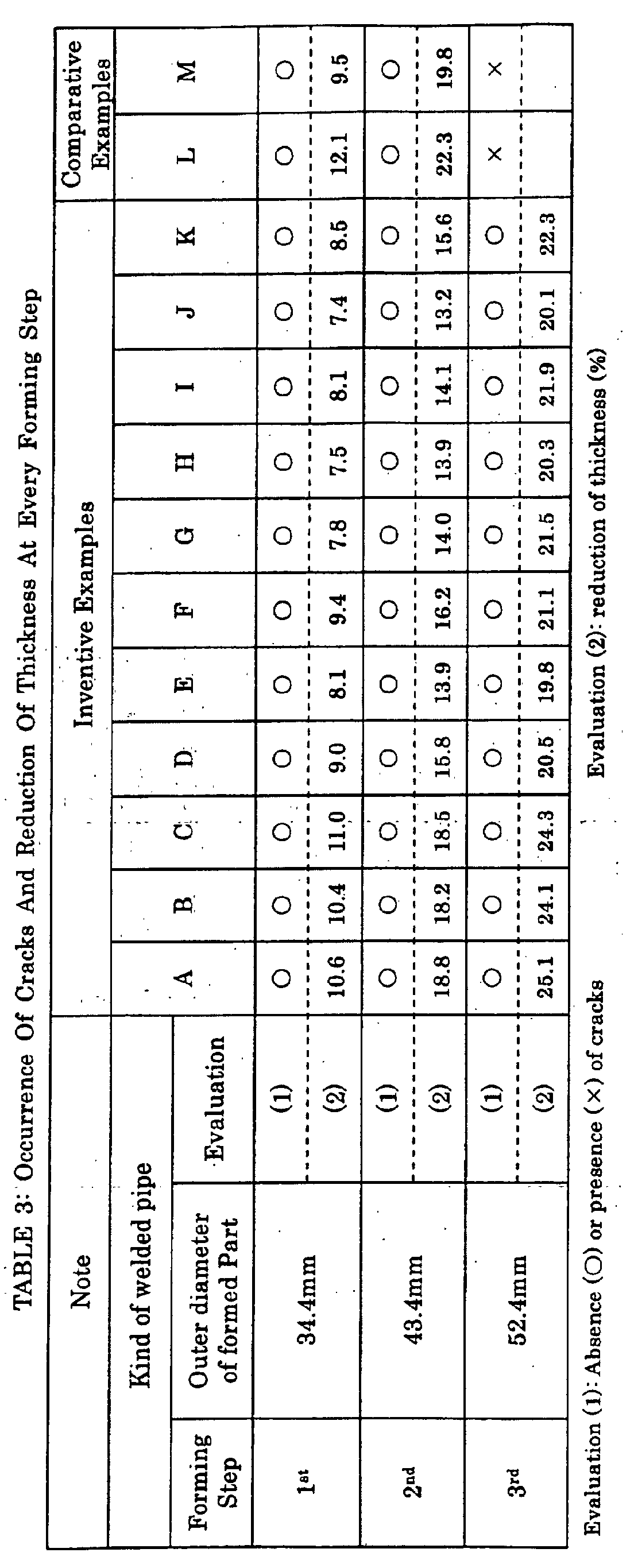
- a welded pipe L was easily buckled during expanding, since it was hard (185 HV) with a large work-hardening coefficient of 0.52. Its forming process was necessarily divided to many steps with a small expansion ratio, but an outer diameter of the expanded part was 42.4 mm at most.
- Another welded pipe M of a ferritic stainless steel was formed with a large reduction of thickness, since it had poor ductility with elongation of 28% and Lankford value of 1.16. Therefore, its expansion ratio without cracks was 42.4 mm at most.
- any welded pipe which was made of a austenitic stainless steel with controlled hardness and work-hardening coefficient, was expanded to an outer diameter of 51.4 mm (in other words, a sufficient inner diameter for a fuel-supply opening) at its end.
- a welded pipe of a Cr-Ni austenitic stainless steel containing Cu was formed to an objective outer diameter in five steps, and also formed to 53.0 mm in outer diameter without cracks.
- Welded pipes of ferritic stainless steels with controlled elongation and Lankford value were also formed to an outer diameter of 51.4 mm without cracks.
- Sectional hardness of an expanded part of each welded pipe was measured at every forming step, so as to research change of hardness in advance of forming steps. Results are shown in Fig. 1 . It is noted that a welded pipe L was excessively hardened up to 550 HV when its end was expanded to 42.4 mm in outer diameter.
- welded pipes A and D were slightly hardened to 460 HV and 315 HV, respectively, although they were made of the same type of austenitic stainless steel. These results prove that the austenitic stainless steels for the welded pipes A and D were materials hardly work-hardened.
- Another welded pipe J of a ferritic stainless steel was softer in a expanded state compared with austenitic stainless steel, since its work-hardening coefficient was low of 0.21.
- a high-frequency welded pipe of 25.4 mm in outer diameter, 1.0 mm in thickness and 350 mm in length was expanded to an outer diameter of 52.4 mm at its end in three steps shown in Table 3 .
- a load applied to each welded pipe along its axial direction was measured at every forming step.
- Results shown in Fig. 2 prove that a load applied to the welded pipe, which was made of an austenitic stainless steel defined by the present invention, was relatively small.
- a load applied along an axial direction was held at a lower level compared with austenitic stainless steel. Decrease of the load means suppression of heat generated during forming and inhibits sintering a welded pipe with a punch. As a result, a lifetime of a punch was prolonged, and the welded pipe was also formed to a product shape having an inner surface free from defects.
- the fuel-filler tube according to the present invention as above-mentioned is made from a welded pipe of an austenitic stainless steel sheet with hardness of 180 HV or less and a work-hardening coefficient ( n -value) of 0.49 or less or a ferritic stainless steel with elongation of 30% or more by a uniaxial tensile test and Lankford value ( r -value) of 1.2 or more. Since the welded pipe can be expanded to a product shape having an expanded fuel-supply opening at its end without cracks or buckling even under severe conditions. A welded pipe of small diameter can be also formed to a product shape having a fuel-supply opening at its end with high dimensional accuracy, with high expansion ratio. Consequently, a fuel-filler tube in small size is provided as a lightened corrosion-resistance part for an automobile.
Landscapes
- Chemical & Material Sciences (AREA)
- Engineering & Computer Science (AREA)
- Mechanical Engineering (AREA)
- Materials Engineering (AREA)
- Metallurgy (AREA)
- Organic Chemistry (AREA)
- General Engineering & Computer Science (AREA)
- Cooling, Air Intake And Gas Exhaust, And Fuel Tank Arrangements In Propulsion Units (AREA)
- Fuel-Injection Apparatus (AREA)
- Rigid Pipes And Flexible Pipes (AREA)
- Earth Drilling (AREA)
- Heat Treatment Of Articles (AREA)
Abstract
Description


Claims (2)
- A fuel-filler tube made from a pipe of an austenitic stainless steel with hardness of 180 HV or less and a work-hardening coefficient (n-value) of 0.49 or less.
- A fuel-filler tube made from a pipe of a ferritic stainless steel with elongation of 30% or more by a uniaxial tensile test and Lankford value (r-value) of 1.2 or more.
Priority Applications (1)
| Application Number | Priority Date | Filing Date | Title |
|---|---|---|---|
| EP07015790A EP1847749B1 (en) | 2000-08-01 | 2001-07-26 | Stainless steel fuel filler tube |
Applications Claiming Priority (3)
| Application Number | Priority Date | Filing Date | Title |
|---|---|---|---|
| JP2000233415 | 2000-08-01 | ||
| JP2000233415 | 2000-08-01 | ||
| PCT/JP2001/006423 WO2002010631A1 (en) | 2000-08-01 | 2001-07-26 | Stainless steel oil feeding pipe |
Related Child Applications (1)
| Application Number | Title | Priority Date | Filing Date |
|---|---|---|---|
| EP07015790A Division EP1847749B1 (en) | 2000-08-01 | 2001-07-26 | Stainless steel fuel filler tube |
Publications (3)
| Publication Number | Publication Date |
|---|---|
| EP1306600A1 true EP1306600A1 (en) | 2003-05-02 |
| EP1306600A4 EP1306600A4 (en) | 2005-12-21 |
| EP1306600B1 EP1306600B1 (en) | 2007-10-24 |
Family
ID=18725936
Family Applications (2)
| Application Number | Title | Priority Date | Filing Date |
|---|---|---|---|
| EP07015790A Expired - Lifetime EP1847749B1 (en) | 2000-08-01 | 2001-07-26 | Stainless steel fuel filler tube |
| EP01954340A Expired - Lifetime EP1306600B1 (en) | 2000-08-01 | 2001-07-26 | Stainless steel oil feeding pipe |
Family Applications Before (1)
| Application Number | Title | Priority Date | Filing Date |
|---|---|---|---|
| EP07015790A Expired - Lifetime EP1847749B1 (en) | 2000-08-01 | 2001-07-26 | Stainless steel fuel filler tube |
Country Status (8)
| Country | Link |
|---|---|
| US (1) | US6851455B2 (en) |
| EP (2) | EP1847749B1 (en) |
| KR (1) | KR100522660B1 (en) |
| CN (1) | CN1225614C (en) |
| AU (1) | AU2001276678A1 (en) |
| DE (2) | DE60141866D1 (en) |
| ES (2) | ES2344430T3 (en) |
| WO (1) | WO2002010631A1 (en) |
Cited By (5)
| Publication number | Priority date | Publication date | Assignee | Title |
|---|---|---|---|---|
| EP1350653A1 (en) * | 2002-03-27 | 2003-10-08 | Nisshin Steel Co., Ltd. | Corrosion-resistant fuel tank and fuel-filler tube for motor vehicle |
| FR2863668A1 (en) * | 2003-12-16 | 2005-06-17 | Usui Kokusai Sangyo Kk | HIGH PRESSURE FUEL SUPPLY HOSE FOR DIESEL ENGINES |
| WO2015074802A1 (en) * | 2013-11-25 | 2015-05-28 | Exxonmobil Chemical Patents Inc. | Lean duplex stainless steel as construction material |
| EP3239341A4 (en) * | 2014-12-26 | 2018-10-31 | Posco | Austenitic stainless steel having excellent flexibility |
| EP3396000A4 (en) * | 2015-12-23 | 2019-01-23 | Posco | AUSTENITIC STAINLESS STEEL TUBE HAVING EXCELLENT WRINKLE RESISTANCE |
Families Citing this family (10)
| Publication number | Priority date | Publication date | Assignee | Title |
|---|---|---|---|---|
| KR100865413B1 (en) * | 2004-12-22 | 2008-10-24 | 닛폰 스틸 앤드 스미킨 스테인레스 스틸 코포레이션 | Ferritic stainless steel welded pipe excellent in pipe expanding workability |
| JP4959937B2 (en) * | 2004-12-27 | 2012-06-27 | 株式会社日立産機システム | Distribution transformer with corrosion diagnostic components |
| US8091588B2 (en) * | 2008-05-30 | 2012-01-10 | Fluid Routing Solutions, Inc. | Metallic tubular structure |
| KR101756701B1 (en) * | 2015-12-23 | 2017-07-12 | 주식회사 포스코 | Austenitic stainless steel with increased workability |
| EP3301199B1 (en) * | 2016-03-28 | 2021-01-20 | LG Electronics Inc. -1- | Bent pipe made of stainless steel |
| KR20180111416A (en) * | 2017-03-31 | 2018-10-11 | 엘지전자 주식회사 | Ductile stainless steel pipe |
| KR20180138070A (en) * | 2017-06-20 | 2018-12-28 | 엘지전자 주식회사 | Absorpotion Chiller |
| JP2019113004A (en) * | 2017-12-25 | 2019-07-11 | 臼井国際産業株式会社 | Rail for high-pressure direct injection |
| KR102120700B1 (en) | 2018-09-13 | 2020-06-09 | 주식회사 포스코 | Austenitic stainless steel with excellent hole expanding workability and resistance of season cracking |
| JP7165161B2 (en) * | 2019-08-09 | 2022-11-02 | 株式会社三五 | Building piping system and construction method of the system |
Family Cites Families (25)
| Publication number | Priority date | Publication date | Assignee | Title |
|---|---|---|---|---|
| GB788468A (en) * | 1954-07-30 | 1958-01-02 | Babcock & Wilcox Co | Forgeable high strength austenitic alloy steel with niobium-tantalum addition |
| US3884731A (en) * | 1964-07-02 | 1975-05-20 | Reynolds Metals Co | Metal composite and method of producing the same |
| GB1224489A (en) * | 1968-03-06 | 1971-03-10 | Armco Steel Corp | Stainless steel, products and method |
| US3785787A (en) * | 1972-10-06 | 1974-01-15 | Nippon Yakin Kogyo Co Ltd | Stainless steel with high resistance against corrosion and welding cracks |
| JPS5129854B2 (en) * | 1973-04-21 | 1976-08-27 | ||
| US4034994A (en) * | 1973-05-07 | 1977-07-12 | Kubota Engineering Co, Ltd. | Tubular end structure of pipe |
| US4134430A (en) * | 1976-03-26 | 1979-01-16 | Usui International Industry, Ltd. | High pressure fuel injection pipe |
| US4558721A (en) * | 1982-09-28 | 1985-12-17 | Apx Group Inc. | Double walled tubing |
| JPS60220281A (en) | 1984-04-12 | 1985-11-02 | 川崎製鉄株式会社 | Corrosion-resistant double pipe |
| US4609577A (en) * | 1985-01-10 | 1986-09-02 | Armco Inc. | Method of producing weld overlay of austenitic stainless steel |
| DE3742539A1 (en) * | 1987-12-16 | 1989-07-06 | Thyssen Stahl Ag | METHOD FOR PRODUCING PLATED WARM RIBBON AND FOLLOWING PRODUCED PLATED WARM RIBBON |
| JPH04247851A (en) | 1991-01-22 | 1992-09-03 | Kobe Steel Ltd | High mn austenitic steel |
| JP3217088B2 (en) * | 1991-07-26 | 2001-10-09 | 三桜工業株式会社 | Stainless steel multiple winding pipe |
| JPH0641689A (en) | 1992-06-22 | 1994-02-15 | Nippon Steel Corp | High cr steel tube excellent in workability |
| TW363082B (en) * | 1994-04-26 | 1999-07-01 | Nippon Steel Corp | Steel sheet having high strength and being suited to deep drawing and process for producing the same |
| JP2933826B2 (en) * | 1994-07-05 | 1999-08-16 | 川崎製鉄株式会社 | Chromium steel sheet excellent in deep drawing formability and secondary work brittleness and method for producing the same |
| JPH1088293A (en) * | 1996-04-16 | 1998-04-07 | Nippon Steel Corp | Alloy having corrosion resistance in an environment in which inferior fuel and waste are burned, steel pipe using the alloy, and method of manufacturing the same |
| JPH1052713A (en) | 1996-08-12 | 1998-02-24 | Nkk Corp | Steel pipe excellent in earthquake resistance and manufacturing method thereof |
| JP3841372B2 (en) * | 1997-02-26 | 2006-11-01 | 臼井国際産業株式会社 | High pressure fuel injection pipe and manufacturing method thereof |
| JPH11256279A (en) * | 1998-03-09 | 1999-09-21 | Nisshin Steel Co Ltd | Stainless steel plate with antibacterial characteristic, and its production |
| CN1089046C (en) * | 1998-06-03 | 2002-08-14 | 住友特殊金属株式会社 | Clad meterial and method of manufacturing the material |
| JP2000063996A (en) * | 1998-08-18 | 2000-02-29 | Nisshin Steel Co Ltd | Austenitic stainless steel excellent in machinability and antibacterial characteristic |
| CA2285732A1 (en) * | 1998-10-08 | 2000-04-08 | Daido Tokushuko Kabushiki Kaisha | Expandable metal-pipe bonded body and manufacturing method thereof |
| EP1176220B9 (en) * | 2000-07-25 | 2004-04-21 | JFE Steel Corporation | Ferritic stainless steel sheet having superior workability at room temperatures and mechanical characteristics at high temperatures, and method of producing the same |
| JP3769479B2 (en) * | 2000-08-07 | 2006-04-26 | 新日鐵住金ステンレス株式会社 | Ferritic stainless steel sheet for fuel tanks with excellent press formability |
-
2001
- 2001-07-26 DE DE60141866T patent/DE60141866D1/en not_active Expired - Lifetime
- 2001-07-26 KR KR10-2003-7001434A patent/KR100522660B1/en not_active Expired - Fee Related
- 2001-07-26 EP EP07015790A patent/EP1847749B1/en not_active Expired - Lifetime
- 2001-07-26 ES ES07015790T patent/ES2344430T3/en not_active Expired - Lifetime
- 2001-07-26 EP EP01954340A patent/EP1306600B1/en not_active Expired - Lifetime
- 2001-07-26 ES ES01954340T patent/ES2294013T3/en not_active Expired - Lifetime
- 2001-07-26 WO PCT/JP2001/006423 patent/WO2002010631A1/en not_active Ceased
- 2001-07-26 DE DE60131083T patent/DE60131083T2/en not_active Expired - Lifetime
- 2001-07-26 US US10/343,244 patent/US6851455B2/en not_active Expired - Lifetime
- 2001-07-26 AU AU2001276678A patent/AU2001276678A1/en not_active Abandoned
- 2001-07-26 CN CNB018137466A patent/CN1225614C/en not_active Expired - Lifetime
Cited By (5)
| Publication number | Priority date | Publication date | Assignee | Title |
|---|---|---|---|---|
| EP1350653A1 (en) * | 2002-03-27 | 2003-10-08 | Nisshin Steel Co., Ltd. | Corrosion-resistant fuel tank and fuel-filler tube for motor vehicle |
| FR2863668A1 (en) * | 2003-12-16 | 2005-06-17 | Usui Kokusai Sangyo Kk | HIGH PRESSURE FUEL SUPPLY HOSE FOR DIESEL ENGINES |
| WO2015074802A1 (en) * | 2013-11-25 | 2015-05-28 | Exxonmobil Chemical Patents Inc. | Lean duplex stainless steel as construction material |
| EP3239341A4 (en) * | 2014-12-26 | 2018-10-31 | Posco | Austenitic stainless steel having excellent flexibility |
| EP3396000A4 (en) * | 2015-12-23 | 2019-01-23 | Posco | AUSTENITIC STAINLESS STEEL TUBE HAVING EXCELLENT WRINKLE RESISTANCE |
Also Published As
| Publication number | Publication date |
|---|---|
| CN1225614C (en) | 2005-11-02 |
| EP1847749B1 (en) | 2010-04-14 |
| EP1847749A3 (en) | 2007-12-05 |
| ES2344430T3 (en) | 2010-08-26 |
| CN1446295A (en) | 2003-10-01 |
| US20030183292A1 (en) | 2003-10-02 |
| EP1306600B1 (en) | 2007-10-24 |
| KR20030026330A (en) | 2003-03-31 |
| DE60131083D1 (en) | 2007-12-06 |
| DE60141866D1 (en) | 2010-05-27 |
| ES2294013T3 (en) | 2008-04-01 |
| EP1306600A4 (en) | 2005-12-21 |
| AU2001276678A1 (en) | 2002-02-13 |
| WO2002010631A1 (en) | 2002-02-07 |
| US6851455B2 (en) | 2005-02-08 |
| EP1847749A2 (en) | 2007-10-24 |
| DE60131083T2 (en) | 2008-08-07 |
| KR100522660B1 (en) | 2005-10-19 |
Similar Documents
| Publication | Publication Date | Title |
|---|---|---|
| US6851455B2 (en) | Stainless steel oil feeding pipe | |
| Washko et al. | Wrought stainless steels | |
| RU2698235C1 (en) | Two-phase stainless steel and its manufacturing method | |
| CN101395293B (en) | Surface-treated stainless-steel sheet excellent in salt damage/corrosion resistance and weld reliability for automotive fuel tank and for automotive fuel pipe and surface-treated stainless-steel welded pipe with excellent suitability for pipe expansion processing for automotive petrol pipe | |
| KR100501625B1 (en) | Ferritic stainless steel sheet for fuel tank and fuel pipe and method for making the same | |
| US6935529B2 (en) | Stainless steel fuel tank for automobile | |
| US20100047609A1 (en) | Electric resistance welded steel tube for heat treatment and method for manufacturing the same | |
| JP5155634B2 (en) | Stainless steel wire for hydrogen resistant spring and hydrogen resistant spring product using the same | |
| RU2225793C2 (en) | Clad corrosion resistant steel and an item made out of it | |
| JP6660789B2 (en) | Ferritic stainless steel sheet for fuel pump member and fuel pump member | |
| JP2010090442A (en) | High workability and high strength steel pipe having excellent chemical treatment property and method for producing the same | |
| US7341795B2 (en) | Fe-Cr alloy structure with excellent corrosion resistance and excellent adhesion, and manufacturing method thereof | |
| EP1889936B1 (en) | Ferrite stainless steel sheet for bellows stock pipe | |
| JP4907079B2 (en) | Ferritic stainless steel welded pipe with excellent pipe workability and ferritic stainless steel sheet for welded pipe | |
| JP2002226945A (en) | Steel pipe and method of manufacturing the same | |
| KR100865413B1 (en) | Ferritic stainless steel welded pipe excellent in pipe expanding workability | |
| RU2115559C1 (en) | Clad corrosion-resistant steel and article manufactured of it | |
| JP3470632B2 (en) | Steel pipe for line pipe excellent in buckling resistance and method of manufacturing the same | |
| JP5000472B2 (en) | Ferritic stainless steel welded pipe excellent in pipe expansion workability and manufacturing method thereof | |
| JP2002060972A (en) | Stainless steel sheet for automobile fuel tank | |
| JP4775840B2 (en) | Stainless steel pipe for high expansion and its manufacturing method | |
| Caminada et al. | Ferritic and Austenitic Grades for the New Generation of Steam Power Plants | |
| JP2007016310A (en) | Ferritic stainless steel sheet for bellows tube | |
| CN101171352A (en) | Ferrite stainless steel plate for corrugated pipe stock pipe | |
| Levy et al. | Tensile Properties of Steel Tubes for Hydroforming Applications |
Legal Events
| Date | Code | Title | Description |
|---|---|---|---|
| PUAI | Public reference made under article 153(3) epc to a published international application that has entered the european phase |
Free format text: ORIGINAL CODE: 0009012 |
|
| 17P | Request for examination filed |
Effective date: 20030220 |
|
| AK | Designated contracting states |
Designated state(s): AT BE CH CY DE DK ES FI FR GB GR IE IT LI LU MC NL PT SE TR |
|
| AX | Request for extension of the european patent |
Extension state: AL LT LV MK RO SI |
|
| RBV | Designated contracting states (corrected) |
Designated state(s): DE ES FR GB IT SE |
|
| RIC1 | Information provided on ipc code assigned before grant |
Ipc: 7F 16L 9/02 A Ipc: 7C 22C 38/18 B Ipc: 7C 22C 38/40 B Ipc: 7B 60K 15/04 B |
|
| A4 | Supplementary search report drawn up and despatched |
Effective date: 20051104 |
|
| 17Q | First examination report despatched |
Effective date: 20060420 |
|
| GRAP | Despatch of communication of intention to grant a patent |
Free format text: ORIGINAL CODE: EPIDOSNIGR1 |
|
| GRAS | Grant fee paid |
Free format text: ORIGINAL CODE: EPIDOSNIGR3 |
|
| GRAA | (expected) grant |
Free format text: ORIGINAL CODE: 0009210 |
|
| AK | Designated contracting states |
Kind code of ref document: B1 Designated state(s): DE ES FR GB IT SE |
|
| REG | Reference to a national code |
Ref country code: GB Ref legal event code: FG4D |
|
| REF | Corresponds to: |
Ref document number: 60131083 Country of ref document: DE Date of ref document: 20071206 Kind code of ref document: P |
|
| REG | Reference to a national code |
Ref country code: SE Ref legal event code: TRGR |
|
| ET | Fr: translation filed | ||
| REG | Reference to a national code |
Ref country code: ES Ref legal event code: FG2A Ref document number: 2294013 Country of ref document: ES Kind code of ref document: T3 |
|
| PLBE | No opposition filed within time limit |
Free format text: ORIGINAL CODE: 0009261 |
|
| STAA | Information on the status of an ep patent application or granted ep patent |
Free format text: STATUS: NO OPPOSITION FILED WITHIN TIME LIMIT |
|
| 26N | No opposition filed |
Effective date: 20080725 |
|
| REG | Reference to a national code |
Ref country code: FR Ref legal event code: PLFP Year of fee payment: 16 |
|
| REG | Reference to a national code |
Ref country code: FR Ref legal event code: PLFP Year of fee payment: 17 |
|
| REG | Reference to a national code |
Ref country code: FR Ref legal event code: PLFP Year of fee payment: 18 |
|
| PGFP | Annual fee paid to national office [announced via postgrant information from national office to epo] |
Ref country code: FR Payment date: 20200721 Year of fee payment: 20 Ref country code: DE Payment date: 20200721 Year of fee payment: 20 Ref country code: GB Payment date: 20200727 Year of fee payment: 20 Ref country code: ES Payment date: 20200922 Year of fee payment: 20 |
|
| PGFP | Annual fee paid to national office [announced via postgrant information from national office to epo] |
Ref country code: SE Payment date: 20200727 Year of fee payment: 20 Ref country code: IT Payment date: 20200724 Year of fee payment: 20 |
|
| REG | Reference to a national code |
Ref country code: DE Ref legal event code: R071 Ref document number: 60131083 Country of ref document: DE |
|
| REG | Reference to a national code |
Ref country code: GB Ref legal event code: PE20 Expiry date: 20210725 |
|
| REG | Reference to a national code |
Ref country code: SE Ref legal event code: EUG |
|
| PG25 | Lapsed in a contracting state [announced via postgrant information from national office to epo] |
Ref country code: GB Free format text: LAPSE BECAUSE OF EXPIRATION OF PROTECTION Effective date: 20210725 |
|
| PG25 | Lapsed in a contracting state [announced via postgrant information from national office to epo] |
Ref country code: ES Free format text: LAPSE BECAUSE OF EXPIRATION OF PROTECTION Effective date: 20210727 |