EP1306279A1 - Brake booster - Google Patents
Brake booster Download PDFInfo
- Publication number
- EP1306279A1 EP1306279A1 EP02255776A EP02255776A EP1306279A1 EP 1306279 A1 EP1306279 A1 EP 1306279A1 EP 02255776 A EP02255776 A EP 02255776A EP 02255776 A EP02255776 A EP 02255776A EP 1306279 A1 EP1306279 A1 EP 1306279A1
- Authority
- EP
- European Patent Office
- Prior art keywords
- valve
- tubular member
- valve body
- inoperative position
- plunger
- Prior art date
- Legal status (The legal status is an assumption and is not a legal conclusion. Google has not performed a legal analysis and makes no representation as to the accuracy of the status listed.)
- Granted
Links
- 230000007246 mechanism Effects 0.000 claims description 14
- 230000033001 locomotion Effects 0.000 claims description 13
- 230000000717 retained effect Effects 0.000 claims description 10
- 230000014759 maintenance of location Effects 0.000 claims description 5
- 239000012530 fluid Substances 0.000 claims description 4
- 230000000994 depressogenic effect Effects 0.000 abstract description 13
- 230000004044 response Effects 0.000 abstract description 11
- 230000002093 peripheral effect Effects 0.000 description 12
- 230000005489 elastic deformation Effects 0.000 description 6
- 238000010276 construction Methods 0.000 description 4
- 230000000694 effects Effects 0.000 description 4
- 238000004891 communication Methods 0.000 description 3
- 230000005540 biological transmission Effects 0.000 description 2
- 230000000881 depressing effect Effects 0.000 description 2
- 229910000639 Spring steel Inorganic materials 0.000 description 1
- 238000013459 approach Methods 0.000 description 1
- 230000006872 improvement Effects 0.000 description 1
- 238000004519 manufacturing process Methods 0.000 description 1
- 239000002184 metal Substances 0.000 description 1
- 238000000034 method Methods 0.000 description 1
- 230000008569 process Effects 0.000 description 1
- 238000000638 solvent extraction Methods 0.000 description 1
- 229920003002 synthetic resin Polymers 0.000 description 1
- 239000000057 synthetic resin Substances 0.000 description 1
Images




Classifications
-
- B—PERFORMING OPERATIONS; TRANSPORTING
- B60—VEHICLES IN GENERAL
- B60T—VEHICLE BRAKE CONTROL SYSTEMS OR PARTS THEREOF; BRAKE CONTROL SYSTEMS OR PARTS THEREOF, IN GENERAL; ARRANGEMENT OF BRAKING ELEMENTS ON VEHICLES IN GENERAL; PORTABLE DEVICES FOR PREVENTING UNWANTED MOVEMENT OF VEHICLES; VEHICLE MODIFICATIONS TO FACILITATE COOLING OF BRAKES
- B60T13/00—Transmitting braking action from initiating means to ultimate brake actuator with power assistance or drive; Brake systems incorporating such transmitting means, e.g. air-pressure brake systems
- B60T13/10—Transmitting braking action from initiating means to ultimate brake actuator with power assistance or drive; Brake systems incorporating such transmitting means, e.g. air-pressure brake systems with fluid assistance, drive, or release
- B60T13/24—Transmitting braking action from initiating means to ultimate brake actuator with power assistance or drive; Brake systems incorporating such transmitting means, e.g. air-pressure brake systems with fluid assistance, drive, or release the fluid being gaseous
- B60T13/46—Vacuum systems
- B60T13/52—Vacuum systems indirect, i.e. vacuum booster units
- B60T13/573—Vacuum systems indirect, i.e. vacuum booster units characterised by reaction devices
- B60T13/575—Vacuum systems indirect, i.e. vacuum booster units characterised by reaction devices using resilient discs or pads
-
- B—PERFORMING OPERATIONS; TRANSPORTING
- B60—VEHICLES IN GENERAL
- B60T—VEHICLE BRAKE CONTROL SYSTEMS OR PARTS THEREOF; BRAKE CONTROL SYSTEMS OR PARTS THEREOF, IN GENERAL; ARRANGEMENT OF BRAKING ELEMENTS ON VEHICLES IN GENERAL; PORTABLE DEVICES FOR PREVENTING UNWANTED MOVEMENT OF VEHICLES; VEHICLE MODIFICATIONS TO FACILITATE COOLING OF BRAKES
- B60T13/00—Transmitting braking action from initiating means to ultimate brake actuator with power assistance or drive; Brake systems incorporating such transmitting means, e.g. air-pressure brake systems
- B60T13/10—Transmitting braking action from initiating means to ultimate brake actuator with power assistance or drive; Brake systems incorporating such transmitting means, e.g. air-pressure brake systems with fluid assistance, drive, or release
- B60T13/24—Transmitting braking action from initiating means to ultimate brake actuator with power assistance or drive; Brake systems incorporating such transmitting means, e.g. air-pressure brake systems with fluid assistance, drive, or release the fluid being gaseous
- B60T13/46—Vacuum systems
- B60T13/52—Vacuum systems indirect, i.e. vacuum booster units
- B60T13/573—Vacuum systems indirect, i.e. vacuum booster units characterised by reaction devices
-
- B—PERFORMING OPERATIONS; TRANSPORTING
- B60—VEHICLES IN GENERAL
- B60T—VEHICLE BRAKE CONTROL SYSTEMS OR PARTS THEREOF; BRAKE CONTROL SYSTEMS OR PARTS THEREOF, IN GENERAL; ARRANGEMENT OF BRAKING ELEMENTS ON VEHICLES IN GENERAL; PORTABLE DEVICES FOR PREVENTING UNWANTED MOVEMENT OF VEHICLES; VEHICLE MODIFICATIONS TO FACILITATE COOLING OF BRAKES
- B60T13/00—Transmitting braking action from initiating means to ultimate brake actuator with power assistance or drive; Brake systems incorporating such transmitting means, e.g. air-pressure brake systems
- B60T13/10—Transmitting braking action from initiating means to ultimate brake actuator with power assistance or drive; Brake systems incorporating such transmitting means, e.g. air-pressure brake systems with fluid assistance, drive, or release
- B60T13/24—Transmitting braking action from initiating means to ultimate brake actuator with power assistance or drive; Brake systems incorporating such transmitting means, e.g. air-pressure brake systems with fluid assistance, drive, or release the fluid being gaseous
- B60T13/46—Vacuum systems
- B60T13/52—Vacuum systems indirect, i.e. vacuum booster units
- B60T13/57—Vacuum systems indirect, i.e. vacuum booster units characterised by constructional features of control valves
-
- B—PERFORMING OPERATIONS; TRANSPORTING
- B60—VEHICLES IN GENERAL
- B60T—VEHICLE BRAKE CONTROL SYSTEMS OR PARTS THEREOF; BRAKE CONTROL SYSTEMS OR PARTS THEREOF, IN GENERAL; ARRANGEMENT OF BRAKING ELEMENTS ON VEHICLES IN GENERAL; PORTABLE DEVICES FOR PREVENTING UNWANTED MOVEMENT OF VEHICLES; VEHICLE MODIFICATIONS TO FACILITATE COOLING OF BRAKES
- B60T8/00—Arrangements for adjusting wheel-braking force to meet varying vehicular or ground-surface conditions, e.g. limiting or varying distribution of braking force
- B60T8/32—Arrangements for adjusting wheel-braking force to meet varying vehicular or ground-surface conditions, e.g. limiting or varying distribution of braking force responsive to a speed condition, e.g. acceleration or deceleration
- B60T8/321—Arrangements for adjusting wheel-braking force to meet varying vehicular or ground-surface conditions, e.g. limiting or varying distribution of braking force responsive to a speed condition, e.g. acceleration or deceleration deceleration
- B60T8/3255—Systems in which the braking action is dependent on brake pedal data
- B60T8/3275—Systems with a braking assistant function, i.e. automatic full braking initiation in dependence of brake pedal velocity
Definitions
- the invention relates to a brake booster, and more particularly, to a brake booster which assures that an increased output can be obtained in response to a force of depression of a small magnitude which is applied to a brake pedal in the event a braking effort of an increased magnitude is required as in an emergency brake.
- a brake booster which is arranged to permit an increased output to be obtained even in response to a brake depressing force of a small magnitude as in an emergency brake which requires a braking effort of an increased magnitude is known in the art, as exemplified by Japanese Patent No. 3,070,672 disclosing a brake booster in which in response to an input which exceeds a given value, an output gradient is increased subsequently to increase the output, or a Japanese Laid-Open Patent Application No. 35,474/1998 disclosing a brake booster in which an operation of a brake pedal is electrically detected, and the output is increased in response thereto.
- the present invention relates to a brake booster including a valve body slidably disposed within a shell, a power piston mounted on the valve body, a constant pressure chamber disposed forwardly of the power piston within the shell, a variable pressure chamber disposed rearwardly of the power piston within the shell, a valve mechanism disposed within the valve body for controlling a switching between the supply/discharge of a fluid to and from the variable pressure chamber, and an input shaft for operating the valve mechanism, the valve mechanism comprising a valve plunger connected to the input shaft and having an atmosphere valve seat, a vacuum valve seat formed within the valve body and a valve element which can be seated upon the atmosphere valve seat and the vacuum valve seat.
- the brake booster further comprises a tubular member slidably disposed within the valve body and having the vacuum valve seat formed thereon, retainer means for causing the tubular member to be retracted relative to the valve body so that the vacuum valve seat is seated upon the valve element when the input shaft is advanced from its inoperative position through a given stroke relative to the valve body, and for retaining the tubular member at a position which is reached by retracting through a given stroke relative to the valve body, and release means for releasing the retention of the tubular member by the retainer means to allow the tubular member to return to its inoperative position when the input shaft returns to its inoperative position.
- the second aspect of the present invention relates to a brake booster including a valve body slidably disposed within a shell, a power piston mounted on the valve body, a constant pressure chamber formed forwardly of and a variable pressure chamber formed rearwardly of the power piston within the shell, a valve mechanism disposed within the valve body for switching a supply/discharge of a fluid to or from the variable pressure chamber, and an input shaft for operating the valve mechanism, the valve mechanism comprising a valve plunger connected to the input shaft and having an atmosphere valve seat formed thereon, a first vacuum valve seat formed on the valve body and a valve element which can be seated upon the atmosphere valve seat and the first vacuum valve seat.
- the brake booster further comprises a tubular member slidably disposed within the valve body and having a second vacuum valve seat juxtaposed to the first vacuum valve seat, retainer means for causing the tubular member to be retracted relative to the valve body to permit the second vacuum valve seat to be seated upon the valve element when the input shaft is advanced from its inoperative position through a given stroke relative to the valve body and for retaining the tubular member at a position which is reached by retracting through a given stroke relative to the valve body, and release means for releasing the retention of the tubular member by the retainer means to allow the tubular member to return to its inoperative position when the input shaft has returned to its inoperative position.
- the input shaft is advanced from its inoperative position through a given stroke or more relative to the valve body, whereby the tubular member is caused to retract relative to the valve body. Consequently, the vacuum valve seat (second vacuum valve seat) formed on the tubular member and the valve element which is seated thereon are caused to retract through a given stroke or more relative to the valve body and is retained in such positions by the retainer means.
- This allows an atmosphere valve which is formed by the combination of the atmosphere valve seat and the valve element to be opened to a greater opening than during a normal operation, allowing the atmosphere to be rapidly introduced into the variable pressure chamber to enable an output from the brake booster to increase rapidly to a greater value.
- a brake booster which is simple in construction and which is capable of immediately increasing the output in response to a quick depression of a brake pedal.
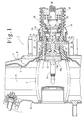
- a brake booster 1 has a shell 2, in which a substantially tubular valve body 3 is slidably disposed. Toward the rear end, the outer periphery of the valve body 3 projects externally through a rear opening 2a of the shell 2 in which an annular seal member 4 is disposed to maintain a hermetic seal between the outer periphery of the valve body 3 toward the rear end and the opening 2a in the shell 2.
- a power piston 5 is connected around the outer periphery of the valve body 3, and a diaphragm 6 is applied to the back surface of the power piston 5, thus partitioning the interior of the shell 2 into a forwardly located constant pressure chamber A and a rearwardly located variable pressure chamber B.
- the shell 2 has a front wall 2b, to which a negative pressure introducing tube 7 is connected, through which a negative pressure is normally introduced into the constant pressure chamber A.
- a return spring 8 is disposed within the constant pressure chamber A to urge the valve body 3 normally rearward, and accordingly, in the inoperative condition of the brake booster 1 shown in Figs. 1 and 2, the valve body 3 as urged by the return spring 8 remains at rest in its inoperative position shown.
- a holder 11 in the form of a stepped cylinder is fitted into the inner periphery of the valve body 3 toward its front end.
- An annular seal member 12 maintains a hermetic seal between the outer periphery of the holder 11 and the inner periphery of the valve body 3.
- the holder 11 constitutes part of the valve body 3, and the holder 11 may be formed integrally with the valve body 3.
- the holder 11 Toward the front end, the holder 11 includes an increased diameter portion 11a in which a reaction disc 13 is received, and the outer periphery of a plate plunger 14a, which forms a part of a valve plunger 14, is slidably fitted into the inner periphery of the holder 11 at a location rearward of the increased diameter portion 11a. In this manner, the reaction disc 13 and the valve plunger 14 are disposed in opposing relationship with each other.
- the holder 11 Toward the rear end, the holder 11 includes a reduced diameter portion 11b, the outer periphery of which is tapered, thus reducing its diameter toward the rear end.
- An output shaft 15 is disposed forwardly of the reaction disc 13, and has one end 15a which is slidably fitted into the increased diameter portion 11a of the holder 11 to abut against the reaction disc 13 from the front side thereof. In this manner, the reaction disc 13 is held sandwiched between the rear end face of the end 15a of the output shaft 15 and the stepped end face of the holder 11.
- An opening is formed in the front wall 2b of the shell 2 to allow a housing and a piston of a master cylinder, not shown, to be inserted in the constant pressure chamber A, and the front end of the output shaft 15 is disposed in abutment against the piston of the master cylinder.
- a valve mechanism 16 which switches a communication between the constant pressure chamber A and the variable pressure chamber B and the communication between the variable pressure chamber B and the atmosphere is received within the valve body 3.
- the valve mechanism 16 of this embodiment comprises an annular first vacuum valve seat 17 formed on the inner periphery of the valve body 3, a tubular member 21 slidably fitted into the inner periphery of the valve body 3 while maintaining a hermetic seal therewith and having a rear end on which a second vacuum valve seat 18 is formed, a valve plunger 14 slidably fitted into and extending though the tubular member 21 and formed with an atmosphere valve seat 22 at its rear end, and a valve element 24 which is adapted to be seated on the both vacuum valve seats 17, 18 and the atmosphere valve seat 22 from the rear side under the resilience of a spring 23.
- the valve element 24 comprises a first member 25 which is located forwardly and formed of a rigid body, and a second member 26 which is located rearwardly and formed of rubber and connected to the first member 25.
- a rubber ring is attached on the front side of the first member 25 to define a first seat area S1.
- a plate 27 which is formed of a rigid body is mounted on the front side of the second member 26 and an annular rubber member is applied to the plate 17 to define a second seat area S2.
- the atmosphere valve seat 22 which is formed on the valve plunger 14 is located. inside the first member 25 to be disposed in opposing relationship with the second seat area S2.
- the spring 23 extends between the plate 27 and an input shaft 28, thus normally urging the valve element 24 forward.
- the both vacuum valve seats 17, 18 are juxtaposed to be adjacent to each other radially of the valve body 3.
- a combination of the both vacuum valve seats 17, 18 and the first seat area S1 on the valve element 24 which moves into engagement with or disengagement from the valve seats defines a vacuum valve 31.
- a space located radially outward of the vacuum valve 31 communicates with the constant pressure chamber A through a constant pressure passage 32 formed in the valve body 3.
- a combination of the atmosphere valve seat 22 formed on the valve plunger 14 and the second seat area S2 on the valve element 24 which moves into engagement with or disengagement from the valve seat 22 defines an atmosphere valve 33.
- a space located between the vacuum valve 31 and the atmosphere valve 33 communicates with the variable pressure chamber B through a variable pressure passage 34, which is formed by a radial opening formed in the valve body 3.
- a space located radially inward of the atmosphere valve 33 communicates with the atmosphere through an atmosphere passage 35 formed in the valve body 3 and a filter 36 disposed therein.
- a rear end of the valve plunger 14 is pivotally connected with a front end of the input shaft 28, and a spring 37 having a greater resilience than the spring 23 is disposed between a retainer 39 fitted into the valve body 3 and the outer periphery of the input shaft 28.
- the other end of the input shaft 28 is connected to a brake pedal, not shown.
- a key member 38 which is known in itself, passes through the variable pressure passage 34 in the valve body 3, and then passes through a radial opening 21b in the tubular member 21before it is engaged with an engaging portion 14b of the valve plunger 14.
- valve body 3 Since the valve body 3 is normally urged rearward by the return spring 8, in the inoperative condition of the brake booster 1 shown in Figs. 1 and 2, the key member 38 abuts against a rear wall 2c of the shell 2.
- a front end face of the variable pressure passage 34 is disposed in abutment against the key member 38 as are the front end face of the radial opening 21b formed in the tubular member 21 and the front end face of the engaging portion 14b of the valve plunger 14.
- the second seat area S2 on the valve element 24 is seated on the atmosphere valve seat 22 to close the atmosphere valve 33, while the first seat area S1 of the valve element 24 is removed from the both vacuum valve seats 17, 18 to open the vacuum valve 31.
- the chambers A and B communicate with each other, and a negative pressure is introduced into the both chambers.
- reaction disc 13 In the inoperative condition, the rear end face of the reaction disc 13 is slightly spaced from the opposing plate plunger 14a.
- the reaction disc 13 bulges rearward under the influence of a reaction to the output acting upon the output shaft 15, whereby the end face of the reaction disc 13 abuts against the plate plunger 14a.
- a reaction to the output acting upon the output shaft 15 begins to be transmitted from this point in time to the valve plunger 14, the input shaft 28 and the brake pedal, not shown, through the reaction disc 13.
- a lever member 41 is provided in the valve body 3 premising the described arrangement, in order to allow an output from the brake booster 1 to be rapidly increased immediately in response to a quick depression of the brake pedal.
- the lever member 41 is formed of a spring steel to exhibit resilience.
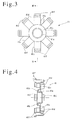
- the lever member 41 includes a cylindrical portion 41a of a reduced diameter in its radially inner portion, and the front end of the cylindrical portion 41a then extends radially outward through a given distance and is subsequently folded back upon itself to provide an annular fitting portion 41b, which in turn continues to eight radial portions 41c which extend radially outward.
- the outer end of each radial portion 41c then extends rearwardly and is folded upon itself forwardly to define an abutment 41d, which continues forwardly to provide an engaging tab 41f which is arcuate in section at the distal end thereof, the tab 41f bulging radially outward.
- the lever member 41 thus constructed serves as retainer means, with the cylindrical portion 41a being positioned in a space outward of the reduced diameter portion 14c at the front end of the valve plunger 14, the annular fitting portion 41b being loosely fitted around the reduced diameter portion 11b of the holder 11 from the rear side, and the eight engaging tabs 41f being disposed in contact with the inner periphery of the valve body 3.
- the arrangement is such that the rear end 11c (the rear end of the reduced diameter portion 11b) of the holder 11 abuts against a boundary between the annular fitting portion 41b and the radial portion 41c of the lever member 41 to provide a fulcrum for the angular movement of the lever member 41, and the eight abutments 41d of the lever member 41 abut against the front end face of the tubular member 21 (see Fig. 2).
- the outer periphery of the tubular member 21 is formed with a flange 21f, and a spring 42 is disposed between the flange 21a and an opposing stepped end face of the valve body 3, thus normally urging the tubular member 21 forward relative to the valve body 3. Accordingly, when the lever member 41 is disposed in abutment against the tubular member 21, the outer portion of the lever member 41 is normally urged forward about the rear end 11c of the holder 11 which acts as the fulcrum for the angular movement.
- the tubular member 21 is formed with a radial opening 21b which radially extend therethrough, and is also formed with an axial groove 21c which continues from the radial opening 21b to the rear end face in an axial opening into which the valve plunger 14 is slidably fitted.
- the key member 38 is passed into the radial opening 21b in the tubular member 21 before engaging the engaging portion 14b of the valve plunger 14.
- the radial opening 21b and the axial groove 21c formed in the tubular member 21 provide an internal space, through which a communication is permitted between the variable pressure passage 34 and the vacuum valve 31 and the atmosphere valve 33.
- An annular seal member 43 is provided around the outer periphery of the tubular member 21 toward the rear end, thus maintaining a hermetic seal between the tubular member 21 and the inner periphery of the valve body 3.
- the second vacuum valve seat 18 is provided by an annular projection formed on the rear end of the tubular member 21.
- an engaging recess 44 which is provided by an annular groove, is formed in the inner peripheral surface of the valve body 3 at a location immediately rearward of the holder 11, and in the inoperative condition shown, the engaging tab 41f of the lever member 41 is located slightly forward of the engaging recess 44 formed in the valve body 3.
- a step 14d of the valve plunger 14 which is located rearward of the reduced diameter portion 14c abuts against the rear end of the cylindrical portion 41a of the lever member 41 to urge it forward.
- the rear end 11c of the holder 11 acts as a center of angular movement, causing the radial portion 41c and its outer portion of the lever member 41 to be retracted rearward, thus causing the tubular member 21 to be retracted rearward relative to the valve body 3.
- the engaging tab 41a of the lever member 41 becomes engaged with the engaging recess 44 in the valve body 3.
- the valve element 24 is caused to retract rearward under the condition that the second vacuum valve seat 18 formed on the tubular member 21 is seated on the first seat area S1. This allows the atmosphere valve 33 to be opened to a greater opening than during a normal operation, whereby the atmosphere is rapidly introduced into the variable pressure chamber B to allow the brake booster 1 to provide a greater output rapidly.
- the input shaft 28 and the valve plunger 14 retract, and come to a stop upon abutment of the key member 38 against the rear wall 2c of the shell 2.
- the tubular member 21 moves forward relative to the valve body 3, whereby the outer portion of the lever member 41 which abuts against the tubular member 21 moves forward, disengaging the engaging tab 41a of the lever member 41 from the engaging recess 44.
- tubular member 21 and the key member 38 constitute together release means which releases the retention of the tubular member 21 by the lever member 41.
- the valve body 3 is stationary as a result of the abutment of the front end face of the variable pressure passage 34 against the key member 38, and the tubular member 21 and the valve plunger 14 are also stationary as a result of the abutment of the front end face of the radial opening 21b in the tubular member 21 and the front end face of the engaging portion 14b of the valve plunger 14 against the key member 38.
- the second seat area S2 of the valve element 24 is seated on the atmosphere valve seat 22 to close the atmosphere valve 33.
- the engaging tab 41f of the lever member 41 is held removed from the engaging recess 44 in the valve body 3 by the tubular member 21 which abuts against the key member 38, and thus is located forwardly thereof.
- the rear end of the cylindrical portion 41a which represents the inner periphery of the lever member 41, is spaced from the step 14d of the valve plunger 14.
- the second vacuum valve seat 18 formed on the tubular member 21 is located at a small distance forward of the first vacuum valve seat 17, and the both vacuum valve seats 17, 18 are removed from the first seat area S1 of the valve element 24 to open the vacuum valve 31.
- the chambers A and B communicate with each other, and the negative pressure is introduced into the both chambers.
- the rear end face of the reaction disc 13 is slightly spaced from the plate plunger 14a.
- a pressure differential between the negative pressure in the constant pressure chamber A and the atmosphere in the variable pressure chamber B drives the valve body 3 and the output shaft 15 forward.
- a reaction occurs from the output acting upon the output shaft 15 to cause the reaction disc 13 to bulge rearward, resulting in an abutment of the end face of the reaction disc 13 against the plate plunger 14a. From this point in time on, the reaction from the output acting on the output shaft 15 is transmitted through the reaction disc 13 to the valve plunger 14, the input shaft 28 and the brake pedal, not shown.
- valve plunger 14 is not advanced largely relative to the valve body 3, and accordingly the step 14d of the valve plunger 14 cannot abut against the cylindrical portion 41a of the lever member 41.
- the positional relationship between the both vacuum valve seats 17, 18 remain unchanged as in the inoperative condition shown in Fig. 2, and the first seat area S1 of the valve element 24 is seated on the first vacuum valve seat 17.
- the step 14d of the valve plunger 14 abuts against the cylindrical portion 41a of the lever member 41, thus driving the cylindrical portion 41a forward. Accordingly, the radial portion 41c, the abutment 41d and the engaging tab 41f of the lever member 41 retract rearward about the fulcrum of angular movement which is provided by the rear end 11c of the holder 11, whereby the tubular member 21 retracts rearward relative to the valve body 3 against the resilience of the spring 42.
- the atmosphere valve 33 is opened to a larger opening than during a normal operation, rapidly introducing the atmosphere into the variable pressure chamber B to increase the output from the brake booster 1 rapidly.
- a reaction from the output causes the reaction disc 13 to bulge rearward, resulting in an abutment of the reaction disc 13 against the plate plunger 14a to urge the valve plunger 14 rearward.
- the output from the brake booster 1 increases by a corresponding amount. In this manner, there can be obtained an increased output from the brake booster 1 rapidly as an immediate response to a quick depression of the brake pedal.
- valve plunger 14 is driven back rearward to a degree as the force with which the brake pedal is depressed is reduced subsequently, but the tubular member 21 and the valve element 24 are maintained in the conditions mentioned above because the engaging tab 41f of the lever member 41 serving as retainer means is maintained engaged with the engaging recess 44.
- the valve plunger 14 and the input shaft 28 retract, and accordingly, the atmosphere valve seat 22 is seated on the second seat area S2 of the valve element 24 to close the atmosphere valve 33, while the second vacuum valve seat 18 moves away from the first seat area S1 of the valve element 24 to open the vacuum valve 31. Accordingly, the atmosphere in the variable pressure chamber B is displaced into the constant pressure chamber A, causing the valve body 3 and the power piston 5 to retract toward their inoperative positions.
- the key member 38 initially abuts against the rear wall 2c of the shell 2 and comes to a stop, and the valve plunger 14 and the tubular member 21 which are disposed in abutment against the key member 38 cannot retract any further and thus come to a stop at corresponding positions.
- the valve body 3 and the power piston 5 retract subsequently until the front end face of the variable pressure passage 34 abuts against the key member 38.
- valve body 3 retracts rearward relative to the tubular member 21 which remains stationary, it follows that the abutment 41d and the engaging tab 41f of the lever member 41 move forward relative to the valve body 3, whereby the engaging tab 41 is disengaged from the engaging recess 44 in the valve body 3, resuming the inoperative condition shown in Fig. 2.
- a brake booster 1 which is capable of rapidly increasing an output during an emergency brake operation with a construction which is simple enough by merely adding the tubular member 21, the lever member 41 and the spring 42 to a conventional brake booster.
- the brake booster 1 provides a high reliability even during an emergency brake operation because of such a simple construction.
- the lever member 41 is formed with the engaging tab 41f while an annular groove serving as the engaging recess 44 is formed in the inner peripheral surface of the valve body 3.
- an engaging recess may be formed in the lever member 41 while an engaging tab may be formed on the valve body 3.
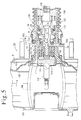
- Figs. 5 and 6 show a second embodiment of the present invention in which the lever member 41 and the engaging recess 44 used in the first embodiment are replaced by a ball 151 and a cylindrical retainer member 152 and related parts.
- a holder 111 has a reduced diameter portion 111b which is extended axially in the rearward direction, creating a cylindrical space between the reduced diameter portion 101b and the inner peripheral surface of a valve body 103, and a cylindrical tubular member 121 is disposed in this space, and its inner periphery is slidably fitted over the reduced diameter portion 111b while the outer periphery of the tubular member 121, toward its rear end, is slidably fitted into the inner periphery of the valve body 103.
- An annular projection 121e is formed around the outer periphery of the tubular member 121, and a spring 142 is disposed between the projection 121 and a stepped end face of the holder 111, thus normally urging the tubular member 121 rearward.
- the inner periphery of the valve body 103 is formed with a stepped end face 103a at a location rearward of the annular projection 121e on the tubular member 121 so as to be disposed opposite thereto for defining a retracted end as the tubular member 121 is moved rearward relative to the valve body 103.
- a second vacuum valve seat 118 is formed on the rear end of the tubular member 121.
- the inner periphery of the tubular member 121 is formed with an annular groove 121d serving as an engaging recess which is engageable with a ball 151.
- the opposite end faces of the annular groove 121d are formed as inclined surfaces so that a spacing between the both end faces is at its maximum at the inner edge thereof.
- the reduced diameter portion 111b of the holder 111 is formed with a plurality of radial openings 111d which are spaced apart at an equal interval circumferentially, and a ball 151 is loosely fitted in each of the radial openings 111d.
- the ball 151 is formed of a metal, and has a spherical diameter which is slightly greater than the wall thickness of the reduced diameter portion 111b at the location where the radial opening 111d is formed. In this manner, each ball 151 is radially moveable along the radial opening 111d in which it is received.
- the reduced diameter portion 111b of the holder 111 is formed with a radial through-opening 111e in alignment with the location of a variable pressure passage 134, and a key member 138 is passed through the through-opening 111e before it engages an engaging portion 114b of a valve plunger 114.
- the reduced diameter portion 114c of the valve plunger 114 has an axial size which is chosen to be twice that of the first embodiment.
- a retainer member 152 is disposed in a space formed between the reduced diameter portion 101b located forward of the key member 138 and the valve plunger 114.
- the inner periphery of the retainer member 152 has a reduced internal diameter to provide a reduced diameter portion 152c toward the front end and has an increased diameter which is greater than that of the reduced diameter portion 152c to provide an increased diameter portion 152a toward the rear end, thereby forming a stepped end face 152b which faces rearward.
- the outer periphery of the retainer member 152 is slidably fitted into the inner periphery of the reduced diameter portion 111b of the holder 111 while simultaneously placing the reduced diameter portion 152c of the retainer member 152 outside the reduced diameter portion 114c of the valve plunger 114 to surround it and to place the increased diameter portion 152a of the retainer member 152 so as to surround the outer periphery of a portion of the valve plunger 114 located rearward of the reduced diameter portion 114c.
- the stepped end face 152b of the retainer member 152 and a step 114d of the valve plunger 114 which is located rearward of the reduced diameter portion 114c are disposed to oppose each other.
- a spring 153 is disposed between the retainer member 152 and the holder 111, thus normally urging the retainer member 152 rearward.
- the ball 151 disposed within each radial opening 111d is prevented from being disengaged from the radial opening 111d by the inner peripheral surface of the tubular member 121 which is located outside and the outer peripheral surface of the retainer member 152 which is located inside.
- the outer peripheral surface of the retainer member 152 is formed with an annular groove 152d serving as an engaging recess which is engageable with the ball 151.
- the opposite end faces of the annular groove 152d are provided as inclined surfaces so that a spacing between the opposite end faces is at its maximum at the outer edges thereof.
- the valve body 103, the tubular member 121, the retainer member 152 and the valve plunger 114 are disposed in abutment against the key member 138.
- the second vacuum valve seat 118 on the tubular member 121 is located forwardly of the first vacuum valve seat 117 on the valve body 103, and the ball 151 is urged outward by the outer peripheral surface of the retainer member 152 which is urged by the spring 153, whereby part of the ball 151 projects externally of the radial opening 111d to be located within the annular groove 121d in the tubular member 121.
- valve plunger 114 is also rapidly driven forward, whereby the step 114d of the valve plunger 114 abuts against the stepped end face 152b of the retainer member 152, causing the latter to be driven forward relative to the holder 111 and the valve body 103.
- the tubular member 121 moves rearward under the resilience of the spring 142, whereby the ball 151 abuts against the front inclined surface of the annular groove 121d.
- the second vacuum valve seat 118 on the tubular member 121 which is moving rearward becomes seated on the valve element 124 which has been seated on the first vacuum valve seat 117, causing the valve element 124 to move away from the first vacuum valve seat 117 to be driven back rearward, thus opening the atmosphere valve 133 to a greater opening than during a usual operation. Consequently, the atmosphere is rapidly introduced into the variable pressure chamber B, allowing an increased output to be delivered from the brake booster 101 rapidly.
- the key member 138 which is engaged with the valve plunger 114 that is now retracting to its inoperative position abuts against the rear wall 102c of the shell 2 and comes to a stop, and subsequently the rear end of the retainer member 152 and the front end face of the radial opening 121b in the tubular member 121 abut against the key member 138, whereby the tubular member 121 comes to a stop.
- valve body 103 continues to retract subsequently under the influence of the return spring 108, it follows that the tubular member 121 moves forward relative to the valve body 103 and the holder 111, and the entire axial region of the annular groove 121d in the tubular member 121 overlaps the radial opening 111d in the holder 111. Accordingly, the ball 151 is urged outward by the inclined surface of the annular groove 152d in the retainer member 152 which is urged by the spring 153, and continues to be urged outward by the front outer peripheral surface of the annular groove 152d. Thus, part of each ball 151 projects externally of the radial opening 111d to be positioned within the annular groove 121d in the tubular member 121, thus returning to the inoperative condition shown in Figs. 5, 6 and 7.
- the tubular member 121, the retainer member 152, the springs 142 and 153 and the balls 151 constitute together retainer means
- the tubular member 121, the retainer member 152, the springs 142 and 153, the valve plunger 114 and the key member 138 constitute together release means.
- the arrangement is similar to the first embodiment, and therefore will not be described.
- the key member 138 abuts against the wall 102c of the shell 102 and remains stationary, and the valve body 103, the tubular member 121, the retainer member 152 and the valve plunger 114 also abut against the key member 138 and remain stationary.
- the ball 151 is urged outward by the outer peripheral surface of the retainer member 152 which is urged by the spring 153, the ball 151 partly projecting externally of the radial opening 111d and being located within the annular groove 121d in the tubular member 121.
- the second vacuum valve seat 118 formed on the tubular member 121 is located slightly forwardly of the first vacuum valve seat 117, and the both vacuum valve seats 117, 118 are removed from the first seat area S1 on the valve element 124 to open the vacuum valve 131.
- the second seat area S2 on the valve element 124 is seated on the atmosphere valve seat 122 to close the atmosphere valve 133.
- the chambers A and B communicate with each other, and a negative pressure is introduced into the both chambers.
- the rear end face of the reaction disc 113 is slightly spaced from the opposing plate plunger 114a.
- the stepped end face 152b of the retainer member 152 and the opposing step 114d of the valve plunger 114 are also spaced apart.
- the input shaft 128 and the valve plunger 114 are gently driven forward.
- the first seat area S1 on the valve element 124 becomes seated on the first vacuum valve seat 117 to close the vacuum valve 131
- the second seat area S2 on the valve element 124 becomes removed from the atmosphere valve seat 122 to open the atmosphere valve 133.
- the retainer member 152 abuts against the valve plunger 114 under the resilience of the spring 153, and the tubular member 121 retracts under the resilience of the spring 142, causing the ball 151 to abut against the front inclined surface of the annular groove 121d in the tubular member 121.
- valve plunger 114 is gently driven forward, a distance through which the retainer member 152 is driven forward relative to the holder 111 is small if the step 114d of the valve plunger 114 abuts against the stepped end face 152b of the retainer member 152. Accordingly, the annular groove 152d in the retainer member 152 does not assume a position where it overlaps the radial opening 111d in the reduced diameter portion 111b of the holder 111, and thus the ball 151 is maintained as located within the annular groove 121d in the tubular member 121, preventing any movement of the tubular member 121 relative to the valve body 103.
- variable pressure chamber B Since the vacuum valve 131 is closed while the atmosphere valve 133 is opened, the atmosphere is introduced into the variable pressure chamber B through the variable pressure passage 134. A pressure differential between the negative pressure in the constant pressure chamber A and the atmosphere in the variable pressure chamber B drives the valve body 103 and the output shaft 115 forward.
- valve plunger 114 cannot be advanced through an increased stroke relative to the valve body 103 and the holder 111, and therefore the ball 151 cannot engage the annular groove 152d in the retainer member 152. Accordingly, there is no axial reciprocating movement of the tubular member 121 relative to the valve body 103.
- the positional relationship between the both vacuum valve seats 117, 118 remains the same as in the inoperative condition shown in Fig. 6, and the first seat area S1 on the valve element 124 is seated on the first vacuum valve seat 117.
- valve plunger 114 and the input shaft 128 retract; the key member 138 which is engaged with the valve plunger 114 comes to a stop by abutment against the rear wall 102c of the shell 102; followed by an abutment of the front end face of the radial opening 121b in the tubular member 121 and the rear end of the retainer member 152 against the key member 138 to stop their movement, and the valve body 103 also abuts against the key member 138 to return to its inoperative position shown.
- the first seat area S1 on the valve element 124 becomes seated on the first vacuum valve seat 117 to close the vacuum valve 131 while the atmosphere valve seat 122 moves away from the second seat area S2 on the valve element 124 to open the atmosphere valve 133. Since the transmission of a reaction from the reaction disc 113 to the plate plunger 114a is retarded in contrast to the valve plunger 114 which is rapidly driven forward, it will be seen that the valve plunger 114 is driven forward through a given stroke or more relative to the valve body 103 and the holder 111 (see Fig. 8).
- the retainer member 152 which is in abutment against the valve plunger 114 is also driven forward through an increased stroke relative to the holder 111, and the entire axial region of the annular groove 152d in the retainer member 152 completely overlaps the radial opening 111d (see Fig. 9).
- the tubular member 121 retracts rearward under the resilience of the spring 142, and the ball 151 engages the front inclined surface of the annular groove 121d, and is urged inward by the resilience of the spring 142 which is applied through the inclined surface, thus partly projecting beyond the inner end of the radial opening 111d to roll along the inclined surface of the annular groove 152d to engage the latter.
- the valve element 124 moves away from the first vacuum valve seat 117 and is maintained in a position which is retracted relative to the valve body 103.
- This allows the atmosphere valve 133 to be opened to a greater opening than during a usual operation, allowing the atmosphere to be rapidly introduced into the variable pressure chamber B to increase the output from the brake booster 101 rapidly.
- the reaction from the output causes the reaction disc 113 to bulge rearward and to abut against the plate plunger 114a, thus urging the valve plunger 114 rearward.
- the second embodiment also allows an increased output to be obtained rapidly during an emergency operation, in the similar manner as in the first embodiment.
- the key member 138 which is engaged with the valve plunger 114 that is retracting to its inoperative position comes to a stop by abutment against the rear wall 102c of the shell 2, followed by the abutment of the rear end of the retainer member 152 and also the front end face of the radial opening 121b in the tubular member 121 against the key member 138 to stop their movements.
- valve body 103 retracts under the influence of the return spring 108 to abut against the key member 138, and this means. that the tubular member 121 is driven forward relative to the valve body 103 and the holder 111, whereby the entire axial region of the annular groove 121d in the tubular member 121 overlaps the radial opening 111d in the holder 111. Accordingly, the ball 151 is urged outward by the inclined surface of the annular groove 152d in the retainer member 152 which is urged by the spring 153, thus continuing the condition that the ball 151 is urged outward by the front, outer peripheral surface of the annular groove 152d. Part of each ball 151 projects externally of the radial opening 111d to be located within the annular groove 121d in the tubular member 121, thus returning to the inoperative condition shown in Figs. 5, 6 and 7.
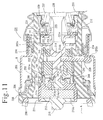
- Fig. 11 shows a third embodiment of the present invention.
- the first vacuum valve seat 17 provided on the inner periphery of the valve body 3 according to the first embodiment is eliminated, leaving only a vacuum valve seat 218 formed on the rear end of a tubular member 221.
- the vacuum valve seat 218 is located rearward of the step formed on the inner periphery of the valve body 3 on which the first vacuum valve seat 17 is defined according to the first embodiment.
- the arrangement is similar to the first embodiment, and accordingly, corresponding parts to those shown in the first embodiment are designated by like reference numerals as used before, to which 200 is added.
- valve plunger 214 moves through a given stroke or more relative to a valve body 203, in the similar manner as in the first embodiment, whereby a step 214d on the valve plunger 214 abuts against a cylindrical portion 241a of a lever member 241 to cause an angular movement of the lever member 241, thereby causing the tubular member 221 to retract rearward relative to the valve body 203.
- the third embodiment is also capable of delivering an increased output from the brake booster 201 rapidly during an emergency operation, in the similar manner as in the first embodiment.
- the brake booster When the brake pedal is released after the actuation of the emergency brake operation, the brake booster returns to its inoperative condition in the similar manner as in the first embodiment.
- the first vacuum valve seat 17 formed on the valve body 3 used in the first embodiment is eliminated.
- the first vacuum valve seat 117 on the valve body 103 used in the second embodiment may also be eliminated, leaving only the vacuum valve seat 118 formed on the tubular member 121.
- Such an arrangement is also capable of achieving an similar functioning and effects as achieved by the first embodiment.
- Fig. 12 shows a fourth embodiment of the present invention.
- the balls 151, the retainer member 152 and the spring 153 used in the second embodiment shown in Fig. 6 are eliminated, and instead, a tubular resilient member 361 is provided together with an improvement of a tubular member 321 and related parts.
- the tubular member 321 includes an increased diameter portion 321A toward the rear end, the outer periphery of which is slidably fitted into the inner periphery of a valve body 303.
- a rear end of the increased diameter portion 321A defines a second vacuum valve seat 318 in the similar manner as in the second embodiment, and a seal member 343 is mounted around the outer periphery of the increased diameter portion 321A to maintain a hermetic seal between the inner periphery of the valve body 303 and the increased diameter portion 321A.
- a substantially cylindrical tubular resilient member 361 is fitted around the outer periphery of the tubular member 321 in a region forward of the increased diameter portion 321A.
- the tubular resilient member 361 has a rear end which is extended radially outward to provide a flange 361a, which is disposed in abutment against the front end face of the increased diameter portion 321A.
- a spring 342 is disposed between the flange 361a and an opposing stepped end face of the valve body 303, thus normally urging the tubular member 321 and the tubular resilient member 361 rearward relative to the valve body 303 in an integral manner.
- the tubular resilient member 361 includes an axially front end 361b, which is formed with notches at a plurality of circumferential locations therearound, the notches extending axially and having increased sizes at their rear ends.
- the front end 361b of the tubular resilient member 361 functions as a leaf spring which urges the outer periphery of the tubular member 321 located toward the front end thereof radially inward.
- the tubular resilient member 361 is formed with an opening at a given axial position for allowing a key member 338 to pass therethrough.
- the tubular member 321 is formed of a synthetic resin, and its front end is formed with axially extending notches at a plurality of circumferential locations therearound, thereby providing a plurality of sections 321B capable of elastic deformation in the radial direction at the plurality of circumferential locations. As mentioned above, these sections 321B are urged radially inward by the front end 361b of the tubular resilient member 361.
- An engaging section 321C which projects radially inward is formed on the front end of each section 321B.
- the engaging section 321C is triangular in axial section, and has a radially extending stepped end face on its rear side and has an inclined surface disposed at an angle of 45° on its front side.
- a holder 311 has a reduced diameter portion 311b of an axial size which is reduced as compared with the second embodiment, and the outer periphery of the reduced diameter portion 311b is formed with an annular groove 311f serving as an engaging recess of a given width while the inner periphery of the reduced diameter portion 311b is formed with a radial portion 311c toward the rear end.
- Each section 321B capable of elastic deformation of the tubular member 321 is fitted around the outer periphery of the holder 311 from the rear side, with each engaging portion 321C engaged with the annular groove 311f in the holder 311.
- the inner periphery of the tubular member 321 is formed with an annular step 321D toward the front end, and the inner peripheral surface of the annular step 321D has a reduced diameter at its front end and an increased diameter at its rear end with a tapered surface 321F having an increasing diameter toward the rear end provided as a boundary therebetween.
- the valve plunger 314 is chamfered at a step 314d, and has a tapered surface 314e having a diameter which is reduced toward the front end.
- the valve plunger 314 has a reduced diameter portion 314c which slidably extends through the inner peripheral surface of a radial portion 311g of the holder 311, and the front end face of the reduced diameter portion 314c abuts against a plunger plate 314a.
- the arrangement is substantially similar to the second embodiment, and accordingly, corresponding parts to those shown in the second embodiment are designated by like numerals as used before, to which 200 is added in the fourth embodiment.
- an input shaft 328 and the valve plunger 314 are driven forward through a reduced amount which is less than a given stroke relative to the valve body 303, and accordingly, the tapered surface 314e of the valve plunger 314 opposes the tapered surface 321F of the tubular member 321, but does not abut against it. Accordingly, the section 321B capable of elastic deformation of the tubular member 321 cannot be increased in diameter, and the engaging section 321C remains engaged with the annular groove 311f. Hence, the tubular member 321 is maintained in its foremost position relative to the valve body 3 (see Figs. 12 and 13).
- the second vacuum valve seat 318 formed on the tubular member 321 abuts against the first seat area S1 on a valve element 324, which is then retracted rearward.
- the tubular member 321 has its stepped end face 321G abutting against the key member 338, which in turn comes to a stop by abutment against a rear end face of the variable pressure passage 334 while maintaining the stepped end face 321G in abutment thereagainst, and is thus retained in this position.
- an atmosphere valve 333 comprising an atmosphere valve seat 322 and a second seat area S2 obtains an opening which is greater than that obtained during a usual operation.
- retainer means in the fourth embodiment comprises the annular groove 311f, the tubular member 321, the spring 342, the key member 338, the variable pressure passage 334 and the tapered surface 314e of the valve plunger 314.
- Release means in the fourth. embodiment comprises the annular groove 311f, the tubular member 321, the tubular resilient member 361 and the key member 338.
- the valve plunger 314 in the inoperative condition of the brake booster 301 shown in Fig. 12, assumes its retracted end position which is rearmost within a shell 302 as a result of an abutment of the engaging portion 314b of the valve plunger 314 against the key member 338 which abuts against the rear wall 302c of the shell 302.
- the tubular member 321 also assumes its retracted end position where the stepped end face 321G abuts against the key member 338.
- the tapered surface 314e of the valve plunger 314 is located rearward of and opposes the tapered surface 321F of the tubular member 321, while maintaining a clearance therebetween.
- the second seat area S2 on the valve element 324 is seated on the atmosphere valve seat 322 to close the atmosphere valve 333.
- the engaging section 321C of the tubular member 321 is engaged with the annular groove 311f in the holder 311.
- the tubular member 321 is maintained at its advanced position relative to the valve body 303.
- the second vacuum valve seat 318 formed on the tubular member 321 is located slightly forward of the first vacuum valve seat 317, and the both vacuum valve seats 317, 318 are removed from the first seat area S1 on the valve element 324 to open the vacuum valve 338.
- the chambers A and B communicate with each other, and a negative pressure is introduced into the both chambers.
- the rear end face of the reaction disc 313 is slightly spaced from the plunger plate 314a.
- the input shaft 328 and the valve plunger 314 are gently driven forward.
- the valve plunger 314 is advanced only less than a given stroke relative to the valve body 303 and the holder 311 during the usual gentle depression of the brake pedal, and therefore the tapered surface 314e of the valve plunger 314 approaches, but does not abut against the tapered surface 321F of the tubular member 321.
- the sections 321B capable of elastic deformation of the tubular member 321 are not deformed in the radially outward direction, and the engaging section 321C remains engaged with the annular groove 311f in the holder 311 (see Fig. 13).
- the first seat area S1 on the valve element 324 is seated on the first vacuum valve seat 317 to close the vacuum valve 331, while the atmosphere valve seat 322 is removed from the second seat area S2 on the valve element 324 to open the atmosphere valve 333. Since the vacuum valve 331 is closed and the atmosphere valve 333 is opened, the atmosphere is introduced into the variable pressure chamber B through the variable pressure passage 334. Accordingly, the valve body 303 and the like are driven forward to actuate the brake booster 301.
- a brake reaction occurring from the output shaft 315 causes the rear end face of the reaction disc 313 to bulge and to abut against the plunger plate 314a. Accordingly, from this point in time on, the brake reaction begins to be transmitted through the valve plunger 314 and the input shaft 328 to the brake pedal, not shown.
- valve plunger 314 and the input shaft 328 retract rearward and the key member 338 abuts against the wall 302c of the shell 302 to stop. Subsequently, the front end face of the engaging portion 314b of the valve plunger 314 abuts against the key member 338 to stop, and subsequently the front end face of the variable pressure passage 334 in the valve body 303 and the stepped end face 321G of the tubular member 321 abut against the key member 338 to stop. In this manner, the valve body 303 and the tubular member 321 return to their inoperative positions shown.
- valve plunger 314 and the input shaft 328 are driven forward through a given stroke or more relative to the valve body 303 and the holder 311.
- the first seat area S1 on the valve element 324 is initially seated on the first vacuum valve seat 317 to close the vacuum valve 331, and the atmosphere valve seat 322 is removed from the second seat area S2 on the valve element 324 to open the atmosphere valve 333.
- the tapered surface 314e of the valve plunger 314 abuts against the tapered surface 321F of the tubular member 321, and then further moves forward, whereby the sections 321B capable of elastic deformation of the tubular member 321 have their diameter increased to allow the engaging section 321C to be disengaged from the annular groove 311f.
- the tubular member 321 which is urged rearward by the spring 342 retracts rearward relative to the valve body 303 and the holder 311, and after the second vacuum valve seat 318 is seated on the first seat area S1 on the valve element 324, it causes the valve element 324 to retract further rearward (see Fig. 14).
- the tubular member 321 ceases to retract relative to the valve body 303 at a retracted position which is reached as the stepped end face 321G abuts against the key member 338, which in turn abuts against the rear end face of the variable pressure passage 334, and is retained at this position.
- the atmosphere valve seat 322 is largely spaced from the second seat area S2, and the atmosphere valve 333 which comprises these members are retained in a position in which its opening is greater than during a usual brake operation. Consequently, the atmosphere is rapidly introduced into the variable pressure chamber B, allowing the output from the brake booster 301 to rise rapidly. In response to a reaction from this output, the reaction disc 313 bulges rearward to abut against the plate plunger 314a to thereby urges the valve plunger 314 rearward.
- the fourth embodiment also allows an increased output to be obtained rapidly during an emergency operation, in the similar manner as in the described embodiments.
- the fourth embodiment is capable of achieving a similar functioning and effects as in the described embodiments.
Landscapes
- Engineering & Computer Science (AREA)
- Transportation (AREA)
- Mechanical Engineering (AREA)
- Braking Systems And Boosters (AREA)
Abstract
Description
- The invention relates to a brake booster, and more particularly, to a brake booster which assures that an increased output can be obtained in response to a force of depression of a small magnitude which is applied to a brake pedal in the event a braking effort of an increased magnitude is required as in an emergency brake.
- A brake booster which is arranged to permit an increased output to be obtained even in response to a brake depressing force of a small magnitude as in an emergency brake which requires a braking effort of an increased magnitude is known in the art, as exemplified by Japanese Patent No. 3,070,672 disclosing a brake booster in which in response to an input which exceeds a given value, an output gradient is increased subsequently to increase the output, or a Japanese Laid-Open Patent Application No. 35,474/1998 disclosing a brake booster in which an operation of a brake pedal is electrically detected, and the output is increased in response thereto.
- However, drawbacks are pointed out with conventional brake boosters as mentioned above. Specifically, in the brake booster disclosed in '672 patent, the arrangement is such that the output is increased when the input has exceeded the given value, and accordingly, the output cannot be immediately increased in response to a quick depression of the brake pedal.
- On the other hand, in the brake booster disclosed in Application No. 35,474/1998, there is a need to provide a solenoid operated valve and a sensor which detects the degree of depression of the brake pedal in an integral manner with the booster, resulting in a complicated arrangement and an increased manufacturing cost of the brake booster.
- It would be desirable to be able to provide a brake booster which is simple in construction and which is capable of immediately increasing the output in response to a quick depression of a brake pedal.
- Specifically, the present invention relates to a brake booster including a valve body slidably disposed within a shell, a power piston mounted on the valve body, a constant pressure chamber disposed forwardly of the power piston within the shell, a variable pressure chamber disposed rearwardly of the power piston within the shell, a valve mechanism disposed within the valve body for controlling a switching between the supply/discharge of a fluid to and from the variable pressure chamber, and an input shaft for operating the valve mechanism, the valve mechanism comprising a valve plunger connected to the input shaft and having an atmosphere valve seat, a vacuum valve seat formed within the valve body and a valve element which can be seated upon the atmosphere valve seat and the vacuum valve seat. According to the first aspect of the present invention, the brake booster further comprises a tubular member slidably disposed within the valve body and having the vacuum valve seat formed thereon, retainer means for causing the tubular member to be retracted relative to the valve body so that the vacuum valve seat is seated upon the valve element when the input shaft is advanced from its inoperative position through a given stroke relative to the valve body, and for retaining the tubular member at a position which is reached by retracting through a given stroke relative to the valve body, and release means for releasing the retention of the tubular member by the retainer means to allow the tubular member to return to its inoperative position when the input shaft returns to its inoperative position.
- The second aspect of the present invention relates to a brake booster including a valve body slidably disposed within a shell, a power piston mounted on the valve body, a constant pressure chamber formed forwardly of and a variable pressure chamber formed rearwardly of the power piston within the shell, a valve mechanism disposed within the valve body for switching a supply/discharge of a fluid to or from the variable pressure chamber, and an input shaft for operating the valve mechanism, the valve mechanism comprising a valve plunger connected to the input shaft and having an atmosphere valve seat formed thereon, a first vacuum valve seat formed on the valve body and a valve element which can be seated upon the atmosphere valve seat and the first vacuum valve seat. According to the second aspect of the present invention, the brake booster further comprises a tubular member slidably disposed within the valve body and having a second vacuum valve seat juxtaposed to the first vacuum valve seat, retainer means for causing the tubular member to be retracted relative to the valve body to permit the second vacuum valve seat to be seated upon the valve element when the input shaft is advanced from its inoperative position through a given stroke relative to the valve body and for retaining the tubular member at a position which is reached by retracting through a given stroke relative to the valve body, and release means for releasing the retention of the tubular member by the retainer means to allow the tubular member to return to its inoperative position when the input shaft has returned to its inoperative position.
- With the described arrangement, during an emergency brake operation in which a brake pedal is quickly depressed, the input shaft is advanced from its inoperative position through a given stroke or more relative to the valve body, whereby the tubular member is caused to retract relative to the valve body. Consequently, the vacuum valve seat (second vacuum valve seat) formed on the tubular member and the valve element which is seated thereon are caused to retract through a given stroke or more relative to the valve body and is retained in such positions by the retainer means. This allows an atmosphere valve which is formed by the combination of the atmosphere valve seat and the valve element to be opened to a greater opening than during a normal operation, allowing the atmosphere to be rapidly introduced into the variable pressure chamber to enable an output from the brake booster to increase rapidly to a greater value. In this manner, there is provided a brake booster which is simple in construction and which is capable of immediately increasing the output in response to a quick depression of a brake pedal.
- The invention will become apparent from the following description of the embodiments thereof with respect to the attached drawings of which:
- Fig. 1 is a cross section of a first embodiment of the present invention;
- Fig. 2 is an enlarged view of an essential part shown in Fig. 1 ;
- Fig. 3 is a front view of a
lever member 41 shown in Fig. 1; - Fig. 4 is a cross section taken along the lines IV-IV shown in Fig. 3;
- Fig. 5 is a cross section of a second embodiment of the present invention;
- Fig. 6 is a cross section, to an enlarged scale, of an essential part shown in Fig. 5;
- Fig. 7 is a cross section showing components of the second embodiment shown in Fig. 6 in a simplified form;
- Fig. 8 is a cross section illustrating an operational phase of the components shown in Fig. 7 during an emergency operation;
- Fig. 9 is a cross section illustrating another operational phase of the components shown in Fig.7 during an emergency operation ;
- Fig. 10 is a cross section illustrating a further operational phase of the components shown in Fig. 7 during an emergency operation;
- Fig. 11 is a cross section of a third embodiment of the present invention;
- Fig. 12 is a cross section of a fourth embodiment of the present invention;
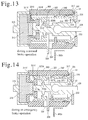
- Fig. 13 is a cross section illustrating an operational phase of the components shown in Fig. 12 during a normal brake operation; and
- Fig. 14 is a cross section showing another operational phase of the components shown in Fig. 12 during an emergency operation.
-
- Referring to the drawings, several embodiments of the present invention will now be described. Initially referring to Figs. 1 and 2, a
brake booster 1 has ashell 2, in which a substantiallytubular valve body 3 is slidably disposed. Toward the rear end, the outer periphery of thevalve body 3 projects externally through arear opening 2a of theshell 2 in which anannular seal member 4 is disposed to maintain a hermetic seal between the outer periphery of thevalve body 3 toward the rear end and the opening 2a in theshell 2. - A
power piston 5 is connected around the outer periphery of thevalve body 3, and adiaphragm 6 is applied to the back surface of thepower piston 5, thus partitioning the interior of theshell 2 into a forwardly located constant pressure chamber A and a rearwardly located variable pressure chamber B. - The
shell 2 has afront wall 2b, to which a negativepressure introducing tube 7 is connected, through which a negative pressure is normally introduced into the constant pressure chamber A. Areturn spring 8 is disposed within the constant pressure chamber A to urge thevalve body 3 normally rearward, and accordingly, in the inoperative condition of thebrake booster 1 shown in Figs. 1 and 2, thevalve body 3 as urged by thereturn spring 8 remains at rest in its inoperative position shown. - In the present embodiment, a
holder 11 in the form of a stepped cylinder is fitted into the inner periphery of thevalve body 3 toward its front end. Anannular seal member 12 maintains a hermetic seal between the outer periphery of theholder 11 and the inner periphery of thevalve body 3. In effect, theholder 11 constitutes part of thevalve body 3, and theholder 11 may be formed integrally with thevalve body 3. Toward the front end, theholder 11 includes an increaseddiameter portion 11a in which areaction disc 13 is received, and the outer periphery of aplate plunger 14a, which forms a part of avalve plunger 14, is slidably fitted into the inner periphery of theholder 11 at a location rearward of the increaseddiameter portion 11a. In this manner, thereaction disc 13 and thevalve plunger 14 are disposed in opposing relationship with each other. Toward the rear end, theholder 11 includes a reduced diameter portion 11b, the outer periphery of which is tapered, thus reducing its diameter toward the rear end. - An
output shaft 15 is disposed forwardly of thereaction disc 13, and has oneend 15a which is slidably fitted into the increaseddiameter portion 11a of theholder 11 to abut against thereaction disc 13 from the front side thereof. In this manner, thereaction disc 13 is held sandwiched between the rear end face of theend 15a of theoutput shaft 15 and the stepped end face of theholder 11. - An opening is formed in the
front wall 2b of theshell 2 to allow a housing and a piston of a master cylinder, not shown, to be inserted in the constant pressure chamber A, and the front end of theoutput shaft 15 is disposed in abutment against the piston of the master cylinder. - A
valve mechanism 16 which switches a communication between the constant pressure chamber A and the variable pressure chamber B and the communication between the variable pressure chamber B and the atmosphere is received within thevalve body 3. - The
valve mechanism 16 of this embodiment comprises an annular firstvacuum valve seat 17 formed on the inner periphery of thevalve body 3, atubular member 21 slidably fitted into the inner periphery of thevalve body 3 while maintaining a hermetic seal therewith and having a rear end on which a secondvacuum valve seat 18 is formed, avalve plunger 14 slidably fitted into and extending though thetubular member 21 and formed with anatmosphere valve seat 22 at its rear end, and avalve element 24 which is adapted to be seated on the bothvacuum valve seats atmosphere valve seat 22 from the rear side under the resilience of aspring 23. - The
valve element 24 comprises afirst member 25 which is located forwardly and formed of a rigid body, and asecond member 26 which is located rearwardly and formed of rubber and connected to thefirst member 25. A rubber ring is attached on the front side of thefirst member 25 to define a first seat area S1. Aplate 27 which is formed of a rigid body is mounted on the front side of thesecond member 26 and an annular rubber member is applied to theplate 17 to define a second seat area S2. Theatmosphere valve seat 22 which is formed on thevalve plunger 14 is located. inside thefirst member 25 to be disposed in opposing relationship with the second seat area S2. Thespring 23 extends between theplate 27 and aninput shaft 28, thus normally urging thevalve element 24 forward. - In the present embodiment, the both
vacuum valve seats valve body 3. A combination of the bothvacuum valve seats valve element 24 which moves into engagement with or disengagement from the valve seats defines avacuum valve 31. A space located radially outward of thevacuum valve 31 communicates with the constant pressure chamber A through aconstant pressure passage 32 formed in thevalve body 3. - A combination of the
atmosphere valve seat 22 formed on thevalve plunger 14 and the second seat area S2 on thevalve element 24 which moves into engagement with or disengagement from thevalve seat 22 defines anatmosphere valve 33. A space located between thevacuum valve 31 and theatmosphere valve 33 communicates with the variable pressure chamber B through avariable pressure passage 34, which is formed by a radial opening formed in thevalve body 3. - A space located radially inward of the
atmosphere valve 33 communicates with the atmosphere through anatmosphere passage 35 formed in thevalve body 3 and afilter 36 disposed therein. - A rear end of the
valve plunger 14 is pivotally connected with a front end of theinput shaft 28, and aspring 37 having a greater resilience than thespring 23 is disposed between aretainer 39 fitted into thevalve body 3 and the outer periphery of theinput shaft 28. The other end of theinput shaft 28 is connected to a brake pedal, not shown. - A
key member 38, which is known in itself, passes through thevariable pressure passage 34 in thevalve body 3, and then passes through aradial opening 21b in the tubular member 21before it is engaged with anengaging portion 14b of thevalve plunger 14. - Since the
valve body 3 is normally urged rearward by thereturn spring 8, in the inoperative condition of thebrake booster 1 shown in Figs. 1 and 2, thekey member 38 abuts against arear wall 2c of theshell 2. A front end face of thevariable pressure passage 34 is disposed in abutment against thekey member 38 as are the front end face of theradial opening 21b formed in thetubular member 21 and the front end face of theengaging portion 14b of thevalve plunger 14. - When the
key member 38 is disposed in abutment against therear wall 2c of theshell 2 in this manner, thekey member 38 and thevalve plunger 14 are maintained at a given position relative to thevalve body 3, thus reducing a lost motion of theinput shaft 28 at the commencement of operation of thebrake booster 1. - In the inoperative condition, the second seat area S2 on the
valve element 24 is seated on theatmosphere valve seat 22 to close theatmosphere valve 33, while the first seat area S1 of thevalve element 24 is removed from the bothvacuum valve seats vacuum valve 31. Under this condition, the chambers A and B communicate with each other, and a negative pressure is introduced into the both chambers. - In the inoperative condition, the rear end face of the
reaction disc 13 is slightly spaced from the opposingplate plunger 14a. By contrast, when theinput shaft 28 and thevalve plunger 14 are driven forward to actuate thebrake booster 1, thereaction disc 13 bulges rearward under the influence of a reaction to the output acting upon theoutput shaft 15, whereby the end face of thereaction disc 13 abuts against theplate plunger 14a. A reaction to the output acting upon theoutput shaft 15 begins to be transmitted from this point in time to thevalve plunger 14, theinput shaft 28 and the brake pedal, not shown, through thereaction disc 13. - In the present embodiment, a
lever member 41 is provided in thevalve body 3 premising the described arrangement, in order to allow an output from thebrake booster 1 to be rapidly increased immediately in response to a quick depression of the brake pedal. - Specifically, referring to Figs. 2 to 4, the
lever member 41 is formed of a spring steel to exhibit resilience. Thelever member 41 includes acylindrical portion 41a of a reduced diameter in its radially inner portion, and the front end of thecylindrical portion 41a then extends radially outward through a given distance and is subsequently folded back upon itself to provide an annularfitting portion 41b, which in turn continues to eightradial portions 41c which extend radially outward. The outer end of eachradial portion 41c then extends rearwardly and is folded upon itself forwardly to define anabutment 41d, which continues forwardly to provide an engagingtab 41f which is arcuate in section at the distal end thereof, thetab 41f bulging radially outward. - The
lever member 41 thus constructed serves as retainer means, with thecylindrical portion 41a being positioned in a space outward of the reduceddiameter portion 14c at the front end of thevalve plunger 14, the annularfitting portion 41b being loosely fitted around the reduced diameter portion 11b of theholder 11 from the rear side, and the eightengaging tabs 41f being disposed in contact with the inner periphery of thevalve body 3. The arrangement is such that the rear end 11c (the rear end of the reduced diameter portion 11b) of theholder 11 abuts against a boundary between the annularfitting portion 41b and theradial portion 41c of thelever member 41 to provide a fulcrum for the angular movement of thelever member 41, and the eightabutments 41d of thelever member 41 abut against the front end face of the tubular member 21 (see Fig. 2). - At its front end, the outer periphery of the
tubular member 21 is formed with a flange 21f, and aspring 42 is disposed between theflange 21a and an opposing stepped end face of thevalve body 3, thus normally urging thetubular member 21 forward relative to thevalve body 3. Accordingly, when thelever member 41 is disposed in abutment against thetubular member 21, the outer portion of thelever member 41 is normally urged forward about the rear end 11c of theholder 11 which acts as the fulcrum for the angular movement. - At a given axial position along the length thereof, the
tubular member 21 is formed with aradial opening 21b which radially extend therethrough, and is also formed with anaxial groove 21c which continues from theradial opening 21b to the rear end face in an axial opening into which thevalve plunger 14 is slidably fitted. Thekey member 38 is passed into theradial opening 21b in thetubular member 21 before engaging the engagingportion 14b of thevalve plunger 14. Also, theradial opening 21b and theaxial groove 21c formed in thetubular member 21 provide an internal space, through which a communication is permitted between thevariable pressure passage 34 and thevacuum valve 31 and theatmosphere valve 33. Anannular seal member 43 is provided around the outer periphery of thetubular member 21 toward the rear end, thus maintaining a hermetic seal between thetubular member 21 and the inner periphery of thevalve body 3. The secondvacuum valve seat 18 is provided by an annular projection formed on the rear end of thetubular member 21. - In the present embodiment, an engaging
recess 44, which is provided by an annular groove, is formed in the inner peripheral surface of thevalve body 3 at a location immediately rearward of theholder 11, and in the inoperative condition shown, the engagingtab 41f of thelever member 41 is located slightly forward of the engagingrecess 44 formed in thevalve body 3. By contrast, during an emergency brake operation which will be described later, because thevalve plunger 14 and theinput shaft 28 are driven forward through a given stroke or more relative to thevalve body 3 and theholder 11, astep 14d of thevalve plunger 14 which is located rearward of the reduceddiameter portion 14c abuts against the rear end of thecylindrical portion 41a of thelever member 41 to urge it forward. Accordingly, the rear end 11c of theholder 11 acts as a center of angular movement, causing theradial portion 41c and its outer portion of thelever member 41 to be retracted rearward, thus causing thetubular member 21 to be retracted rearward relative to thevalve body 3. Concomitantly, the engagingtab 41a of thelever member 41 becomes engaged with the engagingrecess 44 in thevalve body 3. As a consequence, thevalve element 24 is caused to retract rearward under the condition that the secondvacuum valve seat 18 formed on thetubular member 21 is seated on the first seat area S1. This allows theatmosphere valve 33 to be opened to a greater opening than during a normal operation, whereby the atmosphere is rapidly introduced into the variable pressure chamber B to allow thebrake booster 1 to provide a greater output rapidly. - If the depression of the brake pedal is terminated under this condition, the
input shaft 28 and thevalve plunger 14 retract, and come to a stop upon abutment of thekey member 38 against therear wall 2c of theshell 2. This causes thetubular member 21 and thevalve plunger 14 to return to their inoperative positions shown, and thevalve body 3 retracts in retarded relationship thereto, and the front end face of thevariable pressure passage 34 abuts against thekey member 38, whereupon thevalve body 3 comes to a stop and returns to its inoperative position. At this time, thetubular member 21 moves forward relative to thevalve body 3, whereby the outer portion of thelever member 41 which abuts against thetubular member 21 moves forward, disengaging the engagingtab 41a of thelever member 41 from the engagingrecess 44. - In the present embodiment, the
tubular member 21 and thekey member 38 constitute together release means which releases the retention of thetubular member 21 by thelever member 41. - With the described arrangement, in the inoperative condition of the
brake booster 1 shown in Figs. 1 and 2, thekey member 38 abuts against therear wall 2c of theshell 2, thevalve body 3 is stationary as a result of the abutment of the front end face of thevariable pressure passage 34 against thekey member 38, and thetubular member 21 and thevalve plunger 14 are also stationary as a result of the abutment of the front end face of theradial opening 21b in thetubular member 21 and the front end face of the engagingportion 14b of thevalve plunger 14 against thekey member 38. - In the inoperative condition, the second seat area S2 of the
valve element 24 is seated on theatmosphere valve seat 22 to close theatmosphere valve 33. On the other hand, the engagingtab 41f of thelever member 41 is held removed from the engagingrecess 44 in thevalve body 3 by thetubular member 21 which abuts against thekey member 38, and thus is located forwardly thereof. At this time, the rear end of thecylindrical portion 41a, which represents the inner periphery of thelever member 41, is spaced from thestep 14d of thevalve plunger 14. Accordingly, the secondvacuum valve seat 18 formed on thetubular member 21 is located at a small distance forward of the firstvacuum valve seat 17, and the both vacuum valve seats 17, 18 are removed from the first seat area S1 of thevalve element 24 to open thevacuum valve 31. Accordingly, the chambers A and B communicate with each other, and the negative pressure is introduced into the both chambers. In the inoperative condition, the rear end face of thereaction disc 13 is slightly spaced from theplate plunger 14a. - If brake pedal, not shown, is gently depressed in the inoperative condition mentioned above, the
input shaft 18 and thevalve plunger 14 are gently driven forward. As a consequence, the first seat area S1 of thevalve element 24 is seated on the firstvacuum valve seat 17 on the valve plunger 30 to close thevacuum valve 31, while theatmosphere valve seat 22 is spaced from the second seat are S2 of thevalve element 24 to open theatmosphere valve 33. Because thevalve plunger 14 is gently driven forward at this time, thestep 14d of thevalve plunger 14 does not abut against thecylindrical portion 41a of thelever member 41, and thus the engagingtab 41f of thelever member 41 does not move relative to thevalve body 3. In this manner, thevacuum valve 31 is closed while theatmosphere valve 33 is opened, allowing the atmosphere to be introduced into the variable pressure chamber B through thevariable pressure passage 34. - Accordingly, a pressure differential between the negative pressure in the constant pressure chamber A and the atmosphere in the variable pressure chamber B drives the
valve body 3 and theoutput shaft 15 forward. When thebrake booster 1 is actuated in this manner, a reaction occurs from the output acting upon theoutput shaft 15 to cause thereaction disc 13 to bulge rearward, resulting in an abutment of the end face of thereaction disc 13 against theplate plunger 14a. From this point in time on, the reaction from the output acting on theoutput shaft 15 is transmitted through thereaction disc 13 to thevalve plunger 14, theinput shaft 28 and the brake pedal, not shown. - During the usual gentle brake operation as mentioned above, the
valve plunger 14 is not advanced largely relative to thevalve body 3, and accordingly thestep 14d of thevalve plunger 14 cannot abut against thecylindrical portion 41a of thelever member 41. Thus, there is no axial reciprocating movement of thetubular member 21 relative to thevalve body 3, and as a consequence, the positional relationship between the both vacuum valve seats 17, 18 remain unchanged as in the inoperative condition shown in Fig. 2, and the first seat area S1 of thevalve element 24 is seated on the firstvacuum valve seat 17. - If the brake pedal is now released and the
valve plunger 14 and theinput shaft 28 retract rearward, thekey member 38 abuts against therear wall 2c of theshell 2 and comes to a stop. Subsequently, the front end face of thevariable pressure passage 34 in thevalve body 3 as well as the front end face of theradial opening 21b in thetubular member 21 both abut against thekey member 38, whereby thevalve body 3 and thetubular member 21 return to their inoperative positions shown. - When the brake pedal is quickly depressed in the inoperative condition shown in Figs. 1 and 2, the first seat area S1 of the
valve element 24 becomes seated on the firstvacuum valve seat 17 to close thevacuum valve 31 while theatmosphere valve seat 22 is removed from the second seat area S2 of thevalve element 24 to open theatmosphere valve 33. This allows the atmosphere to be introduced into the variable pressure chamber B, whereby thevalve body 3 is driven forward to actuate thebrake booster 1. At this time, the transmission of the reaction to thevalve plunger 14 through thereaction disc 13 is retarded with respect to the rate of depression of the brake pedal, and accordingly, thevalve plunger 14 is advanced relative to thevalve body 3 through an increased stroke as compared with the stroke which occurs during the gentle brake operation. - When the
valve plunger 14 is advanced through a given stroke or more relative to thevalve body 3 in this manner, thestep 14d of thevalve plunger 14 abuts against thecylindrical portion 41a of thelever member 41, thus driving thecylindrical portion 41a forward. Accordingly, theradial portion 41c, theabutment 41d and the engagingtab 41f of thelever member 41 retract rearward about the fulcrum of angular movement which is provided by the rear end 11c of theholder 11, whereby thetubular member 21 retracts rearward relative to thevalve body 3 against the resilience of thespring 42. - This causes the second
vacuum valve seat 18 to be seated on thevalve element 24 which is already seated on the firstvacuum valve seat 17, thus moving thevalve element 24 away from the firstvacuum valve seat 17 in a rearward direction. As a consequence, the opening of the atmosphere valve 33 (represented by a spacing between theatmosphere valve seat 22 and the second seat area S2) increases. Since at this time, the engagingtab 41f of thelever member 41 is engaged with the engagingrecess 44 in thevalve body 3, thetubular member 21 is retained in a position which is reached by retracting through a given stroke relative to thevalve body 3, and the first seat area S1 of thevalve element 24 is retained in a position where it is seated on the secondvacuum valve seat 18. Thus, theatmosphere valve 33 is opened to a larger opening than during a normal operation, rapidly introducing the atmosphere into the variable pressure chamber B to increase the output from thebrake booster 1 rapidly. A reaction from the output causes thereaction disc 13 to bulge rearward, resulting in an abutment of thereaction disc 13 against theplate plunger 14a to urge thevalve plunger 14 rearward. However, because the amount of bulge which thereaction disc 13 experiences until theatmosphere valve seat 22 on thevalve plunger 14 becomes seated on the second seat area S2 of thevalve element 24 is greater than the bulge which occurs during the usual operation, the output from thebrake booster 1 increases by a corresponding amount. In this manner, there can be obtained an increased output from thebrake booster 1 rapidly as an immediate response to a quick depression of the brake pedal. - During the emergency operation of the
brake booster 1, thevalve plunger 14 is driven back rearward to a degree as the force with which the brake pedal is depressed is reduced subsequently, but thetubular member 21 and thevalve element 24 are maintained in the conditions mentioned above because the engagingtab 41f of thelever member 41 serving as retainer means is maintained engaged with the engagingrecess 44. - When the brake pedal is released in the emergency operation, the
valve plunger 14 and theinput shaft 28 retract, and accordingly, theatmosphere valve seat 22 is seated on the second seat area S2 of thevalve element 24 to close theatmosphere valve 33, while the secondvacuum valve seat 18 moves away from the first seat area S1 of thevalve element 24 to open thevacuum valve 31. Accordingly, the atmosphere in the variable pressure chamber B is displaced into the constant pressure chamber A, causing thevalve body 3 and thepower piston 5 to retract toward their inoperative positions. - Subsequently, the
key member 38 initially abuts against therear wall 2c of theshell 2 and comes to a stop, and thevalve plunger 14 and thetubular member 21 which are disposed in abutment against thekey member 38 cannot retract any further and thus come to a stop at corresponding positions. On the other hand, thevalve body 3 and thepower piston 5 retract subsequently until the front end face of thevariable pressure passage 34 abuts against thekey member 38. Concomitantly, because thevalve body 3 retracts rearward relative to thetubular member 21 which remains stationary, it follows that theabutment 41d and the engagingtab 41f of thelever member 41 move forward relative to thevalve body 3, whereby the engagingtab 41 is disengaged from the engagingrecess 44 in thevalve body 3, resuming the inoperative condition shown in Fig. 2. - Thus it will be seen that an increased output can be obtained rapidly during an emergency brake operation in accordance with the present embodiment.
- It will be seen that with the present embodiment, there can be provided a
brake booster 1 which is capable of rapidly increasing an output during an emergency brake operation with a construction which is simple enough by merely adding thetubular member 21, thelever member 41 and thespring 42 to a conventional brake booster. In addition, thebrake booster 1 provides a high reliability even during an emergency brake operation because of such a simple construction. - In the described embodiment, the
lever member 41 is formed with the engagingtab 41f while an annular groove serving as the engagingrecess 44 is formed in the inner peripheral surface of thevalve body 3. However, an engaging recess may be formed in thelever member 41 while an engaging tab may be formed on thevalve body 3. - Figs. 5 and 6 show a second embodiment of the present invention in which the
lever member 41 and the engagingrecess 44 used in the first embodiment are replaced by aball 151 and acylindrical retainer member 152 and related parts. - It is to be noted that in the description to follow, parts corresponding to those shown in the first embodiment are designated by like reference numerals as used before, to which 100 is added in the second embodiment.
- Specifically, in the second embodiment, a
holder 111 has a reduced diameter portion 111b which is extended axially in the rearward direction, creating a cylindrical space between the reduced diameter portion 101b and the inner peripheral surface of avalve body 103, and a cylindricaltubular member 121 is disposed in this space, and its inner periphery is slidably fitted over the reduced diameter portion 111b while the outer periphery of thetubular member 121, toward its rear end, is slidably fitted into the inner periphery of thevalve body 103. - An
annular projection 121e is formed around the outer periphery of thetubular member 121, and aspring 142 is disposed between theprojection 121 and a stepped end face of theholder 111, thus normally urging thetubular member 121 rearward. It is to be noted that the inner periphery of thevalve body 103 is formed with a stepped end face 103a at a location rearward of theannular projection 121e on thetubular member 121 so as to be disposed opposite thereto for defining a retracted end as thetubular member 121 is moved rearward relative to thevalve body 103. In the similar manner as in the first embodiment, a secondvacuum valve seat 118 is formed on the rear end of thetubular member 121. At a given axial position, the inner periphery of thetubular member 121 is formed with anannular groove 121d serving as an engaging recess which is engageable with aball 151. The opposite end faces of theannular groove 121d are formed as inclined surfaces so that a spacing between the both end faces is at its maximum at the inner edge thereof. - At a given axial position, the reduced diameter portion 111b of the
holder 111 is formed with a plurality of radial openings 111d which are spaced apart at an equal interval circumferentially, and aball 151 is loosely fitted in each of the radial openings 111d. Theball 151 is formed of a metal, and has a spherical diameter which is slightly greater than the wall thickness of the reduced diameter portion 111b at the location where the radial opening 111d is formed. In this manner, eachball 151 is radially moveable along the radial opening 111d in which it is received. - Toward the rear end, the reduced diameter portion 111b of the
holder 111 is formed with a radial through-opening 111e in alignment with the location of avariable pressure passage 134, and akey member 138 is passed through the through-opening 111e before it engages an engagingportion 114b of avalve plunger 114. - In the second embodiment, the reduced
diameter portion 114c of thevalve plunger 114 has an axial size which is chosen to be twice that of the first embodiment. Aretainer member 152 is disposed in a space formed between the reduced diameter portion 101b located forward of thekey member 138 and thevalve plunger 114. The inner periphery of theretainer member 152 has a reduced internal diameter to provide a reduceddiameter portion 152c toward the front end and has an increased diameter which is greater than that of the reduceddiameter portion 152c to provide an increaseddiameter portion 152a toward the rear end, thereby forming a steppedend face 152b which faces rearward. - The outer periphery of the
retainer member 152 is slidably fitted into the inner periphery of the reduced diameter portion 111b of theholder 111 while simultaneously placing the reduceddiameter portion 152c of theretainer member 152 outside the reduceddiameter portion 114c of thevalve plunger 114 to surround it and to place the increaseddiameter portion 152a of theretainer member 152 so as to surround the outer periphery of a portion of thevalve plunger 114 located rearward of the reduceddiameter portion 114c. In this manner, the steppedend face 152b of theretainer member 152 and astep 114d of thevalve plunger 114 which is located rearward of the reduceddiameter portion 114c are disposed to oppose each other. Aspring 153 is disposed between theretainer member 152 and theholder 111, thus normally urging theretainer member 152 rearward. - Accordingly, in the present embodiment, the
ball 151 disposed within each radial opening 111d is prevented from being disengaged from the radial opening 111d by the inner peripheral surface of thetubular member 121 which is located outside and the outer peripheral surface of theretainer member 152 which is located inside. - In addition, at a given axial position, the outer peripheral surface of the
retainer member 152 is formed with anannular groove 152d serving as an engaging recess which is engageable with theball 151. The opposite end faces of theannular groove 152d are provided as inclined surfaces so that a spacing between the opposite end faces is at its maximum at the outer edges thereof. - In the inoperative condition of the
brake booster 101 shown in Figs. 5 and 6, thevalve body 103, thetubular member 121, theretainer member 152 and thevalve plunger 114 are disposed in abutment against thekey member 138. The secondvacuum valve seat 118 on thetubular member 121 is located forwardly of the firstvacuum valve seat 117 on thevalve body 103, and theball 151 is urged outward by the outer peripheral surface of theretainer member 152 which is urged by thespring 153, whereby part of theball 151 projects externally of the radial opening 111d to be located within theannular groove 121d in thetubular member 121. - By contrast, during an emergency operation in which the brake pedal is quickly depressed, the
valve plunger 114 is also rapidly driven forward, whereby thestep 114d of thevalve plunger 114 abuts against the steppedend face 152b of theretainer member 152, causing the latter to be driven forward relative to theholder 111 and thevalve body 103. At this time, thetubular member 121 moves rearward under the resilience of thespring 142, whereby theball 151 abuts against the front inclined surface of theannular groove 121d. - The entire axial region of the
annular groove 152d in theretainer member 152 is then positioned to overlap the radial opening 111d completely, and accordingly, theball 151 is urged radially inward under the resilience of thespring 142 which is applied through the front inclined surface of theannular groove 121d, whereby part of theball 151 projects beyond the inner. end of the radial opening 151d to roll along the inclined surface of theannular groove 152d to engage the latter. - Part of the
ball 151 which has been projecting externally of the radial opening 111d then sinks into the radial opening 111d, and the resilience of thespring 142 causes thetubular member 121 to move rearward relative to thevalve body 103 and theholder 111 until theannular projection 121e abuts against the stepped end face 103a of thevalve body 103, whereupon it comes to a stop (see Figs. 7 to 10). Accordingly, the secondvacuum valve seat 118 on thetubular member 121 which is moving rearward becomes seated on thevalve element 124 which has been seated on the firstvacuum valve seat 117, causing thevalve element 124 to move away from the firstvacuum valve seat 117 to be driven back rearward, thus opening theatmosphere valve 133 to a greater opening than during a usual operation. Consequently, the atmosphere is rapidly introduced into the variable pressure chamber B, allowing an increased output to be delivered from thebrake booster 101 rapidly. - If the brake pedal is now released during the emergency operation, the
key member 138 which is engaged with thevalve plunger 114 that is now retracting to its inoperative position abuts against therear wall 102c of theshell 2 and comes to a stop, and subsequently the rear end of theretainer member 152 and the front end face of the radial opening 121b in thetubular member 121 abut against thekey member 138, whereby thetubular member 121 comes to a stop. - Because the
valve body 103 continues to retract subsequently under the influence of thereturn spring 108, it follows that thetubular member 121 moves forward relative to thevalve body 103 and theholder 111, and the entire axial region of theannular groove 121d in thetubular member 121 overlaps the radial opening 111d in theholder 111. Accordingly, theball 151 is urged outward by the inclined surface of theannular groove 152d in theretainer member 152 which is urged by thespring 153, and continues to be urged outward by the front outer peripheral surface of theannular groove 152d. Thus, part of eachball 151 projects externally of the radial opening 111d to be positioned within theannular groove 121d in thetubular member 121, thus returning to the inoperative condition shown in Figs. 5, 6 and 7. - It will be understood from the foregoing description that in the second embodiment, the
tubular member 121, theretainer member 152, thesprings balls 151 constitute together retainer means, and thetubular member 121, theretainer member 152, thesprings valve plunger 114 and thekey member 138 constitute together release means. In other respects, the arrangement is similar to the first embodiment, and therefore will not be described. - With the described arrangement, in the inoperative condition of the
brake booster 101 shown in Figs. 5, 6 and 7, thekey member 138 abuts against thewall 102c of theshell 102 and remains stationary, and thevalve body 103, thetubular member 121, theretainer member 152 and thevalve plunger 114 also abut against thekey member 138 and remain stationary. Theball 151 is urged outward by the outer peripheral surface of theretainer member 152 which is urged by thespring 153, theball 151 partly projecting externally of the radial opening 111d and being located within theannular groove 121d in thetubular member 121. - Accordingly, the second
vacuum valve seat 118 formed on thetubular member 121 is located slightly forwardly of the firstvacuum valve seat 117, and the bothvacuum valve seats valve element 124 to open thevacuum valve 131. On the other hand, the second seat area S2 on thevalve element 124 is seated on theatmosphere valve seat 122 to close theatmosphere valve 133. - Accordingly, the chambers A and B communicate with each other, and a negative pressure is introduced into the both chambers. In the inoperative condition, the rear end face of the
reaction disc 113 is slightly spaced from the opposing plate plunger 114a. The steppedend face 152b of theretainer member 152 and the opposingstep 114d of thevalve plunger 114 are also spaced apart. - When the brake pedal, not shown, is gently depressed in the inoperative condition mentioned above, the
input shaft 128 and thevalve plunger 114 are gently driven forward. The first seat area S1 on thevalve element 124 becomes seated on the firstvacuum valve seat 117 to close thevacuum valve 131, and the second seat area S2 on thevalve element 124 becomes removed from theatmosphere valve seat 122 to open theatmosphere valve 133. Theretainer member 152 abuts against thevalve plunger 114 under the resilience of thespring 153, and thetubular member 121 retracts under the resilience of thespring 142, causing theball 151 to abut against the front inclined surface of theannular groove 121d in thetubular member 121. However, because thevalve plunger 114 is gently driven forward, a distance through which theretainer member 152 is driven forward relative to theholder 111 is small if thestep 114d of thevalve plunger 114 abuts against the steppedend face 152b of theretainer member 152. Accordingly, theannular groove 152d in theretainer member 152 does not assume a position where it overlaps the radial opening 111d in the reduced diameter portion 111b of theholder 111, and thus theball 151 is maintained as located within theannular groove 121d in thetubular member 121, preventing any movement of thetubular member 121 relative to thevalve body 103. - Since the
vacuum valve 131 is closed while theatmosphere valve 133 is opened, the atmosphere is introduced into the variable pressure chamber B through thevariable pressure passage 134. A pressure differential between the negative pressure in the constant pressure chamber A and the atmosphere in the variable pressure chamber B drives thevalve body 103 and theoutput shaft 115 forward. - When the
brake booster 101 is actuated in this manner, a reaction from the output which is acting on theoutput shaft 115 causes thereaction disc 113 to bulge rearward, whereupon the end face of thereaction disc 113 abuts against the plate plunger 114a. From this point in time on, the reaction from the output acting on theoutput shaft 115 begins to be transmitted through thereaction disc 113 to thevalve plunger 114, theinput shaft 128 and the brake pedal, not shown. - It will be understood that during the usual gentle brake operation, the
valve plunger 114 cannot be advanced through an increased stroke relative to thevalve body 103 and theholder 111, and therefore theball 151 cannot engage theannular groove 152d in theretainer member 152. Accordingly, there is no axial reciprocating movement of thetubular member 121 relative to thevalve body 103. Thus, the positional relationship between the bothvacuum valve seats valve element 124 is seated on the firstvacuum valve seat 117. - When the brake pedal is released after the brake booster has been actuated, the
valve plunger 114 and theinput shaft 128 retract; thekey member 138 which is engaged with thevalve plunger 114 comes to a stop by abutment against therear wall 102c of theshell 102; followed by an abutment of the front end face of the radial opening 121b in thetubular member 121 and the rear end of theretainer member 152 against thekey member 138 to stop their movement, and thevalve body 103 also abuts against thekey member 138 to return to its inoperative position shown. - By contrast, during an emergency operation in which the brake pedal is quickly depressed, the first seat area S1 on the
valve element 124 becomes seated on the firstvacuum valve seat 117 to close thevacuum valve 131 while theatmosphere valve seat 122 moves away from the second seat area S2 on thevalve element 124 to open theatmosphere valve 133. Since the transmission of a reaction from thereaction disc 113 to the plate plunger 114a is retarded in contrast to thevalve plunger 114 which is rapidly driven forward, it will be seen that thevalve plunger 114 is driven forward through a given stroke or more relative to thevalve body 103 and the holder 111 (see Fig. 8). - As a consequence, the
retainer member 152 which is in abutment against thevalve plunger 114 is also driven forward through an increased stroke relative to theholder 111, and the entire axial region of theannular groove 152d in theretainer member 152 completely overlaps the radial opening 111d (see Fig. 9). Concurrently, thetubular member 121 retracts rearward under the resilience of thespring 142, and theball 151 engages the front inclined surface of theannular groove 121d, and is urged inward by the resilience of thespring 142 which is applied through the inclined surface, thus partly projecting beyond the inner end of the radial opening 111d to roll along the inclined surface of theannular groove 152d to engage the latter. This causes part of theball 151 which has been projecting externally of the radial opening 111d to sink into the radial opening 111d. Thetubular member 121 moves rearward relative to thevalve body 103 and theholder 111 under the resilience of thespring 142 until theannular projection 121e abuts against the stepped end face 103a on thevalve body 103, whereupon it comes to a stop (see Figs. 9 and 10). - Thus, after the second
vacuum valve seat 118 becomes seated on thevalve element 124 which has been seated on the firstvacuum valve seat 117, thevalve element 124 moves away from the firstvacuum valve seat 117 and is maintained in a position which is retracted relative to thevalve body 103. This allows theatmosphere valve 133 to be opened to a greater opening than during a usual operation, allowing the atmosphere to be rapidly introduced into the variable pressure chamber B to increase the output from thebrake booster 101 rapidly. The reaction from the output causes thereaction disc 113 to bulge rearward and to abut against the plate plunger 114a, thus urging thevalve plunger 114 rearward. However, an amount of bulge of thereaction disc 113 which is gained until theatmosphere valve seat 122 on thevalve plunger 114 becomes seated on the second seat area S2 on thevalve element 124 is greater than during a normal operation, and thus the output from thebrake booster 101 can be increased by a corresponding amount. In this manner, the second embodiment also allows an increased output to be obtained rapidly during an emergency operation, in the similar manner as in the first embodiment. - Once actuated, if the force of depressing the brake pedal is reduced somewhat, the
tubular member 121 and thevalve element 124 are maintained in the conditions mentioned above because a condition that theannular projection 121e on thetubular member 121 abuts against the stepped end face 103a on thevalve body 103 is retained. - When the brake pedal is released after the actuation of the emergency operation, the
key member 138 which is engaged with thevalve plunger 114 that is retracting to its inoperative position comes to a stop by abutment against therear wall 102c of theshell 2, followed by the abutment of the rear end of theretainer member 152 and also the front end face of the radial opening 121b in thetubular member 121 against thekey member 138 to stop their movements. - Subsequently, the
valve body 103 retracts under the influence of thereturn spring 108 to abut against thekey member 138, and this means. that thetubular member 121 is driven forward relative to thevalve body 103 and theholder 111, whereby the entire axial region of theannular groove 121d in thetubular member 121 overlaps the radial opening 111d in theholder 111. Accordingly, theball 151 is urged outward by the inclined surface of theannular groove 152d in theretainer member 152 which is urged by thespring 153, thus continuing the condition that theball 151 is urged outward by the front, outer peripheral surface of theannular groove 152d. Part of eachball 151 projects externally of the radial opening 111d to be located within theannular groove 121d in thetubular member 121, thus returning to the inoperative condition shown in Figs. 5, 6 and 7. - As described, it will be apparent that the second embodiment achieves a similar functioning and effects as achieved by the first embodiment.
- Fig. 11 shows a third embodiment of the present invention. In the third embodiment, the first
vacuum valve seat 17 provided on the inner periphery of thevalve body 3 according to the first embodiment is eliminated, leaving only avacuum valve seat 218 formed on the rear end of atubular member 221. In the inoperative condition of abrake booster 201, thevacuum valve seat 218 is located rearward of the step formed on the inner periphery of thevalve body 3 on which the firstvacuum valve seat 17 is defined according to the first embodiment. In other respects, the arrangement is similar to the first embodiment, and accordingly, corresponding parts to those shown in the first embodiment are designated by like reference numerals as used before, to which 200 is added. - In the third embodiment, when a brake pedal, not shown, is gently depressed in the inoperative condition of the
brake booster 201 shown in Fig. 11, aninput shaft 228 and avalve plunger 214 are driven forward, whereby a first seat area S1 on avalve element 224 becomes seated on thevacuum valve seat 218 formed on atubular member 221 to close avacuum valve 231 while anatmosphere valve seat 222 formed on thevalve plunger 214 moves away from a second seat area S2 on thevalve element 224 to open anatmosphere valve 233. Subsequent operation remains the same as described above in connection with the first embodiment. - During an emergency operation in which the brake pedal is quickly depressed, the
input shaft 228 and thevalve plunger 214 are driven forward to allow thevalve element 224 to be seated on thevacuum valve seat 218 while theatmosphere valve seat 222 moves away from thevalve element 224 to actuate thebrake booster 201. Thevalve plunger 214 then moves through a given stroke or more relative to avalve body 203, in the similar manner as in the first embodiment, whereby astep 214d on thevalve plunger 214 abuts against acylindrical portion 241a of alever member 241 to cause an angular movement of thelever member 241, thereby causing thetubular member 221 to retract rearward relative to thevalve body 203. As a consequence, thevalve element 224 which has been seated on thevacuum valve seat 218 on thetubular member 221 retracts relative to thevalve body 203, and an engagingtab 241f of thelever member 241 is maintained in a position in which it is engaged with aengaging recess 244 in thevalve body 203. Subsequent operation remains the same as described above in connection with the first embodiment. Accordingly, the third embodiment is also capable of delivering an increased output from thebrake booster 201 rapidly during an emergency operation, in the similar manner as in the first embodiment. - When the brake pedal is released after the actuation of the emergency brake operation, the brake booster returns to its inoperative condition in the similar manner as in the first embodiment.
- As mentioned above, in the third embodiment, the first
vacuum valve seat 17 formed on thevalve body 3 used in the first embodiment is eliminated. Similarly the firstvacuum valve seat 117 on thevalve body 103 used in the second embodiment may also be eliminated, leaving only thevacuum valve seat 118 formed on thetubular member 121. Such an arrangement is also capable of achieving an similar functioning and effects as achieved by the first embodiment. - Fig. 12 shows a fourth embodiment of the present invention. Briefly, in the fourth embodiment, the
balls 151, theretainer member 152 and thespring 153 used in the second embodiment shown in Fig. 6 are eliminated, and instead, a tubular resilient member 361 is provided together with an improvement of atubular member 321 and related parts. - Specifically, in the fourth embodiment, the
tubular member 321 includes an increaseddiameter portion 321A toward the rear end, the outer periphery of which is slidably fitted into the inner periphery of avalve body 303. A rear end of the increaseddiameter portion 321A defines a secondvacuum valve seat 318 in the similar manner as in the second embodiment, and aseal member 343 is mounted around the outer periphery of the increaseddiameter portion 321A to maintain a hermetic seal between the inner periphery of thevalve body 303 and the increaseddiameter portion 321A. - A substantially cylindrical tubular resilient member 361 is fitted around the outer periphery of the
tubular member 321 in a region forward of the increaseddiameter portion 321A. The tubular resilient member 361 has a rear end which is extended radially outward to provide aflange 361a, which is disposed in abutment against the front end face of the increaseddiameter portion 321A. Aspring 342 is disposed between theflange 361a and an opposing stepped end face of thevalve body 303, thus normally urging thetubular member 321 and the tubular resilient member 361 rearward relative to thevalve body 303 in an integral manner. - The tubular resilient member 361 includes an axially
front end 361b, which is formed with notches at a plurality of circumferential locations therearound, the notches extending axially and having increased sizes at their rear ends. In this manner, thefront end 361b of the tubular resilient member 361 functions as a leaf spring which urges the outer periphery of thetubular member 321 located toward the front end thereof radially inward. The tubular resilient member 361 is formed with an opening at a given axial position for allowing akey member 338 to pass therethrough. - The
tubular member 321 is formed of a synthetic resin, and its front end is formed with axially extending notches at a plurality of circumferential locations therearound, thereby providing a plurality ofsections 321B capable of elastic deformation in the radial direction at the plurality of circumferential locations. As mentioned above, thesesections 321B are urged radially inward by thefront end 361b of the tubular resilient member 361. - An engaging
section 321C which projects radially inward is formed on the front end of eachsection 321B. The engagingsection 321C is triangular in axial section, and has a radially extending stepped end face on its rear side and has an inclined surface disposed at an angle of 45° on its front side. - In the present embodiment, a
holder 311 has a reduced diameter portion 311b of an axial size which is reduced as compared with the second embodiment, and the outer periphery of the reduced diameter portion 311b is formed with anannular groove 311f serving as an engaging recess of a given width while the inner periphery of the reduced diameter portion 311b is formed with a radial portion 311c toward the rear end. - Each
section 321B capable of elastic deformation of thetubular member 321 is fitted around the outer periphery of theholder 311 from the rear side, with each engagingportion 321C engaged with theannular groove 311f in theholder 311. This represents a condition in which thetubular member 321 is retained foremost with respect to thevalve body 303, and a secondvacuum valve seat 318 formed on the rear end of thetubular member 321 is located slightly forwardly of a firstvacuum valve seat 317 which is adjacent to and outward thereof. - The inner periphery of the
tubular member 321 is formed with an annular step 321D toward the front end, and the inner peripheral surface of the annular step 321D has a reduced diameter at its front end and an increased diameter at its rear end with atapered surface 321F having an increasing diameter toward the rear end provided as a boundary therebetween. - The
valve plunger 314 is chamfered at astep 314d, and has a taperedsurface 314e having a diameter which is reduced toward the front end. - The
valve plunger 314 has a reduceddiameter portion 314c which slidably extends through the inner peripheral surface of aradial portion 311g of theholder 311, and the front end face of the reduceddiameter portion 314c abuts against aplunger plate 314a. In other respects, the arrangement is substantially similar to the second embodiment, and accordingly, corresponding parts to those shown in the second embodiment are designated by like numerals as used before, to which 200 is added in the fourth embodiment. - As will be described later, during a usual brake operation, an
input shaft 328 and thevalve plunger 314 are driven forward through a reduced amount which is less than a given stroke relative to thevalve body 303, and accordingly, the taperedsurface 314e of thevalve plunger 314 opposes the taperedsurface 321F of thetubular member 321, but does not abut against it. Accordingly, thesection 321B capable of elastic deformation of thetubular member 321 cannot be increased in diameter, and the engagingsection 321C remains engaged with theannular groove 311f. Hence, thetubular member 321 is maintained in its foremost position relative to the valve body 3 (see Figs. 12 and 13). - By contrast, during an emergency brake operation shown in Fig. 14 in which a brake pedal is quickly depressed, the
input shaft 328 and thevalve plunger 314 are driven forward through an increased stroke than during the usual brake operation relative to thevalve body 303, and the taperedsurface 314e of thevalve plunger 314 abuts against the taperedsurface 321F of thetubular member 321, increasing the diameter of thesection 321B capable of elastic deformation of thetubular member 321. Accordingly, the engagingsection 321C is disengaged from theannular groove 311f, terminating the connection of thetubular member 321 to thevalve body 303. Concomitantly, thetubular member 321 retracts rearward relative to thevalve body 303 under the resilience of aspring 342. Consequently, the secondvacuum valve seat 318 formed on thetubular member 321 abuts against the first seat area S1 on avalve element 324, which is then retracted rearward. Thetubular member 321 has its steppedend face 321G abutting against thekey member 338, which in turn comes to a stop by abutment against a rear end face of thevariable pressure passage 334 while maintaining the steppedend face 321G in abutment thereagainst, and is thus retained in this position. As a consequence, anatmosphere valve 333 comprising anatmosphere valve seat 322 and a second seat area S2 obtains an opening which is greater than that obtained during a usual operation. - In this manner, retainer means in the fourth embodiment comprises the
annular groove 311f, thetubular member 321, thespring 342, thekey member 338, thevariable pressure passage 334 and the taperedsurface 314e of thevalve plunger 314. Release means in the fourth. embodiment comprises theannular groove 311f, thetubular member 321, the tubular resilient member 361 and thekey member 338. - With the described arrangement, in the inoperative condition of the
brake booster 301 shown in Fig. 12, thevalve plunger 314 assumes its retracted end position which is rearmost within a shell 302 as a result of an abutment of the engagingportion 314b of thevalve plunger 314 against thekey member 338 which abuts against therear wall 302c of the shell 302. At this time, thetubular member 321 also assumes its retracted end position where the steppedend face 321G abuts against thekey member 338. Also at this time, the taperedsurface 314e of the valve plunger 314is located rearward of and opposes the taperedsurface 321F of thetubular member 321, while maintaining a clearance therebetween. - In the inoperative condition, the second seat area S2 on the
valve element 324 is seated on theatmosphere valve seat 322 to close theatmosphere valve 333. The engagingsection 321C of thetubular member 321 is engaged with theannular groove 311f in theholder 311. In other words, thetubular member 321 is maintained at its advanced position relative to thevalve body 303. Accordingly, the secondvacuum valve seat 318 formed on thetubular member 321 is located slightly forward of the firstvacuum valve seat 317, and the bothvacuum valve seats valve element 324 to open thevacuum valve 338. Accordingly, the chambers A and B communicate with each other, and a negative pressure is introduced into the both chambers. In the inoperative condition described, the rear end face of thereaction disc 313 is slightly spaced from theplunger plate 314a. - If the brake pedal, not shown, is gently depressed in the inoperative condition, the
input shaft 328 and thevalve plunger 314 are gently driven forward. Thevalve plunger 314 is advanced only less than a given stroke relative to thevalve body 303 and theholder 311 during the usual gentle depression of the brake pedal, and therefore thetapered surface 314e of thevalve plunger 314 approaches, but does not abut against the taperedsurface 321F of thetubular member 321. Hence, thesections 321B capable of elastic deformation of thetubular member 321 are not deformed in the radially outward direction, and the engagingsection 321C remains engaged with theannular groove 311f in the holder 311 (see Fig. 13). - Accordingly, the first seat area S1 on the
valve element 324 is seated on the firstvacuum valve seat 317 to close thevacuum valve 331, while theatmosphere valve seat 322 is removed from the second seat area S2 on thevalve element 324 to open theatmosphere valve 333. Since thevacuum valve 331 is closed and theatmosphere valve 333 is opened, the atmosphere is introduced into the variable pressure chamber B through thevariable pressure passage 334. Accordingly, thevalve body 303 and the like are driven forward to actuate thebrake booster 301. - A brake reaction occurring from the
output shaft 315 causes the rear end face of thereaction disc 313 to bulge and to abut against theplunger plate 314a. Accordingly, from this point in time on, the brake reaction begins to be transmitted through thevalve plunger 314 and theinput shaft 328 to the brake pedal, not shown. - In this manner, when the
brake booster 301 is actuated by a usual gentle depression of the brake pedal, thetubular member 321 is retained at its foremost position relative to thevalve body 303. - If the brake pedal is released after it is once actuated, the
valve plunger 314 and theinput shaft 328 retract rearward and thekey member 338 abuts against thewall 302c of the shell 302 to stop. Subsequently, the front end face of the engagingportion 314b of thevalve plunger 314 abuts against thekey member 338 to stop, and subsequently the front end face of thevariable pressure passage 334 in thevalve body 303 and the steppedend face 321G of thetubular member 321 abut against thekey member 338 to stop. In this manner, thevalve body 303 and thetubular member 321 return to their inoperative positions shown. - When the brake pedal is quickly depressed in the inoperative condition shown in Fig. 12, the
valve plunger 314 and theinput shaft 328 are driven forward through a given stroke or more relative to thevalve body 303 and theholder 311. - Consequently, the first seat area S1 on the
valve element 324 is initially seated on the firstvacuum valve seat 317 to close thevacuum valve 331, and theatmosphere valve seat 322 is removed from the second seat area S2 on thevalve element 324 to open theatmosphere valve 333. The taperedsurface 314e of thevalve plunger 314 abuts against the taperedsurface 321F of thetubular member 321, and then further moves forward, whereby thesections 321B capable of elastic deformation of thetubular member 321 have their diameter increased to allow the engagingsection 321C to be disengaged from theannular groove 311f. - Accordingly, the
tubular member 321 which is urged rearward by thespring 342 retracts rearward relative to thevalve body 303 and theholder 311, and after the secondvacuum valve seat 318 is seated on the first seat area S1 on thevalve element 324, it causes thevalve element 324 to retract further rearward (see Fig. 14). Thetubular member 321 ceases to retract relative to thevalve body 303 at a retracted position which is reached as the steppedend face 321G abuts against thekey member 338, which in turn abuts against the rear end face of thevariable pressure passage 334, and is retained at this position. - Consequently, the
atmosphere valve seat 322 is largely spaced from the second seat area S2, and theatmosphere valve 333 which comprises these members are retained in a position in which its opening is greater than during a usual brake operation. Consequently, the atmosphere is rapidly introduced into the variable pressure chamber B, allowing the output from thebrake booster 301 to rise rapidly. In response to a reaction from this output, thereaction disc 313 bulges rearward to abut against theplate plunger 314a to thereby urges thevalve plunger 314 rearward. However, because the amount of bulge of thereaction disc 313 until theatmosphere valve seat 322 on thevalve plunger 314 is seated on the second seat area S2 on thevalve element 324 is greater than during a usual operation, the output from thebrake booster 301 increases by a corresponding amount. In this manner, the fourth embodiment also allows an increased output to be obtained rapidly during an emergency operation, in the similar manner as in the described embodiments. - When the brake pedal is released after the actuation of the emergency brake, the
input shaft 328 and thevalve plunger 314 retract, and thekey member 338 abuts against thewall 302c of the shell 302 to stop. In this manner, thetubular member 321 and thevalve plunger 314 return to their inoperative positions shown, but thevalve body 303 and theholder 311 retract in retarded relationship thereto, and return to their inoperative positions when the front end face of thevariable pressure passage 334 abuts against thekey member 338 to stop thevalve body 303. During this process, it follows that thetubular member 321 is moved forward relative to thevalve body 303, and accordingly, the inclined surface of the engagingsection 321C of thetubular member 321 is fitted over the outer periphery of the rear portion of theholder 311 and slides forward, whereupon the engagingsection 321C engages theannular groove 311f in theholder 311, thus returning to the inoperative position shown in Fig. 12. In this manner, the fourth embodiment is capable of achieving a similar functioning and effects as in the described embodiments. - In the foregoing, the embodiments has been described as an application of the present invention to a single type brake booster, but it should be understood that the present invention is equally applicable to a tandem type (having two pairs of constant and variable pressure chambers) and a triple type (having three pairs of constant and variable pressure chambers) brake booster.
Claims (10)
- A brake booster including a valve body slidably disposed in a shell, a power piston mounted on the valve body, a constant pressure chamber and a variable pressure chamber formed forwardly and rearwardly, respectively, of the power piston within the shell, a valve mechanism disposed within the valve body for switchably controlling a supply/discharge of a fluid to or from the variable pressure chamber, and an input shaft for operating the valve mechanism, the valve mechanism comprising a valve plunger connected to the input shaft and having an atmosphere valve seat thereon, a vacuum valve seat formed within the valve body, and a valve element which can be seated upon the atmosphere valve seat and the vacuum valve seat;
the brake booster further comprising a tubular member slidably mounted in the valve body, the vacuum valve seat being formed on the tubular member, retainer means for causing the tubular member to retract relative to the valve body to bring the vacuum valve seat to be seated on the valve element as the input shaft is driven forward through a given stroke from an inoperative position and for retaining the tubular member at a position which is reached as it is retracted through a given stroke relative to the valve body, and release means for releasing the retention of the tubular member by the retainer means to allow the tubular member to return to its inoperative position as the input shaft returns to its inoperative position. - A brake booster including a valve body slidably disposed in a shell, a power piston mounted on the valve body, a constant pressure chamber and a variable pressure chamber formed forwardly and rearwardly, respectively, of the power piston within the shell, a valve mechanism disposed within the valve body for switchably controlling a supply/discharge of a fluid to or from the variable pressure chamber, and an input shaft for operating the valve mechanism, the valve mechanism comprising a valve plunger connected to the input shaft and having an atmosphere valve seat thereon, a first vacuum valve seat formed on the valve body, and a valve element which can be seated on the atmosphere valve seat and the first vacuum valve seat;
the brake booster further comprising a tubular member slidably mounted on the valve body, the tubular member being formed with a second vacuum valve seat which is juxtaposed with the first vacuum valve seat, retainer means for causing the tubular member to retract relative to the valve body to bring the second vacuum valve seat to be seated on the valve element as the input shaft is driven forward through a given stroke relative to the valve body from its inoperative position and for retaining the tubular member at a position which is reached as it is retracted through a given stroke relative to the valve body, and release means for releasing the retention of the tubular member by the retainer means to allow the tubular member to return to its inoperative position as the input shaft returns to its inoperative position. - A brake booster according to Claim 2 in which the second vacuum valve seat is located forwardly of the first vacuum valve seat in its inoperative position where the valve element can be seated only upon the first vacuum valve seat.
- A brake booster according to one of Claims 1 to 3 in which the retainer means comprises a lever member having a fulcrum for its angular movement on the valve body, the arrangement being such that as the valve plunger is driven forward to abut against an inner portion of the lever member, the lever member undergoes an angular movement about the fulcrum to cause its outer portion to retract the tubular member relative to the valve body and to cause an engaging portion on the lever member to engage with an engaging portion provided on the valve body, thereby retaining the tubular member at a position which is reached as it is retracted through a given stroke relative to the valve body.
- A brake booster according to Claim 4 in which the release means comprises a key member which abuts against an internal surface of the shell in its inoperative position to define a retracting limit for the valve plunger when it is at its inoperative position, and an abutment surface formed on the tubular member and disposed for abutment against the key member, the arrangement being such that when the input shaft has returned to its inoperative position, the key member which has abutted against the internal surface of the shell abuts against the abutment surface on the tubular member, which is then driven forward relative to the valve body to terminate the engagement between the engaging portion on the valve body and the engaging portion on the lever member, thus allowing the tubular member to return to its inoperative position.
- A brake booster according to one of Claims 1 to 3 in which the retainer means comprises an engaging recess formed in a lateral surface of the tubular member, an engaging member supported by the valve body so as to be movable in the radial direction, a retaining member operated by the valve plunger for causing an engagement or a disengagement between the engaging recess and the engaging member, and a resilient member for urging the tubular member rearward, the arrangement being such that as the input shaft is driven forward through a given stroke relative to the valve body from its inoperative position, the retaining member is operated by the valve plunger to disengage the engaging member from the engaging recess and to retain the tubular member at a position which is reached as it is retracted through a given stroke relative to the valve body under the resilience of the resilient member.
- A brake booster according to one of Claims 1 to 3 in which the release means comprises a key member which abuts against an internal surface of the shell in its inoperative position to define a retracting limit for the valve plunger when it is at its inoperative position, an abutment surface formed on the tubular member and disposed for abutment against the key member, and an abutment surface formed on a retaining member and disposed for abutment against the key member, the arrangement being such that as the input shaft returns to its inoperative position, the key member which abuts against the internal surface of the shell abuts against the abutment surface of the tubular member to allow the tubular member to be driven forward relative to the valve body and to abut against the abutment surface of the retaining member to operate the retaining member to bring the engaging recess and the engaging member into engagement to allow the tubular member to return to its inoperative position.
- A brake booster according to one of Claims 1 to 3 in which the retainer means comprises an engaging portion formed on a forward portion of the tubular member, an engaging recess formed in the valve body and adapted to be engaged by the engaging portion, and a resilient member for urging the tubular member rearward, the arrangement being such that as the input shaft is driven forward through a given stroke relative to the valve body from its inoperative position, the valve plunger causes the engaging portion on the tubular member to be displaced radially to cause the engaging portion to be disengaged from the engaging recess, and the tubular member is retained at a position which is reached as it is retracted through a given stroke relative to the valve body under the influence of the resilient member.
- A brake booster according to one of Claims 1 to 3 in which the release means comprises a key member which abuts against an internal surface of the shell at its inoperative position to define a retracting limit for the valve plunger when it is in its inoperative position, and an abutment surface formed on the tubular member and disposed for abutment against the key member, the arrangement being such that as the input shaft has returned to its inoperative position, the key member which has abutted against the internal surface of the shell abuts against the abutment surface of the tubular member to move the tubular member forward relative to the valve body, whereby the engaging portion on the tubular member and the engaging recess in the valve body are engaged to allow the tubular member to be returned to its inoperative position.
- A brake booster according to Claim 8 or 9 in which the engaging portion on the tubular member is formed to be elastically deformable in the radial direction, and is engaged with the engaging recess in the valve body under the resilience of a second resilient member which urges the engaging portion in the radial direction.
Applications Claiming Priority (2)
| Application Number | Priority Date | Filing Date | Title |
|---|---|---|---|
| JP2001331240A JP3879905B2 (en) | 2000-12-13 | 2001-10-29 | Brake booster |
| JP2001331240 | 2001-10-29 |
Publications (2)
| Publication Number | Publication Date |
|---|---|
| EP1306279A1 true EP1306279A1 (en) | 2003-05-02 |
| EP1306279B1 EP1306279B1 (en) | 2005-11-09 |
Family
ID=19146849
Family Applications (1)
| Application Number | Title | Priority Date | Filing Date |
|---|---|---|---|
| EP02255776A Expired - Lifetime EP1306279B1 (en) | 2001-10-29 | 2002-08-20 | Brake booster |
Country Status (4)
| Country | Link |
|---|---|
| EP (1) | EP1306279B1 (en) |
| KR (1) | KR100853651B1 (en) |
| CN (1) | CN1248892C (en) |
| DE (1) | DE60207171T2 (en) |
Cited By (2)
| Publication number | Priority date | Publication date | Assignee | Title |
|---|---|---|---|---|
| EP1325852A3 (en) * | 2001-12-27 | 2004-01-02 | Bosch Automotive Systems Corporation | Negative pressure brake booster |
| KR100888375B1 (en) | 2007-10-10 | 2009-03-13 | 주식회사 만도 | Brake booster |
Families Citing this family (8)
| Publication number | Priority date | Publication date | Assignee | Title |
|---|---|---|---|---|
| WO2004101340A1 (en) * | 2003-05-16 | 2004-11-25 | Bosch Corporation | Negative pressure booster |
| US7360360B2 (en) * | 2005-03-31 | 2008-04-22 | Nissin Kogyo Co., Ltd. | Vehicle braking device |
| KR100767305B1 (en) | 2006-04-19 | 2007-10-18 | 한국델파이주식회사 | Booster of car brake |
| KR100759882B1 (en) * | 2006-06-27 | 2007-09-18 | 주식회사 만도 | Brake booster |
| KR101383643B1 (en) * | 2008-05-13 | 2014-04-09 | 한국델파이주식회사 | Panic booster for vehicle |
| KR100909999B1 (en) * | 2008-05-20 | 2009-07-29 | 한국델파이주식회사 | Car panic booster |
| CN102431538B (en) * | 2011-11-28 | 2014-05-07 | 广东中博汽车零部件有限公司 | Booster with emergency braking function |
| DE102021121700A1 (en) | 2021-08-20 | 2023-02-23 | Zf Active Safety Gmbh | Actuator, brake booster, vehicle brake system and assembly therefor |
Citations (8)
| Publication number | Priority date | Publication date | Assignee | Title |
|---|---|---|---|---|
| GB2054777A (en) * | 1979-07-05 | 1981-02-18 | Lucas Industries Ltd | Servo boosters for vehicle braking systems |
| JPH0370672A (en) | 1989-08-09 | 1991-03-26 | Higashi Nippon Riyokaku Tetsudo Kk | Electronic interlocking device |
| US5564326A (en) * | 1992-06-25 | 1996-10-15 | Bendix Europe Services Techniques | Valve type control device for a pneumatic booster |
| JPH08318846A (en) * | 1995-05-29 | 1996-12-03 | Jidosha Kiki Co Ltd | Negative pressure booster |
| JPH1035474A (en) | 1996-07-22 | 1998-02-10 | Aisin Seiki Co Ltd | Automotive braking system |
| WO1999059854A2 (en) * | 1998-05-15 | 1999-11-25 | Continental Teves Ag & Co. Ohg | Brake booster with a panic braking function |
| FR2782044A1 (en) * | 1998-08-07 | 2000-02-11 | Continental Teves Ag & Co Ohg | SERVO BRAKE HAVING AN EMERGENCY BRAKING FUNCTION |
| WO2001032488A1 (en) * | 1999-10-29 | 2001-05-10 | Aisin Seiki Kabushiki Kaisha | Negative pressure type booster |
Family Cites Families (2)
| Publication number | Priority date | Publication date | Assignee | Title |
|---|---|---|---|---|
| US6155156A (en) * | 1997-11-21 | 2000-12-05 | Jidosha Kiki Co., Ltd. | Brake booster |
| US6003425A (en) * | 1998-03-27 | 1999-12-21 | Jidosha Kiki Co., Ltd. | Booster |
-
2002
- 2002-04-04 KR KR1020020018456A patent/KR100853651B1/en not_active Expired - Fee Related
- 2002-04-24 CN CNB021184100A patent/CN1248892C/en not_active Expired - Fee Related
- 2002-08-20 EP EP02255776A patent/EP1306279B1/en not_active Expired - Lifetime
- 2002-08-20 DE DE60207171T patent/DE60207171T2/en not_active Expired - Lifetime
Patent Citations (9)
| Publication number | Priority date | Publication date | Assignee | Title |
|---|---|---|---|---|
| GB2054777A (en) * | 1979-07-05 | 1981-02-18 | Lucas Industries Ltd | Servo boosters for vehicle braking systems |
| JPH0370672A (en) | 1989-08-09 | 1991-03-26 | Higashi Nippon Riyokaku Tetsudo Kk | Electronic interlocking device |
| US5564326A (en) * | 1992-06-25 | 1996-10-15 | Bendix Europe Services Techniques | Valve type control device for a pneumatic booster |
| JPH08318846A (en) * | 1995-05-29 | 1996-12-03 | Jidosha Kiki Co Ltd | Negative pressure booster |
| JPH1035474A (en) | 1996-07-22 | 1998-02-10 | Aisin Seiki Co Ltd | Automotive braking system |
| WO1999059854A2 (en) * | 1998-05-15 | 1999-11-25 | Continental Teves Ag & Co. Ohg | Brake booster with a panic braking function |
| FR2782044A1 (en) * | 1998-08-07 | 2000-02-11 | Continental Teves Ag & Co Ohg | SERVO BRAKE HAVING AN EMERGENCY BRAKING FUNCTION |
| WO2001032488A1 (en) * | 1999-10-29 | 2001-05-10 | Aisin Seiki Kabushiki Kaisha | Negative pressure type booster |
| EP1227020A1 (en) * | 1999-10-29 | 2002-07-31 | Aisin Seiki Kabushiki Kaisha | Negative pressure type booster |
Non-Patent Citations (1)
| Title |
|---|
| PATENT ABSTRACTS OF JAPAN vol. 1997, no. 04 30 April 1997 (1997-04-30) * |
Cited By (2)
| Publication number | Priority date | Publication date | Assignee | Title |
|---|---|---|---|---|
| EP1325852A3 (en) * | 2001-12-27 | 2004-01-02 | Bosch Automotive Systems Corporation | Negative pressure brake booster |
| KR100888375B1 (en) | 2007-10-10 | 2009-03-13 | 주식회사 만도 | Brake booster |
Also Published As
| Publication number | Publication date |
|---|---|
| DE60207171T2 (en) | 2006-07-20 |
| KR100853651B1 (en) | 2008-08-25 |
| KR20030035774A (en) | 2003-05-09 |
| CN1248892C (en) | 2006-04-05 |
| CN1417070A (en) | 2003-05-14 |
| EP1306279B1 (en) | 2005-11-09 |
| DE60207171D1 (en) | 2005-12-15 |
Similar Documents
| Publication | Publication Date | Title |
|---|---|---|
| US6564692B2 (en) | Brake booster | |
| EP1295770B1 (en) | Brake booster | |
| US6216580B1 (en) | Reaction mechanism for booster | |
| JPWO2001032488A1 (en) | Negative pressure booster | |
| EP1306279B1 (en) | Brake booster | |
| US6711982B2 (en) | Brake booster | |
| EP1293407A1 (en) | Booster | |
| US6899010B2 (en) | Pneumatic booster | |
| JP2004017740A (en) | Vacuum booster | |
| WO2004091989A1 (en) | Negative pressure doubling device | |
| US6516704B2 (en) | Brake booster | |
| US6782794B2 (en) | Negative pressure boosting device | |
| EP1325852B1 (en) | Negative pressure brake booster | |
| US5642652A (en) | Booster | |
| US5823089A (en) | Booster | |
| JP3856266B2 (en) | Pneumatic booster | |
| US6352015B1 (en) | Booster | |
| JP3456508B2 (en) | Booster | |
| WO2008126941A1 (en) | Vacuum boosting device | |
| US5537910A (en) | Actuator for a brake booster | |
| JP3905203B2 (en) | Pneumatic booster | |
| JP2008155793A (en) | Negative pressure booster | |
| WO2008044610A1 (en) | Negative pressure booster and brake booster using the same | |
| JPH11348763A (en) | Brake booster device | |
| GB2278167A (en) | Brake booster |
Legal Events
| Date | Code | Title | Description |
|---|---|---|---|
| PUAI | Public reference made under article 153(3) epc to a published international application that has entered the european phase |
Free format text: ORIGINAL CODE: 0009012 |
|
| AK | Designated contracting states |
Designated state(s): AT BE BG CH CY CZ DE DK EE ES FI FR GB GR IE IT LI LU MC NL PT SE SK TR |
|
| AX | Request for extension of the european patent |
Extension state: AL LT LV MK RO SI |
|
| 17P | Request for examination filed |
Effective date: 20030718 |
|
| AKX | Designation fees paid |
Designated state(s): DE FR GB |
|
| 17Q | First examination report despatched |
Effective date: 20040210 |
|
| GRAP | Despatch of communication of intention to grant a patent |
Free format text: ORIGINAL CODE: EPIDOSNIGR1 |
|
| GRAS | Grant fee paid |
Free format text: ORIGINAL CODE: EPIDOSNIGR3 |
|
| GRAA | (expected) grant |
Free format text: ORIGINAL CODE: 0009210 |
|
| AK | Designated contracting states |
Kind code of ref document: B1 Designated state(s): DE FR GB |
|
| REG | Reference to a national code |
Ref country code: GB Ref legal event code: FG4D |
|
| REF | Corresponds to: |
Ref document number: 60207171 Country of ref document: DE Date of ref document: 20051215 Kind code of ref document: P |
|
| ET | Fr: translation filed | ||
| PLBE | No opposition filed within time limit |
Free format text: ORIGINAL CODE: 0009261 |
|
| STAA | Information on the status of an ep patent application or granted ep patent |
Free format text: STATUS: NO OPPOSITION FILED WITHIN TIME LIMIT |
|
| 26N | No opposition filed |
Effective date: 20060810 |
|
| PGFP | Annual fee paid to national office [announced via postgrant information from national office to epo] |
Ref country code: DE Payment date: 20141024 Year of fee payment: 13 |
|
| REG | Reference to a national code |
Ref country code: FR Ref legal event code: PLFP Year of fee payment: 14 |
|
| PGFP | Annual fee paid to national office [announced via postgrant information from national office to epo] |
Ref country code: GB Payment date: 20150824 Year of fee payment: 14 |
|
| PGFP | Annual fee paid to national office [announced via postgrant information from national office to epo] |
Ref country code: FR Payment date: 20150824 Year of fee payment: 14 |
|
| REG | Reference to a national code |
Ref country code: DE Ref legal event code: R119 Ref document number: 60207171 Country of ref document: DE |
|
| PG25 | Lapsed in a contracting state [announced via postgrant information from national office to epo] |
Ref country code: DE Free format text: LAPSE BECAUSE OF NON-PAYMENT OF DUE FEES Effective date: 20160301 |
|
| GBPC | Gb: european patent ceased through non-payment of renewal fee |
Effective date: 20160820 |
|
| REG | Reference to a national code |
Ref country code: FR Ref legal event code: ST Effective date: 20170428 |
|
| PG25 | Lapsed in a contracting state [announced via postgrant information from national office to epo] |
Ref country code: FR Free format text: LAPSE BECAUSE OF NON-PAYMENT OF DUE FEES Effective date: 20160831 Ref country code: GB Free format text: LAPSE BECAUSE OF NON-PAYMENT OF DUE FEES Effective date: 20160820 |