EP1306131A2 - Cross-Coupling catalyst comprising a cyclic nitrogen ligand and process using the same - Google Patents
Cross-Coupling catalyst comprising a cyclic nitrogen ligand and process using the same Download PDFInfo
- Publication number
- EP1306131A2 EP1306131A2 EP02023829A EP02023829A EP1306131A2 EP 1306131 A2 EP1306131 A2 EP 1306131A2 EP 02023829 A EP02023829 A EP 02023829A EP 02023829 A EP02023829 A EP 02023829A EP 1306131 A2 EP1306131 A2 EP 1306131A2
- Authority
- EP
- European Patent Office
- Prior art keywords
- compound
- nickel
- group
- nitrogen
- substituted
- Prior art date
- Legal status (The legal status is an assumption and is not a legal conclusion. Google has not performed a legal analysis and makes no representation as to the accuracy of the status listed.)
- Granted
Links
Classifications
-
- B—PERFORMING OPERATIONS; TRANSPORTING
- B01—PHYSICAL OR CHEMICAL PROCESSES OR APPARATUS IN GENERAL
- B01J—CHEMICAL OR PHYSICAL PROCESSES, e.g. CATALYSIS OR COLLOID CHEMISTRY; THEIR RELEVANT APPARATUS
- B01J31/00—Catalysts comprising hydrides, coordination complexes or organic compounds
- B01J31/16—Catalysts comprising hydrides, coordination complexes or organic compounds containing coordination complexes
- B01J31/18—Catalysts comprising hydrides, coordination complexes or organic compounds containing coordination complexes containing nitrogen, phosphorus, arsenic or antimony as complexing atoms, e.g. in pyridine ligands, or in resonance therewith, e.g. in isocyanide ligands C=N-R or as complexed central atoms
- B01J31/1805—Catalysts comprising hydrides, coordination complexes or organic compounds containing coordination complexes containing nitrogen, phosphorus, arsenic or antimony as complexing atoms, e.g. in pyridine ligands, or in resonance therewith, e.g. in isocyanide ligands C=N-R or as complexed central atoms the ligands containing nitrogen
- B01J31/181—Cyclic ligands, including e.g. non-condensed polycyclic ligands, comprising at least one complexing nitrogen atom as ring member, e.g. pyridine
-
- B—PERFORMING OPERATIONS; TRANSPORTING
- B01—PHYSICAL OR CHEMICAL PROCESSES OR APPARATUS IN GENERAL
- B01J—CHEMICAL OR PHYSICAL PROCESSES, e.g. CATALYSIS OR COLLOID CHEMISTRY; THEIR RELEVANT APPARATUS
- B01J31/00—Catalysts comprising hydrides, coordination complexes or organic compounds
- B01J31/16—Catalysts comprising hydrides, coordination complexes or organic compounds containing coordination complexes
- B01J31/18—Catalysts comprising hydrides, coordination complexes or organic compounds containing coordination complexes containing nitrogen, phosphorus, arsenic or antimony as complexing atoms, e.g. in pyridine ligands, or in resonance therewith, e.g. in isocyanide ligands C=N-R or as complexed central atoms
- B01J31/1805—Catalysts comprising hydrides, coordination complexes or organic compounds containing coordination complexes containing nitrogen, phosphorus, arsenic or antimony as complexing atoms, e.g. in pyridine ligands, or in resonance therewith, e.g. in isocyanide ligands C=N-R or as complexed central atoms the ligands containing nitrogen
-
- B—PERFORMING OPERATIONS; TRANSPORTING
- B01—PHYSICAL OR CHEMICAL PROCESSES OR APPARATUS IN GENERAL
- B01J—CHEMICAL OR PHYSICAL PROCESSES, e.g. CATALYSIS OR COLLOID CHEMISTRY; THEIR RELEVANT APPARATUS
- B01J31/00—Catalysts comprising hydrides, coordination complexes or organic compounds
- B01J31/16—Catalysts comprising hydrides, coordination complexes or organic compounds containing coordination complexes
- B01J31/18—Catalysts comprising hydrides, coordination complexes or organic compounds containing coordination complexes containing nitrogen, phosphorus, arsenic or antimony as complexing atoms, e.g. in pyridine ligands, or in resonance therewith, e.g. in isocyanide ligands C=N-R or as complexed central atoms
- B01J31/1805—Catalysts comprising hydrides, coordination complexes or organic compounds containing coordination complexes containing nitrogen, phosphorus, arsenic or antimony as complexing atoms, e.g. in pyridine ligands, or in resonance therewith, e.g. in isocyanide ligands C=N-R or as complexed central atoms the ligands containing nitrogen
- B01J31/181—Cyclic ligands, including e.g. non-condensed polycyclic ligands, comprising at least one complexing nitrogen atom as ring member, e.g. pyridine
- B01J31/1815—Cyclic ligands, including e.g. non-condensed polycyclic ligands, comprising at least one complexing nitrogen atom as ring member, e.g. pyridine with more than one complexing nitrogen atom, e.g. bipyridyl, 2-aminopyridine
-
- B—PERFORMING OPERATIONS; TRANSPORTING
- B01—PHYSICAL OR CHEMICAL PROCESSES OR APPARATUS IN GENERAL
- B01J—CHEMICAL OR PHYSICAL PROCESSES, e.g. CATALYSIS OR COLLOID CHEMISTRY; THEIR RELEVANT APPARATUS
- B01J31/00—Catalysts comprising hydrides, coordination complexes or organic compounds
- B01J31/16—Catalysts comprising hydrides, coordination complexes or organic compounds containing coordination complexes
- B01J31/18—Catalysts comprising hydrides, coordination complexes or organic compounds containing coordination complexes containing nitrogen, phosphorus, arsenic or antimony as complexing atoms, e.g. in pyridine ligands, or in resonance therewith, e.g. in isocyanide ligands C=N-R or as complexed central atoms
- B01J31/1805—Catalysts comprising hydrides, coordination complexes or organic compounds containing coordination complexes containing nitrogen, phosphorus, arsenic or antimony as complexing atoms, e.g. in pyridine ligands, or in resonance therewith, e.g. in isocyanide ligands C=N-R or as complexed central atoms the ligands containing nitrogen
- B01J31/181—Cyclic ligands, including e.g. non-condensed polycyclic ligands, comprising at least one complexing nitrogen atom as ring member, e.g. pyridine
- B01J31/1825—Ligands comprising condensed ring systems, e.g. acridine, carbazole
-
- B—PERFORMING OPERATIONS; TRANSPORTING
- B01—PHYSICAL OR CHEMICAL PROCESSES OR APPARATUS IN GENERAL
- B01J—CHEMICAL OR PHYSICAL PROCESSES, e.g. CATALYSIS OR COLLOID CHEMISTRY; THEIR RELEVANT APPARATUS
- B01J31/00—Catalysts comprising hydrides, coordination complexes or organic compounds
- B01J31/16—Catalysts comprising hydrides, coordination complexes or organic compounds containing coordination complexes
- B01J31/18—Catalysts comprising hydrides, coordination complexes or organic compounds containing coordination complexes containing nitrogen, phosphorus, arsenic or antimony as complexing atoms, e.g. in pyridine ligands, or in resonance therewith, e.g. in isocyanide ligands C=N-R or as complexed central atoms
- B01J31/1805—Catalysts comprising hydrides, coordination complexes or organic compounds containing coordination complexes containing nitrogen, phosphorus, arsenic or antimony as complexing atoms, e.g. in pyridine ligands, or in resonance therewith, e.g. in isocyanide ligands C=N-R or as complexed central atoms the ligands containing nitrogen
- B01J31/181—Cyclic ligands, including e.g. non-condensed polycyclic ligands, comprising at least one complexing nitrogen atom as ring member, e.g. pyridine
- B01J31/184—Cyclic ligands, including e.g. non-condensed polycyclic ligands, comprising at least one complexing nitrogen atom as ring member, e.g. pyridine mixed aromatic/aliphatic ring systems, e.g. indoline
-
- B—PERFORMING OPERATIONS; TRANSPORTING
- B01—PHYSICAL OR CHEMICAL PROCESSES OR APPARATUS IN GENERAL
- B01J—CHEMICAL OR PHYSICAL PROCESSES, e.g. CATALYSIS OR COLLOID CHEMISTRY; THEIR RELEVANT APPARATUS
- B01J31/00—Catalysts comprising hydrides, coordination complexes or organic compounds
- B01J31/16—Catalysts comprising hydrides, coordination complexes or organic compounds containing coordination complexes
- B01J31/22—Organic complexes
- B01J31/2282—Unsaturated compounds used as ligands
- B01J31/2295—Cyclic compounds, e.g. cyclopentadienyls
-
- C—CHEMISTRY; METALLURGY
- C07—ORGANIC CHEMISTRY
- C07B—GENERAL METHODS OF ORGANIC CHEMISTRY; APPARATUS THEREFOR
- C07B37/00—Reactions without formation or introduction of functional groups containing hetero atoms, involving either the formation of a carbon-to-carbon bond between two carbon atoms not directly linked already or the disconnection of two directly linked carbon atoms
- C07B37/04—Substitution
-
- C—CHEMISTRY; METALLURGY
- C07—ORGANIC CHEMISTRY
- C07D—HETEROCYCLIC COMPOUNDS
- C07D213/00—Heterocyclic compounds containing six-membered rings, not condensed with other rings, with one nitrogen atom as the only ring hetero atom and three or more double bonds between ring members or between ring members and non-ring members
- C07D213/02—Heterocyclic compounds containing six-membered rings, not condensed with other rings, with one nitrogen atom as the only ring hetero atom and three or more double bonds between ring members or between ring members and non-ring members having three double bonds between ring members or between ring members and non-ring members
- C07D213/04—Heterocyclic compounds containing six-membered rings, not condensed with other rings, with one nitrogen atom as the only ring hetero atom and three or more double bonds between ring members or between ring members and non-ring members having three double bonds between ring members or between ring members and non-ring members having no bond between the ring nitrogen atom and a non-ring member or having only hydrogen or carbon atoms directly attached to the ring nitrogen atom
- C07D213/06—Heterocyclic compounds containing six-membered rings, not condensed with other rings, with one nitrogen atom as the only ring hetero atom and three or more double bonds between ring members or between ring members and non-ring members having three double bonds between ring members or between ring members and non-ring members having no bond between the ring nitrogen atom and a non-ring member or having only hydrogen or carbon atoms directly attached to the ring nitrogen atom containing only hydrogen and carbon atoms in addition to the ring nitrogen atom
-
- C—CHEMISTRY; METALLURGY
- C07—ORGANIC CHEMISTRY
- C07D—HETEROCYCLIC COMPOUNDS
- C07D213/00—Heterocyclic compounds containing six-membered rings, not condensed with other rings, with one nitrogen atom as the only ring hetero atom and three or more double bonds between ring members or between ring members and non-ring members
- C07D213/02—Heterocyclic compounds containing six-membered rings, not condensed with other rings, with one nitrogen atom as the only ring hetero atom and three or more double bonds between ring members or between ring members and non-ring members having three double bonds between ring members or between ring members and non-ring members
- C07D213/04—Heterocyclic compounds containing six-membered rings, not condensed with other rings, with one nitrogen atom as the only ring hetero atom and three or more double bonds between ring members or between ring members and non-ring members having three double bonds between ring members or between ring members and non-ring members having no bond between the ring nitrogen atom and a non-ring member or having only hydrogen or carbon atoms directly attached to the ring nitrogen atom
- C07D213/06—Heterocyclic compounds containing six-membered rings, not condensed with other rings, with one nitrogen atom as the only ring hetero atom and three or more double bonds between ring members or between ring members and non-ring members having three double bonds between ring members or between ring members and non-ring members having no bond between the ring nitrogen atom and a non-ring member or having only hydrogen or carbon atoms directly attached to the ring nitrogen atom containing only hydrogen and carbon atoms in addition to the ring nitrogen atom
- C07D213/16—Heterocyclic compounds containing six-membered rings, not condensed with other rings, with one nitrogen atom as the only ring hetero atom and three or more double bonds between ring members or between ring members and non-ring members having three double bonds between ring members or between ring members and non-ring members having no bond between the ring nitrogen atom and a non-ring member or having only hydrogen or carbon atoms directly attached to the ring nitrogen atom containing only hydrogen and carbon atoms in addition to the ring nitrogen atom containing only one pyridine ring
-
- B—PERFORMING OPERATIONS; TRANSPORTING
- B01—PHYSICAL OR CHEMICAL PROCESSES OR APPARATUS IN GENERAL
- B01J—CHEMICAL OR PHYSICAL PROCESSES, e.g. CATALYSIS OR COLLOID CHEMISTRY; THEIR RELEVANT APPARATUS
- B01J2231/00—Catalytic reactions performed with catalysts classified in B01J31/00
- B01J2231/40—Substitution reactions at carbon centres, e.g. C-C or C-X, i.e. carbon-hetero atom, cross-coupling, C-H activation or ring-opening reactions
- B01J2231/42—Catalytic cross-coupling, i.e. connection of previously not connected C-atoms or C- and X-atoms without rearrangement
- B01J2231/4205—C-C cross-coupling, e.g. metal catalyzed or Friedel-Crafts type
- B01J2231/4211—Suzuki-type, i.e. RY + R'B(OR)2, in which R, R' are optionally substituted alkyl, alkenyl, aryl, acyl and Y is the leaving group
-
- B—PERFORMING OPERATIONS; TRANSPORTING
- B01—PHYSICAL OR CHEMICAL PROCESSES OR APPARATUS IN GENERAL
- B01J—CHEMICAL OR PHYSICAL PROCESSES, e.g. CATALYSIS OR COLLOID CHEMISTRY; THEIR RELEVANT APPARATUS
- B01J23/00—Catalysts comprising metals or metal oxides or hydroxides, not provided for in group B01J21/00
- B01J23/70—Catalysts comprising metals or metal oxides or hydroxides, not provided for in group B01J21/00 of the iron group metals or copper
- B01J23/74—Iron group metals
- B01J23/755—Nickel
-
- B—PERFORMING OPERATIONS; TRANSPORTING
- B01—PHYSICAL OR CHEMICAL PROCESSES OR APPARATUS IN GENERAL
- B01J—CHEMICAL OR PHYSICAL PROCESSES, e.g. CATALYSIS OR COLLOID CHEMISTRY; THEIR RELEVANT APPARATUS
- B01J2531/00—Additional information regarding catalytic systems classified in B01J31/00
- B01J2531/80—Complexes comprising metals of Group VIII as the central metal
- B01J2531/84—Metals of the iron group
- B01J2531/847—Nickel
Definitions
- the present invention relates to a coupling catalyst comprising a nickel compound and a nitrogen-containing cyclic compound and a process for producing a coupling compound by reacting an unsaturated organic compound and boron compound using the catalyst.
- Suzuki coupling reaction comprising reacting a boron compound with an aryl halide compound by using a nickel catalyst can be mentioned as a versatile process for producing biaryl type coupling compounds.
- phosphine compounds have been exclusively used as a ligand of the nickel catalyst, and a catalyst using an amine compound as the ligand in the reaction were only rarely known for a catalyst using 2,2'-bipyridyl or triethylamine since it has been well known in the art that an amine compound having a nitrogen atom, which is an element of Group 15 of the Periodic Table of Elements as the phosphrous atom of a phosphine, is inferior to phosphine ligand in their ability to coordinate with ametal atom (Yukigosei Kagaku Kyokaishi, vol.58, August, 2000, p.736-744, Tetrahedron Vol. 55, p.
- Nickel complexes prepared from a hydrate of nickel chloride, bromide or iodide or nickel nitrate, and 1-methylimidazole or 1,2-dimethylimidazole in a mixture of ethanol and 2,2-dimethoxypropane were known, however, catalytic activity of these compounds were not known nor suggested (Inorganic Chimica Acta., pp.406-410 September, 1969).
- a coupling reaction can be carried out with good selectivity by using a catalyst comprising, as components, a readily available and inexpensive nitrogen-containing cyclic compound and a nickel compound.
- the present invention provides:
- divalent nickel compound examples include, for example, a nickel salt, a complex salt of a divalent nickel, nickel hydroxide, a ⁇ -complex compound of divalent or zero valent nickel.
- nickel salt examples include, for example, a salt of nickel and inorganic or organic acid.
- Specific examples of the salt of nickel and inorganic acid include, for example, a nickel halide such as nickel(II) chloride, nickel(II) bromide, nickel(II) iodide or the like, nickel(II) nitrate, nickel(II) sulfate, nickel(II) ammonium sulfate, nickel(II) sulfamidate, nickel(II) hypophosphate.
- nickel halide such as nickel(II) chloride, nickel(II) bromide, nickel(II) iodide or the like, nickel(II) nitrate, nickel(II) sulfate, nickel(II) ammonium sulfate, nickel(II) sulfamidate, nickel(II) hypophosphate.
- nickel(II) acetate examples include, for example, nickel(II) acetate, nickel(II) stearate, nickel (II) cyclohexanebutyrate, nickel (II) citrate, nickel (II) naphthenate, nickel(II) formate and the like.
- nickel(II) acetate examples include, for example, nickel(II) acetate, nickel(II) stearate, nickel (II) cyclohexanebutyrate, nickel (II) citrate, nickel (II) naphthenate, nickel(II) formate and the like.
- nickel(II) acetate examples include, for example, nickel(II) acetate, nickel(II) stearate, nickel (II) cyclohexanebutyrate, nickel (II) citrate, nickel (II) naphthenate, nickel(II) formate and the like.
- the complex salt of divalent nickel examples include, for example, an amine complex of the divalent nickel compound such as hexaaminenickel(II) chloride, or hexaaminenickel(II) iodide, and acetylacetone complex of nickel such as nickel (II) acetylacetonate or the like.
- an amine complex of the divalent nickel compound such as hexaaminenickel(II) chloride, or hexaaminenickel(II) iodide
- acetylacetone complex of nickel such as nickel (II) acetylacetonate or the like.
- nickel hydroxide examples include, for example, nickel(II) hydroxie.
- Examples of the ⁇ -complex compound of divalent nickel include, for example, bis ( ⁇ 3 -allyl)nickel(II) and bis( ⁇ -cyclopentadienyl)nickel(II), and allylnickel chloride dimer and the like.
- nickel compounds of thet ⁇ -complex compound of zero valent nickel include, for example, bis(1,5-cyclooctadiene)nickel(0),nickel carbonyl(0) and the like. These nickel compounds may be anhydrous or hydrated. Preferred nickel compounds are nickel(II) chloride, nickel(II) nickel bromide, nickel(II) iodide, nickel(II) nitrate, bis(1,5-cyclooctadiene)nickel, and nickel(II) acetate.
- the amount of the nickel compound may be a catalytic amount and is typically in an amount of 0.00001 mol to 1 mole, preferably 0.2 mol or less per mol of the unsaturated organic compound of formula (2).
- the hydrocarbon group represented by R 10 or R 20 encompasses saturated and unsaturated hydrocarbon groups.
- Examples of the substituted or unsubstituted hydrocarbon group represented by R 10 or R 20 include, for example, a linear, or branched, C1-10 alkyl group such as methyl, ethyl, propyl, butyl, pentyl, hexyl, heptyl, octyl, nonyl, decyl, and a C4-10 cyclic alkyl group such as cyclobutyl, cyclopentyl, cyclohexyl, cycloheptyl, cyclooctyl or cyclodecyl group, and the like.
- C1-10 alkyl group such as methyl, ethyl, propyl, butyl, pentyl, hexyl, heptyl, octyl, nonyl, decyl
- a C4-10 cyclic alkyl group such as cyclobutyl, cyclopentyl, cycl
- Examples of the substituted or unsubstituted hydrocarbon group represented by R 10 or R 20 include, for example, a linear, or branched C2-10 alkenyl group such as vinyl, propenyl, butenyl, hexenyl, heptenyl, octenyl, nonenyl, decenyl, and a C5-10 cycloalkenyl group such as cyclopentenyl, cyclohexeneyl, cyclooctadienyl group, and a C6-16 aryl group such as phenyl, naphthy, anthracenyl, phenanthryl, indenyl, fulorenyl, or pyrenyl group and the like.
- a linear, or branched C2-10 alkenyl group such as vinyl, propenyl, butenyl, hexenyl, heptenyl, octenyl, nonenyl, decenyl
- Examples of the substituted or unsubstituted alkylene group represented by Q, or formed by R 10 and R 20 include, for example, a C3-6 alkylene group such as trimethylene, tetramethylene, pentamethylene, hexamethylene or the like.
- Examples of the compound of formula (I), wherein Q represents an alkylene group and R 10 and R 20 groups also form an alkylene group include, for example, 1.8-diazabicyclo[5.4.0]-7-undecene, 1,2-Dimethyl-1,4,5,6-tetrahydropyrimidine, 1.5-diazabicylo[4.3.0]non-5-ene and the like.
- Examples of the substituted or unsubstituted alkenylene group represented by Q, or formed by R 10 and R 20 include, for example, a C2-5 alkeneylene group such as ethylene, propenylene, butadienyl, butenylene, or pentenylene group, and the like.
- Specific examples of the compound of formula (I), wherein Q, or R 10 and R 20 forms the alkenylene group include, for example, 1-methylimidazole, 2-ethyl-4-methylimidazole, 1,2-dimethylimidazole, 1,2-dicyclohexylimidazole, N-benzylimidazole, 1-vinylimidazole, 1-phenylimidazole, imidazo[1.2-a]pyridine (pKa:4.9), 1-methylhistidine and the like.
- Examples of the compound of formula (I) wherein Q is a substituted or unsubstituted 1,2-phenylene group include, for example, a substituted or unsubstituted N-hydrocarbylbenzimidazole, and specific examples thereof include, for example, N-methylbenzimidazole.
- Examples of the compound of formula (I) wherein Q is a substituted or unsubstituted 1,8-naphthylene group include, for example, N-hydrocarbylperimidine compound such as N-methylperimidine.
- the hydrocarbyl group referred to in the present description also includes those groups as specified above for the hydrocarbon group represented by R 10 or R 20 .
- Examples of the substituted or unsubstituted pyridine or fused ring compound thereof (e.g. with a benzene ring or the like) of which conjugated acid has pKa of 5 or more include, for example, pyridine (pKa of its conjugate acid: 5.4, hereinafter referred to merely as "pKa”), quinoline(pKa:5.0), isoquinoline(pKa:5.37), 4-vinylpyridine(pKa:5.39), N-methyl- ⁇ -carboline(pKa:5.47), acrydine(pKa:5.50), ⁇ -picoline(pKa:5.52), 3,5-lutidine(pKa:5.81), 4-isopropylpyridine(pKa:6.0), N,N-dimethylaminopyridine(pKa:9.7) and the like.
- pyridine pKa of its conjugate acid: 5.4, hereinafter referred to merely as "pK
- the compounds of which conjugated acid has a pKa value of 6 or more are preferred, more preferred are the compounds of which conjugated acid has a pKa value of 7 or more, yet more preferred are the compounds of which conjugated acid has a pKa value of 9 or more.
- Said pKa value of the conjugated acid of the nitrogen-containing cyclic compounds of groups (b) and (c) can be calculated by a commercially available software (Product of LA Systems, ACD/pKa (version 1.0), and an updated version may be relied on, if appropriate) and the pKa values-recited in the present specification are calculated by the software.
- ACD/pKa is a program that calculates acid-base ionization constants (pKa values) under 25°C and zero ionic strength in aqueous solutions for a given organic structure.
- Examples of the substituted pyrimidine of which conjugate acid has pKa of 3 or more include, for example, a substituted or unsubstituted fused ring compound of pyrimidine, and specific examples thereof include, for example, 4,6-dimethylpyrimidine(pKa:3.0), quinazoline(pKa:3.4), pteridine(pKa:3.75).
- Examples of the cyclic ketone compound that may be used to obtain the enamine compound include, for example, a 5 to 10 membered aliphatic ketone such as cyclopentanone, cyclohexanone, cycloheptanone, cyclooctanone, cyclononanone, cyclodecanone or the like.
- a 5 to 10 membered aliphatic ketone such as cyclopentanone, cyclohexanone, cycloheptanone, cyclooctanone, cyclononanone, cyclodecanone or the like.
- Examples of the cyclic secondary amine compound that may be used to obtain the enamine compound include, for example, a C4-6 alkyleneimine such as pyrrolidine, 3-dimethylaminopyrrolidine, piperidine, hexamethyleneimine, or heptametyleneimine, of which alkylene groupmay be substituted, for example, with an alkyl group, a dialkyl amino group or other substituent groups as exemplified below for the nitrogen-containing cyclic compound of groups (a), (b), (c), (e) and (f).
- Specific examples of the eanmine compound include, for example, an enamine obtainable from pyrrolidine and cyclohexanone.
- Examples of the substituted or unsubstituted 2H-pyrrole, 3,4-dihydro-2H-pyrrole, or 3H-pyrrole or fused ring compound thereof include, for example, 2H-pyrrole, 3,4-dihydro-2H-pyrrole, 2-methyl-1-pyrroline, 1-methylpyrroline, 3H-pyrrole, 3H-indole, 4aH-carbazole and the like.
- Examples of the substituted or unsubstituted N-hydrocarbyl-1,2,3-triazole or fused ring compound thereof include, for example, N-methylbenzotriazole, 1-methyl-1,2,3-triazole, 2-methyl-1,2,3-triazole or the like.
- the substituted nitrogen-containing cyclic group as recited (a) to (f) above may be substituted with at least one group selected from:
- Preferred specific compounds are N-methylimidazole, N,N-dimethylaminopyridine, and 1,8-diazabicylo[5.4.0]-7-undecene.
- the nitrogen-containing cyclic compound may be supported on a resin that cannot be dissolved in a reaction solvent, and can be used as a heterogeneous catalyst.
- a resin that cannot be dissolved in a reaction solvent
- examples thereof include N,N-dimethylaminopyridine supported on a polystyrene.
- the nitrogen-containing cyclic compound (B) can used in a catalytic amount and is typically used in an amount of 0.1 mol or more, preferably, 1 to 10 moles per 1 gram atom of a nickel atom of the nickel compound.
- the nitrogen-containing cyclic compound (B) may be used in an excess amount as a solvent when the compound (B) is a liquid at the reaction temperature.
- the unsaturated organic compound of formula (1) or the boron compound of formula (2) contains chemical structures as featured under (a) to (f) above of the nitrogen-containing cyclic compound, they may be served as the present catalyst component.
- the nickel compound may be used in the coupling reaction in a form of a solution in which it is completely dissolved or in a form of suspension, or it may be supported on a support such as carbon, silica, or alumina.
- the catalyst of the present invention may be prepared prior to the coupling reaction, for example, as a catalyst preparation composition containing the nickel compound (A) and the nitrogen-containing cyclic compound (B), and optionally a suitable solvent.
- the nickel compound (A) and the nitrogen-containing cyclic compound (B) may be independently or simultaneously added to a reaction mixture containing the unsaturated organic compound of formula (2) and the boron compound of formula (3).
- Examples of the catalyst that may be suitably prepared from the components (A) and (B) include, for example, the catalyst compositions 1) to 5) described above.
- Examples of the solvent that may be suitably used for preparing the catalyst composition 1) include water, and the same organic solvent including an aprotic organic solvent such as an aprotic polar solvent, an ether, an aromatic hydrocarbon, and an aliphatic hydrocarbon as exemplified below as the solvent for the coupling reaction.
- an aprotic organic solvent such as an aprotic polar solvent, an ether, an aromatic hydrocarbon, and an aliphatic hydrocarbon as exemplified below as the solvent for the coupling reaction.
- Examples of the reducing agent that may be suitably used to prepare the catalyst composition 4) recited above include, for example, sodium borohydride, lithium aluminum hydride, sodium hydride, diisobutyl aluminum hydride, alkyl Grignard reagent, alkyl lithium(e.g. butyl lithium), zinc metal. Preferred are the alkyl Grignard reagent and alkyl lithium, and more preferred is butyl lithium.
- the (A) divalent nickel compound, the (B) nitrogen-containing cyclic compound, and the reducing agent may be contacted, preferably in an inert organic solvent, and the components (A), (B) and the reducing agent may be optionally mixed with other(s), but the catalyst may be typically obtainable by reacting(i) (A2) a divalent nickel compound, with (B) a nitrogen-containing cyclic compound as defined above, and (ii) reacting the resulting mixture with the reducing agent.
- the inert organic solvent examples include an ether solvent, a hydrocarbon solvent, a reaction solvent that may be suitably used for the coupling reaction as described below, and a mixture thereof.
- Preferred solvents are the ether and hydrocarbon solvent.
- a carbon-carbon bond is selectively formed between two sp2 carbon atoms to which the leaving group and the boron atom are respectively bonded to produce a desired coupling product.
- Examples of the leaving group represented by X 1 include a halogen atom such as chlorine, bromine, or iodine, a sulfonate group such as methanesulfonyloxy, trifluoromethanesulfonyloxy, or p-toluenesulfonyloxy group, and a diazonium salt.
- a halogen atom such as chlorine, bromine, or iodine
- a sulfonate group such as methanesulfonyloxy, trifluoromethanesulfonyloxy, or p-toluenesulfonyloxy group
- Examples of the substituted or unsubstituted aryl group represented by R 1 include, for example, substituted or unsubstituted C6-16 aryl group such as phenyl, naphthyl, anthracenyl, phenanthryl, indenyl, fluorenyl or pyrenyl group.
- substituted or unsubstituted heteroaryl group examples include, for example, a pyridyl, quinazolyl, quinolyl, pyrimidyl, furyl, thienyl, pyrrolyl, imidazolyl, or tetrazolyl group.
- Preferred examples of the substituted or unsubstituted aryl group include a compound of formula (4): wherein R 3 is the same or different and each independently represents a substituent group, or R 3 groups on adjacent benzene carbon atoms, together with the benzene ring to which they are bonded, optionally form a ortho-fused, or ortho- and peri-fused aromatic ring compound (e.g.
- X 1 represents a leaving group bonded with a sp2 carbon atom
- l is an integer of 0 or 1
- k is an integer of 0 to 5, provided that at least one ortho-position of the leaving group is a hydrogen atom or a common carbon atom of the fused aromatic ring compound.
- Examples of the substituted or unsubstituted alkenyl group represented by R 1 include, for example, a substituted or unsubstituted linear, or branched C2-10 alkenyl group and C5-10 cyclic alkenyl group. Specific examples thereof include, for example, 5- to 10-membered cycloalkenyl group having at least one double bond and may be substituted with an oxo group such as cyclohexenyl, cyclopentenyl, 1,4-benzoquinonyl, 6-oxocyclohexe-1-enyl, or 5-oxocyclopent-1-enyl group.
- Examples of the substituent group with which R 1 group may be substituted or the substituents represented by R 3 or R 5 below include, for example, a linear, branched or cyclic alkyl group (e.g, C1-10alkyl group as exemplified above) such as methyl, ethyl, i-propyl, cyclohexyl, or the like, a haloalkyl group such as trifluoromethyl group, a fluorine atom, an alkoxy group (e.g.
- C1-C10alkoxy group as exemplified above) such as methoxy, ethoxy, t-butoxy, pentyloxy, hexyloxy, heptyloxy, octyloxy, nonyloxy, or decyloxy group, an aryloxy group such as phenoxy or the like, a hydroxy group, an arylthio group such as phenylthio group, or the like, a cyano group, a nitro group, an amino group which may be substituted with an alkyl group or groups such as an amino, dimethylamino, pyrrolidino, piperlidino, or cyclohexylamino group, or the like, a carbamate group which may be substituted with an alkyl group(e.g.
- C1-10 alkyl such as t-butylcarbamate, or methylcarbamate, a sulfonamide group which may be substituted with an alkyl, haloalkyl, or aryl group such as benzenesulfonamide, or methanesulfonamide, an imino group, an imido group such as phthalimide, a formyl group, a carboxyl group, an alkoxycarbonyl group, in which the alkoxy include the C1-10 alkoxy group as exemplified above, such as methoxycarbonyl group, aryloxycarbonyl group such as p-methoxyphenoxycarbonyl group, a substituted or unsubstituted carbamoyl group such as carbamoyl or N-hydrocarbylsubstituted carbamoyl(e.g.N-phenylcarbamoyl group), aheteroaryl group suchas
- the unsaturated organic compound of formula (1) include, for example, bromobenzene, o-bromotoluene, p-t-butylbromobenzene, 3,5-dimethylbromobenzene, 2-hydroxyethylbromobenzene, 4-cyclohexylbromobenzene, 3-bromobenzotrifluoride, beta-bromostyrene, 3-bromo-4-chlorobenzotrifluoride, 2-naphthylbromide, 9,10-dibromoanthracene, 9-bromoanthracene, 2-t-butyl-9,10-dibromoanthracene, 1,3-dibromobenzene, m-methoxybromobenzene, 4-bromobenzaldehyde, 1,4-dibromo-2-fluorobenzene, methyl 2-bromophenylacetate, methyl 3-bromophenylacetate
- Examples of the substituted or unsubstituted aryl, heteroaryl group or alkenyl group represented by R 2 include, for example, the same groups as described above for the heteroaryl or alkenyl group represented by R 1 .
- alkoxy group represented by X 2 examples include, for example, C1-10 alkoxy group such as methoxy or other groups, as exemplified above.
- Examples of the compound of formula (3) wherein X 2 represents an alkylendioxy group or arylenedioxy group include a pinacol or catechol ester thereof.
- Said boron compound of formula (3) maybe a cyclic anhydride (trimer) of formula (3'): (-O-B(R 2 )-) 3 wherein R 2 is the same as defined above.
- Preferred substituted or unsubstituted aryl group represented by R 2 include an aryl-boron compound of formula (5) : wherein R 4 represents a hydrogen atom, X 2 represents a hydroxy group, an alkoxy group, or the X 2 groups are bonded at their terminals to form an alkylenedioxy or arylenedioxy group, R 5 groups are the same or different and independently represent a substituent group as defined above, or R 5 groups on adjacent benzene carbon atoms, together with the benzene ring to which they are bonded, optionally form an ortho-fused, or ortho- and para-fused aromatic ring compound (e.g.
- Examples of the boron compound of formula (3) include, for example, phenylboronic acid, 2-methylphenylboronic acid, 3-methylphenylboronic acid, 4-methylphenylboronic acid, 2,3-dimethylphenylboronic acid, 2,4-dimethylphenylboronic acid, 2,5-dimethylphenylboronic acid, 2-ethylphenylboronic acid, 4-n-propylphenylboronic acid, 4-isopropylphenylboronic acid, 4-n-butylphenylboronicacid, 4-t-butylphenylboronicacid, 1-naphthylboronic acid, 2-naphthylboronic acid, 2-biphenylboronic acid, 3-biphenylboronic acid, 4-biphenylboronic acid, 2-fluoro-4-biphenylboronic acid, 2-fluorenylboronic acid, 9-fluorenylboronic acid, 9-phenathrenylboronic acid,
- the unsaturated organic compound (2) is reacted with the boron compound (3) usually in the presence of a base.
- the base examples include, for example, an inorganic base such as hydroxide, carbonate, hydrogencarbonate, phosphate, carboxylate or alkoxide of an alkali metal or an alkaline earth metal. These base may be hydrate or anhydrous. Preferably used are hydroxide, carbonate, hydrogencarbonate, phosphate, or carboxylate of an alkali metal or an alkaline earth metal. More preferred are a carbonate or carboxylate of an alkali metal or an alkaline earth metal.
- the inorganic base examples include, for example, lithium carbonate, sodium carbonate, potassium carbonate, cesium carbonate, calcium carbonate, barium carbonate, lithium phosphate, sodium phosphate, and potassium phosphate. More preferred are sodium carbonate, potassium carbonate, and potassium phosphate.
- the base is usually used in an amount of 0.1 to 20 moles, preferably 1 to 5 moles per mol of the boron compound (3).
- the base may be used alone or as a mixture thereof.
- the reaction is usually conducted in the presence of a solvent, preferably in an organic solvent.
- a solvent preferably in an organic solvent.
- Water is also usable in the present reaction.
- the organic solvent examples include, for example, an alcohol such as methanol, ethanol or the like, an aprotic polar solvent such as N-methylpyrolidone, N,N-dimethylformamide, N,N-dimethylacetamide, dimethylsulfoxide, acetonitrile or the like, an ether such as diethyl ether, diisopropyl ether, ethyleneglycol dimethyl ether, diethyleneglycol dimethyl ether, 1,4-dioxane, tetrahydrofuran, or the like, an aromatic hydrocarbon such as benzene, toluene, xylene, or the like, an aliphatic hydrocarbon such as hexane, heptane or the like, and a mixture thereof.
- the solvent is usually used in an amount of 1 part by weight to 200 parts by weight or less, preferably 5 parts by weight to 100 parts by weight or less per 1 part by weight of the unsaturated compound of formula (2).
- the reaction is usually conducted at a temperature of 0°C to 200°C or less, preferably 20°C to about 140°C.
- the reaction is usually conducted under inert gas atmosphere such as nitrogen gas or argon gas and usually under normal pressure.
- the unsaturated organic compound (2), the boron compound (3), the nickel compound, the nitrogen-containing cyclic compound, and optionally the base and a suitable solvent are added to a reactor in an optional sequence and fashion.
- the reducing agent is added so as to prevent formation of undesirable reduced product of the unsaturated compound (2) and/or the boron compound (3), if necessary-.
- the catalyst composition produced by using the reducing agent is added to the reaction mixture of the unsaturated organic compound (2) and the boron compound (3) or vice versa.
- the produced coupling product is usually isolated by acidifying the reaction solution with a mineral acid such as a diluted hydrochloric acid, or diluted sulfuric acid, extracted with a suitable organic solvent, if desired, washing with water, distillation of the solvent.
- a mineral acid such as a diluted hydrochloric acid, or diluted sulfuric acid
- the product thus obtained may be further purified by distillation, recrystallization, various chromatographies, if necessary.
- Examples of the coupling compound of formula (1) include a compound of formula (1a) to (1d), wherein R 1 and R 2 respectively correspond to the compound of formula (4) and the aryl-boron compound of formula (5).
- the coupling product of formula (1) include, for example, biphenyl, 4-t-butylbiphenyl, 2-methoxybiphenyl, 4-t-butyl-3'-methylbiphenyl, 4-methoxybiphenyl, 4-formylbiphenyl, 3-methoxy-2'-methoxybiphenyl, ethyl 2-phenylphenylacetate, ethyl 3-phenylphenylacetate, ethyl4-phenylphenylacetate,3-nitrobiphenyl,4-nitrobiphenyl, 9-phenylphenathrene, 1-benzyl-5-phenylterazole, 4-phenylacetophenone, 4-phenyl-N,N'-dimethylaniline, 2,4-difluorobiphenyl, 4-carboxybiphenyl, 1,4-diphenyl-2-fluorobenzene, 4-(4-trifluoromethylphenyl)phenol,
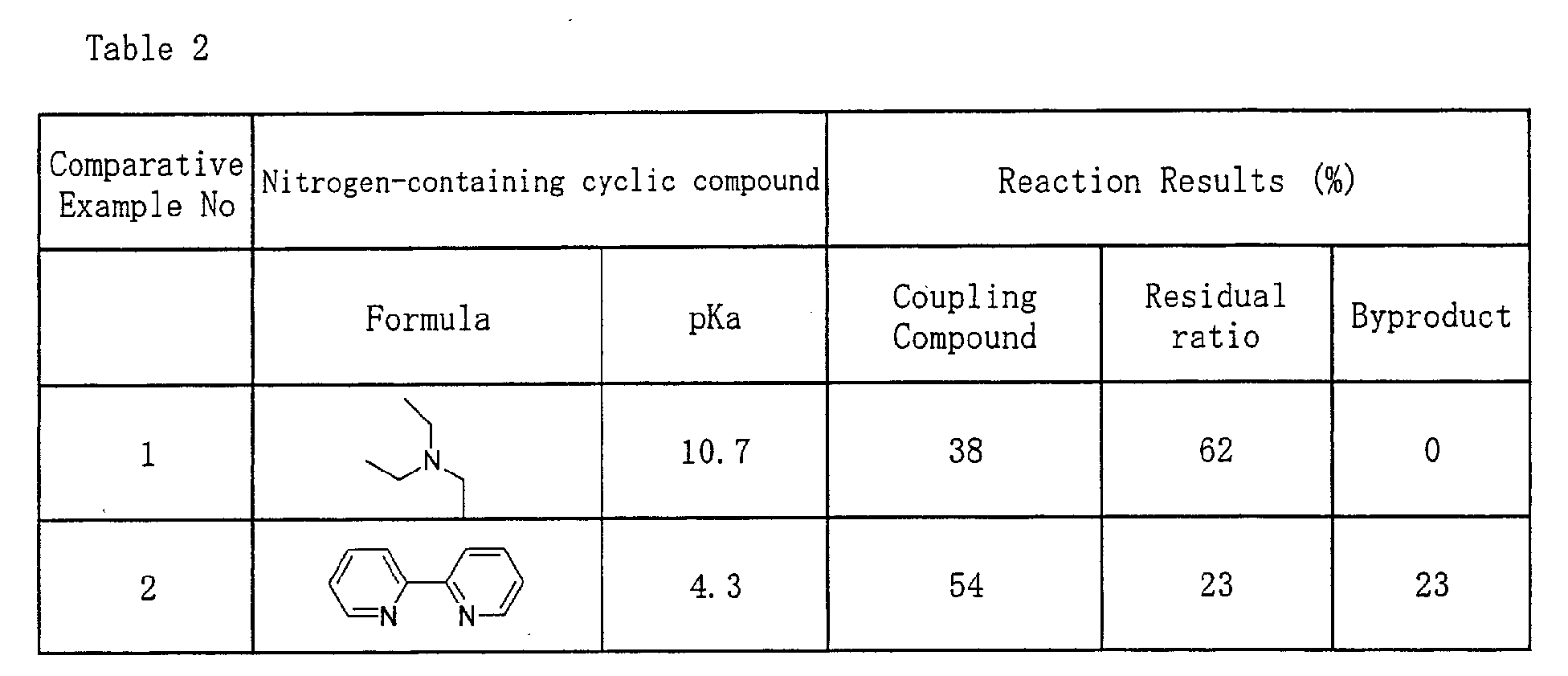
- Example 2 0.030mmol of the nitrogen-containing cyclic compounds shown in Table 1 were used respectively in place of 1,8-diazabicyclo [5.4.0]-7-undecene used in Example 1 and the reactions were conducted in a similar manner as in Example 1.
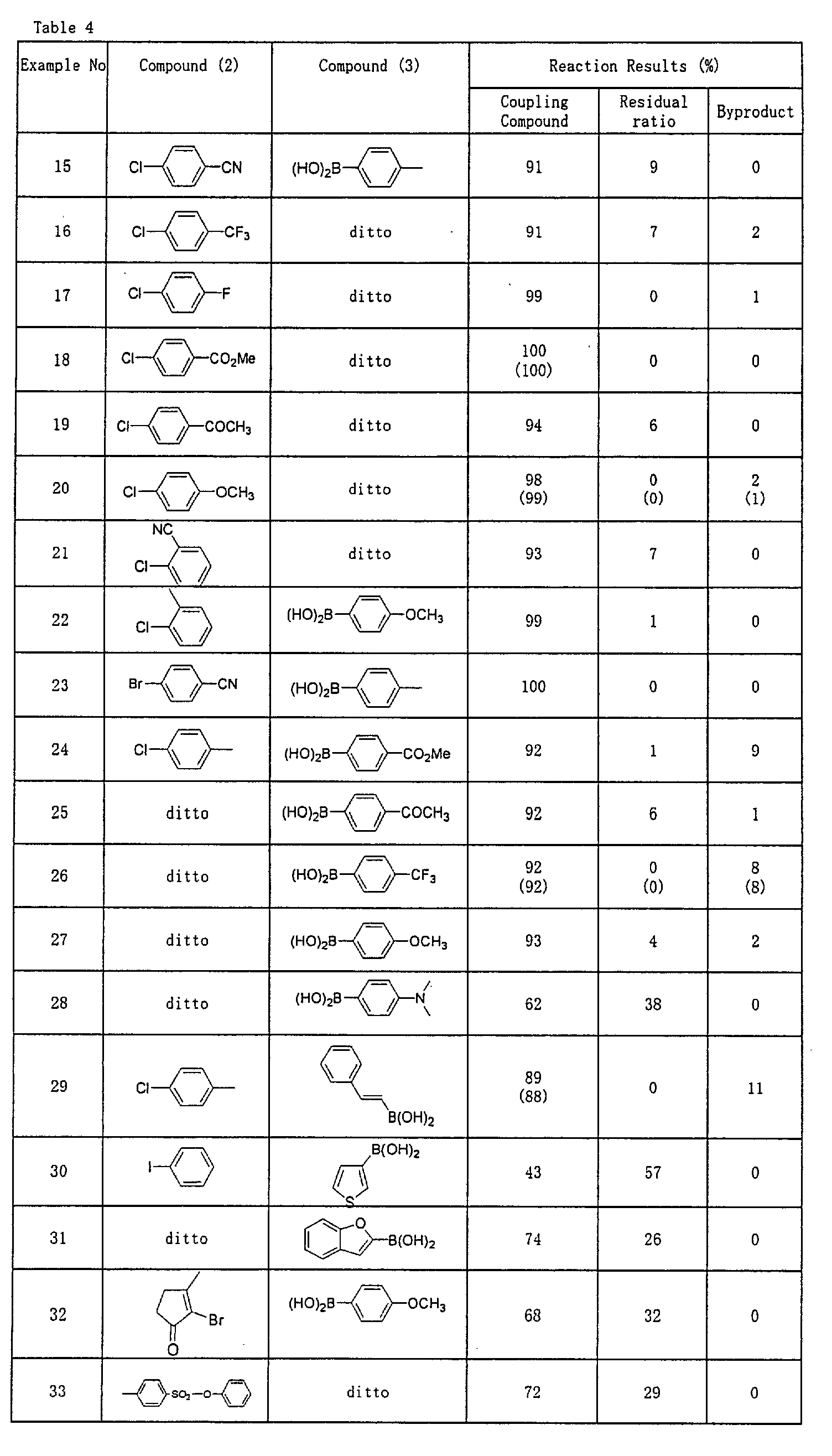
- Example 10 the figures shown in the parenthesis are the results obtained by using 1 ml of ethyleneglycol dimethy ether was used in place of dioxane and the reaction temperature was set at 100°C in place of 80°C and the reaction was continued for 8 hours in place of 3 hours in Example 1.
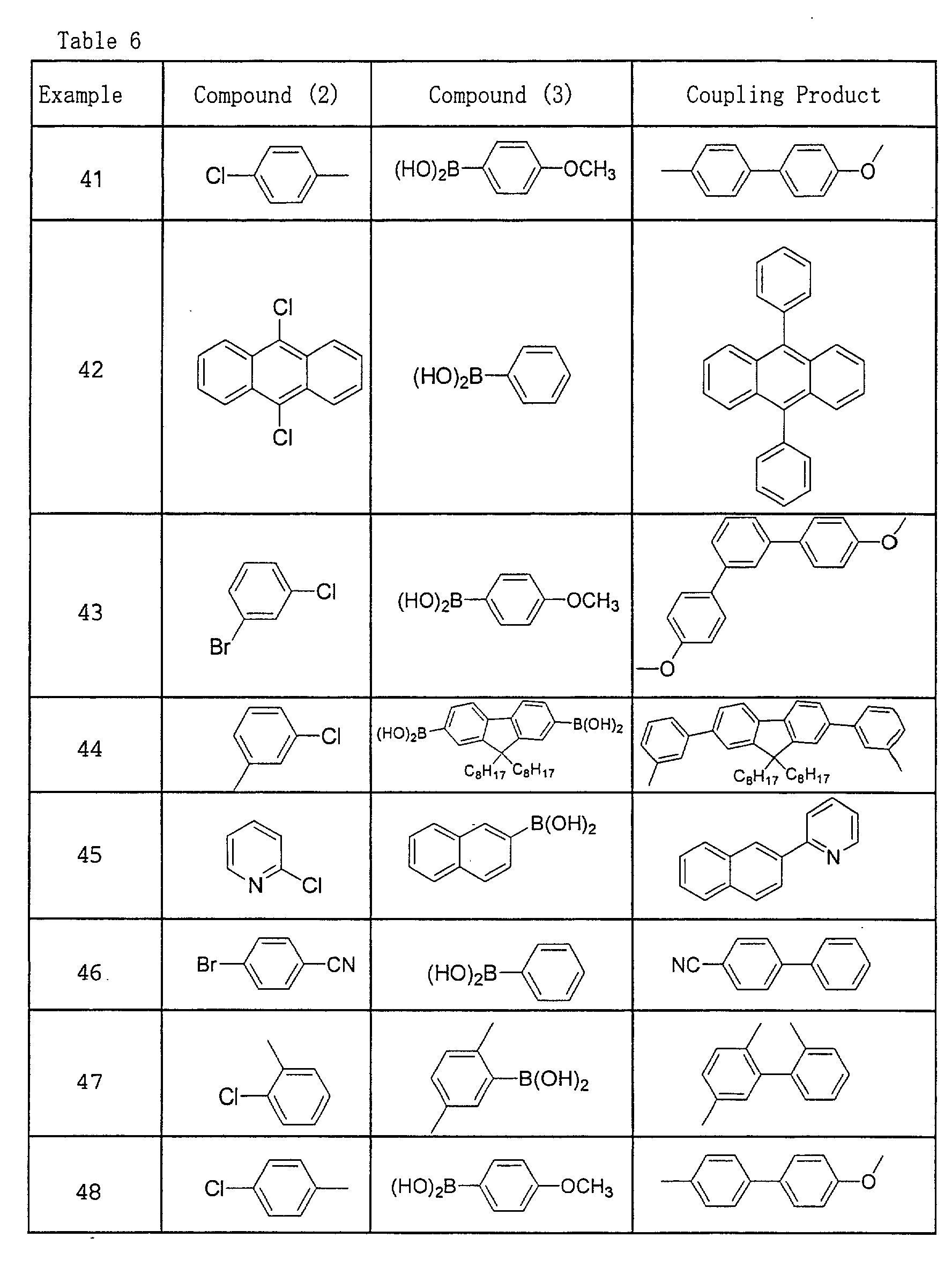
- the reaction was conducted in a similar manner as in Example 1 except that 0.4 mmol (60mg) of 2,5-dimethylphenylboronic acid was used in place of p-methoxyphenylboronic acid and 0.030mmol(2.5mg) of N-methylimidazole was used in place of 1,8-diazabicyclo[5.4.0]-7-undecene.
- the gaschromatography analysis of the reaction mixture showed that 3-methyl-2',5,-dimethylbiphenyl:99%, byproduct 3,3'-dimethylbiphenyl:0%, and unreacted 3-chlorotoluene:1%.
- the reaction was conducted in a similar manner as in Example 1 except that 0.4 mmol (60mg ) of 2, 5-dimethylphenylboronic acid was used in place of p-methoxyphenylboronic acid and 0.03mmol (38 mg) of 2-chlorotoluene was used in place of 3-chlorotoluene.
- the gaschromatography analysis of the reaction mixture showed that 2-methyl-2',5'-dimethylbiphenyl:83%, byproduct 2,5'-dimethyl-2',5'-dimethylbiphenyl:3%, and unreacted 2-chlorotoluene:14%.
- the reaction was conducted in a similar manner as in Example 1 except that 0.015mmol(16mg) of N,N-dimethylaminopyridine (supported on polystyrene) was used in place of 1,8-diazabicyclo[5.4.0]-7-undecene, 4-chlorotoluene was used in place of 3-chlorotoluene, 0.57 mmol(120mg) of potassium phosphate was used, and 1 ml of tetrahydrofuran was used in place of dioxane.
- the reaction was conducted in a similar manner as in Example 1 except that 0.8mmol (98mg) of phenylboronic acid was used place of p-methoxyphenylboronic acid, and 0.015 mmol(2.5mg) of N-methylimidazole was used in place of 1,8-diazabicyclo[5.4.0]-7-undecene, 0.3 mmol (74mg) of 9,10-dichloroanthracene was used in place of 3-chlorotoluene, 1.14 mmol(240mg) of potassium phosphate was used, 1 ml of ethyleneglycol dimethyl ether was used in place of dioxane, and the reaction was continued for 5 hours .
- the reaction result showed that 9,10-diphenylanthracene:100%, and 9,10-dichloroanthracene: 0%.
- the reaction was conducted in a similar manner as in Example 1 except that 0.015mmol(2.5mg) of N-methylimidazole was used in place of 1,8-diazabicyclo[5.4.0]-7-undecene, 0.3 mmol(57mg) of 3-bromochlorobenzene was used in place of 3-chlorotoluene, 0.57 mmol(120mg) of potassium phosphate was used, 1 ml of tetrahydrofuran was used in place of dioxane, and reaction was continued for 1 hour.
- the reaction results showed following results: 1,4-di(4-methoxyphenyl)biphenyl(desired product):100%, and unreacted 3-bromochlorobenzene:0%.
- the reaction was conducted in a similar manner as in Example 1 except that 0.4mmol (62mg) of 2, 7- (9,9'-di-n-octylfluorenyl) diboronic acid was used place of p-methoxyphenylboronic acid, and 0.015 mmol(2.5mg) of N-methylimidazole was used in place of 1,8-diazabicyclo[5.4.0]-7-undecene, 0.3 mmol (41mg) of potassium carbonate was used in place of potassium phosphate was used, 1 ml of tetrahydrofuran was used in place of dioxane, and the reaction was continued for 5 hours.
- the reaction result showed that 2,7-di(3-methylphenyl)-9,9'-di-n-octylfluorene:88% in terms of 3-chlorotoluene.
- the reaction was conducted in a similar manner as in Example 1 except that 0.4 mmol (69mg) of 2-naphthylboronic acid was used in place of p-methoxyphenylboronic acid, 0.015mmol(2.5mg) of N-methylimidazole was used in place of 1,8-diazabicyclo[5.4.0]-7-undecene, 0.3 mmol(34mg) of 2-chloropyridine was used in place of 3-chlorotoluene, and 1 ml of tetrahydrofuran was used in place of dioxane.
- the reaction results showed following results: 2-(2-naphthyl)pyridine:41%, 2-pyridylpyridine:0% and unreacted 2-chloropyridine:59%.
- the reaction was conducted in a similar manner as in Example 1 except that 0.015 mmol(2.5mg) of N-methylimidazole was used in place of 1,8-diazabicyclo[5.4.0]-7-undecene, 0.3mmol (38mg) of 4-chlorotoluene was used in place of 3-chlorotoluene, 0.57 mmol (120mg) of potassium phosphate was used, 0.015 mmol (4.4mg) of nickel chloride hexahydrate wa used in place of bis(1,5-cyclooctadiene)nickel, and 1 ml of tetrahydrofuran was used in place of dioxane. Gaschromatography analysis of the reaction mixture showed that 4-methoxy-4'-methylbiphenyl:95%, byproduct 4,4'-dimethylbiphenyl:2%, and unreacted 4-chlorotoluene:3%.
Landscapes
- Chemical & Material Sciences (AREA)
- Organic Chemistry (AREA)
- Chemical Kinetics & Catalysis (AREA)
- Inorganic Chemistry (AREA)
- Engineering & Computer Science (AREA)
- Materials Engineering (AREA)
- Catalysts (AREA)
- Organic Low-Molecular-Weight Compounds And Preparation Thereof (AREA)
Abstract
a substituted or unsubstituted aryl group,
which process is characterized by reacting
an unsaturated organic compound of formula (2):
with a boron compound of formula (3):
Description
a substituted or unsubstituted aryl group,
a substituted or unsubstituted heteroaryl group, or
a substituted or unsubstituted linear, branched or cyclic alkenyl group,
n and n' independently represent an integer of 1 or 2, provided that n and n' do not simultaneously represent 2, and when n=2, Y represents R2, or X1 as defined below, which process comprises reacting
an unsaturated organic compound of formula (2):
with a boron compound of formula (3):
X2 represents a hydroxy group, an alkoxy group, or X2 groups are bonded at their terminals to form an alkylenedioxy group or an arylenedioxy group, and
m represents an integer of 1 or 2,
provided that the boron atom is bonded with a sp2 carbon atom of R2 group, and
m ≦ n, wherein n is the same as defined in connection with formula (1) above, or
a cyclic anhydride trimer thereof of formula : (-O-B(R2)-)3, wherein R2 is the same as defined above,
in the presence of a catalyst comprising
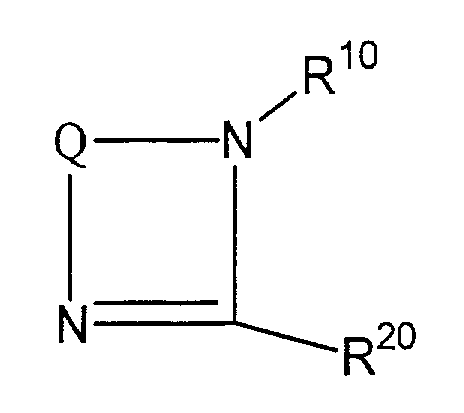
a substituted or unsubstituted alkylene group,
a substituted or unsubstituted alkenylene group,
a substituted or unsubstituted 1,2-phenylene group,
a substituted or unsubstituted 1,8-naphthylene group, or
-N=N- group,
R10 represents
a substituted or unsubstituted hydrocarbon group, and
R20 represents
a hydrogen atom, a substituted or unsubstituted hydrocarbon group,
alternatively, R10 and R20 are bonded at their terminals to form a substituted or unsubstituted alkylene, or alkenylene group,
These nickel compounds may be anhydrous or hydrated. Preferred nickel compounds are nickel(II) chloride, nickel(II) nickel bromide, nickel(II) iodide, nickel(II) nitrate, bis(1,5-cyclooctadiene)nickel, and nickel(II) acetate.
As for the software, a web-site, http://acdlabs.com. can be referred to. ACD/pKa is a program that calculates acid-base ionization constants (pKa values) under 25°C and zero ionic strength in aqueous solutions for a given organic structure. Each calculation is provided with both its ± 95% confidence limits and a detailed report of how it has been carried out, including Hammett-type equation(s), substituent constants, and literature references where available. The accuracy of calculations is usually better than ± 0.2 pKa units except for very complex structures or poorly-characterized substituents, where the accuracy is usually better than ± 0.5 pKa units. In order to achieve this accuracy, ACD/pKa DB uses its own internal databases and algorithms.
when n=n'=1,



when n=1, and n'=2,

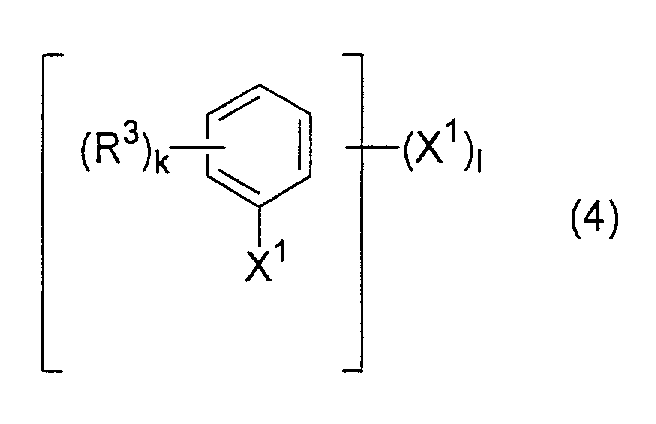
X1 represents a leaving group bonded with a sp2 carbon atom,
l is an integer of 0 or 1, and
k is an integer of 0 to 5,
provided that at least one ortho-position of the leaving group is a hydrogen atom or a common carbon atom of the fused aromatic ring compound.
Specific examples thereof include, for example, 5- to 10-membered cycloalkenyl group having at least one double bond and may be substituted with an oxo group such as cyclohexenyl, cyclopentenyl, 1,4-benzoquinonyl, 6-oxocyclohexe-1-enyl, or 5-oxocyclopent-1-enyl group.
a linear, branched or cyclic alkyl group (e.g, C1-10alkyl group as exemplified above) such as methyl, ethyl, i-propyl, cyclohexyl, or the like,
a haloalkyl group such as trifluoromethyl group,
a fluorine atom,
an alkoxy group (e.g. C1-C10alkoxy group as exemplified above) such as methoxy, ethoxy, t-butoxy, pentyloxy, hexyloxy, heptyloxy, octyloxy, nonyloxy, or decyloxy group,
an aryloxy group such as phenoxy or the like,
a hydroxy group,
an arylthio group such as phenylthio group, or the like, a cyano group,
a nitro group,
an amino group which may be substituted with an alkyl group or groups such as an amino, dimethylamino, pyrrolidino, piperlidino, or cyclohexylamino group, or the like,
a carbamate group which may be substituted with an alkyl group(e.g. C1-10 alkyl as exemplified above) such as t-butylcarbamate, or methylcarbamate,
a sulfonamide group which may be substituted with an alkyl, haloalkyl, or aryl group such as benzenesulfonamide, or methanesulfonamide,
an imino group,
an imido group such as phthalimide,
a formyl group,
a carboxyl group,
an alkoxycarbonyl group, in which the alkoxy include the C1-10 alkoxy group as exemplified above, such as methoxycarbonyl group,
aryloxycarbonyl group such as p-methoxyphenoxycarbonyl group,
a substituted or unsubstituted carbamoyl group such as carbamoyl or N-hydrocarbylsubstituted carbamoyl(e.g.N-phenylcarbamoyl group),
aheteroaryl group suchas pyridyl, quinazolyl, pyrimidyl, furyl, thienyl, pyrrolyl, or imidazolyl group, and
an aryl group such as phenyl or naphthyl group.

X2 represents a hydroxy group, an alkoxy group, or the X2 groups are bonded at their terminals to form an alkylenedioxy or arylenedioxy group,
R5 groups are the same or different and independently represent a substituent group as defined above, or R5 groups on adjacent benzene carbon atoms, together with the benzene ring to which they are bonded, optionally form an ortho-fused, or ortho- and para-fused aromatic ring compound (e.g. naphthyl, anthracenyl, phenanthryl, indenyl, fluorenyl orpyrenyl group), and
p represents an integer of 0 to 4, and q represents an integer of 0 or 1, or
a cyclic anhydride trimer thereof.
an alcohol such as methanol, ethanol or the like,
an aprotic polar solvent such as N-methylpyrolidone, N,N-dimethylformamide, N,N-dimethylacetamide, dimethylsulfoxide, acetonitrile or the like,
an ether such as diethyl ether, diisopropyl ether, ethyleneglycol dimethyl ether, diethyleneglycol dimethyl ether, 1,4-dioxane, tetrahydrofuran, or the like,
an aromatic hydrocarbon such as benzene, toluene, xylene, or the like,
an aliphatic hydrocarbon such as hexane, heptane or the like, and a mixture thereof. The solvent is usually used in an amount of 1 part by weight to 200 parts by weight or less, preferably 5 parts by weight to 100 parts by weight or less per 1 part by weight of the unsaturated compound of formula (2).


| Example No | Nitrogen-containing cyclic compound | Base | Solvent | Reaction Results (%) | ||
| Coupling Compound | Residual ratio | By-product | ||||
| 34 | N-methylimidazole | Potassium phosphate trihydrate | Dioxane | 72 | 26 | 2 |
| 35 | ditto | ditto | Tetrahydrofuran | 98 | 0 | 2 |
| 36 | ditto | ditto | Ethyleneglycol dimethyl ether | 85 | 10 | 5 |
| 37 | ditto | ditto | Toluene | 57 | 41 | 2 |
| 38 | ditto | Potassium carbonate | Tetrahydrofuran | 83 | 17 | 0 |
| 39 | 1,8-Diazabicy clo[5.4.0]-7-undecene | ditto | Ethyleneglycol dimethyl ether | 43 | 57 | 0 |
| 40 | N,N-Dimethyam inopyridine | ditto | Tetrahydrofuran | 54 | 46 | 0 |
1,4-di(4-methoxyphenyl)biphenyl(desired product):100%, and unreacted 3-bromochlorobenzene:0%.
2-(2-naphthyl)pyridine:41%, 2-pyridylpyridine:0% and unreacted 2-chloropyridine:59%.
| Example No | Nickel compound | Reaction Results (%) | ||
| Coupling Compound | Residual ratio | Byproduct | ||
| 49 | Nickel Nitrate hexahydrate | 85 | 15 | 0 |
| 50 | Nickel acetate tetrahydrate | 72 | 26 | 1 |
Experiments are conducted in a similar manner as in Example 1 to produce the desired coupling product with the exception that the catalyst preparation solution and the solid material respectively are used.
Claims (41)
- A process for producing a coupling compound of formula (1):
a substituted or unsubstituted aryl group,
a substituted or unsubstituted heteroaryl group, or
a substituted or unsubstituted linear, branched or cyclic alkenyl group,
n and n' independently represent an integer of 1 or 2, provided that n and n' do not simultaneously represent 2, and when n=2, Y represents R2, or X1 as defined below, which process comprises reacting
an unsaturated organic compound of formula (2):
X1 is the same or different and independently represents a leaving group and bonded with a sp2 carbon atom of R1 group,
with a boron compound of formula (3):
X2 represents a hydroxy group, an alkoxy group, or X2 groups are bonded at their terminals to form an alkylenedioxy group or an arylenedioxy group, and
m represents an integer of 1 or 2,
provided that the boron atom is bonded with a sp2 carbon atom of R2 group, and
m ≦ n, wherein n is the same as defined in connection with formula (1) above, or
a cyclic anhydride trimer thereof of formula: (-O-B(R2)-)3, wherein R2 is the same as defined above,
in the presence of a catalyst comprising(A) a nickel compound, and(B) a nitrogen-containing cyclic compound selected from:(a) a nitrogen-containing cyclic compound of formula (I):wherein Q represents
a substituted or unsubstituted alkylene group, a substituted or unsubstituted alkenylene group,
a substituted or unsubstituted 1,2-phenylene group,
a substituted or unsubstituted 1,8-naphthylene group, or
-N=N- group,
R10 represents
a substituted or unsubstituted hydrocarbon group, and
R20 represents
a hydrogen atom, a substituted or unsubstituted hydrocarbon group,
alternatively, R10 and R20 are bonded at their terminals to form a substituted or unsubstituted alkylene, or alkenylene group,(b) a substitutedorunsubstitutedpyridine or fused ring compound thereof of which conjugated acid has pKa of 5 or more,(c) a substituted pyrimidine or substituted or unsubstituted fused pyrimidine compound of which conjugate acid has pKa of 3 or more,(d) an enamine compound obtainable from a cyclic ketone compound and a cyclic secondary amine compound,(e) a substituted or unsubstituted 2H-pyrrole, 3,4-dihydro-2H-pyrrole or 3H-pyrrole or fused ring compound thereof, or(f) a substituted or unsubstituted N-hydrocarbyl 1,2,3-triazole, or a fused ring compound thereof. - A process according to claim 1, wherein the leaving group is a halogen atom, a sulfonate group, or a diazonium salt.
- A process according to claim 1, wherein the nitrogen-containing cyclic compound is the nitrogen-containing cyclic compound of formula (I).
- A process according to claim 3, wherein Q is the unsubstituted alkylene group.
- A process according to claim 3, wherein Q is the unsubstituted alkenylene group.
- Aprocess according to claim 3, wherein Q is the substituted or unsubstituted 1,2-phenylene group.
- A process according to claim 3, wherein Q is -N=N-.
- A process according to claim 1, wherein the nitrogen-containing cyclic compound is the substituted or unsubstituted pyridine or fused ring compound thereof of which conjugated acid has pKa of 5 or more.
- A process according to claim 1, wherein the nitrogen-containing cyclic compound is the substituted pyrimidine or substituted or unsubstituted fused pyrimidine compound of which conjugate acid has pKa of 3 or more.
- A process according to claim 1, wherein the nitrogen-containing cyclic compound is the enamine compound obtainable from a cyclic ketone compound and a cyclic secondary amine compound.
- A process according to claim 1, wherein the nitrogen-containing cyclic compound is the substituted or unsubstituted 2H-pyrrole, 3,4-dihydro-2H-pyrrole or 3H-pyrrole or fused ring compound thereof.
- A process according to claim 1, wherein the nitrogen-containing cyclic compound is the substituted or unsubstituted N-hydrocarbyl-1,2,3-triazole or fused ring compound thereof.
- A process according to any one of claims 1 to 8, the nickel compound is nickel(II) chloride, nickel(II) nickel bromide, nickel(II) iodide, nickel(II) nitrate, nickel bis(1,5-cyclooctadiene)nickel, nickel(II) acetate.
- A process according to claim 1, wherein the nitrogen-containing cyclic compound is N-methylimidazole, N,N-dimethylaminopyridine, or 1,8-diazabicyclo[5.4.0]-7-undecene.
- A process according to claim 1, wherein the catalyst is dichlorobis(N-methylimidazole)nickel.
- A process according to claim 1, wherein the unsaturated organic compound of formula (2) is a compound of formula (4):wherein R3 is the same or different and each independently represents a substituent group, or R3 groups on adjacent benzene carbon atoms, together with the benzene ring to which they are bonded, form an ortho-fused, or ortho- and peri-fused aromatic ring compound,
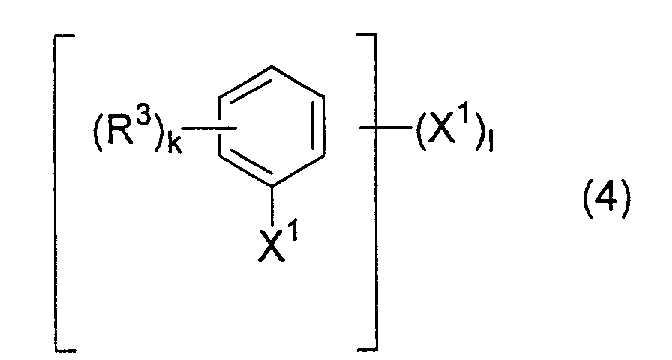
X1 represents a leaving group bonded with a sp2 carbon atom,
l is an integer of 0 or 1, and
k is an integer of 0 to 5,
provided that at least one ortho-position of the leaving group is a hydrogen atom or a common carbon atom of the fused aromatic ring compound. - A process according to claim 1, wherein the boron-compound of formula (3) is a compound of formula (5):wherein R4 represents a hydrogen atom,
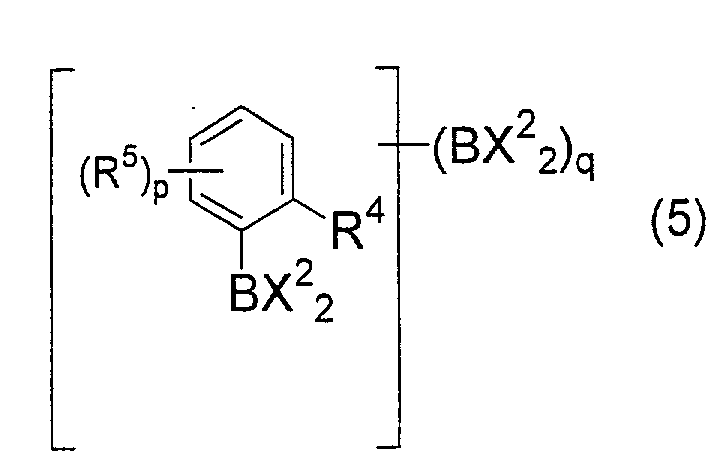
X2 represents a hydroxy group, an alkoxy group, or the X2 groups are bonded at their terminals to form an alkylenedioxy or arylenedioxy group,
R5 groups are the same or different and independently represent a substituent group, or R5 groups on adjacent benzene carbon atoms, together with the benzene ring to which they are bonded, optionally form an ortho-fused, or ortho- and para-fused aromatic ring compound, and
p represents an integer of 0 to 4, and q represents an integer of 0 or 1, or
a cyclic anhydride trimer thereof. - A process according to claim 1, which comprises reacting the unsaturated organic compound of formula (2) with the boron compound of formula (3) in the presence of the nitrogen containing cyclic compound as defined in (B) and the nickel compound in (A) as catalyst components.
- A catalyst composition:1) comprising (A) the nickel compound as defined in claim 1, (B) the nitrogen-containing cyclic compound as defined in claim 1, and a solvent, provided that said solvent is not a solvent consisting of ethanol and 2,2-dimethoxypropane,2) comprising (A) the nickel compound, (B) the nitrogen-containing cyclic compound as defined in claim 1, and a solvent consisting essentially of an aprotic organic solvent,3) comprising (A1) a zero valent nickel compound, and (B) the nitrogen-containing cyclic compound as defined above,4) obtainable by reacting (i) (A2) a divalent nickel compound, with (B) the nitrogen-containing cyclic compound as defined above, in the presence of a reducing agent, or5) comprising (A) the nickel compound, and (B) the nitrogen-containing cyclic compound as defined above, with the proviso that said nitrogen-containing cyclic compound is not 1-methylimidazole nor 1,2-dimethylimidazole when said nickel compound is a hydrate of nickel chloride, bromide or iodide or nickel nitrate.
- A catalyst composition according to claim 19, which is the catalyst composition comprising (A) the nickel compound, (B) the nitrogen-containing cyclic compound, and a solvent, provided that said solvent is not a solvent consisting of ethanol and 2,2-dimethoxypropane.
- A catalyst composition according to claim 20, whererin the solvent is an organic solvent, provided that the organic solvent is not a solvent consisting of ethanol and 2,2-dimethoxypropane.
- A catalyst composition according to claim 19, which is the catalyst composition comprising (A) the nickel compound, (B) the nitrogen-containing cyclic compound, and a solvent consisting essentially of an aprotic organic solvent.
- A catalyst composition according to claim 22, wherein the aprotic organic solvent is ether or hydrocarbon.
- A catalyst composition according to claim 19, which is the catalyst composition comprising (A1) a zero valent nickel compound, and (B) the nitrogen-containing cyclic compound.
- A catalyst composition according to claim 24, wherein the zero valent nickel compound is bis(1,5-cyclooctadiene)nickel.
- A catalyst composition according to claim 19, which is the catalyst composition obtainable by reacting (i) (A2) a divalent nickel compound, with (B) the nitrogen-containing cyclic compound, in the presence of a reducing agent.
- A catalyst composition according to claim 26, wherein the divalent nickel compound is nickel(II) chloride, nickel(II) nickel bromide, nickel(II) iodide, nickel(II) nitrate, or nickel(II) acetate, and the reducing agent is an alkyl lithium or an alkyl Grignard reagent.
- A catalyst composition according to claim 19, which is the catalyst composition comprising (A) the nickel compound, and (B) the nitrogen-containing cyclic compound, with the proviso that said nitrogen-containing cyclic compound is not 1-methylimidazole nor 1,2-dimethylimidazole when said nickel compound is a hydrate of nickel chloride, bromide or iodide or nickel nitrate.
- A catalyst composition according to claim 19, wherein The nitrogen-containing cyclic compound is the nitrogen-containing cyclic compound of formula (I).
- A catalyst composition according to claim 29, wherein Q is the unsubstituted alkylene group.
- A catalyst composition according to claim 29, wherein Q is the unsubstituted alkenylene group.
- A catalyst composition according to claim 29, wherein Q is the substituted or unsubstituted 1,2-phenylene group.
- A catalyst composition according to claim 29, wherein Q is -N=N-.
- A catalyst composition according to claim 19, wherein the nitrogen-containing cyclic compound is the substituted or unsubstituted pyridine or fused ring compound thereof of which conjugated acid has pKa of 5 or more.
- A catalyst composition according to claim 19, wherein the nitrogen-containing cyclic compound is the substituted pyrimidine or substituted or unsubstituted fused pyrimidine compound of which conjugate acid has pKa of 3 or more.
- A catalyst composition according to claim 19, wherein the nitrogen-containing cyclic compound is the enamine compound obtainable from a cyclic ketone compound and a cyclic secondary amine compound.
- A catalyst composition according to claim 36, wherein the cyclic ketone compound is cyclopentanone or cyclohexanone, and the cyclic secondary amine compound is pyrrolidine or piperidine.
- A catalyst composition according to claim 19, wherein the nitrogen-containing cyclic compound is the substituted or unsubstituted 2H-pyrrole, 3,4-dihydro-2H-pyrrole or 3H-pyrrole or fused ring compound thereof.
- A catalyst composition according to claim 19, wherein the nitrogen-containing cyclic compound is the substituted or unsubstituted N-hydrocarbyl-1,2,3-triazole or fused ring compound thereof.
- A catalyst composition according to claim 19, wherein the nickel compound is nickel(II) chloride, nickel (II) nickel bromide, nickel(II) iodide, nickel(II) nitrate, nickel bis(1,5-cyclooctadiene)nickel, or nickel(II) acetate.
- A catalyst composition according to claim 19, wherein the nitrogen-containing cyclic compound is N,N-dimethylaminopyridine, or 1,8-diazabicyclo[5.4.0]-7-undecene.
Applications Claiming Priority (2)
| Application Number | Priority Date | Filing Date | Title |
|---|---|---|---|
| JP2001324593 | 2001-10-23 | ||
| JP2001324593 | 2001-10-23 |
Publications (3)
| Publication Number | Publication Date |
|---|---|
| EP1306131A2 true EP1306131A2 (en) | 2003-05-02 |
| EP1306131A3 EP1306131A3 (en) | 2004-05-19 |
| EP1306131B1 EP1306131B1 (en) | 2016-12-07 |
Family
ID=19141295
Family Applications (1)
| Application Number | Title | Priority Date | Filing Date |
|---|---|---|---|
| EP02023829.1A Expired - Lifetime EP1306131B1 (en) | 2001-10-23 | 2002-10-23 | Cross-coupling process using a catalyst comprising a cyclic nitrogen ligand |
Country Status (2)
| Country | Link |
|---|---|
| US (2) | US7041856B2 (en) |
| EP (1) | EP1306131B1 (en) |
Cited By (2)
| Publication number | Priority date | Publication date | Assignee | Title |
|---|---|---|---|---|
| CN104619746A (en) * | 2012-04-17 | 2015-05-13 | 莫门蒂夫性能材料股份有限公司 | Mositure curable organopolysiloxane composition |
| CN111848453A (en) * | 2020-07-22 | 2020-10-30 | 浙江金立源药业有限公司 | Production process and production line of 4-methyl-2' -cyanobiphenyl |
Families Citing this family (9)
| Publication number | Priority date | Publication date | Assignee | Title |
|---|---|---|---|---|
| US7041856B2 (en) * | 2001-10-23 | 2006-05-09 | Sumitomo Chemical Company, Limited | Coupling catalyst and process using the same |
| JP4311069B2 (en) * | 2003-01-17 | 2009-08-12 | 住友化学株式会社 | Method for producing coupling compound |
| EP1449580B1 (en) * | 2003-02-19 | 2005-12-28 | Sumitomo Chemical Company, Limited | Production method of a cross-coupling compound from an alkyl halide and an organoboron compound |
| US7521581B2 (en) * | 2005-03-30 | 2009-04-21 | Tosoh Corporation | Catalyst composition and process for producing cross-coupled compound using same |
| WO2008111414A1 (en) * | 2007-03-09 | 2008-09-18 | Kyoto University | Catalyst composition, and process for production of cross-coupling compound using the same |
| US8602904B2 (en) * | 2010-05-10 | 2013-12-10 | Wonderland Nurserygoods Company Limited | Swing apparatus and control system and method therefor |
| WO2017059181A1 (en) * | 2015-09-30 | 2017-04-06 | The Regents Of The University Of Michigan | Ni(0) catalysts |
| CN109678757A (en) * | 2017-10-19 | 2019-04-26 | 上海茂晟康慧科技有限公司 | A kind of synthetic method of sartanbiphenyl and its derivative |
| CN108440291B (en) * | 2018-03-26 | 2020-08-28 | 南京工业大学 | A visible light-catalyzed method for dehydrogenation and self-coupling of 1,3-dicarbonyl compounds |
Family Cites Families (34)
| Publication number | Priority date | Publication date | Assignee | Title |
|---|---|---|---|---|
| US3326990A (en) | 1962-06-14 | 1967-06-20 | Columbian Carbon | Cycloolefin production using zieglertype reducing agent and a nickel chelate |
| US3407098A (en) | 1965-08-25 | 1968-10-22 | Olin Mathieson | Colorant film for aluminum surfaces |
| JPS4629020B1 (en) * | 1967-07-20 | 1971-08-23 | ||
| US3600419A (en) | 1968-09-03 | 1971-08-17 | Olin Corp | Preparation of aromatic isocyanates |
| US3642760A (en) | 1968-10-14 | 1972-02-15 | Solvay | Polymerization and copolymerization of diolefins |
| DD99556A1 (en) * | 1970-08-17 | 1973-08-12 | METHOD FOR THE OLIGOMERIZATION AND COOLIGERIZATION OF OLEFINES | |
| US3677978A (en) * | 1971-08-23 | 1972-07-18 | Ppg Industries Inc | Metal salt complexes of imidazoles as curing agents for one-part epoxy resins |
| CH596276A5 (en) | 1974-07-31 | 1978-03-15 | Ciba Geigy Ag | |
| CH594721A5 (en) | 1974-09-05 | 1978-01-31 | Ciba Geigy Ag | |
| DE2446543A1 (en) | 1974-09-28 | 1976-04-15 | Hoechst Ag | Monoazomethine pigments - from 3-hydroxy 4-formylnaphthalic acid or derivs. |
| DE2460396A1 (en) | 1974-12-20 | 1976-06-24 | Hoechst Ag | Diazomethine pigments and metal complexes - prepd. from 3-hydroxy 4-formyl-naphthalic acid |
| DD152547A1 (en) * | 1980-08-13 | 1981-12-02 | Dirk Walther | METHOD FOR THE CATALYTIC SYNTHESIS OF SULFUR DIIMIDES |
| DE3443465A1 (en) | 1984-11-29 | 1986-05-28 | Basf Ag, 6700 Ludwigshafen | NEW ISOINDOLINE COMPOUNDS, THEIR METAL COMPLEXES AND THEIR USE |
| JPH07122013B2 (en) | 1987-03-13 | 1995-12-25 | 日本メクトロン株式会社 | Fluorine-containing elastomer composition |
| US4912276A (en) | 1988-10-25 | 1990-03-27 | Eastman Kodak Company | Preparation of biaryl compounds |
| JP2727104B2 (en) * | 1989-03-07 | 1998-03-11 | イハラケミカル工業株式会社 | Method for producing diaryl derivative |
| US5563263A (en) | 1994-09-14 | 1996-10-08 | Hoechst Celanese Corporation | D4 -symmetric porphyrin-based catalysts, processes for preparing same, and processes for using same |
| WO1998000399A1 (en) * | 1996-07-01 | 1998-01-08 | E.I. Du Pont De Nemours And Company | Nickel catalyzed addition of -nh- containing compounds to vinyl and aryl halides |
| DE19652350A1 (en) | 1996-12-17 | 1998-06-18 | Studiengesellschaft Kohle Mbh | New catalysts made from transition metal compounds and 4,5-diphosphinoacridine ligands |
| US6200925B1 (en) | 1997-03-13 | 2001-03-13 | Eastman Chemical Company | Catalyst compositions for the polymerization of olefins |
| JPH11180991A (en) | 1997-12-22 | 1999-07-06 | Idemitsu Petrochem Co Ltd | Transition metal compound, olefin-polymerization catalyst and method for producing olefin polymer using the catalyst |
| US6034240A (en) | 1998-03-09 | 2000-03-07 | Symyx Technologies, Inc. | Substituted aminomethylphosphines, coordination complexes of aminomethylphosphines and their synthesis |
| US6395916B1 (en) * | 1998-07-10 | 2002-05-28 | Massachusetts Institute Of Technology | Ligands for metals and improved metal-catalyzed processes based thereon |
| US6365690B1 (en) | 1999-05-06 | 2002-04-02 | E. I. Du Pont De Nemours And Company | Polymerization of ethylene |
| CA2372526A1 (en) | 1999-05-10 | 2000-11-16 | Michael D. Wyrsta | Methods and compositions for controlled polypeptide synthesis |
| JP4507294B2 (en) | 1999-05-27 | 2010-07-21 | チッソ株式会社 | Method for producing biaryl derivative |
| JP4070370B2 (en) | 1999-09-22 | 2008-04-02 | 富士フイルム株式会社 | Method for producing polycyclic aromatic compound |
| US6689928B2 (en) | 2000-04-04 | 2004-02-10 | Exxonmobil Research And Engineering Company | Transition metal complexes and oligomers therefrom |
| US6501000B1 (en) | 2000-04-04 | 2002-12-31 | Exxonmobil Research And Engineering Company | Late transition metal catalyst complexes and oligomers therefrom |
| US20050101772A1 (en) | 2001-02-17 | 2005-05-12 | Jorg Schottek | Non-metallocenes, method for the production thereof and the use thereof for the polymerisation of olefins |
| JP4730574B2 (en) * | 2001-05-18 | 2011-07-20 | 山田化学工業株式会社 | Benzimidazole compounds, azobenzimidazole compounds and their chelate compounds |
| US6489414B1 (en) | 2001-06-06 | 2002-12-03 | Equistar Chemicals, Lp | Chelating pyrimidines as ligands for single-site olefin polymerization catalysts |
| US7041856B2 (en) * | 2001-10-23 | 2006-05-09 | Sumitomo Chemical Company, Limited | Coupling catalyst and process using the same |
| EP1449580B1 (en) * | 2003-02-19 | 2005-12-28 | Sumitomo Chemical Company, Limited | Production method of a cross-coupling compound from an alkyl halide and an organoboron compound |
-
2002
- 2002-10-22 US US10/277,138 patent/US7041856B2/en not_active Expired - Lifetime
- 2002-10-23 EP EP02023829.1A patent/EP1306131B1/en not_active Expired - Lifetime
-
2006
- 2006-01-09 US US11/327,382 patent/US20060111593A1/en not_active Abandoned
Cited By (3)
| Publication number | Priority date | Publication date | Assignee | Title |
|---|---|---|---|---|
| CN104619746A (en) * | 2012-04-17 | 2015-05-13 | 莫门蒂夫性能材料股份有限公司 | Mositure curable organopolysiloxane composition |
| CN111848453A (en) * | 2020-07-22 | 2020-10-30 | 浙江金立源药业有限公司 | Production process and production line of 4-methyl-2' -cyanobiphenyl |
| CN111848453B (en) * | 2020-07-22 | 2022-09-02 | 浙江金立源药业有限公司 | Production process and production line of 4-methyl-2' -cyanobiphenyl |
Also Published As
| Publication number | Publication date |
|---|---|
| US7041856B2 (en) | 2006-05-09 |
| US20030162950A1 (en) | 2003-08-28 |
| EP1306131A3 (en) | 2004-05-19 |
| US20060111593A1 (en) | 2006-05-25 |
| EP1306131B1 (en) | 2016-12-07 |
Similar Documents
| Publication | Publication Date | Title |
|---|---|---|
| Joshi et al. | Graphene oxide grafted with Pd17Se15 nano-particles generated from a single source precursor as a recyclable and efficient catalyst for C–O coupling in O-arylation at room temperature | |
| Percec et al. | Aryl mesylates in metal catalyzed homo-and cross-coupling reactions. 4. Scope and limitations of aryl mesylates in nickel catalyzed cross-coupling reactions | |
| Knappke et al. | 35 years of palladium-catalyzed cross-coupling with Grignard reagents: how far have we come? | |
| Fleckenstein et al. | Aqueous cross-coupling: highly efficient Suzuki–Miyaura coupling of N-heteroaryl halides and N-heteroarylboronic acids | |
| Sahoo et al. | Cross‐Coupling of Triallyl (aryl) silanes with Aryl Bromides and Chlorides: An Alternative Convenient Biaryl Synthesis | |
| EP1306131B1 (en) | Cross-coupling process using a catalyst comprising a cyclic nitrogen ligand | |
| Feuerstein et al. | Palladium–tetraphosphine catalysed cross coupling of aryl bromides with arylboronic acids: remarkable influence of the nature of the ligand | |
| KR102362056B1 (en) | Method for producing butadiene compound | |
| Hoshi et al. | An active, general, and long-lived palladium catalyst for cross-couplings of deactivated (hetero) aryl chlorides and bromides with arylboronic acids | |
| Ding et al. | Heterogeneous copper-catalyzed hydroxylation of aryl iodides under air conditions | |
| JP4427946B2 (en) | Method for producing coupling compound | |
| CN102015585B (en) | Method for producing unsaturated organic compound | |
| JP4321131B2 (en) | Method for producing coupling compound | |
| Shi et al. | Highly efficient and stable palladium/imidazolium salt-phosphine catalysts for Suzuki–Miyaura cross-coupling of aryl bromides | |
| Feuerstein et al. | Palladium catalysed cross-coupling of aryl chlorides with arylboronic acids in the presence of a new tetraphosphine ligand | |
| Gao et al. | A highly efficient catalytic system for cross-coupling of aryl chlorides and bromides with malononitrile anion by palladium carbene complexes | |
| JP4232518B2 (en) | Method for producing coupling compound | |
| JP2004189599A (en) | Method for producing unsaturated organic compound derivative | |
| EP1449580B1 (en) | Production method of a cross-coupling compound from an alkyl halide and an organoboron compound | |
| US7122711B2 (en) | Method for producing biaryl compound | |
| JP4552451B2 (en) | Method for producing coupling compound | |
| EP1439157B1 (en) | Method for producing Suzuki coupling compound catalysed by a nickel compound | |
| Wu et al. | A highly active cobalt catalyst system for Kumada Biaryl cross-coupling | |
| US7521581B2 (en) | Catalyst composition and process for producing cross-coupled compound using same | |
| JP2003212798A (en) | Method for producing substituted aromatic compounds |
Legal Events
| Date | Code | Title | Description |
|---|---|---|---|
| PUAI | Public reference made under article 153(3) epc to a published international application that has entered the european phase |
Free format text: ORIGINAL CODE: 0009012 |
|
| AK | Designated contracting states |
Designated state(s): AT BE BG CH CY CZ DE DK EE ES FI FR GB GR IE IT LI LU MC NL PT SE SK TR |
|
| AX | Request for extension of the european patent |
Extension state: AL LT LV MK RO SI |
|
| PUAL | Search report despatched |
Free format text: ORIGINAL CODE: 0009013 |
|
| RIC1 | Information provided on ipc code assigned before grant |
Ipc: 7C 07D 213/02 B Ipc: 7C 07F 5/02 B Ipc: 7C 07D 249/04 B Ipc: 7C 07D 247/00 B Ipc: 7C 07D 227/00 B Ipc: 7C 07B 37/04 B Ipc: 7B 01J 31/18 A Ipc: 7C 07D 257/00 B Ipc: 7C 07F 15/04 B |
|
| AK | Designated contracting states |
Kind code of ref document: A3 Designated state(s): AT BE BG CH CY CZ DE DK EE ES FI FR GB GR IE IT LI LU MC NL PT SE SK TR |
|
| AX | Request for extension of the european patent |
Extension state: AL LT LV MK RO SI |
|
| 17P | Request for examination filed |
Effective date: 20040720 |
|
| RAP1 | Party data changed (applicant data changed or rights of an application transferred) |
Owner name: SUMITOMO CHEMICAL COMPANY, LIMITED |
|
| AKX | Designation fees paid |
Designated state(s): CH DE FR GB LI |
|
| 17Q | First examination report despatched |
Effective date: 20041118 |
|
| GRAP | Despatch of communication of intention to grant a patent |
Free format text: ORIGINAL CODE: EPIDOSNIGR1 |
|
| INTG | Intention to grant announced |
Effective date: 20160712 |
|
| GRAS | Grant fee paid |
Free format text: ORIGINAL CODE: EPIDOSNIGR3 |
|
| GRAA | (expected) grant |
Free format text: ORIGINAL CODE: 0009210 |
|
| AK | Designated contracting states |
Kind code of ref document: B1 Designated state(s): CH DE FR GB LI |
|
| REG | Reference to a national code |
Ref country code: GB Ref legal event code: FG4D |
|
| REG | Reference to a national code |
Ref country code: CH Ref legal event code: EP |
|
| REG | Reference to a national code |
Ref country code: DE Ref legal event code: R096 Ref document number: 60248533 Country of ref document: DE |
|
| REG | Reference to a national code |
Ref country code: DE Ref legal event code: R097 Ref document number: 60248533 Country of ref document: DE |
|
| PLBE | No opposition filed within time limit |
Free format text: ORIGINAL CODE: 0009261 |
|
| STAA | Information on the status of an ep patent application or granted ep patent |
Free format text: STATUS: NO OPPOSITION FILED WITHIN TIME LIMIT |
|
| 26N | No opposition filed |
Effective date: 20170908 |
|
| PGFP | Annual fee paid to national office [announced via postgrant information from national office to epo] |
Ref country code: DE Payment date: 20171018 Year of fee payment: 16 |
|
| REG | Reference to a national code |
Ref country code: CH Ref legal event code: PL |
|
| GBPC | Gb: european patent ceased through non-payment of renewal fee |
Effective date: 20171023 |
|
| REG | Reference to a national code |
Ref country code: FR Ref legal event code: ST Effective date: 20180629 |
|
| PG25 | Lapsed in a contracting state [announced via postgrant information from national office to epo] |
Ref country code: LI Free format text: LAPSE BECAUSE OF NON-PAYMENT OF DUE FEES Effective date: 20171031 Ref country code: CH Free format text: LAPSE BECAUSE OF NON-PAYMENT OF DUE FEES Effective date: 20171031 Ref country code: GB Free format text: LAPSE BECAUSE OF NON-PAYMENT OF DUE FEES Effective date: 20171023 |
|
| PG25 | Lapsed in a contracting state [announced via postgrant information from national office to epo] |
Ref country code: FR Free format text: LAPSE BECAUSE OF NON-PAYMENT OF DUE FEES Effective date: 20171031 |
|
| REG | Reference to a national code |
Ref country code: DE Ref legal event code: R119 Ref document number: 60248533 Country of ref document: DE |
|
| PG25 | Lapsed in a contracting state [announced via postgrant information from national office to epo] |
Ref country code: DE Free format text: LAPSE BECAUSE OF NON-PAYMENT OF DUE FEES Effective date: 20190501 |