EP1305367B1 - Thermoplastic silicone elastomers from compatibilized polyamide resins - Google Patents
Thermoplastic silicone elastomers from compatibilized polyamide resins Download PDFInfo
- Publication number
- EP1305367B1 EP1305367B1 EP01959153A EP01959153A EP1305367B1 EP 1305367 B1 EP1305367 B1 EP 1305367B1 EP 01959153 A EP01959153 A EP 01959153A EP 01959153 A EP01959153 A EP 01959153A EP 1305367 B1 EP1305367 B1 EP 1305367B1
- Authority
- EP
- European Patent Office
- Prior art keywords
- weight
- compatibilizer
- diorganopolysiloxane
- group
- polyamide
- Prior art date
- Legal status (The legal status is an assumption and is not a legal conclusion. Google has not performed a legal analysis and makes no representation as to the accuracy of the status listed.)
- Expired - Lifetime
Links
Classifications
-
- C—CHEMISTRY; METALLURGY
- C08—ORGANIC MACROMOLECULAR COMPOUNDS; THEIR PREPARATION OR CHEMICAL WORKING-UP; COMPOSITIONS BASED THEREON
- C08L—COMPOSITIONS OF MACROMOLECULAR COMPOUNDS
- C08L77/00—Compositions of polyamides obtained by reactions forming a carboxylic amide link in the main chain; Compositions of derivatives of such polymers
- C08L77/02—Polyamides derived from omega-amino carboxylic acids or from lactams thereof
-
- C—CHEMISTRY; METALLURGY
- C08—ORGANIC MACROMOLECULAR COMPOUNDS; THEIR PREPARATION OR CHEMICAL WORKING-UP; COMPOSITIONS BASED THEREON
- C08L—COMPOSITIONS OF MACROMOLECULAR COMPOUNDS
- C08L77/00—Compositions of polyamides obtained by reactions forming a carboxylic amide link in the main chain; Compositions of derivatives of such polymers
-
- C—CHEMISTRY; METALLURGY
- C08—ORGANIC MACROMOLECULAR COMPOUNDS; THEIR PREPARATION OR CHEMICAL WORKING-UP; COMPOSITIONS BASED THEREON
- C08L—COMPOSITIONS OF MACROMOLECULAR COMPOUNDS
- C08L77/00—Compositions of polyamides obtained by reactions forming a carboxylic amide link in the main chain; Compositions of derivatives of such polymers
- C08L77/06—Polyamides derived from polyamines and polycarboxylic acids
-
- C—CHEMISTRY; METALLURGY
- C08—ORGANIC MACROMOLECULAR COMPOUNDS; THEIR PREPARATION OR CHEMICAL WORKING-UP; COMPOSITIONS BASED THEREON
- C08L—COMPOSITIONS OF MACROMOLECULAR COMPOUNDS
- C08L83/00—Compositions of macromolecular compounds obtained by reactions forming in the main chain of the macromolecule a linkage containing silicon with or without sulfur, nitrogen, oxygen or carbon only; Compositions of derivatives of such polymers
- C08L83/04—Polysiloxanes
-
- C—CHEMISTRY; METALLURGY
- C08—ORGANIC MACROMOLECULAR COMPOUNDS; THEIR PREPARATION OR CHEMICAL WORKING-UP; COMPOSITIONS BASED THEREON
- C08G—MACROMOLECULAR COMPOUNDS OBTAINED OTHERWISE THAN BY REACTIONS ONLY INVOLVING UNSATURATED CARBON-TO-CARBON BONDS
- C08G77/00—Macromolecular compounds obtained by reactions forming a linkage containing silicon with or without sulfur, nitrogen, oxygen or carbon in the main chain of the macromolecule
- C08G77/04—Polysiloxanes
- C08G77/12—Polysiloxanes containing silicon bound to hydrogen
-
- C—CHEMISTRY; METALLURGY
- C08—ORGANIC MACROMOLECULAR COMPOUNDS; THEIR PREPARATION OR CHEMICAL WORKING-UP; COMPOSITIONS BASED THEREON
- C08G—MACROMOLECULAR COMPOUNDS OBTAINED OTHERWISE THAN BY REACTIONS ONLY INVOLVING UNSATURATED CARBON-TO-CARBON BONDS
- C08G77/00—Macromolecular compounds obtained by reactions forming a linkage containing silicon with or without sulfur, nitrogen, oxygen or carbon in the main chain of the macromolecule
- C08G77/04—Polysiloxanes
- C08G77/14—Polysiloxanes containing silicon bound to oxygen-containing groups
-
- C—CHEMISTRY; METALLURGY
- C08—ORGANIC MACROMOLECULAR COMPOUNDS; THEIR PREPARATION OR CHEMICAL WORKING-UP; COMPOSITIONS BASED THEREON
- C08G—MACROMOLECULAR COMPOUNDS OBTAINED OTHERWISE THAN BY REACTIONS ONLY INVOLVING UNSATURATED CARBON-TO-CARBON BONDS
- C08G77/00—Macromolecular compounds obtained by reactions forming a linkage containing silicon with or without sulfur, nitrogen, oxygen or carbon in the main chain of the macromolecule
- C08G77/04—Polysiloxanes
- C08G77/14—Polysiloxanes containing silicon bound to oxygen-containing groups
- C08G77/16—Polysiloxanes containing silicon bound to oxygen-containing groups to hydroxy groups
-
- C—CHEMISTRY; METALLURGY
- C08—ORGANIC MACROMOLECULAR COMPOUNDS; THEIR PREPARATION OR CHEMICAL WORKING-UP; COMPOSITIONS BASED THEREON
- C08G—MACROMOLECULAR COMPOUNDS OBTAINED OTHERWISE THAN BY REACTIONS ONLY INVOLVING UNSATURATED CARBON-TO-CARBON BONDS
- C08G77/00—Macromolecular compounds obtained by reactions forming a linkage containing silicon with or without sulfur, nitrogen, oxygen or carbon in the main chain of the macromolecule
- C08G77/04—Polysiloxanes
- C08G77/14—Polysiloxanes containing silicon bound to oxygen-containing groups
- C08G77/18—Polysiloxanes containing silicon bound to oxygen-containing groups to alkoxy or aryloxy groups
-
- C—CHEMISTRY; METALLURGY
- C08—ORGANIC MACROMOLECULAR COMPOUNDS; THEIR PREPARATION OR CHEMICAL WORKING-UP; COMPOSITIONS BASED THEREON
- C08G—MACROMOLECULAR COMPOUNDS OBTAINED OTHERWISE THAN BY REACTIONS ONLY INVOLVING UNSATURATED CARBON-TO-CARBON BONDS
- C08G77/00—Macromolecular compounds obtained by reactions forming a linkage containing silicon with or without sulfur, nitrogen, oxygen or carbon in the main chain of the macromolecule
- C08G77/04—Polysiloxanes
- C08G77/20—Polysiloxanes containing silicon bound to unsaturated aliphatic groups
-
- C—CHEMISTRY; METALLURGY
- C08—ORGANIC MACROMOLECULAR COMPOUNDS; THEIR PREPARATION OR CHEMICAL WORKING-UP; COMPOSITIONS BASED THEREON
- C08G—MACROMOLECULAR COMPOUNDS OBTAINED OTHERWISE THAN BY REACTIONS ONLY INVOLVING UNSATURATED CARBON-TO-CARBON BONDS
- C08G77/00—Macromolecular compounds obtained by reactions forming a linkage containing silicon with or without sulfur, nitrogen, oxygen or carbon in the main chain of the macromolecule
- C08G77/04—Polysiloxanes
- C08G77/22—Polysiloxanes containing silicon bound to organic groups containing atoms other than carbon, hydrogen and oxygen
- C08G77/26—Polysiloxanes containing silicon bound to organic groups containing atoms other than carbon, hydrogen and oxygen nitrogen-containing groups
-
- C—CHEMISTRY; METALLURGY
- C08—ORGANIC MACROMOLECULAR COMPOUNDS; THEIR PREPARATION OR CHEMICAL WORKING-UP; COMPOSITIONS BASED THEREON
- C08G—MACROMOLECULAR COMPOUNDS OBTAINED OTHERWISE THAN BY REACTIONS ONLY INVOLVING UNSATURATED CARBON-TO-CARBON BONDS
- C08G77/00—Macromolecular compounds obtained by reactions forming a linkage containing silicon with or without sulfur, nitrogen, oxygen or carbon in the main chain of the macromolecule
- C08G77/42—Block-or graft-polymers containing polysiloxane sequences
- C08G77/44—Block-or graft-polymers containing polysiloxane sequences containing only polysiloxane sequences
-
- C—CHEMISTRY; METALLURGY
- C08—ORGANIC MACROMOLECULAR COMPOUNDS; THEIR PREPARATION OR CHEMICAL WORKING-UP; COMPOSITIONS BASED THEREON
- C08G—MACROMOLECULAR COMPOUNDS OBTAINED OTHERWISE THAN BY REACTIONS ONLY INVOLVING UNSATURATED CARBON-TO-CARBON BONDS
- C08G77/00—Macromolecular compounds obtained by reactions forming a linkage containing silicon with or without sulfur, nitrogen, oxygen or carbon in the main chain of the macromolecule
- C08G77/42—Block-or graft-polymers containing polysiloxane sequences
- C08G77/445—Block-or graft-polymers containing polysiloxane sequences containing polyester sequences
-
- C—CHEMISTRY; METALLURGY
- C08—ORGANIC MACROMOLECULAR COMPOUNDS; THEIR PREPARATION OR CHEMICAL WORKING-UP; COMPOSITIONS BASED THEREON
- C08G—MACROMOLECULAR COMPOUNDS OBTAINED OTHERWISE THAN BY REACTIONS ONLY INVOLVING UNSATURATED CARBON-TO-CARBON BONDS
- C08G77/00—Macromolecular compounds obtained by reactions forming a linkage containing silicon with or without sulfur, nitrogen, oxygen or carbon in the main chain of the macromolecule
- C08G77/42—Block-or graft-polymers containing polysiloxane sequences
- C08G77/448—Block-or graft-polymers containing polysiloxane sequences containing polycarbonate sequences
-
- C—CHEMISTRY; METALLURGY
- C08—ORGANIC MACROMOLECULAR COMPOUNDS; THEIR PREPARATION OR CHEMICAL WORKING-UP; COMPOSITIONS BASED THEREON
- C08G—MACROMOLECULAR COMPOUNDS OBTAINED OTHERWISE THAN BY REACTIONS ONLY INVOLVING UNSATURATED CARBON-TO-CARBON BONDS
- C08G77/00—Macromolecular compounds obtained by reactions forming a linkage containing silicon with or without sulfur, nitrogen, oxygen or carbon in the main chain of the macromolecule
- C08G77/42—Block-or graft-polymers containing polysiloxane sequences
- C08G77/452—Block-or graft-polymers containing polysiloxane sequences containing nitrogen-containing sequences
- C08G77/455—Block-or graft-polymers containing polysiloxane sequences containing nitrogen-containing sequences containing polyamide, polyesteramide or polyimide sequences
-
- C—CHEMISTRY; METALLURGY
- C08—ORGANIC MACROMOLECULAR COMPOUNDS; THEIR PREPARATION OR CHEMICAL WORKING-UP; COMPOSITIONS BASED THEREON
- C08G—MACROMOLECULAR COMPOUNDS OBTAINED OTHERWISE THAN BY REACTIONS ONLY INVOLVING UNSATURATED CARBON-TO-CARBON BONDS
- C08G77/00—Macromolecular compounds obtained by reactions forming a linkage containing silicon with or without sulfur, nitrogen, oxygen or carbon in the main chain of the macromolecule
- C08G77/42—Block-or graft-polymers containing polysiloxane sequences
- C08G77/452—Block-or graft-polymers containing polysiloxane sequences containing nitrogen-containing sequences
- C08G77/458—Block-or graft-polymers containing polysiloxane sequences containing nitrogen-containing sequences containing polyurethane sequences
-
- C—CHEMISTRY; METALLURGY
- C08—ORGANIC MACROMOLECULAR COMPOUNDS; THEIR PREPARATION OR CHEMICAL WORKING-UP; COMPOSITIONS BASED THEREON
- C08G—MACROMOLECULAR COMPOUNDS OBTAINED OTHERWISE THAN BY REACTIONS ONLY INVOLVING UNSATURATED CARBON-TO-CARBON BONDS
- C08G77/00—Macromolecular compounds obtained by reactions forming a linkage containing silicon with or without sulfur, nitrogen, oxygen or carbon in the main chain of the macromolecule
- C08G77/42—Block-or graft-polymers containing polysiloxane sequences
- C08G77/46—Block-or graft-polymers containing polysiloxane sequences containing polyether sequences
-
- Y—GENERAL TAGGING OF NEW TECHNOLOGICAL DEVELOPMENTS; GENERAL TAGGING OF CROSS-SECTIONAL TECHNOLOGIES SPANNING OVER SEVERAL SECTIONS OF THE IPC; TECHNICAL SUBJECTS COVERED BY FORMER USPC CROSS-REFERENCE ART COLLECTIONS [XRACs] AND DIGESTS
- Y10—TECHNICAL SUBJECTS COVERED BY FORMER USPC
- Y10S—TECHNICAL SUBJECTS COVERED BY FORMER USPC CROSS-REFERENCE ART COLLECTIONS [XRACs] AND DIGESTS
- Y10S525/00—Synthetic resins or natural rubbers -- part of the class 520 series
- Y10S525/903—Interpenetrating network
Definitions
- the present invention relates to a thermoplastic elastomer composition wherein a silicone base is blended with a polyamide resin and a compatibilizer and silicone gum contained in the base is dynamically vulcanized during the mixing process.
- TPEs Thermoplastic elastomers
- Thermoplastic elastomers are polymeric materials which possess both plastic and rubbery properties. They have elastomeric mechanical properties but, unlike conventional thermoset rubbers, they can be re-processed at elevated temperatures. This re-processability is a major advantage of TPEs over chemically crosslinked rubbers since it allows recycling of fabricated parts and results in a considerable reduction of scrap.
- Block copolymer thermoplastic elastomers contain "hard” plastic segments which have a melting point or glass transition temperature above ambient as well as “soft” polymeric segments which have a glass transition or melt point considerably below room temperature.
- the hard segments aggregate to form distinct microphases and act as physical crosslinks for the soft phase, thereby imparting a rubbery character at room temperature.
- the hard segments melt or soften and allow the copolymer to flow and to be processed like an ordinary thermoplastic resin.
- thermoplastic elastomer referred to as a simple blend (physical blend) can be obtained by uniformly mixing an elastomeric component with a thermoplastic resin.
- a thermoplastic elastomer known in the art as a thermoplastic vulcanizate (TPV) results. Since the crosslinked elastomeric phase of a TPV is insoluble and non-flowable at elevated temperature, TPVs generally exhibit improved oil and solvent resistance as well as reduced compression set relative to the simple blends.
- a TPV is formed by a process known as dynamic vulcanization, wherein the elastomer and the thermoplastic matrix are mixed and the elastomer is cured with the aid of a crosslinking agent and/or catalyst during the mixing process.
- TPVs are known in the art, including some wherein the crosslinked elastomeric component can be a silicone polymer while the thermoplastic component is an organic, non-silicone polymer (i.e., a thermoplastic silicone vulcanizate or TPSiV).
- the elastomeric component can be cured by various mechanisms, but it has been shown that the use of a non-specific radical initiator, such as an organic peroxide, can also result in at least a partial cure of the thermoplastic resin itself, thereby reducing or completely destroying the ability to re-process the composition (i.e., it no longer is a thermoplastic). In other cases, the peroxide can lead to the partial degradation of the thermoplastic resin.
- elastomer-specific crosslinkers such as organohydrido silicon compounds, can be used to cure alkenyl-functional silicone elastomers.
- the vinyl-containing silicone is vulcanized in the thermoplastic during melt mixing according to a chain extension or crosslinking mechanism which employs a silicon hydride-containing silicone component. This disclosure states that the chain extension procedure results in a thermoplastic composition when the vinyl-containing silicone has 2 to 4 vinyl groups and the hydride-containing silicone has 1 to 2 times the equivalent of the vinyl functionality.
- thermoset compositions when the vinyl-containing silicone has 2 to 30 vinyl groups and the hydride-containing silicone has 2 to 10 times the equivalent of the vinyl functionality.
- Typical thermoplastics mentioned include polyamides, polyurethanes, styrenics, polyacetals and polycarbonates.
- Arkles discloses a silicone fluid content ranging from 1 to 40 weight percent (1 to 60% in the case of the '739 patent), there is no suggestion of any criticality as to these proportions or to the specific nature of the organic resin.
- thermoplastic elastomers having improved resistance to oil and compression set. These systems are prepared by first forming a cured rubber concentrate wherein a curable elastomeric copolymer is dispersed in a polymeric carrier not miscible therewith, the curable copolymer being dynamically vulcanized while this combination is mixed. The resulting rubber concentrate is, in turn, blended with an engineering thermoplastic to provide the desired TPE. Silicone rubber is disclosed as a possible elastomeric component, but no examples utilizing such a silicone are provided. Further, this publication specifically teaches that the polymeric carrier must not react with the cure agent for the curable copolymer.
- Crosby et al. in United States Patent No. 4,695,602 teach composites wherein a silicone semi-IPN vulcanized via a hydrosilation reaction is dispersed in a fiber-reinforced thermoplastic resin having a high flexural modulus.
- the silicones employed are of the type taught by Arkles, cited supra, and the composites are said to exhibit improved shrinkage and warpage characteristics relative to systems which omit the IPN.
- Ward et al. in United States Patent No. 4,831,071, disclose a method for improving the melt integrity and strength of a high modulus thermoplastic resin to provide smooth-surfaced, high tolerance profiles when the modified resin is melt-drawn.
- a silicone mixture is cured via a hydrosilation reaction after being dispersed in the resin to form a semi-IPN, and the resulting composition is subsequently extruded and melt-drawn.
- thermoplastic elastomer composition which is prepared by dynamically heating a mixture comprising an unsaturated organic (i.e., non-silicone) rubber, a thermoplastic resin, an SiH-containing crosslinker, a hydrosilating catalyst and a compatibilizing agent.
- Copending application SN 09/393029 discloses that the impact resistance of polyester and polyamide resins can be greatly augmented by preparing a thermoplastic silicone vulcanizate therefrom wherein the elastomeric component is a silicone rubber base which comprises a silicone gum and a silica filler and the weight ratio of the base to the resin ranges from 10:90 to 35:65.
- the resulting thermoplastic materials have improved impact resistance, they do not exhibit sufficiently low modulus to be useful as elastomers.
- TPSiV elastomers of the type described in above cited United States Patent No. 6,013,715 can be prepared from certain polyamide resins wherein the silicone component is a base comprising a diorganopolysiloxane gum and a reinforcing filler.
- the elastomers disclosed herein generally also have good appearance, have an elongation of at least 25% and have a tensile strength and/or elongation at least 25% greater than that of the corresponding simple (physical) blend wherein the diorganopolysiloxane is not cured.
- the silicone component which is dispersed in the thermoplastic resin, and dynamically cured therein must include a high molecular weight gum, rather than a low viscosity silicone fluid, the latter resulting in compositions having poor uniformity.
- the present invention therefore, relates to a thermoplastic elastomer prepared by
- the invention further relates to a thermoplastic elastomer which is prepared by the above method.
- Component (A) of the present invention is a thermoplastic polyamide resin.
- These resins are well known by the generic term "nylon” and are long chain synthetic polymers containing amide (i.e., -C(O)-NH-) linkages along the main polymer chain.
- the polyamide resin has a melt point (m.p.), or glass transition temperature (T g ) if the polyamide is amorphous, of room temperature (i.e., 25°C) to 275°C.
- TPSiV elastomers from polyamides having higher melt points (e.g., nylon 4/6) resulted in poor physical properties, the ultimate elongation of such products being less than the required 25% according to the present invention.
- the polyamide resin is preferably dried by passing a dry, inert gas over resin pellets or powder at elevated temperatures.
- the degree of drying consistent with acceptable properties and processing depends on the particular polyamide and its value is generally recommended by the manufacturer or may be determined by a few simple experiments. It is generally preferred that the polyamide resin contains no more than about 0.1 weight percent of moisture.
- the polyamide must also be rheologically stable under the mixing conditions required to prepare the TPSiV elastomer, as described infra.
- This stability is evaluated on the neat resin at the appropriate processing temperature and a change of more than 20% in melt viscosity (mixing torque) within the time generally required to prepare the corresponding TPSiVs (e.g., 10 to 30 minutes in a bowl mixer) indicates that the resin is outside the scope of the present invention.
- a dried nylon 11 sample having a m.p. of 198°C was mixed in a bowl mixer under a nitrogen gas purge at about 210 to 220°C for about 15 minutes and the observed mixing torque increased by approximately 200%.
- Such a polyamide resin is not a suitable candidate for the instant method.
- resin (A) can be any thermoplastic crystalline or amorphous high molecular weight solid homopolymer, copolymer or terpolymer having recurring amide units within the polymer chain. In copolymer and terpolymer systems, more than 50 mole percent of the repeat units are amide-containing units.
- polyamides examples include polylactams such as nylon 6, polyenantholactam (nylon 7), polycapryllactam (nylon 8), polylauryllactam (nylon 12), and the like; homopolymers of aminoacids such as polypyrrolidinone (nylon 4); copolyamides of dicarboxylic acid and diamine such as nylon 6/6, nylon 66, polyhexamethyleneazelamide (nylon 6/9), polyhexamethylene-sebacamide (nylon 6/10), polyhexamethyleneisophthalamide (nylon 6,1), polyhexamethylenedodecanoic acid (nylon 6/12) and the like; aromatic and partially aromatic polyamides; copolyamides such as copolymers of caprolactam and hexamethyleneadipanude (nylon 6,6/6), or a terpolyamide (e.g., nylon 6,6/6,6); block copolymers such as polyether polyamides; or mixtures thereof.
- Silicone base (B) is a uniform blend of a diorganopolysiloxane gum (B') and a reinforcing filler (B").
- Diorganopolysiloxane (B') is a high consistency (gum) polymer or copolymer which contains at least 2 alkenyl groups having 2 to 20 carbon atoms in its molecule.
- the alkenyl group is specifically exemplified by vinyl, allyl, butenyl, pentenyl, hexenyl and decenyl.
- the position of the alkenyl functionality is not critical and it may be bonded at the molecular chain terminals, in non-terminal positions on the molecular chain or at both positions. It is preferred that the alkenyl group is vinyl or hexertyl and that this group is present at a level of 0.001 to 3 weight percent, preferably 0.01 to 1 weight percent, in the diorganopolysiloxane gum.
- the remaining (i.e., non-alkenyl) silicon-bonded organic groups in component (B') are independently selected from hydrocarbon or halogenated hydrocarbon groups which contain no aliphatic unsaturation. These may be specifically exemplified by alkyl groups having 1 to 20 carbon atoms, such as methyl, ethyl, propyl, butyl, pentyl and hexyl; cycloalkyl groups, such as cyclohexyl and cycloheptyl; aryl groups having 6 to 12 carbon atoms, such as phenyl, tolyl and xylyl; aralkyl groups having 7 to 20 carbon atoms, such as benzyl and phenethyl; and halogenated alkyl groups having 1 to 20 carbon atoms, such as 3,3,3-trifluoropropyl and chloromethyl.
- Methyl preferably makes up at least 50, more preferably at least 90, mole percent of the non-unsaturated silicon-bonded organic groups in component (B').
- polydiorganosiloxane (B') can be a homopolymer or a copolymer containing such organic groups.
- examples include gums comprising dimethylsiloxy units and phenylmethylsiloxy units; dimethylsiloxy units and diphenylsiloxy units; and dimethylsiloxy units, diphenylsiloxy units and phenylmethylsiloxy units, among others.
- the molecular structure is also not critical and is exemplified by straight-chain and partially branched straight-chain, linear structures being preferred.
- organopolysiloxane (B') include:
- Component (B') may also consist of combinations of two or more organopolysiloxanes. Most preferably, component (B') is a polydimethylsiloxane homopolymer which is terminated with a vinyl group at each end of its molecule or is such a homopolymer which also contains at least one vinyl group along its main chain.
- the molecular weight of the diorganopolysiloxane gum is sufficient to impart a Willianns plasticity number of at least about 30 as determined by the American Society for Testing and Materials (ASTM) test method 926.
- the plasticity number as used herein, is defined as the thickness in millimeters x 100 of a cylindrical test specimen 2 cm 3 in volume and approximately 10 mm in height after the specimen has been subjected to a compressive load of 49 Newtons for three minutes at 25°C.
- the TPSiVs prepared by dynamic vulcanization according to the instant method exhibit poor uniformity such that at high silicone contents (e.g., 50 to 70 weight percent) there are regions of essentially only silicone and those of essentially only thermoplastic resin, and the blends are weak and friable.
- the gums of the present invention are considerably more viscous than the silicone fluids employed in the prior art.
- silicones contemplated by Arkles, cited supra have an upper viscosity limit of 100,000 cS (0.1 m 2 /s) and, although the plasticity of fluids of such low viscosity are not readily measured by the ASTM D 926 procedure, it was determined that this corresponds to a plasticity of approximately 24. Although there is no absolute upper limit on the plasticity of component (B'), practical considerations of processability in conventional mixing equipment generally restrict this value.
- the plasticity number should be about 100 to 200, most preferably about 120 to 185.
- a typical method for preparing an alkenyl-functional polymer comprises the base-catalyzed equilibration of cyclic and/or linear diorganopolysiloxanes in the presence of similar alkenyl-functional species.
- Component (B") is a finely divided filler which is known to reinforce diorganopolysiloxane (B') and is preferably selected from finely divided, heat stable minerals such as fumed and precipitated forms of silica, silica aerogels and titanium dioxide having a specific surface area of at least about 50 m 2 /gram.
- the fumed form of silica is a preferred reinforcing filler based on its high surface area, which can be up to 450 m 2 /gram and a fumed silica having a surface area of 50 to 400 m 2 /g, most preferably 200 to 380 m 2 /g, is highly preferred.
- the fumed silica filler is treated to render its surface hydrophobic, as typically practiced in the silicone rubber art.
- This can be accomplished by reacting the silica with a liquid organosilicon compound which contains silanol groups or hydrolyzable precursors of silanol groups.
- Compounds that can be used as filler treating agents include such ingredients as low molecular weight liquid hydroxy- or alkoxy-terminated polydiorganosiloxanes, hexaorganodisiloxanes, cyclodimethylsilazanes and hexaorganodisilazanes.
- the treating compound is an oligomeric hydroxy-terminated diorganopolysiloxane having an average degree of polymerization (DP) of 2 to about 100, more preferably about 2 to about 10 and it is used at a level of about 5 to 50 parts by weight for each 100 parts by weight of the silica filler.
- DP average degree of polymerization
- component (B') is the preferred vinyl-functional or hexenyl-functional polydimethylsiloxane
- this treating agent is preferably a hydroxy-terminated polydimethylsiloxane.
- the reinforcing filler (B) are uniformly blended with 100 parts by weight of gum (B') to prepare silicone base (B).
- This blending is typically carried out at room temperature using a two-roll mill, internal mixer or other suitable device, as well known in the silicone rubber art.
- the silicone base can be formed in-situ during mixing prior to dynamic vulcanization of the gum, as further described infra. In the latter case, the temperature of mixing is kept below the softening point or melting point of the polyamide resin until the reinforcing filler is well dispersed in the diorganopolysiloxane gum.
- the compatibilizer (C) may be a coupling agent, an organofunctional diorganopolysiloxane or a siloxane copolymer.
- at least one compatibilizer is included in the preparation of the thermoplastic elastomer.
- the compatibilizer is (i) a coupling agent having a molecular weight of less than 800 which contains at least two groups in its molecule which are independently selected from ethylenically unsaturated groups (e.g.,vinyl, allyl, butenyl, pentenyl, hexenyl, acrylate and methacrylate), epoxy, anhydride, silanol; hydroxyl; alkoxy having 1 to 20, preferably from 1 to 10, more preferably from 1 to 4, carbon atoms, carboxyl or oxazoline.
- the latter group has the structure, wherein the carbon atoms of the ring may contain one or more substituents selected from hydrocarbon groups having 1 to 4 carbon atoms.
- the coupling agent can have an organic or siloxane-based skeletal structure as long as it contains at least two of the above mentioned groups, these being located at terminal positions, along the backbone or both.
- the above mentioned functional organic groups i.e., non-silanol
- Si-C bonds e.g., through a divalent hydrocarbon group such as trimethylene, tetramethylene and dimethylene
- a divalent organic group containing oxygen and/or nitrogen heteroatoms such as ester, ether or amide.
- the groups may be the same, it is generally preferred that at least one of these is an ethylenically unsaturated group, preferably vinyl, while at least one other group is selected from the above mentioned epoxy, anhydride, alkoxy, silanol, hydroxyl, carboxyl or oxazoline groups.
- the concentration of these coupling agents can be from 0.1 to 5 parts by weight for each 100 parts by weight of the polyamide (A), preferably, from 0.2 to 3 parts by weight.
- the compatibilizer is (ii) a functional diorganopolysiloxane having a number average molecular weight of at least 800, preferably 800 to 50,000, more preferably from 800 to 15,000.
- the functional diorganopolysiloxane (ii) is a polymer or copolymer in which the organic groups are independently selected from hydrocarbon or halogenated hydrocarbon groups which contain no aliphatic unsaturation, as described above for component (B'), including preferred embodiments thereof.
- At least one functional group selected from epoxy, anhydride, silanol, alkoxy having 1 to 20, preferably from 1 to 10, more preferably from 1 to 4, carbon atoms, amine, carboxyl or oxazoline, as described above, must be present in this polymer or copolymer.
- suitable component (ii) include epoxy-functional polydimethylsiloxanes, such as mono (2,3-epoxy)propylether-terminated polydimethylsiloxane, epoxypropoxypropyl-terminated polydimethylsiloxane, (epoxycyclohexylethyl)methylsiloxane-dimethylsiloxane copolymers, and (epoxypropoxypropyl)methylsiloxane-dimethylsiloxane copolymers; amine-functional polydimethylsiloxanes, such as aminopropyl-terminated polydimethylsiloxane, aminoethylaminopropyl-terminated polydimethylsiloxane, aminopropyl-grafted polydimethylsiloxane, aminoethylaminopropyl-grafted polydimethylsiloxane; polydimethylsiloxanes containing anhydride groups, such as succinic anhydride-
- the concentration of the functional diorganopolysiloxane can be from 0.5 to 10 parts by weight for each 100 parts by weight of the polyamide (A), preferably, from 0.5 to 5 parts by weight.
- compatibilizers (i) and (ii) it is sometimes preferred to mix the compatibilizer with the polyamide resin at a temperature above the melt point of the resin prior to addition of the silicone base. While not wishing to be held to any theory or mechanism, it is believed that this procedure results in a reaction between the functional groups of the compatibilizer and either the amide or end groups of the resin, thereby maximizing compatibilization efficiency. Alternatively, it is sometimes advantageous to add the compatibilizer to a mixture of the polyamide and the silicone base. In any event, the preferred technique can be readily determined by routine experimentation.
- the compatibilizer is (iii) a block or graft copolymer comprising at least one diorganopolysiloxane block and at least one block selected from polyamide, polyether, polyurethane, polyurea, polycarbonate or polyacrylate.
- copolymer (iii) can have a structure such as AB, (AB) n , ABA, BAB, A-g-B and B-g-A, wherein n is an integer having a value greater than 1, A represents a diorganopolysiloxane block and B represents one of the above mentioned organic blocks.
- the diorganopolysiloxane block is a polymer or copolymer in which all of the organic groups are independently selected from hydrocarbon or halogenated hydrocarbon groups which contain no aliphatic unsaturation, these groups being previously described in connection with component (B').
- this component can be selected from diorganopolysiloxane-polyether block or graft copolymers, diorganopolysiloxane-polyamide block or graft copolymers, diorganopolysiloxane-polyurethane block or graft copolymers, diorganopolysiloxane-polyurea block or graft copolymers, diorganopolysiloxane-polycarbonate block or graft copolymers, diorganopolysiloxane-polyacrylate block or graft copolymers or diorganopolysiloxane-polymethacrylate block or graft copolymers, wherein the diorganopolysiloxane is preferably a polydimethylsiloxane block. It is preferred that the number average molecular weight of copolymer (iii) is 1,500 to 50,000, more preferably 2,000 to 20,000.
- copolymer (iii) examples include polyamide-polydimethylsiloxane copolymers, such as the siloxane-based polyamides prepared by reacting an SiH-functional dimethylsiloxane and a reaction product of an olefinic acid with a diamine (as described in United States Patent No.
- the concentration of these copolymers can be from 0.5 to 10 parts by weight for each 100 parts by weight of polyamide (A), preferably from 0.5 to 5 parts by weight.
- the organohydrido silicon compound (D) is a crosslinker (cure agent) for diorganopolysiloxane (B') of the present composition and is an organopolysiloxane which contains at least 2 silicon-bonded hydrogen atoms in each molecule, but having at least about 0.1 weight percent hydrogen, preferably 0.2 to 2 and most preferably 0.5 to 1.7, percent hydrogen bonded to silicon.
- cure agent for diorganopolysiloxane (B') of the present composition and is an organopolysiloxane which contains at least 2 silicon-bonded hydrogen atoms in each molecule, but having at least about 0.1 weight percent hydrogen, preferably 0.2 to 2 and most preferably 0.5 to 1.7, percent hydrogen bonded to silicon.
- component (B') or component (D), or both must have a functionality greater than 2 if diorganopolysiloxane (B') is to be cured (i.e., the sum of these functionalities must be greater than 4 on average
- the position of the silicon-bonded hydrogen in component (D) is not critical, and it may be bonded at the molecular chain terminals, in non-terminal positions along the molecular chain or at both positions.
- the silicon-bonded organic groups of component (D) are independently selected from any of the (non-alkenyl) hydrocarbon or halogenated hydrocarbon groups described above in connection with diorganopolysiloxane (B'), including preferred embodiments thereof.
- component (D) is also not critical and is exemplified by straight-chain, partially branched straight-chain, branched, cyclic and network structures, linear polymers or copolymers being preferred, this component should be compatible with diorganopolysiloxane (B') (i.e., it is effective in curing component (B')).
- Component (D) is exemplified by the following:
- organohydrido silicon compounds are polymers or copolymers comprising RHSiO units ended with either R 3 SiO 1/2 or HR 2 SiO 1/2 , wherein R is independently selected from alkyl groups having 1 to 20 carbon atoms, phenyl or trifluoropropyl, preferably methyl. It is also preferred that the viscosity of component (D) is about 0.5 to 1,000 mPa-s at 25°C, preferably 2 to 500 mPa-s. Further, this component preferably has 0.5 to 1.7 weight percent hydrogen bonded to silicon.
- component (D) is selected from a polymer consisting essentially of methylhydridosiloxane units or a copolymer consisting essentially of dimethylsiloxane units and methylhydridosiloxane units, having 0.5 to 1.7 percent hydrogen bonded to silicon and having a viscosity of 2 to 500 mPa-s at 25°C. It is understood that such a highly preferred system will have terminal groups selected from trimethylsiloxy or dimethylhdridosiloxy groups.
- Component (D) may also be a combination of two or more of the above described systems.
- the organohydrido silicon compound (D) is used at a level such that the molar ratio of SiH therein to Si-alkenyl in component (B') is greater than 1 and preferably below about 50, more preferably 3 to 30, most preferably 4 to 20.
- Hydrosilation catalyst (E) is a catalyst that accelerates the cure of diorganopolysiloxane (B') in the present composition.
- This hydrosilation catalyst is exemplified by platinum catalysts, such as platinum black, platinum supported on silica, platinum supported on carbon, chloroplatinic acid, alcohol solutions of chloroplatinic acid, platinum/olefin complexes, platinum/alkenylsiloxane complexes, platinum/beta-diketone complexes, platinum/phosphine complexes and the like; rhodium catalysts, such as rhodium chloride and rhodium chloride/di(n-butyl)sulfide complex and the like; and palladium catalysts, such as palladium on carbon, palladium chloride and the like.
- Component (E) is preferably a platinum-based catalyst such as chloroplatinic acid; platinum dichloride; platinum tetrachloride; a platinum complex catalyst produced by reacting chloroplatinic acid and divinyltetramethyldisiloxane which is diluted with dimethylvinylsiloxy endblocked polydimethylsiloxane, prepared according to U.S. Patent No. 3,419,593 to Willing; and a neutralized complex of platinous chloride and divinyltetramethyldisiloxane, prepared according to U.S. Patent No. 5,175,325 to Brown et al.
- catalyst (E) is a neutralized complex of platinous chloride and divinyltetramethyldisiloxane.
- Component (E) is added to the present composition in a catalytic quantity sufficient to promote the reaction of components (B') and (D) and thereby cure the diorganopolysiloxane to form an elastomer.
- the catalyst is preferably added so as to provide about 0.1 to 500 parts per million (ppm) of metal atoms based on the total weight of the thermoplastic elastomer composition, more preferably 0.25 to 100 ppm.
- a stabilizer, component (F) is included in the formulation.
- Stabilizer (F) is at least one organic compound selected from hindered phenols; thioesters; hindered amines; 2,2'-(1,4-phenylene)bis(4H-3, I-benzoxazin-4-one); or 3,5-di- tert -butyl-4-hydroxybenzoic acid, hexadecyl ester.
- a hindered phenol is an organic compound having at least one group of the formula in its molecule, wherein Q is a monovalent organic group having 1 to 24 carbon atoms selected from hydrocarbon groups, hydrocarbon groups which optionally contain heteroatoms selected from sulfur, nitrogen or oxygen or halogen-substituted versions of the aforementioned groups.
- Q examples include groups such as alkyl, aryl, alkylaryl, arylalkyl, cycloalkyl and halogen-substituted version thereof; alkoxy groups having 1 to 24 carbon atoms, such as methoxy or t-butoxy; and hydrocarbon groups having 2 to 24 carbon atoms which contain heteroatoms (e.g., -CH 2 -S-R", -CH 2 -O-R" or -CH 2 -C(O)OR", wherein R" is a hydrocarbon group having 1 to 18 carbon atoms).
- the benzene ring may additionally be substituted with one or more of the above described Q groups.
- the residue of the organic compound to which group (i) is chemically bonded is not critical as long as it does not contain moieties which would interfere with the dynamic vulcanization, described infra.
- this residue may be a hydrocarbon, a substituted hydrocarbon or a hetero atom-containing hydrocarbon group of the appropriate valence.
- the group according to formula (i) can be attached to hydrogen to form an organophenol.
- the hindered phenol compound has a number average molecular weight of less than about 3,000.
- a preferred hindered phenol compound contains at least one group of the formula in its molecule wherein the benzene ring may be optionally further substituted with hydrocarbon groups having 1 to 24 carbon atoms.
- R is an alkyl group having one to four carbon atoms and R' is a hydrocarbon group having 4 to 8 carbon atoms.
- one to four of the groups shown in structures (i) or (ii) are attached to an organic residue of appropriate valence such that the contemplated compound has a molecular weight (MW) of less than about 1,500. Most preferably, four such groups are present in component (C) and this compound has a molecular weight of less than about 1,200.
- This monovalent (or polyvalent) organic residue can contain one or more heteroatoms such as oxygen, nitrogen, phosphorous and sulfur.
- the R' groups in the above formula may be illustrated by t-butyl, n-pentyl, butenyl, hexenyl, cyclopentyl, cyclohexyl and phenyl. It is preferred that both R and R' are t-butyl.
- a group according to formula (ii) can also be attached to hydrogen to form a diorganophenol.
- Non-limiting specific examples of suitable hindered phenols include 1,1,3-Tris(2'-methyl-4'-hydroxy-5'-t-butylphenyl)butane, N,N'-hexamethylene bis(3-(3,5-di- t -butyl-4-hydroxyphenyl)propionamide), 4,4'-thiobis(2-t-butyl-5-methylphenol), 1,3,5-tris(4- tert -butyl-3-hydroxy-2,6-dimethyl benzyl)-1,3,5-triazine-2,4,6-(1H,3H,5H)-trione, N,N'-hexamethylenebis(3,5-di- tert -butyl-4-hydroxyhydrocinnamamide), tetrakis(methylene(3,5-di- tert -butyl-4-hydroxy-hydrocinnamate))methane, 1,3,5-trimethyl-2,4,6 -tris (3,5
- Thioesters of the invention are compounds having at least one group of the formula G-S-G wherein G is -CH 2 -CH 2 -C(O)OR''' and R''' is a monovalent hydrocarbon group having 1 to 24 carbon atoms.
- suitable thioesters include distearyl 3,3'-thiodipropionate, dilauryl-3,3'-thiodipropionate and di(tridecyl)3,3'-thiodipropionate.
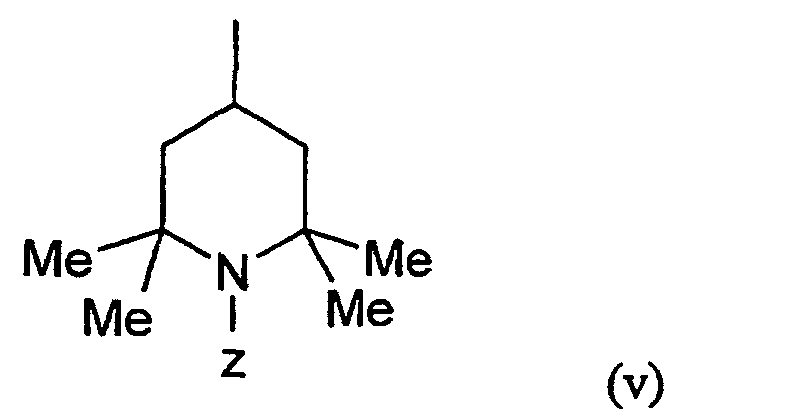
- the hindered amine of the present invention is a low molecular weight organic compound or a polymer which contains at least one divalent group of the formula wherein Me hereinafter denotes a methyl group.
- the backbone of this component is not critical as long as it does not contain functionality which would interfere with the dynamic vulcanization of the silicone gum and it may be illustrated by low-molecular and polymeric polyalkylpiperidines, as disclosed in United States Patent No. 4,692,486.
- the above group has the structure wherein Z is selected from hydrogen or an alkyl group having 1 to 24 carbon atoms, preferably hydrogen.
- suitable hindered amines include: 1,6-hexanediamine, N, N'-bis(2,2,6,6-pentamethyl-4-piperidinyl)-, polymers with morpholine-2,4,6-trichloro- 1,3,5-triazine; 1,6-hexanediamine, N, N'-bis(2,2,6,6-tetramethyl-4-piperidinyl)-, polymers with 2,4,-Dichloro-6-(4- morpholinyl)-1,3,5-triazine; bis(1,2,2,6,6-pentamethyl-4-piperidinyl) sebacate; bis(2,2,6,6-tetramethyl-4-piperidinyl) sebacate; dimethyl succinate polymer with 4-hydroxy-2,2,6,6-tetramethyl-1-piperidine ethanol; and polymethyl (propyl-3-oxy-(2',2',6',6'-tetramethyl-4'-piperidinyl) silox
- Preferred stabilizers of the invention are tetrakis(methylene(3,5-di- tert -butyl-4-hydroxy-hydrocinnamate))methane, N,N'-hexamethylenebis(3,5-di- tert -butyl-4-hydroxyhydrocinnamamide) and 1,1,3-tris(2'-methyl-4'-hydroxy-5'-t-butylphenyl)butane.
- Preferred hindered phenols are IrganoxTM 245 ⁇ triethyleneglycol bis (3-(3'- tert -butyl-4'-hydroxy-5'-methylphenyl)propionate) ⁇ , IrganoxTM 1098 ⁇ N,N'-hexamethylenebis(3,5-di- tert butyl-4-hydroxyhydrocinnamamide) ⁇ and IrganoxTM 1010 ⁇ tetrakis(methylene(3,5-di- tert -butyl-4-hydroxy-hydrocinnamate))methane ⁇ .
- stabilizer (F) From 0.02 to 5 parts by weight of stabilizer (F) are preferably employed for each 100 parts by weight of polyamide (A) plus silicone base (B). Preferably 0.1 to 0.75 parts by weight, more preferably 0.475 to 0.525 parts by weight, of (F) are added for each 100 parts by weight of (A) plus (B).
- an optional additive G
- this optional component is added at a level of 0.5 to 40 weight percent based on the total composition, more preferably 0.5 to 20 weight percent.
- This optional additive can be illustrated by, but not limited to, reinforcing fillers for polyamide resins, such as glass fibers and carbon fibers; extending fillers, such as quartz, barium sulfate, calcium carbonate, and diatomaceous earth; pigments, such as iron oxide and titanium oxide; electrically conducting fillers, such as carbon black and finely divided metals; heat stabilizers, such as hydrated cerric oxide; antioxidants; flame retardants, such as halogenated hydrocarbons, alumina trihydrate, magnesium hydroxide and organophosphorous compounds; and other fire retardant (FR) materials.
- a preferred FR additive is calcium silicate particulate, preferably a wollastonite having an average particle size of 2 to 30 ⁇ m.
- optional component (G) can be a plasticizers for the silicone gum component, such as polydimethylsiloxane oil, and/or a plasticizer for the polyamide component.
- plasticizers for the silicone gum component such as polydimethylsiloxane oil
- plasticizers for the polyamide component include phthalate esters such as dicyclohexyl phthalate, dimethyl phthalate, dioctyl phthalate, butyl benzyl phthalate and benzyl phthalate; trimellitate esters such as C 1 - C 9 alkyl trimellitate; sulfonamides such as N-cyclohexyl-p-toluenesulfonamide, N-ethyl-o,p-toluenesulfonamide and o-toluenesulfonamide, and liquid oligomeric plasticizers.
- Preferred plasticizers are liquids of low volatility which minimize emissions of plasticizer at the common melt temperatures of polyamide
- the above additives are typically added to the final thermoplastic composition after dynamic cure, but they may also be added at any point in the preparation provided they do not interfere with the dynamic vulcanization mechanism.
- the above additional ingredients are only used at levels which do not significantly detract from the desired properties of the final composition.
- the thermoplastic elastomer is prepared by thoroughly dispersing silicone base (B) and compatibilizer (C) in polyamide (A) and dynamically vulcanizing the diorganopolysiloxane in the base using organohydrido silicon compound (D) and catalyst (E).
- the weight ratio of silicone base (B) to polyamide resin (A) is greater than 35:65. It has been found that when this ratio is 35:65 or less, the resulting vulcanizate generally has a modulus more resembling the polyamide resin than a thermoplastic elastomer.
- the above mentioned ratio should be no more than about 85:15 since the compositions tend to be weak and resemble cured silicone elastomers above this value.
- the maximum ratio of (B) to (A) for any given combination of components is also limited by processability considerations since too high a silicone base content results in at least a partially crosslinked continuous phase which is no longer thermoplastic.
- this practical limit is readily determined by routine experimentation and represents the highest level of component (B) which allows the TPSiV to be compression molded.
- the final thermoplastic elastomer can also be readily processed in other conventional plastic operations, such as injection molding and extrusion and, in this case, the weight ratio of components (B) to (A) should be no more than about 75:25.
- Such a preferred thermoplastic elastomer which is subsequently re-processed often has a tensile strength and elongation which are within 10% of the corresponding values for the original TPSiV (i.e., the thermoplastic elastomer is little changed by re-processing).
- the amount of silicone base consistent with the above mentioned requirements depends upon the particular polyamide resin and other components selected, it is preferred that the weight ratio of components (B) to (A) is 40:60 to 75:25, more preferably 40:60 to 70:30.
- Mixing is carried out in any device which is capable of uniformly dispersing the components in the polyamide resin, such as an internal mixer or a twin-screw extruder, the latter being preferred for commercial preparations.
- the temperature is preferably kept as low as practical consistent with good mixing so as not to degrade the resin.
- order of mixing is generally not critical and, for example, components (A), (C), (D) and, optionally, (F) can be added to (B) at a temperature above the softening point (i.e., melt point or glass temperature) of (A), catalyst (E) then being introduced to initiate dynamic vulcanization.
- components (B) through (F) should be well dispersed in resin (A) before dynamic vulcanization begins.
- the silicone base can be formed in-situ.
- the reinforcing filler may be added to a mixer already containing the polyamide resin and diorganopolysiloxane gum at a temperature below the softening point of the resin to thoroughly disperse the filler in the gum. The temperature is then raised to melt the resin, the other ingredients are added and mixing/dynamic vulcanization are carried out. Optimum temperatures, mixing times and other conditions of the mixing operation depend upon the particular resin and other components under consideration and these may be determined by routine experimentation by those skilled in the art.
- the tensile strength or elongation, or both, of the TPSiV elastomer must be at least 25% greater than that of a corresponding simple blend.
- a further requirement of the invention is that the TPSiV has at least 25% elongation, as determined by the test described infra.
- the term "simple blend" denotes a composition wherein the weight proportions of resin (A), base (B) and compatibilizer (C) are identical to the proportions in the TPSiV, but no cure agents are employed (i.e., either component (D) or (E), or both, are omitted and the gum is therefore not cured).
- the tensile strength of the TPSiV is measured on dumbbells having a length of 25.4 mm and a width of 3.2 mm and a typical thickness of 1 to 2 mm, according to ASTM method D 412, at an extension rate of 50 mm/min. At least three such samples are evaluated and the results averaged after removing obvious low readings due to sample inhomogeneity (e.g., such as voids, contamination or inclusions). These values are then compared to the corresponding average tensile and elongation values of a sample prepared from the simple blend composition. When at least a 25% improvement in tensile and/or elongation over the simple blend is not realized there is no benefit derived from the dynamic vulcanization and such TPSiVs are not within the scope of the present invention.
- thermoplastic elastomer prepared by the above described method can then be processed by conventional techniques, such as extrusion, vacuum forming, injection molding, blow molding, overmolding or compression molding. Moreover, these compositions can be re-processed (recycled) with little or no degradation of mechanical properties.
- novel thermoplastic elastomers of the present invention can be used to fabricate wire and cable insulation; vibration and sound dampening components; electrical connectors; automotive and appliance components, such as belts, hoses, air ducts, boots, bellows, gaskets and fuel line components; furniture components; "soft-feel" grips for hand-held devices (e.g., handles for tools); architectural seals; bottle closures; medical devices; sporting goods; and general rubber parts.
- BASE 1 is a silicone rubber base made from 68.78% PDMS 1, defined infra, 25.8% of a fumed silica having a surface area of about 250 m 2 /g (Cab-O-Sil® MS-75 by Cabot Corp., Tuscola, IL.), 5.4% of a hydroxy-terminated diorganopolysiloxane having an average degree of polymerization (DP) of about 8 and 0.02% of ammonium carbonate.
- DP average degree of polymerization
- BASE 2 is a silicone rubber base made from 76.68 % PDMS 1, defined infra, 17.6 % of a fumed silica having a surface area of about 250 m 2 /g, 5.7 % of a hydroxy-terminated diorganopolysiloxane having an average degree of polymerization (DP) of about 8 and 0.02 % of ammonia.
- DP degree of polymerization
- BASE 3 is a silicone rubber base made from 53.68% PDMS 1, defined infra, 35.5% of a fumed silica having a surface area of about 250 m 2 /g, 10.8% of a hydroxy-terminated diorganopolysiloxane having an average degree of polymerization (DP) of about 8 and 0.02% of ammonia.
- BASE 4 is a silicone rubber base made from 87.9% PDMS 1, defined infra, 10% of a fumed silica having a surface area of about 250 m 2 /g, 2.1 % of a hydroxy-terminated diorganopolysiloxane having an average degree of polymerization (DP) of about 8.
- CATALYST 1 is a 1.5 % platinum complex of 1,3-diethenyl-1,1,3,3-tetramethyldisiloxane; 6 % tetramethyldivinyldisiloxane; 92 % dimethylvinyl ended polydimethylsiloxane and 0.5 % dimethylcyclopolysiloxanes having 6 or greater dimethylsiloxane units.
- COMPATIBILIZER 1 is an epoxy-functional polydimethylsiloxane described as an (epoxypropoxypropyl)methylsiloxane-dimethyl siloxane copolymer having a number average molecular weight of 5,700 and marketed under the trade name EXP-29 by Genesee Polymer Corp., Flint, Michigan.
- COMPATIBILIZER 2 is an (epoxypropoxypropyl)methylsiloxane-dimethyl siloxane copolymer having a number average molecular weight of 8,300 and marketed under the trade name EXP-32 by Genesee Polymer Corp.
- COMPATIBILIZER 3 is an epoxy-ended silicone polymer described as an epoxypropoxypropyl-terminated polydimethylsiloxane having a number average molecular weight of 4,730 and marketed under the trade name GP-504 by Genesee Polymer Corp.
- COMPATIBILIZER 4 is allyl glycidyl ether obtained from Aldrich Chemical Co., Milwaukee, WI.
- COMPATIBILIZER 5 is allyl succinic anhydride obtained from Polysciences, Inc., Warrington, PA.
- COMPATIBILIZER 6 is a succinic anhydride-terminated polydimethylsiloxane having a number average molecular weight of 600-800 and marketed under the trade name DMS-Z11 by Gelest, Tullytown, PA.
- COMPATIBILIZER 7 is an epoxypropoxypropyl-terminated polydimethylsiloxane having a number average molecular weight of 900-1,100 and marketed under the trade name DMS-E12 by Gelest.
- COMPATIBILIZER 8 is an (epoxycyclohexylethyl)methylsiloxane-dimethyl siloxane copolymer having a number average molecular weight of 18,000 and marketed under the trade name EMS-232 by Gelest.
- COMPATIBILIZER 9 is a siloxane-based polyamide prepared according to methods described in above cited United States Patent No. 5,981,680 to Petroff et al. and having the formula ⁇ -CO-(CH 2 ) 10 -Si(Me) 2 0-(SiMe 2 0) m -Si(Me) 2 -(CH 2 ) 10 -CO-NH-(CH 2 ) 6 -NH- ⁇ n wherein m has an average value of 13 and n is such that the number average molecular weight of the copolymer is 14,950 by gel permeation chromatography (GPC) using polystyrene standard and tetrahydrofuran solvent.
- GPC gel permeation chromatography
- COMPATIBILIZER 10 is similar to COMPATIBILIZER 9 wherein m has an average value of 28 and n is such that the number average molecular weight of the copolymer is 17,760 by GPC (as above).
- COMPATIBILIZER 11 is similar to COMPATIBILIZER 9 wherein m has an average value of 43 and n is such that the number average molecular weight of the copolymer is 68,410 by GPC (as above).
- COMPATIBILIZER 13 is an aminopropyl-terminated polydimethylsiloxane having a degree of polymerization of 14.
- COMPATIBILIZER 14 is an aminopropyl-terminated polydimethylsiloxane marketed by Gelest under the trade name DMS-A12.
- COMPATIBILIZER 15 is an ethylene oxide-dimethylsiloxane-ethylene oxide block copolymer marketed by Gelest under the trade name DBE-C25.
- IRGANOXTM 1010 is a hindered phenol stabilizer marketed by Ciba-Geigy and described as tetrakis ⁇ methylene(3,5-di-tert-butyl-4-hydroxy-hydrocinnamate) ⁇ methane.
- IRGANOXTM 1098 is a hindered phenol described as N,N'-hexamethylenebis(3,5-di-(tert)-butyl-4-hydroxyhydrocinnamamide) and marketed by Ciba-Geigy.
- NYLON 6-A is a nylon 6 marketed under the trade name ZytelTM 7301 by Du Pont; m.p. 215 - 225°C.
- PDMS 1 is a gum consisting of 99.81 wt % Me 2 SiO units, 0.16 % MeViSiO units and 0.03% Me 2 ViSiO 1/2 units. Prepared by potassium catalyzed equilibration of cyclic siloxanes wherein the catalyst is neutralized with carbon dioxide. This gum has plasticity of about 150.
- X-LINKER 1 is an SiH-functional crosslinker consisting essentially of 68.4 % MeHSiO units, 28.1 % Me 2 SiO units and 3.5 % Me 3 SiO 1/2 units and has a viscosity of approximately 29 mPa ⁇ s.
- a masterbatch was prepared by adding 200 g of BASE 1 to a Haake System 9000TM bowl mixer (300 ml bowl) under a dry nitrogen atmosphere using roller rotors at 100°C and 60 rpm (revolutions per minute). After 3 minutes, 1.5 g of X-LINKER 1 were slowly added to the mixer and the masterbatch was homogenized for 6 minutes.
- NYLON 12-A (72 g; dried 4hrs at 80°C) was added to the mixer at 190°C and 60 rpm under a dry nitrogen purge. After three minutes, the above described masterbatch (108.7 g) was added and mixed for 4 minutes. Finally, CATALYST 1(0.78 g) was added and the process torque increased to a maximum of 6,000 m-g and then decreased, mixing being stopped when the torque reached 5,500 m-g.
- TPSiV was prepared according to the methods of Example A4 wherein 0.4 g of COMPATIBILIZER 5 was used instead of 0.32 g of COMPATIBILIZER 4. Properties of the resulting TPSiV were determined as described above and are reported in Table A2.
- TPSiV was prepared according to the method of (Comparative) Example A6 wherein 0.4 g of COMPATIBILIZER 5 was added three minutes after the nylon was melted. Properties of the resulting TPSiV were determined as described above and are reported in Table A2.
- TPSiVs were prepared as in (Comparative) Example A8 wherein 2 g of COMPATIBILIZER 3, 2 g of COMPATIBILIZER 1 and 0.4 g of COMPATIBILIZER 5, respectively, were added 3 minutes after the nylon was melted. Each run was stopped at the torque indicated in the last column of Table A2, this table also showing the resulting properties of the compositions.
- Example Compatibilizer Type/amount g
- Tensile (MPa) Elongation (%) Torque (m-g) (Comp.) Ex. A3 none 10.8 100 >12,000 Ex.
- each compatibilizer was first mixed with NYLON 6-A using a twin-screw extruder at a process temperature of 260-270°C to form a compatibilized polyamide, according to the procedure described in Example C1, infra. Each compatibilized polyamide was then used as the resin portion in these formulations, the order of addition being the same as described above. Each composition was molded at 250°C and tested, as described above, the results being shown in Table A3.
- Compatibilized polyamides formed from NYLON 12-B and the compatibilizers (and weight percentage thereof) shown in the second column of Table A4 were prepared in a twin-screw extruder at 220°C, as described in Example C1, infra. Eighty grams of each compatibilized resin was mixed with the following components and dynamically vulcanized (nitrogen purge; 220°C; 60 rpm): BASE 1 120 g IRGANOXTM 1010 1.0 g X-LINKER 1 1.94 g CATALYST 1 0.8g These compositions were molded and tested as described above and the results are shown in Table A4.
- NYLON 12-B (80 g) was added to a Haake System 9000TM bowl mixer equipped with roller rotors at 210°C and 60 rpm under nitrogen purge. After three minutes, base 1 (120 g) was added and mixed for 3 more minutes. IRGANOXTM 1010 (0.5 g) was added and mixed for 2 more minutes. X-LINKER 1 (1.9 g) was then added, followed by the addition of 2 g of COMPATIBILIZER 15. After mixing for another 3 minutes, CATALYST 1 (0.85 g) was added dropwise and the run was stopped when torque stabilized. The mechanical properties of the resulting TPSiV are summarized in
- NYLON 12-A (80 g) was first dried for 2 hours at 120°C and mixed at 210°C/60 rpm under a nitrogen atmosphere using roller rotors, as described above.
- IRGANOXTM 1010 (1.05 g) was mixed in for approximately 3 minutes, followed by 120 g of BASE 1 and, after approximately 3.5 more minutes, 3.07 g of COMPATIBILIZER 9, the latter being mixed for an additional 3.5 minutes.
- X-LINKER 1 (3.84 g) was added and the recorded mixing torque was approximately 1,800 m-g.
- TPSiV (Comparative Example B8) was prepared according to Example B1 at 245°C using a one-step catalyst addition and using the following ingredients: NYLON 6-C 80 g IRGANOXTM 1010 1 g BASE 1 120 g X-LINKER 1 3.87 g CATALYST 1 0.855 g
- Example B9 A similar composition was prepared which also included 1.1 g of COMPATIBILIZER 13 (Example B9). These materials were molded at 255°C and tested as described above, the properties being reported in Table B2.
- Example Compatibilizer Amount (g) Tensile (MPa) Elongation (%) Final Torque (m-g) (Comp.) Ex. B8 0 11.0 99 5,200
- Example B9 1.1 14.6 122 6,000
- thermoplastic elastomer was dried (80°C/4 hours) to remove residual moisture from the quenching procedure, samples were molded at 265°C and tested, as described above. Tensile strength was 11.2 MPa and elongation was 40%.
- COMPATIBILIZER 2 was injected into the extruder via a MasterFlexTM CL peristaltic pump at a rate of 1.0 g/min. such that the final content of COMPATIBILIZER 2 in the resulting compatibilized polyamide was 2%.
- the extruded compatibilized polyamide was passed through a water bath at 5°C and then pelletized in a Conair JetroTM pelletizer model 304 (compatibilized polyamide 1).
- the above compatibilized polyamide 1 (93.9 g) was mixed and 1.0 g of IRGANOXTM 1010 was added at 1.1 minutes into the run.
- BASE 1 99.4 g
- was introduced 1.7 min.
- 3.2 g of X-LINKER 1 4.9 min.).
- Example C1 The procedures of Example C1 were duplicated wherein COMPATIBILIZER 3 was substituted for COMPATIBILIZER 2 to provide a compatibilized polyamide in which the COMPATIBILIZER 3 content was 2% (compatibilized polyamide 2). The latter was used to prepare a TPSiV as in Example C 1 wherein the final mixing torque was 3,860 m-g and total mixing time was 20.0 min. The resulting TPSiV was molded and tested, as described above, and exhibited a tensile strength of 17.8 MPa and an elongation of 252%.
- Example C1 The procedures of Example C1 were duplicated wherein no compatibilizer was employed. Thus, 93.9 g of only dried NYLON 12-B was used to prepare a TPSiV, as previously described. Final torque was 8,210 m-g, this being more than double that observed in Examples C1 or C2. The resulting TPSiV was molded and tested, as described above, and exhibited a tensile strength of 17.4 MPa and an elongation of 221 %.
- Example D1 BASE 3 13.7 170 6,000
- Example D2 BASE 1 13.5 194 6,000
- Example D3 BASE 2 10.5 132 6,400
Landscapes
- Chemical & Material Sciences (AREA)
- Health & Medical Sciences (AREA)
- Chemical Kinetics & Catalysis (AREA)
- Medicinal Chemistry (AREA)
- Polymers & Plastics (AREA)
- Organic Chemistry (AREA)
- Compositions Of Macromolecular Compounds (AREA)
- Processes Of Treating Macromolecular Substances (AREA)
Abstract
Description

1 to 4, carbon atoms, amine, carboxyl or oxazoline, as described above, must be present in this polymer or copolymer.

-CH2-C(O)OR", wherein R" is a hydrocarbon group having 1 to 18 carbon atoms). Further, although not explicitly shown in formula (i), it is also contemplated that the benzene ring may additionally be substituted with one or more of the above described Q groups. The residue of the organic compound to which group (i) is chemically bonded is not critical as long as it does not contain moieties which would interfere with the dynamic vulcanization, described infra. For example, this residue may be a hydrocarbon, a substituted hydrocarbon or a hetero atom-containing hydrocarbon group of the appropriate valence. It is also contemplated that the group according to formula (i) can be attached to hydrogen to form an organophenol. Preferably, the hindered phenol compound has a number average molecular weight of less than about 3,000.

1,1,3-Tris(2'-methyl-4'-hydroxy-5'-t-butylphenyl)butane, N,N'-hexamethylene bis(3-(3,5-di-t-butyl-4-hydroxyphenyl)propionamide), 4,4'-thiobis(2-t-butyl-5-methylphenol), 1,3,5-tris(4-tert-butyl-3-hydroxy-2,6-dimethyl benzyl)-1,3,5-triazine-2,4,6-(1H,3H,5H)-trione, N,N'-hexamethylenebis(3,5-di-tert-butyl-4-hydroxyhydrocinnamamide), tetrakis(methylene(3,5-di-tert-butyl-4-hydroxy-hydrocinnamate))methane, 1,3,5-trimethyl-2,4,6 -tris (3,5-di-tert-butyl-4-hydroxybenzyl) benzene, 4,4'-methylenebis (2,6-di-tertiary-butylphenol), 2,2'-thiobis(6-tert-butyl-4-methylphenol), 2,2'-thiobis(4-octylphenol), 4,4'-thiobis(6-tert-butyl-2-methylphenol), 4,4'-thiobis(3,6-di-sec-amylphenol), 2-(4,6-bis(2,4-dimethylphenyl)-1,3,5,-triazin-2-yl)-5-(octyloxy) phenol, 2,4-bisoctylmercapto-6-(3,5-di-tert-butyl-4-hydroxyanilino)-1,3,5-triazine, 2,4,6-tris(3,5-di-tert-butyl-4-hydroxyphenoxy)-1,2,3-triazine, 1,3,5-tris(3,5-di-tert-butyl-4-hydroxybenzyl)isocyanurate, 2-octylmercapto-4,6-bis(3,5-di-tert-butyl-4-hydroxyanilino)-1,3,5-triazine, 2-octylmercapto-4,6-bis(3,5-di-tert-butyl-4-hydroxyphenoxy)-1,3,5-triazine, 2, 4,6-tris(3,5-di-tert-butyl-4-hydraxyphenylethyl)-1,3,5-triazine, 1,3,5-tris(3,5-di-tert-butyl-4-hydroxyphenylpropionyl)hexahydro-1,3,5-triazine,
1,3,5-tris(3,5-dicyclohexyl-4-hydroxybenzyl) isocyanurate, 1,3,5-tris(4-tert-butyl-3-hydroxy-2,6-dimethylbenzyl)isocyanurate, 2,6-di-tert-butyl-4-methoxyphenol, 2,5-di-tert-butylhydroquinone, 2,5-di-tert-amylhydroquinone, 2,6-di-tert-butylhydroquinone, 2,5-di-tert-butyl-4-hydroxyanisole, 2,6-diphenyl-4-octadecyloxyphenol, 3,5-di-tert-butyl-4-hydroxyanisole, 3,5-di-tert-butyl-4-hydroxyphenyl stearate, bis(3,5-di-tert-butyl-4-hydroxyphenyl) adipate, esters of beta-(3,5-di-tert-butyl-4-hydroxyphenyl)propionic acid with mono- or polyhydric alcohols (e.g., methanol, ethanol, n-octanol, trimethylhexanediol, isooctanol, octadecanol, 1,6-hexanediol, 1,9-nonanediol, ethylene glycol, 1,2-propanediol, neopentyl glycol, thiodiethylene glycol, diethylene glycol, triethylene glycol, pentaerythritol, trimethylolpropane, tris(hydroxyethyl) isocyanurate, N,N'-bis(hydroxyethyl)oxatamide, 3-thiaundecanol, 3-thiapentadecanol,
4-hydroxymethyl-1-phospha-2,6,7-trioxabicyclo(2.2.2) octane and esters of beta-(5-tert-butyl-4-hydroxy-3-methylphenyl)propionic acid with mono- or polyhydric alcohols (as above).
and R''' is a monovalent hydrocarbon group having 1 to 24 carbon atoms. Specific non-limiting examples of suitable thioesters include distearyl 3,3'-thiodipropionate, dilauryl-3,3'-thiodipropionate and di(tridecyl)3,3'-thiodipropionate.

Irganox™ 1076 = octadecyl 3,5-di-tert-butyl-4-hydroxyhydrocinnamate,
Irganox™ 1035 = thiodiethylene bis(3,5-di-tert-butyl-4-hydroxyhydrocinnamate),
Irganox™ MD1024 = 1,2-bis(3,5-di-tert-butyl-4-hydroxyhydrocinnamoyl)hydrazine, Irganox™ 1330 = 1,3,5-trimethyl-2,4,6-tris(3,5-di-tert-butyl-4-hydroxybenzyl)benzene, Irganox™ 1425 WL = calcium bis(monoethyl(3,5-di-tert-butyl-4-hydroxybenzyl)phosphonate) and
Irganox™ 3114 =1,3,5-tris-(3,5-di-tert-butyl-4-hydroxybenzyl)-1,3,5-triazine-2,4,6(1H,3H,5H)-trione.
BASE 1 is a silicone rubber base made from 68.78% PDMS 1, defined infra, 25.8% of a fumed silica having a surface area of about 250 m2/g (Cab-O-Sil® MS-75 by Cabot Corp., Tuscola, IL.), 5.4% of a hydroxy-terminated diorganopolysiloxane having an average degree of polymerization (DP) of about 8 and 0.02% of ammonium carbonate.
BASE 2 is a silicone rubber base made from 76.68 % PDMS 1, defined infra, 17.6 % of a fumed silica having a surface area of about 250 m2/g, 5.7 % of a hydroxy-terminated diorganopolysiloxane having an average degree of polymerization (DP) of about 8 and 0.02 % of ammonia.
BASE 3 is a silicone rubber base made from 53.68% PDMS 1, defined infra, 35.5% of a fumed silica having a surface area of about 250 m2/g, 10.8% of a hydroxy-terminated diorganopolysiloxane having an average degree of polymerization (DP) of about 8 and 0.02% of ammonia.
BASE 4 is a silicone rubber base made from 87.9% PDMS 1, defined infra, 10% of a fumed silica having a surface area of about 250 m2/g, 2.1 % of a hydroxy-terminated diorganopolysiloxane having an average degree of polymerization (DP) of about 8.
CATALYST 1 is a 1.5 % platinum complex of 1,3-diethenyl-1,1,3,3-tetramethyldisiloxane; 6 % tetramethyldivinyldisiloxane; 92 % dimethylvinyl ended polydimethylsiloxane and 0.5 % dimethylcyclopolysiloxanes having 6 or greater dimethylsiloxane units.
COMPATIBILIZER 1 is an epoxy-functional polydimethylsiloxane described as an (epoxypropoxypropyl)methylsiloxane-dimethyl siloxane copolymer having a number average molecular weight of 5,700 and marketed under the trade name EXP-29 by Genesee Polymer Corp., Flint, Michigan.
COMPATIBILIZER 2 is an (epoxypropoxypropyl)methylsiloxane-dimethyl siloxane copolymer having a number average molecular weight of 8,300 and marketed under the trade name EXP-32 by Genesee Polymer Corp.
COMPATIBILIZER 3 is an epoxy-ended silicone polymer described as an epoxypropoxypropyl-terminated polydimethylsiloxane having a number average molecular weight of 4,730 and marketed under the trade name GP-504 by Genesee Polymer Corp. COMPATIBILIZER 4 is allyl glycidyl ether obtained from Aldrich Chemical Co., Milwaukee, WI.
COMPATIBILIZER 5 is allyl succinic anhydride obtained from Polysciences, Inc., Warrington, PA.
COMPATIBILIZER 6 is a succinic anhydride-terminated polydimethylsiloxane having a number average molecular weight of 600-800 and marketed under the trade name DMS-Z11 by Gelest, Tullytown, PA.
COMPATIBILIZER 7 is an epoxypropoxypropyl-terminated polydimethylsiloxane having a number average molecular weight of 900-1,100 and marketed under the trade name DMS-E12 by Gelest.
COMPATIBILIZER 8 is an (epoxycyclohexylethyl)methylsiloxane-dimethyl siloxane copolymer having a number average molecular weight of 18,000 and marketed under the trade name EMS-232 by Gelest.
COMPATIBILIZER 9 is a siloxane-based polyamide prepared according to methods described in above cited United States Patent No. 5,981,680 to Petroff et al. and having the formula
COMPATIBILIZER 10 is similar to COMPATIBILIZER 9 wherein m has an average value of 28 and n is such that the number average molecular weight of the copolymer is 17,760 by GPC (as above).
COMPATIBILIZER 11 is similar to COMPATIBILIZER 9 wherein m has an average value of 43 and n is such that the number average molecular weight of the copolymer is 68,410 by GPC (as above).
COMPATIBILIZER 12 is an unsaturated diamide of the formula
COMPATIBILIZER 14 is an aminopropyl-terminated polydimethylsiloxane marketed by Gelest under the trade name DMS-A12.
COMPATIBILIZER 15 is an ethylene oxide-dimethylsiloxane-ethylene oxide block copolymer marketed by Gelest under the trade name DBE-C25.
IRGANOX™ 1010 is a hindered phenol stabilizer marketed by Ciba-Geigy and described as tetrakis{methylene(3,5-di-tert-butyl-4-hydroxy-hydrocinnamate)}methane.
IRGANOX™ 1098 is a hindered phenol described as N,N'-hexamethylenebis(3,5-di-(tert)-butyl-4-hydroxyhydrocinnamamide) and marketed by Ciba-Geigy.
NYLON 12-A is nylon 12 obtained from Aldrich Chemical Co.; m.p. = 178°C.
NYLON 12-B is Rilsan™ AMNO, a nylon 12 marketed by Elf Atochem NA, Inc.,
Philadelphia, PA; m.p. = 175°C.
NYLON 6-A is a nylon 6 marketed under the trade name Zytel™ 7301 by Du Pont; m.p. 215 - 225°C.
NYLON 6-B is a nylon 6 marketed as CM 1017 by Toray Industries Inc., Japan; m.p. = 223°C.
NYLON 6-C is a nylon 6 obtained from Aldrich Chemical Co.; m.p. = 229°C.
NYLON 6/6 is a nylon 6/6 obtained from Aldrich Chemical Co.; m.p. = 267°C.
PDMS 1 is a gum consisting of 99.81 wt % Me2SiO units, 0.16 % MeViSiO units and 0.03% Me2ViSiO1/2 units. Prepared by potassium catalyzed equilibration of cyclic siloxanes
wherein the catalyst is neutralized with carbon dioxide. This gum has plasticity of about 150. X-LINKER 1 is an SiH-functional crosslinker consisting essentially of 68.4 % MeHSiO units, 28.1 % Me2SiO units and 3.5 % Me3SiO1/2 units and has a viscosity of approximately 29 mPa·s. This corresponds to the average formula MD16D'39M, in which where M is
| Example | Compatibilizer (g) | Tensile (MPa) | Elongation (%) | Final Torque (m-g) |
| Comp. Ex. A1 | 0 | 7.3 | 37 | 5,500 |
| Ex. A2 | COMPATIBILIZER 1 EXP-29 (2g) | 13.6 | 178 | 6,500 |
| Example | Compatibilizer Type/amount (g) | Tensile (MPa) | Elongation (%) | Torque (m-g) |
| (Comp.) Ex. A3 | none | 10.8 | 100 | >12,000 |
| Ex. A4 | COMPATIBILIZER 4 (0.32 g) | 13.0 | 172 | >12,000 |
| Ex. A5 | COMPATIBILIZER 5 (0.4 g) | 13.7 | 160 | >12,000 |
| (Comp.) Ex. A6 | none | 9.2 | 63 | 10,000 |
| Ex. A7 | COMPATIBILIZER 5 (0.4 g) | 8.2 | 118 | 10,000 |
| (Comp.) Ex. A8 | none | 14.5 | 185 | >18,000 |
| Ex. A9 | COMPATIBILIZER 3 (2 g) | 16.1 | 211 | >18,000 |
| Ex. A10 | COMPATIBILIZER 1 (2 g) | 17.4 | 229 | >18,000 |
| Ex. A11 | COMPATIBILIZER 5 (0.4 g) | 17.6 | 255 | >18,000 |
| Example | NYLON | Compatibilizer Weight (g)/ Type | IRGANOX ™ 1098 content (g) | Tensile (MPa) | Elongation (%) | Torque (m-g) |
| (Comp.) Ex. A12 | 6-A | 0 | 0 | 9.5 | 29 | 4,000 |
| (Comp.) Ex. A13 | 6-A | 0 | 1.5 | 9.3 | 31 | 6,000 |
| A14 | 6-A | 0.8 /COM. 6 | 0 | 16.0 | 104 | 6,000 |
| A15 | 6-A | 0.8 / COM. 6 | 1.5 | 16.0 | 154 | 9,000 |
| A16 | 6-A | 1.6/COMP.7 | 1.5 | 14.8 | 121 | 8,300 |
| A17 | 6-A | 0.8 / COMP. 7 | 1.5 | 11.5 | 66 | 8,200 |
| A18 | 6-A | 0.8/COMP.1 | 1.5 | 11.3 | 73 | 7,800 |
| A19 | 6-A | 1.6 / COMP. 1 | 1.5 | 10.6 | 72 | 8,000 |
| (Comp.) Ex. A20 | 6-B | 0 | 0 | 9.0 | 33 | 4,000 |
| (Comp.) Ex. A21 | 6-B | 0 | 1.5 | 9.7 | 49 | 4,600 |
| A22 | 6-B | 0.8/COMP.6 | 0 | 12.3 | 53 | 5,200 |
| A23 | 6-B | 0.8/COMP.6 | 1.5 | 16.2 | 151 | 6,500 |
| BASE 1 | 120 g |
| IRGANOX™ 1010 | 1.0 g |
| X-LINKER 1 | 1.94 g |
| CATALYST 1 | 0.8g |
| Example | Amount and Type of Compatibilizer in Resin | Tensile Strength (MPa) | Elongation (%) | Terminal torque (m-g) |
| (Comp.) Ex. A24 | 0% | 13.5 | 187 | 4900 |
| A25 | 1.0% COMPATIBILIZER 8 | 13.3 | 195 | 4300 |
| (Comp.)Ex. A26 | 0.5 % COMPATIBILIZER 7 | 13.4 | 199 | 4300 |
| A27 | 1.0 % COMPATIBILIZER 7 | 15.0 | 260 | 5400 |
| (Comp.)Ex. A28 | 2.0 % COMPATIBILIZER 7 | 13.7 | 198 | 5500 |
| A29 | 1.0 % COMPATIBILIZER 6 | 14.8 | 239 | 4000 |
| Samples Name | Compatibilizer | Tensile Strength (MPa) | Elongation (%) | Terminal Torque, (m-g) |
| (Comp.) Ex. A32 | None | 13.4 | 174 | 6500 |
| A33 | COMPATIBILIZER 14 | 14.2 | 201 | 10500 |
| A34 | COMPATIBILIZER 15 | 13.2 | 191 | 5000 |
| Example | Compatibilizer | Tensile (MPa) | Elongation (%) | Torque (m-g) |
| Ex. B1 | COMPATIBILIZER 9 | 16.7 | 265 | 8,700 |
| Ex. B2 | COMPATIBILIZER 9 | 16.0 | 254 | 14,500 |
| Ex. B3 | COMPATIBILIZER 10 | 16.2 | 241 | >19,000 |
| Ex. B4 | COMPATIBILIZER 11 | 15.8 | 256 | 11,000 |
| Ex. B5 | COMPATIBILIZER 12 | 18.4 | 277 | >20,000 |
| Ex. B6** | COMPATIBILIZER 12 | 16.7 | 257 | >20,000 |
| (Comp.) Ex. B7 | 0 | 14.9 | 200 | 15,000 |
| NYLON 6-C | 80 g |
| IRGANOX™ 1010 | 1 g |
| BASE 1 | 120 g |
| X-LINKER 1 | 3.87 g |
| CATALYST 1 | 0.855 g |
| Example | Compatibilizer Amount (g) | Tensile (MPa) | Elongation (%) | Final Torque (m-g) |
| (Comp.) Ex. B8 | 0 | 11.0 | 99 | 5,200 |
| Example B9 | 1.1 | 14.6 | 122 | 6,000 |
COMPATIBILIZER 2 was injected into the extruder via a MasterFlex™ CL peristaltic pump at a rate of 1.0 g/min. such that the final content of COMPATIBILIZER 2 in the resulting compatibilized polyamide was 2%. The extruded compatibilized polyamide was passed through a water bath at 5°C and then pelletized in a Conair Jetro™ pelletizer model 304 (compatibilized polyamide 1). A TPSiV was then prepared on a Haake Rheomix™ 3000 mixer fitted with roller rotors (free volume = 310 cm3 ; 210°C; 60 rpm) using a dry nitrogen purge at a flow rate of 236 cm3/s. The above compatibilized polyamide 1 (93.9 g) was mixed and 1.0 g of IRGANOX™ 1010 was added at 1.1 minutes into the run. BASE 1 (99.4 g) was introduced (1.7 min.), followed by 3.2 g of X-LINKER 1 (4.9 min.). Mixing was continued and CATALYST 1 (0.752 g) was added (6.8 min.) to dynamically cure the silicone gum. The set temperature was reduced to 200°C and, when the mixing torque reached a steady state value of 3,286 m-g, the resulting TPSiV was removed. The TPSiV was compression molded at 225°C for 5 minutes and tested as described above. The average (5 measurements) tensile strength was 17.6 MPa and average elongation was 249%.
| NYLON 12-B | 80 g |
| COMPATIBTLIZER 2 | 2.4 g |
| IRGANOX™ 1010 | 1 g |
| BASE (as indicated in Table D1) | 120 g |
| X-LINKER 1 | 1.9 g |
| CATALYST 1 | 0.86 g |
| Example | Silicone | Tensile (MPa) | Elongation (%) | Maximum Torque (m-g) |
| Example D1 | BASE 3 | 13.7 | 170 | 6,000 |
| Example D2 | BASE 1 | 13.5 | 194 | 6,000 |
| Example D3 | BASE 2 | 10.5 | 132 | 6,400 |
| Example D4 | BASE 4 | 5.2 | 47 | 2,500* |
- Total mix and vulcanization time = 75 minutes, this being about 3 times longer than other samples.
| NYLON 12-B | 80 g |
| COMPATIBILIZER 2 | X (amount shown in second column of Table D2) |
| IRGANOX™ 1010 | 1 g |
| BASE 1 | 120 g |
| X-LINKER 1 | Y (amount shown in third column of Table D2) |
| CATALYST 1 | 0.86 g |
| Example | X (g) | Y (g) | Tensile (MPa) | Elongation (%) | Maximum Torque (m-g) |
| (Comp.) Ex. D5 | 0 | 1 | 8.0 | 81 | 4,600 |
| D6 | 0.8 | 1 | 9.3 | 105 | 4,300 |
| D7 | 2.4 | 1 | 9.9 | 130 | 4,600 |
| D8 | 1.2 | 1.9 | 10.7 | 124 | 7,000 |
| D9 | 2.4 | 1.9 | 13.7 | 170 | 6,000 |
| D10 | 3.6 | 1.9 | 11.1 | 138 | 7,800 |
| NYLON 12-B | 80 g |
| COMPATIBILIZER 2 | 0.8 g |
| IRGANOX™ 1010 | X (amount shown in second column of Table D3) |
| BASE 1 | 120 g |
| X-LINKER 1 | 1.9 g |
| CATALYST 1 | 0.95 g |
| Example | X (g) | Tensile (MPa) | Elongation (%) | Maximum Torque (m-g) |
| Example D11 | 0 | 7.4 | 47 | 6,000 |
| Example D12 | 1 | 11.4 | 130 | 7,000 |
Claims (13)
- A method for preparing a thermoplastic elastomer, said method comprising:(I) mixing(A) a rheologically stable polyamide resin having a melting point or glass transition temperature of 25°C to 275°C,(B) a silicone base comprising(B') 100 parts by weight of a diorganopolysiloxane gum having a plasticity of at least 30 and having an average of at least 2 alkenyl groups in its molecule and(B'') 5 to 200 parts by weight of a reinforcing filler, the weight ratio of said silicone base to said polyamide resin is 35:65 to 85:15.(C) for each 100 parts by weight of said polyamide resin, a compatibilizer selected from(i) from 0.1 to 5 parts by weight of a coupling agent having a molecular weight of less than 800 which contains at least two groups independently selected from ethylenically unsaturated group, epoxy, anhydride, silanol, carboxyl, hydroxyl, alkoxy, having 1 to 20 carbon atoms or oxazoline in its molecule.(ii) from 0.1 to 10 parts by weight of a functional diorganopolysiloxane having at least one group selected from epoxy, anhydride, silanol, carboxyl, amine, alkoxy having 1 to 20 carbon atoms or oxazoline in its molecule, or(iii) from 0.1 to 10 parts by weight of a copolymer comprising at least one diorganopolysiloxane block and at least one block selected from polyamide, polyether, polyurethane, polyurea, polycarbonate or polyacrylate.(D) an organohydrido silicon compound which contains an average of at least 2 silicon-bonded hydrogen groups in its molecule and(E) a hydrosilation catalyst, components (D) and (E) being present in an amount sufficient to cure said diorganopolysiloxane (B'); and(II) dynamically curing said diorganopolysiloxane (B').
- The method according to claim 1, wherein the weight ratio of said silicone base (B) to said polyamide resin (A) is 35:65 to 75:25.
- The method according to claim 2, wherein said polyamide is selected from the group consisting of nylon 6, nylon 6/6, nylon 6/12 and nylon 12.
- The method according to claim 2, wherein said diorganopolysiloxane (B') is a gum selected from the group consisting of a copolymer consisting essentially of dimethylsiloxane units and methylvinylsiloxane units and a copolymer consisting essentially of dimethylsiloxane units and methylhexenylsiloxane units and said reinforcing filler (B'') is a fumed silica.
- The method according to claim 4, wherein said organohydrido silicon component (D) is selected from the group consisting of a polymer consisting essentially of methylhydridosiloxane units and a copolymer consisting essentially of dimethylsiloxane units and methylhydridosiloxane units, having 0.5 to 1.7 weight percent hydrogen bonded to silicon and having a viscosity of 2 to 500 mPa-s at 25°C and said catalyst (E) is a neutralized complex of platinous chloride and divinyltetramethyldisiloxane.
- The method according to claim 3, wherein the weight ratio of said silicone base (B) to said polyamide resin (A) is 40:60 to 70:30.
- The method according to anyone of claims 1 - 6, wherein 0.02 to 5 parts by weight of a stabilizer (F) per 100 parts by weight of said polyamide plus said silicone base is included in mixing step (I), said stabilizer being selected from hindered phenols; thioesters; hindered amines; 2,2'-(1,4-phenylene)bis(4H-3, 1-benzoxazin-4-one); and
3,5-di-tert-butyl-4-hydroxybenzoic acid, hexadecyl ester. - The method according to claim 7, wherein said stabilizer is a hindered phenol having at least one group of the formulain its molecule, in which Q is a monovalent organic group having 1 to 24 carbon atoms selected from
 wherein the benzene ring of said formula may additionally be substituted with at least one Q group.(i) hydrocarbon groups,(ii) hydrocarbon groups which optionally contain heteroatoms selected from sulfur, nitrogen or oxygen or(iii) halogen-substituted versions of (i) or (ii),
 - The method according to claim 8. wherein said stabilizer is a hindered phenol having at least one group of the formulain its molecule, wherein R is an alkyl group having one to four carbon atoms, R' is a hydrocarbon group having 4 to 8 carbon atoms and wherein the benzene ring of said formula may be optionally further substituted with a hydrocarbon group having 1 to 24 carbon atoms.

- The method according to claim 1, wherein said compatibilizer is selected from
allyl glycidyl ether, allyl succinic anhydride,
succinic anhydride-functional polydimethylsiloxanes, polyamide-polydimethylsiloxane copolymers or poly(alkylene oxide)-polydimethylsiloxane copolymers. - The method according to claim 7, wherein said compatibilizer is selected from
allyl glycidyl ether, allyl succinic anhydride,
succinic anhydride-functional polydimethylsiloxanes, polyamide-polydimethylsiloxane copolymers or poly(alkylene oxide)-polydimethylsiloxane copolymers. - The method according to claim 1, wherein a fire retardant is included in mixing step (I).
- A thermoplastic elastomer obtainable by the method of any of claims 1 to 12.
Applications Claiming Priority (3)
| Application Number | Priority Date | Filing Date | Title |
|---|---|---|---|
| US616625 | 1996-03-15 | ||
| US09/616,625 US6362288B1 (en) | 2000-07-26 | 2000-07-26 | Thermoplastic silicone elastomers from compatibilized polyamide resins |
| PCT/US2001/023301 WO2002008335A2 (en) | 2000-07-26 | 2001-07-24 | Thermoplastic silicone elastomers from compatibilized polyamide resins |
Publications (2)
| Publication Number | Publication Date |
|---|---|
| EP1305367A2 EP1305367A2 (en) | 2003-05-02 |
| EP1305367B1 true EP1305367B1 (en) | 2005-06-15 |
Family
ID=24470298
Family Applications (1)
| Application Number | Title | Priority Date | Filing Date |
|---|---|---|---|
| EP01959153A Expired - Lifetime EP1305367B1 (en) | 2000-07-26 | 2001-07-24 | Thermoplastic silicone elastomers from compatibilized polyamide resins |
Country Status (11)
| Country | Link |
|---|---|
| US (2) | US6362288B1 (en) |
| EP (1) | EP1305367B1 (en) |
| JP (1) | JP5031970B2 (en) |
| KR (1) | KR100803647B1 (en) |
| CN (1) | CN1188468C (en) |
| AT (1) | ATE297965T1 (en) |
| AU (1) | AU2001280738A1 (en) |
| CA (1) | CA2416880C (en) |
| DE (1) | DE60111536T2 (en) |
| MX (1) | MXPA02010449A (en) |
| WO (1) | WO2002008335A2 (en) |
Families Citing this family (142)
| Publication number | Priority date | Publication date | Assignee | Title |
|---|---|---|---|---|
| US6362287B1 (en) * | 2000-03-27 | 2002-03-26 | Dow Corning Corportion | Thermoplastic silicone elastomers formed from nylon resins |
| US6362288B1 (en) * | 2000-07-26 | 2002-03-26 | Dow Corning Corporation | Thermoplastic silicone elastomers from compatibilized polyamide resins |
| FR2819261B1 (en) * | 2001-01-11 | 2003-02-28 | Nexans | RIP-RESISTANT SILICONE RUBBER COMPOSITION FOR ENERGY CABLES AND ACCESSORIES |
| US6479580B1 (en) | 2001-04-30 | 2002-11-12 | Dow Corning Corporation | Polyolefin thermoplastic silicone elastomers employing radical cure |
| US6465552B1 (en) * | 2001-05-01 | 2002-10-15 | Dow Corning Corporation | Thermoplastic silicone elastomers employing radical cure |
| FR2825916B1 (en) * | 2001-06-14 | 2004-07-23 | Oreal | COMPOSITION BASED ON SILICONE OIL STRUCTURED IN RIGID FORM, PARTICULARLY FOR COSMETIC USE |
| FR2825915B1 (en) * | 2001-06-14 | 2006-02-03 | Oreal | COMPOSITION BASED ON STRUCTURED SILICONE OIL IN RIGID FORM, IN PARTICULAR FOR COSMETIC USE |
| FR2825914B1 (en) * | 2001-06-14 | 2003-09-19 | Oreal | COMPOSITION BASED ON SILICONE OIL STRUCTURED IN RIGID FORM, IN PARTICULAR FOR COSMETIC USE |
| US6569958B1 (en) * | 2001-10-19 | 2003-05-27 | Dow Corning Corporation | Thermoplastic silicone elastomers from compatibilized polyester resins |
| US6569955B1 (en) * | 2001-10-19 | 2003-05-27 | Dow Corning Corporation | Thermoplastic silicone elastomers from compatibilized polyamide resins |
| DE60222454T2 (en) * | 2001-10-23 | 2008-06-12 | Dow Corning Corp., Midland | THERMOPLASTIC POLYURETHANE SILICONE ELASTOMERS |
| FR2840807B1 (en) * | 2002-06-12 | 2005-03-11 | COSMETIC CARE AND / OR MAKEUP COMPOSITION, STRUCTURED BY SILICONE POLYMERS AND ORGANOGELATORS, IN RIGID FORM | |
| US20040120912A1 (en) * | 2002-12-17 | 2004-06-24 | L'oreal | Compositions containing at least one oil structured with at least one silicone-polyamide polymer, and at least one crystalline silicone compound and methods of using the same |
| US6958155B2 (en) * | 2002-06-12 | 2005-10-25 | L'oreal | Cosmetic compositions comprising at least one polysiloxane based polyamide |
| US20040115153A1 (en) * | 2002-12-17 | 2004-06-17 | L'oreal | Compositions containing at least one oil structured with at least one silicone-polyamide polymer, and at least one silicone gum and methods of using the same |
| US20030235552A1 (en) * | 2002-06-12 | 2003-12-25 | L'oreal | Cosmetic composition for care and/or makeup, structured with silicone polymers and film-forming silicone resins |
| US7329699B2 (en) | 2003-07-11 | 2008-02-12 | L'oreal | Composition containing oil, structuring polymer, and coated silicone elastomer, and methods of making and using the same |
| US20040115154A1 (en) * | 2002-12-17 | 2004-06-17 | L'oreal | Compositions containing at least one oil structured with at least one silicone-polyamide polymer, and at least one short chain ester and methods of using the same |
| US20030235548A1 (en) * | 2002-06-12 | 2003-12-25 | L'oreal | Cosmetic composition for care and/or treatment and/or makeup of the emulsion type structured with silicone polymers |
| US7879316B2 (en) * | 2002-06-12 | 2011-02-01 | L'oreal | Cosmetic composition containing a polyorganosiloxane polymer |
| US6916464B2 (en) | 2002-12-20 | 2005-07-12 | L'oreal | Sunscreen compositions |
| ES2346304T3 (en) * | 2002-06-12 | 2010-10-14 | L'oreal | COSMETIC COMPOSITION OF CARE AND / OR STRUCTURED MAKEUP WITH SILICONE POLYMERS AND ORGANOGELIFYING AGENTS, IN A RIGID FORM. |
| US20030232030A1 (en) * | 2002-06-12 | 2003-12-18 | L'oreal | Compositions containing at least one oil structured with at least one silicone-polyamide polymer, and at least one gelling agent and methods of using the same |
| FR2840911B1 (en) * | 2002-06-18 | 2005-09-30 | Rhodia Chimie Sa | SILICONE COMPOSITION USEFUL IN PARTICULAR FOR CARRYING OUT ANTI-FRICTION VARNISH, METHOD FOR APPLYING THE VARNISH ON A SUPPORT, AND SUPPORT THUS PROCESSED |
| US6743868B2 (en) * | 2002-07-18 | 2004-06-01 | Dow Corning Corporation | Polyamide based thermoplastic silicone elastomers |
| US6805809B2 (en) | 2002-08-28 | 2004-10-19 | Board Of Trustees Of University Of Illinois | Decal transfer microfabrication |
| WO2004023026A1 (en) * | 2002-09-09 | 2004-03-18 | Titeflex Corporation | A flexible, kink resistant, fluid transfer hose construction |
| US7410695B2 (en) * | 2002-10-24 | 2008-08-12 | Dow Corning Corporation | Siloxane based amide modified nylons |
| US8728500B2 (en) | 2002-12-17 | 2014-05-20 | L'oreal | Composition containing a polyorganosiloxane polymer, a thickening agent and at least one volatile alcohol |
| EP1575535B1 (en) * | 2002-12-17 | 2008-12-17 | L'oreal | Care and/or make-up cosmetic composition structured with silicone polymers |
| EP1578387B1 (en) * | 2002-12-17 | 2008-08-13 | L'oreal | Transparent or translucent care and/or make-up cosmetic composition structured with silicone polymers |
| DE10309385B4 (en) * | 2003-03-03 | 2007-01-18 | Clariant Produkte (Deutschland) Gmbh | Flame retardant stabilizer combination for thermoplastic polymers and their use as well as flameproof plastic molding compounds |
| US20040191512A1 (en) * | 2003-03-27 | 2004-09-30 | Samuel Mooney | Melt-spun synthetic fiber and process for producing the fiber |
| DE10334497A1 (en) * | 2003-07-29 | 2005-02-24 | Degussa Ag | Polymer powder with phosphonate-based flame retardant, process for its preparation and moldings, made from this polymer powder |
| US20060016499A1 (en) * | 2003-09-05 | 2006-01-26 | Blanchard Ralph T | Flexible, kink resistant, fluid transfer hose construction |
| US20050158260A1 (en) * | 2003-12-12 | 2005-07-21 | L'oreal | Cosmetic composition containing a polyorganosiloxane polymer |
| US20050155690A1 (en) * | 2004-01-16 | 2005-07-21 | Park Edward H. | Bonding of dynamic vulcanizates of fluorocarbon elastomers |
| US7351769B2 (en) * | 2004-01-26 | 2008-04-01 | Freudenberg-Nok General Partnership | Dynamic vulcanization of elastomers with in-situ polymerization |
| US20050167928A1 (en) | 2004-02-04 | 2005-08-04 | Park Edward H. | Dynamic seal using vulcanization of fluorocarbon elastomers |
| WO2005078018A1 (en) * | 2004-02-11 | 2005-08-25 | Michigan State University | Anhydride functionalized polyhydroxyalkanoates, preparation and use thereof |
| US7909971B2 (en) * | 2004-03-08 | 2011-03-22 | The Board Of Trustees Of The University Of Illinois | Microfluidic electrochemical reactors |
| US7413697B2 (en) * | 2004-06-21 | 2008-08-19 | Freudenberg-Nok General Partnership | Pre-molding heat treatment of dynamic vulcanizates of fluorocarbon elastomers |
| WO2006004698A1 (en) * | 2004-06-29 | 2006-01-12 | Polyone Corporation | Compatibilized thermoplastic elastomer compositions |
| US20060004126A1 (en) * | 2004-06-30 | 2006-01-05 | Park Edward H | Thermoplastic vulcanizate with functional fillers |
| US7468334B2 (en) * | 2004-10-04 | 2008-12-23 | Highland Industries, Inc. | Silicone vulcanizate coated fabric |
| US7662545B2 (en) * | 2004-10-14 | 2010-02-16 | The Board Of Trustees Of The University Of Illinois | Decal transfer lithography |
| US7758848B2 (en) * | 2004-10-22 | 2010-07-20 | L'oreal | Cosmetic composition containing a polyorganosiloxane polymer |
| WO2006060295A1 (en) | 2004-12-01 | 2006-06-08 | Dow Corning Corporation | Silicone polyether-amide block copolymers |
| US7294427B2 (en) * | 2004-12-27 | 2007-11-13 | Fuelcell Energy, Inc. | Manifold gasket accommodating differential movement of fuel cell stack |
| US20060142491A1 (en) * | 2004-12-27 | 2006-06-29 | Freudenberg-Nok General Partnership | Thermoplastic vulcanizate with high temperature processing aid |
| US7449523B2 (en) * | 2004-12-27 | 2008-11-11 | Freudenberg-Nok General Partnership | Fluorocarbon elastomer compositions containing wear reducing additives |
| US7449524B2 (en) | 2005-01-05 | 2008-11-11 | Freudenberg-Nok General Partnership | Dynamic vulcanization with fluorocarbon processing aids |
| JP3788624B1 (en) * | 2005-01-18 | 2006-06-21 | 旭電化工業株式会社 | Composition comprising siloxane compound and phenol compound |
| US20060229417A1 (en) * | 2005-04-07 | 2006-10-12 | Frederic Ferrate | Polyphenylene sulfide- silicone vulcanizates |
| US7232770B2 (en) * | 2005-05-03 | 2007-06-19 | General Chemical Performance Products Llc | High temperature and chemical resistant process for wafer thinning and backside processing |
| US7658387B2 (en) | 2005-06-27 | 2010-02-09 | Freudenberg-Nok General Partnership | Reinforced elastomeric seal |
| US20070004865A1 (en) * | 2005-06-29 | 2007-01-04 | Freudenberg-Nok General Partnership | Dynamic vulcanization of fluorocarbon elastomers containing peroxide cure sites |
| US7718736B2 (en) * | 2005-06-30 | 2010-05-18 | Freudenberg-Nok General Partnership | Base resistant FKM-TPV elastomers |
| US8241617B2 (en) * | 2005-08-01 | 2012-08-14 | L'oréal | Methods for removing make-up compositions from keratin materials |
| US7790148B2 (en) * | 2005-09-02 | 2010-09-07 | L'oreal | Compositions containing silicone polymer, wax and volatile solvent |
| US20070051418A1 (en) * | 2005-09-02 | 2007-03-08 | Rowles Brian A | Multilayer tubes |
| EP1969641A2 (en) * | 2005-11-04 | 2008-09-17 | Dow Corning Corporation | Encapsulation of photovoltaic cells |
| US8022123B2 (en) * | 2005-12-22 | 2011-09-20 | Glen Burnie Technologies, Llc | Method for manufacturing and dispersing nanoparticles in thermoplastics |
| EP2412699A1 (en) * | 2005-12-28 | 2012-02-01 | E.I. Du Pont De Nemours And Company | Compositions comprising novel compounds and electronic devices made with such compositions |
| US20070167574A1 (en) * | 2006-01-13 | 2007-07-19 | Freudenberg-Nok General Partnership | Fluorocarbon rubber with enhanced low temperature properties |
| US8877306B2 (en) * | 2006-03-09 | 2014-11-04 | Manoj Ajbani | Compatibalized blends of polyphenylene sulfide and thermoplastic vulcanizate |
| US8039526B2 (en) * | 2006-04-05 | 2011-10-18 | Exxonmobil Chemical Patents Inc. | Thermoplastic vulcanizates including nanoclays and processes for making the same |
| US20100152348A1 (en) * | 2006-04-06 | 2010-06-17 | David Abecassis | Nanocompatibilized novel polymer blends |
| US8778323B2 (en) * | 2006-05-03 | 2014-07-15 | L'oréal | Cosmetic compositions containing block copolymers, tackifiers and modified silicones |
| US8673282B2 (en) * | 2006-05-03 | 2014-03-18 | L'oreal | Cosmetic compositions containing block copolymers, tackifiers and a selective solvent for soft blocks |
| US8758739B2 (en) * | 2006-05-03 | 2014-06-24 | L'oreal | Cosmetic compositions containing block copolymers, tackifiers and gelling agents |
| US8557230B2 (en) * | 2006-05-03 | 2013-10-15 | L'oreal | Cosmetic compositions containing block copolymers, tackifiers and shine enhancing agents |
| US8673283B2 (en) * | 2006-05-03 | 2014-03-18 | L'oreal | Cosmetic compositions containing block copolymers, tackifiers and a solvent mixture |
| US8673284B2 (en) * | 2006-05-03 | 2014-03-18 | L'oreal | Cosmetic compositions containing block copolymers, tackifiers and a selective solvent for hard blocks |
| US20080227899A1 (en) * | 2006-05-11 | 2008-09-18 | David Abecassis | Novel method for polymer RDP-clay nanocomposites and mechanisms for polymer/polymer blending |
| US20080023679A1 (en) * | 2006-05-11 | 2008-01-31 | David Abecassis | Novel flame retardant nanoclay |
| US20080071013A1 (en) * | 2006-07-12 | 2008-03-20 | David Abecassis | Novel thermoplastic pelletizing technology |
| US20080064798A1 (en) * | 2006-07-21 | 2008-03-13 | David Abecassis | Novel method for nanoclay particle dispersion |
| US20080064802A1 (en) * | 2006-07-26 | 2008-03-13 | David Abecassis | Method for polymer-polymer compatiblization and non polymer filler dispersion and compositions made therefrom |
| US20080058460A1 (en) * | 2006-09-05 | 2008-03-06 | Dow Corning Corporation | Silicone hot melt additive for thermoplastics |
| US8125060B2 (en) | 2006-12-08 | 2012-02-28 | Infineon Technologies Ag | Electronic component with layered frame |
| MX2009005479A (en) * | 2007-01-09 | 2009-06-04 | Nokia Corp | Power for uplink acknowledgment transmission. |
| US8658141B2 (en) * | 2007-01-12 | 2014-02-25 | L'oreal | Cosmetic composition containing a block copolymer, a tackifier, a silsesquioxane wax and/or resin |
| US8603444B2 (en) * | 2007-01-12 | 2013-12-10 | L'oréal | Cosmetic compositions containing a block copolymer, a tackifier and a high viscosity ester |
| US20080171008A1 (en) * | 2007-01-17 | 2008-07-17 | L'oreal S.A. | Composition containing a polyorganosiloxane polymer, a tackifier, a wax and a block copolymer |
| WO2008115414A2 (en) * | 2007-03-15 | 2008-09-25 | Glen Burnie Technologies, L.L.C. | A novel method for producing an organoclay additive for use in polypropylene |
| US20090042044A1 (en) * | 2007-08-08 | 2009-02-12 | David Abecassis | Novel nanocomposite coating for the reduction of pigment particles loss and UV fade and chemical degradation for decorative & structural products made from concrete and concrete composites |
| US20100029986A1 (en) * | 2007-10-19 | 2010-02-04 | David Abecassis | Novel amine functionalized carbon nanotube |
| US20090118412A1 (en) * | 2007-11-01 | 2009-05-07 | Veerag Yagnik Mehta | New and novel engineering resin thermoplastic silicone vulcanizates |
| CN101932631B (en) * | 2008-01-30 | 2014-04-02 | 道康宁东丽株式会社 | Silicon-containing particle, process for producing the same, organic-polymer composition, ceramic, and process for producing the same |
| GB0806820D0 (en) * | 2008-04-16 | 2008-05-14 | Dow Corning | Polymeric compositions |
| EP2123706A1 (en) * | 2008-05-19 | 2009-11-25 | Evonik Degussa GmbH | Thermoplastic elastomers |
| TW201033287A (en) | 2008-12-23 | 2010-09-16 | Multibase Sa | Elastomeric composition |
| US20120219516A1 (en) | 2011-02-25 | 2012-08-30 | L'oreal S.A. | Cosmetic compositions having long lasting shine |
| GB201109949D0 (en) | 2011-06-14 | 2011-07-27 | Dow Corning | Pressure material |
| US9494262B2 (en) | 2012-04-13 | 2016-11-15 | Ticona Llc | Automotive fuel lines including a polyarylene sulfide |
| US9758674B2 (en) | 2012-04-13 | 2017-09-12 | Ticona Llc | Polyarylene sulfide for oil and gas flowlines |
| US9493646B2 (en) | 2012-04-13 | 2016-11-15 | Ticona Llc | Blow molded thermoplastic composition |
| US9494260B2 (en) | 2012-04-13 | 2016-11-15 | Ticona Llc | Dynamically vulcanized polyarylene sulfide composition |
| US9765219B2 (en) | 2012-04-13 | 2017-09-19 | Ticona Llc | Polyarylene sulfide components for heavy duty trucks |
| US9312047B2 (en) | 2012-06-22 | 2016-04-12 | Honeywell International Inc. | Method and compositions for producing polymer blends |
| US9388312B2 (en) | 2012-07-26 | 2016-07-12 | Invista North America S.A.R.L. | Thermoplastic composition for use in high impact applications |
| BR112015001576A2 (en) | 2012-07-26 | 2017-07-04 | Invista Tech Sarl | thermoplastic composition for use in high impact applications |
| CN102964822B (en) * | 2012-12-12 | 2014-04-09 | 江苏天辰硅材料有限公司 | Silicon rubber toughened and modified nylon resin and preparation method thereof |
| WO2014110193A1 (en) | 2013-01-10 | 2014-07-17 | The Trustees Of The University Of Pennsylvania | Hydraulic crumb silicone and orthotics comprising same |
| US20140316041A1 (en) * | 2013-04-22 | 2014-10-23 | Veerag Mehta | Alternative approach to toughening and flexibilizing thermoplastic and thermoset polymers |
| JP6626444B2 (en) | 2013-08-27 | 2019-12-25 | ティコナ・エルエルシー | Heat resistant reinforced thermoplastic composition for injection molding |
| WO2015031232A1 (en) | 2013-08-27 | 2015-03-05 | Ticona Llc | Thermoplastic composition with low hydrocarbon uptake |
| KR102123626B1 (en) * | 2013-09-30 | 2020-06-16 | 코오롱인더스트리 주식회사 | Polymer film |
| CN103696268A (en) * | 2013-11-12 | 2014-04-02 | 孙光华 | High strength fiber coating ribbon production process |
| DE102014104475A1 (en) * | 2014-03-31 | 2015-10-01 | Volkswagen Ag | Plastic-metal hybrid component and method of making the same |
| DE102014104513A1 (en) * | 2014-03-31 | 2015-10-01 | Evonik Degussa Gmbh | Polymer composition, semi-finished fiber composite and method of making the same |
| WO2016079324A1 (en) * | 2014-11-21 | 2016-05-26 | Multibase Sa | Thermoplastic silicone elastomers |
| WO2016094381A1 (en) | 2014-12-11 | 2016-06-16 | Ticona Llc | Stabilized flexible thermoplastic composition and products formed therefrom |
| PL3034557T3 (en) * | 2014-12-18 | 2021-05-04 | Henkel Ag & Co. Kgaa | Thermoplastic composition comprising a polyamide and a polysiloxane |
| CN105696349A (en) * | 2015-09-18 | 2016-06-22 | 安徽义林塑业有限公司 | Processing method of high-strength fiber non-woven fabric |
| CN105885423A (en) * | 2016-05-25 | 2016-08-24 | 北京化工大学 | Method for preparing silicone rubber/polyamide thermoplastic vulcanized rubber by virtue of reactive compatibilization |
| WO2018013553A1 (en) | 2016-07-14 | 2018-01-18 | Rogers Corporation | Impact-absorbing material and assembly comprising the same and method for their manufacture |
| CN109563265B (en) | 2016-07-28 | 2021-06-01 | 3M创新有限公司 | Segmented silicone polyamide block copolymer and products containing the same |
| JP2019529596A (en) | 2016-07-28 | 2019-10-17 | スリーエム イノベイティブ プロパティズ カンパニー | Segmented silicone polyamide block copolymer and articles containing the same |
| CN109661554B (en) | 2016-08-08 | 2021-05-11 | 提克纳有限责任公司 | Thermally conductive polymer composition for heat sink |
| CN106543676B (en) * | 2016-10-26 | 2018-06-05 | 安徽飞达电气科技有限公司 | Excellent capacitor plastic housing of a kind of noise reduction performance and preparation method thereof |
| CN107057067B (en) * | 2016-12-30 | 2020-04-24 | 浙江大学 | Triblock reactive compatilizer and preparation method thereof |
| CN110234680B (en) * | 2017-01-31 | 2022-06-03 | 玛尔提贝斯股份有限公司 | Thermoplastic composition |
| US11332618B2 (en) | 2017-01-31 | 2022-05-17 | Multibase S.A. | Thermoplastic copolymer block polyamide silicone elastomers |
| WO2018165434A1 (en) | 2017-03-08 | 2018-09-13 | Dow Silicones Corporation | Long lasting cosmetic composition comprising silicone elastomer |
| EP3746505B1 (en) | 2018-02-01 | 2024-06-26 | Dow Silicones Corporation | Composition, polymer composite article formed therewith, and method of preparing same |
| WO2019168807A1 (en) | 2018-03-02 | 2019-09-06 | Carbon, Inc. | Sustainable additive manufacturing resins and methods of recycling |
| CN110437611B (en) * | 2019-08-06 | 2021-12-07 | 浙江工业大学 | Reinforced and toughened ultralow temperature resistant nylon composite material and preparation method and application thereof |
| US11572441B2 (en) * | 2019-09-09 | 2023-02-07 | Xerox Corporation | Polyamides with pendent pigments and related methods |
| CN110791088A (en) * | 2019-11-12 | 2020-02-14 | 福建安达福新材料科技有限公司 | PA/TPU supercritical foaming composite material and preparation method thereof |
| EP4058515A4 (en) * | 2019-11-15 | 2023-08-02 | Dow Global Technologies LLC | CURABLE COMPOSITION AND METHOD FOR BONDING SUBSTRATES THEREOF |
| WO2021146237A1 (en) | 2020-01-17 | 2021-07-22 | Carbon, Inc. | Chemical recycling of additively manufactured objects |
| KR20220022192A (en) * | 2020-08-18 | 2022-02-25 | 현대자동차주식회사 | Polyamide Composite Resin Composition for Fuel Tube |
| CN112175394A (en) * | 2020-10-28 | 2021-01-05 | 湖北新海鸿化工有限公司 | Silicone rubber elastomer composition |
| CN112760008A (en) * | 2021-01-12 | 2021-05-07 | 广东美涂士建材股份有限公司 | Double-component anticorrosive paint |
| KR102625307B1 (en) * | 2021-02-22 | 2024-01-16 | (주)한성피.엔.씨 | Continuous method for producing polymer alloy of thermoplastic carbonaceous resin and silicone rubber by dynamic crosslinking |
| CN113321446B (en) * | 2021-06-16 | 2022-05-06 | Oppo广东移动通信有限公司 | Ceramic polymer composite material and preparation method thereof, shell and preparation method thereof, and electronic equipment |
| CN113444243A (en) * | 2021-06-18 | 2021-09-28 | 山东东辰瑞森新材料科技有限公司 | Polyether-organic silicon composite nylon elastomer and preparation method thereof |
| CN118382675A (en) * | 2021-11-19 | 2024-07-23 | 美国陶氏有机硅公司 | Silicone rubber composition |
| CN116731438A (en) * | 2023-05-29 | 2023-09-12 | 上海阀门五厂有限公司 | Manufacturing method of corrosion-resistant irradiation-resistant fatigue-resistant rubber sealing element |
| CN117894529A (en) * | 2024-01-22 | 2024-04-16 | 联颖科技(安福)有限公司 | A high-toughness cable and preparation method thereof |
Family Cites Families (27)
| Publication number | Priority date | Publication date | Assignee | Title |
|---|---|---|---|---|
| US4500688A (en) | 1982-04-20 | 1985-02-19 | Petrarch Systems Inc. | Curable silicone containing compositions and methods of making same |
| US4970263A (en) | 1982-04-20 | 1990-11-13 | Arkles Barry C | Secondary cross-linked semi-interpenetrating polymer networks and methods of making same |
| US4695602A (en) | 1985-02-28 | 1987-09-22 | Lnp Corporation | Fiber reinforced thermoplastics containing silicone interpenetrating polymer networks |
| US4849469A (en) | 1985-02-28 | 1989-07-18 | Ici Americas Inc. | Void control in thermoplastics containing silicone interpenetrating polymer networks |
| JPS6211897A (en) | 1985-07-10 | 1987-01-20 | 信越化学工業株式会社 | Composition for acoustic lens |
| US4891407A (en) | 1985-11-13 | 1990-01-02 | Tetratec Corporation | Interpenetrating polymeric networks comprising polytetrafluoroethylene and polysiloxane |
| US4831071A (en) | 1987-09-21 | 1989-05-16 | Ici Americas Inc. | Enhanced melt extrusion of thermoplastics containing silicone interpenetrating polymer networks |
| US4803244A (en) | 1987-11-16 | 1989-02-07 | Union Carbide Corporation | Process for the preparation of thermoplastic elastomers |
| FR2640632B1 (en) * | 1988-12-20 | 1991-02-15 | Rhone Poulenc Chimie | THERMOPLASTIC-SILICON POLYCONDENSATE ALLOYS AND PROCESS FOR THEIR PREPARATION |
| JP3181374B2 (en) * | 1992-05-15 | 2001-07-03 | 富士化成工業株式会社 | Method for producing polyamide elastomer |
| US5391594A (en) | 1992-06-29 | 1995-02-21 | Dow Corning Corporation | Method for imparting fire retardancy to organic resins |
| JP3073884B2 (en) | 1993-05-10 | 2000-08-07 | 信越化学工業株式会社 | Heat-curable silicone elastomer composition |
| TW273561B (en) | 1993-10-21 | 1996-04-01 | Sumitomo Bakelite Co | |
| ES2098818T3 (en) | 1994-06-01 | 1997-05-01 | Gen Electric | THERMOPLASTIC COMPOSITION COMPRISING A COMPATIBILIZED POLYAMIDE-BASED POLYAMIN BASE (PHENYLENE-ETER) -POLIAMIDE BLACK. |
| US5589544A (en) * | 1994-07-06 | 1996-12-31 | Advanced Elastomer Systems, L.P. | Soft thermoplastic elastomers having improved resistance to oil swell and compression set |
| JPH0873664A (en) * | 1994-09-01 | 1996-03-19 | Sumitomo Bakelite Co Ltd | Production of thermoplastic elastomer |
| US5648426A (en) | 1995-05-05 | 1997-07-15 | Huls America Inc. | Composition and method for impact modification of thermoplastics |
| JP2865598B2 (en) | 1995-10-02 | 1999-03-08 | 横浜ゴム株式会社 | Thermoplastic elastomer composition |
| US5872187A (en) | 1996-03-11 | 1999-02-16 | General Electric Company | Polyamide resin composition |
| JPH1036570A (en) * | 1996-07-19 | 1998-02-10 | Yokohama Rubber Co Ltd:The | Production of thermoplastic elastomer composition and manufacturing equipment |
| US6013715A (en) | 1997-04-22 | 2000-01-11 | Dow Corning Corporation | Thermoplastic silicone elastomers |
| CN1269815A (en) | 1997-09-12 | 2000-10-11 | 陶氏化学公司 | Toughened polymer blends |
| KR100612642B1 (en) * | 1998-03-03 | 2006-08-14 | 다우 코닝 코포레이션 | Thermoplastic Silicone Elastomer |
| US6153691A (en) * | 1998-10-07 | 2000-11-28 | Dow Corning Corporation | Thermoplastic silicone vulcanizates prepared by condensation cure |
| US6281286B1 (en) * | 1999-09-09 | 2001-08-28 | Dow Corning Corporation | Toughened thermoplastic resins |
| US6362287B1 (en) * | 2000-03-27 | 2002-03-26 | Dow Corning Corportion | Thermoplastic silicone elastomers formed from nylon resins |
| US6362288B1 (en) * | 2000-07-26 | 2002-03-26 | Dow Corning Corporation | Thermoplastic silicone elastomers from compatibilized polyamide resins |
-
2000
- 2000-07-26 US US09/616,625 patent/US6362288B1/en not_active Expired - Lifetime
-
2001
- 2001-07-24 KR KR1020037001074A patent/KR100803647B1/en not_active Expired - Lifetime
- 2001-07-24 CA CA002416880A patent/CA2416880C/en not_active Expired - Fee Related
- 2001-07-24 MX MXPA02010449A patent/MXPA02010449A/en active IP Right Grant
- 2001-07-24 EP EP01959153A patent/EP1305367B1/en not_active Expired - Lifetime
- 2001-07-24 WO PCT/US2001/023301 patent/WO2002008335A2/en not_active Ceased
- 2001-07-24 AU AU2001280738A patent/AU2001280738A1/en not_active Abandoned
- 2001-07-24 JP JP2002514233A patent/JP5031970B2/en not_active Expired - Fee Related
- 2001-07-24 CN CNB018088724A patent/CN1188468C/en not_active Expired - Lifetime
- 2001-07-24 DE DE60111536T patent/DE60111536T2/en not_active Expired - Lifetime
- 2001-07-24 AT AT01959153T patent/ATE297965T1/en not_active IP Right Cessation
- 2001-10-26 US US10/014,957 patent/US6649704B2/en not_active Expired - Lifetime
Also Published As
| Publication number | Publication date |
|---|---|
| MXPA02010449A (en) | 2004-09-10 |
| DE60111536T2 (en) | 2006-03-16 |
| KR100803647B1 (en) | 2008-02-19 |
| CN1188468C (en) | 2005-02-09 |
| CN1429253A (en) | 2003-07-09 |
| WO2002008335A3 (en) | 2002-06-06 |
| KR20030022310A (en) | 2003-03-15 |
| AU2001280738A1 (en) | 2002-02-05 |
| US6649704B2 (en) | 2003-11-18 |
| US20020091205A1 (en) | 2002-07-11 |
| WO2002008335A2 (en) | 2002-01-31 |
| ATE297965T1 (en) | 2005-07-15 |
| JP5031970B2 (en) | 2012-09-26 |
| CA2416880C (en) | 2009-12-15 |
| CA2416880A1 (en) | 2002-01-31 |
| EP1305367A2 (en) | 2003-05-02 |
| DE60111536D1 (en) | 2005-07-21 |
| JP2004504468A (en) | 2004-02-12 |
| US6362288B1 (en) | 2002-03-26 |
Similar Documents
| Publication | Publication Date | Title |
|---|---|---|
| US6649704B2 (en) | Thermoplastic silicone elastomers from compatibilized polyamide resins | |
| US6743868B2 (en) | Polyamide based thermoplastic silicone elastomers | |
| EP1440123B1 (en) | Thermoplastic silicone elastomers from compatibilized polyamide resins | |
| US6713569B2 (en) | Thermoplastic silicone elastomers formed from nylon resins | |
| EP1354003B1 (en) | Thermoplastic silicone elastomers formed from polyester resins | |
| EP1444298B1 (en) | Thermoplastic silicone elastomers from compatibilized polyester resins | |
| US6759487B2 (en) | Thermoplastic polyurethane-silicone elastomers | |
| US6465552B1 (en) | Thermoplastic silicone elastomers employing radical cure | |
| CA2385636A1 (en) | With silicon rubber toughened thermoplastic resins |
Legal Events
| Date | Code | Title | Description |
|---|---|---|---|
| PUAI | Public reference made under article 153(3) epc to a published international application that has entered the european phase |
Free format text: ORIGINAL CODE: 0009012 |
|
| 17P | Request for examination filed |
Effective date: 20030211 |
|
| AK | Designated contracting states |
Designated state(s): AT BE CH CY DE DK ES FI FR GB GR IE IT LI LU MC NL PT SE TR |
|
| AX | Request for extension of the european patent |
Extension state: AL LT LV MK RO SI |
|
| RIN1 | Information on inventor provided before grant (corrected) |
Inventor name: BREWER, CHRISTOPHER, M. Inventor name: RABE, RICHARD, L. Inventor name: LI, DAWEI Inventor name: CHORVATH, IGOR Inventor name: LEE, MICHAEL, K. Inventor name: OLDINSKI, ROBERT, L. Inventor name: PETROFF, LENIN, J. Inventor name: ROMENESKO, DAVID, J. Inventor name: NAKANISHI, KOJI Inventor name: LEE, YONGJUN |
|
| GRAP | Despatch of communication of intention to grant a patent |
Free format text: ORIGINAL CODE: EPIDOSNIGR1 |
|
| GRAS | Grant fee paid |
Free format text: ORIGINAL CODE: EPIDOSNIGR3 |
|
| GRAA | (expected) grant |
Free format text: ORIGINAL CODE: 0009210 |
|
| AK | Designated contracting states |
Kind code of ref document: B1 Designated state(s): AT BE CH CY DE DK ES FI FR GB GR IE IT LI LU MC NL PT SE TR |
|
| PG25 | Lapsed in a contracting state [announced via postgrant information from national office to epo] |
Ref country code: TR Free format text: LAPSE BECAUSE OF FAILURE TO SUBMIT A TRANSLATION OF THE DESCRIPTION OR TO PAY THE FEE WITHIN THE PRESCRIBED TIME-LIMIT Effective date: 20050615 Ref country code: AT Free format text: LAPSE BECAUSE OF FAILURE TO SUBMIT A TRANSLATION OF THE DESCRIPTION OR TO PAY THE FEE WITHIN THE PRESCRIBED TIME-LIMIT Effective date: 20050615 Ref country code: CH Free format text: LAPSE BECAUSE OF FAILURE TO SUBMIT A TRANSLATION OF THE DESCRIPTION OR TO PAY THE FEE WITHIN THE PRESCRIBED TIME-LIMIT Effective date: 20050615 Ref country code: LI Free format text: LAPSE BECAUSE OF FAILURE TO SUBMIT A TRANSLATION OF THE DESCRIPTION OR TO PAY THE FEE WITHIN THE PRESCRIBED TIME-LIMIT Effective date: 20050615 Ref country code: ES Free format text: LAPSE BECAUSE OF FAILURE TO SUBMIT A TRANSLATION OF THE DESCRIPTION OR TO PAY THE FEE WITHIN THE PRESCRIBED TIME-LIMIT Effective date: 20050615 Ref country code: FI Free format text: LAPSE BECAUSE OF FAILURE TO SUBMIT A TRANSLATION OF THE DESCRIPTION OR TO PAY THE FEE WITHIN THE PRESCRIBED TIME-LIMIT Effective date: 20050615 Ref country code: BE Free format text: LAPSE BECAUSE OF FAILURE TO SUBMIT A TRANSLATION OF THE DESCRIPTION OR TO PAY THE FEE WITHIN THE PRESCRIBED TIME-LIMIT Effective date: 20050615 Ref country code: NL Free format text: LAPSE BECAUSE OF FAILURE TO SUBMIT A TRANSLATION OF THE DESCRIPTION OR TO PAY THE FEE WITHIN THE PRESCRIBED TIME-LIMIT Effective date: 20050615 |
|
| REG | Reference to a national code |
Ref country code: GB Ref legal event code: FG4D Ref country code: CH Ref legal event code: EP |
|
| REF | Corresponds to: |
Ref document number: 60111536 Country of ref document: DE Date of ref document: 20050721 Kind code of ref document: P |
|
| PG25 | Lapsed in a contracting state [announced via postgrant information from national office to epo] |
Ref country code: LU Free format text: LAPSE BECAUSE OF NON-PAYMENT OF DUE FEES Effective date: 20050724 Ref country code: CY Free format text: LAPSE BECAUSE OF FAILURE TO SUBMIT A TRANSLATION OF THE DESCRIPTION OR TO PAY THE FEE WITHIN THE PRESCRIBED TIME-LIMIT Effective date: 20050724 |
|
| PG25 | Lapsed in a contracting state [announced via postgrant information from national office to epo] |
Ref country code: IE Free format text: LAPSE BECAUSE OF NON-PAYMENT OF DUE FEES Effective date: 20050725 |
|
| REG | Reference to a national code |
Ref country code: IE Ref legal event code: FG4D |
|
| PG25 | Lapsed in a contracting state [announced via postgrant information from national office to epo] |
Ref country code: MC Free format text: LAPSE BECAUSE OF NON-PAYMENT OF DUE FEES Effective date: 20050731 |
|
| PG25 | Lapsed in a contracting state [announced via postgrant information from national office to epo] |
Ref country code: SE Free format text: LAPSE BECAUSE OF FAILURE TO SUBMIT A TRANSLATION OF THE DESCRIPTION OR TO PAY THE FEE WITHIN THE PRESCRIBED TIME-LIMIT Effective date: 20050915 Ref country code: GR Free format text: LAPSE BECAUSE OF FAILURE TO SUBMIT A TRANSLATION OF THE DESCRIPTION OR TO PAY THE FEE WITHIN THE PRESCRIBED TIME-LIMIT Effective date: 20050915 Ref country code: DK Free format text: LAPSE BECAUSE OF FAILURE TO SUBMIT A TRANSLATION OF THE DESCRIPTION OR TO PAY THE FEE WITHIN THE PRESCRIBED TIME-LIMIT Effective date: 20050915 |
|
| PG25 | Lapsed in a contracting state [announced via postgrant information from national office to epo] |
Ref country code: PT Free format text: LAPSE BECAUSE OF FAILURE TO SUBMIT A TRANSLATION OF THE DESCRIPTION OR TO PAY THE FEE WITHIN THE PRESCRIBED TIME-LIMIT Effective date: 20051124 |
|
| NLV1 | Nl: lapsed or annulled due to failure to fulfill the requirements of art. 29p and 29m of the patents act | ||
| REG | Reference to a national code |
Ref country code: CH Ref legal event code: PL |
|
| ET | Fr: translation filed | ||
| REG | Reference to a national code |
Ref country code: IE Ref legal event code: MM4A |
|
| PLBE | No opposition filed within time limit |
Free format text: ORIGINAL CODE: 0009261 |
|
| STAA | Information on the status of an ep patent application or granted ep patent |
Free format text: STATUS: NO OPPOSITION FILED WITHIN TIME LIMIT |
|
| 26N | No opposition filed |
Effective date: 20060316 |
|
| REG | Reference to a national code |
Ref country code: DE Ref legal event code: R082 Ref document number: 60111536 Country of ref document: DE Representative=s name: FLEISCHER, ENGELS & PARTNER MBB, PATENTANWAELT, DE |
|
| REG | Reference to a national code |
Ref country code: FR Ref legal event code: PLFP Year of fee payment: 15 |
|
| PGFP | Annual fee paid to national office [announced via postgrant information from national office to epo] |
Ref country code: GB Payment date: 20150722 Year of fee payment: 15 |
|
| PGFP | Annual fee paid to national office [announced via postgrant information from national office to epo] |
Ref country code: FR Payment date: 20150629 Year of fee payment: 15 |
|
| PGFP | Annual fee paid to national office [announced via postgrant information from national office to epo] |
Ref country code: IT Payment date: 20150727 Year of fee payment: 15 |
|
| GBPC | Gb: european patent ceased through non-payment of renewal fee |
Effective date: 20160724 |
|
| PG25 | Lapsed in a contracting state [announced via postgrant information from national office to epo] |
Ref country code: FR Free format text: LAPSE BECAUSE OF NON-PAYMENT OF DUE FEES Effective date: 20160801 |
|
| REG | Reference to a national code |
Ref country code: FR Ref legal event code: ST Effective date: 20170331 |
|
| PG25 | Lapsed in a contracting state [announced via postgrant information from national office to epo] |
Ref country code: GB Free format text: LAPSE BECAUSE OF NON-PAYMENT OF DUE FEES Effective date: 20160724 |
|
| PG25 | Lapsed in a contracting state [announced via postgrant information from national office to epo] |
Ref country code: IT Free format text: LAPSE BECAUSE OF NON-PAYMENT OF DUE FEES Effective date: 20160724 |
|
| PGFP | Annual fee paid to national office [announced via postgrant information from national office to epo] |
Ref country code: DE Payment date: 20200714 Year of fee payment: 20 |
|
| REG | Reference to a national code |
Ref country code: DE Ref legal event code: R071 Ref document number: 60111536 Country of ref document: DE |