EP1304647A1 - Codage d'informations concentriques - Google Patents
Codage d'informations concentriques Download PDFInfo
- Publication number
- EP1304647A1 EP1304647A1 EP02354159A EP02354159A EP1304647A1 EP 1304647 A1 EP1304647 A1 EP 1304647A1 EP 02354159 A EP02354159 A EP 02354159A EP 02354159 A EP02354159 A EP 02354159A EP 1304647 A1 EP1304647 A1 EP 1304647A1
- Authority
- EP
- European Patent Office
- Prior art keywords
- frequency
- dimensional
- filter
- windows
- real
- Prior art date
- Legal status (The legal status is an assumption and is not a legal conclusion. Google has not performed a legal analysis and makes no representation as to the accuracy of the status listed.)
- Granted
Links
Images


Classifications
-
- G—PHYSICS
- G06—COMPUTING OR CALCULATING; COUNTING
- G06V—IMAGE OR VIDEO RECOGNITION OR UNDERSTANDING
- G06V40/00—Recognition of biometric, human-related or animal-related patterns in image or video data
- G06V40/10—Human or animal bodies, e.g. vehicle occupants or pedestrians; Body parts, e.g. hands
- G06V40/18—Eye characteristics, e.g. of the iris
- G06V40/193—Preprocessing; Feature extraction
-
- G—PHYSICS
- G06—COMPUTING OR CALCULATING; COUNTING
- G06V—IMAGE OR VIDEO RECOGNITION OR UNDERSTANDING
- G06V10/00—Arrangements for image or video recognition or understanding
- G06V10/40—Extraction of image or video features
- G06V10/42—Global feature extraction by analysis of the whole pattern, e.g. using frequency domain transformations or autocorrelation
- G06V10/431—Frequency domain transformation; Autocorrelation
-
- G—PHYSICS
- G06—COMPUTING OR CALCULATING; COUNTING
- G06V—IMAGE OR VIDEO RECOGNITION OR UNDERSTANDING
- G06V10/00—Arrangements for image or video recognition or understanding
- G06V10/40—Extraction of image or video features
- G06V10/46—Descriptors for shape, contour or point-related descriptors, e.g. scale invariant feature transform [SIFT] or bags of words [BoW]; Salient regional features
- G06V10/478—Contour-based spectral representations or scale-space representations, e.g. by Fourier analysis, wavelet analysis or curvature scale-space [CSS]
Definitions
- the present invention relates to a coding method of an annular element of a digital image. More specifically, the present invention relates to a method of coding a such element in which the "useful" information is annular or circular, i.e. the information to be coded varies basically according to the angular position in circles concentric.
- An example of application of the present invention is the coding of an iris of an eye in a digital image during a recognition process.
- the iris of one eye is a annular element delimited by the cornea and the pupil.
- an iris is characterized by its texture which is a whole three-dimensional patterns of hollows and bumps, each pattern having a radial direction in the iris. Such a texture is translated, during the two-dimensional digital acquisition, by alternating light and dark areas. The variation of texture in the iris from the edge of the pupil to the cornea in a radial direction is very small.
- Information texture characteristics of the iris basically vary according to the angular position of concentric circles.
- a first known method consists, as is disclosed in U.S. Patent 5,572,596 and in the application international 00/62239, to decompose the texture of the image wavelet digital.
- this decomposition into wavelets or sub-bands is implemented using filter cells applied to the spatial coordinates of the image and chosen to isolate the low frequencies from the high frequencies. After each filtering, a decimation is carried out (or sub-sampling by two) thus limiting the complexity calculations without losing information.
- this form of sub-band coding requires the use of memory storage important to retain meaningful information from the digital image texture.
- Figure 1 illustrates schematically, in the form of a block diagram, another known method of coding an iris which consists in performing a local spectral decomposition by a set of bandpass filters, usually Gabor.
- block 101 CONVERSION
- the general form annular iris is transformed into rectangular shape right. This is done by converting the coordinates Cartesian iris in polar coordinates, using a polar conversion at constant angle.
- Figure 2A schematically illustrates a ring iridian 201, delimited by a pupillary circle P and by the circular boundary I between the iris and the cornea.
- Circle C contains the information to be coded.
- the iridian ring 201 is transformed in a rectangular image 202 illustrated in FIG. 2B, in which the data of circle C is now distributed on a line, for example horizontal.
- block 102 we select a number of lines of the image and a number of points in these lines and we apply to the discrete values selected, generally the intensity (gray level) of the pixels, filtering at using a Gabor filter (band pass).
- the choice of center frequencies of the bands and bandwidth is carried out according to a compromise between the precision constraints of the information extracted from the filtering and its significance.
- the points of each line selected are subject to filtering on three areas of frequencies.
- frequency is meant here a relative frequency expressed in cycles per image, that is to say which refers to dimensions of the initial image.
- the information extracted does not therefore not depend on the scanning conditions, which allows a subsequent direct comparison between a processed image and a reference image.
- the Gabor filter used is a complex filter. For each of the central frequencies of the filter, we therefore obtain after filtering, analog information about the parts real Re and imaginary Im from the filtering products. The continuous component being eliminated by filtering, the information obtained varies around the reference used.
- Figures 2C and 2D respectively illustrate an example of variation of the real part Re and the imaginary part Im as a function of time t over part of a line of the image.
- next step 103 (BINAR), illustrated in FIG. 2E and 2F, the previous data Re and Im are transformed into binary data.
- block 104 the binary data is coded taking into account the phase (the information being in angular direction).
- Phase coding is possible from fact that the Gabor filter is a complex filter and that the real and imaginary parts of the filter are quadrature. In This is what allows us to consider that the ratio of real and imaginary parts Re is equal to the tangent of the phase.
- Another disadvantage is that the accuracy of the coding obtained is directly related to the number of calculations. Through Therefore, if we want more information to discriminate two images, we must increase the number and the calculation time.
- the present invention aims to provide a method of coding of information with essentially circular distribution in an annular element, which is faster than the processes known.
- the present invention also aims to provide such a method which provides coding containing more information, therefore more reliable results than known methods, without increase the amount of calculations.
- the present invention also aims to provide such a process applicable to the coding of an iris of an eye in an image digitized.
- the present invention further aims to provide a filter which allows coding of distributed information essentially circular in an annular element which is simpler than commonly used filters.
- the invention aims to produce such a filter which makes it possible to obtain simply and quickly a code in phase, frequency and module.
- the Hamming windows have identical coefficients ⁇ i, k .
- the Hamming windows are Hanning windows for which the identical coefficients ⁇ i, k are equal to 0.54.
- the Hamming windows have different coefficients ⁇ i, k .
- the real, two-dimensional bandpass filter oriented along the axis of phases has a bandwidth at -3 dB of width an octave.
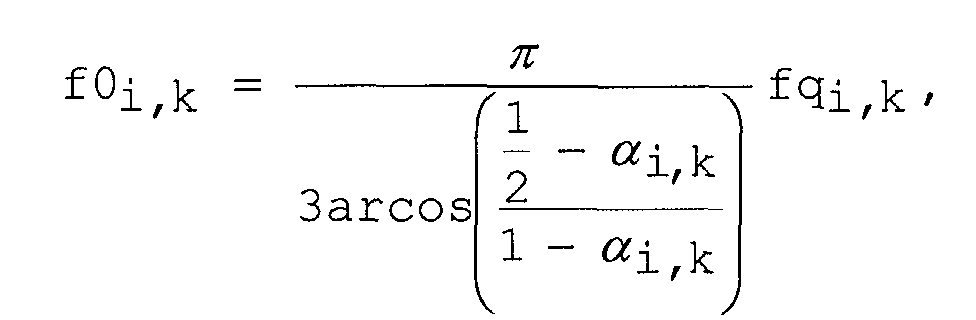
- the bandwidth of each of the Hamming windows is defined by: where arcos denotes the inverse cosine function.
- the method consists in applying three bandpass filters, real, two-dimensional, oriented along the information axis characteristics of the rectangular frequency image different plants.
- the present invention also provides a method of coding, in a digital image, of a texture of an element annular defined by the inclusion of a first circle of radius relatively small in a second circle of relatively radius large, characterized in that it consists in implementing the method of any of the preceding embodiments.
- the ring is an iris of one eye, the first circle being the pupil of said eye and the second circle being the boundary between the iris and the cornea of the eye.
- a mode of coding an iris or any other element annular having a texture that is to say information characteristics varying more significantly on concentric circles that in radial directions, is described below in relation to Figures 3 and 4.
- An IMAGE digital image to be processed includes a annular element, here an iris, to be coded similar to that described previously in connection with FIG. 2A.
- block 301 CONVERSION
- the form general annular iris is transformed into a shape rectangular 202 of FIG. 2B. This is done in converting the Cartesian coordinates of the iris to polar coordinates, using polar angle conversion constant.
- block 302 the converted image 202 of FIG. 2B is transferred from the spatial domain to the domain frequency by a Fourier transform.
- FT Fast Fourier transform
- block 303 (FILTERING), the discrete values obtained by the Fourier transform, are the subject of a filtering by means of a two-dimensional filter, real and oriented in the direction of the characteristic information of the image textured rectangular.
- the two Hamming windows Y i, 1 and Y i, 2 of the two-dimensional filter have identical form coefficients ⁇ i, 1 and ⁇ i, 2 .
- the Hamming windows are then Hanning windows for which the form coefficient ⁇ i, k is 0.54.
- the two Hamming windows Y i, 1 and Y i, 2 of the two-dimensional filter have coefficients of form ⁇ i, 1 and ⁇ i, 2 different from each other.
- the filter in the case of identical form coefficients ⁇ k , has a bandwidth at -3 dB with a width of one octave in the two directions (vertical and horizontal) of the image.
- the bandwidth at -3 dB of the filter of an octave is obtained if the value f0 i, k with respect to the central frequency fq i, k is as follows: where arcos denotes the inverse cosine function.
- the two-pass bandpass filter of bandwidth of an octave at -3 dB is thus applied, preferably, for several different central frequencies fq i, k .
- block 304 we apply to the results of the previous filterings a transform of Hilbert.
- the module information a i (x 0 , y 0 ), of instantaneous phase ⁇ i (x 0 , y 0 ) and of emerging frequency ⁇ i (x 0 , y 0 ), are then extracted, block 306 (DEMODULATION), in the space domain, using standard demodulation methods.
- an advantage of the method according to the invention resides in that the filtering to isolate the spectral components using a two-dimensional filter, real in the frequency domain (zero phase) and oriented in the sense of concentric information requires fewer calculations than a Gabor filter or a wavelet decomposition.
- Another advantage of the present invention lies in since the filter used is real, it is non-phase shifting. he it is therefore not necessary to apply two filters in quadrature and an encoder. Extraction of phase and module data is then performed by demodulation, as described previously, directly in an analytical image obtained by a Hilbert transform. Such a sequence of transformation-demodulation is simpler and faster to put in action.
- a particular advantage of the preferred embodiment of the present invention using Hamming windows is that the filter used has a function of transfer in which the most mathematical function complicated gameplay is a cosine. This filter is therefore particularly simpler than a Gabor filter which has more complicated functions, including functions complex exponentials corresponding to the sum of functions cosine and sinusoidal.
- Another advantage of a process according to the present invention resides in the fact that the same number of calculations can lead (during demodulation) to quantities different information allowing increased reliability depending on the application and needs of discrimination.
- the number of discriminating information between two images is independent of the number of calculations performed up to the demodulation.
- this improvement comes in particular from what according to the invention we treat the whole image instead a reduced number of lines and points. This treatment of the whole image is possible without increasing the treatment because the treatments implemented are more effective.
- the method according to the invention applies to the coding of a texture of an annular element, the texture being characterized by information to be coded which essentially vary according to the angular position in concentric circles.
- Such coding can be used to detect the presence of such a texture.
- a texture For example, in the wood, it can detect the presence of type defects knots in the wood during quality control tests.
- the texture information will be homogeneous.
- the presence of a fault we will observe in the information of frequency a strong variation.
- the module, phase and frequency code obtained allows iridian recognition usable as a parameter of recognition to identify an individual.
- An example application is access control: access to a site physical, such as a command to open a door by code, or by access card; access to a bank account usually password protected; access to any device such as a computer or mobile phone usually protected by a code to be entered. Such a device can also replace identification with fingerprints or other biometric identification.
- the present invention is capable of various variations and modifications that will appear to humans art.
- the process begins with acquiring the image of an eye.
- the image can come from a database.
- the ring element to be coded had internal limits and external circular. In general, the limits can be elliptical, provided that the characterizing information remains variable depending on the angular direction.
Landscapes
- Engineering & Computer Science (AREA)
- Physics & Mathematics (AREA)
- Multimedia (AREA)
- Theoretical Computer Science (AREA)
- Computer Vision & Pattern Recognition (AREA)
- General Physics & Mathematics (AREA)
- Health & Medical Sciences (AREA)
- Spectroscopy & Molecular Physics (AREA)
- Mathematical Physics (AREA)
- General Health & Medical Sciences (AREA)
- Ophthalmology & Optometry (AREA)
- Human Computer Interaction (AREA)
- Image Processing (AREA)
- Compression Or Coding Systems Of Tv Signals (AREA)
- Compression, Expansion, Code Conversion, And Decoders (AREA)
- Image Analysis (AREA)
- Collating Specific Patterns (AREA)
- Compression Of Band Width Or Redundancy In Fax (AREA)
Abstract
Description

i représente l'indice du filtre parmi une série (par exemple trois) de filtres utilisés ;
k désigne la direction de la fenêtre de Hamming considérée (k=1 ou 2) ;
fk est la fréquence courante ;
αi,k est un nombre réel non nul, positif et strictement inférieur à 1, appelé coefficient de forme ;
fqi,k est la fréquence centrale du filtre monodimensionnel, passe-bande dans la direction k et d'indice i dans la série de filtres ; et
f0i,k fixe l'étalement spectral centré sur la fréquence fqi,k.


i représente l'indice du filtre parmi une série (par exemple trois) de filtres utilisés ;
k désigne la direction de la fenêtre de Hamming considérée (k=1 ou 2) ;
fk est la fréquence courante, comprise entre fqi,k-f0i,k et fqi,k+f0i,k ;
αi,k est un nombre réel non nul, positif et strictement inférieur à 1, appelé coefficient de forme ;
fqi,k est la fréquence centrale du filtre monodimensionnel, passe-bande dans la direction k et d'indice i dans la série du filtre ; et
f0i,k fixe l'étalement spectral centré sur la fréquence fqi,k.
Claims (10)
- Procédé de codage en fréquence, module et phase d'une représentation numérique, dans le domaine spatial, d'un élément annulaire, caractérisé en ce qu'il comporte les étapes suivantes :appliquer (301) à tout point de l'élément une conversion polaire à angle constant, d'où il résulte que l'élément est déplié sous forme rectangulaire ;transférer (302), dans le domaine fréquentiel, tout point de la forme rectangulaire convertie au moyen d'une transformée de Fourier ;filtrer (303) les données discrètes résultant du transfert au moyen d'au moins un filtre passe-bande, réel, bidimensionnel, orienté selon l'axe des phases ;appliquer (304) une transformée de Hilbert aux résultats du filtrage ;appliquer (305) une transformée de Fourier inverse aux résultats de la transformée de Hilbert ; etextraire (306) des informations de phase et de module, dans le domaine spatial.
- Procédé selon la revendication 1, caractérisé en ce que le filtre passe-bande, réel, bidimensionnel, orienté selon l'axe des phases est le produit de deux fenêtres de Hamming unidimensionnelles, la fonction de transfert de chacune de ces fenêtres étant nulle partout, sauf dans un domaine de fréquence restreint autour d'une fréquence centrale dans lequel son expression analytique est la suivante :où

i représente l'indice du filtre parmi une série de filtres utilisés ;
k désigne la direction de la fenêtre de Hamming considérée ;
fk est la fréquence courante ;
αi,k est un nombre réel non nul, positif et strictement inférieur à 1 ;
fqi,k est la fréquence centrale du filtre monodimensionnel, passe-bande dans la direction k et d'indice i dans la série de filtres ; et
f0i,k fixe l'étalement spectral centré sur la fréquence fqi,k. - Procédé selon la revendication 2, caractérisé en ce que les fenêtres de Hamming ont des coefficients αi,k identiques.
- Procédé selon la revendication 3, caractérisé en ce que les fenêtres de Hamming sont des fenêtres de Hanning pour lesquelles les coefficients αi,k identiques valent 0,54.
- Procédé selon la revendication 2, caractérisé en ce que les fenêtres de Hamming ont des coefficients αi,k différents.
- Procédé selon l'une quelconque des revendications 1 à 4, caractérisé en ce que le filtre passe-bande réel, bidimensionnel, orienté selon l'axe des phases présente une bande passante à -3 dB d'une largeur d'une octave.
- Procédé selon les revendications 4 et 6, caractérisé en ce que la bande passante de chacune des fenêtres de Hamming est définie par :où arcos désigne la fonction inverse de cosinus.

- Procédé selon l'une quelconque des revendications 1 à 6, caractérisé en ce qu'il consiste à appliquer trois filtres passe-bande, réels, bidimensionnels, orientés selon l'axe des informations caractéristiques de l'image rectangulaire de fréquences centrales différentes.
- Procédé de codage, dans une image numérique, d'une texture d'un élément annulaire défini par l'inclusion d'un premier cercle de rayon relativement faible dans un second cercle de rayon relativement grand, caractérisé en ce qu'il consiste à mettre en oeuvre le procédé de l'une quelconque des revendications 1 à 8.
- Procédé selon la revendication 9, caractérisé en ce que l'anneau est un iris d'un oeil, le premier cercle étant la pupille dudit oeil et le second cercle étant la limite entre l'iris et la cornée de l'oeil.
Applications Claiming Priority (2)
| Application Number | Priority Date | Filing Date | Title |
|---|---|---|---|
| FR0113522 | 2001-10-19 | ||
| FR0113522A FR2831302A1 (fr) | 2001-10-19 | 2001-10-19 | Codage d'informations concentriques |
Publications (2)
| Publication Number | Publication Date |
|---|---|
| EP1304647A1 true EP1304647A1 (fr) | 2003-04-23 |
| EP1304647B1 EP1304647B1 (fr) | 2007-12-12 |
Family
ID=8868494
Family Applications (1)
| Application Number | Title | Priority Date | Filing Date |
|---|---|---|---|
| EP02354159A Expired - Lifetime EP1304647B1 (fr) | 2001-10-19 | 2002-10-16 | Codage d'informations concentriques |
Country Status (5)
| Country | Link |
|---|---|
| US (1) | US7031539B2 (fr) |
| EP (1) | EP1304647B1 (fr) |
| JP (1) | JP2003228707A (fr) |
| DE (1) | DE60223982T2 (fr) |
| FR (1) | FR2831302A1 (fr) |
Cited By (1)
| Publication number | Priority date | Publication date | Assignee | Title |
|---|---|---|---|---|
| CN101539990B (zh) * | 2008-03-20 | 2011-05-11 | 中国科学院自动化研究所 | 一种虹膜图像鲁棒特征选择和快速比对的方法 |
Families Citing this family (35)
| Publication number | Priority date | Publication date | Assignee | Title |
|---|---|---|---|---|
| US8090157B2 (en) | 2005-01-26 | 2012-01-03 | Honeywell International Inc. | Approaches and apparatus for eye detection in a digital image |
| US8705808B2 (en) | 2003-09-05 | 2014-04-22 | Honeywell International Inc. | Combined face and iris recognition system |
| US8064647B2 (en) | 2006-03-03 | 2011-11-22 | Honeywell International Inc. | System for iris detection tracking and recognition at a distance |
| US8098901B2 (en) | 2005-01-26 | 2012-01-17 | Honeywell International Inc. | Standoff iris recognition system |
| US7593550B2 (en) * | 2005-01-26 | 2009-09-22 | Honeywell International Inc. | Distance iris recognition |
| US7933507B2 (en) * | 2006-03-03 | 2011-04-26 | Honeywell International Inc. | Single lens splitter camera |
| US8442276B2 (en) * | 2006-03-03 | 2013-05-14 | Honeywell International Inc. | Invariant radial iris segmentation |
| US8049812B2 (en) | 2006-03-03 | 2011-11-01 | Honeywell International Inc. | Camera with auto focus capability |
| JP4151624B2 (ja) * | 2004-07-14 | 2008-09-17 | 松下電器産業株式会社 | 瞳孔検出装置、虹彩認証装置及び瞳孔検出方法 |
| DE602005013401D1 (de) * | 2004-07-22 | 2009-04-30 | Nec Corp | Bildverarbeitungssystem |
| EP1991947B1 (fr) * | 2006-03-03 | 2020-04-29 | Gentex Corporation | Système d'indexation et de recherche de base de données |
| KR101299074B1 (ko) | 2006-03-03 | 2013-08-30 | 허니웰 인터내셔널 인코포레이티드 | 홍채 인코딩 시스템 |
| EP1991948B1 (fr) | 2006-03-03 | 2010-06-09 | Honeywell International Inc. | Systeme de reconnaissance d'iris ayant une mesure de qualite d'image |
| JP2009529197A (ja) | 2006-03-03 | 2009-08-13 | ハネウェル・インターナショナル・インコーポレーテッド | モジュールバイオメトリクス収集システムアーキテクチャ |
| TW200816060A (en) * | 2006-09-29 | 2008-04-01 | Univ Nat Chiao Tung | Iris recognition method |
| US8063889B2 (en) | 2007-04-25 | 2011-11-22 | Honeywell International Inc. | Biometric data collection system |
| US8260009B2 (en) * | 2007-08-15 | 2012-09-04 | Indiana University Research And Technology Corp. | System and method for measuring clarity of images used in an iris recognition system |
| US8436907B2 (en) | 2008-05-09 | 2013-05-07 | Honeywell International Inc. | Heterogeneous video capturing system |
| US8165393B2 (en) * | 2008-06-05 | 2012-04-24 | Microsoft Corp. | High dynamic range texture compression |
| US8213782B2 (en) | 2008-08-07 | 2012-07-03 | Honeywell International Inc. | Predictive autofocusing system |
| US8090246B2 (en) | 2008-08-08 | 2012-01-03 | Honeywell International Inc. | Image acquisition system |
| CN101727574A (zh) * | 2008-10-17 | 2010-06-09 | 深圳富泰宏精密工业有限公司 | 虹膜识别系统及方法 |
| US8280119B2 (en) | 2008-12-05 | 2012-10-02 | Honeywell International Inc. | Iris recognition system using quality metrics |
| US8630464B2 (en) | 2009-06-15 | 2014-01-14 | Honeywell International Inc. | Adaptive iris matching using database indexing |
| US8472681B2 (en) | 2009-06-15 | 2013-06-25 | Honeywell International Inc. | Iris and ocular recognition system using trace transforms |
| JP5492606B2 (ja) * | 2010-03-03 | 2014-05-14 | アズビル株式会社 | 演算装置、及び演算装置を備えた流量計 |
| CN101916439B (zh) * | 2010-07-27 | 2012-08-08 | 哈尔滨工业大学 | 基于希尔伯特-黄变换的空间碎片高光谱序列探测方法 |
| US8742887B2 (en) | 2010-09-03 | 2014-06-03 | Honeywell International Inc. | Biometric visitor check system |
| US8437513B1 (en) | 2012-08-10 | 2013-05-07 | EyeVerify LLC | Spoof detection for biometric authentication |
| US8483450B1 (en) | 2012-08-10 | 2013-07-09 | EyeVerify LLC | Quality metrics for biometric authentication |
| US8369595B1 (en) | 2012-08-10 | 2013-02-05 | EyeVerify LLC | Texture features for biometric authentication |
| PH12018500541B1 (en) | 2015-09-11 | 2024-04-12 | Jumio Corp | Method and system for determining a quality metric in biometric authentication |
| JP6885935B2 (ja) * | 2015-10-16 | 2021-06-16 | マジック リープ, インコーポレイテッドMagic Leap,Inc. | 眼の特徴を用いる眼ポーズ識別 |
| CN105956585B (zh) * | 2016-07-14 | 2019-02-26 | 郑州航空工业管理学院 | 基于权值相位差的虹膜匹配方法 |
| CN110119764B (zh) * | 2019-04-16 | 2021-03-02 | 北京天泽智云科技有限公司 | 一种变转速工况下轴心轨迹的提纯方法 |
Family Cites Families (2)
| Publication number | Priority date | Publication date | Assignee | Title |
|---|---|---|---|---|
| JP2868266B2 (ja) * | 1990-01-25 | 1999-03-10 | 株式会社日本自動車部品総合研究所 | 信号位相差検出回路及び信号位相差検出方法 |
| JP3438342B2 (ja) * | 1994-09-12 | 2003-08-18 | 株式会社デンソー | パルス位相差符号化回路 |
-
2001
- 2001-10-19 FR FR0113522A patent/FR2831302A1/fr active Pending
-
2002
- 2002-10-16 EP EP02354159A patent/EP1304647B1/fr not_active Expired - Lifetime
- 2002-10-16 DE DE60223982T patent/DE60223982T2/de not_active Expired - Lifetime
- 2002-10-17 JP JP2002302854A patent/JP2003228707A/ja not_active Withdrawn
- 2002-10-18 US US10/273,792 patent/US7031539B2/en not_active Expired - Lifetime
Non-Patent Citations (7)
| Title |
|---|
| "Wayback Machine : Searching Page", THE INTERNET ARCHIVE: BUILDING AN 'INTERNET LIBRARY', pages 1, Retrieved from the Internet <URL:http://web.archive.org/web/*/http://astron.berkeley.edu/~jrg/ngst/fft/window.html> [retrieved on 20020709] * |
| "Wayback Machine : Searching Page", THE INTERNET ARCHIVE: BUILDING AN 'INTERNET LIBRARY', pages 1, Retrieved from the Internet <URL:http://web.archive.org/web/*/http://www.mathworks.com/access/helpdesk/help/toolbox/images/linfil11.shtml> [retrieved on 20020709] * |
| "Windowing Method", MATLAB DOCUMENTATION - IMAGE PROCESSING TOOLBOX, 8 March 2001 (2001-03-08), pages 1, XP002205212, Retrieved from the Internet <URL:http://www.mathworks.com/access/helpdesk/help/toolbox/images/linfil11.shtml> [retrieved on 20020709] * |
| BINGHAM C. ET AL: "Modern Techniques of Power Spectrum Estimation", IEEE TRANS. ON AUDIO AND ELECTRONICS, vol. AU-15, no. 2, June 1967 (1967-06-01), pages 55 - 66, XP002205211, Retrieved from the Internet <URL:http://qss.stanford.edu/~godfrey/statistics/mtpse.pdf> [retrieved on 20020709] * |
| DAUGMAN J: "HIGH CONFIDENCE RECOGNITION OF PERSONS BY RAPID VIDEO ANALYSIS OF IRIS TEXTURE", ECOS. EUROPEAN CONVENTION ON SECURITY AND DETECTION, XX, XX, 16 May 1995 (1995-05-16), pages 244 - 251, XP000671918 * |
| GRAHAM J R: "Windowing and the DFT", FOURIER TRANSFORMS & THE FREQUENCY DOMAIN, 22 February 2001 (2001-02-22), pages 1 - 3, XP002205213, Retrieved from the Internet <URL:http://astron.berkeley.edu/~jrg/ngst/fft/window.html> [retrieved on 20020709] * |
| HAVLICEK J P ET AL: "The analytic image", IMAGE PROCESSING, 1997. PROCEEDINGS., INTERNATIONAL CONFERENCE ON SANTA BARBARA, CA, USA 26-29 OCT. 1997, LOS ALAMITOS, CA, USA,IEEE COMPUT. SOC, US, 26 October 1997 (1997-10-26), pages 446 - 449, XP010253992, ISBN: 0-8186-8183-7 * |
Cited By (1)
| Publication number | Priority date | Publication date | Assignee | Title |
|---|---|---|---|---|
| CN101539990B (zh) * | 2008-03-20 | 2011-05-11 | 中国科学院自动化研究所 | 一种虹膜图像鲁棒特征选择和快速比对的方法 |
Also Published As
| Publication number | Publication date |
|---|---|
| JP2003228707A (ja) | 2003-08-15 |
| FR2831302A1 (fr) | 2003-04-25 |
| DE60223982D1 (de) | 2008-01-24 |
| DE60223982T2 (de) | 2008-12-04 |
| EP1304647B1 (fr) | 2007-12-12 |
| US7031539B2 (en) | 2006-04-18 |
| US20030076984A1 (en) | 2003-04-24 |
Similar Documents
| Publication | Publication Date | Title |
|---|---|---|
| EP1304647B1 (fr) | Codage d'informations concentriques | |
| US7616320B2 (en) | Method and apparatus for recognition of microorganisms using holographic microscopy | |
| WO2008019169A2 (fr) | Système de codage pratique | |
| FR2935822A1 (fr) | Procede de reconnaissance de formes et systeme mettant en oeuvre le procede | |
| CA2778682A1 (fr) | Procede et dispositif d'analyse d'images hyper-spectrales | |
| EP1306795A1 (fr) | Filtre bidimensionnel non-déphaseur | |
| CA2207670A1 (fr) | Procede de synthese d'un filtre numerique a reponse impulsionnelle finie et filtre obtenu selon le procede | |
| EP1172980B1 (fr) | Dispositif pour la classification de signaux complexes contenant une modulation numérique linéaire | |
| EP0480807B1 (fr) | Procédé et dispositif de recalage d'images utilisant une corrélation de phase avec pondération pour déterminer un décalage | |
| WO2013034654A1 (fr) | Identification par reconnaissance d'iris | |
| CA2006606C (fr) | Procede et dispositif holographique en lumiere incoherente | |
| CA2523800C (fr) | Procede de traitement de cubes sismiques correspondant pour une meme zone au sol, a differentes valeurs de deports source/recepteur et/ou d'angles d'incidence | |
| EP0076209B1 (fr) | Dispositif automatique d'analyse statistique d'un objet | |
| FR3098962A1 (fr) | Système de détection d’une particularité hyperspectrale | |
| CA2108663C (fr) | Procede et dispositif de filtrage pour la reduction des preechos d'un signal audio-numerique | |
| EP0065454B1 (fr) | Procédé et dispositif pour la recréation d'un signal analogique de luminance à partir d'un signal numérique | |
| FR2914432A1 (fr) | Procede d'extrapolation de signaux par modelisation ar regularisee multicanaux spectraux. | |
| EP1365350A1 (fr) | Extraction de minuties d'une image d'empreinte digitale | |
| EP1055103A1 (fr) | Procede et dispositif de determination de la repartition d'intensite et de phase dans differents plans de coupe d'un faisceau laser | |
| EP0567377B1 (fr) | Procédé de pistage à partir d'images d'éléments déformables, et/ou aux contours fortement bruités | |
| Diasakos et al. | Distinguishing Signal from Noise in 5G MIMO Systems Using Generative Adversarial Networks | |
| Maycock et al. | Speckle reduction in digital holography using independent component analysis | |
| EP4163866A1 (fr) | Procédé, programme d'ordinateur et dispositif de traitement d'images par extraction de composante(s) principale(s) d'une représentation d'images | |
| CN121999920A (zh) | 一种高质量拉曼光谱的快速采集方法及系统 | |
| AU735557B2 (en) | Method and apparatus for highly efficient representation and compression of images |
Legal Events
| Date | Code | Title | Description |
|---|---|---|---|
| PUAI | Public reference made under article 153(3) epc to a published international application that has entered the european phase |
Free format text: ORIGINAL CODE: 0009012 |
|
| AK | Designated contracting states |
Designated state(s): AT BE BG CH CY CZ DE DK EE ES FI FR GB GR IE IT LI LU MC NL PT SE SK TR |
|
| AX | Request for extension of the european patent |
Extension state: AL LT LV MK RO SI |
|
| 17P | Request for examination filed |
Effective date: 20031010 |
|
| AKX | Designation fees paid |
Designated state(s): DE FR GB IT |
|
| GRAP | Despatch of communication of intention to grant a patent |
Free format text: ORIGINAL CODE: EPIDOSNIGR1 |
|
| RIC1 | Information provided on ipc code assigned before grant |
Ipc: G06K 9/46 20060101ALI20070413BHEP Ipc: G06K 9/00 20060101AFI20070413BHEP |
|
| GRAS | Grant fee paid |
Free format text: ORIGINAL CODE: EPIDOSNIGR3 |
|
| GRAA | (expected) grant |
Free format text: ORIGINAL CODE: 0009210 |
|
| AK | Designated contracting states |
Kind code of ref document: B1 Designated state(s): DE FR GB IT |
|
| REG | Reference to a national code |
Ref country code: GB Ref legal event code: FG4D Free format text: NOT ENGLISH |
|
| REF | Corresponds to: |
Ref document number: 60223982 Country of ref document: DE Date of ref document: 20080124 Kind code of ref document: P |
|
| GBT | Gb: translation of ep patent filed (gb section 77(6)(a)/1977) |
Effective date: 20080117 |
|
| PLBE | No opposition filed within time limit |
Free format text: ORIGINAL CODE: 0009261 |
|
| STAA | Information on the status of an ep patent application or granted ep patent |
Free format text: STATUS: NO OPPOSITION FILED WITHIN TIME LIMIT |
|
| 26N | No opposition filed |
Effective date: 20080915 |
|
| GBPC | Gb: european patent ceased through non-payment of renewal fee |
Effective date: 20081016 |
|
| REG | Reference to a national code |
Ref country code: FR Ref legal event code: ST Effective date: 20090630 |
|
| PG25 | Lapsed in a contracting state [announced via postgrant information from national office to epo] |
Ref country code: IT Free format text: LAPSE BECAUSE OF NON-PAYMENT OF DUE FEES Effective date: 20081016 |
|
| PG25 | Lapsed in a contracting state [announced via postgrant information from national office to epo] |
Ref country code: FR Free format text: LAPSE BECAUSE OF NON-PAYMENT OF DUE FEES Effective date: 20081031 |
|
| PG25 | Lapsed in a contracting state [announced via postgrant information from national office to epo] |
Ref country code: GB Free format text: LAPSE BECAUSE OF NON-PAYMENT OF DUE FEES Effective date: 20081016 |
|
| PGFP | Annual fee paid to national office [announced via postgrant information from national office to epo] |
Ref country code: DE Payment date: 20100930 Year of fee payment: 9 |
|
| PG25 | Lapsed in a contracting state [announced via postgrant information from national office to epo] |
Ref country code: DE Free format text: LAPSE BECAUSE OF NON-PAYMENT OF DUE FEES Effective date: 20120501 |
|
| REG | Reference to a national code |
Ref country code: DE Ref legal event code: R119 Ref document number: 60223982 Country of ref document: DE Effective date: 20120501 |