EP1304344A1 - Method for producing polycarbonate - Google Patents
Method for producing polycarbonate Download PDFInfo
- Publication number
- EP1304344A1 EP1304344A1 EP01951913A EP01951913A EP1304344A1 EP 1304344 A1 EP1304344 A1 EP 1304344A1 EP 01951913 A EP01951913 A EP 01951913A EP 01951913 A EP01951913 A EP 01951913A EP 1304344 A1 EP1304344 A1 EP 1304344A1
- Authority
- EP
- European Patent Office
- Prior art keywords
- reaction
- inert gas
- aromatic polycarbonate
- scrubber
- compound
- Prior art date
- Legal status (The legal status is an assumption and is not a legal conclusion. Google has not performed a legal analysis and makes no representation as to the accuracy of the status listed.)
- Withdrawn
Links
Images


Classifications
-
- C—CHEMISTRY; METALLURGY
- C08—ORGANIC MACROMOLECULAR COMPOUNDS; THEIR PREPARATION OR CHEMICAL WORKING-UP; COMPOSITIONS BASED THEREON
- C08G—MACROMOLECULAR COMPOUNDS OBTAINED OTHERWISE THAN BY REACTIONS ONLY INVOLVING UNSATURATED CARBON-TO-CARBON BONDS
- C08G64/00—Macromolecular compounds obtained by reactions forming a carbonic ester link in the main chain of the macromolecule
- C08G64/20—General preparatory processes
- C08G64/30—General preparatory processes using carbonates
-
- C—CHEMISTRY; METALLURGY
- C08—ORGANIC MACROMOLECULAR COMPOUNDS; THEIR PREPARATION OR CHEMICAL WORKING-UP; COMPOSITIONS BASED THEREON
- C08G—MACROMOLECULAR COMPOUNDS OBTAINED OTHERWISE THAN BY REACTIONS ONLY INVOLVING UNSATURATED CARBON-TO-CARBON BONDS
- C08G64/00—Macromolecular compounds obtained by reactions forming a carbonic ester link in the main chain of the macromolecule
- C08G64/20—General preparatory processes
- C08G64/30—General preparatory processes using carbonates
- C08G64/307—General preparatory processes using carbonates and phenols
Definitions
- the present invention relates to a process for the production of an aromatic polycarbonate and, more particularly, a process for the production of an aromatic polycarbonate under a flow of an inert gas, wherein an aromatic polycarbonate can be efficiently produced by separating and removing an alcohol or a phenol, which is produced as a reaction by-product, from the inert gas using a scrubber.
- Japanese Patent Application Laid-open No. 6-206996 discloses a method in which, when a molten material containing a diphenol, a carbonate diaryl ester and, as necessary, a branching agent is subjected to a transesterification reaction at a temperature of 130°C to 400°C in the presence of a catalyst to produce an aromatic polycarbonate, an inert gas is mixed with the molten material or passed over the molten material.
- the conventional method employs a surface condenser having a jacket and/or a coil, a large heat exchange area is required, it is necessary to use either a very large-scale condenser or a combination of multiple condensers, and there is the problem that the equipment cost increases.
- Japanese Patent Application Laid-open No. 6-65367 discloses a process for the production of an aromatic polycarbonate from an aromatic dihydroxy compound and an aromatic carbonate diester that employs, as a method of separating by condensation a by-product, an unreacted substance and/or a low molecular weight polymer from a phenol series compound by-product vapor and an accompanying vapor containing the unreacted substance and/or low molecular weight polymer, a method using a scrubber in which a compound having a vapor pressure of 10 mmHg or less at 190°C is used as a scrubbing liquid.
- Japanese Patent Application Laid-open No. 2000-128975 discloses a process for the production of an aromatic polycarbonate by a transesterification method in which a distilled mixture is condensed and dissolved using a scrubber having a scrubbing liquid compound that has (a) a vapor pressure at 190°C of 50 to 500 mmHg and (b) a melting point of 30°C or less and (c) dissolves, at 25°C, at least 5 wt% of an aromatic polycarbonate having a number average molecular weight of 2,500.
- USP No. 5,444,148 discloses a process for the production of an aromatic polycarbonate by a transesterification method in which a phenol and a residual monomer are removed concomitantly with an inert gas, and the inert gas that has been used for the removal is washed with diphenyl carbonate.
- the present invention includes two main inventions that are different in terms of the starting materials. That is to say, the present invention includes two main inventions described in 1. and 6. below, one thereof corresponding to where the starting materials are an aromatic dihydroxy compound and a carbonate diester and the other thereof corresponding to where the starting material is an oligomer of an aromatic polycarbonate.
- the first invention of the present invention is as follows.
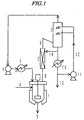
- FIG. 1 An embodiment of the production process or production method for an aromatic polycarbonate of the present invention and, in particular, a separation process for a reaction by-product using a scrubber that is a characteristic of the present invention is shown in FIG. 1 for a case where an aromatic polycarbonate is produced by a melt polymerization method, which is the first invention, and in FIG. 2 for a case where an aromatic polycarbonate is produced by a solid phase polymerization method, which is the second invention.
- FIG. 3 An example of a spray system scrubber is shown in FIG. 3.
- FIGS. 1 and 2 show one mode for carrying out the present invention, and other appropriately modified modes are of course included in the scope of the present invention.
- a horizontal type polymerization reactor can also be used instead of the vertical type polymerization reactor shown in FIGS. 1 and 2 and a case where the rectifier shown in FIG. 1 is not used is also included in the scope of the present invention.
- the present invention can be applied to any polycondensation method such as a batchwise method or a continuous method, and in the case of either a batchwise or a continuous method it is not essential to apply the present invention to all stages from supplying a starting material to obtaining a product and the present invention can be applied to at least one of the stages for the production of an aromatic polycarbonate.
- FIG. 1 shows one embodiment of the process for the production of an aromatic polycarbonate by a melt polymerization method.
- the production process by the melt polymerization method includes as main components a polymerization reactor 1, a rectifier 2 and a scrubber 3.
- An aromatic dihydroxy compound and a carbonate diester, which are starting materials, a catalyst and/or a low molecular weight polycarbonate (which is a starting material in the case where the present invention is applied to an intermediate stage of the polymerization) are supplied continuously or batchwise to the polymerization reactor 1 from a starting material supply pipeline 4.
- the temperature of the polymerization reaction is preferably 150 to 350°C. When the temperature is less than this range it is difficult for the reaction to proceed smoothly, and when the temperature exceeds 350°C undesirable side reactions such as branching tend to occur.
- reaction mixture that has been polycondensed to some extent within the polymerization reactor is discharged continuously or batchwise via a reaction mixture discharge pipeline 5.
- the aromatic polycarbonate oligomer discharged here can be used in a production process that uses a crystallized aromatic polycarbonate as a starting material.
- An inert gas that flows into the polymerization reactor 1 is circulated within the reaction system through the rectifier 2 and the scrubber 3 by a gas circulation pump 6. Furthermore, fresh inert gas can be supplied to the circulation system as necessary.
- the inert gas is heated by a heater 7 and made to flow into the polymerization reactor.
- the temperature of the heated inert gas is preferably at least the polycondensation reaction temperature and at most 350°C. When the temperature of the inert gas is less than the reaction temperature the reaction rate is undesirably lowered, and when it exceeds 350°C unwanted side reactions such as branching undesirably tend to occur, as is the case with the reaction temperature.
- the method of making the inert gas flow into the polymerization reactor is not particularly limited, but a method in which the inert gas is injected directly into the reaction mixture is preferred.
- the reaction pressure (the pressure of the interior of the polycondensation reactor) is desirably at least 15 kPa and at most 1,000 kPa, preferably at least 90 kPa and at most 300 kPa, and more preferably at least 90 kPa and at most 200 kPa, in order to exploit the characteristics of the circulation of the inert gas.
- the pressure is less than the above-mentioned lower limit, a large-scale device for generating a high vacuum and maintaining this vacuum is needed.
- a burden is imposed on a pump such as a compressor or a blower for circulating the inert gas, which is undesirable.
- the 'inert gas' referred to in the present invention means a gas that does not interfere with the polycondensation reaction of an aromatic polycarbonate and, in addition to nitrogen gas, noble gases such as helium and argon can be cited as examples.
- the ratio of A to the amount (B (units: kg/hr)) of carbonate diester added is preferably 0.07 to 7.
- the effect of circulating the inert gas is too small and the reaction rate undesirably becomes too low, and when it exceeds 7 there is a possibility that the capacity of equipment such as the scrubber might become huge and impractical.
- reaction by-product An alcohol or a phenol that is produced as a by-product in the reaction (hereinafter, called a reaction by-product) is discharged through a vent pipeline 8 of the polymerization reactor accompanying the inert gas together with substances that did not react in the polymerization reactor and then guided to the rectifier 2.
- the reaction by-product and the unreacted substances are separated from each other and the unreacted substances, which are collected as high boiling point fractions, are returned to the polymerization reactor.
- the gaseous mixture of the inert gas and the reaction by-product distills out of the top of the rectifier 2 and is guided to the scrubber 3 via the rectifier-scrubber connecting pipeline 9.
- FIG. 2 shows one embodiment of the process for the production of an aromatic polycarbonate by a solid phase polymerization method.
- the production process by the solid phase polymerization method includes as main components a polymerization reactor 1 and a scrubber 3 as shown in FIG. 2.
- a crystallized aromatic polycarbonate that is at least partially crystallized (in the present invention, simply called a 'crystallized aromatic polycarbonate').
- the viscosity average molecular weight of the crystallized aromatic polycarbonate is not particularly limited, but it is preferably 3,000 to 50,000, and more preferably 5,200 to 22,000.
- the degree of crystallinity of the crystallized aromatic polycarbonate is about 10% to 70%.
- the above-mentioned crystallized aromatic polycarbonate which is a starting material, is supplied from a starting material supply pipeline 4 to the polymerization reactor 1 continuously or batchwise.
- the polymerization temperature is preferably at least a temperature that is 20°C higher than the glass transition temperature of the crystallized aromatic polycarbonate and at most a temperature that is 5°C lower than the melting point of the crystallized aromatic polycarbonate.
- the temperature is less than the above-mentioned lower limit, it is difficult for the reaction to proceed smoothly, and when the temperature exceeds the above-mentioned upper limit the crystals melt and it is difficult to maintain the crystallized aromatic polycarbonate in the solid phase.
- reaction mixture discharge pipeline 5 When the crystallized aromatic polycarbonate, which is a starting material, is supplied continuously to the polymerization reactor, the reaction mixture that has been polycondensed to some extent within the polymerization reactor is discharged continuously or batchwise via a reaction mixture discharge pipeline 5.
- An inert gas that flows into the polymerization reactor 1 is circulated within the reaction system through the scrubber 3 and further, if necessary, through an organic gas adsorption device 15 by a gas circulation pump 6. Furthermore, fresh inert gas can be supplied to the circulation system as necessary.
- the inert gas is heated by a heater 7 and made to flow into the polymerization reactor.
- the temperature of the heated inert gas is preferably at least a temperature that is 20°C higher than the glass transition temperature of the crystallized aromatic polycarbonate and at most a temperature that is 5°C lower than the melting point of the crystallized aromatic polycarbonate.
- the method of making the inert gas flow into the polymerization reactor is not particularly limited, but a method in which the inert gas is made to flow from a lower part to an upper part of the polymerization reactor is preferred.
- the pressure of the interior of the polymerization reactor is desirably at least 15 kPa and at most 1,000 kPa, preferably at least 90 kPa and at most 500 kPa, and more preferably at least 90 kPa and at most 200 kPa, in order to exploit the characteristics of the circulation of the inert gas.
- the pressure is less than the above-mentioned lower limit, a large-scale device for generating a high vacuum and maintaining this vacuum is needed.
- a burden is imposed on a pump such as a compressor or a blower for circulating the inert gas.
- the ratio of A to the amount (C (units: kg/hr)) of crystallized aromatic polycarbonate added is preferably 0.07 to 7.
- the effect obtained by circulating the inert gas is too small and the reaction rate undesirably becomes too low, and when it exceeds 7 there is a possibility that the capacity of equipment such as the scrubber might become huge and impractical.
- reaction by-product An alcohol or a phenol that is produced as a by-product in the reaction (hereinafter, called a reaction by-product) is guided to the scrubber 3 through a vent pipeline 8 of the polymerization reactor accompanying the inert gas together with substances that did not react in the polymerization reactor.
- reaction by-product is separated from the inert gas using the scrubber.
- the scrubbing liquid used for the scrubber it is preferable for the scrubbing liquid used for the scrubber to comprise principally a compound X or Y that is the same as either the alcohol or the phenol that is the reaction by-product.
- 'To comprise principally' referred to here means that the reaction by-product is a principal component of the scrubbing liquid composition, and it is preferably at least 50 mole%, and more preferably at least 80 mole%.
- the reaction by-product is a principal component of the scrubbing liquid composition, and it is preferably at least 50 mole%, and more preferably at least 80 mole%.
- the process for separating and purifying the reaction by-product from the scrubbing liquid that has absorbed the reaction by-product can thereby be simplified. Furthermore, the condensed and liquefied reaction by-product can be used as the scrubbing liquid as it is or as a part of a mixture.
- the mixing ratio is not particularly limited.
- the temperature of the scrubbing liquid is controlled using a scrubbing liquid temperature controller 10 such as a heat exchanger.
- the temperature of the scrubbing liquid at the entrance of the scrubber is preferably at least the solidifying point of the compound X or Y in the scrubbing liquid and at most a temperature at which the vapor pressure of the compound X in the scrubbing liquid is 40 kPa.
- a scrubbing liquid temperature controller 10 such as a heat exchanger.
- the temperature of the scrubbing liquid at the entrance of the scrubber is preferably at least the solidifying point of the compound X or Y in the scrubbing liquid and at most a temperature at which the vapor pressure of the compound X in the scrubbing liquid is 40 kPa.
- the temperature at which the vapor pressure thereof becomes 40 kPa is 150°C.
- the temperature-controlled scrubbing liquid is supplied to the scrubber by a scrubbing liquid circulation pump 11 via a scrubbing liquid feed pipeline 12 and made to come into contact with a gaseous mixture of the inert gas and the reaction by-product so as to absorb and separate the reaction by-product from the inert gas.
- the scrubbing liquid that has absorbed the reaction by-product is again temperature-controlled by the scrubbing liquid temperature controller 10 and supplied to the scrubber but, if necessary, a portion of the scrubbing liquid is discharged from the scrubbing liquid circulation system via a scrubbing liquid discharge pipeline 13.
- the scrubbing liquid component is the same as the reaction by-product, a portion of the scrubbing liquid can be used as a reflux liquid in the rectifier and a required amount can therefore be supplied to the rectifier via a reflux liquid feed pipeline 14.
- FIG. 3 is a schematic diagram of an embodiment of the spray type scrubber.
- a scrubbing liquid B that is sprayed by means of spray nozzles 2' comes into contact with a gaseous mixture A of reaction by-product and inert gas so forming a scrubbing liquid D that has absorbed the reaction by-product and an inert gas C containing a reduced amount of the reaction by-product.
- the scrubber used in the present invention is not particularly limited; one having a structure that allows good contact between the scrubbing liquid and the gaseous mixture of inert gas and reaction by-product and has a small pressure loss can be used and, for example, a spray type, a packed tower type, a liquid tank splash type, a liquid surface collision type, a venturi type, a cyclone type, etc. can be considered.
- the operating pressure of the scrubber in the present invention is desirably approximately equal to the reaction pressure and is at least 15 kPa and at most 1,000 kPa, preferably at least 90 kPa and at most 500 kPa, and more preferably at least 90 kPa and at most 200 kPa.
- the present invention can of course employ a combination of a scrubber and another separation technique such as, for example, a surface condenser.
- the aromatic polycarbonate referred to in the first invention of the present invention is an aromatic polycarbonate that is obtained by a condensation polymerization reaction of a mixture mainly containing an aromatic dihydroxy compound and a carbonate diester in the presence of a transesterification catalyst, etc. formed from, for example, a nitrogen-containing basic compound, an alkali metal compound and/or an alkaline-earth metal compound.
- the aromatic polycarbonate referred to in the second invention is an aromatic polycarbonate that is obtained by using as a starting material a low molecular weight aromatic polycarbonate, that is to say, an oligomer or a prepolymer of an aromatic polycarbonate, crystallizing it and then subjecting it to solid phase polymerization.
- aromatic dihydroxy compounds for example, bis(4-hydroxyphenyl)methane, 2,2-bis(4-hydroxyphenyl)propane, 2,2-bis(4-hydroxy-3-methylphenyl)propane, 4,4-bis(4-hydroxyphenyl)heptane, 2,2-bis(4-hydroxy-3,5-dichlorophenyl) propane, 2,2-bis(4-hydroxy-3,5-dibromophenyl)propane, bis(4-hydroxyphenyl)oxide, bis(3,5-dichloro-4-hydroxyphenyl)oxide, p,p' -dihydroxydiphenyl, 3,3'-dichloro-4,4'-dihydroxydiphenyl, bis(hydroxyphenyl)sulfone, resorcinol, hydroquinone, 1,4-dihydroxy-2,5-dichlorobenzene, 1,4-dihydroxy-3-methylbenzene, bis(4-hydroxyphenyl)sulfide
- carbonate diesters for example, diphenyl carbonate, ditolyl carbonate, bis(chlorophenyl) carbonate, m-cresyl carbonate, dinaphthyl carbonate, bis(diphenyl) carbonate, dimethyl carbonate, diethyl carbonate, dibutyl carbonate, dicyclohexyl carbonate, etc. are used.
- diphenyl carbonate is preferred in terms of the reactivity, the stability of the color of the resin product and, furthermore, the cost.
- the polycarbonate of the present invention can further contain, as necessary, an aliphatic dihydroxy compound such as, for example, ethylene glycol, 1,4-butanediol, 1,4-cyclohexanedimethanol or 1,10-decanediol, a dicarboxylic acid such as, for example, succinic acid, isophthalic acid, 2,6-naphthalenedicarboxylic acid, adipic acid, cyclohexanecarboxylic acid or terephthalic acid, an oxyacid such as, for example, lactic acid, p -hydroxybenzoic acid or 6-hydroxy-2-naphthoic acid.
- an aliphatic dihydroxy compound such as, for example, ethylene glycol, 1,4-butanediol, 1,4-cyclohexanedimethanol or 1,10-decanediol
- a dicarboxylic acid such as, for example, succinic acid, isophthalic acid,
- an alkali metal compound or an alkaline-earth metal compound is preferably used, and an alkali metal compound is particularly preferably used.
- alkali metal compounds that are used as the catalyst for example, hydroxides, hydrogencarbonates, carbonates, acetates, nitrates, nitrites, sulfites, cyanates, thiocyanates, stearates, hydrogenborates, benzoates, hydrogenphosphates, bisphenol and phenol salts, etc. of alkali metals can be cited.
- alkaline-earth metal compounds that are used as the catalyst, for example, hydroxides, hydrogencarbonates, carbonates, acetates, nitrates, nitrites, sulfites, cyanates, thiocyanates, stearates, hydrogenborates, benzoates, bisphenol and phenol salts, etc. of alkaline-earth metals can be cited.
- the alkali metal compound or alkaline-earth metal compound that is used as the catalyst is preferably used at a ratio such that the alkali metal element or alkaline-earth metal element in the catalyst is present at 1 x 10 -8 to 5 x 10 -5 equivalents per mole of the aromatic diol compound. More preferably, the ratio is 5 x 10 -7 to 1 x 10 -5 equivalents on the same basis.
- ammonium hydroxides having an alkyl, aryl or alkylaryl group such as tetramethylammonium hydroxide (Me 4 NOH), tetraethylammonium hydroxide (Et 4 NOH), tetrabutylammonium hydroxide (Bu 4 NOH), benzyltrimethylammonium hydroxide (Ph-CH 2 (Me) 3 NOH) and hexadecyltrimethylammonium hydroxide, tertiary amines such as triethylamine, tributylamine, dimethylbenzylamine and hexadecyldimethylamine, and basic salts such as tetramethylammonium borohydride (Me 4 NBH 4 ), tetrabutylammonium borohydride (Bu 4 NBH 4 ), tetramethylammonium tetraphenylborate (
- the above-mentioned nitrogen-containing basic compound is preferably used at a ratio such that the ammonium nitrogen atom in the nitrogen-containing basic compound is present at 1 x 10 -5 to 5 x 10 -4 equivalents per mole of the aromatic dihydroxy compound. More preferably, the ratio is 2 x 10 -5 to 5 x 10 -4 equivalents on the same basis. Particularly preferably, the ratio is 5 x 10 -5 to 5 x 10 -4 equivalents on the same basis.
- the ratios of the alkali metal compound, alkaline-earth metal compound and nitrogen-containing basic compound relative to the aromatic diol compound (which is the same as the 'aromatic dihydroxy compound') that is added initially are expressed as 'an amount of Z (compound name) at W (value) equivalents as the metal or basic nitrogen atom per mole of the aromatic dihydroxy compound', and this means that when Z is, for example, sodium phenoxide, monosodium 2,2-bis(4-hydroxyphenyl)propane or triethylamine and the number of sodium atoms or basic nitrogen atoms is one, the amount of Z corresponds to W moles, and when Z is disodium 2,2-bis(4-hydroxyphenyl)propane and the number of sodium atoms is two, the amount of Z corresponds to W/2 moles.
- an alkali metal salt of an ate complex of an element belonging to group 14 of the periodic table or (b) an alkali metal salt of an oxoacid of an element belonging to group 14 of the periodic table can be used as the alkali metal compound of the catalyst.
- the elements belonging to group 14 of the periodic table referred to here denote silicon, germanium and tin.
- alkali metal compounds as a polycondensation catalyst has the advantage that the polycondensation reaction can proceed rapidly and to completion. Furthermore, undesirable side reactions such as branching that are caused during the polycondensation reaction can be suppressed to a low level.
- alkali metal salts of an ate complex of elements belonging to group 14 of the periodic table there are those described in Japanese Patent Application Laid-open No. 7-268091. More particularly, with regard to compounds of germanium (Ge), NaGe(OMe) 5 , NaGe(OEt) 3 , NaGe(OPr) 5 , NaGe(OBu) 5 , NaGe(OPh) 5 , LiGe(OMe) 5 , LiGe(OBu) 5 and LiGe(OPh) 5 can be cited.
- alkali metal salts of an oxoacid of elements belonging to group 14 of the periodic table alkali metal salts of silicic acid, alkali metal salts of stannic acid, alkali metal salts of germanous acid (Ge(II)) and alkali metal salts of germanic acid (Ge(IV)) can be cited as preferable examples.
- alkali metal salts of silicic acid are, for example, acidic or neutral alkali metal salts of monosilicic acid and condensates thereof and, with regard to examples thereof, monosodium orthosilicate, disodium orthosilicate, trisodium orthosilicate and tetrasodium orthosilicate can be cited.
- the alkali metal salts of germanous acid are, for example, acidic or neutral alkali metal salts of monogermanous acid and condensates thereof and, with regard to examples thereof, the monosodium salt of germanous acid (NaHGeO 2 ) can be cited.
- the alkali metal salts of germanic acid (Ge(IV)) are, for example, acidic or neutral alkali metal salts of monogermanic acid (Ge(IV)) or condensates thereof and, with regard to examples thereof, monolithium orthogermanate (LiH 3 GeO 4 ), disodium orthogermanate, tetrasodium orthogermanate, disodium digermanate (Na 2 Ge 2 O 5 ), disodium tetragermanate (Na 2 Ge 4 O 9 ) and disodium pentagermanate (Na 2 Ge 5 O 11 ) can be cited.
- monolithium orthogermanate LiH 3 GeO 4
- disodium orthogermanate disodium orthogermanate
- tetrasodium orthogermanate disodium digermanate
- Na 2 Ge 4 O 9 disodium tetragermanate
- disodium pentagermanate Na 2 Ge 5 O 11
- the above-mentioned polycondensation catalyst is preferably used at a ratio such that the alkali metal element in the catalyst is present at 1 x 10 -8 to 5x 10 -5 equivalents per mole of the aromatic dihydroxy compound. More preferably, the ratio is 5 x 10 -7 to 1 x 10 -5 equivalents on the same basis.
- a co-catalyst of at least one type chosen from the group consisting of oxoacids and oxides of elements belonging to group 14 of the periodic table can be present as necessary.
- silicic acid for example, stannic acid, and germanic acid can be cited.
- oxides of the elements belonging to group 14 of the periodic table for example, silicon monoxide, silicon dioxide, tin monoxide, tin dioxide, germanium monoxide, germanium dioxide and condensates thereof can be cited.
- the co-catalyst is preferably present at a ratio such that the metal element belonging to group 14 of the periodic table in the co-catalyst is present at 50 mole (atom) or less per mole (atom) of the alkali metal element in the polycondensation catalyst.
- the ratio of the co-catalyst to the metal element that is used exceeds 50 mole (atom) per mole (atom), the polycondensation reaction rate undesirably decreases.
- the co-catalyst at a ratio such that the metal element belonging to group 14 of the periodic table in the co-catalyst is present at 0.1 to 30 mole (atom) per mole (atom) of the alkali metal element in the polycondensation catalyst
- catalyst systems have the advantage that, when they are used in a polycondensation reaction, the polycondensation reaction and a termination reaction can be carried out rapidly and to completion. Furthermore, undesirable side reactions such as branching, which are caused in the polycondensation reaction system, can be suppressed to a low level.
- a method of crystallizing a low molecular weight aromatic polycarbonate and then subjecting it to solid phase polymerization is known as in, for example, Japanese Patent Application Laid-open No. 2001-11171.
- a crystallized aromatic polycarbonate which is a starting material of the present invention, can be obtained by crystallizing a low molecular weight aromatic polycarbonate, that is to say, an oligomer of an aromatic polycarbonate.
- melt polymerization method When producing a low molecular weight aromatic polycarbonate, various types of polymerization method can be employed, but a melt polymerization method can be preferably used. With regard to a method of crystallizing an oligomer of an aromatic polycarbonate a known solvent treatment method, thermal crystallization method, etc. can be cited. As a crystallization method in the present invention, the thermal crystallization method is preferred.
- an oligomer or a prepolymer having an intrinsic viscosity [ ⁇ ] of 0.05 to 0.25 (dl/g) can preferably be used as an uncrystallized (i.e. substantially uncrystallized) low molecular weight aromatic polycarbonate.
- the intrinsic viscosity [ ⁇ ] of the aromatic polycarbonate referred to in the present invention is a value calculated from the viscosity measured in a dichloromethane solution at 20°C.
- This aromatic polycarbonate oligomer usually has a degree of crystallinity of approximately 0% or is in an amorphous state having a value close to 0%.
- the molten polycarbonate oligomer immediately after the reaction can preferably be used.
- the low molecular weight aromatic polycarbonate is crystallized by maintaining it in a temperature range of at least its glass transition temperature (Tg) and less than its melting point.
- Tg glass transition temperature
- a preferred temperature for the crystallization treatment is at least a temperature that is 20°C higher than the glass transition temperature of the low molecular weight aromatic polycarbonate and less than the melting point, and more preferably at least a temperature that is 40°C higher than the glass transition temperature of the low molecular weight aromatic polycarbonate and at most a temperature that is 5°C less than the melting point.
- the atmosphere for the crystallization treatment can be air, an inert gas or vacuum.
- the time required for the crystallization depends on the degree of polymerization, the glass transition temperature (Tg) and the amount of the low molecular weight aromatic polycarbonate.
- the crystals so obtained are simultaneously granulated.
- the granulation method a method in which a predetermined size of a molten material is dropped onto or adhered to a hot plate at a predetermined temperature, a method in which a molten mixture is drawn into a strand and cut into a predetermined length, a method in which a molten material is cast on a film on a hot plate so as to crystallize it and it is then cut or pulverized, a method in which a lump is cooled so as to crystallize it and it is then pulverized, etc. can be employed.
- a small amount of an already crystallized aromatic polycarbonate oligomer can be used as a crystallization nucleus.
- a small amount of a carbonate diester, aromatic dihydroxy compound, etc. can be used as a plasticizer.
- the crystallized aromatic polycarbonate that has been crystallized by the above-mentioned methods and granulated as necessary is heated as it is in the solid state at a temperature of the melting point of the crystals or less in a flow of an inert gas so as to effect solid phase polymerization to give a highly polymerized aromatic polycarbonate.
- a higher temperature is preferred in terms of the polymerization rate, in order to prevent adhesion between the crystals it is necessary to carry out the polymerization at a temperature lower than the melting point of the crystals. Since the melting point of the crystals rises as the degree of polymerization increases, a method in which the solid phase polymerization temperature is increased according to an increase in the melting point is also preferably employed.
- the polymerization time it is usually a few hours to a few tens of hours.
- the polycarbonate resin so produced by solid phase polymerization usually has an intrinsic viscosity [ ⁇ ] of about 0.3 to 1.7 (dl/g), good color, few gel components and excellent moldability, but it can be subjected to a reaction to block the terminal hydroxyl groups or stabilization of the melt viscosity as necessary, which is preferred since the thermal stability during molding and the durability of the polycarbonate resin can be enhanced.
- an aromatic polycarbonate can be produced under a flow of an inert gas by an efficient and simplified process.
- FIG. 1 is a brief sketch of one example of a process for the production of an aromatic polycarbonate by melt polymerization using a scrubber of the present invention
- FIG. 2 is a brief sketch of one example of a process for the production of an aromatic polycarbonate by solid phase polymerization using a scrubber of the present invention
- Fig. 3 is a schematic diagram of one embodiment of a spray type scrubber.
- the melting point was measured using a Perkin Elmer DSC7 at a temperature rise rate of 20°C/min.
- the enthalpy of fusion ( ⁇ H) of the crystals was calculated from the area of the section corresponding to the melting of the crystals.
- the degree of crystallinity was calculated using the value for ⁇ H obtained by the DSC measurement by defining the ⁇ H of a 100% crystallized polycarbonate as 109.8 J/g (ref. J. Polym. Sci.; Part B: Polym. Phys., Vol. 25 (1979) 1511-1517).
- Phenol which was the by-product, was discharged via the reactor vent pipeline accompanying the nitrogen gas together with trace amounts of unreacted diphenyl carbonate and oligomer, and was separated and recovered by a scrubber.
- the scrubber shown in FIGS. 1 and 3 was used and was operated at atmospheric pressure with a scrubbing liquid temperature of 55°C and a flow rate of 1.5 L/min. This resulted in a concentration of the phenol reaction by-product in the inert gas on the scrubber inlet side of 52.48 wt%, and a concentration of phenol in the inert gas on the scrubber outlet side of 2.04 wt%.
- phenol was added as the scrubbing liquid, and increases in the amount of phenol were subsequently discharged as appropriate via the scrubbing liquid discharge pipeline.
- the viscosity average molecular weight of the polycarbonate obtained by the above-mentioned method was 5,220 and the production was carried out continuously in a stable manner.
- Example 1 A portion of the low molecular weight aromatic polycarbonate obtained in Example 1 was taken out and thermally treated at 180°C for 4 hours under a nitrogen atmosphere. Hardly any crystallization occurred after 1 hour of the thermal treatment, but a degree of crystallinity of 23% was achieved after 4 hours of the thermal treatment.
- the crystallized polycarbonate so obtained had a viscosity average molecular weight of 5,650, a melting point of 220°C and a ⁇ H of 37.9 J/g. It was pulverized and then sieved using 1 mm and 2 mm sieves to collect a powder having a particle size of 1 mm to 2 mm.
- the crystallized polycarbonate powder was supplied continuously to a 50 L reactor at 1,000 g/hr, and a solid phase polymerization reaction was carried out at a reaction temperature of 220°C and a reaction pressure of atmospheric pressure while making an inert gas flow into the reactor.
- the polycarbonate so obtained from the reaction was continuously extracted from the polymerization reactor at a rate of 970 g/hr.
- Nitrogen gas was used as an inert gas. The nitrogen gas was heated to 220°C and supplied to the polymerization reactor at a rate of 20 NL/min.
- Phenol which was the reaction by-product, was discharged via the reactor vent pipeline accompanying the nitrogen gas together with trace amounts of unreacted diphenyl carbonate and oligomer, and was separated and recovered by a scrubber.
- the scrubber shown in FIGS. 2 and 3 was used and was operated at atmospheric pressure with a scrubbing liquid temperature of 50°C and a flow rate of 1.5 L/min. This resulted in a concentration of the phenol reaction by-product in the inert gas on the scrubber inlet side of 0.022 wt%, and a concentration of phenol in the inert gas on the scrubber outlet side of 0.012 wt%.
- phenol was added as the scrubbing liquid, and increases in the amount of phenol were subsequently discharged as appropriate via the scrubbing liquid discharge pipeline.
- the viscosity average molecular weight of polycarbonate obtained by the above-mentioned method was 22,300 and the production was carried out continuously in a stable manner.
Landscapes
- Chemical & Material Sciences (AREA)
- Health & Medical Sciences (AREA)
- Chemical Kinetics & Catalysis (AREA)
- Medicinal Chemistry (AREA)
- Polymers & Plastics (AREA)
- Organic Chemistry (AREA)
- Polyesters Or Polycarbonates (AREA)
Abstract
The present invention relates to a process for the production of an
aromatic polycarbonate by a polycondensation reaction or a solid phase
polymerization reaction under a flow of an inert gas, wherein an alcohol or a
phenol, which is produced as a by-product, is separated from the inert gas
using a scrubber. In accordance with the present invention, since the
by-product can be separated efficiently, an aromatic polycarbonate can be
produced under a flow of an inert gas by an efficient and simplified process.
Description
The present invention relates to a process for the production of an
aromatic polycarbonate and, more particularly, a process for the production of
an aromatic polycarbonate under a flow of an inert gas, wherein an aromatic
polycarbonate can be efficiently produced by separating and removing an
alcohol or a phenol, which is produced as a reaction by-product, from the inert
gas using a scrubber.
With regard to a process for the production of a polycarbonate by a
polycondensation reaction, it is necessary to remove a by-product that is
produced by the reaction from the reaction system. In this case, in general, a
method in which the interior of a polymerization reactor is evacuated is most
commonly used. However, this method has the problem that it is necessary to
employ a highly air-tight polymerization reaction device in order to maintain the
reaction system at high vacuum so imposing a high cost on the production
equipment.
As an alternative to the above-mentioned method in which the interior of
the polymerization reactor is evacuated, a method in which a polycondensation
reaction is carried out under low vacuum or atmospheric pressure by circulating
an inert gas within the polymerization reactor so as to remove a reaction-produced
by-product together with the inert gas from the reaction system is
also well known.
Japanese Patent Application Laid-open No. 6-206996 discloses a
method in which, when a molten material containing a diphenol, a carbonate
diaryl ester and, as necessary, a branching agent is subjected to a
transesterification reaction at a temperature of 130°C to 400°C in the presence
of a catalyst to produce an aromatic polycarbonate, an inert gas is mixed with
the molten material or passed over the molten material.
Although this method has the advantage that it is unnecessary to
maintain the polymerization reaction system at high vacuum, it is necessary to
separate and remove the by-product from the gaseous mixture of the by-product
and the inert gas.
It is also necessary to employ a device having an extremely large heat
exchange area in order to separate a condensing material such as the by-product
that is produced by the aromatic polycarbonate reaction from a non-condensing
gas such as the inert gas.
Since the conventional method employs a surface condenser having a
jacket and/or a coil, a large heat exchange area is required, it is necessary to
use either a very large-scale condenser or a combination of multiple
condensers, and there is the problem that the equipment cost increases.
In order to solve the above-mentioned problems, Japanese Patent
Application Laid-open No. 6-65367 discloses a process for the production of an
aromatic polycarbonate from an aromatic dihydroxy compound and an aromatic
carbonate diester that employs, as a method of separating by condensation a
by-product, an unreacted substance and/or a low molecular weight polymer
from a phenol series compound by-product vapor and an accompanying vapor
containing the unreacted substance and/or low molecular weight polymer, a
method using a scrubber in which a compound having a vapor pressure of
10 mmHg or less at 190°C is used as a scrubbing liquid.
Japanese Patent Application Laid-open No. 2000-128975 discloses a
process for the production of an aromatic polycarbonate by a transesterification
method in which a distilled mixture is condensed and dissolved using a
scrubber having a scrubbing liquid compound that has (a) a vapor pressure at
190°C of 50 to 500 mmHg and (b) a melting point of 30°C or less and (c)
dissolves, at 25°C, at least 5 wt% of an aromatic polycarbonate having a
number average molecular weight of 2,500.
Furthermore, USP No. 5,444,148 discloses a process for the production
of an aromatic polycarbonate by a transesterification method in which a phenol
and a residual monomer are removed concomitantly with an inert gas, and the
inert gas that has been used for the removal is washed with diphenyl
carbonate.
However, these processes have not yet achieved an efficient separation
of a reaction by-product to produce an aromatic polycarbonate.
It is an object of the present invention to eliminate the above-mentioned
problems of the conventional polymerization reaction to form an aromatic
polycarbonate under a flow of an inert gas and to provide a more efficient
process for the production of a polycarbonate.
As a result of an intensive investigation by the present inventors into a
process for the production of an aromatic polycarbonate by a polycondensation
reaction under a flow of an inert gas, it has been found that an aromatic
polycarbonate can be produced in a more efficient and simplified process by
separating a by-product alcohol or phenol from the inert gas using a scrubber
under specific conditions, and the present invention has thus been
accomplished.
That is to say, as described in detail below, the present invention
includes two main inventions that are different in terms of the starting materials.
That is to say, the present invention includes two main inventions described in
1. and 6. below, one thereof corresponding to where the starting materials are
an aromatic dihydroxy compound and a carbonate diester and the other thereof
corresponding to where the starting material is an oligomer of an aromatic
polycarbonate.
The first invention of the present invention is as follows.
The first and second inventions of the present invention are described in
detail below by reference to drawings.
An embodiment of the production process or production method for an
aromatic polycarbonate of the present invention and, in particular, a separation
process for a reaction by-product using a scrubber that is a characteristic of the
present invention is shown in FIG. 1 for a case where an aromatic
polycarbonate is produced by a melt polymerization method, which is the first
invention, and in FIG. 2 for a case where an aromatic polycarbonate is
produced by a solid phase polymerization method, which is the second
invention.
Moreover, an example of a spray system scrubber is shown in FIG. 3.
These figures merely show one mode for carrying out the present
invention, and other appropriately modified modes are of course included in the
scope of the present invention. For example, a horizontal type polymerization
reactor can also be used instead of the vertical type polymerization reactor
shown in FIGS. 1 and 2 and a case where the rectifier shown in FIG. 1 is not
used is also included in the scope of the present invention. The present
invention can be applied to any polycondensation method such as a batchwise
method or a continuous method, and in the case of either a batchwise or a
continuous method it is not essential to apply the present invention to all stages
from supplying a starting material to obtaining a product and the present
invention can be applied to at least one of the stages for the production of an
aromatic polycarbonate.
FIG. 1 shows one embodiment of the process for the production of an
aromatic polycarbonate by a melt polymerization method.
The production process by the melt polymerization method includes as
main components a polymerization reactor 1, a rectifier 2 and a scrubber 3. An
aromatic dihydroxy compound and a carbonate diester, which are starting
materials, a catalyst and/or a low molecular weight polycarbonate (which is a
starting material in the case where the present invention is applied to an
intermediate stage of the polymerization) are supplied continuously or
batchwise to the polymerization reactor 1 from a starting material supply
pipeline 4. The temperature of the polymerization reaction is preferably 150 to
350°C. When the temperature is less than this range it is difficult for the
reaction to proceed smoothly, and when the temperature exceeds 350°C
undesirable side reactions such as branching tend to occur.
When the starting materials are supplied continuously to the
polymerization reactor, the reaction mixture that has been polycondensed to
some extent within the polymerization reactor is discharged continuously or
batchwise via a reaction mixture discharge pipeline 5.
The aromatic polycarbonate oligomer discharged here can be used in a
production process that uses a crystallized aromatic polycarbonate as a
starting material.
An inert gas that flows into the polymerization reactor 1 is circulated
within the reaction system through the rectifier 2 and the scrubber 3 by a gas
circulation pump 6. Furthermore, fresh inert gas can be supplied to the
circulation system as necessary. The inert gas is heated by a heater 7 and
made to flow into the polymerization reactor. The temperature of the heated
inert gas is preferably at least the polycondensation reaction temperature and
at most 350°C. When the temperature of the inert gas is less than the reaction
temperature the reaction rate is undesirably lowered, and when it exceeds
350°C unwanted side reactions such as branching undesirably tend to occur,
as is the case with the reaction temperature. The method of making the inert
gas flow into the polymerization reactor is not particularly limited, but a method
in which the inert gas is injected directly into the reaction mixture is preferred.
The reaction pressure (the pressure of the interior of the
polycondensation reactor) is desirably at least 15 kPa and at most 1,000 kPa,
preferably at least 90 kPa and at most 300 kPa, and more preferably at least 90
kPa and at most 200 kPa, in order to exploit the characteristics of the
circulation of the inert gas. When the pressure is less than the above-mentioned
lower limit, a large-scale device for generating a high vacuum and
maintaining this vacuum is needed. When the pressure is higher than the
above-mentioned upper limit, a burden is imposed on a pump such as a
compressor or a blower for circulating the inert gas, which is undesirable.
The 'inert gas' referred to in the present invention means a gas that does
not interfere with the polycondensation reaction of an aromatic polycarbonate
and, in addition to nitrogen gas, noble gases such as helium and argon can be
cited as examples.
With regard to the amount (A (units: kg/hr)) of the inert gas that is
circulated into the polymerization reactor, the ratio of A to the amount (B (units:
kg/hr)) of carbonate diester added is preferably 0.07 to 7. When it is less than
0.07 the effect of circulating the inert gas is too small and the reaction rate
undesirably becomes too low, and when it exceeds 7 there is a possibility that
the capacity of equipment such as the scrubber might become huge and
impractical.
An alcohol or a phenol that is produced as a by-product in the reaction
(hereinafter, called a reaction by-product) is discharged through a vent pipeline
8 of the polymerization reactor accompanying the inert gas together with
substances that did not react in the polymerization reactor and then guided to
the rectifier 2. In the rectifier 2 the reaction by-product and the unreacted
substances are separated from each other and the unreacted substances,
which are collected as high boiling point fractions, are returned to the
polymerization reactor. On the other hand, the gaseous mixture of the inert gas
and the reaction by-product distills out of the top of the rectifier 2 and is guided
to the scrubber 3 via the rectifier-scrubber connecting pipeline 9.
FIG. 2 shows one embodiment of the process for the production of an
aromatic polycarbonate by a solid phase polymerization method.
The production process by the solid phase polymerization method
includes as main components a polymerization reactor 1 and a scrubber 3 as
shown in FIG. 2. In the case of the solid phase polymerization method, it is
necessary to use as a starting material a crystallized aromatic polycarbonate
that is at least partially crystallized (in the present invention, simply called a
'crystallized aromatic polycarbonate'). The viscosity average molecular weight
of the crystallized aromatic polycarbonate is not particularly limited, but it is
preferably 3,000 to 50,000, and more preferably 5,200 to 22,000. The degree
of crystallinity of the crystallized aromatic polycarbonate is about 10% to 70%.
The above-mentioned crystallized aromatic polycarbonate, which is a starting
material, is supplied from a starting material supply pipeline 4 to the
polymerization reactor 1 continuously or batchwise. The polymerization
temperature is preferably at least a temperature that is 20°C higher than the
glass transition temperature of the crystallized aromatic polycarbonate and at
most a temperature that is 5°C lower than the melting point of the crystallized
aromatic polycarbonate. When the temperature is less than the above-mentioned
lower limit, it is difficult for the reaction to proceed smoothly, and
when the temperature exceeds the above-mentioned upper limit the crystals
melt and it is difficult to maintain the crystallized aromatic polycarbonate in the
solid phase.
When the crystallized aromatic polycarbonate, which is a starting
material, is supplied continuously to the polymerization reactor, the reaction
mixture that has been polycondensed to some extent within the polymerization
reactor is discharged continuously or batchwise via a reaction mixture
discharge pipeline 5.
An inert gas that flows into the polymerization reactor 1 is circulated
within the reaction system through the scrubber 3 and further, if necessary,
through an organic gas adsorption device 15 by a gas circulation pump 6.
Furthermore, fresh inert gas can be supplied to the circulation system as
necessary. The inert gas is heated by a heater 7 and made to flow into the
polymerization reactor. The temperature of the heated inert gas is preferably at
least a temperature that is 20°C higher than the glass transition temperature of
the crystallized aromatic polycarbonate and at most a temperature that is 5°C
lower than the melting point of the crystallized aromatic polycarbonate. When
the temperature is less than the above-mentioned range, it is difficult for the
reaction to proceed smoothly, and when the temperature exceeds the above-mentioned
range the crystals melt and it is difficult to maintain the crystallized
aromatic polycarbonate in the solid phase. The method of making the inert gas
flow into the polymerization reactor is not particularly limited, but a method in
which the inert gas is made to flow from a lower part to an upper part of the
polymerization reactor is preferred.
The pressure of the interior of the polymerization reactor (the reaction
pressure) is desirably at least 15 kPa and at most 1,000 kPa, preferably at
least 90 kPa and at most 500 kPa, and more preferably at least 90 kPa and at
most 200 kPa, in order to exploit the characteristics of the circulation of the
inert gas. When the pressure is less than the above-mentioned lower limit, a
large-scale device for generating a high vacuum and maintaining this vacuum
is needed. When the pressure is higher than the above-mentioned upper limit,
a burden is imposed on a pump such as a compressor or a blower for
circulating the inert gas.
With regard to the amount (A (units: kg/hr)) of the inert gas that is made
to flow into the polymerization reactor, the ratio of A to the amount (C (units:
kg/hr)) of crystallized aromatic polycarbonate added is preferably 0.07 to 7.
When it is less than 0.07 the effect obtained by circulating the inert gas is too
small and the reaction rate undesirably becomes too low, and when it exceeds
7 there is a possibility that the capacity of equipment such as the scrubber
might become huge and impractical.
An alcohol or a phenol that is produced as a by-product in the reaction
(hereinafter, called a reaction by-product) is guided to the scrubber 3 through a
vent pipeline 8 of the polymerization reactor accompanying the inert gas
together with substances that did not react in the polymerization reactor.
In the present invention the reaction by-product is separated from the
inert gas using the scrubber.
In the present invention it is preferable for the scrubbing liquid used for
the scrubber to comprise principally a compound X or Y that is the same as
either the alcohol or the phenol that is the reaction by-product. 'To comprise
principally' referred to here means that the reaction by-product is a principal
component of the scrubbing liquid composition, and it is preferably at least
50 mole%, and more preferably at least 80 mole%. In this case, although it is
possible to determine by experiment, etc. whether to chose an alcohol or a
phenol, it is often advantageous to choose a compound that is distilled in a
greater amount since the subsequent treatment becomes easy.
The process for separating and purifying the reaction by-product from
the scrubbing liquid that has absorbed the reaction by-product can thereby be
simplified. Furthermore, the condensed and liquefied reaction by-product can
be used as the scrubbing liquid as it is or as a part of a mixture. The mixing
ratio is not particularly limited.
In FIGS. 1 and 2, the temperature of the scrubbing liquid is controlled
using a scrubbing liquid temperature controller 10 such as a heat exchanger.
The temperature of the scrubbing liquid at the entrance of the scrubber is
preferably at least the solidifying point of the compound X or Y in the scrubbing
liquid and at most a temperature at which the vapor pressure of the compound
X in the scrubbing liquid is 40 kPa. When it is less than this range the liquid
solidifies, and on the other hand it is undesirable for the temperature to exceed
this range since the scrubber cannot exhibit an adequate separating ability.
For instance, when X or Y is phenol, since the solidifying point thereof is 43°C,
the temperature at which the vapor pressure thereof becomes 40 kPa is 150°C.
In FIGS. 1 and 2, the temperature-controlled scrubbing liquid is supplied
to the scrubber by a scrubbing liquid circulation pump 11 via a scrubbing liquid
feed pipeline 12 and made to come into contact with a gaseous mixture of the
inert gas and the reaction by-product so as to absorb and separate the reaction
by-product from the inert gas. The scrubbing liquid that has absorbed the
reaction by-product is again temperature-controlled by the scrubbing liquid
temperature controller 10 and supplied to the scrubber but, if necessary, a
portion of the scrubbing liquid is discharged from the scrubbing liquid
circulation system via a scrubbing liquid discharge pipeline 13. Furthermore,
since the scrubbing liquid component is the same as the reaction by-product, a
portion of the scrubbing liquid can be used as a reflux liquid in the rectifier and
a required amount can therefore be supplied to the rectifier via a reflux liquid
feed pipeline 14.
FIG. 3 is a schematic diagram of an embodiment of the spray type
scrubber. Within the scrubber tower 1', a scrubbing liquid B that is sprayed by
means of spray nozzles 2' comes into contact with a gaseous mixture A of
reaction by-product and inert gas so forming a scrubbing liquid D that has
absorbed the reaction by-product and an inert gas C containing a reduced
amount of the reaction by-product.
The scrubber used in the present invention is not particularly limited;
one having a structure that allows good contact between the scrubbing liquid
and the gaseous mixture of inert gas and reaction by-product and has a small
pressure loss can be used and, for example, a spray type, a packed tower type,
a liquid tank splash type, a liquid surface collision type, a venturi type, a
cyclone type, etc. can be considered.
The operating pressure of the scrubber in the present invention is
desirably approximately equal to the reaction pressure and is at least 15 kPa
and at most 1,000 kPa, preferably at least 90 kPa and at most 500 kPa, and
more preferably at least 90 kPa and at most 200 kPa.
The present invention can of course employ a combination of a scrubber
and another separation technique such as, for example, a surface condenser.
The aromatic polycarbonate referred to in the first invention of the
present invention is an aromatic polycarbonate that is obtained by a
condensation polymerization reaction of a mixture mainly containing an
aromatic dihydroxy compound and a carbonate diester in the presence of a
transesterification catalyst, etc. formed from, for example, a nitrogen-containing
basic compound, an alkali metal compound and/or an alkaline-earth metal
compound.
The aromatic polycarbonate referred to in the second invention is an
aromatic polycarbonate that is obtained by using as a starting material a low
molecular weight aromatic polycarbonate, that is to say, an oligomer or a
prepolymer of an aromatic polycarbonate, crystallizing it and then subjecting it
to solid phase polymerization.
A detailed explanation is given below regarding the starting material
aromatic dihydroxy compound and carbonate diester, the polycondensation
catalyst, etc. that are used in the process for the production of an aromatic
polycarbonate of the first invention.
With regard to such aromatic dihydroxy compounds, for example,
bis(4-hydroxyphenyl)methane, 2,2-bis(4-hydroxyphenyl)propane,
2,2-bis(4-hydroxy-3-methylphenyl)propane, 4,4-bis(4-hydroxyphenyl)heptane,
2,2-bis(4-hydroxy-3,5-dichlorophenyl) propane,
2,2-bis(4-hydroxy-3,5-dibromophenyl)propane, bis(4-hydroxyphenyl)oxide,
bis(3,5-dichloro-4-hydroxyphenyl)oxide, p,p'-dihydroxydiphenyl,
3,3'-dichloro-4,4'-dihydroxydiphenyl, bis(hydroxyphenyl)sulfone, resorcinol,
hydroquinone, 1,4-dihydroxy-2,5-dichlorobenzene,
1,4-dihydroxy-3-methylbenzene, bis(4-hydroxyphenyl)sulfide,
bis(4-hydroxyphenyl)sulfoxide, etc. can be cited, and
2,2-bis(4-hydroxyphenyl)propane is particularly preferred.
With regard to the carbonate diesters, for example, diphenyl carbonate,
ditolyl carbonate, bis(chlorophenyl) carbonate, m-cresyl carbonate, dinaphthyl
carbonate, bis(diphenyl) carbonate, dimethyl carbonate, diethyl carbonate,
dibutyl carbonate, dicyclohexyl carbonate, etc. are used. Among these,
diphenyl carbonate is preferred in terms of the reactivity, the stability of the
color of the resin product and, furthermore, the cost.
The polycarbonate of the present invention can further contain, as
necessary, an aliphatic dihydroxy compound such as, for example, ethylene
glycol, 1,4-butanediol, 1,4-cyclohexanedimethanol or 1,10-decanediol, a
dicarboxylic acid such as, for example, succinic acid, isophthalic acid,
2,6-naphthalenedicarboxylic acid, adipic acid, cyclohexanecarboxylic acid or
terephthalic acid, an oxyacid such as, for example, lactic acid,
p-hydroxybenzoic acid or 6-hydroxy-2-naphthoic acid.
With regard to the polycondensation catalyst, an alkali metal compound
or an alkaline-earth metal compound is preferably used, and an alkali metal
compound is particularly preferably used.
With regard to the alkali metal compounds that are used as the catalyst,
for example, hydroxides, hydrogencarbonates, carbonates, acetates, nitrates,
nitrites, sulfites, cyanates, thiocyanates, stearates, hydrogenborates,
benzoates, hydrogenphosphates, bisphenol and phenol salts, etc. of alkali
metals can be cited.
With regard to specific examples thereof, sodium hydroxide, potassium
hydroxide, lithium hydroxide, sodium hydrogencarbonate, potassium
hydrogencarbonate, lithium hydrogencarbonate, sodium carbonate, potassium
carbonate, lithium carbonate, sodium acetate, potassium acetate, lithium
acetate, sodium nitrate, potassium nitrate, lithium nitrate, sodium nitrite,
potassium nitrite, lithium nitrite, sodium sulfite, potassium sulfite, lithium sulfite,
sodium cyanate, potassium cyanate, lithium cyanate, sodium thiocyanate,
potassium thiocyanate, lithium thiocyanate, sodium stearate, potassium
stearate, lithium stearate, sodium hydrogenborate, potassium hydrogenborate,
lithium hydrogenborate, sodium phenylborate, potassium phenylborate, lithium
phenylborate, sodium benzoate, potassium benzoate, lithium benzoate,
disodium hydrogenphosphate, dipotassium hydrogenphosphate, dilithium
hydrogenphosphate, the disodium salt, dipotassium salt and dilithium salt of
bisphenol A, the sodium salt, potassium salt and lithium salt of phenol, etc. can
be cited and, in particular, the disodium salt of bisphenol A and the sodium salt
of phenol are most preferred.
With regard to the alkaline-earth metal compounds that are used as the
catalyst, for example, hydroxides, hydrogencarbonates, carbonates, acetates,
nitrates, nitrites, sulfites, cyanates, thiocyanates, stearates, hydrogenborates,
benzoates, bisphenol and phenol salts, etc. of alkaline-earth metals can be
cited.
With regard to specific examples thereof, calcium hydroxide, barium
hydroxide, strontium hydroxide, calcium hydrogencarbonate, barium
hydrogencarbonate, strontium hydrogencarbonate, calcium carbonate, barium
carbonate, strontium carbonate, calcium acetate, barium acetate, strontium
acetate, calcium nitrate, barium nitrate, strontium nitrate, calcium nitrite, barium
nitrite, strontium nitrite, calcium sulfite, barium sulfite, strontium sulfite, calcium
cyanate, barium cyanate, strontium cyanate, calcium thiocyanate, barium
thiocyanate, strontium thiocyanate, calcium stearate, barium stearate, strontium
stearate, calcium hydrogenborate, barium hydrogenborate, strontium
hydrogenborate, calcium benzoate, barium benzoate, strontium benzoate, the
calcium salt, barium salt and strontium salt of bisphenol A, the calcium salt,
barium salt and strontium salt of phenol, etc. can be cited.
The alkali metal compound or alkaline-earth metal compound that is
used as the catalyst is preferably used at a ratio such that the alkali metal
element or alkaline-earth metal element in the catalyst is present at 1 x 10⁻⁸ to 5
x 10-5 equivalents per mole of the aromatic diol compound. More preferably,
the ratio is 5 x 10⁻⁷ to 1 x 10⁻⁵ equivalents on the same basis.
It is undesirable for the amount of alkali metal element or alkaline-earth
metal element in the catalyst to exceed the range of 1 x 10⁻⁸ to 5 x 10⁻⁵
equivalents per mole of the aromatic dihydroxy compound because there are
the problems that various physical properties of the aromatic polycarbonate
resin so obtained might be adversely affected, the transesterification reaction
does not proceed adequately and a high molecular weight aromatic
polycarbonate resin thus cannot be obtained, etc.
With regard to the nitrogen-containing basic compounds that are used
as the catalyst, for example, ammonium hydroxides having an alkyl, aryl or
alkylaryl group such as tetramethylammonium hydroxide (Me4NOH),
tetraethylammonium hydroxide (Et4NOH), tetrabutylammonium hydroxide
(Bu4NOH), benzyltrimethylammonium hydroxide (Ph-CH2(Me)3NOH) and
hexadecyltrimethylammonium hydroxide, tertiary amines such as triethylamine,
tributylamine, dimethylbenzylamine and hexadecyldimethylamine, and basic
salts such as tetramethylammonium borohydride (Me4NBH4),
tetrabutylammonium borohydride (Bu4NBH4), tetramethylammonium
tetraphenylborate (Me4NBPh4) and tetrabutylammonium tetraphenylborate
(Bu4NBPh4) can be cited.
The above-mentioned nitrogen-containing basic compound is preferably
used at a ratio such that the ammonium nitrogen atom in the nitrogen-containing
basic compound is present at 1 x 10⁻⁵ to 5 x 10⁻⁴ equivalents per
mole of the aromatic dihydroxy compound. More preferably, the ratio is 2 x 10⁻⁵
to 5 x 10⁻⁴ equivalents on the same basis. Particularly preferably, the ratio is
5 x 10⁻⁵ to 5 x 10⁻⁴ equivalents on the same basis.
In the specification of the present invention, the ratios of the alkali metal
compound, alkaline-earth metal compound and nitrogen-containing basic
compound relative to the aromatic diol compound (which is the same as the
'aromatic dihydroxy compound') that is added initially are expressed as 'an
amount of Z (compound name) at W (value) equivalents as the metal or basic
nitrogen atom per mole of the aromatic dihydroxy compound', and this means
that when Z is, for example, sodium phenoxide, monosodium
2,2-bis(4-hydroxyphenyl)propane or triethylamine and the number of sodium
atoms or basic nitrogen atoms is one, the amount of Z corresponds to W moles,
and when Z is disodium 2,2-bis(4-hydroxyphenyl)propane and the number of
sodium atoms is two, the amount of Z corresponds to W/2 moles.
In the present invention, if desired, (a) an alkali metal salt of an ate
complex of an element belonging to group 14 of the periodic table or (b) an
alkali metal salt of an oxoacid of an element belonging to group 14 of the
periodic table can be used as the alkali metal compound of the catalyst. The
elements belonging to group 14 of the periodic table referred to here denote
silicon, germanium and tin.
The use of these alkali metal compounds as a polycondensation catalyst
has the advantage that the polycondensation reaction can proceed rapidly and
to completion. Furthermore, undesirable side reactions such as branching that
are caused during the polycondensation reaction can be suppressed to a low
level.
With regard to (a) alkali metal salts of an ate complex of elements
belonging to group 14 of the periodic table, there are those described in
Japanese Patent Application Laid-open No. 7-268091. More particularly, with
regard to compounds of germanium (Ge), NaGe(OMe)5, NaGe(OEt)3,
NaGe(OPr)5, NaGe(OBu)5, NaGe(OPh)5, LiGe(OMe)5, LiGe(OBu)5 and
LiGe(OPh)5 can be cited.
With regard to compounds of tin (Sn), NaSn(OMe)3, NaSn(OMe)2(OEt),
NaSn(OPr)3, NaSn(O-n-C6H13)3, NaSn(OMe)5, NaSn(OEt)5, NaSn(OBu)5,
NaSn(O-n-C12H25)5, NaSn(OEt)3, NaSn(OPh)5 and NaSnBu2(OMe)3 can be
cited.
With regard to (b) alkali metal salts of an oxoacid of elements belonging
to group 14 of the periodic table, alkali metal salts of silicic acid, alkali metal
salts of stannic acid, alkali metal salts of germanous acid (Ge(II)) and alkali
metal salts of germanic acid (Ge(IV)) can be cited as preferable examples.
The alkali metal salts of silicic acid are, for example, acidic or neutral
alkali metal salts of monosilicic acid and condensates thereof and, with regard
to examples thereof, monosodium orthosilicate, disodium orthosilicate,
trisodium orthosilicate and tetrasodium orthosilicate can be cited.
The alkali metal salts of stannic acid are, for example, acidic or neutral
alkali metal salts of monostannic acid and condensates thereof and, with
regard to examples thereof, disodium monostannate (Na2SnO3· xH2O, x = 0 to
5) and tetrasodium monostannate (Na4SnO4) can be cited.
The alkali metal salts of germanous acid (Ge(II)) are, for example, acidic
or neutral alkali metal salts of monogermanous acid and condensates thereof
and, with regard to examples thereof, the monosodium salt of germanous acid
(NaHGeO2) can be cited.
The alkali metal salts of germanic acid (Ge(IV)) are, for example, acidic
or neutral alkali metal salts of monogermanic acid (Ge(IV)) or condensates
thereof and, with regard to examples thereof, monolithium orthogermanate
(LiH3GeO4), disodium orthogermanate, tetrasodium orthogermanate, disodium
digermanate (Na2Ge2O5), disodium tetragermanate (Na2Ge4O9) and disodium
pentagermanate (Na2Ge5O11) can be cited.
The above-mentioned polycondensation catalyst is preferably used at a
ratio such that the alkali metal element in the catalyst is present at 1 x 10⁻⁸ to
5x 10⁻⁵ equivalents per mole of the aromatic dihydroxy compound. More
preferably, the ratio is 5 x 10⁻⁷ to 1 x 10⁻⁵ equivalents on the same basis.
In the polycondensation reaction of the present invention, in addition to
the above-mentioned catalyst, a co-catalyst of at least one type chosen from
the group consisting of oxoacids and oxides of elements belonging to group 14
of the periodic table can be present as necessary.
The use of such a co-catalyst at a specified ratio can more effectively
suppress undesirable side reactions such as branching that easily occur during
the polycondensation reaction and the formation of foreign matter and charring
that occur inside the equipment during molding, without degrading the reaction
rates of a terminal blocking reaction and the polycondensation reaction.
With regard to oxoacids of the elements belonging to group 14 of the
periodic table, for example, silicic acid, stannic acid, and germanic acid can be
cited.
With regard to oxides of the elements belonging to group 14 of the
periodic table, for example, silicon monoxide, silicon dioxide, tin monoxide, tin
dioxide, germanium monoxide, germanium dioxide and condensates thereof
can be cited.
The co-catalyst is preferably present at a ratio such that the metal
element belonging to group 14 of the periodic table in the co-catalyst is present
at 50 mole (atom) or less per mole (atom) of the alkali metal element in the
polycondensation catalyst. When the ratio of the co-catalyst to the metal
element that is used exceeds 50 mole (atom) per mole (atom), the
polycondensation reaction rate undesirably decreases.
It is more preferable to use the co-catalyst at a ratio such that the metal
element belonging to group 14 of the periodic table in the co-catalyst is present
at 0.1 to 30 mole (atom) per mole (atom) of the alkali metal element in the
polycondensation catalyst
These catalyst systems have the advantage that, when they are used in
a polycondensation reaction, the polycondensation reaction and a termination
reaction can be carried out rapidly and to completion. Furthermore,
undesirable side reactions such as branching, which are caused in the
polycondensation reaction system, can be suppressed to a low level.
A method of crystallizing a low molecular weight aromatic polycarbonate
and then subjecting it to solid phase polymerization is known as in, for
example, Japanese Patent Application Laid-open No. 2001-11171.
A crystallized aromatic polycarbonate, which is a starting material of the
present invention, can be obtained by crystallizing a low molecular weight
aromatic polycarbonate, that is to say, an oligomer of an aromatic
polycarbonate.
When producing a low molecular weight aromatic polycarbonate, various
types of polymerization method can be employed, but a melt polymerization
method can be preferably used. With regard to a method of crystallizing an
oligomer of an aromatic polycarbonate a known solvent treatment method,
thermal crystallization method, etc. can be cited. As a crystallization method in
the present invention, the thermal crystallization method is preferred.
In the present invention, as an uncrystallized (i.e. substantially
uncrystallized) low molecular weight aromatic polycarbonate, an oligomer or a
prepolymer having an intrinsic viscosity [η] of 0.05 to 0.25 (dl/g) can preferably
be used. The intrinsic viscosity [η] of the aromatic polycarbonate referred to in
the present invention is a value calculated from the viscosity measured in a
dichloromethane solution at 20°C.
This aromatic polycarbonate oligomer usually has a degree of
crystallinity of approximately 0% or is in an amorphous state having a value
close to 0%. When producing a polycarbonate oligomer by a melt
polymerization reaction, the molten polycarbonate oligomer immediately after
the reaction can preferably be used.
In the present invention the low molecular weight aromatic
polycarbonate is crystallized by maintaining it in a temperature range of at least
its glass transition temperature (Tg) and less than its melting point. When the
temperature is less than the glass transition temperature (Tg) of the low
molecular weight aromatic polycarbonate, the crystallization hardly proceeds,
and when the temperature is the melting point thereof or higher, the crystals
will melt. A preferred temperature for the crystallization treatment is at least a
temperature that is 20°C higher than the glass transition temperature of the low
molecular weight aromatic polycarbonate and less than the melting point, and
more preferably at least a temperature that is 40°C higher than the glass
transition temperature of the low molecular weight aromatic polycarbonate and
at most a temperature that is 5°C less than the melting point.
The atmosphere for the crystallization treatment can be air, an inert gas
or vacuum. The time required for the crystallization depends on the degree of
polymerization, the glass transition temperature (Tg) and the amount of the low
molecular weight aromatic polycarbonate.
Normally, during the crystallization treatment, the crystals so obtained
are simultaneously granulated. With regard to the granulation method, a
method in which a predetermined size of a molten material is dropped onto or
adhered to a hot plate at a predetermined temperature, a method in which a
molten mixture is drawn into a strand and cut into a predetermined length, a
method in which a molten material is cast on a film on a hot plate so as to
crystallize it and it is then cut or pulverized, a method in which a lump is cooled
so as to crystallize it and it is then pulverized, etc. can be employed.
In order to promote crystallization, as described in Japanese Patent
Application Laid-open No. 2001-11171, a small amount of an already
crystallized aromatic polycarbonate oligomer can be used as a crystallization
nucleus. As another crystallization promotion method, a small amount of a
carbonate diester, aromatic dihydroxy compound, etc. can be used as a
plasticizer.
The crystallized aromatic polycarbonate that has been crystallized by
the above-mentioned methods and granulated as necessary is heated as it is in
the solid state at a temperature of the melting point of the crystals or less in a
flow of an inert gas so as to effect solid phase polymerization to give a highly
polymerized aromatic polycarbonate. Although a higher temperature is
preferred in terms of the polymerization rate, in order to prevent adhesion
between the crystals it is necessary to carry out the polymerization at a
temperature lower than the melting point of the crystals. Since the melting
point of the crystals rises as the degree of polymerization increases, a method
in which the solid phase polymerization temperature is increased according to
an increase in the melting point is also preferably employed. With regard to
the polymerization time, it is usually a few hours to a few tens of hours.
The polycarbonate resin so produced by solid phase polymerization
usually has an intrinsic viscosity [η] of about 0.3 to 1.7 (dl/g), good color, few
gel components and excellent moldability, but it can be subjected to a reaction
to block the terminal hydroxyl groups or stabilization of the melt viscosity as
necessary, which is preferred since the thermal stability during molding and the
durability of the polycarbonate resin can be enhanced.
In accordance with the present invention, since the by-product can be
separated efficiently, an aromatic polycarbonate can be produced under a flow
of an inert gas by an efficient and simplified process.
FIG. 1 is a brief sketch of one example of a process for the production of
an aromatic polycarbonate by melt polymerization using a scrubber of the
present invention, and FIG. 2 is a brief sketch of one example of a process for
the production of an aromatic polycarbonate by solid phase polymerization
using a scrubber of the present invention. Furthermore, Fig. 3 is a schematic
diagram of one embodiment of a spray type scrubber.
Examples of the present invention are illustrated below. However, the
present invention is in no way limited by these examples.
A gaseous mixture of inert gas and phenol was sampled, the phenol
therein was dissolved in acetonitrile, and the concentration of the phenol in this
solution was measured by gas chromatography.
The intrinsic viscosity [η] (dl/g) was measured in dichloromethane at
20°C using an Ubbelohde viscometer, and the viscosity average molecular
weight M was determined using the equation below.
[η] = 1.23 x 10M0.83
The melting point was measured using a Perkin Elmer DSC7 at a
temperature rise rate of 20°C/min. The enthalpy of fusion (ΔH) of the crystals
was calculated from the area of the section corresponding to the melting of the
crystals.
The degree of crystallinity was calculated using the value for ΔH
obtained by the DSC measurement by defining the ΔH of a 100% crystallized
polycarbonate as 109.8 J/g (ref. J. Polym. Sci.; Part B: Polym. Phys., Vol. 25
(1979) 1511-1517).
1,000 g/hr of 2,2'-bis(4-hydroxyphenyl)propane, 967 g/hr of diphenyl
carbonate and 0.60 mg/hr of disodium bisphenol A were supplied continuously
to a 5L polymerization reactor, and a reaction was carried out at a reaction
temperature of 240°C and a reaction pressure of atmospheric pressure while
supplying an inert gas by injecting it directly into the liquid phase of the reaction
mixture in the polymerization reactor. The polycarbonate so obtained from the
reaction was continuously extracted from the polymerization reactor at a rate of
1,180 g/hr. Nitrogen gas was used as an inert gas. The nitrogen gas was
heated to 240°C and supplied to the polymerization reactor at a rate of 20
NL/min. The nitrogen gas was supplied by injecting it directly into the liquid
phase of the reaction mixture in the polymerization reactor.
Phenol, which was the by-product, was discharged via the reactor vent
pipeline accompanying the nitrogen gas together with trace amounts of
unreacted diphenyl carbonate and oligomer, and was separated and recovered
by a scrubber. The scrubber shown in FIGS. 1 and 3 was used and was
operated at atmospheric pressure with a scrubbing liquid temperature of 55°C
and a flow rate of 1.5 L/min. This resulted in a concentration of the phenol
reaction by-product in the inert gas on the scrubber inlet side of 52.48 wt%, and
a concentration of phenol in the inert gas on the scrubber outlet side of
2.04 wt%. When starting continuous production, phenol was added as the
scrubbing liquid, and increases in the amount of phenol were subsequently
discharged as appropriate via the scrubbing liquid discharge pipeline.
The viscosity average molecular weight of the polycarbonate obtained
by the above-mentioned method was 5,220 and the production was carried out
continuously in a stable manner.
A portion of the low molecular weight aromatic polycarbonate obtained in
Example 1 was taken out and thermally treated at 180°C for 4 hours under a
nitrogen atmosphere. Hardly any crystallization occurred after 1 hour of the
thermal treatment, but a degree of crystallinity of 23% was achieved after 4
hours of the thermal treatment. The crystallized polycarbonate so obtained had
a viscosity average molecular weight of 5,650, a melting point of 220°C and a
ΔH of 37.9 J/g. It was pulverized and then sieved using 1 mm and 2 mm sieves
to collect a powder having a particle size of 1 mm to 2 mm.
The crystallized polycarbonate powder was supplied continuously to a
50 L reactor at 1,000 g/hr, and a solid phase polymerization reaction was
carried out at a reaction temperature of 220°C and a reaction pressure of
atmospheric pressure while making an inert gas flow into the reactor. In this
case, the polycarbonate so obtained from the reaction was continuously
extracted from the polymerization reactor at a rate of 970 g/hr. Nitrogen gas
was used as an inert gas. The nitrogen gas was heated to 220°C and supplied
to the polymerization reactor at a rate of 20 NL/min.
Phenol, which was the reaction by-product, was discharged via the
reactor vent pipeline accompanying the nitrogen gas together with trace
amounts of unreacted diphenyl carbonate and oligomer, and was separated
and recovered by a scrubber. The scrubber shown in FIGS. 2 and 3 was used
and was operated at atmospheric pressure with a scrubbing liquid temperature
of 50°C and a flow rate of 1.5 L/min. This resulted in a concentration of the
phenol reaction by-product in the inert gas on the scrubber inlet side of 0.022
wt%, and a concentration of phenol in the inert gas on the scrubber outlet side
of 0.012 wt%. When starting continuous production, phenol was added as the
scrubbing liquid, and increases in the amount of phenol were subsequently
discharged as appropriate via the scrubbing liquid discharge pipeline.
The viscosity average molecular weight of polycarbonate obtained by
the above-mentioned method was 22,300 and the production was carried out
continuously in a stable manner.
Claims (9)
- A process for the production of an aromatic polycarbonate in which an aromatic dihydroxy compound and a carbonate diester are subjected to a polycondensation reaction under a flow of an inert gas at a reaction pressure of at least 15 kPa and at most 1,000 kPa, characterized in that an alcohol or a phenol that is produced as a by-product of the reaction is separated from the inert gas using a scrubber.
- The production process according to Claim 1 wherein a scrubbing liquid used for the scrubber comprises principally a compound X that is the same as either the alcohol or the phenol that is produced as a by-product of the reaction between the aromatic dihydroxy compound and the carbonate diester.
- The production process according to Claim 2 wherein the temperature of the scrubbing liquid that is supplied to the scrubber is at least the solidifying point of the compound X and at most the temperature at which the vapor pressure of the compound X is 40 kPa.
- The production process according to any one of Claims 1 to 3 wherein the carbonate diester is an aromatic carbonate diester.
- The production process according to either one of Claims 2 or 3 wherein the compound X is phenol.
- A process for the production of an aromatic polycarbonate in which a crystallized aromatic polycarbonate is subjected to a polycondensation reaction under a flow of an inert gas at a reaction pressure of at least 15 kPa and at most 1,000 kPa, characterized in that an alcohol or a phenol that is produced as a by-product of the reaction is separated from the inert gas using a scrubber.
- The production process according to Claim 6 wherein a scrubbing liquid used for the scrubber comprises principally a compound Y that is the same as either the alcohol or the phenol that is produced as a by-product of the reaction of the crystallized aromatic polycarbonate.
- The production process according to Claim 7 wherein the temperature of the scrubbing liquid that is supplied to the scrubber is at least the solidifying point of the compound Y and at most the temperature at which the vapor pressure of the compound Y is 40 kPa.
- The production process according to either one of Claims 7 or 8 wherein the compound Y is phenol.
Applications Claiming Priority (3)
| Application Number | Priority Date | Filing Date | Title |
|---|---|---|---|
| JP2000221984 | 2000-07-24 | ||
| JP2000221984 | 2000-07-24 | ||
| PCT/JP2001/006227 WO2002008312A1 (en) | 2000-07-24 | 2001-07-18 | Method for producing polycarbonate |
Publications (2)
| Publication Number | Publication Date |
|---|---|
| EP1304344A1 true EP1304344A1 (en) | 2003-04-23 |
| EP1304344A4 EP1304344A4 (en) | 2004-11-24 |
Family
ID=18716293
Family Applications (1)
| Application Number | Title | Priority Date | Filing Date |
|---|---|---|---|
| EP01951913A Withdrawn EP1304344A4 (en) | 2000-07-24 | 2001-07-18 | Method for producing polycarbonate |
Country Status (8)
| Country | Link |
|---|---|
| US (1) | US20040044239A1 (en) |
| EP (1) | EP1304344A4 (en) |
| JP (1) | JP3615208B2 (en) |
| KR (1) | KR20030031897A (en) |
| CN (1) | CN1174021C (en) |
| AU (1) | AU2001272749A1 (en) |
| TW (1) | TW555783B (en) |
| WO (1) | WO2002008312A1 (en) |
Families Citing this family (3)
| Publication number | Priority date | Publication date | Assignee | Title |
|---|---|---|---|---|
| US8263729B2 (en) * | 2010-12-21 | 2012-09-11 | Sabic Innovative Plastics Ip B.V. | Method for making polycarbonate |
| CN109880074B (en) * | 2019-02-25 | 2020-08-11 | 浙江欧威家具股份有限公司 | Process for the preparation of polycarbonates |
| CN114736122B (en) * | 2022-05-23 | 2023-12-08 | 天津科技大学 | Reaction circulation rectification process method for producing methyl ethyl carbonate and diethyl ester |
Family Cites Families (3)
| Publication number | Priority date | Publication date | Assignee | Title |
|---|---|---|---|---|
| DE4240587A1 (en) * | 1992-12-03 | 1994-06-09 | Bayer Ag | Prepn of aromatic polycarbonate from di:phenol and di:aryl carbonate, in melt - in presence of catalyst, with passage of large current of inert gas through melt |
| JP3366774B2 (en) * | 1995-06-07 | 2003-01-14 | 帝人株式会社 | Method for producing aromatic polycarbonate |
| JP3174067B2 (en) * | 1996-04-11 | 2001-06-11 | 帝人株式会社 | Method for producing aromatic polycarbonate resin |
-
2001
- 2001-07-18 EP EP01951913A patent/EP1304344A4/en not_active Withdrawn
- 2001-07-18 KR KR1020027014673A patent/KR20030031897A/en not_active Withdrawn
- 2001-07-18 AU AU2001272749A patent/AU2001272749A1/en not_active Abandoned
- 2001-07-18 JP JP2002514214A patent/JP3615208B2/en not_active Expired - Fee Related
- 2001-07-18 US US10/297,833 patent/US20040044239A1/en not_active Abandoned
- 2001-07-18 CN CNB018088074A patent/CN1174021C/en not_active Expired - Fee Related
- 2001-07-18 WO PCT/JP2001/006227 patent/WO2002008312A1/en not_active Ceased
- 2001-07-23 TW TW090117942A patent/TW555783B/en not_active IP Right Cessation
Also Published As
| Publication number | Publication date |
|---|---|
| US20040044239A1 (en) | 2004-03-04 |
| WO2002008312A1 (en) | 2002-01-31 |
| CN1174021C (en) | 2004-11-03 |
| CN1426432A (en) | 2003-06-25 |
| EP1304344A4 (en) | 2004-11-24 |
| JP3615208B2 (en) | 2005-02-02 |
| KR20030031897A (en) | 2003-04-23 |
| AU2001272749A1 (en) | 2002-02-05 |
| TW555783B (en) | 2003-10-01 |
Similar Documents
| Publication | Publication Date | Title |
|---|---|---|
| EP1427770B1 (en) | Process for the production of polycarbonate | |
| US5922826A (en) | Process for producing polycarbonate | |
| JP2000044669A (en) | Method for producing aromatic polycarbonate and vacuum collecting system | |
| EP0710687B1 (en) | Process for producing aromatic polycarbonate | |
| US5929192A (en) | Process for producing aromatic polycarbonate resin | |
| EP1018529B1 (en) | Process for producing polycarbonates | |
| JP4275228B2 (en) | Process for producing polycarbonate | |
| US20040044239A1 (en) | Method for producing polycarbonate | |
| JP3211988B2 (en) | Method for producing aromatic polycarbonate | |
| EP1245607A1 (en) | Method of crystallizing low-molecular polycarbonate and process for producing polycarbonate resin from the same | |
| JPWO2002008312A1 (en) | Method for producing aromatic polycarbonate | |
| JP3216834B2 (en) | Method for producing aromatic polycarbonate | |
| JP4469070B2 (en) | Method and apparatus for producing aromatic polycarbonate | |
| EP1546233B1 (en) | Method for preparing polycarbonate resin | |
| JP2000256456A (en) | Method for producing polycarbonate resin | |
| JP4509448B2 (en) | Solid particles | |
| JP2003138001A (en) | Method for producing aromatic polycarbonate | |
| JP5330811B2 (en) | Polycarbonate and optical materials | |
| JP2004506793A (en) | Method for producing polycarbonate and apparatus used for the same | |
| CN119365515A (en) | Method for producing polycarbonate, method for recovering dihydroxy compound, and device for producing polycarbonate | |
| KR100733924B1 (en) | Method for producing high molecular weight branched polycarbonate resin | |
| JP2000319380A (en) | Method for producing polycarbonate | |
| JP5122046B2 (en) | Method for producing polycarbonate | |
| JP3483409B2 (en) | Heating method for polycarbonate manufacturing equipment | |
| JP3583584B2 (en) | Method for producing aromatic polycarbonate |
Legal Events
| Date | Code | Title | Description |
|---|---|---|---|
| PUAI | Public reference made under article 153(3) epc to a published international application that has entered the european phase |
Free format text: ORIGINAL CODE: 0009012 |
|
| 17P | Request for examination filed |
Effective date: 20021007 |
|
| AK | Designated contracting states |
Designated state(s): AT BE CH CY DE DK ES FI FR GB GR IE IT LI LU MC NL PT SE TR |
|
| AX | Request for extension of the european patent |
Extension state: AL LT LV MK RO SI |
|
| A4 | Supplementary search report drawn up and despatched |
Effective date: 20041011 |
|
| 17Q | First examination report despatched |
Effective date: 20041117 |
|
| STAA | Information on the status of an ep patent application or granted ep patent |
Free format text: STATUS: THE APPLICATION IS DEEMED TO BE WITHDRAWN |
|
| 18D | Application deemed to be withdrawn |
Effective date: 20050330 |