EP1304147A2 - Mobile gaming - Google Patents
Mobile gaming Download PDFInfo
- Publication number
- EP1304147A2 EP1304147A2 EP02021006A EP02021006A EP1304147A2 EP 1304147 A2 EP1304147 A2 EP 1304147A2 EP 02021006 A EP02021006 A EP 02021006A EP 02021006 A EP02021006 A EP 02021006A EP 1304147 A2 EP1304147 A2 EP 1304147A2
- Authority
- EP
- European Patent Office
- Prior art keywords
- screen
- markers
- marker
- character
- perform
- Prior art date
- Legal status (The legal status is an assumption and is not a legal conclusion. Google has not performed a legal analysis and makes no representation as to the accuracy of the status listed.)
- Withdrawn
Links
- 230000009471 action Effects 0.000 claims abstract description 33
- 239000003550 marker Substances 0.000 claims description 69
- 238000000034 method Methods 0.000 claims description 3
- 230000000295 complement effect Effects 0.000 claims 1
- 238000004590 computer program Methods 0.000 claims 1
- 238000006243 chemical reaction Methods 0.000 abstract description 38
- 238000003825 pressing Methods 0.000 description 4
- 230000009189 diving Effects 0.000 description 3
- XLYOFNOQVPJJNP-UHFFFAOYSA-N water Substances O XLYOFNOQVPJJNP-UHFFFAOYSA-N 0.000 description 3
- 230000008901 benefit Effects 0.000 description 2
- 230000008859 change Effects 0.000 description 2
- 230000000875 corresponding effect Effects 0.000 description 2
- 238000010304 firing Methods 0.000 description 2
- 230000007935 neutral effect Effects 0.000 description 2
- 238000013459 approach Methods 0.000 description 1
- 238000004891 communication Methods 0.000 description 1
- 238000010276 construction Methods 0.000 description 1
- 230000003247 decreasing effect Effects 0.000 description 1
- 238000013461 design Methods 0.000 description 1
- 230000000694 effects Effects 0.000 description 1
- 230000007613 environmental effect Effects 0.000 description 1
- 230000006870 function Effects 0.000 description 1
- 230000008571 general function Effects 0.000 description 1
- 230000003993 interaction Effects 0.000 description 1
- 238000002955 isolation Methods 0.000 description 1
- 230000009191 jumping Effects 0.000 description 1
- 238000004519 manufacturing process Methods 0.000 description 1
- 238000010295 mobile communication Methods 0.000 description 1
- 238000002360 preparation method Methods 0.000 description 1
- 230000009467 reduction Effects 0.000 description 1
- 230000004044 response Effects 0.000 description 1
- 239000007787 solid Substances 0.000 description 1
- 230000004936 stimulating effect Effects 0.000 description 1
- 238000012360 testing method Methods 0.000 description 1
- 230000000007 visual effect Effects 0.000 description 1
- 238000009941 weaving Methods 0.000 description 1
Images





Classifications
-
- A—HUMAN NECESSITIES
- A63—SPORTS; GAMES; AMUSEMENTS
- A63F—CARD, BOARD, OR ROULETTE GAMES; INDOOR GAMES USING SMALL MOVING PLAYING BODIES; VIDEO GAMES; GAMES NOT OTHERWISE PROVIDED FOR
- A63F13/00—Video games, i.e. games using an electronically generated display having two or more dimensions
- A63F13/50—Controlling the output signals based on the game progress
- A63F13/53—Controlling the output signals based on the game progress involving additional visual information provided to the game scene, e.g. by overlay to simulate a head-up display [HUD] or displaying a laser sight in a shooting game
- A63F13/537—Controlling the output signals based on the game progress involving additional visual information provided to the game scene, e.g. by overlay to simulate a head-up display [HUD] or displaying a laser sight in a shooting game using indicators, e.g. showing the condition of a game character on screen
- A63F13/5372—Controlling the output signals based on the game progress involving additional visual information provided to the game scene, e.g. by overlay to simulate a head-up display [HUD] or displaying a laser sight in a shooting game using indicators, e.g. showing the condition of a game character on screen for tagging characters, objects or locations in the game scene, e.g. displaying a circle under the character controlled by the player
-
- A63F13/10—
-
- A—HUMAN NECESSITIES
- A63—SPORTS; GAMES; AMUSEMENTS
- A63F—CARD, BOARD, OR ROULETTE GAMES; INDOOR GAMES USING SMALL MOVING PLAYING BODIES; VIDEO GAMES; GAMES NOT OTHERWISE PROVIDED FOR
- A63F13/00—Video games, i.e. games using an electronically generated display having two or more dimensions
- A63F13/40—Processing input control signals of video game devices, e.g. signals generated by the player or derived from the environment
- A63F13/44—Processing input control signals of video game devices, e.g. signals generated by the player or derived from the environment involving timing of operations, e.g. performing an action within a time slot
-
- A—HUMAN NECESSITIES
- A63—SPORTS; GAMES; AMUSEMENTS
- A63F—CARD, BOARD, OR ROULETTE GAMES; INDOOR GAMES USING SMALL MOVING PLAYING BODIES; VIDEO GAMES; GAMES NOT OTHERWISE PROVIDED FOR
- A63F13/00—Video games, i.e. games using an electronically generated display having two or more dimensions
- A63F13/45—Controlling the progress of the video game
-
- A—HUMAN NECESSITIES
- A63—SPORTS; GAMES; AMUSEMENTS
- A63F—CARD, BOARD, OR ROULETTE GAMES; INDOOR GAMES USING SMALL MOVING PLAYING BODIES; VIDEO GAMES; GAMES NOT OTHERWISE PROVIDED FOR
- A63F13/00—Video games, i.e. games using an electronically generated display having two or more dimensions
- A63F13/80—Special adaptations for executing a specific game genre or game mode
- A63F13/807—Gliding or sliding on surfaces, e.g. using skis, skates or boards
-
- A—HUMAN NECESSITIES
- A63—SPORTS; GAMES; AMUSEMENTS
- A63F—CARD, BOARD, OR ROULETTE GAMES; INDOOR GAMES USING SMALL MOVING PLAYING BODIES; VIDEO GAMES; GAMES NOT OTHERWISE PROVIDED FOR
- A63F13/00—Video games, i.e. games using an electronically generated display having two or more dimensions
- A63F13/30—Interconnection arrangements between game servers and game devices; Interconnection arrangements between game devices; Interconnection arrangements between game servers
- A63F13/33—Interconnection arrangements between game servers and game devices; Interconnection arrangements between game devices; Interconnection arrangements between game servers using wide area network [WAN] connections
- A63F13/332—Interconnection arrangements between game servers and game devices; Interconnection arrangements between game devices; Interconnection arrangements between game servers using wide area network [WAN] connections using wireless networks, e.g. cellular phone networks
-
- A—HUMAN NECESSITIES
- A63—SPORTS; GAMES; AMUSEMENTS
- A63F—CARD, BOARD, OR ROULETTE GAMES; INDOOR GAMES USING SMALL MOVING PLAYING BODIES; VIDEO GAMES; GAMES NOT OTHERWISE PROVIDED FOR
- A63F2300/00—Features of games using an electronically generated display having two or more dimensions, e.g. on a television screen, showing representations related to the game
- A63F2300/30—Features of games using an electronically generated display having two or more dimensions, e.g. on a television screen, showing representations related to the game characterized by output arrangements for receiving control signals generated by the game device
- A63F2300/303—Features of games using an electronically generated display having two or more dimensions, e.g. on a television screen, showing representations related to the game characterized by output arrangements for receiving control signals generated by the game device for displaying additional data, e.g. simulating a Head Up Display
-
- A—HUMAN NECESSITIES
- A63—SPORTS; GAMES; AMUSEMENTS
- A63F—CARD, BOARD, OR ROULETTE GAMES; INDOOR GAMES USING SMALL MOVING PLAYING BODIES; VIDEO GAMES; GAMES NOT OTHERWISE PROVIDED FOR
- A63F2300/00—Features of games using an electronically generated display having two or more dimensions, e.g. on a television screen, showing representations related to the game
- A63F2300/30—Features of games using an electronically generated display having two or more dimensions, e.g. on a television screen, showing representations related to the game characterized by output arrangements for receiving control signals generated by the game device
- A63F2300/303—Features of games using an electronically generated display having two or more dimensions, e.g. on a television screen, showing representations related to the game characterized by output arrangements for receiving control signals generated by the game device for displaying additional data, e.g. simulating a Head Up Display
- A63F2300/306—Features of games using an electronically generated display having two or more dimensions, e.g. on a television screen, showing representations related to the game characterized by output arrangements for receiving control signals generated by the game device for displaying additional data, e.g. simulating a Head Up Display for displaying a marker associated to an object or location in the game field
-
- A—HUMAN NECESSITIES
- A63—SPORTS; GAMES; AMUSEMENTS
- A63F—CARD, BOARD, OR ROULETTE GAMES; INDOOR GAMES USING SMALL MOVING PLAYING BODIES; VIDEO GAMES; GAMES NOT OTHERWISE PROVIDED FOR
- A63F2300/00—Features of games using an electronically generated display having two or more dimensions, e.g. on a television screen, showing representations related to the game
- A63F2300/40—Features of games using an electronically generated display having two or more dimensions, e.g. on a television screen, showing representations related to the game characterised by details of platform network
- A63F2300/406—Transmission via wireless network, e.g. pager or GSM
-
- A—HUMAN NECESSITIES
- A63—SPORTS; GAMES; AMUSEMENTS
- A63F—CARD, BOARD, OR ROULETTE GAMES; INDOOR GAMES USING SMALL MOVING PLAYING BODIES; VIDEO GAMES; GAMES NOT OTHERWISE PROVIDED FOR
- A63F2300/00—Features of games using an electronically generated display having two or more dimensions, e.g. on a television screen, showing representations related to the game
- A63F2300/60—Methods for processing data by generating or executing the game program
- A63F2300/63—Methods for processing data by generating or executing the game program for controlling the execution of the game in time
- A63F2300/638—Methods for processing data by generating or executing the game program for controlling the execution of the game in time according to the timing of operation or a time limit
-
- A—HUMAN NECESSITIES
- A63—SPORTS; GAMES; AMUSEMENTS
- A63F—CARD, BOARD, OR ROULETTE GAMES; INDOOR GAMES USING SMALL MOVING PLAYING BODIES; VIDEO GAMES; GAMES NOT OTHERWISE PROVIDED FOR
- A63F2300/00—Features of games using an electronically generated display having two or more dimensions, e.g. on a television screen, showing representations related to the game
- A63F2300/80—Features of games using an electronically generated display having two or more dimensions, e.g. on a television screen, showing representations related to the game specially adapted for executing a specific type of game
- A63F2300/8005—Athletics
-
- A—HUMAN NECESSITIES
- A63—SPORTS; GAMES; AMUSEMENTS
- A63F—CARD, BOARD, OR ROULETTE GAMES; INDOOR GAMES USING SMALL MOVING PLAYING BODIES; VIDEO GAMES; GAMES NOT OTHERWISE PROVIDED FOR
- A63F2300/00—Features of games using an electronically generated display having two or more dimensions, e.g. on a television screen, showing representations related to the game
- A63F2300/80—Features of games using an electronically generated display having two or more dimensions, e.g. on a television screen, showing representations related to the game specially adapted for executing a specific type of game
- A63F2300/8041—Skating using skis, skates or board
Definitions
- the present invention relates to electronic games and in particular to electronic games in the context of mobile gaming.
- the present invention in one aspect resides in an electronic gaming system configured to provide for end-user control of an on-screen gaming character, the system comprising means for generating an on-screen graphical element comprising first and second markers which are arranged to move relative to one another during operation of the system, the arrangement being such that in operation when said first and second markers attain a pre-defined positional relationship relative to one another the on-screen gaming character is controllable to perform a pre-determined action.
- the present invention concerns systems, apparatus and methods relating to a timing and reaction based control system configured to allow an end user to interact with an electronic game so as to control the on-screen character to perform actions, movements or tricks.
- the invention in its various aspects serves to provide a versatile control system that allows an end-user to control his on-screen character to perform a wide range of tricks and stunts.
- the invention reflects the skill and difficulty involved in performing such tricks in the real world and translates this into and workable control system that in preferred forms is suitable for a mobile device.
- the solution provided by the present invention enables the use of as few keys as possible in order to create as simple an interface as possible.
- the invention extends to areas concerned with client-server systems and the downloading and more generally enabling the provision of content for a client terminal.
- Figure 1 outlines three entities of the present invention, namely a server 10 that holds content for downloading, an end user's mobile phone 12 that is able to download the content, and an operator network 14 that provides a telecommunications service to the mobile phone 12.
- the server 10 has a unique URL address and using this can be accessed by the end user through the mobile phone 12 which may be WAP, iMODE, 2.5 or 3G enabled, and which is equipped for mobile gaming.
- Mobile gaming is a term used to refer to all aspects of electronic games in the context of mobile communications. It is not uncommon nowadays for mobile phones to have, pre-loaded on a memory of the phone, content relating to one or more electronic games.
- the game is run by the mobile phone's processor, and it is played using the phone's User Interface (UI) which normally involves the use of the display and one or more of the keys.
- UI User Interface
- the end user navigates through the phone's various main menu options to the Games option and then selects the particular electronic game he or she wishes to play.
- Certain keys of the mobile phone's keypad are pre-assigned for enabling the end user to control certain predetermined features of the game, usually in relation to other features of the game which are under the control of the software of the game.
- each end user controls his/her particular game's character to compete with the other player(s).
- an electronic game which is designed to be played on a mobile phone platform is created by a content provider, who may be the mobile phone manufacturer or a third party.
- the mobile phone makes use of its memory for storing the game and its processor for running the game.
- the electronic game comprises a games engine that provides the general functions of the game including instructions and routines for gameplay, for example by drawing of library functions that define how games characters may interact during game play.
- the electronic game also has gaming parameters that set out the environmental factors that define the backdrop to the game.
- gaming parameters relating to characters of the games these being entities of the game under end user control and with which the end user during gameplay associates himself, for instance a team in a sports game, or a fighter in a combat game.
- gaming parameters relating to characters of the games, these being entities of the game under end user control and with which the end user during gameplay associates himself, for instance a team in a sports game, or a fighter in a combat game.
- a combination of these factors define the look and feel of the game, its characters, its objectives, its rules of operation.
- the content provider may additionally create new levels and/or versions for the game.
- new levels and/or versions are applied to the game it modifies the games content.
- Modified games content has associated with it an identifier tag that identifies the version that has been used in its construction.
- the mobile phone manufacturer or content provider benefits in increased traffic and stimulating content for the website.
- the mobile phone manufacturer may embed the games content onto the phone during manufacture, or authorise downloading of the games content onto the phone.
- the present invention sets out to enhance the interaction experience of an end-user with his on-screen character by providing a timing and reaction based control system allowing the on-screen character to perform actions or tricks.
- the system comprises three elements:
- the key control interface is a feature of the UI and may for example be provided by the keys of a phone key/dial pad, or the buttons on a games controller/joystick.
- the on-screen graphical bar (which herein will be referred to as a "reaction bar”) is a software generated graphical device that is displayed on the phone's display along with the other graphical features of the game. During gameplay the reaction bar is displayed on-screen at an appropriate time. This may be as a consequence of the context of the game, or because the player has pressed a key that has caused it to appear.
- the reaction bar serves to provide an end-user with a visual on-screen interface that allows for correlation between key depressions with timing elements resulting in various on-screen character actions.
- the reaction bar moreover the control system of the present invention as whole, gives an end-user the opportunity to make the on-screen character carry out some or other action in response to depression of a given key (or keys) at a given moment in time with reference to the reaction bar.
- the reaction bar presents two markers that move relative to one another and which at some instant in time come into alignment with one another.
- the movement of the markers relative to one another represent the timing aspect of the invention.
- Figure 2 illustrates one form of reaction bar (20) in isolation from other game graphics.
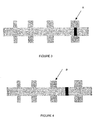
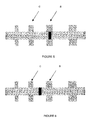
- the moving marker travels along the bar at a pre-determined rate and comes into registration first with fixed marker A; this is given by when the moving marker slides into and through the zone defined by the width of marker A as illustrated in Figure 3. As the moving marker continues to travel along the bar it exits the zone of marker A and travels towards marker B as shown in Figure 4. Thus, the moving marker approaches fixed marker B, enters the zone defined by marker B (see Figure 5), traverses through marker B and exits marker B (see Figure 6). Likewise, the moving marker moves towards and through the zones defined by markers C and D. Having passed through the four markers, the moving marker reaches the finish point at the end of the reaction bar. The instances in time when the moving marker is within the zones defined by the markers represent the instances in time at which the end user must press a key in order to make the on-screen character perform a corresponding action.
- the speed of movement of the moving marker can be increased or decreased, which respectively leads to harder or easier gameplay.
- the size, that is the width, of the fixed markers can be made to decrease in size from the start to the end of the bar. This allows a smaller margin of error for the end user with each consecutive press, as the range, and hence time period, at which the moving and fixed markers are aligned will be smaller.
- the distance between say markers C and D can be smaller than that between A and B.
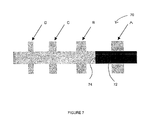
- reaction bar 70 instead of being embodied as a small rectangular marker with two side edges, is embodied as a solid area marker 72 that begins to "fill in” the reaction bar from its starting end and then continues to do so as it moves along the bar from one end to the other.
- the markers is shown as having already traversed marker A and is approaching marker B.
- the instances in time when the leading edge 74 of the moving marker is within the zones defined by the markers represent the points in time at which the end user needs to press a key in order to make the on-screen character perform a certain action.
- the present invention is implemented in an electronic game suitable for a mobile phone, and this implementation the electronic game replicates the popular sport of snowboarding.
- the end-user has control over the actions of an on-screen snowboarder character.
- the end-user makes use of the array of keys on keypad of the mobile phone.
- certain keys of the keypad are designated as a jump/land key, turn left, turn right keys, go faster and brake keys and two keys to activate the snowboarder to perform tricks.
- the slope of ground determines the speed of the snowboarder and the snowboarder slow down by turning. Since in snowboarding tricks are typically performed when the snowboarder is "catching air" (i.e. when the base of the board is lifted from the ground) the tricks keys may be the same keys as the go faster and brake keys since these are effectively dysfunctional when the snowboarder is in the air.
- the end user manoeuvres the on-screen snowboarder to snowboard down a slope, weaving from one side to the other using the left and right keys, and accelerating and braking using the go faster and brake keys.
- the end user may elect to make his snowboarder perform a jump off a ramp. So as the end user encounters an on-screen ramp, he directs the snowboarder towards the ramp. As the snowboarder hits the ramp the end-user presses the jump key on the keypad. The moment at which the user presses the jump key causes the snowboarder to spring into the air.
- the reaction bar is brought up on the mobile phone's display.
- Figure 8 illustrates the reaction bar of this embodiment. Straight away the fill-in marker begins travelling from one end of the bar to the other (see Figure 9).
- the rate at which the fill-in marker travels around the reaction bar is determined by the maximum height that the snowboarder will reach. This in turn is a consequence of how fast the snowboarder was travelling down the slope and the particular point on the ramp at which the end-user pressed the jump key.
- the end-user In order to make the snowboarder perform various tricks and moves while he is "catching air", the end-user must press one or both of the two trick keys (which conveniently may be designated as the keys given by the 4 and 6 keys on the keypad). However, in order to execute a trick successfully the end-user must press the trick keys when the fill-in marker attains alignment with one of the fixed markers, that is, when the moving marker is within the zone defined by the fixed marker, as is illustrated in Figure 10.
- the end user is free to choose at which markers his snowboarder is to perform tricks. This need not be the first marker, but can be subsequent markers. In fact, the end-user can elect to start the first trick by pressing a trick key at any fixed marker on the bar. However, as each marker is smaller than the previous marker and as the space between the markers is sequentially smaller, it becomes increasingly harder to perform more complex tricks and thus the end-user must be more accurate with his key depressions.
- the fill-in marker continues around the reaction bar and the end-user can either complete the current trick and straighten up ready for landing, or can start another trick at the next and subsequent fixed markers.
- the end-user may press the same key as used to begin the trick at the next marker on the bar (see Figure 11). Again, the end-user need not necessarily use this marker, but can press the key at any subsequent marker (e.g. at the marker in Figure 12), and in this way the end user may be able to control his snowboarder to perform a trick within a trick.
- a real-time version is preferred in which tricks run one after the other, although a slightly less real-time version is also contemplated in which the entire key sequence is used and only one action is performed. That is to say, in one instance, key presses at markers 1, 2 and 3 will produce 2 actions (press at 1 to begin, press at 2 to finish action 1 and begin action 2, press at 3 to end action 2), whereas in the other, presses at markers 1, 2 and 3 will produce only one action because the moves are stored and played out as a combination once the final move of the sequence has been completed (press at 1 to begin, press at 2 to summon second level sequence, press at 3 to finish sequence and elicit action).
- the system allows for a reduction in the number of action keys needed in order to produce various moves, and also provides a system whereby it is easy for the end user to remember trick combinations.
- reaction bar introduces an element of timing to the available tricks and moves of the snowboarding game. Only correct actuation of keys with reference to the timing element of the reaction bar will allow successful execution of the desired trick. Incorrect actuation of the key with respect to the timing element of the reaction bar results in incomplete (or no) execution of desired actions.
- both markers are made to move relative to one another (possibly at different rates).
- the "fixed” markers may be configured to "jiggle" from side to side. This would make pressing the correct key right on the marker more challenging as the bar would be filling in at a different rate to the movement of the marker.
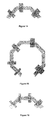
- Figures 14, 15 and 16 illustrates possible reaction bars for a standard jump, a big ramp jump and a half pipe jump.
- the length of the reaction bar is representative of the height and length of the jump and therefore is indicative of the amount of time the snowboarder will spend in the air.
- a jump from the big ramp will allow the snowboarder to be in the air for the longest period of time and thus the reaction bar associated with the big ramp (see Figure 15) is the longest.
- the shortest reaction bar as show in Figure 14 relates to a normal downhill jump that is perfumed by the snowboarder jumping up whilst snowboarding down a slope.
- Figure 16 illustrates a reaction bar associated with a half pipe jump, and this bar reflects the extended amount of time that the snowboarder is in the air and also has additional markers along its length which reflect the additional opportunities for carrying out tricks on a half pipe jump. However, if the snowboarder misses the first marker on half-pipe then he miss out on the trick completely.
- a reaction bar may also include a "warm-up section”. This is a section of bar before the first marker and allows the end user to gauge how fast the moving marker is moving along the bar and so provides the end user with preparation time to press the appropriate keys at the fixed markers.
- FIG 17 illustrates a further embodiment of the present invention.
- the reaction bar is utilised in the context of a diving game 170.
- the end user controls the diver 172 to walking towards the edge of the diving board 174.
- the end user then presses a jump key and the diver takes off from the edge of the board.
- the reaction bar 176 appears on the screen.
- the reaction bar consists of a moving marker 178 that slides down the bar and past a series of fixed markers 180.
- the moving marker moves past the fixed markers.
- the end user In order to control the diver to perform acrobatic moves, the end user must try and press the appropriate keys at the instances when the moving marker is aligned with the fixed markers. Points accrue for performing moves.
- the end user must control the diver so that he lands optimally in the water. The best dives, which have the highest scores, have the most elaborate moves whilst still ensuring an optimal water entry.
- Figures 18 to 21 illustrate another embodiment of the present invention in the context of a martial arts game.
- a martial art character 180 under the control of the end-user, and a reaction bar 181 that consists of a moving marker 182 moving along the bar past a series of fixed markers 183.
- the moving marker travels along the bar it comes into registration with each of the fixed markers.
- the end user must press a given key in order to initiate a given martial arts move.
- Figures 19 to 21 show the character carrying out a move as the moving marker sequentially aligns with the fixed markers and the corresponding key is pressed.
- Figure 19 shows the character in a neutral stance ready for action.
- Figure 20 shows the character executing a kick move at the instant when the moving marker aligns with the fixed marker and the user presses the appropriate key.
- Figure 21 shows the character returning to a neutral position at the point when the moving marker again aligns with a fixed marker and the end user presses the relevant key.
- the fixed markers may be split into two, three or move segments. Points could then be scored depending on which of the segments the moving marker is in at the instance when the end user presses the key. Most points could be awarded for successfully hitting the last segment of the fixed marker as mis-firing (firing too late) would result in the end user not pressing within the fixed marker zone and therefore not obtaining any points. This therefore reflects the inherent risk of holding back the key press until the last segment.
- a useful feature that may be incorporated into the present invention is that the holding down of a key for extended periods of time when a marker is moving around a reaction bar does not allow successful execution of moves. To be legitimate, the key presses have to be discrete key presses.
- legends associated with the respective markers indicative of pre-defined moves may be related the controller keys as dynamically changing soft keys that may change after a particular move is started.
- the advantage of system according to the present innovation is that it is flexible and can be tailored to allow for a large number of different actions, depending on how it is configured. It is straightforward and can make complex moves easy for the user to remember. It makes a correlation between the complexity of a manoeuvre in the real world and in the games world.
- the present invention may be embodied in other specific forms without departing from its essential attributes.
- the reactions bar may be termed a time bar, status bar, a trickometer, and may be embodied graphically in a bar, band, meter, gauge, arc, or window.
- markers may be tags, flags, graphical indicators of any form.
Landscapes
- Engineering & Computer Science (AREA)
- Multimedia (AREA)
- Physics & Mathematics (AREA)
- Optics & Photonics (AREA)
- User Interface Of Digital Computer (AREA)
Abstract
Description
- A key control interface (for example, the keys on a phone key/dial pad or the buttons on a game controller);
- An on-screen graphical "bar";
- A list of tricks or actions that can be performed by the player.
Claims (9)
- An electronic gaming system configured to provide for end-user control of at least one on-screen gaming character, the system comprising means for generating an on-screen graphical element comprising first and second markers which are arranged to move relative to one another during operation of the system, the arrangement being such that in operation when said first and second markers attain a pre-defined positional relationship relative to one another the on-screen gaming character is controllable to perform a pre-determined action.
- A system according to claim 1, wherein the on-screen gaming character is controllable to perform the pre-determined action by the end-user actuating a controller provided for playing the game.
- A system according to claim 1 or claim 2, wherein the graphical element includes a bar and the first marker comprises a plurality of fixed markers at spaced apart locations along the bar, and the second marker comprises a moving marker arranged to move along the bar relative to the plurality of fixed markers
- A system according to claim 3, wherein the said attained pre-defined positional relationship of the first and second markers relative to one another corresponds to when the moving marker respectively comes into registration with each of the plurality of fixed markers.
- A system according to claim 4, wherein user actuation of the controller at the instance when the moving marker comes into registration with a fixed marker causes the on-screen character to perform a pre-determined action.
- A system according to claim 4 or claim 5, wherein user actuation of the controller at a first instance when the moving marker comes into registration with a first fixed marker causes the on-screen character to perform a corresponding first pre-determined action, and user actuation of the controller at a second instance when the moving marker comes into registration with a second fixed marker causes the on-screen character to perform a corresponding second predetermined action that is complementary to the first action.
- A method for controlling an on-screen gaming character of a computer game, the method comprising providing an on-screen graphical element comprising first and second markers which are arranged to move relative to one another during operation of the game, controlling the on-screen gaming character to perform a pre-determined action when said first and second markers attain a pre-defined positional relationship relative to one another.
- A computer program product on a carrier comprising a software module configured to provide for end-user control of an on-screen gaming character, the module comprising an on-screen graphical element comprising first and second markers which are arranged to move relative to one another during operation of the system, the arrangement being such that in operation when said first and second markers attain a pre-defined positional relationship relative to one another the on-screen gaming character is controllable to perform a predetermined action.
- A gaming device including games content for a gaming system configured to provide for end-user control of an on-screen gaming character, said device having a memory for storing the games content and a processor for processing the games content, the processor being operable to run the system according to claim 1.
Applications Claiming Priority (2)
| Application Number | Priority Date | Filing Date | Title |
|---|---|---|---|
| GB0123998 | 2001-10-05 | ||
| GB0123998A GB2380418A (en) | 2001-10-05 | 2001-10-05 | Mobile phone game with timing bar graphic |
Publications (2)
| Publication Number | Publication Date |
|---|---|
| EP1304147A2 true EP1304147A2 (en) | 2003-04-23 |
| EP1304147A3 EP1304147A3 (en) | 2004-10-20 |
Family
ID=9923332
Family Applications (1)
| Application Number | Title | Priority Date | Filing Date |
|---|---|---|---|
| EP02021006A Withdrawn EP1304147A3 (en) | 2001-10-05 | 2002-09-20 | Mobile gaming |
Country Status (3)
| Country | Link |
|---|---|
| US (1) | US7275992B2 (en) |
| EP (1) | EP1304147A3 (en) |
| GB (1) | GB2380418A (en) |
Cited By (2)
| Publication number | Priority date | Publication date | Assignee | Title |
|---|---|---|---|---|
| US10347076B2 (en) | 2004-02-25 | 2019-07-09 | Interactive Games Llc | Network based control of remote system for enabling, disabling, and controlling gaming |
| US10726664B2 (en) | 2004-02-25 | 2020-07-28 | Interactive Games Llc | System and method for convenience gaming |
Families Citing this family (4)
| Publication number | Priority date | Publication date | Assignee | Title |
|---|---|---|---|---|
| US20050272503A1 (en) * | 2004-06-03 | 2005-12-08 | Johan Thoresson | Mobile electronic devices for video gaming and related gaming devices and methods |
| US20070238075A1 (en) * | 2006-04-05 | 2007-10-11 | James Mauch | System of associative learning |
| US8281046B2 (en) | 2008-07-03 | 2012-10-02 | Steelseries Aps | System and method for distributing user interface device configurations |
| US7925797B2 (en) | 2008-07-03 | 2011-04-12 | Steelseries Hq | System and method for distributing user interface device configurations |
Family Cites Families (17)
| Publication number | Priority date | Publication date | Assignee | Title |
|---|---|---|---|---|
| JP3153761B2 (en) * | 1996-03-06 | 2001-04-09 | 株式会社ナムコ | Game screen display method and game device |
| JPH10272258A (en) * | 1997-01-30 | 1998-10-13 | Sega Enterp Ltd | Image processing device |
| JP3119608B2 (en) | 1997-11-19 | 2000-12-25 | コナミ株式会社 | Competitive video game device, character movement control method in competitive video game, and recording medium storing character movement control program |
| JPH11300044A (en) * | 1998-04-16 | 1999-11-02 | Sony Computer Entertainment Inc | Recording medium and entertainment system |
| JP2000300851A (en) * | 1999-02-16 | 2000-10-31 | Konami Co Ltd | Game system, game device usable in the same and storage medium readable by computer |
| JP2000350855A (en) * | 1999-06-12 | 2000-12-19 | Konami Co Ltd | Block hitting game playing method, game machine and recording medium |
| JP3191241B2 (en) * | 1999-07-14 | 2001-07-23 | 株式会社スクウェア | Computer-readable recording medium, game control method, and game device |
| JP2001190840A (en) * | 2000-01-06 | 2001-07-17 | Konami Co Ltd | Game system and computer readable recording medium |
| JP3312018B2 (en) * | 2000-01-14 | 2002-08-05 | コナミ株式会社 | Game system and computer-readable storage medium |
| JP3545983B2 (en) * | 2000-01-19 | 2004-07-21 | コナミ株式会社 | Video game apparatus, technique setting method in video game, and computer-readable recording medium on which technique setting program is recorded |
| JP2001300132A (en) * | 2000-02-17 | 2001-10-30 | Sony Computer Entertainment Inc | Entertainment system, entertainment device, recording medium and program |
| JP3417918B2 (en) * | 2000-11-02 | 2003-06-16 | コナミ株式会社 | Computer-readable recording medium recording display control program, and display control apparatus and method |
| EP1207498A3 (en) * | 2000-11-15 | 2003-10-15 | Sega Corporation | Display object generation method in information processing equipment |
| US6908389B1 (en) * | 2001-03-07 | 2005-06-21 | Nokia Corporation | Predefined messages for wireless multiplayer gaming |
| JP3392120B2 (en) * | 2001-03-23 | 2003-03-31 | 任天堂株式会社 | GAME DEVICE AND ITS PROGRAM |
| JP2002292116A (en) * | 2001-03-29 | 2002-10-08 | Square Co Ltd | Game apparatus, game control method and recording medium and computer program therefor |
| US6923717B2 (en) * | 2001-05-15 | 2005-08-02 | Nintendo Of America Inc. | Adrenaline feature for sports video games |
-
2001
- 2001-10-05 GB GB0123998A patent/GB2380418A/en not_active Withdrawn
-
2002
- 2002-09-16 US US10/243,746 patent/US7275992B2/en not_active Expired - Fee Related
- 2002-09-20 EP EP02021006A patent/EP1304147A3/en not_active Withdrawn
Cited By (5)
| Publication number | Priority date | Publication date | Assignee | Title |
|---|---|---|---|---|
| US10347076B2 (en) | 2004-02-25 | 2019-07-09 | Interactive Games Llc | Network based control of remote system for enabling, disabling, and controlling gaming |
| US10360755B2 (en) | 2004-02-25 | 2019-07-23 | Interactive Games Llc | Time and location based gaming |
| US10726664B2 (en) | 2004-02-25 | 2020-07-28 | Interactive Games Llc | System and method for convenience gaming |
| US11024115B2 (en) | 2004-02-25 | 2021-06-01 | Interactive Games Llc | Network based control of remote system for enabling, disabling, and controlling gaming |
| US11514748B2 (en) | 2004-02-25 | 2022-11-29 | Interactive Games Llc | System and method for convenience gaming |
Also Published As
| Publication number | Publication date |
|---|---|
| US20030068602A1 (en) | 2003-04-10 |
| GB2380418A (en) | 2003-04-09 |
| GB0123998D0 (en) | 2001-11-28 |
| EP1304147A3 (en) | 2004-10-20 |
| US7275992B2 (en) | 2007-10-02 |
Similar Documents
| Publication | Publication Date | Title |
|---|---|---|
| CN107398071B (en) | Game target selection method and device | |
| EP1125607B1 (en) | Video game device, technique setting method in video game, and computer readable recording medium storing technique setting program | |
| JP3511518B1 (en) | GAME DEVICE, GAME PROGRAM, AND INFORMATION STORAGE MEDIUM | |
| JP6547036B1 (en) | Game program, method, and information processing apparatus | |
| JP6592481B2 (en) | GAME PROGRAM, INFORMATION PROCESSING SYSTEM, INFORMATION PROCESSING DEVICE, AND GAME PROCESSING METHOD | |
| JP2025142199A (en) | Program, terminal, game system, and game management device | |
| JP7549068B2 (en) | PROGRAM, TERMINAL, GAME SYSTEM AND GAME MANAGEMENT DEVICE | |
| US7275992B2 (en) | Mobile gaming | |
| WO2025180138A1 (en) | In-game information display method and apparatus, electronic device, and storage medium | |
| JP2019098117A (en) | Game device and game program | |
| KR101254588B1 (en) | Exercising Apparatus Linking Functional Game and Exercising Method Using the Same | |
| JP6547037B1 (en) | Game program, method, and information processing apparatus | |
| CN118059465A (en) | Virtual character control method and device, electronic equipment and storage medium | |
| JP4167710B2 (en) | Video game processing apparatus and video game processing program | |
| CN118142161A (en) | Information processing method, device, electronic device and storage medium in game | |
| JP3445587B2 (en) | Competitive rally game program | |
| JP2001149658A (en) | Game equipment | |
| EP1310282A2 (en) | Electronic gaming system | |
| US11617956B2 (en) | Non-transitory computer-readable storage medium having game program stored therein, game system, game processing method, and game apparatus | |
| JP6667979B1 (en) | Game system, progress control method, and program | |
| JP2019193831A (en) | Game program, method, and information processor | |
| JP2000237457A (en) | Video game equipment | |
| CN120459640A (en) | Interaction method, device, electronic device and storage medium in game | |
| CN116999828A (en) | Virtual character skill operation method, device and equipment in virtual scene | |
| CN119488711A (en) | Game control method, device, electronic device and storage medium |
Legal Events
| Date | Code | Title | Description |
|---|---|---|---|
| PUAI | Public reference made under article 153(3) epc to a published international application that has entered the european phase |
Free format text: ORIGINAL CODE: 0009012 |
|
| AK | Designated contracting states |
Designated state(s): AT BE BG CH CY CZ DE DK EE ES FI FR GB GR IE IT LI LU MC NL PT SE SK TR |
|
| AX | Request for extension of the european patent |
Extension state: AL LT LV MK RO SI |
|
| PUAL | Search report despatched |
Free format text: ORIGINAL CODE: 0009013 |
|
| AK | Designated contracting states |
Kind code of ref document: A3 Designated state(s): AT BE BG CH CY CZ DE DK EE ES FI FR GB GR IE IT LI LU MC NL PT SE SK TR |
|
| AX | Request for extension of the european patent |
Extension state: AL LT LV MK RO SI |
|
| 17P | Request for examination filed |
Effective date: 20050420 |
|
| 17Q | First examination report despatched |
Effective date: 20050601 |
|
| AKX | Designation fees paid |
Designated state(s): AT BE BG CH CY CZ DE DK EE ES FI FR GB GR IE IT LI LU MC NL PT SE SK TR |
|
| STAA | Information on the status of an ep patent application or granted ep patent |
Free format text: STATUS: THE APPLICATION IS DEEMED TO BE WITHDRAWN |
|
| 18D | Application deemed to be withdrawn |
Effective date: 20061011 |