EP1302868A2 - Document sorting method based on link relation - Google Patents
Document sorting method based on link relation Download PDFInfo
- Publication number
- EP1302868A2 EP1302868A2 EP02251263A EP02251263A EP1302868A2 EP 1302868 A2 EP1302868 A2 EP 1302868A2 EP 02251263 A EP02251263 A EP 02251263A EP 02251263 A EP02251263 A EP 02251263A EP 1302868 A2 EP1302868 A2 EP 1302868A2
- Authority
- EP
- European Patent Office
- Prior art keywords
- document
- popularity
- degree
- documents
- popularity degree
- Prior art date
- Legal status (The legal status is an assumption and is not a legal conclusion. Google has not performed a legal analysis and makes no representation as to the accuracy of the status listed.)
- Withdrawn
Links
Images








Classifications
-
- G—PHYSICS
- G06—COMPUTING OR CALCULATING; COUNTING
- G06F—ELECTRIC DIGITAL DATA PROCESSING
- G06F16/00—Information retrieval; Database structures therefor; File system structures therefor
- G06F16/90—Details of database functions independent of the retrieved data types
- G06F16/95—Retrieval from the web
- G06F16/951—Indexing; Web crawling techniques
-
- G—PHYSICS
- G06—COMPUTING OR CALCULATING; COUNTING
- G06F—ELECTRIC DIGITAL DATA PROCESSING
- G06F16/00—Information retrieval; Database structures therefor; File system structures therefor
- G06F16/90—Details of database functions independent of the retrieved data types
- G06F16/95—Retrieval from the web
- G06F16/953—Querying, e.g. by the use of web search engines
- G06F16/9535—Search customisation based on user profiles and personalisation
Definitions
- the present invention relates to the sorting of documents existing in a network and in particular, it relates to a document sorting method suitable for a case where there are a lot of documents in a variety of formats, such as a character format, an image format, a voice format and the like and where such documents are frequently updated.
- the present invention further relates to sorting of documents based on their "popularity", e.g. usefulness or connectedness as indicated by their degree of linkage to other documents.
- the WWW World Wide Web
- the Web stores a lot of documents (also called “Web pages”), the number of pages amounting to two billion or more in the year 2000, according to a certain survey.
- the Web not only stores a lot of documents, but also the documents are updated very frequently.
- a retriever is provided with both information indicating the location in the network of a document obtained by such retrieval, such as a URI (Uniform Resource Identifier), a URL (Uniform Resource Locator) and the like, and a sentence showing the contents of a Web page.
- URI Uniform Resource Identifier
- URL Uniform Resource Locator
- the present invention addresses a problem that the popularity degree based on the number of linked documents of a document always increases and never decreases.
- An embodiment of the present invention can obtain information indicating how the "popularity degree" of a document, as determined for example by the number of links to the document from other documents located on the Web, changes as time passes.
- An embodiment of the present invention can sort documents in relation to the transition (change with time) of document contents and the like.
- a popularity degree calculation method for calculating the popularity degree of a document indicating the level of popularity of a document in a network includes: extracting documents updated or collected (e.g., added to the network or first identified) during a first time period and calculating the popularity degree of each of the extracted documents.
- the popularity degree of each of the documents collected or updated during the first time period By calculating the popularity degree of each of the documents collected or updated during the first time period, old documents (e.g., documents placed on the network a long time ago and not since updated) are eliminated from the targets of popularity calculation. Thus, the problem that the popularity degree of a document tends to increase and never decrease can also be solved.
- the first time period it is preferable for the first time period to be fairly long, for example, approximately 150 days.
- the popularity degree can be calculated based on both a link relation (e.g. number of links to or from the document) extracted from each document and document location information indicating the location of a document in a network. In this case, since there is no need to read the contents of a document, a popularity degree can be rapidly calculated.
- a link relation e.g. number of links to or from the document
- the method described above can also calculate a popularity transition degree indicating both the direction (more or less popular over time) and degree of the transition of the popularity degree of a document, based on a popularity degree calculated during a second time period. In this way, information indicating how the popularity degree of a document changes in a time series can be obtained.
- this time period is used to check the variation of popularity over time, it is preferable for this time period to be not so long, for example, several weeks.
- the method described above can also calculate a regression equation against time of the popularity degree calculated in the second time period and then calculate a popularity transition degree, based on the regression equation.
- the popularity transition degree rate of popularity rise or fall
- the tendency of the transition against time of a popularity degree can be determined based on an intercept of the regression equation.
- the popularity degree order (e.g. popularity rank) of the extracted document can also be used instead of the popularity degree.
- a document relationship judgment method for judging the relationship between documents in a network comprises: extracting a link relation from a first document and judging whether a second document linked to the first document is a non-text document related to the contents (content) of the first, based on the link relation.
- a link relation from a first document and judging whether a second document linked to the first document is a non-text document related to the contents (content) of the first, based on the link relation.
- the method described above can further comprise: extracting a character string in the vicinity of a part which links to the second document in the first document, from the first document and judging whether the second document is a non-text document related to the contents of the first document, based on the character string. For example, if a character string shows that the second document has a non-text format, such as MPEG, animation, streaming and the like, it can be estimated that the second document will be a non-text document related to the contents of the first document.
- a character string shows that the second document has a non-text format, such as MPEG, animation, streaming and the like
- the method described above can further comprise judging that the second document is not a non-text document related to the contents of the first document. Since an extension indicates the document format of the second document, it can be judged whether the second document is a non-text document, based on the extension.
- the method described above can further comprise judging whether the second document is a non-text document related to the contents of the first document, based on whether the second document is used a prescribed number of times or more in the first document. For example, a bullet and the like are images, and such element images for preparing a document are repeatedly used many times and are not related to the contents of the document. Therefore, if the second document is frequently used in the first document, it can be estimated that the second document is not related to the contents of the first document.
- the method described above can further comprise registering the second document as a non-text document related to the contents of the first document.
- the document includes a lot of images. If all the images are registered as non-text documents related to the contents of the first document, there is a possibility that the situation may become problematic. However, since in this case, the file names of these image files tend to be similar to one another, registering only a document, the file name which is ranked at the top in a dictionary order, of a plurality of documents, as a non-text document related to the contents of the first document, can solve such a problem.
- the method described above can further comprise judging whether the second document is a non-text document related to the contents of the first document, based on both the document location information indicating the location of the first document in a network and the document location information about the second document. In addition, the method can further comprise judging whether the second document is a non-text document related to the contents of the first document, based on both the document location information about the first document and that of the fourth document.
- the first document sometimes includes the second document as a non-text document unrelated to the contents, such as a banner advertisement and the like.
- a non-text document unrelated to the contents of the first document such as an advertisement banner, can be eliminated based on the document location information about each document.
- a service type judgment method for judging the type of a service provided by a document in a network comprises: extracting a tag designating user input from a document and judging the type of service provided by the document, based on the tag designating user input. In this way, each of the documents can be sorted according to the service type provided by the document.
- a tag designating user input for example, a form tag is used if a language describing a document is HTML.
- the method described above can further comprise determining that the document does not provide any services if the document includes no tag designating user input. This is because if a document includes no user input column, there will be a low possibility that the document may provide a service.
- the method can further comprise judging the type of a service provided by the document, based on button indication included in the document.
- the method can judge the type of a service provided by a document, based on an input column in addition to the button indication. This is because the format of the input column of a button and the like is often determined based on a service provided by a document.
- the method can further comprise judging that a service type provided by a document is "sales agent".
- a document providing a service of selling goods often includes such a button so as to receive the order of goods.
- the method can also judge the service type provided by the document is "retrieval".
- a device provided with means for implementing the procedure performed by the method according to each aspect of the present invention can also obtain the same functions/effects as those of the method described earlier.
- the same functions/effects as those of the method described earlier can also be obtained by a computer executing a program for enabling the computer to exercise the same control as the procedure performed by each of the methods described above of the present invention.
- the same functions/effects as those of the method described earlier, as described above, of a computer browsing and executing the program can also be obtained from a computer-readable storage medium that stores the program.
- FIG. 1 shows the basic configuration of the present invention.
- a document sorting device calculates a popularity degree indicating the degree of the popularity of a document, based on a link relation and further calculates a popularity transition degree indicating how the popularity degree varies with time. Then, each document is sorted according to both the calculated popularity degree and popularity transition degree.
- a document sorting device 10 comprises a popularity degree calculation unit 11 and a popularity degree transition calculation unit 12.
- the popularity calculation unit 11 calculates a popularity degree indicating the degree of popularity of each document, based on the link relation between documents in a network that are collected during the first time period. In this case, the popularity degree calculation unit 11 calculates the popularity degree of each of the documents collected or updated during the first time period. In this way, the problem that the popularity degree of a document will always increase and never decrease can be solved.
- the popularity degree transition calculation unit 12 calculates a popularity transition degree indicating the direction and degree of a transition of popularity degree during the second time period, based on the popularity degree calculated by the popularity degree calculation unit 11.
- the popularity degree transition calculation unit 12 can use a popularity degree order obtained by ranking each document according to the popularity degree instead of the popularity degree. In this way, how the popularity of a document in a network varies as time elapses can be analyzed.
- a retriever is provided with both information indicating the location of a retrieved document in a network and an explanatory sentence indicating the contents of the document. Therefore, the retriever cannot judge what non-text contents the document includes or what service the document provides without accessing the document.
- non-text contents in the document are judged simply based on the extension of a file, non-text contents unrelated to the contents of the document, such as a banner, a bullet (point) and the like are also sorted as contents related to the document, which is another problem.
- the document sorting device 10 further comprises a related non-text contents judgment unit 13 and a service type judgment unit 14.
- the related non-text contents judgment unit 13 selects non-text contents related to the contents of the document from all the non-text contents included in each document and sorts the selected non-text contents related to the contents of the document in relation to the document.
- the service type judgment unit 14 judges whether a document provides a service, based on a tag included in each document, for example, a tag designating user input used when providing an input column, such as a form tag in the case of HTML and the like. If the document provides a service, the unit 14 further judges the type of the service and sorts the judged service type in relation to the document. In this way, for example, in a retrieval service, as a result, both non-text contents related to the document and information about the service provided by the document can be provided as information about the document in addition to both the information indicating the location of a document in a network and a sentence indicating the contents of the document.
- Fig. 2 shows the configuration of a document retrieval apparatus according to the preferred embodiment of the present invention.
- a document retrieval apparatus 100 collects documents from a network and sorts the collected documents.
- a LAN Local Area Network
- WAN Wide Area Network
- the document retrieval apparatus 100 searches for documents directly or according to the instructions of the user of a terminal set, which is not shown in Fig. 2, connected to the apparatus 100 through a network, which is not shown in Fig. 2, and provides the retrieval result to the user.
- the terminal set of the user can also comprise a browser 108, and the user can also browse information transmitted from the document retrieval apparatus 100 using the browser 108.
- the document retrieval apparatus 100 comprises a collection unit 101, a popularity degree calculation unit 102, a popularity degree transition calculation unit 103, a related non-text contents judgment unit 104, a service type judgment unit 105, a page sorting unit 106, a retrieval service unit 107, a document table 111, a link relation table 112, a popularity degree table 113, a popularity degree transition table 114, a non-text contents table 115 and a service type table 116.
- Each of the collection unit 101, popularity degree calculation unit 102, popularity degree transition calculation unit 103, related non-text contents judgment unit 104, service type judgment unit 105, page sorting unit 106 and retrieval service unit 107 corresponds to each software component described by a program and is stored in the specific program code intercept of the memory in the computer for implementing the document retrieval apparatus 100.
- a language for describing documents in a network that is, Web pages
- a language for embedding a link relation into a document such as HTML (HyperText Markup Language), XML (eXtensible Markup Language), SGML (Standard Generalized Markup Language) and the like
- HTML HyperText Markup Language
- XML eXtensible Markup Language
- SGML Standard Generalized Markup Language
- the present invention handles images, animation, voice and the like as documents in addition to text documents described with the languages described above.
- HTML is sometimes used as a language for describing a text document, the present invention is not limited to HTML.
- the collection unit 101 collects documents made public in a network and attaches a document ID (Identification information) for identifying a document to each of the collected documents.
- the collection unit 101 also analyzes the link relation between the collected documents. Furthermore, the collection unit 101 stores the document location information indicating the location of the collected document in the network and information about the link relation between the collected documents in the document table 111 and link relation table 112, respectively.
- a URI Uniform Resource Identifier
- a URL Uniform Resource Locator
- a URL sometimes is used as the document location information.
- the present invention is not limited to the URL.
- the popularity degree calculation unit 102 regularly (or irregularly) calculates a popularity degree indicating the degree of the popularity of a document, based on the link relation between documents collected by the collection unit 102 and stores the calculation result in the popularity degree table 113.
- the popularity degree calculation unit 102 selects documents collected or updated during the first time period, from all the documents collected by the collection unit 101 as target documents whose popularity degree are calculated. In this case, since a time period that is too short will not obtain a meaningful popularity degree, the first time period must be fairly long. For example, for the first time period, "150 days before a popularity degree is calculated" is used.
- the popularity degree transition calculation unit 103 calculates a popularity transition degree indicating both the direction and degree of the popularity degree transition of each document, based on the popularity degree calculated by the popularity degree calculation unit 102 during the second time period and stores the calculation result in the popularity degree transition table 114.
- the second time period since a time period that is too long cannot catch a short-term transition of a popularity degree, the second time period must be short in some measure, for example, several weeks. For example, for the second time period, "within 14 days before a popularity transition degree is calculated" is used.
- the popularity degree transition calculation unit 103 obtains a popularity degree calculated during the second time period for each document from the popularity degree table 113 and calculates a linear regression equation against the time of the obtained popularity degree to obtain the regression coefficient of the linear regression equation as the popular transition degree.
- the popularity degree transition calculation unit 103 can also use a popularity degree order obtained by ranking each document according to the popularity degree instead of a popularity degree. In this way, how the popularity of a document in a network varies as time elapses can be analyzed.
- the related non-text contents judgment unit 104 judges the type of each document, based on the extension of a file name included in the document location information about each document or character strings located before and after a part in the document in which a link is embedded.
- the related non-text contents judgment unit 104 judges whether non-text contents included in each document are related to the contents of the document, based on the link relation between documents. Then, the related non-text contents judgment unit 104 stores the non-text contents that are judged to be related to the contents of each document, in the non-text contents table 115 in relation to the document. In this way, non-text contents unrelated to the contents of each document, from all the non-text contents included in the document, can be eliminated, and non-text contents related to the contents of the document can be sorted in relation to the document.
- the service type judgment unit 105 judges the type of a service provided by a document, based on information for describing an input column included in each text document and stores the judged service type in the service type table 116 in relation to the document. In this way, a service type provided by each document can be sorted in relation to the document.
- the page sorting unit 106 sorts each document according to a related field and the like. Since there are a variety of sorting technologies as to a document sorting method, the detailed description is omitted in the description of the preferred embodiments.
- the retrieval service unit 107 retrieves a document from a network and provides a user with the retrieval result.
- the retrieval service unit 107 obtains information about the document obtained by retrieval from both the popularity degree table 113 and popularity degree transition table 114, and provides the user with both the popularity degree and popularity transition degree in addition to both the information indicating the contents of the retrieved document and document location information. In this way, the user can judge how the popularity of the retrieved document is situated, and specifically, whether the document is becoming more popular or less popular, by information provided on the output screen of the retrieval result.
- the retrieval service unit 107 can also obtain information about the document obtained by the retrieval from both the non-text contents table 115 and service type table 116, and can also provide the user with both information about non-text contents related to the retrieved document and information about a service type provided by the retrieved document. In this way, the user can judge what non-text contents the document obtained by the retrieval includes or what service the document obtained by the retrieval provides by information provided on the output screen of the retrieval result without accessing (browsing) the document.
- the retrieval service unit 107 can also obtain one or more pieces of information about the documents from both the popularity degree table 113 and popularity degree transition table 114, and can also provide the user with one or more pieces of obtained information in time series. In this way, the user can analyze the transition of the popularity degree of a document.
- each table is described below with reference to Figs. 3 through 8.
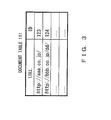
- the data structure of the document table 111 is described with reference to Fig. 3.
- the document table 111 stores both the document location information about each document and a corresponding document ID. In this way, the document location information is converted into a document ID, and in subsequent processes, information about the link relation and the like of each document can be managed using the document ID.
- link relation table 112 stores the link relation information of each document.
- link relation information includes the collection day/time (or date) of a document, update day/time (or date), the document ID of a link source document and the document ID of a link destination document as items.
- the document ID of a link source document and the document ID of a link destination document are called a "link source ID" and a "link destination ID", respectively. If it is difficult to obtain the update day/time of each document, the collection day/time can also be used instead of the update day/time.
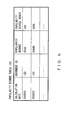
- the popularity degree table 113 stores the popularity information of each document.
- the popularity information includes as items the calculation day/time (or date) of a popularity degree, the document ID of a document, a calculated popularity degree and a popularity degree order obtained by ranking each document according to the popularity degree.
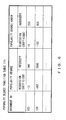
- the popularity degree transition table 114 stores the popularity degree transition information of each document.
- the popularity degree transition information includes as items the document ID of a document, the regression coefficient (gradient)/intercept of a regression equation obtained by calculating the linear regression equation of a popularity degree, and regression coefficient (gradient)/intercept of a regression equation obtained by calculating the linear regression equation of a popularity degree order.
- the non-text contents table 115 stores the document ID of a document with a link destination, the document ID of non-text contents document linked to by the document and is related to the contents of the document (hereinafter called a "related non-text contents ID") and the file type of the non-text contents document.
- the service type table 116 stores both the document ID of each document and a service type provided by the document.
- the collection unit 101 consecutively collects documents from a network, analyzes the link relation between the collected documents and stores the collection result and the analysis result in the document table 111 and link relation table 112, respectively.
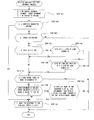
- the popularity degree calculation unit 102 regularly, for example, every day, calculates the popularity degree of each document collected or updated during a specific time period before the calculation date. "Every day” is just an example and the present invention is not limited to "every day”. The procedure of a process for calculating a popularity degree is described below with reference to Fig. 9.
- the popularity degree calculation unit 102 starts at a specific time every day. If a popularity degree calculation date for calculating a popularity degree is d1, the popularity degree calculation unit 102 designates d2 that is the N-th day, for example, the 150th day, before d1 as a calculation starting date (step S11).
- the "150th day” is just an example. "Any days” is acceptable as N if "the days” is long enough to obtain a meaningful popularity degree.
- the popularity degree calculation unit 102 extracts link relation information, the collection or update date of which falls between the calculation starting date d2 and calculation date d1 (step S12). By restricting the collection or update date of a document, the popularity degree of which is calculated, to within a specific time period, a document that is not updated after being prepared can be eliminated from popularity degree calculation targets.
- the popularity degree calculation unit 102 deletes all the plurality of pieces of link relation information with the same link relation source ID other than that of the latest collection or update date (step S13). In this way, repeated calculation of the popularity degree of the same document can be prevented.
- the popularity degree calculation unit 102 calculates the popularity degree of each document, based on the extracted link relation information (step S14). More specifically, the popularity degree calculation unit 102 calculates the popularity degree of each document, based on both link relation and a similarity degree, indicating the similarity between a character string indicating the document location information about a link source document and a character string indicating the document location information about a link destination document, without referring to the contents of the document.
- the calculation procedure of a popularity degree is described below.
- a weight is given to each link relation and the weighted link relation is handled instead of handling all link relations in an equal manner. More specifically, a weight is given to a link relation as the reciprocal number of the similarity degree between the document location information about a link source document and the document location information about a link destination document.
- the popularity degree calculation procedure is described in more detail below.
- the popularity degree W q of document q can be defined as the solution of the following simultaneous linear equations (2) on the condition that C q is a constant (which is the lower limit of the popularity degree and a different value can also be given depending on a document) of each document p ⁇ DOC.
- the popularity degree calculation unit 102 calculates the popularity degree of each document by solving the simultaneous linear equations (2). Since there are a lot of existing algorithms that can be used as the solution method of such simultaneous linear equations, the description is omitted.
- the calculation method of the similarity degree sim (p, q) in the document location information between documents p and q in equation (1) is described later. It can be judged from both equations (1) and (2) that the ideas described above are implemented. Specifically, it can be judged from equation (1) that, if the similarity degree in the document location information between documents p and q is low, the weight of link relation lw increases.
- the popularity W q of a document that is linked to by a document with a high link relation weight lw is high.
- the popularity degree of a document that is linked to by a document having document location information with a low similarity degree is high.
- a document linked to by the larger number of documents has the higher popularity degree.
- the popularity degree of a document that is linked to by a document with a high popularity degree W is high.
- the URL of a document is composed of three kinds of information: a server address, a path and a file name.
- a server address www.flab.fujitsu.co.jp/hypertext/news/1999/p roduct1.html
- a path hypertext/news/1999
- product1.html a file name
- a server address is hierarchically divided by ".” and an address indicates a higher hierarchical level in the rightward direction. For example, if a server address is www.flab.fujitsu.co.jp, a level of a machine (www), a level of a laboratory (flab), a level of Fujitsu (fujitsu), a level of a company (co.) and a level of Japan (jp) are represented from left to right.
- the weight of a link relation according to the preferred embodiment is calculated based on the following ideas.
- sim-merge(p, q) (similarity degree of server address) + (similarity degree of path) +(similarity degree of file name)
- the similarity degree of a server address is defined to be (1+n).
- the similarity degree of a server address of the documents is defined to be (1+n).
- the merged similarity degree between the documents is 4.
- server addresses of www.fujitsu.co.jp and www.fujitsu.com are compared, no level in both server addresses are matched (no matched level), the merged similarity degree between the documents is 1.
- each factor of a path separated by "/" is compared from the top.
- the number of matched levels is defined as the similarity degree of a path. For example, if /doc/patent/index.html and /doc/patent/1999/2/file.html are compared, two levels are matched. In this case, the similarity degree of a path between the documents is 2.
- the similarity degree of a file name when two file names are matched, the similarity degree of the files is defined as 1.
- sim-merge (p, q)
- the popularity degree of a document linked to by a document with a similar URL becomes low compared with the popularity degree of a document with URL that is not similar. Therefore, by introducing the concept of sim(p, q) or diff(p, q) into lw(p, q), a problem that the popularity degree becomes high only if the servers (sites) or users include a lot of documents can be solved.
- the popularity degree calculation unit 102 After calculating the popularity degree, the popularity degree calculation unit 102 obtains a popularity degree order by sorting each document in descending order of the popularity degree (step S15). A popularity degree order sometimes increases and sometimes decreases as time elapses. Therefore, the problem of the conventional calculation method that a popularity degree simply increases as time elapses can also be solved by paying attention to the transition of a popularity degree order in a time series instead of the transition of a popularity degree. Lastly, the popularity degree calculation unit 102 stores both the calculated popularity degree and popularity degree order in the popularity degree table 113 together with both the document ID of each document and the popularity degree calculation date (step S16), and terminates the process.
- each document when providing a user with the retrieval result of documents, each document can also be sorted or ranked based on the popularity degree calculated as described above.
- the popularity degree of the document when providing a user with information about a specific document, the popularity degree of the document can be provided to the user, which is described later.
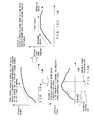
- Fig. 10A shows the transition in a time series of a popularity degree calculated by the conventional calculation method.
- horizontal and vertical axes represent time and a popularity degree, respectively. Since an author or an administrator seldom deletes or updates a document once published on the Web, when the popularity degree of the document is calculated simply based on the number of other documents linking to the document, the number of times it is linked to by other documents, as in the conventional case, the popularity degree never decreases and always increases, as shown in Fig. 10A.
- Fig. 10B shows the transition in a time series of a popularity degree calculated by the calculation method according to this preferred embodiment.
- horizontal and vertical axes represent time and a popularity degree, respectively.
- the popularity degree for documents collected or updated during a specific time period between a calculation starting date and a popularity degree calculation date are calculated, documents that are not updated for a long time after they were initially prepared are eliminated from calculation targets, unlike the conventional case. Therefore, for example, the popularity degree of a document linked to by other documents not updated for a long time is calculated as being low compared with the conventional case. In this way, the conventional problem that a popularity degree always increases can be solved.
- the popularity degree of the top page is calculated as being high at first. However, if the pages on the site are not updated subsequently, the popularity degree of the top page decreases and the high popularity degree is only temporary.
- Fig. 10C shows the transition in a time series of a popularity degree order based on a popularity degree calculated by the calculation method according to this preferred embodiment.
- horizontal and vertical axes represent time and a popularity degree order, respectively.
- a popularity degree order is information indicating the relative popularity degree of a document among all the documents whose popularity degrees have been calculated. Therefore, even if the popularity degree is calculated by the conventional calculation method, it is avoided that the popularity degree order continues to increase. Therefore, by judging the popularity degree of a document, based on the transition in a time series of a population degree order also, the conventional problem that a popularity degree always increases can be solved.
- the popularity degree order of a document out of all documents whose popularity degrees have been calculated changes in a typical manner, it is found to become almost constant after sufficient passage of time, as shown in Fig. 10C.
- the popularity degree of the document increases, the popularity degree order also rises.
- the popularity degree of the document decreases, the popularity degree order also falls.
- the popularity of a document enters a period of increase at first, then a period of stability continues and finally a period of decrease begins. In this case, as shown in Fig. 10, the popularity degree order continues to rise during the period of increase, becomes almost constant during the period of stability and continues to fall during the period of decrease.
- the shape of the curve of the popularity degree order becomes an upwards-convex shape.
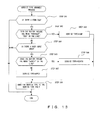
- the popularity degree transition calculation unit 103 obtains a popularity degree calculated during a specific time period from the popularity degree table 113 and calculates a popularity transition degree, which is the transition degree in a time series of a popularity degree.
- the popularity degree transition calculation unit 103 determines a date d3 which is the M-th day, for example, the 14th day, before popularity degree calculation date d1 as a calculation starting date (step S21).
- the "14th day” is just an example. If M is too long, the short-term transition of a popularity degree cannot be detected. Therefore, it is preferable for M to be several weeks.
- the popularity degree transition calculation unit 103 obtains the popularity degree or popularity degree order of each document calculated during a time period between calculation starting date d3 and popularity degree calculation date d1, from the popularity degree table 113 (step S22).
- the popularity degree transition calculation unit 103 calculates the linear regression equation against time of a popularity degree or popularity degree order for each document and obtains both the regression coefficient and intercept b of the linear regression equation (step S33). If a linear regression equation is calculated based on a popularity degree, the regression coefficient a corresponds to a popularity transition degree. If the linear recurrence is calculated based on a popularity degree order, a value a/b obtained by dividing regression coefficient a by intercept b corresponds to the popularity transition degree.
- linear regression equation r a(d1 - d3)b
- a (M ⁇ Iw - I ⁇ W)/(M ⁇ I2 - I 2 )
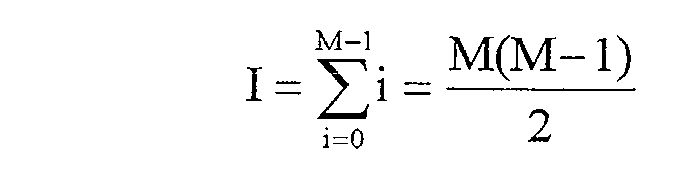
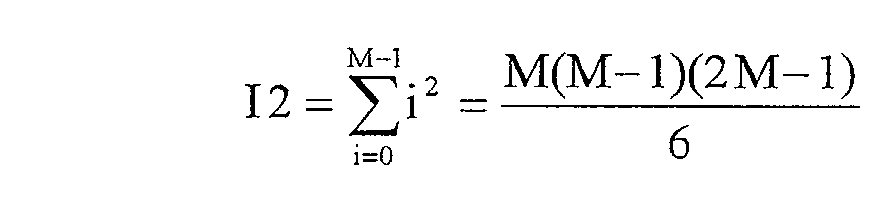
- each of Iw, W, I and I2 can be calculated as follows.
- the popularity degree transition calculation unit 103 stores both the calculated regression coefficient a and intercept b of each document together with the document ID, in the popularity degree transition table 114 (step S24) and terminates the process.
- the popularity transition degree of the document is provided to the user together with both the document location information about the document and information indicating both the title and contents.
- the popularity transition degree can also be provided using an icon illustrating both the direction and degree of popularity change, which is described later.
- Non-text contents judgment unit 104 judges whether non-text contents included in a document are related to the contents of the document, based on a link relation embedded in the document.
- the related non-text contents judgment unit 104 refers to the link relation table112 and extracts link relation information including a link destination ID. If the extracted link relation information includes a plurality of pieces of link relation information and each piece has the same link source ID, only link relation information with the latest collection or update date is adopted and the others are deleted. This is because the same process is prevented from being applied to the same document.
- a document aggregate composed of link source documents S specified by a link source ID included in the extracted link relation information is designated as a link source document aggregate.
- a document specified by a link destination ID included in the extracted link relation information, that is, a link destination document, is termed a "judgment target document C".
- Procedures in steps S31 through S40 are applied to each judgment target document C included in each link source document S.
- the related non-text contents judgment unit 104 extracts a link character string A existing in the vicinity of a part in the link source document S, in which the link to the judgment target document C is embedded from each link source document S (step S31).
- the related non-text contents judgment unit 104 can extract 100 bytes each before and after an anchor tag ( ⁇ a>) as a link character string A from a link source document S. Then, the related non-text contents judgment unit 104 judges whether the link character string A is a specific character string (step S32).
- a specific character string is, for example, a character string describing a format of the judgment target document C is a non-text format, such as "MPEG", “animation”, “streaming”, “video”, “audio”, “mp3”, the format name of animation, etc., and the like.
- a table for defining these specific character strings is provided in advance in the document retrieval apparatus 100.
- the related non-text contents judgment unit 104 judges that the judgment target document C is non-text contents related to the contents of the link source document S. Then, the flow proceeds to step S40.
- the related non-text contents judgment unit 104 stores the document ID of the judgment target document C in the non-text contents table 115 as a related non-text contents ID together with both the format type of the judgment target document C and the document ID of a link source document S, and terminates the process of the judgment target document C.
- the related non-text contents judgment unit 104 further judges whether the extension of the file name of judgment target document C included in the document location information about the judgment target document C is a specific extension (step S33).
- each extension is obvious to a person having ordinary skill in the art, the description of each extension is omitted. This example does not restrict the present invention.
- the related non-text contents judgment unit 104 can also judge whether judgment target document C is non-text contents, based on such an extension.
- a table for defining these specific extensions, which is not shown in Fig. 2, is provided in advance in the document retrieval apparatus 100. If it is judged that the extension of a file name included in the document location information about judgment target document C is not a specific extension (No in step S33), the related non-text contents judgment unit 104 judges that judgment target document C is not non-text contents and terminates the process of the document.
- the related non-text contents judgment unit 104 further judges whether the judgment target document C is used as a link. For example, in the case of HTML, this judgment can be made based on a tag.
- the fact that judgment target document C is used as a link means, for example, that another document can be browsed by referring a link relation embedded in the document (for example, clicking or touching), such as a banner advertisement image.
- judgment target document C in the example, an image
- judgment target document C is used as a link in a document described in HTML
- the fact is often described as follows . This example does not restrict the present invention.
- the related non-text contents judgment unit 104 refers to the document table 111 using the document IDs of both judgment target document C and link source document S, and obtains two pieces of document location information about both documents. Then, the related non-text contents judgment unit 104 judges whether a site storing judgment target document C and a site storing link source document S are the same, based on both the document location information about judgment target document C and link source document S (step S35).
- the related non-text contents judgment unit 104 judges whether a site storing judgment target document C and a site storing link source document S are the same, based on the server addresses or domains of both the URL of judgment target document C and the URL of link source document S.
- step S35 If it is judged that a site storing judgment target document C and a site storing link source document S are the same (Yes in step S35), it is estimated that judgment target document C is related to the contents of link source document S. Therefore, the flow proceeds to step S37, which is described later. This is because if judgment target document C is related to the contents of link source document S, judgment target document C is often stored in the same site as link source document S.
- the related non-text contents judgment unit 104 further judges whether a site storing the link destination document of the judgment target document C and a site storing the link source document S are the same, based on both the document location information about the link source document S and the document location information about the link destination document of the judgment target document C (step S36).
- the document location information about the link destination document of the judgment target document C is often described in the vicinity of a tag for embedding a link in the judgment target document C as described in the example given above.
- step S36 If it is judged that a site storing the link destination document of judgment target document C and a site storing link source document S are the same (Yes in step S36), the flow proceeds to step S37. This is because since it is estimated that the link destination document of judgment target document C is related to the contents of link source document S, it can be estimated that judgment target document C may also be related to the contents of link source document S.
- the related non-text contents judgment unit 104 estimates that judgment target document C is a document unrelated to the contents of link source document S, such as a banner advertisement, and terminates the process of the judgment target document C.
- step S37 the related non-text contents judgment unit 104 judges whether judgment target document C is used a prescribed number of times, for example, three times or more. "Three times" is just an example, and the prescribed number is not limited to any specific number. If it is judged that judgment target document C is used three times or more (Yes in step S37), the related non-text contents judgment unit 104 judges that judgment target document C is not related to the contents of the link source document S and terminates the process of the judgment target document C. Otherwise, the flow proceeds to step S38.
- judgment target document C is of a format, or a material for document preparation such as a bullet-point list
- judgment target document C may be used multiple number of times in one document. Since it cannot be considered that such a document is related to the contents of link source document S, the document is not handled as related non-text content.
- step S37 If the judgment in step S37 is "No", the related non-text contents judgment unit 104 further obtains the file name of the link destination document of link source document S from the document table 111, based on a link destination ID included in the link relation information of link source document S and judges whether the link source document S has another link destination document with a file name similar to that of judgment target document C (step S38).
- step S38 If it is judged that the link source document S does not have another link destination document with a file name similar to that of judgment target document C (No in step S38), the flow proceeds to step S40 and the related non-text contents judgment unit 104 registers the judgment target document C in the non-text contents table 115 in the way described above.
- the related non-text contents judgment unit 104 judges whether the file name of judgment target document C is ranked at the top in a dictionary order, of all the file names of the link destination documents each with a file name similar to that of the judgment target document C (step S39).
- a dictionary order is, for example, an alphabetical order or a descending order of a number.
- step S40 the related non-text contents judgment unit 104 registers the judgment target document C in the non-text contents table 115 and terminates the process of the document. Otherwise (No in step S39), the unit 104 terminates the process of the judgment target document C without executing step S40.
- link source document S displays a list of images like an album and if all the images are handled as documents related to the contents of the link source document S, there are too many related documents and this fact makes it problematic to provide a user with a retrieval result.
- the respective remaining parts excluding a numeric part are often the same, for example, pict01.jpg, pict02.jpg, pict03.jpg and the like. Therefore, if there are link destination documents each with a similar file name, such problems can be avoided by registering only a document with the highest-ranked file name in a dictionary order as related non-text content.
- the related non-text contents judgment unit 104 After terminating the process of a specific judgment target document C in this way, the related non-text contents judgment unit 104 refers to the link relation information of link source document S and judges whether the link source document S has another non-judged link destination document. If the link source document S includes a non-judged link destination document, the related non-text contents judgment unit 104 designates the non-judged link destination document as a new judgment target document C and performs the processes in steps S31 and after, on the document.
- the related non-text contents judgment unit 104 extracts another unprocessed link source document S from the link source document aggregate and performs the same process, on the other link destination document C of the link source document S.
- the process is performed for all link destination documents of all the link source documents S, the related non-text contents judgment process is terminated.
- information indicating the type of non-text contents linked to the document can also be provided to the user based on the judgment result described above in addition to both the document location information about the document and information indicating both the title and contents.
- a user can know what related non-text contents the document has without actually browsing the document.
- the related non-text contents can also be displayed on the screen of the user or reproduced, which is described later.
- the service type judgment unit 105 judges the type of a service provided by a document, based on a form tag used in the document. In the following description, three types of services, retrieval, shopping and application (registration) are judged.
- a retrieval service is a service for searching for something using a keyword inputted by a user (or reader, etc) .
- a shopping service is a service for selling a user a commodity.
- An application (registration) service is a service for receiving a name, an address and the like from a user and receiving the application or registration for a membership or a prize.
- the service type judgment unit 105 extracts a document including text (not shown in Fig. 13) from collected documents. Whether a document includes text can also be judged, for example, based on the extension of the file name of each document. The following process is performed for each extracted document.
- the service type judgment unit 105 judges whether the document includes a form tag (step S41). If the document does not include a form tag (No in step S41), the unit 105 terminates the process of the document since it can be judged that the document provides no service.
- the service type judgment unit 105 further judges whether a button included in the document displays the word(s) "purchase”, “buy” or the like (step S42).
- buttons are often described as follows.
- step S42 If the button includes the word(s) "purchase”, “buy” or the like (Yes in step S42), the service type judgment unit 105 judges that the type of service provided by the document is "shopping” (step S43) and the flow proceeds to step S48.
- the service type judgment unit 105 registers the service type of the document as “shopping” by storing the judged service type "shopping” in the service type table 116 together with the document ID of the document (step S48).
- the service type judgment unit 105 further judges whether the document includes a user input area a (step S44). If the document includes no user input area (N in step S44), it is judged that the document provides no service, and the process of the document is terminated. If the document includes a user input area (Yes in step S44), the service type judgment unit 105 further judges whether a button included in the document displays the word(s) "search” or the like (step S45).
- step S45 If the button displays the word(s) "search” or the like (Yes in step S45), the service type judgment unit 105 judges that the type of a service provided by the document is "search” (step S46) and the flow proceeds to step S48.
- step S48 the service type judgment unit 105 registers the service type provided by the document in the way described above.
- step S45 If the button does not display the word(s) "search” or the like (No in step S45), the service type judgment unit 105 judges that the type of a service provided by the document is "application” (step S47), and the flow proceeds to step S48.
- the service type judgment unit 105 can judge the service type provided by the document, based on a form tag.
- the process for judging a service type may include a variety of variations. For example, between steps S42 and S43, the following processes can also be performed.
- the service type judgment unit 105 judges whether the document includes an ISBN (International Standard Book Number) input column. If the document includes an ISBN input column, the unit 105 judges that a service type provided by the document is "book store" and the flow proceeds to step S48. If the document includes no ISBN input column, the flow proceeds to step S43. In this way, a service type provided by a document can be judged in greater detail.
- ISBN International Standard Book Number
- information indicating the type of a service provided by the document can also be provided to the user based on the judgment result described above in addition to both the document location information about the document and information indicating both the title and contents. In this way, a user can know about the type of a service provided by the document without actually browsing the document.
- the service type judged in the process described above can also be used to sort each page.
- the page sorting unit 106 judges the contents of a document, based on a word /phrase in each document and sorts each document, based on the judgment result.
- a word /phrase for example, "Java (registered trademark)", "theme park” and the like are used.
- the present invention is not limited to these examples. Since the sorting method of each document by this page sorting unit is the same as that of the prior art, the detailed description is omitted.
- the page sorting unit 106 for example, can also use the service type provided by each document that is judged by the service type judgment unit 105.
- the retrieval service unit 107 searches for a document, according to instructions from the user of the document retrieval apparatus 100, and provides the user with the retrieval result together with the process results of the popularity degree calculation unit 102 and popularity degree transition calculation unit 103, etc., accordingly. More specifically, the retrieval service unit 107 displays a retrieval result in the terminal set of a user together with the process result.
- the process of the retrieval service unit 107 is described below with reference to a screen displayed in the terminal set of a user, accordingly.
- the retrieval service unit 107 provides a user with information about a document obtained by retrieval in a variety of formats . First, a case where a user inputs a keyword and the like and the user is provided with retrieval result obtained using the keyword and the like, is described.
- the retrieval service unit 107 seeks a document using the keyword and the like inputted by a user and obtains the following information about the required document from each table by using the document ID of the searched-for document.
- the retrieval service unit 107 generates a popularity degree transition icon illustrating both the direction and rate of change of popularity, based on both the obtained regression coefficient a and intercept b.
- the popularity degree transition icon displays an arrow and indicates the direction and speed of a popularity degree transition by the direction and angle of the arrow, respectively.
- the retrieval service unit 107 generates, for example, the following six kinds as popularity degree transition icons. The present invention is not limited to these examples.
- Rapidly increasing icon This icon shows that a popularity degree is rapidly increasing. This icon shows a steeply inclined arrow that rises towards the right.
- This icon indicates that a popularity degree is increasing. This icon shows an arrow rising towards the right and the angle is closer to horizontal compared with that of the rapidly increasing icon.
- Decreasing icon This icon shows that a popularity degree is decreasing. This icon shows an arrow falling towards the right and the angle is closer to horizontal compared with that of the rapidly decreasing icon.
- Rapidly decreasing icon This icon shows that a popularity degree is rapidly decreasing. This icon shows a steeply declined arrow falling towards the right.
- Stable icon this icon shows a horizontal arrow pointing toward the right. This icon can also be divided into two types with different colors: one to indicate high-level stability and the other to indicate low-level stability, as described later.
- Unmarked icon This is an icon without an arrow. This icon shows another state.
- Example 1 Case where a popularity degree transition is calculated based on a popularity degree
- the retrieval service unit 107 judges which icon should be attached to each searched document, based on both regression coefficient a and intercept b as follows.
- Rapidly increasing icon In the case where a of a document is 50 or more.
- Increasing icon In the case where a of a document is 30 or more and less than 50.
- Decreasing icon In the case where a of a document is -30 or less and more than -50.
- Rapidly decreasing icon In the case where a of a document is -50 or less.
- High-level stable icon In the case where b of a document is 8000 or more.
- Low-level stable icon In the case where b of a document is 3000 or less.
- Example 2 Case where a popularity degree transition is calculated based on a popularity degree order (a natural number between 1 and a total number of documents including both 1 and the total number).
- the retrieval service unit 107 judges which icon should be attached to each document as follows.
- Rapidly increasing icon In the case where a/b of a document is -0.1 or less (a popularity degree increases 10% or more).
- a/b of a document is -0.05 or less and more than -0.1 (a popularity degree increases 5% or more and less than 10%).
- Decreasing icon In the case where a/b of a document is 0.05 or more and less than 0.1 (a popularity degree decreases 5% or more and less than 10%).
- Rapidly decreasing icon In the case where a/b of a document is 0.1 or more (a popularity degree decreases 10% or more).
- High-level stable icon In the case where b of a document is 1000 or less.
- Low-level stable icon In the case where b of a document is 100000 or more.
- the retrieval service unit 107 generates a related media icon illustrating the type of related non-text contents for a document whose related non-text contents is registered and embeds a link to the related non-text contents in the related media icon. In this way, if a user selects the related media icon, the user can browse or reproduce the related non-text contents without browsing the link source document (searched document) of the related non-text contents.
- the related media icon indicates, for example, the type of related non-text contents. More specifically, if related non-text contents have a jpg format, the related media icon indicates a character string of "jpg". Alternatively, the related media icon can also illustrate a camera for indicating an image. If a document stores a plurality of related non-text contents, this process is applied to each related non-text content.
- the retrieval service unit 107 generates a service contents icon illustrating the service type of a document whose service type is registered.
- the service contents icon indicates, for example, a service type. More specifically, if a service type is "shop", the service contents icon describes a character string of "shop". Alternatively, the service contents icon can illustrate "shopping".
- the retrieval service unit 107 sorts each document obtained by retrieval according to the popularity degree order and sets the title of each document, information indicating the contents of the document, the document location information about the document, the popularity degree transition icon, the related media icon and the service contents icon on a screen in sorted order. In this way, the display screen of the retrieval result, as shown in Fig. 14, can be generated.
- each document is sorted in descending order according to the latest popularity, that is, in descending order of a static popularity degree.
- a user can determine how the popularity degree of each document has changed to cause this order, by a popularity degree transition icon.
- a user can determine to what non-text document each document is linked (includes), by a related media icon. By further selecting (for example, by clicking or touching) the related media icon, the related non-text contents can be reproduced or browsed. Therefore, a user can determine to what non-text contents each document is linked (includes), without browsing the document.
- a user can determine what service each document provides, by a service contents icon.
- the retrieval service unit 107 obtains the popularity degrees or a plurality of popularity degree orders of the document whose popularity degree transition icon is selected, that are calculated during a specific period, for example, several months from the popularity degree table 113, and generates a graph of a popularity degree or popularity degree order versus popularity degree calculation date, and displays the graph on a screen.
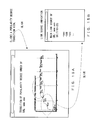
- Fig. 15A shows an example of a popularity degree transition screen on which a graph shows popularity degree order transition against a popularity degree calculation date.
- horizontal and vertical axes represent a date and popularity degree order, respectively.
- figures are described in two lines, one figure at the top and the other at the bottom represent a popularity degree order and a popularity degree, respectively.
- This graph shows how the popularity degree of the relevant document changes during these several months and corresponds to the visual version of the popularity degree transition table.
- the popularity degree order of a document specified by a URL www.aaa rapidly increases in March and becomes stable in and after May.
- the retrieval service unit 107 obtains link relation information in which a date during an appropriate time period in the vicinity of the selected part is used as a collection date or an update date and the document ID of the document is used as a link destination ID from the link relation table 112. Then, the retrieval service unit 107 generates a list of link source documents linking to the document during the specific time period, based on the obtained link relation information and displays the list on a screen.
- Fig. 15B shows an example of a screen displaying a list of documents linking to a document specified by a URL, www.aaa, that is, a list of the link source documents of a document specified a URL: www.aaa during a specific time period. From Fig. 15B, a user can determine by which document the document is linked to during the time period. For example, if a user is the site master of the document specified by a URL, www.aaa, the user can use this information for future site maintenance.
- a user can also register in advance both the document location information about a specific document and the threshold value of a popularity degree in the retrieval service unit 107 and if the popularity degree of the document is beyond or below the threshold value, the retrieval service unit 107 can also notify the user of the fact. In this case, since a user can automatically notified of the popularity degree transition of a document, the user can use this information for future site maintenance and the like.
- the document retrieval apparatus of the present invention can also be used for a variety of things other than general retrieval.
- the document retrieval apparatus 100 can also be used as an industry analysis tool.
- a user can utilize this popularity degree transition for marketing. For that purpose, a user first must prepare a list of the document location information about the top pages (documents) of the corporation in a desired industry (for example, a collection of URLs).
- the document retrieval apparatus 100 obtains the latest popularity degree of each document included in the list of document location information from the popularity degree table 113 and creates a popularity degree list displaying a list of the documents in descending order of obtained popularity degrees.
- This popularity degree list shows the current industry ranking.
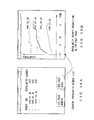
- Fig. 16A shows an example of the popularity degree list.
- buttons indicating "the past month” and "the past year” are set.
- the document retrieval apparatus further obtains the popularity degree of each document included in the list of a plurality of pieces of document location information calculated during the past month or year from the popularity degree table 111, generates a graph showing the transition of a popularity degree against a popularity degree calculation date and displays the graph on a screen.
- the popularity degree order can also be used instead of the popularity degree.
- Fig. 16B shows an example of the graph showing the transition of the popularity degree during the past year for each document in a popularity degree list.
- Fig. 16B shows the transition of the popularity degrees in the past year for each document in the list shown in Fig. 16A and is displayed on the monitor screen of a user by pushing a button indicating "the past year" in Fig. 16A.
- horizontal and vertical axes represent a population degree calculation date and a popularity degree, respectively.
- the popularity degree of a document with a URL, bbb.co.jp has rapidly increased during the past year.
- the document retrieval apparatus 100 can also be used for a local information retrieval system.
- the page sorting unit 106 generates a hierarchical category indicating a district, such as prefectures, cities, towns and villages and sorts each document according to the category.
- a user can access a desired document, the popularity degree, the popularity degree transition, related media and services provided by the page by following the hierarchical category.
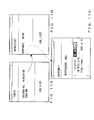
- Fig. 17 shows an example of the screen of a local information retrieval system.
- Fig. 17A shows an example of a screen displaying a list of documents related to the category "Tokyo".
- the selected area "Tokyo”, each ward of Tokyo and information about each document sorted into “Tokyo” are displayed at the top, middle and bottom, respectively. Since the bottom of the screen is the same as the display screen of a retrieval result shown in Fig. 14, the bottom is omitted in Fig. 17.
- the screen shifts to a screen displaying a list of documents related to the category "Minato-ku (ward)".
- Fig. 17B shows an example of a screen displaying a list of documents related to the category "Minato-ku (ward), Tokyo”.
- the selected area "Minato-ku (ward)”, the town name in Minato-ku (ward) and information about each document sorted into “Minato-ku (ward), Tokyo” are displayed at the top, middle and bottom, respectively.
- the bottom of the screen is the same as the display screen of a retrieval result shown in Fig. 14. If a user further selects "Roppongi" at the top of the screen shown in Fig. 17B, the current screen shifts to a screen displaying a list of documents related to the category "Roppongi, Minato-ku (ward), Tokyo”.
- Fig. 17C shows an example of a screen displaying a list of documents related to the category "Roppongi, Minato-ku (ward), Tokyo”.
- the selectedarea "Roppongi”, another category and information about documents sorted into ""Roppongi, Minato-ku (ward), Tokyo” are displayed at the top, middle and bottom, respectively.
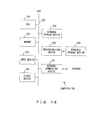
- Both the document retrieval apparatus 100, terminal set of a user and the like that are described in the preferred embodiments can also be configured using a computer, as shown in Fig. 18.
- the computer 200 shown in Fig. 18 comprises a CPU 201, a memory 202, an input device 203, an output device 204, an external storage device 205, a medium driving device 206 and a network connecting device 207 and the devices are connected to one another by a bus 208.
- a ROM Read-Only Memory
- a RAM Random-Access Memory
- the memory 202 stores both programs and data that are used for the process.
- the CPU 201 performs necessary processes by using the memory 202 and executing the program.
- the function of each of the collection unit 101, popularity degree calculation unit 102, popularity degree transition calculation unit 103, related non-text contents judgment unit 104, service type judgment unit 105, page sorting unit 106 and retrieval service unit 107 that constitute the document retrieval apparatus 100 shown in Fig. 1 are implemented by a program describing the process of each unit.
- Each program is stored in[the specific respective program code intercept of]the memory 202. The process performed by each unit is described in each flowchart.
- the input device 203 for example, a keyboard, a pointing device, a touch panel and the like are used.
- the input device 203 is used for a user to input instructions and information.
- the output device 204 for example, a display device, a printer and the like are used.
- the output device 204 is used to output inquiries, process results and the like to the user of the computer 200.
- the external storage device 205 for example, a magnetic disk device, an optical disk device, a magneto-optical disk device and the like are used.
- This external storage device 205 can also store both the programs and data described above and can also use the programs and data by loading them into the memory 202, if requested.
- the medium driving device 206 drives a portable storage medium 209 and accesses the recorded contents.
- a portable storage medium 209 an arbitrary computer-readable storage medium, such as a memory card, a memory stick, a flexible disk, a CD-ROM (Compact-Disk Read-Only Memory), an optical disk, a magneto-optical disk, a DVD (Digital Versatile Disk) and the like are used.
- the programs and data described above can also be stored in this portable storage medium 209 and can also be used by loading the programs and data, if requested.
- the network connecting device 207 communicates with an external device through an arbitrary network (line), such as a LAN, WAN and the like and transmits/receives data accompanying communications. If requested, the network connecting device 207 can also receive the programs and data described above from an external device and can also use the programs and data by loading them into the memory 202.
- an arbitrary network such as a LAN, WAN and the like.
- Fig. 19 shows both computer-readable storage media and transmission signals for providing the computer shown in Fig. 18 with the programs and data.
- the computer 200 can also execute the functions corresponding to those of the document retrieval apparatus by providing the computer 200 with both the programs and data stored in each table as follows.
- the programs and data are stored in advance in the computer-readable storage medium 209. Then, as shown in Fig. 19, it is acceptable to configure the system so that the computer 200 can read both the programs and data from the storage medium 209 using the medium driving device 206, the programs and data can be temporarily stored in the memory 202 of the computer 200 or the external storage device 205 and the CPU 201 of the computer 200 can read and execute these stored programs.
- the programs can also be downloaded into the computer from a database (DB) 210 possessed by a program (data) provider through a communications line (network) 211.
- a computer with the DB 210 for transmitting the programs converts program data representing the programs into program data signals and obtains transmission signals by modulating the converted program data signals using a modem and outputs the obtained transmission signals to the communications line 211.
- a computer for receiving the programs obtains the program data signals by demodulating the received transmission signals using a modem and obtains the program data by converting the obtained program data signals.
- the communications line 211 (transmission medium) for connecting a computer on the transmitting side and a computer on the receiving side is a digital line
- the program data signals themselves can also be transmitted without modulation.
- the computer of a telephone office service provider
- the present invention calculates a popularity degree for indicating the level of popularity (usage) of a document collected or updated during a first time period and further calculates a popularity transition degree indicating the change over time of the popularity, based on the popularity degree calculated during a second time period.
- a popularity degree for indicating the level of popularity (usage) of a document collected or updated during a first time period and further calculates a popularity transition degree indicating the change over time of the popularity, based on the popularity degree calculated during a second time period.
- a variety of documents such as documents providing non-text contents, documents providing services and the like, can be sorted based on both a link relation between documents and a tag embedded in each document.
Landscapes
- Engineering & Computer Science (AREA)
- Databases & Information Systems (AREA)
- Theoretical Computer Science (AREA)
- Data Mining & Analysis (AREA)
- Physics & Mathematics (AREA)
- General Engineering & Computer Science (AREA)
- General Physics & Mathematics (AREA)
- Information Retrieval, Db Structures And Fs Structures Therefor (AREA)
- Information Transfer Between Computers (AREA)
- Management, Administration, Business Operations System, And Electronic Commerce (AREA)
Abstract
Description



- In the case of contents related to music
mp3, wma, wav - In the case of contents related to animated images
ram, rm, rv, rmm, wmv, avi, asx, qt, mov, mpeg,mpg, fla, swf - In the case of contents related to images
jpg, jpeg
- The
retrieval service unit 107 obtains both the latest popularity degree and the popularity degree order from the popularity degree table 113. - The
retrieval service unit 107 obtains both regression coefficient (gradient) a and intercept b, based on the latest popularity degree and popularity degree order, respectively, from the popularity degree transition table 114. - The
retrieval service unit 107 obtains the document ID of related non-text contents from the non-text contents table 115. - The
retrieval service unit 107 obtains a service type from the service type table 116.
Claims (37)
- A popularity degree calculation method for calculating a popularity degree indicating a level of popularity of a document in a network, comprising:extracting a plurality of documents updated or collected during a first time period (S12); andcalculating the popularity degree for each extracted document (S14).
- The popularity degree calculation method according to claim 1, wherein the popularity degree is calculated based on both a link relation of each of the extracted documents and document location information indicating a location in the network of each of the documents.
- The popularity degree calculation method according to claim 2, wherein the popularity degree is calculated based on features of a character string describing the document location information.
- The popularity degree calculation method according to claim 1, 2, or 3, further comprising:calculating a popularity transition degree indicating both a direction and a degree of change in popularity over time of each of the extracted documents (S21 to S23).
- The popularity degree calculation method according to claim 4, wherein the popularity transition degree is calculated based on a popularity degree calculated during a second time period (S22).
- The popularity degree calculation method according to claim 5, further comprising:wherein the popularity transition degree is calculated according to the regression equation (S23).calculating a regression equation against a time of the popularity degree calculated during the second time period,
- The popularity degree calculation method according to claim 6, wherein the popularity transition degree is calculated based on a regression coefficient of the regression equation (S23).
- The popularity degree calculation method according to claim 7, further comprising:determining the popularity transition degree, based on an intercept of the regression equation.
- The popularity degree calculation method according to any of claims 4 to 8, further comprising:placing the extracted documents in order, based on the popularity degree calculated during the second time period; andcalculating a regression equation against time of the order during the second time period, wherein the popularity transition degree is calculated based on the regression equation.
- A document relation judgment method for judging a relation between documents in a network, comprising:extracting a link relation from a first document (S31); andjudging whether a second document linked to by the first document is a non-text document related to contents of the first document, based on the link relation (S32 to S37).
- The document relation judgment method according to claim 10, further comprising:wherein said judging is made based on the character string (S32).extracting a character string located in the vicinity of a part which the first document is linking to the second document, from the first document (S31),
- The document relation judgment method according to claim 11, wherein if the character string includes a specific character string, it is determined that the second document is the non-text document related to the contents of the first document (S32:Yes).
- The document relation judgment method according to claim 10, wherein said judging is made based on an extension of a file name of the second document (S33).
- The document relation judgment method according to claim 13, wherein if the extension is not a specific extension, it is determined that the second document is not the non-text document related to the contents of the first document (S33:No).
- The document relation judgment method according to claim 10, wherein said judging is made based on whether the second document is used a prescribed number of times or more in the first document (S37).
- The document relation judgment method according to claim 15, wherein if the second document is used the prescribed number of times or more in the first document, it is determined that the second document is not the non-text document related to the contents of the first document (S37:Yes).
- The document relation judgment method according to claim 15, wherein if the second document is used less than the prescribed number of times in the first document, it is determined that the second document is the non-text document related to the contents of the first document (S37:No).
- The document relation judgment method according to any of claims 10 to 17, further comprising:not registering the second document in a database as the non-text document related to the contents of the first document, if the first document includes a third document with a file name similar to a file name of the second document and if the file name of the second document is ranked lower than the file name of the third document in a dictionary order (S38 and S39).
- The document relation judgment method according to any of claims 10 to 18, further comprising:judging, if there is a fourth document linked to by the second document, whether the second document is the non-text document related to the contents of the first document, based on both document location information about the first document indicating location in the network of the document and document location information about the second document (S34 and S35).
- The document relation judgment method according to claim 19, wherein it is judged whether the second document is the non-text document related to the contents of the first document, based on both the document location information about the first document and document location information about the fourth document (S36).
- The document relation judgment method according to any of claims 10 to 20, wherein if a fifth document is linked to by the second document and if a server address or a domain in each of document location information about the second document indicating a location in the network of the document and document location information about the fifth document is different from a server address or a domain in document location information about the first document, it is determined that the second document is not the non-text document related to the contents of the first document (S34 to S36).
- A service type judgment method for judging a type of a service provided by a document in a network, comprising:extracting a tag designating user input from the document (S41); andjudging the type of the service provided by the document, based on the tag designating user input (S42 to S47).
- The service type judgment method according to claim 22, further comprising:determining that the document provides no service, if the document includes no tag designating user input (S41:No).
- The service type judgment method according to claim 22 or 23, wherein the service type provided by the document is judged based on the description of a button included in the document (S42 and S45).
- The service type judgment method according to claim 22, 23, or 24, wherein the service type provided by the document is judged based on a user input area included in the document (S44).
- A program which, when run on a computer, implements the popularity degree calculation method of any of claims 1 to 9.
- A program which, when run on a computer, implements the document relation judgement method of any of claims 10 to 21.
- A program which, when run on a computer, implements the service type judgement method of any of claims 22 to 25.
- A computer-readable storage medium that stores the program of claims 26, 27, or 28.
- A document retrieval method for searching for a document in a network, comprising:collecting documents from the network;extracting documents updated or collected during a first time period (S12);calculating a popularity degree indicating a level of popularity of each of the extracted documents (S14);retrieving documents meeting retrieval conditions from the collected documents, based on the retrieval conditions;ranking the retrieved documents, based on the popularity degree; andoutputting information about the retrieved documents, based on the ranking result.
- The document retrieval method according to claim 30, further comprising:calculating a popularity transition degree for indicating both a direction and a degree of the change in popularity over time of each retrieval document (S21 to S23); andadding information about the popularity transition degree to information about the retrieved documents.
- The document retrieval method according to claim 30, 31, or 32, further comprising:for each retrieved document, judging whether another document linked to by the document is a non-text document related to the contents of the document, based on the link relation (S32 to S37); andadding the information about the related non-text document to the information about the retrieved documents.
- The document retrieval method according to claim 32, further comprising:embedding the information about the related non-text document into the related non-text document.
- The document retrieval method according to any of claims 30 to 33, further comprising:extracting a tag designating user input from the document (S41);judging a type of a service provided by the document, based on the tag designating user input (S42 to S47); andadding the information about the service type to the information about the retrieved documents.
- The document retrieval method according to any of claims 30 to 34, further comprising:receiving from a user registration of both document location information indicating the location of a specific document in the network and a value; andnotifying the user of the fact that a popularity degree has reached the value, if the popularity degree for the document specified by the document location information has reached the value.
- A document retrieval apparatus for searching for a document in a network, comprising:a collection unit (101) collecting documents from the network;a popularity degree calculation unit (102) extracting documents updated or collected during a first time period as calculation targets of a popularity degree indicating a level of popularity and calculating the popularity degree of each of the extracted documents ; anda retrieval service unit (107) retrieving a document meeting retrieval conditions from the collected documents, based on the retrieval conditions, ranking the retrieved documents, based on the popularity degree and outputting information about the retrieved documents, based on the ranking result.
- An area information document retrieval apparatus for searching for documents about an area in a network, comprising:a collection unit (101) collecting documents from the network and extracting a link relation from each of the collected documents;a popularity degree calculation unit (102) extracting documents updated or collected during a first time period as calculation targets of a popularity degree indicating a level of popularity and calculating the popularity degree of each of the extracted documents;a popularity degree transition calculation (103) unit calculating a popularity transition degree for indicating both a direction and a degree of change in popularity over time, based on the popularity degree calculated during a second time period;a related non-text contents judgment unit (104) judging whether a document linked to by each collected document is a non-text document related to the contents of each collected document, based on a link relation between the collected documents;a service type judgment unit (105) extracting a tag for designating user input from each of the collected documents and judging a type of a service provided by the document, based on the tag for designating user input;a sorting unit (106) hierarchically sorting the collected documents for each area; anda retrieval service unit (107) searching for the documents sorted for each of the area names, based on an area name designated by a user, ranking the retrieved documents, based on the popularity degree and outputting information about the popularity transition degree of the retrieved documents, information about the related non-text document and information about a service type provided by the retrieved documents, based on the ranking result, in addition to information about the content of the retrieved documents.
Applications Claiming Priority (2)
| Application Number | Priority Date | Filing Date | Title |
|---|---|---|---|
| JP2001314993 | 2001-10-12 | ||
| JP2001314993A JP4283466B2 (en) | 2001-10-12 | 2001-10-12 | Document arrangement method based on link relationship |
Publications (2)
| Publication Number | Publication Date |
|---|---|
| EP1302868A2 true EP1302868A2 (en) | 2003-04-16 |
| EP1302868A3 EP1302868A3 (en) | 2005-12-28 |
Family
ID=19133224
Family Applications (1)
| Application Number | Title | Priority Date | Filing Date |
|---|---|---|---|
| EP02251263A Withdrawn EP1302868A3 (en) | 2001-10-12 | 2002-02-25 | Document sorting method based on link relation |
Country Status (3)
| Country | Link |
|---|---|
| US (1) | US20030074350A1 (en) |
| EP (1) | EP1302868A3 (en) |
| JP (1) | JP4283466B2 (en) |
Families Citing this family (21)
| Publication number | Priority date | Publication date | Assignee | Title |
|---|---|---|---|---|
| US7130844B2 (en) * | 2002-10-31 | 2006-10-31 | International Business Machines Corporation | System and method for examining, calculating the age of an document collection as a measure of time since creation, visualizing, identifying selectively reference those document collections representing current activity |
| US7346839B2 (en) * | 2003-09-30 | 2008-03-18 | Google Inc. | Information retrieval based on historical data |
| JP2005108123A (en) * | 2003-10-01 | 2005-04-21 | Fujitsu Ltd | Connection information display method, connection information display program, and connection information display device |
| US8020085B2 (en) * | 2003-11-13 | 2011-09-13 | International Business Machines Corporation | Assigning priority levels to hyperlinks embedded in the created Web documents |
| US7237184B2 (en) * | 2003-12-18 | 2007-06-26 | Microsoft Corporation | Data property promotion system and method |
| US7290205B2 (en) * | 2004-06-23 | 2007-10-30 | Sas Institute Inc. | System and method for management of document cross-reference links |
| US7913163B1 (en) * | 2004-09-22 | 2011-03-22 | Google Inc. | Determining semantically distinct regions of a document |
| US7552398B2 (en) * | 2005-05-24 | 2009-06-23 | Palo Alto Research Center Incorporated | Systems and methods for semantically zooming information |
| US7562085B2 (en) * | 2005-05-24 | 2009-07-14 | Palo Alto Research Center Incorporated | Systems and methods for displaying linked information in a sorted context |
| US7716226B2 (en) | 2005-09-27 | 2010-05-11 | Patentratings, Llc | Method and system for probabilistically quantifying and visualizing relevance between two or more citationally or contextually related data objects |
| JP2007156637A (en) * | 2005-12-01 | 2007-06-21 | Mitsubishi Electric Corp | Information search device, program, and information search system |
| JP4542993B2 (en) * | 2006-01-13 | 2010-09-15 | 株式会社東芝 | Structured document extraction apparatus, structured document extraction method, and structured document extraction program |
| JP4800187B2 (en) * | 2006-01-17 | 2011-10-26 | ヤフー株式会社 | Evaluation information management system, evaluation information management program, and evaluation information management method |
| JP2008165490A (en) * | 2006-12-28 | 2008-07-17 | Nec Corp | Information selection apparatus and method, program, and recording medium |
| US8103649B2 (en) * | 2007-02-05 | 2012-01-24 | Ntt Docomo, Inc. | Search system and search method |
| US8566338B2 (en) * | 2007-09-21 | 2013-10-22 | International Business Machines Corporation | Automatically making changes in a document in a content management system based on a change by a user to other content in the document |
| US20110106836A1 (en) * | 2009-10-30 | 2011-05-05 | International Business Machines Corporation | Semantic Link Discovery |
| JP2011141617A (en) * | 2010-01-05 | 2011-07-21 | Fujifilm Corp | Web page browsing system, control method thereof, and relay server |
| JP6029843B2 (en) * | 2012-04-02 | 2016-11-24 | アルパイン株式会社 | Map display device |
| US9646032B2 (en) * | 2013-10-24 | 2017-05-09 | Microsoft Technology Licensing, Llc | Temporal user engagement features |
| US9836531B1 (en) * | 2014-12-31 | 2017-12-05 | Bco Holdings, Llc | Systems and methods for determining crowd sentiment based on unstructured data |
Family Cites Families (33)
| Publication number | Priority date | Publication date | Assignee | Title |
|---|---|---|---|---|
| US5991782A (en) * | 1994-02-18 | 1999-11-23 | Fujitsu Limited | Automated extraction and doubly linked reference marks for partialized document contents and version control |
| JPH08249317A (en) * | 1995-03-08 | 1996-09-27 | Toshiba Corp | Document providing method, document providing apparatus, and document requesting apparatus |
| JPH09160821A (en) * | 1995-12-01 | 1997-06-20 | Matsushita Electric Ind Co Ltd | Hypertext document creation device |
| US5920859A (en) * | 1997-02-05 | 1999-07-06 | Idd Enterprises, L.P. | Hypertext document retrieval system and method |
| US6144973A (en) * | 1996-09-06 | 2000-11-07 | Kabushiki Kaisha Toshiba | Document requesting system and method of receiving related document in advance |
| JP3121548B2 (en) * | 1996-10-15 | 2001-01-09 | インターナショナル・ビジネス・マシーンズ・コーポレ−ション | Machine translation method and apparatus |
| US6285999B1 (en) * | 1997-01-10 | 2001-09-04 | The Board Of Trustees Of The Leland Stanford Junior University | Method for node ranking in a linked database |
| US5898836A (en) * | 1997-01-14 | 1999-04-27 | Netmind Services, Inc. | Change-detection tool indicating degree and location of change of internet documents by comparison of cyclic-redundancy-check(CRC) signatures |
| US6996533B2 (en) * | 1997-03-21 | 2006-02-07 | Fujitsu Limited | Information processing system |
| US6115718A (en) * | 1998-04-01 | 2000-09-05 | Xerox Corporation | Method and apparatus for predicting document access in a collection of linked documents featuring link proprabilities and spreading activation |
| US6088707A (en) * | 1997-10-06 | 2000-07-11 | International Business Machines Corporation | Computer system and method of displaying update status of linked hypertext documents |
| US6085226A (en) * | 1998-01-15 | 2000-07-04 | Microsoft Corporation | Method and apparatus for utility-directed prefetching of web pages into local cache using continual computation and user models |
| US6195622B1 (en) * | 1998-01-15 | 2001-02-27 | Microsoft Corporation | Methods and apparatus for building attribute transition probability models for use in pre-fetching resources |
| US6421675B1 (en) * | 1998-03-16 | 2002-07-16 | S. L. I. Systems, Inc. | Search engine |
| US6038574A (en) * | 1998-03-18 | 2000-03-14 | Xerox Corporation | Method and apparatus for clustering a collection of linked documents using co-citation analysis |
| US6446095B1 (en) * | 1998-06-09 | 2002-09-03 | Matsushita Electric Industrial Co., Ltd. | Document processor for processing a document in accordance with a detected degree of importance corresponding to a data link within the document |
| JP2000029902A (en) * | 1998-07-15 | 2000-01-28 | Nec Corp | Structure document classifying device and recording medium where program actualizing same structured document classifying device by computer is recorded, and structured document retrieval system and recording medium where program actualizing same structured document retrieval system by computer is recorded |
| JP3849318B2 (en) * | 1998-09-10 | 2006-11-22 | 富士ゼロックス株式会社 | Information search device, information search method, and computer-readable recording medium storing information search program |
| JP3860347B2 (en) * | 1998-10-30 | 2006-12-20 | 富士通株式会社 | Link processing device |
| US6598054B2 (en) * | 1999-01-26 | 2003-07-22 | Xerox Corporation | System and method for clustering data objects in a collection |
| EP1107128A1 (en) * | 1999-12-03 | 2001-06-13 | Hyundai Electronics Industries Co., Ltd. | Apparatus and method for checking the validity of links in a computer network |
| JP2001166981A (en) * | 1999-12-06 | 2001-06-22 | Fuji Xerox Co Ltd | Device and method for analyzing hyper text |
| WO2001046870A1 (en) * | 1999-12-08 | 2001-06-28 | Amazon.Com, Inc. | System and method for locating and displaying web-based product offerings |
| US6691163B1 (en) * | 1999-12-23 | 2004-02-10 | Alexa Internet | Use of web usage trail data to identify related links |
| US20030115546A1 (en) * | 2000-02-17 | 2003-06-19 | Dubey Stuart P. | Method and apparatus for integrating digital media assets into documents |
| KR20020041332A (en) * | 2000-03-31 | 2002-06-01 | 쿄세라 커뮤니케이션 시스템 가부시키가이샤 | Content server device |
| NO313399B1 (en) * | 2000-09-14 | 2002-09-23 | Fast Search & Transfer Asa | Procedure for searching and analyzing information in computer networks |
| US7113935B2 (en) * | 2000-12-06 | 2006-09-26 | Epicrealm Operating Inc. | Method and system for adaptive prefetching |
| US7356530B2 (en) * | 2001-01-10 | 2008-04-08 | Looksmart, Ltd. | Systems and methods of retrieving relevant information |
| US6907459B2 (en) * | 2001-03-30 | 2005-06-14 | Xerox Corporation | Systems and methods for predicting usage of a web site using proximal cues |
| US20030018621A1 (en) * | 2001-06-29 | 2003-01-23 | Donald Steiner | Distributed information search in a networked environment |
| US20030014501A1 (en) * | 2001-07-10 | 2003-01-16 | Golding Andrew R. | Predicting the popularity of a text-based object |
| US7310632B2 (en) * | 2004-02-12 | 2007-12-18 | Microsoft Corporation | Decision-theoretic web-crawling and predicting web-page change |
-
2001
- 2001-10-12 JP JP2001314993A patent/JP4283466B2/en not_active Expired - Fee Related
-
2002
- 2002-02-25 EP EP02251263A patent/EP1302868A3/en not_active Withdrawn
- 2002-02-27 US US10/083,121 patent/US20030074350A1/en not_active Abandoned
Also Published As
| Publication number | Publication date |
|---|---|
| EP1302868A3 (en) | 2005-12-28 |
| JP4283466B2 (en) | 2009-06-24 |
| US20030074350A1 (en) | 2003-04-17 |
| JP2003122669A (en) | 2003-04-25 |
Similar Documents
| Publication | Publication Date | Title |
|---|---|---|
| EP1302868A2 (en) | Document sorting method based on link relation | |
| US12093636B2 (en) | Uniform resource locator subscription service | |
| US7058944B1 (en) | Event driven system and method for retrieving and displaying information | |
| JP5572596B2 (en) | Personalize the ordering of place content in search results | |
| JP4489994B2 (en) | Topic extraction apparatus, method, program, and recording medium for recording the program | |
| US7844594B1 (en) | Information search, retrieval and distillation into knowledge objects | |
| US8326818B2 (en) | Method of managing websites registered in search engine and a system thereof | |
| US7225181B2 (en) | Document searching apparatus, method thereof, and record medium thereof | |
| CN101031915B (en) | Method and system for enhancing first document | |
| US20020038299A1 (en) | Interface for presenting information | |
| US20090094327A1 (en) | Method and apparatus for mapping a site on a wide area network | |
| US20100114874A1 (en) | Providing search results | |
| US20070067217A1 (en) | System and method for selecting advertising | |
| US6608634B1 (en) | System and method for demonstration of dynamic web sites with integrated database without connecting to a network | |
| US20090249229A1 (en) | System and method for display of relevant web page images | |
| JP2005535039A (en) | Interact with desktop clients with geographic text search systems | |
| JP2003524259A (en) | Spatial coding and display of information | |
| US20080195495A1 (en) | Notebook system | |
| US20070162459A1 (en) | System and method for creating searchable user-created blog content | |
| CN102640175A (en) | A method for managing a plurality of electronic books on a computing device | |
| US20050131859A1 (en) | Method and system for standard bookmark classification of web sites | |
| JP2009500764A (en) | Information retrieval method and apparatus reflecting information value | |
| JP4266023B2 (en) | Document arrangement method based on link relationship | |
| US7089305B2 (en) | Conditional promotion of bookmarks | |
| KR20050045650A (en) | Information suppling system and method with info-box |
Legal Events
| Date | Code | Title | Description |
|---|---|---|---|
| PUAI | Public reference made under article 153(3) epc to a published international application that has entered the european phase |
Free format text: ORIGINAL CODE: 0009012 |
|
| AK | Designated contracting states |
Designated state(s): AT BE CH CY DE DK ES FI FR GB GR IE IT LI LU MC NL PT SE TR |
|
| AX | Request for extension of the european patent |
Extension state: AL LT LV MK RO SI |
|
| PUAL | Search report despatched |
Free format text: ORIGINAL CODE: 0009013 |
|
| AK | Designated contracting states |
Kind code of ref document: A3 Designated state(s): AT BE CH CY DE DK ES FI FR GB GR IE IT LI LU MC NL PT SE TR |
|
| AX | Request for extension of the european patent |
Extension state: AL LT LV MK RO SI |
|
| 17P | Request for examination filed |
Effective date: 20060330 |
|
| AKX | Designation fees paid |
Designated state(s): DE FR GB |
|
| STAA | Information on the status of an ep patent application or granted ep patent |
Free format text: STATUS: THE APPLICATION IS DEEMED TO BE WITHDRAWN |
|
| 18D | Application deemed to be withdrawn |
Effective date: 20091121 |