EP1302502A1 - Process for producing aqueous dispersion of biodegradable polyester - Google Patents
Process for producing aqueous dispersion of biodegradable polyester Download PDFInfo
- Publication number
- EP1302502A1 EP1302502A1 EP01938700A EP01938700A EP1302502A1 EP 1302502 A1 EP1302502 A1 EP 1302502A1 EP 01938700 A EP01938700 A EP 01938700A EP 01938700 A EP01938700 A EP 01938700A EP 1302502 A1 EP1302502 A1 EP 1302502A1
- Authority
- EP
- European Patent Office
- Prior art keywords
- biodegradable polyester
- aqueous
- producing
- dispersion according
- polyester dispersion
- Prior art date
- Legal status (The legal status is an assumption and is not a legal conclusion. Google has not performed a legal analysis and makes no representation as to the accuracy of the status listed.)
- Granted
Links
Classifications
-
- C—CHEMISTRY; METALLURGY
- C08—ORGANIC MACROMOLECULAR COMPOUNDS; THEIR PREPARATION OR CHEMICAL WORKING-UP; COMPOSITIONS BASED THEREON
- C08J—WORKING-UP; GENERAL PROCESSES OF COMPOUNDING; AFTER-TREATMENT NOT COVERED BY SUBCLASSES C08B, C08C, C08F, C08G or C08H
- C08J3/00—Processes of treating or compounding macromolecular substances
- C08J3/02—Making solutions, dispersions, lattices or gels by other methods than by solution, emulsion or suspension polymerisation techniques
- C08J3/03—Making solutions, dispersions, lattices or gels by other methods than by solution, emulsion or suspension polymerisation techniques in aqueous media
-
- B—PERFORMING OPERATIONS; TRANSPORTING
- B29—WORKING OF PLASTICS; WORKING OF SUBSTANCES IN A PLASTIC STATE IN GENERAL
- B29B—PREPARATION OR PRETREATMENT OF THE MATERIAL TO BE SHAPED; MAKING GRANULES OR PREFORMS; RECOVERY OF PLASTICS OR OTHER CONSTITUENTS OF WASTE MATERIAL CONTAINING PLASTICS
- B29B7/00—Mixing; Kneading
- B29B7/30—Mixing; Kneading continuous, with mechanical mixing or kneading devices
- B29B7/34—Mixing; Kneading continuous, with mechanical mixing or kneading devices with movable mixing or kneading devices
- B29B7/38—Mixing; Kneading continuous, with mechanical mixing or kneading devices with movable mixing or kneading devices rotary
- B29B7/46—Mixing; Kneading continuous, with mechanical mixing or kneading devices with movable mixing or kneading devices rotary with more than one shaft
- B29B7/48—Mixing; Kneading continuous, with mechanical mixing or kneading devices with movable mixing or kneading devices rotary with more than one shaft with intermeshing devices, e.g. screws
-
- B—PERFORMING OPERATIONS; TRANSPORTING
- B29—WORKING OF PLASTICS; WORKING OF SUBSTANCES IN A PLASTIC STATE IN GENERAL
- B29B—PREPARATION OR PRETREATMENT OF THE MATERIAL TO BE SHAPED; MAKING GRANULES OR PREFORMS; RECOVERY OF PLASTICS OR OTHER CONSTITUENTS OF WASTE MATERIAL CONTAINING PLASTICS
- B29B9/00—Making granules
- B29B9/02—Making granules by dividing preformed material
- B29B9/06—Making granules by dividing preformed material in the form of filamentary material, e.g. combined with extrusion
-
- B—PERFORMING OPERATIONS; TRANSPORTING
- B29—WORKING OF PLASTICS; WORKING OF SUBSTANCES IN A PLASTIC STATE IN GENERAL
- B29C—SHAPING OR JOINING OF PLASTICS; SHAPING OF MATERIAL IN A PLASTIC STATE, NOT OTHERWISE PROVIDED FOR; AFTER-TREATMENT OF THE SHAPED PRODUCTS, e.g. REPAIRING
- B29C48/00—Extrusion moulding, i.e. expressing the moulding material through a die or nozzle which imparts the desired form; Apparatus therefor
- B29C48/022—Extrusion moulding, i.e. expressing the moulding material through a die or nozzle which imparts the desired form; Apparatus therefor characterised by the choice of material
-
- B—PERFORMING OPERATIONS; TRANSPORTING
- B29—WORKING OF PLASTICS; WORKING OF SUBSTANCES IN A PLASTIC STATE IN GENERAL
- B29C—SHAPING OR JOINING OF PLASTICS; SHAPING OF MATERIAL IN A PLASTIC STATE, NOT OTHERWISE PROVIDED FOR; AFTER-TREATMENT OF THE SHAPED PRODUCTS, e.g. REPAIRING
- B29C48/00—Extrusion moulding, i.e. expressing the moulding material through a die or nozzle which imparts the desired form; Apparatus therefor
- B29C48/25—Component parts, details or accessories; Auxiliary operations
- B29C48/285—Feeding the extrusion material to the extruder
- B29C48/288—Feeding the extrusion material to the extruder in solid form, e.g. powder or granules
- B29C48/2886—Feeding the extrusion material to the extruder in solid form, e.g. powder or granules of fillers or of fibrous materials, e.g. short-fibre reinforcements
-
- B—PERFORMING OPERATIONS; TRANSPORTING
- B29—WORKING OF PLASTICS; WORKING OF SUBSTANCES IN A PLASTIC STATE IN GENERAL
- B29C—SHAPING OR JOINING OF PLASTICS; SHAPING OF MATERIAL IN A PLASTIC STATE, NOT OTHERWISE PROVIDED FOR; AFTER-TREATMENT OF THE SHAPED PRODUCTS, e.g. REPAIRING
- B29C48/00—Extrusion moulding, i.e. expressing the moulding material through a die or nozzle which imparts the desired form; Apparatus therefor
- B29C48/25—Component parts, details or accessories; Auxiliary operations
- B29C48/285—Feeding the extrusion material to the extruder
- B29C48/297—Feeding the extrusion material to the extruder at several locations, e.g. using several hoppers or using a separate additive feeding
-
- B—PERFORMING OPERATIONS; TRANSPORTING
- B29—WORKING OF PLASTICS; WORKING OF SUBSTANCES IN A PLASTIC STATE IN GENERAL
- B29C—SHAPING OR JOINING OF PLASTICS; SHAPING OF MATERIAL IN A PLASTIC STATE, NOT OTHERWISE PROVIDED FOR; AFTER-TREATMENT OF THE SHAPED PRODUCTS, e.g. REPAIRING
- B29C48/00—Extrusion moulding, i.e. expressing the moulding material through a die or nozzle which imparts the desired form; Apparatus therefor
- B29C48/25—Component parts, details or accessories; Auxiliary operations
- B29C48/36—Means for plasticising or homogenising the moulding material or forcing it through the nozzle or die
- B29C48/395—Means for plasticising or homogenising the moulding material or forcing it through the nozzle or die using screws surrounded by a cooperating barrel, e.g. single screw extruders
- B29C48/40—Means for plasticising or homogenising the moulding material or forcing it through the nozzle or die using screws surrounded by a cooperating barrel, e.g. single screw extruders using two or more parallel screws or at least two parallel non-intermeshing screws, e.g. twin screw extruders
-
- B—PERFORMING OPERATIONS; TRANSPORTING
- B29—WORKING OF PLASTICS; WORKING OF SUBSTANCES IN A PLASTIC STATE IN GENERAL
- B29C—SHAPING OR JOINING OF PLASTICS; SHAPING OF MATERIAL IN A PLASTIC STATE, NOT OTHERWISE PROVIDED FOR; AFTER-TREATMENT OF THE SHAPED PRODUCTS, e.g. REPAIRING
- B29C48/00—Extrusion moulding, i.e. expressing the moulding material through a die or nozzle which imparts the desired form; Apparatus therefor
- B29C48/25—Component parts, details or accessories; Auxiliary operations
- B29C48/36—Means for plasticising or homogenising the moulding material or forcing it through the nozzle or die
- B29C48/395—Means for plasticising or homogenising the moulding material or forcing it through the nozzle or die using screws surrounded by a cooperating barrel, e.g. single screw extruders
- B29C48/40—Means for plasticising or homogenising the moulding material or forcing it through the nozzle or die using screws surrounded by a cooperating barrel, e.g. single screw extruders using two or more parallel screws or at least two parallel non-intermeshing screws, e.g. twin screw extruders
- B29C48/405—Intermeshing co-rotating screws
-
- B—PERFORMING OPERATIONS; TRANSPORTING
- B29—WORKING OF PLASTICS; WORKING OF SUBSTANCES IN A PLASTIC STATE IN GENERAL
- B29C—SHAPING OR JOINING OF PLASTICS; SHAPING OF MATERIAL IN A PLASTIC STATE, NOT OTHERWISE PROVIDED FOR; AFTER-TREATMENT OF THE SHAPED PRODUCTS, e.g. REPAIRING
- B29C48/00—Extrusion moulding, i.e. expressing the moulding material through a die or nozzle which imparts the desired form; Apparatus therefor
- B29C48/25—Component parts, details or accessories; Auxiliary operations
- B29C48/36—Means for plasticising or homogenising the moulding material or forcing it through the nozzle or die
- B29C48/395—Means for plasticising or homogenising the moulding material or forcing it through the nozzle or die using screws surrounded by a cooperating barrel, e.g. single screw extruders
- B29C48/40—Means for plasticising or homogenising the moulding material or forcing it through the nozzle or die using screws surrounded by a cooperating barrel, e.g. single screw extruders using two or more parallel screws or at least two parallel non-intermeshing screws, e.g. twin screw extruders
- B29C48/41—Intermeshing counter-rotating screws
-
- B—PERFORMING OPERATIONS; TRANSPORTING
- B29—WORKING OF PLASTICS; WORKING OF SUBSTANCES IN A PLASTIC STATE IN GENERAL
- B29C—SHAPING OR JOINING OF PLASTICS; SHAPING OF MATERIAL IN A PLASTIC STATE, NOT OTHERWISE PROVIDED FOR; AFTER-TREATMENT OF THE SHAPED PRODUCTS, e.g. REPAIRING
- B29C48/00—Extrusion moulding, i.e. expressing the moulding material through a die or nozzle which imparts the desired form; Apparatus therefor
- B29C48/25—Component parts, details or accessories; Auxiliary operations
- B29C48/78—Thermal treatment of the extrusion moulding material or of preformed parts or layers, e.g. by heating or cooling
- B29C48/80—Thermal treatment of the extrusion moulding material or of preformed parts or layers, e.g. by heating or cooling at the plasticising zone, e.g. by heating cylinders
- B29C48/802—Heating
-
- B—PERFORMING OPERATIONS; TRANSPORTING
- B29—WORKING OF PLASTICS; WORKING OF SUBSTANCES IN A PLASTIC STATE IN GENERAL
- B29C—SHAPING OR JOINING OF PLASTICS; SHAPING OF MATERIAL IN A PLASTIC STATE, NOT OTHERWISE PROVIDED FOR; AFTER-TREATMENT OF THE SHAPED PRODUCTS, e.g. REPAIRING
- B29C48/00—Extrusion moulding, i.e. expressing the moulding material through a die or nozzle which imparts the desired form; Apparatus therefor
- B29C48/25—Component parts, details or accessories; Auxiliary operations
- B29C48/88—Thermal treatment of the stream of extruded material, e.g. cooling
- B29C48/911—Cooling
-
- B—PERFORMING OPERATIONS; TRANSPORTING
- B29—WORKING OF PLASTICS; WORKING OF SUBSTANCES IN A PLASTIC STATE IN GENERAL
- B29C—SHAPING OR JOINING OF PLASTICS; SHAPING OF MATERIAL IN A PLASTIC STATE, NOT OTHERWISE PROVIDED FOR; AFTER-TREATMENT OF THE SHAPED PRODUCTS, e.g. REPAIRING
- B29C48/00—Extrusion moulding, i.e. expressing the moulding material through a die or nozzle which imparts the desired form; Apparatus therefor
- B29C48/25—Component parts, details or accessories; Auxiliary operations
- B29C48/88—Thermal treatment of the stream of extruded material, e.g. cooling
- B29C48/919—Thermal treatment of the stream of extruded material, e.g. cooling using a bath, e.g. extruding into an open bath to coagulate or cool the material
-
- B—PERFORMING OPERATIONS; TRANSPORTING
- B29—WORKING OF PLASTICS; WORKING OF SUBSTANCES IN A PLASTIC STATE IN GENERAL
- B29C—SHAPING OR JOINING OF PLASTICS; SHAPING OF MATERIAL IN A PLASTIC STATE, NOT OTHERWISE PROVIDED FOR; AFTER-TREATMENT OF THE SHAPED PRODUCTS, e.g. REPAIRING
- B29C2793/00—Shaping techniques involving a cutting or machining operation
- B29C2793/0027—Cutting off
-
- B—PERFORMING OPERATIONS; TRANSPORTING
- B29—WORKING OF PLASTICS; WORKING OF SUBSTANCES IN A PLASTIC STATE IN GENERAL
- B29C—SHAPING OR JOINING OF PLASTICS; SHAPING OF MATERIAL IN A PLASTIC STATE, NOT OTHERWISE PROVIDED FOR; AFTER-TREATMENT OF THE SHAPED PRODUCTS, e.g. REPAIRING
- B29C2793/00—Shaping techniques involving a cutting or machining operation
- B29C2793/009—Shaping techniques involving a cutting or machining operation after shaping
-
- B—PERFORMING OPERATIONS; TRANSPORTING
- B29—WORKING OF PLASTICS; WORKING OF SUBSTANCES IN A PLASTIC STATE IN GENERAL
- B29C—SHAPING OR JOINING OF PLASTICS; SHAPING OF MATERIAL IN A PLASTIC STATE, NOT OTHERWISE PROVIDED FOR; AFTER-TREATMENT OF THE SHAPED PRODUCTS, e.g. REPAIRING
- B29C2948/00—Indexing scheme relating to extrusion moulding
- B29C2948/92—Measuring, controlling or regulating
- B29C2948/92504—Controlled parameter
- B29C2948/92704—Temperature
-
- B—PERFORMING OPERATIONS; TRANSPORTING
- B29—WORKING OF PLASTICS; WORKING OF SUBSTANCES IN A PLASTIC STATE IN GENERAL
- B29C—SHAPING OR JOINING OF PLASTICS; SHAPING OF MATERIAL IN A PLASTIC STATE, NOT OTHERWISE PROVIDED FOR; AFTER-TREATMENT OF THE SHAPED PRODUCTS, e.g. REPAIRING
- B29C2948/00—Indexing scheme relating to extrusion moulding
- B29C2948/92—Measuring, controlling or regulating
- B29C2948/92819—Location or phase of control
- B29C2948/92857—Extrusion unit
- B29C2948/92876—Feeding, melting, plasticising or pumping zones, e.g. the melt itself
- B29C2948/92895—Barrel or housing
-
- B—PERFORMING OPERATIONS; TRANSPORTING
- B29—WORKING OF PLASTICS; WORKING OF SUBSTANCES IN A PLASTIC STATE IN GENERAL
- B29C—SHAPING OR JOINING OF PLASTICS; SHAPING OF MATERIAL IN A PLASTIC STATE, NOT OTHERWISE PROVIDED FOR; AFTER-TREATMENT OF THE SHAPED PRODUCTS, e.g. REPAIRING
- B29C48/00—Extrusion moulding, i.e. expressing the moulding material through a die or nozzle which imparts the desired form; Apparatus therefor
- B29C48/001—Combinations of extrusion moulding with other shaping operations
- B29C48/0022—Combinations of extrusion moulding with other shaping operations combined with cutting
-
- B—PERFORMING OPERATIONS; TRANSPORTING
- B29—WORKING OF PLASTICS; WORKING OF SUBSTANCES IN A PLASTIC STATE IN GENERAL
- B29C—SHAPING OR JOINING OF PLASTICS; SHAPING OF MATERIAL IN A PLASTIC STATE, NOT OTHERWISE PROVIDED FOR; AFTER-TREATMENT OF THE SHAPED PRODUCTS, e.g. REPAIRING
- B29C48/00—Extrusion moulding, i.e. expressing the moulding material through a die or nozzle which imparts the desired form; Apparatus therefor
- B29C48/03—Extrusion moulding, i.e. expressing the moulding material through a die or nozzle which imparts the desired form; Apparatus therefor characterised by the shape of the extruded material at extrusion
- B29C48/04—Particle-shaped
-
- B—PERFORMING OPERATIONS; TRANSPORTING
- B29—WORKING OF PLASTICS; WORKING OF SUBSTANCES IN A PLASTIC STATE IN GENERAL
- B29C—SHAPING OR JOINING OF PLASTICS; SHAPING OF MATERIAL IN A PLASTIC STATE, NOT OTHERWISE PROVIDED FOR; AFTER-TREATMENT OF THE SHAPED PRODUCTS, e.g. REPAIRING
- B29C48/00—Extrusion moulding, i.e. expressing the moulding material through a die or nozzle which imparts the desired form; Apparatus therefor
- B29C48/03—Extrusion moulding, i.e. expressing the moulding material through a die or nozzle which imparts the desired form; Apparatus therefor characterised by the shape of the extruded material at extrusion
- B29C48/05—Filamentary, e.g. strands
-
- B—PERFORMING OPERATIONS; TRANSPORTING
- B29—WORKING OF PLASTICS; WORKING OF SUBSTANCES IN A PLASTIC STATE IN GENERAL
- B29K—INDEXING SCHEME ASSOCIATED WITH SUBCLASSES B29B, B29C OR B29D, RELATING TO MOULDING MATERIALS OR TO MATERIALS FOR MOULDS, REINFORCEMENTS, FILLERS OR PREFORMED PARTS, e.g. INSERTS
- B29K2105/00—Condition, form or state of moulded material or of the material to be shaped
- B29K2105/26—Scrap or recycled material
-
- B—PERFORMING OPERATIONS; TRANSPORTING
- B29—WORKING OF PLASTICS; WORKING OF SUBSTANCES IN A PLASTIC STATE IN GENERAL
- B29K—INDEXING SCHEME ASSOCIATED WITH SUBCLASSES B29B, B29C OR B29D, RELATING TO MOULDING MATERIALS OR TO MATERIALS FOR MOULDS, REINFORCEMENTS, FILLERS OR PREFORMED PARTS, e.g. INSERTS
- B29K2995/00—Properties of moulding materials, reinforcements, fillers, preformed parts or moulds
- B29K2995/0037—Other properties
- B29K2995/0059—Degradable
- B29K2995/006—Bio-degradable, e.g. bioabsorbable, bioresorbable or bioerodible
-
- C—CHEMISTRY; METALLURGY
- C08—ORGANIC MACROMOLECULAR COMPOUNDS; THEIR PREPARATION OR CHEMICAL WORKING-UP; COMPOSITIONS BASED THEREON
- C08J—WORKING-UP; GENERAL PROCESSES OF COMPOUNDING; AFTER-TREATMENT NOT COVERED BY SUBCLASSES C08B, C08C, C08F, C08G or C08H
- C08J2367/00—Characterised by the use of polyesters obtained by reactions forming a carboxylic ester link in the main chain; Derivatives of such polymers
Definitions
- the present invention relates to a method for producing an aqueous biodegradable polyester dispersion.
- Aqueous resin dispersions have many advantages meeting current requirements such as easy handling property and safety for operators and operation environment as compared with resin solutions in solvents and are in wide use. However, most of these aqueous resin dispersions are not biodegradable, except rubber latices, and thus put a certain load on the environment when they are discarded.
- emulsions Very few aqueous dispersions (hereinafter referred to as emulsions) of biodegradable resins are disclosed or reported in patent applications and scientific reports, and most of them are aliphatic polyesters or starch derivatives. These aqueous dispersions must have a high solid concentration or a high viscosity for practical use. However, these conventional aqueous dispersions of biodegradable resins give almost no consideration to these points. For example, regarding the solid concentration by weight (hereinafter referred to "solid concentration”), disclosed are a polyhydroxyalkanoate emulsion having a solid concentration of 2.5% by weight (hereinafter simply referred to as %) (PCT International Publication No.
- the emulsions of biodegradable resins in the documents are produced by dissolving a solid resin in a solvent to yield a solution, and mixing and stirring the solution with an aqueous emulsifier solution (solution phase-inversion emulsification).
- Japanese Unexamined Patent Application Publication No. 56-2149 discloses a process of melting a resin and mixing the molten resin with an aqueous emulsifier solution (melt emulsification), and Japanese Unexamined Patent Application Publication No. 4-20532 discloses a process of mixing a molten mixture of a resin and an emulsifier with water.
- These techniques are intended to yield polyolefin resin emulsions and are irrelevant to aqueous dispersions of biodegradable polyesters, the subject matter of the present invention.
- biodegradable polyesters are different from the polyolefin resins in physical properties, particularly in surface-chemical properties with respect to water, which are important for emulsification.
- the biodegradable polyesters are generally more susceptible to hydrolysis than the polyolefin resins. No report has been made on the application of melt emulsification to biodegradable polyesters.
- biodegradability and “being biodegradable” used herein mean a property of being decomposed by microorganisms in soil or water in a natural environment ultimately into, for example, carbon dioxide gas and water.
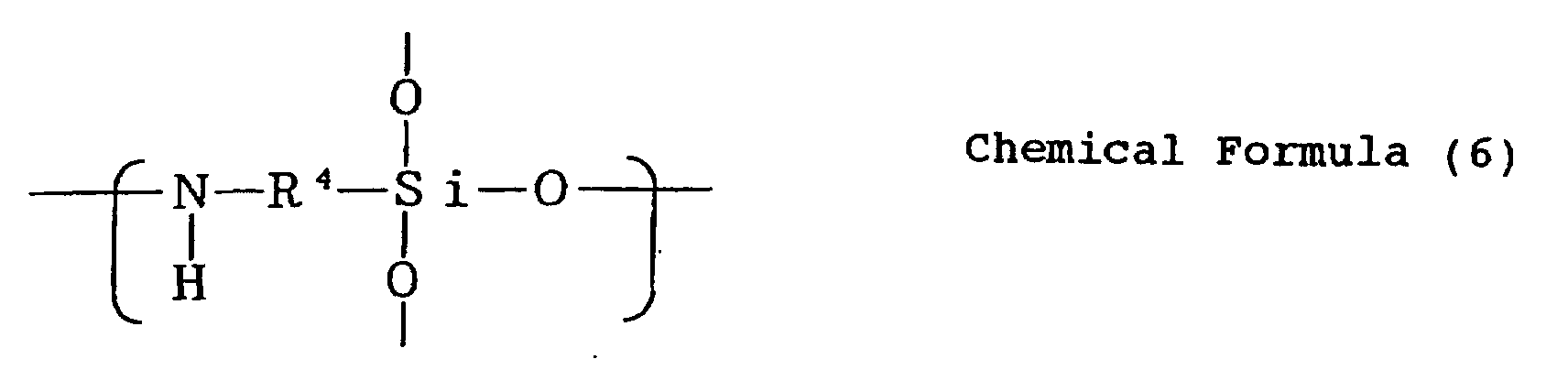
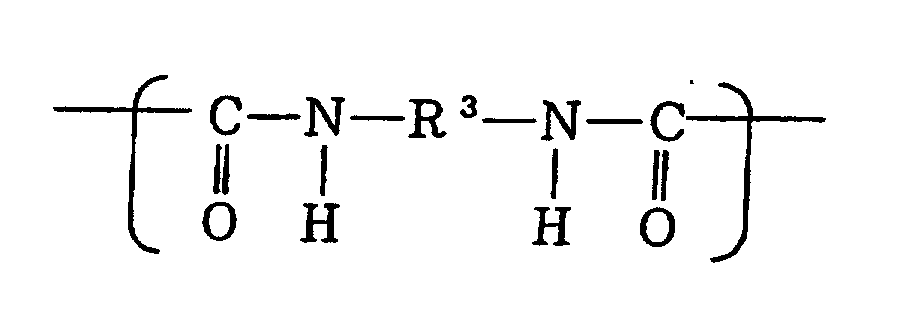
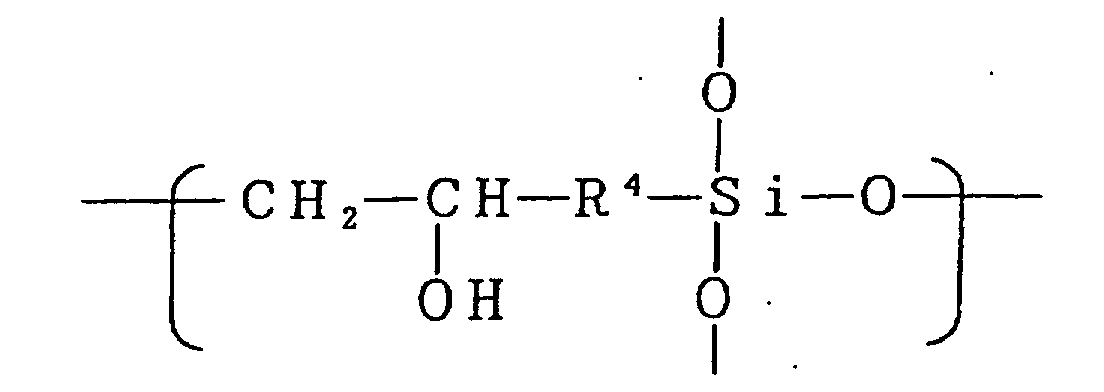
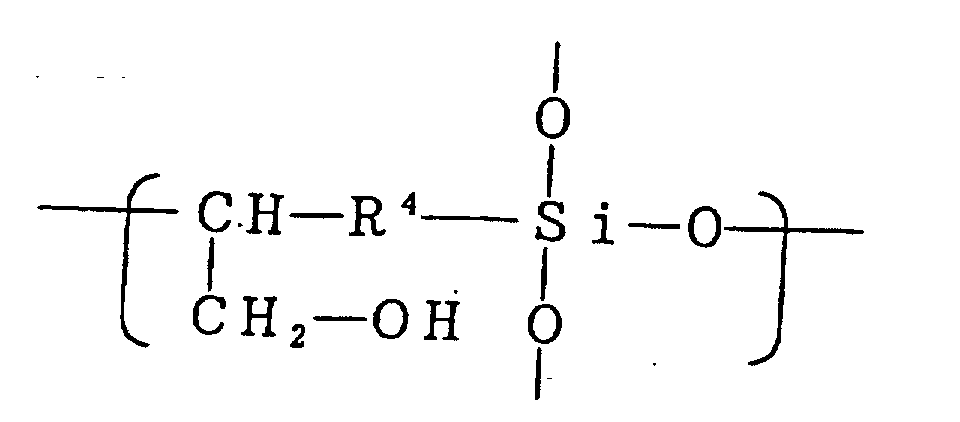
- Such biodegradable polyesters for use in the present invention include, for example, polyesters having a constitutional repeating unit represented by Chemical Formula (1); biodegradable polyesters having the constitutional repeating unit of Chemical Formula (1) combined through a unit represented by Chemical Formula (2) and/or a unit represented by Chemical Formula (3) and/or a unit represented by Chemical Formula (4) and/or a unit represented by Chemical Formula (5) and/or a unit represented by Chemical Formula (6); and polyesters having a constitutional repeating unit represented by Chemical Formula (7).
- biodegradable polyesters further include polyesters each having both the constitutional repeating units of Chemical Formulae (1) and (7), and the polyesters just mentioned above further having at least one of the units of Chemical Formulae (2) through (6).
- random and/or block copolymers and blends of these polyesters are also useful.
- examples of the biodegradable polyesters having any one of the units of Chemical Formulae (1) through (6) are poly(butylene succinate), poly(butylene succinate adipate), poly(ethylene succinate), poly(ethylene succinate adipate), and reaction products prepared by combining these polyesters with hexamethylene diisocyanate or ⁇ -aminopropyltrimethoxysilane.
- biodegradable polyesters having the constitutional repeating unit of Chemical Formula (7) include polycaprolactone, poly(lactic acid), poly(glycolic acid), as well as polyhydroxybutyrate-polyhydroxyvalerate copolymers, and other polyhydroxyalkanoates produced by microorganisms.
- the biodegradable polyesters may further includes another structure than the aforementioned structures within ranges not deteriorating their biodegradability.
- biodegradable polyesters are poly(butylene succinate) prepared by introducing 25% or less of a reaction product of dehydration condensation of ethylene glycol and terephthalic acid into the constitutional repeating unit, and poly(butylene succinate terephthalate) and poly(ethylene succinate terephthalate) each containing less than or equal to 40% by mole of a terephthalate constitutional repeating unit.
- Emulsifiers for use in present invention should have a surface tension in terms of 1% aqueous solution at 20°C of less than or equal to 63 mN/m, preferably less than or equal to 60 mN/m, and more preferably less than or equal to 55 mN/m. If the surface tension exceeds 63 mN/m, constitutive particles of the resulting emulsion may not be sufficiently divided and thus invite coarse particles on the order of several millimeters, or a solid phase and an aqueous phase are separated to thereby fail to yield a stable emulsion.
- the emulsifiers include, for example, surfactants such as sodium lauryl sulfate, sodium oleate, and other anionic surfactants comprising an aliphatic acid salt containing 4 to 18 carbon atoms; lauryl trimethylammonium chloride and other cationic surfactants; N-lauryl glycine and other ampholytic surfactants; and polyoxyethylene nonylphenyl ether and other nonionic surfactants.
- nonionic surfactants also include those used as food additives such as glycerin fatty acid esters, sucrose fatty acid esters, sorbitan fatty acid esters, propylene glycol fatty acid esters, lecithin, and their ethylene oxide adducts.
- the emulsifiers also include water-soluble macromolecular substances such as starch, casein, and gelatin, as well as those used as food additives for thickening such as alginic acid, alginates, Locust bean gum, guar gum, gum arabic, xanthan gum, agar, carrageenan, crystalline cellulose, pectin, and other naturally-occurring macromolecular substances; hydroxyethylcellulose, methylcellulose, carboxymethyl cellulose, propylene glycol arginate, cationic modified starch, and other semisynthetic macromolecular substances; poly(vinyl alcohol), polyacrylamides, poly(vinyl pyrrolidone), poly(acrylic acid), polyvinylpyridine, poly(ethylene imine), as well as copolymers or modified products of these polymers to have an anionic, cationic, or hydrophobic constitutional unit; copolymers of vinyl monomers such as acrylic esters, methacrylic ester and sty
- preferred emulsifiers include partially saponified poly(vinyl alcohol)s inclusive of acetic acid group built-up type; partially saponified poly(vinyl alcohol)s having a sulfonic group, carboxyl group or amino group; and water-soluble biodegradable polyesters having a carboxyl group or polyoxyethylene residue.
- poly(vinyl alcohol)s and nonionic surfactants having a polyoxyethylene chain are typically preferred.
- the ratio ⁇ o / ⁇ w of the viscosity of the molten biodegradable polyester ⁇ o to the viscosity ⁇ w of the aqueous emulsifier solution is preferably less than or equal to 150, more preferably less than or equal to 100, and typically preferably less than or equal to 60, wherein the viscosity ⁇ o means the viscosity of the biodegradable polyester at a temperature 30°C higher than the melt temperature (Tm) of the biodegradable polyester; and the viscosity ⁇ w means the viscosity of the aqueous emulsifier solution at a temperature of 80°C.
- the biodegradable polyester can further comprise a plasticizer or the aqueous emulsifier solution can further comprise a thickener.
- the amount of the emulsifier is preferably more than 5% by weight, for example from 6 to 25% by weight, relative to the biodegradable polyester.
- the biodegradable polyester must be melted and the aqueous emulsifier solution must be prepared before performing the method of the present invention.
- the aqueous emulsifier solution can be prepared according to a regular dissolution procedure, and the melting of the biodegradable polyester will be illustrated below.
- the biodegradable polyester is melted by heating to a temperature higher than its melting point.
- the melting is generally performed at a temperature higher than the melting point by 10°C or more using a drum, an emulsification equipment or an extruder.
- the volatile content of the melt is preferably less than or equal to 0.3%. If the volatile content exceeds 0.3%, the molten biodegradable polyester yields foams upon mixing with the aqueous emulsifier solution, and the resulting mixture is not sufficiently sheared and milled to cause coarse particles.
- a W/O disperse system comprising the molten biodegradable polyester as a continuous phase and the aqueous emulsifier solution as a disperse phase is formed at early stages of dispersion.
- phase inversion occurs after continuous kneading to yield an O/W dispersion system comprising the aqueous emulsifier solution as a continuous phase and the biodegradable polyester as a disperse phase.
- Dispersion means to yield such a large shearing force as to finely divide the particles include, for example, homomixers, homogenizers, colloid mills, extruders, kneader-ruders, and agitators (dispersers) having modified helical blades for use in highly viscous liquids.
- high-performance disperse that disperse an material by local mixing by means of a high-speed disperser and by rotation and revolution of a blade capable of equally agitating the whole material (hereinafter referred to as "high-performance dispersers”), corotating twin-screw extruders, grinder extruders, and other screw extruders.
- any dispersing apparatus (i) the aqueous emulsifier solution is added to the molten biodegradable polyester with stirring, or (ii) the aqueous emulsifier solution and the molten biodegradable polyester are charged into the dispersing apparatus concurrently and are then agitated to start the mixing and dispersing process.
- the extruders can perform the procedure (i), and the high-performance dispersers can perform any of the procedures (i) and (ii).
- the biodegradable polyester is continuously fed to the extruder through its hopper, and separately the aqueous emulsifier solution is injected into the extruder through a supply port disposed at any position other than the point where the resin is melted. Then the biodegradable polyester is melted, is mixed and kneaded with the aqueous emulsifier solution, or is further mixed and kneaded with water at a temperature lower than or equal to 100°C and thereby continuously yields an aqueous dispersion of the biodegradable polyester.
- two or more supply ports can be arranged according to necessity.
- the biodegradable polyester When a high-performance disperser is used, the biodegradable polyester is charged into the disperser, is heated and melted; the aqueous emulsifier solution is added to the molten biodegradable polyester with stirring in one installment or dropwise and thereby yield a target aqueous dispersion of the biodegradable polyester.
- the biodegradable polyester When the biodegradable polyester has a melting point of equal to or higher than 100°C, the biodegradable polyester may further comprise a plasticizer to lower the melting point, or a pressure-tight apparatus is used. As a result, the mixing and dispersing procedure can be performed in the same manner as above.
- the aqueous dispersion of biodegradable polyester prepared by the melt emulsification may have a solid concentration of from 40% to 65% by weight, preferably from 50% to 65% by weight, and more preferably from 55% to 65% by weight, and a viscosity at 20°C of from 10 3 mPa ⁇ s to 10 4 mPa ⁇ s, preferably from 1500 mPa ⁇ s to 10 4 mPa ⁇ s, and more preferably from 2000 mPa ⁇ s to 10 4 mPa ⁇ s.
- the solid concentration and viscosity can be appropriately determined according to the purpose of the aqueous dispersion, and the aqueous dispersion may be diluted where necessary.
- the biodegradable polyester constitutes micron-to submicron-fine particles.
- the peak particle size is generally less than or equal to 10 ⁇ m, and preferably less than or equal to 5 ⁇ m and more preferably less than or equal to 3 ⁇ m, while depending on its intended purpose. Troubles induced by standing still, such as sedimentation of emulsion particles or separation of water, can be prevented by controlling the viscosity in consideration of the particle size.
- the aqueous dispersion has pH in the range of from 3 to 7 in many cases. When the aqueous dispersion is acidic with pH lower than 3 or is basic with pH higher than 7, standing conditions (temperature and time) must be carefully set to avoid hydrolysis.
- aqueous biodegradable polyester dispersions prepared according to the present invention can be formulated into compositions further comprising any of additives such as plasticizers, tackifiers, fillers, pigments, dispersion stabilizers, and chemical agents such as insecticides, pharmaceutical drugs and agricultural chemicals according to necessity.
- additives are incorporated into the aqueous dispersions by means of processes according to their forms, properties, and formulation amounts, as well as intended purposes of the resulting compositions. For example, pellets comprising the biodegradable polyester and the additives previously are previously prepared and are used; the additives are added to the melt phase and/or aqueous phase in any process step of the melt emulsification; or the additives are added to extruded products.
- Promising fields by function in which the aqueous dispersions can be used in practice include, for example, adhesion, coating, sustained release, and forming or molding as excipients.
- means for coalescence such as heating, pressurization, addition of solvents or plasticizers, are required.
- these means are not required when the aqueous dispersions are used in applications in which the particles coalesce with each other as a result of evaporation of water, such as in pressure sensitive adhesion.
- the adhesion function means not only narrow definition of adhesion to bond wood, boards, cloths, and glass, but also includes capability of serving as adhesives in the broad sense of term.
- adhesives are used to bond organic materials such as wood pulp, staple fibers, wood pieces, leather chips, synthetic fibers, and synthetic webs; or inorganic materials such as rock wool, cement, white marble, asbestos, clay, porcelain clay, powders of metals, and metal oxides to form reinforced paper, pulp molds, nonwoven fabrics, artificial leather, inorganic fiber boards, and inorganic building boards. They are also used to impregnate paper, cloths and other materials to reinforce and toughen the materials to thereby yield book jackets, starched bed sheets, and starched shirts.
- the aqueous dispersions When the aqueous dispersions are used in these applications, the resulting products are biodegradable, can be easily decomposed in a natural environment after discarded and thus do not invite environmental pollution caused by discarded articles. Moreover, when the aqueous dispersion is used as a heat sealing agent for paper, it can exhibit blocking resistance at high temperature and high humidity due to the crystallinity of the biodegradable polyester, can adhere in a short time, can be hydrolyzed and thus does not invite environmental pollution. The aqueous dispersion can thereby be used as a recyclable heat sealing agent.
- the aqueous biodegradable polyester dispersions prepared according to the present invention can also be used in applications requiring coating function. Coating is performed for protection or for yielding good appearance by imparting resistance such as toughness, water resistance, light resistance, chemical resistance, and aging resistance. Coating is also performed to impart sustained release properties to fertilizers and chemical agents. A variety of resins have been used in these applications, but most of such resins remain without decomposition and thus cause environmental pollution. From this viewpoint, coating of the following materials is one of the optimum applications of the aqueous biodegradable polyester dispersions.
- Such coating procedures include, for example, coating of materials that can be decomposed in a natural environment, such as paper, wood and leather; coating of fertilizers, agricultural chemicals, pharmaceutical preparations, and other medicated materials that exhibit effects by being delivered in a minimum dose to a target site at a predetermined rate; and coating of submersible metals, concrete, and other materials for use in shipping and constructions in oceans and rivers so as to avoid adhesion of underwater creatures such as mussels and acorn shells.
- Final products of the aqueous dispersions are paints, inks, and other coatings.
- Articles to be coated with the coatings can be selected within broad ranges including paper, cloths, wood, plastics, cement products, concrete, metals, agricultural chemicals, insecticides, pharmaceutical preparations, and fertilizers.
- the aqueous dispersions can also be applied to the following use owing to the crystallinity of the constitutive biodegradable polyesters.
- articles obtained by coating, adhesion or impregnation of the aqueous biodegradable polyester dispersions, such as felt, are placed in a mold, are molded by the application of heat and pressure and thereby yield, for example, caps and hats, nurse's caps, and lining boxes of containers.
- the articles are also dried and heated and thereby yield disposable resin gloves.
- aqueous biodegradable polyester dispersions prepared according to the present invention are applied to target points by using brushes, sprays, coaters, and other already available devices according to the purposes thereof. Where necessary, the coated articles are heated to a temperature equal to or higher than the melting point of the biodegradable polyester after application to complete coating.
- coating applications include, for example, wood coating, construction coating (building coating), antifouling coating, shipping coating, road marking coating, magnetic recording medium coating, and other painting applications in general senses; undercoating of recording paper, coated printing paper, printing art paper, moisture-proof paper, waterproof paper, water-repellent paper, release paper, and label paper; coating of paper, nonwoven fabrics, woven fabrics, and other materials for covering books; coating of shopping bags, paper bags, paper towels, and tissue paper; and coating of fertilizers, agricultural chemicals, and insecticides to yield sustained-release products.
- the adhesion and coating procedures can be performed concurrently in practical use.
- an absorber comprising wood pulp and an absorbing agent is sandwiched between the reinforced paper as a top sheet and a sheet coated with the aqueous biodegradable polyester dispersion as a back sheet.
- the resulting three layers are bonded using the aqueous biodegradable polyester dispersion and thereby yield diapers (nappies), sanitary napkins, and other products that can be converted into compost.
- a chemical agent is incorporated into the aqueous biodegradable polyester dispersion.
- the chemical agent is added to the biodegradable polyester in advance, is added to the melt or the aqueous emulsifier solution, or is added to the aqueous dispersion after its preparation.
- the resulting aqueous biodegradable polyester dispersion containing the chemical agent can be used as intact or by applying to paper, cloths, wood, leather, biodegradable plastics, and other biodegradable substrates.
- products such as sustained-release agricultural chemicals, sustained-release fertilizers, and sustained-release and long-life anti-termite agents are spread as intact over soil.
- Aqueous dispersions containing pheromones and other insect pest control agents or anti-inflammatory analgesic agents for neuralgia are applied to substrates such as paper, cloths, and biodegradable plastic films before practical use.
- Biodegradation Test Biodegradation tests were performed according to the following method unless otherwise noted.
- test sample 3 cm wide, 5 cm long.
- the test sample was embedded in a test soil having a moisture content of 50% relative to the maximum water holding capacity, and a weight loss of the test sample at 25°C was determined to determine the biodegradability.
- the test soil was soil (volcanic ash soil) of SDS Minori Farm, Yuki, Hadori, Minori-cho, Higashiibaraki-gun, Ibaraki, Japan. The weight ratio of the test sample to the test soil was 1:400.
- a total of 5 kg of toluene and 1 kg of a biodegradable polyester (poly(butylene succinate); number average molecular weight: 10000; hydroxyl value: 5.6) were charged into a 10-L cylindrical separable stainless steel reactor equipped with a stirrer, thermometer, dropping funnel, side-arm reflux condenser, and nitrogen gas supply port.
- the mixture in the flask was heated to 110°C with stirring under flow of nitrogen gas to thereby remove water from the reaction system under reflux. After completion of removal of water 30 minutes into refluxing, the mixture in the flask was cooled to 80°C and was further stirred and treated with 320 g of hexamethylene diisocyanate added all at once from the dropping funnel.
- the reaction product was a viscous solution having a number average molecular weight in terms of solid contents of 15000 and a solid concentration of 20.1%.
- a 1% aqueous solution prepared from the reaction product had a surface tension of 45.3 mN/m.
- the mixture was diluted with 288 g of ion exchange water (diluent water) added over 5 minutes to increase fluidity and was stirred for further 10 minutes and thereby yielded an emulsion containing toluene.
- Toluene was then removed from the product by distillation under reduced pressure to yield an emulsion.
- the emulsion had a peak particle size of 1.16 ⁇ m, a solid concentration of 16.9%, and a viscosity of 65 mPa ⁇ s.
- Solid Concentration The emulsion was dried at 105°C for 2 hours, and the solid concentration was defined as the residue on evaporation (%) obtained in this procedure.
- Viscosity of Molten Biodegradable Polyester The relationship between shear rate and viscosity was determined as a graph using a capillary rheometer (viscometer) CAPIROGRAPH 1B (available from Toyo Seiki Seisaku-Sho, Ltd.), and a viscosity at a shear rate of 10 3 s -1 (emulsification condition in the examples) was determined by reading the graph and was defined as ⁇ o . The measuring temperatures were described in the examples.
- Viscosities of Aqueous Emulsifier Solution and Emulsion A viscosity at 10 rpm was determined using a B type viscometer (available from Tokimec Inc. under the trade name of Model BH or Model BM). Alternatively, the relationship between the number of revolutions and the viscosity was determined as a graph, and a viscosity at 10 rpm was determined by reading the graph. In this procedure, the viscosity at 10 rpm was defined as ⁇ w .
- MFR Melt Flow Rate
- Peak Particle Size A particle size distribution curve was determined by a dynamic light scattering method using an analyzer (Microtrac Particle Size Analyzer FRA available from Microtrac Inc.(Leeds & Northrup)), and the peak particle size was defined as the particle size corresponding to the maximum frequency in the particle size distribution curve.
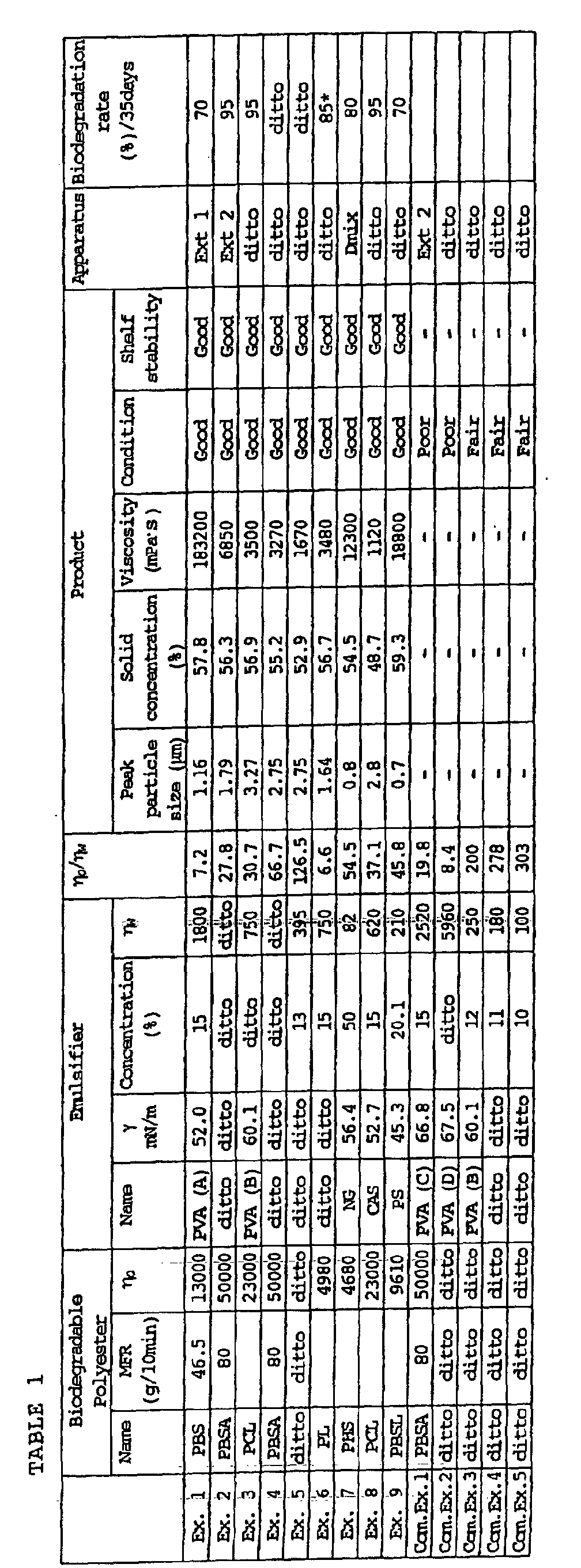
- Pellets of a poly(butylene succinate) were continuously fed at a rate of 10 kg/h from a hopper to a corotating twin-screw kneader extruder. Concurrently, 15% aqueous solution of a partially saponified poly(vinyl alcohol) was continuously injected at a constant temperature of 80°C and a flow rate of 14 kg/h from an aqueous emulsifier solution supply port of the extruder disposed in a cylinder unit at fourth block from the hopper port using a plunger pump. The resulting mixture was continuously extruded.
- the poly(butylene succinate) was a non-chain-extended product of Showa Highpolymer Co., Ltd.
- the extruder was a product of JSW under the trade name of SUPERTEX 44 ⁇ II and had a cylinder diameter of 47 mm, was deep grooved and had an L/D ratio of 52.5.
- the partially saponified poly(vinyl alcohol) was a product of Kuraray Co., Ltd. under the trade name of KURARAY POVAL 220EG and had an average molecular weight of 98080 and a surface tension in terms of 1% aqueous solution at 20°C of 52.0 mN/m.
- the temperatures in the cylinder were set at 50°C in a resin pellet supply portion, at 155°C in a resin melting portion, and at 100°C between the emulsifier aqueous solution supply portion to the outlet.
- the viscosity ⁇ o of the resin pellets was 13000 mPa ⁇ s at 145°C
- the viscosity ⁇ w of the emulsifier aqueous solution was 1800 mPa ⁇ s at 80°C
- the ratio ⁇ o / ⁇ w of ⁇ o to ⁇ w was 7.2.
- the product was viscous and milky white, and electric conductance revealed that it was an emulsion having an aqueous phase as a continuous phase.
- the emulsion cooled to room temperature had a peak particle size of 1.79 ⁇ m, a solid concentration of 57.8%, and a viscosity at 20°C of 183200 mPa ⁇ s and exhibited good shelf stability.
- the emulsion showed a decomposition rate of 70% (35 days) in the biodegradation test.
- Pellets of a poly(butylene succinate adipate) were continuously fed at a rate of 40 kg/h through a hopper into a corotating twin-screw extruder. Concurrently, 15% aqueous solution of a partially saponified poly(vinyl alcohol) was injected at a constant temperature of 80°C and a flow rate of 18 kg/h using a plunger pump from an aqueous emulsifier solution supply port disposed in a cylinder unit at the fourth block from the hopper port. In addition, water held at 80°C was injected into the extruder through a supply port disposed in the cylinder unit at eight block distance at a flow rate of 22 kg/h using a plunger pump.
- the poly(butylene succinate adipate) was a product of Showa Highpolymer Co., Ltd. under the trade name of BIONOLLE #3050 and had a T m of 95°C and a MFR of 80.
- the extruder was a product of JSW under the trade name of SUPERTEX XCT and had a cylinder diameter of 69 mm and an L/D ratio of 42.
- the partially saponified poly(vinyl alcohol) was a product of Kuraray Co., Ltd. under the trade name of KURARAY POVAL 220EG and was the same as in Example 1.
- the temperatures in the cylinder were set at 50°C in the hopper portion, at 140°C in a resin melting portion, and at 100°C between the emulsifier aqueous solution supply portion to the outlet.
- the viscosity ⁇ o of the resin pellets was 50000 mPa ⁇ s at 125°C
- the viscosity ⁇ w of the emulsifier aqueous solution was 1800 mPa ⁇ s
- the ratio ⁇ o / ⁇ w was 27.8.
- the product was an emulsion having a peak particle size of 1.64 ⁇ m, a solid concentration of 56.3%, and a viscosity at 20°C of 6850 mPa ⁇ s and exhibiting good shelf stability.
- the emulsion showed a decomposition rate of 95% (35 days) in the biodegradation test.
- Poly(lactic acid)emulsion having stable properties shown in Table 1 was obtained by the procedure of Example 2, except that a poly(lactic acid) was used as the biodegradable polyester.
- the poly(lactic acid) was prepared by dehydration condensation of a commercially available L-lactic acid as a 90% aqueous solution according to the following program (under the same conditions with those described in Example 2 of Japanese Unexamined Patent Application Publication No. 59-96123).
- the poly(lactic acid) had a T m of 160°C, but it flowed down too fast to determine its MFR.
- the resulting extrudate exhibited a decomposition rate of 85% (35 days) in biodegradation test in a compost at 58°C.
- Sebacic acid and 4-methyl-1,7-heptanediol in a molar ratio of the former to the latter of 1.00:1.05 were subjected to dehydration and subsequently to deglycolation and were further treated with hexamethylenediamine for chain extension and thereby yielded a biodegradable polyester having a number average molecular weight of 46300 and a T m of 32°C.
- the polymer flowed down too fast to determine its MFR.
- a total of 2 kg of the biodegradable polyester was charged into a high-performance disperser (a product of Tokushu Kika Kogyo Co., Ltd. under the trade name of T.K.
- HIVIS DISPER MIX 305 HIVIS DISPER MIX 305
- aqueous solution surface tension in terms of 1% aqueous solution at 20°C: 56.4 mN/m
- NOIGEN DS-601 polyoxyethylene distearate, a product of Dai-ichi Kogyo Seiyaku Co., Ltd.
- phase inversion occurred.
- the high-performance disperser was operated at a blade speed of 140 rpm and a disper speed of 10000 rpm.
- the mixture was cooled with 1600 g of ion exchange water and thereby yielded a product.
- the viscosity ratio ⁇ o / ⁇ w was 57.0 ( ⁇ o : 4680 mPa ⁇ s, ⁇ w : 82 mPa ⁇ s).
- the product was an emulsion having a peak particle size of 0.8 ⁇ m, a solid concentration of 54.5% and a viscosity of 12300 mPa ⁇ s at 20°C and exhibiting good shelf stability.
- the product exhibited a decomposition rate of 80% (35 days) in the biodegradation test.
- Emulsions were prepared by the procedure of Example 7, except that the biodegradable polyester and emulsifier were changed. The results are shown in Table 1.
- a polycaprolactone (available from Daicel Chemical Industries, Ltd. under the trade name of PLACCEL H-7; T m : 60°C; MFR: 129) was used in Example 8.
- a polymer was prepared by the procedure of the poly(lactic acid) of Example 6, except that equivalent moles of succinic acid, 1,4-butanediol, and dl-lactic acid were used in the presence of a catalyst tetrapropoxytitanium in an amount of 0.05% by weight relative to the monomers. This polymer was used in Example 9.
- the emulsions obtained in Examples 8 and 9 showed decomposition rates of 95% (35 days) and 70% (35 days), respectively, in the biodegradation test.
- Example 3 The emulsion obtained in Example 3 was applied to wood free paper using a 4-mil applicator and was dried at 110°C for 3 minutes. The resulting coated paper was laminated with coating base paper by heat-sealing at 70°C at 0.1 MPa for 2 seconds. After cooling to room temperature, the adherends were tried to peel off but the whole paper broke, indicating that they are satisfactorily bonded. The bonded paper showed a decomposition rate of 95% (35 days) in the biodegradation test.
- Example 3 Five pieces of the above-prepared bonded paper (5 cm wide, 5 cm long) were immersed in 500 g of tap water for 24 hours and were then stirred in a domestic juicing blender, where edges of blades were taken off by means of filing, for 5 minutes. The resulting mixture was put into water in a 1-L graduated cylinder to find that the paper disintegrated into pulp filaments, the adhesive was re-dispersed to make the aqueous phase turbid, and no cluster of the resin was observed. These results show that the emulsion obtained in Example 3 is an adhesive that is suitable for use in recycling base paper.
- TAROX BF-2700 a magnetic iron oxide
- 1 g of 10% aqueous solution of sodium hexametaphosphate 10 g of 10% aqueous solution of KURARAY POVAL S-2217, 59 g of water, and 150 g of glass beads
- a disperser available from Tokushu Kika Kogyo Co., Ltd. under the trade name of T.K. AUTO HOMO MIXER M
- the mixture was further treated with 20 g of a poly(butylene succinate adipate) emulsion (the product of Example 2) by stirring at 200 rpm for 10 minutes, was then treated with 0.2 g of a plasticizer ADEKACIZER RS-107 (an adipic diester available from Asahi Denka Co., Ltd.) with stirring for further 30 minutes and thereby yielded a magnetic iron oxide slurry.
- the prepared slurry was applied to wood free paper for use in plain paper copier (PPC) (70.4 g/m 2 ) using a 3-mil applicator, was dried at 110°C for 3 minutes; the resulting magnetic film was oriented using a magnetic orientation device and thereby yielded a magnetic iron oxide-coated paper.
- the coated paper was tough and showed no change in a cellophane-tape peel test, a scratch test with the nail, and a wet rubbing test (rubbing 50 times with fingers while supplying water).
- Example 2 The extrusion procedure of Example 2 was repeated, except that biodegradable polyesters and emulsifiers shown in Table 1 were used, but stable emulsions were not obtained as indicated in "Product” in Table 1.
- An emulsion was prepared by the procedure of Reference Example 2, except using the same polycaprolactone and emulsifier (KURARAY POVAL 220EG) as in Example 3.
- the thermocompression bonding procedure of paper of Example 10 was repeated, except using the above-prepared emulsion. After cooling to room temperature, the adherends were tried to peel off, and the resin layer was easily peeled off from the paper without any paper breakage.
- the emulsion obtained in Comparative Example 6 was inferior in heat-sealing property to the emulsion obtained in Example 10. Considering that this is partly because the resin permeated into the paper to an excessive extent, i.e., the thickness of the adhesive layer was not enough, an attempt was made to concentrate the emulsion obtained in Comparative Example 6 in the following manner. Initially, 300 g of the emulsion of Comparative Example 6 was placed in a 1-L balloon flask, and the flask was attached to a vacuum evaporator to concentrate the emulsion under reduced pressure.
- the solution phase inversion emulsification procedure of Reference Example 2 was performed, except that the concentration of KURARAY POVAL 220EG in the aqueous solution was changed to 2.5% to satisfy the proportion of the emulsifier and that diluent water was not used since it was not necessary.
- the product contained large amounts of aggregates, and the aggregates emerged to separate the product into two phases.
- the aqueous phase as a lower layer was about one third of the whole volume of the product.
- An emulsion was obtained by distilling off toluene from the aqueous phase under reduced pressure and was found to have a solid concentration of 4.8% and a viscosity of 46.5 mPa ⁇ s at 20°C. Using the prepared emulsion, a heat-sealing test was performed by the procedure of Example 10, but the emulsion did not exhibit adhesion property as in Comparative Examples 6 and 7.
- the present invention can provide a method for producing an aqueous biodegradable polyester dispersion that has a high solid concentration and a high viscosity and is very advantageous in practical use.
Landscapes
- Mechanical Engineering (AREA)
- Engineering & Computer Science (AREA)
- Chemical & Material Sciences (AREA)
- Thermal Sciences (AREA)
- Medicinal Chemistry (AREA)
- Polymers & Plastics (AREA)
- Organic Chemistry (AREA)
- Physics & Mathematics (AREA)
- Chemical Kinetics & Catalysis (AREA)
- Health & Medical Sciences (AREA)
- Dispersion Chemistry (AREA)
- Processes Of Treating Macromolecular Substances (AREA)
- Compositions Of Macromolecular Compounds (AREA)
- Biological Depolymerization Polymers (AREA)
- Polyamides (AREA)
- Polyesters Or Polycarbonates (AREA)
Abstract
Description


and/or
the following unit:


the following unit:

the following unit:

and/or
the following unit:

the following unit
the following unit:

biodegradable polyesters having the constitutional repeating unit of Chemical Formula (1) combined through a unit represented by Chemical Formula (2) and/or a unit represented by Chemical Formula (3) and/or a unit represented by Chemical Formula (4) and/or a unit represented by Chemical Formula (5) and/or a unit represented by Chemical Formula (6); and
polyesters having a constitutional repeating unit represented by Chemical Formula (7).
Dispersion means to yield such a large shearing force as to finely divide the particles include, for example, homomixers, homogenizers, colloid mills, extruders, kneader-ruders, and agitators (dispersers) having modified helical blades for use in highly viscous liquids. Among them preferred are high-performance disperse that disperse an material by local mixing by means of a high-speed disperser and by rotation and revolution of a blade capable of equally agitating the whole material (hereinafter referred to as "high-performance dispersers"), corotating twin-screw extruders, grinder extruders, and other screw extruders.


Claims (13)
- A method for producing an aqueous biodegradable polyester dispersion, the method comprising the step of mixing and kneading a molten biodegradable polyester, an aqueous emulsifier solution having a surface tension in terms of 1.0% by weight aqueous solution at 20°C of less than or equal to 63 mN/m, and other additives according to necessity to yield an aqueous dispersion having a solid concentration of equal to or more than 40% by weight and a viscosity at 20°C of equal to or more than 1000 mPa·s.
- The method for producing an aqueous biodegradable polyester dispersion according to Claim 1, wherein the ratio ηo/ηw of the viscosity ηo of the molten biodegradable polyester to the viscosity ηw of the aqueous emulsifier solution is less than or equal to 150.
- The method for producing an aqueous biodegradable polyester dispersion according to Claim 1 or 2, wherein the biodegradable polyester has the following constitutional repeating unit:wherein R1 and R2 are each an alkylene group containing 2 to 10 carbon atoms or an alicyclic hydrocarbon group containing 5 or 6 carbon atoms.

- The method for producing an aqueous biodegradable polyester dispersion according to Claim 1 or 2, wherein the biodegradable polyester structurally comprises the constitutional repeating unit according to Claim 3 being combined through at least the following unit:wherein R3 is a diisocyanate residue,

and/or
the following unit:
- The method for producing an aqueous biodegradable polyester dispersion according to Claim 1 or 2, wherein the biodegradable polyester structurally comprises the constitutional repeating unit according to Claim 3 being combined through at least the following unit:and/or

the following unit:and/or
the following unit:wherein R4 is an alkylene group containing 2 to 6 carbon atoms.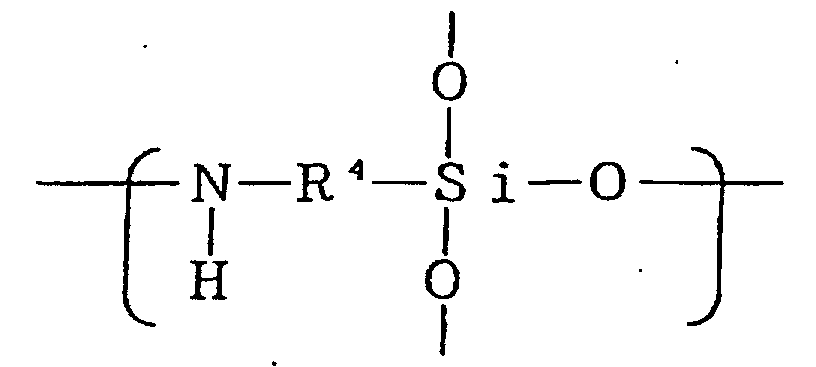
- The method for producing an aqueous biodegradable polyester dispersion according to Claim 1 or 2, wherein the biodegradable polyester has the following constitutional repeating unit:wherein R5 is a hydrogen, an alkyl group containing 1 to 19 carbon atoms, or an alkenyl group containing 1 to 19 carbon atoms; and n is a number from 1 to about 4.

- The method for producing an aqueous biodegradable polyester dispersion according to Claim 1 or 2, wherein the biodegradable polyester structurally comprises the constitutional repeating unit according to Claim 6 being combined through at least the following unit:wherein R3 is a diisocyanate residue;
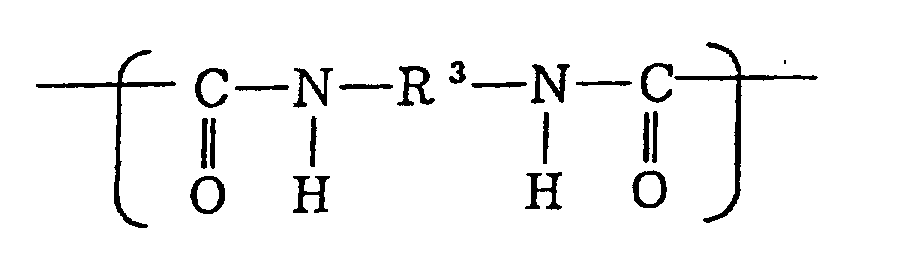
and/or
the following unit: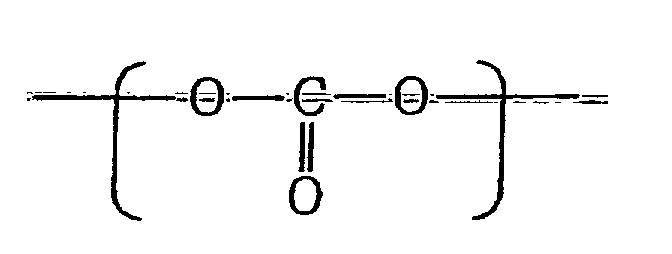
- The method for producing an aqueous biodegradable polyester dispersion according to Claim 1 or 2, wherein the biodegradable polyester structurally comprises the constitutional repeating unit according to Claim 6 being combined through at least the following unit:and/or

the following unitand/or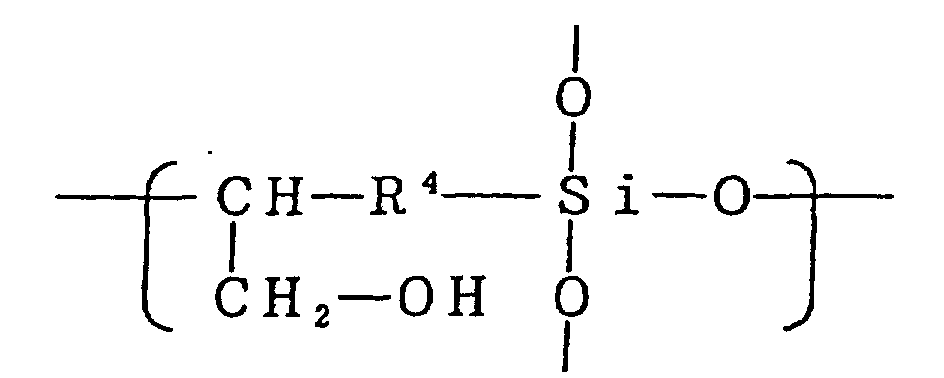
the following unit:wherein R4 is an alkylene group containing 2 to 6 carbon atoms.
- The method for producing an aqueous biodegradable polyester dispersion according to any one of Claims 1 to 8, wherein the emulsifier is a poly(vinyl alcohol) or a nonionic surfactant having a polyoxyethylene chain.
- The method for producing an aqueous biodegradable polyester dispersion according to any one of Claims 1 to 9, wherein a peak particle size is less than or equal to 3 µm, where the peak particle size is the diameter at a peak in a particle size distribution curve.
- The method for producing an aqueous biodegradable polyester dispersion according to any one of Claims 1 to 10, wherein the step of mixing and kneading is performed using a screw extruder.
- The method for producing an aqueous biodegradable polyester dispersion according to Claim 11, wherein the screw extruder is a corotating twin-screw extruder or a grinder extruder.
- The method for producing an aqueous biodegradable polyester dispersion according to Claim 11 or 12, wherein the aqueous emulsifier solution is supplied separately at two or more points of the screw extruder.
Applications Claiming Priority (3)
| Application Number | Priority Date | Filing Date | Title |
|---|---|---|---|
| JP2000181574A JP2001354841A (en) | 2000-06-16 | 2000-06-16 | Aqueous dispersion of biodegradable polyester |
| JP2000181574 | 2000-06-16 | ||
| PCT/JP2001/005140 WO2001096449A1 (en) | 2000-06-16 | 2001-06-15 | Process for producing aqueous dispersion of biodegradable polyester |
Publications (3)
| Publication Number | Publication Date |
|---|---|
| EP1302502A1 true EP1302502A1 (en) | 2003-04-16 |
| EP1302502A4 EP1302502A4 (en) | 2004-10-20 |
| EP1302502B1 EP1302502B1 (en) | 2006-08-30 |
Family
ID=18682482
Family Applications (1)
| Application Number | Title | Priority Date | Filing Date |
|---|---|---|---|
| EP01938700A Expired - Lifetime EP1302502B1 (en) | 2000-06-16 | 2001-06-15 | Process for producing aqueous dispersion of biodegradable polyester |
Country Status (8)
| Country | Link |
|---|---|
| US (1) | US6716911B2 (en) |
| EP (1) | EP1302502B1 (en) |
| JP (1) | JP2001354841A (en) |
| KR (1) | KR20030016294A (en) |
| CN (1) | CN1239579C (en) |
| AU (1) | AU2001264299A1 (en) |
| DE (1) | DE60122732T2 (en) |
| WO (1) | WO2001096449A1 (en) |
Cited By (10)
| Publication number | Priority date | Publication date | Assignee | Title |
|---|---|---|---|---|
| EP1514891A1 (en) * | 2003-09-12 | 2005-03-16 | Roquette Frˬres | Aqueous dispersions of at least one biodegradable polymer |
| FR2862310A1 (en) * | 2003-11-17 | 2005-05-20 | Roquette Freres | Aqueous filmogen composition preparing method for preparing e.g. aqueous adhesive composition, involves preparing aqueous pigment composition from aqueous dispersion composed of certain percent of biodegradable polymer and stabilizing agent |
| FR2862309A1 (en) * | 2003-11-17 | 2005-05-20 | Roquette Freres | Aqueous pigment composition preparing method for e.g. preparing pigment coating slip, involves preparing aqueous pigment composition from aqueous dispersion composed of certain percent of biodegradable polymer and stabilizing agent |
| WO2011117308A1 (en) | 2010-03-24 | 2011-09-29 | Basf Se | Process for producing aqueous dispersions of thermoplastic polyesters |
| WO2012140181A1 (en) | 2011-04-15 | 2012-10-18 | Basf Se | Method for producing aqueous dispersions of aliphatic polycarbonates |
| WO2013068363A1 (en) | 2011-11-09 | 2013-05-16 | Basf Se | Use in paper coatings of a mixture of a secondary polymeric dispersion and of a primary dispersion of an emulsion polymer |
| US8604101B2 (en) | 2010-03-24 | 2013-12-10 | Basf Se | Process for producing aqueous dispersions of thermoplastic polyesters |
| WO2016190740A1 (en) | 2015-05-27 | 2016-12-01 | Csk Food Enrichment B.V. | Cheese coating |
| WO2016190741A1 (en) | 2015-05-27 | 2016-12-01 | Csk Food Enrichment B.V. | Cheese coating |
| WO2021233535A1 (en) | 2020-05-20 | 2021-11-25 | Wacker Chemie Ag | Aqueous dispersion of biologically degradable polyesters |
Families Citing this family (31)
| Publication number | Priority date | Publication date | Assignee | Title |
|---|---|---|---|---|
| JP2003096281A (en) * | 2001-09-26 | 2003-04-03 | Mitsui Chemicals Inc | Aqueous dispersing element, fine particle and coating film of biodegradable polyester, and production method thereof |
| JP2003277595A (en) * | 2002-03-25 | 2003-10-02 | Mitsui Chemicals Inc | Aqueous dispersion of poly-lactic acid with improved film- forming property and storage stability |
| JP2004277681A (en) * | 2003-03-14 | 2004-10-07 | Toho Chem Ind Co Ltd | Modified biodegradable resin small particle size emulsion |
| JP2004277679A (en) * | 2003-03-14 | 2004-10-07 | Toho Chem Ind Co Ltd | Modified polylactic acid-based resin emulsion and method for producing the same |
| US6840319B1 (en) * | 2004-01-21 | 2005-01-11 | Halliburton Energy Services, Inc. | Methods, compositions and biodegradable fluid loss control additives for cementing subterranean zones |
| WO2008008381A2 (en) | 2006-07-14 | 2008-01-17 | Dupont Teijin Films U.S. Limited Partnership | Multilayer sealant film |
| US20080026959A1 (en) * | 2006-07-25 | 2008-01-31 | Halliburton Energy Services, Inc. | Degradable particulates and associated methods |
| WO2011024021A1 (en) * | 2009-08-31 | 2011-03-03 | Ovc Intellectual Capital, Llc | Sizing composition containing a biodegradable polymer |
| EP2702091B1 (en) | 2011-04-29 | 2019-02-13 | CJ CheilJedang Corporation | Process for latex production by melt emulsification |
| US20140228429A1 (en) * | 2011-05-27 | 2014-08-14 | Dsm Ip Assets B.V | Extrusion process |
| JP6111079B2 (en) * | 2012-01-27 | 2017-04-05 | 株式会社キクテック | Hot melt coating composition |
| JP2014189989A (en) * | 2013-03-26 | 2014-10-06 | Showa Denko Kk | Fracturing material |
| US9321899B1 (en) * | 2014-10-29 | 2016-04-26 | Xerox Corporation | Preparing latex using a biosolvent |
| CN109071828A (en) * | 2016-02-29 | 2018-12-21 | 米切尔曼公司 | Water-based hydrolytically stable dispersion of biodegradable polymers |
| CN109843985B (en) | 2016-10-13 | 2022-06-07 | 株式会社钟化 | Method for producing polyhydroxyalkanoate |
| US20180171559A1 (en) * | 2016-12-20 | 2018-06-21 | Michelman, Inc. | Coated substrates including compostable coatings and methods for producing the same |
| WO2019244007A1 (en) | 2018-06-19 | 2019-12-26 | 3M Innovative Properties Company | Aqueous dispersions including polyester particles, photopolymerizable compositions, articles, and methods |
| CN112654477A (en) | 2018-08-02 | 2021-04-13 | 边缘市场营销有限公司 | Thermoplastic elastomer cork composite material |
| EP3656524B1 (en) | 2018-11-21 | 2021-01-06 | Biofibre GmbH | Method of manufacturing biocomposite materials comprising cellulose |
| CN110028628A (en) * | 2019-04-02 | 2019-07-19 | 苏州海晨塑胶有限公司 | A kind of degradable poly ester material and preparation method thereof |
| JP7760505B2 (en) * | 2020-07-14 | 2025-10-27 | 住友精化株式会社 | Aqueous polyester resin dispersion composition and method for producing the same |
| CN114426761B (en) * | 2020-10-29 | 2023-09-08 | 财团法人工业技术研究院 | Biodegradable polyester material and method for producing same |
| WO2022225024A1 (en) * | 2021-04-22 | 2022-10-27 | 三菱ケミカル株式会社 | Emulsion resin composition and coating agent |
| JP6966663B1 (en) * | 2021-06-07 | 2021-11-17 | ミヨシ油脂株式会社 | Biodegradable resin aqueous dispersion and film forming agent and method for forming a film using it |
| WO2023190059A1 (en) * | 2022-03-28 | 2023-10-05 | 積水化成品工業株式会社 | Aqueous dispersion of polybutylene succinate adipate resin particles, method for producing same, and polybutylene succinate adipate resin particles |
| CN115386208B (en) * | 2022-08-11 | 2025-06-24 | 长兴电子(苏州)有限公司 | Degradable microbeads and preparation method and application thereof |
| KR102630985B1 (en) * | 2022-12-27 | 2024-01-30 | 롯데정밀화학 주식회사 | Method for Preparing Biodegradable Polymer Emulsion and Biodegradable Polymer Emulsion Prepared Therefrom |
| US20250313701A1 (en) * | 2022-12-27 | 2025-10-09 | Lotte Fine Chemical Co., Ltd. | Method for preparing biodegradable polymer emulsion, biodegradable polymer emulsion prepared thereby, and biodegradable polymer coating solution using same |
| WO2024176844A1 (en) * | 2023-02-24 | 2024-08-29 | 綜研化学株式会社 | Production method for polyester resin aqueous re-dispersion for adhesive agents |
| WO2024181408A1 (en) * | 2023-03-02 | 2024-09-06 | 株式会社日本触媒 | Polyester amide resin and method for producing same |
| JPWO2024203745A1 (en) | 2023-03-24 | 2024-10-03 |
Family Cites Families (10)
| Publication number | Priority date | Publication date | Assignee | Title |
|---|---|---|---|---|
| GB1455091A (en) * | 1974-02-11 | 1976-11-10 | Toyo Boseki | Dispersion of linear polyester resin |
| DE2903022A1 (en) * | 1979-01-26 | 1980-07-31 | Bayer Ag | Finely-divided aq. polyester dispersion prepn. - by dispersing polyester with nonionic emulsifier and polyether-modified polyester emulsifier in neutraliser-contg. aq. phase |
| DE4242781A1 (en) * | 1992-12-17 | 1994-06-23 | Wacker Chemie Gmbh | Biodegradable, aqueous dispersions |
| DE19638686A1 (en) * | 1996-09-20 | 1998-03-26 | Basf Ag | Aqueous dispersion of a biodegradable polyester and its use |
| JP3616465B2 (en) * | 1996-10-01 | 2005-02-02 | ミヨシ油脂株式会社 | Biodegradable emulsion |
| DE19652813A1 (en) * | 1996-12-18 | 1998-06-25 | Basf Coatings Ag | Aqueous powder coating dispersion |
| FI105566B (en) * | 1996-12-31 | 2000-09-15 | Valtion Teknillinen | Process and preparation of polymer dispersions |
| JPH1192712A (en) * | 1997-09-24 | 1999-04-06 | Showa Highpolymer Co Ltd | O/w type biologically decomposable emulsion and composition using the same |
| JP3861500B2 (en) * | 1998-04-23 | 2006-12-20 | 大日本インキ化学工業株式会社 | Production method of self-dispersible particles made of biodegradable polyester |
| JP4382909B2 (en) * | 1999-07-02 | 2009-12-16 | ミヨシ油脂株式会社 | Biodegradable resin aqueous dispersion and biodegradable composite material |
-
2000
- 2000-06-16 JP JP2000181574A patent/JP2001354841A/en active Pending
-
2001
- 2001-06-15 KR KR1020027017098A patent/KR20030016294A/en not_active Ceased
- 2001-06-15 DE DE60122732T patent/DE60122732T2/en not_active Expired - Fee Related
- 2001-06-15 WO PCT/JP2001/005140 patent/WO2001096449A1/en not_active Ceased
- 2001-06-15 EP EP01938700A patent/EP1302502B1/en not_active Expired - Lifetime
- 2001-06-15 CN CNB018128483A patent/CN1239579C/en not_active Expired - Fee Related
- 2001-06-15 AU AU2001264299A patent/AU2001264299A1/en not_active Abandoned
- 2001-06-15 US US10/311,070 patent/US6716911B2/en not_active Expired - Lifetime
Cited By (12)
| Publication number | Priority date | Publication date | Assignee | Title |
|---|---|---|---|---|
| EP1514891A1 (en) * | 2003-09-12 | 2005-03-16 | Roquette Frˬres | Aqueous dispersions of at least one biodegradable polymer |
| FR2859729A1 (en) * | 2003-09-12 | 2005-03-18 | Roquette Freres | AQUEOUS DISPERSIONS OF AT LEAST ONE BIODEGRADABLE POLYMER |
| FR2862310A1 (en) * | 2003-11-17 | 2005-05-20 | Roquette Freres | Aqueous filmogen composition preparing method for preparing e.g. aqueous adhesive composition, involves preparing aqueous pigment composition from aqueous dispersion composed of certain percent of biodegradable polymer and stabilizing agent |
| FR2862309A1 (en) * | 2003-11-17 | 2005-05-20 | Roquette Freres | Aqueous pigment composition preparing method for e.g. preparing pigment coating slip, involves preparing aqueous pigment composition from aqueous dispersion composed of certain percent of biodegradable polymer and stabilizing agent |
| WO2005052075A1 (en) * | 2003-11-17 | 2005-06-09 | Roquette Freres | Use of an aqueous dispersion of at least one biodegradable polymer containing at least one stabilizing agent for the preparation of an aqueous filmogenic composition |
| WO2011117308A1 (en) | 2010-03-24 | 2011-09-29 | Basf Se | Process for producing aqueous dispersions of thermoplastic polyesters |
| US8604101B2 (en) | 2010-03-24 | 2013-12-10 | Basf Se | Process for producing aqueous dispersions of thermoplastic polyesters |
| WO2012140181A1 (en) | 2011-04-15 | 2012-10-18 | Basf Se | Method for producing aqueous dispersions of aliphatic polycarbonates |
| WO2013068363A1 (en) | 2011-11-09 | 2013-05-16 | Basf Se | Use in paper coatings of a mixture of a secondary polymeric dispersion and of a primary dispersion of an emulsion polymer |
| WO2016190740A1 (en) | 2015-05-27 | 2016-12-01 | Csk Food Enrichment B.V. | Cheese coating |
| WO2016190741A1 (en) | 2015-05-27 | 2016-12-01 | Csk Food Enrichment B.V. | Cheese coating |
| WO2021233535A1 (en) | 2020-05-20 | 2021-11-25 | Wacker Chemie Ag | Aqueous dispersion of biologically degradable polyesters |
Also Published As
| Publication number | Publication date |
|---|---|
| EP1302502A4 (en) | 2004-10-20 |
| KR20030016294A (en) | 2003-02-26 |
| DE60122732D1 (en) | 2006-10-12 |
| AU2001264299A1 (en) | 2001-12-24 |
| DE60122732T2 (en) | 2006-12-21 |
| CN1239579C (en) | 2006-02-01 |
| JP2001354841A (en) | 2001-12-25 |
| EP1302502B1 (en) | 2006-08-30 |
| US20030181630A1 (en) | 2003-09-25 |
| CN1441823A (en) | 2003-09-10 |
| WO2001096449A1 (en) | 2001-12-20 |
| US6716911B2 (en) | 2004-04-06 |
Similar Documents
| Publication | Publication Date | Title |
|---|---|---|
| EP1302502B1 (en) | Process for producing aqueous dispersion of biodegradable polyester | |
| CN102432893B (en) | Water dispersion, its production method and uses thereof | |
| JP4635292B2 (en) | POLYLACTIC ACID RESIN POWDER, PROCESS FOR PRODUCING THE SAME, AND AGRE | |
| JP2002538250A (en) | Diol latex composition and modified condensation polymer | |
| JP2004107413A (en) | Plasticizer-containing polylactic acid-based resin aqueous dispersion | |
| EP2053093B1 (en) | Aqueous dispersion of polyamide rubber elastic body and method for producing the same | |
| DE2356727A1 (en) | PROCESS FOR DIGERATING NORMALLY SOLID ADDITIONAL POLYMERS INSOLUBLE IN WATER AND ALKALIA | |
| CA2297987A1 (en) | Diol latex compositions | |
| JP5059668B2 (en) | Resin composition and method for producing the same | |
| WO2021075412A1 (en) | Aqueous dispersion liquid and use of same | |
| JP4266323B2 (en) | Method for producing polylactic acid aqueous dispersion | |
| US5723538A (en) | Aqueous dispersions of polyamides | |
| Nasri et al. | Elaboration and characterization of polymers used in flexible multilayer food packaging | |
| CN107109036B (en) | Aqueous dispersion of polyester-based elastomer and method for producing the same | |
| JP2004331847A (en) | Polylactic acid aqueous dispersion | |
| JP2003511527A (en) | Latex formation in alkaline reactive media and its use in polyester blend formation | |
| US20080161505A1 (en) | Method of Manufacturing Polyactic Acid | |
| JP2003321600A (en) | Polylactic acid aqueous emulsion, method for producing the same and coating containing the polylactic acid aqueous emulsion | |
| JP2004204038A (en) | Biodegradable water dispersion | |
| JP3954838B2 (en) | Biodegradable heat seal lacquer composition and biodegradable composite | |
| JP2003096281A (en) | Aqueous dispersing element, fine particle and coating film of biodegradable polyester, and production method thereof | |
| JP2002003607A (en) | Method for producing aqueous dispersion of biodegradable polyester | |
| EP1332165A1 (en) | Chlorine-free polyolefin-based plastisol or organosol and method for producing the same | |
| US5770680A (en) | Aqueous dispersions of polyamides | |
| JP3400854B2 (en) | Process for producing aqueous emulsion of ethylene-glycidyl acrylate compound copolymer |
Legal Events
| Date | Code | Title | Description |
|---|---|---|---|
| PUAI | Public reference made under article 153(3) epc to a published international application that has entered the european phase |
Free format text: ORIGINAL CODE: 0009012 |
|
| 17P | Request for examination filed |
Effective date: 20030116 |
|
| AK | Designated contracting states |
Designated state(s): AT BE CH CY DE DK ES FI FR GB GR IE IT LI LU MC NL PT SE TR |
|
| AX | Request for extension of the european patent |
Extension state: AL LT LV MK RO SI |
|
| RBV | Designated contracting states (corrected) |
Designated state(s): DE FR GB |
|
| A4 | Supplementary search report drawn up and despatched |
Effective date: 20040903 |
|
| RIC1 | Information provided on ipc code assigned before grant |
Ipc: 7C 08L 77/12 B Ipc: 7C 08J 3/03 A Ipc: 7C 08L 67/00 B Ipc: 7C 08L 67/02 B |
|
| 17Q | First examination report despatched |
Effective date: 20050630 |
|
| GRAP | Despatch of communication of intention to grant a patent |
Free format text: ORIGINAL CODE: EPIDOSNIGR1 |
|
| GRAS | Grant fee paid |
Free format text: ORIGINAL CODE: EPIDOSNIGR3 |
|
| GRAA | (expected) grant |
Free format text: ORIGINAL CODE: 0009210 |
|
| AK | Designated contracting states |
Kind code of ref document: B1 Designated state(s): DE FR GB |
|
| REG | Reference to a national code |
Ref country code: GB Ref legal event code: FG4D |
|
| REF | Corresponds to: |
Ref document number: 60122732 Country of ref document: DE Date of ref document: 20061012 Kind code of ref document: P |
|
| ET | Fr: translation filed | ||
| PLBE | No opposition filed within time limit |
Free format text: ORIGINAL CODE: 0009261 |
|
| STAA | Information on the status of an ep patent application or granted ep patent |
Free format text: STATUS: NO OPPOSITION FILED WITHIN TIME LIMIT |
|
| 26N | No opposition filed |
Effective date: 20070531 |
|
| PGFP | Annual fee paid to national office [announced via postgrant information from national office to epo] |
Ref country code: DE Payment date: 20080827 Year of fee payment: 8 |
|
| PGFP | Annual fee paid to national office [announced via postgrant information from national office to epo] |
Ref country code: GB Payment date: 20080429 Year of fee payment: 8 |
|
| GBPC | Gb: european patent ceased through non-payment of renewal fee |
Effective date: 20090615 |
|
| REG | Reference to a national code |
Ref country code: FR Ref legal event code: ST Effective date: 20100226 |
|
| PG25 | Lapsed in a contracting state [announced via postgrant information from national office to epo] |
Ref country code: FR Free format text: LAPSE BECAUSE OF NON-PAYMENT OF DUE FEES Effective date: 20090630 |
|
| PGFP | Annual fee paid to national office [announced via postgrant information from national office to epo] |
Ref country code: FR Payment date: 20080430 Year of fee payment: 8 |
|
| PG25 | Lapsed in a contracting state [announced via postgrant information from national office to epo] |
Ref country code: GB Free format text: LAPSE BECAUSE OF NON-PAYMENT OF DUE FEES Effective date: 20090615 |
|
| PG25 | Lapsed in a contracting state [announced via postgrant information from national office to epo] |
Ref country code: DE Free format text: LAPSE BECAUSE OF NON-PAYMENT OF DUE FEES Effective date: 20100101 |