EP1301070B1 - Insect control pouch - Google Patents
Insect control pouch Download PDFInfo
- Publication number
- EP1301070B1 EP1301070B1 EP01918518A EP01918518A EP1301070B1 EP 1301070 B1 EP1301070 B1 EP 1301070B1 EP 01918518 A EP01918518 A EP 01918518A EP 01918518 A EP01918518 A EP 01918518A EP 1301070 B1 EP1301070 B1 EP 1301070B1
- Authority
- EP
- European Patent Office
- Prior art keywords
- pouch
- article
- active
- chamber
- walls
- Prior art date
- Legal status (The legal status is an assumption and is not a legal conclusion. Google has not performed a legal analysis and makes no representation as to the accuracy of the status listed.)
- Expired - Lifetime
Links
- 241000238631 Hexapoda Species 0.000 title claims description 41
- 239000004615 ingredient Substances 0.000 claims description 17
- 238000000034 method Methods 0.000 claims description 12
- -1 vapothrin Chemical compound 0.000 claims description 11
- 239000000463 material Substances 0.000 claims description 10
- DDVNRFNDOPPVQJ-HQJQHLMTSA-N transfluthrin Chemical compound CC1(C)[C@H](C=C(Cl)Cl)[C@H]1C(=O)OCC1=C(F)C(F)=CC(F)=C1F DDVNRFNDOPPVQJ-HQJQHLMTSA-N 0.000 claims description 10
- ZCVAOQKBXKSDMS-PVAVHDDUSA-N (+)-trans-(S)-allethrin Chemical compound CC1(C)[C@H](C=C(C)C)[C@H]1C(=O)O[C@@H]1C(C)=C(CC=C)C(=O)C1 ZCVAOQKBXKSDMS-PVAVHDDUSA-N 0.000 claims description 7
- 229960001901 bioallethrin Drugs 0.000 claims description 6
- ZFHGXWPMULPQSE-SZGBIDFHSA-N (Z)-(1S)-cis-tefluthrin Chemical compound FC1=C(F)C(C)=C(F)C(F)=C1COC(=O)[C@@H]1C(C)(C)[C@@H]1\C=C(/Cl)C(F)(F)F ZFHGXWPMULPQSE-SZGBIDFHSA-N 0.000 claims description 5
- 239000005939 Tefluthrin Substances 0.000 claims description 5
- SMKRKQBMYOFFMU-UHFFFAOYSA-N prallethrin Chemical compound CC1(C)C(C=C(C)C)C1C(=O)OC1C(C)=C(CC#C)C(=O)C1 SMKRKQBMYOFFMU-UHFFFAOYSA-N 0.000 claims description 5
- 229920001577 copolymer Polymers 0.000 claims description 4
- 239000007788 liquid Substances 0.000 claims description 4
- 239000007787 solid Substances 0.000 claims description 4
- 229920000219 Ethylene vinyl alcohol Polymers 0.000 claims description 3
- 239000004677 Nylon Substances 0.000 claims description 3
- 239000004743 Polypropylene Substances 0.000 claims description 3
- 239000004372 Polyvinyl alcohol Substances 0.000 claims description 3
- 229920001328 Polyvinylidene chloride Polymers 0.000 claims description 3
- 239000004715 ethylene vinyl alcohol Substances 0.000 claims description 3
- RZXDTJIXPSCHCI-UHFFFAOYSA-N hexa-1,5-diene-2,5-diol Chemical compound OC(=C)CCC(O)=C RZXDTJIXPSCHCI-UHFFFAOYSA-N 0.000 claims description 3
- 229920001778 nylon Polymers 0.000 claims description 3
- 229920000728 polyester Polymers 0.000 claims description 3
- 229920001155 polypropylene Polymers 0.000 claims description 3
- 229920002451 polyvinyl alcohol Polymers 0.000 claims description 3
- 239000005033 polyvinylidene chloride Substances 0.000 claims description 3
- 239000004698 Polyethylene Substances 0.000 claims description 2
- 229920000573 polyethylene Polymers 0.000 claims description 2
- 239000002356 single layer Substances 0.000 claims description 2
- 239000000758 substrate Substances 0.000 description 37
- 239000004480 active ingredient Substances 0.000 description 21
- 238000007789 sealing Methods 0.000 description 20
- 238000001704 evaporation Methods 0.000 description 9
- 230000008020 evaporation Effects 0.000 description 8
- 239000002917 insecticide Substances 0.000 description 8
- 239000002904 solvent Substances 0.000 description 8
- 229920001824 Barex® Polymers 0.000 description 5
- 239000003570 air Substances 0.000 description 5
- 238000003860 storage Methods 0.000 description 5
- 241000255925 Diptera Species 0.000 description 4
- 239000010410 layer Substances 0.000 description 4
- 239000000853 adhesive Substances 0.000 description 3
- 230000001070 adhesive effect Effects 0.000 description 3
- 239000002949 juvenile hormone Substances 0.000 description 3
- 230000008569 process Effects 0.000 description 3
- 239000000126 substance Substances 0.000 description 3
- 239000004215 Carbon black (E152) Substances 0.000 description 2
- 244000166675 Cymbopogon nardus Species 0.000 description 2
- 235000018791 Cymbopogon nardus Nutrition 0.000 description 2
- GLZPCOQZEFWAFX-UHFFFAOYSA-N Geraniol Chemical compound CC(C)=CCCC(C)=CCO GLZPCOQZEFWAFX-UHFFFAOYSA-N 0.000 description 2
- 229940024113 allethrin Drugs 0.000 description 2
- 230000008901 benefit Effects 0.000 description 2
- 239000003795 chemical substances by application Substances 0.000 description 2
- 238000005520 cutting process Methods 0.000 description 2
- OEBRKCOSUFCWJD-UHFFFAOYSA-N dichlorvos Chemical compound COP(=O)(OC)OC=C(Cl)Cl OEBRKCOSUFCWJD-UHFFFAOYSA-N 0.000 description 2
- 239000003205 fragrance Substances 0.000 description 2
- 229930195733 hydrocarbon Natural products 0.000 description 2
- 150000002430 hydrocarbons Chemical group 0.000 description 2
- XMGQYMWWDOXHJM-UHFFFAOYSA-N limonene Chemical compound CC(=C)C1CCC(C)=CC1 XMGQYMWWDOXHJM-UHFFFAOYSA-N 0.000 description 2
- 230000002093 peripheral effect Effects 0.000 description 2
- 239000003039 volatile agent Substances 0.000 description 2
- ZCVAOQKBXKSDMS-AQYZNVCMSA-N (+)-trans-allethrin Chemical compound CC1(C)[C@H](C=C(C)C)[C@H]1C(=O)OC1C(C)=C(CC=C)C(=O)C1 ZCVAOQKBXKSDMS-AQYZNVCMSA-N 0.000 description 1
- FMTFEIJHMMQUJI-NJAFHUGGSA-N 102130-98-3 Natural products CC=CCC1=C(C)[C@H](CC1=O)OC(=O)[C@@H]1[C@@H](C=C(C)C)C1(C)C FMTFEIJHMMQUJI-NJAFHUGGSA-N 0.000 description 1
- 241001674044 Blattodea Species 0.000 description 1
- 244000004281 Eucalyptus maculata Species 0.000 description 1
- 239000005792 Geraniol Substances 0.000 description 1
- GLZPCOQZEFWAFX-YFHOEESVSA-N Geraniol Natural products CC(C)=CCC\C(C)=C/CO GLZPCOQZEFWAFX-YFHOEESVSA-N 0.000 description 1
- MMOXZBCLCQITDF-UHFFFAOYSA-N N,N-diethyl-m-toluamide Chemical compound CCN(CC)C(=O)C1=CC=CC(C)=C1 MMOXZBCLCQITDF-UHFFFAOYSA-N 0.000 description 1
- 239000004820 Pressure-sensitive adhesive Substances 0.000 description 1
- 240000004460 Tanacetum coccineum Species 0.000 description 1
- ROVGZAWFACYCSP-MQBLHHJJSA-N [2-methyl-4-oxo-3-[(2z)-penta-2,4-dienyl]cyclopent-2-en-1-yl] (1r,3r)-2,2-dimethyl-3-(2-methylprop-1-enyl)cyclopropane-1-carboxylate Chemical compound CC1(C)[C@H](C=C(C)C)[C@H]1C(=O)OC1C(C)=C(C\C=C/C=C)C(=O)C1 ROVGZAWFACYCSP-MQBLHHJJSA-N 0.000 description 1
- 230000002745 absorbent Effects 0.000 description 1
- 239000002250 absorbent Substances 0.000 description 1
- 230000002411 adverse Effects 0.000 description 1
- 239000012080 ambient air Substances 0.000 description 1
- 239000012298 atmosphere Substances 0.000 description 1
- 230000003190 augmentative effect Effects 0.000 description 1
- 230000004888 barrier function Effects 0.000 description 1
- 230000009286 beneficial effect Effects 0.000 description 1
- 239000010630 cinnamon oil Substances 0.000 description 1
- 239000010634 clove oil Substances 0.000 description 1
- 239000011248 coating agent Substances 0.000 description 1
- 238000000576 coating method Methods 0.000 description 1
- 238000007796 conventional method Methods 0.000 description 1
- 239000001941 cymbopogon citratus dc and cymbopogon flexuosus oil Substances 0.000 description 1
- 229950001327 dichlorvos Drugs 0.000 description 1
- 229960001673 diethyltoluamide Drugs 0.000 description 1
- 238000009792 diffusion process Methods 0.000 description 1
- 201000010099 disease Diseases 0.000 description 1
- 208000037265 diseases, disorders, signs and symptoms Diseases 0.000 description 1
- 238000003197 gene knockdown Methods 0.000 description 1
- 229940113087 geraniol Drugs 0.000 description 1
- 238000010438 heat treatment Methods 0.000 description 1
- 229920001903 high density polyethylene Polymers 0.000 description 1
- 239000004700 high-density polyethylene Substances 0.000 description 1
- FYQGBXGJFWXIPP-UHFFFAOYSA-N hydroprene Chemical compound CCOC(=O)C=C(C)C=CCC(C)CCCC(C)C FYQGBXGJFWXIPP-UHFFFAOYSA-N 0.000 description 1
- 229930000073 hydroprene Natural products 0.000 description 1
- 238000007373 indentation Methods 0.000 description 1
- 239000000077 insect repellent Substances 0.000 description 1
- 230000009545 invasion Effects 0.000 description 1
- 230000001788 irregular Effects 0.000 description 1
- 239000000171 lavandula angustifolia l. flower oil Substances 0.000 description 1
- 235000001510 limonene Nutrition 0.000 description 1
- 229940087305 limonene Drugs 0.000 description 1
- 230000033001 locomotion Effects 0.000 description 1
- 201000004792 malaria Diseases 0.000 description 1
- 125000002496 methyl group Chemical group [H]C([H])([H])* 0.000 description 1
- 230000004048 modification Effects 0.000 description 1
- 238000012986 modification Methods 0.000 description 1
- 239000002018 neem oil Substances 0.000 description 1
- 239000002728 pyrethroid Substances 0.000 description 1
- 229940015367 pyrethrum Drugs 0.000 description 1
- 239000010671 sandalwood oil Substances 0.000 description 1
- 238000000926 separation method Methods 0.000 description 1
- 238000009827 uniform distribution Methods 0.000 description 1
- 238000003466 welding Methods 0.000 description 1
- 238000009736 wetting Methods 0.000 description 1
Images


Classifications
-
- A—HUMAN NECESSITIES
- A01—AGRICULTURE; FORESTRY; ANIMAL HUSBANDRY; HUNTING; TRAPPING; FISHING
- A01M—CATCHING, TRAPPING OR SCARING OF ANIMALS; APPARATUS FOR THE DESTRUCTION OF NOXIOUS ANIMALS OR NOXIOUS PLANTS
- A01M1/00—Stationary means for catching or killing insects
- A01M1/20—Poisoning, narcotising, or burning insects
-
- A—HUMAN NECESSITIES
- A01—AGRICULTURE; FORESTRY; ANIMAL HUSBANDRY; HUNTING; TRAPPING; FISHING
- A01M—CATCHING, TRAPPING OR SCARING OF ANIMALS; APPARATUS FOR THE DESTRUCTION OF NOXIOUS ANIMALS OR NOXIOUS PLANTS
- A01M1/00—Stationary means for catching or killing insects
- A01M1/20—Poisoning, narcotising, or burning insects
- A01M1/2022—Poisoning or narcotising insects by vaporising an insecticide
- A01M1/2027—Poisoning or narcotising insects by vaporising an insecticide without heating
- A01M1/2055—Holders or dispensers for solid, gelified or impregnated insecticide, e.g. volatile blocks or impregnated pads
-
- A—HUMAN NECESSITIES
- A01—AGRICULTURE; FORESTRY; ANIMAL HUSBANDRY; HUNTING; TRAPPING; FISHING
- A01M—CATCHING, TRAPPING OR SCARING OF ANIMALS; APPARATUS FOR THE DESTRUCTION OF NOXIOUS ANIMALS OR NOXIOUS PLANTS
- A01M1/00—Stationary means for catching or killing insects
- A01M1/20—Poisoning, narcotising, or burning insects
- A01M1/2022—Poisoning or narcotising insects by vaporising an insecticide
- A01M1/2027—Poisoning or narcotising insects by vaporising an insecticide without heating
- A01M1/2044—Holders or dispensers for liquid insecticide, e.g. using wicks
-
- A—HUMAN NECESSITIES
- A61—MEDICAL OR VETERINARY SCIENCE; HYGIENE
- A61L—METHODS OR APPARATUS FOR STERILISING MATERIALS OR OBJECTS IN GENERAL; DISINFECTION, STERILISATION OR DEODORISATION OF AIR; CHEMICAL ASPECTS OF BANDAGES, DRESSINGS, ABSORBENT PADS OR SURGICAL ARTICLES; MATERIALS FOR BANDAGES, DRESSINGS, ABSORBENT PADS OR SURGICAL ARTICLES
- A61L9/00—Disinfection, sterilisation or deodorisation of air
- A61L9/015—Disinfection, sterilisation or deodorisation of air using gaseous or vaporous substances, e.g. ozone
- A61L9/04—Disinfection, sterilisation or deodorisation of air using gaseous or vaporous substances, e.g. ozone using substances evaporated in the air without heating
- A61L9/12—Apparatus, e.g. holders, therefor
-
- A—HUMAN NECESSITIES
- A01—AGRICULTURE; FORESTRY; ANIMAL HUSBANDRY; HUNTING; TRAPPING; FISHING
- A01M—CATCHING, TRAPPING OR SCARING OF ANIMALS; APPARATUS FOR THE DESTRUCTION OF NOXIOUS ANIMALS OR NOXIOUS PLANTS
- A01M2200/00—Kind of animal
- A01M2200/01—Insects
- A01M2200/012—Flying insects
Definitions
- the present invention relates generally to dispersing actives into the air according to the preamble of claim 1.
- a similar article is already disclosed by US-A-4 145 001. It appears especially well suited to disperse insect control actives such as insect repellants and insecticides to control flying insects that may be present in indoor rooms.
- Insect control is also useful in other areas, including screened areas such as tents, that are subject to invasion by flying insects.
- Devices that dispense insecticide vapors to control insects in such settings traditionally require heating or burning a liquid or solid to disperse the active ingredients.
- Products that use a heat source may require a safe burning site, e.g. in the case of insect coils, or may require a source of electrical current for typical heated evaporation products.
- WO96/32843 describes an insect strip to control flying insects, the strip having a substrate that is impregnated with an active ingredient available for passive evaporation.
- the active ingredient is selected from transfluthrin, prallethrin, vapothrin, tefluthrin, esbiothrin, dichlovos (DDVP), and combinations thereof.
- the vaporizable active ingredients of the aforementioned insect control devices are typically stored for shipment, sale, and home storage in some type of separate, tear open, vapor impermeable pouch or other container.
- the pouch or other container prevents the active ingredient from prematurely evaporating before insect control is required and also provides a way of avoiding having those handling the device accidentally contact the active during such non-use situations.
- both a substrate from which the active could passively vaporize and a sealed barrier pouch or container were needed. See also U.S. patent 5,487,932.
- the invention provides an article to dispense a volatile active such as insect control ingredients and fragrances, deodorizers, and other air modification volatile ingredients.
- the article has a pouch having opposed walls that are releasably sealed together to define an interior cavity there between.
- the walls thus having inside surfaces within the pouch and outside, exposed surfaces, the walls and seals being impermeable to the active.
- An inside surface of at least one of the walls is coated with a vaporizable active.
- coated is herein defined to include all means of surface treating such that a surface carries the material with which it is coated.
- the pouch is impermeable to the active contained therein and has an outside, exposed surface. No separable, active-bearing article is contained within the pouch with, instead, the inside surfaces of the pouch being the only structure of the article coated with the vaporizable active.
- Both of the opposed walls are single layer walls.
- the pouch is formed by folding a strip of polymeric film upon itself, with the fold constituting a first side of the pouch.
- the remaining sides are releasably sealed.
- the pouch is generally rectangular, having the folded side and three remaining, sealed sides.
- two sheets of the film could be placed on each other and then sealed on all sides, again preferably in rectangular shape with four, sealed sides.
- pouches or sheets of material will be referred to as having four "sides" even if their shape is actually rounded, irregular, or has in literal fact more than four sides, the reference to a shape having four sides simply intended to describe a closed figure.
- a circle, oblong, square, triangle, pentagon, or other closed figure will be equally referred to as figures having "four sides”.
- the sealing is preferably heat sealing, such as hot wire sealing or sealing using a heat sealing bar, preferably the sealing bar being 0.5mm-12.7mm wide.
- a narrow, hot seal is desirable for creating a vapor-tight seal. If only a liquid-tight seal is desired, as will be discussed below, a broader seal width created with a cooler sealing device is preferable.
- the pouch can have, extending from its end, a portion that is free of the active, which portion has a through hole or is in the form of a hanger.
- the extending portion can be in the form of a pair of unsealed flaps extending from the opposed walls at a sealed side of the pouch to form tabs extending beyond the point of sealing to facilitate the opening of the pouch.
- the flaps can be of different sizes, and one of the flaps can include a through hole.
- the interior surface of the pouch can be textured, corrugated, or otherwise modified to increase its surface area, thus providing the ability to hold a greater amount of volatile active than would otherwise be the case, extending the time over which volatile remains to be released from an opened pouch.
- the pouch can be subdivided by an intermediate seal into two chambers, the remaining outside margins of both chambers being sufficiently sealed as to prevent passage of the volatile active even when in vapor form. At least one interior surface of a first of the two chambers is coated with the volatile active to be dispensed.
- the end of the second chamber remote from the intermediate seal is tearable to allow a user to open the second chamber to grasp the opposed walls thereof to then part the weak intermediate seal and expose the interior surfaces of the first chamber. It will be apparent that this arrangement allows a user to tear open the first chamber while substantially avoiding having to touch any volatile active-coated surface.
- the intermediate seal is made sufficiently complete to contain volatile active even in vapor form, a user might tear lateral pouch walls before the intermediate seal opens, resulting in a somewhat unreliably openable product.
- the intermediate seal can be made adequate to completely prevent the passage there through of the volatile active when it is in liquid or solid form, even though it may not be adequate to prevent the passage of active in vapor form to the second chamber.
- This lesser sealing requirement allows the intermediate seal to also be sufficiently releasable that the intermediate seal opens without any tearing of the opposed lateral walls. Any leaking vapor is then contained within the second chamber by the vapor-tight seal around its remaining margins. This arrangement provides a reliably openable article that remains vapor tight.
- the opposed walls at a sealed margin of the second chamber, at a location remote from the intermediate seal include a notch that provides a point of mechanical weakness to make easier a user's tearing open the end of the second chamber.
- a through hole can be provided through opposed lateral walls of the second chamber (to provide a hanger hole once the pouch is opened).
- the intermediate seal is a weak one, the circumference of the hanger hole should be completely sealed.
- control agent be selected from the group consisting of transfluthrin, tefluthrin, prallethrin, vapothrin, esbiothrin, dichlovos, and combinations thereof.
- Preferred materials for forming the pouch are .0127 mm to 1524 mm thick films of acrylonitrile methacrylate copolymer, polyester, polyvinylidene chloride, orientated polyethylene, nylon, polyvinyl alcohol, orientated polypropylene, and ethylene vinyl alcohol. They are all vapor impermeable, heat sealable, and provide suitable relatively non-absorbent surfaces that can be coated with the active. These surfaces also have sufficiently high surface energy that the insecticide solutions easily wet and spread on them.
- the insect control ingredient is transfluthrin
- the walls are formed of a modified acrylonitrile methacrylate copolymer such as the material sold as Barex® 210 or Barex® 218 (both available from BP Chemicals/Amoco).
- a suitable method of forming such a pouch is where one obtains a pocket formed of polymeric film, injects a selected active in the pocket, and so heat seals the pocket as to form an enclosed pouch with the active releasably trapped therein.
- the invention also provides a method of controlling flying insects.
- One obtains an article according to the invention opens the pouch to form a strip, and then hangs the strip in a selected environment such that an insect control ingredient can vaporize into the environment.
- An alternative method of forming such a pouch is where one obtains a polymeric film, coats a surface of the film with the active, folds the film upon itself so that the coated surface is an inward surface, and heat seals at least three peripheral sides of the resulting structure to form an enclosed pouch with active releasably trapped therein.
- a further method of forming such a pouch is where one obtains two sheets of polymeric film, coats a surface of at least one of the sheets with the active, places the sheets upon each other so that said surface faces the other sheet, and heat seals peripheral sides of the resulting structure to form an enclosed pouch with the active releasably trapped therein.
- the pouch can be hermetically sealed to prevent the insect control ingredient from escaping during storage, but can be easily peeled apart for use.
- the strip substrate can be formed to have a free end extending from one end of the pouch, that free end being kept free (or substantially free) of the insect control ingredient and thus being available to be handled by a user to open the pouch or hang the strip substrate without having to contact the insect control ingredient.
- the present invention thus provides a very low-cost vapor dispersing article wherein the strip substrate acts as a base for the vaporizable active and also forms the sides of a vapor impermeable pouch.
- Fig. 1 is a front elevational view of a preferred pouch of the present invention
- Fig. 2 is a side cross-sectional view of the pouch of Fig. 1;
- Fig. 3 is an end view showing the Fig. 1 pouch in the process of being peeled open for use;
- Fig. 4. is a front elevational view showing the Fig. 1 pouch with a hanger inserted at its upper end, and having the pouch opened;
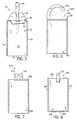
- Fig. 5 shows an envelope into which insect control ingredient is being dispensed prior to completing the sealing of the pouch
- Fig. 6 is a second embodiment where the upper extending portion of the Fig. 1 embodiment has been replaced by a hanger;
- Fig. 7 is a third embodiment having integral grip tabs extending from each pouch wall
- Fig. 8 is a fourth embodiment having separately attached grip tabs at the front and back sides of the pouch;
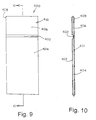
- Fig. 9 is a fifth embodiment having an intermediate seal
- Fig. 10 is a cross-sectional view of the embodiment of Fig. 9 taken along section lines 10-10 of Fig. 9;
- Fig. 11 is a sixth embodiment of a laminate version
- Fig. 12 is a cross-sectional view of the embodiment of Fig. 11 taken along lines 12-12 of Fig. 11.
- pouch 10 of the present invention is formed from a polymeric film substrate 12 that is coated on a side (inside surfaces of one or both opposed walls 26 and 28) with insect control ingredient 14 dissolved in a solvent.
- the preferred insect control active 14 is transfluthrin ((IR-trans)-(2,3,5,6-tetrafluorophenyl) methyl 3-(2,2-dichoroethenyl)-2,2-dimethyl cyclopropane carboxylate - also called Bayothrin or NAK 4455).
- Transfluthrin is effective at low concentrations against flying insects, particularly mosquitoes, flies, cockroaches, and moths, and has sufficient volatility to attain these low but effective concentrations at typical room temperatures. Its extremely rapid knock-down property, even at very low concentrations and application rates, makes this chemical particularly suitable for passive evaporation insect control devices.
- the active ingredient 14 may be other suitable actives as well, such as pyrethrum and pyrethroid type materials commonly used in mosquito coils. As alluded to above, these actives include d-allethrin, allethrin, prallethrin, bioallethrin, s-bioallethrin, esbiothrin, dichlorvos, transfluthrin, tefluthrin, vapothrin, and combinations thereof.
- Other suitable insect control actives include the repellants DEET, citronella, lemon grass oil, lavender oil, cinnamon oil, neem oil, clove oil, sandalwood oil and geraniol as well as the insect growth regulators, such as hydroprene. Combinations of such ingredients are also possible.
- the solvent is preferably a hydrocarbon solvent, such as Isopar, owing to the ability of such solvents to solubilize the active ingredient and permit uniform distribution of the active ingredient on the substrate without adversely affecting the substrate. Such solvents also volatilize rapidly without substantially volatilizing the active ingredients. Other solvents known for use with such volatiles may also be used.
- the substrate 12 must be made of a material capable receiving and holding the active ingredient and readily releasing it by passive evaporation.
- the substrate 12 should also be inert and essentially non-absorbing (preferably having a solubility less than 40 ⁇ g/cm 2 ) so as to provide low resistance to the diffusion of the active ingredient into the ambient air.
- the substrate 12 must also be vapor impermeable and hermetically sealable.
- a preferred substrate material is a acrylonitrile methacrylate copolymer film, such as Barex® 210 and 218 available from BP Chemicals/Amoco.
- suitable non-absorbing polymeric films include, without limitation, polyester, polyvinylidene chloride e.g. Saran, orientated high density polyethylene, nylon, polyvinyl alcohol, orientated polypropylene, and ethylene vinyl alcohol.
- the substrate 12 is preferably a thin strip having flaps 16 and 18 at its ends that are free of the active ingredient 14, with flap 18 being truncated so that the flaps 16 and 18 are of different sizes. Flaps 16 and 18 also have through holes 22 and 24, which provide locations for attaching a hanger 20, as shown in Fig. 4. If desired, only one such hole need be formed. Examples of suitable hanger 20 and other attachment means include hooks, strings, magnetic clips, clamps, hook and loop fasteners, mechanical clips and fasteners, adhesives, and the like.
- a preferred fastener arrangement includes adhesive strips attached to one or both flaps, with holes or ties provided in or for attachment to the strips. Any such means provided on the substrate should not substantially block the passage of air over the substrate.
- the pouch 10 has front 26 and back sides 28 with the facing surfaces coated with the active ingredient 14 to define a cavity between the opposed walls.
- the substrate 12 is folded in two along a fold line 30 slightly off the mid-point of the substrate 12 so that the back side flap 18 extends past the front side flap 16.
- Each side 26 and 28 share a common bottom 32 and a top 34 and lateral 36 and 38 edges are initially open prior to being sealed.
- the lateral edges 36 and 38 can then be sealed, preferably using a releasable sealing technique, such as pressure sealing, heat sealing, or ultrasonic welding.
- a releasable sealing technique such as pressure sealing, heat sealing, or ultrasonic welding.
- the seal must be a vapor impermeable seal.
- Other sealing techniques can be used, such as using a pressure sensitive adhesive.
- front 26 and back 28 sides may initially be two separate pieces of substrate. In that case, the films would be placed on each other and need to be also sealed at the bottom.
- the substrate 12 is in the form of a pocket having an opening at the top 34.
- Any effective conventional method may be used to coat the substrate 12 with the active ingredient 14.
- the substrate 12 is preferably coated with the active ingredient by dissolving an appropriate amount of the active ingredient in a hydrocarbon solvent and thoroughly wetting the pouch 10 interior by injecting the solvent into the pocket, for example through tip 40 of an applicator. In this manner, no active ingredient 14 contacts the flaps 16 and 18. At this point, the top of the pocket can be heat sealed to form the pouch.
- Such pouches 10 can be formed using high speed automation equipment. Multiple insect strips can be cut from a self-wound reel of the substrate at a width equal to the unfolded length of the substrate 12. Then multiple strips can be simultaneously folded lengthwise.
- the cuts can be made after the initial folding, using a hot knife or wire sealing technique.
- the folded substrate can simultaneously be heat sealed and cut at the sides' edges.
- the active ingredient can then be added to each envelope through the opening at the top which is then bar heat sealed.
- a hanger hole is provided and corners of the flaps are cut for aesthetics.
- the inside surface of the pre or post folded length of substrate can be coated with the active ingredient before the cutting and sealing steps.
- the preferred conditions for a Barex® film coatable with transfluthrin are that the sealing be conducted with a 1.3 second dwell time at 80 psi and 150-175°C.
- the pouch 10 can be activated by grasping flaps 16 and 18, and pulling in generally opposite directions until the top 34 and side edge 36 and 38 seals are broken and the substrate 12 is unfolded as shown in Fig. 4.
- the hanger 20 may be inserted into either of the through holes 22 and 24 and the resulting strip can be suspended by a suitable hook, bar or ledge (e.g. on a closet clothes bar).
- Strips of the present invention can be placed in any environment where there is some air movement passing over the coated side of the substrate 12, thereby allowing the active ingredient 14 to continuously passively evaporate into the atmosphere for an extended period of time.
- Suitable environments include enclosed rooms as well as volumes of open air space, such as patios, and the like.
- the invention is used to control mosquitoes, but it may also be used to control a wide variety of other flying insects by suitable selection of the insecticide or repellant.
- FIG. 6 an alternate embodiment 100 is shown where substrate 102 is cut to define a hanger portion 104.
- a smaller flap 106 integral with the front side of the pouch extends past the top seal 108.
- the pouch is opened by grasping the hanger 104 and the flap 106 pulling in opposing directions, as described above. Once opened, the insect strip can be suspended by the hanger 104.
- a second alternate embodiment 200 has substrate 202 cut or augmented so that when the pouch is formed a pair of grip tabs 204 and 206, for unfolding the pouch, extend in non-overlapping fashion from the top seal 208 of the front and back sides of the pouch.
- the grip tabs 204 and 206 can be integral with the substrate 202. Or, the grip tabs 204 and 206 can be sealed or adhered to the substrate 202 at the top seal 208.
- a hanger attachment location such as a through hole, could be provided at one or both of the grip tabs.
- Figure 8 shows yet another alternate embodiment 300, in which the substrate 302 is formed from two separate film sheets placed one on top of another. All four edges (including bottom 303) are sealed using a sealing process.
- Two grip tabs 304 (one shown) are adhered to the front and back sides for separating the top 306 and lateral seals 308 and 310. The adhesive used to attach these must create a stronger bond than the heat seal along the top and sides of the pouch.
- a hanger attachment location such as a through hole, could be provided at one or both of the grip tabs 304.
- Figures 9 and 10 show yet another alternative embodiment, pouch 400, preferred for its ability to be opened reliably, without tearing problems that can occur in other embodiments.
- the pouch 400 has opposed walls 401,403 but is also subdivided by an intermediate seal 402 into first and second chambers 404,406. The remaining margins of both chambers are sufficiently sealed as to prevent passage of the volatile active even when in vapor form.
- at least one interior surface of the first 404 of the two chambers is coated with the volatile active to be dispensed.
- the interior surfaces of the second chamber 406 are free of any such coating of volatile active.
- the end 408 of the second chamber 406 remote from the intermediate seal 402 is tearable to allow a user to open the second chamber and grasp the opposed walls thereof to then part the intermediate seal 402 and expose the interior surfaces of the first chamber 404. It will be apparent that this arrangement allows a user to tear open the first chamber 404 while avoiding having to touch any volatile active-coated surface.
- an intermediate seal made sufficiently complete to contain volatile active even in vapor form also is mechanically strong enough that a user can tear the pouch walls before the intermediate seal opens, resulting in an unreliably openable product.
- the intermediate seal 402 is made adequate to prevent the passage there through of the volatile active when it is in liquid or solid form, even though it may not be adequate to prevent the passage of active in vapor form.
- This lesser sealing requirement allows the intermediate seal 402 to also be sufficiently releasable mechanically that the intermediate seal opens without any tearing of the opposed walls 401,403. Vapor is contained within the second chamber 406 and within the entire pouch 400, by the vapor-tight seal around the remaining margins of the first and second chambers 404,406.
- the opposed walls at a sealed margin of the second chamber 406 at a location remote from the intermediate seal 402 include a notch 410 that provides a point of mechanical weakness to make easier a user's tearing open the end of the second chamber.
- FIGs 11 and 12 show still another alternative embodiment.
- the pouch is formed from a single sheet of laminate folded back on itself with one layer 506 and another layer 507. As can be appreciated from Fig. 12, the sheet is folded back on itself so that the layer 507 is at the interior.
- An outer seal 505/508 surrounds the pouch to enclose the insecticide 520 in the lower chamber 504.
- Two through holes 513 and 514 are provided which are surrounded by seal areas 516 around their entire circumference.
- the holes are disposed off the central axis of the pouch so that someone ripping open the pouch starting with a tear point 510 or 511 would be unlikely to tear through both such holes. It should be recognized that this positioning of the sealed holes could be used even without a laminate structure.
- seal 502 is a relatively weak seal (to permit ease of separation after the pouch has been torn open), some vapors of the insecticide may leak past seal 502 during storage. However, because of additional seal areas 516 they will be trapped during storage. Thus, this embodiment maximizes the likelihood that a hanger will survive the opening of the pouch, without compromising the enclosure during storage.
- the end of the pouch with the tear points is tearable to allow a user to open the second chamber and grasp the opposed walls thereof to then part the intermediate seal 502 and expose the interior surfaces of the first chamber 504.
- control agent be selected from the group consisting of transfluthrin, tefluthrin, prallethrin, vapothrin, esbiothrin, dichlovos, and combinations thereof.
- the active dispensing articles of the present invention could be formed in still other embodiments. These are also intended to be within the scope of the present invention.
- the active can instead (or also) be a fragrancer/deodorizer, using any of a wide variety of such volatiles known in the art (e.g. citronella, limonene, eucalyptus). Accordingly, the claims should be referenced in order to determine the full scope of the invention.
- the invention provides a hangable strip allowing for passive evaporation of an active ingredient, in which no separate outer layer or envelope is required.
Landscapes
- Life Sciences & Earth Sciences (AREA)
- Pest Control & Pesticides (AREA)
- Health & Medical Sciences (AREA)
- General Health & Medical Sciences (AREA)
- Toxicology (AREA)
- Engineering & Computer Science (AREA)
- Insects & Arthropods (AREA)
- Wood Science & Technology (AREA)
- Zoology (AREA)
- Environmental Sciences (AREA)
- Epidemiology (AREA)
- Animal Behavior & Ethology (AREA)
- Public Health (AREA)
- Veterinary Medicine (AREA)
- Catching Or Destruction (AREA)
- Agricultural Chemicals And Associated Chemicals (AREA)
- Bag Frames (AREA)
- Packages (AREA)
- Packaging Of Annular Or Rod-Shaped Articles, Wearing Apparel, Cassettes, Or The Like (AREA)
Description
- The present invention relates generally to dispersing actives into the air according to the preamble of claim 1. A similar article is already disclosed by US-A-4 145 001. It appears especially well suited to disperse insect control actives such as insect repellants and insecticides to control flying insects that may be present in indoor rooms.
- It is beneficial to control flying insects within buildings. Insect control is also useful in other areas, including screened areas such as tents, that are subject to invasion by flying insects.
- Devices that dispense insecticide vapors to control insects in such settings traditionally require heating or burning a liquid or solid to disperse the active ingredients. Products that use a heat source may require a safe burning site, e.g. in the case of insect coils, or may require a source of electrical current for typical heated evaporation products.
- Thus, techniques have been designed to dispense such insect control actives (and other actives such as fragrances and deodorizers) by employing passive evaporation, i.e. evaporation without the application of heat. For example, WO96/32843 describes an insect strip to control flying insects, the strip having a substrate that is impregnated with an active ingredient available for passive evaporation. The active ingredient is selected from transfluthrin, prallethrin, vapothrin, tefluthrin, esbiothrin, dichlovos (DDVP), and combinations thereof.
- Co-pending U.S. patent application 09/326,446, filed June 4, 1999, assigned to the assignee of the present invention, discloses insect control ingredients that can passively evaporate from non-absorbing substrate strips (such as those made of Barex® polymeric film) to control flying insects. The disclosures of this patent application and all other patent applications, patents, and publications referred to herein are incorporated by reference as if fully set forth herein.
- The vaporizable active ingredients of the aforementioned insect control devices are typically stored for shipment, sale, and home storage in some type of separate, tear open, vapor impermeable pouch or other container. The pouch or other container prevents the active ingredient from prematurely evaporating before insect control is required and also provides a way of avoiding having those handling the device accidentally contact the active during such non-use situations. Thus, in the past, both a substrate from which the active could passively vaporize and a sealed barrier pouch or container were needed. See also U.S. patent 5,487,932.
- However, this added material and assembly cost money. This is a significant problem, because these devices are often intended for use in areas of the world where the average income is exceedingly low while, at the same time, the rate of malaria and other flying insect borne disease is high. Thus, a need exists for developing ways to reduce the cost of such passive evaporation strips while still providing the functions of both a dispensing substrate and a sealed pouch or container for that substrate prior to its being needed for use.
- In one embodiment, the invention provides an article to dispense a volatile active such as insect control ingredients and fragrances, deodorizers, and other air modification volatile ingredients. The article has a pouch having opposed walls that are releasably sealed together to define an interior cavity there between. The walls thus having inside surfaces within the pouch and outside, exposed surfaces, the walls and seals being impermeable to the active. An inside surface of at least one of the walls is coated with a vaporizable active. The term "coated" is herein defined to include all means of surface treating such that a surface carries the material with which it is coated. The pouch is impermeable to the active contained therein and has an outside, exposed surface. No separable, active-bearing article is contained within the pouch with, instead, the inside surfaces of the pouch being the only structure of the article coated with the vaporizable active. Both of the opposed walls are single layer walls.
- In preferred embodiments, the pouch is formed by folding a strip of polymeric film upon itself, with the fold constituting a first side of the pouch. The remaining sides are releasably sealed. Preferably the pouch is generally rectangular, having the folded side and three remaining, sealed sides. Alternatively, two sheets of the film could be placed on each other and then sealed on all sides, again preferably in rectangular shape with four, sealed sides. For ease of description, and unless a contrary meaning is clearly intended in the context, pouches or sheets of material will be referred to as having four "sides" even if their shape is actually rounded, irregular, or has in literal fact more than four sides, the reference to a shape having four sides simply intended to describe a closed figure. Thus, a circle, oblong, square, triangle, pentagon, or other closed figure will be equally referred to as figures having "four sides".
- The sealing is preferably heat sealing, such as hot wire sealing or sealing using a heat sealing bar, preferably the sealing bar being 0.5mm-12.7mm wide. A narrow, hot seal is desirable for creating a vapor-tight seal. If only a liquid-tight seal is desired, as will be discussed below, a broader seal width created with a cooler sealing device is preferable.
- The pouch can have, extending from its end, a portion that is free of the active, which portion has a through hole or is in the form of a hanger. Alternatively or additionally, the extending portion can be in the form of a pair of unsealed flaps extending from the opposed walls at a sealed side of the pouch to form tabs extending beyond the point of sealing to facilitate the opening of the pouch. If desired, the flaps can be of different sizes, and one of the flaps can include a through hole.
- The interior surface of the pouch can be textured, corrugated, or otherwise modified to increase its surface area, thus providing the ability to hold a greater amount of volatile active than would otherwise be the case, extending the time over which volatile remains to be released from an opened pouch.
- The pouch can be subdivided by an intermediate seal into two chambers, the remaining outside margins of both chambers being sufficiently sealed as to prevent passage of the volatile active even when in vapor form. At least one interior surface of a first of the two chambers is coated with the volatile active to be dispensed.
- The end of the second chamber remote from the intermediate seal is tearable to allow a user to open the second chamber to grasp the opposed walls thereof to then part the weak intermediate seal and expose the interior surfaces of the first chamber. It will be apparent that this arrangement allows a user to tear open the first chamber while substantially avoiding having to touch any volatile active-coated surface.
- If the intermediate seal is made sufficiently complete to contain volatile active even in vapor form, a user might tear lateral pouch walls before the intermediate seal opens, resulting in a somewhat unreliably openable product. To avoid this, the intermediate seal can be made adequate to completely prevent the passage there through of the volatile active when it is in liquid or solid form, even though it may not be adequate to prevent the passage of active in vapor form to the second chamber. This lesser sealing requirement allows the intermediate seal to also be sufficiently releasable that the intermediate seal opens without any tearing of the opposed lateral walls. Any leaking vapor is then contained within the second chamber by the vapor-tight seal around its remaining margins. This arrangement provides a reliably openable article that remains vapor tight.
- Preferably the opposed walls at a sealed margin of the second chamber, at a location remote from the intermediate seal, include a notch that provides a point of mechanical weakness to make easier a user's tearing open the end of the second chamber.
- Also, if desired, a through hole can be provided through opposed lateral walls of the second chamber (to provide a hanger hole once the pouch is opened). However, for those embodiments where the intermediate seal is a weak one, the circumference of the hanger hole should be completely sealed.
- Where such a hole is used with a weakened tear point adjacent thereto, there is some risk that a consumer, while tearing open the second chamber, may tear in a way that also breaks the hole, thereby destroying the hanger feature. To reduce the risk of completely losing the hanger capability, it is desirable to place the hole off center, and even more desirable to use multiple such through holes.
- While a wide variety of vaporizable insecticides, repellants, and insect growth regulators may be suitable insect control ingredients, it is highly desirable for insect control purposes that the control agent be selected from the group consisting of transfluthrin, tefluthrin, prallethrin, vapothrin, esbiothrin, dichlovos, and combinations thereof.
- Preferred materials for forming the pouch are .0127 mm to 1524 mm thick films of acrylonitrile methacrylate copolymer, polyester, polyvinylidene chloride, orientated polyethylene, nylon, polyvinyl alcohol, orientated polypropylene, and ethylene vinyl alcohol. They are all vapor impermeable, heat sealable, and provide suitable relatively non-absorbent surfaces that can be coated with the active. These surfaces also have sufficiently high surface energy that the insecticide solutions easily wet and spread on them.
- Most preferably, the insect control ingredient is transfluthrin, and the walls are formed of a modified acrylonitrile methacrylate copolymer such as the material sold as Barex® 210 or Barex® 218 (both available from BP Chemicals/Amoco).
- A suitable method of forming such a pouch is where one obtains a pocket formed of polymeric film, injects a selected active in the pocket, and so heat seals the pocket as to form an enclosed pouch with the active releasably trapped therein.
- The invention also provides a method of controlling flying insects. One obtains an article according to the invention, opens the pouch to form a strip, and then hangs the strip in a selected environment such that an insect control ingredient can vaporize into the environment.
- An alternative method of forming such a pouch, is where one obtains a polymeric film, coats a surface of the film with the active, folds the film upon itself so that the coated surface is an inward surface, and heat seals at least three peripheral sides of the resulting structure to form an enclosed pouch with active releasably trapped therein.
- A further method of forming such a pouch, is where one obtains two sheets of polymeric film, coats a surface of at least one of the sheets with the active, places the sheets upon each other so that said surface faces the other sheet, and heat seals peripheral sides of the resulting structure to form an enclosed pouch with the active releasably trapped therein.
- It will be appreciated from the discussion herein that the inventors of the present invention have identified vapor impermeable, releasably sealable materials that are also suitable to be a substrate for an active insect control ingredient. The present invention thus avoids the need for a separate pouch to house the coated substrate.
- Preferably, hot knife and bar heat sealing processes are used to releasably seal the pouch. In this way, the pouch can be hermetically sealed to prevent the insect control ingredient from escaping during storage, but can be easily peeled apart for use.
- Another advantage is that the strip substrate can be formed to have a free end extending from one end of the pouch, that free end being kept free (or substantially free) of the insect control ingredient and thus being available to be handled by a user to open the pouch or hang the strip substrate without having to contact the insect control ingredient.
The present invention thus provides a very low-cost vapor dispersing article wherein the strip substrate acts as a base for the vaporizable active and also forms the sides of a vapor impermeable pouch. - These and still other advantages of the invention will appear from the following description. In the description reference is made to the accompanying drawings which from a part hereof and in which there is shown by way of illustration preferred embodiments of the invention. However, the claims should be looked to in order to judge the full scope of the invention.
- Fig. 1 is a front elevational view of a preferred pouch of the present invention;
- Fig. 2 is a side cross-sectional view of the pouch of Fig. 1;
- Fig. 3 is an end view showing the Fig. 1 pouch in the process of being peeled open for use;
- Fig. 4. is a front elevational view showing the Fig. 1 pouch with a hanger inserted at its upper end, and having the pouch opened;
- Fig. 5 shows an envelope into which insect control ingredient is being dispensed prior to completing the sealing of the pouch;
- Fig. 6 is a second embodiment where the upper extending portion of the Fig. 1 embodiment has been replaced by a hanger;
- Fig. 7 is a third embodiment having integral grip tabs extending from each pouch wall;
- Fig. 8 is a fourth embodiment having separately attached grip tabs at the front and back sides of the pouch;
- Fig. 9 is a fifth embodiment having an intermediate seal;
- Fig. 10 is a cross-sectional view of the embodiment of Fig. 9 taken along section lines 10-10 of Fig. 9;
- Fig. 11 is a sixth embodiment of a laminate version; and
- Fig. 12 is a cross-sectional view of the embodiment of Fig. 11 taken along lines 12-12 of Fig. 11.
- Referring to the first page of drawings,
pouch 10 of the present invention is formed from apolymeric film substrate 12 that is coated on a side (inside surfaces of one or both opposedwalls 26 and 28) withinsect control ingredient 14 dissolved in a solvent. - The preferred insect control active 14 is transfluthrin ((IR-trans)-(2,3,5,6-tetrafluorophenyl) methyl 3-(2,2-dichoroethenyl)-2,2-dimethyl cyclopropane carboxylate - also called Bayothrin or NAK 4455). Transfluthrin is effective at low concentrations against flying insects, particularly mosquitoes, flies, cockroaches, and moths, and has sufficient volatility to attain these low but effective concentrations at typical room temperatures. Its extremely rapid knock-down property, even at very low concentrations and application rates, makes this chemical particularly suitable for passive evaporation insect control devices.
- The
active ingredient 14 may be other suitable actives as well, such as pyrethrum and pyrethroid type materials commonly used in mosquito coils. As alluded to above, these actives include d-allethrin, allethrin, prallethrin, bioallethrin, s-bioallethrin, esbiothrin, dichlorvos, transfluthrin, tefluthrin, vapothrin, and combinations thereof.
Other suitable insect control actives include the repellants DEET, citronella, lemon grass oil, lavender oil, cinnamon oil, neem oil, clove oil, sandalwood oil and geraniol as well as the insect growth regulators, such as hydroprene. Combinations of such ingredients are also possible. - The solvent is preferably a hydrocarbon solvent, such as Isopar, owing to the ability of such solvents to solubilize the active ingredient and permit uniform distribution of the active ingredient on the substrate without adversely affecting the substrate. Such solvents also volatilize rapidly without substantially volatilizing the active ingredients. Other solvents known for use with such volatiles may also be used.
- The
substrate 12 must be made of a material capable receiving and holding the active ingredient and readily releasing it by passive evaporation. Thesubstrate 12 should also be inert and essentially non-absorbing (preferably having a solubility less than 40 µg/cm2) so as to provide low resistance to the diffusion of the active ingredient into the ambient air. Thesubstrate 12 must also be vapor impermeable and hermetically sealable. - A preferred substrate material is a acrylonitrile methacrylate copolymer film, such as Barex® 210 and 218 available from BP Chemicals/Amoco. Other suitable non-absorbing polymeric films include, without limitation, polyester, polyvinylidene chloride e.g. Saran, orientated high density polyethylene, nylon, polyvinyl alcohol, orientated polypropylene, and ethylene vinyl alcohol.
- The
substrate 12 is preferably a thinstrip having flaps active ingredient 14, withflap 18 being truncated so that theflaps Flaps holes hanger 20, as shown in Fig. 4. If desired, only one such hole need be formed. Examples ofsuitable hanger 20 and other attachment means include hooks, strings, magnetic clips, clamps, hook and loop fasteners, mechanical clips and fasteners, adhesives, and the like. A preferred fastener arrangement includes adhesive strips attached to one or both flaps, with holes or ties provided in or for attachment to the strips. Any such means provided on the substrate should not substantially block the passage of air over the substrate. - As best seen in Figs. 1 and 2, the
pouch 10 hasfront 26 and back sides 28 with the facing surfaces coated with theactive ingredient 14 to define a cavity between the opposed walls. Preferably, thesubstrate 12 is folded in two along afold line 30 slightly off the mid-point of thesubstrate 12 so that theback side flap 18 extends past thefront side flap 16. Eachside common bottom 32 and a top 34 andlateral - The lateral edges 36 and 38 can then be sealed, preferably using a releasable sealing technique, such as pressure sealing, heat sealing, or ultrasonic welding. In any case, the seal must be a vapor impermeable seal. Other sealing techniques can be used, such as using a pressure sensitive adhesive.
- Note also that is possible for the front 26 and back 28 sides to initially be two separate pieces of substrate. In that case, the films would be placed on each other and need to be also sealed at the bottom.
- Referring now to Fig. 5, at this point the
substrate 12 is in the form of a pocket having an opening at the top 34. Any effective conventional method may be used to coat thesubstrate 12 with theactive ingredient 14. Thesubstrate 12 is preferably coated with the active ingredient by dissolving an appropriate amount of the active ingredient in a hydrocarbon solvent and thoroughly wetting thepouch 10 interior by injecting the solvent into the pocket, for example throughtip 40 of an applicator. In this manner, noactive ingredient 14 contacts theflaps -
Such pouches 10 can be formed using high speed automation equipment. Multiple insect strips can be cut from a self-wound reel of the substrate at a width equal to the unfolded length of thesubstrate 12. Then multiple strips can be simultaneously folded lengthwise. - Alternatively, and probably preferably, the cuts can be made after the initial folding, using a hot knife or wire sealing technique. In this manner, the folded substrate can simultaneously be heat sealed and cut at the sides' edges. As described above and shown in Fig. 5, the active ingredient can then be added to each envelope through the opening at the top which is then bar heat sealed. A hanger hole is provided and corners of the flaps are cut for aesthetics. Alternatively, prior to cutting, the inside surface of the pre or post folded length of substrate can be coated with the active ingredient before the cutting and sealing steps.
- In either case the preferred conditions for a Barex® film coatable with transfluthrin are that the sealing be conducted with a 1.3 second dwell time at 80 psi and 150-175°C.
- Referring now to Fig. 3, the
pouch 10 can be activated by graspingflaps side edge substrate 12 is unfolded as shown in Fig. 4. Thehanger 20 may be inserted into either of the throughholes - Strips of the present invention can be placed in any environment where there is some air movement passing over the coated side of the
substrate 12, thereby allowing theactive ingredient 14 to continuously passively evaporate into the atmosphere for an extended period of time. Suitable environments include enclosed rooms as well as volumes of open air space, such as patios, and the like. Preferably the invention is used to control mosquitoes, but it may also be used to control a wide variety of other flying insects by suitable selection of the insecticide or repellant. - Referring now to Fig. 6, an
alternate embodiment 100 is shown where substrate 102 is cut to define ahanger portion 104. Asmaller flap 106 integral with the front side of the pouch extends past thetop seal 108. The pouch is opened by grasping thehanger 104 and theflap 106 pulling in opposing directions, as described above. Once opened, the insect strip can be suspended by thehanger 104. - Referring next to Fig. 7, a second
alternate embodiment 200 hassubstrate 202 cut or augmented so that when the pouch is formed a pair ofgrip tabs top seal 208 of the front and back sides of the pouch. Thegrip tabs substrate 202. Or, thegrip tabs substrate 202 at thetop seal 208. Although not shown, a hanger attachment location, such as a through hole, could be provided at one or both of the grip tabs. - Figure 8 shows yet another
alternate embodiment 300, in which thesubstrate 302 is formed from two separate film sheets placed one on top of another. All four edges (including bottom 303) are sealed using a sealing process. Two grip tabs 304 (one shown) are adhered to the front and back sides for separating the top 306 andlateral seals grip tabs 304. - Figures 9 and 10 show yet another alternative embodiment,
pouch 400, preferred for its ability to be opened reliably, without tearing problems that can occur in other embodiments. Corresponding with the previous embodiments, thepouch 400 has opposed walls 401,403 but is also subdivided by anintermediate seal 402 into first and second chambers 404,406. The remaining margins of both chambers are sufficiently sealed as to prevent passage of the volatile active even when in vapor form. As in the embodiments previously discussed, at least one interior surface of the first 404 of the two chambers is coated with the volatile active to be dispensed. In contrast, the interior surfaces of thesecond chamber 406 are free of any such coating of volatile active. - The
end 408 of thesecond chamber 406 remote from theintermediate seal 402 is tearable to allow a user to open the second chamber and grasp the opposed walls thereof to then part theintermediate seal 402 and expose the interior surfaces of thefirst chamber 404. It will be apparent that this arrangement allows a user to tear open thefirst chamber 404 while avoiding having to touch any volatile active-coated surface. - Sometimes an intermediate seal made sufficiently complete to contain volatile active even in vapor form also is mechanically strong enough that a user can tear the pouch walls before the intermediate seal opens, resulting in an unreliably openable product. To avoid this, in the most preferred embodiment, the
intermediate seal 402 is made adequate to prevent the passage there through of the volatile active when it is in liquid or solid form, even though it may not be adequate to prevent the passage of active in vapor form. This lesser sealing requirement allows theintermediate seal 402 to also be sufficiently releasable mechanically that the intermediate seal opens without any tearing of the opposed walls 401,403. Vapor is contained within thesecond chamber 406 and within theentire pouch 400, by the vapor-tight seal around the remaining margins of the first and second chambers 404,406. This arrangement provides a reliably openable article that remains vapor tight. Preferably the opposed walls at a sealed margin of thesecond chamber 406 at a location remote from theintermediate seal 402 include anotch 410 that provides a point of mechanical weakness to make easier a user's tearing open the end of the second chamber. - Figures 11 and 12 show still another alternative embodiment. The pouch is formed from a single sheet of laminate folded back on itself with one
layer 506 and anotherlayer 507. As can be appreciated from Fig. 12, the sheet is folded back on itself so that thelayer 507 is at the interior. Anouter seal 505/508 surrounds the pouch to enclose theinsecticide 520 in thelower chamber 504. - As was the case with the Fig. 9 embodiment, there is an
intermediate seal 502. However, there are now two opposedtear point indentations - Two through
holes seal areas 516 around their entire circumference. The holes are disposed off the central axis of the pouch so that someone ripping open the pouch starting with atear point - If
seal 502 is a relatively weak seal (to permit ease of separation after the pouch has been torn open), some vapors of the insecticide may leakpast seal 502 during storage. However, because ofadditional seal areas 516 they will be trapped during storage. Thus, this embodiment maximizes the likelihood that a hanger will survive the opening of the pouch, without compromising the enclosure during storage. - As was the case with the Fig. 9 embodiment, the end of the pouch with the tear points is tearable to allow a user to open the second chamber and grasp the opposed walls thereof to then part the
intermediate seal 502 and expose the interior surfaces of thefirst chamber 504. - While a wide variety of vaporizable insecticides, repellants, and insect growth regulators may be suitable insect control ingredients, it is highly desirable for insect control purposes that the control agent be selected from the group consisting of transfluthrin, tefluthrin, prallethrin, vapothrin, esbiothrin, dichlovos, and combinations thereof.
- It should be appreciated that the active dispensing articles of the present invention could be formed in still other embodiments. These are also intended to be within the scope of the present invention. For example, the active can instead (or also) be a fragrancer/deodorizer, using any of a wide variety of such volatiles known in the art (e.g. citronella, limonene, eucalyptus). Accordingly, the claims should be referenced in order to determine the full scope of the invention.
- The invention provides a hangable strip allowing for passive evaporation of an active ingredient, in which no separate outer layer or envelope is required.
Claims (19)
- An article to dispense a volatile active (14), comprising a pouch (10) having opposed walls (26, 28) that are releasably sealed together to define an interior cavity there between, the walls thus having inside surfaces within the pouch (10) and outside, exposed surfaces, the walls and seals being impermeable to the active, an inside surface of at least one of said walls being coated with the vaporizable active (14) characterised in that both of the opposed walls are single layer walls and wherein no separable, active-bearing article is contained within the pouch (10).
- The article of claim 1, wherein the pouch has a portion extending from an end of the pouch, which portion is free of the active.
- The article of claim 2, wherein the extending portion includes a through hole.
- The article of claim 2, wherein the extending portion comprises a pair of unsealed flaps extending from the opposed walls at a side of the pouch to form tabs to facilitate opening of the pouch.
- The article of claim 4, wherein the flaps are different sizes.
- The article of claim 5, wherein at least one of the flaps includes a through hole.
- The article of claim 2, wherein the extending portion defines a hook for suspending the pouch once it is opened.
- The article of claim 1, further comprising a grip tab adhered to the pouch.
- The article of claim 1, wherein the active is an insect control ingredient selected from the group consisting of transfluthrin, tefluthrin, prallethrin, vapothrin, esbiothrin, dichlovos, and combinations thereof.
- The article of claim 1, wherein the walls are formed from a material selected from the group of acrylonitrile methacrylate copolymer, polyester, polyvinylidene chloride, orientated polyethylene, nylon, polyvinyl alcohol, orientated polypropylene and ethylene vinyl alcohol films.
- The article of claim 1 wherein an interior surface of the pouch is textured, corrugated or otherwise modified to increase its surface area, thus providing the ability to hold a greater amount of volatile active than would otherwise be the case, extending the time over which volatile remains to be released from an opened pouch.
- The article of claim 1 wherein the pouch is subdivided by an intermediate seal into two chambers, the remaining margins of both chambers being sufficiently sealed as to prevent passage of the volatile active even when in vapor form, at least one interior surface of a first of the two chambers being coated with the volatile active to be dispensed, the end of the second chamber remote from the intermediate seal being tearable to allow a user to open the second chamber to grasp opposed walls thereof to then part the intermediate seal and expose the interior surfaces of the first chamber, the intermediate seal being adequate to prevent the passage there through of the volatile active when in liquid or solid form while also being sufficiently releasable that the intermediate seal opens without any tearing of the opposed walls.
- The article of claim 12 wherein the opposed walls at a sealed margin of the second chamber at a location remote from the intermediate seal include a notch that provides a point of mechanical weakness to make easier a user's tearing open the end of the second chamber.
- The article of claim 12 wherein the opposed walls at sealed margins of the second chamber at two opposed locations remote from the intermediate seal each include a notch that provides a point of mechanical weakness to make easier a user's tearing open the end of the second chamber.
- The article of claim 12, wherein there is a through hole extending through the opposed walls of the second chamber.
- The article of claim 15, wherein a circumferential edge of the through hole is sealed from the second chamber.
- The article of claim 16, wherein the through hole is not aligned with a central axis of the article.
- The article of claim 17, wherein there are two such through holes.
- A method of controlling flying insects comprising the steps of:obtaining an article according to any one of claims 1 to 18 having an insect control ingredient as the active;opening a pouch to form a strip; andhanging the strip in a selected environment such that insect control ingredient can vaporize into the environment.
Applications Claiming Priority (3)
| Application Number | Priority Date | Filing Date | Title |
|---|---|---|---|
| US619118 | 2000-07-19 | ||
| US09/619,118 US6360477B1 (en) | 2000-07-19 | 2000-07-19 | Insect control pouch |
| PCT/US2001/007675 WO2002007512A1 (en) | 2000-07-19 | 2001-03-09 | Insect control pouch |
Publications (2)
| Publication Number | Publication Date |
|---|---|
| EP1301070A1 EP1301070A1 (en) | 2003-04-16 |
| EP1301070B1 true EP1301070B1 (en) | 2006-05-31 |
Family
ID=24480530
Family Applications (1)
| Application Number | Title | Priority Date | Filing Date |
|---|---|---|---|
| EP01918518A Expired - Lifetime EP1301070B1 (en) | 2000-07-19 | 2001-03-09 | Insect control pouch |
Country Status (17)
| Country | Link |
|---|---|
| US (1) | US6360477B1 (en) |
| EP (1) | EP1301070B1 (en) |
| JP (1) | JP3813124B2 (en) |
| KR (1) | KR100655688B1 (en) |
| CN (1) | CN1178576C (en) |
| AR (1) | AR029836A1 (en) |
| AT (1) | ATE327671T1 (en) |
| AU (2) | AU4558601A (en) |
| BR (1) | BR0112605A (en) |
| DE (1) | DE60120170T2 (en) |
| ES (1) | ES2262636T3 (en) |
| MX (1) | MXPA03000618A (en) |
| NZ (1) | NZ523706A (en) |
| PL (1) | PL359385A1 (en) |
| RU (1) | RU2003104834A (en) |
| WO (1) | WO2002007512A1 (en) |
| ZA (1) | ZA200300710B (en) |
Cited By (1)
| Publication number | Priority date | Publication date | Assignee | Title |
|---|---|---|---|---|
| WO2017069934A3 (en) * | 2015-10-19 | 2017-05-26 | The Procter & Gamble Company | Scented article |
Families Citing this family (53)
| Publication number | Priority date | Publication date | Assignee | Title |
|---|---|---|---|---|
| US6718686B2 (en) * | 2001-02-16 | 2004-04-13 | Robert E. Marsh | Insect removal device |
| US6928769B2 (en) * | 2001-08-07 | 2005-08-16 | Bugjammer, Inc. | Disposable insect-control member |
| US20030047844A1 (en) * | 2001-09-07 | 2003-03-13 | Jose Porchia | Method of producing an electrically charged film |
| US6899931B2 (en) | 2001-09-07 | 2005-05-31 | S. C. Johnson Home Storage, Inc. | Film material |
| US6846449B2 (en) * | 2001-09-07 | 2005-01-25 | S. C. Johnson Home Storage, Inc. | Method of producing an electrically charged film |
| US20030060350A1 (en) * | 2001-09-07 | 2003-03-27 | Taylor Pamela J. | Method of protecting a surface |
| AU2003222024B2 (en) * | 2002-03-22 | 2008-07-24 | University Of Florida Research Foundation Inc. | Hermetically sealed baits for subterranean termites |
| US20060263403A1 (en) * | 2003-04-24 | 2006-11-23 | Essam Enan | Compositions and methods for controlling insects involving the tyramine receptor |
| US7622269B2 (en) * | 2004-03-19 | 2009-11-24 | Tyratech, Inc. | Methods of screening tyramine- and octopamine-expressing cells for compounds and compositions having potential insect control activity |
| OA13160A (en) | 2003-04-24 | 2006-12-13 | Univ Vanderbilt | Compositions and methods for controlling insects. |
| US20040254322A1 (en) * | 2003-06-10 | 2004-12-16 | Trent John S. | Easily torn charged or uncharged films and methods and compositions for producing same |
| US20050005504A1 (en) * | 2003-06-30 | 2005-01-13 | Munagavalasa Murthy S. | Volatile insect control sheet and method of manufacture thereof |
| US7243788B2 (en) * | 2003-10-22 | 2007-07-17 | Kimberly-Clark Worldwide, Inc. | Package for segregating and mixing substances |
| US20050246943A1 (en) * | 2004-05-10 | 2005-11-10 | Hermann Neumann | Multi-season pest control system and method |
| US20080256843A1 (en) * | 2004-10-12 | 2008-10-23 | Bayer Healthcare Llc | Insect Bait Station |
| US7913699B2 (en) | 2006-01-31 | 2011-03-29 | U.S. Smokeless Tobacco Company Llc | Tobacco articles and methods |
| US7918231B2 (en) * | 2006-01-31 | 2011-04-05 | U.S. Smokeless Tobacco Company Llc | Tobacco articles and methods |
| US7819124B2 (en) | 2006-01-31 | 2010-10-26 | U.S. Smokeless Tobacco Company | Tobacco articles and methods |
| EP2030638B1 (en) * | 2006-02-23 | 2010-07-21 | Zobele Espana, S.A. | Disposable device for diffusion of volatile substances |
| US20070241132A1 (en) * | 2006-04-17 | 2007-10-18 | The Procter & Gamble Company | Pressurized package |
| US20070241133A1 (en) * | 2006-04-17 | 2007-10-18 | The Procter & Gamble Company | Container visible package |
| US20080145462A1 (en) * | 2006-06-27 | 2008-06-19 | Essam Enan | Compositions and methods for treating parasitic infections |
| US8685471B2 (en) * | 2006-07-17 | 2014-04-01 | Tyratech, Inc. | Compositions and methods for controlling insects |
| US8622206B2 (en) | 2006-09-08 | 2014-01-07 | The Procter & Gamble Company | Peel-to-open packages |
| US20080086932A1 (en) * | 2006-10-13 | 2008-04-17 | Cook Peter J | Insect-attraction apparatus |
| US20080115406A1 (en) | 2006-11-16 | 2008-05-22 | Duston Tyler D | Insect control tape |
| BRPI0806666A8 (en) * | 2007-01-16 | 2018-02-06 | Tyratech Inc | COMPOSITIONS AND METHOD FOR PEST CONTROL |
| ES2329640B1 (en) * | 2007-09-12 | 2010-09-13 | Zobele España S.A. | CONTAINER EVAPORATOR OF VOLATILE SUBSTANCES AND MANUFACTURING METHOD OF SUCH CONTAINER. |
| MX2010010216A (en) | 2008-03-19 | 2011-02-22 | Tyratech Inc | Pest control using natural pest control agent blends. |
| CN102036668A (en) * | 2008-03-19 | 2011-04-27 | 蒂拉德克公司 | Pest control compositions and methods |
| EP2389079B1 (en) | 2008-12-31 | 2013-07-24 | U.S. Smokeless Tobacco Company LLC | Smokeless tobacco articles |
| CN101816315A (en) * | 2010-03-23 | 2010-09-01 | 重庆市日用化学工业研究所 | Compound fumigation pesticide containing natural essential oil and preparation method thereof |
| USD733275S1 (en) | 2012-07-24 | 2015-06-30 | S.C. Johnson & Son, Inc. | Dispensing device |
| US9498554B2 (en) | 2012-07-24 | 2016-11-22 | S.C. Johnson & Son, Inc. | Dispensing device |
| US9204625B2 (en) | 2012-08-17 | 2015-12-08 | S.C. Johnson & Son, Inc. | Dispenser |
| US9649400B2 (en) | 2012-08-17 | 2017-05-16 | S.C. Johnson & Son, Inc. | Method and system for dispensing a composition |
| US8894044B2 (en) | 2012-08-17 | 2014-11-25 | S.C. Johnson & Son, Inc. | Dispenser |
| USD682408S1 (en) | 2012-09-28 | 2013-05-14 | S.C. Johnson & Son, Inc. | Substrate |
| USD717394S1 (en) | 2012-11-21 | 2014-11-11 | S.C. Johnson & Son, Inc. | Dispenser |
| US10694747B2 (en) | 2012-11-21 | 2020-06-30 | S. C. Johnson & Son, Inc. | Dispenser comprising only one single hinge |
| USD704813S1 (en) | 2013-06-17 | 2014-05-13 | S. C. Johnson & Son, Inc. | Dispenser |
| US9603352B2 (en) * | 2014-03-31 | 2017-03-28 | S. C. Johnson & Son, Inc. | Dispenser |
| USD722376S1 (en) | 2014-03-31 | 2015-02-10 | S.C. Johnson & Son, Inc. | Dispenser |
| US10377556B2 (en) | 2015-02-04 | 2019-08-13 | S.C. Johnson & Son, Inc. | Retaining apparatus |
| ES2815553T3 (en) * | 2015-02-27 | 2021-03-30 | Ecolab Usa Inc | System and method of treating articles with insecticide |
| US10561127B2 (en) * | 2016-09-09 | 2020-02-18 | Verily Life Sciences Llc | Blood feeding system using nonwoven fabric materials |
| ES2718131A1 (en) | 2017-12-27 | 2019-06-27 | Zobele Espana Sa | Volatile substances diffuser (Machine-translation by Google Translate, not legally binding) |
| USD896633S1 (en) | 2019-01-29 | 2020-09-22 | Golden State Foods Corp. | Container |
| USD896634S1 (en) | 2019-01-29 | 2020-09-22 | Golden State Foods Corp. | Container |
| US11825837B2 (en) * | 2019-06-04 | 2023-11-28 | S. C. Johnson & Son, Inc. | Dispenser and method of use thereof |
| USD916227S1 (en) | 2019-10-24 | 2021-04-13 | Enterprises of CC, Inc. | Flying insect trap |
| IT202000012352A1 (en) * | 2020-05-26 | 2021-11-26 | Tecnoline S P A | MEDICAL CONTAINER, FOR PLATELETS AND OTHER ORGANIC SUBSTANCES. |
| KR102741419B1 (en) * | 2022-02-15 | 2024-12-10 | 한림대학교 산학협력단 | Tea bay type trash bin drosophila repellent |
Family Cites Families (12)
| Publication number | Priority date | Publication date | Assignee | Title |
|---|---|---|---|---|
| DE81791C (en) * | ||||
| US3655129A (en) * | 1968-07-17 | 1972-04-11 | Ppg Industries Inc | Slow release films and methods of making same |
| US4158440A (en) | 1976-10-12 | 1979-06-19 | The Ridson Manufacturing Company | Device for releasing a volatile substance in a controlled manner |
| US4145001A (en) | 1977-09-15 | 1979-03-20 | American Can Company | Packaging for controlled release of volatile substances |
| US4270417A (en) * | 1980-03-17 | 1981-06-02 | Joseph Tesoro | Two-way ratchet wrench |
| US4720417A (en) * | 1984-12-11 | 1988-01-19 | Minnesota Mining And Manufacturing Company | Fragrance-releasing pull-apart sheet |
| ES2032425T3 (en) * | 1987-11-24 | 1993-02-16 | Pictoris Beta | SOLID DEODORANT OF GRANULAR TYPE AND ITS CORRESPONDING PACKAGE. |
| US5487932A (en) | 1992-06-12 | 1996-01-30 | Minnesota Mining And Manufacturing Company | Applicator wipe for viscous fluids |
| US5637401A (en) * | 1994-06-08 | 1997-06-10 | Fragrance Technology Trust | Odorant composition, delivery system and method |
| US6582714B1 (en) | 1995-04-10 | 2003-06-24 | S. C. Johnson & Son, Inc. | Article for insert control by passive evaporation of an active ingredient |
| US5961043A (en) | 1998-06-26 | 1999-10-05 | S. C. Johnson & Son, Inc. | Supporting device for dispensing volatile material |
| US6534079B1 (en) | 1999-06-04 | 2003-03-18 | S. C. Johnson & Son, Inc. | Passive space insect repellant strip |
-
2000
- 2000-07-19 US US09/619,118 patent/US6360477B1/en not_active Expired - Lifetime
-
2001
- 2001-03-09 EP EP01918518A patent/EP1301070B1/en not_active Expired - Lifetime
- 2001-03-09 AT AT01918518T patent/ATE327671T1/en not_active IP Right Cessation
- 2001-03-09 ES ES01918518T patent/ES2262636T3/en not_active Expired - Lifetime
- 2001-03-09 RU RU2003104834/12A patent/RU2003104834A/en not_active Application Discontinuation
- 2001-03-09 AU AU4558601A patent/AU4558601A/en active Pending
- 2001-03-09 PL PL01359385A patent/PL359385A1/en not_active Application Discontinuation
- 2001-03-09 NZ NZ523706A patent/NZ523706A/en not_active Application Discontinuation
- 2001-03-09 AU AU2001245586A patent/AU2001245586B2/en not_active Ceased
- 2001-03-09 CN CNB018143733A patent/CN1178576C/en not_active Expired - Lifetime
- 2001-03-09 MX MXPA03000618A patent/MXPA03000618A/en active IP Right Grant
- 2001-03-09 BR BR0112605-9A patent/BR0112605A/en not_active Application Discontinuation
- 2001-03-09 KR KR1020037000877A patent/KR100655688B1/en not_active Expired - Fee Related
- 2001-03-09 WO PCT/US2001/007675 patent/WO2002007512A1/en not_active Ceased
- 2001-03-09 JP JP2002513267A patent/JP3813124B2/en not_active Expired - Fee Related
- 2001-03-09 DE DE60120170T patent/DE60120170T2/en not_active Expired - Fee Related
- 2001-07-17 AR ARP010103409A patent/AR029836A1/en active IP Right Grant
-
2003
- 2003-01-27 ZA ZA200300710A patent/ZA200300710B/en unknown
Cited By (1)
| Publication number | Priority date | Publication date | Assignee | Title |
|---|---|---|---|---|
| WO2017069934A3 (en) * | 2015-10-19 | 2017-05-26 | The Procter & Gamble Company | Scented article |
Also Published As
| Publication number | Publication date |
|---|---|
| DE60120170D1 (en) | 2006-07-06 |
| CN1178576C (en) | 2004-12-08 |
| AU2001245586B2 (en) | 2004-11-18 |
| AU4558601A (en) | 2002-02-05 |
| CN1447648A (en) | 2003-10-08 |
| RU2003104834A (en) | 2004-12-27 |
| ZA200300710B (en) | 2004-02-25 |
| US6360477B1 (en) | 2002-03-26 |
| PL359385A1 (en) | 2004-08-23 |
| WO2002007512A1 (en) | 2002-01-31 |
| ATE327671T1 (en) | 2006-06-15 |
| EP1301070A1 (en) | 2003-04-16 |
| BR0112605A (en) | 2003-06-10 |
| AR029836A1 (en) | 2003-07-16 |
| ES2262636T3 (en) | 2006-12-01 |
| MXPA03000618A (en) | 2003-05-14 |
| KR20030027939A (en) | 2003-04-07 |
| KR100655688B1 (en) | 2006-12-11 |
| JP2004504041A (en) | 2004-02-12 |
| JP3813124B2 (en) | 2006-08-23 |
| NZ523706A (en) | 2004-06-25 |
| DE60120170T2 (en) | 2007-03-29 |
Similar Documents
| Publication | Publication Date | Title |
|---|---|---|
| US6360477B1 (en) | Insect control pouch | |
| AU2001245586A1 (en) | Insect control pouch | |
| US6296866B2 (en) | Insect combatant controlled/prolonged delivery device | |
| CA2017516C (en) | Controlled release system for insect attractant | |
| US6557778B1 (en) | Touchless volatile dispenser | |
| JP2007521304A (en) | Volatile pest control sheet and method for producing the same | |
| US12219956B2 (en) | Dispenser and method of use thereof | |
| JP5840407B2 (en) | How to avoid insect pests in food containers | |
| JP2002265304A (en) | Heated evaporator for pest control | |
| JP2003201205A (en) | Heated evaporator for pest control | |
| JP4167466B2 (en) | Transpiration liquid containing bag, heating transpiration method and apparatus | |
| US20260137079A1 (en) | Dispenser and method of use thereof | |
| JP2003043170A (en) | Time indicator | |
| JP4441017B2 (en) | Portable flying pest control device | |
| TH49504A (en) | Insect control bags |
Legal Events
| Date | Code | Title | Description |
|---|---|---|---|
| PUAI | Public reference made under article 153(3) epc to a published international application that has entered the european phase |
Free format text: ORIGINAL CODE: 0009012 |
|
| 17P | Request for examination filed |
Effective date: 20030205 |
|
| AK | Designated contracting states |
Designated state(s): AT BE CH CY DE DK ES FI FR GB GR IE IT LI LU MC NL PT SE TR |
|
| AX | Request for extension of the european patent |
Extension state: AL LT LV MK RO SI |
|
| RIN1 | Information on inventor provided before grant (corrected) |
Inventor name: SKALITZKY, MICHAEL, J. Inventor name: LAWSON, DANIEL, L. Inventor name: PARSONS, WILLIAM, G. Inventor name: POHLMANN, EDGAR Inventor name: FLASHINSKI, STANLEY, J. Inventor name: FRICKE, BRUNO, W. Inventor name: MUNAGAVALASA, MURTHY, S. |
|
| 17Q | First examination report despatched |
Effective date: 20050330 |
|
| GRAP | Despatch of communication of intention to grant a patent |
Free format text: ORIGINAL CODE: EPIDOSNIGR1 |
|
| GRAS | Grant fee paid |
Free format text: ORIGINAL CODE: EPIDOSNIGR3 |
|
| GRAA | (expected) grant |
Free format text: ORIGINAL CODE: 0009210 |
|
| AK | Designated contracting states |
Kind code of ref document: B1 Designated state(s): AT BE CH CY DE DK ES FI FR GB GR IE IT LI LU MC NL PT SE TR |
|
| PG25 | Lapsed in a contracting state [announced via postgrant information from national office to epo] |
Ref country code: IT Free format text: LAPSE BECAUSE OF FAILURE TO SUBMIT A TRANSLATION OF THE DESCRIPTION OR TO PAY THE FEE WITHIN THE PRESCRIBED TIME-LIMIT;WARNING: LAPSES OF ITALIAN PATENTS WITH EFFECTIVE DATE BEFORE 2007 MAY HAVE OCCURRED AT ANY TIME BEFORE 2007. THE CORRECT EFFECTIVE DATE MAY BE DIFFERENT FROM THE ONE RECORDED. Effective date: 20060531 Ref country code: FI Free format text: LAPSE BECAUSE OF FAILURE TO SUBMIT A TRANSLATION OF THE DESCRIPTION OR TO PAY THE FEE WITHIN THE PRESCRIBED TIME-LIMIT Effective date: 20060531 Ref country code: AT Free format text: LAPSE BECAUSE OF FAILURE TO SUBMIT A TRANSLATION OF THE DESCRIPTION OR TO PAY THE FEE WITHIN THE PRESCRIBED TIME-LIMIT Effective date: 20060531 Ref country code: LI Free format text: LAPSE BECAUSE OF FAILURE TO SUBMIT A TRANSLATION OF THE DESCRIPTION OR TO PAY THE FEE WITHIN THE PRESCRIBED TIME-LIMIT Effective date: 20060531 Ref country code: CH Free format text: LAPSE BECAUSE OF FAILURE TO SUBMIT A TRANSLATION OF THE DESCRIPTION OR TO PAY THE FEE WITHIN THE PRESCRIBED TIME-LIMIT Effective date: 20060531 Ref country code: NL Free format text: LAPSE BECAUSE OF FAILURE TO SUBMIT A TRANSLATION OF THE DESCRIPTION OR TO PAY THE FEE WITHIN THE PRESCRIBED TIME-LIMIT Effective date: 20060531 Ref country code: BE Free format text: LAPSE BECAUSE OF FAILURE TO SUBMIT A TRANSLATION OF THE DESCRIPTION OR TO PAY THE FEE WITHIN THE PRESCRIBED TIME-LIMIT Effective date: 20060531 |
|
| REG | Reference to a national code |
Ref country code: GB Ref legal event code: FG4D Ref country code: CH Ref legal event code: EP |
|
| REG | Reference to a national code |
Ref country code: IE Ref legal event code: FG4D |
|
| REF | Corresponds to: |
Ref document number: 60120170 Country of ref document: DE Date of ref document: 20060706 Kind code of ref document: P |
|
| PG25 | Lapsed in a contracting state [announced via postgrant information from national office to epo] |
Ref country code: DK Free format text: LAPSE BECAUSE OF FAILURE TO SUBMIT A TRANSLATION OF THE DESCRIPTION OR TO PAY THE FEE WITHIN THE PRESCRIBED TIME-LIMIT Effective date: 20060831 Ref country code: SE Free format text: LAPSE BECAUSE OF FAILURE TO SUBMIT A TRANSLATION OF THE DESCRIPTION OR TO PAY THE FEE WITHIN THE PRESCRIBED TIME-LIMIT Effective date: 20060831 |
|
| REG | Reference to a national code |
Ref country code: GR Ref legal event code: EP Ref document number: 20060402862 Country of ref document: GR |
|
| PG25 | Lapsed in a contracting state [announced via postgrant information from national office to epo] |
Ref country code: PT Free format text: LAPSE BECAUSE OF FAILURE TO SUBMIT A TRANSLATION OF THE DESCRIPTION OR TO PAY THE FEE WITHIN THE PRESCRIBED TIME-LIMIT Effective date: 20061031 |
|
| NLV1 | Nl: lapsed or annulled due to failure to fulfill the requirements of art. 29p and 29m of the patents act | ||
| REG | Reference to a national code |
Ref country code: ES Ref legal event code: FG2A Ref document number: 2262636 Country of ref document: ES Kind code of ref document: T3 |
|
| REG | Reference to a national code |
Ref country code: CH Ref legal event code: PL |
|
| ET | Fr: translation filed | ||
| PLBE | No opposition filed within time limit |
Free format text: ORIGINAL CODE: 0009261 |
|
| STAA | Information on the status of an ep patent application or granted ep patent |
Free format text: STATUS: NO OPPOSITION FILED WITHIN TIME LIMIT |
|
| 26N | No opposition filed |
Effective date: 20070301 |
|
| GBPC | Gb: european patent ceased through non-payment of renewal fee |
Effective date: 20070309 |
|
| PG25 | Lapsed in a contracting state [announced via postgrant information from national office to epo] |
Ref country code: MC Free format text: LAPSE BECAUSE OF NON-PAYMENT OF DUE FEES Effective date: 20070331 Ref country code: IE Free format text: LAPSE BECAUSE OF NON-PAYMENT OF DUE FEES Effective date: 20070309 |
|
| PG25 | Lapsed in a contracting state [announced via postgrant information from national office to epo] |
Ref country code: GB Free format text: LAPSE BECAUSE OF NON-PAYMENT OF DUE FEES Effective date: 20070309 |
|
| PGFP | Annual fee paid to national office [announced via postgrant information from national office to epo] |
Ref country code: DE Payment date: 20080430 Year of fee payment: 8 |
|
| PGFP | Annual fee paid to national office [announced via postgrant information from national office to epo] |
Ref country code: GR Payment date: 20080328 Year of fee payment: 8 |
|
| PGFP | Annual fee paid to national office [announced via postgrant information from national office to epo] |
Ref country code: ES Payment date: 20090326 Year of fee payment: 9 |
|
| PG25 | Lapsed in a contracting state [announced via postgrant information from national office to epo] |
Ref country code: LU Free format text: LAPSE BECAUSE OF NON-PAYMENT OF DUE FEES Effective date: 20070309 Ref country code: CY Free format text: LAPSE BECAUSE OF FAILURE TO SUBMIT A TRANSLATION OF THE DESCRIPTION OR TO PAY THE FEE WITHIN THE PRESCRIBED TIME-LIMIT Effective date: 20060531 |
|
| PG25 | Lapsed in a contracting state [announced via postgrant information from national office to epo] |
Ref country code: TR Free format text: LAPSE BECAUSE OF FAILURE TO SUBMIT A TRANSLATION OF THE DESCRIPTION OR TO PAY THE FEE WITHIN THE PRESCRIBED TIME-LIMIT Effective date: 20060531 |
|
| PGFP | Annual fee paid to national office [announced via postgrant information from national office to epo] |
Ref country code: FR Payment date: 20090317 Year of fee payment: 9 |
|
| PG25 | Lapsed in a contracting state [announced via postgrant information from national office to epo] |
Ref country code: DE Free format text: LAPSE BECAUSE OF NON-PAYMENT OF DUE FEES Effective date: 20091001 |
|
| PG25 | Lapsed in a contracting state [announced via postgrant information from national office to epo] |
Ref country code: GR Free format text: LAPSE BECAUSE OF NON-PAYMENT OF DUE FEES Effective date: 20091002 |
|
| REG | Reference to a national code |
Ref country code: FR Ref legal event code: ST Effective date: 20101130 |
|
| PG25 | Lapsed in a contracting state [announced via postgrant information from national office to epo] |
Ref country code: FR Free format text: LAPSE BECAUSE OF NON-PAYMENT OF DUE FEES Effective date: 20100331 |
|
| REG | Reference to a national code |
Ref country code: ES Ref legal event code: FD2A Effective date: 20110415 |
|
| PG25 | Lapsed in a contracting state [announced via postgrant information from national office to epo] |
Ref country code: ES Free format text: LAPSE BECAUSE OF NON-PAYMENT OF DUE FEES Effective date: 20110404 |
|
| PG25 | Lapsed in a contracting state [announced via postgrant information from national office to epo] |
Ref country code: ES Free format text: LAPSE BECAUSE OF NON-PAYMENT OF DUE FEES Effective date: 20100310 |