EP1300988A1 - A method for maintaining a communication link in wireless network groups - Google Patents
A method for maintaining a communication link in wireless network groups Download PDFInfo
- Publication number
- EP1300988A1 EP1300988A1 EP02026733A EP02026733A EP1300988A1 EP 1300988 A1 EP1300988 A1 EP 1300988A1 EP 02026733 A EP02026733 A EP 02026733A EP 02026733 A EP02026733 A EP 02026733A EP 1300988 A1 EP1300988 A1 EP 1300988A1
- Authority
- EP
- European Patent Office
- Prior art keywords
- dependent
- controller
- frequency hopping
- band
- master device
- Prior art date
- Legal status (The legal status is an assumption and is not a legal conclusion. Google has not performed a legal analysis and makes no representation as to the accuracy of the status listed.)
- Granted
Links
Images

Classifications
-
- H—ELECTRICITY
- H04—ELECTRIC COMMUNICATION TECHNIQUE
- H04W—WIRELESS COMMUNICATION NETWORKS
- H04W36/00—Hand-off or reselection arrangements
- H04W36/04—Reselecting a cell layer in multi-layered cells
-
- H—ELECTRICITY
- H04—ELECTRIC COMMUNICATION TECHNIQUE
- H04B—TRANSMISSION
- H04B1/00—Details of transmission systems, not covered by a single one of groups H04B3/00 - H04B13/00; Details of transmission systems not characterised by the medium used for transmission
- H04B1/69—Spread spectrum techniques
- H04B1/713—Spread spectrum techniques using frequency hopping
- H04B1/7143—Arrangements for generation of hop patterns
-
- H—ELECTRICITY
- H04—ELECTRIC COMMUNICATION TECHNIQUE
- H04W—WIRELESS COMMUNICATION NETWORKS
- H04W48/00—Access restriction; Network selection; Access point selection
- H04W48/18—Selecting a network or a communication service
-
- H—ELECTRICITY
- H04—ELECTRIC COMMUNICATION TECHNIQUE
- H04W—WIRELESS COMMUNICATION NETWORKS
- H04W76/00—Connection management
- H04W76/20—Manipulation of established connections
- H04W76/25—Maintenance of established connections
-
- H—ELECTRICITY
- H04—ELECTRIC COMMUNICATION TECHNIQUE
- H04W—WIRELESS COMMUNICATION NETWORKS
- H04W84/00—Network topologies
- H04W84/18—Self-organising networks, e.g. ad-hoc networks or sensor networks
- H04W84/20—Leader-follower arrangements
-
- H—ELECTRICITY
- H04—ELECTRIC COMMUNICATION TECHNIQUE
- H04W—WIRELESS COMMUNICATION NETWORKS
- H04W24/00—Supervisory, monitoring or testing arrangements
-
- H—ELECTRICITY
- H04—ELECTRIC COMMUNICATION TECHNIQUE
- H04W—WIRELESS COMMUNICATION NETWORKS
- H04W60/00—Affiliation to network, e.g. registration; Terminating affiliation with the network, e.g. de-registration
-
- H—ELECTRICITY
- H04—ELECTRIC COMMUNICATION TECHNIQUE
- H04W—WIRELESS COMMUNICATION NETWORKS
- H04W76/00—Connection management
- H04W76/20—Manipulation of established connections
-
- H—ELECTRICITY
- H04—ELECTRIC COMMUNICATION TECHNIQUE
- H04W—WIRELESS COMMUNICATION NETWORKS
- H04W84/00—Network topologies
- H04W84/18—Self-organising networks, e.g. ad-hoc networks or sensor networks
Definitions
- the present invention relates generally to wireless communication systems and, in particular, to wireless networks.
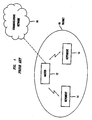
- FIG. 1 depicts a wireless network 10 referred to herein as a piconet in accordance with the prior art.
- Piconet 10 comprises a master 12 and one or more dependents 14.
- Master 12 is a communication device that may be directly or indirectly connected to communications network 16, such as a Public Switching Telephone Network (PSTN) or another wireless network.
- PSTN Public Switching Telephone Network
- Master 12 being operable to communicate with dependents 14 over a wireless interface and having hardware and software for controlling and managing data or voice transmissions among dependents 14 and communications network 16.
- Dependents 14 are devices for communicating with master 12 over a wireless interface. For example, suppose master 12 is a telephone switchboard that is connected to a PSTN and dependent 14 is a wireless telephone. In this example, the communication path goes from the wireless telephone to the telephone switchboard to the PSTN, and vice-versa.
- Master 12 and dependents 14 are operable to communicate with each other so long as dependents 14 are within the coverage area of the piconet, which is defined by the communication range of master 12.
- master 12 has a communication range of a few meters. If dependents 14 are mobile devices, such as wireless terminals, and move beyond the communication range of master 12, dependents 14 would be unable to communicate with master 12 and, thus, be unable to maintain a communication link with communications network 16. Accordingly, there exists a need for dependents 14 to maintain communication with communications network 16 when dependents 14 move outside the coverage area of the piconet.
- the present invention is a method and apparatus for maintaining communication between a dependent and a communications network when the dependent is outside a coverage area associated with its master using a controller and a communications network.
- the dependent when the dependent is in a piconet, the dependent is within communication range of its master using a communication channel on frequency band f band (1).
- the dependent when the dependent moves outside the piconet, the dependent should be within communication range of the controller and, thus, switches to another communication channel within frequency band f band (1) such that it may communicate with the controller.
- the dependent moves outside the communication range of the controller, the dependent should be within communication range of a communications network or a base station and, thus, switches to a communication channel within another frequency band f band (2).
- FIG. 2 depicts a wireless network group 20 in accordance with the present invention.
- Wireless network group 20 has an associated geographical area 21, such as one or more floors within a building, which is within a coverage area or cell 32 associated with base station 30 is a part of a communications network.
- Base station 30 is well-known in the art.
- Wireless network group 20 comprises a plurality of piconets 22- j and a controller 24 which are within the geographical area 21.
- Each piconet 22- j comprises a master 26- j and zero or more dependents 28- k .
- Master 26- j being a communication device for communicating with dependents 28- k and controller 24, and having hardware and software for controlling and managing data transmissions among dependents 28- k and controller 24.
- Masters 26- j are private local devices in control of communications in designated piconet coverage areas among its dependents 28- k and controller 24.
- base station 30 is a public unit that provides wireless communications services for designated macro and/or micro cellular or PCS areas, i.e., cell 32.
- Base station 30 is also operable to communicate with controller 24 over a wireless interface on frequency band f band (2).
- Masters 26- j being operable to communicate with dependents 28- k over a wireless interface using frequency band f band (1) and with controller 24 over a wired or wireless interface.
- each master 26- j uses a communication channel defined by a unique frequency hopping sequence f j , wherein the frequency hopping sequence f j is a part of a finite set of frequency hopping sequences f set within frequency band f band (1).
- Each master 26- j has an associated communication range R j in which master 26- j can communicate with dependents 28- k . Such communication range R j defines the coverage area of piconet 22- j . Note that a master 26- j in one piconet may also be a dependent in another piconet.
- Controller 24 is a communication device being operable to communicate with master 26- j , dependents 28- k and base station 30, and having hardware and software for controlling and managing data transmissions among dependents 28- k and masters 26- j .
- Controller 24 communicates with base station 30 over a wireless interface using frequency band f band (2) and with dependents 28- k over a wireless interface using frequency band f band (1).
- controller 24 uses a communication channel defined by a unique frequency hopping sequence f c , wherein the frequency hopping sequence f c is also a part of the finite set of frequency hopping sequences f set within frequency band f band (1).
- Controller 24 has an associated communication range R c in which controller 24 can communicate with dependents 28- k .
- the range R c of controller 24 may be supplemented via access points 25, which are devices for extending the range of controller 24.
- Such communication range R c defines the geographical area 21 associated with wireless network group 20. Note that there may be gaps 23 in the geographical area 21 where controller 24 may not be able to communicate with dependents 24- k .
- frequency band f band (1) is approximately 2.4 GHz and frequency band f band (2) is either approximately 800 or 1800 MHz.
- Controller 24 interfaces with base station 30 in the following manner. Controller receives data from masters 26- j and/or dependents 28- k on a communication channel defined by frequency hopping sequence f c on frequency band f band (1) and subsequently demodulates and re-modulates the data onto a communication channel on frequency band f band (2), and vice-versa.
- Dependents 28- j are communication devices for communicating with masters 26- j , controller 24 and base station 30 or equivalent.
- Dependents 28- k are operable to communicate with any master 26- j or controller 24 using any of the frequency hopping sequences f j or f c from the finite set of frequency hopping sequences f set .
- Dependents 28- k are also operable to communicate with base station 30 over a wireless interface using frequency band f band (2).
- dependents 28- k When dependents 28- k are activated or already active, dependents 28- k follow a frequency searching protocol to establish a communication link with a master device or base station 30, wherein master devices include masters 26- j and controller 24. Once a communication link is established with a master device, dependents 28- k can communicate with base station 30 through the linked master device. Specifically, if the master device is a master 26- j , the transmission path spans from dependents 28- k , to its master 26- j , to controller 24 and to base station 30, and vice-versa. If the master device is controller 24, the transmission path spans from dependents 28- k , to controller 24 and to base station 30, and vice-versa. Note that a communication link can also be established directly between a dependent 28- k and base station 30.
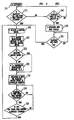
- FIG. 3 depicts a flowchart 300 of a frequency searching protocol used in accordance with one embodiment of the present invention.
- step 310 dependent 28- k is activated.
- step 315 dependent 28- k searches for a signal transmitted on any of the frequency hopping sequences f j or f c in the finite set of frequency hopping sequences f set . If one or more such signals are detected, in step 320, dependent 28- k selects a master device associated with the detected signal having the strongest or an acceptable signal-to-noise ratio to be its master. In one embodiment, a signal transmitted on any of the frequency hopping sequences f j or f c is deemed detected if it has a signal-to-noise ratio over a threshold value.
- the master associated with the frequency hopping sequence f j is selected as the master device.
- step 322 dependent 28- k transmits a master registration message to its selected master device indicating dependent 28- k 's selection of its master device.
- the master registration message being transmitted on the frequency hopping sequence associated with the selected master device.
- steps 325 and 335 if the selected master device is controller 24, upon receipt of the master registration message, dependent 28- k will be registered with and by controller 24 in a controller registry, which is a database or registry indicating master devices to which dependents 28- k are registered.
- the master 26- j upon receiving the master registration message, in step 330, the master 26- j transmits a controller registration message to controller 24 indicating to controller 24 to register dependent 28- k with master 26- j .
- the controller registration message being transmitted on the frequency hopping sequence f c using a wired or wireless interface.
- controller 24 registers dependent 28- k with master 26- j in the controller registry. Note that if dependent 28- k was previously registered with another master device in the controller registry, the previous registration is superseded or replaced with the current registration in the controller registry.
- master 26- j also registers its dependents 28- k in a master registry, which is a database or registry belonging to master 26- j and indicating the associated dependents 28- k .
- step 338 dependent 28-k continuously searches for signals transmitted on any of the frequency hopping sequences f j or f c , but not for signals transmitted on frequency band f band (2).
- step 339 if dependent 28- k detects one or more such signals with a stronger signal-to-noise ratio than the signal being transmitted by the master device to which dependent 28- k is currently registered, dependent 28- k will go to step 320 and select a new master device with which to be registered. Otherwise, dependent 28- k will continue to search for signals transmitted on any of the frequency hopping sequences f j or f c .
- step 338 dependent 28- k also searches for signals transmitted on frequency band f band (2).
- controller 24 transmits a controller-base station registration message to base station 30 or a communications network indicating to base station 30 to set up a communications link for dependent 28- k through controller 24, wherein the controller-base station registration message is transmitted on frequency band f band (2).
- base station 30 Upon receiving the controller-base station registration message, base station 30 registers dependent 28- k in a registry and provides communication services to dependent 28- k via controller 24. Once this communication link has been set up, the communication link from and to dependent 28- k to master 26- j to controller 24 to base station 30 is completed.
- step 340 dependent 28- k searches for a signal transmitted by base station 30 or a communications network on frequency band f band (2). If such a signal is detected, in step 345, dependent 28- k proceeds to register with base station 30, as is well-known in the art. Otherwise, service is denied to dependent 28- k and dependent 28- k continues to step 315.
- a signal transmitted by base station 30 on frequency band f band (2) is deemed detected if it has a signal-to-noise ratio over a threshold value.
- dependent 28- k After dependent 28- k has been registered with base station 30, in step 350, dependent 28- k will continue to search for signals transmitted on any of the frequency hopping sequences f j or f c on frequency band f band (1). If dependent 28- k detects one or more such signals, dependent 28- k will go to step 320 and select a master device with which to be registered. When dependent 28- k registers with the master device, the master device will subsequently cause controller 24 to re-register dependent 28- k at base station 30 via controller 24.
- controller 24 transmits a base station re-registration message to base station 30 indicating or instructing base station 30 to re-register dependent 28- k via controller 24 wherein the base station re-registration message is transmitted on frequency band f band (2).
- base station 30 receives the base station re-registration message, base station 30 re-registers dependent 28- k via controller 24.
- base station 30 knows to communicate with dependent 28- k through controller 24.
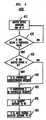
- FIG. 4 depicts a flowchart 400 illustrating the operation of a master device.
- the master device with which dependent 28 is registered continuously monitors the signal strength or signal-to-noise ratio of signals being transmitted from dependent 28- k .
- the master device will cause dependent 28- k to be unregistered in the controller registry.
- controller 24 In the case where dependent 28- k is currently registered with a master 26- j in the controller registry (i.e., the master device is a master 26- j ), in steps 430 to 450, master 26- j will transmit a controller unregistration message to controller 24 indicating to controller 24 to unregister dependent 28- k from master 26- j in the controller registry. In the case where dependent 28- k is currently registered with controller 24 in the controller registry (i.e., the master device is controller 24), in steps 430 and 450, controller 24 will unregister dependent 28- k from itself in the controller registry.
- controller 24 Whenever controller 24 unregisters any dependent 28- k without re-registering the same dependent 28- k with another master 26- j or itself (as in the case where dependent 28- k selects a new master device), in step 455, controller 24 will transmit a handoff message to base station 30 indicating to base station 30 the profile of dependent 28- k and to start communicating with the dependent 28- k being unregistered by controller 24 from the controller registry.
- base station 30 receives the handoff message, base station 30 re-registers dependent 28- k in its registry such that base station 30 now knows to communicate directly with dependent 28- k (and not through controller 24).
- the handoff message being transmitted on frequency band f band (2).
- controller 24 transmits a base station registration message to that dependent 28- k indicating or instructing dependent 28- k to search for signals transmitted on frequency band f band (2) and, upon detection, to re-register with base station 30 associated with the detected signal on frequency band f band (2).
- dependent 28- k receives the base station registration message
- dependent 28- k starts to communicate directly with base station 30 without searching for signals transmitted on frequency band f band (2).
- the base station registration message being transmitted on frequency band f band (2).
- the base station registration message may be transmitted on frequency hopping sequence f c alone or in conjunction with the base station registration message being transmitted on frequency band f band (2).
- FIG. 2 depicts an embodiment in which cell 32, i.e., coverage area of base station 30, includes the geographical area 21 associated with wireless network group 20.
- any area within geographical area 21 should be within communication range of base station 30 except for gaps 23 in the geographical area 21.
- gaps 23 in geographical area 21 should not be gaps in cell 32.
- dependent 28- k leaves a piconet, it is assumed to still be within the geographical area 21 and, thus, should also be within the coverage area of base station 30 thereby allowing dependent 28- k to register with base station 30 once it leaves the piconet 22- j .
- the geographical area 21 may be in the coverage areas of two adjacent base stations.
- controller 24 may instruct dependent 28- k to register with a particular base station based on the piconet 22- j from which dependent 28- k is leaving.
- part of the geographical area 21 is in the coverage area of base station 30 and the other part of the coverage area 21 is not in the coverage area of any base station.
- controller 24 may instruct dependent 28- k upon leaving a piconet 22- j to attempt to register with base station 30 regardless of whether dependent 28- k is within cell 32.
Landscapes
- Engineering & Computer Science (AREA)
- Computer Networks & Wireless Communication (AREA)
- Signal Processing (AREA)
- Computer Security & Cryptography (AREA)
- Mobile Radio Communication Systems (AREA)
Abstract
Description
- The present invention relates generally to wireless communication systems and, in particular, to wireless networks.
- FIG. 1 depicts a
wireless network 10 referred to herein as a piconet in accordance with the prior art. Piconet 10 comprises amaster 12 and one or moredependents 14. Master 12 is a communication device that may be directly or indirectly connected to communications network 16, such as a Public Switching Telephone Network (PSTN) or another wireless network.Master 12 being operable to communicate withdependents 14 over a wireless interface and having hardware and software for controlling and managing data or voice transmissions amongdependents 14 and communications network 16.Dependents 14 are devices for communicating withmaster 12 over a wireless interface. For example, supposemaster 12 is a telephone switchboard that is connected to a PSTN and dependent 14 is a wireless telephone. In this example, the communication path goes from the wireless telephone to the telephone switchboard to the PSTN, and vice-versa. -
Master 12 anddependents 14 are operable to communicate with each other so long asdependents 14 are within the coverage area of the piconet, which is defined by the communication range ofmaster 12. Typically,master 12 has a communication range of a few meters. Ifdependents 14 are mobile devices, such as wireless terminals, and move beyond the communication range ofmaster 12,dependents 14 would be unable to communicate withmaster 12 and, thus, be unable to maintain a communication link with communications network 16. Accordingly, there exists a need fordependents 14 to maintain communication with communications network 16 whendependents 14 move outside the coverage area of the piconet. - The present invention is a method and apparatus for maintaining communication between a dependent and a communications network when the dependent is outside a coverage area associated with its master using a controller and a communications network. In one embodiment, when the dependent is in a piconet, the dependent is within communication range of its master using a communication channel on frequency band f band(1). When the dependent moves outside the piconet, the dependent should be within communication range of the controller and, thus, switches to another communication channel within frequency band f band(1) such that it may communicate with the controller. When the dependent moves outside the communication range of the controller, the dependent should be within communication range of a communications network or a base station and, thus, switches to a communication channel within another frequency band f band(2).
- The features, aspects, and advantages of the present invention will become better understood with regard to the following description, appended claims, and accompanying drawings where
- FIG. 1 depicts a wireless network referred to herein as a piconet in accordance with the prior art;
- FIG. 2 a wireless network group in accordance with the present invention;
- FIG. 3 depicts a flowchart of a frequency searching protocol used in accordance with one embodiment of the present invention; and
- FIG. 4 depicts a flowchart illustrating the operation of a master device.
-
- FIG. 2 depicts a
wireless network group 20 in accordance with the present invention.Wireless network group 20 has an associated geographical area 21, such as one or more floors within a building, which is within a coverage area orcell 32 associated withbase station 30 is a part of a communications network.Base station 30 is well-known in the art.Wireless network group 20 comprises a plurality of piconets 22-j and acontroller 24 which are within the geographical area 21. Each piconet 22-j comprises a master 26-j and zero or more dependents 28-k. Master 26-j being a communication device for communicating with dependents 28-k andcontroller 24, and having hardware and software for controlling and managing data transmissions among dependents 28-k andcontroller 24. - Masters 26-j are private local devices in control of communications in designated piconet coverage areas among its dependents 28-k and
controller 24. By contrast,base station 30 is a public unit that provides wireless communications services for designated macro and/or micro cellular or PCS areas, i.e.,cell 32.Base station 30 is also operable to communicate withcontroller 24 over a wireless interface on frequency band f band(2). - Masters 26-j being operable to communicate with dependents 28-k over a wireless interface using frequency band f band(1) and with
controller 24 over a wired or wireless interface. When communicating with dependents 28-k, each master 26-j uses a communication channel defined by a unique frequency hopping sequence fj , wherein the frequency hopping sequence fj is a part of a finite set of frequency hopping sequences f set within frequency band f band(1). Each master 26-j has an associated communication range R j in which master 26-j can communicate with dependents 28-k. Such communication range R j defines the coverage area of piconet 22-j. Note that a master 26-j in one piconet may also be a dependent in another piconet. -
Controller 24 is a communication device being operable to communicate with master 26-j, dependents 28-k andbase station 30, and having hardware and software for controlling and managing data transmissions among dependents 28-k and masters 26-j.Controller 24 communicates withbase station 30 over a wireless interface using frequency band f band(2) and with dependents 28-k over a wireless interface using frequency band f band(1). When communicating with dependents 28-k,controller 24 uses a communication channel defined by a unique frequency hopping sequence f c, wherein the frequency hopping sequence f c is also a part of the finite set of frequency hopping sequences f set within frequency band f band(1).Controller 24 has an associated communication range Rc in whichcontroller 24 can communicate with dependents 28-k. The range Rc ofcontroller 24 may be supplemented viaaccess points 25, which are devices for extending the range ofcontroller 24. Such communication range Rc defines the geographical area 21 associated withwireless network group 20. Note that there may begaps 23 in the geographical area 21 wherecontroller 24 may not be able to communicate with dependents 24-k. In one embodiment, frequency band f band(1) is approximately 2.4 GHz and frequency band f band(2) is either approximately 800 or 1800 MHz. -
Controller 24 interfaces withbase station 30 in the following manner. Controller receives data from masters 26-j and/or dependents 28-k on a communication channel defined by frequency hopping sequence f c on frequency band f band(1) and subsequently demodulates and re-modulates the data onto a communication channel on frequency band f band(2), and vice-versa. - Dependents 28-j are communication devices for communicating with masters 26-j,
controller 24 andbase station 30 or equivalent. Dependents 28-k are operable to communicate with any master 26-j orcontroller 24 using any of the frequency hopping sequences fj or fc from the finite set of frequency hopping sequences f set. Dependents 28-k are also operable to communicate withbase station 30 over a wireless interface using frequency band f band(2). - When dependents 28-k are activated or already active, dependents 28-k follow a frequency searching protocol to establish a communication link with a master device or
base station 30, wherein master devices include masters 26-j andcontroller 24. Once a communication link is established with a master device, dependents 28-k can communicate withbase station 30 through the linked master device. Specifically, if the master device is a master 26-j, the transmission path spans from dependents 28-k, to its master 26-j, to controller 24 and tobase station 30, and vice-versa. If the master device iscontroller 24, the transmission path spans from dependents 28-k, to controller 24 and tobase station 30, and vice-versa. Note that a communication link can also be established directly between a dependent 28-k andbase station 30. - FIG. 3 depicts a
flowchart 300 of a frequency searching protocol used in accordance with one embodiment of the present invention. Instep 310, dependent 28-k is activated. Instep 315, dependent 28-k searches for a signal transmitted on any of the frequency hopping sequences fj or f c in the finite set of frequency hopping sequences f set. If one or more such signals are detected, instep 320, dependent 28-k selects a master device associated with the detected signal having the strongest or an acceptable signal-to-noise ratio to be its master. In one embodiment, a signal transmitted on any of the frequency hopping sequences fj or f c is deemed detected if it has a signal-to-noise ratio over a threshold value. In one embodiment, if a signal with an acceptable signal-to-noise ratio is detected on any frequency hopping sequence fj and on frequency hopping sequence fc , the master associated with the frequency hopping sequence fj is selected as the master device. - In
step 322, dependent 28-k transmits a master registration message to its selected master device indicating dependent 28-k's selection of its master device. The master registration message being transmitted on the frequency hopping sequence associated with the selected master device. Insteps controller 24, upon receipt of the master registration message, dependent 28-k will be registered with and bycontroller 24 in a controller registry, which is a database or registry indicating master devices to which dependents 28-k are registered. - However, if the selected master device is a master 26-j, upon receiving the master registration message, in
step 330, the master 26-j transmits a controller registration message tocontroller 24 indicating tocontroller 24 to register dependent 28-k with master 26-j. The controller registration message being transmitted on the frequency hopping sequence f c using a wired or wireless interface. Upon receiving the controller registration message, instep 335,controller 24 registers dependent 28-k with master 26-j in the controller registry. Note that if dependent 28-k was previously registered with another master device in the controller registry, the previous registration is superseded or replaced with the current registration in the controller registry. In one embodiment, master 26-j also registers its dependents 28-k in a master registry, which is a database or registry belonging to master 26-j and indicating the associated dependents 28-k. - Once dependent 28-k has been registered with a master device, or has transmitted the master registration message, in
step 338, dependent 28-k continuously searches for signals transmitted on any of the frequency hopping sequences fj or f c, but not for signals transmitted on frequency band f band(2). Instep 339, if dependent 28-k detects one or more such signals with a stronger signal-to-noise ratio than the signal being transmitted by the master device to which dependent 28-k is currently registered, dependent 28-k will go to step 320 and select a new master device with which to be registered. Otherwise, dependent 28-k will continue to search for signals transmitted on any of the frequency hopping sequences fj or f c. In an alternate embodiment, instep 338, dependent 28-k also searches for signals transmitted on frequency band f band(2). - Note that when dependent 28-k has been registered in the controller registry,
controller 24 transmits a controller-base station registration message tobase station 30 or a communications network indicating tobase station 30 to set up a communications link for dependent 28-k throughcontroller 24, wherein the controller-base station registration message is transmitted on frequency band f band(2). Upon receiving the controller-base station registration message,base station 30 registers dependent 28-k in a registry and provides communication services to dependent 28-k viacontroller 24. Once this communication link has been set up, the communication link from and to dependent 28-k to master 26-j tocontroller 24 tobase station 30 is completed. - Returning to step 315, if no signals transmitted on any frequency hopping sequences fj or f c were detected, in
step 340, dependent 28-k searches for a signal transmitted bybase station 30 or a communications network on frequency band f band(2). If such a signal is detected, instep 345, dependent 28-k proceeds to register withbase station 30, as is well-known in the art. Otherwise, service is denied to dependent 28-k and dependent 28-k continues to step 315. In one embodiment, a signal transmitted bybase station 30 on frequency band f band(2) is deemed detected if it has a signal-to-noise ratio over a threshold value. - After dependent 28-k has been registered with
base station 30, instep 350, dependent 28-k will continue to search for signals transmitted on any of the frequency hopping sequences fj or f c on frequency band f band(1). If dependent 28-k detects one or more such signals, dependent 28-k will go to step 320 and select a master device with which to be registered. When dependent 28-k registers with the master device, the master device will subsequently causecontroller 24 to re-register dependent 28-k atbase station 30 viacontroller 24. For example, when dependent 28-k sends a master registration message to its new master device and is subsequently registered atcontroller 24, as described steps 320-335,controller 24 transmits a base station re-registration message tobase station 30 indicating or instructingbase station 30 to re-register dependent 28-k viacontroller 24 wherein the base station re-registration message is transmitted on frequency band f band(2). Whenbase station 30 receives the base station re-registration message,base station 30 re-registers dependent 28-k viacontroller 24. By re-registering dependent 28-k viacontroller 24,base station 30 knows to communicate with dependent 28-k throughcontroller 24. - Once dependent 28-k is registered with a master device, the master device can cause dependent 28-k to be unregistered. FIG. 4 depicts a flowchart 400 illustrating the operation of a master device. In
step 410, the master device with which dependent 28 is registered continuously monitors the signal strength or signal-to-noise ratio of signals being transmitted from dependent 28-k. Instep 420, if such signal strength or signal-to-noise ratio falls below a threshold value or another value, the master device will cause dependent 28-k to be unregistered in the controller registry. In the case where dependent 28-k is currently registered with a master 26-j in the controller registry (i.e., the master device is a master 26-j), insteps 430 to 450, master 26-j will transmit a controller unregistration message tocontroller 24 indicating tocontroller 24 to unregister dependent 28-k from master 26-j in the controller registry. In the case where dependent 28-k is currently registered withcontroller 24 in the controller registry (i.e., the master device is controller 24), insteps controller 24 will unregister dependent 28-k from itself in the controller registry. - Whenever
controller 24 unregisters any dependent 28-k without re-registering the same dependent 28-k with another master 26-j or itself (as in the case where dependent 28-k selects a new master device), instep 455,controller 24 will transmit a handoff message tobase station 30 indicating tobase station 30 the profile of dependent 28-k and to start communicating with the dependent 28-k being unregistered bycontroller 24 from the controller registry. Whenbase station 30 receives the handoff message,base station 30 re-registers dependent 28-k in its registry such thatbase station 30 now knows to communicate directly with dependent 28-k (and not through controller 24). The handoff message being transmitted on frequency band f band(2). Subsequently, instep 460,controller 24 transmits a base station registration message to that dependent 28-k indicating or instructing dependent 28-k to search for signals transmitted on frequency band f band(2) and, upon detection, to re-register withbase station 30 associated with the detected signal on frequency band f band(2). In another embodiment, once dependent 28-k receives the base station registration message, dependent 28-k starts to communicate directly withbase station 30 without searching for signals transmitted on frequency band f band(2). The base station registration message being transmitted on frequency band f band(2). Alternately, the base station registration message may be transmitted on frequency hopping sequence f c alone or in conjunction with the base station registration message being transmitted on frequency band f band(2). - Note that FIG. 2 depicts an embodiment in which
cell 32, i.e., coverage area ofbase station 30, includes the geographical area 21 associated withwireless network group 20. In other words, any area within geographical area 21 should be within communication range ofbase station 30 except forgaps 23 in the geographical area 21. Note that in most cases,gaps 23 in geographical area 21 should not be gaps incell 32. When dependent 28-k leaves a piconet, it is assumed to still be within the geographical area 21 and, thus, should also be within the coverage area ofbase station 30 thereby allowing dependent 28-k to register withbase station 30 once it leaves the piconet 22-j. Other embodiments are possible. In another embodiment, the geographical area 21 may be in the coverage areas of two adjacent base stations. In this embodiment,controller 24 may instruct dependent 28-k to register with a particular base station based on the piconet 22-j from which dependent 28-k is leaving. In another embodiment, part of the geographical area 21 is in the coverage area ofbase station 30 and the other part of the coverage area 21 is not in the coverage area of any base station. In this embodiment,controller 24 may instruct dependent 28-k upon leaving a piconet 22-j to attempt to register withbase station 30 regardless of whether dependent 28-k is withincell 32. - It should be understood that although the present invention is described herein with reference to certain embodiments, other embodiments are possible. Accordingly, the present invention should not be limited to the embodiments disclosed herein.
Claims (9)
- A method for maintaining a communication link comprising the steps of:searching at a dependent for one or more frequency hopping sequences from a set of frequency hopping sequences;registering the dependent with a first master device when a first frequency hopping sequence is detected, the first frequency hopping sequence being associated with the first master device;monitoring for frequency hopping sequences in the set;registering the dependent with a second master device if the dependent detects a signal transmitted on a second frequency hopping sequence associated with the second master device having a higher signal strength than a signal transmitted on the first frequency hopping sequence.
- The method of claim 1, wherein the step of registering the dependent with the first master device comprises the step of:transmitting a registration message to the first master device using the first frequency hopping sequence.
- The method of claim 1, wherein the step of registering the dependent with the second master device comprises the step of:transmitting a registration message to the second master device using the second frequency hopping sequence.
- The method of claim 1, wherein the set of frequency hopping sequences use a first frequency band f band(1).
- The method of claim 4 comprising the additional step of:searching for a signal transmitted using a second frequency band f band(2) if no frequency hopping sequence in the set are detected.
- The method of claim 5 comprising the additional step of:registering with a communication network when the second frequency band f band(2) is detected, the communications network being associated with the second frequency band f band(2).
- The method of claim 1 comprising the additional steps of:receiving a registration message indicating the dependent to register with a communications network; andregistering with the communication network using a second frequency band f band(2).
- A method for maintaining a communication link comprising the steps of:receiving a first registration message at a master device from a dependent over a first frequency hopping sequence associated with the master device;transmitting a second registration message over a second frequency hopping sequence associated with a second master device;monitoring a strength at the master device for a signal transmitted by the dependent over the first frequency hopping sequence; andtransmitting an unregistration message over the second frequency hopping sequence if the strength of the signal transmitted over the first frequency hopping sequence falls below a threshold value.
- The method of claim 8, wherein the first and second frequency hopping sequences are part of a set of frequency hopping sequences on a same frequency band.
Applications Claiming Priority (3)
| Application Number | Priority Date | Filing Date | Title |
|---|---|---|---|
| US365678 | 1999-08-02 | ||
| US09/365,678 US8041359B1 (en) | 1999-08-02 | 1999-08-02 | Method for maintaining a communication link in wireless network groups |
| EP00306299A EP1075159B1 (en) | 1999-08-02 | 2000-07-24 | A method for maintaining a communication link in wireless network groups |
Related Parent Applications (1)
| Application Number | Title | Priority Date | Filing Date |
|---|---|---|---|
| EP00306299A Division EP1075159B1 (en) | 1999-08-02 | 2000-07-24 | A method for maintaining a communication link in wireless network groups |
Publications (2)
| Publication Number | Publication Date |
|---|---|
| EP1300988A1 true EP1300988A1 (en) | 2003-04-09 |
| EP1300988B1 EP1300988B1 (en) | 2005-10-05 |
Family
ID=23439877
Family Applications (2)
| Application Number | Title | Priority Date | Filing Date |
|---|---|---|---|
| EP02026733A Expired - Lifetime EP1300988B1 (en) | 1999-08-02 | 2000-07-24 | A method for maintaining a communication link in wireless network groups |
| EP00306299A Expired - Lifetime EP1075159B1 (en) | 1999-08-02 | 2000-07-24 | A method for maintaining a communication link in wireless network groups |
Family Applications After (1)
| Application Number | Title | Priority Date | Filing Date |
|---|---|---|---|
| EP00306299A Expired - Lifetime EP1075159B1 (en) | 1999-08-02 | 2000-07-24 | A method for maintaining a communication link in wireless network groups |
Country Status (7)
| Country | Link |
|---|---|
| US (1) | US8041359B1 (en) |
| EP (2) | EP1300988B1 (en) |
| JP (1) | JP5036095B2 (en) |
| KR (2) | KR100803419B1 (en) |
| AU (1) | AU4884200A (en) |
| CA (1) | CA2314430A1 (en) |
| DE (2) | DE60008979T2 (en) |
Families Citing this family (11)
| Publication number | Priority date | Publication date | Assignee | Title |
|---|---|---|---|---|
| JP5105665B2 (en) * | 2001-03-13 | 2012-12-26 | キヤノン株式会社 | COMMUNICATION DEVICE, CONTROL METHOD, AND PROGRAM |
| GB2374767B (en) * | 2001-03-21 | 2005-04-13 | Agere Syst Guardian Corp | Bluetooth smart offset compensation |
| KR100761257B1 (en) * | 2001-04-27 | 2007-09-28 | 엘지전자 주식회사 | How Bluetooth extends network topology |
| KR20020093322A (en) * | 2001-06-08 | 2002-12-16 | 주식회사 하이닉스반도체 | Method for multi network connection handover of high speed mobile terminal in pico cell environment |
| KR100447304B1 (en) * | 2002-01-24 | 2004-09-07 | 삼성전자주식회사 | Bluetooth system capable of communicating on a scatternet and communicating method thereof |
| CN1549613A (en) * | 2003-05-19 | 2004-11-24 | �ʼҷ����ֵ��ӹɷ�����˾ | Method and apparatus for soft switching between P2P communication mode and traditional communication mode in radio communication system |
| US20060291412A1 (en) * | 2005-06-24 | 2006-12-28 | Naqvi Shamim A | Associated device discovery in IMS networks |
| CN101141165A (en) * | 2006-09-05 | 2008-03-12 | 华为技术有限公司 | System and method for implementing transmit and receive diversity |
| WO2008069509A1 (en) * | 2006-12-05 | 2008-06-12 | Electronics And Telecommunications Research Institute | Apparatus and method for automatically switching dmb channel in dmb multiple frequency network |
| NO20066084L (en) * | 2006-12-29 | 2008-06-30 | Tomas Rudberg Larsen | Methods and systems for transmission between an r.f. unit and at least ± n r.f. base station |
| WO2025048247A1 (en) * | 2023-08-28 | 2025-03-06 | 삼성전자 주식회사 | Electronic device for operating main group and auxiliary group, and operation method of electronic device |
Citations (4)
| Publication number | Priority date | Publication date | Assignee | Title |
|---|---|---|---|---|
| EP0766490A2 (en) * | 1995-09-29 | 1997-04-02 | Nokia Mobile Phones Ltd. | Integrated radio communication system |
| US5633888A (en) * | 1995-06-05 | 1997-05-27 | Advanced Micro Devices, Inc. | Method of using an access point adjacency matrix to establish handoff in a wireless LAN |
| EP0851633A2 (en) * | 1996-12-30 | 1998-07-01 | Lucent Technologies Inc. | System and method for achieving handover in wireless LAN by buffering data at subsequent access point |
| WO1999029126A1 (en) * | 1997-12-03 | 1999-06-10 | Nokia Mobile Phones Limited | Integrating communications networks |
Family Cites Families (23)
| Publication number | Priority date | Publication date | Assignee | Title |
|---|---|---|---|---|
| US4427921A (en) * | 1981-10-01 | 1984-01-24 | Gte Laboratories Inc. | Electrodeless ultraviolet light source |
| US5338827A (en) | 1990-01-30 | 1994-08-16 | Trw Inc. | Polyimide resins useful at high temperatures |
| US5260988A (en) | 1992-02-06 | 1993-11-09 | Motorola, Inc. | Apparatus and method for alternative radiotelephone system selection |
| CA2106692A1 (en) | 1992-10-07 | 1994-04-08 | David Edward Borth | Method of registering/reassigning a call in a dual mode communication network |
| US5396541A (en) * | 1992-10-23 | 1995-03-07 | At&T Corp. | Call handoff in a wireless telephone system |
| US5428668A (en) * | 1993-11-04 | 1995-06-27 | Ericsson Ge Mobile Communications Inc. | Radio personal communications system and method for allocating frequencies for communications between a cellular terminal and a base station |
| US5594782A (en) * | 1994-02-24 | 1997-01-14 | Gte Mobile Communications Service Corporation | Multiple mode personal wireless communications system |
| US5448569A (en) * | 1994-04-12 | 1995-09-05 | International Business Machines Corporation | Handoff monitoring in cellular communication networks using slow frequency hopping |
| JPH07321708A (en) * | 1994-05-30 | 1995-12-08 | Tec Corp | Frequency hopping wireless communication method |
| JPH089455A (en) * | 1994-06-22 | 1996-01-12 | Hitachi Ltd | Wireless communication system and communication device |
| KR970008949B1 (en) * | 1994-11-16 | 1997-06-03 | Korea Electronics Telecomm | Method and system for providing a frequency handoff in communication in a cdma cellular telephone system |
| US6535732B1 (en) * | 1995-05-04 | 2003-03-18 | Interwave Communications International, Ltd. | Cellular network having a concentrated base transceiver station and a plurality of remote transceivers |
| US5732350A (en) * | 1995-12-06 | 1998-03-24 | Motorola, Inc. | Method for mobile station location registration with dynamic cell grouping for radiotelephone systems |
| JP3275696B2 (en) * | 1996-03-29 | 2002-04-15 | 三菱電機株式会社 | Monitoring device for frequency hopping radio waves |
| US6041358A (en) * | 1996-11-12 | 2000-03-21 | Industrial Technology Research Inst. | Method for maintaining virtual local area networks with mobile terminals in an ATM network |
| US6049593A (en) * | 1997-01-17 | 2000-04-11 | Acampora; Anthony | Hybrid universal broadband telecommunications using small radio cells interconnected by free-space optical links |
| JPH10261980A (en) * | 1997-03-18 | 1998-09-29 | Fujitsu Ltd | Wireless communication network base station device, wireless communication network communication control method, wireless communication network system, and wireless terminal device |
| US5937353A (en) * | 1997-04-04 | 1999-08-10 | Nortel Networks Corporation | Method and apparatus for controlling allocation of traffic channels in macrocell/microcell telecommunications networks |
| JP3478062B2 (en) * | 1997-06-12 | 2003-12-10 | 三菱電機株式会社 | Mobile communication system, mobile station, and base station |
| JP3856253B2 (en) * | 1997-10-16 | 2006-12-13 | ソニー株式会社 | Cellular radio communication system and base station |
| JPH11177531A (en) * | 1997-12-15 | 1999-07-02 | Toshiba Tec Corp | Slow frequency hopping spread spectrum communication method and wireless communication system using this communication method |
| US6259898B1 (en) * | 1998-05-05 | 2001-07-10 | Telxon Corporation | Multi-communication access point |
| US6912230B1 (en) * | 1999-02-05 | 2005-06-28 | Tecore | Multi-protocol wireless communication apparatus and method |
-
1999
- 1999-08-02 US US09/365,678 patent/US8041359B1/en not_active Expired - Fee Related
-
2000
- 2000-07-24 DE DE60008979T patent/DE60008979T2/en not_active Expired - Lifetime
- 2000-07-24 DE DE60023041T patent/DE60023041T2/en not_active Expired - Lifetime
- 2000-07-24 EP EP02026733A patent/EP1300988B1/en not_active Expired - Lifetime
- 2000-07-24 EP EP00306299A patent/EP1075159B1/en not_active Expired - Lifetime
- 2000-07-25 CA CA002314430A patent/CA2314430A1/en not_active Abandoned
- 2000-07-26 AU AU48842/00A patent/AU4884200A/en not_active Abandoned
- 2000-07-29 KR KR1020000043926A patent/KR100803419B1/en not_active Expired - Fee Related
- 2000-07-31 JP JP2000230390A patent/JP5036095B2/en not_active Expired - Fee Related
-
2007
- 2007-03-30 KR KR1020070031683A patent/KR100803420B1/en not_active Expired - Fee Related
Patent Citations (4)
| Publication number | Priority date | Publication date | Assignee | Title |
|---|---|---|---|---|
| US5633888A (en) * | 1995-06-05 | 1997-05-27 | Advanced Micro Devices, Inc. | Method of using an access point adjacency matrix to establish handoff in a wireless LAN |
| EP0766490A2 (en) * | 1995-09-29 | 1997-04-02 | Nokia Mobile Phones Ltd. | Integrated radio communication system |
| EP0851633A2 (en) * | 1996-12-30 | 1998-07-01 | Lucent Technologies Inc. | System and method for achieving handover in wireless LAN by buffering data at subsequent access point |
| WO1999029126A1 (en) * | 1997-12-03 | 1999-06-10 | Nokia Mobile Phones Limited | Integrating communications networks |
Non-Patent Citations (3)
| Title |
|---|
| ALBRECHT M ET AL: "IP services over Bluetooth: leading the way to a new mobility", LOCAL COMPUTER NETWORKS, 1999. LCN '99. CONFERENCE ON LOWELL, MA, USA 18-20 OCT. 1999, LOS ALAMITOS, CA, USA,IEEE COMPUT. SOC, US, 18 October 1999 (1999-10-18), pages 2 - 11, XP010358529, ISBN: 0-7695-0309-8 * |
| HAARTSEN J: "BLUETOOTH - THE UNIVERSAL RADIO INTERFACE FOR AD HOC, WIRELESS CONNECTIVITY", ON - ERICSSON REVIEW, ERICSSON. STOCKHOLM, SE, no. 3, 1998, pages 110 - 117, XP000783249, ISSN: 0014-0171 * |
| MOULY M ET AL: "HANDOVER CRITERIA", GSM SYSTEM FOR MOBILE COMMUNICATIONS, LASSAY-LES-CHATEAUX, EUROPE MEDIA, FR, 1993, pages 329,396 - 401, XP002071994 * |
Also Published As
| Publication number | Publication date |
|---|---|
| US8041359B1 (en) | 2011-10-18 |
| KR100803420B1 (en) | 2008-02-13 |
| KR20070041486A (en) | 2007-04-18 |
| DE60023041D1 (en) | 2006-02-16 |
| EP1075159A2 (en) | 2001-02-07 |
| JP5036095B2 (en) | 2012-09-26 |
| EP1075159B1 (en) | 2004-03-17 |
| DE60008979T2 (en) | 2005-03-10 |
| KR20010021153A (en) | 2001-03-15 |
| KR100803419B1 (en) | 2008-02-13 |
| DE60023041T2 (en) | 2006-06-29 |
| EP1075159A3 (en) | 2001-10-10 |
| EP1300988B1 (en) | 2005-10-05 |
| DE60008979D1 (en) | 2004-04-22 |
| AU4884200A (en) | 2001-02-08 |
| JP2001086037A (en) | 2001-03-30 |
| CA2314430A1 (en) | 2001-02-02 |
Similar Documents
| Publication | Publication Date | Title |
|---|---|---|
| US6035197A (en) | Method and system for providing a handoff from a CDMA cellular telephone system | |
| JP2586631B2 (en) | Cellular radiotelephone apparatus and method with dropped call protection circuit | |
| EP1579643B1 (en) | Method and apparatus for establishing direct communication for mobiles in a radio communication system | |
| KR100603411B1 (en) | Method and apparatus for seamless handover between communication networks | |
| US6047178A (en) | Direct communication wireless radio system | |
| KR100803420B1 (en) | How to Maintain a Communication Link | |
| CN101198174B (en) | Communication construction, wireless access point and its method for control and terminal communication | |
| US5987332A (en) | Method of providing a subscriber unit with neighbor cell information during ongoing communication | |
| US6188897B1 (en) | Mobile station roaming in a multiple service provider area | |
| EP1527633A2 (en) | Wireless personal communicator and communication method | |
| KR20120035665A (en) | Communication method of vehicular access point, vehicular user equipment and macro base station for user in the vehicle | |
| US6526279B1 (en) | Communication system with a mobile terminal supporting mobile assisted signal strength measurements for a plurality of networks and methods for operating the same | |
| GB2277849A (en) | Radio communication network | |
| CN111464996B (en) | DECT resource coordination method and system based on network | |
| US6181946B1 (en) | Method for subscriber based management of neighbor list information during a communication session | |
| US5949774A (en) | Method of processing a call while switching site affiliation in a radio communication system | |
| JP4385665B2 (en) | Wireless communication apparatus and communication system | |
| KR0166635B1 (en) | Method of perceiving optimum relay station of portable apparatus in trs | |
| JPH0746644A (en) | Mobile communication system | |
| JP2975850B2 (en) | Digital cordless telephone equipment | |
| JP2803138B2 (en) | Communication method and system for mobile communication | |
| JP2008252335A (en) | Wireless communication terminal control method and wireless communication terminal | |
| JPH0974583A (en) | Mobile communication system | |
| MXPA00000081A (en) | Method of processing a call while switching site affiliation in a radio communication system | |
| HK1120979B (en) | Communication architecture, wireless access point and method for controlling its communication with terminals thereof |
Legal Events
| Date | Code | Title | Description |
|---|---|---|---|
| PUAI | Public reference made under article 153(3) epc to a published international application that has entered the european phase |
Free format text: ORIGINAL CODE: 0009012 |
|
| 17P | Request for examination filed |
Effective date: 20021209 |
|
| AC | Divisional application: reference to earlier application |
Ref document number: 1075159 Country of ref document: EP Kind code of ref document: P |
|
| AK | Designated contracting states |
Kind code of ref document: A1 Designated state(s): DE FI FR GB SE |
|
| AKX | Designation fees paid |
Designated state(s): DE FI FR GB SE |
|
| 17Q | First examination report despatched |
Effective date: 20040316 |
|
| GRAP | Despatch of communication of intention to grant a patent |
Free format text: ORIGINAL CODE: EPIDOSNIGR1 |
|
| GRAS | Grant fee paid |
Free format text: ORIGINAL CODE: EPIDOSNIGR3 |
|
| GRAA | (expected) grant |
Free format text: ORIGINAL CODE: 0009210 |
|
| AC | Divisional application: reference to earlier application |
Ref document number: 1075159 Country of ref document: EP Kind code of ref document: P |
|
| AK | Designated contracting states |
Kind code of ref document: B1 Designated state(s): DE FI FR GB SE |
|
| PG25 | Lapsed in a contracting state [announced via postgrant information from national office to epo] |
Ref country code: FI Free format text: LAPSE BECAUSE OF FAILURE TO SUBMIT A TRANSLATION OF THE DESCRIPTION OR TO PAY THE FEE WITHIN THE PRESCRIBED TIME-LIMIT Effective date: 20051005 |
|
| REG | Reference to a national code |
Ref country code: GB Ref legal event code: FG4D |
|
| PG25 | Lapsed in a contracting state [announced via postgrant information from national office to epo] |
Ref country code: SE Free format text: LAPSE BECAUSE OF FAILURE TO SUBMIT A TRANSLATION OF THE DESCRIPTION OR TO PAY THE FEE WITHIN THE PRESCRIBED TIME-LIMIT Effective date: 20060105 |
|
| REF | Corresponds to: |
Ref document number: 60023041 Country of ref document: DE Date of ref document: 20060216 Kind code of ref document: P |
|
| ET | Fr: translation filed | ||
| PLBE | No opposition filed within time limit |
Free format text: ORIGINAL CODE: 0009261 |
|
| STAA | Information on the status of an ep patent application or granted ep patent |
Free format text: STATUS: NO OPPOSITION FILED WITHIN TIME LIMIT |
|
| 26N | No opposition filed |
Effective date: 20060706 |
|
| REG | Reference to a national code |
Ref country code: GB Ref legal event code: 732E Free format text: REGISTERED BETWEEN 20131031 AND 20131106 |
|
| REG | Reference to a national code |
Ref country code: FR Ref legal event code: CD Owner name: ALCATEL-LUCENT USA INC. Effective date: 20131122 |
|
| REG | Reference to a national code |
Ref country code: FR Ref legal event code: GC Effective date: 20140410 |
|
| REG | Reference to a national code |
Ref country code: FR Ref legal event code: RG Effective date: 20141015 |
|
| REG | Reference to a national code |
Ref country code: FR Ref legal event code: PLFP Year of fee payment: 16 |
|
| REG | Reference to a national code |
Ref country code: FR Ref legal event code: PLFP Year of fee payment: 17 |
|
| REG | Reference to a national code |
Ref country code: FR Ref legal event code: PLFP Year of fee payment: 18 |
|
| PGFP | Annual fee paid to national office [announced via postgrant information from national office to epo] |
Ref country code: GB Payment date: 20170719 Year of fee payment: 18 Ref country code: FR Payment date: 20170724 Year of fee payment: 18 Ref country code: DE Payment date: 20170724 Year of fee payment: 18 |
|
| REG | Reference to a national code |
Ref country code: DE Ref legal event code: R119 Ref document number: 60023041 Country of ref document: DE |
|
| GBPC | Gb: european patent ceased through non-payment of renewal fee |
Effective date: 20180724 |
|
| PG25 | Lapsed in a contracting state [announced via postgrant information from national office to epo] |
Ref country code: DE Free format text: LAPSE BECAUSE OF NON-PAYMENT OF DUE FEES Effective date: 20190201 Ref country code: FR Free format text: LAPSE BECAUSE OF NON-PAYMENT OF DUE FEES Effective date: 20180731 Ref country code: GB Free format text: LAPSE BECAUSE OF NON-PAYMENT OF DUE FEES Effective date: 20180724 |