EP1300459A1 - Lubricating oil for refrigerating machine and hydraulic composition containing the same for use in refrigerating machine - Google Patents
Lubricating oil for refrigerating machine and hydraulic composition containing the same for use in refrigerating machine Download PDFInfo
- Publication number
- EP1300459A1 EP1300459A1 EP01941067A EP01941067A EP1300459A1 EP 1300459 A1 EP1300459 A1 EP 1300459A1 EP 01941067 A EP01941067 A EP 01941067A EP 01941067 A EP01941067 A EP 01941067A EP 1300459 A1 EP1300459 A1 EP 1300459A1
- Authority
- EP
- European Patent Office
- Prior art keywords
- lubricating oil
- group
- refrigerant
- carbon atoms
- refrigerators
- Prior art date
- Legal status (The legal status is an assumption and is not a legal conclusion. Google has not performed a legal analysis and makes no representation as to the accuracy of the status listed.)
- Withdrawn
Links
Images


Classifications
-
- C—CHEMISTRY; METALLURGY
- C10—PETROLEUM, GAS OR COKE INDUSTRIES; TECHNICAL GASES CONTAINING CARBON MONOXIDE; FUELS; LUBRICANTS; PEAT
- C10M—LUBRICATING COMPOSITIONS; USE OF CHEMICAL SUBSTANCES EITHER ALONE OR AS LUBRICATING INGREDIENTS IN A LUBRICATING COMPOSITION
- C10M171/00—Lubricating compositions characterised by purely physical criteria, e.g. containing as base-material, thickener or additive, ingredients which are characterised exclusively by their numerically specified physical properties, i.e. containing ingredients which are physically well-defined but for which the chemical nature is either unspecified or only very vaguely indicated
-
- C—CHEMISTRY; METALLURGY
- C10—PETROLEUM, GAS OR COKE INDUSTRIES; TECHNICAL GASES CONTAINING CARBON MONOXIDE; FUELS; LUBRICANTS; PEAT
- C10M—LUBRICATING COMPOSITIONS; USE OF CHEMICAL SUBSTANCES EITHER ALONE OR AS LUBRICATING INGREDIENTS IN A LUBRICATING COMPOSITION
- C10M107/00—Lubricating compositions characterised by the base-material being a macromolecular compound
- C10M107/20—Lubricating compositions characterised by the base-material being a macromolecular compound containing oxygen
-
- C—CHEMISTRY; METALLURGY
- C09—DYES; PAINTS; POLISHES; NATURAL RESINS; ADHESIVES; COMPOSITIONS NOT OTHERWISE PROVIDED FOR; APPLICATIONS OF MATERIALS NOT OTHERWISE PROVIDED FOR
- C09K—MATERIALS FOR MISCELLANEOUS APPLICATIONS, NOT PROVIDED FOR ELSEWHERE
- C09K5/00—Heat-transfer, heat-exchange or heat-storage materials, e.g. refrigerants; Materials for the production of heat or cold by chemical reactions other than by combustion
- C09K5/02—Materials undergoing a change of physical state when used
- C09K5/04—Materials undergoing a change of physical state when used the change of state being from liquid to vapour or vice versa
- C09K5/041—Materials undergoing a change of physical state when used the change of state being from liquid to vapour or vice versa for compression-type refrigeration systems
- C09K5/044—Materials undergoing a change of physical state when used the change of state being from liquid to vapour or vice versa for compression-type refrigeration systems comprising halogenated compounds
- C09K5/045—Materials undergoing a change of physical state when used the change of state being from liquid to vapour or vice versa for compression-type refrigeration systems comprising halogenated compounds containing only fluorine as halogen
-
- C—CHEMISTRY; METALLURGY
- C10—PETROLEUM, GAS OR COKE INDUSTRIES; TECHNICAL GASES CONTAINING CARBON MONOXIDE; FUELS; LUBRICANTS; PEAT
- C10M—LUBRICATING COMPOSITIONS; USE OF CHEMICAL SUBSTANCES EITHER ALONE OR AS LUBRICATING INGREDIENTS IN A LUBRICATING COMPOSITION
- C10M105/00—Lubricating compositions characterised by the base-material being a non-macromolecular organic compound
- C10M105/08—Lubricating compositions characterised by the base-material being a non-macromolecular organic compound containing oxygen
-
- C—CHEMISTRY; METALLURGY
- C10—PETROLEUM, GAS OR COKE INDUSTRIES; TECHNICAL GASES CONTAINING CARBON MONOXIDE; FUELS; LUBRICANTS; PEAT
- C10M—LUBRICATING COMPOSITIONS; USE OF CHEMICAL SUBSTANCES EITHER ALONE OR AS LUBRICATING INGREDIENTS IN A LUBRICATING COMPOSITION
- C10M105/00—Lubricating compositions characterised by the base-material being a non-macromolecular organic compound
- C10M105/08—Lubricating compositions characterised by the base-material being a non-macromolecular organic compound containing oxygen
- C10M105/32—Esters
- C10M105/42—Complex esters, i.e. compounds containing at least three esterified carboxyl groups and derived from the combination of at least three different types of the following five types of compound: monohydroxy compounds, polyhydroxy compounds, monocarboxylic acids, polycarboxylic acids and hydroxy carboxylic acids
- C10M105/46—Complex esters, i.e. compounds containing at least three esterified carboxyl groups and derived from the combination of at least three different types of the following five types of compound: monohydroxy compounds, polyhydroxy compounds, monocarboxylic acids, polycarboxylic acids and hydroxy carboxylic acids derived from the combination of monohydroxy compounds, dihydroxy compounds and dicarboxylic acids only and having no free hydroxy or carboxyl groups
-
- C—CHEMISTRY; METALLURGY
- C10—PETROLEUM, GAS OR COKE INDUSTRIES; TECHNICAL GASES CONTAINING CARBON MONOXIDE; FUELS; LUBRICANTS; PEAT
- C10M—LUBRICATING COMPOSITIONS; USE OF CHEMICAL SUBSTANCES EITHER ALONE OR AS LUBRICATING INGREDIENTS IN A LUBRICATING COMPOSITION
- C10M105/00—Lubricating compositions characterised by the base-material being a non-macromolecular organic compound
- C10M105/08—Lubricating compositions characterised by the base-material being a non-macromolecular organic compound containing oxygen
- C10M105/32—Esters
- C10M105/48—Esters of carbonic acid
-
- C—CHEMISTRY; METALLURGY
- C10—PETROLEUM, GAS OR COKE INDUSTRIES; TECHNICAL GASES CONTAINING CARBON MONOXIDE; FUELS; LUBRICANTS; PEAT
- C10M—LUBRICATING COMPOSITIONS; USE OF CHEMICAL SUBSTANCES EITHER ALONE OR AS LUBRICATING INGREDIENTS IN A LUBRICATING COMPOSITION
- C10M107/00—Lubricating compositions characterised by the base-material being a macromolecular compound
- C10M107/20—Lubricating compositions characterised by the base-material being a macromolecular compound containing oxygen
- C10M107/30—Macromolecular compounds obtained otherwise than by reactions only involving carbon-to-carbon unsaturated bonds
-
- C—CHEMISTRY; METALLURGY
- C10—PETROLEUM, GAS OR COKE INDUSTRIES; TECHNICAL GASES CONTAINING CARBON MONOXIDE; FUELS; LUBRICANTS; PEAT
- C10M—LUBRICATING COMPOSITIONS; USE OF CHEMICAL SUBSTANCES EITHER ALONE OR AS LUBRICATING INGREDIENTS IN A LUBRICATING COMPOSITION
- C10M107/00—Lubricating compositions characterised by the base-material being a macromolecular compound
- C10M107/20—Lubricating compositions characterised by the base-material being a macromolecular compound containing oxygen
- C10M107/30—Macromolecular compounds obtained otherwise than by reactions only involving carbon-to-carbon unsaturated bonds
- C10M107/32—Condensation polymers of aldehydes or ketones; Polyesters; Polyethers
- C10M107/34—Polyoxyalkylenes
-
- C—CHEMISTRY; METALLURGY
- C10—PETROLEUM, GAS OR COKE INDUSTRIES; TECHNICAL GASES CONTAINING CARBON MONOXIDE; FUELS; LUBRICANTS; PEAT
- C10M—LUBRICATING COMPOSITIONS; USE OF CHEMICAL SUBSTANCES EITHER ALONE OR AS LUBRICATING INGREDIENTS IN A LUBRICATING COMPOSITION
- C10M171/00—Lubricating compositions characterised by purely physical criteria, e.g. containing as base-material, thickener or additive, ingredients which are characterised exclusively by their numerically specified physical properties, i.e. containing ingredients which are physically well-defined but for which the chemical nature is either unspecified or only very vaguely indicated
- C10M171/008—Lubricant compositions compatible with refrigerants
-
- C—CHEMISTRY; METALLURGY
- C09—DYES; PAINTS; POLISHES; NATURAL RESINS; ADHESIVES; COMPOSITIONS NOT OTHERWISE PROVIDED FOR; APPLICATIONS OF MATERIALS NOT OTHERWISE PROVIDED FOR
- C09K—MATERIALS FOR MISCELLANEOUS APPLICATIONS, NOT PROVIDED FOR ELSEWHERE
- C09K2205/00—Aspects relating to compounds used in compression type refrigeration systems
- C09K2205/24—Only one single fluoro component present
-
- C—CHEMISTRY; METALLURGY
- C10—PETROLEUM, GAS OR COKE INDUSTRIES; TECHNICAL GASES CONTAINING CARBON MONOXIDE; FUELS; LUBRICANTS; PEAT
- C10M—LUBRICATING COMPOSITIONS; USE OF CHEMICAL SUBSTANCES EITHER ALONE OR AS LUBRICATING INGREDIENTS IN A LUBRICATING COMPOSITION
- C10M2207/00—Organic non-macromolecular hydrocarbon compounds containing hydrogen, carbon and oxygen as ingredients in lubricant compositions
- C10M2207/28—Esters
- C10M2207/32—Esters of carbonic acid
- C10M2207/325—Esters of carbonic acid used as base material
-
- C—CHEMISTRY; METALLURGY
- C10—PETROLEUM, GAS OR COKE INDUSTRIES; TECHNICAL GASES CONTAINING CARBON MONOXIDE; FUELS; LUBRICANTS; PEAT
- C10M—LUBRICATING COMPOSITIONS; USE OF CHEMICAL SUBSTANCES EITHER ALONE OR AS LUBRICATING INGREDIENTS IN A LUBRICATING COMPOSITION
- C10M2209/00—Organic macromolecular compounds containing oxygen as ingredients in lubricant compositions
- C10M2209/10—Macromolecular compoundss obtained otherwise than by reactions only involving carbon-to-carbon unsaturated bonds
- C10M2209/11—Complex polyesters
- C10M2209/112—Complex polyesters having dihydric acid centres
- C10M2209/1125—Complex polyesters having dihydric acid centres used as base material
-
- C—CHEMISTRY; METALLURGY
- C10—PETROLEUM, GAS OR COKE INDUSTRIES; TECHNICAL GASES CONTAINING CARBON MONOXIDE; FUELS; LUBRICANTS; PEAT
- C10M—LUBRICATING COMPOSITIONS; USE OF CHEMICAL SUBSTANCES EITHER ALONE OR AS LUBRICATING INGREDIENTS IN A LUBRICATING COMPOSITION
- C10M2211/00—Organic non-macromolecular compounds containing halogen as ingredients in lubricant compositions
- C10M2211/02—Organic non-macromolecular compounds containing halogen as ingredients in lubricant compositions containing carbon, hydrogen and halogen only
- C10M2211/022—Organic non-macromolecular compounds containing halogen as ingredients in lubricant compositions containing carbon, hydrogen and halogen only aliphatic
-
- C—CHEMISTRY; METALLURGY
- C10—PETROLEUM, GAS OR COKE INDUSTRIES; TECHNICAL GASES CONTAINING CARBON MONOXIDE; FUELS; LUBRICANTS; PEAT
- C10N—INDEXING SCHEME ASSOCIATED WITH SUBCLASS C10M RELATING TO LUBRICATING COMPOSITIONS
- C10N2020/00—Specified physical or chemical properties or characteristics, i.e. function, of component of lubricating compositions
- C10N2020/09—Characteristics associated with water
- C10N2020/097—Refrigerants
- C10N2020/101—Containing Hydrofluorocarbons
-
- C—CHEMISTRY; METALLURGY
- C10—PETROLEUM, GAS OR COKE INDUSTRIES; TECHNICAL GASES CONTAINING CARBON MONOXIDE; FUELS; LUBRICANTS; PEAT
- C10N—INDEXING SCHEME ASSOCIATED WITH SUBCLASS C10M RELATING TO LUBRICATING COMPOSITIONS
- C10N2030/00—Specified physical or chemical properties which is improved by the additive characterising the lubricating composition, e.g. multifunctional additives
- C10N2030/40—Low content or no content compositions
- C10N2030/41—Chlorine free or low chlorine content compositions
-
- C—CHEMISTRY; METALLURGY
- C10—PETROLEUM, GAS OR COKE INDUSTRIES; TECHNICAL GASES CONTAINING CARBON MONOXIDE; FUELS; LUBRICANTS; PEAT
- C10N—INDEXING SCHEME ASSOCIATED WITH SUBCLASS C10M RELATING TO LUBRICATING COMPOSITIONS
- C10N2040/00—Specified use or application for which the lubricating composition is intended
- C10N2040/08—Hydraulic fluids, e.g. brake-fluids
-
- C—CHEMISTRY; METALLURGY
- C10—PETROLEUM, GAS OR COKE INDUSTRIES; TECHNICAL GASES CONTAINING CARBON MONOXIDE; FUELS; LUBRICANTS; PEAT
- C10N—INDEXING SCHEME ASSOCIATED WITH SUBCLASS C10M RELATING TO LUBRICATING COMPOSITIONS
- C10N2040/00—Specified use or application for which the lubricating composition is intended
- C10N2040/30—Refrigerators lubricants or compressors lubricants
Definitions
- the present invention relates to a lubricating oil for refrigerators and a hydraulic fluid composition for refrigerators using the lubricating oil. More particularly, the present invention relates to a lubricating oil for refrigerators which exhibits excellent miscibility with a refrigerant having no chlorine atoms and one carbon atom and, in particular, with difluoromethane and a hydraulic fluid composition for refrigerators which comprises the above lubricating oil for refrigerators and the above refrigerant and exhibits excellent antiwear, lubricity and stability.
- compression-type refrigerators are constituted at least with a compressor, a condenser, an expansion mechanism such as an expansion valve and an evaporator and, where necessary, a drier and has a structure in which a mixed fluid of a refrigerant and a lubricating oil is circulated in the closed system.
- temperature is high in the compressor and low in the refrigerating chamber although the conditions may be different depending on the type of the apparatus and it is required, in general, that the refrigerant and the lubricating oil be circulated in the system without causing phase separation in a wide temperature range.
- the maximum temperature in the region of phase separation at the low temperature side is -10°C or lower, more preferably -20°C or lower, still more preferably -30°C or lower, still more preferably -40°C or lower and most preferably -50°C or lower.
- chlorodifluoromethane referred to as R22, hereinafter
- R502 chloropentafluoroethane in relative amounts of 48.8:51.2
- R22 and R502 are more rigorously restricted world-wide because there is the possibility of causing environmental pollution such as destruction of the ozonosphere present in the stratosphere.
- hydrofluorocarbons such as 1,1,1,2-tetrafluoroethane, difluoromethane, pentafluoroethane and 1,1,1-trifluoroethane (occasionally referred to as R134a, R32, R125 and R143a, respectively) are attracting attention.
- R134a, R32, R125 and R143a have no potentiality of causing the ozonosphere destruction and are preferable as the refrigerant for the compression-type refrigerators.
- the present invention has an object of providing a lubricating oil for refrigerators which exhibits excellent miscibility with a refrigerant having no chlorine atoms and one carbon atom and, in particular, with difluoromethane (R32) and a hydraulic fluid composition for refrigerators which comprises the above lubricating oil for refrigerators and the above refrigerant and exhibits excellent antiwear, Lubricity and stability.
- the present inventors have been studying miscibility of compounds having oxygen such as polyether compounds, examples of which include polyoxyalkylene glycol derivatives and polyvinyl ether derivatives, and polyol ester derivatives in the presence of the refrigerant R32. However, these compounds do not always exhibit the sufficient miscibility with the refrigerant R32.
- the present invention provides a lubricating oil for refrigerators which comprises a compound having oxygen as a base oil and is miscible with a refrigerant having no chlorine atoms and one carbon atom at a temperature of -10°C or lower when the lubricating oil is comprised at least in one content within a range of 3 to 50% by weight based on an entire amount of a mixture comprising the lubricating oil and the refrigerant; and, preferably, the above lubricating oil for refrigerators in which the compound having oxygen is a polycarbonate compound having at least two carbonate bonds in one molecule.
- the present invention further provides a hydraulic fluid composition for refrigerators which comprises (A) a refrigerant having no chlorine atoms and one carbon atom and (B) a lubricating oil for refrigerators described above.
- the lubricating oil for refrigerators of the present invention is used in combination with a refrigerant having no chlorine atoms and one carbon atom and, in particular, a fluorohydrocarbon-based refrigerant having no chlorine atoms.
- a refrigerant having no chlorine atoms and one carbon atom and, in particular, a fluorohydrocarbon-based refrigerant having no chlorine atoms.
- the inner pressure is higher and the temperature during the use is also higher. Therefore, when the difference in the hardness between the parts constituting the metal sliding portion of the compression mechanism is set at a value greater than 10 as expressed by H RC , where necessary, the antiwear of the part having a greater hardness is sufficiently improved while the antiwear of the part having a smaller hardness is surely kept at an ordinary value since the hardness is kept at the ordinary value.
- the lubricating oil for refrigerators of the present invention comprises a compound having oxygen as a base oil and is miscible with a refrigerant having no chlorine atoms and one carbon atom such as R32 (which means that the liquid phase is homogeneous) at a temperature of -10°C or lower when the lubricating oil is comprised at least in one content within the range of 3 to 50% by weight based on the entire amount of a mixture comprising the lubricating oil and the refrigerant.
- the content of the lubricating oil exhibiting the miscibility with the refrigerant at a temperature of -10°C or lower is at least one content within the range of 3 to 50% by weight as described above. It is preferable that the above range is 10 to 15% by weight.
- the lubricating oil is miscible with the refrigerant in the entire range of the content of 3 to 50% by weight.
- the temperature exhibiting the miscibility i.e., the temperature of phase separation at the low temperature side
- the temperature of phase separation at the low temperature side is higher than -10°C, there is the possibility that phase separation takes place during the operation of refrigeration.
- phase separation takes place during the operation of refrigeration, the life and the efficiency of the apparatus are adversely affected to a great extent.
- the phase separation of the refrigerant and the lubricating oil takes place in the compressor, lubrication of moving parts deteriorates and seizure occurs to cause a great decrease in the life of the apparatus.
- the efficiency of heat exchange decreases due to the presence of lubricating oil of high viscosity.
- the maximum temperature in the region of phase separation at the low temperature side is -10°C or lower, more preferably -20°C or lower, still more preferably -30°C or lower, still more preferably -40°C or lower and most preferably -50°C or lower.
- the compound having oxygen which provides the lubricating oil having the above properties is not particularly limited and various compounds can be used. It is preferable that the compound having oxygen is a polycarbonate compound having at least two carbonate bonds in one molecule.
- the polycarbonate compound include at least one compound selected from: compounds represented by general formula (I): wherein Z represents a residue group obtained by eliminating hydroxyl group from an alcohol having 1 to 12 carbon atoms and a functionality of n , R 1 represents a linear or branched alkylene group having 2 to 10 carbon atoms, R 2 represents a monovalent hydrocarbon group having 1 to 12 carbon atoms or a group having ether bond represented by R 4 (O-R 3 ) p -, R 4 representing hydrogen atom or a monovalent hydrocarbon group having 1 to 12 carbon atoms, R 3 representing a linear or branched alkylene group having 2 to 10 carbon atoms and p representing an integer of 1 to 10, k represents an integer of 1 to 30, m represents an integer of 1 to 50
- Z represents a residue group obtained by eliminating hydroxyl group from an alcohol having 1 to 12 carbon atoms and a functionality of 1 to 6. It is preferable that Z represents a residue group obtained by removing hydroxyl group from a monohydric alcohol having 1 to 12 carbon atoms.
- Examples of the alcohol having 1 to 12 carbon atoms and a functionality of 1 to 6 from which the residue group represented by Z is derived include the following alcohols.
- Examples of the monohydric alcohol include aliphatic monohydric alcohols such as methyl alcohol, ethyl alcohol, n-propyl alcohol, isopropyl alcohol, various types of butyl alcohol, various types of pentyl alcohol, various types of hexyl alcohol, various types of octyl alcohol, various types of decyl alcohol and various types of dodecyl alcohol; alicyclic monohydric alcohols such as cyclopentyl alcohol and cyclohexyl alcohol; aromatic alcohols such as phenol, cresol, xylenol, butylphenol and naphthol; and aromatic aliphatic alcohols such as benzyl alcohol and phenetyl alcohol.
- dihydric alcohol examples include aliphatic alcohols such as ethylene glycol, propylene glycol, butylene glycol, neopentylene glycol and tetramethylene glycol; alicyclic alcohols such as cyclohexanediol and cyclohexanedimethaonol; aromatic alcohols such as catechol, resorcinol, hydroquinone and dihydroxydiphenyl.
- trihydric alcohol examples include aliphatic alcohols such as glycerol, trimethylolpropane, trimethylolethane, trimethylolbutane and 1,3,5-pentanetriol; alicyclic alcohols such as cyclohexanetriol and cyclohexane-trimethanol; and aromatic alcohols such as pyrogallol and methyl-pyrogallol.
- aliphatic alcohols such as glycerol, trimethylolpropane, trimethylolethane, trimethylolbutane and 1,3,5-pentanetriol
- alicyclic alcohols such as cyclohexanetriol and cyclohexane-trimethanol
- aromatic alcohols such as pyrogallol and methyl-pyrogallol.
- the alcohol having a functionality of 4 to 6 examples include pentaerythritol, digylcerol, triglycerol, sorbitol and dipentaerythr
- Examples of the compound represented by general formula (I) as the example of the polycarbonate compound include compounds represented by general formula (I-a): wherein R 6 represents a residue group obtained by eliminating hydroxyl group from a monohydric alcohol having 1 to 12 carbon atoms and R 1 , R 2 , k and m are as described for general formula (I).
- Examples of the compound represented by general formula (II) as the example of the polycarbonate compound include compounds represented by general formula (II-a): wherein R 1 , R 2 , R 5 , R 6 , k, m and q are as described for general formulae (I), (II) and (I-a).
- examples of the residue group represented by R 6 which is obtained by eliminating hydroxyl group from a monohydric alcohol having 1 to 12 carbon atoms include aliphatic hydrocarbon groups such as methyl group, ethyl group, n-propyl group, isopropyl group, various types of butyl group, various types of pentyl group, various types of hexyl group, various types of octyl group, various types of decyl group and various types of dodecyl group; alicyclic hydrocarbon groups such as cyclopentyl group, cyclohexyl group, methylcyclohexyl group, dimethylcyclohexyl group and decahydronaphthyl group; aromatic hydrocarbon groups such as phenyl group, various types of tolyl group, various types of xylyl group, mesityl group and various types of naphthyl group; and aromatic aliphatic hydrocarbon groups such as phenyl group, various types of tolyl group
- R 1 represents a linear or branched alkylene groups having 2 to 10 carbon atoms, preferably a linear or branched alkylene group having 2 to 6 carbon atoms and more preferably ethylene group or propylene group from the standpoint of the properties and the easiness of production.
- R 2 represents a monovalent hydrocarbon group having 1 to 12 carbon atoms or a group having ether bond represented by R 4 (O-R 3 ) p -, wherein R 4 represents hydrogen atom or a monovalent hydrocarbon group having 1 to 12 carbon atoms and preferably 1 to 6 carbon atoms, R 3 represents a linear or branched alkylene group having 2 to 10 carbon atoms and p represents an integer of 1 to 10.
- Examples of the monovalent hydrocarbon group having 1 to 12 carbon atoms described above include the same compounds as those described as the examples of the group represented by R 6 .
- Examples of the linear or branched alkylene group having 2 to 10 carbon atoms which is represented by R 3 linear and branched alkylene groups having 2 to 6 carbon atoms are preferable and ethylene group and propylene group are more preferable from the same standpoint as that described above for R 1 .
- R 2 linear and branched alkyl groups having 1 to 6 carbon atoms are preferable.
- linear or branched alkylene group having 2 to 10 carbon atoms which is represented by R 5 in general formula (II-a)
- linear and branched alkylene groups having 2 to 6 carbon atoms are preferable and ethylene group and propylene groups are more preferable from the same standpoint as that described above for R 1 .
- the above polycarbonate compound can be produced in accordance with various processes.
- the object polycarbonate compound can be produced by reacting a diester of carbonic acid or a derivative forming an ester of carbonic acid such as phosgene with an alkylene glycol or a polyoxyalkylene glycol in accordance with a conventional process.
- the lubricating oil of the present invention may comprise a single type or a plurality of types of the polycarbonate compound represented by general formula (I) and may comprise a single type or a plurality of types of the polycarbonate compound represented by general formula (II).
- the lubricating oil may comprise one or more type of the polycarbonate compound represented by general formula (I) and one or more types of the polycarbonate compound represented by general formula (II).
- the lubricating oil may further comprise compounds having oxygen such as polyether compounds, examples of which include polyoxyalkylene glycol derivatives and polyvinyl ether derivatives, and polyester derivatives in combination with the polycarbonate compound described above as long as the object of the present invention is not adversely affected.
- the lubricating oil for refrigerators of the present invention has a kinematic viscosity at 40°C in the range of 2 to 2,000 mm 2 /s, more preferably in the range of 5 to 1,500 mm 2 /s and most preferably in the range of 10 to 1,000 mm 2 /s.
- the lubricating oil for refrigerators of the present invention further comprises acid catchers, extreme pressure agents, oiliness agents and antioxidants.
- Examples of the acid catchers include compounds having glycidyl ether group, epoxidized monoesters of fatty acids, epoxidized oils and fats and compounds having epoxycycloalkyl group.
- Examples of the extreme pressure agent include organic sulfur compound-based agents such as monosulfides, polysulfides, sulfoxides, sulfones, thiosulfinates, vulcanized oils and fats, thiocarbonates, thiophenes, thiazoles and esters of methanesulfonic acid; phosphoric acid ester-based agents such as monoesters of phosphoric acid, diesters of phosphoric acid and triesters of phosphoric acid such as tricresyl phosphate; phosphorous acid ester-based agents such as monoesters of phosphorous acid, diesters of phosphorous acid and triesters of phosphorous acid; thiophosphoric acid ester-based agents such as triesters of thiophosphoric acid; higher
- the oiliness agent examples include (x) compounds obtained by etherification of aliphatic polyhydric alcohols having a functionality of 3 to 6 and (y) compounds obtained by etherification of condensates of two or three molecules of aliphatic polyhydric alcohols having a functionality of 3 to 6.
- component (x) and component (y) will be described in the following.
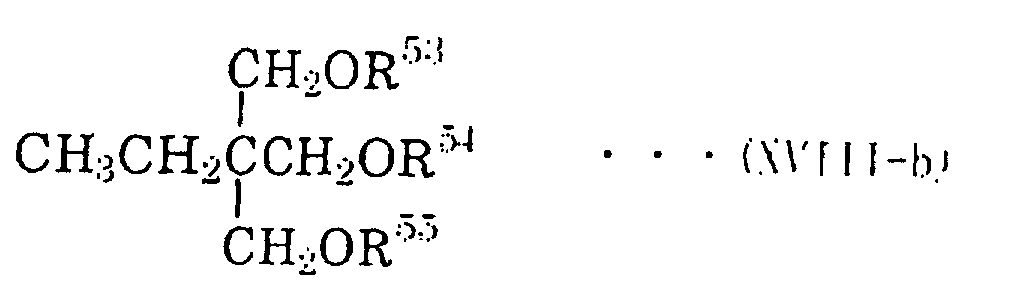
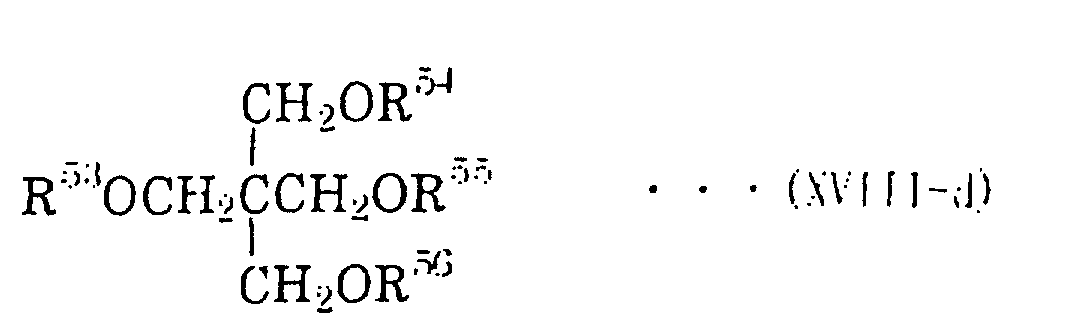
- compounds represented by the following general formulae (XVIII-a) to (XVIII-f) are preferable.
- R 53 to R 58 each represent hydrogen atom or an alkyl group, an aryl group, an aralkyl group or an acyl group which has 1 to 18 carbon atoms and may be linear or branched.
- the atoms or the groups represented by R 53 to R 58 may be the same with or different from each other.
- R 53 to R 58 may each represent a glycol ether residue group represented by -(R a O) x -R b , wherein R a represents an alkylene group having 2 to 6 carbon atoms, R b represents an alkyl group, an aryl group, an aralkyl group or an acyl group which has 1 to 20 carbon atoms and x represents an integer of 1 to 10.
- Examples of the aliphatic polyhydric alcohol having a functionality of 3 to 6 include glycerol, trimethylolpropane, erythritol, pentaerythritol, arabitol, sorbitol and mannitol.
- Examples of the group represented by R 53 to R 58 in the above general formulae (XVIII-a) to (XVIII-f) include methyl group, ethyl group, n-propyl group, isopropyl group, various types of butyl group, various types of pentyl group, various types of hexyl group, various types heptyl group, various types of octyl group, various types of nonyl group, various types of decyl group, various types of undecyl group, various types of dodecyl group, various types of tridecyl group, various types of tetradecyl group, various types of pentadecyl group, various types of hexadecy group, various types of heptadecyl group, various types of octadecyl group, phenyl group and benzyl group.
- R 47 to R 52 may also represent hydrogen atom and, in this case, the above compound is a partial
- R 53 to R 60 are the same as those described for R 53 to R 58 and the atoms or groups represented by R 53 to R 60 may be the same with or different from each other.
- Examples of the compound obtained by etherification of a condensate of two or three molecules of an aliphatic polyhydric alcohols having a functionality of 3 to 6 include diglycerol, ditrimethylolpropane, dipentaerythritol, disorbitol, triglycerol, tritrimethylolpropane, tripentaerythritol and trisorbitol.
- components (x) and (y) represented by the above general formulae (XVIII-a) to (XVIII-j) include trihexyl ether of glycerol, dimethyl octyl triether of glycerol, di(methyloxyisopropylene) dodecyl triether of glycerol, diphenyl octyl triether of glycerol, di(phenyloxy-isopropylene) dodecyl triether of glycerol, trihexyl ether of trimethylol-propane, dimethyl octyl triether of trimethylolpropane, di(methyloxy-isopropylene) dodecyl triether of trimethylolpropane, tetrahexyl ether of pentaerythritol, trimethyl octyl tetraether of pentaerythritol, tri(methyloxyisopropylene) dodecy
- the kinematic viscosity of components (x) and (y) at 40°C is in the range of 5 to 200 mm 2 /s and preferably in the range of 10 to 100 mm 2 /s.
- the kinematic viscosity is smaller than 5 mm 2 /s, the effect of improving the Lubricity and preventing clogging of capillaries is small.
- the kinematic viscosity exceeds 200 mm 2 /s, miscibility with the refrigerant decreases (the temperature of phase separation is elevated). Therefore, such kinematic viscosities are not preferable.
- the above components (x) and (y) may be used singly or in combination of two or more.
- the amount of components (x) and (y) are in the range of 0.1 to 30% by weight based on the amount of the entire composition.
- the amount is less than 0.1% by weight, the object of the present invention is not sufficiently achieved.
- the amount exceeds 30% by weight, the effect is not exhibited to the degree expected from the amount and solubility into the base oil occasionally decreases.
- the amount is in the range of 0.1 to 15% by weight and most preferably in the range of 0.5 to 10% by weight.
- the lubricating oil for refrigerators of the present invention may further comprise other additives conventionally used for lubricating oils such as metal inactivators, defoaming agents, detergent dispersants, viscosity index improvers, oiliness agents, antiwear additives, rust preventives, corrosion inhibitors and pour pint improvers, where desired.
- additives conventionally used for lubricating oils such as metal inactivators, defoaming agents, detergent dispersants, viscosity index improvers, oiliness agents, antiwear additives, rust preventives, corrosion inhibitors and pour pint improvers, where desired.
- Examples of the metal inactivator include benzotriazole derivatives.
- Examples of the defoaming agent include silicone oils such a dimethylpolysiloxane and polymethacrylates.
- Examples of the detergent dispersant include sulfonates, phenates and succinimide.
- Examples of the viscosity index improver include polymethacrylates, polyisobutylene, ethylene-propylene copolymers and hydrogenated styrene-diene copolymers.
- the hydraulic fluid composition for refrigerators of the present invention comprises (A) a refrigerant having no chlorine atoms and one carbon atom and (B) a lubricating oil for refrigerators of the present invention described above.
- Examples of the refrigerant having no chlorine atoms and one carbon atom include difluoromethane (R32).
- the amounts of component (A) and component (B) are selected in a manner such that the ratio of the amount by weight of component (A) to the amount by weight of component (B) is, in general, in the range of 5:95 to 99:1 and preferably in the range of 10:90 to 99:1.
- the amount of the refrigerant is smaller than the above range, the refrigerating ability decreases.
- the amount of the refrigerant exceeds the above range, the lubricity decreases. Therefor, such amounts are not preferable.
- the lubricating oil for refrigerators of the present invention can be applied to various types of refrigerators.
- the lubricating oil for refrigerators of the present invention is advantageously applied to compression-type refrigerating cycles of compression-type refrigerators.
- the lubricating oil can be advantageously applied to refrigerators disclosed in Japanese Patent Application Laid-Open Nos. Heisei 4(1992)-183788, Heisei 8(1996)-259975, Heisei 8(1996)-240362, Heisei 8(1996)-253779, Heisei 8(1996)-240352, Heisei 5(1993)-17792, Heisei 8(1996)-226717 and Heisei 8(1996)-231972.
- the advantageous effects can be exhibited when the lubricating oil of the present invention is applied to compression-type refrigerating cycles having an oil separator and/or a hot gas line such as the refrigerating cycles shown in Figures 1 to 3.
- a compression-type refrigerating cycle is constituted with a compressor, a condenser, an expansion valve and an evaporator.
- a lubricating oil for a refrigerator a lubricating oil exhibiting excellent miscibility with the refrigerant used for the refrigerator is used.
- a refrigerant comprising component (A) as the main component is used for the above refrigerating cycle and the refrigerator is lubricated with a conventional refrigerating oil
- antiwear is poor and a stable operation for a long period time cannot be achieved due to insufficient stability.
- the drawbacks are marked when a capillary tube is used as the expansion valve in the refrigerating cycle of a refrigerator such as an electric refrigerator and a small air conditioner.
- the lubricating oil of the present invention can be effectively used as the lubricating oil composition even when a compression-type refrigerating cycle having an oil separator and/or a hot gas line is operated using a refrigerant comprising component (A) as the main component.
- the hydraulic fluid composition for a refrigerator of the present invention exhibits remarkably excellent miscibility between component (A) and component (B).
- the maximum temperature in the region of phase separation at the low temperature side is -10°C or lower, more preferably -20°C or lower, still more preferably -30°C or lower, still more preferably -40°C or lower and most preferably -50°C or lower.
- the hydraulic fluid composition of the present invention does not cause phase separation at the low temperature side during operation of a refrigerator since the maximum temperature in the region of phase separation at the low temperature side is -10°C or lower and enables stable operation of the refrigerator.
- the obtained toluene solution of the product was washed with 300 ml of pure water and the washing water was not alkaline after the washing was repeated five times.
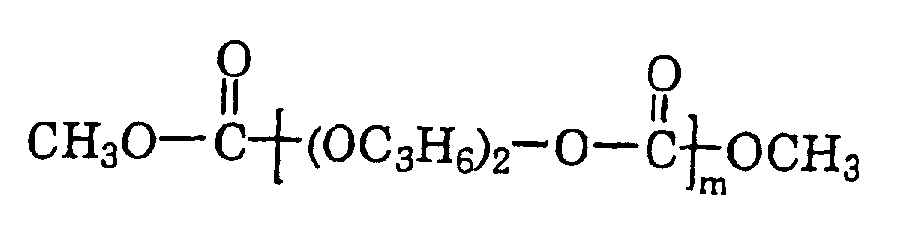
- Toluene was completely removed by distillation using a rotary evaporator under evacuation by an aspirator at 120°C for 30 minutes, followed by evacuation by a vacuum pump at 133 Pa for 30 minutes and 295 g of a polycarbonate of dipropylene glycol (methyl group at the chain ends): of the object compound was obtained.
- n-Butanol formed by the carbonate exchange reaction was removed by distillation during the heating.
- the reaction was allowed to proceed further while the residual di-n-butyl carbonate was removed by distillation under evacuation to 10 kPa by an aspirator at the temperature kept at 160°C.
- 300 ml of toluene was added to the reaction product.
- the obtained toluene solution of the product was washed with 200 ml of pure water and the washing water was not alkaline after the washing was repeated five times.
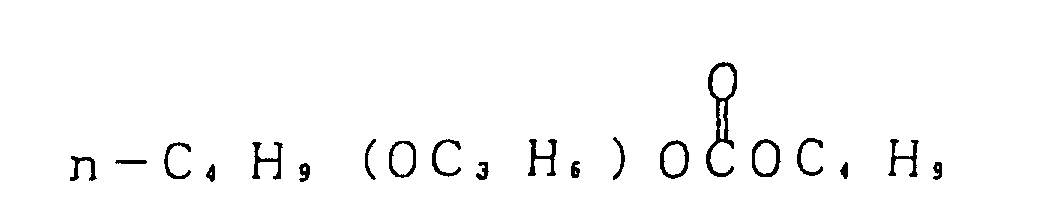
- Toluene was completely removed by distillation using a rotary evaporator under evacuation by an aspirator at 120°C for 30 minutes, followed by evacuation by a vacuum pump at 133 Pa for 30 minutes and 194 g of a polycarbonate of dipropylene glycol (n-butyl group at the chain ends): of the object compound was obtained.
- Methanol formed by the carbonate exchange reaction was removed by distillation together with a portion of dimethyl carbonate.
- the reaction was allowed to proceed further while the residual dimethyl carbonate was removed by distillation at the reaction temperature slowly elevated to 140°C over 2 hours. After the heating was stopped, 500 ml of toluene was added to the reaction product.
- the obtained toluene solution of the product was washed with 300 ml of pure water and the washing water was not alkaline after the washing was repeated five times.
- Toluene was completely removed by distillation using a rotary evaporator under evacuation by an aspirator at 120°C for 30 minutes, followed by evacuation by a vacuum pump at 133 Pa for 30 minutes and 354 g of a mixture of polycarbonates of dipropylene glycol (the n-butyl diethylene glycol ether group and the methyl diethylene glycol ether group at the chain ends): of the object compound was obtained.
- the lubricating oils used for Examples and Comparative Examples as the samples contained 0.3% by weight of an ⁇ -olefin oxide.
- the kinematic viscosity and the viscosity index of a base oil and the properties of a lubricating oil were obtained in accordance with the following methods.
- the kinematic viscosity was measured in accordance with the method of Japanese Industrial Standard K2283-1983 using a glass capillary viscometer at 40°C and at 100°C.
- a prescribed amount of a sample was placed into a pressure-resistance glass ampoule.
- the glass ampoule was connected to a vacuum piping and a piping of the refrigerant of difluoromethane (R32).
- R32 the refrigerant of difluoromethane
- the ampoule was cooled and a prescribed amount of the refrigerant of difluoromethane (R32) was taken into the ampoule. Then, the ampoule was sealed.
- the ampoule was cooled slowly from the room temperature to -50°C in a thermostatted chamber and the temperature at which the phase separation started was measured. The lower the temperature of phase separation, the more preferable the property at the low temperature side.
- the load of seizure was obtained in accordance with the method of ASTM D-3233 using a Falex friction tester of the closed type.
- the condition of the test was as follows: the amount of oil: 300 ml; the refrigerant: R32; the pressure: 0.8 MPaG; and the temperature: 50°C.
- Example 1 2 3 4 5 kinematic viscosity (mm 2 /s) at 40°C 143 89.81 111.6 92.63 972.7 at 100°C 10.42 11.29 10.90 9.71 33.27 Temperature of phase separation (°C) 10% by weight -50> -50> -50> -50> 15% by weight -50> -50> -50> -50> -50> Lubricity (load of seizure) (N) 4080 3750 3970 3630 4150 Stability appearance of oil good good good good good precipitates none none none none none none metal catalyst no change no change no change no change no change no change no change no change no change no change no change Comparative Example 1 2 3 4 kinematic viscosity (mm 2 /s) at 40°C 68.85 44.86 68.64 35.24 at 100°C 8.38 10.23 8.23 7.72 Temperature of phase separation (°C) 10% by weight sep.r.t.
- the lubricating oil for refrigerators of the present invention exhibits excellent miscibility with a refrigerant having no chlorine atoms and one carbon atom and, in particular, with difluoromethane.
- the hydraulic fluid composition for refrigerators of the present invention which comprises the lubricating oil for refrigerators of the present invention and the above refrigerant exhibits excellent antiwear, lubricity and stability.
Landscapes
- Chemical & Material Sciences (AREA)
- Chemical Kinetics & Catalysis (AREA)
- Organic Chemistry (AREA)
- General Chemical & Material Sciences (AREA)
- Oil, Petroleum & Natural Gas (AREA)
- Emergency Medicine (AREA)
- Health & Medical Sciences (AREA)
- Engineering & Computer Science (AREA)
- Physics & Mathematics (AREA)
- Combustion & Propulsion (AREA)
- Thermal Sciences (AREA)
- Materials Engineering (AREA)
- Lubricants (AREA)
Abstract
Description
- 1:
- A compressor
- 2:
- A condenser
- 3:
- An expansion valve
- 4:
- An evaporator
- 5:
- An oil separator
- 6:
- A hot gas line
- 7:
- A valve for a hot gas line
compounds represented by general formula (I):

compounds represented by general formula (II):














| Example | 1 | 2 | 3 | 4 | 5 |
| kinematic viscosity (mm2/s) | |||||
| at 40°C | 143 | 89.81 | 111.6 | 92.63 | 972.7 |
| at 100°C | 10.42 | 11.29 | 10.90 | 9.71 | 33.27 |
| Temperature of phase separation (°C) | |||||
| 10% by weight | -50> | -50> | -50> | -50> | -50> |
| 15% by weight | -50> | -50> | -50> | -50> | -50> |
| Lubricity (load of seizure) (N) | 4080 | 3750 | 3970 | 3630 | 4150 |
| Stability | |||||
| appearance of oil | good | good | good | good | good |
| precipitates | none | none | none | none | none |
| metal catalyst | no change | no change | no change | no change | no change |
| Comparative Example | 1 | 2 | 3 | 4 |
| kinematic viscosity (mm2/s) | ||||
| at 40°C | 68.85 | 44.86 | 68.64 | 35.24 |
| at 100°C | 8.38 | 10.23 | 8.23 | 7.72 |
| Temperature of phase separation (°C) | ||||
| 10% by weight | sep.r.t. | sep.r.t. | sep.r.t. | sep.r.t. |
| 15% by weight | sep.r.t. | sep.r.t. | sep.r.t. | sep.r.t. |
| Lubricity (load of seizure) (N) | 3890 | 4220 | 3120 | 3360 |
| Stability | ||||
| appearance of oil | yellowish brown | good | good | light yellow |
| precipitates | none | none | none | none |
| metal catalyst | change in color of Fe,Cu | no change | no change | change in Fe |
Claims (16)
- A lubricating oil for refrigerators which comprises a compound having oxygen as a base oil and is miscible with a refrigerant having no chlorine atoms and one carbon atom at a temperature of -10°C or lower when the lubricating oil is comprised at least in one content within a range of 3 to 50% by weight based on an entire amount of a mixture comprising the lubricating oil and the refrigerant.
- A lubricating oil for refrigerators according to Claim 1, which comprises a compound having oxygen as a base oil and is miscible with a refrigerant having no chlorine atoms and one carbon atom at a temperature of -10°C or lower when the lubricating oil is comprised at least in one content within a range of 10 to 15% by weight based on an entire amount of a mixture comprising the lubricating oil and the refrigerant.
- A lubricating oil for refrigerators according to Claims 1 and 2, which comprises a compound having oxygen as a base oil and is miscible with a refrigerant having no chlorine atoms and one carbon atom at a temperature of -10°C or lower when the lubricating oil is comprised in a content in a range of 3 to 50% by weight based on an entire amount of a mixture comprising the lubricating oil and the refrigerant.
- A lubricating oil for refrigerators according to any one of Claims 1 to 3, wherein the compound having oxygen is a polycarbonate compound having at least two carbonate bonds in one molecule.
- A lubricating oil for refrigerators according to Claim 4, wherein the polycarbonate compound is at least one compound selected from:
compounds represented by general formula (I):wherein Z represents a residue group obtained by eliminating hydroxyl group from an alcohol having 1 to 12 carbon atoms and a functionality of n, R1 represents a linear or branched alkylene group having 2 to 10 carbon atoms, R2 represents a monovalent hydrocarbon group having 1 to 12 carbon atoms or a group having ether bond represented by R4(O-R3)p-, R4 representing hydrogen atom or a monovalent hydrocarbon group having 1 to 12 carbon atoms, R3 representing a linear or branched alkylene group having 2 to 10 carbon atoms and p representing an integer of 1 to 20, k represents an integer of 1 to 30, m represents an integer of 1 to 50 and n represents an integer of 1 to 6; and
compounds represented by general formula (II):wherein R5 represents a linear or branched alkylene group having 2 to 10 carbon atoms, q represents an integer of 1 to 20 and Z, R1, R2, k, m and n are as described for general formula (I).
- A lubricating oil for refrigerators according to Claim 5, wherein the compound represented by general formula (I) is a compound represented by general formula (I-a):wherein R6 represents a residue group obtained by eliminating hydroxyl group from a monohydric alcohol having 1 to 12 carbon atoms and R1, R2, k and m are as described for general formula (I); and/or the compound represented by general formula (II) is a compound represented by general formula (II-a):
 wherein R1, R2, R5, R6, k, m and q are as described for general formulae (I), (II) and (I-a).
- A lubricating oil for refrigerators according to Claim 6, wherein R1 in general formulae (I-a) and (II-a) represents an alkylene group having 2 to 6 carbon atoms.
- A lubricating oil for refrigerators according to Claim 7, wherein R1 represents ethylene group or propylene group.
- A lubricating oil for refrigerators according to any one of Claims 6, 7 and 8, wherein, in general formulae (I-a) and (II-a), R2 represents a monovalent hydrocarbon group having 1 to 6 carbon atoms or a group having ether bond represented by R4(O-R3)p-, R4 representing hydrogen atom or a monovalent hydrocarbon group having 1 to 6 carbon atoms, R3 representing a linear or branched alkylene group having 2 to 6 carbon atoms and p representing an integer of 1 to 10; and R6 represents a linear or branched alkyl group having 1 to 6 carbon atoms.
- A lubricating oil for refrigerators according to any one of Claims 1 to 9, which has a kinematic viscosity at 40°C of 2 to 2,000 mm2/s.
- A lubricating oil for refrigerators according to any one of Claim 10, which has a kinematic viscosity at 40°C of 10 to 1,000 mm2/s.
- A lubricating oil for refrigerators according to any one of Claims 1 to 11, which comprises an acid catcher.
- A lubricating oil for refrigerators according to any one of Claims 1 to 12, which comprises at least one additive selected from a group consisting of extreme pressure agents, oiliness agents and antioxidants.
- A hydraulic fluid composition for refrigerators which comprises (A) a refrigerant having no chlorine atoms and one carbon atom and (B) a lubricating oil for refrigerators described in any one of Claims 1 to 13.
- A hydraulic fluid composition for refrigerators according to Claim 14, which comprises component (A) and component (B) in amounts such that a ratio of an amount by weight of component (A) to an amount by weight of component (B) is in a range of 5:95 to 99:1.
- A hydraulic fluid composition for refrigerators according to any one of Claims 14 and 15, wherein the refrigerant of component (A) is difluoromethane.
Applications Claiming Priority (3)
| Application Number | Priority Date | Filing Date | Title |
|---|---|---|---|
| JP2000179303 | 2000-06-15 | ||
| JP2000179303 | 2000-06-15 | ||
| PCT/JP2001/005119 WO2001096505A1 (en) | 2000-06-15 | 2001-06-15 | Lubricating oil for refrigerating machine and hydraulic composition containing the same for use in refrigerating machine |
Publications (2)
| Publication Number | Publication Date |
|---|---|
| EP1300459A1 true EP1300459A1 (en) | 2003-04-09 |
| EP1300459A4 EP1300459A4 (en) | 2006-05-31 |
Family
ID=18680595
Family Applications (1)
| Application Number | Title | Priority Date | Filing Date |
|---|---|---|---|
| EP01941067A Withdrawn EP1300459A4 (en) | 2000-06-15 | 2001-06-15 | LUBRICATING OIL FOR REFRIGERATING MACHINES AND HYDRAULIC COMPOSITION CONTAINING THE SAME, USED IN A REFRIGERATING MACHINE |
Country Status (6)
| Country | Link |
|---|---|
| US (1) | US20040167042A1 (en) |
| EP (1) | EP1300459A4 (en) |
| JP (1) | JPWO2001096505A1 (en) |
| KR (1) | KR20030007971A (en) |
| TW (1) | TWI289600B (en) |
| WO (1) | WO2001096505A1 (en) |
Families Citing this family (5)
| Publication number | Priority date | Publication date | Assignee | Title |
|---|---|---|---|---|
| US7052626B1 (en) * | 1989-12-28 | 2006-05-30 | Nippon Mitsubishi Oil Corporation | Fluid compositions containing refrigeration oils and chlorine-free fluorocarbon refrigerants |
| JP4460085B2 (en) * | 1999-07-06 | 2010-05-12 | 出光興産株式会社 | Refrigerating machine oil composition for carbon dioxide refrigerant |
| JP4603117B2 (en) * | 1999-12-28 | 2010-12-22 | 出光興産株式会社 | Refrigerating machine oil composition for natural refrigerants |
| JP7032043B2 (en) * | 2016-12-20 | 2022-03-08 | 出光興産株式会社 | Refrigerating machine oil and composition for refrigerating machine |
| CN111936606B (en) * | 2018-04-02 | 2022-11-01 | 引能仕株式会社 | Refrigerator, refrigerator oil and working fluid composition for refrigerator |
Family Cites Families (12)
| Publication number | Priority date | Publication date | Assignee | Title |
|---|---|---|---|---|
| JP2927483B2 (en) * | 1990-01-23 | 1999-07-28 | 出光興産株式会社 | Polycarbonate synthetic lubricating oil |
| EP0548049B1 (en) * | 1990-04-20 | 1996-07-17 | NIPPON OIL Co. Ltd. | Synthetic lubricating oils |
| EP0499793B1 (en) * | 1991-01-18 | 1995-04-12 | Nippon Oil Co., Ltd. | Synthetic lubricating oils |
| JPH069977A (en) * | 1992-06-24 | 1994-01-18 | Kao Corp | Refrigerator working fluid composition |
| JPH0967589A (en) * | 1995-09-04 | 1997-03-11 | Kao Corp | Composition for working fluid of refrigerator |
| JP3983328B2 (en) * | 1996-04-26 | 2007-09-26 | 出光興産株式会社 | Refrigerator oil composition |
| JPH1112585A (en) * | 1997-06-26 | 1999-01-19 | Kao Corp | Refrigerator oil and composition for refrigerator working fluid |
| JP2000008062A (en) * | 1998-06-22 | 2000-01-11 | Mitsui Chemicals Inc | Refrigerant refrigerant composition |
| TW546372B (en) * | 1998-12-11 | 2003-08-11 | Idemitsu Kosan Co | Refrigerator oil composition, and method of using the composition for lubrication |
| JP4460085B2 (en) * | 1999-07-06 | 2010-05-12 | 出光興産株式会社 | Refrigerating machine oil composition for carbon dioxide refrigerant |
| JP4456708B2 (en) * | 1999-12-28 | 2010-04-28 | 出光興産株式会社 | Lubricating oil composition containing cyclic organophosphorus compound |
| EP2277981A3 (en) * | 2000-07-26 | 2011-06-22 | Idemitsu Kosan Co., Ltd. | Lubricating oil for refrigerator and refrigerator fluid composition for refrigerator using the same |
-
2001
- 2001-06-15 EP EP01941067A patent/EP1300459A4/en not_active Withdrawn
- 2001-06-15 KR KR1020027017118A patent/KR20030007971A/en not_active Abandoned
- 2001-06-15 US US10/297,595 patent/US20040167042A1/en not_active Abandoned
- 2001-06-15 TW TW090114777A patent/TWI289600B/en not_active IP Right Cessation
- 2001-06-15 JP JP2002510625A patent/JPWO2001096505A1/en not_active Withdrawn
- 2001-06-15 WO PCT/JP2001/005119 patent/WO2001096505A1/en not_active Ceased
Also Published As
| Publication number | Publication date |
|---|---|
| EP1300459A4 (en) | 2006-05-31 |
| TWI289600B (en) | 2007-11-11 |
| US20040167042A1 (en) | 2004-08-26 |
| JPWO2001096505A1 (en) | 2004-06-10 |
| KR20030007971A (en) | 2003-01-23 |
| WO2001096505A1 (en) | 2001-12-20 |
Similar Documents
| Publication | Publication Date | Title |
|---|---|---|
| US8648022B2 (en) | Lubricating oil for refrigerator and hydraulic fluid composition for refrigerator using the same | |
| EP1243639B1 (en) | Use of a refrigerating machine oil composition for carbon dioxide refrigerant | |
| JP2911629B2 (en) | Refrigeration oil composition | |
| US5403503A (en) | Refrigerator oil composition for hydrogen-containing hydrofluorocarbon refrigerant | |
| KR0131690B1 (en) | Lubricating oil for refrigerator with compressor | |
| KR100287584B1 (en) | Refrigerator oil composition | |
| US7531488B2 (en) | Lubricating oil for refrigerator with compressor | |
| US6815402B2 (en) | Lubricating oil composition containing cyclic organophosphorus compound | |
| JP3763221B2 (en) | Composition for refrigerant | |
| JPH0491194A (en) | Synthetic lubricating oil | |
| JPH03217495A (en) | Polycarbonate-based synthetic lubricating oil | |
| US20040167042A1 (en) | Lubricating oil for refrigerating machine and hydraulic composition containing the same for use in refrigerating machine | |
| JP2774307B2 (en) | Refrigeration oil for fluorinated alkane refrigerant | |
| JP5039251B2 (en) | Lubricating oil composition for refrigerator and working fluid composition for refrigerator using the same | |
| JP5016157B2 (en) | Lubricating oil composition for refrigerator and working fluid composition for refrigerator using the same | |
| CN1332002C (en) | Method or reducing wear of metal surfaces and maintaining hydrolytically stable environment in refrigeration equipment during operation of such equipment | |
| JP2002105471A (en) | Lubricating oil composition for refrigerator and working fluid composition for refrigerator using the same | |
| JP2554737B2 (en) | Refrigeration oil for fluorinated alkane refrigerants | |
| JP2859253B2 (en) | Refrigeration oil for fluorinated alkane refrigerant | |
| JP2824237B2 (en) | Lubricating oil composition for compression refrigerator | |
| JP2785066B2 (en) | Lubricating oil for compression refrigerators | |
| JP3266571B2 (en) | Refrigerating machine oil | |
| JP2000008062A (en) | Refrigerant refrigerant composition | |
| JPH03185093A (en) | Refrigerator oil composition for hcfc refrigerant | |
| JPH08239678A (en) | Refrigeration oil for fluorinated alkane refrigerants |
Legal Events
| Date | Code | Title | Description |
|---|---|---|---|
| PUAI | Public reference made under article 153(3) epc to a published international application that has entered the european phase |
Free format text: ORIGINAL CODE: 0009012 |
|
| 17P | Request for examination filed |
Effective date: 20021204 |
|
| AK | Designated contracting states |
Designated state(s): AT BE CH CY DE DK ES FI FR GB GR IE IT LI LU MC NL PT SE TR Kind code of ref document: A1 Designated state(s): AT BE CH CY DE DK ES FI FR GB GR IE IT LI LU MC NL PT SE TR |
|
| A4 | Supplementary search report drawn up and despatched |
Effective date: 20060419 |
|
| 17Q | First examination report despatched |
Effective date: 20060906 |
|
| STAA | Information on the status of an ep patent application or granted ep patent |
Free format text: STATUS: THE APPLICATION IS DEEMED TO BE WITHDRAWN |
|
| 18D | Application deemed to be withdrawn |
Effective date: 20090103 |