EP1298217A1 - Process for producing glycoprotein - Google Patents
Process for producing glycoprotein Download PDFInfo
- Publication number
- EP1298217A1 EP1298217A1 EP01949913A EP01949913A EP1298217A1 EP 1298217 A1 EP1298217 A1 EP 1298217A1 EP 01949913 A EP01949913 A EP 01949913A EP 01949913 A EP01949913 A EP 01949913A EP 1298217 A1 EP1298217 A1 EP 1298217A1
- Authority
- EP
- European Patent Office
- Prior art keywords
- sugar
- sugar chain
- producing
- medium
- glycoprotein
- Prior art date
- Legal status (The legal status is an assumption and is not a legal conclusion. Google has not performed a legal analysis and makes no representation as to the accuracy of the status listed.)
- Withdrawn
Links
Classifications
-
- C—CHEMISTRY; METALLURGY
- C12—BIOCHEMISTRY; BEER; SPIRITS; WINE; VINEGAR; MICROBIOLOGY; ENZYMOLOGY; MUTATION OR GENETIC ENGINEERING
- C12P—FERMENTATION OR ENZYME-USING PROCESSES TO SYNTHESISE A DESIRED CHEMICAL COMPOUND OR COMPOSITION OR TO SEPARATE OPTICAL ISOMERS FROM A RACEMIC MIXTURE
- C12P21/00—Preparation of peptides or proteins
- C12P21/005—Glycopeptides, glycoproteins
Definitions
- the present invention relates to a method for producing a glycoprotein.
- a cell capable of mainly modifying a sugar chain such as a eukaryotic cell (e.g., mammalian cell) must be used as a host.
- a eukaryotic cell e.g., mammalian cell
- the modification of the sugar chain is not as strictly controlled on a DNA level as seen in the production of a protein.
- the modification is carried out by a series of enzymatic reactions consisting of up to about 20 steps, so that it is known that the process of the sugar chain modification is affected by factors such as protein structure, host cell lines, and culturing condition for cells ( Biotechnology , vol. 8, pp. 421-428, 1990; ibid., vol. 13, pp. 592-596, 1995; Biochemistry , vol. 28, pp. 7644-7662, 1989).
- natural-type and recombinant-type sugar chains can have different structures, and recombinant-type sugar chains can have macro- and micro-heterogeneity of carbohydrate structures in many cases (J. Biol. Chem., pp. 21153-21159, 1989; Arch. Biochem. Biophys., vol. 203, pp. 458-465, 1980).
- a sugar chain structure different from a natural-type one can cause an immunological reaction, so that it is desirable that a recombinant-type one has a sugar chain structure common to the natural-type one.
- controlling the structure of the sugar chain is a big problem in the production of a recombinant glycoprotein.
- the object of the present invention is to provide means for controlling the "modification and structure change" of a sugar chain in the production of a glycoprotein using the genetically recombinant technique.
- the present invention is related to:
- the glycoprotein according to the present invention is a generic name for substances having a sugar chain binding to proteins by covalent bonds. It refers to a complex glycoprotein having a sugar chain, which consists of two to six different monosaccharides, which does not have any repeated structure, and which is binding to proteins by covalent bonds.
- Such a glycoprotein includes substances that occur widely in the living world, have a biologically and/or physiologically activity, and have sugar chain(s) binding with at least one amino acid residue that can be binding by a sugar chain such as asparagine moiety, serine moiety, and threonine moiety in the amino acid sequence of the protein.
- Sugar chains of glycoproteins are classified into two groups based on the binding mode between sugar chain and protein, i.e., serum-type sugar chain and mucin-type sugar chain.
- the former is an N-linked oligosaccharides sugar chain or asparagines type sugar chain (Asn type sugar chain) obtained by binding, to form an N- ⁇ -glycoside bond, N-acetylglucosamine to Asn of the amino acid sequence Asn-X-Ser/Thr in a polypeptide, is frequently found in serum glycoproteins, and is called 'serum-type sugar chain'.
- the latter is an O-linked oligosaccharides sugar chain obtained by binding, to form an O- ⁇ -glycoside bond, N-acetylgalactosamine to Ser or Thr, is frequently found in mucin that is a mucous protein, and is called 'mucin-type sugar chain'.
- Each sugar chain can bind to an amino acid in a protein at any bindable site in the amino acid sequence as long as the biological activity and/or physiological activity are/is kept. Therefore, the number of the sugar chain per one molecule of glycoprotein can be one, two, or more.
- Sugars constituting the sugar chain include N-acetylglucosamine, N-acetylgalactosamine, D-mannose, D-galactose, L-fucose, and sialic acid as well as, in plants, D-xylose and D-arabinose. These sugars can bind in any arrangement.
- glycoproteins include plasma protein (e.g., blood coagulation factors such as factor VIII, factor IX, and factor XIII, immunoglobulin, antithrombin III, prothrombin, thrombin, fibrinogen, fibrin, plasminogen, haptoglobin, ⁇ 1-plasmin inhibitor, ⁇ 1-antitrypsin, transferrin, and heparin cofactor II), interferon (IFN), insulin, various growth factors, urinary trypsin inhibitor, plasminogen activators (e.g., urokinase (UK), prourokinase, tissue plasminogen activator (tPA)), colony formation-stimulating factor (CSF), various receptors, various enzymes, erythropoietin (EPO), interleukin (IL), hormone, lymphokine, and cytokine.
- plasma protein e.g., blood coagulation factors such as factor VIII, factor IX, and factor XIII, immunoglobulin, antithro
- a gene encoding the above protein is introduced into an expression vector system to construct the host-vector system for expression according to the present invention.
- a combination consisting of a replicon derived from a species compatible with the host cell and the said host is used in general.
- the vector has replication point, promoter, control sequence (enhancer), signal sequence, ribosome-binding site, RNA splice sequence, poly-A addition site, and transcription termination sequence (terminator), and, optionally, can has a marker sequence that permits selecting a phenotype in a transformed cell.
- DHFR dihydrofolate reductase
- Any host capable of producing a glycoprotein can be used for the present invention.
- a host includes one derived from a eukaryote (e.g., animal cell, yeast, fungus, plant cell, and insect cell), auxotroph, and antibiotic-sensitive strain.
- the animal cell includes CHO cell (e.g., CHO-K1 cell), COS-7 cell, Vero cell, HeLa cell, WI38 cell, BHK cell, MDCK cell, C127 cell, and variants such as dhfr-deficient strain, HGPRT (hypoxanthine guanine phosphoribosyl transferase)-deficient strain, and ouabain-resistant strains derived from those cells.
- CHO cell e.g., CHO-K1 cell
- COS-7 cell Vero cell
- HeLa cell HeLa cell
- WI38 cell BHK cell
- MDCK cell BHK cell
- C127 cell and variants such as dhfr-deficient strain, HGPRT (hypoxanthine guanine phosphoribosyl transferase)-deficient strain, and ouabain-resistant strains derived from those cells.
- HGPRT hypoxanthine guanine phosphoribosyl transferase
- the yeast includes ones belonging to the genus Saccharomyces (e.g., S. cerevisiae ), the genus Picbia (e.g., P. pastoris ), and the genus Kluyveromyces .
- the fungus includes one belonging to the genus Aspergillus .
- the plant cell includes ones derived from potato, tobacco, corn, Oryzae sativa, Brassica campestris , soybean, tomato, wheat, barley, and rye.
- Well-known methods can be used for preparing a host (transformant) capable of producing a glycoprotein using the genetically recombinant technique and for producing a glycoprotein using the host.
- the method for preparing a transformant includes a method for introducing a plasmid directly into a host cell and a method for integrating a plasmid into the chromosome.
- the former method includes the protoplast polyethylene glycol method and the electroporation method.
- the latter method comprises the steps of making a plasmid contain a partial DNA sequence of a gene present in the host chromosome and introducing the plasmid or linear fragment thereof into the host chromosome by the homologous recombination using the homologous sequence part.
- Transformants are cultured by well-known methods.
- a culture medium depends on the kind of the host.
- Yeasts may be cultured, for example, with YPD liquid medium (1% yeast extract, 2% Bacto Peptone, and 2% glucose).
- Animal cells may be cultured, for example, with basal media (e.g., MEM medium, DMEM medium, RPMI medium, and HamF medium), serum media (e.g., FCS-added one, and bovine serum- or human serum-added one), and serum-free media (e.g., insulin-, peptone-, HSA-, and/or transferrin added ones).
- basal media e.g., MEM medium, DMEM medium, RPMI medium, and HamF medium
- serum media e.g., FCS-added one, and bovine serum- or human serum-added one
- serum-free media e.g., insulin-, peptone-, HSA-, and/or transferrin added ones
- DMEM medium is Dulbecco's modified Eagle medium ( In Vitro vol. 6, p. 89, 1970).
- RPMI medium includes RPMI1640 medium ( J. Immunol. Methods vol. 39, p. 285, 1980; JAMA vol. 1999, p. 519, 1957).
- HamF medium includes HamF12 medium ( Proc. Natl. Acad. Sci. USA vol. 53, p. 288, 1965).
- the serum-free medium can contain, for example, insulin, peptone, transferrin, and HSA (human serum albumin) (Japanese Patent Application Laid-Open ( kokai ) No. Hei 4-234982); insulin, peptone, and non-protein iron source (WO98/00521); recombinant insulin, plant peptone and an inorganic iron salt (Japanese Patent 2625302) or recombinant HSA (WO98/06822); and, if necessary, trace metals such as cobalt, molibdenium, iron, manganese, copper, and zinc with being added as a solution of their inorganic or organic salts or complexes (e.g., Japanese Patent Application Laid-Open ( kokai ) No. 2001-120262, WO98/4680, US-5612196).
- HSA human serum albumin
- the culturing is carried out, usually, at 15-43°C (preferably 30-37°C) or so for 10-200 h or so, if necessary, with aeration and/or agitation, by the batch culture technique, the fed-batch culture technique, or the continuous culture technique.
- culturing vessels such as culturing device using dish, flask, roller bottle, spinner flask, micro-carrier, microcapsule, and/or hollow fiber can be used for culturing a recombinant host cell according to the present invention, other vessels can also be used.
- the culturing method includes the successive subculture usually carried out using the above culturing vessel and the continuous culturing method in which old culture liquid is continuously or intermittently withdrawn from the reactor with or without separating cells from the culture liquid and the same volume of fresh medium is supplied with keeping the culture condition for a long time.
- the cell density upon culturing the recombinant host cell is, for example, 10 4 -10 9 cells/ml or so.
- the recombinant host cell can also be cultured at a high cell density, for example, at 10 8 cells/ml or higher for the present invention.
- the production of a glycoprotein using the general recombinant host cell according to the present invention can be carried out by the known means as described, for example, in WO91/06649.
- an animal cell is used as a recombinant host cell, methods described, for example, in Japanese Patent Application Laid-Open ( kokai ) No. Sho 61-177987 and Japanese Patent Application Laid-Open ( kokai ) No. Sho 63-146789 can be used.
- the present invention is characterized by modifying the structure of sugar chain binding to a protein by changing the specific-sugar-consumption rate as an index upon producing a glycoprotein by culturing a genetically recombinant host in a medium.
- the specific-sugar-consumption rate' is a consumption rate of a sugar in a medium (change in amount of sugar consumption per unit time) per one cell upon culturing a host.
- the specific consumption rate in the batch culture technique is defined by Eq.1: wherein ⁇ is a specific consumption rate, Xv is a cell density of viable cells, S is a concentration of a sugar, and t is a time.
- V dS dt F (Sin - S) - ⁇ VXv
- ⁇ a specific consumption rate
- Xv a cell density of viable cells
- S a concentration of a sugar
- t a time
- V a culture volume
- F a flow rate
- Sin a concentration of the sugar in the influent.
- Changing the specific consumption rate of a sugar as an index can be carried out by controlling of the condition concerning the metabolism of the sugar, for example, by changing the concentration, the composition, and the addition stage of sugar(s) (e.g., glucose, mannose, and fructose) in a medium with or without adding substance(s) that affect(s) the sugar metabolism (e.g., alcohol, retinoic acid, fatty acid, and glutamine). It is preferable to increase the specific consumption rate of a sugar for the present invention.
- sugar(s) e.g., glucose, mannose, and fructose
- substance(s) that affect(s) the sugar metabolism e.g., alcohol, retinoic acid, fatty acid, and glutamine. It is preferable to increase the specific consumption rate of a sugar for the present invention.
- the concentration of sugar(s) is, for example, 0.75-3 g/l or so.
- These constituents can be added in a combination such as (glucose and mannose), (glucose and an alcohol), (glucose and retinoic acid), (glucose and glutamine), and (an alcohol and retinoic acid).
- Each of these constituents can be simultaneously added as one dose, independently added by several times doses, simultaneously and continuously added, independently and continuously added, or independently and by combination consisting of "continuous dose of one regent" and "one dose or several times doses of another reagent".
- Alcohol(s) can be added to be 0.03% or less or so.
- Retinoic acid can be added to be 1 nM to 1 ⁇ M or so.
- Glutamine can be added to be 0.3 g/l or less or so.
- 'Modifying the structure of a sugar chain' means 'modifying the total amount of a sugar chain', 'modifying the amount of fucosylated sugar chain', 'modifying the amount of triantennary type structure sugar chains ', 'modifying the amount of complete galactose sugar chain', 'modifying the amount of natural-type sugar chain', and 'modifying the kind and/or molecular weight of sugar chain as the concept'. It is preferable to decrease the amount of fucosylated sugar chain, to decrease the amount of triantennary type structure sugar chains, to increase the amount of complete galactose sugar chain, to increase the amount of natural-type sugar chain, and so on for the present invention.
- Cells expressing a glycoprotein according to the present invention via the gene manipulation can be treated by well-known methods such as the freezing and thawing method, the glass bead method, the high-pressure method, the ultrasonication method, and the enzyme method in the case of the intracellular expression to give a crude extract containing a glycoprotein according to the present invention.
- a glycoprotein according to the present invention can be obtained from the culture supernatant.
- the glycoprotein can be purified by well-known methods such as the fractionation, the ultrafiltration, the gel filtration, the ion exchanger treatment, the affinity chromatography, the adsorption chromatography, the centrifugation, the dialysis, and the porous membrane treatment.
- a glycoprotein according to the present invention can be pharmaceutically prepared by well-known techniques for the pharmaceutical preparation.
- a dhfr-deficient strain of CHO-K1 cell into which human antithrombin-III (hereinafter referred to as AT-III) gene and dhfr gene were integrated was adapted to a low-serum medium containing 0.5% fetal bovine serum (FBS) (13D-35D) according to the method disclosed in Japanese Patent Application Laid-Open ( kokai ) No. Hei 4-349880 or Biosci. Biotech. Biochem. vol. 56, 600-604, 1992 to provide for examples and experimental examples of the present invention.
- FBS fetal bovine serum
- the cell described in Reference Example was cultured in a flask to a confluent state, and 0.25% trypsin solution was added to the resultant cells, and the obtained mixture was incubated at 37°C for 10 min, and an equivalent volume of a fresh medium was added to the resultant mixture, and pipetting was carried out, and the obtained mixture was centrifuged, and the obtained supernatant was discarded, and a fresh medium was added to the pellet, and cells were suspend, and an appropriate amount of the obtained suspension was inoculated to a fresh vessel for the successive subculture. After the successive subculture was carried out four times, cells were suspended in a fresh medium to give a preculture.
- a medium was prepared by adding glucose to 0.5% FBS-containing ⁇ -MEM medium to be 1.5 g/l.
- the composition of the medium is described below in detail:
- Culture was carried out according to Example 1 except that glucose was further added to give a final concentration of 1.5 g/l after 41 h from the initiation of the culture to produce rAT-III in the culture medium.
- Culture was carried out according to Example 1 except that mannose was further added to give a final concentration of 1.5 g/l after 41 h from the initiation of the culture to produce rAT-III in the culture medium.
- a specific sugar consumption rate was calculated at the logarithmic growth phase for each culture system hypothesizing that the cell density of total cells was 0.45 x 10 5 cells/ml and that of viable cells was 0.43 x 10 5 cells/ml with these values being the same as those of the inoculum at the initiation of the culture.
- a sugar consumption rate of the culture system of Example 3 was calculated by adding an assumed value calculated from the assayed sugar concentration before the re-addition and an assumed increase in the sugar concentration by the re-addition. Glucose concentrations were assayed using a Glucose Analyzer (Yellow Spring Inc., Model 127). Culture was carried out three times for each condition. Results are summarized in Table 1.
- rAT-III Collected rAT-III was incubated with 0.01N hydrochloric acid at 80°C for 1 h, and the resultant mixture was treated with pepsin at pH2, 37°C for 1 day, and the pepsin was inactivated, and the resultant mixture was treated with Glycopeptidase A (Seikagaku Kogyo Co.) at 37°C overnight to excise the sugar chain, and the excised sugar chain was PA-labelled by incubating with 2-aminopyridine(Wako) at 90°C for 1 h, and the excised PA-labelled origosaccharides was reduced by reacting with boron-dimethylamine complex (Wako Pure Chem. Industries, Ltd.) at 80°C for 35 min, and pH of the obtained reaction solution was adjusted to pH10 with ammonia solution, and chloroform was added to the resultant reaction solution, and the obtained mixture was mixed, and an aqueous fraction was collected.
- Glycopeptidase A Seikag
- the aqueous solution was lyophilized, and the obtained solid was dissolved in 10 mM ammonium sulfate (pH 6), and the obtained solution was analyzed by the reversed-phase HPLC using Shimadzu Seisakusho LC10AD liquid chromatograph system, a C18-based reversed-phase column (Cosmosil 5C18-AR30, ⁇ 6 mm x 150 mm, Nacalai Tesque Inc.), flow rate of 2 ml/min, column temperature of 37°C, a detector by fluorescence spectrophotometry, an excitation wavelength at 320 nm, detection wavelength at 400 nm, 20 mM ammonium sulfate buffer (pH 4) as eluate A, and 20 mM ammonium sulfate buffer (pH 4) containing 1% 1-butanol as eluate B.
- Shimadzu Seisakusho LC10AD liquid chromatograph system a C18-based reversed-phase column (Cosmos
- the eluting program was as follows: linear gradient elution from time 0 min to time 10 min, (eluate A: eluate B) was from (100:0) to (90:10); linear gradient elution from time 10 min to time 25 min, (eluate A: eluate B) was from (90:10) to (95:5); isocratic elution from time 25 min, (eluate A: eluate B) was 95:5.
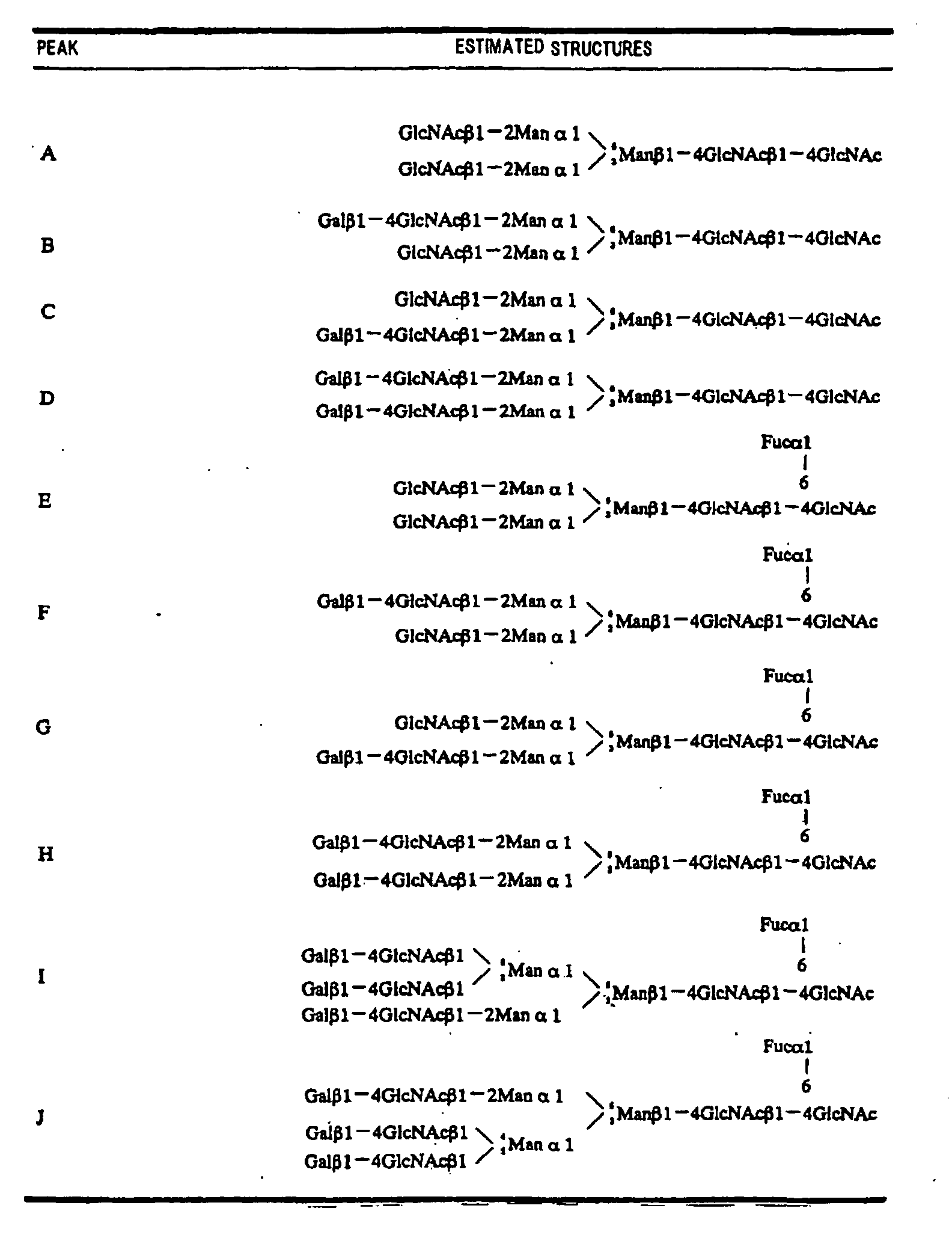
- Peaks A-J were detected by the above analysis.
- the structures of the sugar chains of peaks A, B, C, D, G, H, and J in the chromatograph were estimated based on the retention times of authentic PA-labelled sugar chains and the two-dimensional map.
- PA-sugar chain 012 (Takara Co., 4112) for peak A
- PA-sugar chain 001 (Takara Co., 4101) for peak D
- PA-sugar chain 009 (Takara Co., 4109) for peak H
- PA-oligosaccharide Seikagaku Kogyo Co., Y-C207
- PA-oligosaccharide (Seikagaku Kogyo Co., Y-C208) for peak C
- PA-oligosaccharide (Seikagaku Kogyo Co., Y-C228) for peak G
- the sugar chain structure of E,F,I was estimated based only on the two-dimensional map.
- the two-dimensional map method was carried out using the combination of normal-phase HPLC and reversed-phase HPLC according to the method disclosed in Japanese Patent Laid-Open Hei 11-127890. Estimated structures of each sugar chain are illustrated in table 2.
- An amount of total sugar chain per AT-III was investigated for each culture expression.
- An amount of sugar chain binding to fucose per AT-III was assayed three times per one sample by the AAL-binding assay method using biotin-labelled Aleuric aurantia lectin (AAL, Wako Pure Chem. Industries, Ltd., 018-14691).
- the AAL method is for assaying an amount of sugar chain binding to fucose using a lectin that is a protein that binds sugar-specifically.
- the antigen-antibody was made occur between an anti-AT-III antibody adsorbed on a solid layer and AT-III, and biotin-labelled lectin (AAL) was made react with the sugar chain of AT-III, and the amount of sugar chain binding to fucose was determined as the concentration of an enzyme by serially adding 100 ⁇ l of 18.6 ⁇ g/ml anti-AT-III antibody, 100 ⁇ l of 10 ⁇ g/ml AT-III,100 ⁇ l of 40 ⁇ g/ml labelled AAL and 100 ⁇ l of 2 ⁇ g/ml streptavidin-labelled enzyme (alkaline protease). Diethanolamine was used as the substrate for the enzyme.
- a relative ratio of the amount of total sugar chain binding to fucose per AT-III in each culture system was calculated by dividing the value obtained by the above method with the ratio of the amount of sugar chain binding to fucose per the amount of total sugar chain (obtained in Example 2). Relative values were calculated with the value of Example 1 being 1, and are summarized in Table 4. amount of total sugar chain per AT-III Example 1 1.00 ⁇ 0.07 Example 2 1.05 ⁇ 0.04 Example 3 1.15 ⁇ 0.10 Values in the table indicate 'averages' ⁇ 'standard deviations'.
- Example 1 Ratio of sugar chain found in natural type Value to total sugar chain (%) Value per AT-III (relative value)
- Example 2 41 1.09 ⁇ 0.04
- Example 3 44 1.28 ⁇ 0.10 AT-III derived from plasma 100 -
- the method according to the present invention permits producing a glycoprotein whose sugar chain structure was modified by changing the specific sugar chain consumption rate as an index in the culture of a genetically recombinant host.
- the sugar chain modification could be controlled by operating the specific sugar consumption rate.
Landscapes
- Life Sciences & Earth Sciences (AREA)
- Chemical & Material Sciences (AREA)
- Organic Chemistry (AREA)
- Health & Medical Sciences (AREA)
- Zoology (AREA)
- Engineering & Computer Science (AREA)
- Wood Science & Technology (AREA)
- Microbiology (AREA)
- General Chemical & Material Sciences (AREA)
- Chemical Kinetics & Catalysis (AREA)
- Biotechnology (AREA)
- Molecular Biology (AREA)
- Biochemistry (AREA)
- Bioinformatics & Cheminformatics (AREA)
- General Engineering & Computer Science (AREA)
- General Health & Medical Sciences (AREA)
- Genetics & Genomics (AREA)
- Preparation Of Compounds By Using Micro-Organisms (AREA)
Abstract
Description

| Concentration of glucose (g/l) | Specific sugar consumption rate (x 10-10 g/cell·hr) | |
| Example 1 | 1.5 | 1.17 ± 0.07 |
| Example 2 | 3 | 1.25 ± 0.07 |
| Example 3 | 1.5 + 1.5 | 1.35 ± 0.10 |
| Specific sugar consumption velocities in the table are 'average values' ± 'standard deviations'. |
20 mM ammonium sulfate buffer (pH 4) containing 1% 1-butanol as eluate B. The eluting program was as follows: linear gradient elution from time 0 min to time 10 min, (eluate A: eluate B) was from (100:0) to (90:10); linear gradient elution from time 10 min to time 25 min, (eluate A: eluate B) was from (90:10) to (95:5); isocratic elution from time 25 min, (eluate A: eluate B) was 95:5.

| Ratio of each sugar chain per total sugar chain (%) | ||||
| Example 1 | Example 2 | Example 3 | AT-III derived from plasma | |
| A | 0 | 0 | 0 | 4 |
| B | 0 | 0 | 0 | 7 |
| C | 24 | 27 | 30 | 8 |
| D | 15 | 14 | 14 | 81 |
| E | 2 | 3 | 3 | 0 |
| F+G | 7 | 8 | 5 | 0 |
| H | 46 | 43 | 42 | 0 |
| I | 3 | 2 | 3 | 0 |
| J | 4 | 2 | 3 | 0 |
| amount of total sugar chain per AT-III | |
| Example 1 | 1.00 ± 0.07 |
| Example 2 | 1.05 ± 0.04 |
| Example 3 | 1.15 ± 0.10 |
| Values in the table indicate 'averages' ± 'standard deviations'. |
| Ratio of sugar chain binding to fucose to total sugar chain (%) | |
| Example 1 | 61 |
| Example 2 | 59 |
| Example 3 | 56 |
| AT-III derived from plasma | 0 |
| Ratio of sugar chain found in natural type | ||
| Value to total sugar chain (%) | Value per AT-III (relative value) | |
| Example 1 | 39 | 1.00 ± 0.07 |
| Example 2 | 41 | 1.09 ± 0.04 |
| Example 3 | 44 | 1.28 ± 0.10 |
| AT-III derived from plasma | 100 | - |
Claims (16)
- A method for producing a glycoprotein by culturing a genetically recombinant host in a medium, wherein the sugar chain structure binding to a protein is modified by changing the specific sugar consumption rate (consumption rate of sugar in the medium) as an index.
- The method for producing a glycoprotein according to claim 1, wherein the host is a eukaryote.
- The method for producing a glycoprotein according to claim 1, wherein the host is an animal cell, a yeast, or a fungus.
- The method for producing a glycoprotein according to claim 1, wherein the host is a CHO cell.
- The method for producing a glycoprotein according to any one of claims 1 to 4, wherein the modifying of the sugar chain structure includes at least one selected from:1) modifying the amount of total sugar chain;2) modifying the ratio of the fucosylated sugar chain in the total sugar chain;3) modifying the amount of triantennary type structure sugar chains;4) modifying the amount of complete galactose sugar chain;5) modifying the amount of natural-type sugar chain; and6) modifying the kind or molecular weight of sugar chain.
- The production method according to claim 1, wherein the modifying of the sugar chain structure includes at least one selected from:1) decreasing the ratio of the fucosylated sugar chain in the total sugar chain;2) decreasing the amount of triantennary type structure sugar chains;3) increasing the amount of complete galactose sugar chain; and4) increasing the amount of natural-type sugar chain.
- The method for producing a glycoprotein according to any one of claims 1 to 6, wherein the changing of the specific sugar consumption rate as an index is achieved by controlling of the condition concerning the metabolism of sugars.
- The method for producing a glycoprotein according to claim 7, wherein the controlling of the condition concerning the sugar metabolism includes controlling at least one selected from:1) the concentration of the sugar in the medium;2) the composition of the sugar in the medium;3) the addition stage of the sugar into the medium; and4) the addition of a substance affecting the sugar metabolism in the medium.
- The method for producing a glycoprotein according to claim 7 or 8, wherein the changing of the specific sugar consumption rate as an index includes increasing of the specific sugar consumption rate.
- A method for producing a glycoprotein by culturing a genetically recombinant CHO cell in a medium, wherein the ratio of the fucosylated sugar chain in a sugar chain binding to a protein is decreased by increasing of the specific sugar consumption rate as an index.
- A novel glycoprotein obtained by the method for producing a glycoprotein according to any one of claims 1 to 10.
- The method for producing a glycoprotein according to claim 8, wherein the sugar to be added to the medium is glucose, mannose or fructose.
- The method for producing a glycoprotein according to claim 8, wherein the concentration of the sugar to be added to the medium is of the extent of 0.75 to 3 g/l.
- The method for producing a glycoprotein according to claim 8, wherein the substance affecting the sugar metabolism is an alcohol, retinoic acid, a fatty acid or glutamine.
- The method for producing a glycoprotein according to claim 8, wherein the amount of an alcohol to be added is of the extent of 0.03% or less, and the amount of retinoic acid to be added is of the extent of 1 nM to 1 µM, and the amount of glutamine to be added is of the extent of 0.3 g/l or less.
- The method for producing a glycoprotein according to claim 8, wherein the combination of components to be added to the medium is (glucose and mannose), (glucose and an alcohol), (glucose and retinoic acid), (glucose and glutamine), or (glucose and retinoic acid).
Applications Claiming Priority (3)
| Application Number | Priority Date | Filing Date | Title |
|---|---|---|---|
| JP2000204327 | 2000-07-05 | ||
| JP2000204327 | 2000-07-05 | ||
| PCT/JP2001/005812 WO2002002793A1 (en) | 2000-07-05 | 2001-07-04 | Process for producing glycoprotein |
Publications (3)
| Publication Number | Publication Date |
|---|---|
| EP1298217A1 true EP1298217A1 (en) | 2003-04-02 |
| EP1298217A8 EP1298217A8 (en) | 2003-08-06 |
| EP1298217A4 EP1298217A4 (en) | 2004-09-08 |
Family
ID=18701603
Family Applications (1)
| Application Number | Title | Priority Date | Filing Date |
|---|---|---|---|
| EP20010949913 Withdrawn EP1298217A4 (en) | 2000-07-05 | 2001-07-04 | GLYCOPROTEIN PRODUCTION PROCESS |
Country Status (4)
| Country | Link |
|---|---|
| US (2) | US20030170813A1 (en) |
| EP (1) | EP1298217A4 (en) |
| AU (1) | AU2001271021A1 (en) |
| WO (1) | WO2002002793A1 (en) |
Cited By (2)
| Publication number | Priority date | Publication date | Assignee | Title |
|---|---|---|---|---|
| WO2007070315A2 (en) | 2005-12-08 | 2007-06-21 | Amgen Inc. | Improved production of glycoproteins using manganese |
| AU2004279741B2 (en) * | 2003-10-09 | 2010-03-11 | Kyowa Kirin Co., Ltd. | Process for producing antithrombin III composition |
Families Citing this family (27)
| Publication number | Priority date | Publication date | Assignee | Title |
|---|---|---|---|---|
| PT1176195E (en) * | 1999-04-09 | 2013-07-18 | Kyowa Hakko Kirin Co Ltd | Method for controlling the activity of immunologically functional molecule |
| US6946292B2 (en) * | 2000-10-06 | 2005-09-20 | Kyowa Hakko Kogyo Co., Ltd. | Cells producing antibody compositions with increased antibody dependent cytotoxic activity |
| CA2434364C (en) | 2001-01-19 | 2013-03-19 | The Dow Chemical Company | Method for secretory production of glycoprotein having human-type sugar chain using plant cell |
| AU2003236017B2 (en) | 2002-04-09 | 2009-03-26 | Kyowa Kirin Co., Ltd. | Drug containing antibody composition |
| WO2004008100A2 (en) * | 2002-07-15 | 2004-01-22 | Immunex Corporation | Methods and media for controlling sialylation of proteins produced by mammalian cells |
| US7691810B2 (en) * | 2003-10-09 | 2010-04-06 | Kyowa Hakko Kirin Co., Ltd | Method of producing recombinant antithrombin III composition |
| WO2008069244A1 (en) * | 2006-12-05 | 2008-06-12 | Kyowa Hakko Kogyo Co., Ltd. | Process for producing glycoprotein composition |
| US20100113294A1 (en) * | 2007-04-16 | 2010-05-06 | Momenta Pharmaceuticals, Inc. | Defined glycoprotein products and related methods |
| NZ580510A (en) | 2007-04-17 | 2011-06-30 | Stichting Dienst Landbouwkundi | Mammalian-type glycosylation in plants by expression of non-mammalian glycosyltransferases |
| CN102498202A (en) * | 2009-02-25 | 2012-06-13 | 印第安纳大学研究和科技公司 | Materials and methods for identifying and using yeast strains that metabolize pentose sugars in the presence of D-glucose |
| CN104928336B (en) * | 2009-10-26 | 2020-05-08 | 弗·哈夫曼-拉罗切有限公司 | Methods for the production of glycosylated immunoglobulins |
| PT2496246T (en) | 2009-11-03 | 2018-07-31 | Grifols Therapeutics Llc | Composition, method, and kit for alpha-1 proteinase inhibitor |
| RU2540480C2 (en) | 2009-11-24 | 2015-02-10 | Грифольс Терапьютикс Инк. | Methods, compositions and sets for lyophilisation |
| US9062106B2 (en) | 2011-04-27 | 2015-06-23 | Abbvie Inc. | Methods for controlling the galactosylation profile of recombinantly-expressed proteins |
| WO2013121509A1 (en) * | 2012-02-13 | 2013-08-22 | 公立大学法人高知工科大学 | Single-cell isolation method and single-cell culture method for botryococcus braunii |
| US9067990B2 (en) | 2013-03-14 | 2015-06-30 | Abbvie, Inc. | Protein purification using displacement chromatography |
| WO2013158273A1 (en) | 2012-04-20 | 2013-10-24 | Abbvie Inc. | Methods to modulate c-terminal lysine variant distribution |
| WO2013158279A1 (en) | 2012-04-20 | 2013-10-24 | Abbvie Inc. | Protein purification methods to reduce acidic species |
| US9512214B2 (en) | 2012-09-02 | 2016-12-06 | Abbvie, Inc. | Methods to control protein heterogeneity |
| SG11201507230PA (en) | 2013-03-12 | 2015-10-29 | Abbvie Inc | Human antibodies that bind human tnf-alpha and methods of preparing the same |
| WO2014151878A2 (en) | 2013-03-14 | 2014-09-25 | Abbvie Inc. | Methods for modulating protein glycosylation profiles of recombinant protein therapeutics using monosaccharides and oligosacharides |
| US9017687B1 (en) | 2013-10-18 | 2015-04-28 | Abbvie, Inc. | Low acidic species compositions and methods for producing and using the same using displacement chromatography |
| BR112015032960B1 (en) | 2013-07-04 | 2021-01-05 | F. Hoffmann-La Roche Ag | immunoassay suppressed by interference to detect anti-drug antibodies in serum samples |
| EP3052640A2 (en) | 2013-10-04 | 2016-08-10 | AbbVie Inc. | Use of metal ions for modulation of protein glycosylation profiles of recombinant proteins |
| US9085618B2 (en) | 2013-10-18 | 2015-07-21 | Abbvie, Inc. | Low acidic species compositions and methods for producing and using the same |
| US9181337B2 (en) | 2013-10-18 | 2015-11-10 | Abbvie, Inc. | Modulated lysine variant species compositions and methods for producing and using the same |
| WO2015073884A2 (en) | 2013-11-15 | 2015-05-21 | Abbvie, Inc. | Glycoengineered binding protein compositions |
Family Cites Families (7)
| Publication number | Priority date | Publication date | Assignee | Title |
|---|---|---|---|---|
| US5096816A (en) * | 1990-06-05 | 1992-03-17 | Cetus Corporation | In vitro management of ammonia's effect on glycosylation of cell products through pH control |
| JPH06292592A (en) * | 1993-02-09 | 1994-10-21 | Snow Brand Milk Prod Co Ltd | Glycoprotein production method |
| US5843705A (en) * | 1995-02-21 | 1998-12-01 | Genzyme Transgenic Corporation | Transgenically produced antithrombin III |
| US5705364A (en) * | 1995-06-06 | 1998-01-06 | Genentech, Inc. | Mammalian cell culture process |
| JPH0984582A (en) * | 1995-09-21 | 1997-03-31 | Kirin Brewery Co Ltd | Animal cell with enhanced glycosyltransferase activity, sugar chain-modified glycoprotein and method for producing the same |
| JPH11127890A (en) * | 1997-10-31 | 1999-05-18 | Kazuo Shimada | Glycoprotein production method |
| ATE309350T1 (en) * | 1997-12-03 | 2005-11-15 | Roche Diagnostics Gmbh | METHOD FOR PRODUCING POLYPEPTIDES WITH SUITABLE GLYCOSYLATION |
-
2001
- 2001-07-04 EP EP20010949913 patent/EP1298217A4/en not_active Withdrawn
- 2001-07-04 WO PCT/JP2001/005812 patent/WO2002002793A1/en not_active Ceased
- 2001-07-04 AU AU2001271021A patent/AU2001271021A1/en not_active Abandoned
- 2001-07-04 US US10/312,904 patent/US20030170813A1/en not_active Abandoned
-
2007
- 2007-02-14 US US11/705,899 patent/US20070141675A1/en not_active Abandoned
Cited By (7)
| Publication number | Priority date | Publication date | Assignee | Title |
|---|---|---|---|---|
| AU2004279741B2 (en) * | 2003-10-09 | 2010-03-11 | Kyowa Kirin Co., Ltd. | Process for producing antithrombin III composition |
| WO2007070315A2 (en) | 2005-12-08 | 2007-06-21 | Amgen Inc. | Improved production of glycoproteins using manganese |
| EP3026109A1 (en) | 2005-12-08 | 2016-06-01 | Amgen Inc. | Improved production of glycoproteins using manganese |
| EP3026109B1 (en) * | 2005-12-08 | 2022-03-09 | Amgen Inc. | Improved production of glycoproteins using manganese |
| EP4155385A1 (en) * | 2005-12-08 | 2023-03-29 | Amgen Inc. | Improved production of glycoproteins using manganese |
| EP1957630B2 (en) † | 2005-12-08 | 2023-03-29 | Amgen Inc. | Improved production of glycoproteins using manganese |
| US12351613B2 (en) | 2005-12-08 | 2025-07-08 | Amgen Inc. | Production of glycoproteins using manganese |
Also Published As
| Publication number | Publication date |
|---|---|
| WO2002002793A1 (en) | 2002-01-10 |
| AU2001271021A1 (en) | 2002-01-14 |
| EP1298217A4 (en) | 2004-09-08 |
| US20030170813A1 (en) | 2003-09-11 |
| US20070141675A1 (en) | 2007-06-21 |
| EP1298217A8 (en) | 2003-08-06 |
Similar Documents
| Publication | Publication Date | Title |
|---|---|---|
| US20070141675A1 (en) | Process for producing glycoprotein | |
| JP4384400B2 (en) | Process for producing appropriately glycosylated polypeptides | |
| US6506598B1 (en) | Cell culture process | |
| EP2964663B1 (en) | Continuous purification of therapeutic proteins | |
| EP0832189B2 (en) | Process for controlling sialylation of proteins produced by mammalian cell culture | |
| KR20160125514A (en) | Modulation of cell growth and glycosylation in recombinant glycoprotein production | |
| CA2720610C (en) | Methods of recombinant production of glycoproteins | |
| Zhang et al. | Enhanced secretion of human α1-antitrypsin expressed with a novel glycosylation module in tobacco BY-2 cell culture | |
| WO1998006822A1 (en) | Culture medium and use of the same | |
| CN116391043A (en) | How protein is made | |
| EP1096017A2 (en) | Method for increasing the production of physiologically active substances by cultured cells | |
| EP0736605B2 (en) | Process for producing proteins | |
| US10519479B1 (en) | Methods for modifying glycosylation using manganese | |
| CA2085744A1 (en) | Interleukin-6 compositions, and a production process thereof | |
| Hosoi et al. | Optimization of cell culture conditions for production of biologically active proteins | |
| CN1178244A (en) | Preparation method of recombinant human glycosylated pro-urokinase | |
| JPWO2002002793A1 (en) | Method for producing glycoproteins | |
| De Jesus et al. | The Influence of pH on Cell Growth and Specific Productivity of Two CHO Cell Lines Producing Human Anti Rh D IgG | |
| EP4480493A1 (en) | A recombinant human alpha-1 antitrypsin glycoprotein for treating non-viral inflammatory diseases of the lung | |
| KR920007398B1 (en) | Method for producing human tissue plasminogen activator | |
| EP1757700A2 (en) | Cell culture process for glycoproteins | |
| JPH07138294A (en) | Recombinant glycoprotein | |
| HK1096993A (en) | Cell culture process for glycoproteins | |
| NZ733430A (en) | A method for controlling glycosylation of recombinant glycoprotein | |
| NZ752502A (en) | A Method For Controlling Glycosylation Of Recombinant Glycoprotein |
Legal Events
| Date | Code | Title | Description |
|---|---|---|---|
| PUAI | Public reference made under article 153(3) epc to a published international application that has entered the european phase |
Free format text: ORIGINAL CODE: 0009012 |
|
| 17P | Request for examination filed |
Effective date: 20030121 |
|
| AK | Designated contracting states |
Kind code of ref document: A1 Designated state(s): AT BE CH CY DE DK ES FI FR GB GR IE IT LI LU MC NL PT SE TR Designated state(s): AT BE CH CY DE DK ES FI FR GB GR IE IT LI LU MC NL PT SE TR |
|
| AX | Request for extension of the european patent |
Extension state: AL LT LV MK RO SI |
|
| RAP1 | Party data changed (applicant data changed or rights of an application transferred) |
Owner name: MITSUBISHI PHARMA CORPORATION Owner name: JAPAN AS REPRESENTED BY SECRETARY OF OSAKA UNIVERS |
|
| RIN1 | Information on inventor provided before grant (corrected) |
Inventor name: KOBAYASHI, KAORU,MITSUBISHI PHARMA CORPORATION Inventor name: MIKI, HIDEO,C/O MITSUBISHI PHARMA CORPORATION Inventor name: OHDA, TOYOO,C/O MITSUBISHI PHARMA CORPORATION Inventor name: KATAKURA, YOSHIO,C/O GRADUATE SCHOOL OF ENG. Inventor name: KISHIMOTO, MICHIMASA,C/O GRADUATE SCHOOL OF ENG. Inventor name: OMASA, TAKESHI,C/O GRADUATE SCHOOL OF ENGINEERING Inventor name: SUGA, KENICHI,C/O GRADUATE SCHOOL OF ENGINEERING |
|
| RIC1 | Information provided on ipc code assigned before grant |
Ipc: 7C 12P 21/02 B Ipc: 7C 12N 9/99 B Ipc: 7C 12N 5/06 B Ipc: 7C 12N 1/18 B Ipc: 7C 07K 14/475 B Ipc: 7C 07K 14/47 B Ipc: 7C 12R 1/91 B Ipc: 7C 07K 14/00 B Ipc: 7C 12N 15/10 B Ipc: 7C 12P 21/00 A |
|
| A4 | Supplementary search report drawn up and despatched |
Effective date: 20040723 |
|
| 17Q | First examination report despatched |
Effective date: 20050211 |
|
| 17Q | First examination report despatched |
Effective date: 20050211 |
|
| STAA | Information on the status of an ep patent application or granted ep patent |
Free format text: STATUS: THE APPLICATION IS DEEMED TO BE WITHDRAWN |
|
| 18D | Application deemed to be withdrawn |
Effective date: 20080109 |