EP1298129A2 - Process for producing 4-sustituted benzopyran derivatives - Google Patents
Process for producing 4-sustituted benzopyran derivatives Download PDFInfo
- Publication number
- EP1298129A2 EP1298129A2 EP02021753A EP02021753A EP1298129A2 EP 1298129 A2 EP1298129 A2 EP 1298129A2 EP 02021753 A EP02021753 A EP 02021753A EP 02021753 A EP02021753 A EP 02021753A EP 1298129 A2 EP1298129 A2 EP 1298129A2
- Authority
- EP
- European Patent Office
- Prior art keywords
- perfluoroalkyl
- represented
- general formula
- acetophenone
- reacting
- Prior art date
- Legal status (The legal status is an assumption and is not a legal conclusion. Google has not performed a legal analysis and makes no representation as to the accuracy of the status listed.)
- Withdrawn
Links
- 238000000034 method Methods 0.000 title claims abstract description 75
- 150000001562 benzopyrans Chemical class 0.000 title description 4
- KWOLFJPFCHCOCG-UHFFFAOYSA-N Acetophenone Chemical compound CC(=O)C1=CC=CC=C1 KWOLFJPFCHCOCG-UHFFFAOYSA-N 0.000 claims abstract description 82
- KDLHZDBZIXYQEI-UHFFFAOYSA-N Palladium Chemical compound [Pd] KDLHZDBZIXYQEI-UHFFFAOYSA-N 0.000 claims abstract description 49
- WFDIJRYMOXRFFG-UHFFFAOYSA-N Acetic anhydride Chemical compound CC(=O)OC(C)=O WFDIJRYMOXRFFG-UHFFFAOYSA-N 0.000 claims abstract description 42
- 150000005224 alkoxybenzenes Chemical class 0.000 claims abstract description 36
- 125000005010 perfluoroalkyl group Chemical group 0.000 claims abstract description 30
- -1 benzopyranyl ester Chemical class 0.000 claims abstract description 23
- 150000001875 compounds Chemical class 0.000 claims abstract description 22
- UGFAIRIUMAVXCW-UHFFFAOYSA-N Carbon monoxide Chemical compound [O+]#[C-] UGFAIRIUMAVXCW-UHFFFAOYSA-N 0.000 claims abstract description 21
- 229910002091 carbon monoxide Inorganic materials 0.000 claims abstract description 21
- 229910052763 palladium Inorganic materials 0.000 claims abstract description 18
- 239000002841 Lewis acid Substances 0.000 claims abstract description 16
- 150000007517 lewis acids Chemical class 0.000 claims abstract description 16
- 150000001266 acyl halides Chemical class 0.000 claims abstract description 12
- 150000001732 carboxylic acid derivatives Chemical class 0.000 claims abstract description 11
- 239000012380 dealkylating agent Substances 0.000 claims abstract description 10
- 150000008065 acid anhydrides Chemical class 0.000 claims abstract description 7
- YMWUJEATGCHHMB-UHFFFAOYSA-N Dichloromethane Chemical compound ClCCl YMWUJEATGCHHMB-UHFFFAOYSA-N 0.000 claims description 51
- WEVYAHXRMPXWCK-UHFFFAOYSA-N Acetonitrile Chemical compound CC#N WEVYAHXRMPXWCK-UHFFFAOYSA-N 0.000 claims description 24
- ZMXDDKWLCZADIW-UHFFFAOYSA-N N,N-Dimethylformamide Chemical compound CN(C)C=O ZMXDDKWLCZADIW-UHFFFAOYSA-N 0.000 claims description 21
- ILAHWRKJUDSMFH-UHFFFAOYSA-N boron tribromide Chemical class BrB(Br)Br ILAHWRKJUDSMFH-UHFFFAOYSA-N 0.000 claims description 18
- FVAUCKIRQBBSSJ-UHFFFAOYSA-M sodium iodide Chemical compound [Na+].[I-] FVAUCKIRQBBSSJ-UHFFFAOYSA-M 0.000 claims description 15
- OKTJSMMVPCPJKN-UHFFFAOYSA-N Carbon Chemical group [C] OKTJSMMVPCPJKN-UHFFFAOYSA-N 0.000 claims description 12
- 239000003795 chemical substances by application Substances 0.000 claims description 11
- HKIPCXRNASWFRU-UHFFFAOYSA-N 1,3-difluoropropan-2-one Chemical compound FCC(=O)CF HKIPCXRNASWFRU-UHFFFAOYSA-N 0.000 claims description 10
- VHYFNPMBLIVWCW-UHFFFAOYSA-N 4-Dimethylaminopyridine Chemical compound CN(C)C1=CC=NC=C1 VHYFNPMBLIVWCW-UHFFFAOYSA-N 0.000 claims description 10
- 229910052751 metal Inorganic materials 0.000 claims description 10
- 239000002184 metal Substances 0.000 claims description 10
- NLKNQRATVPKPDG-UHFFFAOYSA-M potassium iodide Chemical compound [K+].[I-] NLKNQRATVPKPDG-UHFFFAOYSA-M 0.000 claims description 10
- 125000002023 trifluoromethyl group Chemical group FC(F)(F)* 0.000 claims description 10
- KWGKDLIKAYFUFQ-UHFFFAOYSA-M lithium chloride Chemical group [Li+].[Cl-] KWGKDLIKAYFUFQ-UHFFFAOYSA-M 0.000 claims description 9
- 230000029936 alkylation Effects 0.000 claims description 8
- 238000005804 alkylation reaction Methods 0.000 claims description 8
- 229910017053 inorganic salt Inorganic materials 0.000 claims description 8
- 230000007935 neutral effect Effects 0.000 claims description 8
- 125000000217 alkyl group Chemical group 0.000 claims description 6
- IJOOHPMOJXWVHK-UHFFFAOYSA-N chlorotrimethylsilane Chemical class C[Si](C)(C)Cl IJOOHPMOJXWVHK-UHFFFAOYSA-N 0.000 claims description 6
- ITMCEJHCFYSIIV-UHFFFAOYSA-N triflic acid Chemical compound OS(=O)(=O)C(F)(F)F ITMCEJHCFYSIIV-UHFFFAOYSA-N 0.000 claims description 6
- 235000009518 sodium iodide Nutrition 0.000 claims description 5
- 150000003573 thiols Chemical class 0.000 claims description 5
- WJKHJLXJJJATHN-UHFFFAOYSA-N triflic anhydride Chemical compound FC(F)(F)S(=O)(=O)OS(=O)(=O)C(F)(F)F WJKHJLXJJJATHN-UHFFFAOYSA-N 0.000 claims description 5
- ZCYVEMRRCGMTRW-UHFFFAOYSA-N 7553-56-2 Chemical group [I] ZCYVEMRRCGMTRW-UHFFFAOYSA-N 0.000 claims description 4
- WKBOTKDWSSQWDR-UHFFFAOYSA-N Bromine atom Chemical group [Br] WKBOTKDWSSQWDR-UHFFFAOYSA-N 0.000 claims description 4
- GDTBXPJZTBHREO-UHFFFAOYSA-N bromine Chemical group BrBr GDTBXPJZTBHREO-UHFFFAOYSA-N 0.000 claims description 4
- 229910052794 bromium Inorganic materials 0.000 claims description 4
- 150000001721 carbon Chemical group 0.000 claims description 4
- 229910052799 carbon Inorganic materials 0.000 claims description 4
- 229910052801 chlorine Inorganic materials 0.000 claims description 4
- 229910052731 fluorine Inorganic materials 0.000 claims description 4
- 125000001153 fluoro group Chemical group F* 0.000 claims description 4
- 229910052740 iodine Chemical group 0.000 claims description 4
- 239000011630 iodine Chemical group 0.000 claims description 4
- 150000003839 salts Chemical class 0.000 claims description 4
- HVHZEKKZMFRULH-UHFFFAOYSA-N 2,6-ditert-butyl-4-methylpyridine Chemical compound CC1=CC(C(C)(C)C)=NC(C(C)(C)C)=C1 HVHZEKKZMFRULH-UHFFFAOYSA-N 0.000 claims description 3
- ZAMOUSCENKQFHK-UHFFFAOYSA-N Chlorine atom Chemical group [Cl] ZAMOUSCENKQFHK-UHFFFAOYSA-N 0.000 claims description 3
- 239000000460 chlorine Chemical group 0.000 claims description 3
- 239000011737 fluorine Substances 0.000 claims description 3
- NAWXUBYGYWOOIX-SFHVURJKSA-N (2s)-2-[[4-[2-(2,4-diaminoquinazolin-6-yl)ethyl]benzoyl]amino]-4-methylidenepentanedioic acid Chemical compound C1=CC2=NC(N)=NC(N)=C2C=C1CCC1=CC=C(C(=O)N[C@@H](CC(=C)C(O)=O)C(O)=O)C=C1 NAWXUBYGYWOOIX-SFHVURJKSA-N 0.000 claims description 2
- 239000002994 raw material Substances 0.000 abstract description 3
- 238000006243 chemical reaction Methods 0.000 description 83
- VLKZOEOYAKHREP-UHFFFAOYSA-N n-Hexane Chemical compound CCCCCC VLKZOEOYAKHREP-UHFFFAOYSA-N 0.000 description 48
- 239000002904 solvent Substances 0.000 description 41
- HEMHJVSKTPXQMS-UHFFFAOYSA-M Sodium hydroxide Chemical compound [OH-].[Na+] HEMHJVSKTPXQMS-UHFFFAOYSA-M 0.000 description 33
- 239000002585 base Substances 0.000 description 32
- RTZKZFJDLAIYFH-UHFFFAOYSA-N Diethyl ether Chemical compound CCOCC RTZKZFJDLAIYFH-UHFFFAOYSA-N 0.000 description 31
- XLYOFNOQVPJJNP-UHFFFAOYSA-N water Substances O XLYOFNOQVPJJNP-UHFFFAOYSA-N 0.000 description 31
- 239000000203 mixture Substances 0.000 description 29
- 238000003756 stirring Methods 0.000 description 29
- OKKJLVBELUTLKV-UHFFFAOYSA-N Methanol Chemical compound OC OKKJLVBELUTLKV-UHFFFAOYSA-N 0.000 description 27
- VEXZGXHMUGYJMC-UHFFFAOYSA-N Hydrochloric acid Chemical compound Cl VEXZGXHMUGYJMC-UHFFFAOYSA-N 0.000 description 26
- 239000010410 layer Substances 0.000 description 25
- HEDRZPFGACZZDS-MICDWDOJSA-N Trichloro(2H)methane Chemical compound [2H]C(Cl)(Cl)Cl HEDRZPFGACZZDS-MICDWDOJSA-N 0.000 description 24
- ZYGHJZDHTFUPRJ-UHFFFAOYSA-N coumarin Chemical compound C1=CC=C2OC(=O)C=CC2=C1 ZYGHJZDHTFUPRJ-UHFFFAOYSA-N 0.000 description 24
- 238000000605 extraction Methods 0.000 description 23
- HEDRZPFGACZZDS-UHFFFAOYSA-N Chloroform Chemical compound ClC(Cl)Cl HEDRZPFGACZZDS-UHFFFAOYSA-N 0.000 description 22
- XEKOWRVHYACXOJ-UHFFFAOYSA-N Ethyl acetate Chemical compound CCOC(C)=O XEKOWRVHYACXOJ-UHFFFAOYSA-N 0.000 description 18
- 238000010992 reflux Methods 0.000 description 16
- 238000005406 washing Methods 0.000 description 16
- 229910052943 magnesium sulfate Inorganic materials 0.000 description 15
- CSNNHWWHGAXBCP-UHFFFAOYSA-L magnesium sulphate Substances [Mg+2].[O-][S+2]([O-])([O-])[O-] CSNNHWWHGAXBCP-UHFFFAOYSA-L 0.000 description 15
- 235000019341 magnesium sulphate Nutrition 0.000 description 15
- 239000011541 reaction mixture Substances 0.000 description 15
- RIOQSEWOXXDEQQ-UHFFFAOYSA-N triphenylphosphine Chemical compound C1=CC=CC=C1P(C=1C=CC=CC=1)C1=CC=CC=C1 RIOQSEWOXXDEQQ-UHFFFAOYSA-N 0.000 description 15
- CSCPPACGZOOCGX-UHFFFAOYSA-N Acetone Chemical compound CC(C)=O CSCPPACGZOOCGX-UHFFFAOYSA-N 0.000 description 14
- 239000007864 aqueous solution Substances 0.000 description 14
- 239000000243 solution Substances 0.000 description 14
- HMXJOWDZAJWLTF-UHFFFAOYSA-N 2h-chromene-2-carboxylic acid Chemical compound C1=CC=C2C=CC(C(=O)O)OC2=C1 HMXJOWDZAJWLTF-UHFFFAOYSA-N 0.000 description 13
- 239000000047 product Substances 0.000 description 13
- 239000000126 substance Substances 0.000 description 13
- XYFCBTPGUUZFHI-UHFFFAOYSA-N Phosphine Chemical compound P XYFCBTPGUUZFHI-UHFFFAOYSA-N 0.000 description 12
- 239000003153 chemical reaction reagent Substances 0.000 description 12
- 238000004821 distillation Methods 0.000 description 12
- 238000003786 synthesis reaction Methods 0.000 description 12
- 239000002253 acid Substances 0.000 description 11
- 239000012295 chemical reaction liquid Substances 0.000 description 11
- 238000001035 drying Methods 0.000 description 11
- 150000002148 esters Chemical class 0.000 description 11
- ISWSIDIOOBJBQZ-UHFFFAOYSA-N Phenol Chemical compound OC1=CC=CC=C1 ISWSIDIOOBJBQZ-UHFFFAOYSA-N 0.000 description 10
- WQDUMFSSJAZKTM-UHFFFAOYSA-N Sodium methoxide Chemical compound [Na+].[O-]C WQDUMFSSJAZKTM-UHFFFAOYSA-N 0.000 description 10
- 238000001914 filtration Methods 0.000 description 10
- SCVFZCLFOSHCOH-UHFFFAOYSA-M potassium acetate Chemical compound [K+].CC([O-])=O SCVFZCLFOSHCOH-UHFFFAOYSA-M 0.000 description 10
- BRSHLOIZDJDEPI-UHFFFAOYSA-N 1-[2-hydroxy-5-(trifluoromethyl)phenyl]ethanone Chemical compound CC(=O)C1=CC(C(F)(F)F)=CC=C1O BRSHLOIZDJDEPI-UHFFFAOYSA-N 0.000 description 9
- RWRDLPDLKQPQOW-UHFFFAOYSA-N Pyrrolidine Chemical compound C1CCNC1 RWRDLPDLKQPQOW-UHFFFAOYSA-N 0.000 description 9
- 230000015572 biosynthetic process Effects 0.000 description 9
- UNXJQBYPFPFIKT-UHFFFAOYSA-N 2,2-bis(fluoromethyl)-6-(trifluoromethyl)chromene-4-carboxylic acid Chemical compound C1=C(C(F)(F)F)C=C2C(C(=O)O)=CC(CF)(CF)OC2=C1 UNXJQBYPFPFIKT-UHFFFAOYSA-N 0.000 description 8
- BWIMCGNFHUVBLK-UHFFFAOYSA-N [2,2-bis(fluoromethyl)-6-(trifluoromethyl)chromen-4-yl] trifluoromethanesulfonate Chemical compound C1=C(C(F)(F)F)C=C2C(OS(=O)(=O)C(F)(F)F)=CC(CF)(CF)OC2=C1 BWIMCGNFHUVBLK-UHFFFAOYSA-N 0.000 description 8
- BWHMMNNQKKPAPP-UHFFFAOYSA-L potassium carbonate Chemical compound [K+].[K+].[O-]C([O-])=O BWHMMNNQKKPAPP-UHFFFAOYSA-L 0.000 description 8
- CFIPQRIPCRRISV-UHFFFAOYSA-N 1-methoxy-4-(trifluoromethyl)benzene Chemical compound COC1=CC=C(C(F)(F)F)C=C1 CFIPQRIPCRRISV-UHFFFAOYSA-N 0.000 description 7
- AJBJISAUTCAXDV-UHFFFAOYSA-N 4-bromo-2h-chromene Chemical compound C1=CC=C2C(Br)=CCOC2=C1 AJBJISAUTCAXDV-UHFFFAOYSA-N 0.000 description 7
- 239000007789 gas Substances 0.000 description 7
- 238000004519 manufacturing process Methods 0.000 description 7
- 238000004293 19F NMR spectroscopy Methods 0.000 description 6
- 238000005160 1H NMR spectroscopy Methods 0.000 description 6
- GUSGUEAZUOKKCL-UHFFFAOYSA-N 2,2-bis(fluoromethyl)-6-(trifluoromethyl)-3h-chromen-4-one Chemical compound FC(F)(F)C1=CC=C2OC(CF)(CF)CC(=O)C2=C1 GUSGUEAZUOKKCL-UHFFFAOYSA-N 0.000 description 6
- IJGRMHOSHXDMSA-UHFFFAOYSA-N Atomic nitrogen Chemical compound N#N IJGRMHOSHXDMSA-UHFFFAOYSA-N 0.000 description 6
- UHOVQNZJYSORNB-UHFFFAOYSA-N Benzene Chemical compound C1=CC=CC=C1 UHOVQNZJYSORNB-UHFFFAOYSA-N 0.000 description 6
- KWYUFKZDYYNOTN-UHFFFAOYSA-M Potassium hydroxide Chemical compound [OH-].[K+] KWYUFKZDYYNOTN-UHFFFAOYSA-M 0.000 description 6
- JUJWROOIHBZHMG-UHFFFAOYSA-N Pyridine Chemical compound C1=CC=NC=C1 JUJWROOIHBZHMG-UHFFFAOYSA-N 0.000 description 6
- 239000007788 liquid Substances 0.000 description 6
- 238000002156 mixing Methods 0.000 description 6
- 229910000073 phosphorus hydride Inorganic materials 0.000 description 6
- 238000000746 purification Methods 0.000 description 6
- 239000007858 starting material Substances 0.000 description 6
- CYRMSUTZVYGINF-UHFFFAOYSA-N trichlorofluoromethane Chemical compound FC(Cl)(Cl)Cl CYRMSUTZVYGINF-UHFFFAOYSA-N 0.000 description 6
- UXVMQQNJUSDDNG-UHFFFAOYSA-L Calcium chloride Chemical compound [Cl-].[Cl-].[Ca+2] UXVMQQNJUSDDNG-UHFFFAOYSA-L 0.000 description 5
- LFQSCWFLJHTTHZ-UHFFFAOYSA-N Ethanol Chemical compound CCO LFQSCWFLJHTTHZ-UHFFFAOYSA-N 0.000 description 5
- 229910002666 PdCl2 Inorganic materials 0.000 description 5
- UIIMBOGNXHQVGW-UHFFFAOYSA-M Sodium bicarbonate Chemical class [Na+].OC([O-])=O UIIMBOGNXHQVGW-UHFFFAOYSA-M 0.000 description 5
- 239000001110 calcium chloride Substances 0.000 description 5
- 229910001628 calcium chloride Inorganic materials 0.000 description 5
- 239000000284 extract Substances 0.000 description 5
- 238000010438 heat treatment Methods 0.000 description 5
- 238000002955 isolation Methods 0.000 description 5
- 238000012544 monitoring process Methods 0.000 description 5
- PIBWKRNGBLPSSY-UHFFFAOYSA-L palladium(II) chloride Chemical compound Cl[Pd]Cl PIBWKRNGBLPSSY-UHFFFAOYSA-L 0.000 description 5
- 235000011056 potassium acetate Nutrition 0.000 description 5
- SERVTOXIOYSDQO-UHFFFAOYSA-N 2h-chromen-2-ol Chemical compound C1=CC=C2C=CC(O)OC2=C1 SERVTOXIOYSDQO-UHFFFAOYSA-N 0.000 description 4
- KRHYYFGTRYWZRS-UHFFFAOYSA-N Fluorane Chemical compound F KRHYYFGTRYWZRS-UHFFFAOYSA-N 0.000 description 4
- 238000005727 Friedel-Crafts reaction Methods 0.000 description 4
- FXHOOIRPVKKKFG-UHFFFAOYSA-N N,N-Dimethylacetamide Chemical compound CN(C)C(C)=O FXHOOIRPVKKKFG-UHFFFAOYSA-N 0.000 description 4
- CDBYLPFSWZWCQE-UHFFFAOYSA-L Sodium Carbonate Chemical compound [Na+].[Na+].[O-]C([O-])=O CDBYLPFSWZWCQE-UHFFFAOYSA-L 0.000 description 4
- 239000007983 Tris buffer Substances 0.000 description 4
- 238000004458 analytical method Methods 0.000 description 4
- 239000007795 chemical reaction product Substances 0.000 description 4
- 239000007810 chemical reaction solvent Substances 0.000 description 4
- 229910001873 dinitrogen Inorganic materials 0.000 description 4
- 230000000694 effects Effects 0.000 description 4
- DNJIEGIFACGWOD-UHFFFAOYSA-N ethanethiol Chemical compound CCS DNJIEGIFACGWOD-UHFFFAOYSA-N 0.000 description 4
- 238000004817 gas chromatography Methods 0.000 description 4
- 239000000543 intermediate Substances 0.000 description 4
- 238000004811 liquid chromatography Methods 0.000 description 4
- 238000002844 melting Methods 0.000 description 4
- 230000008018 melting Effects 0.000 description 4
- 125000002496 methyl group Chemical group [H]C([H])([H])* 0.000 description 4
- 125000006340 pentafluoro ethyl group Chemical group FC(F)(F)C(F)(F)* 0.000 description 4
- 229910000027 potassium carbonate Inorganic materials 0.000 description 4
- 230000009257 reactivity Effects 0.000 description 4
- VZGDMQKNWNREIO-UHFFFAOYSA-N tetrachloromethane Chemical compound ClC(Cl)(Cl)Cl VZGDMQKNWNREIO-UHFFFAOYSA-N 0.000 description 4
- JCYVZAHGMLLKRN-UHFFFAOYSA-N 2,3-dibromo-2h-chromene Chemical compound C1=CC=C2C=C(Br)C(Br)OC2=C1 JCYVZAHGMLLKRN-UHFFFAOYSA-N 0.000 description 3
- BAYGVMXZJBFEMB-UHFFFAOYSA-N 4-(trifluoromethyl)phenol Chemical compound OC1=CC=C(C(F)(F)F)C=C1 BAYGVMXZJBFEMB-UHFFFAOYSA-N 0.000 description 3
- LSNNMFCWUKXFEE-UHFFFAOYSA-M Bisulfite Chemical compound OS([O-])=O LSNNMFCWUKXFEE-UHFFFAOYSA-M 0.000 description 3
- QAOWNCQODCNURD-UHFFFAOYSA-N Sulfuric acid Chemical compound OS(O)(=O)=O QAOWNCQODCNURD-UHFFFAOYSA-N 0.000 description 3
- YXFVVABEGXRONW-UHFFFAOYSA-N Toluene Chemical compound CC1=CC=CC=C1 YXFVVABEGXRONW-UHFFFAOYSA-N 0.000 description 3
- ZMANZCXQSJIPKH-UHFFFAOYSA-N Triethylamine Chemical compound CCN(CC)CC ZMANZCXQSJIPKH-UHFFFAOYSA-N 0.000 description 3
- 150000008062 acetophenones Chemical class 0.000 description 3
- 230000010933 acylation Effects 0.000 description 3
- 238000005917 acylation reaction Methods 0.000 description 3
- 238000001816 cooling Methods 0.000 description 3
- 230000020335 dealkylation Effects 0.000 description 3
- 238000006900 dealkylation reaction Methods 0.000 description 3
- 238000007336 electrophilic substitution reaction Methods 0.000 description 3
- 239000000706 filtrate Substances 0.000 description 3
- 239000011356 non-aqueous organic solvent Substances 0.000 description 3
- 125000001997 phenyl group Chemical group [H]C1=C([H])C([H])=C(*)C([H])=C1[H] 0.000 description 3
- 239000002798 polar solvent Substances 0.000 description 3
- UMJSCPRVCHMLSP-UHFFFAOYSA-N pyridine Natural products COC1=CC=CN=C1 UMJSCPRVCHMLSP-UHFFFAOYSA-N 0.000 description 3
- 230000002194 synthesizing effect Effects 0.000 description 3
- UKSZBOKPHAQOMP-SVLSSHOZSA-N (1e,4e)-1,5-diphenylpenta-1,4-dien-3-one;palladium Chemical compound [Pd].C=1C=CC=CC=1\C=C\C(=O)\C=C\C1=CC=CC=C1.C=1C=CC=CC=1\C=C\C(=O)\C=C\C1=CC=CC=C1 UKSZBOKPHAQOMP-SVLSSHOZSA-N 0.000 description 2
- KZPYGQFFRCFCPP-UHFFFAOYSA-N 1,1'-bis(diphenylphosphino)ferrocene Chemical compound [Fe+2].C1=CC=C[C-]1P(C=1C=CC=CC=1)C1=CC=CC=C1.C1=CC=C[C-]1P(C=1C=CC=CC=1)C1=CC=CC=C1 KZPYGQFFRCFCPP-UHFFFAOYSA-N 0.000 description 2
- WSLDOOZREJYCGB-UHFFFAOYSA-N 1,2-Dichloroethane Chemical compound ClCCCl WSLDOOZREJYCGB-UHFFFAOYSA-N 0.000 description 2
- LVEYOSJUKRVCCF-UHFFFAOYSA-N 1,3-bis(diphenylphosphino)propane Chemical compound C=1C=CC=CC=1P(C=1C=CC=CC=1)CCCP(C=1C=CC=CC=1)C1=CC=CC=C1 LVEYOSJUKRVCCF-UHFFFAOYSA-N 0.000 description 2
- NLXLAEXVIDQMFP-UHFFFAOYSA-N Ammonia chloride Chemical compound [NH4+].[Cl-] NLXLAEXVIDQMFP-UHFFFAOYSA-N 0.000 description 2
- XKRFYHLGVUSROY-UHFFFAOYSA-N Argon Chemical compound [Ar] XKRFYHLGVUSROY-UHFFFAOYSA-N 0.000 description 2
- IAZDPXIOMUYVGZ-UHFFFAOYSA-N Dimethylsulphoxide Chemical compound CS(C)=O IAZDPXIOMUYVGZ-UHFFFAOYSA-N 0.000 description 2
- JLTDJTHDQAWBAV-UHFFFAOYSA-N N,N-dimethylaniline Chemical compound CN(C)C1=CC=CC=C1 JLTDJTHDQAWBAV-UHFFFAOYSA-N 0.000 description 2
- 229910021605 Palladium(II) bromide Inorganic materials 0.000 description 2
- OFBQJSOFQDEBGM-UHFFFAOYSA-N Pentane Chemical compound CCCCC OFBQJSOFQDEBGM-UHFFFAOYSA-N 0.000 description 2
- WCUXLLCKKVVCTQ-UHFFFAOYSA-M Potassium chloride Chemical compound [Cl-].[K+] WCUXLLCKKVVCTQ-UHFFFAOYSA-M 0.000 description 2
- KEAYESYHFKHZAL-UHFFFAOYSA-N Sodium Chemical compound [Na] KEAYESYHFKHZAL-UHFFFAOYSA-N 0.000 description 2
- WETWJCDKMRHUPV-UHFFFAOYSA-N acetyl chloride Chemical compound CC(Cl)=O WETWJCDKMRHUPV-UHFFFAOYSA-N 0.000 description 2
- 239000012346 acetyl chloride Substances 0.000 description 2
- 150000000475 acetylene derivatives Chemical class 0.000 description 2
- 239000003905 agrochemical Substances 0.000 description 2
- NEHMKBQYUWJMIP-UHFFFAOYSA-N chloromethane Chemical compound ClC NEHMKBQYUWJMIP-UHFFFAOYSA-N 0.000 description 2
- 238000000354 decomposition reaction Methods 0.000 description 2
- VAYGXNSJCAHWJZ-UHFFFAOYSA-N dimethyl sulfate Chemical compound COS(=O)(=O)OC VAYGXNSJCAHWJZ-UHFFFAOYSA-N 0.000 description 2
- 229940079593 drug Drugs 0.000 description 2
- 239000003814 drug Substances 0.000 description 2
- 239000002024 ethyl acetate extract Substances 0.000 description 2
- 125000006342 heptafluoro i-propyl group Chemical group FC(F)(F)C(F)(*)C(F)(F)F 0.000 description 2
- 125000006341 heptafluoro n-propyl group Chemical group FC(F)(F)C(F)(F)C(F)(F)* 0.000 description 2
- IZZWJPQHPPRVLP-UHFFFAOYSA-N hexane;2-methoxy-2-methylpropane Chemical compound CCCCCC.COC(C)(C)C IZZWJPQHPPRVLP-UHFFFAOYSA-N 0.000 description 2
- XMBWDFGMSWQBCA-UHFFFAOYSA-N hydrogen iodide Chemical compound I XMBWDFGMSWQBCA-UHFFFAOYSA-N 0.000 description 2
- 229940071870 hydroiodic acid Drugs 0.000 description 2
- AMXOYNBUYSYVKV-UHFFFAOYSA-M lithium bromide Chemical compound [Li+].[Br-] AMXOYNBUYSYVKV-UHFFFAOYSA-M 0.000 description 2
- PQXKHYXIUOZZFA-UHFFFAOYSA-M lithium fluoride Chemical compound [Li+].[F-] PQXKHYXIUOZZFA-UHFFFAOYSA-M 0.000 description 2
- HSZCZNFXUDYRKD-UHFFFAOYSA-M lithium iodide Chemical compound [Li+].[I-] HSZCZNFXUDYRKD-UHFFFAOYSA-M 0.000 description 2
- 239000012044 organic layer Substances 0.000 description 2
- 239000003960 organic solvent Substances 0.000 description 2
- YJVFFLUZDVXJQI-UHFFFAOYSA-L palladium(ii) acetate Chemical compound [Pd+2].CC([O-])=O.CC([O-])=O YJVFFLUZDVXJQI-UHFFFAOYSA-L 0.000 description 2
- INIOZDBICVTGEO-UHFFFAOYSA-L palladium(ii) bromide Chemical compound Br[Pd]Br INIOZDBICVTGEO-UHFFFAOYSA-L 0.000 description 2
- IOLCXVTUBQKXJR-UHFFFAOYSA-M potassium bromide Chemical compound [K+].[Br-] IOLCXVTUBQKXJR-UHFFFAOYSA-M 0.000 description 2
- NROKBHXJSPEDAR-UHFFFAOYSA-M potassium fluoride Chemical compound [F-].[K+] NROKBHXJSPEDAR-UHFFFAOYSA-M 0.000 description 2
- 239000002244 precipitate Substances 0.000 description 2
- 239000000376 reactant Substances 0.000 description 2
- 238000001953 recrystallisation Methods 0.000 description 2
- 238000007789 sealing Methods 0.000 description 2
- 238000010898 silica gel chromatography Methods 0.000 description 2
- 229910000029 sodium carbonate Inorganic materials 0.000 description 2
- 239000012312 sodium hydride Substances 0.000 description 2
- 229910000104 sodium hydride Inorganic materials 0.000 description 2
- 125000001424 substituent group Chemical group 0.000 description 2
- JOXIMZWYDAKGHI-UHFFFAOYSA-N toluene-4-sulfonic acid Chemical compound CC1=CC=C(S(O)(=O)=O)C=C1 JOXIMZWYDAKGHI-UHFFFAOYSA-N 0.000 description 2
- 238000011282 treatment Methods 0.000 description 2
- FAQYAMRNWDIXMY-UHFFFAOYSA-N trichloroborane Chemical compound ClB(Cl)Cl FAQYAMRNWDIXMY-UHFFFAOYSA-N 0.000 description 2
- YFQPRQIVKLIGMR-UHFFFAOYSA-N 1,1,2,2,2-pentafluoroethylsulfonyl 1,1,2,2,2-pentafluoroethanesulfonate Chemical compound FC(F)(F)C(F)(F)S(=O)(=O)OS(=O)(=O)C(F)(F)C(F)(F)F YFQPRQIVKLIGMR-UHFFFAOYSA-N 0.000 description 1
- QFMZQPDHXULLKC-UHFFFAOYSA-N 1,2-bis(diphenylphosphino)ethane Chemical compound C=1C=CC=CC=1P(C=1C=CC=CC=1)CCP(C=1C=CC=CC=1)C1=CC=CC=C1 QFMZQPDHXULLKC-UHFFFAOYSA-N 0.000 description 1
- RYHBNJHYFVUHQT-UHFFFAOYSA-N 1,4-Dioxane Chemical compound C1COCCO1 RYHBNJHYFVUHQT-UHFFFAOYSA-N 0.000 description 1
- XLQSXGGDTHANLN-UHFFFAOYSA-N 1-bromo-4-(trifluoromethyl)benzene Chemical compound FC(F)(F)C1=CC=C(Br)C=C1 XLQSXGGDTHANLN-UHFFFAOYSA-N 0.000 description 1
- DURPTKYDGMDSBL-UHFFFAOYSA-N 1-butoxybutane Chemical group CCCCOCCCC DURPTKYDGMDSBL-UHFFFAOYSA-N 0.000 description 1
- HOPRXXXSABQWAV-UHFFFAOYSA-N 2,3,4-trimethylpyridine Chemical class CC1=CC=NC(C)=C1C HOPRXXXSABQWAV-UHFFFAOYSA-N 0.000 description 1
- HPYNZHMRTTWQTB-UHFFFAOYSA-N 2,3-dimethylpyridine Chemical class CC1=CC=CN=C1C HPYNZHMRTTWQTB-UHFFFAOYSA-N 0.000 description 1
- ZWVHTXAYIKBMEE-UHFFFAOYSA-N 2-hydroxyacetophenone Chemical class OCC(=O)C1=CC=CC=C1 ZWVHTXAYIKBMEE-UHFFFAOYSA-N 0.000 description 1
- TXFPEBPIARQUIG-UHFFFAOYSA-N 4'-hydroxyacetophenone Chemical compound CC(=O)C1=CC=C(O)C=C1 TXFPEBPIARQUIG-UHFFFAOYSA-N 0.000 description 1
- BCJVBDBJSMFBRW-UHFFFAOYSA-N 4-diphenylphosphanylbutyl(diphenyl)phosphane Chemical compound C=1C=CC=CC=1P(C=1C=CC=CC=1)CCCCP(C=1C=CC=CC=1)C1=CC=CC=C1 BCJVBDBJSMFBRW-UHFFFAOYSA-N 0.000 description 1
- VJXRKZJMGVSXPX-UHFFFAOYSA-N 4-ethylpyridine Chemical class CCC1=CC=NC=C1 VJXRKZJMGVSXPX-UHFFFAOYSA-N 0.000 description 1
- FKNQCJSGGFJEIZ-UHFFFAOYSA-N 4-methylpyridine Chemical class CC1=CC=NC=C1 FKNQCJSGGFJEIZ-UHFFFAOYSA-N 0.000 description 1
- FPJNPSGNLVIBBS-UHFFFAOYSA-N CC(c1cc(C(F)(F)F)ccc1OC)=O Chemical compound CC(c1cc(C(F)(F)F)ccc1OC)=O FPJNPSGNLVIBBS-UHFFFAOYSA-N 0.000 description 1
- CURLTUGMZLYLDI-UHFFFAOYSA-N Carbon dioxide Chemical compound O=C=O CURLTUGMZLYLDI-UHFFFAOYSA-N 0.000 description 1
- YXHKONLOYHBTNS-UHFFFAOYSA-N Diazomethane Chemical compound C=[N+]=[N-] YXHKONLOYHBTNS-UHFFFAOYSA-N 0.000 description 1
- OIFBSDVPJOWBCH-UHFFFAOYSA-N Diethyl carbonate Chemical compound CCOC(=O)OCC OIFBSDVPJOWBCH-UHFFFAOYSA-N 0.000 description 1
- NTIZESTWPVYFNL-UHFFFAOYSA-N Methyl isobutyl ketone Chemical compound CC(C)CC(C)=O NTIZESTWPVYFNL-UHFFFAOYSA-N 0.000 description 1
- UIHCLUNTQKBZGK-UHFFFAOYSA-N Methyl isobutyl ketone Natural products CCC(C)C(C)=O UIHCLUNTQKBZGK-UHFFFAOYSA-N 0.000 description 1
- GRYLNZFGIOXLOG-UHFFFAOYSA-N Nitric acid Chemical compound O[N+]([O-])=O GRYLNZFGIOXLOG-UHFFFAOYSA-N 0.000 description 1
- CTQNGGLPUBDAKN-UHFFFAOYSA-N O-Xylene Chemical compound CC1=CC=CC=C1C CTQNGGLPUBDAKN-UHFFFAOYSA-N 0.000 description 1
- NFHFRUOZVGFOOS-UHFFFAOYSA-N Pd(PPh3)4 Substances [Pd].C1=CC=CC=C1P(C=1C=CC=CC=1)C1=CC=CC=C1.C1=CC=CC=C1P(C=1C=CC=CC=1)C1=CC=CC=C1.C1=CC=CC=C1P(C=1C=CC=CC=1)C1=CC=CC=C1.C1=CC=CC=C1P(C=1C=CC=CC=1)C1=CC=CC=C1 NFHFRUOZVGFOOS-UHFFFAOYSA-N 0.000 description 1
- YNHIGQDRGKUECZ-UHFFFAOYSA-L PdCl2(PPh3)2 Substances [Cl-].[Cl-].[Pd+2].C1=CC=CC=C1P(C=1C=CC=CC=1)C1=CC=CC=C1.C1=CC=CC=C1P(C=1C=CC=CC=1)C1=CC=CC=C1 YNHIGQDRGKUECZ-UHFFFAOYSA-L 0.000 description 1
- VYPSYNLAJGMNEJ-UHFFFAOYSA-N Silicium dioxide Chemical compound O=[Si]=O VYPSYNLAJGMNEJ-UHFFFAOYSA-N 0.000 description 1
- VMHLLURERBWHNL-UHFFFAOYSA-M Sodium acetate Chemical compound [Na+].CC([O-])=O VMHLLURERBWHNL-UHFFFAOYSA-M 0.000 description 1
- WYURNTSHIVDZCO-UHFFFAOYSA-N Tetrahydrofuran Chemical compound C1CCOC1 WYURNTSHIVDZCO-UHFFFAOYSA-N 0.000 description 1
- FXXACINHVKSMDR-UHFFFAOYSA-N acetyl bromide Chemical compound CC(Br)=O FXXACINHVKSMDR-UHFFFAOYSA-N 0.000 description 1
- LEKJTGQWLAUGQA-UHFFFAOYSA-N acetyl iodide Chemical compound CC(I)=O LEKJTGQWLAUGQA-UHFFFAOYSA-N 0.000 description 1
- 239000003377 acid catalyst Substances 0.000 description 1
- 125000002252 acyl group Chemical group 0.000 description 1
- 230000002411 adverse Effects 0.000 description 1
- 150000004703 alkoxides Chemical class 0.000 description 1
- 125000005910 alkyl carbonate group Chemical group 0.000 description 1
- 150000001350 alkyl halides Chemical class 0.000 description 1
- 150000008051 alkyl sulfates Chemical class 0.000 description 1
- 230000002152 alkylating effect Effects 0.000 description 1
- VSCWAEJMTAWNJL-UHFFFAOYSA-K aluminum chloride Substances Cl[Al](Cl)Cl VSCWAEJMTAWNJL-UHFFFAOYSA-K 0.000 description 1
- 235000019270 ammonium chloride Nutrition 0.000 description 1
- 229910052786 argon Inorganic materials 0.000 description 1
- QVGXLLKOCUKJST-UHFFFAOYSA-N atomic oxygen Chemical compound [O] QVGXLLKOCUKJST-UHFFFAOYSA-N 0.000 description 1
- 238000009835 boiling Methods 0.000 description 1
- 239000006227 byproduct Substances 0.000 description 1
- AXCZMVOFGPJBDE-UHFFFAOYSA-L calcium dihydroxide Chemical compound [OH-].[OH-].[Ca+2] AXCZMVOFGPJBDE-UHFFFAOYSA-L 0.000 description 1
- 239000000920 calcium hydroxide Substances 0.000 description 1
- 229910001861 calcium hydroxide Inorganic materials 0.000 description 1
- 235000011089 carbon dioxide Nutrition 0.000 description 1
- QGJOPFRUJISHPQ-NJFSPNSNSA-N carbon disulfide-14c Chemical compound S=[14C]=S QGJOPFRUJISHPQ-NJFSPNSNSA-N 0.000 description 1
- 239000003054 catalyst Substances 0.000 description 1
- 230000003197 catalytic effect Effects 0.000 description 1
- 125000001309 chloro group Chemical group Cl* 0.000 description 1
- 238000004440 column chromatography Methods 0.000 description 1
- 238000007796 conventional method Methods 0.000 description 1
- 239000012024 dehydrating agents Substances 0.000 description 1
- DENRZWYUOJLTMF-UHFFFAOYSA-N diethyl sulfate Chemical compound CCOS(=O)(=O)OCC DENRZWYUOJLTMF-UHFFFAOYSA-N 0.000 description 1
- 229940008406 diethyl sulfate Drugs 0.000 description 1
- IEJIGPNLZYLLBP-UHFFFAOYSA-N dimethyl carbonate Chemical compound COC(=O)OC IEJIGPNLZYLLBP-UHFFFAOYSA-N 0.000 description 1
- AOMUALOCHQKUCD-UHFFFAOYSA-N dodecyl 4-chloro-3-[[3-(4-methoxyphenyl)-3-oxopropanoyl]amino]benzoate Chemical compound CCCCCCCCCCCCOC(=O)C1=CC=C(Cl)C(NC(=O)CC(=O)C=2C=CC(OC)=CC=2)=C1 AOMUALOCHQKUCD-UHFFFAOYSA-N 0.000 description 1
- 239000012259 ether extract Substances 0.000 description 1
- 125000001495 ethyl group Chemical group [H]C([H])([H])C([H])([H])* 0.000 description 1
- 125000005843 halogen group Chemical group 0.000 description 1
- ZYCMDWDFIQDPLP-UHFFFAOYSA-N hbr bromine Chemical compound Br.Br ZYCMDWDFIQDPLP-UHFFFAOYSA-N 0.000 description 1
- 239000001307 helium Substances 0.000 description 1
- 229910052734 helium Inorganic materials 0.000 description 1
- SWQJXJOGLNCZEY-UHFFFAOYSA-N helium atom Chemical compound [He] SWQJXJOGLNCZEY-UHFFFAOYSA-N 0.000 description 1
- 125000002887 hydroxy group Chemical group [H]O* 0.000 description 1
- 238000009776 industrial production Methods 0.000 description 1
- 239000011261 inert gas Substances 0.000 description 1
- 150000007529 inorganic bases Chemical class 0.000 description 1
- 125000001449 isopropyl group Chemical group [H]C([H])([H])C([H])(*)C([H])([H])[H] 0.000 description 1
- JILPJDVXYVTZDQ-UHFFFAOYSA-N lithium methoxide Chemical compound [Li+].[O-]C JILPJDVXYVTZDQ-UHFFFAOYSA-N 0.000 description 1
- AZVCGYPLLBEUNV-UHFFFAOYSA-N lithium;ethanolate Chemical compound [Li+].CC[O-] AZVCGYPLLBEUNV-UHFFFAOYSA-N 0.000 description 1
- 229910052987 metal hydride Inorganic materials 0.000 description 1
- 150000004681 metal hydrides Chemical class 0.000 description 1
- 229940050176 methyl chloride Drugs 0.000 description 1
- XTAZYLNFDRKIHJ-UHFFFAOYSA-N n,n-dioctyloctan-1-amine Chemical compound CCCCCCCCN(CCCCCCCC)CCCCCCCC XTAZYLNFDRKIHJ-UHFFFAOYSA-N 0.000 description 1
- 125000004123 n-propyl group Chemical group [H]C([H])([H])C([H])([H])C([H])([H])* 0.000 description 1
- 229910017604 nitric acid Inorganic materials 0.000 description 1
- 229910052757 nitrogen Inorganic materials 0.000 description 1
- LYGJENNIWJXYER-UHFFFAOYSA-N nitromethane Chemical compound C[N+]([O-])=O LYGJENNIWJXYER-UHFFFAOYSA-N 0.000 description 1
- KZCOBXFFBQJQHH-UHFFFAOYSA-N octane-1-thiol Chemical compound CCCCCCCCS KZCOBXFFBQJQHH-UHFFFAOYSA-N 0.000 description 1
- 150000007530 organic bases Chemical class 0.000 description 1
- 239000001301 oxygen Substances 0.000 description 1
- 229910052760 oxygen Inorganic materials 0.000 description 1
- QULYNCCPRWKEMF-UHFFFAOYSA-N parachlorobenzotrifluoride Chemical compound FC(F)(F)C1=CC=C(Cl)C=C1 QULYNCCPRWKEMF-UHFFFAOYSA-N 0.000 description 1
- 150000003003 phosphines Chemical class 0.000 description 1
- PJGSXYOJTGTZAV-UHFFFAOYSA-N pinacolone Chemical compound CC(=O)C(C)(C)C PJGSXYOJTGTZAV-UHFFFAOYSA-N 0.000 description 1
- 239000001103 potassium chloride Substances 0.000 description 1
- 235000011164 potassium chloride Nutrition 0.000 description 1
- 239000011698 potassium fluoride Substances 0.000 description 1
- 235000003270 potassium fluoride Nutrition 0.000 description 1
- 238000011403 purification operation Methods 0.000 description 1
- 150000003222 pyridines Chemical class 0.000 description 1
- 238000007363 ring formation reaction Methods 0.000 description 1
- 238000005055 short column chromatography Methods 0.000 description 1
- 238000007086 side reaction Methods 0.000 description 1
- 239000000741 silica gel Substances 0.000 description 1
- 229910002027 silica gel Inorganic materials 0.000 description 1
- 239000001632 sodium acetate Substances 0.000 description 1
- 235000017281 sodium acetate Nutrition 0.000 description 1
- 235000017557 sodium bicarbonate Nutrition 0.000 description 1
- 229910000030 sodium bicarbonate Inorganic materials 0.000 description 1
- 229910000033 sodium borohydride Inorganic materials 0.000 description 1
- 239000012279 sodium borohydride Substances 0.000 description 1
- QDRKDTQENPPHOJ-UHFFFAOYSA-N sodium ethoxide Chemical compound [Na+].CC[O-] QDRKDTQENPPHOJ-UHFFFAOYSA-N 0.000 description 1
- AKHNMLFCWUSKQB-UHFFFAOYSA-L sodium thiosulfate Chemical class [Na+].[Na+].[O-]S([O-])(=O)=S AKHNMLFCWUSKQB-UHFFFAOYSA-L 0.000 description 1
- 239000007787 solid Substances 0.000 description 1
- HIFJUMGIHIZEPX-UHFFFAOYSA-N sulfuric acid;sulfur trioxide Chemical compound O=S(=O)=O.OS(O)(=O)=O HIFJUMGIHIZEPX-UHFFFAOYSA-N 0.000 description 1
- 238000004809 thin layer chromatography Methods 0.000 description 1
- VPYJNCGUESNPMV-UHFFFAOYSA-N triallylamine Chemical compound C=CCN(CC=C)CC=C VPYJNCGUESNPMV-UHFFFAOYSA-N 0.000 description 1
- TUQOTMZNTHZOKS-UHFFFAOYSA-N tributylphosphine Chemical compound CCCCP(CCCC)CCCC TUQOTMZNTHZOKS-UHFFFAOYSA-N 0.000 description 1
- RXJKFRMDXUJTEX-UHFFFAOYSA-N triethylphosphine Chemical compound CCP(CC)CC RXJKFRMDXUJTEX-UHFFFAOYSA-N 0.000 description 1
- YWWDBCBWQNCYNR-UHFFFAOYSA-N trimethylphosphine Chemical compound CP(C)C YWWDBCBWQNCYNR-UHFFFAOYSA-N 0.000 description 1
- YFTHZRPMJXBUME-UHFFFAOYSA-N tripropylamine Chemical compound CCCN(CCC)CCC YFTHZRPMJXBUME-UHFFFAOYSA-N 0.000 description 1
- COIOYMYWGDAQPM-UHFFFAOYSA-N tris(2-methylphenyl)phosphane Chemical compound CC1=CC=CC=C1P(C=1C(=CC=CC=1)C)C1=CC=CC=C1C COIOYMYWGDAQPM-UHFFFAOYSA-N 0.000 description 1
- 239000008096 xylene Substances 0.000 description 1
Classifications
-
- C—CHEMISTRY; METALLURGY
- C07—ORGANIC CHEMISTRY
- C07D—HETEROCYCLIC COMPOUNDS
- C07D311/00—Heterocyclic compounds containing six-membered rings having one oxygen atom as the only hetero atom, condensed with other rings
- C07D311/02—Heterocyclic compounds containing six-membered rings having one oxygen atom as the only hetero atom, condensed with other rings ortho- or peri-condensed with carbocyclic rings or ring systems
- C07D311/04—Benzo[b]pyrans, not hydrogenated in the carbocyclic ring
- C07D311/58—Benzo[b]pyrans, not hydrogenated in the carbocyclic ring other than with oxygen or sulphur atoms in position 2 or 4
-
- C—CHEMISTRY; METALLURGY
- C07—ORGANIC CHEMISTRY
- C07C—ACYCLIC OR CARBOCYCLIC COMPOUNDS
- C07C45/00—Preparation of compounds having >C = O groups bound only to carbon or hydrogen atoms; Preparation of chelates of such compounds
- C07C45/45—Preparation of compounds having >C = O groups bound only to carbon or hydrogen atoms; Preparation of chelates of such compounds by condensation
- C07C45/46—Friedel-Crafts reactions
-
- C—CHEMISTRY; METALLURGY
- C07—ORGANIC CHEMISTRY
- C07C—ACYCLIC OR CARBOCYCLIC COMPOUNDS
- C07C45/00—Preparation of compounds having >C = O groups bound only to carbon or hydrogen atoms; Preparation of chelates of such compounds
- C07C45/61—Preparation of compounds having >C = O groups bound only to carbon or hydrogen atoms; Preparation of chelates of such compounds by reactions not involving the formation of >C = O groups
- C07C45/67—Preparation of compounds having >C = O groups bound only to carbon or hydrogen atoms; Preparation of chelates of such compounds by reactions not involving the formation of >C = O groups by isomerisation; by change of size of the carbon skeleton
- C07C45/673—Preparation of compounds having >C = O groups bound only to carbon or hydrogen atoms; Preparation of chelates of such compounds by reactions not involving the formation of >C = O groups by isomerisation; by change of size of the carbon skeleton by change of size of the carbon skeleton
-
- C—CHEMISTRY; METALLURGY
- C07—ORGANIC CHEMISTRY
- C07C—ACYCLIC OR CARBOCYCLIC COMPOUNDS
- C07C49/00—Ketones; Ketenes; Dimeric ketenes; Ketonic chelates
- C07C49/76—Ketones containing a keto group bound to a six-membered aromatic ring
- C07C49/84—Ketones containing a keto group bound to a six-membered aromatic ring containing ether groups, groups, groups, or groups
Definitions
- the present invention relates to a process for producing a 2,2-bis(fluoromethyl)-6-(perfluoroalkyl)-2H-1-benzopyran-4-carboxylic acid represented by the general formula [1], which is a 4-substituted benzopyran derivative useful as an intermediate for medicines and agricultural chemicals, wherein R 1 is a perfluoroalkyl group that is represented by C n F 2n+1 where n is an integer of 1-10 and that optionally has a branch in a carbon structure of the perfluoroalkyl group.
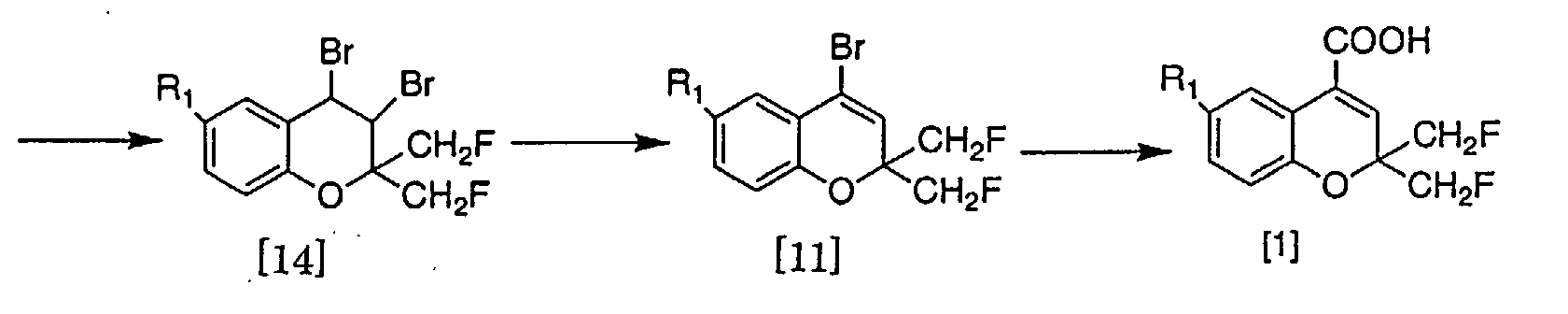
- the benzopyranone [2] is reduced in the first step by sodium borohydride or the like.
- the resulting benzopyranol [12] is dehydrated in the second step by a dehydrating agent (e.g., p -toluenesulfonic acid).
- the resulting benzopyran derivative [13] is brominated in the third step by bromine.
- the resulting dibromobenzopyran [14] is reacted in the fourth step with a base.
- the 4-bromobenzopyran [11] is obtained by four steps from a 3,4-dihalogeno-1-perfluoroalkylbenzene [15], that it is obtained by four steps from an acetylene derivative [16], and that it is obtained by subjecting an acetylene derivative [17] to a thermal cyclization, where R 1 is defined as above, and X and Y are independently halogen atoms.
- the present invention further relates to a process for producing hydroxyacetophenones, which are useful as intermediates for medicines and agricultural chemicals, and particularly to 2-hydroxy-5-(perfluoroalkyl)acetophenones.
- DE 2653601 A1 discloses that 2-hydroxy-5-(trifluoromethyl)acetophenone was obtained by mixing together 4-(trifluoromethyl)phenol and hydrofluoric acid anhydride, then by adding acetyl chloride to the mixture, and then by heating the mixture at 100°C under a pressurized condition.
- benzene rings having a perfluoroalkyl group are low in reactivity in Friedel-Crafts type electrophilic substitution reactions.
- a severe condition for example, by heating at 100°C or higher or by light irradiation in the presence of a strong acid or strong base in order to directly introduce an acyl group onto 4-perfluoroalkylphenol by Friedel-Crafts reactions.
- Such severe condition may gradually decompose the perfluoroalkyl group, thereby lowering selectivity of the target reaction. This may lower the yield of 2-hydroxy-5-(perfluoroalkyl)acetophenone or may makes it difficult to conduct purification by adverse effects of by-products.
- the process comprises the steps of:
- the 2,2-bis(fluoromethyl)-6-(perfluoroalkyl)-2H-1-benzopyran-4-one represented by the general formula [2]
- the benzopyranone [2] for simplification.
- Various other compounds may also be referred to in a manner similar to this.
- the benzopyranone [2] which is the starting material of the step (a) can be produced by the step (e) reacting a 2-hydroxy-5-(perfluoroalkyl) acetophenone, represented by the general formula [5], with 1,3-difluoroacetone in the presence of a base, where R 1 is defined as above.
- the acetophenone [5] can be the starting material for producing the carboxylic acid [1].
- the second process comprises the steps of:
- the present invention to produce the alkoxybenzene [6] by the step (f) reacting a 4-(perfluoroalkyl)phenol represented by the general formula [8] with an alkylation agent or reacting a 4-(perfluoroalkyl) halogenobenzene represented by the general formula [9] with a metal alcoholate.
- R 1 is defined as above and X is a fluorine, chlorine, bromine or iodine.
- the first process it is possible by the first process to obtain the target product (i.e., the benzopyrancarboxylic acid [1]) from the benzopyranone [2] (starting material) by only the two steps of (a) and (b) without producing the 4-bromobenzopyran [11] as an intermediate.
- the target product i.e., the benzopyrancarboxylic acid [1]
- the benzopyranone [2] starting material
- the present inventors have found that it is possible to very smoothly obtain the sulfonic ester [4] by reacting the benzopyranone [2] with the perfluoroalkanesulfonic acid anhydride [3] in the presence of a base (i.e., the step (a)) and that it is possible to easily obtain the target benzopyrancarboxylic acid [1] by reacting the sulfonic ester [4] (obtained by the step (a)) with carbon monoxide in the presence of a palladium complex compound and a base, as shown by the following reaction scheme.
- the substituent R 1 is a perfluoroalkyl group that is represented by C n F 2n+1 where n is an integer of 1-10 and that optionally has a branch in its carbon structure.
- n is preferably 1, 2 or 3.
- the step (a) may be conducted at a temperature of 0-100°C, preferably 0-60°C, more preferably 0-30°C.
- the type of this base is not particularly limited. It is preferable to select the base from pyridines (e.g., pyridine, monomethylpyridines, dimethylpyridines, monoethylpyridines, trimethylpyridines, 2,6-di-tert-butyl-4-methylpyridine, and 4-dimethylaminopyridine (DMAP)).
- pyridines e.g., pyridine, monomethylpyridines, dimethylpyridines, monoethylpyridines, trimethylpyridines, 2,6-di-tert-butyl-4-methylpyridine, and 4-dimethylaminopyridine (DMAP)
- DMAP 4-dimethylaminopyridine
- the amount of the base is not particularly limited, it is preferably 1-10 moles, more preferably 1-4 moles, per mol of the benzopyranone [2]. If it is less than 1 mol, the reaction may not proceed sufficiently. If it is greater than 10 moles, it may cause an economical disadvantage
- sulfonic acid anhydride [3] examples are trifluoromethanesulfonic acid anhydride and pentafluoroethanesulfonic acid anhydride.
- R 2 and R 3 may be different perfluoroalkyl groups.
- sulfonic acid anhydrides [3] having such R 2 and R 3 are generally high in price. Therefore, it is preferable to use one in which R 2 and R 3 are the same perfluoroalkyl groups. It is particularly preferable to use trifluoromethanesulfonic acid anhydride due to its availability.
- the amount of the sulfonic acid anhydride [3] used in the reaction may be 1-15 moles, preferably 1-5 moles, more preferably 1-3 moles, per mol of the benzopyranone [2]. If it is less than 1 mol, the reaction may not proceed sufficiently. If it is greater than 15 moles, it may cause an economical disadyantage.
- a solvent in the step (a) is not particularly limited. Its preferable examples include methylene chloride, chloroform, carbon tetrachloride, and 1,2-dichloroethane. Although the time for completing the step (a) may be approximately in a range of 10-200 hrs, it may deviate from this range depending on the reaction conditions. Therefore, it is preferable to terminate the reaction after confirming that the raw materials have been consumed sufficiently by monitoring the progress of the reaction using a conventional analytical technique such as liquid chromatography or thin layer chromatography.
- the purification operation after the step (a) is not particularly limited and can be conducted by normal techniques in the field of organic synthesis.
- the reaction mixture can be washed with water, followed by extraction with a low-boiling-point organic solvent, column chromatography, recrystallization, and removal of the solvent by distillation, thereby obtaining the sulfonic ester [4].
- the benzopyranone [2] used in the step (a) is not limited at all with respect to its synthesis.
- the step (e) can be conducted by mixing together the acetophenone [5], 1,3-difluoroacetone and a base, and then by stirring the mixture in the presence of a solvent at a temperature of preferably 0-60°C, more preferably 20-40°C, thereby synthesizing the benzopyranone [2].
- the base and the solvent are respectively pyrrolidine and methanol, but are not limited thereto. It is possible to achieve the reaction of the step (e) by mixing together 1 part by mole of the acetophenone [5], 1 part by mole of 1,3-difluoroacetone, and 1 part by mole of a base. The reaction is, however, not limited to these relative amounts.
- each of the former compounds may be in an amount of 1-5 moles, preferably 1-2 moles, per mol of the latter compound.
- the reaction mixture obtained by the step (e) may be subjected to a normal purification procedure of organic syntheses, thereby separating the target benzopyranone [2].
- the step (e) and the subsequent purification procedure may be conducted in accordance with the disclosure of Bioorganic & Medicinal Chemistry 8 (2000), 1393-1405 and may be modified by a person skilled in the art.
- step (b) will be described in detail in the following.
- the step (b) is conducted by reacting the sulfonic ester [4] with carbon monoxide in the presence of a palladium complex compound and a base, thereby obtaining the carboxylic acid [1].
- the palladium complex compound is not particularly limited.
- Pd(dba) 2 bis(dibenzylideneacetone)palladium (Pd(dba) 2 ), tris(dibenzylidene)(chloroform)dipalladium (Pd 2 (dba) 3 (CHCl 3 )), tetraquis(triphenylphosphine)palladium (Pd(PPh 3 ) 4 ), palladium acetate Pd(OCOMe) 2 , PdCl 2 , PdBr 2 , PdCl 2 (PPh 3 ) 2 , Pd(OCOMe) 2 (PPh 3 ) 2 , PdBr 2 (PPh 3 ) 2 , PdCl 2 (PMe 3 ) 2 , PdCl 2 [P(Ph) 2 CH 2 CH 2 P(Ph) 2 ], PdCl 2 [P(Ph) 2 CH 2 CH 2 CH 2 P(Ph) 2 ], PdCl 2 [P(Ph)
- the amount of the palladium complex compound used in the reaction may be 0.00001-0.5 moles, preferably 0.00005-0.1 moles, more preferably 0.0001-0.1 moles, per mol of the sulfonic ester [4]. If it is less than 0.00001 moles, the reaction rate may become too slow, making it disadvantageous to an industrial production. Although an amount greater than 0.5 moles does not cause particular problems in conducting the reaction, it may become uneconomical.
- the phosphine may be selected from common phosphines, such as triphenylphosphine, tri-o-tolylphosphine, triethylphosphine, tri-n-butylphosphine, 1,1'-bis(diphenylphosphino)ferrocene (dppf), 1,4-bis(diphenylphosphino)butane, 1,3-bis(diphenylphosphino)propane, and 1,2-bis(diphenylphosphino)ethane.
- common phosphines such as triphenylphosphine, tri-o-tolylphosphine, triethylphosphine, tri-n-butylphosphine, 1,1'-bis(diphenylphosphino)ferrocene (dppf), 1,4-bis(diphenylphosphino)butane, 1,3-bis(diphenylphosphino)propane
- the phosphine used in the step (b) may be in an amount of 10 moles or less, preferably 5 moles or less, more preferably 3 moles or less, per mol of the palladium complex compound. If it is greater than 10 moles, the reaction rate may become too slow. Furthermore, it may become uneconomical.
- the step (b) can proceed without adding a phosphine. In particular, in case that the after-explained neutral inorganic salt is coexistent with the other reactants, it is possible to obtain a sufficient reaction rate with no addition of phosphine.
- a base is essential for the step (b). Its nonlimitative examples are inorganic bases such as potassium acetate, sodium acetate, sodium hydroxide, potassium hydroxide, sodium carbonate, and potassium carbonate; and organic bases such as triethylamine, tripropylamine, tri-n-octylamine, triallylamine, pyridine, and N,N-dimethylaniline.
- the base may be in an amount of 1-10 moles, preferably 1-5 moles, more preferably 1-3 moles, per mol of the sulfonic ester [4]. If it is less than 1 mole, the reaction may not proceed sufficiently, causing low yield. An amount greater than 10 moles does not increase the yield further and makes the unreacted base remain in the system. This is economically disadvantageous.
- the step (b) can be conducted in a solvent or without using any reaction solvent.
- the solvent may be selected from pentane, hexane, benzene, toluene, xylene, diethyl ether, dioxane, tetrahydrofurane, acetone, methyl isobutyl ketone, acetonitrile, pyridine, N,N-dimethylformamide, N,N-dimethylacetamide, dimethylsulfoxide, and water.
- the base is in the form of liquid, it serves as a solvent, too. With this, it is possible to obtain an effect similar to the case of adding a solvent.
- a neutral inorganic salt in the step (b), since it enhances the reaction rate and allows the reaction to proceed at a lower temperature with an improved yield.
- Its nonlimitative examples are potassium fluoride, potassium chloride, potassium bromide, potassium iodide, lithium fluoride, lithium chloride, lithium bromide, and lithium iodide.
- the neutral inorganic salt may be in an amount of 0.01-10 moles, preferably 0.1-5 moles, more preferably 0.5-2 moles, per mol of the sulfonic ester [4]. If it is less than 0.01 moles, the advantageous effect caused by adding the neutral inorganic salt may be insufficient. An amount greater than 10 moles may not further improve the yield and may become economically disadvantageous.
- the reaction of the step (b) can be conducted by charging a reactor with the above-mentioned reagents, then by sealingly closing the reactor, then by introducing carbon monoxide into the reactor, and then by stirring the mixture under normal pressure (e.g., atmospheric pressure) or a pressurized condition. It is optional to make another gas (preferably inert gas such as nitrogen, helium and argon) other than carbon monoxide coexistent with the other reagents. Each of the air and oxygen is not preferable as the another gas, since it may lower the palladium catalytic activity. Normally, it is not necessary to use the another gas.
- the partial pressure (in terms of absolute pressure) of carbon monoxide is preferably 0.01-10 MPa, more preferably 0.05-1.5 MPa.
- reaction temperature of the step (b) may be in a range of 0-200°C, preferably 0-150°C, more preferably 0-120°C. The optimum reaction temperature may be changed depending on the types and the amounts of the reagents (e.g., palladium complex compound, neutral inorganic salt, and base).
- the reaction mixture may be subjected to a normal purification procedure. For example, it is possible to add a large excess of water to the reaction mixture, followed by sufficient stirring, extraction with an organic solvent, and removal of the solvent by distillation, thereby obtaining the benzopyrancarboxylic acid [1].
- the second process will be described in detail in the following. As stated above, it is possible by the second process to easily synthesize the target product (i.e., the acetophenone [5]) from the alkoxybenzene [6] (starting material).
- the present inventors have unexpectedly found that the alkoxybenzene [6] is remarkably higher than 4-(perfluoroalkyl)phenol [8] with respect to (a) chemical stability and (b) reactivity in Friedel-Crafts type electrophilic substitution reactions and that an acylation of the alkoxybenzene [6] proceeds smoothly under a mild condition of 50°C or lower by reacting the alkoxybenzene [6] with acetic anhydride or an acyl halide in the presence of a Lewis acid, thereby easily synthesizing 2-alkoxy-5-(perfluoroalkyl) acetophenone [7].
- the alkoxybenzene [6] can easily be produced by reacting the 4-(perfluoroalkyl)phenol [8] with an alkylation agent or by reacting a 4-(perfluoroalkyl)halogenobenzene [9] with a metal alcoholate.
- the substituent R 1 of the general formulas [5] to [9] is a perfluoroalkyl group that is represented by C n F 2n+1 where n is an integer of 1-10 and that optionally has a branch in its carbon structure.
- n is preferably 1, 2 or 3.
- R 1 is trifluoromethyl group (CF 3 ), pentafluoroethyl group (C 2 F 5 ), heptafluoro-n-propyl group (CF 3 CF 2 CF 2 ), or heptafluoro-i-propyl group (CF 3 CFCF 3 ).
- R 5 of the general formulas [6] and [7] is a straight-chain or non-straight-chain alkyl group having a carbon atom number of 1-20.
- R 5 is preferably methyl group, ethyl group, n-propyl group or i-propyl group, particularly preferably methyl group.
- the step (c) can be conducted by reacting the alkoxybenzene [6] with acetic anhydride or an acyl halide in the presence of a Lewis acid, thereby synthesizing the acetophenone [7].
- the step (c) will be described in detail in the following.
- the order of adding the reagents is not particularly limited in the step (c), it is preferable that the alkoxybenzene [6] is mixed with acetic anhydride or an acyl halide, and then the resulting mixture is added intermittently or continuously in a dropwise manner to a reaction vessel containing a Lewis acid (e.g., trifluoromethanesulfonic acid), since this procedure makes it easy to control the reaction temperature.
- a Lewis acid e.g., trifluoromethanesulfonic acid
- the reagents of the step (c) are not particularly limited in their relative amounts, it is preferable that the acetic anhydride or acyl halide and the Lewis acid are in equimolar amounts or slightly greater relative to that of the alkoxybenzene [6].
- the acetic anhydride or acyl halide is in 1.0-3.0 moles and the Lewis acid is in 1.0-10.0 moles relative to 1.0 mol of the alkoxybenzene [6].
- the acetic anhydride or acyl halide and the Lewis acid are in amounts less than their preferable lower limit (i.e., 1.0 mole), yield of the acetophenone [7] may become too low.
- the preferable upper limits i.e., 3.0 moles and 10.0 moles
- the reaction proceeds. This, however, may become economically disadvantageous.
- the Lewis acid used in the step (c) is not limited to particular types. Its preferable examples include trifluoromethanesulfonic acid, hydrofluoric acid anhydride, fuming sulfuric acid, and sulfuric acid. Of these, trifluoromethanesulfonic acid is particularly preferable, since it is in the form of liquid at normal temperature (e.g., room temperature) and thereby easy for handling and since it is high in activity as a Lewis acid.
- step (c) it is not preferable to use aluminum chloride anhydride, which is often used as a catalyst in Friedel-Crafts type electrophilic substitution reactions, since it tends to replace a fluorine atom(s) of a perfluoroalkyl group (e.g., trifluoromethyl group and pentafluoroethyl group) directly bonded to the benzene ring with a chlorine atom(s).
- a perfluoroalkyl group e.g., trifluoromethyl group and pentafluoroethyl group
- acetic anhydride or an acyl halide e.g., acetyl fluoride, acetyl chloride, acetyl bromide and acetyl iodide
- acetic anhydride is particularly preferable, since it is particularly high in reactivity. It is optional to use other aclyation agents and to use a plurality of acylation agents at the same time.
- the step (c) is usually conducted in a solvent.
- a Lewis acid e.g., trifluoromethanesulfonic acid
- the Lewis acid serves as a reaction solvent, too. Therefore, there is no need for adding another reaction solvent.
- the another reaction solvent may be selected from carbon disulfide, dichloromethane, carbon tetrachloride, and 1,2-dichloroethane.
- the reaction temperature of the step (c) is not particularly limited. It is preferably 0-50°C, more preferably 0-30°C, from the viewpoint of suppressing the decomposition of the perfluoroalkyl group (R 1 ). Although the time for completing the step (c) may be approximately in a range of 1-12 hrs, it may vary depending on the reaction conditions. Therefore, it is preferable to terminate the reaction after confirming that the alkoxybenzene [6] has been consumed sufficiently by monitoring the progress of the reaction using a conventional analytical technique such as gas chromatography or liquid chromatography.
- the purification process after the step (c) is not particularly limited. For example, it is possible to wash the reaction liquid with water to remove salts, aqueous unreacted components and the like, followed by extraction with a nonaqueous organic solvent and then removal of the solvent by distillation, thereby obtaining the alkoxyacetophenone [7].
- the step (f) for producing the alkoxybenzene [6] will be described in detail in the following. It is possible to easily produce the alkoxybenzene [6] by the process (a) in which the 4-(perfluoroalkyl)phenol [8] is reacted with an alkylation agent or by the process (b) in which the 4-(perfluoroalkyl) halogenobenzene [9] is reacted with a metal alcoholate (e.g., sodium methoxide).
- a metal alcoholate e.g., sodium methoxide
- the process (a) of the step (f) can be conducted by any one of conventional techniques for alkylating hydroxyl group.
- 4-(perfluoroalkyl)phenol [8] can be reacted with an alkyl sulfate (e.g., dimethyl sulfate and diethyl sulfate), alkyl carbonate (e.g., dimethyl carbonate and diethyl carbonate) or alkyl halide (e.g., methyl chloride) in the presence of a base.
- an alkyl sulfate e.g., dimethyl sulfate and diethyl sulfate
- alkyl carbonate e.g., dimethyl carbonate and diethyl carbonate
- alkyl halide e.g., methyl chloride
- it can be reacted with a diazoalkane compound (e.g., diazomethane).
- a third technique it can be reacted with an
- a solvent it is preferable to conduct the process (a) in a solvent.
- this solvent is not limited to particular types, it is preferable to use a polar solvent to make the reaction proceed mildly.
- polar solvents include acetone, acetonitrile, methanol, ethanol, N,N-dimethylformamide, and nitromethane. Of these, acetone is particularly preferable, since it is chemically stable and thereby easy for handling.
- a base in an amount of 1.0-1.5 moles (in the case of a monovalent base such as sodium hydroxide) or 0.5-1.0 mole ( in the case of a bivalent base such as potassium carbonate) per mol of the 4-(perfluoroalkyl)phenol [8].
- the base is not limited to particular types, and it can be selected from common bases such as sodium carbonate, potassium carbonate, sodium hydroxide, potassium hydroxide, and calcium hydroxide. It is possible to conduct the reaction by adding a base to the 4-(perfluoroalkyl)phenol [8], then by stirring the mixture sufficiently, and then by adding an alkylation agent, followed by stirring.
- the alkylation agent is in an amount of preferably 0.5-3.0 moles, more preferably 0.5-1.5 moles, per mol of the 4-(perfluoroalkyl)phenol [8], in the case of an alkylation agent having two alkyl groups in the molecule.
- the reaction temperature is not particularly limited, it is preferably 0-100°C, more preferably 10-60°C, throughout the process (a). In order to properly control the reaction temperature, it is preferable to mix the reagents intermittently or continuously.
- the period of time required from completion of mixing all the reagents until completion of the reaction may be approximately 2-6 hrs. However, it may vary depending on the reaction conditions. Therefore, it is preferable to conduct the reaction, while monitoring its progress by a common analytical technique such as gas chromatography.
- the process (b) of the step (f) can be conducted by adding in a polar solvent (e.g., methanol and ethanol) a metal alcoholate (e.g., sodium methoxide, lithium methoxide, sodium ethoxide, and lithium ethoxide) in an amount preferably 1-10 parts by mole, more preferably 1-5 parts by mole, to 1 part by mole of the halogenobenzene [9], followed by heating and stirring.
- the reaction temperature of the process (b) is preferably 80-200°C, more preferably 120-180°C. If it is higher than boiling point of the solvent, it is necessary to conduct the reaction in a pressure-proof reaction vessel in a tightly sealed condition.
- the time required for the reaction may be about 3-10 hrs, it may vary depending on the reaction conditions. Therefore, it is preferable to conduct the reaction, while monitoring the progress of the reaction using gas chromatography or liquid chromatography.
- the reaction mixture obtained by completing the reaction may be subjected to a normal purification procedure of organic syntheses, thereby separating the alkoxybenzene [6].
- the reaction mixture can be distilled by an evaporator to remove the solvent, followed by washing sufficiently with water, then extraction with a nonaqueous organic solvent, then removal of the solvent by distillation, and then distillation of the residue, thereby obtaining the alkoxybenzene [6].
- step (d) of dealkylating the acetophenone [7] by a dealkylating agent to obtain the acetophenone [5] will be described in detail in the following.
- the reaction of the step (d) can be conducted by mixing together the acetophenone [7] and a dealkylating agent and then by stirring the mixture.
- the dealkylating agent is not particularly limited with respect to its type and operational procedure, and it may be selected from generally known dealkylating agents such as concentrated sulfuric acid, concentrated hydrochloric acid, concentrated nitric acid, hydrobromic acid (HBr) aqueous solution, hydroiodic acid (HI) aqueous solution, boron tribromide (BBr 3 ), and boron trichloride (BCl 3 ), and sodium hydroxide.
- the dealkylation of the step (d) may not proceed sufficiently even if the acetophenone [7] is reacted with a dealkylating agent.
- a drastic heating for accelerating the dealkylation may generate undesirable side reactions (e.g., decomposition of perfluoroalkyl group).
- the first method is that the alkoxyacetophenone [7] is reacted with boron tribromide (BBr 3 ). It is preferable to conduct this reaction in a solvent. Although this solvent is not limited to particular types, methylene chloride is particularly preferable since it allows the reaction to proceed smoothly. It is preferable to conduct the reaction at -50°C or lower under nitrogen gas flow, more preferably at -78°C or lower under nitrogen gas flow.
- the first method For the purpose of keeping the reaction conditions constant, it is preferable to conduct the first method by separately dissolving the alkoxyacetophenone [7] and boron tribromide in methylene chloride to prepare two solutions, then by gradually adding one of these solutions in a dropwise manner to the other solution while stirring the other solution, and then by continuing stirring under the same condition.
- the stirring time may be about 1-5 hrs, it may deviate therefrom depending on the reaction conditions.
- boron tribromide is in an amount preferably 0.33-2.0 moles relative to 1 mol of the alkoxyacetophenone [7].
- the second method of the step (d) is that the alkoxyacetophenone [7] is reacted with sodium iodide and trimethylsilylchloride in a solvent.
- this solvent is not limited to particular types, it is preferable to use acetonitrile since it allows the reaction to proceed mildly. It is preferable to conduct the second method by dissolving the alkoxyacetophenone [7] and sodium iodide in a solvent, then by adding trimethylsilylchloride in a dropwise manner to the mixture, and then continuing stirring of the mixture.
- each of sodium iodide and trimethylsilylchloride is in a range of 1.0-3.0 moles per mol of the alkoxyacetophenone [7].
- the reaction temperature is not particularly limited.
- the temperature, at which the reagents are mixed together, is preferably 10-40°C.
- the temperature for the subsequent stirring is preferably the reflux temperature of acetonitrile if acetonitrile is used as the solvent.
- the period of time required for such refluxing (heating) may be about 5-70 hrs, but it may deviate therefrom depending on the reaction conditions.
- the third method of the step (d) is conducted by dissolving a strong base, such as a metal hydride (e.g., sodium hydride) or a metal alkoxide (e.g., sodium methoxide), in a solvent to prepare a first solution, then by adding a thiol (e.g., ethanethiol and 1-octanethiol) to the first solution to prepare a second solution (a solution of a metal salt of thiol), then by adding the alkoxyacetophenone [7] to the second solution, and then by continuing stirring of the resulting solution.
- a strong base such as a metal hydride (e.g., sodium hydride) or a metal alkoxide (e.g., sodium methoxide)
- a thiol e.g., ethanethiol and 1-octanethiol
- the reaction temperature is not particularly limited.
- the temperature, at which the second solution is prepared is preferably 0-30°C.
- the temperature, at which the alkoxyacetophenone [7] is added to the second solution and then the stirring is conducted is preferably 0-100°C.
- the period of time for the stirring may be 15 minutes to 2 hrs, it may deviate therefrom depending on the reaction conditions.
- each of the strong base and the thiol is in an equimolar amount or greater relative to that of the alkoxyacetophenone [7].
- each of them is preferably in 1.0-1.1 moles relative to 1.0 mole of the alkoxyacetophenone [7] in terms of reactivity and economy.
- each of the first to third methods of the step (d) it is preferable to conduct the reaction, while monitoring the progress of the reaction by using a normal analytical technique such as gas chromatography and liquid chromatography. It is possible to terminate the reaction after confirming that the alkoxyacetophenone [7] has sufficiently been consumed.
- the reaction mixture obtained by the step (d) may be subjected to a normal post-treatment.
- the reaction mixture is sufficiently washed with water, followed by extraction with a nonaqueous organic solvent and then removal of this solvent by distillation, thereby obtaining the target product, the hydroxyacetophenone [5].
- a three-necked 50-ml flask (equipped with a thermometer, a reflux condenser and a dropping funnel) was charged with 2.2g (10.8mmol) of 5-trifluoromethyl-2-hydroxyacetophenone, 2.2g (23.4mmol) of 1,3-difluoroacetone, and 40ml of methanol. Then, 2.0g (28.1mmol) of pyrrolidine were added in a dropwise manner by spending 5 minutes to the mixture at a temperature of 30-34°C with stirring of the mixture.
- the mixture was heated under reflux for 6 hrs, followed by distilling methanol off, then by adding a 2 mol/liter hydrochloric acid to make the reaction mixture acid, and then by extraction two times with 30 ml of ethyl acetate.
- the resulting two ethyl acetate extracts were combined together, followed by washing with water, then by drying with magnesium sulfate anhydride, and then by filtration. Then, the ethyl acetate was distilled off by an evaporator.
- a three-necked 200-ml flask (equipped with a thermometer, a reflux condenser and a dropping funnel) was charged with 10.0g (49.0mmol) of 5-trifluoromethyl-2-hydroxyacetophenone, 5.53g (58.8mmol) of 1,3-difluoroacetone, and 150ml of methanol. Then, 4.9ml (58.8mmol) of pyrrolidine were added in a dropwise manner by spending 10 minutes to the mixture under cooling with ice, while the mixture was stirred.
- the mixture was stirred at room temperature for 1 hr and then heated under reflux for 5 hrs, followed by distilling methanol off, then by adding a 2 mol/liter hydrochloric acid to make the reaction mixture acid, and then by extraction two times with 150 ml of metyl tertiary butyl ether (MTBE).
- MTBE metyl tertiary butyl ether
- the resulting two MTBE extracts were combined together, followed by washing with 60 ml of a 2 mol/L sodium hydroxide aqueous solution and then with water, then by drying with 5g of magnesium sulfate anhydride, and then by filtration. Then, the MTBE was distilled off by an evaporator.
- the temperature of the mixture was gradually increased to room temperature, followed by stirring for 18 hr at room temperature.
- the resulting reaction liquid was filtered, followed by washing two times with water.
- the methylene chloride was distilled off by an evaporator.
- the resulting residue was dissolved in 50ml of hexane, followed by filtration.
- a three-necked 50-ml flask (equipped with a reflux condenser, a thermometer, and a CO introducing pipe connected with a balloon charged with carbon monoxide gas) was charged with 1.0g (2.4mmol) of trifluoromethanesulfonic acid 2,2-bis(fluoromethyl)-6- (trifluoromethyl)-2H-1-benzopyran-4-yl ester, 0.95g (9.7mmol) of potassium acetate, 0.4g (2.4mmol) of potassium iodide, and 10ml of N,N-dimethylacetoamide.
- reaction liquid was poured into 50ml of 2 mol/L hydrochloric acid, followed by shaking for 5 min and then extraction two times with 50ml of ether.
- the resulting two ether extracts were combined together, followed by washing with water, then by drying with 5g of magnesium sulfate anhydride, and then by filtration.
- the ether was distilled off by an evaporator.
- the resulting residue was dissolved in 50ml of a saturated sodium hydrogencarbonate aqueous solution, followed by washing with 5ml of methylene chloride.
- the resulting aqueous layer was made acid by concentrated hydrochloric acid, followed by extraction two times with 50ml of ethyl acetate.
- a three-necked 50-ml flask (equipped with a reflux condenser, a thermometer, and a CO introducing pipe connected with a balloon charged with carbon monoxide gas) was charged with 2.00g (4.85mmol) of trifluoromethanesulfonic acid 2,2-bis(fluoromethyl)-6- (trifluoromethyl)-2H-1-benzopyran-4-yl ester, 1.90g (19.4mmol) of potassium acetate, 206mg (4.85mmol) of lithium chloride, and 25ml of N,N-dimethylformamide.
- the MTBE was distilled off by an evaporator.
- the resulting residue was dissolved in 50ml of a saturated sodium hydrogencarbonate aqueous solution, followed by washing with 5ml of methylene chloride.
- the resulting aqueous layer was made acid by concentrated hydrochloric acid, followed by extraction two times with 50ml of MTBE.
- the resulting two MTBE extracts were combined together, followed by washing with water, then by drying with 5g of magnesium sulfate anhydride, and then by filtration.
- a three-necked 200-ml flask (equipped with a reflux condenser, a thermometer, and a CO introducing pipe connected with a balloon charged with carbon monoxide gas) was charged with 6.00g (14.6mmol) of trifluoromethanesulfonic acid 2,2-bis(fluoromethyl)-6-(trifluoromethyl)-2H-1-benzopyran-4-yl ester, 5.7g (58.2mmol) of potassium acetate, 618mg (14.6mmol) of lithium chloride, and 75ml of N,N-dimethylformamide.
- the MTBE was distilled off by an evaporator.
- the resulting residue was dissolved in 150ml of a saturated sodium hydrogencarbonate aqueous solution, followed by washing with 15ml of methylene chloride.
- the resulting aqueous layer was made acid by concentrated hydrochloric acid, followed by extraction two times with 150ml of MTBE.
- the resulting two MTBE extracts were combined together, followed by washing with water, then by drying with 15g of magnesium sulfate anhydride, and then by filtration.
- the resulting precipitates (solid) were separated by filtration.
- the obtained filtrate was concentrated by an evaporator.
- 100ml of water and 100ml of n-hexane were added, thereby extracting the target product into the n-hexane layer.
- 50ml of n-hexane were added, thereby conducting an extraction again.
- the resulting two n-hexane layers were combined together, followed by washing with 80ml of 2 mol/L sodium hydroxide aqueous solution.
- the resulting n-hexane layer was washed two times with 50ml of water.
- n-hexane layer was dried with magnesium sulfate anhydride, followed by concentration by an evaporator and then by removal of hexane by distillation under reduced pressure, thereby obtaining 22.8g (0.13moles) of oily 4-(trifluoromethyl)anisole (isolation yield: 84.0%).
- This product was found to have the following properties.
- a 100ml three-necked flask (equipped with a dropping funnel and a thermometer and connected with a calcium chloride tube for shielding. the flask against moisture of the outside) was charged with 5.87g (0.027moles) of 2-methoxy-5-(trifluoromethyl)acetophenone and 20ml of methylene chloride. Then, 27ml (0.027moles) of a methylene chloride solution (containing 1.0 mol of boron tribromide per liter of methylene chloride) were added in a dropwise manner at a temperature of not higher than -50°C under nitrogen gas flow under stirring to the flask in a dry ice and acetone bath.
- reaction was conducted at about -78°C for 1hr. Then, the reaction liquid was poured into 100ml of iced water. The resulting water layer was extracted with 50ml of methylene chloride. The obtained methylene chloride layers were combined together, followed by extraction three times with 50ml of 10% sodium hydroxide aqueous solution. The obtained aqueous layers were combined together, followed by addition of concentrated hydrochloric acid to make the aqueous layer acid and then extraction two times with 100ml of ether.
- a 300ml three-necked flask (equipped with a reflux condenser, a dropping funnel and a thermometer and connected with a calcium chloride tube for shielding the flask against moisture of the outside) was charged with 20.9g (0.096moles) of 2-methoxy-5-(trifluoromethyl)acetophenone, 28.7g (0.19moles) of sodium iodide, and 200ml of acetonitrile. Under stirring, 20.8g (0.19moles) of trimethylsilylchloride were added in a dropwise manner to the flask kept in an iced water bath at a temperature of not higher than 20°C.
- reaction liquid was refluxed for 40hr at reflux temperature of acetonitrile. After that, the reaction liquid was cooled down to room temperature, followed by addition of 80ml of 2 mol/L hydrochloric acid and 200ml of ether to extract the reaction product. Then, 100ml of ether were added to the aqueous layer to conduct the extraction again. The obtained ether layers were combined together, followed by washing with saturated sodium thiosulfate aqueous solution to remove iodine and then by extraction three times with 80ml of 10% sodium hydroxide aqueous solution and then two times with 50ml of water.
- the obtained aqueous layers were combined together, followed by addition of concentrated hydrochloric acid to make the aqueous layer acid and then extraction two times with 150ml of ether.
- the obtained ether layer was dried with magnesium sulfate anhydride, followed by concentration by an evaporator, thereby obtaining 9.5g (0.047 moles) of oily 2-hydroxy-5-(trifluoromethyl)acetophenone (isolation purity: 48.6%).
- a 300ml three-necked flask (equipped with a reflux condenser, a dropping funnel and a thermometer and connected with a calcium chloride tube for shielding the flask against moisture of the outside) was charged with 5.8g (0.145moles) of 60% sodium hydride and 150ml of dimethylformamide. Then, under stirring, 9.0g (0.145moles) of ethanethiol were added under nitrogen gas flow in a dropwise manner by spending 10 min to the flask kept in an ice bath, followed by stirring for 30 min. Then, 30.0g (0.138 moles) of 2-methoxy-5-(trifluoromethyl)acetophenone were added, and then the resulting reaction liquid was heated at 100°C.
Landscapes
- Chemical & Material Sciences (AREA)
- Organic Chemistry (AREA)
- Chemical Kinetics & Catalysis (AREA)
- Organic Low-Molecular-Weight Compounds And Preparation Thereof (AREA)
- Low-Molecular Organic Synthesis Reactions Using Catalysts (AREA)
- Catalysts (AREA)
Abstract
Description





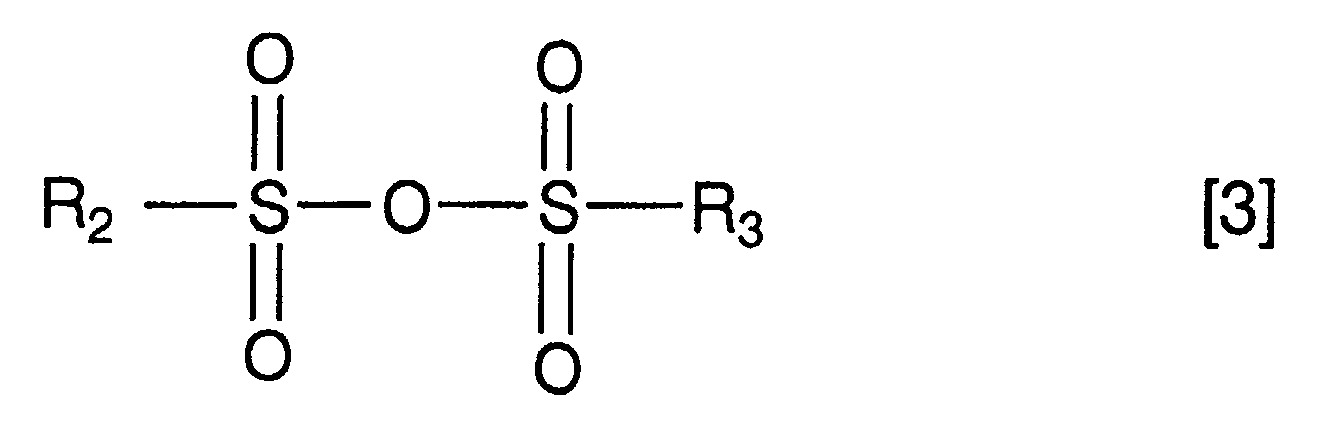

each of R2 and R3 is independently a lower perfluoroalkyl group that is represented by CnF2n+1 where n is an integer of 1-10 and that optionally has a branch in a carbon structure of the lower perfluoroalkyl group; and
R4 is identical with the R2 or R3.


Each of the air and oxygen is not preferable as the another gas, since it may lower the palladium catalytic activity. Normally, it is not necessary to use the another gas. The partial pressure (in terms of absolute pressure) of carbon monoxide is preferably 0.01-10 MPa, more preferably 0.05-1.5 MPa. If it is lower than 0.01 MPa, the reaction may not proceed sufficiently, thereby lowering yield. Even if it is higher than 10 MPa, the yield of the target product may not improve further. Furthermore, it may require the reactor to have an improved strength. As the reaction proceeds in the step (b), carbon monoxide is consumed either under normal pressure or under pressurized condition. Therefore, it is preferable to introduce carbon monoxide intermittently or continuously into the system in order to maintain the carbon monoxide partial pressure at a constant level. The reaction temperature of the step (b) may be in a range of 0-200°C, preferably 0-150°C, more preferably 0-120°C. The optimum reaction temperature may be changed depending on the types and the amounts of the reagents (e.g., palladium complex compound, neutral inorganic salt, and base).


Melting point: 73.0-74.5°C
1H-NMR (standard substance: TMS; solvent: CDCl3) σ (ppm): 2.98 (s, 2H), 4.61 (dd, J=47.6, 2.4Hz, 4H), 7.15 (d, J=8.8Hz, 1H), 7.76 (dd, J=8.8, 2.4Hz, 1H), 8.17 (d, J=2.4Hz, 1H)
19F-NMR (standard substance: CCl3F; solvent: CDCl3) σ (ppm): -62.81 (s, 3F), -232.40 (t, J=47.6Hz, 2F)
2,2-bis(fluoromethyl)-6-(trifluoromethyl)-2H-1-benzopyran-4-yl ester (yield: 75%). This product was found to have the following properties.
1H-NMR (standard substance: TMS; solvent: CDCl3) σ (ppm): 4.51-4.73 (m, J=46.4Hz, 4H), 5.78 (s, 1H), 7.04 (d, J=8.8Hz, 1H), 7.53 (d, J=2.0Hz, 1H), 7.58 (dd, J=8.8, 2.0Hz, 1H)
19F-NMR (standard substance: CCl3F; solvent: CDCl3) σ (ppm): -62.85 (s, 3F), -73.51 (s, 3F), -232.91 (t, J=46.4Hz, 2F)
Melting point: 159-161°C
1H-NMR (standard substance: TMS; solvent: CDCl3) σ (ppm): 4.52-4.74 (m, J=46.4Hz, 4H), 6.95 (s, 1H), 7.04 (d, J=8.4Hz, 1H), 7.52 (dd, J=8.4, 2.0Hz, 1H), 8.36 (d, J=2.0Hz, 1H), 10.0-10.4 (1H, bs)
19F-NMR (standard substance: CCl3F; solvent: CDCl3) σ (ppm): -62.48 (s, 3F), -233.97 (t, J=46.4Hz, 2F)
| Ex. 8-1 | Ex. 8-2 | Ex. 8-3 | Ex. 8-4 | Ex. 8-5 | |
| Reactants | |||||
| Palladium Complex Compound | Pd(dba)2, 0.024mmol | Pd2(dba)2·CHCl3, 0.024mmol | Pd2(dba)2·CHCl3, 0.012mmol | Pd(OCOMe)2 0.024mmol | Pd(OCOMe)2 0.024mmol |
| Phosphine Compound | - | - | - | Triphenylphosphine, 0.048mmol | Triphenylphosphine, 0.048mmol |
| Neutral Inorganic Salt | - | - | LiCl, 2.4mmol | - | KI, 2.4mmol |
| Reaction Conditions | |||||
| Temp. (°C) | 25 | 25 | 25 | 50 | 50 |
| Time (hr) | 5 | 1 | 1 | 3 | 5 |
| Yield | 0.96mmol, 40% | 1.51mmol, 63% | 2.02mmol, 84% | 0.60mmol, 25% | 1.27mmol, 53% |
Pd2(dba)2·CHCl3: tris(dibenzylidene)(chloroform)dipalladium;
Pd(OCOMe)2: palladium acetatate
Melting point: 168°C
1H-NMR (standard substance: TMS; solvent: CDCl3) σ (ppm): 3.84 (s, 3H), 6.95 (d, J=8.4Hz, 2H), 7.54 (d, J=8.4Hz, 2H) 19F-NMR (standard substance: CCl3F; solvent: CDCl3) σ (ppm): -61.94 (s, 3F)
1H-NMR (standard substance: TMS; solvent: CDCl3) σ (ppm): 2.63 (s, 3H), 2.16 (s, 3H), 7.06 (d, J=8.8Hz, 1H), 7.71 (dd, J=8.8, 2.0Hz, 1H), 8.06 (d, J=2Hz, 1H)
19F-NMR (standard substance: CCl3F; solvent: CDCl3) σ (ppm): -62.31 (s, 3F)
Melting point: 79°C/800Pa
1H-NMR (standard substance: TMS; solvent: CDCl3) σ (ppm): 2.69 (s, 3H), 7.07 (d, J=8.8Hz, 1H), 7.69 (dd, J=8.8, 2.0Hz, 1H), 7.99 (d, J=2.0Hz, 1H), 12.55 (s, 1H)
19F-NMR (standard substance: CCl3F; solvent: CDCl3) σ (ppm): -62.31 (s, 3F)
Claims (18)
- A process for producing a 2,2-bis(fluoromethyl)-6-(perfluoroalkyl)-2H-1-benzopyran-4-carboxylic acid represented by the general formula [1], the process comprising the steps of:where R1 is a perfluoroalkyl group that is represented by CnF2n+1 where n is an integer of 1-10 and that optionally has a branch in a carbon structure of the perfluoroalkyl group;(a) reacting a 2,2-bis(fluoromethyl)-6-(perfluoroalkyl)-2H-1-benzopyran-4-one, represented by the general formula [2], with a perfluoroalkanesulfonic acid anhydride, represented by the general formula [3], in the presence of a base, thereby obtaining a perfluoroalkanesulfonic 2,2-bis(fluoromethyl)-6-(perfluoroalkyl)-2H-1-benzopyran-4-yl ester represented by the general formula [4]; and(b) reacting the benzopyranyl ester with carbon monoxide in the presence of a palladium complex compound and a base, thereby obtaining the carboxylic acid,


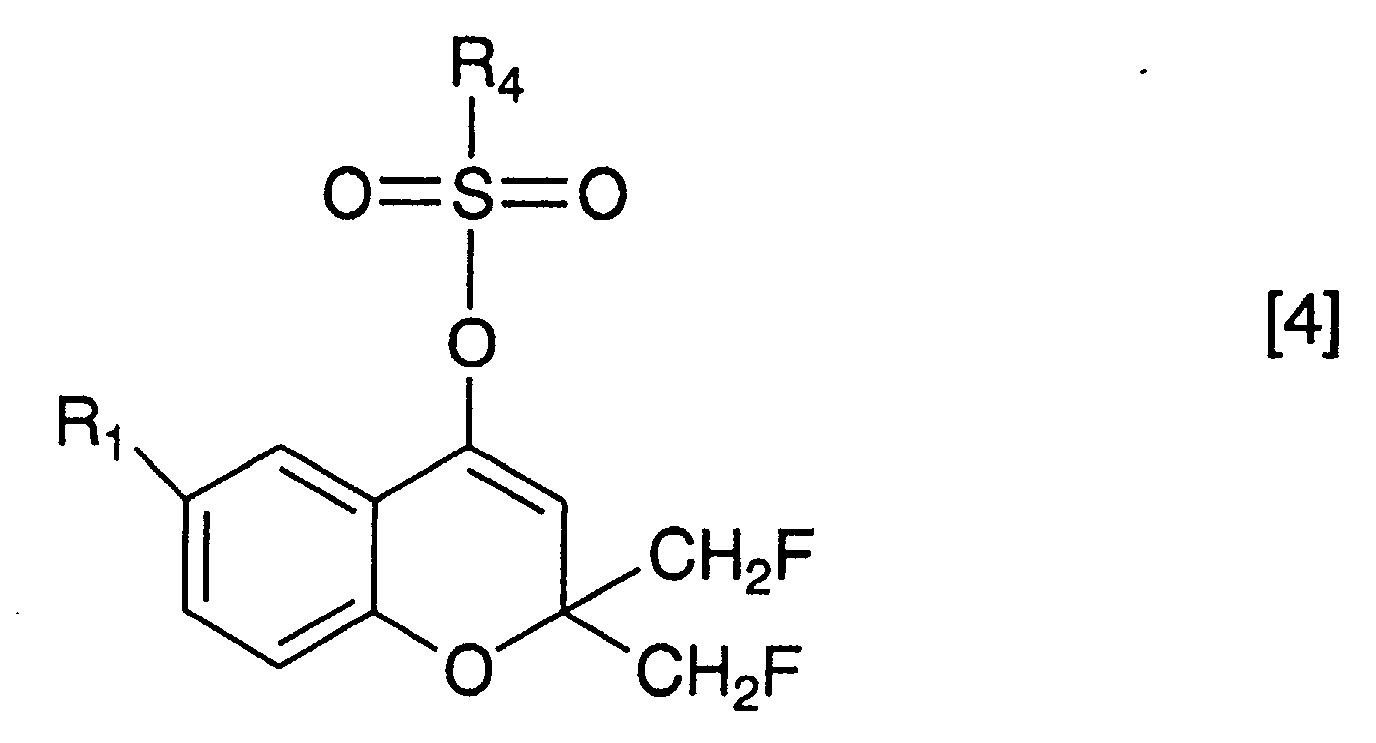
each of R2 and R3 is independently a lower perfluoroalkyl group that is represented by CnF2n+1 where n is an integer of 1-10 and that optionally has a branch in a carbon structure of the lower perfluoroalkyl group; and
R4 is identical with the R2 or R3. - A process for producing a 2,2-bis(fluoromethyl)-6-(perfluoroalkyl)-2H-1-benzopyran-4-carboxylic acid represented by the general formula [1], the process comprising the steps of:(c) reacting a 4-(perfluoroalkyl)alkoxybenzene, represented by the general formula [6], with acetic anhydride or an acyl halide in the presence of a Lewis acid, thereby obtaining a 2-alkoxy-5-(perfluoroalkyl)acetophenone represented by the general formula [7];(d) dealkylating the 2-alkoxy-5-(perfluoroalkyl) acetophenone by a dealkylating agent, thereby obtaining a 2-hydroxy-5-(perfluoroalkyl)acetophenone represented by the general formula [5];(e) reacting the 2-hydroxy-5-(perfluoroalkyl) acetophenone with 1,3-difluoroacetone in the presence of a base, thereby obtaining a 2,2-bis(fluoromethyl)-6-(perfluoroalkyl)-2H-1-benzopyran-4-one represented by the general formula [2];(a) reacting the 2,2-bis(fluoromethyl)-6-(perfluoroalkyl)-2H-1-benzopyran-4-one with a perfluoroalkanesulfonic acid anhydride, represented by the general formula [3], in the presence of a base, thereby obtaining a perfluoroalkanesulfonic 2,2-bis(fluoromethyl)- 6-(perfluoroalkyl)-2H-1-benzopyran-4-yl ester represented by the general formula [4]; and(b) reacting the benzopyranyl ester with carbon monoxide in the presence of a palladium complex compound and a base, thereby obtaining the carboxylic acid,
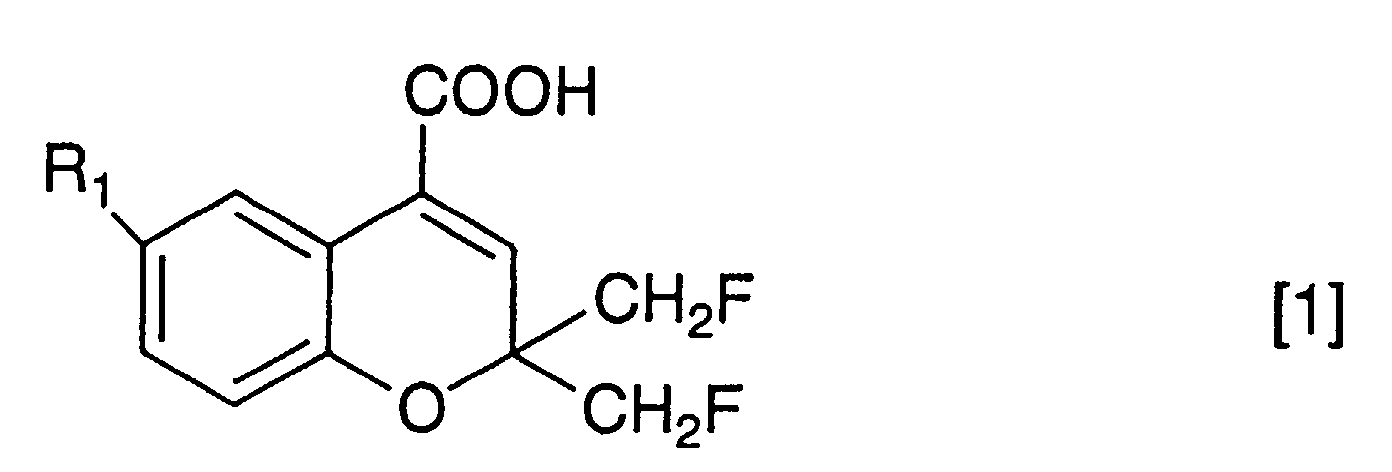


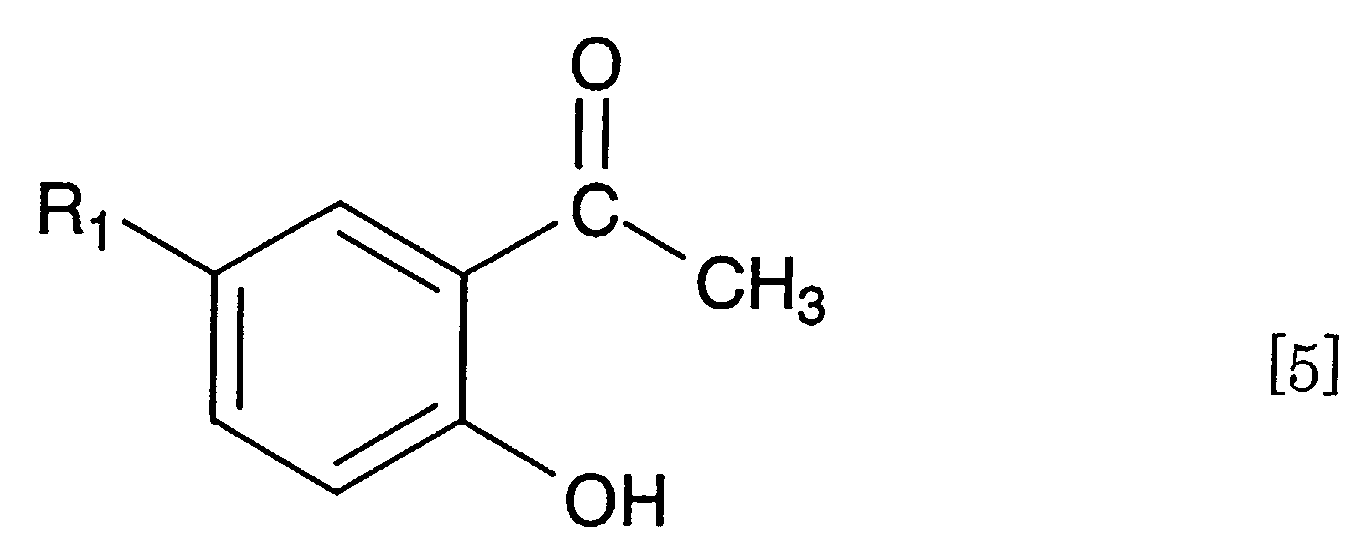
 where R1 is a perfluoroalkyl group that is represented by CnF2n+1 where n is an integer of 1-10 and that optionally has a branch in a carbon structure of the perfluoroalkyl group;
each of R2 and R3 is independently a lower perfluoroalkyl group that is represented by CnF2n+1 where n is an integer of 1-10 and that optionally has a branch in a carbon structure of the lower perfluoroalkyl group;
R4 is identical with the R2 or R3; and
R5 is a straight-chain or non-straight-chain alkyl group having a carbon atom number of 1-20. - A process for producing a 2,2-bis(fluoromethyl)-6-(perfluoroalkyl)-2H-1-benzopyran-4-carboxylic acid represented by the general formula [1], the process comprising the steps of:(f) reacting a 4-perfluoroalkylphenol, represented by the general formula [8], with an alkylation agent, or reacting a 4-(perfluoroalkyl)halogenobenzene, represented by the general formula [9], with a metal alcoholate, thereby obtaining a 4-(perfluoroalkyl)alkoxybenzene, represented by the general formula [6];(c) reacting the 4-(perfluoroalkyl)alkoxybenzene with acetic anhydride or an acyl halide in the presence of a Lewis acid, thereby obtaining a 2-alkoxy-5-(perfluoroalkyl) acetophenone represented by the general formula [7];(d) dealkylating the 2-alkoxy-5-(perfluoroalkyl) acetophenone by a dealkylating agent, thereby obtaining a 2-hydroxy-5-(perfluoroalkyl)acetophenone represented by the general formula [5];(e) reacting the 2-hydroxy-5-(perfluoroalkyl) acetophenone with 1,3-difluoroacetone in the presence of a base, thereby obtaining a 2,2-bis(fluoromethyl)-6-(perfluoroalkyl)-2H-1-benzopyran-4 represented by the general formula [2];(a) reacting the 2,2-bis(fluoromethyl)-6-(perfluoroalkyl)-2H-1-benzopyran-4-one with a perfluoroalkanesulfonic acid anhydride, represented by the general formula [3], in the presence of a base, thereby obtaining a perfluoroalkanesulfonic 2,2-bis(fluoromethyl)-6-(perfluoroalkyl)-2H-1-benzopyran-4-yl ester represented by the general formula [4]; and(b) reacting the benzopyranyl ester with carbon monoxide in the presence of a palladium complex compound and a base, thereby obtaining the carboxylic acid,

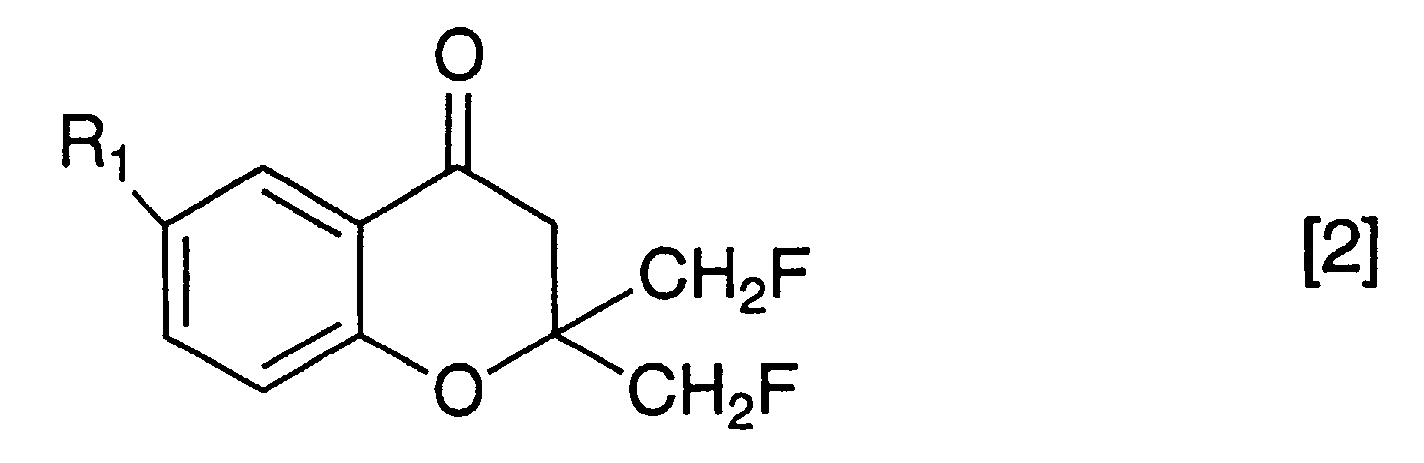

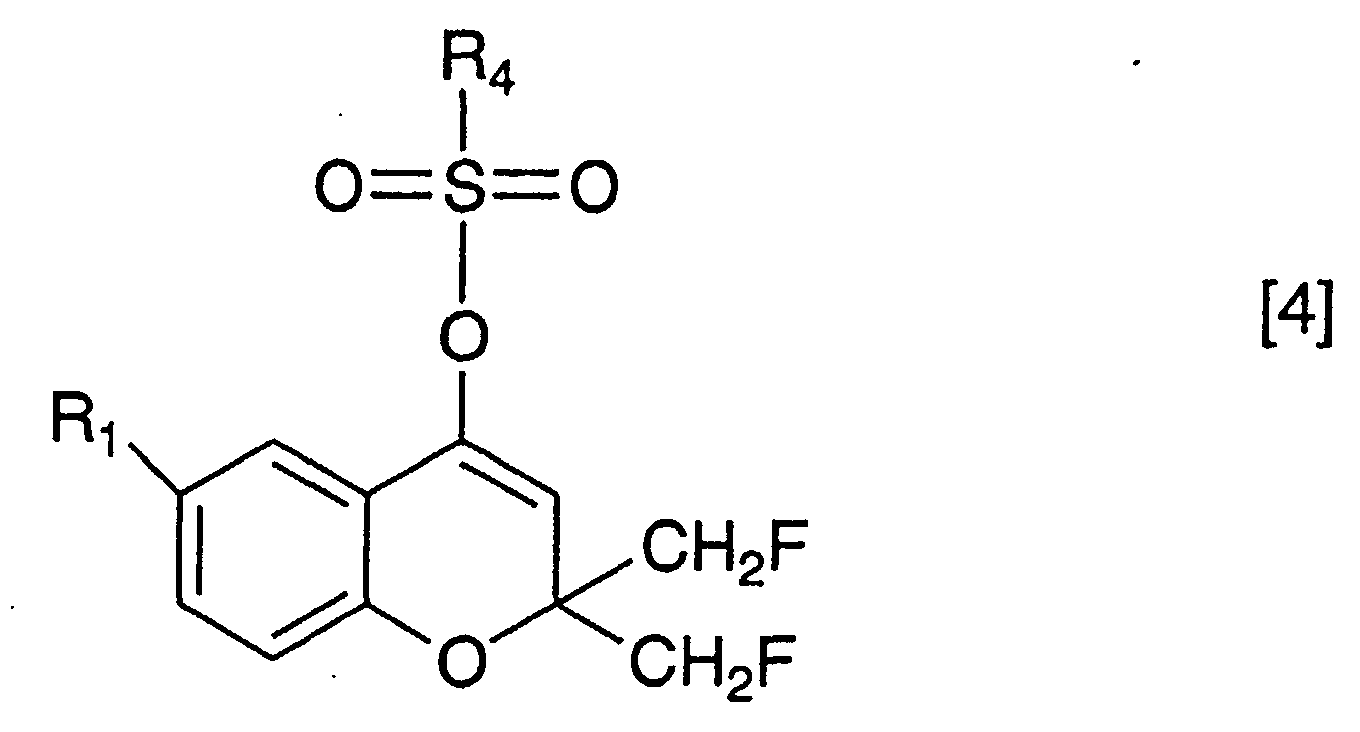


 where R1 is a perfluoroalkyl group that is represented by CnF2n+1 where n is an integer of 1-10 and that optionally has a branch in a carbon structure of the perfluoroalkyl group;
each of R2 and R3 is independently a lower perfluoroalkyl group that is represented by CnF2n+1 where n is an integer of 1-10 and that optionally has a branch in a carbon structure of the lower perfluoroalkyl group;
R4 is identical with the R2 or R3;
R5 is a straight-chain or non-straight-chain alkyl group having a carbon atom number of 1-20; and
X is a fluorine, chlorine, bromine or iodine. - A process according to claim 1, wherein the 2,2-bis(fluoromethyl)-6-(perfluoroalkyl)-2H-1-benzopyran-4-one of the step (a) is obtained by the step of (e) reacting a 2-hydroxy-5-(perfluoroalkyl) acetophenone, represented by the general formula [5], with 1,3-difluoroacetone in the presence of a base,where R1 is defined as above.
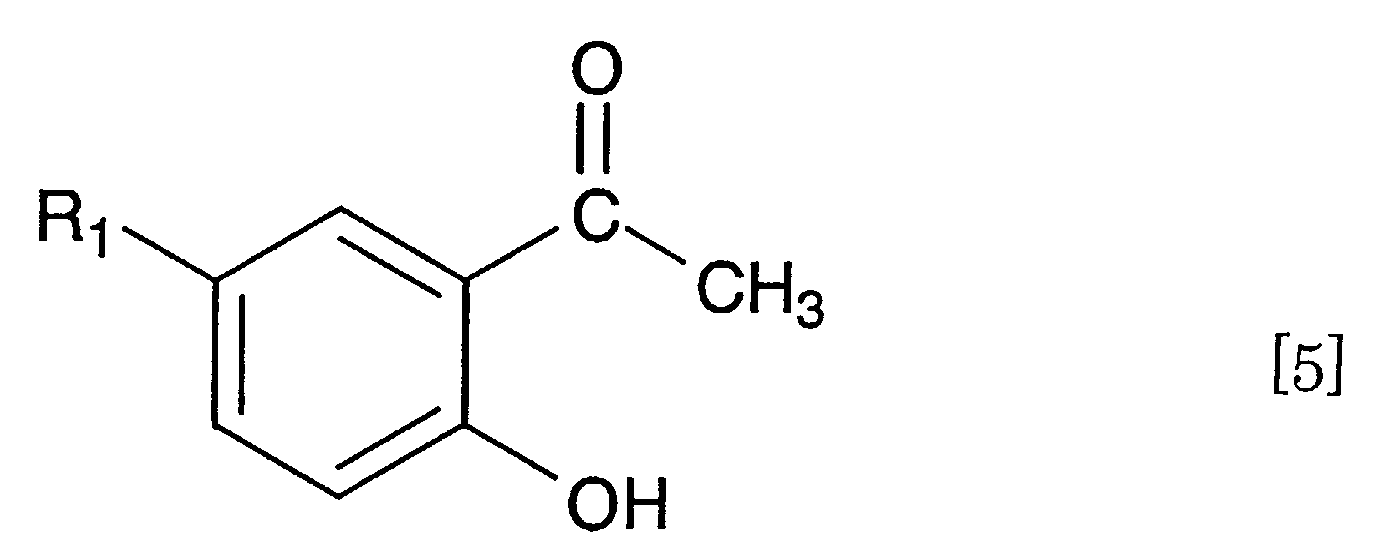
- A process according to claim 1, wherein the base of the step (a) is 4-dimethylaminopyridine or 2,6-di-tert-butyl-4-methylpyridine.
- A process according to claim 1, wherein the step (b) is conducted in the presence of a neutral inorganic salt.
- A process according to claim 6, wherein the neutral inorganic salt is lithium chloride or potassium iodide.
- A process according to claim 1, wherein the perfluoroalkanesulfonic acid anhydride of the step (a) is trifluoromethanesulfonic acid anhydride.
- A process according to claim 1, wherein R1 of the general formulas [1], [2] and [4] is a trifluoromethyl group.
- A process for producing a 2-hydroxy-5-(perfluoroalkyl) acetophenone represented by the general formula [5], the process comprising the steps of:where R1 is a perfluoroalkyl group that is represented by CnF2n+1 where n is an integer of 1-10 and that optionally has a branch in a carbon structure of the perfluoroalkyl group; and(c) reacting a 4-(perfluoroalkyl)alkoxybenzene, represented by the general formula [6], with acetic anhydride or an acyl halide in the presence of a Lewis acid, thereby obtaining a 2-alkoxy-5-(perfluoroalkyl)acetophenone represented by the general formula [7]; and(d) dealkylating the 2-alkoxy-5-(perfluoroalkyl) acetophenone by a dealkylating agent, thereby obtaining the 2-hydroxy-5-(perfluoroalkyl)acetophenone,
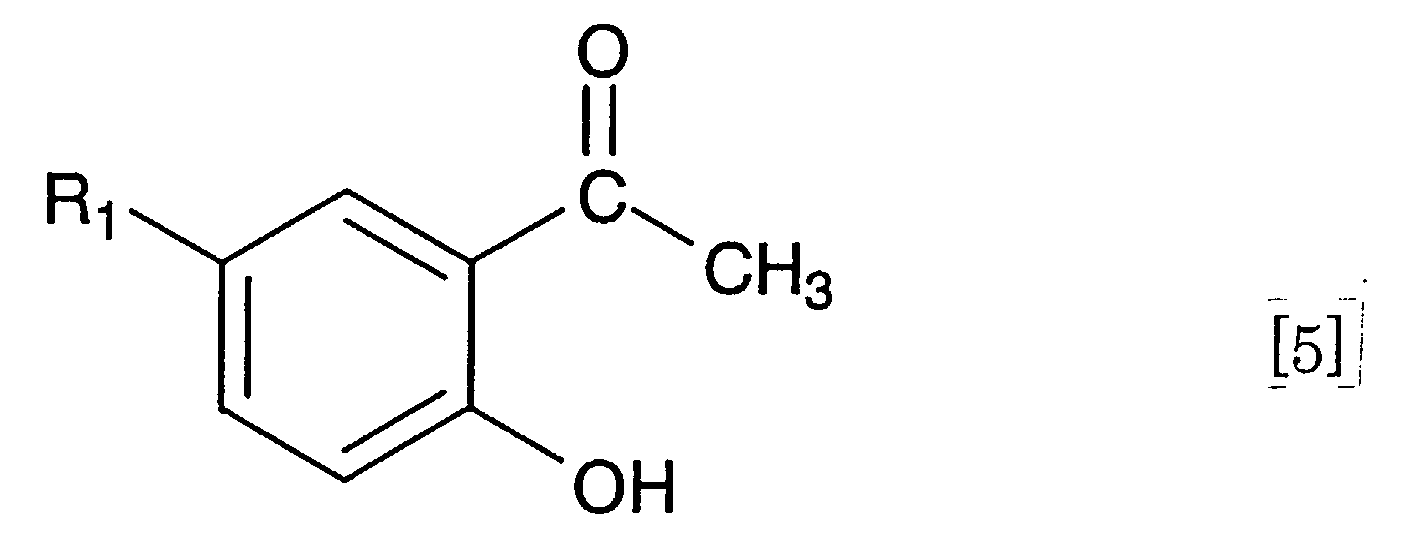
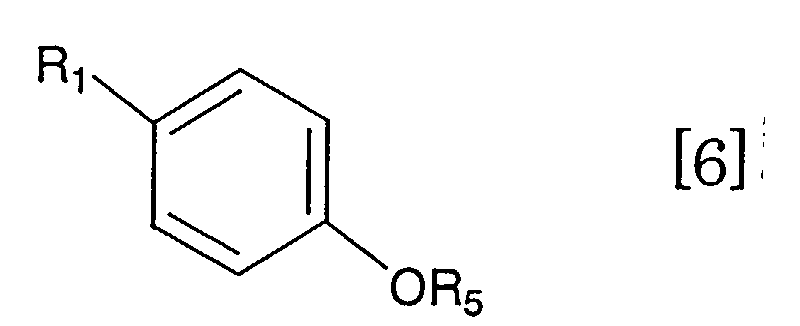
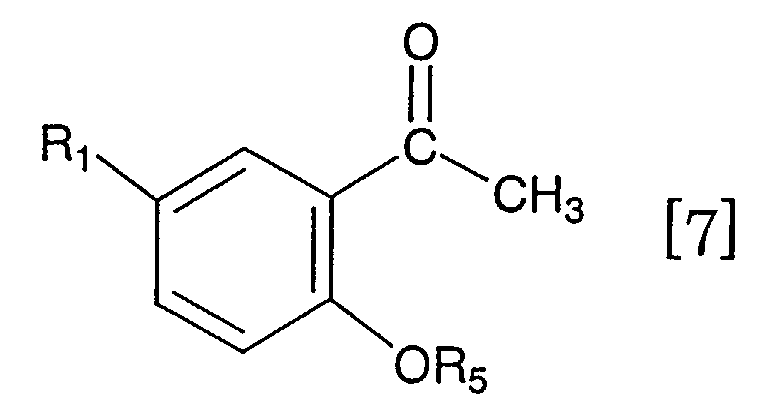
R5 is a straight-chain or non-straight-chain alkyl group. - A process according to claim 10, wherein the 4-(perfluoroalkyl)alkoxybenzene of the step (c) is obtained by the step of (f) reacting a 4-perfluoroalkylphenol, represented by the general formula [8], with an alkylation agent, or reacting a 4-(perfluoroalkyl)halogenobenzene, represented by the general formula [9], with a metal alcoholate;
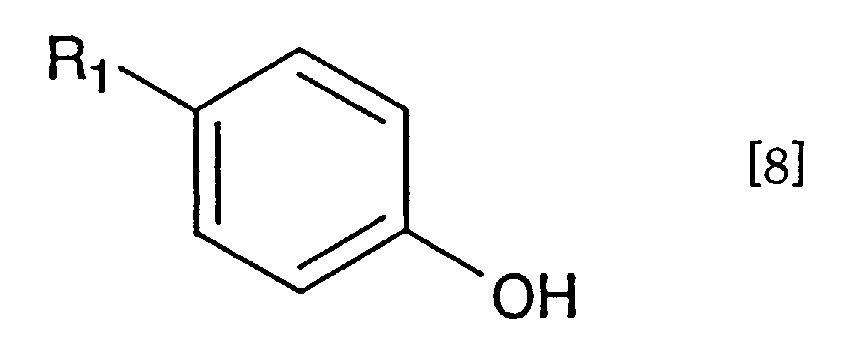 wherein X is a fluorine, chlorine, bromine or iodine.
- A process according to claim 10, wherein the Lewis acid of the step (c) is trifluoromethanesulfonic acid.
- A process according to claim 10, wherein the step (d) is conducted by reacting the 2-alkoxy-5-(perfluoroalkyl) acetophenone with boron tribromide, trimethylsilylchloride, or a metal salt of a thiol.
- A process according to claim 13, wherein the step (d) is conducted by reacting the 2-alkoxy-5-(perfluoroalkyl) acetophenone with boron tribromide in methylene chloride.
- A process according to claim 13, wherein the step (d) is conducted by reacting the 2-alkoxy-5-(perfluoroalkyl) acetophenone with trimethylsilylchloride in acetonitrile in the presence of sodium iodide.
- A process according to claim 13, wherein the step (d) is conducted by reacting the 2-alkoxy-5-(perfluoroalkyl) acetophenone with a metal salt of a thiol in N,N-dimethylformamide.
- A process according to claim 10, wherein R1 of the general formulas [5], [6] and [7] is a trifluoromethyl group.
- 2-methoxy-5-(trifluoromethyl)acetophenone represented by the following formula [10].
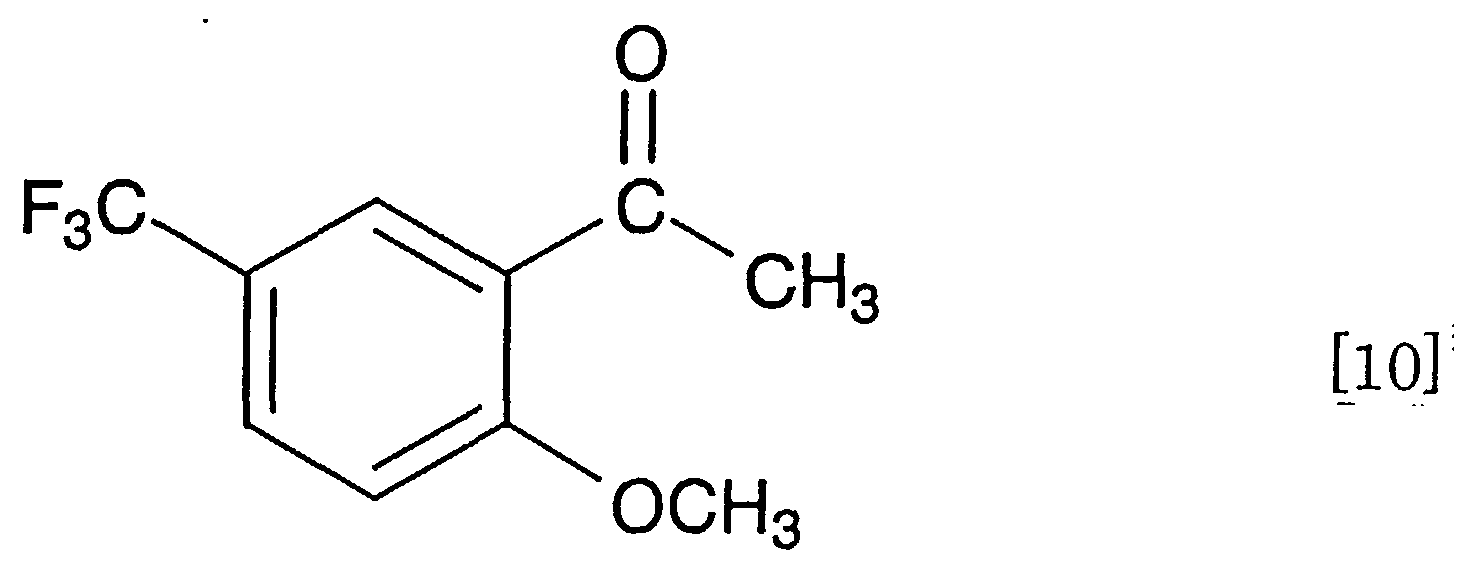
Applications Claiming Priority (4)
| Application Number | Priority Date | Filing Date | Title |
|---|---|---|---|
| JP2001300314A JP2003104928A (en) | 2001-09-28 | 2001-09-28 | Method for producing hydroxyacetophenones |
| JP2001300314 | 2001-09-28 | ||
| JP2001332471A JP2003137879A (en) | 2001-10-30 | 2001-10-30 | Method for producing 4-substituted benzopyran derivative |
| JP2001332471 | 2001-10-30 |
Publications (2)
| Publication Number | Publication Date |
|---|---|
| EP1298129A2 true EP1298129A2 (en) | 2003-04-02 |
| EP1298129A3 EP1298129A3 (en) | 2003-06-04 |
Family
ID=26623262
Family Applications (1)
| Application Number | Title | Priority Date | Filing Date |
|---|---|---|---|
| EP02021753A Withdrawn EP1298129A3 (en) | 2001-09-28 | 2002-09-25 | Process for producing 4-sustituted benzopyran derivatives |
Country Status (2)
| Country | Link |
|---|---|
| US (1) | US6608217B2 (en) |
| EP (1) | EP1298129A3 (en) |
Cited By (1)
| Publication number | Priority date | Publication date | Assignee | Title |
|---|---|---|---|---|
| US8455394B2 (en) | 2009-01-14 | 2013-06-04 | Dow Agrosciences, Llc | Fungicidal compositions including hydrazone derivatives and copper |
Families Citing this family (5)
| Publication number | Priority date | Publication date | Assignee | Title |
|---|---|---|---|---|
| WO2011051478A1 (en) | 2009-10-30 | 2011-05-05 | Domain Therapeutics | Novel oxime derivatives and their use as allosteric modulators of metabotropic glutamate receptors |
| CN102827060B (en) * | 2012-01-12 | 2013-12-25 | 上海合全药物研发有限公司 | Synthetic method of 5-trifluoromethyl pyrrole-2-formic acid |
| EP3186257B1 (en) | 2014-08-27 | 2019-02-06 | Prexton Therapeutics SA | Novel chromone oxime derivative and its use as allosteric modulator of metabotropic glutamate receptors |
| WO2017032874A1 (en) | 2015-08-27 | 2017-03-02 | Prexton Therapeutics Sa | Brain-penetrant chromone oxime derivative for the therapy of levodopa-induced dyskinesia |
| CN119528866B (en) * | 2024-11-28 | 2025-10-17 | 河南农业大学 | Ditrifluoromethyl-containing coumarin tertiary alcohol compound and preparation method and application thereof |
Family Cites Families (2)
| Publication number | Priority date | Publication date | Assignee | Title |
|---|---|---|---|---|
| DE2653601A1 (en) * | 1976-11-25 | 1978-06-01 | Bayer Ag | Hydroxyphenyl ketones prepn. from phenols - by reaction with acid halides in liq. hydrogen fluoride |
| HK1041001A1 (en) | 1998-09-30 | 2002-06-28 | 中外制药株式会社 | Processes for the preparation of 4-substituted benzopyran derivatives |
-
2002
- 2002-09-25 EP EP02021753A patent/EP1298129A3/en not_active Withdrawn
- 2002-09-26 US US10/255,099 patent/US6608217B2/en not_active Expired - Fee Related
Cited By (4)
| Publication number | Priority date | Publication date | Assignee | Title |
|---|---|---|---|---|
| US8455394B2 (en) | 2009-01-14 | 2013-06-04 | Dow Agrosciences, Llc | Fungicidal compositions including hydrazone derivatives and copper |
| US8461078B2 (en) | 2009-01-14 | 2013-06-11 | Dow Agrosciences Llc | Fungicidal compositions including hydrazone derivatives and copper |
| US8476194B2 (en) | 2009-01-14 | 2013-07-02 | Dow Agrosciences, Llc | Fungicidal compositions including hydrazone derivatives and copper |
| US8715745B2 (en) | 2009-01-14 | 2014-05-06 | Dow Agrosciences, Llc. | Fungicidal compositions including hydrazone derivatives and copper |
Also Published As
| Publication number | Publication date |
|---|---|
| EP1298129A3 (en) | 2003-06-04 |
| US20030109574A1 (en) | 2003-06-12 |
| US6608217B2 (en) | 2003-08-19 |
Similar Documents
| Publication | Publication Date | Title |
|---|---|---|
| US7820848B2 (en) | Process for the preparation of stilbene derivatives | |
| KR100880787B1 (en) | 3,3 ', 5,5', 6,6'-hexaalkyl-2,2'-biphenol, 3,3 ', 4,4', 5,5'-hexaalkyl-2,2'-ratio Process for preparing phenol and 3,3 ', 4,4', 5,5 ', 6,6'-octaalkyl-2,2'-biphenol | |
| US5420310A (en) | Conversion of 15-beta to 15-alpha 5,6,7-trinor-4,8-inter-m-phenylene PGI2 derivatives | |
| US6608217B2 (en) | Process for producing 4-substituted benzopyran derivatives | |
| KR860001445B1 (en) | Process for the preparation of 3-phenoxybenzyl 2-(4-alkoxyphenyl)-2-methyl propylether | |
| KR100415000B1 (en) | Preparation of 3-isochromanone | |
| US6075152A (en) | Process for preparing isochroman-3-ones | |
| CN119032078A (en) | Preparation method of HPPD inhibitor herbicide, intermediate and intermediate preparation method | |
| KR20010049460A (en) | Process for producing retinal and intermediates for producing the same | |
| JP3268459B2 (en) | Method for producing acetophenones | |
| JP2004506628A (en) | Intermediates for use in preparing vitamin E | |
| US6201131B1 (en) | Process for producing [2-(arylsulfonyl) ethenyl] benzene derivatives | |
| JP5023683B2 (en) | Process for producing benzofluorene derivative and intermediate thereof | |
| HUT75109A (en) | Process for preparing intermediates for the synthesis of antifungal agents | |
| JP2003104928A (en) | Method for producing hydroxyacetophenones | |
| JPH09143139A (en) | Production of cyanofluorophenol | |
| US4594467A (en) | Preparation of 3,5-dichloro-α-methylstyrene | |
| JPH0511110B2 (en) | ||
| JPH03127753A (en) | Production of 4-chloro-4'-hydroxybenzophenones | |
| US4861917A (en) | Process for preparing macrocyclic 2-halogenoketones | |
| EP0170506B1 (en) | Method for inversion of optically active 4-hydroxy-2-cyclopentenones | |
| JP2662162B2 (en) | Method for producing 3-alkylpyrrole | |
| JP2003137879A (en) | Method for producing 4-substituted benzopyran derivative | |
| JP3128703B2 (en) | Method for producing color-forming compounds, intermediates thereof, and methods for producing them | |
| CN114832862A (en) | Catalytic composition for coupling reaction and application thereof in preparation of isoquinoline-1, 3-diketone compounds |
Legal Events
| Date | Code | Title | Description |
|---|---|---|---|
| PUAI | Public reference made under article 153(3) epc to a published international application that has entered the european phase |
Free format text: ORIGINAL CODE: 0009012 |
|
| AK | Designated contracting states |
Kind code of ref document: A2 Designated state(s): AT BE BG CH CY CZ DE DK EE ES FI FR GB GR IE IT LI LU MC NL PT SE SK TR Designated state(s): AT BE BG CH CY CZ DE DK EE ES FI FR GB GR IE IT LI LU MC NL PT SE SK TR |
|
| AX | Request for extension of the european patent |
Extension state: AL LT LV MK RO SI |
|
| PUAL | Search report despatched |
Free format text: ORIGINAL CODE: 0009013 |
|
| AK | Designated contracting states |
Designated state(s): AT BE BG CH CY CZ DE DK EE ES FI FR GB GR IE IT LI LU MC NL PT SE SK TR |
|
| AX | Request for extension of the european patent |
Extension state: AL LT LV MK RO SI |
|
| 17P | Request for examination filed |
Effective date: 20031114 |
|
| AKX | Designation fees paid |
Designated state(s): DE FR GB |
|
| STAA | Information on the status of an ep patent application or granted ep patent |
Free format text: STATUS: THE APPLICATION HAS BEEN WITHDRAWN |
|
| 18W | Application withdrawn |
Effective date: 20050111 |
|
| R18W | Application withdrawn (corrected) |
Effective date: 20050111 |