EP1295868A1 - Amide compounds and use thereof - Google Patents

Amide compounds and use thereof Download PDF

Info

Publication number
EP1295868A1
EP1295868A1 EP01938646A EP01938646A EP1295868A1 EP 1295868 A1 EP1295868 A1 EP 1295868A1 EP 01938646 A EP01938646 A EP 01938646A EP 01938646 A EP01938646 A EP 01938646A EP 1295868 A1 EP1295868 A1 EP 1295868A1
Authority
EP
European Patent Office
Prior art keywords
group
ethyl
acrylamide
difluoromethoxy
hydroxy
Prior art date
Legal status (The legal status is an assumption and is not a legal conclusion. Google has not performed a legal analysis and makes no representation as to the accuracy of the status listed.)
Withdrawn
Application number
EP01938646A
Other languages
German (de)
French (fr)
Other versions
EP1295868A4 (en
Inventor
Hiroshi Sakaguchi
Current Assignee (The listed assignees may be inaccurate. Google has not performed a legal analysis and makes no representation or warranty as to the accuracy of the list.)
Sumitomo Chemical Co Ltd
Original Assignee
Sumitomo Chemical Co Ltd
Priority date (The priority date is an assumption and is not a legal conclusion. Google has not performed a legal analysis and makes no representation as to the accuracy of the date listed.)
Filing date
Publication date
Application filed by Sumitomo Chemical Co Ltd filed Critical Sumitomo Chemical Co Ltd
Publication of EP1295868A1 publication Critical patent/EP1295868A1/en
Publication of EP1295868A4 publication Critical patent/EP1295868A4/en
Withdrawn legal-status Critical Current

Links

Classifications

    • CCHEMISTRY; METALLURGY
    • C07ORGANIC CHEMISTRY
    • C07DHETEROCYCLIC COMPOUNDS
    • C07D239/00Heterocyclic compounds containing 1,3-diazine or hydrogenated 1,3-diazine rings
    • C07D239/02Heterocyclic compounds containing 1,3-diazine or hydrogenated 1,3-diazine rings not condensed with other rings
    • C07D239/24Heterocyclic compounds containing 1,3-diazine or hydrogenated 1,3-diazine rings not condensed with other rings having three or more double bonds between ring members or between ring members and non-ring members
    • C07D239/26Heterocyclic compounds containing 1,3-diazine or hydrogenated 1,3-diazine rings not condensed with other rings having three or more double bonds between ring members or between ring members and non-ring members with only hydrogen atoms, hydrocarbon or substituted hydrocarbon radicals, directly attached to ring carbon atoms
    • AHUMAN NECESSITIES
    • A01AGRICULTURE; FORESTRY; ANIMAL HUSBANDRY; HUNTING; TRAPPING; FISHING
    • A01NPRESERVATION OF BODIES OF HUMANS OR ANIMALS OR PLANTS OR PARTS THEREOF; BIOCIDES, e.g. AS DISINFECTANTS, AS PESTICIDES OR AS HERBICIDES; PEST REPELLANTS OR ATTRACTANTS; PLANT GROWTH REGULATORS
    • A01N37/00Biocides, pest repellants or attractants, or plant growth regulators containing organic compounds containing a carbon atom having three bonds to hetero atoms with at the most two bonds to halogen, e.g. carboxylic acids
    • A01N37/36Biocides, pest repellants or attractants, or plant growth regulators containing organic compounds containing a carbon atom having three bonds to hetero atoms with at the most two bonds to halogen, e.g. carboxylic acids containing at least one carboxylic group or a thio analogue, or a derivative thereof, and a singly bound oxygen or sulfur atom attached to the same carbon skeleton, this oxygen or sulfur atom not being a member of a carboxylic group or of a thio analogue, or of a derivative thereof, e.g. hydroxy-carboxylic acids
    • AHUMAN NECESSITIES
    • A01AGRICULTURE; FORESTRY; ANIMAL HUSBANDRY; HUNTING; TRAPPING; FISHING
    • A01NPRESERVATION OF BODIES OF HUMANS OR ANIMALS OR PLANTS OR PARTS THEREOF; BIOCIDES, e.g. AS DISINFECTANTS, AS PESTICIDES OR AS HERBICIDES; PEST REPELLANTS OR ATTRACTANTS; PLANT GROWTH REGULATORS
    • A01N37/00Biocides, pest repellants or attractants, or plant growth regulators containing organic compounds containing a carbon atom having three bonds to hetero atoms with at the most two bonds to halogen, e.g. carboxylic acids
    • A01N37/36Biocides, pest repellants or attractants, or plant growth regulators containing organic compounds containing a carbon atom having three bonds to hetero atoms with at the most two bonds to halogen, e.g. carboxylic acids containing at least one carboxylic group or a thio analogue, or a derivative thereof, and a singly bound oxygen or sulfur atom attached to the same carbon skeleton, this oxygen or sulfur atom not being a member of a carboxylic group or of a thio analogue, or of a derivative thereof, e.g. hydroxy-carboxylic acids
    • A01N37/38Biocides, pest repellants or attractants, or plant growth regulators containing organic compounds containing a carbon atom having three bonds to hetero atoms with at the most two bonds to halogen, e.g. carboxylic acids containing at least one carboxylic group or a thio analogue, or a derivative thereof, and a singly bound oxygen or sulfur atom attached to the same carbon skeleton, this oxygen or sulfur atom not being a member of a carboxylic group or of a thio analogue, or of a derivative thereof, e.g. hydroxy-carboxylic acids having at least one oxygen or sulfur atom attached to an aromatic ring system
    • CCHEMISTRY; METALLURGY
    • C07ORGANIC CHEMISTRY
    • C07CACYCLIC OR CARBOCYCLIC COMPOUNDS
    • C07C235/00Carboxylic acid amides, the carbon skeleton of the acid part being further substituted by oxygen atoms
    • C07C235/02Carboxylic acid amides, the carbon skeleton of the acid part being further substituted by oxygen atoms having carbon atoms of carboxamide groups bound to acyclic carbon atoms and singly-bound oxygen atoms bound to the same carbon skeleton
    • C07C235/32Carboxylic acid amides, the carbon skeleton of the acid part being further substituted by oxygen atoms having carbon atoms of carboxamide groups bound to acyclic carbon atoms and singly-bound oxygen atoms bound to the same carbon skeleton the carbon skeleton containing six-membered aromatic rings
    • C07C235/34Carboxylic acid amides, the carbon skeleton of the acid part being further substituted by oxygen atoms having carbon atoms of carboxamide groups bound to acyclic carbon atoms and singly-bound oxygen atoms bound to the same carbon skeleton the carbon skeleton containing six-membered aromatic rings having the nitrogen atoms of the carboxamide groups bound to hydrogen atoms or to acyclic carbon atoms
    • CCHEMISTRY; METALLURGY
    • C07ORGANIC CHEMISTRY
    • C07CACYCLIC OR CARBOCYCLIC COMPOUNDS
    • C07C255/00Carboxylic acid nitriles
    • C07C255/01Carboxylic acid nitriles having cyano groups bound to acyclic carbon atoms
    • C07C255/11Carboxylic acid nitriles having cyano groups bound to acyclic carbon atoms containing cyano groups and singly-bound oxygen atoms bound to the same saturated acyclic carbon skeleton
    • C07C255/13Carboxylic acid nitriles having cyano groups bound to acyclic carbon atoms containing cyano groups and singly-bound oxygen atoms bound to the same saturated acyclic carbon skeleton containing cyano groups and etherified hydroxy groups bound to the carbon skeleton
    • CCHEMISTRY; METALLURGY
    • C07ORGANIC CHEMISTRY
    • C07CACYCLIC OR CARBOCYCLIC COMPOUNDS
    • C07C323/00Thiols, sulfides, hydropolysulfides or polysulfides substituted by halogen, oxygen or nitrogen atoms, or by sulfur atoms not being part of thio groups
    • C07C323/50Thiols, sulfides, hydropolysulfides or polysulfides substituted by halogen, oxygen or nitrogen atoms, or by sulfur atoms not being part of thio groups containing thio groups and carboxyl groups bound to the same carbon skeleton
    • C07C323/62Thiols, sulfides, hydropolysulfides or polysulfides substituted by halogen, oxygen or nitrogen atoms, or by sulfur atoms not being part of thio groups containing thio groups and carboxyl groups bound to the same carbon skeleton having the sulfur atom of at least one of the thio groups bound to a carbon atom of a six-membered aromatic ring of the carbon skeleton
    • CCHEMISTRY; METALLURGY
    • C07ORGANIC CHEMISTRY
    • C07CACYCLIC OR CARBOCYCLIC COMPOUNDS
    • C07C327/00Thiocarboxylic acids
    • C07C327/38Amides of thiocarboxylic acids
    • C07C327/40Amides of thiocarboxylic acids having carbon atoms of thiocarboxamide groups bound to hydrogen atoms or to acyclic carbon atoms
    • C07C327/44Amides of thiocarboxylic acids having carbon atoms of thiocarboxamide groups bound to hydrogen atoms or to acyclic carbon atoms to carbon atoms of an unsaturated carbon skeleton
    • CCHEMISTRY; METALLURGY
    • C07ORGANIC CHEMISTRY
    • C07DHETEROCYCLIC COMPOUNDS
    • C07D213/00Heterocyclic compounds containing six-membered rings, not condensed with other rings, with one nitrogen atom as the only ring hetero atom and three or more double bonds between ring members or between ring members and non-ring members
    • C07D213/02Heterocyclic compounds containing six-membered rings, not condensed with other rings, with one nitrogen atom as the only ring hetero atom and three or more double bonds between ring members or between ring members and non-ring members having three double bonds between ring members or between ring members and non-ring members
    • C07D213/04Heterocyclic compounds containing six-membered rings, not condensed with other rings, with one nitrogen atom as the only ring hetero atom and three or more double bonds between ring members or between ring members and non-ring members having three double bonds between ring members or between ring members and non-ring members having no bond between the ring nitrogen atom and a non-ring member or having only hydrogen or carbon atoms directly attached to the ring nitrogen atom
    • C07D213/24Heterocyclic compounds containing six-membered rings, not condensed with other rings, with one nitrogen atom as the only ring hetero atom and three or more double bonds between ring members or between ring members and non-ring members having three double bonds between ring members or between ring members and non-ring members having no bond between the ring nitrogen atom and a non-ring member or having only hydrogen or carbon atoms directly attached to the ring nitrogen atom with substituted hydrocarbon radicals attached to ring carbon atoms
    • C07D213/54Radicals substituted by carbon atoms having three bonds to hetero atoms with at the most one bond to halogen, e.g. ester or nitrile radicals
    • C07D213/56Amides
    • CCHEMISTRY; METALLURGY
    • C07ORGANIC CHEMISTRY
    • C07DHETEROCYCLIC COMPOUNDS
    • C07D241/00Heterocyclic compounds containing 1,4-diazine or hydrogenated 1,4-diazine rings
    • C07D241/02Heterocyclic compounds containing 1,4-diazine or hydrogenated 1,4-diazine rings not condensed with other rings
    • C07D241/10Heterocyclic compounds containing 1,4-diazine or hydrogenated 1,4-diazine rings not condensed with other rings having three double bonds between ring members or between ring members and non-ring members
    • C07D241/12Heterocyclic compounds containing 1,4-diazine or hydrogenated 1,4-diazine rings not condensed with other rings having three double bonds between ring members or between ring members and non-ring members with only hydrogen atoms, hydrocarbon or substituted hydrocarbon radicals, directly attached to ring carbon atoms
    • CCHEMISTRY; METALLURGY
    • C07ORGANIC CHEMISTRY
    • C07DHETEROCYCLIC COMPOUNDS
    • C07D277/00Heterocyclic compounds containing 1,3-thiazole or hydrogenated 1,3-thiazole rings
    • C07D277/02Heterocyclic compounds containing 1,3-thiazole or hydrogenated 1,3-thiazole rings not condensed with other rings
    • C07D277/20Heterocyclic compounds containing 1,3-thiazole or hydrogenated 1,3-thiazole rings not condensed with other rings having two or three double bonds between ring members or between ring members and non-ring members
    • C07D277/22Heterocyclic compounds containing 1,3-thiazole or hydrogenated 1,3-thiazole rings not condensed with other rings having two or three double bonds between ring members or between ring members and non-ring members with only hydrogen atoms, hydrocarbon or substituted hydrocarbon radicals, directly attached to ring carbon atoms
    • C07D277/30Radicals substituted by carbon atoms having three bonds to hetero atoms with at the most one bond to halogen, e.g. ester or nitrile radicals
    • CCHEMISTRY; METALLURGY
    • C07ORGANIC CHEMISTRY
    • C07DHETEROCYCLIC COMPOUNDS
    • C07D307/00Heterocyclic compounds containing five-membered rings having one oxygen atom as the only ring hetero atom
    • C07D307/02Heterocyclic compounds containing five-membered rings having one oxygen atom as the only ring hetero atom not condensed with other rings
    • C07D307/34Heterocyclic compounds containing five-membered rings having one oxygen atom as the only ring hetero atom not condensed with other rings having two or three double bonds between ring members or between ring members and non-ring members
    • C07D307/38Heterocyclic compounds containing five-membered rings having one oxygen atom as the only ring hetero atom not condensed with other rings having two or three double bonds between ring members or between ring members and non-ring members with substituted hydrocarbon radicals attached to ring carbon atoms
    • C07D307/54Radicals substituted by carbon atoms having three bonds to hetero atoms with at the most one bond to halogen, e.g. ester or nitrile radicals
    • CCHEMISTRY; METALLURGY
    • C07ORGANIC CHEMISTRY
    • C07DHETEROCYCLIC COMPOUNDS
    • C07D307/00Heterocyclic compounds containing five-membered rings having one oxygen atom as the only ring hetero atom
    • C07D307/77Heterocyclic compounds containing five-membered rings having one oxygen atom as the only ring hetero atom ortho- or peri-condensed with carbocyclic rings or ring systems
    • C07D307/78Benzo [b] furans; Hydrogenated benzo [b] furans
    • C07D307/79Benzo [b] furans; Hydrogenated benzo [b] furans with only hydrogen atoms, hydrocarbon or substituted hydrocarbon radicals, directly attached to carbon atoms of the hetero ring
    • CCHEMISTRY; METALLURGY
    • C07ORGANIC CHEMISTRY
    • C07DHETEROCYCLIC COMPOUNDS
    • C07D319/00Heterocyclic compounds containing six-membered rings having two oxygen atoms as the only ring hetero atoms
    • C07D319/101,4-Dioxanes; Hydrogenated 1,4-dioxanes
    • C07D319/141,4-Dioxanes; Hydrogenated 1,4-dioxanes condensed with carbocyclic rings or ring systems
    • C07D319/161,4-Dioxanes; Hydrogenated 1,4-dioxanes condensed with carbocyclic rings or ring systems condensed with one six-membered ring
    • C07D319/18Ethylenedioxybenzenes, not substituted on the hetero ring
    • CCHEMISTRY; METALLURGY
    • C07ORGANIC CHEMISTRY
    • C07DHETEROCYCLIC COMPOUNDS
    • C07D333/00Heterocyclic compounds containing five-membered rings having one sulfur atom as the only ring hetero atom
    • C07D333/02Heterocyclic compounds containing five-membered rings having one sulfur atom as the only ring hetero atom not condensed with other rings
    • C07D333/04Heterocyclic compounds containing five-membered rings having one sulfur atom as the only ring hetero atom not condensed with other rings not substituted on the ring sulphur atom
    • C07D333/06Heterocyclic compounds containing five-membered rings having one sulfur atom as the only ring hetero atom not condensed with other rings not substituted on the ring sulphur atom with only hydrogen atoms, hydrocarbon or substituted hydrocarbon radicals, directly attached to the ring carbon atoms
    • C07D333/24Radicals substituted by carbon atoms having three bonds to hetero atoms with at the most one bond to halogen, e.g. ester or nitrile radicals
    • CCHEMISTRY; METALLURGY
    • C07ORGANIC CHEMISTRY
    • C07DHETEROCYCLIC COMPOUNDS
    • C07D333/00Heterocyclic compounds containing five-membered rings having one sulfur atom as the only ring hetero atom
    • C07D333/50Heterocyclic compounds containing five-membered rings having one sulfur atom as the only ring hetero atom condensed with carbocyclic rings or ring systems
    • C07D333/52Benzo[b]thiophenes; Hydrogenated benzo[b]thiophenes
    • C07D333/54Benzo[b]thiophenes; Hydrogenated benzo[b]thiophenes with only hydrogen atoms, hydrocarbon or substituted hydrocarbon radicals, directly attached to carbon atoms of the hetero ring
    • C07D333/60Radicals substituted by carbon atoms having three bonds to hetero atoms with at the most one bond to halogen, e.g. ester or nitrile radicals

Definitions

  • the present invention relates to amide compounds and their use for fungicide.
  • the present invention provides an amide compound which can be more excellent fungicidal active ingredient, though various fungicides for controlling plant diseases have been known hitherto.
  • the present invention provides an amide compound given by formula [I]: wherein R 1 represents a C1-C10 haloalkyl group, C2-C10 haloalkenyl group, C3-C10 haloalkynyl group, C3-C8 halocycloalkyl group or C3-C10 alkynyl group; R 2 represents a hydrogen atom or C1-C3 alkyl group (namely, methy, ethyl, propyl and isopropyl); X represents an oxygen atom or sulfur atom; Y represents an oxygen atom or sulfur atom; Ar represents an aromatic group; A represents an ethylene group or trimethylene group, said ethylene group and trimethylene group may be substituted by one or more selected from halogen atom, amino group, hydroxy group, cyano group, nitro group, C1-C6 alkyl group, C3-C6 cycloalkyl group, C3-C6 cycloalkenyl group, C1-C6
  • examples of the C1-C10 haloalkyl group for R 1 include fluoromethyl, difluoromethyl, trifluoromethyl, chlorodifluoromethyl, chlorofluoromethyl, bromodifluoromethyl, trichloromethyl, dichlorobromomethyl, 1,1,2,2,2-pentafluoroethyl, 2,2,2-trifluoroethyl, 2,2-difluoroethyl and 2-fluoroethyl;
  • examples of the C2-C10 haloalkenyl group include 2-fluorovinyl, 2,2-difluorovinyl, trifluorovinyl, 3-chloropropenyl, 3,3-dichloropropenyl, 3-fluoropropenyl, 3,3-difluoropropenyl, 2,3,3-trifluoropropenyl and 10-fluoro-2-decenyl; examples of the C3-C10 haloalkyny
  • C1-C3 haloalkyl group, C2-C3 haloalkenyl group, C3-C5-haloalkynyl group, C3-C6 halocycloalkyl group and C3-C8 alkynyl group are preferable, and especialy fluoromethyl, difluoromethyl, trifluoromethyl and 2-propynyl are more preferable for R 1 .
  • examples of the aromatic group for Ar include aromatic hydrocarbyl groups such as phenyl, naphthyl (1-naphthyl, 2-naphthyl) and so on; and aromatic heterocyclic groups such as thienyl (2-thienyl, 3-thienyl), furyl (2-furyl, 3-furyl), pyrrolyl (1-pyrrolyl, 2-pyrrolyl, 3-pyrrolyl), pyrazolyl (1-pyrazolyl, 3-pyrazolyl, 4-pyrazolyl), imidazolyl (1-imidazolyl, 2-imidazolyl, 4-imidazolyl), triazolyl (1-triazolyl, 4-triazolyl), tetrazolyl (1-tetrazolyl, 5-tetrazolyl), thiazolyl (2-thiazolyl, 4-thiazolyl, 5-thiazolyl), isothiazolyl (3-isothiazolyl, 4-isothiazolyl, 4-iso
  • substituents include halogen (chlorine, bromine, fluorine, iodine), amino, hydroxy, cyano, nitro, C1-C10 alkyl (e.g. methyl, ethyl, propyl, isopropyl, butyl, isobutyl, 1-methylpropyl, pentyl, 1-methylbutyl, 1-ethylbutyl, 2-methylbutyl, 3-methylbutyl, 2,2-dimethylpropyl, 1,2-dimethylbutyl, 1,1-dimethylpropyl, hexyl, 1-methylpentyl, 1-ethylpentyl, 3,3-dimethylbutyl, heptyl, 3,7-dimethyloctyl), C1-C10 haloalkyl (e.g.
  • cyano C1-C9 alkyl e.g. cyanomethyl, 1-cyanoethyl, 2-cyanoethyl, 3-cyanopropyl, 5-cyanohexyl
  • C2-C10 alkenyl e.g. vinyl, 1-propenyl, 2-propenyl, 1-methyl-1-propenyl, 1-butenyl, 2-butenyl, 3-butenyl, 3,3-dimethyl-1-butenyl, 4-pentenyl, 5-hexenyl
  • C2-C10 haloalkenyl e.g.
  • C1-C10 haloalkoxy e.g. trifluoromethoxy, difluoromethoxy, bromodifluoromethoxy, chlorodifluoromethoxy, fluoromethoxy, 2,2,2-trifluoroethoxy, 1,1,2,2-tetrafluoroethoxy
  • C3-C10 alkenyloxy e.g.
  • cyano C1-C9 alkoxy e.g. cyanomethoxy, 1-cyanoethoxy, 2-cyanoethoxy, 3-cyanopropoxy, 5-cyanohexyloxy
  • C1-C10 alkylthio e.g. methylthio, ethylthio, propylthio, butylthio, isobutylthio, sec-butylthio, pentylthio, hexylthio
  • C1-C10 haloalkylthio e.g.
  • preferred Ar's are 4-methylphenyl group, 4-ethylphenyl group, 4-methoxyphenyl group, 4-chlorophenyl group, 4-trifluoromethylphenyl group, 3,4-tetramethylenephenyl group (5,6,7,8-tetrahydronaphthalen-2-yl group), 3,4-trimethylenephenyl group (indan-5-yl group) and 2-naphthyl group.
  • the ethylene group (-CH 2 CH 2 -) and trimethylene group for A may be substituted by at least one selected from halogen (chlorine, bromine, fluorine, iodine), amino, hydroxy, cyano, nitro, C1-C6 alkyl (e.g. methyl, ethyl, propyl, isopropyl, butyl, sec-butyl, isobutyl, t-butyl), C3-C6 cycloalkyl (e.g. cyclopropyl, cyclopentyl, cyclohexyl), C3-C6 cycloalkenyl, C1-C6 alkoxy (e.g.
  • C1-C6 haloalkoxy e.g. trifluoromethoxy, difluoromethoxy, bromodifluoromethoxy, chlorodifluoromethoxy, fluoromethoxy, 2,2,2-trifluoroethoxy, 1,1,2,2-tetrafluoroethoxy
  • C1-C6 alkylthio e.g.
  • C1-C6 haloalkylthio e.g. trifluoromethylthio, difluoromethylthio, bromodifluoromethylthio, chlorodifluoromethylthio, fluoromethylthio, 2,2,2-trifluoroethylthio, 1,1,2,2-tetrafluoroethylthio
  • C2-C6 (alkoxycarbonyl) e.g.
  • ethylene CH 2 - is preferable for A.
  • examples of the C1-C6 alkyl group for Z 1 and Z 2 include methyl, ethyl, propyl, isopropyl, butyl, isobutyl, sec-butyl, pentyl, 1-methylbutyl, 1-ethylbutyl, 2-methylbutyl, 3-methylbutyl, 2,2-dimethylpropyl, 1,2-dimethylpropyl, 1,1-dimethylpropyl, hexyl, 1-methylpentyl and 3,3-dimethylbutyl;
  • examples of the C1-C6 haloalkyl group include trifluoromethyl, 2,2,2-trifluoroethyl and 1,1,2,2-tetrafluoroethyl;
  • examples of the C2-C6 alkenyl group include vinyl, 2-propenyl, 1-methyl-2-propenyl, 2-methyl-2-propenyl, 2-butenyl, 3-butenyl, 3-methyl-2-butenyl, 4-methyl-3-
  • the compounds having excellent efficacy for controlling plant diseases are exemplified by N-[2-(3,4-dimethoxyphenyl)ethyl]-3-difluoromethoxy-2-(4-methylphenyl)acrylamide, N-[2-(3,4-dimethoxyphenyl) ethyl]-3-difluoromethoxy-2-[2-(5,6,7,8-tetrahydronaphthalen-2-yl)acrylamide, N-[2- ⁇ 3-methoxy-4-(2-propynyloxy)phenyl ⁇ ethyl]-3-difluoromethoxy-2-(5,6,7,8-tetrahydronaphthalen-2-yl)acrylamide, N-[2- ⁇ 3-methoxy-4-(2-propynyloxy) phenyl ⁇ ethyl]-3-difluoromethoxy-2-(4-methylphenyl)acrylamide, N-[2-(3,4-dimethoxypheny
  • the present compounds can be produced, for example, by the following [Production method A], [Production method B] or [Production method C].
  • a protective group may be utilized for protecting a functional group from chemical reaction, if necessary.
  • L 1 represents a leaving group such as chlorine, bromine, iodine, p-toluenesulfonyloxy, methanesulfonyloxy and trifluoromethanesulfonyl
  • R 11 represents C1-C10 haloalkyl group such as fluoromethyl, difluoromethyl, bromodifluoromethyl and fluoroethoxy, C3-C10 haloalkenyl group such as 3,3-dichloroally or C3-C10 haloalkynyl group such as 2-propynyl
  • R 2 , X, Y, Ar, A, Z 1 and Z 2 have the same meanings as defined above.
  • Step 1 (process 1) in the above scheme is a process for producing the present compound given by formula [I-1] by making the compound given by formula [II] react with the compound given by formula [III] optionally in the presence of a base.
  • the reaction temperature is usually in the range of 0-100°C and the reaction period is usually in the range of 1-24 hours.
  • the amount of the compound given by formula [III] utilized for the reaction is usually 0.5-10 mols, preferably 1-3 mols based on 1 mol of the compound given by formula [II].
  • the amount of the base is usually 1-10 mols moles based on 1 mol of the compound given by formula [II].
  • the base include inorganic bases such as sodium hydroxide, potassium hydroxide, sodium carbonate, potassium carbonate, sodium hydride and the like; organic bases such as pyridine, triethylamine, ethyldiisopropylamine and the like; and mixtures thereof.
  • the reaction is usually carried out in a solvent.
  • the solvent include ethers such as 1,4-dioxane, tetrahydrofuran, ethylene glycol dimethyl ether and t-butyl methyl ether; aliphatic hydrocarbons such as hexane and heptane; aromatic hydrocarbons such as toluene; halogenated hydrocarbons such as chlorobenzene; organic bases such as pyridine, triethylamine and N,N-dimethylaniline; esters such as butyl acetate and ethyl acetate; nitriles such as acetonitrile; N,N-dimethylformamide; dimethyl sulfoxide; water; and mixtures thereof.
  • ethers such as 1,4-dioxane, tetrahydrofuran, ethylene glycol dimethyl ether and t-butyl methyl ether
  • aliphatic hydrocarbons such as hexane and
  • the reaction solution after the reaction is subjected to usual work-up such as extraction with organic solvent, concentration and so on to provide the isolated objective product.
  • the objective product can be purified by recrystallization, distillation, chromatography and so on.
  • the step 2-1 is a step of making the compound given by formula [IV] react with the compound given by formula [V] in the presence of a base to provide the compound given by formula [VI].
  • the reaction temperature is usually in the range of 0 to 100°C and the amount of the compound given by formula [V] is usually 1 to 5 mols based on 1 mol of the compound given by formula [IV].
  • the amount of the base used for the reaction is usually 1 to 10 mols based on 1 mol of the compound given by formula [IV].
  • the base include inorganic bases such as sodium hydroxide, potassium hydroxide, sodium carbonate, potassium carbonate and sodium hydride; organic bases such as pyridine, triethylamine and ethyldiisopropylamine; and mixtures thereof.
  • the reaction is usually carried out in a solvent and examples of the solvent include ethers such as 1,4-dioxane, tetrahydrofuran, ethylene glycol dimethyl ether and t-butyl methyl ether; aliphatic hydrocarbons such as hexane and heptane; aromatic hydrocarbons such as toluene; halogenated hydrocarbons such as chlorobenzene; organic bases such as pyridine, triethylamine and N,N-dimethylaniline; esters such as butyl acetate and ethyl acetate; nitriles such as acetonitrile; N,N-dimethylformamide; dimethyl sulfoxide; water; and mixtures thereof.
  • ethers such as 1,4-dioxane, tetrahydrofuran, ethylene glycol dimethyl ether and t-butyl methyl ether
  • aliphatic hydrocarbons such as hexane and
  • the reaction solution after the reaction is subjected to usual work-up such as extraction with organic solvent, concentration and so on to provide the isolated objective product.
  • the objective product can be purified by recrystallization, distillation, chromatography and so on.
  • the step 2-2 is a step of making the compound given by formula [VI] react with the compound given by formula [VII-1] or formula [VII-2] to provide the compound given by formula [VIII].
  • the reaction temperature is usually in the range of 50 to 150°C
  • the reaction period is usually in the range of 1 to 24 hours
  • the amount of the compound given by formula [VII-1] or formula [VII-2] is usually 1 to 10 mols based on 1 mol of the compound given by formula [VI].
  • the reaction is usually carried out in a solvent and examples of the solvent include ethers such as 1,4-dioxane, tetrahydrofuran, ethylene glycol dimethyl ether and t-butyl methyl ether; aliphatic hydrocarbons such as hexane and heptane; aromatic hydrocarbons such as toluene; halogenated hydrocarbons such as chlorobenzene; organic bases such as pyridine, triethylamine and N,N-dimethylaniline; nitriles such as acetonitrile; N,N-dimethylformamide; dimethyl sulfoxide; and mixtures thereof.
  • ethers such as 1,4-dioxane, tetrahydrofuran, ethylene glycol dimethyl ether and t-butyl methyl ether
  • aliphatic hydrocarbons such as hexane and heptane
  • aromatic hydrocarbons such as toluene
  • the reaction solution after the reaction is subjected to usual work-up such as extraction with organic solvent, concentration and so on to provide the isolated objective product.
  • the objective product can be purified by recrystallization, distillation, chromatography and so on.
  • the step 2-3 is a step of making the compound given by formula [VIII] react with excess water in the presence of an acid to provide the compound given by formula [II-1].
  • the reaction temperature is usually in the range of 0 to 100°C and examples of the acid include hydrochloric acid, sulfuric acid and p-toluenesulfonic acid.
  • the amount of the acid is usually 0.1 to 100 mols based on 1 mol of the compound given by formula [VIII].
  • the reaction can be carried out in a solvent and examples of the solvent include ethers such as 1,4-dioxane, tetrahydrofuran, ethylene glycol dimethyl ether and t-butyl methyl ether; aliphatic hydrocarbons such as hexane and heptane; aromatic hydrocarbons such as toluene; halogenated hydrocarbons such as chlorobenzene; nitriles such as acetonitrile; N,N-dimethylformamide; dimethyl sulfoxide; and mixtures thereof.
  • ethers such as 1,4-dioxane, tetrahydrofuran, ethylene glycol dimethyl ether and t-butyl methyl ether
  • aliphatic hydrocarbons such as hexane and heptane
  • aromatic hydrocarbons such as toluene
  • halogenated hydrocarbons such as chlorobenzene
  • nitriles such as aceton
  • the reaction solution after the reaction is subjected to usual work-up such as extraction with organic solvent, concentration and so on to provide the isolated objective product.
  • the objective product can be purified by recrystallization, distillation, chromatography and so on.
  • the step 3 is a step of making the compound given by formula [I-1] react with Lawesson's Reagent in a solvent to provide the compound given by formula [I-2].
  • the reaction temperature is usually in the range of 50 to 150°C and the amount of the Lawesson's Reagent is usually 1 to 10 mols based on 1 mol of the compound given by formula [I-1].
  • solvent used for the reaction examples include ethers such as 1,4-dioxane, tetrahydrofuran, ethylene glycol dimethyl ether and t-butyl methyl ether; aliphatic hydrocarbons such as hexane and heptane; aromatic hydrocarbons such as toluene; halogenated hydrocarbons such as chlorobenzene; organic bases such as pyridine, triethylamine and N,N-dimethylaniline; nitriles such as acetonitrile; N,N-dimethylformamide; dimethyl sulfoxide; and mixtures thereof.
  • ethers such as 1,4-dioxane, tetrahydrofuran, ethylene glycol dimethyl ether and t-butyl methyl ether
  • aliphatic hydrocarbons such as hexane and heptane
  • aromatic hydrocarbons such as toluene
  • halogenated hydrocarbons such as chloro
  • the reaction solution after the reaction is subjected to usual work-up such as extraction with organic solvent, concentration and so on to provide the isolated objective product.
  • the objective product can be purified by recrystallization, distillation, chromatography and so on.
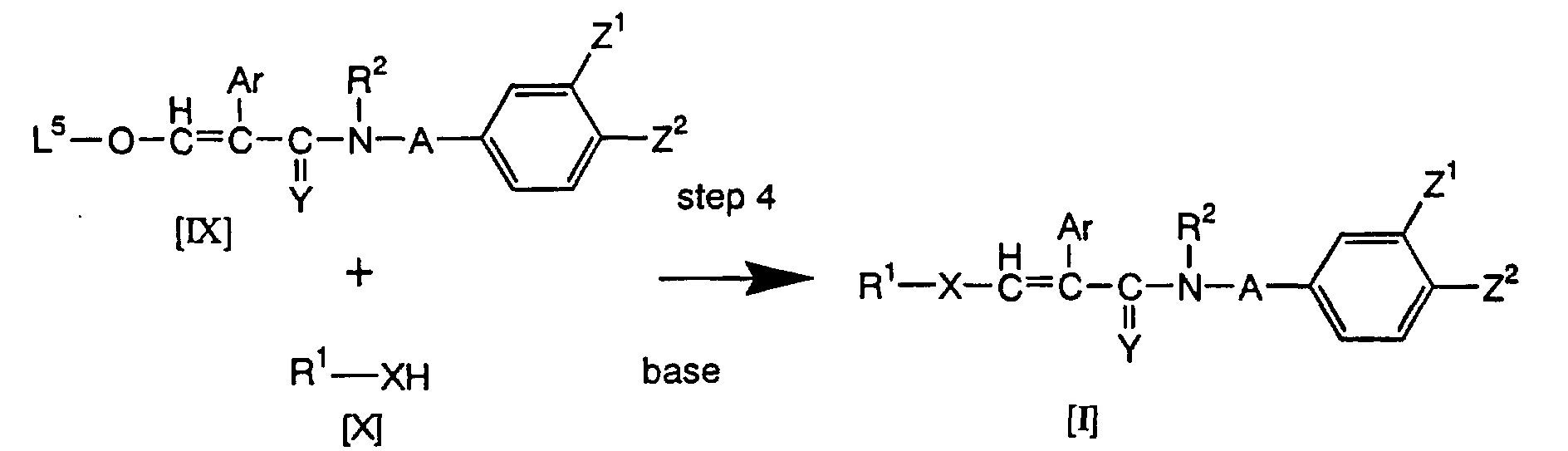
  • L 5 represents p-toluenesulfonyl, methanesulfonyl or trifluoromethanesulfonyl
  • R 1 , R 2 , Y, Ar, A, Z 1 and Z 2 have the same meanings as defined above.
  • the step 4 is a step of making the compound given by formula [IX] react with the compound given by formula [X]optionally in the presence of a base to provide the present compound given by formula [I].
  • the reaction temperature is usually in the range of 0 to 100°C
  • the reaction period is usually in the range of 1 to 24 hours
  • the amount of the compound given by formula [X] is usually 0.5 to 10 mols, preferably 1 to 3 mols based on 1 mol of the compound given by formula [IX].
  • the amount of the base is usually 1 to 10 mols based on 1 mol of the compound given by formula [X].
  • the base include inorganic bases such as sodium hydroxide, potassium hydroxide, sodium carbonate, potassium carbonate and sodium hydride; organic bases such as pyridine, triethylamine and ethyldiisopropylamine; and mixtures thereof.
  • the reaction is usually carried out in a solent and examples of the solvent include ethers such as 1,4-dioxane, tetrahydrofuran, ethylene glycol dimethyl ether and t-butyl methyl ether; aliphatic hydrocarbons such as hexane and heptane; aromatic hydrocarbons such as toluene; halogenated hydrocarbons such as chlorobenzene; organic bases such as pyridine, triethylamine and N,N-dimethylaniline; esters such as butyl acetate and ethyl acetate; nitriles such as acetonitrile; N,N-dimethylformamide; dimethyl sulfoxide; water; and mixtures thereof.
  • ethers such as 1,4-dioxane, tetrahydrofuran, ethylene glycol dimethyl ether and t-butyl methyl ether
  • aliphatic hydrocarbons such as hexane
  • the reaction solution after the reaction is subjected to usual work-up such as extraction with organic solvent, concentration and so on to provide the isolated objective product.
  • the objective product can be purified by recrystallization, distillation, chromatography and so on.
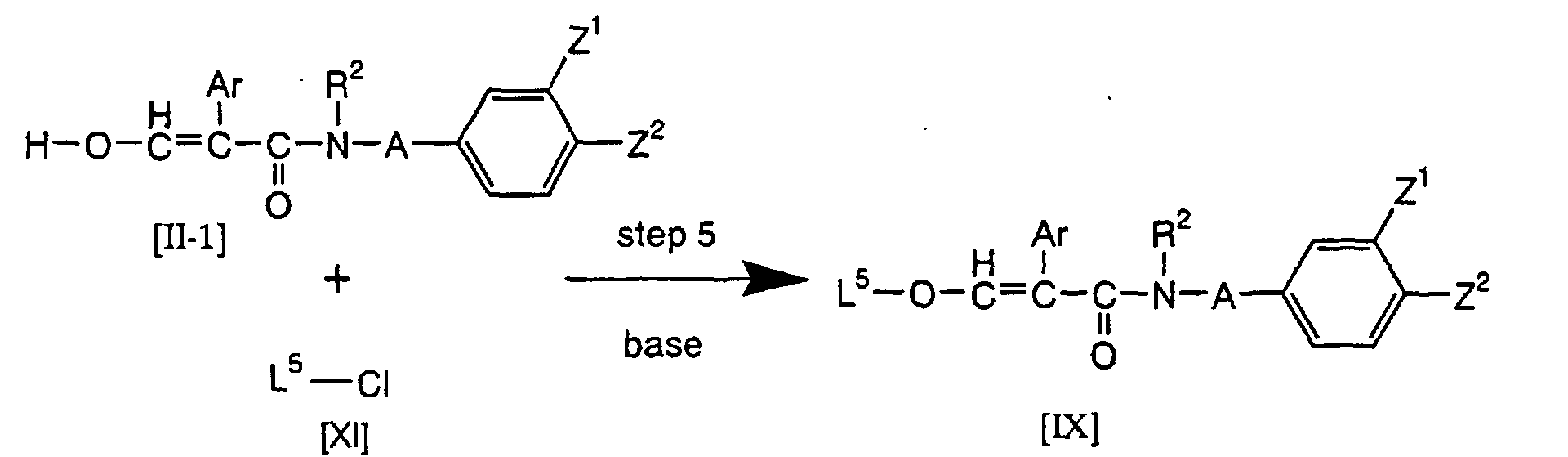
  • the compound given by formula [IX] can be, for example, produced according to the following scheme.
  • L 5 , R 2 , Ar, A, Z 1 and Z 2 have the same meanings as defined above.
  • the step 5 is a step of making the compound given by formula [II-1] react with the compound given by formula [X]optionally in the presence of a base to provide the present compound given by formula [IX].
  • the reaction temperature is usually in the range of -20 to 100°C
  • the reaction period is usually in the range of 1 to 24 hours and the amount of the compound given by formula [XI] is usually 0.5 to 10 mols, preferably 1 to 3 mols based on 1 mol of the compound given by formula [IX].
  • the amount of the base is usually 1 to 10 mols based on 1 mol of the compound given by formula [II-1].
  • the base include inorganic bases such as sodium hydroxide, potassium hydroxide, sodium carbonate, potassium carbonate and sodium hydride; organic bases such as pyridine, triethylamine and ethyldiisopropylamine; and mixtures thereof.
  • the reaction is usually carried out in a solent and examples of the solvent include ethers such as 1,4-dioxane, tetrahydrofuran, ethylene glycol dimethyl ether and t-butyl methyl ether; aliphatic hydrocarbons such as hexane and heptane; aromatic hydrocarbons such as toluene; halogenated hydrocarbons such as chlorobenzene; organic bases such as pyridine, triethylamine and N,N-dimethylaniline; esters such as butyl acetate and ethyl acetate; nitriles such as acetonitrile; N,N-dimethylformamide; dimethyl sulfoxide; water; and mixtures thereof.
  • ethers such as 1,4-dioxane, tetrahydrofuran, ethylene glycol dimethyl ether and t-butyl methyl ether
  • aliphatic hydrocarbons such as hexane
  • the reaction solution after the reaction is subjected to usual work-up such as extraction with organic solvent, concentration and so on to provide the isolated objective product.
  • the objective product can be purified by recrystallization, distillation, chromatography and so on.
  • the present compound when used as an active ingredient of fungicide, it can be used as it is without any other ingredient, but it is usually formulated to emulsifiable concentrates, wettable powders, water dispersible granules, emulsion formulations, flowables, dusts, granules and so on by mixing with solid carrier, liquid carrier, surfactant or the other auxiliaries and used. These formulations usually contain 0.1 to 90% by weight of the present compound.
  • minerals such as kaolin clay, attapulgite clay, bentonite, montmorillonite, terra alba, pyrophilite, talc, diatomaceous earth and calcite
  • natural organic substances such as corncob and walnut shell
  • synthetic organic substances such as urea
  • salts such as calcium carbonate and ammonium sulfate
  • synthetic inorganic substances such as synthetic hydrous silicon oxide.
  • liquid carrier examples include aromatic hydrocarbons such as xylene, alkylbenzene and methylnaphthalene; alcohols such as isopropanol, ethylene glycol, propylene glycol and cellosolve; ketones such as acetone, cyclohexanone and isophorone; vegetable oils such as soybean oil and cottonseed oil; paraffin type aliphatic hydrocarbons; esters; dimethyl sulfoxide; acetonitrile and water.
  • aromatic hydrocarbons such as xylene, alkylbenzene and methylnaphthalene
  • alcohols such as isopropanol, ethylene glycol, propylene glycol and cellosolve
  • ketones such as acetone, cyclohexanone and isophorone
  • vegetable oils such as soybean oil and cottonseed oil
  • paraffin type aliphatic hydrocarbons esters
  • dimethyl sulfoxide acetonitrile and water.
  • surfactant examples include anionic surfactants such as alkylsulfate ester salts, alkylarylsulfonate salts, dialkyl sulfosaccinate salts, polyoxyethylenealkylary ether phosphate salts, ligninsulfonate salts and naphthalenesulfonate formaldehyde condensate; nonionic surfactants such as polyoxyethylenealkylary ether, polyoxyethylenealkylpolyoxypropylene block copolymers and sorbitan fatty acid esters.
  • anionic surfactants such as alkylsulfate ester salts, alkylarylsulfonate salts, dialkyl sulfosaccinate salts, polyoxyethylenealkylary ether phosphate salts, ligninsulfonate salts and naphthalenesulfonate formaldehyde condensate
  • nonionic surfactants such as polyoxyethylenealkylary ether,
  • auxiliaries for formulation examples include water soluble polymers such as polyvinyl alcohol and polyvinylpyrrolidone; polysaccharides such as gum arabic, algin acid and its salts, CMC(carboxymethylcellulose) and xanthan gum; inorganic substances such as alminium magnesium silicate and almina sol; preservatives; coloring agent; PAP (isopropyl acid phosphate) and stabilizers such as BHT.
  • water soluble polymers such as polyvinyl alcohol and polyvinylpyrrolidone
  • polysaccharides such as gum arabic, algin acid and its salts, CMC(carboxymethylcellulose) and xanthan gum
  • inorganic substances such as alminium magnesium silicate and almina sol
  • preservatives coloring agent
  • PAP isopropyl acid phosphate
  • stabilizers such as BHT.
  • the application methods of the present compounds are typically foliar application and soil treatment.
  • the dosage is usually 1 to 5000g, preferably 5 to 1000g per 1 hectare though it is variable depending on the type of plants (e.g. crops) to be treated, type of diseases to be controlled, degree of affection by the diseases, formulation type, application method, time of application, weather conditions and so on.
  • the concentration of the active ingredient is 0.0001 to 3% by weight, preferably 0.0005 to 1% by weight. Dusts, granules and the like are applied as they are without dilution.
  • the present compound is also used for the other known application methods such as seed treatment. When it is used for seed treatment, seeds are usually soaked in 1 to 1000ppm dilution of the present compound, or said dilution is sprayed to or daubed on the seeds. Further, dusts containing 0.1 to 10% by weight of the present compound may be applied by powder treatment.
  • the present compound can be used as agricultural/horticultural fungicide for controlling plant diseases in the plowed fields, paddy fields, orchards, tea plantations, pastures, lawns and the like. Also, an increased fungicidal effect can be expected by using the compounds in admixture with other fungicides.
  • admixable other fungicide examples include azole type fungicidal compounds such as propiconazole, triadimenol, prochloraz, penconazole, tebuconazole, flusilazole, diniconazole, bromconazole, epoxyconazole, diphenoconazole, ciproconazole, metoconazole, triflumizole, tetraconazole, microbutanil, fenbuconazole, hexaconazole, fluquinconazole, triticonazole, bitertanol, imazalil and flutriafol; cyclic amine type fungicidal compounds such as fenpropimorph, tridemorph and fenpropidin; benzimidazole type fungicidal compounds such as carbendazim, benomyl, thiabendazole and thiophanate-methyl; procymidone; cyprodinil; pyrime
  • the present compound can be used in combination with other agricultural/horticultural insecticides, acaricides, nematocides, herbicides, plant growth regulators and fertilizers. In the combination, they can be mixed in advance.
  • insecticide, acaricide and nematocide examples include organophosphorus compounds such as fenitrothion [O,O-dimethyl O-(3-methyl-4-nitrophenyl) phosphorothioate], fenthion [O,O-dimethyl O-(3-methyl-4-(methythio)phenyl) phosphorothioate], diazinon [O,O-diethyl O-2-isopropyl-6-methylpyrimidin-4-yl phosphorothioate], chlorpyrifos [O,O-diethyl 0-3,5,6-trichloro-2-pyridyl phosphorothioate], acephate [O,S-dimethyl acetylphosphoramidothioate], methidathion [S-2,3-dihydro-5-methoxy-2-oxo-1,3,4-thiadiazol-3-ylmethyl O,O-dimethyl phosphorodithi
  • Examples of the plant diseases to be controlled by the present compound include Pyriculana oryzae and Cochliobolus miyabeanus and Rhizoctonia solani of rice; Erysiphe graminis, Gibberella zeae, Puccinia striiformis, P. graminis, P. recondita, P. hordei, Typhula sp., Micronectriella nivalis, Ustilago tritici, U.
  • pirina Alternaria kikuchiana and Gymnosporangium haraeanum of pear
  • Sclerotinia cinerea Cladosporium carpophilum and Phomopsis sp. of peach
  • Elsinoe ampelina Glomerella cingulata, Uncinula necator, Phakopsora ampelopsidis, Guignardia bidwellii and Plasmopara viticola , of grape
  • Gloeosporium kaki Cercospora kaki and Mycosphaerella nawae of Japanese persimmon
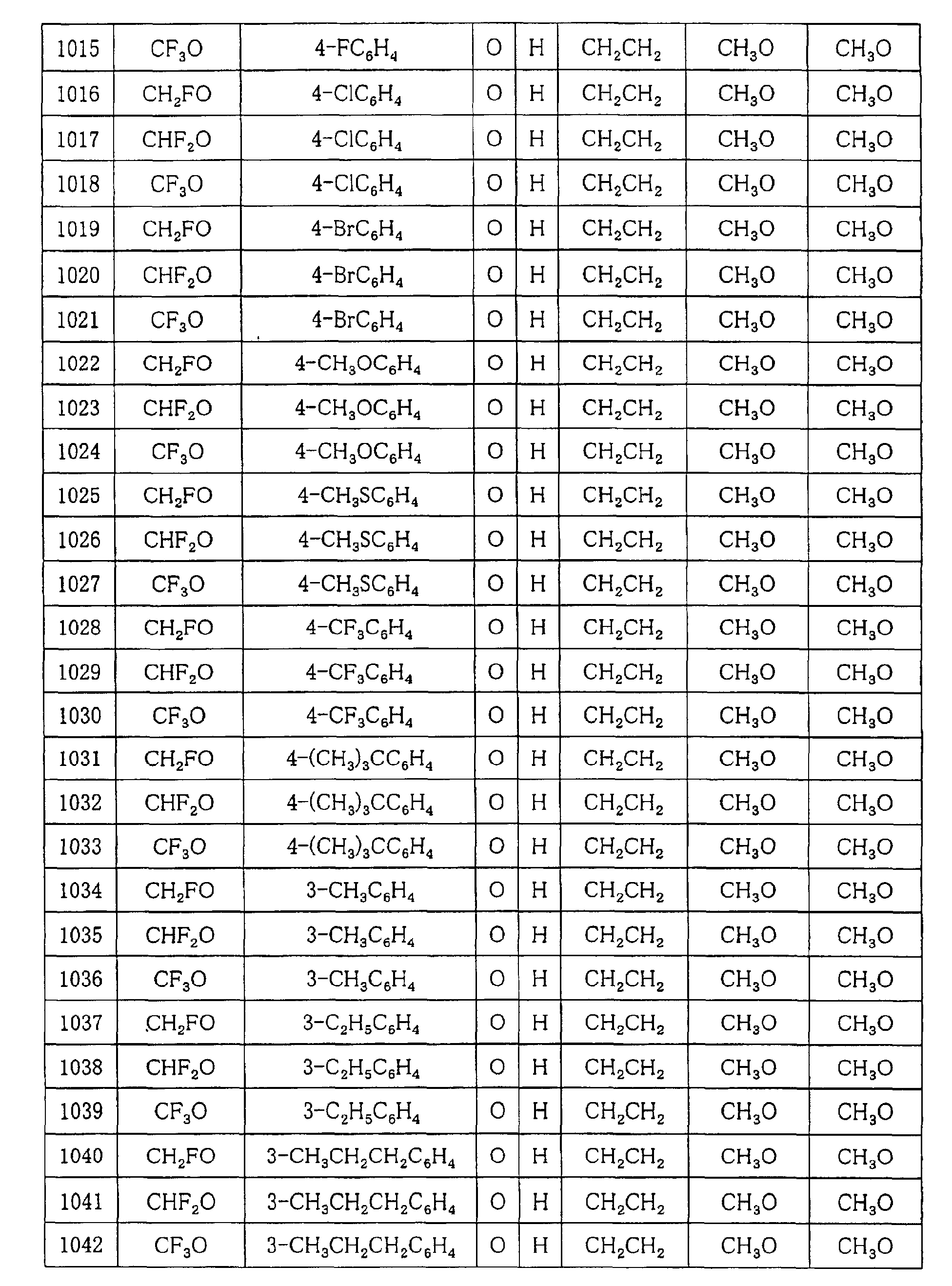
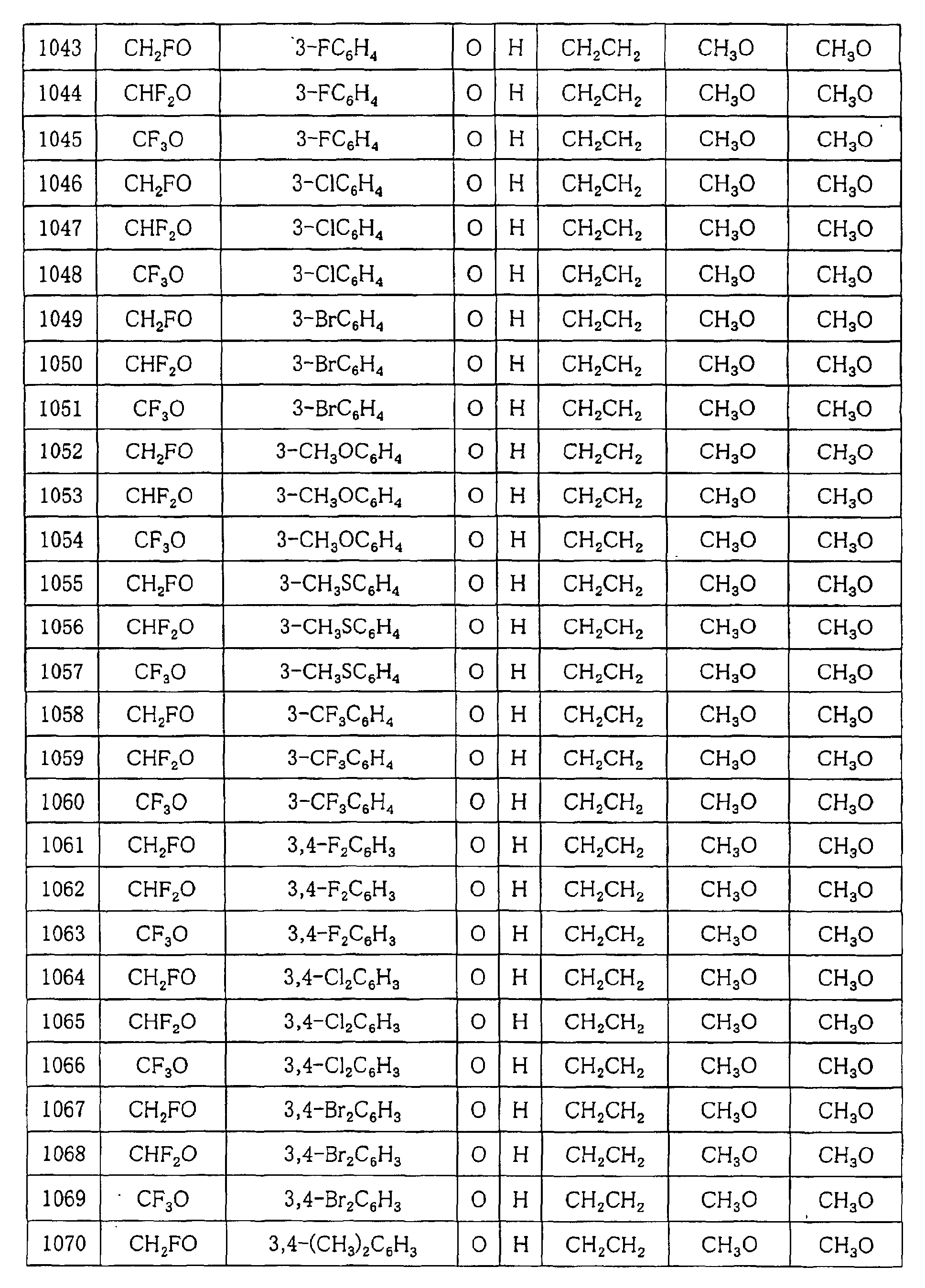
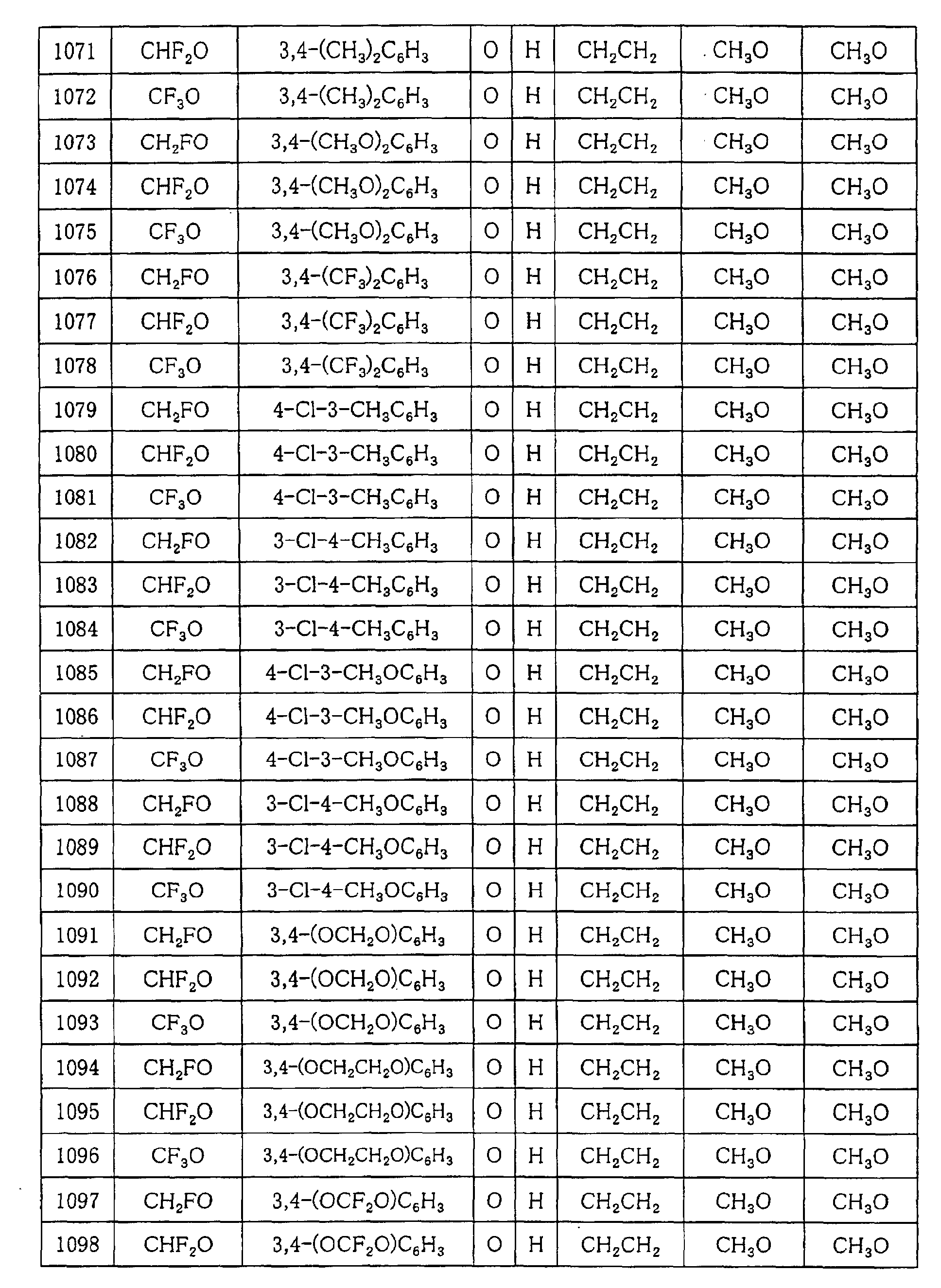
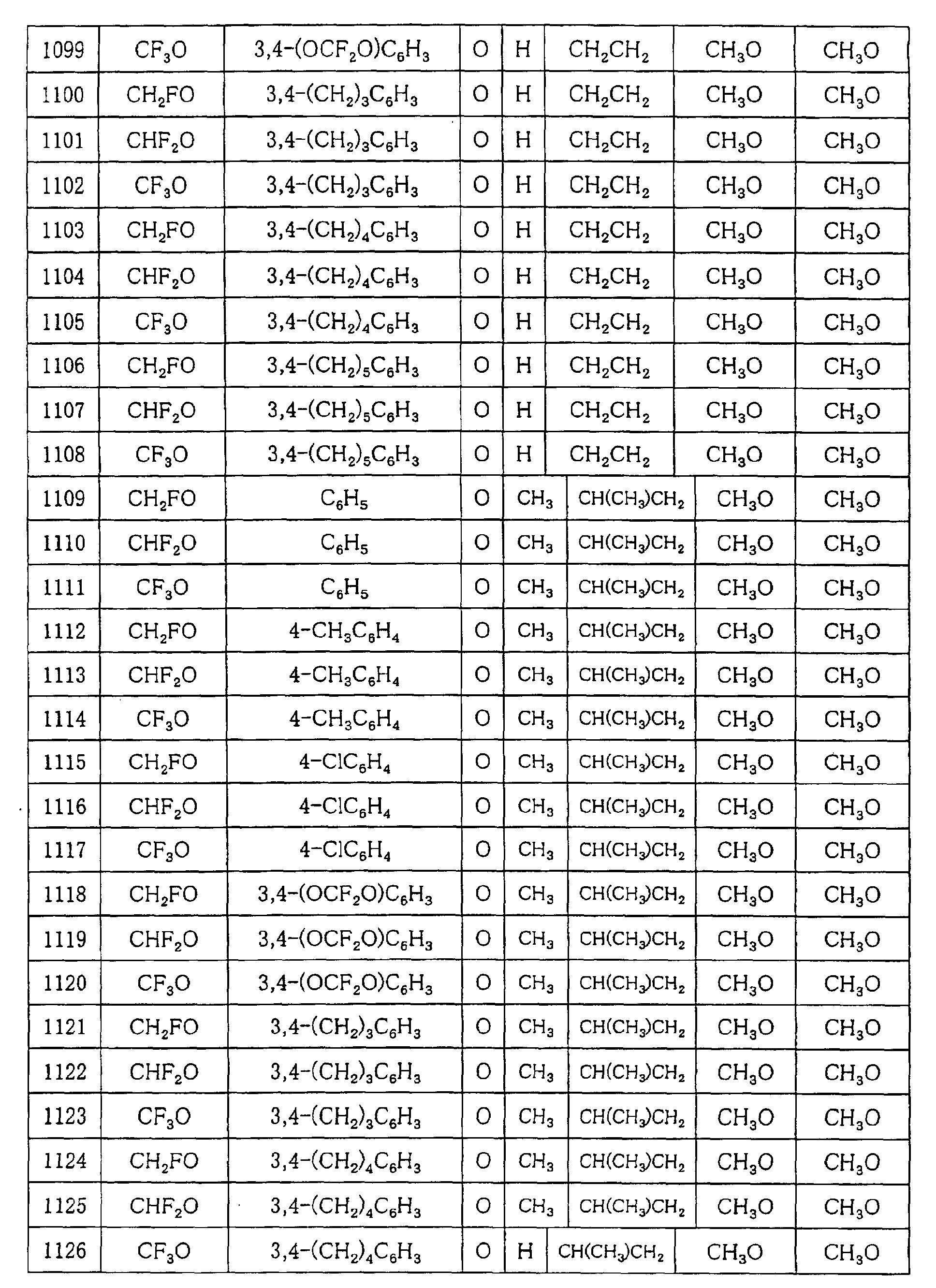
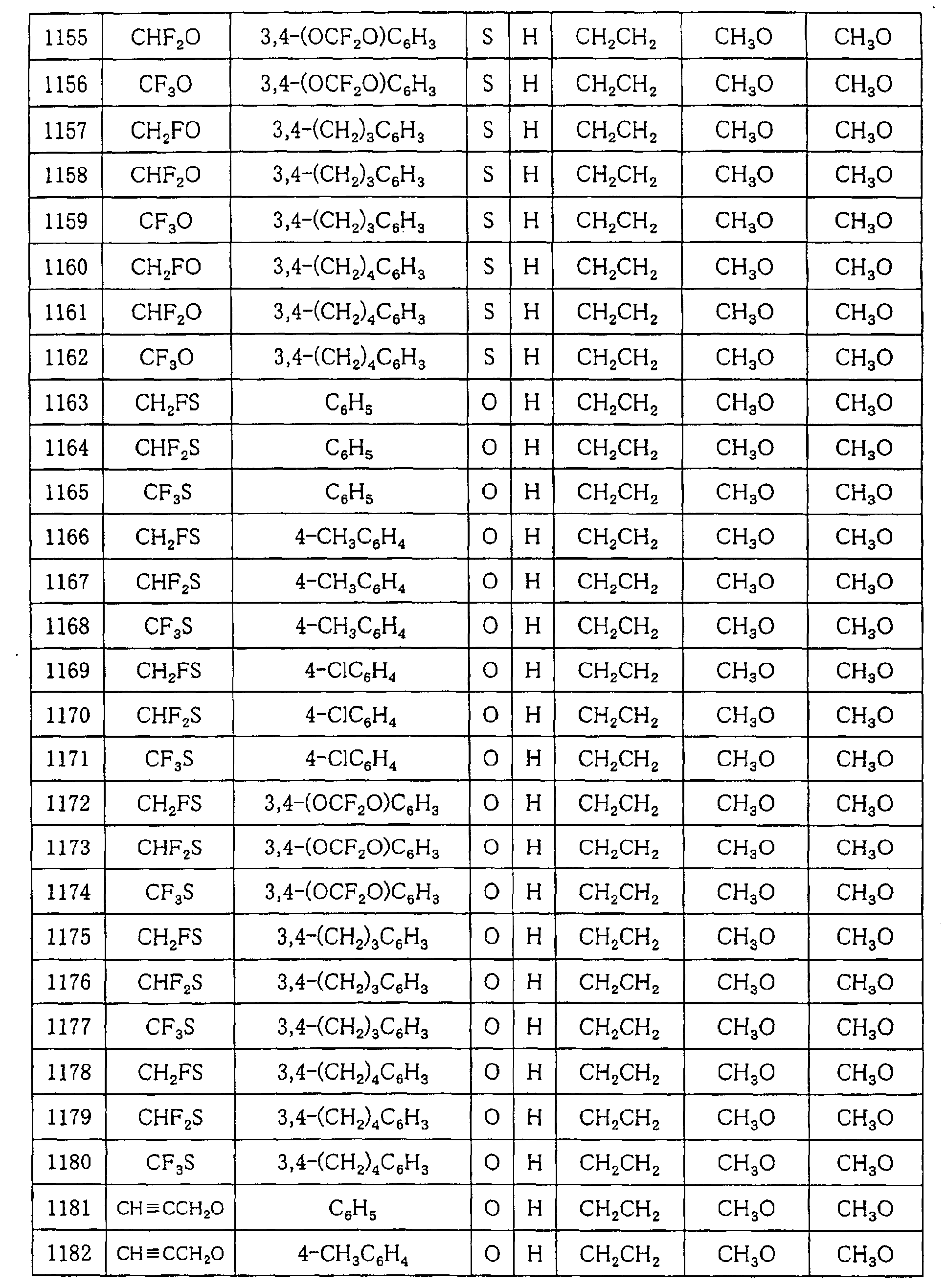
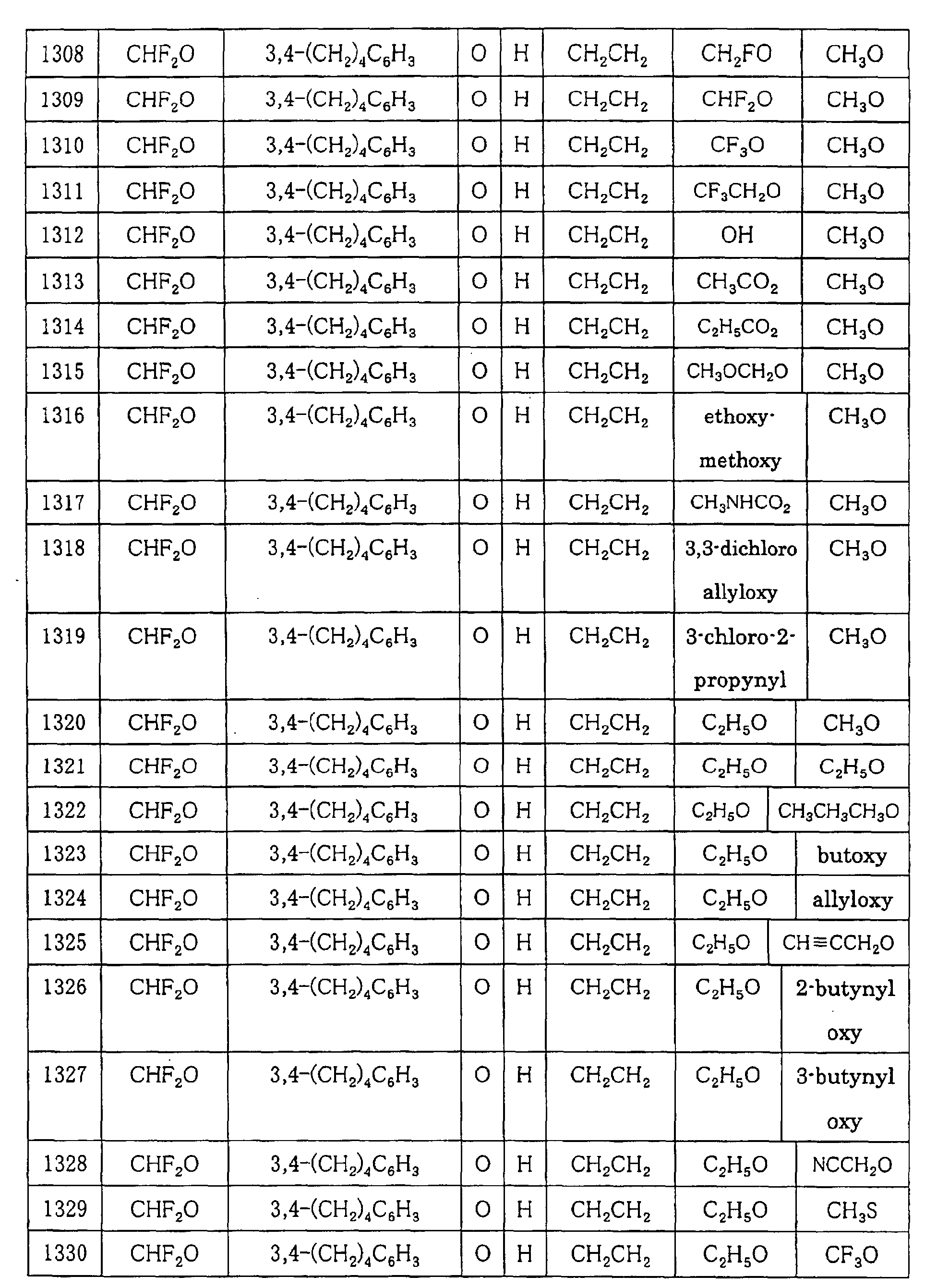
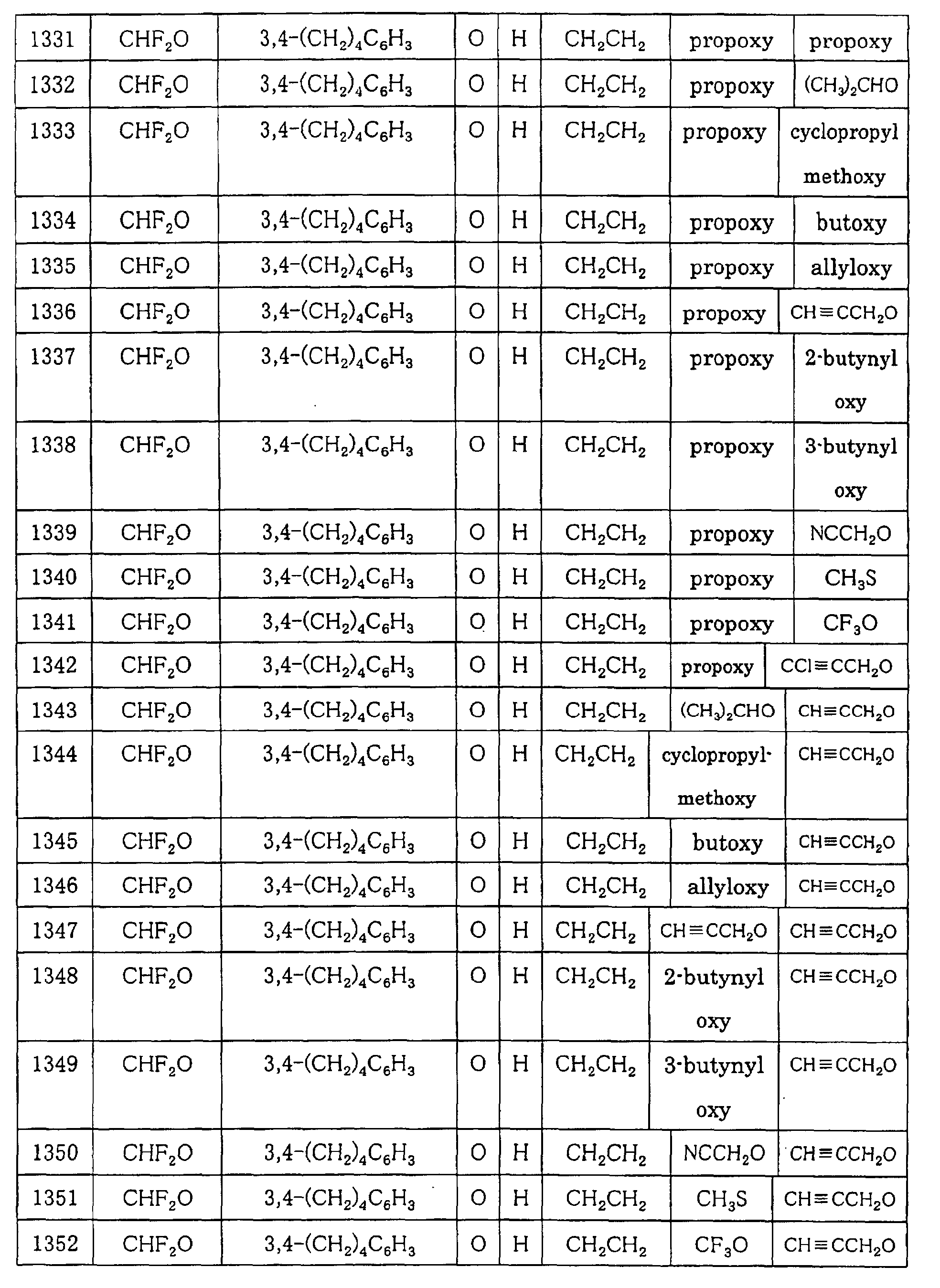
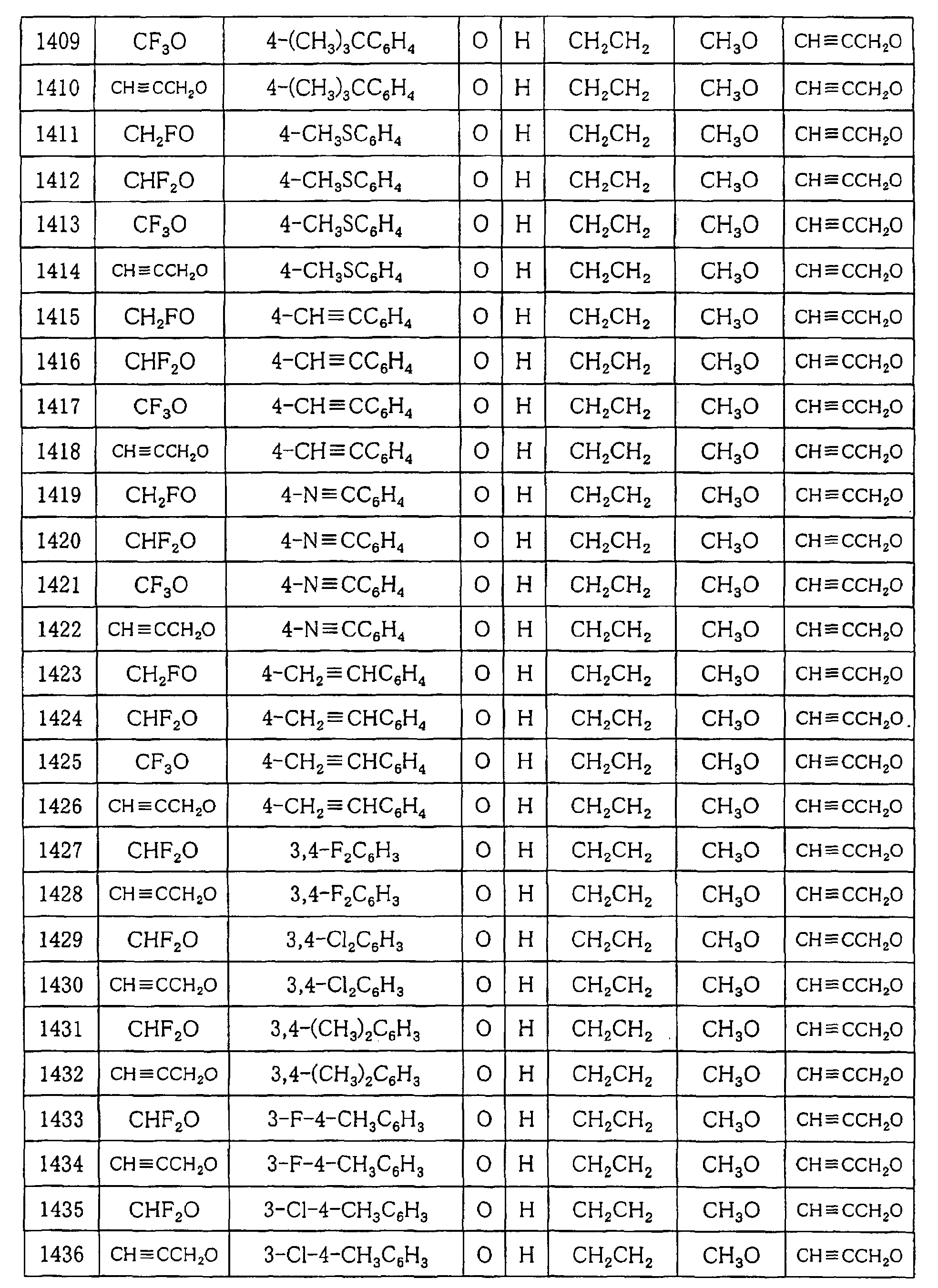
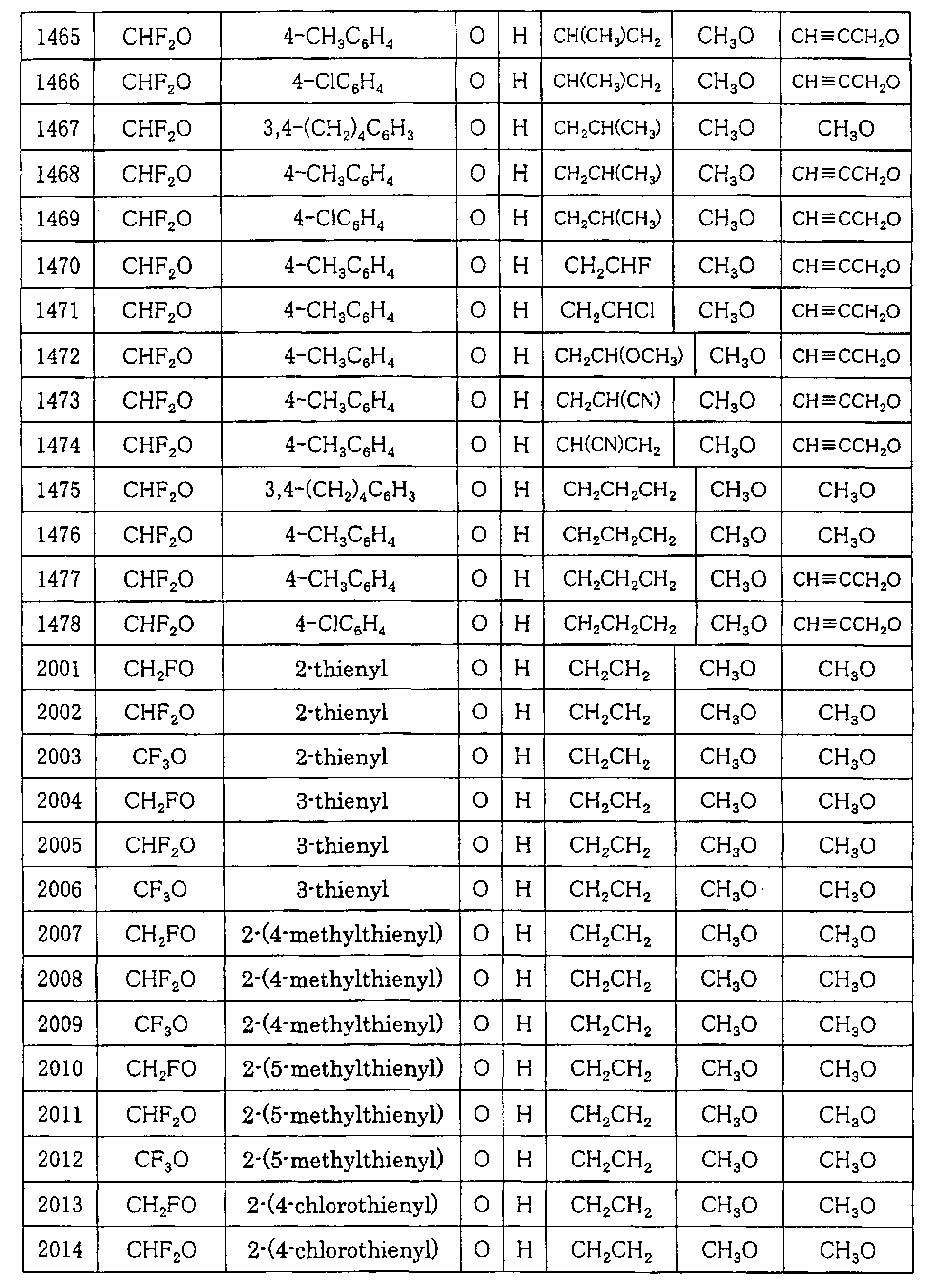
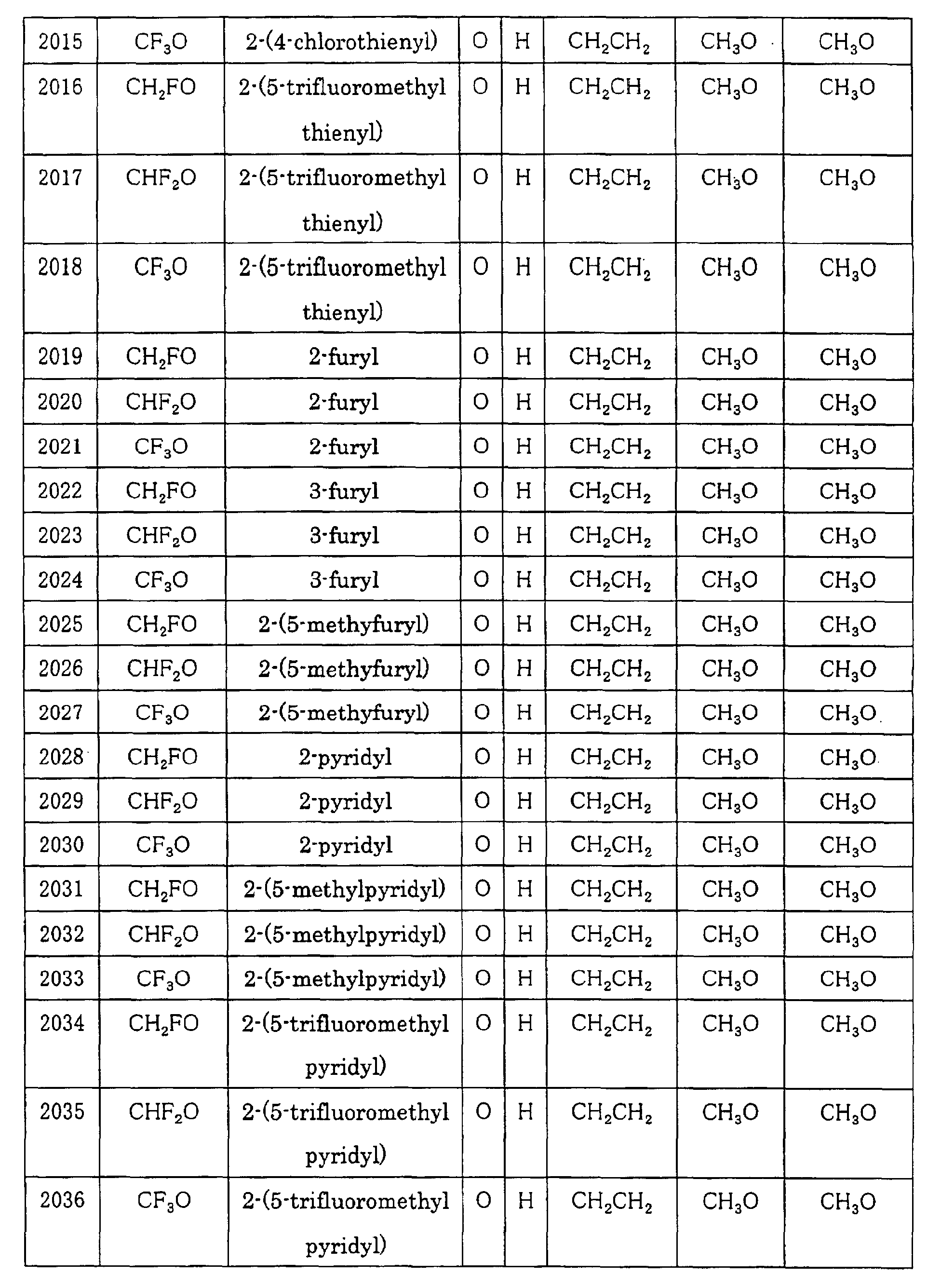
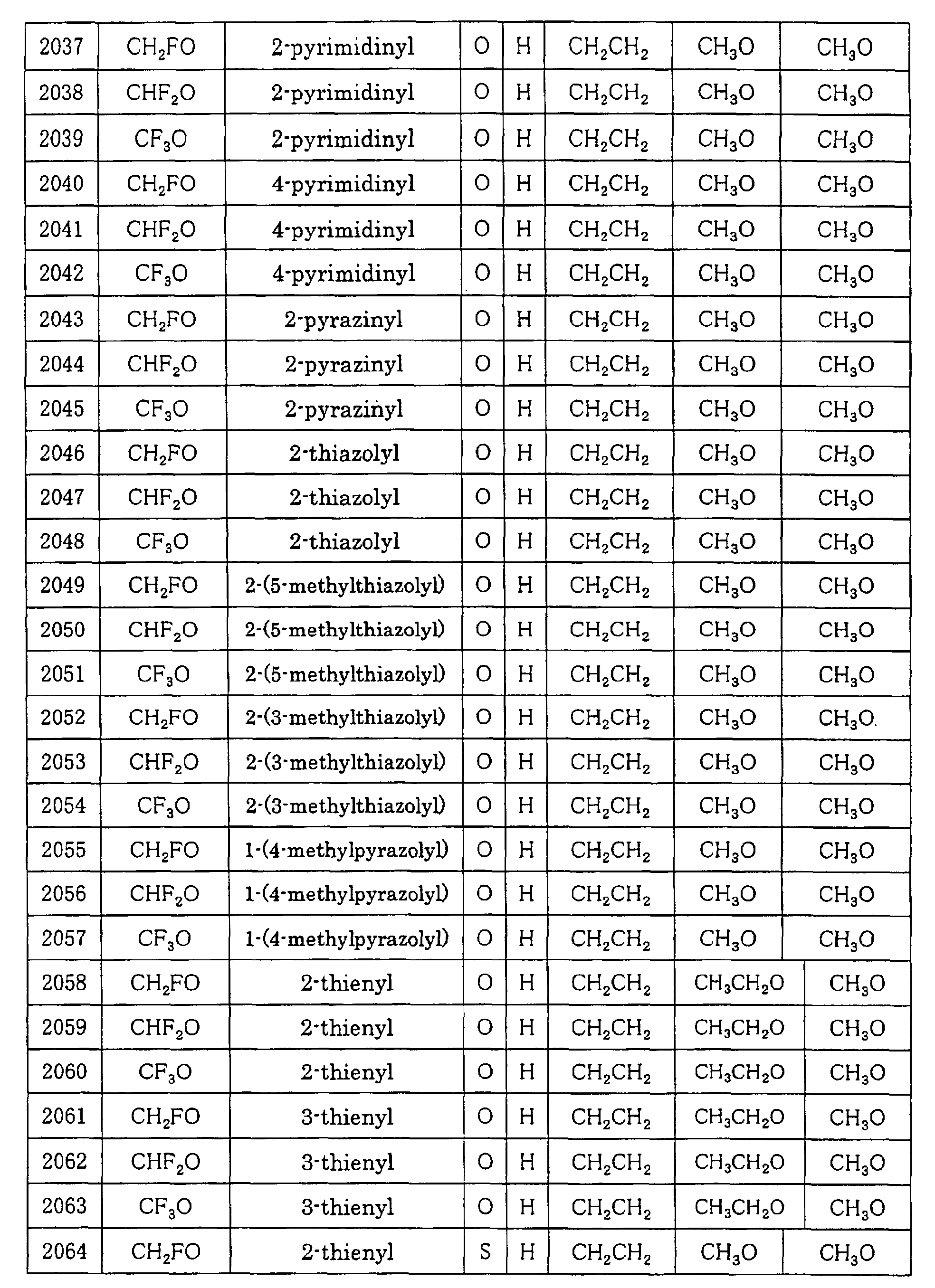
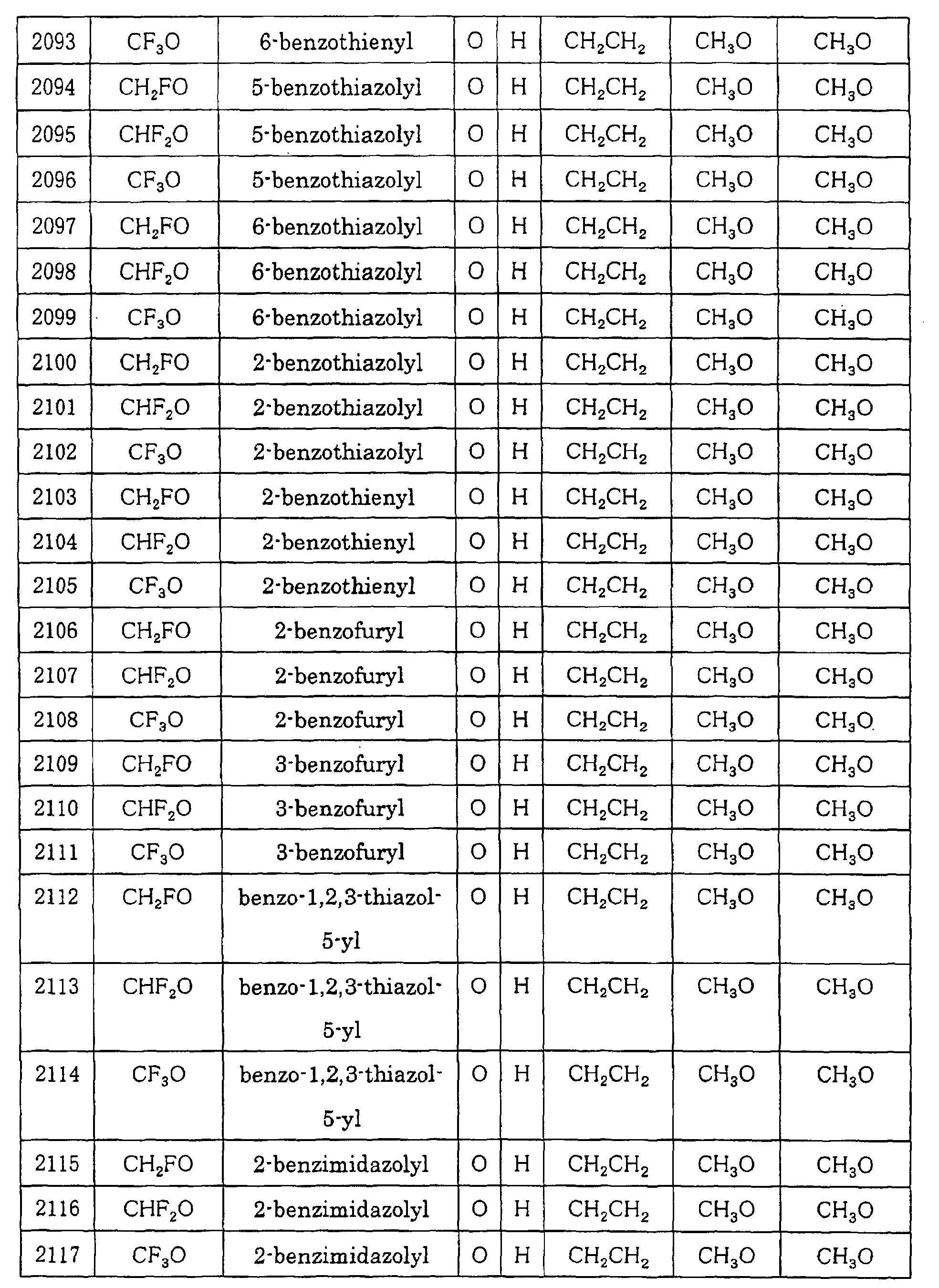
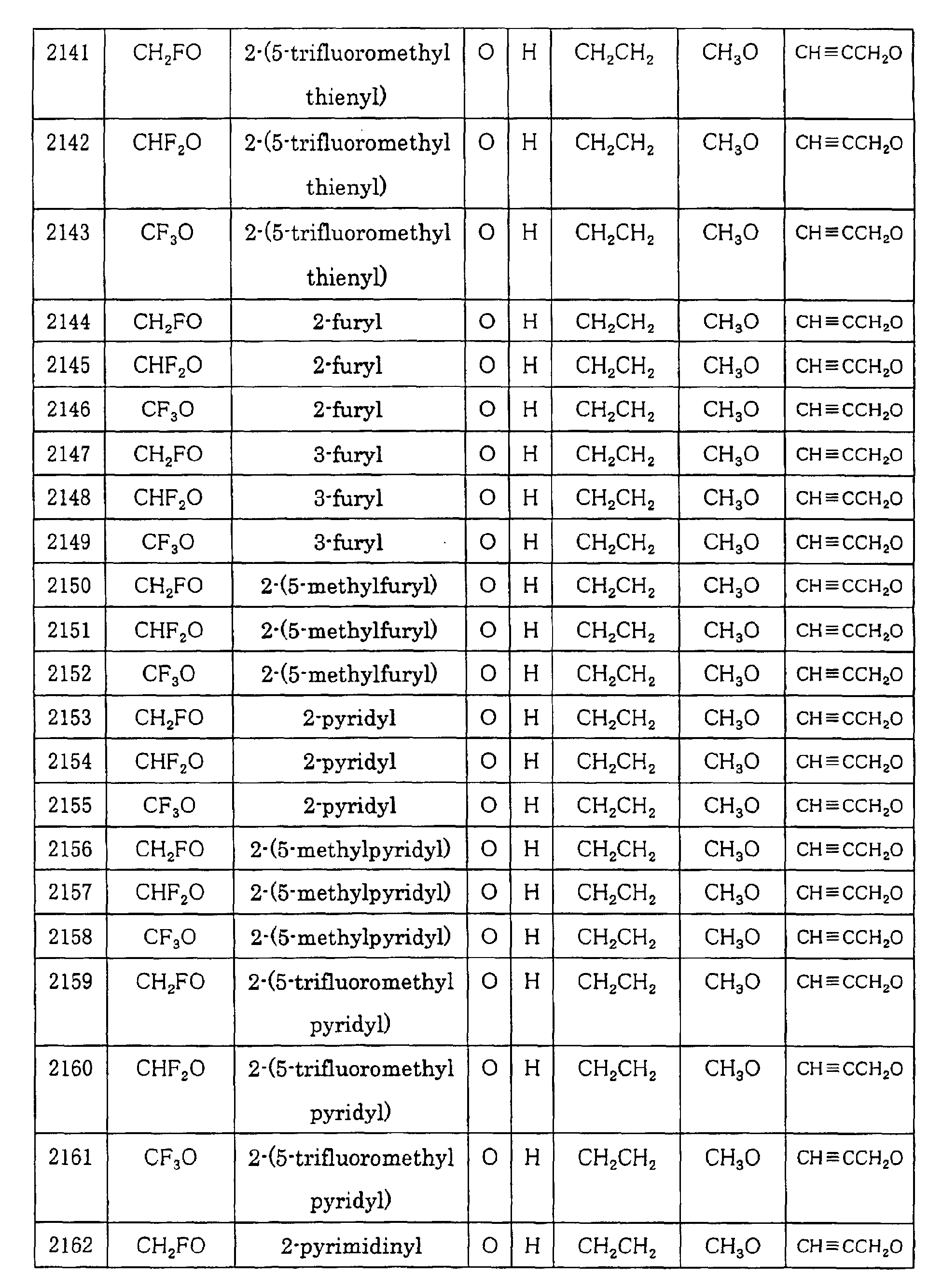
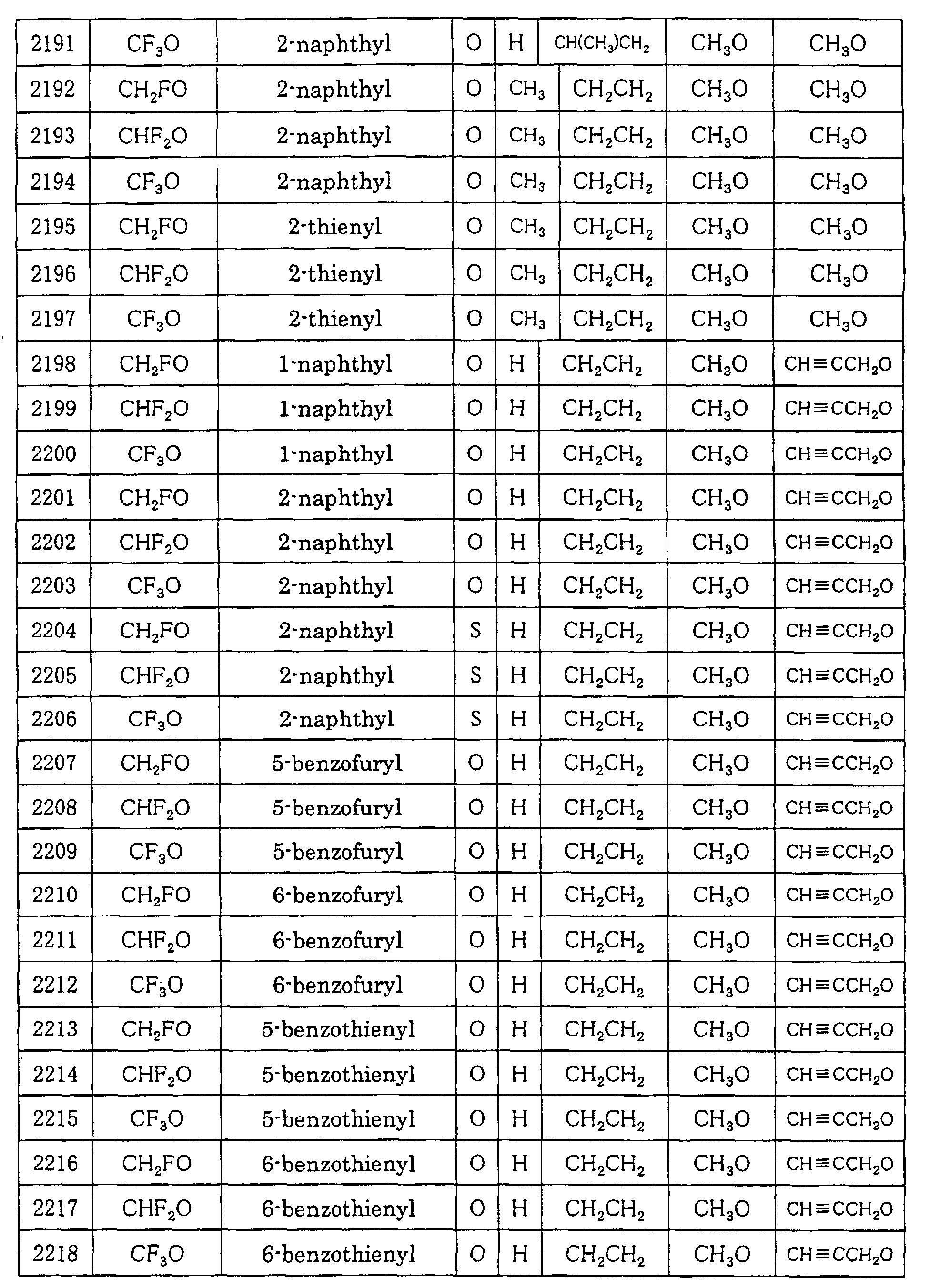
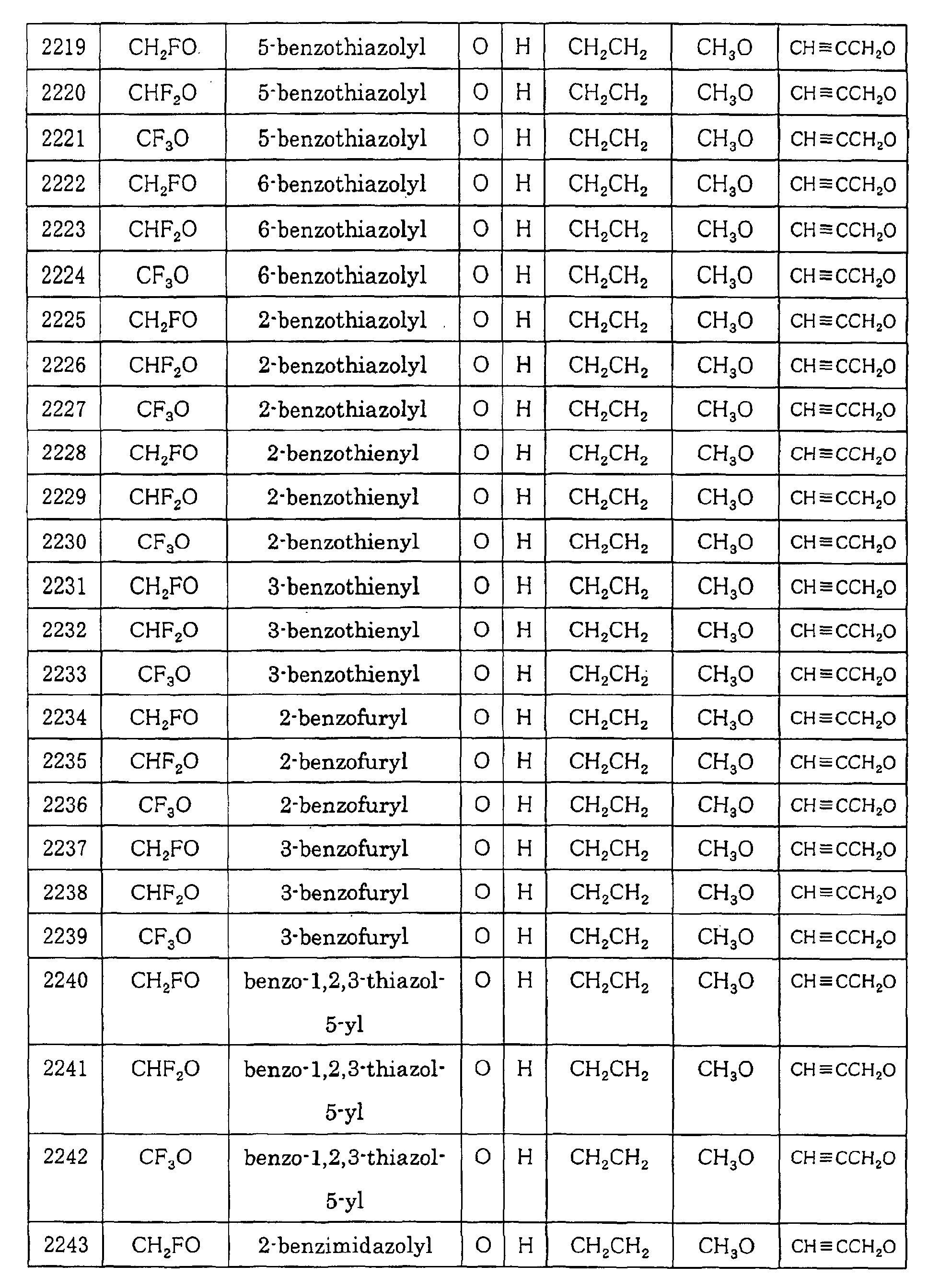
  • the numbers of the present compounds are the compound numbers described in the table below.
  • N-[2-(3,4-dimethoxyphenyl)ethyl]-3-hydroxy-2-(3-methylphenyl) acrylamide in place of N-[2-(3,4-dimethoxyphenyl)ethyl]-3-hydroxy-2-(4-methylphenyl)acrylamide N-[2-(3,4-dimethoxyphenyl)ethyl]-3-fluoromethoxy-2-(3-methylphenyl)acrylamide (the present compound 1034) was obtained according to production example 1.
  • reaction mixture was extracted with ethyl acetate, washed with 5% hydrochloric acid, saturated aqueous sodium bicarbonate solution and saturated brine subsequently, dried over anhydrous magnesium sulfate and concentrated under reduced pressure.
  • N-[2-(3,4-dimethoxyphenyl)ethyl]-3-hydroxy-2-(4-chlorophenyl) acrylamide was obtained according to production example 5.
  • N-[2-(3,4-dimethoxyphenyl)ethyl]-3-(2-fluoroethoxy)-2-(5,6,7,8-tetrahydronaphthalen-2-yl)acrylamide (the present compound 1241) was obtained according to production example 10.
  • N-[2-(4-cyanomethoxy-3-methoxyphenyl)ethyl]-3-difluoromethoxy-2-(5,6,7,8-tetrahydronaphthalen-2-yl)acrylamide (the present compound 1274) was obtained according to production example 12.
  • N-[2-(4-allyloxy-3-methoxyphenyl)ethyl] -3-difluoromethoxy-2-(5,6,7,8-tetrahydronaphthalen-2-yl)acrylamide (the present compound 1266) was obtained according to production example 12.
  • N-[2- ⁇ 4-(2-butynyloxy)-3-methoxyphenyl ⁇ ethyl]-3-difluoromethoxy-2-(5,6,7,8-tetrahydronaphthalen-2-yl)acrylamide (the present compound 1269) was obtained according to production example 12.
  • reaction mixture was extracted with ethyl acetate, washed with 5% hydrochloric acid, saturated aqueous sodium bicarbonate solution and saturated brine subsequently, dried over anhydrous magnesium sulfate and concentrated under reduced pressure.
  • N-[2-(3-cyanomethoxy-4-methoxyphenyl)ethyl]-3-difluoromethoxy-2-(5,6,7,8-tetrahydronaphthalen-2-yl)acrylamide (the present compound 1305) was obtained according to production example 18.
  • 3-difluoromethoxy-N-[2-(4-hydroxy-3-methoxyphenyl)ethyl]-2-(4-trifluoromethylphenyl)acrylamide in place of 3-difluoromethoxy-N-[2-(4-hydroxy-3-methoxyphenyl)ethyl]-2-(4-methylphenyl)acrylamide, 3-difluoromethoxy-N-[2- ⁇ 3-methoxy-4-(2-propynyloxy)phenyl ⁇ ethyl]-2-(4-trifluoromethylphenyl)acrylamide (the present compound 1357) was obtained according to production example 19.
  • 3-difluoromethoxy-N-[2-(4-hydroxy-3-methoxyphenyl)ethyl]-2-(naphthalen-2-yl)acrylamide in place of 3-difluoromethoxy-N-[2-(4-hydroxy-3-methoxyphenyl)ethyl]-2-(4-methylphenyl)acrylamide, 3-difluoromethoxy-N-[2- ⁇ 3-methoxy-4-(2-propynyloxy)phenyl ⁇ ethyl)-2-(naphthalen-2-yl)acrylamide (the present compound 2202) was obtained according to production example 19.
  • N-[2-(4-cyclopropylmethoxy-3-methoxyphenyl)ethyl]-3-difluoromethoxy-2-(4-methylphenyl)acrylamide (the present compound 1271) was obtained according to production example 19.
  • JP hei10-87602A (5,6,7,8-tetrahydronaphthalen-2-yl)acetic acid was obtained.
  • the control effect of the present compounds was evaluated by visually observing the area of a lesion on a sample plant in investigation and comparing the area of a lesion in a non-treatment district and the area of a lesion in a district treated with the present compound.
  • Sand loam was compacted in a plastic pot, a grape (variety: Berry A) was seeded and grown in a green house for 40 days.
  • the present compounds 1004, 1005, 1006, 1016, 1017, 1020, 1023, 1026, 1029, 1065, 1103, 1104, 1143, 1160, 1182, 1196, 1197, 1223, 1232, 1241, 1251, 1258, 1266, 1268, 1271, 1274, 1281, 1282, 1305, 1320, 1371, 2077 and 2133 were formulated into flowables according to formulation example 6, then, diluted with water to provide given concentration (200ppm), and these were sprayed onto stems and leaves so as to give sufficient adhesion on the surface of grape leaves.
  • the plant After spraying, the plant was air-dried, and a suspension of zoosporangiua of Plasmopara viticola was inoculated by spraying. After inoculation, the plant was first left for one day at 23°C under high humidity, then further left for 6 days in the green house, then the control effect was checked. As a result, the lesion areas on plants in the treatment districts using the present compounds were not more than 10% of the lesion area of a non-treatment district.
  • Sand loam was compacted in a plastic pot, a grape (variety: Berry A) was seeded and grown in a green house for 40 days.
  • the present compounds 1259, 1284, 1353, 1355, 1360, 1367, 1445, 1447 and 1450 were formulated into flowables according to formulation example 6, then, diluted with water to provide given concentration (50ppm), and these were sprayed onto stems and leaves so as to give sufficient adhesion on the surface of grape leaves. After spraying, the plant was air-dried, and a suspension of zoosporangiua of Plasmopara viticola was inoculated by spraying.
  • the plant was first left for one day at 23°C under high humidity, then further left for 6 days in the green house, then the control effect was checked.
  • the lesion areas on plants in the treatment districts using the present compounds were not more than 10% of the lesion area of a non-treatment district.
  • Sand loam was compacted in a plastic pot, a grape (variety: Berry A) was seeded and grown in a green house for 40 days.
  • the present compounds 1354, 1357, 1358, 1364, 1388, 1392, 1429 and 2202 were formulated into flowables according to formulation example 6, then, diluted with water to provide given concentration (12.5ppm), and these were sprayed onto stems and leaves so as to give sufficient adhesion on the surface of grape leaves. After spraying, the plant was air-dried, and a suspension of zoosporangiua of Plasmopara viticola was inoculated by spraying.
  • the plant was first left for one day at 23°C under high humidity, then further left for 6 days in the green house, then the control effect was checked.
  • the lesion areas on plants in the treatment districts using the present compounds were not more than 10% of the lesion area of a non-treatment district.
  • Sand loam was compacted in a plastic pot, a tomato (variety: Ponterosa) was seeded and grown in a green house for 20 days.
  • the present compounds 1004, 1005, 1006, 1016, 1017, 1020, 1023, 1026, 1029, 1034, 1065, 1103, 1104, 1122, 1143, 1160, 1182, 1185, 1196, 1197, 1223, 1124, 1127, 1232, 1241, 1251, 1258, 1259, 1268, 1269, 1274, 1281, 1282, 1284, 1299, 1320, 1353, 1354, 1358, 1360, 1388, 1367, 1392, 1429, 1445, 1448, 1450, 1465, 1476, 2077 and 2133 were formulated into flowables according to formulation example 6, then, diluted with water to provide given concentration (500ppm), and these were sprayed onto stems and leaves so as to give sufficient adhesion on the surface of tomato leaves.
  • the plant After spraying, the plant was air-dried, and a suspension of zoosporangiua of Phytophthora infestans was inoculated by spraying. After inoculation, the plant was first left for one day at 23°C under high humidity, then further left for 4 days in the green house, then the control effect was checked. As a result, the lesion areas on plants in the treatment districts using the present compounds were not more than 10% of the lesion area of a non-treatment district.
  • the present compound has an excellent efficacy for controlling plant diseases and is useful as an active ingredient of fungicide, especially agricultural and horticultural fungicide.

Landscapes

  • Chemical & Material Sciences (AREA)
  • Organic Chemistry (AREA)
  • Life Sciences & Earth Sciences (AREA)
  • Agronomy & Crop Science (AREA)
  • Pest Control & Pesticides (AREA)
  • Plant Pathology (AREA)
  • Health & Medical Sciences (AREA)
  • Engineering & Computer Science (AREA)
  • Dentistry (AREA)
  • General Health & Medical Sciences (AREA)
  • Wood Science & Technology (AREA)
  • Zoology (AREA)
  • Environmental Sciences (AREA)
  • Organic Low-Molecular-Weight Compounds And Preparation Thereof (AREA)
  • Agricultural Chemicals And Associated Chemicals (AREA)

Abstract

An amide compound given by formula [I]:
Figure 80000001
wherein R1 represents a C1-C10 haloalkyl and so on, R2 represents a hydrogen and so on, X represents an oxygen or sulfur, Y represents an oxygen or sulfur, Ar represents an aromatic group, A represents an ethylene and so on, and Z1 and Z2 represent alkyl, alkoxy and so on,
and a fungicide containing it as an active ingredient.

Description

Technical Field
The present invention relates to amide compounds and their use for fungicide.
Background Arts
The present invention provides an amide compound which can be more excellent fungicidal active ingredient, though various fungicides for controlling plant diseases have been known hitherto.
Disclosure of the Invention
The present invention provides an amide compound given by formula [I]:
Figure 00010001
wherein R1 represents a C1-C10 haloalkyl group, C2-C10 haloalkenyl group, C3-C10 haloalkynyl group, C3-C8 halocycloalkyl group or C3-C10 alkynyl group; R2 represents a hydrogen atom or C1-C3 alkyl group (namely, methy, ethyl, propyl and isopropyl); X represents an oxygen atom or sulfur atom; Y represents an oxygen atom or sulfur atom; Ar represents an aromatic group; A represents an ethylene group or trimethylene group, said ethylene group and trimethylene group may be substituted by one or more selected from halogen atom, amino group, hydroxy group, cyano group, nitro group, C1-C6 alkyl group, C3-C6 cycloalkyl group, C3-C6 cycloalkenyl group, C1-C6 alkoxy group, C1-C6 haloalkoxy group, C1-C6 alkylthio group, C1-C6 haloalkylthio group, C2-C6 (alkoxycarbonyl) group and tri(C1-C6 alkyl)silyl group; Z1 and Z2 are the same or different and represents a halogen atom (chlorine, bromine, fluorine, iodine), C1-C6 alkyl group, C1-C6 haloalkyl group, C2-C6 alkenyl group, C2-C6 alkynyl group, C3-C6 cycloalkyl group, C1-C6 alkoxy group, C1-C6 haloalkoxy group, C2-C6 (alkoxyalkoxy) group, C4-C6 (cycloalkylalkoxy) group, C3-C6 alkenyloxy group, C3-C6 haloalkenyloxy group, C3-C6 alkynyloxy group, C3-C6 haloalkynyloxy group, C3-C6 cycloalkoxy group, C3-C6 cycloalkenyloxy group, cyano C1-C5 alkoxy group, C1-C6 alkylthio group, C1-C6 haloalkylthio group, (C1-C5 alkoxy)carbonyl group, phenoxy group, benzyloxy group, hydroxy group or cyano group, the benzene ring of said phenyl group and benzyloxy group may be substituted by one or more selected from halogen atom (chlorine, bromine, fluorine, iodine), C1-C6 alkyl group, C1-C6 alkoxy group, trfluoromethyl group, amino group and nitro group; and Z1 and Z2 may represents C2-C6 alkylenedioxy group together,
(hereinafter, referred to as the present compound) and fungicide comprising it as an active ingredient.
In the present invention, examples of the C1-C10 haloalkyl group for R1 include fluoromethyl, difluoromethyl, trifluoromethyl, chlorodifluoromethyl, chlorofluoromethyl, bromodifluoromethyl, trichloromethyl, dichlorobromomethyl, 1,1,2,2,2-pentafluoroethyl, 2,2,2-trifluoroethyl, 2,2-difluoroethyl and 2-fluoroethyl; examples of the C2-C10 haloalkenyl group include 2-fluorovinyl, 2,2-difluorovinyl, trifluorovinyl, 3-chloropropenyl, 3,3-dichloropropenyl, 3-fluoropropenyl, 3,3-difluoropropenyl, 2,3,3-trifluoropropenyl and 10-fluoro-2-decenyl; examples of the C3-C10 haloalkynyl group include 3-fluoro-2-propynyl, 3-chloro-2-propynyl, 3-bromo-2-propynyl, 3-iodo-2-propynyl, 4-fluoro-2-butynyl, 4,4-difluoro-2-butynyl, 4,4,4-trifluoro-2-butynyl and 4-chloro-2-butynyl; examples of the C3-C8 halocycloalkyl group include 2,2-difluorocyclopropyl, 2,3,4-trifluorocyclobutyl, 2,5-dichlorocyclopentyl, 4,4-difluorocyclohexy and 2-chlorocycloheptyl; and examples of the C3-C10 alkynyl group include 2-propynyl, 2-butynyl, 3-butynyl, 1-methyl-2-propynyl, 5-pentynyl and 7-octynyl. Among them, C1-C3 haloalkyl group, C2-C3 haloalkenyl group, C3-C5-haloalkynyl group, C3-C6 halocycloalkyl group and C3-C8 alkynyl group are preferable, and especialy fluoromethyl, difluoromethyl, trifluoromethyl and 2-propynyl are more preferable for R1.
In the present invention, examples of the aromatic group for Ar include aromatic hydrocarbyl groups such as phenyl, naphthyl (1-naphthyl, 2-naphthyl) and so on; and aromatic heterocyclic groups such as thienyl (2-thienyl, 3-thienyl), furyl (2-furyl, 3-furyl), pyrrolyl (1-pyrrolyl, 2-pyrrolyl, 3-pyrrolyl), pyrazolyl (1-pyrazolyl, 3-pyrazolyl, 4-pyrazolyl), imidazolyl (1-imidazolyl, 2-imidazolyl, 4-imidazolyl), triazolyl (1-triazolyl, 4-triazolyl), tetrazolyl (1-tetrazolyl, 5-tetrazolyl), thiazolyl (2-thiazolyl, 4-thiazolyl, 5-thiazolyl), isothiazolyl (3-isothiazolyl, 4-isothiazolyl, 5-isothiazolyl), oxazolyl (2-oxazolyl, 4-oxazolyl, 5-oxazolyl), isoxazolyl (3-isoxazolyl, 4-isoxazolyl, 5-isoxazolyl), thiadiazolyl (e.g. 1,2,5-thiadiazol-4-yl, 1,3,4-thiadiazol-2-yl, 1,2,3-thiadiazol-5-yl), pyridyl (2-pyridyl, 3-pyridyl, 4-pyridyl), pyrimidinyl (2-pyrimidinyl, 4-pyrimidinyl, 5-pyrimidinyl), pyrazinyl, pyridazinyl (3-pyridazinyl, 4-pyridazinyl), pyrrolidinyl, benzofuryl (2-benzofuryl, 3-benzofuryl, 4-benzofuryl, 5-benzofuryl, 6-benzofuryl, 7-benzofuryl), benzothienyl (2-benzothienyl, 3-benzothienyl, 4-benzothienyl, 5-benzothienyl, 6-benzothienyl, 7-benzothienyl), indolyl (1-indolyl, 2-indolyl, 3-indolyl, 4-indolyl, 5-indolyl, 6-indolyl, 7-indolyl), benzothiazolyl (2-benzothiazolyl, 4-benzothiazolyl, 5-benzothiazolyl, 6-benzothiazolyl, 7-benzothiazolyl), benzimidazolyl (1-benzimidazolyl 2-benzimidazolyl, 4-benzimidazolyl, 5-benzimidazolyl, 6-benzimidazolyl, 7-benzimidazolyl), benzopyrazolyl (1-benzopyrazolyl, 2-benzopyrazolyl, 3-benzopyrazolyl, 4-benzopyrazolyl, 5-benzopyrazolyl, 6-benzopyrazolyl, 7-benzopyrazolyl), quinolyl (2-quinolyl, 3-quinolyl, 4-quinolyl, 5-quinolyl, 6-quinolyl, 7-quinolyl, 8-quinolyl), isoquinolyl (1-isoquinolyl, 3-isoquinolyl, 4-isoquinolyl, 5-isoquinolyl, 6-isoquinolyl, 7-isoquinolyl, 8-isoquinolyl), pyrazolopyrimidinyl, imidazopyrimidinyl, thiophenopyrimidinyl, thiazolopyrimidinyl, pyrazolopyridyl, imidazopyridyl, thiophenopyridyl, thiazolopyridyl and so on; and said aromatic hydrocarbyl group and aromatic heterocyclic group may be substituted. Typical examples of the substituents include halogen (chlorine, bromine, fluorine, iodine), amino, hydroxy, cyano, nitro, C1-C10 alkyl (e.g. methyl, ethyl, propyl, isopropyl, butyl, isobutyl, 1-methylpropyl, pentyl, 1-methylbutyl, 1-ethylbutyl, 2-methylbutyl, 3-methylbutyl, 2,2-dimethylpropyl, 1,2-dimethylbutyl, 1,1-dimethylpropyl, hexyl, 1-methylpentyl, 1-ethylpentyl, 3,3-dimethylbutyl, heptyl, 3,7-dimethyloctyl), C1-C10 haloalkyl (e.g. trifluoromethyl, 2,2,2-trifluoroethyl, 1,1,2,2-tetrafluoroethyl), cyano C1-C9 alkyl (e.g. cyanomethyl, 1-cyanoethyl, 2-cyanoethyl, 3-cyanopropyl, 5-cyanohexyl), C2-C10 alkenyl (e.g. vinyl, 1-propenyl, 2-propenyl, 1-methyl-1-propenyl, 1-butenyl, 2-butenyl, 3-butenyl, 3,3-dimethyl-1-butenyl, 4-pentenyl, 5-hexenyl), C2-C10 haloalkenyl (e.g. 2-fluorovinyl, 3-chloro-2-propenyl, 3,3-dichloro-2-propenyl, 2-fluoro-1-propenyl, 3,3,3-trifluoro-1-propenyl, 4-chloro-3-butenyl, 2-chloro-3-methyl-1-butenyl, 2-fluoro-5-hexenyl), C2-C10 alkynyl (e.g. ethynyl, 1-propynyl, 2-propynyl, 1-methyl-2-propynyl, 1-ethyl-2-propynyl, 1-butynyl, 3,3-dimethyl-1-butynyl, 3-butynyl, 4-pentynyl, 5-hexynyl), C2-C10 haloalkynyl (e.g. 2-fluoroethynyl, 2-chloroethynyl, 3-chloro-2-propynyl, 4-fluoro-3-butynyl, 5-chloro-4-pentynyl, 6-bromo-5-hexynyl), C3-C6 cycloalkyl (e.g. cyclopropyl, cyclobutyl, cyclopentyl, cyclohexyl), C3-C6 cycloalkenyl (e.g. 2-cyclopentenyl, 2-cyclohexenyl), C1-C10 alkoxy (e.g. methoxy, ethoxy, propoxy, isopropoxy, butoxy, sec-butoxy, isobutoxy, pentyloxy), C1-C10 haloalkoxy (e.g. trifluoromethoxy, difluoromethoxy, bromodifluoromethoxy, chlorodifluoromethoxy, fluoromethoxy, 2,2,2-trifluoroethoxy, 1,1,2,2-tetrafluoroethoxy), C3-C10 alkenyloxy (e.g. 2-propenyloxy, 1-methyl-2-propenyloxy, 1-ethyl-2-propenyloxy, 2-butenyloxy, 3-butenyloxy, 2,2-dimethyl-3-butenyloxy, 4-pentenyloxy, 5-hexenyloxy), C3-C10 haloalkenyloxy (e.g. 3-chloro-2-propenyloxy, 3,3-dichloro-2-propenyloxy, 2-fluoro-1-propenyloxy, 3,3,3-trifluoro-1-propenyloxy, 4-chloro-3-butenyloxy, 2-chloro-3-methyl-1-butenyloxy, 2-fluoro-5-hexenyloxy), C3-C10 alkynyloxy (e.g. 2-propynyloxy, 1-methyl-2-propynyloxy, 1-ethyl-2-propynyloxy, 2-butynyloxy, 3-butynyloxy, 4-pentynyloxy, 5-hexynyloxy), C3-C10 haloalkynyloxy (e.g. 3-chloro-2-propynyloxy, 3-fluoro-2-propynyloxy, 4-fluoro-3-butynyloxy, 5-chloro-4-pentynyloxy, 6-bromo-5-hexynyloxy), C3-C10 cycloalkoxy (e.g. cyclopropoxy, cyclobutoxy, cyclopentyloxy, cyclohexyloxy, cyclooctyloxy), cyano C1-C9 alkoxy (e.g. cyanomethoxy, 1-cyanoethoxy, 2-cyanoethoxy, 3-cyanopropoxy, 5-cyanohexyloxy), C1-C10 alkylthio (e.g. methylthio, ethylthio, propylthio, butylthio, isobutylthio, sec-butylthio, pentylthio, hexylthio), C1-C10 haloalkylthio (e.g. trifluoromethylthio, difluoromethylthio, bromodifluoromethylthio, chlorodifluoromethylthio, fluoromethylthio, 2,2,2-trifluoroethylthio, 1,1,2,2-tetrafluoroethylthio), C2-C10 (alkoxycarbonyl) (e.g. methoxycarbonyl, ethoxycarbonyl, propoxycarbonyl, isopropoxycarbonyl, butoxycarbonyl, isobutoxycarbonyl, sec-butoxycarbonyl, pentyloxycarbonyl, hexyloxycarbonyl), tri(C1-C6 alkyl)silyl (e.g. trimethylsilyl, triethylsilyl), C3-C5 alkylene (e.g. trimethylene, tetramethylene, pentamethylene) and methylenedioxy. Among them, preferred Ar's are 4-methylphenyl group, 4-ethylphenyl group, 4-methoxyphenyl group, 4-chlorophenyl group, 4-trifluoromethylphenyl group, 3,4-tetramethylenephenyl group (5,6,7,8-tetrahydronaphthalen-2-yl group), 3,4-trimethylenephenyl group (indan-5-yl group) and 2-naphthyl group.
In the present invention, the ethylene group (-CH2CH2-) and trimethylene group for A may be substituted by at least one selected from halogen (chlorine, bromine, fluorine, iodine), amino, hydroxy, cyano, nitro, C1-C6 alkyl (e.g. methyl, ethyl, propyl, isopropyl, butyl, sec-butyl, isobutyl, t-butyl), C3-C6 cycloalkyl (e.g. cyclopropyl, cyclopentyl, cyclohexyl), C3-C6 cycloalkenyl, C1-C6 alkoxy (e.g. methoxy, ethoxy, propoxy, isopropoxy, butoxy, sec-butoxy, isobutoxy, pentyloxy), C1-C6 haloalkoxy (e.g. trifluoromethoxy, difluoromethoxy, bromodifluoromethoxy, chlorodifluoromethoxy, fluoromethoxy, 2,2,2-trifluoroethoxy, 1,1,2,2-tetrafluoroethoxy), C1-C6 alkylthio (e.g. methylthio, ethylthio, propylthio, butylthio, isobutylthio, sec-butylthio, pentylthio, hexylthio), C1-C6 haloalkylthio (e.g. trifluoromethylthio, difluoromethylthio, bromodifluoromethylthio, chlorodifluoromethylthio, fluoromethylthio, 2,2,2-trifluoroethylthio, 1,1,2,2-tetrafluoroethylthio), C2-C6 (alkoxycarbonyl) (e.g. methoxycarbonyl, ethoxycarbonyl, propoxycarbonyl, isopropoxycarbonyl, butoxycarbonyl, isobutoxycarbonyl, sec-butoxycarbonyl, pentyloxycarbonyl, hexyloxycarbonyl) and (C1-C6 alkyl)silyl (e.g. trimethylsilyl, triethylsilyl). Among them, ethylene ("CH2CH2-) is preferable for A.
In the present invention, examples of the C1-C6 alkyl group for Z1 and Z2 include methyl, ethyl, propyl, isopropyl, butyl, isobutyl, sec-butyl, pentyl, 1-methylbutyl, 1-ethylbutyl, 2-methylbutyl, 3-methylbutyl, 2,2-dimethylpropyl, 1,2-dimethylpropyl, 1,1-dimethylpropyl, hexyl, 1-methylpentyl and 3,3-dimethylbutyl; examples of the C1-C6 haloalkyl group include trifluoromethyl, 2,2,2-trifluoroethyl and 1,1,2,2-tetrafluoroethyl; examples of the C2-C6 alkenyl group include vinyl, 2-propenyl, 1-methyl-2-propenyl, 2-methyl-2-propenyl, 2-butenyl, 3-butenyl, 3-methyl-2-butenyl, 4-methyl-3- butenyl, 4-pentenyl and 5-hexenyl; C2-C6 alkynyl group include ethynyl, 2-propynyl, 1-methyl-2-propynyl, 1-ethyl-2-propynyl, 2-butynyl, 3-butynyl, 1-methyl-2-butynyl, 2-pentynyl and 4,4-dimethyl-2-pentynyl; examples of the C3-C6 cycloalkyl group include cyclopropyl, cyclopentyl and cyclohexyl; examples of the C1-C6 alkoxy group include methoxy, ethoxy, propoxy, isopropoxy, butoxy, sec-butoxy, isobutoxy and pentyloxy; examples of the C1-C6 haloalkoxy group include trifluoromethoxy, difluoromethoxy, bromodifluoromethoxy, chlorodifluoromethoxy, fluoromethoxy, 2,2,2-trifluoroethoxy and 1,1,2,2-tetrafluoroethoxy; examples of the C2-C6 (alkoxyalkoxy) group include methoxymethoxy, 2-methoxyethoxy, ethoxymethoxy and isopropoxymethoxy; examples of the C4-C6 (cycloalkylalkoxy) group include cyclopropylmethyl; examples of the C3-C6 alkenyloxy group include 2-propenyloxy, 1-methyl-2-propenyloxy, 2-methyl-2-propenyloxy, 2-butenyloxy, 3-butenyloxy, 3-methyl-2-butenyloxy, 4-methyl-3- butenyloxy, 4-pentenyloxy and 5-hexenyloxy; examples of the C3-C6 haloalkenyloxy group include 2-chloro-2-propenyloxy, 3-fluoro-2- propenyloxy, 3-chloro-2-propenyloxy, 3-bromo-2-propenyloxy, 3,3-dichloro-2-propenyloxy, 2,3,3-trifluoro-2-propenyloxy, 4-chloro-2-butenyloxy, 4-chloro-3-butenyloxy and 3-chloro-3-butenyloxy; examples of the C3-C6 alkynyloxy group include 2-propynyloxy, 1-methyl-2-propynyloxy, 1-ethyl-2-propynyloxy, 2-butynyloxy, 3-butynyloxy, 1-methyl-2-butynyloxy, 2-pentynyloxy, 4-pentynyloxy and 4,4-dimethyl-2-pentynyloxy; examples of the C3-C6 haloalkynyloxy group include 3-fluoro-2-propynyloxy, 3-chloro-2-propynyloxy, 3-bromo-2-propynyloxy, 3-chloro-1-methyl-2-propynyloxy, 4,4,4-trifluoro-2-butynyloxy, 4-chloro-3-butynyloxy and 5-chloro-4-pentynyloxy; examples of the C3-C6 cycloalkoxy group include cyclopropoxy, cyclopentyloxy and cyclohexyloxy; examples of the C3-C6 cycloalkenyloxy group include cyclopentenyloxy and cyclohexenyloxy; examples of the cyano C1-C5 alkoxy group include cyanomethoxy, 1-cyanoethoxy and 2-cyanoethoxy; examples of the C1-C6 alkylthio group include methylthio, ethylthio, propylthio, butylthio, isobutylthio, sec-butylthio, pentylthio and hexylthio; examples of the C1-C6 haloalkylthio group include trifluoromethylthio, difluoromethylthio, bromodifluoromethylthio, chlorodifluoromethylthio, fluoromethylthio, 2,2,2-trifluoroethylthio and 1,1,2,2-tetrafluoroethylthio; examples of the (C1-C5 alkoxy)carbonyl group include methoxycarbonyl, ethoxycarbonyl, propoxycarbonyl, isopropoxycarbonyl, butoxycarbonyl, isobutoxycarbonyl, sec-butoxycarbonyl and pentyloxycarbonyl; examples of the optionally substituted phenoxy group include phenoxy, 4-chlorophenoxy, 4-methylphenoxy, 4-methoxyphenoxy and 4-trifluoromethylphenoxy; examples of the optionally substituted benzyloxy group include benzyloxy, 4-chlorobenzyloxy, 4-methylbenzyloxy, 4-methoxybenzyloxy and 4-trifluoromethylbenzyloxy; and examples of the C2-C6 alkylenedioxy group include ethylenedioxy, propylenedioxy and trimethylenedioxy. Among them, preferable are methoxy for Z1 and methoxy and 2-propynyloxy for Z2.
In the present compounds, there exist (E) and (Z) isomers based on C=C double bond bonded with Ar and X, and the present invention include each isomer and mixtures thereof.
In the present compounds, the compounds having excellent efficacy for controlling plant diseases are exemplified by N-[2-(3,4-dimethoxyphenyl)ethyl]-3-difluoromethoxy-2-(4-methylphenyl)acrylamide, N-[2-(3,4-dimethoxyphenyl) ethyl]-3-difluoromethoxy-2-[2-(5,6,7,8-tetrahydronaphthalen-2-yl)acrylamide, N-[2-{3-methoxy-4-(2-propynyloxy)phenyl}ethyl]-3-difluoromethoxy-2-(5,6,7,8-tetrahydronaphthalen-2-yl)acrylamide, N-[2-{3-methoxy-4-(2-propynyloxy) phenyl}ethyl]-3-difluoromethoxy-2-(4-methylphenyl)acrylamide, N-[2-(3,4-dimethoxyphenyl)ethyl]-3-difluoromethoxy-2-(4-chlorophenyl)acrylamide and N- [2-{3-methoxy-4-(2-propynyloxy)phenyl}ethyl]-3-difluoromethoxy-2-(4-chlorophenyl)acrylamide.
The present compounds can be produced, for example, by the following [Production method A], [Production method B] or [Production method C]. In these production methods, a protective group may be utilized for protecting a functional group from chemical reaction, if necessary.
[Production method A]
Production method of making the compound given by formula [II] to react with the compound given by formula [III]
Figure 00080001
In the above scheme, L1 represents a leaving group such as chlorine, bromine, iodine, p-toluenesulfonyloxy, methanesulfonyloxy and trifluoromethanesulfonyl; R11 represents C1-C10 haloalkyl group such as fluoromethyl, difluoromethyl, bromodifluoromethyl and fluoroethoxy, C3-C10 haloalkenyl group such as 3,3-dichloroally or C3-C10 haloalkynyl group such as 2-propynyl; and R2, X, Y, Ar, A, Z1 and Z2 have the same meanings as defined above.
Step 1 (process 1) in the above scheme is a process for producing the present compound given by formula [I-1] by making the compound given by formula [II] react with the compound given by formula [III] optionally in the presence of a base. The reaction temperature is usually in the range of 0-100°C and the reaction period is usually in the range of 1-24 hours. The amount of the compound given by formula [III] utilized for the reaction is usually 0.5-10 mols, preferably 1-3 mols based on 1 mol of the compound given by formula [II].
When the base is utilized for the reaction, the amount of the base is usually 1-10 mols moles based on 1 mol of the compound given by formula [II]. Examples of the base include inorganic bases such as sodium hydroxide, potassium hydroxide, sodium carbonate, potassium carbonate, sodium hydride and the like; organic bases such as pyridine, triethylamine, ethyldiisopropylamine and the like; and mixtures thereof.
The reaction is usually carried out in a solvent. Examples of the solvent include ethers such as 1,4-dioxane, tetrahydrofuran, ethylene glycol dimethyl ether and t-butyl methyl ether; aliphatic hydrocarbons such as hexane and heptane; aromatic hydrocarbons such as toluene; halogenated hydrocarbons such as chlorobenzene; organic bases such as pyridine, triethylamine and N,N-dimethylaniline; esters such as butyl acetate and ethyl acetate; nitriles such as acetonitrile; N,N-dimethylformamide; dimethyl sulfoxide; water; and mixtures thereof.
The reaction solution after the reaction is subjected to usual work-up such as extraction with organic solvent, concentration and so on to provide the isolated objective product. The objective product can be purified by recrystallization, distillation, chromatography and so on.
The compound given by formula [I] wherein R1 is trifluoromethyl can be prepared according to the methods described in Tetrahydron Lett., 1973, 2253 and J. Org. Chem., 1979, 44, 3872. At that time, Production Example 15 given below can be comferred.
The compound given by formula [II] wherein X is oxygen and Y is also oxygen (the compound given by formula [II-1] in the scheme below) can be prepared according to the methods described in Chem. Ber., 1971, 104, 2709, J. Org. Chem., 1966, 61, 3358 and Adv. Heterocycl. Chem., 1981, 31, 207. It can be concretely produced according to the following scheme.
Figure 00100001
In the above scheme, L3 and L4 are the same or different and represent alkoxy group such as t-butoxy group; L2 represents chlorine or bromine atom; and R2, Ar, A, Z1 and Z2 have the same meanings as defined above.
The step 2-1 is a step of making the compound given by formula [IV] react with the compound given by formula [V] in the presence of a base to provide the compound given by formula [VI]. The reaction temperature is usually in the range of 0 to 100°C and the amount of the compound given by formula [V] is usually 1 to 5 mols based on 1 mol of the compound given by formula [IV].
The amount of the base used for the reaction is usually 1 to 10 mols based on 1 mol of the compound given by formula [IV]. Examples of the base include inorganic bases such as sodium hydroxide, potassium hydroxide, sodium carbonate, potassium carbonate and sodium hydride; organic bases such as pyridine, triethylamine and ethyldiisopropylamine; and mixtures thereof.
The reaction is usually carried out in a solvent and examples of the solvent include ethers such as 1,4-dioxane, tetrahydrofuran, ethylene glycol dimethyl ether and t-butyl methyl ether; aliphatic hydrocarbons such as hexane and heptane; aromatic hydrocarbons such as toluene; halogenated hydrocarbons such as chlorobenzene; organic bases such as pyridine, triethylamine and N,N-dimethylaniline; esters such as butyl acetate and ethyl acetate; nitriles such as acetonitrile; N,N-dimethylformamide; dimethyl sulfoxide; water; and mixtures thereof.
The reaction solution after the reaction is subjected to usual work-up such as extraction with organic solvent, concentration and so on to provide the isolated objective product. The objective product can be purified by recrystallization, distillation, chromatography and so on.
The step 2-2 is a step of making the compound given by formula [VI] react with the compound given by formula [VII-1] or formula [VII-2] to provide the compound given by formula [VIII]. The reaction temperature is usually in the range of 50 to 150°C, the reaction period is usually in the range of 1 to 24 hours and the amount of the compound given by formula [VII-1] or formula [VII-2] is usually 1 to 10 mols based on 1 mol of the compound given by formula [VI].
The reaction is usually carried out in a solvent and examples of the solvent include ethers such as 1,4-dioxane, tetrahydrofuran, ethylene glycol dimethyl ether and t-butyl methyl ether; aliphatic hydrocarbons such as hexane and heptane; aromatic hydrocarbons such as toluene; halogenated hydrocarbons such as chlorobenzene; organic bases such as pyridine, triethylamine and N,N-dimethylaniline; nitriles such as acetonitrile; N,N-dimethylformamide; dimethyl sulfoxide; and mixtures thereof.
The reaction solution after the reaction is subjected to usual work-up such as extraction with organic solvent, concentration and so on to provide the isolated objective product. The objective product can be purified by recrystallization, distillation, chromatography and so on.
The step 2-3 is a step of making the compound given by formula [VIII] react with excess water in the presence of an acid to provide the compound given by formula [II-1]. The reaction temperature is usually in the range of 0 to 100°C and examples of the acid include hydrochloric acid, sulfuric acid and p-toluenesulfonic acid. The amount of the acid is usually 0.1 to 100 mols based on 1 mol of the compound given by formula [VIII].
The reaction can be carried out in a solvent and examples of the solvent include ethers such as 1,4-dioxane, tetrahydrofuran, ethylene glycol dimethyl ether and t-butyl methyl ether; aliphatic hydrocarbons such as hexane and heptane; aromatic hydrocarbons such as toluene; halogenated hydrocarbons such as chlorobenzene; nitriles such as acetonitrile; N,N-dimethylformamide; dimethyl sulfoxide; and mixtures thereof.
The reaction solution after the reaction is subjected to usual work-up such as extraction with organic solvent, concentration and so on to provide the isolated objective product. The objective product can be purified by recrystallization, distillation, chromatography and so on.
[Production method B]
Production method of making the compound given by formula [I-1] to react with 2,4-bis(4-methoxyphenyl)-1,3-dithia-2,4-diphosphetane-2,4-disulfide (hereinafter, referred to as Lawesson's Reagent)
Figure 00120001
In the above scheme, R1, R2, X, Ar, A, Z1 and Z2 have the same meanings as defined above.
The step 3 is a step of making the compound given by formula [I-1] react with Lawesson's Reagent in a solvent to provide the compound given by formula [I-2]. The reaction temperature is usually in the range of 50 to 150°C and the amount of the Lawesson's Reagent is usually 1 to 10 mols based on 1 mol of the compound given by formula [I-1].
Examples of the solvent used for the reaction include ethers such as 1,4-dioxane, tetrahydrofuran, ethylene glycol dimethyl ether and t-butyl methyl ether; aliphatic hydrocarbons such as hexane and heptane; aromatic hydrocarbons such as toluene; halogenated hydrocarbons such as chlorobenzene; organic bases such as pyridine, triethylamine and N,N-dimethylaniline; nitriles such as acetonitrile; N,N-dimethylformamide; dimethyl sulfoxide; and mixtures thereof.
The reaction solution after the reaction is subjected to usual work-up such as extraction with organic solvent, concentration and so on to provide the isolated objective product. The objective product can be purified by recrystallization, distillation, chromatography and so on.
[Production method C]
Production method of making the compound given by formula [IX] to react with the compound given by formula [X]
Figure 00130001
In the above scheme, L5 represents p-toluenesulfonyl, methanesulfonyl or trifluoromethanesulfonyl, and R1, R2, Y, Ar, A, Z1 and Z2 have the same meanings as defined above.
The step 4 is a step of making the compound given by formula [IX] react with the compound given by formula [X]optionally in the presence of a base to provide the present compound given by formula [I]. The reaction temperature is usually in the range of 0 to 100°C, the reaction period is usually in the range of 1 to 24 hours and the amount of the compound given by formula [X] is usually 0.5 to 10 mols, preferably 1 to 3 mols based on 1 mol of the compound given by formula [IX].
When the base is utilized in the above reaction, the amount of the base is usually 1 to 10 mols based on 1 mol of the compound given by formula [X]. Examples of the base include inorganic bases such as sodium hydroxide, potassium hydroxide, sodium carbonate, potassium carbonate and sodium hydride; organic bases such as pyridine, triethylamine and ethyldiisopropylamine; and mixtures thereof.
The reaction is usually carried out in a solent and examples of the solvent include ethers such as 1,4-dioxane, tetrahydrofuran, ethylene glycol dimethyl ether and t-butyl methyl ether; aliphatic hydrocarbons such as hexane and heptane; aromatic hydrocarbons such as toluene; halogenated hydrocarbons such as chlorobenzene; organic bases such as pyridine, triethylamine and N,N-dimethylaniline; esters such as butyl acetate and ethyl acetate; nitriles such as acetonitrile; N,N-dimethylformamide; dimethyl sulfoxide; water; and mixtures thereof.
The reaction solution after the reaction is subjected to usual work-up such as extraction with organic solvent, concentration and so on to provide the isolated objective product. The objective product can be purified by recrystallization, distillation, chromatography and so on.
The compound given by formula [IX] can be, for example, produced according to the following scheme.
Figure 00140001
In the above scheme, L5, R2, Ar, A, Z1 and Z2 have the same meanings as defined above.
The step 5 is a step of making the compound given by formula [II-1] react with the compound given by formula [X]optionally in the presence of a base to provide the present compound given by formula [IX]. The reaction temperature is usually in the range of -20 to 100°C, the reaction period is usually in the range of 1 to 24 hours and the amount of the compound given by formula [XI] is usually 0.5 to 10 mols, preferably 1 to 3 mols based on 1 mol of the compound given by formula [IX].
When the base is utilized in the above reaction, the amount of the base is usually 1 to 10 mols based on 1 mol of the compound given by formula [II-1]. Examples of the base include inorganic bases such as sodium hydroxide, potassium hydroxide, sodium carbonate, potassium carbonate and sodium hydride; organic bases such as pyridine, triethylamine and ethyldiisopropylamine; and mixtures thereof.
The reaction is usually carried out in a solent and examples of the solvent include ethers such as 1,4-dioxane, tetrahydrofuran, ethylene glycol dimethyl ether and t-butyl methyl ether; aliphatic hydrocarbons such as hexane and heptane; aromatic hydrocarbons such as toluene; halogenated hydrocarbons such as chlorobenzene; organic bases such as pyridine, triethylamine and N,N-dimethylaniline; esters such as butyl acetate and ethyl acetate; nitriles such as acetonitrile; N,N-dimethylformamide; dimethyl sulfoxide; water; and mixtures thereof.
The reaction solution after the reaction is subjected to usual work-up such as extraction with organic solvent, concentration and so on to provide the isolated objective product. The objective product can be purified by recrystallization, distillation, chromatography and so on.
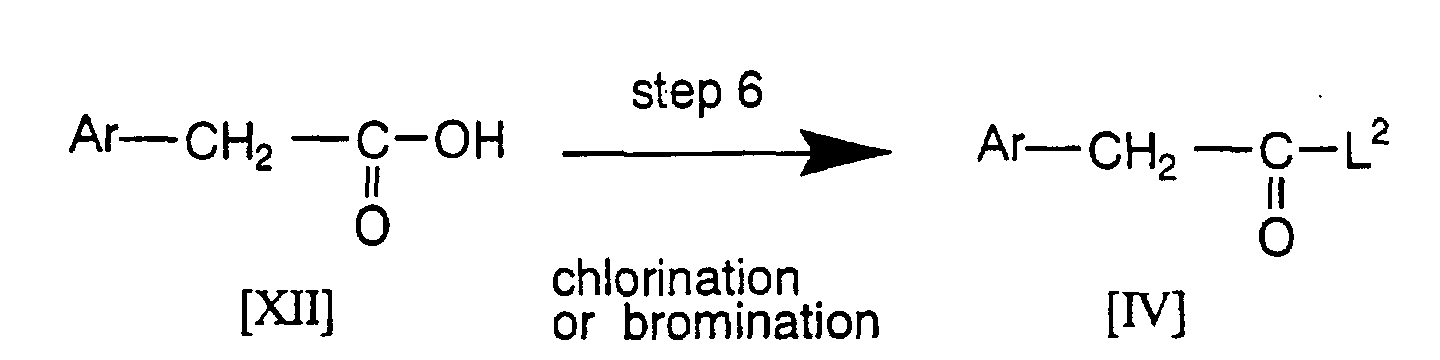
The compound given by formula [IV] can be, for example, produced according to the following scheme.
Figure 00160001
wherein L2 and Ar mean as described above.
The compound given by formula [XII] can be produced according to the description in Syn. Commun., 1982, 21, 415, JP sho58-41862A, Tetrahedron Lett., 1980,21,2547, Syn. Commun., 1976, 6, 349 and J. Am. Chem. Soc., 1977, 99, 4833.
The compound given by formula [V] can be produced according to the description in Bull. Chem. Soc, Jpn., 1990, 63, 1252, J. Am. Chem. Soc., 1955, 77, 2544, Synthesis, 1975, 590 and Chem. Lett., 1984, 1733.
When the present compound is used as an active ingredient of fungicide, it can be used as it is without any other ingredient, but it is usually formulated to emulsifiable concentrates, wettable powders, water dispersible granules, emulsion formulations, flowables, dusts, granules and so on by mixing with solid carrier, liquid carrier, surfactant or the other auxiliaries and used. These formulations usually contain 0.1 to 90% by weight of the present compound.
Examples of the solid carrier utilized for the formulation include fine powders or granules of minerals such as kaolin clay, attapulgite clay, bentonite, montmorillonite, terra alba, pyrophilite, talc, diatomaceous earth and calcite; natural organic substances such as corncob and walnut shell; synthetic organic substances such as urea; salts such as calcium carbonate and ammonium sulfate; and synthetic inorganic substances such as synthetic hydrous silicon oxide. Examples of the liquid carrier include aromatic hydrocarbons such as xylene, alkylbenzene and methylnaphthalene; alcohols such as isopropanol, ethylene glycol, propylene glycol and cellosolve; ketones such as acetone, cyclohexanone and isophorone; vegetable oils such as soybean oil and cottonseed oil; paraffin type aliphatic hydrocarbons; esters; dimethyl sulfoxide; acetonitrile and water.
Examples of the surfactant include anionic surfactants such as alkylsulfate ester salts, alkylarylsulfonate salts, dialkyl sulfosaccinate salts, polyoxyethylenealkylary ether phosphate salts, ligninsulfonate salts and naphthalenesulfonate formaldehyde condensate; nonionic surfactants such as polyoxyethylenealkylary ether, polyoxyethylenealkylpolyoxypropylene block copolymers and sorbitan fatty acid esters.
Examples of the auxiliaries for formulation include water soluble polymers such as polyvinyl alcohol and polyvinylpyrrolidone; polysaccharides such as gum arabic, algin acid and its salts, CMC(carboxymethylcellulose) and xanthan gum; inorganic substances such as alminium magnesium silicate and almina sol; preservatives; coloring agent; PAP (isopropyl acid phosphate) and stabilizers such as BHT.
The application methods of the present compounds are typically foliar application and soil treatment.
When the present compound is used for controlling plant diseases, the dosage is usually 1 to 5000g, preferably 5 to 1000g per 1 hectare though it is variable depending on the type of plants (e.g. crops) to be treated, type of diseases to be controlled, degree of affection by the diseases, formulation type, application method, time of application, weather conditions and so on.
In case emulsifiable concentrates, wettable powders, flowables and the like are used as aqueous dilution, the concentration of the active ingredient is 0.0001 to 3% by weight, preferably 0.0005 to 1% by weight. Dusts, granules and the like are applied as they are without dilution. The present compound is also used for the other known application methods such as seed treatment. When it is used for seed treatment, seeds are usually soaked in 1 to 1000ppm dilution of the present compound, or said dilution is sprayed to or daubed on the seeds. Further, dusts containing 0.1 to 10% by weight of the present compound may be applied by powder treatment.
The present compound can be used as agricultural/horticultural fungicide for controlling plant diseases in the plowed fields, paddy fields, orchards, tea plantations, pastures, lawns and the like. Also, an increased fungicidal effect can be expected by using the compounds in admixture with other fungicides. Examples of such admixable other fungicide include azole type fungicidal compounds such as propiconazole, triadimenol, prochloraz, penconazole, tebuconazole, flusilazole, diniconazole, bromconazole, epoxyconazole, diphenoconazole, ciproconazole, metoconazole, triflumizole, tetraconazole, microbutanil, fenbuconazole, hexaconazole, fluquinconazole, triticonazole, bitertanol, imazalil and flutriafol; cyclic amine type fungicidal compounds such as fenpropimorph, tridemorph and fenpropidin; benzimidazole type fungicidal compounds such as carbendazim, benomyl, thiabendazole and thiophanate-methyl; procymidone; cyprodinil; pyrimethanil; diethofencarb; thiuram; fluazinam; mancozeb; iprodione; vinclozolin; chlorothalonil; captan; mepanipyrim; fenpiclonil; fludioxonil; dichlofluanide; folpet; kresoxim-methyl; azoxystrobin; trifloxystrobin; picoxystrobin; pyraclostrobin; N-methyl-α -ethoxyimino-2-[(2,5-dimethylphenoxy) methyl]phenylactamide, spiroxamine; quinoxyfen; phenhexamid; famoxadone; fenamidon (RP-407213) and iprovalicarb.
The present compound can be used in combination with other agricultural/horticultural insecticides, acaricides, nematocides, herbicides, plant growth regulators and fertilizers. In the combination, they can be mixed in advance.
Examples of the insecticide, acaricide and nematocide include organophosphorus compounds such as fenitrothion [O,O-dimethyl O-(3-methyl-4-nitrophenyl) phosphorothioate], fenthion [O,O-dimethyl O-(3-methyl-4-(methythio)phenyl) phosphorothioate], diazinon [O,O-diethyl O-2-isopropyl-6-methylpyrimidin-4-yl phosphorothioate], chlorpyrifos [O,O-diethyl 0-3,5,6-trichloro-2-pyridyl phosphorothioate], acephate [O,S-dimethyl acetylphosphoramidothioate], methidathion [S-2,3-dihydro-5-methoxy-2-oxo-1,3,4-thiadiazol-3-ylmethyl O,O-dimethyl phosphorodithioate], disulfoton [O,O-diethyl S-2-ethylthioethyl phosphorodithioate], DDVP [2,2-dichlorovinyl dimethyl phosphate], sulprofos [O-ethyl O-4-(methylthio)phenyl S-propyl phosphorodithioate], cyanophos [0-4-cyanophenyl O,O-dimethyl phosphorothioate], dioxabenzofos [2-methoxy-4H-1,3,2-benzodioxaphosphorin 2-sulfide], dimethoate [O,O-dimethyl S-(N-methylcarbamoylmethyl) dithiophosphate], phenthoate [ethyl 2-dimethoxyphosphinothioylthio(phenyl) acetate], malathion [diethyl (dimethoxyphosphinothioylthio) succinate], trichlorfon [dimethyl 2,2,2-trichloro-1-hydroxyethylphosphonate], azinphos-methyl [S-3,4-dihydro-4-oxo-1,2,3-benzotriazin-3-ylmethyl O,O-dimethyl phosphorodithioate], monocrotophos [dimethyl (E)-1-methyl-2-(methylcarbamoyl) vinyl phosphate], ethion [O,O,O',O'-tetraethyl S,S'-methylene bis (phosphorodithioate)] and fosthiazate [N-(O-methyl-S-sec-butyl) phosphorylthiazolidin-2-one]; carbamate compounds such as BPMC [2-sec-butylphenyl methylcarbamate], benfracarb [ethyl N-[2,3-dihydro-2,2-dimethylbenzofuran-7-yloxycarbonyl(methyl)aminothio]-N-isopropyl-β-alaninate], propoxur [2- isopropoxyphenyl N-methylcarbamate], carbosulfan [2,3-dihydro-2,2-dimethyl-7-benzo[b]furanyl N-dibuthylaminothio-N-methylcarbamate], carbaryl [1-naphthyl N-methylcarbamate], methomyl [S-methyl N-[(methylcarbamoyl)oxy]thioacetimidate], ethiofencarb [2-(ethylthiomethyl) phenyl methylcarbamate], aldicarb [2-methyl-2-(methylthio)propionaldehyde O-methylcarbamoyloxime], oxamyl [N,N-dimethyl-2-methylcarbamoyloxyimino-2-(methylthio)acetamide] and fenothiocarb [S-4-phenoxybuthyl N,N-dimethylthiocarbamate]; pyrethroid compounds such as etofenprox [2-(4-ethoxyphenyl)-2-methylpropyl 3-phenoxybenzyl ether], fenvalerate [(RS)-α-cyano-3-phenoxybenzyl (RS)-2-(4-chlorophenyl)-3-methylbutyrate], esfenvalerate [(S)- α-cyano-3-phenoxybenzyl (S)-2-(4-chlorophenyl)-3-methylbutyrate], fenpropathrin [(RS)- α-cyano-3-phenoxybenzyl 2,2,3,3-tetramethylcyclopropanecarboxylate], cypermethrin [(RS)- α-cyano-3-phenoxybenzyl (1RS,3RS)-3-(2,2-dichlorovinyl)-2,2-dimethyl-cyclopropanecarboxylate], permethrin [3-phenoxybenzyl (1RS,3RS)-3-(2,2-dichlorovinyl)-2,2-dimethylcyclopropanecarboxylate], cyhalothrin [(RS)- α-cyano-3-phenoxybenzyl (Z)-(1RS,3RS)-3-(2-chloro-3,3,3-trifluoropropenyl)-2,2-dimethylcyclopropanecarboxylate], deltamethrin [(S)-α-cyano-m-phenoxybenzyl (1R, 3R)-3-(2,2-dibromovinyl)-2,2-dimethyl-cyclopropanecarboxylate], cycloprothrin [(RS)- α-cyano-3-phenoxybenzyl (RS)-2,2-dichloro-1-(4-ethoxyphenyl)cyclopropanecarboxylate], fluvalinate [α-cyano-3-phenoxybenzyl N-(2-chloro- α,α,α-trifluoro-p-tolyl)-D-valinate], bifenthrin [2-methylbiphenyl-3-ylmethyl (Z)-(1RS)-cis-3-(2-chloro-3,3,3-trifluoroprop-1-enyl)-2,2-dimethyl-cyclopropanecarboxylate], acrinathrin [cyano(3-phenoxyphenyl)methyl (1R-{1α (S*), 3 α(Z)})-2,2-dimethyl-3-[3-oxo-3-(2,2,2-trifluoro-1-(trifluoromethyl)ethoxy-1-propenyl)cyclopropanecarboxylate], 2-methyl-2-(4-bromodifluoromethoxyphenyl) propyl 3-phenoxybenzyl ether, tralomethrin [(S)-α-cyano-3-phenoxybenzyl (1R-cis)3-(1,2,2,2-tetrabromoethyl)-2,2-dimethylcyclopropanecarboxylate], silafluofen [(4-ethoxyphenyl)(3-(4-fluoro-3-phenoxyphenyl)propyl) dimethylsilane]; thiadiazine derivatives such as buprofezin (2-t-butylimino-3-isopropyl-5-phenyl-1,3,5-thiadiazin-4-one); nitroimidazolidine derivatives; nereistoxin derivatives such as cartap (S,S'-(2-dimethylaminotrimethylene)bis(thiocarbamate), thiocyclam [N,N'-dimethyl-1,2,3-trithian-5-ylamine] and bensultap [S,S'-2-dimethylaminotrimethylene di(benzenethiosulfonate)]; N-cyanoamidine derivatives such as N-cyano-N'-methyl-N'-(6-chloro-3-pyridylmethyl)acetamidine; chlorinated hydrocarbons such as endosulfan [6,7,8,9,10,10-hexachloro-1,5,5a,6,9,9a-hexahydro-6,9-methano-2,4,3-benzodioxathiepine oxide], γ-BHC [1,2,3,4,5,6-hexachlorocyclohexane] and 1,1-bis(chlorophenyl)-2,2,2-trichloroethanol; benzoylphenylurea compounds such as chlorfluazuron [1-(3,5-dichloro-4-(3-chloro-5-trifluoromethylpyridyn-2-yloxy)phenyl)-3-(2,6-difluorobenzoyl)urea], teflubenzuron [1-(3,5-dichloro-2,4-difluorophenyl)-3-(2,6-difluorobenzoyl)urea] and flufenoxuron [1-(4-(2-chloro-4-trifluoromethylphenoxy)-2-fluorophenyl)-3-(2,6-difluorobenzoyl)urea]; formamidine derivatives such as amitraz [N,N'-[(methylimino)dimethylidine]di-2,4-xylidine] and chlordimeform [N'-(4-chloro-2-methylphenyl)-N,N-dimethylmethanimidamide]; thiourea derivatives such as diafenthiuron [N-(2,6-diisopropyl-4- phenoxyphenyl)-N'-t-butylcarbodiimide]; phenylpyrazole compounds; tebufenozide [N-t-butyl-N'-(4-ethylbenzoyl)-3,5-dimethylbenzhydrazide]; 4-bromo-2-(4-chlorophenyl)-1-ethoxymethyl-5-trifluoromethylpyrrole-3-carbonitrile; bromopropylate [isopropyl 4,4'-dibromobenzilate]; tetradifon [4-chlorophenyl 2,4,5-trichlorophenyl sulfone]; quinomethionate [S,S-6-methylquinoxalin-2,3-diyl dithiocarbonate]; propargite [2-(4-t-butylphenoxy)cyclohexyl prop-2-yl sulfite]; fenbutatin oxide [bis[tris (2-methyl-2-phenylpropyl)tin]oxide]; hexythiazox [(4RS,5RS)-5'(4-chlorophenyl)-N-chlorohexyl-4-methyl-2-oxo-1,3-thiazolidin-3-carboxamide]; clofentezine [3,6-bis(2-chlorophenyl)-1,2,4,5-tetrazine]; pyridathioben [2-t-butyl-5-(4-t-butylbenzylthio)-4-chloropyridazin-3(2H)-one]; fenpyroximate [t-butyl (E)-4-[(1,3-dimethyl-5-phenoxypyrazol-4-yl)methyleneaminooxymethyl]benzoate]; tebufenpyrad [N-(4-t-butylbenzyl)-4-chloro-3-ethyl-1-methyl-5-pyrazolecarboxamide]; polynactins complex [tetranactin, dinactin and trinactin]; milbemectin; abamectin; ivermectin; azadirachtin [AZAD]; pyrimidifen [5-chloro-N-[2-{4-(2-ethoxyethyl)-2,3-dimethylphenoxy}ethyl]-6-ethylpyrimidin-4-amine] and pymetrozine [2,3,4,5-tetrahydro-3-oxo-4-[(pyridin-3-yl)methyleneamino]-6-methyl-1,2,4-triazine.
Examples of the plant diseases to be controlled by the present compound include Pyriculana oryzae and Cochliobolus miyabeanus and Rhizoctonia solani of rice; Erysiphe graminis, Gibberella zeae, Puccinia striiformis, P. graminis, P. recondita, P. hordei, Typhula sp., Micronectriella nivalis, Ustilago tritici, U. nuda, Tilletia caries, Pseudocercosporella herpotrichoides, Rhynchosporium secalis, Septoria tritici and Leptosphaeria nodorum, of wheat and barley; Diaporthe citri, Elsinoe fawcetti, Penicillium digitatum and P. italicum of citrus; Sclerotinia mali, Valsa mali, Podosphaera leucotricha, Alternaria mali and Venturia inaequalis of apple; Venturia nashicola, V. pirina, Alternaria kikuchiana and Gymnosporangium haraeanum of pear; Sclerotinia cinerea, Cladosporium carpophilum and Phomopsis sp. of peach; Elsinoe ampelina, Glomerella cingulata, Uncinula necator, Phakopsora ampelopsidis, Guignardia bidwellii and Plasmopara viticola, of grape; Gloeosporium kaki, Cercospora kaki and Mycosphaerella nawae of Japanese persimmon; Colletotrichum lagenarium, Sphaerothecafuliginea, Mycosphaerella melonis, Fusarium oxysporum, Pseudoperonospora cubensis and Phytophthora sp. of gourd; Alternaria solani, Cladosporium fulvum, Phytophthora infestans and Pythium sp. of tomato; Phomopsis vexans and Erysiphe cichoracearum, of eggplant; Alternaria japonica and Cercosporella brassicae of Cruciferae vegetables; Puccinia allii of leek; Cercospora kikuchii, Elsinoe glycines and Diaporthe phaseolorum var. sojae of soybean; Colletotrichum lindemthianum of kidney bean; Cercospora personata and Cercospora arachidicola of peanut; Erysiphe pisi of pea; Alternaria solani and Phytophthora infestans of potato; Sphaerotheca humuli of strawberry; Exobasidium reticulatum and Elsinoe leucospila of tea; Alternaria longipes, Erysiphe cichoracearum, Colletotrichum tabacum, Peronospora tabacina and Phytophthora nicotianae of tobacco; Cercospora beticola of sugar beet; Diplocarpon rosae and Sphaerotheca pannosa of rose; Septoria chrysanthemi-indici and Puccinia horiana of chrysanthemum; and Botrytis cinerea and Sclerotinia sclerotiorum of various crops.
Examples
The present invention is explained by production examples, formulation examples and test examples below and it is not restricted by the following examples.
At first, the production examples of the present compounds and reference production examples of the intermediates of the present compounds. The numbers of the present compounds are the compound numbers described in the table below.
Production example 1
Two hundred milligrams (200mg) of N-[2-(3,4-dimethoxyphenyl)ethyl]-3-hydroxy-2-(4-methylphenyl)acrylamide (0.586mmol), 28mg (0.70mmol) of 60% sodium hydride, 2ml of anhydrous N,N-dimethylformamide and 1ml of anhydrous diethyl ether were mixed and 0.5ml of bromofluoromethane was added thereto at -5°C. The mixture was stirred at -5°C for 30 minutes and then stirred at 0°C for 1 hour. The reaction mixture was added to water and extracted with ethyl acetate. The organic layer was washed with 5% hydrochloric acid, saturated aqueous sodium bicarbonate solution and saturated brine subsequently, dried over anhydrous magnesium sulfate and concentrated under reduced pressure. The residue was subjected to silica gel preparative thin layer chromatography (eluent, hexane:ethyl acetate=2:1) to give 205mg of N-[2-(3,4-dimethoxyphenyl)ethyl]-3-fluoromethoxy-2-(4-methylphenyl)acrylamide (the present compound 1-4). 1H―NMR(CDCl3, TMS) δ(ppm): 7.1-7.2(5H,m), 6.7-6.8(3H,m), 6.5(1H,s), 5.43(2H,d,J=53Hz), 3.87(3H,s), 3.85(3H,s), 3.62(2H,m), 2.84(2H,t), 2.34(3H,s)
By using N-[2-(3,4-dimethoxyphenyl)ethyl]-3-hydroxy-2-(3-methylphenyl) acrylamide in place of N-[2-(3,4-dimethoxyphenyl)ethyl]-3-hydroxy-2-(4-methylphenyl)acrylamide, N-[2-(3,4-dimethoxyphenyl)ethyl]-3-fluoromethoxy-2-(3-methylphenyl)acrylamide (the present compound 1034) was obtained according to production example 1.
1H―NMR(CDCl3, TMS) δ(ppm): 7.0-7.3(4H,m), 6.6-6.8(4H,m), 6.46(1H,br), 5.44(2H,d,J=53.4Hz), 3.86(3H,s), 3.85(3H,s), 3.6-3.7(2H,m), 2.84(2H,t,J=6.9Hz), 2.33(3H,s)
Production example 2
Five hundred milligrams (500mg) of N-[2-(3,4-dimethoxyphenyl)ethyl]-3-hydroxy-2-(4-methylphenyl)acrylamide (1.46mmol), 0.31g (1.7mmol) of 30% aqueous potassium hydroxide solution, 0.1g (0.3mmol) of tetrabutylammonium bromide and 10ml of ethylene glycol dimethyl ether were mixed and chlorodifluoromethane gas was blown thereto at room temperature. After a small amount of 30% aqueous potassium hydroxide solution was further added, a sample was taken out from the reaction mixture and the disappearance of the starting material was confirmed by thin layer chromatograph analysis. Then, 5% hydrochrolic acid was added to the reaction mixture, which was followed by extracted with ethyl acetate, washed with 5% hydrochrolic acid, saturated aqueous sodium bicarbonate solution and saturated brine subsequently, dried over anhydrous magnesium sulfate and concentrated under reduced pressure. The residue was washed with hexane to give 474mg of N-[2-(3,4-dimethoxyphenyl) ethyl]-3-difluoromethoxy-2-(4-methylphenyl)acrylamide (the present compound 1005).
1H-NMR(CDCl3, TMS) δ(ppm): 7.11-7.19(4H,m), 6.85(1H,s), 6.72-6.78 (3H,m), 6.36(1H,t,J=71.8Hz), 3.86(3H,s), 3.83(3H,s), 3.49(2H,m), 2.83(2H,t), 2.34(3H,s)
Production example 3
One gram (1.00g) of N-[2-(3,4-dimethoxyphenyl)ethyl]-3-hydroxy-2-(4-chlorophenyl)acrylamide (2.66mmol), 130mg (3.25mmol) of 60% sodium hydride and 10ml of anhydrous N,N-dimethylformamide were mixed and 0.46g of bromofluoromethane was added thereto at -15°C. The mixture was stirred at -15°C for 30 minutes and then stirred at 0°C for 1 hour. The reaction mixture was added to water and extracted with ethyl acetate. The organic layer was washed with 5% hydrochloric acid and saturated brine subsequently, dried over anhydrous magnesium sulfate and concentrated under reduced pressure. The residue was subjected to silica gel preparative thin layer chromatography (eluent, hexane:ethyl acetate 1:1) to give 100mg of N-[2-(3,4-dimethoxyphenyl)ethyl]-3-fluoromethoxy-2-(4-chlorophenyl)acrylamide (the present compound 1016).
1H-NMR(CDCl3, TMS) δ(ppm): 7.0-7.3(4H,m), 6.5-6.8(5H,m), 5.41(2H,d, J=53.4Hz), 3.84(3H,s), 3.83(3H,s), 3.5-3.7(2H,m), 2.82(2H,t,J=6.9Hz)
Production example 4
Five hundred milligrams (500mg) of N-[2-(3,4-dimethoxyphenyl)ethyl]-3-hydroxy-2-(4-chlorophenyl)acrylamide (1.33mmol), 2.00g (3.56mmol) of 10% aqueous potassium hydroxide solution, 87mg (0.266mmol) of tetrabutylammonium bromide and 10ml of ethylene glycol dimethyl ether were mixed and chlorodifluoromethane gas was blown thereto at room temperature. After a sample was taken out from the reaction mixture and the disappearance of the starting material was confirmed by thin layer chromatograph analysis, 5% hydrochloric acid was added to the reaction mixture. The reaction mixture was extracted with ethyl acetate, washed with 5% hydrochloric acid, saturated aqueous sodium bicarbonate solution and saturated brine subsequently, dried over anhydrous magnesium sulfate and concentrated under reduced pressure. The residue was subjected to silica gel chromatography (eluent, hexane:ethyl acetate=2:1) and the obtained residue was washed with hexane to give 360mg of N-[2-(3,4-dimethoxyphenyl)ethyl]-3-difluoromethoxy-2-(4-chlorophenyl)acrylamide.
1H―NMR(CDCl3, TMS) δ(ppm): 7.2-7.4(4H,m), 6.7-6.9(4H,m), 6.35(1H,t, J=71.4Hz), 6.13(1H,br), 3.86(3H,s), 3.83(3H,s), 3.6-3.7(2H,m), 2.84(2H,t, J=6.8Hz)
Production example 5
Five hundred miligrams (500mg) of N-[2-(3,4-dimethoxyphenyl)ethyl]-3-hydroxy-2-(4-methylphenyl)acrylamide (1.47mmol), 0.11g (1.47mmol) of 3-chloropropyne and 5ml of anhydrous N,N-dimethylformamide were mixed and 64mg (1.61mmol) of 60% sodium hydride was added thereto at 0-5°C. The mixture was stirred at 0-10°C for 30 minutes and then stirred at room temperature. Water was added to the reaction mixture, followed by extracted with ethyl acetate, washed with 5% hydrochrolic acid and saturated brine subsequently, dried over anhydrous magnesium sulfate and concentrated under reduced pressure. The residue was subjected to silica gel chromatography (eluent, hexane:ethyl acetate=1:1) to give 180mg of N-[2-(3,4-dimethoxyphenyl)ethyl]-3-(2-propynyloxy)-2-(4-methylphenyl)acrylamide (the present compound 1182).
1H―NMR(CDCl3, TMS) δ(ppm): 7.0-7.3(4H,m), 6.7-6.9(4H,m), 6.70(1H,s), 4.51(2H,d,J=2.4Hz), 3.86(6H,s), 3.5-3.7(2H,m), 2.83(2H,t,J=6.9Hz), 2.59(1H,t, J=2.4Hz), 2.32(3H,s)
By using N-[2-(3,4-dimethoxyphenyl)ethyl]-3-hydroxy-2-(4-chlorophenyl) acrylamide in place of N-[2-(3,4-dimethoxyphenyl)ethyl]-3-hydroxy-2-(4-methylphenyl)acrylamide, N-[2-(3,4-dimethoxyphenyl)ethyl]-3-(2-propynyloxy)-2-(4-chlorophenyl)acrylamide (the present compound 1185) was obtained according to production example 5.
1H-NMR(CDCl3, TMS) δ(ppm): 7.60(1H,s), 7.2-7.4(4H,m), 7.0-7.1(2H,m), 6.73(1H,d,J=7.9Hz), 6.62(1H,d,J=1.9Hz), 6.56(1H,dd,J=8.0,1.9Hz), 5.28(1H,br), 4.52(2H,d,J=2.3Hz), 3.87(3H,s), 3.83(3H,s), 3.4-3.6(2H,m), 2.71(2H,t,J=6.9Hz), 2.57(1H,t,J=2.2Hz)
Production example 6
0.76g (2.0mmol) of N-[2-(3,4-dimethoxyphenyl)ethyl]-3-hydroxy-2-(5,6,7,8-tetrahydronaphthalen-2-yl)acrylamide and 8ml of anhydrous N,N-dimethylformamide were mixed and 0.5ml of bromofluoromethane was added thereto at -15°C. 88mg (2.2mmol) of 60% sodium hydride was added and stirred at -15°C for 30 minutes and then stirred at approximately 0°C for 1.5 hours. Water was added to the reaction mixture, followed by extracted with ethyl acetate, washed with 5% hydrochrolic acid and saturated brine subsequently, dried over anhydrous magnesium sulfate and concentrated under reduced pressure. The residue was subjected to silica gel preparative thin layer chromatography (eluent, hexane:ethyl acetate=1:1) to give 0.68g of N-[2-(3,4-dimethoxyphenyl)ethyl]-3-fluoromethoxy-2-(5,6,7,8-tetrahydronaphthalen-2-yl)acrylamide (the present compound 1103).
1H-NMR(CDCl3, TMS) δ(ppm): 7.00(3H,s), 6.7-6.9(4H,m), 6.42(1H,br), 5.43(2H,d,J=53.7Hz), 3.85(3H,s), 3.84(3H,s), 3.6-3.7(2H,m), 2.83(2H,t,J=6.9Hz), 2.7-2.8(4H,m), 1.7-1.9(4H,m)
Production example 7
A mixture of 380mg (0.920mmol) of N-[2-(3,4-dimethoxyphenyl)ethyl]-3-fluoromethoxy-2-(5,6,7,8-tetrahydronaphthalen-2-yl)acrylamide, 420mg (1.01mmol) of Lawesson's Reagent and 5ml of anhydrous tetrahydrofuran was refluxed by heating for 3 hours. Water and ethyl acetate were added to the reaction mixture, and the ethyl acetate layer was washed with aqueous sodium hydroxide solution, aqueous ammonium chloride solution and saturated brine subsequently, dried over anhydrous magnesium sulfate and concentrated under reduced pressure. The residue was subjected to silica gel chromatography (eluent, hexane:ethyl acetate=3:1) to give 222mg of N-[2-(3,4-dimethoxyphenyl)ethyl]-3-fluoromethoxy-2-(5,6,7,8-tetrahydronaphthalen-2-yl)acrylthioamide (the present compound 1160).
1H-NMR(CDCl3, TMS) δ(ppm): 8.11(1H,s), 7.0-7.1(2H,m), 6.77(2H,d, J=6.0Hz), 6.70(1H,d,J=8.2Hz), 6.60(1H,d,J=1.7Hz), 6.55(1H,dd,J=7.9,1.9Hz), 5.48(2H,d,J=53.5Hz), 3.9-4.0(2H,m), 3.85(3H,s), 3.81(3H,s), 2.83(2H,t,J=6.7Hz), 2.6-2.8(4H,m), 1.7-1.9(4H,m)
By using 3-difluoromethoxy-N-[2-{3-methoxy-4-(2-propynyloxy)phenyl} ethyl]-2-(4-methylphenyl)acrylamide in place of N-[2-(3,4-dimethoxyphenyl)ethyl]-3-fluoromethoxy-2-(5,6,7,8-tetrahydronaphthalen-2-yl)acrylamide, 3-difluoromethoxy-N-[2-{3-methoxy-4-(2-propynyloxy)phenyl}ethyl]-2-(4-methylphenyl)acrylthioamide (the present compound 1445) was obtained according to production example 7.
1H ― NMR (CDCl3, TMS) δ(ppm): 8.20(1H,s), 7.1-7.2(2H,m), 6.8-7.0(4H,m), 6.38(1H,t, J=71.0Hz), 6.5-6.6(1H,m), 4.74(2H,s), 3.9-4.0(2H,m), 3.79(3H,s), 2.83(2H,t,J=6.8Hz), 2.52(1H,t,J=2.1Hz), 2.39(3H,s)
Production example 8
Five hundred milligrams (500mg) of N-[2-(3,4-dimethoxyphenyl)ethyl]-3-hydroxy-2-(5,6,7,8-tetrahydronaphthalen-2-yl)acrylamide (1.31mmol), 1.80g (3.28mmol) of 10% aqueous potassium hydroxide solution, 87mg (0.262mmol) of tetrabutylammonium bromide and 10ml of ethylene glycol dimethyl ether were mixed and chlorodifluoromethane gas was blown thereto at room temperature. A sample was taken out from the reaction mixture and the disappearance of the starting material was confirmed by thin layer chromatograph analysis. Then, 5% hydrochrolic acid was added to the reaction mixture, which was followed by extracted with ethyl acetate, washed with 5% hydrochrolic acid, saturated aqueous sodium bicarbonate solution and saturated brine subsequently, dried over anhydrous magnesium sulfate and concentrated under reduced pressure. The residue was subjected to silica gel chromatography (eluent, hexane:ethyl acetate =2:1) and the obtained residue was washed with hexane to give 350mg of 3-difluoromethoxy-N-[2-(3,4-dimethoxyphenyl)ethyl]-2-(5,6,7,8-tetrahydronaphthalen-2-yl)acrylamide (the present compound 1104).
1H-NMRCCDCl3, TMS) δ(ppm): 6.9-7.1(3H,m), 6.7-6.9(4H,m), 6.36(1H,t, J=71.8Hz), 6.01(1H,br), 3.86(3H,s), 3.83(3H,s), 3.6-3.7(2H,m), 2.83(2H,t, J=6.9Hz), 2.6-2.8(4H,m), 1.7-1.9(4H,m)
By using N-[2-(3,4-dimethoxyphenyl)ethyl]-3-hydroxy-2-(4-methoxyphenyl)acrylamide in place of N-(2-(3,4-dimethoxyphenyl)ethyl]-3-hydroxy-2-(5,6,7,8-tetrahydronaphthalen-2-yl)acrylamide, 3-difluoromethoxy-N-[2-(3,4-dimethoxyphenyl)ethyl]-2-(4-methoxyphenyl)acrylamide (the present compound 1023) was obtained according to production example 8.
1H-NMR(CDCl3, TMS) δ(ppm): 7.1-7.3(2H,m), 6.7-6.9(6H,m), 6.35(1H,t, J=71.7Hz), 6.04(1H,br), 3.86(3H,s), 3.82(3H,s), 3.80(3H,s), 3.6-3.7(2H,m), 2.83 (2H,t,J=6.8Hz)
By using N-[2-(3,4-dimethoxyphenyl)ethyl]-3-hydroxy-2-(naphthalen-2-yl)acrylamide in place of N-[2-(3,4-dimethoxyphenyl)ethyl]-3-hydroxy-2-(5,6,7,8-tetrahydronaphthalen-2-yl)acrylamide, 3-difluoromethoxy-N-[2-(3,4-dimethoxyphenyl)ethyl]-2-(naphthalen-2-yl)acrylamide (the present compound 2077) was obtained according to production example 8.
1H―NMR (CDCl3, TMS) δ(ppm): 7.7-7.9(4H,m), 7.4-7.6(3H,m), 7.01(1H,s), 6.7-6.8(3H,m), 6.41(1H,t,J=71.6Hz), 6.08(1H,br), 3.84(3H,s), 3.79(3H,s), 3.6-3.7 (2H,m), 2.86(2H,t,J=6.9Hz)
By using N-[2-(3,4-dimethoxyphenyl)ethyl]-3-hydroxy-2-(4-bromophenyl) acrylamide in place of N-[2-(3,4-dimethoxyphenyl)ethyl]-3-hydroxy-2-(5,6,7,8-tetrahydronaphthalen-2-yl)acrylamide, 2-(4-bromophenyl)-3-difluoromethoxy-N-[2-(3,4-dimethoxyphenyl)ethyl]acrylamide (the present compound 1020) was obtained according to production example 8.
1H-NMR (CDCl3, TMS) δ(ppm): 7.4-7.5(2H,m), 7.1-7.2(2H,m), 6.89(1H,s), 6.7-6.9(3H,m), 6.35(1H,t,J=71.4Hz), 6.14(1H,br), 3.86(3H,s), 3.83(3H,s), 3.6-3.7 (2H,m), 2.84(2H,t,J=6.9Hz)
By using N-[2-(3,4-dimethoxyphenyl)ethyl]-3-hydroxy-2-(4-trifluoromethylphenyl)acrylamide in place of N-[2-(3,4-dimethoxyphenyl) ethyl]-3-hydroxy-2-(5,6,7,8-tetrahydronaphthalen-2-yl)acrylamide, 3-difluoromethoxy-N-[2-(3,4-dimethoxyphenyl)ethyl]-2-(4-trifluoromethylphenyl) acrylamide (the present compound 1029) was obtained according to production example 8.
1H-NMR(CDCl3, TMS) δ(ppm): 7.4-7.6(4H,m), 6.95(1H,s), 6.7-6.9(3H,m), 6.37(1H,t,J=71.5Hz), 6.21(1H,br), 3.85(3H,s), 3.83(3H,s), 3.6-3.7(2H,m), 2.85(2H,t,J=6.9Hz)
By using N-[2-(3,4-dimethoxyphenyl)ethyl]-3-hydroxy-2-(indan-5-yl) acrylamide in place of N-[2-(3,4-dimethoxyphenyl)ethyl]-3-hydroxy-2-(5,6,7,8-tetrahydronaphthalen-2-yl)acrylamide, 3-difluoromethoxy-N-[2-(3,4-dimethoxyphenyl)ethyl]-2-(indan-5-yl)acrylamide (the present compound 1122) was obtained according to production example 8.
1H-NMRCCDCl3, TMS) δ(ppm): 7.0-7.2(3H,m), 6.6-6.9(4H,m), 6.35(1H,t, 71.7Hz), 6.02(1H,br), 3.85(3H,s), 3.83(3H,s), 3.6-3.7(2H,m), 2.8-3.0(6H,m), 2.0-2.1(2H,m)
By using N-[2-(3,4-dimethoxyphenyl)ethyl]-3-hydroxy-2-(4-nitrophenyl) acrylamide in place of N-[2-(3,4-dimethoxyphenyl)ethyl]-3-hydroxy-2-(5,6,7,8-tetrahydronaphthalen-2-yl)acrylamide, 3-difluoromethoxyN-[2-(3,4-dimethoxyphenyl)ethyl]-2-(4-nitrophenyl)acrylamide (the present compound 1247) was obtained according to production example 8.
1H―NMR(CDCl3, TMS) δ(ppm): 8.1-8.2(2H,m), 7.4-7.5(2H,m), 7.03(1H,s), 6.6-6.9(3H,m), 6.37(1H,t,J=70.8Hz), 6.28(1H,br), 3.8-3.9(6H,m), 3.6-3.7(2H,m), 2.86(2H,t,J=6.7Hz)
By using N-[2-(3,4-dimethoxyphenyl)ethyl]-3-hydroxy-2-(4-methylthiophenyl)acrylamide in place of N-[2-(3,4-dimethoxyphenyl)ethyl]-3-hydroxy-2-(5,6,7,8-tetrahydronaphthalen-2-yl)acrylamide, 3-difluoromethoxy-N-[2-(3,4-dimethoxyphenyl)ethyl]-2-(4-methylthiophenyl)acrylamide (the present compound 1026) was obtained according to production example 8.
1H―NMR(CDCl3, TMS) δ(ppm): 7.20(4H,s), 6.7-6.9(4H,m), 6.36(1H,t, J=71.5Hz), 6.07(1H,br), 3.86(3H,s), 3.82(3H,s), 3.6-3.7(2H,m), 2.84(2H,t, J=6.9Hz), 2.49(3H,s)
By using N-[2-(3,4-dimethoxyphenyl)ethyl]-3-hydroxy-2-(3,4-dichlorophenyl)acrylamide in place of N-[2-(3,4-dimethoxyphenyl)ethyl]-3-hydroxy-2-(5,6,7,8-tetrahydronaphthalen-2-yl)acrylamide, 2-(3,4-dichlorophenyl)-3-difluoromethoxy-N-[2-(3,4-dimethoxyphenyl)ethyl]acrylamide (the present compound 1065) was obtained according to production example 8.
1H-NMR (CDCl3, TMS) δ(ppm): 7.3-7.5(2H,m), 7.14(1H,dd,J=8.5,2.1Hz), 6.90(1H,s), 6.7-6.9(3H,m), 6.35(1H,t,J=71.4Hz), 6.21(1H,br), 3.87(3H,s), 3.86(3H,s), 3.6-3.7(2H,m), 2.85(2H,t,J=6.8Hz)
By using N-[2-(3,4-dimethoxyphenyl)ethyl]-3-hydroxy-2-(4-isopropylphenyl)acrylamide in place of N-[2-(3,4-dimethoxyphenyl)ethyl)-3-hydroxy-2-(5,6,7,8-tetrahydronaphthalen-2-yl)acrylamide, 3-difluoromethoxy-N-[2-(3,4-dimethoxyphenyl)ethyl]-2-(4-isopropylphenyl)acrylamide (the present compound 1251) was obtained according to production example 8.
1H―NMR(CDCl3, TMS) δ(ppm): 7.0-7.2(4H,m), 6.7-6.9(4H,m), 6.38(1H,t, J=71.7Hz), 6.05(1H,br), 3.86(3H,s), 3.83(3H,s), 3.5-3.7(2H,m), 2.8-3.0(3H,m), 1.23(6H,d, J=6.8Hz)
By using N-[3-(3,4-dimethoxyphenyl)propyl]-3-hydroxy-2-(4-methylphenyl)acrylamide in place of N-[2-(3,4-dimethoxyphenyl)ethyl]-3-hydroxy-2-(5,6,7,8-tetrahydronaphthalen-2-yl)acrylamide, 3-difluoromethoxy-N-[3-(3,4-dimethoxyphenyl)propyl]-2-(4-methylphenyl)acrylamide (the present compound 1476) was obtained according to production example 8.
1H―NMR(CDCl3, TMS) δ(ppm): 7.1-7.3(4H,m), 6.87(1H,s), 6.7-6.8(3H,m), 6.46(1H,t,J=72.1Hz), 5.98(1H,br), 3.86(3H,s), 3.85(3H,s), 3.4-3.5(2H,m), 2.63(2H,t, J=7.43Hz), 2.34(3H,s), 1.8-2.0(2H,m)
Production example 9
Five hundred milligrams (500mg) of 3-difluoromethoxy-N-[2-(3,4-dimethoxyphenyl)ethyl]-2-(5,6,7,8-tetrahydronaphthalen-2-yl)acrylamide (1.16mmol) and 5ml of anhydrous N,N-dimethylformamide were mixed and cooled, and then 49mg (1.22mmol) of 60% sodium hydride was added thereto and stirred at 0°C for 30 minutes. To the mixture, 164mg (1.16mmol) of methyl iodide was added and stirred at 0°C for 30 minutes and then at room temperature for 2 hours. Water was added to the reaction mixture, which which was followed by extracted with ethyl acetate, washed with 5% hydrochrolic acid and saturated brine subsequently, dried over anhydrous magnesium sulfate and concentrated under reduced pressure. The residue was subjected to silica gel preparative thin layer chromatography (eluent, hexane:ethyl acetate =3:1) to give 460mg of 3-difluoromethoxy-N-[2-(3,4-dimethoxyphenyl)ethyl]-N-methyl-2-(5,6,7,8-tetrahydronaphthalen-2-yl)acrylamide (the present compound 1125).
1H-NMR (CDCl3, TMS) δ(ppm): 6.5-7.1(7H,m), 6.38(1H,t,J=72.4Hz), 3.85 (3H,s), 3.82(3H,s), 3.7-3.8(2H,m), 2.8-3.0(5H,m), 2.6-2.8(4H,m), 1.7-1.9(4H,m)
Production example 10
Six hundred milligrams (600mg) of N-[2-(3,4-dimethoxyphenyl)ethyl]-3-hydroxy-2-(5,6,7,8-tetrahydronaphthalen-2-yl)acrylamide (1.57mmol), 0.14g (1.89mmol) of 3-chloropropyne, 280mg (2.05mmol) of potassium carbonate and 10ml of anhydrous N,N-dimethylformamide were mixed and stirred at room temperature. Water was added to the reaction mixture, which was followed by extracted with ethyl acetate, washed with 5% hydrochrolic acid and saturated brine subsequently, dried over anhydrous magnesium sulfate and concentrated under reduced pressure. The residue was subjected to silica gel chromatography (eluent, hexane:ethyl acetate =1:1) to give 415mg of N-[2-(3,4-dimethoxyphenyl)ethyl]-3-(2-propynyloxy)-2-(5,6,7,8-tetrahydronaphthalen-2-yl)acrylamide (the present compound 1196).
1H-NMR(CDCl3, TMS) δ(ppm): 7.00(3H,s), 6.7-6.9(4H,m), 6.69(1H,s), 4.50(2H,d,J=2.4Hz), 3.86(6H,s), 3.5-3.7(2H,m), 2.7-2.9(6H,m), 2.61(1H,t, J=2.4Hz), 1.7-1.9(4H,m)
By using 1,1,3-trichloropropene in place of 3-chloropropyne, 3-(3,3-dichloroallyloxy)-N-[2-(3,4-dimethoxyphenyl)ethyl]-2-(5,6,7,8-tetrahydronaphthalen-2-yl)acrylamide (the present compound 1232) was obtained according to production example 10.
1H―NMR(CDCl3, TMS) δ(ppm): 6.9-7.0(3H,m), 6.7-6.9(4H,m), 6.53(1H,s), 5.98(1H,d,J=6.4Hz), 4.51(2H,d,J=6.5Hz), 3.86(3H,s), 3.85(3H,s), 3.6-3.7(2H,m), 2.7-2.9(6H,m), 1.7-1.9(4H,m)
By using 1-chloro-2-fluoroethane in place of 3-chloropropyne, N-[2-(3,4-dimethoxyphenyl)ethyl]-3-(2-fluoroethoxy)-2-(5,6,7,8-tetrahydronaphthalen-2-yl)acrylamide (the present compound 1241) was obtained according to production example 10.
1H―NMR(CDCl3, TMS) δ(ppm): 6.99(3H,s), 6.93(1H,br), 6.7-6.9(3H,m), 6.60(1H,s), 4.4-4.7(2H,m), 4.0-4.2(2H,m), 3.86(6H,s), 3.6-3.7(2H,m), 2.7-2.9(6H,m), 1.7-1.9(4H,m)
Production example 11
Three hundred milligrams (300mg) of N-[2-(3,4-dimethoxyphenyl)ethyl]-3-(2-propynyloxy)-2-(5,6,7,8-tetrahydronaphthalen-2-yl)acrylamide (0.716mmol), 20mg (0.0766mmol) of tetrabutylammonium fluoride, 100mg (0.716mmol) of potassium carbonate and 2ml of carbon tetrachloride were mixed and stirred at room temperature. Water was added to the reaction mixture, which was followed by extracted with ethyl acetate, washed with 5% hydrochrolic acid and saturated brine subsequently, dried over anhydrous magnesium sulfate and concentrated under reduced pressure. The residue was subjected to silica gel chromatography (eluent, hexane:ethyl acetate =1:1) to give 140mg of 3-(3-chloro-2-propynyloxy)-N-[2-(3,4-dimethoxyphenyl)ethyl]-2-(5,6,7,8-tetrahydronaphthalen-2-yl)acrylamide (the present compound 1223).
1H―NMR(CDCl3, TMS) δ(ppm): 7.00(3H,s), 6.7-6.9(4H,m), 6.65(1H,s), 4.50(2H,d,J=2.6Hz), 3.86(6H,s), 3.5-3.7(2H,m), 2.7-2.9(6H,m), 1.7-1.9(4H,m)
Production example 12
239mg of 3-difluoromethoxy-N-[2-(4-hydroxy-3-methoxyphenyl)ethyl]-2-(5,6,7,8-tetrahydronaphthalen-2-yl)acrylamide (0.572mmol), 128mg (1.72mmol) of 3-chloropropyne, 3ml of anhydrous N,N-dimethylformamide and 20mg (0.50mmol) of 60% sodium hydride were mixed and stirred at room temperature for 4 hours. Water was added to the reaction mixture, which was followed by extracted with ethyl acetate, washed with 5% hydrochrolic acid, saturated aqueous sodium bicarbonate solution and saturated brine subsequently, dried over anhydrous magnesium sulfate and concentrated under reduced pressure. The residue was subjected to silica gel column chromatography to give 225mg of 3-difluoromethoxy-N-[2-{3-methoxy-4-(2-propynyloxy)phenyl}ethyl]-2-(5,6,7,8-tetrahydronaphthalen-2-yl)acrylamide (the present compound 1268).
1H-NMR(CDCl3, TMS) δ(ppm): 7.00(3H,s), 6.7-6.9(4H,m), 6.69(1H,s), 4.50(2H,d, J=2.4Hz), 3.86(6H,s), 3.5-3.7(2H,m), 2.7-2.9(6H,m), 2.61(1H,t, J=2.4Hz), 1.7-1.9(4H,m)
By using bromoethane in place of 3-chloropropyne, 3-difluoromethoxy-N-[2-(4-ethoxy-3-methoxyphenyl)ethyl]-2-(5,6,7,8-tetrahydronaphthalen-2-yl) acrylamide (the present compound 1143) was obtained according to production example 12.
1H-NMR(CDCl3, TMS) δ(ppm): 6.99(3H,s), 6.7-6.9(4H,m), 6.37(1H,t,J=71.8Hz), 6.12(1H,br), 4.06(2H,q,J=8.1Hz), 3.80(3H,s), 3.5-3.7(2H,m), 2.6-2.9(6H,m), 1.7-1.9(4H,m), 1.44(3H,t,J=7.0Hz)
By using chloropropane in place of 3-chloropropyne, 3-difluoromethoxy-N-[2-(3-methoxy-4-propoxyphenyl)ethyl]-2-(5,6,7,8-tetrahydronaphthalen-2-yl) acrylamide (the present compound 1258) was obtained according to production example 12.
1H―NMR(CDCl3, TMS) δ(ppm): 6.9-7.1(3H,m), 6.4-6.9(4H,m), 6.36(1H,t, J=71.9Hz), 6.05(1H,br), 3.97(2H,t,J=6.8Hz), 3.82(3H,s), 3.5-3.7(2H,m), 2.6-2.9 (6H,m), 1.7-1.9(6H,m), 1.03(3H,t,J=7.4Hz)
By using chloroacetonitrile in place of 3-chloropropyne, N-[2-(4-cyanomethoxy-3-methoxyphenyl)ethyl]-3-difluoromethoxy-2-(5,6,7,8-tetrahydronaphthalen-2-yl)acrylamide (the present compound 1274) was obtained according to production example 12.
1H-NMR(CDCl3, TMS) δ(ppm): 6.9-7.1(4H,m), 6.7-6.9(3H,m), 6.39(1H,t, J=71.8Hz), 6.10(1H,br), 4.79(2H,s), 3.83(3H,s), 3.6-3.7(2H,m), 2.6-2.9(6H,m), 1.7-1.9(4H,m)
By using allyl chloride in place of 3-chloropropyne, N-[2-(4-allyloxy-3-methoxyphenyl)ethyl] -3-difluoromethoxy-2-(5,6,7,8-tetrahydronaphthalen-2-yl)acrylamide (the present compound 1266) was obtained according to production example 12.
1H-NMR(CDCl3, TMS) δ(ppm): 7.00(3H,s), 6.6-6.9(4H,m), 6.35(1H,t, J=71.9Hz), 5.9-6.2(2H,m), 5.2-5.5(2H,m), 4.58(2H,dd,J=3.9,1.3Hz), 3.83(3H,s), 3.5-3.7(2H,m), 2.6-2.9(6H,m), 1.7-1.9(4H,m)
By using 1-chloro-2-butyn in place of 3-chloropropyne, N-[2-{4-(2-butynyloxy)-3-methoxyphenyl}ethyl]-3-difluoromethoxy-2-(5,6,7,8-tetrahydronaphthalen-2-yl)acrylamide (the present compound 1269) was obtained according to production example 12.
1H―NMR(CDCl3, TMS) δ(ppm): 7.00(3H,s), 6.9-7.0(1H,m), 6.84(1H,s), 6.7-6.8(2H,m), 6.34(1H,t,J=71.7Hz), 6.03(1H,br), 4.69(2H,q,J=2.3Hz), 3.82(3H,s), 3.6-3.7(2H,m), 2.83(2H,t,J=6.9Hz), 2.7-2.8(4H,m), 1.83(3H,t,J=2.2Hz), 1.7-1.8(4H,m)
By using methoxymethyl chloride in place of 3-chloropropyne, 3-difluoromethoxy-N- [2-(3-methoxy-4-methoxymethoxyphenyl)ethyl] -2-(5,6,7,8-tetrahydronaphthalen-2-yl)acrylamide (the present compound 1284) was obtained according to production example 12.
1H―NMR(CDCl3, TMS) δ(ppm): 7.0-7.1(4H,m), 6.85(1H,s), 6.7-6.8(2H,m), 6.34(1H,t,J=71.6Hz), 6.02(1H,br), 5.20(2H,s), 3.83(3H,s), 3.6-3.7(2H,m), 3.51(3H,s), 2.7-2.9(6H,m), 1.7-1.9(4H,m)
By using isopropyl chloride in place of 3-chloropropyne, 3-difluoromethoxy-N-[2-(4-isopropoxy-3-methoxyphenyl)ethyl]-2-(5,6,7,8-tetrahydronaphthalen-2-yl) acrylamide (the present compound 1259) was obtained according to production example 12.
1H-NMR(CDCl3, TMS) δ(ppm): 7.00(3H,s), 6.6-6.9(4H,m), 6.35(1H,t, J=71.7Hz), 6.02(1H,br), 4.4-4.6(1H,m), 3.80(3H,s), 3.6-3.7(2H,m), 2.7-2.9(6H,m), 1.7-1.9(4H,m), 1.35(6H,d,J=6.1Hz)
Production example 13
Eighty milligrams (80mg) of acetyl chloride (1.00mmol) were added to a mixture of 420mg (1.00mmol), of 3-diffuoromethoxy-N-[2-(4-hydroxy-3-methoxyphenyl)ethyl]-2-(5,6,7,8-tetrahydronaphthalen-2-yl)acrylamide, 120mg (1.20mmol) of triethylamine and 5ml of tetrahydrofuran at 0°C and stirred at 0°C for 30 minutes and then at room temperature for 2 hours. Water and ethyl acetate were added to the reaction mixture. The organic layer was washed with 5% hydrochrolic acid and saturated brine subsequently, dried over anhydrous magnesium sulfate and concentrated under reduced pressure. The residue was subjected to silica gel chromatography (eluent, hexane:ethyl acetate =3:1) to give 260mg of 3-difluoromethoxy-N-[2-(3-methoxy-4-acetyloxyphenyl)ethyl]-2-(5,6,7,8-tetrahydronaphthalen-2-yl)acrylamide (the present compound 1282).
1H―NMR(CDCl3, TMS) δ(ppm): 7.01(3H,s), 6.7-7.0(4H,m), 6.34(1H,t, J=71.2Hz), 6.18(1H,br), 3.77(3H,s), 3.6-3.7(2H,m), 2.83(2H,t,J=6.7Hz), 2.7-2.8 (4H,m), 2.30(3H,s), 1.7-1.8(4H,m)
Production example 14
One and a half grams (1.5g) of N-[2-(3,4-dimethoxyphenyl)ethyl]-3-hydroxy-2-(4-methylphenyl)acrylamide (4.39mmol), 193mg (4.83mmol) of 60% sodium hydride, 10ml of anhydrous dimethoxyethane and 10ml of anhydrous diethyl ether were mixed, 0.8ml of dibromodifluoromethane was added thereto at 0°C and stirred at 0°C for 3 hours. Water was added to the reaction mixture, which was followed by extracted with ethyl acetate, washed with water, dried over anhydrous magnesium sulfate and concentrated under reduced pressure. The residue was subjected to silica gel column chromatography (eluent, hexane:ethyl acetate =2:1) to give 1.0g of N-[2-(3,4-dimethoxyphenyl)ethyl]-3-bromodifluoromethoxy-2-(4-methylphenyl)acrylamide (the present compound 1197).
1H-NMR(CDCl3, TMS) δ(ppm): 7.1-7.2(4H,m), 6.7-6.8(4H,m), 6.4(1H,s), 3.86(3H,s), 3.83(3H,s), 3.66(2H,m), 2.84(2H,t), 2.35(3H,s)
Production example 15
Five hundred hundred milligrams (500mg) of N-[2-(3,4-dimethoxyphenyl) ethyl]-3-bromodifluoromethoxy-2-(4-methylphenyl)acrylamide (1.06mmol), 0.5ml of hydrogen fluoride-pyridine complex, 340mg (1.57mmol) of mercury oxide and 1ml of isopropyl ether were mixed and stirred at room temperature for 2 hours. Aqueous sodium bicarbonate solution and celite were added to the reaction mixture and filtered. Water was added to the filtrate, which was followed by extracted with ethyl acetate, washed with 5% hydrochrolic acid, saturated aqueous sodium bicarbonate solution and saturated brine subsequently, dried over anhydrous magnesium sulfate and concentrated under reduced pressure. The residue was recrystallized from t-butyl methyl ether and hexane to give 0.35g of N- [2-(3,4-dimethoxyphenyl)ethyl]-3-trifluoromethoxy-2-(4-methylphenyl) acrylamide (the present compound 1006).
1H―NMR(CDCl3, TMS) δ(ppm): 7.1-7.2(4H,m), 6.7-6.8(3H,m), 6.71(1H,s), 6.1(1H,s), 3.84(3H,s), 3.82(3H,s), 3.62(2H,m), 2.89(2H,t), 2.32(3H,s)
Production example 16
4.20g (9.19mmol) of N-[2-(4-benzyloxy-3-methoxyphenyl)ethyl]-3-hydroxy-2-(5,6,7,8-tetrahydronaphthalen-2-yl)acrylamide, 14.3g (23.0mmol) of 10% aqueous potassium hydroxide solution, 0.60g (1.84mmol) of tetrabutylammonium bromide and 40ml of ethylene glycol dimethyl ether were mixed and chlorodifluoromethane gas was blown thereto at room temperature. After a sample was taken out from the reaction mixture and the disappearance of the starting material was confirmed by thin layer chromatography, 5% hydrochloric acid was added to the reaction mixture. The reaction mixture was extracted with ethyl acetate, washed with 5% hydrochloric acid, saturated aqueous sodium bicarbonate solution and saturated brine subsequently, dried over anhydrous magnesium sulfate and concentrated under reduced pressure. The residue was subjected to silica gel chromatography (eluent, hexane:ethyl acetate =2:1) and the obtained product was washed with hexane to give 2.4g of N-[2-(4-benzyloxy-3-methoxyphenyl)ethyl]-3-difluoromethoxy-2-(5,6,7,8-tetrahydronaphthalen-2-yl)acrylamide (the present compound 1281).
1H―NMR(CDCl3, TMS) δ(ppm): 7.2-7.5(5H,m), 6.9-7.1(3H,m), 6.6-6.9(4H, m), 6.26(1H,t,J=71.6Hz), 6.02(1H,br), 5.13(2H,s), 3.84(3H,s), 3.5-3.7(2H,m), 2.7-2.9(6H,m), 1.7-1.9(4H,m)
By using N-[2-(2,3-dihydrobenzo[1,4]dioxin-6-yl)ethyl]-3-hydroxy-2-(5,6,7,8-tetrahydronaphthalen-2-yl)acrylamide in place of N-[2-(4-benzyloxy-3-methoxyphenyl)ethyl]-3-hydroxy-2-(5,6,7,8-tetrahydronaphthalen-2-yl) acrylamide, 3-difluoromethoxy-N-[2-(2,3-dihydrobenzo[1,4]dioxin-6-yl)ethyl]-2-(5,6,7,8-tetrahydronaphthalen-2-yl)acrylamide (the present compound 1450) was obtained according to production example 16.
1H―NMR(CDCl3, TMS) δ(ppm): 7.01(3H,s), 6.85(1H,s), 6.6-6.8(3H,m), 6.41(1H, t,J=71.6Hz), 6.02(1H,br), 4.24(4H,s), 3.5-3.7(2H,m), 2.7-2.8(6H,m), 1.7-1.9(4H,m)
By using N-[2-(3-chloro-4-methoxyphenyl)ethyl]-3-hydroxy-2-(5,6,7,8-tetrahydronaphthalen-2-yl)acrylamide in place of N-[2-(4-benzyloxy-3-methoxyphenyl)ethyl]-3-hydroxy-2-(5,6,7,8-tetrahydronaphthalen-2-yl) acrylamide, N-[2-(3-chloro-4-methoxyphenyl)ethyl]-3-difluoromethoxy-2-(5,6,7,8-tetrahydronaphthalen-2-yl)acrylamide (the present compound 1447) was obtained according to production example 16.
1H-NMR(CDCl3, TMS) δ(ppm): 6.9-7.2(4H,m), 6.8-6.9(3H,m), 6.40(1H,t, J=71.6Hz), 6.00(1H,br), 3.88(3H,s), 3.5-3.6(2H,m), 2.7-2.9(6H,m), 1.7-1.9(4H,m)
By using N-[2-(4-methoxy-3-methylphenyl)ethyl]-3-hydroxy-2-(5,6,7,8-tetrahydronaphthalen-2-yl)acrylamide in place of N-[2-(4-benzyloxy-3-methoxyphenyl)ethyl]-3-hydroxy-2-(5,6,7,8-tetrahydronaphthalen-2-yl) acrylamide, 3-difluoromethoxy-N-[2-(4-methoxy-3-methylphenyl)ethyl]-2-(5,6,7,8-tetrahydronaphthalen-2-yl)acrylamide (the present compound 1448) was obtained according to production example 16.
1H-NMR(CDCl3, TMS) δ(ppm): 6.9-7.0(4H,m), 6.7-6.9(3H,m), 6.34(1H,t, J=71.7Hz), 6.00(1H,br), 3.81(3H,s), 3.5-3.7(2H,m), 2.7-2.8(6H,m), 2.17(3H,s), 1.7-1.9(4H,m)
Production example 17
2.40g (4.73mmol) of N-[2-(4-benzyloxy-3-methoxyphenyl)ethyl]-3-difluoromethoxy-2-(5,6,7,8-tetrahydronaphthalen-2-yl)acrylamide, 1.20g (7.09mmol) of 48% hydrobromic acid and 30ml of acetic acid were mixed and stirred at 80°C for 2 hours. Water was added to to the reaction mixture, which was followed by extracted with ethyl acetate, washed with 5% hydrochrolic acid and saturated brine subsequently, dried over anhydrous magnesium sulfate and concentrated under reduced pressure. The residue was subjected to silica gel column chromatography (eluent, hexane:ethyl acetate =1:1) to give 1.81g of 3-difluoromethoxy-N- [2-(4-hydroxy-3-methoxyphenyl)ethyl]-2-(5,6,7,8-tetrahydronaphthalen-2-yl)acrylamide (the present compound 1371).
1H―NMR(CDCl3, TMS) δ(ppm): 7.0-7.1(3H,m), 6.84(1H,d,J=3.3Hz) 6.80(1H,s 6.6-6.7(2H,m), 6.36(1H,t,J=71.8Hz), 6.12(1H,br), 5.78(1H,s), 3.82(3H,s), 3.5-3.7(2H,m), 2.4-2.8(6H,m), 1.7-1.9(4H,m)
Production example 18
417mg (1.00mmol) of 3-difluoromethoxy-N-[2-(3-hydroxy-4-methoxyphenyl)ethyl]-2-(5,6,7,8-tetrahydronaphthalen-2-yl)acrylamide, 5ml of anhydrous N,N-dimethylformamide, 74mg (1.00mmol) of 3-chloropropyne and 50mg (1.25mmol) of 60% sodium hydride were mixed and stirred at room temperature for 3 hours. Water was added to to the reaction mixture, which was followed by extracted with ethyl acetate, washed with 5% hydrochrolic acid, saturated aqueous sodium bicarbonate solution and saturated brine subsequently, dried over anhydrous magnesium sulfate and concentrated under reduced pressure. The residue was subjected to silica gel column chromatography to give 162mg of 3- difluoromethoxy-N-[2-{4-methoxy-3-(2-propynyloxy)phenyl}ethyl]-2-(5,6,7,8-tetrahydronaphthalen-2-yl)acrylamide (the present compound 1299).
1H―NMR(CDCl3, TMS) δ(ppm): 7.00(3H,s), 6.8-6.9(4H,m), 6.37(1H,t, J=71.7Hz), 6.03(1H,br), 4.71(2H,d,J=2.4Hz), 3.85(3H,s), 3.6-3.7(2H,m), 2.83(2H, t,J=6.8Hz), 2.7-2.8(4H,m), 2.47(1H,t,J=2.4Hz), 1.7-1.9(4H,m)
By using bromoethane in place of 3-chloropropyne, 3-difluoromethoxy-N-[2-(3-ethoxy-4-methoxyphenyl)ethyl]-2-(5,6,7,8-tetrahydronaphthalen-2-yl) acrylamide (the present compound 1320) was obtained according to production example 18.
1H-NMR(CDCl3, TMS) δ(ppm): 7.00(3H,s), 6.7-6.9(4H,m), 6.36(1H,t, J=71.7Hz), 6.02(1H,br), 4.04(2H,q,J=7.0Hz), 3.84(3H,s), 3.5-3.7(2H,m), 2.7-2.9 (6H,m), 1.7-1.9(4H,m), 1.44(3H,t,J=7.0Hz)
By using chloroacetonitrile in place of 3-chloropropyne, N-[2-(3-cyanomethoxy-4-methoxyphenyl)ethyl]-3-difluoromethoxy-2-(5,6,7,8-tetrahydronaphthalen-2-yl)acrylamide (the present compound 1305) was obtained according to production example 18.
1H―NMR(CDCl3, TMS) δ(ppm): 6.8-7.1(7H,m), 6.40(1H,t,J=72.1Hz), 6.05(1H,br), 4.77(2H,s), 3.86(3H,s), 3.5-3.7(2H,m), 2.84(2H,t,J=6.9Hz), 2.7-2.8(4H,m), 1.7-1.9(4H,m)
Production example 19
Five hundred milligrams (500mg) of 3-difluoromethoxy-N-[2-(4-hydxoxy-3-methoxyphenyl)ethyl]-2-(4-methylphenyl)acrylamide (1.33mmol), 5ml of anhydrous N,N-dimethylformamide, 196mg (2.65mmol) of 3-chloropropyne and 60mg (1.46mmol) of 60% sodium hydride were stirred at room temperature for 2 hours. Water was added to to the reaction mixture, which was followed by extracted with ethyl acetate, washed with 5% hydrochrolic acid, saturated aqueous sodium bicarbonate solution and saturated brine subsequently, dried over anhydrous magnesium sulfate and concentrated under reduced pressure. The residue was subjected to silica gel column chromatography (eluent, hexane:ethyl acetate =2:1) to give 242mg of 3-difluoromethoxy-N-[2-{3-methoxy-4-(2-propynyloxy)phenyl}ethyl]-2-(4-methylphenyl)acrylamide (the present compound 1353).
1H-NMR(CDCl3, TMS) δ(ppm): 7.1-7.2(4H,m), 6.95(1H,d,J=8.25Hz), 6.85(1H,s), 6.7-6.8(2H,m), 6.35(1H,t,J=71.7Hz), 6.11(1H,br), 4.73(2H,d,J=2.3Hz), 3.81(3H,s), 3.6-3.7(2H,m), 2.83(2H,t,J=6.9Hz), 2.49(1H,d,J=2.4Hz), 2.32(3H,s)
By using 3-difluoromethoxy-N-[2-(4-hydroxy-3-methoxyphenyl)ethyl]-2-(indan-5-yl)acrylamide in place of 3-difluoromethoxy-N-[2-(4-hydroxy-3-methoxyphenyl)ethyl]-2-(4-methylphenyl)acrylamide, 3-difluoromethoxy-2-(indan-5-yl)-N-[2-{3-methoxy-4-(2-propynyloxy)phenyl}ethyl]acrylamide (the present compound 1360) was obtained according to production example 19.
1H―NMR(CDCl3, TMS) δ(ppm): 7.1-7.0(2H,m), 6.9-7.1(2H,m), 6.85(1H,s), 6.7-6.8(2H,m), 6.35(1H,t,J=71.6Hz), 6.06(1H,br), 4.74(2H,d,J=2.4Hz), 3.83(3H,s), 3.6-3.7(2H,m), 2.8-2.9(6H,m), 2.49(1H,t,J=2.4Hz), 2.0-2.2(2H,m)
By using 3-difluoromethoxy-N-[2-(4-hydroxy-3-methoxyphenyl)ethyl]-2-(4-methoxyphenyl)acrylamide in place of 3-difluoromethoxy-N-[2-(4-hydroxy-3-methoxyphenyl)ethyl]-2-(4-methylphenyl)acrylamide, 3-difluoromethoxy-2-(4-methoxyphenyl)-N-[2-{3-methoxy-4-(2-propynyloxy)phenyl}ethyl] acrylamide (the present compound 1358) was obtained according to production example 19.
1H―NMR(CDCl3, TMS) δ(ppm): 7.2-7.3(2H,m), 6.7-7.0(6H,m), 6.34(1H,t,J=71.6Hz), 6.05(1H,br), 4.74(2H,d,J=2.5Hz), 3.83(3H,s), 3.81(3H,s), 3.6-3.7(2H,m), 2.84(2H,t,J=6.8Hz), 2.49(1H,t,J=2.5Hz)
By using 3-difluoromethoxy-N-[2-(4-hydroxy-3-methoxyphenyl)ethyl]-2-phenylacrylamide in place of 3-difluoromethoxy-N-[2-(4-hydroxy-3-methoxyphenyl)ethyl]-2-(4-methylphenyl)acrylamide, 3-difluoromethoxy-N-[2-{3-methoxy-4-(2-propynyloxy)phenyl}ethyl]-2-phenylacrylamide (the present compound 1388) was obtained according to production example 19.
1H―NMR(CDCl3, TMS) δ(ppm): 7.3-7.4(5H,m), 6.96(1H,d,J=8.7Hz), 6.90(1H,s), 6.7-6.8(2H,m), 6.36(1H,t,J=71.5Hz), 6.07(1H,br), 4.75(2H,d,J=2.4Hz), 3.83(3H,s), 3.6-3.7(2H,m), 2.85(2H,t,J=6.8Hz), 2.50(1H,t,J=2.4Hz)
By using 3-difluoromethoxy-N-[2-(4-hydroxy-3-methoxyphenyl)ethyl]-2-(4-trifluoromethylphenyl)acrylamide in place of 3-difluoromethoxy-N-[2-(4-hydroxy-3-methoxyphenyl)ethyl]-2-(4-methylphenyl)acrylamide, 3-difluoromethoxy-N-[2-{3-methoxy-4-(2-propynyloxy)phenyl}ethyl]-2-(4-trifluoromethylphenyl)acrylamide (the present compound 1357) was obtained according to production example 19.
1H―NMR(CDCl3, TMS) δ(ppm): 7.59(2H,d,J=8.2Hz), 7.43(2H,d,J=8.0Hz), 6.9-7.0(2H,m), 6.7-6.8(2H,m), 6.35(1H,t,J=71.0Hz), 6.21(1H,br), 4.75(2H,d, J=2.2Hz), 3.84(3H,s), 3.6-3.7(2H,m), 2.87(2H,t,J=6.8Hz), 2.49(1H,t,J=2.2Hz)
By using 3-difluoromethoxy-N-[2-(4-hydroxy-3-methoxyphenyl)ethyl]-2-(4-ethylphenyl)acrylamide in place of 3-difluoromethoxy-N-[2-(4-hydroxy-3-methoxyphenyl)ethyl]-2-(4-methylphenyl)acrylamide, 3-difluoromethoxy-2-(4-ethylphenyl)-N-[2-{3-methoxy-4-(2-propynyloxy)phenyl}ethyl]acrylamide (the present compound 1354) was obtained according to production example 19.
1H―NMR(CDCl3, TMS) δ(ppm): 7.1-7.3(4H,m), 6.96(1H,d,J=8.7Hz), 6.87 (1H,s), 6.7-6.8(2H,m), 6.35(1H,t,J=71.6Hz), 6.06(1H,br), 4.75(2H,d,J=2.4Hz), 3.83(3H,s), 3.6-3.7(2H,m), 2.85(2H,t,J=6.8Hz), 2.64(2H,q,J=6.8Hz), 2.50(1H,t, J=2.4Hz)
By using 3-difluoromethoxy-N-[2-(4-hydroxy-3-methoxyphenyl)ethyl]-2-(4-fluorophenyl)acrylamide in place of 3-difluoromethoxy-N-[2-(4-hydroxy-3-methoxyphenyl)ethyl]-2-(4-methylphenyl)acrylamide, 3-difluoromethoxy-2-(4-fluorophenyl)-N-[2-{3-methoxy-4-(2-propynyloxy)phenyl}ethyl]acrylamide (the present compound 1392) was obtained according to production example 19.
1H-NMR(CDCl3, TMS) δ(ppm): 7.2-7.3(2H,m), 6.9-7.1(3H,m), 6.87(1H,s), 6.7-6.8(2H,m), 6.34(1H,t,J=71.3Hz), 6.17(1H,br), 4.76(2H,d,J=2.4Hz), 3.85(3H,s), 3.6-3.7(2H,m), 2.85(2H,t,J=6.8Hz), 2.64(2H,q,J=6.8Hz), 2.50(1H,t,J=2.4Hz)
By using 3-difluoromethoxy-N-[2-(4-hydroxy-3-methoxyphenyl)ethyl]-2-(naphthalen-2-yl)acrylamide in place of 3-difluoromethoxy-N-[2-(4-hydroxy-3-methoxyphenyl)ethyl]-2-(4-methylphenyl)acrylamide, 3-difluoromethoxy-N-[2-{3-methoxy-4-(2-propynyloxy)phenyl}ethyl)-2-(naphthalen-2-yl)acrylamide (the present compound 2202) was obtained according to production example 19.
1H-NMR(CDCl3, TMS) δ(ppm): 7.7-7.9(4H,m), 7.4-7.5(3H,m), 7.02(1H,s), 6.93(1H,d,J=8.6Hz), 6.7-6.8(2H,m), 6.39(1H,t,J=71.5Hz), 6.11(1H,br), 4.72(2H,d, J=2.2Hz), 3.78(3H,s), 3.6-3.7(2H,m), 2.87(2H,t,J=6.8Hz), 2.48(1H,t,J=2.5Hz)
By using 3-difluoromethoxy-N-[2-(4-hydroxy-3-methoxyphenyl)ethyl]-2-(5-methylthiophen-2-yl)acrylamide in place of 3-difluoromethoxy-N-[2-(4-hydroxy-3-methoxyphenyl)ethyl]-2-(4-methylphenyl)acrylamide, 3-difluoromethoxy-2-(5-methylthiophen-2-yl)-N-[2-{3-methoxy-4-(2-propynyloxy) phenyl}ethyl]acrylamide (the present compound 2133) was obtained according to production example 19.
1H-NMR(CDCl3, TMS) δ(ppm): 7.62(1H,s), 6.95(1H,d,J=8.6Hz), 6.15-6.72 (3H,m), 6.4(1H,br), 4.74(2H,d,J=2.4Hz), 3.83(3H,s), 3.6(2H,m), 2.79(2H,t, J=6.9Hz), 2.50(1H,t,J=2.4Hz), 2.47(3H,s)
By using 3-difluoromethoxy-N-[2-(4-hydroxy-3-methoxyphenyl)ethyl]-2-(3,4-dichlorophenyl)acrylamide in place of 3-difluoromethoxy-N-[2-(4-hydroxy-3-methoxyphenyl)ethyl]-2-(4-methylphenyl)acrylamide, 3-difluoromethoxy-2-(3,4-dichlorophenyl)-N-[2-{3-methoxy-4-(2-propynyloxy)phenyl}ethyl]acrylamide (the present compound 1429) was obtained according to production example 19.
1H―NMR(CDCl3, TMS) δ(ppm): 7.4-7.5(2H,m), 7.13(1H,dd,J=2.14, 8.2Hz), 6.97(1H,d,J=7.1Hz), 6.92(1H,s), 6.7-6.8 (2H,m), 6.0-6.7 (2H,m), 4.75(2H,d,J=2.4Hz), 3.84(3H,s), 3.6(2H,m), 2.85(2H,t, J=6.5Hz), 2.51(1H,t,J=2.4Hz)
By using 3-difluoromethoxy-N-[2-(4-hydroxy-3-methoxyphenyl)-1-methylethyl]-2-(4-methylphenyl)acrylamide in place of 3-difluoromethoxy-N-[2-(4-hydroxy-3-methoxyphenyl)ethyl]-2-(4-methylphenyl)acrylamide, 3-difluoromethoxy-N-[2-(3-methoxy-4-(2-propynyloxy)phenyl)-1-methylethyl]-2-(4-methylphenyl)acrylamide (the present compound 1465) was obtained according to production example 19.
1H-NMR(CDCl3, TMS) δ(ppm): 7.1-7.2(4H,m), 6.95(1H,d,J=7.9Hz), 6.85(1H,s), 6. 7-6.8 (2H,m), 6.36(1H,t,J=71.7Hz), 5.78(1H,d,J=7.8Hz), 4.75(2H,d,J=2.2Hz), 4.3-4.5(1H,m), 3.82(3H,s), 2.7-2.9(2H,m), 2.49(1H,t, J=2.1Hz), 2.34(3H,s), 1.20(3H,d,J=6.7Hz)
By using bromomethylcyclopropane in place of 3-chloropropyne, N-[2-(4-cyclopropylmethoxy-3-methoxyphenyl)ethyl]-3-difluoromethoxy-2-(4-methylphenyl)acrylamide (the present compound 1271) was obtained according to production example 19.
1H-NMR(CDCl3, TMS) δ(ppm): 7.1-7.2(4H,m), 6.7-6.9(4H,m), 6.35 (1H,t, J=71.7Hz), 6.01(1H,br), 3.8-3.9(5H,m), 3.6-3.7(2H,m), 2.82(2H,t, J=6.8Hz), 2.33(3H,s), 1.2-1.4(1H,m), 0.6-0.7(2H,m), 0.3-0.4(2H,m)
Production example 20
477mg (1.20mmol) of 3-difluoromethoxy-N-[2-(4-hydroxy-3-methoxyphenyl)ethyl]-2-(4-chlorophenyl)acrylamide, 5ml of anhydrous N,N-dimethylformamide), 180mg (2.40mmol) of 3-chloropropyne and 72mg (1.80mmol) of 60% sodium hydride were stirred at room temperature for 2 hours. Water was added to to the reaction mixture, which was followed by extracted with ethyl acetate, washed with 5% hydrochrolic acid, saturated aqueous sodium bicarbonate solution and saturated brine subsequently, dried over anhydrous magnesium sulfate and concentrated under reduced pressure. The residue was subjected to silica gel column chromatography (eluent, hexane:ethyl acetate =2:1) to give 70mg of 3-diffuoromethoxy-N-[2-{3-methoxy-4-(2-propynyloxy)phenyl}ethyl]-2-(4-chlorophenyl)acrylamide (the present compound 1355).
1H-NMR(CDCl3, TMS) δ(ppm): 7.1-7.4(4H,m), 6.97(1H,d,J=8.7Hz), 6.89 (1H,s), 6.7-6.8(2H,m), 6.34(1H,t,J=71.3Hz), 6.17(1H,br), 4.75(2H,d,J=2.4Hz), 3.84(3H,s), 3.6-3.7(2H,m), 2.85(2H,t,J=7.0Hz), 2.50(1H,d,J=2.4Hz)
Production example 21
Two hundred milligrams (200mg) of 3-hydroxy-N-[2-(4-hydroxy-3-methoxyphenyl)ethyl]-2-(4-methylphenyl)acrylamide (0.611mmol), 2ml of anhydrous N,N-dimethylformamide, 144mg (1.22mmol) of 3-bromopropyne and 173mg (1.25mmol) of potassium carbonate were stirred at room temperature for 2 hours and then at 50°C for 4 hours. Water was added to to the reaction mixture, which was followed by extracted with ethyl acetate, washed with 5% hydrochrolic acid, saturated aqueous sodium bicarbonate and saturated brine subsequently, dried over anhydrous magnesium sulfate and concentrated under reduced pressure. The residue was subjected to silica gel column chromatography (eluent, hexane:ethyl acetate =1:1) to give 100mg of N-[2-{3-methoxy-4-(2-propynyloxy) phenyl}ethyl]-3-(2-propynyloxy)-2-(4-methylphenyl)acrylamide (the present compound 1364).
1H―NMR(CDCl3, TMS) δ(ppm): 7.1-7.2(4H,m), 6.98(1H,d,J=8.6Hz), 6.6-6.9(4H,m), 4.74(2H,d,J=2.5Hz), 4.49(2H,d,J=2.5Hz), 3.85(3H,s), 3.6-3.7 (2H,m), 2.83(2H,t,J=6.9Hz), 2.59(1H,d,J=2.3Hz), 2.50(1H,d,J=2.2Hz), 2.32(3H,s)
Production example 22
Three hundred milligrams (300mg) of 3-hydroxy-N-[2-(4-hydroxy-3-methoxyphenyl)ethyl]-2-(4-chlorophenyl)acrylamide (0.863mmol) and 3ml of anhydrous N,N-dimethylformamide were mixed and 320mg (4.32mmol) of 3-chloropropyne was added thereto at 0-5°C, and then 100mg (2.59mmol) of 60% sodium hydride was added at 0-5°C. The mixture was stirred for 1 hour at 0-5°C and further at room temperature. Water was added to to the reaction mixture, which was followed by extracted with ethyl acetate, washed with 5% hydrochrolic acid and saturated brine subsequently, dried over anhydrous magnesium sulfate and concentrated under reduced pressure. The residue was subjected to silica gel chromatography (eluent, hexane:ethyl acetate =2:1) to give 160mg of 2-(4-chlorophenyl}-N-[2-{3-methoxy-4-(2-propynyloxy)phenyl}ethyl]-3-(2-propynyloxy) acrylamide (the present compound 1367).
1H-NMR(CDCl3, TMS) δ(ppm): 7.2-7.3(4H,m), 6.9-7.0(2H,m), 6.7-6.8 (3H,m), 4.75(2H,d,J=2.4Hz), 4.52(2H,d,J=2.4Hz), 3.86(3H,s), 3.6-3.7(2H,m), 2.84(2H,t,J=6.9Hz), 2.63(1H,d,J=2.4Hz), 2.51(1H,d,J=2.42Hz)
Production example 23
4.17g (10.00mmol) of N-[2-(4-benzyloxy-3-methoxyphenyl)ethyl]-3-hydroxy-2-(4-methylphenyl)acrylamide, 22.4g (40.0mmol) of 10% aqueous potassium hydroxide solution, 1.62g (5.00mmol) of tetrabutylammonium bromide and 50ml of ethylene glycol dimethyl ether were mixed and chlorodifluoromethane gas was blown thereto at room temperature. After a sample was taken out from the reaction mixture and the disappearance of the starting material was confirmed by thin layer chromatography, 5% hydrochloric acid was added to the reaction mixture, which was followed by extracted with ethyl acetate, washed with 5% hydrochrolic acid, saturated aqueous sodium bicarbonate solution and saturated brine subsequently, dried over anhydrous magnesium sulfate and concentrated under reduced pressure. The residue was washed with diethyl ether to give 3.46g of N-[2-(4-benzyloxy-3-methoxyphenyl)ethyl]-3-difluoromethoxy-2-(4-methylphenyl)acrylamide (the present compound 1451).
1H-NMR(CDCl3, TMS) δ(ppm): 7.2-7.5(5H,m), 7.1-7.2(4H,m), 6.84(1H,s), 6.80(1H,d,J=8.2Hz), 6.74(1H,d,J=1.6Hz), 6.65(1H,dd,J=8.0,1.8Hz), 6.26(1H,t, J=71.6Hz), 6.02(1H,br), 5.13(2H,s), 3.84(3H,s), 3.6-3.7(2H,m), 2.81(2H,t, J=6.8Hz), 2.33(3H,s)
Production example 24
9.40g of N-[2-(4-benzyloxy-3-methoxyphenyl)ethyl]-3-difluoromethoxy-2-(4-methylphenyl)acrylamide (20.1mmol), 3.72g (22.1mmol) of 48% hydrobromic acid and 95ml of acetic acid were mixed and stirred at 80°C for 1.5 hours. The solvent was distilled off from the reaction mixture under reduced pressure and the residue was subjected to silica gel column chromatography (eluent, hexane:ethyl acetate =2:1) to give 4.55g of 3-difluoromethoxy-N-[2-(4-hydroxy-3-methoxyphenyl)ethyl]-2-(4-methylphenyl)acrylamide (the present compound 1452).
1H―NMR(CDCl3, TMS) δ(ppm): 7.1-7.2(4H,m), 6.8-6.9(2H,m), 6.6-6.7(2H,m), 6.35(1H,t,J=71.7Hz), 6.02(1H,br), 5.51(1H,s), 3.84(3H,s), 3.6-3.7(2H,m), 2.81(2H,t, J=6.9Hz), 2.34(3H,s)
Production example 25
1.48g (3.38mmol) of N-[2-(4-benzyloxy-3-methoxyphenyl)ethyl]-3-hydroxy-2-(4-chlorophenyl)acrylamide, 4.3g (8.46mmol) of 10% aqueous potassium hydroxide solution, 220mg (0.677mmol) of tetrabutylammonium bromide and 15ml of ethylene glycol dimethyl ether were mixed and chlorodifluoromethane gas was blown thereto at room temperature. After a sample was taken out from the reaction mixture and the disappearance of the starting material was confirmed by thin layer chromatography, 5% hydrochloric acid was added to the reaction mixture, which was followed by extracted with ethyl acetate, washed with 5% hydrochrolic acid, saturated aqueous sodium bicarbonate solution and saturated brine subsequently, dried over anhydrous magnesium sulfate and concentrated under reduced pressure. The residue was washed with hexane to give 1.45g of N-[2-(4-benzyloxy-3-methoxyphenyl)ethyl]-2-(4-chlorophenyl)-3-difluoromethoxyacrylamide (the present compound 1453).
1H―NMR(CDCl3, TMS) δ(ppm): 7.2-7.5(9H,m), 6.87(1H,s), 6.80(1H,d, J=8.3Hz), 6.75(1H,d,J=2.0Hz), 6.66(1H,dd,J=8.0,2.0Hz), 6.23(1H,t,J=71.7Hz), 6.12(1H,br), 5.14(2H,s), 3.85(3H,s), 3.6-3.7(2H,m), 2.82(2H,t,J=6.8Hz)
Production example 26
1.45g (2.97mmol) of N-[2-(4-benzyloxy-3-methoxyphenyl)ethyl]-2-(4-chlorophenyl)-3-difluoromethoxyacrylamide, 751mg (4.46mmol) of 48% hydrobromic acid and 15ml of acetic acid were mixed and stirred at 80°C for 1.5 hours. Water was added to to the reaction mixture, which was followed by extracted with ethyl acetate twice, washed with saturated brine twice, dried over anhydrous magnesium sulfate and concentrated under reduced pressure. The residue was subjected to silica gel column chromatography (eluent, hexane:ethyl acetate =1:1) to give 880mg of 2-(4-chlorophenyl)-3-difluoromethoxy-N-[2-(4-hydroxy-3-methoxyphenyl)ethyl]acrylamide (the present compound 1454).
1H-NMR(CDCl3, TMS) δ(ppm): 7.2-7.4(4H,m), 6.88(1H,s), 6.84(1H,d, J=7.8Hz), 6.6-6.8(2H,m), 6.34(1H,t,J=71.4Hz), 6.14(1H,br), 5.53(1H,s), 3.85 (3H,s), 3.6-3.7(2H,m), 2.82(2H,t,J=6.8Hz)
Reference production example 1
A mixture of 5.00g (33.3mmol) of (4-methylphenyl)acetic acid, 5.94g (49.9mmol) of thionyl chloride, 0.12g (1.6mmol) of N,N-dimethylformamide and 20ml of toluene was stirred at 100°C for 1 hour, cooled and concentrated under reduced pressure. The residue was added to a mixture of 6.34g (35-0mmol 2-(3,4-dimethoxyphenyl)ethylamine, 8.6g (67mmol) of diisopropylethylamine and 25ml of toluene at 0°C and kept at 0°C for 30 minutes and at room temperature for 6 hours. Water and ethyl acetate were added to the reaction mixture and precipitated solid was collected with filtration. The obtained solid was dried to give 5.76g of N-[2-(3,4-dimethoxyphenyl)ethyl]-2-(4-methylphenyl)acetamide.
1H―NMR(CDCl3, TMS) δ(ppm): 7.0-7.2(4H,m), 6.72(1H,d,J=8.2Hz), 6.57-6.60(2H, m), 5.4(1H,s), 3.86(3H,s), 3.82(3H,s), 3.49(2H,s), 3.43(2H,m), 2.67(2H,t,J=6.9Hz), 2.34(3H,s)
One gram (1.0g) of N-[2-(3,4-dimethoxyphenyl)ethyl]-2-(4-methylphenyl) acetamide (3.2mmol), 1.68g (9.64mmol) of t-butoxybis(dimethylamino)methane and 15ml of N,N-dimethylformamide were mixed and stirred at 90°C for 3 hours and then at 110°C for 3 hours. Water was added to the reaction mixture, which was followed by extracted with ethyl acetate, washed with saturated brine twice, dried over anhydrous magnesium sulfate and the solvent was distilled off under reduced pressure to give 1.20g of crude N-[2-(3,4-dimethoxyphenyl)ethyl]-3-dimethylamino-2-(4-methylphenyl)acrylamide.
One gram (1.0g) of crude N-[2-(3,4-dimethoxyphenyl)ethyl]-3-dimethylamino-2-(4-methylphenyl)acrylamide (2.7mmol), 12ml of 5% hydrochloric acid and 20ml of tetrahydrofuran were mixed and stirred at room temperature for 2 hours. Water was added to the reaction mixture, which was followed by extracted with ethyl acetate twice, washed with saturated brine twice, dried over anhydrous magnesium sulfate and the solvent was distilled off under reduced pressure. The residue was washed with hexane and dried to give 0.76g of N-[2-(3,4-dimethoxyphenyl)ethyl]-3-hydroxy-2-(4-methylphenyl)acrylamide.
1H―NMR(CDCl3, TMS) δ(ppm): 7.26(1H,s), 7.0-7.1(4H,m), 6.6-6.7(3H,m), 5.5(1H,s), 3.86(3H,s), 3.82(3H,s), 3.51(2H,m), 2.75(2H,t,J=6.9Hz), 2.35(3H,s)
Reference production example 2
A mixture of 5.00g (29.3mmol) of (4-chlorophenyl)acetic acid, 5.23g (43.9mmol) of thionyl chloride and 50ml of toluene was stirred at 50°C for 30 minutes and then 80°C for 2.5 hours, cooled and concentrated under reduced pressure. The residue was added to a mixture of 5.18g (28.5mmol) 2-(3,4-dimethoxyphenyl)ethylamine, 3.46g (34.2mmol) of triethylamine and 50ml of tetrahydrofuran at 0°C and kept at 0°C for 30 minutes and at room temperature for 3 hours. Water and ethyl acetate were added to the reaction mixture and precipitated solid was collected with filtration. The obtained solid was dried to give 5.75g of N-[2-(3,4-dimethoxyphenyl)ethyl]-2-(4-chlorophenyl) acetamide.
1H―NMR(CDCl3, TMS) δ(ppm): 7.2-7.3(2H,m), 7.0-7.1(2H,m), 6.72(1H,d, J=8.1Hz), 6.61(1H,d,J=2.0Hz), 6.51(1H,dd,J=8.0,1.9Hz), 5.31(1H,br), 3.87(3H,s), 3.83(3H,s), 3.4-3.5(4H,m), 2.68(2H,t,J=6.8Hz)
5.75g (17.2mmol) of N-[2-(3,4-dimethoxyphenyl)ethyl]-2-(4-chlorophenyl) acetamide, 9.00g (51.6mmol) of t-butoxybis(dimethylamino)methane and 90ml of N,N-dimethylformamide were mixed and stirred at 90°C for 3 hours and then at 110°C for 3 hours. Water was added to the reaction mixture, which was followed by extracted with ethyl acetate, washed with saturated brine twice, dried over anhydrous magnesium sulfate and the solvent was distilled off under reduced pressure to give 6.68g of crude N-[2-(3,4-dimethoxyphenyl)ethyl]-3-dimethylamino-2-(4-chlorophenyl)acrylamide.
6.60g (17.2mmol) of crude N-[2-(3,4-dimethoxyphenyl)ethyl]-3-dimethylamino-2-(4-chlorophenyl)acrylamide, 80ml of 5% hydrochloric acid and 100ml of tetrahydrofuran were mixed and stirred at room temperature for 2 hours. Water was added to the reaction mixture, which was followed by extracted with ethyl acetate twice, washed with saturated brine twice, dried over anhydrous magnesium sulfate and the solvent was distilled off under reduced pressure. The residue was washed with hexane and dried to give 4.46g of N-[2-(3,4-dimethoxyphenyl)ethyl]-3-hydroxy-2-(4-chlorophenyl)acrylamide.
1H―NMR(CDCl3, TMS) δ(ppm): 13.66(1H,d,J=11.34Hz), 7.2-7.3(2H,m), 7.0-7.1(3H,m), 6.74(1H,d,J=8.1Hz), 6.5-6.6(2H,m), 5.32(1H,br), 3.87(3H,s), 3.80(3H,s), 3.5-3.6(2H,m), 2.75(2H,d,J=6.8Hz)
Reference production example 3
According to the description of JP hei10-87602A, (5,6,7,8-tetrahydronaphthalen-2-yl)acetic acid was obtained.
A mixture of 3.60g (18.9mmol) of (5,6,7,8-tetrahydronaphthalen-2-yl)acetic acid, 3.38g (28.4mmol) of thionyl chloride and 40ml of toluene was stirred at 50°C for 30 minutes and then 80°C for 2.5 hours, cooled and concentrated under reduced pressure. The residue was added to a mixture of 3.43g (18.9mmol) 2-(3,4-dimethoxyphenyl)ethylamine, 2.30g (22.7mmol) of triethylamine and 40ml of tetrahydrofuran at 0°C and kept at 0°C for 30 minutes and at room temperature for 3 hours. Water and ethyl acetate were added to the reaction mixture and precipitated solid was collected with filtration. The obtained solid was dried to give 5.78g of N-(2-(3,4-dimethoxyphenyl)ethyl]-2-(5,6,7,8-tetrahydronaphthalen-2-yl)acetamide.
1H-NMR(CDCl3, TMS) δ(ppm): 6.99(1H,d,J=8.1Hz), 6.8-6.9(2H,m), 6.5-6.8(3H,m), 5.42(1H,br), 3.85(3H,s), 3.82(3H,s), 3.4-3.5(4H,m), 2.6-2.8(6H,m), 1.7-1.9(4H,m)
2.65g (7.50mmol) of N-[2-(3,4-dimethoxyphenyl)ethyl]-2-(5,6,7,8-tetrahydronaphthalen-2-yl)acetamide, 3.92g (22.5mmol) of t-butoxybis (dimethylamino)methane and 30ml of N,N-dimethylformamide were mixed and stirred at 90°C for 3 hours and then at 110°C for 3 hours. Water was added to the reaction mixture, which was followed by extracted with ethyl acetate, washed with saturated brine twice, dried over anhydrous magnesium sulfate and the solvent was distilled off under reduced pressure to give 3.30g of crude N-[2-(3,4-dimethoxyphenyl)ethyl]-3-dimethylamino-2-(5,6,7,8-tetrahydronaphthalen-2-yl)acrylamide.
Three grams (3.00g) of crude N-[2-(3,4-dimethoxyphenyl)ethyl]-3-dimethylamino-2-(5,6,7,8-tetrahydronaphthalen-2-yl)acrylamide (7.35mmol), 30ml of 5% hydrochloric acid and 30ml of tetrahydrofuran were mixed and stirred at room temperature for 1.5 hours. Water was added to the reaction mixture, which was followed by extracted with ethyl acetate twice, washed with saturated brine twice, dried over anhydrous magnesium sulfate and the solvent was distilled off under reduced pressure. The residue was washed with hexane and dried to give 2.20g of N-[2-(3,4-dimethoxyphenyl)ethyl]-3-hydroxy-2-(5,6,7,8-tetrahydronaphthalen-2-yl)acrylamide.
1H-NMR(CDCl3, TMS) δ(ppm): 13.61(1H,d,J=11.2Hz), 6.9-7.1(2H,m), 6.6-6.8(5H, m), 5.56(1H,br), 3.86(3H,s), 3.82(3H,s), 3.4-3.6(2H,m), 2.6-2.9(6H,m), 1.7-1.9(4H,m)
Reference production example 4
15.2g (0.1mol) of vanilline, 20.5g (0.12mol) of benzyl bromide, 17.9g (0.13mol) of potassium carbonate and 150ml of N,N-dimethylformamide were mixed and stirred at 50°C for 2 hours. Water was added to the reaction mixture, which was followed by extracted with ethyl acetate, washed with 5% hydrochloric acid and then saturated brine, dried over anhydrous magnesium sulfate and the solvent was distilled off under reduced pressure. The residue was washed with hexane and dried to give 23.1g of 4-benzyloxy-3-methoxybenzaldehyde.
1H―NMR(CDCl3, TMS) δ(ppm): 9.83(1H,s), 7.5-7.3(7H,m), 6.98(1H,d, J=8.2Hz), 5.24(2H,s), 3.95(3H,s)
23.1g (95.7mmol) of 4-benzyloxy-3-methoxybenzaldehyde, 8.76g (143mmol) of nitromethane and 250ml of acetic acid were mixed and 7.07g (96.7mmol) of butylamine was added dropwise thereto. The mixture was refluxed for 2 hours by heating, and then cooled and poured into ice-water. The precipitated crystals were dissolved with ethyl acetate, washed with saturated brine, dried over anhydrous magnesium sulfate and the solvent was distilled off under reduced pressure. The residue was washed with hexane and dried to give 17.0g of 1-benzyloxy-2-methoxy-4-(2-nitrovinyl)benzene.
1H―NMR(CDCl3, TMS) δ(ppm): 7.95(1H,d,J=13.5Hz), 7.51(1H,d,J=14.7Hz), 7.3-7.5(5H,m), 5.24(2H,s), 3.95(3H,s)
6.78g (178.8mmol) of lithium aluminum hydride and 200ml of anhydrous tetrahydrofuran were mixed and an anhydrous tetrahydrofuran solution of 17.0g (59.6mmol) of 1-benzyloxy-2-methoxy-4-(2-nitrovinyl)benzene was added dropwise thereto over about 90 minutes under vigorous stirring. The mixture was refluxed for 2 hours by heating, and then cooled and aqueous sodium hydroxide solution was added to the mixture. The precipitates were filtered off with celite-precoated glass filter and the solvent was distilled off from the filtrate under reduced pressure. The residue was extracted with ethyl acetate, washed with saturated brine, dried over potassium carbonate and the solvent was distilled off under reduced pressure to give 13.67g of crude 2-(3-methoxy-4-benzyloxyphenyl)ethylamine.
1H―NMR(CDCl3, TMS) δ(ppm): 7.2-7.5(5H,m), 6.6-6.9(3H,m), 5.10(2H,s), 3.85(3H,s), 2.90(2H,t,J=6.7Hz), 2.66(2H,t,J=6.8Hz), 2.0-2.4(2H,br)
8.01g (31.2mmol) of crude 2-(3-methoxy-4-benzyloxyphenyl)ethylamine, 3.78g (37.4mmol) of triethylamine and 80ml of tetrahydrofuran were mixed and cooled to 0°C and then (5,6,7,8-tetrahydronaphthalen-2-yl)acetyl chloride was added dropwise thereto. The mixture was stirred at 0°C for 30 minutes and further at room temperature for 2 hours. Water was added to the reaction mixture, which was followed by extracted with ethyl acetate, washed with 5% hydrochloric acid and then saturated brine, dried over anhydrous magnesium sulfate and the solvent was distilled off under reduced pressure. The residue was subjected to silica gel column chromatography (eluent, hexane:ethyl acetate =1:1) to give 8.3g of N-[2-(4-benzyloxy-3-methoxyphenyl)ethyl]-2-(5,6,7,8-tetrahydronaphthalen-2-yl)acetamide.
1H-NMR(CDCl3, TMS) δ(ppm): 7.1-7.2(4H,m) 6.72(1H,d,J=8.2Hz), 6.5-6.6(2H,m), 5.4(1H,s), 3.86(3H,s), 3.82(3H,s), 3.49(2H,s), 3.3-3.4(2H,m), 2.67(2H,t,J=6.9Hz), 2.34(3H,s)
8.8g (13.6mmol) of N-[2-(4-benzyloxy-3-methoxyphenyl)ethyl]-2-(5,6,7,8-tetrahydronaphthalen-2-yl)acetamide, 8.9g (51.1mmol) of t-butoxybis (dimethylamino)methane and 100ml of N,N-dimethylformamide were mixed and stirred at 100°C for 6 hours. Water was added to the reaction mixture, which was followed by extracted with ethyl acetate, washed with saturated brine twice, dried over anhydrous magnesium sulfate and the solvent was distilled off under reduced pressure. To the residue, 50ml of 5% hydrochloric acid and 100ml of tetrahydrofuran were added and stirred at room temperature for 2 hours. Water was added to the reaction mixture, which was followed by extracted with ethyl acetate twice, washed with saturated brine twice, dried over anhydrous magnesium sulfate and the solvent was distilled off under reduced pressure. The residue was subjected to silica gel chromatography (eluent, hexane:ethyl acetate =2:1) and dried to give 4.20g of N-[2-(4-benzyloxy-3-methoxyphenyl)ethyl]-3-hydroxy-2-(5,6,7,8-tetrahydronaphthalen-2-yl)acrylamide.
1H-NMR(CDCl3, TMS) δ(ppm): 13.61(1H,d,J=11.3Hz), 7.2-7.5(5H,m), 7.04(1H,d, J=11.0Hz), 6.97(1H,d,J=8.2Hz), 6.7-6.9(3H,m), 6.66(1H,d,J=2.0Hz), 6.59(1H,dd,J=8.3, 1.9Hz), 5.55(1H,br), 5.11(2H,s), 3.83(3H,s), 3.4-3.6(2H,m), 2.6-2.9(6H,m), 1.7-1.9(4H,m)
Reference production example 5
15.26g (59.3mmol) of crude 2-(3-methoxy-4-benzyloxyphenyl)ethylamine, 9.09g (89.0mmol) of triethylamine and 100ml of tetrahydrofuran were mixed and cooled to about 0°C and then 5.44g (32.28mmol) of (4-methylphenyl)acetyl chloride was added dropwise thereto. The mixture was stirred at 0°C for 30 minutes and further at room temperature for 3 hours. Water was added to the reaction mixture, which was followed by extracted with ethyl acetate, washed with 5% hydrochloric acid and saturated brine subsequently, dried over anhydrous magnesium sulfate and the solvent was distilled off under reduced pressure. The residue was washed with hexane and dried to give 19.48g of N-[2-(4-benzyloxy-3-methoxyphenyl)ethyl]-2-(4-methylphenyl)acetamide.
1H―NMR(CDCl3, TMS) δ(ppm): 7.2-7.5(5H,m), 7.0-7.1(4H,m), 6.73(1H,d, J=8.2Hz), 6.62(1H,d,J=1.9Hz), 6.46(1H,dd,J=8.1,1.9Hz), 5.34(1H,br), 5.12(2H,s), 3.83(3H,s), 3.4-3.5(4H,m), 2.64(2H,t,J=6.9Hz), 2.32(3H,s)
11.68g (30.0mmol) of N-[2-(4-benzyloxy-3-methoxyphenyl)ethyl]-2-(4-methylphenyl)acetamide and 15.67g (90.0mmol) of t-butoxybis(dimethylamino) methane were mixed and stirred at 80°C for 2 hours. The reaction mixture was cooled and tetrahydrofuran was added thereto. The reaction mixture was acidified with 5% hydrochloric acid and stirred at room temperature for 2 hours. After the solvent was distilled off under reduced pressure, water and 5% hydrochloric acid were added to the residue, which was followed by extracted with chloroform twice, washed with saturated brine twice, dried over anhydrous magnesium sulfate and the solvent was distilled off under reduced pressure. The residue was washed with hexane and dried to give 11.30g of N-[2-(4-benzyloxy-3-methoxyphenyl)ethyl]-3-hydroxy-2-(4-methylphenyl)acrylamide.
1H―NMR(CDCl3, TMS) δ(ppm): 13.61(1H,d,J=11.3Hz), 7.2-7.5(5H,m),
6.9-7.1(5H,m), 6.77(1H,d,J=8.1Hz), 6.64(1H,d,J=1.6Hz), 6.56(1H,dd,J=8.1,1.6Hz), 5.46(1H,br), 5.13(2H,s), 3.83(3H,s), 3.4-3.6(2H,m), 2.73(2H,t,J=6.8Hz), 2.33(3H,s)
Reference production example 6
2.14g (11.97mmol) of crude 2-(3-methoxy-4-benzyloxyphenyl)ethylamine, 1.45g (14.36mmol) of triethylamine and 20ml of tetrahydrofuran were mixed and cooled to about 0°C and then 2.26g (11.97mmol) of (4-chlorophenyl)acetyl chloride was added dropwise thereto. The mixture was stirred at 0°C for 30 minutes and further at room temperature for 2 hours. Water was added to the reaction mixture, which was followed by extracted with ethyl acetate, washed with 5% hydrochloric acid and saturated brine subsequently, dried over anhydrous magnesium sulfate and the solvent was distilled off under reduced pressure. The residue was washed with hexane and dried to give 3.70g of N-[2-(4-benzyloxy-3-methoxyphenyl)ethyl]-2-(4-chlorophenyl)acetamide.
1H―NMR(CDCl3, TMS) δ(ppm): 7.2-7.5(7H,m), 7.0-7.1(2H,m), 6.73(1H,d, J=8.3Hz), 6.63(1H,d,J=2.0Hz), 6.43(1H,dd,J=8.0,2.0Hz), 5.29(1H,br), 5.14(2H,s), 3.84(3H,s), 3.4-3.5(4H,m), 2.66(2H,t,J=6.8Hz)
2.25g (5.49mmol) of N-[2-(4-benzyloxy-3-methoxyphenyl)ethyl]-2-(4-chlorophenyl)acetamide and 2.39g (13.73mmol) of t-butoxybis(dimethylamino) methane were mixed and stirred at 90°C for 1.5 hours. The reaction mixture was cooled and tetrahydrofuran was added thereto. The reaction mixture was acidified with 5% hydrochloric acid and stirred at room temperature for 2 hours. After the solvent was distilled off under reduced pressure, water and 5% hydrochloric acid were added to the residue, which was followed by extracted with ethyl acetate, washed with saturated brine twice, dried over anhydrous magnesium sulfate and the solvent was distilled off under reduced pressure. The residue was subjected to silica gel column chromatography (eluent, hexane:ethyl acetate =2:1) to give 1.50g of N-[2-(4-benzyloxy-3-methoxyphenyl)ethyl]-3-hydroxy-2-(4-chlorophenyl)acrylamide.
1H―NMR(CDCl3, TMS) δ(ppm): 13.67(1H,d,J=11.0Hz), 7.2-7.5(7H,m), 6.9-7.1(3H,m), 6.76(1H,d,J=8.3Hz), 6.65(1H,d,J=1.8Hz), 6.52(1H,dd,J=8.0,2.0Hz), 5.32(1H,br), 5.15(2H,s), 3.84(3H,s), 3.4-3.6(2H,m), 2.73(2H,t,J=6.8Hz)
Reference production example 7
Two grams (2.00g) of N-[2-(4-benzyloxy-3-methoxyphenyl)ethyl]-3-hydroxy-2-(4-methylphenyl)acrylamide (4.79mmol), 1.21g (7.19mmol) of 48% hydrobromic acid and 20ml of acetic acid were mixed and stirred at 80°C for 1.5 hours. The solvent was distilled off from the reaction mixture under reduced pressure and the residue was subjected to silica gel column chromatography (eluent, hexane:ethyl acetate =2:1) to give 630mg of 3-hydroxy-N-[2-(4-hydroxy-3-methoxyphenyl)ethyl]-2-(4-methylphenyl)acrylamide.
1H―NMR(CDCl3, TMS) δ(ppm): 13.6(1H,d,J=11.3Hz), 6.9-7.2(5H,m), 6.80(1H,d, J=7.8Hz), 6.5-6.6(2H,m), 5.4-5.5(2H,m), 3.83(3H,s), 3.4-3.6(2H,m), 2.74(2H,t,J=6.9Hz), 2.35(3H,s)
Reference production example 8
1.60g (3.66mmol) of N-[2-(4-benzyloxy-3-methoxyphenyl)ethyl]-3-hydroxy-2-(4-chlorophenyl)acrylamide, 925mg (5.49mmol) of 48% hydrobromic acid and 15ml of acetic acid were mixed and stirred at 80°C for 1.5 hours. Water was added to the reaction mixture, which was followed by extracted with ethyl acetate twice, washed with saturated brine twice, dried over anhydrous magnesium sulfate and the solvent was distilled off under reduced pressure. The residue was subjected to silica gel column chromatography (eluent, hexane:ethyl acetate =2:1) to give 600mg of 2-(4-chlorophenyl)-3-hydroxy-N-[2-(4-hydroxy-3-methoxyphenyl)ethyl] acrylamide.
1H―NMR(CDCl3, TMS) δ(ppm): 13.6(1H,d,J=11.3Hz), 7.2-7.4(2H,m), 7.0-7.1(3H, m), 6.82(1H,d,J=6.7,1.7Hz), 6.5-6.6(2H,m), 5.54(1H,s), 5.32(1H,br), 3.83(3H,s), 3.4-3.6 (2H,m), 2.74(2H,t,J=6.9Hz)
Reference production example 9
4.02g (55.0mmol) of butylamine was added dropwise to a mixture of 12.1g (50.0mmol) of 4-benzyloxy-3-methoxybenzaldehyde, 5.63g (75.0mmol) of nitroethane and 120ml of acetic acid and refluxed for 5 hours by heating. The reaction mixture was cooled and extracted with ethyl acetate, washed with saturated brine, dried over anhydrous magnesium sulfate and the solvent was distilled off under reduced pressure. The residue was subjected to silica gel column chromatography (eluent, hexane:ethyl acetate =4:1) to give 2.70g of 1-benzyloxy-2-methoxy-4-(2-nitropropenyl)benzene.
1H-NMR(CDCl3, TMS) δ(ppm): 8.04(1H,s 7.3-7.5(5H,m), 6.9-7.1(3H,m), 5.21(2H,s), 3.92(3H,s), 2.47(3H,s)
To a mixture of 1.03g (27.1mmol) of lithium aluminum hydride and 20ml of anhydrous tetrahydrofuran, an anhydrous tetrahydrofuran solution of 2.70g (9.03mmol) of 1-benzyloxy-2-methoxy-4-(2-nitropropenyl)benzene was added dropwise under vigorous stirring over about 90 minutes and refluxed for 2 hours by heating. The reaction mixture was cooled and aqueous sodium hydroxide solution was added thereto. After the precipitates were filtered off with celite-precoated glass filter, the solvent was distilled off from the filtrate under reduced pressure. The residue was extracted with ethyl acetate, washed with saturated brine, dried over potassium carbonate and the solvent was distilled off under reduced pressure to give 2.30g of crude 2-(4-benzyloxy-3-methoxyphenyl)-1-methylethylamine.
1H―NMR(CDCl3, TMS) δ(ppm): 7.2-7.5(5H,m), 6.6-6.9(3H,m), 5.12(2H,s), 3.87 (3H,s), 3.1-3.2(1H,m), 2.4-2.8(2H,m), 1.4-2.0(2H,br), 1.11(3H,d,J=6.3Hz)
2.30g (8.48mmol) of crude 2-(4-benzyloxy-3-methoxyphenyl)-1-methylethylamine, 1.03g (10.2mmol) of triethylamine and 25ml of tetrahydrofuran were mixed and cooled to about 0°C and then 1.42g (8.48mmol) of (4-methylphenyl)acetyl chloride was added dropwise thereto. The mixture was stirred at 0°C for 30 minutes and further at room temperature for 2 hours. Water was added to the reaction mixture, which was followed by extracted with ethyl acetate, washed with 5% hydrochloric acid and saturated brine subsequently, dried over anhydrous magnesium sulfate and the solvent was distilled off under reduced pressure. The residue was washed with hexane and dried to give 2.40g of N-[2-(4-benzyloxy-3-methoxyphenyl)-1-methylethyl]-2-(4-methylphenyl) acetamide.
1H―NMR(CDCl3, TMS) δ(ppm): 7.3-7.5(5H,m), 6.9-7.1(4H,m), 6.72(1H,d,J=8.1Hz), 6.62(1H,d,J=1.9Hz), 6.42(1H,dd,J=2.0,8.1Hz), 5.1-5.3(2H,m), 4.1-4.3(1H,m), 3.83(3H,s), 3.45(2H,s), 2.59(2H,d,J=6.4Hz), 2.33(3H,s), 1.04(3H,d,J=6.6Hz)
2.40g (5.95mmol) of N-[2-(4-benzyloxy-3-methoxyphenyl)-1-methylethyl]-2-(4-methylphenyl)acetamide and 3.10g (17.8mmol) of t-butoxybis(dimethylamino) methane were mixed and stirred at 80°C for 2 hours. The reaction mixture was cooled and tetrahydrofuran was added thereto. The reaction mixture was acidified with hydrochloric acid and stirred at room temperature for 2 hours. After the solvent was distilled off under reduced pressure, the residue was extracted with chloroform washed with saturated brine twice, dried over anhydrous magnesium sulfate and the solvent was distilled off under reduced pressure. The residue was subjected to silica gel chromatography (eluent, hexane:ethyl acetate =3:2) and dried to give 1.90g of N-[2-(4-benzyloxy-3-methoxyphenyl)-1-methylethyl]-3-hydroxy-2-(4-methylphenyl)acrylamide.
1H―NMR(CDCl3, TMS) δ(ppm): 13.65(1H,d,J=11.2Hz), 7.2-7.5(5H,m), 6.9-7.2(5H, m), 6.76(1H,d,J=8.2Hz), 6.63(1H,d,J=1.88Hz), 6.52(1H,dd,J=8.1,1.9Hz), 5.28(2H,d, J=7.6Hz), 5.14(2H,s), 4.2-4.4(1H,d), 3.83(3H,s), 3.6-3.8(2H,m), 2.35(3H,s), 1.11(3H,d, J=6.5Hz)
1.90g (4.41mmol) of N-[2-(4-benzyloxy-3-methoxyphenyl)-1-methylethyl]-3-hydroxy-2-(4-methylphenyl)acrylamide, 0.99g (17.6mmol) of 10% aqueous potassium hydroxide solution, 716mg (2.20mmol) of tetrabutylammonium bromide and 20ml of ethylene glycol dimethyl ether were mixed and chlorodifluoromethane gas was blown thereto at room temperature to 50°C. After a sample was taken out from the reaction mixture and the disappearance of the starting material was confirmed by thin layer chromatograph analysis, the reaction mixture was cooled. Then, 5% hydrochrolic acid was added to the reaction mixture, which was followed by extracted with ethyl acetate, washed with 5% hydrochrolic acid, saturated brine subsequently, dried over anhydrous magnesium sulfate and concentrated under reduced pressure. The residue was washed with hexane to give 1.80g of N- [2-(4-benzyloxy-3-methoxyphenyl)-1-methylethyl]-3-difluoromethoxy-2-(4-methylphenyl)acrylamide.
1H―NMR(CDCl3, TMS) δ(ppm): 7.2-7.5(5H,m), 7.0-7.2(4H,m), 6.7-6.9(4H,m), 6.63 (1H,dd,J=8.0,1.8Hz) 6.30(1H,t,J=71.7Hz), 5.79(1H,d,J=8.1Hz), 5.13(2H,s) 4.3-4.6(1H,m), 3.83(3H,s), 2.6-2.9(2H,m), 2.33(3H,s), 1.18(3H,d,J=6.6Hz)
1.80g (3.74mmol) of N-[2-(4-benzyloxy-3-methoxyphenyl)-1-methylethyl]-3-difluoromethoxy-2-(4-methylphenyl)acrylamide, 693mg (4.11mmol) of 48% hydrobromic acid and 20ml of acetic acid were mixed and stirred at 80°C for 2 hours. The solvent was distilled off from the reaction mixture under reduced pressure and the residue was subjected to silica gel column chromatography (eluent, hexane:ethyl acetate =2:1) to give 1.10g of 3-difluoromethoxy-N-[2-(4-hydroxy-3-methoxyphenyl)-1-methylethyl]-2-(4-methylphenyl)acrylamide.
1H-NMR(CDCl3, TMS) δ(ppm): 7.1-7.2(4H,m) 6.6-6.9(4H,m), 6.37(1H,t, J=71.5Hz), 5.79(1H,d,J=7.7Hz), 5.58(1H,s), 4.3-4.5(1H,m), 3.82(3H,s), 2.6-2.9(2H,m), 2.34(3H,s), 1.18(3H,d,J=6.5Hz)
Examples of the present compounds are given with their compound numbers below.
Compound given by formula [I]:
Figure 00580001
Figure 00580002
Figure 00590001
Figure 00600001
Figure 00610001
Figure 00620001
Figure 00630001
Figure 00640001
Figure 00650001
Figure 00660001
Figure 00670001
Figure 00680001
Figure 00690001
Figure 00700001
Figure 00710001
Figure 00720001
Figure 00730001
Figure 00740001
Figure 00750001
Figure 00760001
Figure 00770001
Figure 00780001
Figure 00790001
Figure 00800001
Figure 00810001
Figure 00820001
Figure 00830001
Figure 00840001
Figure 00850001
Figure 00860001
Formulation examples are given below. Parts represent parts by weight. The numbers of the present compounds are represented by the above-mentioned numbers.
Formulation example 1
Fifty parts of each of the present compounds 1001-1478 and 2001-2254, 3 parts of calcium ligninsulfonate, 2 parts of magnesium laurylsulfate and 45 parts of synthetic hydrated silica are pulverized and mixed well to give wettable powders of each compound.
Formulation example 2
Twenty parts of each of the present compounds 1001-1478 and 2001-2254 and 1.5 parts of sorbitan trioleate are mixed with 28.5 parts of an aqueous solution containing 2 parts of polyvinyl alcohol, and wet-pulverized finely. To the obtained mixture, 40 parts of an aqueous solution containing 0.05 part of xanthan gum and 0.1 part of aluminium magnesium silicate is added and further 10 parts of propylene glycol are added to give a flowable of each compound.
Formulation example 3
Two parts of each of the present compounds 1001-1478 and 2001-2254, 88 parts of kaolin clay and 10 parts of talc are pulverized and mixed well to give dusts of each compound.
Formulation example 4
Five parts of each of the present compounds 1001-1478 and 2001-2254, 14 parts of polyoxyethylenestyryl phenyl ether, 6 parts of calcium dodecylbenzenesulfonate and 75 parts of xylene are mixed well to give emulsifiable concentrates of each compound.
Formulation example 5
Two parts of each of the present compounds 1001-1478 and 2001-2254, 1 part of synthetic hydrated silica, 2 parts of calcium ligninsulfonate, 30 parts of bentonite and 65 parts of kaolin clay are pulverized and mixed well, and water is added thereto and kneeded, granulated and dried to give granules of each compound.
Formulation example 6
Ten parts of each of the present compounds 1001-1478 and 2001-2254, 35 parts of white carbon (calsium silicate) containing 50% of ammonium polyoxyethylenealkyl ether sulfate and 55 parts of water are mixed and wet pulverized finely to give a flowable of each compound.
Next, usefulness of the present compounds for controlling plant diseases is shown by test examples. The present compounds are represented by the numbers referred to in the above table.
The control effect of the present compounds was evaluated by visually observing the area of a lesion on a sample plant in investigation and comparing the area of a lesion in a non-treatment district and the area of a lesion in a district treated with the present compound.
Test example 1
Sand loam was compacted in a plastic pot, a grape (variety: Berry A) was seeded and grown in a green house for 40 days. The present compounds 1004, 1005, 1006, 1016, 1017, 1020, 1023, 1026, 1029, 1065, 1103, 1104, 1143, 1160, 1182, 1196, 1197, 1223, 1232, 1241, 1251, 1258, 1266, 1268, 1271, 1274, 1281, 1282, 1305, 1320, 1371, 2077 and 2133 were formulated into flowables according to formulation example 6, then, diluted with water to provide given concentration (200ppm), and these were sprayed onto stems and leaves so as to give sufficient adhesion on the surface of grape leaves. After spraying, the plant was air-dried, and a suspension of zoosporangiua of Plasmopara viticola was inoculated by spraying. After inoculation, the plant was first left for one day at 23°C under high humidity, then further left for 6 days in the green house, then the control effect was checked. As a result, the lesion areas on plants in the treatment districts using the present compounds were not more than 10% of the lesion area of a non-treatment district.
Test example 2
Sand loam was compacted in a plastic pot, a grape (variety: Berry A) was seeded and grown in a green house for 40 days. The present compounds 1259, 1284, 1353, 1355, 1360, 1367, 1445, 1447 and 1450 were formulated into flowables according to formulation example 6, then, diluted with water to provide given concentration (50ppm), and these were sprayed onto stems and leaves so as to give sufficient adhesion on the surface of grape leaves. After spraying, the plant was air-dried, and a suspension of zoosporangiua of Plasmopara viticola was inoculated by spraying. After inoculation, the plant was first left for one day at 23°C under high humidity, then further left for 6 days in the green house, then the control effect was checked. As a result, the lesion areas on plants in the treatment districts using the present compounds were not more than 10% of the lesion area of a non-treatment district.
Test example 3
Sand loam was compacted in a plastic pot, a grape (variety: Berry A) was seeded and grown in a green house for 40 days. The present compounds 1354, 1357, 1358, 1364, 1388, 1392, 1429 and 2202 were formulated into flowables according to formulation example 6, then, diluted with water to provide given concentration (12.5ppm), and these were sprayed onto stems and leaves so as to give sufficient adhesion on the surface of grape leaves. After spraying, the plant was air-dried, and a suspension of zoosporangiua of Plasmopara viticola was inoculated by spraying. After inoculation, the plant was first left for one day at 23°C under high humidity, then further left for 6 days in the green house, then the control effect was checked. As a result, the lesion areas on plants in the treatment districts using the present compounds were not more than 10% of the lesion area of a non-treatment district.
Test example 4
Sand loam was compacted in a plastic pot, a tomato (variety: Ponterosa) was seeded and grown in a green house for 20 days. The present compounds 1004, 1005, 1006, 1016, 1017, 1020, 1023, 1026, 1029, 1034, 1065, 1103, 1104, 1122, 1143, 1160, 1182, 1185, 1196, 1197, 1223, 1124, 1127, 1232, 1241, 1251, 1258, 1259, 1268, 1269, 1274, 1281, 1282, 1284, 1299, 1320, 1353, 1354, 1358, 1360, 1388, 1367, 1392, 1429, 1445, 1448, 1450, 1465, 1476, 2077 and 2133 were formulated into flowables according to formulation example 6, then, diluted with water to provide given concentration (500ppm), and these were sprayed onto stems and leaves so as to give sufficient adhesion on the surface of tomato leaves. After spraying, the plant was air-dried, and a suspension of zoosporangiua of Phytophthora infestans was inoculated by spraying. After inoculation, the plant was first left for one day at 23°C under high humidity, then further left for 4 days in the green house, then the control effect was checked. As a result, the lesion areas on plants in the treatment districts using the present compounds were not more than 10% of the lesion area of a non-treatment district.
Industrial Applicability
The present compound has an excellent efficacy for controlling plant diseases and is useful as an active ingredient of fungicide, especially agricultural and horticultural fungicide.

Claims (14)

  1. An amide compound given by formula [I]:
    Figure 00910001
    wherein R1 represents a C1-C10 haloalkyl group, C2-C10 haloalkenyl group, C3-C10 haloalkynyl group, C3-C8 halocycloalkyl group or C3-C10 alkynyl group; R2 represents a hydrogen atom or C1-C3 alkyl group; X represents an oxygen atom or sulfur atom; Y represents an oxygen atom or sulfur atom; Ar represents an aromatic group; A represents an ethylene group or trimethylene group, said ethylene group and trimethylene group may be substituted by one or more selected from halogen atom, amino group, hydroxy group, cyano group, nitro group, C1-C6 alkyl group, C3-C6 cycloalkyl group, C3-C6 cycloalkenyl group, C1-C6 alkoxy group, C1-C6 haloalkoxy group, C1-C6 alkylthio group, C1-C6 haloalkylthio group, C2-C6 (alkoxycarbonyl) group and tri(C1-C6 alkyl)silyl group; Z1 and Z2 are the same or different and represents a halogen atom, C1-C6 alkyl group, C1-C6 haloalkyl group, C2-C6 alkenyl group, C2-C6 alkynyl group, C3-C6 cycloalkyl group, C1-C6 alkoxy group, C1-C6 haloalkoxy group, C2-C6 (alkoxyalkoxy) group, C4-C6 (cycloalkylalkoxy) group, C3-C6 alkenyloxy group, C3-C6 haloalkenyloxy group, C3-C6 alkynyloxy group, C3-C6 haloalkynyloxy group, C3-C6 cycloalkoxy group, C3-C6 cycloalkenyloxy group, cyano C1-C5 alkoxy group, C1-C6 alkylthio group, C1-C6 haloalkylthio group, (C1-C5 alkoxy)carbonyl group, phenoxy group, benzyloxy group, hydroxy group or cyano group, the benzene ring of said phenyl group and benzyloxy group may be substituted by one or more selected from halogen atom, C1-C6 alkyl group, C1-C6 alkoxy group, trfluoromethyl group, amino group and nitro group; and Z1 and Z2 may represents C2-C6 alkylenedioxy group together.
  2. An amide compound according to claim 1, wherein Ar is an aromatic hydrocarbyl group or aromatic heterocyclic group which may be substituted by at least one selected from halogen, amino, hydroxy, cyano, nitro, C1-C10 alkyl, C1-C10 haloalkyl, cyano C1-C9 alkyl, C2-C10 alkenyl, C2-C10 haloalkenyl, C2-C10 alkynyl, C2-C10 haloalkynyl, C3-C6 cycloalkyl, C3-C6 cycloalkenyl, C1-C10 alkoxy, C1-C10 haloalkoxy, C3-C10 alkenyloxy, C3-C10 haloalkenyloxy, C3-C10 alkynyloxy, C3-C10 haloalkynyloxy, C3-C10 cycloalkoxy, cyano C1-C9 alkoxy, C1-C10 alkylthio, C1-C10 haloalkylthio, C2-C10 (alkoxycarbonyl), tri(C1-C6 alkyl)silyl, C3-C5 alkylene and methylenedioxy.
  3. An amide compound according to claim 2, wherein Ar is phenyl, naphthyl, thienyl, furyl, pyrrolyl, pyrazolyl, imidazolyl, triazolyl, tetrazolyl, thiazolyl, isothiazolyl, oxazolyl, isoxazolyl, thiadiazolyl, pyridyl, pyrimidinyl, pyrazinyl, pyridazinyl, pyrrolidinyl, benzofuryl, benzothienyl, indolyl, benzothiazolyl, benzimidazolyl, benzopyrazolyl, quinolyl, isoquinolyl, pyrazolopyrimidinyl, imidazopyrimidinyl, thiophenopyrimidinyl, thiazolopyrimidinyl, pyrazolopyridyl, imidazopyridyl, thiophenopyridyl or thiazolopyridyl which may be substituted by at least one selected from halogen, amino, hydroxy, cyano, nitro, C1-C10 alkyl, C1-C10 haloalkyl, cyano C1-C9 alkyl, C2-C10 alkenyl, C2-C10 haloalkenyl, C2-C10 alkynyl, C2-C10 haloalkynyl, C3-C6 cycloalkyl, C3-C6 cycloalkenyl, C1-C10 alkoxy, C1-C10 haloalkoxy, C3-C10 alkenyloxy, C3-C10 haloalkenyloxy, C3-C10 alkynyloxy, C3-C10 haloalkynyloxy, C3-C10 cycloalkoxy, cyano C1-C9 alkoxy, C1-C10 alkylthio, C1-C10 haloalkylthio, C2-C10 (alkoxycarbonyl) and tri(C1-C6 alkyl)silyl.
  4. An amide compound according to claim 2, wherein Ar is phenyl or naphthyl which may be substituted by at least one selected from halogen, amino, hydroxy, cyano, nitro, C1-C10 alkyl, C1-C10 haloalkyl, cyano C1-C9 alkyl, C2-C10 alkenyl, C2-C10 haloalkenyl, C2-C10 alkynyl, C2-C10 haloalkynyl, C3-C6 cycloalkyl, C3-C6 cycloalkenyl, C1-C10 alkoxy, C1-C10 haloalkoxy, C3-C10 alkenyloxy, C3-C10 haloalkenyloxy, C3-C10 alkynyloxy, C3-C10 haloalkynyloxy, C3-C10 cycloalkoxy, cyano C1-C9 alkoxy, C1-C10 alkylthio, C1-C10 haloalkylthio, C2-C10 (alkoxycarbonyl) and tri(C1-C6 alkyl)silyl.
  5. An amide compound according to claim 2, wherein Ar is phenyl, 4-methylphenyl, 3-methylphenyl, 4-ethylphenyl, 4-methoxyphenyl, 3-methoxyphenyl, 4-chlorophenyl, 4-trifluoromethylphenyl, 3,4-tetramethylenephenyl, 3,4-trimethylenephenyl, 3,4-dichlorophenyl, 3,4-dimethoxyphenyl or 2-naphthyl.
  6. An amide compound according to claim 1, wherein A is an ethylene group.
  7. An amide compound according to claim 1, wherein R2 is a hydrogen atom.
  8. An amide compound according to claim 1, wherein both of X and Y are oxygen atoms.
  9. An amide compound according to claim 1, wherein both of Z1 and Z2 are methoxy.
  10. An amide compound according to claim 1, wherein Z1 is methoxy and Z2 is 2-propynyloxy.
  11. An amide compound according to claim 1, wherein R1 is a fluoromethyl, difluoromethyl, trifluoromethyl or 2-propynyl.
  12. An amide compound according to claim 1, which is N-[2-(3,4-dimethoxyphenyl) ethyl]-3-difluoromethoxy-2-(4-methylphenyl)acrylamide, N-[2-(3,4-dimethoxyphenyl)ethyl]-3-difluoromethoxy-2-[2-(5,6,7,8-tetrahydronaphthalen-2-yl)]acrylamide, N-[2-{3-methoxy-4-(2-propynyloxy)phenyl}ethyl]-3-difluoromethoxy-2-(5,6,7,8-tetrahydronaphthalen-2-yl)acrylamide, N-[2-{3-methoxy-4-(2-propynyloxy)phenyl}ethyl]-3-difluoromethoxy-2-(4-methyphenyl) acrylamide, N-[2-(3,4-dimethoxyphenyl)ethyl]-3-difluoromethoxy-2-(4-chlorophenyl)acrylamide or N-[2-{3-methoxy-4-(2-propynyloxy)phenyl)ethyl]-3-difluoromethoxy-2-(4-chlorophenyl)acrylamide
  13. A fungicide which is characterized by comprising an amide compound described in claim 1 as an active ingredient, and a carrier.
  14. A method for controlling plant diseases which is characterized by applying an effective amount of an amide compound described in claim 1 to plants.
EP01938646A 2000-06-29 2001-06-13 AMIDE COMPOUNDS AND ASSOCIATED USE Withdrawn EP1295868A4 (en)

Applications Claiming Priority (7)

Application Number Priority Date Filing Date Title
JP2000195649 2000-06-29
JP2000378666 2000-12-13
JP2001096096 2001-03-29
PCT/JP2001/005037 WO2002000607A1 (en) 2000-06-29 2001-06-13 Amide compounds and use thereof

Publications (2)

Publication Number Publication Date
EP1295868A1 true EP1295868A1 (en) 2003-03-26
EP1295868A4 EP1295868A4 (en) 2004-03-17

Family

ID=27343888

Family Applications (1)

Application Number Title Priority Date Filing Date
EP01938646A Withdrawn EP1295868A4 (en) 2000-06-29 2001-06-13 AMIDE COMPOUNDS AND ASSOCIATED USE

Country Status (4)

Country Link
US (1) US6762321B2 (en)
EP (1) EP1295868A4 (en)
AU (1) AU2001264273A1 (en)
WO (1) WO2002000607A1 (en)

Cited By (5)

* Cited by examiner, † Cited by third party
Publication number Priority date Publication date Assignee Title
WO2007049728A1 (en) 2005-10-27 2007-05-03 Sumitomo Chemical Company, Limited Amide compounds and their use
WO2010145788A1 (en) * 2009-06-18 2010-12-23 Bayer Cropscience Ag Propargyloxybenzamide derivatives
US7956010B2 (en) * 2007-04-27 2011-06-07 Sumitomo Chemical Company, Limited Amide compound and use thereof for controlling plant diseases
US7999136B2 (en) * 2007-04-27 2011-08-16 Sumitomo Chemical Company, Limited Amide compound and use thereof
US8003699B2 (en) * 2007-04-27 2011-08-23 Sumitomo Chemical Company, Limited Amide compound and use thereof for controlling plant diseases

Families Citing this family (3)

* Cited by examiner, † Cited by third party
Publication number Priority date Publication date Assignee Title
DE10212840A1 (en) * 2002-03-22 2003-10-09 Oce Printing Systems Gmbh Method and device for printing single sheets with a turning device
EP1492768A1 (en) * 2002-03-28 2005-01-05 Basf Aktiengesellschaft Phenethylacrylamide, methods for the production thereof and agents containing the same
US20060122065A1 (en) * 2002-12-24 2006-06-08 Hiroshi Sakaguchi Amide compound and method of controlling plant disease with the same

Family Cites Families (8)

* Cited by examiner, † Cited by third party
Publication number Priority date Publication date Assignee Title
IL31647A (en) 1968-03-25 1972-09-28 Bayer Ag Beta-alkoxyacrylic acid amides,their preparation and use for combating pests
IL95157A (en) 1989-07-28 1996-05-14 Rohm & Haas S-substituted beta-thioacrylamides their preparation and their use as microbicides
US5023275A (en) 1989-07-28 1991-06-11 Rohm And Haas Company S-substituted beta-thioacrylamide biocides and fungicides
US5588044A (en) 1994-11-22 1996-12-24 Voysys Corporation Voice response system with programming language extension
DE4443641A1 (en) 1994-12-08 1996-06-13 Bayer Ag Substituted carboxamides
BR9710389A (en) 1996-07-22 1999-08-17 Bayer Ag Derivatives of glyoxylic acids
DE19648009A1 (en) 1996-11-20 1998-05-28 Bayer Ag Glyoxylic acid amides
EE200200685A (en) 2000-06-14 2004-06-15 Basf Aktiengesellschaft Use of phenethyl acrylamides, phenethyl acrylamides and process for their preparation

Cited By (7)

* Cited by examiner, † Cited by third party
Publication number Priority date Publication date Assignee Title
WO2007049728A1 (en) 2005-10-27 2007-05-03 Sumitomo Chemical Company, Limited Amide compounds and their use
US7902400B2 (en) 2005-10-27 2011-03-08 Sumitomo Chemical Company, Limited Amide compounds and their use
CN101351442B (en) * 2005-10-27 2011-12-14 住友化学株式会社 Amide compounds and their uses
US7956010B2 (en) * 2007-04-27 2011-06-07 Sumitomo Chemical Company, Limited Amide compound and use thereof for controlling plant diseases
US7999136B2 (en) * 2007-04-27 2011-08-16 Sumitomo Chemical Company, Limited Amide compound and use thereof
US8003699B2 (en) * 2007-04-27 2011-08-23 Sumitomo Chemical Company, Limited Amide compound and use thereof for controlling plant diseases
WO2010145788A1 (en) * 2009-06-18 2010-12-23 Bayer Cropscience Ag Propargyloxybenzamide derivatives

Also Published As

Publication number Publication date
EP1295868A4 (en) 2004-03-17
WO2002000607A1 (en) 2002-01-03
US6762321B2 (en) 2004-07-13
US20030195354A1 (en) 2003-10-16
AU2001264273A1 (en) 2002-01-08

Similar Documents

Publication Publication Date Title
US5360806A (en) Amide compounds and their salts and pesticidal compositions containing them
JP2001302605A (en) Biphenyl compounds and their uses
RU2049775C1 (en) N-phenylcarbamate compound and fungicide composition
US6762321B2 (en) Amide compounds and use thereof
US5556867A (en) Oxazoline derivative, its production and its use
US6762197B2 (en) Difluoromethyltriazolone compounds, use of the same and intermediates for the production thereof
WO1998043949A1 (en) Oxime ether compounds, their use and intermediates for preparations of the same
JP4121158B2 (en) Disease or pest control agent comprising an alkoxyimino-substituted bicyclic derivative as an active ingredient
JP2001064237A (en) Acrylic acid derivatives, their uses and intermediates for their production
US6489487B1 (en) Triazolone derivatives, use thereof, and intermediates therefor
JP2001114737A (en) Oxime derivatives and their uses
JP2002356465A (en) Amide compounds and their uses
JP2000103772A (en) Intermediate for the production of oxime ether compounds
JP2000001460A (en) Acrylic acid derivatives and their uses
JP2000239261A (en) Triazolone derivatives, their uses and intermediates for their production
JPH11286472A (en) Oxime ether compounds, their uses and intermediates for their production
JP2000247962A (en) Isoxazolone derivatives and uses thereof
JP2000103773A (en) Acrylic acid derivatives and their uses
JPH08208551A (en) Dihalopropene compounds and insecticides and acaricides containing them as active ingredients
JP4529537B2 (en) Imidazole compounds and uses thereof
JPH07330651A (en) Dihalopropene compound and insecticide containing the same as active ingredient
JP3239508B2 (en) Oxazoline compounds, intermediates thereof and insecticides and acaricides containing the same as an active ingredient
JP2000007650A (en) Acrylic acid derivatives and their uses
JP2005206571A (en) N- (α-cyanobenzyl) amide compound and its use for controlling plant diseases
JPH0725840A (en) Amide compound and plant disease control agent containing the same

Legal Events

Date Code Title Description
PUAI Public reference made under article 153(3) epc to a published international application that has entered the european phase

Free format text: ORIGINAL CODE: 0009012

AK Designated contracting states

Kind code of ref document: A1

Designated state(s): AT BE CH CY DE DK ES FI FR GB GR IE IT LI LU MC NL PT SE TR

Designated state(s): AT BE CH CY DE DK ES FI FR GB GR IE IT LI LU MC NL PT SE TR

AX Request for extension of the european patent

Extension state: AL LT LV MK RO SI

17P Request for examination filed

Effective date: 20021203

A4 Supplementary search report drawn up and despatched

Effective date: 20040203

RIC1 Information provided on ipc code assigned before grant

Ipc: 7C 07D 319/18 B

Ipc: 7C 07D 333/60 B

Ipc: 7C 07D 333/24 B

Ipc: 7C 07D 307/79 B

Ipc: 7C 07D 307/54 B

Ipc: 7C 07D 277/30 B

Ipc: 7C 07D 241/12 B

Ipc: 7C 07D 239/26 B

Ipc: 7C 07D 213/56 B

Ipc: 7C 07C 327/48 B

Ipc: 7A 01N 43/08 B

Ipc: 7A 01N 43/10 B

Ipc: 7A 01N 43/12 B

Ipc: 7A 01N 43/40 B

Ipc: 7A 01N 43/52 B

Ipc: 7A 01N 43/54 B

Ipc: 7A 01N 43/56 B

Ipc: 7A 01N 43/60 B

Ipc: 7A 01N 43/78 B

Ipc: 7A 01N 37/36 B

Ipc: 7C 07C 235/34 A

RAP1 Party data changed (applicant data changed or rights of an application transferred)

Owner name: SUMITOMO CHEMICAL COMPANY, LIMITED

STAA Information on the status of an ep patent application or granted ep patent

Free format text: STATUS: THE APPLICATION IS DEEMED TO BE WITHDRAWN

18D Application deemed to be withdrawn

Effective date: 20070103