EP1295864A1 - Process for preparation of 1,5-diaminonaphthalenes - Google Patents
Process for preparation of 1,5-diaminonaphthalenes Download PDFInfo
- Publication number
- EP1295864A1 EP1295864A1 EP02724682A EP02724682A EP1295864A1 EP 1295864 A1 EP1295864 A1 EP 1295864A1 EP 02724682 A EP02724682 A EP 02724682A EP 02724682 A EP02724682 A EP 02724682A EP 1295864 A1 EP1295864 A1 EP 1295864A1
- Authority
- EP
- European Patent Office
- Prior art keywords
- nitro
- derivative
- formula
- nitrobenzene
- tetralone
- Prior art date
- Legal status (The legal status is an assumption and is not a legal conclusion. Google has not performed a legal analysis and makes no representation as to the accuracy of the status listed.)
- Granted
Links
- 0 *C(C(*)c(c1c(*)c(*)c2*)c2[N+]([O-])=O)C(*)C1=N Chemical compound *C(C(*)c(c1c(*)c(*)c2*)c2[N+]([O-])=O)C(*)C1=N 0.000 description 1
Classifications
-
- C—CHEMISTRY; METALLURGY
- C07—ORGANIC CHEMISTRY
- C07C—ACYCLIC OR CARBOCYCLIC COMPOUNDS
- C07C209/00—Preparation of compounds containing amino groups bound to a carbon skeleton
- C07C209/44—Preparation of compounds containing amino groups bound to a carbon skeleton by reduction of carboxylic acids or esters thereof in presence of ammonia or amines, or by reduction of nitriles, carboxylic acid amides, imines or imino-ethers
- C07C209/52—Preparation of compounds containing amino groups bound to a carbon skeleton by reduction of carboxylic acids or esters thereof in presence of ammonia or amines, or by reduction of nitriles, carboxylic acid amides, imines or imino-ethers by reduction of imines or imino-ethers
-
- C—CHEMISTRY; METALLURGY
- C07—ORGANIC CHEMISTRY
- C07C—ACYCLIC OR CARBOCYCLIC COMPOUNDS
- C07C201/00—Preparation of esters of nitric or nitrous acid or of compounds containing nitro or nitroso groups bound to a carbon skeleton
- C07C201/06—Preparation of nitro compounds
- C07C201/12—Preparation of nitro compounds by reactions not involving the formation of nitro groups
-
- C—CHEMISTRY; METALLURGY
- C07—ORGANIC CHEMISTRY
- C07C—ACYCLIC OR CARBOCYCLIC COMPOUNDS
- C07C209/00—Preparation of compounds containing amino groups bound to a carbon skeleton
- C07C209/30—Preparation of compounds containing amino groups bound to a carbon skeleton by reduction of nitrogen-to-oxygen or nitrogen-to-nitrogen bonds
- C07C209/32—Preparation of compounds containing amino groups bound to a carbon skeleton by reduction of nitrogen-to-oxygen or nitrogen-to-nitrogen bonds by reduction of nitro groups
- C07C209/36—Preparation of compounds containing amino groups bound to a carbon skeleton by reduction of nitrogen-to-oxygen or nitrogen-to-nitrogen bonds by reduction of nitro groups by reduction of nitro groups bound to carbon atoms of six-membered aromatic rings in presence of hydrogen-containing gases and a catalyst
-
- C—CHEMISTRY; METALLURGY
- C07—ORGANIC CHEMISTRY
- C07C—ACYCLIC OR CARBOCYCLIC COMPOUNDS
- C07C209/00—Preparation of compounds containing amino groups bound to a carbon skeleton
- C07C209/30—Preparation of compounds containing amino groups bound to a carbon skeleton by reduction of nitrogen-to-oxygen or nitrogen-to-nitrogen bonds
- C07C209/40—Preparation of compounds containing amino groups bound to a carbon skeleton by reduction of nitrogen-to-oxygen or nitrogen-to-nitrogen bonds by reduction of hydroxylamino or oxyimino groups
-
- C—CHEMISTRY; METALLURGY
- C07—ORGANIC CHEMISTRY
- C07C—ACYCLIC OR CARBOCYCLIC COMPOUNDS
- C07C209/00—Preparation of compounds containing amino groups bound to a carbon skeleton
- C07C209/68—Preparation of compounds containing amino groups bound to a carbon skeleton from amines, by reactions not involving amino groups, e.g. reduction of unsaturated amines, aromatisation, or substitution of the carbon skeleton
-
- C—CHEMISTRY; METALLURGY
- C07—ORGANIC CHEMISTRY
- C07C—ACYCLIC OR CARBOCYCLIC COMPOUNDS
- C07C211/00—Compounds containing amino groups bound to a carbon skeleton
- C07C211/43—Compounds containing amino groups bound to a carbon skeleton having amino groups bound to carbon atoms of six-membered aromatic rings of the carbon skeleton
- C07C211/57—Compounds containing amino groups bound to a carbon skeleton having amino groups bound to carbon atoms of six-membered aromatic rings of the carbon skeleton having amino groups bound to carbon atoms of six-membered aromatic rings being part of condensed ring systems of the carbon skeleton
- C07C211/58—Naphthylamines; N-substituted derivatives thereof
-
- C—CHEMISTRY; METALLURGY
- C07—ORGANIC CHEMISTRY
- C07C—ACYCLIC OR CARBOCYCLIC COMPOUNDS
- C07C249/00—Preparation of compounds containing nitrogen atoms doubly-bound to a carbon skeleton
- C07C249/02—Preparation of compounds containing nitrogen atoms doubly-bound to a carbon skeleton of compounds containing imino groups
-
- C—CHEMISTRY; METALLURGY
- C07—ORGANIC CHEMISTRY
- C07C—ACYCLIC OR CARBOCYCLIC COMPOUNDS
- C07C249/00—Preparation of compounds containing nitrogen atoms doubly-bound to a carbon skeleton
- C07C249/04—Preparation of compounds containing nitrogen atoms doubly-bound to a carbon skeleton of oximes
- C07C249/08—Preparation of compounds containing nitrogen atoms doubly-bound to a carbon skeleton of oximes by reaction of hydroxylamines with carbonyl compounds
-
- C—CHEMISTRY; METALLURGY
- C07—ORGANIC CHEMISTRY
- C07C—ACYCLIC OR CARBOCYCLIC COMPOUNDS
- C07C2602/00—Systems containing two condensed rings
- C07C2602/02—Systems containing two condensed rings the rings having only two atoms in common
- C07C2602/04—One of the condensed rings being a six-membered aromatic ring
- C07C2602/10—One of the condensed rings being a six-membered aromatic ring the other ring being six-membered, e.g. tetraline
Definitions
- 1,5-diaminonaphthalene derivative has been prepared by nitrating naphthalene to produce a dinitronaphthalene and then reducing the nitro groups into amino groups. Dinitration of naphthalene, however, produces a 1,8-dinitro derivative in a large amount in addition to the desired 1,5-dinitro derivative.
- 1,5-dinitronaphthalene is produced in an yield of 30 % while 1,8-dinitronaphthalene in an yield of 65%.
- the current preparation procedure produces the 1,8-dinitro derivative in a large amount in addition to the 1,5-dinitro derivative.
- this invention comprises the embodiments described in the following [1] to [7].
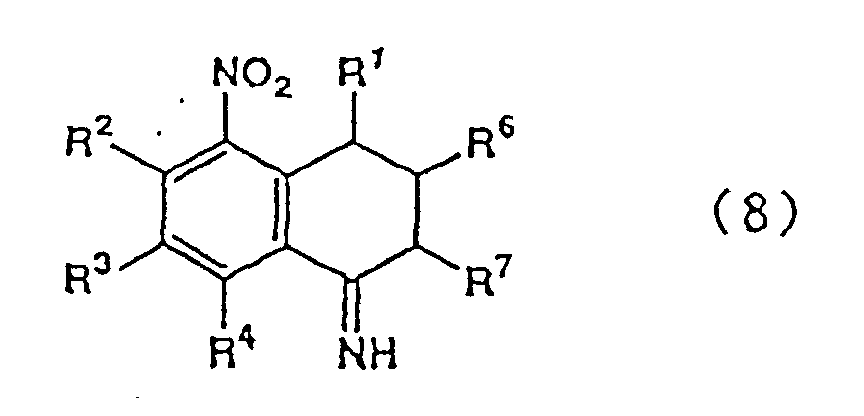
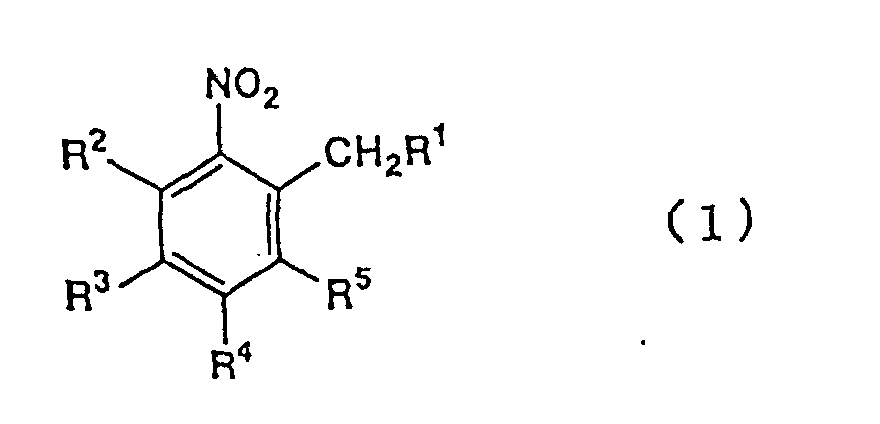
- R 1 to R 4 may be the same or different, and represent hydrogen, alkyl having 1 to 4 carbon atoms, aromatic hydrocarbon having 6 to 12 carbon atoms or halogen; and R 5 represents hydrogen.
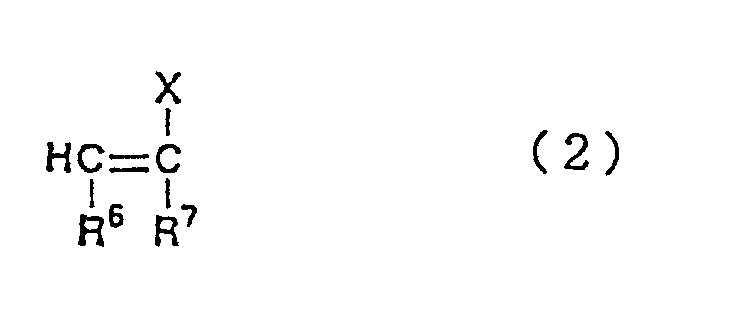
- R 6 and R 7 may be the same or different, and represent hydrogen, alkyl having 1 to 4 carbon atoms or halogen; X represents an electron withdrawing group; and R 6 and R 7 are mutually cis- or trans-configured.
- alkyl in R 1 to R 4 and R 6 and R 7 examples include methyl, ethyl, n-propyl, isopropyl, n-butyl, i-butyl and t-butyl.
- Examples of aromatic hydrocarbon in R 1 to R 4 include phenyl, tolyl and xylyl.
- halogen in R 1 to R 4 and R 6 and R 7 include fluorine, chlorine, bromine and iodine.
- R 8 when X is CO 2 R 8 represents alkyl having 1 to 7 carbon atoms, cycloalkyl, aromatic hydrocarbon having 6 to 12 carbon atoms, or aralkyl.
- alkyl having 1 to 7 carbon atoms include methyl, ethyl, n-propyl, isopropyl, n-butyl, i-butyl, t-butyl, n-pentyl and n-hexyl.
- Examples of cycloalkyl include cyclopentyl and cyclohexyl.
- aromatic hydrocarbon include phenyl, tolyl and xylyl.
- aralkyl is benzyl and phenethyl.
- examples of an electron withdrawing group X in a vinyl compound represented by formula (2) is preferably one selected from the group consisting of CN and CO 2 R 8 where R 8 represents alkyl having 1 to 7 carbon atoms, cycloalkyl, aromatic hydrocarbon having 6 to 12 carbon atoms or aralkyl.
- examples of an acrylonitrile derivative in which X is CN include acrylonitrile, methacrylonitrile, crotononitrile, 2-chloroacrylonitrile, 3-chloroacrylonitrile and 3-ethylacrylonitrile.
- Examples of an acrylate in which X is CO 2 R 8 include methyl acrylate, ethyl acrylate, isopropyl acrylate, t-butyl acrylate, methyl methacrylate, methyl crotonate, methyl 2-chloroacrylate, methyl 3-chloroacrylate and isopropyl 3-chloroacrylate.
- Examples of a nitrobenzenecarboxylic acid represented by formula (3) where X is carboxyl include 4-(2-nitrobenzene)butyric acid, 4-(2-nitrobenzene)-2-methylbutyric acid, 4-(2-nitrobenzene)-3-methylbutyric acid, 4-(2-nitrobenzene)-3-ethylbutyric acid, 4-(2-nitrobenzene)-3-chlorobutyric acid, 4-(2-nitro-3-isopropylbenzene)butyric acid, 4-(2-nitro-3-butylbenzene)butyric acid, 4-(2-nitro-4-t-butylbenzene)butyric acid, 4-(2-nitro-5-methylbenzene)butyric acid, 4-(2-nitro-5-methylbenzene)butyric acid and 4-(2-nitro-3-methylbenzene)-2-methylbutyric acid.
- 4-(2-nitrobenzene)butyric acid is preferable because it can be converted into a 5-nitro-1-tetralone which is used
- Examples of a nitrobenzenecarboxylate represented by formula (3) where X is CO 2 R 8 include methyl 4-(2-nitrobenzene)butyrate, methyl 4-(2-nitrobenzene)-2-methylbutyrate, methyl 4-(2-nitrobenzene)-3-methylbutyrate, methyl 4-(2-nitrobenzene)-3-ethylbutyrate, methyl 4-(2-nitrobenzene)-3-chlorobutyrate, methyl 4-(2-nitro-3-isopropylbenzene) butyrate, methyl 4-(2-nitro-3-butylbenzene) butyrate, methyl 4-(2-nitro-4-t-butylbenzene) butyrate, methyl 4-(2-nitro-5-methylbenzene) butyrate, methyl 4-(2-nitro-3-methylbenzene)-2-methylbutyrate, ethyl 4-(2-nitrobenzene)butyrate, ethyl 4-(2-nitrobenzene)-2-methylbutyrate, ethyl 4-
- Examples of a nitrobenzenecarboxamide represented by formula (3) where X is CONH 2 include 4-(2-nitrobenzene)butyramide, 4-(2-nitrobenzene)-2-methyl butyramide, 4-(2-nitrobenzene)-3-methylbutyramide, 4-(2-nitrobenzene)-3-ethyl butyramide, 4-(2-nitrobenzene)-3-chlorobutyramide, 4-(2-nitrobenzene)-heptyramide, 4-(2-nitro-3-isopropylbenzene)butyramide, 4-(2-nitro-3-butylbenzene)butyramide, 4-(2-nitro-4-t-butylbenzene)butyramide, 4-(2-nitro-5-methylbenzene)butyramide, 4-(2-nitro-5-methylbenzene)butyramide, 4-(2-nitro-3-methylbenzene)-2-methylbutyramide and 4-(2-nitro-5-methylbenzene)-valeramide.
- a nitrobenenecarboxamide represented by formula (3) where X is CONH 2 can be prepared by reacting a nitrobenzenenitrile derivative represented by formula (3) where X is nitrile with water under acidic conditions.
- An acid used for reaction of the nitrobenzenenitrile derivative with water under acidic conditions may be any acid by which the nitrile group can be protonated; for example, sulfuric acid and sulfonic acids such as p-toluenesulfonic acid, chlorosulfonic acid, trifluoromethanesulfonic acid. Sulfuric acid is preferable because it is inexpensive and readily available. The amount of the acid used must be one or more equivalent to the nitrobenzenenitrile derivative.
- the reaction is initiated by contacting the nitrobenzenenitrile derivative with the acid under anhydrous conditions.
- a contact temperature and a contact period may vary depending on the type and the amount of the acid. For example, when using 20 equivalents of sulfuric acid, the reaction can be substantially completed by treatment at 100 °C for 4 hours.
- a solvent may be used, which must be inert during the reaction.
- a reaction pressure may be an ambient, increased or reduced pressure as long as a proper reaction temperature can be maintained.
- a reaction temperature may vary depending on the type of the acid, but a lower temperature is generally advantageous. If the reaction is conducted at an elevated temperature, the nitrobenzenecarboxamide may be further hydrolyzed into a corresponding nitrobenzenecarboxylic acid.
- a reaction temperature is 50 to 200 °C, preferably 50 to 150 °C.
- a reaction period may be quite short; specifically, 5 min or less is sufficient. A longer reaction period may lead to hydrolysis to the nitrobenzenecarboxylic acid as is at a higher reaction temperature.
- a reaction temperature and a reaction period must be carefully chosen.
- water containing a basic compound may be used. Specifically, water containing a basic compound may be added, or alternatively a basic compound or water containing a basic compound may be added after adding water. By adding a basic compound, a higher reaction temperature and a longer reaction period may be employed while preventing hydrolysis into a nitrobenzenecarboxylic acid derivative.
- a nitrobenzenecarboxamide may be obtained as crystals after reacting with water when it has a higher melting point or is highly crystallizable.
- the crystals may be washed with water for removing the acid, salts and/or the basic compound. If necessary, the crystals are purified by, for example, recrystallization.
- the product When a melting point is too low to give crystals after reaction with water, the product may be extracted, concentrated as usual, and then isolated by, for example, distillation or recrystallization. These treatments or reactions are preferably conducted in a liquid phase, and may be conducted batchwise or in a continuous system.
- a nitrobenzenecarboxamide may be prepared by reacting a nitrobenzene carboxylic acid represented by formula (3) where X is carboxyl and/or its derivative (an ester or acid halide), with ammonia.
- a compound which can act as a dehydrating agent or a condensing agent such as DCC may be used.
- the system In the reaction without a condensing agent, the system must be heated.
- the reaction may be conducted either in a liquid or a gaseous phase, but a liquid phase is preferable in the light of a volumetric efficiency.
- ammonia liquefied in an autoclave may be used as a solvent or alternatively a solvent inert to the reaction may be added.
- a reaction temperature and a reaction period may vary depending on the type of a dehydrating agent or condensing agent used.
- a reaction pressure is preferably an ambient pressure or higher.
- a catalyst When reacting an ester of a nitrobenzenecarboxylic acid with ammonia, a catalyst may be added. Without a catalyst, the reaction system must be heated. The reaction may be conducted either in a liquid phase or in a gaseous phase, but a liquid phase is preferable in the light of a volmetric efficiency. Although the reaction may be conducted without a solvent, ammonia liquefied in an autoclave may be used as a solvent or alternatively a solvent inert to the reaction may be added. A reaction temperature and a reaction period may vary depending on the type of a catalyst used. A reaction pressure is preferably an ambient pressure or higher.
- a catalyst When reacting an acid halide of a nitrobenzenecarboxylic acid with ammonia, a catalyst may be added, a desalting agent may be added, or an excessive ammonia may be added as a desalting agent.
- the reaction may be conducted either in a liquid phase or in a gaseous phase, but a liquid phase is preferable in the light of a volmetric efficiency. Although the reaction may be conducted without a solvent, ammonia liquefied in an autoclave may be used as a solvent or alternatively a solvent inert to the reaction may be added.
- a reaction temperature and a reaction period may vary depending on the type of a catalyst or desalting agent used.
- a reaction pressure is preferably an ambient pressure or higher.
- the reaction of the compounds represented by formulas (1) and (2) in the first step in the process according to the present invention is conducted in the presence of a base, preferably a strong base.
- a strong base include solid bases such as NaOH, KOH, LiOH, Na 2 CO 3 , K 2 CO 3 , CH 3 ONa, t-BuOK, NaH, C 6 H 5 ONa, (CH 3 ) 4 N + OH - , (Bu) 4 N + OH - , DBU and basic ion-exchange resins, particularly preferably NaOH and KOH.
- Examples of a solvent capable of dissolving at least part of a base used include circular urea derivatives such as 1,3-dimethyl-2-imidazolidinone, 1,3-diethyl-2-imidazolidinone, 1,3-dipropyl-2-imidazolidinone and 1,3-dibutyl-2-imidazolidinone; amides such as formamide, N-methylformamide, N,N-dimethylformamide, N-methylacetamide, N,N-dimethylacetamide and hexamethylphosphoramide; dimethylsulfoxide; sulfolane; pyridine; morpholine; ethers such as tetrahydrofuran and 1,4-dioxane; nitriles such as acetonitrile and propionitrile; and lower alcohols such as methanol, ethanol and isopropanol.
- circular urea derivatives such as 1,3-dimethyl-2-imidazolidinone,
- solvents may be mixed with water or used in combination of two or more for improving a solubility of a base.
- a catalyst capable of solubilizing a base any solvent which is inert to the reaction may be used.
- An example of a preferable solvent is a mixture of 1,3-dimethyl-2-imidazolidinone and water.
- phase transfer catalyst An example of a catalyst capable of solubilizing a base is a phase transfer catalyst.
- a phase transfer catalyst include cetyltrimethylammonium bromide, tetrabutylammonium chloride, tetrabutylammonium bromide and tetrabutylammonium hydroxide.
- a reaction temperature may vary depending on a base and a solvent used, but is preferably 150 °C or lower because the reaction must be conducted at a temperature equal to or lower than a decomposition temperature of an ortho-alkylnitrobenzene derivative.
- a reaction period may be generally 1 min to 6 hours.
- the reaction is preferably conducted in an atmosphere of an inert gas such as nitrogen or under oxygen-free conditions.
- the reaction may be conducted batchwise or in a continuous system.
- the reaction may be quenched by pouring the reaction mixture into ice-water, and then the mixture is neutralized to pH 6 to 7 with an acid. After separating phases using an organic solvent, the organic solvent may be removed to provide a viscous liquid containing the desired aromatic nitro compound represented by formula (3).
- an extraction solvent used examples include isopropyl ether, ethyl acetate, butyl acetate, carbon disulfide, carbon tetrachloride, hexane, cyclohexane, petroleum ether, toluene, xylenes, chloroform, dichloromethane, 1,2-dichloroethane, trichloroethylene, 1,2-dichlorobenzene, chlorobenzene, benzonitrile, nitromethane, nitrobenzene, anisole and diethyleneglycol dimethyl ether.
- Any solvent other than those described above may be used as long as it can dissolve the desired compound, can be separated from water, is stable under the phase separation process and has physical properties such as a boiling point within a preferable range.
- These compounds may be collected and purified by recrystallization or column chromatography when they have a high melting point or are easily crystallized, or by distillation at a reduced pressure or column chromatography when they have a low melting point or are poorly crystallized and exhibit good thermal stability.
- Examples of an aromatic nitro compound represented by formula (3) include 4-(2-nitrobenzene)butanonitrile, 4-(2-nitrobenzene)-2-methylbutanonitrile, 4-(2-nitrobenzene)-3-methylbutanonitrile, 4-(2-nitrobenzene)-3-ethylbutanonitrile, 4-(2-nitrobenzene)-3-chlorobutanonitrile, 4-(2-nitro-3-isopropylbenzene)butanonitrile, 4-(2-nitro-3-butylbenzene)butanonitrile, 4-(2-nitro-4-t-butylbenzene)butanonitrile, 4-(2-nitro-5-methylbenzene)butanonitrile, 4-(2-nitro-3-methylbenzene)-2-methylbutanonitrile, 4-(2-nitro-5-isopropylbenzene)butanonitrile, 4-(2-nitro-5-chlorobenzene)butanonitrile, 4-(2-nitrobenzene)butyric acid, 4-(2-nitro
- 4-(2-nitrobenzene)butanonitrile, 4-(2-nitrobenzene)butyric acid, methyl 4-(2-nitrobenzene)butyrate, ethyl 4-(2-nitrobenzene)butyrate and 4-(2-nitrobenzene)butyramide are preferable because they may be readily converted into a 5-nitro-1-tetralone which is used in a variety of applications.
- the cyclization of an aromatic nitro compound represented by formula (3) into a 5-nitro-1-tetralone derivative represented by formula (4) is usually conducted using an acid catalyst.
- an acid catalyst examples include strong acids such as sulfuric acid and polyphosphoric acid; superacids such as oleum, chlorosulfonic acid, trifluoromethanesulfonic acid and fluorosulfonic acid; and Lewis-acid-containing superacids such as fluorosulfonic acid or chlorosulfonic acid containing a small amount of, e. g., SO 3 or SbF 5 .
- Solid superacids such as sulfated zirconia and sulfated tin oxide may be also used.
- the amount of the acid is one or more equivalent to the substrate represented by formula (3).
- the cyclization may be conducted in such an acid or in a solvent inert to the acid.
- a reaction temperature is generally 20 °C to 200 °C, preferably 50 to 150 °C.
- a reaction period is generally 5 min to 15 hours, preferably 20 min to 10 hours.
- the reaction may be conducted batchwise or in a continuous system.
- Examples of an organic solvent used herein include isopropyl ether, ethyl acetate, butyl acetate, carbon disulfide, carbon tetrachloride, hexane, cyclohexane, petroleum ether, toluene, xylenes, chloroform, dichloromethane, 1,2-dichloroethane, trichloroethylene, o-dichlorobenzene, chlorobenzene, benzonitrile, nitromethane, nitrobenzene, anisole and diethyleneglycol dimethyl ether, particularly preferably isopropyl ether, ethyl acetate and butyl acetate. Any solvent other than those described above may be used as long as it can dissolve the desired compound, can be separated from water, is stable under the phase separation process and has physical properties such as a boiling point within a preferable range.
- an aromatic nitro compound represented by formula (3) is a nitrobenzenecarboxamide
- the cyclization for forming a 5-nitro-1-tetralone derivative represented by formula (4) may be conducted by contacting the material with a dehydrating agent.
- the dehydrating agent may be preferably acidic; for example, polyphosphoric acid and phosphorous oxides. These dehydrating agents may be used alone or in combination with the strong acid described above.
- a reaction temperature and a reaction period may vary depending on the types of the acid and the dehydrating agent, but it must be 200 °C or lower because an excessively elevated temperature may cause decomposition of a reaction product.
- a reaction pressure may be an ambient, increased or reduced pressure as long as an appropriate reaction temperature may be maintained.
- a reaction solvent, if used, is preferably inert in the reaction and contains a minimum amount of water. The reaction is preferably conducted in a liquid phase and may be conducted batchwise or in a continuous system.
- the crude 5-nitro-1-tetralone derivative may be purified by recrystallization when it has a high melting point or is readily crystallized, or by distillation when it has a low melting point or is less crystallizable.
- Examples of a 5-nitro-1-tetralone derivative represented by formula (4) include 5-nitro-1-tetralone, 5-nitro-2-methyl-1-tetralone, 5-nitro-3-methyl-1-tetralone, 5-nitro-3-ethyl-1-tetralone, 5-nitro-3-chloro-1-tetralone, 5-nitro-4-n-propyl-1-tetralone, 5-nitro-6-isopropyl-1-tetralone, 5-nitro-6-n-butyl-1-tetralone, 5-nitro-7-t-butyl-1-tetralone, 5-nitro-8-methyl-1-tetralone, 5-nitro-8-chloro-1-tetralone, 5-nitro-2,6-dimethyl-1-tetralone, 5-nitro-4,8-dimethyl-1-tetralone and 5-nitro-8-isopropyl-1-tetralone.
- 5-nitro-1-tetralone is preferable because it may be converted into 1,5-diaminonaphthalene.
- a 5-nitro-1-tetralone derivative represented by formula (4) may be then converted into a desired 1,5-diaminonaphthalene derivative by 1) oxime formation, conversion into a 5-nitro-1-aminonaphthalene derivative, and then reduction of the nitro groups, or 2) imine formation, aromatization and then reduction of the nitro groups.
- a 5-nitro-1-tetralone derivative may be converted into an oxime by a common oxime-formation process.
- An oxime-forming agent may be hydroxylamine or a salt of hydroxylamine. Examples of a salt of hydroxylamine include hydroxylamine hydrochloride and hydroxylamine sulfate. Hydroxylamine may be obtained by neutralizing such a salt with a basic compound or by reacting ammonia with a peroxide such as hydrogen peroxide. Hydroxylamine may be isolated by an appropriate method such as distillation, and may be used after extraction, or directly used as it is.
- a reaction solvent in the oxime formation may be any solvent which is inert in the reaction.
- examples of such a solvent include alcohols and alcohols containing an acidic compound such as acetic acid.
- a reaction temperature is from 20 ° C to a temperature at which hydroxylamine or its salt decomposes. It is generally 20 to 150 °C, preferably 50 to 120 °C.
- a reaction pressure may be an ambient pressure, but an increased or reduced pressure may be employed as long as an appropriate reaction temperature may be maintained.
- a reaction period is 1 min or longer.
- a product may be isolated by an appropriate method such as distillation, recrystallization, reprecipitation and column chromatography, or some of the reaction solvent may be evaporated. Alternatively, when the reaction solvent is inert in the next step, the reaction mixture may be directly used without further concentration or isolation.
- the oxime may be heated in acetic acid as a solvent in the presence of hydrochloric acid to provide a desired 5-nitro-1-aminonaphthalene hydrochloride.
- a reaction temperature and a reaction period may vary depending on a reagent used, and may be chosen such that the N-O bond in the oxime group can be cleaved in a dehydration reaction as described above.
- a reaction temperature is generally 50 to 250 °C, preferably 50 to 200 °C.
- the OH in the oxime group may be converted into a functional group which may be readily eliminated, for example, into OCOCH 3 using acetic anhydride.
- a reaction pressure may be an ambient or increased pressure.
- the dehydrating reagent When gaseous, it may be fed at an ambient pressure, but it is advantageously charged in a closed system at an increased pressure.
- the nitro group may be converted into an amino group by directly using a method for converting a nitrobenzene derivative into an aniline derivative, but reduction with hydrogen using a hydrogenation catalyst is the most cost-effective process.
- a hydrogenation catalyst include Raney metals such as Raney Ni and Raney Co; and platinum-group catalysts such as Pd/C and Pt/alumina.
- the reaction may be conducted in a gaseous or liquid phase.
- a solvent used in a liquid phase reaction may be any inert solvent in the reaction, preferably alcohols and amides.
- a reaction temperature is generally an ambient temperature to 150 °C, preferably 50 to 100 ° C.
- a reaction pressure may be an ambient pressure or higher, but an excessively higher hydrogen pressure may cause hydrogenation on the naphthalene ring.
- All the reactions of oxime formation, conversion into an aminonaphthalene derivative and reduction of a nitro group may be conducted batchwise or in a continuous system.
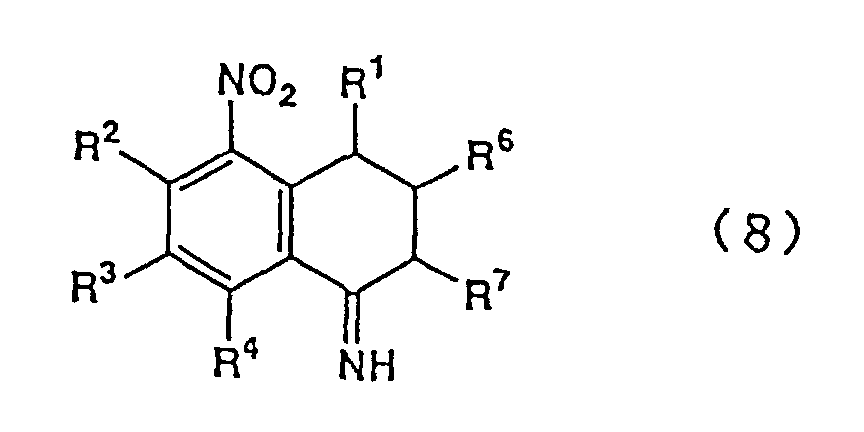
- a 5-nitro-1-tetralone derivative may be converted into a 1,5-diaminonaphthalene derivative via an imine instead of an oxime.
- a 5-nitro-1-tetralone derivative may be converted into an imine by reacting the nitro compound with an excessive amount of ammonia and/or an ammonium salt.
- a dehydrating agent may be added.
- the reaction may be conducted at an ambient or increased pressure, but when using ammonia, the reaction is preferably conducted at an increased pressure.
- Aromatization of the tetralin ring and reduction of the nitro groups after imine formation may proceed via hydrogen transfer, using a hydrogenation catalyst such as Raney metals, e. g., Raney Ni and Raney Co and platinum group catalysts, e. g., Pd/C and Pt/alumina. Hydrogenation may be conducted in the presence of hydrogen for reducing partially remaining nitro and nitroso groups. Aromatization of the tetralin ring and reduction of the nitro group may be conducted in one step. Specifically, the imine may be converted into a 1,5-diaminonaphthalene derivative using a hydrogenation catalyst in the presence of hydrogen.
- a hydrogenation catalyst such as Raney metals, e. g., Raney Ni and Raney Co and platinum group catalysts, e. g., Pd/C and Pt/alumina. Hydrogenation may be conducted in the presence of hydrogen for reducing partially remaining nitro and nitroso groups.
- a 5-nitro-1-tetralone derivative may be converted into a 1,5-diaminonaphthalene derivative using a hydrogenation catalyst in the presence of ammonia and/or an ammonium salt together with hydrogen.
- All the reactions of imine formation, aromatization and reduction of the nitro group may be conducted in a gaseous or liquid phase, and batchwise or in a continuous system.
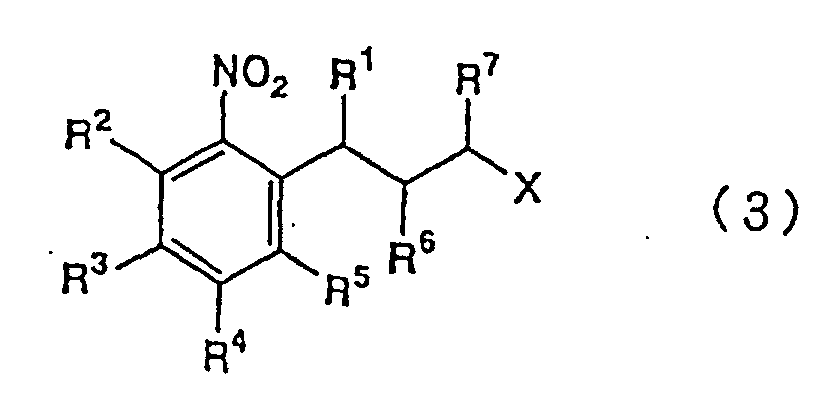
- a product 1,5-diaminonaphthalene derivative in the present invention is a compound represented by general formula (5), where R 1 to R 4 and R 6 to R 7 are as defined in formulas (1) and (2).
- 1,5-diaminonaphthalene derivative used in the present invention examples include 1,5-diaminonaphthalene, 2-methyl-1,5-diaminonaphthalene, 3-methyl-1,5-diaminonaphthalene, 3-ethyl-1,5-diaminonaphthalene, 3-chloro-1,5-diaminonaphthalene, 4-n-propyl-1,5-diaminonaphthalene, 6-isopropyl-1,5-diaminonaphthalene, 6-n-butyl-1,5-diaminonaphthalene, 7-t-butyl-1,5-diaminonaphthalene, 8-methyl-1,5-diaminonaphthalene, 6-chloro-1,5-diaminonaphthalene, 2,6-dimethyl-1,5-diaminonaphthalene and 4,8-dimethyl-1,5-diaminona
- a 4-(2-nitrobenzene)butyric acid may be prepared by treating the above methyl ester as follows.
- acetic acid was dissolved 55 g of methyl 4-(2-nitrobenzene)butyrate (0.247 mol).
- To the mixture were added 44 g of water (2.47 mol) and 5 g of 3N aqueous HCl.
- the mixture was heated for 5 hours under reflux for hydrolysis.
- the flask was equipped with a short distilling column, and then 65 g of FSO 3 H was recovered by distillation at a reduced pressure (0.027 MPa).
- the recovered FSO 3 H did not exhibit reduced activity in the cyclization even after repeated use in the reaction.
- Into 500 mL of ice-water was poured a mixture containing 5-nitro-1-tetralone and sulfuric acid generated by decomposition of a part of the superacid, and the resulting mixture was extracted with butyl acetate (150 mL ⁇ 2). The extract was washed with water (100 mL ⁇ 3) and dried over sodium sulfate.
- the sulfuric-acid containing solution after phase separation of the reaction mixture using butyl acetate may be effectively utilized for neutralizing the aqueous solution containing the base used in Example 1.
- a reaction was conducted as described in Example 4, except that 2.09 g of 4-(2-nitrobenzene)butyric acid was used as a starting material. As a result, a conversion rate of 4-(2-nitrobenzene)butyric acid was 100 %, the desired 5-nitro-1-tetralone was formed in an yield of 71 %, and no isomers having nitro and/or carbonyl groups in different substitution positions were detected.
- a reaction was conducted as described in Example 4, except that 2.23 g of methyl 4-(2-nitrobenzene)butyrate was used as a starting material. As a result, a conversion rate of methyl 4-(2-nitrobenzene)butyrate was 100 %, the desired 5-nitro-1-tetralone was formed in an yield of 71 %, and no isomers having nitro and/or carbonyl groups in different substitution positions were detected.
- a reaction was conducted as described in Example 4, except that 2.09 g of 4-(2-nitrobenzene)butyric acid was used as a starting material and 15 g of FSO 3 H and 0.325 g of SbF 5 were used as a superacid. As a result, a conversion rate of 4-(2-nitrobenzene)butyric acid was 100 %, the desired 5-nitro-1-tetralone was formed in an yield of 81 %, and no isomers having nitro and/or carbonyl groups in different substitution positions were detected.
- Example 10 A reaction and work-up were conducted as described in Example 10, replacing acrylonitrile with 106.5 g of methyl acrylate (1.2 mol) to give a yellow viscous liquid (161.5 g).
- the viscous liquid contained a mixture of 4-(2-nitrobenzene)butyric acid and methyl 4-(2-nitrobenzene)butyrate. They might be directly separated by column chromatography or the ester alone might be collected by distillation. However, for minimizing a collection loss, the mixture was dissolved in ethyl ether, and the carboxylic acid was esterified with diazomethane into the methyl ester, which was then distilled to isolate the methyl ester with a high purity. Its purity as methyl 4-(2-nitrobenzene)butyrate was 99.5 % and an yield on the basis of methyl acrylate was 60 %.
- Example 12 A reaction and work-up were conducted as described in Example 12, except that the amount of 85 wt% powdered KOH was 7.9 g (0.12 mol) to give 174.1 g of a yellow viscous liquid. Its purity as methyl 4-(2-nitrobenzene)butyrate was 99.5 %, and an yield on the basis of methyl acrylate was 65 %.
- Example 12 A reaction and work-up were conducted as described in Example 12, except that acrylonitrile and DMI were replaced with 106.5 g of methyl acrylate (1.2 mol) and 1.2 L of DMSO, respectively. After isolation, a purity as methyl 4-(2-nitrobenzene)butyrate was 99.5 %, and an yield on the basis of methyl acrylate was 3 %.
- the ortho-alkylnitrobenzene derivative and a vinyl compound as starting materials are used to prepare a corresponding 1,5-diaminonaphthalene derivative via a 5-nitro-1-tetralone derivative
- the ortho-alkylnitrobenzene derivative and a vinyl compound having an electron withdrawing group such as an acrylonitrile derivative and an acrylate may be reacted in the presence of a strong base to safely and cost-effectively provide an aromatic nitro compound such as a nitrobenzenenitrile derivative, a nitrobenzenecarboxylate, a nitrobenzenecarboxylic acid and a nitrobenzenecarboxamide.
- a 4-(2-nitrobenzene)butanonitrile derivative, a 4-(2-nitrobenzene)butyric acid derivative, a 4-(2-nitrobenzene)butyrate or a 4-(2-nitrobenzene)butyramide derivative as a starting material may be cyclized to provide a 5-nitro-1-tetralone derivative in a high yield.
- a 5-nitro-1-tetralone derivative may be used as a starting material to provide a corresponding 1,5-diaminonaphthalene derivative without forming any isomer.
Landscapes
- Chemical & Material Sciences (AREA)
- Organic Chemistry (AREA)
- Chemical Kinetics & Catalysis (AREA)
- Organic Low-Molecular-Weight Compounds And Preparation Thereof (AREA)
- Low-Molecular Organic Synthesis Reactions Using Catalysts (AREA)
Abstract
Description


1H-NMR (CDCl3): 7.90 ppm (1H, d-d, J = 1.1 Hz, 8.1 Hz, Ar-H), 7.53 ppm (1H, m, Ar-H), 7.37 ppm (2H, m, Ar-H), 5.40 (2H, b-s, NH2), 2.94 ppm (2H, d-d, J = 7.6 Hz, 10 Hz, CH2), 2.33 ppm (2H, t, J = 7.4 Hz, CH2), 2.03 ppm (2H, m, CH2);
IR (KBr): 3402, 3210, 1650, 1522, 1336 (cm-1);
FD-MS: M/Z = 209.
Claims (7)
- A process for preparing a 1,5-diaminonaphthalene derivative comprising:wherein R1 to R4 and R6 to R7 are as defined in formulas (1) and (2).(i) the first step comprising reacting an ortho-alkylnitrobenzene represented by formula (1):wherein R1 to R4, which may be the same or different, represent hydrogen, alkyl having 1 to 4 carbon atoms, aromatic hydrocarbon having 6 to 12 carbon atoms, or halogen; and R5 represents hydrogen, with a vinyl compound represented by formula (2):
 wherein R6 and R7, which may be the same or different, represent hydrogen, alkyl having 1 to 4 carbon atoms, or halogen; and X represents an electron withdrawing group, provided that R6 and R7 are mutually cis- or trans-configured, in the presence of a base, to produce an aromatic nitro compound represented by formula (3):
 wherein R1 to R7 are as defined in formulas (1) and (2); and X represents an electron withdrawing group, which may be the same as or different from X as defined in formula (2);
 (ii) the second step of cyclizing the aromatic nitro compound represented by formula (3) to produce a 5-nitro-1-tetralone derivative represented by formula (4):wherein R1 to R4 and R6 to R7 are as defined in formulas (1) and (2); and
 (iii) the third step comprising reacting the 5-nitro-1-tetralone derivative represented by formula (4) with an amine to provide an intermediate, which is then reduced and aromatized to produce the 1,5-diaminonaphthalene derivative represented by formula (5):
- The process as claimed in Claim 1, wherein X in formula (2) is one selected from the group consisting of CN and CO2R8 where R8 represents alkyl having 1 to 7 carbon atoms, cycloalkyl, aromatic hydrocarbon having 6 to 12 carbon atoms or aralkyl.
- The process as claimed in Claim 1, wherein X in formula (3) is one selected from the group consisting of CONH2, CN, CO2H and CO2R8 where R8 represents alkyl having 1 to 7 carbon atoms, cycloalkyl, aromatic hydrocarbon having 6 to 12 carbon atoms or aralkyl.
- The process as claimed in Claim 1 or 2, wherein the reaction of the ortho-alkylnitrobenzene represented by formula (1) with the vinyl compound represented by formula (2) in the first step is conducted in the presence of at least one selected from the group consisting of a solvent capable of dissolving at least part of the base and a catalyst capable of solubilizing the base.
- The process as claimed in Claim 4, wherein the solvent capable of dissolving at least part of the base is a circular urea derivative.
- The process as claimed in any of Claims 1 to 5, wherein in the third step, a hydroxylamine derivative as the amine is reacted with the 5-nitro-1-tetralone derivative represented by formula (4) or an ammonia derivative as the amine is reacted with the 5-nitro-1-tetralone derivative represented by formula (4) in the presence of hydrogen peroxide, to provide an oxime represented by formula (6):wherein R1 to R4 and R6 to R7 are as defined in formulas (1) and (2), which is then converted by aromatization into a 5-nitro-1-aminonaphthalene derivative represented by formula (7):
 wherein R1 to R4 and R6 to R7 are as defined in formulas (1) and (2), which is then reduced into the 1,5-diaminonaphthalene derivative represented by formula (5).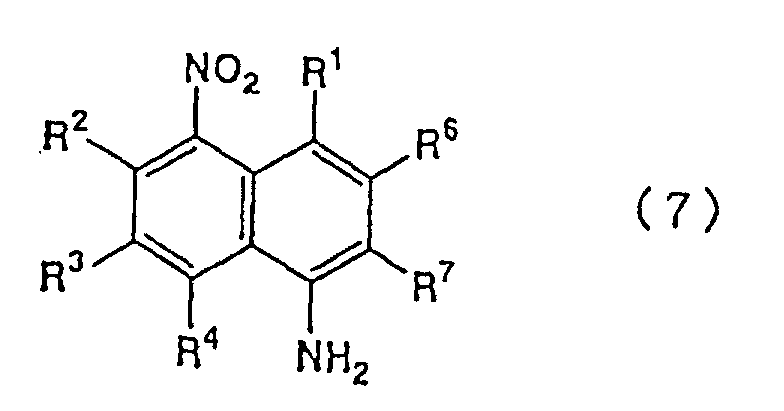
- The process as claimed in any of Claims 1 to 5, wherein in the third step, an ammonia derivative as the amine is reacted with the 5-nitro-1-tetralone derivative represented by formula (4) to provide an imine represented by formula (8):wherein R1 to R4 and R6 to R7 are as defined in formulas (1) and (2), which is then reduced and aromatized to provide the 1,5-diaminonaphthalene derivative represented by formula (5).
Applications Claiming Priority (7)
| Application Number | Priority Date | Filing Date | Title |
|---|---|---|---|
| JP2001136962 | 2001-05-08 | ||
| JP2001136962 | 2001-05-08 | ||
| JP2001161619 | 2001-05-30 | ||
| JP2001161619 | 2001-05-30 | ||
| JP2001271763 | 2001-09-07 | ||
| JP2001271763 | 2001-09-07 | ||
| PCT/JP2002/004398 WO2002090315A1 (en) | 2001-05-08 | 2002-05-02 | Process for preparation of 1,5-diaminonaphthalenes |
Publications (3)
| Publication Number | Publication Date |
|---|---|
| EP1295864A1 true EP1295864A1 (en) | 2003-03-26 |
| EP1295864A4 EP1295864A4 (en) | 2005-12-28 |
| EP1295864B1 EP1295864B1 (en) | 2008-12-03 |
Family
ID=27346664
Family Applications (1)
| Application Number | Title | Priority Date | Filing Date |
|---|---|---|---|
| EP02724682A Expired - Lifetime EP1295864B1 (en) | 2001-05-08 | 2002-05-02 | Process for preparation of 1,5-diaminonaphthalenes |
Country Status (5)
| Country | Link |
|---|---|
| US (1) | US6737548B2 (en) |
| EP (1) | EP1295864B1 (en) |
| CN (1) | CN1464874A (en) |
| DE (1) | DE60230097D1 (en) |
| WO (1) | WO2002090315A1 (en) |
Cited By (1)
| Publication number | Priority date | Publication date | Assignee | Title |
|---|---|---|---|---|
| EP1369412A1 (en) * | 2002-06-03 | 2003-12-10 | Bayer Ag | Process for the preparation of 5-nitro-3,4-dihydro-1(2H)-naphthalenone, 1,5-naphthalendiamine and 1,5-naphthalendiisocyanate |
Families Citing this family (4)
| Publication number | Priority date | Publication date | Assignee | Title |
|---|---|---|---|---|
| CN1301245C (en) * | 2002-12-04 | 2007-02-21 | 三井化学聚氨酯株式会社 | Method for producing 1,5-diaminonaphthalene |
| US8376942B2 (en) * | 2005-05-06 | 2013-02-19 | Welch Allyn, Inc. | Articulation mechanism for a vaginal speculum |
| CN101434549B (en) * | 2008-11-07 | 2012-05-23 | 甘肃中科药源生物工程有限公司 | Method for preparing 1, 4-diaminonaphthalene from 1, 4-dinitronaphthalene |
| CR20210541A (en) | 2019-03-29 | 2021-12-20 | Medimmune Ltd | COMPOUNDS AND CONJUGATES OF THESE |
Family Cites Families (11)
| Publication number | Priority date | Publication date | Assignee | Title |
|---|---|---|---|---|
| US3787496A (en) | 1971-04-29 | 1974-01-22 | Exxon Research Engineering Co | Preparation of aromatic compounds via benzyne intermediates |
| DE2453529A1 (en) | 1974-11-12 | 1976-05-13 | Bayer Ag | PROCESS FOR THE MANUFACTURING OF NITRONAPHTHALINES |
| DE2531281C3 (en) | 1975-07-12 | 1980-12-04 | Bayer Ag, 5090 Leverkusen | Process for the preparation of aminonaphthalene derivatives |
| DE3039085A1 (en) | 1980-10-16 | 1982-05-27 | Basf Ag, 6700 Ludwigshafen | METHOD FOR PRODUCING PRIMARY AROMATIC AMINES FROM CYCLIC KETONES |
| US5113025A (en) | 1989-10-02 | 1992-05-12 | Ethyl Corporation | Selective reducing agents |
| JP3008226B2 (en) | 1991-01-16 | 2000-02-14 | 第一製薬株式会社 | Hexacyclic compounds |
| JP3359955B2 (en) * | 1992-07-16 | 2002-12-24 | 第一製薬株式会社 | Antitumor agent |
| JPH07278066A (en) | 1994-04-08 | 1995-10-24 | Mitsui Toatsu Chem Inc | Method for producing 1,5-diaminonaphthalene |
| DE19739202C1 (en) | 1997-09-08 | 1999-03-25 | Bayer Ag | Process for the preparation of a dinitronaphthalene isomer mixture with a high proportion of 1,5-dinitronaphthalene |
| WO2002051792A1 (en) | 2000-12-22 | 2002-07-04 | Bayer Aktiengesellschaft | Method for the production of 1,5-naphthalenediamine |
| JP5929061B2 (en) | 2011-09-15 | 2016-06-01 | セイコーエプソン株式会社 | Robot controller, robot system, robot |
-
2002
- 2002-05-02 CN CN02802290A patent/CN1464874A/en active Pending
- 2002-05-02 WO PCT/JP2002/004398 patent/WO2002090315A1/en not_active Ceased
- 2002-05-02 EP EP02724682A patent/EP1295864B1/en not_active Expired - Lifetime
- 2002-05-02 US US10/312,852 patent/US6737548B2/en not_active Expired - Fee Related
- 2002-05-02 DE DE60230097T patent/DE60230097D1/en not_active Expired - Lifetime
Cited By (4)
| Publication number | Priority date | Publication date | Assignee | Title |
|---|---|---|---|---|
| EP1369412A1 (en) * | 2002-06-03 | 2003-12-10 | Bayer Ag | Process for the preparation of 5-nitro-3,4-dihydro-1(2H)-naphthalenone, 1,5-naphthalendiamine and 1,5-naphthalendiisocyanate |
| US7057071B2 (en) | 2002-06-03 | 2006-06-06 | Bayer Materialscience Ag | Process for producing 5-nitro-3,4-dihydro-1(2H)-naphthalinone, 1-5-naphthalenediamine and 1,5-naphthalene diisocyanate |
| US7202384B2 (en) | 2002-06-03 | 2007-04-10 | Bayer Materialscience Aktiengesellschaft | Process for producing 5-nitro-3,4-dihydro-1(2H)-naphthalinone, 1,5-naphthalenediamine and 1,5-naphthalene diisocyanate |
| US7202378B2 (en) | 2002-06-03 | 2007-04-10 | Bayer Materialscience Ag | Process for producing 5-nitro-3,4-dihydro-1(H)-naphthalinone, 1,5-naphthalenediamine and 1,5-naphthalene diisocyanate |
Also Published As
| Publication number | Publication date |
|---|---|
| US6737548B2 (en) | 2004-05-18 |
| EP1295864B1 (en) | 2008-12-03 |
| WO2002090315A1 (en) | 2002-11-14 |
| EP1295864A4 (en) | 2005-12-28 |
| US20030176722A1 (en) | 2003-09-18 |
| DE60230097D1 (en) | 2009-01-15 |
| CN1464874A (en) | 2003-12-31 |
Similar Documents
| Publication | Publication Date | Title |
|---|---|---|
| EP1294658B1 (en) | Process for the preparation of nitroalkenes | |
| US6376712B2 (en) | Process for producing trifluoromethylbenzylamines | |
| CN109678741B (en) | Preparation method of 4-amino-3-fluorobenzoic acid | |
| JP4412449B2 (en) | Method for producing diaminoresorcinol compound | |
| US4387246A (en) | Method of preparing orthotrifluoromethyl aniline | |
| US6737548B2 (en) | Process for preparing 1,5-diaminonaphthalene derivative | |
| US6706924B2 (en) | Process for the production of 1,5-naphthalenediamine | |
| HU195763B (en) | Process for production of derivatives of nitrosubstituated benzotrifluorid | |
| CN109867604B (en) | Production process of p-aminobenzamide | |
| CN104245660A (en) | Method for preparing N-(5-chloro-2-isopropylbenzyl)-cyclopropylamine | |
| KR100656728B1 (en) | Process for preparing polyhalogenated paratrifluoromethylaniline | |
| US20030191341A1 (en) | Chemical process | |
| EP0143769B1 (en) | Preparation of ortho-aminobenzotrifluoride | |
| JP2003155267A (en) | Method for producing 1,5-diaminonaphthalenes | |
| JP2003081921A (en) | Method for producing 1,5-diaminonaphthalene | |
| CN101489976A (en) | A kind of method for preparing 1 ' unbranched alkenyl nitrobenzene derivatives | |
| JP2002293773A (en) | Method for producing quinazoline derivative | |
| JP3193421B2 (en) | Method for producing 2-amino-4-fluorobenzoic acid | |
| US6992223B2 (en) | Method for producing 2-benzylaniline | |
| US20040242942A1 (en) | Process for producing 2,5-bis(trifluoromethyl)nitrobenzene | |
| CN103068789B (en) | The method of position chlorination alkyl benzene amine between selectivity | |
| JPS6054948B2 (en) | Method for producing aromatic amines from α,β↓-unsaturated cycloaliphatic ketoxime | |
| JPH01228943A (en) | Production of 2,4-dichloro-3-alkyl-6-nitrophenol | |
| KR100561201B1 (en) | Method for Purifying Substituted P-nitrodiphenyl Ether | |
| JPH04275261A (en) | Preparation of 3,5-diaminobenzo- trifluoride |
Legal Events
| Date | Code | Title | Description |
|---|---|---|---|
| PUAI | Public reference made under article 153(3) epc to a published international application that has entered the european phase |
Free format text: ORIGINAL CODE: 0009012 |
|
| 17P | Request for examination filed |
Effective date: 20030113 |
|
| AK | Designated contracting states |
Kind code of ref document: A1 Designated state(s): AT BE CH CY DE DK ES FI FR GB GR IE IT LI LU MC NL PT SE TR |
|
| RAP1 | Party data changed (applicant data changed or rights of an application transferred) |
Owner name: MITSUI CHEMICALS, INC. |
|
| A4 | Supplementary search report drawn up and despatched |
Effective date: 20051111 |
|
| RAP1 | Party data changed (applicant data changed or rights of an application transferred) |
Owner name: MITSUI CHEMICALS POLYURETHANES, INC. |
|
| 17Q | First examination report despatched |
Effective date: 20070524 |
|
| GRAP | Despatch of communication of intention to grant a patent |
Free format text: ORIGINAL CODE: EPIDOSNIGR1 |
|
| GRAS | Grant fee paid |
Free format text: ORIGINAL CODE: EPIDOSNIGR3 |
|
| GRAA | (expected) grant |
Free format text: ORIGINAL CODE: 0009210 |
|
| AK | Designated contracting states |
Kind code of ref document: B1 Designated state(s): DE |
|
| REF | Corresponds to: |
Ref document number: 60230097 Country of ref document: DE Date of ref document: 20090115 Kind code of ref document: P |
|
| PLBE | No opposition filed within time limit |
Free format text: ORIGINAL CODE: 0009261 |
|
| STAA | Information on the status of an ep patent application or granted ep patent |
Free format text: STATUS: NO OPPOSITION FILED WITHIN TIME LIMIT |
|
| 26N | No opposition filed |
Effective date: 20090904 |
|
| PGFP | Annual fee paid to national office [announced via postgrant information from national office to epo] |
Ref country code: DE Payment date: 20170523 Year of fee payment: 16 |
|
| REG | Reference to a national code |
Ref country code: DE Ref legal event code: R119 Ref document number: 60230097 Country of ref document: DE |
|
| PG25 | Lapsed in a contracting state [announced via postgrant information from national office to epo] |
Ref country code: DE Free format text: LAPSE BECAUSE OF NON-PAYMENT OF DUE FEES Effective date: 20181201 |