EP1295608A1 - Remedial agent for anxiety neurosis or depression and piperazine derivative - Google Patents

Remedial agent for anxiety neurosis or depression and piperazine derivative Download PDF

Info

Publication number
EP1295608A1
EP1295608A1 EP01943844A EP01943844A EP1295608A1 EP 1295608 A1 EP1295608 A1 EP 1295608A1 EP 01943844 A EP01943844 A EP 01943844A EP 01943844 A EP01943844 A EP 01943844A EP 1295608 A1 EP1295608 A1 EP 1295608A1
Authority
EP
European Patent Office
Prior art keywords
group
substituted
compound
hydrogen atom
phenyl
Prior art date
Legal status (The legal status is an assumption and is not a legal conclusion. Google has not performed a legal analysis and makes no representation as to the accuracy of the status listed.)
Withdrawn
Application number
EP01943844A
Other languages
German (de)
French (fr)
Other versions
EP1295608A4 (en
Inventor
Atsuro c/o TAISHO PHARM. CO. LTD NAKAZATO
Shigeyuki c/o TAISHO PHARM. CO. LTD CHAKI
Taketoshi c/o TAISHO PHARM. CO. LTD OKUBO
Shin-Ichi c/o TAISHO PHARM. CO. LTD OGAWA
Takaaki c/o TAISHO PHARM. CO. LTD ISHII
Current Assignee (The listed assignees may be inaccurate. Google has not performed a legal analysis and makes no representation or warranty as to the accuracy of the list.)
Taisho Pharmaceutical Co Ltd
Original Assignee
Taisho Pharmaceutical Co Ltd
Priority date (The priority date is an assumption and is not a legal conclusion. Google has not performed a legal analysis and makes no representation as to the accuracy of the date listed.)
Filing date
Publication date
Application filed by Taisho Pharmaceutical Co Ltd filed Critical Taisho Pharmaceutical Co Ltd
Publication of EP1295608A1 publication Critical patent/EP1295608A1/en
Publication of EP1295608A4 publication Critical patent/EP1295608A4/en
Withdrawn legal-status Critical Current

Links

Images

Classifications

    • CCHEMISTRY; METALLURGY
    • C07ORGANIC CHEMISTRY
    • C07DHETEROCYCLIC COMPOUNDS
    • C07D295/00Heterocyclic compounds containing polymethylene-imine rings with at least five ring members, 3-azabicyclo [3.2.2] nonane, piperazine, morpholine or thiomorpholine rings, having only hydrogen atoms directly attached to the ring carbon atoms
    • C07D295/04Heterocyclic compounds containing polymethylene-imine rings with at least five ring members, 3-azabicyclo [3.2.2] nonane, piperazine, morpholine or thiomorpholine rings, having only hydrogen atoms directly attached to the ring carbon atoms with substituted hydrocarbon radicals attached to ring nitrogen atoms
    • C07D295/12Heterocyclic compounds containing polymethylene-imine rings with at least five ring members, 3-azabicyclo [3.2.2] nonane, piperazine, morpholine or thiomorpholine rings, having only hydrogen atoms directly attached to the ring carbon atoms with substituted hydrocarbon radicals attached to ring nitrogen atoms substituted by singly or doubly bound nitrogen atoms
    • C07D295/125Heterocyclic compounds containing polymethylene-imine rings with at least five ring members, 3-azabicyclo [3.2.2] nonane, piperazine, morpholine or thiomorpholine rings, having only hydrogen atoms directly attached to the ring carbon atoms with substituted hydrocarbon radicals attached to ring nitrogen atoms substituted by singly or doubly bound nitrogen atoms with the ring nitrogen atoms and the substituent nitrogen atoms attached to the same carbon chain, which is not interrupted by carbocyclic rings
    • AHUMAN NECESSITIES
    • A61MEDICAL OR VETERINARY SCIENCE; HYGIENE
    • A61KPREPARATIONS FOR MEDICAL, DENTAL OR TOILETRY PURPOSES
    • A61K31/00Medicinal preparations containing organic active ingredients
    • A61K31/33Heterocyclic compounds
    • A61K31/395Heterocyclic compounds having nitrogen as a ring hetero atom, e.g. guanethidine or rifamycins
    • A61K31/495Heterocyclic compounds having nitrogen as a ring hetero atom, e.g. guanethidine or rifamycins having six-membered rings with two or more nitrogen atoms as the only ring heteroatoms, e.g. piperazine or tetrazines
    • AHUMAN NECESSITIES
    • A61MEDICAL OR VETERINARY SCIENCE; HYGIENE
    • A61KPREPARATIONS FOR MEDICAL, DENTAL OR TOILETRY PURPOSES
    • A61K31/00Medicinal preparations containing organic active ingredients
    • A61K31/33Heterocyclic compounds
    • A61K31/395Heterocyclic compounds having nitrogen as a ring hetero atom, e.g. guanethidine or rifamycins
    • A61K31/495Heterocyclic compounds having nitrogen as a ring hetero atom, e.g. guanethidine or rifamycins having six-membered rings with two or more nitrogen atoms as the only ring heteroatoms, e.g. piperazine or tetrazines
    • A61K31/496Non-condensed piperazines containing further heterocyclic rings, e.g. rifampin, thiothixene or sparfloxacin
    • AHUMAN NECESSITIES
    • A61MEDICAL OR VETERINARY SCIENCE; HYGIENE
    • A61KPREPARATIONS FOR MEDICAL, DENTAL OR TOILETRY PURPOSES
    • A61K45/00Medicinal preparations containing active ingredients not provided for in groups A61K31/00 - A61K41/00
    • A61K45/06Mixtures of active ingredients without chemical characterisation, e.g. antiphlogistics and cardiaca
    • AHUMAN NECESSITIES
    • A61MEDICAL OR VETERINARY SCIENCE; HYGIENE
    • A61PSPECIFIC THERAPEUTIC ACTIVITY OF CHEMICAL COMPOUNDS OR MEDICINAL PREPARATIONS
    • A61P25/00Drugs for disorders of the nervous system
    • AHUMAN NECESSITIES
    • A61MEDICAL OR VETERINARY SCIENCE; HYGIENE
    • A61PSPECIFIC THERAPEUTIC ACTIVITY OF CHEMICAL COMPOUNDS OR MEDICINAL PREPARATIONS
    • A61P25/00Drugs for disorders of the nervous system
    • A61P25/22Anxiolytics
    • AHUMAN NECESSITIES
    • A61MEDICAL OR VETERINARY SCIENCE; HYGIENE
    • A61PSPECIFIC THERAPEUTIC ACTIVITY OF CHEMICAL COMPOUNDS OR MEDICINAL PREPARATIONS
    • A61P25/00Drugs for disorders of the nervous system
    • A61P25/24Antidepressants
    • CCHEMISTRY; METALLURGY
    • C07ORGANIC CHEMISTRY
    • C07CACYCLIC OR CARBOCYCLIC COMPOUNDS
    • C07C2601/00Systems containing only non-condensed rings
    • C07C2601/02Systems containing only non-condensed rings with a three-membered ring
    • CCHEMISTRY; METALLURGY
    • C07ORGANIC CHEMISTRY
    • C07CACYCLIC OR CARBOCYCLIC COMPOUNDS
    • C07C2601/00Systems containing only non-condensed rings
    • C07C2601/06Systems containing only non-condensed rings with a five-membered ring
    • C07C2601/08Systems containing only non-condensed rings with a five-membered ring the ring being saturated
    • CCHEMISTRY; METALLURGY
    • C07ORGANIC CHEMISTRY
    • C07CACYCLIC OR CARBOCYCLIC COMPOUNDS
    • C07C2601/00Systems containing only non-condensed rings
    • C07C2601/12Systems containing only non-condensed rings with a six-membered ring
    • C07C2601/14The ring being saturated

Definitions

  • Melanocortin receptors are classified into 5 subtypes of MC 1 - MC 5 .
  • melanocortin receptor subtype MC 4 is reported as peptidergic selective agonist or antagonist, but there is no report on stress reaction and anti-anxiety action of these agonists or antagonists.
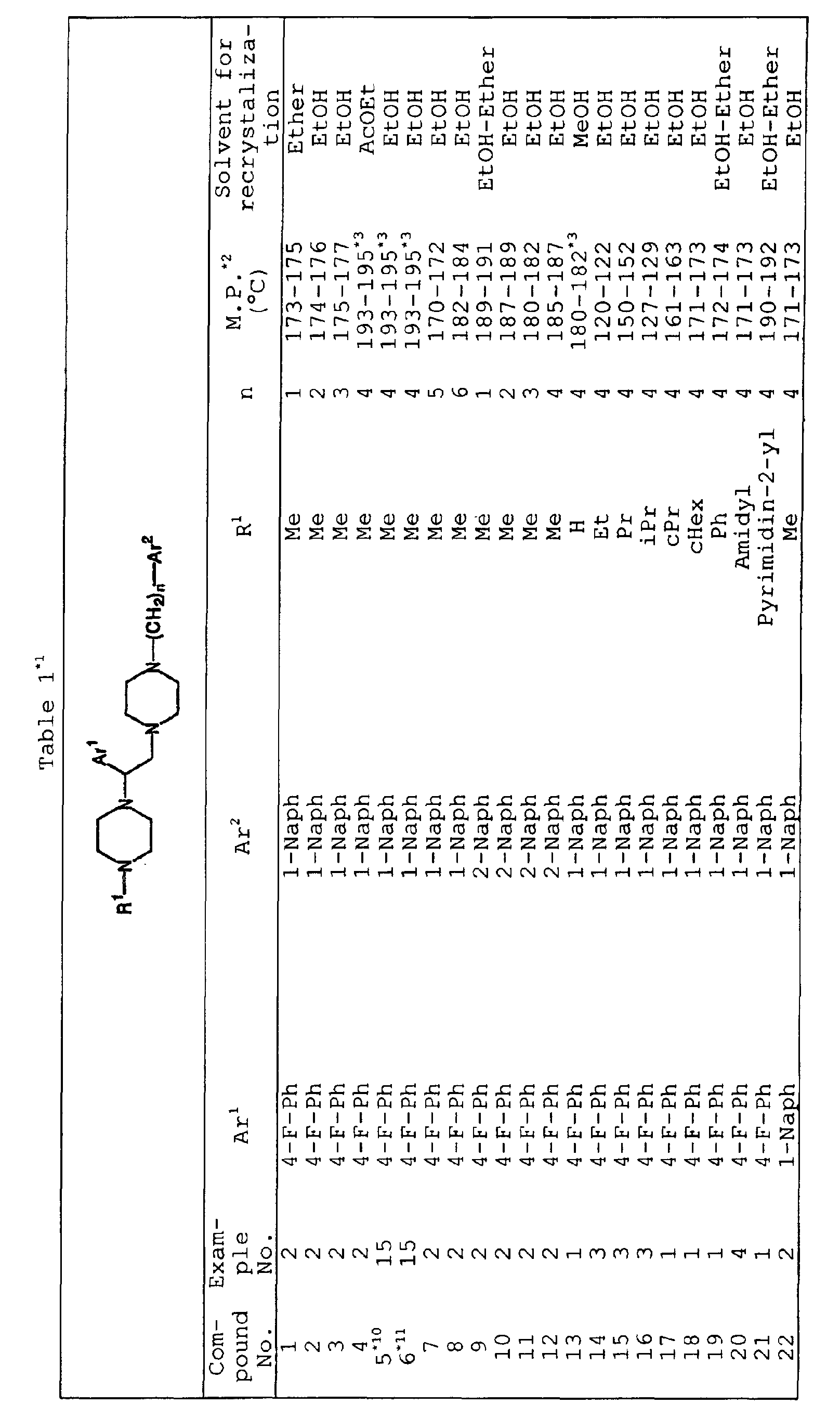
  • Compound 4 of the present invention in Table 1 acts as a high selective antagonist in recombinant human melanocortin receptors.
  • MC 4 receptor agonists have been found to have anxiety inducing action
  • MC 4 receptor antagonists have been found to be effective for treatment of anxiety neurosis and depression because of their anti-stress, anti-anxiety and anti-depression actions.
  • novel piperazine derivatives of MC 4 receptor antagonists have been found, and thereby the present invention has been accomplished.
  • the antagonist which belongs to MC 4 receptor means a compound which has an antagonistic action to MC 4 receptor, and preferably means a compound having an concentration-dependent inhibition action in the receptor binding test using MC 4 receptor-expressed cells according to the method described in J. Biol. Chem., 268; 15174-15179, 1993, having equivalent or higher affinity to MC 4 receptor than ⁇ -MSH, and antagonizing to an action of ⁇ -MSH when the amount of cAMP stimulated by ⁇ -MSH is measured by means of a cAMP measurement kit.
  • the C 1-10 alkyl group refers to a straight or branched alkyl group having 1 to 10 carbon atoms, and examples which are a methyl group, an ethyl group, a propyl group, an isopropyl group, a butyl group, an isobutyl group, a pentyl group, an isopentyl group, a 1-ethylpropyl group, a hexyl group, an isohexyl group, a 1-ethylbutyl group, a heptyl group, an isoheptyl group, an octyl group, a nonyl group and a decyl group.
  • the C 3-10 alkenyl group refers to a straight or branched alkenyl group having 3 to 10 carbon atoms, and examples of which are an allyl group, a 1-buten-4-yl group, a 2-buten-4-yl group, a 1-penten-5-yl group, a 2-penten-5-yl group and a prenyl group.
  • the amino group substituted with one or two C 1-6 alkyl groups refers to an amino group substituted with 1 or 2 members of a straight or branched alkyl groups having 1 to 6 carbon atoms; and examples of which are a methylamino group, an ethylamino group, a propylamino group, a dimethylamino group, diethylamino group and a dipropylamino group.
  • Examples of the amino group represented by the formula: NR 11 (R 22 ) are a methylamino group, an ethylamino group, a propylamino group, a dimethylamino group, a diethylamino group and a dipropylamino group. Furthermore, examples of the cyclic amino group represented by the formula: NR 11 (R 22 ) are a pyrrolidino group, a piperidino group, a piperazino group, a morpholino group and a thiomorpholino group.
  • Examples of the amino group represented by the formula: NR 33 (R 44 ) are a methylamino group, an ethylamino group, a propylamino group, a dimethylamino group, a diethylamino group and a dipropylamino group. Furthermore, examples of the cyclic amino group represented by the formula: NR 33 (R 44 ) are a pyrrolidino group, a piperidino group, a piperazino group, a morpholino group and a thiomorpholino group.
  • the halogen atom refers to a fluorine atom, a chlorine atom, a bromine atom or an iodine atom.
  • the compounds of Formula [1] can be prepared by the following General Preparation Methods 1 to 17 (in the following reaction schemes, Ar 1 , Ar 2 , R 6 , T 1 and n are defined above;
  • X 1 is a chlorine atom, a bromine atom or an iodine atom;
  • T 2 is a single bond, -N(R 6 )- or -O-;
  • R 7 is a C 1-10 alkyl group;
  • R 8 is a C 1-10 alkyl group, a C 3-10 alkenyl group, a phenyl group or a pyrimidin-2-yl group;
  • R 9 is an ordinary amino-protective group such as a t-butoxycarbonyl group, an ethoxycarbonyl group or a benzyloxycarbonyl group;
  • R 10 is a C 1-10 alkyl group,
  • a compound (1) can be reacted with a compound (2) in the presence or absence of a base in an inert solvent to convert to a compound (3), followed by reduction of the carbonyl group in an inert solvent to synthesize a compound (4).
  • the compound (4) can be reacted with a halogenating agent or a sulfonylating agent such as an alkylsulfonyl halide or an arylsulfonyl halide in the presence or absence of a base in an inert solvent, thereby the hydroxyl group is converted to a suitable leaving group.
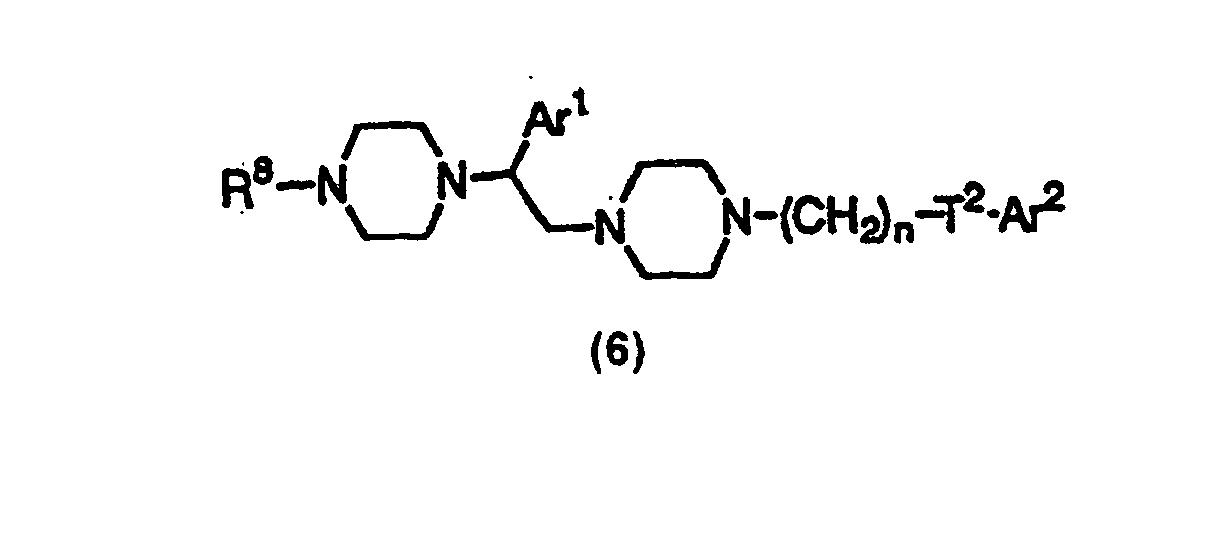
  • a compound (5) can be reacted in the presence or absence of a base in an inert solvent to give a compound (6) of the present invention.
  • the base includes, for example, organic amines (e.g., triethylamine, diisopropylethylamine and pyridine) and inorganic bases (e.g., potassium carbonate, sodium bicarbonate, sodium hydroxide, potassium hydroxide and sodium hydride).
  • the reduction includes, for example, a reduction under an acidic, neutral or basic condition using a boron reductant (e.g. sodium borohydride, sodium cyanoborohydride, lithium borohydride, L-Selectride and K-Selectride) or an aluminum reductant (e.g. lithium aluminum hydride, Red-Al or diisobutyl aluminum hydride).
  • a boron reductant e.g. sodium borohydride, sodium cyanoborohydride, lithium borohydride, L-Selectride and K-Selectride
  • an aluminum reductant e.g. lithium aluminum hydride, Red-Al or diisobutyl aluminum
  • the halogenating agent includes an ordinary halogenating agent of the hydroxyl group (e.g., thionyl chloride, thionyl bromide or phosphoryl chloride).
  • the sulfonylating agent such as an alkylsulfonyl halide or an arylsulfonyl halide include, for example, ordinary sulfonylating agents of the alcohol (e.g. methanesulfonyl chloride, benzenesulfonyl chloride, toluenesulfonyl chloride or trifluoromethanesulfonyl chloride).
  • the inert solvent include, for example, alcohols (e.g., methanol and ethanol), ethers (e.g., diethyl ether and tetrahydrofuran), hydrocarbons (e.g., toluene and benzene), halogenated carbon type solvents (e.g., chloroform and dichloromethane), dimethylformamide, acetonitrile, water and a mixture thereof.
  • alcohols e.g., methanol and ethanol
  • ethers e.g., diethyl ether and tetrahydrofuran
  • hydrocarbons e.g., toluene and benzene
  • halogenated carbon type solvents e.g., chloroform and dichloromethane
  • dimethylformamide acetonitrile
  • acetonitrile water and a mixture thereof.
  • a compound (9) can be prepared from the compound (1). Then, the amino group of the compound (9) can be deprotected to give a compound (10), which can be then condensed with a compound (11) in an inert solvent to give a compound (12). The amide group of the compound (12) can be reduced in an inert solvent to give a the compound (6) of the present invention.
  • the deprotection of the compound (9) can be carried out using the method described in Protective Groups in Organic Synthesis, by Theodora W. Greene and Peter G. M. Wuts.
  • the condensation includes, for example, an amidation via an acid halide(e.g., an acid chloride and an acid bromide), an amidation via a mixed acid anhydride using ethyl chlorocarbonate, isobutyl chlorocarbonate, etc., and an amidation using a condensing agent such as 1-(3,3-dimethylaminopropyl)-3-ethylcarbodiimide, 1,3-dicyclohexylcarbodiimide, diphenylphosphoryl azide, diethyl cyanophosphate or carbonyldiimidazole.
  • an acid halide e.g., an acid chloride and an acid bromide
  • an amidation via a mixed acid anhydride using ethyl chlorocarbonate isobutyl chlor
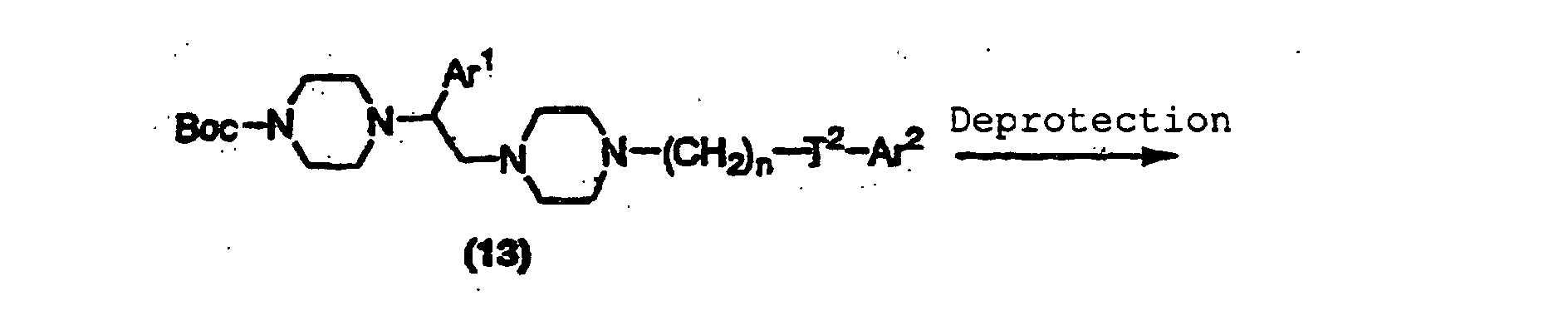
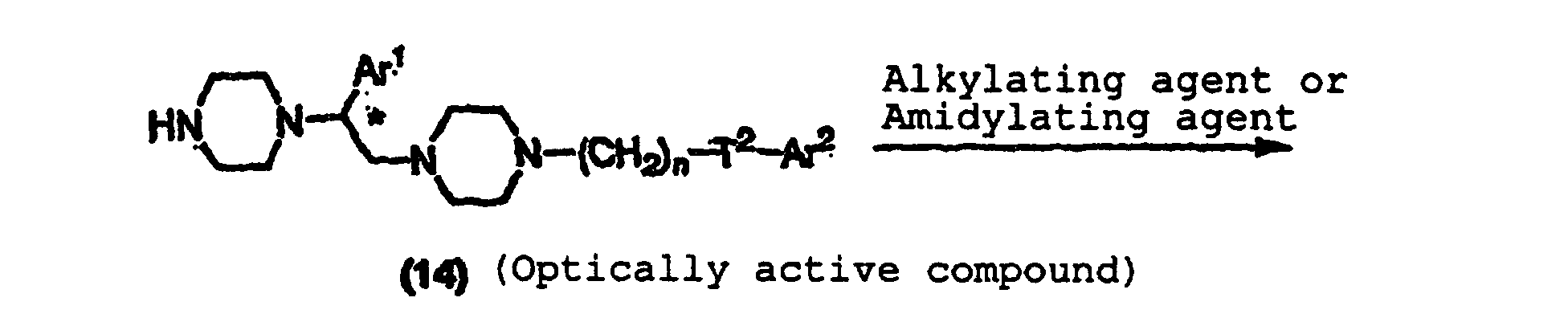
  • a compound (13) can be prepared from the compound (1). Removal of the Boc group of the compound (13) can give a compound (14) of the present invention. Then, the compound (14) can be reacted with an alkylating agent or an amidylating agent in the presence or absence of a base in an inert solvent to give a compound (15) of the present invention.
  • the removal of the Boc group of the compound (13) can be carried out according to the method described in Protective Groups in Organic Synthesis, by Theodora W. Greene and Peter G. M. Wuts.
  • the alkylating agent include, for example, alkyl halides (e.g., methyl iodide, ethyl iodide, 1-bromopropane, 2-bromopropane and 2-bromopropionitrile), alkyl sulfates (e.g., dimethyl sulfate and diethyl sulfate).
  • the amidylating agent includes, for example, an amidylating agent such as cyanamide, S-methylthiourea and aminoiminomethanesulfonic acid.
  • the base include, for example, organic amines (e.g., triethylamine, diisopropylethylamine and pyridine) and inorganic bases (e.g., potassium carbonate, sodium bicarbonate, sodium hydroxide, potassium hydroxide and sodium hydride).
  • the inert solvent include, for example, alcohols (e.g., methanol and ethanol), ethers (e.g., diethyl ether and tetrahydrofuran), hydrocarbons (e.g., toluene and benzene), halogenated carbon type solvents (e.g., chloroform and dichloromethane), dimethylformamide, acetonitrile, water and a mixture thereof.
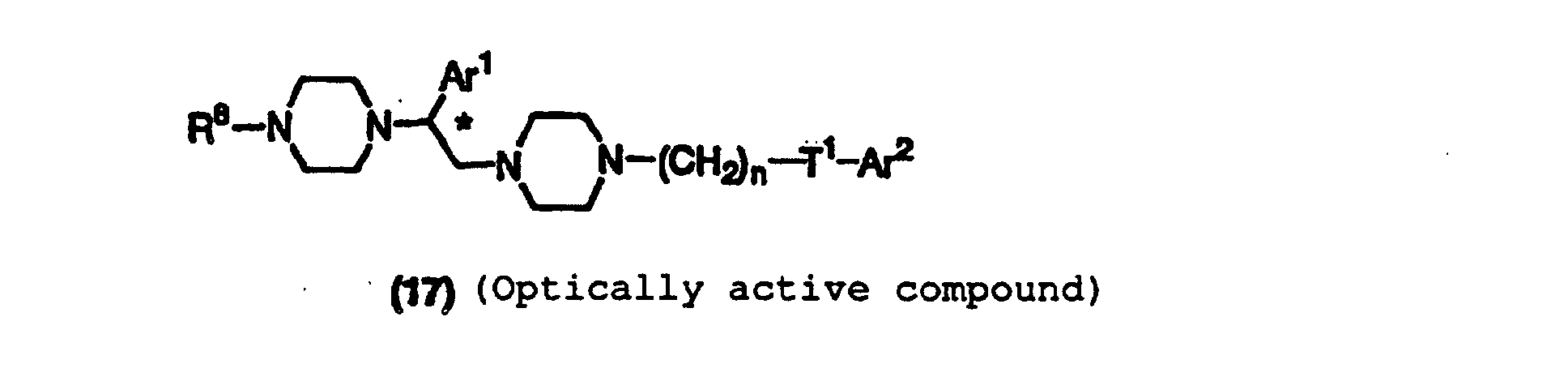
  • a compound (10) obtained according to the general preparation method 2 can be reacted with a compound (16) in the presence or absence of a base in an inert solvent to give a compound (17) of the present invention.
  • the base include, for example, organic amines (e.g., triethylamine, diisopropylethylamine and pyridine) and inorganic bases (e.g., potassium carbonate, sodium bicarbonate, sodium hydroxide, potassium hydroxide and sodium hydride).
  • the inert solvent include, for example, alcohols (e.g., methanol and ethanol), ethers (e.g., diethyl ether and tetrahydrofuran), hydrocarbons (e.g., toluene and benzene), halogenated carbon type solvents (e.g., chloroform and dichloromethane), dimethylformamide, acetonitrile, water and a mixture thereof.
  • a compound (18) can be treated with a base in an inert solvent and reacted with a compound (19) to give a compound (20), which can be then treated with an acid in an inert solvent to synthesize a compound (21).
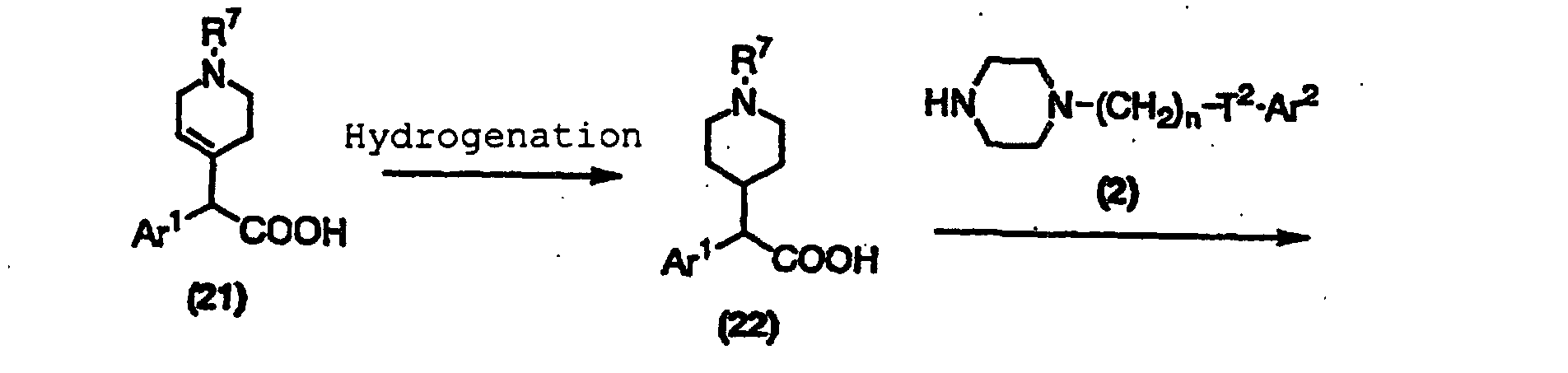
  • the compound (21) can be hydrogenated in an inert solvent to give a compound (22), which can be then condensed with the compound (2) to give a compound (23).
  • the amide group of the compound (23) can be reduced in an inert solvent to a compound (24) of the present invention.
  • the base include, for example, metal amides (e.g., lithium diisopropylamide, lithium hexamethyldisilazide, sodium hexamethyldisilazide and potassium hexamethyldisilazide) and metal hydrides (e.g., sodium hydride and potassium hydride).
  • the acid include, for example, inorganic acids (e.g., hydrochloric acid, hydrobromic acid, sulfuric acid, nitric acid and phosphoric acid) and organic acids (e.g., p-toluenesulfonic acid, methanesulfonic acid, trifluoroacetic acid and formic acid).
  • the hydrogenation includes, for example, a reaction which is carried out in an inert solvent using a conventional metal catalyst (e.g., palladium-carbon, palladium-black, palladium hydroxide, platinum dioxide and Raney nickel) under a hydrogen atmosphere.
  • a conventional metal catalyst e.g., palladium-carbon, palladium-black, palladium hydroxide, platinum dioxide and Raney nickel
  • the condensation include, for example, an amidation via an acid halide(e.g., an acid chloride and an acid bromide), an amidation via a mixed acid anhydride using ethyl chlorocarbonate, isobutyl chlorocarbonate, etc., and an amidation using a condensing agent such as 1-(3,3-dimethylaminopropyl)-3-ethylcarbodiimide, 1,3-dicyclohexylcarbodiimide, diphenylphosphoryl azide, diethyl cyanophosphate or carbonyldiimidazole.
  • the reduction includes, for example, a reduction under an acidic, neutral or basic condition using a boron reductant (e.g.
  • the inert solvent include, for example, alcohols (e.g., methanol and ethanol), ethers (e.g., diethyl ether and tetrahydrofuran), hydrocarbons (e.g., toluene and benzene), halogenated carbon type solvents (e.g., chloroform and dichloromethane), dimethylformamide, acetonitrile, water and a mixture thereof.
  • alcohols e.g., methanol and ethanol
  • ethers e.g., diethyl ether and tetrahydrofuran
  • hydrocarbons e.g., toluene and benzene
  • halogenated carbon type solvents e.g., chloroform and dichloromethane
  • a compound (25) of the present invention can be prepared from the compound (20), and a compound (26) of the present invention can be prepared from the compound (21).
  • the compound (27) obtained by the general preparation method 5 can be condensed with the compound (7) in an inert solvent to give a compound (28), followed by deprotection of the amino group of the compound (28) to synthesize a compound (29).
  • the compound (29) can be condensed with the compound (11) in an inert solvent to give a compound (30), followed by reduction of the amide group of the compound (30) in an inert solvent to give a compound (31) of the present invention.
  • the condensation include, for example, an amidation via an acid halide(e.g., an acid chloride and an acid bromide), an amidation via a mixed acid anhydride using ethyl chlorocarbonate, isobutyl chlorocarbonate, etc., and an amidation using a condensing agent such as 1-(3,3-dimethylaminopropyl)-3-ethylcarbodiimide, 1,3-dicyclohexylcarbodiimide, diphenylphosphoryl azide, diethyl cyanophosphate or carbonyldiimidazole.
  • the deprotction of the compound (28) can be carried out according to the method described in Protective Groups in Organic Synthesis, by Theodora W.
  • the reduction includes, for example, a reduction under an acidic, neutral or basic condition using a boron reductant (e.g. diborane) or an aluminum reductant (e.g. lithium aluminum hydride, Red-Al and diisobutyl aluminum hydride).
  • a boron reductant e.g. diborane
  • an aluminum reductant e.g. lithium aluminum hydride, Red-Al and diisobutyl aluminum hydride.
  • the inert solvent include, for example, alcohols (e.g., methanol and ethanol), ethers (e.g., diethyl ether and tetrahydrofuran), hydrocarbons (e.g., toluene and benzene), halogenated carbon type solvents (e.g., chloroform and dichloromethane), dimethylformamide, acetonitrile, water and a mixture thereof.
  • alcohols e.g., methanol and ethanol
  • ethers e.g., diethyl ether and tetrahydrofuran
  • hydrocarbons e.g., toluene and benzene
  • halogenated carbon type solvents e.g., chloroform and dichloromethane
  • dimethylformamide acetonitrile
  • acetonitrile water and a mixture thereof.
  • the compound (29) obtained according to the general preparation method 7 can be reacted with a compound (32) in the presence or absence of a base in an inert solvent to synthesize a compound (33). Reduction of the amide group of the compound (33) in an inert solvent can give a compound (31) of the present invention.
  • the base include, for example, organic amines (e.g., triethylamine, diisopropylethylamine and pyridine) and inorganic bases (e.g., potassium carbonate, sodium bicarbonate, sodium hydroxide, potassium hydroxide and sodium hydride).
  • organic amines e.g., triethylamine, diisopropylethylamine and pyridine
  • inorganic bases e.g., potassium carbonate, sodium bicarbonate, sodium hydroxide, potassium hydroxide and sodium hydride
  • the reduction includes, for example, a reduction under an acidic, neutral or basic condition using a boron reductant (e.g., diborane) or an aluminum reductant (e.g. lithium aluminum hydride, Red-Al and diisobutyl aluminum hydride).
  • boron reductant e.g., diborane
  • aluminum reductant e.g. lithium aluminum hydride, Red-Al and diis
  • the inert solvent include, for example, alcohols (e.g., methanol and ethanol), ethers (e.g., diethyl ether and tetrahydrofuran), hydrocarbons (e.g., toluene and benzene), halogenated carbon type solvents (e.g., chloroform and dichloromethane), dimethylformamide, acetonitrile, water and a mixture thereof.
  • alcohols e.g., methanol and ethanol
  • ethers e.g., diethyl ether and tetrahydrofuran
  • hydrocarbons e.g., toluene and benzene
  • halogenated carbon type solvents e.g., chloroform and dichloromethane
  • dimethylformamide acetonitrile
  • acetonitrile water and a mixture thereof.
  • the base include, for example, organic amines (e.g., triethylamine, diisopropylethylamine and pyridine) and inorganic bases (e.g., potassium carbonate, sodium bicarbonate, sodium hydroxide, potassium hydroxide and sodium hydride).
  • the alkylating agent include, for example, alkyl halides (e.g., methyl iodide, ethyl iodide, 1-bromopropane, 2-bromopropane or 2-bromopropionitrile) and alkyl sulfates (e.g., dimethyl sulfate or diethyl sulfate).
  • a compound (39) obtained by the general preparation method 9 can be condensed with a compound (40) in an inert solvent to give a compound (41), and the Boc group of the compound (41) can be removed, followed by reaction with an alkylating agent in the presence or absence of a base in an inert solvent to give the compound (42).
  • the amino group of the compound (42) can be deprotected to synthesize the compound (26). Then, following the procedure similar to that from the compound (29) of the general preparation method 7 or similar to that of the general preparation method 8, a compound (31) of the present invention can be prepared.
  • the base include, for example, organic amines (e.g., triethylamine, diisopropylethylamine and pyridine) and inorganic bases (e.g., potassium carbonate, sodium bicarbonate, sodium hydroxide, potassium hydroxide or sodium hydride).
  • the alkylating agent include, for example, alkyl halides (e.g., methyl iodide, ethyl iodide, 1-bromopropane, 2-bromopropane or 2-bromopropionitrile), alkyl sulfates (e.g., dimethyl sulfate or diethyl sulfate).
  • Optically active compounds (6), (14), (15), (17), (24), (25), (26), (31) and (46) of the present invention can be obtained by optical resolution of racemic mixtures of (6), (14), (15), (17), (24), (25), (26), (31) and (46) of the present invention, respectively, by an ordinary optical resolution using an acidic chiral resolving agent or an optical resolution by HPLC using a chiral stationary phase.
  • an optically active compound (6) can be synthesized by resolving a racemic mixture of synthesis intermediate (4), (8), (9), (10) or (12) by an optical resolution using an acidic chiral resolving agent or an optical resolution by HPLC using a chiral stationary phase and following the method described in the general preparation method 1 or 2.
  • an optically active compound (14) or (15) can be synthesized by resolving a racemic mixture of synthesis intermediate (13) by an optical resolution using an acidic chiral resolving agent or an optical resolution by HPLC using a chiral stationary phase and following the method described in the general preparation method 3.
  • the acidic chiral resolving agent includes, for example, optically active organic acids such as (+) or (-)-di-p-toluoyltartaric acid, (+) or (-)-dibenzoyltartaric acid, (+) or (-)-tartaric acid, (+) or (-)-mandelic acid, (+) or (-)-camphoric acid, or (+) or (-)-camphor-sulfonic acid.
  • optically active organic acids such as (+) or (-)-di-p-toluoyltartaric acid, (+) or (-)-dibenzoyltartaric acid, (+) or (-)-tartaric acid, (+) or (-)-mandelic acid, (+) or (-)-camphoric acid, or (+) or (-)-camphor-sulfonic acid.
  • the chiral stationary phase includes, for example, cellulose ester, cellulose carbamate, amylose carbamate, crown ether or polymethacrylate or derivatives thereof.
  • the compound (1) can be subjected to asymmetric reduction in an inert solvent to give an optically active alcohol (47).
  • the compound (47) can be subjected to epoxidation in the presence or absence of a base in an inert solvent, and then reacted with the compound (2) in an inert solvent to synthesize an optically active compound (4). Then, following the procedure similar to that for preparing the compound (6) from the compound (4) of the general preparation method 1, an optically active compound (6) of the present invention can be prepared from the optically active compound (4).
  • the asymmetric reduction includes, for example, a reduction by borane-tetrahydrofuran complex using oxazaborolidines such as (R)-5,5-diphenyl-2-methyl-3,4-propano-1,3,2-oxazaborolidine or (S)-5,5-diphenyl-2-methyl-3,4-propano-1,3,2-oxazaborolidine as a chiral auxiliary group, a reduction using optically active metal hydrides such as (R)-B-3-pinanyl-9-borabicyclo-[3.3.1]nonane, (S)-B-3-pinanyl-9-borabicyclo-[3.3.1]nonane, (-)-chlorodiisopinocamphenylborane, (+)-chlorodiisopinocamphenylborane, (R,R)-2,5-dimethylborane, (S,S)-2,5-dimethylborane, (R)-BINAL
  • the base include, for example, organic amines (e.g., triethylamine, diisopropylethylamine and pyridine), inorganic bases (e.g., potassium carbonate, sodium bicarbonate, sodium hydroxide, potassium hydroxide and sodium hydride), metal amides (e.g., lithium diisopropylamide, lithium hexamethyldisilazide, sodium hexamethyldisilazide or potassium hexamethyldisilazide) and metal hydrides (e.g., sodium hydride and potassium hydride).
  • organic amines e.g., triethylamine, diisopropylethylamine and pyridine
  • inorganic bases e.g., potassium carbonate, sodium bicarbonate, sodium hydroxide, potassium hydroxide and sodium hydride
  • metal amides e.g., lithium diisopropylamide, lithium hexamethyldisilazide,
  • the inert solvent examples include, for example, alcohols (e.g., methanol and ethanol), ethers (e.g., diethyl ether and tetrahydrofuran), hydrocarbons (e.g., toluene and benzene), halogenated carbon type solvents (e.g., chloroform and dichloromethane), dimethylformamide, acetonitrile, water and a mixture thereof.
  • alcohols e.g., methanol and ethanol
  • ethers e.g., diethyl ether and tetrahydrofuran
  • hydrocarbons e.g., toluene and benzene
  • halogenated carbon type solvents e.g., chloroform and dichloromethane
  • dimethylformamide acetonitrile
  • acetonitrile water and a mixture thereof.
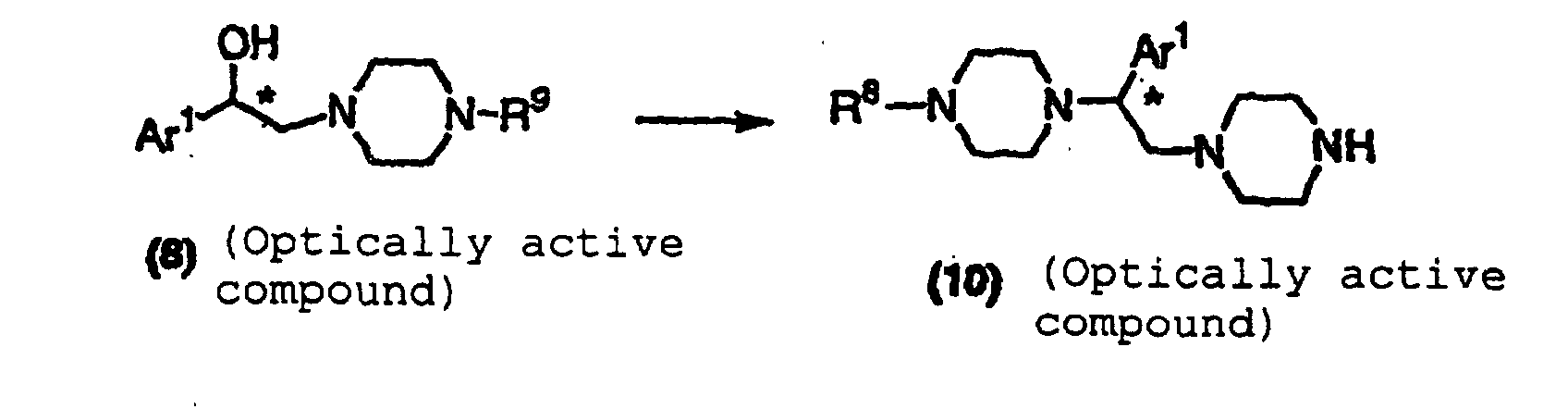
  • an optically active compound (8) can be prepared from the compound (1). Then, following the procedure similar to that for preparing the compound (6) from the compound (8) of the general preparation method 2, an optically active compound (6) can be prepared from the optically active compound (8).
  • optically active compound (13) can be prepared from the compound (1). Then, following the procedure similar to that of the general preparation method 3, optically active compounds (14) and (15) of the present invention can be prepared from the optically active compound (13).
  • an optically active compounds (17) can be prepared from an optically active compound (10) which can be obtained by the general preparation method 15.
  • the compounds of the present invention can be administered orally or parenterally, and the dosage forms thereof are, for example, tablets, capsules, granules, fine-powders, powders, troches, ointments, creams, emulsions, suspensions, suppositories and injections, all of which can be prepared by conventional preparation techniques (e.g., the method defined in Japanese Pharmacopoeia, 12th edition). These dosage forms can be suitably chosen according to conditions and age of the patient and the purpose of therapy.
  • These forms can be prepared by using conventional excipients (e.g., crystalline cellulose, starches, lactose and mannitol), binders (e.g., hydroxypropyllcellulose and polyvinylpyrrolidone), lubricants (e.g., magnesium stearate and talc), disintegrators (e.g., carboxymethylcellulose calcium).
  • excipients e.g., crystalline cellulose, starches, lactose and mannitol
  • binders e.g., hydroxypropyllcellulose and polyvinylpyrrolidone
  • lubricants e.g., magnesium stearate and talc
  • disintegrators e.g., carboxymethylcellulose calcium
  • the dose of the compound of the present invention for the treatment of adult human may range from 1 to 2000 mg per day, in a single portion or several divided portions, and can be suitably increased or decreased depending on age, body weight and conditions of the patient.
  • Example 3(1) 0.72 g of 1-[2-(4-Fluorophenyl)-2-piperazinoethyl]-4-(4-naphthalen-1-yl-butyl)piperazine tetrahydrochloride obtained in Example 3(1) was dissolved in 10 ml of ethanol, and 0.20 g of cyanamide was added, followed by reflux with stirring for 4 hours. After cooling to room temperature, the reaction solution was concentrated under reduced pressure, a saturated aqueous sodium bicarbonate solution was added and, after extraction with ethyl acetate, the organic layer was dried over anhydrous sodium sulfate. After removal of the drying agent by filtration, the filtrate was concentrated under reduced pressure.
  • the crude membrane preparation (0.25 ml, 25 ⁇ g protein) was reacted with [ 125 I]Nle 4 -D-Phe 7 - ⁇ -MSH (final concentration; 0.2 nM) at 25°C for 120 minutes.
  • the reaction solution was filtered under suction on GF/C glass filter presoaked for 2 hours in 50 mM Tris hydrochloric acid buffer solution (pH 7.4) containing 0.5 % bovine serum with the use of a cell harvester for receptor binding assay.
  • the radioactivity on the filter paper was measured in a gamma-counter.
  • the binding in the presence of 1 ⁇ M Nle 4 -D-Phe 7 - ⁇ -MSH was defined as non-specific binding.
  • ⁇ -MSH and MTII were purchased from Peninsula Laboratories. Male SD rats weighing 220 to 240 g (Charles River Japan Inc.) were used for animals. Rats deprived of drinking water for 48 hours were divided into 5 animals for each group.
  • the test compound was administered to rats intracerbroventricularly at 10 ⁇ l/2 min. of the test compound which was prepared by dissolving a predetermined amount of ⁇ -MSH or MTII in saline containing 0.1 % bovine serum albumin.
  • saline containing 0.1% bovine serum albumin was administered intracerebroventricularly at 10 ⁇ l/2 min.
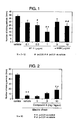
  • mice Male SD rats weighing 220 to 240 g (Charles River Japan Inc.) were used. Rats deprived of drinking water for 48 hours were divided into 10 animals for each group. To rats of group to be administered with the test compound was subcutaneously administered the test compound which was prepared by dissolving a predetermined amount of Compound 4 in Table 1 in saline for injection and adding 0.5 M aqueous sodium hydroxide solution to adjust to pH 4 - 5. Thirty minutes after the administration, rats were placed in a apparatus for the test, and drinking behaviors during the time of free access to drinking water for 3 minutes were measured. During the time of free access to drinking water, an electric shock (1.0 mA) was released, every 2 seconds of cumulative licking time to the drinking nozzle. The evaluation of this experiment was carried out using the number of the electric shocks. Results are shown in Fig. 2.
  • Anti-anxiety action of Compound 4 in Table 1 in forced swim stress-induced anxiety model of rats was studied.
  • Rats Male SD rats weighing 220 to 240 g (Charles River Japan Inc.) were used. Rats were divided into 10 animals for each group. To rats of group to be administered with the test compound was subcutaneously administered the test compound which was prepared by dissolving a predetermined amount of the test drug in saline for injection and adding 0.5 M aqueous sodium hydroxide solution to adjust to pH 4 - 5. Thirty minutes after the administration, rats were exposed to a forced swim stress by placing in a black cylinder (20 cm internal diameter, 40 cm high) containing 25 cm deep of water maintained at 25°C. Duration of the forced swim stress was 2 minutes, and the anti-anxiety action was studied by the elevated plus-maze test, which was carried out 5 minutes after the forced swim stress.
  • the elevated plus-maze used for the test consisted of open arms (10 cm wide, 50 cm long) and close arms (10 cm wide, 50 cm long), and the open arms and the enclosed arms were covered with 1 cm-high and 40 cm-high transparent Plexiglas, respectively.
  • the plus-maze was placed in 50 cm high from the floor. Luminosity at the center of the maze was 40 lux. Each rat was placed in the center of the plus-maze facing one enclosed arm. The amount of time spent in open arms of the maze was recorded during a 5-minute period. Results are shown in Table 3.
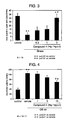
  • Fig. 3 shows that, when a significant difference test was carried out by Dunnett test, p ⁇ 0.01 represents that there is a significant difference in comparison with the control which is not exposed to the forced swim stress.
  • Symbol ** in Fig. 3 shows that, when a significant difference test was carried out by Dunnett test, p ⁇ 0.01 represents that there is a significant difference in comparison with the group exposed to the forced swim stress by treating with saline.
  • Fig. 4 shows that, when a significant difference test was carried out by Dunnett test, p ⁇ 0.01 represents that there is a significant difference in comparison with the control group of which olfactory bulbs were not removed.
  • Symbol ** in Fig.4 shows that, when a significant difference test was carried out by Dunnett test, p ⁇ 0.01 represents that there is a significant difference in comparison of the olfactory bulbectomized group, which were administered with saline.
  • the compounds, which antagonize MC 4 receptor are useful as therapeutic agents of depression or anxiety because of their inhibitory action of anxiogenic-like symptoms and depressive-like symptoms.

Landscapes

  • Health & Medical Sciences (AREA)
  • Chemical & Material Sciences (AREA)
  • Veterinary Medicine (AREA)
  • Public Health (AREA)
  • General Health & Medical Sciences (AREA)
  • Animal Behavior & Ethology (AREA)
  • Life Sciences & Earth Sciences (AREA)
  • Medicinal Chemistry (AREA)
  • Pharmacology & Pharmacy (AREA)
  • Organic Chemistry (AREA)
  • Epidemiology (AREA)
  • Neurosurgery (AREA)
  • Nuclear Medicine, Radiotherapy & Molecular Imaging (AREA)
  • General Chemical & Material Sciences (AREA)
  • Chemical Kinetics & Catalysis (AREA)
  • Neurology (AREA)
  • Biomedical Technology (AREA)
  • Bioinformatics & Cheminformatics (AREA)
  • Engineering & Computer Science (AREA)
  • Pain & Pain Management (AREA)
  • Psychiatry (AREA)
  • Pharmaceuticals Containing Other Organic And Inorganic Compounds (AREA)

Abstract

There are provided a therapeutic preparation for anxiety neurosis or depression which comprises a MC4 receptor antagonist as an effective ingredient; and a piperazine derivative represented by Formula [1]:
Figure 80000001
[wherein Ar1 is a phenyl group, a substituted phenyl group, a naphthyl group or a substituted naphthyl group; Ar2 is a naphthyl group, a substituted naphthyl group, a quinolyl group, a group represented by the formula:
Figure 80000002
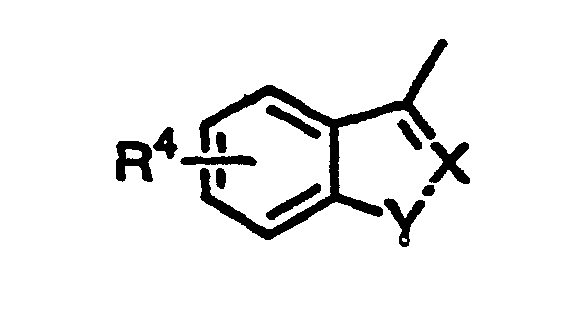
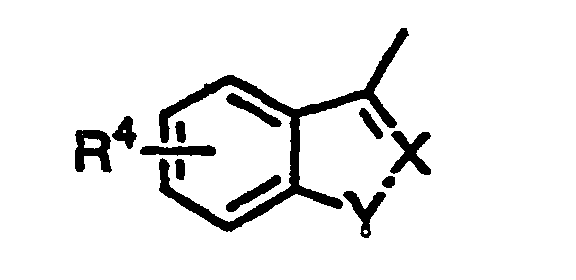
(wherein R4 is a hydrogen atom or a halogen atom; and X-Y is CH-NH, CH-O, CH-S or N-O) or a group represented by the formula:
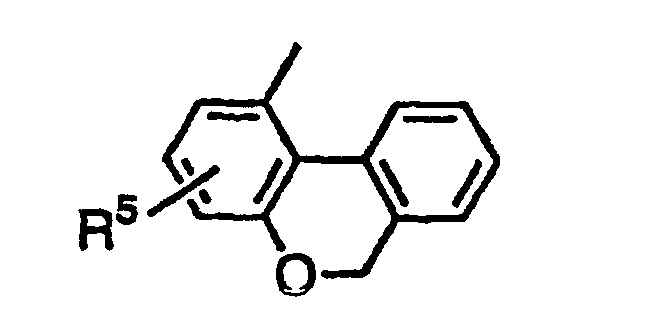
Figure 80000003
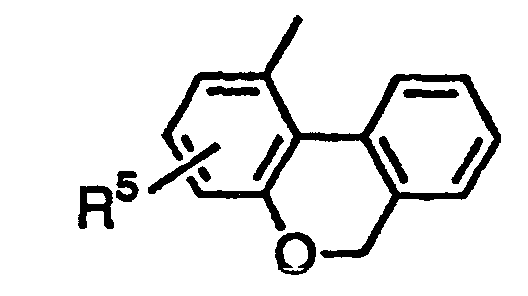
(wherein R5 is a hydrogen atom, a hydroxyl group or a C1-10 alkoxy group); R1 is a hydrogen atom, a C1-10 alkyl group, a C3-8 cycloalkyl group, a C3-10 alkenyl group, a phenyl group, a 1-cyanoethyl group, a pyrimidin-2-yl group or an amidyl group; R2 and R3 are the same or different, and are each a hydrogen atom or a C1-10 alkyl group; A-B is N-CH2, CH-CH2, C(OH)-CH2 or C=CH; T1 is a single bond, -N(R6)- (wherein R6 is a hydrogen atom or a C1-10 alkyl group), -O-, -CH=CH- or -C(=O)-; n is an integer of from 1 to 10 and when T1 is a single bond, -CH=CH- or -C(=O)-, n is an integer of from 2 to 10 when T1 is -N(R6)- or -O-], or a pharmaceutically acceptable salt thereof.

Description

BACKGROUND ART
The present invention relates to a therapeutic preparation for anxiety neurosis or depression which comprises a MC4 receptor antagonist as an effective ingredient, and relates to novel piperazine derivatives having a MC4 receptor antagonistic action.
It is suggested by the recent progress of pathophysiology that stress is deeply pertinent to development mechanism of anxiety neurosis and depression. As an intracerebral reaction caused by stress, there has been known a functional abnormality of neuroendocrine system of which representative is the functional abnormality of hypothalamus-pituitary-adrenal system. From such a background, the neuropeptides which locate in pituitary and affect neuroendocrine attract attention as a development reason of depression/anxiety.
Among such neuropeptides are corticotropin releasing factors (CRF) and proopiomelanocortin (POMC). CRF is known to play the central role of stress reaction such as susceptibility of hypothalamus-pituitary-adrenal system, and suggested to have relation to anxiety/depression. Melanocortins [adrenocorticotropic hormone (ACTH), melanocyte stimulating hormone (MSH)] produced from POMC are main neuropeptides in hypothalamus, but there is no report of the substances acting to melanocortin receptors relating to stress reaction and depression/anxiety neurosis.
Melanocortin receptors are classified into 5 subtypes of MC1 - MC5. Among these subtypes, melanocortin receptor subtype MC4 is reported as peptidergic selective agonist or antagonist, but there is no report on stress reaction and anti-anxiety action of these agonists or antagonists. Compound 4 of the present invention in Table 1 acts as a high selective antagonist in recombinant human melanocortin receptors.
The relation of melanocortin receptor subtypes and anxiety/depression and stress reaction, and novel piperazine derivatives have been investigated.
DISCLOSURE OF THE INVENTION
As a result of extensive research of the above-mentioned subject, MC4 receptor agonists have been found to have anxiety inducing action, and MC4 receptor antagonists have been found to be effective for treatment of anxiety neurosis and depression because of their anti-stress, anti-anxiety and anti-depression actions. Furthermore, novel piperazine derivatives of MC4 receptor antagonists have been found, and thereby the present invention has been accomplished.
The present invention is described as follows:
The present invention contains the following three items.
  • 1. A therapeutic preparation for anxiety neurosis or depression which comprises a MC4 receptor antagonist as an effective ingredient.
  • 2. The therapeutic preparation for anxiety neurosis or depression wherein the MC4 receptor antagonist is a piperazine derivative represented by Formula [1] :
    Figure 00030001
    [wherein Ar1 is a phenyl group, a substituted phenyl group, a naphthyl group or a substituted naphthyl group; Ar2 is a naphthyl group, a substituted naphthyl group, a quinolyl group, a group represented by the formula:
    Figure 00030002
    (wherein R4 is a hydrogen atom or a halogen atom, and X-Y is CH-NH, CH-O, CH-S or N-O) or a group represented by the formula:
    Figure 00040001
    (wherein R5 is a hydrogen atom, a hydroxyl group or a C1-10 alkoxy group); R1 is a hydrogen atom, a C1-10 alkyl group, a C3-8 cycloalkyl group, a C3-10 alkenyl group, a phenyl group, a 1-cyanoethyl group, a pyrimidin-2-yl group or an amidyl group; R2 and R3 are the same or different, and are each a hydrogen atom or a C1-10 alkyl group; A-B is N-CH2, CH-CH2, C(OH)-CH2 or C=CH; T1 is a single bond, -N(R6)- (wherein R6 is a hydrogen atom or a C1-10 alkyl group), -O-, -CH=CH- or -C(=O)-; n is an integer of from 1 to 10 when T1 is a single bond, -CH=CH- or -C(=O)-, and n is an integer of from 2 to 10 when T1 is -N(R6)- or -O-], or a pharmaceutically acceptable salt thereof.
  • 3. The piperazine derivative represented by the above-mentioned Formula [1] or a pharmaceutically acceptable salt thereof.
  • In the present invention, the antagonist which belongs to MC4 receptor means a compound which has an antagonistic action to MC4 receptor, and preferably means a compound having an concentration-dependent inhibition action in the receptor binding test using MC4 receptor-expressed cells according to the method described in J. Biol. Chem., 268; 15174-15179, 1993, having equivalent or higher affinity to MC4 receptor than α-MSH, and antagonizing to an action of α-MSH when the amount of cAMP stimulated by α-MSH is measured by means of a cAMP measurement kit.
    The terms used in the present invention are defined as follows. In the present invention, "Cx-y" means that the group referred thereto contains the number of carbon atoms which ranges from x to y.
    The substituted phenyl group refers to a phenyl group substituted with 1 to 3 substituents selected arbitrarily from the group consisting of a C1- 10 alkyl group, a C3-8 cycloalkyl group, a C3-8 cycloalkyl C1-5 alkyl group, a C1-10 alkoxy group, a C3-8 cycloalkoxy group, a C3-8 cycloalkyl C1-5 alkoxy group, a benzyloxy group, a hydroxyl group, a halogen atom, a nitro group, a group of the formula: NR11(R22) (wherein R11 and R22 are the same or different, and are each a hydrogen atom or a C1-6 alkyl group, or R11 and R22 together with the nitrogen atom to which they are attached form a 5 - 8 membered cyclic amine), a trifluoromethyl group, a cyano group, a carbamoyl group and a phenyl group, and preferably a phenyl group substituted with 1 to 3 substituents selected arbitrarily from the group consisting of a C1- 10 alkyl group, a C1-10 alkoxy group, a benzyloxy group, a hydroxyl group, a halogen atom, a nitro group, an amino group, an amino group substituted with one or two C1-6 alkyl groups, a trifluoromethyl group, a cyano group, a carbamoyl group and a phenyl group; and examples of which are a 2-methylphenyl group, a 3-methylphenyl group, a 4-methylphenyl group, a 2-ethylphenyl group, a 3-ethylphenyl group, a 4-ethylphenyl group, a 2-propylphenyl group, a 3-propylphenyl group, a 4-propylphenyl group, a 2-cyclopentylphenyl group, a 2-methoxyphenyl group, a 3-methoxyphenyl group, a 4-methoxyphenyl group, a 4-ethoxyphenyl group, a 4-isopropoxyphenyl group, a 4-benzyloxyphenyl group, a 4-hydroxyphenyl group, a 2-fluorophenyl group, a 3-fluorophenyl group, a 4-fluorophenyl group, a 2-chlorophenyl group, a 3-chlorophenyl group, a 4-chlorophenyl group, a 2-bromophenyl group, a 3-bromophenyl group, a 4-bromophenyl group, a 4-nitrophenyl group, a 4-aminophenyl group, a 4-trifluoromethylphenyl group, a 3-cyanophenyl group, a 4-cyanophenyl group, a 3-carbamoylphenyl group, a 4-carbamonylphenyl group and a 4-biphenyl group.
    The substituted naphthyl group refers to a naphthyl group substituted with 1 to 3 substituents selected arbitrarily from the group consisting of a C1- 10 alkyl group, a C3-8 cycloalkyl group, a C3-8 cycloalkyl C1-5 alkyl group, a C1-10 alkoxy group, a C3-8 cycloalkoxy group, a C3-8 cycloalkyl C1-5 alkoxy group, a benzyloxy group, a hydroxyl group, a C1-5 alkoxycarbonylmethoxy group, a carbamoylmethoxy group, a halogen atom, a nitro group, a group of the formula: NR33(R44) (wherein R33 and R44 are the same or different, and are each a hydrogen atom or a C1-6 alkyl group, or R33 and R44, together with the nitrogen atom to which they are attached, form a 5 - 8 membered cyclic amine) and a trifluoromethyl group; and preferably a naphthyl group substituted with 1 to 3 substituents selected arbitrarily from the group consisting of a C1-10 alkyl group, a C1-10 alkoxy group, a hydroxyl group, a C1-5 alkoxycarbonylmethoxy group, a carbamoylmethoxy group, a halogen atom, an amino group, and an amino group substituted with one or two C1-6 alkyl groups; and examples of which are a 2-methylnaphthalen-1-yl group, a 3-methylnaphthalen-1-yl group, a 4-methylnaphthalen-1-yl group, a 2-ethylnaphthalen-1-yl group, a 3-ethylnaphthalen-1-yl group, a 4-ethylnaphthalen-1-yl group, a 2-propylnaphthalen-1-yl group, a 3-propylnaphthalen-1-yl group, a 4-propylnaphthalen-1-yl group, a 2-methoxynaphthalen-1-yl group, a 3-methoxynaphthalen-1-yl group, a 4-methoxynaphthalen-1-yl group, a 6-methoxynaphthalen-1-yl group, a 4-ethoxynaphthalen-1-yl group, a 4-isopropoxynaphthalen-1-yl group, a 4-benzyloxynaphthalen-1-yl group, a 2-hydroxynaphthalen-1-yl group, a 4-hydroxynaphthalen-1-yl group, a 2-methoxycaronylmethoxynaphthalen-1-yl group, a 2-carbamoylmethoxynaphthalen-1-yl group, a 2-fluoronaphthalen-1-yl group, a 3-fluoronaphthalen-1-yl group, a 4-fluoronaphthalen-1-yl group, a 2-chloronaphthalen-1-yl group, a 3-chloronaphthalen-1-yl group, a 4-chloronaphthalen-1-yl group, a 2-bromonaphthalen-1-yl group, a 3-bromonaphthalen-1-yl group, a 4-bromonaphthalen-1-yl group, a 4-nitronaphthalen-1-yl group, a 4-aminonaphthalen-1-yl group, a 4-trifluoromethylnaphthalen-1-yl group and a 4-dimethylaminonaphthalen-1-yl group.
    The C1-10 alkyl group refers to a straight or branched alkyl group having 1 to 10 carbon atoms, and examples which are a methyl group, an ethyl group, a propyl group, an isopropyl group, a butyl group, an isobutyl group, a pentyl group, an isopentyl group, a 1-ethylpropyl group, a hexyl group, an isohexyl group, a 1-ethylbutyl group, a heptyl group, an isoheptyl group, an octyl group, a nonyl group and a decyl group. The C3-8 cycloalkyl group refers to a cycloalkyl group having 3 to 8 carbon atoms, and examples of which are a cyclopropyl group, a cyclobutyl group, a cyclopentyl group and a cyclohexyl group. The C3-8 cycloalkyl C1-5 alkyl group refers to a C1-5 alkyl group substituted with a cycloalkyl group having 3 to 8 carbon atoms, and examples of which are a cyclopropylmethyl group, a cyclobutylmethyl group, a cyhclopentylmethyl group and a cyclohexylmethyl group.
    The C3-10 alkenyl group refers to a straight or branched alkenyl group having 3 to 10 carbon atoms, and examples of which are an allyl group, a 1-buten-4-yl group, a 2-buten-4-yl group, a 1-penten-5-yl group, a 2-penten-5-yl group and a prenyl group.
    The C1-10 alkoxy group refers to a straight or branced alkoxy group having 1 to 10 carbon atoms; and examples of which are a methoxy group, an ethoxy group, a propoxy group, an isopropoxy group, a butoxy group, an isobutoxy group, a pentyloxy group, an isopentyloxy group, a hexyloxy group, a heptyloxy group, an octyloxy group, a nonyloxy group and a decyloxy group. The C3-8 cycloalkoxy group refers to a cycloalkoxy group having 3 to 8 carbon atoms; and examples of which are a cyclopropoxy group, a cyclopentyloxy group and a cyclooctyloxy group. The C3-8 cycloalkyl C1-5 alkoxy group refers to the C1-5 alkoxy group substituted with a cycloalkyl group having 3 to 8 carbon atoms; and examples of which are a cyclopropylmethoxy group, a cyclopentylmethoxy group and a cyclohexylethoxy group.
    The amino group substituted with one or two C1-6 alkyl groups refers to an amino group substituted with 1 or 2 members of a straight or branched alkyl groups having 1 to 6 carbon atoms; and examples of which are a methylamino group, an ethylamino group, a propylamino group, a dimethylamino group, diethylamino group and a dipropylamino group.
    Examples of the amino group represented by the formula: NR11(R22) are a methylamino group, an ethylamino group, a propylamino group, a dimethylamino group, a diethylamino group and a dipropylamino group. Furthermore, examples of the cyclic amino group represented by the formula: NR11(R22) are a pyrrolidino group, a piperidino group, a piperazino group, a morpholino group and a thiomorpholino group.
    Examples of the amino group represented by the formula: NR33(R44) are a methylamino group, an ethylamino group, a propylamino group, a dimethylamino group, a diethylamino group and a dipropylamino group. Furthermore, examples of the cyclic amino group represented by the formula: NR33(R44) are a pyrrolidino group, a piperidino group, a piperazino group, a morpholino group and a thiomorpholino group.
    The halogen atom refers to a fluorine atom, a chlorine atom, a bromine atom or an iodine atom.
    Examples of the pharmaceutically acceptable salt in the present invention are salts with mineral acids such as sulfuric acid, hydrochloric acid or phosphoric acid, or salts with organic acids such as acetic acid, oxalic acid, lactic acid, tartaric acid, fumaric acid, maleic acid, methanesulfonic acid or benzenesulfonic acid.
    The compounds of Formula [1] can be prepared by the following General Preparation Methods 1 to 17 (in the following reaction schemes, Ar1, Ar2, R6, T1 and n are defined above; X1 is a chlorine atom, a bromine atom or an iodine atom; A1-B1 is CH-CH2, C(OH)-CH2 or C=CH; T2 is a single bond, -N(R6)- or -O-; R7 is a C1-10 alkyl group; R8 is a C1-10 alkyl group, a C3-10 alkenyl group, a phenyl group or a pyrimidin-2-yl group; and R9 is an ordinary amino-protective group such as a t-butoxycarbonyl group, an ethoxycarbonyl group or a benzyloxycarbonyl group; R10 is a C1-10 alkyl group, a 1-cyanoethyl group or an amidino group; R11 is the group defined for R9 other than a t-butoxycarbonyl group; Boc group is a t-butoxycarbonyl group; Bn group is a benzyl group and * means optically active).
    [General preparation method 1]
    Figure 00110001
    Figure 00110002
    Figure 00110003
    Figure 00110004
    A compound (1) can be reacted with a compound (2) in the presence or absence of a base in an inert solvent to convert to a compound (3), followed by reduction of the carbonyl group in an inert solvent to synthesize a compound (4). The compound (4) can be reacted with a halogenating agent or a sulfonylating agent such as an alkylsulfonyl halide or an arylsulfonyl halide in the presence or absence of a base in an inert solvent, thereby the hydroxyl group is converted to a suitable leaving group. Then, a compound (5) can be reacted in the presence or absence of a base in an inert solvent to give a compound (6) of the present invention.
    The base includes, for example, organic amines (e.g., triethylamine, diisopropylethylamine and pyridine) and inorganic bases (e.g., potassium carbonate, sodium bicarbonate, sodium hydroxide, potassium hydroxide and sodium hydride). The reduction includes, for example, a reduction under an acidic, neutral or basic condition using a boron reductant (e.g. sodium borohydride, sodium cyanoborohydride, lithium borohydride, L-Selectride and K-Selectride) or an aluminum reductant (e.g. lithium aluminum hydride, Red-Al or diisobutyl aluminum hydride). The halogenating agent includes an ordinary halogenating agent of the hydroxyl group (e.g., thionyl chloride, thionyl bromide or phosphoryl chloride). The sulfonylating agent such as an alkylsulfonyl halide or an arylsulfonyl halide include, for example, ordinary sulfonylating agents of the alcohol (e.g. methanesulfonyl chloride, benzenesulfonyl chloride, toluenesulfonyl chloride or trifluoromethanesulfonyl chloride). The inert solvent include, for example, alcohols (e.g., methanol and ethanol), ethers (e.g., diethyl ether and tetrahydrofuran), hydrocarbons (e.g., toluene and benzene), halogenated carbon type solvents (e.g., chloroform and dichloromethane), dimethylformamide, acetonitrile, water and a mixture thereof.
    [General preparation method 2]
    Figure 00130001
    Figure 00130002
    Figure 00130003
    Figure 00130004
    Figure 00130005
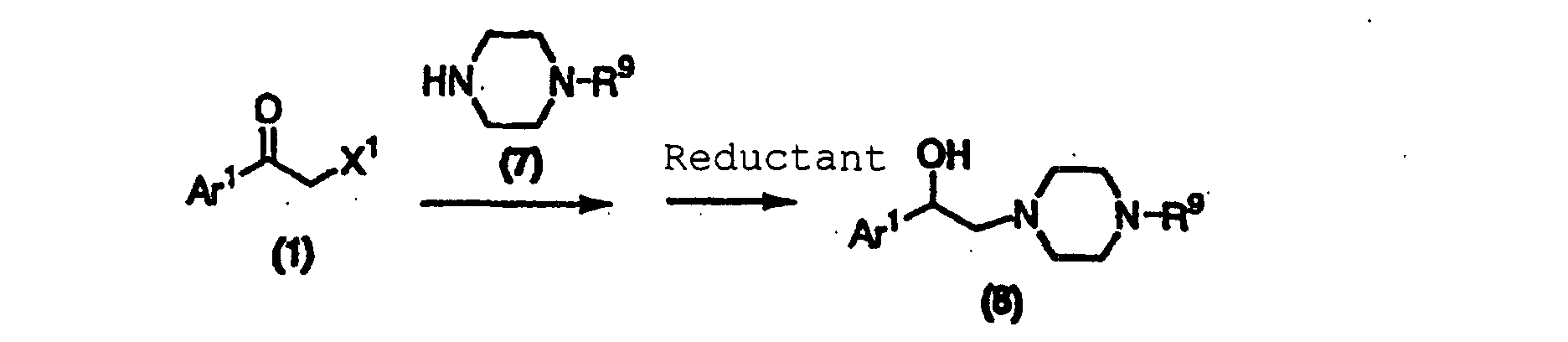
    Following the procedure similar to that for preparing the compound (6) from the compound (1) of the general preparation method 1, a compound (9) can be prepared from the compound (1). Then, the amino group of the compound (9) can be deprotected to give a compound (10), which can be then condensed with a compound (11) in an inert solvent to give a compound (12). The amide group of the compound (12) can be reduced in an inert solvent to give a the compound (6) of the present invention.
    The deprotection of the compound (9) can be carried out using the method described in Protective Groups in Organic Synthesis, by Theodora W. Greene and Peter G. M. Wuts. The condensation includes, for example, an amidation via an acid halide(e.g., an acid chloride and an acid bromide), an amidation via a mixed acid anhydride using ethyl chlorocarbonate, isobutyl chlorocarbonate, etc., and an amidation using a condensing agent such as 1-(3,3-dimethylaminopropyl)-3-ethylcarbodiimide, 1,3-dicyclohexylcarbodiimide, diphenylphosphoryl azide, diethyl cyanophosphate or carbonyldiimidazole. The reduction includes, for example, a reduction under an acidic, neutral or basic condition using a boron reductant (e.g., diborane) or an aluminum reductant (e.g. lithium aluminum hydride, Red-Al and diisopropyl aluminum hydride). The inert solvent include, for example, alcohols (e.g., methanol and ethanol), ethers (e.g., diethyl ether and tetrahydrofuran), hydrocarbons (e.g., toluene and benzene), halogenated carbon type solvents (e.g., chloroform and dichloromethane), dimethylformamide, acetonitrile, water and a mixture thereof.
    [General preparation method 3]
    Figure 00150001
    Figure 00150002
    Figure 00150003
    Following the procedure similar to that for preparing the compound (6) from the compound (1) of the general preparation method 1, a compound (13) can be prepared from the compound (1). Removal of the Boc group of the compound (13) can give a compound (14) of the present invention. Then, the compound (14) can be reacted with an alkylating agent or an amidylating agent in the presence or absence of a base in an inert solvent to give a compound (15) of the present invention.
    The removal of the Boc group of the compound (13) can be carried out according to the method described in Protective Groups in Organic Synthesis, by Theodora W. Greene and Peter G. M. Wuts. The alkylating agent include, for example, alkyl halides (e.g., methyl iodide, ethyl iodide, 1-bromopropane, 2-bromopropane and 2-bromopropionitrile), alkyl sulfates (e.g., dimethyl sulfate and diethyl sulfate). The amidylating agent includes, for example, an amidylating agent such as cyanamide, S-methylthiourea and aminoiminomethanesulfonic acid. The base include, for example, organic amines (e.g., triethylamine, diisopropylethylamine and pyridine) and inorganic bases (e.g., potassium carbonate, sodium bicarbonate, sodium hydroxide, potassium hydroxide and sodium hydride). The inert solvent include, for example, alcohols (e.g., methanol and ethanol), ethers (e.g., diethyl ether and tetrahydrofuran), hydrocarbons (e.g., toluene and benzene), halogenated carbon type solvents (e.g., chloroform and dichloromethane), dimethylformamide, acetonitrile, water and a mixture thereof.
    [General preparation method 4]
    Figure 00170001
    Figure 00170002
    A compound (10) obtained according to the general preparation method 2 can be reacted with a compound (16) in the presence or absence of a base in an inert solvent to give a compound (17) of the present invention.
    The base include, for example, organic amines (e.g., triethylamine, diisopropylethylamine and pyridine) and inorganic bases (e.g., potassium carbonate, sodium bicarbonate, sodium hydroxide, potassium hydroxide and sodium hydride). The inert solvent include, for example, alcohols (e.g., methanol and ethanol), ethers (e.g., diethyl ether and tetrahydrofuran), hydrocarbons (e.g., toluene and benzene), halogenated carbon type solvents (e.g., chloroform and dichloromethane), dimethylformamide, acetonitrile, water and a mixture thereof.
    [General preparation method 5]
    Figure 00180001
    Figure 00180002
    Figure 00180003
    Figure 00180004
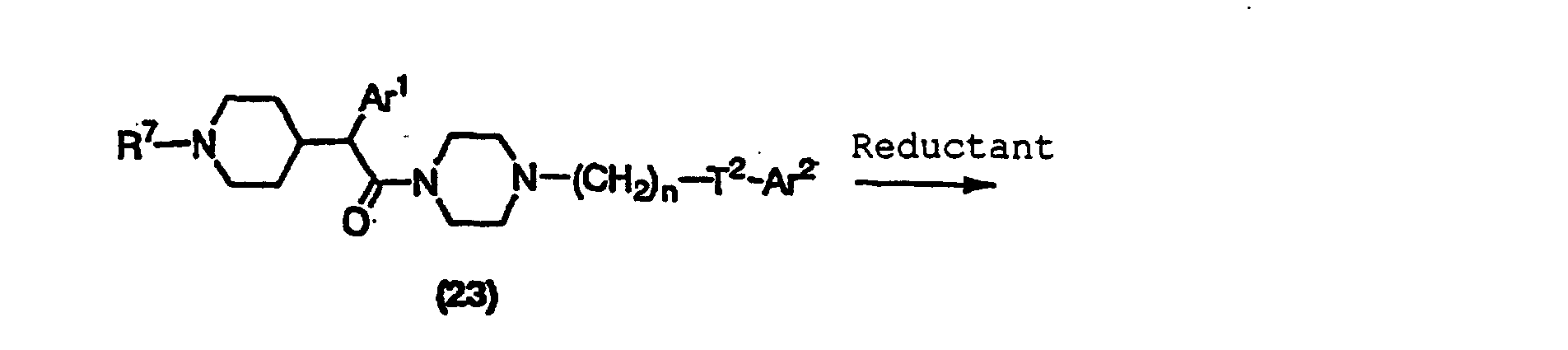
    A compound (18) can be treated with a base in an inert solvent and reacted with a compound (19) to give a compound (20), which can be then treated with an acid in an inert solvent to synthesize a compound (21). The compound (21) can be hydrogenated in an inert solvent to give a compound (22), which can be then condensed with the compound (2) to give a compound (23). The amide group of the compound (23) can be reduced in an inert solvent to a compound (24) of the present invention.
    The base include, for example, metal amides (e.g., lithium diisopropylamide, lithium hexamethyldisilazide, sodium hexamethyldisilazide and potassium hexamethyldisilazide) and metal hydrides (e.g., sodium hydride and potassium hydride). The acid include, for example, inorganic acids (e.g., hydrochloric acid, hydrobromic acid, sulfuric acid, nitric acid and phosphoric acid) and organic acids (e.g., p-toluenesulfonic acid, methanesulfonic acid, trifluoroacetic acid and formic acid). The hydrogenation includes, for example, a reaction which is carried out in an inert solvent using a conventional metal catalyst (e.g., palladium-carbon, palladium-black, palladium hydroxide, platinum dioxide and Raney nickel) under a hydrogen atmosphere. The condensation include, for example, an amidation via an acid halide(e.g., an acid chloride and an acid bromide), an amidation via a mixed acid anhydride using ethyl chlorocarbonate, isobutyl chlorocarbonate, etc., and an amidation using a condensing agent such as 1-(3,3-dimethylaminopropyl)-3-ethylcarbodiimide, 1,3-dicyclohexylcarbodiimide, diphenylphosphoryl azide, diethyl cyanophosphate or carbonyldiimidazole. The reduction includes, for example, a reduction under an acidic, neutral or basic condition using a boron reductant (e.g. diborane) or an aluminum reductant (e.g. lithium aluminum hydride, Red-Al and diisobutyl aluminum hydride). The inert solvent include, for example, alcohols (e.g., methanol and ethanol), ethers (e.g., diethyl ether and tetrahydrofuran), hydrocarbons (e.g., toluene and benzene), halogenated carbon type solvents (e.g., chloroform and dichloromethane), dimethylformamide, acetonitrile, water and a mixture thereof.
    [General preparation method 6]
    Figure 00200001
    Figure 00200002
    Following the procedure similar to that for preparing the compound (24) from the compound (22) of the general preparation method 5, a compound (25) of the present invention can be prepared from the compound (20), and a compound (26) of the present invention can be prepared from the compound (21).
    [General preparation method 7]
    Figure 00210001
    Figure 00210002
    Figure 00210003
    Figure 00210004
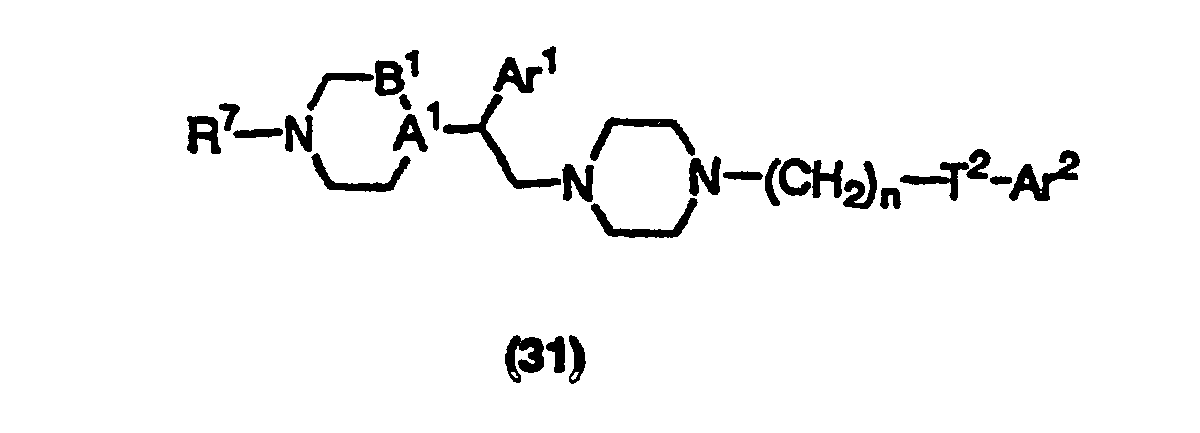
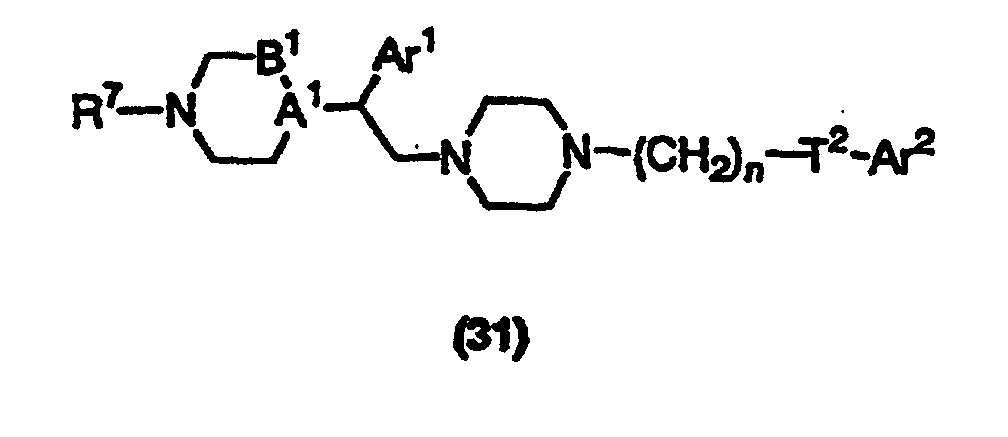
    The compound (27) obtained by the general preparation method 5 can be condensed with the compound (7) in an inert solvent to give a compound (28), followed by deprotection of the amino group of the compound (28) to synthesize a compound (29). The compound (29) can be condensed with the compound (11) in an inert solvent to give a compound (30), followed by reduction of the amide group of the compound (30) in an inert solvent to give a compound (31) of the present invention.
    The condensation include, for example, an amidation via an acid halide(e.g., an acid chloride and an acid bromide), an amidation via a mixed acid anhydride using ethyl chlorocarbonate, isobutyl chlorocarbonate, etc., and an amidation using a condensing agent such as 1-(3,3-dimethylaminopropyl)-3-ethylcarbodiimide, 1,3-dicyclohexylcarbodiimide, diphenylphosphoryl azide, diethyl cyanophosphate or carbonyldiimidazole. The deprotction of the compound (28) can be carried out according to the method described in Protective Groups in Organic Synthesis, by Theodora W. Greene and Peter G. M. Wuts. The reduction includes, for example, a reduction under an acidic, neutral or basic condition using a boron reductant (e.g. diborane) or an aluminum reductant (e.g. lithium aluminum hydride, Red-Al and diisobutyl aluminum hydride). The inert solvent include, for example, alcohols (e.g., methanol and ethanol), ethers (e.g., diethyl ether and tetrahydrofuran), hydrocarbons (e.g., toluene and benzene), halogenated carbon type solvents (e.g., chloroform and dichloromethane), dimethylformamide, acetonitrile, water and a mixture thereof.
    [General preparation method 8]
    Figure 00230001
    Figure 00230002
    Figure 00230003
    The compound (29) obtained according to the general preparation method 7 can be reacted with a compound (32) in the presence or absence of a base in an inert solvent to synthesize a compound (33). Reduction of the amide group of the compound (33) in an inert solvent can give a compound (31) of the present invention.
    The base include, for example, organic amines (e.g., triethylamine, diisopropylethylamine and pyridine) and inorganic bases (e.g., potassium carbonate, sodium bicarbonate, sodium hydroxide, potassium hydroxide and sodium hydride). The reduction includes, for example, a reduction under an acidic, neutral or basic condition using a boron reductant (e.g., diborane) or an aluminum reductant (e.g. lithium aluminum hydride, Red-Al and diisobutyl aluminum hydride). The inert solvent include, for example, alcohols (e.g., methanol and ethanol), ethers (e.g., diethyl ether and tetrahydrofuran), hydrocarbons (e.g., toluene and benzene), halogenated carbon type solvents (e.g., chloroform and dichloromethane), dimethylformamide, acetonitrile, water and a mixture thereof.
    [General preparation method 9]
    Figure 00250001
    Figure 00250002
    Figure 00250003
    Figure 00250004
    Figure 00250005
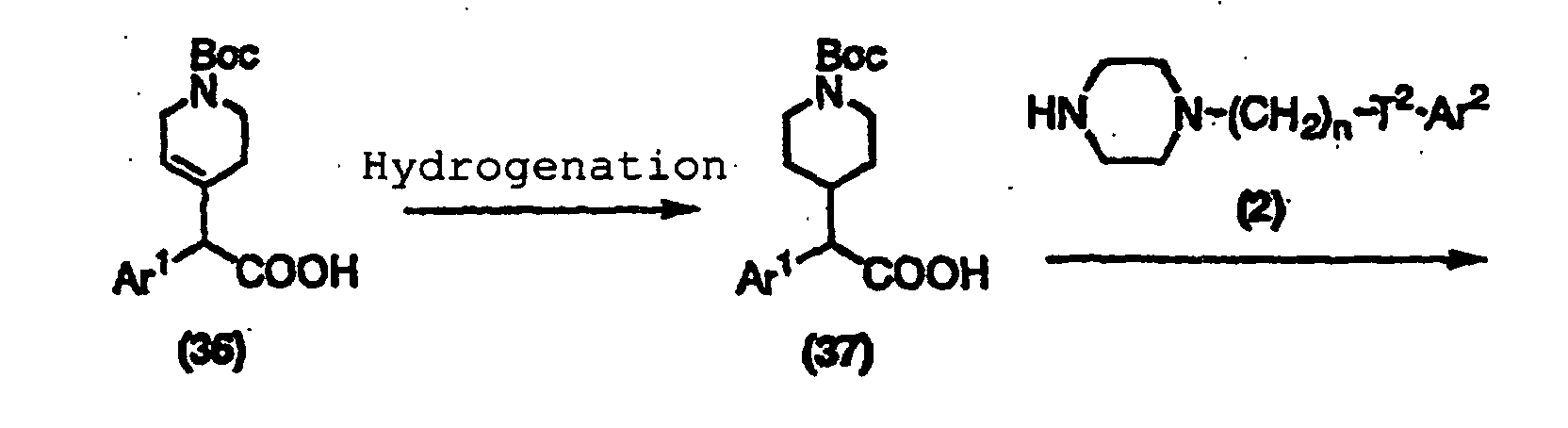
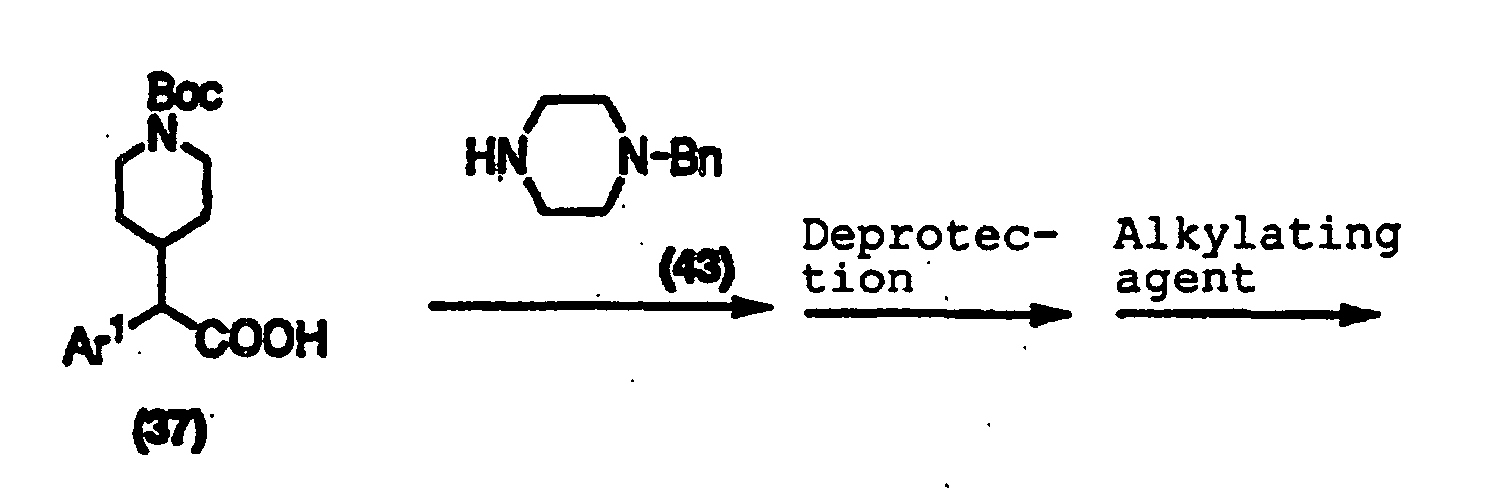
    Following the procedure similar to that for preparing the compound (20) from the compound (18) of the general preparation method 5, a compound (35) can be prepared from the compound (18). Following the procedure similar to that for preparing the compound (21) from the compound (20) of the general preparation method 5 using the compound (35), and protecting the amino group again by a Boc group can give a compound (36). The compound (36) can be hydrogenated in an inert solvent to give a compound (37), which can be then condensed with the compound (2) in an inert solvent to give a compound (38). The Boc group of the compound (38) can be removed, followed by reaction with an alkylating agent in the presence or absence of a base in an inert solvent to synthesize the compound (23). The amide group of the compound (23) can be reduced in an inert solvent to give the compound (24) of the present invention.
    Protection of the amino group by the Boc group or removal of the Boc group can be carried out according to the method described in Protective Groups in Organic Synthesis, by Theodora W. Greene and Peter G. M. Wuts. The hydrogenation is a reaction which is carried out in an inert solvent using a conventional metal catalyst (e.g., palladium-carbon, palladium-black, palladium hydroxide, platinum dioxide and Raney nickel) under a hydrogen atmosphere. The condensation include, for example, an amidation via an acid halide(e.g., an acid chloride or an acid bromide), an amidation via a mixed acid anhydride using ethyl chlorocarbonate, isobutyl chlorocarbonate, etc., and an amidation using a condensing agent such as 1-(3,3-dimethylaminopropyl)-3-ethylcarbodiimide, 1,3-dicyclohexylcarbodiimide, diphenylphosphoryl azide, diethyl cyanophosphate or carbonyldiimidazole. The base include, for example, organic amines (e.g., triethylamine, diisopropylethylamine and pyridine) and inorganic bases (e.g., potassium carbonate, sodium bicarbonate, sodium hydroxide, potassium hydroxide and sodium hydride). The alkylating agent include, for example, alkyl halides (e.g., methyl iodide, ethyl iodide, 1-bromopropane, 2-bromopropane or 2-bromopropionitrile) and alkyl sulfates (e.g., dimethyl sulfate or diethyl sulfate). The reduction includes, for example, a reduction under an acidic, neutral or basic condition using a boron reductant (e.g., diborane) or an aluminum reductant (e.g., lithium aluminum hydride, Red-Al and diisobutyl aluminum hydride). The inert solvent include, for example, alcohols (e.g., methanol and ethanol), ethers (e.g., diethyl ether and tetrahydrofuran), hydrocarbons (e.g., toluene and benzene), halogenated carbon type solvents (e.g., chloroform and dichloromethane), dimethylformamide, acetonitrile, water and a mixture thereof.
    [General preparation method 10]
    Figure 00280001
    Figure 00280002
    Following the procedure similar to that for preparing the compound (24) from the compound (37) of the general preparation method 9, the compound (25) and the compound (26) of the present invention can be prepared from the compound (35) and a compound (36), respectively.
    [General preparation method 11]
    Figure 00290001
    Figure 00290002
    Figure 00290003
    Figure 00290004
    A compound (39) obtained by the general preparation method 9 can be condensed with a compound (40) in an inert solvent to give a compound (41), and the Boc group of the compound (41) can be removed, followed by reaction with an alkylating agent in the presence or absence of a base in an inert solvent to give the compound (42). The amino group of the compound (42) can be deprotected to synthesize the compound (26). Then, following the procedure similar to that from the compound (29) of the general preparation method 7 or similar to that of the general preparation method 8, a compound (31) of the present invention can be prepared.
    The condensation include, for example, an amidation via an acid halide(e.g., an acid chloride, an acid bromide), an amidation via a mixed acid anhydride using ethyl chlorocarbonate, isobutyl chlorocarbonate, etc., and an amidation using a condensing agent such as 1-(3,3-dimethylaminopropyl)-3-ethylcarbodiimide, 1,3-dicyclohexylcarbodiimide, diphenylphosphoryl azide, diethyl cyanophosphate or carbonyldiimidazole. The base include, for example, organic amines (e.g., triethylamine, diisopropylethylamine and pyridine) and inorganic bases (e.g., potassium carbonate, sodium bicarbonate, sodium hydroxide, potassium hydroxide or sodium hydride). The alkylating agent include, for example, alkyl halides (e.g., methyl iodide, ethyl iodide, 1-bromopropane, 2-bromopropane or 2-bromopropionitrile), alkyl sulfates (e.g., dimethyl sulfate or diethyl sulfate). Removal of the Boc group or deprotection of the amino group can be carried out according to the method described in Protective Groups in Organic Synthesis, by Theodora W. Greene and Peter G. M. Wuts. The inert solvent includes, for example, alcohols (e.g., methanol and ethanol), ethers (e.g., diethyl ether and tetrahydrofuran), hydrocarbons (e.g., toluene and benzene), halogenated carbon type solvents (e.g., chloroform and dichloromethane), dimethylformamide, acetonitrile, water and a mixture thereof.
    [General preparation method 12]
    Figure 00310001
    Figure 00310002
    Figure 00310003
    Figure 00310004
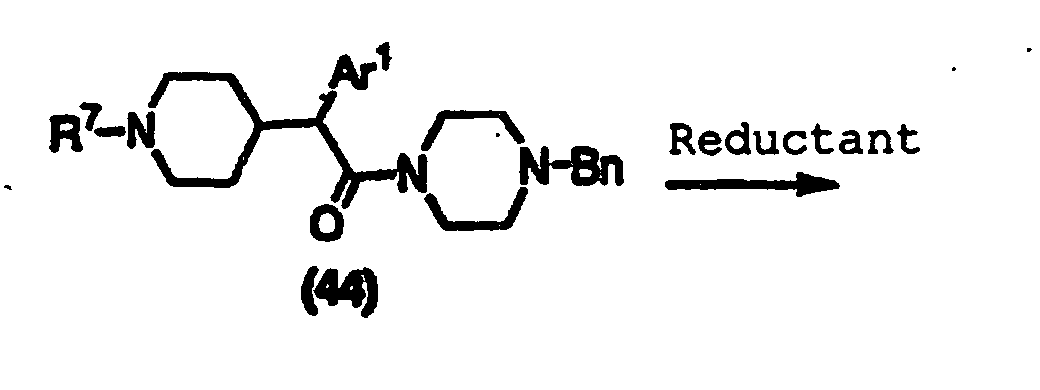
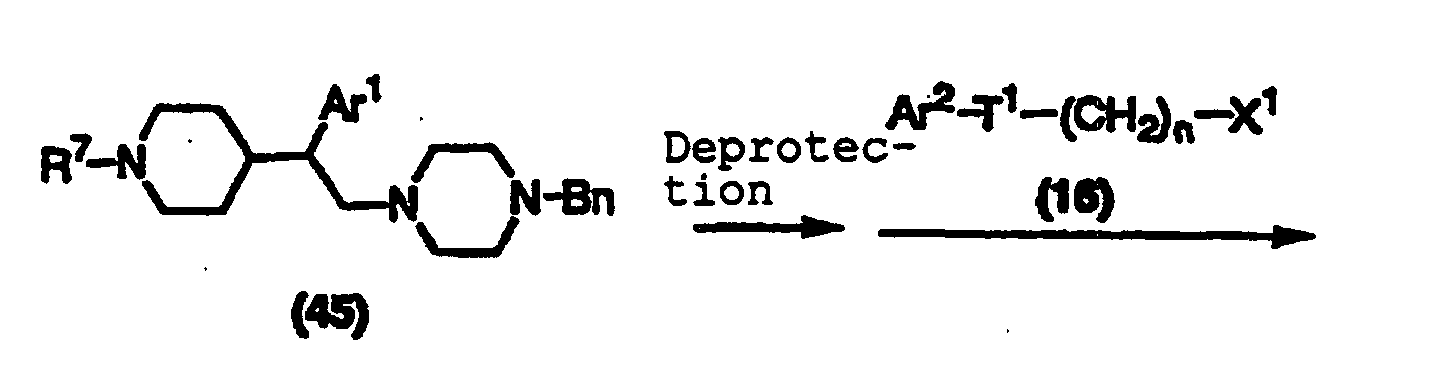
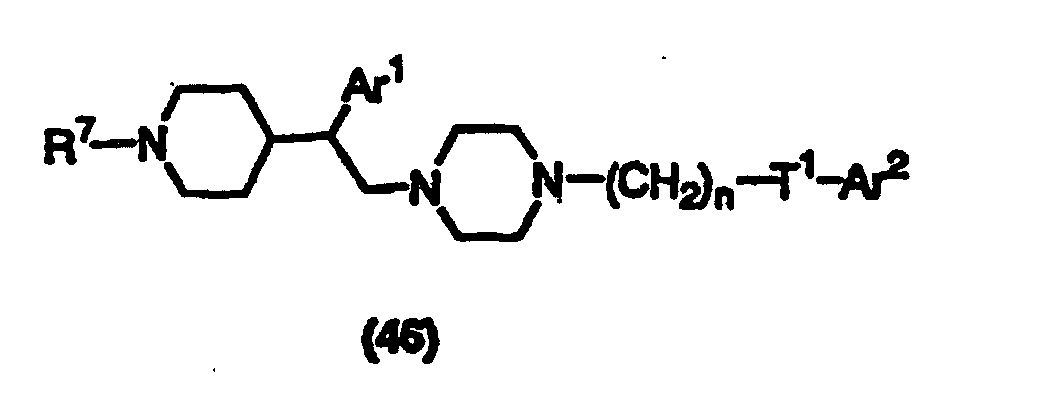
    Following the procedure similar to that for preparing the compound (42) from the compound (39) of the general preparation method 11, a compound (44) can be prepared from the compound (37). Reduction of the amide group of the compound (44) in an inert solvent can give a compound (45), and the benzyl group of the compound (45) can be removed, followed by reaction with the compound (16) in the presence or absence of a base in an inert solvent to give a compound (46) of the present invention.
    The reduction includes, for example, a reduction under an acidic, neutral or basic condition using a boron reductant (e.g., diborane) or an aluminum reductant (e.g. lithium aluminum hydride, Red-Al and diisobutyl aluminum hydride). Removal of the benzyl group can be carried out according to the method described in Protective Groups in Organic Synthesis, by Theodora W. Greene and Peter G. M. Wuts. The base include, for example, organic amines (e.g., triethylamine, diisopropylethylamine and pyridine) and inorganic bases (e.g., potassium carbonate, sodium bicarbonate, sodium hydroxide, potassium hydroxide and sodium hydride). The inert solvent include, for example, alcohols (e.g., methanol and ethanol), ethers (e.g., diethyl ether and tetrahydrofuran), hydrocarbons (e.g., toluene and benzene), halogenated carbon type solvents (e.g., chloroform and dichloromethane), dimethylformamide, acetonitrile, water and a mixture thereof.
    [General preparation method 13]
    Optically active compounds (6), (14), (15), (17), (24), (25), (26), (31) and (46) of the present invention can be obtained by optical resolution of racemic mixtures of (6), (14), (15), (17), (24), (25), (26), (31) and (46) of the present invention, respectively, by an ordinary optical resolution using an acidic chiral resolving agent or an optical resolution by HPLC using a chiral stationary phase. Further, an optically active compound (6) can be synthesized by resolving a racemic mixture of synthesis intermediate (4), (8), (9), (10) or (12) by an optical resolution using an acidic chiral resolving agent or an optical resolution by HPLC using a chiral stationary phase and following the method described in the general preparation method 1 or 2. Furthermore, an optically active compound (14) or (15) can be synthesized by resolving a racemic mixture of synthesis intermediate (13) by an optical resolution using an acidic chiral resolving agent or an optical resolution by HPLC using a chiral stationary phase and following the method described in the general preparation method 3. An optically active compound (17) can be synthesized by resolving a racemic mixture of synthesis intermediate (10) by an optical resolution using an acidic chiral resolving agent or an optical resolution by HPLC using a chiral stationary phase and following the method described in the general preparation method 4. An optically active compound (46) can be synthesized by resolving a racemic mixture of synthesis intermediate (45) by an optical resolution using an acidic chiral resolving agent or an optical resolution by HPLC using a chiral stationary phase and following the method described in the general preparation method 12.
    The acidic chiral resolving agent includes, for example, optically active organic acids such as (+) or (-)-di-p-toluoyltartaric acid, (+) or (-)-dibenzoyltartaric acid, (+) or (-)-tartaric acid, (+) or (-)-mandelic acid, (+) or (-)-camphoric acid, or (+) or (-)-camphor-sulfonic acid.
    The chiral stationary phase includes, for example, cellulose ester, cellulose carbamate, amylose carbamate, crown ether or polymethacrylate or derivatives thereof.
    [General preparation method 14]
    Figure 00340001
    Figure 00340002
    Figure 00340003
    The compound (1) can be subjected to asymmetric reduction in an inert solvent to give an optically active alcohol (47). The compound (47) can be subjected to epoxidation in the presence or absence of a base in an inert solvent, and then reacted with the compound (2) in an inert solvent to synthesize an optically active compound (4). Then, following the procedure similar to that for preparing the compound (6) from the compound (4) of the general preparation method 1, an optically active compound (6) of the present invention can be prepared from the optically active compound (4).
    The asymmetric reduction includes, for example, a reduction by borane-tetrahydrofuran complex using oxazaborolidines such as (R)-5,5-diphenyl-2-methyl-3,4-propano-1,3,2-oxazaborolidine or (S)-5,5-diphenyl-2-methyl-3,4-propano-1,3,2-oxazaborolidine as a chiral auxiliary group, a reduction using optically active metal hydrides such as (R)-B-3-pinanyl-9-borabicyclo-[3.3.1]nonane, (S)-B-3-pinanyl-9-borabicyclo-[3.3.1]nonane, (-)-chlorodiisopinocamphenylborane, (+)-chlorodiisopinocamphenylborane, (R,R)-2,5-dimethylborane, (S,S)-2,5-dimethylborane, (R)-BINAL-H and (S)-BINAL-H, or an asymmetric hydrogenation using an optically active metal catalyst such as optically active BINAP-ruthenium complex. The base include, for example, organic amines (e.g., triethylamine, diisopropylethylamine and pyridine), inorganic bases (e.g., potassium carbonate, sodium bicarbonate, sodium hydroxide, potassium hydroxide and sodium hydride), metal amides (e.g., lithium diisopropylamide, lithium hexamethyldisilazide, sodium hexamethyldisilazide or potassium hexamethyldisilazide) and metal hydrides (e.g., sodium hydride and potassium hydride). Examples of the inert solvent include, for example, alcohols (e.g., methanol and ethanol), ethers (e.g., diethyl ether and tetrahydrofuran), hydrocarbons (e.g., toluene and benzene), halogenated carbon type solvents (e.g., chloroform and dichloromethane), dimethylformamide, acetonitrile, water and a mixture thereof.
    [General preparation method 15]
    Figure 00360001
    Figure 00360002
    Following the procedure similar to that for preparing the compound (4) from the compound (1) of the general preparation method 14, an optically active compound (8) can be prepared from the compound (1). Then, following the procedure similar to that for preparing the compound (6) from the compound (8) of the general preparation method 2, an optically active compound (6) can be prepared from the optically active compound (8).
    [General preparation method 16]
    Figure 00370001
    Figure 00370002
    Figure 00370003
    Following the procedure similar to that for preparing the compound (6) from the compound (1) of the general preparation method 14, an optically active compound (13) can be prepared from the compound (1). Then, following the procedure similar to that of the general preparation method 3, optically active compounds (14) and (15) of the present invention can be prepared from the optically active compound (13).
    [General preparation 17]
    Figure 00380001
    Figure 00380002
    Following the procedure similar to that of the general preparation method 4, an optically active compounds (17) can be prepared from an optically active compound (10) which can be obtained by the general preparation method 15.
    The compounds of the present invention can be administered orally or parenterally, and the dosage forms thereof are, for example, tablets, capsules, granules, fine-powders, powders, troches, ointments, creams, emulsions, suspensions, suppositories and injections, all of which can be prepared by conventional preparation techniques (e.g., the method defined in Japanese Pharmacopoeia, 12th edition). These dosage forms can be suitably chosen according to conditions and age of the patient and the purpose of therapy. These forms can be prepared by using conventional excipients (e.g., crystalline cellulose, starches, lactose and mannitol), binders (e.g., hydroxypropyllcellulose and polyvinylpyrrolidone), lubricants (e.g., magnesium stearate and talc), disintegrators (e.g., carboxymethylcellulose calcium).
    The dose of the compound of the present invention for the treatment of adult human may range from 1 to 2000 mg per day, in a single portion or several divided portions, and can be suitably increased or decreased depending on age, body weight and conditions of the patient.
    MODE FOR CARRYING OUT THE INVENTION
    The present invention is illustrated in more detail by the following examples and experiments.
    Example 1 Synthesis of 1-[2-(4-methoxyphenyl)-2-(4-methylpiperazino)ethyl]-4-(4-naphthalen-1-yl-butyl)piperazine trimaleate (Compound 32 in Table 1)
  • (1) In 6.0 ml of chloroform was dissolved 0.69 g of 4-methoxyphenacyl bromide, and 3.0 ml of N-ethyldiisopropylamine and 1.20 g of 1-(4-naphthalen-1-yl-butyl)piperazine dihydrochloride were added, followed by reflux with heating for an hour. The reaction solution was cooled to room temperature, and concentrated under reduced pressure. To the residue was added a saturated aqueous sodium bicarbonate solution and, after extraction with ethyl acetate, the organic layer was dried over anhydrous sodium sulfate. After removal of the drying agent by filtration, the filtrate was concentrated under reduced pressure to give a crude 1-[2-(4-methoxyphenyl)-2-oxoethyl]-4-(4-naphthalen-1-yl-butyl)piperazine.
  • (2) The crude 1-[2-(4-methoxyphenyl)-2-oxoethyl]-4-(4-naphthalen-1-yl-butyl)piperazine obtained in (1) was dissolved in 10 ml of ethanol, and then a solution prepared by adding 1 drop of 10 % aqueous potassium hydroxide solution and 0.18 g of sodium borohydride to 1.0 ml of water was added, followed by stirring at 50°C for an hour. To the reaction solution was poured water and, after extraction with ethyl acetate, the organic layer was dried over anhydrous sodium sulfate. After removal of the drying agent by filtration, the filtrate was concentrated under reduced pressure to give a crude 1-[2-hydroxy-2-(4-methoxyphenyl)ethyl]-4-(4-naphthalen-1-yl-butyl)piperazine.
  • (3) The crude 1-[2-hydroxy-2-(4-methoxyphenyl)ethyl]-4-(4-naphthalen-1-yl-butyl)piperazine obtained in (2) and 1.25 ml of triethylamine were dissolved in 10 ml of methylene chloride and, after ice-cooling, 0.46 ml of methanesulfonyl chloride was added, followed by stirring at room temperature for 30 minutes. To the reaction solution were added 0.84 ml of triethylamine and 1.0 ml of 1-methylpiperazine, successively, followed by stirring at room temperature for 3 hours. After concentration of the reaction solution under reduced pressure, a saturated aqueous sodium bicarbonate solution was poured and, after extraction with ethyl acetate, the organic layer was dried over anhydrous sodium sulfate. After removal of the drying agent by filtration, the filtrate was concentrated under reduced pressure, and the residue was purified by a silica gel column chromatography (Chromatorex NH, hexane : ethyl acetate =1:1) to give 0.94 g of 1-[2-(4-methoxyphenyl)-2-(4-methylpiperazino)ethyl]-4- (4-naphthalen-1-yl-butyl)piperazine.
  • (4) 0.94 g of 1-[2-(4-Methoxyphenyl)-2-(4-methylpiperazino)ethyl]-4-(4-naphthalen-1-yl-butyl)piperazine was dissolved in 5.0 ml of ethanol, 5.0 ml of an ethanol solution of 0.56 g of maleic acid was added, followed by being allowed to stand for 2 hours. The precipitated crystals were collected by filtration and washed with ethanol to give 1.24 g of 1-[2-(4-methoxyphenyl)-2-(4-methylpiperazino)ethyl]-4-(4-naphthalen-1-yl-butyl)piperazine trimaleate as crystals.
  • The structures and physical property data of the present compound and the compounds prepared similarly are shown in Tables 1 and 2.
    Example 2 Synthesis of 1-[2-(4-fluorophenyl)-2-(4-methylpiperazino)ethyl]-4-(4-naphthalen-1-yl-butyl)piperazine tetrahydrochloride (Compound 4 in Table 1)
  • (1) 4.3 g of 2-Chloro-4'-fluoroacetophenone and 8.0 g of 1-ethoxycarbonylpiperazine were dissolved in 30 ml of chloroform and refluxed with heating for 2 hours. After cooling to room temperature, the reaction solution was concentrated under reduced pressure, and 25 % aqueous ammonia solution was added, followed by extraction with ether. The organic layer was dried over anhydrous sodium sulfate. After removal of the drying agent by filtration, the filtrate was concentrated under reduced pressure to give a crude 1-ethoxycarbonyl-4-[2-(4-fluorophenyl)-2-oxoethyl]piperazine, which was then dissolved in 40 ml of ethanol, and a solution prepared by adding 1 drop of 5 % potassium hydroxide and 1.0 g of sodium borohydride to 5 ml of water was added, followed by heating at 50°C for an hour. After concentration of the reaction solution under reduced pressure, water was added, followed by extraction with ether, and the organic layer was dried over anhydrous sodium sulfate. After removal of the drying agent by filtration, the filtrate was concentrated under reduced pressure. To the residue was poured 50 ml of 4M hydrogen chloride/ethyl acetate solution, the solution was concentrated under reduced pressure, and the resulting solid was washed with ether to give 8.3 g of 1-ethoxycarbonyl-4-[2-(4-fluorophenyl)-2-hydroxyethyl]piperazine hydrochloride.
  • (2) To 8.3 g of 1-ethoxycarbonyl-4-[2-(4-fluorophenyl)-2-hydroxyethyl]piperazine hydrochloride were added 20 ml of benzene and 2.5 ml of thionyl chloride, followed by heating at 50°C for 10 minutes. The reaction solution was concentrated under reduced pressure, 25 % aqueous ammonia solution and water were poured, followed by extraction with ethyl acetate. The organic layer was dried over anhydrous sodium sulfate and, after removal of the drying agent by filtration, the filtrate was concentrated under reduced pressure. To the residue was poured 50 ml of 4M hydrogen chloride/ethyl acetate solution, the solution was concentrated under reduced pressure, and the resulting solid was washed with ether to give 8.1 g of 1-ethoxycarbonyl-4-[2-chloro-2-(4-fluorophenyl)ethyl]-piperazine hydrochloride.
  • (3) To 7.6 g of 1-ethoxycarbonyl-4-[2-chloro-2-(4-fluorophenyl)ethyl]piperazine hydrochloride were poured 5 ml of 25 % aqueous ammonia solution and water and, after extraction with ether, the organic layer was dried over anhydrous sodium sulfate. After removal of the drying agent by filtration, the filtrate was concentrated under reduced pressure. The residue was dissolved in 20 ml of benzene, and 5.4 ml of 1-methylpiperazine was added, followed by heating at 65°C for 3.5 hours. To the reaction solution were poured 25 % aqueous ammonia solution and water and, after extraction with ether, the organic layer was dried over anhydrous sodium sulfate. After removal of the drying agent by filtration, the filtrate was concentrated under reduced pressure. The residue was purified by a silica gel column chromatography (Chromatorex NH, hexane : ethyl acetate =4:1) to give 6.58 g of 1-ethoxycarbonyl-4-[2-(4-fluorophenyl)-2-(4-methylpiperazino)ethyl]piperazine as an oil.
  • (4) 1.25 g of 1-Ethoxycarbonyl-4-[2-(4-fluorophenyl)-2-(4-methylpiperazino)ethyl]piperazine was dissolved in 2 ml of ethanol, and 1.3 g of potassium hydroxide was added, followed by reflux with heating for an hour. The reaction solution was cooled to room temperature and, after addition of 2 ml of water, extracted with ethyl acetate, and the organic layer was dried over anhydrous sodium sulfate. After removal of the drying agent by filtration, the filtrate was concentrated under reduced pressure to give 1.0 g of a crude 1-[2-(4-fluorophenyl)-2-(4-methyl-piperazino)ethyl]piperazine.
  • (5) 0.37 g of 4-Naphthalen-1-yl-butyric acid was dissolved in 5.0 ml of toluene, and 0.35 ml of thionyl chloride and 1 drop of dimethylformamide were added, followed by heating at 70°C for 30 minutes. The reaction solution was cooled to room temperature and concentrated under reduced pressure to give a crude 4-naphthalen-1-yl-butyryl chloride. To the resulting crude 4-naphthalen-1-yl-butyryl chloride was added 2.3 ml of a toluene solution of 0.40 g of 1-[2-(4-fluorophenyl)-2-(4-methylpiperazino)ethyl]piperazine, followed by stirring at room temperature for 30 minutes. To the reaction solution was added a saturated aqueous sodium bicarbonate solution and, after extraction with ethyl acetate, the organic layer was dried over anhydrous sodium sulfate. After removal of the drying agent by filtration, the filtrate was concentrated under reduced pressure, and the residue was purified by a silica gel column chromatography (Wako-gel C-200, chloroform : methanol =10:1) to give 0.58 g of 1-[2-(4-fluorophenyl)-2-(4-methylpiperazino)ethyl]-4-(4-naphthalen-1-yl-butyryl)piperazine as an oil.
  • (6) 0.32 g of 1-[2-(4-Fluorophenyl)-2-(4-methylpiperazino)ethyl]-4-(4-naphthalen-1-yl-butyryl)piperazine was dissolved in tetrahydrofuran, and 50 mg of lithium aluminum hydride was added, followed by reflux with heating for 30 minutes. The reaction solution was cooled to room temperature and, after addition of 1 ml of 10 % aqueous sodium hydroxide solution, ether was poured, followed by drying over anhydrous sodium sulfate. After removal of the drying agent by filtration, the filtrate was concentrated under reduced pressure, and the residue was purified by a silica gel column chromatography (Chromatorex NH, hexane : ethyl acetate =1:1) to give 0.30 g of 1-[2-(4-fluorophenyl)-2-(4-methylpiperazino)ethyl]-4-(4-naphthalen-1-yl-butyl)piperazine as an oil.
  • (7) 0.30 g of 1-[2-(4-Fluorophenyl)-2-(4-methylpiperazino)ethyl]-4-(4-naphthalen-1-yl-butyl)piperazine was dissolved in 4 ml of methanol, and 1 ml of 4M hydrogen chloride/ethyl acetate solution was added. The solution was concentrated under reduced pressure, and the resulting solid was washed with methanol to give 1-[2-(4-fluorophenyl)-2-(4-methylpiperazino)ethyl]-4-(4-naphthalen-1-yl-butyl)piperazine tetrahydrochloride (0.20 g).
  • The structures and physical property data of the present compound and the compounds prepared similarly are shown in Tables 1 and 2.
    Example 3 Synthesis of 1-[2-(4-fluorophenyl)-2-(4-isopropylpiperazino)ethyl]-4-(4-naphthalen-1-yl-butyl)piperazine trimaleate (Compound 16 in Table 1)
  • (1) 0.62 g of 1-[2-(4-Fluorophenyl)-2-(4-t-butoxycarbonylpiperazino)ethyl]-4-(4-naphthalen-1-yl-butyl)piperazine was dissolved in a mixture of 3 ml of ethyl acetate and 3 ml of methanol, and 4 ml of 4M hydrogen chloride/ethyl acetate solution was added, followed by stirring at room temperature for 6 hours. The precipitated crystals were collected by filtration, and the crystals were washed with ethyl acetate to give 0.42 g of 1-[2-(4-fluorophenyl)-2-piperazinoethyl]-4-(4-naphthalen-1-yl-butyl)piperazine tetrahydrochloride as an oil.
  • (2) 0.2 g of 1-[2-(4-Fluorophenyl)-2-piperazinoethyl]-4-(4-naphthalen-1-yl-butyl)piperazine tetrahydrochloride was dissolved in 0.7 ml of dimethylformamide, and 74 mg of 60 % sodium hydride in oil was added with ice-cooling. The temperature was elevated to room temperature, followed by stirring for 10 minutes. To the reaction solution was added a 0.3 ml of dimethylformamide solution of 0.2 g of 2-bromopropane, followed by stirring overnight. The reaction solution was poured to water and, after extraction with ethyl acetate, the organic layer was washed with a saturated aqueous sodium chloride solution and dried over anhydrous sodium sulfate. After removal of the drying agent by filtration, the filtrate was concentrated under reduced pressure, and the residue was purified by a silica gel column chromatography (Chromatorex NH, hexane : ethyl acetate =1:1) to give 0.13 g of 1-[2-(4-fluorophenyl)-2-(4-isopropylpiperazino)ethyl]-4-(4-naphthalen-1-yl-butyl)piperazine as an oil.
  • (3) 0.13 g of 1-[2-(4-Fluorophenyl)-2-(4-isopropylpiperazino)ethyl]-4-(4-naphthalen-1-yl-butyl)piperazine was dissolved in 1.5 ml of ethanol, and 1 ml of an ethanol solution of 0.11 g of maleic acid was added, followed by allowing to stand for 2 hours. The precipitated crystals were collected by filtration and washed with ethanol to give 0.18 g of 1-[2-(4-fluorophenyl)-2-(4-isopropylpiperazino)ethyl]-4-(4-naphthalen-1-yl-butyl)piperazine trimaleate as crystals.
  • The structures and physical property data of the present compound and the compounds prepared similarly are shown in Table 1.
    Example 4 Synthesis 4-{1-(4-fluorophenyl)-2-[4-(4-naphthalen-1-yl-butyl)piperazin-1-yl]ethyl}piperazine-1-carboxamidine trimaleate (Compound 20 in Table 1)
    0.72 g of 1-[2-(4-Fluorophenyl)-2-piperazinoethyl]-4-(4-naphthalen-1-yl-butyl)piperazine tetrahydrochloride obtained in Example 3(1) was dissolved in 10 ml of ethanol, and 0.20 g of cyanamide was added, followed by reflux with stirring for 4 hours. After cooling to room temperature, the reaction solution was concentrated under reduced pressure, a saturated aqueous sodium bicarbonate solution was added and, after extraction with ethyl acetate, the organic layer was dried over anhydrous sodium sulfate. After removal of the drying agent by filtration, the filtrate was concentrated under reduced pressure. The residue was dissolved in 3.0 ml of ethanol, and 3.0 ml of an ethanol solution of 0.50 g of maleic acid was added, followed by allowing to stand for 2 hours. The precipitated crystals were collected by filtration and washed with ethanol to give 0.52 g of 4-{1-(4-fluorophenyl)-2-[4-(4-naphthalen-1-yl-butyl)piperazin-1-yl]ethyl}piperazine-1-carboxamidine trimaleate as crystals.
    The structures and physical property data of the present compound and the compounds prepared similarly are shown in Table 1.
    Example 5 Synthesis of 1-[2-(4-aminophenyl)-2-(4-methylpiperazino)ethyl]-4-(4-naphthalen-1-yl-butyl)piperazine trimaleate (Compound 39 in Table 1)
    0.54 g of 1-[2-(4-Nitrophenyl)-2-(4-methylpiperazino)ethyl]-4-(4-naphthalen-1-yl-butyl)piperazine trimaleate obtained by the procedure similar to that of Example 1 was dissolved in 1M aqueous sodium hydroxide solution and extracted with chloroform. The organic layer was dried over anhydrous sodium sulfate. After removal of the drying agent by filtration, the filtrate was concentrated under reduced pressure. The residue was dissolved in 20 ml of ethanol, and 10 mg of platinum oxide was added, followed by stirring under a hydrogen atmosphere for 2 hours. After removal of the platinum oxide by filtration, the filtrate was concentrated under reduced pressure. The residue was dissolved in 3.0 ml of ethanol, and 3.0 ml of an ethanol solution of 0.19 g of maleic acid was added, followed by allowing to stand for 2 hours. The precipitated crystals were collected by filtration and washed with ethanol to give 0.35 g of 1-[2-(4-aminophenyl)-2-(4-methylpiperazino)ethyl]-4-(4-naphthalen-1-yl-butyl)piperazine trimaleate as crystals.
    The structures and physical property data of the present compound and the compounds prepared similarly are shown in Table 1.
    Example 6 Synthesis of 1-[2-(4-fluorophenyl)-2-(4-methylpiperazino)ethyl]-4-[4-(6-fluoro-1,2-benzisoxazol-3-yl)butyl]piperazine trimaleate (Compound 46 in Table 1)
  • (1) 0.37 g of 1-[2-(4-Fluorophenyl)-2-(4-methylpiperazino)ethyl]piperazine obtained in Example 2 (4) was dissolved in 4.0 ml of dimethylformamide, and 0.19 g of N-ethyldiisopropylamine and 0.31 g of 4-(6-fluoro-1,2-benzisoxazol-3-yl)butyl chloride were added, followed by stirring at 120°C for 3 hours. The reaction solution was cooled to room temperature, diluted with ethyl acetate and washed with water and a saturated aqueous sodium chloride solution. The organic layer was dried over anhydrous sodium sulfate. After removal of the drying agent by filtration, the filtrate was concentrated under reduced pressure. The residue was purified by a silica gel column chromatography (Chromatorex NH, hexane : ethyl acetate =1:1) to give 0.22 g of 1-[2-(4-fluorophenyl)-2-(4-methylpiperazino)ethyl]-4-[4-(6-fluoro-1,2-benzisoxazol-3-yl)butyl]piperazine as an oil.
  • (2) 0.21 g of 1-[2-(4-Fluorophenyl)-2-(4-methylpiperazino)ethyl]-4-[4-(6-fluoro-1,2-benzisoxazol-3-yl)butyl]piperazine was dissolved in 2.0 ml of ethanol, and 2.0 ml of an ethanol solution of 0.16 g of maleic acid was added, followed by allowing to stand for 2 hours. The precipitated crystals were collected by filtration and washed with ethanol to give 0.30 g of 1-[2-(4-fluorophenyl)-2-(4-methylpiperazino)ethyl]-4-[4-(6-fluoro-1,2-benzisoxazol-3-yl)butyl]piperazine trimaleate as crystals.
  • The structures and physical property data of the present compound and the compounds prepared similarly are shown in Tables 1 and 2.
    Example 7 Synthesis of 1-[2-(4-fluorophenyl)-2-(4-isopropylpiperazino)ethyl]-4-[4-(2-hydroxynaphthalen-1-yl)butyl]piperazine trimaleate (Compound 55 in Table 1)
    0.06 g of 1-[2-(4-Fluorophenyl)-2-(4-isopropylpiperazino)ethyl]-4-[4-(2-methoxynaphthalen-1-yl)butyl]piperazine obtained by the procedure similar to that of Example 2 was dissolved in 10 ml of 48 % aqueous hydrobromic acid solution and refluxed with heating for 2 hours. The reaction solution was cooled to room temperature and concentrated under reduced pressure, and 1M aqueous sodium hydroxide solution was added, followed by extraction with ether. The organic layer was dried over anhydrous sodium sulfate. After removal of the drying agent by filtration, the filtrate was concentrated under reduced pressure. The residue was purified by a silica gel column chromatography (Chromatorex NH, hexane : ethyl acetate =1:1) to give 0.06 g of 1-[2-(4-fluorophenyl)-2-(4-isopropylpiperazino)ethyl]-4-[4-(2-hydroxynaphthalen-1-yl)butyl]piperazine as an oil.
    The structures and physical property data of the present compound and the compounds prepared similarly are shown in Table 1.
    Example 8 Synthesis of 1-[2-(4-fluorophenyl)-2-(4-isopropylpiperazino)ethyl]-4-[4-(2-isopropoxynaphthalen-1-yl)butyl]piperazine trimaleate (Compound 56 in Table 1)
  • (1) 0.05 g of 1-[2-(4-Fluorophenyl)-2-(4-isopropylpiperazino)ethyl]-4-[4-(2-hydroxynaphthalen-1-yl)butyl]piperazine obtained in Example 7 was dissolved in 5 ml of dimethylformamide, and 0.19 g of potassium carbonate and 0.068 ml of 2-iodopropane were added, followed by stirring at 70°C for 6 hours. The reaction solution was cooled to room temperature, diluted with ethyl acetate, and washed with water and a saturated aqueous sodium chloride solution. The organic layer was dried over anhydrous sodium sulfate. After removal of the drying agent by filtration, the filtrate was concentrated under reduced pressure. The residue was purified by a silica gel column chromatography (Chromatorex NH, hexane : ethyl acetate =1:1) to give 0.03 g of 1-[2-(4-fluorophenyl)-2-(4-isopropylpiperazino)ethyl]-4-[4-(2-isopropoxynaphthalen-1-yl)butyl]piperazine as an oil.
  • (2) 0.03 g of 1-[2-(4-Fluorophenyl)-2-(4-isopropylpiperazino)ethyl]-4-[4-(2-isopropoxy-naphthalen-1-yl)butyl]piperazine was dissolved in 2.0 ml of ethanol, and 2.0 ml of an ethanol solution of 0.02 g of maleic acid was added, followed by allowing to stand for 2 hours. The precipitated crystals were collected by filtration and washed with ethanol to give 0.03 g of 1-[2-(4-fluorophenyl)-2-(4-isopropylpiperazino)ethyl]-4-[4-(2-isopropoxynaphthalen-1-yl)butyl]piperazine trimaleate as crystals.
  • The structures and physical property data of the present compound and the compounds prepared similarly are shown in Tables 1.
    Example 9 Synthesis of 1-[2-(4-carbamoylphenyl)-2-(4-isopropylpiperazino)ethyl]-4-[4-(2-methoxynaphthalen-1-yl)butyl]piperazine tetrahydrochoride (Compound 75 in Table 1)
  • (1) 0.50 g of 1-[2-(4-Methoxycarbonylphenyl)-2-(4-isopropylpiperazino)ethyl]-4-[4-(2-methoxynaphthalen-1-yl-butyl)piperazine obtained by the procedure similar to that of Example 2 was dissolved in 2 ml of conc. hydrochloric acid, and stirred at 80°C for 5 hours. The reaction solution was cooled to room temperature and concentrated under reduced pressure. The residue was suspended in 5 ml of thionyl chloride and refluxed with heating for 2 hours. After concentration of the reaction solution under reduced pressure, the residue was dissolved in 2.5 ml of tetrahydrofuran, and 25 % aqueous ammonia solution was added, followed by stirring at room temperature for an hour. The reaction solution was diluted with ethyl acetate and washed with a saturated aqueous sodium bicarbonate solution and a saturated aqueous sodium chloride solution. The organic layer was dried over anhydrous sodium sulfate. After removal of the drying agent by filtration, the filtrate was concentrated under reduced pressure. The residue was purified by a silica gel column chromatography (Chromatorex NH, hexane : ethyl acetate =1:1) to give 0.10 g of 1-[2-(4-carbamoylphenyl)-2-(4-isopropylpiperazino)ethyl]-4-[4-(2-methoxynaphthalen-1-yl)butyl]piperazine as an oil.
  • (2) 0.10 g of 1-[2-(4-Carbamoylphenyl)-2-(4-isopropylpiperazino)ethyl]-4-[4-(2-methoxynaphthalen-1-yl)butyl]piperazine was dissolved in 4 ml of methanol, and 1 ml of 4M hydrogen chloride/ethyl acetate solution was added. The solution was concentrated under reduced pressure, and the resulting solid was washed with ethyl acetate to give 0.10 g of 1-[2-(4-carbamoylphenyl)-2-(4-isopropylpiperazino)ethyl]-4-[4-(2-methoxynaphthalen-1-yl)butyl]piperazine tetrahydrochoride.
  • The structures and physical property data of the present compound and the compounds prepared similarly are shown in Table 1.
    Example 10 Synthesis of 1-[2-(3-carbamoylphenyl)-2-(4-isopropylpiperazino)ethyl]-4-[4-(2-methoxynaphthalen-1-yl)butyl]piperazine tetrahydrochoride (Compound 76 in Table 1)
  • (1) 0.20 g of 1-[2-(3-Cyanophenyl)-2-(4-isopropylpiperazino)ethyl]-4-[4-(2-methoxynaphthalen-1-yl)butyl]piperazine obtained by the procedure similar to that of Example 2 was dissolved in 2 ml of t-butanol, and 70 mg of potassium hydroxide was added, followed by reflux with heating for 2 hours. The reaction solution was cooled to room temperature, diluted with chloroform and washed with a saturated aqueous sodium bicarbonate solution and a saturated aqueous sodium chloride solution. The organic layer was dried over anhydrous sodium sulfate. After removal of the drying agent by filtration, the filtrate was concentrated under reduced pressure. The residue was purified by a silica gel column chromatography (Chromatorex NH, hexane : ethyl acetate =2:1) to give 74 mg of 1-[2-(3-carbamoylphenyl)-2-(4-isopropylpiperazino)ethyl]-4-[4-(2-methoxynaphthalen-1-yl)butyl]piperazine as an oil.
  • (2) 74 mg of 1-[2-(3-Carbamoylphenyl)-2-(4-isopropylpiperazino)ethyl]-4-[4-(2-methoxynaphthalen-1-yl)butyl]piperazine was dissolved in 4 ml of methanol, and 1 ml of 4M hydrogen chloride/ethyl acetate solution was added. The solution was concentrated under reduced pressure, and the resulting solid was washed with ethyl acetate to give 70 mg of 1-[2-(3-carbamoylphenyl)-2-(4-isopropylpiperazino)ethyl]-4-[4-(2-methoxynaphthalen-1-yl)butyl]piperazine tetrahydrochoride.
  • The structures and physical property data of the present compound and the compounds prepared similarly are shown in Table 1.
    Example 11 Synthesis of 1-[2-(4-fluorophenyl)-2-piperidin-4-yl-ethyl]-4-[4-(2-methoxynaphthalen-1-yl)butyl]piperazine (Compound 81 in Table 2)
  • (1) 48.3 ml of Diisopropylamine was dissolved in 200 ml of tetrahydrofuran, and 137 ml of 2.5 M n-butyl lithium/hexane solution was added dropwise with ice-cooling. To the reaction solution was added dropwise a 100 ml of tetrahydrofuran solution of 25.2 g of p-fluorophenylacetic acid, 28.4 ml of hexamethylphosphoric triamide (HMPA) was added, and the temperature was elevated to room temperature, followed by stirring for 30 minutes. After ice-cooling, to the reaction solution was added dropwise 100 ml of a tetrahydrofuran solution of 32.5 g of 1-t-butoxycarobnyl-4-piperidone, and the temperature was elevated to room temperature, followed by stirring for 3 hours. To the reaction solution was added dropwise water and, after extraction with ethyl acetate, the aqueous layer was made acidic with potassium hydrogensulfate, and extracted with ethyl acetate. The organic layer was washed with a saturated aqueous sodium chloride solution and dried over anhydrous sodium sulfate. After removal of the drying agent by filtration, the filtrate was concentrated under reduced pressure. To the residue was added ether, followed by stirring at room temperature. The precipitated crystals were collected by filtration and washed with ether to give 30.0 g of 1-t-butoxycarbonyl-4-[carboxy-(4-fluorophenyl)methyl]-4-hydroxypiperidine as a powder.
  • (2) 20.0 g of 1-t-Butoxycarbonyl-4-[carboxy-(4-fluorophenyl)methyl]-4-hydroxypiperidine was suspended in 40 ml of chloroform, and 40 ml of conc. sulfuric acid was added dropwise with ice-cooling. The reaction solution was refluxed with heating for 3 hours and, after ice-cooling, 250 ml of 4M sodium hydroxide solution, 200 ml of 1,4-dioxane and 14.8 g of di-t-butyldicarbonate were added. After stirring at room temperature for 30 minutes, the reaction solution was made acidic with potassium hydrogensulfate, followed by extraction with chloroform. The organic layer was washed with a saturated aqueous sodium chloride solution and dried over anhydrous sodium sulfate.
    After removal of the drying agent by filtration, the filtrate was concentrated under reduced pressure. The residue was purified by a silica gel column chromatography (Wako-gel C-200, chloroform : methanol =10:1) to give 18.0 g of 1-t-butoxycarbonyl-4-[carboxy-(4-fluorophenyl)methyl]-3,6-dihydro-2H-pyridine as an oil.
  • (3) 5.0 g of 1-t-Butoxycarbonyl-4-[carboxy-(4-fluorophenyl)methyl]-3,6-dihydro-2H-pyridine was dissolved in 50 ml of methanol, and 0.50 g of palladium hydroxide/carbon was added, followed by stirring under a hydrogen atmosphere at room temperature for 2 days. After removal of the catalyst by Celite filtration, the filtrate was concentrated under reduced pressure to give 3.6 g of a crude 1-t-butoxycarbonyl-4-[carboxy-(4-fluorophenyl)methyl]piperidine.
  • (4) 2.2 g of 1-t-Butoxycarbonyl-4-[carboxy-(4-fluorophenyl)methyl]piperidine was dissolved in 20 ml of dimethylformamide, and 2.0 g of 1-[4-(2-methoxynaphthalen-1-yl)butyl]piperazine dihydrochloride, 1.9 g of 1-(3,3-dimethylaminopropyl)-3-ethylcarbodiimide hydrochloride, 1.9 g of 1-hydroxybenzotriazole monohydrate and 3.5 ml of triethylamine were added, followed by stirring at room temperature overnight. The reaction solution was diluted with ethyl acetate and washed with a saturated aqueous sodium bicarbonate solution and a saturated aqueous sodium chloride solution. The organic layer was dried over anhydrous sodium sulfate. After removal of the drying agent by filtration, the filtrate was concentrated under reduced pressure. The residue was purified by a silica gel column chromatography (Chromatorex NH, hexane : ethyl acetate =3:1) to give 2.4 g of 1-t-butoxycarbonyl-4-(1-(4-fluorophenyl)-2-{4-[4-(2-methoxynaphthalen-1-yl)butyl]piperazin-1-yl}-2-oxoethyl)piperidine as an oil.
  • (5) 2.1 g of 1-t-Butoxycarbonyl-4-(1-(4-fluorophenyl)-2-{4-[4-(2-methoxynaphthalen-1-yl)butyl]piperazin-1-yl}-2-oxoethyl)piperidine was dissolved in 10 ml of methanol, and 10 ml of 4M hydrogen chloride/1,4-dioxane solution was added, followed by stirring at room temperature for 2 hours. After concentration of the reaction solution under reduced pressure, to the residue was added ether, followed by stirring at room temperature. The precipitated crystals were filtered and washed with ether to give 1.7 g of 4-(1-(4-fluorophenyl)-2-{4-[4-(2-methoxynaphthalen-1-yl)butyl]piperazin-1-yl}-2-oxoethyl)piperidine dihydrochloride.
  • (6) 0.15 g of 4-(1-(4-Fluorophenyl)-2-{4-[4-(2-methoxynaphthalen-1-yl)butyl]piperazin-1-yl}-2-oxoethyl)piperidine dihydrochloride was dissolved in 1M aqueous sodium hydroxide solution and extracted with chloroform. The organic layer was dried over anhydrous sodium sulfate. After removal of the drying agent by filtration, the filtrate was concentrated under reduced pressure. The residue was dissolved in 5 ml of tetrahydrofuran, and 10 mg lithium aluminum hydride was added, followed by stirring at 50°C for 15 minutes. The reaction solution was cooled to room temperature and diluted with ether, and 25 % aqueous ammonia solution was added dropwise. The precipitate was removed by Celite filtration, the filtrate was concentrated under reduced pressure, and the residue was purified by a silica gel column chromatography (Chromatorex NH, hexane : ethyl acetate =4:1) to give 0.13 g of 1-[2-(4-fluorophenyl)-2-piperidin-4-yl-ethyl]-4-[4-(2-methoxynaphthalen-1-yl)butyl]piperazine as an oil.
  • The structures and physical property data of the present compound and the compounds prepared similarly are shown in Table 2.
    Example 12 Synthesis of 4-{1-(4-fluorophenyl)-2-[4-(naphthalen-1-yl-butyl)piperazin-1-yl]ethyl}-1-methylpiperidin-4-ol trihydrochloride (Compound 83 in Table 2)
  • (1) 2.37 g of 1-t-Butoxycarbonyl-4-[carboxy-(4-fluorophenyl)methyl]-4-hydroxypiperidine obtained in Example 11(1) was dissolved in 20 ml of dimethylformamide, and 2.50 g of 1-(4-naphthalen-1-yl-butyl)piperazine dihydrochloride, 1.9 g of 1-(3,3-dimethylaminopropyl)-3-ethylcarbodiimide hydrochloride, 1.9 g of 1-hydroxybenzotriazole monohydrate and 3.5 ml of triethylamine were added, followed by stirring at room temperature overnight. The reaction solution was diluted with ethyl acetate and washed with a saturated aqueous sodium bicarbonate solution and a saturated aqueous sodium chloride solution. The organic layer was dried over anhydrous sodium sulfate. After removal of the drying agent by filtration, the filtrate was concentrated under reduced pressure. The residue was purified by a silica gel column chromatography (Chromatorex NH, hexane : ethyl acetate =3:1) to give 1.96 g of 1-t-butoxycarbonyl-4-{1-(4-fluorophenyl)-2-[4-(naphthalen-1-yl-butyl)piperazin-1-yl]-2-oxoethyl}-4-hydroxypiperidine as an oil.
  • (2) 1.04 g of 1-t-Butoxycarbonyl-4-{1-(4-fluorophenyl)-2-[4-(naphthalen-1-yl-butyl)piperazin-1-yl]-2-oxoethyl}-4-hydroxypiperidine was dissolved in 10 ml of methanol, and 20 ml of 4M hydrogen chloride/1,4-dioxane solution was added, followed by stirring at room temperature for 2 hours. The reaction solution was concentrated under reduced pressure, ethyl acetate was added to the residue, and the mixture was washed with 1M aqueous sodium hydroxide solution and a saturated aqueous sodium solution. The organic layer was dried over anhydrous sodium sulfate. After removal of the drying agent by filtration, the filtrate was concentrated under reduced pressure. The residue was dissolved in 9 ml of acetonitrile, and 640 µl of 37% formalin, 190 µl of acetic acid and 160 mg of sodium cyanoborohydride were added, followed by stirring at room temperature for an hour. The reaction solution was diluted with ethyl acetate and washed with a saturated aqueous sodium bicarbonate solution and a saturated aqueous sodium chloride solution. The organic layer was dried over anhydrous sodium sulfate. After removal of the drying agent by filtration, the filtrate was concentrated under reduced pressure. The residue was purified by a silica gel column chromatography (Chromatorex NH, hexane : ethyl acetate =2:1) to give 0.44 g of 4-{1-(4-fluorophenyl)-2-[4-(naphthalen-1-yl-butyl)piperazin-1-yl]-2-oxoethyl}-1-methylpiperidin-4-ol as an oil.
  • (3) 0.25 g of 4-{1-(4-Fluorophenyl)-2-[4-(naphthalen-1-yl-butyl)piperazin-1-yl]-2-oxoethyl}-1-methylpiperidin-4-ol was dissolved in 3 ml of tetrahydrofuran, and 18 mg of lithium aluminum hydride was added, followed by stirring at 50°C for 15 minutes. The reaction solution was cooled to room temperature and diluted with ether, and 25 % aqueous ammonia solution was added dropwise. The precipitate was removed by Celite filtration, the filtrate was concentrated under reduced pressure, and the residue was purified by a silica gel column chromatography (Chromatorex NH, hexane : ethyl acetate =4:1) to give 33 mg of 4-{1-(4-fluorophenyl)-2-[4-(naphthalen-1-yl-butyl)piperazin-1-yl]ethyl}-1-methylpiperidin-4-ol as an oil.
  • (4) 33 mg of 4-{1-(4-Fluorophenyl)-2-[4-(naphthalen-1-yl-butyl)piperazin-1-yl]ethyl}-1-methylpiperidin-4-ol was dissolved in 4 ml of methanol, and 1 ml of 4M hydrogen chloride/ethyl acetate solution was added. The solution was concentrated under reduced pressure, and the resulting solid was washed with ethyl acetate to give 35 mg of 4-{1-(4-fluorophenyl)-2-[4-(naphthalen-1-yl-butyl)piperazin-1-yl]ethyl}-1-methylpiperidin-4-ol trihydrochloride.
  • The structures and physical property data of the present compound and the compounds prepared similarly are shown in Table 2.
    Example 13 Synthesis of 1-[2-(4-fluorophenyl)-2-(1-methyl-1,2,3,6-tetrahydropyridin-4-yl)ethyl]-4-(4-naphthalen-1-yl-butyl)piperazine (Compound 84 in Table 2)
  • (1) 0.49 g of 1-t-Butoxycarbonyl-4-[carboxy-(4-fluorophenyl)methyl]-3,6-dihydro-2H-pyridine obtained in Example 11(2) was dissolved in 5 ml of dimethylformamide, and 0.55 g of 1-(4-naphthalen-1-yl-butyl)piperazine dihydrochloride, 0.34 g of 1-(3,3-dimethylaminopropyl)-3-ethylcarbodiimide hydrochloride, 0.34 g of 1-hydroxybenzotriazole monohydrate and 0.5 ml of triethylamine were added, followed by stirring at room temperature overnight. The reaction solution was diluted with ethyl acetate and washed with a saturated aqueous sodium bicarbonate solution and a saturated aqueous sodium chloride solution. The organic layer was dried over anhydrous sodium sulfate. After removal of the drying agent by filtration, the filtrate was concentrated under reduced pressure. The residue was purified by a silica gel column chromatography (Chromatorex NH, hexane : ethyl acetate =2:1) to give 0.53 g of 1-t-butoxycarbonyl-4-{1-(4-fluorophenyl)-2-[4-(4-naphthalen-1-yl-butyl)piperazin-1-yl]-2-oxoethyl}-3,6-dihydro-2H-pyridine as an oil.
  • (2) 0.49 g of 1-t-Butoxycarbonyl-4-{1-(4-fluorophenyl)-2-[4-(4-naphthalen-1-yl-butyl)piperazin-1-yl]-2-oxoethyl}-3,6-dihydro-2H-pyridine was dissolved in 5 ml of methanol, and 20 ml of 4M hydrogen chloride/1,4-dioxane solution was added, followed by stirring at room temperature for 2 hours. The reaction solution was concentrated under reduced pressure, ethyl acetate was added to the residue, the mixture was washed with 1M aqueous sodium hydroxide solution and a saturated aqueous sodium solution. The organic layer was dried over anhydrous sodium sulfate. After removal of the drying agent by filtration, the filtrate was concentrated under reduced pressure. The residue was dissolved in 5 ml of acetonitrile, and 340 µl of 37% formalin, 200 µl of acetic acid and 90 mg of sodium cyanoborohydride were added, followed by stirring at room temperature for an hour. The reaction solution was diluted with ethyl acetate and washed with a saturated aqueous sodium bicarbonate solution and a saturated aqueous sodium chloride solution. The organic layer was dried over anhydrous sodium sulfate. After removal of the drying agent by filtration, the filtrate was concentrated under reduced pressure. The residue was purified by a silica gel column chromatography (Chromatorex NH, hexane : ethyl acetate =2:1) to give 0.25 g of 4-{1-(4-fluorophenyl)-2-[4-(4-naphthalen-1-yl-butyl)piperazin-1-yl]-2-oxoethyl}-1-methyl-3,6-dihydro-2H-pyridine as an oil.
  • (3) 0.25 g of 4-{1-(4-Fluorophenyl)-2-[4-(4-naphthalen-1-yl-butyl)piperazin-1-yl]-2-oxoethyl}-1-methyl-3,6-dihydro-2H-pyridine was dissolved in 3 ml of tetrahydrofuran, and 18 mg of lithium aluminum hydride was added, followed by stirring at 50°C for 15 minutes. The reaction solution was cooled to room temperature and diluted with ether, and 25 % aqueous ammonia solution was added dropwise. The precipitate was removed by Celite filtration, the filtrate was concentrated under reduced pressure, and the residue was purified by a silica gel column chromatography (Chromatorex NH, hexane : ethyl acetate =4:1) to give 0.10 g of 1-[2-(4-fluorophenyl)-2-(1-methyl-1,2,3,6-tetrahydropyridin-4-yl)ethyl]-4-(4-naphthalen-1-yl-butyl)piperazine as an oil.
  • The structures and physical property data of the present compound and the compounds prepared similarly are shown in Table 2.
    Example 14 Synthesis of 1-[2-(4-fluorophenyl)-2-(1-isopropylpiperidin-4-yl)ethyl]-4-[4-(2-methoxynaphthalen-1-yl)butyl]piperazine trihydrochloride (Compound 82 in Table 2)
  • (1) 0.20 g of 4-(1-(4-Fluorophenyl)-2-{4-[4-(2-methoxynaphthalen-1-yl)butyl]piperazin-1-yl}-2-oxoethyl)piperidine hydrochloride obtained in Example 11(5) was dissolved in 2 ml of dimethylformamide, and 93 mg of potassium carbonate and 41 µl of 2-iodopropane were added, followed by stirring at room temperature overnight. The reaction solution was diluted with ethyl acetate and washed with a saturated aqueous sodium bicarbonate solution and a saturated aqueous sodium chloride solution. The organic layer was dried over anhydrous sodium sulfate. After removal of the drying agent by filtration, the filtrate was concentrated under reduced pressure. The residue was purified by a silica gel column chromatography (Chromatorex NH, hexane : ethyl acetate =4:1) to give 0.15 g of 1-isopropyl-4-(1-(4-fluorophenyl)-2-{4-[4-(2-methoxynaphthalen-1-yl)butyl]piperazin-1-yl}-2-oxoethyl)piperidine as an oil.
  • (2) 0.14 g of 1-Isopropyl-4-(1-(4-fluorophenyl)-2-{4-[4-(2-methoxynaphthalen-1-yl)butyl]piperazin-1-yl}-2-oxoethyl)piperidine was dissolved in 5 ml of tetrahydrofuran, and 10 ml of lithium aluminum hydride was added, followed stirring at 50°C for 15 minutes. The reaction solution was cooled to room temperature and diluted with ether, and 25% aqueous ammonia solution was added dropwise. The precipitate was removed by Celite filtration, the filtrate was concentrated under reduced pressure, and the residue was purified by a silica gel column chromatography (Chromatorex NH, hexane : ethyl acetate =4:1) to give 0.13 g of 1-[2-(4-fluorophenyl)-2-(1-isopropylpiperidin-4-yl)ethyl]-4-[4-(2-methoxynaphthalen-1-yl)butyl]piperazine as an oil.
  • (3) 0.11 g of 1-[2-(4-Fluorophenyl)-2-(1-isopropylpiperidin-4-yl)ethyl]-4-[4-(2-methoxy-naphthalen-1-yl)butyl]piperazine was dissolved in 4 ml of methanol, and 1 ml of 4M hydrogen chloride/ethyl acetate solution was added. The solution was concentrated under reduced pressure, and the resulting solid was washed with ethyl acetate to give 0.12 g of 1-[2-(4-fluorophenyl)-2-(1-isopropylpiperidin-4-yl)ethyl]-4-[4-(2-methoxynaphthalen-1-yl)butyl]-piperazine trihydrochloride.
  • The structures and physical property data of the present compound and the compounds prepared similarly are shown in Table 2.
    Example 15 Synthesis of 1-[2-(4-fluorophenyl)-2-(4-methylpiperazino)ethyl]-4-[4-naphthalen-1-yl-butyl]piperazine hydrochloride (Optically active compound)
    1-[2-(4-Fluorophenyl)-2-(4-methylpiperazino)ethyl]-4-[4-naphthalen-1-yl-butyl]piperazine hydrochloride obtained in Example 2 (6) was resolved by means of HPLC (Chiralpak AD (manufactured by Daicel Co.), 2x25cm, mobile phase: hexane-isopropanol-diethylamine=95:5:0.1, flow rate 5.0 ml/min). After the resolution, the solvent was concentrated under reduced pressure, dissolved in ethanol, and introduced to the hydrochloride by 4M hydrogen chloride/ethyl acetate solution, and the solvent was concentrated under reduced pressure to give 1- [2-(4-fluorophenyl)-2-(4-methylpiperazino)ethyl]-4-[4-naphthalen-1-yl-butyl]piperazine hydrochloride (optically active compound).
    (+)-1-[2-(4-Fluorophenyl)-2-(4-methylpiperazino)ethyl]-4-[4-naphthalen-1-yl-butyl]piperazine hydrochloride [α]D 25=+15.8(c=0.24, MeOH), Retention time; 7.0 minutes.
    m.p.193 - 195°C (ethanol)
    (-)-1-[2-(4-Fluorophenyl)-2-(4-methylpiperazino)ethyl]-4-[4-naphthalen-1-yl-butyl]piperazine hydrochloride
    [α]D 25=-15.0(c=0.24, MeOH), Retention time; 10.9 minutes. m.p.193 - 195°C (ethanol)
    The structures and physical property data of the present compound and the compounds prepared similarly are shown in Table 1.
    Example 16 Synthesis of (+)-1-[2-(4-fluorophenyl)-2-(4-isopropylpiperazino)ethyl]-4-[4-(2-methoxynaphthalen-1-yl)butyl]piperazine tetrahydrochloride (Compound 61 in Table 1)
  • (1) 1.0 g of 2-Chloro-4'-fluoroacetophenone was dissolved in 5 ml of tetrahydrofuran, and 0.16 g of (S)-5,5-diphenyl-2-methyl-3,4-propano-1,3,2-oxazaborolidine and 1M borane-tetrahydrofuran complex 7.0 ml of tetrahydrofuran solution were added with ice-cooling, followed by stirring for 10 minutes. Then, to the reaction solution was added 2 ml of 4M aqueous sodium hydroxide solution, followed by stirring at room temperature for 4 hours. The reaction solution was concentrated under reduced pressure, and the residue was dissolved in ether and washed with a saturated aqueous sodium bicarbonate solution and a saturated aqueous sodium chloride solution. The organic layer was dried over anhydrous sodium sulfate. After removal of the drying agent by filtration, the filtrate was concentrated under reduced pressure. The residue was purified by a silica gel column chromatography (Wako-gel C200, hexane : ethyl acetate =10:1) to give an optically active 2-(4-fluorophenyl)oxirane (0.85 g) as an oil.
  • (2) The optically active 0.80 g of 2-(4-fluorophenyl)oxirane was dissolved in ethanol, and 3.2 g of 1-[4-(2-methoxynaphthalen-1-yl)butyl]piperazine was added, followed by reflux with heating for 2 hours. The reaction solution was cooled to room temperature and concentrated under reduced pressure. The residue was dissolved in chloroform and washed with a saturated aqueous sodium bicarbonate solution and a saturated aqueous sodium chloride solution. The organic layer was dried over anhydrous sodium sulfate. After removal of the drying agent by filtration, the filtrate was concentrated under reduced pressure. The residue was purified by a silica gel column chromatography (Chromatorex NH, hexane : ethyl acetate =2:1) to give an optically active 0.12 g of 1-[2-hydroxy-2-(4-fluorophenyl)ethyl]-4-[4-(2-methoxynaphthalen-1-yl)butyl]piperazine as a solid.
  • (3) The optically active 0.12 g of 1-[2-hydroxy-2-(4-fluorophenyl)ethyl]-4-[4-(2-methoxynaphthalen-1-yl)butyl]piperazine and 0.15 ml of triethylamine were dissolved in 5 ml of methylene chloride and, after ice-cooling, 43 µl of methanesulfonyl chloride was added, followed by stirring at room temperature for 30 minutes. To the reaction solution were added 0.15 ml of triethylamine and 0.11 g of 1-isopropylpiperazine dihydrochloride, successively, followed by stirring at room temperature for 3 hours. The reaction solution was concentrated under reduced pressure, and the residue was dissolved in ethyl acetate and washed with a saturated aqueous sodium bicarbonate solution and a saturated aqueous sodium chloride solution. The organic layer was dried over anhydrous sodium sulfate. After removal of the drying agent by filtration, the filtrate was concentrated under reduced pressure. The residue was purified by a silica gel column chromatography (Chromatorex NH, hexane : ethyl acetate =4:1) to give 0.12 g of (+)-1-[2-(4-fluorophenyl)-2-(4-isopropylpiperazino)ethyl]-4-[4-(2-methoxynaphthalen-1-yl)butyl]piperazine.
  • (4) 0.12 g of (+)-1-[2-(4-Fluorophenyl)-2-(4-isopropylpiperazino)ethyl]-4-[4-(2-methoxynaphthalen-1-yl)butyl]piperazine was dissolved in 4 ml of methanol, and 1 ml of 4M hydrogen chloride/ethyl acetate solution was added. After concentration under reduced pressure, the resulting solid was washed with ethyl acetate to give 0.12 g of (+)-1-[2-(4-fluorophenyl)-2-(4-isopropylpiperazino)ethyl]-4-[4-(2-methoxynaphthalen-1-yl)butyl]piperazine tetrahydrochloride.
  • The structures and physical property data of the present compound and the compounds prepared similarly are shown in Table 1.
    Example 17 Synthesis of (-)-1-[2-(4-fluorophenyl)-2-(4-isopropylpiperazino)ethyl]-4-[4-(2-methoxynaphthalen-1-yl)butyl]piperazine tetrahydrochloride (Compound 62 in Table 1)
    Following a procedure similar to that of Example 16 using (R)-5,5-diphenyl-2-methyl-3,4-propano-1,3,2-oxazaborolidine, thereby there was obtained 0.12 g of (-)-1-[2-(4-fluorophenyl)-2-(4-isopropylpiperazino)ethyl]-4-[4-(2-methoxynaphthalen-1-yl)butyl]piperazine tetrahydrochloride.
    The structures and physical property data of the present compound and the compounds prepared similarly are shown in Table 1.
    Figure 00730001
    Figure 00740001
    Figure 00750001
    Figure 00760001
    Figure 00770001
    Figure 00780001
    Figure 00790001
    Experiment 1 [MC4 receptor Binding Assay]
    MC4 receptor binding assay was carried out according to the method described in Pharmacology & Toxicology, 79, 161-165, 1996. HEK-293 cell membranes expressing the human MC4 recepter were purchased from Biolinks Co. The cell membranes were homogenized in a 50 mM Tris hydrochloric acid buffer solution (pH 7.4) containing 2 mM ethylenediamine tetraacetic acid, 10 mM calcium chloride and 100 µM phenylmethanesulfonylfluoride. The homogenate was centrifuged at 48,000 x g for 20 minutes at 4°C. The precipitate obtained by centrifugation was again homogenized in the same buffer solution, and the homogenate was centrifuged at 48,000 x g for 20 minutes at 4°C. This procedure was repeated twice. The precipitate was suspended in 50 mM Tris hydrochloric acid buffer solution (pH 7.4) containing 2 mM ethylenediamine tetraacetic acid, 10 mM calcium chloride, 100 µM phenylmethanesulfonylfluoride and 0.1 % bovine serum albumin to adjust to a protein concentration of 50 µg/ml to give a crude membrane preparation which was used for the binding assay. The crude membrane preparation (0.25 ml, 25 µg protein) was reacted with [125I]Nle4-D-Phe7-α-MSH (final concentration; 0.2 nM) at 25°C for 120 minutes. After the completion of the reaction, the reaction solution was filtered under suction on GF/C glass filter presoaked for 2 hours in 50 mM Tris hydrochloric acid buffer solution (pH 7.4) containing 0.5 % bovine serum with the use of a cell harvester for receptor binding assay. The radioactivity on the filter paper was measured in a gamma-counter. The binding in the presence of 1 µM Nle4-D-Phe7-α-MSH was defined as non-specific binding. Specific binding was obtained by subtracting the non-specific binding from the total binding, which was the binding in the absence of 1 µM Nle4-D-Phe7-α-MSH. Test compound was dissolved in 100 % DMSO, and added simultaneously with [125I]Nle4-D-Phe7-α-MSH to the membrane preparation. The IC50 value was calculated from the inhibition curve in the concentration of 10-9 - 10-5. As a result, for example, Compound 4 shows 164 nM, and optically active Compound 6 shows 90 nM.
    Experiment 2 Anxiogenic-like activity inducing action by α-MSH and MTII in Vogel test in rat (Proconflict test) was studied.
    α-MSH and MTII were purchased from Peninsula Laboratories. Male SD rats weighing 220 to 240 g (Charles River Japan Inc.) were used for animals. Rats deprived of drinking water for 48 hours were divided into 5 animals for each group. The test compound was administered to rats intracerbroventricularly at 10 µl/2 min. of the test compound which was prepared by dissolving a predetermined amount of α-MSH or MTII in saline containing 0.1 % bovine serum albumin. To control rats which were not administered test compound, saline containing 0.1% bovine serum albumin was administered intracerebroventricularly at 10 µl/2 min. Thirty minutes after the administration, rats were placed in a apparatus for the test, and drinking behaviors during the time of free access to drinking water for 3 minutes were measured. During the time of free access to drinking water, an electric shock (0.4 mA) was released, every 2 seconds of cumulative licking time to the drinking nozzle. The evaluation of this experiment was carried out using the number of the electric shocks. Results are shown in Fig. 1.
    Symbols # and ## in Fig.1 show that, when a significant difference test was carried out by Dunnett test, p<0.05 and p<0.01 represent that there is a significant difference in comparison with the control group treated with saline containing 0.1 % bovine serum albumin.
    As apparent from the results shown in Fig. 1, the number of times of drinking water was dose-dependently, significantly decreased by the intracerebroventricular administrations of α-MSH and MTII in comparison with the control group.
    Experiment 3 Anti-anxiety action of Compound 4 in Table 1 in Vogel test (Conflict test) in rats was studied.
    Male SD rats weighing 220 to 240 g (Charles River Japan Inc.) were used. Rats deprived of drinking water for 48 hours were divided into 10 animals for each group. To rats of group to be administered with the test compound was subcutaneously administered the test compound which was prepared by dissolving a predetermined amount of Compound 4 in Table 1 in saline for injection and adding 0.5 M aqueous sodium hydroxide solution to adjust to pH 4 - 5. Thirty minutes after the administration, rats were placed in a apparatus for the test, and drinking behaviors during the time of free access to drinking water for 3 minutes were measured. During the time of free access to drinking water, an electric shock (1.0 mA) was released, every 2 seconds of cumulative licking time to the drinking nozzle. The evaluation of this experiment was carried out using the number of the electric shocks. Results are shown in Fig. 2.
    Symbol ** in Fig. 2 shows that, when a significant difference test was carried out by Dunnett test, p<0.01 represents that there is a significant difference in comparison with the control group which were not exposed to an electric shock to drinking nozzle. Symbol ## in Fig. 2 shows that, when a significant difference test was carried out by Dunnett test, p<0.01 represents that there is a significant difference in comparison with the group which were treated with an isotonic sodium chloride solution and exposed to electric shocks to drinking nozzle.
    As apparent from the results shown in Fig. 2, the number of times of drinking water of the group exposed to an electric shock in comparison with the group which were not exposed to electric shocks. However, this decreased number of times of drinking water was significantly, dose-dependently antagonized by the subcutaneous administration of 1 mg/kg, 3 mg/kg or 10 mg/kg of Compound 4 in Table 1.
    Experiment 4 Anti-anxiety action of Compound 4 in Table 1 in forced swim stress-induced anxiety model of rats was studied.
    Male SD rats weighing 220 to 240 g (Charles River Japan Inc.) were used. Rats were divided into 10 animals for each group. To rats of group to be administered with the test compound was subcutaneously administered the test compound which was prepared by dissolving a predetermined amount of the test drug in saline for injection and adding 0.5 M aqueous sodium hydroxide solution to adjust to pH 4 - 5. Thirty minutes after the administration, rats were exposed to a forced swim stress by placing in a black cylinder (20 cm internal diameter, 40 cm high) containing 25 cm deep of water maintained at 25°C. Duration of the forced swim stress was 2 minutes, and the anti-anxiety action was studied by the elevated plus-maze test, which was carried out 5 minutes after the forced swim stress.
    The elevated plus-maze used for the test consisted of open arms (10 cm wide, 50 cm long) and close arms (10 cm wide, 50 cm long), and the open arms and the enclosed arms were covered with 1 cm-high and 40 cm-high transparent Plexiglas, respectively. The plus-maze was placed in 50 cm high from the floor. Luminosity at the center of the maze was 40 lux. Each rat was placed in the center of the plus-maze facing one enclosed arm. The amount of time spent in open arms of the maze was recorded during a 5-minute period. Results are shown in Table 3.
    Symbol ** in Fig. 3 shows that, when a significant difference test was carried out by Dunnett test, p<0.01 represents that there is a significant difference in comparison with the control which is not exposed to the forced swim stress. Symbol ## in Fig. 3 shows that, when a significant difference test was carried out by Dunnett test, p<0.01 represents that there is a significant difference in comparison with the group exposed to the forced swim stress by treating with saline.
    As apparent from the results shown in Fig. 3, the amount of time spent in open arms of the group exposed to the forced swim stress is significantly decreased in comparison with the group which were not exposed to the forced swim stress. However, this decreased amount of time spent in open arms was significantly, dose-dependently. antagonized by the subcutaneous administration of 0.3 mg/kg, 1 mg/kg or 3 mg/kg of Compound 4 in Table 1.
    Experiment 5 Anti-depressant action of Compound 4 in Table 1 in olfactory bulbectomized rats was studied.
    Male SD rats weighing 220 to 240 g (Charles River Japan Inc.) were used. Rats were anesthetized with sodium pentobarbital, the olfactory bulbs were removed by suction using the metal pipe linked to a water aspirator. Two weeks after the removal of the olfactory bulbs, rats were divided into five animals for each group. To rats of group to be administered with the test compound was subcutaneously administered once a day for 2 weeks; the test drug which was prepared by dissolving a predetermined amount of the test drug in saline for injection and adding 0.5 M aqueous sodium hydroxide solution to adjust to pH 4 - 5. Twenty four hours after the final administration, rats were placed in the center of a circular open field apparatus (75 cm diameter 25 blocks), and the number of crossings among blocks during 3 minutes was counted. Results are shown in Fig. 4.
    Symbol ** in Fig. 4 shows that, when a significant difference test was carried out by Dunnett test, p<0.01 represents that there is a significant difference in comparison with the control group of which olfactory bulbs were not removed. Symbol ## in Fig.4 shows that, when a significant difference test was carried out by Dunnett test, p<0.01 represents that there is a significant difference in comparison of the olfactory bulbectomized group, which were administered with saline.
    As apparent from the results shown in Fig. 3, the number of crossings among blocks in the open field of the olfactory bulbectomized rats was significantly increased in comparison with rats whose olfactory bulbs were not removed. However, the increased number of crossings among blocks in the open field was significantly, dose-dependently antagonized by the subcutaneous administration of 1 mg/kg, 3 mg/kg or 10 mg/kg of Compound 4 in Table 1.
    From the above results, the compounds, which antagonize MC4 receptor are useful as therapeutic agents of depression or anxiety because of their inhibitory action of anxiogenic-like symptoms and depressive-like symptoms.
    BRIEF DESCRIPTION OF DRAWINGS
  • Fig. 1 shows the results of anxiogenic-like activity by Vogel test in rats in Experiment 2.
  • Fig. 2 shows the results of anti-anxiety activity by Vogel test in rats in Experiment 3.
  • Fig. 3 shows the results of anti-anxiety activity in forced swim stress-induced anxiety model rats in Experiment 4.
  • Fig. 4 shows the results of anti-depression activity in olfactory bulbectomized rats in Experiment 5.
  • Claims (13)

    1. A therapeutic preparation for anxiety neurosis or depression which comprises a MC4 receptor antagonist as an effective ingredient.
    2. The therapeutic preparation for anxiety neurosis or depression according to Claim 1 wherein the MC4 receptor antagonist is a piperazine derivative represented by Formula [1]:
      Figure 00890001
      [wherein Ar1 is a phenyl group, a substituted phenyl group, a naphthyl group or a substituted naphthyl group; Ar2 is a naphthyl group, a substituted naphthyl group, a quinolyl group, a group represented by the formula:
      Figure 00890002
      (wherein R4 is a hydrogen atom or a halogen atom; and X-Y is CH-NH, CH-O, CH-S or N-O) or a group represented by the formula:
      Figure 00890003
      (wherein R5 is a hydrogen atom, a hydroxyl group or a C1-10 alkoxy group); R1 is a hydrogen atom, a C1-10 alkyl group, a C3-8 cycloalkyl group, a C3-10 alkenyl group, a phenyl group, a 1-cyanoethyl group, a pyrimidin-2-yl group or an amidyl group; R2 and R3 are the same or different, and are each a hydrogen atom or a C1-10 alkyl group; A-B is N-CH2, CH-CH2, C(OH)-CH2 or C=CH; T1 is a single bond, -N(R6)- (wherein R6 is a hydrogen atom or a C1-10 alkyl group), -O-, -CH=CH- or -C(=O)-; n is an integer of from 1 to 10 when T1 is a single bond, -CH=CH- or -C(=O)-, and n is an integer of from 2 to 10 when T1 is -N(R6)- or -O-], or a pharmaceutically acceptable salt thereof.
    3. The therapeutic preparation for anxiety neurosis or depression according to Claim 2 wherein, in Formula [1], Ar1 is a phenyl group or a substituted phenyl group; and Ar2 is a naphthyl group or a substituted naphthyl group.
    4. The therapeutic preparation for anxiety neurosis or depression according to Claim 2 wherein, in Formula [1], Ar1 is a phenyl group or a substituted phenyl group; Ar2 is a naphthyl group or a substituted naphthyl group; R1 is a hydrogen atom, a C1-10 alkyl group or a C3-8 cycloalkyl group; R2 and R3 are each a hydrogen atom; A-B is N-CH2 or CH-CH2, and T1 is a single bond.
    5. The therapeutic preparation for anxiety neurosis or depression according to any one of Claims 2 to 4 wherein the substituted phenyl group is a phenyl group substituted with 1 to 3 substituents selected arbitrarily from the group consisting of a C1-10 alkyl group, a C1-10 alkoxy group, a benzyloxy group, a hydroxyl group, a halogen atom, a nitro group, an amino group, an amino group substituted with one or two C1-6 alkyl groups, a trifluoromethyl group, a cyano group, a carbamoyl group and a phenyl group; and a substituted naphthyl group is a naphthyl group substituted with 1 to 3 substituents selected arbitrarily from the group consisting of a C1-10 alkyl group, a C1-10 alkoxy group, a hydroxyl group, a C1-5 alkoxycarbonylmethoxy group, a carbamoylmethoxy group, a halogen atom, an amino group and an amino group substituted with one or two C1-6 alkyl groups.
    6. The therapeutic preparation for anxiety neurosis or depression according to Claim 2 wherein, in Formula [1], Ar1 is a phenyl group or a substituted phenyl group; Ar2 is a group of the formula:
      Figure 00910001
      (wherein R5 is a hydrogen atom, a hydroxyl group or a C1-10 alkoxy group); R1 is a hydrogen atom, a C1-10 alkyl group or a C3-8 cycloalkyl group; R2 and R3 are each a hydrogen atom; A-B is N-CH2 or CH-CH2; and T1 is a single bond.
    7. The therapeutic preparation for anxiety neurosis or depression according to Claim 6 wherein the substituted phenyl group is a phenyl group substituted with 1 to 3 substituents selected arbitrarily from the group consisting of a C1-10 alkyl group, a C1-10 alkoxy group, a benzyloxy group, a hydroxyl group, a halogen atom, a nitro group, an amino group, an amino group substituted with one or two C1-6 alkyl groups, a trifluoromethyl group, a cyano group, a carbamoyl group and a phenyl group.
    8. A piperazine derivative represented by Formula [1]:
      Figure 00920001
      [wherein Ar1 is a phenyl group, a substituted phenyl group, a naphthyl group or a substituted naphthyl group; Ar2 is a naphthyl group, a substituted naphthyl group, a quinolyl group, a group represented by the formula:
      Figure 00920002
      (wherein R4 is a hydrogen atom or a halogen atom; and X-Y is CH-NH, CH-O, CH-S or N-O) or a group represented by the formula:
      Figure 00930001
      (wherein R5 is a hydrogen atom, a hydroxyl group or a C1-10 alkoxy group); R1 is a hydrogen atom, a C1-10 alkyl group, a C3-8 cycloalkyl group, a C3-10 alkenyl group, a phenyl group, a 1-cyanoethyl group, a pyrimidin-2-yl group or an amidyl group; R2 and R3 are the same or different, and are each a hydrogen atom or a C1-10 alkyl group; A-B is N-CH2, CH-CH2, C(OH)-CH2 or C=CH; T1 is a single bond, -N(R6)- (wherein R6 is a hydrogen atom or a C1-10 alkyl group), -O-, -CH=CH- or -C(=O)-; n is an integer of from 1 to 10 when T1 is a single bond, -CH=CH- or -C(=O)-, and n is an integer of from 2 to 10 when T1 is -N(R6)- or -O-], or a pharmaceutically acceptable salt thereof.
    9. The piperazine derivative of Formula [1] or a pharmaceutically acceptable salt thereof according to Claim 8 wherein Ar1 is a phenyl group or a substituted phenyl group; and Ar2 is a naphthyl group or a substituted naphthyl group.
    10. The piperazine derivative of Formula [1] or a pharmaceutically acceptable salt thereof according to Claim 8 wherein Ar1 is a phenyl group or a substituted phenyl group; Ar2 is a naphthyl group or a substituted naphthyl group; R1 is a hydrogen atom, a C1-10 alkyl group or a C3-8 cycloalkyl group; R2 and R3 are each a hydrogen atom; A-B is N-CH2 or CH-CH2; and T1 is a single bond.
    11. The piperazine derivative of Formula (1) or a pharmaceutically acceptable salt thereof according to any one of Claims 8 - 10 wherein the substituted phenyl group is a phenyl group substituted with 1 to 3 substituents selected arbitrarily from the group consisting of a C1-10 alkyl group, a C1-10 alkoxy group, a benzyloxy group, a hydroxyl group, a halogen atom, a nitro group, an amino group, an amino group substituted with one or two C1-6 alkyl groups, a trifluoromethyl group, a cyano group, a carbamoyl group and a phenyl group, and a substituted naphthyl group is a naphthyl group substituted with 1 to 3 substituents selected arbitrarily from the group consisting of a C1- 10 alkyl group, a C1-10 alkoxy group, a hydroxyl group, a C1-5 alkoxycarbonylmethoxy group, a carbamoylmethoxy group, a halogen atom, an amino group and an amino group substituted with one or two C1-6 alkyl groups.
    12. The piperazine derivative of Formula [1] or a pharmaceutically acceptable salt thereof according to Claim 8 wherein Ar1 is a phenyl group or a substituted phenyl group; Ar2 is a group of the formula:
      Figure 00940001
      (wherein R5 is a hydrogen atom, a hydroxyl group or a C1-10 alkoxy group); R1 is a hydrogen atom, a C1-10 alkyl group or a C3-8 cycloalkyl group; R2 and R3 are each a hydrogen atom; A-B is N-CH2 or CH-CH2; and T1 is a single bond.
    13. The piperazine derivative or a pharmaceutically acceptable salt thereof according to Claim 12 wherein the substituted phenyl group is a phenyl group substituted with 1 to 3 substituents selected arbitrarily from the group consisting of a C1- 10 alkyl group, a C1-10 alkoxy group, a benzyloxy group, a hydroxyl group, a halogen atom, a nitro group, an amino group, an amino group substituted with one or two C1-6 alkyl groups, a trifluoromethyl group, a cyano group, a carbamoyl group and a phenyl group.
    EP01943844A 2000-06-27 2001-06-27 THERAPEUTIC AGENT FOR NEVROTIC ANXIETY OR DEPRESSION AND PIPERAZINE DERIVATIVE Withdrawn EP1295608A4 (en)

    Applications Claiming Priority (3)

    Application Number Priority Date Filing Date Title
    JP2000192856 2000-06-27
    JP2000192856 2000-06-27
    PCT/JP2001/005524 WO2002000259A1 (en) 2000-06-27 2001-06-27 Remedial agent for anxiety neurosis or depression and piperazine derivative

    Publications (2)

    Publication Number Publication Date
    EP1295608A1 true EP1295608A1 (en) 2003-03-26
    EP1295608A4 EP1295608A4 (en) 2004-03-31

    Family

    ID=18691931

    Family Applications (1)

    Application Number Title Priority Date Filing Date
    EP01943844A Withdrawn EP1295608A4 (en) 2000-06-27 2001-06-27 THERAPEUTIC AGENT FOR NEVROTIC ANXIETY OR DEPRESSION AND PIPERAZINE DERIVATIVE

    Country Status (22)

    Country Link
    US (1) US6949552B2 (en)
    EP (1) EP1295608A4 (en)
    JP (1) JP5002881B2 (en)
    KR (1) KR20030013470A (en)
    CN (1) CN1438897A (en)
    AU (2) AU6634201A (en)
    BG (1) BG107371A (en)
    BR (1) BR0111976A (en)
    CA (1) CA2413506A1 (en)
    CZ (1) CZ20024165A3 (en)
    EA (2) EA200500087A1 (en)
    EE (1) EE200200717A (en)
    HR (1) HRP20030056A2 (en)
    HU (1) HUP0301719A2 (en)
    IL (1) IL153706A0 (en)
    MX (1) MXPA02012707A (en)
    NO (1) NO20026122L (en)
    NZ (1) NZ523800A (en)
    PL (1) PL360286A1 (en)
    SK (1) SK18322002A3 (en)
    WO (1) WO2002000259A1 (en)
    ZA (1) ZA200210386B (en)

    Cited By (3)

    * Cited by examiner, † Cited by third party
    Publication number Priority date Publication date Assignee Title
    WO2005037207A3 (en) * 2003-10-14 2006-09-21 Wyeth Corp Arylalkyl-piperazine derivatives for the treatment of conditions ameliorated by monoamine reuptake including vasomotor symptoms (vms)
    WO2008039863A3 (en) * 2006-09-27 2009-01-08 Braincells Inc Composition comprising a melanocortin receptor (mcr) modulating agent alone or in combination with a second neurogenic agent for treating nervous system disorders
    WO2011026959A1 (en) 2009-09-07 2011-03-10 Vifor (International) Ag Novel ethane diamine hepcidin antagonists

    Families Citing this family (19)

    * Cited by examiner, † Cited by third party
    Publication number Priority date Publication date Assignee Title
    HUP0301719A2 (en) 2000-06-27 2003-09-29 Taisho Pharmaceutical Co., Ltd. Remedial agent for anxiety neurosis or depression and piperazine derivatives
    US7354923B2 (en) 2001-08-10 2008-04-08 Palatin Technologies, Inc. Piperazine melanocortin-specific compounds
    US7718802B2 (en) 2001-08-10 2010-05-18 Palatin Technologies, Inc. Substituted melanocortin receptor-specific piperazine compounds
    US7732451B2 (en) 2001-08-10 2010-06-08 Palatin Technologies, Inc. Naphthalene-containing melanocortin receptor-specific small molecule
    CA2462200A1 (en) 2001-08-10 2003-02-20 Palatin Technologies, Inc. Peptidomimetics of biologically active metallopeptides
    US7456184B2 (en) 2003-05-01 2008-11-25 Palatin Technologies Inc. Melanocortin receptor-specific compounds
    US7655658B2 (en) 2001-08-10 2010-02-02 Palatin Technologies, Inc. Thieno [2,3-D]pyrimidine-2,4-dione melanocortin-specific compounds
    AU2002357619A1 (en) * 2001-12-21 2003-07-09 Taisho Pharmaceutical Co., Ltd. Piperazine derivative
    US7968548B2 (en) * 2003-05-01 2011-06-28 Palatin Technologies, Inc. Melanocortin receptor-specific piperazine compounds with diamine groups
    US7727991B2 (en) 2003-05-01 2010-06-01 Palatin Technologies, Inc. Substituted melanocortin receptor-specific single acyl piperazine compounds
    US7727990B2 (en) 2003-05-01 2010-06-01 Palatin Technologies, Inc. Melanocortin receptor-specific piperazine and keto-piperazine compounds
    US7419980B2 (en) * 2003-10-14 2008-09-02 Wyeth Fused-aryl and heteroaryl derivatives and methods of their use
    US7709484B1 (en) 2004-04-19 2010-05-04 Palatin Technologies, Inc. Substituted melanocortin receptor-specific piperazine compounds
    ZA200708445B (en) * 2005-04-04 2009-03-25 Takeda Pharmaceutical Preventive or remedy for depression or anxiety neurosis
    US20070021433A1 (en) 2005-06-03 2007-01-25 Jian-Qiang Fan Pharmacological chaperones for treating obesity
    US7834017B2 (en) 2006-08-11 2010-11-16 Palatin Technologies, Inc. Diamine-containing, tetra-substituted piperazine compounds having identical 1- and 4-substituents
    EP2072050A1 (en) * 2007-12-21 2009-06-24 Santhera Pharmaceuticals (Schweiz) AG Compounds with anti-emetic effect
    WO2012027495A1 (en) 2010-08-27 2012-03-01 University Of The Pacific Piperazinylpyrimidine analogues as protein kinase inhibitors
    WO2012100342A1 (en) 2011-01-27 2012-08-02 Université de Montréal Pyrazolopyridine and pyrazolopyrimidine derivatives as melanocortin-4 receptor modulators

    Family Cites Families (9)

    * Cited by examiner, † Cited by third party
    Publication number Priority date Publication date Assignee Title
    FR1317053A (en) * 1961-03-17 1963-02-01 Soc Ind Fab Antibiotiques Sifa Novel piperazine derivatives, and method of preparation
    CA918659A (en) * 1969-07-31 1973-01-09 Yoshitomi Pharmaceutical Industries 11-(4-substituted-1-piperazinyl)-dibenzo (b,f) (1,4) thiazepines
    FR2601364B1 (en) * 1986-07-09 1988-10-21 Adir NOVEL PIPERAZINE DIONE-2,6 DERIVATIVES, PROCESSES FOR THEIR PREPARATION AND THE PHARMACEUTICAL COMPOSITIONS CONTAINING THEM.
    GB9021453D0 (en) * 1990-10-03 1990-11-14 Wyeth John & Brother Ltd Piperazine derivatives
    JPH0641071A (en) * 1991-09-06 1994-02-15 Taisho Pharmaceut Co Ltd Indole acetate derivative
    GB9200293D0 (en) 1992-01-08 1992-02-26 Wyeth John & Brother Ltd Piperazine derivatives
    SE9700620D0 (en) * 1997-02-21 1997-02-21 Wapharm Ab Cyclic peptides with selectivity for MSH receptor subtypes
    WO1999064002A1 (en) 1998-06-11 1999-12-16 Merck & Co., Inc. Spiropiperidine derivatives as melanocortin receptor agonists
    HUP0301719A2 (en) 2000-06-27 2003-09-29 Taisho Pharmaceutical Co., Ltd. Remedial agent for anxiety neurosis or depression and piperazine derivatives

    Cited By (5)

    * Cited by examiner, † Cited by third party
    Publication number Priority date Publication date Assignee Title
    WO2005037207A3 (en) * 2003-10-14 2006-09-21 Wyeth Corp Arylalkyl-piperazine derivatives for the treatment of conditions ameliorated by monoamine reuptake including vasomotor symptoms (vms)
    US7491723B2 (en) 2003-10-14 2009-02-17 Wyeth Alkanol and cycloalkanol-amine derivatives and methods of their use
    WO2008039863A3 (en) * 2006-09-27 2009-01-08 Braincells Inc Composition comprising a melanocortin receptor (mcr) modulating agent alone or in combination with a second neurogenic agent for treating nervous system disorders
    WO2011026959A1 (en) 2009-09-07 2011-03-10 Vifor (International) Ag Novel ethane diamine hepcidin antagonists
    CN102712587A (en) * 2009-09-07 2012-10-03 维福(国际)股份公司 Novel ethane diamine hepcidin antagonists

    Also Published As

    Publication number Publication date
    NO20026122L (en) 2003-02-25
    AU2001266342B2 (en) 2005-01-27
    EP1295608A4 (en) 2004-03-31
    AU6634201A (en) 2002-01-08
    US6949552B2 (en) 2005-09-27
    CA2413506A1 (en) 2002-12-20
    EE200200717A (en) 2004-08-16
    BG107371A (en) 2003-08-29
    EA200500087A1 (en) 2005-06-30
    IL153706A0 (en) 2003-07-06
    HRP20030056A2 (en) 2005-02-28
    JP5002881B2 (en) 2012-08-15
    WO2002000259A1 (en) 2002-01-03
    MXPA02012707A (en) 2003-04-25
    KR20030013470A (en) 2003-02-14
    CN1438897A (en) 2003-08-27
    SK18322002A3 (en) 2003-09-11
    NZ523800A (en) 2005-02-25
    ZA200210386B (en) 2004-02-10
    PL360286A1 (en) 2004-09-06
    EA200300071A1 (en) 2003-06-26
    HUP0301719A2 (en) 2003-09-29
    NO20026122D0 (en) 2002-12-19
    EA005737B1 (en) 2005-06-30
    BR0111976A (en) 2003-12-09
    CZ20024165A3 (en) 2004-03-17
    US20030186992A1 (en) 2003-10-02

    Similar Documents

    Publication Publication Date Title
    US6949552B2 (en) Remedial agent for anxiety neurosis or depression and piperazine derivative
    JP3152440B2 (en) Substituted oxime derivatives useful as neurokinin antagonists
    AU688120B2 (en) New piperidine compounds, process for their preparation and the pharmaceutical compositions which contain them
    TWI306402B (en) N-[phenyl(piperidin-2-yl)methyl]benzamide derivatives, their preparation and their application in therapy
    RU2146520C1 (en) Use of nonpeptide antagonists of tachykinin receptors
    US7375227B2 (en) Quinoline derivatives
    EP2262784B1 (en) Inhibitors of the chemokine receptor cxcr3
    JPWO2002000259A1 (en) Drugs for treating anxiety or depression, and piperazine derivatives
    US20090023773A1 (en) Compositions and methods for modulating gated ion channels
    US20060094716A1 (en) 1-Pyridin-4-yl-urea derivatives
    JPWO2003053927A1 (en) Piperazine derivatives
    JP2005537293A (en) N- [phenyl (piperidin-2-yl) methyl] benzamide derivative, process for producing the same, and therapeutic use thereof
    CN113292485B (en) Benzyl piperazine urea TRPV1 antagonizing and MOR agonizing double-target medicine and its prepn and application
    JP2001507351A (en) Spiro-substituted azacyclic-substituted piperazino derivatives as neurokinin antagonists
    JPH11514671A (en) 1,4-Di-substituted piperidines as muscarinic antagonists
    US8048895B2 (en) Kappa opioid receptor ligands
    US7750161B2 (en) Pyridine derivatives
    JP4700614B2 (en) Substituted 2-carbonylamino-6-piperidineaminopyridines and substituted 1-carbonylamino-3-piperidineaminobenzenes as 5-HT1F agonists
    WO2009052708A1 (en) 1-(3-amino-propyl)-piperidin-4-yl-amides, pharmaceutical compositions, processes for their preparation and uses
    CZ342397A3 (en) Piperazine derivatives as neurokinin antagonists
    JP2006513151A (en) 4-Aminopiperidine derivatives, their production and use as pharmaceuticals
    US11787787B2 (en) Delta-opioid receptor agonists
    US20060058352A1 (en) Piperidine amine compounds and their use
    JP2005035983A (en) Drugs for anxiety or depression
    TW317565B (en)

    Legal Events

    Date Code Title Description
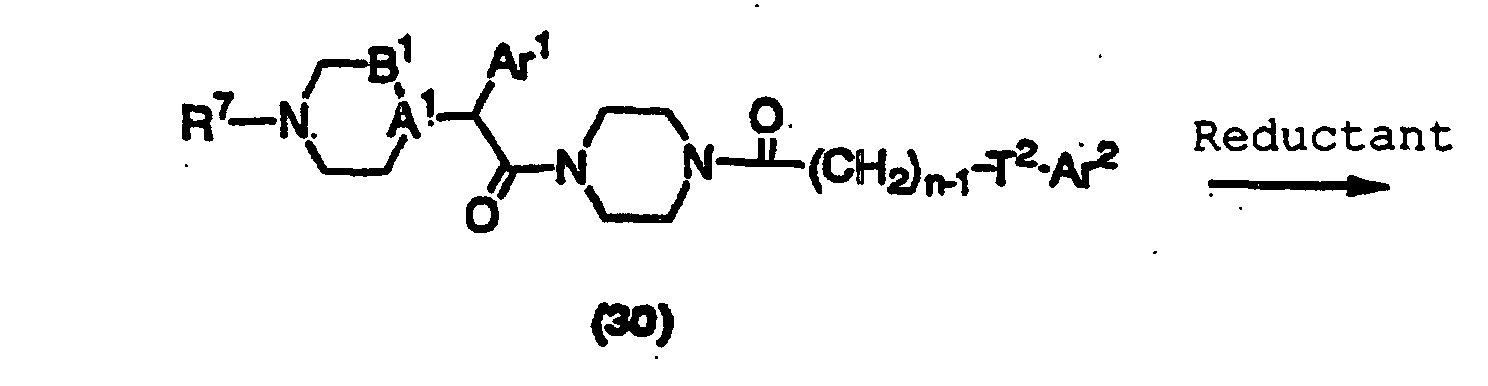
    PUAI Public reference made under article 153(3) epc to a published international application that has entered the european phase

    Free format text: ORIGINAL CODE: 0009012

    17P Request for examination filed

    Effective date: 20021220

    AK Designated contracting states

    Kind code of ref document: A1

    Designated state(s): AT BE CH CY DE DK ES FI FR GB GR IE IT LI LU MC NL PT SE TR

    Designated state(s): AT BE CH CY DE DK ES FI FR GB GR IE IT LI LU MC NL PT SE TR

    AX Request for extension of the european patent

    Extension state: AL LT LV MK RO SI

    A4 Supplementary search report drawn up and despatched

    Effective date: 20040217

    RIC1 Information provided on ipc code assigned before grant

    Ipc: 7A 61P 25/00 B

    Ipc: 7A 61K 31/495 B

    Ipc: 7C 07D 333/58 B

    Ipc: 7C 07D 311/80 B

    Ipc: 7C 07D 307/81 B

    Ipc: 7C 07D 295/13 B

    Ipc: 7C 07D 295/033 B

    Ipc: 7C 07D 261/20 B

    Ipc: 7C 07D 239/42 B

    Ipc: 7C 07D 215/12 B

    Ipc: 7C 07D 211/70 B

    Ipc: 7C 07D 211/26 B

    Ipc: 7C 07D 209/14 A

    17Q First examination report despatched

    Effective date: 20041018

    GRAP Despatch of communication of intention to grant a patent

    Free format text: ORIGINAL CODE: EPIDOSNIGR1

    RTI1 Title (correction)

    Free format text: REMEDIAL AGENT FOR ANXIETY NEUROSIS OR DEPRESSION CONTAINING A PIPERAZINE DERIVATIVE

    RTI1 Title (correction)

    Free format text: REMEDIAL AGENT FOR ANXIETY NEUROSIS OR DEPRESSION CONTAINING A PIPERAZINE DERIVATIVE

    STAA Information on the status of an ep patent application or granted ep patent

    Free format text: STATUS: THE APPLICATION IS DEEMED TO BE WITHDRAWN

    18D Application deemed to be withdrawn

    Effective date: 20060301