EP1294272B1 - System for maintenance and management of health - Google Patents
System for maintenance and management of health Download PDFInfo
- Publication number
- EP1294272B1 EP1294272B1 EP01938508A EP01938508A EP1294272B1 EP 1294272 B1 EP1294272 B1 EP 1294272B1 EP 01938508 A EP01938508 A EP 01938508A EP 01938508 A EP01938508 A EP 01938508A EP 1294272 B1 EP1294272 B1 EP 1294272B1
- Authority
- EP
- European Patent Office
- Prior art keywords
- individual patient
- log
- caregivers
- medical
- condition
- Prior art date
- Legal status (The legal status is an assumption and is not a legal conclusion. Google has not performed a legal analysis and makes no representation as to the accuracy of the status listed.)
- Expired - Lifetime
Links
- 230000036541 health Effects 0.000 title claims abstract description 25
- 238000012423 maintenance Methods 0.000 title claims abstract description 18
- 238000004891 communication Methods 0.000 claims abstract description 14
- 230000009471 action Effects 0.000 claims description 23
- 238000012544 monitoring process Methods 0.000 claims description 17
- 238000005259 measurement Methods 0.000 claims description 9
- 239000003814 drug Substances 0.000 claims description 7
- 229940079593 drug Drugs 0.000 claims description 7
- 238000011282 treatment Methods 0.000 claims description 6
- 238000002560 therapeutic procedure Methods 0.000 claims description 5
- 238000004590 computer program Methods 0.000 claims description 3
- 238000012806 monitoring device Methods 0.000 claims description 3
- 238000003745 diagnosis Methods 0.000 claims description 2
- 238000013475 authorization Methods 0.000 claims 2
- 238000000034 method Methods 0.000 abstract description 10
- 230000002093 peripheral effect Effects 0.000 abstract description 10
- 230000006870 function Effects 0.000 abstract description 4
- 238000007726 management method Methods 0.000 description 11
- 230000003449 preventive effect Effects 0.000 description 5
- 230000010354 integration Effects 0.000 description 4
- 230000008901 benefit Effects 0.000 description 3
- 238000003339 best practice Methods 0.000 description 3
- 230000000694 effects Effects 0.000 description 3
- 238000005516 engineering process Methods 0.000 description 3
- 238000013024 troubleshooting Methods 0.000 description 3
- 238000004458 analytical method Methods 0.000 description 2
- 238000013473 artificial intelligence Methods 0.000 description 2
- 238000006243 chemical reaction Methods 0.000 description 2
- 239000000463 material Substances 0.000 description 2
- 230000000474 nursing effect Effects 0.000 description 2
- 230000008569 process Effects 0.000 description 2
- 230000029058 respiratory gaseous exchange Effects 0.000 description 2
- 230000004044 response Effects 0.000 description 2
- WQZGKKKJIJFFOK-GASJEMHNSA-N Glucose Natural products OC[C@H]1OC(O)[C@H](O)[C@@H](O)[C@@H]1O WQZGKKKJIJFFOK-GASJEMHNSA-N 0.000 description 1
- 102100026827 Protein associated with UVRAG as autophagy enhancer Human genes 0.000 description 1
- 101710102978 Protein associated with UVRAG as autophagy enhancer Proteins 0.000 description 1
- 230000006793 arrhythmia Effects 0.000 description 1
- 206010003119 arrhythmia Diseases 0.000 description 1
- 230000003416 augmentation Effects 0.000 description 1
- 230000005540 biological transmission Effects 0.000 description 1
- 230000036772 blood pressure Effects 0.000 description 1
- 230000036760 body temperature Effects 0.000 description 1
- 210000004556 brain Anatomy 0.000 description 1
- 230000001413 cellular effect Effects 0.000 description 1
- 230000001684 chronic effect Effects 0.000 description 1
- 230000001419 dependent effect Effects 0.000 description 1
- 201000010099 disease Diseases 0.000 description 1
- 208000037265 diseases, disorders, signs and symptoms Diseases 0.000 description 1
- 208000002173 dizziness Diseases 0.000 description 1
- 238000011156 evaluation Methods 0.000 description 1
- 239000008103 glucose Substances 0.000 description 1
- 230000005802 health problem Effects 0.000 description 1
- 230000009474 immediate action Effects 0.000 description 1
- 238000001802 infusion Methods 0.000 description 1
- 230000000977 initiatory effect Effects 0.000 description 1
- 238000009434 installation Methods 0.000 description 1
- 230000002452 interceptive effect Effects 0.000 description 1
- 238000002483 medication Methods 0.000 description 1
- 238000005457 optimization Methods 0.000 description 1
- 230000008520 organization Effects 0.000 description 1
- 230000037081 physical activity Effects 0.000 description 1
- 238000013439 planning Methods 0.000 description 1
- 238000004886 process control Methods 0.000 description 1
- 238000012545 processing Methods 0.000 description 1
- 230000008439 repair process Effects 0.000 description 1
- 238000012360 testing method Methods 0.000 description 1
- 230000001225 therapeutic effect Effects 0.000 description 1
- 238000012549 training Methods 0.000 description 1
- 238000012546 transfer Methods 0.000 description 1
- 230000007704 transition Effects 0.000 description 1
Images


Classifications
-
- A—HUMAN NECESSITIES
- A61—MEDICAL OR VETERINARY SCIENCE; HYGIENE
- A61B—DIAGNOSIS; SURGERY; IDENTIFICATION
- A61B5/00—Measuring for diagnostic purposes; Identification of persons
- A61B5/0002—Remote monitoring of patients using telemetry, e.g. transmission of vital signals via a communication network
-
- G—PHYSICS
- G16—INFORMATION AND COMMUNICATION TECHNOLOGY [ICT] SPECIALLY ADAPTED FOR SPECIFIC APPLICATION FIELDS
- G16H—HEALTHCARE INFORMATICS, i.e. INFORMATION AND COMMUNICATION TECHNOLOGY [ICT] SPECIALLY ADAPTED FOR THE HANDLING OR PROCESSING OF MEDICAL OR HEALTHCARE DATA
- G16H10/00—ICT specially adapted for the handling or processing of patient-related medical or healthcare data
- G16H10/20—ICT specially adapted for the handling or processing of patient-related medical or healthcare data for electronic clinical trials or questionnaires
-
- G—PHYSICS
- G16—INFORMATION AND COMMUNICATION TECHNOLOGY [ICT] SPECIALLY ADAPTED FOR SPECIFIC APPLICATION FIELDS
- G16H—HEALTHCARE INFORMATICS, i.e. INFORMATION AND COMMUNICATION TECHNOLOGY [ICT] SPECIALLY ADAPTED FOR THE HANDLING OR PROCESSING OF MEDICAL OR HEALTHCARE DATA
- G16H10/00—ICT specially adapted for the handling or processing of patient-related medical or healthcare data
- G16H10/60—ICT specially adapted for the handling or processing of patient-related medical or healthcare data for patient-specific data, e.g. for electronic patient records
-
- G—PHYSICS
- G16—INFORMATION AND COMMUNICATION TECHNOLOGY [ICT] SPECIALLY ADAPTED FOR SPECIFIC APPLICATION FIELDS
- G16H—HEALTHCARE INFORMATICS, i.e. INFORMATION AND COMMUNICATION TECHNOLOGY [ICT] SPECIALLY ADAPTED FOR THE HANDLING OR PROCESSING OF MEDICAL OR HEALTHCARE DATA
- G16H20/00—ICT specially adapted for therapies or health-improving plans, e.g. for handling prescriptions, for steering therapy or for monitoring patient compliance
- G16H20/70—ICT specially adapted for therapies or health-improving plans, e.g. for handling prescriptions, for steering therapy or for monitoring patient compliance relating to mental therapies, e.g. psychological therapy or autogenous training
-
- G—PHYSICS
- G16—INFORMATION AND COMMUNICATION TECHNOLOGY [ICT] SPECIALLY ADAPTED FOR SPECIFIC APPLICATION FIELDS
- G16H—HEALTHCARE INFORMATICS, i.e. INFORMATION AND COMMUNICATION TECHNOLOGY [ICT] SPECIALLY ADAPTED FOR THE HANDLING OR PROCESSING OF MEDICAL OR HEALTHCARE DATA
- G16H40/00—ICT specially adapted for the management or administration of healthcare resources or facilities; ICT specially adapted for the management or operation of medical equipment or devices
- G16H40/60—ICT specially adapted for the management or administration of healthcare resources or facilities; ICT specially adapted for the management or operation of medical equipment or devices for the operation of medical equipment or devices
- G16H40/67—ICT specially adapted for the management or administration of healthcare resources or facilities; ICT specially adapted for the management or operation of medical equipment or devices for the operation of medical equipment or devices for remote operation
-
- G—PHYSICS
- G16—INFORMATION AND COMMUNICATION TECHNOLOGY [ICT] SPECIALLY ADAPTED FOR SPECIFIC APPLICATION FIELDS
- G16H—HEALTHCARE INFORMATICS, i.e. INFORMATION AND COMMUNICATION TECHNOLOGY [ICT] SPECIALLY ADAPTED FOR THE HANDLING OR PROCESSING OF MEDICAL OR HEALTHCARE DATA
- G16H70/00—ICT specially adapted for the handling or processing of medical references
- G16H70/20—ICT specially adapted for the handling or processing of medical references relating to practices or guidelines
-
- G—PHYSICS
- G16—INFORMATION AND COMMUNICATION TECHNOLOGY [ICT] SPECIALLY ADAPTED FOR SPECIFIC APPLICATION FIELDS
- G16H—HEALTHCARE INFORMATICS, i.e. INFORMATION AND COMMUNICATION TECHNOLOGY [ICT] SPECIALLY ADAPTED FOR THE HANDLING OR PROCESSING OF MEDICAL OR HEALTHCARE DATA
- G16H80/00—ICT specially adapted for facilitating communication between medical practitioners or patients, e.g. for collaborative diagnosis, therapy or health monitoring
-
- Y—GENERAL TAGGING OF NEW TECHNOLOGICAL DEVELOPMENTS; GENERAL TAGGING OF CROSS-SECTIONAL TECHNOLOGIES SPANNING OVER SEVERAL SECTIONS OF THE IPC; TECHNICAL SUBJECTS COVERED BY FORMER USPC CROSS-REFERENCE ART COLLECTIONS [XRACs] AND DIGESTS
- Y10—TECHNICAL SUBJECTS COVERED BY FORMER USPC
- Y10S—TECHNICAL SUBJECTS COVERED BY FORMER USPC CROSS-REFERENCE ART COLLECTIONS [XRACs] AND DIGESTS
- Y10S128/00—Surgery
- Y10S128/92—Computer assisted medical diagnostics
Definitions
- the present invention relates generally to systems for maintenance and management of health for individual patients with Communication Systems for remote monitoring and controlling of large collections of individuals, persons or devices, and to Artificial Intelligence for managing and maintaining their good status and trouble-free operation.
- a patient monitoring system which includes a portable device and a central station.
- the portable device includes an ECG and a photo-plethysmograph connected to a patient; an arrhythmia analysis apparatus; an expert system for determining if a pre-established critical parameter set has been exceeded; and a wireless wide area communication device for automatically contacting the central station via a public cellular phone network when the critical parameter set has been exceeded.
- the central station When the central station is contacted, the patient's ECG waveforms, measurements, and trends, are sent to the central monitoring station and a two way voice channel between the patient and the central station is automatically opened.
- the central station includes a computerized facility which has a station from which a clinician can observe the real time data being sent from the patient, the patient's historical records and from which the clinician can talk to the patient and activate therapeutic devices attached to the patient such as an external defibrillator, a pacer or an automatic drug infusion device.
- the above mentioned monitoring system is provided only for emergency cases to provide some immediate action on the patient. However, the system does not give a complete overview of the patient's health plan as is normally performed by the family doctor.
- WO-A-00/28459 is described a method and computer apparatus for automated medical outcomes data feedback, medical records integration, and healthcare provider response.
- the method is in general directed to the transfer per e-mail of any questions to the patient which are stored in patient data log and which are transferred to any healthcare provider, if appropriate. From the expert system task lists for the appropriate actors are provided, which tasks are performed by the actors themselves.
- an object of the invention is a system for the maintenance and management of health of a large number of individual patients which permits an easy and complete access to all important data of the patient to be treated.
- the main advantage of the system according to the present invention is that all important data can be retrieved immediately at any place. So the caregivers like medical doctors, first-aid men and emergency services can immediately decide which treatment or therapy should be given.
- the medical maintenance system according to the present invention now combines the advantages of usual medical sensors and well-trained medical personnel in hospitals, doctor's offices, wide-spread walk-in stores and emergency services with the leading technical maintenance intelligence, with the most efficient and most widely used, traditional communication tool, the telephone.
- 'Patients' we define as 'Patients', 'Individuals' and 'Units' the individuals and the large number of distributed entities to be monitored, managed and maintained. They all have as a main property their 'Condition', defined by the physiological data and measured through different parameters. We call 'Walk-ins' the devices, doctor's offices and labs, that measure and collect the 'Condition' data from the 'Patients' by 'Sensors' and feed the measured data into the management system.
- 'Managers' the programs and 'Supervisors' and 'Caregivers' the persons who are in charge of the 'Condition' monitoring, like doctors, first-aid men and emergency services, which react on 'Events' defined as alarms, problems and the like.
- 'Resources' all the man hours, money, people, devices, energy and consumables or disposables used and spent for treatment, troubleshooting, assistance and for teaching and maintenance of the 'Units'.
- 'Logs' all the electronically organized and recorded inputs of measurements, actions, notes and results.
- 'Reports' all the information gathered over the whole time and compiled on different purposes to satisfy general and specific information needs, from administrative functions to strategic fact-finding and decision-making.
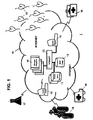
- FIG. 1 a platform of the Mobile Tele-Medical Maintenance System (MTMM) is depicted, which is a computer system 1 with a combination of proven technology process control modules, hardware and software, with a known medical knowledge base, linked via the Internet 10 and with the telephone as communication net as backbone to the distributed peripheral entities.
- the system kernel consists of several large databases 11 containing all the relevant data of all Patients and Resources :
- a 'Personal Medical Web Site' contains the data in form of an EMR ('Electronic Medical Record') which is stored in a Condition Log in one of the databases 11.
- EMR Electronic Medical Record
- the system kernel resides normally on web servers and is linked to a large number of peripheral units on the individual patients.
- a 'Personal Health Plan' shows all the doctor's prescriptions and recommendations to the Patient for medication, eating, physical activities, lifestyle, telephone calls to the doctor's office, etc. and the selected Condition monitoring with threshold values or limits and indications for corrective actions to caregivers should any values or limits be exceeded.
- a further database 12 collects all the Condition measurements made and Event messages received, together with all the corrective actions or reactions taken and initiated by the Manager programs and the Supervisors and Caregivers, and links them to Cases, Users and Resources in a Shift Log. Also the Personal Health Plan is linked to the Shift Log.
- the databases 11 and 12 are connected by and communicate over an internal network or intranet 13 with each other, directed by Manager modules 14 and Supervisors and Caregivers 15.
- the kernel is surrounded by the peripherals, linked to the databases and the Manager Modules via the Internet: All the Patients, shown as 'Mobile Hearts' 16, the Walk-ins 17, the Caregivers 18 and emergency services 19.
- peripherals have many ways to enter their Condition data into the databases, using e.g. smart Sensors, lab instruments and PC's, alarm buttons and help-phones, or just 'manual' typing or voice input in plain text on a terminal.
- scanners can be used to enter handwritten information, which can be transferred to machine-readable information by a known transposing program, into the databases 11.
- a Log Manager Module 20 is shown, which is the basic program module of the MTMM system, doing Condition Monitoring and Supervision. All Conditions, i.e. measurements, alarms and other inputs, and Events 21 are entered and logged into the databases. All the necessary links 22 to Personal Health Plans are updated, enabling fast retrieval and augmentation of knowledge stored in a knowledge database.
- the Log Manager Module as a condition monitoring device assesses the data entered and, if preset limits or trends 23 have been exceeded, automatically generates alarms 24 to Supervisors, Caregivers, Patients, emergency services and other medical personnel on duty. Based on the doctors prescriptions 25 and case classifications 23 the Log Manager Module initiates calls by doctors, visits by Caregivers, medication changes by pharmacies, device exchange and maintenance by technicians, etc.
- the Log Manager Module sends the orders 26 for these corrective actions also to the human shift Supervisor who may then decide on priorities and may coordinate the actions.
- the Log Manager Module keeps track of all the related events, of his own actions and initiations, of the Supervisors decisions, of the actions and the results feedback 27, in a fully integrated Shift Log 28.
- the Log Manager Module is an excellent tool for any shift supervision 29, also for medical supervision. No handwritten notes are necessary, all important events are always present and can be called upon directly on-screen. The planning of shifts in care giving, in emergency telephone services, for ambulances and for hospitals, etc. becomes "easy" to manage.
- Figure 3 a Diagnostic Manager Module 30 as an evaluating device is shown, which is a 'knowledge driven brain' of the MTMM system, doing the assessment of Conditions and Events, taking decisions and making recommendations to the Caregivers and the Patients for troubleshooting and treatment and keeping record of the results 35 of each action.
- the Diagnostic Manager Module enables Supervisors, Caregivers, emergency technicians and Patients to assess the situation 34 and to identify the appropriate corrective action quickly and accurately.
- This module applying usual software technologies, combines actual 'best-practice' diagnosis guidelines with a unique knowledge base from the electronic Shift Logs 36, learning and acquiring new knowledge 37 continuously.
- Health Plan or Disease Management classification system. All the different sources of services (doctors, walk-ins, care givers visits) and their care and assistance given, planned and unplanned, are selected and implemented in this 'Personal Health Plan'. For this task the Health Plan Manager Module bases on the Caregivers experience and 'best practice' guidelines but also on all company internal rules and ISO certified standards.
- the 'Personal Health Plan' keeps the overall picture of all the service efforts done and the resulting Condition, summarized into an integral history of the Patient's health. Transitions in his 'medical life', by going to the hospital, being released to a nursing home, moving to another area and another family doctor, changing job and health insurance, etc. can be managed without transferring the patients data in a old-fashioned, cumbersome way.
- the 'Mobile Patient' can really leave home 'without it' and access his 'Private Patient Web site' and his 'Personal Health Plan' from any place in this world, while still being monitored, supervised and assisted like in his home town.
- All services, all devices and Resources are recorded and managed in a parts classification system. This system includes all necessary information about suppliers, contracts, equipment and warranties. The same way all the patients and the care, planned and unplanned, are managed in the Health Plan Manager, the same way all peripheral entities, Devices and Resources, are maintained ready and in good condition.
- the Service Manager Module also contains all the information according to ISO standards and company internal rules and specs.
- the Report Manager Module enables monitoring the compliance of the therapies implemented and the outcome of the therapies administered. It therefore delivers the basis to all measures to improve efficiency and quality of the Care-giving process ('Teaching and Treating') throughout the whole service industry and its market.
- FIG 4 the integration of peripherals is depicted.
- the MTMM system uses the open architecture of Internet, telephone and the so called 'RF-Piconet', which finally enables a full integration of all types of peripherals via the easy to use, omnipresent telephone link, by wire and wireless.
- the mobile phone system enables tracking of the Patient's position down to some 50 m accuracy, an ideal tool for any Emergency Medical Service but also for caring friends and family members.
- the Sensors have become 'intelligent' and can communicate over the same Internet with the central Log Manager Module. In the MTMM system they download requests and limits for bio-signal acquisition and transmission and do the Condition monitoring. They can do basic pre-assessments of the bio-signals and can give local alarms to the Patient, if limits are exceeded. They integrate RF-Piconet transceivers (like Bluetooth) that enable them to start communication with any other device, when ever they are switched on.
- RF-Piconet transceivers like Bluetooth
- the MTMM system performs thus the functions of "CSACT” : C ondition monitoring, S upervision, A ssessment, C ommunication, T reatment and T eaching. It applies different methods of signal analysis in the intelligent sensors and in the kernel to assess the actual status of the individuals, it communicates the assessment to diagnosing programs and supervisory personnel and commands the actuators, assistance personnel and the individual to treat itself and to cope with the actual situation.
- the MTMM system will do : Alarms, immediate corrective actions, reports, logs including accounting; recalls, to care providers, optimized plans for preventive check-ups and care; optimized management of all personnel, material, devices and infrastructure resources of the care givers; all sorts of statistics for any level of the medical hierarchy in politics, public and private health organizations and insurers.
- Fig. 4 shows such a typical 'Piconet' 43 in the MTMM system: a mobile telephone 41 with its display 42 and special display control buttons 44, its numeric keypad 45 in order to type in values from stand-alone tests, speaker and microphone for voice output and input 46.
- the mobile telephone 41 communicates with any server on the Internet and its built-in RF-Piconet transceiver 47 communicate with two Sensors on the Patients body, and with one tabletop device.
- a heart monitor 50 senses the ECG with two electrodes 48, pre-analyzes it and stores it on a memory-card 49. It also monitors the breathing rate and breathing volume by breath sensors 52. The measured values-are stored and checked for coherence between two normally independent signals.
- the heart monitor 50 uses the display 42 of the mobile telephone 41 to show to the patient locally his Condition with heart-rate, body temperature, breath rate and breath volume.
- the mobile telephone 41 transmits further the Condition data over the Internet 53 to the MTMM system and to its Log Manager Module.
- the heart monitor 50 and mobile telephone 41 may communicate continuously or periodically with each other, or only in case of alarms or exceeding of limits.
- a non-invasive blood pressure unit 55 is used only a few times a day, according to the doctor's request. So are many other devices; when ever they are taken out of the pocket and switched on, they automatically search over transceiver 47 the area for an active 'Piconet' to hook on.
- the RF-Piconet transceiver 47 (like Bluetooth) offers this type of network, like the wire-bound Ethernet.
- a glucose meter 56 might be of the old fashioned strip type. With a built-in RF-Piconet transceiver 47 it will automatically call the MTMM system via the mobile telephone's access to the Internet 51 and will ask for Condition measurement schedules. If it does not have the network capability, the MTMM system will request the Patient via the mobile telephone's display 42 to do a measurement at the prescribed time and to type in the resulting value via the numeric keypad 45 of the mobile telephone 41.
- the system is standard-based, running on Windows and Unix platforms.
- the databases are all relational.
- the system is also modular. The individual modules can be used independently of one another.
- the favorite network fully exploiting the new WAP (Wireless Application Protocol) capabilities, is the worldwide Internet, or an Intranet in large companies, hospitals, nursing home holdings, etc.
- the mobile telephone can control several sensors : and input devices.
- Bluetooth is the future standard in these "Piconets”.
Landscapes
- Health & Medical Sciences (AREA)
- Engineering & Computer Science (AREA)
- Medical Informatics (AREA)
- General Health & Medical Sciences (AREA)
- Public Health (AREA)
- Epidemiology (AREA)
- Primary Health Care (AREA)
- Biomedical Technology (AREA)
- Life Sciences & Earth Sciences (AREA)
- Pathology (AREA)
- Molecular Biology (AREA)
- Child & Adolescent Psychology (AREA)
- Physics & Mathematics (AREA)
- General Business, Economics & Management (AREA)
- Biophysics (AREA)
- Heart & Thoracic Surgery (AREA)
- Business, Economics & Management (AREA)
- Surgery (AREA)
- Animal Behavior & Ethology (AREA)
- Veterinary Medicine (AREA)
- Bioethics (AREA)
- Computer Networks & Wireless Communication (AREA)
- Developmental Disabilities (AREA)
- Hospice & Palliative Care (AREA)
- Psychiatry (AREA)
- Psychology (AREA)
- Social Psychology (AREA)
- Measuring And Recording Apparatus For Diagnosis (AREA)
- Alarm Systems (AREA)
- Monitoring And Testing Of Exchanges (AREA)
- Exchange Systems With Centralized Control (AREA)
- Emergency Alarm Devices (AREA)
- Selective Calling Equipment (AREA)
Abstract
Description
- The present invention relates generally to systems for maintenance and management of health for individual patients with Communication Systems for remote monitoring and controlling of large collections of individuals, persons or devices, and to Artificial Intelligence for managing and maintaining their good status and trouble-free operation.
- In most western societies, namely in the United States and Europe, more than 30% of the population do have serious chronic health problems that challenge them in any aspects of their daily work life, and even more and worse when they leave their home to go on travel, or try to do some sports for their health. The annual medical cost in the U.S. have soared to more than 10'000 $ per non-healthy person. To bring down and control these costs, home healthcare and preventive healthcare have been launched and promoted by insurers and politicians, delivered by mostly small local care givers spread out over the country. The success of these programs was expected to be significant, especially when modern tools and methods of communication were designed, as described in earlier patents for different, interactive and interesting hardware systems and electronic data processing or EDP methods.
- But all these efforts ran against the fact that life expectancy climbed faster than any corrective measures. Sooner or later it will add all of us to the group of persons who have to be constantly monitored. In these modern societies we mostly live single on our own with no mate in the home. And any retired people's home will only accept us, if we can still move around freely and do not have to stay and to be served in the bed all the time, because the next weakness or dizziness can not be predicted or immediately assessed and reacted upon.
- Many tele-medical systems have been designed and described in the very details, but have not really been used wide-spread and have not contributed to successful optimization of cost and services. Main reason for this is the limited application of existing technology in hardware and software by the medical caregivers and therefore only a limited range of services are conceived and delivered.
- E.g. in
US-A-5,544,661 a patient monitoring system is described which includes a portable device and a central station. The portable device includes an ECG and a photo-plethysmograph connected to a patient; an arrhythmia analysis apparatus; an expert system for determining if a pre-established critical parameter set has been exceeded; and a wireless wide area communication device for automatically contacting the central station via a public cellular phone network when the critical parameter set has been exceeded. When the central station is contacted, the patient's ECG waveforms, measurements, and trends, are sent to the central monitoring station and a two way voice channel between the patient and the central station is automatically opened. The central station includes a computerized facility which has a station from which a clinician can observe the real time data being sent from the patient, the patient's historical records and from which the clinician can talk to the patient and activate therapeutic devices attached to the patient such as an external defibrillator, a pacer or an automatic drug infusion device. - The above mentioned monitoring system is provided only for emergency cases to provide some immediate action on the patient. However, the system does not give a complete overview of the patient's health plan as is normally performed by the family doctor.
- In
WO-A-00/28459 - In this document only the patient is interrogated about the outcome of any medical intervention which is a help for the medical personnel. However, this method is not a system for maintenance and management of health care as intended by the present invention.
- Accordingly, an object of the invention is a system for the maintenance and management of health of a large number of individual patients which permits an easy and complete access to all important data of the patient to be treated.
- This object of the invention is accomplished by a system with the features of
claim 1 and by a computer program product with the features of claim 8. - The main advantage of the system according to the present invention is that all important data can be retrieved immediately at any place. So the caregivers like medical doctors, first-aid men and emergency services can immediately decide which treatment or therapy should be given.
- In systems used for the management of large industrial plants, e.g. to control and maintain large oil refineries, or systems for monitoring remote pump stations along pipelines latest sensor technology with high-speed communications and extensive Artificial Intelligence in the central supervision stations, are known for over 20 years. Repair and preventive maintenance cost have been reduced to lowest optimized levels, while at the same time availability of the very complex plants was pushed up and can be guaranteed today to 100% over 30 years.
- It was surprisingly found that the functions to be implemented in efficiency optimized health maintenance of large groups of individuals, spread over rural countryside are very similar to above mentioned management systems, that secure the safe and efficient operation of all the installations in a large metropolitan subway system. The medical maintenance system according to the present invention now combines the advantages of usual medical sensors and well-trained medical personnel in hospitals, doctor's offices, wide-spread walk-in stores and emergency services with the leading technical maintenance intelligence, with the most efficient and most widely used, traditional communication tool, the telephone.
- These and other advantages of the invention are disclosed in the dependent claims and the following description in which an exemplified embodiment of the invention is described with respect to the accompanying drawings.
-
- Fig. 1
- shows an overview of the elements of the present invention,
- Fig. 2
- shows a basic program module for monitoring and supervising,
- Fig. 3
- shows another module for assessing and decision making, and
- Fig. 4
- shows several medical sensors connected to a mobile telephone for communication with the maintenance and management system.
- In the following description we define as 'Patients', 'Individuals' and 'Units' the individuals and the large number of distributed entities to be monitored, managed and maintained. They all have as a main property their 'Condition', defined by the physiological data and measured through different parameters. We call 'Walk-ins' the devices, doctor's offices and labs, that measure and collect the 'Condition' data from the 'Patients' by 'Sensors' and feed the measured data into the management system.
We call 'Managers' the programs and 'Supervisors' and 'Caregivers' the persons who are in charge of the 'Condition' monitoring, like doctors, first-aid men and emergency services, which react on 'Events' defined as alarms, problems and the like. We call 'Resources' all the man hours, money, people, devices, energy and consumables or disposables used and spent for treatment, troubleshooting, assistance and for teaching and maintenance of the 'Units'.
We call 'Logs' all the electronically organized and recorded inputs of measurements, actions, notes and results. And finally we call 'Reports' all the information gathered over the whole time and compiled on different purposes to satisfy general and specific information needs, from administrative functions to strategic fact-finding and decision-making. - In Figure 1 a platform of the Mobile Tele-Medical Maintenance System (MTMM) is depicted, which is a
computer system 1 with a combination of proven technology process control modules, hardware and software, with a known medical knowledge base, linked via the Internet 10 and with the telephone as communication net as backbone to the distributed peripheral entities. The system kernel consists of severallarge databases 11 containing all the relevant data of all Patients and Resources : A 'Personal Medical Web Site' contains the data in form of an EMR ('Electronic Medical Record') which is stored in a Condition Log in one of thedatabases 11. At the other hand the access to the EMR can be obtained via an Internet link. The system kernel resides normally on web servers and is linked to a large number of peripheral units on the individual patients. - A 'Personal Health Plan' shows all the doctor's prescriptions and recommendations to the Patient for medication, eating, physical activities, lifestyle, telephone calls to the doctor's office, etc. and the selected Condition monitoring with threshold values or limits and indications for corrective actions to caregivers should any values or limits be exceeded.
- A
further database 12 collects all the Condition measurements made and Event messages received, together with all the corrective actions or reactions taken and initiated by the Manager programs and the Supervisors and Caregivers, and links them to Cases, Users and Resources in a Shift Log. Also the Personal Health Plan is linked to the Shift Log. - The
databases intranet 13 with each other, directed byManager modules 14 and Supervisors andCaregivers 15. - The kernel is surrounded by the peripherals, linked to the databases and the Manager Modules via the Internet: All the Patients, shown as 'Mobile Hearts' 16, the Walk-
ins 17, theCaregivers 18 andemergency services 19. These peripherals have many ways to enter their Condition data into the databases, using e.g. smart Sensors, lab instruments and PC's, alarm buttons and help-phones, or just 'manual' typing or voice input in plain text on a terminal. Also scanners can be used to enter handwritten information, which can be transferred to machine-readable information by a known transposing program, into thedatabases 11. - In Figure 2 a
Log Manager Module 20 is shown, which is the basic program module of the MTMM system, doing Condition Monitoring and Supervision. All Conditions, i.e. measurements, alarms and other inputs, andEvents 21 are entered and logged into the databases. All thenecessary links 22 to Personal Health Plans are updated, enabling fast retrieval and augmentation of knowledge stored in a knowledge database. - The Log Manager Module as a condition monitoring device assesses the data entered and, if preset limits or
trends 23 have been exceeded, automatically generates alarms 24 to Supervisors, Caregivers, Patients, emergency services and other medical personnel on duty. Based on thedoctors prescriptions 25 andcase classifications 23 the Log Manager Module initiates calls by doctors, visits by Caregivers, medication changes by pharmacies, device exchange and maintenance by technicians, etc. - The Log Manager Module sends the orders 26 for these corrective actions also to the human shift Supervisor who may then decide on priorities and may coordinate the actions. The Log Manager Module keeps track of all the related events, of his own actions and initiations, of the Supervisors decisions, of the actions and the
results feedback 27, in a fully integratedShift Log 28. - It is a main characteristic of the MTMM system that all the tasks can be and some have to be executed in parallel by the software Manager Modules and the human Supervisors.
- The Log Manager Module is an excellent tool for any
shift supervision 29, also for medical supervision. No handwritten notes are necessary, all important events are always present and can be called upon directly on-screen. The planning of shifts in care giving, in emergency telephone services, for ambulances and for hospitals, etc. becomes "easy" to manage. - In Figure 3 a
Diagnostic Manager Module 30 as an evaluating device is shown, which is a 'knowledge driven brain' of the MTMM system, doing the assessment of Conditions and Events, taking decisions and making recommendations to the Caregivers and the Patients for troubleshooting and treatment and keeping record of theresults 35 of each action. - In response to
alarms 31,Condition measurements 32 anddescriptions 33 of problem situations, the Diagnostic Manager Module enables Supervisors, Caregivers, emergency technicians and Patients to assess thesituation 34 and to identify the appropriate corrective action quickly and accurately. This module, applying usual software technologies, combines actual 'best-practice' diagnosis guidelines with a unique knowledge base from the electronic Shift Logs 36, learning and acquiringnew knowledge 37 continuously. - With this knowledge always recallable from the Diagnostic Manager, all the Supervisors, Caregivers, emergency and shift staff are learning continuously on their
job 38, reducing cost of training significantly and improving the quality of their service. Internet-based teaching can be included, linked and added to the recommended procedures. - This is the first program in the 'Maintenance Control Cycle' and it enables the Caregivers to tailor-made their 'Teaching and Treatment' service to the Patients' individual needs, while optimizing the deployment of their resources and reduce the cost generated. But it is also the follow-up program that enables the Caregiver and the Patient to adjust their efforts and to optimize the deviation of the Condition from 'best practice' accepted standards for the Patient's sex, age, population group, job, education, activity, etc.
- All Teaching, Treatment, medications, activities, Condition monitoring parameters with devices and actions are managed and displayed to Caregiver and Patient in a Health Plan (or Disease Management) classification system. All the different sources of services (doctors, walk-ins, care givers visits) and their care and assistance given, planned and unplanned, are selected and implemented in this 'Personal Health Plan'. For this task the Health Plan Manager Module bases on the Caregivers experience and 'best practice' guidelines but also on all company internal rules and ISO certified standards.
- The 'Personal Health Plan' keeps the overall picture of all the service efforts done and the resulting Condition, summarized into an integral history of the Patient's health. Transitions in his 'medical life', by going to the hospital, being released to a nursing home, moving to another area and another family doctor, changing job and health insurance, etc. can be managed without transferring the patients data in a old-fashioned, cumbersome way. In the MTMM system the 'Mobile Patient' can really leave home 'without it' and access his 'Private Patient Web site' and his 'Personal Health Plan' from any place in this world, while still being monitored, supervised and assisted like in his home town.
- This is the module for the Caregiver's logistics organization. It enables them to monitor and optimize their highly complex, distributed and costly operations. It manages the collection of all service contracts and doctors prescriptions. It controls all preventive care and unscheduled troubleshooting events, and includes them into a "integral" care cycle. It allows regular preventive care work to be scheduled, planned, ordered and monitored down to the smallest consumable needed.
- All services, all devices and Resources are recorded and managed in a parts classification system. This system includes all necessary information about suppliers, contracts, equipment and warranties. The same way all the patients and the care, planned and unplanned, are managed in the Health Plan Manager, the same way all peripheral entities, Devices and Resources, are maintained ready and in good condition. For this purpose the Service Manager Module also contains all the information according to ISO standards and company internal rules and specs.
- While the care givers work is performed, all data about type of service, problems solved, how, with which medication and material and at what cost, are entered and a special Care Service Report is generated. Findings, conclusions and actions taken are then transferred to the Diagnostic Manager's knowledge data base.
- This is the evaluation and analysis program for the management of this fully integrated Health Maintenance Process. It enables continuous and periodical monitoring and classification of the activities in the electronic Shift Log, in the service orders and in other Events. This makes transparent the patients and population group's proneness to problems just as well as the cost control, hours spent and medication and consumables used.
- The Report Manager Module enables monitoring the compliance of the therapies implemented and the outcome of the therapies administered. It therefore delivers the basis to all measures to improve efficiency and quality of the Care-giving process ('Teaching and Treating') throughout the whole service industry and its market.
- All the data bases are of the relational type, based on standard software. It therefore is easy to add report generators to create additional, custom made reports, as well as to implement interfaces to sophisticated Management Information Systems.
- In Figure 4 the integration of peripherals is depicted. The MTMM system uses the open architecture of Internet, telephone and the so called 'RF-Piconet', which finally enables a full integration of all types of peripherals via the easy to use, omnipresent telephone link, by wire and wireless.
- The telephones, mainly the new mobile phones (also built into other devices, like watches, palm PC's), shall become the favorites in personal medical condition monitoring. Installing and assigning new peripherals is easy: New users get their phone with a world-wide private number (= device address). They can use it where ever they are and what ever telecom company's infrastructure they are based on.
The new mobile phones have become real Internet terminals, with which huge amounts of information can be downloaded and displayed, if necessary. They are used in the MTMM system as hubs for the very small network of different intelligent Sensors on the Patients body and devices nearby in the home, the "Piconet" 43. The mobile phone can poll Condition data from the Sensors, display them, pre-assess them and transmit them on to the databases in the kernel. And all Users have been comfortable for a long time with the user-friendly guidance "if you need assistance, press 0" and will also get used to high-tech voice input and voice recognition. - In most urban areas the mobile phone system enables tracking of the Patient's position down to some 50 m accuracy, an ideal tool for any Emergency Medical Service but also for caring friends and family members.
- The Sensors have become 'intelligent' and can communicate over the same Internet with the central Log Manager Module. In the MTMM system they download requests and limits for bio-signal acquisition and transmission and do the Condition monitoring. They can do basic pre-assessments of the bio-signals and can give local alarms to the Patient, if limits are exceeded. They integrate RF-Piconet transceivers (like Bluetooth) that enable them to start communication with any other device, when ever they are switched on.
- The MTMM system performs thus the functions of "CSACT" : C ondition monitoring, S upervision, A ssessment, C ommunication, T reatment and T eaching. It applies different methods of signal analysis in the intelligent sensors and in the kernel to assess the actual status of the individuals, it communicates the assessment to diagnosing programs and supervisory personnel and commands the actuators, assistance personnel and the individual to treat itself and to cope with the actual situation. Using standard and Artificial Intelligence software the MTMM system will do : Alarms, immediate corrective actions, reports, logs including accounting; recalls, to care providers, optimized plans for preventive check-ups and care; optimized management of all personnel, material, devices and infrastructure resources of the care givers; all sorts of statistics for any level of the medical hierarchy in politics, public and private health organizations and insurers.
- Fig. 4 shows such a typical 'Piconet' 43 in the MTMM system: a
mobile telephone 41 with itsdisplay 42 and specialdisplay control buttons 44, itsnumeric keypad 45 in order to type in values from stand-alone tests, speaker and microphone for voice output andinput 46. Themobile telephone 41 communicates with any server on the Internet and its built-in RF-Piconet transceiver 47 communicate with two Sensors on the Patients body, and with one tabletop device. - A
heart monitor 50 senses the ECG with twoelectrodes 48, pre-analyzes it and stores it on a memory-card 49. It also monitors the breathing rate and breathing volume bybreath sensors 52. The measured values-are stored and checked for coherence between two normally independent signals. Theheart monitor 50 uses thedisplay 42 of themobile telephone 41 to show to the patient locally his Condition with heart-rate, body temperature, breath rate and breath volume. Themobile telephone 41 transmits further the Condition data over the Internet 53 to the MTMM system and to its Log Manager Module. Theheart monitor 50 andmobile telephone 41 may communicate continuously or periodically with each other, or only in case of alarms or exceeding of limits. - A non-invasive
blood pressure unit 55 is used only a few times a day, according to the doctor's request. So are many other devices; when ever they are taken out of the pocket and switched on, they automatically search overtransceiver 47 the area for an active 'Piconet' to hook on. The RF-Piconet transceiver 47 (like Bluetooth) offers this type of network, like the wire-bound Ethernet. - A
glucose meter 56 might be of the old fashioned strip type. With a built-in RF-Piconet transceiver 47 it will automatically call the MTMM system via the mobile telephone's access to theInternet 51 and will ask for Condition measurement schedules. If it does not have the network capability, the MTMM system will request the Patient via the mobile telephone'sdisplay 42 to do a measurement at the prescribed time and to type in the resulting value via thenumeric keypad 45 of themobile telephone 41. - It should be clear to the skilled person that instead of
mobile telephones 41 also normal telephone sets or PC's with a monitor can be used. - Built-in data conversion modules in the Log Manager Module allow defined alarm and condition data formats to be transferred directly into the database. The Supervisors can assess the individual patients status 'real-time' by calling their mobile phone's "Pico-net" hub.
- But also the devices leased and maintained by the Caregiver, by the ambulances and by medical personnel can be called and directed in 'real-time'. The logs of their deployment at the same time are transferred to commercial bookkeeping and invoicing systems within the company offering useful and efficient support not found in other systems.
- The system is standard-based, running on Windows and Unix platforms. The databases are all relational. The system is also modular. The individual modules can be used independently of one another.
- The favorite network, fully exploiting the new WAP (Wireless Application Protocol) capabilities, is the worldwide Internet, or an Intranet in large companies, hospitals, nursing home holdings, etc. The mobile telephone can control several sensors : and input devices. Bluetooth is the future standard in these "Piconets".
Claims (8)
- A system for maintenance and management of health care for a large number of individual patients comprising a computer system and a communication system connected in communicating relationship to the computer system, wherein
the computer system (1) comprises- a condition monitoring device (20) comprising a Condition Log (11; 22), provided for entering and storing all important physiological data and event information of each individual patient together with alarm signals for said individual patient,- a supervision device (20) comprising a Shift Log (12; 28), provided for assessing the alarm signals and event information and for transmitting the alarm signals and event information to care givers involved in order to initiate a corrective action on each individual patient and for requesting a report about the corrective action and its results, and for storing the reports, and- an evaluating device (30) provided for evaluating problems and the patterns of the measurements by comparing the problems and patterns with accumulated information in a knowledge database (36), for selecting appropriate corrective action to be recommended to the caregivers and for requesting a report of the caregivers about the corrective action and its results, and for entering the reports into the knowledge database, thereby accumulating and enlarging the knowledge database, and- the communication system (10; 13; 43; 51) is provided for transmitting alarms and recommendations to a supervisor, in order to correct and/or release the alarms and recommendations, being transmitted further to the caregivers for taking the recommended action to the individual patient. - A system according to Claim 1, whereas the communication system (10'; 13; 43; 51) comprises devices for Internet access, especially Internet accessible mobile telephones (41), PDA's and PC's.
- A system according to Claim 1 or 2, wherein sensors (48; 50; 52; 55; 56) are provided for measuring the physiological data on the patient which are connected to the communication system (10; 13; 43; 51).
- A system according to one of Claims 1 to 3, comprising a Medical Web Site stored in the computer system (1), which contains a separate database containing all medical data and the medical history of each individual patient, which is accessible by express authorization of the individual patient and/or his caregiver only.
- A system according to one of Claims 1 to 4 comprising a Personal Health Plan stored in the computer system (1), containing the doctor's prescriptions for medication, treatments, practicing and lifestyle of the individual patient, a schedule for the monitoring of conditions stored in the Condition Log, the selection of sensors to be used, the threshold values of the physiological data to be monitored and corrective actions, whereas the monitored data, compliance for therapies and the outcome of the therapies are attached to the Plan, which is accessible by express authorization of the individual patient and/or his caregiver only.
- A system according to one of Claims 1 to 5 comprising a Log Manager Module (20) for monitoring the alarm signals and the event information in the Condition Log (11; 22) and for supervising the reports in the Shift Log (12; 28; 36).
- A system according to one of Claims 1 to 6, comprising a Diagnostic Manager Module (30) for diagnosing the condition of each individual patient by means of comparing data stored in expert computer programs containing diagnosis guidelines with the accumulated data of the knowledge database.
- A computer program product stored on a medium usable in a computer system for maintenance and management of health care for a large number of individual patients, comprising software code adopted to cause the system according to Claim 1 to perform the following steps:- transmitting, entering and storing all important physiological data and event information of each individual patient together with alarm signals for said individual patient into a Condition Log (11; 22) of a condition monitoring device (20),- assessing the alarm signals and event information and transmitting the alarm signals and event information to care givers involved in order to initiate a corrective action on the patient and requesting a report about the corrective action and its results, and storing the reports into a Shift Log (12; 28) of a supervision device (20), and- evaluating problems and the patterns of the measurements by comparing the problems and patterns, with accumulated information in a knowledge database (36) of an evaluating device (30), selecting appropriate corrective action to be recommended to the caregivers and for requesting a report of the caregivers about the corrective action and its results, and entering the reports into the knowledge database, whereby accumulating and enlarging the knowledge database, and- transmitting alarms and recommendations by means of a communication system (10; 13; 43; 51) connected to the computer system (1) to a supervisor, who corrects and/or releases the alarms and recommendations, being transmitted further to the caregivers for taking the recommended action.
Applications Claiming Priority (3)
| Application Number | Priority Date | Filing Date | Title |
|---|---|---|---|
| IB0000838 | 2000-06-22 | ||
| WOPCT/IB00/00838 | 2000-06-22 | ||
| PCT/IB2001/001110 WO2001097686A1 (en) | 2000-06-22 | 2001-06-22 | System for maintenance and management of health |
Publications (2)
| Publication Number | Publication Date |
|---|---|
| EP1294272A1 EP1294272A1 (en) | 2003-03-26 |
| EP1294272B1 true EP1294272B1 (en) | 2007-08-15 |
Family
ID=11003938
Family Applications (1)
| Application Number | Title | Priority Date | Filing Date |
|---|---|---|---|
| EP01938508A Expired - Lifetime EP1294272B1 (en) | 2000-06-22 | 2001-06-22 | System for maintenance and management of health |
Country Status (7)
| Country | Link |
|---|---|
| US (1) | US6735551B2 (en) |
| EP (1) | EP1294272B1 (en) |
| AT (1) | ATE369786T1 (en) |
| AU (1) | AU2001264182A1 (en) |
| DE (1) | DE60129964T2 (en) |
| ES (1) | ES2293998T3 (en) |
| WO (1) | WO2001097686A1 (en) |
Cited By (2)
| Publication number | Priority date | Publication date | Assignee | Title |
|---|---|---|---|---|
| DE102007057169A1 (en) * | 2007-11-26 | 2009-05-28 | Helmut Rauer | Diagnostic machine for web-based sensor- and evaluation system, has personal-computer-based processor, where machine supplies processed data into diagnostic- and management center over secured internet connection |
| WO2012177159A1 (en) | 2011-06-22 | 2012-12-27 | Klaus Dieter Jentsch | Device and method for remote diagnostic and management of automated technical devices |
Families Citing this family (82)
| Publication number | Priority date | Publication date | Assignee | Title |
|---|---|---|---|---|
| US8797165B2 (en) | 2000-10-11 | 2014-08-05 | Riddell, Inc. | System for monitoring a physiological parameter of players engaged in a sporting activity |
| US10952671B2 (en) | 2000-10-11 | 2021-03-23 | Riddell, Inc. | System for monitoring a physiological parameter of players engaged in a sporting activity |
| US6826509B2 (en) | 2000-10-11 | 2004-11-30 | Riddell, Inc. | System and method for measuring the linear and rotational acceleration of a body part |
| AU2002309528A1 (en) | 2001-04-02 | 2002-10-15 | Therasense, Inc. | Blood glucose tracking apparatus and methods |
| US7407484B2 (en) | 2001-04-06 | 2008-08-05 | Medic4All Inc. | Physiological monitoring system for a computational device of a human subject |
| US6556999B1 (en) * | 2001-06-08 | 2003-04-29 | Syntex (Usa) Llc | System and method for bridging a clinical remote data entry product to a back-end clinical data management system |
| US6783492B2 (en) * | 2001-06-26 | 2004-08-31 | Steven Dominguez | System and method for monitoring body functions |
| EP1421458B1 (en) | 2001-08-03 | 2010-04-07 | Hill-Rom Services, Inc. | Patient point-of-care computer system |
| IL155682A0 (en) * | 2001-08-20 | 2003-11-23 | Inverness Medical Ltd | Wireless diabetes management devices and methods for using the same |
| WO2003043494A1 (en) * | 2001-11-23 | 2003-05-30 | Medit As | A cluster system for remote monitoring and diagnostic support |
| US20030107487A1 (en) | 2001-12-10 | 2003-06-12 | Ronen Korman | Method and device for measuring physiological parameters at the wrist |
| ES2190380A1 (en) * | 2001-12-24 | 2003-07-16 | Serna F Leandro Llosa | Localisation and communication system |
| FR2837298B1 (en) | 2002-03-14 | 2004-08-13 | Jean Charles Aubert | METHOD FOR MANAGING INFORMATION STORED ON A CHIP CARD READABLE BY A MOBILE TELEPHONE |
| US20050080322A1 (en) * | 2002-03-18 | 2005-04-14 | Ronen Korman | Monitoring method and monitoring system for assessing physiological parameters of a subject |
| EP1352606A1 (en) * | 2002-04-10 | 2003-10-15 | Ulrike Heemann | Monitoring method for physiological data of an individual, in particular for remote monitoring of patients |
| CA2482859C (en) * | 2002-04-16 | 2010-02-09 | Carematix, Inc. | Method and apparatus for remotely monitoring the condition of a patient |
| FR2841360B1 (en) * | 2002-06-21 | 2007-03-30 | Jean Spiess | DEVICE FOR ASSISTING, CONTROLLING, VALIDATING AND SECURING THE TAKING OF DRUGS |
| US10249386B2 (en) | 2002-08-01 | 2019-04-02 | Prosocial Applications, Inc. | Electronic health records |
| US10170203B1 (en) | 2002-08-01 | 2019-01-01 | Prosocial Applications, Inc. | Method and software for a web-based platform of comprehensive personal health records that enforces individualized patient hierarchies of user permissions and detects gaps in patient care |
| US20040083395A1 (en) * | 2002-08-01 | 2004-04-29 | Elain Blechman | Client-centric e-health system and method with applications to long-term health and community care consumers, insurers, and regulators |
| US20110082794A1 (en) * | 2002-08-01 | 2011-04-07 | Blechman Elaine A | Client-centric e-health system and method with applications to long-term health and community care consumers, insurers, and regulators |
| US20050267847A1 (en) * | 2002-08-01 | 2005-12-01 | Blechman Elaine A | Client-centric e-health system and method with applications to long-term health and community care consumers, insurers, and regulators |
| US8560582B2 (en) * | 2002-08-12 | 2013-10-15 | Jeffrey Saul Harris | Method for analyzing records in a data base |
| US20040030584A1 (en) * | 2002-08-12 | 2004-02-12 | Harris Jeffrey Saul | System and method for guideline-based, rules assisted medical and disability management |
| US7259906B1 (en) | 2002-09-03 | 2007-08-21 | Cheetah Omni, Llc | System and method for voice control of medical devices |
| US7761382B2 (en) * | 2003-03-14 | 2010-07-20 | Siemens Aktiengesellschaft | Method and system to protect electronic data objects from unauthorized access |
| AU2004224345B2 (en) | 2003-03-21 | 2010-02-18 | Welch Allyn, Inc. | Personal status physiologic monitor system and architecture and related monitoring methods |
| US20050108366A1 (en) * | 2003-07-02 | 2005-05-19 | International Business Machines Corporation | Administering devices with domain state objects |
| KR20060108721A (en) * | 2003-12-09 | 2006-10-18 | 마츠시타 덴끼 산교 가부시키가이샤 | Mobile medication history management device, memory card, and management method |
| US20050165622A1 (en) * | 2004-01-26 | 2005-07-28 | Neel Gary T. | Medical diagnostic testing device with voice message capability |
| US7828147B2 (en) | 2004-04-24 | 2010-11-09 | Inrange Systems, Inc. | Multi-layer medication carrier |
| AU2004319427B2 (en) | 2004-04-24 | 2011-04-21 | Inrange Systems, Inc. | Integrated, non-sequential, remote medication management and compliance system |
| US20060026036A1 (en) * | 2004-07-30 | 2006-02-02 | Mahmood Syyed T | System and method for simultaneously optimizing the quality of life and controlling health care costs |
| US20100286488A1 (en) * | 2004-08-27 | 2010-11-11 | Moshe Cohen | Method and system for using a mobile device as a portable personal terminal for medical information |
| EP1634530A1 (en) * | 2004-09-13 | 2006-03-15 | International Business Machines Corporation | System and method for displaying information related to a physical parameter of an individual |
| ITBO20050002A1 (en) * | 2005-01-04 | 2006-07-05 | Giacomo Vespasiani | METHOD AND SYSTEM FOR INTERACTIVE MANAGEMENT OF DATA CONCERNING AN INSULIN THERAPY IN SELF-CONTROL FOR A DIABETIC PATIENT |
| MX2007008304A (en) | 2005-01-07 | 2008-01-18 | Riddell | System and method for evaluating and providing treatment to sports participants. |
| US7545272B2 (en) | 2005-02-08 | 2009-06-09 | Therasense, Inc. | RF tag on test strips, test strip vials and boxes |
| US20060205564A1 (en) * | 2005-03-04 | 2006-09-14 | Peterson Eric K | Method and apparatus for mobile health and wellness management incorporating real-time coaching and feedback, community and rewards |
| US20090030967A1 (en) * | 2005-05-17 | 2009-01-29 | United Technologies Corporation | Personal wearable microserver |
| CA2552062C (en) * | 2005-07-22 | 2016-06-28 | 4121856 Canada Inc. | System and methods for enhancing the experience of spectators attending a live sporting event |
| WO2007021973A2 (en) * | 2005-08-12 | 2007-02-22 | Sudhir Sitaram Krishna | Method and system of personal healthcare management |
| US8764654B2 (en) | 2008-03-19 | 2014-07-01 | Zin Technologies, Inc. | Data acquisition for modular biometric monitoring system |
| US20070088579A1 (en) * | 2005-10-19 | 2007-04-19 | Richards John W Jr | Systems and methods for automated processing and assessment of an insurance disclosure via a network |
| US20070088580A1 (en) * | 2005-10-19 | 2007-04-19 | Richards John W Jr | Systems and methods for providing comparative health care information via a network |
| WO2007063057A1 (en) * | 2005-11-30 | 2007-06-07 | Swiss Reinsurance Company | Activation and control device for coupling two mutually activatable automatic intervention systems |
| US20080103823A1 (en) * | 2006-11-01 | 2008-05-01 | Papa Angelo A | Method for coordinating professional services |
| US8214007B2 (en) | 2006-11-01 | 2012-07-03 | Welch Allyn, Inc. | Body worn physiological sensor device having a disposable electrode module |
| US20080154642A1 (en) * | 2006-12-21 | 2008-06-26 | Susan Marble | Healthcare Core Measure Tracking Software and Database |
| US8348839B2 (en) * | 2007-04-10 | 2013-01-08 | General Electric Company | Systems and methods for active listening/observing and event detection |
| ES2693097T3 (en) | 2007-05-30 | 2018-12-07 | Ascensia Diabetes Care Holdings Ag | System and method for managing health data |
| US9848058B2 (en) | 2007-08-31 | 2017-12-19 | Cardiac Pacemakers, Inc. | Medical data transport over wireless life critical network employing dynamic communication link mapping |
| US7978062B2 (en) * | 2007-08-31 | 2011-07-12 | Cardiac Pacemakers, Inc. | Medical data transport over wireless life critical network |
| EP2201709A2 (en) * | 2007-09-17 | 2010-06-30 | The Technology Partnership PLC | Configurable module |
| US20120046964A1 (en) * | 2007-10-30 | 2012-02-23 | Papa Angelo A | Method of coordinating professional services |
| US20090252306A1 (en) * | 2008-04-07 | 2009-10-08 | The General Electric Company | Telemedicine system and method |
| US8799010B2 (en) * | 2008-05-07 | 2014-08-05 | Unitedhealth Group Incorporated | Telehealth scheduling and communications network |
| US20090319298A1 (en) * | 2008-06-19 | 2009-12-24 | Weiss Sanford B | Patient status and healthcare information communication system and method |
| US8812841B2 (en) | 2009-03-04 | 2014-08-19 | Cardiac Pacemakers, Inc. | Communications hub for use in life critical network |
| US8319631B2 (en) | 2009-03-04 | 2012-11-27 | Cardiac Pacemakers, Inc. | Modular patient portable communicator for use in life critical network |
| WO2011037508A1 (en) | 2009-09-24 | 2011-03-31 | Telefonaktiebolaget L M Ericsson (Publ) | Method and apparatus for simulation of a system in a communications network |
| US20110288378A1 (en) * | 2010-05-24 | 2011-11-24 | Codd Timothy D | Method of Administering A Lifestyle Tracking System |
| US9492341B2 (en) | 2010-10-08 | 2016-11-15 | Hill-Rom Services, Inc. | Hospital bed with graphical user interface having advanced functionality |
| US20120130739A1 (en) * | 2010-11-21 | 2012-05-24 | David Crane | Unsupervised Telemedical Office for Remote &/or Autonomous & Automated Medical Care of Patients |
| MX352036B (en) | 2011-09-01 | 2017-11-07 | Riddell | Systems and methods for monitoring a physiological parameter of persons engaged in physical activity. |
| US9700222B2 (en) | 2011-12-02 | 2017-07-11 | Lumiradx Uk Ltd | Health-monitor patch |
| US9734304B2 (en) | 2011-12-02 | 2017-08-15 | Lumiradx Uk Ltd | Versatile sensors with data fusion functionality |
| US10159296B2 (en) | 2013-01-18 | 2018-12-25 | Riddell, Inc. | System and method for custom forming a protective helmet for a customer's head |
| US10404784B2 (en) | 2013-02-22 | 2019-09-03 | Samsung Electronics Co., Ltd. | Method and system for transmitting result of examination of specimen from medical device to destination |
| US9230420B2 (en) | 2013-02-22 | 2016-01-05 | Samsung Electronics Co., Ltd. | Method and system for implementing alarms for medical device through mobile device |
| EP2770452A1 (en) | 2013-02-22 | 2014-08-27 | Samsung Electronics Co., Ltd. | Method and system for transmitting result of examination of specimen from medical device to destination through mobile device |
| CN104680033A (en) * | 2015-03-23 | 2015-06-03 | 黑龙江聚拢华玺智能科技有限公司 | Intelligent pension service software system |
| US10659479B2 (en) * | 2015-03-27 | 2020-05-19 | Mcafee, Llc | Determination of sensor usage |
| US20170161446A1 (en) * | 2015-12-04 | 2017-06-08 | Sectra Ab | Systems and Methods for Continuous Optimization of Medical Treatments |
| US10726846B2 (en) * | 2016-06-03 | 2020-07-28 | Sri International | Virtual health assistant for promotion of well-being and independent living |
| US10780338B1 (en) | 2016-07-20 | 2020-09-22 | Riddell, Inc. | System and methods for designing and manufacturing bespoke protective sports equipment |
| WO2018027253A1 (en) * | 2016-08-11 | 2018-02-15 | Bloomfield Lochlan John | Health management system and method |
| US11399589B2 (en) | 2018-08-16 | 2022-08-02 | Riddell, Inc. | System and method for designing and manufacturing a protective helmet tailored to a selected group of helmet wearers |
| CA3169309A1 (en) | 2018-11-21 | 2020-05-28 | Riddell, Inc. | Protective recreational sports helmet with components additively manufactured to manage impact forces |
| WO2020123873A1 (en) * | 2018-12-12 | 2020-06-18 | Riddell, Inc. | Systems and methods for providing training opportunities based on physiological parameter of persons engaged in physical activity |
| WO2022228596A1 (en) * | 2021-04-27 | 2022-11-03 | Michaela Bischof | Secured communication and assistance system |
| DE102021002201A1 (en) | 2021-04-27 | 2022-10-27 | Michaela Bischof | Secured communication and assistance system |
Family Cites Families (15)
| Publication number | Priority date | Publication date | Assignee | Title |
|---|---|---|---|---|
| US5544661A (en) * | 1994-01-13 | 1996-08-13 | Charles L. Davis | Real time ambulatory patient monitor |
| US6234964B1 (en) * | 1997-03-13 | 2001-05-22 | First Opinion Corporation | Disease management system and method |
| US6602469B1 (en) * | 1998-11-09 | 2003-08-05 | Lifestream Technologies, Inc. | Health monitoring and diagnostic device and network-based health assessment and medical records maintenance system |
| AU3098800A (en) | 1998-11-10 | 2000-05-29 | Duane Steward | Method for automated medical outcomes data feedback, medical records integration, and healthcare provider response |
| US6221011B1 (en) * | 1999-07-26 | 2001-04-24 | Cardiac Intelligence Corporation | System and method for determining a reference baseline of individual patient status for use in an automated collection and analysis patient care system |
| US6602191B2 (en) * | 1999-12-17 | 2003-08-05 | Q-Tec Systems Llp | Method and apparatus for health and disease management combining patient data monitoring with wireless internet connectivity |
| US6893396B2 (en) * | 2000-03-01 | 2005-05-17 | I-Medik, Inc. | Wireless internet bio-telemetry monitoring system and interface |
| US20030036683A1 (en) * | 2000-05-01 | 2003-02-20 | Kehr Bruce A. | Method, system and computer program product for internet-enabled, patient monitoring system |
| US6544173B2 (en) * | 2000-05-19 | 2003-04-08 | Welch Allyn Protocol, Inc. | Patient monitoring system |
| US20020072932A1 (en) * | 2000-12-11 | 2002-06-13 | Bala Swamy | Health personal digital assistant |
| US20020147390A1 (en) * | 2000-12-20 | 2002-10-10 | Markis John Emmanuel M.D. | Methods and apparatus for acquiring and using bedside medical data |
| US6723046B2 (en) * | 2001-01-29 | 2004-04-20 | Cybernet Systems Corporation | At-home health data management method and apparatus |
| AU2002254463A1 (en) * | 2001-03-28 | 2002-10-15 | Televital, Inc. | Real-time monitoring assessment, analysis, retrieval, and storage of physiological data |
| US20020169584A1 (en) * | 2001-05-14 | 2002-11-14 | Zhongsu Fu | Mobile monitoring system |
| US20020188182A1 (en) * | 2001-06-11 | 2002-12-12 | Haines John Edward | System and method for scoring and managing patient progression |
-
2001
- 2001-06-22 AT AT01938508T patent/ATE369786T1/en active
- 2001-06-22 AU AU2001264182A patent/AU2001264182A1/en not_active Abandoned
- 2001-06-22 WO PCT/IB2001/001110 patent/WO2001097686A1/en not_active Ceased
- 2001-06-22 US US10/312,317 patent/US6735551B2/en not_active Expired - Lifetime
- 2001-06-22 DE DE60129964T patent/DE60129964T2/en not_active Expired - Lifetime
- 2001-06-22 EP EP01938508A patent/EP1294272B1/en not_active Expired - Lifetime
- 2001-06-22 ES ES01938508T patent/ES2293998T3/en not_active Expired - Lifetime
Non-Patent Citations (1)
| Title |
|---|
| None * |
Cited By (2)
| Publication number | Priority date | Publication date | Assignee | Title |
|---|---|---|---|---|
| DE102007057169A1 (en) * | 2007-11-26 | 2009-05-28 | Helmut Rauer | Diagnostic machine for web-based sensor- and evaluation system, has personal-computer-based processor, where machine supplies processed data into diagnostic- and management center over secured internet connection |
| WO2012177159A1 (en) | 2011-06-22 | 2012-12-27 | Klaus Dieter Jentsch | Device and method for remote diagnostic and management of automated technical devices |
Also Published As
| Publication number | Publication date |
|---|---|
| DE60129964T2 (en) | 2008-05-08 |
| US6735551B2 (en) | 2004-05-11 |
| WO2001097686A1 (en) | 2001-12-27 |
| ES2293998T3 (en) | 2008-04-01 |
| AU2001264182A1 (en) | 2002-01-02 |
| DE60129964D1 (en) | 2007-09-27 |
| EP1294272A1 (en) | 2003-03-26 |
| US20030101078A1 (en) | 2003-05-29 |
| ATE369786T1 (en) | 2007-09-15 |
Similar Documents
| Publication | Publication Date | Title |
|---|---|---|
| US6735551B2 (en) | System for maintenance and management of health | |
| JP5346318B2 (en) | Communication repeater device for implantable medical devices | |
| CA2303916C (en) | Knowledge-based expert interactive system for pain | |
| US6450956B1 (en) | System and method for treatment and outcome measurement analysis | |
| JP5801878B2 (en) | Electronic health journal | |
| AU754171B2 (en) | Systems, methods and computer program products for monitoring, diagnosing and treating medical conditions of remotely located patients | |
| US20010039375A1 (en) | Large-scale processing loop for implantable medical devices | |
| CN110322953B (en) | A kind of intelligent escort system and its escort method | |
| US20070106129A1 (en) | Dietary monitoring system for comprehensive patient management | |
| CN111128333A (en) | One-stop intelligent diagnosis and intelligent medical management system | |
| EP2375964A1 (en) | Method for remote diagnostics monitoring and support of patients and device and telemedical center | |
| CN108281195A (en) | A kind of management method and system of medical data | |
| JP2006519626A5 (en) | ||
| WO2003098399A2 (en) | Health care information management system and method | |
| WO2002002004A1 (en) | A health outcomes and disease management network and related method for providing improved patient care | |
| US20050240246A1 (en) | Large-scale processing loop for implantable medical devices | |
| Rodriguez et al. | A home telecare management system | |
| US20070168222A1 (en) | System and method for providing hierarchical medical device control for automated patient management | |
| EP1244993A2 (en) | Large-scale processing loop for implantable medical devices | |
| Moreno et al. | Improving palliative care with agent technology | |
| Yang et al. | Requirement analysis and architecture design for ubiquitous healthcare service systems | |
| CN120932835A (en) | County-level medical care dispatching system and method suitable for elderly patients | |
| TH22070U (en) | Analysis system Predict health conditions Recommend prevention guidelines and remote rehabilitation | |
| TH22070A3 (en) | Analysis system Predict health conditions Recommend prevention guidelines and remote rehabilitation | |
| Sundjaja | Check 03-Disease Management Information System. pdf |
Legal Events
| Date | Code | Title | Description |
|---|---|---|---|
| PUAI | Public reference made under article 153(3) epc to a published international application that has entered the european phase |
Free format text: ORIGINAL CODE: 0009012 |
|
| 17P | Request for examination filed |
Effective date: 20030117 |
|
| AK | Designated contracting states |
Kind code of ref document: A1 Designated state(s): AT BE CH CY DE DK ES FI FR GB GR IE IT LI LU MC NL PT SE TR |
|
| AX | Request for extension of the european patent |
Extension state: AL LT LV MK RO SI |
|
| 17Q | First examination report despatched |
Effective date: 20041206 |
|
| GRAP | Despatch of communication of intention to grant a patent |
Free format text: ORIGINAL CODE: EPIDOSNIGR1 |
|
| GRAS | Grant fee paid |
Free format text: ORIGINAL CODE: EPIDOSNIGR3 |
|
| GRAA | (expected) grant |
Free format text: ORIGINAL CODE: 0009210 |
|
| AK | Designated contracting states |
Kind code of ref document: B1 Designated state(s): AT BE CH CY DE DK ES FI FR GB GR IE IT LI LU MC NL PT SE TR |
|
| REG | Reference to a national code |
Ref country code: GB Ref legal event code: FG4D |
|
| REG | Reference to a national code |
Ref country code: CH Ref legal event code: EP |
|
| REG | Reference to a national code |
Ref country code: IE Ref legal event code: FG4D |
|
| REF | Corresponds to: |
Ref document number: 60129964 Country of ref document: DE Date of ref document: 20070927 Kind code of ref document: P |
|
| PG25 | Lapsed in a contracting state [announced via postgrant information from national office to epo] |
Ref country code: NL Free format text: LAPSE BECAUSE OF FAILURE TO SUBMIT A TRANSLATION OF THE DESCRIPTION OR TO PAY THE FEE WITHIN THE PRESCRIBED TIME-LIMIT Effective date: 20070815 Ref country code: FI Free format text: LAPSE BECAUSE OF FAILURE TO SUBMIT A TRANSLATION OF THE DESCRIPTION OR TO PAY THE FEE WITHIN THE PRESCRIBED TIME-LIMIT Effective date: 20070815 |
|
| NLV1 | Nl: lapsed or annulled due to failure to fulfill the requirements of art. 29p and 29m of the patents act | ||
| ET | Fr: translation filed | ||
| PG25 | Lapsed in a contracting state [announced via postgrant information from national office to epo] |
Ref country code: BE Free format text: LAPSE BECAUSE OF FAILURE TO SUBMIT A TRANSLATION OF THE DESCRIPTION OR TO PAY THE FEE WITHIN THE PRESCRIBED TIME-LIMIT Effective date: 20070815 |
|
| REG | Reference to a national code |
Ref country code: ES Ref legal event code: FG2A Ref document number: 2293998 Country of ref document: ES Kind code of ref document: T3 |
|
| PG25 | Lapsed in a contracting state [announced via postgrant information from national office to epo] |
Ref country code: DK Free format text: LAPSE BECAUSE OF FAILURE TO SUBMIT A TRANSLATION OF THE DESCRIPTION OR TO PAY THE FEE WITHIN THE PRESCRIBED TIME-LIMIT Effective date: 20070815 Ref country code: GR Free format text: LAPSE BECAUSE OF FAILURE TO SUBMIT A TRANSLATION OF THE DESCRIPTION OR TO PAY THE FEE WITHIN THE PRESCRIBED TIME-LIMIT Effective date: 20071116 |
|
| PG25 | Lapsed in a contracting state [announced via postgrant information from national office to epo] |
Ref country code: PT Free format text: LAPSE BECAUSE OF FAILURE TO SUBMIT A TRANSLATION OF THE DESCRIPTION OR TO PAY THE FEE WITHIN THE PRESCRIBED TIME-LIMIT Effective date: 20080115 |
|
| REG | Reference to a national code |
Ref country code: CH Ref legal event code: NV Representative=s name: SPIERENBURG & PARTNER AG, PATENT- UND MARKENANWAEL |
|
| PLBE | No opposition filed within time limit |
Free format text: ORIGINAL CODE: 0009261 |
|
| STAA | Information on the status of an ep patent application or granted ep patent |
Free format text: STATUS: NO OPPOSITION FILED WITHIN TIME LIMIT |
|
| PG25 | Lapsed in a contracting state [announced via postgrant information from national office to epo] |
Ref country code: SE Free format text: LAPSE BECAUSE OF FAILURE TO SUBMIT A TRANSLATION OF THE DESCRIPTION OR TO PAY THE FEE WITHIN THE PRESCRIBED TIME-LIMIT Effective date: 20071115 |
|
| 26N | No opposition filed |
Effective date: 20080516 |
|
| PG25 | Lapsed in a contracting state [announced via postgrant information from national office to epo] |
Ref country code: MC Free format text: LAPSE BECAUSE OF NON-PAYMENT OF DUE FEES Effective date: 20080630 |
|
| PG25 | Lapsed in a contracting state [announced via postgrant information from national office to epo] |
Ref country code: IE Free format text: LAPSE BECAUSE OF NON-PAYMENT OF DUE FEES Effective date: 20080623 |
|
| PG25 | Lapsed in a contracting state [announced via postgrant information from national office to epo] |
Ref country code: CY Free format text: LAPSE BECAUSE OF FAILURE TO SUBMIT A TRANSLATION OF THE DESCRIPTION OR TO PAY THE FEE WITHIN THE PRESCRIBED TIME-LIMIT Effective date: 20070815 |
|
| PG25 | Lapsed in a contracting state [announced via postgrant information from national office to epo] |
Ref country code: LU Free format text: LAPSE BECAUSE OF NON-PAYMENT OF DUE FEES Effective date: 20080622 |
|
| PG25 | Lapsed in a contracting state [announced via postgrant information from national office to epo] |
Ref country code: TR Free format text: LAPSE BECAUSE OF FAILURE TO SUBMIT A TRANSLATION OF THE DESCRIPTION OR TO PAY THE FEE WITHIN THE PRESCRIBED TIME-LIMIT Effective date: 20070815 |
|
| PGRI | Patent reinstated in contracting state [announced from national office to epo] |
Ref country code: IT Effective date: 20110501 |
|
| REG | Reference to a national code |
Ref country code: CH Ref legal event code: PCOW Free format text: NEW ADDRESS: 9401 GLEN RIDGE DRIVE, BRENTWOOD, TN 37027 (US) $ FRIDOLIN VOEGELI, BAHNHOFSTRASSE 213, 8623 WETZIKON (CH) |
|
| REG | Reference to a national code |
Ref country code: FR Ref legal event code: PLFP Year of fee payment: 15 |
|
| PGFP | Annual fee paid to national office [announced via postgrant information from national office to epo] |
Ref country code: GB Payment date: 20150629 Year of fee payment: 15 Ref country code: DE Payment date: 20150629 Year of fee payment: 15 |
|
| PGFP | Annual fee paid to national office [announced via postgrant information from national office to epo] |
Ref country code: AT Payment date: 20150630 Year of fee payment: 15 Ref country code: FR Payment date: 20150626 Year of fee payment: 15 |
|
| PGFP | Annual fee paid to national office [announced via postgrant information from national office to epo] |
Ref country code: ES Payment date: 20150728 Year of fee payment: 15 |
|
| PGFP | Annual fee paid to national office [announced via postgrant information from national office to epo] |
Ref country code: IT Payment date: 20150630 Year of fee payment: 15 |
|
| REG | Reference to a national code |
Ref country code: DE Ref legal event code: R119 Ref document number: 60129964 Country of ref document: DE |
|
| REG | Reference to a national code |
Ref country code: AT Ref legal event code: MM01 Ref document number: 369786 Country of ref document: AT Kind code of ref document: T Effective date: 20160622 |
|
| GBPC | Gb: european patent ceased through non-payment of renewal fee |
Effective date: 20160622 |
|
| REG | Reference to a national code |
Ref country code: FR Ref legal event code: ST Effective date: 20170228 |
|
| PG25 | Lapsed in a contracting state [announced via postgrant information from national office to epo] |
Ref country code: DE Free format text: LAPSE BECAUSE OF NON-PAYMENT OF DUE FEES Effective date: 20170103 Ref country code: FR Free format text: LAPSE BECAUSE OF NON-PAYMENT OF DUE FEES Effective date: 20160630 |
|
| PG25 | Lapsed in a contracting state [announced via postgrant information from national office to epo] |
Ref country code: AT Free format text: LAPSE BECAUSE OF NON-PAYMENT OF DUE FEES Effective date: 20160622 Ref country code: GB Free format text: LAPSE BECAUSE OF NON-PAYMENT OF DUE FEES Effective date: 20160622 |
|
| PG25 | Lapsed in a contracting state [announced via postgrant information from national office to epo] |
Ref country code: IT Free format text: LAPSE BECAUSE OF NON-PAYMENT OF DUE FEES Effective date: 20160622 |
|
| PG25 | Lapsed in a contracting state [announced via postgrant information from national office to epo] |
Ref country code: ES Free format text: LAPSE BECAUSE OF NON-PAYMENT OF DUE FEES Effective date: 20160623 |
|
| REG | Reference to a national code |
Ref country code: ES Ref legal event code: FD2A Effective date: 20180626 |
|
| PGFP | Annual fee paid to national office [announced via postgrant information from national office to epo] |
Ref country code: CH Payment date: 20200630 Year of fee payment: 20 |
|
| REG | Reference to a national code |
Ref country code: CH Ref legal event code: PL |