EP1293495A1 - Process for the preparation of bromoisophthalic acid compounds - Google Patents
Process for the preparation of bromoisophthalic acid compounds Download PDFInfo
- Publication number
- EP1293495A1 EP1293495A1 EP01934410A EP01934410A EP1293495A1 EP 1293495 A1 EP1293495 A1 EP 1293495A1 EP 01934410 A EP01934410 A EP 01934410A EP 01934410 A EP01934410 A EP 01934410A EP 1293495 A1 EP1293495 A1 EP 1293495A1
- Authority
- EP
- European Patent Office
- Prior art keywords
- acid compound
- bromoisophthalic
- preparing
- compound according
- acid
- Prior art date
- Legal status (The legal status is an assumption and is not a legal conclusion. Google has not performed a legal analysis and makes no representation as to the accuracy of the status listed.)
- Granted
Links
Classifications
-
- C—CHEMISTRY; METALLURGY
- C07—ORGANIC CHEMISTRY
- C07C—ACYCLIC OR CARBOCYCLIC COMPOUNDS
- C07C51/00—Preparation of carboxylic acids or their salts, halides or anhydrides
- C07C51/347—Preparation of carboxylic acids or their salts, halides or anhydrides by reactions not involving formation of carboxyl groups
- C07C51/363—Preparation of carboxylic acids or their salts, halides or anhydrides by reactions not involving formation of carboxyl groups by introduction of halogen; by substitution of halogen atoms by other halogen atoms
-
- C—CHEMISTRY; METALLURGY
- C07—ORGANIC CHEMISTRY
- C07C—ACYCLIC OR CARBOCYCLIC COMPOUNDS
- C07C67/00—Preparation of carboxylic acid esters
- C07C67/30—Preparation of carboxylic acid esters by modifying the acid moiety of the ester, such modification not being an introduction of an ester group
- C07C67/307—Preparation of carboxylic acid esters by modifying the acid moiety of the ester, such modification not being an introduction of an ester group by introduction of halogen; by substitution of halogen atoms by other halogen atoms
Definitions
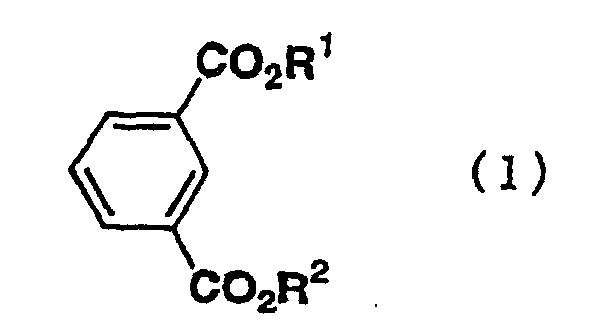
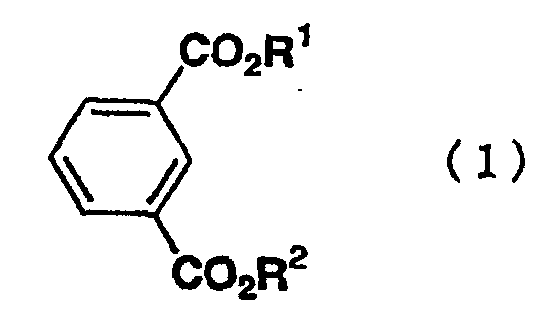
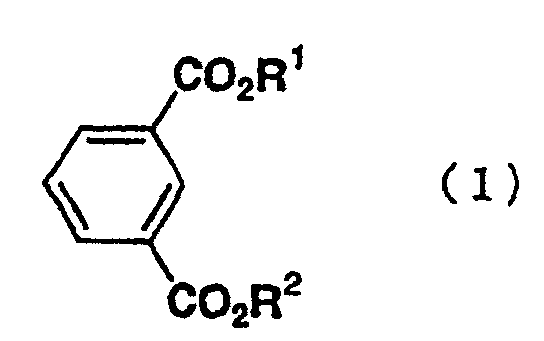
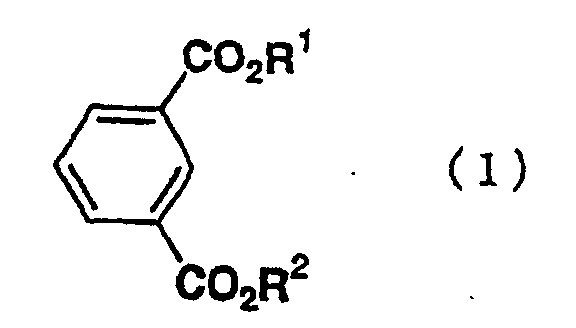
- the present invention relates to a process for preparing a bromoisophthalic acid compound comprising brominating an isophthalic acid compound of the general formula (1) wherein R 1 and R 2 independently of one another are hydrogen atom or C 1-6 alkyl.
- Bromoisophthalic acid compounds are key intermediates for modifiers for several polymers represented by polyesters and polyamides, etc. or functional chemicals, and pharmaceutical preparations and agricultural chemicals.
- An object of the present invention is to provide a process for preparing bromoisophthalic acid compounds, in particular 5-bromoisophthalic acid compounds and 4,5-dibrompisophthalic acid compounds in a selective manner and a high yield, by the use of bromine that is inexpensive industrially.
- the present invention relates to a process for preparing a bromoisophthalic acid compound comprising brominating an isophthalic acid compound of the general formula (1) wherein R 1 and R 2 independently of one another are hydrogen atom or C 1-6 alkyl, with bromine in a solvent containing sulfur trioxide.
- reaction conditions such as the amount of sulfur trioxide, reaction temperature and reaction time by which monobromo and dibromo products can be prepared in a high yield and a selective manner.
- Isophthalic acid compounds as a raw material are compounds of the general formula (1) wherein R 1 and R 2 independently of one another are hydrogen atom or C 1-6 alkyl.
- R 1 and R 2 include specifically hydrogen, methyl, ethyl, n-propyl, i-propyl, n-butyl, i-butyl, s-butyl, t-butyl, 1-pentyl, 2-pentyl, 3-pentyl, 3-methylbutyl, neopentyl, t-pentyl, 1-hexyl, 2-hexyl, 3-hexyl, 1-methyl-1-ethylpropyl, 1,1,2-trimethyl propyl, 1,2,2-trimethyl propyl, 3,3-dimethyl butyl and the like.
- the isophthalic acid compounds of the general formula (1) include isophthalic acid, or dialkyl isophthalate compounds, such as dimethyl isophthalate, diethyl isophthalate, methyl ethyl isophthalate, di-n-propyl isophthalate, di-i-propyl isophthalate, di-n-butyl isophthalate, di-1-pentyl isophthalate, di-1-hexyl isophthalate, di-1-pentyl isophthalate and di-1-hexyl isophthalate.
- isophthalic acid and dimethyl isophthalates are preferable from the standpoint of availability of industrial raw materials.
- isophthalic acid is appropriate for a raw material in the present reaction because it can be produced economically and its commercial product can be used at it is.
- a characteristic of the present invention resides in bromination with bromine in a solvent containing sulfur trioxide.
- compounds in which hydrogen atoms on the phenyl group are substituted with electron-attracting groups, such as isophthalic acid hardly reacts by the use of only bromine.
- the present inventors attempted to an reaction with the bromine improved in its brominating ability by forming a complex between sulfur trioxide and bromine. Consequently, they found that monobromo products can be obtained, and further dibromo products also can be obtained by setting suitable conditions.
- organic solvents can be used, but it is generally convenient to use sulfuric acid solvent, that is fuming sulfuric acid. Also, it is able to use chlorosulfonic acid, sulfur trioxide - dioxane complex, sulfur trioxide - pyridine complex or the like that is a complex between sulfur trioxide and other compound. Among them, fuming sulfuric acid affords high reactivity in a reduced cost.
- the concentration of sulfur trioxide may be broadly selected, but commercially available products having a concentration of 10 to 60 wt% can be generally used. Also, fuming sulfuric acid having a concentration no more than 10 wt% can be prepared by adding sulfuric acid to the commercially available products.
- hydrocarbon halides or sulfolane can be used besides the above-mentioned sulfuric acid.
- hydrocarbon halides include carbon tetrachloride, 1,2-dichloroethane (EDC), 1,1,1-trichloroethane, 1,1,2-trichloroethane and 1,1,2,2-tetrachloroethane. It is preferably appropriate to use it in an amount in weight of 1 to 20 times, particularly 2 to 10 times that of substrate.
- the brominating reaction of the present invention is characterized by using bromine that is the most economic in industrial use. Commercially available bromine can be used as it is.
- the amount of bromine used is preferably 0.5 to 1.5 time in moles that of substrate in a case where monobromo products are prepared, and preferably 1 to 3 times in moles that of substrate in a case where dibromo products are prepared.
- the proportion of monobromo and dibromo products formed can be selected by sulfur trioxide concentration, reaction temperature and reaction time besides amount of bromine used.
- the reaction can be carried out at a temperature of 50° to 200°C, particularly 100° to 160°.
- the reaction time ranges generally from 1 to 100 hours although it changes depending on the kind of substrate, the amount of fuming sulfuric acid, the amount of bromine or the reaction temperature, and the reaction ceases generally for 3 to 24 hours.
- the end point of the reaction can be confirmed by gas chromatography or liquid chromatography.
- the present reaction may be carried out in a batch system or a continuous system.
- a reaction solution is added into a large excess of cooled water, and crystals separated out are filtered off, washed with water and dried to give crude crystals of aimed bromo products.
- the crude crystals can be optionally purified by recrystallization.
- the present inventors examined several solvents for recrystallization, and consequently found that it is impossible for bromoisophthalic acid to be recrystallized with general solvents for recrystallization due to its slight solubility. On the contrary, the present inventors found that lower alcohol solvents with 1 to 5 carbon atoms give aimed products in high yield of recrystallization and high purity. Among them, particularly methanol is preferable as the solvent as it exhibits good ability for recrystallization and advantage economically.
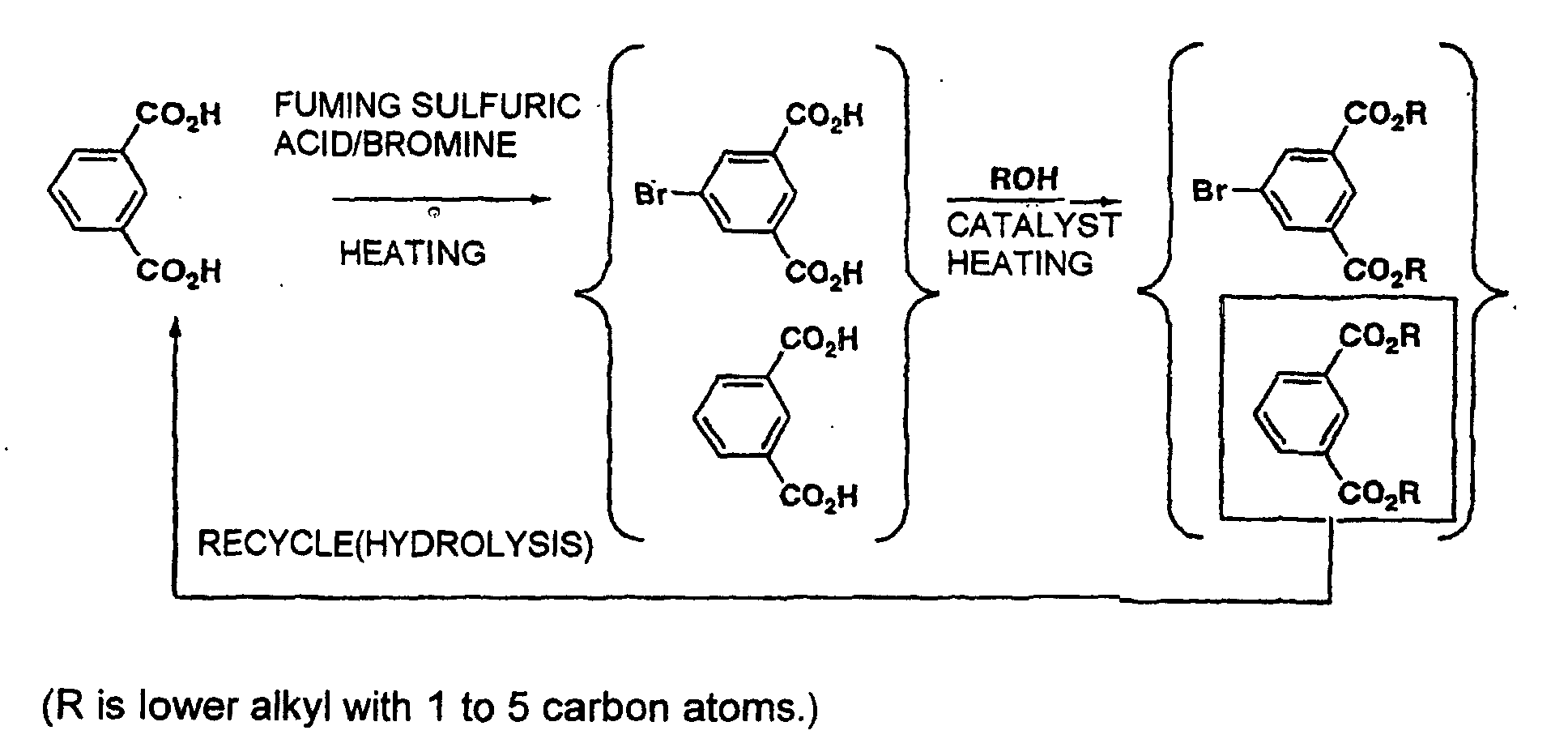
- a distillation method is applicable as another method for purifying the bromo products produced by the present invention. That is, crude crystals of bromoisophthalic acid obtained by the reaction are diesterified with a lower alcohol solvent with 1 to 5 carbon atoms in the presence of an acid catalyst, and then the aimed bromo products can be separated from esters of unreacted raw materials and other dibromo products by the use of distillation.
- the acid catalyst sulfuric acid or p-toluene sulfonic acid can be used. It is preferable to use the acid catalyst in an amount of 1 to 20 mol% based on that of isophthalic acid compounds.
- methanol or ethanol is preferable from the standpoint of boiling point of the diesters. The amount used thereof is generally 5 to 100 times in moles that of isophthalic acid compounds.
- the reaction can be generally carried out at a boiling point of an alcohol used, but ceases for a short time by carrying out it at a temperature above the boiling point of the alcohol under pressure.
- the temperature is preferably 100° to 180°C.
- each of the resulting esters has a high boiling point. Generally, it is preferably carried out at 10 to 10000 Pa. Although simple distillation can be carried out depending on the component of the reacted products, generally the aimed monobromo products with a high purity are obtained by rectification.
- dibromo products can be distilled out as faints after a distillation, they can be isolated from a still residue after monobromo products were distilled out.
- dimethyl esters were derived from the crystal by heating and stirring it at 120°C with 13.1 g (408 mmol) of methanol and 0.35 g (30 mol%) of sulfuric acid in an autoclave.
- the esters were subjected to rectification to give 1.78 g (yield: 65.1%, vacuum boiling point: 159°C /4.8mmHg) of aimed dimethyl 5-bromoisophthalate and 0.52 g (yield: 26.8%, vacuum boiling point: 133°C /4.8mmHg) of dimethyl isophthalate corresponding to a raw material.
- the resulting crystals were identified as dimethyl 5-bromoisophthalate and 5-bromoisophthalic acid by MASS, 1 H-NMR and melting point.
- the esters were subjected to rectification to give 6.73 g (yield: 49.3%, vacuum boiling point: 159°C /4.8mmHg) of aimed dimethyl 5-bromoisophthalate and 1.67 g (yield: 17.2%, vacuum boiling point: 133°C /4.8mmHg) of dimethyl isophthalate corresponding to a raw material.
- the resulting crystals were identified as dimethyl 5-bromoisophthalate and 5-bromoisophthalic acid by MASS, 1 H-NMR and melting point.
- 5-bromoisophthalic acid compounds can be prepared in a selective manner and a reduced cost.
Landscapes
- Chemical & Material Sciences (AREA)
- Organic Chemistry (AREA)
- Chemical Kinetics & Catalysis (AREA)
- Engineering & Computer Science (AREA)
- Oil, Petroleum & Natural Gas (AREA)
- Organic Low-Molecular-Weight Compounds And Preparation Thereof (AREA)
Abstract
Description

| Ex. No. | Concentration of Fuming Sulfuric Acid (wt%)-(g) | Bromine g(mmol) | Temperature(°C) | Time (h.) | Quantitative Yield (%) | |||
| 5BIP | IP | 4,5-DBIP | 2,5-DBIP | |||||
| 2 | 10-6 | 1.6(10) | 110 | 22 | 34.5 | 58.0 | trace | - |
| 3 | 20-6 | 1.6(10) | 110 | 22 | 48.6 | 43.2 | trace | - |
| 4 | 30-6 | 1.6(10) | 110 | 22 | 62.8 | 24.6 | 2.3 | - |
| 5 | 10-6 | 1.6(10) | 150 | 22 | 77.0 | 4.1 | 8.0 | - |
| 6 | 20-6 | 1.6(10) | 150 | 7 | 53.8 | 46.5 | 0.7 | - |
| 7 | 10-6 | 3.2(20) | 150 | 7 | 79.1 | 6.4 | 5.8 | trace |
| IP: Isophthalic Acid, 5BIP: 5-Bromoisophthalic Acid, | ||||||||
| 4,5-DBIP: 4,5-Dibromoisophthalic Acid | ||||||||
| 2,5-DBIP: 2,5-Dibromoisophthalic Acid |
| Ex. No. | Concentration of Fuming Sulfuric Acid (wt%)-(g) | Bromine g(mmol) | Temperature(°C) | Time (h.) | Quantitative Yield (%) | |||
| 5BIP | IP | 4,5-DBIP | 2,5-DBIP | |||||
| 9 | 60-6 | 1.6(10) | 110 | 22 | 45.0 | 1.4 | 18.7 | 1.0 |
| 10 | 20-6 | 1.6(10) | 130 | 22 | 49.2 | 0.0 | 15.3 | trace |
| 11 | 30-6 | 1.6(10) | 130 | 22 | 53.1 | 0.8 | 13.6 | 1.0 |
| 12 | 20-6 | 1.6(10) | 150 | 22 | 43.1 | 0.0 | 20.0 | 0.8 |
| 13 | 20-6 | 3.2(20) | 150 | 7 | 37.5 | 0.0 | 23.3 | 1.5 |
| 14 | 10-12 | 1.6(10) | 150 | 7 | 47.0 | 0.6 | 18.1 | 1.2 |
| 15 | 20-12 | 1.6(10) | 150 | 7 | 49.8 | 0.7 | 20.3 | 1.4 |
| 16 | 20-12 | 3.2(10) | 150 | 7 | 11.9 | 0.0 | 26.2 | 4.9 |
| IP: Isophthalic Acid, 5BIP: 5-Bromoisophthalic Acid, | ||||||||
| 4,5-DBIP: 4,5-Dibromoisophthalic Acid | ||||||||
| 2,5-DBIP: 2,5-Dibromoisophthalic Acid |
Claims (13)
- A process for preparing a bromoisophthalic acid compound comprising brominating an isophthalic acid compound of the general formula (1)wherein R1 and R2 independently of one another are hydrogen atom or C1-6 alkyl, with bromine in a solvent containing sulfur trioxide.
- The process for preparing a bromoisophthalic acid compound according to claim 1, wherein the solvent containing sulfur trioxide is fuming sulfuric acid.
- The process for preparing a bromoisophthalic acid compound according to claim 1, wherein the concentration of sulfur trioxide in the fuming sulfuric acid ranges from 1 to 60 wt%.
- The process for preparing a bromoisophthalic acid compound according to any one of claims 1 to 3, wherein the reaction temperature ranges from 50° to 200°C.
- The process for preparing a bromoisophthalic acid compound according to claim 2, wherein the isophthalic acid compound is brominated with bromine in a molar amount 0.5 to 1.5 time that of the isophthalic acid compound in the fuming sulfuric acid in which the concentration of sulfur trioxide ranges from 1 to 30 wt% at a reaction temperature between 100° and 160°C to give a monobromoisophthalic acid compound.
- The process for preparing a bromoisophthalic acid compound according to claim 5, wherein the monobromoisophthalic acid compound is 5-bromoisophthalic acid compound.
- A process for preparing a bromoisophthalic acid compound according to claim 2, wherein the isophthalic acid compound is brominated with bromine in a molar amount 1 to 5 times that of the isophthalic acid compound in the fuming sulfuric acid in which the concentration of sulfur trioxide ranges from 10 to 60 wt% at a reaction temperature between 100° and 200°C to give a monobromoisophthalic acid compound and a dibromoisophthalic acid compound.
- The process for preparing a bromoisophthalic acid compound according to claim 7, wherein the monobromoisophthalic acid compound is 5-bromoisophthalic acid compound and the dibromoisophthalic acid compound is 4,5-dibromoisophthalic acid compound.
- The process for preparing a bromoisophthalic acid compound according to any one of claims 1 to 8, wherein after the conclusion of the bromination, the resulting crude product is purified by recrystallization in a lower alcohol with 1 to 5 carbon atoms.
- The process for preparing a bromoisophthalic acid compound according to claim 9, wherein the lower alcohol with 1 to 5 carbon atoms is methanol.
- The process for preparing a bromoisophthalic acid compound according to any one of claims 1 to 8, wherein after the conclusion of the bromination, the resulting crude product is diesterified with a lower alcohol with 1 to 5 carbon atoms at the presence of an acid catalyst, and then a bromoisophthalic acid compound is separated and purified by distillation.
- The process for preparing a bromoisophthalic acid compound according to claim 11, wherein the acid catalyst is sulfuric acid, and the diesterification is carried out under pressure at a reaction temperature above the boiling point of the lower alcohol with 1 to 5 carbon atoms.
- The process for preparing a bromoisophthalic acid compound according to claim 11 or 12, wherein the lower alcohol with 1 to 5 carbon atoms is methanol or ethanol.
Applications Claiming Priority (3)
| Application Number | Priority Date | Filing Date | Title |
|---|---|---|---|
| JP2000167511 | 2000-06-05 | ||
| JP2000167511 | 2000-06-05 | ||
| PCT/JP2001/004532 WO2001094289A1 (en) | 2000-06-05 | 2001-05-30 | Process for the preparation of bromoisophthalic acid compounds |
Publications (3)
| Publication Number | Publication Date |
|---|---|
| EP1293495A1 true EP1293495A1 (en) | 2003-03-19 |
| EP1293495A4 EP1293495A4 (en) | 2005-09-28 |
| EP1293495B1 EP1293495B1 (en) | 2013-04-24 |
Family
ID=18670658
Family Applications (1)
| Application Number | Title | Priority Date | Filing Date |
|---|---|---|---|
| EP01934410.0A Expired - Lifetime EP1293495B1 (en) | 2000-06-05 | 2001-05-30 | Process for the preparation of bromoisophthalic acid compounds |
Country Status (5)
| Country | Link |
|---|---|
| US (1) | US6855845B2 (en) |
| EP (1) | EP1293495B1 (en) |
| KR (1) | KR100787277B1 (en) |
| CN (1) | CN1185199C (en) |
| WO (1) | WO2001094289A1 (en) |
Families Citing this family (3)
| Publication number | Priority date | Publication date | Assignee | Title |
|---|---|---|---|---|
| CN103980113B (en) * | 2014-06-04 | 2016-05-25 | 国药集团化学试剂有限公司 | A kind of preparation method of 4-bromophthalic acid |
| JP7388674B2 (en) * | 2019-01-25 | 2023-11-29 | 日本マイクロバイオファーマ株式会社 | 14-Method for producing bromo anthracycline |
| CN110590540A (en) * | 2019-08-29 | 2019-12-20 | 陈晓东 | Flame retardant 2, 5-dibromo terephthalic acid and production process thereof |
Family Cites Families (6)
| Publication number | Priority date | Publication date | Assignee | Title |
|---|---|---|---|---|
| US2596945A (en) * | 1947-03-24 | 1952-05-13 | Shell Dev | Copolymers of 1-alkenyl nitriles and allylic esters of aromatic dicarboxylic acids |
| GB946259A (en) * | 1961-04-05 | 1964-01-08 | Ici Ltd | Halogenation of terephthalic acid |
| JPS5432435A (en) | 1977-08-15 | 1979-03-09 | Mitsui Toatsu Chem Inc | Preparation of tetrabromo terephthalic acid |
| JPS61171452A (en) | 1985-01-25 | 1986-08-02 | Mitsubishi Chem Ind Ltd | Production method of metabromobenzoic acid |
| DE19620797A1 (en) * | 1996-05-23 | 1997-11-27 | Bayer Ag | Process for the preparation of halogenated phthalic acids and their derivatives |
| JP3911732B2 (en) | 1996-10-15 | 2007-05-09 | 日産化学工業株式会社 | Process for producing dialkyl 5-bromo-isophthalate |
-
2001
- 2001-05-30 EP EP01934410.0A patent/EP1293495B1/en not_active Expired - Lifetime
- 2001-05-30 US US10/296,500 patent/US6855845B2/en not_active Expired - Fee Related
- 2001-05-30 WO PCT/JP2001/004532 patent/WO2001094289A1/en not_active Ceased
- 2001-05-30 KR KR1020027016547A patent/KR100787277B1/en not_active Expired - Fee Related
- 2001-05-30 CN CNB018102891A patent/CN1185199C/en not_active Expired - Fee Related
Also Published As
| Publication number | Publication date |
|---|---|
| KR100787277B1 (en) | 2007-12-20 |
| US6855845B2 (en) | 2005-02-15 |
| CN1431990A (en) | 2003-07-23 |
| EP1293495B1 (en) | 2013-04-24 |
| EP1293495A4 (en) | 2005-09-28 |
| KR20030009512A (en) | 2003-01-29 |
| US20040015010A1 (en) | 2004-01-22 |
| WO2001094289A1 (en) | 2001-12-13 |
| CN1185199C (en) | 2005-01-19 |
Similar Documents
| Publication | Publication Date | Title |
|---|---|---|
| US5589598A (en) | Process of purification of 2,6-diisopropylphenol | |
| US6214998B1 (en) | Process for preparing 2-chloro-5-chloromethylthiazole | |
| HU193589B (en) | Process for preparing fluorinated phtaloyl- and terephtaloyl compounds | |
| AU2003294750A1 (en) | Method for the production of benzophenones | |
| US6855845B2 (en) | Process for the preparing bromoisophithalic acid compound | |
| EP0881215B1 (en) | Process for the preparation of 4-methylenepiperidines | |
| JP4893903B2 (en) | Method for producing bromoisophthalic acid compound | |
| EP0384043A2 (en) | Methods for the preparation of brominated intermediates | |
| JP7607049B2 (en) | Method for producing 9,9-bis(3,5-dialkyl-4-aminophenyl)fluorene compound | |
| JPH08119939A (en) | Method for producing high-purity ether-type bismaleimide | |
| US7038091B2 (en) | Process for producing acetylene compound | |
| US20020062043A1 (en) | Process for preparing optionally substituted biphenylcarbonyl chlorides | |
| US6469200B1 (en) | Process for producing 2-alkylidene-4-bromoacetoacetic acid ester | |
| JP4519241B2 (en) | Epoxide production method | |
| US7041853B2 (en) | Process for producing 4-bromothioanisole | |
| JP2001011016A (en) | Production of tartaric acid lower alkyl diester | |
| JP3876933B2 (en) | Method for producing hydrogen sulfate ester | |
| JP4470348B2 (en) | Method for producing tertiary carboxylic acid ester | |
| IL305608A (en) | Process for preparing alkyl-4-oxotetrahydrofuran-2-carboxylate | |
| JPS625897B2 (en) | ||
| JP2717689B2 (en) | Process for producing p- or m-hydroxyphenylalkyl alcohol | |
| JP2006527186A (en) | Method for preparing 3-aryl-2-alkoxypropanoic acid without resolution | |
| JPH10182544A (en) | Production of p-acylalkylbenzene derivative | |
| WO1997038963A1 (en) | Process for the manufacture of alkyl 2-(6-methoxy-naphthyl)propionates | |
| WO2006107065A1 (en) | Method for producing haloalkyl ether compound |
Legal Events
| Date | Code | Title | Description |
|---|---|---|---|
| PUAI | Public reference made under article 153(3) epc to a published international application that has entered the european phase |
Free format text: ORIGINAL CODE: 0009012 |
|
| 17P | Request for examination filed |
Effective date: 20021203 |
|
| AK | Designated contracting states |
Designated state(s): DE FR GB NL Kind code of ref document: A1 Designated state(s): DE FR GB NL |
|
| RIC1 | Information provided on ipc code assigned before grant |
Ipc: 7C 07B 61/00 B Ipc: 7C 07C 51/43 B Ipc: 7C 07C 51/363 A Ipc: 7C 07C 67/08 B Ipc: 7C 07C 69/80 B Ipc: 7C 07C 67/54 B Ipc: 7C 07C 67/307 B Ipc: 7C 07C 63/72 B |
|
| A4 | Supplementary search report drawn up and despatched |
Effective date: 20050811 |
|
| 17Q | First examination report despatched |
Effective date: 20061221 |
|
| REG | Reference to a national code |
Ref country code: DE Ref legal event code: R079 Ref document number: 60147918 Country of ref document: DE Free format text: PREVIOUS MAIN CLASS: C07C0051363000 Ipc: C07K0005060000 |
|
| GRAP | Despatch of communication of intention to grant a patent |
Free format text: ORIGINAL CODE: EPIDOSNIGR1 |
|
| RIC1 | Information provided on ipc code assigned before grant |
Ipc: C07K 5/06 20060101AFI20121107BHEP |
|
| RIN1 | Information on inventor provided before grant (corrected) |
Inventor name: NAGAI, MASAKI Inventor name: SUZUKI, HIDEO Inventor name: HASHIBA, ISAO |
|
| GRAS | Grant fee paid |
Free format text: ORIGINAL CODE: EPIDOSNIGR3 |
|
| GRAA | (expected) grant |
Free format text: ORIGINAL CODE: 0009210 |
|
| RIN1 | Information on inventor provided before grant (corrected) |
Inventor name: NAGAI, MASAKI Inventor name: HASHIBA, ISAO Inventor name: SUZUKI, HIDEO |
|
| AK | Designated contracting states |
Kind code of ref document: B1 Designated state(s): DE FR GB NL |
|
| REG | Reference to a national code |
Ref country code: GB Ref legal event code: FG4D |
|
| REG | Reference to a national code |
Ref country code: DE Ref legal event code: R096 Ref document number: 60147918 Country of ref document: DE Effective date: 20130613 |
|
| PGFP | Annual fee paid to national office [announced via postgrant information from national office to epo] |
Ref country code: DE Payment date: 20130516 Year of fee payment: 13 Ref country code: GB Payment date: 20130501 Year of fee payment: 13 |
|
| REG | Reference to a national code |
Ref country code: NL Ref legal event code: VDEP Effective date: 20130424 |
|
| PG25 | Lapsed in a contracting state [announced via postgrant information from national office to epo] |
Ref country code: NL Free format text: LAPSE BECAUSE OF FAILURE TO SUBMIT A TRANSLATION OF THE DESCRIPTION OR TO PAY THE FEE WITHIN THE PRESCRIBED TIME-LIMIT Effective date: 20130424 |
|
| PLBE | No opposition filed within time limit |
Free format text: ORIGINAL CODE: 0009261 |
|
| STAA | Information on the status of an ep patent application or granted ep patent |
Free format text: STATUS: NO OPPOSITION FILED WITHIN TIME LIMIT |
|
| REG | Reference to a national code |
Ref country code: FR Ref legal event code: ST Effective date: 20140131 |
|
| 26N | No opposition filed |
Effective date: 20140127 |
|
| REG | Reference to a national code |
Ref country code: DE Ref legal event code: R097 Ref document number: 60147918 Country of ref document: DE Effective date: 20140127 |
|
| PG25 | Lapsed in a contracting state [announced via postgrant information from national office to epo] |
Ref country code: FR Free format text: LAPSE BECAUSE OF NON-PAYMENT OF DUE FEES Effective date: 20130624 |
|
| REG | Reference to a national code |
Ref country code: DE Ref legal event code: R119 Ref document number: 60147918 Country of ref document: DE |
|
| GBPC | Gb: european patent ceased through non-payment of renewal fee |
Effective date: 20140530 |
|
| REG | Reference to a national code |
Ref country code: DE Ref legal event code: R119 Ref document number: 60147918 Country of ref document: DE Effective date: 20141202 |
|
| PG25 | Lapsed in a contracting state [announced via postgrant information from national office to epo] |
Ref country code: DE Free format text: LAPSE BECAUSE OF NON-PAYMENT OF DUE FEES Effective date: 20141202 |
|
| PG25 | Lapsed in a contracting state [announced via postgrant information from national office to epo] |
Ref country code: GB Free format text: LAPSE BECAUSE OF NON-PAYMENT OF DUE FEES Effective date: 20140530 |