EP1292882B1 - Verfahren und einrichtung zum verschl sseln einer nachricht - Google Patents
Verfahren und einrichtung zum verschl sseln einer nachricht Download PDFInfo
- Publication number
- EP1292882B1 EP1292882B1 EP01938930A EP01938930A EP1292882B1 EP 1292882 B1 EP1292882 B1 EP 1292882B1 EP 01938930 A EP01938930 A EP 01938930A EP 01938930 A EP01938930 A EP 01938930A EP 1292882 B1 EP1292882 B1 EP 1292882B1
- Authority
- EP
- European Patent Office
- Prior art keywords
- data
- optical
- encryption
- message
- digital pen
- Prior art date
- Legal status (The legal status is an assumption and is not a legal conclusion. Google has not performed a legal analysis and makes no representation as to the accuracy of the status listed.)
- Expired - Lifetime
Links
Images



Classifications
-
- G—PHYSICS
- G06—COMPUTING OR CALCULATING; COUNTING
- G06F—ELECTRIC DIGITAL DATA PROCESSING
- G06F7/00—Methods or arrangements for processing data by operating upon the order or content of the data handled
- G06F7/58—Random or pseudo-random number generators
- G06F7/588—Random number generators, i.e. based on natural stochastic processes
-
- H—ELECTRICITY
- H04—ELECTRIC COMMUNICATION TECHNIQUE
- H04L—TRANSMISSION OF DIGITAL INFORMATION, e.g. TELEGRAPHIC COMMUNICATION
- H04L9/00—Cryptographic mechanisms or cryptographic arrangements for secret or secure communications; Network security protocols
- H04L9/06—Cryptographic mechanisms or cryptographic arrangements for secret or secure communications; Network security protocols the encryption apparatus using shift registers or memories for block-wise or stream coding, e.g. DES systems or RC4; Hash functions; Pseudorandom sequence generators
- H04L9/0643—Hash functions, e.g. MD5, SHA, HMAC or f9 MAC
-
- H—ELECTRICITY
- H04—ELECTRIC COMMUNICATION TECHNIQUE
- H04L—TRANSMISSION OF DIGITAL INFORMATION, e.g. TELEGRAPHIC COMMUNICATION
- H04L9/00—Cryptographic mechanisms or cryptographic arrangements for secret or secure communications; Network security protocols
- H04L9/06—Cryptographic mechanisms or cryptographic arrangements for secret or secure communications; Network security protocols the encryption apparatus using shift registers or memories for block-wise or stream coding, e.g. DES systems or RC4; Hash functions; Pseudorandom sequence generators
- H04L9/065—Encryption by serially and continuously modifying data stream elements, e.g. stream cipher systems, RC4, SEAL or A5/3
- H04L9/0656—Pseudorandom key sequence combined element-for-element with data sequence, e.g. one-time-pad [OTP] or Vernam's cipher
- H04L9/0662—Pseudorandom key sequence combined element-for-element with data sequence, e.g. one-time-pad [OTP] or Vernam's cipher with particular pseudorandom sequence generator
-
- H—ELECTRICITY
- H04—ELECTRIC COMMUNICATION TECHNIQUE
- H04L—TRANSMISSION OF DIGITAL INFORMATION, e.g. TELEGRAPHIC COMMUNICATION
- H04L9/00—Cryptographic mechanisms or cryptographic arrangements for secret or secure communications; Network security protocols
- H04L9/08—Key distribution or management, e.g. generation, sharing or updating, of cryptographic keys or passwords
- H04L9/0861—Generation of secret information including derivation or calculation of cryptographic keys or passwords
- H04L9/0866—Generation of secret information including derivation or calculation of cryptographic keys or passwords involving user or device identifiers, e.g. serial number, physical or biometrical information, DNA, hand-signature or measurable physical characteristics
-
- H—ELECTRICITY
- H04—ELECTRIC COMMUNICATION TECHNIQUE
- H04L—TRANSMISSION OF DIGITAL INFORMATION, e.g. TELEGRAPHIC COMMUNICATION
- H04L9/00—Cryptographic mechanisms or cryptographic arrangements for secret or secure communications; Network security protocols
- H04L9/32—Cryptographic mechanisms or cryptographic arrangements for secret or secure communications; Network security protocols including means for verifying the identity or authority of a user of the system or for message authentication, e.g. authorization, entity authentication, data integrity or data verification, non-repudiation, key authentication or verification of credentials
- H04L9/3226—Cryptographic mechanisms or cryptographic arrangements for secret or secure communications; Network security protocols including means for verifying the identity or authority of a user of the system or for message authentication, e.g. authorization, entity authentication, data integrity or data verification, non-repudiation, key authentication or verification of credentials using a predetermined code, e.g. password, passphrase or PIN
- H04L9/3231—Biological data, e.g. fingerprint, voice or retina
-
- H—ELECTRICITY
- H04—ELECTRIC COMMUNICATION TECHNIQUE
- H04W—WIRELESS COMMUNICATION NETWORKS
- H04W12/00—Security arrangements; Authentication; Protecting privacy or anonymity
- H04W12/03—Protecting confidentiality, e.g. by encryption
- H04W12/033—Protecting confidentiality, e.g. by encryption of the user plane, e.g. user's traffic
-
- H—ELECTRICITY
- H04—ELECTRIC COMMUNICATION TECHNIQUE
- H04L—TRANSMISSION OF DIGITAL INFORMATION, e.g. TELEGRAPHIC COMMUNICATION
- H04L2209/00—Additional information or applications relating to cryptographic mechanisms or cryptographic arrangements for secret or secure communication H04L9/00
- H04L2209/80—Wireless
- H04L2209/805—Lightweight hardware, e.g. radio-frequency identification [RFID] or sensor
Definitions
- the present invention generally relates to the field of transmitting information from a sender to a receiver. More specifically, the present invention relates to a method and a device for encrypting a message for secure transmission of such a message from a sending device to a receiver. The invention further relates to a computer readable medium comprising instructions for bringing a computer to perform such a method, and a sending device and a system, respectively, comprising such a device.
- random number data When using cryptography or a network security algorithm based on cryptography, random number data is used for different reasons and play an essential role. For example, random numbers are frequently used as encryption keys or for generation of encryption keys. Furthermore, random data is by definition difficult to determine or guess.
- symmetric encryption When using symmetric encryption, the same key is used for both encryption and decryption.
- the encryption key is used in conjunction with an encryption algorithm, and different keys will result in different outputs from the algorithm.
- the degree of security of the encrypted message depends on the secrecy of the key and therefore on the random number used as the key or for generating the key, not on the secrecy of the algorithm. This makes it possible to use powerful standard algorithms, such as AES (Advanced Encryption Standard), DES (Data Encryption Standard) or IDEA (International Data Encryption Standard).
- AES Advanced Encryption Standard
- DES Data Encryption Standard
- IDEA International Data Encryption Standard
- asymmetric encryption When using asymmetric encryption, the sender and the receiver each has a private encryption key and a public encryption key. Thereby, confidentiality, authentication and non-repudiation is achieved.
- Commonly used asymmetric encryption algorithms include, for example, RSA (Rhivest-Shamir-Adleman) and DH (Diffie-Hellman).
- a widely used technique for pseudo random number generation is the linear congruential method.
- X 0 is an initial number, i.e. the random seed.
- the microseconds of the internal clock are used as random seed to initiate the algorithm.
- the final output image is used to encrypt an image message by optical modulo- n addition of the final output image to the image message.
- optical modulo- n addition of the final output image to the image message Apart from its evident inability of being readily implemented in a hand-held device, the known optical technique appears to suffer from both limited precision and slow processing speed.
- US-A-5 852 434 An example of a hand-held device is shown in US-A-5 852 434, which relates to an absolute position determination device for indicating the instantaneous position and movement of a stylus on a surface formatted with a position-related code for indicating X-Y coordinates.
- an object of the present invention is to provide an improved method and device for generating an encryption key and encrypting a message.
- the present invention is based on the advantageous insight of using optical data as random seed for generation of an encryption key, which in turn is used in an encryption algorithm for encrypting a message.
- the optical data obtained in accordance with the method of the present invention presents the requisite degree of randomness and unpredictability.
- the optical data can be considered as being "truly" random. Consequently, the degree of randomness is higher and the optical data used are more unpredictable as compared to the data used for random seed in the known methods described above.
- an improved degree of secrecy of the generated encryption key will be achieved.
- a surface, or a portion thereof is scanned or read with an optical sensor, preferably a camera or a light-sensitive sensor, thereby obtaining optical data representative of characteristics the read surface.
- the light-sensitive sensor being, for example, a CCD sensor (Charge-Coupled Device) or a CMOS sensor (Complementary Metal-Oxide semiconductor).
- the obtained optical data are determined by and represent values of at least one optical parameter, which is representative of physical conditions on the portion of the surface.
- the optical data are obtained from a portion of a surface provided with a position code pattern, wherein the position code pattern includes optical readable markings.
- Each of said markings may be designed more or less arbitrarily.
- the design of each marking is preferably elementary, for example in the shape of round dots as shown in the detailed description below.
- the position code pattern is implemented using any parameter, which may be used to achieve symbols of the above-mentioned type that may be detected or sensed by an optical detector or optical sensor.
- the fact that the position code pattern is optically readable facilitates the appliance of the pattern onto the surface. Accordingly, the pattern should have the capability to reflect light, which not necessarily has to have a wavelength in the visible spectrum.
- the parameter sensed and used for the generation of the encryption key is brightness, which is a relative measure of the intensity of the energy output of a light source that is visible for an optical sensor.
- the brightness of light that is reflected from a portion of an illuminated surface is registered.
- the sensed light does not necessarily have to constitute reflected light.
- Sensing of emitted light from luminous surfaces are also contemplated within the scope of the present invention, or any combinations of emitted and reflected light.
- the brightness in the sensed light may, for example, depend on variations in the surrounding illumination, the quality of the printing of the pattern, the blacking of the markings, and/or the quality of the surface, e.g. a paper surface.
- Biometric factors may also have an impact on the brightness, for example the inclination of the pen. These and other factors introduce a considerable degree of randomness in the optical data. Furthermore, the fact that the optical sensor in itself is a noise generator will even further enhance the degree of randomness in the optical data.
- the optical data are processed according to a preprogrammed order or scheme and organized in data fields of a predetermined length.
- the data fields are preferably organized in data records according to a predetermined scheme, e.g. in a predetermined order.
- the order of the data fields within the data records are rearranged according to a cyclic reordering algorithm.
- the order of the rearranged data fields in different data records may differ from one data record to another.
- a number of different reordering schemes may be used, including the case that for some data records, the order of the data fields is not altered at all.
- the cyclic reordering is performed by shifting all data fields in each data record.
- the data fields may be shifted by a number of steps ranging from zero, i.e. no shift takes place, to a number corresponding to the number of data fields in the data record minus 1.
- the reordering algorithm contains information as to the number of steps each data field is shifted for a specific data record.
- the order of the data fields in each record included in a first set of data records are rearranged according to a first reordering algorithm. Thereby, a first set of rearranged data records is obtained. Then, the order of the data fields in each data record of a second set of data records are rearranged according to a second reordering algorithm, whereby a second set of rearranged data records is obtained.
- the first set of rearranged data records forms key data
- the second set of rearranged data records forms input data, or vice versa, of the encryption key used in the encryption algorithm.
- the key data and the input data form encryption data that can be used as material in an encryption process.
- the material can be encrypted with the public key of the receiver, to be used as encryption key or key material, to be compressed to an encryption key, for a symmetric encryption algorithm.
- the advantage of the described rearranging process is that the statistical characteristics, i.e. the randomness and unpredictability, of the processed data are significantly improved.
- the output data of the encryption algorithm when using the optical data as random seed and the described reordering algorithm, constitute uniformly distributed noise according to prevalent statistical testing methods.
- a first hashing is performed on a set of a predetermined number of data records by a first algorithm, i.e. a first hash function.
- a first algorithm i.e. a first hash function.
- hashing is an iterative process which will not be described in detail. Therefore, the term hashing output, as used hereinafter, refers to the result of all iterations included in the hashing.
- a first output i.e. a first hashing output, is obtained from the first hashing.
- the first output is then used as an input to a second algorithm, which may be a second hash function.
- the output of the second algorithm i.e. random numbers, is then, for example, used as the encryption key or for generating an encryption key in an encryption algorithm for encrypting a message.
- the second algorithm may alternatively be an iterative algorithm different from a hash function.
- A3 or A5 which are stream ciphers and are used for symmetrical encryption, may be used.
- the first hash function introduces distortion or noise in the obtained optical data used as input data. In other words, it shatter the regularities in the optical data and the correlation between data fields included in the data records.
- the use of a second hash function, or an alternative, preferably iterative, algorithm, on the first output further improves the statistical characteristics of the data and provides a further distortion on the first output.
- the statistical characteristics, i.e. the randomness and unpredictability, of the processed optical data are significantly improved using the method according to this embodiment.
- the improvement is such that the random numbers generated as a result of the method of this embodiment can be regarded as uniformly distributed white noise according to prevalent statistical testing methods.
- symmetrical encryption algorithms are used in the first and second algorithms. By using the same encryption algorithm for the algorithms, the advantages of a simplified implementation of the program code of the algorithms and a saving of memory capacity are achieved.
- this encryption algorithm is preferably used in at least one of said algorithms as well, and preferably in both.
- other and different encryption algorithms may be used in each of said algorithms, as well as for the actual encryption of the message.
- statistical properties of the parameter are. This results in a higher degree of randomness and unpredictability. Examples of statistical properties preferably being used includes maximum, minimum and sum values of the sensed parameter. However, other statistical properties are conceivable, such as mean values, standard deviation values, etc.
- the use of said calculation of statistical properties is by no means restricted to a specific embodiment of the present invention.
- the statistical properties of the optical data may be calculated and the result thereof may be used to improve the stochasticity of the optical data, and the encryption key generated therewith, regardless of the chosen method for generating the encryption key.
- the optical data used for generating an encryption key may constitute part of the message to be encrypted and transmitted. Alternatively, the optical data do not constitute part of the message.
- the step of obtaining optical data for encrypting the message may be obtained prior to, during, or following the procedure of obtaining the message to be encrypted. As an example, the encryption of the message may take place just prior to the actual transmission thereof. Then, the encryption key, including obtaining optical data, whether the optical data are extracted from the message or not, may be generated in connection with the encryption procedure. Alternatively, the generation of the encryption key may have been performed earlier, e.g. in connection with obtaining and storing the message, and a stored encryption key is used for the encryption.
- the optical data used for generating an encryption key are stored in a storage medium prior to processing thereof.
- the optical data are stored after the processing thereof.
- a symmetrical encryption algorithm is used for the actual encryption of the message.
- symmetrical encryption algorithms that are suitable, for example AES, DES, or IDEA.
- the use of an asymmetric encryption algorithm, such as the RSA, for the actual encryption of the message is also conceivable and lie within the scope of the present invention.
- the present invention is not limited to a specific encryption algorithm.
- the method of the present invention is implemented in a digital pen.
- a digital pen comprises an optical sensor for obtaining a message to be transmitted, for instance from a surface provided with a position code pattern as described above.
- the digital pen also comprises illumination means for illuminating a surface to be read by the optical sensor.
- the illumination means and the optical sensor may be restricted to a limited wavelength range, such that the optical sensor primarily detects reflected light that are provided by the illumination means.
- the optical sensor is also used for obtaining the optical data used for generating an encryption key. Thereby, no additional sensor or random number generator is required within the limited interior of the digital pen.
- the digital pen comprises a processor or processing means for performing the steps of the present invention, as well as all the steps required for obtaining, encrypting and transmitting a message.
- the digital pen also comprises, inter alia, suitable storing means for storing data, power supply means, e.g. a battery, as well as transmission means for transmitting the message to a receiver.
- a pressure sensor for obtaining pressure data. Since the pressure data relates to biometric factors, such as movements of the hand, the degree of randomness of the pressure data is high. The pressure data can then be used in combination with the optical data as random number data or random seed, in the generation of an encryption key, in order to enhance the degree of randomness in the random seed.
- time data are obtained and used in combination with the optical data as random seed in order to enhance the stochasticity of the random seed.
- time data is deterministic by nature, the degree of randomness of the combined data will not be decreased.
- the time data are preferably provided by the internal clock of the processing means. The thus obtained random seed may be subsequently used in the generation of the encryption key in the manner as described above.
- One such area is authentication of a sent or received message.
- Another area is key transport from a sender to a receiver. Then, the random numbers are encrypted with a public key of the receiver and are used as an encryption key or key data, to be subsequently compressed to an encryption key, for a symmetric encryption algorithm.
- the random numbers can also be used to generate prime numbers for RSA or DH keys.
- the method and the device of the present invention are suitable to realize as a computer program or a computer readable medium, preferably within the contents of a digital pen.
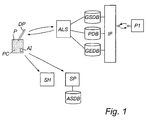
- FIG. 1 an information management system in which a position-code product and a sending device, such as a digital pen, can be integrated is shown.
- a position-code product and a sending device such as a digital pen
- the system of Fig. 1 includes a multitude of sending devices or digital pens DP and position code products P (only one of which being shown in Fig. 1), a look-up unit ALS, and a plurality of service handler units SH (only one of which is shown in Fig. 1).
- the information can be transmitted in any suitable way from the digital pen DP to the look-up unit ALS and the service handler unit SH.
- wireless transmission of information is effected from the digital pen DP to a network connection unit, which in turn transmits the information to the look-up unit ALS and service handler unit SH, respectively.
- the network connection unit can be an integral part of the digital pen DP.
- the network connection unit can be a mobile phone or a computer or any other suitable unit with an interface to a computer network such as the Internet or a LAN.
- the look-up unit ALS is connected to a virtual space database GSDB which includes data on the functionality of every position coded by the position code PC and the actor associated with each such position.
- the look-up unit ALS is also connected to a pen database PDB, which includes data on all digital pens in the system, such as the unique pen identifier of each pen and all settings or properties that are associated with each pen.
- the pen database PDB also includes data relating to the manufacturer of each pen.
- the look-up unit ALS is connected to an event database GEDB, which includes data on the transactions taking place in the look-up unit ALS, i.e. the address requests made by the pens in the system and the address responses returned to the pens, as well as any errors occurring in the process.
- GEDB event database
- the look-up unit ALS could be connected to one all-embracing database.
- the system also includes one or more networks in which network operators handle the communication between the digital pens DP and the look-up unit ALS, and between the digital pens DP and the service handler unit SH.
- This network operator could also act as a service handler in the system, for example by means of a server unit SP providing communication services that allows the pen owner to send electronic messages, for example e-mail, SMS or fax, based on information written on the position-coded products P by means of the digital pen DP.
- the server unit SP of the network operator could also provide for network storage of information generated in the system, for example entries in an position-coded calendar or notebook.
- the network operator maintains an application database ASDB which contains data on user-specific settings for different applications, for example a signature or electronic business card to be attached to e-mail messages, where and how to store sent messages, etc.
- the system includes Internet portals hosted by one or more web servers which are interfaced with the databases of the system, one portal of which P1 being shown in Fig. 1.
- the portal P1 is a so-called Partner Portal, i.e. a portal which allows pen manufactures, paper manufactures, service handlers and network operators to access selected portions of the databases of the system, via an interface unit IF.
- An example of another portal is a so-called Pen Owner Portal, i.e. a portal which allows for the pen owners to access selected portions of the databases of the system.
- the functionalities of the two portals are merged into one common portal.
- the information is sent in a secure way, i.e. by using encryption and digital signatures. If the digital pen DP sends confidential information to the service handler unit SH, the digital pen DP encrypts the information and the service handler unit SH will, in order to decipher the information, decrypt it.
- the digital pen DP can use either symmetric encryption or asymmetric encryption.
- a portion of a product such as the position-coded product used in the system of Fig. 1, in the form of a paper 1, provided with, on its surface 2, an optical readable position code pattern 3 which enables a determination of the position.
- the position code pattern includes markings 4, which are methodically arranged over the surface 2.
- the Applicant proposes in the international patent application WO 01/16691, which is incorporated herein by reference, the use of a product having a writing surface which is provided with such a position code.
- the position code which codes a plurality of positions on the surface, enables electronic recording of information that is being written on the writing surface, by means of a digital pen which detects the position code.
- the position code is capable of coding coordinates of a large number of positions, much larger than the number of required positions on the product.
- the position code can be seen as forming a virtual space which is defined by all positions that the position code is capable of coding, whereby different positions in the virtual space can be dedicated for different functions and/or actors. It should be noted that the position code pattern shown in Fig. 2 is, for the sake of clarity, greatly enlarged.
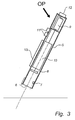
- Fig. 3 shows a schematic representation of an embodiment of a sending device designed for reading, for example, a position code pattern of Fig. 2.
- the device is a digital pen.
- the pen DP comprises a housing 5, shaped in a pen-like form.
- An opening 6 is provided at one end portion of the housing 5. The opening is intended to rest against, or to be held at a short distance from, the surface S from which information is to be obtained.
- a pressure sensor unit may also be comprised within the housing 5, which will be discussed below.
- the optical unit comprises a diode 7, arranged to illuminate the surface provided with the position code, and a light-sensitive sensor 8, for example a CCD sensor (Charge-Coupled Device) or a CMOS sensor (Complementary Metal-Oxide semiconductor), arranged to register two-dimensional images.
- the current supply unit is in this embodiment a battery 9, arranged in a separate container.
- the electronic unit 10 comprises a processor device including image-processing means, encryption means and a processor programmed to read images from the sensor 8 and to perform determination of the position and decoding of information on the basis of the images. Furthermore, the processor is programmed to perform computations in order to, for example from an image received from the sensor, calculate properties of the optical data obtained from the image. The data resulting from these computations can be used as input data for other computations or algorithms, such as encryption algorithms. In this embodiment, the AES and RSA algorithms are implemented in the processor device.
- the electronic unit 10 comprises a memory or data storage that is arranged, for example, to store data received from the processor or the sensor, as well as program instructions for the processor device.
- the pen may comprise a keypad 11, which enables activation and controlling of the pen.
- a transceiver 12 for wireless communication, by means of IR-light or radio waves, with other participants of the system of Fig. 1 is also included.
- a display 13 for showing, for example, registered information can be included.
- the keypad, the transceiver, and the display are in communication with and controlled by the electronic unit 10.
- FIG. 3 is schematical and that the actual configuration of the parts comprised within the pen may differ from the configuration shown without departing from the scope of the present invention.
- the position-code pattern is an optical readable pattern and, thus, the sensor is an optical sensor.
- the position code pattern can be based on another parameter than an optical parameter as mentioned above. In that case, the sensor must, of course, be of such a type that is capable of reading the parameter in question.
- the combination of a digital pen and a position-coded product can be used as an input device to a computer, a PDA, a mobile phone, or the like.
- text and sketches written on a position-coded notepad can be transferred via the pen to a computer.
- the combination of a pen and a position-coded product allows for global communication, directly from the product via the pen, by the position code on the product being dedicated for such communication.
- the information registered by the pen can be transformed into a fax message, an e-mail or an SMS, and can then be sent from the pen to a recipient.
- the combination of a pen and a position-coded product can be used in e-commerce.
- the digital pen can be used to order an item from a position-coded advertisement in a magazine, by the position code in the advertisement being dedicated for such a service.
- a patterned surface is read or scanned by the sensor 8, whereby an optical image OI is obtained.
- the image OI is then stored as a mapping of the pattern in an image storing medium.
- the optical image OI or the optical data representing the image includes a predetermined number of pixels.
- Each optical image OI is, in turn, divided into a predetermined number of subimages or image elements, wherein each image element includes a predetermined number of pixels.
- the size and number of these pixel representations, i.e. the resolution, is adjustable.
- each optical image includes 96x96 pixels. Furthermore, the 96x96 pixels are divided in a matrix constituent of 16x16 image elements, wherein each image element consequently consists of 6x6 pixels.
- each image element consequently consists of 6x6 pixels.
- the resulting optical data OD comprise information of the brightness on the portion of the surface that has been read. Factors having an influence on the sensed brightness have already been discussed above.
- the brightness is represented by discrete values.
- a white surface corresponds to a value of 255 and a black surface, e.g. a black marking, corresponds to a value of 0.
- each image element, representing a portion of the surface includes data of at least one marking and at least a portion of a surface surrounding the markings.
- any of the input values from the digital pen's sensors can be used as parameters for key generation. These parameters are then used in combination with the optical data OD or in combination with computer random seeds.
- the optical data OD produced by the sensor are processed to calculate specific statistical properties of the optical data.
- a maximum value, a minimum value and a sum value of the intensity or brightness of a number of pixels are calculated and used in the continued process as optical data.
- the thus calculated statistical values are hereinafter referred to as processed optical data POD. This calculation is performed on each image element, i.e. on the optical data OD represented in each image element, respectively.
- Other preferably statistical properties that may be calculated such as a mean value, or a standard deviation value.
- each image element is represented by one data record DR and each data record DR consists of four data fields.
- the first two data fields contain the calculated sum value, the third contains the calculated minimum value, and the fourth contains the calculated maximum value.
- a sequence of data records DR is produced from one optical image, each data record corresponding to one image element of the image.
- the data records DR are produced, they are optionally stored in a cyclic register, prior to the use as random number data, and are arranged in the processor device to be accessed by the processor when required, for example at the transmission of a message.
- the sequence of data records DR is processed in an algorithm in order to increase the stochasticity of the processed optical data in the data records.
- the processed optical data POD are not one hundred percent random in a statistical sense.
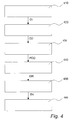
- Figs 5 and 8 show two different algorithms of two alternative embodiments of the present invention for increasing the randomness of the processed optical data. These algorithms will be described in greater detail below.
- the processed optical data are used as an encryption key EK in an encryption algorithm and encryption of a message obtained from the position-coded surface using the digital pen is performed.
- the processed optical data is, at step 460, used for authentication of a sent message. Then, the processed optical data are used as random number data, which is encrypted by means of an encryption key, for example a private key of the digital pen, and the encrypted random number data is used for authentication of said sent message.
- an encryption key for example a private key of the digital pen
- Encryption algorithms such as the AES encryption algorithm, uses block encryption.
- a block cipher i.e. an encryption algorithm using block encryption, is a method of encryption text (to produce ciphertext) in which an encryption key and algorithm are applied to a block of data at once as a group rather than to one bit at a time.
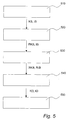
- Fig. 5 there is shown a flow diagram of the method according to a first preferred algorithm in accordance with the present invention for increasing the randomness or stochasticity of the processed optical data and to produce random numbers. It should be noted that the following description with reference to Figs 5, 6, 7A, and 7B corresponds to step 450 of Fig. 4.
- the sequence of data records is organized into data blocks, wherein each data block is determined or labeled as either a key data block KB or an input data block IB, in accordance with the description above.
- each data block is determined or labeled as either a key data block KB or an input data block IB, in accordance with the description above.
- four subsequent data records are organized in a single data block.
- every second data block is a key data block KB
- the intermediate data blocks are input data blocks IB.
- the key data blocks KB are processed according to a first mathematical algorithm
- the input data blocks IB are processed according to a second mathematical algorithm.
- the mathematical algorithms define a cyclic reordering or shifting procedure of the data fields included in the key data block KB and the input data block IB, respectively.
- Fig. 6 the order of the data fields within a key data block KB or an input data block IB are shown prior to the shifting procedure.
- the records are shown schematically as boxes divided into four elements, each element representing a data field.
- the fields indicated with 1 and 2 include the sum of brightness, the fields indicated with 3 the minimum, and the field indicated with 4 the maximum.
- the cyclic shifting scheme of the data fields included in the key data block KB is shown below in table 1. Table 1 Data record Steps A 0 B 3 C 2 D 1
- Fig. 7A the order of the data fields within the key data block after the cyclic shifting has been performed is shown.
- the data fields of the first data record, record A retain their positions
- the data fields within the second record, record B are shifted three positions to the right
- the fields within the third record, record C are shifted two positions to the right
- the fields within the fourth record, record D are shifted one position to the right.
- the data block output as a result of the reordering algorithm for a key data block is referred to as reordered key data block, RKB.
- Table 2 the cyclic shifting scheme of the data fields included in the input data block IB is shown.
- Table 2 Data record Steps A 1 B 2 C 3 D 0
- Fig. 7B there is shown the order of the data fields within the input data block after the cyclic shifting, to the right, has been performed.
- the data fields within the first data record, record A are shifted one position
- the data fields within the second data record, record B are shifted two positions
- the data fields within the third data record, record C are shifted three positions
- the data fields within the fourth data record, record D retain their positions.
- the data block output as a result of the reordering algorithm for an input data block is referred to as reordered input data block, RIB.
- step 540 the data in the thus reordered key and input data blocks are used as the encryption key, key data KD, and the initiation vector, input data ID, respectively, for the encryption algorithm.
- step 550 the method is returned to the procedure shown in Fig. 4 at step 460, where the actual encryption of the message is performed using, in this preferred embodiment, the AES encryption algorithm.
- the AES encryption algorithm is of course contemplated within the scope of the present invention.
- the algorithm can be regarded as having two parts.
- the seed update a random seed is calculated based on the processed optical data.
- the random number calculation the thus calculated random seed is used as input data for calculation of the random numbers to be used in the encryption algorithm.
- Data blocks that include a subset of the sequence of data records containing the processed optical data form the input data in the seed update part.
- the data records comprise data fields, preferably organized as is described above in relation to the first preferred embodiment.
- each data record includes four data fields, the first two including the sum value, the third the minimum value, and the fourth the maximum value, see Fig. 6.
- each data block is processed in a first hash function, which in this embodiment is an encryption algorithm, in order to increase the randomness of the data records containing the processed optical data.
- the first hash function is, in this embodiment, a symmetrical encryption algorithm.
- the data records containing the processed optical data are used as the encryption key, and an arbitrarily chosen vector is used as the initiation vector. However, it is preferred that the number of ones and zeros are substantially equal and appropriately distributed throughout the initiation vector. This can be achieved by using the previous seed as the initiation vector for the hashing algorithm, which will remove the risk of patterns that may be produced due to frequent seed updates with substantially similar input data, and will improve the quality of the random seed.
- an iterative process concatenates each hashing output or hash value, HV, and thereby forms hashing output data blocks. This is due to the fact that a hashing process normally results in an output having a data size that is less, or much less, than the data size of the input data. The number of iterations is dependent on the desired size of the output data.
- the output data blocks are then divided into key data blocks and seed data blocks at step 830.
- SI x Hash n (SI x , SU x )
- Y/n Y is the bit-length of the random number to be generated in the second step
- n is the bit-length of the output data of the hashing algorithm
- SU x is input data block x
- SI x is output data block x
- SK x is key data block x
- SD x seed data block x is SD x seed data block x.
- the hashing algorithm is performed using a symmetric encryption algorithm, AES.
- AES symmetric encryption algorithm
- the seed update can be performed with a full update of the seed, i.e. with all data blocks included in SI, or with one data block, SI x . This is dependent on the requirements of the random number calculation algorithm in part two and the computer power at hand.
- the key data blocks and seed data blocks are used as input data in a second algorithm, which in this embodiment utilizes a symmetrical encryption algorithm, for example AES.
- the algorithm performed at step 840 is an iterative algorithm.
- AES symmetrical encryption algorithm
- A3 or A5 which are stream ciphers and are used for symmetrical encryption, may be used.
- a counter, seed count is also included. It counts the number of times the random number calculation was used since the input data were updated in the seed update.
- steps 1.2 and 1.3 could be made in a number of other ways, but the described method ensures that all changes in a block is transformed through out most of the random seed, and thereby ensures a high quality random seed for the following calculation.
- the second algorithm is a hash function, preferably using the same symmetrical encryption algorithm as in the second algorithm described above.
- step 850 the method is returned to the procedure shown in Fig. 4 at step 460, where the actual encryption of the message is performed using, in this preferred embodiment, the AES encryption algorithm, where the random number data PR x obtained through the above method are used as the encryption key at step 460 of Fig. 4.
- an encryption of the random number data PR x is performed, for example by the use of an asymmetric encryption algorithm. Then, the encrypted random number data is sent to the receiver of the encrypted message. The receiver performs a hashing on the encrypted random number data and uses the resulting hash value as a private encryption key, which then is used in an asymmetric encryption algorithm for decryption of the received message.
Landscapes
- Engineering & Computer Science (AREA)
- Computer Security & Cryptography (AREA)
- Computer Networks & Wireless Communication (AREA)
- Signal Processing (AREA)
- Physics & Mathematics (AREA)
- Theoretical Computer Science (AREA)
- General Physics & Mathematics (AREA)
- General Engineering & Computer Science (AREA)
- Biodiversity & Conservation Biology (AREA)
- Pure & Applied Mathematics (AREA)
- Mathematical Analysis (AREA)
- Computational Mathematics (AREA)
- Health & Medical Sciences (AREA)
- Life Sciences & Earth Sciences (AREA)
- Mathematical Optimization (AREA)
- Biomedical Technology (AREA)
- General Health & Medical Sciences (AREA)
- Power Engineering (AREA)
- Mobile Radio Communication Systems (AREA)
- Storage Device Security (AREA)
- Communication Control (AREA)
- Two-Way Televisions, Distribution Of Moving Picture Or The Like (AREA)
- Radar Systems Or Details Thereof (AREA)
Claims (36)
- Verfahren in einem digitalen Stift (DP) für die Verschlüsselung einer Nachricht für sichere Übertragung der Nachricht von dem digitalen Stift (DP) zu einem Empfänger (ALS, SH, SP), das durch die folgenden Schritte gekennzeichnet ist:- Ermitteln der Nachricht durch Registrierung von Abbildern einer Oberfläche (2), die mit einem Positionscodemuster (3) versehen ist, unter Verwendung eines optischen Sensors (8) in dem digitalen Stift (DP) und Bestimmen mindestens einer Position aus den Abbildern;- Ermitteln (410 - 420) von optischen Daten für die Erzeugung eines Verschlüsselungsschlüssels unter Verwendung des optischen Sensors (8) in dem digitalen Stift (DP), wobei die optischen Daten Werte eines optischen Parameters elektronisch repräsentieren, welcher durch den optischen Sensor (8) lesbar ist;- Erzeugen (430 - 450) des Verschlüsselungsschlüssels ausschließlich durch elektronische Verarbeitung in einem Prozessor (10) des digitalen Stifts (8) unter Verwendung der optischen Daten als Zufallssaat; und- Verschlüsseln (460) der Nachricht unter Verwendung des Verschlüsselungsschlüssels in einem Verschlüsselungsalgorithmus.
- Verfahren nach Anspruch 1, wobei der optische Parameter die Helligkeit ist, die durch den optischen Sensor (8) erfasst wird.
- Verfahren nach Anspruch 1 oder 2, wobei der Schritt (410 - 420) des Ermittelns von optischen Daten den Schritt umfasst des- Ermittelns der optischen Daten von einem Abschnitt einer Oberfläche (2) die mit einem Positionscodemuster (3) versehen ist, wobei das Positionscodemuster (3) optisch lesbare Markierungen (4) umfasst und wobei der optische Parameter für den Abschnitt repräsentativ ist.
- Verfahren nach irgendeinem der Ansprüche 1 - 3, wobei der Schritt (430 - 450) der Erzeugung eines Verschlüsselungsschlüssels die Schritte umfasst:- Verarbeiten (430) der optischen Daten nach einem vorbestimmten Schema,- Organisieren (440) der verarbeiteten optischen Daten in Datenfeldern, wobei jedes Datenfeld eine vorbestimmte Größe hat, und- Organisieren (440) der Datenfelder in einer vorbestimmten Reihenfolge in Datensätzen.
- Verfahren nach Anspruch 4, wobei der Schritt (430) der Verarbeitung optischer Daten den Schritt umfasst der- Berechnung statistischer Eigenschaften von Sätzen der optischen Parameterwerte, welche durch die optischen Daten repräsentiert werden, wobei die statistischen Eigenschaften die verarbeiteten optischen Daten bilden.
- Verfahren nach Anspruch 5, wobei die statistischen Eigenschaften einen Maximalwert, einen Minimalwert und einen Summenwert des Satzes optischer Parameter umfassen, und wobei die Schritte (440) des Organisierens die Schritte umfassen des- Organisierens des Maximalwertes in mindestens einem Maximaldatenfeld, des Minimalwertes in mindestens einem Minimaldatenfeld und des Summenwertes in mindestens einem Summendatenfeld, und- Organisierens des Maximaldatenfelds, des Minimaldatenfelds und des Summendatenfelds in einem Datensatz entsprechend der vorbestimmten Reihenfolge.
- Verfahren nach irgendeinem der Ansprüche 4 bis 6, wobei der Schritt (430 - 450) des Erzeugens eines Verschlüsselungsschlüssels ferner umfasst den Schritt des- Neuanordnens (520) der Reihenfolge der Datenfelder innerhalb mindestens einem Datensatz einer ersten Folge von Datensätzen entsprechend einem ersten Neuanordnungsalgorithmus, wodurch eine erste Folge von neu angeordneten Datensätzen erreicht wird, und- Neuanordnens (530) der Reihenfolge der Datenfelder innerhalb mindestens einem Datensatz einer zweiten Folge von Datensätzen entsprechend einem zweiten Neuanordnungsalgorithmus, wodurch eine zweite Folge von neu angeordneten Datensätzen erreicht wird.
- Verfahren nach Anspruch 7, wobei ein Verschlüsselungsschlüssel Schlüsseldaten und Eingabedaten umfasst, und wobei der Schritt (430 - 450) der Erzeugung eines Verschlüsselungsschlüssels die Schritte umfasst der- Verwendung (540) der ersten Folge von neu angeordneten Datensätzen als die Schlüsseldaten, und- Verwendung (540) der zweiten Folge von neu angeordneten Datensätzen als die Eingabedaten.
- Verfahren nach irgendeinem der Ansprüche 4 bis 6, wobei der Schritt (430 - 450) des Erzeugens eines Verschlüsselungsschlüssels die Schritte umfasst des- Verarbeitens eines Satzes einer vorbestimmten Anzahl der Datensätze in einem ersten Schritt (810 - 820) unter Verwendung einer ersten Kontrollsummenfunktion, wodurch eine erste Ausgabe ermittelt wird,- Verarbeitens der ersten Ausgabe in einem zweiten Schritt (830 - 840) unter Verwendung eines iterativen Algorithmus, wodurch eine zweite Ausgabe ermittelt wird, und- Verwendens (850) der zweiten Ausgabe als Verschlüsselungsschlüssel oder für die Erzeugung des Verschlüsselungsschlüssels.
- Verfahren nach Anspruch 9, wobei die erste Ausgabe in dem zweiten Schritt (830 - 840) unter Verwendung einer zweiten Kontrollsummenfunktion verarbeitet wird.
- Verfahren nach Anspruch 9 oder 10, wobei in dem ersten Schritt (810 - 820) und in dem zweiten Schritt (830 - 840) ein erster symmetrischer Verschlüsselungsalgorithmus bzw. ein zweiter symmetrischer Verschlüsselungsalgorithmus verwendet wird.
- Verfahren nach Anspruch 11, wobei genau ein symmetrischer Verschlüsselungsalgorithmus verwendet wird sowohl als der erste symmetrische Verschlüsselungsalgorithmus als auch als der zweite symmetrische Verschlüsselungsalgorithmus.
- Verfahren nach Anspruch 12, wobei genau ein symmetrischer Verschlüsselungsalgorithmus verwendet wird sowohl als der Verschlüsselungsalgorithmus für die Durchführung des Schritts (460) der Verschlüsselung der Nachricht als auch als der erste symmetrische Verschlüsselungsalgorithmus und der zweite symmetrische Verschlüsselungsalgorithmus.
- Verfahren nach irgendeinem der vorstehenden Ansprüche, wobei der Verschlüsselungsschlüssel Schlüsseldaten und Eingabedaten umfasst, und wobei das Verfahren ferner die Schritte umfasst des- Verwendens einer ersten Untermenge der optischen Daten für die Erzeugung der Schlüsseldaten, und- Verwendens einer zweiten Untermenge der optischen Daten für die Erzeugung der Eingabedaten.
- Verfahren nach irgendeinem der vorstehenden Ansprüche, wobei der Verschlüsselungsalgorithmus für die Verschlüsselung der Nachricht ein symmetrischer Verschlüsselungsalgorithmus ist.
- Verfahren nach Anspruch 1, das ferner die Schritte umfasst der- Ermittlung von Druckdaten unter Verwendung einer Druckerfassungseinrichtung, wobei der Schritt (430 - 450) der Erzeugung eines Verschlüsselungsschlüssel den Schritt umfasst der- Erzeugung des Verschlüsselungsschlüssels unter Verwendung der Druckdaten in Kombination mit den optischen Daten als Zufallssaat.
- Verfahren nach Anspruch 1, das ferner die Schritte umfasst der- Ermittlung von Zeitdaten, wobei der Schritt (430 - 450) der Erzeugung eines Verschlüsselungsschlüssel den Schritt umfasst der- Erzeugung des Verschlüsselungsschlüssels unter Verwendung der Zeitdaten in Kombination mit den optischen Daten als Zufallssaat.
- Verfahren nach irgendeinem der vorstehenden Ansprüche, wobei die Schritte in einem digitalen Stift (DP) ausgeführt werden, welcher den optischen Sensor (8) und eine Übertragungseinrichtung (12) umfasst.
- Computer lesbares Medium, das Anweisungen umfasst für die Durchführung eines Verfahrens nach irgendeinem der vorstehenden Ansprüche auf einem Computer.
- Digitaler Stift (DP) für die Verschlüsselung einer Nachricht für sichere Übertragung der Nachricht von dem digitalen Stift (DP) zu einem Empfänger (ALS, SH, SP), gekennzeichnet durch- einen optischen Sensor (8) für die Registrierung von Abbildern auf einer Oberfläche (2), die mit einem Positionscodemuster (3) versehen ist;- eine Empfangseinrichtung (10) für den Empfang optischer Daten von dem optischen Sensor (8) für die Erzeugung eines Verschlüsselungsschlüssels, wobei die optischen Daten Werte eines optischen Parameters elektronisch repräsentieren, welcher durch den optischen Sensor (8) lesbar ist;- Verarbeitungseinrichtung (10) für die Erzeugung des Verschlüsselungsschlüssels ausschließlich durch elektronische Verarbeitung unter Verwendung der optischen Daten als Zufallssaat, und für die Ermittlung der Nachricht durch Bestimmen mindestens einer Position aus den aufgezeichneten Abbildern; und- Verschlüsselungseinrichtung (10) für die Verschlüsselung der zu übertragenden Nachricht unter Verwendung des Verschlüsselungsschlüssels.
- Digitaler Stift nach Anspruch 20, wobei die optischen Daten von einem Abschnitt einer Oberfläche (2) ermittelt wurden, der mit einem Positionscodemuster (3) mit optisch lesbaren Markierungen (4) versehen ist.
- Digitaler Stift nach Anspruch 21, wobei die Verarbeitungseinrichtung (10) ferner angeordnet ist, um- die optischen Daten nach einem vorbestimmten Schema zu verarbeiten,- die verarbeiteten optischen Daten in Datenfeldern zu organisieren, wobei jedes Datenfeld eine vorbestimmte Größe hat, und- die Datenfelder in einer vorbestimmten Reihenfolge in Datensätzen zu organisieren.
- Digitaler Stift nach Anspruch 22, wobei die Verarbeitungseinrichtung (10) ferner angeordnet ist, um statistische Eigenschaften von Sätzen von den durch die optischen Daten repräsentierten, optischen Parameterwerten zu berechnen, wobei die statistischen Eigenschaften die verarbeiteten optischen Daten bilden.
- Digitaler Stift nach Anspruch 23, wobei die Eigenschaften einen Maximalwert, einen Minimalwert und einen Summenwert des Satzes optischer Parameterwerte umfassen, und wobei die Verarbeitungseinrichtung (10) ferner angeordnet ist, um- den Maximalwert in mindestens einem Maximaldatenfeld, den Minimalwert in mindestens einem Minimaldatenfeld und den Summenwert in mindestens einem Summendatenfeld zu organisieren, und- das Maximaldatenfeld, das Minimaldatenfeld und das Summendatenfeld in einem Datensatz entsprechend der vorbestimmten Reihenfolge zu organisieren.
- Digitaler Stift nach irgendeinem der Ansprüche 22 - 24, wobei die Verarbeitungseinrichtung (10) ferner angeordnet ist, um- die Reihenfolge der Datenfelder innerhalb mindestens einem Datensatz einer ersten Folge von Datensätzen entsprechend einem ersten Neuanordnungsalgorithmus neu anzuordnen, wodurch eine erste Folge von neu angeordneten Datensätzen erreicht wird, und- die Reihenfolge der Datenfelder innerhalb mindestens einem Datensatz einer zweiten Folge von Datensätzen entsprechend einem zweiten Neuanordnungsalgorithmus neu anzuordnen, wodurch eine zweite Folge von neu angeordneten Datensätzen erreicht wird.
- Digitaler Stift nach Anspruch 25, wobei ein Verschlüsselungsschlüssel Schlüsseldaten und Eingabedaten umfasst, und wobei die Verarbeitungseinrichtung (10) ferner angeordnet ist, um- die erste Folge von neu angeordneten Datensätzen als die Schlüsseldaten zu verwenden, und- die zweite Folge von neu angeordneten Datensätzen als die Eingabedaten zu verwenden.
- Digitaler Stift nach irgendeinem der Ansprüche 22 bis 24, wobei die Verarbeitungseinrichtung (10) ferner angeordnet ist, um- einen Satz einer vorbestimmten Anzahl der Datensätze in einem ersten Schritt unter Verwendung einer ersten Kontrollsummenfunktion zu verarbeiten, wodurch eine erste Ausgabe ermittelt wird,- die erste Ausgabe in einem zweiten Schritt unter Verwendung eines iterativen Algorithmus zu verarbeiten, wodurch eine zweite Ausgabe ermittelt wird, und- die zweite Ausgabe als einen Verschlüsselungsschlüssel oder für die Erzeugung des Verschlüsselungsschlüssels zu verwenden.
- Digitaler Stift nach Anspruch 27, wobei die Verarbeitungseinrichtung (10) ferner angeordnet ist, um eine zweite Kontrollsummenfunktion zu verwenden für die Verarbeitung der erste Ausgabe in dem zweiten Schritt.
- Digitaler Stift nach Anspruch 27 oder 28, wobei in dem ersten Schritt und dem zweiten Schritt eine erster bzw. ein zweiter symmetrischer Verschlüsselungsalgorithmus verwendet wird.
- Digitaler Stift nach Anspruch 29, wobei die Verarbeitungseinrichtung ferner angeordnet ist, einen symmetrischen Verschlüsselungsalgorithmus sowohl als den ersten symmetrischen Verschlüsselungsalgorithmus als auch als den zweiten symmetrischen Verschlüsselungsalgorithmus zu verwenden.
- Digitaler Stift nach Anspruch 29, wobei ein und derselbe symmetrische Verschlüsselungsalgorithmus von der Verschlüsselungseinrichtung (10) verwendet wird für die Verschlüsselung der Nachricht, und von der Verarbeitungseinrichtung (10) verwendet wird als der erste symmetrische Verschlüsselungsalgorithmus und als der zweite symmetrische Verschlüsselungsalgorithmus.
- Digitaler Stift nach irgendeinem der Ansprüche 20 - 31, wobei die Verschlüsselungseinrichtung (10) ferner angeordnet ist, um die Nachricht unter Verwendung eines symmetrischen Verschlüsselungsalgorithmus zu verschlüsseln.
- Digitaler Stift nach irgendeinem der Ansprüche 20 - 32, wobei die Verschlüsselungseinrichtung (10) ferner angeordnet ist, um- eine erste Untermenge der optischen Daten als Schlüsseldaten für den Verschlüsselungsalgorithmus zu verwenden, und- eine zweite Untermenge der optischen Daten als Eingabedaten für den Verschlüsselungsalgorithmus zu verwenden.
- Digitaler Stift nach Anspruch 20, wobei die Empfangseinrichtung (10) ferner angeordnet ist, um Druckdaten zu empfangen und wobei die Verarbeitungseinrichtung (10) angeordnet ist, um den Verschlüsselungsschlüssel unter Verwendung der Druckdaten in Kombination mit den optischen Daten zu erzeugen.
- Digitaler Stift nach Anspruch 20, wobei die Verarbeitungseinrichtung (10) ferner angeordnet ist, um Zeitdaten zu ermitteln und um den Verschlüsselungsschlüssel unter Verwendung der Zeitdaten in Kombination mit den optischen Daten zu erzeugen.
- Verfahren für die Authentifizierung einer gesendeten Nachricht, wobei die Nachricht von einem digitalen Stift (DP) an einen Empfänger (ALS, SH; SP) gesendet wurde, gekennzeichnet durch die Schritte des- Ermittelns der Nachricht durch Registrierung von Abbildern einer Oberfläche (2), die mit einem Positionscodemuster (3) versehen ist, unter Verwendung eines optischen Sensors (8) in dem digitalen Stift (DP) und Bestimmens mindestens einer Position aus den Abbildern,- Ermittelns optischer Daten für die Erzeugung von Zufallszahldaten unter Verwendung des optischen Sensors (8) in dem digitalen Stift (DP), wobei die optischen Daten Werte eines optischen Parameters elektronisch repräsentieren, der durch den optischen Sensor (8) lesbar ist,- Verwendens der optischen Daten für die Erzeugung der Zufallszahldaten ausschließlich durch elektronische Verarbeitung in einem Prozessor (10) des digitalen Stifts (DP),- Verschlüsselns der Zufallszahldaten, und- Verwendens der verschlüsselten Zufallszahldaten für die Authentifizierung der Nachricht.
Applications Claiming Priority (3)
| Application Number | Priority Date | Filing Date | Title |
|---|---|---|---|
| SE0002158 | 2000-06-07 | ||
| SE0002158A SE516567C2 (sv) | 2000-06-07 | 2000-06-07 | Förfarande och anordning för säker trådlös överföring av information |
| PCT/SE2001/001296 WO2001095091A1 (en) | 2000-06-07 | 2001-06-07 | Method and device for encrypting a message |
Publications (2)
| Publication Number | Publication Date |
|---|---|
| EP1292882A1 EP1292882A1 (de) | 2003-03-19 |
| EP1292882B1 true EP1292882B1 (de) | 2006-07-26 |
Family
ID=20280029
Family Applications (2)
| Application Number | Title | Priority Date | Filing Date |
|---|---|---|---|
| EP01938909A Withdrawn EP1293061A1 (de) | 2000-06-07 | 2001-06-07 | Verfahren und einrichtung zur sicheren drahtlosen bertragung von informationen |
| EP01938930A Expired - Lifetime EP1292882B1 (de) | 2000-06-07 | 2001-06-07 | Verfahren und einrichtung zum verschl sseln einer nachricht |
Family Applications Before (1)
| Application Number | Title | Priority Date | Filing Date |
|---|---|---|---|
| EP01938909A Withdrawn EP1293061A1 (de) | 2000-06-07 | 2001-06-07 | Verfahren und einrichtung zur sicheren drahtlosen bertragung von informationen |
Country Status (8)
| Country | Link |
|---|---|
| EP (2) | EP1293061A1 (de) |
| JP (1) | JP4815094B2 (de) |
| AT (1) | ATE334443T1 (de) |
| AU (2) | AU2001264501A1 (de) |
| DE (1) | DE60121764T2 (de) |
| ES (1) | ES2269415T3 (de) |
| SE (1) | SE516567C2 (de) |
| WO (2) | WO2001095091A1 (de) |
Cited By (4)
| Publication number | Priority date | Publication date | Assignee | Title |
|---|---|---|---|---|
| US8183980B2 (en) | 2005-08-31 | 2012-05-22 | Assa Abloy Ab | Device authentication using a unidirectional protocol |
| US8358783B2 (en) | 2008-08-11 | 2013-01-22 | Assa Abloy Ab | Secure wiegand communications |
| WO2016195949A1 (en) * | 2015-06-04 | 2016-12-08 | Microsoft Technology Licensing, Llc | Authenticating stylus device |
| US12047511B2 (en) | 2018-07-30 | 2024-07-23 | Madoka SAKAITANI | Information processing system and information processing method |
Families Citing this family (42)
| Publication number | Priority date | Publication date | Assignee | Title |
|---|---|---|---|---|
| US8054971B2 (en) | 2001-04-27 | 2011-11-08 | Comverse Ltd | Free-hand mobile messaging-method and device |
| US7916124B1 (en) | 2001-06-20 | 2011-03-29 | Leapfrog Enterprises, Inc. | Interactive apparatus using print media |
| SE520504C2 (sv) * | 2001-11-30 | 2003-07-15 | Anoto Ab | Elektronisk penna och metod för registrering av handskriven information |
| US7385595B2 (en) | 2001-11-30 | 2008-06-10 | Anoto Ab | Electronic pen and method for recording of handwritten information |
| SE0104395L (sv) * | 2001-12-27 | 2003-06-28 | Anoto Ab | Sätt att överföra information mellan en digital användarenhet och en datorresurs med hjälp av positionskodning |
| WO2003063528A2 (en) | 2002-01-16 | 2003-07-31 | Sure On Sight Ltd | Secure messaging via a mobile communications network |
| GB2384392A (en) * | 2002-01-16 | 2003-07-23 | Sure On Sight Ltd | Secure messaging via a mobile telecommunications network |
| NZ536481A (de) | 2002-05-14 | 2007-05-31 | Screenlife Llc | |
| US7417773B2 (en) | 2002-09-30 | 2008-08-26 | Pitney Bowes Inc. | Method and system for creating and sending a facsimile using a digital pen |
| US20050060644A1 (en) * | 2003-09-15 | 2005-03-17 | Patterson John Douglas | Real time variable digital paper |
| US20060067576A1 (en) | 2004-03-17 | 2006-03-30 | James Marggraff | Providing a user interface having interactive elements on a writable surface |
| US7853193B2 (en) | 2004-03-17 | 2010-12-14 | Leapfrog Enterprises, Inc. | Method and device for audibly instructing a user to interact with a function |
| US7453447B2 (en) | 2004-03-17 | 2008-11-18 | Leapfrog Enterprises, Inc. | Interactive apparatus with recording and playback capability usable with encoded writing medium |
| US7831933B2 (en) | 2004-03-17 | 2010-11-09 | Leapfrog Enterprises, Inc. | Method and system for implementing a user interface for a device employing written graphical elements |
| US7698640B2 (en) | 2004-08-04 | 2010-04-13 | Leapfrog Enterprises, Inc. | User interactive journal |
| US7428990B1 (en) | 2004-12-22 | 2008-09-30 | Leapfrog Enterprises, Inc. | Capacitive sensing of media information in an interactive media device |
| US7621441B1 (en) | 2004-12-22 | 2009-11-24 | Leapfrog Enterprises | Interactive device using capacitive sensor array for joint page identification and page location determination |
| JP2008532139A (ja) | 2005-02-23 | 2008-08-14 | アノト アクティエボラーク | 電子ペンにおける方法、コンピュータプログラム製品、および電子ペン |
| US7643633B2 (en) | 2005-05-06 | 2010-01-05 | Research In Motion Limited | Adding randomness internally to a wireless mobile communication device |
| EP1722299B1 (de) * | 2005-05-06 | 2007-06-20 | Research In Motion Limited | Erzeugung von Zufallszahlen in einem drahtlosen Kommunikationsgerät |
| US7661592B1 (en) | 2005-06-08 | 2010-02-16 | Leapfrog Enterprises, Inc. | Interactive system including interactive apparatus and game |
| US7922099B1 (en) | 2005-07-29 | 2011-04-12 | Leapfrog Enterprises, Inc. | System and method for associating content with an image bearing surface |
| US7374087B1 (en) | 2005-07-29 | 2008-05-20 | Leapfrog Enterprises, Inc. | Method, apparatus and system for conveying cartridge notification |
| US7549596B1 (en) | 2005-07-29 | 2009-06-23 | Nvidia Corporation | Image bearing surface |
| GB2428952B (en) * | 2005-07-30 | 2010-10-06 | Hewlett Packard Development Co | Digital pen and paper system |
| US7281664B1 (en) | 2005-10-05 | 2007-10-16 | Leapfrog Enterprises, Inc. | Method and system for hierarchical management of a plurality of regions of an encoded surface used by a pen computer |
| US7936339B2 (en) | 2005-11-01 | 2011-05-03 | Leapfrog Enterprises, Inc. | Method and system for invoking computer functionality by interaction with dynamically generated interface regions of a writing surface |
| US7562822B1 (en) | 2005-12-30 | 2009-07-21 | Leapfrog Enterprises, Inc. | Methods and devices for creating and processing content |
| DE602006002242D1 (de) * | 2006-02-15 | 2008-09-25 | Jaycrypto Ltd | Verfahren und Vorrichtung zum Erzeugen von Initialwerten für einen Zufallszahlengenerator |
| US7847942B1 (en) | 2006-12-28 | 2010-12-07 | Leapfrog Enterprises, Inc. | Peripheral interface device for color recognition |
| US7892095B2 (en) | 2007-02-13 | 2011-02-22 | Screenlife, Llc | Displaying information to a selected player in a multi-player game on a commonly viewed display device |
| WO2008132382A1 (fr) * | 2007-03-20 | 2008-11-06 | France Telecom | Procede de generation d'un alea a partir d'une donnee biometrique |
| US8275123B2 (en) | 2007-08-17 | 2012-09-25 | Infineon Technologies, Ag | Integrated data transceiver and sensor for the generation of a symmetrical cryptographic key |
| US10620754B2 (en) | 2010-11-22 | 2020-04-14 | 3M Innovative Properties Company | Touch-sensitive device with electrodes having location pattern included therein |
| EP2940923B1 (de) | 2014-04-28 | 2018-09-05 | Université de Genève | Verfahren und Vorrichtung für einen optischen Quantumzufallszahlengenerator |
| EP3306464B1 (de) | 2016-10-09 | 2021-09-29 | Université de Genève | Verfahren und vorrichtung zur quantenzufallszahlerzeugung |
| US10452877B2 (en) | 2016-12-16 | 2019-10-22 | Assa Abloy Ab | Methods to combine and auto-configure wiegand and RS485 |
| US10713385B2 (en) | 2018-07-03 | 2020-07-14 | International Business Machines Corporation | Position data pseudonymization |
| JP6673994B2 (ja) | 2018-08-24 | 2020-04-01 | 本田技研工業株式会社 | エンジン |
| DE102018126763B4 (de) * | 2018-10-26 | 2020-12-10 | Michael Artmann | Kryptographieverfahren |
| CN113596042A (zh) * | 2021-08-03 | 2021-11-02 | 拉卡拉汇积天下技术服务(北京)有限公司 | 信息投递方法、装置、系统、电子设备及存储介质 |
| EP4170480B1 (de) | 2021-10-20 | 2024-06-12 | Université de Genève | Verfahren und vorrichtung zur quantenzufallszahlerzeugung |
Family Cites Families (16)
| Publication number | Priority date | Publication date | Assignee | Title |
|---|---|---|---|---|
| IL78541A (en) * | 1986-04-18 | 1989-09-28 | Rotlex Optics Ltd | Method and apparatus for encryption of optical images |
| JP2824943B2 (ja) * | 1991-08-21 | 1998-11-18 | 松下電器産業株式会社 | ライトペン |
| US5852434A (en) | 1992-04-03 | 1998-12-22 | Sekendur; Oral F. | Absolute optical position determination |
| US5721788A (en) * | 1992-07-31 | 1998-02-24 | Corbis Corporation | Method and system for digital image signatures |
| US5371794A (en) * | 1993-11-02 | 1994-12-06 | Sun Microsystems, Inc. | Method and apparatus for privacy and authentication in wireless networks |
| JPH07262372A (ja) * | 1994-03-23 | 1995-10-13 | Toshiba Corp | 情報処理装置 |
| JPH07287632A (ja) * | 1994-04-19 | 1995-10-31 | Alps Electric Co Ltd | 座標検出装置 |
| US5661506A (en) | 1994-11-10 | 1997-08-26 | Sia Technology Corporation | Pen and paper information recording system using an imaging pen |
| JPH0983512A (ja) * | 1995-09-19 | 1997-03-28 | Olympus Optical Co Ltd | 暗号化システム及びそれに利用可能な光学的排他的論理和演算装置 |
| JP3382451B2 (ja) * | 1996-03-11 | 2003-03-04 | キヤノン株式会社 | 情報入力装置及びディスプレイ装置 |
| US6026165A (en) * | 1996-06-20 | 2000-02-15 | Pittway Corporation | Secure communications in a wireless system |
| US5850443A (en) * | 1996-08-15 | 1998-12-15 | Entrust Technologies, Ltd. | Key management system for mixed-trust environments |
| SE509327C2 (sv) * | 1996-11-01 | 1999-01-11 | C Technologies Ab | Sätt och anordning för registrering av tecken med hjälp av en penna |
| US6327395B1 (en) * | 1996-12-20 | 2001-12-04 | Xerox Parc | Glyph address carpet methods and apparatus for providing location information in a multidimensional address space |
| WO1998040982A1 (en) * | 1997-03-12 | 1998-09-17 | Visa International | Secure electronic commerce employing integrated circuit cards |
| DE19907600A1 (de) * | 1999-02-22 | 2000-08-24 | Rene Baltus | Biometrischer Zufallsgenerator |
-
2000
- 2000-06-07 SE SE0002158A patent/SE516567C2/sv not_active IP Right Cessation
-
2001
- 2001-06-07 DE DE60121764T patent/DE60121764T2/de not_active Expired - Lifetime
- 2001-06-07 JP JP2002502577A patent/JP4815094B2/ja not_active Expired - Fee Related
- 2001-06-07 ES ES01938930T patent/ES2269415T3/es not_active Expired - Lifetime
- 2001-06-07 WO PCT/SE2001/001296 patent/WO2001095091A1/en not_active Ceased
- 2001-06-07 WO PCT/SE2001/001267 patent/WO2001095559A1/en not_active Ceased
- 2001-06-07 AU AU2001264501A patent/AU2001264501A1/en not_active Abandoned
- 2001-06-07 EP EP01938909A patent/EP1293061A1/de not_active Withdrawn
- 2001-06-07 AU AU2001264480A patent/AU2001264480A1/en not_active Abandoned
- 2001-06-07 EP EP01938930A patent/EP1292882B1/de not_active Expired - Lifetime
- 2001-06-07 AT AT01938930T patent/ATE334443T1/de not_active IP Right Cessation
Non-Patent Citations (1)
| Title |
|---|
| TORU SASAKI ET AL: "Stream cipher based on pseudorandom number generation with optical affine transformation", APPLIED OPTICS, vol. 39, no. 14, 10 May 2000 (2000-05-10), pages 2340 - 2346 * |
Cited By (7)
| Publication number | Priority date | Publication date | Assignee | Title |
|---|---|---|---|---|
| US8183980B2 (en) | 2005-08-31 | 2012-05-22 | Assa Abloy Ab | Device authentication using a unidirectional protocol |
| US8358783B2 (en) | 2008-08-11 | 2013-01-22 | Assa Abloy Ab | Secure wiegand communications |
| US8923513B2 (en) | 2008-08-11 | 2014-12-30 | Assa Abloy Ab | Secure wiegand communications |
| US8943562B2 (en) | 2008-08-11 | 2015-01-27 | Assa Abloy Ab | Secure Wiegand communications |
| WO2016195949A1 (en) * | 2015-06-04 | 2016-12-08 | Microsoft Technology Licensing, Llc | Authenticating stylus device |
| US9898100B2 (en) | 2015-06-04 | 2018-02-20 | Microsoft Technology Licensing, Llc | Authenticating stylus device |
| US12047511B2 (en) | 2018-07-30 | 2024-07-23 | Madoka SAKAITANI | Information processing system and information processing method |
Also Published As
| Publication number | Publication date |
|---|---|
| DE60121764T2 (de) | 2006-12-28 |
| SE0002158L (sv) | 2001-12-08 |
| EP1292882A1 (de) | 2003-03-19 |
| WO2001095559A1 (en) | 2001-12-13 |
| ES2269415T3 (es) | 2007-04-01 |
| SE0002158D0 (sv) | 2000-06-07 |
| JP2003536299A (ja) | 2003-12-02 |
| AU2001264480A1 (en) | 2001-12-17 |
| DE60121764D1 (de) | 2006-09-07 |
| WO2001095091A1 (en) | 2001-12-13 |
| SE516567C2 (sv) | 2002-01-29 |
| ATE334443T1 (de) | 2006-08-15 |
| AU2001264501A1 (en) | 2001-12-17 |
| JP4815094B2 (ja) | 2011-11-16 |
| EP1293061A1 (de) | 2003-03-19 |
Similar Documents
| Publication | Publication Date | Title |
|---|---|---|
| EP1292882B1 (de) | Verfahren und einrichtung zum verschl sseln einer nachricht | |
| US7457413B2 (en) | Method and device for encrypting a message | |
| Kumar et al. | A chaotic based image encryption scheme using elliptic curve cryptography and genetic algorithm | |
| US7657033B2 (en) | Cryptography related to keys | |
| AU729638B2 (en) | A non-deterministic public key encryption system | |
| Laiphrakpam et al. | Encrypting multiple images with an enhanced chaotic map | |
| US6192129B1 (en) | Method and apparatus for advanced byte-oriented symmetric key block cipher with variable length key and block | |
| Liu et al. | A novel image encryption algorithm based on improved 3D chaotic cat map | |
| US20140112469A1 (en) | Novel encryption processes based upon irrational numbers and devices to accomplish the same | |
| Sathishkumar et al. | Image encryption using random pixel permutation by chaotic mapping | |
| US20110246768A1 (en) | Systems and methods improving cryptosystems with biometrics | |
| JP2008513811A (ja) | 計算変換の方法及びシステム | |
| Ningthoukhongjam et al. | Medical image encryption through chaotic asymmetric cryptosystem | |
| Thangapalani et al. | Securing Medical Image Transmission using Memetic Algorithm | |
| Jain et al. | Diagonal queue medical image steganography with Rabin cryptosystem | |
| Bhardwaj et al. | An approach for securing QR code using cryptography and visual cryptography | |
| Hegde et al. | Exploring the effectiveness of steganography techniques: A comparative analysis | |
| Carey et al. | A cancelable multi-modal biometric based encryption scheme for medical images | |
| Kavitha et al. | A survey on medical image encryption | |
| Razaq et al. | Novel substitution-box generation using group theory for secure medical image encryption in E-healthcare | |
| Fu et al. | A new medical image encryption algorithm using multiple 1-D chaotic maps | |
| Al-Mahmood et al. | Innovative Lightweight Encryption Schemes Leveraging Chaotic Systems for Secure Data Transmission. | |
| Naskar et al. | A secure symmetric image encryption based on linear geometry | |
| Parag et al. | Data Encryption Using Image Processing: A Brief Study | |
| Saleem et al. | Analysis of parameters influencing the performance of digital image encryption using ECC |
Legal Events
| Date | Code | Title | Description |
|---|---|---|---|
| PUAI | Public reference made under article 153(3) epc to a published international application that has entered the european phase |
Free format text: ORIGINAL CODE: 0009012 |
|
| 17P | Request for examination filed |
Effective date: 20030107 |
|
| AK | Designated contracting states |
Kind code of ref document: A1 Designated state(s): AT BE CH CY DE DK ES FI FR GB GR IE IT LI LU MC NL PT SE TR |
|
| AX | Request for extension of the european patent |
Extension state: AL LT LV MK RO SI |
|
| 17Q | First examination report despatched |
Effective date: 20041125 |
|
| RAP1 | Party data changed (applicant data changed or rights of an application transferred) |
Owner name: ANOTO IP LIC HB |
|
| 111L | Licence recorded |
Free format text: 0100 LEAPFROG ENTERPRISES INC. Effective date: 20050530 |
|
| GRAP | Despatch of communication of intention to grant a patent |
Free format text: ORIGINAL CODE: EPIDOSNIGR1 |
|
| RAP1 | Party data changed (applicant data changed or rights of an application transferred) |
Owner name: ANOTO AB |
|
| GRAS | Grant fee paid |
Free format text: ORIGINAL CODE: EPIDOSNIGR3 |
|
| GRAA | (expected) grant |
Free format text: ORIGINAL CODE: 0009210 |
|
| AK | Designated contracting states |
Kind code of ref document: B1 Designated state(s): AT BE CH CY DE DK ES FI FR GB GR IE IT LI LU MC NL PT SE TR |
|
| AX | Request for extension of the european patent |
Extension state: AL LT LV MK RO SI |
|
| PG25 | Lapsed in a contracting state [announced via postgrant information from national office to epo] |
Ref country code: IT Free format text: LAPSE BECAUSE OF FAILURE TO SUBMIT A TRANSLATION OF THE DESCRIPTION OR TO PAY THE FEE WITHIN THE PRESCRIBED TIME-LIMIT;WARNING: LAPSES OF ITALIAN PATENTS WITH EFFECTIVE DATE BEFORE 2007 MAY HAVE OCCURRED AT ANY TIME BEFORE 2007. THE CORRECT EFFECTIVE DATE MAY BE DIFFERENT FROM THE ONE RECORDED. Effective date: 20060726 Ref country code: BE Free format text: LAPSE BECAUSE OF FAILURE TO SUBMIT A TRANSLATION OF THE DESCRIPTION OR TO PAY THE FEE WITHIN THE PRESCRIBED TIME-LIMIT Effective date: 20060726 Ref country code: LI Free format text: LAPSE BECAUSE OF FAILURE TO SUBMIT A TRANSLATION OF THE DESCRIPTION OR TO PAY THE FEE WITHIN THE PRESCRIBED TIME-LIMIT Effective date: 20060726 Ref country code: CH Free format text: LAPSE BECAUSE OF FAILURE TO SUBMIT A TRANSLATION OF THE DESCRIPTION OR TO PAY THE FEE WITHIN THE PRESCRIBED TIME-LIMIT Effective date: 20060726 Ref country code: FI Free format text: LAPSE BECAUSE OF FAILURE TO SUBMIT A TRANSLATION OF THE DESCRIPTION OR TO PAY THE FEE WITHIN THE PRESCRIBED TIME-LIMIT Effective date: 20060726 Ref country code: AT Free format text: LAPSE BECAUSE OF FAILURE TO SUBMIT A TRANSLATION OF THE DESCRIPTION OR TO PAY THE FEE WITHIN THE PRESCRIBED TIME-LIMIT Effective date: 20060726 |
|
| REG | Reference to a national code |
Ref country code: GB Ref legal event code: FG4D |
|
| RIN1 | Information on inventor provided before grant (corrected) |
Inventor name: THUVESHOLMEN, MIKAEL Inventor name: DORE HANSEN, MADS Inventor name: SKANTZE, KRISTOFER Inventor name: EDSOE, TOMAS |
|
| REG | Reference to a national code |
Ref country code: CH Ref legal event code: EP |
|
| REG | Reference to a national code |
Ref country code: IE Ref legal event code: FG4D |
|
| REF | Corresponds to: |
Ref document number: 60121764 Country of ref document: DE Date of ref document: 20060907 Kind code of ref document: P |
|
| PG25 | Lapsed in a contracting state [announced via postgrant information from national office to epo] |
Ref country code: DK Free format text: LAPSE BECAUSE OF FAILURE TO SUBMIT A TRANSLATION OF THE DESCRIPTION OR TO PAY THE FEE WITHIN THE PRESCRIBED TIME-LIMIT Effective date: 20061026 Ref country code: SE Free format text: LAPSE BECAUSE OF FAILURE TO SUBMIT A TRANSLATION OF THE DESCRIPTION OR TO PAY THE FEE WITHIN THE PRESCRIBED TIME-LIMIT Effective date: 20061026 |
|
| PG25 | Lapsed in a contracting state [announced via postgrant information from national office to epo] |
Ref country code: PT Free format text: LAPSE BECAUSE OF FAILURE TO SUBMIT A TRANSLATION OF THE DESCRIPTION OR TO PAY THE FEE WITHIN THE PRESCRIBED TIME-LIMIT Effective date: 20061226 |
|
| LTIE | Lt: invalidation of european patent or patent extension |
Effective date: 20060726 |
|
| ET | Fr: translation filed | ||
| REG | Reference to a national code |
Ref country code: ES Ref legal event code: FG2A Ref document number: 2269415 Country of ref document: ES Kind code of ref document: T3 |
|
| PLBE | No opposition filed within time limit |
Free format text: ORIGINAL CODE: 0009261 |
|
| STAA | Information on the status of an ep patent application or granted ep patent |
Free format text: STATUS: NO OPPOSITION FILED WITHIN TIME LIMIT |
|
| 26N | No opposition filed |
Effective date: 20070427 |
|
| PG25 | Lapsed in a contracting state [announced via postgrant information from national office to epo] |
Ref country code: MC Free format text: LAPSE BECAUSE OF NON-PAYMENT OF DUE FEES Effective date: 20070630 |
|
| PG25 | Lapsed in a contracting state [announced via postgrant information from national office to epo] |
Ref country code: GR Free format text: LAPSE BECAUSE OF FAILURE TO SUBMIT A TRANSLATION OF THE DESCRIPTION OR TO PAY THE FEE WITHIN THE PRESCRIBED TIME-LIMIT Effective date: 20061027 |
|
| PG25 | Lapsed in a contracting state [announced via postgrant information from national office to epo] |
Ref country code: IE Free format text: LAPSE BECAUSE OF NON-PAYMENT OF DUE FEES Effective date: 20070607 |
|
| PG25 | Lapsed in a contracting state [announced via postgrant information from national office to epo] |
Ref country code: LU Free format text: LAPSE BECAUSE OF NON-PAYMENT OF DUE FEES Effective date: 20070607 Ref country code: CY Free format text: LAPSE BECAUSE OF FAILURE TO SUBMIT A TRANSLATION OF THE DESCRIPTION OR TO PAY THE FEE WITHIN THE PRESCRIBED TIME-LIMIT Effective date: 20060726 |
|
| PG25 | Lapsed in a contracting state [announced via postgrant information from national office to epo] |
Ref country code: TR Free format text: LAPSE BECAUSE OF FAILURE TO SUBMIT A TRANSLATION OF THE DESCRIPTION OR TO PAY THE FEE WITHIN THE PRESCRIBED TIME-LIMIT Effective date: 20060726 |
|
| PGFP | Annual fee paid to national office [announced via postgrant information from national office to epo] |
Ref country code: ES Payment date: 20100625 Year of fee payment: 10 |
|
| PGFP | Annual fee paid to national office [announced via postgrant information from national office to epo] |
Ref country code: NL Payment date: 20100614 Year of fee payment: 10 |
|
| REG | Reference to a national code |
Ref country code: NL Ref legal event code: V1 Effective date: 20120101 |
|
| PG25 | Lapsed in a contracting state [announced via postgrant information from national office to epo] |
Ref country code: NL Free format text: LAPSE BECAUSE OF NON-PAYMENT OF DUE FEES Effective date: 20120101 |
|
| REG | Reference to a national code |
Ref country code: ES Ref legal event code: FD2A Effective date: 20130607 |
|
| PG25 | Lapsed in a contracting state [announced via postgrant information from national office to epo] |
Ref country code: ES Free format text: LAPSE BECAUSE OF NON-PAYMENT OF DUE FEES Effective date: 20110608 |
|
| PGFP | Annual fee paid to national office [announced via postgrant information from national office to epo] |
Ref country code: DE Payment date: 20130605 Year of fee payment: 13 |
|
| PGFP | Annual fee paid to national office [announced via postgrant information from national office to epo] |
Ref country code: FR Payment date: 20130624 Year of fee payment: 13 |
|
| PGFP | Annual fee paid to national office [announced via postgrant information from national office to epo] |
Ref country code: GB Payment date: 20140604 Year of fee payment: 14 |
|
| REG | Reference to a national code |
Ref country code: DE Ref legal event code: R119 Ref document number: 60121764 Country of ref document: DE |
|
| REG | Reference to a national code |
Ref country code: FR Ref legal event code: ST Effective date: 20150227 |
|
| PG25 | Lapsed in a contracting state [announced via postgrant information from national office to epo] |
Ref country code: DE Free format text: LAPSE BECAUSE OF NON-PAYMENT OF DUE FEES Effective date: 20150101 |
|
| REG | Reference to a national code |
Ref country code: DE Ref legal event code: R119 Ref document number: 60121764 Country of ref document: DE Effective date: 20150101 |
|
| PG25 | Lapsed in a contracting state [announced via postgrant information from national office to epo] |
Ref country code: FR Free format text: LAPSE BECAUSE OF NON-PAYMENT OF DUE FEES Effective date: 20140630 |
|
| GBPC | Gb: european patent ceased through non-payment of renewal fee |
Effective date: 20150607 |
|
| PG25 | Lapsed in a contracting state [announced via postgrant information from national office to epo] |
Ref country code: GB Free format text: LAPSE BECAUSE OF NON-PAYMENT OF DUE FEES Effective date: 20150607 |
|
| REG | Reference to a national code |
Ref country code: CH Ref legal event code: PK Free format text: ERGAENZUNG LIZENZEINTRAG: AUSSCHLIESSLICHE LIZENZ |