EP1292167A2 - Call connection system and call connection method - Google Patents
Call connection system and call connection method Download PDFInfo
- Publication number
- EP1292167A2 EP1292167A2 EP02019767A EP02019767A EP1292167A2 EP 1292167 A2 EP1292167 A2 EP 1292167A2 EP 02019767 A EP02019767 A EP 02019767A EP 02019767 A EP02019767 A EP 02019767A EP 1292167 A2 EP1292167 A2 EP 1292167A2
- Authority
- EP
- European Patent Office
- Prior art keywords
- call
- slot
- idle
- slots
- general
- Prior art date
- Legal status (The legal status is an assumption and is not a legal conclusion. Google has not performed a legal analysis and makes no representation as to the accuracy of the status listed.)
- Granted
Links
Images






Classifications
-
- H—ELECTRICITY
- H04—ELECTRIC COMMUNICATION TECHNIQUE
- H04W—WIRELESS COMMUNICATION NETWORKS
- H04W76/00—Connection management
- H04W76/50—Connection management for emergency connections
-
- H—ELECTRICITY
- H04—ELECTRIC COMMUNICATION TECHNIQUE
- H04W—WIRELESS COMMUNICATION NETWORKS
- H04W4/00—Services specially adapted for wireless communication networks; Facilities therefor
- H04W4/90—Services for handling of emergency or hazardous situations, e.g. earthquake and tsunami warning systems [ETWS]
-
- H—ELECTRICITY
- H04—ELECTRIC COMMUNICATION TECHNIQUE
- H04W—WIRELESS COMMUNICATION NETWORKS
- H04W72/00—Local resource management
- H04W72/50—Allocation or scheduling criteria for wireless resources
- H04W72/56—Allocation or scheduling criteria for wireless resources based on priority criteria
-
- H—ELECTRICITY
- H04—ELECTRIC COMMUNICATION TECHNIQUE
- H04W—WIRELESS COMMUNICATION NETWORKS
- H04W74/00—Wireless channel access
- H04W74/04—Scheduled access
-
- H—ELECTRICITY
- H04—ELECTRIC COMMUNICATION TECHNIQUE
- H04W—WIRELESS COMMUNICATION NETWORKS
- H04W76/00—Connection management
- H04W76/30—Connection release
Definitions
- the present invention relates to a call connection system and call connection method which are used for emergencies and, more particularly, to a call connection system and call connection method which are suitable for emergency calls by radio.
- a radio terminal apparatus designed to perform speech communication by radio using TDMA Time Division Multiple Access
- TDMA Time Division Multiple Access
- PHS Personal Handyphone System
- an idle slot is ensured, and a speech signal from the radio terminal apparatus is inserted in the slot, thereby allowing speech communication.
- Such slots are shared by radio terminal apparatuses accommodated under the supervision of a radio base station. If, therefore, the number of radio terminal apparatuses accommodated which require one radio base station of speech communication exceeds the number of slots, all the slots are simultaneously used. In such a case, even if an emergency caller tries to perform speech communication, he/she cannot perform speech communication until an idle slot occurs.
- Reference 1 describes an apparatus and method which assign dedicated slots to special mobile stations (radio terminal apparatuses) and allow the special radio terminal apparatuses to use the slots as needed. According to the apparatus and method described in reference 1, since the order of calls is determined in each radio terminal apparatus, even if an emergency occurs in a general radio terminal apparatus and originates a call, the call is not preferentially handled as an emergency call.
- a call connection system which assigns at least one specific one of a plurality of slots, in advance, as an emergency call slot for processing an emergency call and assigns remaining slots, in advance, as general call slots for processing general calls that need not be preferentially handled, comprising call connection processing means for, if there is an idle general call slot, performing call connection processing by using the idle slot in response to a general call connection request, announcement transfer means for, if there is no idle general call slot and there is an idle emergency call slot, assigning one of the emergency call slots to an originating terminal, in response to a general call connection request, to transfer a first announcement informing that the general call cannot be connected because of line congestion to the originating terminal; and slot releasing means for releasing the emergency call slot assigned to the originating terminal after at least transfer of the first announcement is completed by the announcement transfer means.
- Fig. 1 shows the schematic arrangement of a call connection system according to the first embodiment of the present invention.
- a fixed telephone 12 which is a wire telephone
- first and second NMSs (Network Management Systems) 13 1 and 13 2 and first and second access nodes 14 1 and 14 2 for accessing a network 11 which performs telephone communication and the like are connected to the network 11.
- First to third radio base stations 15 1 to 15 3 are connected to the access node 14 1 .
- a plurality of radio base stations including a fourth radio base station 15 4 are connected to the access node 14 2 .
- Service areas (cells) 17 1 , 17 2 ,... respectively managed by the radio base stations 15 1 , 15 2 ,... are so arranged as to partially overlap each other without leaving any gap between them. This arrangement allows radio terminal apparatuses 16 1 , 16 2 ,... to communicate with the fixed telephone 12 and radio terminal apparatuses other than the local apparatuses from any places.
- Fig. 2 shows a slot configuration used when communication between a radio base station and a radio terminal apparatus is done by using the TDMA scheme.
- the radio base station 15 1 is equipped with one radio unit
- the number of available slots 22 per radio unit is represented by m
- the number of emergency call slots 24 is represented by n.
- available slot count m 8
- emergency call slot count n 2.
- the delimited units indicated by #1 to #8 are slots 21. Eight consecutive slots 21 are the available slots 22.
- slots #1 to #6 are the general call slots 23, and slots #7 and #8 are the emergency call slots 24.
- Fig. 3 shows another example of the assignment pattern of the general call slots 23 and emergency call slots 24.
- slots #1, #2, #4, #5, #7, and #8 are set as the general call slots 23, and the remaining slots #3 and #6 are set as the emergency call slots 24.
- the ratio or number of emergency call slots 24 to be assigned can be freely set in accordance with the state of an actual connection system.
- the number of emergency call slots 24 can be increased/decreased, as needed. Assume that the first radio base station 15 1 has two radio units, and the number of available slots is increased to 16, which is twice as many as that in the above case. In this case, if the number of emergency call slots 24 used in the past is small, the number of emergency call slots 24 need not be increased to four, which is twice as many as the current number of slots. However, since slots for emergency calls must be ensured at a considerably high probability, the number of emergency call slots 24 must be set with a sufficient margin.
- Each of the radio base stations 15 1 , 15 2 ,... includes a CPU (Central Processing Unit), a ROM (Read Only Memory) serving as a storage medium in which predetermined control programs are stored, and a RAM (Random Access Memory) serving as a work memory.
- the CPU, ROM, and RAM are not illustrated.
- Active slot management units 25 1 , 25 2 ,... which are provided in correspondence with the radio base stations 15 1 , 15 2 ,... and manage active slots in the radio base stations 15 1 , 15 2 ,... are implemented by the CPUs in the respective radio base stations in a software manner. Note that the active slot management units 25 1 , 25 2 ,... may have CPUs other than the CPUs in the radio base stations 15 1 , 15 2 ,....
- the CPU (Fig. 17) of the active slot management unit 25 1 in the radio base station 15 1 collates the telephone number of the destination with an emergency call collation table (not shown) to determine whether the call is an emergency call (step S31).
- An emergency call collation table (not shown) to determine whether the call is an emergency call (step S31).
- a list of telephone numbers (emergency calls) to be preferentially connected to destinations such as a police station, emergency hospital, and firehouse is stored in this emergency call collation table.
- step S31 If it is determined in step S31 that the call is an emergency call, it is checked whether there are any idle slots in the general call slots 23 (step S32). If there are idle slots, the emergency call is assigned to one of them (step S33). If there are no idle slots, it is checked whether there are any idle slots in the emergency call slots 24 (step S34). If there are idle slots, the emergency call is assigned to one of them (step S35). If there are no idle slots, since all the available slots 22 cannot be used, the processing is terminated without assigning any slot.
- step S31 If it is determined in step S31 that the call is not an emergency call, i.e., is a general call, it is checked whether there are any idle slots in the general call slots 23 (step S36). If there are idle slots in the general call slots 23, the general call is assigned to one of them (step S37). If there are no idle slots in the general call slots 23, general call notification processing is performed (step S38).
- step S51 it is checked whether there are any idle slots in the emergency call slots 24 (Fig. 2) (step S51). If there are no idle slots, the processing is terminated. If there are idle slots in the emergency call slots 24, a predetermined announcement set in advance in a speech output ROM (not shown) is sent to the originating side by using one of the idle emergency call slots 24 (step S52). This announcement informs that the call cannot be connected to the destination. For example, the announcement "We currently have difficulty in connecting you to the destination because of line congestion. Please call later.” is sent to the originating side. One of the emergency call slots 24 is used only for this short period. When the announcement is over, the used emergency call slot 24 is released (step S53).
- the time during which the emergency call slot 24 is used for a general call is very short, and hence there is substantially no influence on emergency calls.
- the terminal which has originated the general call is notified of the inability to connect the call because of line congestion, the notified person can recognize the situation. This allows the caller to recognize that the connection failure has not occurred because the line is busy.
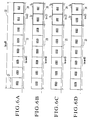
- one slot S 7 of the two emergency call slots 24 is used to send an announcement, as shown in Fig. 6B.
- the announcement is completely sent, the slot S 7 is restored from the active state to the idle state, as shown in Fig. 6C.
- the other slot S 8 of the emergency call slots 24 may be used in place of the slot S 7 to send the announcement.
- step S61 it is checked whether there are two or more idle slots in emergency call slots 24 (step S61). If there are two or more idle slots, the number of slots to be assigned to emergency calls is sufficient to some degree. In this case, the first announcement is sent to the originating terminal by using one of the emergency call slots (step S62). The content of this announcement is "We are waiting for the line to become idle. Please wait for a while.”, i.e., the content that makes the caller wait for a short period of time. Thereafter, the CPU of the active slot management unit checks whether there are any idle slots in the general call slots 23 (step S63). If one of the general call slots 23 becomes idle during this short period of time (about 10 to 20 sec), the general call is assigned to the idle general call slot 23 to allow speech communication with the destination (step S64).
- step S63 If it is determined in step S63 that there is still no idle slot in the general call slots 23, the second announcement is sent by using the emergency call slot 24 again (step S65). The emergency call slot 24 is then released (step S66).
- the announcement used in step S65 may be basically the same as that in step S52 in the first embodiment.
- step S61 If it is determined in step S61 that there are not two or more idle slots in the emergency call slots 24, it is checked whether there is one idle slot in the emergency call slots 24 (step S67). If there is no idle slot, the processing is terminated without performing connection. If there is one idle slot, the second announcement is sent out first (step S65), and then the emergency call slots 24 is released (step S66). This processing is substantially the same as that in the first embodiment.
- the idle emergency call slot 24 is used only for one-way transmission of an announcement from the active slot management unit 25 1 side. If one of the general call slots 23 becomes idle after a lapse of a certain period of time since the absence of idle slots in the general call slots 23, the general call is effectively used.
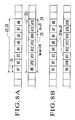
- Figs. 8A and 8B show the states of slots in a case wherein a radio base station is equipped with two radio units, and there are a total of 16 available slots.
- the emergency call slots 24 may be assigned to one first available slot 22 1 (slot #5) and one second available slot 22 2 (slot #11). If the number (m) of available slots 22 increases to a certain extent, emergency calls can be satisfactorily handled even if the number of emergency call slots 24 is not increased in proportion to m. In addition, if there are two or more emergency call slots 24, as described above, the chances of connecting general calls can be increased to a certain extent.
- Termination processing in a call connection system according to the third embodiment of the present invention will be described next with reference to Fig. 9.
- the arrangement of the call connection system according to this embodiment is the same as that shown in Fig. 1, and a description thereof will be omitted.
- a fixed telephone 12 connected to a network 11 originates a call to a radio terminal apparatus 16 1 as a destination located in a service area 17 1 managed by a radio base station 15 1 .
- connection processing is performed for the radio base station 15 1 through the network 11 by a general connection sequence (step S71).
- an active slot management unit 25 1 connected to the radio base station 15 1 checks whether a general call slot 23 can be used (step S72). That is, the active slot management unit 25 1 checks the presence of an idle slot in the general call slots 23.
- step S73 disconnection processing is performed between the radio base station 15 1 and-the network 11 (step S73).
- a radio terminal apparatus 16 1 located in a service area 17 1 originates a general call to a radio terminal apparatus 16 2 as a destination which is located in the same service area.
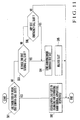
- the CPU of an active slot management unit 25 1 connected to a radio base station 15 1 checks whether there are two or more idle general call slots 23 (step S81). If there are two or more idle slots, one of them is assigned to the originating radio terminal apparatus 16 1 , and another slot is assigned to the terminating radio terminal apparatus 16 2 (step S82) With this operation, communication between the radio terminal apparatuses 16 1 and 16 2 is started.
- step S81 If it is determined in step S81 that only one of the general call slots 23 is idle or there is no idle slot, communication between the radio terminal apparatuses 16 1 and 16 2 cannot be started. In this case, the CPU of the active slot management unit 25 1 checks whether there is only one idle slot in the general call slots 23 (step S83). If there is only one idle general call slot 23, an announcement is sent out by using this slot as in step S52 (Fig. 5). Thereafter, the general call slot 23 is released (step S85), and the processing is terminated.
- step S83 If it is determined in step S83 that there is no idle general call slot 23, it is checked whether there are any idle slots in emergency call slots 24 (step S86). If there is an idle slot in the emergency call slots 24, an announcement is send out through this idle emergency call slot 24 (step S84), and then the slot is released (step S85). Thereafter, the processing is terminated. If it is determined in step S86 that there is no idle slot in the emergency call slot 24, the processing is immediately terminated.
- the processing for an emergency call is the same as that in the first and second embodiments, a description thereof will be omitted.
- the presence/absence of an idle slot may be checked again as in the first and second embodiments.
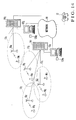
- Handover processing in a call connection system will be described next with reference to Figs. 12 and 13.
- the same reference numerals as in Fig. 1 denote the same parts in Fig. 12, and a description thereof will be omitted.
- Handover is processing to be done to continue communication when a radio terminal apparatus 16 1 moves from a current service area 17 1 (cell) to an adjacent service area (cell) 17 2 .
- idle slot control needs to be done by active slot management units 25 1 and 25 2 .
- radio terminal apparatus 16 1 moves from the service area 17 1 to the service area 17 2 while communication is performed between the radio base station 15 1 and the radio terminal apparatus 16 1 will be described.
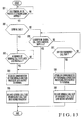
- a second radio base station (handover processing means) 15 2 at the movement destination performs the connection processing shown in Fig. 13 between itself and the radio terminal apparatus 16 1 .
- step S91 It is always checked whether a radio terminal apparatus in the process of communication has entered the service area 17 2 (step S91). If the movement of the radio terminal apparatus 16 1 from the service area 17 1 to the service area 17 2 is detected, it is checked whether the communication is being done with a general call or emergency call (step S92). If the communication is being done with a general call, it is checked whether the number of general call slots 23 used is less than (m - n) (step S93). In this check, it is checked whether there are any idle slots in the general call slots 23.
- the second radio base station 15 2 performs connection processing for the radio terminal apparatus 16 1 to establish communication by using the idle general call slot 23 (step S94). Subsequently, the general call slot 23 for the active slot management unit 25 1 in the radio base station 15 1 which has been used for communication by the radio terminal apparatus 16 1 is released (step S95). This makes the radio terminal apparatus 16 1 perform communication in the service area 17 2 after movement under the supervision (control) of the second radio base station 15 2 .
- step S93 it may be determined that there are no idle slots in the general call slots 23 for the active slot management unit 25 2 in the second radio base station 15 2 . In this case, however, the line cannot be disconnected. For this reason, the terminal apparatus is waited until an idle slot appears in the general call slots 23 for the active slot management unit 25 2 . During this wait time, the general call slot 23 for the active slot management unit 25 1 in the radio base station 15 1 is used for communication.
- step S92 it is determined in step S92 that a call in the process of communication is an emergency call. It is then checked whether there are any idle slots in the general call slot 23 for the active slot management unit 25 2 (step S96). If there is an idle slot in the general call slots 23, the radio base station 15 2 performs connection processing for the radio terminal apparatus 16 1 to establish communication by using the idle general call slot 23 (step S94).
- An emergency call slot 24 for the active slot management unit 25 1 in the radio base station 15 1 which has been used for communication by the radio terminal apparatus 16 1 is released (step S95). If, however, the general call slot 23 is used for an emergency call, the general call slot 23 which has been used for the emergency call is released.
- the radio terminal apparatus 16 1 starts communication in the service area 17 2 after movement under the supervision (control) of the radio base station 15 2 . That is, if there is an idle slot in the general call slots 23 in the service area 17 2 as a movement destination, the control operation required is the same as that for a radio terminal apparatus which is performing communication with a general call.
- step S96 If it is checked in step S96 that there is no idle slot in the general call slots 23 in the service area 17 2 as a movement destination, it is checked whether there are any idle slots in the emergency call slots 24 for the active slot management unit 25 2 (step S97). If there is an idle slot in the emergency call slots 24, the radio base station 15 2 performs connection processing for the radio terminal apparatus 16 1 to establish communication by using the idle emergency call slot 24 (step S98). Thereafter, the general call slot 23 or emergency call slot 24 for the active slot management unit 25 1 in the radio base station 15 1 which has been used for communication by the radio terminal apparatus 16 1 is released (step S99). With this operation, the radio terminal apparatus 16 1 starts communication in the service area 17 2 after movement under the supervision (control) of the radio base station 15 2 .
- Figs. 14, 15, and 16 show a call connection system according to the sixth embodiment of the present invention.
- active slot management units 125 1 and 125 2 are connected to NMSs (Network Management Systems) 13 1 and 13 2 .
- the active slot management unit 125 1 therefore manages all the radio base stations 15 1 , 15 2 , and 15 3 collectively.
- the active slot management unit 125 2 also collectively manages all the radio base stations in its charge.
- an active slot management unit need not always be installed on the NMS 13 side and may be installed on the access node 14 side or inside a network 11.
- connection processing is done between the radio terminal apparatus 16 1 and the first access node 14 1 (step S131).
- the CPU of the active slot management unit 125 1 in the NMS 13 1 connected to the access node 14 1 checks whether there are any idle slots in general call slots 23 for the corresponding radio base station 15 1 (step S132). If there is an idle slot in the general call slots 23, connection processing is continued by using the idle general call slot 23.
- the emergency call slot 24 (Fig. 2) is used to perform connection processing between the radio terminal apparatus 16 1 and the radio base station 15 1 .
- the connection processing is performed between the radio base station 15 1 and the access node 14 1 .
- the access node 14 1 sends out, to the corresponding radio terminal apparatus 16 1 , an announcement informing that the call cannot be connected to the destination because of line congestion (step S133).
- disconnection processing is performed between the access node 14 1 and the radio terminal apparatus 16 1 , and the emergency call slot 24 used for the announcement is released (step S134).
- Fig. 16 shows a case wherein the fixed telephone 12 connected to the network 11 originates a general call to the radio terminal apparatus 16 1 as a destination.
- connection from the network 11 to the access node 14 1 is performed (step S141).
- the CPU of the active slot management unit 125 1 connected to the access node 14 1 through the NMS 13 1 checks whether there is any idle slot in the general call slots 23 for the radio terminal apparatus 16 1 (step S142). If there is an idle slot in the general call slots 23, connection is established between the radio terminal apparatus 16 1 as a destination and the access node 14 1 , and communication is performed between the fixed telephone 12 connected to the network 11 and the radio terminal apparatus 16 1 .
- disconnection processing is performed between the access node 14 1 and the fixed telephone connected to the network (step S143).
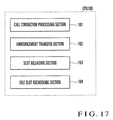
- Fig. 17 shows the functional blocks of the CPU of the active slot management unit described above.
- a CPU 100 includes a call connection processing section 101, announcement transfer section 102, and slot releasing section 103.
- the CPU 100 may further include an idle slot rechecking section 104.
- the call connection processing section 101 executes steps S33, S35, and S37 (Fig. 4).
- the announcement transfer section 102 executes step S52 (Fig. 5) and steps S62 and S65 (Fig. 7).
- the slot releasing section 103 executes step S53 (Fig. 5) and step S66 (Fig. 7).
- the idle slot rechecking section 104 executes step S63 (Fig. 7).
- the call connection processing section 101 further executes step S82 (Fig. 11)
- the announcement transfer section 102 further executes step S84 (Fig. 11)
- the slot releasing section 103 further executes step S85 (Fig. 11).
- the present invention when a request to connect a general call is generated, if there is not a sufficient number of general call slots for this new communication and there is an idle slot in the emergency call slots, an announcement informing that the general call cannot be connected because of line congestion is sent to the originating terminal. Therefore, by using this emergency call slot for the announcement for a short period of time, appropriate information can be provided for the caller. In addition, since the time taken for the announcement is relatively short and the time length can be one-sidedly, there is no possibility of interfering with emergency calls. Furthermore, since. the caller can know that the general call cannot be connected not because the line is busy but because the line is congested, he/she can consider a call timing again.
- the first announcement informing that a standby state is temporarily set for the connection of the general call is sent out to the originating terminal by using the idle emergency call slot.
- the second announcement informing that the general call cannot be connected because of line congestion is sent out to the originating terminal.
Landscapes
- Engineering & Computer Science (AREA)
- Computer Networks & Wireless Communication (AREA)
- Signal Processing (AREA)
- Business, Economics & Management (AREA)
- Health & Medical Sciences (AREA)
- Emergency Management (AREA)
- Environmental & Geological Engineering (AREA)
- Public Health (AREA)
- Mobile Radio Communication Systems (AREA)
- Telephonic Communication Services (AREA)
Abstract
Description
Claims (10)
- A call connection system which assigns at least one specific one of a plurality of slots, in advance, as an emergency call slot for processing an emergency call and assigns remaining slots, in advance, as general call slots for processing general calls that need not be preferentially handled, characterized by comprising:call connection processing means (101) for, if there is an idle general call slot, performing call connection processing by using the idle slot in response to a general call connection request;announcement transfer means (102) for, if there is no idle general call slot and there is an idle emergency call slot, assigning one of the emergency call slots to an originating terminal, in response to a general call connection request, to transfer a first announcement informing that the general call cannot be connected because of line congestion to the originating terminal; andslot releasing means (103) for releasing the emergency call slot assigned to the originating terminal after at least transfer of the first announcement is completed by said announcement transfer means.
- A call connection system which assigns at least one specific one of a plurality of slots, in advance, as an emergency call slot for processing an emergency call and assigns remaining slots, in advance, as general call slots for processing general calls that need not be preferentially handled, characterized by comprising:call connection processing means (101) for, if there are two idle general call slots for an originating terminal and terminating terminal, performing call connection processing by using the idle slots in response to a connection request for a general call that designates the terminating terminal in the same service area as the originating terminal;announcement transfer means (102) for, if there are not two idle general call slots for the originating terminal and terminating terminal and there is at least one idle slot in the emergency call slots, assigning one idle emergency call slot to the originating terminal, in response to the general call connection request, and transferring a first announcement informing that the general call cannot be connected because of line congestion to the originating terminal; andslot releasing means (103) for releasing the emergency call slot assigned to the originating terminal after at least transfer of the first announcement is completed.
- A system according to claim 1 or 2, wherein said system further comprises checking means (104) for rechecking occurrence of an idle general call slot after a lapse of a predetermined period of time including a transfer time of the first announcement,
if said checking means determines that there is an idle general call slot, said call connection processing means performs connection processing for a general call corresponding to a request by using the idle general call slot,
if said checking means does not determine the presence of an idle general call slot, said announcement transfer means transfers a second announcement informing that the general call cannot be connected because of line congestion to the originating terminal, and
said slot releasing means releases the emergency call slot assigned to the originating terminal upon completion of transfer of the second announcement. - A system according to claim 1, 2, or 3, wherein if at least one of the general call slots and emergency call slots is idle, said call connection processing means performs call connection processing by using the idle slot in response to an emergency call connection request.
- A system according to claim 1, 2, 3 or 4, wherein
said system further comprises handover processing means for, when a terminal in the process of communication moves from a first service area to a second service area, performing handover by ensuring a necessary slot if there is an idle general call slot in the second service area, and
said slot releasing means releases the general call slot that has been used in the first service area, after the handover processing. - A system according to claim 5, wherein said handover processing means continues communication by continuously occupying the general call slot in the first service area if there is no idle general call slot in the second service area.
- A call connection method characterized by comprising the steps of:assigning at least one specific one of a plurality of slots, in advance, as an emergency call slot for processing an emergency call and assigning remaining slots, in advance, as general call slots for processing general calls that need not be preferentially handled;if there is an idle general call slot, performing call connection processing by using the idle slot in response to a general call connection request;if there is no idle general call slot and there is an idle emergency call slot, assigning one of the emergency call slots to an originating terminal, in response to a general call connection request, to transfer a first announcement informing that the general call cannot be connected because of line congestion to the originating terminal; andreleasing the emergency call slot assigned to the originating terminal after at least transfer of the first announcement is completed.
- A method according to claim 7, wherein
the method further comprises the steps of:rechecking occurrence of an idle general call slot after a lapse of a predetermined period of time including a transfer time of the first announcement after transfer of the first announcement;if it is determined upon a recheck that there is an idle general call slot, performing connection processing for a general call corresponding to a request by using the idle general call slot; andif the presence of an idle general call slot is not determined upon the recheck, transferring a second announcement informing that the general call cannot be connected because of line congestion to the originating terminal; andthe releasing step comprises the step of releasing the emergency call slot assigned to the originating terminal upon completion of transfer of the second announcement. - A call connection method characterized by comprising the steps of:assigning at least one specific one of a plurality of slots, in advance, as an emergency call slot for processing an emergency call and assigning remaining slots, in advance, as general call slots for processing general calls that need not be preferentially handled;if there are two idle general call slots for an originating terminal and terminating terminal, performing call connection processing by using the idle slots in response to a connection request for a general call that designates the terminating terminal in the same service area as the originating terminal;if there are not two idle general call slots for the originating terminal and terminating terminal and there is at least one idle slot in the emergency call slots, assigning one idle emergency call slot to the originating terminal, in response to the general call connection request, and transferring a first announcement informing that the general call cannot be connected because of line congestion to the originating terminal; andreleasing the emergency call slot assigned to the originating terminal after at least transfer of the first announcement is completed.
- A method according to claim 9 , wherein
the method further comprises the steps of:rechecking occurrence of an idle general call slot after a lapse of a predetermined period of time including a transfer time of the first announcement after transfer of the first announcement;if it is determined upon a recheck that there is an idle general call slot, performing connection processing for a general call corresponding to a request by using the idle general call slot; andif the presence of an idle general call slot is not determined upon the recheck, transferring a second announcement informing that the general call cannot be connected because of line congestion to the originating terminal; andthe releasing step comprises the step of releasing the emergency call slot assigned to the originating terminal upon completion of transfer of the second announcement.
Applications Claiming Priority (2)
| Application Number | Priority Date | Filing Date | Title |
|---|---|---|---|
| JP2001271145A JP3624869B2 (en) | 2001-09-07 | 2001-09-07 | Call connection system |
| JP2001271145 | 2001-09-07 |
Publications (3)
| Publication Number | Publication Date |
|---|---|
| EP1292167A2 true EP1292167A2 (en) | 2003-03-12 |
| EP1292167A3 EP1292167A3 (en) | 2003-07-23 |
| EP1292167B1 EP1292167B1 (en) | 2007-01-17 |
Family
ID=19096689
Family Applications (1)
| Application Number | Title | Priority Date | Filing Date |
|---|---|---|---|
| EP02019767A Expired - Lifetime EP1292167B1 (en) | 2001-09-07 | 2002-09-04 | Call connection system and call connection method |
Country Status (6)
| Country | Link |
|---|---|
| US (1) | US20030053438A1 (en) |
| EP (1) | EP1292167B1 (en) |
| JP (1) | JP3624869B2 (en) |
| KR (1) | KR20030022062A (en) |
| CN (1) | CN100477823C (en) |
| DE (1) | DE60217598T2 (en) |
Families Citing this family (11)
| Publication number | Priority date | Publication date | Assignee | Title |
|---|---|---|---|---|
| CN101076188B (en) * | 2007-03-20 | 2013-01-16 | 中兴通讯股份有限公司 | Abort calling method based on TCS |
| JP5090885B2 (en) * | 2007-12-10 | 2012-12-05 | 株式会社エヌ・ティ・ティ・ドコモ | Radio base station and communication control method |
| CN101640732A (en) * | 2008-07-31 | 2010-02-03 | 鸿富锦精密工业(深圳)有限公司 | Network device and method for re-dialing telephone thereof |
| JP5218242B2 (en) * | 2009-04-16 | 2013-06-26 | 住友電気工業株式会社 | Roadside communication device, mobile communication device, and roadside communication system including these |
| US20100278156A1 (en) * | 2009-05-04 | 2010-11-04 | Shin Chang Sub | Data communication method using body area network superframe |
| JP5402685B2 (en) * | 2010-02-01 | 2014-01-29 | 富士通株式会社 | Mobile station and radio communication method |
| CN101834784A (en) * | 2010-04-08 | 2010-09-15 | 华为终端有限公司 | Method and device for switching CTNET (China Telecom Network) and CTWAP (China Telecom Wireless Application Protocol) services |
| CN102137366A (en) * | 2010-11-26 | 2011-07-27 | 上海通号轨道交通工程技术研究中心有限公司 | Method and device for receiving and processing multipath emergent calls |
| JP2013135432A (en) * | 2011-12-27 | 2013-07-08 | Hitachi Kokusai Electric Inc | Communication system |
| CN110972124B (en) * | 2018-09-30 | 2021-11-02 | 海能达通信股份有限公司 | Emergency call receiving method, device and system and electronic equipment |
| WO2022157899A1 (en) * | 2021-01-21 | 2022-07-28 | 株式会社Nttドコモ | Network node, wireless communication system, and communication method |
Family Cites Families (9)
| Publication number | Priority date | Publication date | Assignee | Title |
|---|---|---|---|---|
| JP3029881B2 (en) * | 1991-03-18 | 2000-04-10 | 富士通株式会社 | Time slot assignment method for slotted ring network |
| JP3818668B2 (en) * | 1995-11-01 | 2006-09-06 | モトローラ・インコーポレイテッド | Method and apparatus for assigning communication channels in a communication system |
| JPH11243584A (en) * | 1998-02-26 | 1999-09-07 | Fujitsu Ltd | Emergency call control device for mobile communication system |
| EP0954196B1 (en) * | 1998-04-30 | 2006-11-02 | Alcatel | Method for setting up calls in a telecommunications system during traffic congestion |
| JP4326700B2 (en) * | 1998-08-20 | 2009-09-09 | クゥアルコム・インコーポレイテッド | System and method for priority access channel assignment in a cellular telephone system |
| KR100310323B1 (en) * | 1998-12-31 | 2001-11-22 | 김진찬 | Method for processing emergence call in mobile communication network |
| KR20010027383A (en) * | 1999-09-13 | 2001-04-06 | 박종섭 | Method for processing call in a mobile communication system |
| FI19992341A7 (en) * | 1999-10-29 | 2001-04-30 | Nokia Networks Oy | Method and system for interface redefinition |
| FI19992342A7 (en) * | 1999-10-29 | 2001-04-30 | Nokia Corp | Method and system for interface redefinition |
-
2001
- 2001-09-07 JP JP2001271145A patent/JP3624869B2/en not_active Expired - Fee Related
-
2002
- 2002-09-03 US US10/232,580 patent/US20030053438A1/en not_active Abandoned
- 2002-09-04 DE DE60217598T patent/DE60217598T2/en not_active Expired - Lifetime
- 2002-09-04 EP EP02019767A patent/EP1292167B1/en not_active Expired - Lifetime
- 2002-09-06 KR KR1020020053722A patent/KR20030022062A/en not_active Ceased
- 2002-09-09 CN CNB02141646XA patent/CN100477823C/en not_active Expired - Fee Related
Also Published As
| Publication number | Publication date |
|---|---|
| DE60217598T2 (en) | 2007-05-24 |
| DE60217598D1 (en) | 2007-03-08 |
| JP2003087853A (en) | 2003-03-20 |
| US20030053438A1 (en) | 2003-03-20 |
| EP1292167A3 (en) | 2003-07-23 |
| CN100477823C (en) | 2009-04-08 |
| EP1292167B1 (en) | 2007-01-17 |
| JP3624869B2 (en) | 2005-03-02 |
| KR20030022062A (en) | 2003-03-15 |
| CN1406002A (en) | 2003-03-26 |
Similar Documents
| Publication | Publication Date | Title |
|---|---|---|
| US4827499A (en) | Call control of a distributed processing communications switching system | |
| US6321093B1 (en) | System and method for controlling priority calls in a wireless network | |
| EP1292167B1 (en) | Call connection system and call connection method | |
| JPH04275728A (en) | Wireless long-distance communication system and its resources allocation method | |
| US6564052B1 (en) | Wireless local loop system and method for wireless link control | |
| JPH06284466A (en) | Mobile radio telephone communication device | |
| US5598403A (en) | Path setting control system in communication network | |
| JPH07250382A (en) | Radio channel selection method and radio channel selection system | |
| US6526282B1 (en) | Method and apparatus for controlling the restriction on traffic in mobile communication system | |
| KR19980076546A (en) | Data network interworking system and its control method for data communication between subscribers in mobile communication network | |
| EP1074106B1 (en) | Method of balancing availability of communication links in communication systems | |
| EP0942614A2 (en) | Wireless access network system capable of reducing call loss probability | |
| JPH11196461A (en) | Mobile body communication system | |
| JPH11234730A (en) | Wireless communication method and apparatus for performing emergency call management | |
| GB2315958A (en) | Provision of distributed call handling over a plurality of network nodes | |
| JP3387788B2 (en) | Emergency call priority connection device | |
| JP2930040B2 (en) | PHS emergency outgoing call connection control system and method | |
| KR100326187B1 (en) | Call direction changing method in telecommunication system | |
| KR100208941B1 (en) | Diagnostic and control method of automatic routing in a tdx | |
| JPH0591555A (en) | Channel switching control system for mobile communication | |
| KR100303313B1 (en) | Method for setting up a mobile to mobile call without passing through mobile switching center | |
| KR100294001B1 (en) | Method and system for recovery of radio channel in wireless local loop | |
| KR100265430B1 (en) | Emergency call receiving method and device thereof | |
| KR20030085341A (en) | Method for Managing Call Resource Between Mobile Communication Switching and Base Station Controller | |
| JPH01238328A (en) | Radio channel switching system for mobile radio equipment |
Legal Events
| Date | Code | Title | Description |
|---|---|---|---|
| PUAI | Public reference made under article 153(3) epc to a published international application that has entered the european phase |
Free format text: ORIGINAL CODE: 0009012 |
|
| AK | Designated contracting states |
Kind code of ref document: A2 Designated state(s): AT BE BG CH CY CZ DE DK EE ES FI FR GB GR IE IT LI LU MC NL PT SE SK TR |
|
| AX | Request for extension of the european patent |
Extension state: AL LT LV MK RO SI |
|
| PUAL | Search report despatched |
Free format text: ORIGINAL CODE: 0009013 |
|
| AK | Designated contracting states |
Designated state(s): AT BE BG CH CY CZ DE DK EE ES FI FR GB GR IE IT LI LU MC NL PT SE SK TR |
|
| AX | Request for extension of the european patent |
Extension state: AL LT LV MK RO SI |
|
| 17P | Request for examination filed |
Effective date: 20030612 |
|
| AKX | Designation fees paid |
Designated state(s): DE FR SE |
|
| 17Q | First examination report despatched |
Effective date: 20040421 |
|
| GRAP | Despatch of communication of intention to grant a patent |
Free format text: ORIGINAL CODE: EPIDOSNIGR1 |
|
| GRAS | Grant fee paid |
Free format text: ORIGINAL CODE: EPIDOSNIGR3 |
|
| GRAA | (expected) grant |
Free format text: ORIGINAL CODE: 0009210 |
|
| AK | Designated contracting states |
Kind code of ref document: B1 Designated state(s): DE FR SE |
|
| RIN1 | Information on inventor provided before grant (corrected) |
Inventor name: OGURA, TOMOHIROC/O NEC CORPORATION Inventor name: SONETAKA, NORIYOSHIC/O NEC CORPORATION |
|
| REF | Corresponds to: |
Ref document number: 60217598 Country of ref document: DE Date of ref document: 20070308 Kind code of ref document: P |
|
| REG | Reference to a national code |
Ref country code: SE Ref legal event code: TRGR |
|
| ET | Fr: translation filed | ||
| PLBE | No opposition filed within time limit |
Free format text: ORIGINAL CODE: 0009261 |
|
| STAA | Information on the status of an ep patent application or granted ep patent |
Free format text: STATUS: NO OPPOSITION FILED WITHIN TIME LIMIT |
|
| 26N | No opposition filed |
Effective date: 20071018 |
|
| PGFP | Annual fee paid to national office [announced via postgrant information from national office to epo] |
Ref country code: SE Payment date: 20090910 Year of fee payment: 8 |
|
| REG | Reference to a national code |
Ref country code: SE Ref legal event code: EUG |
|
| PG25 | Lapsed in a contracting state [announced via postgrant information from national office to epo] |
Ref country code: SE Free format text: LAPSE BECAUSE OF NON-PAYMENT OF DUE FEES Effective date: 20100905 |
|
| REG | Reference to a national code |
Ref country code: FR Ref legal event code: PLFP Year of fee payment: 14 |
|
| PGFP | Annual fee paid to national office [announced via postgrant information from national office to epo] |
Ref country code: DE Payment date: 20150902 Year of fee payment: 14 |
|
| PGFP | Annual fee paid to national office [announced via postgrant information from national office to epo] |
Ref country code: FR Payment date: 20150811 Year of fee payment: 14 |
|
| REG | Reference to a national code |
Ref country code: DE Ref legal event code: R119 Ref document number: 60217598 Country of ref document: DE |
|
| REG | Reference to a national code |
Ref country code: FR Ref legal event code: ST Effective date: 20170531 |
|
| PG25 | Lapsed in a contracting state [announced via postgrant information from national office to epo] |
Ref country code: FR Free format text: LAPSE BECAUSE OF NON-PAYMENT OF DUE FEES Effective date: 20160930 Ref country code: DE Free format text: LAPSE BECAUSE OF NON-PAYMENT OF DUE FEES Effective date: 20170401 |