EP1292075A2 - Verfahren zur Leitweglenkung von Datenpaketen - Google Patents
Verfahren zur Leitweglenkung von Datenpaketen Download PDFInfo
- Publication number
- EP1292075A2 EP1292075A2 EP02102263A EP02102263A EP1292075A2 EP 1292075 A2 EP1292075 A2 EP 1292075A2 EP 02102263 A EP02102263 A EP 02102263A EP 02102263 A EP02102263 A EP 02102263A EP 1292075 A2 EP1292075 A2 EP 1292075A2
- Authority
- EP
- European Patent Office
- Prior art keywords
- communication
- routing
- kna
- knb
- knc
- Prior art date
- Legal status (The legal status is an assumption and is not a legal conclusion. Google has not performed a legal analysis and makes no representation as to the accuracy of the status listed.)
- Granted
Links
Images
Classifications
-
- H—ELECTRICITY
- H04—ELECTRIC COMMUNICATION TECHNIQUE
- H04L—TRANSMISSION OF DIGITAL INFORMATION, e.g. TELEGRAPHIC COMMUNICATION
- H04L65/00—Network arrangements, protocols or services for supporting real-time applications in data packet communication
- H04L65/10—Architectures or entities
- H04L65/102—Gateways
- H04L65/1043—Gateway controllers, e.g. media gateway control protocol [MGCP] controllers
-
- H—ELECTRICITY
- H04—ELECTRIC COMMUNICATION TECHNIQUE
- H04L—TRANSMISSION OF DIGITAL INFORMATION, e.g. TELEGRAPHIC COMMUNICATION
- H04L45/00—Routing or path finding of packets in data switching networks
-
- H—ELECTRICITY
- H04—ELECTRIC COMMUNICATION TECHNIQUE
- H04L—TRANSMISSION OF DIGITAL INFORMATION, e.g. TELEGRAPHIC COMMUNICATION
- H04L45/00—Routing or path finding of packets in data switching networks
- H04L45/42—Centralised routing
-
- H—ELECTRICITY
- H04—ELECTRIC COMMUNICATION TECHNIQUE
- H04L—TRANSMISSION OF DIGITAL INFORMATION, e.g. TELEGRAPHIC COMMUNICATION
- H04L65/00—Network arrangements, protocols or services for supporting real-time applications in data packet communication
- H04L65/1066—Session management
- H04L65/1069—Session establishment or de-establishment
-
- H—ELECTRICITY
- H04—ELECTRIC COMMUNICATION TECHNIQUE
- H04M—TELEPHONIC COMMUNICATION
- H04M7/00—Arrangements for interconnection between switching centres
- H04M7/12—Arrangements for interconnection between switching centres for working between exchanges having different types of switching equipment, e.g. power-driven and step by step or decimal and non-decimal
- H04M7/1205—Arrangements for interconnection between switching centres for working between exchanges having different types of switching equipment, e.g. power-driven and step by step or decimal and non-decimal where the types of switching equipement comprises PSTN/ISDN equipment and switching equipment of networks other than PSTN/ISDN, e.g. Internet Protocol networks
- H04M7/1245—Arrangements for interconnection between switching centres for working between exchanges having different types of switching equipment, e.g. power-driven and step by step or decimal and non-decimal where the types of switching equipement comprises PSTN/ISDN equipment and switching equipment of networks other than PSTN/ISDN, e.g. Internet Protocol networks where a network other than PSTN/ISDN interconnects two PSTN/ISDN networks
-
- H—ELECTRICITY
- H04—ELECTRIC COMMUNICATION TECHNIQUE
- H04M—TELEPHONIC COMMUNICATION
- H04M2207/00—Type of exchange or network, i.e. telephonic medium, in which the telephonic communication takes place
- H04M2207/08—ISDN systems
Definitions
- the invention relates to a method for routing of Data packets in a packet-switched network.
- connection-oriented communication connection In today's telecommunication networks are communication links predominantly connection-oriented realized. at such a connection-oriented communication connection is for a signal transmission between two communication endpoints exclusively a dedicated "line" provided that reserved for this communication connection is. Although in modern - a mediation of associated communication endpoints realizing - communication facilities no physically reserved line exists in an existing communication connection, are also referred to in the literature as "time slot-oriented" Common communication links to the connection-oriented Counted communication links.
- connection-oriented Communication connection is a packet-switching Communication link.
- packet-switching Networks such as the Internet or spatially limited networks - in the professional world often as "Local Area Network (LAN)" - is in many cases one - in comparison with a connection-oriented communication network - more economical variant of a telecommunications infrastructure possible.
- LAN Local Area Network
- This is also in one better utilization efficiency of available connection resources justified because e.g. transmission capacity much more efficient by means of a packet-switched transmission can be used as a connection-oriented Transmission with guaranteed line capacity is possible.
- the switch becomes from communication partners not through a central Managed communication device. Instead, the Communication link through a mutual sending and Receive - containing payload and signaling information - Data packets between the two communication partners maintained, with the individual data packets et al Information about the destination of each other Include communication partners.
- VoIP Voice over IP
- Internet Protocol Internet Protocol
- H.323 Session Initiation Protocol
- SIP is a signaling protocol for Internet telephony as well as other services such as conference interactions, event notification, Messaging, etc. This protocol was developed by the working group MMUSIC (Multiparty Multimedia Session Control) of the working group IETF (Internet Engineering Task Force).
- MMUSIC Multiparty Multimedia Session Control
- IETF Internet Engineering Task Force
- the H.323 standard is an international ITU-T standard (International Telecommunication Union - Telecommunications Standardization Sector) for voice, data and video communication over packet-switched networks that require interoperability guarantees manufacturer products with each other, where u.a. System components such as communication endpoints, Gateway devices and a central host computer, i.a. make a determination of the route - often as a gatekeeper designated - for a communication system after this Standard are defined.
- ITU-T International Telecommunication Union - Telecommunications Standardization Sector
- a communication endpoint is one of the standards H.323 or SIP correspondingly designed communication endpoint.
- a gateway device (or gateway) is understood a hardware or software configuration that connects various networks accomplished together. Consequently a gateway device has the task of data packets from one network to another for what to do in particular, an implementation between in the connected networks used communication protocols is necessary. This implementation In particular, this can also be done in a protocol, that does not work on the principle of packet switching, for example, an ISDN protocol (Integrated Services Digital Network).
- gateway devices often between a packet-switched network a LAN, for example, and a communication device, such as one according to a timeslot-oriented method working switching device - in the art often called "Private Branch Exchange, PBX" - arranged.
- Routing also referred to in the professional world as "routing" - A call signaling and an assignment of Numbers and IP addresses of the communication network respectively their conversion controls.
- routing A call signaling and an assignment of Numbers and IP addresses of the communication network respectively their conversion controls.
- routing of a routing server is not limited solely on the exchange of signaling information, but includes all between communication endpoints of a Communication network exchanged data packets, ie also data packets containing the actual payload (e.g. Voice or video data).
- gateway devices In many applications, there is a packet-switching Network multiple - connected by gateway devices - Transitional to connection-oriented working Communication equipment. These manage a communication network, which works, for example, according to the ISDN protocol.
- the ISDN protocol is characterized by a separation of payload - e.g. Speech and / or video communication data - in one or more so-called B-channels and signaling information marked in a so-called D channel.
- the Signaling information includes data for call control, Signaling, etc.
- further data on the D-channel transmit the advanced features such as an indication of the name and other information a calling or called party at the communication endpoint of a called or calling subscriber.
- the QSIG protocol is an international one of the ECMA ("European Computer Manufacturers Association ") defined signaling standard for a logical signaling between two private switching nodes, e.g. Communication equipment.
- QSIG has some basic functions ("Generic Functions "), to which additional features can be added are. These can be purely QSIG compliant, QSIG compliant with manufacturer's own extensions, as well as manufacturer-specific be.
- the DSS1 protocol is one based on ITU-T 1.411 ("International Telecommunication Union ") based European ISDN protocol for the D-channel of the European Euro-ISDN.
- the DSS1 protocol solves that used by DeutscheInstitut 1TR6 protocol.
- the 1TR6 protocol is a national ISDN protocol for the D channel of DeutscheInstitut. This technical guideline becomes European in the course of European harmonization above-mentioned Converted to DSS1 protocol. The differences between Both protocols are u.a. in the transmission of the Phone number information. Furthermore, with the 1TR6 protocol all communication endpoints at one ISDN basic connection both have an identical number as well as by means of a communication endpoint selection digit individually addressed.
- subsection 7.3.10 discloses an information element "desiredProtocols", that a preferred protocol type (e.g., voice communication or fax exchange) between a communication initiating and a called communication partner.
- a preferred protocol type e.g., voice communication or fax exchange
- a executing instance can with the help of this information element locate a communication partner who has this Protocol type also supported.
- a routing of these tunnelled data packets takes over et al the routing server.
- In the routing of data packets is passed through the routing server i.A. with respect to one achievable transmission quality - the most efficient way determined by the packet-switched network.
- the object of the invention is a method for routing specify between two communication partners the full range of communication facilities provided features.
- An essential advantage of the method according to the invention is to be seen in that by considering the communication protocols in the routing a feature-rich transparent Mediation takes place. Under the feature transparency is to be understood that a connection between two identical or similar communication protocols using communication endpoints with an unconverted one Exchange of signaling information can. Accordingly, at the communication end points, a Bandwidth of features like a communication network internal Connection available.
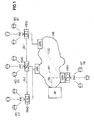
- Fig. 1 shows four communication networks KNA, KNB, KNC, the from a respectively associated central communication device PBXA, PBXB, PBXC, PBXD and multiple communication endpoints be formed.
- the communication networks For example, KNA, KNB, KNC work on the basis of an ISDN protocol.
- each communication network KNA, KNB, KNC, KND became the Simplifying the reference only one communication endpoint at a time provided with a reference numeral.
- the first Communication network KNA is a first communication endpoint KE1 with a phone number "102”
- the second communication network KNB is a second communication endpoint KE2 with the number "201”
- in the third communication network KNC is a third communication endpoint KE3 with the telephone number "311”
- in the fourth communication network KND is a fourth communication endpoint KE4 with the telephone number "412" characterized.
- the first, second and fourth communication devices PBXA, PBXB, PBXD work with a first communication protocol N, while the third communication device PBXC with one deviating from the first communication protocol N, second communication protocol NQ works.
- These communication protocols N, NQ are e.g. in a mediation and Feature control of the respective communication unit PBXA, PBXB, PBXC implemented.
- the implementation of the Communication protocols N, NQ in the respective communication device PBXA, PBXB, PBXD; PBXC has an impact on that Format of the signaling information in the respective communication network KNA, KNB, KND, KNC and thus u.U.
- the first and second communication devices PBXA, PBXB are via a respectively associated gateway device GWA, GWB with connected to a packet-switched network LAN.
- the third and fourth communication device PBXC, PBXD are via a common gateway device GWC with the packet-switching Network LAN connected.
- the assignment of the first two communication devices PBXA, PBXB to one gateway device each GWA, GWB is chosen for a simplified presentation, in technical practice are - analogous to the gateway device GWC shared communication equipment PBXC, PBXD - often multiple communication devices connected to a gateway device.
- the second and third communication device PBXB, PBXC and the third and fourth communication devices PBXC, PBXD are each interconnected via cross-connections QL1, QL2.
- Using the cross-connection QL1 is e.g. a Connection of the second communication endpoint KE2 with the third communication endpoint KE3 without using a Routing via the packet-switching network LAN possible.
- These cross-connections QL1, QL2 are an exemplary example for a more advanced - in reality more complex and Closer - Networking of Communication Facilities see.
- This is u.a. a decomposition of the time-continuous communication data into individual data packets and a destination addressing of these data packets with the IP number (Internet Protocol) of the connected Communication endpoint as well as in reverse direction - from the packet-switched network LAN towards one of Communication networks KNY, KNB, KNC, KND - an implementation of the for in the respective communication network KNY, KNB, KNC, KND arranged communication endpoint certain data packets in made a continuous-time data stream.
- This decomposition is executed by the gateway devices GWA, GWB, GWC.
- a central server unit - becomes one optimized - according to traffic theory, after Connection quality, etc. - routing of the data packets determined by the respective gateway devices GWA, GWB, GWC are interchanged. For this exchanges the respective gateway device GWA, GWB, GWC - in the Drawing dash-dotted for the first gateway device GWA - with the routing server GK bidirectional data packets out, the information related to the Routing, so-called routing data RD included.
- the communication facilities PBA, PBB, PBC, PBXD work according to a timeslot - oriented mediation principle - in The experts often referred to as "Time Division Multiplex", TDM - and control the connected communication endpoints via signaling information.
- the representation of the routes LW1, LW2 with dotted Lines is for clarity on the packet-switching Network LAN limited.
- the routes LW1, LW2 extend from the one communication endpoint associated communication device PBXA, PBXB, PBXC, PBXD to the connected communication endpoint associated communication device PBXA, PBXB, PBXC, PBXD.
- the illustration illustrates the routes LW1, LW2 not the actual topological Path of individual data packets through the packet-switching network LAN but the connection between two communication partners.
- the two routes LW1, LW2 are routed by the routing server GK under previous exchange of routing data RD determined with the first gateway device GWA.
- the second and third gateway device also exchange - not shown Routing data RD with the routing server GK.
- Tunnels are tunneled using the first route LW1 - Signaling and payload information containing - Communication data between the first and the third Communication endpoint KE1, KE3 associated gateway facilities GWA, GWC exchanged directly.
- GWB will use this tunnelled communication data in continuous-time user and signaling information implemented and via the third communication device PBXC passed to the third communication endpoint KE3.
- In reverse Direction are from the third communication device PBXC continuous-time payload and signaling information from the third communication endpoint KE3 to the third gateway device GWC, and tunnelled by this - in Form of data packets - via the packet-switched network LAN transmitted to the first gateway device GWA.
- the second route LW2 be tunneled - Signaling and payload information containing - Communication data first between the first and second gateway device GWA, GWB exchanged.
- GWB become this tunnelled communication data again in time-continuous user and signaling information implemented and to the second communication device PBXB handed over. There they will be through one - Not shown - interface in a signaling information format converts its underlying communication protocol also on a similarly designed - Not shown - interface in the third communication device PBXC is implemented.
- the communication data is bidirectional between both communication devices PBXB, PBXC exchanged.
- the over the communication data received via the cross-connection QL converted into the own communication protocol NQ and the third communication endpoint KE3. In the opposite direction is the corresponding conversions analogous.
- the determination of the route LW2, which is a feature-rich transparent Communication connection is made by the routing server GK.
- a routing server manages information for a routing of data packets, the data from in the routing server take into account stored routing tables. In these routing tables according to the invention an entry over the implemented communication protocols with the Destination gateway devices GWC connected communication devices, in the case PBXC, provided.
- this exchange is for the sake of clarity only by the example of the first gateway device GWA - is also about the in the drawing illustrated first route LW1 a performance characteristics transparent Connection of the first communication endpoint KE1 with the third communication endpoint KE3 over the first and third gateway device GWA, GWC, the fourth communication device PBXD and over the cross-connection QL2 on the third communication device PBXC feasible.
- the inventive Routing is not limited to routing of data packets via the packet-switched Network LAN, but also influences the route guidance of the - In the respective gateway device GWA, GWB, GWC from data packets converted - continuous data stream.
- the fourth communication device has one with the first communication device PBXA identical communication protocol N.
- the alternative first route LW1 is via the cross connection QL2 thus analogous to the second route LW2 - here on the Cross-connection QL1 - a feature-transparent connection of the first communication endpoint KE1 with the third Communication endpoint KE3 feasible.
- routing data packets can also be realized without the involvement of a routing server GK, parts of its functionality by a appropriately configured gateway device, e.g. through the first gateway device GWA to be executed.
Landscapes
- Engineering & Computer Science (AREA)
- Computer Networks & Wireless Communication (AREA)
- Signal Processing (AREA)
- Multimedia (AREA)
- Business, Economics & Management (AREA)
- General Business, Economics & Management (AREA)
- Data Exchanges In Wide-Area Networks (AREA)
- Telephonic Communication Services (AREA)
Abstract
Description
- Fig. 1:
- ein Strukturbild zur schematischen Darstellung von durch ein paketvermittelndes Netzwerk verbundenen Kommunikationsnetzwerken.
Claims (15)
- Verfahren zur Leitweglenkung von Kommunikationsdaten über paketvermittelnde Netzwerke (LAN) mit mehreren über Gatewayeinrichtungen (GWA, GWB, GWC) mit dem paketvermittelnden Netzwerk (LAN) verbundenen Kommunikationsnetzwerken (KNA,KNB,KNC,KND),
bei dem eine Leitweglenkung für zwischen den Kommunikationsnetzwerken (KNA,KNB,KNC,KND) zu übertragenden Kommunikationsdaten unter Berücksichtigung der in den jeweiligen Kommunikationsnetzwerken (KNA, KNB, KNC, KND) verwendeten Kommunikationsprotokollen (N,NQ) erfolgt. - Verfahren nach Anspruch 1,
dadurch gekennzeichnet, dass die Leitweglenkung durch einen zentralen, die Gatewayeinrichtungen (GWA,GWB,GWC) steuernden Routingserver (GK) erfolgt. - Verfahren nach Anspruch 2,
dadurch gekennzeichnet, dass im zentralen Routingserver (GK) Leitwegetabellen verwaltet werden, die Daten für eine dynamische und/oder statische Leitweglenkung enthalten. - Verfahren nach Anspruch 3,
dadurch gekennzeichnet, dass die Leitwegetabellen einen Eintrag enthalten, der in den Kommunikationsnetzwerken (KNA,KNB,KNC,KND) verwendete Kommunikationsprotokolle (N,NQ) charakterisiert. - Verfahren nach einem der vorhergehenden Ansprüche,
dadurch gekennzeichnet, dass die Leitweglenkung ausgehend von einem an ein erstes Kommunikationsnetzwerk (KNA) angeschlossenen ersten Kommunikationsendpunkt (KE1) zu einem an ein zweites Kommunikationsnetzwerk (KNB) angeschlossenen zweiten Kommunikationsendpunkt (KE2) bei gleichen Kommunikationsprotokollen (N,NQ) der beteiligten Kommunikationsnetzwerken (KNA,KNB) direkt von der ersten Gatewayeinrichtung (GWA) über das paketvermittelnde Netzwerk (LAN) an die dem zweiten Kommunikationsnetzwerk (KNB) zugeordneten zweiten Gatewayeinrichtung (GWB) erfolgt. - Verfahren nach einem der Ansprüche 1 bis 5,
dadurch gekennzeichnet, dass die Leitweglenkung ausgehend von einem an ein erstes Kommunikationsnetzwerk (KNA) angeschlossenen ersten Kommunikationsendpunkt (KE1) zu einem an ein drittes Kommunikationsnetzwerk (KNC) angeschlossenen dritten Kommunikationsendpunkt (KE3),
wobei in dem ersten und dem dritten Kommunikationsnetzwerk (KNA, KNC) unterschiedliche Kommunikationsprotokollen (N,NQ) verwendet werden,über das paketvermittelnde Netzwerk (LAN) zu einem zweiten, ein mit dem ersten Kommunikationsnetzwerk (KNA) gleiches oder gleichartiges Kommunikationsprotokoll (N) aufweisendes Kommunikationsnetzwerk (KNB,KND) erfolgt, undanschließend eine Querverbindung (QL1,QL2) von dem mit dem ersten Kommunikationsnetzwerk (KNA) gleiches oder gleichartiges Kommunikationsprotokoll (N) aufweisenden Kommunikationsnetzwerk (KNB,KND) zum dritten Kommunikationsnetzwerk (KNC) erfolgt. - Verfahren nach einem der vorhergehenden Ansprüche,
dadurch gekennzeichnet, dass die Leitweglenkung mit Hilfe der Gatewayeinrichtungen (GWA,GWB,GWC) unter Verwendung von Informationen aus dem Routingserver (GK) und/oder aus den übertragenen Datenpaketen erfolgt. - Verfahren nach einem der vorhergehenden Ansprüche,
dadurch gekennzeichnet, dass die Leitweglenkung mit Hilfe von die Kommunikationsnetzwerke (KNA,KNB,KNC,KND) zentral steuernden Kommunikationseinrichtungen (PBXA, PBXB, PBXC, PBXD) erfolgt. - Verfahren nach einem der vorhergehenden Ansprüche,
dadurch gekennzeichnet, dass Kommunikationsdaten der Kommunikationsnetzwerke (KNA,KNB,KNC,KND) über das paketvermittelnden Netzwerk (LAN) getunnelt werden. - Verfahren nach einem der vorhergehenden Ansprüche,
dadurch gekennzeichnet, dass die jeweilige Gatewayeinrichtung (GWA,GWB,GWC) über mindestens eine zugehörige Kommunikationseinrichtung (PBXA,PBXB,PBXC,PBXD) mit dem entsprechenden Kommunikationsnetzwerk (KNA,KNB,KNC,KND) verbunden ist. - Verfahren nach einem der vorhergehenden Ansprüche,
dadurch gekennzeichnet, dass die Kommunikationsprotokolle (N,NQ) ISDN-orientierten Standards entsprechen. - Verfahren nach einem der vorhergehenden Ansprüche,
dadurch gekennzeichnet, dass die Kommunikationsdaten im paketvermittelnden Netzwerk (LAN) in Form von Datenpaketen gemäß eines Voice Over IP-Standards aufgebaut sind. - Verfahren nach Anspruch 12,
dadurch gekennzeichnet, dass die Datenpakete gemäß des H.323-Standards aufgebaut sind. - Verfahren nach Anspruch 12,
dadurch gekennzeichnet, dass die Datenpakete gemäß des SIP-Standards aufgebaut sind. - Verfahren nach einem der vorhergehenden Ansprüche,
dadurch gekennzeichnet, dass die Leitweglenkung zwischen gleichen oder ähnlichen Kommunikationsprotokolle (N) aufweisenden Kommunikationsnetzwerken (PBXA,PBXB,PBXD) eine vorrangige Priorität besitzt.
Applications Claiming Priority (2)
| Application Number | Priority Date | Filing Date | Title |
|---|---|---|---|
| DE10144356A DE10144356B4 (de) | 2001-09-10 | 2001-09-10 | Verfahren zur Leitweglenkung von Datenpaketen |
| DE10144356 | 2001-09-10 |
Publications (3)
| Publication Number | Publication Date |
|---|---|
| EP1292075A2 true EP1292075A2 (de) | 2003-03-12 |
| EP1292075A3 EP1292075A3 (de) | 2004-04-14 |
| EP1292075B1 EP1292075B1 (de) | 2012-06-27 |
Family
ID=7698373
Family Applications (1)
| Application Number | Title | Priority Date | Filing Date |
|---|---|---|---|
| EP02102263A Expired - Lifetime EP1292075B1 (de) | 2001-09-10 | 2002-09-02 | Verfahren zur Leitweglenkung von Datenpaketen |
Country Status (3)
| Country | Link |
|---|---|
| US (1) | US20030048775A1 (de) |
| EP (1) | EP1292075B1 (de) |
| DE (1) | DE10144356B4 (de) |
Families Citing this family (5)
| Publication number | Priority date | Publication date | Assignee | Title |
|---|---|---|---|---|
| CA2443347A1 (en) * | 2003-09-29 | 2005-03-29 | Pleora Technologies Inc. | Massively reduced instruction set processor |
| DE10354947A1 (de) * | 2003-11-25 | 2005-06-30 | Siemens Ag | Verfahren zur Übermittlung von Kommunikationsdaten in einem Kommunikationssystem |
| KR100677487B1 (ko) * | 2005-09-02 | 2007-02-02 | 엘지전자 주식회사 | 이동 통신 단말기의 발신자 정보를 제공하는 방법 |
| FR2895622A1 (fr) * | 2005-12-27 | 2007-06-29 | France Telecom | Interfonctionnement de services de telephonie sur ip |
| FR2903549B1 (fr) * | 2006-07-10 | 2008-09-26 | Inside Contactless Sa | Procede de controle d'application dans un chipset nfc comprenant plusieurs processeurs hotes |
Family Cites Families (15)
| Publication number | Priority date | Publication date | Assignee | Title |
|---|---|---|---|---|
| US3727614A (en) * | 1971-05-13 | 1973-04-17 | Merck & Co Inc | Multiple dosage inoculator |
| FR2460343A1 (fr) * | 1979-06-29 | 1981-01-23 | Solvay | Cathode pour la production electrolytique d'hydrogene |
| US4619652A (en) * | 1982-12-23 | 1986-10-28 | Alza Corporation | Dosage form for use in a body mounted pump |
| US5062834A (en) * | 1989-02-24 | 1991-11-05 | Product Development (S.G.Z.) Ltd | Device for dispensing a liquid particularly useful for delivering medicaments at a predetermined rate |
| US5425706A (en) * | 1989-02-24 | 1995-06-20 | S. I. Scientific Innovations Ltd. | Dispensing device particularly useful for dispensing nutritional liquids |
| US5724355A (en) * | 1995-10-24 | 1998-03-03 | At&T Corp | Network access to internet and stored multimedia services from a terminal supporting the H.320 protocol |
| US7336649B1 (en) * | 1995-12-20 | 2008-02-26 | Verizon Business Global Llc | Hybrid packet-switched and circuit-switched telephony system |
| CA2217838C (en) * | 1996-11-07 | 2003-07-29 | At&T Corp. | Wan-based voice gateway |
| US6584098B1 (en) * | 1997-09-04 | 2003-06-24 | British Telecommunications Public Limited Company | Telecommunications system |
| NO325072B1 (no) * | 1997-11-11 | 2008-01-28 | Ericsson Telefon Ab L M | Fremgangsmate for manuell ruting av anrop fra et forste telekommunikasjonsnett til et ytre telekommunikasjonsnett |
| US6389005B1 (en) * | 1997-12-01 | 2002-05-14 | Nortel Networks Limited | Automatic backup trunking for voice over the internet |
| US6996093B2 (en) * | 2000-01-11 | 2006-02-07 | Transnexus, Inc. | Architectures for clearing and settlement services between internet telephony clearinghouses |
| US20010036172A1 (en) * | 2000-02-03 | 2001-11-01 | Aaron Haskal | Wireless voice over internet protocol communication systems |
| US7126939B2 (en) * | 2000-07-24 | 2006-10-24 | Nortel Networks Limited | Packet-based calls in a wireless network |
| US6842513B1 (en) * | 2001-03-16 | 2005-01-11 | At&T Corp. | Method and apparatus for providing telecommunications services |
-
2001
- 2001-09-10 DE DE10144356A patent/DE10144356B4/de not_active Expired - Fee Related
-
2002
- 2002-09-02 EP EP02102263A patent/EP1292075B1/de not_active Expired - Lifetime
- 2002-09-05 US US10/234,844 patent/US20030048775A1/en not_active Abandoned
Also Published As
| Publication number | Publication date |
|---|---|
| EP1292075B1 (de) | 2012-06-27 |
| US20030048775A1 (en) | 2003-03-13 |
| EP1292075A3 (de) | 2004-04-14 |
| DE10144356B4 (de) | 2005-08-04 |
| DE10144356A1 (de) | 2003-04-03 |
Similar Documents
| Publication | Publication Date | Title |
|---|---|---|
| EP0939537B1 (de) | Verfahren und Anordnung zum Bereitstellen von Leistungsmerkmalen über ein Kommunikationsnetz | |
| EP1449388B1 (de) | Verfahren zum bereitstellen von leistungsmerkmalen für alternativ-verbindungen von primär-verbindungen | |
| EP0687402B1 (de) | Schaltungsanordnung zur integration von edv-systemen bei der benutzung von telefonanlagen | |
| EP1480431A1 (de) | Verfahren zur Signalisierung von Anrufumleitungsparametern in einem SIP-Netz | |
| EP2055112B1 (de) | Kommunikationsnetz mit leitungs- und paketvermittelnder steuerung | |
| DE10001077A1 (de) | Verfahren, Dienst-Vermittlungsstelle, Dienst-Steuerknoten, Internet-Gateway, Programm-Modul und Internet-Endgerät zum Aufbau einer Ruf-Verbindung zwischen einem Telefonnetz-Endgerät und einem Internet-Endgerät | |
| EP1091553B1 (de) | Server zur Unterstützung des Aufbaus von Fernsprechverbindungen über ein IP Netz | |
| EP1091551B1 (de) | Verfahren zum Betreiben einer Vermittlungseinrichtung unter Nutzung verschiedener Signalisierungsprotokolle | |
| WO2000008891A1 (de) | Verfahren zum umschalten einer ersten auf eine zweite kommunikationsverbindung zwischen zwei kommunikationssystemen | |
| DE60029105T2 (de) | Ip - basiertes fernsprechsystem | |
| EP1292075B1 (de) | Verfahren zur Leitweglenkung von Datenpaketen | |
| EP1269766B1 (de) | Bereitstellen von ergänzenden diensten in einem paketvermittelnden kommunikationsnetz | |
| EP1457062B1 (de) | Verfahren zur bereitstellung von pstn/isdn diensten in netzwerken der nächsten generation | |
| EP0939536B1 (de) | Verfahren und Anordnung zum Bereitstellen von Leistungsmerkmalen für mobile Teilnehmer über ein Kommunikationsnetz | |
| DE10032244A1 (de) | Verfahren und Anordnung für eine Datenübertragung zwischen zwei Kommunikationseinrichtungen über ein paket-orientiertes Kommunikationsnetz | |
| EP1536610B1 (de) | Verfahren zur Übermittlung von Kommunikationsdaten in einem Kommunikationssystem | |
| EP1493285B1 (de) | Call hold / terminal portability in h.323/isup-bicc-sip netzen | |
| DE4423792A1 (de) | Verfahren und Schaltungsanordnung zur Mehrfachausnutzung von Basiskanälen im ISDN | |
| DE10145758A1 (de) | Verfahren und Anordnung zur Vermittlung einer Verbindung | |
| EP1614277B1 (de) | Verfahren zum vorsehen eines teilnehmerinteraktions-dienstes ("user interactive dialogue (uid) vor verbindungsannahme") vor verbindungsannahme durch den gerufenen teilnehmer | |
| EP1035715B1 (de) | Verfahren zum Bereitstellen von Leistungsmerkmalen über ein Kommunikationsnetz | |
| DE102004046694B4 (de) | Aufbau einer Kommunikationsverbindung zwischen mehreren Endgeräten in einem Nebenstellenanlagenverbund | |
| WO2003005667A1 (de) | Verfahren zur informationsübermittlung über ein paketorientiertes netzwerk | |
| WO2003032591A2 (de) | Flexible und aufwandsarme bereitstellung von dienstmerkmalen für sprachübertragung im paketnetz | |
| DE10103407A1 (de) | Internet-Anschlußsystem |
Legal Events
| Date | Code | Title | Description |
|---|---|---|---|
| PUAI | Public reference made under article 153(3) epc to a published international application that has entered the european phase |
Free format text: ORIGINAL CODE: 0009012 |
|
| AK | Designated contracting states |
Kind code of ref document: A2 Designated state(s): AT BE BG CH CY CZ DE DK EE ES FI FR GB GR IE IT LI LU MC NL PT SE SK TR |
|
| AX | Request for extension of the european patent |
Extension state: AL LT LV MK RO SI |
|
| PUAL | Search report despatched |
Free format text: ORIGINAL CODE: 0009013 |
|
| AK | Designated contracting states |
Kind code of ref document: A3 Designated state(s): AT BE BG CH CY CZ DE DK EE ES FI FR GB GR IE IT LI LU MC NL PT SE SK TR |
|
| AX | Request for extension of the european patent |
Extension state: AL LT LV MK RO SI |
|
| RIC1 | Information provided on ipc code assigned before grant |
Ipc: 7H 04M 7/00 B Ipc: 7H 04L 12/56 A |
|
| 17P | Request for examination filed |
Effective date: 20040322 |
|
| AKX | Designation fees paid |
Designated state(s): DE FR GB IT |
|
| 17Q | First examination report despatched |
Effective date: 20050112 |
|
| RAP1 | Party data changed (applicant data changed or rights of an application transferred) |
Owner name: SIEMENS ENTERPRISE COMMUNICATIONS GMBH & CO. KG |
|
| GRAP | Despatch of communication of intention to grant a patent |
Free format text: ORIGINAL CODE: EPIDOSNIGR1 |
|
| GRAS | Grant fee paid |
Free format text: ORIGINAL CODE: EPIDOSNIGR3 |
|
| GRAA | (expected) grant |
Free format text: ORIGINAL CODE: 0009210 |
|
| AK | Designated contracting states |
Kind code of ref document: B1 Designated state(s): DE FR GB IT |
|
| REG | Reference to a national code |
Ref country code: GB Ref legal event code: FG4D Free format text: NOT ENGLISH |
|
| REG | Reference to a national code |
Ref country code: DE Ref legal event code: R096 Ref document number: 50215520 Country of ref document: DE Effective date: 20120823 |
|
| PG25 | Lapsed in a contracting state [announced via postgrant information from national office to epo] |
Ref country code: IT Free format text: LAPSE BECAUSE OF FAILURE TO SUBMIT A TRANSLATION OF THE DESCRIPTION OR TO PAY THE FEE WITHIN THE PRESCRIBED TIME-LIMIT Effective date: 20120627 |
|
| REG | Reference to a national code |
Ref country code: DE Ref legal event code: R084 Ref document number: 50215520 Country of ref document: DE Effective date: 20130226 |
|
| PLBE | No opposition filed within time limit |
Free format text: ORIGINAL CODE: 0009261 |
|
| STAA | Information on the status of an ep patent application or granted ep patent |
Free format text: STATUS: NO OPPOSITION FILED WITHIN TIME LIMIT |
|
| REG | Reference to a national code |
Ref country code: GB Ref legal event code: 746 Effective date: 20130418 |
|
| 26N | No opposition filed |
Effective date: 20130328 |
|
| REG | Reference to a national code |
Ref country code: DE Ref legal event code: R097 Ref document number: 50215520 Country of ref document: DE Effective date: 20130328 |
|
| REG | Reference to a national code |
Ref country code: DE Ref legal event code: R082 Ref document number: 50215520 Country of ref document: DE Representative=s name: FRITZSCHE PATENT, DE |
|
| REG | Reference to a national code |
Ref country code: DE Ref legal event code: R081 Ref document number: 50215520 Country of ref document: DE Owner name: UNIFY GMBH & CO. KG, DE Free format text: FORMER OWNER: SIEMENS ENTERPRISE COMMUNICATIONS GMBH & CO. KG, 81379 MUENCHEN, DE Effective date: 20131112 Ref country code: DE Ref legal event code: R082 Ref document number: 50215520 Country of ref document: DE Representative=s name: FRITZSCHE PATENT, DE Effective date: 20131112 Ref country code: DE Ref legal event code: R081 Ref document number: 50215520 Country of ref document: DE Owner name: UNIFY GMBH & CO. KG, DE Free format text: FORMER OWNER: SIEMENS AKTIENGESELLSCHAFT, 80333 MUENCHEN, DE Effective date: 20120702 Ref country code: DE Ref legal event code: R082 Ref document number: 50215520 Country of ref document: DE Representative=s name: FRITZSCHE PATENTANWAELTE, DE Effective date: 20131112 |
|
| REG | Reference to a national code |
Ref country code: FR Ref legal event code: CD Owner name: UNIFY GMBH & CO. KG, DE Effective date: 20150209 |
|
| REG | Reference to a national code |
Ref country code: FR Ref legal event code: PLFP Year of fee payment: 15 |
|
| REG | Reference to a national code |
Ref country code: DE Ref legal event code: R082 Ref document number: 50215520 Country of ref document: DE Representative=s name: FRITZSCHE PATENTANWAELTE, DE Ref country code: DE Ref legal event code: R081 Ref document number: 50215520 Country of ref document: DE Owner name: UNIFY GMBH & CO. KG, DE Free format text: FORMER OWNER: UNIFY GMBH & CO. KG, 81379 MUENCHEN, DE |
|
| REG | Reference to a national code |
Ref country code: FR Ref legal event code: PLFP Year of fee payment: 16 |
|
| PGFP | Annual fee paid to national office [announced via postgrant information from national office to epo] |
Ref country code: GB Payment date: 20170925 Year of fee payment: 16 Ref country code: DE Payment date: 20170921 Year of fee payment: 16 Ref country code: FR Payment date: 20170925 Year of fee payment: 16 |
|
| REG | Reference to a national code |
Ref country code: DE Ref legal event code: R119 Ref document number: 50215520 Country of ref document: DE |
|
| GBPC | Gb: european patent ceased through non-payment of renewal fee |
Effective date: 20180902 |
|
| PG25 | Lapsed in a contracting state [announced via postgrant information from national office to epo] |
Ref country code: DE Free format text: LAPSE BECAUSE OF NON-PAYMENT OF DUE FEES Effective date: 20190402 |
|
| PG25 | Lapsed in a contracting state [announced via postgrant information from national office to epo] |
Ref country code: FR Free format text: LAPSE BECAUSE OF NON-PAYMENT OF DUE FEES Effective date: 20180930 |
|
| PG25 | Lapsed in a contracting state [announced via postgrant information from national office to epo] |
Ref country code: GB Free format text: LAPSE BECAUSE OF NON-PAYMENT OF DUE FEES Effective date: 20180902 |