EP1292047A1 - Procédé et dispositif de détection de sources dans un système de communications - Google Patents
Procédé et dispositif de détection de sources dans un système de communications Download PDFInfo
- Publication number
- EP1292047A1 EP1292047A1 EP02292171A EP02292171A EP1292047A1 EP 1292047 A1 EP1292047 A1 EP 1292047A1 EP 02292171 A EP02292171 A EP 02292171A EP 02292171 A EP02292171 A EP 02292171A EP 1292047 A1 EP1292047 A1 EP 1292047A1
- Authority
- EP
- European Patent Office
- Prior art keywords
- sources
- law
- observations
- vector
- sensors
- Prior art date
- Legal status (The legal status is an assumption and is not a legal conclusion. Google has not performed a legal analysis and makes no representation as to the accuracy of the status listed.)
- Granted
Links
- 238000000034 method Methods 0.000 title claims abstract description 43
- 238000004891 communication Methods 0.000 title claims description 5
- 238000001514 detection method Methods 0.000 claims abstract description 21
- 239000013598 vector Substances 0.000 claims description 46
- 239000011159 matrix material Substances 0.000 description 34
- 238000012360 testing method Methods 0.000 description 17
- 230000014509 gene expression Effects 0.000 description 9
- 108091006146 Channels Proteins 0.000 description 7
- 238000012546 transfer Methods 0.000 description 6
- 238000004364 calculation method Methods 0.000 description 4
- 238000000926 separation method Methods 0.000 description 4
- 230000002123 temporal effect Effects 0.000 description 4
- 125000004122 cyclic group Chemical group 0.000 description 3
- 238000005315 distribution function Methods 0.000 description 3
- 239000000203 mixture Substances 0.000 description 3
- 230000005540 biological transmission Effects 0.000 description 2
- 230000002596 correlated effect Effects 0.000 description 2
- 230000003247 decreasing effect Effects 0.000 description 2
- 230000003111 delayed effect Effects 0.000 description 2
- 238000012545 processing Methods 0.000 description 2
- 230000003044 adaptive effect Effects 0.000 description 1
- 230000000875 corresponding effect Effects 0.000 description 1
- 238000000354 decomposition reaction Methods 0.000 description 1
- 238000010586 diagram Methods 0.000 description 1
- 238000001914 filtration Methods 0.000 description 1
- 230000002452 interceptive effect Effects 0.000 description 1
- 230000001902 propagating effect Effects 0.000 description 1
- 230000033764 rhythmic process Effects 0.000 description 1
- 238000005070 sampling Methods 0.000 description 1
- 230000001360 synchronised effect Effects 0.000 description 1
- 238000012549 training Methods 0.000 description 1
Images
Classifications
-
- H—ELECTRICITY
- H04—ELECTRIC COMMUNICATION TECHNIQUE
- H04B—TRANSMISSION
- H04B7/00—Radio transmission systems, i.e. using radiation field
- H04B7/005—Control of transmission; Equalising
-
- H—ELECTRICITY
- H04—ELECTRIC COMMUNICATION TECHNIQUE
- H04B—TRANSMISSION
- H04B7/00—Radio transmission systems, i.e. using radiation field
- H04B7/02—Diversity systems; Multi-antenna system, i.e. transmission or reception using multiple antennas
- H04B7/04—Diversity systems; Multi-antenna system, i.e. transmission or reception using multiple antennas using two or more spaced independent antennas
- H04B7/08—Diversity systems; Multi-antenna system, i.e. transmission or reception using multiple antennas using two or more spaced independent antennas at the receiving station
- H04B7/0837—Diversity systems; Multi-antenna system, i.e. transmission or reception using multiple antennas using two or more spaced independent antennas at the receiving station using pre-detection combining
- H04B7/0842—Weighted combining
- H04B7/086—Weighted combining using weights depending on external parameters, e.g. direction of arrival [DOA], predetermined weights or beamforming
Definitions
- the present invention relates to a method for determining the presence of emitting sources and possibly their number in a system comprising at least one receiver receiving signals from radio transmitters.
- the transmitted signals are for example digital modulations comprising a or more synchronization signals.
- the detection of the number of sources present allows in particular the implementation of high resolution direction finding methods.
- TSC Training Sequence Channel
- SCH Synchronization sequences Channel
- a source can be a multipath coming from a transmitter.
- the observations u (t) and v (t) are distinguished by the noise vectors b u (t) and b v (t) made up of background noise as well as interferers received independently on u (t) and v (t).
- the vectors b u (t) and b v (t) are statistically decorrelated and Gaussian.
- the method determines the rank of the matrix R uv from an estimate of this matrix on T samples u (t k ) then v (t k ) statistically independent:
- the observation vector v (t) is for example determined by means of a processor on the basis of the observation u (t) received on the network of sensors.
- the method is applicable in a radiocommunication system GSM type.
- the invention also relates to a device making it possible to set up implements the above process.
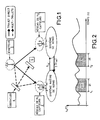
- FIG. 1 represents an example of a communication system comprising a transmitting source 1, a base station 2 equipped with a network of N 1 sensors and a base station 3 equipped with a network of N 2 sensors, with different N 1 preferably N 2 .
- the sensors receive the signals coming from the emitting source which can correspond to direct paths (indicated in solid lines in the figure) or paths with reflection on obstacles 4 (indicated in dotted lines). These signals correspond to what is designated in the description under the term "observations”.
- the N 1 and N 2 sensors constitute the reception channels.
- One of the two base stations is a master, for example the station 2 in the figure. As a result, it recovers by wire by example the signals acquired on the other base station 3. It is then provided with a processor allowing to execute in particular the different steps of the method according to the invention, as well as performing operations of direction finding or other signal processing.
- the master station 2 sends, for example by wire or radio, to the other base station the instant of acquisition of the first sample so as to make the acquisitions of the two stations.
- the second station is then equipped with a processor which allows to acquire signals at a given time and also to communicate with the master station.
- the two goniometry systems equipping the stations receive the direct route in common.
- the noises b u (t) and b v (t) are for example composed of the background noise as well as of interferers independently received on the two observation vectors.
- the method thus makes it possible to obtain the number Mo of sources common to observation vectors of lengths N 1 and N 2 different.
- the method according to the invention also makes it possible to obtain instants of synchronization or the number of multipaths associated with a transmitter.
- the present invention involves several signal transmitters s m (t) each comprising a reference signal d m (t).
- the signal emitted by the transmitter is the synchronization signal d (t) for various instants t 1 , t 2 , ..etc.
- the exponent u refers to the useful signals.
- u mp is the incidence of the p th path of the m th user.
- P m corresponds to the number of multipaths of the m th transmitter.
- the present invention aims in particular to estimate this parameter for 1 ⁇ m ⁇ M 0 .
- the transmitted signals propagate in several multipaths, by example with a temporal spread close to symbol time (Rhythm of transmission of symbols of a digital signal).
- a temporal spread close to symbol time Rhythm of transmission of symbols of a digital signal.
- x (t) at (u 0 ) d (tt k ) + b '(T) with a (u 0 ) the directing vector of the direct path of incidence u 0 and t k the instant of appearance of the reference signal transmitted by this path, and b ' (t) consists of a mixture of noise and jammers.
- the signal is expressed for example in the form: with ⁇ 1p the attenuation factor of the p th path and u 1p its incidence.
- b '(t) is composed of the noise and interferers mixture
- Each path has the incidence u 1p and a delay ⁇ 1p .
- the temporal spreading of the channel is therefore worth L + max [
- N 1 is equal to the number of time shifts of the reference signal d 1 (t) and N 2 to the number N of sensors of the base station 3.
- I L denotes the identity matrix of dimension LxL.
- ⁇ t T
- U R dd -1/2 R xd (t 0 ) H R xx (t 0 ) -1/2 and we deduce that:
- the threshold ⁇ 0 (pfa, L) is chosen from a chi-2 table for a probability pfa and a number of degrees of freedom equal to 2NL.
- the synchro positions t k will then correspond to the instants of appearance of the reference vector r 1 L (t) and thus of the reference signal d 1 (t). These instants can then be used to implement a goniometry with mono or multi-reference references.
- the method makes it possible to determine the number M 0 of sources associated with the same cyclic parameters.
- N 1 the observation vector x (t) of dimension N 1 x1 received on a network of N 1 sensors and y (t) a second observation vector of dimension N 2 x1 where N 2 ⁇ N 1 such that:
- r m ( ⁇ , ⁇ ) ⁇ E [s m 0 (t) s rn 0 (t- ⁇ ) *] exp (j2 ⁇ t)> ⁇ 0
- vs m ( ⁇ , ⁇ ) ⁇ E [s m 0 (t) s m 0 (t- ⁇ )] exp (j2 ⁇ t)> ⁇ 0
- E [] denotes the mathematical expectation and ⁇ > the time mean.
- the method of equations (9-12) can be implemented by setting either: is :
- the vector y (t) is either from a sub-network of the network of observation sensors x (t) or from another network composed of N 2 sensors.
- the method makes it possible to determine the number of multipaths coming from a transmitter.
- the signal emitted by a source or mobile propagates in the majority of cases according to several journeys, direct journeys or journeys with reflection.
- the method makes it possible for example to determine the number of multipaths of a known signal transmitter d m (t) or reference signal included in the signal frame from the observation vector x (t) received by the network sensors.
- a transmitter is for example made up of several sources and the signal model is written in the form: where b M0 (t) is the component of the signal including noise and interferers. Knowing that the transfer function H m u of the m th transmitter verifies the following relation:
- the signal from the m th transmitter can be isolated by performing the following operation:
- the transfer functions are estimated by implementing a method described below in the paragraph "Separation of the emitters or useful" which makes it possible to identify the transfer matrices H m u of each of the emitters separately.
- Knowledge of the transfer matrices of all the transmitters then makes it possible to isolate the signal x m (t) from the m th transmitter.
- the method then consists, for example, in applying the principle of detecting the number Pm of multi-paths on the signal x m (t).
- the reference signal d m (t) makes it possible to construct the reference vector r m L (t).
- the objective of the detection is to find coherence between the observations x m (t) and the reference vector r m L (t).
- u (T) r m
- L corresponds to the time offset number of the reference signal d m (t).
- the rank of the covariance matrix of the signal b M0 (t) is worth M T - P m :
- This matrix R bb is calculated from the signals x (t) and r u L (t) as described above.
- the unitary matrix P roj (P m ) is composed of the N- (M T - P m ) eigenvectors of R bb associated with the smallest eigenvalues.
- N is the number of sensors of the base station 3 and M T the total number of sources and P m the number of multipaths of the n th transmitter.
- the signals u (t) and v (t) have the signal r m L (t) in common.
- the number P m of multipaths of the m th transmitter is estimated by implementing the detection test described above, by choosing particular values for the lengths N 1 and N 2 of the observations.
- the method estimates the matrix H u in the least squares sense as in the single user case.
- the process estimates H u by minimizing the difference between H u r u L (t) and x (t).
- H u R xr u ( R rr u ) -1
- the multi-user method exploits the coefficients of correlations r and ij ( T ) between the reference signals, which are not necessarily zero. This remark makes it possible to verify intuitively that the use of the coefficients r and ij ( T ) is necessary to achieve the separation of reference signals d i (t) and d j (t) in the correlated case.
- the test has the advantage of operating in the presence of spatially non-white noise b M0 (t).
- noise never has this property: It is composed of the noise of receivers whose covariance matrix can be measured and the non-measurable atmospheric noise composed in particular of interferers.
Landscapes
- Engineering & Computer Science (AREA)
- Computer Networks & Wireless Communication (AREA)
- Signal Processing (AREA)
- Mobile Radio Communication Systems (AREA)
- Monitoring And Testing Of Transmission In General (AREA)
- Radar Systems Or Details Thereof (AREA)
- Small-Scale Networks (AREA)
- Radio Transmission System (AREA)
Abstract
Description



- si Vclassique(M/M0) ≥ αM, le nombre de sources M0 présentes est supérieur à M,
- si Vclassique(M/M0) < αM, le nombre de sources M0 présentes est inférieure ou égale à M.


U=R and -1/2 / uu R and uv R and -1/2 / vv tel que:

- si Vuv(M/M0) > αM, le nombre de sources M0 présentes est supérieur à M,
- si Vuv(M/M0) < αM, le nombre de sources M0 présentes est inférieur
- définir une loi de vraisemblance Vuv([M=M0]/M0) ∼ Chi-2 à 2(N1-M0) (N2-M0) degrés de libertés avec N1 ≤ N2, dim{ u (t)}=N1x1 et dim v (t)}=N2x1,
- déterminer un seuil de détection αM afin d'obtenir une probabilité de fausse alarme faible et un nombre de degrés de liberté tenant compte des longueurs N1 et N2 et du nombre de sources M0
- déterminer la présence et/ou le nombre des sources M0 en appliquant la loi de vraisemblance et le seuil αM.
- les signaux émis par les différentes sources M0 comportent une séquence de référence d(t),
- on prend comme vecteur d'observation u (t) le vecteur de référence r 1 L(t-t0) avec N1=L et comme vecteur d'observation v (t) le vecteur reçu x (t) sur les capteurs avec N2=N (L correspond au nombre de décalages temporels du signal de référence),
- on détermine la ou les positions de synchronisation.
- la possibilité de détecter la présence et éventuellement le nombre de sources communes à des observations ayant des longueurs différentes, obtenues sur un nombre de capteurs différent,
- déterminer les positions de synchro pour le cas d'émetteurs se propageant suivant plusieurs multi-trajets,
- déterminer le nombre de multi-trajets Pm d'un émetteur.
- La figure 1 un exemple de système de radiocommunication comportant une source émettrice et deux stations de base équipées chacune d'un réseau de capteurs,
- La figure 2 un exemple de signal comportant un signal de référence d(t),
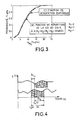
- La figure 3 des résultats validant le procédé selon l'invention,
- La figure 4 un diagramme schématisant le recouvrement temporel de deux signaux apparaissant à deux instants différents.
Les observations u (t) et v (t) ont la structure suivante (8) :



- si Vuv(M/M0) ≥ αM, le nombre de sources M0 présentes est supérieur à M,
- si Vuv(M/M0) < αM, le nombre de sources M0 présentes est inférieure ou égale à M.

Ainsi entre les deux instants tk et tk+ δt, le signal émis par l'émetteur est le signal de synchronisation d(t) pour divers instants t1, t2, ..etc.


Les matrices représentatives du canal de transmission Hm u et Hm, ont l'expression suivante (14):

Le vecteur de référence r m L(t) est composé du signal de référence dm(t), en étant défini par exemple pour deux émetteurs utiles de la façon suivante :

L = le nombre de décalages temporels du signal de référence. L'optimum est de choisir L égal à l'étalement temporel du canal de l'émetteur s'étalant le plus :
Δtij= t k(j)- tk(i) la différence correspondant à deux signaux de référence di(t) et dj(t) détectés aux instants respectifs tk(i) et t k(j) et qui correspondent aux 2 utilisateurs, dans ce cas Δt12.
b'(t) est constitué d'un mélange bruit et brouilleurs.

ρ1p le facteur d'atténuation du pième trajet et u1p son incidence.


b '(t) est composé du mélange bruit et brouilleurs et tk est la position de synchro du premier trajet de cet émetteur en posant tk=τ1p. Chaque trajet a pour incidence u1p et un retard τ1p. L'étalement temporel du canal vaut donc L+ max [|τ1i-τ1j|]. En faisant l'hypothèse que le vecteur de référence r 1 L(t-t0) est synchronisé en t0 en vérifiant x (t) = H1 u r 1 L(t-t0), le procédé selon l'invention s'applique en posant




- Si Vuv(M/M0)(t0)≥ α0(pfa,L) ⇒ II y a détection de r 1 L(t-t0) et t0 est une position de synchro car on est dans l'hypothèse H0.
- Si Vuv(M/M0)(t0)< α0(pfa,L) ⇒ II n'y a pas détection car on est dans l'hypothèse H1.













- si Vuv(M/Pm) ≥ αM alors M=M+1 et retour à l'étape n°3
- si Vuv(M/Pm) < αM alors Pm=M et arrêt du test de détection


Claims (7)
- Procédé de détection de sources Mo communes à plusieurs observations u (t) et v (t) ayant des longueurs N1 et N2 différentes, au sein d'un seul réseau de capteurs, caractérisé en ce qu'il comporte au moins les étapes suivantes :définir une loi de vraisemblance Vuv([M=M0]/M0) sensiblement égale à une loi de Chi-2 à 2(N1-M0) (N2-M0) degrés de libertés avec N1 ≤ N2 , dim{ u (t)}=N1x1 et dim{ v (t)}=N2x1,déterminer un seuil de détection αM afin d'obtenir une probabilité de fausse alarme faible et un nombre de degrés de liberté tenant compte des longueurs N1 et N2 et du nombre de sources M0,déterminer la présence et/ou le nombre des sources Mo en appliquant la loi de vraisemblance et le seuil αM.
- Procédé selon la revendication 1 caractérisé en ce que le vecteur observation v (t) est déterminé à partir du vecteur d'observation u (t).
- Procédé selon la revendication 1 caractérisé en ce que :les signaux émis par les différentes sources Mo comportent une séquence de référence d(t),on prend comme vecteur d'observation u (t) le vecteur de référence r 1 L(t-t0) avec N1=L et comme vecteur d'observation v (t) le vecteur reçu x (t) sur les capteurs avec N2=N (L correspond au nombre de décalages temporels du signal de référence),on détermine la ou les positions de synchronisation.
- Procédé selon l'une des revendications précédentes caractérisé en ce qu'il comporte une étape de détermination du nombre Pm de multi-trajets pour un émetteur m donné en cherchant une cohérence entre les observations x m(t) et le vecteur de référence r m L(t) et en vérifiant u (t)= r m L(t) et dim{ u (t)}=N1x1 avec N1=L.
- Procédé selon la revendication 4 caractérisé en ce qu'il comporte une étape de goniométrie mono ou multi-références.
- Application du procédé selon l'une des revendications 1 à 5 pour déterminer la présence et/ou le nombre de sources communes à au moins deux observations présentant des longueurs différentes dans un système de radiocommunication de type GSM.
- Dispositif permettant de déterminer la présence et/ou le nombre de sources communes à au moins deux observations u (t) et v (t) caractérisé en ce qu'il comporte au moins des moyens adaptés à mettre en oeuvre les étapes de la revendication 1.
Applications Claiming Priority (2)
| Application Number | Priority Date | Filing Date | Title |
|---|---|---|---|
| FR0111486A FR2829325B1 (fr) | 2001-09-05 | 2001-09-05 | Procede et dispositif de detection de sources dans un systeme de communication |
| FR0111486 | 2001-09-05 |
Publications (2)
| Publication Number | Publication Date |
|---|---|
| EP1292047A1 true EP1292047A1 (fr) | 2003-03-12 |
| EP1292047B1 EP1292047B1 (fr) | 2004-12-29 |
Family
ID=8866989
Family Applications (1)
| Application Number | Title | Priority Date | Filing Date |
|---|---|---|---|
| EP02292171A Expired - Lifetime EP1292047B1 (fr) | 2001-09-05 | 2002-09-03 | Procédé et dispositif de détection de sources dans un système de communications |
Country Status (6)
| Country | Link |
|---|---|
| US (1) | US7019635B2 (fr) |
| EP (1) | EP1292047B1 (fr) |
| AT (1) | ATE286327T1 (fr) |
| CA (1) | CA2404491A1 (fr) |
| DE (1) | DE60202412T2 (fr) |
| FR (1) | FR2829325B1 (fr) |
Families Citing this family (1)
| Publication number | Priority date | Publication date | Assignee | Title |
|---|---|---|---|---|
| FR2952725B1 (fr) | 2009-11-13 | 2011-12-30 | Thales Sa | Procede de goniometrie de multi-trajets avec un recepteur 2 voies |
Family Cites Families (10)
| Publication number | Priority date | Publication date | Assignee | Title |
|---|---|---|---|---|
| FR2732490B1 (fr) | 1995-03-28 | 1997-04-25 | Thomson Csf | Procede de reception multicapteur d'une station de base d'un reseau de communication echangeant des donnees avec des mobiles, et dispositif pour sa mise en oeuvre |
| FR2735937B1 (fr) | 1995-06-23 | 1997-08-08 | Thomson Csf | Procede de tarage des chaines emission et reception des voies formees par une station de base d'un systeme de radiocommunication entre mobiles |
| DE69604595T2 (de) | 1995-08-22 | 2000-05-31 | Thomson-Csf, Paris | Verfahren und anordnung zur räumlichen multiplexierung/demultiplexierung von funksignalen in einem sdma-mobilfunksystem |
| FR2749733B1 (fr) | 1996-06-07 | 1998-11-27 | Thomson Csf | Procede et dispositif de gestion des transferts intercellulaires des communications dans un systeme de radiocommunication cellulaire |
| FR2764074B1 (fr) | 1997-06-03 | 1999-08-20 | Thomson Csf | Procede et dispositif de radiogoniometrie cooperative en transmission |
| FR2766320B1 (fr) | 1997-07-15 | 1999-10-15 | Thomson Csf | Procede et dispositif d'analyse des interferences dans un systeme de radiocommunication cellulaire |
| FR2774217B1 (fr) * | 1998-01-23 | 2000-04-14 | Thomson Csf | Procede de detection cyclique en diversite de polarisation de signaux radioelectriques numeriques cyclostationnaires |
| US6498936B1 (en) * | 1999-01-22 | 2002-12-24 | Ericsson Inc. | Methods and systems for coding of broadcast messages |
| US6442384B1 (en) * | 1999-10-22 | 2002-08-27 | Ericsson Inc. | System and method for identification of uplink/downlink interference sources |
| US6735436B1 (en) * | 2000-10-03 | 2004-05-11 | Ericsson Inc. | System and method for quantifying accuracy of interference analysis in a telecommunications network |
-
2001
- 2001-09-05 FR FR0111486A patent/FR2829325B1/fr not_active Expired - Fee Related
-
2002
- 2002-09-03 AT AT02292171T patent/ATE286327T1/de not_active IP Right Cessation
- 2002-09-03 EP EP02292171A patent/EP1292047B1/fr not_active Expired - Lifetime
- 2002-09-03 DE DE60202412T patent/DE60202412T2/de not_active Expired - Lifetime
- 2002-09-04 CA CA002404491A patent/CA2404491A1/fr not_active Abandoned
- 2002-09-05 US US10/234,457 patent/US7019635B2/en not_active Expired - Fee Related
Non-Patent Citations (5)
| Title |
|---|
| CESBRON F ET AL: "Locating GSM mobiles using antenna array", ELECTRONICS LETTERS, IEE STEVENAGE, GB, vol. 34, no. 16, 6 August 1998 (1998-08-06), pages 1539 - 1540, XP006010131, ISSN: 0013-5194 * |
| CHEN W ET AL: "Detection of the number of signals in noise with banded covariance matrices", IEE PROCEEDINGS: RADAR, SONAR & NAVIGATION, INSTITUTION OF ELECTRICAL ENGINEERS, GB, vol. 143, no. 5, 3 October 1996 (1996-10-03), pages 289 - 294, XP006006735, ISSN: 1350-2395 * |
| LI C -C: "Estimating the number of signals by chi-square statistics", ICASSP 88: 1988 INTERNATIONAL CONFERENCE ON ACOUSTICS, SPEECH, AND SIGNAL PROCESSING (CAT. NO.88CH2561-9), NEW YORK, NY, USA, 11-14 APRIL 1988, 1988, New York, NY, USA, IEEE, USA, pages 2336 - 2339 vol.4, XP010072594 * |
| SWINDLEHURST A: "Alternative algorithm for maximum likelihood DOA estimation and detection", IEE PROCEEDINGS: RADAR, SONAR & NAVIGATION, INSTITUTION OF ELECTRICAL ENGINEERS, GB, vol. 141, no. 6, 1 December 1994 (1994-12-01), pages 293 - 9, XP006002094, ISSN: 1350-2395 * |
| WAX M ET AL: "DETECTION OF THE NUMBER OF COHERENT SIGNALS BY THE MDL PRINCIPLE", IEEE TRANSACTIONS ON ACOUSTICS, SPEECH AND SIGNAL PROCESSING, IEEE INC. NEW YORK, US, vol. 37, no. 8, August 1989 (1989-08-01), pages 1190 - 1196, XP001033542, ISSN: 0096-3518 * |
Also Published As
| Publication number | Publication date |
|---|---|
| EP1292047B1 (fr) | 2004-12-29 |
| US7019635B2 (en) | 2006-03-28 |
| ATE286327T1 (de) | 2005-01-15 |
| FR2829325B1 (fr) | 2005-06-17 |
| DE60202412T2 (de) | 2005-12-08 |
| DE60202412D1 (de) | 2005-02-03 |
| CA2404491A1 (fr) | 2003-03-05 |
| US20030086510A1 (en) | 2003-05-08 |
| FR2829325A1 (fr) | 2003-03-07 |
Similar Documents
| Publication | Publication Date | Title |
|---|---|---|
| EP0735702B1 (fr) | Procédé et dispositif de réception multicapteur d'une station de base fixe pour un système de communication mobile | |
| EP1050973A1 (fr) | Procédé de détection conjointe d'un ensemble de codes CDMA | |
| EP0991952B1 (fr) | Procede et dispositif de radiogoniometrie cooperative en transmission | |
| EP2428810A1 (fr) | Procédé de géo-localisation multi-émetteurs par traitement spatio-temporel | |
| EP1260071B1 (fr) | Procede et dispositif d'estimation d'un canal de propagation | |
| EP1582888B1 (fr) | Procédé de localisation aveugle large bande d'un ou plusieurs émetteurs à partir d'un porteur défilant | |
| EP0708544A1 (fr) | Dispositif de reconnaissance d'informations portées par un signal reçu | |
| EP0933885B1 (fr) | Procédé de détection cyclique en diversité de polarisation de signaux radioélectriques numériques cyclostationnaires | |
| EP1291664A1 (fr) | Procédé et dispositif de radiogoniometrie cooperative en transmission | |
| EP1265374B1 (fr) | Procédé et dispositif de traitement de signal dans un récepteur de radiocommunication à étalement de spectre | |
| EP1292047B1 (fr) | Procédé et dispositif de détection de sources dans un système de communications | |
| EP1235399B1 (fr) | Procédé et dispositif d'estimation de la matrice de covariance du canal de transmission d'un système UMTS | |
| EP1681819A1 (fr) | Système de communication multi antennes | |
| EP1854226B1 (fr) | Procede et dispositif de synchronisation de liaisons rectilignes ou quasi-rectilignes en presence d'interferences | |
| FR3111034A1 (fr) | Méthode de démodulation par apprentissage automatique pour récepteurs MIMO à détection d’énergie | |
| EP1229696A1 (fr) | Estimation des paramètres de canal au moyen d'estimation de maximum de vraisemblance | |
| WO2005046150A1 (fr) | Procede de demodulation aveugle aux ordres superieurs d'un emetteur de forme d'onde lineaire | |
| EP3345357B1 (fr) | Procede et dispositif de synchronisation mimo en presence d'interferences | |
| FR3046326A1 (fr) | Procede et systeme pour la detection de signaux dans un reseau multi sources | |
| FR2802043A1 (fr) | Dispositifs d'estimation de canal radio et de demodulation | |
| EP2499511B1 (fr) | Procede de goniometrie de multi-trajets avec un recepteur 2 voies | |
| EP1221792A1 (fr) | Procédé et récepteur autodidacte pour déterminer les paramètres spatio-temporels d'un canal de propagation | |
| WO2005109708A1 (fr) | Procede de determination de codes d’etalement utilises dans un signal cdma et dispositif de communication correspondant. | |
| EP1949548A1 (fr) | Procede de detection de trajets en transmission impulsionnelle et dispositif correspondant |
Legal Events
| Date | Code | Title | Description |
|---|---|---|---|
| PUAI | Public reference made under article 153(3) epc to a published international application that has entered the european phase |
Free format text: ORIGINAL CODE: 0009012 |
|
| AK | Designated contracting states |
Kind code of ref document: A1 Designated state(s): AT BE BG CH CY CZ DE DK EE ES FI FR GB GR IE IT LI LU MC NL PT SE SK TR |
|
| AX | Request for extension of the european patent |
Extension state: AL LT LV MK RO SI |
|
| 17P | Request for examination filed |
Effective date: 20030903 |
|
| AKX | Designation fees paid |
Designated state(s): AT BE BG CH CY CZ DE DK EE ES FI FR GB GR IE IT LI LU MC NL PT SE SK TR |
|
| 17Q | First examination report despatched |
Effective date: 20031126 |
|
| GRAP | Despatch of communication of intention to grant a patent |
Free format text: ORIGINAL CODE: EPIDOSNIGR1 |
|
| GRAS | Grant fee paid |
Free format text: ORIGINAL CODE: EPIDOSNIGR3 |
|
| GRAA | (expected) grant |
Free format text: ORIGINAL CODE: 0009210 |
|
| RAP1 | Party data changed (applicant data changed or rights of an application transferred) |
Owner name: THALES |
|
| AK | Designated contracting states |
Kind code of ref document: B1 Designated state(s): AT BE BG CH CY CZ DE DK EE ES FI FR GB GR IE IT LI LU MC NL PT SE SK TR |
|
| PG25 | Lapsed in a contracting state [announced via postgrant information from national office to epo] |
Ref country code: FI Free format text: LAPSE BECAUSE OF FAILURE TO SUBMIT A TRANSLATION OF THE DESCRIPTION OR TO PAY THE FEE WITHIN THE PRESCRIBED TIME-LIMIT Effective date: 20041229 Ref country code: IT Free format text: LAPSE BECAUSE OF FAILURE TO SUBMIT A TRANSLATION OF THE DESCRIPTION OR TO PAY THE FEE WITHIN THE PRESCRIBED TIME-LIMIT;WARNING: LAPSES OF ITALIAN PATENTS WITH EFFECTIVE DATE BEFORE 2007 MAY HAVE OCCURRED AT ANY TIME BEFORE 2007. THE CORRECT EFFECTIVE DATE MAY BE DIFFERENT FROM THE ONE RECORDED. Effective date: 20041229 Ref country code: SK Free format text: LAPSE BECAUSE OF FAILURE TO SUBMIT A TRANSLATION OF THE DESCRIPTION OR TO PAY THE FEE WITHIN THE PRESCRIBED TIME-LIMIT Effective date: 20041229 Ref country code: CZ Free format text: LAPSE BECAUSE OF FAILURE TO SUBMIT A TRANSLATION OF THE DESCRIPTION OR TO PAY THE FEE WITHIN THE PRESCRIBED TIME-LIMIT Effective date: 20041229 Ref country code: EE Free format text: LAPSE BECAUSE OF FAILURE TO SUBMIT A TRANSLATION OF THE DESCRIPTION OR TO PAY THE FEE WITHIN THE PRESCRIBED TIME-LIMIT Effective date: 20041229 Ref country code: NL Free format text: LAPSE BECAUSE OF FAILURE TO SUBMIT A TRANSLATION OF THE DESCRIPTION OR TO PAY THE FEE WITHIN THE PRESCRIBED TIME-LIMIT Effective date: 20041229 Ref country code: TR Free format text: LAPSE BECAUSE OF FAILURE TO SUBMIT A TRANSLATION OF THE DESCRIPTION OR TO PAY THE FEE WITHIN THE PRESCRIBED TIME-LIMIT Effective date: 20041229 Ref country code: AT Free format text: LAPSE BECAUSE OF FAILURE TO SUBMIT A TRANSLATION OF THE DESCRIPTION OR TO PAY THE FEE WITHIN THE PRESCRIBED TIME-LIMIT Effective date: 20041229 Ref country code: IE Free format text: LAPSE BECAUSE OF FAILURE TO SUBMIT A TRANSLATION OF THE DESCRIPTION OR TO PAY THE FEE WITHIN THE PRESCRIBED TIME-LIMIT Effective date: 20041229 Ref country code: BG Free format text: LAPSE BECAUSE OF FAILURE TO SUBMIT A TRANSLATION OF THE DESCRIPTION OR TO PAY THE FEE WITHIN THE PRESCRIBED TIME-LIMIT Effective date: 20041229 |
|
| REG | Reference to a national code |
Ref country code: GB Ref legal event code: FG4D Free format text: NOT ENGLISH |
|
| REG | Reference to a national code |
Ref country code: CH Ref legal event code: EP |
|
| REG | Reference to a national code |
Ref country code: IE Ref legal event code: FG4D Free format text: FRENCH |
|
| REF | Corresponds to: |
Ref document number: 60202412 Country of ref document: DE Date of ref document: 20050203 Kind code of ref document: P |
|
| PG25 | Lapsed in a contracting state [announced via postgrant information from national office to epo] |
Ref country code: SE Free format text: LAPSE BECAUSE OF FAILURE TO SUBMIT A TRANSLATION OF THE DESCRIPTION OR TO PAY THE FEE WITHIN THE PRESCRIBED TIME-LIMIT Effective date: 20050329 Ref country code: GR Free format text: LAPSE BECAUSE OF FAILURE TO SUBMIT A TRANSLATION OF THE DESCRIPTION OR TO PAY THE FEE WITHIN THE PRESCRIBED TIME-LIMIT Effective date: 20050329 Ref country code: DK Free format text: LAPSE BECAUSE OF FAILURE TO SUBMIT A TRANSLATION OF THE DESCRIPTION OR TO PAY THE FEE WITHIN THE PRESCRIBED TIME-LIMIT Effective date: 20050329 |
|
| PG25 | Lapsed in a contracting state [announced via postgrant information from national office to epo] |
Ref country code: ES Free format text: LAPSE BECAUSE OF FAILURE TO SUBMIT A TRANSLATION OF THE DESCRIPTION OR TO PAY THE FEE WITHIN THE PRESCRIBED TIME-LIMIT Effective date: 20050409 |
|
| GBT | Gb: translation of ep patent filed (gb section 77(6)(a)/1977) |
Effective date: 20050405 |
|
| NLV1 | Nl: lapsed or annulled due to failure to fulfill the requirements of art. 29p and 29m of the patents act | ||
| REG | Reference to a national code |
Ref country code: IE Ref legal event code: FD4D |
|
| PG25 | Lapsed in a contracting state [announced via postgrant information from national office to epo] |
Ref country code: CY Free format text: LAPSE BECAUSE OF FAILURE TO SUBMIT A TRANSLATION OF THE DESCRIPTION OR TO PAY THE FEE WITHIN THE PRESCRIBED TIME-LIMIT Effective date: 20050903 |
|
| PG25 | Lapsed in a contracting state [announced via postgrant information from national office to epo] |
Ref country code: MC Free format text: LAPSE BECAUSE OF NON-PAYMENT OF DUE FEES Effective date: 20050930 Ref country code: LU Free format text: LAPSE BECAUSE OF NON-PAYMENT OF DUE FEES Effective date: 20050930 Ref country code: BE Free format text: LAPSE BECAUSE OF NON-PAYMENT OF DUE FEES Effective date: 20050930 |
|
| PLBE | No opposition filed within time limit |
Free format text: ORIGINAL CODE: 0009261 |
|
| STAA | Information on the status of an ep patent application or granted ep patent |
Free format text: STATUS: NO OPPOSITION FILED WITHIN TIME LIMIT |
|
| 26N | No opposition filed |
Effective date: 20050930 |
|
| PG25 | Lapsed in a contracting state [announced via postgrant information from national office to epo] |
Ref country code: LI Free format text: LAPSE BECAUSE OF NON-PAYMENT OF DUE FEES Effective date: 20060930 Ref country code: CH Free format text: LAPSE BECAUSE OF NON-PAYMENT OF DUE FEES Effective date: 20060930 |
|
| REG | Reference to a national code |
Ref country code: CH Ref legal event code: PL |
|
| BERE | Be: lapsed |
Owner name: *THALES Effective date: 20050930 |
|
| PG25 | Lapsed in a contracting state [announced via postgrant information from national office to epo] |
Ref country code: PT Free format text: LAPSE BECAUSE OF NON-PAYMENT OF DUE FEES Effective date: 20050529 |
|
| PGFP | Annual fee paid to national office [announced via postgrant information from national office to epo] |
Ref country code: DE Payment date: 20140827 Year of fee payment: 13 |
|
| PGFP | Annual fee paid to national office [announced via postgrant information from national office to epo] |
Ref country code: GB Payment date: 20140903 Year of fee payment: 13 |
|
| REG | Reference to a national code |
Ref country code: FR Ref legal event code: PLFP Year of fee payment: 14 |
|
| PGFP | Annual fee paid to national office [announced via postgrant information from national office to epo] |
Ref country code: FR Payment date: 20150825 Year of fee payment: 14 |
|
| REG | Reference to a national code |
Ref country code: DE Ref legal event code: R119 Ref document number: 60202412 Country of ref document: DE |
|
| GBPC | Gb: european patent ceased through non-payment of renewal fee |
Effective date: 20150903 |
|
| PG25 | Lapsed in a contracting state [announced via postgrant information from national office to epo] |
Ref country code: GB Free format text: LAPSE BECAUSE OF NON-PAYMENT OF DUE FEES Effective date: 20150903 Ref country code: DE Free format text: LAPSE BECAUSE OF NON-PAYMENT OF DUE FEES Effective date: 20160401 |
|
| REG | Reference to a national code |
Ref country code: FR Ref legal event code: ST Effective date: 20170531 |
|
| PG25 | Lapsed in a contracting state [announced via postgrant information from national office to epo] |
Ref country code: FR Free format text: LAPSE BECAUSE OF NON-PAYMENT OF DUE FEES Effective date: 20160930 |