EP1291935A1 - Electrochemical device - Google Patents
Electrochemical device Download PDFInfo
- Publication number
- EP1291935A1 EP1291935A1 EP01936906A EP01936906A EP1291935A1 EP 1291935 A1 EP1291935 A1 EP 1291935A1 EP 01936906 A EP01936906 A EP 01936906A EP 01936906 A EP01936906 A EP 01936906A EP 1291935 A1 EP1291935 A1 EP 1291935A1
- Authority
- EP
- European Patent Office
- Prior art keywords
- sealant
- metal case
- sealing body
- electrolyte
- battery
- Prior art date
- Legal status (The legal status is an assumption and is not a legal conclusion. Google has not performed a legal analysis and makes no representation as to the accuracy of the status listed.)
- Granted
Links
Images

Classifications
-
- H—ELECTRICITY
- H01—ELECTRIC ELEMENTS
- H01M—PROCESSES OR MEANS, e.g. BATTERIES, FOR THE DIRECT CONVERSION OF CHEMICAL ENERGY INTO ELECTRICAL ENERGY
- H01M10/00—Secondary cells; Manufacture thereof
- H01M10/04—Construction or manufacture in general
- H01M10/0422—Cells or battery with cylindrical casing
- H01M10/0427—Button cells
-
- H—ELECTRICITY
- H01—ELECTRIC ELEMENTS
- H01G—CAPACITORS; CAPACITORS, RECTIFIERS, DETECTORS, SWITCHING DEVICES, LIGHT-SENSITIVE OR TEMPERATURE-SENSITIVE DEVICES OF THE ELECTROLYTIC TYPE
- H01G9/00—Electrolytic capacitors, rectifiers, detectors, switching devices, light-sensitive or temperature-sensitive devices; Processes of their manufacture
- H01G9/004—Details
- H01G9/08—Housing; Encapsulation
- H01G9/10—Sealing, e.g. of lead-in wires
-
- H—ELECTRICITY
- H01—ELECTRIC ELEMENTS
- H01M—PROCESSES OR MEANS, e.g. BATTERIES, FOR THE DIRECT CONVERSION OF CHEMICAL ENERGY INTO ELECTRICAL ENERGY
- H01M10/00—Secondary cells; Manufacture thereof
- H01M10/04—Construction or manufacture in general
- H01M10/0422—Cells or battery with cylindrical casing
-
- H—ELECTRICITY
- H01—ELECTRIC ELEMENTS
- H01M—PROCESSES OR MEANS, e.g. BATTERIES, FOR THE DIRECT CONVERSION OF CHEMICAL ENERGY INTO ELECTRICAL ENERGY
- H01M50/00—Constructional details or processes of manufacture of the non-active parts of electrochemical cells other than fuel cells, e.g. hybrid cells
- H01M50/10—Primary casings; Jackets or wrappings
- H01M50/183—Sealing members
- H01M50/186—Sealing members characterised by the disposition of the sealing members
-
- H—ELECTRICITY
- H01—ELECTRIC ELEMENTS
- H01M—PROCESSES OR MEANS, e.g. BATTERIES, FOR THE DIRECT CONVERSION OF CHEMICAL ENERGY INTO ELECTRICAL ENERGY
- H01M50/00—Constructional details or processes of manufacture of the non-active parts of electrochemical cells other than fuel cells, e.g. hybrid cells
- H01M50/10—Primary casings; Jackets or wrappings
- H01M50/183—Sealing members
- H01M50/19—Sealing members characterised by the material
- H01M50/193—Organic material
-
- H—ELECTRICITY
- H01—ELECTRIC ELEMENTS
- H01M—PROCESSES OR MEANS, e.g. BATTERIES, FOR THE DIRECT CONVERSION OF CHEMICAL ENERGY INTO ELECTRICAL ENERGY
- H01M10/00—Secondary cells; Manufacture thereof
- H01M10/05—Accumulators with non-aqueous electrolyte
-
- H—ELECTRICITY
- H01—ELECTRIC ELEMENTS
- H01M—PROCESSES OR MEANS, e.g. BATTERIES, FOR THE DIRECT CONVERSION OF CHEMICAL ENERGY INTO ELECTRICAL ENERGY
- H01M50/00—Constructional details or processes of manufacture of the non-active parts of electrochemical cells other than fuel cells, e.g. hybrid cells
- H01M50/10—Primary casings; Jackets or wrappings
- H01M50/102—Primary casings; Jackets or wrappings characterised by their shape or physical structure
- H01M50/107—Primary casings; Jackets or wrappings characterised by their shape or physical structure having curved cross-section, e.g. round or elliptic
-
- H—ELECTRICITY
- H01—ELECTRIC ELEMENTS
- H01M—PROCESSES OR MEANS, e.g. BATTERIES, FOR THE DIRECT CONVERSION OF CHEMICAL ENERGY INTO ELECTRICAL ENERGY
- H01M50/00—Constructional details or processes of manufacture of the non-active parts of electrochemical cells other than fuel cells, e.g. hybrid cells
- H01M50/10—Primary casings; Jackets or wrappings
- H01M50/102—Primary casings; Jackets or wrappings characterised by their shape or physical structure
- H01M50/109—Primary casings; Jackets or wrappings characterised by their shape or physical structure of button or coin shape
-
- Y—GENERAL TAGGING OF NEW TECHNOLOGICAL DEVELOPMENTS; GENERAL TAGGING OF CROSS-SECTIONAL TECHNOLOGIES SPANNING OVER SEVERAL SECTIONS OF THE IPC; TECHNICAL SUBJECTS COVERED BY FORMER USPC CROSS-REFERENCE ART COLLECTIONS [XRACs] AND DIGESTS
- Y02—TECHNOLOGIES OR APPLICATIONS FOR MITIGATION OR ADAPTATION AGAINST CLIMATE CHANGE
- Y02E—REDUCTION OF GREENHOUSE GAS [GHG] EMISSIONS, RELATED TO ENERGY GENERATION, TRANSMISSION OR DISTRIBUTION
- Y02E60/00—Enabling technologies; Technologies with a potential or indirect contribution to GHG emissions mitigation
- Y02E60/10—Energy storage using batteries
-
- Y—GENERAL TAGGING OF NEW TECHNOLOGICAL DEVELOPMENTS; GENERAL TAGGING OF CROSS-SECTIONAL TECHNOLOGIES SPANNING OVER SEVERAL SECTIONS OF THE IPC; TECHNICAL SUBJECTS COVERED BY FORMER USPC CROSS-REFERENCE ART COLLECTIONS [XRACs] AND DIGESTS
- Y02—TECHNOLOGIES OR APPLICATIONS FOR MITIGATION OR ADAPTATION AGAINST CLIMATE CHANGE
- Y02P—CLIMATE CHANGE MITIGATION TECHNOLOGIES IN THE PRODUCTION OR PROCESSING OF GOODS
- Y02P70/00—Climate change mitigation technologies in the production process for final industrial or consumer products
- Y02P70/50—Manufacturing or production processes characterised by the final manufactured product
Definitions
- the present invention relates to electrochemical elements utilizing an electrochemical reaction, such as organic electrolyte batteries for use as the main power source or memory backup power source of electronic equipment, or electric double layer capacitors and aluminum electrolytic capacitors. More specifically, the present invention relates to an electrochemical element having a structure capable of recognizing the application state of a sealant provided in a sealing section of a container.
- electrochemical elements comprise an element unit in which a pair of electrodes are disposed to face each other with a separator therebetween; an electrolyte; and a container for accommodating them.
- this container is composed of a metal case having an opening, and a sealing body for sealing the opening.
- a gasket is sometimes interposed between them.
- a sealant is provided between the metal case and the sealing body, or between the gasket and the metal case or the sealing body.
- the metal case is available in various shapes. such as a cylindrical shape with a bottom, a rectangular shape and a button shape.
- the sealant is required to have the functions of preventing the electrolyte from leaking out or evaporating and preventing infiltration of moisture from the outside.
- a sealant is used with a view to prevent the infiltration of moisture into the element.
- sealant A variety of sealant has been conventionally proposed. Among them, asphalt pitch, coal tar or the like has been most widely used. Moreover, one obtained by mixing the pitch with a mineral oil (Japanese Examined Patent Publication No. 61-36344) and one obtained by mixing the pitch with a silicone rubber (Japanese Laid-Open Patent Publication No. 63-80471) were proposed as the sealants that hardly cause an electrolyte leakage under high temperature/low temperature.
- An electrochemical element as described above is directly mounted on a circuit board with a decrease in the size of the element.
- the major mounting method is automatic soldering by a reflow method.
- lead-free products there has been a worldwide tendency toward lead-free products. Accordingly, there is urgent necessity to develop parts that can correspond to high-temperature reflow automatic mounting using lead-free solder.
- the parts to be mounted have been made resistant to high temperature one after another, it is difficult to make electrochemical elements correspond to the high-temperature reflow automatic mounting because they are parts for storing energy, and the realization of high-temperature resistant electrochemical elements as products is much behind as compared to other parts to be mounted.
- the major reason for this is that the electrochemical element is exposed to a high-temperature condition (under an environment of 250°C at the peak for around several ten seconds) in passing through the inside of a reflow furnace, receives extremely high thermal stress and then bursts or causes performance degradation.
- the present inventors found that variations in the applied or coated position of the sealant and the uniformity of a film made of the sealant are the causes of the occurrence of electrolyte leakage. Moreover, since the sealant proposed by the present inventors previously is transparent and colorless, it is extremely difficult to confirm by visual observation or image recognition the applied position and the uniformity of the film in a state where the sealant is applied to the gasket. Therefore, it is considered that elements whose evaluation values about the applied position and the uniformity of the film are out of the specified values can not be removed as defective units on the production process, resulting in the occurrence of electrolyte leakage.
- Japanese Laid-Open Patent Publication No. 3-37955 Japanese Laid-Open Patent Publication No. 3-37955
- Japanese Laid-Open Patent Publication No. 3-37955 Japanese Laid-Open Patent Publication No. 3-37955
- a prior example Japanese Laid-Open Patent Publication No. 3-37955 that judges the applied state of the sealant by image data discloses a structure for distinguishing the sealant from a background by adding a white powder or a luminescent material to the sealant as auxiliary means for performing image recognition.
- a powder and luminescent material have substantially no function as the sealant, and they sometimes cause degradation of the sealing performance.
- an object of the present invention to provide an electrochemical element having a structure capable of confirming simultaneously the applied position and the uniformity of the film thickness of a sealant applied to the case, sealing plate and gasket of the electrochemical element by visual observation or image recognition, without adversely affecting the characteristics of the sealant.
- the present invention provides an electrochemical element comprising: an element unit in which a positive electrode and a negative electrode are disposed to face each other with a separator therebetween; an electrolyte in contact with the element unit; a metal case for accommodating the element unit and the electrolyte; a sealing body for sealing an opening of the metal case; and a sealant provided between the metal case and the sealing body, wherein the sealant comprises an elastomer as a main component and an organic pigment and is colored in a color different from the metal case, gasket and sealing body.
- the present invention also provides an electrochemical element comprising: an element unit in which a positive electrode and a negative electrode are disposed to face each other with a separator therebetween; an electrolyte in contact with the element unit; a metal case for accommodating the element unit and the electrolyte; a sealing body for sealing an opening of the metal case; a gasket interposed between the metal case and the sealing body; and a sealant provided between the gasket and the metal case or the sealing body, wherein the sealant comprises an elastomer as a main component and an organic pigment and is colored in a color different from the metal case, gasket and sealing body.
- the organic pigment is preferably an organic pigment made of a phthalocyanine-based metal complex.
- the sealant composed mainly of an elastomer is colored by an organic pigment, and its color tone is set so as to be different from the metal case and the sealing body, and also preferably from the gasket. Therefore, when a solution of the sealant is prepared and a coating film is formed by the application of this solution in the production process, it is possible to evaluate and judge the applied state based on the difference in the saturation or color tone between the sealant and the respective components such as the metal case, thereby enabling a reduction in variations of the applied state.
- the applied position of the sealant can be recognized by the position of the colored portion, but also the applied position can be accurately controlled by feeding back the result of the recognition of the applied position to an applicator.
- the applied state such as unevenness and a blur
- the film thickness of the sealant By reflecting the result of the recognition on the control of the applicator in the same manner as for the applied position, it is possible to minimize the unevenness of the film thickness of the sealant. Furthermore, since only an amount which is necessary and sufficient for ensuring the sealing of the element is applied, it is possible to reduce the applied amount of the sealant.
- the sealant of the present invention is colored by an organic pigment which has a chemical affinity with the elastomer as the main component and a specific gravity substantially the same as that of the elastomer, it has a structure in which the pigment particles are evenly dispersed. Therefore, in the solution of the sealant of the present invention, precipitation and separation of the pigment can never occur.
- Japanese Laid-Open Patent Publication No. 3-37955 Japanese Laid-Open Patent Publication No. 3-37955
- titanium oxide (TiO 2 ) and fluorescent material are given as specific material names of the white powder and the luminescent material, respectively.
- the specific gravity of the inorganic powder is relatively large (for example, the specific gravity of titanium oxide is 3.8 to 4.2)
- the powder is likely to separate and precipitate in the sealant. Consequently, the white powder is unevenly present in the coating film, and, if such a coating film is applied to a battery, it becomes a cause of occurrence of electrolyte leakage.
- the fluorescent material is soluble in organic electrolytes. Therefore, there is a possibility that the luminescent material in the sealant reacts with an organic electrolyte to be dissolved therein and does not perform the function as the sealant.
- the sealant of the present invention is colored by an organic pigment which is evenly mixed with and dispersed in the elastomer as described above, it can never cause characteristic deterioration resulting from degradation of the function of the sealant applied to the element.
- the coloring of the sealant is selectable according to the color tones of the metal case, sealing body and gasket, and the degree of freedom is high.
- an image recognition device which is introduced in the production process is affected by the characteristics of the device and environment as well as the colors of the respective components, it is preferable to select one by considering the respective effects. Accordingly, the recognition accuracy of the applied state, i.e., the applied position and the film thickness, can be significantly improved.
- the sealant of the present invention is composed mainly of an elastomer, even when the electrochemical element is passed through a reflow furnace, it is possible to maintain the sealing characteristic in the container of the electrochemical element without causing the melting of the sealant.
- the sealant of the present invention can follow the deformation of components resulting from the addition of thermal stress, particularly, the expansion and shrinkage of the gasket, it is possible to significantly improve the sealing performance of the electrochemical element.
- the sealant can be applied in a uniform film thickness to predetermined positions, such as the peripheral portion of the sealing body, the inside peripheral portion of the case and the gasket, thereby producing the effect of preventing occurrence of electrolyte leakage due to variations in the applied position and the film thickness. Since both the elastomer and organic pigment forming the sealant have excellent heat resistance and the adhesion between the sealant and other components are excellent, the sealing performance can be maintained against an excessive temperature change and thermal stress during the mounting by a reflow method. It is therefore possible to obtain an electrochemical element with a reduced probability of occurrence of electrolyte leakage.
- An electrochemical element of the present invention is characterized in that a sealant used in a sealing section is formed from a specific rubber component and a specific organic pigment. More specifically, the sealant is composed mainly of an elastomer and colored by adding the organic pigment to the elastomer. Accordingly, the sealant is colored in any color different from the color tones of a metal case, sealing body and gasket, so that, when the sealant is applied to the metal case, etc., the applied condition is easily confirmed by visual observation or image recognition.
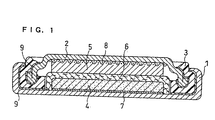
- FIG. 1 is a vertical cross sectional view of a flat type organic electrolyte battery with a thickness of 2.1 mm and a diameter of 6.8 mm.
- This battery is formed using a material having resistance to heat of around 250°C so that it has a high-temperature environment resistant characteristic capable of corresponding to automatic soldering using a reflow method.
- lithium manganate and a lithium-aluminum alloy are used for the positive electrode and the negative electrode, respectively.
- 1 represents a battery case for accommodating a power generating element.
- This case 1 also functions as a positive electrode terminal and is made of stainless steel having an excellent corrosion resistance.
- a container for sealing the power generating element is constructed by the case 1, a sealing plate 2 that is made of stainless steel and functions as a negative electrode terminal, and a gasket 3 interposed between the case 1 from the sealing plate 2.
- the gasket 3 is made of poly(phenylene sulphide), for example. This gasket 3 has a function of fluid-tightly sealing the power generating element in the battery container in addition to a function of insulating the case 1 from the sealing plate 2.
- the sealant is applied to an inner face portion of the gasket 3 that comes into contact with the sealing plate, i.e., an inner side portion from the raised portion through the bottom face, and an inner side portion of the case 1 from the raised portions through the peripheral portion of the bottom.
- the gasket 3 and the sealing plate 2 are incorporated in this order in the opening of the case 1 and the peripheral portion of the case 1 is bent inward, thereby making caulked sealing.
- a film of the sealant is represented as 9.
- a positive electrode 4 is obtained by mixing carbon black as a conductive agent and a fluorocarbon resin powder as a binder to lithium manganate as an active material, forming the resulting mixture into a pellet with a diameter of 4 mm and a thickness of 1.2 mm and then drying the pellet at 250°C for 12 hours.
- the obtained pellet-like positive electrode 4 is placed on a positive electrode collector 7 formed by applying a carbon coating to the bottom face of the case 1 and drying it.
- a negative electrode 5 is made of a lithium-aluminum alloy obtained by electrochemically alloying metallic lithium and aluminum. The production method thereof is as follows.
- a collector 8 made of a stainless steel net is joined to the inner face of the sealing plate 2 and then aluminum in the shape of a disk with a diameter of 4 mm and a thickness of 0.3 mm is bonded thereto by the application of pressure.
- lithium metal in the shape of a sheet is bonded to the surface of the aluminum by the application of pressure.
- a separator 6 provided between the positive electrode 4 and the negative electrode 5 is made of poly(phenylene sulfide).
- the organic electrolyte is one obtained by dissolving 1 mol/l of lithium bisperfluorosulphonyl imide LiN(CF 3 SO 2 ) 2 in sulfolane as a solvent, and the battery case is filled with 15 ⁇ l of the organic electrolyte.
- FIG. 2 is a cross sectional view showing a state in which the sealant is provided in the sealing section of a cylindrical type nonaqueous electrolyte battery as one electrochemical element.
- a metal case 11 accommodates therein an element unit in which a positive electrode 12 and a negative electrode 14 are disposed to face each other with a separator 13 therebetween, and a nonaqueous electrolyte.
- the nonaqueous electrolyte is omitted in FIG. 2.
- the element unit is formed by winding the layered positive electrode 12, negative electrode 14 and separator 13.
- An upper insulating ring 18 and a lower insulating ring 19 for certainly preventing a short circuit of the electrodes are provided at the upper and lower parts of the element unit.
- a positive electrode lead 12a connected to the positive electrode 12 is electrically connected to a positive electrode terminal 15 provided on a sealing body 16.
- a negative electrode lead 14a connected to the negative electrode 14 is electrically connected to the metal case 11 that also functions as a negative electrode terminal.
- a sealant 17 is provided between the opening of the metal case 11 and the peripheral portion of the sealing body 16.
- the sealant is applied to the inner circumferential face of the opening of the case 11 in a thickness of 5 to 100 ⁇ m.
- the film of the sealant is represented as 17.
- a method for judging the applied state of the sealant by image recognition a method disclosed in the above-described prior example is applicable.
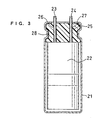
- FIG. 3 shows a state in which the sealant is provided in the sealing section of an electric double layer capacitor that is an electrochemical element.
- a metal case 21 accommodates therein an element unit in which a pair of polarized electrodes made of activated carbon are disposed to face each other with a separator therebetween, and a nonaqueous electrolyte. However, the nonaqueous electrolyte is omitted in FIG. 3.
- An element unit 20 is formed by layering a positive electrode, a negative electrode, and a separator for separating the electrodes and by winding the layers, although its cross section is not shown in FIG. 3.
- a positive electrode lead 23 and a negative electrode lead 24 are connected to the positive electrode and the negative electrode, respectively.
- the opening of the metal case 21 is sealed with a sealing body 25 made of a synthetic resin or a rubber so as to prevent evaporation of the nonaqueous electrolyte in the case.
- the open end of the metal case 21 is crimped onto the upper circumferential part of the sealing body 25 by applying a shrinking process to the outer circumference.
- the sealing body 25 has two through-holes 26 and 27, and the positive electrode lead 23 and the negative electrode lead 24 are guided to the outside through these through-holes.
- a film 28 of the sealant is provided between the opening of the metal case 21 and the side section and peripheral portion of the upper face of the sealing body 25.
- the sealant may also be provided between the positive electrode lead 23 and negative electrode lead 24 and the inner faces of the through-holes 26 and 27.
- the sealant of the present invention is composed mainly of an elastomer, it has a higher adhesive strength compared to the pitch as a known sealant. Therefore, even when the metal case, sealing body or gasket is expanded or shrunk due to an abrupt change in temperature during mounting by a reflow method, the sealant of the present invention can follow the change. It is thus possible to certainly prevent an electrolyte leakage without impairing the sealing characteristic of the element by a change in temperature.
- the elastomer as the main component of the sealant, it is possible to use chloroprene rubber and acrylic rubber containing carbon and hydrogen elements, and more preferably an elastomer obtained by using one selected from the group consisting of butadiene rubber, nitrile rubber, isobutylene rubber, butyl rubber, ethylene-propylene rubber and ethylene-propylene-diene monomer rubber alone or by combining a plurality of these rubbers. It is also possible to apply a silicone rubber and fluorosilicone rubber containing silicon and oxygen atoms in high ratios in the structural formula.
- These rubbers contain carbon and hydrogen atoms in the structural formula, and have a high affinity with organic pigments like the elastomers because the silicon and carbon are elements of the same group.
- these elastomers are colorless and transparent or white, and they can be colored in any color by combining them with later-described organic pigments.
- organic pigment that is combined with each of the above-mentioned elastomers so as to form a sealant
- Table 1 Coloring Name of Organic Pigment Red Lake Red Eosine Lake Green Phthalocyanine Green Yellowish Green Green Gold Blue Phthalocyanine Blue Violet Methyl violet Lake
- phthalocyanine-based metal complexes such as phthalocyanine blue and phthalocyanine green are strongest in terms of the coloring strength of the organic pigments and can achieve a reduction in the amount to be added to the sealant, and thus the phthalocyanine-based organic pigments have an advantage over other organic pigments.
- Organic pigments made of phthalocyanine-based metal complexes are compounds obtained by substituting two hydrogen ions in the center of a phthalocyanine compound with transition metal ions such as copper, cobalt, iron, nickel and zinc.
- these compounds have high stability, i.e., organic solvent resistance, alkali resistance and acid resistance, with respect to various types of electrolytes such as organic solvents.
- these compounds have a specific gravity of around 1.4 that is similar to elastomers (the specific gravity of 1.3 to 1.6) as the main component of the sealant of the present invention, when the organic pigment is added to and dispersed in the sealant, it can never separate.
- the phthalocyanine-based organic pigments are superior in terms of the heat resistance and can present in a stable manner even when they are exposed to a high-temperature environment as in reflow.
- the organic pigments are extremely superior in the aspect of the dispersibility to elastomers as compared to the dispersibility of inorganic pigments, and prevent partial color unevenness in producing a sealant.
- the reasons why the organic pigments have excellent dispersibility are that the organic pigments have a specific gravity substantially equal to that of elastomers, and also the ligand of metal ions comprising carbon and hydrogen that are the characteristics of the organic pigment and the elastomer that is a structure containing mainly carbon and hydrogen are chemically attracted to each other to a very week degree.
- inorganic pigments are composed mainly of metal or metal oxides, and their specific gravity is two or more times larger than that of elastomers.
- the inorganic pigments lack the affinity with elastomers, the pigments start to precipitate as soon as they are mixed with elastomers, resulting in sealants having uneven color.
- Dyes used as coloring means together with organic and inorganic pigments are generally unstable with respect to an organic electrolyte, and have a possibility of dissolving. Thus, when an electrochemical element is stored in a long time, the dye component in the sealant may come in contact with the organic electrolyte to cause dissolution of the dye, possibly affecting the reliability.
- the organic pigments are extremely stable with respect to an organic electrolyte, and even when they are stored in a long time, the pigment component in the sealant is not dissolved, and thus the organic pigments do not affect the long-term reliability of batteries at all.
- the elastomer that is the main component of the sealant is colorless and transparent or white, the color of the sealant itself becomes darker as the amount of the organic pigment contained in the sealant increases. Therefore, by increasing the difference between the color of the gasket and the saturation of the colored sealant, it is possible to easily confirm the applied position and the uniformity of the film of the sealant by visual observation or image recognition. For instance, when an opalescent resin is used for the gasket, the recognition accuracy of the applied condition is improved by applying the sealant colored in a dark color, particularly in black or violet color.
- the percentage of the organic pigment in the sealant when the amount of the organic pigment increases, the recognition accuracy of the applied condition is improved. Meanwhile, the amount of the elastomer in the sealant relatively decreases, and the sealing effect that is the most important function required for the sealant is lowered. Therefore, the adhesion quality at the contact surface with the polymer of the sealing body or the gasket is impaired, and the probability of occurrence of electrolyte leakage increases. Accordingly, there is a suitable range for the percentage of the organic pigment in the sealant. More specifically, around 10 to 30 percent by weight is preferred.
- a butyl rubber was used as the elastomer, and phthalocyanine blue was used as the organic pigment.
- a solution was prepared by dissolving a mass of butyl rubber in toluene, and a fine powder of phthalocyanine blue was added to this.
- the solution of the sealant thus prepared was applied to predetermined positions of the gasket 3 and case 1. This application was executed manually, and further the applied condition was confirmed by visual observation.
- a butyl rubber film containing the organic pigment was formed.
- the percentage of the butyl rubber and pigment in the solution for coating was 5% by weight, and the component ratio of the butyl rubber and the organic pigment was 40 parts by weight of the pigment based on 60 parts by weight of the butyl rubber.
- a battery having the structure as shown in FIG. 1 was fabricated.
- the gasket and separator made of poly(phenylene sulfide) were used. This battery is represented as A.
- a battery F comprising the film 9 of the sealant shown in FIG. 1 that was composed of only butyl rubber was assembled.
- the concentration of the butyl rubber in the toluene solution used was 3% by weight.
- the batteries A, B and C are superior in the leakage resistance after the passage of the reflow furnace as compared to the battery F of the comparative example containing no pigment in the sealant.
- the applied position and the applied state such as unevenness and a blur of the colored sealant can be easily confirmed by visual observation because of the difference in the saturation between the sealant and the gasket 3, case 1 and sealing plate 2. Therefore, the layer of the sealant is uniformly formed in the sealing section and the variation thereof is reduced, and the probability of occurrence of electrolyte leakage is significantly decreased.
- the coloring of the sealant was changed for the batteries A through C, the difference in the rate of occurrence of electrolyte leakage depending on the types of the organic pigments added to the sealant is small.
- the present inventors also confirmed that there was no difference in the rate of occurrence of electrolyte leakage if the types of organic pigments and the percentage thereof added to the sealant were within the range specified in the above-described embodiment.
- the battery E to which the inorganic pigment was added was not subjected to the influences such as decomposition and degradation by the organic electrolyte or degeneration by heat, it was deemed that a portion where the inorganic pigment was unevenly present was created when the sealant was applied, the sealing performance in this portion was degraded, and consequently the electrolyte leakage occurred.
- the present invention by setting the color of an organic pigment to be added to a sealant so that it differs from the colors of components constituting an electrochemical element, it is possible to evaluate and judge the applied state when the sealant was applied, based on the difference in the colors of the respective components. Accordingly, elements that are below standards of the applied state and have a possibility to cause an electrolyte leakage can be eliminated from the production process. It is therefore possible to provide an electrochemical element with a significantly decreased ratio of defective units that would cause an electrolyte leakage. In particular, the accuracy of the evaluation and judgment of the applied state by image recognition is significantly improved, thereby greatly contributing to an improvement of the productivity in the substantially fully automated mounting process.
- the present invention can solve environmental problems and its industrial value is extremely high.
Landscapes
- Chemical & Material Sciences (AREA)
- Chemical Kinetics & Catalysis (AREA)
- Electrochemistry (AREA)
- General Chemical & Material Sciences (AREA)
- Engineering & Computer Science (AREA)
- Manufacturing & Machinery (AREA)
- Power Engineering (AREA)
- Microelectronics & Electronic Packaging (AREA)
- Sealing Battery Cases Or Jackets (AREA)
- Electric Double-Layer Capacitors Or The Like (AREA)
Abstract
Description
| Coloring | Name of Organic Pigment |
| Red | Lake Red |
| Eosine Lake | |
| Green | Phthalocyanine Green |
| Yellowish Green | Green Gold |
| Blue | Phthalocyanine Blue |
| Violet | Methyl violet Lake |
| Colorant | Occurrence of electrolyte leakage after passing reflow furnace | ||
| Battery A | Phthalocyanine Blue | 0/1000 | |
| Battery | Lake Red | 5/1000 | |
| Battery | Green Gold | 3/1000 | |
| Battery | Oil Red | 28/1000 | |
| Battery | Titanium oxide | 16/1000 | |
| Battery F | None | 35/1000 |
Claims (4)
- An electrochemical element comprising: an element unit in which a positive electrode and a negative electrode are disposed to face each other with a separator therebetween; an electrolyte in contact with said element unit; a metal case for accommodating said element unit and said electrolyte; a sealing body for sealing an opening of said metal case; and a sealant provided between said metal case and said sealing body, characterized in that said sealant comprises an elastomer as a main component and an organic pigment and is colored in a color different from said metal case, gasket and sealing body.
- The electrochemical element as set forth in claim 1, wherein said organic pigment is an organic pigment composed of a phthalocyanine-based metal complex.
- An electrochemical element comprising: an element unit in which a positive electrode and a negative electrode are disposed to face each other with a separator therebetween; an electrolyte in contact with said element unit; a metal case for accommodating said element unit and said electrolyte; a sealing body for sealing an opening of said metal case; a gasket interposed between said metal case and said sealing body; and a sealant provided between said gasket and said metal case or said sealing body, characterized in that said sealant comprises an elastomer as a main component and an organic pigment and is colored in a color different from said metal case, gasket and sealing body.
- The electrochemical element as set forth in claim 3, wherein said organic pigment is an organic pigment composed of a phthalocyanine-based metal complex.
Applications Claiming Priority (3)
| Application Number | Priority Date | Filing Date | Title |
|---|---|---|---|
| JP2000173137 | 2000-06-09 | ||
| JP2000173137 | 2000-06-09 | ||
| PCT/JP2001/004830 WO2001095412A1 (en) | 2000-06-09 | 2001-06-07 | Electrochemical device |
Publications (3)
| Publication Number | Publication Date |
|---|---|
| EP1291935A1 true EP1291935A1 (en) | 2003-03-12 |
| EP1291935A4 EP1291935A4 (en) | 2005-12-14 |
| EP1291935B1 EP1291935B1 (en) | 2012-12-19 |
Family
ID=18675420
Family Applications (1)
| Application Number | Title | Priority Date | Filing Date |
|---|---|---|---|
| EP01936906A Expired - Lifetime EP1291935B1 (en) | 2000-06-09 | 2001-06-07 | Electrochemical device |
Country Status (4)
| Country | Link |
|---|---|
| US (1) | US7223496B2 (en) |
| EP (1) | EP1291935B1 (en) |
| TW (1) | TW501305B (en) |
| WO (1) | WO2001095412A1 (en) |
Families Citing this family (18)
| Publication number | Priority date | Publication date | Assignee | Title |
|---|---|---|---|---|
| US20040211862A1 (en) * | 2003-04-25 | 2004-10-28 | Elam Daryl B. | Unmanned aerial vehicle with integrated wing battery |
| DE10327112A1 (en) * | 2003-06-13 | 2004-12-30 | Bayer Chemicals Ag | Ion exchange material production used for e.g. water treatment, comprises polymerizing a vinyl monomer in the presence of iron (oxy)hydroxide and functionalizing the resulting bead polymer |
| JP2005276885A (en) * | 2004-03-23 | 2005-10-06 | Sanyo Electric Co Ltd | Electric double layer capacitor, electrolyte battery and manufacturing method of them |
| KR100760757B1 (en) * | 2005-12-29 | 2007-09-21 | 삼성에스디아이 주식회사 | Lithium secondary battery |
| JP5116234B2 (en) * | 2006-01-18 | 2013-01-09 | 三洋電機株式会社 | Lithium secondary battery |
| US20070231727A1 (en) * | 2006-03-31 | 2007-10-04 | Baird Brian W | Toner formulations containing extra particulate additive |
| CN101689621B (en) * | 2007-06-29 | 2013-03-27 | 永备电池有限公司 | Vapor Permeation Resistance Sealing Elements for Nonaqueous Electrochemical Cells |
| WO2010089152A1 (en) | 2009-02-09 | 2010-08-12 | Varta Microbattery Gmbh | Button cells and method for producing same |
| DE102009060800A1 (en) | 2009-06-18 | 2011-06-09 | Varta Microbattery Gmbh | Button cell with winding electrode and method for its production |
| DE102010012977A1 (en) * | 2010-03-22 | 2011-09-22 | Varta Microbattery Gmbh | Protected against short circuit button cell |
| JP6156386B2 (en) | 2012-10-02 | 2017-07-05 | 株式会社スリーボンド | Non-aqueous electrolyte battery sealant composition |
| KR102305264B1 (en) * | 2015-03-06 | 2021-09-24 | 삼성에스디아이 주식회사 | Rechargeable battery |
| JP7229928B2 (en) * | 2017-09-06 | 2023-02-28 | 三洋電機株式会社 | Non-aqueous electrolyte secondary battery |
| EP3806179B1 (en) * | 2019-10-10 | 2024-03-20 | VARTA Microbattery GmbH | Secondary lithium battery and method of manufacture |
| US12119474B1 (en) | 2020-04-02 | 2024-10-15 | Energizer Brands, Llc | Electrode bonding system and method of use |
| US11641044B1 (en) | 2020-04-14 | 2023-05-02 | Energizer Brands, Llc | Battery housing and systems and methods of making thereof |
| KR102918561B1 (en) * | 2020-07-17 | 2026-01-27 | 주식회사 엘지에너지솔루션 | Button type secondary battery and manufacturing method thereof |
| US12087899B1 (en) | 2021-05-19 | 2024-09-10 | Energizer Brands, Llc | Electrode and separator feed system and method of use |
Family Cites Families (12)
| Publication number | Priority date | Publication date | Assignee | Title |
|---|---|---|---|---|
| JPS5657254A (en) | 1979-10-12 | 1981-05-19 | Matsushita Electric Ind Co Ltd | Nonaqueous-electrolyte battery |
| JPS62188164A (en) * | 1986-02-13 | 1987-08-17 | Fuji Elelctrochem Co Ltd | Battery |
| US4772291A (en) * | 1986-05-12 | 1988-09-20 | Japan Liquid Crystal Co., Ltd. | Process for the preparation of densely colored pellet for synthetic resins |
| JPS6380471A (en) | 1986-09-25 | 1988-04-11 | Matsushita Electric Ind Co Ltd | non-aqueous electrolyte battery |
| JPH0337955A (en) | 1989-07-04 | 1991-02-19 | Fuji Elelctrochem Co Ltd | Judgement device for seal material coating in cell |
| US5332633A (en) * | 1993-03-16 | 1994-07-26 | Duracell Inc. | Cell sealant |
| JP3092412B2 (en) * | 1993-09-30 | 2000-09-25 | 松下電器産業株式会社 | Battery |
| JP3574276B2 (en) * | 1996-08-08 | 2004-10-06 | 日本ゼオン株式会社 | Sealant for organic electrolyte battery, composition containing the same, and battery using the same |
| US6146789A (en) * | 1996-08-15 | 2000-11-14 | Three Bond Co., Ltd. | Battery having a visible-light or near-infrared-light curing resin as an insulating seal |
| JPH10170386A (en) | 1996-12-11 | 1998-06-26 | Furukawa Battery Co Ltd:The | Pass / fail judgment method by illumination of sealant application part of alkaline storage battery |
| JPH10261388A (en) | 1997-03-19 | 1998-09-29 | Furukawa Battery Co Ltd:The | Inspection method and device for judging quality of application of sealant application section |
| JP2000138042A (en) | 1998-11-02 | 2000-05-16 | Matsushita Electric Ind Co Ltd | Organic electrolyte battery |
-
2001
- 2001-06-07 WO PCT/JP2001/004830 patent/WO2001095412A1/en not_active Ceased
- 2001-06-07 EP EP01936906A patent/EP1291935B1/en not_active Expired - Lifetime
- 2001-06-08 TW TW090113994A patent/TW501305B/en not_active IP Right Cessation
-
2002
- 2002-02-06 US US10/068,713 patent/US7223496B2/en not_active Expired - Lifetime
Also Published As
| Publication number | Publication date |
|---|---|
| EP1291935A4 (en) | 2005-12-14 |
| EP1291935B1 (en) | 2012-12-19 |
| WO2001095412A1 (en) | 2001-12-13 |
| US7223496B2 (en) | 2007-05-29 |
| US20020106559A1 (en) | 2002-08-08 |
| TW501305B (en) | 2002-09-01 |
Similar Documents
| Publication | Publication Date | Title |
|---|---|---|
| US7223496B2 (en) | Electrochemical element | |
| EP1658651B8 (en) | Battery can and manufacturing method thereof and battery using the same | |
| US6489062B1 (en) | Non-aqueous electrolyte secondary battery having heat-resistant electrodes | |
| US6713215B2 (en) | Non-aqueous electrolyte rechargeable batteries | |
| US7742280B2 (en) | Coin-shaped storage cell | |
| US20150004478A1 (en) | Novel Method For Gold Plated Termination of Hermetic Device | |
| CN101533899A (en) | Battery | |
| EP0975042A2 (en) | Organic electrolyte battery | |
| EP0646977B1 (en) | Electrochemical devices comprising lithium nitride-metal compounds in at least one of a pair of electrodes | |
| US20240304958A1 (en) | Cylindrical battery | |
| US20030087158A1 (en) | Lithium secondary battery | |
| Morasch et al. | Li-ion battery material impedance analysis II: graphite and solid electrolyte interphase kinetics | |
| US7622226B2 (en) | Secondary battery having a terminal for surface mounting | |
| US20230170528A1 (en) | Non-aqueous electrolyte secondary battery | |
| CA2333850A1 (en) | Lithium secondary battery | |
| JP4578811B2 (en) | Soldering method for non-aqueous electrolyte secondary battery | |
| JP4908312B2 (en) | Electrochemical element | |
| JP2008204839A (en) | Cylindrical battery sealing plate | |
| US20030162100A1 (en) | Lithium secondary battery for mounting on substrate | |
| JP3966254B2 (en) | Secondary battery with surface mount terminals | |
| US20030113632A1 (en) | Oxidized titanium as a cathodic current collector | |
| JP2005332657A (en) | Nonaqueous electrolyte secondary battery | |
| US20240072394A1 (en) | Battery | |
| JP2004079356A (en) | Non-aqueous electrolyte battery | |
| EP1009047A1 (en) | Battery plate and battery |
Legal Events
| Date | Code | Title | Description |
|---|---|---|---|
| PUAI | Public reference made under article 153(3) epc to a published international application that has entered the european phase |
Free format text: ORIGINAL CODE: 0009012 |
|
| 17P | Request for examination filed |
Effective date: 20020308 |
|
| AK | Designated contracting states |
Kind code of ref document: A1 Designated state(s): AT BE CH CY DE DK ES FI FR GB GR IE IT LI LU MC NL PT SE TR |
|
| AX | Request for extension of the european patent |
Extension state: AL LT LV MK RO SI |
|
| RBV | Designated contracting states (corrected) |
Designated state(s): DE FR GB |
|
| A4 | Supplementary search report drawn up and despatched |
Effective date: 20051028 |
|
| GRAP | Despatch of communication of intention to grant a patent |
Free format text: ORIGINAL CODE: EPIDOSNIGR1 |
|
| 17Q | First examination report despatched |
Effective date: 20061024 |
|
| R17C | First examination report despatched (corrected) |
Effective date: 20080414 |
|
| RAP1 | Party data changed (applicant data changed or rights of an application transferred) |
Owner name: PANASONIC CORPORATION |
|
| GRAJ | Information related to disapproval of communication of intention to grant by the applicant or resumption of examination proceedings by the epo deleted |
Free format text: ORIGINAL CODE: EPIDOSDIGR1 |
|
| GRAP | Despatch of communication of intention to grant a patent |
Free format text: ORIGINAL CODE: EPIDOSNIGR1 |
|
| GRAS | Grant fee paid |
Free format text: ORIGINAL CODE: EPIDOSNIGR3 |
|
| GRAA | (expected) grant |
Free format text: ORIGINAL CODE: 0009210 |
|
| AK | Designated contracting states |
Kind code of ref document: B1 Designated state(s): DE FR GB |
|
| REG | Reference to a national code |
Ref country code: GB Ref legal event code: FG4D |
|
| REG | Reference to a national code |
Ref country code: DE Ref legal event code: R096 Ref document number: 60147505 Country of ref document: DE Effective date: 20130214 |
|
| PLBE | No opposition filed within time limit |
Free format text: ORIGINAL CODE: 0009261 |
|
| STAA | Information on the status of an ep patent application or granted ep patent |
Free format text: STATUS: NO OPPOSITION FILED WITHIN TIME LIMIT |
|
| 26N | No opposition filed |
Effective date: 20130920 |
|
| REG | Reference to a national code |
Ref country code: DE Ref legal event code: R097 Ref document number: 60147505 Country of ref document: DE Effective date: 20130920 |
|
| REG | Reference to a national code |
Ref country code: FR Ref legal event code: PLFP Year of fee payment: 16 |
|
| REG | Reference to a national code |
Ref country code: FR Ref legal event code: PLFP Year of fee payment: 17 |
|
| REG | Reference to a national code |
Ref country code: FR Ref legal event code: PLFP Year of fee payment: 18 |
|
| PGFP | Annual fee paid to national office [announced via postgrant information from national office to epo] |
Ref country code: FR Payment date: 20200619 Year of fee payment: 20 Ref country code: DE Payment date: 20200618 Year of fee payment: 20 |
|
| PGFP | Annual fee paid to national office [announced via postgrant information from national office to epo] |
Ref country code: GB Payment date: 20200625 Year of fee payment: 20 |
|
| REG | Reference to a national code |
Ref country code: DE Ref legal event code: R079 Ref document number: 60147505 Country of ref document: DE Free format text: PREVIOUS MAIN CLASS: H01M0002080000 Ipc: H01M0050183000 |
|
| REG | Reference to a national code |
Ref country code: DE Ref legal event code: R071 Ref document number: 60147505 Country of ref document: DE |
|
| REG | Reference to a national code |
Ref country code: GB Ref legal event code: PE20 Expiry date: 20210606 |
|
| PG25 | Lapsed in a contracting state [announced via postgrant information from national office to epo] |
Ref country code: GB Free format text: LAPSE BECAUSE OF EXPIRATION OF PROTECTION Effective date: 20210606 |