EP1291461A1 - Color-recovering agent - Google Patents
Color-recovering agent Download PDFInfo
- Publication number
- EP1291461A1 EP1291461A1 EP01932248A EP01932248A EP1291461A1 EP 1291461 A1 EP1291461 A1 EP 1291461A1 EP 01932248 A EP01932248 A EP 01932248A EP 01932248 A EP01932248 A EP 01932248A EP 1291461 A1 EP1291461 A1 EP 1291461A1
- Authority
- EP
- European Patent Office
- Prior art keywords
- group
- weight
- color
- compound
- clothes
- Prior art date
- Legal status (The legal status is an assumption and is not a legal conclusion. Google has not performed a legal analysis and makes no representation as to the accuracy of the status listed.)
- Granted
Links
Classifications
-
- C—CHEMISTRY; METALLURGY
- C11—ANIMAL OR VEGETABLE OILS, FATS, FATTY SUBSTANCES OR WAXES; FATTY ACIDS THEREFROM; DETERGENTS; CANDLES
- C11D—DETERGENT COMPOSITIONS; USE OF SINGLE SUBSTANCES AS DETERGENTS; SOAP OR SOAP-MAKING; RESIN SOAPS; RECOVERY OF GLYCEROL
- C11D3/00—Other compounding ingredients of detergent compositions covered in group C11D1/00
- C11D3/16—Organic compounds
- C11D3/37—Polymers
- C11D3/3703—Macromolecular compounds obtained otherwise than by reactions only involving carbon-to-carbon unsaturated bonds
- C11D3/373—Macromolecular compounds obtained otherwise than by reactions only involving carbon-to-carbon unsaturated bonds containing silicones
- C11D3/3742—Nitrogen containing silicones
-
- C—CHEMISTRY; METALLURGY
- C11—ANIMAL OR VEGETABLE OILS, FATS, FATTY SUBSTANCES OR WAXES; FATTY ACIDS THEREFROM; DETERGENTS; CANDLES
- C11D—DETERGENT COMPOSITIONS; USE OF SINGLE SUBSTANCES AS DETERGENTS; SOAP OR SOAP-MAKING; RESIN SOAPS; RECOVERY OF GLYCEROL
- C11D1/00—Detergent compositions based essentially on surface-active compounds; Use of these compounds as a detergent
- C11D1/38—Cationic compounds
- C11D1/40—Monoamines or polyamines; Salts thereof
-
- C—CHEMISTRY; METALLURGY
- C11—ANIMAL OR VEGETABLE OILS, FATS, FATTY SUBSTANCES OR WAXES; FATTY ACIDS THEREFROM; DETERGENTS; CANDLES
- C11D—DETERGENT COMPOSITIONS; USE OF SINGLE SUBSTANCES AS DETERGENTS; SOAP OR SOAP-MAKING; RESIN SOAPS; RECOVERY OF GLYCEROL
- C11D1/00—Detergent compositions based essentially on surface-active compounds; Use of these compounds as a detergent
- C11D1/38—Cationic compounds
- C11D1/48—N-containing polycondensation products
-
- C—CHEMISTRY; METALLURGY
- C11—ANIMAL OR VEGETABLE OILS, FATS, FATTY SUBSTANCES OR WAXES; FATTY ACIDS THEREFROM; DETERGENTS; CANDLES
- C11D—DETERGENT COMPOSITIONS; USE OF SINGLE SUBSTANCES AS DETERGENTS; SOAP OR SOAP-MAKING; RESIN SOAPS; RECOVERY OF GLYCEROL
- C11D1/00—Detergent compositions based essentially on surface-active compounds; Use of these compounds as a detergent
- C11D1/38—Cationic compounds
- C11D1/62—Quaternary ammonium compounds
-
- C—CHEMISTRY; METALLURGY
- C11—ANIMAL OR VEGETABLE OILS, FATS, FATTY SUBSTANCES OR WAXES; FATTY ACIDS THEREFROM; DETERGENTS; CANDLES
- C11D—DETERGENT COMPOSITIONS; USE OF SINGLE SUBSTANCES AS DETERGENTS; SOAP OR SOAP-MAKING; RESIN SOAPS; RECOVERY OF GLYCEROL
- C11D1/00—Detergent compositions based essentially on surface-active compounds; Use of these compounds as a detergent
- C11D1/66—Non-ionic compounds
- C11D1/667—Neutral esters, e.g. sorbitan esters
-
- C—CHEMISTRY; METALLURGY
- C11—ANIMAL OR VEGETABLE OILS, FATS, FATTY SUBSTANCES OR WAXES; FATTY ACIDS THEREFROM; DETERGENTS; CANDLES
- C11D—DETERGENT COMPOSITIONS; USE OF SINGLE SUBSTANCES AS DETERGENTS; SOAP OR SOAP-MAKING; RESIN SOAPS; RECOVERY OF GLYCEROL
- C11D3/00—Other compounding ingredients of detergent compositions covered in group C11D1/00
- C11D3/0005—Other compounding ingredients characterised by their effect
- C11D3/0021—Dye-stain or dye-transfer inhibiting compositions
-
- C—CHEMISTRY; METALLURGY
- C11—ANIMAL OR VEGETABLE OILS, FATS, FATTY SUBSTANCES OR WAXES; FATTY ACIDS THEREFROM; DETERGENTS; CANDLES
- C11D—DETERGENT COMPOSITIONS; USE OF SINGLE SUBSTANCES AS DETERGENTS; SOAP OR SOAP-MAKING; RESIN SOAPS; RECOVERY OF GLYCEROL
- C11D3/00—Other compounding ingredients of detergent compositions covered in group C11D1/00
- C11D3/16—Organic compounds
- C11D3/20—Organic compounds containing oxygen
- C11D3/2093—Esters; Carbonates
-
- C—CHEMISTRY; METALLURGY
- C11—ANIMAL OR VEGETABLE OILS, FATS, FATTY SUBSTANCES OR WAXES; FATTY ACIDS THEREFROM; DETERGENTS; CANDLES
- C11D—DETERGENT COMPOSITIONS; USE OF SINGLE SUBSTANCES AS DETERGENTS; SOAP OR SOAP-MAKING; RESIN SOAPS; RECOVERY OF GLYCEROL
- C11D3/00—Other compounding ingredients of detergent compositions covered in group C11D1/00
- C11D3/16—Organic compounds
- C11D3/26—Organic compounds containing nitrogen
- C11D3/30—Amines; Substituted amines ; Quaternized amines
-
- C—CHEMISTRY; METALLURGY
- C11—ANIMAL OR VEGETABLE OILS, FATS, FATTY SUBSTANCES OR WAXES; FATTY ACIDS THEREFROM; DETERGENTS; CANDLES
- C11D—DETERGENT COMPOSITIONS; USE OF SINGLE SUBSTANCES AS DETERGENTS; SOAP OR SOAP-MAKING; RESIN SOAPS; RECOVERY OF GLYCEROL
- C11D3/00—Other compounding ingredients of detergent compositions covered in group C11D1/00
- C11D3/16—Organic compounds
- C11D3/26—Organic compounds containing nitrogen
- C11D3/32—Amides; Substituted amides
-
- C—CHEMISTRY; METALLURGY
- C11—ANIMAL OR VEGETABLE OILS, FATS, FATTY SUBSTANCES OR WAXES; FATTY ACIDS THEREFROM; DETERGENTS; CANDLES
- C11D—DETERGENT COMPOSITIONS; USE OF SINGLE SUBSTANCES AS DETERGENTS; SOAP OR SOAP-MAKING; RESIN SOAPS; RECOVERY OF GLYCEROL
- C11D3/00—Other compounding ingredients of detergent compositions covered in group C11D1/00
- C11D3/16—Organic compounds
- C11D3/37—Polymers
- C11D3/3703—Macromolecular compounds obtained otherwise than by reactions only involving carbon-to-carbon unsaturated bonds
- C11D3/3719—Polyamides or polyimides
-
- C—CHEMISTRY; METALLURGY
- C11—ANIMAL OR VEGETABLE OILS, FATS, FATTY SUBSTANCES OR WAXES; FATTY ACIDS THEREFROM; DETERGENTS; CANDLES
- C11D—DETERGENT COMPOSITIONS; USE OF SINGLE SUBSTANCES AS DETERGENTS; SOAP OR SOAP-MAKING; RESIN SOAPS; RECOVERY OF GLYCEROL
- C11D3/00—Other compounding ingredients of detergent compositions covered in group C11D1/00
- C11D3/16—Organic compounds
- C11D3/37—Polymers
- C11D3/3703—Macromolecular compounds obtained otherwise than by reactions only involving carbon-to-carbon unsaturated bonds
- C11D3/3723—Polyamines or polyalkyleneimines
-
- C—CHEMISTRY; METALLURGY
- C11—ANIMAL OR VEGETABLE OILS, FATS, FATTY SUBSTANCES OR WAXES; FATTY ACIDS THEREFROM; DETERGENTS; CANDLES
- C11D—DETERGENT COMPOSITIONS; USE OF SINGLE SUBSTANCES AS DETERGENTS; SOAP OR SOAP-MAKING; RESIN SOAPS; RECOVERY OF GLYCEROL
- C11D3/00—Other compounding ingredients of detergent compositions covered in group C11D1/00
- C11D3/16—Organic compounds
- C11D3/37—Polymers
- C11D3/3703—Macromolecular compounds obtained otherwise than by reactions only involving carbon-to-carbon unsaturated bonds
- C11D3/373—Macromolecular compounds obtained otherwise than by reactions only involving carbon-to-carbon unsaturated bonds containing silicones
-
- C—CHEMISTRY; METALLURGY
- C11—ANIMAL OR VEGETABLE OILS, FATS, FATTY SUBSTANCES OR WAXES; FATTY ACIDS THEREFROM; DETERGENTS; CANDLES
- C11D—DETERGENT COMPOSITIONS; USE OF SINGLE SUBSTANCES AS DETERGENTS; SOAP OR SOAP-MAKING; RESIN SOAPS; RECOVERY OF GLYCEROL
- C11D3/00—Other compounding ingredients of detergent compositions covered in group C11D1/00
- C11D3/16—Organic compounds
- C11D3/37—Polymers
- C11D3/3746—Macromolecular compounds obtained by reactions only involving carbon-to-carbon unsaturated bonds
- C11D3/3749—Polyolefins; Halogenated polyolefins; Natural or synthetic rubber; Polyarylolefins or halogenated polyarylolefins
-
- C—CHEMISTRY; METALLURGY
- C11—ANIMAL OR VEGETABLE OILS, FATS, FATTY SUBSTANCES OR WAXES; FATTY ACIDS THEREFROM; DETERGENTS; CANDLES
- C11D—DETERGENT COMPOSITIONS; USE OF SINGLE SUBSTANCES AS DETERGENTS; SOAP OR SOAP-MAKING; RESIN SOAPS; RECOVERY OF GLYCEROL
- C11D3/00—Other compounding ingredients of detergent compositions covered in group C11D1/00
- C11D3/16—Organic compounds
- C11D3/37—Polymers
- C11D3/3746—Macromolecular compounds obtained by reactions only involving carbon-to-carbon unsaturated bonds
- C11D3/3757—(Co)polymerised carboxylic acids, -anhydrides, -esters in solid and liquid compositions
-
- D—TEXTILES; PAPER
- D06—TREATMENT OF TEXTILES OR THE LIKE; LAUNDERING; FLEXIBLE MATERIALS NOT OTHERWISE PROVIDED FOR
- D06P—DYEING OR PRINTING TEXTILES; DYEING LEATHER, FURS OR SOLID MACROMOLECULAR SUBSTANCES IN ANY FORM
- D06P5/00—Other features in dyeing or printing textiles, or dyeing leather, furs, or solid macromolecular substances in any form
- D06P5/02—After-treatment
- D06P5/04—After-treatment with organic compounds
- D06P5/08—After-treatment with organic compounds macromolecular
-
- Y—GENERAL TAGGING OF NEW TECHNOLOGICAL DEVELOPMENTS; GENERAL TAGGING OF CROSS-SECTIONAL TECHNOLOGIES SPANNING OVER SEVERAL SECTIONS OF THE IPC; TECHNICAL SUBJECTS COVERED BY FORMER USPC CROSS-REFERENCE ART COLLECTIONS [XRACs] AND DIGESTS
- Y10—TECHNICAL SUBJECTS COVERED BY FORMER USPC
- Y10S—TECHNICAL SUBJECTS COVERED BY FORMER USPC CROSS-REFERENCE ART COLLECTIONS [XRACs] AND DIGESTS
- Y10S8/00—Bleaching and dyeing; fluid treatment and chemical modification of textiles and fibers
- Y10S8/01—Silicones
-
- Y—GENERAL TAGGING OF NEW TECHNOLOGICAL DEVELOPMENTS; GENERAL TAGGING OF CROSS-SECTIONAL TECHNOLOGIES SPANNING OVER SEVERAL SECTIONS OF THE IPC; TECHNICAL SUBJECTS COVERED BY FORMER USPC CROSS-REFERENCE ART COLLECTIONS [XRACs] AND DIGESTS
- Y10—TECHNICAL SUBJECTS COVERED BY FORMER USPC
- Y10S—TECHNICAL SUBJECTS COVERED BY FORMER USPC CROSS-REFERENCE ART COLLECTIONS [XRACs] AND DIGESTS
- Y10S8/00—Bleaching and dyeing; fluid treatment and chemical modification of textiles and fibers
- Y10S8/90—Basic emulsifiers for dyeing
- Y10S8/901—Quaternary ammonium salts
Definitions
- This invention relates to a composition of a color-recovering agent for recovering the color of clothes having a colored pattern, which can be used generally in home.
- JP-A No. 53-111192 and JP-A No. 55-26232 disclose a method of industrially deepening the color of clothes by allowing a low-refractive compound to be adsorbed into stained clothes and heating or wet-heating the clothes, thereby deepening the color thereof.
- JP-A No. 10-96172 discloses a method of allowing silicone to be adsorbed into fibers.
- JP-A No. 5-508889 discloses a composition for a cloth softener agent comprising amino-modified silicone.
- the object of these inventions is to confer smoothness and water repellency on clothes, but not to improve the color of clothes.
- JP-A No. 62-174298 describes treatment of faded clothes with an aqueous solution containing cellulase to recover the color of the clothes, but the effect is not satisfactory.
- the object of this invention is to provide an agent, which in home can easily recover the color of clothes faded by repeated washing, etc.
- This invention relates to a color-recovering agent composition which comprises (a) a water-insoluble polymer with a refractive index of 1.20 to 1.45 at 25°C, (b) at least one compound selected from components (i) and (ii) below defined and (c) water, wherein the ratio by weight of (a)/(b) is in the range of 3/1 to 100/1:
- the component (a) is a water-insoluble silicone compound
- the component (b) is a compound with a molecular weight of 300 to 1,000 having, in the molecule thereof, at least one of a quaternary ammonium group and a tertiary amino group and at least one of a C 10-36 alkyl group and a C 10-36 alkenyl group.
- the component (a) is preferably a fluorine-containing polymer or a silicone compound.
- composition can further comprise (d) a non-aqueous medium or (e) an emulsifier.
- the composition of this invention may also be a composition comprising the components (a), (b), (c), (d) and (e) described above.
- refractive index is the one measured by an Abbe refractometer
- water-insoluble refers to a solubility of not higher than 1 g/L ion-exchanged water at 20°C.
- the component (a) in this invention is a water-insoluble polymer having a refractive index at 25°C of 1.20 to 1.45, preferably 1.25 to 1.45, and particularly preferably 1.30 to 1.43.
- a refractive index at 25°C of 1.20 to 1.45, preferably 1.25 to 1.45, and particularly preferably 1.30 to 1.43.
- the refractive index is in this range, a sufficient color-recovering effect can be obtained, and color can also be made suitable.
- a water-soluble polymer cannot give the color-recovering effect achieved by the water-insoluble polymer of this invention.
- the polymer satisfying the properties described above is preferably a fluorine-containing polymer and a silicone compound.
- the fluorine-containing polymer is preferably a polymer or copolymer of at least one monomer selected from trifluoroethyl acrylate (or methacrylate), pentadecafluorooctyl acrylate (or methacrylate), tetrafluoroethylene, trifluorochloroethylene, trifluoroethyl acrylate (or methacrylate), hexafluoropropylene, tetrafluoroethylene oxide and hexafluoropropylene oxide, or modified silicone containing an organic group including a fluoroalkyl group, fluoroalkylene group or fluoroaryl group as described later (referred to hereinafter as fluorine-modified silicone) .
- these polymers preferably have a weight-average molecular weight of 1,000 to 1,000,000, preferably 1,500 to 500,000 as determined by gel permeation liquid chromatography using polystyrene as the standard with dimethylformamide as the development solvent.
- the fluorine type compound can be obtained by an usual radical polymerization reaction when the monomer is an ethylenically unsaturated compound, or by an usual addition reaction when the monomer is an alkylene oxide compound.
- the radical polymerization reaction may be bulk polymerization, solution polymerization or emulsion polymerization.
- the polymerization initiator used may be 2,2'-azobis(2-amidinopropane), azobisisobutyronitrile, di-t-butyl peroxide, hydrogen peroxide, t-butyl hydroperoxide, cumene hydroperoxide, methyl ethyl ketone peroxide, cyclohexanone peroxide, peracetic acid, perbenzoic acid, lauroyl peroxide or persulfate.
- the addition reaction of the alkylene oxide compound can be easily carried out in the presence of a catalyst a usually used alkali such as sodium hydroxide or potassium hydroxide or Lewis acid such as boron trifluoride.
- a catalyst a usually used alkali such as sodium hydroxide or potassium hydroxide or Lewis acid such as boron trifluoride.
- the fluorine type polymer may be a copolymer containing copolymerizable monomers other than fluorine-containing monomers, wherein the molar ratio of fluorine-containing monomers to the total monomers is 0.5 or more, preferably 0.6 or more, for the effect of recovering color.
- the viscosity thereof at 25°C is 100,000 to 200,000 mm 2 /s, preferably 500,000 to 100,000 mm 2 /s and particularly preferably 500 to 80,000mm 2 /s, for the effect of recovering color.
- the viscosity can be measured, for example, by an Ubbellohde U-shaped viscometer.
- a silicone compound can also be used as the component (a).
- the silicone compound is an organopolysiloxane oil having refractive index and solubility in the above-specified ranges, and specifically mention is made of a dimethyl polysiloxane oil (referred to hereinafter as dimethyl silicone), an organopolysiloxane oil derived from dimethyl silicone oil by replacing some methyl groups in side chains or in terminals thereof by hydroxyl groups (referred to hereinafter as hydroxy silicone) or an organopolysiloxane oil derived from the dimethyl silicone oil or hydroxy silicone by replacing some methyl groups (preferably some methyl groups in side chains) by "organic groups other than methyl groups" (referred to hereinafter as modified silicone).
- dimethyl silicone dimethyl polysiloxane oil
- hydroxy silicone an organopolysiloxane oil derived from dimethyl silicone oil by replacing some methyl groups in side chains or in terminals thereof by hydroxyl groups
- the modified silicone is illustrated mainly in chapter 6 in Silicone Handbook (first edition, edited by Kunio Ito and published on August 31, 1990 by the Nikkan Kogyo Shimbun, Ltd.).
- the organic groups other than methyl groups include organic groups including an amino group, organic groups including an amide group, organic groups including a polyether group, organic groups including an epoxy group, organic groups including a carboxy group, organic groups including an alkyl group and organic groups including a halogenoalkyl group, halogenoalkylene group or halogenoaryl group, as well as organic groups including a poly(N-acylalkylene imine) chain.
- the silicone compound in this invention is preferably modified silicone having organic groups including an amino group (referred to hereinafter as amino-modified silicone), modified silicone having organic groups including a poly (N-acylalkylene imine) chain or modified silicone having organic groups including a halogenoalkyl group, halogenoalkylene group or halogenoaryl group (halogeno-modified silicone), more preferably amino-modified silicone or halogeno-modified silicone having an amino equivalent of 1,500 to 40,000 g/mol, preferably 2,500 to 20,000 g/mol and particularly preferably 3,000 to 10,000 g/mol, and most preferably amino-modified silicone.
- amino-modified silicone modified silicone having organic groups including an amino group
- halogeno-modified silicone more preferably amino-modified silicone or hal
- the silicone compound used is preferably modified silicone having organic groups including an amino group or a poly(N-acylalkylene imine) chain, more preferably modified silicone having an amino group or a poly(N-acylalkylene imine) chain bound via a C 2-8 alkylene group to a side chain of the polysiloxane chain.
- modified silicone having water-soluble organic groups When modified silicone having water-soluble organic groups is used in this invention, the one modified to have a solubility of 1 g or less/L of ion-exchanged water is selected.
- the silicone compound (excluding fluorine-modified silicone) in this invention is a compound having a weight-average molecular weight of preferably 1,000 to 1, 000, 000, more preferably 3, 000 to 500, 000 and most preferably 5,000 to 250, 000 as determined by gel permeation liquid chromatography using polystyrene as the standard with chloroform as the development solvent.
- the viscosity thereof is preferably 10 to 100,000 mm 2 /s, more preferably 500 to 50,000 mm 2 /s and most preferably 1,000 to 40,000 mm 2 /s.
- the viscosity can be measured, for example, by an Ubbellohde U-shaped viscometer.
- the component (b) in this invention is a compound selected from the following (i) or (ii):
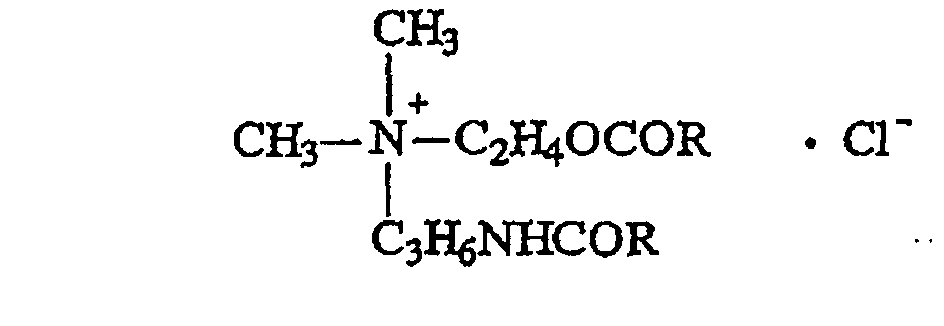
- the compound (i) is particularly preferably (i-1) a quaternary ammonium salt of the general formula (2) below, (i-2) a tertiary amine compound of the general formula (3) or (4) below, (i-3) an ester compound of a C 2-10 polyvalent alcohol with a C 10-20 fatty acid, (i-4) an amide compound of a polyvalent carboxylic acid with a secondary amine having a C 10-20 alkyl group, and (i-5) an amide compound of a C 10-20 fatty acid with an alkylene diamine, dialkylene triamine or hydroxyalkyl alkylene diamine.
- R 4 represents a C 10-36 , preferably C 10-24' more preferably C 12-18 alkyl or alkenyl group
- R 6 and R 7 each represent a C 1-3 alkyl group or hydroxyalkyl group or R 4 -(X-R 5 ) n -
- R 8 represents a C 1-3 alkyl group or hydroxyalkyl group
- X is a group selected from -COO-, -OCO-, -CONR 9 - and -NR 9 CO-
- R 5 represents a C 1-5 , preferably C 1-3 alkylene group
- R 9 represents a hydrogen atom or a C 1-3 alkyl group or hydroxyalkyl group
- n is an integer of 1 or 0
- Y - is an inorganic or organic anion, preferably a halogen ion, sulfate ion, phosphate ion, C 1-3 alkyl sulfate ion, C 1-12 fatty acid
- R 10 represents a C 10-36 , preferably C 10-24 , more preferably C 12-18 alkyl or alkenyl group
- R 12 and R 13 each represent a C 1-3 alkyl group or hydroxyalkyl group or R 10 -(X-R 11 ) m -
- X is a group selected from -COO-, -OCO-, -CONR 9 - and -NR 9 CO-
- R 11 represents a C 1-5 , preferably C 1-3 alkylene group
- m is an integer of 1 or 0
- R 9 represents a hydrogen atom or a C 1-3 alkyl group or hydroxyalkyl group.
- R 14 , R 15 , R 18 , R 21 and R 22 independently represent a hydrogen atom, a C 1-5 alkyl group or hydroxyalkyl group or R 23 -(W-R 24 ) l -, and at least one of R 14 , R 15 , R 18 , R 21 and R 22 is R 23 -(W-R 24 ) l -, whereupon R 23 is a C 10-36 alkyl group, and R 24 is a C 1-5 alkylene group; W is -COO-, -OCO-, -CONR 25 -, -NR 25 CO-, or -O-, and W and R 24 in R 23 -(W-R 24 ) l - bound to each N atom may be the same or different; R 25 represents a hydrogen atom, a C 1-3 alkyl group or hydroxyalkyl group; R 16 , R 17 , R 19 and R 20 each represent a C 1-5 alkylene group; each of l and l
- the ester compound (i-3) of a C 2-10 polyvalent alcohol with a C 10-20 fatty acid is preferably a mono-, di- tri- and/or tetra-ester of a C 10-22 , preferably C 10-20 , more preferably C 12-18 saturated or unsaturated fatty acid with glycerin, pentaerythritol, sorbitol, ethylene glycol, propylene glycol, diethylene glycol or dipropylene glycol, or a mixture of such esters, or glyceryl ether or diglyceryl ether having at least one C 10-20 , preferably C 12-18 alcohol added thereto, or a mixture thereof, or an ester compound of a C 10-20 , preferably C 12-18 fatty acid with a C 1-20 , preferably C 1-18 alcohol.
- ester compounds of glycerin, pentaerythritol or sorbitol with a C 12-18 fatty acid, or a mixture thereof are prefer
- the amide compound (i-4) of a polyvalent carboxylic acid with a primary amine includes amide compounds of a C 10-20 , preferably C 12-18 primary amine with a polyvalent carboxylic acid selected from oxalic acid, glutaric acid, succinic acid, maleic acid, fumaric acid, valeric acid, adipic acid, azelaic acid, sebacic acid, brassylic acid, dodecane diacid, tricarballylic acid, 1,2,3-propane dicarboxylic acid, citric acid, malic acid and tartaric acid.
- a polyvalent carboxylic acid selected from oxalic acid, glutaric acid, succinic acid, maleic acid, fumaric acid, valeric acid, adipic acid, azelaic acid, sebacic acid, brassylic acid, dodecane diacid, tricarballylic acid, 1,2,3-propane dicarboxylic acid, citric acid, malic acid and tart
- the amide compound (i-5) of a C 10-20 fatty acid with ethylene diamine, diethylene triamine or hydroxyethyl ethylene diamine is also good.
- the amine compound may be fully or partially amidated.
- the compound belonging to (i) in this invention is particularly preferably (i-1), (i-2) and (i-3) for the effect of recovering color, more preferably (i-1) and (i-2).
- the compound (ii) is preferably a polymer or copolymer having a weight-average molecular weight of 1,000 to 2,000,000, preferably 3,000 to 1,500,000 (as determined by gel permeation chromatography using polyethylene glycol as the standard) obtained by a polymerization reaction usually using at least one member selected from amide type monomers such as acrylamide, methacrylamide, crotonic acid amide and vinyl pyrrolidone, carboxylic acid type monomers such as acrylic acid, methacrylic acid and maleic acid, hydroxyl type monomers such as polyvinyl alcohol, quaternary ammonium type monomers such as acryloyl aminopropyl trialkyl ammonium salt, methacryloyl aminopropyl trialkyl ammonium salt, acryloyloxyethyl trialkyl ammonium salt, methacryloyloxyethyl trialkyl ammonium salt, dialkyl diallyl ammonium salt and trialkyl allyl ammonium salt, and
- the above-mentioned (ii) may be a copolymer of the above ethylenically unsaturated monomer with a copolymerizable unsaturated monomer, and such an unsaturated monomer includes alkyl (meth)acrylate, ethylene, propylene, butadiene, styrene and fatty acid vinyl.
- the copolymerizable unsaturated monomer is contained in an amount of less than 50 mole %, preferably less than 30 mole % and particularly preferably less than 10 mole % in the copolymer (ii).
- the color-recovering agent of this invention preferably comprises the component (a) in an amount of 1 to 30% by weight, particularly 2 to 20% by weight, and the component (b) in an amount of 0.1 to 10% by weight, particularly 0.2 to 5% by weight.
- the ratio by weight of (a)/(b) is preferably 3/1 to 100/1, more preferably 3/1 to 50/1, most preferably 4/1 to 25/1.
- the component (c) in this invention is preferably water from which heavy metals ion and hard-water components had been removed, particularly preferably ion-exchanged water or distilled water.
- the color recovering agent of this invention comprises the component (c) in an amount of 40 to 95% by weight, preferably 50 to 90% by weight and more preferably 60 to 90% by weight for storage stability.
- the component (d) in this invention includes ethylene glycol, propylene glycol, diethylene glycol, dipropylene glycol, alkyl glyceryl ether, di- or trialkylene glycol monoalkyl ether, di- or trialkylene glycol monoallyl ether, triethylene glycol monoallyl ether, glycerine, 1,6-hexane diol, 2,5-hexane diol, cyclohexanol, 2-hexanol and 1-octanol.
- ethylene glycol, propylene glycol, diethylene glycol, dipropylene glycol, C 3-8 alkyl glyceryl ethers, di- or trialkylene glycol mono- or diallyl ether, and di- or triethylene glycol mono- or diphenyl ether are particularly preferable.
- at least one member selected from ethylene glycol, propylene glycol, ethanol and propanol is compounded preferably for the effect of recovering color and storage stability.
- the color-recovering agent of this invention comprises the component (d) in an amount of preferably 0.1 to 20% by weight, more preferably 0.5 to 10% by weight.
- Emulsifier (referred to hereinafter as component (e))
- an emulsifier is preferably blended for the purpose of emulsification and dispersion in the color-recovering agent.
- a part of the component (b) acts as an emulsifier.
- the composition preferably contains an emulsifier other than the component (b).
- the component (e) as the emulsifier includes anionic surfactants such as alkyl benzene sulfonic acids or salts thereof, alkyl sulfates, polyoxyalkylene alkyl ether sulfates, olefin sulfonates, alkane sulfonates and fatty acid salts, nonionic surfactants such as polyoxyalkylene alkyl or alkenyl ethers, polyoxy alkylene alkyl phenyl ethers, fatty acid alkanol amides or alkylene oxide adducts thereof, sucrose fatty acid esters and alkyl glucosides, and amphoteric surfactants such as amine oxides, sulfobetaine and carbobetaine.
- anionic surfactants such as alkyl benzene sulfonic acids or salts thereof, alkyl sulfates, polyoxyalkylene alkyl ether sulfates, ole
- a polyoxyalkylene alkyl (C 8-20 ) or alkenyl (C 8-20 ) ether having 5 to 100 molecules on average of alkylene oxide added thereto is preferable.
- the emulsifier in this invention is particularly preferably a nonionic surfactant represented by the general formula (1): R 1 -O-(R 2 O) p -H wherein R 1 is a C 8-20 , preferably C 10-20 alkyl group or alkenyl group; R 2 is a C 2-3 alkylene group, preferably an ethylene group; and p is a number of 2 to 200, preferably 5 to 100, more preferably 5 to 80.
- R 1 is a C 8-20 , preferably C 10-20 alkyl group or alkenyl group
- R 2 is a C 2-3 alkylene group, preferably an ethylene group
- p is a number of 2 to 200, preferably 5 to 100, more preferably 5 to 80.
- the compound of the general formula (1) includes the following compounds: R 3 -O-(C 2 H 4 O) r -H wherein R 3 is a C 10-18 alkyl group, r is a number of 5 to 60, preferably 5 to 40; R 3 -O-(C 2 H 4 O) s (C 3 H 6 O) t -H wherein R 3 has the same meaning as defined above; s and t independently represent a number of 2 to 40, preferably 2 to 40, and the sum of s and t is a number of 5 to 60; and ethylene oxide and propylene oxide may be added in a random or block manner.
- the ratio by weight of component (e)/component (a) in this invention is preferably 1/1,000 to 2/1, more preferably 5/1,000 to 1/1, particularly preferably 1/100 to 1/1 for emulsification and dispersion stability.
- the diameter of the emulsified particles in the color-recovering agent is 0.01 to 5 ⁇ m, preferably 0.02 to 3 ⁇ m and particularly preferably 0.01 to 1 ⁇ m for color recovery.
- the color-recovering agent of this invention is used in the form of a dispersion prepared by diluting the components (a), (b) and preferably (d) with water [component (c)].
- the pH value (at 20°C) of the color-recovering agent of this invention is 2 to 9, preferably 3 to 8.0, for storage stability and the effect of recovering color.
- this invention also relates to a color recovering composition which comprises (a) a water-insoluble polymer with a refractive index of 1.20 to 1.45 at 25°C, (b) a compound with a molecular weight of 300 to 1,000 having at least one of a quaternary ammonium group and a tertiary amino group and at least one of a C 8-36 or C 10-36 alkyl group and a C 8-36 or C 10-36 alkenyl group, and (c) water.
- the composition preferably comprises the component (a) in an amount of 5 to 50% by weight, particularly 2 to 20% by weight and the component (b) in an amount of 1 to 10% by weight, particularly 1 to 5% by weight for the effect of recovering color.
- the ratio by weight of (a)/(b) is in the range of preferably 3/1 to 100/1, more preferably 3/1 to 50/1 and most preferably 4/1 to 25/1.
- the color-recovering agent of this invention may be used by soaking faded clothes therein or by adding it to a neutral detergent or to a generally used weakly alkaline detergent in washing of clothes, or by adding it to rinsing water after clothes are washed with a detergent, whereby the color of the clothes with a patterned color can be easily recovered.
- the color-recovering agent When used together with a detergent, the color-recovering agent is used at a concentration of preferably 0.01 to 2% by weight, particularly preferably 0.033 to 0.5% by weight in the washing solution.
- the color-recovering agent is used at a concentration of preferably 0.001 to 0.3% by weight, particularly preferably 0.01 to 0.2% by weight in the washing solution, whereby the effect of recovering color can be achieved efficiently.
- clothes are soaked in an aqueous medium prepared by dissolving or dispersing the components (a) and (b) and the arbitrary component in water.
- concentration of the component (a) in the aqueous medium is 5 to 2,500 ppm, preferably 30 to 800 ppm, more preferably 50 to 800 ppm.
- the concentration of the component (b) in the aqueous medium is 1 to 800 ppm, particularly 2 to 500 ppm, particularly preferably 5 to 500 ppm.
- the pH value at 20°C of the aqueous medium used in this invention is 5 to 11, preferably 6 to 10.5, particularly preferably 7.5 to 10.5 in respect of the effect of recovering color.
- the aqueous medium used in this invention may contain a commercial weakly alkaline detergent, a softener or a detergent such as a textile size or a fiber-treating agent in addition to the color-recovering agent, and the concentration of these detergents or the fiber-treating agent is desirably 900 ppm or less, preferably 700 ppm or less, particularly preferably 500 ppm or less, to achieve the color-recovering effect effectively.
- the soaking time is 1 to 180 minutes, preferably 5 to 120 minutes, particularly preferably 5 to 30 minutes.
- the temperature of the aqueous medium is 5 to 50°C, more preferably 10 to 40°C. After soaking, the clothes are dehydrated and air-dried or dried in an automatic drier. After drying, the clothes may be ironed.
- each color-recovering agent was prepared by mixing the components in a total weight of 200 g in the ratio shown in Table 1 in a 200-ml beaker and stirring the mixture for 4 hours at 300 r/min with a stainless steel agitating blade of 30 mm in diameter.
- the diameter of particles in each color-recovering agent thus emulsified was in the range of 0.02 to 2 ⁇ m.
- the particle diameter was measured with a light-scattering photometer ELS-800 manufactured by Ohtsuka Denshi Co., Ltd.
- the weakly alkaline detergent used had an average particle diameter of 500 ⁇ m (from which particles of 125 ⁇ m or less in diameter and particles of 1, 000 ⁇ m or more in diameter had been removed), an apparent bulk density of 700 g/cm 3 and a composition consisting of 22 weight % sodium linear (C 12-13 ) alkyl benzene sulfonate, 5 weight % sodium lauryl sulfate, 4 weight % sodium myristate, 5 weight % polyoxyethylene lauryl ether (having 8 molecules on average of ethylene oxide added thereto), 8 weight % sodium silicate No.
- the above faded clothes were washed with a combination of a weakly alkaline detergent (the same as the one used in preparation of the faded clothes; the concentration of the detergent, 0.0667 weight %) and the color-recovering agent (0.3 weight %) in Table 1 (two-chamber washing machine VH-360S1 produced by Toshiba; 30 L tap water was used; water temperature, 20°C; washing for 10 minutes, dehydration for 1 minute, rinsing for 5 minutes with 30 L running tap water) . After this procedure was repeated 5 times, the faded clothes were compared with the faded clothes (control) washed 5 times without using the color-recovering agent in Table 1 and evaluated in the same manner as in treatment method 1. The results are shown in Table I-1.
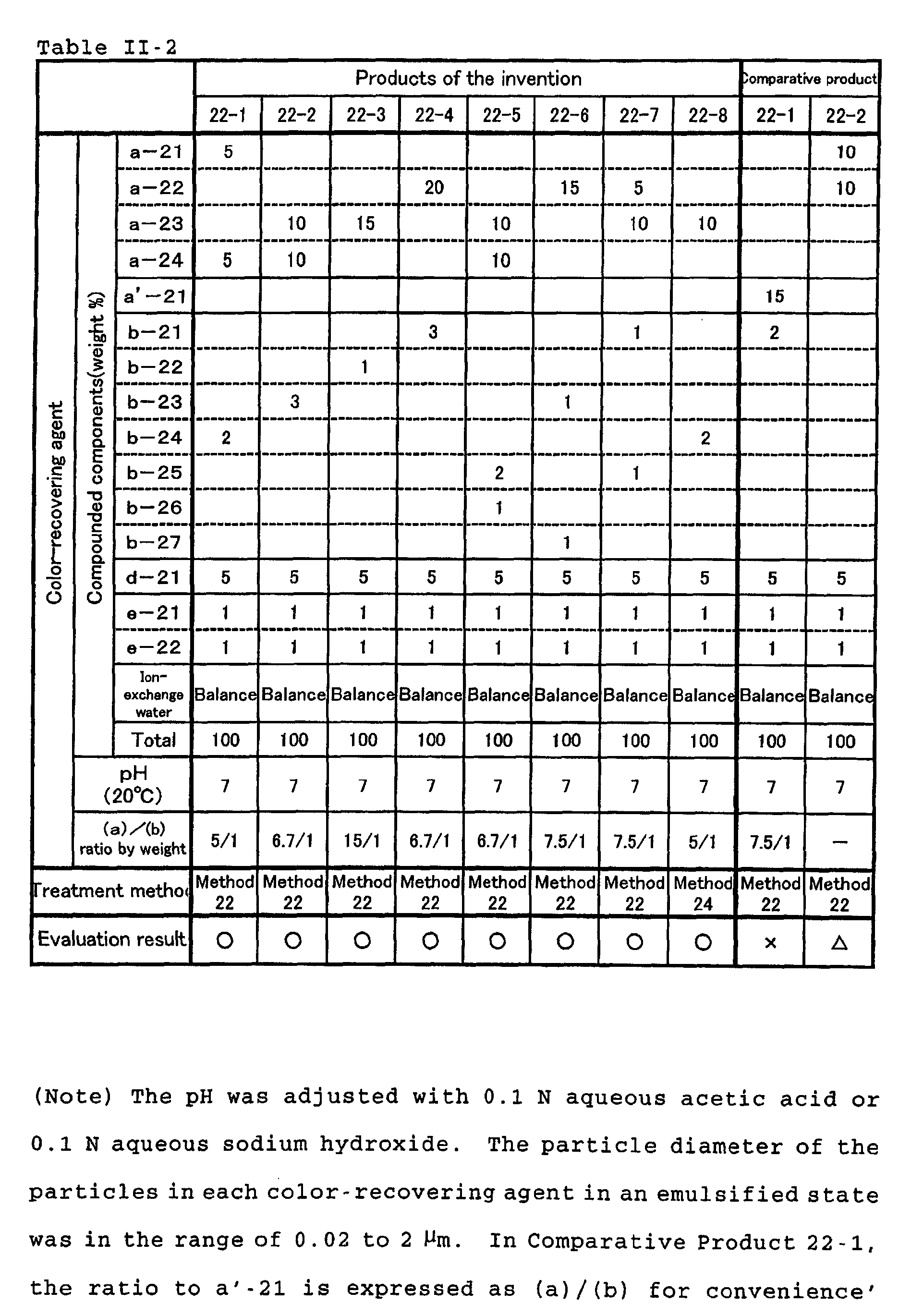
- compositions in Tables II-1 to II-2 were prepared in the same manner as in Example I except that the components (a-21) to (e-22) below were used.
- the reaction mixture was concentrated under reduced pressure, whereby an N-propionyl ethylene imine-dimethyl siloxane copolymer was obtained as a pale yellow rubber solid (468 g, yield 97%).
- the content of dimethyl polysiloxane was 61%, and the weight-average molecular weight was 102,000.
- the weakly alkaline detergent used had an average particle diameter of 500 ⁇ m (from which particles of 125 ⁇ m or less in diameter and particles of 1,000 ⁇ m or more in diameter had been removed), an apparent bulk density of 700 g/cm 3 and a composition consisting of 22 weight % sodium linear (C 12-13 ) alkyl benzene sulfonate, 5 weight % sodium lauryl sulfate, 4 weight % sodium myristate, 5 weight % polyoxyethylene lauryl ether (having 8 molecules on average of ethylene oxide added thereto), 8 weight % sodium silicate No.
- ⁇ Treatment method 21> was the same as treatment method 1 above.
- the above faded clothes were washed and rinsed with a combination of a weakly alkaline detergent (the same as the one used in preparation of the faded clothes; the concentration of the detergent, 0.0667 weight %) and the color-recovering agent (0.3 weight %) in Table II-2 in a washing machine under the same conditions as in preparation of the above faded clothes. To clarify the color-recovering effect, this procedure was repeated 7 times. The faded clothes were compared with faded clothes as the control washed 7 times without using the color-recovering agent in Table 2 and evaluated under the evaluation criteria in treatment method 1. The results are shown in Table II-2.
- ⁇ Treatment method 23> was the same as treatment method 3 described above.
Landscapes
- Chemical & Material Sciences (AREA)
- Engineering & Computer Science (AREA)
- Life Sciences & Earth Sciences (AREA)
- Chemical Kinetics & Catalysis (AREA)
- Oil, Petroleum & Natural Gas (AREA)
- Wood Science & Technology (AREA)
- Organic Chemistry (AREA)
- Health & Medical Sciences (AREA)
- Emergency Medicine (AREA)
- Textile Engineering (AREA)
- Detergent Compositions (AREA)
Abstract
Description


- 0:
- Near to the color of new clothes.
- 1:
- Seems more vivid in color than the control.
- 2:
- Seems equal to the control.
- 3:
- Seems more faded than the control.




Claims (5)
- A color-recovering agent composition which comprises (a) a water-insoluble polymer with a refractive index of 1.20 to 1.45 at 25°C, (b) at least one compound selected from the group consisting of components (i) and (ii) below defined and (c) water, wherein the ratio by weight of (a)/(b) is in the range of 3/1 to 100/1:(i) a compound with a molecular weight of 300 to 1,000, having, in the molecule thereof, at least one member selected from the group consisting of an amide group, an ester group, a quaternary ammonium group and a tertiary amino group and at least one of a C10-36 alkyl or alkenyl group, and(ii) a polymer or copolymer derived from at least one ethylenically unsaturated compound having at least one member selected from the group consisting of an amide group, a carboxylic acid group, a hydroxyl group, a quaternary ammonium group and a tertiary amino group.
- The composition according to claim 1, wherein the component (a) is a fluorine-containing polymer or a silicone compound.
- The composition according to claim 1, wherein the component (a) is a water-insoluble silicone compound and the component (b) is a compound with a molecular weight of 300 to 1000,having, in the molecule thereof, at least one of a quaternary ammonium group and a tertiary amino group and at least one of a C10-36 alkyl group and a C10-36 alkenyl group.
- The composition according to claim 1 or 3, which further comprises (d) a non-aqueous medium.
- The composition according to claim 1 or 3, which further comprises (d) a non-aqueous medium and (e) an emulsifier.
Applications Claiming Priority (5)
| Application Number | Priority Date | Filing Date | Title |
|---|---|---|---|
| JP2000154526 | 2000-05-25 | ||
| JP2000154525 | 2000-05-25 | ||
| JP2000154525A JP4447116B2 (en) | 2000-05-25 | 2000-05-25 | Color recovery agent |
| JP2000154526A JP4447117B2 (en) | 2000-05-25 | 2000-05-25 | Color recovery agent |
| PCT/JP2001/004365 WO2001090477A1 (en) | 2000-05-25 | 2001-05-24 | Color-recovering agent |
Publications (3)
| Publication Number | Publication Date |
|---|---|
| EP1291461A1 true EP1291461A1 (en) | 2003-03-12 |
| EP1291461A4 EP1291461A4 (en) | 2004-06-16 |
| EP1291461B1 EP1291461B1 (en) | 2007-03-07 |
Family
ID=26592576
Family Applications (1)
| Application Number | Title | Priority Date | Filing Date |
|---|---|---|---|
| EP01932248A Expired - Lifetime EP1291461B1 (en) | 2000-05-25 | 2001-05-24 | Color-recovering agent |
Country Status (5)
| Country | Link |
|---|---|
| US (1) | US7003834B2 (en) |
| EP (1) | EP1291461B1 (en) |
| CN (1) | CN1221705C (en) |
| DE (1) | DE60127117T2 (en) |
| WO (1) | WO2001090477A1 (en) |
Cited By (3)
| Publication number | Priority date | Publication date | Assignee | Title |
|---|---|---|---|---|
| EP1358865A3 (en) * | 2002-04-22 | 2004-01-07 | The Procter & Gamble Company | Durable hair treatment composition |
| WO2022152671A1 (en) * | 2021-01-13 | 2022-07-21 | Unilever Ip Holdings B.V. | Laundry composition |
| WO2022152548A1 (en) * | 2021-01-13 | 2022-07-21 | Unilever Ip Holdings B.V. | Fabric conditioner |
Families Citing this family (3)
| Publication number | Priority date | Publication date | Assignee | Title |
|---|---|---|---|---|
| EP1591102A1 (en) * | 2004-04-30 | 2005-11-02 | The Procter & Gamble Company | Process and kit-of-parts for improved hair conditioning after coloring, bleaching or perming |
| CN101834110B (en) * | 2010-03-30 | 2011-11-09 | 扬州润光照明电器有限公司 | Conductive film for electrodeless lamp and production method thereof |
| US10435647B2 (en) * | 2017-08-08 | 2019-10-08 | The Seydel Companies, Inc. | Polyesters made from bio-renewable raw materials for preventing dye redeposition on fabrics and garments in textile finishing and garment washing processes |
Family Cites Families (28)
| Publication number | Priority date | Publication date | Assignee | Title |
|---|---|---|---|---|
| US3372048A (en) * | 1963-07-31 | 1968-03-05 | American Cyanamid Co | Process for the color restoration of faded textile materials and articles produced thereby |
| JPS53111192A (en) | 1977-03-07 | 1978-09-28 | Toray Industries | Fiber structure with improved deep color |
| JPS5851557B2 (en) * | 1978-08-11 | 1983-11-17 | 東レ株式会社 | Method for improving color development of fiber structures |
| DK163591C (en) | 1985-10-08 | 1992-08-24 | Novo Nordisk As | PROCEDURE FOR TREATING A TEXTILE SUBSTANCE WITH A CELLULASE |
| JPS63145482A (en) | 1986-12-05 | 1988-06-17 | 花王株式会社 | Finish composition for clothing |
| GB8817961D0 (en) * | 1988-07-28 | 1988-09-01 | Dow Corning Ltd | Compositions & process for treatment of textiles |
| JP3015408B2 (en) | 1989-05-23 | 2000-03-06 | 三洋電機株式会社 | Method for manufacturing superconducting transistor |
| CA2019352A1 (en) * | 1989-06-21 | 1990-12-21 | Clarence R. Robbins | Fiber conditioning compositions containing aminosilicone conditioning agent |
| DE3929757A1 (en) * | 1989-09-07 | 1991-03-14 | Sandoz Ag | WAFERRED AMINOPOLYSILOXANIC MICROSULSIONS, THEIR PREPARATION AND USE |
| JPH03180578A (en) * | 1989-12-11 | 1991-08-06 | Kao Corp | Aerosol fiber color-thickening agent |
| JP3021060B2 (en) * | 1990-06-27 | 2000-03-15 | 帝人株式会社 | Deep-colored polyester fiber fabric and method for producing the same |
| WO1992001773A1 (en) | 1990-07-23 | 1992-02-06 | The Procter & Gamble Company | Liquid fabric softeners containing microemulsified amino silanes |
| US5173201A (en) | 1990-07-23 | 1992-12-22 | The Proctor & Gamble Company | Microemulsified amine functional silicone in liquid fabric softeners for reducing fiber-fiber and yarn-yarn friction in fabrics |
| US5310772A (en) * | 1990-09-07 | 1994-05-10 | Alliedsignal Inc. | Coemulsification of oxidized polyethylene homopolymers and amino functional silicone fluids |
| GB2270919B (en) * | 1992-09-26 | 1996-04-24 | Sandoz Ltd | Aqueous wax and silicone dispersions,their production and use |
| JP2852898B2 (en) * | 1995-03-30 | 1999-02-03 | 三洋化成工業株式会社 | Soft finish for textile |
| US6077317A (en) * | 1996-01-25 | 2000-06-20 | Lever Brothers Company, Division Of Conopco, Inc. | Prewash stain remover composition with siloxane based surfactant |
| WO1998000498A1 (en) * | 1996-06-28 | 1998-01-08 | The Procter & Gamble Company | Liquid cleaning compositions and shampoos containing dianionic or alkoxylated dianionic surfactants |
| JPH1096172A (en) | 1996-09-18 | 1998-04-14 | Lion Corp | Fiber treatment composition |
| BR9712638A (en) | 1996-10-21 | 1999-10-26 | Procter & Gamble | High utilization of fabric softening compositions for improved benefits |
| US6040288A (en) * | 1997-02-21 | 2000-03-21 | Rhodia Inc. | Fabric color protection compositions and methods |
| JP3552229B2 (en) * | 1997-09-08 | 2004-08-11 | 信越化学工業株式会社 | Synthetic fiber darkener |
| US6143286A (en) * | 1998-08-05 | 2000-11-07 | Revlon Consumer Products Corporation | Method for improving the fade resistance of hair and related compositions |
| JP4039750B2 (en) * | 1998-10-05 | 2008-01-30 | ライオン株式会社 | Liquid finish composition for textile products |
| US7041630B1 (en) * | 1998-10-23 | 2006-05-09 | The Procter & Gamble Company | Fabric color care method for rejuvenating and/or restoring color to a faded fabric |
| KR20010070002A (en) | 1999-07-29 | 2001-07-25 | 고오사이 아끼오 | Acid resistant catalyst sheet and process for producing same |
| GB2364065A (en) * | 2000-06-28 | 2002-01-16 | Procter & Gamble | Fabric treatment composition |
| CA2424698A1 (en) * | 2000-11-16 | 2002-05-23 | The Procter & Gamble Company | Fabric color care method |
-
2001
- 2001-05-24 US US10/239,569 patent/US7003834B2/en not_active Expired - Fee Related
- 2001-05-24 EP EP01932248A patent/EP1291461B1/en not_active Expired - Lifetime
- 2001-05-24 WO PCT/JP2001/004365 patent/WO2001090477A1/en not_active Ceased
- 2001-05-24 CN CNB018101003A patent/CN1221705C/en not_active Expired - Fee Related
- 2001-05-24 DE DE60127117T patent/DE60127117T2/en not_active Expired - Lifetime
Cited By (5)
| Publication number | Priority date | Publication date | Assignee | Title |
|---|---|---|---|---|
| EP1358865A3 (en) * | 2002-04-22 | 2004-01-07 | The Procter & Gamble Company | Durable hair treatment composition |
| WO2003088939A3 (en) * | 2002-04-22 | 2004-02-05 | Procter & Gamble | Durable hair treatment composition |
| WO2022152671A1 (en) * | 2021-01-13 | 2022-07-21 | Unilever Ip Holdings B.V. | Laundry composition |
| WO2022152640A1 (en) * | 2021-01-13 | 2022-07-21 | Unilever Ip Holdings B.V. | Laundry composition |
| WO2022152548A1 (en) * | 2021-01-13 | 2022-07-21 | Unilever Ip Holdings B.V. | Fabric conditioner |
Also Published As
| Publication number | Publication date |
|---|---|
| US20030141489A1 (en) | 2003-07-31 |
| CN1430690A (en) | 2003-07-16 |
| CN1221705C (en) | 2005-10-05 |
| DE60127117D1 (en) | 2007-04-19 |
| EP1291461B1 (en) | 2007-03-07 |
| EP1291461A4 (en) | 2004-06-16 |
| US7003834B2 (en) | 2006-02-28 |
| DE60127117T2 (en) | 2007-12-13 |
| WO2001090477A1 (en) | 2001-11-29 |
Similar Documents
| Publication | Publication Date | Title |
|---|---|---|
| CA2073812C (en) | Water dispersible or water soluble copolymer containing uv-absorbing monomer | |
| EP1465931B1 (en) | Azetidinium modified polymers and fabric treatment composition | |
| CA2073791C (en) | Fabric care composition comprising water soluble or water dispersible copolymer containing uv-absorbing monomer | |
| US20030158344A1 (en) | Hydrophobe-amine graft copolymer | |
| WO2009128549A1 (en) | Textile treatment agent composition | |
| CA2266255A1 (en) | In situ solvent free method for making anhydride based graft copolymers | |
| US7003834B2 (en) | Color-recovering agent | |
| EP0443313B1 (en) | Liquid softener composition for fabric | |
| JP4997180B2 (en) | Textile processing method | |
| JP4727281B2 (en) | Liquid detergent composition for clothing | |
| JP4447117B2 (en) | Color recovery agent | |
| JP7788825B2 (en) | Washing Instructions | |
| EP1023424A1 (en) | Detergent composition | |
| JP4467834B2 (en) | Color recovery method | |
| JP4980032B2 (en) | Textile treatment agent | |
| JP4447116B2 (en) | Color recovery agent | |
| DE60201986T2 (en) | DETERGENT COMPOSITION | |
| JP2009155751A (en) | Textile treatment agent | |
| EP2093323B1 (en) | Liquid softener composition, or transparent or semi-transparent liquid softener composition | |
| DE60105763T2 (en) | COMPOSITION TO TEXTILE CARE | |
| DE60109196T2 (en) | TEXTILE CARE | |
| JPH09255988A (en) | Liquid detergent composition | |
| JP6964468B2 (en) | How to wash textiles | |
| JP5495536B2 (en) | Liquid detergent composition | |
| EP1574562B1 (en) | Detergent compositions |
Legal Events
| Date | Code | Title | Description |
|---|---|---|---|
| PUAI | Public reference made under article 153(3) epc to a published international application that has entered the european phase |
Free format text: ORIGINAL CODE: 0009012 |
|
| 17P | Request for examination filed |
Effective date: 20021025 |
|
| AK | Designated contracting states |
Designated state(s): AT BE CH CY DE DK ES FI FR GB GR IE IT LI LU MC NL PT SE TR Kind code of ref document: A1 Designated state(s): AT BE CH CY DE DK ES FI FR GB GR IE IT LI LU MC NL PT SE TR |
|
| RBV | Designated contracting states (corrected) |
Designated state(s): AT BE CH DE FR GB LI |
|
| RIC1 | Information provided on ipc code assigned before grant |
Ipc: 7D 06M 13/332 B Ipc: 7D 06M 13/46 B Ipc: 7C 11D 1/62 B Ipc: 7C 11D 3/00 B Ipc: 7C 11D 17/00 B Ipc: 7D 06P 5/08 B Ipc: 7C 11D 3/37 A Ipc: 7D 06M 15/643 B Ipc: 7C 11D 3/32 B |
|
| A4 | Supplementary search report drawn up and despatched |
Effective date: 20040429 |
|
| RBV | Designated contracting states (corrected) |
Designated state(s): DE FR GB |
|
| 17Q | First examination report despatched |
Effective date: 20050513 |
|
| GRAP | Despatch of communication of intention to grant a patent |
Free format text: ORIGINAL CODE: EPIDOSNIGR1 |
|
| GRAS | Grant fee paid |
Free format text: ORIGINAL CODE: EPIDOSNIGR3 |
|
| GRAA | (expected) grant |
Free format text: ORIGINAL CODE: 0009210 |
|
| AK | Designated contracting states |
Kind code of ref document: B1 Designated state(s): DE FR GB |
|
| REG | Reference to a national code |
Ref country code: GB Ref legal event code: FG4D |
|
| REF | Corresponds to: |
Ref document number: 60127117 Country of ref document: DE Date of ref document: 20070419 Kind code of ref document: P |
|
| ET | Fr: translation filed | ||
| PLBE | No opposition filed within time limit |
Free format text: ORIGINAL CODE: 0009261 |
|
| STAA | Information on the status of an ep patent application or granted ep patent |
Free format text: STATUS: NO OPPOSITION FILED WITHIN TIME LIMIT |
|
| 26N | No opposition filed |
Effective date: 20071210 |
|
| PGFP | Annual fee paid to national office [announced via postgrant information from national office to epo] |
Ref country code: FR Payment date: 20110523 Year of fee payment: 11 |
|
| PGFP | Annual fee paid to national office [announced via postgrant information from national office to epo] |
Ref country code: GB Payment date: 20110518 Year of fee payment: 11 |
|
| PGFP | Annual fee paid to national office [announced via postgrant information from national office to epo] |
Ref country code: DE Payment date: 20110518 Year of fee payment: 11 |
|
| GBPC | Gb: european patent ceased through non-payment of renewal fee |
Effective date: 20120524 |
|
| REG | Reference to a national code |
Ref country code: FR Ref legal event code: ST Effective date: 20130131 |
|
| REG | Reference to a national code |
Ref country code: DE Ref legal event code: R119 Ref document number: 60127117 Country of ref document: DE Effective date: 20121201 |
|
| PG25 | Lapsed in a contracting state [announced via postgrant information from national office to epo] |
Ref country code: FR Free format text: LAPSE BECAUSE OF NON-PAYMENT OF DUE FEES Effective date: 20120531 Ref country code: GB Free format text: LAPSE BECAUSE OF NON-PAYMENT OF DUE FEES Effective date: 20120524 |
|
| PG25 | Lapsed in a contracting state [announced via postgrant information from national office to epo] |
Ref country code: DE Free format text: LAPSE BECAUSE OF NON-PAYMENT OF DUE FEES Effective date: 20121201 |