EP1291040A2 - Method for neutralizing solid residue in abandoned chemical weapons - Google Patents
Method for neutralizing solid residue in abandoned chemical weapons Download PDFInfo
- Publication number
- EP1291040A2 EP1291040A2 EP02256191A EP02256191A EP1291040A2 EP 1291040 A2 EP1291040 A2 EP 1291040A2 EP 02256191 A EP02256191 A EP 02256191A EP 02256191 A EP02256191 A EP 02256191A EP 1291040 A2 EP1291040 A2 EP 1291040A2
- Authority
- EP
- European Patent Office
- Prior art keywords
- solid residue
- solution
- neutralizing
- heel
- dissolving
- Prior art date
- Legal status (The legal status is an assumption and is not a legal conclusion. Google has not performed a legal analysis and makes no representation as to the accuracy of the status listed.)
- Granted
Links
Images

Classifications
-
- A—HUMAN NECESSITIES
- A62—LIFE-SAVING; FIRE-FIGHTING
- A62D—CHEMICAL MEANS FOR EXTINGUISHING FIRES OR FOR COMBATING OR PROTECTING AGAINST HARMFUL CHEMICAL AGENTS; CHEMICAL MATERIALS FOR USE IN BREATHING APPARATUS
- A62D3/00—Processes for making harmful chemical substances harmless or less harmful, by effecting a chemical change in the substances
- A62D3/30—Processes for making harmful chemical substances harmless or less harmful, by effecting a chemical change in the substances by reacting with chemical agents
-
- A—HUMAN NECESSITIES
- A62—LIFE-SAVING; FIRE-FIGHTING
- A62D—CHEMICAL MEANS FOR EXTINGUISHING FIRES OR FOR COMBATING OR PROTECTING AGAINST HARMFUL CHEMICAL AGENTS; CHEMICAL MATERIALS FOR USE IN BREATHING APPARATUS
- A62D3/00—Processes for making harmful chemical substances harmless or less harmful, by effecting a chemical change in the substances
- A62D3/30—Processes for making harmful chemical substances harmless or less harmful, by effecting a chemical change in the substances by reacting with chemical agents
- A62D3/36—Detoxification by using acid or alkaline reagents
-
- A—HUMAN NECESSITIES
- A62—LIFE-SAVING; FIRE-FIGHTING
- A62D—CHEMICAL MEANS FOR EXTINGUISHING FIRES OR FOR COMBATING OR PROTECTING AGAINST HARMFUL CHEMICAL AGENTS; CHEMICAL MATERIALS FOR USE IN BREATHING APPARATUS
- A62D3/00—Processes for making harmful chemical substances harmless or less harmful, by effecting a chemical change in the substances
- A62D3/30—Processes for making harmful chemical substances harmless or less harmful, by effecting a chemical change in the substances by reacting with chemical agents
- A62D3/38—Processes for making harmful chemical substances harmless or less harmful, by effecting a chemical change in the substances by reacting with chemical agents by oxidation; by combustion
-
- C—CHEMISTRY; METALLURGY
- C06—EXPLOSIVES; MATCHES
- C06B—EXPLOSIVES OR THERMIC COMPOSITIONS; MANUFACTURE THEREOF; USE OF SINGLE SUBSTANCES AS EXPLOSIVES
- C06B21/00—Apparatus or methods for working-up explosives, e.g. forming, cutting, drying
- C06B21/0091—Elimination of undesirable or temporary components of an intermediate or finished product, e.g. making porous or low density products, purifying, stabilising, drying; Deactivating; Reclaiming
-
- A—HUMAN NECESSITIES
- A62—LIFE-SAVING; FIRE-FIGHTING
- A62D—CHEMICAL MEANS FOR EXTINGUISHING FIRES OR FOR COMBATING OR PROTECTING AGAINST HARMFUL CHEMICAL AGENTS; CHEMICAL MATERIALS FOR USE IN BREATHING APPARATUS
- A62D2101/00—Harmful chemical substances made harmless, or less harmful, by effecting chemical change
- A62D2101/02—Chemical warfare substances, e.g. cholinesterase inhibitors
-
- A—HUMAN NECESSITIES
- A62—LIFE-SAVING; FIRE-FIGHTING
- A62D—CHEMICAL MEANS FOR EXTINGUISHING FIRES OR FOR COMBATING OR PROTECTING AGAINST HARMFUL CHEMICAL AGENTS; CHEMICAL MATERIALS FOR USE IN BREATHING APPARATUS
- A62D2203/00—Aspects of processes for making harmful chemical substances harmless, or less harmful, by effecting chemical change in the substances
- A62D2203/02—Combined processes involving two or more distinct steps covered by groups A62D3/10 - A62D3/40
-
- A—HUMAN NECESSITIES
- A62—LIFE-SAVING; FIRE-FIGHTING
- A62D—CHEMICAL MEANS FOR EXTINGUISHING FIRES OR FOR COMBATING OR PROTECTING AGAINST HARMFUL CHEMICAL AGENTS; CHEMICAL MATERIALS FOR USE IN BREATHING APPARATUS
- A62D2203/00—Aspects of processes for making harmful chemical substances harmless, or less harmful, by effecting chemical change in the substances
- A62D2203/04—Combined processes involving two or more non-distinct steps covered by groups A62D3/10 - A62D3/40
Definitions
- the present invention relates to a method for neutralizing and decontaminating solid residue adhered onto munition bodies of abandoned chemical weapons.
- Chemical munitions have generally been processed according to the following steps:
- the surface of the heel remaining in the munition shell has an insoluble coat resulting from high-polymeric modification of chemical agents due to long-term abandonment.
- the heel cannot be sufficiently dissolved even with a strong alkaline solution at a high temperature, thereby inhibiting hydrolysis.
- One possible solution is to cut the insoluble coat of the heel or the heel itself into minute pieces in advance; however, such cutting requires high precision and complicated steps, resulting in a longer processing time and inefficiency, which is a problem.
- the present invention aims to solve the problems and overcome weaknesses encountered in the conventional art. It is an object of the present invention to provide a method for neutralizing solid residue, i.e., heel, in a chemical weapon that can reliably and completely dissolve the solid residue to promote hydrolysis and that can efficiently decontaminate the chemical weapon in a short time.
- a first aspect of the present invention provides a method for decontaminating and neutralizing solid residue remaining in a munition shell of an abandoned chemical weapon, including the steps of: dissolving the solid residue using an organic solvent to obtain a solid residue solution; and neutralizing the solid residue solution with an alkaline solution and an oxidant.
- hydrolysis with the alkaline solution is performed first, and oxidation with the oxidant is performed next.
- hydrolysis with the alkaline solution and oxidation with the oxidant are performed simultaneously.
- a second aspect of the present invention provides a method for decontaminating and neutralizing solid residue remaining in a munition shell of an abandoned chemical weapon, including the steps of: dissolving the solid residue with a mixture containing an organic solvent and an alkaline solution to obtain a solid residue solution; and neutralizing the solid residue solution with an alkaline solution and an oxidant.
- a third aspect of the present invention provides a method for decontaminating and neutralizing solid residue remaining in a munition shell of an abandoned chemical weapon, including the steps of dissolving the solid residue with an organic solvent so as to perform a primary dissolving process, treating the solid residue remaining in the munition shell with a mixture of the organic solvent and an alkaline solution to perform a secondary dissolving process and a primary hydrolysis process to obtain a solid residue solution, and neutralizing the solid residue solution with an oxidant.
- an alkaline solution is added to the solid residue solution.
- the organic solvent used in the step of dissolving the solid residue comprises at least one selected from the group consisting of methyl isobutyl ketone, N,N-dimethylformamide, and dimethyl sulfoxide.
- the alkaline solution is a NaOH solution or a KOH solution.
- the oxidant contains H 2 O 2 .
- ketones or amides may be particularly effective among organic solvents since they have a polarity between that of aqueous and oily.
- organic solvents are methyl isobutyl ketone (MIBK), N,N-dimethylformamide (DMF), and dimethyl sulfoxide (DMSO).
- MIBK methyl isobutyl ketone
- DMF N,N-dimethylformamide
- DMSO dimethyl sulfoxide
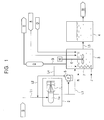
- Fig. 1 is a process chart illustrating a first embodiment of the present invention.
- reference numeral 1 denotes a chemical munition
- 2 denotes a disassembling machine for demolishing the chemical munition 1 installed inside a disassembling chamber
- 3 denotes a reaction vessel for hydrolyzing and oxidizing a solution in which heel, i.e., solid residue, is dissolved, hereinafter referred to as the solid residue solution or heel solution
- 4 denotes a processed solution storage vessel for storing the solution that has been subjected to the above processes.
- the chemical munition 1 is fixed, and a hole is bored in a munition shell 1a using the disassembling machine 2.
- a nozzle is inserted into the hole.
- an organic solvent S such as MIBK or the like is fed from the nozzle via a solvent supply line L1 and is circulated by a pump 5 through a solvent circulation line L2 to wash the munition shell 1a and dissolve the heel remaining in the munition shell 1a.
- the washing and dissolving by the organic solvent S is performed at normal temperature.
- the supply and circulation of the organic solvent S are stopped.
- the circulated liquid i.e., the heel solution
- a line L4 is a circulation adjusting line for adjusting the circulation rate of the organic solvent S.
- the excess solvent is discharged into the reaction vessel 3 via the line L4.
- an alkaline solution A such as NaOH or KOH
- an oxidant such as hydrogen peroxide (H 2 O 2 ) are simultaneously added to the heel solution so as to hydrolyze and oxidize the heel solution simultaneously.
- hot steam J is fed to a heat exchanger 7 to maintain the temperature of the heel solution at 110 to 115°C, i.e., at a boiling temperature.
- cooling water R is fed to the heat exchanger 7 to cool the reacted solution to normal temperature.
- the reacted solution i.e., the processed solution
- the reacted solution is discharged to the processed solution storage vessel 4 via a processed solution discharge line L5.
- the processed solution is subjected to decontamination such as stabilization according to its components such as arsenic or the like, is sealed in a steel drum, and is stored as a waste solution W.
- the effluent gas from the reaction vessel 3 is discharged via an effluent gas line G and a condenser D.
- the effluent gas i.e., a vessel vent V, is then subjected a separate decontamination.
- the munition shell is washed and the heel is dissolved with an organic solvent such as MIBK or the like.
- an organic solvent such as MIBK or the like.
- an alkaline solution and an oxidant are simultaneously added to the heel solution in the reaction vessel to perform simultaneous hydrolysis and oxidation thereof, neutralization can be performed efficiently in a short time.
- the reaction rate can be further increased. The reaction rate of hydrolysis at a boiling temperature is 6 times or more higher than that at a low temperature, i.e., 90°C or less. Since the organic solvent can be recycled, the process in this embodiment is economically advantageous as well.
- the present invention is not limited to this embodiment.
- the oxidation may be performed after hydrolysis, as has been performed conventionally.
- the present invention includes a modification in which the process is performed at a temperature of 90°C or more and less than 110°C, which is the boiling temperature.
- FIG. 2 is a process chart illustrating the second embodiment of the present invention.
- the detailed descriptions of the components and the steps common to the first embodiment are omitted. Only those differing from the first embodiment are described in detail.
- a hole is bored in the munition shell 1a of the chemical munition 1, and a nozzle is inserted into the hole.
- the organic solvent S such as MIBK or the like described above is fed via the solvent supply line L1 and is circulated using the pump 5 via the solvent circulation line L2 so as to dissolve the heel remaining in the munition shell 1a (a primary dissolving process).
- the supply and the circulation of the organic solvent S are halted, and the circulated liquid, i.e., the heel solution, is discharged into the reaction vessel 3 via the heel solution discharge line L3.
- an alkaline solution A such as NaOH, KOH, or the like is added to the heel solution.
- the liquid in the reaction vessel 3 i.e., the mixture of the organic solvent and the alkaline solution
- the mixture is circulated via a mixture circulation line L6 so as to dissolve any heel still remaining in the munition shell (a secondary dissolving process) until the heel is completely dissolved and removed and to simultaneously perform partial hydrolysis (a primary hydrolysis process).
- An oxidant O is added to the heel solution in the vessel after the above-described treatment.
- the alkaline solution A may be further added to the solution if necessary.
- a secondary hydrolysis treatment and oxidation are performed at a boiling temperature of 110 to 115°C so as to complete the neutralization.
- a primary dissolving process using an organic solvent such as MIBK and a secondary dissolving process for the mixture of organic solvent and the alkaline solution are performed in combination in two stages.
- an organic solvent such as MIBK
- a secondary dissolving process for the mixture of organic solvent and the alkaline solution are performed in combination in two stages.
- the mixture used in the secondary dissolving and in the hydrolysis contains an organic solvent and an alkaline solution.
- an oxidant may be added to the mixture.
- the alkaline solution in the mixture is recycled from the reaction vessel; alternatively, a mixture of a fresh organic solvent and a fresh alkaline solution may be circulated without having to pass through the reaction vessel.
- the solid residue, i.e., the heel, remaining in chemical weapons can be completely dissolved in a short time while sufficiently promoting the hydrolysis.
- decontamination of chemical weapons as a whole can be efficiently performed in a short time.
- the present invention provides an important technical contribution to this field.
Landscapes
- Chemical & Material Sciences (AREA)
- Health & Medical Sciences (AREA)
- General Health & Medical Sciences (AREA)
- Toxicology (AREA)
- Chemical Kinetics & Catalysis (AREA)
- General Chemical & Material Sciences (AREA)
- Business, Economics & Management (AREA)
- Emergency Management (AREA)
- Organic Chemistry (AREA)
- Processing Of Solid Wastes (AREA)
- Compounds Of Unknown Constitution (AREA)
- Compounds Of Alkaline-Earth Elements, Aluminum Or Rare-Earth Metals (AREA)
Abstract
Description
| (Solubility of a highly insoluble heel sample after hydrolysis) | |
| MIBK | 5.8 g/mL |
| DMF | 4.3 g/mL |
| DMSO | 3.6 g/mL |
Claims (9)
- A method for decontaminating and neutralizing solid residue remaining in a munition shell of an abandoned chemical weapon, comprising the steps of:dissolving the solid residue using an organic solvent to obtain a solid residue solution; andneutralizing the solid residue solution with an alkaline solution and an oxidant.
- The method according to claim 1, wherein, in the step of neutralizing the solid residue solution, hydrolysis with the alkaline solution is performed, and oxidation with the oxidant is then performed.
- The method according to claim 1, wherein, in the step of neutralizing the solid residue solution, hydrolysis with the alkaline solution and oxidation with the oxidant are performed simultaneously.
- A method for decontaminating and neutralizing solid residue remaining in a munition shell of an abandoned chemical weapon, comprising the steps of:dissolving the solid residue with a mixture comprising an organic solvent and an alkaline solution to obtain a solid residue solution; andneutralizing the solid residue solution with an alkaline solution and an oxidant.
- A method for decontaminating and neutralizing solid residue remaining in a munition shell of an abandoned chemical weapon, comprising the steps of:dissolving the solid residue with an organic solvent so as to perform a primary dissolving process;treating the solid residue remaining in the munition shell with a mixture of the organic solvent and an alkaline solution to perform a secondary dissolving process and a primary hydrolysis process to obtain a solid residue solution; andneutralizing the solid residue solution with an oxidant.
- The method according to claim 5, wherein, in the step of neutralizing the solid residue solution, an alkaline solution is added to the solid residue solution.
- The method according to any preceding claim, wherein the organic solvent used in the step of dissolving the solid residue comprises at least one selected from methyl isobutyl ketone, N,N-dimethylformamide, and dimethyl sulfoxide.
- The method according to any preceding claim, wherein the alkaline solution is an NaOH solution or a KOH solution.
- The method according to any preceding claim, wherein the oxidant comprises H2O2.
Applications Claiming Priority (2)
| Application Number | Priority Date | Filing Date | Title |
|---|---|---|---|
| JP2001272066 | 2001-09-07 | ||
| JP2001272066 | 2001-09-07 |
Publications (3)
| Publication Number | Publication Date |
|---|---|
| EP1291040A2 true EP1291040A2 (en) | 2003-03-12 |
| EP1291040A3 EP1291040A3 (en) | 2004-07-14 |
| EP1291040B1 EP1291040B1 (en) | 2009-11-04 |
Family
ID=19097490
Family Applications (1)
| Application Number | Title | Priority Date | Filing Date |
|---|---|---|---|
| EP02256191A Expired - Lifetime EP1291040B1 (en) | 2001-09-07 | 2002-09-06 | Method for neutralizing solid residue in abandoned chemical weapons |
Country Status (5)
| Country | Link |
|---|---|
| US (1) | US7435866B2 (en) |
| EP (1) | EP1291040B1 (en) |
| CN (1) | CN1264616C (en) |
| DE (1) | DE60234233D1 (en) |
| RU (1) | RU2236881C2 (en) |
Cited By (3)
| Publication number | Priority date | Publication date | Assignee | Title |
|---|---|---|---|---|
| WO2005035067A3 (en) * | 2003-04-24 | 2005-11-24 | Steris Inc | Activated vapor treatment for neutralizing warfare agents |
| ES2259575A1 (en) * | 2006-03-31 | 2006-10-01 | Arturo Diaz De Barrionuevo | Integral recuperation of high energy content products comprises disarming of projectiles for explosives alkaline hydrolysis and regeneration of the inert matter |
| GR1011080B (en) * | 2024-09-06 | 2025-11-25 | Soukos Robotics E.E., | Method and system for the demilitarization of conventional ammunition of all types and calibers, as well as chemical and biological weapons, with integrated artificial intelligence (ai) |
Families Citing this family (9)
| Publication number | Priority date | Publication date | Assignee | Title |
|---|---|---|---|---|
| WO2002033628A2 (en) * | 2000-10-18 | 2002-04-25 | Johnson & Johnson Consumer Companies, Inc. | Intelligent performance-based product recommendation system |
| DE60307259T2 (en) * | 2002-04-24 | 2007-07-19 | Steris Inc., Temecula | TREATMENT SYSTEM AND METHOD USING ACTIVATED OXYGENATING STEAM |
| US7518029B2 (en) * | 2003-02-18 | 2009-04-14 | Defence Research & Development Organisation | Process for destruction of gelled sulphur mustard |
| US7102052B2 (en) * | 2003-04-24 | 2006-09-05 | Steris Inc | Activated vapor treatment for neutralizing warfare agents |
| JP3987870B1 (en) * | 2006-05-02 | 2007-10-10 | 株式会社神戸製鋼所 | Purification method in pressure-resistant container for blast treatment |
| US20090187060A1 (en) | 2008-01-22 | 2009-07-23 | E-Z-Em, Inc. | Method and Formulation for Neutralizing Toxic Chemicals and Materials |
| US20100119412A1 (en) * | 2008-11-07 | 2010-05-13 | Aries Associates, Inc. | Novel Chemistries, Solutions, and Dispersal Systems for Decontamination of Chemical and Biological Systems |
| US20100179368A1 (en) * | 2008-11-07 | 2010-07-15 | Aries Associates, Inc. | Novel Chemistries, Solutions, and Dispersal Systems for Decontamination of Chemical and Biological Systems |
| CN117776825B (en) * | 2023-12-25 | 2026-03-27 | 一重集团大连工程技术有限公司 | A method for processing energetic materials |
Family Cites Families (11)
| Publication number | Priority date | Publication date | Assignee | Title |
|---|---|---|---|---|
| US3810842A (en) | 1966-02-15 | 1974-05-14 | Grace W R & Co | Composition for decontaminating chemical warfare agents |
| US3810788A (en) * | 1966-02-15 | 1974-05-14 | P Steyermark | Method for decontaminating chemical warfare agents |
| US3634278A (en) * | 1969-02-20 | 1972-01-11 | Us Air Force | Monoethanolamine-lithium decontaminating agent |
| DD299457A7 (en) | 1980-02-04 | 1992-04-23 | Bundesamt Fuer Wehrtechnik Und Beschaffung,De | DETOXIFICANT WITH UNIVERSAL EFFECT AGAINST CHEMICAL COMBATIVE SUBSTANCES |
| DE3102746A1 (en) | 1981-01-28 | 1982-09-02 | Bundesrep Deutschland | Process and equipment for decontaminating objects contaminated with chemical warfare agents |
| US4656159A (en) * | 1984-10-31 | 1987-04-07 | Georgetown University | Galactose-C-6 nitrogen mustard compounds and their uses |
| ZA9710751B (en) * | 1996-12-12 | 1999-05-28 | Commodore Applied Technologies | Method for destroying energetic materials |
| RU2151375C1 (en) * | 1997-04-23 | 2000-06-20 | Богданов Владимир Сергеевич | Method for opening and neutralization of ammunition with liquid toxic agents |
| RU2122536C1 (en) * | 1997-04-23 | 1998-11-27 | Научно-производственное объединение "Алтай" | Method and decomposing mixture for decomposition of solid rocket fuel |
| FR2766724B1 (en) | 1997-07-31 | 1999-10-22 | Irdec Sa | NON-AGGRESSIVE DECONTAMINANT COMPOSITIONS |
| CN1286640A (en) | 1998-09-14 | 2001-03-07 | 联合讯号公司 | Demilitarization of chemical munitions |
-
2002
- 2002-09-04 CN CN02132231.7A patent/CN1264616C/en not_active Expired - Fee Related
- 2002-09-05 US US10/234,145 patent/US7435866B2/en not_active Expired - Lifetime
- 2002-09-06 EP EP02256191A patent/EP1291040B1/en not_active Expired - Lifetime
- 2002-09-06 DE DE60234233T patent/DE60234233D1/en not_active Expired - Lifetime
- 2002-09-06 RU RU2002123870/15A patent/RU2236881C2/en not_active IP Right Cessation
Cited By (5)
| Publication number | Priority date | Publication date | Assignee | Title |
|---|---|---|---|---|
| WO2005035067A3 (en) * | 2003-04-24 | 2005-11-24 | Steris Inc | Activated vapor treatment for neutralizing warfare agents |
| US7629500B2 (en) | 2003-04-24 | 2009-12-08 | Steris Inc | Activated vapor treatment for neutralizing warfare agents |
| ES2259575A1 (en) * | 2006-03-31 | 2006-10-01 | Arturo Diaz De Barrionuevo | Integral recuperation of high energy content products comprises disarming of projectiles for explosives alkaline hydrolysis and regeneration of the inert matter |
| ES2259575B2 (en) * | 2006-03-31 | 2007-06-01 | Arturo Diaz De Barrionuevo | INTEGRAL ELIMINATION PROCESS OF HIGH ENERGETIC CONTENT PRODUCTS. |
| GR1011080B (en) * | 2024-09-06 | 2025-11-25 | Soukos Robotics E.E., | Method and system for the demilitarization of conventional ammunition of all types and calibers, as well as chemical and biological weapons, with integrated artificial intelligence (ai) |
Also Published As
| Publication number | Publication date |
|---|---|
| DE60234233D1 (en) | 2009-12-17 |
| RU2236881C2 (en) | 2004-09-27 |
| US20030050525A1 (en) | 2003-03-13 |
| EP1291040A3 (en) | 2004-07-14 |
| RU2002123870A (en) | 2004-03-27 |
| EP1291040B1 (en) | 2009-11-04 |
| US7435866B2 (en) | 2008-10-14 |
| CN1264616C (en) | 2006-07-19 |
| CN1403215A (en) | 2003-03-19 |
Similar Documents
| Publication | Publication Date | Title |
|---|---|---|
| US7435866B2 (en) | Method for neutralizing solid residue in abandoned chemical weapons | |
| US7875186B2 (en) | Process for regenerating and protonating a weak-base anion exchange resin | |
| US5516971A (en) | Process for disposal of waste propellants and explosives | |
| KR19990067157A (en) | Chemical warfare agent destruction method and device | |
| IL126456A0 (en) | Reactor and method for solid phase peptide synthesis | |
| US6011193A (en) | Munitions treatment by acid digestion | |
| JP3994039B2 (en) | Neutralization method of solid residue in aging chemical weapons | |
| US8115045B2 (en) | Nuclear waste removal system and method using wet oxidation | |
| CA2350214C (en) | Process for the decontamination of a surface of a component | |
| JP2000301170A (en) | Decomposition treatment method for organic chlorine compounds | |
| GB2402417A (en) | Drill cutting treatment method and apparatus | |
| JP2002524668A (en) | Ozone bleaching method including addition of oxalic acid | |
| JP2002273459A (en) | Hydrothermal oxidation reaction method and apparatus | |
| Irvine et al. | Combining SBR systems for chemical and biological treatment: the destruction of the nerve agent VX | |
| JPS55142590A (en) | Treating method of water containing hydrazine | |
| US7883676B2 (en) | Hydrolysis system and process for devices containing energetic material | |
| RU2780562C1 (en) | Method for preparing potassium iodate from potassium iodide | |
| US20040073077A1 (en) | Decomposition of nitrogen-based energetic material | |
| JPH11267633A (en) | Method for treating chloroform generated in chemical pulp bleaching process | |
| JP2001239142A (en) | Supercritical hydroxylation decomposition equipment | |
| JPH09225294A (en) | Method for decomposing halogen-containing organic compounds | |
| JP2006102611A (en) | Electrolytic method and apparatus for photograph waste liquid | |
| JP2005000719A (en) | Method for treating animal organic waste liquid | |
| JP2021014609A (en) | Circulating cooling water system treatment method | |
| Baldwin Jr | Evaporation and wet oxidation of steam generator cleaning solutions |
Legal Events
| Date | Code | Title | Description |
|---|---|---|---|
| PUAI | Public reference made under article 153(3) epc to a published international application that has entered the european phase |
Free format text: ORIGINAL CODE: 0009012 |
|
| 17P | Request for examination filed |
Effective date: 20020925 |
|
| AK | Designated contracting states |
Kind code of ref document: A2 Designated state(s): AT BE BG CH CY CZ DE DK EE ES FI FR GB GR IE IT LI LU MC NL PT SE SK TR |
|
| AX | Request for extension of the european patent |
Extension state: AL LT LV MK RO SI |
|
| PUAL | Search report despatched |
Free format text: ORIGINAL CODE: 0009013 |
|
| AK | Designated contracting states |
Kind code of ref document: A3 Designated state(s): AT BE BG CH CY CZ DE DK EE ES FI FR GB GR IE IT LI LU MC NL PT SE SK TR |
|
| AX | Request for extension of the european patent |
Extension state: AL LT LV MK RO SI |
|
| AKX | Designation fees paid |
Designated state(s): BE DE FR GB |
|
| R17C | First examination report despatched (corrected) |
Effective date: 20061205 |
|
| GRAP | Despatch of communication of intention to grant a patent |
Free format text: ORIGINAL CODE: EPIDOSNIGR1 |
|
| GRAS | Grant fee paid |
Free format text: ORIGINAL CODE: EPIDOSNIGR3 |
|
| GRAA | (expected) grant |
Free format text: ORIGINAL CODE: 0009210 |
|
| AK | Designated contracting states |
Kind code of ref document: B1 Designated state(s): BE DE FR GB |
|
| REG | Reference to a national code |
Ref country code: GB Ref legal event code: FG4D |
|
| REF | Corresponds to: |
Ref document number: 60234233 Country of ref document: DE Date of ref document: 20091217 Kind code of ref document: P |
|
| PLBE | No opposition filed within time limit |
Free format text: ORIGINAL CODE: 0009261 |
|
| STAA | Information on the status of an ep patent application or granted ep patent |
Free format text: STATUS: NO OPPOSITION FILED WITHIN TIME LIMIT |
|
| 26N | No opposition filed |
Effective date: 20100805 |
|
| REG | Reference to a national code |
Ref country code: FR Ref legal event code: PLFP Year of fee payment: 15 |
|
| REG | Reference to a national code |
Ref country code: FR Ref legal event code: PLFP Year of fee payment: 16 |
|
| REG | Reference to a national code |
Ref country code: FR Ref legal event code: PLFP Year of fee payment: 17 |
|
| PGFP | Annual fee paid to national office [announced via postgrant information from national office to epo] |
Ref country code: DE Payment date: 20190827 Year of fee payment: 18 Ref country code: FR Payment date: 20190815 Year of fee payment: 18 |
|
| PGFP | Annual fee paid to national office [announced via postgrant information from national office to epo] |
Ref country code: BE Payment date: 20190716 Year of fee payment: 18 |
|
| PGFP | Annual fee paid to national office [announced via postgrant information from national office to epo] |
Ref country code: GB Payment date: 20190906 Year of fee payment: 18 |
|
| REG | Reference to a national code |
Ref country code: DE Ref legal event code: R119 Ref document number: 60234233 Country of ref document: DE |
|
| GBPC | Gb: european patent ceased through non-payment of renewal fee |
Effective date: 20200906 |
|
| REG | Reference to a national code |
Ref country code: BE Ref legal event code: MM Effective date: 20200930 |
|
| PG25 | Lapsed in a contracting state [announced via postgrant information from national office to epo] |
Ref country code: DE Free format text: LAPSE BECAUSE OF NON-PAYMENT OF DUE FEES Effective date: 20210401 Ref country code: FR Free format text: LAPSE BECAUSE OF NON-PAYMENT OF DUE FEES Effective date: 20200930 |
|
| PG25 | Lapsed in a contracting state [announced via postgrant information from national office to epo] |
Ref country code: BE Free format text: LAPSE BECAUSE OF NON-PAYMENT OF DUE FEES Effective date: 20200930 Ref country code: GB Free format text: LAPSE BECAUSE OF NON-PAYMENT OF DUE FEES Effective date: 20200906 |