EP1289194A1 - Radio lan system and radio lan system signal collision evading method - Google Patents
Radio lan system and radio lan system signal collision evading method Download PDFInfo
- Publication number
- EP1289194A1 EP1289194A1 EP02703922A EP02703922A EP1289194A1 EP 1289194 A1 EP1289194 A1 EP 1289194A1 EP 02703922 A EP02703922 A EP 02703922A EP 02703922 A EP02703922 A EP 02703922A EP 1289194 A1 EP1289194 A1 EP 1289194A1
- Authority
- EP
- European Patent Office
- Prior art keywords
- wireless lan
- lan system
- signal
- channel
- communication
- Prior art date
- Legal status (The legal status is an assumption and is not a legal conclusion. Google has not performed a legal analysis and makes no representation as to the accuracy of the status listed.)
- Granted
Links
Images



Classifications
-
- H—ELECTRICITY
- H04—ELECTRIC COMMUNICATION TECHNIQUE
- H04W—WIRELESS COMMUNICATION NETWORKS
- H04W74/00—Wireless channel access
- H04W74/08—Non-scheduled access, e.g. ALOHA
- H04W74/0808—Non-scheduled access, e.g. ALOHA using carrier sensing, e.g. carrier sense multiple access [CSMA]
- H04W74/0816—Non-scheduled access, e.g. ALOHA using carrier sensing, e.g. carrier sense multiple access [CSMA] with collision avoidance
-
- H—ELECTRICITY
- H04—ELECTRIC COMMUNICATION TECHNIQUE
- H04W—WIRELESS COMMUNICATION NETWORKS
- H04W40/00—Communication routing or communication path finding
-
- H—ELECTRICITY
- H04—ELECTRIC COMMUNICATION TECHNIQUE
- H04W—WIRELESS COMMUNICATION NETWORKS
- H04W74/00—Wireless channel access
- H04W74/04—Scheduled access
-
- H—ELECTRICITY
- H04—ELECTRIC COMMUNICATION TECHNIQUE
- H04W—WIRELESS COMMUNICATION NETWORKS
- H04W74/00—Wireless channel access
- H04W74/08—Non-scheduled access, e.g. ALOHA
- H04W74/0833—Random access procedures, e.g. with 4-step access
- H04W74/0841—Random access procedures, e.g. with 4-step access with collision treatment
- H04W74/085—Random access procedures, e.g. with 4-step access with collision treatment collision avoidance
-
- H—ELECTRICITY
- H04—ELECTRIC COMMUNICATION TECHNIQUE
- H04W—WIRELESS COMMUNICATION NETWORKS
- H04W84/00—Network topologies
- H04W84/02—Hierarchically pre-organised networks, e.g. paging networks, cellular networks, WLAN [Wireless Local Area Network] or WLL [Wireless Local Loop]
- H04W84/10—Small scale networks; Flat hierarchical networks
- H04W84/12—WLAN [Wireless Local Area Networks]
Definitions
- the present invention relates to a wireless LAN system and a signal collision avoidance method for the same, which avoid the collision of signals between two or more wireless LAN systems different in communication protocol from each other.
- ARIB-MMAC-HiSWANa In the technical field of conventional wireless LAN communications, ARIB-MMAC-HiSWANa has been defined in which control information, downlink data, and uplink data are arranged sequentially in time sequence in a frame with a fixed cycle time implement communications between radio stations.
- Another standard substantially compatible with ARIB-MMAC-HiSWANa has been defined in Europe as ESTI-BRAN-HiperLAN/2.
- HiSWANa and HiperLAN/2 (ARIB-MMAC-HiSWANa and ESTI-BRAN-HiperLAN/2 standards) use OFDM (Orthogonal Frequency Division Multiplexing) for communication in a frequency band of 5 GHz.
- HiSWANa and HiperLAN/2 define a transmission frame with a frame cycle of 2 msec. In the transmission frame, as shown in Fig.
- BCH broadcast channel
- FCH frame channel
- ACH access feedback channel
- DL, UL downlink/uplink phases
- LCH, SCH long/short transport channels
- RCH random channel
- data is transmitted from an access point (a base station device in a HiSWANa or HiperLAN/2 wireless LAN system) to a plurality of mobile terminals or a single mobile terminal.
- an access point a base station device in a HiSWANa or HiperLAN/2 wireless LAN system
- data is transmitted from a mobile terminal to the access point.
- the access point schedules the arrangement of a transmission frame and notifies the mobile terminal of the scheduled transmission frame.
- IEEE802.11a has been defined in the USA as a wireless LAN standard. IEEE802.11a also uses OFDM for communication in the 5GHz frequency band, but CSMA (Carrier Sense Multiple Access) is used as its access method.
- CSMA Carrier Sense Multiple Access
- a station a terminal device in an IEEE802.11a wireless LAN system detects the presence or absence of a vacant channel prior to transmitting data, and when a vacant channel exists, the station transmits data, while when no vacant channel exists, the station waits for proper time and retries transmission.
- IEEE802.1la defines Network Allocation Vector (hereinbelow called NAV) for control of transmission between stations regardless of carrier sense as one of the measures mainly against hidden terminal problems (when two terminals are so far away that they cannot communicate with each other, one is called a hidden terminal as seen from the other).
- NAV Network Allocation Vector
- HiSWANa and HiperLAN/2 prescribe some intervals from when the access point transmits the access feedback channel (ACH) until the mobile terminal initiates transmission in the uplink phase (Prescribed Time 1, Prescribed Time 2, ..., Prescribed Time n). These intervals are defined in consideration of the fact that mobile terminals vary in response speed due to differences in performance; they make it possible to adapt the transmission to respective response speeds.
- the access point sets a prescribed time for each mobile terminal according to the response speed of the mobile terminal so that any data block will not be placed earlier than allowable response time.
- a small amount of traffic causes areas without data to be allocated, that is, no signal sections, between a data block in the downlink phase and a data block in the uplink phase, and between data blocks in uplink phases different in prescribed time.
- HiSWANa and HiperLAN/2 standards use the same frequency and modulation method for communication as those in the IEEE802.11a standard, if these systems coexist so close that one is affected by waves from the other, the collision of signals between the systems may occur. This causes a problem of making it difficult to use mixed wireless LAN systems based on these different standards.
- HiSWANa and HiperLAN/2 initiate communication at fixed intervals, while IEEE802.11a initiates communication after waiting until a channel becomes vacant. Therefore, if a period during which data has not been allocated in the HiSWANa or HiperLAN/2 system exceeds a waiting-time period until a station that operates according to the IEEE802.11a standard detects a vacant channel, the station will initiate transmission. In this case, data transmitted in the following uplink phase collides with an IEEE802.11a frame transmitted from the station.
- the carrier sense (detection of a vacant channel) of a station that operates according to the IEEE802.11a standard can succeed while no signal is being transmitted in an unused section of the HiSWANa or HiperLAN/2 system, which causes a collision between the systems. Therefore, it is difficult to use mixed wireless LAN systems based on these different standards, and building a wireless LAN system requires an adaptation of the system to either of the standards.
- the present invention has been made in view of the above-mentioned points, and it is an object thereof to provide a wireless LAN system and a signal collision avoidance method for the same, which can avoid the collision of signals between a wireless LAN system based on a communication scheme in which communication is initiated at fixed intervals, and a wireless LAN system based on a communication scheme in which communication is initiated after waiting for a vacant channel.
- a wireless LAN system initiating communication at fixed intervals includes: no-signal section determining means for determining whether a no signal section has occurred in a communication frame upon scheduling of the communication frame; and scheduling means which, when the no-signal section determining means determines that the no signal section has occurred in the communication frame, schedules the transmission of a communication disable signal to a channel to disable communication in the no signal section with another wireless LAN system initiating communication after waiting until the channel through which the wireless LAN system concerned is performing communication becomes vacant.
- a wireless LAN system initiating communication at fixed intervals includes: no-signal section determining means for determining whether there is a no signal section between a data block in a downlink phase for transmitting downlink data and a data block in an uplink phase allocated first to transmit uplink data, both of which are contained in frame data to be arranged upon scheduling of a communication frame; and scheduling means which, when the no-signal section determining means determines that there is a no signal section, schedules the transmission of a communication disable signal to a channel to disable communication in the no signal section with another wireless LAN system initiating communication after waiting until the channel through which the wireless LAN system concerned is performing communication becomes vacant.
- the scheduling means transmits the communication disable signal at timing earlier than the gap time.
- a wireless LAN system initiating communication at fixed intervals includes: no-signal section determining means for determining whether there is a no signal section between data groups in uplink phases, which transmit uplink data belonging to different groups defined with different delay times, both of which are contained in frame data to be arranged upon scheduling of a communication frame; and scheduling means which, when the no-signal section determining means determines that there is a no signal section, schedules the transmission of a communication disable signal to a channel to disable communication in the no signal section with another wireless LAN system initiating communication after waiting until the channel through which the wireless LAN system concerned is performing communication becomes vacant.
- the scheduling means transmits the communication disable signal at timing earlier than the gap time.
- a wireless LAN system initiating communication at fixed intervals includes: no-signal section determining means for determining whether there is a no signal section between a data block in a downlink phase for transmitting downlink data and a data block in an uplink phase allocated first to transmit uplink data, both of which are contained in frame data to be arranged upon scheduling of a communication frame; and scheduling means which, when the no-signal section determining means determines that there is a no signal section, schedules the transmission to a channel of a channel in use signal to indicate another wireless LAN system that the channel is in use, another wireless LAN system initiating communication after waiting until the channel through which the wireless LAN system concerned is performing communication becomes vacant.
- the scheduling means transmits the channel in use signal at timing earlier than the gap time.
- a wireless LAN system initiating communication at fixed intervals includes: no-signal section determining means for determining whether there is a no signal section between data groups in uplink phases, which transmit uplink data belonging to different groups defined with different delay times, both of which are contained in frame data to be arranged upon scheduling of a communication frame; and scheduling means which, when the no-signal section determining means determines that there is a no signal section, schedules the transmission to a channel of a channel in use signal to indicate another wireless LAN system that the channel is in use, another wireless LAN system initiating communication after waiting until the channel through which the wireless LAN system concerned is performing communication becomes vacant.
- the scheduling means transmits the channel in use signal at timing earlier than the gap time.
- the scheduling means transmits the channel in use signal repeatedly and intermittently at intervals not longer than the gap time during which another wireless LAN system detects the vacancy of the channel, and for the duration of time enough to determine that the channel is in use when another wireless LAN system detects the vacancy of the channel.
- the scheduling means transmits a signal as the channel in use signal, which terminals belonging to the wireless LAN system can usefully receive as a retransmission packet.
- the scheduling means transmits a signal as the channel in use signal, which terminals belonging to the wireless LAN system can usefully receive as a preamble signal.
- a signal collision avoidance method for a wireless LAN system initiating communication at fixed intervals includes: a step of determining whether a no signal section has occurred in a communication frame upon scheduling of the communication frame; and a step of providing a communication disable signal in the communication frame when it is determined that the no signal section has occurred in the communication frame, to disable communication in the no signal section with another wireless LAN system initiating communication after waiting until a channel through which the wireless LAN system concerned is performing communication becomes vacant.
- a signal collision avoidance method for a wireless LAN system initiating communication at fixed intervals includes: a step of determining whether a no signal section has occurred in a communication frame due to no data to be arranged between a data block in a downlink phase for transmitting downlink data and a data block in an uplink phase allocated first to transmit uplink data, both of which are contained in frame data to be arranged upon scheduling of the communication frame; and a step of providing a communication disable signal in the communication frame when it is determined that the no-signal section has occurred, to disable communication in the no signal section with another wireless LAN system initiating communication after waiting until a channel through which the wireless LAN system concerned is performing communication becomes vacant.
- the transmission of the communication disable signal is initiated at timing earlier than the gap time
- a further aspect of the present invention is that a signal collision avoidance method for a wireless LAN system initiating communication at fixed intervals includes: a step of determining whether a no signal section has occurred in a communication frame due to no data to be arranged between data groups in uplink phases, which transmit uplink data belonging to different groups defined with different delay times, both of which are contained in frame data to be arranged upon scheduling of the communication frame; and a step of providing a communication disable signal in the communication frame when it is determined that the no-signal section has occurred in the communication frame, to disable communication in the no signal section with another wireless LAN system initiating communication after waiting until a channel through which the wireless LAN system concerned is performing communication becomes vacant.
- the transmission of the communication disable signal is initiated at timing earlier than the gap time.
- a further aspect of the present invention is that a signal collision avoidance method for a wireless LAN system initiating communication at fixed intervals includes: a step of determining whether a no signal section has occurred in a communication frame due to no data to be arranged between a data block in a downlink phase for transmitting downlink data and a data block in an uplink phase allocated first to transmit uplink data, both of which are contained in frame data to be arranged upon scheduling of the communication frame; and a step of providing a channel in use signal when it is determined that the no-signal section has occurred in the communication frame, to indicate another wireless LAN system that a channel is in use, another wireless LAN system initiating communication after waiting until the channel through which the wireless LAN system concerned is performing communication becomes vacant.
- the transmission of the channel in use signal is initiated at timing earlier than the gap time.
- a signal collision avoidance method for a wireless LAN system initiating communication at fixed intervals includes: a step of determining whether a no signal section has occurred in a communication frame due to no data to be arranged between data groups in uplink phases, which transmit uplink data belonging to different groups defined with different delay times, both of which are contained in frame data to be arranged upon scheduling of the communication frame; and a step of providing a channel in use signal in an area corresponding to the no signal section when it is determined that the no-signal section has occurred in the communication frame, to indicate another wireless LAN system that a channel is in use, another wireless LAN system initiating communication after waiting until the channel through which the wireless LAN system concerned is performing communication becomes vacant.
- the transmission of the channel in use signal is initiated at timing earlier than the gap time.
- the channel in use signal is transmitted repeatedly and intermittently at intervals not longer than the gap time during which another wireless LAN system detects the vacancy of the channel, and for the duration of time enough to determine that the channel is in use when another wireless LAN system detects the vacancy of the channel.
- the channel in use signal is a signal which terminals belonging to the wireless LAN system can usefully receive as a retransmission packet.
- the channel in use signal is a signal which terminals belonging to the wireless LAN system can usefully receive as a preamble signal.
- a wireless LAN system initiating communication at fixed intervals for example, a wireless LAN system based on the HiSWANa or HiperLAN/2 standard
- a wireless LAN system initiating communication after waiting for the vacancy of a channel for example, a wireless LAN system based on the IEEE802.11a standard exist together in each other's radio areas, since the collision of signals between them can be avoided, a system in which these wireless LAN systems are mixed can easily be built.
- the gist of the present invention is as follows.
- channel reservation data for controlling transmission from stations in a wireless LAN system (a wireless LAN system other than the above wireless LAN system, that is, another wireless LAN system) initiating communication after waiting for the vacancy of a channel, or a band occupied signal to indicate another wireless LAN system that the channel is in use is provided to prevent another LAN system from using the no signal section.
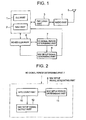
- Fig. 1 is a block diagram showing a configuration of an access point in a wireless LAN system according to the first embodiment of the present invention.
- the access point in the wireless LAN system includes a DLC part (hereinbelow called the data link part) 1, a MAC part (hereinbelow called the medium access part) 2, a PHY (Physical Layer Protocol) layer part 3, a radio part 4, an antenna 5, a scheduler part 6, a no signal period determining part 7, and a NAV setup signal generating part 8.
- a DLC part hereinbelow called the data link part
- a MAC part hereinbelow called the medium access part
- PHY Physical Layer Protocol
- the data link part 1 controls the transmission of data, and has three processing phases: connection establishment, data transfer, and data link connection release.
- the medium access part 2 controls the way of transmitting data to a LAN cable (medium) and the like.
- the PHY layer part 3 interconverts data to be exchanged and signals according to the channel, and outputs the converted data.
- the radio part 4 converts the data from the PHY layer part 3 into a radio signal for output to the antenna 5, while it down-converts a radio signal captured by the antenna 5 and outputs the same to the PHY layer part 3.
- the scheduler part 6 lines up in time sequence plural pieces of data obtained from an upper layer, not shown, through the medium access part 2 to create a communication frame. Then the scheduler part 6 sends the created communication frame to the medium access part 2. In this case, the scheduler part 6 sends the no signal period determining part 7 the state of creation during the creation of the communication frame to make the no signal period determining part 7 determine the presence or absence of a no signal section and the length of the no signal period. Upon receipt of a report from the no signal period determining part 7 that there has been a no signal period, the scheduler part 6 performs scheduling for transmitting a NAV setup signal based on the IEEE802.11a standard as channel reservation data (corresponding to a communication disable signal).
- the no signal period determining part 7 monitors an interval between a downlink phase and an uplink phase, and an interval between two adjacent uplink phases, which come before or after each other in time sequence. If there is a no signal period at least in either interval, the no signal period determining part 7 informs of it the scheduler part 6 and the NAV setup signal generating part 8.
- the NAV setup signal generating part 8 includes a SIFS (Short Inter Frame Space) count part 10, a NAV setup-period determining part 11, and a NAV setup signal output part 12.
- the SIFS count part 10 measures a no signal period, and based on the result of measurement, the NAV setup period determining part 11 determines the NAV setup period.
- a NAV setup signal with a length corresponding to the period is outputted from the NAV setup signal output part 12.
- the NAV setup signal from the NAV setup signal generating part 8 is inputted to the data link part 1 and the medium access part 2, respectively.
- a signal for indicating a period during which the NAV setup signal is outputted is inputted from the NAV setup signal generating part 8 to the scheduler part 6.
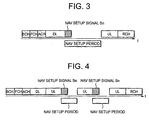
- Fig. 3 is a diagram showing the arrangement of data upon scheduling of a communication frame at the access point in the wireless LAN system according to the first embodiment of the present invention.
- the scheduler part 6 Upon scheduling of a communication frame, when informed from the no signal period determining part 7 that a no signal section has occurred between a downlink phase and an uplink phase, the scheduler part 6 puts a NAV setup signal Sn behind the downlink phase, in accordance with instructions from the NAV setup signal generating part 8, as channel reservation data that covers the no signal section.
- the scheduler part 6 performs scheduling for arranging the NAV setup signal Sn and transmits the arranged NAV setup signal Sn, so that the NAV is set in the downlink phase at stations in an IEEE802.11a wireless LAN system. It can prevent the stations in the IEEE802.11a wireless LAN system from transmitting data, and hence avoid the collision of signals within the period of the uplink phase due to an IEEE802.11a frame interrupt.
- scheduling is performed for transmitting a NAV setup signal (communication disable signal) as channel reservation data that covers the no signal section, to disable communication within the no signal section with the IEEE802.11a wireless LAN system initiating communication after waiting for the vacancy of a channel. Therefore, even when a HiSWANa or HiperLAN/2 wireless LAN system initiating communication at fixed intervals and an IEEE802.11a wireless LAN system initiating communication after waiting for the vacancy of a channel exist together in each other's radio areas, the collision of signals between the systems can be avoided.
- a NAV setup signal communication disable signal
- the NAV setup signal Sn is put immediately behind the downlink phase, but it can be set before the no signal section. In this case, the same effect can be obtained.
- the NAV setup period may be any length of time as long as it can cover at least the no signal section concerned. If the NAV setup period is so set that it ranges up to another section such as RCH, collisions that could occur in that section can also be avoided.
- the access point in the wireless LAN system according to the second embodiment of the present invention has the same configuration as that according to the first embodiment, the illustration of the configuration will be omitted, using Fig. 1 or Fig. 2 as needed.
- Fig. 4 is a diagram showing the arrangement of data upon scheduling of a communication frame at the access point in the wireless LAN system according to the second embodiment of the present invention.
- the scheduler part 6 Upon scheduling of a communication frame, when informed from the no signal period determining part 7 that a no signal section has occurred between two adjacent uplink phases, which come before or after each other in time sequence, the scheduler part 6 puts a NAV setup signal Sn behind the preceding uplink phase, in accordance with instructions from the NAV setup signal generating part 8, as channel reservation data that covers the no signal section.
- the two adjacent uplink phases that come before or after each other in time sequence is not limited to a pair alone. If there are plural pairs, the scheduler part 6 will perform the same control for each of the pairs, respectively. The same goes for the other embodiments to be described below.
- the scheduler part 6 performs scheduling for arranging the NAV setup signal Sn and transmits the arranged NAV setup signal Sn, so that the NAV is set in the uplink phase at stations in an IEEE802.11a wireless LAN system. It can prevent the stations in the IEEE802.11a wireless LAN system from transmitting data, and hence avoid the collision of signals within the period of the following uplink phase due to an IEEE802.11a frame interrupt.
- the NAV setup signal Sn is put immediately behind the uplink phase that is ahead in time sequence, but it can be set before the no signal section. In this case, the same effect can be obtained. Further, if there are a plurality of no signal sections, such a NAV as to cover all the no signal sections can be set at the first stage. In this case, the transmission of the NAV can be completed at a time. The NAV may also cover the no signal section between the downlink phase and the uplink phase together with the no signal section between the uplink phases. In addition, the NAV setup period may be any length of time as long as it can cover at least the no signal section concerned. If the NAV setup period is so set that it ranges up to another section such as RCH, collisions that could occur in that section can also be avoided.
- the access point in the wireless LAN system according to the third embodiment of the present invention has the same configuration as that according to the first embodiment, the illustration of the configuration will be omitted, using Fig. 1 or Fig. 2 as needed.
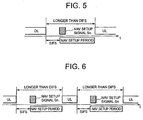
- Fig. 5 is a diagram showing the arrangement of data upon scheduling of a communication frame at the access point in the wireless LAN system according to the third embodiment of the present invention.
- the scheduler part 6 Upon scheduling of a communication frame, when informed from the no signal period determining part 7 that a no signal section has occurred between a downlink phase and an uplink phase, the scheduler part 6 performs scheduling as follows. That is, when the no signal section is longer than the carrier sense time of a station in an IEEE802.11a wireless LAN system, the scheduler part 6 puts a NAV setup signal Sn between the downlink phase and the uplink phase prior to the success of carrier sense of the station, in accordance with instructions from the NAV setup signal generating part 8, as channel reservation data that covers the no signal section.
- the NAV setup signal Sn that covers the no signal section concerned is put behind a short interframe space (SIFS) as channel reservation data.
- DIFS DCF interframe space
- the scheduler part 6 thus performs scheduling for arranging the NAV setup signal Sn and transmits the arranged NAV setup signal Sn, so that the NAV is set at the station in the IEEE802.11a wireless LAN system. It can prevent the station from initiating transmission within the no signal section, and hence avoid the collision of signals within the period of the uplink phase due to an IEEE802.11a frame interrupt. Especially, according to the embodiment, since the NAV is set only when an IEEE802.11a interrupt might occur in the first embodiment, collisions can be avoided more efficiently.
- the access point in the wireless LAN system according to the fourth embodiment of the present invention has the same configuration as that according to the first embodiment, the illustration of the configuration will be omitted, using Fig. 1 or Fig. 2 as needed.
- Fig. 6 is a diagram showing the arrangement of data upon scheduling of a communication frame at the access point in the wireless LAN system according to the fourth embodiment of the present invention.
- the scheduler part 6 Upon scheduling of a communication frame, when informed from the no signal period determining part 7 that a no signal section has occurred between two adjacent uplink phases, which come before or after each other in time sequence, the scheduler part 6 performs scheduling as follows. That is, when the no signal section is longer than the carrier sense time of a station in an IEEE802.11a wireless LAN system, the scheduler part 6 puts a NAV setup signal Sn behind the preceding uplink phase prior to the success of carrier sense of the station, in accordance with instructions from the NAV setup signal generating part 8, as channel reservation data that covers the no signal section.
- the NAV setup signal Sn is put behind the preceding uplink phase, that is, behind a short interframe space (SIFS) as channel reservation data.
- DIFS DCF interframe space
- the scheduler part 6 thus performs scheduling for arranging the NAV setup signal Sn and transmits the arranged NAV setup signal Sn, so that the NAV is set at the station in the IEEE802.11a wireless LAN system. It can prevent the station from initiating transmission, and hence avoid the collision of signals within the period of the following uplink phase due to an IEEE802.11a frame interrupt. Especially, according to the embodiment, since the NAV is set only when an IEEE802.11a interrupt might occur in the first embodiment, collisions can be avoided more efficiently.
- the transmission of the NAV can be completed at a time.
- the NAV may also cover the no signal section between the downlink phase and the uplink phase together with the no signal section between the uplink phases.
- the NAV setup period may be any length of time as long as it can cover at least the no signal section concerned. If the NAV setup period is so set that it ranges up to another section such as RCH, collisions that could occur in that section can also be avoided.
- Fig. 7 is a block diagram showing a configuration of an access point in a wireless LAN system according to the fifth embodiment of the present invention.
- portions common to those described above in Fig. 1 are given the same reference numerals to omit the descriptions.
- the access point- in the wireless LAN system includes a band occupied signal generating part 15, instead of the NAV setup signal generating part 8 of Fig. 1, for generating a band occupied signal (channel in use signal) So, which indicates an IEEE802.11a wireless LAN system that the HiSWANa wireless LAN system is using a no signal section.
- the scheduler part 6 sends the no signal period determining part 7 the state of the creation to make the no signal period determining part 7 determine the presence or absence of a no signal section and the length of the no signal period if any. Then, upon receipt of a report from the no signal period determining part 7 that there has been a no signal period, the scheduler part 6 performs scheduling for transmitting a band occupied signal.
- the no signal period determining part 7 monitors an interval between a downlink phase and an uplink phase, and an interval between two adjacent uplink phases, which come before or after each other in time sequence.
- the no signal period determining part 7 informs of it the scheduler part 6 and the band occupied signal generating part 15.
- the band occupied signal generating part 15 includes the SIFS count part 10, a band occupied signal setup period determining part 16, and a band occupied signal output part 17.
- the SIFS count part 10 measures a no signal period, and based on the result of measurement, the band occupied signal setup period determining part 16 determines a period for setting a band occupied signal. Once the band occupied signal setup period is decided, a band occupied signal with a length corresponding to the period is outputted from the band occupied signal output part 17. In this case, the band occupied signal from the band occupied signal output part 17 is inputted to the data link part 1 and the medium access part 2, respectively. On the other hand, a signal for indicating a period during which the band occupied signal is outputted is inputted from the band occupied signal generating part 15 to the scheduler part 6.
- the band occupied signal is, for example, dummy data, which indicates an IEEE802.11a wireless LAN system initiating communication after waiting for the vacancy of a channel that the channel is in use.
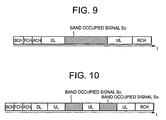
- Fig. 9 is a diagram showing the arrangement of data upon scheduling of a communication frame at the access point in the wireless LAN system according to the fifth embodiment of the present invention.
- the scheduler part 6 Upon scheduling of a communication frame, when informed from the band occupied signal setup period determining part 16 that a no signal section has occurred between a downlink phase and an uplink phase, the scheduler part 6 puts a band occupied signal (corresponding to a channel in use signal)So behind the downlink phase, in accordance with instructions from the band occupied signal generating part 8, to indicate that HiSWANa is using the no signal section concerned.
- the scheduler part 6 performs scheduling for arranging the band occupied signal So and transmits the arranged band occupied signal So, so that the channel-becomes busy whenever any IEEE802.11a communication station performs carrier sense. It can prevent the station concerned from initiating transmission within the no signal section, and hence avoid the collision of signals within the period of the uplink phase due to an IEEE802.1 la frame interrupt. Especially, according to the embodiment, even the collision of signals that could occur-in the first embodiment with such a station that does not support any NAV setup signal (that cannot understand the NAV setup signal) can be avoided.
- the access point in the wireless LAN system according to the sixth embodiment of the present invention has the same configuration as that according to the fifth embodiment, the illustration of the configuration will be omitted, using Fig. 7 or Fig. 8 as needed.
- Fig. 10 is a diagram showing the arrangement of data upon scheduling of a communication frame at the access point in the wireless LAN system according to the sixth embodiment of the present invention.
- the scheduler part 6 Upon scheduling of a communication channel, when informed from the band occupied signal setup period determining part 16 that a no signal section has occurred between two adjacent uplink phases, which come before or after each other in time sequence, the scheduler part 6 arranges a band occupied signal So in accordance with instructions from the band occupied signal generating part 15 to indicate that HiSWANa is using the no signal section concerned. Like the fifth embodiment, this embodiment uses dummy data, for example, as the band occupied signal So.
- the scheduler part 6 performs scheduling for arranging the band occupied signal So and transmits the arranged band occupied signal So, so that the channel becomes busy whenever any IEEE802.11a communication station performs carrier sense. It can prevent the station concerned from initiating transmission within the no signal section, and hence avoid the collision of signals within the period of the uplink phase due to an IEEE802.11a frame interrupt. Especially, according to the embodiment, even the collision of signals that could occur in the second embodiment with such a station that does not support any NAV setup signal (that cannot understand the NAV setup signal) can be avoided.
- the access point in the wireless LAN system according to the seventh embodiment of the present invention has the same configuration as that according to the fifth embodiment, the illustration of the configuration will be omitted, using Fig. 7 or Fig. 8 as needed.
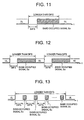
- Fig. 11 is a diagram showing the arrangement of data upon scheduling of a communication frame at the access point in the wireless LAN system according to the seventh embodiment of the present invention.
- the scheduler part 6 Upon scheduling of a communication channel, when informed from the band occupied signal setup period determining part 16 that a no signal section has occurred between a downlink phase and an uplink phase, the scheduler part 6 performs scheduling as follows. That is, when the no signal section is longer than the carrier sense time of a station in an IEEE802.11a wireless LAN system, the scheduler part 6 puts a band occupied signal So between the downlink phase and the uplink phase prior to the success of carrier sense of the station, upon scheduling of a communication frame, in accordance with instructions from the band occupied signal generating part 15, as dummy data to indicate that HiSWANa is using the no signal section concerned.
- the band occupied signal So is put behind a short interframe space (SIFS) to indicate that HiSWANa is using the no signal section concerned.
- DIFS DCF interframe space
- the scheduler part 6 thus performs scheduling for arranging the band occupied signal So and transmits the arranged band occupied signal So, so that the channel becomes busy whenever any station in an IEEE802.11a wireless LAN system performs carrier sense. It can prevent the station concerned from initiating transmission within the no signal section, and hence avoid the collision of signals within the period of the uplink phase due to an IEEE802.11a frame interrupt. Especially, according to the embodiment, the transmission of the band occupied signal So is carried out only when an IEEE802.11a interrupt might occur in the fifth embodiment, thus avoiding collisions more efficiently.
- the access point in the wireless LAN system according to the eighth embodiment of the present invention has the same configuration as that according to the fifth embodiment, the illustration of the configuration will be omitted, using Fig. 7 or Fig. 8 as needed.
- Fig. 12 is a diagram showing the arrangement of data upon scheduling of a communication frame at the access point in the wireless LAN system according to the eighth embodiment of the present invention.
- the scheduler part 6 Upon scheduling of a communication frame, when informed from the no signal period determining part 7 that a no signal section has occurred between two adjacent uplink phases, which come before or after each other in time sequence, the scheduler part 6 arranges a band occupied signal So as follows. That is, when the no signal section is longer than the carrier sense time of a station in an IEEE802.11a wireless LAN system, the scheduler part 6 puts a band occupied signal So between the two uplink phases prior to the success of carrier sense of the station, in accordance with instructions from the band occupied signal generating part 15, to indicate that HiSWANa is using the no signal section concerned.
- the scheduler part 6 thus performs scheduling for arranging the band occupied signal So and transmits the arranged band occupied signal So, so that the channel becomes busy whenever any station in the IEEE802.11a wireless LAN system performs carrier sense. It can prevent the station concerned from initiating transmission within the no signal section, and hence avoid the collision of signals within the period of the following uplink phase due to an IEEE802.11a frame interrupt. Especially, according to the embodiment, the transmission of the band occupied signal So is carried out only when an IEEE802.11a interrupt might occur in the sixth embodiment, thus avoiding collisions more efficiently.
- the access point in the wireless LAN system according to the ninth embodiment of the present invention has the same configuration as that according to the fifth embodiment, the illustration of the configuration will be omitted, using Fig. 7 or Fig. 8 as needed.
- Fig. 13 is a diagram showing the arrangement of data upon scheduling of a communication frame at the access point in the wireless LAN system according to the ninth embodiment of the present invention.
- the scheduler part 6 Upon scheduling of a communication frame, when informed from the no signal section determining part 7 that a no signal section has occurred between a downlink phase and an uplink phase, the scheduler part 6 performs scheduling as fellows. That is, when the no signal section is longer than the carrier sense time of any station, the scheduler part 6 arranges a band occupied signal So prior to the success of carrier sense of the station, in accordance with instructions from the band occupied signal generating part 15, as dummy data to indicate that HiSWANa is using the no signal section concerned.
- the transmission is temporarily terminated, and the transmission and termination of the band occupied signal So are repeated until the remaining length of the no signal section becomes shorter than the carrier sense time, for example, until it becomes shorter than the DCF interframe spece DIPS. Specifically, the transmission and termination of dummy data are repeated.
- the repetition of the transmission and termination of the band occupied signal So makes the channel become busy whenever any station in the IEEE802.11a wireless LAN system performs carrier sense. It can prevent the station concerned from initiating transmission within the no signal section, and hence avoid the collision of signals within the period of the uplink phase due to an IEEE802.11a frame interrupt.
- this embodiment exemplifies a no signal section between a downlink phase and an uplink phase
- the same method can be applied to a no signal section between two adjacent uplink phases, which come before or after each other in time sequence. In this case, the same effect can be obtained.
- the transmission of the band occupied signal So is carried out only for a minimum period in the seventh and eighth embodiments, thus avoiding collisions more efficiently.
- the access point in the wireless LAN system according to the tenth embodiment of the present invention has the same configuration as that according to the fifth embodiment, the illustration of the configuration will be omitted, using Fig. 7 or Fig. 8 as needed.
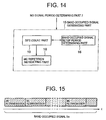
- the band occupied signal generating part 15 in this embodiment has an MC repetition instructing part 18 for instructing the repetition of multi-cast data based on processing by the data link part 1 and the medium access part 2.
- the MC repetition instructing part 18 instructs the arrangement of a set of multi-cast, iterative HiSWANa packets (retransmission packets) that is large enough in number to be inserted in the period for setting a band occupied signal determined by the band occupied signal setup period determining part 16.
- Fig. 15 is a diagram showing a band occupied signal obtained in the band occupied signal generating part 15 in Fig. 14.
- the term "multi-cast" means that mobile terminals belonging to the system can receive the iterative packets.
- a mobile terminal which has determined the rejection of a packet due to an error or the like can obtain and rescue the packet from the iterative packets, thereby improving the frequency of error in packets in the multi-cast communication.
- the signal collision avoidance method for the wireless LAN system according to this embodiment can also be applied to each of the wireless LAN systems according to the aforementioned embodiments 5 through 9.
- the access point in the wireless LAN system according to the eleventh embodiment of the present invention has the same configuration as that according to the fifth embodiment, the illustration of the configuration will be omitted, using Fig. 7 or Fig. 8 as needed.
- the band occupied signal generating part 15 in this embodiment has a preamble instruction part 19 that instructs the PHY part layer 3 through the data link part 1 and the medium access part 2 to transmit a preamble.
- Fig. 17 is a waveform chart showing a band occupied signal obtained in the band occupied signal generating part 15.
- the band occupied signal So shown in Fig. 17 is used as a preamble signal based on HiSWANa so that any mobile terminal belonging to the system can receive it. It allows the mobile terminal that has received the preamble signal to maintain more accurate synchronization. Frequency offset correction can also be made, which makes possible proper communication.
- the use of a preamble was mentioned. If a preamble unique for use in the band occupied signal is used, the preamble illustrated in the embodiment and another preamble used in another area can be used separately.
Landscapes
- Engineering & Computer Science (AREA)
- Computer Networks & Wireless Communication (AREA)
- Signal Processing (AREA)
- Mobile Radio Communication Systems (AREA)
- Small-Scale Networks (AREA)
Abstract
Description
Claims (24)
- A wireless LAN system initiating communication at fixed intervals includes:no-signal section determining means for determining whether a no signal section has occurred in a communication frame upon scheduling of the communication frame; andscheduling means which, when said no-signal section determining means determines that the no signal section has occurred in the communication frame, schedules the transmission of a communication disable signal to a channel to disable communication in the no signal section with another wireless LAN system initiating communication after waiting until the channel through which said wireless LAN system is performing communication becomes vacant.
- A wireless LAN system initiating communication at fixed intervals includes:no-signal section determining means for determining whether there is a no signal section between a data block in a downlink phase for transmitting downlink data and a data block in an uplink phase allocated first to transmit uplink data, both of which are contained in frame data to be arranged upon scheduling of a communication frame; andscheduling means which, when said no-signal section determining means determines that there is a no signal section, schedules the transmission of a communication disable signal to a channel to disable communication in the no signal section with another wireless LAN system initiating communication after waiting until the channel through which said wireless LAN system is performing communication becomes vacant.
- The wireless LAN system according to claim 2 wherein, when the no signal section is longer than a gap time from the finish time of the downlink phase until another wireless LAN system detects the vacancy of the channel, said scheduling means transmits the communication disable signal at timing earlier than the gap time.
- A wireless LAN system initiating communication at fixed intervals includes:no-signal section determining means for determining whether there is a no signal section between data groups in uplink phases, which transmit uplink data belonging to different groups defined with different delay times, both of which are contained in frame data to be arranged upon scheduling of a communication frame; andscheduling means which, when said no-signal section determining means determines that there is a no signal section, schedules the transmission of a communication disable signal to a channel to disable communication in the no signal section with another wireless LAN system initiating communication after waiting until the channel through which said wireless LAN system is performing communication becomes vacant.
- The wireless LAN system according to claim 4 wherein, when the no signal section is longer than a gap time from the finish time of the data block allocated first between groups of data blocks in the uplink phases until another wireless LAN system detects the vacancy of the channel, said scheduling means transmits the communication disable signal at timing earlier than the gap time.
- A wireless LAN system initiating communication at fixed intervals includes:no-signal section determining means for determining whether there is a no signal section between a data block in a downlink phase for transmitting downlink data and a data block in an uplink phase allocated first to transmit uplink-data, both of which are contained in frame data to be arranged upon scheduling of a communication frame; andscheduling means which, when said no-signal section determining means determines that there is a no signal section, schedules the transmission to a channel of a channel in use signal to indicate another wireless LAN system that the channel is in use, another wireless LAN system initiating communication after waiting until the channel through which said wireless LAN system is performing communication becomes vacant.
- The wireless LAN system according to claim 6 wherein, when the no signal section is longer than a gap time from the finish time of the downlink phase until another wireless LAN system detects the vacancy of the channel, said scheduling means transmits the channel in use signal at timing earlier than the gap time.
- A wireless LAN system initiating communication at fixed intervals includes:no-signal section determining means for determining whether there is a no signal section between data groups in uplink phases, which transmit uplink data belonging to different groups defined with different delay times, both of which are contained in frame data to be arranged upon scheduling of a communication frame; andscheduling means which, when said no-signal section determining means determines that there is a no signal section, schedules the transmission to a channel of a channel in use signal to indicate another wireless LAN system that the channel is in use, another wireless LAN system initiating communication after waiting until the channel through which said wireless LAN system is performing communication becomes vacant.
- The wireless LAN system according to claim 8 wherein, when the no signal section is longer than a gap time from the finish time of the data block allocated first between groups of data blocks in the uplink phases until another wireless LAN system detects the vacancy of the channel, said scheduling means transmits the channel in use signal at timing earlier than the gap time.
- The wireless LAN system according to claim 8 wherein said scheduling means transmits the channel in use signal repeatedly and intermittently at intervals not longer than the gap time during which another wireless LAN system detects the vacancy of the channel, and for the duration of time enough to determine that the channel is in use when another wireless LAN system detects the vacancy of the channel.
- The wireless LAN system according to claim 8 wherein said scheduling means transmits a signal as the channel in use signal, which terminals belonging to said wireless LAN system can usefully receive as a retransmission packet.
- The wireless LAN system according to claim 8 wherein said scheduling means transmits a signal as the channel in use signal, which terminals belonging to the wireless LAN system can usefully receive as a preamble signal.
- A signal collision avoidance method for a wireless LAN system initiating communication at fixed intervals includes:a step of determining whether a no signal section has occurred in a communication frame upon scheduling of the communication frame; anda step of providing a communication disable signal in the communication frame when it is determined that the no signal section has occurred in the communication frame, to disable communication in the no signal section with another wireless LAN system initiating communication after waiting until a channel through which said wireless LAN system is performing communication becomes vacant.
- A signal collision avoidance method for a wireless LAN system initiating communication at fixed intervals includes:a step of determining whether a no signal section has occurred in a communication frame due to no data to be arranged between a data block in a downlink phase for transmitting downlink data and a data block in an uplink phase allocated first to transmit uplink data, both of which are contained in frame data to be arranged upon scheduling of the communication frame; anda step of providing a communication disable signal in the communication frame when it is determined that the no-signal section has occurred, to disable communication in the no signal section with another wireless LAN system initiating communication after waiting until a channel through which said wireless LAN system is performing communication becomes vacant.
- The signal collision avoidance method for the wireless LAN system according to claim 14 wherein, when the no signal section is longer than a gap time from the finish time of the downlink phase until another wireless LAN system detects the vacancy of the channel, the transmission of the communication disable signal is initiated at timing earlier than the gap time.
- A signal collision avoidance method for a wireless LAN system initiating communication at fixed intervals includes:a step of determining whether a no signal section has occurred in a communication frame due to no data to be arranged between data groups in uplink phases, which transmit uplink data belonging to different groups defined with different delay times, both of which are contained in frame data to be arranged upon scheduling of the communication frame; anda step of providing a communication disable signal in the communication frame when it is determined that the no-signal section has occurred in the communication frame, to disable communication in the no signal section with another wireless LAN system initiating communication after waiting until a channel through which said wireless LAN system is performing communication becomes vacant.
- The signal collision avoidance method for the wireless LAN system according to claim 16 wherein, when the no signal section is longer than a gap time from the finish time of the data block allocated first between groups of data blocks in the uplink phases until another wireless LAN system detects the vacancy of the channel, the transmission of the communication disable signal is initiated at timing earlier than the gap time.
- A signal collision avoidance method for a wireless LAN system initiating communication at fixed intervals includes:a step of determining whether a no signal section has occurred in a communication frame due to no data to be arranged between a data block in a downlink phase for transmitting downlink data and a data block in an uplink phase allocated first to transmit uplink data, both of which are contained in frame data to be arranged upon scheduling of the communication frame; anda step of providing a channel in use signal when it is determined that the no-signal section has occurred in the communication frame, to indicate another wireless LAN system that a channel is in use, another wireless LAN system initiating communication after waiting until the channel through which said wireless LAN system is performing communication becomes vacant.
- The signal collision avoidance method for the wireless LAN system according to claim 18 wherein, when the no signal section is longer than a gap time from the finish time of the downlink phase until another wireless LAN system detects the vacancy of the channel, the transmission of the channel in use signal is initiated -at timing earlier than the gap time.
- A signal collision avoidance method for a wireless LAN system initiating communication at fixed intervals includes:a step of determining whether a no signal section has occurred in a communication frame due to no data to be arranged between data groups in uplink phases, which transmit uplink data belonging to different groups defined with different delay times, both of which are contained in frame data to be arranged upon scheduling of the communication frame; anda step of providing a channel in use signal in an area corresponding to the no signal section when it is determined that the no-signal section has occurred in the communication frame, to indicate another wireless LAN system that a channel is in use, another wireless LAN system initiating communication after waiting until the channel through which said wireless LAN system is performing communication becomes vacant.
- The signal collision avoidance method for the wireless LAN system according to claim 20 wherein, when the no signal section is longer than a gap time from the finish time of the data block allocated first between groups of data blocks in the uplink phases until another wireless LAN system detects the vacancy of the channel, the transmission of the channel in use signal is initiated at timing earlier than the gap time.
- The signal collision avoidance method for the wireless LAN system according to claim 18 or 20 wherein the channel in use signal is transmitted repeatedly and intermittently at intervals not longer than the gap time during which another wireless LAN system detects the vacancy of the channel, and for the duration of time enough to determine that the channel is in use when another wireless LAN system detects the vacancy of the channel.
- The signal collision avoidance method for the wireless LAN system according to claim 18 or 20 wherein the channel in use signal is a signal which terminals belonging to said wireless LAN system can usefully receive as a retransmission packet.
- The signal collision avoidance method for the wireless LAN system according to claim 18 or 20 wherein the channel in use signal is a signal which terminals belonging to the wireless LAN system can usefully receive as a preamble signal.
Priority Applications (1)
| Application Number | Priority Date | Filing Date | Title |
|---|---|---|---|
| EP11189730.2A EP2421319B1 (en) | 2001-03-06 | 2002-03-06 | Wireless LAN system and signal collision avoidance method for the same |
Applications Claiming Priority (3)
| Application Number | Priority Date | Filing Date | Title |
|---|---|---|---|
| JP2001062709A JP3530141B2 (en) | 2001-03-06 | 2001-03-06 | Wireless LAN system and wireless LAN system signal collision avoidance method |
| JP2001062709 | 2001-03-06 | ||
| PCT/JP2002/002067 WO2002073895A1 (en) | 2001-03-06 | 2002-03-06 | Radio lan system and radio lan system signal collision evading method |
Related Child Applications (1)
| Application Number | Title | Priority Date | Filing Date |
|---|---|---|---|
| EP11189730.2 Division-Into | 2011-11-18 |
Publications (3)
| Publication Number | Publication Date |
|---|---|
| EP1289194A1 true EP1289194A1 (en) | 2003-03-05 |
| EP1289194A4 EP1289194A4 (en) | 2010-07-21 |
| EP1289194B1 EP1289194B1 (en) | 2011-12-28 |
Family
ID=18921807
Family Applications (2)
| Application Number | Title | Priority Date | Filing Date |
|---|---|---|---|
| EP11189730.2A Expired - Lifetime EP2421319B1 (en) | 2001-03-06 | 2002-03-06 | Wireless LAN system and signal collision avoidance method for the same |
| EP02703922A Expired - Lifetime EP1289194B1 (en) | 2001-03-06 | 2002-03-06 | Communication apparatus of a radio lan system and signal collision avoidance method for a radio lan system |
Family Applications Before (1)
| Application Number | Title | Priority Date | Filing Date |
|---|---|---|---|
| EP11189730.2A Expired - Lifetime EP2421319B1 (en) | 2001-03-06 | 2002-03-06 | Wireless LAN system and signal collision avoidance method for the same |
Country Status (9)
| Country | Link |
|---|---|
| US (1) | US7729319B2 (en) |
| EP (2) | EP2421319B1 (en) |
| JP (1) | JP3530141B2 (en) |
| CN (1) | CN100539759C (en) |
| AT (1) | ATE539589T1 (en) |
| BR (1) | BR0204463A (en) |
| CA (1) | CA2407542A1 (en) |
| CZ (1) | CZ20023660A3 (en) |
| WO (1) | WO2002073895A1 (en) |
Cited By (4)
| Publication number | Priority date | Publication date | Assignee | Title |
|---|---|---|---|---|
| WO2004091146A1 (en) | 2003-04-08 | 2004-10-21 | Matsushita Electric Industrial Co., Ltd. | Method for reserving communication area and radio communication device used for this method |
| RU2482451C2 (en) * | 2011-07-12 | 2013-05-20 | Открытое акционерное общество "Ракетно-космическая корпорация "Энергия" имени С.П. Королева" | Board for selecting observation objects from orbital spacecraft |
| CN106576371A (en) * | 2014-06-26 | 2017-04-19 | Lg电子株式会社 | Method and apparatus for transmitting data in an unlicensed frequency band |
| KR20180034639A (en) * | 2015-07-31 | 2018-04-04 | 차이나 아카데미 오브 텔레커뮤니케이션즈 테크놀로지 | Data transfer method and apparatus |
Families Citing this family (31)
| Publication number | Priority date | Publication date | Assignee | Title |
|---|---|---|---|---|
| MXPA05009100A (en) * | 2003-02-28 | 2006-05-19 | Thomson Licensing | Method for wlan exclusive downlink channel. |
| CN101099318B (en) | 2003-07-14 | 2013-05-15 | 汤姆森许可贸易公司 | Technique for video broadcasting in a wireless LAN |
| JP5080080B2 (en) * | 2003-07-15 | 2012-11-21 | コーニンクレッカ フィリップス エレクトロニクス エヌ ヴィ | Method for performing high-speed active scanning in WLAN, access point, high-speed active scanning system, and first station |
| JP4295051B2 (en) * | 2003-09-12 | 2009-07-15 | パナソニック株式会社 | Transmitting apparatus and transmitting method |
| US7706399B2 (en) * | 2003-12-19 | 2010-04-27 | Intel Corporation | Polling in wireless networks |
| US7450489B2 (en) | 2003-12-30 | 2008-11-11 | Intel Corporation | Multiple-antenna communication systems and methods for communicating in wireless local area networks that include single-antenna communication devices |
| US7551637B2 (en) * | 2004-01-23 | 2009-06-23 | Qualcomm Incorporated | Method and apparatus for channel sensitive scheduling in a communication system |
| JP4577019B2 (en) * | 2004-03-04 | 2010-11-10 | ソニー株式会社 | Wireless communication system, wireless communication apparatus, wireless communication method, and computer program |
| JP4412033B2 (en) * | 2004-03-31 | 2010-02-10 | 沖電気工業株式会社 | Wireless communication device |
| EP1592178B8 (en) * | 2004-04-30 | 2012-10-24 | Sharp Kabushiki Kaisha | Interoperability between different wireless LAN systems |
| JP4421459B2 (en) * | 2004-11-30 | 2010-02-24 | 株式会社東芝 | Wireless communication apparatus and wireless communication method |
| US7768988B2 (en) * | 2005-02-22 | 2010-08-03 | Intel Corporation | Method and apparatus to perform network medium reservation in a wireless network |
| JP4567514B2 (en) * | 2005-04-15 | 2010-10-20 | シャープ株式会社 | Communication device, access point, and wireless LAN system |
| KR101317996B1 (en) * | 2005-05-12 | 2013-10-14 | 삼성전자주식회사 | Method and apparatus for transmiting data between nodes in a mesh network |
| JP4563882B2 (en) * | 2005-07-06 | 2010-10-13 | Okiセミコンダクタ株式会社 | Wireless LAN system and communication method thereof |
| KR100615139B1 (en) * | 2005-10-18 | 2006-08-22 | 삼성전자주식회사 | Method and apparatus for allocating transmission period in wireless telecommunication system and therefor system |
| CN101288249B (en) * | 2005-10-18 | 2012-06-20 | 三星电子株式会社 | Method and device for allocating transmission time period in wireless communication system and system thereof |
| CN101432781B (en) * | 2005-12-20 | 2011-07-13 | 佐塞斯特转移股份有限责任公司 | More power save multi-poll indication |
| JP4518053B2 (en) * | 2006-08-31 | 2010-08-04 | 株式会社デンソーウェーブ | RF tag reader and RF tag system |
| KR101494841B1 (en) * | 2008-02-04 | 2015-02-23 | 삼성전자주식회사 | Method and apparatus for reducing uplink feedback overhead in wireless communication system |
| WO2010061775A1 (en) * | 2008-11-26 | 2010-06-03 | 京セラ株式会社 | Base station device and method of controlling base station device |
| US8923172B2 (en) * | 2009-08-24 | 2014-12-30 | Qualcomm Incorporated | Deterministic backoff channel access |
| KR101611157B1 (en) * | 2009-11-24 | 2016-04-11 | 삼성전자 주식회사 | Air conditioner and communication method thereof |
| JP2011120064A (en) * | 2009-12-04 | 2011-06-16 | Mitsubishi Electric Corp | Transmission terminal, wireless communication system, and transmission method |
| CN102802091B (en) * | 2011-05-24 | 2015-08-26 | 福建联拓科技有限公司 | A kind of method, system and equipment sent and process broadcast message |
| US8542646B1 (en) * | 2011-06-03 | 2013-09-24 | Olympus Corporation | Interference mitigation for network communications |
| CN102938936A (en) * | 2012-11-14 | 2013-02-20 | 北京奇天揽胜科技有限公司 | Scheduling device and scheduling method of inter-multiple-radio-frequency-module for wireless local area network (WLAN) system |
| CN103067969A (en) * | 2013-01-09 | 2013-04-24 | 上海交通大学 | Wireless local area network (WLAN) signal collision treatment method |
| US11489627B2 (en) | 2020-07-29 | 2022-11-01 | Nxp B.V. | Wireless communications device and method of wireless communications |
| US11398936B2 (en) * | 2020-07-30 | 2022-07-26 | Nxp B.V. | Wireless communications device and method of wireless communications |
| CN115189985B (en) * | 2022-08-24 | 2023-09-19 | 中国科学院沈阳自动化研究所 | Modbus multi-master-station data planning and forwarding device |
Family Cites Families (24)
| Publication number | Priority date | Publication date | Assignee | Title |
|---|---|---|---|---|
| JPS59183552A (en) * | 1983-04-04 | 1984-10-18 | Hitachi Ltd | Multiple access method |
| EP0507452B1 (en) | 1991-03-06 | 1999-06-02 | Fujitsu Limited | Fault tolerant communication control processor |
| JPH05260051A (en) | 1992-03-16 | 1993-10-08 | Fuji Xerox Co Ltd | Radio local area network system |
| US5960344A (en) | 1993-12-20 | 1999-09-28 | Norand Corporation | Local area network having multiple channel wireless access |
| NZ272084A (en) * | 1994-06-08 | 1997-02-24 | Alcatel Australia | Tdma mobile radio: extended range with adjacent located transceivers |
| US5517504A (en) * | 1994-07-29 | 1996-05-14 | Motorola, Inc. | Method and system for providing uplink/downlink collision avoidance in a wireless communication system |
| US5583866A (en) * | 1994-12-05 | 1996-12-10 | Motorola, Inc. | Method for delivering broadcast packets in a frequency hopping local area network |
| JP3157836B2 (en) * | 1995-06-14 | 2001-04-16 | インターナシヨナル・ビジネス・マシーンズ・コーポレーシヨン | Packet data transmission in code division multiple access communication system |
| US5734867A (en) * | 1995-07-28 | 1998-03-31 | Motorola, Inc. | Method, device, microprocessor and microprocessor memory for instantaneous preemption of packet data |
| US5737318A (en) * | 1995-12-27 | 1998-04-07 | Philips Electronics North America Corporation | Method for initializing a wireless, packet-hopping network |
| JP3955680B2 (en) | 1998-05-12 | 2007-08-08 | 株式会社エヌ・ティ・ティ・ドコモ | Radio channel access method in mobile communication system of time division communication system, base station and mobile station using the method |
| JP3658224B2 (en) * | 1998-12-24 | 2005-06-08 | キヤノン株式会社 | Wireless communication apparatus, control method therefor, and computer-readable storage medium storing program |
| US6317854B1 (en) * | 1999-05-14 | 2001-11-13 | Nokia Corporation | Apparatus, and associated method, for selecting retransmission of packet data |
| JP2001274805A (en) * | 2000-03-24 | 2001-10-05 | Sony Corp | Wireless communication device and wireless communication method |
| US7050452B2 (en) * | 2000-10-06 | 2006-05-23 | Cognio, Inc. | Systems and methods for interference mitigation among multiple WLAN protocols |
| US6891821B2 (en) * | 2000-12-20 | 2005-05-10 | Lucent Technologies Inc. | Self-aligning backhaul system, method and apparatus |
| US20020122468A1 (en) * | 2001-01-12 | 2002-09-05 | Terion, Inc. | Quasi orthogonal hybrid walsh-PN codes for CDMA application in HF modems |
| US20020093929A1 (en) * | 2001-01-18 | 2002-07-18 | Koninklijke Philips Electronics N.V. | System and method for sharing bandwidth between co-located 802.11a/e and HIPERLAN/2 systems |
| CA2439697C (en) * | 2001-03-02 | 2007-11-13 | At&T Corp. | Interference suppression methods for 802.11 |
| US7167484B2 (en) * | 2001-03-22 | 2007-01-23 | Oxford Semiconductor, Inc. | Centralized coordination point for wireless communication devices using multiple protocols |
| US7177294B2 (en) * | 2001-03-22 | 2007-02-13 | Oxford Semiconductor, Inc. | Collision rectification in wireless communication devices |
| US7164671B2 (en) * | 2001-12-27 | 2007-01-16 | Koninklijke Philips Electronics N.V. | Overlapping network allocation vector (ONAV) for avoiding collision in the IEEE 802.11 WLAN operating under HCF |
| US7274661B2 (en) * | 2001-09-17 | 2007-09-25 | Altera Corporation | Flow control method for quality streaming of audio/video/media over packet networks |
| US7280518B2 (en) * | 2001-10-03 | 2007-10-09 | Freescale Semiconductor, Inc. | Method of operating a media access controller |
-
2001
- 2001-03-06 JP JP2001062709A patent/JP3530141B2/en not_active Expired - Fee Related
-
2002
- 2002-03-06 US US10/275,437 patent/US7729319B2/en active Active
- 2002-03-06 BR BR0204463-3A patent/BR0204463A/en not_active Application Discontinuation
- 2002-03-06 CN CNB028005228A patent/CN100539759C/en not_active Expired - Lifetime
- 2002-03-06 EP EP11189730.2A patent/EP2421319B1/en not_active Expired - Lifetime
- 2002-03-06 AT AT02703922T patent/ATE539589T1/en active
- 2002-03-06 WO PCT/JP2002/002067 patent/WO2002073895A1/en not_active Ceased
- 2002-03-06 CA CA002407542A patent/CA2407542A1/en not_active Abandoned
- 2002-03-06 CZ CZ20023660A patent/CZ20023660A3/en unknown
- 2002-03-06 EP EP02703922A patent/EP1289194B1/en not_active Expired - Lifetime
Cited By (13)
| Publication number | Priority date | Publication date | Assignee | Title |
|---|---|---|---|---|
| WO2004091146A1 (en) | 2003-04-08 | 2004-10-21 | Matsushita Electric Industrial Co., Ltd. | Method for reserving communication area and radio communication device used for this method |
| CN1322718C (en) * | 2003-04-08 | 2007-06-20 | 松下电器产业株式会社 | Communication area reservation method |
| US7330454B2 (en) | 2003-04-08 | 2008-02-12 | Matsushita Electric Industrial Co., Ltd. | Method for reserving communication area and radio communication device used for this method |
| CN100459550C (en) * | 2003-04-08 | 2009-02-04 | 松下电器产业株式会社 | Communication area reserving method |
| EP1631007A4 (en) * | 2003-04-08 | 2010-06-30 | Panasonic Corp | METHOD FOR RESERVING COMMUNICATION AREA AND RADIO COMMUNICATION DEVICE IMPLEMENTED IN THIS METHOD |
| RU2482451C2 (en) * | 2011-07-12 | 2013-05-20 | Открытое акционерное общество "Ракетно-космическая корпорация "Энергия" имени С.П. Королева" | Board for selecting observation objects from orbital spacecraft |
| CN106576371A (en) * | 2014-06-26 | 2017-04-19 | Lg电子株式会社 | Method and apparatus for transmitting data in an unlicensed frequency band |
| EP3163967A4 (en) * | 2014-06-26 | 2018-02-21 | LG Electronics Inc. | Method and device for transmitting data in unlicensed band |
| US10187887B2 (en) | 2014-06-26 | 2019-01-22 | Lg Electronics Inc. | Method and device for transmitting data in unlicensed band |
| CN106576371B (en) * | 2014-06-26 | 2020-01-14 | Lg电子株式会社 | Method and apparatus for transmitting data in an unlicensed frequency band |
| KR20180034639A (en) * | 2015-07-31 | 2018-04-04 | 차이나 아카데미 오브 텔레커뮤니케이션즈 테크놀로지 | Data transfer method and apparatus |
| EP3331309A4 (en) * | 2015-07-31 | 2018-07-11 | China Academy Of Telecommunications Technology | Data transmission method and device |
| US10820350B2 (en) | 2015-07-31 | 2020-10-27 | China Academy Of Telecommunications Technology | Data transmission method and device |
Also Published As
| Publication number | Publication date |
|---|---|
| US20040044784A1 (en) | 2004-03-04 |
| BR0204463A (en) | 2003-03-18 |
| EP2421319B1 (en) | 2013-05-29 |
| ATE539589T1 (en) | 2012-01-15 |
| WO2002073895A1 (en) | 2002-09-19 |
| US7729319B2 (en) | 2010-06-01 |
| EP1289194B1 (en) | 2011-12-28 |
| EP2421319A1 (en) | 2012-02-22 |
| CA2407542A1 (en) | 2002-10-24 |
| EP1289194A4 (en) | 2010-07-21 |
| CN100539759C (en) | 2009-09-09 |
| JP3530141B2 (en) | 2004-05-24 |
| CZ20023660A3 (en) | 2003-06-18 |
| CN1457575A (en) | 2003-11-19 |
| JP2002271340A (en) | 2002-09-20 |
Similar Documents
| Publication | Publication Date | Title |
|---|---|---|
| US7729319B2 (en) | Radio LAN system and radio LAN system signal collision evading method | |
| US11818763B2 (en) | Wireless communication terminal for multi-user uplink transmission, and wireless communication method | |
| US12166587B2 (en) | Wireless communication terminal and wireless communication method for multi-user concurrent transmission | |
| US7995544B2 (en) | Wireless LANs and neighborhood capture | |
| US20250113313A1 (en) | Time synchronization for coordinated restricted target wake time (r-twt) operation | |
| US20040002357A1 (en) | Directional antennas and wireless channel access | |
| JP2023517102A (en) | Multi-link communication method and device | |
| US8194574B2 (en) | Wireless access method and apparatus determining communication carriers to be used in uplink and downlink based on type of service | |
| US20230049192A1 (en) | Traffic management in restricted target wake time (twt) service periods | |
| WO2002041586A2 (en) | Wireless system containing a first network and a second network | |
| WO2003039054A2 (en) | Wireless lans and neighborhood capture | |
| EP1407578A2 (en) | A system and method for sharing bandwidth between co-located 802.11 a/e and hiperlan/2 systems | |
| EP3331309B1 (en) | Data transmission method and device | |
| KR20230078529A (en) | Method and apparatus for synchronizing timeslot in wireless local area network system | |
| JP3004243B2 (en) | Wireless packet access method | |
| US11917682B2 (en) | Wireless LAN system and interference control method | |
| KR20020095251A (en) | Radio lan system and radio lan system signal collision evading method | |
| Chen et al. | Dynamic bandwidth control MAC protocol for CWPAN/IEEE 802.11 aj networks |
Legal Events
| Date | Code | Title | Description |
|---|---|---|---|
| PUAI | Public reference made under article 153(3) epc to a published international application that has entered the european phase |
Free format text: ORIGINAL CODE: 0009012 |
|
| AK | Designated contracting states |
Kind code of ref document: A1 Designated state(s): AT BE CH CY DE DK ES FI FR GB GR IE IT LI LU MC NL PT SE TR Designated state(s): AT BE CH CY DE DK ES FI FR GB GR IE IT LI LU MC NL PT SE TR |
|
| AX | Request for extension of the european patent |
Extension state: AL LT LV MK RO SI |
|
| 17P | Request for examination filed |
Effective date: 20030717 |
|
| RAP1 | Party data changed (applicant data changed or rights of an application transferred) |
Owner name: PANASONIC CORPORATION |
|
| A4 | Supplementary search report drawn up and despatched |
Effective date: 20100621 |
|
| RIC1 | Information provided on ipc code assigned before grant |
Ipc: H04W 74/00 20090101AFI20100615BHEP |
|
| 17Q | First examination report despatched |
Effective date: 20100901 |
|
| RIC1 | Information provided on ipc code assigned before grant |
Ipc: H04W 74/00 20090101AFI20110127BHEP |
|
| RTI1 | Title (correction) |
Free format text: COMMUNICATION APPARATUS OF A RADIO LAN SYSTEM AND SIGNAL COLLISION AVOIDANCE METHOD FOR A RADIO LAN SYSTEM |
|
| GRAP | Despatch of communication of intention to grant a patent |
Free format text: ORIGINAL CODE: EPIDOSNIGR1 |
|
| GRAS | Grant fee paid |
Free format text: ORIGINAL CODE: EPIDOSNIGR3 |
|
| GRAA | (expected) grant |
Free format text: ORIGINAL CODE: 0009210 |
|
| AK | Designated contracting states |
Kind code of ref document: B1 Designated state(s): AT BE CH CY DE DK ES FI FR GB GR IE IT LI LU MC NL PT SE TR |
|
| REG | Reference to a national code |
Ref country code: GB Ref legal event code: FG4D |
|
| REG | Reference to a national code |
Ref country code: CH Ref legal event code: EP |
|
| REG | Reference to a national code |
Ref country code: AT Ref legal event code: REF Ref document number: 539589 Country of ref document: AT Kind code of ref document: T Effective date: 20120115 |
|
| REG | Reference to a national code |
Ref country code: IE Ref legal event code: FG4D |
|
| REG | Reference to a national code |
Ref country code: DE Ref legal event code: R096 Ref document number: 60241839 Country of ref document: DE Effective date: 20120301 |
|
| REG | Reference to a national code |
Ref country code: NL Ref legal event code: VDEP Effective date: 20111228 |
|
| PG25 | Lapsed in a contracting state [announced via postgrant information from national office to epo] |
Ref country code: SE Free format text: LAPSE BECAUSE OF FAILURE TO SUBMIT A TRANSLATION OF THE DESCRIPTION OR TO PAY THE FEE WITHIN THE PRESCRIBED TIME-LIMIT Effective date: 20111228 Ref country code: GR Free format text: LAPSE BECAUSE OF FAILURE TO SUBMIT A TRANSLATION OF THE DESCRIPTION OR TO PAY THE FEE WITHIN THE PRESCRIBED TIME-LIMIT Effective date: 20120329 |
|
| PG25 | Lapsed in a contracting state [announced via postgrant information from national office to epo] |
Ref country code: BE Free format text: LAPSE BECAUSE OF FAILURE TO SUBMIT A TRANSLATION OF THE DESCRIPTION OR TO PAY THE FEE WITHIN THE PRESCRIBED TIME-LIMIT Effective date: 20111228 Ref country code: CY Free format text: LAPSE BECAUSE OF FAILURE TO SUBMIT A TRANSLATION OF THE DESCRIPTION OR TO PAY THE FEE WITHIN THE PRESCRIBED TIME-LIMIT Effective date: 20111228 |
|
| PG25 | Lapsed in a contracting state [announced via postgrant information from national office to epo] |
Ref country code: NL Free format text: LAPSE BECAUSE OF FAILURE TO SUBMIT A TRANSLATION OF THE DESCRIPTION OR TO PAY THE FEE WITHIN THE PRESCRIBED TIME-LIMIT Effective date: 20111228 |
|
| PG25 | Lapsed in a contracting state [announced via postgrant information from national office to epo] |
Ref country code: PT Free format text: LAPSE BECAUSE OF FAILURE TO SUBMIT A TRANSLATION OF THE DESCRIPTION OR TO PAY THE FEE WITHIN THE PRESCRIBED TIME-LIMIT Effective date: 20120430 |
|
| REG | Reference to a national code |
Ref country code: AT Ref legal event code: MK05 Ref document number: 539589 Country of ref document: AT Kind code of ref document: T Effective date: 20111228 |
|
| PG25 | Lapsed in a contracting state [announced via postgrant information from national office to epo] |
Ref country code: DK Free format text: LAPSE BECAUSE OF FAILURE TO SUBMIT A TRANSLATION OF THE DESCRIPTION OR TO PAY THE FEE WITHIN THE PRESCRIBED TIME-LIMIT Effective date: 20111228 Ref country code: MC Free format text: LAPSE BECAUSE OF NON-PAYMENT OF DUE FEES Effective date: 20120331 |
|
| REG | Reference to a national code |
Ref country code: CH Ref legal event code: PL |
|
| PLBE | No opposition filed within time limit |
Free format text: ORIGINAL CODE: 0009261 |
|
| STAA | Information on the status of an ep patent application or granted ep patent |
Free format text: STATUS: NO OPPOSITION FILED WITHIN TIME LIMIT |
|
| PG25 | Lapsed in a contracting state [announced via postgrant information from national office to epo] |
Ref country code: IT Free format text: LAPSE BECAUSE OF FAILURE TO SUBMIT A TRANSLATION OF THE DESCRIPTION OR TO PAY THE FEE WITHIN THE PRESCRIBED TIME-LIMIT Effective date: 20111228 |
|
| 26N | No opposition filed |
Effective date: 20121001 |
|
| REG | Reference to a national code |
Ref country code: IE Ref legal event code: MM4A |
|
| REG | Reference to a national code |
Ref country code: DE Ref legal event code: R097 Ref document number: 60241839 Country of ref document: DE Effective date: 20121001 |
|
| PG25 | Lapsed in a contracting state [announced via postgrant information from national office to epo] |
Ref country code: CH Free format text: LAPSE BECAUSE OF NON-PAYMENT OF DUE FEES Effective date: 20120331 Ref country code: LI Free format text: LAPSE BECAUSE OF NON-PAYMENT OF DUE FEES Effective date: 20120331 Ref country code: AT Free format text: LAPSE BECAUSE OF FAILURE TO SUBMIT A TRANSLATION OF THE DESCRIPTION OR TO PAY THE FEE WITHIN THE PRESCRIBED TIME-LIMIT Effective date: 20111228 Ref country code: IE Free format text: LAPSE BECAUSE OF NON-PAYMENT OF DUE FEES Effective date: 20120306 |
|
| PG25 | Lapsed in a contracting state [announced via postgrant information from national office to epo] |
Ref country code: ES Free format text: LAPSE BECAUSE OF FAILURE TO SUBMIT A TRANSLATION OF THE DESCRIPTION OR TO PAY THE FEE WITHIN THE PRESCRIBED TIME-LIMIT Effective date: 20120408 |
|
| PG25 | Lapsed in a contracting state [announced via postgrant information from national office to epo] |
Ref country code: FI Free format text: LAPSE BECAUSE OF FAILURE TO SUBMIT A TRANSLATION OF THE DESCRIPTION OR TO PAY THE FEE WITHIN THE PRESCRIBED TIME-LIMIT Effective date: 20111228 |
|
| PG25 | Lapsed in a contracting state [announced via postgrant information from national office to epo] |
Ref country code: TR Free format text: LAPSE BECAUSE OF FAILURE TO SUBMIT A TRANSLATION OF THE DESCRIPTION OR TO PAY THE FEE WITHIN THE PRESCRIBED TIME-LIMIT Effective date: 20111228 |
|
| PG25 | Lapsed in a contracting state [announced via postgrant information from national office to epo] |
Ref country code: LU Free format text: LAPSE BECAUSE OF NON-PAYMENT OF DUE FEES Effective date: 20120306 |
|
| REG | Reference to a national code |
Ref country code: DE Ref legal event code: R082 Ref document number: 60241839 Country of ref document: DE Representative=s name: GRUENECKER, KINKELDEY, STOCKMAIR & SCHWANHAEUS, DE |
|
| REG | Reference to a national code |
Ref country code: DE Ref legal event code: R081 Ref document number: 60241839 Country of ref document: DE Owner name: PANASONIC INTELLECTUAL PROPERTY CORPORATION OF, US Free format text: FORMER OWNER: MATSUSHITA ELECTRIC INDUSTRIAL CO., LTD., KADOMA-SHI, OSAKA, JP Effective date: 20120110 Ref country code: DE Ref legal event code: R081 Ref document number: 60241839 Country of ref document: DE Owner name: III HOLDINGS 12, LLC, WILMINGTON, US Free format text: FORMER OWNER: PANASONIC CORPORATION, KADOMA, OSAKA, JP Effective date: 20140711 Ref country code: DE Ref legal event code: R081 Ref document number: 60241839 Country of ref document: DE Owner name: III HOLDINGS 12, LLC, WILMINGTON, US Free format text: FORMER OWNER: MATSUSHITA ELECTRIC INDUSTRIAL CO., LTD., KADOMA-SHI, OSAKA, JP Effective date: 20120110 Ref country code: DE Ref legal event code: R082 Ref document number: 60241839 Country of ref document: DE Representative=s name: GRUENECKER, KINKELDEY, STOCKMAIR & SCHWANHAEUS, DE Effective date: 20140711 Ref country code: DE Ref legal event code: R081 Ref document number: 60241839 Country of ref document: DE Owner name: PANASONIC INTELLECTUAL PROPERTY CORPORATION OF, US Free format text: FORMER OWNER: PANASONIC CORPORATION, KADOMA, OSAKA, JP Effective date: 20140711 Ref country code: DE Ref legal event code: R082 Ref document number: 60241839 Country of ref document: DE Representative=s name: GRUENECKER PATENT- UND RECHTSANWAELTE PARTG MB, DE Effective date: 20140711 |
|
| REG | Reference to a national code |
Ref country code: FR Ref legal event code: TP Owner name: PANASONIC INTELLECTUAL PROPERTY CORPORATION OF, US Effective date: 20140722 |
|
| REG | Reference to a national code |
Ref country code: FR Ref legal event code: PLFP Year of fee payment: 15 |
|
| REG | Reference to a national code |
Ref country code: FR Ref legal event code: PLFP Year of fee payment: 16 |
|
| REG | Reference to a national code |
Ref country code: GB Ref legal event code: 732E Free format text: REGISTERED BETWEEN 20170504 AND 20170510 |
|
| REG | Reference to a national code |
Ref country code: DE Ref legal event code: R082 Ref document number: 60241839 Country of ref document: DE Representative=s name: GRUENECKER PATENT- UND RECHTSANWAELTE PARTG MB, DE Ref country code: DE Ref legal event code: R081 Ref document number: 60241839 Country of ref document: DE Owner name: III HOLDINGS 12, LLC, WILMINGTON, US Free format text: FORMER OWNER: PANASONIC INTELLECTUAL PROPERTY CORPORATION OF AMERICA, TORRANCE, CALIF., US |
|
| REG | Reference to a national code |
Ref country code: GB Ref legal event code: 732E Free format text: REGISTERED BETWEEN 20170727 AND 20170802 |
|
| REG | Reference to a national code |
Ref country code: FR Ref legal event code: TP Owner name: III HOLDINGS 12, LLC, US Effective date: 20171207 |
|
| REG | Reference to a national code |
Ref country code: FR Ref legal event code: PLFP Year of fee payment: 17 |
|
| PGFP | Annual fee paid to national office [announced via postgrant information from national office to epo] |
Ref country code: FR Payment date: 20210329 Year of fee payment: 20 |
|
| PGFP | Annual fee paid to national office [announced via postgrant information from national office to epo] |
Ref country code: GB Payment date: 20210326 Year of fee payment: 20 |
|
| PGFP | Annual fee paid to national office [announced via postgrant information from national office to epo] |
Ref country code: DE Payment date: 20210329 Year of fee payment: 20 |
|
| REG | Reference to a national code |
Ref country code: DE Ref legal event code: R071 Ref document number: 60241839 Country of ref document: DE |
|
| REG | Reference to a national code |
Ref country code: GB Ref legal event code: PE20 Expiry date: 20220305 |
|
| PG25 | Lapsed in a contracting state [announced via postgrant information from national office to epo] |
Ref country code: GB Free format text: LAPSE BECAUSE OF EXPIRATION OF PROTECTION Effective date: 20220305 |