EP1288594A1 - Refrigerating cycle device - Google Patents
Refrigerating cycle device Download PDFInfo
- Publication number
- EP1288594A1 EP1288594A1 EP01936860A EP01936860A EP1288594A1 EP 1288594 A1 EP1288594 A1 EP 1288594A1 EP 01936860 A EP01936860 A EP 01936860A EP 01936860 A EP01936860 A EP 01936860A EP 1288594 A1 EP1288594 A1 EP 1288594A1
- Authority
- EP
- European Patent Office
- Prior art keywords
- refrigerating cycle
- cycle system
- sensor
- present
- refrigerator
- Prior art date
- Legal status (The legal status is an assumption and is not a legal conclusion. Google has not performed a legal analysis and makes no representation as to the accuracy of the status listed.)
- Withdrawn
Links
- SGVUHPSBDNVHKL-UHFFFAOYSA-N CC1CC(C)CCC1 Chemical compound CC1CC(C)CCC1 SGVUHPSBDNVHKL-UHFFFAOYSA-N 0.000 description 1
Images





Classifications
-
- F—MECHANICAL ENGINEERING; LIGHTING; HEATING; WEAPONS; BLASTING
- F25—REFRIGERATION OR COOLING; COMBINED HEATING AND REFRIGERATION SYSTEMS; HEAT PUMP SYSTEMS; MANUFACTURE OR STORAGE OF ICE; LIQUEFACTION SOLIDIFICATION OF GASES
- F25B—REFRIGERATION MACHINES, PLANTS OR SYSTEMS; COMBINED HEATING AND REFRIGERATION SYSTEMS; HEAT PUMP SYSTEMS
- F25B9/00—Compression machines, plants or systems, in which the refrigerant is air or other gas of low boiling point
- F25B9/002—Compression machines, plants or systems, in which the refrigerant is air or other gas of low boiling point characterised by the refrigerant
-
- C—CHEMISTRY; METALLURGY
- C10—PETROLEUM, GAS OR COKE INDUSTRIES; TECHNICAL GASES CONTAINING CARBON MONOXIDE; FUELS; LUBRICANTS; PEAT
- C10N—INDEXING SCHEME ASSOCIATED WITH SUBCLASS C10M RELATING TO LUBRICATING COMPOSITIONS
- C10N2040/00—Specified use or application for which the lubricating composition is intended
- C10N2040/30—Refrigerators lubricants or compressors lubricants
-
- F—MECHANICAL ENGINEERING; LIGHTING; HEATING; WEAPONS; BLASTING
- F25—REFRIGERATION OR COOLING; COMBINED HEATING AND REFRIGERATION SYSTEMS; HEAT PUMP SYSTEMS; MANUFACTURE OR STORAGE OF ICE; LIQUEFACTION SOLIDIFICATION OF GASES
- F25B—REFRIGERATION MACHINES, PLANTS OR SYSTEMS; COMBINED HEATING AND REFRIGERATION SYSTEMS; HEAT PUMP SYSTEMS
- F25B2400/00—Component parts or details not otherwise provided for in this subclass
- F25B2400/12—Inflammable refrigerants
-
- F—MECHANICAL ENGINEERING; LIGHTING; HEATING; WEAPONS; BLASTING
- F25—REFRIGERATION OR COOLING; COMBINED HEATING AND REFRIGERATION SYSTEMS; HEAT PUMP SYSTEMS; MANUFACTURE OR STORAGE OF ICE; LIQUEFACTION SOLIDIFICATION OF GASES
- F25B—REFRIGERATION MACHINES, PLANTS OR SYSTEMS; COMBINED HEATING AND REFRIGERATION SYSTEMS; HEAT PUMP SYSTEMS
- F25B2500/00—Problems to be solved
- F25B2500/22—Preventing, detecting or repairing leaks of refrigeration fluids
- F25B2500/222—Detecting refrigerant leaks
-
- F—MECHANICAL ENGINEERING; LIGHTING; HEATING; WEAPONS; BLASTING
- F25—REFRIGERATION OR COOLING; COMBINED HEATING AND REFRIGERATION SYSTEMS; HEAT PUMP SYSTEMS; MANUFACTURE OR STORAGE OF ICE; LIQUEFACTION SOLIDIFICATION OF GASES
- F25B—REFRIGERATION MACHINES, PLANTS OR SYSTEMS; COMBINED HEATING AND REFRIGERATION SYSTEMS; HEAT PUMP SYSTEMS
- F25B31/00—Compressor arrangements
- F25B31/002—Lubrication
-
- F—MECHANICAL ENGINEERING; LIGHTING; HEATING; WEAPONS; BLASTING
- F25—REFRIGERATION OR COOLING; COMBINED HEATING AND REFRIGERATION SYSTEMS; HEAT PUMP SYSTEMS; MANUFACTURE OR STORAGE OF ICE; LIQUEFACTION SOLIDIFICATION OF GASES
- F25D—REFRIGERATORS; COLD ROOMS; ICE-BOXES; COOLING OR FREEZING APPARATUS NOT OTHERWISE PROVIDED FOR
- F25D23/00—General constructional features
- F25D23/06—Walls
- F25D23/061—Walls with conduit means
-
- F—MECHANICAL ENGINEERING; LIGHTING; HEATING; WEAPONS; BLASTING
- F25—REFRIGERATION OR COOLING; COMBINED HEATING AND REFRIGERATION SYSTEMS; HEAT PUMP SYSTEMS; MANUFACTURE OR STORAGE OF ICE; LIQUEFACTION SOLIDIFICATION OF GASES
- F25D—REFRIGERATORS; COLD ROOMS; ICE-BOXES; COOLING OR FREEZING APPARATUS NOT OTHERWISE PROVIDED FOR
- F25D2400/00—General features of, or devices for refrigerators, cold rooms, ice-boxes, or for cooling or freezing apparatus not covered by any other subclass
- F25D2400/24—Protection against refrigerant explosions
Definitions
- the present invention relates to a refrigerating cycle system using a gas detecting sensor which detects a leakage of flammable hydrocarbon refrigerant used in the refrigeration cycle system.
- a hydrocarbon refrigerant which is zero in ozone destruction coefficient and less in global warming coefficient as compared with a conventional refrigerant is employed from the viewpoint of global environment protection.
- the hydrocarbon refrigerant involves a problem of flammability. Therefore, in a case of using the hydrocarbon refrigerant in the refrigerating cycle system, there is a proposal of a refrigerating cycle system provided with a safety device which detects a hydrocarbon refrigerant leaking from the refrigerating cycle system in order to assure safety with respect to flammability of the refrigerant.
- Japanese Patent Laid-open Publication H6-180166 and Japanese Patent Laid-open Publication H8-166171 disclose a means for collecting the flammable refrigerant into the outdoor unit of the air conditioner
- Japanese Patent Laid-open Publication H8-178481 and Japanese Laid-open Patent H8-247646 disclose a means for stopping a compressor operation of the refrigerator.
- Fig. 9 is a sectional view of a conventional refrigerator.
- the refrigerator comprises a main body 1, heat insulating casing 2, outer casing 3 made of steel, inner casing 4 made of ABS or PS, insulator 5 made of urethane or the like, and door 6 attached to the heat insulating casing 2.
- a machine compartment 7 At the rear bottom of the main body 1 is arranged a machine compartment 7, at a rear of the inner casing 4 is disposed an evaporator 8, and in the machine compartment 7 is installed a compressor 9.
- the compressor 9 includes lubricating oil 10. Also, the compressor 9 is connected to a condenser 11, a expansion device 12, and the evaporator 8 circularly in order, forming a refrigerating cycle.
- a hydrocarbon refrigerant 13 is sealed in the refrigerating cycle, to which power is supplied through plug 14.
- Fig. 10 is a simplified circuit diagram of the refrigerator of Fig. 9.
- Reference numerals 15, 16 indicate gas detecting sensors
- numeral 17 indicates a gas detection control box
- numeral 18 indicates a power relay.
- the compressor 9 When the compressor 9 is operated with power supplied from the plug 14, the flammable hydrocarbon refrigerant 13 is discharged from the compressor 9 and raised in temperature and pressure, and then condensates and liquifies through a heat exchange with an atmosphere in the condenser 11. Subsequently, the hydrocarbon refrigerant 13 is lowered in temperature and pressure by the expansion device 12 and is evaporated by the evaporator 8 through a heat exchange in an interior of the refrigerator and again returns to the compressor 9. By repeating the refrigerating cycle, the hydrocarbon refrigerant 13 is circulated. At the same time, some of the lubricating oil 10 in the compressor 9 is also circulated together with the hydrocarbon refrigerant 13.
- the gas detecting sensors 15, 16 detect the hydrocarbon refrigerant, and the gas detection control box 17 operate the power relay 18 according to the signal from the gas detecting sensors 15, 16 to cut off the power supply from the plug 14.
- the sensor used for detecting the leakage of a hydrocarbon refrigerant is generally a catalytic combustion type or a semiconductor type sensor, which is a relatively inexpensive gas detector.
- the detection principle of the catalytic combustion type sensor is to utilize heat generation due to a resistance change of a platinum coil in combustion of flammable gas on an oxidation catalyst.
- the catalytic combustion has features such that an output from the sensor is nearly proportional to a gas concentration up to a lower limit of explosion and that the sensor is hardly influenced by a temperature and a humidity in the using environment, also being excellent in accuracy and reproducibility.
- a detection principle of the semiconductor type sensor is that a resistance change generated when a metal oxide semiconductor comes into contact with gas is utilized. Therefore, the sensor has a large output at low gas concentrations, and is capable of detecting various gases such as poisonous gas as well as flammable gas even at high concentrations, and ensures excellent endurance against relatively severe environments.
- silicone included in the lubricating oil of the refrigerating cycle system or sulfur compounds included in car exhaust gas or in an atomosphere sticks to the gas detecting sensor, it lowers the sensitivity of the sensor, and it increases the possibility that the sensor become unable to serve its original function of avoiding danger by detecting the leakage of hydrocarbon refrigerant.
- the present invention is intended to address the above conventional problem, and an object of the invention is to provide a refrigerating cycle system which may correctly detect the leakage of hydrocarbon refrigerant and assure the normal operation of the safety device.
- a refrigerating cycle system of the present invention uses a lubricating oil that does not include silicone. Accordingly, a catalytic combustion type or semiconductor type gas detecting sensor which is decreased in sensitivity by a contact with silicone can be used for the refrigerating cycle system that uses a hydrocarbon refrigerant.
- the refrigerating cycle system of the present invention has a removable sensor section for detecting hydrocarbon. Even when the gas detecting sensor becomes unusable due to silicone or sulfur compound, it can be replaced with a new gas detecting sensor, and therefore, a gas detecting sensor which is liable to be contaminated by silicone or sulfur compound can be used for the refrigerating cycle system that uses hydrocarbon refrigerant.
- the refrigerating cycle system of the present invention has a silicone removing filter or sulfur compound removing filter attached to the sensor section. These filters are detachable and can be replaced with new ones. Thus, it is possible to protect the sensor and to prolong its life.
- the refrigerating cycle system of the present invention is provided with one of an infrared type, a hydrogen flame ionization type, and a optical interference type sensors. Since a sensor of such type is not affected by silicone or sulfur compound, it can be used for the refrigerating cycle system that uses hydrocarbon refrigerant even in a silicone or sulfur compound environment.
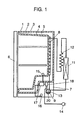
- Fig. 1 is a sectional view of a refrigerator in one preferred embodiment of the present invention.
- the refrigerator of the present invention uses lubricating oil 20 including no silicone.
- flammable hydrocarbon refrigerant 13 is discharged from the compressor 9 and becomes raised in temperature and pressure, and condensed and liquified through heat exchange with an atmosphere in condenser 11. Subsequently, the hydrocarbon refrigerant 13 is decreased in temperature and pressure by expansion device 12 and is evaporated by evaporator 8 through heat exchange in an interior of the refrigerator and again returns to the compressor 9. The refrigerating cycle is repeated and the hydrocarbon refrigerant 13 is circulated. At the same time, small amount of the lubricating oil 20 in the compressor 9 is also circulated together with the hydrocarbon refrigerant 13.
- gas detecting sensors 15, 16 detect the hydrocarbon refrigerant
- gas detection control box 17 activates power relay 18 according to a signal from the gas detecting sensors 15, 16 to cut off the power supply from the plug 14.
- the lubricating oil 20 includes no silicone, a relatively inexpensive catalytic combustion type or semiconductor type gas detecting sensor, which is deteriorated in sensitivity by a contact with silicone, can be used as a safety device for the refrigerating cycle system, although a mist of the lubricating oil 20 leaks together with the hydrocarbon refrigerant 13 and contacts to the gas detecting sensors 15, 16.
- Fig. 2 is a sectional view of a refrigerator in the second preferred embodiment of the present invention as claimed in claim 2.
- the refrigerator of the present invention uses lubricating oil 20' including silicone, and is also provided with gas detecting sensors 21, 22 which are detachably installed.
- the operation of the refrigerator in the present embodiment is same as in the first preferred embodiment.
- the sensors can be replaced with new ones. Accordingly, the refrigerator can be safely used again. Also, even in a case the gas detecting sensors 21, 22 are corroded by sulfur compound floating around the gas detecting sensors 21, 22, and being unabled to perform gas detection thereafter, it is possible to safely use the refrigerator again by replacing the sensors with new ones.
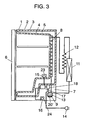
- Fig. 3 is a sectional view of a refrigerator showing the third preferred embodiment of the present invention.
- the refrigerator in the present preferred embodiment has silicone removing filters 23, 24, and the silicone removing filters 23, 24 are disposed so as to cover gas detecting sensors 15, 16.
- the operation of the refrigerator in the present preferred embodiment is also same as in the first preferred embodiment.
- the refrigerator of the present embodiment even in case a mist of lubricating oil 20' including silicone leaks around gas detecting sensors 15, 16 together with hydrocarbon refrigerant 13, the silicone removing filters 23, 24 remove the silicone before sticking to the gas detecting sensors 23, 24, thereby protecting the gas detecting sensors. Also, the refrigerator of the present preferred embodiment is effective against not only the problem of refrigerant leaking from the refrigerator but also the problem of silicone existing in an atmosphere around the gas detecting sensors, the silicone existing for some reasons such as floating from outside.
- a relatively inexpensive catalytic combustion type or semiconductor type gas detecting sensor can be reliably employed.
- Fig. 4 is a sectional view of a refrigerator in the fourth preferred embodiment of the present invention.
- the refrigerator in the present preferred embodiment has sulfur compound removing filters 25, 26, and the sulfur compound removing filters 25, 26 are disposed so as to cover gas detecting sensors 15, 16.
- the operation of the refrigerator in the present preferred embodiment is also same as in the first preferred embodiment.
- the sulfur removing filters 25, 26 remove the sulfur compound before sticking to the gas detecting sensors 15, 16, thereby protecting the gas detecting sensor.
- the present preferred embodiment effectively functions when an existence of sulfur compound is less possible or when the cost of removing filter replacement is low.
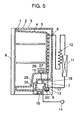
- Fig. 5 is a sectional view of a refrigerator in the fifth preferred embodiment of the present invention.
- the refrigerator in the present preferred embodiment has detachable silicone removing filters 27, 28, and detachable sulfur compound removing filters 29, 30.
- the filters 27, 28 and the filters 29, 30 are disposed so as to cover gas detecting sensors 15, 16.
- the operation of the refrigerator in the present preferred embodiment is also same as in the first preferred embodiment.
- the removing function when the performance of each removing filter is saturated causing the filter to become unusable for some reasons such as refrigerant leakage from the refrigerator or car exhaust, the removing function can be restored by replacing the filter with new one.
- the present preferred embodiment is effective when a possibility that an existence of silicone or sulfur compound that may affect the gas detecting sensor is less or when the maintenance cost of filter replacement is low. Also, it is possible to select one of the silicone removing filter and the sulfur removing filter in accordance with the atmospheric environment where the refrigerator is installed.
- Fig. 6 is a sectional view of a refrigerator in the sixth preferred embodiment of the present invention.
- the refrigerator in the sixth preferred embodiment has non-dispersion type infrared detection sensors 31, 32.
- the detection principle of the non-dispersion type infrared sensor is to utilize a property of infrared ray that is absorbed by gas, and it is mainly characterized in that the measurement can be made with high accuracy and stability.
- the sensitivity is not deteriorated for a long period of time, and the sensor is less affected by coexisting gas, moisture or the like, and is excellent in selectivity.
- the operation of the refrigerator in the present preferred embodiment is also same as in the first preferred embodiment.
- the non-dispersion type infrared sensor detects hydrocarbon gas by measuring an amount of infrared ray (of specific wavelength) absorbed by hydrocarbon gas (infrared ray transmittance) at a specific wavelength. Since an absorption wavelength of hydrocarbon gas is different from those of silicone and sulfur compound, and is not affected by these, it is possible to detect the leakage of hydrocarbon refrigerant without lowering of the sensitivity or other influences on the gas detecting sensor, even in an environment where silicone included in the lubricating oil or sulfur compound included in car exhaust gas exist.
- the senor is able to serve its original function to avoid danger by detecting the leakage of hydrocarbon refrigerant, and it is possible to provide a safe refrigerator.
- An infrared sensor as mentioned above can be simply produced by combining a light emitting diode or semiconductor laser having a specific wavelength light emitting characteristic with a light receiving element, besides the above non-dispersion type infrared sensor.
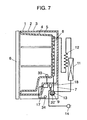
- Fig. 7 is a sectional view of a refrigerator in the seventh preferred embodiment of the present invention.
- the refrigerator in the present preferred embodiment has hydrogen flame ionization type sensors 33, 34.
- the detection principle of the hydrogen flame ionization type sensor is to ustilize a current chnage caused by an ionization of gas such as hydrocarbon gas in hydrogen flame, and it is mainly characterized in that the response is quick and the sensitivity is high.
- the hydrogen flame ionization type sensor is characterized in an output nearly proportional to the carbon number of hydrocarbon and is not affected by inorganic carbon compound.
- the operation of the refrigerator in the present preferred embodiment is also same as in the first preferred embodiment.
- the hydrogen flame ionization type sensor used in the present preferred embodiment detects the current change by the ionization of gas such as hydrocarbon in hydrogen flame, and is not affected by silicone or sulfur compound. Accordingly, the hydrogen flame ionization type sensor is able to serve its original function to avoid danger by detecting the leakage of hydrocarbon refrigerant without lowering of the sensitivity or other influences on the gas detecting sensor, even in an environment where silicone included in the lubricating oil or sulfur compound included in car exhaust gas exist.
- Fig. 8 is a sectional view of a refrigerator in the eighth preferred embodiment of the present invention as claimed in claim 8.
- the refrigerator in the present preferred embodiment has optical interference type sensors 35, 36.
- the detection principle of the optical interference type sensor is to utilize the property of light that is refracted by gas, and it is mainly characterized in that the sensitivity is less deteriorated because there is no chemical changes and is excellent in stability for a long period of time. Also, it is possible to perform continuous measurements of gas concentrations in various processes, with great accuracy, from a level of 1000 ppm to 100 vol%.
- the operation of the refrigerator in the present preferred embodiment is also same as in the first preferred embodiment.
- the optical interference type sensor in the present preferred embodiment detects gas by utilizing the property of light that is refracted by gas, and is not affected by silicone or sulfur compound. Accordingly, the optical interference type sensor is able to serve its original function to avoid danger by detecting the leakage of hydrocarbon refrigerant without decreasing the sensitivity or other influences on the gas detecting sensor, even in an environment where silicone included in the lubricating oil or sulfur compound included in car exhaust gas exist.
- the system comprising at least a compressor, a condenser, a expansion device, and an evaporator, and provided with a sensor for detecting hydrocarbon
- a relatively inexpensive sesistance methanometer type or semiconductor type gas detecting sensor for the purpose of detecting the leakage of hydrocarbon refrigerant of the refrigerating cycle system.
- the refrigerating cycle system of the present invention comprises one of infrared type, hydrogen flame ionization type, and optical interference type sensors. Since a sensor of such type is not affected by silicone or sulfur compound, it can be used for the refrigerating cycle system using hydrocarbon refrigerant even in an environment including silicone or sulfur compound.
Landscapes
- Engineering & Computer Science (AREA)
- Physics & Mathematics (AREA)
- Mechanical Engineering (AREA)
- Thermal Sciences (AREA)
- General Engineering & Computer Science (AREA)
- Investigating Or Analyzing Materials By The Use Of Electric Means (AREA)
Abstract
Description
Claims (5)
- A refrigerating cycle system using a hydrocarbon refrigerant as a refrigerant, the refrigerating cycle system comprising:wherein said compressor uses lubricating oil that does not include organic silicone compound.a compressor;a condenser;an expansion device;an evaporator; anda sensor for detecting hydrocarbon,
- A refrigerating cycle system using a hydrocarbon refrigerant as a refrigerant, the refrigerating cycle system comprising:wherein said sensor is detachable.a compressor;a condenser;an expansion device;an evaporator; anda sensor for detecting hydrocarbon,
- A refrigerating cycle system using a hydrocarbon refrigerant as a refrigerant, the refrigerating cycle system comprising:wherein said sensor has at least one of a filter for removing organic silicone compound and a filter for removing sulfur compound.a compressor;a condenser;an expansion device;an evaporator; anda sensor for detecting hydrocarbon,
- The refrigerating cycle system of claim 3, wherein said filter is detachable.
- A refrigerating cycle system using a hydrocarbon refrigerant as a refrigerant, the refrigerating cycle system comprising:wherein said sensor is one selected from the group consisting of an infrared detection type sensor, a hydrogen flame ionization type sensor, and an optical interference type sensor.a compressor;a condenser;an expansion device;an evaporator; anda sensor for detecting hydrocarbon,
Applications Claiming Priority (3)
| Application Number | Priority Date | Filing Date | Title |
|---|---|---|---|
| JP2000167272A JP3386780B2 (en) | 2000-06-05 | 2000-06-05 | Refrigeration cycle device |
| JP2000167272 | 2000-06-05 | ||
| PCT/JP2001/004755 WO2001094863A1 (en) | 2000-06-05 | 2001-06-05 | Refrigerating cycle device |
Publications (2)
| Publication Number | Publication Date |
|---|---|
| EP1288594A1 true EP1288594A1 (en) | 2003-03-05 |
| EP1288594A4 EP1288594A4 (en) | 2008-04-09 |
Family
ID=18670450
Family Applications (1)
| Application Number | Title | Priority Date | Filing Date |
|---|---|---|---|
| EP01936860A Withdrawn EP1288594A4 (en) | 2000-06-05 | 2001-06-05 | REFRIGERATION CYCLE DEVICE |
Country Status (4)
| Country | Link |
|---|---|
| EP (1) | EP1288594A4 (en) |
| JP (1) | JP3386780B2 (en) |
| CN (1) | CN1243205C (en) |
| WO (1) | WO2001094863A1 (en) |
Families Citing this family (5)
| Publication number | Priority date | Publication date | Assignee | Title |
|---|---|---|---|---|
| CN101454420B (en) * | 2006-05-31 | 2012-07-11 | 纳幕尔杜邦公司 | Vapor compression using ionic liquids as compressor lubricants |
| JP2010007995A (en) * | 2008-06-27 | 2010-01-14 | Daikin Ind Ltd | Refrigerant amount determining method of air conditioning device, and air conditioning device |
| CN102313436A (en) * | 2010-07-06 | 2012-01-11 | 无锡松下冷机有限公司 | Refrigerator and automatic fire alarm method thereof |
| JPWO2016157538A1 (en) * | 2015-04-03 | 2017-04-27 | 三菱電機株式会社 | Refrigeration cycle equipment |
| CN107178961B (en) * | 2017-04-21 | 2019-08-02 | 青岛海尔股份有限公司 | Refrigerator refrigerant leakage monitoring device, its control method and control system |
Family Cites Families (6)
| Publication number | Priority date | Publication date | Assignee | Title |
|---|---|---|---|---|
| JPH08247582A (en) | 1995-03-13 | 1996-09-27 | Toshiba Corp | Refrigeration cycle |
| JP3523381B2 (en) | 1995-07-26 | 2004-04-26 | 株式会社日立製作所 | refrigerator |
| JPH09316439A (en) * | 1996-05-30 | 1997-12-09 | Daikin Ind Ltd | Refrigeration equipment using natural refrigerant |
| JP2965507B2 (en) * | 1996-06-04 | 1999-10-18 | 光明理化学工業株式会社 | Infrared gas detector |
| JP2000136395A (en) | 1998-11-02 | 2000-05-16 | Sanyo Electric Co Ltd | Refrigerator oil composition for hydrocarbon refrigerant |
| JP2000146375A (en) | 1998-11-05 | 2000-05-26 | Hitachi Ltd | Refrigeration equipment |
-
2000
- 2000-06-05 JP JP2000167272A patent/JP3386780B2/en not_active Expired - Fee Related
-
2001
- 2001-06-05 EP EP01936860A patent/EP1288594A4/en not_active Withdrawn
- 2001-06-05 CN CNB018106552A patent/CN1243205C/en not_active Expired - Fee Related
- 2001-06-05 WO PCT/JP2001/004755 patent/WO2001094863A1/en not_active Ceased
Also Published As
| Publication number | Publication date |
|---|---|
| JP3386780B2 (en) | 2003-03-17 |
| CN1522356A (en) | 2004-08-18 |
| WO2001094863A1 (en) | 2001-12-13 |
| JP2001349648A (en) | 2001-12-21 |
| EP1288594A4 (en) | 2008-04-09 |
| CN1243205C (en) | 2006-02-22 |
Similar Documents
| Publication | Publication Date | Title |
|---|---|---|
| EP3818352B1 (en) | Method and system for flammable gas detection | |
| US6061141A (en) | Method and system for detecting gases or vapors in a monitored area | |
| US10465961B2 (en) | Refrigerant leak detection by use of fluid additive | |
| US10732079B2 (en) | Filter replacement lifetime prediction | |
| US9164519B2 (en) | Smart environmental control system for an enclosure with diagnostics | |
| US20190170598A1 (en) | Refrigerant gas sensing system | |
| US20100200664A1 (en) | Thermostat with replaceable carbon monoxide sensor module | |
| CN110848875A (en) | Refrigerant leakage detection method and air conditioner | |
| US11604156B2 (en) | Method and system for multi-sensor gas detection | |
| CN110822675B (en) | Air conditioner refrigerant leakage detection method | |
| US20120090383A1 (en) | System and method for detecting a refrigerant leak and chemicals produced as a result of heating of the refrigerant | |
| EP1288594A1 (en) | Refrigerating cycle device | |
| US9032820B2 (en) | Protective device for a test installation | |
| US20070163238A1 (en) | Method for metering a reagent into the exhaust gas flow of an internal combustion engine | |
| US20220172591A1 (en) | Fire detection for dirty environments | |
| CN113720461B (en) | Protective cover for flame detector | |
| CN223414140U (en) | Energy storage device | |
| US20250003776A1 (en) | Protective shield for a sensor subassembly | |
| RU2817861C1 (en) | System for automatic detection of overheating of electrical equipment elements, which includes several sensors, method of its use and testing | |
| CN111912546B (en) | Air-layer temperature-sensitive gas filter canister life failure indicator and its use method | |
| CA2613430C (en) | Method and device for the detection of hydrogen | |
| JP2535356Y2 (en) | Combustible gas detector Gas sensor poisoning prevention filter | |
| McClure et al. | A Comparison of Refrigerant Constant Monitoring Leak Detectors | |
| US20210223132A1 (en) | Systems and methods for detecting moisture leaks or moisture ingress | |
| WO2024205447A1 (en) | Adaptive system and method for detecting overheating of elements of electrical equipment |
Legal Events
| Date | Code | Title | Description |
|---|---|---|---|
| PUAI | Public reference made under article 153(3) epc to a published international application that has entered the european phase |
Free format text: ORIGINAL CODE: 0009012 |
|
| 17P | Request for examination filed |
Effective date: 20021205 |
|
| AK | Designated contracting states |
Kind code of ref document: A1 Designated state(s): AT BE CH CY DE DK ES FI FR GB GR IE IT LI LU MC NL PT SE TR Designated state(s): AT BE CH CY DE DK ES FI FR GB GR IE IT LI LU MC NL PT SE TR |
|
| AX | Request for extension of the european patent |
Extension state: AL LT LV MK RO SI |
|
| RBV | Designated contracting states (corrected) |
Designated state(s): AT BE CH CY DE FR GB IT LI |
|
| A4 | Supplementary search report drawn up and despatched |
Effective date: 20080306 |
|
| 17Q | First examination report despatched |
Effective date: 20080625 |
|
| RAP1 | Party data changed (applicant data changed or rights of an application transferred) |
Owner name: PANASONIC CORPORATION |
|
| STAA | Information on the status of an ep patent application or granted ep patent |
Free format text: STATUS: THE APPLICATION IS DEEMED TO BE WITHDRAWN |
|
| 18D | Application deemed to be withdrawn |
Effective date: 20110104 |