EP1288243A1 - Curable fluoropolyether rubber compositions and cured rubber parts made therefrom - Google Patents
Curable fluoropolyether rubber compositions and cured rubber parts made therefrom Download PDFInfo
- Publication number
- EP1288243A1 EP1288243A1 EP02256021A EP02256021A EP1288243A1 EP 1288243 A1 EP1288243 A1 EP 1288243A1 EP 02256021 A EP02256021 A EP 02256021A EP 02256021 A EP02256021 A EP 02256021A EP 1288243 A1 EP1288243 A1 EP 1288243A1
- Authority
- EP
- European Patent Office
- Prior art keywords
- perfluoropolyether
- rubber part
- rubber
- composition
- letter
- Prior art date
- Legal status (The legal status is an assumption and is not a legal conclusion. Google has not performed a legal analysis and makes no representation as to the accuracy of the status listed.)
- Withdrawn
Links
- 229920001971 elastomer Polymers 0.000 title claims abstract description 40
- 239000000203 mixture Substances 0.000 title claims abstract description 30
- VYPSYNLAJGMNEJ-UHFFFAOYSA-N Silicium dioxide Chemical compound O=[Si]=O VYPSYNLAJGMNEJ-UHFFFAOYSA-N 0.000 claims abstract description 26
- 239000010702 perfluoropolyether Substances 0.000 claims abstract description 20
- 239000000945 filler Substances 0.000 claims abstract description 13
- 239000000377 silicon dioxide Substances 0.000 claims abstract description 12
- 229920000642 polymer Polymers 0.000 claims abstract description 11
- 239000012530 fluid Substances 0.000 claims abstract description 10
- 239000003431 cross linking reagent Substances 0.000 claims abstract description 6
- 238000004132 cross linking Methods 0.000 claims abstract description 5
- 239000002245 particle Substances 0.000 claims abstract description 5
- 150000001875 compounds Chemical class 0.000 claims description 21
- 238000000465 moulding Methods 0.000 claims description 12
- 150000003961 organosilicon compounds Chemical class 0.000 claims description 12
- 125000004435 hydrogen atom Chemical group [H]* 0.000 claims description 10
- RTZKZFJDLAIYFH-UHFFFAOYSA-N Diethyl ether Chemical compound CCOCC RTZKZFJDLAIYFH-UHFFFAOYSA-N 0.000 claims description 9
- 238000000034 method Methods 0.000 claims description 9
- 238000007789 sealing Methods 0.000 claims description 8
- 125000002496 methyl group Chemical group [H]C([H])([H])* 0.000 claims description 7
- 125000001997 phenyl group Chemical group [H]C1=C([H])C([H])=C(*)C([H])=C1[H] 0.000 claims description 7
- 125000000391 vinyl group Chemical group [H]C([*])=C([H])[H] 0.000 claims description 7
- 125000003342 alkenyl group Chemical group 0.000 claims description 6
- 239000003054 catalyst Substances 0.000 claims description 6
- 125000003903 2-propenyl group Chemical group [H]C([*])([H])C([H])=C([H])[H] 0.000 claims description 5
- 238000006459 hydrosilylation reaction Methods 0.000 claims description 4
- 238000002156 mixing Methods 0.000 claims description 4
- 125000001183 hydrocarbyl group Chemical group 0.000 claims 1
- 150000001412 amines Chemical class 0.000 abstract description 10
- 239000000126 substance Substances 0.000 abstract description 5
- 238000012360 testing method Methods 0.000 description 28
- 230000008859 change Effects 0.000 description 19
- 239000000446 fuel Substances 0.000 description 13
- 230000006835 compression Effects 0.000 description 11
- 238000007906 compression Methods 0.000 description 11
- 125000005010 perfluoroalkyl group Chemical group 0.000 description 11
- 229920001973 fluoroelastomer Polymers 0.000 description 10
- 239000010705 motor oil Substances 0.000 description 10
- 229920001577 copolymer Polymers 0.000 description 9
- 239000007788 liquid Substances 0.000 description 9
- 150000002430 hydrocarbons Chemical group 0.000 description 8
- 125000002947 alkylene group Chemical group 0.000 description 7
- 230000000052 comparative effect Effects 0.000 description 7
- 239000000463 material Substances 0.000 description 7
- 125000006551 perfluoro alkylene group Chemical group 0.000 description 7
- -1 perfluoroalkyl ether Chemical compound 0.000 description 7
- 239000007789 gas Substances 0.000 description 6
- 239000003921 oil Substances 0.000 description 6
- 230000035699 permeability Effects 0.000 description 6
- BASFCYQUMIYNBI-UHFFFAOYSA-N platinum Chemical group [Pt] BASFCYQUMIYNBI-UHFFFAOYSA-N 0.000 description 6
- RIOQSEWOXXDEQQ-UHFFFAOYSA-N triphenylphosphine Chemical compound C1=CC=CC=C1P(C=1C=CC=CC=1)C1=CC=CC=C1 RIOQSEWOXXDEQQ-UHFFFAOYSA-N 0.000 description 6
- 239000002904 solvent Substances 0.000 description 5
- XLYOFNOQVPJJNP-UHFFFAOYSA-N water Substances O XLYOFNOQVPJJNP-UHFFFAOYSA-N 0.000 description 5
- XUIMIQQOPSSXEZ-UHFFFAOYSA-N Silicon Chemical group [Si] XUIMIQQOPSSXEZ-UHFFFAOYSA-N 0.000 description 4
- 238000001746 injection moulding Methods 0.000 description 4
- 230000008961 swelling Effects 0.000 description 4
- 229920002554 vinyl polymer Polymers 0.000 description 4
- XDJQVCIRFIRWKY-UHFFFAOYSA-N C=C.C(=C)(F)F Chemical group C=C.C(=C)(F)F XDJQVCIRFIRWKY-UHFFFAOYSA-N 0.000 description 3
- LFQSCWFLJHTTHZ-UHFFFAOYSA-N Ethanol Chemical compound CCO LFQSCWFLJHTTHZ-UHFFFAOYSA-N 0.000 description 3
- YXFVVABEGXRONW-UHFFFAOYSA-N Toluene Chemical compound CC1=CC=CC=C1 YXFVVABEGXRONW-UHFFFAOYSA-N 0.000 description 3
- 239000002253 acid Substances 0.000 description 3
- 239000000654 additive Substances 0.000 description 3
- 229940045985 antineoplastic platinum compound Drugs 0.000 description 3
- 229910052751 metal Inorganic materials 0.000 description 3
- 239000002184 metal Substances 0.000 description 3
- 238000012856 packing Methods 0.000 description 3
- 150000003058 platinum compounds Chemical class 0.000 description 3
- 125000001424 substituent group Chemical group 0.000 description 3
- 229920001169 thermoplastic Polymers 0.000 description 3
- 239000004416 thermosoftening plastic Substances 0.000 description 3
- VTYYLEPIZMXCLO-UHFFFAOYSA-L Calcium carbonate Chemical compound [Ca+2].[O-]C([O-])=O VTYYLEPIZMXCLO-UHFFFAOYSA-L 0.000 description 2
- OKTJSMMVPCPJKN-UHFFFAOYSA-N Carbon Chemical compound [C] OKTJSMMVPCPJKN-UHFFFAOYSA-N 0.000 description 2
- 239000004215 Carbon black (E152) Substances 0.000 description 2
- UQSXHKLRYXJYBZ-UHFFFAOYSA-N Iron oxide Chemical compound [Fe]=O UQSXHKLRYXJYBZ-UHFFFAOYSA-N 0.000 description 2
- KDLHZDBZIXYQEI-UHFFFAOYSA-N Palladium Chemical compound [Pd] KDLHZDBZIXYQEI-UHFFFAOYSA-N 0.000 description 2
- 125000001931 aliphatic group Chemical group 0.000 description 2
- 125000000217 alkyl group Chemical group 0.000 description 2
- 125000000732 arylene group Chemical group 0.000 description 2
- 229910052799 carbon Inorganic materials 0.000 description 2
- 238000000748 compression moulding Methods 0.000 description 2
- 125000004836 hexamethylene group Chemical group [H]C([H])([*:2])C([H])([H])C([H])([H])C([H])([H])C([H])([H])C([H])([H])[*:1] 0.000 description 2
- 239000010720 hydraulic oil Substances 0.000 description 2
- 229930195733 hydrocarbon Natural products 0.000 description 2
- 238000009863 impact test Methods 0.000 description 2
- 125000000962 organic group Chemical group 0.000 description 2
- 230000008569 process Effects 0.000 description 2
- 239000010948 rhodium Substances 0.000 description 2
- 229910052703 rhodium Inorganic materials 0.000 description 2
- MHOVAHRLVXNVSD-UHFFFAOYSA-N rhodium atom Chemical compound [Rh] MHOVAHRLVXNVSD-UHFFFAOYSA-N 0.000 description 2
- 229910052710 silicon Inorganic materials 0.000 description 2
- 230000003068 static effect Effects 0.000 description 2
- 238000001721 transfer moulding Methods 0.000 description 2
- 239000004636 vulcanized rubber Substances 0.000 description 2
- SJBBXFLOLUTGCW-UHFFFAOYSA-N 1,3-bis(trifluoromethyl)benzene Chemical compound FC(F)(F)C1=CC=CC(C(F)(F)F)=C1 SJBBXFLOLUTGCW-UHFFFAOYSA-N 0.000 description 1
- VQMPTVQCADWACQ-UHFFFAOYSA-N CCC(C)(CC)N Chemical compound CCC(C)(CC)N VQMPTVQCADWACQ-UHFFFAOYSA-N 0.000 description 1
- 239000004970 Chain extender Substances 0.000 description 1
- VGGSQFUCUMXWEO-UHFFFAOYSA-N Ethene Chemical compound C=C VGGSQFUCUMXWEO-UHFFFAOYSA-N 0.000 description 1
- 239000005977 Ethylene Substances 0.000 description 1
- AFCARXCZXQIEQB-UHFFFAOYSA-N N-[3-oxo-3-(2,4,6,7-tetrahydrotriazolo[4,5-c]pyridin-5-yl)propyl]-2-[[3-(trifluoromethoxy)phenyl]methylamino]pyrimidine-5-carboxamide Chemical compound O=C(CCNC(=O)C=1C=NC(=NC=1)NCC1=CC(=CC=C1)OC(F)(F)F)N1CC2=C(CC1)NN=N2 AFCARXCZXQIEQB-UHFFFAOYSA-N 0.000 description 1
- NFHFRUOZVGFOOS-UHFFFAOYSA-N Pd(PPh3)4 Substances [Pd].C1=CC=CC=C1P(C=1C=CC=CC=1)C1=CC=CC=C1.C1=CC=CC=C1P(C=1C=CC=CC=1)C1=CC=CC=C1.C1=CC=CC=C1P(C=1C=CC=CC=1)C1=CC=CC=C1.C1=CC=CC=C1P(C=1C=CC=CC=1)C1=CC=CC=C1 NFHFRUOZVGFOOS-UHFFFAOYSA-N 0.000 description 1
- KJTLSVCANCCWHF-UHFFFAOYSA-N Ruthenium Chemical compound [Ru] KJTLSVCANCCWHF-UHFFFAOYSA-N 0.000 description 1
- GWEVSGVZZGPLCZ-UHFFFAOYSA-N Titan oxide Chemical compound O=[Ti]=O GWEVSGVZZGPLCZ-UHFFFAOYSA-N 0.000 description 1
- 125000002015 acyclic group Chemical group 0.000 description 1
- 150000001298 alcohols Chemical class 0.000 description 1
- 150000001336 alkenes Chemical class 0.000 description 1
- PNEYBMLMFCGWSK-UHFFFAOYSA-N aluminium oxide Inorganic materials [O-2].[O-2].[O-2].[Al+3].[Al+3] PNEYBMLMFCGWSK-UHFFFAOYSA-N 0.000 description 1
- 125000003710 aryl alkyl group Chemical group 0.000 description 1
- 125000003118 aryl group Chemical group 0.000 description 1
- 125000001797 benzyl group Chemical group [H]C1=C([H])C([H])=C(C([H])=C1[H])C([H])([H])* 0.000 description 1
- 125000004369 butenyl group Chemical group C(=CCC)* 0.000 description 1
- 125000000484 butyl group Chemical group [H]C([*])([H])C([H])([H])C([H])([H])C([H])([H])[H] 0.000 description 1
- 229910000019 calcium carbonate Inorganic materials 0.000 description 1
- NQZFAUXPNWSLBI-UHFFFAOYSA-N carbon monoxide;ruthenium Chemical compound [Ru].[Ru].[Ru].[O+]#[C-].[O+]#[C-].[O+]#[C-].[O+]#[C-].[O+]#[C-].[O+]#[C-].[O+]#[C-].[O+]#[C-].[O+]#[C-].[O+]#[C-].[O+]#[C-].[O+]#[C-] NQZFAUXPNWSLBI-UHFFFAOYSA-N 0.000 description 1
- 150000004649 carbonic acid derivatives Chemical class 0.000 description 1
- 150000001735 carboxylic acids Chemical class 0.000 description 1
- 229910000420 cerium oxide Inorganic materials 0.000 description 1
- 238000006243 chemical reaction Methods 0.000 description 1
- 125000004122 cyclic group Chemical group 0.000 description 1
- 125000000392 cycloalkenyl group Chemical group 0.000 description 1
- 125000000113 cyclohexyl group Chemical group [H]C1([H])C([H])([H])C([H])([H])C([H])(*)C([H])([H])C1([H])[H] 0.000 description 1
- 125000002704 decyl group Chemical group [H]C([H])([H])C([H])([H])C([H])([H])C([H])([H])C([H])([H])C([H])([H])C([H])([H])C([H])([H])C([H])([H])C([H])([H])* 0.000 description 1
- 230000002950 deficient Effects 0.000 description 1
- 230000006866 deterioration Effects 0.000 description 1
- 230000001627 detrimental effect Effects 0.000 description 1
- 239000000975 dye Substances 0.000 description 1
- 230000000694 effects Effects 0.000 description 1
- 239000000806 elastomer Substances 0.000 description 1
- 125000005677 ethinylene group Chemical group [*:2]C#C[*:1] 0.000 description 1
- 125000001495 ethyl group Chemical group [H]C([H])([H])C([H])([H])* 0.000 description 1
- 229920005560 fluorosilicone rubber Polymers 0.000 description 1
- 238000005187 foaming Methods 0.000 description 1
- 229910021485 fumed silica Inorganic materials 0.000 description 1
- 239000003365 glass fiber Substances 0.000 description 1
- 238000007542 hardness measurement Methods 0.000 description 1
- 229910001385 heavy metal Inorganic materials 0.000 description 1
- 125000006038 hexenyl group Chemical group 0.000 description 1
- 125000004051 hexyl group Chemical group [H]C([H])([H])C([H])([H])C([H])([H])C([H])([H])C([H])([H])C([H])([H])* 0.000 description 1
- 150000008040 ionic compounds Chemical class 0.000 description 1
- 229910052741 iridium Inorganic materials 0.000 description 1
- GKOZUEZYRPOHIO-UHFFFAOYSA-N iridium atom Chemical compound [Ir] GKOZUEZYRPOHIO-UHFFFAOYSA-N 0.000 description 1
- 125000000555 isopropenyl group Chemical group [H]\C([H])=C(\*)C([H])([H])[H] 0.000 description 1
- 150000002576 ketones Chemical class 0.000 description 1
- 239000010687 lubricating oil Substances 0.000 description 1
- ZLNQQNXFFQJAID-UHFFFAOYSA-L magnesium carbonate Chemical compound [Mg+2].[O-]C([O-])=O ZLNQQNXFFQJAID-UHFFFAOYSA-L 0.000 description 1
- 239000001095 magnesium carbonate Substances 0.000 description 1
- 229910000021 magnesium carbonate Inorganic materials 0.000 description 1
- 238000004519 manufacturing process Methods 0.000 description 1
- 238000000691 measurement method Methods 0.000 description 1
- 150000002736 metal compounds Chemical class 0.000 description 1
- 229910044991 metal oxide Inorganic materials 0.000 description 1
- 150000004706 metal oxides Chemical class 0.000 description 1
- 238000012986 modification Methods 0.000 description 1
- 230000004048 modification Effects 0.000 description 1
- 125000001624 naphthyl group Chemical group 0.000 description 1
- 125000002347 octyl group Chemical group [H]C([*])([H])C([H])([H])C([H])([H])C([H])([H])C([H])([H])C([H])([H])C([H])([H])C([H])([H])[H] 0.000 description 1
- JRZJOMJEPLMPRA-UHFFFAOYSA-N olefin Natural products CCCCCCCC=C JRZJOMJEPLMPRA-UHFFFAOYSA-N 0.000 description 1
- 238000010525 oxidative degradation reaction Methods 0.000 description 1
- BMMGVYCKOGBVEV-UHFFFAOYSA-N oxo(oxoceriooxy)cerium Chemical compound [Ce]=O.O=[Ce]=O BMMGVYCKOGBVEV-UHFFFAOYSA-N 0.000 description 1
- 125000004430 oxygen atom Chemical group O* 0.000 description 1
- 229910052763 palladium Inorganic materials 0.000 description 1
- 150000002941 palladium compounds Chemical class 0.000 description 1
- YVBBRRALBYAZBM-UHFFFAOYSA-N perfluorooctane Chemical compound FC(F)(F)C(F)(F)C(F)(F)C(F)(F)C(F)(F)C(F)(F)C(F)(F)C(F)(F)F YVBBRRALBYAZBM-UHFFFAOYSA-N 0.000 description 1
- 125000000843 phenylene group Chemical group C1(=C(C=CC=C1)*)* 0.000 description 1
- 125000000286 phenylethyl group Chemical group [H]C1=C([H])C([H])=C(C([H])=C1[H])C([H])([H])C([H])([H])* 0.000 description 1
- 239000000049 pigment Substances 0.000 description 1
- 229910052697 platinum Inorganic materials 0.000 description 1
- 229920001296 polysiloxane Polymers 0.000 description 1
- 239000000843 powder Substances 0.000 description 1
- 239000010970 precious metal Substances 0.000 description 1
- 125000004368 propenyl group Chemical group C(=CC)* 0.000 description 1
- 125000001436 propyl group Chemical group [H]C([*])([H])C([H])([H])C([H])([H])[H] 0.000 description 1
- 239000010453 quartz Substances 0.000 description 1
- 229910052707 ruthenium Inorganic materials 0.000 description 1
- 239000003566 sealing material Substances 0.000 description 1
- 238000009864 tensile test Methods 0.000 description 1
- OGIDPMRJRNCKJF-UHFFFAOYSA-N titanium oxide Inorganic materials [Ti]=O OGIDPMRJRNCKJF-UHFFFAOYSA-N 0.000 description 1
- 125000003944 tolyl group Chemical group 0.000 description 1
- 229910052723 transition metal Inorganic materials 0.000 description 1
- 150000003623 transition metal compounds Chemical class 0.000 description 1
- 150000003624 transition metals Chemical class 0.000 description 1
- IMFACGCPASFAPR-UHFFFAOYSA-N tributylamine Chemical compound CCCCN(CCCC)CCCC IMFACGCPASFAPR-UHFFFAOYSA-N 0.000 description 1
Classifications
-
- C—CHEMISTRY; METALLURGY
- C08—ORGANIC MACROMOLECULAR COMPOUNDS; THEIR PREPARATION OR CHEMICAL WORKING-UP; COMPOSITIONS BASED THEREON
- C08G—MACROMOLECULAR COMPOUNDS OBTAINED OTHERWISE THAN BY REACTIONS ONLY INVOLVING UNSATURATED CARBON-TO-CARBON BONDS
- C08G65/00—Macromolecular compounds obtained by reactions forming an ether link in the main chain of the macromolecule
- C08G65/02—Macromolecular compounds obtained by reactions forming an ether link in the main chain of the macromolecule from cyclic ethers by opening of the heterocyclic ring
- C08G65/32—Polymers modified by chemical after-treatment
- C08G65/329—Polymers modified by chemical after-treatment with organic compounds
- C08G65/336—Polymers modified by chemical after-treatment with organic compounds containing silicon
-
- C—CHEMISTRY; METALLURGY
- C08—ORGANIC MACROMOLECULAR COMPOUNDS; THEIR PREPARATION OR CHEMICAL WORKING-UP; COMPOSITIONS BASED THEREON
- C08G—MACROMOLECULAR COMPOUNDS OBTAINED OTHERWISE THAN BY REACTIONS ONLY INVOLVING UNSATURATED CARBON-TO-CARBON BONDS
- C08G65/00—Macromolecular compounds obtained by reactions forming an ether link in the main chain of the macromolecule
- C08G65/002—Macromolecular compounds obtained by reactions forming an ether link in the main chain of the macromolecule from unsaturated compounds
- C08G65/005—Macromolecular compounds obtained by reactions forming an ether link in the main chain of the macromolecule from unsaturated compounds containing halogens
- C08G65/007—Macromolecular compounds obtained by reactions forming an ether link in the main chain of the macromolecule from unsaturated compounds containing halogens containing fluorine
-
- C—CHEMISTRY; METALLURGY
- C08—ORGANIC MACROMOLECULAR COMPOUNDS; THEIR PREPARATION OR CHEMICAL WORKING-UP; COMPOSITIONS BASED THEREON
- C08K—Use of inorganic or non-macromolecular organic substances as compounding ingredients
- C08K3/00—Use of inorganic substances as compounding ingredients
- C08K3/34—Silicon-containing compounds
- C08K3/36—Silica
Definitions
- Vinylidene-fluoride-ethylene tetrafluoride-perfluorovinyl methyl ether copolymers can be used at temperatures down to -30°C in static sealing applications, and down to -25°C in dynamic sealing applications, but even this falls short of cold resistance requirements today. Apart from their cold resistance, these copolymers have the same drawbacks as vinylidene fluoride-propylene hexafluoride copolymers.
- the above-described linear fluoropolyether compound may first be subjected to hydrosilylation with an organosilicon compound bearing two SiH groups by means of an ordinary method and under ordinary conditions.
- the resulting chain-extended product can then be used as component A.
- organosilicon compounds include the compounds shown below. The following compounds may be used alone or as combinations of two or more thereof. In the formulas shown below, "Me” stands for methyl and “Ph” stands for phenyl.
- the curable composition used in the invention may also have added thereto a filler other than silica to reduce heat shrinkage during curing and lower the thermal expansion coefficient of the elastomer obtained by curing the composition, to enhance certain properties of the inventive rubber parts, including their thermal stability, weatherability, chemical resistance, fire retardance and mechanical strength, and to decrease the gas permeability of the rubber parts.
- additional fillers include glass fibers, carbon, metal oxides such as iron oxide, titanium oxide and cerium oxide, and metal carbonates such as calcium carbonate and magnesium carbonate. If necessary, suitable pigments and dyes may also be added.
- test specimen was immersed in Mobil 254 (available from Mobil Co., Ltd.) at 200°C for 70 hours. Then the test specimen was taken out from Mobil 254 and fully wiped to remove Mobil 254 from the surface of the test specimen. Thereafter, the hardness, tensile strength, elongation and compression set were measured in the same manner as above to evaluate the change from the original property.
- Mobil 254 available from Mobil Co., Ltd.
- a test specimen was fabricated in the same way as in Example 1, but using the liquid fluororubber SIFEL 4750 (manufactured by Shin-Etsu Chemical Co., Ltd.) having a perfluoropolyether structure.
Landscapes
- Chemical & Material Sciences (AREA)
- Health & Medical Sciences (AREA)
- Chemical Kinetics & Catalysis (AREA)
- Medicinal Chemistry (AREA)
- Polymers & Plastics (AREA)
- Organic Chemistry (AREA)
- General Chemical & Material Sciences (AREA)
- Compositions Of Macromolecular Compounds (AREA)
- Sealing Material Composition (AREA)
Abstract
Rubber aircraft parts are made of the cured form of a
curable composition comprising a perfluoropolyether polymer
having a perfluoropolyether backbone and at least one
reactive group, a crosslinking agent for crosslinking the
polymer, and a silica filler having an average particle size
of 0.001-10 µm. By providing dramatically improved
sealability at low temperatures of -25 to -55°C,
particularly during use in a dynamic state, and much
improved resistance to amines and other chemicals, such
rubber parts can ensure the reliable sealability of fluid
line junctions in jet engines.
Description
- The present invention relates to rubber parts for aircraft. More particularly, it relates to rubber parts used as sealing components (e.g., aircraft O-rings, packings, gaskets, face seals) which come into contact with substances such as engine oil and jet fuel.
- Rubber parts for aircraft, especially those used as fluid sealing components around jet engines, include O-rings (e.g., fluid line O-rings), seals (e.g., face seals, packings, gaskets), diaphragms and valves for aircraft engine oils, jet fuels, hydraulic oils and aviation hydraulic fluids such as Skydrol.
- During use, such rubber parts often inevitably come into contact with fluids used in aircraft, such as engine oils (e.g., Mobil 254), jet fuels, hydraulic oils, and aviation hydraulic fluids such as Skydrol. To ensure normal operation, these aircraft parts are required to be resistant to jet fuels, resistant to carboxylic acids that arise from the oxidative degradation of synthetic oils (e.g., engine oils), resistant to amines and oils, and also resistant to gas permeability, heat and water. In addition, because aircraft are commonly operated in cold regions and at altitudes where low temperatures prevail, such rubber parts must also have a good cold resistance.
- Hence, these aircraft parts are generally made of such materials as vinylidene fluoride-propylene hexafluoride copolymer-based fluororubbers, vinylidene fluoride-ethylene tetrafluoride-perfluorovinyl methyl ether copolymer-based cold-resistant fluororubbers, or fluorosilicones.
- Vinylidene fluoride-propylene hexafluoride copolymers, though endowed with excellent heat resistance, resistance to oil and gasoline, and flexing resistance, lack sufficient cold resistance. The lower limit in their service temperature is -20°C for static sealing applications, and -10°C for dynamic sealing applications (e.g., diaphragms). In addition, such copolymers undergo considerable swelling in alcohols and ketones, becoming unfit for use thereafter. They are also subject to severe deterioration by amine-based additives in lubricating oils.
- Vinylidene-fluoride-ethylene tetrafluoride-perfluorovinyl methyl ether copolymers can be used at temperatures down to -30°C in static sealing applications, and down to -25°C in dynamic sealing applications, but even this falls short of cold resistance requirements today. Apart from their cold resistance, these copolymers have the same drawbacks as vinylidene fluoride-propylene hexafluoride copolymers.
- Fluorosilicones have an excellent cold resistance, but an inadequate resistance to amines. In addition, they have a poor resistance to gas permeability and a poor water resistance.
- A need has thus been felt for rubber parts endowed with each of the above properties to the desired degree.
- It is therefore an object of the invention to provide rubber aircraft parts which are endowed with good resistance to jet fuels, jet engine oils, amines and oils, good resistance to gas permeability, good resistance to heat and water, and also outstanding cold resistance.
- We have found that rubber aircraft parts endowed with good resistance to jet fuels, jet engine oils, amines and oils, good resistance to gas permeability, good heat and water resistance, and excellent cold resistance, can be obtained by using the cured form of a curable composition which includes a perfluoropolyether polymer of perfluoropolyether backbone having at least one reactive group, a crosslinking agent for crosslinking the polymer, and a silica filler having an average particle size of 0.001 to 10 µm. In addition, we have discovered that such parts can be imparted with a dramatically improved low-temperature sealability at temperatures below the minimum service temperatures normally achievable in prior-art low-temperature fluororubbers, i.e., at -25 to -55°C, particularly in a dynamic state, and can also be imparted with a markedly improved resistance to amines and other chemicals, thus making it possible to reliably ensure the sealability of fluid line junctions in jet engines.
- Accordingly, the invention provides rubber aircraft parts which are made of the cured form of a curable composition that includes a perfluoropolyether polymer having a perfluoropolyether backbone and at least one reactive group, a crosslinking agent for crosslinking the polymer, and a silica filler having an average particle size of 0.001 to 10 µm. The invention also provides a method of using the above cured product as a fluid sealing component around a jet engine.
- As mentioned above, the rubber aircraft parts of the invention are made of the cured form of a curable composition which includes a perfluoropolyether polymer, a crosslinking agent and a silica filler.
- Any curable composition of the above type may be used, although a curable fluoropolyether rubber composition containing:
- (A) a linear fluoropolyether compound having at least two alkenyl groups per molecule and a backbone with a perfluoropolyether structure;
- (B) an organosilicon compound having at least two silicon-bonded hydrogen atoms (SiH groups) per molecule;
- (C) a hydrosilylation catalyst; and
- (D) a silica filler is especially preferred. For the avoidance of doubt, the limits on any ranges quoted hereafter are to be considered independent from each other.
-
- Component A is a linear fluoropolyether compound having at least two alkenyl groups per molecule and a backbone with a divalent perfluoroalkyl ether structure.
- The perfluoroalkyl ether structure contains a plurality of -CdF2dO- repeating units, the letter d in each unit being independently an integer from 1 to 6. Exemplary perfluoroalkyl ether structures include those of general formula (1) below
- Examples of the repeating unit -CdF2dO- represented by above formula (1) include -CF2O-, -CF2CF2O- , -CF2CF2CF2O-, -CF(CF3)CF2O-, -CF2CF2CF2CF2O-, -CF2CF2CF2CF2CF2CF2O- and -C(CF3)2O-. Of these, -CF2O-, -CF2CF2O-, -CF2CF2CF2O- and -CF(CF3)CF2O- are preferred. More preferably, the perfluoropolyether polymer has a perfluoropolyether backbone with a structure of the following general formula:wherein n is an integer which is at least 10, and especially 30 to 200.

- The perfluoroalkyl ether structure may be composed of only one of these types of repeating unit, or may be a combination of two or more such types.
- It is advantageous for the alkenyl groups on the linear fluoropolyether compound serving as component A to have 2 to 8 carbons, and preferably 2 to 6 carbons, and to have a CH2=CH- structure at the end. Illustrative examples include vinyl, allyl, propenyl, isopropenyl, butenyl and hexenyl. Of these, vinyl and allyl are preferred. The alkenyl groups may be present at intermediate positions on the molecule chain, although it is preferable for them to be bonded to both ends of the molecular chain. In the latter case, they may be bonded directly to both ends of the linear fluoropolyether compound backbone or bonded to the backbone through divalent linkages such as the following:(wherein the free valence bond may be at the o-, m- or p-position); and R' is a hydrogen atom or a methyl, phenyl or allyl group.

- The linear fluoropolyether compound of component A is preferably a linear compound of general formula (3) or (4) below:
- The linear fluoropolyether compound serving as component A of the curable composition is most preferably a compound of the following general formula.In the formula, X is as defined above; p is independently 0 or 1; r is an integer from 1 to 6; u is an integer from 2 to 6; and m and n are independently integers from 0 to 200.
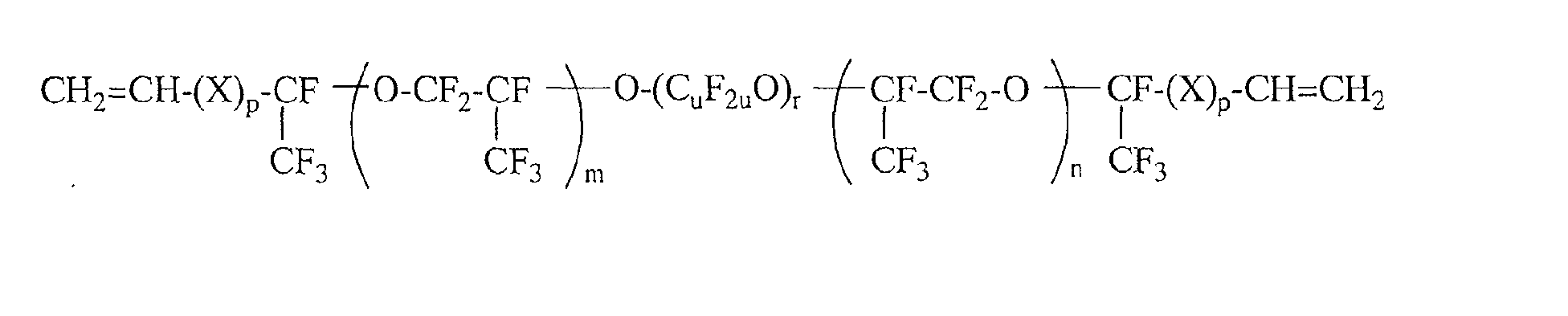
- The linear fluoropolyether compound has a weight-average molecular weight of preferably 4,000 to 100,000, and most preferably 1,000 to 50,000, or 10,000 to 50,000.
- Specific examples of the linear fluoropolyether compound include the following compounds. The letters m and n in these compounds are as defined above.

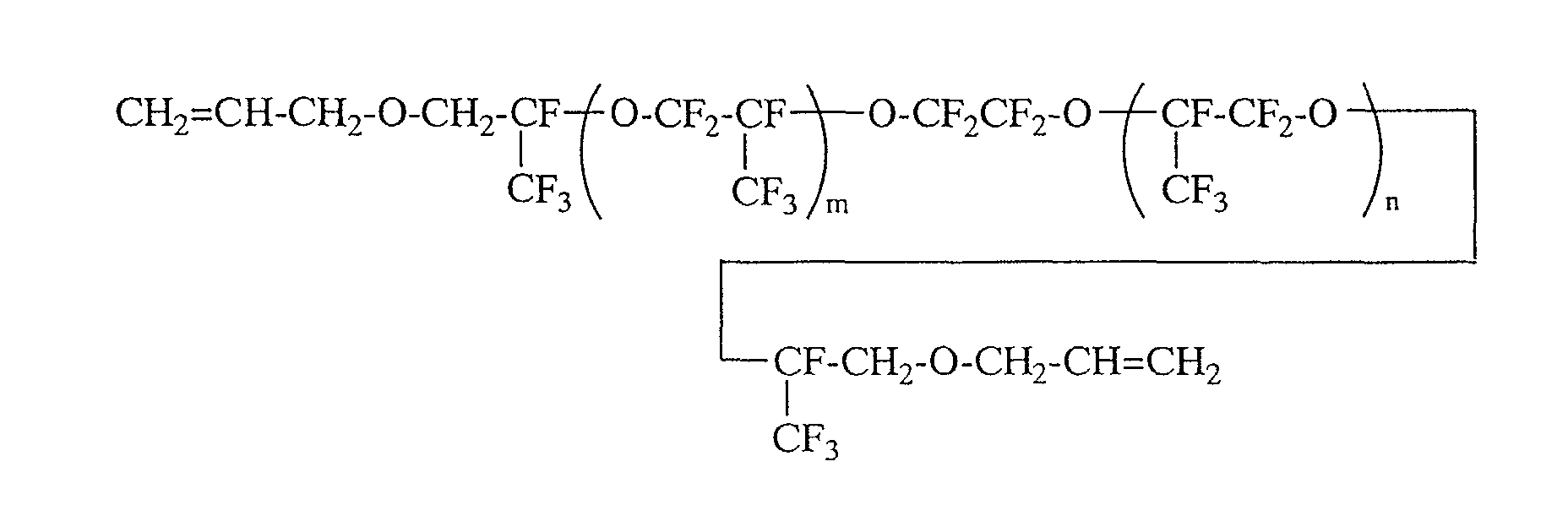
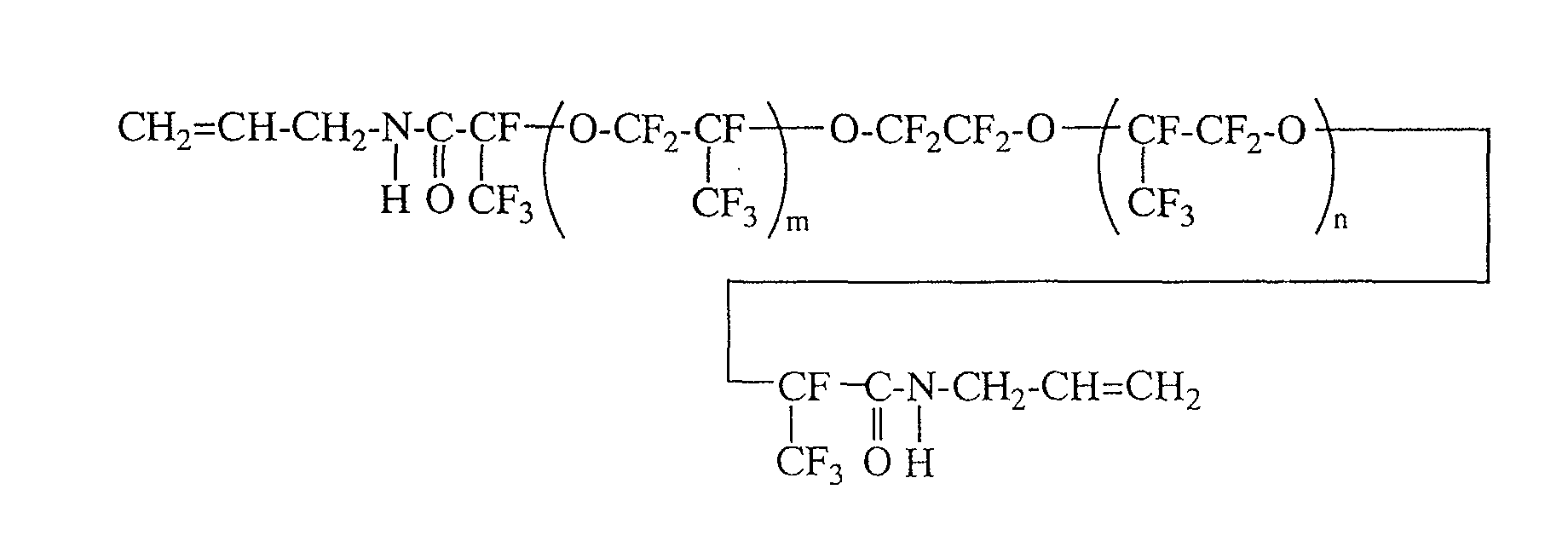
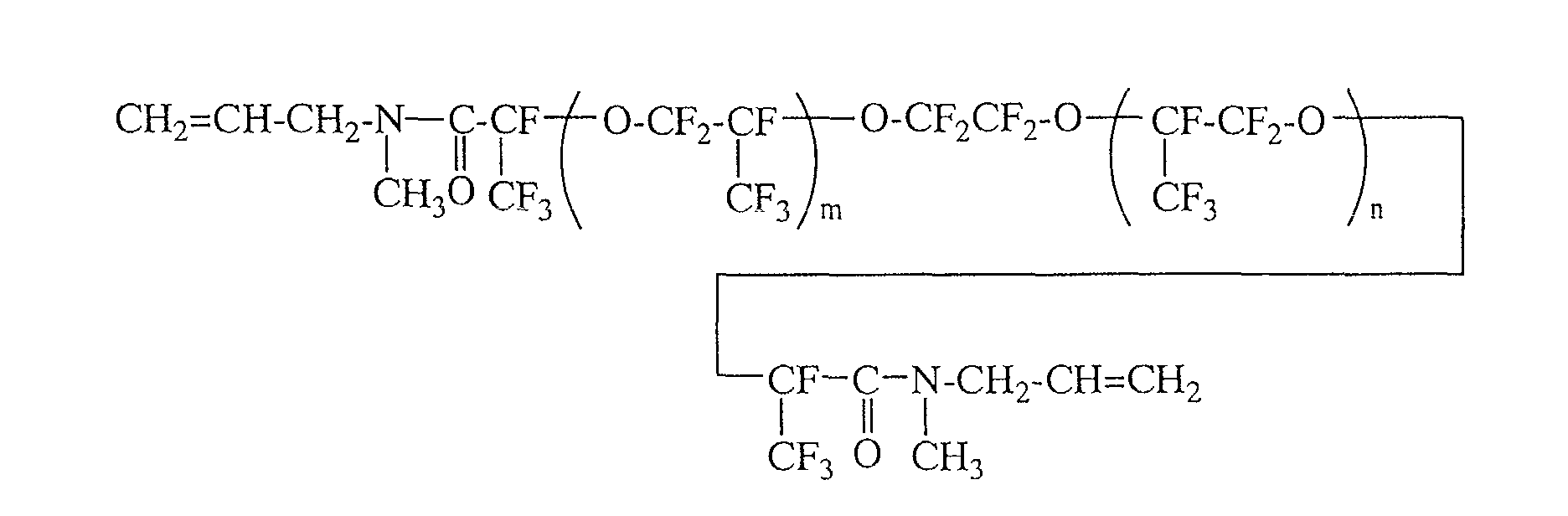
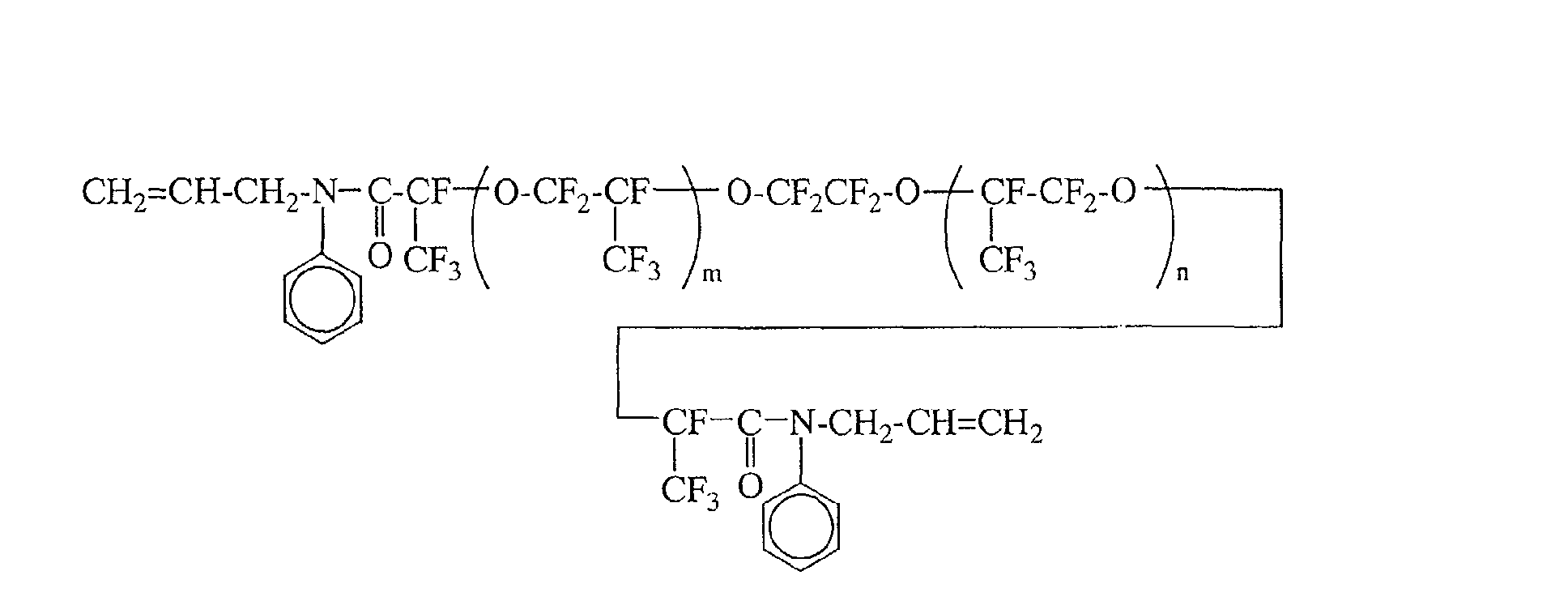
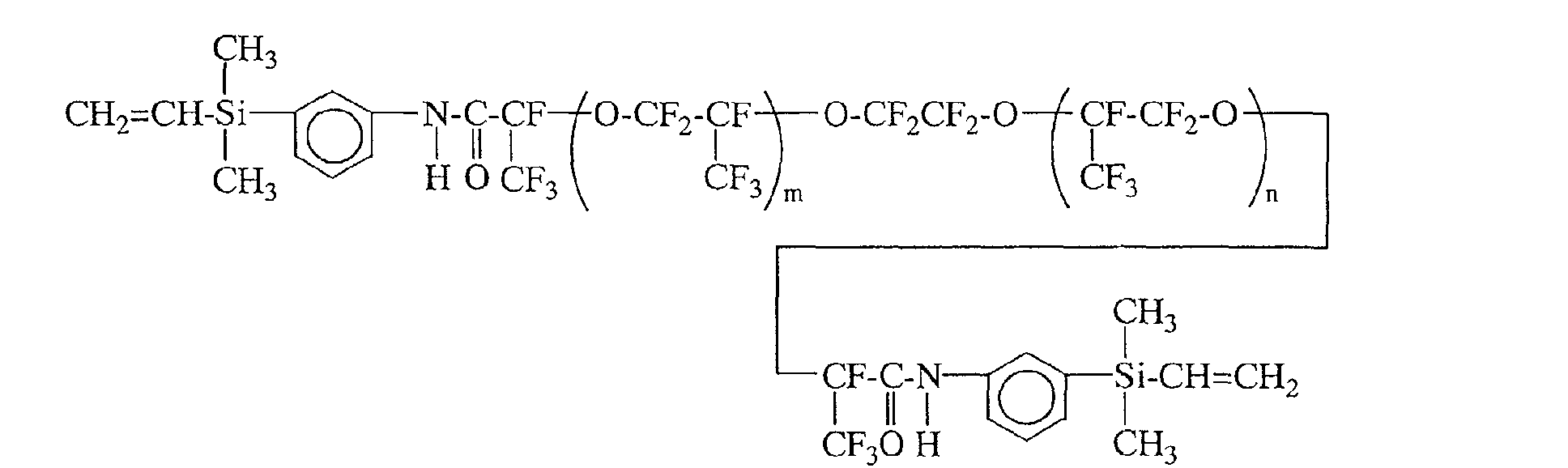
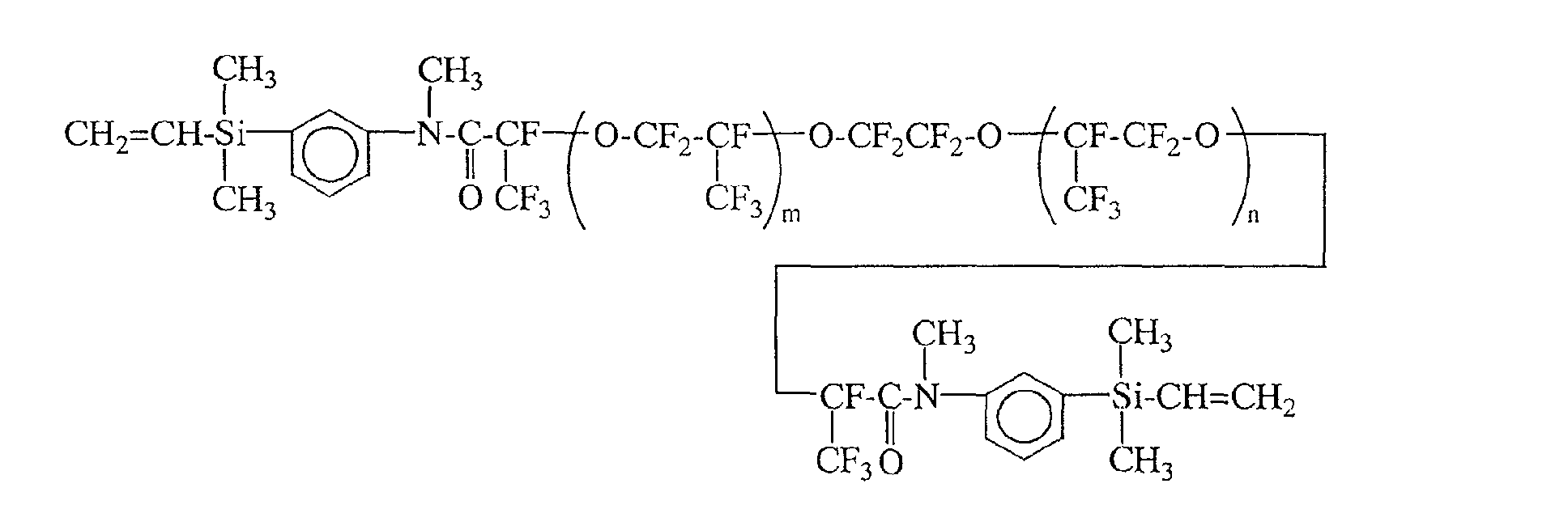
- In the practice of the invention, to modify the linear fluoropolyether compound to the desired weight-average molecular weight in accordance with the intended use, the above-described linear fluoropolyether compound may first be subjected to hydrosilylation with an organosilicon compound bearing two SiH groups by means of an ordinary method and under ordinary conditions. The resulting chain-extended product can then be used as component A.
- Component B of the curable composition used to make the rubber parts of the invention acts as a crosslinking agent and chain extender for component A. Component B is not subject to any particular limitation, provided it is an organosilicon compound having at least two silicon-bonded hydrogen atoms on the molecule. However, it is preferably (a) a fluorinated organohydrosiloxane and/or (b) an organosilicon compound in which every silicon-bonded
hydrogen atom belongs to astructure.
- The fluorinated organohydrosiloxane (a) has at least one monovalent perfluorooxyalkyl, monovalent perfluoroalkyl, divalent perfluorooxyalkylene or divalent perfluoroalkylene group per molecule. It has also at least two, and preferably at least three, hydrosilyl groups (SiH), per molecule. Preferred examples of such perfluorooxyalkyl, perfluoroalkyl, perfluorooxyalkylene and perfluoroalkylene groups include those of the following general formulas: monovalent perfluoroalkyl groups of the formula
divalent perfluoroalkylene groups of the formula
monovalent perfluorooxyalkyl groups of the formula(wherein the letter n is an integer from 1 to 5), and divalent perfluorooxyalkylene groups of the formula (wherein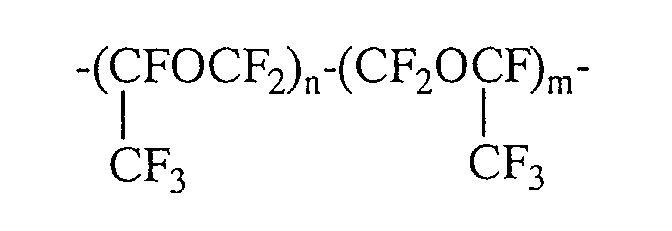
m+n is an integer from 2 to 100). - The fluorinated organohydrosiloxane may be cyclic or acyclic, and may also have a three-dimensional network structure. Especially preferred fluorinated organohydrosiloxanes are those having on the molecule, as a silicon-bonded monovalent substituent, at least one monovalent organic group containing a perfluoroalkyl, perfluoroalkyl ether or perfluoroalkylene group of any of the following general formulas:

- In the above formulas, R1 is a preferably C1-10, and most preferably C2-6, divalent hydrocarbon group such as an alkylene group (e.g., a methylene, ethylene, propylene, methylethylene, tetramethylene or hexamethylene group) or an arylene group (e.g., a phenylene group); R2 is a hydrogen atom or a preferably C1-8, and most preferably C1-6, monovalent hydrocarbon group having no aliphatic unsaturated bonds; and Rf1 is a monovalent perfluoroalkyl, monovalent perfluorooxyalkyl, divalent perfluorooxyalkylene or divalent perfluoroalkylene group of the general formulas shown above.
- Aside from monovalent organic groups containing a monovalent or divalent fluorinated substituent (e.g., a perfluoroalkyl, perfluorooxyalkyl, perfluorooxyalkylene or perfluoroalkylene group), the silicon-bonded monovalent substituent in fluorinated organohydrosiloxanes (a) may be a monovalent hydrocarbon group of the same type as those represented above as R2, preferably one free of aliphatic unsaturated bonds and containing 1 to 8 carbons, and especially 1 to 6 carbons.
- No particular limitation is imposed on the number of silicon atoms per molecule in the fluorinated organohydrosiloxane, although it is generally about 2 to 60, and preferably about 4 to 30.
- Examples of the fluorinated organohydrogensiloxane (a) include the following compounds. In the following formulae, Me is methyl and Ph is phenyl.


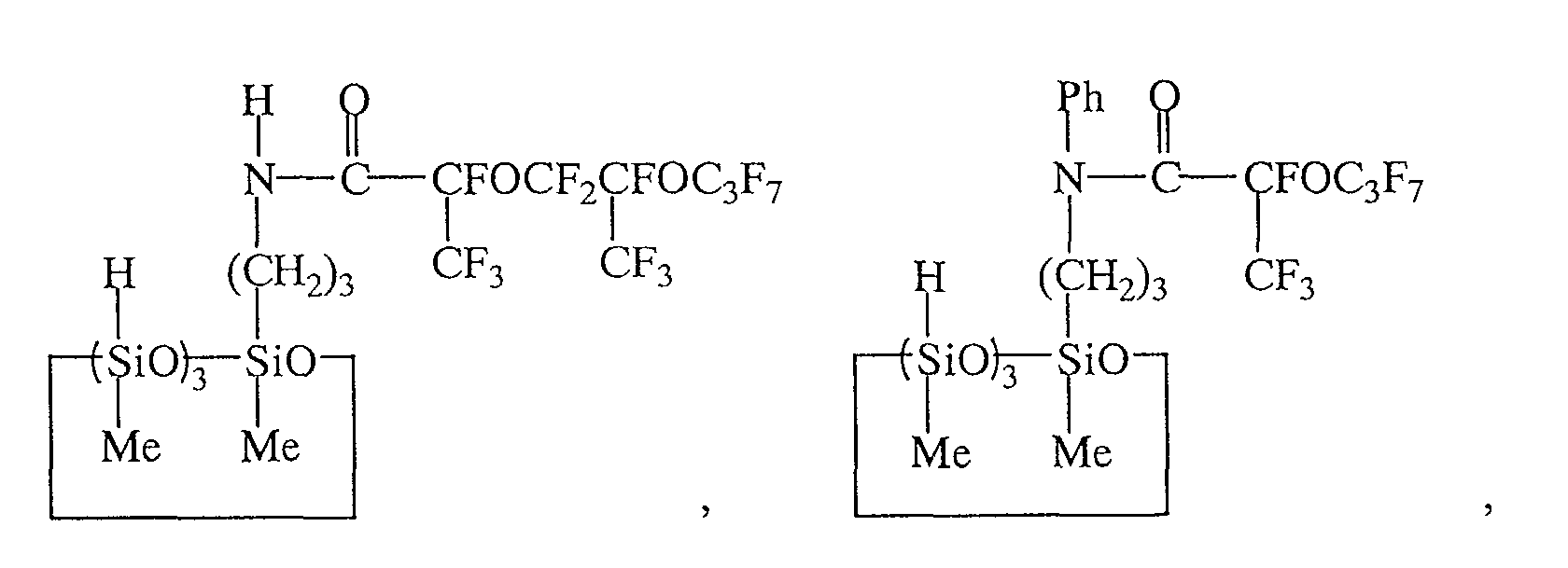
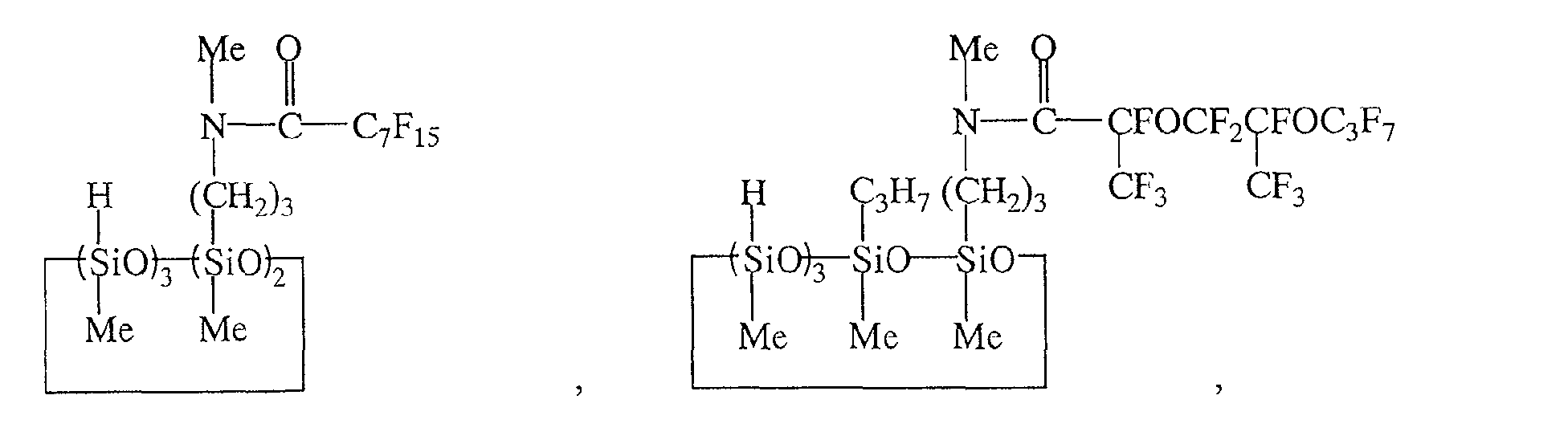

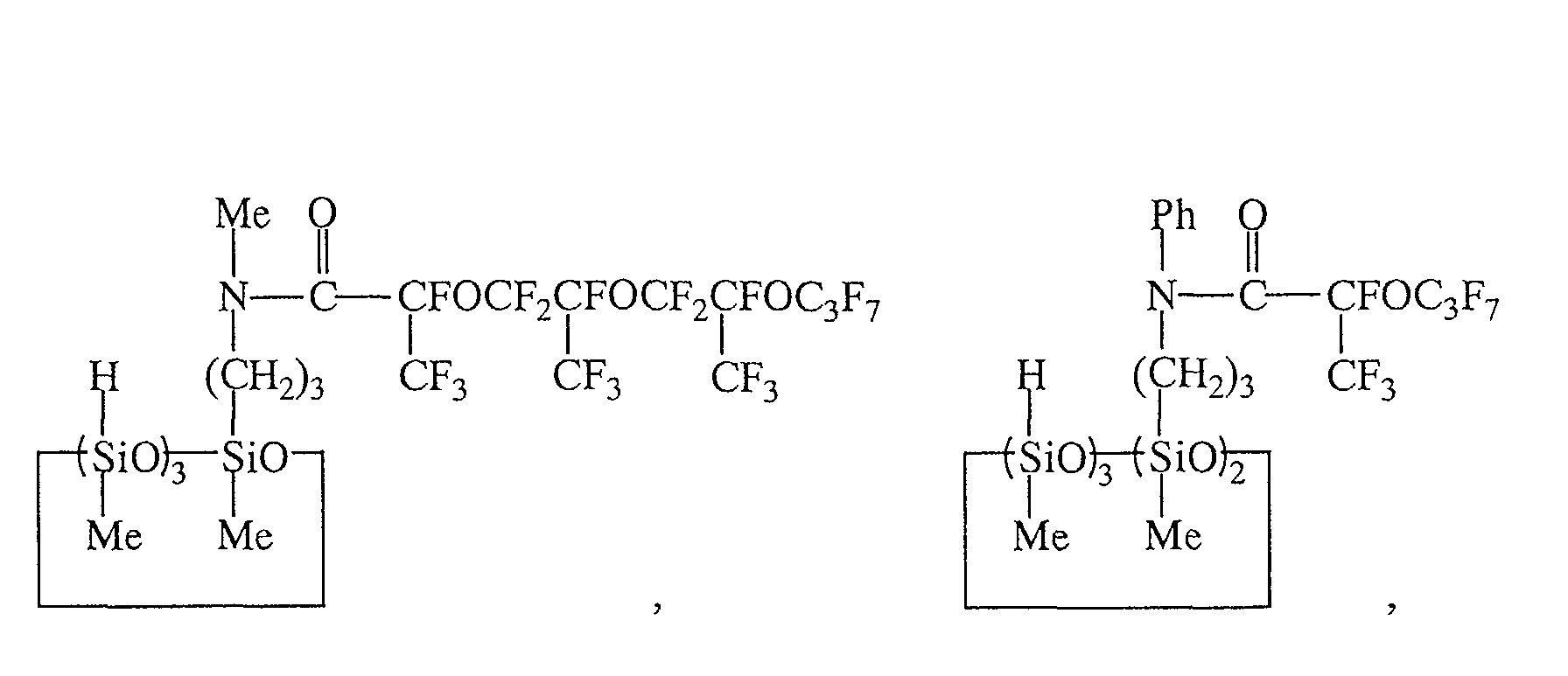


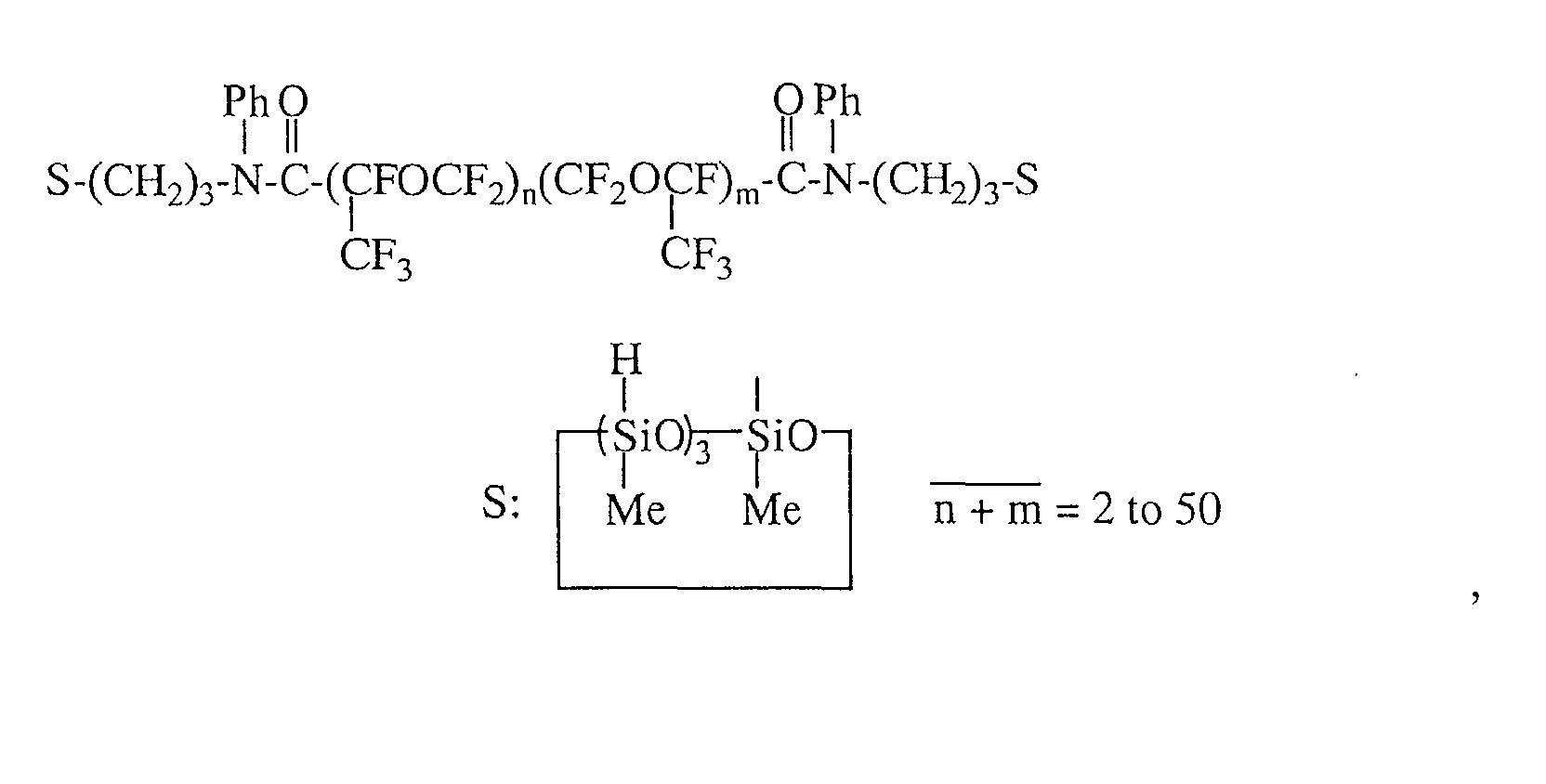
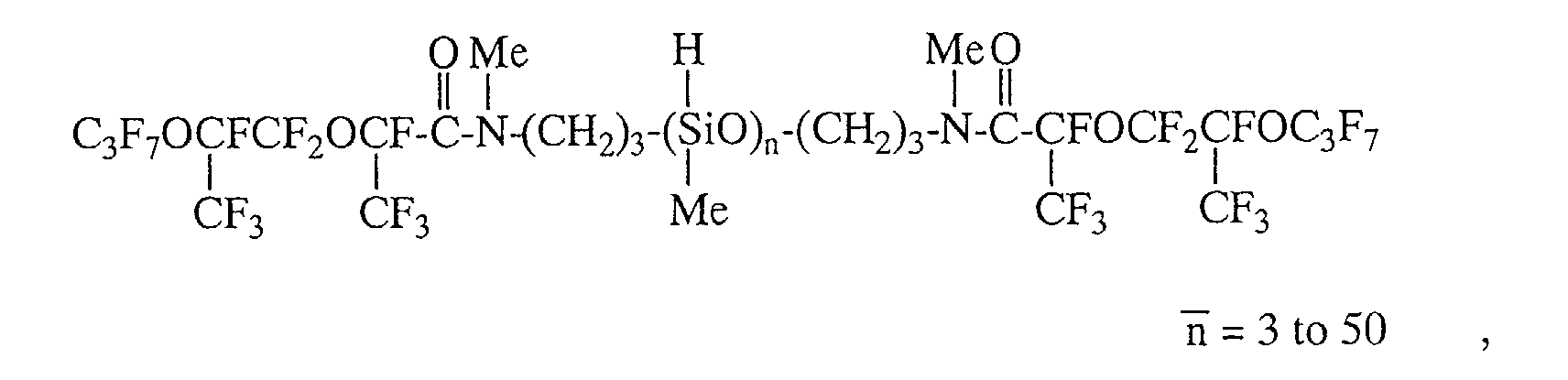
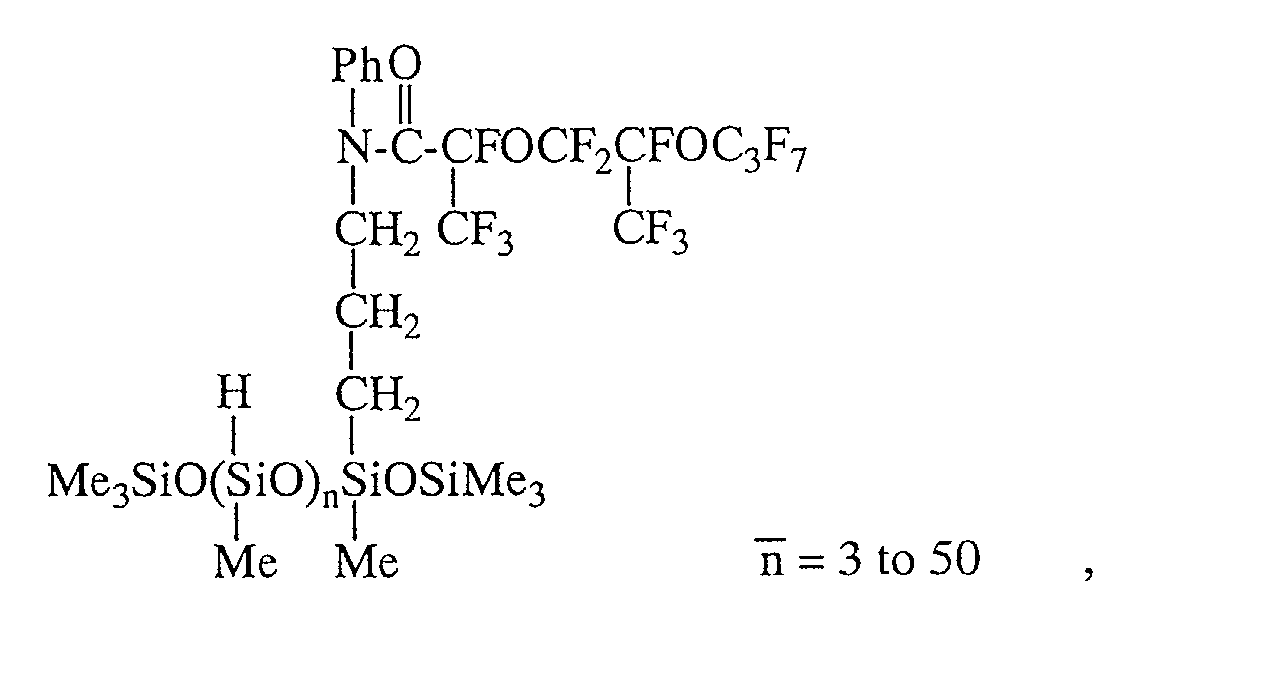

- The organosilicon compound (b) in which every silicon-bonded hydrogen atom belongs to astructure preferably has general formula (5) below
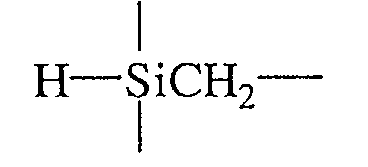
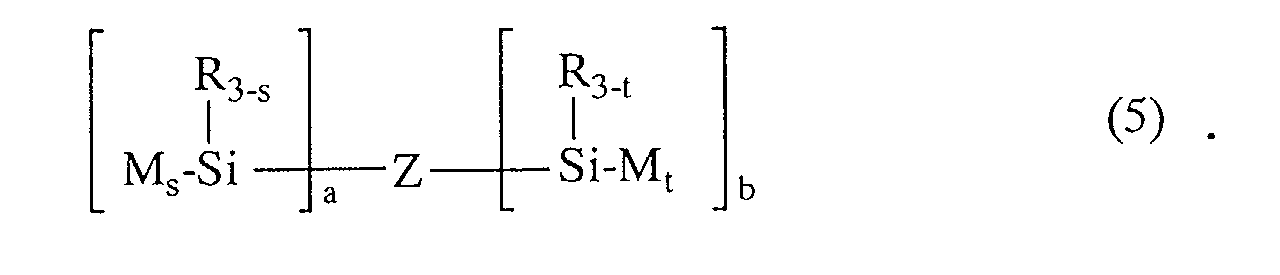
- In formula (5), M is a moiety of the following general formulawherein the letter c is 1, 2, 3 or 4; each R is independently a monovalent C1-20, and preferably C1-6, hydrocarbon; Z is -Q'-M, -Q'-Rf', -Q'-, -Rf"- or -Q'-Rf"-Q'-(Q' being a divalent C1-15 linkage, Rf' being a monovalent perfluoroalkyl or perfluorooxyalkyl group, and Rf" being a divalent perfluoroalkylene or perfluorooxyalkylene group); the letter s is 1, 2 or 3; the letter t is 1, 2 or 3; and the letters a and b are 0 or 1, provided a and b are not both 0.
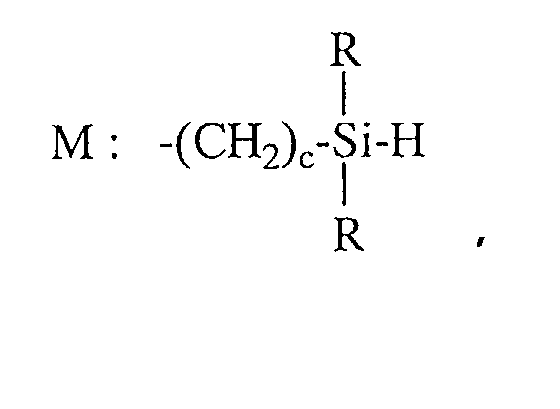
- R is described later in the specification. Illustrative examples of Q' include alkylene groups such as methylene, ethylene, propylene and hexylene groups, as well as these alkylene groups with an ether linkage (-O-) on the chain thereof. The monovalent perfluoroalkyl and perfluorooxyalkyl groups serving as Rf', and the divalent perfluoroalkylene and perfluorooxyalkylene groups serving as Rf" are described subsequently.
- Illustrative examples of the above-described organosilicon compound include compounds of the following formulas, wherein "Me" stands for methyl.


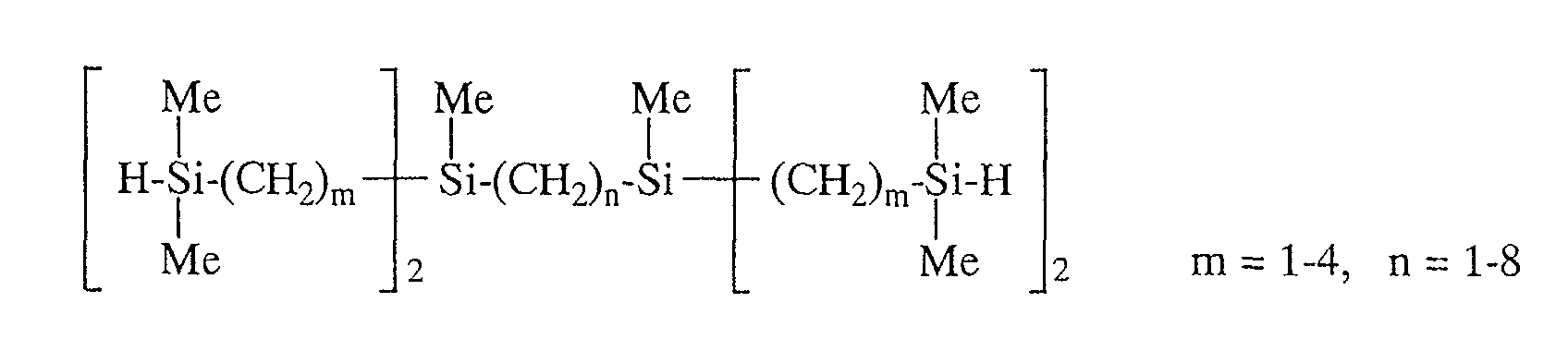

- An organosilicon compound having at least one monovalent perfluoroalkyl or monovalent perfluorooxyalkyl group shown as Rf', or divalent perfluoroalkylene or divalent perfluorooxyalkylene group shown as Rf" per molecule can be used to provide good compatibility with component A, good dispersibility, and good uniformity of the composition when cured.
- Preferred examples of such perfluoroalkyl, perfluorooxyalkyl, perfluoroalkylene and perfluorooxyalkylene groups include those of the following general formulas: monovalent perfluoroalkyl groups of the formula
divalent perfluoroalkylene groups of the formula
monovalent perfluorooxyalkyl groups of the formula(wherein the letter n is an integer from 1 to 5), divalent perfluorooxyalkylene groups of the formula (wherein m+n is an integer from 1 to 200), and
- These perfluoro(oxy)alkyl and perfluoro(oxy)alkylene groups may be directly bonded to a silicon atom, or may be bonded to a silicon atom through a divalent linkage shown as Q'. Exemplary divalent linkages include alkylene groups, arylene groups, and combinations thereof, as well as any of these together with an intervening ether-bonding oxygen atom, amide bond, carbonyl bond or the like. The divalent linkage has preferably 2 to 12 carbons. Illustrative examples include -CH2CH2-, -CH2CH2CH2-, -CH2CH2CH2OCH2-, -CH2CH2CH2-NH-CO-, -CH2CH2CH2-N(Ph)-CO- (Ph being a phenyl group), -CH2CH2CH2-N(CH3)-CO- and -CH2CH2CH2-O-CO-.
- Illustrative examples of the silicon-bonded monovalent hydrocarbon group R on the organosilicon compound serving as above component (b) include C1-20 hydrocarbon groups such as alkyl groups (e.g., methyl, ethyl, propyl, butyl, hexyl, cyclohexyl, octyl, decyl), aryl groups (e.g., phenyl, tolyl, naphthyl), and aralkyl groups (e.g., benzyl, phenylethyl).
- The number of silicon atoms per molecule on the organosilicon compound, although not subject to any particular limitation, is generally about 2 to 60, and preferably about 3 to 30.
- Illustrative examples of such organosilicon compounds include the compounds shown below. The following compounds may be used alone or as combinations of two or more thereof. In the formulas shown below, "Me" stands for methyl and "Ph" stands for phenyl.


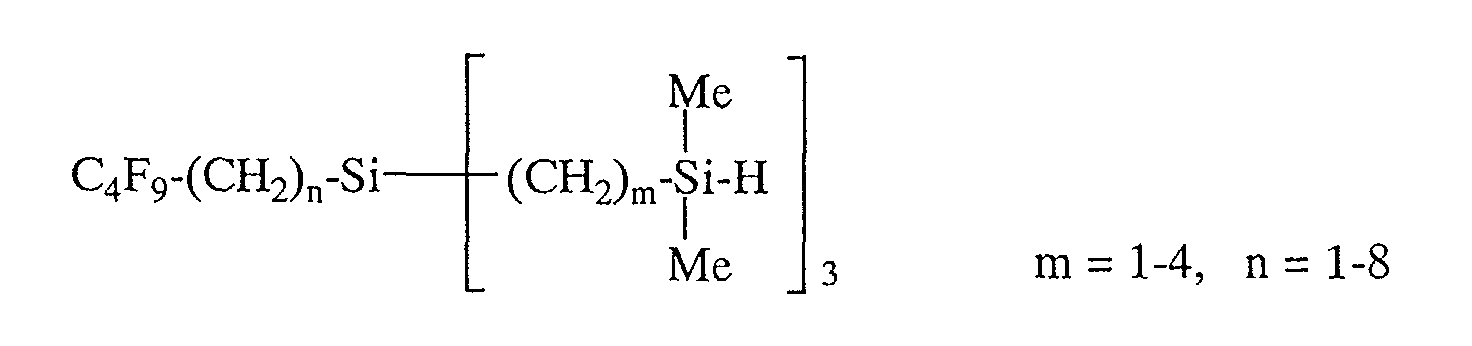

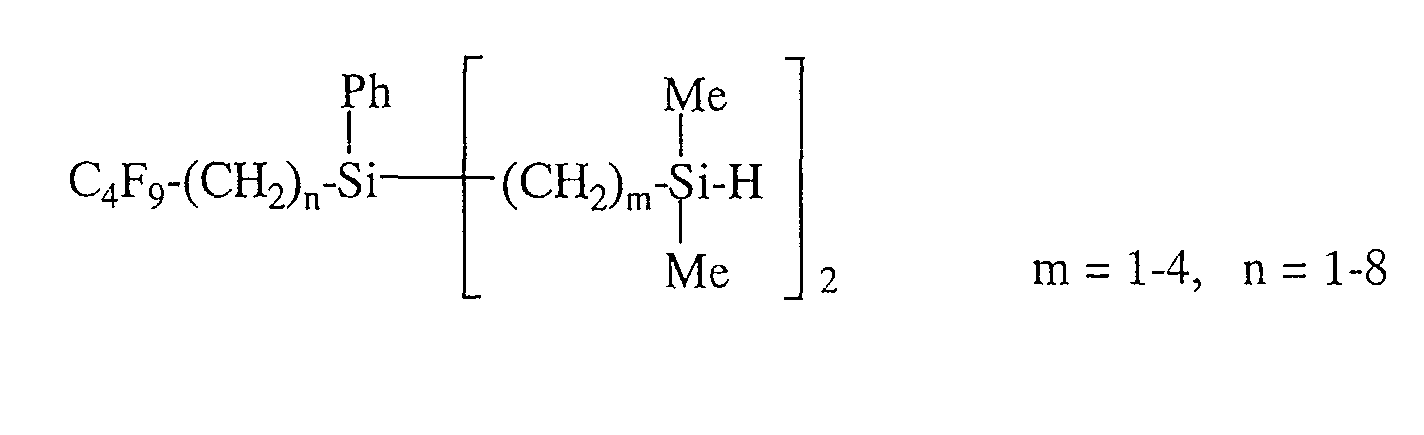
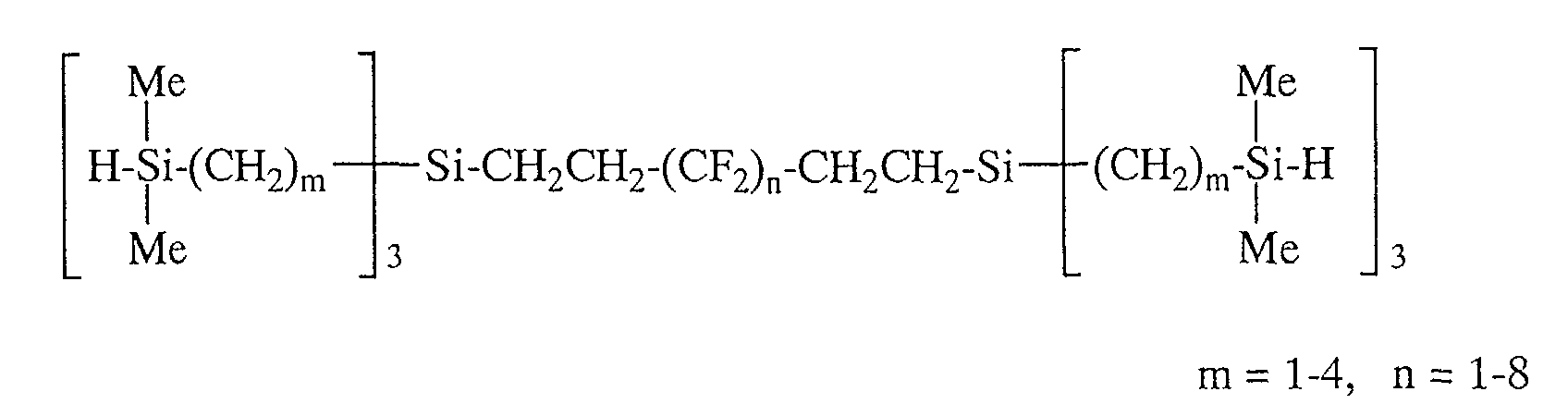
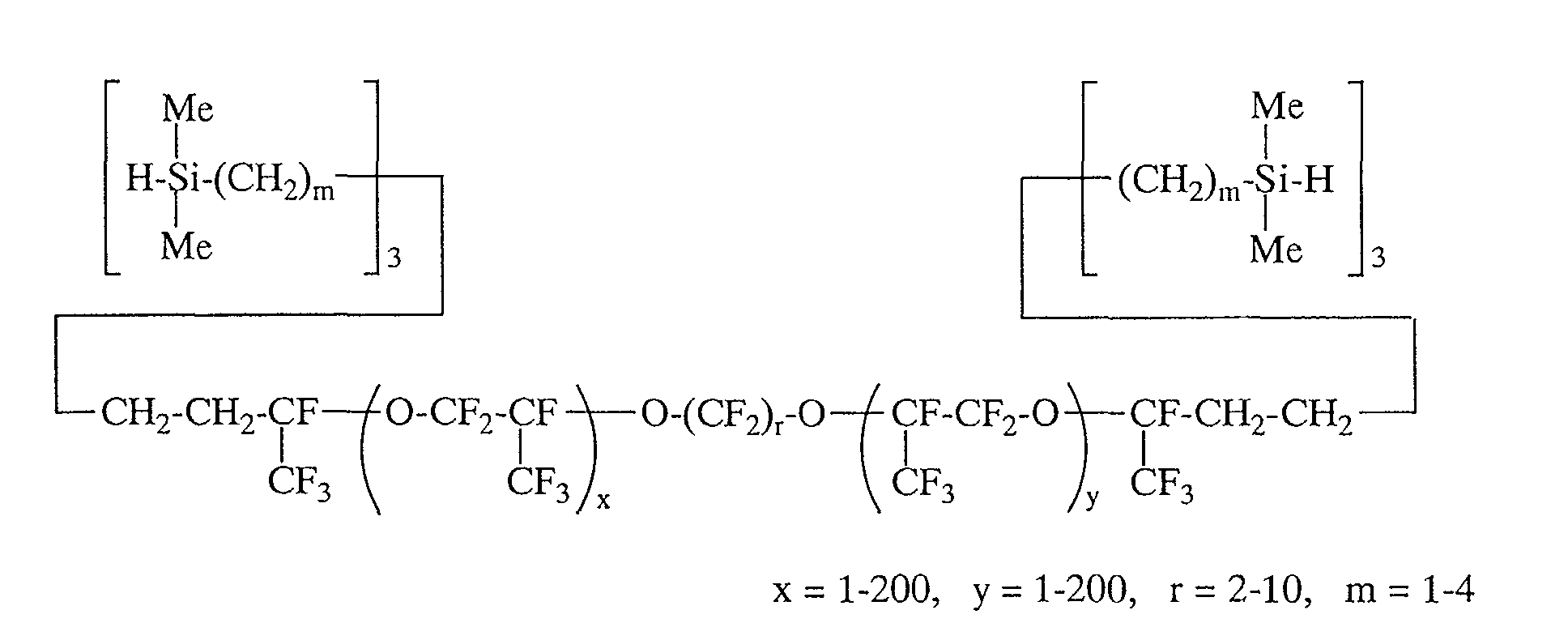

- Component B is generally included in an amount which supplies preferably 0.5 to 5 moles, and most preferably 1 to 2 moles, of hydrosilyl groups (SiH) per mole of alkenyl groups (e.g., vinyl, allyl, cycloalkenyl) on component A. Too little component B may make the degree of crosslinking inadequate, whereas too much may favor chain extension at the expense of curing, may result in foaming of the composition, or may be detrimental to the heat resistance, compressive set and other properties of the rubber parts ultimately obtained.
- The hydrosilylation catalyst serving as component C is preferably a transition metal, such as a platinum group metal (e.g., platinum, rhodium, palladium), or a transition metal compound. Such compounds are generally precious metal compounds, and thus very expensive. Accordingly, the use of platinum compounds which are relatively easy to acquire is advantageous for the purposes of the invention.
- Illustrative, non-limiting, examples of suitable platinum compounds include hexachloroplatinic acid, complexes of hexachloroplatinic acid with an olefin such as ethylene, complexes of hexachloroplatinic acid with an alcohol and vinyl siloxane, and platinum on silica, alumina or carbon.
- Platinum group metal compounds other than platinum compounds that may be used include rhodium, ruthenium, iridium and palladium compounds. Specific examples include RhCl(PPh3)3, RhCl(CO)(PPh3)2, RhCl(C2H4)2, Ru3(CO)12, IrCl(CO)(PPh3)2 and Pd(PPh3)4, wherein "Ph" stands for phenyl.
- The amount of catalyst used is not subject to any particular limitation, an ordinary amount of catalyst being sufficient to achieve the desired curing rate. However, use of the catalyst in an amount of from 0.1 to 1,000 ppm (platinum group metal basis), and especially from 0.1 to 500 ppm, relative to the overall curable composition, is advantageous for economic reasons and for achieving a good cured product.
- Component D is a silica filler having an average particle size of preferably 0.001 to 10 µm, and most preferably 0.005 to 5 µm. Specific examples include fumed silica and quartz powder.
- The silica filler is typically used in an amount of 1 to 200 parts by weight, and preferably 10 to 100 parts by weight, per 100 parts by weight of the perfluoropolyether polymer serving as component A. Too little silica filler results in rubber parts which have a low hardness and a low strength, whereas too much silica filler gives rubber parts which have a low strength and a low elongation.
- If necessary, various additives may be added to the curable composition of the invention to enhance its usefulness. Examples of such additives include CH2=CH(R)SiO (wherein R is a hydrogen atom or a substituted or unsubstituted monovalent hydrocarbon group) unit-containing polysiloxanes (see JP-B 48-10947) and acetylene compounds (see U.S. Patent No. 3,445,420 and JP-B 4-3774) added to control the curing rate of the curable composition, and ionic compounds of heavy metals (see U.S. Patent No. 3,532,649).
- The curable composition used in the invention may also have added thereto a filler other than silica to reduce heat shrinkage during curing and lower the thermal expansion coefficient of the elastomer obtained by curing the composition, to enhance certain properties of the inventive rubber parts, including their thermal stability, weatherability, chemical resistance, fire retardance and mechanical strength, and to decrease the gas permeability of the rubber parts. Examples of such additional fillers include glass fibers, carbon, metal oxides such as iron oxide, titanium oxide and cerium oxide, and metal carbonates such as calcium carbonate and magnesium carbonate. If necessary, suitable pigments and dyes may also be added.
- The curable composition used in the invention may be a millable type material, or it may be a liquid injection molding system (LIMS) type material prepared by mixing two liquid components and curing under applied heat.
- If a millable type material is used, the requisite components are blended on a two-roll mill, then molded by a suitable molding process such as compression molding, transfer molding or injection molding. The molding temperature is preferably 80 to 180°C, and most preferably 100 to 160°C. The molding pressure is preferably 10 to 300 kgf/cm2, and most preferably 20 to 150 kgf/cm2.
- If a LIMS type material is used, the liquid components are mixed in suitable amounts, following which the mixture is molded by a suitable molding process such as compression molding, transfer molding or injection molding. Injection molding while mixing the liquid components primarily with a LIMS machine is preferred. The molding temperature and pressure are preferably within the same ranges as those indicated above for millable type materials. When molding is carried out at above the indicated temperature range, the curing reaction proceeds before the composition has fully assumed the desired product shape. The resulting product may thus have a defective appearance, such as a flow pattern or weld lines. On the other hand, when molding is carried out at a temperature below 80°C, curing takes more than 1 hour, which may be impractical in terms of production efficiency.
- Prior to using the curable composition of the invention, the composition may first be dissolved to the desired concentration in a fluorinated solvent suitable for the intended application and purpose, such as 1,3-bistrifluoromethylbenzene or perfluorooctane.
- The rubber aircraft parts of the invention are made of the cured form of the above-described curable composition. They have good resistance to jet fuels, jet engine oils, and amines and oils, good resistance to gas permeability, good heat and water resistance, and excellent cold resistance. These qualities enable them to be used as sealing materials, such as O-rings, face seals, packings and gaskets, and also as other types of rubber parts, including diaphragms and valves.
- Examples of the invention and comparative examples are given below to illustrate the invention, and are not intended to limit the scope thereof.
- In each of Examples 1 to 3 and Comparative Examples 1 to 3 below, test specimens were fabricated and their properties shown in Table 1 were measured. The results are shown in Table 1.
- The measurement methods are as follows.
- Hardness was measured according to JIS K 6253.
- Tensile strength and elongation was measured according to JIS K 6251.
- The test specimen was kept in a drier at the temperature shown in Table 1 for 70 hours, and then cooled to room temperature. Thereafter, the hardness, tensile strength and elongation were measured in the same manner as above. The heat resistance is shown as the change from the original property.
- Compression set was measured according to JIS K 6262. Jet engine oil resistance:
- The test specimen was immersed in Mobil 254 (available from Mobil Co., Ltd.) at 200°C for 70 hours. Then the test specimen was taken out from Mobil 254 and fully wiped to remove Mobil 254 from the surface of the test specimen. Thereafter, the hardness, tensile strength, elongation and compression set were measured in the same manner as above to evaluate the change from the original property.
- The test specimen was immersed in Fuel B at 40°C for 70 hours. Then the test specimen was taken out from Fuel B and fully dried. Thereafter, the hardness, tensile strength, elongation and compression set were measured in the same manner as above to evaluate the change from the original property.
- Solvent swelling was measured according to JIS K 6258 by the test specimen was immersed in the solvent shown in Table 1 at room temperature for 168 hours. Low-temperature torsional test, TR test, Low-temperature brittleness by impact test:
- They were measured according to JIS K 6261.
- JIS K 6251
- Tensile testing methods for vulcanized rubber
- JIS K 6253
- Hardness testing methods for rubber, vulcanized or thermoplastic
- JIS K 6258-1993
- Testing methods of the effect of liquids for vulcanized rubber
- JIS K 6261
- Low temperature testing methods for rubber, vulcanized or thermoplastic
- JIS K 6262
- Permanent set testing methods for rubber, vulcanized or thermoplastic
- Component A (62 g) and Component B (60 g) of the liquid fluororubber SIFEL 3701 (manufactured by Shin-Etsu Chemical Co., Ltd.) having a perfluoropolyether structure were mixed and vacuum degassed. The degassed material was poured into a mold measuring 170 × 130 × 2 mm and compression molded using a molding machine with a 50-ton press at 150°C and 80 kgf/cm2 for 10 minutes to form a 170 × 130 × 2 mm sheet-like test piece. The test piece was post-cured at 200°C for a period of 4 hours, yielding a finished test specimen.
- A test specimen was fabricated in the same way as in Example 1, but using the liquid fluororubber SIFEL 4750 (manufactured by Shin-Etsu Chemical Co., Ltd.) having a perfluoropolyether structure.
- A test specimen was fabricated in the same way as in Example 1, but using the liquid fluororubber SIFEL 4755 (Shin-Etsu Chemical Co., Ltd.) having a perfluoropolyether structure.
- The liquid fluororubbers SIFEL 3701, 4750 and 4755 contain the above-said components A to D.
- The binary fluororubber Viton E-60C (a vinylidene fluoride-propylene hexafluoride copolymer manufactured by E.I. DuPont de Nemours and Co.) was compression molded using a molding machine with a 50-ton press at 170°C and 100 kgf/cm2 for a period of 15 minutes to form a sheet-like test piece measuring 170 × 130 × 2 mm. The test piece was then post-cured at 230°C for 24 hours, yielding a finished test specimen.
- A test specimen was fabricated in the same way as in Comparative Example 1, but using the cold-resistant fluororubber Viton GLT (a vinylidene fluoride-ethylene tetrafluoride-perfluorovinyl methyl ether copolymer manufactured by E.I. DuPont de Nemours and Co.).
- The fluorosilicone rubber FE271 (manufactured by Shin-Etsu Chemical Co., Ltd) was compression molded using a molding machine with a 50-ton press at 170°C and 100 kgf/cm2 for a period of 15 minutes to form a sheet-like test piece measuring 170 × 130 × 2 mm. The test piece was then post-cured at 200°C for 24 hours, yielding a finished test specimen.
Tests Example Comparative Example 1 2 3 1 2 3 Original properties Hardness (type A durometer) 70 72 73 71 71 70 Tensile strength (Mpa) 7.3 6.8 7.8 12.5 15.2 8.9 Elongation (%) 170 130 140 240 240 260 Heat resistance (70 hours) 150°C Change in hardness (%) +1 +1 +1 +2 +1 +2 Change in tensile strength (%) -5 -4 -3 -1 -2 -10 Change in elongation (%) -7 -6 -7 -5 -3 -4 200°C Change in hardness (%) +1 +2 +2 +1 +2 +2 Change in tensile strength (%) -5 -8 -9 +12 +4 -5 Change in elongation (%) -4 -10 -10 -11 -10 -9 Compression set (70 hours) 150°C Deformation (%) 9 5 4 9 16 10 200°C Deformation (%) 21 14 11 25 36 31 Jet engine oil resistance (Mobil 254; ) 200°C × 70 hrs) Change in hardness (%) -4 -3 -3 -10 -9 rubber solved Change in tensile strength (%) -11 -9 -7 -71 -20 Change in elongation (%) +12 +5 +7 -63 -32 Compression set (%) 31 12 8 58 28 Fuel resistance (Fuel B; 40°C × 70 hrs) Change in hardness (%) -4 -3 -5 -18 -17 -18 Change in tensile strength (%) -15 -12 -13 -34 -42 -31 Change in elongation (%) -13 -12 -11 -30 -20 -29 Compression set (%) 5 3 2 7 8 6 Solvent swelling (room temp. × 168 hrs) Toluene Change in volume (%) +5 +4 +6 +20 +19 +32 Ethanol Change in volume (%) +3 +2 +3 +70 +85 +8 MEK Change in volume (%) +6 +5 +6 +202 +213 +175 Tributyl amine Change in volume (%) +7 +6 +6 rubber
dissolvedLow-temperature torsional test T2 (°C) -37 -38 -36 -7 -21 -50 T5 (°C) -47 -47 -46 -12 -26 -60 T10 (°C) -50 -51 -51 -16 -28 -63 T100 (°C) -55 -56 -56 -23 -34 <-70 TR test TR10 (°C) -50 -48 -49 -17 -31 -66 TR50 (°C) -39 -38 -39 -11 -23 -41 Low-temperature brittleness by impact test Brittleness temperature (°C) -55 -54 -54 -20 -35 <-70 - As is apparent from the results in Table 1, the rubber aircraft parts according to the invention exhibited good resistance to jet fuels, jet engine oils and amines, good cold resistance, good compression set properties, and good heat resistance.
- The rubber aircraft parts of the invention provide dramatically improved sealability at temperatures below the minimum service temperatures normally achievable in prior-art low-temperature fluororubbers, i.e., at -25 to -55°C, particularly during use in a dynamic state. The inventive rubber parts also provide markedly improved resistance to amines and other chemicals. These qualities enable the rubber parts of the invention to ensure the reliable sealability of fluid line junctions in jet engines.
- Japanese Patent Application No. 2001-259925 is incorporated herein by reference.
- Although some preferred embodiments have been described, many modifications and variations may be made thereto in light of the above teachings. It is therefore to be understood that the invention may be practiced otherwise than as specifically described in the Examples.
Claims (7)
- A rubber part for use in an aircraft, which part is made of the cured form of a curable composition comprising:a perfluoropolyether polymer having a perfluoropolyether backbone and at least one reactive group,a crosslinking agent for crosslinking the polymer, anda silica filler having an average particle size of 0.001 to 10 µm.
- The rubber part of claim 1, wherein the curable composition comprising(A) a linear fluoropolyether compound having at least two alkenyl groups per molecule and a backbone with a perfluoropolyether structure;(B) an organosilicon compound having at least two silicon-bonded hydrogen atoms (SiH groups) per molecule;(C) a hydrosilylation catalyst; and(D) a silica filler.
- The rubber part of claim 1 or 2, wherein the perfluoropolyether backbone has a structure of -CdF2dO-repeating units, the letter d in each unit being independently an integer from 1 to 6.
- The rubber part of claim 2, wherein the linear fluoropolyether compound of component (A) is one represented by the general formula (3) or (4):(wherein the free valence bond may be at the o-, m- or p-position); and R' is a hydrogen atom or a methyl, phenyl or allyl group, Rf is a divalent perfluoropolyether structure of the formula (CdF2dO)q, wherein the letter d is independently an integer from 1 to 6 and the letter q is an integer from 1 to 500, the letter p is independently 0 or 1, and Q is a divalent hydrocarbon group of 1 to 15 carbons which may include an ether linkage, and component (B) is (a) a fluorinated organohydrosiloxane and/or (b) an organosilicon compound in which every silicon-bonded hydrogen atom belongs to a
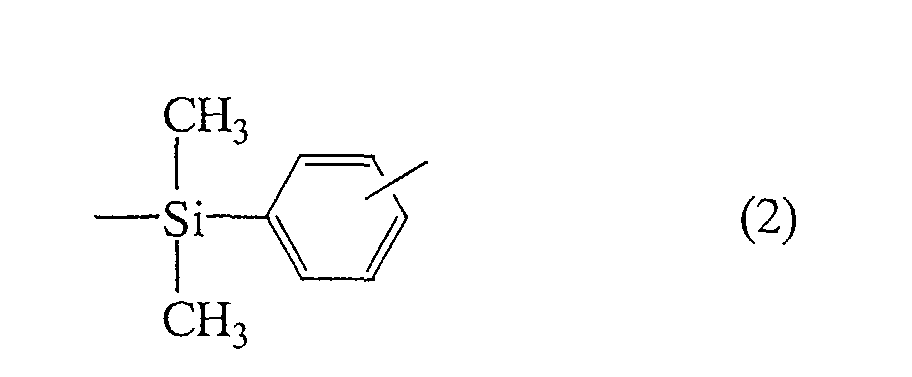 structure.
- A method of using as a fluid sealing component around a jet engine a rubber part according to any one of claims 1 to 4.
- A method of producing a rubber part according to any one of claims 1 to 4, comprising the steps of:blending the curable composition in a mill;molding the composition; andcuring the composition.
- A method of producing a rubber part according to any one of claims 1 to 4, comprising the steps of:mixing the curable composition;molding the composition; andcuring the composition.
Applications Claiming Priority (2)
| Application Number | Priority Date | Filing Date | Title |
|---|---|---|---|
| JP2001259925 | 2001-08-29 | ||
| JP2001259925 | 2001-08-29 |
Publications (1)
| Publication Number | Publication Date |
|---|---|
| EP1288243A1 true EP1288243A1 (en) | 2003-03-05 |
Family
ID=19087209
Family Applications (1)
| Application Number | Title | Priority Date | Filing Date |
|---|---|---|---|
| EP02256021A Withdrawn EP1288243A1 (en) | 2001-08-29 | 2002-08-29 | Curable fluoropolyether rubber compositions and cured rubber parts made therefrom |
Country Status (2)
| Country | Link |
|---|---|
| US (1) | US6815492B2 (en) |
| EP (1) | EP1288243A1 (en) |
Cited By (4)
| Publication number | Priority date | Publication date | Assignee | Title |
|---|---|---|---|---|
| EP1362892A1 (en) * | 2002-05-14 | 2003-11-19 | Shin-Etsu Chemical Co., Ltd. | Curable fluoropolyether rubber compositions and rubber articles |
| EP1477528A1 (en) * | 2003-05-12 | 2004-11-17 | Shin-Etsu Chemical Co., Ltd. | Curable fluoropolyether rubber compositions and rubber articles |
| EP1605018A1 (en) * | 2004-06-11 | 2005-12-14 | Shin-Etsu Chemical Co., Ltd. | Curable perfluoropolyether compositions and rubber or gel articles comprising the same |
| EP3705527A4 (en) * | 2017-10-31 | 2021-08-18 | Daikin Industries, Ltd. | CURING COMPOSITION |
Families Citing this family (6)
| Publication number | Priority date | Publication date | Assignee | Title |
|---|---|---|---|---|
| JP2006200616A (en) * | 2005-01-20 | 2006-08-03 | Ntn Corp | Bearing sealing device and rolling bearing with cold-resistant sealing device |
| US8027736B2 (en) * | 2005-04-29 | 2011-09-27 | Medtronic, Inc. | Lead electrode for use in an MRI-safe implantable medical device |
| US7853332B2 (en) | 2005-04-29 | 2010-12-14 | Medtronic, Inc. | Lead electrode for use in an MRI-safe implantable medical device |
| WO2010014275A2 (en) * | 2008-07-31 | 2010-02-04 | 3M Innovative Properties Company | Fluoropolymer compositions and methods of curing |
| US8864930B2 (en) * | 2012-07-30 | 2014-10-21 | PRC De Soto International, Inc. | Perfluoroether sealant compositions |
| KR102230522B1 (en) | 2013-06-27 | 2021-03-23 | 쓰리엠 이노베이티브 프로퍼티즈 컴파니 | Fluoropolyehter-polysiloxane elastomer compositions and shaped articles |
Citations (5)
| Publication number | Priority date | Publication date | Assignee | Title |
|---|---|---|---|---|
| EP0967251A1 (en) * | 1998-06-22 | 1999-12-29 | Shin-Etsu Chemical Co., Ltd. | Fluororubber compositions and method of making |
| EP1033387A2 (en) * | 1999-03-02 | 2000-09-06 | Shin-Etsu Chemical Co., Ltd. | Curable fluoropolyether base rubber compositions |
| EP1048432A1 (en) * | 1999-04-28 | 2000-11-02 | Shin-Etsu Chemical Co., Ltd. | Mold and method for producing molded fluoroelastomer parts |
| JP2001011193A (en) * | 1999-06-30 | 2001-01-16 | Shin Etsu Chem Co Ltd | Production of curable fluoropolyether-based rubber composition |
| EP1114846A2 (en) * | 2000-01-07 | 2001-07-11 | Shin-Etsu Chemical Co., Ltd. | Curable fluoropolyther base rubber compositions |
Family Cites Families (13)
| Publication number | Priority date | Publication date | Assignee | Title |
|---|---|---|---|---|
| NL129346C (en) | 1966-06-23 | |||
| US3532649A (en) | 1968-09-13 | 1970-10-06 | Dow Corning | Heat activated curing system for organosilicon compounds |
| JPS4810947B1 (en) | 1969-08-15 | 1973-04-09 | ||
| JPH02160853A (en) | 1989-11-16 | 1990-06-20 | Mitsui Toatsu Chem Inc | Polyolefin sheet for decorative panel |
| EP0649885A1 (en) * | 1993-10-25 | 1995-04-26 | Wacker-Chemie GmbH | Hydrophobic silica containing transition metals |
| EP0725113B1 (en) * | 1995-01-23 | 2000-09-27 | Shin-Etsu Chemical Co., Ltd. | Fluorinated amide silicone compounds and curable siloxane compositions |
| JP3017657B2 (en) * | 1995-02-03 | 2000-03-13 | 信越化学工業株式会社 | Curable fluoropolyether rubber composition |
| EP0745604A3 (en) * | 1995-05-29 | 1998-07-29 | Shin-Etsu Chemical Co., Ltd. | Room temperature curable fluoropolymer composition; and fluorine-containing organosilicon compounds, a method of producing the same, and room temperature curable silicone composition containing the same |
| JP3292074B2 (en) * | 1996-12-19 | 2002-06-17 | 信越化学工業株式会社 | Fluorine-containing amide compound |
| JP3633836B2 (en) | 1999-10-08 | 2005-03-30 | 信越化学工業株式会社 | Fluoro rubber composition |
| JP3912473B2 (en) | 1999-12-06 | 2007-05-09 | 信越化学工業株式会社 | Fluoro rubber composition |
| JP4016239B2 (en) | 2000-07-05 | 2007-12-05 | 信越化学工業株式会社 | Curable fluoropolyether rubber composition |
| JP4003774B2 (en) | 2004-05-25 | 2007-11-07 | 利夫 原田 | Cooking spatula |
-
2002
- 2002-08-29 EP EP02256021A patent/EP1288243A1/en not_active Withdrawn
- 2002-08-29 US US10/230,337 patent/US6815492B2/en not_active Expired - Fee Related
Patent Citations (5)
| Publication number | Priority date | Publication date | Assignee | Title |
|---|---|---|---|---|
| EP0967251A1 (en) * | 1998-06-22 | 1999-12-29 | Shin-Etsu Chemical Co., Ltd. | Fluororubber compositions and method of making |
| EP1033387A2 (en) * | 1999-03-02 | 2000-09-06 | Shin-Etsu Chemical Co., Ltd. | Curable fluoropolyether base rubber compositions |
| EP1048432A1 (en) * | 1999-04-28 | 2000-11-02 | Shin-Etsu Chemical Co., Ltd. | Mold and method for producing molded fluoroelastomer parts |
| JP2001011193A (en) * | 1999-06-30 | 2001-01-16 | Shin Etsu Chem Co Ltd | Production of curable fluoropolyether-based rubber composition |
| EP1114846A2 (en) * | 2000-01-07 | 2001-07-11 | Shin-Etsu Chemical Co., Ltd. | Curable fluoropolyther base rubber compositions |
Non-Patent Citations (1)
| Title |
|---|
| PATENT ABSTRACTS OF JAPAN vol. 2000, no. 16 8 May 2001 (2001-05-08) * |
Cited By (6)
| Publication number | Priority date | Publication date | Assignee | Title |
|---|---|---|---|---|
| EP1362892A1 (en) * | 2002-05-14 | 2003-11-19 | Shin-Etsu Chemical Co., Ltd. | Curable fluoropolyether rubber compositions and rubber articles |
| EP1477528A1 (en) * | 2003-05-12 | 2004-11-17 | Shin-Etsu Chemical Co., Ltd. | Curable fluoropolyether rubber compositions and rubber articles |
| EP1605018A1 (en) * | 2004-06-11 | 2005-12-14 | Shin-Etsu Chemical Co., Ltd. | Curable perfluoropolyether compositions and rubber or gel articles comprising the same |
| US8119760B2 (en) | 2004-06-11 | 2012-02-21 | Shin-Etsu Chemical Co., Ltd. | Curable perfluoropolyether compositions and rubber or gel articles comprising the same |
| EP3705527A4 (en) * | 2017-10-31 | 2021-08-18 | Daikin Industries, Ltd. | CURING COMPOSITION |
| US11535749B2 (en) | 2017-10-31 | 2022-12-27 | Daikin Industries, Ltd. | Curable composition |
Also Published As
| Publication number | Publication date |
|---|---|
| US6815492B2 (en) | 2004-11-09 |
| US20030083426A1 (en) | 2003-05-01 |
Similar Documents
| Publication | Publication Date | Title |
|---|---|---|
| EP2368942B1 (en) | Fluorine-containing curable composition and rubber article | |
| US6552152B2 (en) | Curable fluoropolyether rubber compositions | |
| US7091279B2 (en) | Curable fluoropolyether rubber compositions and rubber articles | |
| US20050159550A1 (en) | Injection molding fluoropolyether rubber compositions | |
| EP1033387B1 (en) | Curable fluoropolyether base rubber compositions | |
| US6441079B2 (en) | Curable fluoropolyether base rubber compositions | |
| US6815492B2 (en) | Rubber parts for aircraft | |
| US20030225200A1 (en) | Curable fluoropolyether rubber compositions and rubber articles | |
| US6528562B2 (en) | Curable fluoropolyether rubber compositions | |
| US20060270791A1 (en) | Fluorine-containing material | |
| US20040229992A1 (en) | Curable fluoropolyether rubber compositions and rubber articles | |
| US7189789B2 (en) | Curable fluoropolyether composition and rubber article | |
| JP5447352B2 (en) | Fluorine-containing curable composition | |
| JP4446183B2 (en) | Curable fluoropolyether rubber composition and rubber product | |
| JP2003183493A (en) | Rubber parts for aircraft | |
| JP2003292761A (en) | Curable fluoropolyether rubber composition and rubber product | |
| JP2010248280A (en) | Fluorine-containing curable composition and method for producing the same | |
| JP2007002228A (en) | Fluorine-containing material | |
| US20020193503A1 (en) | FIPG fluoroelastomer compositions | |
| JP2005164050A (en) | On-site construction method of gasket |
Legal Events
| Date | Code | Title | Description |
|---|---|---|---|
| PUAI | Public reference made under article 153(3) epc to a published international application that has entered the european phase |
Free format text: ORIGINAL CODE: 0009012 |
|
| AK | Designated contracting states |
Kind code of ref document: A1 Designated state(s): AT BE BG CH CY CZ DE DK EE ES FI FR GB GR IE IT LI LU MC NL PT SE SK TR |
|
| AX | Request for extension of the european patent |
Extension state: AL LT LV MK RO SI |
|
| AKX | Designation fees paid |
Designated state(s): DE FR GB |
|
| STAA | Information on the status of an ep patent application or granted ep patent |
Free format text: STATUS: THE APPLICATION IS DEEMED TO BE WITHDRAWN |
|
| 18D | Application deemed to be withdrawn |
Effective date: 20030906 |