EP1286267B1 - Mobile communication device and memory management method - Google Patents
Mobile communication device and memory management method Download PDFInfo
- Publication number
- EP1286267B1 EP1286267B1 EP01119923.9A EP01119923A EP1286267B1 EP 1286267 B1 EP1286267 B1 EP 1286267B1 EP 01119923 A EP01119923 A EP 01119923A EP 1286267 B1 EP1286267 B1 EP 1286267B1
- Authority
- EP
- European Patent Office
- Prior art keywords
- sector
- data
- control means
- volatile memory
- inactive
- Prior art date
- Legal status (The legal status is an assumption and is not a legal conclusion. Google has not performed a legal analysis and makes no representation as to the accuracy of the status listed.)
- Expired - Lifetime
Links
Images



Classifications
-
- G—PHYSICS
- G06—COMPUTING OR CALCULATING; COUNTING
- G06F—ELECTRIC DIGITAL DATA PROCESSING
- G06F12/00—Accessing, addressing or allocating within memory systems or architectures
- G06F12/02—Addressing or allocation; Relocation
- G06F12/08—Addressing or allocation; Relocation in hierarchically structured memory systems, e.g. virtual memory systems
-
- G—PHYSICS
- G06—COMPUTING OR CALCULATING; COUNTING
- G06F—ELECTRIC DIGITAL DATA PROCESSING
- G06F12/00—Accessing, addressing or allocating within memory systems or architectures
- G06F12/02—Addressing or allocation; Relocation
- G06F12/0223—User address space allocation, e.g. contiguous or non contiguous base addressing
- G06F12/023—Free address space management
- G06F12/0238—Memory management in non-volatile memory, e.g. resistive RAM or ferroelectric memory
- G06F12/0246—Memory management in non-volatile memory, e.g. resistive RAM or ferroelectric memory in block erasable memory, e.g. flash memory
-
- G—PHYSICS
- G06—COMPUTING OR CALCULATING; COUNTING
- G06F—ELECTRIC DIGITAL DATA PROCESSING
- G06F2212/00—Indexing scheme relating to accessing, addressing or allocation within memory systems or architectures
- G06F2212/72—Details relating to flash memory management
- G06F2212/7209—Validity control, e.g. using flags, time stamps or sequence numbers
Definitions
- the present invention relates to a mobile communication device and a method of operating such a mobile communication device.
- a mobile communication device e.g. a mobile phone
- Parametric data are for example adjustment data of displays, telephone books and login data of a telephone network carrier.
- the non-volatile memories do not require power to be supplied to them in order to maintain data.
- Certain types of non-volatile memories can be erased and occupied with new data without a special-purpose device. The content of the memory can be erased and new data can be stored on the memory device being integrated in the circuit.
- the number of erasing-cycles of these non-volatile memory devices is limited and there is the danger of failure over lifetime of a mobile phone.
- it is desired to use as little different types of memory devices as possible to save costs and to increase the working speed of the mobile communication device.
- An intelligent management of storing and erasing data is required.
- EP 0 834 882 A2 discloses a memory management method comprising storing parametric data in a volatile memory, such as RAM, and periodically updating the data stored in the RAM to a non-volatile memory such as a Flash Memory. Updating data to the Flash Memory is dependent on the time since the last update or on the importance of the data in the RAM.
- the parametric data is stored in dependence on the nature of the data, for reducing wear of the non-volatile memory.
- the method is, e.g. applied to a mobile phone and the information of the data may relate to the user interface set-up, the user personal telephone directory, or some other parameters of the radiotelephone, that vary during use.
- EP 0 834 882 discloses a method of managing a memory device, wherein data is distinguished in data of different priority levels and the period of storing the data in the non-volatile memory is dependent on the priority level. Data is stored into the non-volatile memory in a linked list.
- a disadvantage of the methods described above is that there are no arrangements to ensure a data recovery in case of an unexpected power failure.
- a further disadvantage is that the linked list always stores the complete set of information. The consumption of storage space is relatively great and an erasing of storage space is often required. This increases the wear of a non-volatile memory, notably a FLASH memory.
- DE 197 40 525 C1 discloses a method that relates to the data management in a vehicle.
- the vehicle comprises a computer with a RAM memory and a FLASH memory.
- data is stored into the FLASH-memory.
- the data which had to be maintained, is read out from the non-volatile memory and stored into the volatile memory.
- Data storing in the non-volatile memory is organized by a circulating storing method. The data is repeatedly stored and only one set of data is actual.
- default values are transferred into non-volatile memory to quickly ensure the ability of the vehicle to work.
- the newest set of data is read out from the non-volatile memory and the default values are overwritten with that.
- the disclosed method cannot be protected against data loss in case of an unexpected failure of power supply, without the possibility to execute a special "going down" method.
- the method is not set to ensure the maintenance of security sensitive data as login data of a telephone network carrier.
- the present invention aims to avoid a third type of memory in a mobile communication device and to enable the use of a non-volatile memory with a limited number of erasing cycles in a mobile communication device for maintaining data records, which change during usage of a mobile communication device, whereby an acceptable lifetime of the mobile communication device without a lifetime failure has to be ensured.
- the mobile communication device of the present invention has the advantage to avoid a third type of a non-volatile memory while guaranteeing secure storage of data and preventing lifetime failure of the mobile communication device within an acceptable period of time.
- the number of erasing procedures is limited by the period of time until the next storing. Considering the expected lifetime of a mobile communication device the period can be determined so that the number of erasing procedures does not wear the non-volatile memory by more then the maximum possible erasing cycles.
- the sequence counter always gives the newest data set. After power on, the control means can discover the actual data set. In case there was no change in data being stored in the volatile memory, this data will not be flushed. This feature additionally reduces the wear of the non-volatile memory.
- This arrangement avoids the need of a third type of memory.
- the control means distinguish normal data and secure data.
- the control means immediately store secure data in the non-volatile-memory when said data was changed.
- the mobile communication device In case the mobile communication device is not turned off as provided but a breakdown of power supply occurs, the kind of data, that is most sensitive about data loss, is protected as far as possible.
- the control means store secure data, which were changed between periodical flushing, in a heap area of the active sector as a patch of the outdated information in a data area.
- the patch is containing at least the information about offset, length of the outdated information and the new information itself.
- This feature reduces the number of sector erasures, because only the information is stored which is necessary to be maintained at all.
- the total set of data does not normally require the entire sector.
- a part of the sector can be built as a heap area.
- the patches of the sets of the secure data having been changed are stored in the heap area.
- the amount of erasing cycles is lowered, because secure data normally requires less space and a flushing is avoided by storing patches of the outdated secure data.
- control means store data, which are changed while flushing the data of the volatile memory into the non-volatile memory, as a patch of the outdated information in another area of the volatile memory.
- the patch contains at least information about offset, length of the outdated information and the new information itself.
- the control means change normal data in the volatile memory after the flushing is completed according to the patch and store a patch of secure data in the heap of the active sector of the non-volatile memory.
- control means initiate an erase procedure over the then inactive sector after flushing the data into the now active sector.
- control means check byte by byte if the then inactive sector was actually erased.
- the erase procedure can be suspended while performing and can continue.
- the period of time for periodically flushing and erasing may be at least 15 minutes.
- Erasing requires a long time and should be interruptible to execute other processes.
- the period of not less than 15 minutes implies an estimated lifetime of e.g. at least about 51 ⁇ 2 years under normal conditions of use of a mobile phone.
- one bit of the sequence counter is always clear and the sequence counter is of an eight bit type having the first bit always clear.
- the control means test, whether the sequence counter of the one sector is greater than the sequence counter of the other sector or vice versa by equalizing the one sequence counter to the incremented other sequence counter modulo 128 or vice versa.
- Non-volatile memory types for example a FLASH-memory, which are cleared in the state of all the bits being set. By incrementing a sequence counter may become the value "FF" equal to an erased address. The described feature prevents from that.
- control means store in the new active sector a check sum computed over the sequence counter and over four identification bytes of the active sector after flushing.
- the control means test the validity of the active sector by the check-sum and in case of failure uses the other sector as an active sector.
- the control means can use default values copied to the volatile-memory in case of the second sector being invalid, too.
- a power supply failure could occur while flushing or erasing.
- the embodiment of the invention always ensures a valid data record, either stored in an active sector or given by default values.
- said control means copy the information of the data in the active sector into the volatile memory.
- This embodiment facilitates a fast read/write access to the data, because all the time since power on there is a copy of the data in the volatile memory.
- the time of accessing to the volatile memory is short in proportion to that of the non-volatile memory.
- the non-volatile memory is a FLASH-type one and the control means display a message in case of three or more failed attempts to erase a sector.
- This feature gives notice to a user of the mobile communication device that the device needs service.
- the memory failure is a defect not expected or noticeable by the user. On that score a message is advantageous.
- a preferred application of the invention comprises a mobile communication device with a FLASH-memory as the non-volatile memory.
- the method fundamentally has the same advantages as the mobile communication device. Furthermore, a realization of the method is often simple, because no or less modifications of hardware are required. There are remarkable numbers of mobile phone types with a FLASH memory as the only non-volatile memory.
- the method can ameliorate the management of safe storing of data in an easy way.
- the inventive method is realized in a software program being able to perform the method steps when stored in a memory of a mobile communication device.
- normal data and secure data are distinguished by the control means and furthermore said secure data is stored in the non-volatile memory by the control means immediately in case of being changed.
- the method furthermore comprises the step of storing secure data being changed between periodical flushing into a heap area of the active sector as a patch of the outdated information in a data area by the control means, wherein at least information about an off-set, a length of the outdated information and the new information itself is contained.
- Data being changed while flushing the data of the volatile memory into the non-volatile memory is stored as a patch of the outdated information into another area of the volatile memory by the control means, said patch containing at least information about an off-set, length of the outdated information and the new information itself.
- Said data being normal data is changed in the volatile memory according to the patch after flushing having been completed.
- a patch of the secure data is stored in the heap of the active sector of the non-volatile memory after flushing having been completed.
- the then inactive sector is checked by the control means byte by byte if it is actually erased.
- the erase procedure is suspended by the control-circuit, when another software-procedure has to be executed and the continuation of the erasure procedure is initiated by the control unit after the software-procedure has been completed.
- Data may be flushed and the inactive sector may be erased by the control means at a minimum period of 15 minutes.
- sequence counter is of an 8 bit type having one bit always clear and it is tested by the control means, whether the sequence counter of one sector is greater than the sequence counter of the other sector or vice versa by equalizing the one sequence counter to the incremented other sequence counter modulo-128 and vice versa.
- a check sum computed over the sequence counter and over four identification bytes of the new active sector can be stored in the new active sector by the control means. While proceeding a "switch on" starting procedure, the validity of the active sector is tested by the control means making use of the check-sum and in case of an invalid active sector, the other sector is used as an active sector. In case of the other sector being invalid, too, default values are copied to the volatile memory by the control means.
- Fig. 1 shows a block diagram of a mobile phone as an example of a mobile communication device with control means 100 having a multiplicity of integrated on-board operating units.
- the control means 100 comprise a central processing unit (CPU) 101, a random access memory (RAM) 102, a FASH-memory 103, input/output drivers 104, and a digital signal processor (DSP) 105, which is a sophisticated functional unit, e.g. to compute voice coding.
- the FLASH-memory 103 provides non-volatile memory means and also replaces EEPROM type memory means in the present embodiment of the invention, which will be explained in detail further below.
- a second type of memory is typically used on board of the microcontroller as the control means 100.
- That memory is the RAM 102 providing a volatile memory means for use in association with any software running in the microcontroller and itself being stored in the RAM 102 or storing data in the RAM 102.
- the input/output drivers 104 handle transfer of data between the units of the control means 100 and devices of the mobile phones as microphone, loudspeaker, and receiver/antenna.
- the CPU 101 is coordinating all the operating units described above and interacting with these.
- Fig. 2 is a view on a schematic map of a volatile memory 202, for example the FLASH-memory 103 of Fig. 1 , and of a volatile memory 202 consisting of the RAM 102 of Fig. 1 , e.g.
- a mobile phone as a specific type of a mobile communication device uses both memories 201,202 in its control means 100.
- the view presents the logical arrangement of the memories 201,202.
- the separated numbers of addressable storage units, which are allocated to a logical unit, are clarified by a rectangle for each logical unit.
- the volatile memory 202 contains a data area 203. In this data area 203 a complete set of data is stored containing the information about normal data and secure data.
- Normal data in general are all data, which can change according to settings of a user or a radio network carrier.
- Secure data are settings, which can change and are of importance for a faultless operating of the mobile phone.
- Such data are adjustment data and parameters, such as login or network protocol information.
- the complete set is copied from the non-volatile memory 201 into the volatile memory 202, when the power supply is switched on and the mobile phone is used. As a result, the information is always available in the volatile memory 202 and therefore it is possible to read it quickly.
- the two sectors 204, 204a, 204b do not necessarily require the total storage space of the non-volatile memory 201.
- Other blocks may contain the working or operating software of the mobile phone, which is not changing besides in case of a software update.
- the FLASH-memory 103 is parted in at least two sectors 204.
- the physical design of a FLASH-memory 103 is composed of blocks of memory addresses of the same number. One or more of these blocks are bunched together to a sector 204 and called correspondingly in the context of the present invention.
- the concrete implementation uses a single block of 8KB for each sector 204.
- One of the sectors 204 is marked as an active sector. Following and by convention, the sector 204 on the right is the active sector 204a and the other sector on the left is the inactive sector 204b.
- the roles of the active sector 204a and the inactive sector 204b continuously exchange and the current arrangement relates to a single state of the inventive method. Each sector is logically parted again in three parts.
- the first part is a signature.
- the last and third part is a data area, respectively. Between these two parts the second part is arranged as a heap.
- the composition of the signature will be explained further below with reference to Fig. 3 .
- the data area serves to receive and maintain data, which is flushed from the data area of the volatile memory 202 into the inactive sector 204b. It contains both the normal data and the secure data after flushing in the state they have been in the data area of the volatile memory 202. Addresses of data records are indicated with an offset, which is a relative address, referring to the beginning or the first absolute address of the sector. The numeration is ascending in direction of the end of the sector or with higher absolute addresses.
- Fig. 3 schematically shows a cutout of the FLASH-memory 103 map containing information labeled as signature in Fig. 2 .
- the signature consists of fixed check data and a sequence number having a length of one byte and a check sum having a length of one byte.
- the control means 100 as shown in Fig. 1 , compute the check sum over the sequence counter and over four identification bytes of the active sector. After flushing the result is stored in the signature of the then active sector 204a.
- the active sector 204a is marked with a sequence counter of a greater value, i.e. by the sequence counter of the other sector incremented with a value " 1".
- Fig. 4 schematically shows an information unit stored in the FLASH-memory 103, 201 in Fig. 2 at the area, which is labeled as heap.
- the information unit is a patch used to store the change of secure data immediately without flushing all the content of the data from the volatile memory 202 into the non-volatile memory 201.
- the patch consists of a data length information having a length of one byte. Said byte is followed by two bytes comprising the data offset and as a third essential part of the patch by the changes of the data themselves.
- the main part of the patch consists of this data area in general.
- the omissions of the rectangle indicate the normally larger quantity of the data in the data area in relation to the three bytes.
- the control means 100 flush the data area 203 of the volatile memory 202, when the period of time is lapsing and an erasing subroutine has already erased the inactive sector 204b.
- the control means 100 copy the data from the data area 203 of the volatile memory 202 into the data area of the inactive sector 204b. This shows the arrow 205, symbolizing the movement of copied data.
- the control means 100 increment the sequence counter of the active sector by the value "1", except if it would then become a "FF", a byte with all bits set. In this case the sequence counter is set to the value "00".
- the control means 100 compute a check sum over the new sequence counter value and over four identification bytes of the sector.
- the subroutine "power on” 502 will be explained in more detail with reference to Fig. 7 further below.
- the routine itself, furthermore by convention named “main routine” is a part of the software of the mobile phone.
- the main routine enters its state “start” 501 at any time upon activation of the mobile phone, when the software calls the main function.
- the control means 100 and especially the software of the mobile phone can quickly access the data.
- the main routine now enters a step 503, which is a decision whether the preset period of time lapsed. The period is set to e.g 15. minutes.
- the routine is periodically activated by an interrupt for example and then the routine executes the decision 503 and the ring as long as a time scheduling of the control means 100 or an overflow of the heap stops the execution.
- the process flow enters a further decision step "data dirty?" 504.
- the decision "data dirty" results in "yes” and the predefined process step "flushing” 505 is called as a subroutine.
- the main routine proceeds to a predefined process step 703 "erase inactive sector” and finally returns into the wait modus and to the decision step 503.
- This implementation of the invention advantageously improves the security against lifetime failure of the mobile phone and at same time the security against data loss.
- a period of about 15 minutes results in lifetime of about five and a half years.
- the length of the period can be set different depending on the specific application and/or the particular device.
- exit-procedure which is not shown. This procedure secures a data flushing during an intended power going down of the mobile phone. In case of data in the volatile memory 202 being dirty and the period of time not having lapsed, the exit-procedure flushes data in the non volatile 201 memory .
- a flow chart for a routine will be explained, which runs if data have just been changed.
- data are changed, which can be normal or secure data.
- the process flow enters the state data input "changing of data" 601.
- other software e.g. calls the main process as a subroutine.
- the process flow differs dependent on whether a subroutine "flushing" 505 called by the main process is running at the same time. This is necessary to avoid the storing of wrong data or mixed data.
- the main process which is activated by an interrupt and determines the lapse of the period, and the current process can concur.
- the subroutine "flushing” 505 can run, if activated by the main process. Due to time scheduling the process "flushing” can get a data record, partly changed over again by the current process. From that fact the decision 602 leads to the action "store patch in volatile memory” 603 in case of "yes". A patch equal to the patch explained above is stored in another area of the volatile memory. It contains information about the offset, the data length, and the changed data itself. The main process subsequently can determine the addresses of data in the data area 3 of the volatile memory 202, which are not up to date yet again, by the offset.
- step "return" 607 After storing the patch in RAM and, if secure data, in the heap of the actual sector, the current process enters a step "return" 607 in a direct way and is terminated.
- a step "changed data secure data” 605a is tested whether the data needs an immediate storing in the non-volatile memory 201.
- the action 604 occurs "storing changes in data area”.
- the changed data overwrites the data in the data area 3 of the volatile memory 202.
- the process flow gets to the decision "changed data secure data" 605 where it is tested whether the changed data are secure data, i.e. if the data need an immediate storing in the non-volatile memory 201.
- the action executes "store patch in heap of active sector” 606.
- the changes of the secure data are stored into patches as described above.
- the patches are written to the heap area of the non-volatile memory 201. If there is no space in an embodiment of the invention it is possible to provide an extraordinary flushing.
- the process flow of the process reaches the step “return” 607 and is terminated. Normal data are stored into the non volatile memory 201 by the main process after the period of time lapsed.
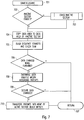
- the figure shows a flow chart for the subroutine.
- the subroutine process is activated with its start step 701, when called by the main process of Fig. 4 .
- the first step is a decision 702, whether the at the moment inactive sector is already erased.
- a FLASH-memory 103 as an example for a used non-volatile memory 201 is erased, when all bits are set to the value "high”. If a bit is not set by a write action and is still set to the value "low", by other words, the bit is not erased, a data write mistake occurs.
- the decision 702 tests, whether an erasing process is already completed. In case of "no" a predefined process 703 "erase inactive sector” is called. The flow chart of the process 703 is not shown. It is essential that the erasing process checks bit by bit that the memory addresses are actually erased before itself returns to the main process of Fig. 5 . If the inactive sector is surely erased, the "flushing" process proceeds to a step, formed by an action 704 "copy data area to data area of the inactive sector”. This step follows the action "build sequence counter and check sum” 705. The sequence counter is formed from the sequence counter of the active sector 204a, which is incremented. In case it would become the value "FF", the count starts with the value "0" again. The check sum is computed over the new sequence counter and four predefined bytes and is stored into the signature of the sector 204b as shown in Fig. 2 .
- the flushing process now enters the decision "data changed while flushing" 706. As shown in Fig. 6 and explained above with reference to state 602 of Fig. 6 , it can occur that data have changed during the flushing process. These changes were stored into patches. The decision tests, whether such patches exist and if the decision results in "no" the flushing process reaches the termination point "return" 707.
- an action “overwrite” 708 corrects the data in the data area 203 of the volatile memory 202 by the patches stored in another area of the volatile memory 202.
- the decision "secure data changed” 709 tests, whether one of the patches relates to secure data. If the decision 709 results in “yes” the action “transfer” 710 starts. It copies the patches of secure data into the heap area of the new active, former inactive sector 4b. The offsets of these patches are adapted to the addresses of corrected data in the data area of the sector 4b of the non-volatile memory 201.
- Fig. 8 shows a flow chart for a subroutine of the flow chart in Fig. 5 , useable for flushing.
- the predefined process is the step 502 of the main process in Fig. 5 .
- the process executes at any time, immediately after power on.
- the start 801 "power on” is followed by the action 802 "select one sector".
- the action randomly selects one of the at least two sectors 204 in the non-volatile memory 201.
- the process enters the decision 803 "sequence counter greater than other". If it results in "no", the sequence counter of the chosen sector 204 is less than that of the other sector 204, the action 804 "select other sector” starts.
- step 805 "valid check sum?". This decision computes the expected check sum and equalizes its value with the stored check sum of the sector 204. In case that the decision 805 results in "yes”, the process reaches action 806 "copy data into volatile memory”. A copy of the data in the volatile memory 202 enables the control means 100 of the device to access data quickly. The process now terminates at step 807 “return”. In case that the decision 805 results in "no”, the process reaches action 808, which exchanges the selection of sectors 204 and the respective other one becomes the selected sector 204. The functionality is equal to the function of step 804.
- the new selected sector is tested by a decision 809 "valid checksum?", which has an identical functionality with decision 805. If the decision 809 results in “yes” the process proceeds to action 806 and furthermore proceeds as described above. In case of a “no” the process enters an action 810 "copy default data into volatile memory". To ensure under all circumstances the operability of the mobile phone, in case of no valid sector, default values are used. At last the process terminates with step 807.
- the process makes available the optimal set of data, which can be recovered.
- the mobile phone can always access the data at the volatile memory 202, when switched on. Since in case of total data loss a limited ability to operate is ensured.
Landscapes
- Engineering & Computer Science (AREA)
- Theoretical Computer Science (AREA)
- Physics & Mathematics (AREA)
- General Engineering & Computer Science (AREA)
- General Physics & Mathematics (AREA)
- Mobile Radio Communication Systems (AREA)
- Techniques For Improving Reliability Of Storages (AREA)
Description
- The present invention relates to a mobile communication device and a method of operating such a mobile communication device.
- A mobile communication device, e.g. a mobile phone, needs a non-volatile memory to store software and parametric data. Parametric data are for example adjustment data of displays, telephone books and login data of a telephone network carrier. The non-volatile memories do not require power to be supplied to them in order to maintain data. Certain types of non-volatile memories can be erased and occupied with new data without a special-purpose device. The content of the memory can be erased and new data can be stored on the memory device being integrated in the circuit. However, the number of erasing-cycles of these non-volatile memory devices is limited and there is the danger of failure over lifetime of a mobile phone. On the other hand, it is desired to use as little different types of memory devices as possible to save costs and to increase the working speed of the mobile communication device. An intelligent management of storing and erasing data is required.
-
EP 0 834 882 A2 discloses a memory management method comprising storing parametric data in a volatile memory, such as RAM, and periodically updating the data stored in the RAM to a non-volatile memory such as a Flash Memory. Updating data to the Flash Memory is dependent on the time since the last update or on the importance of the data in the RAM. The parametric data is stored in dependence on the nature of the data, for reducing wear of the non-volatile memory. The method is, e.g. applied to a mobile phone and the information of the data may relate to the user interface set-up, the user personal telephone directory, or some other parameters of the radiotelephone, that vary during use. - In a second realization
EP 0 834 882 discloses a method of managing a memory device, wherein data is distinguished in data of different priority levels and the period of storing the data in the non-volatile memory is dependent on the priority level. Data is stored into the non-volatile memory in a linked list. - A disadvantage of the methods described above is that there are no arrangements to ensure a data recovery in case of an unexpected power failure. A further disadvantage is that the linked list always stores the complete set of information. The consumption of storage space is relatively great and an erasing of storage space is often required. This increases the wear of a non-volatile memory, notably a FLASH memory.
-
DE 197 40 525 C1 discloses a method that relates to the data management in a vehicle. The vehicle comprises a computer with a RAM memory and a FLASH memory. At deactivation of the vehicle and thereby of the data management system, data is stored into the FLASH-memory. Upon restoring the power supply, the data, which had to be maintained, is read out from the non-volatile memory and stored into the volatile memory. Data storing in the non-volatile memory is organized by a circulating storing method. The data is repeatedly stored and only one set of data is actual. At the start in a first phase, default values are transferred into non-volatile memory to quickly ensure the ability of the vehicle to work. In a second phase, the newest set of data is read out from the non-volatile memory and the default values are overwritten with that. - Disadvantageously the disclosed method cannot be protected against data loss in case of an unexpected failure of power supply, without the possibility to execute a special "going down" method. In general, the method is not set to ensure the maintenance of security sensitive data as login data of a telephone network carrier.
- The present invention aims to avoid a third type of memory in a mobile communication device and to enable the use of a non-volatile memory with a limited number of erasing cycles in a mobile communication device for maintaining data records, which change during usage of a mobile communication device, whereby an acceptable lifetime of the mobile communication device without a lifetime failure has to be ensured.
- The above object is achieved by a mobile communication device according to
claim 1 and a memory managing method according to claim 12. - The mobile communication device of the present invention has the advantage to avoid a third type of a non-volatile memory while guaranteeing secure storage of data and preventing lifetime failure of the mobile communication device within an acceptable period of time. The number of erasing procedures is limited by the period of time until the next storing. Considering the expected lifetime of a mobile communication device the period can be determined so that the number of erasing procedures does not wear the non-volatile memory by more then the maximum possible erasing cycles. The sequence counter always gives the newest data set. After power on, the control means can discover the actual data set. In case there was no change in data being stored in the volatile memory, this data will not be flushed. This feature additionally reduces the wear of the non-volatile memory. This arrangement avoids the need of a third type of memory. Normally there is one volatile memory like a RAM and two kinds of non-volatile memories. The control means distinguish normal data and secure data. The control means immediately store secure data in the non-volatile-memory when said data was changed.
- In case of loosing data, the disadvantages and the dangers differ depending on the kind of data. Certain sets of parameters are security sensitive data as login data of the telephone network carrier, for example. The distinction of types of data can specifically reduce the risk of data loss.
- In case the mobile communication device is not turned off as provided but a breakdown of power supply occurs, the kind of data, that is most sensitive about data loss, is protected as far as possible.
- The control means store secure data, which were changed between periodical flushing, in a heap area of the active sector as a patch of the outdated information in a data area. The patch is containing at least the information about offset, length of the outdated information and the new information itself.
- This feature reduces the number of sector erasures, because only the information is stored which is necessary to be maintained at all. The total set of data does not normally require the entire sector. A part of the sector can be built as a heap area. The patches of the sets of the secure data having been changed are stored in the heap area. Also it is not possible to overwrite a small part of a non-volatile memory at a single memory address without having erased at least a relating block of the memory before, it is always possible to store in an area having been remained free up to now. The amount of erasing cycles is lowered, because secure data normally requires less space and a flushing is avoided by storing patches of the outdated secure data.
- Further, the control means store data, which are changed while flushing the data of the volatile memory into the non-volatile memory, as a patch of the outdated information in another area of the volatile memory. The patch contains at least information about offset, length of the outdated information and the new information itself. The control means change normal data in the volatile memory after the flushing is completed according to the patch and store a patch of secure data in the heap of the active sector of the non-volatile memory.
- Upon the flushing there may occur the problem of data, which are just being flushed into the non-volatile memory, being changed. To obtain consistent data records, the changes of data are not immediately processed but the data sets are stored as patches in a different area of the volatile memory. When the flushing is completed, the patches of normal data are used to overwrite the data in the volatile memory with the correct and updated information. The patches of secure data are copied to the heap area of the then active sector in the non-volatile memory. The offset of the patch is adapted to point to the correct data record. That minimizes the risk to get inconsistent data. Data, which have changed, cannot be mixed with unchanged data and thereon cannot be flushed into the non-volatile memory causing data loss by discrepancies or by not noticeable combinations of new and old information.
- Further, the control means initiate an erase procedure over the then inactive sector after flushing the data into the now active sector.
- In a preferred embodiment of the invention, the control means check byte by byte if the then inactive sector was actually erased.
- Thereby the protection against the false storing of data is improved. The concurrence of a not erased bit and a bit, which should not be set by storage, may cause a wrong information.
- In an embodiment optionally the erase procedure can be suspended while performing and can continue. The period of time for periodically flushing and erasing may be at least 15 minutes.
- Erasing requires a long time and should be interruptible to execute other processes. The period of not less than 15 minutes implies an estimated lifetime of e.g. at least about 5½ years under normal conditions of use of a mobile phone.
- Further, preferably, one bit of the sequence counter is always clear and the sequence counter is of an eight bit type having the first bit always clear. The control means test, whether the sequence counter of the one sector is greater than the sequence counter of the other sector or vice versa by equalizing the one sequence counter to the incremented other sequence counter modulo 128 or vice versa.
- There are non-volatile memory types, for example a FLASH-memory, which are cleared in the state of all the bits being set. By incrementing a sequence counter may become the value "FF" equal to an erased address. The described feature prevents from that.
- In a preferred embodiment, the control means store in the new active sector a check sum computed over the sequence counter and over four identification bytes of the active sector after flushing. The control means test the validity of the active sector by the check-sum and in case of failure uses the other sector as an active sector. The control means can use default values copied to the volatile-memory in case of the second sector being invalid, too.
- A power supply failure could occur while flushing or erasing. The embodiment of the invention always ensures a valid data record, either stored in an active sector or given by default values.
- In case of switching on the mobile communication device after power off, said control means copy the information of the data in the active sector into the volatile memory.
- This embodiment facilitates a fast read/write access to the data, because all the time since power on there is a copy of the data in the volatile memory. The time of accessing to the volatile memory is short in proportion to that of the non-volatile memory.
- Preferably the non-volatile memory is a FLASH-type one and the control means display a message in case of three or more failed attempts to erase a sector.
- This feature gives notice to a user of the mobile communication device that the device needs service. The memory failure is a defect not expected or noticeable by the user. On that score a message is advantageous.
- A preferred application of the invention comprises a mobile communication device with a FLASH-memory as the non-volatile memory.
- The method fundamentally has the same advantages as the mobile communication device. Furthermore, a realization of the method is often simple, because no or less modifications of hardware are required. There are remarkable numbers of mobile phone types with a FLASH memory as the only non-volatile memory. The method can ameliorate the management of safe storing of data in an easy way. Advantageously, the inventive method is realized in a software program being able to perform the method steps when stored in a memory of a mobile communication device.
- Further, at the inventive memory managing method normal data and secure data are distinguished by the control means and furthermore said secure data is stored in the non-volatile memory by the control means immediately in case of being changed. The method furthermore comprises the step of storing secure data being changed between periodical flushing into a heap area of the active sector as a patch of the outdated information in a data area by the control means, wherein at least information about an off-set, a length of the outdated information and the new information itself is contained.
- Data being changed while flushing the data of the volatile memory into the non-volatile memory, is stored as a patch of the outdated information into another area of the volatile memory by the control means, said patch containing at least information about an off-set, length of the outdated information and the new information itself. Said data being normal data is changed in the volatile memory according to the patch after flushing having been completed. A patch of the secure data is stored in the heap of the active sector of the non-volatile memory after flushing having been completed.
- Preferably, the then inactive sector is checked by the control means byte by byte if it is actually erased.
- Favorably the erase procedure is suspended by the control-circuit, when another software-procedure has to be executed and the continuation of the erasure procedure is initiated by the control unit after the software-procedure has been completed.
- Data may be flushed and the inactive sector may be erased by the control means at a minimum period of 15 minutes.
- Suitably the sequence counter is of an 8 bit type having one bit always clear and it is tested by the control means, whether the sequence counter of one sector is greater than the sequence counter of the other sector or vice versa by equalizing the one sequence counter to the incremented other sequence counter modulo-128 and vice versa.
- A check sum computed over the sequence counter and over four identification bytes of the new active sector can be stored in the new active sector by the control means. While proceeding a "switch on" starting procedure, the validity of the active sector is tested by the control means making use of the check-sum and in case of an invalid active sector, the other sector is used as an active sector. In case of the other sector being invalid, too, default values are copied to the volatile memory by the control means.
- After switching on the mobile communication device the information of the data in the active sector patched by the heap-information is copied into the volatile memory.
- The methods described above are suitably used with a FLASH-memory as the non-volatile memory and a message is displayed in case of three or more failed attempts to erase a sector.
- A preferred embodiment in accordance with the present invention will now be described with references to the accompanying drawings in which:
- Fig. 1
- shows a block diagram of a microcontroller in a mobile phone,
- Fig. 2
- schematically shows the volatile memory map and the FLASH-memory map of an inventive mobile phone,
- Fig. 3
- schematically shows a cutout of the FLASH-memory map containing information labeled as signature in
Fig. 1 , - Fig. 4
- schematically shows an information unit stored in the FLASH-memory in
Fig. 2 at the area labeled as heap, - Fig. 5
- shows a flow chart for a routine, useable for storing and flushing in accordance with the inventive method,
- Fig. 6
- shows a flow chart for a routine, which runs if data has been changed just now,
- Fig. 7
- shows a flow chart for a subroutine of the flow chart in
Fig. 5 , useable for flushing, and - Fig. 8
- shows a flow chart for a subroutine of the flow chart in
Fig. 5 , useable for a power-on process. - A preferred embodiment of the present invention will be described with reference to the accompanying drawings.
-
Fig. 1 shows a block diagram of a mobile phone as an example of a mobile communication device with control means 100 having a multiplicity of integrated on-board operating units. The control means 100 comprise a central processing unit (CPU) 101, a random access memory (RAM) 102, a FASH-memory 103, input/output drivers 104, and a digital signal processor (DSP) 105, which is a sophisticated functional unit, e.g. to compute voice coding. The FLASH-memory 103 provides non-volatile memory means and also replaces EEPROM type memory means in the present embodiment of the invention, which will be explained in detail further below. A second type of memory is typically used on board of the microcontroller as the control means 100. That memory is theRAM 102 providing a volatile memory means for use in association with any software running in the microcontroller and itself being stored in theRAM 102 or storing data in theRAM 102. The input/output drivers 104 handle transfer of data between the units of the control means 100 and devices of the mobile phones as microphone, loudspeaker, and receiver/antenna. TheCPU 101 is coordinating all the operating units described above and interacting with these. -
Fig. 2 is a view on a schematic map of avolatile memory 202, for example the FLASH-memory 103 ofFig. 1 , and of avolatile memory 202 consisting of theRAM 102 ofFig. 1 , e.g. A mobile phone as a specific type of a mobile communication device uses both memories 201,202 in its control means 100. The view presents the logical arrangement of the memories 201,202. The separated numbers of addressable storage units, which are allocated to a logical unit, are clarified by a rectangle for each logical unit. Thevolatile memory 202 contains adata area 203. In this data area 203 a complete set of data is stored containing the information about normal data and secure data. Normal data in general are all data, which can change according to settings of a user or a radio network carrier. Secure data are settings, which can change and are of importance for a faultless operating of the mobile phone. Such data are adjustment data and parameters, such as login or network protocol information. The complete set is copied from thenon-volatile memory 201 into thevolatile memory 202, when the power supply is switched on and the mobile phone is used. As a result, the information is always available in thevolatile memory 202 and therefore it is possible to read it quickly. The two sectors 204, 204a, 204b do not necessarily require the total storage space of thenon-volatile memory 201. Other blocks may contain the working or operating software of the mobile phone, which is not changing besides in case of a software update. - The FLASH-
memory 103 is parted in at least two sectors 204. The physical design of a FLASH-memory 103 is composed of blocks of memory addresses of the same number. One or more of these blocks are bunched together to a sector 204 and called correspondingly in the context of the present invention. The concrete implementation uses a single block of 8KB for each sector 204. One of the sectors 204 is marked as an active sector. Following and by convention, the sector 204 on the right is the active sector 204a and the other sector on the left is the inactive sector 204b. The roles of the active sector 204a and the inactive sector 204b continuously exchange and the current arrangement relates to a single state of the inventive method. Each sector is logically parted again in three parts. The first part is a signature. The last and third part is a data area, respectively. Between these two parts the second part is arranged as a heap. The composition of the signature will be explained further below with reference toFig. 3 . The data area serves to receive and maintain data, which is flushed from the data area of thevolatile memory 202 into the inactive sector 204b. It contains both the normal data and the secure data after flushing in the state they have been in the data area of thevolatile memory 202. Addresses of data records are indicated with an offset, which is a relative address, referring to the beginning or the first absolute address of the sector. The numeration is ascending in direction of the end of the sector or with higher absolute addresses. -
Fig. 3 schematically shows a cutout of the FLASH-memory 103 map containing information labeled as signature inFig. 2 . The signature consists of fixed check data and a sequence number having a length of one byte and a check sum having a length of one byte. The control means 100, as shown inFig. 1 , compute the check sum over the sequence counter and over four identification bytes of the active sector. After flushing the result is stored in the signature of the then active sector 204a. The active sector 204a is marked with a sequence counter of a greater value, i.e. by the sequence counter of the other sector incremented with a value " 1". -
Fig. 4 schematically shows an information unit stored in the FLASH-memory Fig. 2 at the area, which is labeled as heap. The information unit is a patch used to store the change of secure data immediately without flushing all the content of the data from thevolatile memory 202 into thenon-volatile memory 201. The patch consists of a data length information having a length of one byte. Said byte is followed by two bytes comprising the data offset and as a third essential part of the patch by the changes of the data themselves. The main part of the patch consists of this data area in general. The omissions of the rectangle indicate the normally larger quantity of the data in the data area in relation to the three bytes. - The control means 100 flush the
data area 203 of thevolatile memory 202, when the period of time is lapsing and an erasing subroutine has already erased the inactive sector 204b. The control means 100 copy the data from thedata area 203 of thevolatile memory 202 into the data area of the inactive sector 204b. This shows the arrow 205, symbolizing the movement of copied data. In a second step, the control means 100 increment the sequence counter of the active sector by the value "1", except if it would then become a "FF", a byte with all bits set. In this case the sequence counter is set to the value "00". Furthermore, the control means 100 compute a check sum over the new sequence counter value and over four identification bytes of the sector. When the sequence counter is now greater than the sequence counter of the up to now active sector 204a and the check sum indicates that the procedure of flushing is completed, the up to now active sector 4a and the inactive sector 204b exchange their roles. An erasing procedure can run over the up to now active sector 204a, as the new inactive sector. With reference toFig. 5 a program flow will be explained, which is running at all the time a mobile communication device is operating and which realizes the inventive method in a mobile phone. The routine controls the flushing. In a first step after astart 501, that is reached during a power-on of the mobile phone as an example of a mobile communication device, a subroutine "power on" 502 is called. The subroutine "power on" 502 will be explained in more detail with reference toFig. 7 further below. The routine itself, furthermore by convention named "main routine" is a part of the software of the mobile phone. The main routine enters its state "start" 501 at any time upon activation of the mobile phone, when the software calls the main function. After the subroutine "power on" 502 is completed there is a complete set of data in thedata area 203 of thevolatile memory 202. The control means 100 and especially the software of the mobile phone can quickly access the data. The main routine now enters astep 503, which is a decision whether the preset period of time lapsed. The period is set to e.g 15. minutes. In case of "no" (period of time not yet lapsed) the process reaches a further decision step "heap full?" 506. Unless the heap is full the process returns to thedecision 503 until the result is "yes" (period of time has lapsed). Alternatively the process proceeds to the predefined process "flushing" 505 as a subroutine. which will be explained with reference toFig. 7 in more detail further below. This ring forms a wait modus to ensure a flushing not earlier than after e.g. 15 minutes and the main routine is at least active in the wait modus, when the mobile phone is powered on. That means the routine is periodically activated by an interrupt for example and then the routine executes thedecision 503 and the ring as long as a time scheduling of the control means 100 or an overflow of the heap stops the execution. In case of "yes" at thedecision 503 the process flow enters a further decision step "data dirty?" 504. When no data changed in thedata area 203 ofvolatile memory 202, a new period of time starts and the process flow returns to the wait modus and thedecision 503 without doing anything else, because the data at thedata area 203 and in the active sector 204a are identical to each other. In case the data have been changed, the decision "data dirty" results in "yes" and the predefined process step "flushing" 505 is called as a subroutine. When the process step "flushing" 505 is completed the main routine proceeds to apredefined process step 703 "erase inactive sector" and finally returns into the wait modus and to thedecision step 503. - This implementation of the invention advantageously improves the security against lifetime failure of the mobile phone and at same time the security against data loss. A period of about 15 minutes results in lifetime of about five and a half years. The length of the period, however, can be set different depending on the specific application and/or the particular device.
- Furthermore, there is an exit-procedure, which is not shown. This procedure secures a data flushing during an intended power going down of the mobile phone. In case of data in the
volatile memory 202 being dirty and the period of time not having lapsed, the exit-procedure flushes data in the non volatile 201 memory . - With reference to
Fig. 6 a flow chart for a routine will be explained, which runs if data have just been changed. As an external event, for example phone book entries by an user or settings of a network carrier, data are changed, which can be normal or secure data. In this case the process flow enters the state data input "changing of data" 601. When data are changed other software e.g. calls the main process as a subroutine. In the decision "flushing at same time" 602 the process flow differs dependent on whether a subroutine "flushing" 505 called by the main process is running at the same time. This is necessary to avoid the storing of wrong data or mixed data. The main process, which is activated by an interrupt and determines the lapse of the period, and the current process can concur. More in detail, the subroutine "flushing" 505 can run, if activated by the main process. Due to time scheduling the process "flushing" can get a data record, partly changed over again by the current process. From that fact thedecision 602 leads to the action "store patch in volatile memory" 603 in case of "yes". A patch equal to the patch explained above is stored in another area of the volatile memory. It contains information about the offset, the data length, and the changed data itself. The main process subsequently can determine the addresses of data in the data area 3 of thevolatile memory 202, which are not up to date yet again, by the offset. After storing the patch in RAM and, if secure data, in the heap of the actual sector, the current process enters a step "return" 607 in a direct way and is terminated. In a step "changed data secure data" 605a is tested whether the data needs an immediate storing in thenon-volatile memory 201. In case of "no" as result of theprevious decision 602 theaction 604 occurs "storing changes in data area". The changed data overwrites the data in the data area 3 of thevolatile memory 202. In the next step the process flow gets to the decision "changed data secure data" 605 where it is tested whether the changed data are secure data, i.e. if the data need an immediate storing in thenon-volatile memory 201. In case of "yes", the action executes "store patch in heap of active sector" 606. The changes of the secure data are stored into patches as described above. The patches are written to the heap area of thenon-volatile memory 201. If there is no space in an embodiment of the invention it is possible to provide an extraordinary flushing. In the following step the process flow of the process reaches the step "return" 607 and is terminated. Normal data are stored into the nonvolatile memory 201 by the main process after the period of time lapsed. - With reference to
Fig. 7 the predefined process "flushing", which is called as part of the main process instep 505, will be explained. The figure shows a flow chart for the subroutine. The subroutine process is activated with itsstart step 701, when called by the main process ofFig. 4 . The first step is adecision 702, whether the at the moment inactive sector is already erased. A FLASH-memory 103 as an example for a usednon-volatile memory 201 is erased, when all bits are set to the value "high". If a bit is not set by a write action and is still set to the value "low", by other words, the bit is not erased, a data write mistake occurs. To protect against that, thedecision 702 tests, whether an erasing process is already completed. In case of "no" apredefined process 703 "erase inactive sector" is called. The flow chart of theprocess 703 is not shown. It is essential that the erasing process checks bit by bit that the memory addresses are actually erased before itself returns to the main process ofFig. 5 . If the inactive sector is surely erased, the "flushing" process proceeds to a step, formed by anaction 704 "copy data area to data area of the inactive sector". This step follows the action "build sequence counter and check sum" 705. The sequence counter is formed from the sequence counter of the active sector 204a, which is incremented. In case it would become the value "FF", the count starts with the value "0" again. The check sum is computed over the new sequence counter and four predefined bytes and is stored into the signature of the sector 204b as shown inFig. 2 . - The flushing process now enters the decision "data changed while flushing" 706. As shown in
Fig. 6 and explained above with reference tostate 602 ofFig. 6 , it can occur that data have changed during the flushing process. These changes were stored into patches. The decision tests, whether such patches exist and if the decision results in "no" the flushing process reaches the termination point "return" 707. - In case of "yes" at
step 706 an action "overwrite" 708 corrects the data in thedata area 203 of thevolatile memory 202 by the patches stored in another area of thevolatile memory 202. After that, the decision "secure data changed" 709 tests, whether one of the patches relates to secure data. If thedecision 709 results in "yes" the action "transfer" 710 starts. It copies the patches of secure data into the heap area of the new active, former inactive sector 4b. The offsets of these patches are adapted to the addresses of corrected data in the data area of the sector 4b of thenon-volatile memory 201. - The danger of secure data loss is advantageously eliminated in case of a sudden power supply failure. Secure data is always stored in the actual sector as a patch in the heap.
- Fig. 8 shows a flow chart for a subroutine of the flow chart in
Fig. 5 , useable for flushing. The predefined process is thestep 502 of the main process inFig. 5 . The process executes at any time, immediately after power on. The start 801 "power on" is followed by the action 802 "select one sector". The action randomly selects one of the at least two sectors 204 in thenon-volatile memory 201. Next, the process enters the decision 803 "sequence counter greater than other". If it results in "no", the sequence counter of the chosen sector 204 is less than that of the other sector 204, the action 804 "select other sector" starts. It exchanges the selection of sectors 204 and the other one becomes the selected sector 204. The process proceeds to a decision 805 "valid check sum?". This decision computes the expected check sum and equalizes its value with the stored check sum of the sector 204. In case that the decision 805 results in "yes", the process reaches action 806 "copy data into volatile memory". A copy of the data in thevolatile memory 202 enables the control means 100 of the device to access data quickly. The process now terminates at step 807 "return". In case that the decision 805 results in "no", the process reaches action 808, which exchanges the selection of sectors 204 and the respective other one becomes the selected sector 204. The functionality is equal to the function of step 804. The new selected sector is tested by a decision 809 "valid checksum?", which has an identical functionality with decision 805. If the decision 809 results in "yes" the process proceeds to action 806 and furthermore proceeds as described above. In case of a "no" the process enters an action 810 "copy default data into volatile memory". To ensure under all circumstances the operability of the mobile phone, in case of no valid sector, default values are used. At last the process terminates with step 807. - Advantageously the process makes available the optimal set of data, which can be recovered. The mobile phone can always access the data at the
volatile memory 202, when switched on. Since in case of total data loss a limited ability to operate is ensured.
Claims (22)
- Mobile communication device comprising volatile memory (202), non-volatile memory (201) and control means (100), whereby at least a part of the non-volatile memory (201) is divided into two sectors (204),whereby the control means (100) is configured to perform the following steps:- store data in the volatile memory (202) and periodically flush said data from the volatile memory (202) into the non-volatile memory (201),- label one of the sectors (204) as an active sector (204a) upon a sequence counter having a greater value than a sequence counter of the other sector (204b), and label the other sector as an inactive sector,- distinguish normal data and secure data,- if secure data is changed between said periodical flushing, store said changed secure data (606) as a patch in a heap area of the active sector, containing at least information about off-set, length of outdated information and said changed secure data,whereby the control means (100) is further configured to periodically (503) perform the following sequence of steps:if the data in the volatile memory (202) has changed since a last flushing (504),- check (702) bit by bit that memory addresses of the inactive sector are actually erased,- erase (703) the inactive sector if the inactive sector was not already erased,- flush (505,704) a data area of the volatile memory (202) into a data area of the inactive sector, if the control means (100) had already erased the inactive sector, whereby, if data is changed while flushing the data from the data area from the volatile memory (202) into the data area of the non-volatile memory (201), the control means (100) is configured to store said changed data (603) as a patch in another area of the volatile memory (202), containing at least information about off-set, length of outdated information and said changed data, whereby, additionally, if said changed data is secure data, the control means (100) is configured to further store said changed secure data (606) as a patch in a heap area of the active sector, containing at least information about off-set, length of outdated information and said changed secure data,- increment (705) the sequence counter of the inactive sector in order to exchange roles of the active sector and the inactive sector, the active sector becoming the new inactive sector and the inactive sector becoming the new active sector,- correct (708) the data area of the volatile memory (202) by the patches of data stored in said another area of the volatile memory (202),- copy (710) the patches of secure changed data which are stored in the heap area of the new inactive sector into the heap area of the new active sector,- erase (507) the new inactive sector.
- Mobile communication device according to claim 1, wherein the control means (100) is further configured to check byte by byte if the inactive sector (204b) was actually erased.
- Mobile communication device according to claim 1 or 2, wherein the control means (100) is further configured that erasing (703) the inactive sector can be suspended while running and can continue.
- Mobile communication device according to one of claims 1 to 3, wherein the period of time for periodically flushing and erasing is at a minimum 15 minutes.
- Mobile communication device according to one of claims 1 to 4, wherein one bit of the sequence counter is always clear.
- Mobile communication device according to claim 5, wherein the sequence counter is of eight bit type having the first bit always clear and the control means (100) is configured to test whether the sequence counter of the one sector (204) is greater than the sequence counter of the other sector (204) or vice versa by equalizing the one sequence counter to the incremented other sequence counter modulo-128 or vice versa.
- Mobile communication device according to one of claims 1 or 6, wherein after flushing the control means (100) is configured to store in the new active sector (204a) a check sum computed over the sequence counter and over four identification bytes of the active sector (204a) and in case of switching on the mobile communication device after power off, said control means (100) tests the validity of the active sector (204a) by the check-sum and in case of failure use the other sector (204b) as an active sector.
- Mobile communication device according to claim 7, wherein the control means (100) is configured to use default values copied to the volatile-memory (202) if the second sector (204) is invalid, too.
- Mobile communication device according to one of claims 1 to 8, wherein upon start of the device the control means (100) is configured to copy the data from the active sector (204a) into the volatile memory (202).
- Mobile communication device according to one of claims 1 to 9, wherein the non-volatile memory (201) is a FLASH-type (103) one.
- Mobile communication device according to one of claims 1 to 10, wherein the control means (100) is configured to display a message in case three or more attempts failing to erase a sector.
- Memory managing method applied by a mobile communication device with a volatile memory (202), a non-volatile memory (201) and control means (100), whereby at least a part of the non-volatile memory (201) is divided into two sectors (204),whereby the control means (100) comprises a control circuit and/or a control program, whereby the control circuit and/or the control program is performing the following steps:- storing, by the control means (100), data in the volatile memory (202) and periodically flushing said data from the volatile memory (202) into the non-volatile memory (201)- labelling, by the control means (100), one of the sectors (204) as an active sector (204a) upon a sequence counter having a greater value than a sequence counter of the other sector (204b), and labelling, by the control means (100), the other sector as an inactive sector- distinguishing, by the control means (100), normal data and secure data- if secure data is changed between said periodical flushing, storing, by the control means (100), said changed secure data (606) as a patch in a heap area of the active sector, containing at least information about off-set, length of outdated information and said changed secure data,whereby the control circuit and/or the control program further comprises periodically (503) performing the following sequence of steps:if the data in the volatile memory (202) has changed since a last flushing (504)- checking (702), by the control means (100), bit by bit that memory addresses of the inactive sector are actually erased- erasing (703), by the control means (100), the inactive sector if the inactive sector was not already erased- flushing (505,704), by the control means (100), a data area of the volatile memory (202) into a data area of the inactive sector, if the control means had already erased the inactive sector, whereby, if data is changed while flushing the data from the data area from the volatile memory (202) into the data area of the non-volatile memory (201), storing, by the control means (100), said changed data (603) as a patch in another area of the volatile memory (202), containing at least information about off-set, length of outdated information and said changed data, whereby, additionally, if said changed data is secure data, further storing, by the control means (100), said changed secure data (606) as a patch in a heap area of the active sector, containing at least information about off-set, length of outdated information and said changed secure data,- incrementing (705), by the control means (100), the sequence counter of the inactive sector in order to exchange roles of the active sector and the inactive sector, the active sector becoming the new inactive sector and the inactive sector becoming the new active sector,- correcting (708), by the control means (100), the data area of the volatile memory (202) by the patches of data stored in said another area of the volatile memory (202),- copying (710), by the control means (100), the patches of secure changed data which are stored in the heap area of the new inactive sector into the heap area of the new active sector,- erasing (507), by the control means (100), the new inactive sector.
- Memory managing method according to claim 12, wherein the inactive sector (204b) is checked byte by byte whether being actually erased by the control means (100).
- Memory managing method according to claims 12 or 13, wherein erasing the inactive sector (703) is suspended by the control-circuit, when another software-procedure must run and when the software-procedure has been completed the continuation of the erasure procedure is initiated by the control unit.
- Memory managing method according to one of claims 12 to 14, wherein at the earliest all 15 minutes the data is flushed and the inactive sector is erased by the control means (100).
- Memory managing method according to one of claims 12 to 15, wherein one bit of the sequence counter is always clear.
- Memory managing method according to claim 16, wherein the sequence counter is of eight bit type and it is tested by the control means (100), whether the sequence counter of the one sector (204) is greater than the sequence counter of the other sector (204) or vice versa by equalizing the one sequence counter to the other incremented sequence counter modulo-128 and vice versa.
- Memory managing method according to one of claims 12 to 17, wherein a check sum is computed over the sequence counter and over four identification bytes of the new active sector (204a) and is stored in the new active sector (204a) by the control means (100) and after switching on the mobile communication device the validity of the active sector (204a) is tested by the control means (100) making use of the check-sum and in case of a invalid active sector (204a) the other sector (204b) is used as an active sector (204a)
- Memory managing method according to claim 18, wherein default values are copied to the volatile memory (202) by the control means (100) if the other sector (204b) being invalid, too.
- Memory managing method according to claim 19, wherein the information of the data in the active sector (204a) is copied into the volatile memory (202) by the control means (100).
- Memory managing method according to one of claims 12 to 20, wherein a FLASH-memory (103) is used as the non-volatile memory (202).
- Memory managing method according to one of claims 12 to 21, wherein a message is displayed by the control means (100) in case of three or more failed attempts to erase a sector (204).
Priority Applications (1)
| Application Number | Priority Date | Filing Date | Title |
|---|---|---|---|
| EP01119923.9A EP1286267B1 (en) | 2001-08-17 | 2001-08-17 | Mobile communication device and memory management method |
Applications Claiming Priority (1)
| Application Number | Priority Date | Filing Date | Title |
|---|---|---|---|
| EP01119923.9A EP1286267B1 (en) | 2001-08-17 | 2001-08-17 | Mobile communication device and memory management method |
Publications (2)
| Publication Number | Publication Date |
|---|---|
| EP1286267A1 EP1286267A1 (en) | 2003-02-26 |
| EP1286267B1 true EP1286267B1 (en) | 2017-08-16 |
Family
ID=8178359
Family Applications (1)
| Application Number | Title | Priority Date | Filing Date |
|---|---|---|---|
| EP01119923.9A Expired - Lifetime EP1286267B1 (en) | 2001-08-17 | 2001-08-17 | Mobile communication device and memory management method |
Country Status (1)
| Country | Link |
|---|---|
| EP (1) | EP1286267B1 (en) |
Families Citing this family (3)
| Publication number | Priority date | Publication date | Assignee | Title |
|---|---|---|---|---|
| GB0123415D0 (en) | 2001-09-28 | 2001-11-21 | Memquest Ltd | Method of writing data to non-volatile memory |
| US7536562B2 (en) | 2002-10-17 | 2009-05-19 | Research In Motion Limited | System and method of security function activation for a mobile electronic device |
| US7356442B1 (en) * | 2006-10-05 | 2008-04-08 | International Business Machines Corporation | End of life prediction of flash memory |
Family Cites Families (5)
| Publication number | Priority date | Publication date | Assignee | Title |
|---|---|---|---|---|
| US5745425A (en) * | 1996-08-29 | 1998-04-28 | Lucent Technologies Inc. | Reliable backup memory |
| GB2317722B (en) * | 1996-09-30 | 2001-07-18 | Nokia Mobile Phones Ltd | Memory device |
| DE19740525C1 (en) | 1997-09-15 | 1999-02-04 | Siemens Ag | Method of data storage and recovery in control system, esp. in motor vehicle, such as taxi |
| DE29807745U1 (en) * | 1998-04-29 | 1998-08-06 | Siemens AG, 80333 München | Data storage system for persistent data |
| US6104638A (en) * | 1999-02-26 | 2000-08-15 | Hewlett-Packard Company | Use of erasable non-volatile memory for storage of changing information |
-
2001
- 2001-08-17 EP EP01119923.9A patent/EP1286267B1/en not_active Expired - Lifetime
Non-Patent Citations (1)
| Title |
|---|
| None * |
Also Published As
| Publication number | Publication date |
|---|---|
| EP1286267A1 (en) | 2003-02-26 |
Similar Documents
| Publication | Publication Date | Title |
|---|---|---|
| EP0833250B1 (en) | Memory management method | |
| EP0834882B1 (en) | Memory management method and apparatus | |
| EP0991081B1 (en) | Emulated EEPROM memory device and corresponding method | |
| US6148441A (en) | Method for reprogramming flash ROM in a personal computer implementing an EISA bus system | |
| EP0833251B1 (en) | Memory management method and apparatus | |
| WO2000007106A1 (en) | Methods and apparatus for updating a nonvolatile memory | |
| JPH08147202A (en) | Reloadable rom filing device | |
| KR20030021631A (en) | Memory apparatus and therefor controling method for mobile station | |
| CA2474739A1 (en) | Non-volatile storage device and control method thereof | |
| EP1345236B1 (en) | A non-volatile memory device | |
| EP3584697B1 (en) | Information processing device | |
| EP1286267A1 (en) | Flash based non-volatile memory | |
| JP2002278850A (en) | Semiconductor device | |
| JP2001075941A (en) | Microcomputer with built-in flash memory and operating method thereof | |
| JPH10333898A (en) | Microcomputer | |
| JP3271935B2 (en) | Control system | |
| JP2004078907A (en) | Storage device, memory management method and program | |
| JP4031693B2 (en) | Nonvolatile memory and data storage device having the same | |
| KR100531862B1 (en) | Garbage data collecting method for mobile communication device | |
| JP2000276461A (en) | Microcomputer | |
| JPH0764796A (en) | Firmware program download method | |
| JP4565981B2 (en) | Nonvolatile memory data storage method, computer program, and portable terminal | |
| JPH0644064A (en) | Firmware reloading system | |
| JPS646600B2 (en) | ||
| JP2002041369A (en) | Semiconductor memory |
Legal Events
| Date | Code | Title | Description |
|---|---|---|---|
| PUAI | Public reference made under article 153(3) epc to a published international application that has entered the european phase |
Free format text: ORIGINAL CODE: 0009012 |
|
| AK | Designated contracting states |
Kind code of ref document: A1 Designated state(s): AT BE CH CY DE DK ES FI FR GB GR IE IT LI LU MC NL PT SE TR Designated state(s): AT BE CH CY DE DK ES FI FR GB GR IE IT LI LU MC NL PT SE TR |
|
| AX | Request for extension of the european patent |
Extension state: AL LT LV MK RO SI |
|
| 17P | Request for examination filed |
Effective date: 20030409 |
|
| AKX | Designation fees paid |
Designated state(s): DE FR GB |
|
| RAP1 | Party data changed (applicant data changed or rights of an application transferred) |
Owner name: SONY DEUTSCHLAND GMBH |
|
| RAP1 | Party data changed (applicant data changed or rights of an application transferred) |
Owner name: SONY DEUTSCHLAND GMBH |
|
| RAP1 | Party data changed (applicant data changed or rights of an application transferred) |
Owner name: SONY DEUTSCHLAND GMBH |
|
| 17Q | First examination report despatched |
Effective date: 20071218 |
|
| GRAP | Despatch of communication of intention to grant a patent |
Free format text: ORIGINAL CODE: EPIDOSNIGR1 |
|
| INTG | Intention to grant announced |
Effective date: 20170313 |
|
| GRAS | Grant fee paid |
Free format text: ORIGINAL CODE: EPIDOSNIGR3 |
|
| GRAA | (expected) grant |
Free format text: ORIGINAL CODE: 0009210 |
|
| AK | Designated contracting states |
Kind code of ref document: B1 Designated state(s): DE FR GB |
|
| REG | Reference to a national code |
Ref country code: GB Ref legal event code: FG4D |
|
| REG | Reference to a national code |
Ref country code: FR Ref legal event code: PLFP Year of fee payment: 17 |
|
| REG | Reference to a national code |
Ref country code: DE Ref legal event code: R096 Ref document number: 60150554 Country of ref document: DE |
|
| REG | Reference to a national code |
Ref country code: DE Ref legal event code: R097 Ref document number: 60150554 Country of ref document: DE |
|
| PLBE | No opposition filed within time limit |
Free format text: ORIGINAL CODE: 0009261 |
|
| STAA | Information on the status of an ep patent application or granted ep patent |
Free format text: STATUS: NO OPPOSITION FILED WITHIN TIME LIMIT |
|
| 26N | No opposition filed |
Effective date: 20180517 |
|
| REG | Reference to a national code |
Ref country code: FR Ref legal event code: PLFP Year of fee payment: 18 |
|
| PGFP | Annual fee paid to national office [announced via postgrant information from national office to epo] |
Ref country code: DE Payment date: 20200819 Year of fee payment: 20 Ref country code: FR Payment date: 20200821 Year of fee payment: 20 Ref country code: GB Payment date: 20200826 Year of fee payment: 20 |
|
| REG | Reference to a national code |
Ref country code: DE Ref legal event code: R071 Ref document number: 60150554 Country of ref document: DE |
|
| REG | Reference to a national code |
Ref country code: GB Ref legal event code: PE20 Expiry date: 20210816 |
|
| PG25 | Lapsed in a contracting state [announced via postgrant information from national office to epo] |
Ref country code: GB Free format text: LAPSE BECAUSE OF EXPIRATION OF PROTECTION Effective date: 20210816 |