EP1285893A1 - Vehicle-use low-reflection glass - Google Patents
Vehicle-use low-reflection glass Download PDFInfo
- Publication number
- EP1285893A1 EP1285893A1 EP01925922A EP01925922A EP1285893A1 EP 1285893 A1 EP1285893 A1 EP 1285893A1 EP 01925922 A EP01925922 A EP 01925922A EP 01925922 A EP01925922 A EP 01925922A EP 1285893 A1 EP1285893 A1 EP 1285893A1
- Authority
- EP
- European Patent Office
- Prior art keywords
- layer
- reflection
- glass
- film
- refractive index
- Prior art date
- Legal status (The legal status is an assumption and is not a legal conclusion. Google has not performed a legal analysis and makes no representation as to the accuracy of the status listed.)
- Withdrawn
Links
- 239000011521 glass Substances 0.000 title claims abstract description 81
- 239000000758 substrate Substances 0.000 claims abstract description 26
- 238000010030 laminating Methods 0.000 claims abstract description 8
- 239000011248 coating agent Substances 0.000 claims abstract description 6
- 238000000576 coating method Methods 0.000 claims abstract description 6
- 239000010936 titanium Substances 0.000 claims description 20
- 239000005340 laminated glass Substances 0.000 claims description 14
- 238000000034 method Methods 0.000 claims description 11
- PXHVJJICTQNCMI-UHFFFAOYSA-N Nickel Chemical compound [Ni] PXHVJJICTQNCMI-UHFFFAOYSA-N 0.000 claims description 6
- 150000004767 nitrides Chemical class 0.000 claims description 6
- 229910052715 tantalum Inorganic materials 0.000 claims description 5
- 229910052719 titanium Inorganic materials 0.000 claims description 5
- RTAQQCXQSZGOHL-UHFFFAOYSA-N Titanium Chemical compound [Ti] RTAQQCXQSZGOHL-UHFFFAOYSA-N 0.000 claims description 4
- GUVRBAGPIYLISA-UHFFFAOYSA-N tantalum atom Chemical compound [Ta] GUVRBAGPIYLISA-UHFFFAOYSA-N 0.000 claims description 4
- QCWXUUIWCKQGHC-UHFFFAOYSA-N Zirconium Chemical compound [Zr] QCWXUUIWCKQGHC-UHFFFAOYSA-N 0.000 claims description 3
- 229910045601 alloy Inorganic materials 0.000 claims description 3
- 239000000956 alloy Substances 0.000 claims description 3
- 229910052735 hafnium Inorganic materials 0.000 claims description 3
- VBJZVLUMGGDVMO-UHFFFAOYSA-N hafnium atom Chemical compound [Hf] VBJZVLUMGGDVMO-UHFFFAOYSA-N 0.000 claims description 3
- 229910052759 nickel Inorganic materials 0.000 claims description 3
- 229910052726 zirconium Inorganic materials 0.000 claims description 3
- 239000010408 film Substances 0.000 abstract description 78
- 239000010409 thin film Substances 0.000 abstract description 11
- 239000010410 layer Substances 0.000 description 106
- VYPSYNLAJGMNEJ-UHFFFAOYSA-N Silicium dioxide Chemical compound O=[Si]=O VYPSYNLAJGMNEJ-UHFFFAOYSA-N 0.000 description 34
- NRTOMJZYCJJWKI-UHFFFAOYSA-N Titanium nitride Chemical compound [Ti]#N NRTOMJZYCJJWKI-UHFFFAOYSA-N 0.000 description 17
- 239000000377 silicon dioxide Substances 0.000 description 13
- 230000015572 biosynthetic process Effects 0.000 description 12
- 229910052681 coesite Inorganic materials 0.000 description 12
- 229910052906 cristobalite Inorganic materials 0.000 description 12
- 229910052682 stishovite Inorganic materials 0.000 description 12
- 229910052905 tridymite Inorganic materials 0.000 description 12
- GWEVSGVZZGPLCZ-UHFFFAOYSA-N Titan oxide Chemical compound O=[Ti]=O GWEVSGVZZGPLCZ-UHFFFAOYSA-N 0.000 description 11
- OGIDPMRJRNCKJF-UHFFFAOYSA-N titanium oxide Inorganic materials [Ti]=O OGIDPMRJRNCKJF-UHFFFAOYSA-N 0.000 description 11
- 230000005284 excitation Effects 0.000 description 10
- 230000004313 glare Effects 0.000 description 9
- 229910052814 silicon oxide Inorganic materials 0.000 description 8
- 238000002834 transmittance Methods 0.000 description 8
- 238000001755 magnetron sputter deposition Methods 0.000 description 6
- 230000000052 comparative effect Effects 0.000 description 4
- 239000006185 dispersion Substances 0.000 description 4
- 238000011156 evaluation Methods 0.000 description 4
- 230000003287 optical effect Effects 0.000 description 4
- 239000012788 optical film Substances 0.000 description 4
- KFZMGEQAYNKOFK-UHFFFAOYSA-N Isopropanol Chemical compound CC(C)O KFZMGEQAYNKOFK-UHFFFAOYSA-N 0.000 description 3
- 238000009501 film coating Methods 0.000 description 3
- 239000000463 material Substances 0.000 description 3
- 230000007935 neutral effect Effects 0.000 description 3
- 239000005329 float glass Substances 0.000 description 2
- 239000007788 liquid Substances 0.000 description 2
- 238000004519 manufacturing process Methods 0.000 description 2
- 229910052751 metal Inorganic materials 0.000 description 2
- 239000002184 metal Substances 0.000 description 2
- BPUBBGLMJRNUCC-UHFFFAOYSA-N oxygen(2-);tantalum(5+) Chemical compound [O-2].[O-2].[O-2].[O-2].[O-2].[Ta+5].[Ta+5] BPUBBGLMJRNUCC-UHFFFAOYSA-N 0.000 description 2
- 238000003980 solgel method Methods 0.000 description 2
- MZLGASXMSKOWSE-UHFFFAOYSA-N tantalum nitride Chemical compound [Ta]#N MZLGASXMSKOWSE-UHFFFAOYSA-N 0.000 description 2
- 229910001936 tantalum oxide Inorganic materials 0.000 description 2
- XLYOFNOQVPJJNP-UHFFFAOYSA-N water Substances O XLYOFNOQVPJJNP-UHFFFAOYSA-N 0.000 description 2
- VZSRBBMJRBPUNF-UHFFFAOYSA-N 2-(2,3-dihydro-1H-inden-2-ylamino)-N-[3-oxo-3-(2,4,6,7-tetrahydrotriazolo[4,5-c]pyridin-5-yl)propyl]pyrimidine-5-carboxamide Chemical compound C1C(CC2=CC=CC=C12)NC1=NC=C(C=N1)C(=O)NCCC(N1CC2=C(CC1)NN=N2)=O VZSRBBMJRBPUNF-UHFFFAOYSA-N 0.000 description 1
- 229910000906 Bronze Inorganic materials 0.000 description 1
- 230000005856 abnormality Effects 0.000 description 1
- 239000000853 adhesive Substances 0.000 description 1
- 230000001070 adhesive effect Effects 0.000 description 1
- 208000003464 asthenopia Diseases 0.000 description 1
- 238000009835 boiling Methods 0.000 description 1
- 239000010974 bronze Substances 0.000 description 1
- 239000003086 colorant Substances 0.000 description 1
- 150000001875 compounds Chemical class 0.000 description 1
- KUNSUQLRTQLHQQ-UHFFFAOYSA-N copper tin Chemical compound [Cu].[Sn] KUNSUQLRTQLHQQ-UHFFFAOYSA-N 0.000 description 1
- 239000003599 detergent Substances 0.000 description 1
- 230000000694 effects Effects 0.000 description 1
- 230000004438 eyesight Effects 0.000 description 1
- 239000007888 film coating Substances 0.000 description 1
- 238000010438 heat treatment Methods 0.000 description 1
- 239000012535 impurity Substances 0.000 description 1
- 239000011229 interlayer Substances 0.000 description 1
- 238000007733 ion plating Methods 0.000 description 1
- 238000003475 lamination Methods 0.000 description 1
- 238000000691 measurement method Methods 0.000 description 1
- 230000003472 neutralizing effect Effects 0.000 description 1
- 230000002093 peripheral effect Effects 0.000 description 1
- 238000005375 photometry Methods 0.000 description 1
- 229920002037 poly(vinyl butyral) polymer Polymers 0.000 description 1
- 238000002360 preparation method Methods 0.000 description 1
- 230000003449 preventive effect Effects 0.000 description 1
- 229910052710 silicon Inorganic materials 0.000 description 1
- 239000010703 silicon Substances 0.000 description 1
- 238000004544 sputter deposition Methods 0.000 description 1
- 230000003746 surface roughness Effects 0.000 description 1
- 239000005341 toughened glass Substances 0.000 description 1
Classifications
-
- G—PHYSICS
- G02—OPTICS
- G02B—OPTICAL ELEMENTS, SYSTEMS OR APPARATUS
- G02B1/00—Optical elements characterised by the material of which they are made; Optical coatings for optical elements
- G02B1/10—Optical coatings produced by application to, or surface treatment of, optical elements
- G02B1/11—Anti-reflection coatings
- G02B1/113—Anti-reflection coatings using inorganic layer materials only
- G02B1/115—Multilayers
-
- B—PERFORMING OPERATIONS; TRANSPORTING
- B60—VEHICLES IN GENERAL
- B60J—WINDOWS, WINDSCREENS, NON-FIXED ROOFS, DOORS, OR SIMILAR DEVICES FOR VEHICLES; REMOVABLE EXTERNAL PROTECTIVE COVERINGS SPECIALLY ADAPTED FOR VEHICLES
- B60J3/00—Antiglare equipment associated with windows or windscreens; Sun visors for vehicles
- B60J3/007—Sunglare reduction by coatings, interposed foils in laminar windows, or permanent screens
-
- C—CHEMISTRY; METALLURGY
- C03—GLASS; MINERAL OR SLAG WOOL
- C03C—CHEMICAL COMPOSITION OF GLASSES, GLAZES OR VITREOUS ENAMELS; SURFACE TREATMENT OF GLASS; SURFACE TREATMENT OF FIBRES OR FILAMENTS MADE FROM GLASS, MINERALS OR SLAGS; JOINING GLASS TO GLASS OR OTHER MATERIALS
- C03C17/00—Surface treatment of glass, not in the form of fibres or filaments, by coating
- C03C17/34—Surface treatment of glass, not in the form of fibres or filaments, by coating with at least two coatings having different compositions
- C03C17/3411—Surface treatment of glass, not in the form of fibres or filaments, by coating with at least two coatings having different compositions with at least two coatings of inorganic materials
- C03C17/3417—Surface treatment of glass, not in the form of fibres or filaments, by coating with at least two coatings having different compositions with at least two coatings of inorganic materials all coatings being oxide coatings
-
- C—CHEMISTRY; METALLURGY
- C03—GLASS; MINERAL OR SLAG WOOL
- C03C—CHEMICAL COMPOSITION OF GLASSES, GLAZES OR VITREOUS ENAMELS; SURFACE TREATMENT OF GLASS; SURFACE TREATMENT OF FIBRES OR FILAMENTS MADE FROM GLASS, MINERALS OR SLAGS; JOINING GLASS TO GLASS OR OTHER MATERIALS
- C03C17/00—Surface treatment of glass, not in the form of fibres or filaments, by coating
- C03C17/34—Surface treatment of glass, not in the form of fibres or filaments, by coating with at least two coatings having different compositions
- C03C17/3411—Surface treatment of glass, not in the form of fibres or filaments, by coating with at least two coatings having different compositions with at least two coatings of inorganic materials
- C03C17/3429—Surface treatment of glass, not in the form of fibres or filaments, by coating with at least two coatings having different compositions with at least two coatings of inorganic materials at least one of the coatings being a non-oxide coating
- C03C17/3435—Surface treatment of glass, not in the form of fibres or filaments, by coating with at least two coatings having different compositions with at least two coatings of inorganic materials at least one of the coatings being a non-oxide coating comprising a nitride, oxynitride, boronitride or carbonitride
Definitions
- the present invention relates in particular to a vehicle-use low reflection glass in which the reflection phenomena of dashboard and its surrounding on a vehicle-use windshield surface or the occurrence of glare of the reflection light is reduced.
- a transparent plate with a conductive, reflection-preventive film is described. It is disclosed therein one comprising, on a metal film for providing conductivity, a high refractive index dielectric film with a refractive index of 1.90-2.50 and a film thickness of 200 ⁇ -400 ⁇ , and on the surface a low refractive index dielectric film with a refractive index of 1.35-1.50 and a film thickness of 700 ⁇ -1,200 ⁇ .
- Japanese Patent Unexamined Publication Heisei 9-156964 discloses a light-absorbing and reflection-preventive body formed on a substrate with a light absorbing film and a silica film from the substrate side.
- the light-absorbing and reflection-preventive body is characterized in that the light absorbing film has a thickness of 5 ⁇ 25nm.
- Japanese Patent Unexamined Publication Heisei 11-271507 discloses a process for preparing a reflection preventive film by using a substrate having a refractive index of greater than 1.9 and by laminating four-layered thin films with a magnetron sputtering method.
- Japanese Patent Unexamined Publication Heisei 11-49532 discloses a low reflection glass having on a transparent glass substrate having a refractive index of 1.47-1.53, a first layer having a refractive index of 2.00-2.60, a refractive index dispersion coefficient ⁇ of 2-15 and an optical film thickness of 35-70nm, a second layer having a refractive index of 1.35-1.55, a refractive index dispersion coefficient ⁇ of 50 or greater and an optical film thickness of 45-70nm, a third layer having a refractive index of 2.00-2.60, a refractive index dispersion coefficient ⁇ of 2-15 and an optical film thickness of 45-135nm, and a fourth layer having a refractive index of 1.35-1.55, a refractive index dispersion coefficient ⁇ of 50 or greater and an optical film thickness of 130-175nm, of which four layers are laminated on this order.
- Japanese Patent Unexamined Publication Heisei 4-357134 which is related to an application of the present applicant, discloses a vehicular low reflection glass in which a first layer having a refractive index of 1.8-1.9 and a film thickness of 700-900 ⁇ and a second layer having a refractive index of 1.4-1.5 and a film thickness of 1100-1300 ⁇ are laminated on a surface of at least one side of a glass substrate and in which, with respect to a visible light incident on the film surface side at an incident angle between 50° and 70° to normal of the film surface, it is lower by 4.5-6.5% than reflectance of a normal glass without a thin film coating.
- Japanese Patent Unexamined Publication Heisei 4-357135 discloses a vehicular low reflection glass in which a first layer having a refractive index of 1.8-1.9 and a film thickness of 700-1000 ⁇ , a second layer having a refractive index of 2.05-2.3 and a film thickness of 1300-1600 ⁇ and a third layer having a refractive index of 1.4-1.5 and a film thickness of 1100-1300 ⁇ are laminated on a surface of at least one side of a glass substrate and in which, with respect to a visible light incident on the film surface side at an incident angle between 50° and 70° to normal of the film surface, it is lower by 4.5-6.5% than reflectance of a normal glass without a thin film coating.
- the present invention was made in view of such task of the prior art and provides a low reflection glass that, for example, in case that it is used as an automotive windshield, effectively reduces driving disruption caused by the reflection onto the windshield from the dashboard through conventionally maintaining the reflection light with respect to a particularly obliquely incident light, that suppresses glare feeling of the reflection light even when viewed at every angle of the car interior and exterior, that does not provide the driver of an opposing car with misidentification and uncomfortable feeling, and that is particularly suitable for automotive windshields, by coating at least one surface side of a glass substrate with a reflection reducing layer formed by combining thin films of particular refractive indexes and film thicknesses.
- a vehicle-use low-reflection glass of the present invention is characterized in that at least one side surface of a transparent glass substrate is coated with a reflection reducing layer formed by sequentially laminating from the glass surface side a light absorbing layer as a first layer having a refractive index (550nm) of 2.2-2.8, a dielectric layer as a second layer having a refractive index (550nm) of 2.1-2.5 and a film thickness of 80nm to 120nm, and a dielectric layer as a third layer having a refractive index (550nm) of 1.45-1.55 and a film thickness of 60nm to 110nm.
- a reflection reducing layer formed by sequentially laminating from the glass surface side a light absorbing layer as a first layer having a refractive index (550nm) of 2.2-2.8, a dielectric layer as a second layer having a refractive index (550nm) of 2.1-2.5 and a film thickness of 80nm to 120nm
- a vehicle-use low-reflection glass of the present invention is characterized in that at least one of each nitride of titanium, zirconium, hafnium and tantalum and nitrides of alloys containing nickel is used as the light-absorbing layer.
- a vehicle-use low-reflection glass of the present invention is characterized in that, with respect to an incident light incident at an incident angle between 40° and 80° to normal of the reflection reducing layer surface, the visible light reflectance on the reflection reducing layer surface side is reduced by 3% or greater than the reflectance on a glass surface of only the transparent glass substrate without a coating of the reflection reducing layer.
- a vehicle use low reflection glass of the present invention is characterized in that, with respect to an oblique incident light incident to have an incident angle of 60° or less to normal of the reflection reducing layer surface, the visible light reflectance on the reflection reducing layer side is 10% or less.
- a vehicle-use low-reflection glass of the present invention is characterized in that the transparent glass substrate is a laminated glass.
- a vehicle-use low-reflection glass of the present invention is characterized in that the reflection reducing layer is formed by a film forming method using vacuum.
- a low reflection glass of the present invention has a structure in which at least one side surface of a transparent glass substrate is coated with a reflection reducing layer formed by sequentially laminating from the glass surface side a light absorbing layer as a first layer having a refractive index (550nm) of 2.2 . 2.8, a dielectric layer as a second layer having a refractive index (550nm) of 2.1-2.5 and a film thickness of 80nm to 120nm, and a dielectric layer as a third layer having a refractive index (550nm) of 1.45-1.55 and a film thickness of 60nm to 110nm.
- a light absorbing layer as a first layer having a refractive index (550nm) of 2.2 . 2.8
- a dielectric layer as a second layer having a refractive index (550nm) of 2.1-2.5 and a film thickness of 80nm to 120nm
- a dielectric layer as a third layer having a refractive index
- the light-absorbing layer of the first layer is an important layer for neutralizing the reflection color tone from the reflection reducing layer, and it is possible to use at least one of each nitride of titanium, zirconium, hafnium and tantalum and nitrides of alloys containing nickel.
- the film thickness of the light-absorbing layer is preferably about 2-5nm in case that it is required to have a visible light transmittance of 70% or greater, as in the case of use for an automotive windshield. In the case of other side glasses, the film thickness may be 5nm or greater.
- first dielectric layer of the second layer it is possible to use, for example, an oxide of titanium, tantalum and the like.
- second dielectric layer of the third layer it is possible to use, for example, an oxide of silicon and the like.
- refractive index of the first layer and refractive index and the film thickness of the second layer and of the third layer within the ranges of the above values, it is possible to reduce the visible light reflectance on the reflection reducing layer side by 3% or greater than the reflectance on the glass surface of only a transparent glass substrate without a coating of the reflection reducing layer, with respect to the visible light on the film surface side that is incident at an incident angle between 40° and 80° to normal on the reflection reducing layer surface, and it is possible to obtain a low reflection glass having a neutral reflection color tone having no uncomfortable feeling.
- a low reflection glass of the present invention has a visible light transmittance of 70% or greater together with the visible light reflectance on the reflection reducing layer surface with respect to the obliquely incident visible light being 10% or lower, and particularly in case that it is used as an automotive windshield, the reflection of dashboard and the like disappears, thereby improving visibility to the driver and the like and making it safe.
- the environment such as the driver, other passengers and persons of the opposing cars, the environment such as human does not necessarily see the glass at a particular angle, and it suppresses glare feeling for the vision from all the directions, reduces fatigue of eyes and human bodies, dissolves unsafety caused thereby, and becomes mild in terms of both of human and material.
- the film upon forming a film of the above reflection reducing layer, it is more preferable to form the film by a thin film producing method using vacuum such as sputtering and ion plating, since it is not necessary to pay an attention to the liquid management and the like such as sol-gel process, and since it is possible to obtain one superior in external quality.
- the glass substrate may be either of colorless or colored one as long as it is a transparent glass. That is, for example, it may be blue, bronze, gray or green glass, and in particular one that tends to obtain heat ray and ultraviolet ray absorbing capacity is more preferable. Furthermore, as well as it can be used as a single plate, it can be used as heat ray reflection glass, multilayered or tempered glass, strength-improved glass, or curved glass. Furthermore, the glass substrate is not particularly limited to an inorganic or organic one.
- the present invention will be explained by examples. However, the present invention is not limited to these examples. Furthermore, the obtained low reflection glasses were evaluated by the following measurement methods.
- the visible light transmittance With respect to the visible light transmittance, the visible light reflectance (car exterior side ⁇ Rg>, car interior side ⁇ Rf>, wavelength range 380nm to 780nm) and the like in the case of normal incidence, U4000 type automated spectrophotometer (made by Hitachi Ltd.) was used, and instantaneous multi-photometry system MCPD-3000 (made by Otsuka Denshi) was used in the case of an oblique incidence of an incident angle of 59.5 degrees, thereby determining optical characteristics such as transmittance, reflectance, dominant wavelength and excitation purity in accordance with JIS Z8722 and JIS R 3106.
- a green color tone float glass (MFL2.3) of a size of about 300mm ⁇ 300mm ⁇ about 2.3mm (thickness) was sequentially washed with neutral detergent, water rinsing and isopropyl alcohol and then dried.
- the films were formed by the following order.
- Each target of Ti or SiO 2 was previously installed in a vacuum chamber of a DC magnetron sputtering apparatus, and the glass substrate was set in a manner to make it possible to move in a reciprocating manner to be opposed to the target.
- the vacuum chamber was sufficiently evacuated to have a pressure of 1 ⁇ 1 -4 Pa before the film formation.
- N 2 gas of a flow rate of 70SCCM was introduced into the vacuum chamber, and the pressure was maintained at about 0.3Pa.
- An electric power (DC) of about 1kW was applied to the above Ti target, thereby forming a titanium nitride film of a thickness of about 3.5nm as the first layer on the glass substrate with a conveyance speed of about 672 mm/min. After completing the film formation, the electric application to the Ti target was stopped.
- the inside of the above vacuum chamber was again evacuated until it becomes 1 ⁇ 10 -4 Pa.
- O 2 gas of a flow rate of 80 SCCM was introduced into the vacuum chamber, and the pressure was maintained at about 0.3Pa.
- An electric power (DC) of about 3kW was applied to the above Ti target, thereby forming a titanium oxide film of a thickness of about 100nm as the second layer on the titanium nitride film, with a conveyance speed of about 23 mm/min.
- DC electric power
- the inside of the above vacuum chamber was again evacuated until it becomes 1 ⁇ 10 -4 Pa.
- Ar gas of a flow rate of 40 SCCM and O 2 gas of a flow rate of 40 SCCM were introduced into the vacuum chamber, and the pressure was maintained at about 0.3Pa.
- An electric power (rf) of about 1kW was applied to the above SiO 2 target, thereby forming a silicon oxide film of a thickness of about 80nm as the third layer on the titanium oxide film, with a conveyance speed of about 19 mm/min.
- the electric application to the SiO 2 target was stopped, and the glass was taken out of the film-forming chamber.
- the titanium oxide film was formed on the titanium nitride layer of the first layer, the titanium nitride layer was partly in an oxidized condition.
- a laminated glass was prepared through heating and bonding using a green color tone float glass (UMFL2.3) of the same size and an adhesive interlayer film (polyvinyl butyral, made by Sekisui Chemical Co., Ltd.) of a thickness of 0.76mm.
- UMFL2.3 green color tone float glass
- an adhesive interlayer film polyvinyl butyral, made by Sekisui Chemical Co., Ltd.
- the visible light transmittance was not lower than 70%, and excitation purities on the car interior side and the car exterior side of normal incidence were 5.8% and 9.2%, which are not greater than 10%. Therefore, it does not have glare feeling and tends to harmonize with the environment without uncomfortable feeling.
- the reflectance on the car interior side, with respect to an oblique incidence (incident angle 59.5° ), supposing the case in which it was installed in a car is also 8.3%, which is lower by about 5% as compared with one (Comparative Example 3) having no film. Therefore, it was excellent due to its less reflection of dashboard and the like.
- the excitation purity in the case of an incident angle of 20° was 5.9%, and that in the case of 40° was 12.3%. At either angle, the excitation purity was low. Thus, it had no glare feeling and was excellent.
- refractive index (550nm) of the reflection-reducing layer of Example 1 that of the titanium nitride layer of the first layer was about 2.3, that of the titanium oxide of the second layer was about 2.3, and silicon oxide layer of the third layer was about 1.5. Refractive index of each layer was determined by optical calculation relating thin films.
- each target of Ti, Ta or SiO 2 was previously installed in a vacuum chamber of a DC magnetron sputtering apparatus, and the vacuum chamber was sufficiently evacuated by the same method as that of Example 1 until the pressure before the film formation becomes 1 ⁇ 10 -4 Pa. After that, N 2 gas of a flow rate of 70SCCM was introduced into the vacuum chamber, and the pressure was maintained at about 0.3Pa. An electric power (DC) of about 1kW was applied to the above Ti target, thereby forming a titanium nitride film of a thickness of about 3.5nm as the first layer on the glass substrate with a conveyance speed of about 672 mm/min. After completing the film formation, the electric application to the Ti target was stopped.
- DC electric power
- the inside of the above vacuum chamber was again evacuated until it becomes 1 ⁇ 10 -4 Pa.
- O 2 gas of a flow rate of 80 SCCM was introduced into the vacuum chamber, and the pressure was maintained at about 0.3Pa.
- An electric power (DC) of about 2kW was applied to the above Ta target, thereby forming a tantalum nitride film of a thickness of about 110nm as the second layer on the titanium nitride film, with a conveyance speed of about 23 mm/min. After completing the film formation, the electric application to the Ta target was stopped.
- the excitation impurities of the car exterior side and the car interior side in the case of normal incidence were 7.4% and 15%, which are somewhat higher as compared with Example 1.
- other characteristics are similar or superior.
- all of the other performances were satisfactory and showed superior low reflection performances as desired.
- refractive index (550nm) the titanium nitride layer of the first layer was about 2.3
- the tantalum nitride layer of the second layer was about 2.2
- the SiOx layer of the third layer was about 1.5.
- each target of Ti or SiO 2 was previously installed in a vacuum chamber of a DC magnetron sputtering apparatus, and the vacuum chamber was sufficiently evacuated by the same method as that of Example 1 until the pressure before the film formation becomes 1 ⁇ 10 -4 Pa. After that, N 2 gas of a flow rate of 70SCCM was introduced into the vacuum chamber, and the pressure was maintained at about 0.3Pa. An electric power (DC) of about 1kW was applied to the above Ti target, thereby forming a titanium nitride film of a thickness of about 3.5nm as the first layer on the glass substrate with a conveyance speed of about 672 mm/min. After completing the film formation, the electric application to the Ti target was stopped.
- DC electric power
- the inside of the above vacuum chamber was again evacuated until it becomes 1 ⁇ 10 -4 Pa.
- O 2 gas of a flow rate of 80 SCCM was introduced into the vacuum chamber, and the pressure was maintained at about 0.3Pa.
- An electric power (DC) of about 3kW was applied to the above Ti target, thereby forming a titanium oxide film of a thickness of about 6nm as the second layer on the titanium nitride film, with a conveyance speed of about 383 mm/min. After completing the film formation, the electric application to the Ti target was stopped.
- the reflectances of the car exterior side and the car interior side in the case of normal incidence were 5.5% and 3.8%, which are respectively lower by about 1% than the reflectances of Example 1.
- the car interior reflectance with respect to oblique incidence (incident angle: about 59.5° ) was in contrast 11.4%, which is greater by about 3% than the case of Example 1.
- refractive index 550nm
- the titanium nitride layer of the first layer was about 2.3
- the titanium oxide layer of the second layer was about 2.3
- the silicon oxide layer of the third layer was about 1.5.
- each target of Ti or SiO 2 was previously installed in a vacuum chamber of a DC magnetron sputtering apparatus, and the vacuum chamber was sufficiently evacuated by the same method as that of Example 1 until the pressure before the film formation becomes 1 ⁇ 10 -4 Pa. After that, O 2 gas of a flow rate of 80SCCM was introduced into the vacuum chamber, and the pressure was maintained at about 0.3Pa. An electric power (DC) of about 3kW was applied to the above Ti target, thereby forming a titanium oxide film of a thickness of about 100nm as the first layer on the glass substrate with a conveyance speed of about 23 mm/min. After completing the film formation, the electric application to the Ti target was stopped.
- DC electric power
- transmittance of the visible light was as high as 75.5%.
- excitation purity of the car interior reflection was as high as about 30%, causing glare feeling, and the car interior reflectance with respect to an oblique incidence (incident angle: about 59.5° ) was as high as 10.5%.
- refractive index 550nm
- the titanium oxide layer of the first layer was about 2.3 and the silicon oxide layer of the second layer was about 1.5.
- the present invention satisfies a visible light transmittance of not lower than 70%, reduces reflectance of an obliquely incident light of 40° to 80° by 3% or greater as compared with a glass substrate having no film coating by combining thin films of particular refractive indexes and film thicknesses in case that it is used for a vehicular windshield.
- the reflection phenomena of dashboard or its peripheral portion is reduced by laminating films by a film forming method using vacuum, thereby improving driver visibility and improving safety by preventing misidentification or eye fatigue or the like.
- it in contrast with the current use of those of black color or dark colors close to it or of embossed dashboard materials, it has a wide selection range in material and color and meets the needs further.
- it is possible to provide a useful vehicular low reflection glass in wide fields
Landscapes
- Chemical & Material Sciences (AREA)
- Engineering & Computer Science (AREA)
- General Chemical & Material Sciences (AREA)
- Organic Chemistry (AREA)
- Physics & Mathematics (AREA)
- Materials Engineering (AREA)
- Geochemistry & Mineralogy (AREA)
- Life Sciences & Earth Sciences (AREA)
- Chemical Kinetics & Catalysis (AREA)
- General Physics & Mathematics (AREA)
- Mechanical Engineering (AREA)
- Optics & Photonics (AREA)
- Inorganic Chemistry (AREA)
- Surface Treatment Of Glass (AREA)
Abstract
It is a vehicle-use low-reflection glass in which at least one
side surface of a transparent glass substrate is coated with a
reflection reducing layer formed by sequentially laminating from
the glass surface side a light absorbing layer as a first layer
having a refractive index of 2.2-2.8, a first dielectric layer as a
second layer having a refractive index of 2.1-2.5 and a film
thickness of 80nm to 120nm, and a second dielectric layer as a
third layer having a refractive index of 1.45-1.55 and a film
thickness of 60nm to ll0nm. This glass does not provide the
driver of an opposing car with misidentification and
uncomfortable feeling, and is particularly suitable for automotive
windshields, by coating at least one surface side of a glass
substrate with a reflection reducing layer formed by combining
thin films of particular refractive indexes and film thicknesses.
Description
The present invention relates in particular to a vehicle-use
low reflection glass in which the reflection phenomena of
dashboard and its surrounding on a vehicle-use windshield
surface or the occurrence of glare of the reflection light is reduced.
Hitherto, various low reflection glasses and glasses
belonging to that category have been proposed and put into
practice. Particularly, in vehicle-use glasses, high-performance
and multifunction glasses with various functions have been used
in recent years. There has been a further desire for glasses that
have more safety for the driver and passengers in a vehicle and
are superior in habitability and mild to environment. Under
such condition, there have been proposed glasses with low
reflection and capability belonging to that category.
For example, in Japanese Patent Unexamined Publication
Showa 64-70701, a transparent plate with a conductive,
reflection-preventive film is described. It is disclosed therein one
comprising, on a metal film for providing conductivity, a high
refractive index dielectric film with a refractive index of 1.90-2.50
and a film thickness of 200Å-400Å, and on the surface a low
refractive index dielectric film with a refractive index of 1.35-1.50
and a film thickness of 700Å-1,200Å.
Japanese Patent Unexamined Publication Heisei 9-156964
discloses a light-absorbing and reflection-preventive body formed
on a substrate with a light absorbing film and a silica film from
the substrate side. The light-absorbing and reflection-preventive
body is characterized in that the light absorbing film has a
thickness of 5·25nm.
Japanese Patent Unexamined Publication Heisei 11-271507
discloses a process for preparing a reflection preventive film by
using a substrate having a refractive index of greater than 1.9 and
by laminating four-layered thin films with a magnetron
sputtering method.
Furthermore, Japanese Patent Unexamined Publication
Heisei 11-49532 discloses a low reflection glass having on a
transparent glass substrate having a refractive index of 1.47-1.53,
a first layer having a refractive index of 2.00-2.60, a refractive
index dispersion coefficient ν of 2-15 and an optical film
thickness of 35-70nm, a second layer having a refractive index of
1.35-1.55, a refractive index dispersion coefficient ν of 50 or
greater and an optical film thickness of 45-70nm, a third layer
having a refractive index of 2.00-2.60, a refractive index
dispersion coefficient ν of 2-15 and an optical film thickness of
45-135nm, and a fourth layer having a refractive index of
1.35-1.55, a refractive index dispersion coefficient ν of 50 or
greater and an optical film thickness of 130-175nm, of which four
layers are laminated on this order.
Relative to these, in particular, as a low reflection glass
suitable for vehicle-use windshield, Japanese Patent Unexamined
Publication Heisei 4-357134, which is related to an application of
the present applicant, discloses a vehicular low reflection glass in
which a first layer having a refractive index of 1.8-1.9 and a film
thickness of 700-900Å and a second layer having a refractive
index of 1.4-1.5 and a film thickness of 1100-1300Å are laminated
on a surface of at least one side of a glass substrate and in which,
with respect to a visible light incident on the film surface side at
an incident angle between 50° and 70° to normal of the film
surface, it is lower by 4.5-6.5% than reflectance of a normal glass
without a thin film coating.
Furthermore, similarly Japanese Patent Unexamined
Publication Heisei 4-357135 discloses a vehicular low reflection
glass in which a first layer having a refractive index of 1.8-1.9 and
a film thickness of 700-1000Å, a second layer having a refractive
index of 2.05-2.3 and a film thickness of 1300-1600Å and a third
layer having a refractive index of 1.4-1.5 and a film thickness of
1100-1300 Å are laminated on a surface of at least one side of a
glass substrate and in which, with respect to a visible light
incident on the film surface side at an incident angle between
50° and 70° to normal of the film surface, it is lower by 4.5-6.5%
than reflectance of a normal glass without a thin film coating.
However, according to those described in the
above-mentioned Japanese Patent Unexamined Publication
Showa 64-70701 and Japanese Patent Unexamined Publication
Heisei 11-49532, it is necessarily difficult to obtain a sufficient
and stable target reflection reduction for the above-mentioned
particular obliquely incident light. Although, according to that
described in Japanese Patent Unexamined Publication 11-271507,
films are formed by DC magnetron sputtering method, which is
one type of film-forming methods using vacuum, it is necessarily
difficult to obtain a sufficient and stable target reflection
reduction for the above-mentioned particular obliquely incident
light.
Furthermore, although it is possible to achieve a sufficient
reflection reduction effect for an obliquely incident light by a
vehicular reflection reduction glass described in the above
Japanese Patent Unexamined Publication Heisei 4-357134, it was
not necessarily one having a low glare feeling of reflection light,
such as excitation purity of the reflection light exceeding 30% and
reaching about 35% at the maximum for a light having an
incident angle of 0-40° and excitation purity of the reflection light
partly exceeding 20% for a light having an incident angle of
50-70° .
Furthermore, although a vehicular reflection reducing glass
described in the above Japanese Patent Unexamined Publication
Heisei 4-357135 is much improved in glare feeling, for example, it
is necessary to pay attention to the liquid management and the
like due to the production by sol-gel process, it was not necessarily
superior with respect to external appearance quality.
The present invention was made in view of such task of the
prior art and provides a low reflection glass that, for example, in
case that it is used as an automotive windshield, effectively
reduces driving disruption caused by the reflection onto the
windshield from the dashboard through conventionally
maintaining the reflection light with respect to a particularly
obliquely incident light, that suppresses glare feeling of the
reflection light even when viewed at every angle of the car interior
and exterior, that does not provide the driver of an opposing car
with misidentification and uncomfortable feeling, and that is
particularly suitable for automotive windshields, by coating at
least one surface side of a glass substrate with a reflection
reducing layer formed by combining thin films of particular
refractive indexes and film thicknesses.
That is, a vehicle-use low-reflection glass of the present
invention is characterized in that at least one side surface of a
transparent glass substrate is coated with a reflection reducing
layer formed by sequentially laminating from the glass surface
side a light absorbing layer as a first layer having a refractive
index (550nm) of 2.2-2.8, a dielectric layer as a second layer
having a refractive index (550nm) of 2.1-2.5 and a film thickness
of 80nm to 120nm, and a dielectric layer as a third layer having a
refractive index (550nm) of 1.45-1.55 and a film thickness of 60nm
to 110nm.
Furthermore, a vehicle-use low-reflection glass of the
present invention is characterized in that at least one of each
nitride of titanium, zirconium, hafnium and tantalum and nitrides
of alloys containing nickel is used as the light-absorbing layer.
Furthermore, a vehicle-use low-reflection glass of the
present invention is characterized in that, with respect to an
incident light incident at an incident angle between 40° and 80°
to normal of the reflection reducing layer surface, the visible light
reflectance on the reflection reducing layer surface side is reduced
by 3% or greater than the reflectance on a glass surface of only the
transparent glass substrate without a coating of the reflection
reducing layer.
Furthermore, a vehicle use low reflection glass of the
present invention is characterized in that, with respect to an
oblique incident light incident to have an incident angle of 60° or
less to normal of the reflection reducing layer surface, the visible
light reflectance on the reflection reducing layer side is 10% or
less.
Furthermore, a vehicle-use low-reflection glass of the
present invention is characterized in that the transparent glass
substrate is a laminated glass.
Furthermore, a vehicle-use low-reflection glass of the
present invention is characterized in that the reflection reducing
layer is formed by a film forming method using vacuum.
A low reflection glass of the present invention has a
structure in which at least one side surface of a transparent glass
substrate is coated with a reflection reducing layer formed by
sequentially laminating from the glass surface side a light
absorbing layer as a first layer having a refractive index (550nm)
of 2.2.2.8, a dielectric layer as a second layer having a refractive
index (550nm) of 2.1-2.5 and a film thickness of 80nm to 120nm,
and a dielectric layer as a third layer having a refractive index
(550nm) of 1.45-1.55 and a film thickness of 60nm to 110nm.
Herein, the light-absorbing layer of the first layer is an
important layer for neutralizing the reflection color tone from the
reflection reducing layer, and it is possible to use at least one of
each nitride of titanium, zirconium, hafnium and tantalum and
nitrides of alloys containing nickel. The film thickness of the
light-absorbing layer is preferably about 2-5nm in case that it is
required to have a visible light transmittance of 70% or greater, as
in the case of use for an automotive windshield. In the case of
other side glasses, the film thickness may be 5nm or greater.
Furthermore, in case that it is formed of dielectric layers of
two layers without using the light absorbing layer of the first
layer, excitation purity of the visible light reflection becomes high.
Thus, when viewed from the car interior side or car exterior side,
it gives glare feeling and uncomfortable feeling. Furthermore,
although it is possible to obtain a neutral reflection tone without
uncomfortable feeling even by laminating four layers or more
through combining high refractive index dielectric films and low
refractive index dielectric films without providing the light
absorbing layer, the cost becomes high.
As the first dielectric layer of the second layer, it is possible
to use, for example, an oxide of titanium, tantalum and the like.
Furthermore, as the second dielectric layer of the third layer, it is
possible to use, for example, an oxide of silicon and the like.
If compounds having the same metal atom, for example,
titanium nitride (the first layer) and titanium oxide (the second
layer), are used for the light absorbing layer of the first layer and
the first dielectric layer of the second layer, adhesion of the
interface between the first layer and the second layer is improved,
thereby making it superior in mechanical durability.
By making refractive index of the first layer and refractive
index and the film thickness of the second layer and of the third
layer within the ranges of the above values, it is possible to reduce
the visible light reflectance on the reflection reducing layer side by
3% or greater than the reflectance on the glass surface of only a
transparent glass substrate without a coating of the reflection
reducing layer, with respect to the visible light on the film surface
side that is incident at an incident angle between 40° and 80°
to normal on the reflection reducing layer surface, and it is
possible to obtain a low reflection glass having a neutral reflection
color tone having no uncomfortable feeling.
Furthermore, in case that a low reflection glass of the
present invention has a visible light transmittance of 70% or
greater together with the visible light reflectance on the reflection
reducing layer surface with respect to the obliquely incident
visible light being 10% or lower, and particularly in case that it is
used as an automotive windshield, the reflection of dashboard and
the like disappears, thereby improving visibility to the driver and
the like and making it safe. Furthermore, with respect to the
environment such as the driver, other passengers and persons of
the opposing cars, the environment such as human does not
necessarily see the glass at a particular angle, and it suppresses
glare feeling for the vision from all the directions, reduces fatigue
of eyes and human bodies, dissolves unsafety caused thereby, and
becomes mild in terms of both of human and material.
Furthermore, upon forming a film of the above reflection
reducing layer, it is more preferable to form the film by a thin film
producing method using vacuum such as sputtering and ion
plating, since it is not necessary to pay an attention to the liquid
management and the like such as sol-gel process, and since it is
possible to obtain one superior in external quality.
The glass substrate may be either of colorless or colored one
as long as it is a transparent glass. That is, for example, it may
be blue, bronze, gray or green glass, and in particular one that
tends to obtain heat ray and ultraviolet ray absorbing capacity is
more preferable. Furthermore, as well as it can be used as a
single plate, it can be used as heat ray reflection glass,
multilayered or tempered glass, strength-improved glass, or
curved glass. Furthermore, the glass substrate is not
particularly limited to an inorganic or organic one.
In the following, the present invention will be explained by
examples. However, the present invention is not limited to these
examples. Furthermore, the obtained low reflection glasses were
evaluated by the following measurement methods.
With respect to the visible light transmittance, the visible
light reflectance (car exterior side <Rg>, car interior side <Rf>,
wavelength range 380nm to 780nm) and the like in the case of
normal incidence, U4000 type automated spectrophotometer
(made by Hitachi Ltd.) was used, and instantaneous
multi-photometry system MCPD-3000 (made by Otsuka Denshi)
was used in the case of an oblique incidence of an incident angle of
59.5 degrees, thereby determining optical characteristics such as
transmittance, reflectance, dominant wavelength and excitation
purity in accordance with JIS Z8722 and JIS R 3106.
After maintaining the low reflection glass sample in boiling
water for 2 hrs, the external appearance was observed by the eyes
and judged. As a result of observing the external appearance by
the eyes, one having no change was judged as satisfactory, and the
symbol ○ was put thereon.
After maintaining the low reflectance glass sample under
an atmosphere of 50° and 95%RH for two weeks, the external
appearance was observed by the eyes and judged. As a result of
observing the external appearance by the eyes, one having no
change was judged as satisfactory, and the symbol ○ was put
thereon.
As to the film thickness of each thin film, upon coating of
each thin film, an uncoated portion was made, and its step
difference was measured with a surface roughness meter (made by
SLOAN Co., DEKTAK 3). After that, it was determined with
supplementary. Furthermore, the above evaluation results are
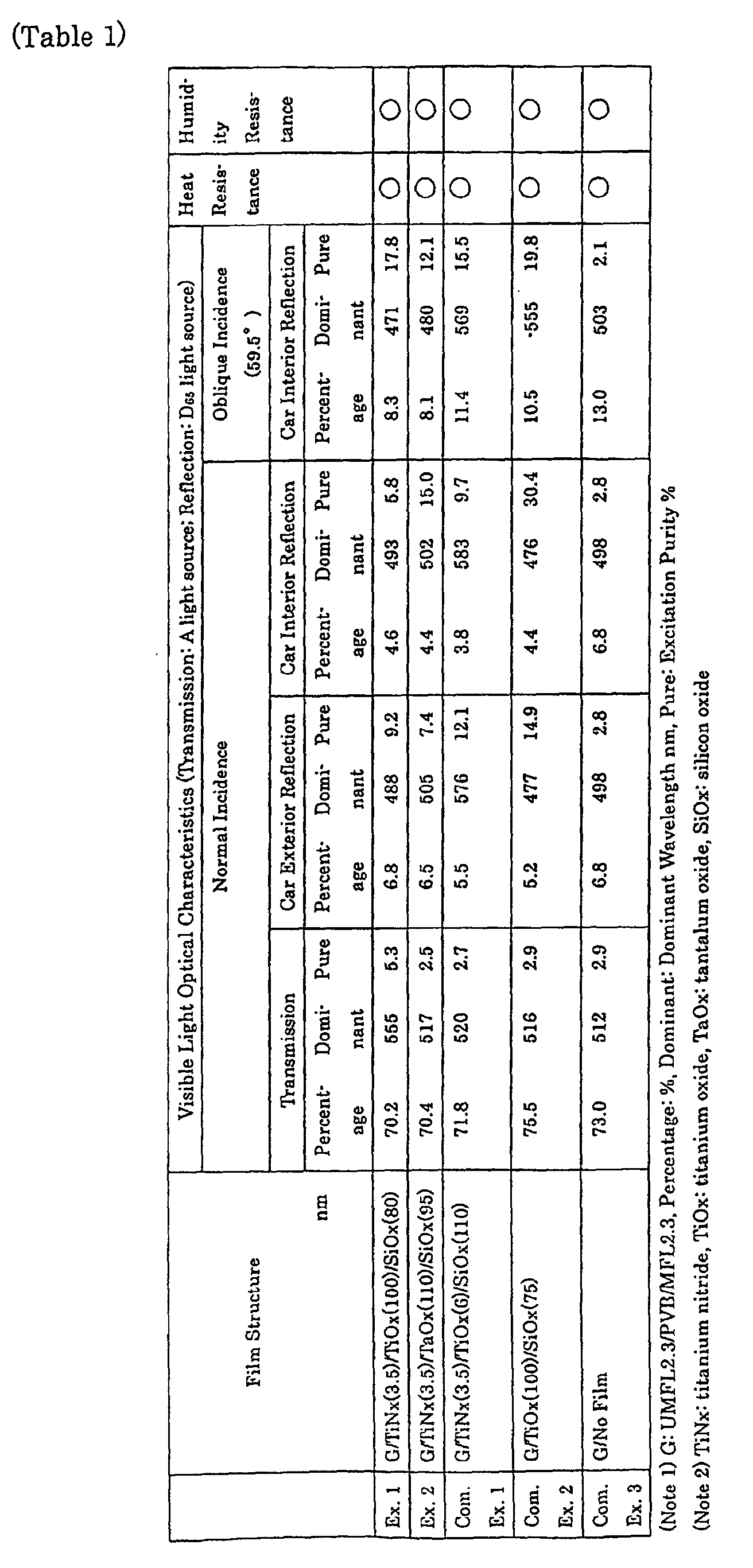
shown in Table 1. In the column of optical characteristics in the
table, percentage, dominant and pure respectively refers to %,
dominant wavelength nm, and excitation purity %. Furthermore,
as the light source, it was conducted with transmittance: A light
source and reflectance: D65 light source.
A green color tone float glass (MFL2.3) of a size of about
300mm × 300mm × about 2.3mm (thickness) was sequentially
washed with neutral detergent, water rinsing and isopropyl
alcohol and then dried.
The films were formed by the following order. Each target
of Ti or SiO2 was previously installed in a vacuum chamber of a
DC magnetron sputtering apparatus, and the glass substrate was
set in a manner to make it possible to move in a reciprocating
manner to be opposed to the target. Then, the vacuum chamber
was sufficiently evacuated to have a pressure of 1×1-4Pa before
the film formation. After that, N2 gas of a flow rate of 70SCCM
was introduced into the vacuum chamber, and the pressure was
maintained at about 0.3Pa. An electric power (DC) of about 1kW
was applied to the above Ti target, thereby forming a titanium
nitride film of a thickness of about 3.5nm as the first layer on the
glass substrate with a conveyance speed of about 672 mm/min.
After completing the film formation, the electric application to the
Ti target was stopped.
Then, the inside of the above vacuum chamber was again
evacuated until it becomes 1 × 10⁻⁴Pa. After that, O2 gas of a flow
rate of 80 SCCM was introduced into the vacuum chamber, and
the pressure was maintained at about 0.3Pa. An electric power
(DC) of about 3kW was applied to the above Ti target, thereby
forming a titanium oxide film of a thickness of about 100nm as the
second layer on the titanium nitride film, with a conveyance speed
of about 23 mm/min. After completing the film formation, the
application to the electric application to the Ti target was stopped.
Then, the inside of the above vacuum chamber was again
evacuated until it becomes 1 × 10⁻⁴Pa. After that, Ar gas of a flow
rate of 40 SCCM and O2 gas of a flow rate of 40 SCCM were
introduced into the vacuum chamber, and the pressure was
maintained at about 0.3Pa. An electric power (rf) of about 1kW
was applied to the above SiO2 target, thereby forming a silicon
oxide film of a thickness of about 80nm as the third layer on the
titanium oxide film, with a conveyance speed of about 19 mm/min.
After that, the electric application to the SiO2 target was stopped,
and the glass was taken out of the film-forming chamber.
Furthermore, when the titanium oxide film was formed on the
titanium nitride layer of the first layer, the titanium nitride layer
was partly in an oxidized condition.
Then, the glass taken out of the film-forming chamber was
put into an autoclave, and the film-formed surface was arranged
outside. A laminated glass was prepared through heating and
bonding using a green color tone float glass (UMFL2.3) of the
same size and an adhesive interlayer film (polyvinyl butyral,
made by Sekisui Chemical Co., Ltd.) of a thickness of 0.76mm.
As a result, as shown in Table 1, the visible light
transmittance was not lower than 70%, and excitation purities on
the car interior side and the car exterior side of normal incidence
were 5.8% and 9.2%, which are not greater than 10%. Therefore,
it does not have glare feeling and tends to harmonize with the
environment without uncomfortable feeling. Furthermore, in
fact, the reflectance on the car interior side, with respect to an
oblique incidence (incident angle 59.5° ), supposing the case in
which it was installed in a car, is also 8.3%, which is lower by
about 5% as compared with one (Comparative Example 3) having
no film. Therefore, it was excellent due to its less reflection of
dashboard and the like. Furthermore, the excitation purity in
the case of an incident angle of 20° was 5.9%, and that in the
case of 40° was 12.3%. At either angle, the excitation purity
was low. Thus, it had no glare feeling and was excellent.
Furthermore, also regarding durability such as heat
resistance, humidity resistance and adhesion resistance, it was
one sufficiently satisfying performance as a laminated glass and
was a desired low reflection laminated glass. Furthermore,
weather resistance (sunshine weather meter, about 1,000 hr
exposure: no abnormality in the external appearance) and other
various characteristics relating to laminated glass were also
evaluated. With this, either one was satisfactory and had a
superior performance.
Furthermore, as to refractive index (550nm) of the
reflection-reducing layer of Example 1, that of the titanium
nitride layer of the first layer was about 2.3, that of the titanium
oxide of the second layer was about 2.3, and silicon oxide layer of
the third layer was about 1.5. Refractive index of each layer was
determined by optical calculation relating thin films.
Similar to Example 1, each target of Ti, Ta or SiO2 was
previously installed in a vacuum chamber of a DC magnetron
sputtering apparatus, and the vacuum chamber was sufficiently
evacuated by the same method as that of Example 1 until the
pressure before the film formation becomes 1 × 10⁻⁴Pa. After that,
N2 gas of a flow rate of 70SCCM was introduced into the vacuum
chamber, and the pressure was maintained at about 0.3Pa. An
electric power (DC) of about 1kW was applied to the above Ti
target, thereby forming a titanium nitride film of a thickness of
about 3.5nm as the first layer on the glass substrate with a
conveyance speed of about 672 mm/min. After completing the
film formation, the electric application to the Ti target was
stopped.
Then, the inside of the above vacuum chamber was again
evacuated until it becomes 1 × 10⁻⁴Pa. After that, O2 gas of a flow
rate of 80 SCCM was introduced into the vacuum chamber, and
the pressure was maintained at about 0.3Pa. An electric power
(DC) of about 2kW was applied to the above Ta target, thereby
forming a tantalum nitride film of a thickness of about 110nm as
the second layer on the titanium nitride film, with a conveyance
speed of about 23 mm/min. After completing the film formation,
the electric application to the Ta target was stopped.
Then, the inside of the above vacuum chamber was again
evacuated until it becomes 1 × 10⁻⁴Pa. After that, Ar gas of a flow
rate of 40 SCCM and O2 gas of a flow rate of 40 SCCM were
introduced into the vacuum chamber, and the pressure was
maintained at about 0.3Pa. An electric power (rf) of about 1kW
was applied to the above SiO2 target, thereby forming a silicon
oxide film of a thickness of about 95nm as the third layer on the
tantalum oxide film, with a conveyance speed of about 16 mm/min.
After that, the electric application to the SiO2 target was stopped,
and the glass was taken out of the film-forming chamber, and a
laminated glass was produced similar to Example 1.
Furthermore, when the tantalum oxide film was formed on the titanium nitride layer of the first layer, the titanium nitride layer was partly in an oxidized condition. The evaluation results are shown in Table 1.
Furthermore, when the tantalum oxide film was formed on the titanium nitride layer of the first layer, the titanium nitride layer was partly in an oxidized condition. The evaluation results are shown in Table 1.
In the obtained low reflection laminated glass, the
excitation impurities of the car exterior side and the car interior
side in the case of normal incidence were 7.4% and 15%, which are
somewhat higher as compared with Example 1. However, other
characteristics are similar or superior. Furthermore, all of the
other performances were satisfactory and showed superior low
reflection performances as desired. Furthermore, regarding
refractive index (550nm), the titanium nitride layer of the first
layer was about 2.3, the tantalum nitride layer of the second layer
was about 2.2, and the SiOx layer of the third layer was about 1.5.
Similar to Example 1, each target of Ti or SiO2 was
previously installed in a vacuum chamber of a DC magnetron
sputtering apparatus, and the vacuum chamber was sufficiently
evacuated by the same method as that of Example 1 until the
pressure before the film formation becomes 1 × 10⁻⁴Pa. After that,
N2 gas of a flow rate of 70SCCM was introduced into the vacuum
chamber, and the pressure was maintained at about 0.3Pa. An
electric power (DC) of about 1kW was applied to the above Ti
target, thereby forming a titanium nitride film of a thickness of
about 3.5nm as the first layer on the glass substrate with a
conveyance speed of about 672 mm/min. After completing the
film formation, the electric application to the Ti target was
stopped.
Then, the inside of the above vacuum chamber was again
evacuated until it becomes 1 × 10⁻⁴Pa. After that, O2 gas of a flow
rate of 80 SCCM was introduced into the vacuum chamber, and
the pressure was maintained at about 0.3Pa. An electric power
(DC) of about 3kW was applied to the above Ti target, thereby
forming a titanium oxide film of a thickness of about 6nm as the
second layer on the titanium nitride film, with a conveyance speed
of about 383 mm/min. After completing the film formation, the
electric application to the Ti target was stopped.
Then, the inside of the above vacuum chamber was again
evacuated until it becomes 1 × 10⁻⁴Pa. After that, Ar gas of a flow
rate of 40 SCCM and O2 gas of a flow rate of 40 SCCM were
introduced into the vacuum chamber, and the pressure was
maintained at about 0.3Pa. An electric power (rf) of about 1kW
was applied to the above SiO2 target, thereby forming a silicon
oxide film of a thickness of about 110nm as the third layer on the
titanium nitride film, with a conveyance speed of about 14
mm/min. After that, the electric application to the SiO2 target
was stopped, and the glass was taken out of the film-forming
chamber, and a laminated glass was produced similar to Example
1. Furthermore, when the titanium oxide film was formed on the
titanium nitride layer of the first layer, the titanium nitride layer
was partly in an oxidized condition. The evaluation results are
shown in Table 1.
In the obtained low reflection laminated glass, the
reflectances of the car exterior side and the car interior side in the
case of normal incidence were 5.5% and 3.8%, which are
respectively lower by about 1% than the reflectances of Example 1.
The car interior reflectance with respect to oblique incidence
(incident angle: about 59.5° ) was in contrast 11.4%, which is
greater by about 3% than the case of Example 1. Thus, it was
not a desired one due to its strong reflection of dashboard and the
like. Furthermore, regarding refractive index (550nm), the
titanium nitride layer of the first layer was about 2.3, the
titanium oxide layer of the second layer was about 2.3, and the
silicon oxide layer of the third layer was about 1.5.
Similar to Example 1, each target of Ti or SiO2 was
previously installed in a vacuum chamber of a DC magnetron
sputtering apparatus, and the vacuum chamber was sufficiently
evacuated by the same method as that of Example 1 until the
pressure before the film formation becomes 1 × 10⁻⁴Pa. After that,
O2 gas of a flow rate of 80SCCM was introduced into the vacuum
chamber, and the pressure was maintained at about 0.3Pa. An
electric power (DC) of about 3kW was applied to the above Ti
target, thereby forming a titanium oxide film of a thickness of
about 100nm as the first layer on the glass substrate with a
conveyance speed of about 23 mm/min. After completing the film
formation, the electric application to the Ti target was stopped.
Then, the inside of the above vacuum chamber was again
evacuated until it becomes 1 × 10⁻⁴Pa. After that, Ar gas of a flow
rate of 40 SCCM and O2 gas of a flow rate of 40 SCCM were
introduced into the vacuum chamber, and the pressure was
maintained at about 0.3Pa. An electric power (rf) of about 1kW
was applied to the above SiO2 target, thereby forming a silicon
oxide film of a thickness of about 75nm as the second layer on the
titanium oxide film, with a conveyance speed of about 20 mm/min.
After that, the electric application to the SiO2 target was stopped,
and the glass was taken out of the film-forming chamber, and a
laminated glass was produced similar to Example 1.
In the obtained low reflection laminated glass,
transmittance of the visible light was as high as 75.5%. However,
excitation purity of the car interior reflection was as high as about
30%, causing glare feeling, and the car interior reflectance with
respect to an oblique incidence (incident angle: about 59.5° ) was
as high as 10.5%. Thus, it was not a desired one. Furthermore,
regarding refractive index (550nm), the titanium oxide layer of
the first layer was about 2.3 and the silicon oxide layer of the
second layer was about 1.5.
Using a glass similar to Example 1, a laminated glass was
prepared without laminating thin films. The evaluation results
are shown in Table 1. In the obtained laminated glass,
reflectances of both surfaces of the car interior side and the car
exterior side in the case of normal incidence were as high as 6.8%,
and the car interior reflectance with respect to an oblique
incidence (incident angle: about 59.5° ) was as high as 13.0%.
Thus, it was strong in reflection of dashboard and the like.
Industrial Usability
As described in detail as above, the present invention
satisfies a visible light transmittance of not lower than 70%,
reduces reflectance of an obliquely incident light of 40° to 80° by
3% or greater as compared with a glass substrate having no film
coating by combining thin films of particular refractive indexes
and film thicknesses in case that it is used for a vehicular
windshield. In particular, the reflection phenomena of
dashboard or its peripheral portion is reduced by laminating films
by a film forming method using vacuum, thereby improving driver
visibility and improving safety by preventing misidentification or
eye fatigue or the like. Furthermore, in contrast with the current
use of those of black color or dark colors close to it or of embossed
dashboard materials, it has a wide selection range in material and
color and meets the needs further. Thus, it is possible to provide
a useful vehicular low reflection glass in wide fields
Claims (6)
- A vehicle-use low-reflection glass characterized in that at least one side surface of a transparent glass substrate is coated with a reflection reducing layer formed by sequentially laminating from the glass surface side a light absorbing layer as a first layer having a refractive index (550nm) of 2.2-2.8, a first dielectric layer as a second layer having a refractive index (550nm) of 2.1-2.5 and a film thickness of 80nm to 120nm, and a second dielectric layer as a third layer having a refractive index (550nm) of 1.45-1.55 and a film thickness of 60nm to 110nm.
- A vehicle-use low-reflection glass according to claim 1, wherein at least one of each nitride of titanium, zirconium, hafnium and tantalum and nitrides of alloys containing nickel is used as the light-absorbing layer.
- A vehicle-use low-reflection glass according to claim 1 or claim 2, wherein, with respect to an incident light incident at an incident angle between 40° and 80° to normal of the reflection reducing layer surface, a visible light reflectance on the reflection reducing layer surface side is reduced by 3% or greater than the reflectance on a glass surface of only the transparent glass substrate without a coating of the reflection reducing layer.
- A vehicle-use low-reflection glass according to claims 1 to 3, wherein, with respect to an oblique incident light incident to have an incident angle of 60° or less to normal of the reflection reducing layer surface, the visible light reflectance on the reflection reducing layer side is 10% or less.
- A vehicle-use low-reflection glass according to claims 1 to 4, wherein the transparent glass substrate is a laminated glass.
- A vehicle-use low-reflection glass according to claims 1 to 5, wherein the reflection reducing layer is formed by a film forming method using vacuum.
Applications Claiming Priority (3)
| Application Number | Priority Date | Filing Date | Title |
|---|---|---|---|
| JP2000135398A JP2001322833A (en) | 2000-05-09 | 2000-05-09 | Low-reflection glass for vehicle |
| JP2000135398 | 2000-05-09 | ||
| PCT/JP2001/003586 WO2001085636A1 (en) | 2000-05-09 | 2001-04-25 | Vehicle-use low-reflection glass |
Publications (1)
| Publication Number | Publication Date |
|---|---|
| EP1285893A1 true EP1285893A1 (en) | 2003-02-26 |
Family
ID=18643482
Family Applications (1)
| Application Number | Title | Priority Date | Filing Date |
|---|---|---|---|
| EP01925922A Withdrawn EP1285893A1 (en) | 2000-05-09 | 2001-04-25 | Vehicle-use low-reflection glass |
Country Status (5)
| Country | Link |
|---|---|
| US (1) | US20040013885A1 (en) |
| EP (1) | EP1285893A1 (en) |
| JP (1) | JP2001322833A (en) |
| TW (1) | TW552242B (en) |
| WO (1) | WO2001085636A1 (en) |
Cited By (1)
| Publication number | Priority date | Publication date | Assignee | Title |
|---|---|---|---|---|
| WO2006095005A1 (en) * | 2005-03-10 | 2006-09-14 | Glaverbel | Automotive glazing with selective diffusion |
Families Citing this family (3)
| Publication number | Priority date | Publication date | Assignee | Title |
|---|---|---|---|---|
| AU2012382382A1 (en) | 2012-06-12 | 2015-01-15 | Aquahydrex Pty Ltd | Breathable electrode and method for use in water splitting |
| CN112905139A (en) * | 2021-03-25 | 2021-06-04 | 广州小鹏汽车科技有限公司 | Vehicle-mounted display screen control method and device, vehicle and storage medium |
| CN114379470B (en) * | 2022-01-17 | 2023-10-20 | 福耀玻璃工业集团股份有限公司 | Vehicle system |
Family Cites Families (18)
| Publication number | Priority date | Publication date | Assignee | Title |
|---|---|---|---|---|
| US4524718A (en) * | 1982-11-22 | 1985-06-25 | Gordon Roy G | Reactor for continuous coating of glass |
| JP2590133B2 (en) | 1987-09-10 | 1997-03-12 | 日本板硝子株式会社 | Transparent plate having conductive anti-reflective coating |
| JPH0299933U (en) * | 1989-01-18 | 1990-08-09 | ||
| JP2811885B2 (en) * | 1990-03-23 | 1998-10-15 | 日本板硝子株式会社 | Heat shielding glass |
| JP2877553B2 (en) | 1991-05-29 | 1999-03-31 | セントラル硝子株式会社 | Anti-reflection glass for vehicles |
| JP2877554B2 (en) | 1991-05-31 | 1999-03-31 | セントラル硝子株式会社 | Anti-reflection glass for vehicles |
| US5234748A (en) * | 1991-06-19 | 1993-08-10 | Ford Motor Company | Anti-reflective transparent coating with gradient zone |
| US5494743A (en) * | 1992-08-20 | 1996-02-27 | Southwall Technologies Inc. | Antireflection coatings |
| DE69405902T2 (en) * | 1993-04-16 | 1998-01-29 | Central Glass Co Ltd | Glass pane with anti-reflective coating and combination element of a single-view display system |
| JP3190240B2 (en) | 1994-12-13 | 2001-07-23 | 旭硝子株式会社 | Light-absorbing antireflective body and method for producing the same |
| US5691044A (en) * | 1994-12-13 | 1997-11-25 | Asahi Glass Company, Ltd. | Light absorptive antireflector |
| FR2730990B1 (en) * | 1995-02-23 | 1997-04-04 | Saint Gobain Vitrage | TRANSPARENT SUBSTRATE WITH ANTI-REFLECTIVE COATING |
| JPH10114547A (en) * | 1996-07-29 | 1998-05-06 | Central Glass Co Ltd | Windowpane for vehicle |
| US6172812B1 (en) * | 1997-01-27 | 2001-01-09 | Peter D. Haaland | Anti-reflection coatings and coated articles |
| JPH1149532A (en) | 1997-06-03 | 1999-02-23 | Nippon Sheet Glass Co Ltd | Low reflection glass article and its production |
| US6074730A (en) | 1997-12-31 | 2000-06-13 | The Boc Group, Inc. | Broad-band antireflection coating having four sputtered layers |
| ATE335211T1 (en) * | 1998-11-30 | 2006-08-15 | Asahi Glass Co Ltd | ANTI-REFLECTION FILM FOR WINDOWS OF A TRANSPORT DEVICE, GLASS WITH ANTI-REFLECTION FILM, LAMINATED GLASS AND PRODUCTION METHOD |
| JP2000290044A (en) * | 1999-04-01 | 2000-10-17 | Nippon Sheet Glass Co Ltd | Low reflection glass sheet and low reflection laminated glass sheet for automobile using that glass sheet |
-
2000
- 2000-05-09 JP JP2000135398A patent/JP2001322833A/en active Pending
-
2001
- 2001-04-25 EP EP01925922A patent/EP1285893A1/en not_active Withdrawn
- 2001-04-25 WO PCT/JP2001/003586 patent/WO2001085636A1/en not_active Ceased
- 2001-04-25 US US10/275,768 patent/US20040013885A1/en not_active Abandoned
- 2001-06-19 TW TW090111001A patent/TW552242B/en not_active IP Right Cessation
Non-Patent Citations (1)
| Title |
|---|
| See references of WO0185636A1 * |
Cited By (1)
| Publication number | Priority date | Publication date | Assignee | Title |
|---|---|---|---|---|
| WO2006095005A1 (en) * | 2005-03-10 | 2006-09-14 | Glaverbel | Automotive glazing with selective diffusion |
Also Published As
| Publication number | Publication date |
|---|---|
| TW552242B (en) | 2003-09-11 |
| WO2001085636A1 (en) | 2001-11-15 |
| JP2001322833A (en) | 2001-11-20 |
| US20040013885A1 (en) | 2004-01-22 |
Similar Documents
| Publication | Publication Date | Title |
|---|---|---|
| JP7303873B2 (en) | Projection equipment for head-up displays (HUD) using p-polarized radiation | |
| US12174374B2 (en) | Projection assembly for a head-up display (HUD) with p-polarised radiation | |
| CN110520782B (en) | Projection device for head-up display (HUD) with p-polarized radiation component | |
| CN114035322B (en) | Head-up display glass and head-up display system thereof | |
| JP7174847B2 (en) | Projection equipment for head-up displays (HUD) using p-polarized radiation | |
| CN110520295B (en) | Composite glass pane for a head-up display with a conductive coating and an anti-reflection coating | |
| KR940011127B1 (en) | Glass plate with reflectance reduction film | |
| JP2023521474A (en) | Projection assembly for head-up display (HUD) using P-polarized radiation | |
| US5605609A (en) | Method for forming low refractive index film comprising silicon dioxide | |
| JP4399986B2 (en) | Antireflection film for transportation equipment window, glass with antireflection film, laminated glass and method for producing the same | |
| CN114349371B (en) | Laminated glass and head-up display system | |
| CN115136037A (en) | Head-up display system | |
| US20250284122A1 (en) | Laminated glazing for head-up display | |
| US20230415571A1 (en) | Projection assembly for a head-up display (hud) with p-polarized radiation | |
| US20240059048A1 (en) | Method for obtaining a laminated curved glazing | |
| JP7493092B2 (en) | Projection fixture for a head-up display (HUD) using p-polarized radiation | |
| CN114791675A (en) | Head-up display glass and head-up display system | |
| WO2023110261A1 (en) | Glazing unit for head up display | |
| JP2917456B2 (en) | Glowless glass | |
| JP2002116303A (en) | Substrate with antireflection film and method of manufacturing the same | |
| JP2000290044A (en) | Low reflection glass sheet and low reflection laminated glass sheet for automobile using that glass sheet | |
| US20040013885A1 (en) | Vehicle-use low-reflection glass | |
| JPH10139491A (en) | Low reflecting dark gray glass | |
| JPH11302037A (en) | Low reflectance and low transmittance glass | |
| US12350906B2 (en) | Composite pane with an electrically conductive coating and at least one layer comprising selectively absorbing nanoparticles |
Legal Events
| Date | Code | Title | Description |
|---|---|---|---|
| PUAI | Public reference made under article 153(3) epc to a published international application that has entered the european phase |
Free format text: ORIGINAL CODE: 0009012 |
|
| 17P | Request for examination filed |
Effective date: 20021107 |
|
| AK | Designated contracting states |
Kind code of ref document: A1 Designated state(s): AT BE CH CY DE DK ES FI FR GB GR IE IT LI LU MC NL PT SE TR Designated state(s): AT BE CH CY DE DK ES FI FR GB GR IE IT LI LU MC NL PT SE TR |
|
| RBV | Designated contracting states (corrected) |
Designated state(s): AT BE CH CY DE FR GB IT LI |
|
| STAA | Information on the status of an ep patent application or granted ep patent |
Free format text: STATUS: THE APPLICATION HAS BEEN WITHDRAWN |
|
| 18W | Application withdrawn |
Effective date: 20060915 |