EP1285784A2 - Vehicle tire - Google Patents
Vehicle tire Download PDFInfo
- Publication number
- EP1285784A2 EP1285784A2 EP02018520A EP02018520A EP1285784A2 EP 1285784 A2 EP1285784 A2 EP 1285784A2 EP 02018520 A EP02018520 A EP 02018520A EP 02018520 A EP02018520 A EP 02018520A EP 1285784 A2 EP1285784 A2 EP 1285784A2
- Authority
- EP
- European Patent Office
- Prior art keywords
- tire
- water
- protective film
- paint
- mark
- Prior art date
- Legal status (The legal status is an assumption and is not a legal conclusion. Google has not performed a legal analysis and makes no representation as to the accuracy of the status listed.)
- Withdrawn
Links
- 230000001681 protective effect Effects 0.000 claims abstract description 26
- XLYOFNOQVPJJNP-UHFFFAOYSA-N water Substances O XLYOFNOQVPJJNP-UHFFFAOYSA-N 0.000 claims abstract description 12
- 238000000034 method Methods 0.000 claims abstract description 8
- 239000003973 paint Substances 0.000 claims description 37
- 239000000126 substance Substances 0.000 claims description 13
- 239000003086 colorant Substances 0.000 claims description 9
- 229920000915 polyvinyl chloride Polymers 0.000 claims description 7
- 239000004094 surface-active agent Substances 0.000 claims description 5
- 238000005406 washing Methods 0.000 claims description 3
- 238000010422 painting Methods 0.000 claims 3
- 239000002352 surface water Substances 0.000 claims 3
- 239000003981 vehicle Substances 0.000 description 8
- 238000005299 abrasion Methods 0.000 description 5
- 230000002411 adverse Effects 0.000 description 3
- 239000000463 material Substances 0.000 description 3
- WNZQDUSMALZDQF-UHFFFAOYSA-N 2-benzofuran-1(3H)-one Chemical compound C1=CC=C2C(=O)OCC2=C1 WNZQDUSMALZDQF-UHFFFAOYSA-N 0.000 description 2
- 239000002253 acid Substances 0.000 description 2
- 238000007689 inspection Methods 0.000 description 2
- KJFMBFZCATUALV-UHFFFAOYSA-N phenolphthalein Chemical compound C1=CC(O)=CC=C1C1(C=2C=CC(O)=CC=2)C2=CC=CC=C2C(=O)O1 KJFMBFZCATUALV-UHFFFAOYSA-N 0.000 description 2
- 239000002904 solvent Substances 0.000 description 2
- 235000015112 vegetable and seed oil Nutrition 0.000 description 2
- 239000008158 vegetable oil Substances 0.000 description 2
- IPDWABJNXLNLRA-UHFFFAOYSA-N 2,3-dihydroxybutanedioic acid;2-hydroxypropane-1,2,3-tricarboxylic acid Chemical compound OC(=O)C(O)C(O)C(O)=O.OC(=O)CC(O)(C(O)=O)CC(O)=O IPDWABJNXLNLRA-UHFFFAOYSA-N 0.000 description 1
- QTBSBXVTEAMEQO-UHFFFAOYSA-M Acetate Chemical compound CC([O-])=O QTBSBXVTEAMEQO-UHFFFAOYSA-M 0.000 description 1
- 235000019737 Animal fat Nutrition 0.000 description 1
- 229920002319 Poly(methyl acrylate) Polymers 0.000 description 1
- 239000004372 Polyvinyl alcohol Substances 0.000 description 1
- 229920002125 Sokalan® Polymers 0.000 description 1
- NIXOWILDQLNWCW-UHFFFAOYSA-N acrylic acid group Chemical group C(C=C)(=O)O NIXOWILDQLNWCW-UHFFFAOYSA-N 0.000 description 1
- 239000003513 alkali Substances 0.000 description 1
- 239000011324 bead Substances 0.000 description 1
- 230000003247 decreasing effect Effects 0.000 description 1
- 230000002950 deficient Effects 0.000 description 1
- 239000002270 dispersing agent Substances 0.000 description 1
- 230000000694 effects Effects 0.000 description 1
- 239000003925 fat Substances 0.000 description 1
- FWQHNLCNFPYBCA-UHFFFAOYSA-N fluoran Chemical compound C12=CC=CC=C2OC2=CC=CC=C2C11OC(=O)C2=CC=CC=C21 FWQHNLCNFPYBCA-UHFFFAOYSA-N 0.000 description 1
- 239000007788 liquid Substances 0.000 description 1
- 238000004519 manufacturing process Methods 0.000 description 1
- 150000007522 mineralic acids Chemical class 0.000 description 1
- 239000003921 oil Substances 0.000 description 1
- 235000019198 oils Nutrition 0.000 description 1
- 235000008390 olive oil Nutrition 0.000 description 1
- 239000004006 olive oil Substances 0.000 description 1
- 150000007524 organic acids Chemical class 0.000 description 1
- 239000007793 ph indicator Substances 0.000 description 1
- 229920001483 poly(ethyl methacrylate) polymer Polymers 0.000 description 1
- 229920003229 poly(methyl methacrylate) Polymers 0.000 description 1
- 239000004584 polyacrylic acid Substances 0.000 description 1
- 229920000120 polyethyl acrylate Polymers 0.000 description 1
- 239000004926 polymethyl methacrylate Substances 0.000 description 1
- 229920002451 polyvinyl alcohol Polymers 0.000 description 1
- 230000002265 prevention Effects 0.000 description 1
- 239000007787 solid Substances 0.000 description 1
- 235000019871 vegetable fat Nutrition 0.000 description 1
Images

Classifications
-
- B—PERFORMING OPERATIONS; TRANSPORTING
- B05—SPRAYING OR ATOMISING IN GENERAL; APPLYING FLUENT MATERIALS TO SURFACES, IN GENERAL
- B05D—PROCESSES FOR APPLYING FLUENT MATERIALS TO SURFACES, IN GENERAL
- B05D5/00—Processes for applying liquids or other fluent materials to surfaces to obtain special surface effects, finishes or structures
-
- B—PERFORMING OPERATIONS; TRANSPORTING
- B60—VEHICLES IN GENERAL
- B60C—VEHICLE TYRES; TYRE INFLATION; TYRE CHANGING; CONNECTING VALVES TO INFLATABLE ELASTIC BODIES IN GENERAL; DEVICES OR ARRANGEMENTS RELATED TO TYRES
- B60C13/00—Tyre sidewalls; Protecting, decorating, marking, or the like, thereof
- B60C13/001—Decorating, marking or the like
-
- B—PERFORMING OPERATIONS; TRANSPORTING
- B60—VEHICLES IN GENERAL
- B60C—VEHICLE TYRES; TYRE INFLATION; TYRE CHANGING; CONNECTING VALVES TO INFLATABLE ELASTIC BODIES IN GENERAL; DEVICES OR ARRANGEMENTS RELATED TO TYRES
- B60C13/00—Tyre sidewalls; Protecting, decorating, marking, or the like, thereof
- B60C13/002—Protection against exterior elements
-
- B—PERFORMING OPERATIONS; TRANSPORTING
- B60—VEHICLES IN GENERAL
- B60C—VEHICLE TYRES; TYRE INFLATION; TYRE CHANGING; CONNECTING VALVES TO INFLATABLE ELASTIC BODIES IN GENERAL; DEVICES OR ARRANGEMENTS RELATED TO TYRES
- B60C19/00—Tyre parts or constructions not otherwise provided for
- B60C19/001—Tyres requiring an asymmetric or a special mounting
-
- B—PERFORMING OPERATIONS; TRANSPORTING
- B05—SPRAYING OR ATOMISING IN GENERAL; APPLYING FLUENT MATERIALS TO SURFACES, IN GENERAL
- B05D—PROCESSES FOR APPLYING FLUENT MATERIALS TO SURFACES, IN GENERAL
- B05D5/00—Processes for applying liquids or other fluent materials to surfaces to obtain special surface effects, finishes or structures
- B05D5/06—Processes for applying liquids or other fluent materials to surfaces to obtain special surface effects, finishes or structures to obtain multicolour or other optical effects
-
- B—PERFORMING OPERATIONS; TRANSPORTING
- B29—WORKING OF PLASTICS; WORKING OF SUBSTANCES IN A PLASTIC STATE IN GENERAL
- B29D—PRODUCING PARTICULAR ARTICLES FROM PLASTICS OR FROM SUBSTANCES IN A PLASTIC STATE
- B29D30/00—Producing pneumatic or solid tyres or parts thereof
- B29D30/06—Pneumatic tyres or parts thereof (e.g. produced by casting, moulding, compression moulding, injection moulding, centrifugal casting)
- B29D30/72—Side-walls
- B29D2030/728—Decorating or marking the sidewalls after tyre vulcanization
Definitions
- the present invention relates to a vehicle tire, more particularly to a tire covered with a protective film which is indicative of tire data such as tire conicity and RFV and removable by washing with water.
- radial force variation (RFV) and tire conicity are characteristics of a tire which affect high-speed performance of the vehicle.
- the radial force variation (RFV) generates vibration on the axle, and causes vibrations (shimmy) of the vehicle body, steering wheel and the like.
- the tire conicity generates a side force towards one direction independently from the tire rotating direction and causes a vehicle's drift.
- tire data such as the direction of the conicity force, the magnitude of RFV and the like are necessary at the time of installing the tires. But, if once the tires are installed properly, such data become not necessary because the tire data especially conicity and RFV are liable to change during use and such data are subject to misinterpretation of the user.
- an object of the present invention to provide a tire, in which a protective film which is indicative of tire data such as tire conicity and RFV and can be washed away with water is provided to cover a surface of the tire, thereby being capable of preventing the surface from abrasion and the like in transit and storage and being capable of providing information for installing the tire proper positions.
- a vehicle tire is provided with a protective film which covers a surface of the tire and is indicative of at least one of tire data including tire conicity and radial force variation of the tire, and the protective film can be washed away with water.
- tire 1 according to the present invention comprises a tread 2, a pair of axially spaced beads 4 and a pair of sidewalls 3 therebetween.
- the tire 1 is a pneumatic tire for passenger car which is laid down and piled up in transit and storage. Therefore, in order to protect the sidewalls 3 from abrasion, the almost entirety of the surface 3s thereof (an annular area filled with a multi-cross pattern shown in Fig.1) is covered with a protective film 11. Aside from the prevention of abrasion, in case of white letter tire, the protective film 11 can be utilized for preventing the white letters from changing in color due to chemicals such as age resistor and the like coming from the adjacent tire.
- the protective film 11 is formed by applying a overcoat paint 11A using a brush, sprayer or the like after the undermentioned mark 10 is printed. Therefore, as the overcoat paint 11A, the following water-soluble paint is preferably used for the removability, film strength, safety, handling, cost and the like.
- the water-soluble paint comprise polyvinyl resin as a film-forming material, water as a solvent, colorant, and surface-active agent.
- polyvinyl resin acrylic modified polyvinyl resin (such as polyacrylic acid, polymethyl acrylate, polyethyl acrylate, polymethyl methacrylate and polyethyl methacrylate) and polyvinyl alcohol acetate are preferably used for the high solubility in water.
- the main purpose of the colorant is to visualize the protective film 11 in order to make it easy to completely remove or wash away the film. Other purposes may be to improve the appearance, to protect from the sunlight, and to make it easy to check the presence and degree of the abrasion and contact.
- the surface-active agent is added as a dispersant for the film materials and in order to improve the application of the paint.
- the solid content of the film forming material (in this example, polyvinyl resin) is set in a range of 10 to 20 parts by weight with respect to 100 parts by weight of the solvent (in this example, water).
- the thickness of the protective film 11 is in a range of from 0.1 to 1.0 mm, more preferably 0.3 to 0.8 mm.
- the above-mentioned mark 10 is indicative of a tire data.
- tire date tire conicity, RFV and the like measured in outgoing inspection may be listed.
- the mark 10 is formed by an undercoat 10A, and the undercoat 10A is formed on the sidewall surface 3S before the overcoat paint 11A is applied.
- the undercoat 10A is formed by applying an oily substance.
- the undercoat 10A is an almost invisible film of the oily substance.
- the mark 10 which is readily visible appears by applying the overcoat paint 11A thereon as being a part devoid of the overcoat paint 11A and being of a black color.
- the overcoat paint 11A is washed away after served its purpose, the mark 10 accordingly disappears.
- vegetable oil and fat, animal fat and oil, and the like can be suitably used.
- vegetable oil which is in liquid form at room temperature such as olive oil is preferably used because it is environment-friendly, odor-free and low-cost, and further it is easy to apply due to low viscosity.
- the undercoat 10A is formed by applying a colored water-soluble paint which is the substantially same as the above-mentioned overcoat paint 11A. In this case, the total film thickness is increased by the overcoat in the position of the mark 10. As a result, the mark 10 appears like an emboss mark. when the overcoat paint 11A is washed away, then the undercoat 10A is also washed away and the mark 10 disappears.
- the undercoat 10A is formed by applying a water-soluble paint which is different from the overcoat paint 11A.
- the difference therebetween may be the color or colorants of the overcoat paint 11A and the undercoat paint (10A).
- the undercoat paint is a dark color and the overcoat paint is a light color.
- Such chemicals are: an electron-releasing color-forming organic chemical for example known as dye, which is added in one of the undercoat paint (10A) and the overcoat paint 11A (preferably in the overcoat paint 11A); and an electron-accepting color developer which is added in the other, whereby the mark 10 becomes a different color from the surrounding color when the overcoat paint 11A contacts with the undercoat 10A and they react with each other.
- an electron-releasing color-forming organic chemical for example known as dye
- an electron-accepting color developer which is added in the other, whereby the mark 10 becomes a different color from the surrounding color when the overcoat paint 11A contacts with the undercoat 10A and they react with each other.
- a phthalide type or fluoran type or spiropyran type color-forming chemical is used in combination with acid as the developer, for example organic acid such as citric acid tartaric acid or inorganic acid.
- a combination of a pH indicator such as phenolphthalein and an acid or alkali substance may be also used.
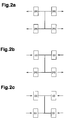
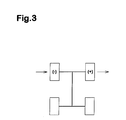
- Method (1) A graphic symbol. e.g. circle and the like, of 5 to 30 mm in diameter or width is provided on the sidewall surface 3s on the leading side in the direction of the conicity force.
- Method (2) A symbol such as plus (+) or minus (-) indicating the direction of the conicity force is provided on the surface 3s.
- the symbol may be provided on only the former, and the symbol plus (+) is used if the conicity force direction is from the latter to the former sidewall, and accordingly, if the direction is reverse thereto, the symbol minus (-) is used.
- Method (3) the absolute value of RFV is printed in figure(s)
- Method (4) a relative value of RFV such as rank number (for example, ten ranks) is printed in figure(s).
- rank number for example, ten ranks
- a numerical character "7" is indicated as a rank number in ten ranks.
- a tire which is suitable for each wheel of the vehicle is selected according to the data indicated by the protective film.
- tires having small RFV are mounted on the steering wheels, and tires having larger RFV are mounted on the driving wheel.
- the protective film is removed by washing with water so that the tire date disappears.
Landscapes
- Engineering & Computer Science (AREA)
- Mechanical Engineering (AREA)
- Tires In General (AREA)
Abstract
Description
Method (1): A graphic symbol. e.g. circle and the like, of 5 to 30 mm in diameter or width is provided on the sidewall surface 3s on the leading side in the direction of the conicity force.
Method (2): A symbol such as plus (+) or minus (-) indicating the direction of the conicity force is provided on the surface 3s. For example, when one of the
Method (3): the absolute value of RFV is printed in figure(s), or
Method (4): a relative value of RFV such as rank number (for example, ten ranks) is printed in figure(s).
The latter is preferable rather than the former because it may be convenient for the worker to fitting the tires to a car. In Fig.1, a numerical character "7" is indicated as a rank number in ten ranks.
Claims (9)
- A vehicle tire provided with a protective film which covers a surface of the tire, wherein the protective film is indicative of at least one of tire data including tire conicity and radial force variation of the tire and can be washed away with water.
- A vehicle tire according to claim 1, wherein
the protective film is provided with a mark indicating said at least one of tire data, - A vehicle tire according to claim 2, wherein
said protective film is formed by first painting the mark on the surface with oily substance, and then applying a water-soluble overcoat paint to the entirety of the surface so that the oily substance repels the water-soluble paint and forms the mark as a part being devoid of the water-soluble paint. - A vehicle tire according to claim 2, wherein
said protective film is formed by first painting the mark on the surface with a water-soluble paint, and then applying a water-soluble overcoat paint to the entirety of the surface so that the mark is formed as a part being increased in the total film thickness and being embossed. - A vehicle tire according to claim 2, wherein
said protective film is formed by first painting the mark on the surface with an undercoat paint, and then applying a water-soluble overcoat paint to the entirety of the surface, and one of the undercoat paint and overcoat paint includes a color-forming chemical and the other includes a color developer so that the mark is formed as a part having a different color from that of the surrounding part. - A vehicle tire according to claim 3, wherein
the water-soluble overcoat paint includes polyvinyl resin, colorant, surface-active agent and water. - A vehicle tire according to claim 4, wherein
the water-soluble overcoat paint includes polyvinyl resin, colorant, surface-active agent and water. - A vehicle tire according to claim 5, wherein
the water-soluble overcoat paint includes polyvinyl resin, colorant, surface-active agent and water. - A method of fitting tires on a vehicle,
the tires each provided with a protective film covering a surface of the tire and being indicative of a data of the tire, and the method comprising
selecting a tire from the tires which is suitable for each wheel of the vehicle according to the data indicated by the protective film, and
removing the protective film by washing with water so that the tire date disappears.
Applications Claiming Priority (2)
| Application Number | Priority Date | Filing Date | Title |
|---|---|---|---|
| JP2001250648A JP3542983B2 (en) | 2001-08-21 | 2001-08-21 | Tire and mounting method |
| JP2001250648 | 2001-08-21 |
Publications (2)
| Publication Number | Publication Date |
|---|---|
| EP1285784A2 true EP1285784A2 (en) | 2003-02-26 |
| EP1285784A3 EP1285784A3 (en) | 2003-12-17 |
Family
ID=19079425
Family Applications (1)
| Application Number | Title | Priority Date | Filing Date |
|---|---|---|---|
| EP02018520A Withdrawn EP1285784A3 (en) | 2001-08-21 | 2002-08-16 | Vehicle tire |
Country Status (3)
| Country | Link |
|---|---|
| US (1) | US7128942B2 (en) |
| EP (1) | EP1285784A3 (en) |
| JP (1) | JP3542983B2 (en) |
Cited By (1)
| Publication number | Priority date | Publication date | Assignee | Title |
|---|---|---|---|---|
| WO2005100050A3 (en) * | 2004-04-12 | 2006-01-26 | Bridgestone Firestone North Am | Use of colored indicia on tires as a designator |
Families Citing this family (8)
| Publication number | Priority date | Publication date | Assignee | Title |
|---|---|---|---|---|
| FI108933B (en) * | 2000-09-26 | 2002-04-30 | Nokian Renkaat Oyj | Vehicle tires with means to indicate tire location when changing tires |
| US7409975B2 (en) * | 2005-05-13 | 2008-08-12 | Bridgestone Firestone North American Tire, Llc | Apparatus for enhancing light reflective properties of tire sidewalls |
| US20100000638A1 (en) * | 2008-07-03 | 2010-01-07 | Scott Smith | Tire having a sidewall with enhanced indicia |
| USD601489S1 (en) | 2008-07-03 | 2009-10-06 | Bridgestone Firestone North American Tire, Llc | Tire sidewall |
| USD632499S1 (en) * | 2009-11-11 | 2011-02-15 | Yao Chen | Fabric with multi-cross pattern |
| JP5507015B2 (en) * | 2012-01-11 | 2014-05-28 | 株式会社ブリヂストン | tire |
| JP5836136B2 (en) * | 2012-01-12 | 2015-12-24 | 株式会社ブリヂストン | How to repair the paint layer on the tire side |
| EP3851296B1 (en) | 2012-12-19 | 2024-10-16 | Bridgestone Americas Tire Operations, LLC | Tire with bi-directional performance |
Family Cites Families (9)
| Publication number | Priority date | Publication date | Assignee | Title |
|---|---|---|---|---|
| US2136567A (en) * | 1935-09-27 | 1938-11-15 | Us Rubber Prod Inc | Rubber tire |
| US2849331A (en) * | 1953-06-02 | 1958-08-26 | Turbolente Joseph | Masking method and composition for producing color paintings |
| US3114650A (en) * | 1960-06-10 | 1963-12-17 | Spraylat Corp | Tire coated with removable coating comprising modified polyvinyl alcohol and method of coating |
| JPH03239607A (en) * | 1990-02-15 | 1991-10-25 | Toyo Tire & Rubber Co Ltd | Radial tire and method for attaching the same |
| US5058648A (en) * | 1990-03-05 | 1991-10-22 | The Goodyear Tire & Rubber Company | Coating composition and tire coated therewith |
| US5380391A (en) * | 1993-03-08 | 1995-01-10 | Mahn, Jr.; John | Heat activated transfer for elastomeric materials |
| FR2746706A1 (en) * | 1996-03-26 | 1997-10-03 | Michelin & Cie | DECORATIVE STACKING FOR ELASTOMERIC ARTICLES |
| US5840138A (en) * | 1997-04-25 | 1998-11-24 | The Goodyear Tire & Rubber Company | Waterborne radial first harmonic marking of tires |
| US6221453B1 (en) * | 1999-03-02 | 2001-04-24 | The Goodyear Tire & Rubber Company | Harmonic label for marking of tires |
-
2001
- 2001-08-21 JP JP2001250648A patent/JP3542983B2/en not_active Expired - Fee Related
-
2002
- 2002-08-16 EP EP02018520A patent/EP1285784A3/en not_active Withdrawn
- 2002-08-20 US US10/223,652 patent/US7128942B2/en not_active Expired - Fee Related
Cited By (1)
| Publication number | Priority date | Publication date | Assignee | Title |
|---|---|---|---|---|
| WO2005100050A3 (en) * | 2004-04-12 | 2006-01-26 | Bridgestone Firestone North Am | Use of colored indicia on tires as a designator |
Also Published As
| Publication number | Publication date |
|---|---|
| US7128942B2 (en) | 2006-10-31 |
| EP1285784A3 (en) | 2003-12-17 |
| US20030037854A1 (en) | 2003-02-27 |
| JP2003054225A (en) | 2003-02-26 |
| JP3542983B2 (en) | 2004-07-14 |
Similar Documents
| Publication | Publication Date | Title |
|---|---|---|
| US7128942B2 (en) | Vehicle tire | |
| AU2011201506B2 (en) | Use of colored indicia on tires as a designator | |
| US10279599B2 (en) | Method for printing surfaces of three-dimensional objects and three-dimensional objects having print | |
| JP7064557B2 (en) | Tires that change color according to the external environment | |
| US7083695B2 (en) | Tires with non-black tread grooves | |
| KR20000048882A (en) | Method of printing markings onto rubber articles, in particular tyres | |
| JP5683889B2 (en) | tire | |
| EP2977232B1 (en) | Tire and tire surface printing method | |
| CN104010841B (en) | Rubber decorations and tires | |
| JP5303690B2 (en) | tire | |
| JP5951983B2 (en) | Run flat tire | |
| JPH0640219A (en) | Pneumatic tire | |
| JP3474930B2 (en) | How to check the invisible surface treatment on the paper | |
| JPH08156501A (en) | Tire wheel | |
| KR200229902Y1 (en) | The sun blind coating paper for caz | |
| EP3686037B1 (en) | Pneumatic tyre | |
| GB2112556A (en) | Indicator | |
| AU2012100111A4 (en) | Use of colored indicia on tires as a designator | |
| KR19990019847A (en) | Car tire replacement timing display structure | |
| JP2000221884A (en) | Display label for tire | |
| KR19990019846A (en) | Car tire replacement timing display structure | |
| CZ12913U1 (en) | Self-sticking label for motorcycle or car wheels | |
| JPH07152321A (en) | Label sheet | |
| AU2012251942A1 (en) | Use of colored indicia on tires as a designator |
Legal Events
| Date | Code | Title | Description |
|---|---|---|---|
| PUAI | Public reference made under article 153(3) epc to a published international application that has entered the european phase |
Free format text: ORIGINAL CODE: 0009012 |
|
| AK | Designated contracting states |
Kind code of ref document: A2 Designated state(s): AT BE BG CH CY CZ DE DK EE ES FI FR GB GR IE IT LI LU MC NL PT SE SK TR Designated state(s): AT BE BG CH CY CZ DE DK EE ES FI FR GB GR IE IT LI LU MC NL PT SE SK TR |
|
| AX | Request for extension of the european patent |
Extension state: AL LT LV MK RO SI |
|
| RIC1 | Information provided on ipc code assigned before grant |
Ipc: 7B 05D 1/32 B Ipc: 7B 05D 5/08 B Ipc: 7B 05D 5/00 B Ipc: 7B 60C 19/00 B Ipc: 7B 60C 13/00 A |
|
| PUAL | Search report despatched |
Free format text: ORIGINAL CODE: 0009013 |
|
| AK | Designated contracting states |
Kind code of ref document: A3 Designated state(s): AT BE BG CH CY CZ DE DK EE ES FI FR GB GR IE IT LI LU MC NL PT SE SK TR |
|
| AX | Request for extension of the european patent |
Extension state: AL LT LV MK RO SI |
|
| 17P | Request for examination filed |
Effective date: 20040527 |
|
| AKX | Designation fees paid |
Designated state(s): DE FR GB |
|
| 17Q | First examination report despatched |
Effective date: 20050221 |
|
| STAA | Information on the status of an ep patent application or granted ep patent |
Free format text: STATUS: THE APPLICATION IS DEEMED TO BE WITHDRAWN |
|
| 18D | Application deemed to be withdrawn |
Effective date: 20100302 |