EP1285647A2 - Hair cosmetic comprising guanidine derivative and N-alpha-acylarginine - Google Patents
Hair cosmetic comprising guanidine derivative and N-alpha-acylarginine Download PDFInfo
- Publication number
- EP1285647A2 EP1285647A2 EP02255724A EP02255724A EP1285647A2 EP 1285647 A2 EP1285647 A2 EP 1285647A2 EP 02255724 A EP02255724 A EP 02255724A EP 02255724 A EP02255724 A EP 02255724A EP 1285647 A2 EP1285647 A2 EP 1285647A2
- Authority
- EP
- European Patent Office
- Prior art keywords
- hair
- acid
- salts
- group
- component
- Prior art date
- Legal status (The legal status is an assumption and is not a legal conclusion. Google has not performed a legal analysis and makes no representation as to the accuracy of the status listed.)
- Granted
Links
- SNEIUMQYRCDYCH-UHFFFAOYSA-N CC(NC(CCCNC(N)=N)C(O)=O)=O Chemical compound CC(NC(CCCNC(N)=N)C(O)=O)=O SNEIUMQYRCDYCH-UHFFFAOYSA-N 0.000 description 1
Classifications
-
- A—HUMAN NECESSITIES
- A61—MEDICAL OR VETERINARY SCIENCE; HYGIENE
- A61Q—SPECIFIC USE OF COSMETICS OR SIMILAR TOILETRY PREPARATIONS
- A61Q5/00—Preparations for care of the hair
- A61Q5/12—Preparations containing hair conditioners
-
- A—HUMAN NECESSITIES
- A61—MEDICAL OR VETERINARY SCIENCE; HYGIENE
- A61K—PREPARATIONS FOR MEDICAL, DENTAL OR TOILETRY PURPOSES
- A61K8/00—Cosmetics or similar toiletry preparations
- A61K8/18—Cosmetics or similar toiletry preparations characterised by the composition
- A61K8/30—Cosmetics or similar toiletry preparations characterised by the composition containing organic compounds
- A61K8/40—Cosmetics or similar toiletry preparations characterised by the composition containing organic compounds containing nitrogen
- A61K8/43—Guanidines
-
- A—HUMAN NECESSITIES
- A61—MEDICAL OR VETERINARY SCIENCE; HYGIENE
- A61Q—SPECIFIC USE OF COSMETICS OR SIMILAR TOILETRY PREPARATIONS
- A61Q5/00—Preparations for care of the hair
-
- A—HUMAN NECESSITIES
- A61—MEDICAL OR VETERINARY SCIENCE; HYGIENE
- A61Q—SPECIFIC USE OF COSMETICS OR SIMILAR TOILETRY PREPARATIONS
- A61Q5/00—Preparations for care of the hair
- A61Q5/10—Preparations for permanently dyeing the hair
Definitions
- the present invention relates to a hair cosmetic embodiments of which may provide conditioning properties such as smoothness in rinsing, excellent finger passing when wet, and settlement of hair when dry.
- Hair cosmetics are composed of various raw materials such as surfactants, oily raw materials, wetting agents, polymer compounds, preservatives and bacteriocides, antioxidants, ultraviolet absorbers, coloring agents, aromatics and the like.
- quaternary ammonium salts are generally used as the cationic surfactant in a hair cosmetic.
- quaternary ammonium salts have demerits that adsorption to hairs is weak due to steric hindrance since a charged nitrogen atom which is an adsorption center to hairs is covered with a long chain or short chain alkyl group or alkenyl group, and the salts are flown in rinsing since water-solubility is high. Therefore, hair cosmetics using quaternary ammonium salts are not necessarily satisfactory from the standpoints of conditioning properties such as smoothness in rinsing, excellent finger passing when wet, and settlement of hair when dry.
- amide group-containing guanidine derivatives and salts thereof are utilized as a cationic surfactant in a hair cosmetic, instead of general purpose quaternary ammonium salts. It is known that a hair cosmetic using an amide group-containing guanidine derivative or salt thereof shows excellent adsorption property to hairs as compared with quaternary ammonium salts, and gives hair excellent flexibility and wetting property, and excellent finished feeling (Japanese Patent Application Laid-Open No.2-243614, 4-49221 and 4-49222).
- an amide group-containing guanidine derivative in a hair cosmetic is already widely known.
- an amide group-containing guanidine derivative when used as a hair cosmetic, there is a problem that, though smoothness in rinsing is improved as compared with a quaternary ammonium salt, the amide group-containing guanidine derivative still shows high water-solubility and flows in rinsing since the derivative is usually used in the-form of salt. Therefore, the amide group-containing guanidine derivative has not been sufficiently satisfactory in conditioning properties such as excellent finger passing when wet and settlement of hair when dry.
- embodiments of the hair cosmetic of the present invention may provide excellent conditioning properties such as smoothness in rinsing, excellent finger passing when wet, and settlement of hair when dry.
- a hair cosmetic embodiments of which may have excellent conditioning properties such as smoothness in rinsing, excellent finger passing when wet, and settlement of hair when dry may be obtained, if one more components selected from amide group-containing guanidine derivatives and salts thereof and one more components selected from N ⁇ -acylarginines and salts thereof are used in combination in a hair cosmetic, leading to completion of the present invention.
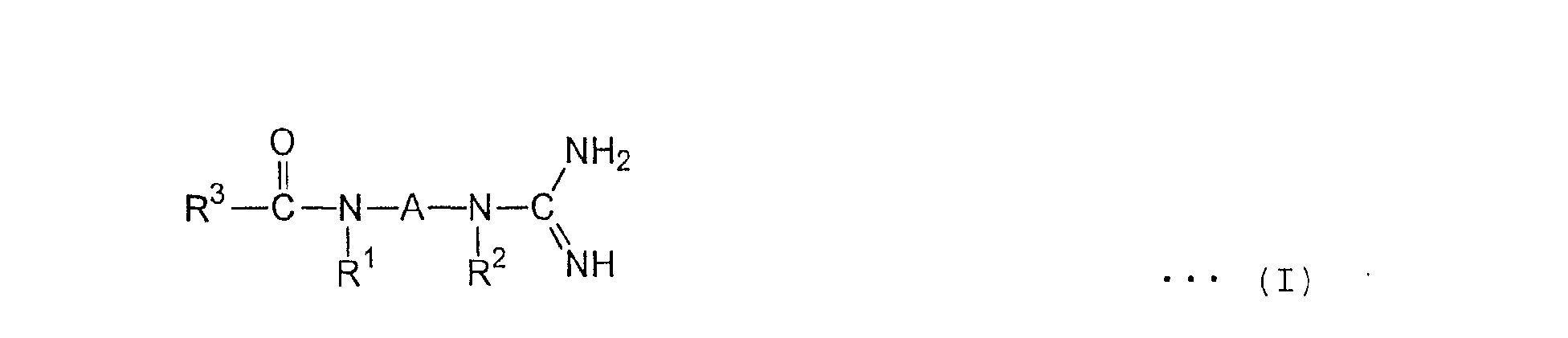
- the hair cosmetic of the present invention comprises, at least, one or more components A selected from amide group-containing guanidine derivatives of the following general formula (I), (in the general formula (I), R 1 and R 2 represent a hydrogen atom, or a linear or branched alkyl or alkenyl group having 1 to 4 carbon atoms, and may be the same or different. R 3 represents a linear or branched alkyl or alkenyl group having 1 to 22 carbon atoms .
- A represents a linear or branched alkylene or alkenylene group having 1 to 10 carbon atoms.) and salts thereof, and one or more components B selected from N ⁇ -acylarginines of the following general formula (II), (in the general formula (II), R 4 represents a linear or branched alkyl or alkenyl group having 1 to 22 carbon atoms.) and salts thereof.
- N ⁇ -acylarginines and salts thereof (component B) compounded as essential components in the hair cosmetic of the present invention are used in combination of quaternary ammonium salts of cationic surfactants as components of a cosmetic composition (Japanese Patent Application Laid-Open No. 11-228348), however, there is no example reported investigating a combination with an amide group-containing guanidine derivative and salt thereof (component A).
- conditioning properties such as smoothness in rinsing, excellent finger passing when wet, and settlement of hair when dry may be improved overall, by using one or more components A selected from amide group-containing guanidine derivatives and salts thereof and one or more components B selected from N ⁇ -acylarginines and salts thereof, in combination.
- the hair cosmetic of the present invention comprises one or more components A selected from amide group-containing guanidine derivatives and salts thereof and one or more components B selected from N ⁇ -acylarginines and salts thereof, as essential components.
- the amide group-containing guanidine derivative used in the present invention is represented by the following general formula (I).
- R 1 and R 2 represent a hydrogen atom, or a linear or branched alkyl or alkenyl group having 1 to 4 carbon atoms.
- R 1 and R 2 may be the same or different.
- R 1 and R 2 represent most preferably a hydrogen atom.
- acyl group (R 3 CO) in the general formula (I) linear or branched and saturated or unsaturated acyl groups having 1 to 22 carbon atoms are listed.
- acyl groups derived from acetic acid, propionic acid, capric acid, lauric acid, myristic acid, palmitic acid, stearic acid, behenic acid, linoleic acid, linolenic acid, oleic acid, isostearic acid, 2-ethylhexanoic acid, coconut oil fatty acid, beef tallow fatty acid, hardened beef tallow fatty acid and the like are listed.
- acyl group a caproyl group, lauroyl group, myristyl group, palmitoyl group, stearoyl group, behenoyl group, cocoyl group, hardened beef tallow fatty acyl group and the like are listed, and further preferably, a lauroyl group, myristyl group, palmitoyl group and stearoyl group are listed.
- A represents a branched or linear alkylene group or alkenylene group having 1 to 10 carbon atoms, preferably 2 to 6 carbon atoms .
- A an ethylene group, propylene group, butylene group, pentylene group and hexylene group are listed.
- the amide group-containing guanidine derivative is compounded, usually in the form of salt, in a hair cosmetic.
- the amide group-containing guanidine derivative can be used in the form of inorganic acid salts such as a hydrochloride, sulfate, phosphate and the like, or organic acid salts such as a glycolate, acetate, citrate, acidic amino acid salt, pyrrolidonecarboxylate, and the like.
- the amide group-containing guanidine derivative or salt thereof used in the present invention can be obtained as described below.
- a monoaminde amine derived from a diamine is subjected to heating pressure reduction treatment, heating nitrogen-bubbling treatment, or stored under an atmosphere of no carbon dioxide, then, guanidylated with cyanamide, S-methylisothiourea and the like, further, mixed impurities are removed by means such as crystallization and the like, as disclosed, for example, in Japanese Patent Application Laid-Open No. 6-312972.
- the amide group-containing guanidine derivative or salt thereof used in the present invention can also be produced by reacting an amino group-containing guanidine derivative of the following general formula (III) with a fatty acid halide or fatty acid ester.
- R 1 and R 2 represent a hydrogen atom, or a linear or branched alkyl or alkenyl group having 1 to 4 carbon atoms, and may be the same or different.
- A represents a linear or branched alkylene or alkenylene group having 1 to 10 carbon atoms.
- arginine is previously mixed into an amino group-containing guanidine derivative represented by the general formula (III), and this mixture is reacted with a fatty acid halide or fatty acid ester.
- arginine is a raw material of the N ⁇ -acylarginine (component B) which is another essential component of the hair cosmetic of the present invention, and in this case, since an amide group-containing guanidine derivative (component A) and N ⁇ -acylarginine (component B) can be obtained simultaneously as reaction products, the resulted reaction products can be utilized as they are in the hair cosmetic of the present invention.
- N ⁇ -acylarginine (component B) will be described in detail below.
- N ⁇ -acylarginine in the present invention is represented by the following general formula (II).
- R 4 represents a linear or branched alkyl or alkenyl group having 1 to 22 carbon atoms.
- the N ⁇ -acylarginine used in the present invention is a compound derived from arginine.
- the N ⁇ -acylarginine has a guanidine group like the amide group-containing guanidine derivative or salt thereof (component A), and used as an amphoteric surfactant in various applications such as cosmetic compositions, lubricants, antistatic agents, surface treating agents and the like.
- N ⁇ -acylarginine in combination with a quaternary ammonium salt of a cationic surfactant, as a component of a cosmetic composition, has been already investigated, as disclosed in Japanese Patent Application Laid-Open No. 11-228348, however, there is no example known investigating a combination with an amide group-containing guanidine derivative.
- the N ⁇ -acylarginine in the present invention has a linear or branched and saturated or unsaturated fatty acyl group having 1 to 22 carbon atoms, and specific examples thereof include N ⁇ -acetylarginine, N ⁇ -propionylarginine, N ⁇ -octanoylarginine, N ⁇ -decanoylarginine, N ⁇ -lauroylarginine, N ⁇ -myristoylarginine, N ⁇ -palmitoylarginine, N ⁇ -stearoylarginine, N ⁇ -behenoylarginine, N ⁇ -coconut oil fatty acid acylarginine, N ⁇ -palm kernel oil fatty acid acylarginine, N ⁇ -beef tallow fatty acid acylarginine and the like.
- N ⁇ -lauroylarginine, N ⁇ -myristoylarginine, N ⁇ -palmitoylarginine and N ⁇ -stearoylarginine are preferable from the standpoint of touch feeling, and N ⁇ -lauroylarginine, N ⁇ -myristoylarginine and N ⁇ -palmitoylarginine are more preferable.
- the N ⁇ -acylarginine which can be used in the present invention can be obtained, as described in Japanese Patent Application Laid-Open No. 48-23729, by reacting arginine which is one of amino acids with a fatty acid halide under alkaline condition together with a hydrophilic organic solvent, or, as described in Japanese Patent Application Laid-Open No. 49-1513, by thermally dehydrating a salt of arginine and a fatty acid at temperatures of 100 to 250°C. Further, a crystal of a N ⁇ -acylarginine can be obtained, as shown in Japanese Patent Application Laid-Open No.
- the N ⁇ -acylarginine may be compounded in the form of salt into a hair cosmetic.
- the N ⁇ -acylarginine can be used in the form of inorganic acid salts such as a hydrochloride, sulfate, phosphate and the like, or organic acid salts such as a glycolate, acetate, citrate, acidic amino acid salt, pyrrolidonecarboxylate, and the like.
- various additives usually used can be added as optional components in an amount not disturbing the effect of the present invention, in addition to the above-described component A and component B.
- raw materials described in the cosmetic raw material standard, cosmetic type compounding component standard, medicine raw material standard, Japanese pharmacopeia and Japanese Standard of Food Additives such as surfactants, wetting agents, silicone compounds, polymer substances (polymer compounds), alcohols, ultraviolet absorbers, coloring matters, pigments, vitamins, antioxidants, sequestering agents, preservatives, bactericides, pH controlling agents, pearlescent agents, nucleic acids, enzymes, natural extracts and the like, are listed.
- surfactant examples include the following compounds.
- alkylsulfates alkylphosphates, polyoxyethylene alkyl ether sulfates, polyoxyethylene alkylphenyl ether sulfates, polyoxyethylene alkylcarboxylates, alkylphenyl ether sulfonates, salts of alkylsulfosuccinic acids and derivatives thereof, salts of N-acylsarcosine and derivatives thereof, salts of N-acyl-N-methyl- ⁇ -alanine, polyoxyethylene coconut oil fatty acid monoethanolamide sulfate, polyoxyethylene alkyl ether phosphates, higher fatty acid salts, salts of N-acylglycine, salts of N-acylalanine and the like.
- carbobetaine type amphoteric surfactants sulfobetaine type amphoteric surfactants, hydroxysulfobetaine type amphoteric surfactants, amidesulfobetaine type amphoteric surfactants, phosphobetaine type amphoteric surfactants, imidazoline type amphoteric surfactants, lecithin derivatives and the like.
- propylene glycol fatty acid esters glycerine fatty acid esters, polyoxyethylene glycerine fatty acid esters, polyglycerine fatty acid esters, sorbitan fatty acid esters, polyoxyethylene sorbitan fatty acid esters, polyoxyethylene sorbitol fatty acid esters, polyoxyethylene alkylphenyl formaldehyde condensates, polyoxyethylene castor oil, polyoxyethylene hardened castor oil, polyoxyethylene sterol and derivatives thereof, polyethylene glycol fatty acid esters, polyoxyethylene alkyl ethers, polyoxyethylene polyoxypropylene alkyl ethers, polyoxyethylene alkylphenyl ethers, polyoxyethylene lanolin and derivatives thereof, polyoxyethylene beeswax derivatives, polyoxyethylene alkylamines, polyoxyethylene fatty acid amides, alkanolamides, sugar esters, polyoxyethylene hardened castor oil pyroglutamates, polyoxyethylene glyceryl
- quaternary ammonium salts amideamines, salts of N-acylarginine esters, salts of N-[3-alkyloxy-2-hydroxypropyl]-L-arginine, and the like.
- salts of anionic surfactants sodium salts, magnesium salts, potassium salts, ammonium salts, diethanolamine salts, triethanolamine salts, arginine salts, lysine salts and the like are listed, and these various surfactants can be added.
- wetting agent examples include the following compounds.
- glycerine propylene glycol, 1,3-butylene glycol, isoprene glycol, polyethylene glycol, diglycerine, triglycerine, tetraglycerine, pentaglycerine, hexaglycerine, decaglycerine, sorbitol, ethylene glycol, erythritol and the like
- NMF Natural moistening factor
- amino acids such as proline, glycine, alanine, serine, threonine, arginine, glutamic acid, aspartic acid, leucine, isoleucine, valine and the like, pyrrolidonecarboxylic acid or pyrrolidonecarboxylates, lactic acid or lactates, urea, glucosamine, creatine, citrates, and the like
- scrose lactose, trehalose, natural oligosaccharides, hyaluronic acid and sodium salts thereof, chondroitin sulfate, and the like
- polyamino acids including polyglutamic acid and polyaspartic acid, and salt thereof, additionally, amino acid derivatives, soybean protein hydrolyzate, deoxyribonucleic acid, glycinebetaine, chitin, chitosan, deacetylated chitin, and the like
- silicone compound examples include the following compounds.
- methyl polysiloxane highly polymerized methyl polysiloxane, polyoxyethylene-methyl polysiloxane copolymer, polyoxypropylene-methyl polysiloxane copolymer and poly(oxyethylene, oxypropylene)-methylpolysiloxane copolymer, and the like
- stearoxy methyl polysiloxane stearoxy trimethylsilane, methyl hydrogen polysiloxane, octamethyl polysiloxane, decamethyl polysiloxane, cyclic silicones such as decamethyl cyclopentasiloxane, octamethyl cyclotetrasiloxane, tetrahydrotetramethyl cyclotetrasiloxane, methyl cyclopolysiloxane, dodecamethyl cyclohexasiloxane and the like, methyl phenyl polysiloxane, trimethyl siloxy silic acid, aminoethyl aminopropyl siloxane-dimethyl siloxane copolymer, and the like
- silanol-modified polysiloxane alkoxy-modified polysiloxane, fatty acid-modified polysiloxane, fluorine-modified polysiloxane, epoxy-modified polysiloxane, alkoxy-modified polysiloxane perfluoro polyether, polyvinyl acetate dimethyl polysiloxane and the like.
- silicone emulsions prepared by emulsifying one or two or more of them, and the like can also be used.
- polymer substance examples include the following compounds.
- guar gum locust bean gum, queens seed, carageenan, galactan, gum Arabic, tragacanth rum, pectin, mannan, starch, pullulan and the like
- xanthan gum dextran, succinoglucan, curdlan, hyaluronic acid and the like
- gelatin casein, albumin, collagen and the like
- polyvinyl alcohol polyvinyl butyral, vinyl acetate-vinylpyrrolidone copolymer, vinyl acetate-crotonic acid copolymer, vinyl methyl ether-ethyl maleate copolymer, vinyl methyl ether-butyl maleate copolymer, crotonic acid-vinyl acetate-vinyl neodecanoic acid copolymer, methoxyethylene maleic anhydride copolymer, isobutylene-sodium maleate copolymer, N-methylpyrrolidone, vinylpyrrolidone-N, N-dimethylaminoethylmethacrylic acid copolymer diethyl sulfate salt, vinylimidazolium methochloride-vinylpyrrolidone copolymer, polyvinyl pyrrolidone, vinyl pyrrolidone-styrene copolymer, vinyl pyrrolidone-hexadec
- alkyl acrylate copolymers polyacrylic acid and salts thereof (sodium, potassium, ammonium, triethanolamine, arginine, lysine, and the like), polyalkyl acrylates, alkyl acrylate copolymers, acrylic amide-styrene copolymers, alkyl acrylate-styrene copolymers, octyl acrylate amide-acrylate copolymers and salts thereof, octyl acrylate amide-hydroxypropyl acrylate-butyl methacrylate aminoethyl copolymers, acrylic resin alkanolamine, hydroxyethyl acrylate-methoxyethyl acrylate copolymer, alkyl acrylate-alkyl methacrylate-diacetone-acetoneacrylamide-methacrylic acid copolymer, dimethyl chloride diallyl ammonium-acrylamide copolymer and the like, methacryloyl e
- Carboxymethyldextran and salts thereof epoxy resin isostearic acid esters, polyamide epichlorohydrin resins, bisphenol epoxy resin fatty acid esters, polyethylene glycol-epichlorohydrin-coconut oil alkylamine-dipropylenetriamine condensate, perfluoro polyether and the like
- the alcohol examples include higher alcohols such as cetyl alcohol, stearyl alcohol, behenyl alcohol, isostearyl alcohol, octyl dodecanol, oleyl alcohol, myristyl alcohol and the like, lower alcohols such as ethanol, isopropyl alcohol and the like.
- ultraviolet absorber examples include benzophenone derivatives, p-aminobenzoic acid derivatives, methoxy cinnamic acid derivatives, salicylic acid derivatives, urocanic acid and derivatives thereof, 4-tert-butyl-4'-methoxydibenzoylmethane, 2-(2'-hydroxy-5'-methylphenyl)benzotriazole, methyl anthranilate and the like.
- coloring matter examples include Red 201, Red 202, Red 204, Red 205, Red 220, Red 226, Red 228, Red 405, Orange 203, Orange 204, Yellow 205, Yellow 401, Blue 404, Red 3, Red 104, Red 106, Red 227, Red 230, Red 401, Red 505, Orange 205, Yellow 4, Yellow 5, Yellow 202, Yellow 203, Green 3, Blue 1 and the like.
- the pigment examples include natural coloring matters such as ⁇ -carotene, calsamine, cochineal and the like, and inorganic pigments such as mica, talc, kaolin, calcium carbonate, magnesium carbonate, anhydrous silic acid, aluminum oxide, barium sulfate, red iron oxide, yellow iron oxide, black iron oxide, chromium oxide, ultramarine, iron blue carbon black, titanium oxide, zinc oxide, mica titanium, squama foil, bismuth oxychloride, boron nitride, photochromic pigment, synthetic fluorine gold mica, iron-containing synthetic fluorine gold mica, fine particle complex powder and the like.
- natural coloring matters such as ⁇ -carotene, calsamine, cochineal and the like
- inorganic pigments such as mica, talc, kaolin, calcium carbonate, magnesium carbonate, anhydrous silic acid, aluminum oxide, barium sulfate, red iron oxide, yellow iron oxide, black iron oxide, chromium oxide
- vitamin examples include vitamins A, B1, B2 and B6 and derivatives thereof used as a nutrient, vitamin C and derivatives thereof used as a whitening agent, vitamin E and derivatives thereof used as a vasodilator, and the like.
- antioxidant examples include tocophenols, dibutyl hydroxy toluene (BHT), butyl hydroxy anisole (BHA) and the like.
- sequestering agent examples include sodium ethylenediamine tetraacetate (EDTA), phosphoric acid, citric acid, succinic acid, gluconic acid, polyphosphoric acid, sodium metaphosphate and the like.
- EDTA ethylenediamine tetraacetate
- phosphoric acid citric acid
- succinic acid succinic acid
- gluconic acid polyphosphoric acid
- sodium metaphosphate sodium metaphosphate
- preservative and bacteriocide examples include benzoic acid, sodium benzoate, isopropyl methyl phenol, zinc undecylenate, undecylene monoethanolamide, zinc chloride, benzalkonium chloride, alkyl trimethyl ammonium chloride, cetyl pyridinium chloride, benzalkonium chloride, alkyldiaminoethylglycine hydrochloride, chlorhexidine hydrochloride, O-phenyl phenol, photosensitive element 101, photosensitive element 201, chlorhexidine gluconate, cresol, chloramine T, chlorxylenol, chlorcresol, chlorphenesine, chlorobutanol, salicylic acid, sodium salicylate, alkyl isoquinolinium bromide, domiphen bromide, sorbic acid and salts, thymol, thiram, dehydroacetic acid and sodium salt, trichloro carbanilide, p-oxy benzoate,
- swertia herb extract cepharanthin, ⁇ -orizanol, capsicum tincture, ginger tincture and benzyl nicotinate are listed as a hair restoration drug
- estradiol and ethynyl estradiol are listed as a female hormone agent
- pant othenic acid and derivatives thereof, placenta extract, allantoin, photosensitive element 301 and the like are listed as a hair root activating agent.
- hamamelis As the drug derived from natural substances, hamamelis, Lamium album, Betulaalba, rheum, licorice, coptis, tibouchina, yarrow, aloe, chamomile, refined oils such as eucalyptus oil, carrot extract, aloe, tibouchina, lilac, Luffa, marronnier, fleawort, Safflower and the like are listed.
- Production of the hair cosmetic of the present invention by compounding various components described above can be conducted according to a conventionally known method without specific restriction excepting the component A and the component B are used as essential components.
- the compounding amount of the component A in the present invention is appropriately determined depending on the intended product, and is not particularly restricted, and preferably from 0.001 to 10% by weight, particularly preferably from 0.1 to 10% by weight. When less than 0.001% by weight, the effect of the present invention is not manifested sufficiently in some cases.
- the compounding amount of the component B in the present invention is appropriately determined depending on the intended product, and is not particularly restricted, and preferably from 0.001 to 3% by weight, more preferably from 0.001 to 1% by weight.
- the hair cosmetic of the present invention is not particularly restricted in its dosage form, and any dosage forms are permissible such as an emulsion system, solution system, solubilization system, powder dispersion system, water-oil two layer system, water-oil-powder three layer system and the like.
- the hair cosmetic of the present invention is not particularly restricted also in its application, and can be applied to shampoo, rinse, hair restoration agent, treatment, hair conditioner, tick, hair liquid, set lotion, permanent wave liquid, hair cream, hair lotion, hair mousse, permanent liquid, hair dye, hair color, hair manicure, and the like.
- the amide group-containing guanidine derivatives of different acyl chain lengths used in the examples were also produced by the same method.
- N ⁇ -acylarginines of different acyl chain lengths used in the examples were also produced by the same method.
- Comparative Example 1 is the standard article, and when the average value calculated according to the following standards is 5.0 to 3.5, evaluation is very good ( ), when 3.5 to 2.5, evaluation is normal ( ⁇ ), and when 2.5 to 1.0, evaluation is poor ( ⁇ ).
- the hair rinse of Comparative Example 2 prepared by compounding the general purpose quaternary ammonium salt (monobehenyl ammonium chloride) and N ⁇ -acylarginine (component B) in combination shows improvement in smoothness in rinse as compared with the standard article (Comparative Example 1), however, since the amide group-containing guanidine derivative (component A) is not contained, excellent finger passing when wet and settlement of hair when dry are rather poor. Also the hair rinse of Comparative Example 3 prepared by compounding the amide group-containing guanidine derivative (component A) shows improvement in smoothness in rinse as compared with Comparative Example 1, however, evaluation items such as excellent finger passing when wet and settlement of hair when dry are still not satisfactory.
- Example 1 4-guanidinobutyldodecaneamide acetate (component A) which is one of amide group-containing guanidine derivatives and N ⁇ -lauroylarginine (component B) which is one of N ⁇ -acylarginines is excellent overall in all evaluation items.
- component A 4-guanidinobutyldodecaneamide acetate
- component B N ⁇ -lauroylarginine
- Example 1 As described above, comparison of Example 1 with Comparative Examples 1 to 3 teaches that conditioning properties such as smoothness in rinse, excellent finger passing when wet and settlement of hair when dry can be improved by compounding the amide group-containing guanidine derivative (component A) and N ⁇ -acylarginine (component B) in combination.
- component A amide group-containing guanidine derivative
- component B N ⁇ -acylarginine
- Hair rinses having compositions (wt% of net composition, total 100%) shown in the following Table 2 were prepared.
- excellent use feelings were obtained in conditioning properties such as smoothness in rinse, excellent finger passing when wet and settlement of hair when dry.
- Hair treatments having compositions (wt% of net composition, total 100%) shown in the following Table 3 were prepared. When the resulted hair treatments were used, excellent use feelings were obtained in conditioning properties such as smoothness in rinse, excellent finger passing when wet and settlement of hair when dry.
- Hair treatment Component Example 6 7 8 9 10 (component A) 2-guanidinoethylmyristylamid e phosphate 2.0 3.0 6-guanidinohexyldodecaneamid e lactate 2.0 4-guanidinobutyldodecaneamid e acetate 2.0 5.0 (component B) N ⁇ -behenoylarginine 0.1 0.3 N ⁇ -decanoylarginine 1.0 1.0 N ⁇ -palmitoylarginine 1.0 (other components) Diglycerine 2.0 2.0 2.0 Alanine- 2.0 2.0 Isocetyl isostearate 7.5 7.5 7.5 7.5 7.5 Isostearyl alcohol 10.0 10.0 10.0 10.0 10.0 10.0 Polyoxyethylene
- Self rinsing shampoos (2 in 1 shampoo) having compositions (wt% of net composition, total 100%) shown in the following Table 4 were prepared.
- compositions wt% of net composition, total 100%
- excellent use feelings were obtained in conditioning properties such as smoothness in rinse, excellent finger passing when wet and settlement of hair when dry.
- Hair dyes having compositions (wt% of net composition, total 100%) shown in the following Table 5 were prepared. When the resulted hair dyes were used, excellent use feelings were obtained in conditioning properties such as smoothness in rinse, excellent finger passing when wet and settlement of hair when dry.
- Hair treatment having compositions (wt% of net composition, total100%) shown in the following table6 were prepared.
- excellent use feeling were obtained in conditioning properties such as smooth in rinse, excellent finger passing, when wet and settlement of hair when dry.
- Hair rinse Component Example 17 (component A) 4-guanidinobutyldodecaneamide acetate 1 (component B) N ⁇ -lauroylarginine 0.05 (other component) 4-aminobutyldodecaneamide acetate 0.01 4-ureidobutyldodecaneamide 0.01 N ⁇ ,Ng-dilauroylagmatine 0.02 Silicone oil 3 Liquid paraffin 1 Cetyl alcohol 1.5 Stearyl alcohol 1 Glycerin 0.7 Perfume, color, perservative suitable amount Purification water Residue
- the hair cosmetic of the present invention can improve overall conditioning properties such as smoothness in rinsing, excellent finger passing when wet, and settlement of hair when dry, by compounding one or more components selected from amide group-containing guanidine derivatives and salts thereof and one or more components selected from N ⁇ -acylarginines and salts thereof, in combination.
- the hair cosmetic of the present invention having such a feature is extremely useful in shampoo, rinse, hair restoration agent, treatment, hair conditioner, tick, hair liquid, set lotion, permanent wave liquid, hair cream, hair lotion, hair mousse, permanent liquid, hair dye, hair color, hair manicure, and the like.
Landscapes
- Health & Medical Sciences (AREA)
- Life Sciences & Earth Sciences (AREA)
- Animal Behavior & Ethology (AREA)
- General Health & Medical Sciences (AREA)
- Public Health (AREA)
- Veterinary Medicine (AREA)
- Birds (AREA)
- Epidemiology (AREA)
- Dermatology (AREA)
- Cosmetics (AREA)
Abstract


Description




Light yellow solid 65.8g (yield 92%)
1H-NMR(CD3OD) : σ = 0.90(3H, t), 1.28-1.38(18H, m), 1.57(6H, m), 2.17(2H, t), 3.19(4H, m)
ESI-Mass: 313(MH+)
White solid, 31 g (yield: 78%)
1H-NMR (CD3OD), σ = 0.89 (3H, t), 1.24 to 1.38 (18H, m), 1.62 (2H, m), 1.78 (2H, m), 2.23 (2H, t), 3.11 (2H, m), 4.27 (1H, t)
FAB-Mass: 357 (MH+)


| Hair rinse | ||||
| Component | Example | |||
| 2 | 3 | 4 | 5 | |
| (component A) | ||||
| 4-guanidinobutylcocoylamide acetate | 3.0 | |||
| 4-guanidinobutyldecaneamide hydrochloride | 3.0 | |||
| 4-guanidinobutylmyristylami de glutamate | 3.0 | |||
| 4-guanidinobutylpalmitylami de pyrrolidone carboxylate | 3.0 | |||
| (component B) | ||||
| Nα-2-ethylhexanoylarginine | 0.05 | |||
| Nα-cocoylarginine | 0.1 | |||
| Nα-myristoylarginine | 0.05 | |||
| Nα-palmitoylarginine | 0.1 | 0.1 | ||
| (other components) | ||||
| Sorbitol | 3.0 | 3.0 | 3.0 | 3.0 |
| Serine | 1.0 | 1.0 | 1.0 | 1.0 |
| Glyceryl octanoate | 3.0 | 3.0 | 3.0 | 3.0 |
| Octyldodecyl myristate | 3.0 | 3.0 | 3.0 | 3.0 |
| Setostearyl alcohol | 3.0 | 3.0 | 3.0 | 3.0 |
| Stearyldimethyl ammonium chloride | 2.0 | 2.0 | 2.0 | 2.0 |
| Polyoxyethylene stearyl ether | 0.5 | 0.5 | 0.5 | 0.5 |
| Preservative | 0.1 | 0.1 | 0.1 | 0.1 |
| Purification water | Residue | Residue | Residue | Residue |
| Hair treatment | |||||
| Component | Example | ||||
| 6 | 7 | 8 | 9 | 10 | |
| (component A) | |||||
| 2-guanidinoethylmyristylamid e phosphate | 2.0 | 3.0 | |||
| 6-guanidinohexyldodecaneamid e lactate | 2.0 | ||||
| 4-guanidinobutyldodecaneamid e acetate | 2.0 | 5.0 | |||
| (component B) | |||||
| Nα-behenoylarginine | 0.1 | 0.3 | |||
| Nα-decanoylarginine | 1.0 | 1.0 | |||
| Nα-palmitoylarginine | 1.0 | ||||
| (other components) | |||||
| Diglycerine | 2.0 | 2.0 | 2.0 | ||
| Alanine- | 2.0 | 2.0 | |||
| Isocetyl isostearate | 7.5 | 7.5 | 7.5 | 7.5 | 7.5 |
| Isostearyl alcohol | 10.0 | 10.0 | 10.0 | 10.0 | 10.0 |
| Polyoxyethylene tetraoleate sorbitol (EO40) | 0.5 | 0.5 | 0.5 | 0.5 | 0.5 |
| Polyoxyethylene hardened castor oil (EO40) | 1.0 | 1.0 | 1.0 | 1.0 | 1.0 |
| Polyoxyethylene hardened castor oil (EO60) | 1.0 | 1.0 | 1.0 | 1.0 | 1.0 |
| Trimethyl ammonium stearate chloride (50wt%, EtOH) | 3.0 | 3.0 | 3.0 | 3.0 | 3.0 |
| Butyl paravene | 0.1 | 0.1 | 0.1 | 0.1 | 0.1 |
| Purification water | Resid ue | Resid ue | Resid ue | resid ue | Resid ue |
| Self rinsing shampoo(2 in 1 shampoo) | |||
| Component | Example | ||
| 11 | 12 | 13 | |
| (component A) | |||
| 4-guanidinobutylmyristylamide acetate | 1.0 | ||
| 4-guanidinobutylpalmitylamide sulfate | 1.0 | ||
| 3-guanidinopropyldodecaneamide laurate | 1.0 | ||
| (component B) | |||
| Nα-cocoylarginine | 1.0 | ||
| Nα-lauroylarginine | 1.0 | ||
| Nα-myristoylarginine | 1.0 | ||
| (other components) | |||
| Imidazolium betaine type amphoteric surfactant | 16.0 | 16.0 | 16.0 |
| coconut oil fatty acid diethanolamide | 4.0 | 4.0 | 4.0 |
| Coconut oil fatty acid acyl-L-arginineethyl DL-pyrrolidone carboxylate | 1.0 | 1.0 | 1.0 |
| stearyl trimethyl ammonium chloride | 2.0 | 2.0 | 2.0 |
| N-lauroyl-N-methyl-β-alanine sodium | 1.0 | 1.0 | 1.0 |
| POE alkylpolyamine | 1.0 | 1.0 | 1.0 |
| Aromatic | Suitable amount | Suitable amount | Suitable amount |
| Coloring matter | Suitable amount | Suitable amount | Suitable amount |
| Sodium hydroxide | Suitable amount | Suitable amount | Suitable amount |
| Purification water | Residue | Residue | Residue |
| Hair dye | |||
| Component | Example | ||
| 14 | 15 | 16 | |
| (component A) | |||
| 6-guanidinohexylpalmitylamide citrate | 0.5 | 0.6 | |
| 4-guanidinobutylmyristylamide malate | 0.7 | ||
| (component B) | |||
| Nα-palmitoylarginine | 1.0 | 0.5 | |
| Nα-stearoylarginine | 1.0 | 0.5 | |
| (other components) | |||
| glycine betaine | 1.0 | 1.0 | 1.0 |
| p-phenylenediamine 3 | 3.0 | 3.0 | 3.0 |
| Resorcin | 0.2 | 0.2 | 0.2 |
| oleic acid | 20.0 | 20.0 | 20.0 |
| POE (10) oleyl alcohol ether | 13.0 | 13.0 | 13.0 |
| Isopropyl alcohol | 10.0 | 10.0 | 10.0 |
| Ammonia water (28%) | 10.0 | 10.0 | 10.0 |
| Antioxidant | Suitable amount | Suitable amount | Suitable amount |
| Chelating agent | Suitable amount | Suitable amount | Suitable amount |
| Purification water | Residue | Residue | Residue |
| Hair rinse | |
| Component | Example 17 |
| (component A) | |
| 4-guanidinobutyldodecaneamide acetate 1 | |
| (component B) | |
| Nα-lauroylarginine | 0.05 |
| (other component) | |
| 4-aminobutyldodecaneamide acetate | 0.01 |
| 4-ureidobutyldodecaneamide | 0.01 |
| Nα,Ng-dilauroylagmatine | 0.02 |
| Silicone oil | 3 |
| Liquid paraffin | 1 |
| Cetyl alcohol | 1.5 |
| Stearyl alcohol | 1 |
| Glycerin | 0.7 |
| Perfume, color, perservative | suitable amount |
| Purification water | Residue |
Claims (1)
- A hair cosmetic comprising, at least, one or more components A selected from amide group-containing guanidine derivatives of the following general formula (I),(in the general formula (I), R1 and R2 represent a hydrogen atom, or a linear or branched alkyl or alkenyl group having 1 to 4 carbon atoms, and may be the same or different. R3 represents a linear or branched alkyl or alkenyl group having 1 to 22 carbon atoms . A represents a linear or branched alkylene or alkenylene group having 1 to 10 carbon atoms.) and salts thereof, and one or more components B selected from Nα-acylarginines of the following general formula (II),
 (in the general formula (II), R4 represents a linear or branched alkyl or alkenyl group having 1 to 22 carbon atoms.) and salts thereof.
Applications Claiming Priority (2)
| Application Number | Priority Date | Filing Date | Title |
|---|---|---|---|
| JP2001250558 | 2001-08-21 | ||
| JP2001250558 | 2001-08-21 |
Publications (3)
| Publication Number | Publication Date |
|---|---|
| EP1285647A2 true EP1285647A2 (en) | 2003-02-26 |
| EP1285647A3 EP1285647A3 (en) | 2003-07-02 |
| EP1285647B1 EP1285647B1 (en) | 2010-08-04 |
Family
ID=19079353
Family Applications (1)
| Application Number | Title | Priority Date | Filing Date |
|---|---|---|---|
| EP02255724A Expired - Lifetime EP1285647B1 (en) | 2001-08-21 | 2002-08-16 | Hair cosmetic comprising guanidine derivative and N-alpha-acylarginine |
Country Status (4)
| Country | Link |
|---|---|
| US (1) | US20030108508A1 (en) |
| EP (1) | EP1285647B1 (en) |
| KR (1) | KR100529818B1 (en) |
| DE (1) | DE60237180D1 (en) |
Cited By (5)
| Publication number | Priority date | Publication date | Assignee | Title |
|---|---|---|---|---|
| EP1264591A3 (en) * | 2001-06-06 | 2003-07-02 | Ajinomoto Co., Inc. | Cosmetic composition |
| WO2004110395A1 (en) * | 2003-06-18 | 2004-12-23 | Goldschmidt Gmbh | Use of alkyl guanidine compounds for the treatment and aftertreatment of hair |
| EP1493423A1 (en) * | 2003-06-18 | 2005-01-05 | Goldschmidt AG | Composition for hair treatment and for the after-treatment of hair for protection against damage by chemical treatment and for the repair of pre-existing damaged hair, comprising alkyl-guanidinium derivatives as active agent |
| FR2862218A1 (en) * | 2003-11-18 | 2005-05-20 | Oreal | HAIR FORMING COMPOSITION COMPRISING AT LEAST ONE NON-HYDROXIDE IMINE |
| CN108101812A (en) * | 2018-01-02 | 2018-06-01 | 成都傲飞生物化学品有限责任公司 | A kind of production purifying process of lauroyl arginine ethyl ester hydrochloride |
Families Citing this family (1)
| Publication number | Priority date | Publication date | Assignee | Title |
|---|---|---|---|---|
| US9050357B2 (en) * | 2010-03-08 | 2015-06-09 | Cp Kelco U.S., Inc. | Compositions and methods for producing consumables for patients with dysphagia |
Family Cites Families (6)
| Publication number | Priority date | Publication date | Assignee | Title |
|---|---|---|---|---|
| JPS6020363B2 (en) * | 1982-08-17 | 1985-05-21 | ライオン株式会社 | cosmetic composition |
| JP2536109B2 (en) * | 1988-12-19 | 1996-09-18 | ライオン株式会社 | Hair cosmetics |
| JPH06256146A (en) * | 1993-03-10 | 1994-09-13 | Lion Corp | Hair cosmetic |
| JP3835498B2 (en) * | 1998-02-09 | 2006-10-18 | 味の素株式会社 | Cosmetic composition |
| JPH11228527A (en) * | 1998-02-10 | 1999-08-24 | Ajinomoto Co Inc | Long-chain acyl arginine crystal and its production |
| JP2001139433A (en) * | 1999-11-17 | 2001-05-22 | Lion Corp | Hair cosmetics |
-
2002
- 2002-08-13 US US10/216,845 patent/US20030108508A1/en not_active Abandoned
- 2002-08-16 DE DE60237180T patent/DE60237180D1/en not_active Expired - Lifetime
- 2002-08-16 EP EP02255724A patent/EP1285647B1/en not_active Expired - Lifetime
- 2002-08-21 KR KR10-2002-0049352A patent/KR100529818B1/en not_active Expired - Fee Related
Cited By (7)
| Publication number | Priority date | Publication date | Assignee | Title |
|---|---|---|---|---|
| EP1264591A3 (en) * | 2001-06-06 | 2003-07-02 | Ajinomoto Co., Inc. | Cosmetic composition |
| WO2004110395A1 (en) * | 2003-06-18 | 2004-12-23 | Goldschmidt Gmbh | Use of alkyl guanidine compounds for the treatment and aftertreatment of hair |
| EP1493423A1 (en) * | 2003-06-18 | 2005-01-05 | Goldschmidt AG | Composition for hair treatment and for the after-treatment of hair for protection against damage by chemical treatment and for the repair of pre-existing damaged hair, comprising alkyl-guanidinium derivatives as active agent |
| FR2862218A1 (en) * | 2003-11-18 | 2005-05-20 | Oreal | HAIR FORMING COMPOSITION COMPRISING AT LEAST ONE NON-HYDROXIDE IMINE |
| EP1532960A1 (en) * | 2003-11-18 | 2005-05-25 | L'oreal | Hair styling composition containing a non-hydroxide imine |
| CN108101812A (en) * | 2018-01-02 | 2018-06-01 | 成都傲飞生物化学品有限责任公司 | A kind of production purifying process of lauroyl arginine ethyl ester hydrochloride |
| CN108101812B (en) * | 2018-01-02 | 2020-12-25 | 成都傲飞生物化学品有限责任公司 | Production and purification process of lauroyl arginine ethyl ester hydrochloride |
Also Published As
| Publication number | Publication date |
|---|---|
| KR100529818B1 (en) | 2005-11-22 |
| US20030108508A1 (en) | 2003-06-12 |
| KR20030017366A (en) | 2003-03-03 |
| DE60237180D1 (en) | 2010-09-16 |
| EP1285647A3 (en) | 2003-07-02 |
| EP1285647B1 (en) | 2010-08-04 |
Similar Documents
| Publication | Publication Date | Title |
|---|---|---|
| EP1283030B1 (en) | Conditioner composition | |
| EP0651632B2 (en) | Hair cosmetic composition | |
| US7282520B2 (en) | External preparation | |
| EP1285579B1 (en) | Bactericidal guanidine derivatives, dermally applicable composition, washing composition, and antibacterial fibre aggregate | |
| JP2000154112A (en) | New cosmetic composition | |
| JP2007131687A (en) | Transparent detergent composition | |
| EP0788832B1 (en) | Basic amino acid derivative for use as a surfactant, and toiletry or detergent composition containing the same | |
| JP4193443B2 (en) | Disinfectant and preservative | |
| JPH11180836A (en) | Hair cosmetic | |
| JP2000355516A (en) | New composition for cosmetic | |
| JPH06102610B2 (en) | Hair cosmetics | |
| EP1285647B1 (en) | Hair cosmetic comprising guanidine derivative and N-alpha-acylarginine | |
| JP2002047123A (en) | Cosmetics | |
| EP1428499B1 (en) | Aqueous hair cleansing composition | |
| CN100439482C (en) | detergent composition | |
| JP2530455B2 (en) | Amino acid derivatives | |
| JPH11106330A (en) | Cosmetic composition | |
| JP2003137748A (en) | Hair cosmetic | |
| JPH11180835A (en) | Hair cosmetic | |
| JPH11106329A (en) | Cosmetic composition | |
| JP3728909B2 (en) | Cosmetic composition | |
| JPH11106315A (en) | Cosmetic composition | |
| JP2000355524A (en) | Cosmetic composition | |
| JP5887185B2 (en) | Hair cosmetics | |
| JP3492745B2 (en) | Shampoo composition |
Legal Events
| Date | Code | Title | Description |
|---|---|---|---|
| PUAI | Public reference made under article 153(3) epc to a published international application that has entered the european phase |
Free format text: ORIGINAL CODE: 0009012 |
|
| AK | Designated contracting states |
Kind code of ref document: A2 Designated state(s): AT BE BG CH CY CZ DE DK EE ES FI FR GB GR IE IT LI LU MC NL PT SE SK TR |
|
| AX | Request for extension of the european patent |
Extension state: AL LT LV MK RO SI |
|
| PUAL | Search report despatched |
Free format text: ORIGINAL CODE: 0009013 |
|
| AK | Designated contracting states |
Designated state(s): AT BE BG CH CY CZ DE DK EE ES FI FR GB GR IE IT LI LU MC NL PT SE SK TR |
|
| AX | Request for extension of the european patent |
Extension state: AL LT LV MK RO SI |
|
| 17P | Request for examination filed |
Effective date: 20030722 |
|
| AKX | Designation fees paid |
Designated state(s): DE FR GB |
|
| 17Q | First examination report despatched |
Effective date: 20070228 |
|
| RIC1 | Information provided on ipc code assigned before grant |
Ipc: A61K 8/43 20060101AFI20090923BHEP Ipc: A61Q 5/10 20060101ALI20090923BHEP Ipc: A61Q 5/12 20060101ALI20090923BHEP |
|
| GRAP | Despatch of communication of intention to grant a patent |
Free format text: ORIGINAL CODE: EPIDOSNIGR1 |
|
| GRAC | Information related to communication of intention to grant a patent modified |
Free format text: ORIGINAL CODE: EPIDOSCIGR1 |
|
| GRAC | Information related to communication of intention to grant a patent modified |
Free format text: ORIGINAL CODE: EPIDOSCIGR1 |
|
| GRAS | Grant fee paid |
Free format text: ORIGINAL CODE: EPIDOSNIGR3 |
|
| GRAA | (expected) grant |
Free format text: ORIGINAL CODE: 0009210 |
|
| AK | Designated contracting states |
Kind code of ref document: B1 Designated state(s): DE FR GB |
|
| REG | Reference to a national code |
Ref country code: GB Ref legal event code: FG4D |
|
| REF | Corresponds to: |
Ref document number: 60237180 Country of ref document: DE Date of ref document: 20100916 Kind code of ref document: P |
|
| RAP2 | Party data changed (patent owner data changed or rights of a patent transferred) |
Owner name: AJINOMOTO CO., INC. |
|
| PGFP | Annual fee paid to national office [announced via postgrant information from national office to epo] |
Ref country code: GB Payment date: 20100818 Year of fee payment: 9 |
|
| PLBI | Opposition filed |
Free format text: ORIGINAL CODE: 0009260 |
|
| PLAX | Notice of opposition and request to file observation + time limit sent |
Free format text: ORIGINAL CODE: EPIDOSNOBS2 |
|
| 26 | Opposition filed |
Opponent name: KPSS-KAO PROFESSIONAL SALON SERVICES GMBH Effective date: 20110502 |
|
| REG | Reference to a national code |
Ref country code: DE Ref legal event code: R026 Ref document number: 60237180 Country of ref document: DE Effective date: 20110502 |
|
| PLAF | Information modified related to communication of a notice of opposition and request to file observations + time limit |
Free format text: ORIGINAL CODE: EPIDOSCOBS2 |
|
| PLAF | Information modified related to communication of a notice of opposition and request to file observations + time limit |
Free format text: ORIGINAL CODE: EPIDOSCOBS2 |
|
| PLBB | Reply of patent proprietor to notice(s) of opposition received |
Free format text: ORIGINAL CODE: EPIDOSNOBS3 |
|
| PLBP | Opposition withdrawn |
Free format text: ORIGINAL CODE: 0009264 |
|
| PLBD | Termination of opposition procedure: decision despatched |
Free format text: ORIGINAL CODE: EPIDOSNOPC1 |
|
| GBPC | Gb: european patent ceased through non-payment of renewal fee |
Effective date: 20110816 |
|
| PLBM | Termination of opposition procedure: date of legal effect published |
Free format text: ORIGINAL CODE: 0009276 |
|
| STAA | Information on the status of an ep patent application or granted ep patent |
Free format text: STATUS: OPPOSITION PROCEDURE CLOSED |
|
| 27C | Opposition proceedings terminated |
Effective date: 20120307 |
|
| PG25 | Lapsed in a contracting state [announced via postgrant information from national office to epo] |
Ref country code: GB Free format text: LAPSE BECAUSE OF NON-PAYMENT OF DUE FEES Effective date: 20110816 |
|
| PGFP | Annual fee paid to national office [announced via postgrant information from national office to epo] |
Ref country code: DE Payment date: 20140813 Year of fee payment: 13 |
|
| REG | Reference to a national code |
Ref country code: DE Ref legal event code: R119 Ref document number: 60237180 Country of ref document: DE |
|
| REG | Reference to a national code |
Ref country code: FR Ref legal event code: PLFP Year of fee payment: 15 |
|
| PG25 | Lapsed in a contracting state [announced via postgrant information from national office to epo] |
Ref country code: DE Free format text: LAPSE BECAUSE OF NON-PAYMENT OF DUE FEES Effective date: 20160301 |
|
| REG | Reference to a national code |
Ref country code: FR Ref legal event code: PLFP Year of fee payment: 16 |
|
| REG | Reference to a national code |
Ref country code: FR Ref legal event code: PLFP Year of fee payment: 17 |
|
| PGFP | Annual fee paid to national office [announced via postgrant information from national office to epo] |
Ref country code: FR Payment date: 20190711 Year of fee payment: 18 |
|
| PG25 | Lapsed in a contracting state [announced via postgrant information from national office to epo] |
Ref country code: FR Free format text: LAPSE BECAUSE OF NON-PAYMENT OF DUE FEES Effective date: 20200831 |