EP1284512A2 - Bipolar plate for a fuel cell - Google Patents
Bipolar plate for a fuel cell Download PDFInfo
- Publication number
- EP1284512A2 EP1284512A2 EP02003459A EP02003459A EP1284512A2 EP 1284512 A2 EP1284512 A2 EP 1284512A2 EP 02003459 A EP02003459 A EP 02003459A EP 02003459 A EP02003459 A EP 02003459A EP 1284512 A2 EP1284512 A2 EP 1284512A2
- Authority
- EP
- European Patent Office
- Prior art keywords
- bipolar plate
- fuel cell
- central area
- grooves
- plate
- Prior art date
- Legal status (The legal status is an assumption and is not a legal conclusion. Google has not performed a legal analysis and makes no representation as to the accuracy of the status listed.)
- Withdrawn
Links
Images


Classifications
-
- H—ELECTRICITY
- H01—ELECTRIC ELEMENTS
- H01M—PROCESSES OR MEANS, e.g. BATTERIES, FOR THE DIRECT CONVERSION OF CHEMICAL ENERGY INTO ELECTRICAL ENERGY
- H01M8/00—Fuel cells; Manufacture thereof
- H01M8/02—Details
- H01M8/0202—Collectors; Separators, e.g. bipolar separators; Interconnectors
- H01M8/0247—Collectors; Separators, e.g. bipolar separators; Interconnectors characterised by the form
-
- H—ELECTRICITY
- H01—ELECTRIC ELEMENTS
- H01M—PROCESSES OR MEANS, e.g. BATTERIES, FOR THE DIRECT CONVERSION OF CHEMICAL ENERGY INTO ELECTRICAL ENERGY
- H01M8/00—Fuel cells; Manufacture thereof
- H01M8/02—Details
- H01M8/0202—Collectors; Separators, e.g. bipolar separators; Interconnectors
- H01M8/0204—Non-porous and characterised by the material
- H01M8/0206—Metals or alloys
-
- H—ELECTRICITY
- H01—ELECTRIC ELEMENTS
- H01M—PROCESSES OR MEANS, e.g. BATTERIES, FOR THE DIRECT CONVERSION OF CHEMICAL ENERGY INTO ELECTRICAL ENERGY
- H01M8/00—Fuel cells; Manufacture thereof
- H01M8/02—Details
- H01M8/0202—Collectors; Separators, e.g. bipolar separators; Interconnectors
- H01M8/0204—Non-porous and characterised by the material
- H01M8/0223—Composites
- H01M8/0228—Composites in the form of layered or coated products
-
- H—ELECTRICITY
- H01—ELECTRIC ELEMENTS
- H01M—PROCESSES OR MEANS, e.g. BATTERIES, FOR THE DIRECT CONVERSION OF CHEMICAL ENERGY INTO ELECTRICAL ENERGY
- H01M8/00—Fuel cells; Manufacture thereof
- H01M8/02—Details
- H01M8/0202—Collectors; Separators, e.g. bipolar separators; Interconnectors
- H01M8/0247—Collectors; Separators, e.g. bipolar separators; Interconnectors characterised by the form
- H01M8/0254—Collectors; Separators, e.g. bipolar separators; Interconnectors characterised by the form corrugated or undulated
-
- Y—GENERAL TAGGING OF NEW TECHNOLOGICAL DEVELOPMENTS; GENERAL TAGGING OF CROSS-SECTIONAL TECHNOLOGIES SPANNING OVER SEVERAL SECTIONS OF THE IPC; TECHNICAL SUBJECTS COVERED BY FORMER USPC CROSS-REFERENCE ART COLLECTIONS [XRACs] AND DIGESTS
- Y02—TECHNOLOGIES OR APPLICATIONS FOR MITIGATION OR ADAPTATION AGAINST CLIMATE CHANGE
- Y02E—REDUCTION OF GREENHOUSE GAS [GHG] EMISSIONS, RELATED TO ENERGY GENERATION, TRANSMISSION OR DISTRIBUTION
- Y02E60/00—Enabling technologies; Technologies with a potential or indirect contribution to GHG emissions mitigation
- Y02E60/30—Hydrogen technology
- Y02E60/50—Fuel cells
-
- Y—GENERAL TAGGING OF NEW TECHNOLOGICAL DEVELOPMENTS; GENERAL TAGGING OF CROSS-SECTIONAL TECHNOLOGIES SPANNING OVER SEVERAL SECTIONS OF THE IPC; TECHNICAL SUBJECTS COVERED BY FORMER USPC CROSS-REFERENCE ART COLLECTIONS [XRACs] AND DIGESTS
- Y02—TECHNOLOGIES OR APPLICATIONS FOR MITIGATION OR ADAPTATION AGAINST CLIMATE CHANGE
- Y02P—CLIMATE CHANGE MITIGATION TECHNOLOGIES IN THE PRODUCTION OR PROCESSING OF GOODS
- Y02P70/00—Climate change mitigation technologies in the production process for final industrial or consumer products
- Y02P70/50—Manufacturing or production processes characterised by the final manufactured product
Definitions
- the present invention relates to a bipolar plate for a fuel cell, in particular, a corrugated bipolar plate made of metal.
- the bipolar plate provided by this invention can simplify the manufacturing process of the fuel cell and thus, reduce the production costs. Specially, the dimension and weight of the fuel cell can be decreased such that the actual utilization and mass production of the fuel cell become more convenient and practical.
- the fuel cell is one of the most important and reasonably priced choices. Compared with traditional internal combustion engines, the fuel cell has many advantages such as high energy transformation efficiency, clean exhaust, low noise, and no consumption of traditional gasoline.
- a fuel cell is an electrical power generation device powered by the electrochemical reaction of hydrogen and oxygen.
- the reaction is a reverse reaction of the electrolysis of water, to transfer the chemical energy into electrical energy.
- the basic construction of a fuel cell for example, a proton exchange membrane fuel cell, comprises a plurality of cell units.
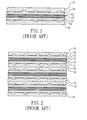
- the construction of the cell unit can be generally illustrated in Fig. 1. It comprises a proton exchange membrane (PEM) 10 at the middle, with the two sides thereof provided with a layer of catalyst 12, each of the two outsides of the catalyst 12 being further provided with a gas diffusion layer (GDL) 14.
- GDL gas diffusion layer
- An anode plate 16 and a cathode plate 18 are further provided at the outermost sides adjacent to the GDL 14.
- a cell unit is formed.
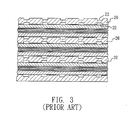
- a plurality of the above cell units are stacked and serially connected to provide sufficient power, as illustrated in Fig. 2. Therefore, two adjacent cell units can share a common polar plate 20, as illustrated in Fig. 3, which serves as the anode and the cathode for the two adjacent cell units respectively. Accordingly, such a polar plate 20 is usually referred to as a bipolar plate.
- the two sides of the bipolar plate 20 are provided with many grooves 22 for transporting the gases for reaction, such as hydrogen and air (to provide oxygen), as well as moving the reactants, such as water droplet or vapor, out of the bipolar plate 20.
- the conventional bipolar plate 20 is made of pure graphite or a graphite composite.
- the grooves on the graphite plate are usually formed by additional mechanical machining with complicated processes and at considerable cost.
- the graphite plate is made by the compression molding of graphite powder, it must be further coated with resin or other material to seal the voids thereof.
- graphite plate has a relatively low extensibility and thus cracks can be formed very easily.
- the crack on the bipolar plate may introduce leakage of gas and thereby impair the operation efficiency of the fuel cell. Furthermore, due to the requirement of adequate mechanical strength, the thickness of the graphite plate cannot be very thin, so the overall dimension occupied by the fuel cell cannot be further reduced.
- the major technical content of this invention is to make a corrugated bipolar plate from a metal sheet and form a plurality of parallel grooves which are complementary to each other on the two side surfaces of the bipolar plate. Because the bipolar plate of this invention is made of metal, the thickness thereof can be relatively thin and, the dimension and weight of the fuel cell can be significantly reduced. In addition, the manufacturing processes of the bipolar plate are simplified and the relative costs can be decreased.
- the bipolar plate 30 for a fuel cell and one of the preferred embodiment is illustrated in Figs. 4 to 7.
- the bipolar plate 30 comprises a central area 31 which is made of metal sheet, and a surrounding area 33 which is made of plastic or other appropriate material.
- the metallic central area 31 is first formed by punching, and the surrounding area 33 is formed by the injection of plastic molding.
- the central area 31 has a first side surface 32, and a second side surface 34 opposite to the first side surface 32.
- the metal sheet of the central area 31 is in a form of continuous corrugation and the corrugated grooves thereof are parallel with each other. As can be seen in the cross sectional view of Fig.
- the wave-like continuous corrugation is provided on the first side surface 32 and the second side surface 34 in a complementary manner to form a plurality of extended grooves 36 and 38 thereon respectively so that the cathode gas and the anode gas which need to be definitely separated can be individually directed into the grooves 36 and 38.
- the plastic surrounding area 33 of the bipolar plate 30 is further provided with a plurality of elongated holes 40, 42, 44 and 46 near the edge thereof, wherein two of the first holes 40 and 42 are connected with the two open ends of the parallel grooves 36 on the first side surface 32 for input/output of gas.
- the second side surface 34 of the bipolar plate 30 includes two second holes 44 and 46 as well as channels 48, as can be seen in Fig. 6, which are connected with the two open ends of the parallel grooves 38 on the second side surface 34.
- Fig. 8 schematically shows the actual application of this invention in the fuel cell.
- the central area 31 of the bipolar plate 30 of this invention is made of metal, it can be punched directly to form the corrugated shape. Therefore, most of the complicated processes for mechanical machining of the conventional bipolar plate can be eliminated and the manufacturing costs for the fuel cell will decrease correspondingly.
- metallic material can provide sufficient mechanical strength and thus, the thickness of the bipolar plate can be significantly reduced, for example, to the extent of approximately 0.01 cm. As a result, the amount of material for making the bipolar plate can be reduced, as well as the overall dimensions and weight of the fuel cell.
Landscapes
- Chemical & Material Sciences (AREA)
- Life Sciences & Earth Sciences (AREA)
- Engineering & Computer Science (AREA)
- Manufacturing & Machinery (AREA)
- Sustainable Development (AREA)
- Sustainable Energy (AREA)
- Chemical Kinetics & Catalysis (AREA)
- Electrochemistry (AREA)
- General Chemical & Material Sciences (AREA)
- Composite Materials (AREA)
- Fuel Cell (AREA)
Abstract
Description
- 10
- proton exchange membrane
- 12
- catalyst
- 14
- gas diffusion layer
- 16
- anode plate
- 18
- cathode plate
- 20
- bipolar plate
- 22
- grooves
- 30
- bipolar plate
- 31
- central area
- 32
- first side surface
- 33
- surrounding area
- 34
- second side surface
- 36
- grooves
- 38
- grooves
- 40
- first hole
- 42
- first hole
- 44
- second hole
- 46
- second hole
- 48
- channels
Claims (6)
- A bipolar plate for a fuel cell, comprises a central area and a surrounding area, wherein the central area has a first side surface and a second side surface opposed to the first side surface, the central area is configured to a corrugated form which defines a plurality of grooves that are formed on the first side surface and the second side surface, the grooves being substantially parallel with and complementary to each other.
- The bipolar plate according to Claim 1, wherein the central area is made of metal sheet.
- The bipolar plate according to Claim 2, wherein the corrugated form is obtained by punching the central area.
- The bipolar plate according to Claim 1, wherein the surrounding area is made of plastic material.
- The bipolar plate according to Claim 4, wherein the surrounding area further includes two first holes, and each of the parallel grooves formed on the first side surface further has two first openings connected respectively to each of the two first holes.
- The bipolar plate according to Claim 5, wherein the surrounding area further includes two second holes, and each of the parallel grooves formed on the second side surface further has two second openings connected to each of the two second holes, respectively.
Applications Claiming Priority (2)
| Application Number | Priority Date | Filing Date | Title |
|---|---|---|---|
| CN01124228 | 2001-08-16 | ||
| CNB011242280A CN1253957C (en) | 2001-08-16 | 2001-08-16 | bipolar plates for fuel cells |
Publications (2)
| Publication Number | Publication Date |
|---|---|
| EP1284512A2 true EP1284512A2 (en) | 2003-02-19 |
| EP1284512A3 EP1284512A3 (en) | 2006-11-08 |
Family
ID=4665596
Family Applications (1)
| Application Number | Title | Priority Date | Filing Date |
|---|---|---|---|
| EP02003459A Withdrawn EP1284512A3 (en) | 2001-08-16 | 2002-02-14 | Bipolar plate for a fuel cell |
Country Status (2)
| Country | Link |
|---|---|
| EP (1) | EP1284512A3 (en) |
| CN (1) | CN1253957C (en) |
Cited By (8)
| Publication number | Priority date | Publication date | Assignee | Title |
|---|---|---|---|---|
| WO2004021490A1 (en) * | 2002-08-28 | 2004-03-11 | Nuvera Fuel Cells Europe S.R.L | Membrane electrochemical generator |
| WO2006039540A1 (en) * | 2004-09-30 | 2006-04-13 | Proton Energy Systems, Inc. | Electrochemical cell bipolar plate |
| FR2887689A1 (en) * | 2005-06-28 | 2006-12-29 | Peugeot Citroen Automobiles Sa | BIPOLAR PLATE FOR FUEL CELL COMPRISING A CONNECTION CHANNEL |
| US7452623B2 (en) | 2004-11-11 | 2008-11-18 | Proton Energy Systems, Inc. | Electrochemical cell bipolar plate with sealing feature |
| US7491463B2 (en) | 2004-11-11 | 2009-02-17 | Proton Energy Systems, Inc. | Electrochemical cell bipolar plate with sealing feature |
| EP2492997A4 (en) * | 2010-03-30 | 2012-11-28 | Shanghai Everpower Technologies Ltd | BIPOLAR PLATE FOR FUEL CELL |
| CN104157895A (en) * | 2014-07-30 | 2014-11-19 | 清华大学 | Light-weight electric pile of polymer electrolyte membrane fuel battery and manufacturing method of light-weight electric pile |
| CN117448858A (en) * | 2023-10-18 | 2024-01-26 | 三一氢能有限公司 | Flow field structure and electrolytic tank |
Families Citing this family (5)
| Publication number | Priority date | Publication date | Assignee | Title |
|---|---|---|---|---|
| DE102004016318A1 (en) * | 2004-03-30 | 2005-10-20 | Reinz Dichtungs Gmbh | Bipolar plate and method for their preparation and a bipolar plate-containing electrochemical system |
| CN100375323C (en) * | 2004-09-14 | 2008-03-12 | 南亚电路板股份有限公司 | Method for improving contact between bipolar plate of flat plate type fuel cell and proton exchange membrane |
| TWI311830B (en) | 2006-06-28 | 2009-07-01 | Nan Ya Printed Circuit Board Corporatio | Fuel cell module utilizing wave-shaped flow board |
| CN101572318B (en) * | 2009-06-16 | 2010-12-08 | 新源动力股份有限公司 | Metal bipolar plate of proton exchange membrane fuel cell |
| CN108598522B (en) * | 2018-04-28 | 2023-01-31 | 上海治臻新能源股份有限公司 | Sealing structure for enhancing stability of fuel cell stack |
Family Cites Families (4)
| Publication number | Priority date | Publication date | Assignee | Title |
|---|---|---|---|---|
| JPS62229765A (en) * | 1986-03-31 | 1987-10-08 | Shin Kobe Electric Mach Co Ltd | Liquid fuel cell |
| JP3523742B2 (en) * | 1996-02-28 | 2004-04-26 | アイシン高丘株式会社 | Fuel cell and separator used therein |
| JP3660437B2 (en) * | 1996-08-30 | 2005-06-15 | アイシン高丘株式会社 | Fuel cell and fuel cell separator |
| JP3882394B2 (en) * | 1999-05-26 | 2007-02-14 | トヨタ自動車株式会社 | Multiple uneven plate forming equipment |
-
2001
- 2001-08-16 CN CNB011242280A patent/CN1253957C/en not_active Expired - Fee Related
-
2002
- 2002-02-14 EP EP02003459A patent/EP1284512A3/en not_active Withdrawn
Cited By (16)
| Publication number | Priority date | Publication date | Assignee | Title |
|---|---|---|---|---|
| US8062805B2 (en) | 2002-08-28 | 2011-11-22 | Nuvera Fuel Cells Europe S.R.L. | Membrane electrochemical generator |
| US8592094B2 (en) | 2002-08-28 | 2013-11-26 | Nuvera Fuel Cells Europe S.R.L. | Membrane electrochemical generator |
| WO2004021490A1 (en) * | 2002-08-28 | 2004-03-11 | Nuvera Fuel Cells Europe S.R.L | Membrane electrochemical generator |
| WO2006039540A1 (en) * | 2004-09-30 | 2006-04-13 | Proton Energy Systems, Inc. | Electrochemical cell bipolar plate |
| US7402358B2 (en) | 2004-09-30 | 2008-07-22 | Proton Energy Systems, Inc. | Electrochemical cell bipolar plate |
| US7452623B2 (en) | 2004-11-11 | 2008-11-18 | Proton Energy Systems, Inc. | Electrochemical cell bipolar plate with sealing feature |
| US7491463B2 (en) | 2004-11-11 | 2009-02-17 | Proton Energy Systems, Inc. | Electrochemical cell bipolar plate with sealing feature |
| US8105727B2 (en) | 2005-06-28 | 2012-01-31 | Peugeot Citroen Automobiles Sa | Bipolar plate for fuel cell comprising a connecting channel |
| WO2007003743A3 (en) * | 2005-06-28 | 2007-02-22 | Peugeot Citroen Automobiles Sa | Bipolar plate for fuel cell comprising a connecting channel |
| FR2887689A1 (en) * | 2005-06-28 | 2006-12-29 | Peugeot Citroen Automobiles Sa | BIPOLAR PLATE FOR FUEL CELL COMPRISING A CONNECTION CHANNEL |
| EP2492997A4 (en) * | 2010-03-30 | 2012-11-28 | Shanghai Everpower Technologies Ltd | BIPOLAR PLATE FOR FUEL CELL |
| US20130022896A1 (en) * | 2010-03-30 | 2013-01-24 | Yong Gao | Bipolar Plate for Fuel Cell |
| US9231257B2 (en) * | 2010-03-30 | 2016-01-05 | Yong Gao | Bipolar plate for fuel cell including non-electrochemical reaction region comprising a non-conductive material |
| CN104157895A (en) * | 2014-07-30 | 2014-11-19 | 清华大学 | Light-weight electric pile of polymer electrolyte membrane fuel battery and manufacturing method of light-weight electric pile |
| CN117448858A (en) * | 2023-10-18 | 2024-01-26 | 三一氢能有限公司 | Flow field structure and electrolytic tank |
| CN117448858B (en) * | 2023-10-18 | 2024-04-19 | 三一氢能有限公司 | Flow field structure and electrolytic tank |
Also Published As
| Publication number | Publication date |
|---|---|
| CN1253957C (en) | 2006-04-26 |
| EP1284512A3 (en) | 2006-11-08 |
| CN1405910A (en) | 2003-03-26 |
Similar Documents
| Publication | Publication Date | Title |
|---|---|---|
| US6677071B2 (en) | Bipolar plate for a fuel cell | |
| US5770327A (en) | Solid oxide fuel cell stack | |
| US5693201A (en) | Ultra-high efficiency turbine and fuel cell combination | |
| CN100423347C (en) | Fuel cell bipolar plates with conductive foam as coolant layer | |
| US7507489B2 (en) | Honeycomb type solid electrolytic fuel cell | |
| EP1284512A2 (en) | Bipolar plate for a fuel cell | |
| US7718295B2 (en) | Method for preparing an interconnect | |
| US9774055B2 (en) | Tubular solid oxide fuel cell assembly and fuel cell device incorporating same | |
| JPH01503096A (en) | Solid oxide fuel cell with a single core | |
| EP1422774A1 (en) | Fuel cell | |
| EP1445814A1 (en) | Fuel cell | |
| CA2450846A1 (en) | Integrated module of bipolar plate for fuel cell stack | |
| JP2003123825A (en) | Ultra high power density small solid oxide fuel cell | |
| US6623882B2 (en) | Bipolar plate for a fuel cell | |
| KR20100012139A (en) | Solid oxide fuel cell system integrated with reformer | |
| KR20160136409A (en) | Contacting method and arrangement for fuel cell or electrolyzer cell stack | |
| JP5401438B2 (en) | Flat type solid electrolyte fuel cell | |
| US8501363B2 (en) | Bipolar plate design with improved freeze start-up | |
| US8409763B2 (en) | Modified planar cell (MPC) and stack based on MPC | |
| KR100546016B1 (en) | Current collector for fuel cell, manufacturing method thereof and fuel cell having same | |
| EP1284511A2 (en) | Bipolar plate for a fuel cell | |
| CN113937327B (en) | Membrane electrode assemblies, fuel cell cells, fuel cells and vehicles | |
| CN1162368A (en) | Combination of ultra-efficient turbines and fuel cells | |
| US20040091764A1 (en) | Ultra-high efficiency turbine and fuel cell combination | |
| CN112993303B (en) | Corrugated flow field structure |
Legal Events
| Date | Code | Title | Description |
|---|---|---|---|
| PUAI | Public reference made under article 153(3) epc to a published international application that has entered the european phase |
Free format text: ORIGINAL CODE: 0009012 |
|
| AK | Designated contracting states |
Designated state(s): AT BE CH CY DE DK ES FI FR GB GR IE IT LI LU MC NL PT SE TR |
|
| AX | Request for extension of the european patent |
Extension state: AL LT LV MK RO SI |
|
| PUAL | Search report despatched |
Free format text: ORIGINAL CODE: 0009013 |
|
| AK | Designated contracting states |
Kind code of ref document: A3 Designated state(s): AT BE CH CY DE DK ES FI FR GB GR IE IT LI LU MC NL PT SE TR |
|
| AX | Request for extension of the european patent |
Extension state: AL LT LV MK RO SI |
|
| AKX | Designation fees paid | ||
| STAA | Information on the status of an ep patent application or granted ep patent |
Free format text: STATUS: THE APPLICATION IS DEEMED TO BE WITHDRAWN |
|
| 18D | Application deemed to be withdrawn |
Effective date: 20070509 |
|
| REG | Reference to a national code |
Ref country code: DE Ref legal event code: 8566 |