EP1283529A2 - Mn-Zn ferrite and coil component using the same - Google Patents
Mn-Zn ferrite and coil component using the same Download PDFInfo
- Publication number
- EP1283529A2 EP1283529A2 EP02017518A EP02017518A EP1283529A2 EP 1283529 A2 EP1283529 A2 EP 1283529A2 EP 02017518 A EP02017518 A EP 02017518A EP 02017518 A EP02017518 A EP 02017518A EP 1283529 A2 EP1283529 A2 EP 1283529A2
- Authority
- EP
- European Patent Office
- Prior art keywords
- mass
- ferrite
- mol
- khz
- mhz
- Prior art date
- Legal status (The legal status is an assumption and is not a legal conclusion. Google has not performed a legal analysis and makes no representation as to the accuracy of the status listed.)
- Granted
Links
Images

Classifications
-
- C—CHEMISTRY; METALLURGY
- C04—CEMENTS; CONCRETE; ARTIFICIAL STONE; CERAMICS; REFRACTORIES
- C04B—LIME, MAGNESIA; SLAG; CEMENTS; COMPOSITIONS THEREOF, e.g. MORTARS, CONCRETE OR LIKE BUILDING MATERIALS; ARTIFICIAL STONE; CERAMICS; REFRACTORIES; TREATMENT OF NATURAL STONE
- C04B35/00—Shaped ceramic products characterised by their composition; Ceramics compositions; Processing powders of inorganic compounds preparatory to the manufacturing of ceramic products
- C04B35/01—Shaped ceramic products characterised by their composition; Ceramics compositions; Processing powders of inorganic compounds preparatory to the manufacturing of ceramic products based on oxide ceramics
- C04B35/26—Shaped ceramic products characterised by their composition; Ceramics compositions; Processing powders of inorganic compounds preparatory to the manufacturing of ceramic products based on oxide ceramics based on ferrites
- C04B35/2658—Other ferrites containing manganese or zinc, e.g. Mn-Zn ferrites
-
- H—ELECTRICITY
- H01—ELECTRIC ELEMENTS
- H01F—MAGNETS; INDUCTANCES; TRANSFORMERS; SELECTION OF MATERIALS FOR THEIR MAGNETIC PROPERTIES
- H01F1/00—Magnets or magnetic bodies characterised by the magnetic materials therefor; Selection of materials for their magnetic properties
- H01F1/01—Magnets or magnetic bodies characterised by the magnetic materials therefor; Selection of materials for their magnetic properties of inorganic materials
- H01F1/03—Magnets or magnetic bodies characterised by the magnetic materials therefor; Selection of materials for their magnetic properties of inorganic materials characterised by their coercivity
- H01F1/12—Magnets or magnetic bodies characterised by the magnetic materials therefor; Selection of materials for their magnetic properties of inorganic materials characterised by their coercivity of soft-magnetic materials
- H01F1/34—Magnets or magnetic bodies characterised by the magnetic materials therefor; Selection of materials for their magnetic properties of inorganic materials characterised by their coercivity of soft-magnetic materials non-metallic substances, e.g. ferrites
- H01F1/342—Oxides
- H01F1/344—Ferrites, e.g. having a cubic spinel structure (X2+O)(Y23+O3), e.g. magnetite Fe3O4
-
- H—ELECTRICITY
- H01—ELECTRIC ELEMENTS
- H01F—MAGNETS; INDUCTANCES; TRANSFORMERS; SELECTION OF MATERIALS FOR THEIR MAGNETIC PROPERTIES
- H01F41/00—Apparatus or processes specially adapted for manufacturing or assembling magnets, inductances or transformers; Apparatus or processes specially adapted for manufacturing materials characterised by their magnetic properties
- H01F41/02—Apparatus or processes specially adapted for manufacturing or assembling magnets, inductances or transformers; Apparatus or processes specially adapted for manufacturing materials characterised by their magnetic properties for manufacturing cores, coils, or magnets
- H01F41/04—Apparatus or processes specially adapted for manufacturing or assembling magnets, inductances or transformers; Apparatus or processes specially adapted for manufacturing materials characterised by their magnetic properties for manufacturing cores, coils, or magnets for manufacturing coils
- H01F41/041—Printed circuit coils
- H01F41/046—Printed circuit coils structurally combined with ferromagnetic material
-
- C—CHEMISTRY; METALLURGY
- C04—CEMENTS; CONCRETE; ARTIFICIAL STONE; CERAMICS; REFRACTORIES
- C04B—LIME, MAGNESIA; SLAG; CEMENTS; COMPOSITIONS THEREOF, e.g. MORTARS, CONCRETE OR LIKE BUILDING MATERIALS; ARTIFICIAL STONE; CERAMICS; REFRACTORIES; TREATMENT OF NATURAL STONE
- C04B2235/00—Aspects relating to ceramic starting mixtures or sintered ceramic products
- C04B2235/02—Composition of constituents of the starting material or of secondary phases of the final product
- C04B2235/30—Constituents and secondary phases not being of a fibrous nature
- C04B2235/32—Metal oxides, mixed metal oxides, or oxide-forming salts thereof, e.g. carbonates, nitrates, (oxy)hydroxides, chlorides
- C04B2235/3205—Alkaline earth oxides or oxide forming salts thereof, e.g. beryllium oxide
- C04B2235/3206—Magnesium oxides or oxide-forming salts thereof
-
- C—CHEMISTRY; METALLURGY
- C04—CEMENTS; CONCRETE; ARTIFICIAL STONE; CERAMICS; REFRACTORIES
- C04B—LIME, MAGNESIA; SLAG; CEMENTS; COMPOSITIONS THEREOF, e.g. MORTARS, CONCRETE OR LIKE BUILDING MATERIALS; ARTIFICIAL STONE; CERAMICS; REFRACTORIES; TREATMENT OF NATURAL STONE
- C04B2235/00—Aspects relating to ceramic starting mixtures or sintered ceramic products
- C04B2235/02—Composition of constituents of the starting material or of secondary phases of the final product
- C04B2235/30—Constituents and secondary phases not being of a fibrous nature
- C04B2235/32—Metal oxides, mixed metal oxides, or oxide-forming salts thereof, e.g. carbonates, nitrates, (oxy)hydroxides, chlorides
- C04B2235/3217—Aluminum oxide or oxide forming salts thereof, e.g. bauxite, alpha-alumina
-
- C—CHEMISTRY; METALLURGY
- C04—CEMENTS; CONCRETE; ARTIFICIAL STONE; CERAMICS; REFRACTORIES
- C04B—LIME, MAGNESIA; SLAG; CEMENTS; COMPOSITIONS THEREOF, e.g. MORTARS, CONCRETE OR LIKE BUILDING MATERIALS; ARTIFICIAL STONE; CERAMICS; REFRACTORIES; TREATMENT OF NATURAL STONE
- C04B2235/00—Aspects relating to ceramic starting mixtures or sintered ceramic products
- C04B2235/02—Composition of constituents of the starting material or of secondary phases of the final product
- C04B2235/30—Constituents and secondary phases not being of a fibrous nature
- C04B2235/32—Metal oxides, mixed metal oxides, or oxide-forming salts thereof, e.g. carbonates, nitrates, (oxy)hydroxides, chlorides
- C04B2235/3231—Refractory metal oxides, their mixed metal oxides, or oxide-forming salts thereof
- C04B2235/3232—Titanium oxides or titanates, e.g. rutile or anatase
-
- C—CHEMISTRY; METALLURGY
- C04—CEMENTS; CONCRETE; ARTIFICIAL STONE; CERAMICS; REFRACTORIES
- C04B—LIME, MAGNESIA; SLAG; CEMENTS; COMPOSITIONS THEREOF, e.g. MORTARS, CONCRETE OR LIKE BUILDING MATERIALS; ARTIFICIAL STONE; CERAMICS; REFRACTORIES; TREATMENT OF NATURAL STONE
- C04B2235/00—Aspects relating to ceramic starting mixtures or sintered ceramic products
- C04B2235/02—Composition of constituents of the starting material or of secondary phases of the final product
- C04B2235/30—Constituents and secondary phases not being of a fibrous nature
- C04B2235/32—Metal oxides, mixed metal oxides, or oxide-forming salts thereof, e.g. carbonates, nitrates, (oxy)hydroxides, chlorides
- C04B2235/3231—Refractory metal oxides, their mixed metal oxides, or oxide-forming salts thereof
- C04B2235/3241—Chromium oxides, chromates, or oxide-forming salts thereof
-
- C—CHEMISTRY; METALLURGY
- C04—CEMENTS; CONCRETE; ARTIFICIAL STONE; CERAMICS; REFRACTORIES
- C04B—LIME, MAGNESIA; SLAG; CEMENTS; COMPOSITIONS THEREOF, e.g. MORTARS, CONCRETE OR LIKE BUILDING MATERIALS; ARTIFICIAL STONE; CERAMICS; REFRACTORIES; TREATMENT OF NATURAL STONE
- C04B2235/00—Aspects relating to ceramic starting mixtures or sintered ceramic products
- C04B2235/02—Composition of constituents of the starting material or of secondary phases of the final product
- C04B2235/30—Constituents and secondary phases not being of a fibrous nature
- C04B2235/32—Metal oxides, mixed metal oxides, or oxide-forming salts thereof, e.g. carbonates, nitrates, (oxy)hydroxides, chlorides
- C04B2235/3262—Manganese oxides, manganates, rhenium oxides or oxide-forming salts thereof, e.g. MnO
-
- C—CHEMISTRY; METALLURGY
- C04—CEMENTS; CONCRETE; ARTIFICIAL STONE; CERAMICS; REFRACTORIES
- C04B—LIME, MAGNESIA; SLAG; CEMENTS; COMPOSITIONS THEREOF, e.g. MORTARS, CONCRETE OR LIKE BUILDING MATERIALS; ARTIFICIAL STONE; CERAMICS; REFRACTORIES; TREATMENT OF NATURAL STONE
- C04B2235/00—Aspects relating to ceramic starting mixtures or sintered ceramic products
- C04B2235/02—Composition of constituents of the starting material or of secondary phases of the final product
- C04B2235/30—Constituents and secondary phases not being of a fibrous nature
- C04B2235/32—Metal oxides, mixed metal oxides, or oxide-forming salts thereof, e.g. carbonates, nitrates, (oxy)hydroxides, chlorides
- C04B2235/327—Iron group oxides, their mixed metal oxides, or oxide-forming salts thereof
- C04B2235/3275—Cobalt oxides, cobaltates or cobaltites or oxide forming salts thereof, e.g. bismuth cobaltate, zinc cobaltite
-
- C—CHEMISTRY; METALLURGY
- C04—CEMENTS; CONCRETE; ARTIFICIAL STONE; CERAMICS; REFRACTORIES
- C04B—LIME, MAGNESIA; SLAG; CEMENTS; COMPOSITIONS THEREOF, e.g. MORTARS, CONCRETE OR LIKE BUILDING MATERIALS; ARTIFICIAL STONE; CERAMICS; REFRACTORIES; TREATMENT OF NATURAL STONE
- C04B2235/00—Aspects relating to ceramic starting mixtures or sintered ceramic products
- C04B2235/02—Composition of constituents of the starting material or of secondary phases of the final product
- C04B2235/30—Constituents and secondary phases not being of a fibrous nature
- C04B2235/32—Metal oxides, mixed metal oxides, or oxide-forming salts thereof, e.g. carbonates, nitrates, (oxy)hydroxides, chlorides
- C04B2235/327—Iron group oxides, their mixed metal oxides, or oxide-forming salts thereof
- C04B2235/3279—Nickel oxides, nickalates, or oxide-forming salts thereof
-
- C—CHEMISTRY; METALLURGY
- C04—CEMENTS; CONCRETE; ARTIFICIAL STONE; CERAMICS; REFRACTORIES
- C04B—LIME, MAGNESIA; SLAG; CEMENTS; COMPOSITIONS THEREOF, e.g. MORTARS, CONCRETE OR LIKE BUILDING MATERIALS; ARTIFICIAL STONE; CERAMICS; REFRACTORIES; TREATMENT OF NATURAL STONE
- C04B2235/00—Aspects relating to ceramic starting mixtures or sintered ceramic products
- C04B2235/02—Composition of constituents of the starting material or of secondary phases of the final product
- C04B2235/30—Constituents and secondary phases not being of a fibrous nature
- C04B2235/32—Metal oxides, mixed metal oxides, or oxide-forming salts thereof, e.g. carbonates, nitrates, (oxy)hydroxides, chlorides
- C04B2235/3281—Copper oxides, cuprates or oxide-forming salts thereof, e.g. CuO or Cu2O
-
- C—CHEMISTRY; METALLURGY
- C04—CEMENTS; CONCRETE; ARTIFICIAL STONE; CERAMICS; REFRACTORIES
- C04B—LIME, MAGNESIA; SLAG; CEMENTS; COMPOSITIONS THEREOF, e.g. MORTARS, CONCRETE OR LIKE BUILDING MATERIALS; ARTIFICIAL STONE; CERAMICS; REFRACTORIES; TREATMENT OF NATURAL STONE
- C04B2235/00—Aspects relating to ceramic starting mixtures or sintered ceramic products
- C04B2235/02—Composition of constituents of the starting material or of secondary phases of the final product
- C04B2235/30—Constituents and secondary phases not being of a fibrous nature
- C04B2235/32—Metal oxides, mixed metal oxides, or oxide-forming salts thereof, e.g. carbonates, nitrates, (oxy)hydroxides, chlorides
- C04B2235/3284—Zinc oxides, zincates, cadmium oxides, cadmiates, mercury oxides, mercurates or oxide forming salts thereof
-
- C—CHEMISTRY; METALLURGY
- C04—CEMENTS; CONCRETE; ARTIFICIAL STONE; CERAMICS; REFRACTORIES
- C04B—LIME, MAGNESIA; SLAG; CEMENTS; COMPOSITIONS THEREOF, e.g. MORTARS, CONCRETE OR LIKE BUILDING MATERIALS; ARTIFICIAL STONE; CERAMICS; REFRACTORIES; TREATMENT OF NATURAL STONE
- C04B2235/00—Aspects relating to ceramic starting mixtures or sintered ceramic products
- C04B2235/02—Composition of constituents of the starting material or of secondary phases of the final product
- C04B2235/30—Constituents and secondary phases not being of a fibrous nature
- C04B2235/32—Metal oxides, mixed metal oxides, or oxide-forming salts thereof, e.g. carbonates, nitrates, (oxy)hydroxides, chlorides
- C04B2235/3293—Tin oxides, stannates or oxide forming salts thereof, e.g. indium tin oxide [ITO]
-
- C—CHEMISTRY; METALLURGY
- C04—CEMENTS; CONCRETE; ARTIFICIAL STONE; CERAMICS; REFRACTORIES
- C04B—LIME, MAGNESIA; SLAG; CEMENTS; COMPOSITIONS THEREOF, e.g. MORTARS, CONCRETE OR LIKE BUILDING MATERIALS; ARTIFICIAL STONE; CERAMICS; REFRACTORIES; TREATMENT OF NATURAL STONE
- C04B2235/00—Aspects relating to ceramic starting mixtures or sintered ceramic products
- C04B2235/60—Aspects relating to the preparation, properties or mechanical treatment of green bodies or pre-forms
- C04B2235/604—Pressing at temperatures other than sintering temperatures
-
- C—CHEMISTRY; METALLURGY
- C04—CEMENTS; CONCRETE; ARTIFICIAL STONE; CERAMICS; REFRACTORIES
- C04B—LIME, MAGNESIA; SLAG; CEMENTS; COMPOSITIONS THEREOF, e.g. MORTARS, CONCRETE OR LIKE BUILDING MATERIALS; ARTIFICIAL STONE; CERAMICS; REFRACTORIES; TREATMENT OF NATURAL STONE
- C04B2235/00—Aspects relating to ceramic starting mixtures or sintered ceramic products
- C04B2235/65—Aspects relating to heat treatments of ceramic bodies such as green ceramics or pre-sintered ceramics, e.g. burning, sintering or melting processes
- C04B2235/658—Atmosphere during thermal treatment
- C04B2235/6583—Oxygen containing atmosphere, e.g. with changing oxygen pressures
- C04B2235/6584—Oxygen containing atmosphere, e.g. with changing oxygen pressures at an oxygen percentage below that of air
-
- H—ELECTRICITY
- H01—ELECTRIC ELEMENTS
- H01F—MAGNETS; INDUCTANCES; TRANSFORMERS; SELECTION OF MATERIALS FOR THEIR MAGNETIC PROPERTIES
- H01F17/00—Fixed inductances of the signal type
- H01F17/04—Fixed inductances of the signal type with magnetic core
Definitions
- the present invention relates to Mn-Zn ferrite and a coil component using Mn-Zn ferrite as a magnetic core, and in particular to Mn-Zn ferrite and a coil component suitable for switching power supplies, noise filters, choke coils and so forth.
- Magnetic core materials for use in noise filters such as line filters for EMI countermeasures are desired to have high impedance in a frequency band where noises should be removed.
- Impedance in a high frequency band can be increased through the phenomenon of resonance between the stray capacitance (C) of a coil and the inductance (L) of a core. It is known that impedance is maximum at the resonance frequency (1/ ⁇ LC). It is also known that impedance at a frequency lower than the resonance frequency is proportional to the initial permeability of a core, and impedance at a frequency higher than the resonance frequency is inversely proportional to the stray capacitance of a coil.
- Mn-Zn ferrite that has high permeability in a wide frequency band has been studied intensively and disclosed in, for example, Japanese Patent Laid-open Nos. 2000-353613 and Hei 9-180925.
- the initial permeability of Mn-Zn ferrite is closely related to a real part ⁇ ' of complex relative permittivity, and when ⁇ ' has a large value, the initial permeability is relaxed in a high frequency band and cannot be maintained through up to a high frequency band. As a result, it is difficult to obtain excellent impedance properties in a high frequency band.
- Japanese Patent Laid-open No. 2000-353613 does not describe dielectric properties or impedance properties
- Japanese Patent Laid-open No. Hei 9-180925 refers to permittivity (relative permittivity) ⁇ , and describes the relative permittivity ⁇ as reading 50,000 to 1,000,000 at 1 KHz, which is very high.
- ⁇ ' may be estimated to range from 30,000 to 60,000 at the lowest, which is a very high value.
- the real part ⁇ ' of complex relative permittivity with such a high value at 1 kHz not only can never be 50 or less at 1 MHz, but also causes relaxation of initial permeability in the vicinity of 500 kHz making it impossible to maintain the initial permeability through up to a high frequency band of 1 MHz or more.
- a coil component comprising a magnetic core of conventional Mn-Zn ferrite having a high real part ⁇ ' of complex relative permittivity scarcely reduces stray capacitance despite whatever optimizations of its winding conditions.
- the stray capacitance of a coil component is roughly classified into capacitance between coils and capacitance between a coil and a core. The former is determined based on the winding conditions of a coil and the latter is determined based on the material properties of a magnetic core, both increasing as the real part ⁇ ' of complex relative permittivity increases.
- the capacitance between a coil and a core is. extremely high as compared with the capacitance between coils.
- the optimization of winding conditions has been hardly effective in reducing the stray capacitance of the component.
- the present invention has been made in consideration of the above-mentioned conventional problems, and an object of the present invention is therefore to provide Mn-Zn ferrite that maintains initial permeability over a wide frequency band, has small stray capacitance when provided with a coil, and has excellent impedance properties over a wide frequency band, and also a coil component made thereof.
- Mn-Zn ferrite In Mn-Zn ferrite according to the present invention, basic components include 44.0 to 50.0 mol% (50.0 mol% excluded) Fe 2 O 3 , 4.0 to 26.5 mol% ZnO and the remainder MnO, and its real part ⁇ ' of complex relative permittivity is 20,000 or less at 1 kHz and 50 or less at 1 MHz, respectively.
- the Mn-Zn ferrite of the present invention may further contain as additive at least one of 0.01 to 4.0 mass% SnO 2 and 0.01 to 3.0 mass% TiO 2 (provided that an upper limit is 4% in total when both thereof are contained).
- the Mn-Zn ferrite of the present invention may also contain as additive at least one of 0.01 to 2.0 mass% CuO, 0.01 to 2.0 mass% NiO, 0.01 to 2.0 mass% CoO, 0.01 to 2.0 mass% MgO, 0.01 to 2.0 mass% Al 2 O 3 and 0.01 to 2.0 mass% Cr 2 O 3 (provided that an upper limit in total is 2 mass% when two or more thereof are contained).
- a coil component according to the present invention uses the above-described Mn-Zn ferrite as a magnetic core.
- the Mn-Zn ferrite and the coil component according to the present invention can provide good impedance properties over a wide frequency band and effectively convert noises at a practically critical frequency band of 10 to 100 MHz into thermal energy and absorb them. Thus, they prove to be very useful.
- Fig. 1 is a graph illustrating frequency properties of impedance of the present invention samples and comparative samples.
- Mn-Zn ferrite according to the present invention has basic component composition consisting of 44.0 to 50.0 mol% (50.0 mol% excluded) Fe 2 O 3 , 4.0 to 26.5 mol% ZnO and the remainder MnO as described above.
- the constant b is set to 6 to 21 is that a value greater than 21 makes the atmosphere substantially identical with the atmospheric air, which dies not justify prescription of oxygen concentration, and that a value smaller than 6 makes excessive FeO produced making electrical resistivity too low resulting in deterioration in initial permeability in a high frequency band though the constant b is desired to be as small as possible in order to increase the initial permeability in a low frequency band.
- the content of iron component in the form of FeO is desirably less than 1 mol%.
- Fe 2 O 3 content of less than 44.0 mol% considerably decreases the initial permeability and saturation magnetic flux density.
- Fe 2 O 3 content exceeding 50.0 mol% makes the real part ⁇ ' of complex relative permittivity larger than 20,000 at 1 kHz and larger than 50 at 1 MHz.
- the Fe 2 O 3 content is set to 44.0 to 50.0 mol% (50.0 mol% excluded), whereby the Mn-Zn ferrite sintered in an atmosphere containing a suitable amount of oxygen or in an atmosphere with oxygen concentration calculated according to the above expression (1) using any one of values ranging from 6 to 21 as the constant b has a real part ⁇ ' of complex relative permittivity of 20,000 or less at 1 kHz and 50 or less at 1 MHz, respectively.
- the initial permeability can be maintained over a wide frequency band and distribution capacity with a coil provided is decreased particularly in a high frequency band, thereby providing excellent impedance properties over a wide frequency band.
- the magnetic properties such as initial permeability and saturation magnetic flux density may be varied not so much as to cause a practical problem, as far as the property of the real part ⁇ ' of complex relative permittivity mentioned above is satisfied.
- ZnO content of less than 4.0 mol% decreases the initial permeability considerably while ZnO exceeding 26.5 mol% decreases the saturation magnetic flux density considerably. Therefore, the ZnO content must be set to range from 4.0 to 26.5 mol%.
- Impedance characteristic of a ferrite core can be separated into a reactance component and a resistance component.
- the reactance component is dominant in the low frequency band and converts noises into magnetic energy to thereby remove them, while the resistance component is dominant in the high frequency band and converts noises into thermal energy to thereby remove them.
- a frequency (to be referred to as f k ), at which the both components join with each other, constitutes a border between the both components.
- the more the resistance component exists the better it is for removing noises.
- the f k is preferred to be lower. Addition of SnO 2 and TiO 2 shifts the frequency (f k ) toward a lower frequency without changing the impedance properties.
- At least one of SnO 2 and TiO 2 is added as additive to the above-mentioned basic component composition based on the above finding.
- the amount of the additives is too small, the above-mentioned effect is small, whereas excessive addition thereof increases the real part ⁇ ' of complex relative permittivity at 1 kHz.
- the SnO 2 content be set to 0.01 to 4.0 mass% and TiO 2 content be set to 0.01 to 3.0 mass%.
- the SnO 2 and TiO 2 may originally be tin oxide and titanium oxide, respectively, or may be from compounds that, when sintered, are converted into tin oxide and titanium oxide, respectively.
- any of the oxides or the compounds is used alone by itself, its addition amount is set to the above-mentioned range in terms of mass ratio with the amount converted into SnO 2 or TiO 2 .
- the addition amount in total may desirably be set to 0.02 to 4.0 mass% in terms of mass ratio with the amounts converted into SnO 2 and TiO 2 .
- the Mn-Zn ferrite according to the present invention may further contain as additive at least one of CuO, NiO, CoO, MgO, Al 2 O 3 and Cr 2 O 3 each in an amount of 0.01 to 2.0 mass%.
- the CuO decreases the real part ⁇ ' of complex relative permittivity at 1 kHz and 1 MHz and therefore is effective in improving the impedance properties in a frequency range above the resonance frequency.
- the effectiveness is small with too small amount of addition thereof, while excessive addition thereof causes the relaxation of initial permeability thereby making it difficult for resonance to take place. Therefore, the amount of addition is desirably set to the above-mentioned range.
- the CuO may originally be copper oxide or may be from compound that, when sintered, is converted into copper oxide. When the copper oxide or the compound is used alone by itself, its addition amount is set to the above-mentioned range in terms of mass ratio with the amount converted into CuO.
- NiO decreases the real part ⁇ ' of complex relative permittivity at 1 kHz and 1 MHz, and therefore is effective in improving impedance properties in a frequency range above the resonance frequency.
- the effectiveness is small with too small amount of addition thereof, while excessive addition thereof causes the relaxation of initial permeability thereby making it difficult for resonance to take place. Therefore, the amount of addition is desirably set to the above-mentioned range.
- the NiO may originally be nickel oxide or may be from compound that, when sintered, is converted into nickel oxide. When the nickel oxide or the compound is used alone by itself, its addition amount is set to the above-mentioned range in terms of mass ratio with the amount converted into NiO.
- CoO decreases the real part ⁇ ' of complex relative permittivity at 1 kHz and 1 MHz, and therefore is effective in improving impedance properties in a frequency range above the resonance frequency.
- Co 2+ when dissolved at B site of spinel, has positive crystal magnetic anisotropy, and nullifies the overall crystal magnetic anisotropy thus increasing the initial permeability, and improving impedance properties in a frequency range below the resonance frequency.
- the effectiveness is small with too small amount of addition thereof, while excessive addition thereof considerably increases the positive crystal magnetic anisotropy and magnetostriction to cause deterioration of magnetic properties. Therefore, the amount of addition is desirably set to the above-mentioned range.
- the CoO may originally be cobalt oxide or may be from compound that, when sintered, is converted into cobalt oxide.
- the cobalt oxide or the compound used alone by itself its addition amount is set to the above-mentioned range in terms of mass ratio with the amount converted into CoO.
- MgO decreases the real part ⁇ ' of complex relative permittivity at 1 kHz and 1 MHz, and therefore is effective in improving impedance properties in a frequency range above the resonance frequency.
- the effectiveness is small with too small amount of addition thereof, while excessive addition thereof causes the relaxation of initial permeability thereby making it difficult for resonance to take place. Therefore, the amount of addition is desirably set to the above-mentioned range.
- MgO may originally be magnesium oxide or may be from compound that, when sintered, is converted into magnesium oxide. When the magnesium oxide or the compound is used alone by itself, its addition amount is set to the above-mentioned range in terms of mass ratio with the amount converted into MgO.
- Al 2 O 3 decreases the real part ⁇ ' of complex relative permittivity at 1 kHz and 1 MHz, and therefore is effective in improving impedance properties in a frequency range above the resonance frequency.
- the effectiveness is small with too small amount of addition thereof, while excessive addition thereof causes deterioration of sintering property. Therefore, the amount of addition is desirably set to the above-mentioned range.
- Al 2 O 3 may originally be aluminum oxide or may be from compound that, when sintered, is converted into aluminum oxide. When the aluminum oxide or the compound is used alone by itself, its addition amount is set to the above-mentioned range in terms of mass ratio with the amount converted into Al 2 O 3 .
- Cr 2 O 3 greatly decreases the real part ⁇ ' of complex relative permittivity at 1 kHz and 1 MHz, and therefore is effective in improving impedance properties in a frequency range above the resonance frequency.
- Cr 3+ when solid-dissolved at B site of spinel, has positive crystal magnetic anisotropy, though weak, and nullifies the overall crystal magnetic anisotropy thus increasing the initial permeability and improving impedance properties in a frequency range below the resonance frequency.
- the effectiveness is small with too small amount of addition thereof, while excessive addition thereof causes deterioration of sintering property. Therefore, the amount of addition is desirably set to the above-mentioned range.
- Cr 2 O 3 may originally be chromium oxide or may be from compound that, when sintered, is converted into chromium oxide.
- the chromium oxide or the compound is used alone by itself, its addition amount is set to the above-mentioned range in terms of mass ratio with the amount converted into Cr 2 O 3 .
- the total addition amount of the oxides may desirably be set to 0.06 to 2.0 mass% in terms of mass ratio with the amounts converted into respective oxides.
- raw material powders of Fe 2 O 3 , ZnO and MnO which are the main components, are previously weighed for a prescribed ratio and mixed to obtain a mixed powder, and then this mixed powder is calcined and finely milled.
- Temperature for calcination differs slightly depending on a target composition and should be appropriately selected from a range of 800° to 1,000°C.
- a general-purpose ball mill can be used to finely mill the calcined powder.
- Mn-Zn ferrite thus obtained and a coil component having a magnetic core made thereof have excellent impedance properties over a wide frequency band, and can effectively convert noises in a practically critical frequency range of 10 to 100 MHz into thermal energy and absorb them.
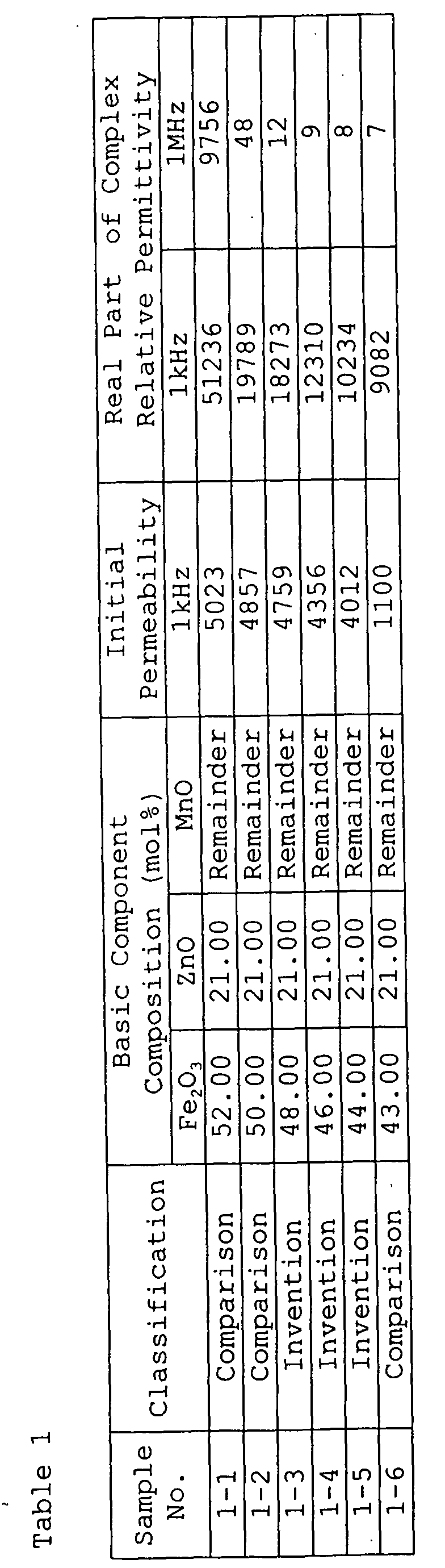
- Raw material powders of Fe 2 O 3 , ZnO and MnO were weighed for a composition of 43.0 to 52.0 mol% Fe 2 O 3 , 21.0 mol% ZnO and the remainder MnO, mixed with a ball mill, calcined in the air at 850°C for 2 hours and milled with a ball mill for 20 hours, and a fine milled powder was obtained.
- This fine milled powder had its components adjusted so as to obtain the above-mentioned composition, and mixed with a ball mill for 1 hour to obtain a mixture.
- this mixture was granulated with addition of polyvinyl alcohol, and pressed at a pressure of 80 MPa into toroidal cores (green compacts) each of which, after sintering, has an outer diameter of 25 mm, an inner diameter of 15 mm and a height (thickness) of 5 mm.
- green compacts were placed in a sintering furnace where an atmosphere was adjusted by flowing nitrogen so as to have a relative partial pressure of oxygen to be obtained by setting the constant b of the expression (1) to 8, were sintered at 1,300°C for 3 hours and then cooled therein, and samples 1-1 to 1-6 shown in Table 1 were obtained.
- a comparison sample 1-1 containing 52.0 mol% Fe 2 O 3 shows a high real part ⁇ ' of complex relative permittivity of more than 50,000 at 1 kHz and more than 9,000 at 1 MHz, respectively, while invention samples 1-3, 1-4 and 1-5 each containing less than 50.0 mol% Fe 2 O 3 have a low real part ⁇ ' of complex relative permittivity of 20,000 or less at 1 kHz and 50 or less at 1 MHz, respectively.
- a comparison sample 1-6 containing a smaller amount of Fe 2 O 3 , i.e., 43.0 mol% Fe 2 O 3 shows an initial permeability of 1100 at 1 kHz
- the invention samples 1-3, 1-4 and 1-5 have a high initial permeability of 4,000 or more at 1 kHz.
- the invention samples maintain higher impedance over a broad frequency band ranging from 10 kHz to 100 MHz than the comparison samples.
- Raw material powders of Fe 2 O 3 , ZnO and MnO as main components were weighed for a composition of 48.0 mol% Fe 2 O 3 , 21.0 mol% ZnO and the remainder MnO, and raw material powder of SnO 2 or TiO 2 was weighed in an amount of 0.05 to 5.0 mass% of the main components. All the raw material powders were mixed with a ball mill, calcined in the air at 850°C for 2 hours, and milled with a ball mill for 20 hours, thus obtaining a fine milled powder. This fine milled powder has its components adjusted so as to obtain the above-mentioned composition, and was mixed with a ball mill for 1 hour to obtain a mixture.
- this mixture was granulated with addition of polyvinyl alcohol, and pressed at a pressure of 80 MPa into toroidal cores (green compacts) each of which, after sintering, has an outer diameter of 25 mm, an inner diameter of 15 mm and a height (thickness) of 5 mm.
- green compacts were placed in a sintering furnace where an atmosphere was adjusted by flowing nitrogen so as to have a relative partial pressure of oxygen to be obtained by setting the constant b of the expression (1) to 8, were sintered at 1,300°C for 3 hours and then cooled therein, and samples 2-1 to 2-8 shown in Table 2 were obtained.
- invention samples 2-1, 2-4, 2-5, 2-6 and 2-7 each containing a prescribed amount of SnO 2 and/or TiO 2 have a lower frequency f k than the invention sample 1-3 containing no SnO 2 or TiO 2 , but has substantially same impedance at 10 kHz and 100 MHz.
- comparison samples 2-2, 2-6 and 2-8 each containing a larger amount of SnO 2 and/or TiO 2 than prescribed show not only a lower initial permeability at 1 kHz but also a higher real part ⁇ ' of complex relative permittivity at 1 kHz and 1 MHz than the invention samples, resulting in significant reduction of impedance at 10 kHz and 100 MHz.
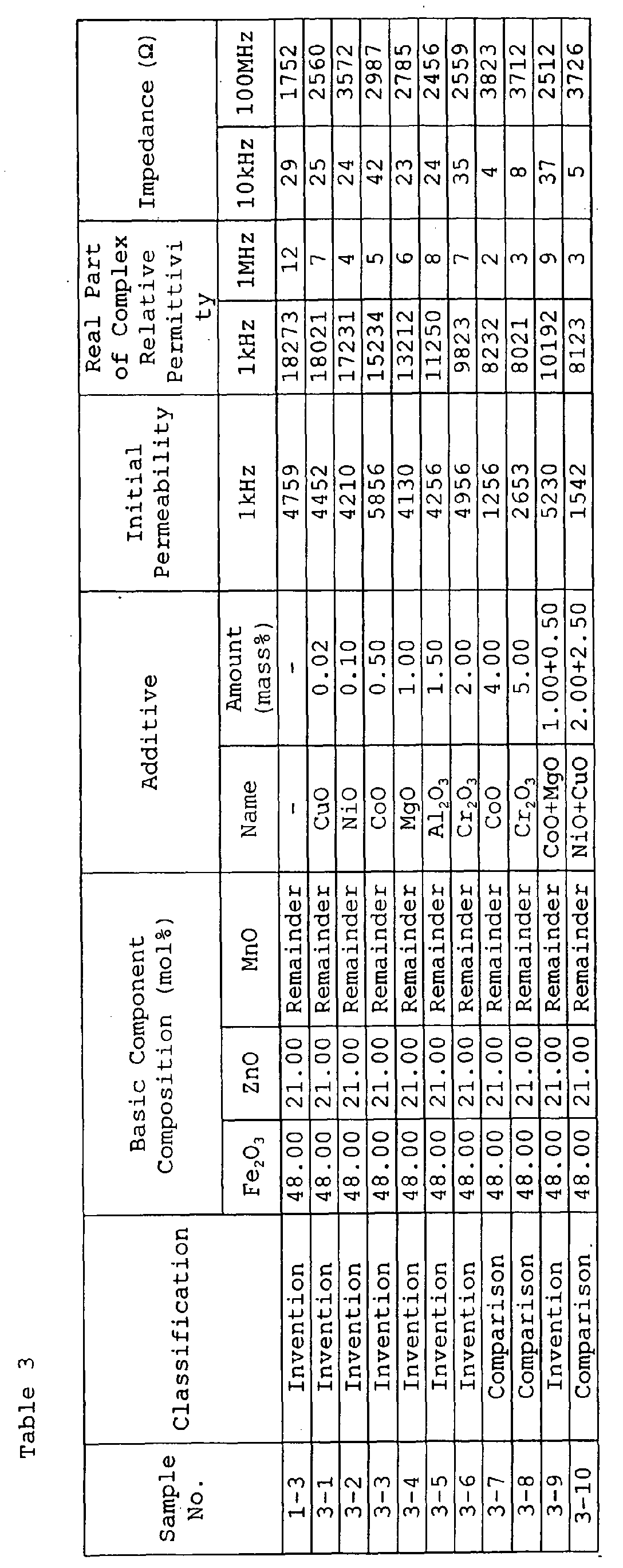
- Raw material powders of Fe 2 O 3 , ZnO and MnO as main components were weighed for a composition of 48.0 mol% Fe 2 O 3 , 21.0 mol% ZnO and the remainder MnO, and one or two of raw material powders of CuO, NiO, CoO, MgO, Al 2 O 3 and Cr 2 O 3 as additive were weighed in an amount of 0.02 to 5.0 mass% of the main components. All the raw material powders were mixed with a ball mill, calcined in the air at 850°C for 2 hours, and milled with a ball mill for 20 hours, thus obtaining a fine milled powder.
- This fine milled powder had its components adjusted so as to obtain the above-mentioned composition, and was mixed with a ball mill for 1 hour to obtain a mixture. Then, this mixture was granulated with addition of polyvinyl alcohol, and pressed at a pressure of 80 MPa into toroidal cores (green compacts) each of which, after sintering, has an outer diameter of 25 mm, an inner diameter of 15 mm and a height (thickness) of 5 mm.
- the green compacts were placed in a sintering furnace where an atmosphere was adjusted by flowing nitrogen so as to have a relative partial pressure of oxygen to be obtained by setting the constant b of the expression (1) to 8, were sintered at 1,300°C for 3 hours and then cooled therein, and samples 3-1 to 3-10 shown in Table 3 were obtained.
- Table 3 also includes the invention sample 1-3 of Example 1.
- invention samples 3-3 and 3-6 containing a prescribed amount of CoO and Cr 2 O 3 show not only a lower real part ⁇ ' of complex relative permittivity but also a higher initial permeability at 1 kHz than the invention sample 1-3 containing no SnO 2 or TiO 2 , and, as a result, shows an increased impedance at 10 kHz and 100 MHz.
- comparison samples 3-7, 3-8 and 3-10 each containing a larger amount of the additive(s) than prescribed show a considerably lower initial permeability at 1 kHz than the invention samples, and, as a result, show a remarkably decreased impedance at 10 kHz.
Landscapes
- Engineering & Computer Science (AREA)
- Power Engineering (AREA)
- Chemical & Material Sciences (AREA)
- Manufacturing & Machinery (AREA)
- Ceramic Engineering (AREA)
- Dispersion Chemistry (AREA)
- Materials Engineering (AREA)
- Structural Engineering (AREA)
- Organic Chemistry (AREA)
- Magnetic Ceramics (AREA)
- Soft Magnetic Materials (AREA)
- Compounds Of Iron (AREA)
Abstract
Description

Claims (4)
- A Mn-Zn ferrite, which contains basic components including 44.0 to 50.0 mol% (50.0 mol% is excluded) Fe2O3, 4.0 to 26.5 mol% ZnO and remainder MnO, and which has a real part ε' of complex relative permittivity of 20,000 or less at 1 kHz, and 50 or less at 1 MHz as well.
- A Mn-Zn ferrite according to claim 1, further containing as additive at least one of 0.01 to 4.0 mass% SnO2 and 0.01 to 3.0 mass% TiO2 with an upper limit being 4.0 mass% in total in case of both thereof contained.
- A Mn-Zn ferrite according to claim 1 or 2, further containing as additive at least one of 0.01 to 2.0 mass% CuO, 0.01 to 2.0 mass% NiO, 0.01 to 2.0 mass% CoO, 0.01 to 2.0 mass% MgO, 0.01 to 2.0 mass% Al2O3 and 0.01 to 2.0 mass% Cr2O3 with an upper limit being 2.0 mass% in total in case of at least two thereof contained.
- A coil component using as a magnetic core a Mn-Zn ferrite described in any one of claims 1 to 3.
Applications Claiming Priority (2)
| Application Number | Priority Date | Filing Date | Title |
|---|---|---|---|
| JP2001244439 | 2001-08-10 | ||
| JP2001244439A JP2003059712A (en) | 2001-08-10 | 2001-08-10 | Mn-Zn FERRITE AND WIRE WOUND COMPONENT |
Publications (3)
| Publication Number | Publication Date |
|---|---|
| EP1283529A2 true EP1283529A2 (en) | 2003-02-12 |
| EP1283529A3 EP1283529A3 (en) | 2003-10-15 |
| EP1283529B1 EP1283529B1 (en) | 2006-03-08 |
Family
ID=19074365
Family Applications (1)
| Application Number | Title | Priority Date | Filing Date |
|---|---|---|---|
| EP02017518A Expired - Lifetime EP1283529B1 (en) | 2001-08-10 | 2002-08-06 | Mn-Zn ferrite and coil component using the same |
Country Status (4)
| Country | Link |
|---|---|
| US (1) | US6767478B2 (en) |
| EP (1) | EP1283529B1 (en) |
| JP (1) | JP2003059712A (en) |
| DE (1) | DE60209599T2 (en) |
Cited By (1)
| Publication number | Priority date | Publication date | Assignee | Title |
|---|---|---|---|---|
| US7148767B2 (en) * | 2003-09-22 | 2006-12-12 | Minebea Co., Ltd. | Bead type noise filter |
Families Citing this family (7)
| Publication number | Priority date | Publication date | Assignee | Title |
|---|---|---|---|---|
| JP2003068515A (en) * | 2001-08-22 | 2003-03-07 | Minebea Co Ltd | Mn-Zn FERRITE AND WINDING COMPONENT |
| JP2004140006A (en) * | 2002-10-15 | 2004-05-13 | Minebea Co Ltd | Common mode choke coil and line filter |
| JP2005032918A (en) * | 2003-07-10 | 2005-02-03 | Matsushita Electric Ind Co Ltd | Magnetic element |
| JP2005179098A (en) * | 2003-12-17 | 2005-07-07 | Jfe Steel Kk | Mn-Ni-Zn ferrite |
| US20070173907A1 (en) * | 2006-01-26 | 2007-07-26 | Thermal Dynamics Corporation | Hybrid electrode for a plasma arc torch and methods of manufacture thereof |
| KR101075079B1 (en) * | 2007-09-14 | 2011-10-21 | 가부시키가이샤 무라타 세이사쿠쇼 | Stacked coil component and mehtod for manufacturing the stacked coil component |
| CN110156451B (en) * | 2019-03-13 | 2021-03-05 | 横店集团东磁股份有限公司 | A kind of high impedance poor iron manganese zinc ferrite material and preparation method thereof |
Family Cites Families (8)
| Publication number | Priority date | Publication date | Assignee | Title |
|---|---|---|---|---|
| JP3247930B2 (en) | 1995-12-27 | 2002-01-21 | 川崎製鉄株式会社 | Mn-Zn soft ferrite |
| JPH10208926A (en) * | 1997-01-21 | 1998-08-07 | Fuji Elelctrochem Co Ltd | Ferrite material, method of manufacturing the same, and deflection yoke core using the material |
| JP3108803B2 (en) * | 1998-08-19 | 2000-11-13 | ミネベア株式会社 | Mn-Zn ferrite |
| JP2000351625A (en) * | 1999-04-05 | 2000-12-19 | Minebea Co Ltd | PRODUCTION OF Mn-Zn FERRITE |
| JP3584437B2 (en) | 1999-04-05 | 2004-11-04 | ミネベア株式会社 | Method for producing Mn-Zn ferrite |
| JP3584438B2 (en) * | 1999-11-19 | 2004-11-04 | ミネベア株式会社 | Mn-Zn ferrite and method for producing the same |
| JP3446082B2 (en) * | 2000-03-22 | 2003-09-16 | ミネベア株式会社 | Mn-Zn ferrite and method for producing the same |
| JP2003068515A (en) * | 2001-08-22 | 2003-03-07 | Minebea Co Ltd | Mn-Zn FERRITE AND WINDING COMPONENT |
-
2001
- 2001-08-10 JP JP2001244439A patent/JP2003059712A/en active Pending
-
2002
- 2002-08-02 US US10/210,055 patent/US6767478B2/en not_active Expired - Fee Related
- 2002-08-06 EP EP02017518A patent/EP1283529B1/en not_active Expired - Lifetime
- 2002-08-06 DE DE60209599T patent/DE60209599T2/en not_active Expired - Fee Related
Cited By (1)
| Publication number | Priority date | Publication date | Assignee | Title |
|---|---|---|---|---|
| US7148767B2 (en) * | 2003-09-22 | 2006-12-12 | Minebea Co., Ltd. | Bead type noise filter |
Also Published As
| Publication number | Publication date |
|---|---|
| EP1283529B1 (en) | 2006-03-08 |
| DE60209599T2 (en) | 2006-08-10 |
| JP2003059712A (en) | 2003-02-28 |
| EP1283529A3 (en) | 2003-10-15 |
| US20030034096A1 (en) | 2003-02-20 |
| US6767478B2 (en) | 2004-07-27 |
| DE60209599D1 (en) | 2006-05-04 |
Similar Documents
| Publication | Publication Date | Title |
|---|---|---|
| US7294284B2 (en) | Method for producing Mn-Zn ferrite | |
| US6991742B2 (en) | Mn-Zn ferrite and coil component with magnetic core made of same | |
| JPH10163018A (en) | Soft-magnetic material for inductor and manufacture of inductor using the same | |
| EP1101736B1 (en) | Mn-Zn ferrite and production thereof | |
| US5626789A (en) | Ferrimagnetic core materials for megahertz frequency high flux density transformers and inductors | |
| JPH10163017A (en) | High frequency soft-magnetic material for low temp. sintering and manufacture of inductor using the same | |
| EP1447392A1 (en) | Electromagnetic wave absorber formed of Mn-Zn ferrite | |
| US6767478B2 (en) | Mn-Zn ferrite and coil component using same | |
| JP3108804B2 (en) | Mn-Zn ferrite | |
| JPH1064715A (en) | Low loss ferrite core material | |
| JP3247930B2 (en) | Mn-Zn soft ferrite | |
| JP2006202796A (en) | High saturation magnetic flux density Mn-Zn-Ni ferrite | |
| EP1447393A1 (en) | Electromagnetic wave absorber formed of Mn-Zn ferrite | |
| US6461531B2 (en) | Mn-Zn ferrite and production process thereof | |
| JPH07130527A (en) | Oxide magnetic material | |
| JP3366708B2 (en) | Low loss Mn-Zn ferrite | |
| JP3584437B2 (en) | Method for producing Mn-Zn ferrite | |
| JP3337937B2 (en) | Ferrite magnetic material and ferrite core | |
| JP4656958B2 (en) | Mn-Co-Zn ferrite | |
| JP3245206B2 (en) | Manganese-zinc ferrite | |
| JPH10270231A (en) | Mn-Ni ferrite material | |
| JP4436493B2 (en) | High frequency low loss ferrite material and ferrite core using the same | |
| JP2005272196A (en) | Mn-Co-Zn ferrite | |
| JP3238735B2 (en) | Manganese-zinc ferrite | |
| US6798329B2 (en) | Inductor |
Legal Events
| Date | Code | Title | Description |
|---|---|---|---|
| PUAI | Public reference made under article 153(3) epc to a published international application that has entered the european phase |
Free format text: ORIGINAL CODE: 0009012 |
|
| AK | Designated contracting states |
Designated state(s): AT BE BG CH CY CZ DE DK EE ES FI FR GB GR IE IT LI LU MC NL PT SE SK TR |
|
| AX | Request for extension of the european patent |
Extension state: AL LT LV MK RO SI |
|
| PUAL | Search report despatched |
Free format text: ORIGINAL CODE: 0009013 |
|
| AK | Designated contracting states |
Kind code of ref document: A3 Designated state(s): AT BE BG CH CY CZ DE DK EE ES FI FR GB GR IE IT LI LU MC NL PT SE SK TR |
|
| AX | Request for extension of the european patent |
Extension state: AL LT LV MK RO SI |
|
| RIC1 | Information provided on ipc code assigned before grant |
Ipc: 7C 04B 35/26 B Ipc: 7H 01F 17/04 B Ipc: 7H 01F 1/34 A |
|
| 17P | Request for examination filed |
Effective date: 20031211 |
|
| 17Q | First examination report despatched |
Effective date: 20040414 |
|
| AKX | Designation fees paid |
Designated state(s): DE FR NL |
|
| GRAP | Despatch of communication of intention to grant a patent |
Free format text: ORIGINAL CODE: EPIDOSNIGR1 |
|
| GRAS | Grant fee paid |
Free format text: ORIGINAL CODE: EPIDOSNIGR3 |
|
| GRAA | (expected) grant |
Free format text: ORIGINAL CODE: 0009210 |
|
| AK | Designated contracting states |
Kind code of ref document: B1 Designated state(s): DE FR NL |
|
| REF | Corresponds to: |
Ref document number: 60209599 Country of ref document: DE Date of ref document: 20060504 Kind code of ref document: P |
|
| ET | Fr: translation filed | ||
| PLBE | No opposition filed within time limit |
Free format text: ORIGINAL CODE: 0009261 |
|
| STAA | Information on the status of an ep patent application or granted ep patent |
Free format text: STATUS: NO OPPOSITION FILED WITHIN TIME LIMIT |
|
| 26N | No opposition filed |
Effective date: 20061211 |
|
| PGFP | Annual fee paid to national office [announced via postgrant information from national office to epo] |
Ref country code: DE Payment date: 20070802 Year of fee payment: 6 |
|
| PGFP | Annual fee paid to national office [announced via postgrant information from national office to epo] |
Ref country code: FR Payment date: 20070808 Year of fee payment: 6 |
|
| PGFP | Annual fee paid to national office [announced via postgrant information from national office to epo] |
Ref country code: NL Payment date: 20080815 Year of fee payment: 7 |
|
| REG | Reference to a national code |
Ref country code: FR Ref legal event code: ST Effective date: 20090430 |
|
| PG25 | Lapsed in a contracting state [announced via postgrant information from national office to epo] |
Ref country code: FR Free format text: LAPSE BECAUSE OF NON-PAYMENT OF DUE FEES Effective date: 20080901 Ref country code: DE Free format text: LAPSE BECAUSE OF NON-PAYMENT OF DUE FEES Effective date: 20090303 |
|
| REG | Reference to a national code |
Ref country code: NL Ref legal event code: V1 Effective date: 20100301 |
|
| PG25 | Lapsed in a contracting state [announced via postgrant information from national office to epo] |
Ref country code: NL Free format text: LAPSE BECAUSE OF NON-PAYMENT OF DUE FEES Effective date: 20100301 |