EP1283287A2 - Hollow carbon fiber and production method - Google Patents
Hollow carbon fiber and production method Download PDFInfo
- Publication number
- EP1283287A2 EP1283287A2 EP20010125424 EP01125424A EP1283287A2 EP 1283287 A2 EP1283287 A2 EP 1283287A2 EP 20010125424 EP20010125424 EP 20010125424 EP 01125424 A EP01125424 A EP 01125424A EP 1283287 A2 EP1283287 A2 EP 1283287A2
- Authority
- EP
- European Patent Office
- Prior art keywords
- several
- polymer
- polymers
- carbon
- thermal decomposition
- Prior art date
- Legal status (The legal status is an assumption and is not a legal conclusion. Google has not performed a legal analysis and makes no representation as to the accuracy of the status listed.)
- Withdrawn
Links
- 229920000049 Carbon (fiber) Polymers 0.000 title claims abstract description 121
- 239000004917 carbon fiber Substances 0.000 title claims abstract description 121
- VNWKTOKETHGBQD-UHFFFAOYSA-N methane Chemical compound C VNWKTOKETHGBQD-UHFFFAOYSA-N 0.000 title claims abstract description 100
- 238000004519 manufacturing process Methods 0.000 title claims abstract description 43
- 229920000642 polymer Polymers 0.000 claims abstract description 191
- OKTJSMMVPCPJKN-UHFFFAOYSA-N Carbon Chemical compound [C] OKTJSMMVPCPJKN-UHFFFAOYSA-N 0.000 claims abstract description 85
- 239000002245 particle Substances 0.000 claims abstract description 67
- 229910052799 carbon Inorganic materials 0.000 claims abstract description 63
- 229910052751 metal Inorganic materials 0.000 claims abstract description 20
- 239000002184 metal Substances 0.000 claims abstract description 20
- 239000000835 fiber Substances 0.000 claims abstract description 18
- 238000010000 carbonizing Methods 0.000 claims abstract 2
- 238000000034 method Methods 0.000 claims description 99
- 238000005979 thermal decomposition reaction Methods 0.000 claims description 85
- 239000007833 carbon precursor Substances 0.000 claims description 68
- 239000003094 microcapsule Substances 0.000 claims description 56
- 229920005989 resin Polymers 0.000 claims description 31
- 239000011347 resin Substances 0.000 claims description 31
- 239000000178 monomer Substances 0.000 claims description 29
- IJGRMHOSHXDMSA-UHFFFAOYSA-N Atomic nitrogen Chemical compound N#N IJGRMHOSHXDMSA-UHFFFAOYSA-N 0.000 claims description 22
- 238000009987 spinning Methods 0.000 claims description 22
- 229910000765 intermetallic Inorganic materials 0.000 claims description 18
- 238000003763 carbonization Methods 0.000 claims description 16
- 238000006116 polymerization reaction Methods 0.000 claims description 13
- 150000001875 compounds Chemical class 0.000 claims description 11
- NLHHRLWOUZZQLW-UHFFFAOYSA-N Acrylonitrile Chemical compound C=CC#N NLHHRLWOUZZQLW-UHFFFAOYSA-N 0.000 claims description 10
- 229910052757 nitrogen Inorganic materials 0.000 claims description 10
- 239000002131 composite material Substances 0.000 claims description 9
- 239000001257 hydrogen Substances 0.000 claims description 9
- 229910052739 hydrogen Inorganic materials 0.000 claims description 9
- 239000003505 polymerization initiator Substances 0.000 claims description 9
- 230000008018 melting Effects 0.000 claims description 8
- 238000002844 melting Methods 0.000 claims description 8
- 238000001311 chemical methods and process Methods 0.000 claims description 6
- ZCYVEMRRCGMTRW-UHFFFAOYSA-N 7553-56-2 Chemical compound [I] ZCYVEMRRCGMTRW-UHFFFAOYSA-N 0.000 claims description 5
- WKBOTKDWSSQWDR-UHFFFAOYSA-N Bromine atom Chemical compound [Br] WKBOTKDWSSQWDR-UHFFFAOYSA-N 0.000 claims description 5
- ZAMOUSCENKQFHK-UHFFFAOYSA-N Chlorine atom Chemical compound [Cl] ZAMOUSCENKQFHK-UHFFFAOYSA-N 0.000 claims description 5
- PXGOKWXKJXAPGV-UHFFFAOYSA-N Fluorine Chemical compound FF PXGOKWXKJXAPGV-UHFFFAOYSA-N 0.000 claims description 5
- OAICVXFJPJFONN-UHFFFAOYSA-N Phosphorus Chemical compound [P] OAICVXFJPJFONN-UHFFFAOYSA-N 0.000 claims description 5
- NINIDFKCEFEMDL-UHFFFAOYSA-N Sulfur Chemical compound [S] NINIDFKCEFEMDL-UHFFFAOYSA-N 0.000 claims description 5
- QVGXLLKOCUKJST-UHFFFAOYSA-N atomic oxygen Chemical compound [O] QVGXLLKOCUKJST-UHFFFAOYSA-N 0.000 claims description 5
- GDTBXPJZTBHREO-UHFFFAOYSA-N bromine Substances BrBr GDTBXPJZTBHREO-UHFFFAOYSA-N 0.000 claims description 5
- 229910052794 bromium Inorganic materials 0.000 claims description 5
- 229910052801 chlorine Inorganic materials 0.000 claims description 5
- 239000000460 chlorine Substances 0.000 claims description 5
- 229910052731 fluorine Inorganic materials 0.000 claims description 5
- 239000011737 fluorine Substances 0.000 claims description 5
- 229910052740 iodine Inorganic materials 0.000 claims description 5
- 239000011630 iodine Substances 0.000 claims description 5
- 229910052760 oxygen Inorganic materials 0.000 claims description 5
- 239000001301 oxygen Substances 0.000 claims description 5
- 229910052698 phosphorus Inorganic materials 0.000 claims description 5
- 239000011574 phosphorus Substances 0.000 claims description 5
- 229910052717 sulfur Inorganic materials 0.000 claims description 5
- 239000011593 sulfur Substances 0.000 claims description 5
- 239000012467 final product Substances 0.000 claims description 4
- 125000004435 hydrogen atom Chemical class [H]* 0.000 claims 2
- 229910002804 graphite Inorganic materials 0.000 abstract description 15
- 239000010439 graphite Substances 0.000 abstract description 15
- 238000007670 refining Methods 0.000 abstract description 8
- 239000002041 carbon nanotube Substances 0.000 abstract description 7
- 229910021393 carbon nanotube Inorganic materials 0.000 abstract description 7
- 238000000926 separation method Methods 0.000 abstract description 3
- 239000002904 solvent Substances 0.000 abstract description 3
- 239000006227 byproduct Substances 0.000 abstract description 2
- 238000007380 fibre production Methods 0.000 description 35
- 208000012886 Vertigo Diseases 0.000 description 20
- 239000011148 porous material Substances 0.000 description 15
- BASFCYQUMIYNBI-UHFFFAOYSA-N platinum Chemical compound [Pt] BASFCYQUMIYNBI-UHFFFAOYSA-N 0.000 description 12
- 238000002360 preparation method Methods 0.000 description 11
- XLYOFNOQVPJJNP-UHFFFAOYSA-N water Substances O XLYOFNOQVPJJNP-UHFFFAOYSA-N 0.000 description 9
- 238000007720 emulsion polymerization reaction Methods 0.000 description 8
- 239000000463 material Substances 0.000 description 7
- 239000012298 atmosphere Substances 0.000 description 6
- 238000006243 chemical reaction Methods 0.000 description 6
- 238000005259 measurement Methods 0.000 description 6
- 229910052697 platinum Inorganic materials 0.000 description 6
- 230000000630 rising effect Effects 0.000 description 6
- ROOXNKNUYICQNP-UHFFFAOYSA-N ammonium peroxydisulfate Substances [NH4+].[NH4+].[O-]S(=O)(=O)OOS([O-])(=O)=O ROOXNKNUYICQNP-UHFFFAOYSA-N 0.000 description 5
- VAZSKTXWXKYQJF-UHFFFAOYSA-N ammonium persulfate Chemical compound [NH4+].[NH4+].[O-]S(=O)OOS([O-])=O VAZSKTXWXKYQJF-UHFFFAOYSA-N 0.000 description 5
- 229910001870 ammonium persulfate Inorganic materials 0.000 description 5
- 238000010438 heat treatment Methods 0.000 description 5
- 238000005342 ion exchange Methods 0.000 description 5
- 239000012299 nitrogen atmosphere Substances 0.000 description 5
- WXIWSQBJNUSTTO-UHFFFAOYSA-N pentane-2,4-dione;platinum Chemical compound [Pt].CC(=O)CC(C)=O.CC(=O)CC(C)=O WXIWSQBJNUSTTO-UHFFFAOYSA-N 0.000 description 5
- 239000005011 phenolic resin Substances 0.000 description 5
- XMWRBQBLMFGWIX-UHFFFAOYSA-N C60 fullerene Chemical compound C12=C3C(C4=C56)=C7C8=C5C5=C9C%10=C6C6=C4C1=C1C4=C6C6=C%10C%10=C9C9=C%11C5=C8C5=C8C7=C3C3=C7C2=C1C1=C2C4=C6C4=C%10C6=C9C9=C%11C5=C5C8=C3C3=C7C1=C1C2=C4C6=C2C9=C5C3=C12 XMWRBQBLMFGWIX-UHFFFAOYSA-N 0.000 description 4
- UFHFLCQGNIYNRP-UHFFFAOYSA-N Hydrogen Chemical compound [H][H] UFHFLCQGNIYNRP-UHFFFAOYSA-N 0.000 description 4
- 239000002775 capsule Substances 0.000 description 4
- 230000005684 electric field Effects 0.000 description 4
- 125000001495 ethyl group Chemical group [H]C([H])([H])C([H])([H])* 0.000 description 4
- 229910003472 fullerene Inorganic materials 0.000 description 4
- 238000005087 graphitization Methods 0.000 description 4
- 239000003863 metallic catalyst Substances 0.000 description 4
- 125000002496 methyl group Chemical group [H]C([H])([H])* 0.000 description 4
- 229920000058 polyacrylate Polymers 0.000 description 4
- -1 polyethylene Polymers 0.000 description 4
- 238000003860 storage Methods 0.000 description 4
- UHOVQNZJYSORNB-UHFFFAOYSA-N Benzene Chemical compound C1=CC=CC=C1 UHOVQNZJYSORNB-UHFFFAOYSA-N 0.000 description 3
- VVQNEPGJFQJSBK-UHFFFAOYSA-N Methyl methacrylate Chemical compound COC(=O)C(C)=C VVQNEPGJFQJSBK-UHFFFAOYSA-N 0.000 description 3
- 230000005540 biological transmission Effects 0.000 description 3
- 230000015572 biosynthetic process Effects 0.000 description 3
- 239000003575 carbonaceous material Substances 0.000 description 3
- 239000003054 catalyst Substances 0.000 description 3
- 230000000052 comparative effect Effects 0.000 description 3
- 238000001035 drying Methods 0.000 description 3
- 238000007710 freezing Methods 0.000 description 3
- 230000008014 freezing Effects 0.000 description 3
- 150000002431 hydrogen Chemical class 0.000 description 3
- 239000004570 mortar (masonry) Substances 0.000 description 3
- 230000002093 peripheral effect Effects 0.000 description 3
- 229920006350 polyacrylonitrile resin Polymers 0.000 description 3
- 239000000344 soap Substances 0.000 description 3
- 238000004804 winding Methods 0.000 description 3
- MYRTYDVEIRVNKP-UHFFFAOYSA-N 1,2-Divinylbenzene Chemical compound C=CC1=CC=CC=C1C=C MYRTYDVEIRVNKP-UHFFFAOYSA-N 0.000 description 2
- OZAIFHULBGXAKX-UHFFFAOYSA-N 2-(2-cyanopropan-2-yldiazenyl)-2-methylpropanenitrile Chemical compound N#CC(C)(C)N=NC(C)(C)C#N OZAIFHULBGXAKX-UHFFFAOYSA-N 0.000 description 2
- 239000004925 Acrylic resin Substances 0.000 description 2
- 229920000178 Acrylic resin Polymers 0.000 description 2
- 239000004372 Polyvinyl alcohol Substances 0.000 description 2
- 229910003481 amorphous carbon Inorganic materials 0.000 description 2
- 230000005587 bubbling Effects 0.000 description 2
- 239000006229 carbon black Substances 0.000 description 2
- 229910001873 dinitrogen Inorganic materials 0.000 description 2
- 238000012674 dispersion polymerization Methods 0.000 description 2
- 238000010891 electric arc Methods 0.000 description 2
- 238000001704 evaporation Methods 0.000 description 2
- 230000008020 evaporation Effects 0.000 description 2
- 239000012510 hollow fiber Substances 0.000 description 2
- 239000011159 matrix material Substances 0.000 description 2
- 125000005395 methacrylic acid group Chemical group 0.000 description 2
- 238000002156 mixing Methods 0.000 description 2
- 229920003229 poly(methyl methacrylate) Polymers 0.000 description 2
- 229920000193 polymethacrylate Polymers 0.000 description 2
- 239000004926 polymethyl methacrylate Substances 0.000 description 2
- 229920002451 polyvinyl alcohol Polymers 0.000 description 2
- 238000007639 printing Methods 0.000 description 2
- 239000000758 substrate Substances 0.000 description 2
- 238000010557 suspension polymerization reaction Methods 0.000 description 2
- 238000003786 synthesis reaction Methods 0.000 description 2
- VXQBJTKSVGFQOL-UHFFFAOYSA-N 2-(2-butoxyethoxy)ethyl acetate Chemical compound CCCCOCCOCCOC(C)=O VXQBJTKSVGFQOL-UHFFFAOYSA-N 0.000 description 1
- 239000004342 Benzoyl peroxide Substances 0.000 description 1
- OMPJBNCRMGITSC-UHFFFAOYSA-N Benzoylperoxide Chemical compound C=1C=CC=CC=1C(=O)OOC(=O)C1=CC=CC=C1 OMPJBNCRMGITSC-UHFFFAOYSA-N 0.000 description 1
- 239000004641 Diallyl-phthalate Substances 0.000 description 1
- 239000001856 Ethyl cellulose Substances 0.000 description 1
- ZZSNKZQZMQGXPY-UHFFFAOYSA-N Ethyl cellulose Chemical compound CCOCC1OC(OC)C(OCC)C(OCC)C1OC1C(O)C(O)C(OC)C(CO)O1 ZZSNKZQZMQGXPY-UHFFFAOYSA-N 0.000 description 1
- 239000004640 Melamine resin Substances 0.000 description 1
- 229920000877 Melamine resin Polymers 0.000 description 1
- 239000005062 Polybutadiene Substances 0.000 description 1
- 239000004698 Polyethylene Substances 0.000 description 1
- 239000002202 Polyethylene glycol Substances 0.000 description 1
- 239000004721 Polyphenylene oxide Substances 0.000 description 1
- 239000004743 Polypropylene Substances 0.000 description 1
- BQCADISMDOOEFD-UHFFFAOYSA-N Silver Chemical compound [Ag] BQCADISMDOOEFD-UHFFFAOYSA-N 0.000 description 1
- 229920001807 Urea-formaldehyde Polymers 0.000 description 1
- 239000002253 acid Substances 0.000 description 1
- 238000004380 ashing Methods 0.000 description 1
- 235000019400 benzoyl peroxide Nutrition 0.000 description 1
- QUDWYFHPNIMBFC-UHFFFAOYSA-N bis(prop-2-enyl) benzene-1,2-dicarboxylate Chemical compound C=CCOC(=O)C1=CC=CC=C1C(=O)OCC=C QUDWYFHPNIMBFC-UHFFFAOYSA-N 0.000 description 1
- 239000005388 borosilicate glass Substances 0.000 description 1
- 125000004432 carbon atom Chemical group C* 0.000 description 1
- 239000007795 chemical reaction product Substances 0.000 description 1
- 238000005354 coacervation Methods 0.000 description 1
- 238000009833 condensation Methods 0.000 description 1
- 230000005494 condensation Effects 0.000 description 1
- 238000011109 contamination Methods 0.000 description 1
- 238000000354 decomposition reaction Methods 0.000 description 1
- 230000007547 defect Effects 0.000 description 1
- 150000008049 diazo compounds Chemical class 0.000 description 1
- 150000001993 dienes Chemical class 0.000 description 1
- 230000000694 effects Effects 0.000 description 1
- 230000008030 elimination Effects 0.000 description 1
- 238000003379 elimination reaction Methods 0.000 description 1
- 239000003822 epoxy resin Substances 0.000 description 1
- 229920001249 ethyl cellulose Polymers 0.000 description 1
- 235000019325 ethyl cellulose Nutrition 0.000 description 1
- 239000000945 filler Substances 0.000 description 1
- 238000001914 filtration Methods 0.000 description 1
- 239000007849 furan resin Substances 0.000 description 1
- 239000007789 gas Substances 0.000 description 1
- 230000009477 glass transition Effects 0.000 description 1
- 238000013208 measuring procedure Methods 0.000 description 1
- NICDRCVJGXLKSF-UHFFFAOYSA-N nitric acid;trihydrochloride Chemical compound Cl.Cl.Cl.O[N+]([O-])=O NICDRCVJGXLKSF-UHFFFAOYSA-N 0.000 description 1
- 150000001451 organic peroxides Chemical class 0.000 description 1
- 229920002857 polybutadiene Polymers 0.000 description 1
- 229920000647 polyepoxide Polymers 0.000 description 1
- 229920000570 polyether Polymers 0.000 description 1
- 229920000573 polyethylene Polymers 0.000 description 1
- 229920001223 polyethylene glycol Polymers 0.000 description 1
- 229920001721 polyimide Polymers 0.000 description 1
- 239000009719 polyimide resin Substances 0.000 description 1
- 229920001155 polypropylene Polymers 0.000 description 1
- 229920001451 polypropylene glycol Polymers 0.000 description 1
- 229920005749 polyurethane resin Polymers 0.000 description 1
- 239000000843 powder Substances 0.000 description 1
- VPMTUQQBSUTFJT-UHFFFAOYSA-N propan-2-amine;dihydrochloride Chemical compound Cl.Cl.CC(C)N VPMTUQQBSUTFJT-UHFFFAOYSA-N 0.000 description 1
- 238000010298 pulverizing process Methods 0.000 description 1
- 238000012216 screening Methods 0.000 description 1
- 229910052709 silver Inorganic materials 0.000 description 1
- 239000004332 silver Substances 0.000 description 1
- PFUVRDFDKPNGAV-UHFFFAOYSA-N sodium peroxide Chemical compound [Na+].[Na+].[O-][O-] PFUVRDFDKPNGAV-UHFFFAOYSA-N 0.000 description 1
- 125000006850 spacer group Chemical group 0.000 description 1
- 238000001694 spray drying Methods 0.000 description 1
- 229910001220 stainless steel Inorganic materials 0.000 description 1
- 239000010935 stainless steel Substances 0.000 description 1
- 229920005992 thermoplastic resin Polymers 0.000 description 1
- 229910052723 transition metal Inorganic materials 0.000 description 1
- 150000003624 transition metals Chemical class 0.000 description 1
- 229920006337 unsaturated polyester resin Polymers 0.000 description 1
- 229920001567 vinyl ester resin Polymers 0.000 description 1
- 125000000391 vinyl group Chemical group [H]C([*])=C([H])[H] 0.000 description 1
- 229920002554 vinyl polymer Polymers 0.000 description 1
Images
Classifications
-
- D—TEXTILES; PAPER
- D01—NATURAL OR MAN-MADE THREADS OR FIBRES; SPINNING
- D01F—CHEMICAL FEATURES IN THE MANUFACTURE OF ARTIFICIAL FILAMENTS, THREADS, FIBRES, BRISTLES OR RIBBONS; APPARATUS SPECIALLY ADAPTED FOR THE MANUFACTURE OF CARBON FILAMENTS
- D01F9/00—Artificial filaments or the like of other substances; Manufacture thereof; Apparatus specially adapted for the manufacture of carbon filaments
- D01F9/08—Artificial filaments or the like of other substances; Manufacture thereof; Apparatus specially adapted for the manufacture of carbon filaments of inorganic material
- D01F9/12—Carbon filaments; Apparatus specially adapted for the manufacture thereof
-
- B—PERFORMING OPERATIONS; TRANSPORTING
- B82—NANOTECHNOLOGY
- B82Y—SPECIFIC USES OR APPLICATIONS OF NANOSTRUCTURES; MEASUREMENT OR ANALYSIS OF NANOSTRUCTURES; MANUFACTURE OR TREATMENT OF NANOSTRUCTURES
- B82Y30/00—Nanotechnology for materials or surface science, e.g. nanocomposites
-
- D—TEXTILES; PAPER
- D01—NATURAL OR MAN-MADE THREADS OR FIBRES; SPINNING
- D01D—MECHANICAL METHODS OR APPARATUS IN THE MANUFACTURE OF ARTIFICIAL FILAMENTS, THREADS, FIBRES, BRISTLES OR RIBBONS
- D01D5/00—Formation of filaments, threads, or the like
- D01D5/24—Formation of filaments, threads, or the like with a hollow structure; Spinnerette packs therefor
-
- B—PERFORMING OPERATIONS; TRANSPORTING
- B82—NANOTECHNOLOGY
- B82Y—SPECIFIC USES OR APPLICATIONS OF NANOSTRUCTURES; MEASUREMENT OR ANALYSIS OF NANOSTRUCTURES; MANUFACTURE OR TREATMENT OF NANOSTRUCTURES
- B82Y40/00—Manufacture or treatment of nanostructures
-
- Y—GENERAL TAGGING OF NEW TECHNOLOGICAL DEVELOPMENTS; GENERAL TAGGING OF CROSS-SECTIONAL TECHNOLOGIES SPANNING OVER SEVERAL SECTIONS OF THE IPC; TECHNICAL SUBJECTS COVERED BY FORMER USPC CROSS-REFERENCE ART COLLECTIONS [XRACs] AND DIGESTS
- Y10—TECHNICAL SUBJECTS COVERED BY FORMER USPC
- Y10S—TECHNICAL SUBJECTS COVERED BY FORMER USPC CROSS-REFERENCE ART COLLECTIONS [XRACs] AND DIGESTS
- Y10S977/00—Nanotechnology
- Y10S977/70—Nanostructure
- Y10S977/773—Nanoparticle, i.e. structure having three dimensions of 100 nm or less
- Y10S977/775—Nanosized powder or flake, e.g. nanosized catalyst
- Y10S977/776—Ceramic powder or flake
-
- Y—GENERAL TAGGING OF NEW TECHNOLOGICAL DEVELOPMENTS; GENERAL TAGGING OF CROSS-SECTIONAL TECHNOLOGIES SPANNING OVER SEVERAL SECTIONS OF THE IPC; TECHNICAL SUBJECTS COVERED BY FORMER USPC CROSS-REFERENCE ART COLLECTIONS [XRACs] AND DIGESTS
- Y10—TECHNICAL SUBJECTS COVERED BY FORMER USPC
- Y10S—TECHNICAL SUBJECTS COVERED BY FORMER USPC CROSS-REFERENCE ART COLLECTIONS [XRACs] AND DIGESTS
- Y10S977/00—Nanotechnology
- Y10S977/70—Nanostructure
- Y10S977/788—Of specified organic or carbon-based composition
-
- Y—GENERAL TAGGING OF NEW TECHNOLOGICAL DEVELOPMENTS; GENERAL TAGGING OF CROSS-SECTIONAL TECHNOLOGIES SPANNING OVER SEVERAL SECTIONS OF THE IPC; TECHNICAL SUBJECTS COVERED BY FORMER USPC CROSS-REFERENCE ART COLLECTIONS [XRACs] AND DIGESTS
- Y10—TECHNICAL SUBJECTS COVERED BY FORMER USPC
- Y10S—TECHNICAL SUBJECTS COVERED BY FORMER USPC CROSS-REFERENCE ART COLLECTIONS [XRACs] AND DIGESTS
- Y10S977/00—Nanotechnology
- Y10S977/84—Manufacture, treatment, or detection of nanostructure
- Y10S977/842—Manufacture, treatment, or detection of nanostructure for carbon nanotubes or fullerenes
-
- Y—GENERAL TAGGING OF NEW TECHNOLOGICAL DEVELOPMENTS; GENERAL TAGGING OF CROSS-SECTIONAL TECHNOLOGIES SPANNING OVER SEVERAL SECTIONS OF THE IPC; TECHNICAL SUBJECTS COVERED BY FORMER USPC CROSS-REFERENCE ART COLLECTIONS [XRACs] AND DIGESTS
- Y10—TECHNICAL SUBJECTS COVERED BY FORMER USPC
- Y10S—TECHNICAL SUBJECTS COVERED BY FORMER USPC CROSS-REFERENCE ART COLLECTIONS [XRACs] AND DIGESTS
- Y10S977/00—Nanotechnology
- Y10S977/84—Manufacture, treatment, or detection of nanostructure
- Y10S977/842—Manufacture, treatment, or detection of nanostructure for carbon nanotubes or fullerenes
- Y10S977/846—Manufacture, treatment, or detection of nanostructure for carbon nanotubes or fullerenes internal modifications, e.g. filling, endohedral modifications
-
- Y—GENERAL TAGGING OF NEW TECHNOLOGICAL DEVELOPMENTS; GENERAL TAGGING OF CROSS-SECTIONAL TECHNOLOGIES SPANNING OVER SEVERAL SECTIONS OF THE IPC; TECHNICAL SUBJECTS COVERED BY FORMER USPC CROSS-REFERENCE ART COLLECTIONS [XRACs] AND DIGESTS
- Y10—TECHNICAL SUBJECTS COVERED BY FORMER USPC
- Y10T—TECHNICAL SUBJECTS COVERED BY FORMER US CLASSIFICATION
- Y10T428/00—Stock material or miscellaneous articles
- Y10T428/249921—Web or sheet containing structurally defined element or component
- Y10T428/249953—Composite having voids in a component [e.g., porous, cellular, etc.]
-
- Y—GENERAL TAGGING OF NEW TECHNOLOGICAL DEVELOPMENTS; GENERAL TAGGING OF CROSS-SECTIONAL TECHNOLOGIES SPANNING OVER SEVERAL SECTIONS OF THE IPC; TECHNICAL SUBJECTS COVERED BY FORMER USPC CROSS-REFERENCE ART COLLECTIONS [XRACs] AND DIGESTS
- Y10—TECHNICAL SUBJECTS COVERED BY FORMER USPC
- Y10T—TECHNICAL SUBJECTS COVERED BY FORMER US CLASSIFICATION
- Y10T428/00—Stock material or miscellaneous articles
- Y10T428/249921—Web or sheet containing structurally defined element or component
- Y10T428/249953—Composite having voids in a component [e.g., porous, cellular, etc.]
- Y10T428/249971—Preformed hollow element-containing
-
- Y—GENERAL TAGGING OF NEW TECHNOLOGICAL DEVELOPMENTS; GENERAL TAGGING OF CROSS-SECTIONAL TECHNOLOGIES SPANNING OVER SEVERAL SECTIONS OF THE IPC; TECHNICAL SUBJECTS COVERED BY FORMER USPC CROSS-REFERENCE ART COLLECTIONS [XRACs] AND DIGESTS
- Y10—TECHNICAL SUBJECTS COVERED BY FORMER USPC
- Y10T—TECHNICAL SUBJECTS COVERED BY FORMER US CLASSIFICATION
- Y10T428/00—Stock material or miscellaneous articles
- Y10T428/29—Coated or structually defined flake, particle, cell, strand, strand portion, rod, filament, macroscopic fiber or mass thereof
- Y10T428/2913—Rod, strand, filament or fiber
-
- Y—GENERAL TAGGING OF NEW TECHNOLOGICAL DEVELOPMENTS; GENERAL TAGGING OF CROSS-SECTIONAL TECHNOLOGIES SPANNING OVER SEVERAL SECTIONS OF THE IPC; TECHNICAL SUBJECTS COVERED BY FORMER USPC CROSS-REFERENCE ART COLLECTIONS [XRACs] AND DIGESTS
- Y10—TECHNICAL SUBJECTS COVERED BY FORMER USPC
- Y10T—TECHNICAL SUBJECTS COVERED BY FORMER US CLASSIFICATION
- Y10T428/00—Stock material or miscellaneous articles
- Y10T428/29—Coated or structually defined flake, particle, cell, strand, strand portion, rod, filament, macroscopic fiber or mass thereof
- Y10T428/2913—Rod, strand, filament or fiber
- Y10T428/2918—Rod, strand, filament or fiber including free carbon or carbide or therewith [not as steel]
-
- Y—GENERAL TAGGING OF NEW TECHNOLOGICAL DEVELOPMENTS; GENERAL TAGGING OF CROSS-SECTIONAL TECHNOLOGIES SPANNING OVER SEVERAL SECTIONS OF THE IPC; TECHNICAL SUBJECTS COVERED BY FORMER USPC CROSS-REFERENCE ART COLLECTIONS [XRACs] AND DIGESTS
- Y10—TECHNICAL SUBJECTS COVERED BY FORMER USPC
- Y10T—TECHNICAL SUBJECTS COVERED BY FORMER US CLASSIFICATION
- Y10T428/00—Stock material or miscellaneous articles
- Y10T428/30—Self-sustaining carbon mass or layer with impregnant or other layer
Definitions
- the present invention relates to a hollow carbon fiber, hollow carbon particle, production method thereof, and a composite of the fiber and resin.
- the hollow carbon fiber represented by a carbon nano-tube is several nm to several hundred nm in diameter and several nm to several dozen nm in length, and the wall consists of a cylindrical form made of several to several dozen graphite walls.
- the hollow carbon fiber has attracted attention for such conspicuous characteristics as mechanical strength, hydrogen storage properties and electric field discharge properties, and studies have been made on its practical application.
- Japanese Patent NO. 2845675 where carbon is coagulated subsequent to its evaporation by arc discharge in the inactive atmosphere
- Japanese Application Patent Laid-Open Publication NO. 95509/2000 wherein a carbon nano-tube is made to grow by contact between carbon vapor and non-magnetic transition metal.
- the aforementioned production methods are practically incapable of controlling the number of wall layers, diameter and length of the hollow carbon tube represented by a carbon nano-tube. It has been very difficult to get uniform shape and characteristics.
- a hollow carbon particle represented by fullerene is several nm to several hundred nm in diameter, and the wall comprises several nm to several dozen graphite layers including the five-membered ring or seven-membered ring.
- An object of the present invention is to solve the problems involved in the aforementioned known production method, hollow carbon fiber represented by carbon nano-tube obtained therefrom, and hollow carbon particles.
- the present invention provides the method for manufacturing the hollow carbon fiber and hollow carbon particle, which allows the number of wall layers, diameter and length of the hollow carbon particles to be controlled, and ensures uniform shape and characteristics.
- the present invention provides a method hollow carbon fiber and its production method characterized by comparatively easy mass production since it does not use metallic catalyst; hence it does not require a step of refining and elimination thereof.
- the present invention also provides a method hollow carbon fiber and its production method characterized by comparatively easy mass production characterized by almost no generation of by-products, separation or refining by solvent.
- the following describes a hollow carbon fiber and its production method containing a step of baking and carbonization of polymer particles having a specified volume after deforming.
- polymer particles When polymer particles are deformed by heating, they are preferred to be heated at the temperature higher than that where they are softened. Further, the heating temperature is preferred to be higher than glass transition temperature.
- the diameter of the polymer particle is not restricted, the diameter of the carbon fiber as a final product can be controlled in terms of the diameter of polymer particle.
- the volume of the polymer particle do not exceed 100 mm 3 .
- the diameter and length of the carbon fiber as a final product can be controlled in terms of the volume of the polymer particle. Thus, use of polymer particles having a smaller volume is preferred to get fibers of a small diameter.
- the aspect ratio (length/diameter) of the fiber be 1 or more. Fibers of the optimum aspect ratio can be provided in response to the particular application. To get fine and long fibers, it is effective to increase the heating temperature, decrease polymer viscosity, increase spinning speed, increase the winding speed of the spun yard in the step of melting and spinning.
- the difference of softening temperature between polymers disappearing due to thermal decomposition forming the polymer particle and carbon precursor polymers is preferred not to exceed 100 degrees Celsius. If temperature difference exceeds 100 degrees Celsius, the difference of viscosity will occur between the polymer disappearing due to thermal decomposition and carbon precursor polymer in the process of spinning, and spun yarn will tend to break.
- the difference in softening temperatures between the two types of aforementioned polymers is preferred not to exceed 50 degrees Celsius. It is more preferred if this difference does not exceed 25 degrees Celsius.
- the hollow carbon fiber of the present invention comprises a hollow formed of polymer disappearing due to thermal decomposition at the time of baking and a carbon shell formed of carbon precursor polymer. This can be produced by a combination of polymers disappearing due to thermal decomposition carbon precursor polymers.
- Reaction control in each process will be facilitated by producing a micro-capsule comprising polymer disappearing due to thermal decomposition and carbon precursor polymer, and baking it after spinning.
- the present invention makes it easier to control the shape of hollow carbon fiber than the aforementioned known production method, and ensures higher yield.
- the residual carbon percentage of the polymer disappearing due to thermal decomposition is preferred to be equal to or smaller than 15 percent by weight, more preferred to be equal to smaller than 7 percent by weight, and still more preferred to be equal to or smaller than 5 percent by weight.
- the residual carbon percentage of the carbon precursor polymer is preferred to be equal to or greater than 15 percent by weight, more preferred to be equal to or greater than 30 percent by weight, and still more preferred to be equal to or greater than 50 percent by weight.
- Control of the diameter of the hollow carbon fiber pore and control of structure of the graphite forming the wall are facilitated by the use of the polymer disappearing due to thermal decomposition with the residual carbon percentage equal to or smaller than 10 percent by weight.
- Control of the diameter of the hollow carbon fiber pore and control of structure of the graphite forming the wall will be made difficult by the use of the carbon precursor polymer with the residual carbon percentage greater than 15 percent by weight, with the result that control to get a desired shape is made difficult.
- thermoplastic resin is preferred.
- olefinic resins such as polyethylene and polypropylene, diene-based resins such as polybutadiene, acrylic resins such as methyl polyacrylate and ethyl polyacrylate, methacrylic resins such as methyl polyamethacrylate and ethyl polymethaacrylate, and polyether resins such as vinyl polyacetate resin, polyvinyl alcohol resin, polyethylene glycol and polypropylene glycol can be enumerated as preferred materials for polymer disappearing due to thermal decomposition.
- acrylic resins such as methyl polyacrylate and ethyl polyacrylate
- methacrylic resins such as methyl polymethacrylate and ethyl polymethacrylate are preferred.
- Polyacrylonitrile resin, phenol resin, furan resin, divinyl benzene resin, unsaturated polyester resin, polyimide resin, diallyl phthalate resin, vinyl ester resin, polyurethane resin, melamine resin and urea resin can be enumerated as preferred materials for carbon precursor polymer.
- micro-capsule When the micro-capsule is synthesized according to seed polymerization method, it is preferred to synthesize the micro-capsule from the radically polymerizable monomer.
- Polyacrylonitrile resin using acrylonitrile resin as a monomer is preferred.
- Polyacrylonitrile resin containing 35mole% or more monomer unit formed by acrylonitrile resin in the polymer is preferred.
- the method of directly getting particles by polymerization such as reversed phase emulsion polymerization, emulsion polymerization, soap free emulsion polymerization, non-aqueous dispersion polymerization, seed polymerization and suspension polymerization is preferred when workability is taken into account.
- Emulsion polymerization and soap free emulsion polymerization are preferred to get the polymer disappearing due to thermal decomposition having a diameter of 0.001 to 1 micron.
- the compound where carbon remains as a main component in the step of carbonization for example, the compound comprising only the element selected from among carbon, hydrogen, oxygen, nitrogen, phosphorus, sulfur, fluorine, chlorine, bromine and iodine wherein the content of the elements other than carbon does not exceed 30%.
- Such a compound is exemplified by diazo compound such as azobisisobutylonitrile, azobis (2-aminopropane) dihydrochloride, azobis-4-cyianopentanoic acid and azobisdimethylvaleronitrile, organic peroxide such as benzoyl peroxide, and peroxide salt such as ammonium persulfate.
- diazo compound such as azobisisobutylonitrile, azobis (2-aminopropane) dihydrochloride, azobis-4-cyianopentanoic acid and azobisdimethylvaleronitrile
- organic peroxide such as benzoyl peroxide
- peroxide salt such as ammonium persulfate.
- the micro-capsule obtained from the aforementioned step is fed to the spinning step.
- the spinning means according to the present invention the known method can be used.
- the micro-capsule when it is molten, it is put into a copper-made crucible as material together with the resin becoming a matrix (for example, polymer disappearing due to thermal decomposition the same one as that used as the aforementioned micro-capsule seed or different one), and is heated to 100 to 300 degrees Celsius by a ribbon heater until the material is molten. Then the molten resin material is wound by a motor through the pore (e.g. 1mm in diameter).
- a motor e.g. 1mm in diameter
- the ratio of the former to the latter is preferred to be 1 to 0.3 through 1.5.
- the form of the hollow carbon fiber can be controlled by adjusting the heating temperature at the time of melting the material, the pore diameter on the bottom of the crucible, the speed of the winding motor, and the peripheral speed and shape of the winding portion.
- the baking and carbonization temperature is preferably from 500 to 3200 degrees Celsius, and more preferably from 600 to 3000 degrees Celsius. If baking and carbonization temperature is below 500 degrees Celsius, formation of a graphite layer will be insufficient with the result that such characteristics as mechanical strength, hydrogen storage characteristics and electric field discharge characteristics will be reduced. If baking and carbonization temperature is higher than 3200 500 degrees Celsius, part or almost all of carbon atoms forming a graphite layer will subliminate with the result that a defect will be caused on the graphite layer.
- the hollow carbon fiber obtained in the aforementioned step is characterized in that the content of metal and metallic compound is 1 percent by weight or less.
- the production method according to the present invention allows hollow carbon fibers to be produced without using metal or metallic compound in the hollow carbon fiber production process, or without removing or refining metal or metallic compound wherein the content of metal and metallic compound is 1 percent by weight or less.
- the prior art method for producing carbon fiber requires a catalyst of metal and metallic compound for the purpose of growth of gas phase especially in the step of producing carbon tubes.
- the present invention provides carbon fibers of high purity, especially carbon nano-tubes of high purity, without requiring any catalyst of metal or metallic compound in the step of production; hence, any step of removing and refining the catalyst of metal and metallic compound after production.
- the present invention is not restricted thereto.
- production is based on the combination between the polymer disappearing due to thermal decomposition and carbon precursor polymer.
- the preferred method for producing hollow carbon fibers is to form micro-capsules from the polymer disappearing due to thermal decomposition and carbon precursor polymer and to bake them subsequent to melting and spinning.
- Reaction control in each process will be facilitated by producing a micro-capsule comprising polymer disappearing due to thermal decomposition and carbon precursor polymer, and baking it after spinning.
- the present invention makes it easier to control the shape of hollow carbon fiber than the aforementioned known production method, and ensures higher yield.
- step (1) 90 ml of emulsified polymer solution disappearing due to thermal decomposition obtained in step (1), 4 ml of acrylonitrile (carbon precursor polymer), 270 ml of ion exchange water and 5 mg ammonium persulfate were sampled and placed in a 1000 ml flask. Nitrogen gas was bubbled in the aforementioned flask for 30 minutes. Then an agitating blade was mounted on the flask, and reaction was performed by agitating it at a speed of 300 rpm at 70 degrees Celsius for 5 hours, then at 80 degrees Celsius for 30 minutes. Emulsified micro-capsule solution was obtained by this step. Water was removed from this emulsified micro-capsule solution by freezing and drying to get micro-capsules.
- step (2) After the micro-capsule obtained in step (2) and the pulverized powder of resin disappearing due to thermal decomposition obtained in step (1) were blended in a mortar at a ratio of 1 to 1 (in weight percentage), they were kneaded while being heated at 120 degrees Celsius in nitrogen atmosphere, thereby getting a resin lump.
- this resin lump was put into a copper-made crucible having a diameter of 30 mm and a length of 100 mm with a 1 mm-diameter pore on the bottom.
- this copper-made crucible was heated to 170 degrees Celsius by a ribbon heater.
- molten resin was wound on a motor driven at a peripheral speed of 50 m/min., thereby allowing the aforementioned resin lump to be spun.
- the fiber gained in the aforementioned spinning step was subjected to melt-proofing in an air flow rate of 30 ml/min. Then it was heated and baked up to 1000 degrees Celsius at a temperature rising speed of 10 degrees Celsius/hour in the atmosphere of flowing nitrogen in a baking kiln. Then it was heated by a Tammann electric furnace up to 3000 degrees Celsius at a temperature rising speed of 30 degrees Celsius/hour, and was subjected to graphitization.
- the carbon fiber gained in the aforementioned step was a hollow carbon fiber consisting of three to scores of graphite layers constituting a 3-to 12-nm diameter wall having a pore diameter of 1 to 3 nm.
- the amount of metal and metallic compound in the obtained hollow fiber was measured according to the specified in the Japanese Industrial Standards (graphite ash measuring procedure) to get the value of 0.01 wt%.
- the hollow carbon fiber gained in the aforementioned step was used as a filler and was combined with epoxy resin to form a composite.
- This composite was characterized by excellent properties such as light weight, superb strength and high resistance to heat. It was very useful for various types of structural members.
- step (1) 90 ml of emulsified polymer solution disappearing due to thermal decomposition obtained in step (1), 4 ml of acrylonitrile, 270 ml of ion exchange water and 5 mg of ammonium persulfate were placed in a 1000 ml flask. Nitrogen gas was bubbled for 30 minutes. Then an agitating blade was mounted on the flask, and reaction was performed by agitating it at a speed of 300 rpm at 70 degrees Celsius for 5 hours, then at 80 degrees Celsius for 30 minutes. Emulsified micro-capsule solution was obtained by this step. Water was removed from this emulsified micro-capsule solution by freezing and drying to get micro-capsules.
- micro-capsule obtained in step (2) was subjected to melt-proofing in an air flow rate of 30 ml/min. Then it was heated and baked up to 1000 degrees Celsius at a temperature rising speed of 10 degrees Celsius/hour in the atmosphere of flowing nitrogen. Then it was heated by a Tammann electric furnace up to 3000 degrees Celsius at a temperature rising speed of 30 degrees Celsius/hour, and was subjected to graphitization.
- the carbon fiber gained in the aforementioned step was a hollow carbon fiber consisting of three to scores of graphite layers constituting a 5 to 50-nm diameter wall having a pore diameter of 3 to 30 nm.
- 35 g of methyl methacrylate, 2 mg of bis(acetylacetone) platinum, 320 g of azobisisobutylonitrile, 350 ml of ion exchange water and 1.0 g of polyvinyl alcohol were made to react in a 1000 ml flask at a temperature of 80 degrees Celsius for 8 hours. Particles were collected by filtering, and were washed in water and dried to get polymer particles disappearing due to thermal decomposition having an average particle diameter of about 200 microns including platinum.
- micro-capsule prepared in the above step and pulverized polymer disappearing due to thermal decomposition including platinum prepared in the above step were slightly mixed at a ratio of 1 to 1 in weight percentage in a mortar. Then they were kneaded while being heated at 120 degrees Celsius in nitrogen atmosphere, thereby getting a resin lump. Then this resin lump was put into a copper-made crucible having a diameter of 30 mm and a length of 100 mm with a 1 mm-diameter pore on the bottom. In the nitrogen atmosphere, this copper-made crucible was heated to 170 degrees Celsius by a ribbon heater. Through the pore on the bottom of the copper-made crucible, molten resin was wound on a motor driven at a peripheral speed of 50 meters, thereby allowing the aforementioned resin lump to be spun.
- the fiber gained by spinning was cut into 1 mm pieces, and was then subjected to melt-proofing in an air flow rate of 30 ml/min. Then it was baked up to 1000 degrees Celsius at a temperature rising speed of 10 degrees Celsius/hour in the atmosphere of flowing nitrogen in a braking kiln. Then it was heated by a Tammann electric furnace up to 3000 degrees Celsius at a temperature rising speed of 30 degrees Celsius/hour, and was subjected to graphitization.
- the obtained carbon fiber was examined by a transmission electron microscope to find out that it had a diameter of 3 to 12 nm with a pore diameter from 1 to 3 nm. Further, 70% of the examined samples had a diameter from 8 to 12 nm. It was found out to be a hollow carbon fiber consisting of three to scores of graphite layers constituting the wall.
- Paste using the aforementioned hollow carbon fiber was prepared.
- the paste was made up of 1 part by weight of hollow carbon fiber dispersed over 2 parts by weight of butyl Carbitol acetate and 0.2 part by weight of ethyl cellulose.
- This paste was used to create a cathode substrate having a structure serving as a basis for Fig. 1. Namely, a 5 mm square cathode electrode was formed by pattern printing and baking of a silver paste on the borosilicate glass substrate. The aforementioned 6mm square carbon fiber paste was printed so as to cover this cathode electrode, and was baked 550 degrees Celsius in air to get a hollow carbon fiber film. Fifty microns above this simple electrode, a stainless steel disk having a diameter of lmm was placed as an anode face-to-face with it via a spacer.
- This cathode and anode were set to a vacuum device to get a vacuum of 1 x 10 (.5) Pa by evacuation.
- Micro-capsules without metallic complex prepared in the aforementioned step and polymer particles disappearing due to thermal decomposition including platinum prepared in Embodiment 1 were slightly mixed at a ratio of 1 to 1 in weight percentage in a mortar.
- the obtained carbon fiber was examined by a transmission electron microscope, and it was found out to have a diameter of 3 to 12 nm with a pore diameter from 1 to 3 nm. Further, 70% of the examined samples had a diameter from 8 to 12 nm. It was a hollow carbon fiber consisting of three to scores of graphite layers constituting the wall.
- this hollow carbon fiber was subjected to ashing treatment and platinum concentration was found to be 0.06 % according to the ICP measurement.
- the aforementioned hollow carbon fiber was used to measure the current discharged from the cathode when voltage was applied between the cathode and anode. As a result, the measurement limit of 1 x 10(.7) amperes was observed when a voltage of 75 volts was applied.
- Carbon precursor without metallic complex was prepared under the same condition as that of the First Embodiment, except that 90 g of the aforementioned emulsified polymer solution disappearing due to thermal decomposition without metallic complex as polymer disappearing due to thermal decomposition was used.
- Carbon fibers without metallic capsule were produced under the same condition as that of the First Embodiment, except that the aforementioned micro-capsules without metallic capsule were used as as metallic capsules, and the pulverized polymer prepared by freezing and drying the aforementioned emulsified polymer solution disappearing due to thermal decomposition without metallic complex to remove water was used as pulverized polymer disappearing due to thermal decomposition.
- the obtained carbon fiber was examined by a transmission electron microscope, and it was found out to have a diameter of 3 to 12 nm with a pore diameter from 1 to 3 nm. Further, 70% of the examined samples had a diameter from 8 to 12 nm. It was a hollow carbon fiber consisting of three to scores of graphite layers constituting the wall.
- the aforementioned hollow carbon fiber was used to measure the current discharged from the cathode when voltage was applied between the cathode and anode. As a result, the measurement limit of 1 x 10(.7) amperes was observed when a voltage of 800 volts was applied.
- Hollow carbon fibers and hollow carbon particles according to the present invention hardly contain metal or metallic compound, or does not contain it at all. Hence, they are free from various contaminations due to metal or unstable electric discharge, and can be used in a great variety of fields.
- the method of producing hollow carbon fibers according to the present invention makes it possible to control hollow carbon fibers represented by carbon tubes with respect to characteristic shape, fiber diameter, fiber lengths, pore diameter, thickness of the wall-forming graphite layer, crystallinity and the like.
- No metallic catalyst is used in the process of producing hollow carbon fibers and hollow carbon particles; hence, no refining is required.
- the present invention allows hollow carbon fibers and hollow carbon particles of a desired shape to be produced at a high yield rate.
- Hollow carbon fibers and hollow carbon particles according to the present invention provide composites characterized by excellent properties such as light weight, superb strength and high resistance to heat.
- the present invention allows the particle diameter, pore diameter and wall to be determined by adjusting hollow carbon particles represented by fullerene.
Landscapes
- Engineering & Computer Science (AREA)
- Chemical & Material Sciences (AREA)
- Textile Engineering (AREA)
- Nanotechnology (AREA)
- Chemical Kinetics & Catalysis (AREA)
- General Chemical & Material Sciences (AREA)
- Physics & Mathematics (AREA)
- Composite Materials (AREA)
- Condensed Matter Physics & Semiconductors (AREA)
- General Physics & Mathematics (AREA)
- Materials Engineering (AREA)
- Crystallography & Structural Chemistry (AREA)
- Mechanical Engineering (AREA)
- Inorganic Fibers (AREA)
- Carbon And Carbon Compounds (AREA)
Abstract
Description
- The present invention relates to a hollow carbon fiber, hollow carbon particle, production method thereof, and a composite of the fiber and resin.
- The hollow carbon fiber represented by a carbon nano-tube is several nm to several hundred nm in diameter and several nm to several dozen nm in length, and the wall consists of a cylindrical form made of several to several dozen graphite walls.
- The hollow carbon fiber has attracted attention for such conspicuous characteristics as mechanical strength, hydrogen storage properties and electric field discharge properties, and studies have been made on its practical application.
- The prior art is disclosed in Japanese Patent NO. 2845675 where carbon is coagulated subsequent to its evaporation by arc discharge in the inactive atmosphere, Japanese Application Patent Laid-Open Publication NO. 109310/2000 wherein at least one of X-ray, microwave and ultrasonic wave is applied to the carbon material including -C ≡ C - and/or -C = C -, and Japanese Application Patent Laid-Open Publication NO. 95509/2000 wherein a carbon nano-tube is made to grow by contact between carbon vapor and non-magnetic transition metal.
- In any of these production methods, however, the Yield of intended carbon nano-tube is low, and by-production of carbonaceous material similar to carbon black and amorphous carbon cannot be avoided. When metallic catalyst is used, it is necessary to refine reaction products, and metallic catalyst cannot be removed completely by refining, with the result that aforementioned hydrogen storage properties and electric field discharge properties are reduced. Such disadvantages cannot be avoided in the prior art.
- Further, the aforementioned production methods are practically incapable of controlling the number of wall layers, diameter and length of the hollow carbon tube represented by a carbon nano-tube. It has been very difficult to get uniform shape and characteristics.
- A hollow carbon particle represented by fullerene is several nm to several hundred nm in diameter, and the wall comprises several nm to several dozen graphite layers including the five-membered ring or seven-membered ring.
- Hollow carbon particles have attracted attention for such conspicuous characteristics as mechanical strength, hydrogen storage properties and electric field discharge properties, and studies have been made on its practical application. In the prior art, carbon is coagulated subsequent to its evaporation by arc discharge in the inactive atmosphere, and is then separated and refined.
- However, the yield fullerene is low, and by-production of carbonaceous material similar to carbon black and amorphous carbon cannot be avoided. Further, separation and refining using solvent such as benzene are essential, and a remarkable reduction in productivity has been unavoidable.
- Further, the aforementioned production methods are practically incapable of controlling the number of wall layers, diameter and length of the hollow carbon particles represented by fullerene.
- An object of the present invention is to solve the problems involved in the aforementioned known production method, hollow carbon fiber represented by carbon nano-tube obtained therefrom, and hollow carbon particles.
- The present invention provides the method for manufacturing the hollow carbon fiber and hollow carbon particle, which allows the number of wall layers, diameter and length of the hollow carbon particles to be controlled, and ensures uniform shape and characteristics.
- What is more, the present invention provides a method hollow carbon fiber and its production method characterized by comparatively easy mass production since it does not use metallic catalyst; hence it does not require a step of refining and elimination thereof.
- The present invention also provides a method hollow carbon fiber and its production method characterized by comparatively easy mass production characterized by almost no generation of by-products, separation or refining by solvent.
- The following describes the summary of the present invention:
- (1) A hollow carbon fiber production method comprising a step of baking and carbonization of polymer particles having a volume of 100mm3 or smaller after deforming.
- (2) A hollow carbon fiber production method according to the aforementioned (1), characterized by deforming the aforementioned polymer particles by heating.
- (3) A hollow carbon fiber production method according to the aforementioned (1) characterized by deforming polymer particles with mechanical force.
- (4) A hollow carbon fiber production method according to the aforementioned 1, characterized by deforming polymer particles with irradiation of electromagnetic wave.
- (5) A hollow carbon fiber production method according to the aforementioned (1), characterized by deforming polymer particles by any one of combinations of the methods described in according to the aforementioned (2) to (4).
- (6) A hollow carbon fiber production method according to the aforementioned (1), characterized in that the diameter of a polymer particle is 5 to 5000 times that of a hollow carbon fiber as a final product.
- (7) A hollow carbon fiber production method according to (1), characterized in that one or both ends of the fiber are closed.
- (8) A hollow carbon fiber production method according to (1), characterized in that the aspect ratio (length/diameter) of the fiber is 1 or more.
- (9) A hollow carbon fiber production method according to (1), characterized in that the diameter and length of a fiber are controlled by the volume of polymer particles.
- (10) A hollow carbon fiber production method according to (1), characterized by containing a step of producing polymer particles by a combination of polymers disappearing due to thermal decomposition and carbon precursor polymers.
- (11) A hollow carbon fiber production method according to (10), characterized by containing a step of producing a micro-capsule from polymers disappearing due to thermal decomposition and carbon precursor polymers, and baking the aforementioned micro-capsule subsequent to melting and spinning.
- (12) A hollow carbon fiber production method according to (10), characterized in that the difference between softening temperature of polymers disappearing due to thermal decomposition and that of carbon precursor polymers does not exceed 100 degrees Celsius.
- (13) A hollow carbon fiber production method according to (10) or (11), characterized in that the ratio between inner and outer diameters of the aforementioned hollow carbon fiber is controlled by the ratio of thickness between the layer of polymers disappearing due to thermal decomposition and that of carbon precursor polymers.
- (14) A hollow carbon fiber production method according to (10) or (11), characterized in that the number of layers of the aforementioned hollow carbon fiber is controlled by the ratio of thickness between the layer of polymers disappearing due to thermal decomposition and that of carbon precursor polymers.
- (15) A hollow carbon fiber production method according to (10) or (11), characterized by using polymers wherein the residual carbon percentage of polymers disappearing due to thermal decomposition does not exceed 10 percent by weight and that of carbon precursor polymers does not exceed 15 percent by weight.
- (16) A hollow carbon fiber production method according to (11) characterized in that the aforementioned micro-capsules are prepared by interfacial chemical technique.
- (17) A hollow carbon fiber production method according to (11) characterized in that the aforementioned micro-capsules are prepared by seed polymerization.
- (18) A hollow carbon fiber production method according to (11) characterized in that the aforementioned carbon precursor polymers is formed of monomer comprising aradically polymerizable groups.
- (19) A hollow carbon fiber production method according to (18) characterized in that the aforementioned carbon precursor polymer has the units formed of acrylonitrile monomers contained in polymers.
- (20) A hollow carbon fiber production method according to (11), characterized in that the aforementioned polymer disappearing due to thermal decomposition is formed of the monomer comprising a radically polymerizable group.
- (21) A hollow carbon fiber production method according to (11), characterized in that a polymer disappearing due to thermal decomposition and a carbon precursor polymer are formed of the monomer comprising radically polymerizable groups, and a compound wherein carbon remains as a major component in the process of carbonization is used as a polymerization initiator.
- (22) A hollow carbon fiber according to (1), characterized in that the polymer particles each have a prescribed volume.
- (23) A hollow carbon fiber according to any one of (1) to (12) and (16) to (22), comprising a hollow formed of polymer disappearing due to thermal decomposition and a carbon shell formed of carbon precursor polymer.
- (24) A composite of a hollow carbon fiber according to (23) and resin.
- (25) A hollow carbon fiber characterized in that the content of metal and metallic compound does not exceed 1 percent by weight.
- (26) A hollow carbon fiber production method characterized in that the content of metal and metallic compound does not exceed 1 percent by weight, where no metal or metallic compound is used in steps of production.
- (27) A hollow carbon fiber production method characterized in that the content of metal and metallic compound does not exceed 1 percent by weight, where no metal or metallic compound is eliminated or refined in step of production.
- (28) A hollow carbon fiber according to (25) comprising a hollow formed of polymer disappearing due to thermal decomposition and carbon shells formed of carbon precursor polymer.
- (29) A hollow carbon fiber production method according to (26) or (27) characterized in that the aforementioned hollow carbon fiber is produced by a combination of polymers disappearing due to thermal decomposition and carbon precursor polymers.
- (30) A hollow carbon fiber production method according to (29) characterized by containing a step of producing a micro-capsule comprising polymers disappearing due to thermal decomposition and carbon precursor polymers, and baking the aforementioned micro-capsule subsequent to melting and spinning.
- (31) A hollow carbon fiber production method according to (30), characterized by using polymers wherein the residual carbon percentage of polymers disappearing due to thermal decomposition does not exceed 10 percent by weight and that of carbon precursor polymers does not exceed 15 percent by weight.
- (32) A hollow carbon fiber production method according to (30) characterized in that the aforementioned micro-capsules are prepared by interfacial chemical technique.
- (33) A hollow carbon fiber production method according to (30) characterized in that the aforementioned micro-capsules are prepared by seed polymerization.
- (34) A hollow carbon fiber production method according to (29) characterized in that the aforementioned carbon precursor polymers are formed of monomers comprising a radically polymerizable group.
- (35) A hollow carbon fiber production method according to (34) characterized in that the aforementioned carbon precursor polymer has 35 mole percent or more of units formed of acrylonitrile monomers contained in polymer.
- (36) A hollow carbon fiber production method according to (29) characterized in that the aforementioned polymer disappearing due to thermal decomposition is formed of the monomer comprising a radically polymerizable group.
- (37) A hollow carbon fiber production method according to (29) characterized in that a polymer disappearing due to thermal decomposition and a carbon precursor polymer are formed of a monomer comprising a radically polymerizable group, and a compound wherein carbon remains as a major component in the process of carbonization is used as a polymerization initiator.
- (38) A hollow carbon fiber production method according to (29) characterized in that a polymer disappearing due to thermal decomposition and a carbon precursor polymer are formed of the monomer comprising a radically polymerizable group, and the compound comprising only the element selected from among carbon, hydrogen, oxygen, nitrogen, phosphorus, sulfur, fluorine, chlorine, bromine and iodine is used as a polymerization initiator.
- (39) A composite of the hollow carbon fiber according to (25) and resin.
- (40) A hollow carbon particle comprising a hollow formed of polymer disappearing due to thermal decomposition and a carbon shell formed of carbon precursor polymer.
- (41) A hollow carbon particle production method characterized in that the aforementioned hollow carbon fiber is produced by a combination of polymers disappearing due to thermal decomposition and carbon precursor polymers.
- (42) A hollow carbon particle production method according to (41) characterized by containing a step of producing a micro-capsule comprising polymers disappearing due to thermal decomposition and carbon precursor polymers, and baking the aforementioned micro-capsule.
- (43) A hollow carbon particle production method according to (41) or (42) characterized by using polymers wherein the residual carbon percentage of polymers disappearing due to thermal decomposition does not exceed 10 percent by weight and that of carbon precursor polymers does not exceed 15 percent by weight.
- (44) A hollow carbon particle production method according to (42) characterized in that the aforementioned micro-capsules are prepared by interfacial chemical technique.
- (45) A hollow carbon particle production method according to (42) characterized in that the aforementioned micro-capsules are prepared by seed polymerization.
- (46) A hollow carbon particle production method according to (42) characterized in that the aforementioned carbon precursor polymers are formed of monomers comprising a radically polymerizable group.
- (47) A hollow carbon particle production method according to (46) characterized in that the aforementioned carbon precursor polymer has 35 mole percent or more of units formed of acrylonitrile monomers contained in polymers.
- (48) A hollow carbon particle production method according to (42) characterized in that the aforementioned polymer disappearing due to thermal decomposition is formed of the monomer comprising a radically polymerizable group.
- (49) A hollow carbon particle production method according to (42) characterized in that a polymer disappearing due to thermal decomposition and a carbon precursor polymer are formed of a monomer comprising a radically polymerizable group, and a compound comprising only the element selected from among carbon, hydrogen, oxygen, nitrogen, phosphorus, sulfur, fluorine, chlorine, bromine and iodine is used as a polymerization initiator.
-
-
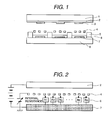
- Fig. 1 is a cross sectional view representing an example of an electron discharge device wherein a hollow carbon fiber is used as an electron discharge source;
- Fig. 2 is a view representing an example of the equivalent circuit of the electron discharge element where the hollow carbon fiber based on printing method is used as an electron discharge source; and
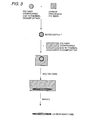
- Fig. 3 is a view illustrating the hollow carbon fiber production process.
-
- The following describes a hollow carbon fiber and its production method containing a step of baking and carbonization of polymer particles having a specified volume after deforming.
- When polymer particles are deformed by heating, they are preferred to be heated at the temperature higher than that where they are softened. Further, the heating temperature is preferred to be higher than glass transition temperature.
- Although the diameter of the polymer particle is not restricted, the diameter of the carbon fiber as a final product can be controlled in terms of the diameter of polymer particle.
- Accordingly, use of polymer particles having a smaller diameter is preferred to get fibers of a small diameter.
- It is preferred that the volume of the polymer particle do not exceed 100 mm3. The diameter and length of the carbon fiber as a final product can be controlled in terms of the volume of the polymer particle. Thus, use of polymer particles having a smaller volume is preferred to get fibers of a small diameter.
- It is preferred that the aspect ratio (length/diameter) of the fiber be 1 or more. Fibers of the optimum aspect ratio can be provided in response to the particular application. To get fine and long fibers, it is effective to increase the heating temperature, decrease polymer viscosity, increase spinning speed, increase the winding speed of the spun yard in the step of melting and spinning.
- The difference of softening temperature between polymers disappearing due to thermal decomposition forming the polymer particle and carbon precursor polymers is preferred not to exceed 100 degrees Celsius. If temperature difference exceeds 100 degrees Celsius, the difference of viscosity will occur between the polymer disappearing due to thermal decomposition and carbon precursor polymer in the process of spinning, and spun yarn will tend to break. The difference in softening temperatures between the two types of aforementioned polymers is preferred not to exceed 50 degrees Celsius. It is more preferred if this difference does not exceed 25 degrees Celsius.
- The hollow carbon fiber of the present invention comprises a hollow formed of polymer disappearing due to thermal decomposition at the time of baking and a carbon shell formed of carbon precursor polymer. This can be produced by a combination of polymers disappearing due to thermal decomposition carbon precursor polymers.
- As a specific means, it is preferred to have a step of producing a micro-capture from polymer disappearing due to thermal decomposition carbon precursor polymer, and baking the micro-capsule after melting and spinning.
- Reaction control in each process will be facilitated by producing a micro-capsule comprising polymer disappearing due to thermal decomposition and carbon precursor polymer, and baking it after spinning. The present invention makes it easier to control the shape of hollow carbon fiber than the aforementioned known production method, and ensures higher yield.
- In the preparation of micro-capsule according to the present invention, the residual carbon percentage of the polymer disappearing due to thermal decomposition is preferred to be equal to or smaller than 15 percent by weight, more preferred to be equal to smaller than 7 percent by weight, and still more preferred to be equal to or smaller than 5 percent by weight. The residual carbon percentage of the carbon precursor polymer is preferred to be equal to or greater than 15 percent by weight, more preferred to be equal to or greater than 30 percent by weight, and still more preferred to be equal to or greater than 50 percent by weight.
- Control of the diameter of the hollow carbon fiber pore and control of structure of the graphite forming the wall are facilitated by the use of the polymer disappearing due to thermal decomposition with the residual carbon percentage equal to or smaller than 10 percent by weight.
- Control of the diameter of the hollow carbon fiber pore and control of structure of the graphite forming the wall will be made difficult by the use of the carbon precursor polymer with the residual carbon percentage greater than 15 percent by weight, with the result that control to get a desired shape is made difficult.
- If aforementioned conditions are met, there is no restriction to a material for the micro-capsule in the present invention. When the workability in the spinning step is taken into account, use of thermoplastic resin is preferred.
- For example, olefinic resins such as polyethylene and polypropylene, diene-based resins such as polybutadiene, acrylic resins such as methyl polyacrylate and ethyl polyacrylate, methacrylic resins such as methyl polyamethacrylate and ethyl polymethaacrylate, and polyether resins such as vinyl polyacetate resin, polyvinyl alcohol resin, polyethylene glycol and polypropylene glycol can be enumerated as preferred materials for polymer disappearing due to thermal decomposition.
- Of these , acrylic resins such as methyl polyacrylate and ethyl polyacrylate, and methacrylic resins such as methyl polymethacrylate and ethyl polymethacrylate are preferred.
- Polyacrylonitrile resin, phenol resin, furan resin, divinyl benzene resin, unsaturated polyester resin, polyimide resin, diallyl phthalate resin, vinyl ester resin, polyurethane resin, melamine resin and urea resin can be enumerated as preferred materials for carbon precursor polymer.
- No restriction is placed on the production method for the aforementioned micro-capsule. When the workability in the spinning step is taken into account, use of the following method is preferred; seed polymerization based on the seed of a polymer disappearing due to thermal, decomposition having a diameter of 0.001 to 100 micron (µm), coacervation method, interfacial condensation method, spray drying method and wet blending method based on hybridizer. Seed polymerization method is preferred when the polymer disappearing due to thermal decomposition has a diameter of 0.001 to 1 micron.
- When the micro-capsule is synthesized according to seed polymerization method, it is preferred to synthesize the micro-capsule from the radically polymerizable monomer. Polyacrylonitrile resin using acrylonitrile resin as a monomer is preferred. Polyacrylonitrile resin containing 35mole% or more monomer unit formed by acrylonitrile resin in the polymer is preferred.
- No restriction is placed on the production method for the polymer disappearing due to thermal decomposition having a diameter of 0.001 to 100 micron. The following methods can be cited as examples; a method of screening for pulverization of polymer disappearing due to thermal decomposition, or a method of directly getting particles by polymerization such as reversed phase emulsion polymerization, emulsion polymerization, soap free emulsion polymerization, non-aqueous dispersion polymerization, seed polymerization and suspension polymerization. The method of directly getting particles by polymerization such as reversed phase emulsion polymerization, emulsion polymerization, soap free emulsion polymerization, non-aqueous dispersion polymerization, seed polymerization and suspension polymerization is preferred when workability is taken into account. Emulsion polymerization and soap free emulsion polymerization are preferred to get the polymer disappearing due to thermal decomposition having a diameter of 0.001 to 1 micron.
- No restriction is placed on the polymerization initiator used when producing micro-capsules. When the finally produced hollow carbon fiber of higher purity is required, it is preferred to use the compound where carbon remains as a main component in the step of carbonization, for example, the compound comprising only the element selected from among carbon, hydrogen, oxygen, nitrogen, phosphorus, sulfur, fluorine, chlorine, bromine and iodine wherein the content of the elements other than carbon does not exceed 30%. Such a compound is exemplified by diazo compound such as azobisisobutylonitrile, azobis (2-aminopropane) dihydrochloride, azobis-4-cyianopentanoic acid and azobisdimethylvaleronitrile, organic peroxide such as benzoyl peroxide, and peroxide salt such as ammonium persulfate.
- The micro-capsule obtained from the aforementioned step is fed to the spinning step. There is no restriction to the spinning means according to the present invention; the known method can be used.
- For example, when the micro-capsule is molten, it is put into a copper-made crucible as material together with the resin becoming a matrix (for example, polymer disappearing due to thermal decomposition the same one as that used as the aforementioned micro-capsule seed or different one), and is heated to 100 to 300 degrees Celsius by a ribbon heater until the material is molten. Then the molten resin material is wound by a motor through the pore (e.g. 1mm in diameter).
- In this case, there is no restriction to the blending ratio between micro-capsule and matrix. For example, the ratio of the former to the latter is preferred to be 1 to 0.3 through 1.5. The form of the hollow carbon fiber can be controlled by adjusting the heating temperature at the time of melting the material, the pore diameter on the bottom of the crucible, the speed of the winding motor, and the peripheral speed and shape of the winding portion.
- Then a hollow carbon fiber can be obtained in the step of baking and carbonization. The baking and carbonization temperature is preferably from 500 to 3200 degrees Celsius, and more preferably from 600 to 3000 degrees Celsius. If baking and carbonization temperature is below 500 degrees Celsius, formation of a graphite layer will be insufficient with the result that such characteristics as mechanical strength, hydrogen storage characteristics and electric field discharge characteristics will be reduced. If baking and carbonization temperature is higher than 3200 500 degrees Celsius, part or almost all of carbon atoms forming a graphite layer will subliminate with the result that a defect will be caused on the graphite layer.
- The hollow carbon fiber obtained in the aforementioned step is characterized in that the content of metal and metallic compound is 1 percent by weight or less.
- The production method according to the present invention allows hollow carbon fibers to be produced without using metal or metallic compound in the hollow carbon fiber production process, or without removing or refining metal or metallic compound wherein the content of metal and metallic compound is 1 percent by weight or less.
- The prior art method for producing carbon fiber requires a catalyst of metal and metallic compound for the purpose of growth of gas phase especially in the step of producing carbon tubes. The present invention, however, provides carbon fibers of high purity, especially carbon nano-tubes of high purity, without requiring any catalyst of metal or metallic compound in the step of production; hence, any step of removing and refining the catalyst of metal and metallic compound after production.
- The following describes the specific production method according to the present invention. However, the present invention is not restricted thereto. For example, it is also possible to form a hollow using the polymer disappearing due to thermal decomposition in the step of baking, and to form a shell using the carbon precursor polymer which is turned into carbon by baking. Namely, production is based on the combination between the polymer disappearing due to thermal decomposition and carbon precursor polymer.
- To put it more specifically, the preferred method for producing hollow carbon fibers is to form micro-capsules from the polymer disappearing due to thermal decomposition and carbon precursor polymer and to bake them subsequent to melting and spinning.
- Reaction control in each process will be facilitated by producing a micro-capsule comprising polymer disappearing due to thermal decomposition and carbon precursor polymer, and baking it after spinning. The present invention makes it easier to control the shape of hollow carbon fiber than the aforementioned known production method, and ensures higher yield.
- The following describes the embodiments according to the present invention:
- 35 ml of methyl methacrylate, 350 ml of ion exchange water and 29 mg ammonium persulfate were put in a 1000 ml flask, and ultrasonic wave was applied for 30 minutes while nitrogen was bubbling. An agitating blade was mounted on the flask, and reaction was performed by agitating it at a speed of 300 rpm at 70 degrees Celsius for 5 hours, then at 80 degrees Celsius for 30 minutes. Emulsified polymer solution disappearing due to thermal decomposition was obtained by this step.
- 90 ml of emulsified polymer solution disappearing due to thermal decomposition obtained in step (1), 4 ml of acrylonitrile (carbon precursor polymer), 270 ml of ion exchange water and 5 mg ammonium persulfate were sampled and placed in a 1000 ml flask. Nitrogen gas was bubbled in the aforementioned flask for 30 minutes. Then an agitating blade was mounted on the flask, and reaction was performed by agitating it at a speed of 300 rpm at 70 degrees Celsius for 5 hours, then at 80 degrees Celsius for 30 minutes. Emulsified micro-capsule solution was obtained by this step. Water was removed from this emulsified micro-capsule solution by freezing and drying to get micro-capsules.
- After the micro-capsule obtained in step (2) and the pulverized powder of resin disappearing due to thermal decomposition obtained in step (1) were blended in a mortar at a ratio of 1 to 1 (in weight percentage), they were kneaded while being heated at 120 degrees Celsius in nitrogen atmosphere, thereby getting a resin lump.
- Then this resin lump was put into a copper-made crucible having a diameter of 30 mm and a length of 100 mm with a 1 mm-diameter pore on the bottom. In the nitrogen atmosphere, this copper-made crucible was heated to 170 degrees Celsius by a ribbon heater. Through the pore on the bottom of the copper-made crucible, molten resin was wound on a motor driven at a peripheral speed of 50 m/min., thereby allowing the aforementioned resin lump to be spun.
- The fiber gained in the aforementioned spinning step was subjected to melt-proofing in an air flow rate of 30 ml/min. Then it was heated and baked up to 1000 degrees Celsius at a temperature rising speed of 10 degrees Celsius/hour in the atmosphere of flowing nitrogen in a baking kiln. Then it was heated by a Tammann electric furnace up to 3000 degrees Celsius at a temperature rising speed of 30 degrees Celsius/hour, and was subjected to graphitization.
- The carbon fiber gained in the aforementioned step was a hollow carbon fiber consisting of three to scores of graphite layers constituting a 3-to 12-nm diameter wall having a pore diameter of 1 to 3 nm.
- The amount of metal and metallic compound in the obtained hollow fiber was measured according to the specified in the Japanese Industrial Standards (graphite ash measuring procedure) to get the value of 0.01 wt%.
- The hollow carbon fiber gained in the aforementioned step was used as a filler and was combined with epoxy resin to form a composite. This composite was characterized by excellent properties such as light weight, superb strength and high resistance to heat. It was very useful for various types of structural members.
- 35 ml of methyl methacrylate, 350 ml of ion exchange water and 29 gm of ammonium persulfate were put in a 1000 ml flask, and ultrasonic wave was applied for 30 minutes while nitrogen was bubbling. An agitating blade was mounted on the flask, and reaction was performed by agitating it at a speed of 300 rpm at 70 degrees Celsius for 5 hours, then at 80 degrees Celsius for 30 minutes. Emulsified polymer solution disappearing due to thermal decomposition was obtained by this step.
- 90 ml of emulsified polymer solution disappearing due to thermal decomposition obtained in step (1), 4 ml of acrylonitrile, 270 ml of ion exchange water and 5 mg of ammonium persulfate were placed in a 1000 ml flask. Nitrogen gas was bubbled for 30 minutes. Then an agitating blade was mounted on the flask, and reaction was performed by agitating it at a speed of 300 rpm at 70 degrees Celsius for 5 hours, then at 80 degrees Celsius for 30 minutes. Emulsified micro-capsule solution was obtained by this step. Water was removed from this emulsified micro-capsule solution by freezing and drying to get micro-capsules.
- The micro-capsule obtained in step (2) was subjected to melt-proofing in an air flow rate of 30 ml/min. Then it was heated and baked up to 1000 degrees Celsius at a temperature rising speed of 10 degrees Celsius/hour in the atmosphere of flowing nitrogen. Then it was heated by a Tammann electric furnace up to 3000 degrees Celsius at a temperature rising speed of 30 degrees Celsius/hour, and was subjected to graphitization.
- The carbon fiber gained in the aforementioned step was a hollow carbon fiber consisting of three to scores of graphite layers constituting a 5 to 50-nm diameter wall having a pore diameter of 3 to 30 nm.
- 35 g of methyl methacrylate, 2 mg of bis(acetylacetone) platinum, 320 g of azobisisobutylonitrile, 350 ml of ion exchange water and 1.0 g of polyvinyl alcohol were made to react in a 1000 ml flask at a temperature of 80 degrees Celsius for 8 hours. Particles were collected by filtering, and were washed in water and dried to get polymer particles disappearing due to thermal decomposition having an average particle diameter of about 200 microns including platinum.
- 50 g of the polymer particles prepared in the above step and 25 g of phenol resin having a particle diameter of 50 microns were treated by a hybridizer to get micro-capsules where polymethyl methacrylate including a platinum complex was used as a core and phenol resin was used as a shell.
- The micro-capsule prepared in the above step and pulverized polymer disappearing due to thermal decomposition including platinum prepared in the above step were slightly mixed at a ratio of 1 to 1 in weight percentage in a mortar. Then they were kneaded while being heated at 120 degrees Celsius in nitrogen atmosphere, thereby getting a resin lump. Then this resin lump was put into a copper-made crucible having a diameter of 30 mm and a length of 100 mm with a 1 mm-diameter pore on the bottom. In the nitrogen atmosphere, this copper-made crucible was heated to 170 degrees Celsius by a ribbon heater. Through the pore on the bottom of the copper-made crucible, molten resin was wound on a motor driven at a peripheral speed of 50 meters, thereby allowing the aforementioned resin lump to be spun.
- The fiber gained by spinning was cut into 1 mm pieces, and was then subjected to melt-proofing in an air flow rate of 30 ml/min. Then it was baked up to 1000 degrees Celsius at a temperature rising speed of 10 degrees Celsius/hour in the atmosphere of flowing nitrogen in a braking kiln. Then it was heated by a Tammann electric furnace up to 3000 degrees Celsius at a temperature rising speed of 30 degrees Celsius/hour, and was subjected to graphitization.
- The obtained carbon fiber was examined by a transmission electron microscope to find out that it had a diameter of 3 to 12 nm with a pore diameter from 1 to 3 nm. Further, 70% of the examined samples had a diameter from 8 to 12 nm. It was found out to be a hollow carbon fiber consisting of three to scores of graphite layers constituting the wall.
- 1 g of this hollow fiber was put into a magnetic crucible having an inner volume of 5 ml. It was subjected to ash treatment at 600 degrees Celsius in the atmosphere of air for three hours. Ash was molten together with 20 g of sodium peroxide, and was dissolved in chloroazotic acid to get a solution. The concentration of platinum in this solution was measured and found out to be 0.10%.
- Paste using the aforementioned hollow carbon fiber was prepared. The paste was made up of 1 part by weight of hollow carbon fiber dispersed over 2 parts by weight of butyl Carbitol acetate and 0.2 part by weight of ethyl cellulose.
- This paste was used to create a cathode substrate having a structure serving as a basis for Fig. 1. Namely, a 5 mm square cathode electrode was formed by pattern printing and baking of a silver paste on the borosilicate glass substrate. The aforementioned 6mm square carbon fiber paste was printed so as to cover this cathode electrode, and was baked 550 degrees Celsius in air to get a hollow carbon fiber film. Fifty microns above this simple electrode, a stainless steel disk having a diameter of lmm was placed as an anode face-to-face with it via a spacer.
- This cathode and anode were set to a vacuum device to get a vacuum of 1 x 10 (.5) Pa by evacuation.
- Voltage was applied between the cathode and anode and the current discharged from the cathode was measured to verify the voltage where electron discharge current started to occur. It was revealed that the limit of the current measurement was 1 x 10 (.7) amperes. When a voltage of 65 volts was applied, the measurement limit of 1 x 10(.7) amperes was observed.
- "2 mg of bis(acetylacetone) platinum" in the preparation of emulsified polymer solution disappearing due to thermal decomposition in First Embodiment was changed to "0 mg of bis(acetylacetone) platinum". Otherwise, the present embodiment is the same as First Embodiment. Based on this condition, polymer particles disappearing due to thermal decomposition without metallic complex were prepared.
- 50 g of polymer particles disappearing due to thermal decomposition without metallic complex prepared in the aforementioned step and 25 g of phenol resin particles having a particle diameter of 5 microns were treated by a hybridizer to get micro-capsules without metallic complex where polymethyl methacrylate was used as a core and phenol resin was used as a shell.
- Micro-capsules without metallic complex prepared in the aforementioned step and polymer particles disappearing due to thermal decomposition including platinum prepared in
Embodiment 1 were slightly mixed at a ratio of 1 to 1 in weight percentage in a mortar. - Then they were kneaded while being heated at 120 degrees Celsius in nitrogen atmosphere, thereby getting a resin lump. Then this resin lump was subjected to the treatment of spinning, melt-proofing, braking and graphitization in the manner similar to that of the first Embodiment.
- The obtained carbon fiber was examined by a transmission electron microscope, and it was found out to have a diameter of 3 to 12 nm with a pore diameter from 1 to 3 nm. Further, 70% of the examined samples had a diameter from 8 to 12 nm. It was a hollow carbon fiber consisting of three to scores of graphite layers constituting the wall.
- Similarly to the First Embodiment, this hollow carbon fiber was subjected to ashing treatment and platinum concentration was found to be 0.06 % according to the ICP measurement.
- According to the same measuring method as that of the First Embodiment, the aforementioned hollow carbon fiber was used to measure the current discharged from the cathode when voltage was applied between the cathode and anode. As a result, the measurement limit of 1 x 10(.7) amperes was observed when a voltage of 75 volts was applied.
- "2 mg of bis (acetylacetone) platinum" in the preparation of emulsified polymer solution disappearing due to thermal decomposition in First Embodiment was changed to "0 mg of bis(acetylacetone) platinum". Otherwise, the present embodiment is the same as First Embodiment. Based on this condition, polymer particles disappearing due to thermal decomposition without metallic complex were prepared.
- Carbon precursor without metallic complex was prepared under the same condition as that of the First Embodiment, except that 90 g of the aforementioned emulsified polymer solution disappearing due to thermal decomposition without metallic complex as polymer disappearing due to thermal decomposition was used.
- Carbon fibers without metallic capsule were produced under the same condition as that of the First Embodiment, except that the aforementioned micro-capsules without metallic capsule were used as as metallic capsules, and the pulverized polymer prepared by freezing and drying the aforementioned emulsified polymer solution disappearing due to thermal decomposition without metallic complex to remove water was used as pulverized polymer disappearing due to thermal decomposition.
- The obtained carbon fiber was examined by a transmission electron microscope, and it was found out to have a diameter of 3 to 12 nm with a pore diameter from 1 to 3 nm. Further, 70% of the examined samples had a diameter from 8 to 12 nm. It was a hollow carbon fiber consisting of three to scores of graphite layers constituting the wall.
- According to the same measuring method as that of the First Embodiment, the aforementioned hollow carbon fiber was used to measure the current discharged from the cathode when voltage was applied between the cathode and anode. As a result, the measurement limit of 1 x 10(.7) amperes was observed when a voltage of 800 volts was applied.
- The voltage applied when the measurement limit current is observed is extremely high, and electric resistance is also high in Comparative Example 1, as compared with the First and Second Embodiments where the hollow carbon fiber including the metallic complex is used. In this respect, electron discharge characteristics are poorer in Comparative Example 1.
- Hollow carbon fibers and hollow carbon particles according to the present invention hardly contain metal or metallic compound, or does not contain it at all. Hence, they are free from various contaminations due to metal or unstable electric discharge, and can be used in a great variety of fields.
- The method of producing hollow carbon fibers according to the present invention makes it possible to control hollow carbon fibers represented by carbon tubes with respect to characteristic shape, fiber diameter, fiber lengths, pore diameter, thickness of the wall-forming graphite layer, crystallinity and the like.
- No metallic catalyst is used in the process of producing hollow carbon fibers and hollow carbon particles; hence, no refining is required. The present invention allows hollow carbon fibers and hollow carbon particles of a desired shape to be produced at a high yield rate.
- Hollow carbon fibers and hollow carbon particles according to the present invention provide composites characterized by excellent properties such as light weight, superb strength and high resistance to heat.
- The present invention allows the particle diameter, pore diameter and wall to be determined by adjusting hollow carbon particles represented by fullerene.
Claims (46)
- A method for producing hollow carbon fibers comprising the step of baking and carbonizing polymer particles having a volume of 100 mm3 or smaller after deforming.
- The method according to claim 1, characterized in that the polymer particles are deformed with heat, with mechanical force or with irradiation with electromagnetic waves or by any combination of heat, mechanical force and/or irradiation with electromagnetic waves.
- The method according to claim 1 and/or claim 2, characterized in that the diameter of the polymer particles is 5 to 5000 times that of the hollow carbon fiber which are obtained as the final product.
- The method according to one or several of the preceding claims, characterized in that one or both ends of the fiber are closed.
- The method according to one or several of the preceding claims, characterized in that the aspect ratio (length/diameter) of the fiber is 1 or more.
- The method according to one or several of the preceding claims, characterized in that the diameter and the length of the fibers are controlled by the volume of polymer particles.
- The method according to one or several of the preceding claims, characterized in that it comprises a step of producing polymer particles by a combination of polymers disappearing due to thermal decomposition and carbon precursor polymers.
- The method according to claim 7, characterized in that it comprises a step of producing a micro-capsule from polymers disappearing due to thermal decomposition and carbon precursor polymers, and baking said micro-capsule subsequent to melting and spinning.
- The method according to one or several of claims 7 and 8, characterized in that the difference between the softening temperature of polymers disappearing due to thermal decomposition and that of carbon precursor polymers does not exceed 100 degrees Celsius.
- The method according to one or several of claims 7 to 9, characterized in that the ratio between inner and outer diameters of said hollow carbon fiber is controlled by the ratio of thickness between the layer of polymers disappearing due to thermal decomposition and that of carbon precursor polymers.
- The method according to one or several of claims 7 to 10, characterized in that the number of layers of said hollow carbon fiber is controlled by the ratio of thickness between the layer of polymer disappearing due to thermal decomposition and that of carbon precursor polymer.
- The method according to one or several of claims 7 to 11, characterized by using polymers wherein the residual carbon percentage of polymer disappearing due to thermal decomposition does not exceed 10 percent by weight and that of carbon precursor polymer does not exceed 15 percent by weight.
- The method according to one or several of claims 8 to 12, characterized in that said micro-capsules are prepared by interfacial chemical technique or by seed polymerization.
- The method according to one or several of claims 7 to 13, characterized in that said carbon precursor polymers are formed of one or several monomers comprising radically polymerizable groups.
- The method according to one or several of claims 7 to 14, characterized in that said carbon precursor polymer has the units formed of acrylonitrile monomers contained in polymers.
- The method according to one or several of claims 7 to 15, characterized in that said polymer disappearing due to thermal decomposition is formed of one or several monomers comprising a radically polymerizable group.
- The method according to one or several of claims 7 to 16, characterized in that the polymer disappearing due to thermal decomposition and the carbon precursor polymer are formed of one or several monomers comprising radically polymerizable groups, and a compound wherein carbon remains as a major component in the process of carbonization is used as a polymerization initiator.
- Hollow carbon fibers, obtainable by a method according to one or several of claims 1 to 17.
- The hollow carbon fibers according to one of claims 1 to 18, characterized in that the polymer particles each have a prescribed volume.
- The hollow carbon fibers according to one of claims 18 and 19 comprising a hollow formed of polymer disappeared due to thermal decomposition and a carbon shell formed of carbon precursor polymer.
- A composite comprising hollow carbon fibers according to one or several of claims 18 to 20 and one or several resins.
- A method for producing hollow carbon fibers, characterized in that no metal or metallic compound is used during the steps of production whereby the content of the fibers of metal(s) and metallic compound(s) does not exceed 1 percent by weight.
- The method according to claim 22, characterized in that no metal(s) or metallic compound(s) is/are eliminated or refined during the steps of production.
- The method according to claim 22 or 23, characterized in that said hollow carbon fiber is produced by a combination of polymers disappearing due to thermal decomposition and carbon precursor polymers.
- The method according to one or several of claims 22 to 24, characterized in that it comprises a step of producing a micro-capsule comprising polymers disappearing due to thermal decomposition and carbon precursor polymers, and baking said micro-capsule subsequent to melting and spinning.
- The method according to one or several of claims 22 to 25, characterized by using polymers wherein the residual carbon percentage of polymers disappearing due to thermal decomposition does not exceed 10 percent by weight and that of carbon precursor polymers does not exceed 15 percent by weight.
- The method according to one or several of claims 22 to 26, characterized in that said micro-capsules are prepared by interfacial chemical technique or by seed polymerization.
- The method according to one or several of claims 22 to 27, characterized in that said carbon precursor polymers are formed of one or several monomers comprising radically polymerizable groups.
- The method according to one or several of claims 22 to 28, characterized in that said carbon precursor polymer has 35 mole percent or more of units formed of acrylonitrile monomers contained in polymer.
- The method according to one or several of claims 22 to 29, characterized in that said polymer disappearing due to thermal decomposition is formed of one or several monomers comprising a radically polymerizable group.
- The method according to one or several of claims 22 to 30, characterized in that the polymer disappearing due to thermal decomposition and the carbon precursor polymer are formed of the monomer comprising a radically polymerizable group, and the compound wherein carbon remains as a major component in the process of carbonization is used as a polymerization initiator.
- The method according to one or several of claims 22 to 30, characterized in that a polymer disappearing due to thermal decomposition and a carbon precursor polymer are formed of a monomer comprising a radically polymerizable group, and a compound comprising only the element selected from among carbon, hydrogen, oxygen, nitrogen, phosphorus, sulfur, fluorine, chlorine, bromine and iodine is used as a polymerization initiator.
- Hollow carbon fibers, obtainable by a method according to one or several of claims 22 to 32.
- Hollow carbon fibers characterized in that the content of metal and metallic compound does not exceed 1 percent by weight.
- The hollow carbon fibers according to claim 34, comprising a hollow formed of polymer disappearing due to thermal decomposition and a carbon shell formed of carbon precursor polymer.
- A composite comprising hollow carbon fibers according to one or several of claims 33 to 35 and one or several resins.
- A method for producing hollow carbon particles, characterized in that said hollow carbon particles are produced by a combination of polymers disappearing due to thermal decomposition and carbon precursor polymers.
- The method according to claim 37, characterized in that it comprises the step of producing a micro-capsule comprising polymers disappearing due to thermal decomposition and carbon precursor polymers, and baking said micro-capsule.
- The method according to claim 37 or 38, characterized by using polymers wherein the residual carbon percentage of polymers disappearing due to thermal decomposition does not exceed 10 percent by weight and that of carbon precursor polymers does not exceed 15 percent by weight.
- The method according to one or several of claims 37 to 39, characterized in that said micro-capsules are prepared by interfacial chemical technique or by seed polymerization.
- The method according to one or several of claims 37 to 40, characterized in that said carbon precursor polymers are formed of monomers comprising a radically polymerizable group.
- The method according to one or several of claims 37 to 41, characterized in that said carbon precursor polymer has 35 mole percent or more of units formed of acrylonitrile monomers contained in polymers.
- The method according to one or several of claims 37 to 42, characterized in that said polymer disappearing due to thermal decomposition is formed of the monomer comprising a radically polymerizable group.
- The method according to one or several of claims 37 to 43, characterized in that a polymer disappearing due to thermal decomposition and a carbon precursor polymer are formed of a monomer comprising a radically polymerizable group, and a compound comprising only the element selected from among carbon, hydrogen, oxygen, nitrogen, phosphorus, sulfur, fluorine, chlorine, bromine and iodine is used as a polymerization initiator.
- Hollow carbon particles, obtainable according to a method according to one or several of claims 37 to 44.
- Hollow carbon particles comprising a hollow formed of polymer disappearing due to thermal decomposition and a carbon shell formed of carbon precursor polymer.
Applications Claiming Priority (6)
| Application Number | Priority Date | Filing Date | Title |
|---|---|---|---|
| JP2001235741 | 2001-08-03 | ||
| JP2001235740A JP2003048705A (en) | 2001-08-03 | 2001-08-03 | Hollow carbon particle and method for producing the same |
| JP2001235742A JP4678106B2 (en) | 2001-08-03 | 2001-08-03 | Hollow carbon fiber and method for producing the same |
| JP2001235740 | 2001-08-03 | ||
| JP2001235742 | 2001-08-03 | ||
| JP2001235741A JP4678105B2 (en) | 2001-08-03 | 2001-08-03 | Hollow carbon fiber and method for producing the same |
Publications (2)
| Publication Number | Publication Date |
|---|---|
| EP1283287A2 true EP1283287A2 (en) | 2003-02-12 |
| EP1283287A3 EP1283287A3 (en) | 2003-10-15 |
Family
ID=27347275
Family Applications (1)
| Application Number | Title | Priority Date | Filing Date |
|---|---|---|---|
| EP20010125424 Withdrawn EP1283287A3 (en) | 2001-08-03 | 2001-10-31 | Hollow carbon fiber and production method |
Country Status (3)
| Country | Link |
|---|---|
| US (3) | US6743500B2 (en) |
| EP (1) | EP1283287A3 (en) |
| KR (1) | KR100503879B1 (en) |
Cited By (2)
| Publication number | Priority date | Publication date | Assignee | Title |
|---|---|---|---|---|
| CN111058141A (en) * | 2019-12-30 | 2020-04-24 | 重庆市硅酸盐研究所 | TDP fiber cloth and preparation method thereof |
| CN111204761A (en) * | 2020-03-31 | 2020-05-29 | 郑州中科新兴产业技术研究院 | Method for electrochemically reducing carbon dioxide by combining ionic liquid and nitrogen-doped porous carbon material |
Families Citing this family (21)
| Publication number | Priority date | Publication date | Assignee | Title |
|---|---|---|---|---|
| US20050100499A1 (en) * | 2001-06-25 | 2005-05-12 | Asao Oya | Carbon nanotube and process for producing the same |
| US6743500B2 (en) * | 2001-08-03 | 2004-06-01 | Hitachi Chemical Company, Ltd. | Hollow carbon fiber and production method |
| JP3606855B2 (en) * | 2002-06-28 | 2005-01-05 | ドン ウン インターナショナル カンパニー リミテッド | Method for producing carbon nanoparticles |
| JP3763078B2 (en) * | 2003-06-02 | 2006-04-05 | 松下電器産業株式会社 | Electron emitting material and manufacturing method thereof |
| US7175826B2 (en) * | 2003-12-29 | 2007-02-13 | General Electric Company | Compositions and methods for hydrogen storage and recovery |
| US20060115409A1 (en) * | 2004-11-26 | 2006-06-01 | Yuan-Yao Li | Method for producing carbon nanotube |
| US7919037B1 (en) * | 2005-01-19 | 2011-04-05 | Darren Boyce | Process and composition for molding heatable articles and resulting product |
| CN1306203C (en) * | 2005-03-18 | 2007-03-21 | 四川大学 | Multiplayer composite tube made from polymer possessing texture in nano layer and making method |
| KR100626792B1 (en) * | 2005-04-20 | 2006-09-25 | 주식회사 모드테크 | Manufacturing method of artificial hair yarn by polyvinyl chloride / acrylic copolymer blend |
| CA2625647A1 (en) * | 2005-10-12 | 2007-04-19 | Adelaide Research And Innovation Pty Ltd | Fabrication of nanowires |
| US7824495B1 (en) | 2005-11-09 | 2010-11-02 | Ut-Battelle, Llc | System to continuously produce carbon fiber via microwave assisted plasma processing |
| US20070237848A1 (en) * | 2005-12-21 | 2007-10-11 | Brad Rawson | MORINDA CITRIFOLIA BASED COMPOSITIONS FOR TREATMENT OF ANTI-INFLAMMATORY DISEASES THROUGH INHIBITION OF COX-1, COX-2, INTERLEUKIN-1beta, INTERLEUKIN-6, TNF-alpha, HLE, AND iNOS |
| US20100247419A1 (en) * | 2006-11-01 | 2010-09-30 | Nguyen Khe C | Solid phase synthesized carbon nano fiber and tube |
| US20080213367A1 (en) * | 2007-03-01 | 2008-09-04 | Cromoz Inc. | Water soluble concentric multi-wall carbon nano tubes |
| KR101272525B1 (en) | 2011-11-30 | 2013-06-11 | 현대자동차주식회사 | Preparation Method for Hollow Carbon Fiber |
| US9683312B2 (en) | 2011-12-10 | 2017-06-20 | The Boeing Company | Fiber with gradient properties and method of making the same |
| US9683310B2 (en) | 2011-12-10 | 2017-06-20 | The Boeing Company | Hollow fiber with gradient properties and method of making the same |
| US9222254B2 (en) | 2012-03-13 | 2015-12-29 | Schabel Polymer Technology, Llc | Structural assembly insulation |
| SG10201710035XA (en) | 2013-11-19 | 2018-01-30 | Hyun Chang Lee | Mobile electric leakage detection device and method |
| KR101783446B1 (en) | 2014-09-30 | 2017-09-29 | 주식회사 엘지화학 | Method for preparation of hollow carbon capsule |
| US10600583B1 (en) | 2018-08-30 | 2020-03-24 | King Saud University | Method of making a porous nitrogen-doped carbon electrode from biomass |
Family Cites Families (29)
| Publication number | Priority date | Publication date | Assignee | Title |
|---|---|---|---|---|
| JPS5021433B2 (en) * | 1971-11-15 | 1975-07-23 | ||
| US3949115A (en) * | 1972-02-24 | 1976-04-06 | Yoshio Tamura | Hollow filamentary structures |
| US4303736A (en) * | 1979-07-20 | 1981-12-01 | Leonard Torobin | Hollow plastic microspheres |
| US5165909A (en) * | 1984-12-06 | 1992-11-24 | Hyperion Catalysis Int'l., Inc. | Carbon fibrils and method for producing same |
| US5171560A (en) * | 1984-12-06 | 1992-12-15 | Hyperion Catalysis International | Carbon fibrils, method for producing same, and encapsulated catalyst |
| US4859711A (en) * | 1986-10-01 | 1989-08-22 | Alcan International Limited | Hollow microspheres |
| CA1287459C (en) * | 1986-10-01 | 1991-08-13 | Mukesh Jain | Process for the preparation of hollow microspheres |
| US5089135A (en) * | 1988-01-20 | 1992-02-18 | Mitsubishi Rayon Co., Ltd. | Carbon based porous hollow fiber membrane and method for producing same |
| US5338605A (en) * | 1990-01-31 | 1994-08-16 | Ketema, Inc. | Hollow carbon fibers |
| JP2845675B2 (en) | 1992-06-30 | 1999-01-13 | 日本電気株式会社 | Method for producing carbon nanotube |
| US5424054A (en) * | 1993-05-21 | 1995-06-13 | International Business Machines Corporation | Carbon fibers and method for their production |
| IL108883A (en) * | 1994-03-07 | 1998-03-10 | Rotem Ind Ltd | Process for the production of hollow carbon fiber membranes |
| GB9518798D0 (en) * | 1995-09-14 | 1995-11-15 | Secr Defence | Apparatus and method for spinning hollow polymeric fibres |
| JP3502490B2 (en) * | 1995-11-01 | 2004-03-02 | 昭和電工株式会社 | Carbon fiber material and method for producing the same |
| JP2873930B2 (en) * | 1996-02-13 | 1999-03-24 | 工業技術院長 | Carbonaceous solid structure having carbon nanotubes, electron emitter for electron beam source element composed of carbonaceous solid structure, and method of manufacturing carbonaceous solid structure |
| US6683783B1 (en) * | 1997-03-07 | 2004-01-27 | William Marsh Rice University | Carbon fibers formed from single-wall carbon nanotubes |
| JP3183845B2 (en) * | 1997-03-21 | 2001-07-09 | 財団法人ファインセラミックスセンター | Method for producing carbon nanotube and carbon nanotube film |
| US6221330B1 (en) * | 1997-08-04 | 2001-04-24 | Hyperion Catalysis International Inc. | Process for producing single wall nanotubes using unsupported metal catalysts |
| JP3017161B2 (en) * | 1998-03-16 | 2000-03-06 | 双葉電子工業株式会社 | Method for producing single-walled carbon nanotube |
| US6426134B1 (en) * | 1998-06-30 | 2002-07-30 | E. I. Du Pont De Nemours And Company | Single-wall carbon nanotube-polymer composites |
| JP3986711B2 (en) | 1998-07-21 | 2007-10-03 | 昭和電工株式会社 | Method for producing single-walled carbon nanotube |
| JP2000109310A (en) | 1998-08-03 | 2000-04-18 | Osaka Gas Co Ltd | Production of functional carbon material |
| US6506323B1 (en) * | 1999-09-22 | 2003-01-14 | Chien-Chung Han | Method for making micrometer-sized carbon tubes |
| US6489025B2 (en) * | 2000-04-12 | 2002-12-03 | Showa Denko K.K. | Fine carbon fiber, method for producing the same and electrically conducting material comprising the fine carbon fiber |
| US6451175B1 (en) * | 2000-08-15 | 2002-09-17 | Wisconsin Alumni Research Foundation | Method and apparatus for carbon nanotube production |
| US20050100499A1 (en) * | 2001-06-25 | 2005-05-12 | Asao Oya | Carbon nanotube and process for producing the same |
| JP3877155B2 (en) | 2001-06-25 | 2007-02-07 | 三菱化学株式会社 | Carbon nanotube and method for producing the same |
| EP1411030A1 (en) | 2001-06-25 | 2004-04-21 | Mitsubishi Chemical Corporation | Carbon nanotube and method for production thereof |
| US6743500B2 (en) * | 2001-08-03 | 2004-06-01 | Hitachi Chemical Company, Ltd. | Hollow carbon fiber and production method |
-
2001
- 2001-10-29 US US09/984,157 patent/US6743500B2/en not_active Expired - Fee Related
- 2001-10-31 EP EP20010125424 patent/EP1283287A3/en not_active Withdrawn
- 2001-11-09 KR KR10-2001-0069656A patent/KR100503879B1/en not_active Expired - Fee Related
-
2002
- 2002-10-15 US US10/270,452 patent/US6641792B2/en not_active Expired - Fee Related
- 2002-10-15 US US10/270,447 patent/US7273652B2/en not_active Expired - Fee Related
Non-Patent Citations (3)
| Title |
|---|
| DATABASE WPI Section Ch, Week 200311 Derwent Publications Ltd., London, GB; Class E36, AN 2003-121106 XP002251178 & WO 03 000589 A (MITSUBISHI CHEM CORP), 3 January 2003 (2003-01-03) * |
| HULICOVA D ET AL: "An attempt to prepare carbon nanotubes by the spinning of microcapsules" CARBON, ELSEVIER SCIENCE PUBLISHING, NEW YORK, NY, US, vol. 39, August 2001 (2001-08), pages 1438-1446, XP002960432 ISSN: 0008-6223 * |
| HULICOVA D ET AL: "Multi-wall carbon nanotubes prepared from polymer core/shell microspheres" INTERNATIONAL SYMPOSIUM ON NANO CARBONS. PROGRAM AND ABSTRACTS, XX, XX, November 2001 (2001-11), pages 177-178, XP002960433 * |
Cited By (3)
| Publication number | Priority date | Publication date | Assignee | Title |
|---|---|---|---|---|
| CN111058141A (en) * | 2019-12-30 | 2020-04-24 | 重庆市硅酸盐研究所 | TDP fiber cloth and preparation method thereof |
| CN111204761A (en) * | 2020-03-31 | 2020-05-29 | 郑州中科新兴产业技术研究院 | Method for electrochemically reducing carbon dioxide by combining ionic liquid and nitrogen-doped porous carbon material |
| CN111204761B (en) * | 2020-03-31 | 2021-06-25 | 郑州中科新兴产业技术研究院 | A method for electrochemical reduction of carbon dioxide by combining ionic liquids with nitrogen-doped porous carbon materials |
Also Published As
| Publication number | Publication date |
|---|---|
| KR20030012776A (en) | 2003-02-12 |
| EP1283287A3 (en) | 2003-10-15 |
| US6641792B2 (en) | 2003-11-04 |
| US6743500B2 (en) | 2004-06-01 |
| US20030039829A1 (en) | 2003-02-27 |
| KR100503879B1 (en) | 2005-07-27 |
| US20030026980A1 (en) | 2003-02-06 |
| US7273652B2 (en) | 2007-09-25 |
| US20030039830A1 (en) | 2003-02-27 |
Similar Documents
| Publication | Publication Date | Title |
|---|---|---|
| US6641792B2 (en) | Hollow carbon fiber and production method | |
| US20050100499A1 (en) | Carbon nanotube and process for producing the same | |
| US5424054A (en) | Carbon fibers and method for their production | |
| JP4325726B2 (en) | Carbon nanotube aggregate and conductive film | |
| EP0758028A2 (en) | Process of producing graphite fiber | |
| Huličová et al. | Carbon nanotubes prepared by spinning and carbonizing fine core–shell polymer microspheres | |
| Varadan et al. | Synthesis of carbon nanocoils by microwave CVD | |
| CN1281486C (en) | Preparation of polymer based carbon balls | |
| JP3877155B2 (en) | Carbon nanotube and method for producing the same | |
| JP4678103B2 (en) | Metal-attached carbon fiber, manufacturing method thereof, and electron-emitting device | |
| JP4678104B2 (en) | Hollow carbon fiber and method for producing the same | |
| JP3925459B2 (en) | Carbon nanofiber and manufacturing method thereof | |
| JP4984131B2 (en) | Nanocarbon paste and method for producing nanocarbon emitter | |
| JP2004099417A (en) | Method for producing foreign element-containing carbon nanotubes | |
| JP2003105638A (en) | Hollow carbon fiber and method for producing the same | |
| JP4678105B2 (en) | Hollow carbon fiber and method for producing the same | |
| EP1411030A1 (en) | Carbon nanotube and method for production thereof | |
| JP2003105640A (en) | Method for producing catalyst substance-supporting carbon fiber and method for storing hydrogen | |
| JP2003105639A (en) | Method for producing hollow carbon fiber | |
| JP2004027467A (en) | Hollow carbon nano-fiber and method for producing the same | |
| JP5250925B2 (en) | Method for producing fibrous carbon | |
| CN117923470B (en) | Ag@ amorphous C nano-particles, PVDF-based composite film and preparation method thereof | |
| RU2729244C1 (en) | Method for modification of multilayer carbon nanotubes | |
| JP3925458B2 (en) | Nanocarbon having pores communicating therewith and method for producing the same | |
| US20060286024A1 (en) | Synthesis and cleaving of carbon nanochips |
Legal Events
| Date | Code | Title | Description |
|---|---|---|---|
| PUAI | Public reference made under article 153(3) epc to a published international application that has entered the european phase |
Free format text: ORIGINAL CODE: 0009012 |
|
| AK | Designated contracting states |
Designated state(s): AT BE CH CY DE DK ES FI FR GB GR IE IT LI LU MC NL PT SE TR |
|
| AX | Request for extension of the european patent |
Extension state: AL LT LV MK RO SI |
|
| PUAL | Search report despatched |
Free format text: ORIGINAL CODE: 0009013 |
|
| AK | Designated contracting states |
Kind code of ref document: A3 Designated state(s): AT BE CH CY DE DK ES FI FR GB GR IE IT LI LU MC NL PT SE TR |
|
| AX | Request for extension of the european patent |
Extension state: AL LT LV MK RO SI |
|
| RIC1 | Information provided on ipc code assigned before grant |
Ipc: 7D 01F 9/22 B Ipc: 7D 01D 5/24 B Ipc: 7D 01F 9/12 A |
|
| 17P | Request for examination filed |
Effective date: 20040413 |
|
| AKX | Designation fees paid |
Designated state(s): CH DE FR GB LI |
|
| 17Q | First examination report despatched |
Effective date: 20090311 |
|
| STAA | Information on the status of an ep patent application or granted ep patent |
Free format text: STATUS: THE APPLICATION IS DEEMED TO BE WITHDRAWN |
|
| 18D | Application deemed to be withdrawn |
Effective date: 20090722 |