EP1283261A1 - Method of screening drug acting on cell wall - Google Patents
Method of screening drug acting on cell wall Download PDFInfo
- Publication number
- EP1283261A1 EP1283261A1 EP01925961A EP01925961A EP1283261A1 EP 1283261 A1 EP1283261 A1 EP 1283261A1 EP 01925961 A EP01925961 A EP 01925961A EP 01925961 A EP01925961 A EP 01925961A EP 1283261 A1 EP1283261 A1 EP 1283261A1
- Authority
- EP
- European Patent Office
- Prior art keywords
- cell wall
- protein
- microorganism
- reporter protein
- fixed
- Prior art date
- Legal status (The legal status is an assumption and is not a legal conclusion. Google has not performed a legal analysis and makes no representation as to the accuracy of the status listed.)
- Granted
Links
Images



Classifications
-
- C—CHEMISTRY; METALLURGY
- C12—BIOCHEMISTRY; BEER; SPIRITS; WINE; VINEGAR; MICROBIOLOGY; ENZYMOLOGY; MUTATION OR GENETIC ENGINEERING
- C12Q—MEASURING OR TESTING PROCESSES INVOLVING ENZYMES, NUCLEIC ACIDS OR MICROORGANISMS; COMPOSITIONS OR TEST PAPERS THEREFOR; PROCESSES OF PREPARING SUCH COMPOSITIONS; CONDITION-RESPONSIVE CONTROL IN MICROBIOLOGICAL OR ENZYMOLOGICAL PROCESSES
- C12Q1/00—Measuring or testing processes involving enzymes, nucleic acids or microorganisms; Compositions therefor; Processes of preparing such compositions
- C12Q1/02—Measuring or testing processes involving enzymes, nucleic acids or microorganisms; Compositions therefor; Processes of preparing such compositions involving viable microorganisms
- C12Q1/18—Testing for antimicrobial activity of a material
-
- C—CHEMISTRY; METALLURGY
- C12—BIOCHEMISTRY; BEER; SPIRITS; WINE; VINEGAR; MICROBIOLOGY; ENZYMOLOGY; MUTATION OR GENETIC ENGINEERING
- C12Q—MEASURING OR TESTING PROCESSES INVOLVING ENZYMES, NUCLEIC ACIDS OR MICROORGANISMS; COMPOSITIONS OR TEST PAPERS THEREFOR; PROCESSES OF PREPARING SUCH COMPOSITIONS; CONDITION-RESPONSIVE CONTROL IN MICROBIOLOGICAL OR ENZYMOLOGICAL PROCESSES
- C12Q1/00—Measuring or testing processes involving enzymes, nucleic acids or microorganisms; Compositions therefor; Processes of preparing such compositions
- C12Q1/02—Measuring or testing processes involving enzymes, nucleic acids or microorganisms; Compositions therefor; Processes of preparing such compositions involving viable microorganisms
- C12Q1/025—Measuring or testing processes involving enzymes, nucleic acids or microorganisms; Compositions therefor; Processes of preparing such compositions involving viable microorganisms for testing or evaluating the effect of chemical or biological compounds, e.g. drugs, cosmetics
-
- G—PHYSICS
- G01—MEASURING; TESTING
- G01N—INVESTIGATING OR ANALYSING MATERIALS BY DETERMINING THEIR CHEMICAL OR PHYSICAL PROPERTIES
- G01N2500/00—Screening for compounds of potential therapeutic value
Definitions
- the present invention relates to a microorganism having a reporter protein such as a fluorescent protein fixed on a cell wall or cell membrane as a GPI-anchored protein and a method for screening an agent acting on cell wall by utilizing the aforementioned microorganism.
- a reporter protein such as a fluorescent protein fixed on a cell wall or cell membrane as a GPI-anchored protein
- a cell wall which characteristically exists in fungal cells is an attractive target from a viewpoint of selectivity.
- major saccharide polymers constituting the cell wall include (1,3)- ⁇ -glucan, (1,6)- ⁇ -glucan, chitin and mannan.
- synthetic pathways of these saccharide polymers the synthetic pathway of mannan commonly exists in animal cells and fungal cells and each biosynthetic pathway has high commonness, and therefore, it is considered generally difficult, although not absolutely impossible, to find a target specific to fungi.
- GPI-anchored proteins In general, proteins collectively called as GPI-anchored proteins extensively exist in eukaryotic cells. These are fixed on cell membranes via GPI anchors (Ferguson, M.A., et al., Ann. Rev. Biochem., 57, pp.285-320, 1988). Each GPI-anchored protein has relatively hydrophobic signal peptide regions at both ends of the N- and C-terminals. These signals are cleaved by post-translational modification, and with addition of a GPI anchor to the C-terminus, the protein is fixed on the ER (rough endoplasmic reticulum) membrane.
- ER rough endoplasmic reticulum
- GPI anchor In Saccharomyces cerevisiae , a part of the GPI anchor is further cleaved from some of the GPI-anchored proteins fixed on the cell membrane, and then the protein is further fixed on the cell wall via (1,6)- ⁇ -glucan as an anchor (Lu, C.F., et al., Mol. Cell Biol., 14, pp.4825-4833, 1994; Kollar, R., et al., J. Biol. Chem., 272, pp.17762-17775, 1997).
- (1,6)- ⁇ -glucan has a function as an anchor for fixing the GPI-anchored proteins on the cell walls, and analytical results so far obtained reveal that, when biosynthesis of (1,6)- ⁇ -glucan is inhibited by gene disruption, these proteins are extracellularly released (Lu, C.F., et al., Mol. Cell Biol., 14, pp.4825-4833, 1994; Lu, C.F., et al., J. Cell. Biol., 128, pp.333-340, 1995).
- An object of the present invention is to provide a method for screening an agent acting on cell wall, preferably a method for efficiently screening an agents having a selective inhibitory action on a cell wall, for example, a selective inhibitory action on a biosynthetic enzyme of (1,6)- ⁇ -glucan that constitutes a cell wall, by using microorganisms. Further, another object of the present invention is to provide a microorganism used for the aforementioned screening method.
- an agent having a selective inhibitory action on a cell wall for example, an agent having a selective inhibitory action on an enzyme for biosynthesis of (1,6)- ⁇ -glucan that constitutes the cell wall
- an agent having a selective inhibitory action on an enzyme for biosynthesis of (1,6)- ⁇ -glucan that constitutes the cell wall should be successfully screened by preparing two kinds of yeasts each having an easily detectable protein (reporter protein) fixed on the cell membrane or cell wall (referred to as "membrane-type arming yeast” and “wall-type arming yeast”, respectively), and using a criterion that a release of the reporter protein is occurred substantially only from the wall-type arming yeast.
- the present invention was achieved on the basis of these findings.
- the present invention thus provides a method for screening an agent acting on cell wall, which comprises the steps of:
- the reporter protein is fixed on the cell wall or cell membrane via a GPI anchor.
- the aforementioned microorganisms are thus microorganisms having a GPI-anchored protein fixed on the cell wall or cell membrane in which a protein as a GPI-anchored protein is used as a reporter protein.
- the aforementioned microorganism has a reporter protein fixed on the cell wall or cell membrane via the GPI anchor.
- the term "GPI-anchored protein" is not used to mean any specific protein and should not be construed in any limitative sense.
- the aforementioned method which uses a microorganism having a reporter protein fixed to (1,6)- ⁇ -glucan of the cell wall; the aforementioned method, wherein the microorganism is yeast; the aforementioned method, wherein the reporter protein is a fluorescent protein; the aforementioned method, wherein the fluorescent protein is a green fluorescent protein; the aforementioned method, wherein the inhibitory action on the cell wall is an inhibitory action against a biosynthetic process and/or a biosynthetic enzyme of the cell wall; and the aforementioned method, wherein the agent acting on the cell wall is an antifungal agent.
- the present invention provides a microorganism having a reporter protein fixed on a cell wall as a GPI-anchored protein.
- the reporter protein is fixed to (1,6)- ⁇ -glucan of the cell wall.
- the present invention also provides a microorganism having a reporter protein fixed on a cell membrane as a GPI-anchored protein.
- These microorganisms are preferably yeasts and can be used for a screening of an agent acting on a cell wall, preferably an antifungal agent.
- the reporter protein is a fluorescent protein
- the fluorescent protein is a green fluorescent protein.
- yeast AY-14 strain having a green fluorescent protein fixed on the cell wall as a GPI-anchored protein
- yeast AY-15 strain having a green fluorescent protein fixed on the cell membrane as a GPI-anchored protein.
- the present invention further provides use of the microorganisms for a screening of an agent acting on a cell wall.
- the present invention further provides a set of microorganisms used for a screening of an agent acting on a cell wall, which comprises:
- a set including microorganisms having a reporter protein fixed to (1,6)- ⁇
- the method of the present invention is for a screening of an agent acting on cell wall, which is characterized to comprise the steps of:
- Type of the agent acting on cell wall which is a subject of screening of the method of the present invention is not particularly limited.
- the method of the present invention can be utilized for a screening of an agent having a selective inhibitory action on cell wall, preferably a selective inhibitory action on biosynthesis (i.e., an agent having an inhibitory action on the biosynthesis of cell wall, but not substantially having an inhibiting action or a nonspecific inhibitory action on the biosynthesis of cell membrane (e.g., that of detergent)).
- the method can be preferably used for a screening of an agent having an inhibitory action on the biosynthesis of (1,3)- ⁇ -glucan and/or (1,6)- ⁇ -glucan, which are major saccharide polymers constituting cell walls, or an agent having an inhibitory action against one or more enzymes involved in biosyntheses of these polymers.
- the wording "acting on a cell wall” means, for example, to act on one or more of the following enzymes and interfere with actions or functions of the enzymes.
- the wording "having a selective inhibitory action on cell wall” means to have a selective inhibitory action on the events described in the aforementioned (a) to (m) including synthesis, decomposition and the like of cell walls.
- the term “agent” is used so as to encompass any substances having a biological action including low molecular compounds to macromolecular compounds as well as natural substances, proteins or a part thereof, nucleic acids such as oligonucleotides or polypeptides and the like.
- the term “agent” should not be construed in any limitative sense, and the term should be construed in its broadest sense.
- the method of the present invention can be most preferably used for a screening of an agent having an inhibitory action on the biosynthesis of (1,6)- ⁇ -glucan, or an agent having an inhibitory action on one or more enzymes involved in the biosynthesis of (1,6)- ⁇ -glucan.
- Specific examples of the agent acting on a cell wall include antifungal agents and the like.
- agents that can be screened by the method of the present invention are not limited to antifungal agents.
- the reporter proteins fixed on a cell wall or cell membrane of microorganism are not particularly limited so long as they are proteins that can be detected by ordinary means, for example, spectroscopic means such as fluorometry or biochemical means such as enzymatic reactions.
- a fluorescent protein and the like can be preferably used.
- a green fluorescent protein (GFP) or a mutant thereof EGFP: Dormack, B.P., et al., Gene, 173, pp.33-38, etc.
- GFP green fluorescent protein
- EGFP green fluorescent protein
- the term "green fluorescent protein” is used so as to encompass GFP and mutants thereof.
- the types of the microorganisms are not particularly limited so long as they are eukaryotic cell microorganisms having a GPI-anchored protein.
- yeasts such as S . cerevisiae is preferably used.
- GPI-anchored protein is also referred to as GPI anchor-type protein, and may also sometimes be referred to as glycosylphosphatidylinositol anchor type protein, phosphatidylinositol anchor type protein, PI anchor type protein or the like.
- yeasts When yeasts are used as the microorganisms, an yeast in which a reporter protein is fixed on a cell wall or cell membrane as the GPI-anchored protein can be prepared according to the methods described in the aforementioned publications. Specific procedures thereof are described in the example of the present specification, and accordingly, those skilled in the art can produce desired microorganisms according to the methods described in the aforementioned publications and the procedures specifically disclosed in the specification.
- a microorganism having a reporter protein fixed on a cell wall as a GPI-anchored protein and a microorganism having a reporter protein fixed on a cell membrane as a GPI-anchored protein are each cultured in the presence of a test agent, and the reporter proteins released into the culture fluid are determined.
- the conditions including type of the medium, a temperature, a cultivation period of time and the like can be appropriately chosen depending on the types of the microorganisms used.
- a specific culture method is specifically described in the example of the specification where an yeast is used as the microorganism.
- an appropriate method can be chosen depending on the type and properties of the reporter protein. For example, when a green fluorescent protein is used as the reporter protein, release of the reporter protein can be determined by measuring the fluorescent spectrum in the culture fluid.
- a criterion that the reporter protein is released from the microorganism having the reporter protein fixed on the cell wall into the culture fluid, whilst the reporter protein is not substantially released from the microorganism having the reporter protein fixed on the cell membrane into the culture fluid, and an agent that satisfies the criterion can be chosen.
- An agent determined as positive for the criterion can be estimated as an agent having a selective inhibitory action on the biosynthesis of the cell wall.
- Escherichia coli strains JM109, TOP10F' and DH5 ⁇ , and S. cerevisiae strains YPH500 (MAT ⁇ ade2, his3, leu2, lys2, trp1, ura3), IFO 0565, IFO 1226 and KRE6-disrupted strain were used. Transformation was performed according to a known method or by using a yeast transformation kit (Invitrogen, Carlsbad, CA, USA) according to the packaged manual.
- Agent Acronym Action Aculeacin A AC Inhibition of cell wall ((1,3)- ⁇ -glucan) synthesis Tunicamycin TM Inhibition of cell wall (N-type saccharide chain) synthesis Nikkomycin Z NM Inhibition of cell wall (chitin) synthesis Calcofluor white CW Physical adsorption to cell wall Congo red CR Physical adsorption to cell wall Amphotericin B AMPH Damage of cell membrane (binding to ergosterol) Fluconazole FCZ Inhibition of cell membrane (ergosterol) synthesis Aureobasidin AB Inhibition of cell membrane (sphingolipid) synthesis Cerulenin CE Inhibition of cell membrane (fatty acid) synthesis Salinomycin SM Damage of cell membrane (ionophore) Flucytosine 5-FC Inhibition of nucleic acid synthesis Zeocin ZE Binding to nucleic acid Netropsin NE Inhibition of nucleic acid synthesis Cycloheximi
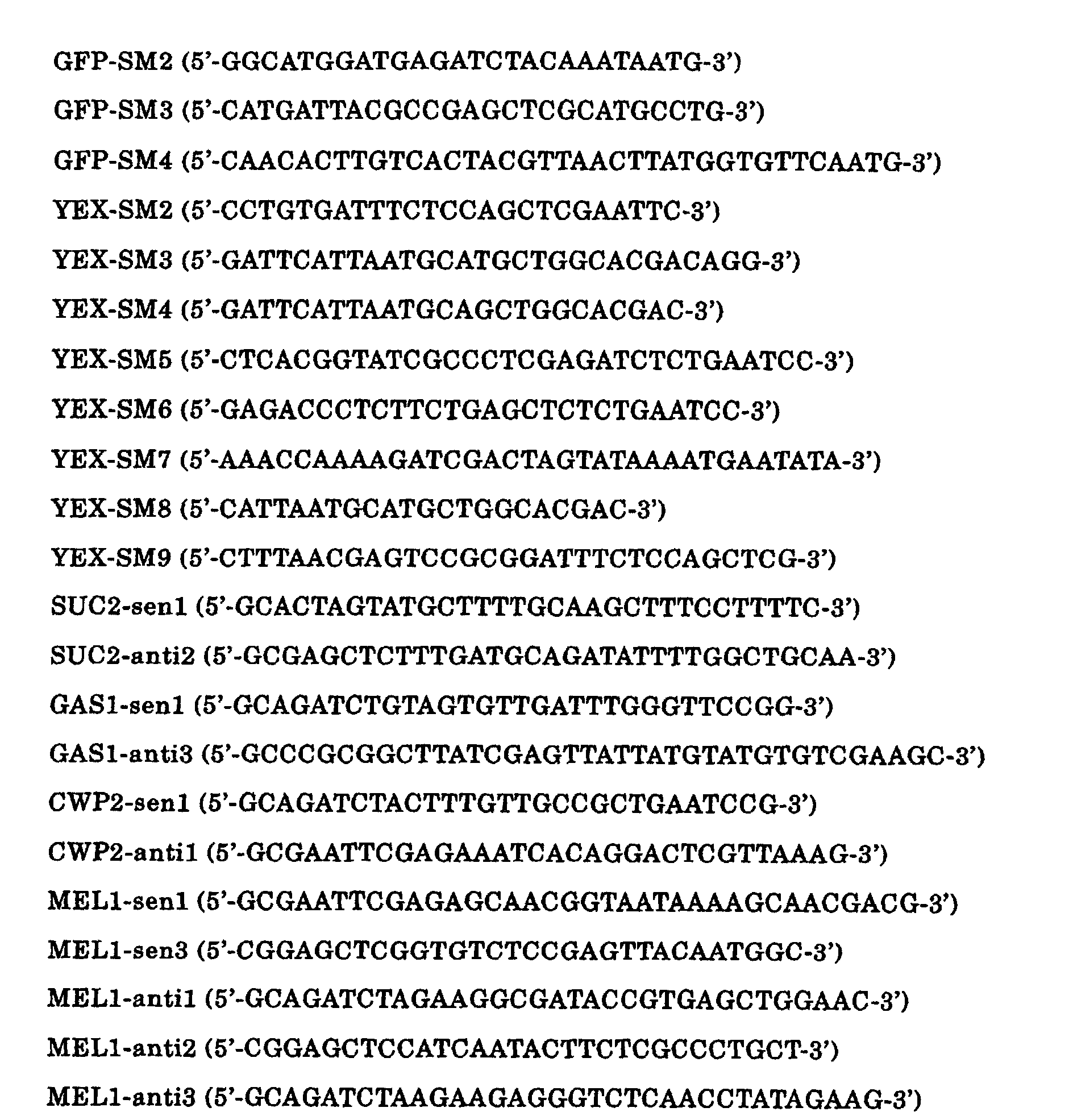
- M13 universal primer and M13 reverse primer were purchased from Pharmacia, and the other oligonucleotides were synthesized for use. These oligonucleotides are encompassed within the scope of the genes of the present invention used to fix a reporter protein on a cell wall or cell membrane of microorganism as a GPI-anchored protein.
- M13 universal primer and M13 reverse primer were purchased from Pharmacia, and the other oligonucleotides were synthesized for use. These oligonucleotides are encompassed within the scope of the genes of the present invention used to fix a reporter protein on a cell wall or cell membrane of microorganism as a GPI-anchored protein.
- plasmids include recombinant vectors containing the genes of the present invention used to fix a reporter protein on a cell wall or cell membrane of microorganism as a GPI-anchored protein.
- pGEM-T Vector System Promega, Madison, WI, USA
- Transformer Site-Directed Mutagenesis Kit (Clontech) was used for introduction of mutations.
- Recovery of DNA fragments from agarose, dephosphrylation, blunt-ending, ligation and digestion with restriction enzymes were performed according to conventional methods.
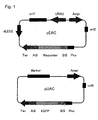
- the structures of major plasmids are shown in Fig. 1.
- oriB represents the replication origin of Escherichia coli
- oriY represents the replication origin of baker's yeast
- Ampr represents ampicillin resistance gene
- dLEU2 represents a partially deficient marker of LEU2
- Pro represents a phosphoglycerate kinase promoter
- SS represents a secretory signal
- Ter represents a phosphoglycerate kinase terminator.
- Reporter is ⁇ -galactosidase.
- pEAC8a Reporter is GFPuv.
- pUAC19 Reporter is EGFP, Marker is URA3, and AS is CWP2 anchoring signal.
- pUAC19a Reporter is EGFP, Marker is URA3, and AS is CWP2 anchoring signal.
- pUAC20a Reporter is EGFP, Marker is LEU2, and AS is CWP2 anchoring signal.
- pUAC21a Reporter is EGFP, Marker is TRP1, and AS is CWP2 anchoring signal.
- Reporter is EGFP, Marker is LEU2, and AS is GAS1 anchoring signal.
- AS is GAS1 anchoring signal.
- pUAC30b Reporter is EGFP, Marker is URA3, and AS is GAS1 anchoring signal.
- pUAC31b Reporter is EGFPuv, Marker is TRP1, and AS is GAS1 anchoring signal.
- GFP green fluorescent protein
- a gene coding for a fusion protein which consists of each of the proteins added with a secretory signal of SUC2 at the N-terminus and a GPI anchoring signal of CWP2 at the C-terminus was designed, and the gene was inserted between the promoter and the terminator of phosphoglycerate kinase gene to obtain an expression cassette.
- Wall-type arming yeasts were obtained by transformation using a plasmid obtained by inserting the expression cassette into a YEp-type vector (pEAC6a, pEAC8a or pEAC9) for AYE1, AYE2 or AYE3 strain, or by linearizing a plasmid obtained by inserting the expression cassette into a YIp type vector (pUAC19a, pUAC20a or pUAC21a) and then introducing into chromosomal DNA of each strain (AY-2, AY-5, AY-16, AY-14 or AY-17 strain).
- Membrane-type arming yeast (AY-12 or AY-15 strain) was prepared by replacing the GPI anchoring signal with any of those derived from GAS1 (pUAC29b, pUAC30b or pUAC31b). The prepared strains are shown in Table 2.
- YPAUD 1% yeast extract, 2% peptone, 2% glucose, 40 ⁇ g/ml of adenine, 20 ⁇ g/ml of uracil
- RPMIB RPMI1640 (Sigma)
- 1 M sorbitol 100 mM potassium phosphate buffer (pH 4.0-7.0)
- 2% glucose 40 ⁇ g/ml of adenine, 20 ⁇ g/ml of uracil
- YNB 0.67% yeast nitrogen base without amino acid (Difco)
- additional nutrients 40 ⁇ g/ml of adenine, 20 ⁇ g/ml of histidine, 60 ⁇ g/ml of leucine, 30 ⁇ g/ml of lysine, 40 ⁇ g/ml of tryptophan, 20 ⁇ g/ml of uracil
- Agar media were obtained by adding 1.5-2% agarose to the aforementioned liquid media.
- the fluorescence intensity and the optimum wavelengths were measured by using a fluorometer (F-2000, Hitachi Koki Co., Ltd.), Further, fluorescence of each cell was detected by using a fluorescence microscope (Axioplan, Zeiss).
- Yeast cells cultured in a liquid medium in the logarithmic growth phase were collected and floated in an appropriate buffer.
- the mixture was added with 400-6.25 ⁇ g/ml of Zymolyase 100T (Seikagaku Corporation) and shaken at 30°C for 30 minutes.
- the KRE6-disrupted strain (AY-16 strain) was cultured with shaking at 30°C.
- the culture fluid was filtered using a filter after 3 and 6 hours, and fluorescence intensity in the medium was measured.
- the AY-2 strain was grown in a test tube, and the cells were collected and Zymolyase was allowed to act on the cells. The fluorescence intensity in the culture supernatant after subjected to the action was measured. When Zymolyase was allowed to act on the AY-2 strain under osmotic pressure protection, the fluorescence intensity in the buffer increased depending on the concentration of the added Zymolyase (Table 4). These results suggested that a large amount of GFP was fixed on the cell wall.
- AY-2 strain wall-type arming yeast
- AY-12 strain membrane-type arming yeast
- Each yeast strain was grown in a test tube, and cells were collected and fractionated into cell wall, cell membrane, and soluble proteins. Fluorescence intensities of the resulting fractions were measured and each ratio on the basis of the total fluorescence intensity was calculated (unit: %). The results are shown in Table 5. It was revealed that a respective large amount of GFP was fixed on the cell wall of the wall-type arming yeast and the cell membrane of the membrane-type arming yeast.
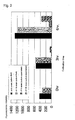
- the GFP releasing effects in the AY-2 strain (wall-type arming yeast) and the AY-12 strain (membrane-type arming yeast) were compared under actions of available antifungal agents.
- the AY-2 strain cells and the AY-12 strain cells each cultured in a test tube were floated on a medium (RPMIB) protected for osmotic pressure, and each of the agents was allowed to act on the cells. After the culture, the fluorescence intensity of the supernatant was measured, and a difference from that of a control with no addition of the agent was calculated. The results are shown in Fig. 3.
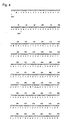
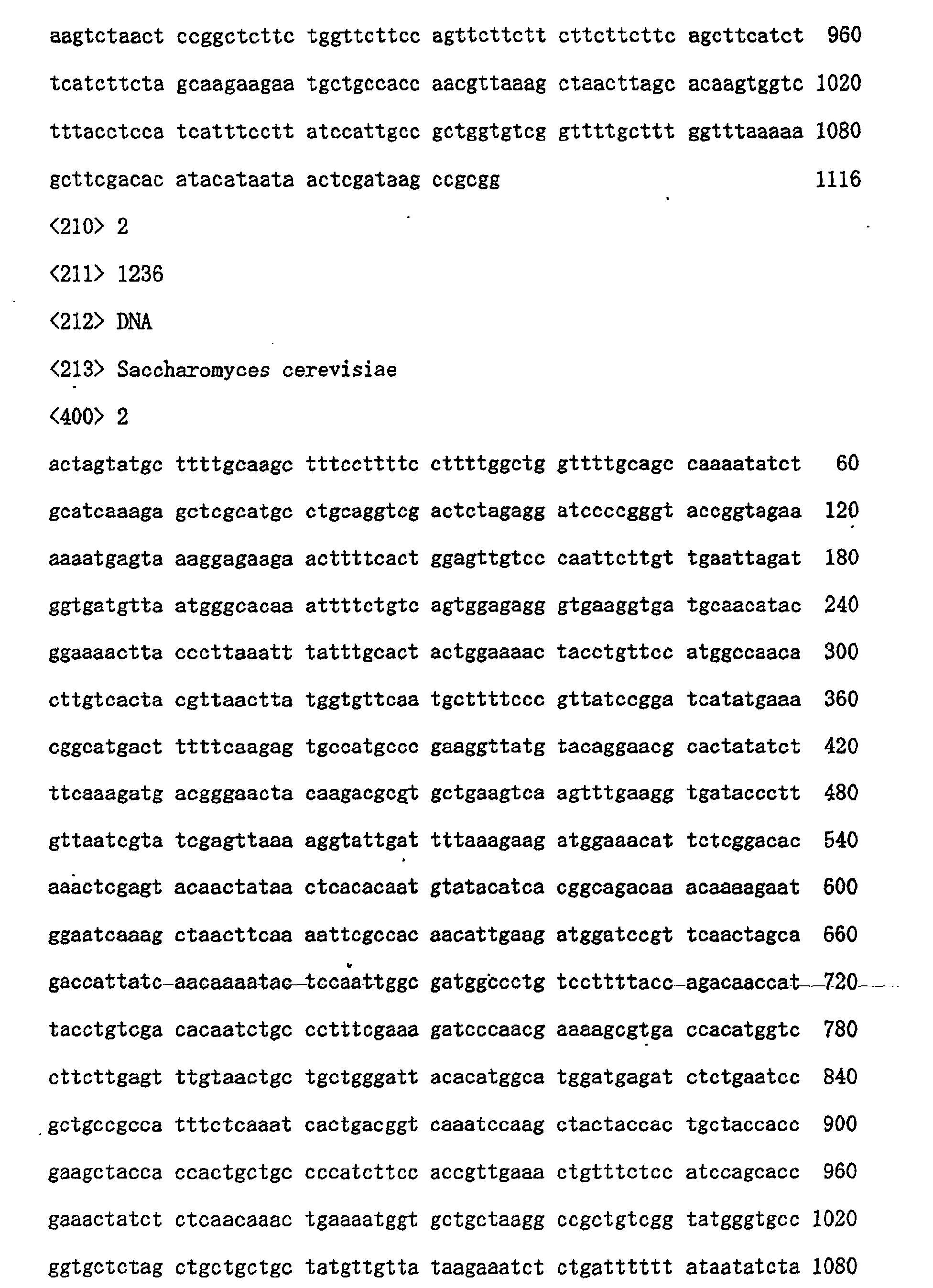
- SEQ ID NO: 1 is the gene incorporated in the AY-15 strain, which is a membrane-type arming yeast, as a genome-incorporated type gene.
- the gene corresponds to a nucleotide sequence of SS (secretory signal)-EGFPuv-membrane anchoring signal (AS) and was obtained by adding mutations to a commercially available GFPuv (312th position was substituted with "g", 315th position with "a”, and 316th position with "a” for the nucleotides in the original GFPuv being t, c and t, respectively).
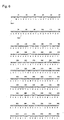
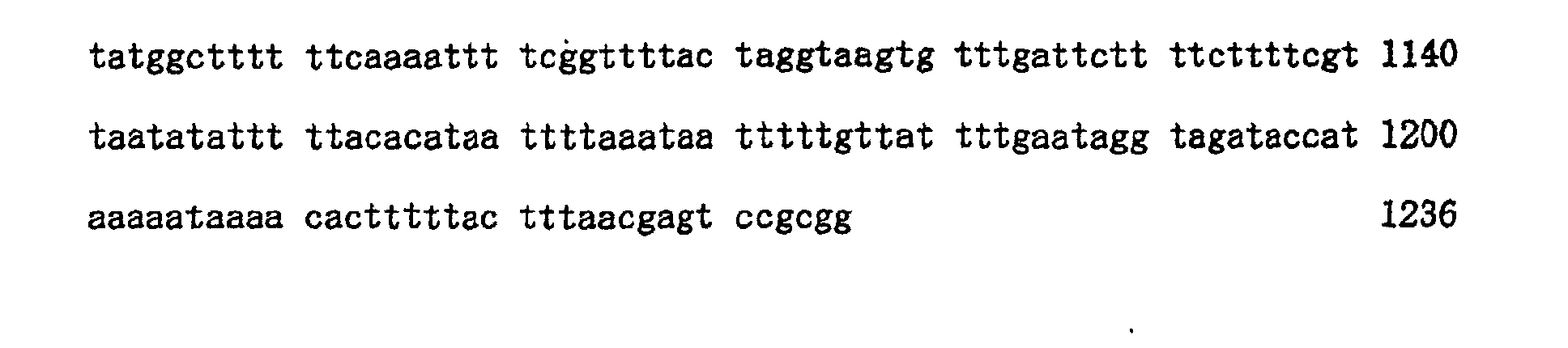
- SEQ ID NO: 2 is the gene incorporated in the AY-14 strain, which is a wall-type arming yeast, as a genome-incorporated type gene.
- the gene corresponds to a nucleotide sequence of SS (secretory signal)-EGFPuv-wall anchoring signal (AS) and was obtained by adding mutations to a commercially available GFPuv (312th position was replaced with "g", 315th position with "a” and 316th position with "a” for the nucleotides in the original GFPuv being t, c and t, respectively).
- agents having a selective inhibitory action on cell walls for example, agents having a selective inhibitory action on an enzyme for biosynthesis of (1,6)- ⁇ -glucan that constitutes cell walls can be efficiently screened.
Landscapes
- Chemical & Material Sciences (AREA)
- Organic Chemistry (AREA)
- Life Sciences & Earth Sciences (AREA)
- Health & Medical Sciences (AREA)
- Engineering & Computer Science (AREA)
- Proteomics, Peptides & Aminoacids (AREA)
- Zoology (AREA)
- Wood Science & Technology (AREA)
- Bioinformatics & Cheminformatics (AREA)
- Immunology (AREA)
- Toxicology (AREA)
- Biotechnology (AREA)
- Analytical Chemistry (AREA)
- Microbiology (AREA)
- Molecular Biology (AREA)
- Physics & Mathematics (AREA)
- Biophysics (AREA)
- Genetics & Genomics (AREA)
- Biochemistry (AREA)
- General Engineering & Computer Science (AREA)
- General Health & Medical Sciences (AREA)
- Medicinal Chemistry (AREA)
- Measuring Or Testing Involving Enzymes Or Micro-Organisms (AREA)
- Micro-Organisms Or Cultivation Processes Thereof (AREA)
- Investigating Or Analysing Biological Materials (AREA)
Abstract
Description
- glucan of the cell wall. The agent acting on a cell wall is preferably an antifungal agent, and the microorganisms are preferably yeasts. Further, the reporter protein is preferably a fluorescent protein, more preferably a green fluorescent protein. As a particularly preferred set, a set of the AY-14 strain and the AY-15 strain is provided. Further, the present invention provides a gene used for fixing a reporter protein as a GPI-anchored protein on a cell wall or cell membrane of a microorganism, preferably an yeast. Preferred genes (oligonucleotides or polynucleotides) are specifically described in the example of the present specification, and examples include, for example, the gene specified by the nucleic acid sequence of SEQ ID NO: 1 or 2 in - Sequence Listing or a gene which has a nucleic acid sequence corresponding to the aforementioned nucleic acid sequence including substitution, insertion and/or deletion of several nucleic acid residues and has substantially the same function as that of the gene specified by the nucleic acid sequence of SEQ ID NO: 1 or 2 in Sequence Listing. The present invention further provides a recombinant vector containing any of these genes and a microorganism, preferably an yeast, transformed with the recombinant vector.
| Agent | Acronym | Action |
| Aculeacin A | AC | Inhibition of cell wall ((1,3)-β-glucan) synthesis |
| Tunicamycin | TM | Inhibition of cell wall (N-type saccharide chain) synthesis |
| Nikkomycin Z | NM | Inhibition of cell wall (chitin) synthesis |
| Calcofluor white | CW | Physical adsorption to cell wall |
| Congo red | CR | Physical adsorption to cell wall |
| Amphotericin B | AMPH | Damage of cell membrane (binding to ergosterol) |
| Fluconazole | FCZ | Inhibition of cell membrane (ergosterol) synthesis |
| Aureobasidin | AB | Inhibition of cell membrane (sphingolipid) synthesis |
| Cerulenin | CE | Inhibition of cell membrane (fatty acid) synthesis |
| Salinomycin | SM | Damage of cell membrane (ionophore) |
| Flucytosine | 5-FC | Inhibition of nucleic acid synthesis |
| Zeocin | ZE | Binding to nucleic acid |
| Netropsin | NE | Inhibition of nucleic acid synthesis |
| Cycloheximide | CH | Inhibition of protein synthesis |
| Azaserine | AS | Inhibition of protein synthesis |
| Bromoconduritol | BC | Inhibition of mannosidase |
| Caffeine | CA | Intracellular information transmission (c-AMP) inhibition |

| Excitation (nm) | Emission (nm) | Fluorescence | |
| YPH500 | 487 | 513 | 260 |
| AY-5 | 487 | 513 | 1260 |
| YPH500 | 395 | 509 | 50 |
| AY-17 | 395 | 509 | 350 |
| Zymolyase (µ g/ml) | |
| 400 | 2160 |
| 200 | 1240 |
| 100 | 1170 |
| 50 | 786 |
| 25 | 410 |
| 12.5 | 215 |
| 6.25 | 126 |
| 0 | 107 |
| AY-2 | AY-12 | |
| | 40 | 11 |
| Cell membrane fraction | 15 | 48 |
| Soluble protein fraction | 45 | 41 |

Claims (24)
- A method for screening an agent acting on a cell wall, which comprises the steps of:(1) culturing each of a microorganism having a reporter protein fixed on a cell wall as a GPI-anchored protein and a microorganism having a reporter protein fixed on a cell membrane as a GPI-anchored protein in the presence of a test agent;(2) determining the reporter protein released into each culture fluid of the microorganism; and(3) judging that the test agent has a selective inhibitory action on the cell wall when the reporter protein is released from the microorganism having the reporter protein fixed on the cell wall into the culture fluid and the reporter protein is not substantially released from the microorganism having the reporter protein fixed on the cell membrane into the culture fluid.
- The method according to Claim 1, which uses a microorganism having the reporter protein fixed to (1,6)-β-glucan on the cell wall.
- The method according to Claim 1 or 2, wherein the microorganism is yeast.
- The method according to any one of Claims 1 to 3, wherein the reporter protein is a fluorescent protein.
- The method according to Claim 4, wherein the fluorescent protein is a green fluorescent protein.
- The method according to any one of Claims 1 to 5, wherein the inhibitory action on the cell wall is an inhibitory action on a biosynthetic process and/or an enzyme for biosynthesis of the cell wall.
- The method according to any one of Claims 1 to 6, wherein the agent acting on the cell wall is an antifungal agent.
- A microorganism having a reporter protein fixed on a cell wall as a GPI-anchored protein.
- The microorganism according to Claim 8, wherein the reporter protein is fixed to (1,6)-β-glucan of the cell wall.
- A microorganism having a reporter protein fixed on a cell membrane as a GPI-anchored protein.
- The microorganism according to any one of Claims 8 to 10, which is used for a screening of an agent acting on a cell wall.
- The microorganism according to Claim 11, wherein the agent acting on a cell wall is an antifungal agent.
- The microorganism according to any one of Claims 8 to 12, wherein the microorganism is an yeast.
- The microorganism according to any one of Claims 8 to 13, wherein the reporter protein is a fluorescent protein.
- The microorganism according to Claim 14, wherein the fluorescent protein is a green fluorescent protein.
- A set of microorganisms used for a screening of an agent acting on a cell wall, which comprises:(1) a microorganism having a reporter protein fixed on a cell wall as a GPI-anchored protein; and(2) a microorganism having a reporter protein fixed on a cell membrane as a GPI-anchored protein.
- The set according to Claim 16, which comprises a microorganism having a reporter protein fixed to (1,6)-β-glucan of the cell wall.
- The set according to Claim 16 or 17, wherein the agent acting on a cell wall is an antifungal agent.
- The set according to any one of Claims 16 to 18, wherein the microorganisms are yeasts.
- The set according to any one of Claims 16 to 19, wherein the reporter protein is a fluorescent protein.
- The set according to Claim 20, wherein the fluorescent protein is a green fluorescent protein.
- An agent acting on a cell wall which is screened by the method according to any one of Claims 1 to 7.
- A gene used for fixing a reporter protein as a GPI-anchored protein on a cell wall or a cell membrane of a microorganism.
- The gene according to Claim 23, which is the gene specified by the nucleic acid sequence of SEQ ID NO: 1 or 2 in Sequence Listing, or a gene which has a nucleic acid sequence corresponding to said nucleic acid sequence including substitution, insertion and/or deletion of several nucleic acid residues and has substantially the same function as that of the gene specified by the nucleic acid sequence of SEQ ID NO: 1 or 2 in Sequence Listing.
Applications Claiming Priority (3)
| Application Number | Priority Date | Filing Date | Title |
|---|---|---|---|
| JP2000132041 | 2000-05-01 | ||
| JP2000132041 | 2000-05-01 | ||
| PCT/JP2001/003630 WO2001083733A1 (en) | 2000-05-01 | 2001-04-26 | Method of screening drug acting on cell wall |
Publications (3)
| Publication Number | Publication Date |
|---|---|
| EP1283261A1 true EP1283261A1 (en) | 2003-02-12 |
| EP1283261A4 EP1283261A4 (en) | 2006-09-06 |
| EP1283261B1 EP1283261B1 (en) | 2008-08-06 |
Family
ID=18640818
Family Applications (1)
| Application Number | Title | Priority Date | Filing Date |
|---|---|---|---|
| EP01925961A Expired - Lifetime EP1283261B1 (en) | 2000-05-01 | 2001-04-26 | Method of screening drug acting on cell wall |
Country Status (9)
| Country | Link |
|---|---|
| US (1) | US20040091949A1 (en) |
| EP (1) | EP1283261B1 (en) |
| AT (1) | ATE403717T1 (en) |
| AU (1) | AU2001252604A1 (en) |
| CA (1) | CA2407906A1 (en) |
| DE (1) | DE60135215D1 (en) |
| ES (1) | ES2312425T3 (en) |
| NO (1) | NO20025217L (en) |
| WO (1) | WO2001083733A1 (en) |
Cited By (1)
| Publication number | Priority date | Publication date | Assignee | Title |
|---|---|---|---|---|
| EP1445327A4 (en) * | 2001-10-22 | 2005-09-14 | Daiichi Seiyaku Co | METHOD FOR SCREENING A MEDICAMENT ACTING ON THE CELL WALL |
Families Citing this family (3)
| Publication number | Priority date | Publication date | Assignee | Title |
|---|---|---|---|---|
| CA2474850A1 (en) * | 2002-01-31 | 2003-08-07 | Daiichi Pharmaceutical Co., Ltd. | Imidazo[1,2-a]pyridine derivatives |
| MX2007013725A (en) | 2005-05-05 | 2008-04-09 | Sensient Flavors Inc | Production of beta-glucans and mannans. |
| CN111679069A (en) * | 2019-12-31 | 2020-09-18 | 安徽中医药大学 | A method for evaluating the antifungal effect of traditional Chinese medicine monomers by remodeling of Candida auris cell wall |
Family Cites Families (2)
| Publication number | Priority date | Publication date | Assignee | Title |
|---|---|---|---|---|
| DK0673427T3 (en) * | 1992-07-08 | 2003-07-21 | Unilever Nv | Enzymatic process using enzymes immobilized on the cell wall of a eukaryotic microbial cell to produce a fusion protein |
| WO1999067419A1 (en) * | 1998-06-25 | 1999-12-29 | The Collaborative Group, Ltd. | β(1,6)-GLUCAN SYNTHESIS AND CELL WALL ASSEMBLY ASSAY |
-
2001
- 2001-04-26 ES ES01925961T patent/ES2312425T3/en not_active Expired - Lifetime
- 2001-04-26 WO PCT/JP2001/003630 patent/WO2001083733A1/en not_active Ceased
- 2001-04-26 EP EP01925961A patent/EP1283261B1/en not_active Expired - Lifetime
- 2001-04-26 AU AU2001252604A patent/AU2001252604A1/en not_active Abandoned
- 2001-04-26 US US10/258,579 patent/US20040091949A1/en not_active Abandoned
- 2001-04-26 CA CA002407906A patent/CA2407906A1/en not_active Abandoned
- 2001-04-26 DE DE60135215T patent/DE60135215D1/en not_active Expired - Fee Related
- 2001-04-26 AT AT01925961T patent/ATE403717T1/en not_active IP Right Cessation
-
2002
- 2002-10-31 NO NO20025217A patent/NO20025217L/en not_active Application Discontinuation
Cited By (2)
| Publication number | Priority date | Publication date | Assignee | Title |
|---|---|---|---|---|
| EP1445327A4 (en) * | 2001-10-22 | 2005-09-14 | Daiichi Seiyaku Co | METHOD FOR SCREENING A MEDICAMENT ACTING ON THE CELL WALL |
| US7459268B2 (en) | 2001-10-22 | 2008-12-02 | Daiichi Pharmaceutical Co., Ltd. | Method for screening agent acting on cell wall |
Also Published As
| Publication number | Publication date |
|---|---|
| ES2312425T3 (en) | 2009-03-01 |
| NO20025217D0 (en) | 2002-10-31 |
| DE60135215D1 (en) | 2008-09-18 |
| CA2407906A1 (en) | 2001-11-08 |
| EP1283261B1 (en) | 2008-08-06 |
| US20040091949A1 (en) | 2004-05-13 |
| NO20025217L (en) | 2002-12-30 |
| WO2001083733A1 (en) | 2001-11-08 |
| ATE403717T1 (en) | 2008-08-15 |
| AU2001252604A1 (en) | 2001-11-12 |
| EP1283261A4 (en) | 2006-09-06 |
Similar Documents
| Publication | Publication Date | Title |
|---|---|---|
| Gaughran et al. | Nikkomycin Z is a specific inhibitor of Saccharomyces cerevisiae chitin synthase isozyme Chs3 in vitro and in vivo | |
| Hein et al. | NPI1, an essential yeast gene involved in induced degradation of Gap1 and Fur4 permeases, encodes the Rsp5 ubiquitin—protein ligase | |
| Zhou et al. | Isolation of crt mutants constitutive for transcription of the DNA damage inducible gene RNR3 in Saccharomyces cerevisiae. | |
| Nakamura et al. | Acidification of vacuoles is required for autophagic degradation in the yeast, Saccharomyces cerevisiae | |
| DeMarini et al. | A septin-based hierarchy of proteins required for localized deposition of chitin in the Saccharomyces cerevisiae cell wall | |
| Martı́n et al. | Regulatory mechanisms for modulation of signaling through the cell integrity Slt2-mediated pathway in Saccharomyces cerevisiae | |
| Hampton et al. | Regulated degradation of HMG-CoA reductase, an integral membrane protein of the endoplasmic reticulum, in yeast. | |
| Springael et al. | Nitrogen-regulated ubiquitination of the Gap1 permease of Saccharomyces cerevisiae | |
| Biggins et al. | Yeast ubiquitin-like genes are involved in duplication of the microtubule organizing center. | |
| Kaiser et al. | Cdc34 and the F-box protein Met30 are required for degradation of the Cdk-inhibitory kinase Swe1 | |
| Frohloff et al. | Saccharomyces cerevisiae Elongator mutations confer resistance to the Kluyveromyces lactis zymocin | |
| Chernova et al. | Pleiotropic effects of Ubp6 loss on drug sensitivities and yeast prion are due to depletion of the free ubiquitin pool | |
| CA2458561A1 (en) | Yeast membrane protein expression system and its application in drug screening | |
| Sanz et al. | Control of chitin synthesis through Shc1p, a functional homologue of Chs4p specifically induced during sporulation | |
| Pal et al. | SCFCdc4-mediated degradation of the Hac1p transcription factor regulates the unfolded protein response in Saccharomyces cerevisiae | |
| Dohrmann et al. | Novel role for checkpoint Rad53 protein kinase in the initiation of chromosomal DNA replication in Saccharomyces cerevisiae | |
| WO1995006132A2 (en) | Identifying biologically active agents through culture color change | |
| EP1283261B1 (en) | Method of screening drug acting on cell wall | |
| US7459268B2 (en) | Method for screening agent acting on cell wall | |
| EP2169056A1 (en) | Set of yeast cells, method of identifying target candidate molecule, method of analyzing action mechanism and screening method | |
| Tomishige et al. | Mutations that are synthetically lethal with a gas1Δ allele cause defects in the cell wall of Saccharomyces cerevisiae | |
| Phadnis et al. | Role of the putative structural protein Sed1p in mitochondrial genome maintenance | |
| US20090047701A1 (en) | Method for screening antifungal agents | |
| JP2008228645A (en) | How to monitor mold poison production | |
| JP2008517591A (en) | Double hybrid system based on gene pausing by transcription interference |
Legal Events
| Date | Code | Title | Description |
|---|---|---|---|
| PUAI | Public reference made under article 153(3) epc to a published international application that has entered the european phase |
Free format text: ORIGINAL CODE: 0009012 |
|
| 17P | Request for examination filed |
Effective date: 20021108 |
|
| AK | Designated contracting states |
Designated state(s): AT BE CH CY DE DK ES FI FR GB GR IE IT LI LU MC NL PT SE TR |
|
| AX | Request for extension of the european patent |
Extension state: AL LT LV MK RO SI |
|
| A4 | Supplementary search report drawn up and despatched |
Effective date: 20060808 |
|
| 17Q | First examination report despatched |
Effective date: 20061018 |
|
| 17Q | First examination report despatched |
Effective date: 20061018 |
|
| GRAP | Despatch of communication of intention to grant a patent |
Free format text: ORIGINAL CODE: EPIDOSNIGR1 |
|
| GRAS | Grant fee paid |
Free format text: ORIGINAL CODE: EPIDOSNIGR3 |
|
| GRAA | (expected) grant |
Free format text: ORIGINAL CODE: 0009210 |
|
| RAP1 | Party data changed (applicant data changed or rights of an application transferred) |
Owner name: DAIICHI SANKYO COMPANY, LIMITED |
|
| AK | Designated contracting states |
Kind code of ref document: B1 Designated state(s): AT BE CH CY DE DK ES FI FR GB GR IE IT LI LU MC NL PT SE TR |
|
| REG | Reference to a national code |
Ref country code: GB Ref legal event code: FG4D |
|
| REG | Reference to a national code |
Ref country code: CH Ref legal event code: NV Representative=s name: ISLER & PEDRAZZINI AG Ref country code: CH Ref legal event code: EP |
|
| REG | Reference to a national code |
Ref country code: IE Ref legal event code: FG4D |
|
| REF | Corresponds to: |
Ref document number: 60135215 Country of ref document: DE Date of ref document: 20080918 Kind code of ref document: P |
|
| REG | Reference to a national code |
Ref country code: SE Ref legal event code: TRGR |
|
| PG25 | Lapsed in a contracting state [announced via postgrant information from national office to epo] |
Ref country code: FI Free format text: LAPSE BECAUSE OF FAILURE TO SUBMIT A TRANSLATION OF THE DESCRIPTION OR TO PAY THE FEE WITHIN THE PRESCRIBED TIME-LIMIT Effective date: 20080806 Ref country code: AT Free format text: LAPSE BECAUSE OF FAILURE TO SUBMIT A TRANSLATION OF THE DESCRIPTION OR TO PAY THE FEE WITHIN THE PRESCRIBED TIME-LIMIT Effective date: 20080806 |
|
| REG | Reference to a national code |
Ref country code: ES Ref legal event code: FG2A Ref document number: 2312425 Country of ref document: ES Kind code of ref document: T3 |
|
| PG25 | Lapsed in a contracting state [announced via postgrant information from national office to epo] |
Ref country code: DK Free format text: LAPSE BECAUSE OF FAILURE TO SUBMIT A TRANSLATION OF THE DESCRIPTION OR TO PAY THE FEE WITHIN THE PRESCRIBED TIME-LIMIT Effective date: 20080806 |
|
| PG25 | Lapsed in a contracting state [announced via postgrant information from national office to epo] |
Ref country code: PT Free format text: LAPSE BECAUSE OF FAILURE TO SUBMIT A TRANSLATION OF THE DESCRIPTION OR TO PAY THE FEE WITHIN THE PRESCRIBED TIME-LIMIT Effective date: 20090106 |
|
| PLBE | No opposition filed within time limit |
Free format text: ORIGINAL CODE: 0009261 |
|
| STAA | Information on the status of an ep patent application or granted ep patent |
Free format text: STATUS: NO OPPOSITION FILED WITHIN TIME LIMIT |
|
| 26N | No opposition filed |
Effective date: 20090507 |
|
| PGFP | Annual fee paid to national office [announced via postgrant information from national office to epo] |
Ref country code: ES Payment date: 20090513 Year of fee payment: 9 |
|
| PGFP | Annual fee paid to national office [announced via postgrant information from national office to epo] |
Ref country code: DE Payment date: 20090428 Year of fee payment: 9 Ref country code: FR Payment date: 20090417 Year of fee payment: 9 Ref country code: IT Payment date: 20090424 Year of fee payment: 9 Ref country code: NL Payment date: 20090427 Year of fee payment: 9 Ref country code: SE Payment date: 20090407 Year of fee payment: 9 |
|
| PGFP | Annual fee paid to national office [announced via postgrant information from national office to epo] |
Ref country code: BE Payment date: 20090401 Year of fee payment: 9 |
|
| PGFP | Annual fee paid to national office [announced via postgrant information from national office to epo] |
Ref country code: CH Payment date: 20090416 Year of fee payment: 9 |
|
| PGFP | Annual fee paid to national office [announced via postgrant information from national office to epo] |
Ref country code: GB Payment date: 20090422 Year of fee payment: 9 |
|
| PG25 | Lapsed in a contracting state [announced via postgrant information from national office to epo] |
Ref country code: IE Free format text: LAPSE BECAUSE OF NON-PAYMENT OF DUE FEES Effective date: 20090426 Ref country code: MC Free format text: LAPSE BECAUSE OF NON-PAYMENT OF DUE FEES Effective date: 20090430 |
|
| PG25 | Lapsed in a contracting state [announced via postgrant information from national office to epo] |
Ref country code: GR Free format text: LAPSE BECAUSE OF FAILURE TO SUBMIT A TRANSLATION OF THE DESCRIPTION OR TO PAY THE FEE WITHIN THE PRESCRIBED TIME-LIMIT Effective date: 20081107 |
|
| BERE | Be: lapsed |
Owner name: DAIICHI SANKYO COMPANY, LTD Effective date: 20100430 |
|
| REG | Reference to a national code |
Ref country code: NL Ref legal event code: V1 Effective date: 20101101 |
|
| EUG | Se: european patent has lapsed | ||
| REG | Reference to a national code |
Ref country code: CH Ref legal event code: PL |
|
| GBPC | Gb: european patent ceased through non-payment of renewal fee |
Effective date: 20100426 |
|
| REG | Reference to a national code |
Ref country code: FR Ref legal event code: ST Effective date: 20101230 |
|
| PG25 | Lapsed in a contracting state [announced via postgrant information from national office to epo] |
Ref country code: NL Free format text: LAPSE BECAUSE OF NON-PAYMENT OF DUE FEES Effective date: 20101101 |
|
| PG25 | Lapsed in a contracting state [announced via postgrant information from national office to epo] |
Ref country code: CH Free format text: LAPSE BECAUSE OF NON-PAYMENT OF DUE FEES Effective date: 20100430 Ref country code: DE Free format text: LAPSE BECAUSE OF NON-PAYMENT OF DUE FEES Effective date: 20101103 Ref country code: LI Free format text: LAPSE BECAUSE OF NON-PAYMENT OF DUE FEES Effective date: 20100430 |
|
| PG25 | Lapsed in a contracting state [announced via postgrant information from national office to epo] |
Ref country code: IT Free format text: LAPSE BECAUSE OF NON-PAYMENT OF DUE FEES Effective date: 20100426 Ref country code: GB Free format text: LAPSE BECAUSE OF NON-PAYMENT OF DUE FEES Effective date: 20100426 Ref country code: BE Free format text: LAPSE BECAUSE OF NON-PAYMENT OF DUE FEES Effective date: 20100430 |
|
| PG25 | Lapsed in a contracting state [announced via postgrant information from national office to epo] |
Ref country code: LU Free format text: LAPSE BECAUSE OF NON-PAYMENT OF DUE FEES Effective date: 20090426 |
|
| REG | Reference to a national code |
Ref country code: ES Ref legal event code: FD2A Effective date: 20110714 |
|
| PG25 | Lapsed in a contracting state [announced via postgrant information from national office to epo] |
Ref country code: ES Free format text: LAPSE BECAUSE OF NON-PAYMENT OF DUE FEES Effective date: 20110704 |
|
| PG25 | Lapsed in a contracting state [announced via postgrant information from national office to epo] |
Ref country code: TR Free format text: LAPSE BECAUSE OF FAILURE TO SUBMIT A TRANSLATION OF THE DESCRIPTION OR TO PAY THE FEE WITHIN THE PRESCRIBED TIME-LIMIT Effective date: 20080806 |
|
| PG25 | Lapsed in a contracting state [announced via postgrant information from national office to epo] |
Ref country code: CY Free format text: LAPSE BECAUSE OF FAILURE TO SUBMIT A TRANSLATION OF THE DESCRIPTION OR TO PAY THE FEE WITHIN THE PRESCRIBED TIME-LIMIT Effective date: 20080806 Ref country code: ES Free format text: LAPSE BECAUSE OF NON-PAYMENT OF DUE FEES Effective date: 20100427 |
|
| PG25 | Lapsed in a contracting state [announced via postgrant information from national office to epo] |
Ref country code: FR Free format text: LAPSE BECAUSE OF NON-PAYMENT OF DUE FEES Effective date: 20100430 |
|
| PG25 | Lapsed in a contracting state [announced via postgrant information from national office to epo] |
Ref country code: SE Free format text: LAPSE BECAUSE OF NON-PAYMENT OF DUE FEES Effective date: 20100427 |