EP1283162B1 - Ballon - Google Patents
Ballon Download PDFInfo
- Publication number
- EP1283162B1 EP1283162B1 EP02002348A EP02002348A EP1283162B1 EP 1283162 B1 EP1283162 B1 EP 1283162B1 EP 02002348 A EP02002348 A EP 02002348A EP 02002348 A EP02002348 A EP 02002348A EP 1283162 B1 EP1283162 B1 EP 1283162B1
- Authority
- EP
- European Patent Office
- Prior art keywords
- envelope
- balloon
- gas
- buoyancy
- liquid
- Prior art date
- Legal status (The legal status is an assumption and is not a legal conclusion. Google has not performed a legal analysis and makes no representation as to the accuracy of the status listed.)
- Expired - Lifetime
Links
- XLYOFNOQVPJJNP-UHFFFAOYSA-N water Substances O XLYOFNOQVPJJNP-UHFFFAOYSA-N 0.000 claims description 58
- 239000007788 liquid Substances 0.000 claims description 48
- 230000002745 absorbent Effects 0.000 claims description 44
- 239000002250 absorbent Substances 0.000 claims description 44
- 229920005594 polymer fiber Polymers 0.000 claims description 2
- 230000005484 gravity Effects 0.000 description 48
- 239000007789 gas Substances 0.000 description 42
- 230000001133 acceleration Effects 0.000 description 10
- YMHOBZXQZVXHBM-UHFFFAOYSA-N 2,5-dimethoxy-4-bromophenethylamine Chemical compound COC1=CC(CCN)=C(OC)C=C1Br YMHOBZXQZVXHBM-UHFFFAOYSA-N 0.000 description 9
- 241000545067 Venus Species 0.000 description 9
- 239000004744 fabric Substances 0.000 description 8
- 230000000717 retained effect Effects 0.000 description 7
- 239000000523 sample Substances 0.000 description 4
- 230000008016 vaporization Effects 0.000 description 4
- 239000000463 material Substances 0.000 description 3
- 239000002775 capsule Substances 0.000 description 2
- 239000003795 chemical substances by application Substances 0.000 description 2
- 238000000034 method Methods 0.000 description 2
- 229920000642 polymer Polymers 0.000 description 2
- -1 polysiloxane Polymers 0.000 description 2
- 229920001296 polysiloxane Polymers 0.000 description 2
- 230000032258 transport Effects 0.000 description 2
- 229920002972 Acrylic fiber Polymers 0.000 description 1
- 239000002390 adhesive tape Substances 0.000 description 1
- 239000000470 constituent Substances 0.000 description 1
- 238000007796 conventional method Methods 0.000 description 1
- 230000000694 effects Effects 0.000 description 1
- 230000001747 exhibiting effect Effects 0.000 description 1
- 239000000835 fiber Substances 0.000 description 1
- 238000010438 heat treatment Methods 0.000 description 1
- 229920001495 poly(sodium acrylate) polymer Polymers 0.000 description 1
- NNMHYFLPFNGQFZ-UHFFFAOYSA-M sodium polyacrylate Chemical compound [Na+].[O-]C(=O)C=C NNMHYFLPFNGQFZ-UHFFFAOYSA-M 0.000 description 1
- 238000009834 vaporization Methods 0.000 description 1
Images

Classifications
-
- B—PERFORMING OPERATIONS; TRANSPORTING
- B64—AIRCRAFT; AVIATION; COSMONAUTICS
- B64B—LIGHTER-THAN AIR AIRCRAFT
- B64B1/00—Lighter-than-air aircraft
- B64B1/58—Arrangements or construction of gas-bags; Filling arrangements
-
- B—PERFORMING OPERATIONS; TRANSPORTING
- B64—AIRCRAFT; AVIATION; COSMONAUTICS
- B64B—LIGHTER-THAN AIR AIRCRAFT
- B64B1/00—Lighter-than-air aircraft
- B64B1/40—Balloons
-
- B—PERFORMING OPERATIONS; TRANSPORTING
- B64—AIRCRAFT; AVIATION; COSMONAUTICS
- B64B—LIGHTER-THAN AIR AIRCRAFT
- B64B1/00—Lighter-than-air aircraft
- B64B1/58—Arrangements or construction of gas-bags; Filling arrangements
- B64B1/62—Controlling gas pressure, heating, cooling, or discharging gas
-
- B—PERFORMING OPERATIONS; TRANSPORTING
- B64—AIRCRAFT; AVIATION; COSMONAUTICS
- B64G—COSMONAUTICS; VEHICLES OR EQUIPMENT THEREFOR
- B64G1/00—Cosmonautic vehicles
- B64G1/10—Artificial satellites; Systems of such satellites; Interplanetary vehicles
- B64G1/105—Space science
-
- B—PERFORMING OPERATIONS; TRANSPORTING
- B64—AIRCRAFT; AVIATION; COSMONAUTICS
- B64G—COSMONAUTICS; VEHICLES OR EQUIPMENT THEREFOR
- B64G1/00—Cosmonautic vehicles
- B64G1/22—Parts of, or equipment specially adapted for fitting in or to, cosmonautic vehicles
- B64G1/222—Parts of, or equipment specially adapted for fitting in or to, cosmonautic vehicles for deploying structures between a stowed and deployed state
- B64G1/2221—Parts of, or equipment specially adapted for fitting in or to, cosmonautic vehicles for deploying structures between a stowed and deployed state characterised by the manner of deployment
- B64G1/2227—Inflating
Definitions
- This invention relates to a balloon including a balloon for planetary exploration and a commercial hot air balloon.
- the gas for the balloon buoyancy should preferably be conveyed to the planet in a liquefied gas rather than in a gas filled in a high-pressure vessel. It is because the liquefied gas state can advantageously reduce the mass and volume of the probe launched into the space.
- the gas should be selected from those materials that can maintain the liquefied gas state at the ordinary temperatures and can turn into the gas state at the relatively high atmospheric temperature of the planet.
- Such materials can be very convenient because they can maintain the liquid state during the transport toward the planet and can turn into the gas state during the floating in the planet's atmosphere.
- a capsule for containing the balloon is designed to release the balloon when the capsule plunges into the atmosphere of the planet, and then the balloon is allowed to fall through the atmosphere while suspending from a parachute. During this short time of falling, the liquefied gas should vaporize sufficiently to expand the balloon.
- the US-Patent 3,268,184 discloses a temperature actuated inflation device for large balloons comprising a thin, pliable plastic bag, a sublimating pressurizing agent within said bag, which bag being sealed by the open end of said bag being folded over upon itself.
- Temperature sensitive adhesive tape means are provided for securing said fold to said bag, whereby when said tape means is heated to a predetermined temperature, said tape loses its adhesiveness and said fold is released allowing said agent to escape.
- the US-Patent 4,393,998 discloses a balloon comprising a container for storing a liquid.
- the US-Patent 4,999,236 discloses a balloon comprising an envelope having a multi-layer-structure comprising a polysiloxane layer, which makes the fabric air impervious.
- a carbonaceous mat of the fabric structure covered by the polysiloxane layer has a low moisture absorbency and is arranged as an innermost sheet in the envelope.
- An object of the present invention is to provide a balloon comprising an envelope, wherein the envelope has a multilayered structure comprising a gas impervious sheet and a liquid absorbent sheet which is lighter and smaller.
- a balloon wherein said liquid absorbent sheet is capable of containing a liquid of a weight from 1 to 200 times as large as the own weight of said liquid absorbent sheet.
- said liquid absorbent sheet is a water absorbent sheet.
- said water absorbent sheet is formed of a polymer fiber.
- the present invention has been accomplished in the course of studying a method for floating a balloon over a planet such as Venus. Specifically, this method is aimed at transporting the buoyancy gas in a liquid state to Venus, and vaporizing the liquefied gas in a short time at the high temperatures of the Venusian atmosphere to expand the envelope of the balloon.
- the envelope for containing the balloon buoyancy gas comprises a gas-impervious sheet.
- the gas impervious sheet has a liquid absorbent sheet adhered on its rear surface (inner surface).
- the liquid absorbent sheet is made of a film or fiber exhibiting excellent liquid absorbency.
- the liquid absorbent sheet can hold liquified materials for the buoyancy gas.
- the liquid held and distributed throughout the liquid absorbent sheet can be vaporized to produce some degree of buoyancy in the balloon an to adjust the buoyancy produced.
- the liquid can vaporize either by heat exchanging between the envelope surface and the high temperature atmosphere around the envelope, or by raising the temperature inside the envelope with a heater.
- the liquid absorbent sheet refers to a sheet which can hold a liquid having a weight equal to or more than 1 time, preferably 3 times, more preferably 5 times as large as the sheet's own weight.
- the liquid absorbent sheet can also contain a liquid, for example, having a weight of up to from 100 to 200 times as large as its own weight.
- the water absorbent sheet can include a polymer fabric based on sodium polyacrylate.
- the polymer fabric has a water absorbency in which a water of weight 80 times as large as its own weight can be absorbent.
- Another examples of the high-water absorbent fabric can include an acrylic fiber.
- the liquid absorbent sheet, which is formed of a film and the like, for the use in the present invention can hold a large quantity of liquid as described above.
- an increased mass of the envelope can greatly be minimized to have a liquid absorbent sheet necessary to hold a predetermined quantity of a liquid.
- the liquid for the buoyancy gas can previously be confined within the envelope by making it held in the liquid absorbent sheet so that the envelope can be sealed from the beginning.
- a gas injector and any relevant piping systems are no longer required to inject the gas into the envelope.
- the weight of the balloon system can be reduced and the structure of the balloon system can be simplified to increase the reliability of the balloon system.
- the skin of the envelope has a surface area much larger than that of the large scale heat exchanger. Therefore, even if the skin does not have high heat exchange efficiency per unit area, the total skin can have high heat exchange efficiency which is as high as that of the large-scale heat exchanger. Accordingly, for a planet such as Venus whose the atmosphere has a relatively high temperature, a large quantity of heat can transfer to the liquid absorbent sheet from the high-temperature atmosphere of the planet when the envelope extends its full length to expose the surface in the atmosphere during the descent of the balloon with a parachute. This large quantity of heat can vaporize the liquid retained in the sheet within a short time to provide sufficient buoyancy to the balloon.
- the liquid for the buoyancy gas can widely be distributed and retained on the inner surface of the envelope to be transported to the planet.
- the liquid can then vaporize using the envelope skin as a giant heat exchanger, which is in contact with the high-temperature atmosphere of the planet. Therefore, a balloon can be provided which is relatively light and small and can vaporize the liquefied buoyancy gas within a short time.
- the balloon according to the present invention can also be applied to a commercial hot air balloon for floating in the earth's atmosphere.
- water can be retained in the liquid absorbent sheet attached to the inner surface of the envelope (balloon envelope) of the hot air balloon.
- the water can then vaporize to generate a water vapor which can be used as a portion of the buoyancy gas.
- the water can vaporize by raising the temperature inside the envelope with a heater. Since a portion of the buoyancy gas consists of the water vapor which has the molecular weight smaller than the average molecular weight of the atmosphere, it is possible to obtain a balloon which can float with an envelope relatively small and light.
- FIG. 1 shows a schematic sectional view of a balloon for planetary exploration 10 according to the present invention.
- the balloon for planetary exploration 10 comprises an envelope 11, a payload (observation device) 13 suspended via a hanging rope 12 from the envelope 11, and a pressure-adjusting valve 14 attached to the envelope 11.
- the pressure-adjusting valve 14 can adjust the pressure inside the envelope.
- the envelope 11 has a multilayered structure comprising a front gas-impervious sheet 15 constituting the envelope's skin, and a liquid absorbent sheet 16 overlaid on the inner surface of the sheet 15.
- the liquid absorbent sheet 16 which is made of a liquid-retainable and absorbable film or fabric is attached to the rear surface (inner surface) of the gas-impervious sheet 15.
- the liquid absorbent sheet 16 previously contains a widely distributed liquid which can be turned into the buoyancy gas in the atmospheric environment where the balloon 10 floats.
- a water absorbent sheet 16 which is formed of a light and thin sheet made of a liquid absorbent film or fabric can be used. The water is previously impregnated in the sheet 16.
- the envelope 11 can extend its full length to expose its surface in the atmosphere, as described above.
- the liquid absorbed on the inner surface of the envelope 11 can vaporize within a short time to produce or adjust the buoyancy.
- the large surface area of the main body of the envelope 11 can be utilized as a heat exchanger to transfer a large quantity of heat to the liquid absorbent sheet 16 so that the liquid can rapidly vaporize to provide sufficient buoyancy to the balloon.
- the envelope 11 can be manufactured in the same manner as conventionally employed. A heat exchanger, a gas injector and relevant piping systems are no longer required. Accordingly, the present invention can easily be implemented to provide a balloon that is relatively small and light.
- the maximum mass of the gondola (observation device) 13 which can suspend from the balloon 10 will be determined.
- the balloon 10 is assumed to float at the altitude of 35 km. At this altitude, the atmospheric pressure, atmospheric temperature and atmospheric density are 581 kPa, 180°C and 6.74 kg/m 3 , respectively. It is also assumed to float a cylindrical envelope 11 of a diameter of 0.34 m and a length of 16.4 m.
- the envelope 11 has a generally cylindrical shape which has either ends configured for a special shape.
- the envelope 11 has a volume of 1.484 m 3 and an entire surface area of 18.2 m 2 .
- the gravity acceleration of Venus is assumed to be 8.77 m/s 2 . In this example, the force is expressed in Newton (N), and the mass is expressed in kilogram (kg).
- buoyancy of the balloon 10 produced at the altitude can be calculated as follows.
- Excess buoyancy can be determined by subtracting, from the value of buoyancy calculated above, the gravity force on the envelope 11 (the gravity force on the gas-impervious sheet 15 + the gravity force on the water absorbent sheet 16) and the gravity force on the water vapor existing inside the envelope 11. The excess buoyancy will balance with the gravity force on the observation device 13 which can suspend from the envelope 11.
- the gravity force on the gas-impervious sheet 15 is determined. Assuming that the thickness of 100 ⁇ m and density of 1.5 g/cm 3 of a heat resistive gas-impervious film is employed in the gas-impervious sheet 15, the gravity force on the gas-impervious sheet 15 can be determined as follows.
- the gravity force on the water absorbent sheet 16 is determined.
- the gravity force on the water vapor as determined above is equal to the gravity force on the water to be impregnated in the water absorbent sheet 16.
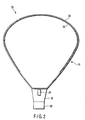
- FIG. 2 shows a schematic sectional view of a commercial balloon 20 according to the present invention.
- the commercial balloon 20 comprises an envelope (a balloon envelope) 21, a gondola 23 suspended via a hanging rope 22 from the envelope 21, and a burner 24.
- the envelope 21 has the same shape as in the case of the hot air balloon.
- the gondola 23 can carry crews.
- the burner 24 can heat the air or the like inside the envelope 21.
- the envelope 21 has a multilayered structure comprising a front gas-impervious sheet 25, and a water absorbent sheet 26 overlaid on the rear surface (inner surface) of the sheet 25.
- the sheet 26 is made of a water absorbent film or water absorbent fabric. Water is previously distributed and retained throughout the water absorbent sheet 26.
- the heat from the burner 24 can heat the air inside the envelope 21 as well as the water retained in the water absorbent sheet 26 to evaporate it.
- the buoyancy gas can consist of the heated air as well as the water vapor so that the excess buoyancy per unit volume of the envelope 21 can be increased. Therefore, for the same mass of the loaded components, a smaller and lighter envelope 21 can float the balloon 20.
- the surface of the envelope 21 is in contact with the atmosphere which is lower in temperature than the gases inside the envelope 21.
- part of water vapor which touches the inner surface of the envelope 21 can cool to liquefy to turn back into the water.
- the liquefied water on the inner surface of the envelope 21 can be retained again in the water absorbent sheet 26 rather than falling down along the inner surface of the envelope 21.
- the water retained in the sheet 26 is again heated on contact with the heated air or water vapor in the envelope 21 and vaporized. As a result, equilibrium can be established at an appropriate temperature.
- the maximum loading capacity of the hot air balloon 20 can be calculated as follows.
- the hot air balloon 20 is considered to float at the altitude of 0 m over the earth.
- the atmospheric temperature is 15°C
- the atmospheric density is 1.2 kg/m 3
- the mass of the envelope 21 per unit area is assumed to be 0.1 kg/m 2 .
- the envelope 21 has the volume of 2000 m 3 .
- the gas inside the envelope 21 is heated with the burner at the temperature of 110°C.
- the envelope 21 can have the surface area of 768m 2 when its shape is approximated as a sphere.
- the gravity acceleration of the Earth is assumed to be 9.8 m/s 2 .
- the gravity force on the air inside the envelope 21 can be determined as follows.
- This value is the maximum loading capacity of the hot air balloon 20 when the buoyancy gas is only constituted of the air.
- the second case is considered where the buoyancy gas is constituted of 100 % water vapor.
- the envelope 21 in which the water absorbent sheet 26 is provided has the increased mass per unit area of 0.115 kg/m 2 rather than 0.1 kg/m 2 .
- the calculation can be performed in the same manner as in the first case.
- the buoyancy of the balloon 20 is the same as in the first case, i.e. 23520 N.
- the gravity force on the water vapor inside the envelope 21 can be determined as follows.
- This value is the maximum loading capacity of the hot air balloon 20 when the buoyancy gas is constituted of 100 % water vapor.
- the maximum loading capacity in the second case is much larger than that in the first case where the buoyancy gas is only constituted of the air.
- the envelope 21 can have a volume smaller than that in the first case to realize the same maximum loading capacity as that in the first case.
- the buoyancy gas cannot be constituted of 100% water vapor and can actually be constituted of 50% air and 50% water vapor, for example. Therefore, the maximum loading capacity of the balloon 20 can be some values between the above two values in the first and second cases.
Landscapes
- Engineering & Computer Science (AREA)
- Aviation & Aerospace Engineering (AREA)
- Remote Sensing (AREA)
- Mechanical Engineering (AREA)
- Physics & Mathematics (AREA)
- Astronomy & Astrophysics (AREA)
- General Physics & Mathematics (AREA)
- Toys (AREA)
Claims (3)
- Ein Ballon (10, 20) mit einer Hülle (11, 21), wobei die Hülle (11, 21) eine mehrlagige Struktur mit einem gasundurchlässigen Tuch (15, 25) und einem flüssigkeitsabsorbierenden Tuch (16, 26) hat, die als innerstes Tuch in der Hülle (11, 21) angeordnet ist, dadurch gekennzeichnet, dass das flüssigkeitsabsorbierende Tuch (16, 26) zur Aufnahme einer Flüssigkeitsmenge mit einem Gewicht ist, 1 bis 200 mal größer als das Eigengewicht des flüssigkeitsabsorbierenden Tuchs (16, 26) ist.
- Ballon nach Anspruch 1, dadurch gekennzeichnet, dass das flüssigkeitsabsorbierende Tuch (16, 26) ein wasserabsorbierendes Tuch ist.
- Ballon nach Anspruch 2, dadurch gekennzeichnet, dass das wasserabsorbierende Tuch (16, 26) aus Polymerfaser gebildet ist.
Applications Claiming Priority (2)
| Application Number | Priority Date | Filing Date | Title |
|---|---|---|---|
| JP2001240870A JP2003054495A (ja) | 2001-08-08 | 2001-08-08 | 気 球 |
| JP2001240870 | 2001-08-08 |
Publications (2)
| Publication Number | Publication Date |
|---|---|
| EP1283162A1 EP1283162A1 (de) | 2003-02-12 |
| EP1283162B1 true EP1283162B1 (de) | 2004-10-20 |
Family
ID=19071417
Family Applications (1)
| Application Number | Title | Priority Date | Filing Date |
|---|---|---|---|
| EP02002348A Expired - Lifetime EP1283162B1 (de) | 2001-08-08 | 2002-01-31 | Ballon |
Country Status (3)
| Country | Link |
|---|---|
| US (1) | US6641083B2 (de) |
| EP (1) | EP1283162B1 (de) |
| JP (1) | JP2003054495A (de) |
Families Citing this family (9)
| Publication number | Priority date | Publication date | Assignee | Title |
|---|---|---|---|---|
| US8704397B2 (en) * | 2005-06-09 | 2014-04-22 | Yehuda Roseman | System for producing electricity from jetstreams and tower therefor |
| CZ297529B6 (cs) * | 2005-10-10 | 2007-01-03 | Vyhlas@Petr | Dekorační nebo reklamní předmět se světelným efektem, zejména balón nebo nafukovadlo |
| RU2533961C1 (ru) * | 2013-05-06 | 2014-11-27 | Николай Николаевич Петухов | Комбинированная оболочка |
| USD777262S1 (en) * | 2014-01-17 | 2017-01-24 | José Alberto Pereira Fonseca | Balloon with stand |
| FR3027283B1 (fr) * | 2014-10-15 | 2018-04-27 | Centre Nationale d'Etudes Spatiales | Ballon ionospherique et systeme d'emport de ballons ionospheriques |
| JP5875093B1 (ja) * | 2015-06-17 | 2016-03-02 | 浩平 中村 | 浮揚型飛行体 |
| JP6698050B2 (ja) * | 2017-05-26 | 2020-05-27 | 健志 岡田 | 水蒸気式飛行体 |
| CN110116810B (zh) * | 2019-06-26 | 2023-11-14 | 中国科学院大气物理研究所 | 气象探空仪高空下投的控制施放装置 |
| JP7365671B2 (ja) * | 2019-07-19 | 2023-10-20 | 国立研究開発法人宇宙航空研究開発機構 | 密閉容器 |
Family Cites Families (16)
| Publication number | Priority date | Publication date | Assignee | Title |
|---|---|---|---|---|
| US345903A (en) * | 1886-07-20 | Field-weeder | ||
| US1035560A (en) * | 1910-01-24 | 1912-08-13 | Hugo Erdmann | Method of refilling aerial vehicles during a flight. |
| US2362966A (en) * | 1941-06-12 | 1944-11-21 | Company Manufacturiers B Trust | Apparatus for filling gas balloons and airships with light gases |
| US3268184A (en) * | 1964-05-06 | 1966-08-23 | Allan M Biggar | Temperature actuated inflation device |
| DE1481222C3 (de) | 1966-04-09 | 1975-01-23 | Hermann 7742 St. Georgen Papst | Motorgetriebenes, lenkbares Luftschiff mit Doppelwandhülle |
| US3807384A (en) * | 1972-08-14 | 1974-04-30 | Nasa | Apparatus for controlling the temperature of balloon-borne equipment |
| US4032085A (en) * | 1973-03-21 | 1977-06-28 | Papst Hermann E R | Dirigible, especially non-rigid dirigible |
| US4012016A (en) * | 1975-09-15 | 1977-03-15 | Dynapods, Inc. | Autonomous variable density aircraft |
| US4032086A (en) * | 1975-10-20 | 1977-06-28 | William Douglas Cooke | Aerostats and aquastats |
| US4432513A (en) * | 1980-09-09 | 1984-02-21 | Yost Paul E | Gas-proof fastening system for a non-rigid airship |
| US4394998A (en) * | 1981-05-18 | 1983-07-26 | Office National D'etudes Et De Recherche Aerospatiales (Onera) | Process and apparatus for exploring the atmosphere of a planet |
| US4993664A (en) * | 1989-04-24 | 1991-02-19 | Kneeland Howard A | Equilibrium ballast apparatus for lighter-than-air balloons and method for using same |
| US4999236A (en) * | 1989-06-08 | 1991-03-12 | The Dow Chemical Company | Fire resistant surfaces for hot air balloons |
| FR2684952B1 (fr) * | 1991-12-13 | 1996-04-26 | Innovation Dev Cie Gle | Aerostats utilisant de la vapeur d'eau comme gaz de sustentation principal. |
| US6119979A (en) * | 1997-09-15 | 2000-09-19 | Sky Station International, Inc. | Cyclical thermal management system |
| US6224016B1 (en) * | 1997-12-19 | 2001-05-01 | Sky Station International, Inc. | Integrated flexible solar cell material and method of production |
-
2001
- 2001-08-08 JP JP2001240870A patent/JP2003054495A/ja active Pending
-
2002
- 2002-01-31 EP EP02002348A patent/EP1283162B1/de not_active Expired - Lifetime
- 2002-02-04 US US10/061,274 patent/US6641083B2/en not_active Expired - Fee Related
Also Published As
| Publication number | Publication date |
|---|---|
| EP1283162A1 (de) | 2003-02-12 |
| US20030052223A1 (en) | 2003-03-20 |
| US6641083B2 (en) | 2003-11-04 |
| JP2003054495A (ja) | 2003-02-26 |
Similar Documents
| Publication | Publication Date | Title |
|---|---|---|
| EP1283162B1 (de) | Ballon | |
| US7469857B2 (en) | System and method for altitude control | |
| US6899009B2 (en) | Flexible multi-shock shield | |
| US5080306A (en) | Multi-layer stitched blanket insulation | |
| US20100187364A1 (en) | Cryogenic propellant depot and integral sunshield | |
| US9884693B2 (en) | Enveloping aerodynamic decelerator | |
| EP2366627A1 (de) | Treibstofftank und Dampfstrahlausstoßvorrichtung damit | |
| CN110466729B (zh) | 一种软式平流层飞艇的浮力压力质心一体化调节系统 | |
| Malone et al. | Lightweight inflatable solar array | |
| JP2520250B2 (ja) | 宇宙空間における保護された建造物 | |
| US10640238B1 (en) | Satellite testbed for evaluating cryogenic-liquid behavior in microgravity | |
| WO2009056296A1 (en) | Cooling system and method for cooling personal garments using cryogenic liquids | |
| US4394998A (en) | Process and apparatus for exploring the atmosphere of a planet | |
| Jones | Reversible fluid balloon altitude control concepts | |
| Nakazawa et al. | Structure of the primordial atmosphere surrounding the early-Earth | |
| CN106672263B (zh) | 一种地外有大气天体充气式无动力滑翔翼浮空器 | |
| Lücking et al. | A passive de-orbiting strategy for high altitude CubeSat missions using a deployable reflective balloon | |
| Neu et al. | Equilibrium behavior of fluids in containers at zero gravity | |
| GB2204671A (en) | Storage of rare gas for electrical drive means for spacecraft | |
| Clemmons | The ECHO I inflation system | |
| US2904285A (en) | Means for prolonging balloon flight | |
| JPH03246200A (ja) | 軌道上廃棄物投棄装置 | |
| FR3027283A1 (fr) | Ballon ionospherique et systeme d'emport de ballons ionospheriques | |
| Izutsu et al. | Venus balloons at low altitudes by double capsule system | |
| Knoll et al. | A review of candidate multilayer insulation systems for potential use on wet-launched LH2 tankage for the space exploration initiative lunar missions |
Legal Events
| Date | Code | Title | Description |
|---|---|---|---|
| PUAI | Public reference made under article 153(3) epc to a published international application that has entered the european phase |
Free format text: ORIGINAL CODE: 0009012 |
|
| 17P | Request for examination filed |
Effective date: 20020131 |
|
| AK | Designated contracting states |
Designated state(s): AT BE CH CY DE DK ES FI FR GB GR IE IT LI LU MC NL PT SE TR |
|
| AX | Request for extension of the european patent |
Extension state: AL LT LV MK RO SI |
|
| AKX | Designation fees paid |
Designated state(s): FR GB |
|
| REG | Reference to a national code |
Ref country code: DE Ref legal event code: 8566 |
|
| 17Q | First examination report despatched |
Effective date: 20031119 |
|
| GRAP | Despatch of communication of intention to grant a patent |
Free format text: ORIGINAL CODE: EPIDOSNIGR1 |
|
| GRAS | Grant fee paid |
Free format text: ORIGINAL CODE: EPIDOSNIGR3 |
|
| GRAA | (expected) grant |
Free format text: ORIGINAL CODE: 0009210 |
|
| AK | Designated contracting states |
Kind code of ref document: B1 Designated state(s): FR GB |
|
| REG | Reference to a national code |
Ref country code: GB Ref legal event code: FG4D |
|
| REG | Reference to a national code |
Ref country code: IE Ref legal event code: FG4D |
|
| RAP2 | Party data changed (patent owner data changed or rights of a patent transferred) |
Owner name: JAPAN AEROSPACE EXPLORATION AGENCY |
|
| ET | Fr: translation filed | ||
| PLBE | No opposition filed within time limit |
Free format text: ORIGINAL CODE: 0009261 |
|
| STAA | Information on the status of an ep patent application or granted ep patent |
Free format text: STATUS: NO OPPOSITION FILED WITHIN TIME LIMIT |
|
| 26N | No opposition filed |
Effective date: 20050721 |
|
| PGFP | Annual fee paid to national office [announced via postgrant information from national office to epo] |
Ref country code: FR Payment date: 20091224 Year of fee payment: 9 Ref country code: GB Payment date: 20091204 Year of fee payment: 9 |
|
| GBPC | Gb: european patent ceased through non-payment of renewal fee |
Effective date: 20110131 |
|
| REG | Reference to a national code |
Ref country code: FR Ref legal event code: ST Effective date: 20110930 |
|
| PG25 | Lapsed in a contracting state [announced via postgrant information from national office to epo] |
Ref country code: FR Free format text: LAPSE BECAUSE OF NON-PAYMENT OF DUE FEES Effective date: 20110131 |
|
| PG25 | Lapsed in a contracting state [announced via postgrant information from national office to epo] |
Ref country code: GB Free format text: LAPSE BECAUSE OF NON-PAYMENT OF DUE FEES Effective date: 20110131 |