EP1282154A2 - High-pressure discharge lamp - Google Patents
High-pressure discharge lamp Download PDFInfo
- Publication number
- EP1282154A2 EP1282154A2 EP02016206A EP02016206A EP1282154A2 EP 1282154 A2 EP1282154 A2 EP 1282154A2 EP 02016206 A EP02016206 A EP 02016206A EP 02016206 A EP02016206 A EP 02016206A EP 1282154 A2 EP1282154 A2 EP 1282154A2
- Authority
- EP
- European Patent Office
- Prior art keywords
- partial pressure
- lamp bulb
- luminance
- pressure discharge
- hours
- Prior art date
- Legal status (The legal status is an assumption and is not a legal conclusion. Google has not performed a legal analysis and makes no representation as to the accuracy of the status listed.)
- Ceased
Links
- 239000007789 gas Substances 0.000 claims abstract description 79
- 229910052736 halogen Inorganic materials 0.000 claims abstract description 61
- 150000002367 halogens Chemical class 0.000 claims abstract description 57
- QVGXLLKOCUKJST-UHFFFAOYSA-N atomic oxygen Chemical compound [O] QVGXLLKOCUKJST-UHFFFAOYSA-N 0.000 claims abstract description 55
- 239000001301 oxygen Substances 0.000 claims abstract description 55
- 229910052760 oxygen Inorganic materials 0.000 claims abstract description 55
- QSHDDOUJBYECFT-UHFFFAOYSA-N mercury Chemical compound [Hg] QSHDDOUJBYECFT-UHFFFAOYSA-N 0.000 claims abstract description 22
- 229910052753 mercury Inorganic materials 0.000 claims abstract description 22
- VYPSYNLAJGMNEJ-UHFFFAOYSA-N Silicium dioxide Chemical compound O=[Si]=O VYPSYNLAJGMNEJ-UHFFFAOYSA-N 0.000 claims description 8
- XKRFYHLGVUSROY-UHFFFAOYSA-N Argon Chemical compound [Ar] XKRFYHLGVUSROY-UHFFFAOYSA-N 0.000 description 16
- FJBFPHVGVWTDIP-UHFFFAOYSA-N dibromomethane Chemical compound BrCBr FJBFPHVGVWTDIP-UHFFFAOYSA-N 0.000 description 11
- 238000003780 insertion Methods 0.000 description 10
- 230000037431 insertion Effects 0.000 description 10
- 229910052786 argon Inorganic materials 0.000 description 8
- 230000014759 maintenance of location Effects 0.000 description 8
- ZOKXTWBITQBERF-UHFFFAOYSA-N Molybdenum Chemical compound [Mo] ZOKXTWBITQBERF-UHFFFAOYSA-N 0.000 description 7
- 239000011888 foil Substances 0.000 description 7
- 229910052750 molybdenum Inorganic materials 0.000 description 7
- 239000011733 molybdenum Substances 0.000 description 7
- WFKWXMTUELFFGS-UHFFFAOYSA-N tungsten Chemical compound [W] WFKWXMTUELFFGS-UHFFFAOYSA-N 0.000 description 7
- 229910052721 tungsten Inorganic materials 0.000 description 7
- 239000010937 tungsten Substances 0.000 description 7
- CURLTUGMZLYLDI-UHFFFAOYSA-N Carbon dioxide Chemical compound O=C=O CURLTUGMZLYLDI-UHFFFAOYSA-N 0.000 description 5
- 230000000694 effects Effects 0.000 description 4
- 150000002366 halogen compounds Chemical class 0.000 description 4
- -1 halogen ions Chemical class 0.000 description 4
- 229910002092 carbon dioxide Inorganic materials 0.000 description 3
- 238000010438 heat treatment Methods 0.000 description 3
- 239000004973 liquid crystal related substance Substances 0.000 description 3
- 238000009877 rendering Methods 0.000 description 3
- CPELXLSAUQHCOX-UHFFFAOYSA-M Bromide Chemical compound [Br-] CPELXLSAUQHCOX-UHFFFAOYSA-M 0.000 description 2
- UGFAIRIUMAVXCW-UHFFFAOYSA-N Carbon monoxide Chemical compound [O+]#[C-] UGFAIRIUMAVXCW-UHFFFAOYSA-N 0.000 description 2
- 230000000712 assembly Effects 0.000 description 2
- 238000000429 assembly Methods 0.000 description 2
- 239000001569 carbon dioxide Substances 0.000 description 2
- 229910002091 carbon monoxide Inorganic materials 0.000 description 2
- 238000004031 devitrification Methods 0.000 description 2
- 238000004519 manufacturing process Methods 0.000 description 2
- 238000000034 method Methods 0.000 description 2
- 239000010453 quartz Substances 0.000 description 2
- 230000008016 vaporization Effects 0.000 description 2
- MYMOFIZGZYHOMD-UHFFFAOYSA-N Dioxygen Chemical compound O=O MYMOFIZGZYHOMD-UHFFFAOYSA-N 0.000 description 1
- 238000000137 annealing Methods 0.000 description 1
- 230000007423 decrease Effects 0.000 description 1
- 238000010586 diagram Methods 0.000 description 1
- 229910001882 dioxygen Inorganic materials 0.000 description 1
- 230000003628 erosive effect Effects 0.000 description 1
- 238000011156 evaluation Methods 0.000 description 1
- 230000001771 impaired effect Effects 0.000 description 1
- 125000004430 oxygen atom Chemical group O* 0.000 description 1
- CHWRSCGUEQEHOH-UHFFFAOYSA-N potassium oxide Chemical compound [O-2].[K+].[K+] CHWRSCGUEQEHOH-UHFFFAOYSA-N 0.000 description 1
- 229910001950 potassium oxide Inorganic materials 0.000 description 1
- XLYOFNOQVPJJNP-UHFFFAOYSA-N water Substances O XLYOFNOQVPJJNP-UHFFFAOYSA-N 0.000 description 1
Images


Classifications
-
- H—ELECTRICITY
- H01—ELECTRIC ELEMENTS
- H01J—ELECTRIC DISCHARGE TUBES OR DISCHARGE LAMPS
- H01J61/00—Gas-discharge or vapour-discharge lamps
- H01J61/02—Details
- H01J61/24—Means for obtaining or maintaining the desired pressure within the vessel
- H01J61/26—Means for absorbing or adsorbing gas, e.g. by gettering; Means for preventing blackening of the envelope
-
- H—ELECTRICITY
- H01—ELECTRIC ELEMENTS
- H01J—ELECTRIC DISCHARGE TUBES OR DISCHARGE LAMPS
- H01J61/00—Gas-discharge or vapour-discharge lamps
- H01J61/82—Lamps with high-pressure unconstricted discharge having a cold pressure > 400 Torr
- H01J61/822—High-pressure mercury lamps
Definitions
- the present invention relates to a high-pressure discharge lamp, and more particularly to a long-life high-pressure discharge lamp which is arranged to prevent the internal gases from leaking out and also to prevent the lamp bulb from being ruptured, and which suffers reduced blackening and luminance drop even after it has been turned on over a long period of time.
- high-pressure discharge lamp 101 generally has a pair of confronting tungsten electrodes 102 inserted in lamp bulb 101 of quartz glass which has a spherical central portion. Electrodes 102 are inserted respectively from insertion slots 104 defined in the respective opposite ends of lamp bulb 101. Insertion slots 104 are hermetically sealed by respective electrodes 102 fitted in respective sleeves 105 of molybdenum foil which serve as thermal dampers. Mercury, a halogen gas such as of methylene bromide or the like, and an inactive gas such as of argon or the like are introduced and confined in lamp bulb 101.
- mercury is introduced and confined at a rate of 0.15 mg/mm 3 or higher in the lamp bulb 101.
- a trigger voltage is applied between electrodes 102, a glow discharge is induced between electrodes 102 in the presence of the inactive gas, vaporizing the mercury, and a plasma discharge caused in the high-pressure mercury gas radiates highly color rendering light with high luminance.
- high-pressure discharge lamps are capable of emitting highly color rendering light with high luminance, they have in recent years attracted much attention and widely been used as light sources for projection-type liquid crystal display devices or the like.
- the halogen gas usually comprises a halogen compound such as methylene bromide or the like.
- a halogen compound such as methylene bromide or the like.
- the halogen gas is introduced and confined in the lamp bulb in an amount that is effective to prevent the blackening, i.e., in such an amount that the halogen sealed in the lamp bulb has a partial pressure of 1 ⁇ 10 -6 ⁇ mol/mm 3 or higher.
- An inactive gas such as of argon or the like is also introduced and confined in the lamp bulb under a pressure ranging from 6 ⁇ 10 3 Pa to 6 ⁇ 10 4 Pa in order to induce a glow discharge when the discharge lamp starts being turned on.
- the halogen gas introduced and confined in the high-pressure discharge lamp exists in an excessive amount, then it tends to erode and degrade electrodes 102 and molybdenum foil sleeves 105 at the sealed ends of the lamp bulb.
- electrodes 102 and molybdenum foil sleeves 105 are highly eroded and degraded, since a high pressure of 100 atms is developed in the lamp bulb due to the vapor pressure of the sealed mercury, the gases tend to leak from the sealed ends of the lamp bulb, and the sealed ends are likely to be ruptured.
- JP-A-11-149899 discloses a high-pressure discharge lamp which is filled with mercury in an amount ranging from 0.12 to 0.35 mg/mm 3 and a halogen gas in an amount ranging from 10 -7 to 10 -2 ⁇ mol/mm 3 , with the electrodes containing 12 ppm of potassium oxide.
- JP-B-2829339 reveals a high-pressure discharge lamp which contains mercury in an amount ranging from 0.2 to 0.35 mg/mm 3 and a halogen gas in an amount ranging from 10 -6 to 10 -4 ⁇ mol/mm 3 .
- JP-B-2980882 reveals a high-pressure discharge lamp which contains with mercury in an amount ranging from 0.16 mg/mm 3 or higher and a halogen gas in an amount ranging from 2 ⁇ 10 -4 to 7 ⁇ 10 -3 ⁇ mol/mm 3 .
- the load on the bulb wall is 0.8 W/mm 2 or higher, and an inactive gas is introduced and confined in the lamp bulb at a pressure of 5 ⁇ 10 3 Pa or higher.
- JP-A-11-297274 discloses a high-pressure discharge lamp which contains mercury in such an amount that it develops a vapor pressure ranging from 100 to 200 atms at the time the high-pressure discharge lamp is turned on, and a halogen gas in an amount ranging from 1.1 ⁇ 10 -5 to 1.2 ⁇ 10 -7 mol/cc.
- the inventor of the present invention has found that while air is discharged from the lamp bulbs of the conventional high-pressure discharge lamps by a vacuum pump before various gases are introduced into the lamp bulb, oxygen components such as an oxygen gas and a carbon dioxide gas remaining in the lamp bulb impair the halogen cycle when the high-pressure discharge lamp is energized.
- the inventor has also revealed that even if the introduced amounts of oxygen components are the same, different halogen gas concentrations impair the halogen cycle to different degrees. Further research activities have shown that if an oxygen partial pressure is of a certain value when a halogen gas is confined at a predetermined concentration, then it is possible to keep the luminance at 100 %, and reducing the oxygen components below the certain value of the oxygen partial pressure is not effective to increase the luminance. That is, the inventor has found that there is a preferable range of oxygen partial pressures depending on the halogen gas concentration.
- a high-pressure discharge tube comprising a hermetically sealed lamp bulb of quartz glass, a pair of confronting electrodes inserted in the lamp bulb, mercury confined in the lamp bulb, and a halogen gas confined in the lamp bulb and having a predetermined concentration, the lamp bulb containing oxygen at a partial pressure lower than a partial pressure which can maintain a luminance of 80 % after 100 hours of operation and equal to or higher than 1.0 ⁇ 10 -5 Pa.
- a high-pressure discharge tube comprising a hermetically sealed lamp bulb of quartz glass, a pair of confronting electrodes inserted in the lamp bulb, mercury confined in the lamp bulb, and a halogen gas confined in the lamp bulb and having a predetermined concentration, the lamp bulb containing oxygen at a partial pressure lower than a partial pressure which can maintain a luminance of 90 % after 100 hours of operation and equal to or higher than 1.0 ⁇ 10 -5 Pa.
- the oxygen partial pressure is in a range for keeping the luminance at 80 % or 90 %, the high-pressure discharge tube is of a long service life.
- the range of the oxygen partial pressure is determined depending on the halogen gas concentration, the oxygen partial pressure is not required to be excessively low.
- partial pressure refers to a partial pressure of not only oxygen molecules (O 2 ), but also molecules including oxygen atoms (hereinafter referred to as oxygen or the like), such as a carbon dioxide gas (CO 2 ), carbon monoxide (CO), water (H 2 O), etc., with the atomic weight of oxygen being converted into oxygen molecules.
- oxygen oxygen or the like
- CO 2 carbon dioxide gas
- CO carbon monoxide
- H 2 O water
- the oxygen partial pressure is defined on the basis of a luminance retention percentage after 100 hours of operation because it is suitable for the evaluation of the effect of blackening based on a failure of the halogen cycle to function fully.
- a high-pressure discharge lamp designed under normal conditions has operated for 200 through 500 hours under normal conditions, the luminance thereof is reduced based on the devitrification of quartz which the lamp bulb is made of. Therefore, it is suitable to evaluate the effect of blackening based on a failure of the halogen cycle to function fully after 100 hours of operation when no luminance drop occurs based on the devitrification of quartz.
- the lower limit of the oxygen partial pressure is 1.0 ⁇ 10 -5 Pa because it is a limit value at which the lamp bulb can be evacuated by an evacuating facility used in industrial applications.
- a more preferable lower limit is 1/10 of a maximum value of a partial pressure which can maintain a luminance of 100 % after 100 hours of operation with the halogen gas confined in the lamp bulb at the above concentration.
- a much more preferable lower limit is a maximum value of a partial pressure which can maintain a luminance of 100 % after 100 hours of operation with the halogen gas confined in the lamp bulb at the above concentration.
- an ideal lower limit of the oxygen partial pressure is the maximum value of the partial pressure which can maintain a luminance of 100 %.
- a more preferable lower limit is set to 1/10 of a maximum value of a partial pressure which can maintain a luminance of 100 % after 100 hours of operation, and a much more preferable lower limit is set to a maximum value of a partial pressure which can maintain a luminance of 100 % after 100 hours of operation.
- the facility for evacuating the lamp bulb is not required to be excessively large in scale.
- a preferable range of halogen gas concentrations is up to 9.9 ⁇ 10 -7 ⁇ mol/mm 3 .
- the range up to 9.9 ⁇ 10 -7 ⁇ mol/mm 3 is effective to prevent the halogen gas from eroding the electrodes and molybdenum foil, and hence to prevent internal gases from leaking out of the lamp bulb. Consequently, the high-pressure discharge tube can be of an increased service life.
- halogen gas concentration refers to the molar concentration of a halogen compound as converted into halogen ions which are generated when the halogen compound is decomposed due to energization of the high-pressure discharge tube.
- the high-pressure discharge lamp is of a long life, suffers reduced blackening and luminance drop even after it has been turned on over a long period of time, and is arranged to prevent the internal gases from leaking out and also to prevent the lamp bulb from being ruptured.
- Fig. 2 shows high-pressure discharge lamp 10 according to an embodiment of the present invention.
- high-pressure discharge lamp 10 has a pair of confronting tungsten electrodes 2A, 2B inserted in lamp bulb 1 of quartz glass which has a spherical central portion.
- High-pressure discharge lamp 10 shown in Fig. 2 comprises a DC high-pressure discharge lamp, and hence electrodes 2A, 2B are of different shapes.
- electrodes 2A, 2B are of identical shapes.
- the principles of the present invention are applicable to both DC and AC high-pressure discharge lamps.
- Electrodes 2A, 2B are inserted respectively from insertion slots 4A, 4B defined in the respective opposite ends of lamp bulb 1. Insertion slots 4A, 4B are hermetically sealed by respective electrodes 2A, 2B fitted in respective sleeves 5 of molybdenum foil which serve as thermal dampers.
- Oxygen or the like is discharged from hermetically sealed lamp bulb 1 to the extent that the remaining oxygen has a partial pressure of about 5 ⁇ 10 -4 Pa. After the oxygen or the like is discharged, mercury, a halogen gas of methylene bromide, and an inactive gas comprising an argon gas are introduced and confined in lamp bulb 1.
- lamp bulb 1 contains mercury at a rate ranging from about 0.15 to 0.25 mg/mm 3 , a halogen gas of methylene bromide at a rate of 9.9 ⁇ 10 -7 ⁇ mol/mm 3 , and an argon gas at a pressure of 150 kPa.
- tungsten is vaporized from electrodes 2A, 2B heated to a high temperature by the glow discharge, and is deposited on the bulb wall.
- the introduced methylene bromide generates bromide ions at the high temperature, and the bromide ions are united with the tungsten deposited on the bulb wall and vaporized and deposited on electrode bases which are of a relatively low temperature.
- Such a halogen cycle is repeated to prevent the blackening of the bulb wall. Therefore, even after high-pressure discharge lamp 10 has been turned on over a long period of time, the bulb wall is not blackened, and high-pressure discharge lamp 10 can emit light continuously at an initial level.
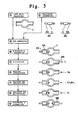
- High-pressure discharge lamp 10 is manufactured according to a process shown in Fig. 3.
- the mercury introducing step 6 ⁇ , the halogen gas introducing step 7 ⁇ , and the inactive gas introducing step 8 ⁇ may be switched around, and the halogen gas and the inactive gas may be premixed with each other before being introduced into lamp bulb 1 or may simultaneously be introduced into lamp bulb 1, thus omitting one of the manufacturing steps.
- high-pressure discharge lamp 10 contains oxygen under a necessary and sufficient partial pressure
- the luminance retention percentage rises as the oxygen partial pressure decreases at any halogen gas concentrations. If a certain oxygen partial pressure is reached, the luminance retention percentage reaches 100 % and remains unchanged. It can thus be seen that depending on the halogen gas concentration, there is a certain threshold for the oxygen partial pressure and any oxygen partial pressures lower than the threshold are useless.
- the halogen gas concentration of high-pressure discharge lamp 10 according to the present embodiment is 9.9 ⁇ 10 -7 ⁇ mol/mm 3 .
- the luminance retention percentage exceeds 80 % and 90 % while the oxygen partial pressure is in the range from 1 ⁇ 10 -2 to 5 ⁇ 10 -3 Pa, and reaches 100 % when the oxygen partial pressure is 2 ⁇ 10 -3 Pa. Therefore, the halogen gas concentration of high-pressure discharge lamp 10 according to the present embodiment is of a value sufficiently small enough not to impair the halogen cycle, but not too small.
- the high-pressure discharge lamp according to the above embodiment does not require a large-scale evacuating facility and is of a long service life.
- the oxygen partial pressure may be considerably high only from the standpoint of preventing the blackening of the lamp tube.
- excessive oxygen is not preferable as it would oxidize parts of the high-pressure discharge lamp, causing operation failures.
- the oxygen partial pressure is 1 Pa (1.0 ⁇ 10 0 Pa)
- the oxygen would oxidize parts of the high-pressure discharge lamp at the time the high-pressure discharge lamp is manufactured, and the high-pressure discharge lamp would not operate normally immediately after it is manufactured.
- Halogen gas concentration ( ⁇ mol/mm 3 ) Leakage occurrences (after 2000 hours of operation) Leakage occurrences (after 5000 hours of operation) 1 ⁇ 10 -1 40 70 2 ⁇ 10 -2 10 30 5 ⁇ 10 -4 0 16 5 ⁇ 10 -5 0 7 9.9 ⁇ 10 -7 0 0 1 ⁇ 10 -7 0 0 1 ⁇ 10 -8 0 0
- projection-type liquid crystal display devices are finding applications as projection television sets for use in home theaters, display devices for use in retain stores, etc. These projection-type liquid crystal display devices are energized for a period of time much longer than display devices for use in presentations, and hence need to have a service life of at least 5000 hours.
- Table 1 indicates that if the halogen gas concentration is greater than 1 ⁇ 10 -6 ⁇ mol/mm 3 , then leakages occur after 5000 hours of operation. In order to make a high-pressure discharge tube operable for 5000 hours, therefore, the halogen gas concentration should be at most 1 ⁇ 10 -6 ⁇ mol/mm 3 .
Landscapes
- Discharge Lamps And Accessories Thereof (AREA)
- Discharge Lamp (AREA)
Abstract
Description
| Halogen gas concentration (µmol/mm3) | Leakage occurrences (after 2000 hours of operation) | Leakage occurrences (after 5000 hours of operation) |
| 1 × 10⁻¹ | 40 | 70 |
| 2 × 10⁻² | 10 | 30 |
| 5 × 10⁻⁴ | 0 | 16 |
| 5 × 10⁻⁵ | 0 | 7 |
| 9.9 × 10⁻⁷ | 0 | 0 |
| 1 × 10⁻⁷ | 0 | 0 |
| 1 × 10⁻⁸ | 0 | 0 |
Claims (7)
- A high-pressure discharge tube comprising:a hermetically sealed lamp bulb of quartz glass;a pair of confronting electrodes inserted in said lamp bulb;mercury confined in said lamp bulb; anda halogen gas confined in said lamp bulb and having a predetermined concentration;said lamp bulb containing oxygen at a partial pressure lower than a partial pressure which can maintain a luminance of 80 % after 100 hours of operation and equal to or higher than 1.0 × 10⁻⁵ Pa.
- A high-pressure discharge tube according to claim 1, wherein said lamp bulb contains oxygen at a partial pressure lower than a partial pressure which can maintain a luminance of 80 % after 100 hours of operation and equal to or higher than 1/10 of a maximum value of a partial pressure which can maintain a luminance of 100 % after 100 hours of operation.
- A high-pressure discharge tube according to claim 1, wherein said lamp bulb contains oxygen at a partial pressure lower than a partial pressure which can maintain a luminance of 80 % after 100 hours of operation and equal to or higher than a maximum value of a partial pressure which can maintain a luminance of 100 % after 100 hours of operation.
- A high-pressure discharge tube according to claim 1, wherein said lamp bulb contains oxygen at a partial pressure lower than a partial pressure which can maintain a luminance of 90 % after 100 hours of operation and equal to or higher than 1.0 × 10⁻⁵ Pa.
- A high-pressure discharge tube according to claim 1, wherein said lamp bulb contains oxygen at a partial pressure lower than a partial pressure which can maintain a luminance of 90 % after 100 hours of operation and equal to or higher than 1/10 of a maximum value of a partial pressure which can maintain a luminance of 100 % after 100 hours of operation.
- A high-pressure discharge tube according to claim 1, wherein said lamp bulb contains oxygen at a partial pressure lower than a partial pressure which can maintain a luminance of 90 % after 100 hours of operation and equal to or higher than a maximum value of a partial pressure which can maintain a luminance of 100 % after 100 hours of operation.
- A high-pressure discharge tube according to any one of claims 1 to 6, wherein said halogen gas in the lamp bulb has a concentration of at most 9.9 × 10⁻⁷ µmol/mm3.
Applications Claiming Priority (2)
| Application Number | Priority Date | Filing Date | Title |
|---|---|---|---|
| JP2001236068 | 2001-08-03 | ||
| JP2001236068A JP2003045373A (en) | 2001-08-03 | 2001-08-03 | High pressure discharge lamp |
Publications (2)
| Publication Number | Publication Date |
|---|---|
| EP1282154A2 true EP1282154A2 (en) | 2003-02-05 |
| EP1282154A3 EP1282154A3 (en) | 2005-06-08 |
Family
ID=19067408
Family Applications (1)
| Application Number | Title | Priority Date | Filing Date |
|---|---|---|---|
| EP02016206A Ceased EP1282154A3 (en) | 2001-08-03 | 2002-07-18 | High-pressure discharge lamp |
Country Status (3)
| Country | Link |
|---|---|
| US (1) | US6911776B2 (en) |
| EP (1) | EP1282154A3 (en) |
| JP (1) | JP2003045373A (en) |
Cited By (1)
| Publication number | Priority date | Publication date | Assignee | Title |
|---|---|---|---|---|
| WO2009115116A1 (en) * | 2008-03-19 | 2009-09-24 | Osram Gesellschaft mit beschränkter Haftung | Gas discharge lamp and method for the production of a gas discharge lamp |
Families Citing this family (4)
| Publication number | Priority date | Publication date | Assignee | Title |
|---|---|---|---|---|
| US6629127B1 (en) * | 1999-07-26 | 2003-09-30 | Microsoft Corporation | Methods and systems for processing HTTP requests |
| JP2005197191A (en) * | 2004-01-09 | 2005-07-21 | Ushio Inc | Ultra high pressure mercury lamp and light irradiation apparatus using the ultra high pressure mercury lamp |
| US7733027B2 (en) * | 2004-01-15 | 2010-06-08 | Koninklijke Philips Electronics N.V. | High-pressure mercury vapor lamp incorporating a predetermined germanium to oxygen molar ratio within its discharge fill |
| JP2011501272A (en) * | 2007-10-09 | 2011-01-06 | スキッフ・エルエルシー | Method, apparatus and system for providing local and online data services |
Family Cites Families (11)
| Publication number | Priority date | Publication date | Assignee | Title |
|---|---|---|---|---|
| JPH02177248A (en) * | 1988-12-28 | 1990-07-10 | Toshiba Corp | Halogen bulb |
| JP2927638B2 (en) | 1993-06-11 | 1999-07-28 | 株式会社小糸製作所 | Manufacturing method of chipless arc tube |
| DE4325679A1 (en) | 1993-07-30 | 1995-02-02 | Patent Treuhand Ges Fuer Elektrische Gluehlampen Mbh | Electric lamp with halogen filling |
| JP3039278B2 (en) * | 1994-08-08 | 2000-05-08 | 株式会社小糸製作所 | Method for manufacturing arc tube for discharge bulb |
| JP3158955B2 (en) | 1995-04-12 | 2001-04-23 | ウシオ電機株式会社 | Short arc type mercury discharge lamp |
| JPH0986959A (en) | 1995-07-20 | 1997-03-31 | Toto Ltd | Sealing glass for being thermally melted with infrared light |
| JP3216877B2 (en) * | 1997-11-18 | 2001-10-09 | 松下電子工業株式会社 | High pressure discharge lamp, illumination optical device using this high pressure discharge lamp as light source, and image display device using this illumination optical device |
| TW385479B (en) * | 1998-04-08 | 2000-03-21 | Koninkl Philips Electronics Nv | Metal-halide lamp |
| JP2980882B2 (en) | 1998-04-08 | 1999-11-22 | ウシオ電機株式会社 | High pressure mercury lamp |
| JP3219084B2 (en) * | 2000-03-10 | 2001-10-15 | 日本電気株式会社 | High pressure discharge lamp and method of manufacturing the same |
| JP3425929B2 (en) * | 2000-07-04 | 2003-07-14 | エヌイーシーマイクロ波管株式会社 | High pressure discharge lamp and manufacturing method thereof |
-
2001
- 2001-08-03 JP JP2001236068A patent/JP2003045373A/en active Pending
-
2002
- 2002-07-18 EP EP02016206A patent/EP1282154A3/en not_active Ceased
- 2002-07-18 US US10/197,483 patent/US6911776B2/en not_active Expired - Lifetime
Cited By (1)
| Publication number | Priority date | Publication date | Assignee | Title |
|---|---|---|---|---|
| WO2009115116A1 (en) * | 2008-03-19 | 2009-09-24 | Osram Gesellschaft mit beschränkter Haftung | Gas discharge lamp and method for the production of a gas discharge lamp |
Also Published As
| Publication number | Publication date |
|---|---|
| US20030030379A1 (en) | 2003-02-13 |
| JP2003045373A (en) | 2003-02-14 |
| EP1282154A3 (en) | 2005-06-08 |
| US6911776B2 (en) | 2005-06-28 |
Similar Documents
| Publication | Publication Date | Title |
|---|---|---|
| EP1310984B1 (en) | High pressure mercury lamp, illumination device using the high-pressure mercury lamp, and image display apparatus using the illumination device | |
| EP1170780B1 (en) | High pressure discharge lamp and method of production therefor | |
| JP2948200B1 (en) | High pressure mercury lamp | |
| US6911776B2 (en) | High-pressure discharge lamp | |
| US6669522B2 (en) | High pressure discharge lamp and method for producing thereof | |
| CN100411081C (en) | Mercury-containing gas discharge tube and its suction device | |
| JP2004031153A (en) | High pressure mercury lamp and lamp unit | |
| JP2006524416A (en) | Fluorescent lamp and extension means assembly | |
| EP1684329B1 (en) | Ultrahigh pressure mercury lamp | |
| US7298089B2 (en) | High-pressure discharge lamp | |
| JP2004103594A (en) | High pressure discharge lamp and its manufacturing method | |
| JP4214826B2 (en) | Short arc type ultra high pressure discharge lamp | |
| JP4135667B2 (en) | Optical device | |
| JP2005285507A (en) | High pressure mercury lamp, lamp unit and image display device | |
| US20100008060A1 (en) | Light assembly with high color-rendering property | |
| Heider | Single Pinched Metal-Halide Lamps Operated at Wall Loadings above 40 W/cm2 | |
| JPH1140101A (en) | Discharge lamp | |
| JP2006073460A (en) | Extra-high-pressure discharge lamp and lamp device using this | |
| JPH04101346A (en) | Cold cathode-type discharge lamp | |
| JPH04137430A (en) | Cold cathode fluorescent lamp and liquid crystal display device | |
| JPH0589831A (en) | Compact fluorescent lamp | |
| JP2007329042A (en) | Fluorescent lamp and liquid crystal backlight device using the fluorescent lamp as a light source | |
| JPH11191393A (en) | Discharge lamps and lighting devices | |
| JP2011216410A (en) | Fluorescent lamp | |
| JPH03274636A (en) | Manufacture of electrode |
Legal Events
| Date | Code | Title | Description |
|---|---|---|---|
| PUAI | Public reference made under article 153(3) epc to a published international application that has entered the european phase |
Free format text: ORIGINAL CODE: 0009012 |
|
| AK | Designated contracting states |
Designated state(s): AT BE BG CH CY CZ DE DK EE ES FI FR GB GR IE IT LI LU MC NL PT SE SK TR |
|
| AX | Request for extension of the european patent |
Extension state: AL LT LV MK RO SI |
|
| PUAL | Search report despatched |
Free format text: ORIGINAL CODE: 0009013 |
|
| AK | Designated contracting states |
Kind code of ref document: A3 Designated state(s): AT BE BG CH CY CZ DE DK EE ES FI FR GB GR IE IT LI LU MC NL PT SE SK TR |
|
| AX | Request for extension of the european patent |
Extension state: AL LT LV MK RO SI |
|
| RIC1 | Information provided on ipc code assigned before grant |
Ipc: 7H 01J 61/12 B Ipc: 7H 01J 61/82 B Ipc: 7H 01J 61/26 A |
|
| 17P | Request for examination filed |
Effective date: 20050506 |
|
| AKX | Designation fees paid |
Designated state(s): DE NL |
|
| STAA | Information on the status of an ep patent application or granted ep patent |
Free format text: STATUS: THE APPLICATION HAS BEEN REFUSED |
|
| 18R | Application refused |
Effective date: 20070709 |