EP1281727A1 - Soluble polyimide and composition comprising the same, bonding sheet, adhesive laminated film for covering accelerator beam tube, and adhesive laminated film for covering conductor wire for accelerator quench heater - Google Patents
Soluble polyimide and composition comprising the same, bonding sheet, adhesive laminated film for covering accelerator beam tube, and adhesive laminated film for covering conductor wire for accelerator quench heater Download PDFInfo
- Publication number
- EP1281727A1 EP1281727A1 EP00974953A EP00974953A EP1281727A1 EP 1281727 A1 EP1281727 A1 EP 1281727A1 EP 00974953 A EP00974953 A EP 00974953A EP 00974953 A EP00974953 A EP 00974953A EP 1281727 A1 EP1281727 A1 EP 1281727A1
- Authority
- EP
- European Patent Office
- Prior art keywords
- polyimide
- adhesive
- general formula
- accelerator
- resin
- Prior art date
- Legal status (The legal status is an assumption and is not a legal conclusion. Google has not performed a legal analysis and makes no representation as to the accuracy of the status listed.)
- Withdrawn
Links
- QHEONTLMDPVDBU-UHFFFAOYSA-N CC(C)(C)c1cc(C2(C)C)c2cc1 Chemical compound CC(C)(C)c1cc(C2(C)C)c2cc1 QHEONTLMDPVDBU-UHFFFAOYSA-N 0.000 description 1
- 0 CC(C)(C)c1ccc(C(C)(C)*)cc1 Chemical compound CC(C)(C)c1ccc(C(C)(C)*)cc1 0.000 description 1
- XUNSZADDFLWFOL-UHFFFAOYSA-N COc(cc1)ccc1S(=O)=O Chemical compound COc(cc1)ccc1S(=O)=O XUNSZADDFLWFOL-UHFFFAOYSA-N 0.000 description 1
- UPMLOUAZCHDJJD-UHFFFAOYSA-N O=C=Nc1ccc(Cc(cc2)ccc2N=C=O)cc1 Chemical compound O=C=Nc1ccc(Cc(cc2)ccc2N=C=O)cc1 UPMLOUAZCHDJJD-UHFFFAOYSA-N 0.000 description 1
Images

Classifications
-
- C—CHEMISTRY; METALLURGY
- C08—ORGANIC MACROMOLECULAR COMPOUNDS; THEIR PREPARATION OR CHEMICAL WORKING-UP; COMPOSITIONS BASED THEREON
- C08G—MACROMOLECULAR COMPOUNDS OBTAINED OTHERWISE THAN BY REACTIONS ONLY INVOLVING UNSATURATED CARBON-TO-CARBON BONDS
- C08G73/00—Macromolecular compounds obtained by reactions forming a linkage containing nitrogen with or without oxygen or carbon in the main chain of the macromolecule, not provided for in groups C08G12/00 - C08G71/00
- C08G73/06—Polycondensates having nitrogen-containing heterocyclic rings in the main chain of the macromolecule
- C08G73/10—Polyimides; Polyester-imides; Polyamide-imides; Polyamide acids or similar polyimide precursors
- C08G73/1046—Polyimides containing oxygen in the form of ether bonds in the main chain
- C08G73/105—Polyimides containing oxygen in the form of ether bonds in the main chain with oxygen only in the diamino moiety
-
- C—CHEMISTRY; METALLURGY
- C08—ORGANIC MACROMOLECULAR COMPOUNDS; THEIR PREPARATION OR CHEMICAL WORKING-UP; COMPOSITIONS BASED THEREON
- C08G—MACROMOLECULAR COMPOUNDS OBTAINED OTHERWISE THAN BY REACTIONS ONLY INVOLVING UNSATURATED CARBON-TO-CARBON BONDS
- C08G73/00—Macromolecular compounds obtained by reactions forming a linkage containing nitrogen with or without oxygen or carbon in the main chain of the macromolecule, not provided for in groups C08G12/00 - C08G71/00
- C08G73/06—Polycondensates having nitrogen-containing heterocyclic rings in the main chain of the macromolecule
- C08G73/10—Polyimides; Polyester-imides; Polyamide-imides; Polyamide acids or similar polyimide precursors
-
- C—CHEMISTRY; METALLURGY
- C08—ORGANIC MACROMOLECULAR COMPOUNDS; THEIR PREPARATION OR CHEMICAL WORKING-UP; COMPOSITIONS BASED THEREON
- C08G—MACROMOLECULAR COMPOUNDS OBTAINED OTHERWISE THAN BY REACTIONS ONLY INVOLVING UNSATURATED CARBON-TO-CARBON BONDS
- C08G73/00—Macromolecular compounds obtained by reactions forming a linkage containing nitrogen with or without oxygen or carbon in the main chain of the macromolecule, not provided for in groups C08G12/00 - C08G71/00
- C08G73/06—Polycondensates having nitrogen-containing heterocyclic rings in the main chain of the macromolecule
- C08G73/10—Polyimides; Polyester-imides; Polyamide-imides; Polyamide acids or similar polyimide precursors
- C08G73/1003—Preparatory processes
- C08G73/1007—Preparatory processes from tetracarboxylic acids or derivatives and diamines
- C08G73/101—Preparatory processes from tetracarboxylic acids or derivatives and diamines containing chain terminating or branching agents
-
- C—CHEMISTRY; METALLURGY
- C08—ORGANIC MACROMOLECULAR COMPOUNDS; THEIR PREPARATION OR CHEMICAL WORKING-UP; COMPOSITIONS BASED THEREON
- C08G—MACROMOLECULAR COMPOUNDS OBTAINED OTHERWISE THAN BY REACTIONS ONLY INVOLVING UNSATURATED CARBON-TO-CARBON BONDS
- C08G73/00—Macromolecular compounds obtained by reactions forming a linkage containing nitrogen with or without oxygen or carbon in the main chain of the macromolecule, not provided for in groups C08G12/00 - C08G71/00
- C08G73/06—Polycondensates having nitrogen-containing heterocyclic rings in the main chain of the macromolecule
- C08G73/10—Polyimides; Polyester-imides; Polyamide-imides; Polyamide acids or similar polyimide precursors
- C08G73/1003—Preparatory processes
- C08G73/1007—Preparatory processes from tetracarboxylic acids or derivatives and diamines
- C08G73/1028—Preparatory processes from tetracarboxylic acids or derivatives and diamines characterised by the process itself, e.g. steps, continuous
- C08G73/1032—Preparatory processes from tetracarboxylic acids or derivatives and diamines characterised by the process itself, e.g. steps, continuous characterised by the solvent(s) used
-
- C—CHEMISTRY; METALLURGY
- C08—ORGANIC MACROMOLECULAR COMPOUNDS; THEIR PREPARATION OR CHEMICAL WORKING-UP; COMPOSITIONS BASED THEREON
- C08G—MACROMOLECULAR COMPOUNDS OBTAINED OTHERWISE THAN BY REACTIONS ONLY INVOLVING UNSATURATED CARBON-TO-CARBON BONDS
- C08G73/00—Macromolecular compounds obtained by reactions forming a linkage containing nitrogen with or without oxygen or carbon in the main chain of the macromolecule, not provided for in groups C08G12/00 - C08G71/00
- C08G73/06—Polycondensates having nitrogen-containing heterocyclic rings in the main chain of the macromolecule
- C08G73/10—Polyimides; Polyester-imides; Polyamide-imides; Polyamide acids or similar polyimide precursors
- C08G73/1039—Polyimides; Polyester-imides; Polyamide-imides; Polyamide acids or similar polyimide precursors comprising halogen-containing substituents
-
- C—CHEMISTRY; METALLURGY
- C08—ORGANIC MACROMOLECULAR COMPOUNDS; THEIR PREPARATION OR CHEMICAL WORKING-UP; COMPOSITIONS BASED THEREON
- C08G—MACROMOLECULAR COMPOUNDS OBTAINED OTHERWISE THAN BY REACTIONS ONLY INVOLVING UNSATURATED CARBON-TO-CARBON BONDS
- C08G73/00—Macromolecular compounds obtained by reactions forming a linkage containing nitrogen with or without oxygen or carbon in the main chain of the macromolecule, not provided for in groups C08G12/00 - C08G71/00
- C08G73/06—Polycondensates having nitrogen-containing heterocyclic rings in the main chain of the macromolecule
- C08G73/10—Polyimides; Polyester-imides; Polyamide-imides; Polyamide acids or similar polyimide precursors
- C08G73/1046—Polyimides containing oxygen in the form of ether bonds in the main chain
- C08G73/1053—Polyimides containing oxygen in the form of ether bonds in the main chain with oxygen only in the tetracarboxylic moiety
-
- C—CHEMISTRY; METALLURGY
- C08—ORGANIC MACROMOLECULAR COMPOUNDS; THEIR PREPARATION OR CHEMICAL WORKING-UP; COMPOSITIONS BASED THEREON
- C08G—MACROMOLECULAR COMPOUNDS OBTAINED OTHERWISE THAN BY REACTIONS ONLY INVOLVING UNSATURATED CARBON-TO-CARBON BONDS
- C08G73/00—Macromolecular compounds obtained by reactions forming a linkage containing nitrogen with or without oxygen or carbon in the main chain of the macromolecule, not provided for in groups C08G12/00 - C08G71/00
- C08G73/06—Polycondensates having nitrogen-containing heterocyclic rings in the main chain of the macromolecule
- C08G73/10—Polyimides; Polyester-imides; Polyamide-imides; Polyamide acids or similar polyimide precursors
- C08G73/1057—Polyimides containing other atoms than carbon, hydrogen, nitrogen or oxygen in the main chain
- C08G73/1064—Polyimides containing other atoms than carbon, hydrogen, nitrogen or oxygen in the main chain containing sulfur
-
- C—CHEMISTRY; METALLURGY
- C09—DYES; PAINTS; POLISHES; NATURAL RESINS; ADHESIVES; COMPOSITIONS NOT OTHERWISE PROVIDED FOR; APPLICATIONS OF MATERIALS NOT OTHERWISE PROVIDED FOR
- C09J—ADHESIVES; NON-MECHANICAL ASPECTS OF ADHESIVE PROCESSES IN GENERAL; ADHESIVE PROCESSES NOT PROVIDED FOR ELSEWHERE; USE OF MATERIALS AS ADHESIVES
- C09J7/00—Adhesives in the form of films or foils
- C09J7/10—Adhesives in the form of films or foils without carriers
-
- C—CHEMISTRY; METALLURGY
- C09—DYES; PAINTS; POLISHES; NATURAL RESINS; ADHESIVES; COMPOSITIONS NOT OTHERWISE PROVIDED FOR; APPLICATIONS OF MATERIALS NOT OTHERWISE PROVIDED FOR
- C09J—ADHESIVES; NON-MECHANICAL ASPECTS OF ADHESIVE PROCESSES IN GENERAL; ADHESIVE PROCESSES NOT PROVIDED FOR ELSEWHERE; USE OF MATERIALS AS ADHESIVES
- C09J7/00—Adhesives in the form of films or foils
- C09J7/20—Adhesives in the form of films or foils characterised by their carriers
- C09J7/22—Plastics; Metallised plastics
-
- C—CHEMISTRY; METALLURGY
- C09—DYES; PAINTS; POLISHES; NATURAL RESINS; ADHESIVES; COMPOSITIONS NOT OTHERWISE PROVIDED FOR; APPLICATIONS OF MATERIALS NOT OTHERWISE PROVIDED FOR
- C09J—ADHESIVES; NON-MECHANICAL ASPECTS OF ADHESIVE PROCESSES IN GENERAL; ADHESIVE PROCESSES NOT PROVIDED FOR ELSEWHERE; USE OF MATERIALS AS ADHESIVES
- C09J7/00—Adhesives in the form of films or foils
- C09J7/20—Adhesives in the form of films or foils characterised by their carriers
- C09J7/22—Plastics; Metallised plastics
- C09J7/25—Plastics; Metallised plastics based on macromolecular compounds obtained otherwise than by reactions involving only carbon-to-carbon unsaturated bonds
-
- C—CHEMISTRY; METALLURGY
- C09—DYES; PAINTS; POLISHES; NATURAL RESINS; ADHESIVES; COMPOSITIONS NOT OTHERWISE PROVIDED FOR; APPLICATIONS OF MATERIALS NOT OTHERWISE PROVIDED FOR
- C09J—ADHESIVES; NON-MECHANICAL ASPECTS OF ADHESIVE PROCESSES IN GENERAL; ADHESIVE PROCESSES NOT PROVIDED FOR ELSEWHERE; USE OF MATERIALS AS ADHESIVES
- C09J7/00—Adhesives in the form of films or foils
- C09J7/30—Adhesives in the form of films or foils characterised by the adhesive composition
- C09J7/35—Heat-activated
-
- C—CHEMISTRY; METALLURGY
- C09—DYES; PAINTS; POLISHES; NATURAL RESINS; ADHESIVES; COMPOSITIONS NOT OTHERWISE PROVIDED FOR; APPLICATIONS OF MATERIALS NOT OTHERWISE PROVIDED FOR
- C09J—ADHESIVES; NON-MECHANICAL ASPECTS OF ADHESIVE PROCESSES IN GENERAL; ADHESIVE PROCESSES NOT PROVIDED FOR ELSEWHERE; USE OF MATERIALS AS ADHESIVES
- C09J2463/00—Presence of epoxy resin
-
- C—CHEMISTRY; METALLURGY
- C09—DYES; PAINTS; POLISHES; NATURAL RESINS; ADHESIVES; COMPOSITIONS NOT OTHERWISE PROVIDED FOR; APPLICATIONS OF MATERIALS NOT OTHERWISE PROVIDED FOR
- C09J—ADHESIVES; NON-MECHANICAL ASPECTS OF ADHESIVE PROCESSES IN GENERAL; ADHESIVE PROCESSES NOT PROVIDED FOR ELSEWHERE; USE OF MATERIALS AS ADHESIVES
- C09J2479/00—Presence of polyamine or polyimide
- C09J2479/08—Presence of polyamine or polyimide polyimide
-
- C—CHEMISTRY; METALLURGY
- C09—DYES; PAINTS; POLISHES; NATURAL RESINS; ADHESIVES; COMPOSITIONS NOT OTHERWISE PROVIDED FOR; APPLICATIONS OF MATERIALS NOT OTHERWISE PROVIDED FOR
- C09J—ADHESIVES; NON-MECHANICAL ASPECTS OF ADHESIVE PROCESSES IN GENERAL; ADHESIVE PROCESSES NOT PROVIDED FOR ELSEWHERE; USE OF MATERIALS AS ADHESIVES
- C09J2479/00—Presence of polyamine or polyimide
- C09J2479/08—Presence of polyamine or polyimide polyimide
- C09J2479/086—Presence of polyamine or polyimide polyimide in the substrate
-
- H—ELECTRICITY
- H05—ELECTRIC TECHNIQUES NOT OTHERWISE PROVIDED FOR
- H05K—PRINTED CIRCUITS; CASINGS OR CONSTRUCTIONAL DETAILS OF ELECTRIC APPARATUS; MANUFACTURE OF ASSEMBLAGES OF ELECTRICAL COMPONENTS
- H05K1/00—Printed circuits
- H05K1/02—Details
- H05K1/03—Use of materials for the substrate
- H05K1/0313—Organic insulating material
- H05K1/032—Organic insulating material consisting of one material
- H05K1/0346—Organic insulating material consisting of one material containing N
Definitions
- the present invention relates to a soluble polyimide having an excellent heat resistance and low water absorption, a composition containing the soluble polyimide, which is cured at a relatively low temperature and has excellent heat resistance and adhesive properties, a bonding sheet using the composition, and adhesive laminated films for covering an accelerator beam tube and for covering a conductor wire for an accelerator quench heater, which have excellent workability, flexibility, and radiation resistance at a low temperature and especially have excellent adhesive properties.
- NBR/phenol resin, epoxy phenol resin/NBR, NBR/epoxy resin, epoxy resin/polyester resin, epoxy resin/acryl resin, acryl resin, or the like has been used as an adhesive agent for a bonding sheet.
- NBR/phenol resin, epoxy phenol resin/NBR, NBR/epoxy resin, epoxy resin/polyester resin, epoxy resin/acryl resin, acryl resin, or the like has been used as an adhesive agent for a bonding sheet.
- NBR/phenol resin, epoxy phenol resin/NBR, NBR/epoxy resin, epoxy resin/polyester resin, epoxy resin/acryl resin, acryl resin, or the like has been used as an adhesive agent for a bonding sheet.
- conventional bonding sheets have some problems in adhesive strength, heat resistance, flexibility, workability, and the like.
- an adhesive agent derived from NBR is quite susceptible to heat.
- Adhesive agents derived from phenol and epoxy are superior in adhesive strength but inferior in flexibility.
- a polyester adhesive agent has excellent flexibility but has low heat resistance.
- An acrylic adhesive agent has excellent flexibility but low heat resistance. Since the acrylic adhesive must be heated for press-bonding at a high temperature for a long time, it is poor in workability. Thus, no conventional adhesive agents have satisfactory quality.
- Polyimide has been widely used because it is more excellent heat resistance than any other organic polymers. It is used even in an aerospace field and is used as a heat-resistant adhesive agent.
- the heat-resistant polyimide adhesive must be bonded at a high temperature in the neighboring of 300°C and at high pressure but does not have very high adhesive strength. Further, it has very low solubility in an organic solvent, and is only soluble in limited solvents such as DMF and DMAc. Since these high-boiling solvents cannot be completely removed from a film after an adhesive solution is applied to the film and then dried, it has been found out that the residual solvents left in the film causes bubbles in the film. Further, since a conventional polyimide adhesive has high water absorption, lead frames having a polyimide adhesive tend to blister when it is dipped in a solder bath.
- An aromatic polyimide which is widely used as an electric and electronic material because of its excellent heat resistance, mechanical properties, electric properties, and the like is generally insoluble and infusible. Therefore, where an aromatic polyimide which is used as a heat-resistant adhesive agent by being applied to an adherend in a liquid state, a polyamic acid solution, that is, a precursor of aromatic polyimide, is applied to the adherend and then heated to complete an imidization reaction.
- a polyamic acid solution that is, a precursor of aromatic polyimide
- this imidization reaction must be carried out at a high temperature in the neighboring of 300°C, and product defects are caused by by-product water generated in the imidization reaction.
- the polyamic acid solution is mixed with another resin such as thermosetting resin, some thermosetting resin are reacted with an amid group of polyamic acid. For this reason, there is limit to selection of the resin to be mixed.
- a higher-energy accelerator has been increasingly produced.
- the accelerator In order to generate high energy, the accelerator must have a magnet capable of passing large currents and generating a strong magnetic field.
- a superconducting magnet has been used as a wire material for the magnet in many cases.
- This wire material is made of conductive metal such as copper in which a bunch of superconducting thin wires are contained.
- the superconducting wire material Nb-Ti, NbSn 3 , VGa 3 or the like is used. Nb-Ti is used in many cases.
- thermosetting adhesive agent When a thermosetting adhesive agent is used for insulating coating, the application of heat having a certain temperature or more causes the degradation of the superconducting wire material by heat, and thereby the properties of the magnet are deteriorated. Therefore, it has been desired to develop an adhesive agent with high adhesion, which can be cured at lower temperature than the thermal-degradation of a superconducting wire material.
- An accelerator is a device which accelerates and collides particles such as protons and electrons to determine elementary particles generated by the collision and in which a large amount of radiation is generated by collision. Therefore, an insulating coating material and adhesive agent for a superconducting magnet must have an excellent radiation resistance.
- thermosetting resin which is composed mainly of epoxy resin has been used for coating such superconducting magnet, particularly a superconducting accelerator beam tube to be used at a very low temperature.
- epoxy resin does not have sufficient radiation resistance
- thermoplastic resin having radiation resistance has been studied.
- the accelerator comprises a quench heater as a safety device.
- a quench heater an accelerator ring with a plate-like electric heating element can entirely release the superconductive state when abnormal condition occurs. Since a large amount of radiation is generated by collision, an insulating coating material and adhesive agent for a superconducting magnet must have an excellent radiation resistance.
- polyimide Since polyimide has excellent heat resistance, low-temperature properties, chemical resistance, and electrical characteristics, it has been widely used particularly as materials for electric or electronic apparatuses. Conventional polyimide films are insoluble and infusible. Therefore, a polyimide film which is laminated with thermoplastic resin such as fluororesin has took the form of a composite material for coating a conductor wire for superconducting accelerator quench heater which is used at a cryogenic temperature.
- the fluororesin does not have sufficient radiation resistance. Since it is expected to increase the amount of radiation generated in the accelerator in the future with an increase in energy produced by the accelerator, radiation resistance is increasingly desired. For this reason, a thermoplastic polyimide resin has been studied for use as a heat-sealing layer having an excellent heat resistance.
- the present invention solves the above problems and provides a soluble polyimide having an excellent solubility, high heat resistance, and low water absorption, a composition containing the polyimide, a bonding sheet, and adhesive laminated films for covering an accelerator beam tube and for covering a conductor wire for an accelerator quench heater.
- the soluble polyimide of the present invention has a solubility of 10 % or higher at 20°C in an organic solvent of N, N-dimethylformamide, 1,4-dioxane, 1,3-dioxolane, or tetrahydrofuran.
- the soluble polyimide of the present invention has a solubility of 10 % or higher at 20°C in an organic solvent of N, N-dimethylformamide, 1,4-dioxane, 1,3-dioxolane, or tetrahydrofuran, and has a glass transition temperature of 100°C to 250°C and has water absorption of 1.5 % or lower.
- ester acid dianhydride represented by the general formula (1) wherein X represents a bivalent organic group including -(CH 2 ) k - or an aromatic group and k is an
- the acid dianhydride represented by the general formula (1) may be 2,2-bis(4-hydroxyphenyl)propane dibenzoate-3,3',4,4'- tetracarboxylic dianhydride represented by
- the soluble polyimide of the present invention may be obtained by reacting the diamine or diisocyanate component represented by the general formula (2) with an acid dianhydride component including 50 mol% or more of 2,2-bis(4-hydroxyphenyl)propane dibenzoate-3,3',4,4'- tetracarboxylic dianhydride represented by the following structural formula:
- the general formula (2) can be represented by (wherein A represents -NH 2 or -NCO and R is a bivalent organic group selected from the group consisting of -CH 2 - and
- the diamine or diisocyanate compound represented by the above general formula may be 1,3-bis(aminophenoxy)benzene; or 1,3-bis(isocyanatephenoxy)benzene;
- the organic solvent solution of polyamide acid may be heated at a temperature of 80°C or higher to 400°C or lower and/or under a pressure of 0.001 ⁇ 10 5 to 0.9 ⁇ 10 5 Pa.
- the composition of the present invention is a resinous composition for an adhesive agent which contains polyimide resin and epoxy resin, and the polyimide resin of the composition is obtained by reacting ester acid dianhydride represented by the general formula (1) (wherein X represents a bivalent organic group including -(CH 2 ) k - or an aromatic group and k is an integer of 1 to 10) with a diamine component.
- ester acid dianhydride represented by the general formula (1) (wherein X represents a bivalent organic group including -(CH 2 ) k - or an aromatic group and k is an integer of 1 to 10) with a diamine component.
- A represents -NH 2 - or -NCO
- composition of the present invention may contain at least one kind of solvent having a low boiling point.
- thermoplastic polyimide, epoxy resin, and curing agent contained in the composition may be soluble in an organic solvent.
- the organic solvent may contain cyclic ether solvent.
- the organic solvent can contain 30 wt% or more of cyclic ether solvent.
- a bonding sheet of the present invention comprises at least an adhesive layer.
- the adhesive layer is made of a resinous composition containing polyimide resin and epoxy resin.
- the polyimide resin used herein is a soluble polyimide having a solubility of 10 % or higher at 20°C in an organic solvent of N, N-dimethylformamide, 1,4-dioxane, 1,3-dioxolane, or tetrahydrofuran.
- ester acid dianhydride represented by the general formula (1) (wherein X represents a bivalent organic group having -(CH 2 ) k - or an aromatic group and k is an integer of
- the soluble polyimide resin may be obtained by reacting an acid dianhydride component including 2,2-bis(4-hydroxyphenyl)propane dibenzoate-3,3',4,4'- tetracarboxylic dianhydride represented by the following formula (2) with a diamine or diisocyanate component.
- the soluble polyimide resin may be obtained by reacting an acid dianhydride component with a diamine component or diisocyanate component containing 1,3-bis(aminophenoxy)benzene; or 1,3-bis(isocyanatephenoxy) benzene;
- a residual volatile left in the cured layer may be 3 wt% or less of the total weight of the cured layer and/or the cured layer may have water absorption of 1.5 % or less.
- the bonding sheet of the present invention can be obtained by casting or applying any one of the above compositions over a base and then drying and peeling it form the base.
- Another bonding sheet of the present invention may have a polyimide adhesive layer on at least one surface thereof, which can be obtained by casting any one of the above compositions over at least one surface of a polyimide film and then drying it.
- the polyimide adhesive layer may have a thickness of 5 to 30 ⁇ m.
- the bonding sheet of the present invention comprises at least an adhesive layer, and main components of the composition contained in the adhesive layer are as follows: I) soluble polyimide resin 100 parts by weight II) epoxy resin 3 to 100 parts by weight III) accelerator or curing agent 0.5 to 50 parts by weight
- Still another bonding sheet of the present invention can have a release film on at least one side thereof.
- the release film used herein can be made of PET (polyethylene terephthalate) or PEN (polyethylene naphthalate).
- An adhesive laminated film for covering an accelerator beam tube is a laminated film having an adhesive layer on at least one surface of a polyimide film.
- the adhesive layer is made of a composition containing a thermoplastic resin having a glass transition temperature of 100°C to 250°C and an water absorption of 1.5 % or less and a thermosetting resin.
- A represents -NH 2 - or -NCO
- thermosetting resin can be a resin having more than one epoxy group in each molecule.
- An adhesive laminated film for covering a conductor wire for an accelerator quench heater is a laminated film having an adhesive layer on at least one surface of a polyimide film
- the adhesive layer is made of a composition containing a thermoplastic resin having a glass transition temperature of 100°C to 250°C and water absorption of 1.5 % or less and a thermosetting resin.
- thermosetting resin may be a resin having more than one epoxy group in each molecule.
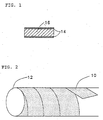
- FIG. 1 is a sectional view of an adhesive laminated film for covering an accelerator beam tube or for covering a conductor wire for an accelerator quench heater.
- FIG. 2 is a perspective view for illustrating a method of covering an accelerator beam tube or a conductor wire for an accelerator quench heater with an adhesive laminated film according to the present invention.
- FIG. 3 is a perspective view for illustrating another method of covering an accelerator beam tube or a conductor wire for an accelerator quench heater with an adhesive laminated film according to the present invention.
- FIG. 4 is sectional view of a conductor wire for an accelerator quench heater which is covered with an adhesive laminated film for covering an accelerator beam tube or for covering a conductor wire for an accelerator quench heater according to the present invention.
- a soluble polyimide according to the present invention has a solubility of 10 % or higher at 20°C in an organic solvent of N, N-dimethylformamide, 1,4-dioxane, 1,3-dioxolane, or tetrahydrofuran.
- the soluble polyimide also has a glass transition temperature of 100°C to 250°C and water absorption of 1.5 % or less.
- the acid dianhydride contains the ester acid dianhydride represented by the general formula (1). More preferably, the ester acid dianhydride constitutes 50 % or more mol% of the total acid dianhydride component.
- Examples of the preferable ester acid dianhydride represented by the general formula (1) include: 2,2-bis(4-hydroxyphenyl)propane dibenzoate-3,3',4,4'- tetracarboxylic dianhydride, p- phenylenebis (trimellitic monoester anhydride), 4,4'-biphenylenebis (trimellitic monoester anhydride), 1,4-naphthalenebis (trimellitic monoester anhydride), 1,2-ethylenebis (trimellitic monoester anhydride), 1,3-trimethylenebis (trimellitic monoester anhydride), 1,4-tetramethylenebis (trimellitic monoester anhydride), 1,5-pentamethylenebis (trimellitic monoester anhydride), and 1,6-hexamethylene bis (trimellitic monoester anhydride.
- One or more kinds of the ester acid dianhydrides can be used as acid dianhydride or a portion of acid dianhydride.
- ESDA 2,2-bis(4-hydroxyphenyl)propane dibenzoate-3,3',4,4'-tetracarboxylic dianhydride
- the above compounds can be used alone or in combination.
- Y's may be the same or different in each repeating unit.
- a hydrocarbon group such as methyl group and ethyl group or halogen group such as Br and Cl may be introduced to each benzene ring.
- the diamine or diisocyanate compound represented by the general formula (2) preferably constitutes 50 % or more of the total amount of diamine or diisocyanate, more preferably 70 % or more, and most preferably 90 % or more.
- a preferable diamine compound is represented by the general formula (3) (wherein A represents -NH 2 or -NCO and R is a bivalent organic group selected from the group consisting of -CH 2 -, A polar group such as -SO 2 and a single bond and an isopropyl group have the effect of increasing a solubility. Since the diamine represented by the general formula (3) contains such organic groups, it is preferably used in terms of solubility.
- a diamine or diisocyanate component including 1,3-bis(aminophenoxy)benzene represented by the following structural formula or 1,3-bis(isocyanatephenoxy)benzene represented by the following general formula
- 1,3-bis(aminophenoxy)benzene or 1,3-bis(isocyanatephenoxy)benzene is preferably used because each provides excellent solubility to the polyimide.
- bis(aminophenoxy phenyl)sulfone is preferably used.
- meta-type bis(aminophenoxy phenyl) sulfone represented by the following structural formula is preferably used because it provides high solubility to the thermoplastic polyimide resin.
- the 1,3-bis(aminophenoxy)benzene or 1,3-bis(isocyanatephenoxy)benzene having an amino group at a meta position is more preferably used than the one having an amino group at a para position, because it provides more excellent solubility to the polyimide.
- the diamine represented by the general formula (2) or (4) has an effect of increasing a solubility of the polyimide resin. More preferably, such diamine constitutes 50 to 99 mol% of the total diamine components, and most preferably 80 to 99 mol%.
- the soluble polyimide of the present invention can be produced by a synthesizing procedure which is applicable to a method of producing a typical polyimide. Following is a general synthesizing procedure.
- a polyamide acid polymer precursor is produced by reacting acid dianhydride with a diamine compound in an organic solvent, and then dehydrated to effect ring closure.
- the acid dianhydride component and diamine component are equimolar or substantially equimolar.
- Preferable molar ratio is:
- the reaction of acid dianhydride with diamine is made by dissolving or diffusing one or more kinds of the diamine compound represented by the general formula (2) in an organic polar solvent and then adding one or more kinds of ester acid dianhydride represented by the general formula (1) to the solvent, for example.
- the order of adding each monomer is not particularly limited.
- the acid dianhydride may be added first to the organic polar solvent and then the diamine compound is added to produce a solution of polyamide acid polymer.
- a certain amount of the diamine compound, acid dianhydride, and the rest of diamine compound may be added in this order in the organic polar solvent to produce a polyamide acid polymer solution,
- there are various other monomer adding methods which are known to the persons skilled in the art.
- the reaction temperature is 80°C or lower, preferably 0°C to 50°C.
- the reaction time is arbitrarily set within a range of 30 minutes to 50 hours. As the reaction proceeds, more amount of polyamide acid is produced, and thereby the viscosity of the reaction solution is increased.
- a polyimide can be prepared by dehydration ring-closure of a polyamide acid solution.
- dehydration ring-closure There are two methods for dehydration ring-closure. The one is thermal dehydration ring-closure in which the polyamide acid solution is heated and then dehydrated, and the other is chemical dehydration ring-closure in which the polyamide acid solution is dehydrated using a dehydrating agent.
- polyamide acid is heated at 150°C or more for imidization.
- a polyamide acid solution may be cast over or applied to a film base such as a glass plate, metal plate, and PET and then heated at 80°C to 300°C.
- a polyamide acid solution is directly put into a container coated with mold release agent such as Teflon and then heated and dried in a vacuum to obtain a polyimide.
- the heating time is preferably one minute to five hours after heating temperature reaches its peak, although it depends on the thickness of the polyamide and maximum heating temperature.
- a preferable thermal imidization method is a method in which polyamide acid solution is heated under a reduced pressure.
- water generated in imidization can be actively removed out of the reaction system and the hydrolytic degradation of polyamide acid can be prevented. Therefore, polyimide of high-molecular weight can be obtained.
- particularly preferable molecular-weight polyimide can be expected to be obtained because the rings of the impurities close again.
- a preferable heating temperature is 80°C to 400°C. More preferable heating temperature is 100°C or more, because imidization and water removal are carried out efficiently at 100°C or more. Most preferable heating temperature is 120°C or more. Maximum heating temperature is preferably lower than thermal decomposition temperature of a desired polyimide. In general, an imidization completion temperature, namely, about 250°C to 350°C, is adopted.
- a reduced pressure is preferably low. Specifically, a preferable reduced pressure is 0.001 X 10 5 to 0.9 X 10 5 Pa, more preferably 0.001 X 10 5 to 0.8 X 10 5 Pa, and most preferably 0.01 X 10 5 to 0.7 X 10 5 Pa.
- the chemical imidization method not less than a stoichiometric amount of dehydrating agent and a catalytic amount of tertiary amine are added to the polyamide acid solution and then the same process as done in the thermal imidization method is conducted, and thus a desired polyimide can be obtained.
- the dehydrating agent used herein include: aliphatic acid anhydrides such as acetic anhydride; and aromatic acid anhydrides.
- the catalyst examples include: aliphatic tertiary amines such as triethylamine; aromatic tertiary amines such as dimethylaniline; heterocyclic tertiary amines such as pyridine, isoquinoline, ⁇ -picoline, ⁇ -picoline, and ⁇ -picoline.
- a diisocyanate component to be reacted preferably contains 50 mol% of or more of the diisocyanate represented by the general formula (5), more preferably 70 mol%, and particularly preferably 90 mol%.
- Y's may be the same or different in each repeating unit.
- a hydrocarbon group such as a methyl group and ethyl group or a halogen group such as Br and Cl may be introduced to each benzene ring.
- a polyimide resin produced using 1,3-bis(isocyanatephenoxy)benzene has more excellent solubility.
- the amount of 1,3-bis(isocyanatephenoxy)benzene is preferably 50 mol% or more of the total diamine components to be reacted, more preferably 70 mol% or more, and most preferably 90 mol% more.
- 1,3-bis(3-isocyanatephenoxy)benzene having an isocyanate group at a meta position which is represented by the following structural formula , is particularly preferably used because it provides more excellent solubility to a polyimide than 1,3-bis(4-isocyanatephenoxy)benzene having an isocyanate group at a para position.
- the soluble polyimide obtained by reacting diamine and acid dianhydride is, in many cases, obtained as a solution of an organic solvent used in the polymerization of polyamide acid.
- the soluble polyimide obtained by reacting diisocyanate and acid dianhydride is also obtained as a solution of an organic solvent used at the start of the reaction. These organic solvents may not be always removed, but may be used in a subsequent step as it is.
- the polyimide in the above state may be purified to obtain solid-state polyimide such as polyimide powders.
- An example of a method of purifying the soluble polyimide is as follows.
- the soluble polyimide resin solution is put into a poor solvent which is compatible with a solvent used in the polymerization of polyamide acid but which does not dissolve the soluble polyimide, the soluble polyimide is precipitated, unreacted monomer is removed from the polyimide, and then the polyimide is dried to obtain the solid purified soluble polyimide.
- the poor solvent include acetone, methanol, ethanol, isopropanol, benzene, metylcellosolve, and methyl ethyl ketone.
- the solid polyimide can be stored, and can be dissolved in a solvent when it is used.
- the polyimide obtained by reacting the acid dianhydride represented by the general formula (1) with the diamine component or diisocyanate component represented by the general formula (2) is a soluble polyimide which has a solubility of 10 % or higher at 20°C in an organic solvent of N, N-dimethylformamide, 1,4-dioxane, 1,3-dioxolane, or tetrahydrofuran.
- a water absorption of polyimide is preferably 2.0 % or lower, more preferably 1.5 % or lower, and most preferably 1.0 % or lower. This is because a substrate material for an electronic circuit having excellent dielectric properties can be easily obtained from such polyimide having a low solubility.
- the polyimide preferably has a glass transition temperature of 100° C to 250°C, preferably 120°C or higher, more preferably 150°C or higher, and most preferably 180°C or higher. If the polyimide is used as a substrate material which is to be heated in a solder reflow reactor at a temperature in the neighboring of 240°C, it is important that polyimide has a glass transition temperature of 160°C or higher.
- the soluble polyimide having a suitable glass transition point according to the present invention can be selected from the polyimides obtained by reacting the diamine with the acid anhydride.
- the adhesive agent can have a solubility of 10 % or higher at 20°C in an organic solvent of N, N-dimethylformamide, 1,4-dioxane, 1,3-dioxolane, or tetrahydrofuran. Furthermore, the agent can also have a solubility of 15 % or higher or 20 % or higher.
- the composition of the present invention comprises: a polyimide obtained by reacting any one of the above acid dianhydrides with any one of the above diamine or diisocyanate components; and thermosetting rein, especially an epoxy resin.
- Y's may be the same or different in each repeating unit.
- a hydrocarbon group such as methyl group and ethyl group or halogen group such as Br and Cl may be introduced to each benzene ring.
- a diamine compound represented by (wherein Y independently represents -C( O)-, -SO 2 -, -O-, -S-, -(CH 2 ) m -, -NHCO-, -(CH 2 ) m -
- the diamine preferably makes up of 1 to 50 mol% of the polyimide resin, and more preferably 1 to 20 mol%.
- thermosetting resin contained in the composition according to the present invention examples include: bismaleimide, bisallylindophenol (bisallylnadiinide), epoxy resin, phenol resin, and cyanate resin.
- preferable thermosetting resin is epoxy rein. Any epoxy resin can be used in the present invention.
- epoxy resin include: bisphenol epoxy resin, hydrogenated bisphenol epoxy resin, phenol novolac epoxy rein, hydrogenerated phenol novolac epoxy resin, alkylphenol novolac epoxy resin, polyphenol epoxy resin, polyglycol epoxy resin, cyclic aliphatic epoxy resin, cresol novolac epoxy resin, glycidylamine epoxy resin, urethane modified epoxy resin, rubber modified epoxy resin, and epoxy modified polysiloxane.
- glycidyl ether resin such as bisphenol A-type epoxy resin and novolac resin, cyclic aliphatic epoxy resin, aromatic epoxy resin, hydrogenerated epoxy resin, and the like can be used alone or in combination.
- Specific examples include: bisphenol A epoxy resin (Yuka Shell Epoxy Kabushiki Kaisha: Epikote 828, 834, 1001, 1002, 1003, 1004, 1005, 1007, 1010, 1100L, etc.), brominated bisphenol A epoxy resin (Yuka Shell Epoxy Kabushiki Kaisha: Epikote 5050, 5051, 5051H etc.), o-cresol novolac resin (Yuka Shell Epoxy Kabushiki Kaisha: Epikote ESCN-220L, 220F, 220H, 220HH, 180H65, 180S65, etc.), naphthalene aralkyl novolac bisphenol A resin (Nippon Steel Chemical Co.
- the content of the polyimide resin is 100 weight parts
- the content of the above thermosetting resin, especially epoxy resin is preferably 1 to 50 weight parts, and more preferably 5 to 30 weight parts. Too less content of thermosetting resin may degrade an adhesive strength of the composition, whereas too much content of the thermosetting resin may degrade a flexibility or heat resistance of the composition.
- an accelerator or curing agent to the composition of the present invention.
- Any curing agent for epoxy rein can be used.
- the curing agent is added to a solution of an adhesive agent so as to improve water absorption, heat resistance, and adhesive properties.
- Examples of a typical adhesive curing agent include: a general curing agent, accelerator, or various coupling agents for an epoxy resin derived from an acid dianhydride, amine, imidazole, or the like.
- thermosetting resin than epoxy resin; phenol resin,; cyanate resin; and the like may be used in combination.
- the accelerator examples include: imidazole compound such as 2-alkylimidazole, 2-alkyl-4-methylimidazole, 2-alkyl-4-ethylimidazole, 1-(2-cyanoethyl)-2-alkylimidazole (preferably having the carbon number of 1 to 4 in an alkyl group), 2-phenylimidazole, 2,4-diphenylimidazole, and 2-phenyl-4-methylimidazole; acid anhydride such as phthalic anhydride, tetrahydrophthalic anhydride, hexahydrophthalic anhydride, and trimellitic anhydride; and amines such as diethylenetriamine, triethylenetetramine, m -xylylenediamine, and diaminphenyl methane. They can be used alone or in combination.
- imidazole compound such as 2-alkylimidazole, 2-alkyl-4-methylimidazole, 2-alkyl-4-ethylimi
- composition of the present invention is preferably composed mainly of the following ingredients.
- composition of the present invention is more preferably composed mainly of the following ingredients.
- composition of the present invention is most preferably composed mainly of the following ingredients.
- the adhesive layer made of the composition composed of the above main ingredients (I), (II) and (III) can obtain most preferable adhesive properties, excellent heat resistant, and the like.
- the content of each ingredient is out of the above range, the following problems may arise. If the content of the epoxy resin is less than 3 weight parts, adhesive strength of the layer is decreased. On the contrary, if it exceeds 100 weight parts, heat resistance of the layer may be decreased. If the content of the accelerator or curing agent is less than 0.5 weight parts, the epoxy resin is not cured. On the contrary, if it exceeds 50 weight parts, heat resistance is decreased.
- An excellent adhesive agent having low water absorption and low-temperature bonding property can be obtained by using the polyimide resin of the present invention as a constituent of a composition of an adhesive agent.
- the polyimide resin of the present invention has an excellent heat resistance and low water absorption. By mixing this polyimide resin with epoxy resin, the composition of the present invention can further obtain excellent adhesive properties.
- a cured composition contains 3 wt% or less of residual volatile, preferably 2 wt% or less, and more preferably 1 wt% or less.
- the residual volatile can be measured by a chromatographic method, for example.
- the cured composition is prepared as follows.
- sample solutions may be prepared in advance by dissolving respective potential solvents in a solvent which is not contained in the cured material.
- Each sample solution may be vaporized in a carrier gas in a gas chromatography column, and then a calibration curve is prepared to easily measure the weight of a residual volatile by the FID or the like.
- composition When the composition is used as an adhesive agent, for example, as a flexible copper clad laminate, adhesive strength increases by reducing the residual volatile. For example, it becomes possible that retention of peeling strength of the composition is preferably 60 % or higher, more preferably 70 % or higher, and most preferably 80 % or higher after conducting a PCT test (pressure cooker test) which is a reliability test for electronic materials.
- PCT test pressure cooker test
- the composition preferably has an excellent low water absorption of 1.5 % or lower, more preferably 1.3 % or lower, and most preferably 1.0 % or lower when the composition of the present invention is cured.
- composition having low water absorption can keep its adhesive strength without swelling under high temperature and humidity.
- a cured material in a laminate can be used for measuring water absorption.
- Water absorption of the composition according to the present invention can be easily adjusted by adjusting compounding ratio of constituents.
- a conventional adhesive agent of polyimide resin does not have sufficient adhesive strength to a metal such as a copper foil and a resin film such as polyimide resin.
- it is difficult to mix a conventional adhesive agent of polyimide resin with epoxy resin because it has a low degree of solubility in epoxy resin.
- the composition of the present invention has a good adhesive strength to a metal foil such as copper foil and polyimide film.
- the composition of the present invention has a high degree of solubility in an organic solvent, so that it has a high workability.
- composition of the present invention can be used in various ways on the basis of knowledge of those skilled in the art.
- an organic solvent of the composition containing an epoxy resin and the polyimide resin obtained by imidizing a polyamide acid polymer can be used in a sheet-like state or in the state of varnish.
- a solution of the composition containing polyimide resin and epoxy resin can be solidified and then dissolved in an organic solvent to use as a varnish.
- composition of the present invention can be formed into a sheet in advance to use it as an adhesive sheet. Further, the composition of the present invention can be impregnated into a glass cloth, glass mat, aromatic polyamide cloth, aromatic polyamide mat or the like as a varnish and then semi-cured to use it as a fiber-reinforced adhesive sheet.
- the composition of the present invention can contain at least one kind of solvent and can be used as a varnish.
- the solvent used herein is not particularly limited as far as it dissolves polyimide resin and epoxy resin.
- a preferable solvent is an organic polar solvent which is to be used for preparing a polyamide acid solution.
- Examples of a polyamide acid solution include: sulfoxide solvents such as dimethyl sulfoxide and diethyl sulfoxide; formamide solvents such as N,N-dimethylformamide and N,N-diethylformamide; acetamide solvents such as N,N-dimethylacetamide and N,N-diethylacetamide; pyrrolidone solvents such as N-methyl-2-pyrrolidone; phenol solvents such as phenol, o -cresol, m -cresol, p -cresol, xylenol, phenol halide, and catechol; hexamethylphosphoramide; and ⁇ -butyrolactone. If necessary, these organic polar solvents can be used in combination with an aromatic hydrocarbon such as xylene and toluene. However, solvents are not particularly limited thereto.
- solvent is a low-boiling solvent having a boiling point of 160°C or lower.
- low-boiling solvent used herein is a solvent having a boiling point of 160°C or lower.
- the solvent has a boiling point of 130°C or lower, and more preferably, solvent has a boiling point of 105°C or lower.
- composition of the present invention can be obtained by dissolving the above-obtained soluble polyimide, epoxy resin, and curing agent in an organic solvent containing cyclic ether. Since the solvent can be removed from such composition by drying at a relatively low temperature, the composition exhibits high adhesive strength when it is laminated in a later step.
- examples of such low-boiling solvent include: tetrahydrofuran (hereinafter referred to as "THF", boiling point: 66°C); 1,4-dioxane (hereinafter referred to as “dioxane”, boiling point: 103°C); 1,2-dimethoxyethane (boiling point: 84°C) and 1,3-dioxolane (boiling point: 76°C).
- THF tetrahydrofuran
- dioxane 1,4-dioxane
- boiling point: 103°C 1,2-dimethoxyethane
- 1,3-dioxolane boiling point: 76°C
- a preferable cyclic ether solvent examples include: tetrahydrofuran (THF), 1,4-dioxane, and 1,3-dioxolane. If the cyclic ether solvent is mixed with a plurality of solvents, it is preferable to mix the solvent with polar organic solvents. When the organic solvent contains 30 wt% or more of cyclic ether solvents, and more preferably 50 wt% or more, the effects of the present invention are easily produced.
- Examples of the polar organic solvent to be mixed with the cyclic ether solvent include: sulfoxide solvents such as dimethyl sulfoxide and diethyl sulfoxide; formamide solvents such as N,N-dimethylformamide and N,N-diethylformamide; and acetamide solvents such as N,N-dimethylacetamide and dimethylacetamide.
- thermoplastic polyimide resins are insoluble or have a low degree of solubility in these solvents.
- thermoplastic polyimide of the present invention is soluble in these solvents since an acid dianhydride residue in a molecule of the thermoplastic resin of the present invention is an ester acid dianhydride residue represented by the general formula (1) (wherein X indicates a bivalent organic group having -(CH 2 ) k - or an aromatic group and k is an integer of 1 to 10).
- the concentration of the organic solvent solution of the composition according to the present invention is 5 to 50 wt%, preferably 10 to 40 wt%, and more preferably 15 to 30 wt%, as a percentage of a weight of a solid content (thermoplastic polyimide + epoxy rein + curing agent) over an weight of the solution.
- a proper dissolving procedure may be determined by its workability.
- the above-obtained composition and even the above-obtained solution of the composition exhibit excellent low water absorption of preferably 1.5 % or less, more preferably 1.3 % or less, and most preferably 1.0 % after it is cured. Further, the content of residual volatile in the cured composition can be reduced to 3 % or less, preferably 2 % or less, and more preferably 1 % or less.
- the composition can preferably exhibit a peeling strength retention of 60 % or more, more preferably 70 % or more, and most preferably 80 % or more after conducting a PCT test (pressure cooker test).
- the composition is excellent in solder heat resistance, heat resistance, and adhesive strength.
- the composition when used as an adhesive agent, it can exhibit sufficient adhesive strength at a relatively low temperature, for example, at 250°C or less.
- composition of the present invention is dissolved in an organic solvent, applied to at least one surface of a polyimide film, for example, and then dried.
- a polyimide film for example, after the composition is applied to a base and then dried, it is peeled from the base and then used as a bonding sheet.
- the composition can be laminated to a metal foil such as a copper foil, aluminum foil, and 42K alloy foil, polyimide film, or printed circuit board by thermocompression.
- the kind of the polyimide film which is used as a core layer is not particularly limited.
- the bonding sheet of the present invention comprises at least an adhesive layer.
- This adhesive layer is made of the composition of the present invention containing epoxy resin and soluble polyimide having a solubility of 10 % or higher at 20°C in an organic solvent such as N, N-dimethylformamide, 1,4-dioxane, 1,3-dioxolane, and tetrahydrofuran.
- the bonding sheet of the present invention may be a single-layer of adhesive, or a laminated sheet in which the adhesive layer is formed on a plastic film, metal foil, or the like.
- a method of producing the bonding sheet of the present invention is not particularly limited. Specifically, the bonding sheet of the present invention can be produced by:
- the bonding sheet obtained in the former case is a single-layer polyimide adhesive film.
- a film-like laminate having a similar structure to the latter case can be produced.
- a method of casting or applying the composition over the base is not limited.
- the composition can be cast or applied using a known coater such as bar coater, die coater, roll coater, knife coater, and spin coater.
- the cast or applied composition preferably has a thickness of 3 to 10 ⁇ m as an adhesive layer after drying.
- Examples of the base include a metal belt, metal drum, and plastic film.
- the polyimide adhesive layer according to the present invention as a surface layer of a laminated bonding sheet having a core layer of polyimide film or as a single-layer bonding sheet of adhesive, has preferably a thickness of 5 to 30 ⁇ m.
- adhesive strength decreases.
- the organic solvent may be hard to be reduced or the evolution of bubbles may occur on its surface.
- the bonding sheet of the present invention comprises a plastic film as a core layer and/or release film layer.
- a plastic film is used as a base, and an adhesive layer is applied over the base and dried.
- the adhesive layer is not peeled from the base, but is rolled up.
- the plastic film to be used as the core layer is preferably a polyimide film.
- the plastic film to be used as a release film is preferably a film which is mainly composed of PET (polyethylene terephthalate) or PEN (polyethylene naphthalate).
- the obtained single-layer film is, for example, sandwiched between two release films to produce a three-layer bonding sheet composed of a release film, an adhesive agent, and another release film.
- the bonding sheet can be formed into sheet or can be produced as a continuous roll, for example.
- a technique of laminating a release film and a film-like adhesive agent is not particularly limited.
- Examples of a preferable laminating technique include a thermal pressing, vacuum pressing, autoclave pressing, heat roll pressing, and inch pressing. From the technical stand point, more preferable are a heat roll pressing technique and an inch pressing technique for pressing a continuous film.
- the bonding sheet of the present invention is a single-layer sheet or a laminated sheet in which adhesive layers are formed on a plastic film (core layer).
- the bonding sheet of the present invention can be laminated to a metal foil, another film, printed circuit board, or the like by thermocompression.
- a metal foil include a copper foil, aluminum foil, and 42 alloy.
- the kinds of the film (core layer) are not particularly limited.
- the film include a polyimide film and a polyester film.
- a conventional polyimide adhesive agent does not have sufficient adhesive strength to a metal such as a copper foil and a resinous film such as polyimide film, and is hard to blend with epoxy resin due to low solubility.
- the bonding sheet of the present invention has a sufficient adhesive strength to a metal such as a copper foil and a resinous film such as polyimide film, and can be bonded at a low temperature.
- the bonding sheet of the present invention is excellent in workability.
- the surface of the adhesive layer of the bonding sheet is thermally pressed to a metal foil or polyimide film at a heating temperature of 150°C to 250°C at a pressure of 0.1 to 10 MPa for a heating time of about 5 to 20 minutes.
- Preferable water absorption of the adhesive layer (soluble polyimide) of the above bonding sheet having an adhesive layer containing the soluble polyimide resin and epoxy resin is preferably 2.0 % or less, and more preferably 1.5 % or less, and most preferably 1.0 %.
- the soluble polyimide can be preferably used as an adhesive agent in a field of electronic material.
- a glass transition temperature of the soluble polyimide can be 120°C or higher, preferably 150°C or higher, and more preferably 160°C or higher.
- the polyimide is used as a substrate material which is to be heated in a solder reflow reactor at a temperature in the neighboring of 240°C, it is important that the polyimide has a glass transition temperature of 160°C or more. Such polyimide can be preferably used.
- the above soluble polyimide resin preferably has a solubility of 10 % or higher at 20°C in an organic solvent such as N, N-dimethylformamide, 1,4-dioxane, 1,3-dioxolane, and tetrahydrofuran, and more preferably 15 % or higher, and most preferably 20 % or higher in view of production cost and efficiency.
- organic solvent such as N, N-dimethylformamide, 1,4-dioxane, 1,3-dioxolane, and tetrahydrofuran
- a residual volatile left in the cured layer can be 3 wt% or less of the total weight of the cured layer, preferably 2 wt% or less, and more preferably 1 wt% or less.
- a water absorption of the cured layer is preferably 1.5 % or less, more preferably 1.3 % or less, and most preferably 1.0 % or less.
- the cured layer can exhibit excellent low water absorption.
- the bonding sheet of the present invention has suitable properties for a TAB tape, composite lead frame, laminating material, or the like. Specifically, the bonding sheet of the present invention has low water absorption, excellent solder heat resistance, excellent heat resistance, and excellent adhesive properties, and can be used as an adhesive agent at 250°C or less.
- an adhesive laminated film for covering an accelerator beam tube is composed of a polyimide film and an adhesive layer.
- the thickness of the polyimide is preferably 5 to 300 ⁇ m and more preferably 10 to 125 ⁇ m.
- the thickness of the adhesive layer is preferably 1 to 20 ⁇ m, and more preferably 3 to 15 ⁇ m.
- the adhesive layer laminated on the polyimide film contains the above soluble polyimide having a glass transition temperature of 100°C to 250°C, and water absorption of 1.5 % or less, and is further composed of a composition containing thermosetting resin.
- the soluble polyimide contained in the adhesive layer has low water absorption, which is preferably 1.5 % or less, more preferably 1.2 % or less, and most preferably 1.0 % or less. If water absorption exceeds 1.5 %, the polyimide film and the adherend tend to be deteriorated due to water absorption.
- water absorption used herein is a value obtained by measuring a 25- ⁇ m-thick soluble polyimide film.
- a glass transition temperature of the soluble polyimide is preferably 130°C to 240°C, more preferably 150°C to 200°C.
- heat sealing of the soluble polyimide and curing reaction of the thermosetting resin are accelerated. Therefore, where a glass transition temperature of the soluble polyimide exceeds 250°C, an adherend may be deteriorated due to high-temperature heat sealing. On the contrary, where a glass transition temperature of the soluble polyimide is less than 100°C, the adhesive layer melts out when it is heated at a high temperature.
- a glass transition temperature of the polyimide must be 60°C to 70°C higher than that of a conventional polyimide adhesive layer. Otherwise, the laminated film is not adhered to the wire rod.
- an accelerator beam tube is made of superconducting wire such as a Ti-Nb system.
- the beam tube is exposed to an atmosphere having a certain temperature or more, it is deteriorated by heat and thereby superconductivity of the tube is spoiled. Therefore, a temperature higher than a glass transition temperature of the polyimide may deteriorate physical properties of the beam tube.
- resin flow may occur by heat and continuity of liquid helium which is used for cooling the wire rod is interrupted. As a result, the wire rod is difficult to cool down and the superconductivity of the wire rod is spoiled.
- the adhesive laminated film for covering an accelerator beam tube contains thermosetting resin and the soluble polyimide which is used as an adhesive layer, the film can be bonded at a heating temperature in the neighboring of a glass transition temperature of the polyimide, and the resin flow and the deterioration of the superconductivity of the wire rod can be prevented. Therefore, the adhesive film is particularly preferably used for covering an accelerator beam tube.
- thermosetting resins any of the above listed thermosetting resins can be used, a preferable thermosetting resin is epoxy resin. Particularly, as listed above, epoxy resin having two or more epoxy groups in one molecule is preferably used.
- the content of the polyimide resin is 100 weight parts
- the content of the above thermosetting resin, especially epoxy resin is preferably 1 to 50 weight parts, and more preferably 5 to 30 weight parts. Too less content of thermosetting resin may degrade an adhesive strength, whereas too much content of the thermosetting resin may degrade a radiation resistance.
- thermosetting resin In order to improve heat resistance and adhesive properties, commonly-used curing agents for thermosetting resin and various coupling agents can be added to the adhesive layer.
- curing agents for epoxy resin include acid dianhydrides, amines, imidazoles, or the like.
- thermoplastic resin having the above properties the above obtained thermoplastic resin of the present invention can be used.
- the adhesive layer of the adhesive laminated film for covering an accelerator beam tube according to the present invention contains thermosetting resin, so that it exhibits excellent adhesive properties at a low temperature.
- thermosetting resin so that it exhibits excellent adhesive properties at a low temperature.
- the above-listed compositions of the present invention are preferably used.
- An example of a method of laminating an adhesive laminated layer on a polyimide film is as follows. A polyimide adhesive solution is cast or applied over a support, dried, and then peeled from the support to obtain a bonding sheet of the present invention. The thus-obtained bonding sheet is attached to the polyimide film by thermocompression to obtain a laminated film.
- the polyimide film, adhesive layer, and release paper may be attached in this order by thermocompression, and the release paper is pealed off when in use.
- the adhesive layer(s) can be attached to one surface or both surfaces of the polyimide film.
- the adhesive laminated film for covering an accelerator beam tube is wound around the tube while overlapping. For this reason, it is preferable to attach the adhesive layers on both surfaces of a polyimide film.
- the adhesive laminated film for covering an accelerator beam tube obtained by the aforementioned method is wound around the tube alone, or it is wound around the tube with a film of polyethylene terephthalate, polypropylene, polyethylene or the like, which is provided to the adhesive layer side of the adhesive laminated film as a spacer.
- the adhesive layer of the laminated film for covering an accelerator beam tube contains the above obtained soluble polyimide which is a thermoplastic resin having a glass temperature of 100°C to 250°C, preferably 150°C to 200°C. For this reason, when this laminated film is lapped around the accelerator beam tube with the adhesive layer inside and then heated at a temperature in the neighboring of the glass transition temperature, the adhesive laminated film can be bonded to the accelerator beam tube without spoiling superconductivity of the beam tube.
- the soluble polyimide resin which is preferably contained in an adhesive layer is obtained by reacting with an ester acid dianhydride represented by the general formula (1). Therefore, the adhesive laminated film for covering an accelerator beam tube exhibits lower water absorption than a conventional polyimide and suffers less performance deterioration due to. water absorption. Further, it has been shown that the laminated film of the present invention has an excellent radiation resistance.
- the adhesive laminated film for covering an accelerator beam tube according to the present invention has excellent adhesive properties, flexibility, and radiation resistance, and suffers less performance deterioration due to water absorption. Such properties are particularly suitable for covering a superconductive accelerator beam tube.
- FIG. 1 is a sectional view of the laminated film having adhesive layers on both sides according to the present invention.
- a laminated film 10 is spirally wound around an accelerator beam tube 12 while overlapping, and then heated to a predetermined temperature in the neighboring of a glass transition temperature of the soluble polyimide (adhesive layer).
- a polytmide film 16 is thermally attached to the accelerator beam tube 12 through an adhesive layer 14.
- the laminated film 10 may be spirally wound at intervals, as shown in FIG. 3.
- One of the method for covering an accelerator beam tube with an insulating coating is winding an adhesive film and a polyimide film together around the accelerator beam tube and then bonding them by thermocompression.
- the adhesive layer is laminated to the polyimide film in advance, in terms of workability and productivity.
- the adhesive film which is composed of thermoplastic resin and thermosetting resin, can be used itself as an insulating coating.
- the adhesive film is wound around the accelerator beam tube first and then bonded thereto by thermocompression. After that, the release paper may be pealed off.
- the accelerator beam tube to be covered with the laminated film of the present invention may be a superconductive accelerator beam tube or any other accelerator beam tube.
- the adhesive laminated film for covering a conductive wire for an accelerator quench heater is produced by laminating an adhesive layer on a polyimide film.
- the adhesive layer can be attached to one surface or both surfaces of the polyimide film.
- the thickness of the polyimide film is preferably 5 to 300 ⁇ m, and more preferably 10 to 125 ⁇ m.
- the thickness of the adhesive layer is preferably 1 to 20 ⁇ m, and more preferably 3 to 15 ⁇ m.
- the adhesive layer to be laminated on the polyimide film is made of a composition containing a thermosetting resin and a thermoplastic resin which has a glass transition temperature of 100°C to 250°C and water absorption of 1.5 % or less.
- a glass transition temperature of the soluble polyimide is preferably 130°C to 240°C, and more preferably 150°C to 200°C.
- heat sealing of the soluble polyimide and curing reaction of the thermosetting resin are accelerated. Therefore, where a glass transition temperature of the soluble polyimide exceeds 250° C, an adherend may be deteriorated due to high-temperature heat sealing. On the contrary, where a glass transition temperature of the soluble polyimide is less than 100°C, the adhesive layer melts out when it is heated at a high temperature.
- thermoplastic resin contained in the adhesive layer has low water absorption of 1.5 % or less. If water absorption exceeds 1.5 %, the polyimide film and the adherend tend to be deteriorated due to absorbed water. Water absorption is preferably 1.2 % or less, and more preferably 1.0 % or less.
- water absorption used herein is a value obtained by measuring a 25- ⁇ m-thick soluble polyimide film.
- the composition containing the polyimide having the above properties and an epoxy resin according to the present invention is suitably used as the adhesive laminated film for coating a conductive wire for an accelerator quench heater.
- Such adhesive layer contains a thermoplastic resin and thermosetting resin, so that it exhibits excellent adhesive properties at a low temperature.
- the adhesive layer is a soluble polyimide having a glass transition temperature of 100°C to 250°C and can be obtained by reacting ester acid dianhydride represented by the general formula (1) with a diamine compound or diisocyanate compound represented by the general formula (2). Since the soluble polyimide according to the present invention has lower water absorption than a conventional polyimide, the adhesive laminated film for coating a conductive wire for an accelerator quench heater suffers less performance deterioration due to water absorption.
- thermosetting resin a preferable thermosetting resin is epoxy resin.
- epoxy resin having two or more epoxy groups in one molecule is preferably used.
- the content of the polyimide resin is 100 weight parts
- the content of the above thermosetting resin, especially epoxy resin is preferably 1 to 50 weight parts, and more preferably 5 to 30 weight parts. Too less content of thermosetting resin may degrade an adhesive strength, whereas too much content of the thermosetting resin may degrade a flexibility or heat resistance.
- thermosetting resin In order to improve heat resistance and adhesive properties, commonly-used curing agents of thermosetting resin and various coupling agents can be added to the adhesive layer.
- curing agents for epoxy resin include acid dianhydrides, amines, imidazoles, or the like.
- Examples of a method of laminating an adhesive layer on a polyimide film include a method in which an adhesive solution is prepared, cast or applied to a polyimide film, and then dried.
- the polyimide resin can be dissolved with thermosetting resin in an organic solvent again and then filtered so as to produce a purified varnish.
- the solvent used herein is not particularly limited, but any known organic solvent can be used.
- Another example of a method of laminating an adhesive laminated layer on a polyimide film is as follows.
- the above polyimide adhesive solution is cast or applied over a base, dried, and then peeled from the base to obtain a bonding sheet containing a soluble polyimide and thermosetting resin.
- the bonding sheet is bonded to the polyimide film (core layer) by thermocompression, and thus a laminated film is obtained.
- the polyimide film, adhesive layer, and release paper may be laminated by thermocompression, and the release paper is pealed off when in use.
- the adhesive laminated film for covering a conductive wire for an accelerator quench heater obtained by the aforementioned method is wound alone around the tube, or it is wound around the tube with a film of polyethylene terephthalate, polypropylene, polyethylene or the like which is provided to the adhesive layer side of the adhesive laminated film as a spacer.
- the adhesive layer of the laminated film for covering a conductive wire for an accelerator quench heater is wound around the conductive wire with the adhesive layer inside, and then heated at a temperature in the neighboring of the glass transition temperature of 100°C to 250°C, preferably 150°C to 200°C.
- the adhesive laminated film can be bonded to the conductive wire.
- the soluble polyimide resin which is preferably used as thermoplastic resin contained in the adhesive laminated film for covering a conductive wire for a accelerator quench heater according to the present invention can be obtained by reacting ester acid dianhydride represented by the general formula (1) with a diamine or diisocyanate compound represented by the general formula (2). Since the soluble polyimide exhibits lower water absorption than a conventional polyimide, the adhesive laminated film for covering a conductive wire for an accelerator quench heater suffers less performance deterioration due to absorbed water. Further, it has been shown that the laminated film of the present invention has an excellent radiation resistance.
- the adhesive laminated film for covering a conductive wire for an accelerator quench heater according to the present invention has excellent adhesive properties, flexibility, and radiation resistance, and suffers less performance deterioration due to water absorption. Such properties are particularly suitable for covering a superconductive accelerator quench heater or the like.
- a conductive wire for an accelerator quench heater is covered by the same method of covering a beam tube as described with reference to FIG. 1 to FIG. 4.
- an adhesive film layer and a polyimide film are wound together around a conductive wire for an accelerator quench heater and then bonded by thermocompression.
- an adhesive laminated film is laminated to a polyimide film in advance, wound around a conductive wire for an accelerator quench heater, and then attached by thermocompression. Therefore, higher handleability, workability, and productivity are atained by the method of the present invention than the conventional method.
- the film-like laminated layer itself which is composed of thermoplastic resin (adhesive layer) and thermosetting resin, can be used as an insulating coating.
- the adhesive film and the release paper are wound together around the accelerator beam tube and then bonded thereto by thermocompression. After that, the release paper may be pealed off.
- the conductor wire for an accelerator quench heater to be covered with the laminated film of the present invention may be a conductor wire for a superconductive accelerator beam tube or any conductor wire for an accelerator quench heater including a copper wire.
- various changes, modifications, and improvements can be made to the embodiments on the basis of knowledge of those skilled in the art without departing from the scope of the present invention.
- N,N-dimethylformamide, 1,4-dioxane, 1,3-dioxolane, and tetrahydrofuran were prepared. 20 g of polyimide was added to 80 g of each organic solvent and stirred sufficiently at 20°C. Then, it was visually checked whether the polyimide was completely dissolved.
- Endothermic starting temperature was measured by a differential scanning calorimeter DSC CELL SCC-41 (Shimadzu Corp.) at a heating rate of 10°C/min.. This endothermic temperature was defined as a glass transition temperature. Higher a glass transition temperature, more excellent in heat resistance.
- Peeling strength was measured in accordance with JISC6481. Copper foils are bonded using an adhesive agent with the roughened surfaces of the foils facing in, and then thermally pressed to cure the adhesive agent. Using this 5-mm-width sample laminate (copper foil/adhesive agent/copper foil), peeling strength was measured by peeling the copper foil at a speed of 50 mm/min at an angle of 90° .
- Copper foils are bonded using an adhesive agent with the roughened surfaces of the foils facing in, and then thermally pressed to cure the adhesive agent. After leaving this sample laminate (copper foil/adhesive agent/copper foil) under normal conditions (at 20°C in a 60% RH environment for 24 hours), it was dipped in a solder bath of 260°C for 10 seconds. After that, the outward appearance of the laminate was checked to see whether it is swelled or not.
- a polyimide was produced in the same manner as described in Example 1, with an exception that 4,4'-[1,4-phenylenebis (1-methylethyllidene)] bisaniline: was used as a diamine compound.
- the polyimide had a solubility of 20% or higher in each organic solvent, a glass transition temperature of 230°C, and water absorption of 0.8%.
- a polyimide was produced in the same manner as described in Example 1, with an exception that 4,4'-[1,3-phenylenebis (1-methylethyllidene)] bisaniline: was used as a diamine compound.
- the polyimide had a solubility of 20% or higher in each organic solvent, a glass transition temperature of 210°C, and water absorption of 0.9%
- a polyimide was produced by heating the polyamide acid obtained in Example 1 at 200°C for 3 hours at a pressure of 0.007 X 10 5 Pa.
- the polyimide had a solubility of 20% or higher in each of the aforementioned organic solvents, a glass transition temperature of 180°C, and water absorption of 0.9%.
- a polyimide was produced in the same manner as described in Example 1, with an exception that 0.1041 mol of 3,3'-bis(aminophenoxyphenyl)propane (meta type) and 0.0446 mol of ⁇ , ⁇ -bis(3-aminopropyl)polydimethylsiloxane (APPS) were used as diamine compounds.
- the polyimide had a solubility of 20% or higher in each organic solvent, a glass transition temperature of 100°C, and water absorption of 1.7%.
- this solution was stirred in a 100°C atmosphere for an hour for imidization. After that, this solution was added dropwise to methanol with stirring at high speed to precipitate thread-like polyimide out of the solution.
- the thread-like polyimide was dried at 100°C for 30 minutes, crushed with a mixer, extracted by Soxlet method using methanol, and dried at 100°C for 2 hours to produce polyimide.
- the polyimide had a glass transition temperature of 160°C and water absorption of 0.9 %.
- the solubilities of the polyimide in DMF, 1,4-dioxane (hereinafter referred to as "dioxane”), and tetrahydrofuran (hereinafter referred to as THF) were checked, respectively. At the result, it was found that the polyimide had a solubility of 20 % or higher in each of the aforementioned organic solvents.
- a polyimide was produced by heating the polyamide acid obtained in Example 7 at 200°C for 3 hours at a pressure of 0.007 X 10 5 Pa.
- the polyimide had a solubility of 20% or higher in each of the aforementioned organic solvents, a glass transition temperature of 160°C, and water absorption of 0.9%.
- 201 g of DMF, 0.1487 mol of 1,3-bis(3-isocyanatephenoxy)benzene, and 0.1487 mol of ESDA were placed in a 500 mL glass flask and then stirred.
- the stirred solution was put into a Teflon coated vat and then dried in a vacuum oven at 200°C for 3 hours to produce a polyimide.
- the polyimide had a solubility of 20% or higher in each of the aforementioned organic solvents, a glass transition temperature of 160°C, and water absorption of 0.9%.
- DMF dimethylformamide
- BAPP-M 3,3-bis(aminophenoxyphenyl)propane
- HAB 3,3'-dihydroxy-4,4'-diaminobiphenyl
- 300 g of the polyamide acid solution was put into a Teflon coated vat and then dried in a vacuum oven at 150°C for 10 minutes, 160°C for 10 minutes, 170°C for 10 minutes, 180°C for 10 minutes, 190°C for 10 minutes, and 210°C for 30 minutes under a reduced pressure of 667Pa.
- the vat was taken out of the vacuum oven, 85. 4 g of thermoplastic polyimide resin having a hydroxyl group was obtained.
- the polyimide had a solubility of 20% or higher in each of the aforementioned organic solvents, a glass transition temperature of 210°C, and water absorption of 0.9%.
- a polyimide acid polymer solution was produced in the same manner as described in Example 10, with an exception that 4,4'-(1,3-phenylenebis(1-methylethyllidene))bisaniline (para type) was used as a diamine compound in place of the BAPP-M, and then thermoplastic polyimide resin powders having a hydroxyl group were obtained.
- the polyimide had a solubility of 20% or higher in each organic solvent, a glass transition temperature of 210°C, and water absorption of 0.9%.
- a polyimide was produced in the same manner as described in Example 1, with an exception that biphenyl tetracarboxylic dianhydride (BTDA) was used in place of ESDA.
- BTDA biphenyl tetracarboxylic dianhydride
- a polyimide was produced in the same manner as described in Example 1, with an exception that 4,4'-diaminodiphenylther was used in place of a diamine compound.
- Thus-obtained polyimide was insoluble in DMF, dioxane, and THF.
- BAPP-M 3,3'-bis(aminophenoxyphenyl)propane
- APS ⁇ , ⁇ -bis(3-aminopropyl) polydimethylsiloxane
- a polyimide was produced in the same manner as described in Example 7, with an exception that biphenyl tetracarboxylic dianhydride (BTDA) was used in place of ESDA.
- BTDA biphenyl tetracarboxylic dianhydride
- DMF dimethylformamide
- BAPP-M 3,3'-bis(aminophenoxyphenyl)propane
- HAB HAB
- ESDA 2,2-bis(4-hydroxyphenyl)propanedibenzoate-3,3',4,4'-tetracarboxylic dianhydride
- 300 g of the polyamide acid solution was put into a Teflon coated vat and then dried in a vacuum oven at 150°C for 10 minutes, 160°C for 10 minutes, 170°C for 10 minutes, 180°C for 10 minutes, 190°C for 10 minutes, and 210°C for 30 minutes under a reduced pressure of 667Pa.
- 85.4 g of thermoplastic polyimide resin having a hydroxyl group was obtained.
- the polyimide had a solubility of 20% or higher in each of the aforementioned organic solvents, a glass transition temperature of 210°C, and water absorption of 0.8%.
- DMF dimethylformamide
- BAPP-M 3,3'-bis(aminophenoxyphenyl)propane
- polyamide acid polymer solution was heated under a reduced pressure in the same manner as described in Example 1 to produce a thermoplastic polyimide resin powders.
- thermoplastic polyimide resin powders had a solubility of 20% or higher in each of the aforementioned organic solvents, a glass transition temperature of 190°C, and water absorption of 0.8%.
- DMF dimethylformamide
- BAPP-M 3,3'-bis(aminophenoxyphenyl)propane
- the varnish was cast over a glass plate, dried at 100°C for 10 minutes, peeled from the glass plate, fixed to an iron frame, and then dried at 150°C for 20 minutes to produce a 25- ⁇ m-thick sheet.
- a polyimide film APICAL 50 AH Kelzaneka Corporation
- a 25- ⁇ m-thick copper foil was sandwiched between a polyimide film APICAL 50 AH (Kaneka Corporation) and a 25- ⁇ m-thick copper foil and then dried at 200°C for 20 minutes at a pressure of 3MPa.
- a flexible copper clad laminate was produced.
- Example 10 The varnish obtained in Example 10 was applied to a polyimide film APICAL 50 AH (Kaneka Corporation) and dried at 100°C for 10 minutes and at 150°C for 20 minutes to produce a 25- ⁇ m-thick adhesive layer.
- polyimide film with the adhesive layer on one side thereof was heated at 200° C for 20 minutes at a pressure of 3MPa.
- a flexible copper clad laminate was produced.
- Example 12 In the same manner as described in Example 12, a composition solution was obtained from the soluble polyimide resin powders obtained in Example 11, and a flexible copper clad laminate was produced from the composition solution.
- Example 12 In the same manner as described in Example 12, a composition solution was obtained from the soluble polyimide resin powders obtained in Example 7, and a flexible copper clad laminate was produced from the composition solution.
- Example 12 In the same manner as described in Example 12, a composition solution was obtained from the soluble polyimide resin powders obtained in Example 1, and a flexible copper clad laminate was produced from the composition solution.
- a copper clad laminate was produced in the same manner as described in Comparative example 6, with an exception that the polyimide resin powders obtained in Comparative example 6 was dissolved in mixed solvent of dioxane and THF (weight ratio of 1:1).
- Example 6 20 g of polyimide resin powders obtained in Example 6 was dissolved in 83 g of DMF to prepare a varnish.
- the varnish was cast over a glass plate, dried at 100°C for 10 minutes, peeled from the glass plate, fixed to an iron frame, and then dried at 150°C for 20 minutes to produce a 25- ⁇ m-thick sheet.
- Thus-obtained sheet was sandwiched between a polyimide film APICAL 50AH (Kaneka Corporation) and a 25- ⁇ m-thick copper foil, and then dried at 200°C for 20 minutes at a pressure of 3MPa.
- a flexible copper clad laminate was produced.
- Polyimide resin powders were obtained in the same manner as described in Comparative example 8, with an exception that pyromelletic dianhydride (PMDA) and oxydianiline (ODA) were used in place of acid dianhydride and a diamine compound, respectively.
- PMDA pyromelletic dianhydride
- ODA oxydianiline
- the polyimide resin powders were dissolved in any solvents of DMF, THF, dioxane, and dioxolane. Neither a composition nor a flexible copper clad laminated could be produced from the polyimide resin powders.
- the physical properties of a composition was measured as follows.
- Peeling strength was measured in accordance with JISC 6481. To check solder heat resistance, the appearance of each laminate was evaluated after dipping the laminate in a solder bath at 260°C for 10 seconds. In Table, the mark " ⁇ " indicates that it was in a good condition and has no swelling part.
- PCT test Pressure Cooker Test for assessing reliability of materials for electronics was conducted at 121°C at a humidity of 100% for 96 hours.
- the rate of water absorption was determined in accordance with ASTM D570 and calculated by the following expression, wherein W 1 is a weight of a cured composition which was dried at 150°C for 30 minutes and W 2 is a weight of the composition which was immersed in distilled water for 24 hours and then wiped with a dry cloth.
- the rate of water absorption(%) (W 2 - W 1 ) ⁇ W 1 ⁇ 100
- a residual volatile content in a cured composition was determined by gas chromatography. Measurement conditions were as follows.
- a composition solution was tried to be produced in the same manner as described in Example 1, with an exception that methyl ethyl ketone (MEK) was used as an organic solvent instead of THF. However, the ingredients were not completely dissolved in the organic solvent.
- MEK methyl ethyl ketone
- composition solution was tried to be produced in the same manner as described in Example 1, with an exception that methanol was used as an organic solvent instead of THF. However, the ingredients were not completely dissolved in the organic solvent.
- composition solution was tried to be produced in the same manner as described in Example 1, with an exception that ethanol was used as an organic solvent instead of THF. However, the ingredients were not completely dissolved in the organic solvent.
- Example 18 The composition solution obtained in Example 18 was cast over 25- ⁇ m-thick polyimide film (APICAL 25AH available from Kaneka Corporation) and dried at 100°C for 10 minutes. After that, it was heated at 180°C for 10 minutes in Example 18a, at 200°C for 10 minutes in Example 18b, and at 220°C for 10 minutes in Example 18c to produce 30- ⁇ m-thick bonding sheets, respectively.
- API 25AH available from Kaneka Corporation
- Example 19a, 19b, and 19c bonding sheets were produced in the same manner as described in Examples 18a, 18b, and 18c, with an exception that the composition solution obtained in Example 19 was used.
- the amount of residual solvent was determined as follows:
- Peeling strength of a flexible copper clad laminate was measured as follows.
- a film-like laminate member and an 18- ⁇ m-thick electrolytic copper foil are thermally pressed at 200°C and a pressure of 3MPa for 20 minutes to produce a flexible copper clad laminate.
- the peeling strength of the laminate was measured in accordance with Japanese Industrial Standard JIS C6481. In that case, the conductor width was 3 mm.
- Table 2 shows the evaluation results of the properties of the film-like laminate member obtained in Examples and Comparative examples.
- THF dioxane dioxolane DMF NMP DMAc Amount of residual solvent(%)
- Example 18a Example 19a
- Example 20a Comparative example 15a Comparative example 16a Comparative example 17a 0.5 3.2 0.8 5.1 8.0 6.2
- Example 18b Example 19b
- Example 20b Comparative example 15b Comparative example 16b Comparative example 17b 0.0 1.3 0.2 2.0 4.3 3.5
- Example 18c Example 19c
- Example 18a Example 19a
- Example 18b Example 19b
- Example 20b Comparative example 15b Comparative example 16b
- each adhesive agent solution was applied to 100- ⁇ m-thick polyethylene terephthalate film so that the thickness of each adhesive agent was in a range of 25 to 50 ⁇ m after drying. Then, it was dried at 40°C for 2 minutes, peeled from the film, fixed to a frame with pins, dried at 120°C for 5 minutes and at 170°C for 3 minutes to remove solvents, and thermally pressed on a release film (PET or PEN) having a thickness of 25 to 50 ⁇ m at 140°C and a pressure of 1MPa for 3 minutes. Thus, a bonding sheet was produced.
- PET or PEN release film having a thickness of 25 to 50 ⁇ m at 140°C and a pressure of 1MPa for 3 minutes.
- the release film was removed from the bonding sheet to obtain an adhesive sheet.
- the adhesive sheet was laminated to a roughened surface of an 18- ⁇ m-electrolytic copper foil at 200°C and a pressure of 3MPa for 5 minutes, and cured at 170°C for 3 hours to prepare a laminated film with adhesive agent.
- thermoplastic polyimide A glass transition temperature of the thermoplastic polyimide was measured by TMA. The measurement value was 190°C. Further, its water absorption was measured in accordance with ASTM D-570 by immersing it in pure water at 20°C for 24 hours. The measurement value was 0.9%.
- the release paper was peeled off the laminated film, and then a copper foil is laminated thereto at 180°C and a pressure of 30 kg/cm 2 for 10 minutes.
- Its peeling strength was measured in accordance with JIS K6481 (at room temperature) so as to use it as the reference when the peeling strength between the adhesive laminated film for covering an accelerator beam tube and the accelerator beam tube or between the adhesive laminated film for covering a conductor wire for an accelerator quench heater and the accelerator quench heater was measured.
- the measurement value was 1.1 kg/cm.
- the adhesive laminated film for covering an accelerator beam tube or for covering a conductor wire for an accelerator quench heater was subjected to a radiation resistance test by applying radiation 5MGy using 2MeV electron beam.
- a release paper was peeled off the laminated film, and then a copper foil is laminated thereto at 180°C and a pressure of 3MPa for 10 minutes. Its peeling strength was measured in accordance with JIS K6481 (at room temperature) so as to use it as the reference when the peeling strength between the adhesive laminated film for covering an accelerator beam tube and the accelerator beam tube or between the adhesive laminated film for covering a conductor wire for an accelerator quench heater and the accelerator quench heater was measured. The measurement value was 1.2 kg/cm.
- the adhesive laminated film for covering accelerator beam tube and the adhesive laminated film for covering conductor wire for accelerator quench heater were subjected to a radiation resistance test by applying radiation 5MGy using 2MeV electron beam. No change was found in color and performance. Results of measurements are shown in Table 5.
- An adhesive sheet was produced in the same manner as Example 40, with an exception that the polyimide obtained in Example 6 was used.
- thermoplastic polyimide A glass transition temperature of the thermoplastic polyimide was measured by TMA. The measurement value was 190°C. Further, its water absorption was measured in accordance with ASTM D-570 by soaking it in pure water at 20°C for 24 hours. The measurement value was 0.9%.
- a release paper was peeled off the laminated film, and then a copper foil is laminated thereto at 180°C and a pressure of 3MPa for 10 minutes. Its peeling strength was measured in accordance with JIS K6481 (at room temperature) so as to use it as the reference when peeling strength between the adhesive laminated film for covering an accelerator beam tube and the accelerator beam tube or between the adhesive laminated film for covering a conductor wire for an accelerator quench heater and the accelerator quench heater was measured. The measurement value was 1.1 kg/cm.
- the adhesive laminated film for covering an accelerator beam tube or for covering a conductor wire for an accelerator quench heater was subjected to a radiation resistance test by applying radiation 5MGy using 2MeV electron beam. No change was found in color and performance. Results of measurements are shown in Table 5.
- An adhesive sheet was produced in the same manner as Example 40, with an exception that the polyimide obtained in Example 3 was used.
- thermoplastic polyimide A glass transition temperature of the thermoplastic polyimide was measured by TMA. The measurement value was 220°C. Further, its water absorption was measured in accordance with ASTM D-570 by soaking it in pure water at 20°C for 24 hours. The measurement value was 0.9%.
- a release paper was peeled off the laminated film, and then a copper foil is laminated thereto at 180°C and a pressure of 3MPa for 10 minutes. Its peeling strength was measured in accordance with JIS K6481 (at room temperature) so as to use it as the reference when peeling strength between the adhesive laminated film for covering an accelerator beam tube and the accelerator beam tube or between the adhesive laminated film for covering a conductor wire for an accelerator quench heater and the accelerator quench heater was measured. The measurement value was 1.1 kg/cm.
- the adhesive laminated film for covering an accelerator beam tube or for covering a conductor wire for an accelerator quench heater was subjected to a radiation resistance test by applying radiation 5MGy using 2MeV electron beam. No change was found in color and performance. Results of measurements are shown in Table 5.
- An adhesive sheet was produced in the same manner as Example 40, with an exception that the polyimide obtained in Example 7 was used.
- thermoplastic polyimide A glass transition temperature of the thermoplastic polyimide was measured by TMA. The measurement value was 160°C. Further, its water absorption was measured in accordance with ASTM D-570 by soaking it in pure water at 20°C for 24 hours. The measurement value was 0.9%.
- a release paper was peeled off the laminated film, and then a copper foil is laminated thereto at 180°C and a pressure of 3MPa for 10 minutes. Its peeling strength was measured in accordance with JIS K6481 (at room temperature) so as to use it as the reference when peeling strength between the adhesive laminated film for covering an accelerator beam tube and the accelerator beam tube or between the adhesive laminated film for covering a conductor wire for an accelerator quench heater and the accelerator quench heater was measured. The measurement value was 1.2 kg/cm.
- the adhesive laminated film for covering an accelerator beam tube or for covering a conductor wire for an accelerator quench heater was subjected to a radiation resistance test by applying radiation 5MGy using 2MeV electron beam. No change was found in color and performance. Results of measurements are shown in Table 5.
- polyamide acid was produced from pyromelletic dianhydride and ODA (oxydianiline).
- the polyamide acid was cast over a polyimide film (APICAL (trademark) available from Kaneka Corporation), dried at 80°C for 25 minutes, at 150°C for 5 minutes, at 250°C for 5 minutes, at 270°C for 5 minutes, and 300°C for 5 minutes for imidization.
- AICAL trademark of Kaneka Corporation
- An adhesive laminated film for covering an accelerator beam tube or for covering a conductor wire for an accelerator quench heater was produced in the same manner as described in Example 2, with an exception that an adhesive agent Epikote 828 (Yuka Shell Epoxy Kabushiki Kaisha) was used instead of the thermoplastic polyimide film.
- the respective properties of the film were measured in the same manner as described in Example 1.
- An adhesive layer of the film had a glass transition temperature of 178°C and water absorption of 2.0%. Peeling strength of the adhesive laminated film was 0.3 kg/cm. The film was blackened under the radiation resistance test. Results of the measurements are shown in Table 5.
- the soluble polyimide of the present invention has a solubility of 10 % or higher in a low-boiling solvent such as 1,4 dioxane and THF, and may have a glass transition temperature of 100°C or higher and water absorption of 2.0% or less. Accordingly, the polyimide of the present invention has an excellent workability as a coating film and adhesive agent.
- the soluble polyimide according to the present invention is mixed with epoxy resin and is used as polyimide composition, polyimide adhesive solution, laminate member, bonding sheet, and adhesive laminated film for covering an accelerator beam tube or for covering a conductor wire for an accelerator quench heater.
- the composition can be bonded at a relatively low temperature, for example, at about 250°C, when it is used as an adhesive agent. Unlike a conventional heat-resistant adhesive agent, it can be bonded at a low temperature, has high adhesion to polyimide, and retain high adhesive strength even at a high temperature. Further, the composition has low water absorption of 1.5% or less. Furthermore, by adjusting a residual volatile content to 3 wt% or less, peeling strength of the composition can be retained even after a PCT treatment. The composition has enough solder heat resistance, and therefore it does not swell when it is dipped in a solder bath.
- the adhesive solution of the present invention Using the adhesive solution of the present invention, almost all the high-boiling solvents can be removed from a base film when the film is dried after an adhesive solution is applied to the film.
- a conventional adhesive solution it contains only high boiling solvents such as DMF and NMP. For this reason, it must be dried at a high temperature to remove the solvents from the film, and its adhesive strength is significantly reduced.
- solvents can be easily removed from a film and high adhesive properties can be achieved even under such drying conditions that residual solvents are significantly reduced.
- thermoplastic polyimide to be used in the adhesive solution of the present invention has relatively lower glass transition temperature than a conventional thermoplastic polyimide, so that it can be bonded at lower temperature. Further, the adhesive solution and film-like laminated member using the adhesive solution exhibit excellent heat resistance, workability, and adhesive properties, and solvents can be easily removed therefrom.
- the bonding sheet of the present invention is made of a soluble polyimide which has a solubility of 10 % or higher in a low-boiling solvent such as 1,4-dioxane, 1,3-dioxalane, and THF, so that it is excellent in workability as a coating film and adhesive agent. Since the bonding sheet of the present invention is made of the soluble polyimide having a high glass transition temperature and low water absorption, it is applicable to an adhesive agent, composite material, or electric and electronic materials.
- the bonding sheet of the present invention can be used in the fields where heat resistance and adhesive properties are required as a printed wiring board, flexible wiring board, TAB (Tape Automated bonding) tape, composite lead frame, tape carrier, adhesive agent for an electronic component such as a semiconductor integrated circuit device, adhesive film, and adhesive agent or bonding agent for bonding an aluminum, iron, ceramics, fiber, and filler.
- TAB Tape Automated bonding
- the adhesive laminated film for covering an accelerator beam tube according to the present invention is composed of polyimide (as a base film) having an excellent heat resistance, radiation resistance, electrical characteristics, chemical resistance, and low-temperature characteristics and an adhesive layer which is made of thermoplastic resin having a glass transition temperature of 100°C to 250°C and water absorption of 1.5% or less and thermosetting resin having an excellent adhesive properties at a relatively low temperature. Therefore, it has an excellent workability, flexibility, and adhesive properties at a low temperature, and suffers very little degradation of performance due to water absorption. When an accelerator beam tube is coated with this film, the tube is protected from radiation by the film.
- the film Since the film has thus comprehensively excellent properties, it is suitably used for coating a superconducting accelerator beam tube or for coating a superconducting magnet for an accelerator. Likewise, when a conductor wire for accelerator quench heater is coated with this film, the conductor wire is protected from radiation by the film. Since the film has comprehensively excellent properties, it is suitably used for coating a conductor wire for a superconducting accelerator quench heater or for coating a superconducting magnet for an accelerator.
Landscapes
- Chemical & Material Sciences (AREA)
- Organic Chemistry (AREA)
- Chemical Kinetics & Catalysis (AREA)
- Health & Medical Sciences (AREA)
- Medicinal Chemistry (AREA)
- Polymers & Plastics (AREA)
- Adhesives Or Adhesive Processes (AREA)
- Macromolecular Compounds Obtained By Forming Nitrogen-Containing Linkages In General (AREA)
Abstract
An object of the present invention relates to a soluble
polyimide having an excellent heat resistance and low water
absorption, a composition containing the soluble polyimide,
which is cured at a relatively low temperature and has
excellent heat resistance and adhesive properties, a bonding
sheet using the composition, and adhesive laminated film for
covering an accelerator beam tube and for covering a
conductor wire for an accelerator quench heater, which have
excellent workability, flexibility, and radiation resistance
at a low temperature and especially have excellent adhesive
properties. The polyimide is obtained by reacting an acid
dianhydride represented by the general formula (1)
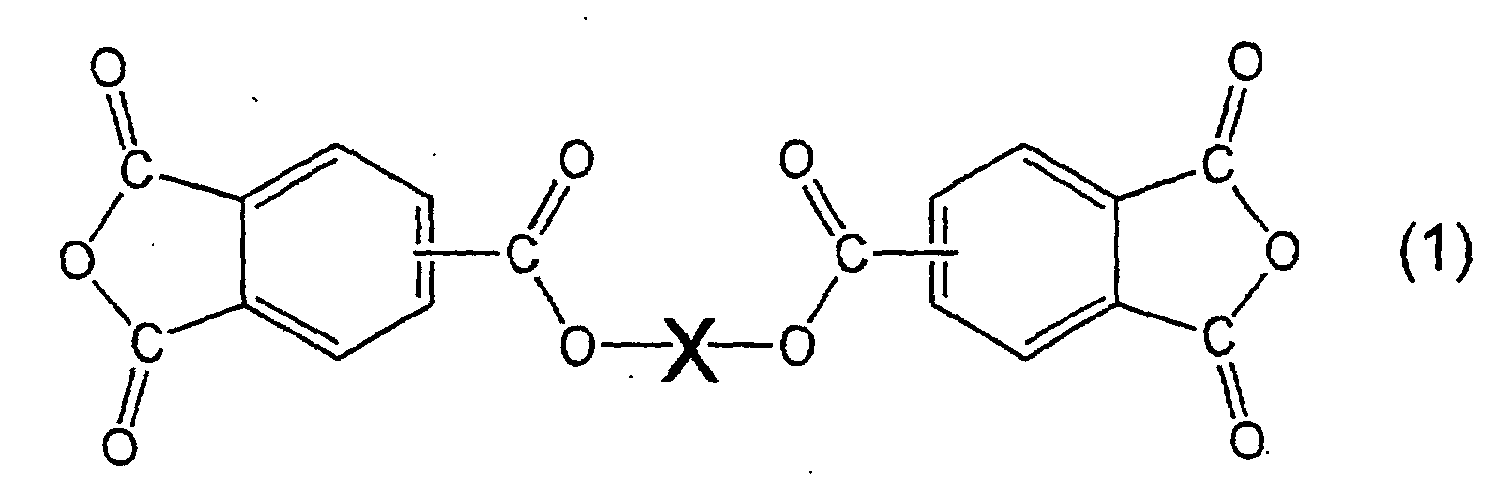 (wherein X represents a bivalent organic group having -(CH2)k-
or an aromatic group and k is an integer of 1 to 10) with a
compound represented by the general formula (2)
(wherein X represents a bivalent organic group having -(CH2)k-
or an aromatic group and k is an integer of 1 to 10) with a
compound represented by the general formula (2)
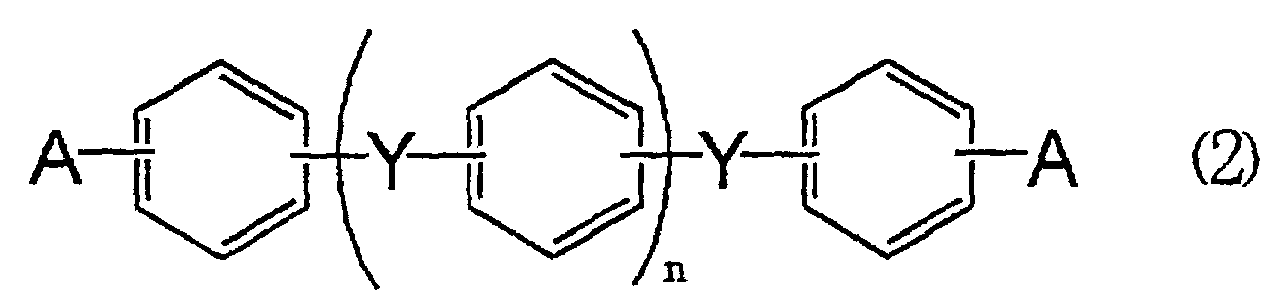 (wherein A represents -NH2- or -NCO, Y independently
represents -C(=O)-, -SO2-, -O-, -S-, -(CH2)m-, -NHCO-,
-C(CH3)2-, -C(CF3)2-, -C(=O)O- or a single bond, and m and n
each are an integer of 0 to 10). The polyimide has a
solubility of 10% or higher at 20°C even in a low-boiling
organic solvent, and has a glass transition temperature of
100°C to 250°C and water absorption of 1.5% or lower.
Specially, by mixing with epoxy resin, the soluble polyimide
is used as a composition, solution of polyimide adhesive,
laminator, bonding sheet, and adhesive laminated films
suitable for covering an accelerator beam tube or for
covering a conductor wire for an accelerator quench heater.
(wherein A represents -NH2- or -NCO, Y independently
represents -C(=O)-, -SO2-, -O-, -S-, -(CH2)m-, -NHCO-,
-C(CH3)2-, -C(CF3)2-, -C(=O)O- or a single bond, and m and n
each are an integer of 0 to 10). The polyimide has a
solubility of 10% or higher at 20°C even in a low-boiling
organic solvent, and has a glass transition temperature of
100°C to 250°C and water absorption of 1.5% or lower.
Specially, by mixing with epoxy resin, the soluble polyimide
is used as a composition, solution of polyimide adhesive,
laminator, bonding sheet, and adhesive laminated films
suitable for covering an accelerator beam tube or for
covering a conductor wire for an accelerator quench heater.
Description
The present invention relates to a soluble polyimide
having an excellent heat resistance and low water absorption,
a composition containing the soluble polyimide, which is
cured at a relatively low temperature and has excellent heat
resistance and adhesive properties, a bonding sheet using the
composition, and adhesive laminated films for covering an
accelerator beam tube and for covering a conductor wire for
an accelerator quench heater, which have excellent
workability, flexibility, and radiation resistance at a low
temperature and especially have excellent adhesive properties.
Recently, electronic apparatuses have been rapidly
growing more multifunctional, more sophisticated, and smaller,
and there has been a growing demand for more compact and more
lightweight electronic parts to be used in the electronic
apparatuses. Also, there has been a growing demand for
higher-density and more multifunctional and sophisticated
semiconductor device packages and wiring materials and parts
for mounting the packages. Particularly, there has been an
increasing demand for a material having excellent adhesive
properties which can be suitably used as a high-density
packaging material such as a semiconductor package, chip-on-lead
(COL) package, lead-on-chip (LOC) package, and multi
chip module (MCM); a material for a printed wiring board such
as multilayer flexible printed circuit board (FPC), a
material used in an aerospace field, and a fixing material
for automotive parts.
For example, for a bonding sheet which is used as a
bonding material for a semiconductor package and other
packaging materials, excellent adhesive properties, heat
resistance, flexibility, and workability have been
intensively demanded.
In view of excellent mechanical properties, heat
resistance, and insulating characteristics, NBR/phenol resin,
epoxy phenol resin/NBR, NBR/epoxy resin, epoxy
resin/polyester resin, epoxy resin/acryl resin, acryl resin,
or the like has been used as an adhesive agent for a bonding
sheet. As the demand for higher-density printed wiring board
and multi-layered flexible printed circuit board increase, it
has been increasingly desired to boost a performance of a
bonding sheet for bonding layers. However, conventional
bonding sheets have some problems in adhesive strength, heat
resistance, flexibility, workability, and the like.
For example, an adhesive agent derived from NBR is
quite susceptible to heat. Adhesive agents derived from
phenol and epoxy are superior in adhesive strength but
inferior in flexibility. A polyester adhesive agent has
excellent flexibility but has low heat resistance. An
acrylic adhesive agent has excellent flexibility but low heat
resistance. Since the acrylic adhesive must be heated for
press-bonding at a high temperature for a long time, it is
poor in workability. Thus, no conventional adhesive agents
have satisfactory quality.
In these fields, a polyimide adhesive has been
increasingly used, because it has sufficient flexibility
which phenolic and epoxy adhesives do not have and heat
resistance which an acrylic adhesive does not have.
Polyimide has been widely used because it is more
excellent heat resistance than any other organic polymers.
It is used even in an aerospace field and is used as a heat-resistant
adhesive agent.
However, the heat-resistant polyimide adhesive must be
bonded at a high temperature in the neighboring of 300°C and
at high pressure but does not have very high adhesive
strength. Further, it has very low solubility in an organic
solvent, and is only soluble in limited solvents such as DMF
and DMAc. Since these high-boiling solvents cannot be
completely removed from a film after an adhesive solution is
applied to the film and then dried, it has been found out
that the residual solvents left in the film causes bubbles in
the film. Further, since a conventional polyimide adhesive
has high water absorption, lead frames having a polyimide
adhesive tend to blister when it is dipped in a solder bath.
An aromatic polyimide which is widely used as an
electric and electronic material because of its excellent
heat resistance, mechanical properties, electric properties,
and the like is generally insoluble and infusible. Therefore,
where an aromatic polyimide which is used as a heat-resistant
adhesive agent by being applied to an adherend in a liquid
state, a polyamic acid solution, that is, a precursor of
aromatic polyimide, is applied to the adherend and then
heated to complete an imidization reaction. However, this
imidization reaction must be carried out at a high
temperature in the neighboring of 300°C, and product defects
are caused by by-product water generated in the imidization
reaction. When the polyamic acid solution is mixed with
another resin such as thermosetting resin, some thermosetting
resin are reacted with an amid group of polyamic acid. For
this reason, there is limit to selection of the resin to be
mixed.
Accordingly, various soluble polyimides have been
proposed so far. Japanese Unexamined Patent Publications
(Patent Kokai) No. 11-071457 and No. 11-222523 disclose
soluble polyimides of a siloxane structure. However, these
polyimides has low heat resistance if the siloxane content is
high, whereas they have high water absorption and are hard to
be dissolved if the siloxane content is low. Thus, it has
been difficult to obtain polyimide having high heat
resistance together with an excellent solubility and low
water absorption.
As the elementary particle physics moves forward, a
higher-energy accelerator has been increasingly produced. In
order to generate high energy, the accelerator must have a
magnet capable of passing large currents and generating a
strong magnetic field. Recently, a superconducting magnet
has been used as a wire material for the magnet in many cases.
This wire material is made of conductive metal such as copper
in which a bunch of superconducting thin wires are contained.
As the superconducting wire material, Nb-Ti, NbSn3, VGa3 or
the like is used. Nb-Ti is used in many cases. When a
thermosetting adhesive agent is used for insulating coating,
the application of heat having a certain temperature or more
causes the degradation of the superconducting wire material
by heat, and thereby the properties of the magnet are
deteriorated. Therefore, it has been desired to develop an
adhesive agent with high adhesion, which can be cured at
lower temperature than the thermal-degradation of a
superconducting wire material.
An accelerator is a device which accelerates and
collides particles such as protons and electrons to determine
elementary particles generated by the collision and in which
a large amount of radiation is generated by collision.
Therefore, an insulating coating material and adhesive agent
for a superconducting magnet must have an excellent radiation
resistance.
Prepreg of thermosetting resin which is composed mainly
of epoxy resin has been used for coating such superconducting
magnet, particularly a superconducting accelerator beam tube
to be used at a very low temperature. However, since epoxy
resin does not have sufficient radiation resistance, the use
of thermoplastic resin having radiation resistance has been
studied.
In the case of an accelerator in which a superconducting
magnet is used, there has been a fear of corruption of the
accelerator by resistance developed when the balance of
superconducting state comes undone for some reasons.
Therefore, the accelerator comprises a quench heater as a
safety device. In the quench heater, an accelerator ring
with a plate-like electric heating element can entirely
release the superconductive state when abnormal condition
occurs. Since a large amount of radiation is generated by
collision, an insulating coating material and adhesive agent
for a superconducting magnet must have an excellent radiation
resistance.
Since polyimide has excellent heat resistance, low-temperature
properties, chemical resistance, and electrical
characteristics, it has been widely used particularly as
materials for electric or electronic apparatuses.
Conventional polyimide films are insoluble and infusible.
Therefore, a polyimide film which is laminated with
thermoplastic resin such as fluororesin has took the form of
a composite material for coating a conductor wire for
superconducting accelerator quench heater which is used at a
cryogenic temperature.
However, the fluororesin does not have sufficient
radiation resistance. Since it is expected to increase the
amount of radiation generated in the accelerator in the
future with an increase in energy produced by the accelerator,
radiation resistance is increasingly desired. For this
reason, a thermoplastic polyimide resin has been studied for
use as a heat-sealing layer having an excellent heat
resistance.
The present invention solves the above problems and
provides a soluble polyimide having an excellent solubility,
high heat resistance, and low water absorption, a composition
containing the polyimide, a bonding sheet, and adhesive
laminated films for covering an accelerator beam tube and for
covering a conductor wire for an accelerator quench heater.
Specifically, the soluble polyimide of the present
invention has a solubility of 10 % or higher at 20°C in an
organic solvent of N, N-dimethylformamide, 1,4-dioxane, 1,3-dioxolane,
or tetrahydrofuran.
Further, the soluble polyimide of the present invention
has a solubility of 10 % or higher at 20°C in an organic
solvent of N, N-dimethylformamide, 1,4-dioxane, 1,3-dioxolane,
or tetrahydrofuran, and has a glass transition temperature of
100°C to 250°C and has water absorption of 1.5 % or lower.
Furthermore, the soluble polyimide of the present
invention can be obtained by reacting ester acid dianhydride
represented by the general formula (1)
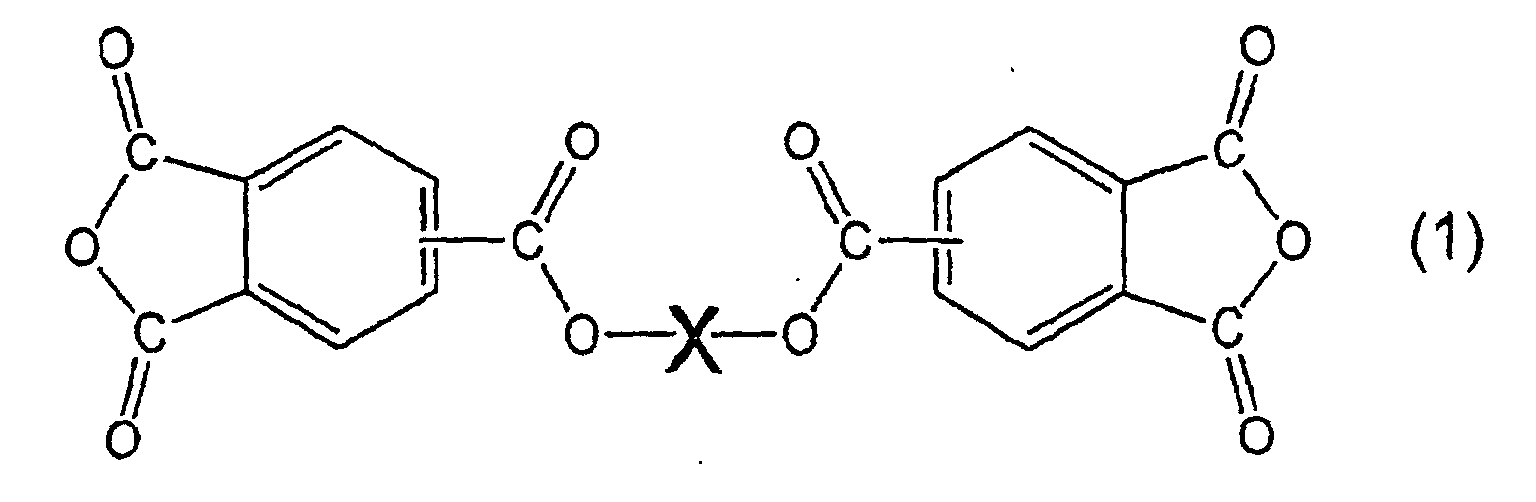 (wherein X represents a bivalent organic group including
-(CH2)k- or an aromatic group and k is an integer of 1 to 10)
with a diamine or diisocyanate compound represented by the
general formula (2)
(wherein X represents a bivalent organic group including
-(CH2)k- or an aromatic group and k is an integer of 1 to 10)
with a diamine or diisocyanate compound represented by the
general formula (2)
 (wherein A represents -NH2- or -NCO, Y independently
represents -C(=O)-, -SO2-, -O-, -S-, -(CH2)m-, -NHCO-,
-C(CH3)2-, -C(CF3)2-, -C(=O)O-, or a single bond, and m and n
each are an integer of 0 to 10).
(wherein A represents -NH2- or -NCO, Y independently
represents -C(=O)-, -SO2-, -O-, -S-, -(CH2)m-, -NHCO-,
-C(CH3)2-, -C(CF3)2-, -C(=O)O-, or a single bond, and m and n
each are an integer of 0 to 10).
The acid dianhydride represented by the general formula
(1) may be 2,2-bis(4-hydroxyphenyl)propane dibenzoate-3,3',4,4'-
tetracarboxylic dianhydride represented by

Further, the soluble polyimide of the present invention
may be obtained by reacting the diamine or diisocyanate
component represented by the general formula (2) with an acid
dianhydride component including 50 mol% or more of 2,2-bis(4-hydroxyphenyl)propane
dibenzoate-3,3',4,4'- tetracarboxylic
dianhydride represented by the following structural formula:

The general formula (2) can be represented by
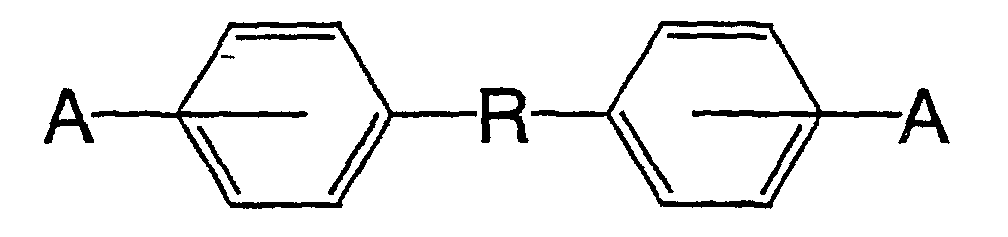 (wherein A represents -NH2 or -NCO and R is a bivalent
organic group selected from the group consisting of -CH2- and
(wherein A represents -NH2 or -NCO and R is a bivalent
organic group selected from the group consisting of -CH2- and
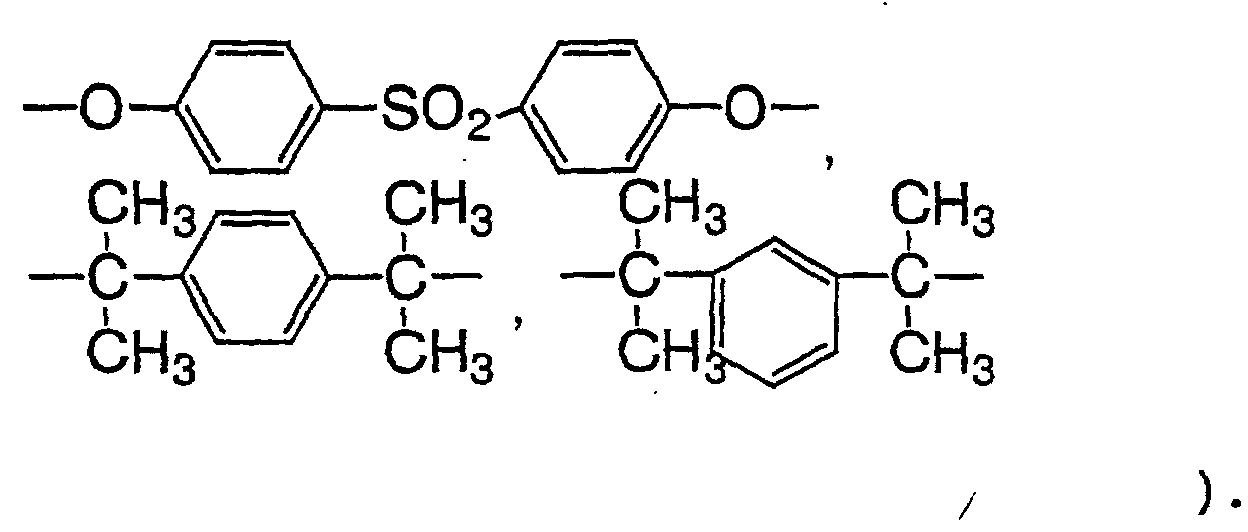
The diamine or diisocyanate compound represented by the
above general formula may be
1,3-bis(aminophenoxy)benzene;
 or 1,3-bis(isocyanatephenoxy)benzene;

Further, the diamine or diisocyanate compound
represented by the general formula (2) may be represented by
the following general formula (4)
 (wherein Y independently represents -C(=O)-, -SO2-, -O-, -S-,
-(CH2)m-, -NHCO-, -C(CH3)2-, -C(CF3)2-, -C(=O)O- or a single
bond, and m and n each are an integer of 0 to 10).
(wherein Y independently represents -C(=O)-, -SO2-, -O-, -S-,
-(CH2)m-, -NHCO-, -C(CH3)2-, -C(CF3)2-, -C(=O)O- or a single
bond, and m and n each are an integer of 0 to 10).
Further, the soluble polyimide of the present invention
may be obtained by heating an organic solvent solution of
polyamide acid obtained by reacting an acid dianhydride
component including ester acid dianhydride represented by the
general formula (1)
 (wherein X represents a bivalent organic group including
-(CH2)k- or an aromatic group and k is an integer of 1 to 10)
with a diamine component including diamine represented by the
general formula (2)
(wherein X represents a bivalent organic group including
-(CH2)k- or an aromatic group and k is an integer of 1 to 10)
with a diamine component including diamine represented by the
general formula (2)
 (wherein A represents -NH2- or -NCO, Y independently
represents -C(=O)-, -SO2-, -O-, -S-, -(CH2)m-, -NHCO-,
-C(CH3)2-, -C(CF3)2-, -C(=O)O- or a single bond, and m and n
each are an integer of 0 to 10) in an organic solvent under a
reduced pressure to imidize the polyamide acid.
(wherein A represents -NH2- or -NCO, Y independently
represents -C(=O)-, -SO2-, -O-, -S-, -(CH2)m-, -NHCO-,
-C(CH3)2-, -C(CF3)2-, -C(=O)O- or a single bond, and m and n
each are an integer of 0 to 10) in an organic solvent under a
reduced pressure to imidize the polyamide acid.
The organic solvent solution of polyamide acid may be
heated at a temperature of 80°C or higher to 400°C or lower
and/or under a pressure of 0.001×10⁵ to 0.9×10⁵ Pa.
A composition of the present invention is a resinous
composition for an adhesive agent which contains polyimide
resin and epoxy resin, and the polyimide resin of the
composition is obtained by reacting an acid dianhydride
component including ester acid dianhydride represented by the
general formula (1)
 (wherein X represents a bivalent organic group including
-(CH2)k- or an aromatic group and k is an integer of 1 to 10)
with a diamine component including diamine represented by the
general formula (2)
(wherein X represents a bivalent organic group including
-(CH2)k- or an aromatic group and k is an integer of 1 to 10)
with a diamine component including diamine represented by the
general formula (2)
 (wherein A represents -NH2- or -NCO, Y independently
represents -C(=O)-, -SO2-, -O-, -S-, -(CH2)m-, -NHCO-,
-C(CH3)2-, -C(CF3)2-, -C(=O)O- or a single bond, and m and n
each are an integer of 0 to 10).
(wherein A represents -NH2- or -NCO, Y independently
represents -C(=O)-, -SO2-, -O-, -S-, -(CH2)m-, -NHCO-,
-C(CH3)2-, -C(CF3)2-, -C(=O)O- or a single bond, and m and n
each are an integer of 0 to 10).
The composition of the present invention is a resinous
composition for an adhesive agent which contains polyimide
resin and epoxy resin, and the polyimide resin of the
composition is obtained by reacting ester acid dianhydride
represented by the general formula (1)
 (wherein X represents a bivalent organic group including
-(CH2)k- or an aromatic group and k is an integer of 1 to 10)
with a diamine component. In the diamine component, diamine
represented by the general formula (2)
(wherein X represents a bivalent organic group including
-(CH2)k- or an aromatic group and k is an integer of 1 to 10)
with a diamine component. In the diamine component, diamine
represented by the general formula (2)
 (wherein A represents -NH2- or -NCO, Y independently
represents -C(=O)-, -SO2-, -O-, -S-, -(CH2)m-, -NHCO-,
-C(CH3)2-, -C(CF3)2-, -C(=O)O- or a single bond, and m and n
each are an integer of 0 to 10) makes up 0 to 99 mol% of the
whole diamine component and 3,3'-dihydroxy-4,4'-diaminobiphenyl
represented by the general formula (3)
(wherein A represents -NH2- or -NCO, Y independently
represents -C(=O)-, -SO2-, -O-, -S-, -(CH2)m-, -NHCO-,
-C(CH3)2-, -C(CF3)2-, -C(=O)O- or a single bond, and m and n
each are an integer of 0 to 10) makes up 0 to 99 mol% of the
whole diamine component and 3,3'-dihydroxy-4,4'-diaminobiphenyl
represented by the general formula (3)
 makes up 1 to 100 mol% of the whole diamine component.
Further, the composition of the present invention may
contain at least one kind of solvent having a low boiling
point.
Furthermore, thermoplastic polyimide, epoxy resin, and
curing agent contained in the composition may be soluble in
an organic solvent. The organic solvent may contain cyclic
ether solvent.
The organic solvent can contain 30 wt% or more of cyclic
ether solvent.
A bonding sheet of the present invention comprises at
least an adhesive layer. The adhesive layer is made of a
resinous composition containing polyimide resin and epoxy
resin. The polyimide resin used herein is a soluble
polyimide having a solubility of 10 % or higher at 20°C in an
organic solvent of N, N-dimethylformamide, 1,4-dioxane, 1,3-dioxolane,
or tetrahydrofuran.
In the bonding sheet of the present invention, the
soluble polyimide resin can be obtained by reacting ester
acid dianhydride represented by the general formula (1)
 (wherein X represents a bivalent organic group having -(CH2)k-
or an aromatic group and k is an integer of 1 to 10) with a
diamine or diisocyanate component represented by the general
formula (2)
(wherein X represents a bivalent organic group having -(CH2)k-
or an aromatic group and k is an integer of 1 to 10) with a
diamine or diisocyanate component represented by the general
formula (2)
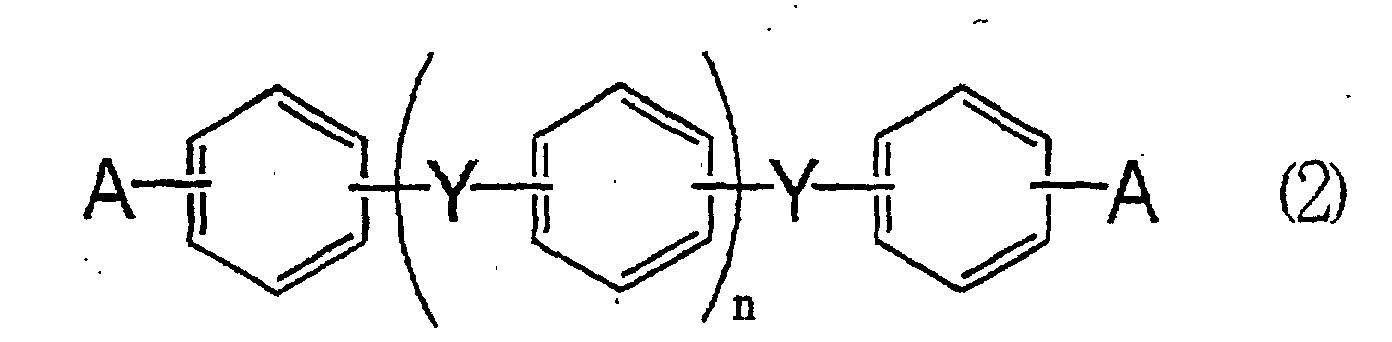 (wherein A represents -NH2- or -NCO, Y independently
represents -C(=O)-, -SO2-, -O-, -S-, -(CH2)m-, -NHCO-,
-C(CH2)m-, -C(CF3)2-, -C(=O)O- or a single bond, and m and n
each are an integer of 0 to 10).
(wherein A represents -NH2- or -NCO, Y independently
represents -C(=O)-, -SO2-, -O-, -S-, -(CH2)m-, -NHCO-,
-C(CH2)m-, -C(CF3)2-, -C(=O)O- or a single bond, and m and n
each are an integer of 0 to 10).
Further, the soluble polyimide resin may be obtained by
reacting an acid dianhydride component including 2,2-bis(4-hydroxyphenyl)propane
dibenzoate-3,3',4,4'- tetracarboxylic
dianhydride represented by the following formula (2)
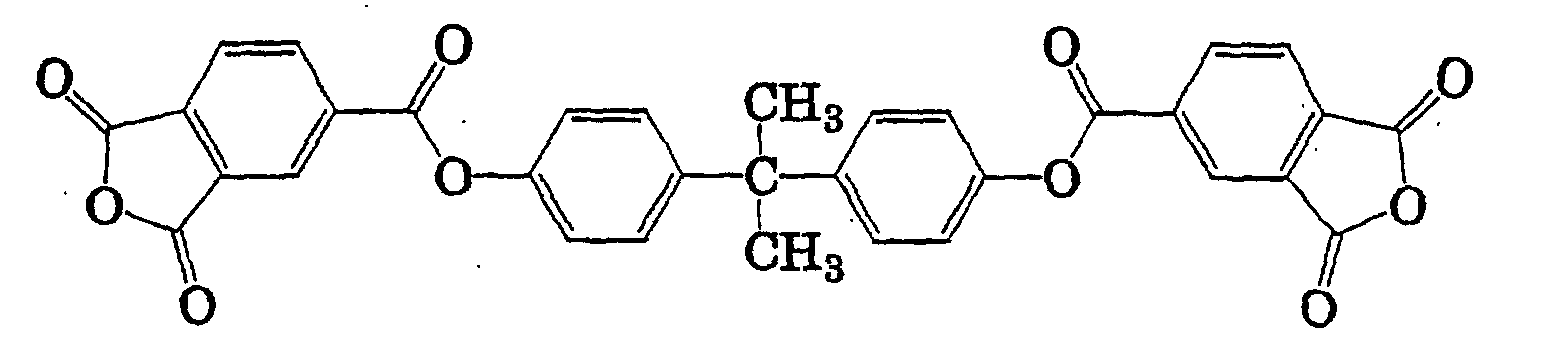 with a diamine or diisocyanate component.
The soluble polyimide resin may be obtained by reacting
an acid dianhydride component with a diamine component or
diisocyanate component containing 1,3-bis(aminophenoxy)benzene;
 or 1,3-bis(isocyanatephenoxy) benzene;

Further, if the adhesive layer is cured, a residual
volatile left in the cured layer may be 3 wt% or less of the
total weight of the cured layer and/or the cured layer may
have water absorption of 1.5 % or less.
The bonding sheet of the present invention can be
obtained by casting or applying any one of the above
compositions over a base and then drying and peeling it form
the base.
Another bonding sheet of the present invention may have
a polyimide adhesive layer on at least one surface thereof,
which can be obtained by casting any one of the above
compositions over at least one surface of a polyimide film
and then drying it.
The polyimide adhesive layer may have a thickness of 5
to 30 µm.
Further, the bonding sheet of the present invention
comprises at least an adhesive layer, and main components of
the composition contained in the adhesive layer are as
follows:
| I) soluble polyimide resin | 100 parts by weight |
| II) epoxy resin | 3 to 100 parts by weight |
| III) accelerator or curing agent | 0.5 to 50 parts by weight |
Further, still another bonding sheet of the present
invention can have a release film on at least one side
thereof.
The release film used herein can be made of PET
(polyethylene terephthalate) or PEN (polyethylene
naphthalate).
An adhesive laminated film for covering an accelerator
beam tube is a laminated film having an adhesive layer on at
least one surface of a polyimide film. The adhesive layer is
made of a composition containing a thermoplastic resin having
a glass transition temperature of 100°C to 250°C and an water
absorption of 1.5 % or less and a thermosetting resin.
The thermoplastic resin used herein may be a soluble
polyimide resin which can be obtained by reacting an acid
dianhydride component containing ester acid dianhydride
represented by the general formula (1)
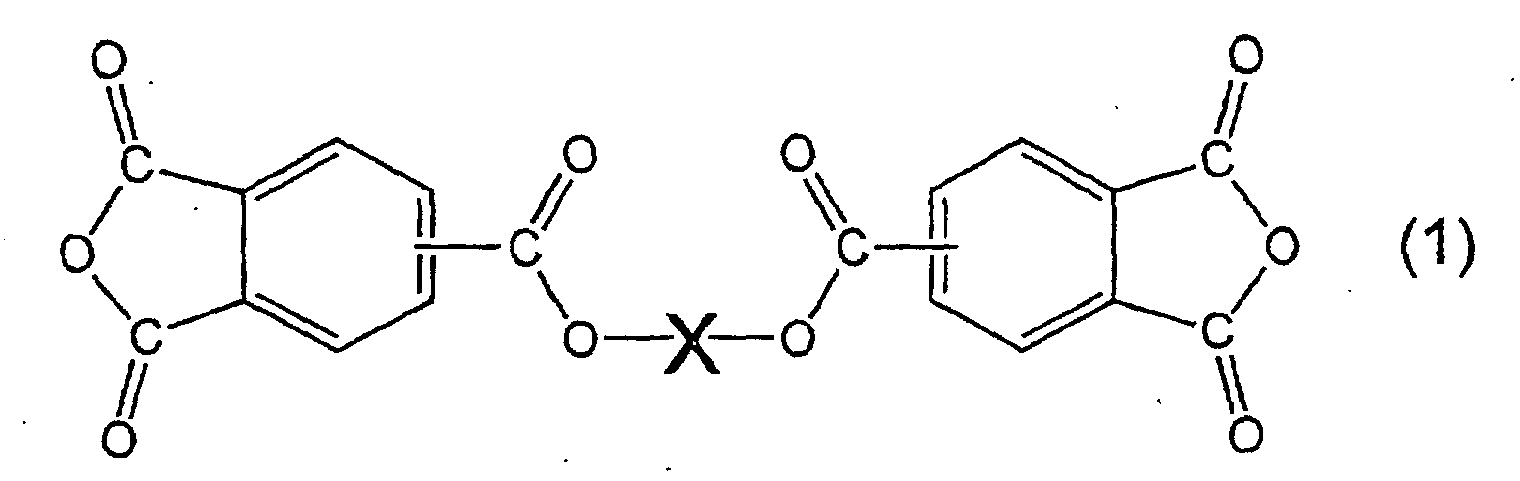 (wherein X represents a bivalent organic group including
-(CH2)k- or an aromatic group and k is an integer of 1 to 10)
with a diamine compound represented by the general formula
(2)
(wherein X represents a bivalent organic group including
-(CH2)k- or an aromatic group and k is an integer of 1 to 10)
with a diamine compound represented by the general formula
(2)
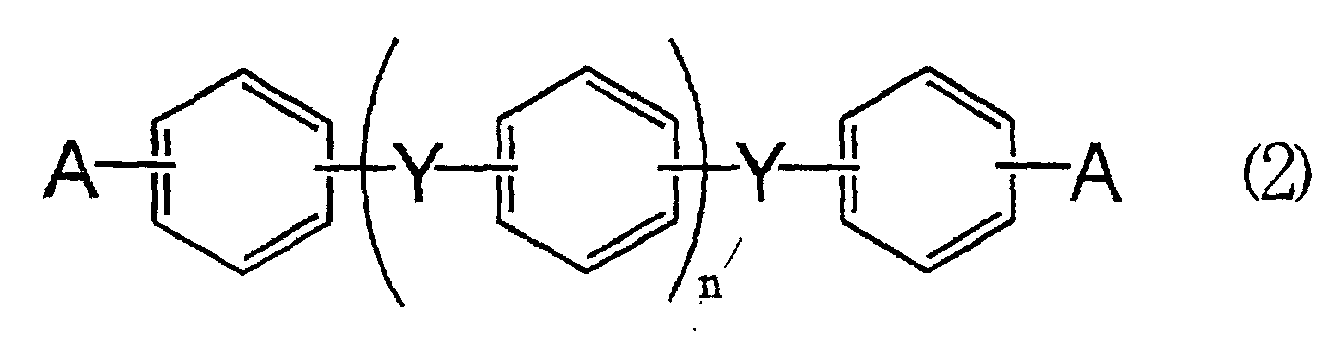 (wherein A represents -NH2- or -NCO, Y independently
represents -C(=O)-, -SO2-, -O-, -S-, -(CH2)m-, -NHCO-,
-C(CH3)2-, -C(CF3)2-, -C(=O)O- or a single bond, and m and n
each are an integer of 0 to 10).
(wherein A represents -NH2- or -NCO, Y independently
represents -C(=O)-, -SO2-, -O-, -S-, -(CH2)m-, -NHCO-,
-C(CH3)2-, -C(CF3)2-, -C(=O)O- or a single bond, and m and n
each are an integer of 0 to 10).
The thermosetting resin can be a resin having more than
one epoxy group in each molecule.
An adhesive laminated film for covering a conductor wire
for an accelerator quench heater is a laminated film having
an adhesive layer on at least one surface of a polyimide film
The adhesive layer is made of a composition containing a
thermoplastic resin having a glass transition temperature of
100°C to 250°C and water absorption of 1.5 % or less and a
thermosetting resin.
The thermoplastic resin used herein may be a soluble
polyimide resin which can be obtained by reacting an acid
dianhydride component including ester acid dianhydride
represented by the general formula (1)
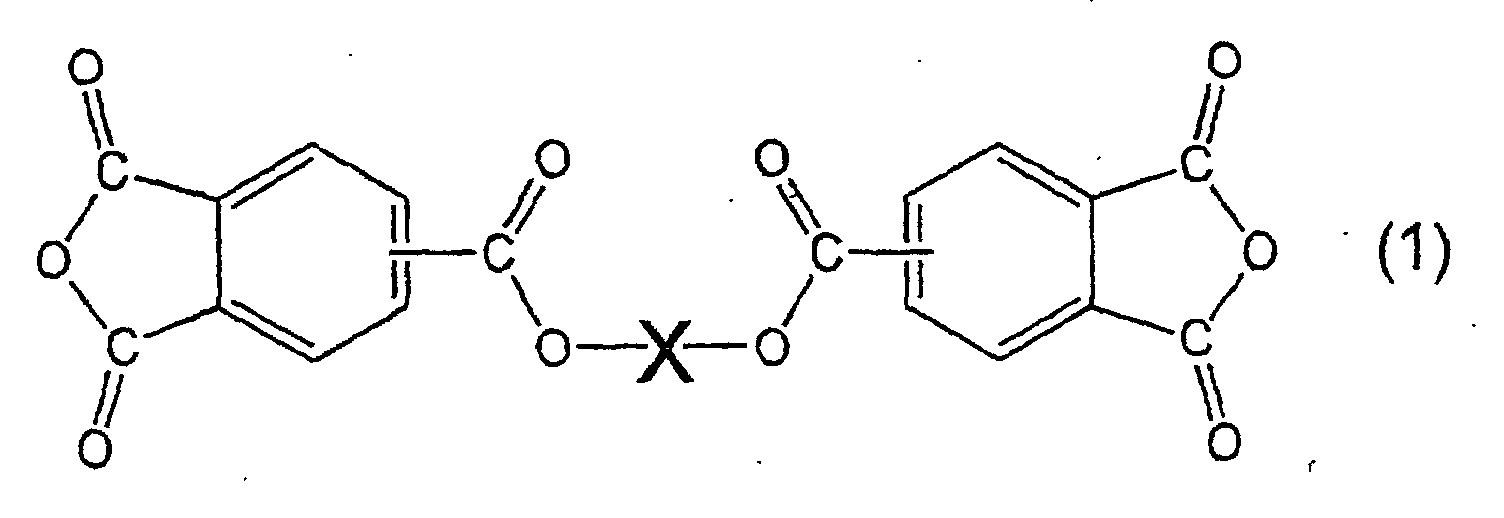 (wherein X represents a bivalent organic group including
-(CH2)k- or an aromatic group and k is an integer of 1 to 10)
with a diamine compound represented by the general formula
(2)
(wherein X represents a bivalent organic group including
-(CH2)k- or an aromatic group and k is an integer of 1 to 10)
with a diamine compound represented by the general formula
(2)
 (wherein A represents -NH2- or -NCO, Y independently
represents -C(=O)-, -SO2-, -O-, -S-, -(CH2)m-, -NHCO-,
-C(CH3)2-, -C(CF3)2-, -C(=O)O- or a single bond, and m and n
each are an integer of 0 to 10).
(wherein A represents -NH2- or -NCO, Y independently
represents -C(=O)-, -SO2-, -O-, -S-, -(CH2)m-, -NHCO-,
-C(CH3)2-, -C(CF3)2-, -C(=O)O- or a single bond, and m and n
each are an integer of 0 to 10).
The thermosetting resin may be a resin having more than
one epoxy group in each molecule.
FIG. 1 is a sectional view of an adhesive laminated film
for covering an accelerator beam tube or for covering a
conductor wire for an accelerator quench heater.
FIG. 2 is a perspective view for illustrating a method
of covering an accelerator beam tube or a conductor wire for
an accelerator quench heater with an adhesive laminated film
according to the present invention.
FIG. 3 is a perspective view for illustrating another
method of covering an accelerator beam tube or a conductor
wire for an accelerator quench heater with an adhesive
laminated film according to the present invention.
FIG. 4 is sectional view of a conductor wire for an
accelerator quench heater which is covered with an adhesive
laminated film for covering an accelerator beam tube or for
covering a conductor wire for an accelerator quench heater
according to the present invention.
A soluble polyimide according to the present invention
has a solubility of 10 % or higher at 20°C in an organic
solvent of N, N-dimethylformamide, 1,4-dioxane, 1,3-dioxolane,
or tetrahydrofuran. The soluble polyimide also has a glass
transition temperature of 100°C to 250°C and water absorption
of 1.5 % or less. A preferable thermoplastic resin having
such properties is obtained by reacting acid dianhydride
including ester acid dianhydride represented by the general
formula (1)
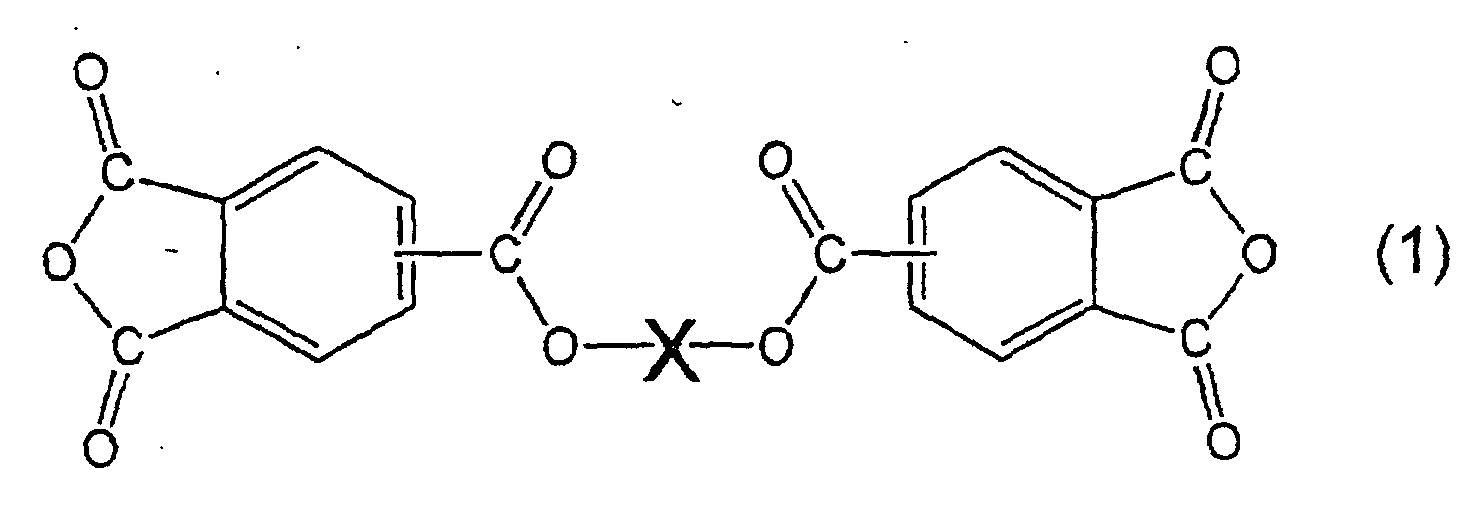 (wherein X represents a bivalent organic group including
-(CH2)k- or an aromatic group and k is an integer of 1 to 10)
with a diamine or diisocyanate compound represented by the
general formula (2)
(wherein X represents a bivalent organic group including
-(CH2)k- or an aromatic group and k is an integer of 1 to 10)
with a diamine or diisocyanate compound represented by the
general formula (2)
 (wherein A represents -NH2- or -NCO, Y independently
represents -C(=O)-, -SO2-, -O-, -S-, -(CH2)m-, -NHCO-,
-C(CH3)2-, -C(CF3)2-, -C(=O)O- or a single bond, and m and n
each are an integer of 0 to 10) in an organic solvent under a
reduced pressure.
(wherein A represents -NH2- or -NCO, Y independently
represents -C(=O)-, -SO2-, -O-, -S-, -(CH2)m-, -NHCO-,
-C(CH3)2-, -C(CF3)2-, -C(=O)O- or a single bond, and m and n
each are an integer of 0 to 10) in an organic solvent under a
reduced pressure.
Since a polyimide resin having low water absorption can
be obtained by the use of ester acid dianhydride represented
by the general formula (1), it is preferable that the acid
dianhydride contains the ester acid dianhydride represented
by the general formula (1). More preferably, the ester acid
dianhydride constitutes 50 % or more mol% of the total acid
dianhydride component.
Examples of the preferable ester acid dianhydride
represented by the general formula (1) include: 2,2-bis(4-hydroxyphenyl)propane
dibenzoate-3,3',4,4'- tetracarboxylic
dianhydride, p- phenylenebis (trimellitic monoester
anhydride), 4,4'-biphenylenebis (trimellitic monoester
anhydride), 1,4-naphthalenebis (trimellitic monoester
anhydride), 1,2-ethylenebis (trimellitic monoester anhydride),
1,3-trimethylenebis (trimellitic monoester anhydride), 1,4-tetramethylenebis
(trimellitic monoester anhydride), 1,5-pentamethylenebis
(trimellitic monoester anhydride), and 1,6-hexamethylene
bis (trimellitic monoester anhydride. One or
more kinds of the ester acid dianhydrides can be used as acid
dianhydride or a portion of acid dianhydride.
2,2-bis(4-hydroxyphenyl)propane dibenzoate-3,3',4,4'-tetracarboxylic
dianhydride (hereinafter referred to as
"ESDA") represented by the following structural formula:
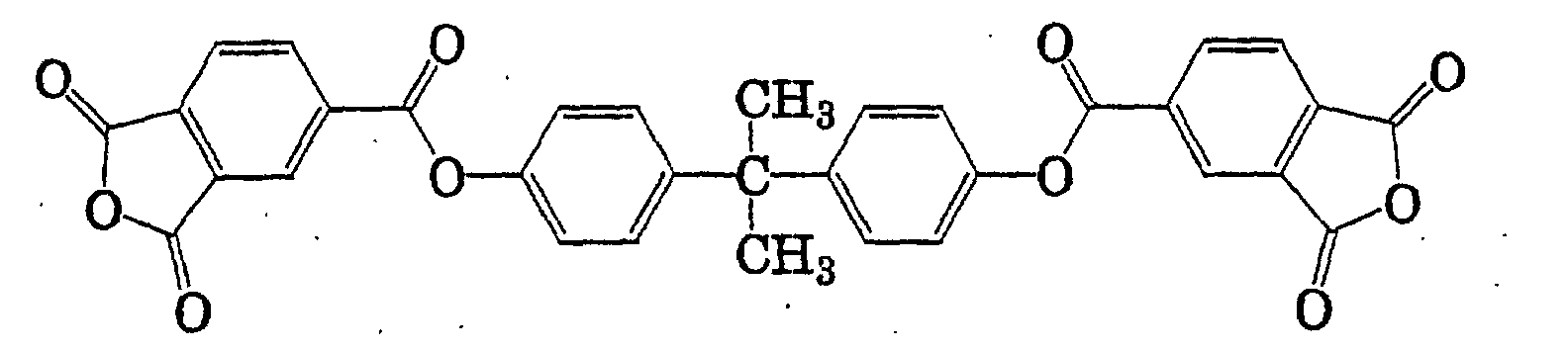 is particularly preferable to obtain a thermoplastic
polyimide resin having a solubility in a solvent, excellent
workability, and high heat resistance in good balance. Since
a degree of solubility increases with content of ESDA. The
ESDA content is preferably 50 mol% or more, more preferably
70 mol% or more, and most preferably 90 mol% or more of the
total acid dianhydride.
is particularly preferable to obtain a thermoplastic
polyimide resin having a solubility in a solvent, excellent
workability, and high heat resistance in good balance. Since
a degree of solubility increases with content of ESDA. The
ESDA content is preferably 50 mol% or more, more preferably
70 mol% or more, and most preferably 90 mol% or more of the
total acid dianhydride.
Examples of the preferable diamine or diisocyanate
component is represented by the following general formula (2)
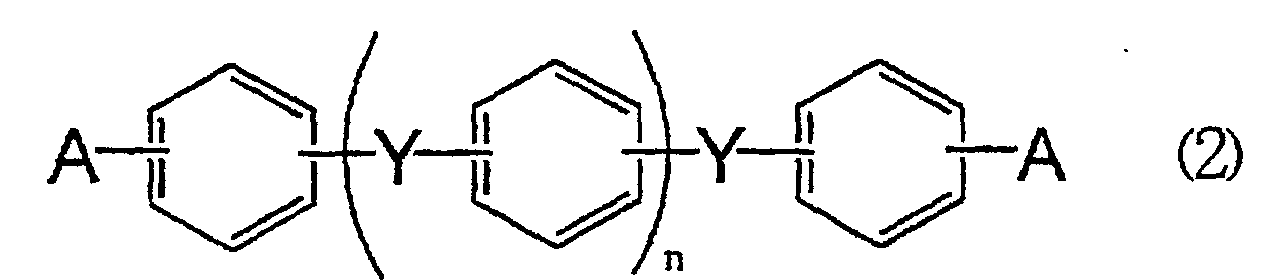 (wherein A represents -NH2- or -NCO, Y independently
represents -C(=O)-, -SO2-, -O-, -S-, -(CH2)m-, -NHCO-,
-C(CH3)2-, -C(CF3)2-, -C(=O)O- or a single bond, and m and n
each are an integer of 0 to 10). The above compounds can be
used alone or in combination. In the general formula (2),
Y's may be the same or different in each repeating unit. A
hydrocarbon group such as methyl group and ethyl group or
halogen group such as Br and Cl may be introduced to each
benzene ring.
(wherein A represents -NH2- or -NCO, Y independently
represents -C(=O)-, -SO2-, -O-, -S-, -(CH2)m-, -NHCO-,
-C(CH3)2-, -C(CF3)2-, -C(=O)O- or a single bond, and m and n
each are an integer of 0 to 10). The above compounds can be
used alone or in combination. In the general formula (2),
Y's may be the same or different in each repeating unit. A
hydrocarbon group such as methyl group and ethyl group or
halogen group such as Br and Cl may be introduced to each
benzene ring.
The diamine or diisocyanate compound represented by the
general formula (2) preferably constitutes 50 % or more of
the total amount of diamine or diisocyanate, more preferably
70 % or more, and most preferably 90 % or more.
Further, a preferable diamine compound is represented by
the general formula (3)
 (wherein A represents -NH2 or -NCO and R is a bivalent
organic group selected from the group consisting of -CH2-,
(wherein A represents -NH2 or -NCO and R is a bivalent
organic group selected from the group consisting of -CH2-,
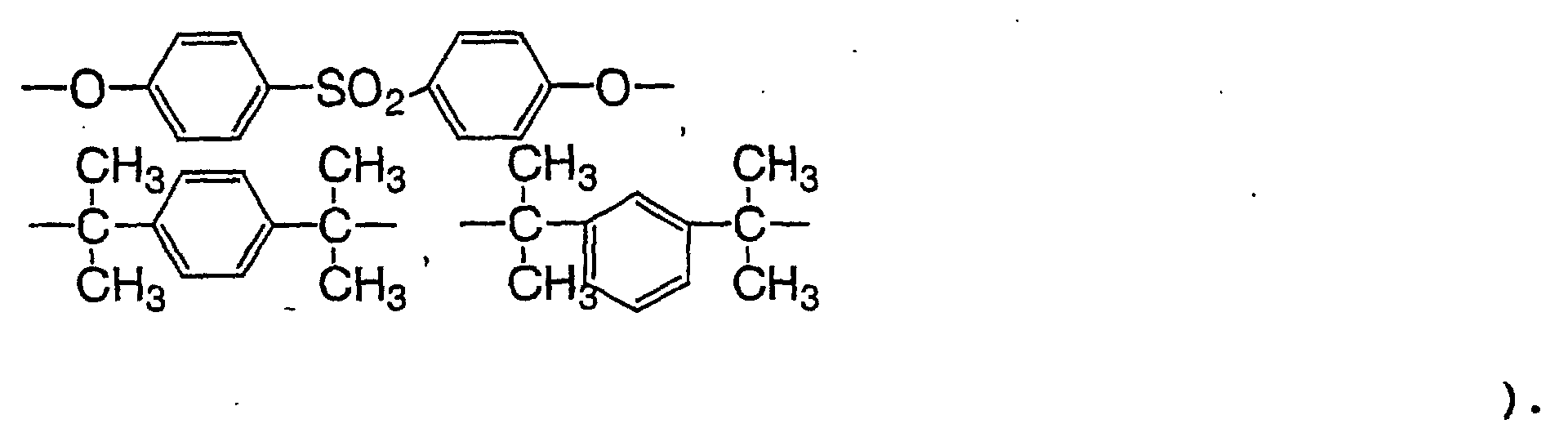 A polar group such as -SO2 and a single bond and an isopropyl
group have the effect of increasing a solubility. Since the
diamine represented by the general formula (3) contains such
organic groups, it is preferably used in terms of solubility.
A polar group such as -SO2 and a single bond and an isopropyl
group have the effect of increasing a solubility. Since the
diamine represented by the general formula (3) contains such
organic groups, it is preferably used in terms of solubility.
Also, in the general formula (2), it is preferable to
use a diamine or diisocyanate component including 1,3-bis(aminophenoxy)benzene
represented by the following
structural formula
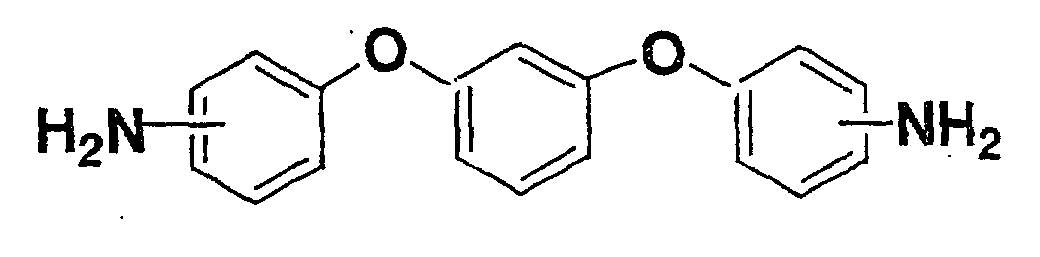 or 1,3-bis(isocyanatephenoxy)benzene represented by the
following general formula
or 1,3-bis(isocyanatephenoxy)benzene represented by the
following general formula

1,3-bis(aminophenoxy)benzene or
1,3-bis(isocyanatephenoxy)benzene is preferably used because
each provides excellent solubility to the polyimide.
Among the compounds represented by the general formula
(1), a compound having an amino group or an isocyanate group
at a meta position, which is represented by the general
formula (4)
 (wherein A represents -NH2- or -NCO, Y independently
represents -C(=O)-, -SO2-, -O-, -S-, -(CH2)m-, -NHCO-,
-C(CH3)2-, -C(CF3)2-, -C(=O)O- or a single bond, and m and n
each are an integer of 0 to 10), is preferably used because
it provides more excellent solubility to a thermoplastic
polyimide resin than a diamine compound having an amino group
at a para position or a isocyanate compound having an
isocyanate group at a para position does.
(wherein A represents -NH2- or -NCO, Y independently
represents -C(=O)-, -SO2-, -O-, -S-, -(CH2)m-, -NHCO-,
-C(CH3)2-, -C(CF3)2-, -C(=O)O- or a single bond, and m and n
each are an integer of 0 to 10), is preferably used because
it provides more excellent solubility to a thermoplastic
polyimide resin than a diamine compound having an amino group
at a para position or a isocyanate compound having an
isocyanate group at a para position does.
For example, bis(aminophenoxy phenyl)sulfone is
preferably used. Particularly, meta-type bis(aminophenoxy
phenyl) sulfone represented by the following structural
formula
 is preferably used because it provides high solubility to the
thermoplastic polyimide resin.
is preferably used because it provides high solubility to the
thermoplastic polyimide resin.
Among the compounds represented by the general formula
(4), the 1,3-bis(aminophenoxy)benzene or 1,3-bis(isocyanatephenoxy)benzene
having an amino group at a meta
position is more preferably used than the one having an amino
group at a para position, because it provides more excellent
solubility to the polyimide.
As stated above, the diamine represented by the general
formula (2) or (4) has an effect of increasing a solubility
of the polyimide resin. More preferably, such diamine
constitutes 50 to 99 mol% of the total diamine components,
and most preferably 80 to 99 mol%.
Next, a method of producing the soluble polyimide
according to the present invention will be described. First,
a method of producing a soluble polyimide by reacting acid
dianhydride represented by the general formula (1) with
diamine represented by the general formula (2) will be
described as an example. The soluble polyimide of the
present invention can be produced by a synthesizing procedure
which is applicable to a method of producing a typical
polyimide. Following is a general synthesizing procedure.
A polyamide acid polymer precursor is produced by
reacting acid dianhydride with a diamine compound in an
organic solvent, and then dehydrated to effect ring closure.
In this case, the acid dianhydride component and diamine
component are equimolar or substantially equimolar.
Preferable molar ratio is:
The reaction of acid dianhydride with diamine is made by
dissolving or diffusing one or more kinds of the diamine
compound represented by the general formula (2) in an organic
polar solvent and then adding one or more kinds of ester acid
dianhydride represented by the general formula (1) to the
solvent, for example. The order of adding each monomer is
not particularly limited. The acid dianhydride may be added
first to the organic polar solvent and then the diamine
compound is added to produce a solution of polyamide acid
polymer. Alternatively, a certain amount of the diamine
compound, acid dianhydride, and the rest of diamine compound
may be added in this order in the organic polar solvent to
produce a polyamide acid polymer solution, In addition,
there are various other monomer adding methods which are
known to the persons skilled in the art.
The reaction temperature is 80°C or lower, preferably
0°C to 50°C. The reaction time is arbitrarily set within a
range of 30 minutes to 50 hours. As the reaction proceeds,
more amount of polyamide acid is produced, and thereby the
viscosity of the reaction solution is increased.
A polyimide can be prepared by dehydration ring-closure
of a polyamide acid solution. There are two methods for
dehydration ring-closure. The one is thermal dehydration
ring-closure in which the polyamide acid solution is heated
and then dehydrated, and the other is chemical dehydration
ring-closure in which the polyamide acid solution is
dehydrated using a dehydrating agent.
In the thermal dehydration ring-closure, polyamide acid
is heated at 150°C or more for imidization. Specifically, a
polyamide acid solution may be cast over or applied to a film
base such as a glass plate, metal plate, and PET and then
heated at 80°C to 300°C. Alternatively, a polyamide acid
solution is directly put into a container coated with mold
release agent such as Teflon and then heated and dried in a
vacuum to obtain a polyimide. In general, the heating time
is preferably one minute to five hours after heating
temperature reaches its peak, although it depends on the
thickness of the polyamide and maximum heating temperature.
Among thermal imidization methods, a preferable thermal
imidization method is a method in which polyamide acid
solution is heated under a reduced pressure. By such
imidization method, water generated in imidization can be
actively removed out of the reaction system and the hydrolytic
degradation of polyamide acid can be prevented. Therefore,
polyimide of high-molecular weight can be obtained. Also,
particularly preferable molecular-weight polyimide can be
expected to be obtained because the rings of the impurities
close again.
In a thermal imidization under a reduced pressure, a
preferable heating temperature is 80°C to 400°C. More
preferable heating temperature is 100°C or more, because
imidization and water removal are carried out efficiently at
100°C or more. Most preferable heating temperature is 120°C
or more. Maximum heating temperature is preferably lower
than thermal decomposition temperature of a desired polyimide.
In general, an imidization completion temperature, namely,
about 250°C to 350°C, is adopted.
A reduced pressure is preferably low. Specifically, a
preferable reduced pressure is 0.001 X 10⁵ to 0.9 X 10⁵ Pa,
more preferably 0.001 X 10⁵ to 0.8 X 10⁵ Pa, and most
preferably 0.01 X 10⁵ to 0.7 X 10⁵ Pa.
In the chemical imidization method, not less than a
stoichiometric amount of dehydrating agent and a catalytic
amount of tertiary amine are added to the polyamide acid
solution and then the same process as done in the thermal
imidization method is conducted, and thus a desired polyimide
can be obtained. Examples of the dehydrating agent used
herein include: aliphatic acid anhydrides such as acetic
anhydride; and aromatic acid anhydrides. Examples of the
catalyst include: aliphatic tertiary amines such as
triethylamine; aromatic tertiary amines such as
dimethylaniline; heterocyclic tertiary amines such as
pyridine, isoquinoline, α-picoline, β-picoline, and γ-picoline.
In another method of producing the soluble polyimide
according to the present invention, an acid dianhydride
component including acid dianhydride represented by the
general formula (1), particularly ESDA, is reacted with a
diisocyanate component including diisocyanate represented by
the general formula (2) wherein A represents -NCO, in an
organic solvent or in the absence of an organic solvent to
obtain polyimide without using polyamide acid.
The polyimide synthesized by the use of acid dianhydride
represented by the general formula (1) and diisocyanate
represented by the general formula (5)
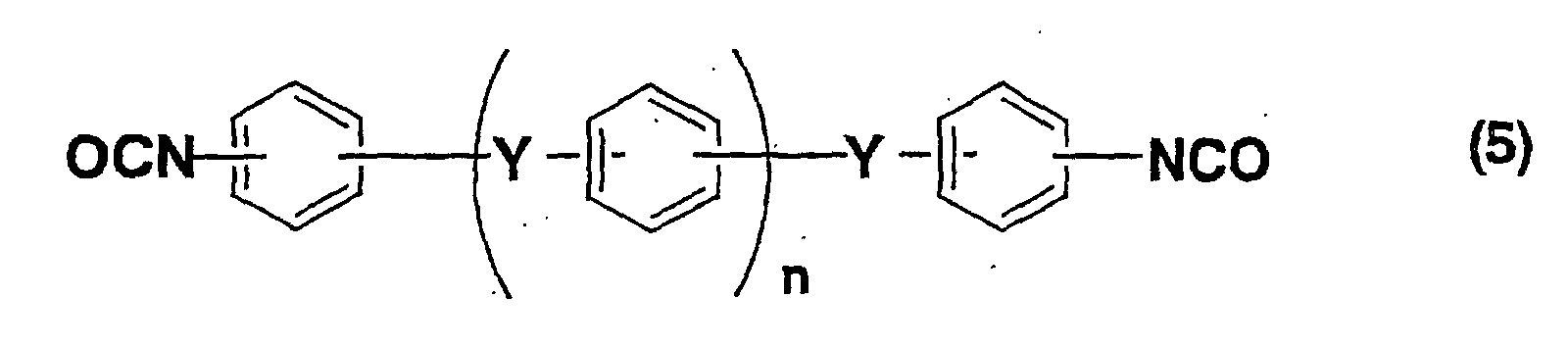 (wherein Y independently represents -C(=O)-, -SO2-, -O-, -S-,
-(CH2)m-, -NHCO-, -C(CH3)2-, -C(CF3)2-, -C(=O)O- or a single
bond, and m and n each are an integer of 0 to 10) has an
excellent solubility in an organic solvent. Therefore, a
diisocyanate component to be reacted preferably contains 50
mol% of or more of the diisocyanate represented by the
general formula (5), more preferably 70 mol%, and
particularly preferably 90 mol%. In the general formula (5),
Y's may be the same or different in each repeating unit. A
hydrocarbon group such as a methyl group and ethyl group or a
halogen group such as Br and Cl may be introduced to each
benzene ring.
(wherein Y independently represents -C(=O)-, -SO2-, -O-, -S-,
-(CH2)m-, -NHCO-, -C(CH3)2-, -C(CF3)2-, -C(=O)O- or a single
bond, and m and n each are an integer of 0 to 10) has an
excellent solubility in an organic solvent. Therefore, a
diisocyanate component to be reacted preferably contains 50
mol% of or more of the diisocyanate represented by the
general formula (5), more preferably 70 mol%, and
particularly preferably 90 mol%. In the general formula (5),
Y's may be the same or different in each repeating unit. A
hydrocarbon group such as a methyl group and ethyl group or a
halogen group such as Br and Cl may be introduced to each
benzene ring.
Among the diisocyanates represented by the general
formula (5), a polyimide resin produced using 1,3-bis(isocyanatephenoxy)benzene
has more excellent solubility.
The amount of 1,3-bis(isocyanatephenoxy)benzene is preferably
50 mol% or more of the total diamine components to be reacted,
more preferably 70 mol% or more, and most preferably 90 mol%
more.
1,3-bis(3-isocyanatephenoxy)benzene having an isocyanate
group at a meta position, which is represented by the
following structural formula
 , is particularly preferably used because it provides more
excellent solubility to a polyimide than 1,3-bis(4-isocyanatephenoxy)benzene
having an isocyanate group at a
para position.
, is particularly preferably used because it provides more
excellent solubility to a polyimide than 1,3-bis(4-isocyanatephenoxy)benzene
having an isocyanate group at a
para position.
The soluble polyimide obtained by reacting diamine and
acid dianhydride is, in many cases, obtained as a solution of
an organic solvent used in the polymerization of polyamide
acid. The soluble polyimide obtained by reacting
diisocyanate and acid dianhydride is also obtained as a
solution of an organic solvent used at the start of the
reaction. These organic solvents may not be always removed,
but may be used in a subsequent step as it is. The polyimide
in the above state may be purified to obtain solid-state
polyimide such as polyimide powders.
An example of a method of purifying the soluble
polyimide is as follows. The soluble polyimide resin
solution is put into a poor solvent which is compatible with
a solvent used in the polymerization of polyamide acid but
which does not dissolve the soluble polyimide, the soluble
polyimide is precipitated, unreacted monomer is removed from
the polyimide, and then the polyimide is dried to obtain the
solid purified soluble polyimide. Examples of the poor
solvent include acetone, methanol, ethanol, isopropanol,
benzene, metylcellosolve, and methyl ethyl ketone. The
solid polyimide can be stored, and can be dissolved in a
solvent when it is used.
The polyimide obtained by reacting the acid dianhydride
represented by the general formula (1) with the diamine
component or diisocyanate component represented by the
general formula (2) is a soluble polyimide which has a
solubility of 10 % or higher at 20°C in an organic solvent of
N, N-dimethylformamide, 1,4-dioxane, 1,3-dioxolane, or
tetrahydrofuran. When this soluble polyimide is used as an
adhesive agent in a field of electronic material, a water
absorption of polyimide is preferably 2.0 % or lower, more
preferably 1.5 % or lower, and most preferably 1.0 % or lower.
This is because a substrate material for an electronic
circuit having excellent dielectric properties can be easily
obtained from such polyimide having a low solubility.
The polyimide preferably has a glass transition
temperature of 100° C to 250°C, preferably 120°C or higher,
more preferably 150°C or higher, and most preferably 180°C or
higher. If the polyimide is used as a substrate material
which is to be heated in a solder reflow reactor at a
temperature in the neighboring of 240°C, it is important that
polyimide has a glass transition temperature of 160°C or
higher. The soluble polyimide having a suitable glass
transition point according to the present invention can be
selected from the polyimides obtained by reacting the diamine
with the acid anhydride.
When the soluble polyimide according to the present
invention is used for a solvent-type adhesive agent, the
adhesive agent can have a solubility of 10 % or higher at
20°C in an organic solvent of N, N-dimethylformamide, 1,4-dioxane,
1,3-dioxolane, or tetrahydrofuran. Furthermore, the
agent can also have a solubility of 15 % or higher or 20 % or
higher.
Next, a composition of the present invention will be
described. The composition of the present invention
comprises: a polyimide obtained by reacting any one of the
above acid dianhydrides with any one of the above diamine or
diisocyanate components; and thermosetting rein, especially
an epoxy resin.
The diamine to be used to produce the soluble polyimide
contained in the composition according to the present
invention is represented by the general formula (2)
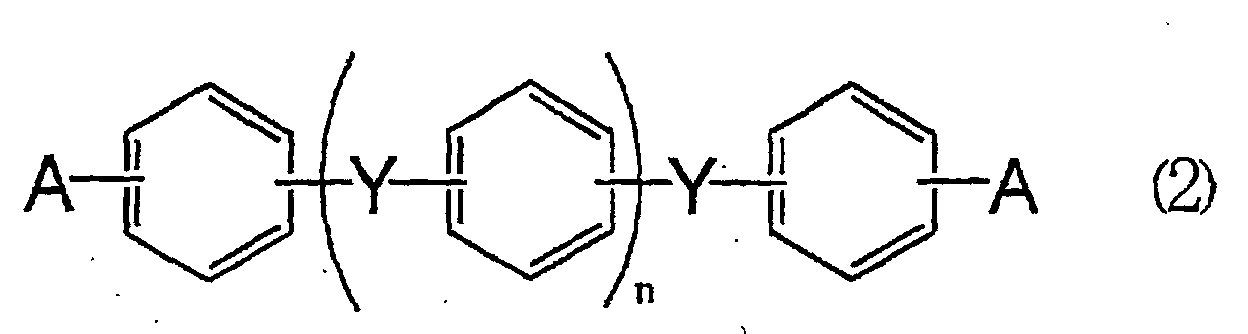 (wherein A represents -NH2- or -NCO, Y independently
represents -C(=O)-, -SO2-, -O-, -S-, -(CH2)m-, -NHCO-,
-C(CH3)2-, -C(CF3)2-, -C(=O)O- or a single bond, and m and n
each are an integer of 0 to 10) and one or a combination of
the diamines can constitutes 0 to 99 mol% of the total
diamine component. In the general formula (2), Y's may be
the same or different in each repeating unit. A hydrocarbon
group such as methyl group and ethyl group or halogen group
such as Br and Cl may be introduced to each benzene ring.
(wherein A represents -NH2- or -NCO, Y independently
represents -C(=O)-, -SO2-, -O-, -S-, -(CH2)m-, -NHCO-,
-C(CH3)2-, -C(CF3)2-, -C(=O)O- or a single bond, and m and n
each are an integer of 0 to 10) and one or a combination of
the diamines can constitutes 0 to 99 mol% of the total
diamine component. In the general formula (2), Y's may be
the same or different in each repeating unit. A hydrocarbon
group such as methyl group and ethyl group or halogen group
such as Br and Cl may be introduced to each benzene ring.
The diamine or diisocyanate compound represented by the
general formula (2) and having an amino group or isocyanate
group at a meta position, namely, the diamine compound or the
diisocyanate compound represented by the following general
formula (4)
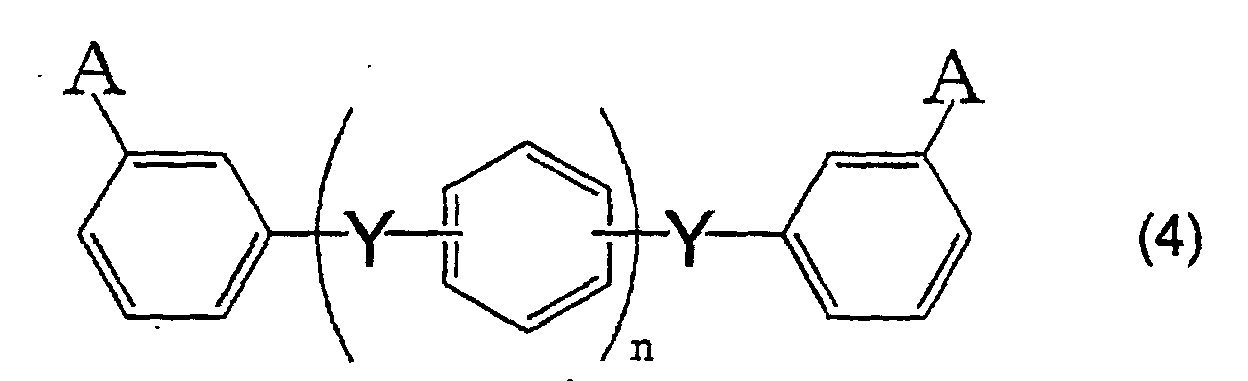 (wherein A represents -NH2- or -NCO, Y independently
represents -C(=O)-, -SO2-, -O-, -S-, -(CH2)m-, -NHCO-,
-C(CH3)2-, -C(CF3)2-, -C(=O)O- or a single bond, and m and n
each are an integer of 0 to 10) is preferably used because it
provides more excellent solubility to a thermoplastic
polyimide resin than a compound having an amino group at a
para position.
(wherein A represents -NH2- or -NCO, Y independently
represents -C(=O)-, -SO2-, -O-, -S-, -(CH2)m-, -NHCO-,
-C(CH3)2-, -C(CF3)2-, -C(=O)O- or a single bond, and m and n
each are an integer of 0 to 10) is preferably used because it
provides more excellent solubility to a thermoplastic
polyimide resin than a compound having an amino group at a
para position.
Preferably, the composition of the present invention is
combined with a diamine compound represented by
 (wherein Y independently represents -C(=O)-, -SO2-, -O-, -S-,
-(CH2)m-, -NHCO-, -(CH2)m-, -C(CF3)2-, -C(=O)O- or a single
bond, and m and n each are an integer of 0 to 10), which
makes up 0 to 99 mol% of the total diamine components, and
3,3'-dihydroxy-4,4'-diaminobiphenyl represented by the
following structural formula
(wherein Y independently represents -C(=O)-, -SO2-, -O-, -S-,
-(CH2)m-, -NHCO-, -(CH2)m-, -C(CF3)2-, -C(=O)O- or a single
bond, and m and n each are an integer of 0 to 10), which
makes up 0 to 99 mol% of the total diamine components, and
3,3'-dihydroxy-4,4'-diaminobiphenyl represented by the
following structural formula
 , which makes up 1 to 100 mol% of the whole diamine component.
More preferably, the diamine represented by the general
formula (6) is combined with a diamine compound having an
amino group at a meta position represented by the general
formula (7)
 (wherein Y independently represents -C(=O)-, -SO2-, -O-, -S-,
-(CH2)m-, -NHCO-, -C(CH3)2-, -C(CF3)2-, -C(=O)O- or a single
bond, and m and n each are an integer of 0 to 10), which
makes up 0 to 99 mol% of the total diamine component, and
3,3'-dihydroxy-4,4'-diaminobiphenyl, which makes up 1 to 100
mol% of the whole diamine component, because it provides more
excellent solubility to the polyimide than a diamine
component containing a diamine compound having an amino group
at a para position.
(wherein Y independently represents -C(=O)-, -SO2-, -O-, -S-,
-(CH2)m-, -NHCO-, -C(CH3)2-, -C(CF3)2-, -C(=O)O- or a single
bond, and m and n each are an integer of 0 to 10), which
makes up 0 to 99 mol% of the total diamine component, and
3,3'-dihydroxy-4,4'-diaminobiphenyl, which makes up 1 to 100
mol% of the whole diamine component, because it provides more
excellent solubility to the polyimide than a diamine
component containing a diamine compound having an amino group
at a para position.
Since a hydroxy group is introduced into the polyimide
resin obtained from a combination of the diamine compound
represented by the general formula (6), especially
represented by the general formula (7), and 3,3'-dihydroxy-4,4'-diaminobiphenyl,
such polyimide has a reactivity with an
epoxy compound. Therefore, in the adhesive composition
containing the polyimide resin of the present invention and
an epoxy resin, a cross-linking reaction between the
polyimide resin and the epoxy resin proceeds, and there can
be easily provided an adhesive composition suitable for a
laminate board having an excellent heat resistance, solder
heat resistance, and PCT resistance. Such effects can be
produced using 1 to 10 mol% of the diamine represented by the
general formula (6). However, too much diamine may impair
the solubility of the polyimide. Therefore, the diamine
preferably makes up of 1 to 50 mol% of the polyimide resin,
and more preferably 1 to 20 mol%.
Examples of the thermosetting resin contained in the
composition according to the present invention include:
bismaleimide, bisallylindophenol (bisallylnadiinide), epoxy
resin, phenol resin, and cyanate resin. In terms of various
properties, preferable thermosetting resin is epoxy rein.
Any epoxy resin can be used in the present invention.
Examples of epoxy resin include: bisphenol epoxy resin,
hydrogenated bisphenol epoxy resin, phenol novolac epoxy rein,
hydrogenerated phenol novolac epoxy resin, alkylphenol
novolac epoxy resin, polyphenol epoxy resin, polyglycol epoxy
resin, cyclic aliphatic epoxy resin, cresol novolac epoxy
resin, glycidylamine epoxy resin, urethane modified epoxy
resin, rubber modified epoxy resin, and epoxy modified
polysiloxane.
For example, glycidyl ether resin such as bisphenol A-type
epoxy resin and novolac resin, cyclic aliphatic epoxy
resin, aromatic epoxy resin, hydrogenerated epoxy resin, and
the like can be used alone or in combination. Specific
examples include: bisphenol A epoxy resin (Yuka Shell Epoxy
Kabushiki Kaisha: Epikote 828, 834, 1001, 1002, 1003, 1004,
1005, 1007, 1010, 1100L, etc.), brominated bisphenol A epoxy
resin (Yuka Shell Epoxy Kabushiki Kaisha: Epikote 5050, 5051,
5051H etc.), o-cresol novolac resin (Yuka Shell Epoxy
Kabushiki Kaisha: Epikote ESCN-220L, 220F, 220H, 220HH, 180H65,
180S65, etc.), naphthalene aralkyl novolac bisphenol A resin
(Nippon Steel Chemical Co. Ltd.:ESN-185, etc.), bisphenol A
novolac resin (Yuka Shell Epoxy Kabushiki Kaisha: Epikote
YX4000H, etc), bisphenol A novolac resin (Yuka Shell Epoxy
Kabushiki Kaisha: 157S70), trishydroxyphenyl methane novolac
resin (Yuka Shell Epoxy Kabushiki Kaisha:1032H60, etc.),
naphthalene aralkyl novolac resin (ESN375, etc), tetraphenylol
ethane (Yuka Shell Epoxy Kabushiki Kaisha: 1031S), YGD414S
(Tohto Kasei Co.,Ltd.), trishydroxyphenyl methane (NIPPON
KAYAKU CO.,LTD.: EPPN502H), special bisphenol (Mitsui
Chemicals, Inc.: VG3101L), special naphthol NC7000 (NIPPON
KAYAKU CO.,LTD.), and glycidylamine resin TETRAD-X and TETRAD-C
(MITUBISHI GAS CHEMICAL COMPANY, INC.). However, the
thermosetting resin contained in the composition according to
the present invention is not limited to the above resins.
Among the above resins, epoxy resins having more than one
epoxy groups are particularly preferable.
If the content of the polyimide resin is 100 weight parts,
the content of the above thermosetting resin, especially epoxy
resin, is preferably 1 to 50 weight parts, and more preferably
5 to 30 weight parts. Too less content of thermosetting resin
may degrade an adhesive strength of the composition, whereas
too much content of the thermosetting resin may degrade a
flexibility or heat resistance of the composition.
Further, it is preferable to add an accelerator or curing
agent to the composition of the present invention. Any curing
agent for epoxy rein can be used. The curing agent is added
to a solution of an adhesive agent so as to improve water
absorption, heat resistance, and adhesive properties.
Examples of a typical adhesive curing agent include: a general
curing agent, accelerator, or various coupling agents for an
epoxy resin derived from an acid dianhydride, amine, imidazole,
or the like.
Other thermosetting resin than epoxy resin; phenol
resin,; cyanate resin; and the like may be used in combination.
Examples of the accelerator include: imidazole compound
such as 2-alkylimidazole, 2-alkyl-4-methylimidazole, 2-alkyl-4-ethylimidazole,
1-(2-cyanoethyl)-2-alkylimidazole
(preferably having the carbon number of 1 to 4 in an alkyl
group), 2-phenylimidazole, 2,4-diphenylimidazole, and 2-phenyl-4-methylimidazole;
acid anhydride such as phthalic
anhydride, tetrahydrophthalic anhydride, hexahydrophthalic
anhydride, and trimellitic anhydride; and amines such as
diethylenetriamine, triethylenetetramine, m-xylylenediamine,
and diaminphenyl methane. They can be used alone or in
combination.
The composition of the present invention is preferably
composed mainly of the following ingredients.
| I) soluble polyimide resin | 100 parts by weight |
| II) epoxy resin | 3 to 100 parts by weight |
| III) accelerator or curing agent | 0.5 to 50 parts by weight |
The composition of the present invention is more
preferably composed mainly of the following ingredients.
| I) soluble polyimide resin | 100 parts by weight |
| II) epoxy resin | 5 to 50 parts by weight |
| III) accelerator or curing agent | 1 to 20 parts by weight |
The composition of the present invention is most
preferably composed mainly of the following ingredients.
| I) soluble polyimide resin | 100 parts by weight |
| II) epoxy resin | 8 to 30 parts by weight |
| III) accelerator or curing agent | 2 to 15 parts by weight |
The adhesive layer made of the composition composed of
the above main ingredients (I), (II) and (III) can obtain
most preferable adhesive properties, excellent heat resistant,
and the like.
If the content of each ingredient is out of the above
range, the following problems may arise. If the content of
the epoxy resin is less than 3 weight parts, adhesive
strength of the layer is decreased. On the contrary, if it
exceeds 100 weight parts, heat resistance of the layer may be
decreased. If the content of the accelerator or curing agent
is less than 0.5 weight parts, the epoxy resin is not cured.
On the contrary, if it exceeds 50 weight parts, heat
resistance is decreased.
An excellent adhesive agent having low water absorption
and low-temperature bonding property can be obtained by using
the polyimide resin of the present invention as a constituent
of a composition of an adhesive agent.
The polyimide resin of the present invention has an
excellent heat resistance and low water absorption. By
mixing this polyimide resin with epoxy resin, the composition
of the present invention can further obtain excellent
adhesive properties.
When the diamine having a hydroxyl group represented by
the chemical formula (6) is introduced into the polyimide
resin, a cross-linking reaction proceeds by reacting the
hydroxyl group with epoxy resin, and thereby an excellent PCT
resistance is provided to the composition of the present
invention.
A cured composition contains 3 wt% or less of residual
volatile, preferably 2 wt% or less, and more preferably 1 wt%
or less.
The residual volatile can be measured by a
chromatographic method, for example. In order to determine
the residual volatile, the cured composition is prepared as
follows.
In this case, various concentrations of sample solutions
may be prepared in advance by dissolving respective potential
solvents in a solvent which is not contained in the cured
material. Each sample solution may be vaporized in a carrier
gas in a gas chromatography column, and then a calibration
curve is prepared to easily measure the weight of a residual
volatile by the FID or the like.
When the composition is used as an adhesive agent, for
example, as a flexible copper clad laminate, adhesive
strength increases by reducing the residual volatile. For
example, it becomes possible that retention of peeling
strength of the composition is preferably 60 % or higher,
more preferably 70 % or higher, and most preferably 80 % or
higher after conducting a PCT test (pressure cooker test)
which is a reliability test for electronic materials.
Also, it becomes possible that the composition
preferably has an excellent low water absorption of 1.5 % or
lower, more preferably 1.3 % or lower, and most preferably
1.0 % or lower when the composition of the present invention
is cured.
The composition having low water absorption can keep its
adhesive strength without swelling under high temperature and
humidity.
In the same manner as the residual volatile content was
measured, a cured material in a laminate can be used for
measuring water absorption.
A water absorption of this adhesive cured material in
the laminate can be measured by any known method. For
example, it can be calculated from the results of measurement
in accordance with the ASTM D570. Specifically, where the
weight of the above cured material after drying at 150°C for
30 minutes is W1 and the weight of the cured material which
is soaked in a distilled water for 24 hours and then wiped is
W2, water absorption can be calculated as follows:
Water absorption (%) = (W2 - W1 ) ÷ W1 × 100
Water absorption of the composition according to the
present invention can be easily adjusted by adjusting
compounding ratio of constituents.
A conventional adhesive agent of polyimide resin does
not have sufficient adhesive strength to a metal such as a
copper foil and a resin film such as polyimide resin. In
addition, it is difficult to mix a conventional adhesive
agent of polyimide resin with epoxy resin because it has a
low degree of solubility in epoxy resin. On the contrary,
the composition of the present invention has a good adhesive
strength to a metal foil such as copper foil and polyimide
film. Further, the composition of the present invention has
a high degree of solubility in an organic solvent, so that it
has a high workability.
The composition of the present invention can be used in
various ways on the basis of knowledge of those skilled in
the art. For example, an organic solvent of the composition
containing an epoxy resin and the polyimide resin obtained by
imidizing a polyamide acid polymer can be used in a sheet-like
state or in the state of varnish. Further, a solution
of the composition containing polyimide resin and epoxy resin
can be solidified and then dissolved in an organic solvent to
use as a varnish.
Also, the composition of the present invention can be
formed into a sheet in advance to use it as an adhesive sheet.
Further, the composition of the present invention can be
impregnated into a glass cloth, glass mat, aromatic polyamide
cloth, aromatic polyamide mat or the like as a varnish and
then semi-cured to use it as a fiber-reinforced adhesive
sheet.
In a preferred embodiment, the composition of the
present invention can contain at least one kind of solvent
and can be used as a varnish. The solvent used herein is not
particularly limited as far as it dissolves polyimide resin
and epoxy resin. A preferable solvent is an organic polar
solvent which is to be used for preparing a polyamide acid
solution. Examples of a polyamide acid solution include:
sulfoxide solvents such as dimethyl sulfoxide and diethyl
sulfoxide; formamide solvents such as N,N-dimethylformamide
and N,N-diethylformamide; acetamide solvents such as N,N-dimethylacetamide
and N,N-diethylacetamide; pyrrolidone
solvents such as N-methyl-2-pyrrolidone; phenol solvents such
as phenol, o-cresol, m-cresol, p-cresol, xylenol, phenol
halide, and catechol; hexamethylphosphoramide; and γ-butyrolactone.
If necessary, these organic polar solvents
can be used in combination with an aromatic hydrocarbon such
as xylene and toluene. However, solvents are not
particularly limited thereto.
Preferable amount and kinds of solvents are used so that
the composition contains only 3 wt% or less of residual
volatile after curing. From the economic and workable point
of view, preferable solvent is a low-boiling solvent having a
boiling point of 160°C or lower. The term "low-boiling
solvent" used herein is a solvent having a boiling point of
160°C or lower. Preferably, the solvent has a boiling point
of 130°C or lower, and more preferably, solvent has a boiling
point of 105°C or lower.
Further, the composition of the present invention can be
obtained by dissolving the above-obtained soluble polyimide,
epoxy resin, and curing agent in an organic solvent
containing cyclic ether. Since the solvent can be removed
from such composition by drying at a relatively low
temperature, the composition exhibits high adhesive strength
when it is laminated in a later step. Preferably, examples
of such low-boiling solvent include: tetrahydrofuran
(hereinafter referred to as "THF", boiling point: 66°C); 1,4-dioxane
(hereinafter referred to as "dioxane", boiling point:
103°C); 1,2-dimethoxyethane (boiling point: 84°C) and 1,3-dioxolane
(boiling point: 76°C). These solvents can be used
alone or in combination.
Examples of a preferable cyclic ether solvent include:
tetrahydrofuran (THF), 1,4-dioxane, and 1,3-dioxolane. If
the cyclic ether solvent is mixed with a plurality of
solvents, it is preferable to mix the solvent with polar
organic solvents. When the organic solvent contains 30 wt%
or more of cyclic ether solvents, and more preferably 50 wt%
or more, the effects of the present invention are easily
produced. Examples of the polar organic solvent to be mixed
with the cyclic ether solvent include: sulfoxide solvents
such as dimethyl sulfoxide and diethyl sulfoxide; formamide
solvents such as N,N-dimethylformamide and N,N-diethylformamide;
and acetamide solvents such as N,N-dimethylacetamide
and dimethylacetamide.
In general, almost all the thermoplastic polyimide
resins are insoluble or have a low degree of solubility in
these solvents. However, the thermoplastic polyimide of the
present invention is soluble in these solvents since an acid
dianhydride residue in a molecule of the thermoplastic resin
of the present invention is an ester acid dianhydride residue
represented by the general formula (1)
 (wherein X indicates a bivalent organic group having -(CH2)k-
or an aromatic group and k is an integer of 1 to 10).
(wherein X indicates a bivalent organic group having -(CH2)k-
or an aromatic group and k is an integer of 1 to 10).
The concentration of the organic solvent solution of the
composition according to the present invention is 5 to 50 wt%,
preferably 10 to 40 wt%, and more preferably 15 to 30 wt%, as
a percentage of a weight of a solid content (thermoplastic
polyimide + epoxy rein + curing agent) over an weight of the
solution. A proper dissolving procedure may be determined by
its workability.
The above-obtained composition and even the above-obtained
solution of the composition exhibit excellent low
water absorption of preferably 1.5 % or less, more preferably
1.3 % or less, and most preferably 1.0 % after it is cured.
Further, the content of residual volatile in the cured
composition can be reduced to 3 % or less, preferably 2 % or
less, and more preferably 1 % or less.
When the polyimide resin contains a hydroxyl group, a
cross-linking reaction between the hydroxyl group and epoxy
resin proceeds. Therefore, the composition can preferably
exhibit a peeling strength retention of 60 % or more, more
preferably 70 % or more, and most preferably 80 % or more
after conducting a PCT test (pressure cooker test). In
addition, the composition is excellent in solder heat
resistance, heat resistance, and adhesive strength.
Furthermore, when the composition is used as an adhesive
agent, it can exhibit sufficient adhesive strength at a
relatively low temperature, for example, at 250°C or less.
The above-obtained composition of the present invention
is dissolved in an organic solvent, applied to at least one
surface of a polyimide film, for example, and then dried.
Alternatively, after the composition is applied to a base and
then dried, it is peeled from the base and then used as a
bonding sheet. Further, the composition can be laminated to
a metal foil such as a copper foil, aluminum foil, and 42K
alloy foil, polyimide film, or printed circuit board by
thermocompression. In this case, the kind of the polyimide
film which is used as a core layer is not particularly
limited.
Next, a bonding sheet of the present invention will be
described. The bonding sheet of the present invention
comprises at least an adhesive layer. This adhesive layer is
made of the composition of the present invention containing
epoxy resin and soluble polyimide having a solubility of 10 %
or higher at 20°C in an organic solvent such as N, N-dimethylformamide,
1,4-dioxane, 1,3-dioxolane, and
tetrahydrofuran. The bonding sheet of the present invention
may be a single-layer of adhesive, or a laminated sheet in
which the adhesive layer is formed on a plastic film, metal
foil, or the like.
A method of producing the bonding sheet of the present
invention is not particularly limited. Specifically, the
bonding sheet of the present invention can be produced by:
The bonding sheet obtained in the former case is a
single-layer polyimide adhesive film. By laminating this
film to a plastic film, a film-like laminate having a similar
structure to the latter case can be produced.
As stated above, typical is a method of dissolving the
composition in an organic solvent, casting or applying the
composition solution over a support, and then heating it to
remove the solvent therefrom. However, a solution of
polyamide acid which is equivalent to the soluble polyimide,
epoxy resin, and other additives can be cast or applied over
a support and then heated to dry and imidize the solvent. An
optimum heating temperature and heating time vary depending
on the resin composition. Therefore, the optimum temperature
and time may be determined by experiment.
A method of casting or applying the composition over the
base is not limited. The composition can be cast or applied
using a known coater such as bar coater, die coater, roll
coater, knife coater, and spin coater. The cast or applied
composition preferably has a thickness of 3 to 10 µm as an
adhesive layer after drying.
Examples of the base include a metal belt, metal drum,
and plastic film.
The polyimide adhesive layer according to the present
invention, as a surface layer of a laminated bonding sheet
having a core layer of polyimide film or as a single-layer
bonding sheet of adhesive, has preferably a thickness of 5 to
30 µm. When the adhesive layer is too thin, adhesive
strength decreases. When the adhesive layer is too thick,
the organic solvent may be hard to be reduced or the
evolution of bubbles may occur on its surface.
The bonding sheet of the present invention comprises a
plastic film as a core layer and/or release film layer. In
this case, a plastic film is used as a base, and an adhesive
layer is applied over the base and dried. The adhesive layer
is not peeled from the base, but is rolled up.
The plastic film to be used as the core layer is
preferably a polyimide film. The plastic film to be used as
a release film is preferably a film which is mainly composed
of PET (polyethylene terephthalate) or PEN (polyethylene
naphthalate).
When a method of peeling the composition from a base is
adopted, the obtained single-layer film is, for example,
sandwiched between two release films to produce a three-layer
bonding sheet composed of a release film, an adhesive agent,
and another release film. The bonding sheet can be formed
into sheet or can be produced as a continuous roll, for
example.
A technique of laminating a release film and a film-like
adhesive agent is not particularly limited. Examples of a
preferable laminating technique include a thermal pressing,
vacuum pressing, autoclave pressing, heat roll pressing, and
inch pressing. From the technical stand point, more
preferable are a heat roll pressing technique and an inch
pressing technique for pressing a continuous film.
The bonding sheet of the present invention is a single-layer
sheet or a laminated sheet in which adhesive layers are
formed on a plastic film (core layer). However, the bonding
sheet of the present invention can be laminated to a metal
foil, another film, printed circuit board, or the like by
thermocompression. Examples of a metal foil include a copper
foil, aluminum foil, and 42 alloy. The kinds of the film
(core layer) are not particularly limited. Examples of the
film include a polyimide film and a polyester film. A
conventional polyimide adhesive agent does not have
sufficient adhesive strength to a metal such as a copper foil
and a resinous film such as polyimide film, and is hard to
blend with epoxy resin due to low solubility. However, the
bonding sheet of the present invention has a sufficient
adhesive strength to a metal such as a copper foil and a
resinous film such as polyimide film, and can be bonded at a
low temperature. Thus, the bonding sheet of the present
invention is excellent in workability.
For example, the surface of the adhesive layer of the
bonding sheet is thermally pressed to a metal foil or
polyimide film at a heating temperature of 150°C to 250°C at
a pressure of 0.1 to 10 MPa for a heating time of about 5 to
20 minutes.
Preferable water absorption of the adhesive layer
(soluble polyimide) of the above bonding sheet having an
adhesive layer containing the soluble polyimide resin and
epoxy resin is preferably 2.0 % or less, and more preferably
1.5 % or less, and most preferably 1.0 %. Within this range,
the soluble polyimide can be preferably used as an adhesive
agent in a field of electronic material. The use of such
soluble polyimide resin having low water absorption makes it
easy to obtain electronic circuit board having excellent
dielectric properties. A glass transition temperature of the
soluble polyimide can be 120°C or higher, preferably 150°C or
higher, and more preferably 160°C or higher. If the
polyimide is used as a substrate material which is to be
heated in a solder reflow reactor at a temperature in the
neighboring of 240°C, it is important that the polyimide has
a glass transition temperature of 160°C or more. Such
polyimide can be preferably used.
The above soluble polyimide resin preferably has a
solubility of 10 % or higher at 20°C in an organic solvent
such as N, N-dimethylformamide, 1,4-dioxane, 1,3-dioxolane,
and tetrahydrofuran, and more preferably 15 % or higher, and
most preferably 20 % or higher in view of production cost and
efficiency.
Further, if the adhesive layer is cured, a residual
volatile left in the cured layer can be 3 wt% or less of the
total weight of the cured layer, preferably 2 wt% or less,
and more preferably 1 wt% or less. A water absorption of the
cured layer is preferably 1.5 % or less, more preferably
1.3 % or less, and most preferably 1.0 % or less. Thus the
cured layer can exhibit excellent low water absorption.
The bonding sheet of the present invention has suitable
properties for a TAB tape, composite lead frame, laminating
material, or the like. Specifically, the bonding sheet of
the present invention has low water absorption, excellent
solder heat resistance, excellent heat resistance, and
excellent adhesive properties, and can be used as an adhesive
agent at 250°C or less.
Next, an adhesive laminated film for covering an
accelerator beam tube is composed of a polyimide film and an
adhesive layer.
Although a composition of the polyimide film to be used
as a base is not particularly limited, the thickness of the
polyimide is preferably 5 to 300 µm and more preferably 10 to
125 µm. The thickness of the adhesive layer is preferably 1
to 20 µm, and more preferably 3 to 15 µm.
The adhesive layer laminated on the polyimide film
contains the above soluble polyimide having a glass
transition temperature of 100°C to 250°C, and water
absorption of 1.5 % or less, and is further composed of a
composition containing thermosetting resin.
The soluble polyimide contained in the adhesive layer
has low water absorption, which is preferably 1.5 % or less,
more preferably 1.2 % or less, and most preferably 1.0 % or
less. If water absorption exceeds 1.5 %, the polyimide film
and the adherend tend to be deteriorated due to water
absorption. The term "water absorption" used herein is a
value obtained by measuring a 25-µm-thick soluble polyimide
film.
A glass transition temperature of the soluble polyimide
is preferably 130°C to 240°C, more preferably 150°C to 200°C.
When the laminated film is heated, heat sealing of the
soluble polyimide and curing reaction of the thermosetting
resin are accelerated. Therefore, where a glass transition
temperature of the soluble polyimide exceeds 250°C, an
adherend may be deteriorated due to high-temperature heat
sealing. On the contrary, where a glass transition
temperature of the soluble polyimide is less than 100°C, the
adhesive layer melts out when it is heated at a high
temperature.
When a wire rod or the like is covered with a laminated
film having an adhesive layer made of only polyimide, a glass
transition temperature of the polyimide must be 60°C to 70°C
higher than that of a conventional polyimide adhesive layer.
Otherwise, the laminated film is not adhered to the wire rod.
However, an accelerator beam tube is made of
superconducting wire such as a Ti-Nb system. When the beam
tube is exposed to an atmosphere having a certain temperature
or more, it is deteriorated by heat and thereby
superconductivity of the tube is spoiled. Therefore, a
temperature higher than a glass transition temperature of the
polyimide may deteriorate physical properties of the beam
tube. Alternatively, resin flow may occur by heat and
continuity of liquid helium which is used for cooling the
wire rod is interrupted. As a result, the wire rod is
difficult to cool down and the superconductivity of the wire
rod is spoiled.
Since the adhesive laminated film for covering an
accelerator beam tube contains thermosetting resin and the
soluble polyimide which is used as an adhesive layer, the
film can be bonded at a heating temperature in the
neighboring of a glass transition temperature of the
polyimide, and the resin flow and the deterioration of the
superconductivity of the wire rod can be prevented.
Therefore, the adhesive film is particularly preferably used
for covering an accelerator beam tube. Although any of the
above listed thermosetting resins can be used, a preferable
thermosetting resin is epoxy resin. Particularly, as listed
above, epoxy resin having two or more epoxy groups in one
molecule is preferably used.
If the content of the polyimide resin is 100 weight
parts, the content of the above thermosetting resin,
especially epoxy resin, is preferably 1 to 50 weight parts,
and more preferably 5 to 30 weight parts. Too less content
of thermosetting resin may degrade an adhesive strength,
whereas too much content of the thermosetting resin may
degrade a radiation resistance.
In order to improve heat resistance and adhesive
properties, commonly-used curing agents for thermosetting
resin and various coupling agents can be added to the
adhesive layer. Examples of curing agents for epoxy resin
include acid dianhydrides, amines, imidazoles, or the like.
As the thermoplastic resin having the above properties, the
above obtained thermoplastic resin of the present invention
can be used.
The adhesive layer of the adhesive laminated film for
covering an accelerator beam tube according to the present
invention contains thermosetting resin, so that it exhibits
excellent adhesive properties at a low temperature.
Particularly, the above-listed compositions of the present
invention are preferably used.
An example of a method of laminating an adhesive
laminated layer on a polyimide film is as follows. A
polyimide adhesive solution is cast or applied over a support,
dried, and then peeled from the support to obtain a bonding
sheet of the present invention. The thus-obtained bonding
sheet is attached to the polyimide film by thermocompression
to obtain a laminated film. In this case, the polyimide film,
adhesive layer, and release paper may be attached in this
order by thermocompression, and the release paper is pealed
off when in use.
The adhesive layer(s) can be attached to one surface or
both surfaces of the polyimide film. In many cases, the
adhesive laminated film for covering an accelerator beam tube
is wound around the tube while overlapping. For this reason,
it is preferable to attach the adhesive layers on both
surfaces of a polyimide film.
The adhesive laminated film for covering an accelerator
beam tube obtained by the aforementioned method is wound
around the tube alone, or it is wound around the tube with a
film of polyethylene terephthalate, polypropylene,
polyethylene or the like, which is provided to the adhesive
layer side of the adhesive laminated film as a spacer.
The adhesive layer of the laminated film for covering an
accelerator beam tube contains the above obtained soluble
polyimide which is a thermoplastic resin having a glass
temperature of 100°C to 250°C, preferably 150°C to 200°C.
For this reason, when this laminated film is lapped around
the accelerator beam tube with the adhesive layer inside and
then heated at a temperature in the neighboring of the glass
transition temperature, the adhesive laminated film can be
bonded to the accelerator beam tube without spoiling
superconductivity of the beam tube.
In the present invention, the soluble polyimide resin
which is preferably contained in an adhesive layer is
obtained by reacting with an ester acid dianhydride
represented by the general formula (1). Therefore, the
adhesive laminated film for covering an accelerator beam tube
exhibits lower water absorption than a conventional polyimide
and suffers less performance deterioration due to. water
absorption. Further, it has been shown that the laminated
film of the present invention has an excellent radiation
resistance.
The adhesive laminated film for covering an accelerator
beam tube according to the present invention has excellent
adhesive properties, flexibility, and radiation resistance,
and suffers less performance deterioration due to water
absorption. Such properties are particularly suitable for
covering a superconductive accelerator beam tube.
The accelerator beam tube is covered with the adhesive
laminated film for covering an accelerator beam tube as
follows. FIG. 1 is a sectional view of the laminated film
having adhesive layers on both sides according to the present
invention. For example, as shown in FIG. 2, a laminated film
10 is spirally wound around an accelerator beam tube 12 while
overlapping, and then heated to a predetermined temperature
in the neighboring of a glass transition temperature of the
soluble polyimide (adhesive layer). As shown in FIG. 4, a
polytmide film 16 is thermally attached to the accelerator
beam tube 12 through an adhesive layer 14. Alternatively,
the laminated film 10 may be spirally wound at intervals, as
shown in FIG. 3.
One of the method for covering an accelerator beam tube
with an insulating coating is winding an adhesive film and a
polyimide film together around the accelerator beam tube and
then bonding them by thermocompression. However, as in the
case of the laminated film of the present invention, it is
preferable that the adhesive layer is laminated to the
polyimide film in advance, in terms of workability and
productivity.
The adhesive film, which is composed of thermoplastic
resin and thermosetting resin, can be used itself as an
insulating coating. In this case, the adhesive film is wound
around the accelerator beam tube first and then bonded
thereto by thermocompression. After that, the release paper
may be pealed off.
While the embodiments of the adhesive laminated film for
covering an accelerator beam tube according to the present
invention have been described, it should be understood that
the present invention be not limited to these embodiments.
The accelerator beam tube to be covered with the laminated
film of the present invention may be a superconductive
accelerator beam tube or any other accelerator beam tube.
The adhesive laminated film for covering a conductive
wire for an accelerator quench heater is produced by
laminating an adhesive layer on a polyimide film. The
adhesive layer can be attached to one surface or both
surfaces of the polyimide film. In many cases, since the
adhesive laminated film for covering an accelerator beam tube
is wound around the tube while overlapping, it is preferable
to laminate the adhesive layers on both surfaces.
Although the composition of the polyimide film is not
particularly limited, the thickness of the polyimide film is
preferably 5 to 300 µm, and more preferably 10 to 125 µm.
The thickness of the adhesive layer is preferably 1 to 20 µm,
and more preferably 3 to 15 µm.
The adhesive layer to be laminated on the polyimide film
is made of a composition containing a thermosetting resin and
a thermoplastic resin which has a glass transition
temperature of 100°C to 250°C and water absorption of 1.5 %
or less.
A glass transition temperature of the soluble polyimide
is preferably 130°C to 240°C, and more preferably 150°C to
200°C. When laminated films are heated, heat sealing of the
soluble polyimide and curing reaction of the thermosetting
resin are accelerated. Therefore, where a glass transition
temperature of the soluble polyimide exceeds 250° C, an
adherend may be deteriorated due to high-temperature heat
sealing. On the contrary, where a glass transition
temperature of the soluble polyimide is less than 100°C, the
adhesive layer melts out when it is heated at a high
temperature.
It is desired that the thermoplastic resin contained in
the adhesive layer has low water absorption of 1.5 % or less.
If water absorption exceeds 1.5 %, the polyimide film and the
adherend tend to be deteriorated due to absorbed water.
Water absorption is preferably 1.2 % or less, and more
preferably 1.0 % or less. The term "water absorption" used
herein is a value obtained by measuring a 25-µm-thick soluble
polyimide film.
The composition containing the polyimide having the
above properties and an epoxy resin according to the present
invention is suitably used as the adhesive laminated film for
coating a conductive wire for an accelerator quench heater.
Such adhesive layer contains a thermoplastic resin and
thermosetting resin, so that it exhibits excellent adhesive
properties at a low temperature. Specifically, the adhesive
layer is a soluble polyimide having a glass transition
temperature of 100°C to 250°C and can be obtained by reacting
ester acid dianhydride represented by the general formula (1)
with a diamine compound or diisocyanate compound represented
by the general formula (2). Since the soluble polyimide
according to the present invention has lower water absorption
than a conventional polyimide, the adhesive laminated film
for coating a conductive wire for an accelerator quench
heater suffers less performance deterioration due to water
absorption.
Although any of the above listed thermosetting resins
can be used, a preferable thermosetting resin is epoxy resin.
Particularly, as listed above, epoxy resin having two or more
epoxy groups in one molecule is preferably used.
If the content of the polyimide resin is 100 weight parts,
the content of the above thermosetting resin, especially epoxy
resin, is preferably 1 to 50 weight parts, and more preferably
5 to 30 weight parts. Too less content of thermosetting resin
may degrade an adhesive strength, whereas too much content of
the thermosetting resin may degrade a flexibility or heat
resistance.
In order to improve heat resistance and adhesive
properties, commonly-used curing agents of thermosetting
resin and various coupling agents can be added to the
adhesive layer. Examples of curing agents for epoxy resin
include acid dianhydrides, amines, imidazoles, or the like.
Examples of a method of laminating an adhesive layer on
a polyimide film include a method in which an adhesive
solution is prepared, cast or applied to a polyimide film,
and then dried. In the case of purified thermoplastic
polyimide resin containing no organic solvent, the polyimide
resin can be dissolved with thermosetting resin in an organic
solvent again and then filtered so as to produce a purified
varnish. The solvent used herein is not particularly limited,
but any known organic solvent can be used.
Another example of a method of laminating an adhesive
laminated layer on a polyimide film is as follows. The above
polyimide adhesive solution is cast or applied over a base,
dried, and then peeled from the base to obtain a bonding
sheet containing a soluble polyimide and thermosetting resin.
The bonding sheet is bonded to the polyimide film (core
layer) by thermocompression, and thus a laminated film is
obtained. In this case, the polyimide film, adhesive layer,
and release paper may be laminated by thermocompression, and
the release paper is pealed off when in use.
The adhesive laminated film for covering a conductive
wire for an accelerator quench heater obtained by the
aforementioned method is wound alone around the tube, or it
is wound around the tube with a film of polyethylene
terephthalate, polypropylene, polyethylene or the like which
is provided to the adhesive layer side of the adhesive
laminated film as a spacer.
The adhesive layer of the laminated film for covering a
conductive wire for an accelerator quench heater is wound
around the conductive wire with the adhesive layer inside,
and then heated at a temperature in the neighboring of the
glass transition temperature of 100°C to 250°C, preferably
150°C to 200°C. Thus, the adhesive laminated film can be
bonded to the conductive wire.
In the present invention, the soluble polyimide resin
which is preferably used as thermoplastic resin contained in
the adhesive laminated film for covering a conductive wire
for a accelerator quench heater according to the present
invention can be obtained by reacting ester acid dianhydride
represented by the general formula (1) with a diamine or
diisocyanate compound represented by the general formula (2).
Since the soluble polyimide exhibits lower water absorption
than a conventional polyimide, the adhesive laminated film
for covering a conductive wire for an accelerator quench
heater suffers less performance deterioration due to absorbed
water. Further, it has been shown that the laminated film of
the present invention has an excellent radiation resistance.
Specifically, the adhesive laminated film for covering a
conductive wire for an accelerator quench heater according to
the present invention has excellent adhesive properties,
flexibility, and radiation resistance, and suffers less
performance deterioration due to water absorption. Such
properties are particularly suitable for covering a
superconductive accelerator quench heater or the like.
A conductive wire for an accelerator quench heater is
covered by the same method of covering a beam tube as
described with reference to FIG. 1 to FIG. 4.
In a conventional method of covering a conductive wire
for an accelerator quench heater, an adhesive film layer and
a polyimide film are wound together around a conductive wire
for an accelerator quench heater and then bonded by
thermocompression. However, in the present invention, an
adhesive laminated film is laminated to a polyimide film in
advance, wound around a conductive wire for an accelerator
quench heater, and then attached by thermocompression.
Therefore, higher handleability, workability, and
productivity are atained by the method of the present
invention than the conventional method.
The film-like laminated layer itself, which is composed
of thermoplastic resin (adhesive layer) and thermosetting
resin, can be used as an insulating coating. In this case,
the adhesive film and the release paper are wound together
around the accelerator beam tube and then bonded thereto by
thermocompression. After that, the release paper may be
pealed off.
While the embodiments of the adhesive laminated film for
covering a conductor wire for an accelerator quench heater
have been described, it should be understood that the present
invention be not limited to these embodiments. The conductor
wire for an accelerator quench heater to be covered with the
laminated film of the present invention may be a conductor
wire for a superconductive accelerator beam tube or any
conductor wire for an accelerator quench heater including a
copper wire. In addition, various changes, modifications,
and improvements can be made to the embodiments on the basis
of knowledge of those skilled in the art without departing
from the scope of the present invention.
The present invention will be more clearly understood by
referring to the examples which follow. These examples
should not be construed to limit the invention in any way.
In Examples, physical properties are measured as follows.
As an organic solvent, N,N-dimethylformamide, 1,4-dioxane,
1,3-dioxolane, and tetrahydrofuran were prepared.
20 g of polyimide was added to 80 g of each organic solvent
and stirred sufficiently at 20°C. Then, it was visually
checked whether the polyimide was completely dissolved.
Endothermic starting temperature was measured by a
differential scanning calorimeter DSC CELL SCC-41 (Shimadzu
Corp.) at a heating rate of 10°C/min.. This endothermic
temperature was defined as a glass transition temperature.
Higher a glass transition temperature, more excellent in heat
resistance.
A polyimide solution was cast over a PET (polyethylene
terephthalate) film, dried at 100°C for 30 minutes, peeled
from the PET film, fixed to a frame with pins, and then dried
at 170°C for 30 minutes to produce a polyimide sheet (25 µm).
After drying at 150°C for 30 minutes, a weight of the
polyimide sheet was measured in accordance with ASTM D-570.
Further, after immersing it in distilled water for 24 hours
(at 20°C in a 60% RH environment), the sheet was wiped and
then the weight thereof was measured.
Water absorption (%) = [(Weight after immersion - weight after drying) / weight after drying] × 100
Peeling strength was measured in accordance with
JISC6481. Copper foils are bonded using an adhesive agent
with the roughened surfaces of the foils facing in, and then
thermally pressed to cure the adhesive agent. Using this 5-mm-width
sample laminate (copper foil/adhesive agent/copper
foil), peeling strength was measured by peeling the copper
foil at a speed of 50 mm/min at an angle of 90° .
Copper foils are bonded using an adhesive agent with the
roughened surfaces of the foils facing in, and then thermally
pressed to cure the adhesive agent. After leaving this
sample laminate (copper foil/adhesive agent/copper foil)
under normal conditions (at 20°C in a 60% RH environment for
24 hours), it was dipped in a solder bath of 260°C for 10
seconds. After that, the outward appearance of the laminate
was checked to see whether it is swelled or not.
Various kinds of polyimides are produced in the
following Example 1 to 11 and Comparative examples 1 to 7.
64.3 g (0.1487 mol) of 3,3'-bis(aminophenoxy
phenyl)sulfone (meta type)
 and 280 g of N,N-dimethylformamide (hereinafter referred to
as "DMF") were placed in a 500 mL glass flask and then
stirred. After dissolving the diamine, 85.7 g (0.1487 mol)
of ESDA was gradually added at 25°C under nitrogen atmosphere
with care of viscosity to produce a polyamid acid solution
having a viscosity of 1500 poise (at 25°C).
and 280 g of N,N-dimethylformamide (hereinafter referred to
as "DMF") were placed in a 500 mL glass flask and then
stirred. After dissolving the diamine, 85.7 g (0.1487 mol)
of ESDA was gradually added at 25°C under nitrogen atmosphere
with care of viscosity to produce a polyamid acid solution
having a viscosity of 1500 poise (at 25°C).
150 g of DMF, 35 g of β-picoline, and 60 g of acetic anhydride were added to this polyamide acid solution and stirred for an hour. Then this solution was stirred in a 100°C atmosphere for an hour for imidization. After that, this solution was added dropwise to methanol with stirring at high speed to precipitate thread-like polyimide out of the solution. The thread-like polyimide was dried for 2 hours at 100°C to produce polyimide powders. A glass transition temperature was 180°C and water absorption was 0.9 %. The solubilities of the polyimide in DMF, 1,4-dioxane (hereinafter referred to as "dioxane"), 1,3-dioxolane (hereinafter referred to as "dioxolane"), and tetrahydrofuran (hereinafter referred to as "THF") were checked, respectively. At the result, it was found that the polyimide had a solubility of 20 % or higher in each of the aforementioned organic solvents.
150 g of DMF, 35 g of β-picoline, and 60 g of acetic anhydride were added to this polyamide acid solution and stirred for an hour. Then this solution was stirred in a 100°C atmosphere for an hour for imidization. After that, this solution was added dropwise to methanol with stirring at high speed to precipitate thread-like polyimide out of the solution. The thread-like polyimide was dried for 2 hours at 100°C to produce polyimide powders. A glass transition temperature was 180°C and water absorption was 0.9 %. The solubilities of the polyimide in DMF, 1,4-dioxane (hereinafter referred to as "dioxane"), 1,3-dioxolane (hereinafter referred to as "dioxolane"), and tetrahydrofuran (hereinafter referred to as "THF") were checked, respectively. At the result, it was found that the polyimide had a solubility of 20 % or higher in each of the aforementioned organic solvents.
A polyimide was produced in the same manner as described
in Example 1, with an exception that 4,4'-[1,4-phenylenebis
(1-methylethyllidene)] bisaniline:
 was used as a diamine compound. The polyimide had a
solubility of 20% or higher in each organic solvent, a glass
transition temperature of 230°C, and water absorption of 0.8%.
was used as a diamine compound. The polyimide had a
solubility of 20% or higher in each organic solvent, a glass
transition temperature of 230°C, and water absorption of 0.8%.
A polyimide was produced in the same manner as described
in Example 1, with an exception that 4,4'-[1,3-phenylenebis
(1-methylethyllidene)] bisaniline:
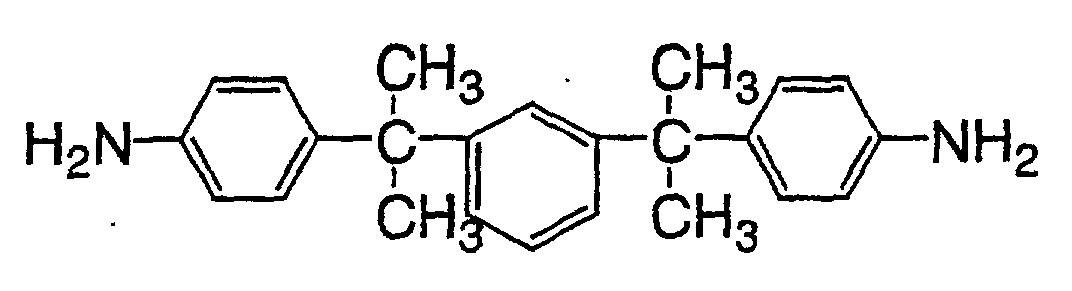 was used as a diamine compound. The polyimide had a
solubility of 20% or higher in each organic solvent, a glass
transition temperature of 210°C, and water absorption of 0.9%
was used as a diamine compound. The polyimide had a
solubility of 20% or higher in each organic solvent, a glass
transition temperature of 210°C, and water absorption of 0.9%
A polyimide was produced by heating the polyamide acid
obtained in Example 1 at 200°C for 3 hours at a pressure of
0.007 X 10⁵ Pa. The polyimide had a solubility of 20% or
higher in each of the aforementioned organic solvents, a
glass transition temperature of 180°C, and water absorption
of 0.9%.
280 g of DMF, 0.1487 mol of 4'4-diphenylmethane
diisocyanate
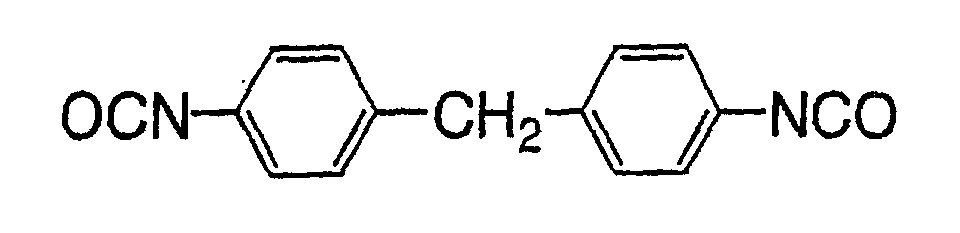 , and 0.1487 mol of ESDA were placed in a 500 mL glass flask
and then stirred. The stirred solution was put into a Teflon
coated vat and then dried in a vacuum oven at 200°C for 3
hours to produce a polyimide. The polyimide had a solubility
of 20% or higher in each of the aforementioned organic
solvents, a glass transition temperature of 200°C, and water
absorption of 0.8%.
, and 0.1487 mol of ESDA were placed in a 500 mL glass flask
and then stirred. The stirred solution was put into a Teflon
coated vat and then dried in a vacuum oven at 200°C for 3
hours to produce a polyimide. The polyimide had a solubility
of 20% or higher in each of the aforementioned organic
solvents, a glass transition temperature of 200°C, and water
absorption of 0.8%.
A polyimide was produced in the same manner as described
in Example 1, with an exception that 0.1041 mol of 3,3'-bis(aminophenoxyphenyl)propane
(meta type)
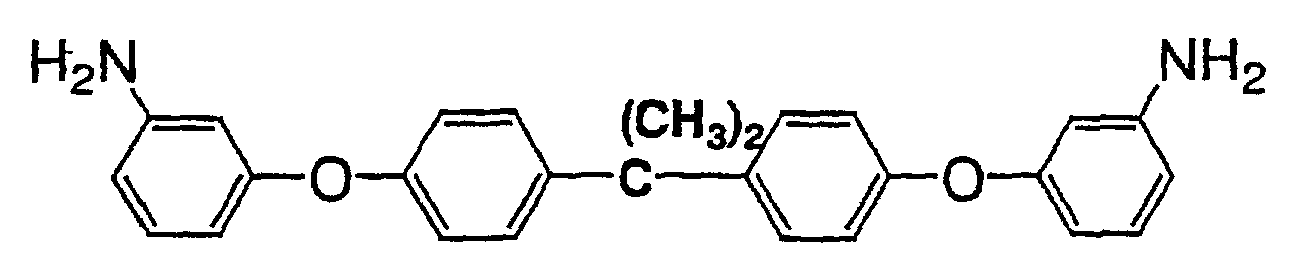 and 0.0446 mol of α,ω-bis(3-aminopropyl)polydimethylsiloxane
(APPS) were used as diamine compounds. The polyimide had a
solubility of 20% or higher in each organic solvent, a glass
transition temperature of 100°C, and water absorption of 1.7%.
and 0.0446 mol of α,ω-bis(3-aminopropyl)polydimethylsiloxane
(APPS) were used as diamine compounds. The polyimide had a
solubility of 20% or higher in each organic solvent, a glass
transition temperature of 100°C, and water absorption of 1.7%.
43.5 g (0.1487 mol) of 1,3-bis(3-aminophenoxy)benzene and
201 g of N,N-dimethylformamide (hereinafter referred to as
DMF) were placed in a 500 mL of glass flask and then stirred.
After dissolving diamine, 64.3 g (0.1487 mol) of ESDA was
gradually added at 25°C under nitrogen atmosphere with care of
viscosity to produce a polyamid acid solution having a
viscosity of 1500 poise (at 25°C). To this polyamide acid
solution, 150 g of DMF, 35 g of β-picoline, and 60 g of acetic
anhydride were added and stirred for an hour. Then this
solution was stirred in a 100°C atmosphere for an hour for
imidization. After that, this solution was added dropwise to
methanol with stirring at high speed to precipitate thread-like
polyimide out of the solution. The thread-like
polyimide was dried at 100°C for 30 minutes, crushed with a
mixer, extracted by Soxlet method using methanol, and dried at
100°C for 2 hours to produce polyimide. The polyimide had a
glass transition temperature of 160°C and water absorption of
0.9 %. The solubilities of the polyimide in DMF, 1,4-dioxane
(hereinafter referred to as "dioxane"), and tetrahydrofuran
(hereinafter referred to as THF) were checked, respectively.
At the result, it was found that the polyimide had a
solubility of 20 % or higher in each of the aforementioned
organic solvents.
A polyimide was produced by heating the polyamide acid
obtained in Example 7 at 200°C for 3 hours at a pressure of
0.007 X 10⁵ Pa. The polyimide had a solubility of 20% or
higher in each of the aforementioned organic solvents, a
glass transition temperature of 160°C, and water absorption
of 0.9%.
201 g of DMF, 0.1487 mol of 1,3-bis(3-isocyanatephenoxy)benzene,
and 0.1487 mol of ESDA were placed
in a 500 mL glass flask and then stirred. The stirred
solution was put into a Teflon coated vat and then dried in a
vacuum oven at 200°C for 3 hours to produce a polyimide. The
polyimide had a solubility of 20% or higher in each of the
aforementioned organic solvents, a glass transition
temperature of 160°C, and water absorption of 0.9%.
280 g of dimethylformamide (hereinafter referred to as
"DMF"), 0.1338 mol of 3,3-bis(aminophenoxyphenyl)propane
(meta type: hereinafter referred to as "BAPP-M"), and 0.0149
mol of 3,3'-dihydroxy-4,4'-diaminobiphenyl (hereinafter
referred to as "HAB"; Wakayama Seika Kogyo Co.,Ltd.) were
placed in a 500 mL glass flask and then dissolved under a
nitrogen atmosphere with stirring. Then, the solution was
cooled with stirring in an ice water bath under a nitrogen
atmosphere in the flask, and 0.1487 mol of 2,2-bis(4-hydroxyphenyl)propanedibenzoate-3,3',4,4'-tetracarboxylic
dianhydride (hereinafter referred to as "ESDA") was gradually
added thereto with care of viscosity until the viscosity
reached 1500 poise. Thus a polyamide acid polymer solution
was produced.
300 g of the polyamide acid solution was put into a
Teflon coated vat and then dried in a vacuum oven at 150°C
for 10 minutes, 160°C for 10 minutes, 170°C for 10 minutes,
180°C for 10 minutes, 190°C for 10 minutes, and 210°C for 30
minutes under a reduced pressure of 667Pa. When the vat was
taken out of the vacuum oven, 85. 4 g of thermoplastic
polyimide resin having a hydroxyl group was obtained. The
polyimide had a solubility of 20% or higher in each of the
aforementioned organic solvents, a glass transition
temperature of 210°C, and water absorption of 0.9%.
A polyimide acid polymer solution was produced in the
same manner as described in Example 10, with an exception
that 4,4'-(1,3-phenylenebis(1-methylethyllidene))bisaniline
(para type) was used as a diamine compound in place of the
BAPP-M, and then thermoplastic polyimide resin powders having
a hydroxyl group were obtained.
The polyimide had a solubility of 20% or higher in each organic solvent, a glass transition temperature of 210°C, and water absorption of 0.9%.
The polyimide had a solubility of 20% or higher in each organic solvent, a glass transition temperature of 210°C, and water absorption of 0.9%.
A polyimide was produced in the same manner as described
in Example 1, with an exception that biphenyl tetracarboxylic
dianhydride (BTDA) was used in place of ESDA. Thus-obtained
polyimide was insoluble in DMF, dioxane, and THF.
A polyimide was produced in the same manner as described
in Example 1, with an exception that 4,4'-diaminodiphenylther
was used in place of a diamine compound. Thus-obtained
polyimide was insoluble in DMF, dioxane, and THF.
280 g of DMF, 0.1338 mol of 3,3'-bis(aminophenoxyphenyl)propane
(hereinafter referred to as
"BAPP-M") and 0.01487 mol of α,ω-bis(3-aminopropyl)
polydimethylsiloxane (APPS) were placed in a 500 mL glass
flask and then dissolved under a nitrogen atmosphere with
stirring. Then, the solution was cooled in an ice water bath
with stirring under a nitrogen atmosphere in the flask, and
0.1487 mol of BTDA was gradually added thereto with care of
viscosity until the viscosity reached 1000 poise. Thus a
polyamide acid polymer solution was produced.
To the polyamide acid polymer solution, 150 g of DMF, 35
g of β-picoline, and 60 g of acetic anhydride were added and
stirred for an hour. It was then further stirred at less
than 100°C for an hour for imidization. After that, this
solution was added dropwise in methanol with stirring at high
speed to precipitate thread-like polyimide out of the
solution. The thread-like polyimide was dried at 100°C for
30 minutes, crushed with a mixer, extracted by Soxlet method
using methanol, and dried at 100°C for 2 hours to produce
polyimide powders. The polyimide powders were insoluble in
DMF, 1,4dioxane, and THF, respectively.
A polyimide was produced in the same manner as described
in Example 7, with an exception that biphenyl tetracarboxylic
dianhydride (BTDA) was used in place of ESDA. Thus-obtained
polyimide was insoluble in DMF, dioxane, and THF,
respectively.
280 g of dimethylformamide (hereinafter referred to as
"DMF"), 0.1338 mol of 3,3'-bis(aminophenoxyphenyl)propane
(meta type: hereinafter referred to as "BAPP-M), and 0.0149
mol of HAB (Wakayama Seika Kogyo Co.,Ltd.) were placed in a
500 mL glass flask and then dissolved under a nitrogen
atmosphere with stirring. Then, the solution was cooled with
an ice water bath with stirring under a nitrogen atmosphere
in the flask, and 0.1487 mol of 2,2-bis(4-hydroxyphenyl)propanedibenzoate-3,3',4,4'-tetracarboxylic
dianhydride (hereinafter referred to as "ESDA") was gradually
added thereto with care of viscosity until the viscosity
reached 1500 poise. Thus a polyamide acid polymer solution
was produced.
300 g of the polyamide acid solution was put into a
Teflon coated vat and then dried in a vacuum oven at 150°C
for 10 minutes, 160°C for 10 minutes, 170°C for 10 minutes,
180°C for 10 minutes, 190°C for 10 minutes, and 210°C for 30
minutes under a reduced pressure of 667Pa. When the vat was
taken out of the vacuum oven, 85.4 g of thermoplastic
polyimide resin having a hydroxyl group was obtained. The
polyimide had a solubility of 20% or higher in each of the
aforementioned organic solvents, a glass transition
temperature of 210°C, and water absorption of 0.8%.
280 g of dimethylformamide (hereinafter referred to as
"DMF") and 0.1487 mol of 3,3'-bis(aminophenoxyphenyl)propane
(meta type: hereinafter referred to as "BAPP-M") were placed
in a 500 mL glass flask and then dissolved under a nitrogen
atmosphere with stirring. Then, the solution was cooled with
an ice water bath with stirring under a nitrogen atmosphere
in the flask, and 0.1487 mol of 2,2-bis(4-hydroxyphenyl)propanedibenzoate-3,3,'4,4'-tetracarboxylic
dianhydride (hereinafter referred to as "ESDA") was gradually
added thereto with care of viscosity until the viscosity
reached 1500 poise. Thus a polyamide acid polymer solution
was produced.
The polyamide acid polymer solution was heated under a
reduced pressure in the same manner as described in Example 1
to produce a thermoplastic polyimide resin powders. Thus-obtained
polyimide had a solubility of 20% or higher in each
of the aforementioned organic solvents, a glass transition
temperature of 190°C, and water absorption of 0.8%.
280 g of dimethylformamide (DMF), 0.1487 mol of 3,3'-bis(aminophenoxyphenyl)propane
(hereinafter referred to as
"BAPP-M") were placed in a 500 mL glass flask and then
dissolved under a nitrogen atmosphere with stirring. Then,
the solution was cooled in an ice water bath with stirring
under a nitrogen atmosphere in the flask, and 0.1487 mol of
BTDA was gradually added thereto with care of viscosity until
the viscosity reached 1500 poise. Thus a polyamide acid
polymer solution was produced.
To the polyamide acid polymer solution, 150 g of DMF, 35
g of β-picoline, and 60 g of acetic anhydride were added and
stirred for an hour. It was then further stirred at less
than 100°C for an hour for imidization. After that, this
solution was added dropwise in methanol with stirring at high
speed to precipitate thread-like polyimide out of the
solution. The thread-like polyimide was dried at 100°C for
30 minutes, crushed with a mixer, extracted by Soxlet method
using methanol, and dried at 100°C for 2 hours to produce
polyimide powders. The polyimide powders had a solubility of
20% or higher in each of the aforementioned organic solvents,
a glass transition temperature of 220°C, and water absorption
of 1.8%.
In each of the following Examples 12 to 17 and
Comparative examples 8 to 14, a copper clad laminate in which
a polyimide composition was used as an adhesive layer was
produced, and the physical properties thereof were measured.
20 g of polyimide resin powders obtained in Example 10,
5 g of novolac epoxy resin Epikote 1032H60 (Yuka Shell Epoxy
Co.,Ltd.), and 0.015 g of 4,4'-diaminodiphenylsulfone
(hereinafter referred to as "4,4'-DDS") as a curing agent
were dissolved in 83 g of a mixed solvent of dioxane and THF
(weight ratio of 1:1) to produce a polyimide composition
(varnish) according to the present invention. The varnish
was cast over a glass plate, dried at 100°C for 10 minutes,
peeled from the glass plate, fixed to an iron frame, and then
dried at 150°C for 20 minutes to produce a 25-µm-thick sheet.
Thus-obtained sheet was sandwiched between a polyimide film
APICAL 50 AH (Kaneka Corporation) and a 25-µm-thick copper
foil and then dried at 200°C for 20 minutes at a pressure of
3MPa. Thus a flexible copper clad laminate was produced.
The varnish obtained in Example 10 was applied to a
polyimide film APICAL 50 AH (Kaneka Corporation) and dried at
100°C for 10 minutes and at 150°C for 20 minutes to produce a
25-µm-thick adhesive layer. Thus-obtained polyimide film
with the adhesive layer on one side thereof was heated at
200° C for 20 minutes at a pressure of 3MPa. Thus a flexible
copper clad laminate was produced.
20 g of the polyimide resin powders obtained in Example
10 and 5 g of glycidylamine epoxy resin TETRAD-C (MITSUBISHI
GAS CHEMICAL COMPANY, INC.) was dissolved in 83 g of mixed
solvent of dioxane and THF (weight ratio of 1:1). Thus-obtained
varnish was cast over a glass plate, dried at 100°C
for 10 minutes, peeled from the glass plate, fixed to an iron
frame, and then dried at 150°C for 20 minutes to produce a
25-µm-thick sheet. Thus-obtained sheet was sandwiched
between a polyimide film APICAL 50 AH (Kaneka Corporation)
and a 25-µm-thick copper foil and then dried at 200°C for 20
minutes at a pressure of 3MPa. Thus a flexible copper clad
laminate was produced.
In the same manner as described in Example 12, a
composition solution was obtained from the soluble polyimide
resin powders obtained in Example 11, and a flexible copper
clad laminate was produced from the composition solution.
In the same manner as described in Example 12, a
composition solution was obtained from the soluble polyimide
resin powders obtained in Example 7, and a flexible copper
clad laminate was produced from the composition solution.
In the same manner as described in Example 12, a
composition solution was obtained from the soluble polyimide
resin powders obtained in Example 1, and a flexible copper
clad laminate was produced from the composition solution.
20 g of polyimide resin powders obtained in Example 6, 5
g of novolac epoxy resin Epikote 1032H60 (Yuka Shell Epoxy
Co.,Ltd.), and 0.015 g of 4,4'-diaminodiphenylsulfone
(hereinafter referred to as "4,4'-DDS") as a curing agent
were dissolved in 83 g of a mixed solvent of dioxane and THF
(weight ratio of 1:1) to produce a resinous composition
(varnish). The varnish was cast over a glass plate, dried at
100°C for 10 minutes, peeled from the glass plate, fixed to
an iron frame, and then dried at 150°C for 20 minutes to
produce a 25-µm-thick sheet. Thus-obtained sheet was
sandwiched between a polyimide film APICAL 50AH (Kaneka
Corporation) and a 25-µm-thick copper foil and then dried at
200°C for 20 minutes at a pressure of 3MPa. Thus a flexible
copper clad laminate was produced.
20 g of polyimide resin powders obtained in Example 7, 5
g of Epikote 1032H60 (Yuka Shell Epoxy Co.,Ltd.), and 0.015 g
of 4,4'-DDS were dissolved in 83 g of DMF. The varnish was
cast over a glass plate, dried at 100°C for 10 minutes,
peeled from the glass plate, fixed to an iron frame, and then
dried at 150°C for 20 minutes to produce a 25-µm-thick sheet.
Thus-obtained sheet was sandwiched between a polyimide film
APICAL 50 AH (Kaneka Corporation) and a 25-µm-thick copper
foil and then dried at 200°C for 20 minutes at a pressure of
3MPa. Thus a flexible copper clad laminate was produced.
A copper clad laminate was produced in the same manner
as described in Comparative example 6, with an exception that
the polyimide resin powders obtained in Comparative example 6
was dissolved in mixed solvent of dioxane and THF (weight
ratio of 1:1).
20 g of polyimide resin powders obtained in Example 6
was dissolved in 83 g of DMF to prepare a varnish. The
varnish was cast over a glass plate, dried at 100°C for 10
minutes, peeled from the glass plate, fixed to an iron frame,
and then dried at 150°C for 20 minutes to produce a 25-µm-thick
sheet. Thus-obtained sheet was sandwiched between a
polyimide film APICAL 50AH (Kaneka Corporation) and a 25-µm-thick
copper foil, and then dried at 200°C for 20 minutes at
a pressure of 3MPa. Thus a flexible copper clad laminate was
produced.
10 g of PLATABOND M1276 (copolymer resin available from
Japan Rirusan Company), 20 g of Epikote 1032H60 (Yuka Shell
Epoxy Co.,Ltd.), and 1 g of diaminodiphenylsulfone were
dissolved in 83 g of DMF to prepare a varnish. The varnish
was cast over a glass plate, dried at 100°C for 10 minutes,
peeled from the glass plate, fixed to an iron frame, and then
dried at 150°C for 20 minutes to produce a 25-µm-thick sheet.
Thus-obtained sheet was sandwiched between a polyimide film
APICAL 50AH (Kaneka Corporation) and a 25-µm-thick copper
foil and then dried at 200°C for 20 minutes at a pressure of
3MPa. Thus a flexible copper clad laminate was produced.
In the same manner as described in Comparative example
12, a flexible copper clad laminate was produced with an
exception that Platabond M1276, Epikote 1032H60, and
diaminodiphenylsulfone were dissolved in a mixed solvent of
dioxane and THF (weight ratio of 1:1).
Polyimide resin powders were obtained in the same manner
as described in Comparative example 8, with an exception that
pyromelletic dianhydride (PMDA) and oxydianiline (ODA) were
used in place of acid dianhydride and a diamine compound,
respectively.
The polyimide resin powders were dissolved in any
solvents of DMF, THF, dioxane, and dioxolane. Neither a
composition nor a flexible copper clad laminated could be
produced from the polyimide resin powders.
The peeling strength and solder heat resistance of
flexible copper clad laminates obtained in Examples 12 to 17
and Comparative examples 8 to 13 were evaluated. Also, water
absorption of each adhesive sheet was evaluated as well.
Results were shown in Table 1.
In the present invention, the physical properties of a
composition was measured as follows.
Peeling strength was measured in accordance with JISC
6481. To check solder heat resistance, the appearance of
each laminate was evaluated after dipping the laminate in a
solder bath at 260°C for 10 seconds. In Table, the mark "○"
indicates that it was in a good condition and has no swelling
part.
PCT test (Pressure Cooker Test) for assessing
reliability of materials for electronics was conducted at
121°C at a humidity of 100% for 96 hours.
Retention of peeling strength was calculated by the
following expression, wherein F1 indicates a peeling strength
of a laminate before PCT test and F2 indicates a peeling
strength of the laminated after PCT test.
Peeling strength after PCT test(%) = F2 ÷ F1 × 100
The rate of water absorption was determined in
accordance with ASTM D570 and calculated by the following
expression, wherein W1 is a weight of a cured composition
which was dried at 150°C for 30 minutes and W2 is a weight of
the composition which was immersed in distilled water for 24
hours and then wiped with a dry cloth.
The rate of water absorption(%) = (W2 - W1 ) ÷ W1 × 100
A residual volatile content in a cured composition was
determined by gas chromatography. Measurement conditions
were as follows.
A residual volatile content was calculated by the
following expression, wherein W3 indicates a weight of a
resinous composition and W4 indicates a weight of the
residual volatile which is determined by gas chromatography.
Residual volatile content (wt%) = W4 ÷ W3 × 100
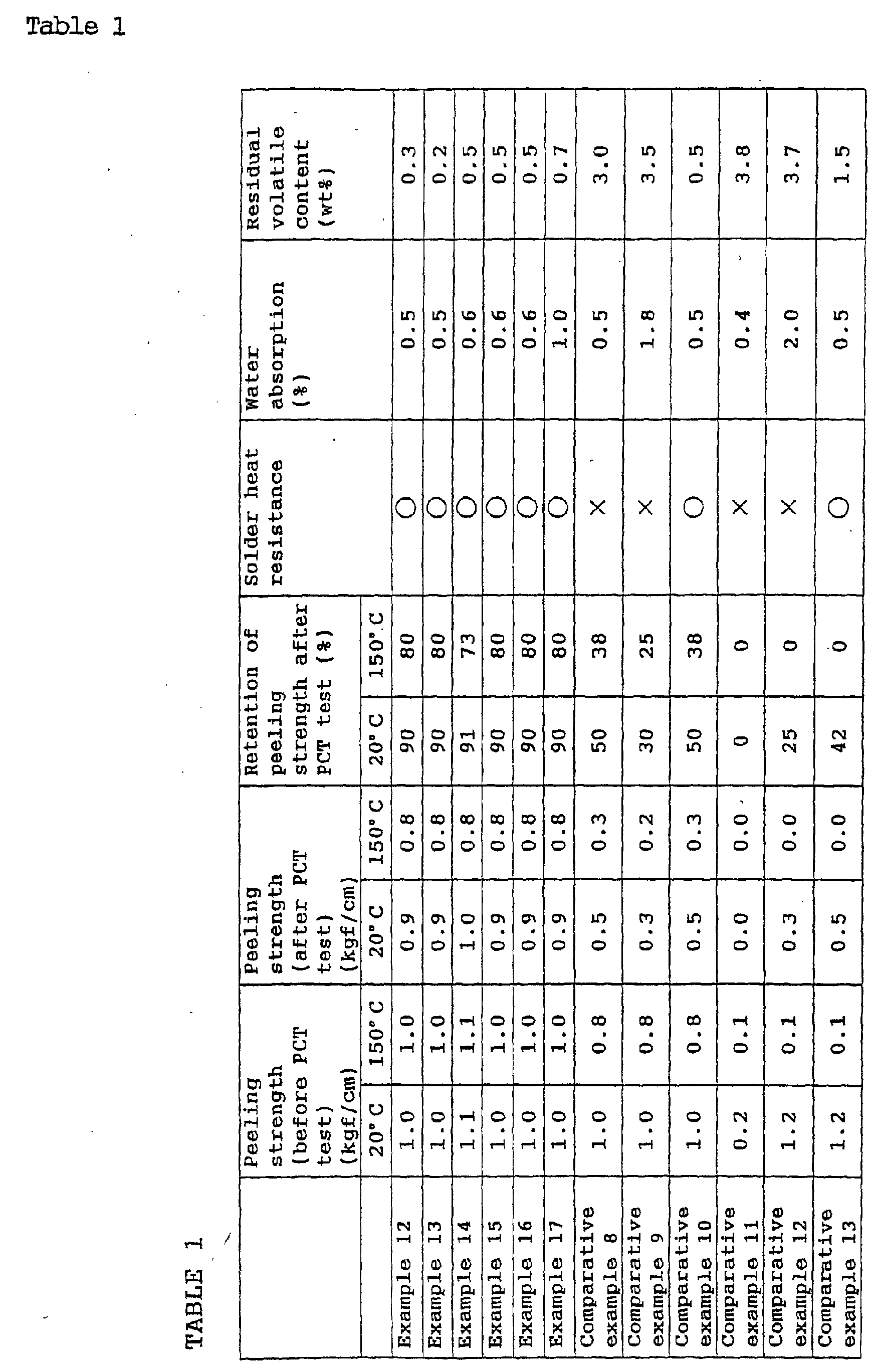
In the following Examples 18 to 20 and comparative
examples 15 to 20, the polyimide compositions were dissolved
in various kinds of organic solvents and then laminated on a
polyimide film to produce bonding sheets . The physical
properties of each bonding sheet was measured.
20 g of the polyimide powders obtained in Example 1, 5 g
of Epikote 1032H60 (Yuka Shell Epoxy Co.,Ltd.), and 1.5 g of
4,4'-diaminodiphenylsulfone (curing agent) were added to 102
g of THF and dissolved with stirring to produce a composition
solution of the present invention (solids concentration:
SC=20%)
A composition solution was produced in the same manner
as described in Example 18, with an exception that 1,4-dioxane
was used as an organic solvent instead of THF.
(solids concentration: SC=20%)
A composition solution was produced in the same manner
as described in Example 18, with an exception that dioxolane
was used as an organic solvent instead of THF. (solids
concentration: SC=20%)
A composition solution was produced in the same manner
as described in Example 18, with an exception that
dimethylformamide (DMF) was used as an organic solvent
instead of THF. (solids concentration: SC=20%)
A composition solution was produced in the same manner
as described in Example 1, with an exception that N-methylpyrrolidone
(NMP) was used as an organic solvent
instead of THF. (solids concentration: SC=20%)
A composition solution was produced in the same manner
as described in Example 1, with an exception that
dimethylacetamide (DMAc) was used as an organic solvent
instead of THF. (solids concentration: SC=20%)
A composition solution was tried to be produced in the
same manner as described in Example 1, with an exception that
methyl ethyl ketone (MEK) was used as an organic solvent
instead of THF. However, the ingredients were not completely
dissolved in the organic solvent.
A composition solution was tried to be produced in the
same manner as described in Example 1, with an exception that
methanol was used as an organic solvent instead of THF.
However, the ingredients were not completely dissolved in the
organic solvent.
A composition solution was tried to be produced in the
same manner as described in Example 1, with an exception that
ethanol was used as an organic solvent instead of THF.
However, the ingredients were not completely dissolved in the
organic solvent.
The composition solution obtained in Example 18 was cast
over 25-µm-thick polyimide film (APICAL 25AH available from
Kaneka Corporation) and dried at 100°C for 10 minutes.
After that, it was heated at 180°C for 10 minutes in Example 18a, at 200°C for 10 minutes in Example 18b, and at 220°C for 10 minutes in Example 18c to produce 30-µm-thick bonding sheets, respectively.
After that, it was heated at 180°C for 10 minutes in Example 18a, at 200°C for 10 minutes in Example 18b, and at 220°C for 10 minutes in Example 18c to produce 30-µm-thick bonding sheets, respectively.
In Examples 19a, 19b, and 19c, bonding sheets were
produced in the same manner as described in Examples 18a, 18b,
and 18c, with an exception that the composition solution
obtained in Example 19 was used.
In Examples 20a, 20b, and 20c and Comparative examples
15a, 15b, 15c, 16a, 16b, and 16c, bonding sheets were
produced in the same manner and conditions as described above.
Since ingredients were not completely dissolved in
Comparative examples 18, 19, and 20, bonding sheets were not
produced using the composition solutions obtained in those
examples.
The amount of residual solvent was determined as follows:
In that case, the calibration curve was prepared as
follows:
The devices and conditions used in the above determination were as follows.
Thermal cracking plant: JHP-3 (Japan Analytical Industry Co.,Ltd)
GC: Hp5890-II (Hewlett-Packard Company)
MS: Hp5871A (Hewlett-Packard Company)
- Decomposing condition: 358°C×5 sec.
- Column: DB-5 capillary column
- Temperature profile: 35°C (5 minutes) → temperature rise(10°C/min.) → 150°C(1.5 minutes)
- Inlet/detector: 250°C/280°C
- Oven/needle temperature: 200°C/200°C
- Split ratio: 1/30
- Sample amount: 0.5 mg
Peeling strength of a flexible copper clad laminate was
measured as follows.
A film-like laminate member and an 18-µm-thick
electrolytic copper foil are thermally pressed at 200°C and a
pressure of 3MPa for 20 minutes to produce a flexible copper
clad laminate. The peeling strength of the laminate was
measured in accordance with Japanese Industrial Standard JIS
C6481. In that case, the conductor width was 3 mm.
Table 2 shows the evaluation results of the properties of
the film-like laminate member obtained in Examples and
Comparative examples.
| THF | dioxane | dioxolane | DMF | NMP | DMAc | |
| Amount of residual solvent(%) | Example 18a | Example 19a | Example 20a | Comparative example 15a | Comparative example 16a | Comparative example 17a |
| 0.5 | 3.2 | 0.8 | 5.1 | 8.0 | 6.2 | |
| Example 18b | Example 19b | Example 20b | Comparative example 15b | Comparative example 16b | Comparative example 17b | |
| 0.0 | 1.3 | 0.2 | 2.0 | 4.3 | 3.5 | |
| Example 18c | Example 19c | Example 20c | Comparative example 15c | Comparative example 16c | Comparative example 17c | |
| 0.0 | 0.2 | 0.1 | 0.9 | 1.9 | 1.4 | |
| Peeling strength (kgf/cm) | Example 18a | Example 19a | Example 20a | Comparative example 15a | Comparative example 16a | Comparative example 17a |
| 1.00 | 0.97 | 1.00 | 1.00 | 0.98 | 1.00 | |
| Example 18b | Example 19b | Example 20b | Comparative example 15b | Comparative example 16b | Conparative example 17b | |
| 0.72 | 0.66 | 0.70 | 0.67 | 0.51 | 0.53 | |
| Example 18c | Example 19c | Example 20c | Comparative example 15c | Comparative example 16c | Comparative example 17c | |
| 0.12 | 0.11 | 0.11 | 0.13 | 0.06 | 0.10 |
As shown in Tables 3 and 4, the polyimides produced in
Examples 1 to 9 and Comparative examples 1 and 2, epoxy
resins, and an accelerator or a curing agent were mixed with
the listed solvents to prepare adhesive agent solutions.
Then, each adhesive agent solution was applied to 100-µm-thick
polyethylene terephthalate film so that the thickness of
each adhesive agent was in a range of 25 to 50 µm after drying.
Then, it was dried at 40°C for 2 minutes, peeled from the film,
fixed to a frame with pins, dried at 120°C for 5 minutes and
at 170°C for 3 minutes to remove solvents, and thermally
pressed on a release film (PET or PEN) having a thickness of
25 to 50 µm at 140°C and a pressure of 1MPa for 3 minutes.
Thus, a bonding sheet was produced.
Next, in order to evaluate the properties of this bonding
sheet, the release film was removed from the bonding sheet to
obtain an adhesive sheet. Then, the adhesive sheet was
laminated to a roughened surface of an 18-µm-electrolytic
copper foil at 200°C and a pressure of 3MPa for 5 minutes, and
cured at 170°C for 3 hours to prepare a laminated film with
adhesive agent.
The properties of thus-obtained laminated film are shown
in Table 3. Compared to the evaluation results of Comparative
examples shown in Table 4, it is clear that the bonding sheet
of the present invention has more excellent adhesion and
solder heat resistance.
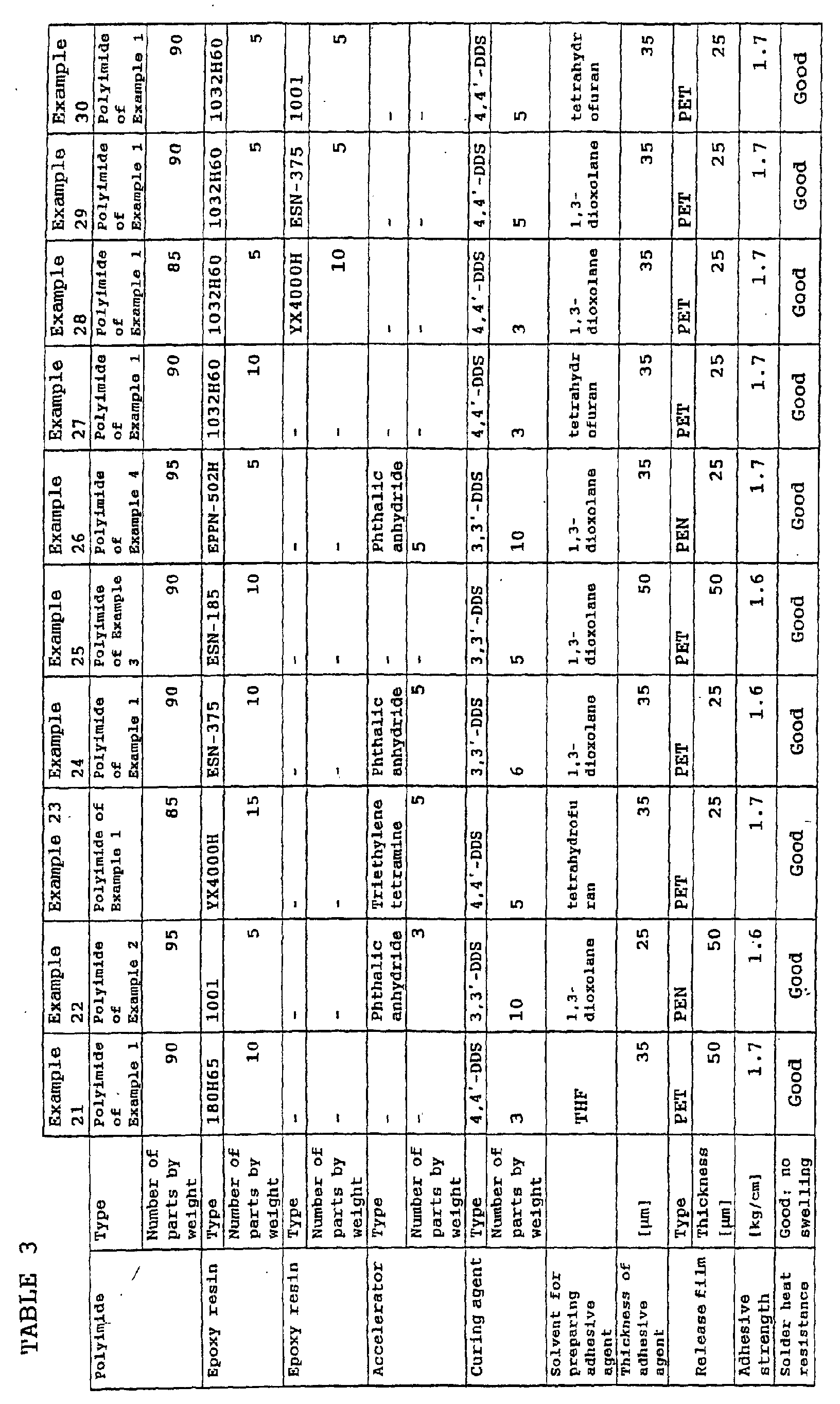
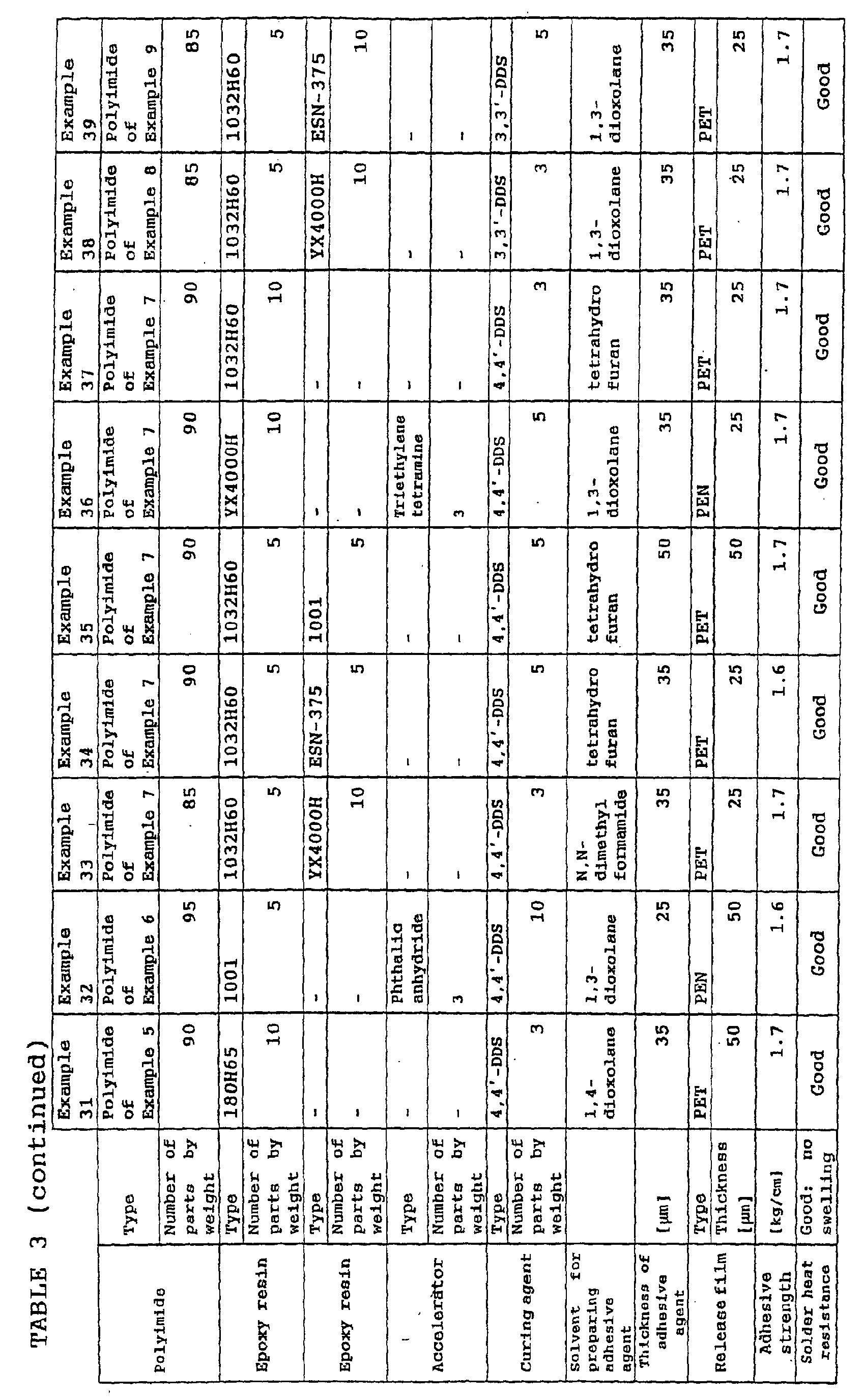
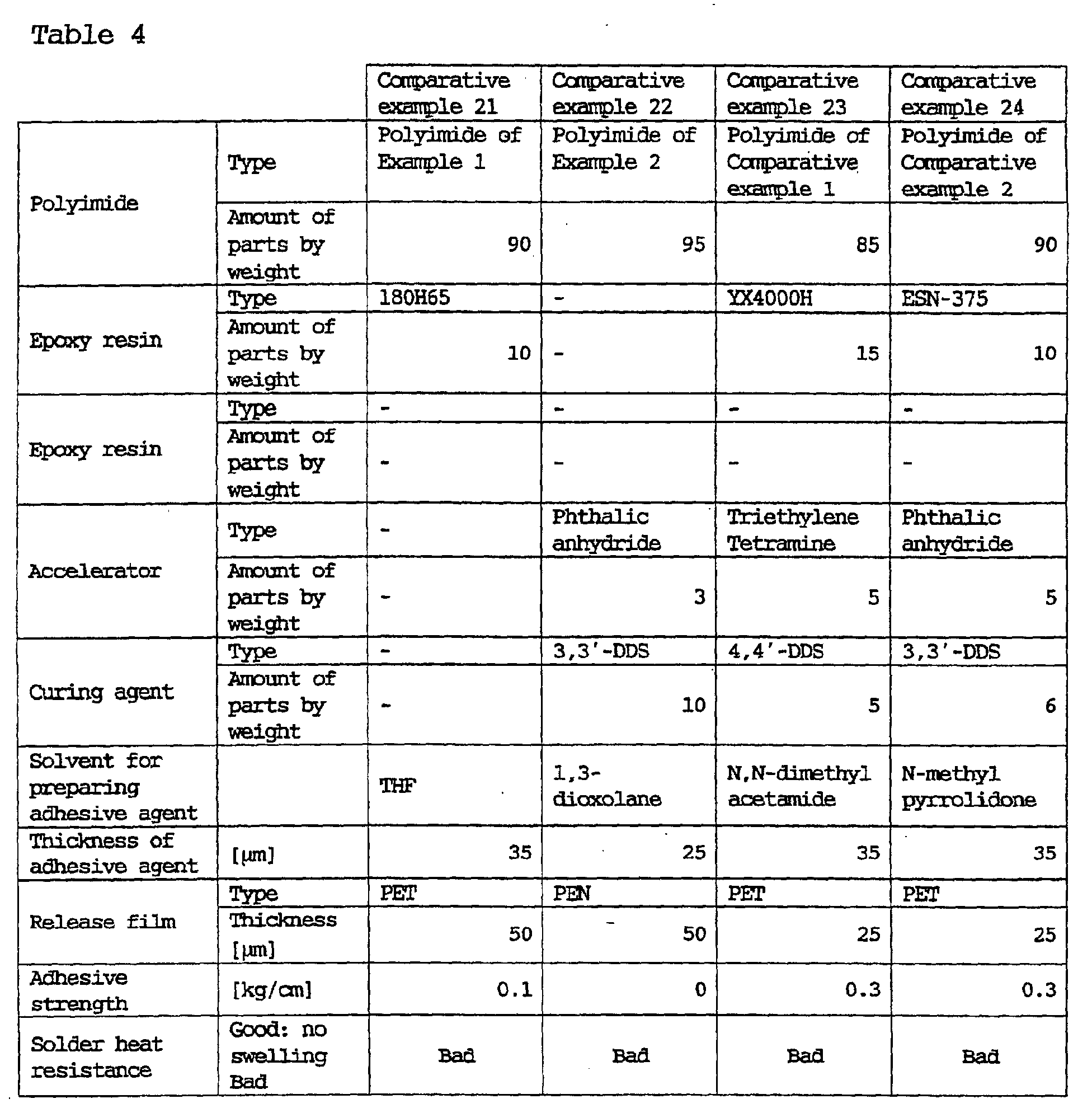
In the following Examples 40 to 44 and Comparative
examples 25 and 26, adhesive laminated films for covering an
accelerator beam tube and for covering a conductor wire for
an accelerator quench heater were produced and the properties
of the respective films were evaluated.
20 g of polyimide powders obtained in Example 1, 5 g of
Epikote 1032H60 (Yuka Shell Epoxy Co.,Ltd.), and 3 g of 4,4-diaminodiphenylsulfone
were dissolved in 83 g of DMF to
produce a varnish. The varnish was cast over a PET film,
dried at 100°C for 10 minutes, peeled from the PET film,
fixed to an iron frame, and then dried at 150°C for 20
minutes to produce a 5-µm-thick film of thermoplastic
polyimide and thermosetting resin which is to be used as an
adhesive layer in the present invention.
Thus-obtained film was laminated to both sides of a 50-µm-thick
polyimide film APICAL 50 AH (Kaneka Corporation) at
150°C and a pressure of 2.2 cm/min. to produce 60-µm-thick
adhesive laminated film for covering an accelerator beam tube
or for covering a conductor wire for an accelerator quench
heater.
A glass transition temperature of the thermoplastic
polyimide was measured by TMA. The measurement value was
190°C. Further, its water absorption was measured in
accordance with ASTM D-570 by immersing it in pure water at
20°C for 24 hours. The measurement value was 0.9%.
Furthermore, the release paper was peeled off the
laminated film, and then a copper foil is laminated thereto
at 180°C and a pressure of 30 kg/cm2 for 10 minutes. Its
peeling strength was measured in accordance with JIS K6481
(at room temperature) so as to use it as the reference when
the peeling strength between the adhesive laminated film for
covering an accelerator beam tube and the accelerator beam
tube or between the adhesive laminated film for covering a
conductor wire for an accelerator quench heater and the
accelerator quench heater was measured. The measurement
value was 1.1 kg/cm. The adhesive laminated film for
covering an accelerator beam tube or for covering a conductor
wire for an accelerator quench heater was subjected to a
radiation resistance test by applying radiation 5MGy using
2MeV electron beam. No change was found in color and
performance. Results of measurements are shown in Table 5.
| Glass transition temperature (°C) | Water absorption (%) | Peeling strength (kg/cm) | Radiation resistance test | |
| Example 40 | 190 | 0.9 | 1.1 | No change |
| Example 41 | 190 | 0.9 | 1.2 | No change |
| Example 42 | 190 | 0.9 | 1.1 | No change |
| Example 43 | 220 | 0.9 | 1.1 | No change |
| Example 44 | 160 | 0.9 | 1.2 | No change |
| Comparative example 25 | - | 2.6 | Not bonded | No change |
| Comparative example 26 | 178 | 2.0 | 0.3 | Turned black |
20 g of polyimide powders obtained in Example 1, 5 g of
Epikote 1032H60 (Yuka Shell Epoxy Co.,Ltd.), and 3 g of 4,4'-diaminodiphenylsulfone
were dissolved in 83 g of DMF to
produce a varnish. The varnish was directly applied to one
surface of the polyimide film so that a 10-µm-thick adhesive
laminated film was produced after drying.
A release paper was peeled off the laminated film, and
then a copper foil is laminated thereto at 180°C and a
pressure of 3MPa for 10 minutes. Its peeling strength was
measured in accordance with JIS K6481 (at room temperature)
so as to use it as the reference when the peeling strength
between the adhesive laminated film for covering an
accelerator beam tube and the accelerator beam tube or
between the adhesive laminated film for covering a conductor
wire for an accelerator quench heater and the accelerator
quench heater was measured. The measurement value was 1.2
kg/cm. The adhesive laminated film for covering accelerator
beam tube and the adhesive laminated film for covering
conductor wire for accelerator quench heater were subjected
to a radiation resistance test by applying radiation 5MGy
using 2MeV electron beam. No change was found in color and
performance. Results of measurements are shown in Table 5.
An adhesive sheet was produced in the same manner as
Example 40, with an exception that the polyimide obtained in
Example 6 was used.
Thus-obtained film was laminated on both sides of a
polyimide film APICAL 50 AH (Kaneka Corporation) at 150°C and
a pressure of 2.2 cm/min. to produce a 60-µm-thick adhesive
laminated film for covering an accelerator beam tube or for
covering a conductor wire for an accelerator quench heater.
A glass transition temperature of the thermoplastic
polyimide was measured by TMA. The measurement value was
190°C. Further, its water absorption was measured in
accordance with ASTM D-570 by soaking it in pure water at
20°C for 24 hours. The measurement value was 0.9%.
A release paper was peeled off the laminated film, and
then a copper foil is laminated thereto at 180°C and a
pressure of 3MPa for 10 minutes. Its peeling strength was
measured in accordance with JIS K6481 (at room temperature)
so as to use it as the reference when peeling strength
between the adhesive laminated film for covering an
accelerator beam tube and the accelerator beam tube or
between the adhesive laminated film for covering a conductor
wire for an accelerator quench heater and the accelerator
quench heater was measured. The measurement value was 1.1
kg/cm. The adhesive laminated film for covering an
accelerator beam tube or for covering a conductor wire for an
accelerator quench heater was subjected to a radiation
resistance test by applying radiation 5MGy using 2MeV
electron beam. No change was found in color and performance.
Results of measurements are shown in Table 5.
An adhesive sheet was produced in the same manner as
Example 40, with an exception that the polyimide obtained in
Example 3 was used.
Thus-obtained film was laminated on both sides of a
polyimide film APICAL 50 AH (Kaneka Corporation) at 150°C and
a pressure of 2.2 cm/min. to produce an adhesive laminated
film for covering an accelerator beam tube or for covering a
conductor wire for an accelerator quench heater.
A glass transition temperature of the thermoplastic
polyimide was measured by TMA. The measurement value was
220°C. Further, its water absorption was measured in
accordance with ASTM D-570 by soaking it in pure water at
20°C for 24 hours. The measurement value was 0.9%.
A release paper was peeled off the laminated film, and
then a copper foil is laminated thereto at 180°C and a
pressure of 3MPa for 10 minutes. Its peeling strength was
measured in accordance with JIS K6481 (at room temperature)
so as to use it as the reference when peeling strength
between the adhesive laminated film for covering an
accelerator beam tube and the accelerator beam tube or
between the adhesive laminated film for covering a conductor
wire for an accelerator quench heater and the accelerator
quench heater was measured. The measurement value was 1.1
kg/cm. The adhesive laminated film for covering an
accelerator beam tube or for covering a conductor wire for an
accelerator quench heater was subjected to a radiation
resistance test by applying radiation 5MGy using 2MeV
electron beam. No change was found in color and performance.
Results of measurements are shown in Table 5.
An adhesive sheet was produced in the same manner as
Example 40, with an exception that the polyimide obtained in
Example 7 was used.
Thus-obtained film was laminated on both sides of a
polyimide film APICAL 50 AH (Kaneka Corporation) at 150°C and
a pressure of 2.2 cm/min. to produce an adhesive laminated
film for covering an accelerator beam tube or for covering a
conductor wire for an accelerator quench heater.
A glass transition temperature of the thermoplastic
polyimide was measured by TMA. The measurement value was
160°C. Further, its water absorption was measured in
accordance with ASTM D-570 by soaking it in pure water at
20°C for 24 hours. The measurement value was 0.9%.
A release paper was peeled off the laminated film, and
then a copper foil is laminated thereto at 180°C and a
pressure of 3MPa for 10 minutes. Its peeling strength was
measured in accordance with JIS K6481 (at room temperature)
so as to use it as the reference when peeling strength
between the adhesive laminated film for covering an
accelerator beam tube and the accelerator beam tube or
between the adhesive laminated film for covering a conductor
wire for an accelerator quench heater and the accelerator
quench heater was measured. The measurement value was 1.2
kg/cm. The adhesive laminated film for covering an
accelerator beam tube or for covering a conductor wire for an
accelerator quench heater was subjected to a radiation
resistance test by applying radiation 5MGy using 2MeV
electron beam. No change was found in color and performance.
Results of measurements are shown in Table 5.
In substantially the same manner as described in the
Examples, polyamide acid was produced from pyromelletic
dianhydride and ODA (oxydianiline). The polyamide acid was
cast over a polyimide film (APICAL (trademark) available from
Kaneka Corporation), dried at 80°C for 25 minutes, at 150°C
for 5 minutes, at 250°C for 5 minutes, at 270°C for 5 minutes,
and 300°C for 5 minutes for imidization. Thus an adhesive
laminated film was produced.
The respective properties of thus-obtained film was
measured in the same manner as described in Examples. A
polyimide resin layer of the film had no glass transition
temperature, and water absorption of the film was 2.6%. The
peel strength of the adhesive laminated film was tried to be
measured. However, it could not be laminated to a copper
foil at a temperature of 180°C at a pressure of 30 kg/cm2 for
10 minutes, and therefore it could not be measured. Under a
radiation resistance test, no change was found in color and
performance. Results of the measurements are shown in Table
5.
An adhesive laminated film for covering an accelerator
beam tube or for covering a conductor wire for an accelerator
quench heater was produced in the same manner as described in
Example 2, with an exception that an adhesive agent Epikote
828 (Yuka Shell Epoxy Kabushiki Kaisha) was used instead of
the thermoplastic polyimide film. The respective properties
of the film were measured in the same manner as described in
Example 1. An adhesive layer of the film had a glass
transition temperature of 178°C and water absorption of 2.0%.
Peeling strength of the adhesive laminated film was 0.3 kg/cm.
The film was blackened under the radiation resistance test.
Results of the measurements are shown in Table 5.
The soluble polyimide of the present invention has a
solubility of 10 % or higher in a low-boiling solvent such as
1,4 dioxane and THF, and may have a glass transition
temperature of 100°C or higher and water absorption of 2.0%
or less. Accordingly, the polyimide of the present invention
has an excellent workability as a coating film and adhesive
agent. Specifically, the soluble polyimide according to the
present invention is mixed with epoxy resin and is used as
polyimide composition, polyimide adhesive solution, laminate
member, bonding sheet, and adhesive laminated film for
covering an accelerator beam tube or for covering a conductor
wire for an accelerator quench heater.
The composition can be bonded at a relatively low
temperature, for example, at about 250°C, when it is used as
an adhesive agent. Unlike a conventional heat-resistant
adhesive agent, it can be bonded at a low temperature, has
high adhesion to polyimide, and retain high adhesive strength
even at a high temperature. Further, the composition has low
water absorption of 1.5% or less. Furthermore, by adjusting
a residual volatile content to 3 wt% or less, peeling
strength of the composition can be retained even after a PCT
treatment. The composition has enough solder heat resistance,
and therefore it does not swell when it is dipped in a solder
bath.
Using the adhesive solution of the present invention,
almost all the high-boiling solvents can be removed from a
base film when the film is dried after an adhesive solution
is applied to the film. In the case of a conventional
adhesive solution, it contains only high boiling solvents
such as DMF and NMP. For this reason, it must be dried at a
high temperature to remove the solvents from the film, and
its adhesive strength is significantly reduced. In order to
provide high adhesive properties to the solution, there is no
other choice but to allow some residual solvents to be left
in the solution. On the contrary, in the case of the
adhesive solution of the present invention, solvents can be
easily removed from a film and high adhesive properties can
be achieved even under such drying conditions that residual
solvents are significantly reduced. The thermoplastic
polyimide to be used in the adhesive solution of the present
invention has relatively lower glass transition temperature
than a conventional thermoplastic polyimide, so that it can
be bonded at lower temperature. Further, the adhesive
solution and film-like laminated member using the adhesive
solution exhibit excellent heat resistance, workability, and
adhesive properties, and solvents can be easily removed
therefrom.
The bonding sheet of the present invention is made of a
soluble polyimide which has a solubility of 10 % or higher in
a low-boiling solvent such as 1,4-dioxane, 1,3-dioxalane, and
THF, so that it is excellent in workability as a coating film
and adhesive agent. Since the bonding sheet of the present
invention is made of the soluble polyimide having a high
glass transition temperature and low water absorption, it is
applicable to an adhesive agent, composite material, or
electric and electronic materials. Specifically, the bonding
sheet of the present invention can be used in the fields
where heat resistance and adhesive properties are required as
a printed wiring board, flexible wiring board, TAB (Tape
Automated bonding) tape, composite lead frame, tape carrier,
adhesive agent for an electronic component such as a
semiconductor integrated circuit device, adhesive film, and
adhesive agent or bonding agent for bonding an aluminum, iron,
ceramics, fiber, and filler.
The adhesive laminated film for covering an accelerator
beam tube according to the present invention is composed of
polyimide (as a base film) having an excellent heat
resistance, radiation resistance, electrical characteristics,
chemical resistance, and low-temperature characteristics and
an adhesive layer which is made of thermoplastic resin having
a glass transition temperature of 100°C to 250°C and water
absorption of 1.5% or less and thermosetting resin having an
excellent adhesive properties at a relatively low temperature.
Therefore, it has an excellent workability, flexibility, and
adhesive properties at a low temperature, and suffers very
little degradation of performance due to water absorption.
When an accelerator beam tube is coated with this film, the
tube is protected from radiation by the film. Since the film
has thus comprehensively excellent properties, it is suitably
used for coating a superconducting accelerator beam tube or
for coating a superconducting magnet for an accelerator.
Likewise, when a conductor wire for accelerator quench heater
is coated with this film, the conductor wire is protected
from radiation by the film. Since the film has
comprehensively excellent properties, it is suitably used for
coating a conductor wire for a superconducting accelerator
quench heater or for coating a superconducting magnet for an
accelerator.
Claims (32)
- A soluble polyimide having a solubility of 10 % or higher at 20°C in an organic solvent of N, N-dimethylformamide, 1,4-dioxane, 1,3-dioxolane, or tetrahydrofuran.
- A soluble polyimide having a solubility of 10 % or higher at 20°C in an organic solvent of N, N-dimethylformarnide, 1,4-dioxane, 1,3-dioxolane, or tetrahydrofuran; a glass transition temperature of 100°C to 250°C; and water absorption of 1.5 % or less.
- The soluble polyimide according to claim 1 or 2, which is obtained by reacting ester acid dianhydride represented by the general formula (1)(wherein X represents a bivalent organic group including -(CH2)k- or an aromatic group and k is an integer of 1 to 10) with a diamine or diisocyanate compound represented by the general formula (2)
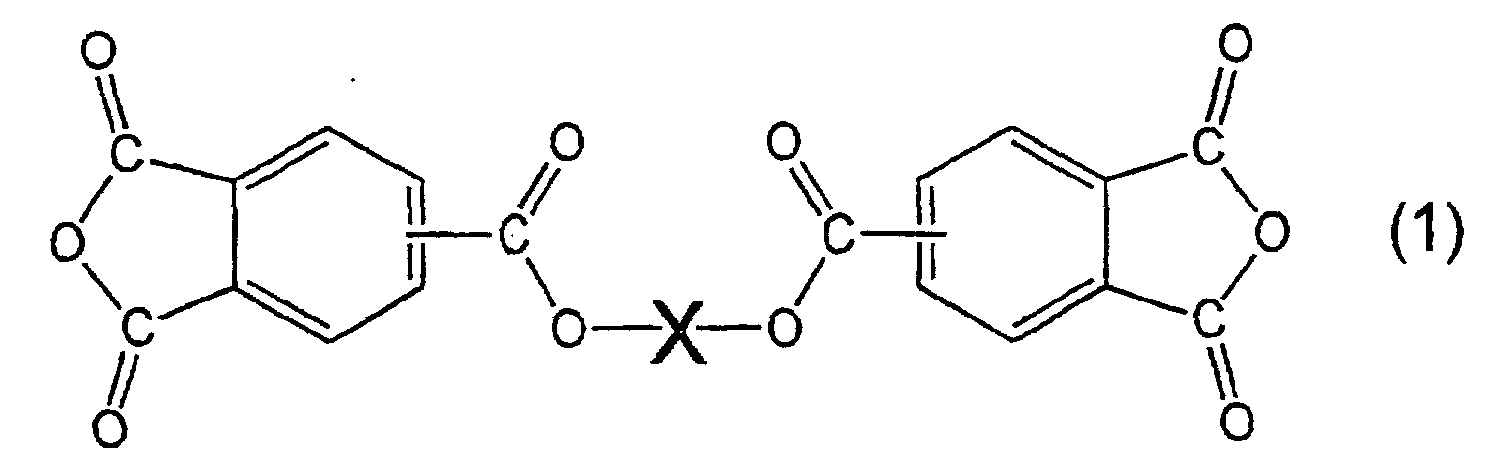 (wherein A represents -NH2- or -NCO; Y independently represents -C(=O)-, -SO2-, -O-, -S-, -(CH2)m-, -NHCO-, -C(CH3)2-, -C(CF3)2-, -C(=O)O- or a single bond; and m and n each are an integer of 0 to 10).
- The soluble polyimide according to claim 3, wherein the acid dianhydride represented by the general formula (1) is 2,2-bis(4-hydroxyphenyl)propane dibenzoate-3,3',4,4'-tetracarboxylic dianhydride

- The soluble polyimide according to claim 3, which is obtained by reacting an acid dianhydride component containing 50 mol% of 2,2-bis(4-hydroxyphenyl)propane dibenzoate-3,3',4,4'- tetracarboxylic dianhydridewith the diamine or diisocyanate component represented by the general formula (2).

- The soluble polyimide according to claim 3, wherein the general formula (2) is represented by(wherein A represents -NH2 or -NCO and R represents a bivalent organic group selected from the group consisting of -CH2- and
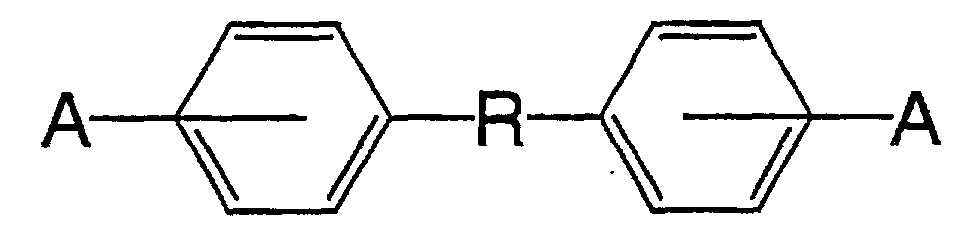
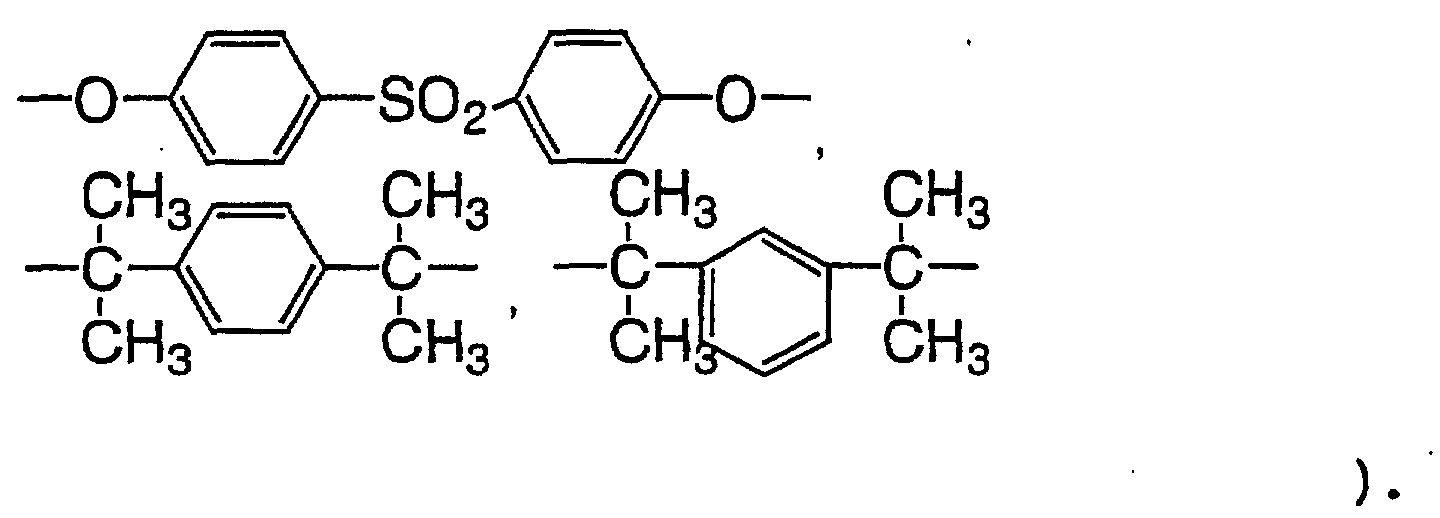
- The soluble polyimide according to claim 3, wherein the diamine or diisocyanate compound represented by the above general formula is 1,3-bis(aminophenoxy)benzeneor 1,3-bis(isocyanatephenoxy)benzene


- The soluble polyimide according to claim 3, wherein the diamine or diisocyanate compound represented by the general formula (2) is represented by the following general formula (4)(wherein Y independently represents -C(=O)-, -SO2-, -O-, -S-, -(CH2)m-, -NHCO-, -C(CH3)2-, -C(CF3)2-, -C(=O)O-, or a single bond, and m and n each are an integer of 1 to 10).

- A soluble polyimide obtained by reacting an acid dianhydride component including ester acid dianhydride represented by the general formula (1)(wherein X represents a bivalent organic group having -(CH2)k- or an aromatic group and k is an integer of 1 to 10) with a diamine component including the diamine represented by the general formula (2)
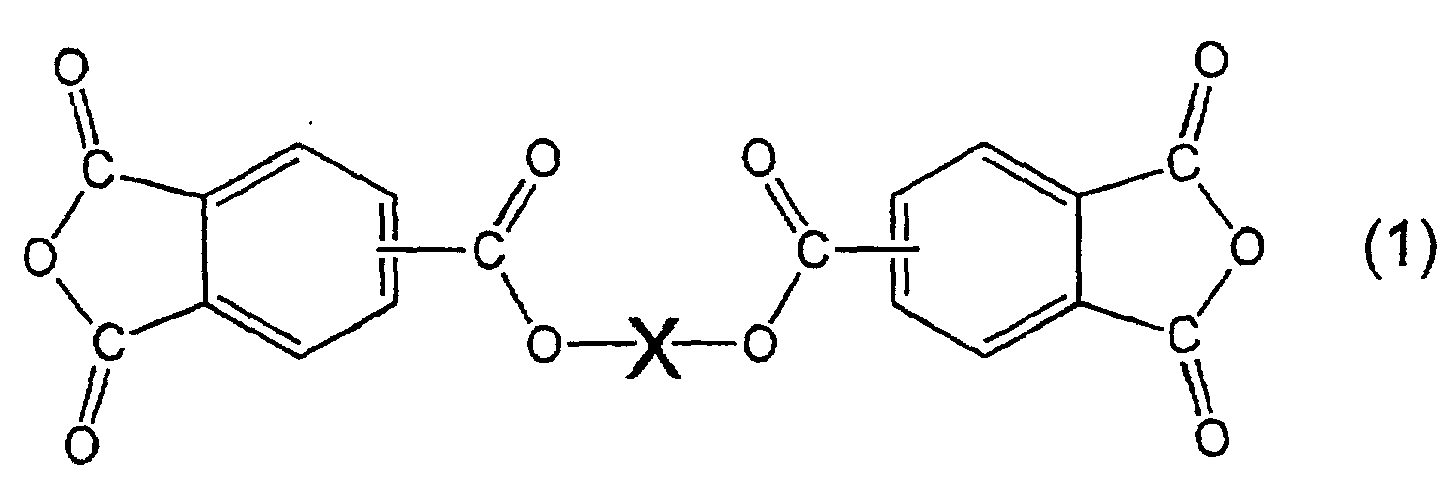 (wherein A represents -NH2- or -NCO; Y independently represents -C(=O)-, -SO2-, -O- , -S-, -(CH2)m-, -NHCO-, -C(CH3)2-, -C(CF3)2-, -C(=O)O- or a single bond; and m and n each are an integer of 0 to 10) in an organic solvent to prepare an organic solvent solution of polyamide acid; and by heating said organic solvent solution under a reduced pressure to imidize the polyamide acid.
- The soluble polyimide according to claim 9, wherein said organic solvent solution is heated under a reduced pressure at a temperature of 80°C to 400°C and/or a pressure of 0.001×10⁵ to 0.9×10⁵ Pa.
- A resinous composition for an adhesive agent, comprising:wherein said polyimide resin is obtained by reacting an acid dianhydride component containing ester acid dianhydride represented by the general formula (1)polyimide resin; andepoxy resin,(wherein X represents a bivalent organic group including -(CH2)k- or an aromatic group and k is an integer of 1 to 10)

with a diamine component containing diamine represented by the general formula (2)(wherein A represents -NH2- or -NCO, Y is -C(=O)-, -SO2-, -O-, -S-, -(CH2)m-, -NHCO-, -C(CH3)2-, -C(CF3)2-, -C(=O)O-, or a single bond, and m and n each are an integer of 0 to 10).
- A resinous composition for an adhesive agent, characterized by comprising polyimide resin and epoxy resin, wherein said polyimide resin is obtained by reacting ester acid dianhydride represented by the general formula (1)(wherein X represents a bivalent organic group including -(CH2)k- or an aromatic group and k is an integer of 1 to 10)
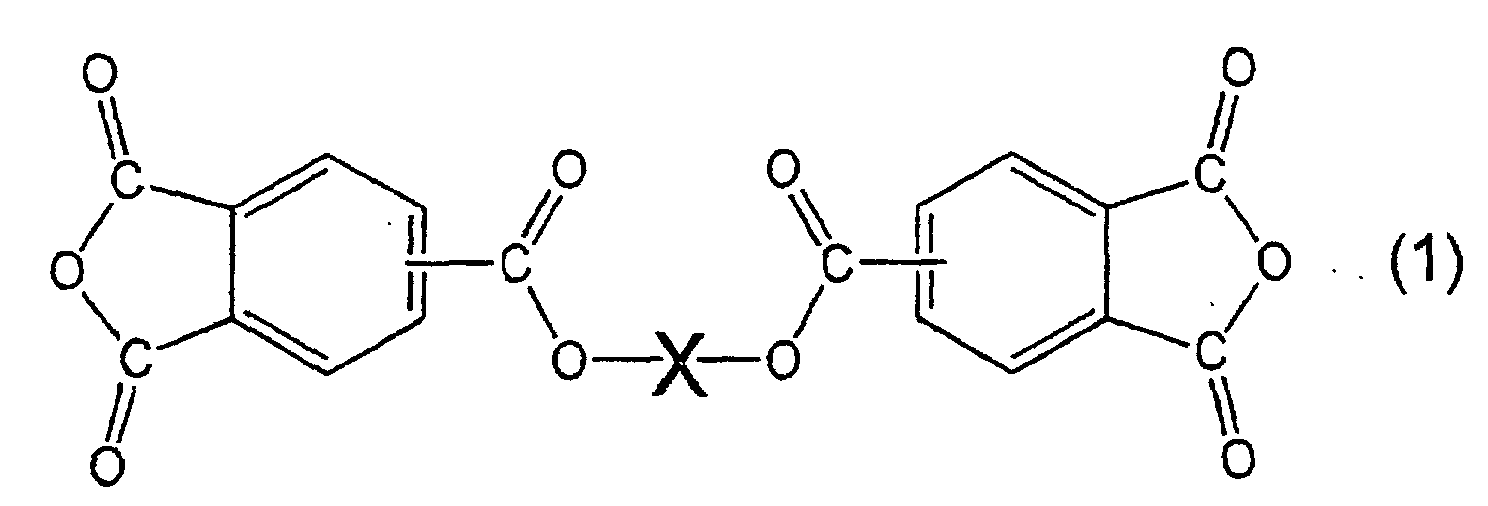
with a diamine component; said diamine component contains diamine represented by the general formula (2)(wherein A represents -NH2- or -NCO, Y independently represents -C(=O)-, -SO2-, -O-, -S-, -(CH2)m-, -NHCO-, -C(CH3)2-, -C(CF3)2-, -C(=O)O-, or a single bond, and m and n each are an integer of 0 to 10) and 3,3'-dihydroxy-4,4'-diaminobiphenyl represented by the general formula (3)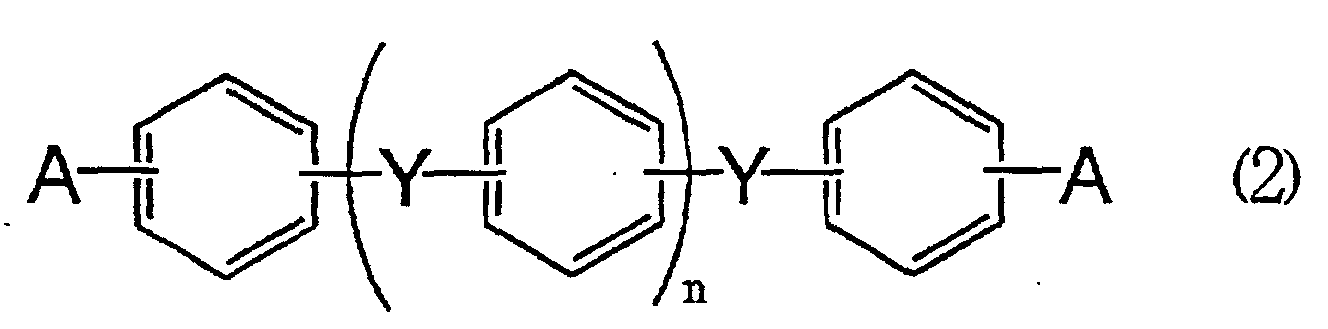 said diamine makes up 0 to 99 mol% of the whole diamine component and said 3,3-dihydroxy-4,4'-diaminobiphenyl makes up 1 to 100 mol% of the whole diamine component.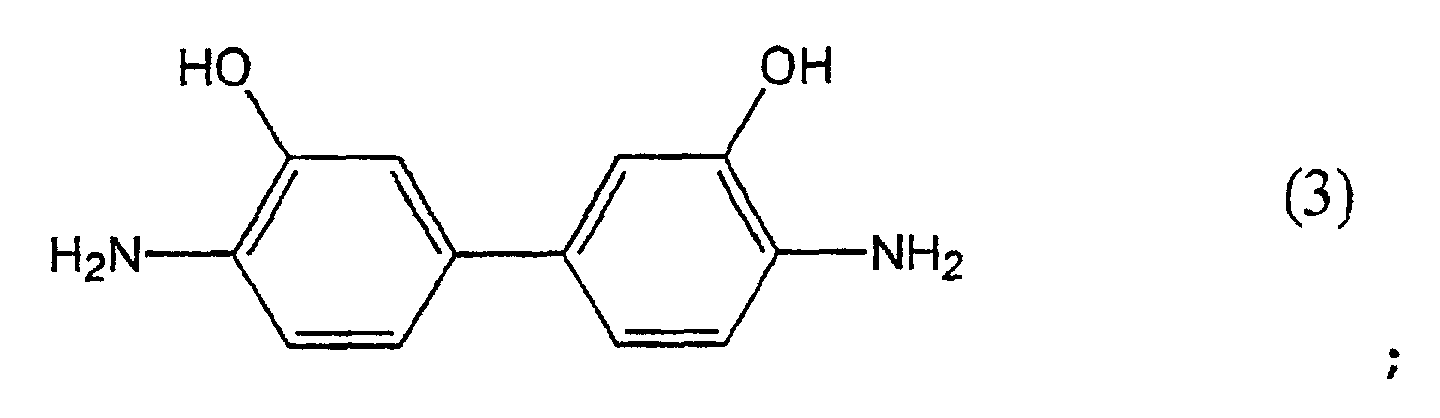
- The composition according to claim 11 or 12, futher comprising at least one kind of low-boiling solvents.
- The composition according to claim 11 or 12, which is obtained by dissolving thermoplastic polyimide, epoxy resin, and curing agent in an organic solvent containing a cyclic ether solvent.
- The composition according to claim 14, wherein said organic solvent contains 30 wt% or more of cyclic ether solvent.
- A bonding sheet comprising at least an adhesive layer, wherein said adhesive layer is made of a resinous composition containing a polyimide resin and an epoxy rein and said polyimide resin is a soluble polyimide resin having a solubility of 10% or higher at 20°C in an organic solvent of N, N-dimethylformamide, 1,4-dioxane, 1,3-dioxolane, or tetrahydrofuran.
- The bonding sheet according to claim 16, wherein, when said adhesive layer is cured, a residual volatile left in the cured layer is 3 wt% or less of the total weight of the cured layer and/or the cured layer has water absorption of 1.5 % or less.
- The bonding sheet according to claim 17, wherein said soluble polyimide resin is obtained by reacting ester acid dianhydride represented by the general formula (1)(wherein X represents a bivalent organic group having -(CH2)k- or an aromatic group and k is an integer of 1 to 10) with a diamine or diisocyanate component represented by the general formula (2)
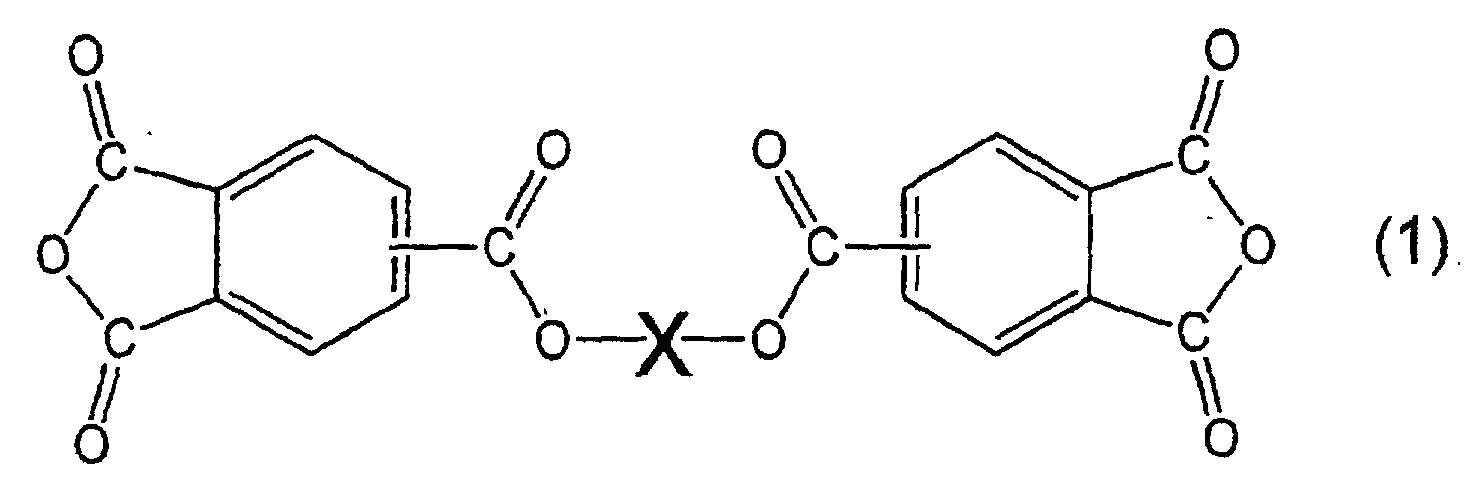 (wherein A represents -NH2- or -NCO, Y independently represents -C(=O)-, -SO2-, -O-, -S-, -(CH2)m-, -NHCO-, -C(CH2)m-, -C(CF3)2-, -C(=O)O-, or a single bond, and m and n each are an integer of 0 to 10).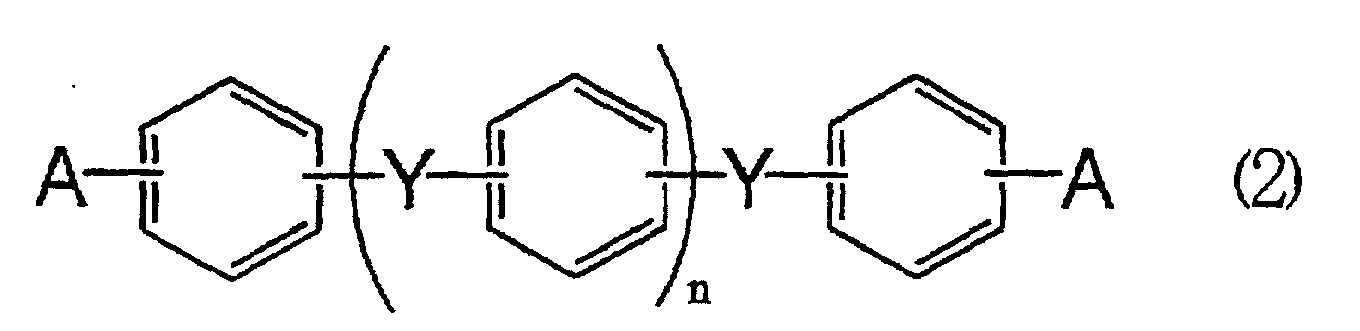
- The bonding sheet according to claim 18, characterized in that said soluble polyimide resin is obtained by reacting an acid dianhydride component including 2,2-bis(4-hydroxyphenyl)propane dibenzoate-3,3',4,4'-tetracarboxylic dianhydride represented by the general formula (2)with a diamine or diisocyanate component.

- The bonding sheet according to claim 18, characterized in that said soluble polyimide resin is obtained by reacting a diamine or diisocyanate component including 1,3-bis(aminophenoxy)benzene;or 1,3-bis(isocyanatephenoxy)benzene;
 with the acid dianhydride component.
- A bonding sheet obtained by casting or applying the composition according to any one of claims 11 to 15 over a support, drying the composition, and subsequently peeling an adhesive layer from the support.
- A bonding sheet comprising a polyimide adhesive layer on a surface thereof, wherein said polyimide adhesive layer is obtained by casting or applying the composition according to any one of claims 11 to 15 over at least one surface of a polyimide film and subsequently drying the composition.
- The bonding sheet according to claim 21 or 22, wherein a thickness of said polyimide adhesive layer is 5 to 30 µm.
- The bonding sheet according to any one of claims 16 to 20, comprising at least an adhesive layer, wherein main constituents of said adhesive layer are:I) 100 parts by weight of soluble polyimide resin;II) 3 to 100 parts by weight of epoxy resin; andIII) 0.5 to 50 parts by weight of accelerator or curing agent.
- The bonding sheet according to claim 21 or 22, comprising a mold release film on at least one surface thereof.
- The bonding sheet according to claim 25, wherein said mold release film is mainly composed of PET(polyethylene terephthalate) or PEN (polyethylene naphthalate).
- An adhesive laminated film for covering an accelerator beam tube, comprising an adhesive layer on at least one surface of a polyimide film, wherein said adhesive layer is composed of a composition containing a thermoplastic resin having a glass transition temperature of 100°C to 250°C and water absorption of 1.5 % or less and a thermosetting resin.
- The adhesive laminated film for covering an accelerator beam tube according to claim 27, wherein said thermoplastic resin is a soluble polyimide resin obtained by reacting an acid dianhydride component including ester acid dianhydride represented by the general formula (1)(wherein X represents a bivalent organic group having -(CH2)k- or an aromatic group and k is an integer of 1 to 10) with a diamine component represented by the general formula (2)
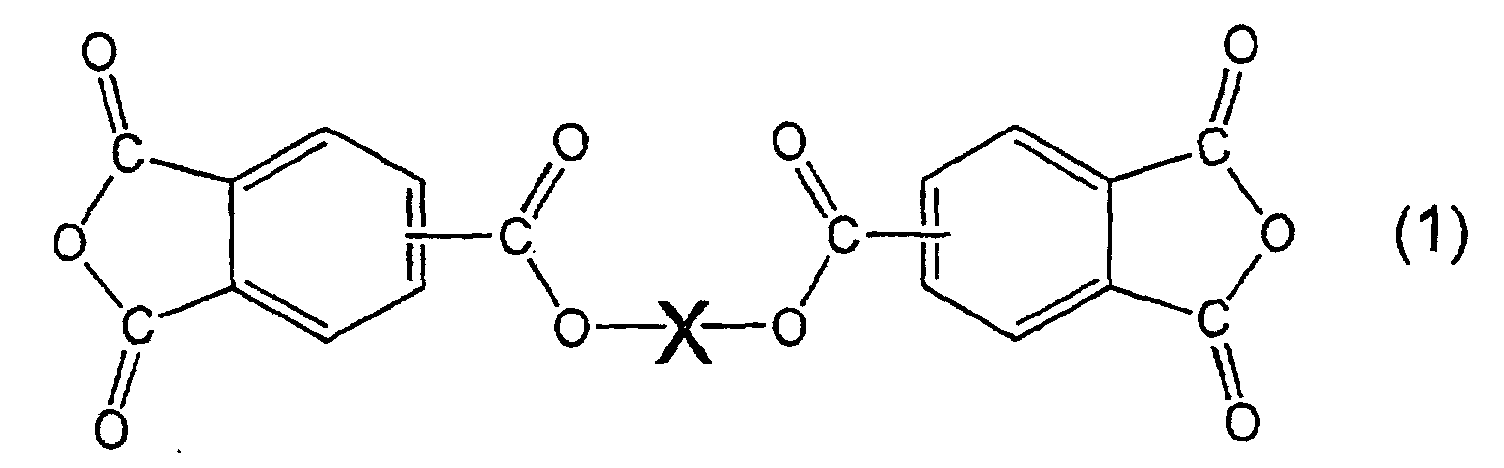 (wherein A represents -NH2- or -NCO, Y independently represents -C(=O)-, -SO2-, -O-, -S-, -(CH2)m-, -NHCO-, -C(CH3)2-, -C(CF3)2-, -C(=O)O- or a single bond, and m and n each are an integer of 0 to 10).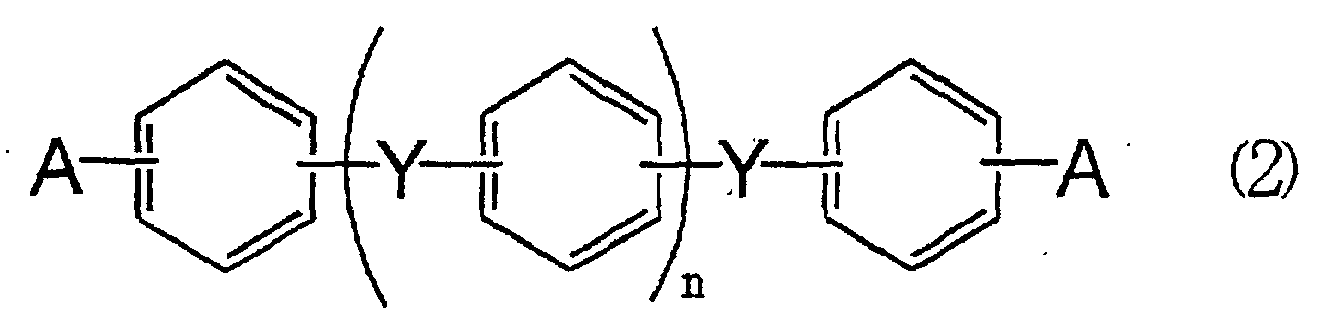
- The adhesive laminated film for covering an accelerator beam tube according to claim 27 or 28, wherein said thermosetting resin comprises two or more kinds of epoxy groups in one molecule.
- An adhesive laminated film for covering a conductor wire for an accelerator quench heater, comprising an adhesive layer on at least one surface of a polyimide film, wherein said adhesive layer is composed of a composition containing a soluble polyimide resin having a glass transition temperature of 100°C to 250°C and water absorption of 1.5 % or less and a thermosetting resin.
- The adhesive laminated film for covering a conductor wire for an accelerator quench heater according to claim 30, wherein said soluble polyimide is a polyimide resin obtained by reacting an acid dianhydride component including ester acid dianhydride represented by the general formula (1)(wherein X represents a bivalent organic group having -(CH2)k- or an aromatic group and k is an integer of 1 to 10) with a diamine component represented by the general formula (2)
 (wherein A represents -NH2- or -NCO, Y independently represents -C(=O)-, -SO2-, -O-, -S-, -(CH2)m-, -NHCO-, -C(CH3)2-, -C(CF3)2-, -C(=O)O- or a single bond, and m and n each are an integer of 0 to 10).
- The adhesive laminated film for covering a conductor wire for an accelerator quench heater according to claim 30, wherein said thermosetting resin comprises two or more epoxy groups in one molecule.
Applications Claiming Priority (15)
| Application Number | Priority Date | Filing Date | Title |
|---|---|---|---|
| JP31932399 | 1999-11-10 | ||
| JP31932399 | 1999-11-10 | ||
| JP2000045542 | 2000-02-23 | ||
| JP2000045542 | 2000-02-23 | ||
| JP2000102194 | 2000-04-04 | ||
| JP2000102195 | 2000-04-04 | ||
| JP2000102194 | 2000-04-04 | ||
| JP2000102196 | 2000-04-04 | ||
| JP2000102192 | 2000-04-04 | ||
| JP2000102193 | 2000-04-04 | ||
| JP2000102195 | 2000-04-04 | ||
| JP2000102193 | 2000-04-04 | ||
| JP2000102192 | 2000-04-04 | ||
| JP2000102196 | 2000-04-04 | ||
| PCT/JP2000/007984 WO2001034678A1 (en) | 1999-11-10 | 2000-11-10 | Soluble polyimide and composition comprising the same, bonding sheet, adhesive laminated film for covering accelerator beam tube, and adhesive laminated film for covering conductor wire for accelerator quench heater |
Publications (2)
| Publication Number | Publication Date |
|---|---|
| EP1281727A1 true EP1281727A1 (en) | 2003-02-05 |
| EP1281727A4 EP1281727A4 (en) | 2004-08-04 |
Family
ID=27566898
Family Applications (1)
| Application Number | Title | Priority Date | Filing Date |
|---|---|---|---|
| EP00974953A Withdrawn EP1281727A4 (en) | 1999-11-10 | 2000-11-10 | Soluble polyimide and composition comprising the same, bonding sheet, adhesive laminated film for covering accelerator beam tube, and adhesive laminated film for covering conductor wire for accelerator quench heater |
Country Status (2)
| Country | Link |
|---|---|
| EP (1) | EP1281727A4 (en) |
| WO (1) | WO2001034678A1 (en) |
Cited By (5)
| Publication number | Priority date | Publication date | Assignee | Title |
|---|---|---|---|---|
| CN100523052C (en) * | 2005-06-03 | 2009-08-05 | 长春人造树脂厂股份有限公司 | Novel polyimide resin and process for producing the same |
| CN100523051C (en) * | 2005-06-03 | 2009-08-05 | 长春人造树脂厂股份有限公司 | Soluble polyimide resin and preparation method thereof |
| US7838114B2 (en) | 2004-02-25 | 2010-11-23 | Kaneka Corporation | Thermosetting resin composition and use thereof |
| WO2020069516A1 (en) * | 2018-09-28 | 2020-04-02 | Kaneka Americas Holding, Inc. | Polyamic acid resin in reach-approved solvent system for wire coating applications |
| CN114015409A (en) * | 2021-11-04 | 2022-02-08 | 杭州福斯特电子材料有限公司 | Composite adhesive, flexible copper-clad plate and preparation method thereof |
Families Citing this family (6)
| Publication number | Priority date | Publication date | Assignee | Title |
|---|---|---|---|---|
| JP2002361788A (en) * | 2001-06-06 | 2002-12-18 | Kanegafuchi Chem Ind Co Ltd | Adhesive composition, laminate using the same, and multilayer printed wiring board |
| JP2003011308A (en) * | 2001-07-03 | 2003-01-15 | Kanegafuchi Chem Ind Co Ltd | Film-shaped laminated member |
| JP4221290B2 (en) * | 2001-07-09 | 2009-02-12 | 株式会社カネカ | Resin composition |
| JP4829490B2 (en) * | 2004-10-06 | 2011-12-07 | 三井化学株式会社 | 1,3-bis (3- (3-isocyanatophenoxy) phenoxy) benzene and process for producing the same |
| JP6932349B2 (en) * | 2017-08-24 | 2021-09-08 | 宇部興産株式会社 | Solvent-soluble polyimide and polyimide solution composition |
| CN112126110B (en) * | 2020-08-31 | 2022-11-08 | 哈尔滨工程大学 | Polyimide sound-absorbing foam with spherical dimple microstructure and preparation method thereof |
Family Cites Families (11)
| Publication number | Priority date | Publication date | Assignee | Title |
|---|---|---|---|---|
| US3856752A (en) * | 1973-10-01 | 1974-12-24 | Ciba Geigy Corp | Soluble polyimides derived from phenylindane diamines and dianhydrides |
| JPS61141731A (en) * | 1984-12-14 | 1986-06-28 | Ube Ind Ltd | Transparent aromatic polyimide and its composition |
| JPH0195155A (en) * | 1987-10-05 | 1989-04-13 | Mitsubishi Kasei Corp | Polyimide resin composition |
| JPH02124972A (en) * | 1988-11-02 | 1990-05-14 | Shin Etsu Chem Co Ltd | Liquid composition containing polyimide resin |
| JP2712597B2 (en) * | 1989-07-28 | 1998-02-16 | 日立化成工業株式会社 | Wiring board substrate |
| JPH06128462A (en) * | 1992-10-15 | 1994-05-10 | Hitachi Chem Co Ltd | Thermosetting resin composition, adhesive sheet, polyimide film having adhesive and metal foil laminated polyimide film |
| JPH0792452A (en) * | 1993-09-24 | 1995-04-07 | Sumitomo Electric Ind Ltd | Polymer for liquid crystal display, liquid crystal device using the same, and method for producing liquid crystal device |
| JP3446845B2 (en) * | 1994-10-14 | 2003-09-16 | 東洋紡績株式会社 | Polyamide-imide resin composition, varnish thereof, and method for producing the varnish |
| JP2932052B2 (en) * | 1995-05-31 | 1999-08-09 | 株式会社巴川製紙所 | Novel polyimide and method for producing the same |
| JPH11228693A (en) * | 1998-02-16 | 1999-08-24 | Kanegafuchi Chem Ind Co Ltd | Polyimide resin solution and method for producing the same |
| JP3942063B2 (en) * | 1999-06-28 | 2007-07-11 | 株式会社カネカ | Novel polyimide composition and novel acid dianhydride used in the same |
-
2000
- 2000-11-10 WO PCT/JP2000/007984 patent/WO2001034678A1/en not_active Ceased
- 2000-11-10 EP EP00974953A patent/EP1281727A4/en not_active Withdrawn
Cited By (6)
| Publication number | Priority date | Publication date | Assignee | Title |
|---|---|---|---|---|
| US7838114B2 (en) | 2004-02-25 | 2010-11-23 | Kaneka Corporation | Thermosetting resin composition and use thereof |
| CN100523052C (en) * | 2005-06-03 | 2009-08-05 | 长春人造树脂厂股份有限公司 | Novel polyimide resin and process for producing the same |
| CN100523051C (en) * | 2005-06-03 | 2009-08-05 | 长春人造树脂厂股份有限公司 | Soluble polyimide resin and preparation method thereof |
| WO2020069516A1 (en) * | 2018-09-28 | 2020-04-02 | Kaneka Americas Holding, Inc. | Polyamic acid resin in reach-approved solvent system for wire coating applications |
| US20210395458A1 (en) * | 2018-09-28 | 2021-12-23 | Kaneka Americas Holding, Inc. | Polyamic acid resin in reach-approved solvent system for wire coating applications |
| CN114015409A (en) * | 2021-11-04 | 2022-02-08 | 杭州福斯特电子材料有限公司 | Composite adhesive, flexible copper-clad plate and preparation method thereof |
Also Published As
| Publication number | Publication date |
|---|---|
| WO2001034678A1 (en) | 2001-05-17 |
| EP1281727A4 (en) | 2004-08-04 |
Similar Documents
| Publication | Publication Date | Title |
|---|---|---|
| JP4743732B2 (en) | Adhesive laminated film for wire coating | |
| CN107325285B (en) | Polyimide, polyimide-based adhesive, adhesive material, adhesive layer, adhesive sheet, laminate, wiring board, and method for producing same | |
| TWI780992B (en) | Polyimide, adhesive, film-like adhesive material, adhesive layer, adhesive sheet, copper foil with resin, copper-clad laminate, printed wiring board, and multilayer wiring board, and method for producing the same | |
| TWI754668B (en) | Copper clad laminate for flexible printed circuit board and flexible printed circuit board | |
| TWI716524B (en) | Copper clad laminate and printed circuit board | |
| CN108690194B (en) | Polyimide, adhesive material, adhesive layer, adhesive sheet, copper foil, copper-clad laminate, wiring board, and method for producing same | |
| CN106010421B (en) | Adhesive composition, film-like adhesive material, adhesive layer, adhesive sheet, copper-clad laminate, wiring board, and printed wiring board | |
| JP6686619B2 (en) | Polyimide adhesive, film adhesive, adhesive layer, adhesive sheet, copper clad laminate and printed wiring board, and multilayer wiring board and method for producing the same | |
| CN108690552B (en) | Adhesive, adhesive material, adhesive layer, adhesive sheet, copper foil, copper-clad laminate, wiring board, and method for producing same | |
| JPWO2000061658A1 (en) | Polyimide resin, resin composition using the same with improved moisture resistance, adhesive solution, film-like joining member, adhesive laminate film, and methods for producing the same | |
| US20040176526A1 (en) | Resin composition | |
| TWI400268B (en) | Thermosetting resin composition and use thereof | |
| JP2016069651A (en) | Polyimide resin composition, adhesive composition, primer composition, laminate and copper foil with resin | |
| KR102863937B1 (en) | Polyimide resin composition, adhesive composition, film-shaped adhesive material, adhesive sheet, copper foil with resin, copper clad laminate, printed wiring board and polyimide film | |
| JP5573573B2 (en) | Resin composition, prepreg, metal foil with resin, adhesive film and metal foil-clad laminate | |
| KR102524336B1 (en) | Resin composition, adhesive, film type adhesive substrate, adhesive sheet, multilayer wiring board, resin attached copper foil, copper-clad laminate, printed wiring board | |
| JP4875794B2 (en) | Resin composition | |
| WO2001034678A1 (en) | Soluble polyimide and composition comprising the same, bonding sheet, adhesive laminated film for covering accelerator beam tube, and adhesive laminated film for covering conductor wire for accelerator quench heater | |
| JP2001329246A (en) | A curable resin composition for an adhesive having improved moisture resistance, a cured product obtained therefrom, and a method for producing the same. | |
| JP4620834B2 (en) | Bonding sheet | |
| JP2005162945A (en) | Heat-resistant resin composition and resin and adhesive film produced therefrom | |
| JP2000143981A (en) | Resin composition | |
| JPWO2001034678A1 (en) | Soluble polyimide, and composition using same, bonding sheet, adhesive laminated film for coating accelerator beam tube, adhesive laminated film for coating lead wire for accelerator quench heater |
Legal Events
| Date | Code | Title | Description |
|---|---|---|---|
| PUAI | Public reference made under article 153(3) epc to a published international application that has entered the european phase |
Free format text: ORIGINAL CODE: 0009012 |
|
| 17P | Request for examination filed |
Effective date: 20020606 |
|
| AK | Designated contracting states |
Designated state(s): AT BE CH CY DE DK ES FI FR GB GR IE IT LI LU MC NL PT SE TR |
|
| RBV | Designated contracting states (corrected) |
Designated state(s): AT BE CH CY DE FR IT LI |
|
| A4 | Supplementary search report drawn up and despatched |
Effective date: 20040617 |
|
| 17Q | First examination report despatched |
Effective date: 20050610 |
|
| 17Q | First examination report despatched |
Effective date: 20050610 |
|
| STAA | Information on the status of an ep patent application or granted ep patent |
Free format text: STATUS: THE APPLICATION HAS BEEN WITHDRAWN |
|
| 18W | Application withdrawn |
Effective date: 20061213 |