EP1281460A1 - Niobium powder, sintered compact thereof and capacitor - Google Patents
Niobium powder, sintered compact thereof and capacitor Download PDFInfo
- Publication number
- EP1281460A1 EP1281460A1 EP01921995A EP01921995A EP1281460A1 EP 1281460 A1 EP1281460 A1 EP 1281460A1 EP 01921995 A EP01921995 A EP 01921995A EP 01921995 A EP01921995 A EP 01921995A EP 1281460 A1 EP1281460 A1 EP 1281460A1
- Authority
- EP
- European Patent Office
- Prior art keywords
- capacitor
- niobium
- powder
- niobium powder
- sintered body
- Prior art date
- Legal status (The legal status is an assumption and is not a legal conclusion. Google has not performed a legal analysis and makes no representation as to the accuracy of the status listed.)
- Granted
Links
Classifications
-
- H—ELECTRICITY
- H01—ELECTRIC ELEMENTS
- H01G—CAPACITORS; CAPACITORS, RECTIFIERS, DETECTORS, SWITCHING DEVICES, LIGHT-SENSITIVE OR TEMPERATURE-SENSITIVE DEVICES OF THE ELECTROLYTIC TYPE
- H01G9/00—Electrolytic capacitors, rectifiers, detectors, switching devices, light-sensitive or temperature-sensitive devices; Processes of their manufacture
- H01G9/004—Details
- H01G9/04—Electrodes or formation of dielectric layers thereon
- H01G9/048—Electrodes or formation of dielectric layers thereon characterised by their structure
- H01G9/052—Sintered electrodes
- H01G9/0525—Powder therefor
-
- C—CHEMISTRY; METALLURGY
- C22—METALLURGY; FERROUS OR NON-FERROUS ALLOYS; TREATMENT OF ALLOYS OR NON-FERROUS METALS
- C22B—PRODUCTION AND REFINING OF METALS; PRETREATMENT OF RAW MATERIALS
- C22B34/00—Obtaining refractory metals
- C22B34/20—Obtaining niobium, tantalum or vanadium
- C22B34/24—Obtaining niobium or tantalum
-
- C—CHEMISTRY; METALLURGY
- C22—METALLURGY; FERROUS OR NON-FERROUS ALLOYS; TREATMENT OF ALLOYS OR NON-FERROUS METALS
- C22C—ALLOYS
- C22C27/00—Alloys based on rhenium or a refractory metal not mentioned in groups C22C14/00 or C22C16/00
- C22C27/02—Alloys based on vanadium, niobium, or tantalum
-
- Y—GENERAL TAGGING OF NEW TECHNOLOGICAL DEVELOPMENTS; GENERAL TAGGING OF CROSS-SECTIONAL TECHNOLOGIES SPANNING OVER SEVERAL SECTIONS OF THE IPC; TECHNICAL SUBJECTS COVERED BY FORMER USPC CROSS-REFERENCE ART COLLECTIONS [XRACs] AND DIGESTS
- Y10—TECHNICAL SUBJECTS COVERED BY FORMER USPC
- Y10T—TECHNICAL SUBJECTS COVERED BY FORMER US CLASSIFICATION
- Y10T428/00—Stock material or miscellaneous articles
- Y10T428/29—Coated or structually defined flake, particle, cell, strand, strand portion, rod, filament, macroscopic fiber or mass thereof
- Y10T428/2982—Particulate matter [e.g., sphere, flake, etc.]
-
- Y—GENERAL TAGGING OF NEW TECHNOLOGICAL DEVELOPMENTS; GENERAL TAGGING OF CROSS-SECTIONAL TECHNOLOGIES SPANNING OVER SEVERAL SECTIONS OF THE IPC; TECHNICAL SUBJECTS COVERED BY FORMER USPC CROSS-REFERENCE ART COLLECTIONS [XRACs] AND DIGESTS
- Y10—TECHNICAL SUBJECTS COVERED BY FORMER USPC
- Y10T—TECHNICAL SUBJECTS COVERED BY FORMER US CLASSIFICATION
- Y10T428/00—Stock material or miscellaneous articles
- Y10T428/29—Coated or structually defined flake, particle, cell, strand, strand portion, rod, filament, macroscopic fiber or mass thereof
- Y10T428/2982—Particulate matter [e.g., sphere, flake, etc.]
- Y10T428/2991—Coated
-
- Y—GENERAL TAGGING OF NEW TECHNOLOGICAL DEVELOPMENTS; GENERAL TAGGING OF CROSS-SECTIONAL TECHNOLOGIES SPANNING OVER SEVERAL SECTIONS OF THE IPC; TECHNICAL SUBJECTS COVERED BY FORMER USPC CROSS-REFERENCE ART COLLECTIONS [XRACs] AND DIGESTS
- Y10—TECHNICAL SUBJECTS COVERED BY FORMER USPC
- Y10T—TECHNICAL SUBJECTS COVERED BY FORMER US CLASSIFICATION
- Y10T428/00—Stock material or miscellaneous articles
- Y10T428/31504—Composite [nonstructural laminate]
Definitions
- the present invention relates to niobium powder employed for producing a capacitor exhibiting excellent reliability; a sintered body formed from the powder; and a capacitor comprising the sintered body.
- Capacitors employed in electronic apparatuses such as cellular phones and personal computers desirably have small size and high capacitance.
- a tantalum capacitor has been widely employed, since the tantalum capacitor has high capacitance relative to its size and exhibits excellent performance.
- a sintered body of tantalum powder is employed as a positive electrode. Therefore, in order to increase the capacitance of the capacitor, the mass of the sintered body must be increased.
- the capacitor when the mass of the sintered body is increased, the capacitor necessarily becomes large and therefore fails to satisfy the demand for small size.
- a capacitor comprising a sintered body of a powder material having a dielectric constant higher than that of tantalum has been studied.
- Niobium is an example of such a material having a high dielectric constant.
- Japanese Patent Application Laid-Open ( kokai ) No. 55-157226 discloses a production process for a sintered element employed in a capacitor, in which niobium agglomeration and niobium powder having a particle size of 2.0 ⁇ m or less are press-shaped and sintered, the resultant sintered body is cut into small pieces, a lead portion is connected to each piece, and the resultant piece is sintered again.
- the publication does not disclose capacitor characteristics in detail.
- US Patent No. 4,084,965 discloses a capacitor formed from niobium powder having a particle size of 5.1 ⁇ m, which powder is obtained through pulverization of hydrogenated niobium ingot.
- a niobium sintered body has a high leakage current (LC) compared with a tantalum sintered body, and thus may fail to be practically useful.
- the present inventors have proposed that the leakage current of niobium can be reduced when the niobium is subjected to, for example, partial nitridation (see Japanese Patent Application Laid-Open ( kokai ) No. 10-242004, US Patent No. 6,115,235) and that when a sintered body of niobium is produced, the sintering temperature is elevated in order to further reduce the leakage current of niobium.
- the product of capacitance per unit mass of the produced sintered body and formation voltage during production of a dielectric on the sintered body decreases. Therefore, obtaining a well-balanced niobium sintered body having high CV and low LC, which is the intended product, is difficult. Meanwhile, when a capacitor is produced from a niobium sintered body obtained so as to attain only high CV, the capacitor encounters the problem in that LC is specifically high.
- niobium Since the affinity of niobium to oxygen is higher than that of tantalum to oxygen, niobium is partly oxidized at room temperature. As described below, when niobium is sintered and the resultant sintered body is employed as one electrode of a capacitor, the aforementioned oxidized portions adversely affect a dielectric of the capacitor, possibly resulting in poor reliability of the capacitor.
- spike noise a rapid change of noise
- the capacitor when voltage is applied to the capacitor at room temperature after the capacitor is subjected to a high-temperature load test (an acceleration test), a rapid change of noise (hereafter, referred to as spike noise) may be generated.
- spike noise a rapid change of noise
- the capacitor when the capacitor is provided on a circuit substrate, when the capacitor is used for a prolonged period of time, generated noise may adversely affect other electronic parts on the circuit board.
- the capacitor involves some problems about reliability.
- an object of the present invention is to provide niobium powder employed for producing a capacitor exhibiting excellent reliability; a sintered body formed from the powder; and a capacitor comprising the sintered body exhibiting excellent reliability. Even when niobium exhibiting high affinity to oxygen is employed, such niobium powder is obtained by regulating the amount of oxygen contained in the powder.
- the present invention provides a niobium powder, a sintered body using the powder, and a capacitor using the sintered body as follows:
- the niobium powder of the present invention is characterized in that the mass ratio of the nitrogen content to the oxygen content is adjusted to 1/45 or more, preferably 1/40 or more and more preferably 1/30 or more in the niobium powder which has been partially oxidized.
- a capacitor produced from the niobium powder fails to exhibit excellent reliability.
- a high-temperature load test which is an acceleration test for evaluating reliability of the capacitor
- spike noise may be generated .
- Generation of spike noise is not preferable, and reliability of the capacitor deteriorates (see Comparative Examples in Table 2 as mentioned later).
- Oxygen and nitrogen contained in the niobium powder is attributed to neither oxygen and nitrogen adsorbed onto the powder nor oxygen and nitrogen physically doped in the powder, but is attributed to oxygen and nitrogen incorporated into the powder through chemical oxidation and chemical nitridation.
- oxygen content and nitrogen content refers to the amount of oxygen and nitrogen contained in the niobium powder.
- the niobium powder having high affinity to oxygen is naturally oxidized in air at room temperature, and thus the niobium powder having the mean particle size specified in the present invention contains oxygen in an amount of usually 5,000 to 60,000 ppm. Therefore, the niobium powder of the present invention is not necessarily oxidized intentionally.
- the nitrogen content by nitridation is 1/45 or more in the mass ratio the oxygen content, and the range from 200 mass ppm (hereinafter “mass ppm” will be abbreviated as “ppm”) to 20,000 ppm is good.
- mass ppm mass ppm
- the nitrogen content is substantially 300 to 9,000 ppm , preferably 500 to 7,000 ppm.
- Nitridation of niobium powder is carried out through a liquid nitridation method, an ion nitridation method, or a gas nitridation method. These methods may be carried out singly or in combination.
- a gas nitridation method in which niobium powder is nitridized in a nitridation gas atmosphere is preferable, since the apparatus for the method is simple and is easily operated.
- such a gas nitridation method can be carried out by allowing the niobium powder to stand in a nitrogen atmosphere.
- the niobium powder comes to comprise the intended amount of nitrogen.
- the nitridation time can be shortened.
- the nitrogen content of niobium powder can be controlled under the conditions of nitridation temperature and nitridation time which are determined through pretests, after the particle size and the oxygen content of the niobium powder are measured.
- niobium powder not only niobium powder, but also granulated niobium powder can be subjected to the aforementioned nitridation.
- Niobium powder serving as a raw material of the sintered body preferably has a mean particle size of 0.05 ⁇ m to 3 ⁇ m.
- the mean particle size of the niobium powder is more preferably 0.05 ⁇ m to 1 ⁇ m.
- the mean particle size of the powder is less than 0.05 ⁇ m, pores in the sintered body become very small, and thus the below-described second electrode (negative electrode material) may be difficult to impregnate into the sintered body.
- the mean particle size of the powder exceeds 3 ⁇ m or more, capacitance per unit weight of the sintered body becomes low, which is not preferable.
- the term "mean particle size” refers to D 50 value (particle size value in which the cumulative mass% corresponds to 50 mass%), which value is measured by use of a particle size distribution measurement apparatus (product name: Microtrac).
- the niobium powder having the aforementioned mean particle size may be obtained by means of pulverization of a sodium-reduced compound of potassium fluoroniobate, pulverization of a hydrogenated niobium ingot and dehydrogenation thereof, or carbon-reduction of niobium oxide.
- the niobium powder is obtained through pulverization of hydrogenated niobium ingot and dehydrogenation thereof, the degree of hydrogenation of a niobium ingot, and the time for pulverization of the ingot by use of a pulverization apparatus are controlled, to thereby obtain the niobium powder having the desired mean particle size.
- the thus-obtained niobium powder may contain impurities attributed to the raw material, the reducing agent, and the employed apparatus.
- a typical impurity is iron, nickel, cobalt, silicon, sodium, potassium, and magnesium (hereafter, referred to as an element M).
- the element M When the niobium powder containing the element M as an impurity is employed for producing a capacitor, the element M may migrate into a dielectric layer. Therefore, when voltage is applied to the capacitor, the element M may cause abnormal accumulation of electric charge, and leakage current of the capacitor may become larger.
- the amount of each of the elements M when the amount of each of the elements M is 100 ppm or less or the total amount of the elements M is 350 ppm or less, the effect on the aforementioned dielectric layer can be reduced.
- the amount of each of the elements M is preferably 70 ppm or less, more preferably 30 ppm or less.
- the total amount of the elements M is preferably 300 ppm or less, more preferably 200 ppm or less.
- the removal of the impurity element M includes a method of washing the niobium powder with an acid and a method of washing with an alkali, and a method of washing the niobium powder with an acid is preferable.
- an acid include hydrofluoric acid, nitric acid, sulfuric acid, and hydrochloric acid, preferably at least one acid selected from among hydrofluoric acid, nitric acid, and sulfuric acid. More preferable method of washing is using nitric acid and hydrogen peroxide at the same time.
- the powder is sufficiently washed with sulfuric acid, residual sulfuric acid is neutralized by use of an alkali, and then the powder is washed with water.
- nitric acid is employed together with hydrogen peroxide for washing the powder, oxidation of the powder by nitric acid can be prevented, which is advantageous.
- the powder may also be washed by means of another method. For example, the powder is stirred in the above-described reagent for a suitable period of time; i.e., until the impurity content reaches a predetermined value or less, and the powder is separated from the reagent.
- the niobium powder may be employed after the niobium powder is formed into granules having an appropriate shape.
- the granulated niobium powder may be employed by mixing with an appropriate amount of non-granulated niobium powder.
- the niobium powder may be granulated through a conventionally-known method. Examples include a method in which non-granulated niobium powder is allowed to stand in vacuum at high temperature for agglomeration, and then the resultant agglomerations are pulverized; and a method in which non-granulated niobium powder is mixed with a specific binder, and the resultant mixture is pulverized.
- niobium powder when niobium powder is kneaded with a binder, a solvent may be employed if necessary.
- the resultant mixture is dried and then pulverized.
- Typical examples of the binder include polyvinyl alcohol and acrylic resins.
- the solvent which may be employed is selected from among acetone, alcohols, esters such as butyl acetate, water, and the like.
- the thus-granulated niobium powder has a mean particle size of 300 ⁇ m or less, preferably 200 ⁇ m or less, more preferably 1 to 200 ⁇ m.
- the niobium powder is sintered to thereby produce the sintered body according to the present invention.
- An example production process for the sintered body is described below.
- the niobium powder is subjected to pressure-shaping into a predetermined form, and then heated at 500 to 2,000°C, preferably 900 to 1,500°C, more preferably 900 to 1,250°C, under a reduced pressure of 1.33 ⁇ 10 -4 to 1.33 ⁇ 10 2 Pa for several minutes to several hours.
- a capacitor of the present invention comprises a first electrode made of the aforementioned sintered body, a dielectric formed on a surface of the sintered body and a second electrode provided on the aforementioned dielectric.
- a lead wire formed from a valve action metal, such as niobium or tantalum, and of appropriate shape and length.
- a valve action metal such as niobium or tantalum
- the dielectric of the capacitor is preferably a dielectric formed from niobium oxide.
- the niobium oxide dielectric is easily obtained by subjecting the niobium sintered body serving as the first electrode to formation in an electrolyte. Formation of the niobium electrode in the electrolyte is typically performed by use of an aqueous solution of a protic acid; for example, a 0.1% aqueous solution of phosphoric acid or sulfuric acid.
- the capacitor of the present invention serves as an electrolytic capacitor and the niobium sintered body becomes a positive electrode.
- the material of the second electrode of the capacitor of the present invention there may be employed at least one material (compound) selected from among electrolytes, organic semiconductors, and inorganic semiconductors, all of which are known in the aluminum electrolytic capacitor industry.
- electrolytes include a solution mixture of ethylene glycol and dimethylformamide containing isobutyltripropylammonium borotetrafluoride in an amount of 5 mass%; and a solution mixture of ethylene glycol and propylene carbonate containing tetraethylammonium borotetrafluoride in an amount of 7 mass%.
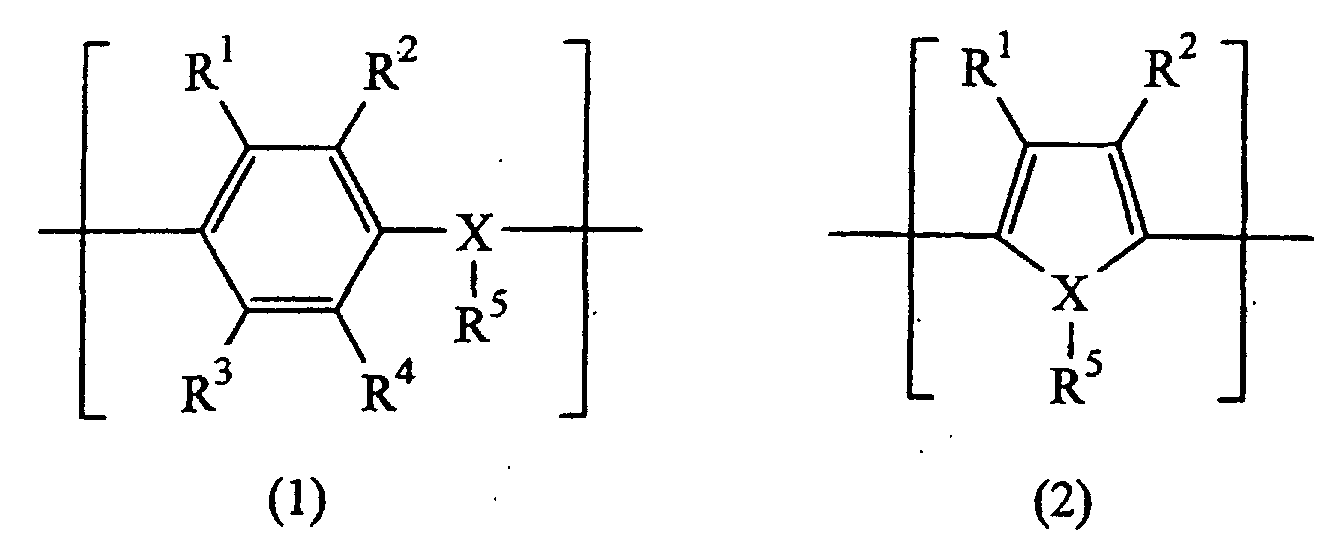
- organic semiconductors include an organic semiconductor comprising benzopyrroline tetramer and chloranyl; an organic semiconductor predominantly comprising tetrathiotetracene; an organic semiconductor predominantly comprising tetracyanoquinodimethane; and an organic semiconductor predominantly comprising a conductive polymer in which a dopant is doped in a polymer including two or more repeating units represented by the following formula (1) or (2): wherein each of R 1 through R 4 , which may be identical to or different from one another, represents hydrogen atom, a C1-C6 alkyi group, or a C1-C6 alkoxy group; X represents an oxygen, sulfur, or nitrogen atom; R 5 , which is present only when X is a nitrogen atom, represents hydrogen atom or a C1-C6 alkyl group; and R 1 and R 2 , and R 3 and R 4 may be bonded to each other to form a cyclic structure.
- the dopant is not particularly limited and may be any known dopant.
- polymers comprising two or more repeating units represented by the formula (1) or (2) include polyaniline, polyoxyphenylene, poly(phenylene sulfide), polythiophene, polyfuran, polypyrrole, polymethylpyrrole, substituted derivatives thereof, and copolymers thereof.
- polypyrrole, polythiophene, or a substituted derivative thereof e.g., poly(3,4-ethylenedioxythiophene) is preferable.
- inorganic semiconductors include an inorganic semiconductor predominantly comprising lead dioxide or manganese dioxide; and an inorganic semiconductor comprising triiron tetroxide. These semiconductors may be employed singly or in combination of two or more species.
- the impedance of the produced capacitor further decreases and the capacitance of the capacitor may be further increased at high frequency.
- a conductive layer may be provided on the electrode in order to improve the electric contact between the electrode and an externally-drawn lead (e.g., a lead frame).
- an externally-drawn lead e.g., a lead frame
- the conductive layer may be formed through, for example, solidification of a conductive paste, plating, metal deposition, or formation of heat resistant conductive resin film.
- conductive pastes include a silver paste, a copper paste, an aluminum paste, a carbon paste, and a nickel paste. These pastes may be employed singly or in combination of two or more species. When two or more pastes are employed, the pastes may be mixed together to form one layer, or the respective layers of the pastes may be laminated on one another. After such a conductive paste is applied onto the electrode, the electrode is allowed to stand in air or heated, to thereby solidify the paste.
- plating include nickel plating, copper plating, silver plating, and aluminum plating.
- metals for deposition include aluminum, nickel, copper, and silver.
- an aluminum paste layer and a silver paste layer are successively formed on the second electrode, and then encapsulated with a material such as an epoxy resin, to thereby produce a capacitor.
- the capacitor may contain a niobium or tantalum lead, which is sintered together with the niobium sintered body or welded to the sintered body after sintering.
- capacitor products for different uses can be produced from the capacitor of the present invention having the aforementioned structure; for example, by encapsulating the capacitor in a resin mold, a resin case, or a metallic case, by dipping the capacitor in a resin, or by coating the capacitor with a laminate film.
- the capacitor including the aforementioned electrodes and the dielectric is placed in, for example, a can which is electrically connected to the second electrode, to thereby produce a capacitor.
- the electrode of the niobium sintered body is led to the outside via the aforementioned niobium or tantalum lead, and the lead is insulated from the can by use of a material such as insulating rubber.
- the produced capacitor exhibits excellent reliability.
- the methods of evaluation of the amounts of nitrogen and oxygen comprised in powder, the capacitance of a sintered body, leakage current (LC) of a sintered body, the capacitance and leakage current (LC) of capacitor formed into a chip and measurement of spike noise are the following.
- the amounts of nitrogen and oxygen comprised in powder were measured by Oxygen-Nitrogen-Amount Measuring Apparatus (product of LECO corporation).
- the ratio of the amount of nitrogen to the separately measured mass of the powder and the ratio of the amount of oxygen to the separately measured mass of the powder were regarded the nitrogen content and the oxygen content, respectively.
- a sintered body was subjected to formation in a 0.1% phosphoric acid aqueous solution at 80°C for 200 minutes, to thereby form a dielectric on the sintered body. Subsequently, the resultant sintered body was immersed in a 30% sulfuric acid aqueous solution at room temperature, and an LCR-Meter (product of Hewlett-Packard Co.) was connected between the sintered body and a tantalum electrode placed in the sulfuric acid solution. The capacitance as measured at 120 Hz was regarded the capacitance of the sintered body.
- the capacitance of a capacitor formed into a chip was measured by use of an LCR-Meter (product of HP) at room temperature and 120 Hz.
- the leakage current of the capacitor chip was measured after rated voltage was applied to the chip for one minute.
- Spike noise of a capacitor was measured after the capacitor was subjected to a high-temperature load test in which rated voltage was applied to the capacitor and the capacitor was allowed to stand at 105°C for 2,000 hours. Spike noise was verified by the existence of noise which was suddenly generated in data of the leakage current recorded continuously on a sheet for five minutes while rated voltage was applied to the capacitor at room temperature.
- the capacitance and leakage current of the capacitor are on the basis of the average value of 20 capacitors for each Example.
- Potassium fluoroniobate 300 g which had been sufficiently dried at 80°C in vacuum, and sodium (amount by mol of ten times that of potassium fluoroniobate) were placed in a nickel-made crucible, and the mixture was allowed to react at 1,000°C for 20 hours under argon for reduction. After completion of reaction, the reduced product was cooled, and sequentially washed with water, 95% sulfuric acid, and water, and then dried in vacuum. The dried product was further pulverized for 35 hours by use of a ball mill including an alumina pot and silica-alumina balls contained therein.
- the thus-pulverized product was immersed in a solution mixture of 50% nitric acid and 10% hydrogen peroxide (3:2 (mass ratio)) with stirring so as to remove an impurity introduced during pulverization.
- the resultant product was sufficiently washed with water such that the pH of washing water reached 7, and then dried in vacuum, to thereby obtain niobium powder having a mean particle size of 2.9 ⁇ m.
- the niobium powder was allowed to stand at 1,100°C and at a reduced pressure of 1.33 ⁇ 10 -4 Pa for 30 minutes. Thereafter, the niobium powder was pulverized in water in a nitrogen atmosphere at room temperature by use of a wet-type pulverization apparatus (product name: Ato-liter), to thereby produce granules having a mean particle size of 150 ⁇ m. The mean particle size was measured by use of an automatic sieving apparatus.
- the oxygen content of the granules was 12,000 ppm.
- the granules were placed in a vessel, and while nitrogen was passed through the vessel at a flow rate of 500 ml/minute, the granules were allowed to stand at the temperature in the range from 200 °C to 700 °C shown in Comparative example 1 and Examples 1 to 4 in Table 1 for three hours for nitridation by changing conditions.
- the measured nitrogen content of the granules and the mass ratio of the nitrogen content to the oxygen content are shown in Table 1.
- the niobium granules which had undergone nitridation under different conditions were shaped with a niobium wire (0.29 mm ⁇ ) into a compact having approximate dimensions of 0.34 cm ⁇ 0.18 cm ⁇ 0.44 cm (about 85 mg).
- One side of the niobium wire (6 mm) was drawn outside of the compact, and the other side (about 3.5 mm) was inserted in the compact.
- the compact was allowed to stand at a reduced pressure of 3.99 ⁇ 10 -4 Pa at 1,250°C for 30 minutes, to thereby produce a sintered body thereof.
- the sintered body was subjected to formation through application of 20 V in a 0.1% phosphoric acid aqueous solution at 80°C for 200 minutes, to thereby form a niobium oxide dielectric layer on a surface of the sintered body.
- a niobium rod (100 mm ⁇ , 300 g) was placed into a reactor made of SUS 304. After the reactor was evacuated to 7.98 ⁇ 10 -2 Pa for degassing, the temperature of the reactor was elevated to 800°C, and hydrogen was fed to the reactor. Hydrogen was further introduced at 350°C for 50 hours. After cooling, a portion of the hydrogenated niobium ingot was pulverized for 5 hours in a one-liter pot made of SUS 304 containing iron balls. The pulverized product was placed into the above-described reactor made of SUS 304 and further hydrogenated under the above conditions. The thus-hydrogenated product was mixed with water, to thereby prepare a 20 vol.% slurry. The slurry and zirconia balls were placed in a wet-type pulverization apparatus made of SUS 304 (product name: Ato-liter), and the mixture was wet-pulverized in the apparatus.
- the pulverized product was sequentially washed with 95% sulfuric acid, water, a mixture of 30% hydrofluoric acid and 50% nitric acid (1 : 1 (mass ratio)), and water, and dried in vacuum, to thereby remove an impurity.
- the mean particle size of the dried pulverized product was 0.7 ⁇ m. Subsequently, the resultant niobium powder was allowed to stand at 950°C and at a reduced pressure of 1.33 ⁇ 10 -4 Pa for 30 minutes. Thereafter, the niobium powder was pulverized in a manner similar to that described in Example 1 to 4, to thereby produce granules having a mean particle size of 130 ⁇ m. The oxygen content of the granules was 30,000 ppm.
- Example 1 to 4 the procedure of Example 1 to 4 was repeated, except that the sintering temperature was changed to 1,050°C, to thereby carry out shaping, sintering, and formation.
- the capacitance and LC of the resultant sintered body were measured. The results are shown in Table 1. Similar sintered bodies (20 for each Example) were produced in a manner similar to that described above, and each sintered body was treated under conditions similar to those described above, to thereby form a niobium oxide dielectric layer on the sintered body.
- the sintered body was exposed to pyrrole vapor which was mixed with nitrogen flowing at 1 liter/minute.
- the resultant sintered body was immersed in a 5 mass% ammonium persulfate aqueous solution and a 1 mass% anthraquinone sulfonate aqueous solution, which solutions had been separately prepared.
- the sintered body was removed from the solutions, and further exposed to pyrrole vapor. This procedure was carried out at least five times, to thereby form a polypyrrole second electrode on the above the dielectric layer.
- a chip capacitor was produced in a manner similar to that as described in Example 1.
- Table 2 shows the capacitance and LC of the capacitor, and the spike noise generation ratio after a high-temperature load test. Further, the amount (unit: ppm) of each element (M) contained in the niobium powder for each Example was measured through atomic absorption spectrometry. The results are shown in Table 3.
- Example 5 and 6 The procedure of Example 5 and 6 was repeated, except that the niobium ingot was pulverized for two hours in the pot after introduction of hydrogen, to thereby obtain niobium powder having a means particle size of 1 ⁇ m. Moreover, the procedure of Example 5 and 6 was repeated, except that the niobium powder was granulated at 1,050°C, to thereby produce granules having a mean particle size of 140 ⁇ m. The oxygen content of the granules was 25,000 ppm. The granules for each Example were subjected to nitridation at the temperature in the range from 200 °C to 500 °C shown in Comparative example 3 and Example 7 to 10 in Table 1 for three hours by changing conditions.
- Example 5 In addition, the procedure of Example 5 was repeated, except that the sintering temperature was changed to 1,150°C, to thereby carry out shaping, sintering, formation, to thereby produce a capacitor.
- the capacitance and LC of the sintered body, the capacitance and LC of the capacitor, and the spike noise generation ratio after a high-temperature load test were measured. The results are shown in Tables 1 and 2.
- Niobium capacitor has low reliability because of niobium powder containing niobium which has high affinity to oxygen and is oxidized naturally.
- niobium powder which has undergone partial oxidation in which the mass ratio of the nitrogen content to the oxygen content is adjusted to 1/45 or more, is employed as a raw material for producing a capacitor, the capacitor which exhibits high reliability; i.e., no spike noise is generated during a reliability test (high-temperature load test) of the capacitor can be obtained.
Landscapes
- Engineering & Computer Science (AREA)
- Chemical & Material Sciences (AREA)
- Metallurgy (AREA)
- Materials Engineering (AREA)
- Mechanical Engineering (AREA)
- Power Engineering (AREA)
- Organic Chemistry (AREA)
- Microelectronics & Electronic Packaging (AREA)
- Manufacturing & Machinery (AREA)
- Powder Metallurgy (AREA)
- Compositions Of Oxide Ceramics (AREA)
- Ceramic Capacitors (AREA)
- Disintegrating Or Milling (AREA)
- Manufacture And Refinement Of Metals (AREA)
- Soft Magnetic Materials (AREA)
Abstract
Description


| Nitridation Temperature (°C) | Nitrogen content (ppm) | Nitrogen /Oxygen (mass ratio) | Capacitance (µF) | LC (µA) | |
| Ex. 1 | 250 | 300 | 1/40 | 190 | 4.0 |
| Ex. 2 | 300 | 1000 | 1/12 | 190 | 1.0 |
| Ex. 3 | 500 | 6000 | 1/2 | 190 | 1.2 |
| Ex. 4 | 700 | 8500 | 1/1.4 | 190 | 2.8 |
| Ex. 5 | 300 | 3000 | 1/10 | 510 | 2.4 |
| Ex. 6 | 400 | 6000 | 1/5 | 510 | 2.9 |
| Ex. 7 | 250 | 1000 | 1/25 | 400 | 1.0 |
| Ex. 8 | 300 | 2000 | 1/13 | 400 | 1.0 |
| Ex. 9 | 400 | 5000 | 1/5 | 400 | 2.1 |
| Ex. 10 | 500 | 8000 | 1/3.1 | 400 | 3.9 |
| Comp. Ex. 1 | 200 | 250 | 1/48 | 190 | 4.2 |
| Comp. Ex. 2 | 200 | 450 | 1/67 | 510 | 8.0 |
| Comp. Ex. 3 | 200 | 400 | 1/63 | 400 | 7.2 |
| Capacitor characteristics | Spike noise generation ratio | ||
| Capacitance/µF | Leakage current/µA | ||
| Ex. 1 | 168 | 4.2 | 0/20 |
| Ex. 2 | 169 | 1.1 | 0/20 |
| Ex. 3 | 172 | 1.4 | 0/20 |
| Ex. 4 | 171 | 2.9 | 0/20 |
| Ex. 5 | 447 | 2.6 | 0/20 |
| Ex. 6 | 450 | 3.0 | 0/20 |
| Ex. 7 | 341 | 1.2 | 0/20 |
| Ex. 8 | 342 | 1.2 | 0/20 |
| Ex. 9 | 338 | 2.4 | 0/20 |
| Ex. 10 | 338 | 4.1 | 0/20 |
| Comp. Ex. 1 | 170 | 4.5 | 2/20 |
| Comp. Ex. 2 | 445 | 8.2 | 1/20 |
| Comp. Ex. 3 | 338 | 7.5 | 2/20 |
| Element M content (ppm) | ||||||||
| Fe | Ni | Co | Si | Na | K | Mg | Total | |
| Ex. 1 | 60 | 30 | 20 | 60 | 10 | 50 | 20 | 250 |
| Ex. 2 | 60 | 30 | 20 | 60 | 10 | 50 | 20 | 250 |
| Ex. 3 | 60 | 30 | 20 | 60 | 10 | 50 | 20 | 250 |
| Ex. 4 | 60 | 30 | 20 | 60 | 10 | 50 | 20 | 250 |
| Ex. 5 | 40 | 20 | 10 | 40 | 5 | 5 | 5 | 125 |
| Ex. 6 | 40 | 20 | 10 | 40 | 5 | 5 | 5 | 125 |
| Ex. 7 | 20 | 10 | 10 | 40 | 5 | 5 | 5 | 95 |
| Ex. 8 | 20 | 10 | 10 | 40 | 5 | 5 | 5 | 95 |
| Ex. 9 | 20 | 10 | 10 | 40 | 5 | 5 | 5 | 95 |
| Ex. 10 | 20 | 10 | 10 | 40 | 5 | 5 | 5 | 95 |
| Comp. Ex. 1 | 60 | 30 | 20 | 60 | 10 | 50 | 20 | 250 |
| Comp. Ex. 2 | 40 | 20 | 10 | 40 | 5 | 5 | 5 | 125 |
| Comp. Ex. 3 | 20 | 10 | 10 | 40 | 5 | 5 | 5 | 95 |
Claims (11)
- The niobium powder which has undergone partial oxidation and partial nitridation, characterized in that the mass ratio of the content of nitrogen in the powder to that of oxygen in the powder is 1/45 or more.
- The niobium powder as claimed in claim 1, wherein the nitrogen content is 300 to 9,000 mass ppm.
- The niobium powder as claimed in claim 1 or 2, wherein the mean particle size of the powder is 0.05 to 3 µm.
- The granulated niobium powder obtained through granulation of niobium powder as claimed in claim 3.
- A sintered body formed from niobium powder as claimed in any one of claims 1 through 4.
- A capacitor comprising a sintered body as claimed in claim 5 serving as a first electrode, a dielectric formed thereon, and a second electrode formed on the dielectric.
- The capacitor as claimed in claim 6, wherein the dielectric is niobium oxide.
- The capacitor as claimed in claim 7, wherein the niobium oxide is formed through electrolytic oxidation.
- The capacitor as claimed in claim 6, wherein the second electrode is formed from at least one material (compound) selected from among ah electrolyte, an organic semiconductor, and an inorganic semiconductor.
- The capacitor as claimed in claim 6, wherein the second electrode is formed from an organic semiconductor, and the organic semiconductor is at least one semiconductor selected from the group consisting of an organic semiconductor comprising benzopyrroline tetramer and chloranyl, an organic semiconductor predominantly comprising tetrathiotetracene, an organic semiconductor predominantly comprising tetracyanoquinodimethane, and an organic semiconductor predominantly comprising a conductive polymer in which a dopant is doped in a polymer including two or more repeating units represented by the following formula (1) or (2):wherein each of R1 through R4, which may be identical to or different from one another, represents hydrogen atom, a C1-C6 alkyl group, or a C1-C6 alkoxy group; X represents an oxygen, sulfur, or nitrogen atom; R5, which is present only when X is a nitrogen atom, represents hydrogen atom or a C1-C6 alkyl group; and R1 and R2, and R3 and R4 may be bonded to each other to form a cyclic structure.
- The capacitor as claimed in claim 10 , wherein the organic semiconductor is at least one species selected from among polypyrrole, polythiophene, and a substituted derivative thereof.
Applications Claiming Priority (3)
| Application Number | Priority Date | Filing Date | Title |
|---|---|---|---|
| JP2000122672 | 2000-04-24 | ||
| JP2000122672 | 2000-04-24 | ||
| PCT/JP2001/003448 WO2001081029A1 (en) | 2000-04-24 | 2001-04-23 | Niobium powder, sintered compact thereof and capacitor |
Publications (3)
| Publication Number | Publication Date |
|---|---|
| EP1281460A1 true EP1281460A1 (en) | 2003-02-05 |
| EP1281460A4 EP1281460A4 (en) | 2006-07-26 |
| EP1281460B1 EP1281460B1 (en) | 2008-03-12 |
Family
ID=18633121
Family Applications (1)
| Application Number | Title | Priority Date | Filing Date |
|---|---|---|---|
| EP01921995A Revoked EP1281460B1 (en) | 2000-04-24 | 2001-04-23 | Niobium powder, sintered compact thereof and capacitor |
Country Status (9)
| Country | Link |
|---|---|
| US (1) | US6671164B2 (en) |
| EP (1) | EP1281460B1 (en) |
| JP (1) | JP4986272B2 (en) |
| CN (1) | CN1226112C (en) |
| AT (1) | ATE388779T1 (en) |
| AU (1) | AU2001248826A1 (en) |
| BR (1) | BR0110333A (en) |
| DE (1) | DE60133192T2 (en) |
| WO (1) | WO2001081029A1 (en) |
Families Citing this family (6)
| Publication number | Priority date | Publication date | Assignee | Title |
|---|---|---|---|---|
| US6755884B2 (en) * | 2000-11-30 | 2004-06-29 | Showa Denko K.K. | Niobium powder for capacitor, sintered body thereof and capacitor using the sintered body |
| JP2004143477A (en) * | 2002-10-22 | 2004-05-20 | Cabot Supermetal Kk | Niobium powder, method for producing the same, and solid electrolytic capacitor using the same |
| US20060260437A1 (en) * | 2004-10-06 | 2006-11-23 | Showa Denko K.K. | Niobium powder, niobium granulated powder, niobium sintered body, capacitor and production method thereof |
| PT1890967E (en) * | 2005-06-03 | 2009-05-05 | Starck H C Gmbh | Niobium suboxides |
| JP5763932B2 (en) * | 2011-02-02 | 2015-08-12 | Necトーキン株式会社 | Solid electrolytic capacitor and manufacturing method thereof |
| CN113770366A (en) * | 2020-06-10 | 2021-12-10 | 安泰科技股份有限公司 | Method for preparing refractory metal powder for 3D printing |
Family Cites Families (19)
| Publication number | Priority date | Publication date | Assignee | Title |
|---|---|---|---|---|
| GB1219748A (en) | 1969-06-13 | 1971-01-20 | Standard Telephones Cables Ltd | Producing niobium or tantalum powder |
| US4084965A (en) | 1977-01-05 | 1978-04-18 | Fansteel Inc. | Columbium powder and method of making the same |
| US4149876A (en) | 1978-06-06 | 1979-04-17 | Fansteel Inc. | Process for producing tantalum and columbium powder |
| JPS60121207A (en) | 1983-12-01 | 1985-06-28 | Toyo Soda Mfg Co Ltd | Manufacture of hyperfine particle |
| JP2665928B2 (en) * | 1988-03-25 | 1997-10-22 | 昭和キャボットスーパーメタル株式会社 | Tantalum powder and method for producing the same |
| DE3820960A1 (en) | 1988-06-22 | 1989-12-28 | Starck Hermann C Fa | FINE-GRAINED HIGH-PURITY EARTH ACID POWDER, METHOD FOR THE PRODUCTION AND USE THEREOF |
| JPH0239417A (en) * | 1988-07-28 | 1990-02-08 | Marcon Electron Co Ltd | Manufacture of electrolytic capacitor |
| US4964906A (en) * | 1989-09-26 | 1990-10-23 | Fife James A | Method for controlling the oxygen content of tantalum material |
| JPH03150822A (en) | 1989-11-07 | 1991-06-27 | Nippon Chemicon Corp | Aluminum electrode for electrolytic capacitor |
| JP3106559B2 (en) | 1991-07-05 | 2000-11-06 | 日本ケミコン株式会社 | Method for producing base material having metal oxide on surface |
| US5448447A (en) * | 1993-04-26 | 1995-09-05 | Cabot Corporation | Process for making an improved tantalum powder and high capacitance low leakage electrode made therefrom |
| DE69516556T2 (en) * | 1994-01-26 | 2000-09-07 | H.C. Starck, Inc. | Process for nitriding tantalum powder |
| US6165623A (en) | 1996-11-07 | 2000-12-26 | Cabot Corporation | Niobium powders and niobium electrolytic capacitors |
| JP3254163B2 (en) * | 1997-02-28 | 2002-02-04 | 昭和電工株式会社 | Capacitor |
| KR100596030B1 (en) * | 1997-11-28 | 2006-07-05 | 쇼와 덴코 가부시키가이샤 | Solid Electrolytic Capacitors and Manufacturing Method Thereof |
| US6051044A (en) * | 1998-05-04 | 2000-04-18 | Cabot Corporation | Nitrided niobium powders and niobium electrolytic capacitors |
| US6171363B1 (en) | 1998-05-06 | 2001-01-09 | H. C. Starck, Inc. | Method for producing tantallum/niobium metal powders by the reduction of their oxides with gaseous magnesium |
| JP3196832B2 (en) * | 1998-05-15 | 2001-08-06 | 日本電気株式会社 | Solid electrolytic capacitor and method of manufacturing the same |
| US6072694A (en) * | 1998-09-30 | 2000-06-06 | Kemet Electronics Corporation | Electrolytic capacitor with improved leakage and dissipation factor |
-
2001
- 2001-04-23 EP EP01921995A patent/EP1281460B1/en not_active Revoked
- 2001-04-23 WO PCT/JP2001/003448 patent/WO2001081029A1/en not_active Ceased
- 2001-04-23 DE DE60133192T patent/DE60133192T2/en not_active Revoked
- 2001-04-23 CN CNB018107281A patent/CN1226112C/en not_active Expired - Fee Related
- 2001-04-23 AT AT01921995T patent/ATE388779T1/en not_active IP Right Cessation
- 2001-04-23 JP JP2001578113A patent/JP4986272B2/en not_active Expired - Lifetime
- 2001-04-23 AU AU2001248826A patent/AU2001248826A1/en not_active Abandoned
- 2001-04-23 BR BR0110333-4A patent/BR0110333A/en not_active IP Right Cessation
- 2001-04-24 US US09/840,274 patent/US6671164B2/en not_active Expired - Lifetime
Also Published As
| Publication number | Publication date |
|---|---|
| WO2001081029A1 (en) | 2001-11-01 |
| JP4986272B2 (en) | 2012-07-25 |
| CN1226112C (en) | 2005-11-09 |
| ATE388779T1 (en) | 2008-03-15 |
| CN1433346A (en) | 2003-07-30 |
| US6671164B2 (en) | 2003-12-30 |
| EP1281460A4 (en) | 2006-07-26 |
| US20020075629A1 (en) | 2002-06-20 |
| AU2001248826A1 (en) | 2001-11-07 |
| EP1281460B1 (en) | 2008-03-12 |
| DE60133192T2 (en) | 2009-03-12 |
| BR0110333A (en) | 2003-01-07 |
| DE60133192D1 (en) | 2008-04-24 |
Similar Documents
| Publication | Publication Date | Title |
|---|---|---|
| JP4592034B2 (en) | Niobium powder, niobium sintered body, capacitor using the sintered body, and method for manufacturing the capacitor | |
| EP1082739B2 (en) | Nitrided niobium powders and niobium electrolytic capacitors | |
| US6835225B2 (en) | Niobium sintered body, production method therefor, and capacitor using the same | |
| JP4527332B2 (en) | Niobium powder, sintered body thereof and capacitor using the same | |
| JPWO2001006525A1 (en) | Niobium powder, its sintered body and capacitor using the same | |
| EP1340235B1 (en) | Powder for capacitor, sintered body thereof and capacitor using the sintered body | |
| EP1275124B1 (en) | Niobium powder for capacitor, sintered body thereof and capacitor using the sintered body | |
| EP1281460B1 (en) | Niobium powder, sintered compact thereof and capacitor | |
| JP4683512B2 (en) | Capacitor powder, sintered body using the same, and capacitor using the same | |
| AU2002218510A1 (en) | Powder for capacitor, sintered body thereof and capacitor using the sintered body | |
| EP1501956B1 (en) | Niobium powder, sintered body thereof and capacitor using the same | |
| JP4521849B2 (en) | Niobium powder for capacitor, sintered body using the niobium powder, and capacitor using the sintered body | |
| EP1264321B1 (en) | Niobium powder for capacitor, sintered body thereof and capacitor using the sintered body | |
| US6843825B2 (en) | Powder for capacitor, sintered body and capacitor using the sintered body | |
| JPWO2001081029A1 (en) | Niobium powder, its sintered body and capacitor | |
| JP4707164B2 (en) | Niobium powder for capacitor, sintered body using the same, and capacitor using the same | |
| RU2269835C2 (en) | Niobium for capacitor manufacture and capacitor produced using sintered niobium product | |
| JP4647744B2 (en) | Niobium powder for capacitor, sintered body using the same, and capacitor using the same | |
| KR100804652B1 (en) | Niobium powder, sintered body and capacitor |
Legal Events
| Date | Code | Title | Description |
|---|---|---|---|
| PUAI | Public reference made under article 153(3) epc to a published international application that has entered the european phase |
Free format text: ORIGINAL CODE: 0009012 |
|
| 17P | Request for examination filed |
Effective date: 20021118 |
|
| AK | Designated contracting states |
Designated state(s): AT BE CH CY DE DK ES FI FR GB GR IE IT LI LU MC NL PT SE TR |
|
| AX | Request for extension of the european patent |
Extension state: AL LT LV MK RO SI |
|
| A4 | Supplementary search report drawn up and despatched |
Effective date: 20060622 |
|
| RIC1 | Information provided on ipc code assigned before grant |
Ipc: H01G 9/052 20060101ALI20060616BHEP Ipc: B22F 1/00 20060101AFI20011106BHEP |
|
| 17Q | First examination report despatched |
Effective date: 20070212 |
|
| GRAP | Despatch of communication of intention to grant a patent |
Free format text: ORIGINAL CODE: EPIDOSNIGR1 |
|
| GRAS | Grant fee paid |
Free format text: ORIGINAL CODE: EPIDOSNIGR3 |
|
| GRAA | (expected) grant |
Free format text: ORIGINAL CODE: 0009210 |
|
| AK | Designated contracting states |
Kind code of ref document: B1 Designated state(s): AT BE CH CY DE DK ES FI FR GB GR IE IT LI LU MC NL PT SE TR |
|
| REG | Reference to a national code |
Ref country code: GB Ref legal event code: FG4D |
|
| REG | Reference to a national code |
Ref country code: CH Ref legal event code: EP |
|
| REG | Reference to a national code |
Ref country code: IE Ref legal event code: FG4D |
|
| REF | Corresponds to: |
Ref document number: 60133192 Country of ref document: DE Date of ref document: 20080424 Kind code of ref document: P |
|
| PG25 | Lapsed in a contracting state [announced via postgrant information from national office to epo] |
Ref country code: FI Free format text: LAPSE BECAUSE OF FAILURE TO SUBMIT A TRANSLATION OF THE DESCRIPTION OR TO PAY THE FEE WITHIN THE PRESCRIBED TIME-LIMIT Effective date: 20080312 |
|
| PG25 | Lapsed in a contracting state [announced via postgrant information from national office to epo] |
Ref country code: AT Free format text: LAPSE BECAUSE OF FAILURE TO SUBMIT A TRANSLATION OF THE DESCRIPTION OR TO PAY THE FEE WITHIN THE PRESCRIBED TIME-LIMIT Effective date: 20080312 |
|
| NLV1 | Nl: lapsed or annulled due to failure to fulfill the requirements of art. 29p and 29m of the patents act | ||
| PG25 | Lapsed in a contracting state [announced via postgrant information from national office to epo] |
Ref country code: BE Free format text: LAPSE BECAUSE OF FAILURE TO SUBMIT A TRANSLATION OF THE DESCRIPTION OR TO PAY THE FEE WITHIN THE PRESCRIBED TIME-LIMIT Effective date: 20080312 |
|
| PG25 | Lapsed in a contracting state [announced via postgrant information from national office to epo] |
Ref country code: SE Free format text: LAPSE BECAUSE OF FAILURE TO SUBMIT A TRANSLATION OF THE DESCRIPTION OR TO PAY THE FEE WITHIN THE PRESCRIBED TIME-LIMIT Effective date: 20080612 Ref country code: ES Free format text: LAPSE BECAUSE OF FAILURE TO SUBMIT A TRANSLATION OF THE DESCRIPTION OR TO PAY THE FEE WITHIN THE PRESCRIBED TIME-LIMIT Effective date: 20080623 Ref country code: PT Free format text: LAPSE BECAUSE OF FAILURE TO SUBMIT A TRANSLATION OF THE DESCRIPTION OR TO PAY THE FEE WITHIN THE PRESCRIBED TIME-LIMIT Effective date: 20080818 |
|
| PG25 | Lapsed in a contracting state [announced via postgrant information from national office to epo] |
Ref country code: MC Free format text: LAPSE BECAUSE OF NON-PAYMENT OF DUE FEES Effective date: 20080430 Ref country code: NL Free format text: LAPSE BECAUSE OF FAILURE TO SUBMIT A TRANSLATION OF THE DESCRIPTION OR TO PAY THE FEE WITHIN THE PRESCRIBED TIME-LIMIT Effective date: 20080312 |
|
| REG | Reference to a national code |
Ref country code: CH Ref legal event code: PL |
|
| ET | Fr: translation filed | ||
| PLBI | Opposition filed |
Free format text: ORIGINAL CODE: 0009260 |
|
| PLAX | Notice of opposition and request to file observation + time limit sent |
Free format text: ORIGINAL CODE: EPIDOSNOBS2 |
|
| 26 | Opposition filed |
Opponent name: H.C. STARCK GMBH Effective date: 20081212 |
|
| PG25 | Lapsed in a contracting state [announced via postgrant information from national office to epo] |
Ref country code: CH Free format text: LAPSE BECAUSE OF NON-PAYMENT OF DUE FEES Effective date: 20080430 Ref country code: LI Free format text: LAPSE BECAUSE OF NON-PAYMENT OF DUE FEES Effective date: 20080430 Ref country code: DK Free format text: LAPSE BECAUSE OF FAILURE TO SUBMIT A TRANSLATION OF THE DESCRIPTION OR TO PAY THE FEE WITHIN THE PRESCRIBED TIME-LIMIT Effective date: 20080312 |
|
| PG25 | Lapsed in a contracting state [announced via postgrant information from national office to epo] |
Ref country code: IE Free format text: LAPSE BECAUSE OF NON-PAYMENT OF DUE FEES Effective date: 20080423 |
|
| PLAF | Information modified related to communication of a notice of opposition and request to file observations + time limit |
Free format text: ORIGINAL CODE: EPIDOSCOBS2 |
|
| PLBB | Reply of patent proprietor to notice(s) of opposition received |
Free format text: ORIGINAL CODE: EPIDOSNOBS3 |
|
| PG25 | Lapsed in a contracting state [announced via postgrant information from national office to epo] |
Ref country code: IT Free format text: LAPSE BECAUSE OF FAILURE TO SUBMIT A TRANSLATION OF THE DESCRIPTION OR TO PAY THE FEE WITHIN THE PRESCRIBED TIME-LIMIT Effective date: 20080312 |
|
| PG25 | Lapsed in a contracting state [announced via postgrant information from national office to epo] |
Ref country code: CY Free format text: LAPSE BECAUSE OF FAILURE TO SUBMIT A TRANSLATION OF THE DESCRIPTION OR TO PAY THE FEE WITHIN THE PRESCRIBED TIME-LIMIT Effective date: 20080312 |
|
| PGFP | Annual fee paid to national office [announced via postgrant information from national office to epo] |
Ref country code: GB Payment date: 20100325 Year of fee payment: 10 |
|
| PG25 | Lapsed in a contracting state [announced via postgrant information from national office to epo] |
Ref country code: LU Free format text: LAPSE BECAUSE OF NON-PAYMENT OF DUE FEES Effective date: 20080423 |
|
| PGFP | Annual fee paid to national office [announced via postgrant information from national office to epo] |
Ref country code: FR Payment date: 20100521 Year of fee payment: 10 |
|
| RDAF | Communication despatched that patent is revoked |
Free format text: ORIGINAL CODE: EPIDOSNREV1 |
|
| PG25 | Lapsed in a contracting state [announced via postgrant information from national office to epo] |
Ref country code: TR Free format text: LAPSE BECAUSE OF FAILURE TO SUBMIT A TRANSLATION OF THE DESCRIPTION OR TO PAY THE FEE WITHIN THE PRESCRIBED TIME-LIMIT Effective date: 20080312 |
|
| PGFP | Annual fee paid to national office [announced via postgrant information from national office to epo] |
Ref country code: DE Payment date: 20100430 Year of fee payment: 10 |
|
| PG25 | Lapsed in a contracting state [announced via postgrant information from national office to epo] |
Ref country code: GR Free format text: LAPSE BECAUSE OF FAILURE TO SUBMIT A TRANSLATION OF THE DESCRIPTION OR TO PAY THE FEE WITHIN THE PRESCRIBED TIME-LIMIT Effective date: 20080613 |
|
| RDAG | Patent revoked |
Free format text: ORIGINAL CODE: 0009271 |
|
| STAA | Information on the status of an ep patent application or granted ep patent |
Free format text: STATUS: PATENT REVOKED |
|
| 27W | Patent revoked |
Effective date: 20100617 |
|
| GBPR | Gb: patent revoked under art. 102 of the ep convention designating the uk as contracting state |
Effective date: 20100617 |