EP1280802B1 - Indazoles substituted with 1,1-dioxoisothiazolidine useful as inhibitors of cell proliferation - Google Patents
Indazoles substituted with 1,1-dioxoisothiazolidine useful as inhibitors of cell proliferation Download PDFInfo
- Publication number
- EP1280802B1 EP1280802B1 EP01930292A EP01930292A EP1280802B1 EP 1280802 B1 EP1280802 B1 EP 1280802B1 EP 01930292 A EP01930292 A EP 01930292A EP 01930292 A EP01930292 A EP 01930292A EP 1280802 B1 EP1280802 B1 EP 1280802B1
- Authority
- EP
- European Patent Office
- Prior art keywords
- indazol
- isothiazolidin
- dioxo
- acetamide
- phenyl
- Prior art date
- Legal status (The legal status is an assumption and is not a legal conclusion. Google has not performed a legal analysis and makes no representation as to the accuracy of the status listed.)
- Expired - Lifetime
Links
- 239000003112 inhibitor Substances 0.000 title abstract description 9
- 230000004663 cell proliferation Effects 0.000 title abstract description 7
- XGYCWCIGCYGQFU-UHFFFAOYSA-N 1,2-thiazolidine 1,1-dioxide Chemical group O=S1(=O)CCCN1 XGYCWCIGCYGQFU-UHFFFAOYSA-N 0.000 title abstract 2
- 150000002473 indoazoles Chemical group 0.000 title description 9
- 150000001875 compounds Chemical class 0.000 claims abstract description 214
- 150000003839 salts Chemical class 0.000 claims abstract description 18
- 239000004480 active ingredient Substances 0.000 claims abstract description 5
- 239000003937 drug carrier Substances 0.000 claims abstract description 4
- 239000000203 mixture Substances 0.000 claims description 102
- DLFVBJFMPXGRIB-UHFFFAOYSA-N Acetamide Chemical compound CC(N)=O DLFVBJFMPXGRIB-UHFFFAOYSA-N 0.000 claims description 68
- -1 amino, hydroxy Chemical group 0.000 claims description 50
- 125000000217 alkyl group Chemical group 0.000 claims description 41
- 125000001997 phenyl group Chemical group [H]C1=C([H])C([H])=C(*)C([H])=C1[H] 0.000 claims description 40
- LSBDFXRDZJMBSC-UHFFFAOYSA-N 2-phenylacetamide Chemical compound NC(=O)CC1=CC=CC=C1 LSBDFXRDZJMBSC-UHFFFAOYSA-N 0.000 claims description 22
- 229910052760 oxygen Inorganic materials 0.000 claims description 21
- 239000001301 oxygen Substances 0.000 claims description 21
- 229910052717 sulfur Inorganic materials 0.000 claims description 20
- 229910052739 hydrogen Inorganic materials 0.000 claims description 19
- 239000001257 hydrogen Substances 0.000 claims description 19
- 229910052757 nitrogen Chemical group 0.000 claims description 19
- HYZJCKYKOHLVJF-UHFFFAOYSA-N 1H-benzimidazole Chemical compound C1=CC=C2NC=NC2=C1 HYZJCKYKOHLVJF-UHFFFAOYSA-N 0.000 claims description 15
- 125000004434 sulfur atom Chemical group 0.000 claims description 15
- 125000001797 benzyl group Chemical group [H]C1=C([H])C([H])=C(C([H])=C1[H])C([H])([H])* 0.000 claims description 13
- 125000004193 piperazinyl group Chemical group 0.000 claims description 13
- 125000001584 benzyloxycarbonyl group Chemical group C(=O)(OCC1=CC=CC=C1)* 0.000 claims description 12
- 229910052736 halogen Inorganic materials 0.000 claims description 12
- 150000002367 halogens Chemical class 0.000 claims description 12
- 125000004433 nitrogen atom Chemical group N* 0.000 claims description 12
- 125000004430 oxygen atom Chemical group O* 0.000 claims description 12
- 125000003545 alkoxy group Chemical group 0.000 claims description 11
- 125000001424 substituent group Chemical group 0.000 claims description 11
- 125000000753 cycloalkyl group Chemical group 0.000 claims description 10
- ZUOUZKKEUPVFJK-UHFFFAOYSA-N diphenyl Chemical group C1=CC=CC=C1C1=CC=CC=C1 ZUOUZKKEUPVFJK-UHFFFAOYSA-N 0.000 claims description 10
- 125000002887 hydroxy group Chemical group [H]O* 0.000 claims description 10
- 125000002883 imidazolyl group Chemical group 0.000 claims description 10
- 125000002757 morpholinyl group Chemical group 0.000 claims description 10
- 125000001624 naphthyl group Chemical group 0.000 claims description 10
- 125000003386 piperidinyl group Chemical group 0.000 claims description 10
- 125000004435 hydrogen atom Chemical class [H]* 0.000 claims description 9
- 125000002924 primary amino group Chemical group [H]N([H])* 0.000 claims description 9
- BFVCNZRIEKAMCP-UHFFFAOYSA-N 2-[4-(2-aminoethoxy)phenyl]-n-[5-(1,1-dioxo-1,2-thiazolidin-2-yl)-1h-indazol-3-yl]acetamide Chemical compound C1=CC(OCCN)=CC=C1CC(=O)NC1=NNC2=CC=C(N3S(CCC3)(=O)=O)C=C12 BFVCNZRIEKAMCP-UHFFFAOYSA-N 0.000 claims description 8
- IJGRMHOSHXDMSA-UHFFFAOYSA-N nitrogen Substances N#N IJGRMHOSHXDMSA-UHFFFAOYSA-N 0.000 claims description 8
- MYMOFIZGZYHOMD-UHFFFAOYSA-N Dioxygen Chemical group O=O MYMOFIZGZYHOMD-UHFFFAOYSA-N 0.000 claims description 6
- 125000005842 heteroatom Chemical group 0.000 claims description 6
- AWJUIBRHMBBTKR-UHFFFAOYSA-N isoquinoline Chemical compound C1=NC=CC2=CC=CC=C21 AWJUIBRHMBBTKR-UHFFFAOYSA-N 0.000 claims description 6
- QJGQUHMNIGDVPM-UHFFFAOYSA-N nitrogen group Chemical group [N] QJGQUHMNIGDVPM-UHFFFAOYSA-N 0.000 claims description 6
- UYWQUFXKFGHYNT-UHFFFAOYSA-N phenylmethyl ester of formic acid Natural products O=COCC1=CC=CC=C1 UYWQUFXKFGHYNT-UHFFFAOYSA-N 0.000 claims description 6
- 125000000472 sulfonyl group Chemical group *S(*)(=O)=O 0.000 claims description 6
- FTNJQNQLEGKTGD-UHFFFAOYSA-N 1,3-benzodioxole Chemical compound C1=CC=C2OCOC2=C1 FTNJQNQLEGKTGD-UHFFFAOYSA-N 0.000 claims description 5
- BAXOFTOLAUCFNW-UHFFFAOYSA-N 1H-indazole Chemical compound C1=CC=C2C=NNC2=C1 BAXOFTOLAUCFNW-UHFFFAOYSA-N 0.000 claims description 5
- HLCPWBZNUKCSBN-UHFFFAOYSA-N 2-aminobenzonitrile Chemical compound NC1=CC=CC=C1C#N HLCPWBZNUKCSBN-UHFFFAOYSA-N 0.000 claims description 5
- NINIDFKCEFEMDL-UHFFFAOYSA-N Sulfur Chemical group [S] NINIDFKCEFEMDL-UHFFFAOYSA-N 0.000 claims description 5
- FZWLAAWBMGSTSO-UHFFFAOYSA-N Thiazole Chemical group C1=CSC=N1 FZWLAAWBMGSTSO-UHFFFAOYSA-N 0.000 claims description 5
- ZIHQUWYJSTVYAT-UHFFFAOYSA-N [NH-][N+]([O-])=O Chemical compound [NH-][N+]([O-])=O ZIHQUWYJSTVYAT-UHFFFAOYSA-N 0.000 claims description 5
- 125000004183 alkoxy alkyl group Chemical group 0.000 claims description 5
- 125000004466 alkoxycarbonylamino group Chemical group 0.000 claims description 5
- 125000003282 alkyl amino group Chemical group 0.000 claims description 5
- 125000004414 alkyl thio group Chemical group 0.000 claims description 5
- 125000004103 aminoalkyl group Chemical group 0.000 claims description 5
- 239000002246 antineoplastic agent Substances 0.000 claims description 5
- QVGXLLKOCUKJST-UHFFFAOYSA-N atomic oxygen Chemical compound [O] QVGXLLKOCUKJST-UHFFFAOYSA-N 0.000 claims description 5
- 235000010290 biphenyl Nutrition 0.000 claims description 5
- 239000004305 biphenyl Chemical group 0.000 claims description 5
- SFZULDYEOVSIKM-UHFFFAOYSA-N chembl321317 Chemical compound C1=CC(C(=N)NO)=CC=C1C1=CC=C(C=2C=CC(=CC=2)C(=N)NO)O1 SFZULDYEOVSIKM-UHFFFAOYSA-N 0.000 claims description 5
- 125000004093 cyano group Chemical group *C#N 0.000 claims description 5
- 150000002148 esters Chemical class 0.000 claims description 5
- 125000002541 furyl group Chemical group 0.000 claims description 5
- 238000004519 manufacturing process Methods 0.000 claims description 5
- 229920006395 saturated elastomer Polymers 0.000 claims description 5
- 239000011593 sulfur Chemical group 0.000 claims description 5
- 125000001544 thienyl group Chemical group 0.000 claims description 5
- 125000004432 carbon atom Chemical group C* 0.000 claims description 4
- 125000001301 ethoxy group Chemical group [H]C([H])([H])C([H])([H])O* 0.000 claims description 4
- 150000003254 radicals Chemical class 0.000 claims description 4
- YBBRCQOCSYXUOC-UHFFFAOYSA-N sulfuryl dichloride Chemical compound ClS(Cl)(=O)=O YBBRCQOCSYXUOC-UHFFFAOYSA-N 0.000 claims description 4
- 125000006272 (C3-C7) cycloalkyl group Chemical group 0.000 claims description 3
- YDTDKKULPWTHRV-UHFFFAOYSA-N 1H-indazol-3-amine Chemical compound C1=CC=C2C(N)=NNC2=C1 YDTDKKULPWTHRV-UHFFFAOYSA-N 0.000 claims description 3
- IUEDCNCMJLSAGK-UHFFFAOYSA-N 2-(2-acetamido-1,3-thiazol-4-yl)-n-[5-(1,1-dioxo-1,2-thiazolidin-2-yl)-1h-indazol-3-yl]acetamide Chemical compound S1C(NC(=O)C)=NC(CC(=O)NC=2C3=CC(=CC=C3NN=2)N2S(CCC2)(=O)=O)=C1 IUEDCNCMJLSAGK-UHFFFAOYSA-N 0.000 claims description 3
- GWGGJFDSSLLQJE-UHFFFAOYSA-N 2-(2-amino-1,3-thiazol-4-yl)-n-[5-(1,1-dioxo-1,2-thiazolidin-2-yl)-1h-indazol-3-yl]acetamide Chemical compound S1C(N)=NC(CC(=O)NC=2C3=CC(=CC=C3NN=2)N2S(CCC2)(=O)=O)=C1 GWGGJFDSSLLQJE-UHFFFAOYSA-N 0.000 claims description 3
- UERHVSNQOFINJF-UHFFFAOYSA-N 2-(benzimidazol-1-yl)-n-[5-(1,1-dioxo-1,2-thiazolidin-2-yl)-1h-indazol-3-yl]acetamide Chemical compound C1=NC2=CC=CC=C2N1CC(=O)NC(C1=C2)=NNC1=CC=C2N1CCCS1(=O)=O UERHVSNQOFINJF-UHFFFAOYSA-N 0.000 claims description 3
- 125000003806 alkyl carbonyl amino group Chemical group 0.000 claims description 3
- 125000004448 alkyl carbonyl group Chemical group 0.000 claims description 3
- 150000001412 amines Chemical class 0.000 claims description 3
- 125000003118 aryl group Chemical group 0.000 claims description 3
- 125000003178 carboxy group Chemical group [H]OC(*)=O 0.000 claims description 3
- 125000001041 indolyl group Chemical group 0.000 claims description 3
- CFHGBZLNZZVTAY-UHFFFAOYSA-N lawesson's reagent Chemical compound C1=CC(OC)=CC=C1P1(=S)SP(=S)(C=2C=CC(OC)=CC=2)S1 CFHGBZLNZZVTAY-UHFFFAOYSA-N 0.000 claims description 3
- VNWKTOKETHGBQD-UHFFFAOYSA-N methane Natural products C VNWKTOKETHGBQD-UHFFFAOYSA-N 0.000 claims description 3
- 125000002496 methyl group Chemical group [H]C([H])([H])* 0.000 claims description 3
- QXGWZQWFXJRLQX-UHFFFAOYSA-N n'-[5-(1,1-dioxo-1,2-thiazolidin-2-yl)-1h-indazol-3-yl]-n-hydroxyethanimidamide Chemical compound C1=C2C(NC(C)=NO)=NNC2=CC=C1N1CCCS1(=O)=O QXGWZQWFXJRLQX-UHFFFAOYSA-N 0.000 claims description 3
- KBIUQFSZLBOEGG-UHFFFAOYSA-N n-[5-(1,1-dioxo-1,2-thiazolidin-2-yl)-1h-indazol-3-yl]-2-(4-ethoxy-3-morpholin-4-ylsulfonylphenyl)acetamide Chemical compound C1=C(S(=O)(=O)N2CCOCC2)C(OCC)=CC=C1CC(=O)NC(C1=C2)=NNC1=CC=C2N1CCCS1(=O)=O KBIUQFSZLBOEGG-UHFFFAOYSA-N 0.000 claims description 3
- NHCZJZRCAUYVFB-UHFFFAOYSA-N n-[5-(1,1-dioxo-1,2-thiazolidin-2-yl)-1h-indazol-3-yl]-2-(4-ethoxy-3-nitrophenyl)acetamide Chemical compound C1=C([N+]([O-])=O)C(OCC)=CC=C1CC(=O)NC1=NNC2=CC=C(N3S(CCC3)(=O)=O)C=C12 NHCZJZRCAUYVFB-UHFFFAOYSA-N 0.000 claims description 3
- MTTJNQDENYSETL-UHFFFAOYSA-N n-[5-(1,1-dioxo-1,2-thiazolidin-2-yl)-1h-indazol-3-yl]-2-(4-ethoxy-3-sulfamoylphenyl)acetamide Chemical compound C1=C(S(N)(=O)=O)C(OCC)=CC=C1CC(=O)NC1=NNC2=CC=C(N3S(CCC3)(=O)=O)C=C12 MTTJNQDENYSETL-UHFFFAOYSA-N 0.000 claims description 3
- CXNXFUAHKZOVID-UHFFFAOYSA-N n-[5-(1,1-dioxo-1,2-thiazolidin-2-yl)-1h-indazol-3-yl]-2-(4-methylsulfonylphenyl)acetamide Chemical compound C1=CC(S(=O)(=O)C)=CC=C1CC(=O)NC1=NNC2=CC=C(N3S(CCC3)(=O)=O)C=C12 CXNXFUAHKZOVID-UHFFFAOYSA-N 0.000 claims description 3
- JGYJGXPWVWFXIN-UHFFFAOYSA-N n-[5-(1,1-dioxo-1,2-thiazolidin-2-yl)-1h-indazol-3-yl]-2-[2-(ethylamino)-1,3-thiazol-4-yl]acetamide Chemical compound S1C(NCC)=NC(CC(=O)NC=2C3=CC(=CC=C3NN=2)N2S(CCC2)(=O)=O)=C1 JGYJGXPWVWFXIN-UHFFFAOYSA-N 0.000 claims description 3
- QSVYXCFTDSWSHK-UHFFFAOYSA-N n-[5-(1,1-dioxo-1,2-thiazolidin-2-yl)-1h-indazol-3-yl]-2-[3-(ethylamino)phenyl]acetamide Chemical compound CCNC1=CC=CC(CC(=O)NC=2C3=CC(=CC=C3NN=2)N2S(CCC2)(=O)=O)=C1 QSVYXCFTDSWSHK-UHFFFAOYSA-N 0.000 claims description 3
- SGMCKUWVGOGHQY-UHFFFAOYSA-N n-[5-(1,1-dioxo-1,2-thiazolidin-2-yl)-1h-indazol-3-yl]-2-[4-(ethylamino)phenyl]acetamide Chemical compound C1=CC(NCC)=CC=C1CC(=O)NC1=NNC2=CC=C(N3S(CCC3)(=O)=O)C=C12 SGMCKUWVGOGHQY-UHFFFAOYSA-N 0.000 claims description 3
- STFLXWOUMRNWSQ-UHFFFAOYSA-N n-[5-(1,1-dioxo-1,2-thiazolidin-2-yl)-1h-indazol-3-yl]-2-phenylethanethioamide Chemical compound O=S1(=O)CCCN1C1=CC=C(NN=C2NC(=S)CC=3C=CC=CC=3)C2=C1 STFLXWOUMRNWSQ-UHFFFAOYSA-N 0.000 claims description 3
- VXSDYZXZHYZDSU-UHFFFAOYSA-N n-[5-(1,1-dioxo-1,2-thiazolidin-2-yl)-1h-indazol-3-yl]ethanethioamide Chemical compound C1=C2C(NC(=S)C)=NNC2=CC=C1N1CCCS1(=O)=O VXSDYZXZHYZDSU-UHFFFAOYSA-N 0.000 claims description 3
- 125000004076 pyridyl group Chemical group 0.000 claims description 3
- DKOWDOLOTVPVDW-UHFFFAOYSA-N tert-butyl n-[4-[2-[[5-(1,1-dioxo-1,2-thiazolidin-2-yl)-1h-indazol-3-yl]amino]-2-oxoethyl]-1,3-thiazol-2-yl]carbamate Chemical compound S1C(NC(=O)OC(C)(C)C)=NC(CC(=O)NC=2C3=CC(=CC=C3NN=2)N2S(CCC2)(=O)=O)=C1 DKOWDOLOTVPVDW-UHFFFAOYSA-N 0.000 claims description 3
- NAWXUBYGYWOOIX-SFHVURJKSA-N (2s)-2-[[4-[2-(2,4-diaminoquinazolin-6-yl)ethyl]benzoyl]amino]-4-methylidenepentanedioic acid Chemical compound C1=CC2=NC(N)=NC(N)=C2C=C1CCC1=CC=C(C(=O)N[C@@H](CC(=C)C(O)=O)C(O)=O)C=C1 NAWXUBYGYWOOIX-SFHVURJKSA-N 0.000 claims description 2
- OKPJCWWTVZQXAP-UHFFFAOYSA-N 1,2-thiazolidine-3,4-dione Chemical compound O=C1CSNC1=O OKPJCWWTVZQXAP-UHFFFAOYSA-N 0.000 claims description 2
- HZVQDPPZQISREC-UHFFFAOYSA-N 2-(1,3-benzodioxol-5-yl)-n-[5-(1,1-dioxo-1,2-thiazolidin-2-yl)-1h-indazol-3-yl]acetamide Chemical compound C=1C=C2OCOC2=CC=1CC(=O)NC(C1=C2)=NNC1=CC=C2N1CCCS1(=O)=O HZVQDPPZQISREC-UHFFFAOYSA-N 0.000 claims description 2
- OTYOFCHDTJOQPU-UHFFFAOYSA-N 2-(3,4-dichlorophenyl)-n-[5-(1,1-dioxo-1,2-thiazolidin-2-yl)-1h-indazol-3-yl]acetamide Chemical compound C1=C(Cl)C(Cl)=CC=C1CC(=O)NC1=NNC2=CC=C(N3S(CCC3)(=O)=O)C=C12 OTYOFCHDTJOQPU-UHFFFAOYSA-N 0.000 claims description 2
- POTHNNBHOCISIF-UHFFFAOYSA-N 2-(3,4-dihydro-1h-isoquinolin-2-yl)-n-[5-(1,1-dioxo-1,2-thiazolidin-2-yl)-1h-indazol-3-yl]acetamide Chemical compound C1CC2=CC=CC=C2CN1CC(=O)NC(C1=C2)=NNC1=CC=C2N1CCCS1(=O)=O POTHNNBHOCISIF-UHFFFAOYSA-N 0.000 claims description 2
- CNKFHLMJEMVKIQ-UHFFFAOYSA-N 2-(3,5-dimethoxyphenyl)-n-[5-(1,1-dioxo-1,2-thiazolidin-2-yl)-1h-indazol-3-yl]acetamide Chemical compound COC1=CC(OC)=CC(CC(=O)NC=2C3=CC(=CC=C3NN=2)N2S(CCC2)(=O)=O)=C1 CNKFHLMJEMVKIQ-UHFFFAOYSA-N 0.000 claims description 2
- WBYPHCOTCFHVPB-UHFFFAOYSA-N 2-(3-aminophenyl)-n-[5-(1,1-dioxo-1,2-thiazolidin-2-yl)-1h-indazol-3-yl]acetamide Chemical compound NC1=CC=CC(CC(=O)NC=2C3=CC(=CC=C3NN=2)N2S(CCC2)(=O)=O)=C1 WBYPHCOTCFHVPB-UHFFFAOYSA-N 0.000 claims description 2
- XKDKTKPNGXUGSV-UHFFFAOYSA-N 2-(3-bromophenyl)-n-[5-(1,1-dioxo-1,2-thiazolidin-2-yl)-1h-indazol-3-yl]acetamide Chemical compound BrC1=CC=CC(CC(=O)NC=2C3=CC(=CC=C3NN=2)N2S(CCC2)(=O)=O)=C1 XKDKTKPNGXUGSV-UHFFFAOYSA-N 0.000 claims description 2
- HSCMWYJNTRAFPF-UHFFFAOYSA-N 2-(3-chloro-4-ethoxyphenyl)-n-[5-(1,1-dioxo-1,2-thiazolidin-2-yl)-1h-indazol-3-yl]acetamide Chemical compound C1=C(Cl)C(OCC)=CC=C1CC(=O)NC1=NNC2=CC=C(N3S(CCC3)(=O)=O)C=C12 HSCMWYJNTRAFPF-UHFFFAOYSA-N 0.000 claims description 2
- UYSFMAROJRGQCA-UHFFFAOYSA-N 2-(3-chlorophenyl)-n-[5-(1,1-dioxo-1,2-thiazolidin-2-yl)-1h-indazol-3-yl]acetamide Chemical compound ClC1=CC=CC(CC(=O)NC=2C3=CC(=CC=C3NN=2)N2S(CCC2)(=O)=O)=C1 UYSFMAROJRGQCA-UHFFFAOYSA-N 0.000 claims description 2
- ODZNFTDJLNIURO-UHFFFAOYSA-N 2-(4-aminophenyl)-n-[5-(1,1-dioxo-1,2-thiazolidin-2-yl)-1h-indazol-3-yl]acetamide Chemical compound C1=CC(N)=CC=C1CC(=O)NC1=NNC2=CC=C(N3S(CCC3)(=O)=O)C=C12 ODZNFTDJLNIURO-UHFFFAOYSA-N 0.000 claims description 2
- WSNJGDJRGNRVDV-UHFFFAOYSA-N 2-(4-bromophenyl)-n-[5-(1,1-dioxo-1,2-thiazolidin-2-yl)-1h-indazol-3-yl]acetamide Chemical compound C1=CC(Br)=CC=C1CC(=O)NC1=NNC2=CC=C(N3S(CCC3)(=O)=O)C=C12 WSNJGDJRGNRVDV-UHFFFAOYSA-N 0.000 claims description 2
- DJXFMECMJJONCX-UHFFFAOYSA-N 2-(4-chlorophenyl)-n-[5-(1,1-dioxo-1,2-thiazolidin-2-yl)-1h-indazol-3-yl]acetamide Chemical compound C1=CC(Cl)=CC=C1CC(=O)NC1=NNC2=CC=C(N3S(CCC3)(=O)=O)C=C12 DJXFMECMJJONCX-UHFFFAOYSA-N 0.000 claims description 2
- QFQRZRPFHMNUBO-UHFFFAOYSA-N 2-[3-(diethylamino)phenyl]-n-[5-(1,1-dioxo-1,2-thiazolidin-2-yl)-1h-indazol-3-yl]acetamide Chemical compound CCN(CC)C1=CC=CC(CC(=O)NC=2C3=CC(=CC=C3NN=2)N2S(CCC2)(=O)=O)=C1 QFQRZRPFHMNUBO-UHFFFAOYSA-N 0.000 claims description 2
- UYUGIOIFYFXSBI-UHFFFAOYSA-N 2-[4-(4-acetylphenyl)piperazin-1-yl]-n-[5-(1,1-dioxo-1,2-thiazolidin-2-yl)-1h-indazol-3-yl]acetamide Chemical compound C1=CC(C(=O)C)=CC=C1N1CCN(CC(=O)NC=2C3=CC(=CC=C3NN=2)N2S(CCC2)(=O)=O)CC1 UYUGIOIFYFXSBI-UHFFFAOYSA-N 0.000 claims description 2
- RDEIMBQBDSADSD-UHFFFAOYSA-N 2-[4-(4-bromophenyl)imidazol-1-yl]-n-[5-(1,1-dioxo-1,2-thiazolidin-2-yl)-1h-indazol-3-yl]acetamide Chemical compound C1=CC(Br)=CC=C1C(N=C1)=CN1CC(=O)NC1=NNC2=CC=C(N3S(CCC3)(=O)=O)C=C12 RDEIMBQBDSADSD-UHFFFAOYSA-N 0.000 claims description 2
- KNUZYYMRJNPPCP-UHFFFAOYSA-N 2-[4-(4-chlorophenyl)piperazin-1-yl]-n-[5-(1,1-dioxo-1,2-thiazolidin-2-yl)-1h-indazol-3-yl]acetamide Chemical compound C1=CC(Cl)=CC=C1N1CCN(CC(=O)NC=2C3=CC(=CC=C3NN=2)N2S(CCC2)(=O)=O)CC1 KNUZYYMRJNPPCP-UHFFFAOYSA-N 0.000 claims description 2
- MYVZVDIHXVPYSD-UHFFFAOYSA-N 2-[4-(dibenzylamino)phenyl]-n-[5-(1,1-dioxo-1,2-thiazolidin-2-yl)-1h-indazol-3-yl]acetamide Chemical compound N=1NC2=CC=C(N3S(CCC3)(=O)=O)C=C2C=1NC(=O)CC(C=C1)=CC=C1N(CC=1C=CC=CC=1)CC1=CC=CC=C1 MYVZVDIHXVPYSD-UHFFFAOYSA-N 0.000 claims description 2
- YFIUABKREHXFIM-UHFFFAOYSA-N 2-[4-(diethylamino)phenyl]-n-[5-(1,1-dioxo-1,2-thiazolidin-2-yl)-1h-indazol-3-yl]acetamide Chemical compound C1=CC(N(CC)CC)=CC=C1CC(=O)NC1=NNC2=CC=C(N3S(CCC3)(=O)=O)C=C12 YFIUABKREHXFIM-UHFFFAOYSA-N 0.000 claims description 2
- OXWIRYQKICBPHO-UHFFFAOYSA-N 2-cyclopentyl-n-[5-(1,1-dioxo-1,2-thiazolidin-2-yl)-1h-indazol-3-yl]-2-phenylacetamide Chemical compound C1CCCC1C(C=1C=CC=CC=1)C(=O)NC(C1=C2)=NNC1=CC=C2N1CCCS1(=O)=O OXWIRYQKICBPHO-UHFFFAOYSA-N 0.000 claims description 2
- NKSZCPBUWGZONP-UHFFFAOYSA-N 3,4-dihydroisoquinoline Chemical compound C1=CC=C2C=NCCC2=C1 NKSZCPBUWGZONP-UHFFFAOYSA-N 0.000 claims description 2
- AVXURJPOCDRRFD-UHFFFAOYSA-N Hydroxylamine Chemical compound ON AVXURJPOCDRRFD-UHFFFAOYSA-N 0.000 claims description 2
- 125000002777 acetyl group Chemical group [H]C([H])([H])C(*)=O 0.000 claims description 2
- 150000001266 acyl halides Chemical class 0.000 claims description 2
- 125000000278 alkyl amino alkyl group Chemical group 0.000 claims description 2
- MALUFKDBDRKPID-UHFFFAOYSA-N n'-[5-(1,1-dioxo-1,2-thiazolidin-2-yl)-1h-indazol-3-yl]-n-hydroxy-2-phenylethanimidamide Chemical compound N=1NC2=CC=C(N3S(CCC3)(=O)=O)C=C2C=1NC(=NO)CC1=CC=CC=C1 MALUFKDBDRKPID-UHFFFAOYSA-N 0.000 claims description 2
- ZXYIRNXOAJYLCU-UHFFFAOYSA-N n-[5-(1,1-dioxidoisothiazolidin-2-yl)-1h-indazol-3-yl]-2-(4-piperidin-1-ylphenyl)acetamide Chemical compound N=1NC2=CC=C(N3S(CCC3)(=O)=O)C=C2C=1NC(=O)CC(C=C1)=CC=C1N1CCCCC1 ZXYIRNXOAJYLCU-UHFFFAOYSA-N 0.000 claims description 2
- MVBQFMFNKGHCTM-UHFFFAOYSA-N n-[5-(1,1-dioxo-1,2-thiazolidin-2-yl)-1h-indazol-3-yl]-1-phenylcyclopentane-1-carboxamide Chemical compound C1CCCC1(C=1C=CC=CC=1)C(=O)NC(C1=C2)=NNC1=CC=C2N1CCCS1(=O)=O MVBQFMFNKGHCTM-UHFFFAOYSA-N 0.000 claims description 2
- ISIPXPVNYUUHRJ-UHFFFAOYSA-N n-[5-(1,1-dioxo-1,2-thiazolidin-2-yl)-1h-indazol-3-yl]-2-(2-methylphenyl)acetamide Chemical compound CC1=CC=CC=C1CC(=O)NC1=NNC2=CC=C(N3S(CCC3)(=O)=O)C=C12 ISIPXPVNYUUHRJ-UHFFFAOYSA-N 0.000 claims description 2
- DLFSESWOWKXVMD-UHFFFAOYSA-N n-[5-(1,1-dioxo-1,2-thiazolidin-2-yl)-1h-indazol-3-yl]-2-(3-methylphenyl)acetamide Chemical compound CC1=CC=CC(CC(=O)NC=2C3=CC(=CC=C3NN=2)N2S(CCC2)(=O)=O)=C1 DLFSESWOWKXVMD-UHFFFAOYSA-N 0.000 claims description 2
- RSNACZHBRZAYBT-UHFFFAOYSA-N n-[5-(1,1-dioxo-1,2-thiazolidin-2-yl)-1h-indazol-3-yl]-2-(3-nitrophenyl)acetamide Chemical compound [O-][N+](=O)C1=CC=CC(CC(=O)NC=2C3=CC(=CC=C3NN=2)N2S(CCC2)(=O)=O)=C1 RSNACZHBRZAYBT-UHFFFAOYSA-N 0.000 claims description 2
- GUHIOHIYYBMQSJ-UHFFFAOYSA-N n-[5-(1,1-dioxo-1,2-thiazolidin-2-yl)-1h-indazol-3-yl]-2-(4-ethoxyphenyl)acetamide Chemical compound C1=CC(OCC)=CC=C1CC(=O)NC1=NNC2=CC=C(N3S(CCC3)(=O)=O)C=C12 GUHIOHIYYBMQSJ-UHFFFAOYSA-N 0.000 claims description 2
- JXSGQHRSUUOSAF-UHFFFAOYSA-N n-[5-(1,1-dioxo-1,2-thiazolidin-2-yl)-1h-indazol-3-yl]-2-(4-fluorophenyl)acetamide Chemical compound C1=CC(F)=CC=C1CC(=O)NC1=NNC2=CC=C(N3S(CCC3)(=O)=O)C=C12 JXSGQHRSUUOSAF-UHFFFAOYSA-N 0.000 claims description 2
- MEKQZIRNPYPHGO-UHFFFAOYSA-N n-[5-(1,1-dioxo-1,2-thiazolidin-2-yl)-1h-indazol-3-yl]-2-(4-hydroxyphenyl)acetamide Chemical compound C1=CC(O)=CC=C1CC(=O)NC1=NNC2=CC=C(N3S(CCC3)(=O)=O)C=C12 MEKQZIRNPYPHGO-UHFFFAOYSA-N 0.000 claims description 2
- BPSLAGUYORIVGJ-UHFFFAOYSA-N n-[5-(1,1-dioxo-1,2-thiazolidin-2-yl)-1h-indazol-3-yl]-2-(4-methoxyphenyl)acetamide Chemical compound C1=CC(OC)=CC=C1CC(=O)NC1=NNC2=CC=C(N3S(CCC3)(=O)=O)C=C12 BPSLAGUYORIVGJ-UHFFFAOYSA-N 0.000 claims description 2
- BNXUVHSQMZRHIA-UHFFFAOYSA-N n-[5-(1,1-dioxo-1,2-thiazolidin-2-yl)-1h-indazol-3-yl]-2-(4-methylphenyl)acetamide Chemical compound C1=CC(C)=CC=C1CC(=O)NC1=NNC2=CC=C(N3S(CCC3)(=O)=O)C=C12 BNXUVHSQMZRHIA-UHFFFAOYSA-N 0.000 claims description 2
- MREOREHGGLMOBW-UHFFFAOYSA-N n-[5-(1,1-dioxo-1,2-thiazolidin-2-yl)-1h-indazol-3-yl]-2-(4-methylpiperazin-1-yl)acetamide Chemical compound C1CN(C)CCN1CC(=O)NC1=NNC2=CC=C(N3S(CCC3)(=O)=O)C=C12 MREOREHGGLMOBW-UHFFFAOYSA-N 0.000 claims description 2
- WNMRVXGHICLEOM-UHFFFAOYSA-N n-[5-(1,1-dioxo-1,2-thiazolidin-2-yl)-1h-indazol-3-yl]-2-(4-methylsulfanylphenyl)acetamide Chemical compound C1=CC(SC)=CC=C1CC(=O)NC1=NNC2=CC=C(N3S(CCC3)(=O)=O)C=C12 WNMRVXGHICLEOM-UHFFFAOYSA-N 0.000 claims description 2
- QVMHUHNRIORMTE-UHFFFAOYSA-N n-[5-(1,1-dioxo-1,2-thiazolidin-2-yl)-1h-indazol-3-yl]-2-(4-morpholin-4-ylsulfonylphenyl)acetamide Chemical compound N=1NC2=CC=C(N3S(CCC3)(=O)=O)C=C2C=1NC(=O)CC(C=C1)=CC=C1S(=O)(=O)N1CCOCC1 QVMHUHNRIORMTE-UHFFFAOYSA-N 0.000 claims description 2
- OTOFYXYOICHVQE-UHFFFAOYSA-N n-[5-(1,1-dioxo-1,2-thiazolidin-2-yl)-1h-indazol-3-yl]-2-(4-naphthalen-2-ylimidazol-1-yl)acetamide Chemical compound C1=NC(C=2C=C3C=CC=CC3=CC=2)=CN1CC(=O)NC(C1=C2)=NNC1=CC=C2N1CCCS1(=O)=O OTOFYXYOICHVQE-UHFFFAOYSA-N 0.000 claims description 2
- KRXFLQGFXAOQJH-UHFFFAOYSA-N n-[5-(1,1-dioxo-1,2-thiazolidin-2-yl)-1h-indazol-3-yl]-2-(4-nitrophenyl)acetamide Chemical compound C1=CC([N+](=O)[O-])=CC=C1CC(=O)NC1=NNC2=CC=C(N3S(CCC3)(=O)=O)C=C12 KRXFLQGFXAOQJH-UHFFFAOYSA-N 0.000 claims description 2
- RZDTZESZMBHIHD-UHFFFAOYSA-N n-[5-(1,1-dioxo-1,2-thiazolidin-2-yl)-1h-indazol-3-yl]-2-(4-phenoxyphenyl)acetamide Chemical compound N=1NC2=CC=C(N3S(CCC3)(=O)=O)C=C2C=1NC(=O)CC(C=C1)=CC=C1OC1=CC=CC=C1 RZDTZESZMBHIHD-UHFFFAOYSA-N 0.000 claims description 2
- CTSMVBKMUPVRDA-UHFFFAOYSA-N n-[5-(1,1-dioxo-1,2-thiazolidin-2-yl)-1h-indazol-3-yl]-2-(4-phenylimidazol-1-yl)acetamide Chemical compound N=1NC2=CC=C(N3S(CCC3)(=O)=O)C=C2C=1NC(=O)CN(C=1)C=NC=1C1=CC=CC=C1 CTSMVBKMUPVRDA-UHFFFAOYSA-N 0.000 claims description 2
- UWUQROGRZXWFGE-UHFFFAOYSA-N n-[5-(1,1-dioxo-1,2-thiazolidin-2-yl)-1h-indazol-3-yl]-2-(4-phenylmethoxyphenyl)acetamide Chemical compound N=1NC2=CC=C(N3S(CCC3)(=O)=O)C=C2C=1NC(=O)CC(C=C1)=CC=C1OCC1=CC=CC=C1 UWUQROGRZXWFGE-UHFFFAOYSA-N 0.000 claims description 2
- ACNJMIYZGUUYIE-UHFFFAOYSA-N n-[5-(1,1-dioxo-1,2-thiazolidin-2-yl)-1h-indazol-3-yl]-2-(4-phenylphenyl)acetamide Chemical compound N=1NC2=CC=C(N3S(CCC3)(=O)=O)C=C2C=1NC(=O)CC(C=C1)=CC=C1C1=CC=CC=C1 ACNJMIYZGUUYIE-UHFFFAOYSA-N 0.000 claims description 2
- XZAKMNGNHIZTMT-UHFFFAOYSA-N n-[5-(1,1-dioxo-1,2-thiazolidin-2-yl)-1h-indazol-3-yl]-2-(4-phenylpiperazin-1-yl)acetamide Chemical compound N=1NC2=CC=C(N3S(CCC3)(=O)=O)C=C2C=1NC(=O)CN(CC1)CCN1C1=CC=CC=C1 XZAKMNGNHIZTMT-UHFFFAOYSA-N 0.000 claims description 2
- DYWVPQFRBVWOES-UHFFFAOYSA-N n-[5-(1,1-dioxo-1,2-thiazolidin-2-yl)-1h-indazol-3-yl]-2-(4-propan-2-ylphenyl)acetamide Chemical compound C1=CC(C(C)C)=CC=C1CC(=O)NC1=NNC2=CC=C(N3S(CCC3)(=O)=O)C=C12 DYWVPQFRBVWOES-UHFFFAOYSA-N 0.000 claims description 2
- KAQTYVZQFWHKBB-UHFFFAOYSA-N n-[5-(1,1-dioxo-1,2-thiazolidin-2-yl)-1h-indazol-3-yl]-2-(4-pyridin-4-ylphenyl)acetamide Chemical compound N=1NC2=CC=C(N3S(CCC3)(=O)=O)C=C2C=1NC(=O)CC(C=C1)=CC=C1C1=CC=NC=C1 KAQTYVZQFWHKBB-UHFFFAOYSA-N 0.000 claims description 2
- HYJBVNVTHDQCJA-UHFFFAOYSA-N n-[5-(1,1-dioxo-1,2-thiazolidin-2-yl)-1h-indazol-3-yl]-2-(4-thiophen-3-ylphenyl)acetamide Chemical compound N=1NC2=CC=C(N3S(CCC3)(=O)=O)C=C2C=1NC(=O)CC(C=C1)=CC=C1C=1C=CSC=1 HYJBVNVTHDQCJA-UHFFFAOYSA-N 0.000 claims description 2
- GVFZBCDMACQGPP-UHFFFAOYSA-N n-[5-(1,1-dioxo-1,2-thiazolidin-2-yl)-1h-indazol-3-yl]-2-[4-(2-ethoxyphenyl)piperazin-1-yl]acetamide Chemical compound CCOC1=CC=CC=C1N1CCN(CC(=O)NC=2C3=CC(=CC=C3NN=2)N2S(CCC2)(=O)=O)CC1 GVFZBCDMACQGPP-UHFFFAOYSA-N 0.000 claims description 2
- QENXUIOPCIGKSU-UHFFFAOYSA-N n-[5-(1,1-dioxo-1,2-thiazolidin-2-yl)-1h-indazol-3-yl]-2-[4-(4-methoxyphenyl)piperazin-1-yl]acetamide Chemical compound C1=CC(OC)=CC=C1N1CCN(CC(=O)NC=2C3=CC(=CC=C3NN=2)N2S(CCC2)(=O)=O)CC1 QENXUIOPCIGKSU-UHFFFAOYSA-N 0.000 claims description 2
- GHRPTBYBDRQRRP-UHFFFAOYSA-N n-[5-(1,1-dioxo-1,2-thiazolidin-2-yl)-1h-indazol-3-yl]-2-[4-(4-phenylphenyl)imidazol-1-yl]acetamide Chemical compound N=1NC2=CC=C(N3S(CCC3)(=O)=O)C=C2C=1NC(=O)CN(C=1)C=NC=1C(C=C1)=CC=C1C1=CC=CC=C1 GHRPTBYBDRQRRP-UHFFFAOYSA-N 0.000 claims description 2
- MYTHKRMQJHXUJS-UHFFFAOYSA-N n-[5-(1,1-dioxo-1,2-thiazolidin-2-yl)-1h-indazol-3-yl]-2-[4-(furan-2-yl)phenyl]acetamide Chemical compound N=1NC2=CC=C(N3S(CCC3)(=O)=O)C=C2C=1NC(=O)CC(C=C1)=CC=C1C1=CC=CO1 MYTHKRMQJHXUJS-UHFFFAOYSA-N 0.000 claims description 2
- ZIWFMBXKQDFDNV-UHFFFAOYSA-N n-[5-(1,1-dioxo-1,2-thiazolidin-2-yl)-1h-indazol-3-yl]-2-[4-(imidazol-1-ylmethyl)phenyl]acetamide Chemical compound N=1NC2=CC=C(N3S(CCC3)(=O)=O)C=C2C=1NC(=O)CC(C=C1)=CC=C1CN1C=CN=C1 ZIWFMBXKQDFDNV-UHFFFAOYSA-N 0.000 claims description 2
- BHVFCNMBGXCGSO-UHFFFAOYSA-N n-[5-(1,1-dioxo-1,2-thiazolidin-2-yl)-1h-indazol-3-yl]-2-[4-(methylamino)phenyl]acetamide Chemical compound C1=CC(NC)=CC=C1CC(=O)NC1=NNC2=CC=C(N3S(CCC3)(=O)=O)C=C12 BHVFCNMBGXCGSO-UHFFFAOYSA-N 0.000 claims description 2
- KFUPFLHLXHKTDR-UHFFFAOYSA-N n-[5-(1,1-dioxo-1,2-thiazolidin-2-yl)-1h-indazol-3-yl]-2-[4-(morpholin-4-ylmethyl)phenyl]acetamide Chemical compound N=1NC2=CC=C(N3S(CCC3)(=O)=O)C=C2C=1NC(=O)CC(C=C1)=CC=C1CN1CCOCC1 KFUPFLHLXHKTDR-UHFFFAOYSA-N 0.000 claims description 2
- UOAVJERTUVCVIC-UHFFFAOYSA-N n-[5-(1,1-dioxo-1,2-thiazolidin-2-yl)-1h-indazol-3-yl]-2-[4-[2-[2-(2-methoxyethoxy)ethoxy]ethoxy]phenyl]acetamide Chemical compound C1=CC(OCCOCCOCCOC)=CC=C1CC(=O)NC1=NNC2=CC=C(N3S(CCC3)(=O)=O)C=C12 UOAVJERTUVCVIC-UHFFFAOYSA-N 0.000 claims description 2
- UVIWXVWRWQOYQQ-UHFFFAOYSA-N n-[5-(1,1-dioxo-1,2-thiazolidin-2-yl)-1h-indazol-3-yl]-2-morpholin-4-ylacetamide Chemical compound N=1NC2=CC=C(N3S(CCC3)(=O)=O)C=C2C=1NC(=O)CN1CCOCC1 UVIWXVWRWQOYQQ-UHFFFAOYSA-N 0.000 claims description 2
- AHERCVYSASKJDT-UHFFFAOYSA-N n-[5-(1,1-dioxo-1,2-thiazolidin-2-yl)-1h-indazol-3-yl]-2-naphthalen-1-ylacetamide Chemical compound C=1C=CC2=CC=CC=C2C=1CC(=O)NC(C1=C2)=NNC1=CC=C2N1CCCS1(=O)=O AHERCVYSASKJDT-UHFFFAOYSA-N 0.000 claims description 2
- ORZSTHMXZBZWIN-UHFFFAOYSA-N n-[5-(1,1-dioxo-1,2-thiazolidin-2-yl)-1h-indazol-3-yl]-2-naphthalen-2-ylacetamide Chemical compound C=1C=C2C=CC=CC2=CC=1CC(=O)NC(C1=C2)=NNC1=CC=C2N1CCCS1(=O)=O ORZSTHMXZBZWIN-UHFFFAOYSA-N 0.000 claims description 2
- DULLSEQKLNMVJV-UHFFFAOYSA-N n-[5-(1,1-dioxo-1,2-thiazolidin-2-yl)-1h-indazol-3-yl]-2-phenylacetamide Chemical compound N=1NC2=CC=C(N3S(CCC3)(=O)=O)C=C2C=1NC(=O)CC1=CC=CC=C1 DULLSEQKLNMVJV-UHFFFAOYSA-N 0.000 claims description 2
- MEIRCTAQUSUQBQ-UHFFFAOYSA-N n-[5-(1,1-dioxo-1,2-thiazolidin-2-yl)-1h-indazol-3-yl]-2-phenylbutanamide Chemical compound C=1C=CC=CC=1C(CC)C(=O)NC(C1=C2)=NNC1=CC=C2N1CCCS1(=O)=O MEIRCTAQUSUQBQ-UHFFFAOYSA-N 0.000 claims description 2
- DYZOONMFNZGEFN-UHFFFAOYSA-N n-[5-(1,1-dioxo-1,2-thiazolidin-2-yl)-1h-indazol-3-yl]-2-piperidin-1-ylacetamide Chemical compound N=1NC2=CC=C(N3S(CCC3)(=O)=O)C=C2C=1NC(=O)CN1CCCCC1 DYZOONMFNZGEFN-UHFFFAOYSA-N 0.000 claims description 2
- DFLYFRZZSPPEAG-UHFFFAOYSA-N n-[5-(1,1-dioxo-1,2-thiazolidin-2-yl)-1h-indazol-3-yl]-3-phenylpropanamide Chemical compound N=1NC2=CC=C(N3S(CCC3)(=O)=O)C=C2C=1NC(=O)CCC1=CC=CC=C1 DFLYFRZZSPPEAG-UHFFFAOYSA-N 0.000 claims description 2
- JPJZEZOGFBLNKX-UHFFFAOYSA-N n-[5-(1,1-dioxo-1,2-thiazolidin-2-yl)-1h-indazol-3-yl]acetamide Chemical compound C1=C2C(NC(=O)C)=NNC2=CC=C1N1CCCS1(=O)=O JPJZEZOGFBLNKX-UHFFFAOYSA-N 0.000 claims description 2
- 125000000449 nitro group Chemical group [O-][N+](*)=O 0.000 claims description 2
- 229940124530 sulfonamide Drugs 0.000 claims description 2
- 150000003456 sulfonamides Chemical class 0.000 claims description 2
- XBXCNNQPRYLIDE-UHFFFAOYSA-N tert-butylcarbamic acid Chemical compound CC(C)(C)NC(O)=O XBXCNNQPRYLIDE-UHFFFAOYSA-N 0.000 claims description 2
- WKYSPRCAIHJOJI-UHFFFAOYSA-N 2-[2-(diethylamino)-1,3-thiazol-4-yl]-n-[5-(1,1-dioxo-1,2-thiazolidin-2-yl)-1h-indazol-3-yl]acetamide Chemical compound S1C(N(CC)CC)=NC(CC(=O)NC=2C3=CC(=CC=C3NN=2)N2S(CCC2)(=O)=O)=C1 WKYSPRCAIHJOJI-UHFFFAOYSA-N 0.000 claims 1
- XUSPLJNKPWKECF-UHFFFAOYSA-N n-[5-(1,1-dioxo-1,2-thiazolidin-2-yl)-1h-indazol-3-yl]-2-[2-[(4-phenylmethoxyphenyl)methylamino]-1,3-thiazol-4-yl]acetamide Chemical compound N=1NC2=CC=C(N3S(CCC3)(=O)=O)C=C2C=1NC(=O)CC(N=1)=CSC=1NCC(C=C1)=CC=C1OCC1=CC=CC=C1 XUSPLJNKPWKECF-UHFFFAOYSA-N 0.000 claims 1
- 206010028980 Neoplasm Diseases 0.000 abstract description 19
- 201000011510 cancer Diseases 0.000 abstract description 17
- 230000002401 inhibitory effect Effects 0.000 abstract description 12
- 201000010099 disease Diseases 0.000 abstract description 8
- 208000037265 diseases, disorders, signs and symptoms Diseases 0.000 abstract description 8
- 206010061218 Inflammation Diseases 0.000 abstract description 6
- 230000033115 angiogenesis Effects 0.000 abstract description 6
- 230000004054 inflammatory process Effects 0.000 abstract description 6
- 208000037803 restenosis Diseases 0.000 abstract description 6
- 239000003795 chemical substances by application Substances 0.000 abstract description 4
- 102000003903 Cyclin-dependent kinases Human genes 0.000 abstract description 2
- 108090000266 Cyclin-dependent kinases Proteins 0.000 abstract description 2
- 125000003453 indazolyl group Chemical class N1N=C(C2=C1C=CC=C2)* 0.000 abstract description 2
- XEKOWRVHYACXOJ-UHFFFAOYSA-N Ethyl acetate Chemical compound CCOC(C)=O XEKOWRVHYACXOJ-UHFFFAOYSA-N 0.000 description 186
- 238000003786 synthesis reaction Methods 0.000 description 106
- 230000015572 biosynthetic process Effects 0.000 description 105
- HEDRZPFGACZZDS-MICDWDOJSA-N Trichloro(2H)methane Chemical compound [2H]C(Cl)(Cl)Cl HEDRZPFGACZZDS-MICDWDOJSA-N 0.000 description 94
- 238000005160 1H NMR spectroscopy Methods 0.000 description 91
- OKKJLVBELUTLKV-MZCSYVLQSA-N Deuterated methanol Chemical compound [2H]OC([2H])([2H])[2H] OKKJLVBELUTLKV-MZCSYVLQSA-N 0.000 description 88
- YMWUJEATGCHHMB-UHFFFAOYSA-N Dichloromethane Chemical compound ClCCl YMWUJEATGCHHMB-UHFFFAOYSA-N 0.000 description 88
- 238000002330 electrospray ionisation mass spectrometry Methods 0.000 description 65
- 229940093499 ethyl acetate Drugs 0.000 description 62
- 235000019439 ethyl acetate Nutrition 0.000 description 62
- OKKJLVBELUTLKV-UHFFFAOYSA-N Methanol Chemical compound OC OKKJLVBELUTLKV-UHFFFAOYSA-N 0.000 description 60
- 239000002904 solvent Substances 0.000 description 60
- IAZDPXIOMUYVGZ-WFGJKAKNSA-N Dimethyl sulfoxide Chemical compound [2H]C([2H])([2H])S(=O)C([2H])([2H])[2H] IAZDPXIOMUYVGZ-WFGJKAKNSA-N 0.000 description 57
- 238000000034 method Methods 0.000 description 51
- XLYOFNOQVPJJNP-UHFFFAOYSA-N water Substances O XLYOFNOQVPJJNP-UHFFFAOYSA-N 0.000 description 47
- WYURNTSHIVDZCO-UHFFFAOYSA-N Tetrahydrofuran Chemical compound C1CCOC1 WYURNTSHIVDZCO-UHFFFAOYSA-N 0.000 description 44
- ZMXDDKWLCZADIW-UHFFFAOYSA-N N,N-Dimethylformamide Chemical compound CN(C)C=O ZMXDDKWLCZADIW-UHFFFAOYSA-N 0.000 description 39
- HEMHJVSKTPXQMS-UHFFFAOYSA-M Sodium hydroxide Chemical compound [OH-].[Na+] HEMHJVSKTPXQMS-UHFFFAOYSA-M 0.000 description 36
- VLKZOEOYAKHREP-UHFFFAOYSA-N n-Hexane Chemical compound CCCCCC VLKZOEOYAKHREP-UHFFFAOYSA-N 0.000 description 32
- 238000010898 silica gel chromatography Methods 0.000 description 32
- 239000000243 solution Substances 0.000 description 31
- 238000002360 preparation method Methods 0.000 description 30
- PYPMKORNJLTHGP-UHFFFAOYSA-N 2-(3-chlorophenyl)acetyl chloride Chemical compound ClC(=O)CC1=CC=CC(Cl)=C1 PYPMKORNJLTHGP-UHFFFAOYSA-N 0.000 description 26
- 239000003480 eluent Substances 0.000 description 26
- YLQBMQCUIZJEEH-UHFFFAOYSA-N tetrahydrofuran Natural products C=1C=COC=1 YLQBMQCUIZJEEH-UHFFFAOYSA-N 0.000 description 22
- RTZKZFJDLAIYFH-UHFFFAOYSA-N Diethyl ether Chemical compound CCOCC RTZKZFJDLAIYFH-UHFFFAOYSA-N 0.000 description 21
- 108010025464 Cyclin-Dependent Kinase 4 Proteins 0.000 description 17
- 102100036252 Cyclin-dependent kinase 4 Human genes 0.000 description 17
- 230000000694 effects Effects 0.000 description 16
- 239000007787 solid Substances 0.000 description 16
- ZMANZCXQSJIPKH-UHFFFAOYSA-N Triethylamine Chemical compound CCN(CC)CC ZMANZCXQSJIPKH-UHFFFAOYSA-N 0.000 description 15
- 238000010992 reflux Methods 0.000 description 15
- 238000006243 chemical reaction Methods 0.000 description 14
- FYSNRJHAOHDILO-UHFFFAOYSA-N thionyl chloride Chemical compound ClS(Cl)=O FYSNRJHAOHDILO-UHFFFAOYSA-N 0.000 description 14
- QTBSBXVTEAMEQO-UHFFFAOYSA-N Acetic acid Chemical compound CC(O)=O QTBSBXVTEAMEQO-UHFFFAOYSA-N 0.000 description 13
- 108091007914 CDKs Proteins 0.000 description 13
- OKTJSMMVPCPJKN-UHFFFAOYSA-N Carbon Chemical compound [C] OKTJSMMVPCPJKN-UHFFFAOYSA-N 0.000 description 13
- 108010024986 Cyclin-Dependent Kinase 2 Proteins 0.000 description 13
- 102100036239 Cyclin-dependent kinase 2 Human genes 0.000 description 13
- WMFOQBRAJBCJND-UHFFFAOYSA-M Lithium hydroxide Chemical compound [Li+].[OH-] WMFOQBRAJBCJND-UHFFFAOYSA-M 0.000 description 12
- 102100032857 Cyclin-dependent kinase 1 Human genes 0.000 description 11
- VEXZGXHMUGYJMC-UHFFFAOYSA-N Hydrochloric acid Chemical compound Cl VEXZGXHMUGYJMC-UHFFFAOYSA-N 0.000 description 9
- 231100000504 carcinogenesis Toxicity 0.000 description 8
- 210000004027 cell Anatomy 0.000 description 8
- 208000005623 Carcinogenesis Diseases 0.000 description 7
- 230000036952 cancer formation Effects 0.000 description 7
- 230000010261 cell growth Effects 0.000 description 7
- 101000868333 Homo sapiens Cyclin-dependent kinase 1 Proteins 0.000 description 6
- 101000909198 Homo sapiens DNA polymerase delta catalytic subunit Proteins 0.000 description 6
- 150000002431 hydrogen Chemical class 0.000 description 6
- 239000002244 precipitate Substances 0.000 description 6
- 101710106279 Cyclin-dependent kinase 1 Proteins 0.000 description 5
- KEAYESYHFKHZAL-UHFFFAOYSA-N Sodium Chemical compound [Na] KEAYESYHFKHZAL-UHFFFAOYSA-N 0.000 description 5
- 229960000583 acetic acid Drugs 0.000 description 5
- 230000033228 biological regulation Effects 0.000 description 5
- 238000001704 evaporation Methods 0.000 description 5
- 230000008020 evaporation Effects 0.000 description 5
- 239000007924 injection Substances 0.000 description 5
- 238000002347 injection Methods 0.000 description 5
- 239000000047 product Substances 0.000 description 5
- 239000012312 sodium hydride Substances 0.000 description 5
- 229910000104 sodium hydride Inorganic materials 0.000 description 5
- 239000000725 suspension Substances 0.000 description 5
- HZAXFHJVJLSVMW-UHFFFAOYSA-N 2-Aminoethan-1-ol Chemical compound NCCO HZAXFHJVJLSVMW-UHFFFAOYSA-N 0.000 description 4
- 108010058546 Cyclin D1 Proteins 0.000 description 4
- 102100024165 G1/S-specific cyclin-D1 Human genes 0.000 description 4
- UFHFLCQGNIYNRP-UHFFFAOYSA-N Hydrogen Chemical compound [H][H] UFHFLCQGNIYNRP-UHFFFAOYSA-N 0.000 description 4
- WTDHULULXKLSOZ-UHFFFAOYSA-N Hydroxylamine hydrochloride Chemical compound Cl.ON WTDHULULXKLSOZ-UHFFFAOYSA-N 0.000 description 4
- YNAVUWVOSKDBBP-UHFFFAOYSA-N Morpholine Chemical compound C1COCCN1 YNAVUWVOSKDBBP-UHFFFAOYSA-N 0.000 description 4
- JUJWROOIHBZHMG-UHFFFAOYSA-N Pyridine Chemical compound C1=CC=NC=C1 JUJWROOIHBZHMG-UHFFFAOYSA-N 0.000 description 4
- VYPSYNLAJGMNEJ-UHFFFAOYSA-N Silicium dioxide Chemical compound O=[Si]=O VYPSYNLAJGMNEJ-UHFFFAOYSA-N 0.000 description 4
- UIIMBOGNXHQVGW-UHFFFAOYSA-M Sodium bicarbonate Chemical compound [Na+].OC([O-])=O UIIMBOGNXHQVGW-UHFFFAOYSA-M 0.000 description 4
- DTQVDTLACAAQTR-UHFFFAOYSA-N Trifluoroacetic acid Chemical compound OC(=O)C(F)(F)F DTQVDTLACAAQTR-UHFFFAOYSA-N 0.000 description 4
- 230000001093 anti-cancer Effects 0.000 description 4
- METKIMKYRPQLGS-UHFFFAOYSA-N atenolol Chemical compound CC(C)NCC(O)COC1=CC=C(CC(N)=O)C=C1 METKIMKYRPQLGS-UHFFFAOYSA-N 0.000 description 4
- 239000012298 atmosphere Substances 0.000 description 4
- 229940043378 cyclin-dependent kinase inhibitor Drugs 0.000 description 4
- 239000000706 filtrate Substances 0.000 description 4
- 239000003630 growth substance Substances 0.000 description 4
- 230000008569 process Effects 0.000 description 4
- 238000011160 research Methods 0.000 description 4
- 239000012321 sodium triacetoxyborohydride Substances 0.000 description 4
- 239000000758 substrate Substances 0.000 description 4
- 125000000999 tert-butyl group Chemical group [H]C([H])([H])C(*)(C([H])([H])[H])C([H])([H])[H] 0.000 description 4
- RIOQSEWOXXDEQQ-UHFFFAOYSA-N triphenylphosphine Chemical compound C1=CC=CC=C1P(C=1C=CC=CC=1)C1=CC=CC=C1 RIOQSEWOXXDEQQ-UHFFFAOYSA-N 0.000 description 4
- 241000701447 unidentified baculovirus Species 0.000 description 4
- WFDIJRYMOXRFFG-UHFFFAOYSA-N Acetic anhydride Chemical compound CC(=O)OC(C)=O WFDIJRYMOXRFFG-UHFFFAOYSA-N 0.000 description 3
- WEVYAHXRMPXWCK-UHFFFAOYSA-N Acetonitrile Chemical compound CC#N WEVYAHXRMPXWCK-UHFFFAOYSA-N 0.000 description 3
- 0 CC[C@](CO)Nc1nc(NCc2ccccc2)c2nc[n](C(C)*)c2n1 Chemical compound CC[C@](CO)Nc1nc(NCc2ccccc2)c2nc[n](C(C)*)c2n1 0.000 description 3
- 108010068192 Cyclin A Proteins 0.000 description 3
- 102100024458 Cyclin-dependent kinase inhibitor 2A Human genes 0.000 description 3
- LFQSCWFLJHTTHZ-UHFFFAOYSA-N Ethanol Chemical compound CCO LFQSCWFLJHTTHZ-UHFFFAOYSA-N 0.000 description 3
- OFOBLEOULBTSOW-UHFFFAOYSA-N Malonic acid Chemical compound OC(=O)CC(O)=O OFOBLEOULBTSOW-UHFFFAOYSA-N 0.000 description 3
- 241001465754 Metazoa Species 0.000 description 3
- MUBZPKHOEPUJKR-UHFFFAOYSA-N Oxalic acid Chemical compound OC(=O)C(O)=O MUBZPKHOEPUJKR-UHFFFAOYSA-N 0.000 description 3
- 235000011054 acetic acid Nutrition 0.000 description 3
- HSDAJNMJOMSNEV-UHFFFAOYSA-N benzyl chloroformate Chemical compound ClC(=O)OCC1=CC=CC=C1 HSDAJNMJOMSNEV-UHFFFAOYSA-N 0.000 description 3
- 230000022131 cell cycle Effects 0.000 description 3
- 230000032823 cell division Effects 0.000 description 3
- KRKNYBCHXYNGOX-UHFFFAOYSA-N citric acid Chemical compound OC(=O)CC(O)(C(O)=O)CC(O)=O KRKNYBCHXYNGOX-UHFFFAOYSA-N 0.000 description 3
- XTVVROIMIGLXTD-UHFFFAOYSA-N copper(II) nitrate Chemical compound [Cu+2].[O-][N+]([O-])=O.[O-][N+]([O-])=O XTVVROIMIGLXTD-UHFFFAOYSA-N 0.000 description 3
- ODCCJTMPMUFERV-UHFFFAOYSA-N ditert-butyl carbonate Chemical compound CC(C)(C)OC(=O)OC(C)(C)C ODCCJTMPMUFERV-UHFFFAOYSA-N 0.000 description 3
- 230000003828 downregulation Effects 0.000 description 3
- IXCSERBJSXMMFS-UHFFFAOYSA-N hydrogen chloride Substances Cl.Cl IXCSERBJSXMMFS-UHFFFAOYSA-N 0.000 description 3
- 229910000041 hydrogen chloride Inorganic materials 0.000 description 3
- 239000005457 ice water Substances 0.000 description 3
- RAXXELZNTBOGNW-UHFFFAOYSA-N imidazole Natural products C1=CNC=N1 RAXXELZNTBOGNW-UHFFFAOYSA-N 0.000 description 3
- XGDZEDRBLVIUMX-UHFFFAOYSA-N methyl 2-(4-hydroxyphenyl)acetate Chemical compound COC(=O)CC1=CC=C(O)C=C1 XGDZEDRBLVIUMX-UHFFFAOYSA-N 0.000 description 3
- 230000002018 overexpression Effects 0.000 description 3
- 239000012071 phase Substances 0.000 description 3
- 238000003756 stirring Methods 0.000 description 3
- 239000003826 tablet Substances 0.000 description 3
- 230000003827 upregulation Effects 0.000 description 3
- JLIDRDJNLAWIKT-UHFFFAOYSA-N 1,2-dimethyl-3h-benzo[e]indole Chemical compound C1=CC=CC2=C(C(=C(C)N3)C)C3=CC=C21 JLIDRDJNLAWIKT-UHFFFAOYSA-N 0.000 description 2
- ZVVWZNFSMIFGEP-UHFFFAOYSA-N 2-(4-ethoxyphenyl)acetic acid Chemical compound CCOC1=CC=C(CC(O)=O)C=C1 ZVVWZNFSMIFGEP-UHFFFAOYSA-N 0.000 description 2
- STGZVYIIBWAWDO-UHFFFAOYSA-N 2-(4-morpholin-4-ylphenyl)acetyl chloride Chemical compound C1=CC(CC(=O)Cl)=CC=C1N1CCOCC1 STGZVYIIBWAWDO-UHFFFAOYSA-N 0.000 description 2
- NSMKVQWYBHHZTB-UHFFFAOYSA-N 2-[4-[2-(phenylmethoxycarbonylamino)ethoxy]phenyl]acetic acid Chemical compound C1=CC(CC(=O)O)=CC=C1OCCNC(=O)OCC1=CC=CC=C1 NSMKVQWYBHHZTB-UHFFFAOYSA-N 0.000 description 2
- GPKDGVXBXQTHRY-UHFFFAOYSA-N 3-chloropropane-1-sulfonyl chloride Chemical compound ClCCCS(Cl)(=O)=O GPKDGVXBXQTHRY-UHFFFAOYSA-N 0.000 description 2
- IKHGUXGNUITLKF-UHFFFAOYSA-N Acetaldehyde Chemical compound CC=O IKHGUXGNUITLKF-UHFFFAOYSA-N 0.000 description 2
- 206010006187 Breast cancer Diseases 0.000 description 2
- 208000026310 Breast neoplasm Diseases 0.000 description 2
- 102000002554 Cyclin A Human genes 0.000 description 2
- 102000003909 Cyclin E Human genes 0.000 description 2
- 108090000257 Cyclin E Proteins 0.000 description 2
- 108010025454 Cyclin-Dependent Kinase 5 Proteins 0.000 description 2
- 108010025468 Cyclin-Dependent Kinase 6 Proteins 0.000 description 2
- 102100036329 Cyclin-dependent kinase 3 Human genes 0.000 description 2
- 102100026804 Cyclin-dependent kinase 6 Human genes 0.000 description 2
- 102100026810 Cyclin-dependent kinase 7 Human genes 0.000 description 2
- 102100026805 Cyclin-dependent-like kinase 5 Human genes 0.000 description 2
- RGHNJXZEOKUKBD-SQOUGZDYSA-N D-gluconic acid Chemical compound OC[C@@H](O)[C@@H](O)[C@H](O)[C@@H](O)C(O)=O RGHNJXZEOKUKBD-SQOUGZDYSA-N 0.000 description 2
- AOJJSUZBOXZQNB-TZSSRYMLSA-N Doxorubicin Chemical compound O([C@H]1C[C@@](O)(CC=2C(O)=C3C(=O)C=4C=CC=C(C=4C(=O)C3=C(O)C=21)OC)C(=O)CO)[C@H]1C[C@H](N)[C@H](O)[C@H](C)O1 AOJJSUZBOXZQNB-TZSSRYMLSA-N 0.000 description 2
- 102000004190 Enzymes Human genes 0.000 description 2
- 108090000790 Enzymes Proteins 0.000 description 2
- VZCYOOQTPOCHFL-OWOJBTEDSA-N Fumaric acid Chemical compound OC(=O)\C=C\C(O)=O VZCYOOQTPOCHFL-OWOJBTEDSA-N 0.000 description 2
- 101000715946 Homo sapiens Cyclin-dependent kinase 3 Proteins 0.000 description 2
- 101000911952 Homo sapiens Cyclin-dependent kinase 7 Proteins 0.000 description 2
- 206010027476 Metastases Diseases 0.000 description 2
- AFVFQIVMOAPDHO-UHFFFAOYSA-N Methanesulfonic acid Chemical compound CS(O)(=O)=O AFVFQIVMOAPDHO-UHFFFAOYSA-N 0.000 description 2
- NBIIXXVUZAFLBC-UHFFFAOYSA-N Phosphoric acid Chemical compound OP(O)(O)=O NBIIXXVUZAFLBC-UHFFFAOYSA-N 0.000 description 2
- 108050002653 Retinoblastoma protein Proteins 0.000 description 2
- FAPWRFPIFSIZLT-UHFFFAOYSA-M Sodium chloride Chemical compound [Na+].[Cl-] FAPWRFPIFSIZLT-UHFFFAOYSA-M 0.000 description 2
- QAOWNCQODCNURD-UHFFFAOYSA-N Sulfuric acid Chemical compound OS(O)(=O)=O QAOWNCQODCNURD-UHFFFAOYSA-N 0.000 description 2
- 230000002159 abnormal effect Effects 0.000 description 2
- 230000005856 abnormality Effects 0.000 description 2
- IKHGUXGNUITLKF-XPULMUKRSA-N acetaldehyde Chemical compound [14CH]([14CH3])=O IKHGUXGNUITLKF-XPULMUKRSA-N 0.000 description 2
- 230000006907 apoptotic process Effects 0.000 description 2
- DULCUDSUACXJJC-UHFFFAOYSA-N benzeneacetic acid ethyl ester Natural products CCOC(=O)CC1=CC=CC=C1 DULCUDSUACXJJC-UHFFFAOYSA-N 0.000 description 2
- WPYMKLBDIGXBTP-UHFFFAOYSA-N benzoic acid Chemical compound OC(=O)C1=CC=CC=C1 WPYMKLBDIGXBTP-UHFFFAOYSA-N 0.000 description 2
- WJHNJMFUEMEYJT-UHFFFAOYSA-N benzyl 3-amino-5-(1,1-dioxo-1,2-thiazolidin-2-yl)indazole-1-carboxylate Chemical compound C12=CC=C(N3S(CCC3)(=O)=O)C=C2C(N)=NN1C(=O)OCC1=CC=CC=C1 WJHNJMFUEMEYJT-UHFFFAOYSA-N 0.000 description 2
- NLMUFEWOFRXTTE-UHFFFAOYSA-N benzyl 5-(1,1-dioxo-1,2-thiazolidin-2-yl)-3-[[2-[4-[2-(phenylmethoxycarbonylamino)ethoxy]phenyl]acetyl]amino]indazole-1-carboxylate Chemical compound N=1N(C(=O)OCC=2C=CC=CC=2)C2=CC=C(N3S(CCC3)(=O)=O)C=C2C=1NC(=O)CC(C=C1)=CC=C1OCCNC(=O)OCC1=CC=CC=C1 NLMUFEWOFRXTTE-UHFFFAOYSA-N 0.000 description 2
- SAGINAGERRNGGV-UHFFFAOYSA-N benzyl n-(2-hydroxyethyl)carbamate Chemical compound OCCNC(=O)OCC1=CC=CC=C1 SAGINAGERRNGGV-UHFFFAOYSA-N 0.000 description 2
- 230000037396 body weight Effects 0.000 description 2
- 239000002775 capsule Substances 0.000 description 2
- 230000003197 catalytic effect Effects 0.000 description 2
- XTHPWXDJESJLNJ-UHFFFAOYSA-N chlorosulfonic acid Substances OS(Cl)(=O)=O XTHPWXDJESJLNJ-UHFFFAOYSA-N 0.000 description 2
- GHVNFZFCNZKVNT-UHFFFAOYSA-N decanoic acid Chemical compound CCCCCCCCCC(O)=O GHVNFZFCNZKVNT-UHFFFAOYSA-N 0.000 description 2
- 238000010511 deprotection reaction Methods 0.000 description 2
- 230000003831 deregulation Effects 0.000 description 2
- FAMRKDQNMBBFBR-BQYQJAHWSA-N diethyl azodicarboxylate Substances CCOC(=O)\N=N\C(=O)OCC FAMRKDQNMBBFBR-BQYQJAHWSA-N 0.000 description 2
- DQYBDCGIPTYXML-UHFFFAOYSA-N ethoxyethane;hydrate Chemical compound O.CCOCC DQYBDCGIPTYXML-UHFFFAOYSA-N 0.000 description 2
- 125000001495 ethyl group Chemical group [H]C([H])([H])C([H])([H])* 0.000 description 2
- FAMRKDQNMBBFBR-UHFFFAOYSA-N ethyl n-ethoxycarbonyliminocarbamate Chemical compound CCOC(=O)N=NC(=O)OCC FAMRKDQNMBBFBR-UHFFFAOYSA-N 0.000 description 2
- 239000012362 glacial acetic acid Substances 0.000 description 2
- 230000012010 growth Effects 0.000 description 2
- 238000010438 heat treatment Methods 0.000 description 2
- JVTAAEKCZFNVCJ-UHFFFAOYSA-N lactic acid Chemical compound CC(O)C(O)=O JVTAAEKCZFNVCJ-UHFFFAOYSA-N 0.000 description 2
- HQKMJHAJHXVSDF-UHFFFAOYSA-L magnesium stearate Chemical compound [Mg+2].CCCCCCCCCCCCCCCCCC([O-])=O.CCCCCCCCCCCCCCCCCC([O-])=O HQKMJHAJHXVSDF-UHFFFAOYSA-L 0.000 description 2
- 238000012423 maintenance Methods 0.000 description 2
- 230000007246 mechanism Effects 0.000 description 2
- 230000009401 metastasis Effects 0.000 description 2
- BDAGIHXWWSANSR-UHFFFAOYSA-N methanoic acid Natural products OC=O BDAGIHXWWSANSR-UHFFFAOYSA-N 0.000 description 2
- UAMCWAFEHLINCV-UHFFFAOYSA-N methyl 2-[4-[2-(phenylmethoxycarbonylamino)ethoxy]phenyl]acetate Chemical compound C1=CC(CC(=O)OC)=CC=C1OCCNC(=O)OCC1=CC=CC=C1 UAMCWAFEHLINCV-UHFFFAOYSA-N 0.000 description 2
- 238000002156 mixing Methods 0.000 description 2
- 239000012074 organic phase Substances 0.000 description 2
- WLJVXDMOQOGPHL-UHFFFAOYSA-N phenylacetic acid Chemical compound OC(=O)CC1=CC=CC=C1 WLJVXDMOQOGPHL-UHFFFAOYSA-N 0.000 description 2
- XNGIFLGASWRNHJ-UHFFFAOYSA-N phthalic acid Chemical compound OC(=O)C1=CC=CC=C1C(O)=O XNGIFLGASWRNHJ-UHFFFAOYSA-N 0.000 description 2
- 239000006187 pill Substances 0.000 description 2
- 108090000623 proteins and genes Proteins 0.000 description 2
- 102000004169 proteins and genes Human genes 0.000 description 2
- UMJSCPRVCHMLSP-UHFFFAOYSA-N pyridine Natural products COC1=CC=CN=C1 UMJSCPRVCHMLSP-UHFFFAOYSA-N 0.000 description 2
- 229910000030 sodium bicarbonate Inorganic materials 0.000 description 2
- 235000017557 sodium bicarbonate Nutrition 0.000 description 2
- ACUGTEHQOFWBES-UHFFFAOYSA-M sodium hypophosphite monohydrate Chemical compound O.[Na+].[O-]P=O ACUGTEHQOFWBES-UHFFFAOYSA-M 0.000 description 2
- YHMOCPRIPIWXTO-UHFFFAOYSA-N tert-butyl 5-(1,1-dioxo-1,2-thiazolidin-2-yl)-3-[(2-phenylacetyl)amino]indazole-1-carboxylate Chemical compound C12=CC(N3S(CCC3)(=O)=O)=CC=C2N(C(=O)OC(C)(C)C)N=C1NC(=O)CC1=CC=CC=C1 YHMOCPRIPIWXTO-UHFFFAOYSA-N 0.000 description 2
- JOXIMZWYDAKGHI-UHFFFAOYSA-N toluene-4-sulfonic acid Chemical compound CC1=CC=C(S(O)(=O)=O)C=C1 JOXIMZWYDAKGHI-UHFFFAOYSA-N 0.000 description 2
- VZCYOOQTPOCHFL-UHFFFAOYSA-N trans-butenedioic acid Natural products OC(=O)C=CC(O)=O VZCYOOQTPOCHFL-UHFFFAOYSA-N 0.000 description 2
- WRIDQFICGBMAFQ-UHFFFAOYSA-N (E)-8-Octadecenoic acid Natural products CCCCCCCCCC=CCCCCCCC(O)=O WRIDQFICGBMAFQ-UHFFFAOYSA-N 0.000 description 1
- RYHBNJHYFVUHQT-UHFFFAOYSA-N 1,4-Dioxane Chemical compound C1COCCO1 RYHBNJHYFVUHQT-UHFFFAOYSA-N 0.000 description 1
- FBQIUSDQWOLCNY-UHFFFAOYSA-N 1-(2-ethoxyphenyl)piperazine Chemical compound CCOC1=CC=CC=C1N1CCNCC1 FBQIUSDQWOLCNY-UHFFFAOYSA-N 0.000 description 1
- PVOAHINGSUIXLS-UHFFFAOYSA-N 1-Methylpiperazine Chemical compound CN1CCNCC1 PVOAHINGSUIXLS-UHFFFAOYSA-N 0.000 description 1
- NOYKUYNVZHTPCI-UHFFFAOYSA-N 1-phenylcyclopentane-1-carbonyl chloride Chemical compound C=1C=CC=CC=1C1(C(=O)Cl)CCCC1 NOYKUYNVZHTPCI-UHFFFAOYSA-N 0.000 description 1
- FKMIBYMTHOJWCY-UHFFFAOYSA-N 2-(2-methylphenyl)acetyl chloride Chemical compound CC1=CC=CC=C1CC(Cl)=O FKMIBYMTHOJWCY-UHFFFAOYSA-N 0.000 description 1
- CJJURHKDGQSBLE-UHFFFAOYSA-N 2-(3,4-dichlorophenyl)acetyl chloride Chemical compound ClC(=O)CC1=CC=C(Cl)C(Cl)=C1 CJJURHKDGQSBLE-UHFFFAOYSA-N 0.000 description 1
- ICUFRGNIOMCGHA-UHFFFAOYSA-N 2-(3,5-dimethoxyphenyl)acetyl chloride Chemical compound COC1=CC(CC(Cl)=O)=CC(OC)=C1 ICUFRGNIOMCGHA-UHFFFAOYSA-N 0.000 description 1
- DFKQZCVLSJIRES-UHFFFAOYSA-N 2-(3-bromophenyl)acetyl chloride Chemical compound ClC(=O)CC1=CC=CC(Br)=C1 DFKQZCVLSJIRES-UHFFFAOYSA-N 0.000 description 1
- YGIBGLUYNJLKJL-UHFFFAOYSA-N 2-(3-chloro-4-ethoxyphenyl)acetyl chloride Chemical compound CCOC1=CC=C(CC(Cl)=O)C=C1Cl YGIBGLUYNJLKJL-UHFFFAOYSA-N 0.000 description 1
- BGGKEDDFKBVTDK-UHFFFAOYSA-N 2-(3-methylphenyl)acetyl chloride Chemical compound CC1=CC=CC(CC(Cl)=O)=C1 BGGKEDDFKBVTDK-UHFFFAOYSA-N 0.000 description 1
- BOEGXSJZNHRKRO-UHFFFAOYSA-N 2-(3-nitrophenyl)acetyl chloride Chemical compound [O-][N+](=O)C1=CC=CC(CC(Cl)=O)=C1 BOEGXSJZNHRKRO-UHFFFAOYSA-N 0.000 description 1
- VQVBNWUUKLBHGI-UHFFFAOYSA-N 2-(4-bromophenyl)acetyl chloride Chemical compound ClC(=O)CC1=CC=C(Br)C=C1 VQVBNWUUKLBHGI-UHFFFAOYSA-N 0.000 description 1
- UMQUIRYNOVNYPA-UHFFFAOYSA-N 2-(4-chlorophenyl)acetyl chloride Chemical compound ClC(=O)CC1=CC=C(Cl)C=C1 UMQUIRYNOVNYPA-UHFFFAOYSA-N 0.000 description 1
- AKOLVLXXEALKNG-UHFFFAOYSA-N 2-(4-ethoxy-3-morpholin-4-ylsulfonylphenyl)butanoic acid Chemical compound CCOC1=CC=C(C(CC)C(O)=O)C=C1S(=O)(=O)N1CCOCC1 AKOLVLXXEALKNG-UHFFFAOYSA-N 0.000 description 1
- FLBFSXMLZFKKTD-UHFFFAOYSA-N 2-(4-ethoxy-3-morpholin-4-ylsulfonylphenyl)butanoyl chloride Chemical compound CCOC1=CC=C(C(CC)C(Cl)=O)C=C1S(=O)(=O)N1CCOCC1 FLBFSXMLZFKKTD-UHFFFAOYSA-N 0.000 description 1
- ZXMCBUIQTATLCF-UHFFFAOYSA-N 2-(4-ethoxy-3-nitrophenyl)acetyl chloride Chemical compound CCOC1=CC=C(CC(Cl)=O)C=C1[N+]([O-])=O ZXMCBUIQTATLCF-UHFFFAOYSA-N 0.000 description 1
- DOJYHQGYPJKSPT-UHFFFAOYSA-N 2-(4-ethoxyphenyl)acetyl chloride Chemical compound CCOC1=CC=C(CC(Cl)=O)C=C1 DOJYHQGYPJKSPT-UHFFFAOYSA-N 0.000 description 1
- SIOJFYRPBYGHOO-UHFFFAOYSA-N 2-(4-fluorophenyl)acetyl chloride Chemical compound FC1=CC=C(CC(Cl)=O)C=C1 SIOJFYRPBYGHOO-UHFFFAOYSA-N 0.000 description 1
- CXJOONIFSVSFAD-UHFFFAOYSA-N 2-(4-methoxyphenyl)acetyl chloride Chemical compound COC1=CC=C(CC(Cl)=O)C=C1 CXJOONIFSVSFAD-UHFFFAOYSA-N 0.000 description 1
- QDZAWVLWIMOXJT-UHFFFAOYSA-N 2-(4-methylphenyl)acetyl chloride Chemical compound CC1=CC=C(CC(Cl)=O)C=C1 QDZAWVLWIMOXJT-UHFFFAOYSA-N 0.000 description 1
- HSXSJJWWKGGAKE-UHFFFAOYSA-N 2-(4-methylsulfanylphenyl)acetyl chloride Chemical compound CSC1=CC=C(CC(Cl)=O)C=C1 HSXSJJWWKGGAKE-UHFFFAOYSA-N 0.000 description 1
- CQMVJFHMNHZAIH-UHFFFAOYSA-N 2-(4-morpholin-4-ylsulfonylphenyl)acetyl chloride Chemical compound C1=CC(CC(=O)Cl)=CC=C1S(=O)(=O)N1CCOCC1 CQMVJFHMNHZAIH-UHFFFAOYSA-N 0.000 description 1
- FYXZTVPBFJQFBO-UHFFFAOYSA-N 2-(4-nitrophenyl)acetyl chloride Chemical compound [O-][N+](=O)C1=CC=C(CC(Cl)=O)C=C1 FYXZTVPBFJQFBO-UHFFFAOYSA-N 0.000 description 1
- UHVGNVUYVXIYSH-UHFFFAOYSA-N 2-(4-propan-2-ylphenyl)acetyl chloride Chemical compound CC(C)C1=CC=C(CC(Cl)=O)C=C1 UHVGNVUYVXIYSH-UHFFFAOYSA-N 0.000 description 1
- YVUWEOSVVGQBEL-UHFFFAOYSA-N 2-(4-pyridin-2-ylphenyl)acetyl chloride Chemical compound C1=CC(CC(=O)Cl)=CC=C1C1=CC=CC=N1 YVUWEOSVVGQBEL-UHFFFAOYSA-N 0.000 description 1
- OXOGTSHFBPJFED-UHFFFAOYSA-N 2-[4-(4-methylpiperazin-1-yl)sulfonylphenyl]acetyl chloride Chemical compound C1CN(C)CCN1S(=O)(=O)C1=CC=C(CC(Cl)=O)C=C1 OXOGTSHFBPJFED-UHFFFAOYSA-N 0.000 description 1
- ICSNLGPSRYBMBD-UHFFFAOYSA-N 2-aminopyridine Chemical group NC1=CC=CC=N1 ICSNLGPSRYBMBD-UHFFFAOYSA-N 0.000 description 1
- LSTRKXWIZZZYAS-UHFFFAOYSA-N 2-bromoacetyl bromide Chemical compound BrCC(Br)=O LSTRKXWIZZZYAS-UHFFFAOYSA-N 0.000 description 1
- OSGGRLYAWNSAGG-UHFFFAOYSA-N 2-cyclopentyl-2-phenylacetyl chloride Chemical compound C=1C=CC=CC=1C(C(=O)Cl)C1CCCC1 OSGGRLYAWNSAGG-UHFFFAOYSA-N 0.000 description 1
- DSVAZLXLRDXHKO-UHFFFAOYSA-N 2-naphthalen-1-ylacetyl chloride Chemical compound C1=CC=C2C(CC(=O)Cl)=CC=CC2=C1 DSVAZLXLRDXHKO-UHFFFAOYSA-N 0.000 description 1
- QEJGMKHQXSZCOS-UHFFFAOYSA-N 2-naphthalen-2-ylacetyl chloride Chemical compound C1=CC=CC2=CC(CC(=O)Cl)=CC=C21 QEJGMKHQXSZCOS-UHFFFAOYSA-N 0.000 description 1
- VMZCDNSFRSVYKQ-UHFFFAOYSA-N 2-phenylacetyl chloride Chemical compound ClC(=O)CC1=CC=CC=C1 VMZCDNSFRSVYKQ-UHFFFAOYSA-N 0.000 description 1
- QGXMHCMPIAYMGT-UHFFFAOYSA-N 2-phenylbutanoyl chloride Chemical compound CCC(C(Cl)=O)C1=CC=CC=C1 QGXMHCMPIAYMGT-UHFFFAOYSA-N 0.000 description 1
- LQJBNNIYVWPHFW-UHFFFAOYSA-N 20:1omega9c fatty acid Natural products CCCCCCCCCCC=CCCCCCCCC(O)=O LQJBNNIYVWPHFW-UHFFFAOYSA-N 0.000 description 1
- JMTMSDXUXJISAY-UHFFFAOYSA-N 2H-benzotriazol-4-ol Chemical compound OC1=CC=CC2=C1N=NN2 JMTMSDXUXJISAY-UHFFFAOYSA-N 0.000 description 1
- FPQQSJJWHUJYPU-UHFFFAOYSA-N 3-(dimethylamino)propyliminomethylidene-ethylazanium;chloride Chemical compound Cl.CCN=C=NCCCN(C)C FPQQSJJWHUJYPU-UHFFFAOYSA-N 0.000 description 1
- BMYNFMYTOJXKLE-UHFFFAOYSA-N 3-azaniumyl-2-hydroxypropanoate Chemical compound NCC(O)C(O)=O BMYNFMYTOJXKLE-UHFFFAOYSA-N 0.000 description 1
- NHQDETIJWKXCTC-UHFFFAOYSA-N 3-chloroperbenzoic acid Chemical compound OOC(=O)C1=CC=CC(Cl)=C1 NHQDETIJWKXCTC-UHFFFAOYSA-N 0.000 description 1
- MFEILWXBDBCWKF-UHFFFAOYSA-N 3-phenylpropanoyl chloride Chemical compound ClC(=O)CCC1=CC=CC=C1 MFEILWXBDBCWKF-UHFFFAOYSA-N 0.000 description 1
- OSWFIVFLDKOXQC-UHFFFAOYSA-N 4-(3-methoxyphenyl)aniline Chemical compound COC1=CC=CC(C=2C=CC(N)=CC=2)=C1 OSWFIVFLDKOXQC-UHFFFAOYSA-N 0.000 description 1
- ZVTWZSXLLMNMQC-UHFFFAOYSA-N 4-phenylmethoxybenzaldehyde Chemical compound C1=CC(C=O)=CC=C1OCC1=CC=CC=C1 ZVTWZSXLLMNMQC-UHFFFAOYSA-N 0.000 description 1
- YLIOAWKNPLJMID-UHFFFAOYSA-N 5-(4-bromophenyl)-1h-imidazole Chemical compound C1=CC(Br)=CC=C1C1=CN=CN1 YLIOAWKNPLJMID-UHFFFAOYSA-N 0.000 description 1
- KWNTZSGAQUQYKA-UHFFFAOYSA-N 5-(4-phenylphenyl)-1h-imidazole Chemical compound N1C=NC(C=2C=CC(=CC=2)C=2C=CC=CC=2)=C1 KWNTZSGAQUQYKA-UHFFFAOYSA-N 0.000 description 1
- GKBWXKOEGOUOPB-UHFFFAOYSA-N 5-[2-[[5-(1,1-dioxo-1,2-thiazolidin-2-yl)-1h-indazol-3-yl]amino]-2-oxoethyl]-2-ethoxybenzenesulfonyl chloride Chemical compound C1=C(S(Cl)(=O)=O)C(OCC)=CC=C1CC(=O)NC1=NNC2=CC=C(N3S(CCC3)(=O)=O)C=C12 GKBWXKOEGOUOPB-UHFFFAOYSA-N 0.000 description 1
- CTUKWPHHWRYGEH-UHFFFAOYSA-N 5-naphthalen-2-yl-1h-imidazole Chemical compound N1C=NC(C=2C=C3C=CC=CC3=CC=2)=C1 CTUKWPHHWRYGEH-UHFFFAOYSA-N 0.000 description 1
- XHLKOHSAWQPOFO-UHFFFAOYSA-N 5-phenyl-1h-imidazole Chemical compound N1C=NC=C1C1=CC=CC=C1 XHLKOHSAWQPOFO-UHFFFAOYSA-N 0.000 description 1
- QSBYPNXLFMSGKH-UHFFFAOYSA-N 9-Heptadecensaeure Natural products CCCCCCCC=CCCCCCCCC(O)=O QSBYPNXLFMSGKH-UHFFFAOYSA-N 0.000 description 1
- GUBGYTABKSRVRQ-XLOQQCSPSA-N Alpha-Lactose Chemical compound O[C@@H]1[C@@H](O)[C@@H](O)[C@@H](CO)O[C@H]1O[C@@H]1[C@@H](CO)O[C@H](O)[C@H](O)[C@H]1O GUBGYTABKSRVRQ-XLOQQCSPSA-N 0.000 description 1
- VHUUQVKOLVNVRT-UHFFFAOYSA-N Ammonium hydroxide Chemical compound [NH4+].[OH-] VHUUQVKOLVNVRT-UHFFFAOYSA-N 0.000 description 1
- 239000005711 Benzoic acid Substances 0.000 description 1
- YTEPFDOOJDVJID-UHFFFAOYSA-N CCC(CC)N(C(C=C1)=O)c2c1cnc(Nc(cc1)ccc1N1CCN(C)CC1)n2 Chemical compound CCC(CC)N(C(C=C1)=O)c2c1cnc(Nc(cc1)ccc1N1CCN(C)CC1)n2 YTEPFDOOJDVJID-UHFFFAOYSA-N 0.000 description 1
- 101150108519 CDK4 gene Proteins 0.000 description 1
- 101100439046 Caenorhabditis elegans cdk-2 gene Proteins 0.000 description 1
- 101100005789 Caenorhabditis elegans cdk-4 gene Proteins 0.000 description 1
- 239000005632 Capric acid (CAS 334-48-5) Substances 0.000 description 1
- 102000016736 Cyclin Human genes 0.000 description 1
- 108050006400 Cyclin Proteins 0.000 description 1
- RGHNJXZEOKUKBD-UHFFFAOYSA-N D-gluconic acid Natural products OCC(O)C(O)C(O)C(O)C(O)=O RGHNJXZEOKUKBD-UHFFFAOYSA-N 0.000 description 1
- FEWJPZIEWOKRBE-JCYAYHJZSA-N Dextrotartaric acid Chemical compound OC(=O)[C@H](O)[C@@H](O)C(O)=O FEWJPZIEWOKRBE-JCYAYHJZSA-N 0.000 description 1
- GHASVSINZRGABV-UHFFFAOYSA-N Fluorouracil Chemical compound FC1=CNC(=O)NC1=O GHASVSINZRGABV-UHFFFAOYSA-N 0.000 description 1
- GUBGYTABKSRVRQ-QKKXKWKRSA-N Lactose Natural products OC[C@H]1O[C@@H](O[C@H]2[C@H](O)[C@@H](O)C(O)O[C@@H]2CO)[C@H](O)[C@@H](O)[C@H]1O GUBGYTABKSRVRQ-QKKXKWKRSA-N 0.000 description 1
- 241000124008 Mammalia Species 0.000 description 1
- 241000713333 Mouse mammary tumor virus Species 0.000 description 1
- KNDDHVDFTNBEBO-UHFFFAOYSA-N N-[5-(1,1-dioxo-1,2-thiazolidin-2-yl)-1H-indazol-3-yl]-2-[2-[(4-phenylmethoxyphenyl)methylideneamino]-1,3-thiazol-4-yl]acetamide Chemical compound N=1NC2=CC=C(N3S(CCC3)(=O)=O)C=C2C=1NC(=O)CC(N=1)=CSC=1N=CC(C=C1)=CC=C1OCC1=CC=CC=C1 KNDDHVDFTNBEBO-UHFFFAOYSA-N 0.000 description 1
- GRYLNZFGIOXLOG-UHFFFAOYSA-N Nitric acid Chemical compound O[N+]([O-])=O GRYLNZFGIOXLOG-UHFFFAOYSA-N 0.000 description 1
- 239000005642 Oleic acid Substances 0.000 description 1
- ZQPPMHVWECSIRJ-UHFFFAOYSA-N Oleic acid Natural products CCCCCCCCC=CCCCCCCCC(O)=O ZQPPMHVWECSIRJ-UHFFFAOYSA-N 0.000 description 1
- 108700020796 Oncogene Proteins 0.000 description 1
- 229930012538 Paclitaxel Natural products 0.000 description 1
- 229920002472 Starch Polymers 0.000 description 1
- KDYFGRWQOYBRFD-UHFFFAOYSA-N Succinic acid Natural products OC(=O)CCC(O)=O KDYFGRWQOYBRFD-UHFFFAOYSA-N 0.000 description 1
- 229930006000 Sucrose Natural products 0.000 description 1
- CZMRCDWAGMRECN-UGDNZRGBSA-N Sucrose Chemical compound O[C@H]1[C@H](O)[C@@H](CO)O[C@@]1(CO)O[C@@H]1[C@H](O)[C@@H](O)[C@H](O)[C@@H](CO)O1 CZMRCDWAGMRECN-UGDNZRGBSA-N 0.000 description 1
- FEWJPZIEWOKRBE-UHFFFAOYSA-N Tartaric acid Natural products [H+].[H+].[O-]C(=O)C(O)C(O)C([O-])=O FEWJPZIEWOKRBE-UHFFFAOYSA-N 0.000 description 1
- 108010040002 Tumor Suppressor Proteins Proteins 0.000 description 1
- 102000001742 Tumor Suppressor Proteins Human genes 0.000 description 1
- WETWJCDKMRHUPV-UHFFFAOYSA-N acetyl chloride Chemical compound CC(Cl)=O WETWJCDKMRHUPV-UHFFFAOYSA-N 0.000 description 1
- 239000012346 acetyl chloride Substances 0.000 description 1
- 239000002253 acid Substances 0.000 description 1
- 230000032683 aging Effects 0.000 description 1
- 229910000147 aluminium phosphate Inorganic materials 0.000 description 1
- BIIVYFLTOXDAOV-YVEFUNNKSA-N alvocidib Chemical compound O[C@@H]1CN(C)CC[C@@H]1C1=C(O)C=C(O)C2=C1OC(C=1C(=CC=CC=1)Cl)=CC2=O BIIVYFLTOXDAOV-YVEFUNNKSA-N 0.000 description 1
- 229950010817 alvocidib Drugs 0.000 description 1
- 235000011114 ammonium hydroxide Nutrition 0.000 description 1
- 238000012442 analytical experiment Methods 0.000 description 1
- 238000004458 analytical method Methods 0.000 description 1
- 238000010171 animal model Methods 0.000 description 1
- 150000001450 anions Chemical class 0.000 description 1
- 108700042656 bcl-1 Genes Proteins 0.000 description 1
- SRSXLGNVWSONIS-UHFFFAOYSA-N benzenesulfonic acid Chemical compound OS(=O)(=O)C1=CC=CC=C1 SRSXLGNVWSONIS-UHFFFAOYSA-N 0.000 description 1
- 229940092714 benzenesulfonic acid Drugs 0.000 description 1
- 235000010233 benzoic acid Nutrition 0.000 description 1
- KBJFZMYJLLYIRD-UHFFFAOYSA-N benzyl 3-[(2-bromoacetyl)amino]-5-(1,1-dioxo-1,2-thiazolidin-2-yl)indazole-1-carboxylate Chemical compound C12=CC=C(N3S(CCC3)(=O)=O)C=C2C(NC(=O)CBr)=NN1C(=O)OCC1=CC=CC=C1 KBJFZMYJLLYIRD-UHFFFAOYSA-N 0.000 description 1
- HKOLZBLWSCBZSQ-UHFFFAOYSA-N benzyl 3-[bis[(2-methylpropan-2-yl)oxycarbonyl]amino]-5-(1,1-dioxo-1,2-thiazolidin-2-yl)indazole-1-carboxylate Chemical compound C12=CC=C(N3S(CCC3)(=O)=O)C=C2C(N(C(=O)OC(C)(C)C)C(=O)OC(C)(C)C)=NN1C(=O)OCC1=CC=CC=C1 HKOLZBLWSCBZSQ-UHFFFAOYSA-N 0.000 description 1
- LVKHKIIIRJBJNJ-UHFFFAOYSA-N benzyl 5-(1,1-dioxo-1,2-thiazolidin-2-yl)-3-[(2-phenylacetyl)amino]indazole-1-carboxylate Chemical compound N=1N(C(=O)OCC=2C=CC=CC=2)C2=CC=C(N3S(CCC3)(=O)=O)C=C2C=1NC(=O)CC1=CC=CC=C1 LVKHKIIIRJBJNJ-UHFFFAOYSA-N 0.000 description 1
- PUJDIJCNWFYVJX-UHFFFAOYSA-N benzyl carbamate Chemical compound NC(=O)OCC1=CC=CC=C1 PUJDIJCNWFYVJX-UHFFFAOYSA-N 0.000 description 1
- GWYFCOCPABKNJV-UHFFFAOYSA-N beta-methyl-butyric acid Natural products CC(C)CC(O)=O GWYFCOCPABKNJV-UHFFFAOYSA-N 0.000 description 1
- 239000011230 binding agent Substances 0.000 description 1
- KDYFGRWQOYBRFD-NUQCWPJISA-N butanedioic acid Chemical compound O[14C](=O)CC[14C](O)=O KDYFGRWQOYBRFD-NUQCWPJISA-N 0.000 description 1
- 229910052799 carbon Inorganic materials 0.000 description 1
- 150000001735 carboxylic acids Chemical class 0.000 description 1
- 101150073031 cdk2 gene Proteins 0.000 description 1
- 230000010307 cell transformation Effects 0.000 description 1
- 238000012512 characterization method Methods 0.000 description 1
- DQLATGHUWYMOKM-UHFFFAOYSA-L cisplatin Chemical compound N[Pt](N)(Cl)Cl DQLATGHUWYMOKM-UHFFFAOYSA-L 0.000 description 1
- 229960004316 cisplatin Drugs 0.000 description 1
- 235000015165 citric acid Nutrition 0.000 description 1
- 238000007796 conventional method Methods 0.000 description 1
- 238000012217 deletion Methods 0.000 description 1
- 230000037430 deletion Effects 0.000 description 1
- 230000002074 deregulated effect Effects 0.000 description 1
- 235000005911 diet Nutrition 0.000 description 1
- 230000037213 diet Effects 0.000 description 1
- 235000014113 dietary fatty acids Nutrition 0.000 description 1
- 125000004177 diethyl group Chemical group [H]C([H])([H])C([H])([H])* 0.000 description 1
- 230000004069 differentiation Effects 0.000 description 1
- 239000007884 disintegrant Substances 0.000 description 1
- ADPGKKZKGXANON-UHFFFAOYSA-N disodium;dioxido(oxo)silane;pentahydrate Chemical compound O.O.O.O.O.[Na+].[Na+].[O-][Si]([O-])=O ADPGKKZKGXANON-UHFFFAOYSA-N 0.000 description 1
- 239000002270 dispersing agent Substances 0.000 description 1
- 229960004679 doxorubicin Drugs 0.000 description 1
- 239000003814 drug Substances 0.000 description 1
- 210000002919 epithelial cell Anatomy 0.000 description 1
- HPXONAQABKKRRV-UHFFFAOYSA-N ethyl 2-(3-chlorosulfonyl-4-ethoxyphenyl)acetate Chemical compound CCOC(=O)CC1=CC=C(OCC)C(S(Cl)(=O)=O)=C1 HPXONAQABKKRRV-UHFFFAOYSA-N 0.000 description 1
- SVDLXCIAELELOF-UHFFFAOYSA-N ethyl 2-(4-ethoxy-3-morpholin-4-ylsulfonylphenyl)acetate Chemical compound CCOC(=O)CC1=CC=C(OCC)C(S(=O)(=O)N2CCOCC2)=C1 SVDLXCIAELELOF-UHFFFAOYSA-N 0.000 description 1
- KZWVNVPYBUGYTA-UHFFFAOYSA-N ethyl 2-(4-ethoxyphenyl)acetate Chemical compound CCOC(=O)CC1=CC=C(OCC)C=C1 KZWVNVPYBUGYTA-UHFFFAOYSA-N 0.000 description 1
- ZDGJDAWKEXWYSY-UHFFFAOYSA-N ethyl 2-(4-morpholin-4-ylphenyl)acetate Chemical compound C1=CC(CC(=O)OCC)=CC=C1N1CCOCC1 ZDGJDAWKEXWYSY-UHFFFAOYSA-N 0.000 description 1
- 230000029142 excretion Effects 0.000 description 1
- 229930195729 fatty acid Natural products 0.000 description 1
- 239000000194 fatty acid Substances 0.000 description 1
- 150000004665 fatty acids Chemical class 0.000 description 1
- 239000012530 fluid Substances 0.000 description 1
- 229960002949 fluorouracil Drugs 0.000 description 1
- 235000019253 formic acid Nutrition 0.000 description 1
- 238000009472 formulation Methods 0.000 description 1
- 239000001530 fumaric acid Substances 0.000 description 1
- 235000011087 fumaric acid Nutrition 0.000 description 1
- 230000006870 function Effects 0.000 description 1
- SDUQYLNIPVEERB-QPPQHZFASA-N gemcitabine Chemical compound O=C1N=C(N)C=CN1[C@H]1C(F)(F)[C@H](O)[C@@H](CO)O1 SDUQYLNIPVEERB-QPPQHZFASA-N 0.000 description 1
- 229960005277 gemcitabine Drugs 0.000 description 1
- 239000000174 gluconic acid Substances 0.000 description 1
- 235000012208 gluconic acid Nutrition 0.000 description 1
- 239000008187 granular material Substances 0.000 description 1
- XMBWDFGMSWQBCA-UHFFFAOYSA-N hydrogen iodide Chemical compound I XMBWDFGMSWQBCA-UHFFFAOYSA-N 0.000 description 1
- 229940071870 hydroiodic acid Drugs 0.000 description 1
- NPZTUJOABDZTLV-UHFFFAOYSA-N hydroxybenzotriazole Substances O=C1C=CC=C2NNN=C12 NPZTUJOABDZTLV-UHFFFAOYSA-N 0.000 description 1
- 239000003701 inert diluent Substances 0.000 description 1
- 238000003402 intramolecular cyclocondensation reaction Methods 0.000 description 1
- 230000009545 invasion Effects 0.000 description 1
- 125000000959 isobutyl group Chemical group [H]C([H])([H])C([H])(C([H])([H])[H])C([H])([H])* 0.000 description 1
- KQNPFQTWMSNSAP-UHFFFAOYSA-N isobutyric acid Chemical compound CC(C)C(O)=O KQNPFQTWMSNSAP-UHFFFAOYSA-N 0.000 description 1
- QXJSBBXBKPUZAA-UHFFFAOYSA-N isooleic acid Natural products CCCCCCCC=CCCCCCCCCC(O)=O QXJSBBXBKPUZAA-UHFFFAOYSA-N 0.000 description 1
- 125000001449 isopropyl group Chemical group [H]C([H])([H])C([H])(*)C([H])([H])[H] 0.000 description 1
- 239000004310 lactic acid Substances 0.000 description 1
- 235000014655 lactic acid Nutrition 0.000 description 1
- 239000008101 lactose Substances 0.000 description 1
- 239000000314 lubricant Substances 0.000 description 1
- 235000019359 magnesium stearate Nutrition 0.000 description 1
- VZCYOOQTPOCHFL-UPHRSURJSA-N maleic acid Chemical compound OC(=O)\C=C/C(O)=O VZCYOOQTPOCHFL-UPHRSURJSA-N 0.000 description 1
- 239000011976 maleic acid Substances 0.000 description 1
- 230000007257 malfunction Effects 0.000 description 1
- 230000003211 malignant effect Effects 0.000 description 1
- 229940098779 methanesulfonic acid Drugs 0.000 description 1
- 125000001570 methylene group Chemical group [H]C([H])([*:1])[*:2] 0.000 description 1
- 150000007522 mineralic acids Chemical class 0.000 description 1
- PSHKMPUSSFXUIA-UHFFFAOYSA-N n,n-dimethylpyridin-2-amine Chemical compound CN(C)C1=CC=CC=N1 PSHKMPUSSFXUIA-UHFFFAOYSA-N 0.000 description 1
- ONAOYFWOLYWDEY-UHFFFAOYSA-N n-(5-nitro-1h-indazol-3-yl)-2-phenylacetamide Chemical compound C12=CC([N+](=O)[O-])=CC=C2NN=C1NC(=O)CC1=CC=CC=C1 ONAOYFWOLYWDEY-UHFFFAOYSA-N 0.000 description 1
- ZQXJLHKKLDLTDT-UHFFFAOYSA-N n-[5-(1,1-dioxo-1,2-thiazolidin-2-yl)-1h-indazol-3-yl]-2-(3-ethoxyphenyl)acetamide Chemical compound CCOC1=CC=CC(CC(=O)NC=2C3=CC(=CC=C3NN=2)N2S(CCC2)(=O)=O)=C1 ZQXJLHKKLDLTDT-UHFFFAOYSA-N 0.000 description 1
- LXUAILSFZKYBPL-UHFFFAOYSA-N n-[5-(1,1-dioxo-1,2-thiazolidin-2-yl)-1h-indazol-3-yl]-2-(4-morpholin-4-ylphenyl)acetamide Chemical compound N=1NC2=CC=C(N3S(CCC3)(=O)=O)C=C2C=1NC(=O)CC(C=C1)=CC=C1N1CCOCC1 LXUAILSFZKYBPL-UHFFFAOYSA-N 0.000 description 1
- PSZYNBSKGUBXEH-UHFFFAOYSA-N naphthalene-1-sulfonic acid Chemical compound C1=CC=C2C(S(=O)(=O)O)=CC=CC2=C1 PSZYNBSKGUBXEH-UHFFFAOYSA-N 0.000 description 1
- 230000009826 neoplastic cell growth Effects 0.000 description 1
- 229910017604 nitric acid Inorganic materials 0.000 description 1
- 231100000252 nontoxic Toxicity 0.000 description 1
- 230000003000 nontoxic effect Effects 0.000 description 1
- ZQPPMHVWECSIRJ-KTKRTIGZSA-N oleic acid Chemical compound CCCCCCCC\C=C/CCCCCCCC(O)=O ZQPPMHVWECSIRJ-KTKRTIGZSA-N 0.000 description 1
- 210000000287 oocyte Anatomy 0.000 description 1
- 235000006408 oxalic acid Nutrition 0.000 description 1
- 229960001592 paclitaxel Drugs 0.000 description 1
- UNEIHNMKASENIG-UHFFFAOYSA-N para-chlorophenylpiperazine Chemical compound C1=CC(Cl)=CC=C1N1CCNCC1 UNEIHNMKASENIG-UHFFFAOYSA-N 0.000 description 1
- MRDGZSKYFPGAKP-UHFFFAOYSA-N para-methoxyphenylpiperazine Chemical compound C1=CC(OC)=CC=C1N1CCNCC1 MRDGZSKYFPGAKP-UHFFFAOYSA-N 0.000 description 1
- 230000007170 pathology Effects 0.000 description 1
- 230000037361 pathway Effects 0.000 description 1
- 229960003424 phenylacetic acid Drugs 0.000 description 1
- 239000003279 phenylacetic acid Substances 0.000 description 1
- YZTJYBJCZXZGCT-UHFFFAOYSA-N phenylpiperazine Chemical compound C1CNCCN1C1=CC=CC=C1 YZTJYBJCZXZGCT-UHFFFAOYSA-N 0.000 description 1
- 239000000843 powder Substances 0.000 description 1
- 238000001556 precipitation Methods 0.000 description 1
- 238000000746 purification Methods 0.000 description 1
- 125000000561 purinyl group Chemical class N1=C(N=C2N=CNC2=C1)* 0.000 description 1
- 230000005855 radiation Effects 0.000 description 1
- 230000002285 radioactive effect Effects 0.000 description 1
- 230000022983 regulation of cell cycle Effects 0.000 description 1
- 230000001105 regulatory effect Effects 0.000 description 1
- 230000009711 regulatory function Effects 0.000 description 1
- 230000008844 regulatory mechanism Effects 0.000 description 1
- 210000002966 serum Anatomy 0.000 description 1
- 239000011780 sodium chloride Substances 0.000 description 1
- AKHNMLFCWUSKQB-UHFFFAOYSA-L sodium thiosulfate Chemical compound [Na+].[Na+].[O-]S([O-])(=O)=S AKHNMLFCWUSKQB-UHFFFAOYSA-L 0.000 description 1
- 235000019345 sodium thiosulphate Nutrition 0.000 description 1
- 239000011877 solvent mixture Substances 0.000 description 1
- 239000008107 starch Substances 0.000 description 1
- 235000019698 starch Nutrition 0.000 description 1
- 239000007858 starting material Substances 0.000 description 1
- 230000004936 stimulating effect Effects 0.000 description 1
- 239000005720 sucrose Substances 0.000 description 1
- 150000003460 sulfonic acids Chemical class 0.000 description 1
- 239000000375 suspending agent Substances 0.000 description 1
- 239000011975 tartaric acid Substances 0.000 description 1
- 235000002906 tartaric acid Nutrition 0.000 description 1
- RCINICONZNJXQF-MZXODVADSA-N taxol Chemical compound O([C@@H]1[C@@]2(C[C@@H](C(C)=C(C2(C)C)[C@H](C([C@]2(C)[C@@H](O)C[C@H]3OC[C@]3([C@H]21)OC(C)=O)=O)OC(=O)C)OC(=O)[C@H](O)[C@@H](NC(=O)C=1C=CC=CC=1)C=1C=CC=CC=1)O)C(=O)C1=CC=CC=C1 RCINICONZNJXQF-MZXODVADSA-N 0.000 description 1
- ORKGOZYKTWLMHH-UHFFFAOYSA-N tert-butyl 5-(3-chloropropylsulfonylamino)-3-[(2-phenylacetyl)amino]indazole-1-carboxylate Chemical compound C12=CC(NS(=O)(=O)CCCCl)=CC=C2N(C(=O)OC(C)(C)C)N=C1NC(=O)CC1=CC=CC=C1 ORKGOZYKTWLMHH-UHFFFAOYSA-N 0.000 description 1
- YIIFTFWIHQCGFK-UHFFFAOYSA-N tert-butyl 5-amino-3-[(2-phenylacetyl)amino]indazole-1-carboxylate Chemical compound C12=CC(N)=CC=C2N(C(=O)OC(C)(C)C)N=C1NC(=O)CC1=CC=CC=C1 YIIFTFWIHQCGFK-UHFFFAOYSA-N 0.000 description 1
- FNBQGALNCGYIPS-UHFFFAOYSA-N tert-butyl 5-nitro-3-[(2-phenylacetyl)amino]indazole-1-carboxylate Chemical compound C12=CC([N+]([O-])=O)=CC=C2N(C(=O)OC(C)(C)C)N=C1NC(=O)CC1=CC=CC=C1 FNBQGALNCGYIPS-UHFFFAOYSA-N 0.000 description 1
- 230000009466 transformation Effects 0.000 description 1
- YNJBWRMUSHSURL-UHFFFAOYSA-N trichloroacetic acid Chemical compound OC(=O)C(Cl)(Cl)Cl YNJBWRMUSHSURL-UHFFFAOYSA-N 0.000 description 1
- JLGLQAWTXXGVEM-UHFFFAOYSA-N triethylene glycol monomethyl ether Chemical compound COCCOCCOCCO JLGLQAWTXXGVEM-UHFFFAOYSA-N 0.000 description 1
- 210000005253 yeast cell Anatomy 0.000 description 1
Classifications
-
- C—CHEMISTRY; METALLURGY
- C07—ORGANIC CHEMISTRY
- C07D—HETEROCYCLIC COMPOUNDS
- C07D417/00—Heterocyclic compounds containing two or more hetero rings, at least one ring having nitrogen and sulfur atoms as the only ring hetero atoms, not provided for by group C07D415/00
- C07D417/02—Heterocyclic compounds containing two or more hetero rings, at least one ring having nitrogen and sulfur atoms as the only ring hetero atoms, not provided for by group C07D415/00 containing two hetero rings
- C07D417/04—Heterocyclic compounds containing two or more hetero rings, at least one ring having nitrogen and sulfur atoms as the only ring hetero atoms, not provided for by group C07D415/00 containing two hetero rings directly linked by a ring-member-to-ring-member bond
-
- A—HUMAN NECESSITIES
- A61—MEDICAL OR VETERINARY SCIENCE; HYGIENE
- A61P—SPECIFIC THERAPEUTIC ACTIVITY OF CHEMICAL COMPOUNDS OR MEDICINAL PREPARATIONS
- A61P29/00—Non-central analgesic, antipyretic or antiinflammatory agents, e.g. antirheumatic agents; Non-steroidal antiinflammatory drugs [NSAID]
-
- A—HUMAN NECESSITIES
- A61—MEDICAL OR VETERINARY SCIENCE; HYGIENE
- A61P—SPECIFIC THERAPEUTIC ACTIVITY OF CHEMICAL COMPOUNDS OR MEDICINAL PREPARATIONS
- A61P35/00—Antineoplastic agents
-
- A—HUMAN NECESSITIES
- A61—MEDICAL OR VETERINARY SCIENCE; HYGIENE
- A61P—SPECIFIC THERAPEUTIC ACTIVITY OF CHEMICAL COMPOUNDS OR MEDICINAL PREPARATIONS
- A61P43/00—Drugs for specific purposes, not provided for in groups A61P1/00-A61P41/00
-
- A—HUMAN NECESSITIES
- A61—MEDICAL OR VETERINARY SCIENCE; HYGIENE
- A61P—SPECIFIC THERAPEUTIC ACTIVITY OF CHEMICAL COMPOUNDS OR MEDICINAL PREPARATIONS
- A61P9/00—Drugs for disorders of the cardiovascular system
-
- C—CHEMISTRY; METALLURGY
- C07—ORGANIC CHEMISTRY
- C07D—HETEROCYCLIC COMPOUNDS
- C07D417/00—Heterocyclic compounds containing two or more hetero rings, at least one ring having nitrogen and sulfur atoms as the only ring hetero atoms, not provided for by group C07D415/00
- C07D417/14—Heterocyclic compounds containing two or more hetero rings, at least one ring having nitrogen and sulfur atoms as the only ring hetero atoms, not provided for by group C07D415/00 containing three or more hetero rings
Definitions
- the present invention relates to a novel indazole derivative represented by the following formula (1): in which n represents 0, 1, 2 or 3, X represents oxygen, sulfur or nitrogen atom, R 1 and R 2 each independently represent hydrogen, amino, hydroxy, lower alkyl or cycloalkyl, or together form cycloalkyl, R 3 represents hydrogen; lower alkyl; phenyl, benzyl or naphthyl which may be unsubstituted or substituted with one to three substituents selected from the group consisting of hydroxy, halogen, nitro, amide, ester, carboxy, cyano, amidinyl, -O-R 5 , -NR 6 R 7 , phenyl, alkylsulfanyl, R 8 -SO 2 -, lower alkyl, lower alkyl substituted with R 9 , pyridinyl, piperidinyl, morpholinyl, piperazinyl, thienyl and furyl; aromatic and bicyclic aromatic compounds
- the present invention also relates to an agent for inhibiting and treating diseases involving cell proliferation such as cancer, inflammation, restenosis and angiogenesis which comprises the compound of formula (1) as an active ingredient together with a pharmaceutically acceptable carrier.
- a representative example is cancer.
- cell growth regulator loses its own function. That is to say, in cancer cells, the cell growth regulator shows an abnormal activity, which is deeply associated with invasion/metastasis which is crucial in the cancerpathology.
- cell cycle deregulation is recognized to be a direct cause of cancer since cancer occurs in experimental animal when overexpression or knock-out of cell growth regulator is induced by using tranformed animal.
- the cell growth is under positive or negative regulation in the same manner as other biological regulations.
- the major pathway of cell cycle regulation known up to now is based on CDK activity and, as a result of studies on many cancer cells and carcinogenesis mechanisms, it was confirmed that problems of positive or negative regulation on CDK activity result in carcinogenesis in many cases. That is, cancer may occur when positive or negative regulation and timely regulation which is important for cell growth regulation are disrupted.
- CDK4 Cyclin dependent kinase 4
- CDK2 which shows their activity in G1-S phase of cell cycle
- CDC2(CDK1) which shows its activity in G2-M phase
- CDK4 and CDK2 activities are regulated by check point of G1-S cell cycle and CDC2 activity by check point of G2-M.
- abnormalities appear in the regulatory mechanism of CDK4, CDK2 and CDC2(CDK1) and in fact, it was confirmed that induced abnormalities cause cancer in the transformed animal. Therefore, CDK4, CDK2 and CDC2(CDK1) among several kinds of CDKs are suitable as a target of anti-cancer agents.
- CDC2(CDK1), CDK3, CDK5, CDK6 and CDK7 play an important role in each phase of cell division. These are classified into CDKs family. In addition to cyclin D1 and E, cyclin A, B, C, D2, D3, D4, F and G are also calssified into the same family.
- Flavopiridol compound of the formula (A): [Ref. : EP 0,241,003(1987) and 0,336,061(1990)].
- CDKs inhibitor having aminopyridine structure of the formula (C): is disclosed in WO 98/33798.
- CDK inhibitors particularly indazole-based compounds
- a component of the formula (1) which has a quite different structure from any other known CDK inhibitors inhibits CDKs enzymes effectively and finally, completed the present invention.
- the object of the present invention is to provide a novel indazole derivative of formula (1), a process for preparing the same, and a composition for inhibiting and treating diseases involving cell proliferation such as cancer, inflammation, restenosis and angiogenesis which comprises as an active ingredient the compound of formula (1).
- CDKs include all of CDK2, CDK4, CDC2(CDK1), CDK3, CDK5, CDK6, CDK7 etc.
- cyclin includes cyclin D1, E, A, B, C, D2, D3, D4, F and G.
- the present invention relates to a novel indazole derivative represented by the following formula (1): in which n represents 0, 1, 2 or 3, X represents oxygen, sulfur or nitrogen atom, R 1 and R 2 each independently represent hydrogen, amino, hydroxy, lower alkyl or cycloalkyl, or together form cycloalkyl, R 3 represents hydrogen; lower alkyl; phenyl, benzyl or naphthyl which may be unsubstituted or substituted with one to three substituents selected from the group consisting of hydroxy, halogen, nitro, amide, ester, carboxy, cyano, amidinyl, -O-R 5 , -NR 6 R 7 , phenyl, alkylsulfanyl, R 8 -SO 2 -, lower alkyl, lower alkyl substituted with R 9 , pyridinyl, piperidinyl, morpholinyl, piperazinyl, thienyl and furyl; aromatic and bicyclic aromatic compounds
- the preferred compounds include those wherein n represents 1 or 2, X represents oxygen, sulfur or nitrogen atom, R 1 and R 2 each independently represent hydrogen, amino, hydroxy, lower alkyl or cycloalkyl, or together form cycloalkyl, R 3 represents hydrogen; lower alkyl; phenyl which may be unsubstituted or substituted with one to three substituents selected from the group consisting of hydroxy, halogen, nitro, amide, cyano, amidinyl, -O-R 5 , -NR 6 R 7 , phenyl, lower alkylsulfanyl, R 8 -SO 2 -, lower alkyl, lower alkyl substituted with R 9 , pyridiny, piperidinyl, morpholinyl, thienyl and furyl; naphthyl; piperazinyl or imidazolyl which may be unsubstituted or substituted with one
- lower alkyl in the substituents of the compound of formula (1) refers to a linear or branched saturated radical of from 1 to 6 C atoms such as methyl, ethyl, isopropyl, isobutyl and t-butyl.
- lower alkoxy refers to a linear or branched radical of from 1 to 6 C atoms such as methoxy, ethoxy, isopropoxy, isobutoxy and t-butoxy.
- the compounds of formula (1) according to the present invention may have asymmetric carbon centers, they can be present in the form of enantiomer or diastereomer, and mixtures thereof including racemate.
- the present invention also includes all these isomers and their mixtures.
- the compound of formula (1) according to the present invention may also form a pharmaceutically acceptable salt.
- a salt includes non-toxic acid addition salt containing pharmaceutical acceptable anion, for example a salt with inorganic acids such as hydrochloric acid, sulfuric acid, nitric acid, phosphoric acid, hydrobromic acid, hydroiodic acid, etc., a salt with organic carboxylic acids such as tartaric acid, formic acid, citric acid, acetic acid, trichloroacetic acid, trifluoroacetic acid, capric acid, isobutanoic acid, oxalic acid, malonic acid, succinic acid, phthalic acid, gluconic acid, benzoic acid, lactic acid, fumaric acid, maleic acid, etc., or a salt with sulfonic acids such as methanesulfonic acid, benzenesulfonic acid, p-toluenesulfonic acid, naphthalenesulfonic acid, etc.
- an amidoxime of the following formula (2) is prepared by reacting anthranilonitrile with hydroxylamine, and the amidoxime thus prepared is then reacted with ester to produce a 3-aminoindazole of the following formula (3): wherein R 1 , R 2 and R 3 are as previously described.
- a 1-position of 3-aminoindazole is protected by t-butylcarbamate to produce a compound of the following formula (4): wherein R 1 , R 2 , R 3 and n are as previously described, and Boc represents t-butoxycarbonyl, and then nitro group at C-5 is reduced to produce an amine of the following formula (5): wherein R 1 , R 2 , R 3 and n are as previously described, and Boc represents t-butoxycarbonyl.
- the indazole derivative of formula (1) according to the present invention may also be synthesized through amidization followed by deprotection of an indazole intermediate of the following formula (9): wherein Cbz represents benzyloxycarbonyl.
- the indazole intermediate of formula (9) is reacted with an acyl halide of the following formula (10): wherein R 1 , R 2 , R 3 and n are as previously described in the formula (1), and X' represents halogen, for example, Cl, or Br., and then subjected to deprotection to give the compound of formula (1), which will be described in the following Example 2.
- indazole derivative of formula (9) is prepared by using anthranilonitrile as a starting material, as depicted in the following Scheme (2): wherein R 1 , R 2 , R 3 and n are as previously described, Boc represents t-butoxycarbonyl, and Cbz represents benzyloxycarbonyl.
- the indazole derivative of formula (9) is prepared by reacting amidoxime of anthranilonitrile with ethyl phenylacetate in accordance with the above Scheme (1) to produce an indazole derivative of the following formula (11): , which corresponds to the compound of formula (1), protecting a nitrogen at 1-position of the indazole derivative by benzylcarbamate to produce a compound of the following formula (12): wherein Cbz represents benzyloxycarbonyl, cleaving an amide bond in the compound of formula (12) using di-t-butylcarbonate to produce a compound of the following formula (13): wherein Boc represents t-butoxycarbonyl, and Cbz represents benzyloxycarbonyl. , and removing t-butoxycarbonyl groups.
- the compound of the formula (1) according to the present invention has an inhibitory activity against CDK, and thus may be put to a good use as an agent for inhibiting and treating diseases involving cell proliferation such as cancer, inflammation, restenosis and angiogenesis.
- another object of the present invention is to provide a composition for inhibiting and treating diseases involving cell proliferation such as cancer, inflammation, restenosis and angiogenesis which comprises the compound of formula (1), pharmaceutically acceptable salt, solvated product or isomer thereof as an active ingredient together with a pharmaceutically acceptable carrier.
- the compound of the present invention When the compound of the present invention is administered for clinical purpose, it is preferably administered in an amount ranging from 1.0 to 50mg/kg of body weight a day.
- the total daily dosage may be administered in one time or over several times.
- the specific dosage for a specific patient can be varied according to the specific compound used, body weight of the subject patient, sex, hygienic condition, diet, time or method of administration, excretion rate, mixing ratio of the medicine, severity of the disease to be treated, etc.
- the compound of the present invention may be administered in the form of injections or oral preparations.
- Injections such as sterilized aqueous or oily suspension for injection may be prepared by using suitable dispersing agent, sufactant or suspension agent according to the known method.
- suitable dispersing agent such as sterilized aqueous or oily suspension for injection
- solvents to be used for preparing injections water, Ringer's fluid and isotonic NaCl solution can be mentioned, and sterilized fixing oil is also used as the solvent or suspension medium.
- Any non-stimulative fixing oil including mono- or diglyceride can be used for this purpose, and also fatty acid such as oleic acid can be used for injection formulation.
- Solid preparations may be prepared by mixing the active compound of formula (1) according to the present invention with at least one carrier selected from the group consisting of inert diluents(e.g. sucrose, lactose, starch, etc.), lubricants(e.g. magnesium stearate), disintegrants, and binders.
- inert diluents e.g. sucrose, lactose, starch, etc.
- lubricants e.g. magnesium stearate
- disintegrants e.g. magnesium stearate
- the active compound of the formula (1) can be administered together with at least one agent selected from the known anti-cancer agents.
- anti-cancer agents to be administered with the compound of the invention 5-fluorouracil, cisplatin, doxorubicin, taxol, gemcitabine, etc. can be mentioned.
- preparations containing the compound according to the invention intended for anti-cancer effect are not limited to those described above, and any preparations useful for treating and inhibiting cancers can be included.
- the title compound was obtained in a yield of 55% according to the same procedure as Example 2, except that 4-(N,N-dibenzylammo)phenylacetyl chloride was used instead of 3-chlorophenylacetyl chloride.
- the title compound was obtained in a yield of 60% according to the same procedure as Example 2, except that 4-fluorophenylacetyl chloride was used instead of 3-chlorophenylacetyl chloride.
- the title compound was obtained in a yield of 46% according to the same procedure as Example 2, except that 4-bromophenylacetyl chloride was used instead of 3-chlorophenylacetyl chloride.
- the title compound was obtained in a yield of 60% according to the same procedure as Example 2, except that 1-naphthylacetyl chloride was used instead of 3-chlorophenylacetyl chloride.
- the title compound was obtained in a yield of 57% according to the same procedure as Example 2, except that 2-naphthylacetyl chloride was used instead of 3-chlorophenylacetyl chloride.
- the title compound was obtained in a yield of 58% according to the same procedure as Example 2, except that 4-(methylsulfanyl)phenylacetyl chloride was used instead of3-chlorophenylacetyl chloride.
- the title compound was obtained in a yield of 32% according to the same procedure as Example 2, except that 4-isopropylphenylacetyl chloride was used instead of 3-chlorophenylacetyl chloride.
- the mixture was heated under reflux for 5 hours, and then cooled to room temperature. Additional 1.007g(9.505mmol) of sodium hypophosphite hydrate and 0.05g of palladium-adsorbed activated carbon(10%) were added to the mixture.
- the mixture was stirred for another 5 hours.
- the resulting suspension was filtered through celite, and the solvent was removed under reduced pressure.
- 35mg of the title compound was obtained in a yield of 48% according to the same procedure as Example 2, except that 2-phenylbutanoyl chloride was used instead of 3-chlorophenylacetyl chloride.
- Example 59-2 60mg(0.224mmol) of the compound obtained in Example 59-2 was dissolved in 15ml of dichloromethane, and then 0.005ml of N,N-dimethylformamide and 0.05ml(0.685mmol) of thionyl chloride were added thereto. The mixture was stirred for one hour. The solvent and the unreacted thionyl chloride were removed under reduced pressure. The residue was dissolved in 15ml of tetrahydrofuran, and 79mg(0.203mmol) of the compound obtained in Preparation 1 was added thereto. The mixture was heated to reflux for 2 hours.
- Example 58 0.1g(0.203mmol) of the compound obtained in Example 58 was dissolved in 15ml of dichloromethane, and then 6ml of trifluoroacetic acid was added thereto. The mixture was stirred at room temperature for two hours. The solvent was removed under reduced pressure to give 40mg of the title compound in a yield of 50%.
- Example 67-1 153mg(0.68mmol) of the compound obtained in Example 67-1 was dissolved in dichloromethane, and then 0.15ml(2.04mmol) of thionyl chloride was added thereto. The mixture was stirred for 2 hours. The solvent was removed under reduced pressure to give the title compound qualitatively.
- Example 190mg of the title compound was obtained in a yield of 79% according to the same procedure as Example 2, except that the compound obtained in Example 67-2 was used instead of 3-chlorophenylacetyl chloride.
- Example 69 The compound extracted with ethyl acetate in Example 69 was purified by silica gel column chromatography (eluent: ethylacetate) to give 3mg of the title compound in a yield of 9%.
- Example 73 The compound extracted with ethyl acetate in Example 73 was purified by silica gel column chromatography (eluent: ethylacetate) to give 1mg of the title compound in a yield of 6%.
- Example 75-4 82mg(0.118mmol) of the compound obtained in Example 75-4 was dissolved in a solution of 20ml methanol and 10ml of dichloromethane, and catalytic amount of palladium-adsorbed activated carbon(10%) was added thereto. The mixture was stirred under hydrogen atmosphere for 2 hours. After the reaction was completed, the product was filtered through celite. The removal of solvent under reduced pressur gave 32mg(0.075mmol) of the title compound in a yield of 63%.
- Example 77-1 20mg(0.034mmol) of the compound obtained in Example 77-1 was dissolved in 20ml of methanol, and then 60mg of sodium borohydride was added thereto. After stirring 3.5 hours, the solvent was removed under reduced pressure. Filtration of the precipitate caused by removal of solvent gave the title compound quantatively.
- Example 79-2 103mg(0.288mmol) of the compound obtained in Example 79-2 was dissolved in a solution of 3ml of tetrahydrofuran/1ml of methano/1ml of water, and then 35mg(0.864mmol) of lithium hydroxide was added thereto. The mixture was stirred at room temperature for one hour. After the solvent was removed under reduced pressure, aqueous 1N HCl solution was added thereto to adjust to pH of 3. After the resulting mixture was extracted with ethyl acetate, the extracted ethyl acetate solution was washed with water three times. The solvent was removed under reduced pressure to give 94mg of the title compound in a yield of 99%.
- Example 79-3 94mg(0.28mmol) of the compound obtained in Example 79-3 was dissolved in dichloromethane, and then 100mg(0.84mmol) of thionyl chloride was added thereto. The mixture was stirred at room temperature for 2 hours. The solvent was removed under reduced pressure to give the title compound quantatively.
- Example 97-4 80mg of the title compound was obtained in a yield of 70% according to the same procedure as Example 2, except that the compound obtained in Example 97-4 was used instead of 3-chlorophenylacetyl chloride.
- Example 82-4 82mg(0.118mmol) of the compound obtained in Example 82-4 was dissolved in a solution of 20ml methanol and 10ml of dichloromethan, and catalytic amount of palladium-adsorbed activated carbon(10%) was added thereto. The mixture was stirred under hydrogen atmosphere for 2 hours. After the reaction was completed, the mixture was filtered through celtite. Removal of solvent under reduced pressure gave 32mg(0.075mmol) of the title compound in a yield of 63%.
- CDK2 enzyme was obtained from either extract from the worm cell co-infected with baculovirus which expresses a CDK2 gene and baculovirus which expresses a cyclin A gene, or active enzyme purified therefrom.
- CDK4 was also obtained from either extract from the worm cell co-infected with baculovirus which expresses a CDK4 gene and baculovirus which expresses a cyclin D1 gene.
- Histon H1 or Rb protein was used for CDK2, and Rb protein for CDK4.
- the radioactive activities in substrates were determined by reacting compounds diluted with each concentration with a proper quantity of CDK2/cyclin A or CDK4/cyclin D1 and substrate protein, and [gamma-32P labeled] ATP, and then separating the substrates.
Landscapes
- Organic Chemistry (AREA)
- Chemical & Material Sciences (AREA)
- Health & Medical Sciences (AREA)
- General Health & Medical Sciences (AREA)
- Veterinary Medicine (AREA)
- Nuclear Medicine, Radiotherapy & Molecular Imaging (AREA)
- General Chemical & Material Sciences (AREA)
- Pharmacology & Pharmacy (AREA)
- Life Sciences & Earth Sciences (AREA)
- Animal Behavior & Ethology (AREA)
- Chemical Kinetics & Catalysis (AREA)
- Public Health (AREA)
- Medicinal Chemistry (AREA)
- Engineering & Computer Science (AREA)
- Bioinformatics & Cheminformatics (AREA)
- Cardiology (AREA)
- Heart & Thoracic Surgery (AREA)
- Pain & Pain Management (AREA)
- Rheumatology (AREA)
- Pharmaceuticals Containing Other Organic And Inorganic Compounds (AREA)
- Plural Heterocyclic Compounds (AREA)
Abstract
Description
- The present invention relates to a novel indazole derivative represented by the following formula (1):in which
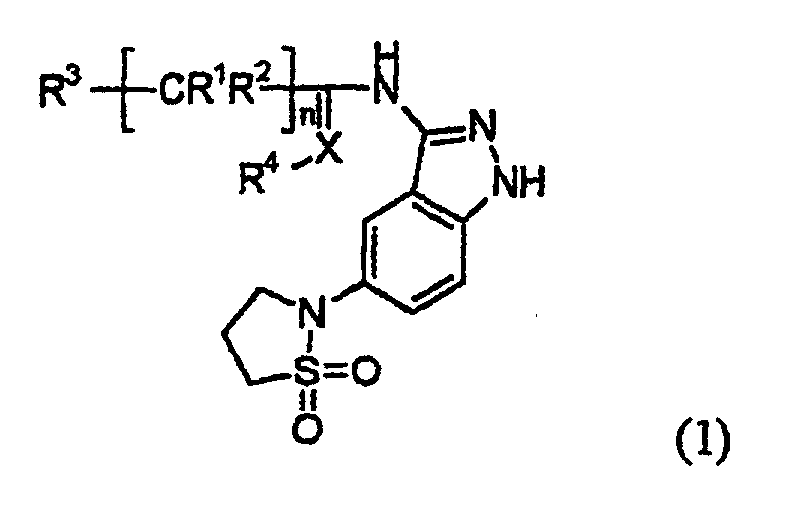
n represents 0, 1, 2 or 3,
X represents oxygen, sulfur or nitrogen atom,
R1 and R2 each independently represent hydrogen, amino, hydroxy, lower alkyl or cycloalkyl, or together form cycloalkyl,
R3 represents hydrogen; lower alkyl; phenyl, benzyl or naphthyl which may be unsubstituted or substituted with one to three substituents selected from the group consisting of hydroxy, halogen, nitro, amide, ester, carboxy, cyano, amidinyl, -O-R5, -NR6R7, phenyl, alkylsulfanyl, R8-SO2-, lower alkyl, lower alkyl substituted with R9, pyridinyl, piperidinyl, morpholinyl, piperazinyl, thienyl and furyl; aromatic and bicyclic aromatic compounds bearing at least one heteroatom selected from nitrogen, oxygen or sulfur atom; C3-7-cycloalkyl bearing at least one heteroatom selected from nitrogen, oxygen or sulfur atom; piperazinyl, imidazolyl, morpholinyl or piperidinyl which may be unsubstituted or substituted with one or two substituents selected from the group consisting of lower alkyl, phenyl, phenyl substituted with halogen, phenyl substituted with alkoxy, phenyl substituted with alkylcarbonyl, biphenyl and naphthyl; thiazole which may be unsubstituted or substituted with amino, mono- or di- lower alkylamino, alkylcarbonylamino, benzylamino, benzyloxycarbonylamino, benzyloxybenzylamino or alkoxycarbonylamino; benzodioxol; isoquinoline; indolyl; or benzimidazole wherein R5 represents phenyl, benzyl, lower alkyl, alkoxyalkyl, alkoxyalkoxylalkyl, alkoxyalkoxyalkoxyalkyl, aminoalkyl or mono- or di-alkylaminoalkyl, R6 and R7 are identifical or different from each other and represent hydrogen, lower alkyl, oxygen or benzyl, or joined to form a ring, and R8 and R9 represent each independently lower alkyl, amino, morpholinyl, piperazinyl, N-alkylpiperazinyl or imidazolyl, and
R4 represents nothing when X is oxygen or sulfur atom, but represents hydroxy or alkoxy when X is nitrogen atom,
pharmaceutically acceptable salt, solvated product and isomer thereof which are useful as inhibitors for Cyclin Dependent Kinase(hereinafter, refered to as "CDK"), and method for preparing the same. - The present invention also relates to an agent for inhibiting and treating diseases involving cell proliferation such as cancer, inflammation, restenosis and angiogenesis which comprises the compound of formula (1) as an active ingredient together with a pharmaceutically acceptable carrier.
- Researches on cell division process in molecular level have been extensively performed from the late 1980's through study of division of frog oocytes, analysis several yeast cell growth or characterization of induced mutants by radiation and study of the tumor suppressor Rb. In the 1990's, it is discovered that small molecular cell growth regulator controls cell division process(i.e. growth, differentiation, cytogenesis, aging and apoptosis etc.) through its own regulatory function. These results were very useful for more precise understanding of the pathology of several diseases.
- A representative example is cancer. In transformation process from normal cells to cancer cells, it was frequently observed that cell growth regulator loses its own function. That is to say, in cancer cells, the cell growth regulator shows an abnormal activity, which is deeply associated with invasion/metastasis which is crucial in the cancerpathology. Particularly, cell cycle deregulation is recognized to be a direct cause of cancer since cancer occurs in experimental animal when overexpression or knock-out of cell growth regulator is induced by using tranformed animal.
- The cell growth is under positive or negative regulation in the same manner as other biological regulations. The major pathway of cell cycle regulation known up to now is based on CDK activity and, as a result of studies on many cancer cells and carcinogenesis mechanisms, it was confirmed that problems of positive or negative regulation on CDK activity result in carcinogenesis in many cases. That is, cancer may occur when positive or negative regulation and timely regulation which is important for cell growth regulation are disrupted.
- The representative CDKs of mammals are CDK4(Cyclin dependent kinase 4) and CDK2 which show their activity in G1-S phase of cell cycle, CDC2(CDK1) which shows its activity in G2-M phase, and so on. It is known that CDK4 and CDK2 activities are regulated by check point of G1-S cell cycle and CDC2 activity by check point of G2-M. In many cancer cells, abnormalities appear in the regulatory mechanism of CDK4, CDK2 and CDC2(CDK1) and in fact, it was confirmed that induced abnormalities cause cancer in the transformed animal. Therefore, CDK4, CDK2 and CDC2(CDK1) among several kinds of CDKs are suitable as a target of anti-cancer agents.
- The results of studies on relation between these CDKs and carcinogenesis will be explained in more detail in the following,
- The relation between the abnormal regulation of CDK4 activity and carcinogenesis is observed in several cancer tissues. The deletion of p16 and p15 genes generating proteins which inhibit CDK4 activity and the overexpression of cyclin D1 indispensable for CDK4 activity are observed in several kinds of cancer, which suggests that malignant phenotype may be expressed when CDK4 activity is deregulated. Furthermore, it was reported that p16 knocked-out mouse has such a high carcinogenesis rate as p53 knocked-out mouse, which suggests that malfunction of p16 on CDK4 regulation is a cause of carcinogenesis. From these experimental results, deregulation of CDK4 activity may be a cause of carcinogenesis and play a role in maintenance of phenotype of cancer cell. Therefore, CDK4 inhibitors may have anti-cancer effects.
- It was reported that overexpression of cyclin E indispensible for CDK2 activity is observed in some breast cancers, deeply associated with metastasis of breast cancer, inhibits cell apoptosis under low serum condition and induces anchorage independent growth, and that hyperproliferation and neoplasia of mammary epithelial cells are observed in transformed animal with overexpressed CDK2 by MMTV promoter, which suggests that CDK2 activity is related with the progress or maintenance of cell transformation and CDK2 inhibitors may also have anti-cancer effects.
- Furthermore, it is discovered that CDC2(CDK1), CDK3, CDK5, CDK6 and CDK7 play an important role in each phase of cell division. These are classified into CDKs family. In addition to cyclin D1 and E, cyclin A, B, C, D2, D3, D4, F and G are also calssified into the same family.
- On the basis of the above-mentioned research, efficient inhibitors of these CDKs may be useful as anti-cancer agents. Therefore, recently, these inhibitors have been developed.
- As effective CDK inhibitors developed hitherto, there exists Flavopiridol, compound of the formula (A):[Ref. : EP 0,241,003(1987) and 0,336,061(1990)].
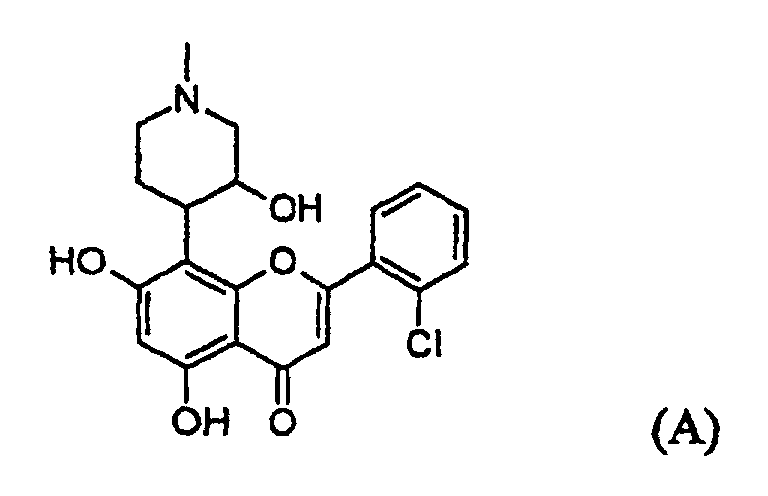
- In addition, a purine derivative of the formula (B):has been recently developed[Ref : WO 97/20842].

- Recently, a CDKs inhibitor having aminopyridine structure of the formula (C):is disclosed in WO 98/33798.

- However, the CDK inhibitors developed up to now could not have satisfactory effects.
- So, the present inventors have made widespread and concentrative researches on CDK inhibitors, particularly indazole-based compounds, and as a result, found that a component of the formula (1) which has a quite different structure from any other known CDK inhibitors inhibits CDKs enzymes effectively and finally, completed the present invention.
- The object of the present invention is to provide a novel indazole derivative of formula (1), a process for preparing the same, and a composition for inhibiting and treating diseases involving cell proliferation such as cancer, inflammation, restenosis and angiogenesis which comprises as an active ingredient the compound of formula (1). In this specification, CDKs include all of CDK2, CDK4, CDC2(CDK1), CDK3, CDK5, CDK6, CDK7 etc., and cyclin includes cyclin D1, E, A, B, C, D2, D3, D4, F and G.
- Hereinafter, the present invention is explained in detail.
- The present invention relates to a novel indazole derivative represented by the following formula (1):in which
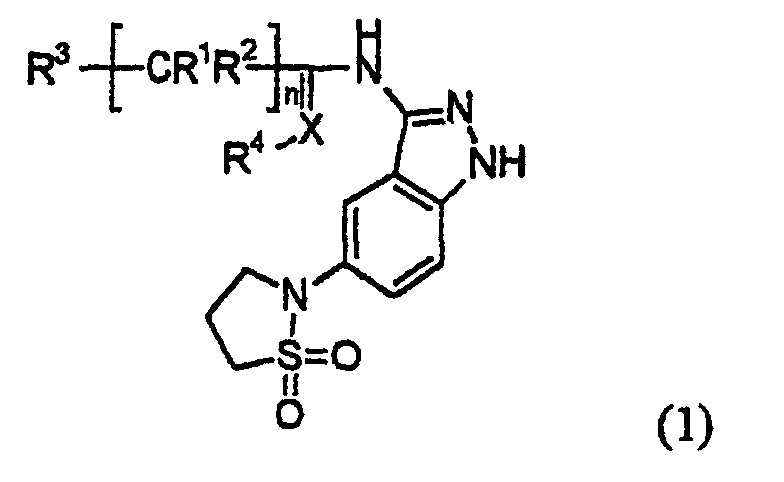
n represents 0, 1, 2 or 3,
X represents oxygen, sulfur or nitrogen atom,
R1 and R2 each independently represent hydrogen, amino, hydroxy, lower alkyl or cycloalkyl, or together form cycloalkyl,
R3 represents hydrogen; lower alkyl; phenyl, benzyl or naphthyl which may be unsubstituted or substituted with one to three substituents selected from the group consisting of hydroxy, halogen, nitro, amide, ester, carboxy, cyano, amidinyl, -O-R5, -NR6 R7, phenyl, alkylsulfanyl, R8-SO2-, lower alkyl, lower alkyl substituted with R9, pyridinyl, piperidinyl, morpholinyl, piperazinyl, thienyl and furyl; aromatic and bicyclic aromatic compounds bearing at least one heteroatom selected from nitrogen, oxygen or sulfur atom; C3-7-cycloalkyl bearing at least one heteroatom selected from nitrogen, oxygen or sulfur atom; piperazinyl, imidazolyl, morpholinyl or piperidinyl which may be unsubstituted or substituted with one or two substituents selected from the group consisting of lower alkyl, phenyl, phenyl substituted with halogen, phenyl substituted with alkoxy, phenyl substituted with alkylcarbonyl, biphenyl and naphthyl; thiazole which may be unsubstituted or substituted with amino, mono- or di- lower alkylamino, alkylcarbonylamino, benzylamino, benzyloxycarbonylamino, benzyloxybenzylamino or alkoxycarbonylamino; benzodioxol; isoquinoline; indolyl; or benzimidazole wherein R5 represents phenyl, benzyl, lower alkyl, alkoxyalkyl, allcoxyalkoxylalkyl, alkoxyalkoxyalkoxyalkyl, aminoalkyl or mono- or di-alkylaminoalkyl, R6 and R7 are identifical or different from each other and represent hydrogen, lower alkyl, oxygen or benzyl, or joined to form a ring, and R8 and R9 represent each independently lower alkyl, amino, morpholinyl, piperazinyl, N-alkylpiperazinyl or imidazolyl, and
R4 represents nothing when X is oxygen or sulfur atom, but represents hydroxy or alkoxy when X is nitrogen atom,
pharmaceutically acceptable salt, solvated product and isomer thereof which have efficacies on inhibiting and treating diseases involving cell proliferation such as cancer, inflammation, restenosis and angiogenesis through a mechanism of inhibiting CDKs activity. - Among the indazole derivatives of formula (1) according to the present invention, the preferred compounds include those wherein
n represents 1 or 2,
X represents oxygen, sulfur or nitrogen atom,
R1 and R2 each independently represent hydrogen, amino, hydroxy, lower alkyl or cycloalkyl, or together form cycloalkyl,
R3 represents hydrogen; lower alkyl; phenyl which may be unsubstituted or substituted with one to three substituents selected from the group consisting of hydroxy, halogen, nitro, amide, cyano, amidinyl, -O-R5, -NR6R7, phenyl, lower alkylsulfanyl, R8-SO2-, lower alkyl, lower alkyl substituted with R9, pyridiny, piperidinyl, morpholinyl, thienyl and furyl; naphthyl; piperazinyl or imidazolyl which may be unsubstituted or substituted with one or two substituents selected from the group consisting of lower alkyl, phenyl, phenyl substituted with halogen, phenyl substituted with lower alkoxy, phenyl substituted with acetyl, biphenyl and naphthyl; morpholinyl; piperidinyl; thiazole which may be unsubstituted or substituted with amino, mono- or di- lower alkylamino, acetylamino, benzylamino, benzyloxyamino, benzyloxybenzylamino or lower alkoxycarbonylamino; benzodioxol; 3,4-dihydroisoquinoline; or benzimidazole wherein R5 represents phenyl, benzyl, lower alkyl, lower alkoxyalkyl, polyethyleneglycolyl, aminoalkyl or mono- or di- lower alkylaminoalkyl, R6 and R7 are identifical or different from each other and represent hydrogen, lower alkyl, oxygen or benzyl, or joined to form a ring, and R8 and R9 each independently represent lower alkyl, amino, morpholinyl, piperazinyl, N-alkylpiperazinyl or imidazolyl, and
R4 represents nothing when X is oxygen or sulfur atom, but represents hydroxy or alkoxy when X is nitrogen atom. - The term "lower alkyl" in the substituents of the compound of formula (1) refers to a linear or branched saturated radical of from 1 to 6 C atoms such as methyl, ethyl, isopropyl, isobutyl and t-butyl. The term "lower alkoxy" refers to a linear or branched radical of from 1 to 6 C atoms such as methoxy, ethoxy, isopropoxy, isobutoxy and t-butoxy.
- Since the compounds of formula (1) according to the present invention may have asymmetric carbon centers, they can be present in the form of enantiomer or diastereomer, and mixtures thereof including racemate.
- Therefore, the present invention also includes all these isomers and their mixtures.
- The compound of formula (1) according to the present invention may also form a pharmaceutically acceptable salt. Such a salt includes non-toxic acid addition salt containing pharmaceutical acceptable anion, for example a salt with inorganic acids such as hydrochloric acid, sulfuric acid, nitric acid, phosphoric acid, hydrobromic acid, hydroiodic acid, etc., a salt with organic carboxylic acids such as tartaric acid, formic acid, citric acid, acetic acid, trichloroacetic acid, trifluoroacetic acid, capric acid, isobutanoic acid, oxalic acid, malonic acid, succinic acid, phthalic acid, gluconic acid, benzoic acid, lactic acid, fumaric acid, maleic acid, etc., or a salt with sulfonic acids such as methanesulfonic acid, benzenesulfonic acid, p-toluenesulfonic acid, naphthalenesulfonic acid, etc.
- The representative examples of the compound of formula (1) according to the present invention are
- 1. N-[5-(1,1-dioxo-1λ6-isothiazolidin-2-yl)-1H-indazol-3-yl]-2-phenylacetamide,
- 2. 2-(3-chlorophenyl)-N-[5-(1,1-dioxo-1λ6-isothiazolidin-2-yl)-1H-indazol-3-yl]acetamide,
- 3. 2-[4-(benzyloxy)phenyl]-N-[5-(1,1-dioxo-1λ6-isothiazolidin-2-yl)-1H-indazol-3-yl]acetamide,
- 4. N-[5-(1,1-dioxo-1λ6-isothiazolidin-2-yl)-1H-indazol-3-yl]-2-(4-hydroxy-phenyl)acetamide,
- 5. 2-[4-(dibenzylamino)phenyl]-N-[5-(1,1-dioxo-1λ6-isothiazolidin-2-yl)-1H-indazol-3-yl]acetamide,
- 6. N-[5-(1,1-dioxo-1λ6-isothiazolidin-2-yl)-1H-indazol-3-yl]-2-[4-(methylamino)phenyl]acetamide,
- 7. 2-(4-aminophenyl)-N-[5-(1,1-dioxo-1λ6-isothiazolidin-2-yl)-1H-indazol-3-yl]acetamide,
- 8. 2-(4-chlorophenyl)-N-[5-(1,1-dioxo-1λ6-isothiazolidin-2-yl)-1H-indazol-3-yl]acetamide,
- 9. N-[5-(1,1-dioxo-1λ6-isothiazolidin-2-yl)-1H-indazol-3-yl]-2-(4-fluorophenyl)acetamide,
- 10. 2-[1,1'-biphenyl]-4-yl-N-[5-(1,1-dioxo-1λ6-isothiazolidin-2-yl)-1H-indazol-3-yl]acetamide,
- 11. 2-(3-bromophenyl)-N-[5-(1,1-dioxo-1λ6-isothiazolidin-2-yl)-1H-indazol-3-yl]acetamide,
- 12. 2-(4-bromophenyl)-N-[5-(1,1-dioxo-1λ6-isothiazolidin-2-yl)-1H-indazol-3-yl]acetamide,
- 13. N-[5-(1,1-dioxo-1λ6-isothiazolidin-2-yl)-1H-indazol-3-yl]-2-phenylethanethioamide,
- 14. N-[5-(1,1-dioxo-1λ6-isothiazolidin-2-yl)-1H-indazol-3-yl]-N'-hydroxy-2-phenylethaneimidoamide,
- 15. 2-(1,3-benzodioxol-5-yl)-N-[5-(1,1-dioxo-1λ6-isothiazolidin-2-yl)-1H-indazol-3-yl]acetamide,
- 16. N-[5-(1,1-dioxo-1λ6-isothiazolidin-2-yl)-1H-indazol-3-yl]-2-(1-naphthyl)acetamide,
- 17. N-[5-(1,1-dioxo-1λ6-isothiazolidin-2-yl)-1H-indazol-3-yl]-2-(2-naphthyl)acetamide,
- 18. N-[5-(1,1-dioxo-1λ6-isothiazolidin-2-yl)-1H-indazol-3-yl]-2-(3-nitrophenyl)acetamide,
- 19. N-[5-(1,1-dioxo-1λ6-isothiazolidin-2-yl)-1H-indazol-3-yl]acetamide,
- 20. N-[5-(1,1-dioxo-1λ6-isothiazolidin-2-yl)-1H-indazol-3-yl]-2-[4-(methylsulfanyl)phenyl]acetamide,
- 21. 2-(3-aminophenyl)-N-[5-(1,1-dioxo-1λ6-isothiazolidin-2-yl)-1H-indazol-3-yl]acetamide,
- 22. N-[5-(1,1-dioxo-1λ6-isothiazolidin-2-yl)-1H-indazol-3-yl]ethanethioamide,
- 23. N-[5-(1,1-dioxo-1λ6-isothiazolidin-2-yl)-1H-indazol-3-yl]-N'-hydroxyethaneimidoamide,
- 24. 2-(3,4-dichlorophenyl)-N-[5-(1,1-dioxo-1λ6-isothiazolidin-2-yl)-1H-indazol-3-yl]acetamide,
- 25. N-[5-(1,1-dioxo-1λ6-isothiazolidin-2-yl)-1H-indazol-3-yl]-3-phenylpropanamide,
- 26. N-[5-(1,1-dioxo-1λ6-isothiazolidin-2-yl)-1H-indazol-3-yl]-2-(4-isopropylphenyl)acetamide,
- 27. N-[5-(1,1-dioxo-1λ6-isothiazolidin-2-yl)-1H-indazol-3-yl]-2-(3-methylphenyl)acetamide,
- 28. N-[5-(1,1-dioxo-1λ6-isothiazolidin-2-yl)-1H-indazol-3-yl]-2-(4-methylphenyl)acetamide,
- 29. N-[5-(1,1-dioxo-1λ6-isothiazolidin-2-yl)-1H-indazol-3-yl]-2-[4-(methylsulfonyl)phenyl]acetamide,
- 30. N-[5-(1,1-dioxo-1λ6-isothiazolidin-2-yl)-1H-indazol-3-yl]-2-(4-methyl-1-piperazinyl)acetamide,
- 31. N-[5-(1,1-dioxo-1λ6-isothiazolidin-2-yl)-1H-indazol-3-yl]-2-(4-morpholinyl)acetamide,
- 32. N-[5-(1,1-dioxo-1λ6-isothiazolidin-2-yl)-1H-indazol-3-yl]-2-(1-piperidinyl)acetamide,
- 33. N-[5-(1,1-dioxo-1λ6-isothiazolidin-2-yl)-1H-indazol-3-yl]-2-[4-(4-pyridinyl)phenyl]acetamide,
- 34. N-[5-(1,1-dioxo-1λ6-isothiazolidin-2-yl)-1H-indazol-3-yl]-2-[4-(1-piperidinyl)phenyl]acetamide,
- 35. N-[5-(1,1-dioxo-1λ6-isothiazolidin-2-yl)-1H-indazol-3-yl]-2-[4-(1-morpholinyl)-phenyl]acetamide,
- 36. N-[5-(1,1-dioxo-1λ6-isothiazolidin-2-yl)-1H-indazol-3-yl]-2-[4-(3-thienyl)phenyl]acetamide,
- 37. N-[5-(1,1-dioxo-1λ6-isothiazolidin-2-yl)-1H-indazol-3-yl]-2-[4-(4-morpholinylsulfonyl)phenyl]acetamide,
- 38. N-[5-(1,1-dioxo-1λ6-isothiazolidin-2-yl)-1H-indazol-3-yl]-2-(4-methoxyphenyl)acetamide,
- 39. N-[5-(1,1-dioxo-1λ6-isothiazolidin-2-yl)-1H-indazol-3-yl]-2-[4-(2-furyl)phenyl]acetamide,
- 40. N-[5-(1,1-dioxo-1λ6-isothiazolidin-2-yl)-1H-indazol-3-yl]-2-4-[(4-methyl-1-piperazinyl)sulfonyl]phenylacetamide,
- 41. 2-(1H-benzimidazol-1-yl)-N-[5-(1,1-dioxo-1λ6-isothiazolidin-2-yl)-1H-indazol-3-yl]acetamide,
- 42. N-[5-(1,1-dioxo-1λ6-isothiazolidin-2-yl)-1H-indazol-3-yl]-2-(4-ethoxyphenyl)acetamide,
- 43. N-[5-(1,1-dioxo-1λ6-isothiazolidin-2-yl)-1H-indazol-3-yl]-2-[4-(4-morpholinylmethyl)phenyl]acetamide,
- 44. N-[5-(1,1-dioxo-1λ6-isothiazolidin-2-yl)-1H-indazol-3-yl]-2-4-[(4-methyl-1-piperazinyl)methyl]phenylacetamide,
- 45. N-[5-(1,1-dioxo-1λ6-isothiazolidin-2-yl)-1H-indazol-3-yl]-2-(4-nitrophenyl)acetamide,
- 46. N-[5-(1,1-dioxo-1λ6-isothiazolidin-2-yl)-1H-indazol-3-yl]-2-[4-(1H-imidazol-1-ylmethyl)phenyl]acetamide,
- 47. N-[5-(1,1-dioxo-1λ6-isothiazolidin-2-yl)-1H-indazol-3-yl]-2-(4-phenyl-1H-imidazol-1-yl)acetamide,
- 48. N-[5-(1,1-dioxo-1λ6-isothiazolidin-2-yl)-1H-indazol-3-yl]-2-(4-phenyl-1-piperazinyl)acetamide,
- 49. 2-[3,4-dihydro-2(1H)-isoquinolinyl]-N-[5-(1,1-dioxo-1λ6-isothiazolidin-2-yl)-1H-indazol-3-yl]acetamide,
- 50. N-[5-(1,1-dioxo-1λ6-isothiazolidin-2-yl)-1H-indazol-3-yl]-2-[4-(4-chlorophenyl)-1-piperazinyl]acetamide,
- 51. N-[5-(1,1-dioxo-1λ6-isothiazolidin-2-yl)-1H-indazol-3-yl]-2-[4-(4-methoxyphenyl)-1-piperazinyl]acetamide,
- 52. N-[5-(1,1-dioxo-1λ6-isothiazolidin-2-yl)-1H-indazol-3-yl]-2-[4-(2-ethoxyphenyl)-1-piperazinyl]acetamide,
- 53. 2-[4-(4-acetylphenyl)-1-piperazinyl]-N-[5-(1,1-dioxo-1λ6-isothiazolidin-2-yl)-1H-indazol-3-yl]acetamide,
- 54. N-[5-(1,1-dioxo-1λ6-isothiazolidin-2-yl)-1H-indazol-3-yl]-2-(4-phenoxyphenyl)acetamide,
- 55. N-[5-(1,1-dioxo-1λ6-isothiazolidin-2-yl)-1H-indazol-3-yl]-1-phenylcyclopentanecarboxamide,
- 56. 2-cyclopentyl-N-[5-(1,1-dioxo-1λ6-isothiazolidin-2-yl)-1H-indazol-3-yl]-2-phenylacetamide,
- 57. N-[5-(1,1-dioxo-1λ6-isothiazolidin-2-yl)-1H-indazol-3-yl]-2-phenylbutanamide,
- 58. t-butyl 4-(2-[5-(1,1-dioxo-1λ6-isothiazolidin-2-yl)-1H-indazol-3-yl]amino-2-oxoethyl)-1,3-thiazol-2-ylcarbamate,
- 59. N-[5-(1,1-dioxo-1λ6-isothiazolidin-2-yl)-1H-indazol-3-yl]-2-4-[2-(2-ethoxy-ethoxy)ethoxy]phenylacetamide,
- 60. 2-(2-amino-1,3-thiazol-4-yl)-N-[5-(1,1-dioxo-1λ6-isothiazolidin-2-yl)-1H-indazol-3-yl]acetamide,
- 61. 2-[4-(4-bromophenyl)-1H-imidazol-1-yl]-N-[5-(1,1-dioxo-1λ6-isothiazolidin-2-yl)-1H-indazol-3-yl]acetamide,
- 62. N-[5-(1,1-dioxo-1λ6-isothiazolidin-2-yl)-1H-indazol-3-yl]-2-[4-(2-naphthyl)-1H-imidazol-1-yl]acetamide,
- 63. 2-(4-[1,1'-biphenyl]-4-yl-1H-imidazol-1-yl)-N-[5-(1,1-dioxo-1λ6-isothiazolidin-2-yl)-1H-indazol-3-yl]acetamide,
- 64. N-[5-(1,1-dioxo-1λ6-isothiazolidin-2-yl)-1H-indazol-3-yl]-2-[2-(ethylamino)-1,3-thiazol-4-yl]acetamide,
- 65. 2-[2-(diethylamino)-1,3-thiazol-4-yl]-N-(5-(1,1-dioxo-1λ6-isothiazolidin-2-yl)-1H-indazol-3-yl]acetamide,
- 66. N-[5-(1,1-dioxo-1λ6-isothiazolidin-2-yl)-1H-indazol-3-yl]-2-(4-2-[2-(2-methoxyethoxy)ethoxy]ethoxyphenyl)acetamide,
- 67. N-[5-(1,1-dioxo-1λ6-isothiazolidin-2-yl)-1H-indazol-3-yl]-2-(4-ethoxy-3-nitrophenyl)acetamide,
- 68. N-[5-(1,1-dioxo-1λ6-isothiazolidin-2-yl)-1H-indazol-3-yl]-2-(2-methylphenyl)acetamide,
- 69. N-[5-(1,1-dioxo-1λ6-isothiazolidin-2-yl)-1H-indazol-3-yl]-2-[3-(ethylamino)phenyl]acetamide,
- 70. 2-[3-(diethylamino)phenyl]-N-[5-(1,1-dioxo-1λ6-isothiazolidin-2-yl)-1H-indazol-3-yl]acetamide,
- 71. 2-(3,5-dimethoxyphenyl)-N-[5-(1,1-dioxo-1λ6-isothiazolidin-2-yl)-1H-indazol-3-yl]acetamide,
- 72. N-[5-(1,1-dioxo-1λ6-isothiazolidin-2-yl)-1H-indazol-3-yl]-2-[4-(ethylamino)phenyl]acetamide,
- 73. 2-[4-(diethylamino)phenyl]-N-[5-(1,1-dioxo-1λ6-isothiazolidin-2-yl)-1H-indazol-3-yl]acetamide,
- 74. 2-(3-chloro-4-ethoxyphenyl)-N-[5-(1,1-dioxo-1λ6-isothiazolidin-2-yl)-1H-indazol-3-yl]acetamide,
- 75. 2-[4-(2-aminoethoxy)phenyl]-N-[5-(1,1-dioxo-1λ6-isothiazolidin-2-yl)-1H-indazol-3-yl]acetamide,
- 76. 2-[2-(acetylamino)-1,3-thiazol-4-yl]-N-[5-(1,1-dioxo-1λ6-isothiazolidin-2-yl)-1H-indazol-3-yl]acetamide,
- 77. 2-(2-[4-(benzyloxy)benzyl]amino-1,3-thiazol-4-yl)-N-[5-(1,1-dioxo-1λ6-isothiazalidin-2-yl)-1H-indazol-3-yl]acetamide,
- 78. N-[5-(1,1-dioxo-1λ6-isothiazolidin-2-yl)-1H-indazol-3-yl]-2-(3-ethoxyphenyl)acetamide,
- 79. N-[5-(1,1-dioxo-1λ6-isothiazolidin-2-yl)-1H-indazol-3-yl]-2-[4-ethoxy-3-(4-morpholinylsulfonyl)phenyl]acetamide,
- 80. 2-[3-(aminosulfonyl)-4-ethoxyphenyl]-N-[5-(1,1-dioxo-1λ6-isothiazolidin-2-yl)-1H-indazol-3-yl]acetamide,
- 81. N-[5-(1,1-dioxo-1λ6-isothiazolidin-2-yl)-1H-indazol-3-yl]-2-4-ethoxy-3-[(4-methyl-1-piperazinyl)sulfonyl]phenylacetamide, and
- 82. 2-[4-(2-aminoethoxy)phenyl]-N-[5-(1,1-dioxo-1λ6-isothiazolidin-2-yl)-1H-indazol-3-yl]acetamide.
-
- The processes for preparing the compound of formula (1) as defined above are depicted in the following Scheme (1):wherein R1, R2, R3 and n are as previously described, and Boc represents t-butoxycarbonyl.
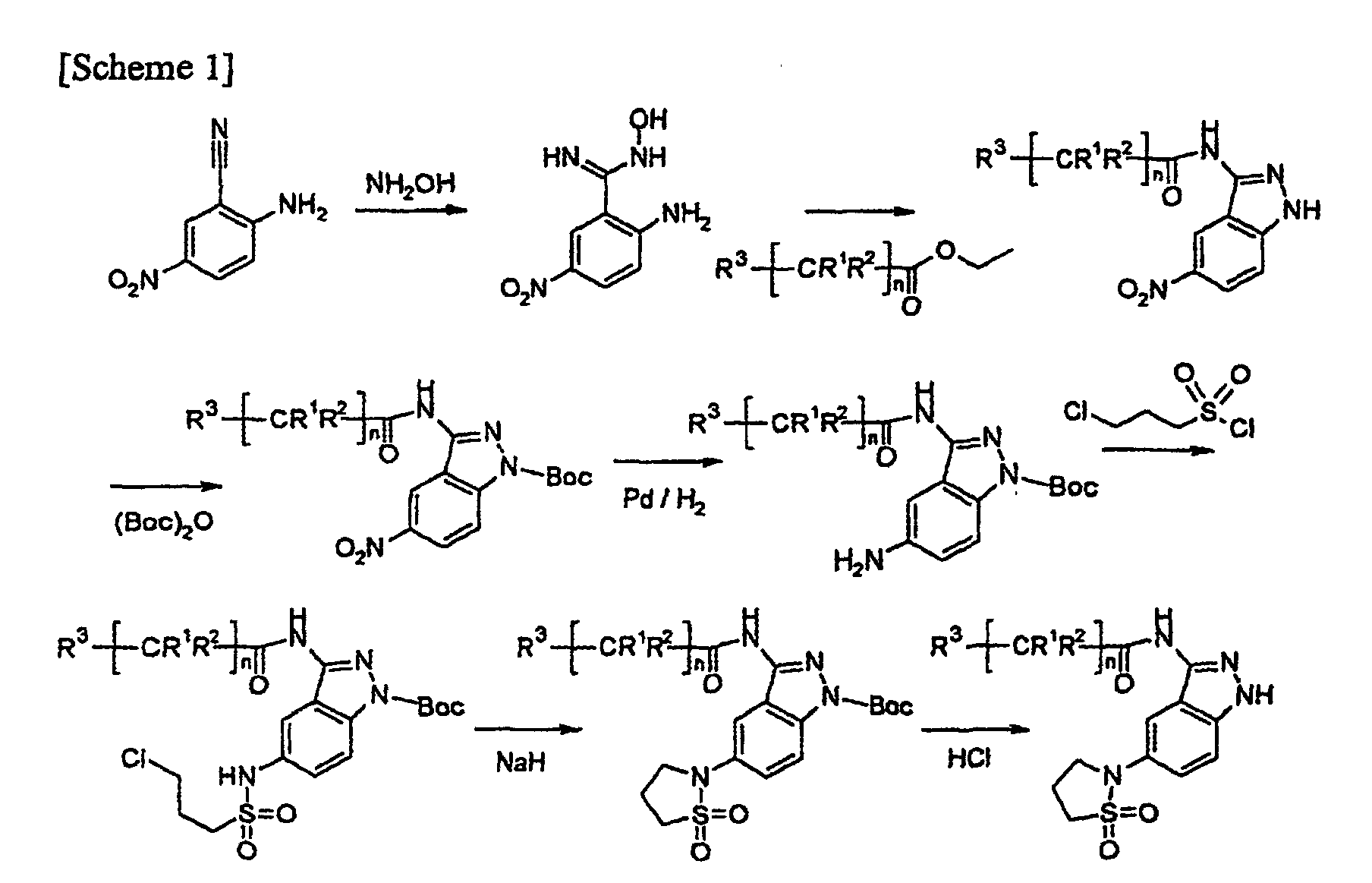
- That is, as depicted in the above Scheme (1), an amidoxime of the following formula (2):is prepared by reacting anthranilonitrile with hydroxylamine, and the amidoxime thus prepared is then reacted with ester to produce a 3-aminoindazole of the following formula (3):
 wherein R1, R2 and R3 are as previously described.
- A 1-position of 3-aminoindazole is protected by t-butylcarbamate to produce a compound of the following formula (4):wherein R1, R2, R3 and n are as previously described, and Boc represents t-butoxycarbonyl, and then nitro group at C-5 is reduced to produce an amine of the following formula (5):
 wherein R1, R2, R3 and n are as previously described, and Boc represents t-butoxycarbonyl.
- A sulfonamide of the following formula (6):wherein R1, R2, R3 and n are as previously described, and Boc represents t-butoxycarbonyl, which is obtained by reacting the compound of formula (5) with sulfonyl chloride is cyclized through intramolecular ring-closure to synthesize a dioxoisothiazolidine of the following formula (7):
 wherein R1, R2, R3 and n are as previously described, and Boc represents t-butoxycarbonyl.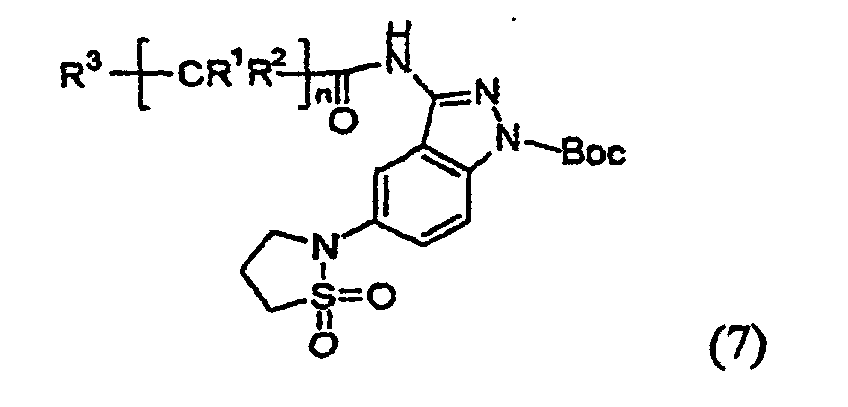
- Finally, the compound of formula (7) is deprotected to give the compound of formula (1). A compound of formula (1) wherein X is oxygen atom is reacted with Lawesson's reagent (2,4-bis-(4-methoxyphenyl-1,3-dithia-2,4-diphosphethane-2,4-disulfide) to produce a compound of formula (1) wherein X is sulfur atom, or the compound of formula (1) wherein X is sulfur atom is reacted with a compound of the following formula (8):
- The indazole derivative of formula (1) according to the present invention may also be synthesized through amidization followed by deprotection of an indazole intermediate of the following formula (9):wherein Cbz represents benzyloxycarbonyl.

- Specifically, the indazole intermediate of formula (9) is reacted with an acyl halide of the following formula (10):wherein R1, R2, R3 and n are as previously described in the formula (1), and X' represents halogen, for example, Cl, or Br., and then subjected to deprotection to give the compound of formula (1), which will be described in the following Example 2.
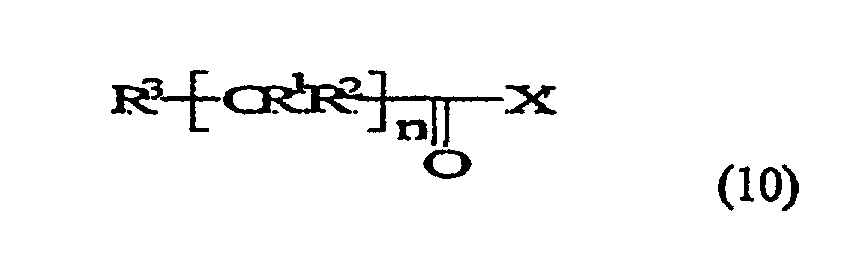
- Meanwhile, the indazole derivative of formula (9) is prepared by using anthranilonitrile as a starting material, as depicted in the following Scheme (2):wherein R1, R2, R3 and n are as previously described, Boc represents t-butoxycarbonyl, and Cbz represents benzyloxycarbonyl.

- Specifically, as depicted in the Scheme (2) above, the indazole derivative of formula (9) is prepared by reacting amidoxime of anthranilonitrile with ethyl phenylacetate in accordance with the above Scheme (1) to produce an indazole derivative of the following formula (11):, which corresponds to the compound of formula (1), protecting a nitrogen at 1-position of the indazole derivative by benzylcarbamate to produce a compound of the following formula (12):
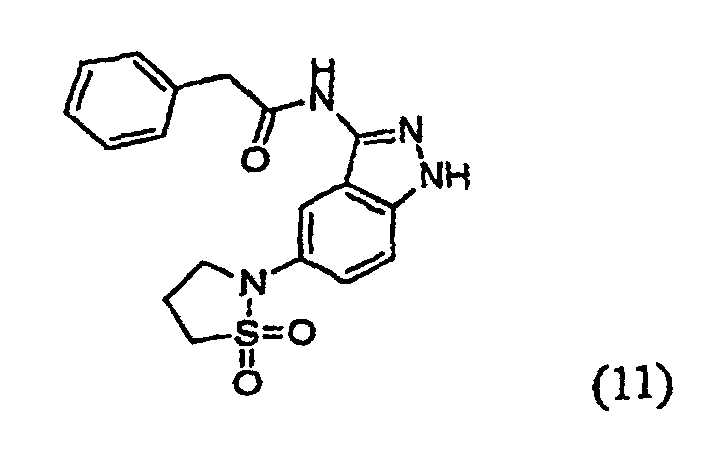 wherein Cbz represents benzyloxycarbonyl,
cleaving an amide bond in the compound of formula (12) using di-t-butylcarbonate to produce a compound of the following formula (13):wherein Boc represents t-butoxycarbonyl, and Cbz represents benzyloxycarbonyl. , and removing t-butoxycarbonyl groups.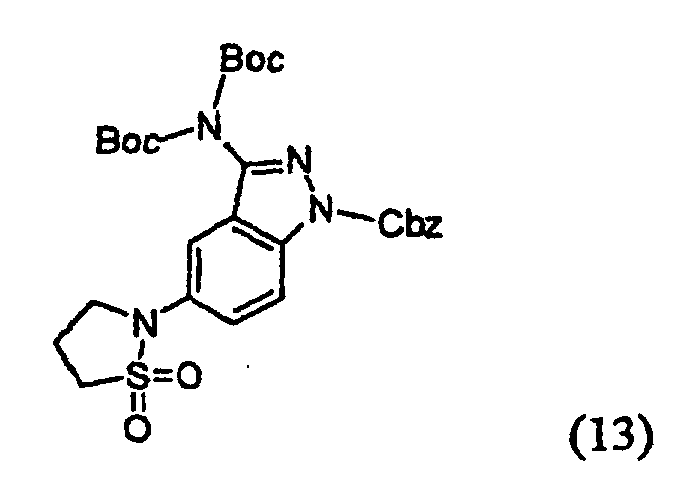
- However, the process for preparing the compounds according to the present invention has been described in detail for the purpose of illustration, but should not be interpreted to limit the invention. The compounds of the present invention can easily be prepared by conventional methods of organic synthesis described in the prior art or combinations thereof, and such combinations are well known to those skilled in the art.
- The compound of the formula (1) according to the present invention has an inhibitory activity against CDK, and thus may be put to a good use as an agent for inhibiting and treating diseases involving cell proliferation such as cancer, inflammation, restenosis and angiogenesis. Accordingly, another object of the present invention is to provide a composition for inhibiting and treating diseases involving cell proliferation such as cancer, inflammation, restenosis and angiogenesis which comprises the compound of formula (1), pharmaceutically acceptable salt, solvated product or isomer thereof as an active ingredient together with a pharmaceutically acceptable carrier.
- When the compound of the present invention is administered for clinical purpose, it is preferably administered in an amount ranging from 1.0 to 50mg/kg of body weight a day. The total daily dosage may be administered in one time or over several times. However, the specific dosage for a specific patient can be varied according to the specific compound used, body weight of the subject patient, sex, hygienic condition, diet, time or method of administration, excretion rate, mixing ratio of the medicine, severity of the disease to be treated, etc.
- The compound of the present invention may be administered in the form of injections or oral preparations.
- Injections such as sterilized aqueous or oily suspension for injection may be prepared by using suitable dispersing agent, sufactant or suspension agent according to the known method. As solvents to be used for preparing injections, water, Ringer's fluid and isotonic NaCl solution can be mentioned, and sterilized fixing oil is also used as the solvent or suspension medium. Any non-stimulative fixing oil including mono- or diglyceride can be used for this purpose, and also fatty acid such as oleic acid can be used for injection formulation.
- As the solid preparation for oral administration, capsules, tablets, pills, powders and granules, preferably capsules and tablets can be mentioned. It is desirable for tablets and pills to be formulated into enteric-coated preparation. Solid preparations may be prepared by mixing the active compound of formula (1) according to the present invention with at least one carrier selected from the group consisting of inert diluents(e.g. sucrose, lactose, starch, etc.), lubricants(e.g. magnesium stearate), disintegrants, and binders.
- When it is intended to produce the desired anti-cancer effects by administering clinically the compound of the invention, the active compound of the formula (1) can be administered together with at least one agent selected from the known anti-cancer agents. In this manner, as anti-cancer agents to be administered with the compound of the invention, 5-fluorouracil, cisplatin, doxorubicin, taxol, gemcitabine, etc. can be mentioned.
- However, the preparations containing the compound according to the invention intended for anti-cancer effect are not limited to those described above, and any preparations useful for treating and inhibiting cancers can be included.
- The present invention is more specifically explained by way of the following prepartions and examples. However, it should be understood that the present invention is not limited to these examples in any manner.
- 27.8g(400mmol) of hydroxylamine hydrochloride and 33.6g(400mmol) of sodium bicarbonate were dissolved in 140ml of water, and then a solution of 33.6g(200mmol) of anthranilonitrile in 520ml of ethanol was added thereto. The mixture was heated under reflux for 12 hours, and then cooled to room temperature. The resulting precipitate was filtered and washed with water and diethyl ether to give 37.2g of the title compound in a yield of 95%.
- 1H NMR (DMSO-d6, ppm): δ 6.02(2H, s), 7.78(1H, d), 7.80(2H, s), 7.92(1H, dd), 8.35(1H, d), 9.98(1H, s)
- FAB MS(m/e) = 197[M+1]
- 29.4g(150mmol) of the compound obtained in Preparation 1-1) was dissolved in 500ml of tetrahydrofuran, and 9.0g(60%, 225mmol) of sodium hydride was added thereto. The mixture was stirred at room temperature for 30 minutes. 36.9g(225mmol) of ethyl phenylacetate was added thereto, the mixture was stirred for one hour, and then 200ml of N,N-dimethylformamide was added thereto. The mixture was further stirred under slight heating for 4 hours. The solvent was removed under reduced pressure, and the residue was then treated with ethyl acetate and water. The resulting precipitate was filtered and washed with water and diethyl lether to give 20.3g of the title compound in a yield of 48%.
- 1H NMR (DMSO-d6, ppm): δ 3.79(2H, s), 7.28(1H, t), 7.30-7.43(4H, m), 7.60(1H, d), 8.12(1H, dd), 9.00(1H, s)
- FAB MS(m/e) = 283 [M+1]
- 8.0g(28mmol) of the compound obtained in Preparation 1-2) was dissolved in 130 mℓ of tetrahydrofuran, and 3.2g(80mmol) of sodium hydroxide in 20ml of water and 7.1g(33mmol) of di-t-butylcarbonate were added thereto. The mixture was stirred for one hour. After removal of solvents under reduced pressure, the residue was subjected to recrystalization using ethyl acetate and hexane to give the title compound quantatively.
- 1H NMR(CDCl3, ppm): δ 1.69(9H, s), 3.65(2H, s), 7.24-7.30(5H, m), 7.68(1H, dd), 7.91(1H, s), 8.00(1H, d), 8.73(1H, s)
- 11g(28mmol) of the compound obtained in Preparation 1-3) was dissolved in methanol, and palladium-adsorbed activated carbon(10%) was added thereto. The mixture was stirred under hydrogen atmosphere for 2 hours. The resulting suspension was filtered through celite, and then the filtrate was concentrated to give the title compound quantatively.
- 1H NMR (CDCl3, ppm): δ 1.68(9H, s), 3.68(2H, s), 7.25-7.31(5H, m), 7.45(1H, dd), 7.71(1H, s), 7.94(1H, d), 8.64(1H, s)
- 6.3g(17mmol) of the compound obtained in Preparation 1-4) was dissolved in 120 mℓ of dichloromethane, and 13ml(170mmol) of pyridine and 27ml(22mmol) of 3-chloropropanesulfonyl chloride were added thereto. The mixture was stirred at room temperature for 2 hours. The solvent was removed under reduced pressure, and then the residue was purified by silica gel column chromatography(eluent: n-hexane/ethylacetate = 1/1(v/v)) to give the title compound qualitatively.
- 1H NMR (CD3OD, ppm): δ 1.69(9H, s), 2.20(2H, m), 3.17(2H, t), 3.65(4H, m), 7.29(5H, m), 7.30(1H, m), 7.40(1H, d), 7.60(1H, s)
- ESI MS(m/e) = 507 [M+1]
- 8.6g(17mmol) of the compound obtained in Preparation 1-5) was dissolved in 150 mℓ of N,N-dimethylformamide, and 1.43g(34mmol) of sodium hydride was added thereto. The mixture was stirred for 30 minutes. The solvent was removed under reduced pressure. The residue was extracted with ethyl acetate, and then the extracted ethyl acetate solution was washed with water three times. The solvent was under reduced pressure, and then the residue was purified by silica gel column chromatography(eluent: n-hexane/ethylacetate = 1/2(v/v)) to give 8.0g of the title compound quantatively.
- 1H NMR (CDCl3, ppm): δ 1.70(9H, s), 2.50(2H, m), 3.28(2H, t), 3.80(4H, m), 7.30(5H, m), 7.68(1H, m), 7.91(1H, s), 8.00(1H, d), 8.73(1H, s)
- ESI MS(m/e) = 471 [M+1]
- 5.2g(11mmol) of the compound obtained in Preparation 1-6) was added to ethyl acetate which was saturated with hydrogen chloride, and the mixture was stirred for 6 hours. The solvent was removed under reduced pressure to give the title compound quantatively.
- 1H NMR (DMSO-d6, ppm): δ 2.39(2H, m), 3.46(2H, t), 3.69(2H, t), 3.74(2H, s), 7.26(1H, t), 7.34(3H, t), 7.39(2H, d), 7.46(1H, d), 7.58(1H, s), 10.69(1H, s)
- ESI MS(m/e) = 371 [M+1]
- After 4.1g(11mmol) of the compound obtained in Example 1 was dissolved in 150 mℓ of dichloromethane, 10ml(7.9mmol) of triethylamine and 2.25ml(17mmol) of benzyl chloroformate were added. The mixture was stirred for 2 hours. After removal of solvent under reduced pressure, the residue was purified by silica gel column chromatography(eluent: n-hexane/ethylacetate = 2/1(v/v)) to give 5.2g of the title compound in a yield of 94%.
- 1H NMR (DMSO-d6, ppm): δ 2.34(2H, m), 3.52(2H, t), 3.74(2H, t), 3.78(2H, s), 5.48(2H, s), 7.25(1H, m), 7.36(4H, m), 7.44(3H, m), 7.53(2H, d), 7.58(1H, dd), 7.82(1H, s), 8.12(1H, d)
- ESI MS(m/e) = 505 [M+1]
- After 5.2g(11mmol) of the compound obtained in Preparation 2-1) was dissolved in 100mℓ of dichloromethane, 1.36g(11mmol) of N,N-dimethylaminopyridine, 1.55ml (11mmol) of triethylamine and 4.85g(22mmol) of di-t-butylcarbonate were added. The mixture was stirred for 30 minutes. After removal of solvent under reduced pressure, the residue was purified by silica gel column chromatography(eluent: n-hexane/ethylacetate = 1/2(v/v)) to give 6.4g of the title compound qualitatively.
- 1H NMR (CD3OD, ppm): δ 1.36(9H, s), 1.44(9H, s), 2.51(2H, m), 3.45(2H, t), 3.83(2H, t), 5.53(2H, s), 7.34(3H, m), 7.48(1H, d), 7.54(2H, d), 7.56(1H, dd), 8.15(1H, dd)
- ESI MS(m/e) = 587 [M+1]
- 6.4g(11mmol) of the compound obtained in Preparation 2-2) was added to ethyl acetate which was saturated with hydrogen chloride, and the mixture was stirred for 3 hours. The mixture was neutralized with aqueous 1N sodium hydroxide solution, and the precipitate thus obtained was filtered under reduced pressure to give 2g of the title compound in a yield of 47%.
- 1H NMR (DMSO-d6, ppm): δ 2.45(2H, m), 3.53(2H, t), 3.77(2H, t), 5.38(2H, s), 6.42(2H, s), 7.37(1H, m), 7.42(2H, m), 7.49(3H, m), 7.71(1H, d), 7.98(1H, d)
- ESI MS(m/e) = 505 [M+1]
- 50mg(0.13mmol) of the compound obtained in Preparation 2 was added to 10ml of tetrahydrofuran, and 3.7mg(0.2mmol) of 3-chlorophenylacetyl chloride was added. The mixture was heated under reflux for 2 hours. After the mixture was cooled to room temperature, 2ml of aqueous 2N sodium hydroxide solution was added. The mixture was stirred for 2 hours. The resultant was extracted with ethyl acetate, and then the extracted ethyl acetate solution was washed with water three times. After removal of solvent under reduced pressure, the residue was purified by silica gel column chromatography(eluent: n-hexane/ethylacetate = 1/4(v/v)) to give 21mg of the title compound in a yield of 40%.
- 1H NMR (CD3OD, ppm): δ 2.49(2H, m), 3.41(2H, t), 3.77(2H, t), 3.79(2H, s), 7.28(1H, m), 7.34(2H, m), 7.45(3H, m), 7.60(1H, s)
- ESI MS(m/e) = 405 [M+1]
- The title compound was obtained in a yield of 42% according to the same procedure as Example 2, except that 4-benzyloxyphenylacetyl chloride was used instead of 3-chlorophenylacetyl chloride.
- 1H NMR (CD3OD, ppm): δ 2.48(2H, m), 3.87(2H, t), 3.71(2H, s), 3.75(2H, t), 5.05(2H, s), 6.95(2H, d), 7.32(5H, m), 7.42(4H, m), 7.59(1H, s)
- API MS(m/e) = 477 [M+1]
- The title compound was obtained in a yield of 35% according to the same procedure as Preparation 1-4), except that the compound obtained in Example 3 was used instead of the compound obtained in Preparation 1-3).
- 1H NMR (CD3OD, ppm): δ 2.49(2H, m), 3.41(2H, t), 3.68(2H, s), 3.75(2H, t), 6.77(2H, d), 7.24(2H, d), 7.44(2H, m), 7.53(1H, s)
- ESI MS(m/e) = 387 [M+1]
- The title compound was obtained in a yield of 55% according to the same procedure as Example 2, except that 4-(N,N-dibenzylammo)phenylacetyl chloride was used instead of 3-chlorophenylacetyl chloride.
- 1H NMR (CD3OD, ppm): δ 2.45(2H, m), 3.37(2H, t), 3.62(2H, s), 3.72(2H, t), 4.62(4H, s), 7.18(4H, m), 7.23(4H, m), 7.27(4H, m), 7.43(2H, m), 7.56(1H, s)
- ESI MS(m/e) = 566 [M+1]
- The procedure was carried out according to the same procedure as Preparation 1-4), except that the compound obtained in Example 5 was used instead of the compound obtained in Preparation 1-3). Then, the residue was purified by silica gel column chromatography(eluent: n-hexane/ethylacetate = 1/3(v/v)) to give the title compound in a yield of 10%.
- 1H NMR (CD3OD, ppm): δ 2.51(2H, m), 2.76(3H, s), 3.41(2H, t), 3.64(2H, s), 3.76(2H, t), 6.63(2H, d), 7.19(2H, d), 7.43(2H, m), 7.55(1H, s)
- ESI MS(m/e) = 400 [M+1]
- The title compound was obtained in a yield of 20% according to the same procedure as Example 6.
- 1H NMR (CD3OD, ppm): δ 2.51(2H, m), 3.43(2H, t), 3.65(2H, s), 3.76(2H, t), 6.72(2H, d), 7.17(2H, d), 7.46(2H, br s), 7.52(1H, br s)
- ESI MS(m/e) = 386 [M+1]
- The title compound was obtained in a yield of 60% according to the same procedure as Example 2, except that 4-chlorophenylacetyl chloride was used instead of 3-chlorophenylacetyl chloride.
- 1H NMR (CD3OD, ppm): δ 2.47(2H, m), 3.40(2H, t), 3.73(2H, t), 3.77(2H, s), 7.33(2H, d), 7.38(2H, d), 7.43(2H, s), 7.56(1H, s)
- ESI MS(m/e) = 405 [M+1]
- The title compound was obtained in a yield of 60% according to the same procedure as Example 2, except that 4-fluorophenylacetyl chloride was used instead of 3-chlorophenylacetyl chloride.
- 1H NMR (CD3OD + CDCl3, ppm): δ 2.18(2H, m), 3.07(2H, t), 3.45(4H, m), 6.69(2H, m), 6.88(1H, m), 7.07(3H, m), 7.31(1H, s)
- API MS(m/e) = 389 [M+1]
- The title compound was obtained in a yield of 40% according to the same procedure as Example 2, except that 1,1'-biphenylacetyl chloride was used instead of 3-chlorophenylacetyl chloride.
- 1H NMR (CD3OD, ppm): δ 2.45(2H, m), 3.38(2H, t), 3.73(2H, t), 3.82(2H, s), 7.30(1H, t), 7.41(4H, m), 7.48(2H, d), 7.58(6H, m).
- ESI MS(m/e) = 447 [M+1]
- The title compound was obtained in a yield of 50% according to the same procedure as Example 2, except that 3-bromophenylacetyl chloride was used instead of 3-chlorophenylacetyl chloride.
- 1H NMR (CD3OD, ppm): δ 2.47(2H, m), 3.40(2H, t), 3.76(4H, m), 7.25(1H, t), 7.35(2H, m), 7.44(2H, m), 7.59(2H, d)
- ESI MS(m/e) = 450 [M+1]
- The title compound was obtained in a yield of 46% according to the same procedure as Example 2, except that 4-bromophenylacetyl chloride was used instead of 3-chlorophenylacetyl chloride.
- 1H NMR (CD3OD, ppm): δ 2.48(2H, m), 3.41(2H, t), 3.75(4H, m), 7.33(2H, d), 7.44(2H, s), 7.49(dH, d), 7.56(1H, s)
- ESI MS(m/e) = 450 [M+1]
- 100mg(0.3mmol) of the compound obtained in Example 1 was dissolved in tetrahydrofuran, and then 72mg(0.18mmol) of Lawesson's reagent(2,4-bis(4-methoxyphenyl)-1,3-dithia-2,4-diphosphethane-2,4-disulfide) was added thereto. The mixture was heated under reflux for 2 hours. The solvent was removed under reduced pressure, and the residue was then treated with ethyl acetate and hexane. The resulting precipitate was purified by silica gel column chromatography (eluent: methanol/dichloromethane = 5/95(v/v)) to give 80mg of the title compound in a yield of 69%.
- API MS(m/e) = 387 [M+1]
- 20mg(0.052mmol) of the compound obtained in Example 13 was dissolved in methanol, and then 9mg(0.1mmol) of sodium bicarbonate and 7mg(0.1mmol) of hydroxylamine hydrochloride salt were added thereto. The mixture was heated under reflux for 2 hours. The solvent was removed by evaporation under reduced pressure, and the residue was then purified by silica gel column chromatography (eluent: methanol/dichloromethane = 5/95(v/v)) to give 4mg of the title compound in a yield of 20%.
- API MS(m/e) = 386 [M+1]
- The title compound was obtained in a yield of 36% according to the same procedure as Example 2, except that 1,3-benzodioxol-5-yl-acetyl chloride was used instead of 3-chlorophenylacetyl chloride.
- 1H NMR (DMSO-d6, ppm): δ 2.41 (2H, m), 3.42(2H, t), 3.62(2H, s), 3.68(2H, t), 5.95(2H, s), 6.82(2H, s), 6.93(1H, s), 7.34(1H, d), 7.42(1H, d), 7.58(1H, s)
- ESI MS(m/e) = 415 [M+1]
- The title compound was obtained in a yield of 60% according to the same procedure as Example 2, except that 1-naphthylacetyl chloride was used instead of 3-chlorophenylacetyl chloride.
- 1H NMR (CD3OD + CDCl3, ppm): δ 2.47(2H, m), 3.34(2H, t), 3.69(2H, t), 4.24(2H, s), 7.35(1H, d), 7.40(1H, dd), 7.47(2H, m), 7.55(3H, m), 7.80(1H, d), 7.85(1H, d), 8.11(1H, d)
- ESI MS(m/e) = 421 [M+1]
- The title compound was obtained in a yield of 57% according to the same procedure as Example 2, except that 2-naphthylacetyl chloride was used instead of 3-chlorophenylacetyl chloride.
- 1H NMR (CD3OD + CDCl3, ppm): δ 2.43(2H, m), 3.33(2H, t), 3.66(2H, t), 3.92(2H, s), 7.39(4H, m), 7.49(1H, d), 7.57(1H, s), 7.79(3H, m), 7.84(1H, s)
- ESI MS(m/e) = 421 [M+1]
- The title compound was obtained in a yield of 30% according to the same procedure as Example 2, except that 3-nitrophenylacetyl chloride was used instead of 3-chlorophenylacetyl chloride.
- 1H NMR (CD3OD + DMSO-d6, ppm): δ 2.42(2H, m), 3.41(2H, t), 3.68(2H, t), 3.91(2H, s), 7.28(1H, d), 7.34(1H, d), 7.42(1H, d), 7.62(1H, s), 7.82(1H, d), 8.12(1H, d), 8.29(1H, s)
- ESI MS(m/e) = 415 [M+1]
- The title compound was obtained in a yield of 70% according to the same procedure as Example 2, except that acetyl chloride was used instead of 3-chlorophenylacetyl chloride.
- 1H NMR (DMSO-d6, ppm): δ 2.44(2H, m), 3.53(2H, t), 3.77(2H, t), 6.48(1H, s), 7.49(1H, dd), 7.72(1H, d), 8.18(1H, d)
- API MS(m/e) = 295 [M+1]
- The title compound was obtained in a yield of 58% according to the same procedure as Example 2, except that 4-(methylsulfanyl)phenylacetyl chloride was used instead of3-chlorophenylacetyl chloride.
- 1H NMR (CD3OD + CDCl3, ppm): δ 2.44(3H, s), 2.51(2H, m), 3.38(2H, t), 3.72(2H, s), 3.76(2H, t), 7.22(2H, d), 7.32(2H, d), 7.40(2H, m), 7.60(1H, s)
- API MS(m/e) = 417 [M+1]
- The procedure was carried out according to the same procedure as Preparation 1-4), except that the compound obtained in Example 18 was used instead of the compound obtained in Preparation 1-3). Then, the residue was purified by silica gel column chromatography(eluent: n-hexanelethylacetate = 1/4(v/v)) to give the title compound in a yield of 28%.
- 1H NMR (DMSO-d6, ppm): δ 2.39(2H, m), 3.47(2H, t), 3.54(2H, s), 3.68(2H, t), 5.11(1H, s), 6.44(1H, d), 6.52(1H, d), 6.58(1H, s), 6.96(1H, t), 7.34(1H, d), 7.45(1H, d), 7.57(1H, s), 10.53(1H, s)
- ESI MS(m/e) = 386 [M+1]
- The procedure was carried out according to the same procedure as Example 13, except that the compound obtained in Example 19 was used instead of the compound obtained in Example 1. Then, the residue was purified by silica gel column chromatography(eluent: n-hexane/ethylacetate = 1/4(v/v)) to give the title compound in a yield of 34%.
- ESI MS(m/e) = 311 [M+1]
- 20mg(0.05mmol) of the compound obtained in Example 22 was dissolved in methanol, and then 9mg(0.1mmol) of sodium bicarbonate and 7mg(0.1mmol) of hydroxylamine hydrochloride were added thereto. The mixture was heated under reflux for 2 hours. The solvent was removed under reduced pressure, and then the residue was purified by silica gel column chromatography(eluent: methanol/dichloromethane = 5/95(v/v)) to give 4mg of the title compound in a yield of 20%.
- ESI MS(m/e) = 310 [M+1]
- The title compound was obtained in a yield of 67% according to the same procedure as Example 2, except that 3,4-dichlorophenylacetyl chloride was used instead of 3-chlorophenylacetyl chloride.
- 1H NMR (DMSO-d6, ppm): δ 2.39(2H, p), 3.46(2H, t), 3.68(2H, t), 3.78(2H, s), 7.36(2H, m), 7.46(1H, d), 7.56(1H, m), 7.61(1H, d), 7.65(1H, s)
- ESI MS(m/e) = 439 [M+1]
- The title compound was obtained in a yield of 21% according to the same procedure as Example 2, except that 3-phenylpropanoyl chloride was used instead of 3-chlorophenylacetyl chloride.
- 1H NMR (CD3OD + CDCl3, ppm): δ 2.50(2H, m), 2.76(2H, t), 3.04(2H, t), 3.40(2H, t), 3.76(2H, t), 7.16(1H, m), 7.26(4H, d), 7.40(2H, m), 7.53(1H, s)
- ESI MS(m/e) = 385 [M+1]
- The title compound was obtained in a yield of 32% according to the same procedure as Example 2, except that 4-isopropylphenylacetyl chloride was used instead of 3-chlorophenylacetyl chloride.
- 1H NMR (CD3OD + CDCl3, ppm): δ 1.20(6H, d), 2.44(2H, m), 2.85(1H, m), 3.41(2H, t), 3.72(4H, m), 7.17(2H, d), 7.30(3H, m), 7.38(1H, dd), 7.64(1H, s)
- ESI MS(m/e) = 413 [M+1]
- The title compound was obtained in a yield of 67% according to the same procedure as Example 2, except that 3-methylphenylacetyl chloride was used instead of 3-chlorophenylacetyl chloride.
- 1H NMR (CD3OD + CDCl3 + DMSO-d6, ppm): δ 2.30(3H, s), 2.40(2H, m), 3.45(2H, t), 3.67(4H, m), 7.20(3H, m), 7.36(2H, m), 7.45(1H, d), 7.58(1H, s)
- ESI MS(m/e) = 4385 [M+1]
- The title compound was obtained in a yield of 69% according to the same procedure as Example 2, except that 4-methylphenylacetyl chloride was used instead of 3-chlorophenylacetyl chloride.
- 1H NMR (CD3OD + CDCl3 + DMSO-d6, ppm): δ 2.26(3H, s), 2.40(2H, m), 3.38(2H, t), 3.67(4H, m), 7.10(1H, d), 7.17(1H, m), 7.27(2H, m), 7.33(1H, m), 7.40(1H, d), 7.57(1H, s)
- ESI MS(m/e) = 385 [M+1]
- 100mg(0.26mmol) of the compound obtained in Example 1 was dissolved in tetrahydrofuran, and 100mg(0.50mmol) of 4-methylthiophenylacetyl chloride was then added thereto. The mixture was heated under reflux for 2 hours. The solvent was removed under reduced pressure, ethyl acetate was added thereto, and then the organic phase was washed with water. The solvent was removed under reduced pressure, the solid thus obtained was dissolved in dichloromethane, and then 60mg(0.36mmol) of m-chloroperbenzoic acid was added thereto. The mixture was stirred at room temperature for one hour. 10% sodium thiosulfate was added thereto, and then the mixture was further stirred for one hour. The organic phase was separated and washed with water. Dichloromethane was removed, and 10ml of tetrahydrofuran and 3ml of aqueous 2N sodium hydroxide solution were added to the solid. The mixture was stirred for 2 hours. The resultant was extracted with ethyl acetate, and then the extracted ethyl acetate solution was washed with water three times. The solvent was removed under reduced pressure, and then the residue was purified by silica gel column chromatography (eluent: methanol/dichloromethane = 5/95(v/v)) to give 60mg of the title compound in a yield of 51%.
- 1H NMR (DMSO-d6, ppm): δ 2.39(2H, p), 3.21(3H, s), 3.46(2H, t), 3.68(2H, t), 3.89(2H, s), 7.34(2H, dd), 7.46(2H, d), 7.57(2H, m), 7.65(2H, d), 7.91(2H, d)
- API MS(m/e) = 449 [M+1]
- The procedure was carried out according to the same procedure as Example 2, except that 2-bromoacetyl bromide was used instead of 3-chlorophenylacetyl chloride. Then, N,N-dimethylformamide was added thereto to form a solution. Anhydrous potassium carbonate and 4-methylpiperazine were added to the solution. The mixture was stirred for 2 hours. The solvent was removed by evaporation under reduced pressure, and then the residue was purified by silica gel column chromatography (eluent: methanol/dichloromethane = 5:95(v/v)) to give the title compound in a yield of 21%.
- 1H NMR (CD3OD, ppm): δ 2.48(5H, m), 2.82(8H, br s), 3.34(2H, s), 3.42(2H, t), 3.80(2H, t), 7.46(2H, m), 7.72(1H, s)
- API MS(m/e) = 393 [M+1]
- The title compound was obtained in a yield of 31% according to the same procedure as Example 30, except that morpholine was used instead of 4-methylpiperazine.
- 1H NMR (CD3OD, ppm): δ 2.48(2H, m), 2.64(4H, br s), 3.41(2H, t), 3.77(8H, m), 7.45(2H, m), 7.71(1H, s)
- API MS(m/e) = 380 [M+1]
- The title compound was obtained in a yield of 33% according to the same procedure as Example 30, except that piperidine was used instead of 4-methylpiperazine.
- 1H NMR (CD3OD + CDCl3, ppm): δ 1.45(2H, br s), 1.68(4H, m), 2.52(2H, m), 2.61(4H, br s), 3.20(2H, s), 3.41(2H, t), 3.81(2H, t), 7.45(2H, m), 7.77(1H, s)
- ESI MS(m/e) = 378 [M+1]
- 150mg(0.373mmol) of the compound obtained in Preparation 1 was dissolved in 10ml of tetrahydrofuran, and then 100mg(0.373mmol) of 4-pyridinylphenylacetyl chloride was added thereto. The mixture was heated under reflux for 2 hours. After the solvent was removed under reduced pressure, the residue was treated with ethyl acetate and water to give 16mg of the title compound as a solid in a yield of 10%.
- 1H NMR (DMSO-d6, ppm): δ 2.38(2H, m), 3.45(2H, t), 3.67(2H, t), 3.81(2H, s), 7.35(1H, d), 7.46(2H, d), 7.56(3H, m), 7.72(2H, d), 7.80(2H, d), 8.63(3H, d), 10.69(1H, s)
- API MS(m/e) = 448 [M+1]
- 130mg(0.337mmol) of the compound obtained in Preparation 1 was added to 10ml of tetrahydrofuran, and then 109mg(0.502mmol) of 4-nitrophenylacetyl chloride was added thereto. The mixture was heated under reflux for 2 hours. The solvent was removed under reduced pressure, and then the residue was purified by silica gel column chromatography (eluent: hexane/ethylacetate = 1:4(v/v)) to give 30mg of the title compound in a yield of 20%.
- 1H NMR (CDCl3+ CD3OD, ppm): δ 1.55(2H, m), 1.69(4H, m), 2.51(2H, m), 3.09(4H, m), 3.38(2H, t), 3.70(2H, s), 3.78(2H, t), 6.95(2H, d), 7.26(2H, d), 7.40(2H, m), 7.63(1H, s)
- API MS(m/e) = 454 [M+1]
- 0.25g(1.53mmol) of 4-phenylmorpholine was dissolved in 20ml of dichloromethane, was added 0.19ml(1.68mmol) of diethyloxalyl chloride at -10°C. 3.4ml(3.37mmol) of 1.0M titanium chloride solution(in dichloromethane) was added dropwise at -10°C, and then the mixture was stirred for 4 hours while keeping the temperature at -10°C. The mixture was poured into ice water, and then extracted with diethyl ether three times. The resulting product was concentrated under reduced pressure, and then purified by silica gel column chromatography (eluent: hexane/ethylacetate = 2/1 (v/v)) to give 0.15mg of the title compound in a yield of 38%.
- 1H NMR (CDCl3 ppm): δ 1.40(3H, t), 3.37(4H, t), 3.84(4H, t), 4.41(2H, q), 6.85(2H, d), 7.92(2H, d)
- 0.5g(1.901mmol) of the compound obtained in Example 35-1) was added to a solvent mixture (dioxane/water = 10ml/0.5ml), and then 1.007g(9.505mmol) of sodium hypophosphite hydrate and 0.05g of palladium-adsorbed activated carbon(10%) were added thereto. The mixture was heated under reflux for 5 hours, and then cooled to room temperature. Additional 1.007g(9.505mmol) of sodium hypophosphite hydrate and 0.05g of palladium-adsorbed activated carbon(10%) were added to the mixture. The mixture was stirred for another 5 hours. The resulting suspension was filtered through celite, and the solvent was removed under reduced pressure. The residue was purified by silica gel column chromatography (eluent: hexane/ethylacetate = 2:1(v/v)) to give 0.37g of the title compound in a yield of 78%.
- 1H NMR (CDCl3+ CD3OD, ppm): δ 1.25(3H, t), 3.14(4H, m), 3.52(2H, s), 3.85(4H, m), 4.14(2H, m), 6.88(2H, d), 7.18(2H, d)
- 0.35g(1.41mmol) of the compound obtained in Example 35-2) was dissolved in 12ml of tetrahydrofuran, and then 0.18g(4.23mmol) of lithium hydroxide in 4ml of water was added thereto. The mixture was stirred for 12 hours. The solvent was removed under reduced pressure. The residue was dissolved in 15ml of dichloromethane, and then 5 molar equivalents of thionyl chloride was added thereto. The mixture was stirred at room temperature for 4 hours. The solvent was removed by evaporation under reduced pressure to give 0.44g of the title compound. The compound was used for subsequent reactions without further purification processes.
- 0.2g(0.518mmol) of the compound obtained in Preparation 1 was added in 40ml of tetrahydrofuran, and then 0.316g(1.2mmol) of 4-morpholinylphenylacetyl chloride was added thereto. The mixture was heated under reflux for 7 hours. Subsequently, the solvent was removed under reduced pressure. The residue was purified by silica gel column chromatography (eluent: dichloromethane/methanol = 19:1(v/v)) to give 10mg of the title compound in a yield of 4%.
- 1H NMR (CDCl3+ CD3OD, ppm): δ 2.47(2H, m), 3.10(4H, m), 3.34(2H, t), 3.67(2H, s), 3.75(2H, t), 3.81(4H, 4H), 6.87(2H, d), 7.25(2H, d), 7.31(1H, d), 7.39(1H, d), 7.67(1H, s)
- API MS(m/e) = 456 [M+1]
- 106mg(0.28mmol) of the compound obtained in Preparation 1 was added to 10ml of tetrahydrofuran, and then 97mg(0.41mmol) of 4-(3-thienyl)phenylacetyl chloride was added thereto. The mixture was heated under reflux for 2 hours. After the resulting mixture was cooled to room temperature, 5ml of aqueous 1N sodium hydroxide solution thereto. The mixture was stirred for 2 hours. The resultant was extracted with ethyl acetate, and then washed with water three times. The solvent was removed under reduced pressure, and the residue was then treated with methanol to give 51mg of the title compound in a yield of 41%.
- 1H NMR (DMSO-d6, ppm): δ 2.37(2H, m), 3.45(2H, t), 3.66(2H, t), 3.74(2H, s), 7.35(1H, d) 7.43(2H, d), 7.46(1H, d), 7.54(1H, d), 7.56(1H, d), 7.63(1H, dd), 7.70(2H, d), 7.85(1H, s), 10.63(1H, s)
- ESI MS(m/e) = 453 [M+1]
- 81mg(0.21mmol) of the compound obtained in Preparation 1 was added to 10ml of tetrahydrofuran, and then 91mg(0.32mmol) of 4-(4-morpholinylsulfonyl)phenylacetyl chloride was added thereto. The mixture was heated under reflux for 2 hours. After the resulting mixture was cooled to room temperature, 5ml of aqueous 1N sodium hydroxide solution thereto. The mixture was stirred for 2 hours. The resultant was extracted with ethyl acetate, and then washed with water three times. The solvent was removed under reduced pressure, and the residue was then treated with diethyl ether to give 69mg of the title compound in a yield of 63%.
- 1H NMR (DMSO-d6, ppm): δ 2,39(2H, m), 2,87(4H, br), 3.45(2H, t), 3.62(4H, br), 3.68(2H, t), 3.90(2H, s), 7.35(1H, d), 7.47(1H, d), 7.56(1H, s), 7.67(2H, d), 7.73(2H, d), 10.73(1H, s)
- ESI MS(m/e) = 520 [M+1]
- 60mg of the title compound was obtained in a yield of 58% according to the same procedure as Example 2, except that 4-methoxyphenylacetyl chloride was used instead of 3-chlorophenylacetyl chloride.
- 1H NMR (DMSO-d6OD, ppm): δ 2.39(2H, m), 3.46(2H, t), 3.68(4H, m), 3.74(3H, s), 6.91(2H, d), 7.31(3H, m), 7.45(1H, d), 7.55(1H, s)
- API MS(m/e) = 401 [M+1]
- 24mg(0.06mmol) of the compound obtained in Preparation 1 was added to 10ml of tetrahydrofuran, and then 21mg(0.09mmol) of 4-(2-furyl)phenylacetyl chloride was added thereto. The mixture was heated under reflux for 2 hours. After the resulting mixture was cooled to room temperature, 5ml of aqueous 1N sodium hydroxide solution thereto. The mixture was stirred for 2 hours. The resultant was extracted with ethyl acetate, and then washed with water three times. The solvent was removed under reduced pressure, and the residue was then treated with dichloromethane to give 13mg of the title compound in a yield of 48%.
- 1H NMR (DMSO-d6, ppm): δ 2,38(2H, m), 3.45(2H, t), 3.69(2H, t), 3.75(2H, s), 6.58(1H, s), 6.91(1H, s), 7.35(1H, d), 7.45(3H, m), 7.55(1H, s), 7.68(2H, d), 7.73(1H, s), 10.63(1H, s)
- ESI MS(m/e) = 437 [M+1]
- 69mg(0.178mmol) of the compound obtained in Preparation 1 was added to 10ml of tetrahydrofuran, and then 112mg(0.355mmol) of 4-[(4-methylpiperazinyl)sulfonyl]phenylacetyl chloride was added thereto. The mixture was heated under reflux for 2 hours. After the resulting mixture was cooled to room temperature, 5ml of aqueous 1N sodium hydroxide solution thereto. The mixture was stirred for 2 hours. The resultant was extracted with ethyl acetate, and then washed with water three times. The solvent was removed under reduced pressure, and the residue was then purified by silica gel column chromatography (eluent: dichloromethane/methanol = 9/1(v/v)) to give 12mg of the title compound in a yield of 13%.
- 1H NMR (CDCl3, ppm): δ 2.26(3H, s), 2.48(4H, br), 2.51(2H, m), 3.08(4H, br), 3.39(2H, t), 3.47(2H, s), 3.79(2H, t), 7.30(1H, d), 7.43(1H, d), 7.80(2H, d), 7.90(1H, s), 8.43(2H, d), 8.72(1H, s)
- ESI MS(m/e) = 533 [M+1]
- 0.5g(1.404mmol) of the compound obtained in Preparation 1 was added to 25ml of tetrahydrofuran, and then 0.147ml(1.2eq) of bromoacetyl bromide was added thereto. The mixture was heated under reflux for one hour. After the solvent was removed by evaporation under reduced pressure, the residue was purified by silica gel column chromatography (eluent: ethylacetate/hexane = 4/1(v/v)) to give 0.47g of the title compound in a yield of 66%.
- 1H NMR (CDCl3+ CD3OD, ppm): δ 2.53(2H, m), 3.42(2H, t), 3.82(2H, t), 4.04(2H, s), 5.47(2H, s), 7.34(3H, m), 7.45(2H, m), 7.57(1H, dd), 7.79(1H, s), 8.00(1H, s).
- 20mg(0.169mmol) of benzimidazole was dissolved in 10ml of N,N-dimethylformamide, and then 20mg(0.5mmol) of sodium hydride was added thereto. After 5 minutes, 70mg(0.38mmol) of the compound in Example 41-1 was added thereto. The mixture was stirred for one hour. The solvent was removed under reduced pressure, and the residue was then treated with ethyl acetate to give 20mg of the title compound in a yield of 35%.
- 1H NMR (DMSO-d6OD, ppm): δ 2.36(2H, m), 3.44(2H, t), 5.29(2H, s), 7.25(2H, m), 7.35(1H, d), 7.48(1H, d), 7.59(2H, m), 7.70(1H, d), 8.28(1H, s)
- ESI MS(m/e) = 411 [M+1]
- 22mg of the title compound was obtained in a yield of 41% according to the same procedure as Example 2, except that 4-ethoxyphenylacetyl chloride was used instead of 3-chlorophenylacetyl chloride.
- 1H NMR (DMSO-d6OD, ppm): δ 1.32(3H, t), 2.40(2H, m), 3.46(2H, t), 3.67(4H, m), 4.01(2H, m), 6.90(2H, d), 7.30(3H, m), 7.45(1H, d), 7.55(1H, s), 10.53(1H, s)
- API MS(m/e) = 413 [M+1]
- 1g(2.591mmol) of the compound obtained in Preparation 1 was added to 80ml of tetrahydrofuran, and then 0.8g(1.2eq) of 4-(bromomethyl)phenylacetyl bromide was added thereto. The mixture was heated under reflux for 2 hours. The solvent was removed under reduced pressure, and the residue was then purified by silica gel column chromatography (eluent: hexane/ethylacetate = 1/4(v/v)) to give 0.9g of the title compound in a yield of 58%.
- 0.1g(0.168mmol) of the compound thus obtained was dissolved in 15ml of N,N-dimethylformamide, and then 0.03ml(2.0eq) of morpholine and 50mg(2.0eq) of anhydrous potassium carbonate were added thereto. The mixture was stirreat at 60°C for 2 hours. The solvent was removed under reduced pressure, and the residue was then purified by silica gel column chromatography (eluent: dichloromethane/methanol = 19/1(v/v)) to give 55mg of the title compound in a yield of 65%.
- 1H NMR (DMSO-d6OD, ppm): δ 2.34(4H, br s), 2.39(2H, m), 3.46(4H, m), 3.57(4H, m), 3.73(4H, m) 7.27(2H, d), 7.34(2H, m), 7.36(3H, m), 7.46(1H, d), 7.57(1H, s)
- API MS(m/e) = 456 [M+1]
- 44mg of the title compound was obtained in a yield of 54% according to the same procedure as Example 43, except that 4-methylpiperazine was used instead of morpholine.
- 1H NMR (CDCl3+ CD3OD, ppm): δ 1.99(3H, s), 2.24(8H, m), 3.04(2H, m), 3.11(2H, t), 3.22(2H, s), 3.51(4H, m), 7.01(2H, d), 7.11(4H, m), 7.40(1H, s)
- ESI MS(m/e) = 482 [M+1]
- 386mg(1.0mmol) of the compound obtained in Preparation 1 was added to 10ml of tetrahydrofuran, and 299mg(1.5mmol) of 4-nitrophenylacetyl chloride was added thereto. The mixture was heated under reflux for 2 hours. After the mixture was cooled to room temperature, 5ml of aqueous 1N sodium hydroxide solution was added thereto. The mixture was stirred for 2 hours. The resultant was extracted with ethyl acetate, and then the extracted ethyl acetate solution was washed with water three times. After the solvent was removed under reduced pressure, the residue was treated with methanol to give 151mg of the title compound as a solid in a yield of 36%.
- 1H NMR (DMSO-d6, ppm): δ 2.39(2H, m), 3.54(2H, t), 3.68(2H, t), 3.93(2H, s), 7.34(1H, d), 7.47(1H, d), 7.57(1H, s), 7.67(2H, d), 8.22(2H, d), 10.72(1H, s)
- ESI MS(m/e) = 416 [M+1]
- 50mg of the title compound was obtained in a yield of 66% according to the same procedure as Example 43, except that imidazole was used instead of morpholine.
- 1H NMR (CDCD3+ CD3OD, ppm): δ 2.28(2H, m), 3.05(2H, s), 3.16(2H, t), 3.53(4H, m), 6.70(2H, d), 6.89(2H, d), 7.12(2H, m), 7.22(2H, d) 7.55(1H, s), 7.79(1H, d)
- ESI MS(m/e) = 451 [M+1]
- 10mg of the title compound was obtained in a yield of 17% according to the same procedure as Example 41, except that 4-phenylimidazole was used instead of benzimidazole.
- 1H NMR (CDCl3+ CD3OD, ppm): δ 2.25(2H, m), 3.13(2H, t), 3.53(2H, t), 4.71(2H, s), 7.00(1H, m), 7.11(2H, m), 7.19(3H, m), 7.46(4H, m)
- ESI MS(m/e) = 437 [M+1]
- 20mg of the title compound was obtained in a yield of 32% according to the same procedure as Example 41, except that 4-phenylpiperazine was used instead of benzimidazole.
- 1H NMR (CDCl3+ CD3OD +DMSO-d6, ppm): δ 2.42(2H, m), 2.74(4H, m), 3.21(4H, m), 3.38(2H, t), 3.72(4H, m), 6.75(1H, t), 6.90(2H, d), 7.17(2H, m) 7.37(2H, dd), 7.42(1H, d), 7.67(1H, s)
- ESI MS(m/e) = 456 [M+1]
- 57mg of the title compound was obtained in a yield of 68% according to the same procedure as Example 41, except that 3,4-dihydro-2(1H)-isoquinoline was used instead of benzimidazole.
- 1H NMR (CDCl3+ CD3OD, ppm): δ 2.56(2H, m), 3.03(4H, m), 3.43(4H, m), 3.85(4H, m), 7.08(4H, m), 7.45(2H, m), 7.83(1H, s)
- ESI MS(m/e) = 426 [M+1]
- 20mg of the title compound was obtained in a yield of 41% according to the same procedure as Example 41, except that 4-(4-chlorophenyl)piperazine was used instead of benzimidazole.
- 1H NMR (CDCl3+ CD3OD, ppm): δ 2.55(2H, m), 2.86(4H, m), 3.36(6H, m), 3.44(2H, t), 3.87(2H, t) 6.87(3H, m), 7.19(1H, t), 7.47(2H, m), 7.82(1H, s)
- ESI MS(m/e) = 490 [M+1]
- 25mg of the title compound was obtained in a yield of 53% according to the same procedure as Example 41, except that 4-(4-methoxyphenyl)piperazine was used instead of benzimidazole.
- 1H NMR (CDCl3+ CD3OD, ppm): δ 2.56(2H, m), 3.44(10H, m), 3.83(5H, m), 4.16(2H, s), 6.92(4H, m), 7.46(2H, m), 7.85(1H, s)
- ESI MS(m/e) = 485 [M+1]
- 15mg of the title compound was obtained in a yield of 20% according to the same procedure as Example 41, except that 4-(2-ethoxyphenyl)piperazine was used instead of benzimidazole.
- 1H NMR (CDCl3+ CD3OD, ppm): δ 1.48(3H, t), 2.56(2H, m), 2.91(4H, m), 3.22(4H, m), 3.34(2H, m), 3.43(2H, t), 3.85(2H, t), 4.11(2H, m), 7.00(4H, m), 7.45(2H, m), 7.85(1H, s)
- API MS(m/e) = 499 [M+1]
- 25mg of the title compound was obtained in a yield of 51% according to the same procedure as Example 41, except that 4-(4-acetylphenyl)piperazine was used instead of benzimidazole.
- 1H NMR (CDCl3+ CD3OD, ppm): δ 2.55(4H, m), 2.86(2H, m), 3.43(8H, m), 3.84(2H, t), 4.06(3H, s), 6.93(2H, m), 7.46(2H, m), 7.86(1H, s), 7.90(2H, m)
- API MS(m/e) = 498 [M+1]
- 25mg of the title compound was obtained in a yield of 30% according to the same procedure as Example 2, except that (4-phenoxyphenyl)acetyl chloride was used instead of 3-chlorophenylacetyl chloride.
- 1H NMR (CDCl3+ CD3OD, ppm): δ 2.44(2H, m), 3.39(2H, t), 3.72(4H, m), 7.02(5H, m), 7.34(6H, m), 7.68(1H, s)
- ESI MS(m/e) = 463 [M+1]
- 24mg of the title compound was obtained in a yield of 31% according to the same procedure as Example 2, except that 1-phenylcyclopentanecarbonyl chloride was used instead of 3-chlorophenylacetyl chloride.
- 1H NMR (CDCl3+ CD3OD, ppm): δ 1.74(4H, m), 2.04(2H, m), 2.49(4H, m), 3.38(2H, t), 3.68(2H, t), 7.20(5H, m), 7.38(2H, m), 7.48(1H, s)
- ESI MS(m/e) = 425 [M+1]
- 30mg of the title compound was obtained in a yield of 38% according to the same procedure as Example 2, except that 2-cyclopentyl-2-phenylacetyl chloride was used instead of 3-chlorophenylacetyl chloride.
- 1H NMR (CDCl3+ CD3OD, ppm): δ 1.61(6H, m), 2.11(1H, m), 2.51(2H, m), 2.79(1H, m), 3.45(4H, m), 3.78(2H, t), 7.32(5H, m), 7.54(2H, m), (1H, s)
- ESI MS(m/e) = 439 [M+1]
- 35mg of the title compound was obtained in a yield of 48% according to the same procedure as Example 2, except that 2-phenylbutanoyl chloride was used instead of 3-chlorophenylacetyl chloride.
- 1H NMR (CDCl3+ CD3OD, ppm): δ 0.94(3H, t), 1.84(1H, m), 2.17(1H, m), 2.46(2H, m), 3.34(2H, t), 3.57(1H, t), 3.72(2H, t), 7.23(5H, m), 7.38(2H, m), 7.56(1H, s)
- ESI MS(m/e) = 399 [M+1]
- 2.0g(10.204mmol) of amino-N-hydroxy-5-nitrobenzenecarboxyimidoamide was dissolved in 120ml of tetrahydrofuran, and then 0.82g(60%, 2.0eq) of sodium hydride was added thereto. After stirring 5 minutes at room temperature, was added 3.5 g(1.2eq) of ethyl 2-2-[(t-butyloxycarbonyl)amino]-1,3-thiazol-4-ylacetate and stirred for one hour. After addition of 20 ml of N,N-dimethylformamide, further stirred under slight heating for 4 hours. The solvent was removed under reduced pressure, and the residue was then treated with ethyl acetate and water. The resulting precipitate was filtered and washed with water and diethyl ether to give 1.9g of the title compound in a yield of 42%.
- 1.9g(4.24mmol) of the compound obtained in Preparation 58-1) was dissolved in methanol, and palladium-adsorbed activated carbon(10%) was added thereto. The mixture was stirred under hydrogen atmosphere for 2 hours. The resulting suspension was filtered through celite, and then the filtrate was concentrated and dried to give 1.7g of the title compound in a yield of 96%.
- 1.7g(4.07mmol) of the compound obtained in Preparation 58-2) was dissolved in 100ml of dichloromethane, and 1.53ml(5.0eq) of pyridine and 0.49ml(1.0eq) of 3-chloropropanesulfonyl chloride were added thereto. The mixture was stirred at room temperature for 2 hours. After the solvent was removed under reduced pressure, the residue was treated with ethyl acetate and water to give 0.8g of the title compound as a solid in a yield of 37%.
- 1H NMR (CDCl3+ CD3OD, ppm): δ 1.35(9H, s), 2.07(2H, m), 3.02(2H, t), 3.45(2H, t),3.69(2H, s), 6.60(1H, s), 7.20(2H, m), 7.60(1H, s)
- API MS(m/e) = 529 [M+1]
- 0.7g(1.33mmol) of the compound obtained in Preparation 58-3) was dissolved in 50ml of N,N-dimethylformamide, and 0.16g(3.0eq) of sodium hydride was added thereto. The mixture was stirred for 3 hours. The solvent was removed under reduced pressure, and then the residue was purified by silica gel column chromatography (eluent: n-hexane/ethyl acetate = 1/4(v/v)) to give 0.1g of the title compound in a yield of 15%.
- 1H NMR (CD3OD, ppm): δ 1.53(9H, s), 2.49(2H, m), 3.42(2H, t), 3.80(4H, m), 6.90(1H, s), 7.44(2H, m), 7.67(1H, s)
- API MS(m/e) = 493 [M+1]
- 432mg(3.22mmol) of 2-(2-ethoxyethoxy)ethanol was dissolved in 40ml of dichloromethane, and 0.6ml(4.19mmol) of triethylamine and 614mg(3.22mmol) of p-toluenesulfonyl chloride were added thereto. The mixture was stirred at room temperature for 15 hours. After the solvent was removed under reduced pressure, 40ml of water was added thereto. The mixture was extracted with 30ml of ethyl acetate. The solvent was removed under reduced pressure to give 760mg(2.64mmol) of the title compound in a yield of 82%.
- 1H NMR (CDCl3, ppm): δ 1.20(3H, t), 2.35(3H, s), 3.35(2H, q), 3.52(2H, t), 3.57-3.60(4H, m), 4.08(2H, t), 7.33(2H, d), 7.78(2H, d)
- FAB MS(m/e) = 289 [M+1]
- 281mg(0.97mmol) of the compound obtained in Example 59-1) and 162mg(0.971mmol) of 4-hydroxyphenylacetic acid methyl ester were dissolved in 30ml of N,N-dimethylformamide, and then 58mg(1.44mmol) of sodium hydride(60%) was added thereto. The mixture was stirred at room temperature for one hour. After the reaction was completed, 3ml of methanol was added thereto. The solvent was removed under reduced pressure, and 40ml of water was added thereto. The mixture was extracted with 30ml of ethyl acetate. The solvent was removed under reduced pressure, and the residue was then purified by silica gel column chromatography to give 64mg(0.239mmol) of the title compound in a yield of 24%.
- 1H NMR (CDCl3, ppm): δ 1.21(3H, t), 3.34(2H, q), 3.51(2H, t), 3.57-3.61(4H, m), 3.82(2H, s), 4.06(2H, t), 6.86(2H, d), 7.17(2H, d)
- FAB MS(m/e) = 269 [M+1]
- 60mg(0.224mmol) of the compound obtained in Example 59-2 was dissolved in 15ml of dichloromethane, and then 0.005ml of N,N-dimethylformamide and 0.05ml(0.685mmol) of thionyl chloride were added thereto. The mixture was stirred for one hour. The solvent and the unreacted thionyl chloride were removed under reduced pressure. The residue was dissolved in 15ml of tetrahydrofuran, and 79mg(0.203mmol) of the compound obtained in Preparation 1 was added thereto. The mixture was heated to reflux for 2 hours. After cooled to room temperature, 1ml(2mmol) of aqueous 2N sodium hydroxide solution was added and the mixture was stirred at room temperature for 10 hours. After the reaction was completed, the mixture was concentrated and 30ml of water was added. The mixture was extracted with 20ml of ethyl acetate and then concentrated again. 37mg(0.074mmol, yield 36%) of the title compound was isolated by silica gel column chromatography.
- 1H NMR (CDCl3, ppm): δ 1.20(3H, t), 2.51(2H, t), 3.32(2H, q), 3.52(2H, t), 3.62-3.87(10H, m), 4.15(2H, t), 6.90(2H, d), 7.27(2H, d), 7.50(1H, d), 7.76(1H, d), 7,82(1H, s), 9.80(1H, s)
- FAB MS(m/e) = 503 [M+1]
- 0.1g(0.203mmol) of the compound obtained in Example 58 was dissolved in 15ml of dichloromethane, and then 6ml of trifluoroacetic acid was added thereto. The mixture was stirred at room temperature for two hours. The solvent was removed under reduced pressure to give 40mg of the title compound in a yield of 50%.
- 1H NMR (CD3OD, ppm): δ 2.50(2H, m), 3.42(2H, t), 3.70(2H, s), 3.80(2H, t), 6.45(1H, s), 7.46(2H, m), 7.70(1H, s)
- ESI MS(m/e) = 393 [M+1]
- 10mg of the title compound was obtained in a yield of 10% according to the same procedure as Example 41, except that 4-(4-bromophenyl)imidazole was used instead of benzimidazole.
- 1H NMR (CD3OD, ppm): δ 2.47(2H, m), 3.39(2H, t), 3.77(2H, t), 5.05(2H, s), 7.43(2H, s), 7.46(2H, d), 7.52(1H, s), 7.60(2H, d), 7.69(1H, s), 7.75(1H, s)
- ESI MS(m/e) = 515 [M+1]
- 20mg of the title compound was obtained in a yield of 21% according to the same procedure as Example 41, except that 4-(2-naphthyl)imidazole was used instead of benzimidazole.
- 1H NMR (CDCl3+ CD3OD, ppm): δ 2.42(2H, m), 3.34(2H, t), 3.72(2H, t), 4.96(2H, s), 7.38(4H, m), 7.51(1H, m), 7.77(6H, m), 8.16(1H, s)
- ESI MS(m/e) = 487 [M+1]
- 15mg of the title compound was obtained in a yield of 10% according to the same procedure as Example 41, except that 4-([1,1'-biphenyl]-4-yl)imidazole was used instead of benzimidazole.
- 1H NMR (CDCl3+ CD3OD, ppm): δ 2.48(2H, m), 3.36(2H, t), 3.76(2H, t), 4.95(2H, s), 7.29(1H, m), 7.39(3H, m), 7.45(1H, d), 7.59(5H, m), 7.70(2H, d), 7.77(2H, d)
- ESI MS(m/e) = 513 [M+1]
- 36mg(0.092mmol) of the compound obtained in Example 60 was dissolved in 15ml of N,N-dimethylformamide, and then 0.016ml(3.0eq) of acetaldehyde and 40mg of sodium triacetoxyborohydride 40mg were added thereto. The mixture was stirred for 12 hours. The solvent was removed under reduced pressure, and then the residue was purified by silica gel column chromatography (eluent: dichloromethane/methanol = 19/1(v/v)) to give 2mg of the compound of Example 64 in a yield of 5% and 3mg of the compound of Example 65 in a yield of 7%.
- 1H NMR (CDCl3+ CD3OD, ppm): δ 1.25(3H, t), 2.52(2H, m), 3.29(2H, m), 3.40(2H, t), 3.66(2H, s), 3.81(2H, t), 6.36(1H, s), 7.42(2H, m), 7.73(1H, s)
- API MS(m/e) = 421 [M+1]
- 1H NMR (CDCl3+ CD3OD, ppm): δ 1.24(6H, m), 2.53(2H, m), 3.30(2H, m), 3.40(2H, t) 3.40(2H, m), 3.81(2H, t), 4.39(2H, s), 6.38(1H, d), 7.43(2H, m), 7.71(1H, d)
- ESI MS(m/e) = 449 [M+1]
- 68mg(0.128mmmol) of the title compound was obtained in a yield of 34% according to the same procedure as Example 59, except that 2-[2-(2-methoxyethoxy)ethoxy]ethanol was used instead of 2-(2-ethoxyethoxy)ethauol.
- 1H NMR (DMSO-d6, ppm): δ 2.51(2H, t), 3.22(3H, s), 3.32-3.81(16H, m), 4.15(2H, t), 6.91(2H, d), 7.29(2H, d), 7.40(1H, d), 7.44(1H, d), 7.53(1H, s), 10.50(1H, s)
- FAB MS(m/e) = 533 [M+1]
- 1.08 g(6.0mmol) of 4-ethoxyphenylacetic acid was dissolved in 12ml of acetic anhydride, and then 1.45g(6.0mmol) of cupric nitrate was added thereto. The mixture was stirred at 0°C for one hour. The resulting mixture was extracted with ethyl acetate, and then washed with water three times. The solvent was removed under reduced pressure, and then the residue was purified by silica gel column chromatography (eluent: dichloromethane/methanol = 95/5(v/v)) to give 1.30mg of the title compound in a yield of 94%.
- 1H NMR (CDCl3, ppm): δ 1.44(3H, t), 3.62(2H, s), 4.16(2H, q), 7.02(1H, d), 7.41(1H, d) 7.73(1H, s)
- ESI MS(m/e) = 224 [M+1]
- 153mg(0.68mmol) of the compound obtained in Example 67-1 was dissolved in dichloromethane, and then 0.15ml(2.04mmol) of thionyl chloride was added thereto. The mixture was stirred for 2 hours. The solvent was removed under reduced pressure to give the title compound qualitatively.
- 190mg of the title compound was obtained in a yield of 79% according to the same procedure as Example 2, except that the compound obtained in Example 67-2 was used instead of 3-chlorophenylacetyl chloride.
- 1H NMR (DMSO-d6, ppm): δ 1.34(3H, t), 2.39(2H, m), 2.04(2H, t), 3.46(2H, t), 3.68(2H, t), 3.78(2H s), 4.21(2H, q), 7.34(1H, d), 7.35(1H, d), 7.47(1H, d), 7.56(1H, s), 7.63(1H, d), 7.87(1H, s), 10.65(1H, s)
- ESI MS(m/e) = 460 [M+1]
- 32mg of the title compound was obtained in a yield of 64% according to the same procedure as Example 2, except that (2-methylphenyl)acetyl chloride was used instead of 3-chlorophenylacetyl chloride.
- 1H NMR (DMSO-d6, ppm): δ 2.23(3H, s), 2.39(2H, m), 3.46(2H, t), 3.68(2H, t), 3.77(2H, s), 7.17(3H, m), 7.31(2H, m), 7.34(1H, d), 7.46(1H, d), 7.58(1H, s), 10.58(1H, s)
- ESI MS(m/e) = 385 [M+1]
- 30mg(0.78mmol) of the compound obtained in Example 21 was added to 5ml of N,N-dimethylformamide, and 10mg(0.234mmol) of acetaldehyde, 50mg(0.234mmol) of sodium triacetoxyborohydride and 14mg(0.234mmol) of glacial acetic acid were added. The mixture was stirred for 15 hours. After the removal of the solvent under reduced pressure, ethyl acetate and water was added. After basified with aqueous 1N sodium hydroxide solution, ethyl acetate layer was collected and it was washed with water three times. The solvent was removed under reduced pressure, and the residue was then purified by silica gel column chromatography (eluent: ethyl acetate) to give 10mg of the title compound in a yield of 31%.
- 1H NMR (CDCl3, ppm): δ 1.18(3H, t), 2.39(2H, m), 3.04(2H, q), 3.61(2H, t), 3.64(2H, s), 6.47(1H, d), 6.54(1H, s), 6.63(1H, d), 7.03(1H, d), 7.10(1H, t), 7.25(1H, s), 7.60(1H, s), 8.58(1H, s)
- ESI MS(m/e) = 414 [M+1]
- The compound extracted with ethyl acetate in Example 69 was purified by silica gel column chromatography (eluent: ethylacetate) to give 3mg of the title compound in a yield of 9%.
- 1H NMR (CDCl3, ppm): δ 1.15(6H, t), 2.48(2H, m), 3.35(6H, m), 3.74(2H, s), 3.76(2H, t), 6.62(3H, m), 7.21(2H, d), 7.42(1H, d), 7.76(1H, s), 8.07(1H, s)
- ESI MS(m/e) = 442 [M+1]
- 50mg of the title compound was obtained in a yield of 89% according to the same procedure as Example 2, except that 3,5-dimethoxyphenylacetyl chloride was used instead of 3-chlorophenylacetyl chloride.
- 1H NMR (DMSO-d6, ppm): δ 2.40(2H, m), 3.46(2H, t), 3.64(2H, s), 3.68(2H, t), 3.74(6H, s), 5.75(1H, s), 6.40(1H, s), 6.57(1H, s), 7.35(1H, d), 7.46(1H, d), 7.55(1H, s), 10.57(1H, s)
- ESI MS(m/e) = 431 [M+1]
- 15mg(0.039mmol) of the compound obtained in Example 21 was dissolved in 5ml of N,N-dimethylformamide, and 5mg(0.117mmol) of acetaldehyde, 25mg(0.117mmol) of sodium triacetoxyborohydride and 7mg(0.117mmol) of glacial acetic acid were. After stirring for 15 hours, solvent was removed under reduced pressure, and ethyl acetate and water was added to the residue. After basified with aqueous 1N sodium hydroxide solution, ethyl acetate layer was collected and it was washed with water three times. The solvent was removed under reduced pressure, and the residue was then purified by silica gel column chromatography (eluent: ethylacetate) to give 5mg of the title compound in a yield of 31%.
- 1H NMR (DMSO-d6, ppm): δ 1.14(3H, t), 2.39(2H, m), 3.01(2H, m), 3.46(2H, t), 3.52(2H, s), 3.67(2H, t), 5.39(1H, s), 6.52(2H, d), 7.09(2H, d), 7.34(1H, d), 7.45(1H, d), 7.54(1H, s), 10.44(1H, s)
- ESI MS(m/e) = 414 [M+1]
- The compound extracted with ethyl acetate in Example 73 was purified by silica gel column chromatography (eluent: ethylacetate) to give 1mg of the title compound in a yield of 6%.
- 1H NMR (CDCl3+ CD3OD, ppm): δ 1.11(6H, t), 2.58(2H, m), 3.31(4H, q), 3.35(2H, t), 3.65(2H, s), 3.79(2H, t), 6.65(2H, d), 7.16(2H, d), 7.32(1H, d), 7.44(1H, d), 7.75(1H, s)
- ESI MS(m/e) = 442 [M+1]
- 47mg of the title compound was obtained in a yield of 81% according to the same procedure as Example 2, except that 3-chloro-4-ethoxyphenylacetyl chloride was used instead of 3-chlorophenylacetyl chloride.
- 1H NMR (DMSO-d6, ppm): δ 1.35(3H, t), 2.40(2H, m), 3.46(2H, t), 3.67(2H, s), 3.68(2H, t), 4.10(2H, q), 7.11(1H, d), 7.35(1H, d), 7.43(1H, s), 7.46(2H, d), 7.55(1H, s), 10.59(1H, s)
- ESI MS(m/e) = 449 [M+1]
- 944mg(15.46mmol) of 2-aminoethanol was dissolved in 50ml of dichloromethane, and then 1.8ml(12.88mmol) of benzyl chloroformate and 2.7ml(19.32mmol) of triethylamine were added thereto. After the reaction was completed, the mixture was concentrated and 50ml of water was added to obtain a white solid. The obtained white solid was filtered and dried to give 1.94g(9.93mmol) of the title compound in a yield of 77%.
- 1H NMR (CDCl3, ppm): δ 3.34(2H, t), 3.71(2H, t), 5.10(2H, s), 7.35-7.39(5H, m)
- FAB MS(m/e) = 196 [M+1]
- 950mg(4.87mmol) of the compound obtained in Example 75-1 and 809mg(4.87mmol) of 4-hydroxyphenylacetic acid methyl ester were dissolved in 70ml of tetrahydrofuran, and then 0.84ml(5.35mmol) of diethylazodicarboxylate and 1.4g(5.35mmol) of triphenylphosphine were added thereto. The mixture was stirred at room temperature for one hour. After the reaction was completed, the solvent was removed under reduced pressure. Addition of 40ml of diethyl ether to the residue caused precipitation. The mixture was stirred for 30 minutes and filtered. The filtrate was purified by silica gel column chromatography to give 1.28g(3.73mmol) of the title compound in a yield of 77%.
- 1H NMR (CDCl3, ppm): δ 3.54(3H; s), 3.59(2H, t), 3.67(2H, s), 4.01(2H, t), 5.10(2H, s), 6.82(2H, d), 7.17(2H, d), 7.35-7.39(5H, m)
- FAB MS(m/e) = 344 [M+1]
- 1.27g(3.70mmol) of the compound obtained in Example 75-2 was dissolved in a solution consisting of 30ml of tetrahydrofuran, 10ml of methanol and 10ml of water, and then 233mg(5.55mmol) of lithium hydroxide was added thereto. The mixture was stirred at room temperature for 15 hours. After the reaction was completed, the mixture was concentrated and 70ml of water was added thereto. The mixture was adjusted to pH of 3 with aqueous 1N hydrochloric acid solution to obtain a white solid. The solid thus obtained was filtered, washed with water and dried to give 730mg(2.22mmol) of the title compound in a yield of 60%.
- 1H NMR (CD3OD, ppm): δ 3.60(2H, t), 3.71(2H, s), 4.05(2H, t), 5.10(2H, s), 6.82(2H, d), 7.17(2H, d), 7.35-7.39(5H, m)
- FAB MS(m/e) = 330 [M+1]
- 127mg(0.386mmol) of the compound obtained in Example 75-3 was dissolved in 20ml of dichloromethane, and then 0.001ml of N,N-dimethylformamide and 0.05ml(0.685mmol) of thionyl chloride were added thereto. The mixture was stirred at room temperature for one hour. After the reaction was completed, the mixture was concentrated and dissolved in 20ml of tetrahydrofuran. 99mg(0.257mmol) of the compound obtained in Preparation 1 was added thereto, and the produced mixture was heated to reflux for 2 hours. After the reaction was completed, 30ml of water was added and the mixture was extracted with 20ml of ethyl acetate. After removal of the solvent, concentrated, the residue was purified by silica gel column chromatography to give 170mg(0.243mmol) of the title compound in a yield of 95%.
- 1H NMR (CDCl3, ppm): δ 2.53(2H, t), 3.39(2H, t), 3.60(2H, t), 3.71(2H, s), 3.83(2H, t), 4.05(2H, t) 5.11(2H, s), 5.47(2H, s), 6.85(2H, d), 7.20(2H, d), 7.31-7.40(10H, m), 7.38-7.40(2H, m), 7.66(1H, d), 8.11(1H, s)
- FAB MS(m/e) = 698 [M+1]
- 82mg(0.118mmol) of the compound obtained in Example 75-4 was dissolved in a solution of 20ml methanol and 10ml of dichloromethane, and catalytic amount of palladium-adsorbed activated carbon(10%) was added thereto. The mixture was stirred under hydrogen atmosphere for 2 hours. After the reaction was completed, the product was filtered through celite. The removal of solvent under reduced pressur gave 32mg(0.075mmol) of the title compound in a yield of 63%.
- 1H NMR (CD3OD, ppm): δ 2.50(2H, t), 3.30(2H, t), 3.34(2H, t), 3.43(2H, t), 3.78(2H, s), 4.05(2H, t), 6.95(2H, d), 7.34(2H, d), 7.40-7.52(2H, m), 7.66(1H, d)
- FAB MS(m/e) = 430 [M+1]
- After 40mg(0.102mmol) of the compound obtained in Example 60 was dissolved in 5ml of N,N-dimethylformamide, were added 0.01ml(1.5eq) of acetic acid, 33mg(1.7eq) of 1-(3-dimethylaminopropyl)-3-ethylcarbodiimide hydrochloric acid salt and 32mg(2.3eq) of hydroxybenzotriazole. The mixture was stirred for 12 hours. The solvent was removed under reduced pressure, and then the residue was purified by silica gel column chromatography (eluent: dichloromethane/methanol = 93/7(v/v)) to give 5mg of the title compound in a yield of 11%.
- 1H NMR (CDCl3+ CD3OD, ppm): δ 2.53(2H, m), 2.66(3H, s), 3.42(2H, t), 3.67(2H, s), 3.83(2H, t), 6.35(1H, s), 7.52(1H, dd), 7.84(1H, s), 8.32(1H, d)
- ESI MS(m/e) = 435 [M+1]
- 77-1) Synthesis of 2-[2-([4-(benzyloxy)phenyl]methylideneamino)-1,3-thiazol-4-yl]-N-[5-(1,1-dioxo-1λ6-isothiazolidin-2-yl)-1H-indazol-3-yl]acetamide
- After 50mg(0.128mmol) of the compound obtained in Example 60 was dissolved in 8ml of N,N-dimethylformamide, were added 81mg(3.0eq) of 4-benzyloxybenzaldehyde, 0.1g(4eq) of sodium triacetoxyborohydride and 0.4ml(5eq) of acetic acid. The mixture was stirred for 12 hours. The solvent was removed under reduced pressure, and then the residue was purified by silica gel column chromatography (eluent: dichloromethane/methanol = 93/7(v/v)) to give 20mg of the title compound in a yield of 26%.
- 1H NMR (CDCl3+ CD3OD, ppm): δ 2.16(2H, m), 3.03(2H, t), 3.49(2H, t), 3.64(2H, s), 4.87(2H, s), 6.79(1H, d), 6.91(1H, s), 7.11(6H, m), 7.40(1H, s), 7.64(1H, d), 8.59(1H, s)
- API MS(m/e) = 587 [M+1]
- 20mg(0.034mmol) of the compound obtained in Example 77-1 was dissolved in 20ml of methanol, and then 60mg of sodium borohydride was added thereto. After stirring 3.5 hours, the solvent was removed under reduced pressure. Filtration of the precipitate caused by removal of solvent gave the title compound quantatively.
- 1H NMR (CDCl3+ CD3OD, ppm): δ 2.45(2H, m), 3.35(2H, t), 3.68(2H, s), 3.75(2H, t), 4.08(2H, m), 4.40(2H, s), 4.94(2H, s), 6.38(1H, s), 6.83(2H, d), 7.25(3H, m), 7.32(2H, m), 7.36(2H, m), 7.44(2H, m), 7.66(1H, s)
- API MS(m/e) = 589 [M+1]
- 40mg of the title compound was obtained in a yield of 48% according to the same procedure as Example 2, except that 3-ethoxyphenylacetyl chloride was used instead of 3-chlorophenylacetyl chloride.
- 1H NMR (DMSO-d6, ppm): δ 1.32(3H, t), 2.40(2H, m), 3.46(2H, t), 3.68(4H, m), 4.03(2H, q), 6.81(1H, d), 6.94(1H, d), 6.95(1H, s), 7.24(1H, t), 7.35(1H, d), 7.46(1H, d), 7.55(1H, s), 10.59(1H, s)
- ESI MS(m/e) = 415 [M+1]
- After addition of 208mg(1.0mmol) of ethyl 2-(4-ethoxyphenyl)acetate to 0.2ml(3.0mmol) of chlorosulfuric acid dropwise at 0°C, the mixture was warmed to room temperature and stirred for one hour, and then poured into ice water. After the resultant was extracted with ethyl acetate, the extracted ethyl acetate solution was washed with water three times. The solvent was removed under reduced pressure to give 110mg of the title compound in a yield of 34%.
- 1H NMR (CDCl3, ppm): δ 1.26(3H, t), 1.53(3H, t), 3.60(2H, s), 4.16(2H, q), 4.27(2H, q), 7.05(1H, d), 7.58(1H, d), 7.84(1H, s)
- 107mg(0.35mmol) of the compound obtained in Example 79-1 was dissolved in dichloromethane, and then 61mg(0.7mmol) of morpholine and 71mg(0.7mmol) of triethylamine were added thereto. The mixture was stirred for one hour. The solvent was removed under reduced pressure. After the residue was extracted with ethyl acetate, the extracted ethyl acetate solution was washed with water three times. The solvent was removed under reduced pressure, and then the residue was purified by silica gel column chromatography (eluent: hexane/ethyl acetate = 1/1(v/v)) to give 106mg of the title compound in a yield of 85%.
- 1H NMR (CDCl3, ppm): δ 1.24(3H, t), 1.46(3H, t), 3.24(4H, t), 3.57(2H, s), 3.71(4H, t), 4.14(4H, q), 6.95(1H, d), 7.42(1H, d), 7.77(1H, s)
- ESI MS(m/e) = 358 [M+1]
- 103mg(0.288mmol) of the compound obtained in Example 79-2 was dissolved in a solution of 3ml of tetrahydrofuran/1ml of methano/1ml of water, and then 35mg(0.864mmol) of lithium hydroxide was added thereto. The mixture was stirred at room temperature for one hour. After the solvent was removed under reduced pressure, aqueous 1N HCl solution was added thereto to adjust to pH of 3. After the resulting mixture was extracted with ethyl acetate, the extracted ethyl acetate solution was washed with water three times. The solvent was removed under reduced pressure to give 94mg of the title compound in a yield of 99%.
- 1H NMR (CDCl3, ppm): δ 1.45(3H, t), 3.24(4H, t), 3.61(2H, s), 3.70(4H, t), 4.14(2H, q), 6.96(1H, d), 7.42(1H, d), 7.76(1H, s)
- ESI MS(m/e) = 330 [M+1]
- 94mg(0.28mmol) of the compound obtained in Example 79-3 was dissolved in dichloromethane, and then 100mg(0.84mmol) of thionyl chloride was added thereto. The mixture was stirred at room temperature for 2 hours. The solvent was removed under reduced pressure to give the title compound quantatively.
- 80mg of the title compound was obtained in a yield of 70% according to the same procedure as Example 2, except that the compound obtained in Example 97-4 was used instead of 3-chlorophenylacetyl chloride.
- 1H NMR (DMSO-d6, ppm): δ 1.36(3H, t), 2.39(2H, m), 3.09(4H, t), 3.46(2H, t), 3.59(4H, t), 3.68(2H, t), 3.74(2H, s), 4.16(2H, q), 7.24(1H, d), 7.35(1H, d), 7.46(1H, d), 7.54(1H, s), 7.62(1H, d), 7.79(1H, s), 10.66(1H, s)
- ESI MS(m/e) = 564 [M+1]
- 20mg(0.048mmol) of the compound obtained in Example 42 was added to 0.2ml of chlorosulfuric acid dropwise at 0°C. After stirring for 10 minutes, the mixture was poured into ice water. The resultant was extracted with ethyl acetate, and then the extracted ethyl acetate solution was washed with water three times. The solvent was removed by evaporation under reduced pressure, and then the residue was purified by silica gel column chromatography (eluent: ethyl acetate) to give 3mg of the title compound in a yield of 12%.
- 1H NMR (DMSO-d6, ppm): δ 1.30(3H; t), 2.39(2H, m), 3.45(2H, t), 3.68(2H, t), 3.72(2H, s), 4.02(2H, q), 6.93(2H, d), 7.28(1H, d), 7.35(1H, d), 7.45(1H, d), 7.49(1H, s), 7.76(1H, s), 10.61(1H, s)
- 10mg(0.019mmol) of the compound obtained in Example 80-1 was dissolved in 5ml of acetonitrile, and then 0.1ml of ammonia water was added thereto. The mixture was stirred for 2 hours. The resultant was extracted with ethyl acetate, and then the extracted ethyl acetate solution was washed with water three times. After the solvent was removed by evaporation under reduced pressure, the residue was treated with diethyl ether to give 5mg of the title compound as a solid in a yield of 56%.
- 1H NMR (DMSO-d6, ppm): δ 1.37(3H, t), 2.39(2H, m), 3.45(2H, t), 3.68(2H, t), 3.72(2H, s), 4.20(2H, q), 6.90(2H, s), 7.19(1H, d), 7.35(1H, d), 7.46(1H, d), 7.54(1H, d), 7.55(1H, s), 7.80(1H, s), 10.67(1H, s)
- ESI MS(m/e) = 494 [M+1]
- 7mg(0.014mmol) of the compound obtained in Example 80-1 was dissolved in 5ml of dichloromethane, and then 0.1ml of N-methylpiperazine was added thereto. The mixture was stirred for 15 hours. The resultant was extracted with ethyl acetate, and then the extracted ethyl acetate solution was washed with water three times. After the solvent was removed by evaporation under reduced pressure, the residue was purified by silica gel column chromatography (eluent: dichloromethane/methanol = 9: 1) to give 2mg of the title compound in a yield of 25%.
- 1H NMR (CDCl3, ppm): δ 1.42(3H, t), 2.28(3H, s), 2.44(4H, br), 2.49(2H, m), 3.28(4H, br), 3.39(2H, t), 3.72(2H, s), 3.74(2H, t), 4.05(2H, q), 6.90(1H, d), 7.19(1H, d), 7.38(1H, d), 7.47(1H, d), 7.57(1H, s), 7.89(1H, s), 8.66(1H, s)
- ESI MS(m/e) = 577 [M+1]
- 944mg(15.46mmol) of 2-aminoethanol was dissolved in 50ml of dichloromethane, and then 1.8ml(12.88mmol) of benzyl chloroformate and 2.7ml(19.32mmol) of triethylamine were added thereto. The mixture was stirred at room temperature for one hour. After the reaction was completed, the mixture was concentrated and 50ml of water was added thereto to obtain a white solid. The obtained white solid was filtered and dried to give 1.94g(9.93mmol) of the title compound in a yield of 77%.
- 1H NMR (CDCl3, ppm): δ 3.34(2H, t), 3.71(2H, t), 5.10(2H, s), 7.35-7.39(5H, m)
- FAB MS(m/e) = 196 [M+1]
- 950mg(4.87mmol) of the compound obtained in Example 82-1 and 809mg(4.87mmol) of 4-hydroxyphenylacetic acid methyl ester were dissolved in 70ml of tetrahydrofuran, and then 0.84ml(5.35mmol) of diethylazodicarboxylate and 1.4g(5.35mmol) of triphenylphosphine were added thereto. The mixture was stirred at room temperature for one hour. After the reaction was completed, the mixture was concentrated and 40ml of diethyl ether was added thereto. The mixture was stirred for 30 minutes and the obtained precipitate was filtered. The filtrate was purified by silica gel column chromatography to give 1.28g(3.73mmol) of the title compound in a yield of 77%.
- 1H NMR (CDCl3, ppm): δ 3.54(3H, s), 3.59(2H, t), 3.67(2H, s), 4.01(2H, t), 5.10(2H, s), 6.82(2H, d), 7.17(2H, d), 7.35-7.39(5H, m)
- FAB MS(m/e) = 344 [M+1]
- 1.27g(3.70mmol) of the compound obtained in Example 82-2 was dissolved in a solution consisting of 30ml of tetrahydrofuran, 10ml of methanol and 10ml of water, and then 233mg(5.55mmol) of lithium hydroxide was added thereto. The mixture was stirred at room temperature for 15 hours. After the reaction was completed, the mixture was concentrated and 70ml of water was added thereto. The mixture was adjusted to pH of 3 with aqueous 1N hydrochloric acid solution to obtain a white solid. The solid thus obtained was filtered, washed with water and dried to give 730mg(2.22mmol) of the title compound in a yield of 60%.
- 1H NMR (CD3OD, ppm): δ 3.60(2H, t), 3.71(2H, s), 4.05(2H, t), 5.10(2H, s), 6.82(2H, d), 7.17(2H, d), 7.35-7.39(5H, m)
- FAB MS(m/e) = 330 [M+1]
- 127mg(0.386mmol) of the compound obtained in Example 82-3 was dissolved in 20ml of dichloromethane, and then 0.001ml of N,N-dimethylformamide and 0.05ml(0.685mmol) of thionyl chloride were added thereto. The mixture was stirred at room temperature for one hour. After the reaction was completed, the mixture was concentrated and the residue was dissolved in 20ml of tetrahydrofuran. 99mg(0.257mmol) of the compound obtained in Preparation 1 was added thereto, and the produced mixture was heated to reflux for 2 hours. After the solvent was removed under reduced pressure, 30ml of water was added thereto and then the mixture was extracted with ethyl acetate. After the solvent was removed under reduced pressure, the residue was purified by silica gel column chromatography to give 170mg(0.243mmol) of the title compound in a yield of 95%.
- 1H NMR (CDCl3, ppm): δ 2.53(2H, t), 3.39(2H, t), 3.60(2H, t), 3.71(2H, s), 3.83(2H, t), 4.05(2H t), 5.11(2H, s), 5.47(2H, s), 6.85(2H, d), 7.20(2H, d), 7.31-7.40(10H, m), 7.38-7.40(2H, m), 7.66(1H, d), 8.11(1H, s)
- FAB MS(m/e) = 698 [M+1]
- 82mg(0.118mmol) of the compound obtained in Example 82-4 was dissolved in a solution of 20ml methanol and 10ml of dichloromethan, and catalytic amount of palladium-adsorbed activated carbon(10%) was added thereto. The mixture was stirred under hydrogen atmosphere for 2 hours. After the reaction was completed, the mixture was filtered through celtite. Removal of solvent under reduced pressure gave 32mg(0.075mmol) of the title compound in a yield of 63%.
- 1H NMR (CD3OD, ppm): δ 2.50(2H, t), 3.30(2H, t), 3.34(2H, t), 3.43(2H, t), 3.78(2H, s), 4.05(2H, t), 6.95(2H, d), 7.34(2H, d), 7.40-7.52(2H, m), 7.66(1H, d)
- FAB MS(m/e) = 430 [M+1]
- Analytical experiments on inhibitory effects for CDK 2 and CDK 4 proteins were performed in accordance with Kitagawa's method(Kitagawa, M. et al.; Oncogene, 9: 2549, 1994) and Carlson's method(Carlson, B. A. et al.; Cancer Research 56: 2473, 1996), respectively. CDK2 enzyme was obtained from either extract from the worm cell co-infected with baculovirus which expresses a CDK2 gene and baculovirus which expresses a cyclin A gene, or active enzyme purified therefrom. CDK4 was also obtained from either extract from the worm cell co-infected with baculovirus which expresses a CDK4 gene and baculovirus which expresses a cyclin D1 gene. As substrates, histon H1 or Rb protein was used for CDK2, and Rb protein for CDK4. The radioactive activities in substrates were determined by reacting compounds diluted with each concentration with a proper quantity of CDK2/cyclin A or CDK4/cyclin D1 and substrate protein, and [gamma-32P labeled] ATP, and then separating the substrates.
- Inhibitory abilities of inhibitors according to the present invention for each enzyme activity were expressed as IC50 values, which were determined in accordance with the method as described above. The results are shown in Table 1 below.

Claims (8)
- A compound represented by the following formula (1):in which

n represents 0, 1, 2 or 3,
X represents oxygen, sulfur or nitrogen atom,
R1 and R2 each independently represent hydrogen, amino, hydroxy, lower alkyl or cycloalkyl, or together form cycloalkyl,
R3 represents hydrogen; lower alkyl; phenyl, benzyl or naphthyl which may be unsubstituted or substituted with one to three substituents selected from the group consisting of hydroxy, halogen, nitro, amide, ester, carboxy, cyano, amidinyl, -O-R5, -NR6R7, phenyl, alkylsulfanyl, R8-SO2-, lower alkyl, lower alkyl substituted with R9, pyridinyl, piperidinyl, morpholinyl, piperazinyl, thienyl and furyl; aromatic and bicyclic aromatic compounds bearing at least one heteroatom selected from nitrogen, oxygen or sulfur atom; C3-7-cycloalkyl bearing at least one heteroatom selected from nitrogen, oxygen or sulfur atom; piperazinyl, imidazolyl, morpholinyl or piperidinyl which may be unsubstituted or substituted with one or two substituents selected from the group consisting of lower alkyl, phenyl, phenyl substituted with halogen, phenyl substituted with alkoxy, phenyl substituted with alkylcarbonyl, biphenyl and naphthyl; thiazole which may be unsubstituted or substituted with amino, mono- or di- lower alkylamino, alkylcarbonylamino, benzylamino, benzyloxycarbonylamino, benzyloxybenzylamino or alkoxycarbonylamino; benzodioxol; isoquinoline; indolyl; or benzimidazole wherein R5 represents phenyl, benzyl, lower alkyl, alkoxyalkyl, alkoxyalkoxylalkyl, alkoxyalkoxyalkoxyalkyl, aminoalkyl or mono- or di-alkylaminoalkyl, R6 and R7 are identifical or different from each other and represent hydrogen, lower alkyl, oxygen or benzyl, or joined to form a ring, and R8 and R9 represent each independently lower alkyl, amino, morpholinyl, piperazinyl, N-alkylpiperazinyl or imidazolyl, and
R4 represents nothing when X is oxygen or sulfur atom, but represents hydroxy or alkoxy when X is nitrogen atom,
pharmaceutically acceptable salt, solvated product or isomer thereof. The term lower refers to a linear or branched saturated radical of from 1 to 6 C atoms - The compound of formula (I), or pharmaceutically acceptable salt, solvated product or isomer thereof according to claim 1, wherein
n represents 1 or 2,
X represents oxygen, sulfur or nitrogen atom,
R1 and R2 each independently represent hydrogen, amino, hydroxy, lower alkyl or cycloalkyl, or together form cycloalkyl,
R3 represents hydrogen; lower alkyl; phenyl which may be unsubstituted or substituted with one to three substituents selected from the group consisting of hydroxy, halogen, nitro, amide, cyano, amidinyl, -O-R5, -NR6R7, phenyl, lower alkylsulfanyl, R8-SO2-, lower alkyl, lower alkyl substituted with R9, pyridiny, piperidinyl, morpholinyl, thienyl and furyl; naphthyl; piperazinyl or imidazolyl which may be unsubstituted or substituted with one or two substituents selected from the group consisting of lower alkyl, phenyl, phenyl substituted with halogen, phenyl substituted with lower alkoxy, phenyl substituted with acetyl, biphenyl and naphthyl; morpholinyl; piperidinyl; thiazole which may be unsubstituted or substituted with amino, mono- or di- lower alkylamino, acetylamino, benzylamino, benzyloxyamino, benzyloxybenzylamino or lower alkoxycarbonylamino; benzodioxol; 3,4-dihydroisoquinoline; or benzimidazole wherein R5 represents phenyl, benzyl, lower alkyl, lower alkoxyalkyl, polyethyleneglycolyl, aminoalkyl or mono- or di- lower alkylaminoalkyl, R6 and R7 are identifical or different from each other and represent hydrogen, lower alkyl, oxygen or benzyl, or joined to form a ring, and R8 and R9 each independently represent lower alkyl, amino, morpholinyl, piperazinyl, N-alkylpiperazinyl or imidazolyl, and
R4 represents nothing when X is oxygen or sulfur atom, but represents hydroxy or alkoxy when X is nitrogen atom.
The term lower refers to a linear or branched saturated radical of from 1 to 6 C atoms. - The compound of formula (1), or pharmaceutically acceptable salt, solvated product or isomer thereof according to claim 1 or 2 wherein the compound is selected from the group consisting of1. N-[5-(1,1-dioxo-1λ6-isothiazolidin-2-yl)-1H-indazol-3-yl]-2-phenylacetamide,2. 2-(3-chlorophenyl)-N-[5-(1,1-dioxo-1λ6-isothiazolidin-2-yl)-1H-indazol-3-yl]-acetamide,3. 2-[4-(benzyloxy)phenyl]-N-[5-(1,1-dioxo-1λ6-isothiazolidin-2-yl)-1H-indazol-3-yl]acetamide,4. N-[5-(1,1-dioxo-1λ6-isothiazolidin-2-yl)-1H-indazol-3-yl]-2-(4-hydroxy-phenyl)acetamide,5. 2-[4-(dibenzylamino)phenyl]-N-[5-(1,1-dioxo-1λ6-isothiazolidin-2-yl)-1H-indazol-3-yl]acetamide,6. N-[5-(1,1-dioxo-1λ6-isothiazolidin-2-yl)-1H-indazol-3-yl]-2-[4-(methylamino)-phenyl]acetamide,7. 2-(4-aminophenyl)-N-[5-(1,1-dioxo-1λ6-isothiazolidin-2-yl)-1H-indazol-3-yl]acetamide,8. 2-(4-chlorophenyl)-N-[5-(1,1-dioxo-1λ6-isothiazolidin-2-yl)-1H-indazol-3-yl]acetamide,9. N-[5-(1,1-dioxo-1λ6-isothiazolidin-2-yl)-1H-indazol-3-yl]-2-(4-fluorophenyl)acetamide,10. 2-[1,1'-biphenyl]-4-yl-N-[5-(1,1-dioxo-1λ6-isothiazolidin-2-yl)-1H-indazol-3-yl]acetamide,11. 2-(3-bromophenyl)-N-[5-(1,1-dioxo-1λ6-isothiazolidin-2-yl)-1H-indazol-3-yl]acetamide,12. 2-(4-bromophenyl)-N-[5-(1,1-dioxo-1λ6-isothiazolidin-2-yl)-1H-indazol-3-yl]acetamide.13. N-[5-(1,1-dioxo-1λ6-isothiazolidin-2-yl)-1H-indazol-3-yl]-2-phenylethanethioamide,14. N-[5-(1,1-dioxo-1λ6-isothiazolidin-2-yl)-1H-indazol-3-yl]-N'-hydroxy-2-phenylethaneimidoamide,15. 2-(1,3-benzodioxol-5-yl)-N-[5-(1,1-dioxo-1λ6-isothiazolidin-2-yl)-1H-indazol-3-yl]acetamide,16. N-[5-(1,1-dioxo-1λ6-isothiazolidin-2-yl)-1H-indazol-3-yl]-2-(1-naphthyl)acetamide,17. N-[5-(1,1-dioxo-1λ6-isothiazolidin-2-yl)-1H-indazol-3-yl]-2-(2-naphthyl)acetamide,18. N-[5-(1,1-dioxo-1λ6-isothiazolidin-2-yl)-1H-indazol-3-yl]-2-(3-nitrophenyl)acetamide,19. N-[5-(1,1-dioxo-1λ6-isothiazolidin-2-yl)-1H-indazol-3-yl]acetamide,20. N-[5-(1,1-dioxo-1λ6-isothiazolidin-2-yl)-1H-indazol-3-yl]-2-[4-(methylsulfanyl)phenyl]acetamide,21. 2-(3-aminophenyl)-N-[5-(1,1-dioxo-1λ6-isothiazolidin-2-yl)-1H-indazol-3-yl]acetamide,22. N-[5-(1,1-dioxo-1λ6-isothiazolidin-2-yl)-1H-indazol-3-yl]ethanethioamide,23. N-[5-(1,1-dioxo-1λ6-isothiazolidin-2-yl)-1H-indazol-3-yl]-N'-hydroxyethaneimidoamide,24. 2-(3,4-dichlorophenyl)-N-[5-(1,1-dioxo-1λ6-isothiazolidin-2-yl)-1H-indazol-3-yl]acetamide,25. N-[5-(1,1-dioxo-1λ6-isothiazolidin-2-yl)-1H-indazol-3-yl]-3-phenylpropanamide,26. N-[5-(1,1-dioxo-1λ6-isothiazolidin-2-yl)-1H-indazol-3-yl]-2-(4-isopropylphenyl)acetamide,27. N-[5-(1,1-dioxo-1λ6-isothiazolidin-2-yl)-1H-indazol-3-yl]-2-(3-methylphenyl)acetamide,28. N-[5-(1,1-dioxo-1λ6-isothiazolidin-2-yl)-1H-indazol-3-yl]-2-(4-methylphenyl)acetamide,29. N-[5-(1,1-dioxo-1λ6-isothiazolidin-2-yl)-1H-indazol-3-yl]-2-[4-(methylsulfonyl)phenyl]acetamide,30. N-[5-(1,1-dioxo-1λ6-isothiazolidin-2-yl)-1H-indazol-3-yl]-2-(4-methyl-1-piperazinyl)acetamide,31. N-[5-(1,1-dioxo-1λ6-isothiazolidin-2-yl)-1H-indazol-3-yl]-2-(4-morpholinyl)acetamide,32. N-[5-(1,1-dioxo-1λ6-isothiazolidin-2-yl)-1H-indazol-3-yl]-2-(1-piperidinyl)acetamide,33. N-[5-(1,1-dioxo-1λ6-isothiazolidin-2-yl)-1H-indazol-3-yl]-2-[4-(4-pyridinyl)phenyl]acetamide,34. N-[5-(1,1-dioxo-1λ6-isothiazolidin-2-yl)-1H-indazol-3-yl]-2-[4-(1-piperidinyl)phenyl]acetamide,35. N-[5-(1,1-dioxo-1λ6-isothiazolidin-2-yl)-1H-indazol-3-yl]-2-(4-(1-morpholinyl)-phenyl]acetamide,36. N-[5-(1,1-dioxo-1λ6-isothiazolidin-2-yl)-1H-indazol-3-yl]-2-[4-(3-thienyl)phenyl]acetamide,37. N-[5-(1,1-dioxo-1λ6-isothiazolidin-2-yl)-1H-indazol-3-yl]-2-[4-(4-morpholinylsulfonyl)phenyl]acetamide,38. N-[5-(1,1-dioxo-1λ6-isothiazolidin-2-yl)-1H-indazol-3-yl]-2-(4-methoxyphenyl)acetamide,39. N-[5-(1,1-dioxo-1λ6-isothiazolidin-2-yl)-1H-indazol-3-yl]-2-[4-(2-furyl)phenyl]acetamide,40. N-[5-(1,1-dioxo-1λ6-isothiazolidin-2-yl)-1H-indazol-3-yl]-2-4-[(4-methyl-1-piperazinyl)sulfonyl]phenylacetamide,41. 2-(1H-benzimidazol-1-yl)-N-[5-(1,1-dioxo-1λ6-isothiazolidin-2-yl)-1H-indazol-3-yl]acetamide,42. N-[5-(1,1-dioxo-1λ6-isothiazolidin-2-yl)-1H-indazol-3-yl]-2-(4-ethoxyphenyl)acetamide,43. N-[5-(1,1-dioxo-1λ6-isothiazolidin-2-yl)-1H-indazol-3-yl]-2-[4-(4-morpholinylmethyl)phenyl]acetamide,44. N-[5-(1,1-dioxo-1λ6-isothiazolidin-2-yl)-1H-indazol-3-yl]-2-4-[(4-methyl-1-piperazinyl)methyl]phenylacetamide,45. N-[5-(1,1-dioxo-1λ6-isothiazolidin-2-yl)-1H-indazol-3-yl]-2-(4-nitrophenyl)acetamide,46. N-[5-(1,1-dioxo-1λ6-isothiazolidin-2-yl)-1H-indazol-3-yl]-2-[4-(1H-imidazol-1-ylmethyl)phenyl]acetamide,47. N-[5-(1,1-dioxo-1λ6-isothiazolidin-2-yl)-1H-indazol-3-yl]-2-(4-phenyl-1H-imidazol-1-yl)acetamide,48. N-[5-(1,1-dioxo-1λ6-isothiazolidin-2-yl)-1H-indazol-3-yl]-2-(4-phenyl-1-piperazinyl)acetamide,49. 2-[3,4-dihydro-2(1H)-isoquinolinyl]-N-[5-(1,1-dioxo-1λ6-isothiazolidin-2-yl)-1H-indazol-3-yl]acetamide,50. N-[5-(1,1-dioxo-1λ6-isothiazolidin-2-yl)-1H-indazol-3-yl]-2-[4-(4-chlorophenyl)-1-piperazinyl]acetamide,51. N-[5-(1,1-dioxo-1λ6-isothiazolidin-2-yl)-1H-indazol-3-yl]-2-[4-(4-methoxyphenyl)-1-piperazinyl]acetamide,52. N-[5-(1,1-dioxo-1λ6-isothiazolidin-2-yl)-1H-indazol-3-yl]-2-[4-(2-ethoxyphenyl)-1-piperazinyl]acetamide,53. 2-[4-(4-acetylphenyl)-1-piperazinyl]-N-[5-(1,1-dioxo-1λ6-isothiazolidin-2-yl)-1H-indazol-3-yl]acetamide,54. N-[5-(1,1-dioxo-1λ6-isothiazolidin-2-yl)-1H-indazol-3-yl]-2-(4-phenoxyphenyl)acetamide,55. N-[5-(1,1-dioxo-1λ6-isothiazolidin-2-yl)-1H-indazol-3-yl]-1-phenylcyclopentanecarboxamide,56. 2-cyclopentyl-N-[5-(1,1-dioxo-1λ6-isothiazolidin-2-yl)-1H-indazol-3-yl]-2-phenylacetamide,57. N-[5-(1,1-dioxo-1λ6-isothiazolidin-2-yl)-1H-indazol-3-yl]-2-phenylbutanamide,58. t-butyl 4-(2-[5-(1,1-dioxo-1λ6-isothiazolidin-2-yl)-1H-indazol-3-yl]amino-2-oxoethyl)-1,3-thiazol-2-ylcarbamate,59. N-[5-(1,1-dioxo-1λ6-isothiazolidin-2-yl)-1H-indazol-3-yl]-2-4-[2-(2-ethoxy-ethoxy)ethoxy]phenylacetamide,60. 2-(2-amino-1,3-thiazol-4-yl)-N-[5-(1,1-dioxo-1λ6-isothiazolidin-2-yl)-1H-indazol-3-yl]acetamide,61. 2-[4-(4-bromophenyl)-1H-imidazol-1-yl]-N-[5-(1,1-dioxo-1λ6-isothiazolidin-2-yl)-1H-indazol-3-yl]acetamide,62. N-[5-(1,1-dioxo-1λ6-isothiazolidin-2-yl)-1H-indazol-3-yl]-2-[4-(2-naphthyl)-1H-imidazol-1-yl]acetamide,63. 2-(4-[1,1'-biphenyl]-4-yl-1H-imidazol-1-yl)-N-[5-(1,1-dioxo-1λ6-isothiazolidin-2-yl)-1H-indazol-3-yl]acetamide,64. N-[5-(1,1-dioxo-1λ6-isothiazolidin-2-yl)-1H-indazol-3-yl]-2-[2-(ethylamino)-1,3-thiazol-4-yl]acetamide,65. 2-[2-(diethylamino)-1,3-thiazol-4-yl]-N-[5-(1,1-dioxo-1λ6-isothiazolidin-2-yl)-1H-indazol-3-yl]acetamide,66. N-[5-(1,1-dioxo-1λ6-isothiazolidin-2-yl)-1H-indazol-3-yl]-2-(4-2-[2-(2-methoxyethoxy)ethoxy]ethoxyphenyl)acetamide,67. N-[5-(1,1-dioxo-1λ6-isothiazolidin-2-yl)-1H-indazol-3-yl]-2-(4-ethoxy-3-nitrophenyl)acetamide,68. N-[5-(1,1-dioxo-1λ6-isothiazolidin-2-yl)-1H-indazol-3-yl]-2-(2-methylphenyl)acetamide,69. N-[5-(1,1-dioxo-1λ6-isothiazolidin-2-yl)-1H-indazol-3-yl]-2-[3-(ethylamino)phenyl]acetamide,70. 2-[3-(diethylamino)phenyl]-N-[5-(1,1-dioxo-1λ6-isothiazolidin-2-yl)-1H-indazol-3-yl]acetamide,71. 2-(3,5-dimethoxyphenyl)-N-[5-(1,1-dioxo-1λ6-isothiazolidin-2-yl)-1H-indazol-3-yl]acetamide,72. N-[5-(1,1-dioxo-1λ6-isothiazolidin-2-yl)-1H-indazol-3-yl]-2-[4-(ethylamino)phenyl]acetamide,73. 2-[4-(diethylamino)phenyl]-N-[5-(1,1-dioxo-1λ6-isothiazolidin-2-yl)-1H-indazol-3-yl]acetamide,74. 2-(3-chloro-4-ethoxyphenyl)-N-[5-(1,1-dioxo-1λ6-isothiazolidin-2-yl)-1H-indazol-3-yl]acetamide,75. 2-[4-(2-aminoethoxy)phenyl]-N-[5-(1,1-dioxo-1λ6-isothiazolidin-2-yl)-1H-indazol-3-yl]acetamide,76. 2-[2-(acetylamino)-1,3-thiazol-4-yl]-N-[5-(1,1-dioxo-1λ6-isothiazolidin-2-yl)-1H-indazol-3-yl]acetamide,77. 2-(2-[4-(benzyloxy)benzyl]amino-1,3-thiazol-4-yl)-N-[5-(1,1-dioxo-1λ6-isothiazolidin-2-yl)-1H-indazol-3-yl]acetamide,78. N-[5-(1,1-dioxo-1λ6-isothiazolidin-2-yl)-1H-indazol-3-yl]-2-(3-etboxyphenyl)acetamide,79. N-[5-(1,1-dioxo-1λ6-isothiazolidin-2-yl)-1H-indazol-3-yl]-2-[4-ethoxy-3-(4-morpholinylsulfonyl)phenyl]acetamide,80. 2-[3-(aminosulfonyl)-4-ethoxyphenyl]-N-[5-(1,1-dioxo-1λ6-isothiazolidin-2-yl)-1H-indazol-3-yl]acetamide,81. N-[5-(1,1-dioxo-1λ6-isothiazolidin-2-yl)-1H-indazol-3-yl]-2-4-ethoxy-3-[(4-methyl-1-piperazinyl)sulfonyl]phenylacetamide, and82. 2-[4-(2-aminoethoxy)phenyl]-N-[5-(1,1-dioxo-1λ6-isothiazolidin-2-yl)-1H-indazol-3-yl]acetamide.
- A composition of anti-cancer agent comprising the compound of formula (I), or pharmaceutically acceptable salt, solvated product or isomer thereof as defined in any of claims 1 to 3 as an active ingredient together with a pharmaceutically acceptable carrier.
- A process for preparing the compound of formula (1), or pharmaceutically acceptable salt, solvated product or isomer thereof as defined in any of claims 1 to 3 which comprisesa) reacting anthranilonitrile with hydroxylamine to produce an amidoxime of the following formula (2):
 b) reacting the amidoxime with ester to produce a 3-aminoindazole of the following formula (3):wherein R1, R2, R3 and n are as defined in claim 1,
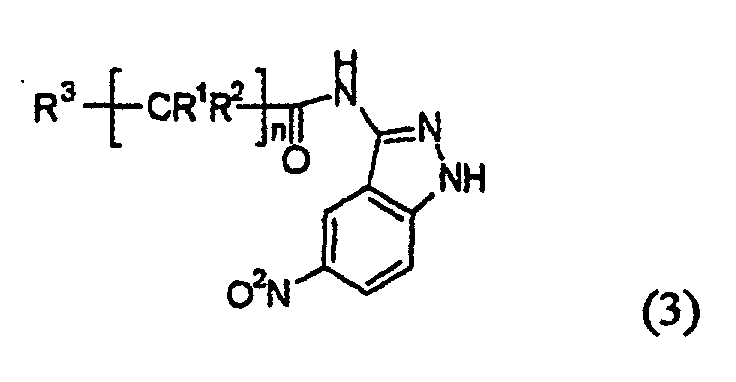 c) protecting the 1-position of3-aminoindazole by t-butylcarbamate to produce a compound of the following formula (4):wherein R1, R2, R3 and n are as previously described, and Boc represents t-butoxycarbonyl.
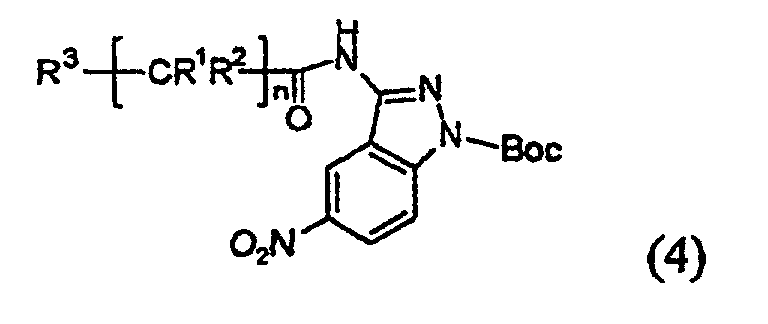 d) reducing the nitro group at C-5 of formula (4) to produce an amine of the following formula (5):wherein, R1, R2, R3 and n are as previously described, and Boc represents t-butoxycarbonyl.
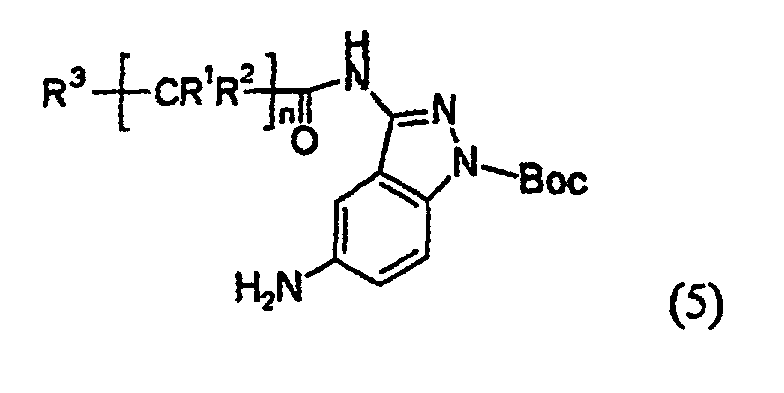 e) reacting the amine of formula (5) with sulfonyl chloride to produce a sulfonamide of the following formula (6):wherein, R1, R2, R3 and n are as previously described, and Boc represents t-butoxycarbonyl.
 e) cyclizing the compound of formula (6) through intramolecular ring-closing to synthesize a dioxoisothiazolidine of the following formula (7):wherein R1, R2, R3 and n are as previously described, and Boc represents t-butoxycarbonyl, and
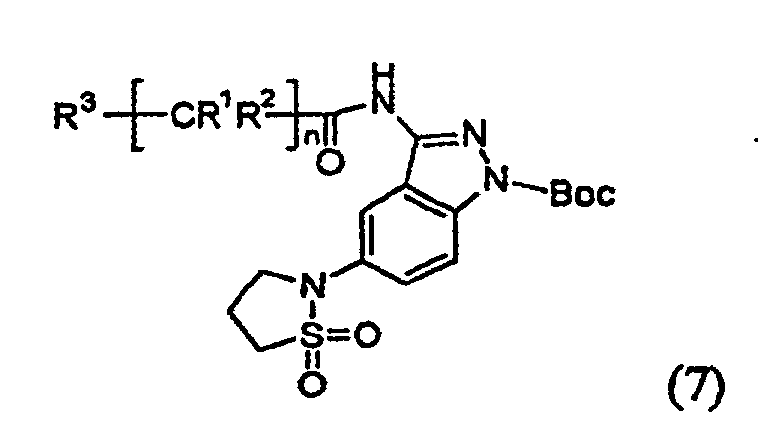 f) deprotecting the compound of formula (7).
 - The process for preparing the compound of formula (1), or pharmaceutically acceptable salt, solvated product or isomer thereof according to claim 5 which comprisesa) reacting a compound of formula (1) wherein X is oxygen atom with Lawesson's reagent to produce a compound of formula (1) wherein X is sulfur atom; orb) reacting the compound of formula (1) wherein X is sulfur atom with a compound of the following formula (8):
- A process for preparing the compound of formula (1), or pharmaceutically acceptable salt, solvated product or isomer thereof which compises reacting an indazole intermediate of the following formula (9):wherein Cbz represents benzyloxycarbonyl, with an acyl halide of the following formula (10):
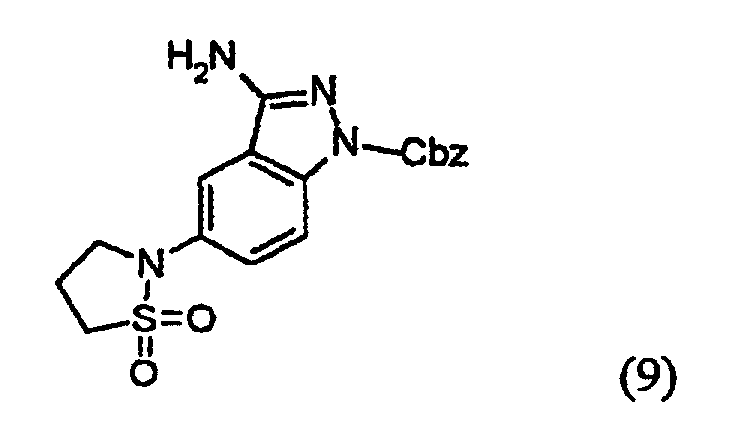 wherein R1, R2, R3 and n are as defined in claim 1, and X' represents halogen.
- A compound of formula (9):wherein Cbz represents benzyloxycarbonyl, as an intermediate for preparing the compound of formula (1), or pharmaceutically acceptable salt, solvated product or isomer thereof as defined in any of claims 1 to 3.
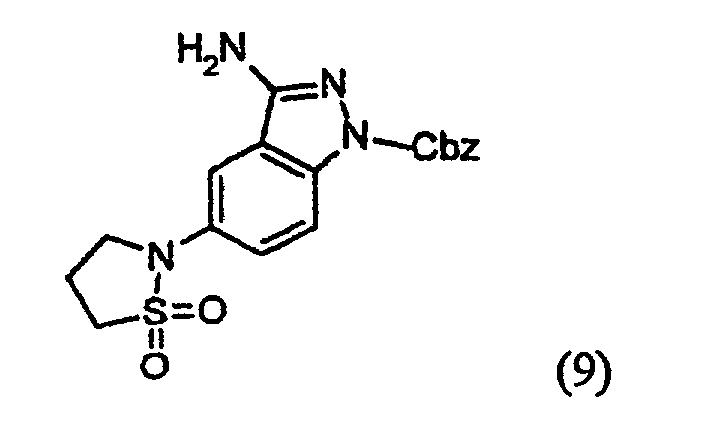
Applications Claiming Priority (3)
| Application Number | Priority Date | Filing Date | Title |
|---|---|---|---|
| KR20000024861 | 2000-05-10 | ||
| KR2000024861 | 2000-05-10 | ||
| PCT/KR2001/000759 WO2001085726A1 (en) | 2000-05-10 | 2001-05-10 | Indazoles substituted with 1,1-dioxoisothiazolidine useful as inhibitors of cell proliferation |
Publications (3)
| Publication Number | Publication Date |
|---|---|
| EP1280802A1 EP1280802A1 (en) | 2003-02-05 |
| EP1280802A4 EP1280802A4 (en) | 2003-06-11 |
| EP1280802B1 true EP1280802B1 (en) | 2004-05-06 |
Family
ID=19668316
Family Applications (1)
| Application Number | Title | Priority Date | Filing Date |
|---|---|---|---|
| EP01930292A Expired - Lifetime EP1280802B1 (en) | 2000-05-10 | 2001-05-10 | Indazoles substituted with 1,1-dioxoisothiazolidine useful as inhibitors of cell proliferation |
Country Status (10)
| Country | Link |
|---|---|
| US (1) | US6620831B2 (en) |
| EP (1) | EP1280802B1 (en) |
| JP (1) | JP2003532730A (en) |
| KR (1) | KR100423899B1 (en) |
| CN (1) | CN1432015A (en) |
| AT (1) | ATE266028T1 (en) |
| AU (1) | AU2001256834A1 (en) |
| CA (1) | CA2408448A1 (en) |
| DE (1) | DE60103147T2 (en) |
| WO (1) | WO2001085726A1 (en) |
Families Citing this family (37)
| Publication number | Priority date | Publication date | Assignee | Title |
|---|---|---|---|---|
| ATE494388T1 (en) | 1999-01-13 | 2011-01-15 | Univ New York State Res Found | NEW METHOD FOR CREATING PROTEIN KINASE INHIBITORS |
| KR100423899B1 (en) * | 2000-05-10 | 2004-03-24 | 주식회사 엘지생명과학 | Indazoles substituted with 1,1-dioxoisothiazolidine useful as inhibitors of cell proliferation |
| KR100406634B1 (en) * | 2001-03-12 | 2003-11-20 | 주식회사 엘지생명과학 | 3,5-Diaminoindazole derivatives, their preparation and their use as inhibitors for cyclin dependent kinases |
| CA2464214C (en) | 2001-10-22 | 2011-02-08 | The Research Foundation Of State University Of New York | Protein kinase and phosphatase inhibitors, methods for designing them, and methods of using them |
| US7005445B2 (en) | 2001-10-22 | 2006-02-28 | The Research Foundation Of State University Of New York | Protein kinase and phosphatase inhibitors and methods for designing them |
| DE10155075A1 (en) * | 2001-11-09 | 2003-05-22 | Merck Patent Gmbh | Cyclic sulfonamides |
| AU2002353186A1 (en) * | 2001-12-19 | 2003-06-30 | Smithkline Beecham P.L.C. | (1-h-indazol-3-yl) -amide derivatives as gsk-3 inhibitors |
| FR2836914B1 (en) * | 2002-03-11 | 2008-03-14 | Aventis Pharma Sa | SUBSTITUTED INDAZOLES, COMPOSITIONS CONTAINING SAME, METHOD OF MANUFACTURE AND USE |
| FR2836915B1 (en) * | 2002-03-11 | 2008-01-11 | Aventis Pharma Sa | AMINOINDAZOLE DERIVATIVES, PREPARATION METHOD AND INTERMEDIATES THEREOF AS MEDICAMENTS AND PHARMACEUTICAL COMPOSITIONS COMPRISING THE SAME |
| GB0218625D0 (en) * | 2002-08-10 | 2002-09-18 | Astex Technology Ltd | Pharmaceutical compounds |
| FR2845382A1 (en) * | 2002-10-02 | 2004-04-09 | Sanofi Synthelabo | INDAZOLECARBOXAMIDE DERIVATIVES, THEIR PREPARATION AND THEIR USE IN THERAPEUTICS |
| US7008953B2 (en) | 2003-07-30 | 2006-03-07 | Agouron Pharmaceuticals, Inc. | 3, 5 Disubstituted indazole compounds, pharmaceutical compositions, and methods for mediating or inhibiting cell proliferation |
| US7977322B2 (en) | 2004-08-20 | 2011-07-12 | Vertex Pharmaceuticals Incorporated | Modulators of ATP-binding cassette transporters |
| WO2005075435A1 (en) * | 2004-01-30 | 2005-08-18 | Vertex Pharmaceuticals Incorporated | Modulators of atp-binding cassette transporters |
| FR2867778B1 (en) | 2004-03-16 | 2006-06-09 | Sanofi Synthelabo | USE OF INDAZOLECARBOXAMIDE DERIVATIVES FOR THE PREPARATION OF A MEDICAMENT FOR THE TREATMENT AND PREVENTION OF MALARIA |
| UY29149A1 (en) * | 2004-10-07 | 2006-05-31 | Boehringer Ingelheim Int | TIAZOLIL-DIHIDRO-INDAZOLES |
| RU2403258C2 (en) * | 2004-10-07 | 2010-11-10 | Бёрингер Ингельхайм Интернациональ Гмбх | Thiazolyldihydroindazoles |
| US7632854B2 (en) * | 2004-11-17 | 2009-12-15 | Pfizer Italia S.R.L. | Aminoindazole derivatives active as kinase inhibitors, process for their preparation and pharmaceutical compositions comprising them |
| BRPI0519424B8 (en) | 2004-12-28 | 2021-05-25 | Athenex Inc | compounds, composition and use of said compounds for the preparation of a medicament for preventing or treating a cell proliferation disorder or microbial infection |
| US7968574B2 (en) | 2004-12-28 | 2011-06-28 | Kinex Pharmaceuticals, Llc | Biaryl compositions and methods for modulating a kinase cascade |
| US7838542B2 (en) | 2006-06-29 | 2010-11-23 | Kinex Pharmaceuticals, Llc | Bicyclic compositions and methods for modulating a kinase cascade |
| CN101595084B (en) | 2006-06-29 | 2013-01-02 | 金克斯医药品有限公司 | Diaryl compositions and methods for modulating kinase cascades |
| US7935697B2 (en) | 2006-12-28 | 2011-05-03 | Kinex Pharmaceuticals, Llc | Compositions for modulating a kinase cascade and methods of use thereof |
| US7939529B2 (en) | 2007-05-17 | 2011-05-10 | Kinex Pharmaceuticals, Llc | Process for the preparation of compositions for modulating a kinase cascade and methods of use thereof |
| TWI457336B (en) | 2006-12-28 | 2014-10-21 | Kinex Pharmaceuticals Llc | Composition and methods for modulating a kinase cascade |
| UA103918C2 (en) * | 2009-03-02 | 2013-12-10 | Айерем Элелси | N-(hetero)aryl, 2-(hetero)aryl-substituted acetamides for use as wnt signaling modulators |
| ES2645367T3 (en) | 2010-04-16 | 2017-12-05 | Athenex, Inc. | Compositions and methods for cancer prevention and treatment |
| ES2882807T3 (en) | 2011-09-16 | 2021-12-02 | Novartis Ag | N-substituted heterocyclyl carboxamides |
| JP6499076B2 (en) | 2012-08-30 | 2019-04-10 | アセネックス インコーポレイテッド | N- (3-Fluorobenzyl) -2- (5- (4-morpholinophenyl) pyridin-2-yl) acetamide as a Protein Tyrosine Kinase Modulator |
| US20140199728A1 (en) | 2013-01-14 | 2014-07-17 | Amgen Inc. | Methods of using cell-cycle inhibitors to modulate one or more properties of a cell culture |
| WO2016193939A1 (en) | 2015-06-04 | 2016-12-08 | Aurigene Discovery Technologies Limited | Substituted heterocyclyl derivatives as cdk inhibitors |
| KR101661723B1 (en) * | 2015-06-09 | 2016-10-05 | 계명대학교 산학협력단 | Composition comprising 2-([1,1'-biphenyl]-4-yl)-N-(5-(1,1- dioxidoisothiazolidin-2-yl)-1H-indazol-3-yl)acetamide for preventing or treating uterine myoma |
| GB201511382D0 (en) | 2015-06-29 | 2015-08-12 | Imp Innovations Ltd | Novel compounds and their use in therapy |
| CN113912597B (en) * | 2020-07-07 | 2023-06-13 | 赛诺哈勃药业(成都)有限公司 | ROR gamma inhibitor, preparation method and medical application thereof |
| US20250206724A1 (en) * | 2022-03-30 | 2025-06-26 | Nerviano Medical Sciences S.R.L. | Substituted 3-amino indazole derivatives as kinase inhibitors |
| WO2024052684A1 (en) | 2022-09-09 | 2024-03-14 | MyricX Pharma Limited | Antibody drug conjugate comprising nmt inhibitor and its use |
| WO2025175264A1 (en) * | 2024-02-17 | 2025-08-21 | Padarn Therapeutics, Inc. | Inhibitors of cdk2 |
Family Cites Families (11)
| Publication number | Priority date | Publication date | Assignee | Title |
|---|---|---|---|---|
| IN164232B (en) | 1986-04-11 | 1989-02-04 | Hoechst India | |
| GB2216875B (en) | 1988-04-06 | 1992-01-08 | Motorola Ltd | Container |
| GB9104136D0 (en) * | 1991-02-27 | 1991-04-17 | Merck Sharp & Dohme | Therapeutic agents |
| FR2741881B1 (en) | 1995-12-01 | 1999-07-30 | Centre Nat Rech Scient | NOVEL PURINE DERIVATIVES HAVING IN PARTICULAR ANTI-PROLIFERATIVE PRORIETES AND THEIR BIOLOGICAL APPLICATIONS |
| KR20000070751A (en) * | 1997-02-05 | 2000-11-25 | 로즈 암스트롱, 크리스틴 에이. 트러트웨인 | Pyrido[2,3-D]pyrimidines and 4-Aminopyrimidines as Inhibitors of Cellular Proliferation |
| CA2288154A1 (en) * | 1997-04-28 | 1998-11-05 | Michael J. Kelley | Cyclin dependent kinase (cdk)4 inhibitors and their use for treating cancer |
| US6011159A (en) * | 1997-05-08 | 2000-01-04 | Pfizer Inc | Processes and intermediates for preparing substituted indazole derivatives |
| AU744986B2 (en) * | 1997-07-12 | 2002-03-07 | Cancer Research Technology Limited | Cyclin dependent kinase inhibiting purine derivatives |
| UA66810C2 (en) | 1997-10-27 | 2004-06-15 | Агорон Фармацевтикалз Інк. | 4-aminotiazole derivatives and compositions based thereon as inhibitors of cyclin-dependent kinases |
| DE69837282T2 (en) * | 1997-12-13 | 2007-11-08 | Bristol-Myers Squibb Co. | USE OF PYRAZOLO Ä 3,4-bÜ PYRIDINE AS A CYCLIN-DEPENDENT KINASE HEMMER |
| KR100423899B1 (en) * | 2000-05-10 | 2004-03-24 | 주식회사 엘지생명과학 | Indazoles substituted with 1,1-dioxoisothiazolidine useful as inhibitors of cell proliferation |
-
2001
- 2001-04-25 KR KR10-2001-0022268A patent/KR100423899B1/en not_active Expired - Fee Related
- 2001-05-10 DE DE60103147T patent/DE60103147T2/en not_active Expired - Fee Related
- 2001-05-10 AU AU2001256834A patent/AU2001256834A1/en not_active Abandoned
- 2001-05-10 JP JP2001582327A patent/JP2003532730A/en active Pending
- 2001-05-10 US US10/275,176 patent/US6620831B2/en not_active Expired - Fee Related
- 2001-05-10 EP EP01930292A patent/EP1280802B1/en not_active Expired - Lifetime
- 2001-05-10 CA CA002408448A patent/CA2408448A1/en not_active Abandoned
- 2001-05-10 WO PCT/KR2001/000759 patent/WO2001085726A1/en not_active Ceased
- 2001-05-10 CN CN01810301A patent/CN1432015A/en active Pending
- 2001-05-10 AT AT01930292T patent/ATE266028T1/en not_active IP Right Cessation
Also Published As
| Publication number | Publication date |
|---|---|
| DE60103147T2 (en) | 2005-05-04 |
| EP1280802A1 (en) | 2003-02-05 |
| JP2003532730A (en) | 2003-11-05 |
| KR20010103618A (en) | 2001-11-23 |
| US20030149034A1 (en) | 2003-08-07 |
| WO2001085726A1 (en) | 2001-11-15 |
| US6620831B2 (en) | 2003-09-16 |
| DE60103147D1 (en) | 2004-06-09 |
| EP1280802A4 (en) | 2003-06-11 |
| AU2001256834A1 (en) | 2001-11-20 |
| KR100423899B1 (en) | 2004-03-24 |
| ATE266028T1 (en) | 2004-05-15 |
| CN1432015A (en) | 2003-07-23 |
| CA2408448A1 (en) | 2001-11-15 |
Similar Documents
| Publication | Publication Date | Title |
|---|---|---|
| US6620831B2 (en) | Indazoles substituted with 1,1-dioxoisothiazolidine useful as inhibitors of cell proliferation | |
| KR102049534B1 (en) | NOVEL CHIRAL N-ACYL-5,6,7,(8-SUBSTITUTED)-TETRAHYDRO-[1,2,4]TRIAZOLO[4,3-a]PYRAZINES AS SELECTIVE NK-3 RECEPTOR ANTAGONISTS, PHARMACEUTICAL COMPOSITION, METHODS FOR USE IN NK-3 RECEPTOR MEDIATED DISORDERS AND CHIRAL SYNTHESIS THEREOF | |
| CN105121407B (en) | Benzoic acid derivative MDM2 inhibitor for treating cancer | |
| US11713312B2 (en) | Substituted bicyclic compounds as farnesoid X receptor modulators | |
| JP2009544625A (en) | Benzothiophene inhibitors of RHO kinase | |
| CN102325753A (en) | Carbazole benzamide compound as SU11752 | |
| EP2310010A2 (en) | Chemical compounds 251 | |
| CA2753135A1 (en) | Pyrazolo[1,5-.alpha.]-1,3,5-triazine derivatives, preparation thereof, and therapeutic use thereof | |
| JP6559699B2 (en) | Substituted nitrogen-containing heterocyclic derivatives, pharmaceutical compositions containing them, and their antitumor applications | |
| AU2014234907B2 (en) | Geminally substituted cyanoethylpyrazolo pyridones as Janus kinase inhibitors | |
| EP2166857A1 (en) | Kinase inhibitor compounds | |
| KR101494919B1 (en) | Bicyclic heterocyclic compound | |
| EP2914589A1 (en) | Compounds for use in the treatment of parasitic diseases | |
| TW202426461A (en) | Compounds, compositions, and methods of using thereof | |
| UA129557C2 (en) | Novel dioxoloisoquinolinone derivatives and use thereof | |
| KR100589967B1 (en) | 3-amino-6-methyl-indazole derivatives used as anticancer agents | |
| KR100406634B1 (en) | 3,5-Diaminoindazole derivatives, their preparation and their use as inhibitors for cyclin dependent kinases | |
| WO2025030117A1 (en) | Ferroptosis inducers | |
| KR100589965B1 (en) | 3,5-diaminoindazole derivatives, methods for their preparation and their use as cyclin dependent kinase inhibitors | |
| KR20190132703A (en) | NOVEL CHIRAL N-ACYL-5,6,7,(8-SUBSTITUTED)-TETRAHYDRO-[1,2,4]TRIAZOLO[4,3-a]PYRAZINES AS SELECTIVE NK-3 RECEPTOR ANTAGONISTS, PHARMACEUTICAL COMPOSITION, METHODS FOR USE IN NK-3 RECEPTOR MEDIATED DISORDERS AND CHIRAL SYNTHESIS THEREOF | |
| JP2025533275A (en) | Novel heterobicyclic compounds for inhibiting YAP-TEAD interaction and pharmaceutical compositions containing the same | |
| KR20230165833A (en) | Substituted pyrrole carboxamides, process for their preparation and use as kinase inhibitors | |
| KR20030064077A (en) | Inhibitors of cyclin dependent kinase with a novel 3-hydroxychromen-4-one structure | |
| KR20030064078A (en) | Inhibitors of cyclin dependent kinase with 3-hydroxychromen-4-one structure having aminomethyl group at 6-position | |
| HK1208459B (en) | Substituted pyrroles active as kinases inhibitors |
Legal Events
| Date | Code | Title | Description |
|---|---|---|---|
| PUAI | Public reference made under article 153(3) epc to a published international application that has entered the european phase |
Free format text: ORIGINAL CODE: 0009012 |
|
| 17P | Request for examination filed |
Effective date: 20021113 |
|
| AK | Designated contracting states |
Designated state(s): AT BE CH CY DE DK ES FI FR GB GR IE IT LI LU MC NL PT SE TR |
|
| AX | Request for extension of the european patent |
Extension state: AL LT LV MK RO SI |
|
| A4 | Supplementary search report drawn up and despatched |
Effective date: 20030502 |
|
| GRAP | Despatch of communication of intention to grant a patent |
Free format text: ORIGINAL CODE: EPIDOSNIGR1 |
|
| GRAS | Grant fee paid |
Free format text: ORIGINAL CODE: EPIDOSNIGR3 |
|
| GRAA | (expected) grant |
Free format text: ORIGINAL CODE: 0009210 |
|
| AK | Designated contracting states |
Kind code of ref document: B1 Designated state(s): AT BE CH CY DE DK ES FI FR GB GR IE IT LI LU MC NL PT SE TR |
|
| PG25 | Lapsed in a contracting state [announced via postgrant information from national office to epo] |
Ref country code: TR Free format text: LAPSE BECAUSE OF FAILURE TO SUBMIT A TRANSLATION OF THE DESCRIPTION OR TO PAY THE FEE WITHIN THE PRESCRIBED TIME-LIMIT Effective date: 20040506 Ref country code: NL Free format text: LAPSE BECAUSE OF FAILURE TO SUBMIT A TRANSLATION OF THE DESCRIPTION OR TO PAY THE FEE WITHIN THE PRESCRIBED TIME-LIMIT Effective date: 20040506 Ref country code: LI Free format text: LAPSE BECAUSE OF FAILURE TO SUBMIT A TRANSLATION OF THE DESCRIPTION OR TO PAY THE FEE WITHIN THE PRESCRIBED TIME-LIMIT Effective date: 20040506 Ref country code: IT Free format text: LAPSE BECAUSE OF FAILURE TO SUBMIT A TRANSLATION OF THE DESCRIPTION OR TO PAY THE FEE WITHIN THE PRESCRIBED TIME-LIMIT;WARNING: LAPSES OF ITALIAN PATENTS WITH EFFECTIVE DATE BEFORE 2007 MAY HAVE OCCURRED AT ANY TIME BEFORE 2007. THE CORRECT EFFECTIVE DATE MAY BE DIFFERENT FROM THE ONE RECORDED. Effective date: 20040506 Ref country code: FI Free format text: LAPSE BECAUSE OF FAILURE TO SUBMIT A TRANSLATION OF THE DESCRIPTION OR TO PAY THE FEE WITHIN THE PRESCRIBED TIME-LIMIT Effective date: 20040506 Ref country code: CY Free format text: LAPSE BECAUSE OF FAILURE TO SUBMIT A TRANSLATION OF THE DESCRIPTION OR TO PAY THE FEE WITHIN THE PRESCRIBED TIME-LIMIT Effective date: 20040506 Ref country code: CH Free format text: LAPSE BECAUSE OF FAILURE TO SUBMIT A TRANSLATION OF THE DESCRIPTION OR TO PAY THE FEE WITHIN THE PRESCRIBED TIME-LIMIT Effective date: 20040506 Ref country code: BE Free format text: LAPSE BECAUSE OF FAILURE TO SUBMIT A TRANSLATION OF THE DESCRIPTION OR TO PAY THE FEE WITHIN THE PRESCRIBED TIME-LIMIT Effective date: 20040506 Ref country code: AT Free format text: LAPSE BECAUSE OF FAILURE TO SUBMIT A TRANSLATION OF THE DESCRIPTION OR TO PAY THE FEE WITHIN THE PRESCRIBED TIME-LIMIT Effective date: 20040506 |
|
| PG25 | Lapsed in a contracting state [announced via postgrant information from national office to epo] |
Ref country code: LU Free format text: LAPSE BECAUSE OF NON-PAYMENT OF DUE FEES Effective date: 20040510 Ref country code: IE Free format text: LAPSE BECAUSE OF NON-PAYMENT OF DUE FEES Effective date: 20040510 |
|
| REG | Reference to a national code |
Ref country code: GB Ref legal event code: FG4D |
|
| REG | Reference to a national code |
Ref country code: CH Ref legal event code: EP |
|
| PG25 | Lapsed in a contracting state [announced via postgrant information from national office to epo] |
Ref country code: MC Free format text: LAPSE BECAUSE OF NON-PAYMENT OF DUE FEES Effective date: 20040531 |
|
| REF | Corresponds to: |
Ref document number: 60103147 Country of ref document: DE Date of ref document: 20040609 Kind code of ref document: P |
|
| REG | Reference to a national code |
Ref country code: IE Ref legal event code: FG4D |
|
| PG25 | Lapsed in a contracting state [announced via postgrant information from national office to epo] |
Ref country code: SE Free format text: LAPSE BECAUSE OF FAILURE TO SUBMIT A TRANSLATION OF THE DESCRIPTION OR TO PAY THE FEE WITHIN THE PRESCRIBED TIME-LIMIT Effective date: 20040806 Ref country code: GR Free format text: LAPSE BECAUSE OF FAILURE TO SUBMIT A TRANSLATION OF THE DESCRIPTION OR TO PAY THE FEE WITHIN THE PRESCRIBED TIME-LIMIT Effective date: 20040806 Ref country code: DK Free format text: LAPSE BECAUSE OF FAILURE TO SUBMIT A TRANSLATION OF THE DESCRIPTION OR TO PAY THE FEE WITHIN THE PRESCRIBED TIME-LIMIT Effective date: 20040806 |
|
| PG25 | Lapsed in a contracting state [announced via postgrant information from national office to epo] |
Ref country code: ES Free format text: LAPSE BECAUSE OF FAILURE TO SUBMIT A TRANSLATION OF THE DESCRIPTION OR TO PAY THE FEE WITHIN THE PRESCRIBED TIME-LIMIT Effective date: 20040817 |
|
| NLV1 | Nl: lapsed or annulled due to failure to fulfill the requirements of art. 29p and 29m of the patents act | ||
| REG | Reference to a national code |
Ref country code: CH Ref legal event code: PL |
|
| ET | Fr: translation filed | ||
| REG | Reference to a national code |
Ref country code: IE Ref legal event code: MM4A |
|
| PLBE | No opposition filed within time limit |
Free format text: ORIGINAL CODE: 0009261 |
|
| STAA | Information on the status of an ep patent application or granted ep patent |
Free format text: STATUS: NO OPPOSITION FILED WITHIN TIME LIMIT |
|
| 26N | No opposition filed |
Effective date: 20050208 |
|
| PGFP | Annual fee paid to national office [announced via postgrant information from national office to epo] |
Ref country code: DE Payment date: 20060508 Year of fee payment: 6 |
|
| PGFP | Annual fee paid to national office [announced via postgrant information from national office to epo] |
Ref country code: GB Payment date: 20060510 Year of fee payment: 6 |
|
| PGFP | Annual fee paid to national office [announced via postgrant information from national office to epo] |
Ref country code: FR Payment date: 20060515 Year of fee payment: 6 |
|
| PG25 | Lapsed in a contracting state [announced via postgrant information from national office to epo] |
Ref country code: PT Free format text: LAPSE BECAUSE OF NON-PAYMENT OF DUE FEES Effective date: 20041006 |
|
| GBPC | Gb: european patent ceased through non-payment of renewal fee |
Effective date: 20070510 |
|
| REG | Reference to a national code |
Ref country code: FR Ref legal event code: ST Effective date: 20080131 |
|
| PG25 | Lapsed in a contracting state [announced via postgrant information from national office to epo] |
Ref country code: DE Free format text: LAPSE BECAUSE OF NON-PAYMENT OF DUE FEES Effective date: 20071201 |
|
| PG25 | Lapsed in a contracting state [announced via postgrant information from national office to epo] |
Ref country code: GB Free format text: LAPSE BECAUSE OF NON-PAYMENT OF DUE FEES Effective date: 20070510 |
|
| PG25 | Lapsed in a contracting state [announced via postgrant information from national office to epo] |
Ref country code: FR Free format text: LAPSE BECAUSE OF NON-PAYMENT OF DUE FEES Effective date: 20070531 |