EP1278129A2 - Algebrarechnerverfahren und Vorrichtung - Google Patents
Algebrarechnerverfahren und Vorrichtung Download PDFInfo
- Publication number
- EP1278129A2 EP1278129A2 EP01000275A EP01000275A EP1278129A2 EP 1278129 A2 EP1278129 A2 EP 1278129A2 EP 01000275 A EP01000275 A EP 01000275A EP 01000275 A EP01000275 A EP 01000275A EP 1278129 A2 EP1278129 A2 EP 1278129A2
- Authority
- EP
- European Patent Office
- Prior art keywords
- expression
- dod
- domain
- definition
- expressions
- Prior art date
- Legal status (The legal status is an assumption and is not a legal conclusion. Google has not performed a legal analysis and makes no representation as to the accuracy of the status listed.)
- Withdrawn
Links
Images



Classifications
-
- G—PHYSICS
- G06—COMPUTING OR CALCULATING; COUNTING
- G06F—ELECTRIC DIGITAL DATA PROCESSING
- G06F17/00—Digital computing or data processing equipment or methods, specially adapted for specific functions
- G06F17/10—Complex mathematical operations
Definitions
- the invention relates generally to electronic devices, and, more particularly, to computer algebra systems and methods.
- Computer algebra systems which can be found on advanced calculators, personal computers, and other such systems, perform various tasks such as simplifying algebraic expressions, differentiating and integrating simple functions, solving simple differential equations, and so forth. That is, algebraic expressions such as (x+1) 2 - (x-1) 2 typically will be automatically simplified to 4x and these two expressions are equivalent for all values of the variable x. However, many computer algebra systems will automatically simplify algebraic expressions to nonequivalent expressions without warning; for example, ln(xy) - ln(x) could be simplified to ln(y).
- the present invention provides computer algebra systems with domain preservation constraints displayed with a transformed expression which has an apparent domain of definition differing from the domain of definition of the original expression.
- Preferred embodiment computer algebra systems and devices display domain preservation constraints to limit apparent domain of definition expansion of a transformed (simplified) algebraic expression as compared to the domain of definition of the original expression.
- preferred embodiments transform "x 2 /x" into “x
- the preferred embodiments simplify the expression "x/x 2 " to "1/x" without any indication of domain of definition because both the original and simplified expressions have the same domain of definition, namely x ⁇ 0.
- Variables in an algebraic expression may be restricted to a subset of all possible numeric values, and thus each variable (or the variables jointly) has an associated "variable domain".
- an expression with e rt could require r ⁇ 0 because the exponential models positive interest rate growth.
- Scalar algebraic expressions are often finite and real only for the variable in a strict subset of their possible values. For example, 1/x is finite only for x ⁇ 0; and ⁇ x is real only for x ⁇ 0.
- the "arithmetic domain" is finite real values. An expression is defined only if it and all of its sub-expressions are in the arithmetic domain.
- the arithmetic domain is finite complex values (which include real values). Moreover, values such as + ⁇ , - ⁇ , and perhaps also are sometimes considered defined. The undeniably multi-valued ⁇ is less frequently considered defined, and the indeterminate value 0/0 is almost never considered defined. (However, one can define 0/0 as representing the entire extended real line or complex plane, or else one undetermined point therein, depending on the arithmetic domain.) In the more restrictive direction, the arithmetic domain can be restricted to rational values, integer values, or complex values having such real and imaginary parts.
- dod(expression) simplifies to true, it means that the expression is defined for all values of its variables in the arithmetic domain. Whereas, if dod(expression) simplifies to false, it means that the expression is undefined for all values of its variables in the arithmetic domain.
- a computer algebra system could compute dod of each input algebraic expression; AND the dod with any domain constraints provided by the user; simplify the algebraic expression and the associated domain Boolean expression; and, lastly, display the resulting Boolean expression along with the simplified transformed algebraic expression.
- an input expression “ ⁇ x - ⁇ x
- the input expression " ⁇ x + ⁇ x” would cause the output "2 ⁇ x
- dod( ⁇ x + ⁇ x) dod(2 ⁇ x).
- the first preferred embodiment computer algebra systems apply rewrite rules to transform (simplify) algebraic expressions, with the rewrite rules indicating any expansion of the dod of a transformed expression from that of its antecedent expression.
- the first preferred embodiments propagate a constraint that makes the dod of the two algebraic expressions identical in order to preserve equivalence. For example, an original expression " ⁇ x - ⁇ x" being transformed to the expression "0" without any explicit dod would suggest that the dod has expanded from x ⁇ 0 to all x.
- the first preferred embodiments would display the simplified transformed expression as "0
- the first preferred embodiments would transform the expression " ⁇ x + ⁇ x" to the expression "2 ⁇ x" without any dod display because the dod has not changed.
- the transformation of " ⁇ x - ⁇ x” includes the two rewrites: a*u - b*u ⁇ (a-b)*u and 0*u ⁇ 0
- the transformation of " ⁇ x + ⁇ x" to "2 ⁇ x” includes the rewrite: a*u + b*u ⁇ (a+b)*u with a and b equal to 1 and u equal to ⁇ x.
- the preferred embodiments compute the domain of definition of such sub-expressions to preserve equivalence between an input and its result: 0*u ⁇ 0
- dod(u) often simplifies to true, in which case the display can omit "
- the dod of the expression ⁇ (x 2 + bx + c) + ln(sin(x) + y + e x ) + 0/x is x 2 + bx + c ⁇ 0 and sin(x) + y + e x >0 and x ⁇ 0, whereas the domain preservation constraint associated with simplifying the input expression to the sum of its first two terms is merely "
- Domain preservation constraints can exploit constraints provided with the input. For example, the input 0*ln(sin(x) + y + e x ) would simplify to 0
- y ⁇ 1 would simplify to 0
- Various preferred embodiment systems aim to provide users with fine control over computer algebra transformations in a way that is WYSIWYG (What You See Is What You Get) with respect to standard math instruction and textbook notation.
- WYSIWYG What You See Is What You Get
- internal form may eliminate many operators and functions that can be expressed in terms of more fundamental ones. For example, division is replaced by multiplication with negative powers, negation is replaced by multiplication by -1, subtraction is replaced by addition together with a negative coefficient, square roots are replaced by fractional powers, cosines and tangents are replaced by sines, and hyperbolic functions are replaced by exponentials. This reduces the number of cases that the code must test and aids automatic collection and cancellations of similar sub-expressions.
- a separate final pass replaces 1 ⁇ 2 powers by square roots, collects negative powers into denominators, replaces negative coefficients with subtraction or negation etc. to make the result closer to common textbook notation.
- preferred embodiments may offer users the choice of whether to transform negative exponents to division or vice-versa.
- users cannot have fine control over transformations involving subtraction and negation if they are always eliminated during simplification and then restored just before display.
- One way to provide fine control is by testing flags at many points in the code. For example, in the function that simplifies the product of two expressions we could test a flag that controlled whether or not 1*anything ⁇ anything, and similarly for anything*1, etc. Such flags may control the effects of arithmetic mode, real versus complex mode, trigonometric collection, etc.
- this hard-wired code approach leads to complicated code and difficult data changes. Therefore, some preferred embodiments employ rewrite rules which are much easier for novice implementers to understand and modify, and the resulting code density is probably higher.
- a rewrite rule contains a pattern expression.
- a pattern matcher determines if that pattern expression matches the specific expression that we are attempting to transform. For example, using capital letters to denote pattern variables that can match any syntactically-complete portion of a specific expression, one of the patterns for simplifying ratios might be (A/B)/C. As a specific example, this pattern would match the specific expression 2*x/(x+y)/z, with A matching 2*x, B matching x+y, and C matching z.
- a rewrite rule also contains a replacement pattern expressed in terms of the pattern variables.
- an appropriate replacement pattern would be A/(B*C). If the pattern matches the specific expression, the latter is rewritten by substituting the specific match values of the pattern variables into the replacement pattern. For our example this returns 2*x/((x+y)*z).
- Some rules generate domain preservation constraints, which we attach to a result using the "
- a rewrite rule also generally contains a predicate to test any additional conditions that must be satisfied by a match for the rewrite to occur. For example, to do multinomial expansion we can use the rewrite rule (A ⁇ B) N ⁇ (A ⁇ B) N-1 *(A ⁇ B) provided N>1 and N is integer.
- polynomial expansion entails not only multinomial expansion, but also distribution of products over sums.
- Another choice is to attempt matching only the entire highlighted portion of the specific expression, versus also attempting to match any sub-expressions. For example, two opportunities for further multinomial expansion occur in the above result (x+y) 2 *x + (x+y) 2 *y, but not at the top level.
- the user indicates which rule or set of rules that (s)he wants to apply to a selected expression or sub-expression.
- the rule engine searches those rules one after the other until one is applicable, then rewrites the expression according to the rule; see Figure 1.
- This rewrite might entail "anding" any associated domain preservation constraints onto any prior constraints.
- these domain preservation constraints might entail computing the domain of definition of certain sub-expressions. For example, the input expression 0 ln(x)
- the process might be repeated until no re-write rules are applicable. Also depending on the context and/or user choice, the process might attempt to match any sub-expression or only the entire expression.
- the preferred embodiment devices include handheld computer systems such as calculators with relatively small displays and computing power and also personal computers and various network-connected devices, all programmed with preferred embodiment computer algebra systems.
- the program may be (partially) stored in nonvolatile memory such as ROM, Flash EEPROM, FeRAM, and so forth, and may be loaded into a calculator via a cable link from a personal computer.
- Preferred embodiments displaying only changes from apparent domains of definition during expression transformations avoids screen clutter. Further, preferred embodiments may also reduce unnecessary computations such as computing a domain of definition for every expression and sub-expression during a sequence of transformation steps.
- Preferred embodiment computer algebra systems could be used, for example, on calculators such as the Texas Instruments' TI-89 and TI-92 Plus which have symbolic modes of operation.
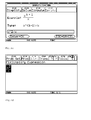
- Figures 2a-2f illustrate a sequence of screens shots of a TI-89 calculator programmed with a preferred embodiment computer algebra system. In particular, Figure 2a shows the screen with a prompt to the user to enter a new problem.
- Figure 2b shows the next screen displaying a generic simplification of a fraction example ("x k+1 / x") in response to the user's new problem selection plus a line for user input.
- Figure 2c shows the screen as in Figure 2b but including the user's typed input of the expression "x ⁇ 2/x”.
- Figure 2d shows the screen after entry (user striking "enter") of the user input which is now expressed as "x 2 / x”.
- Figure 2e illustrates the screen after the preferred embodiment simplification (user again striking "enter") which has the "x 2 /x” as Figure 2d plus the comment "standard form” and the simplified expression "x
- Figure 2f shows a screen for a system without the domain preservation constraints; in particular, the user input "x ⁇ 2/x" appears at the bottom, and in the next to the bottom line at the lefthand side the input recast as “x 2 / x" and at the righthand side the simplified expression "x" without any indication of domain of definition.
- Figure 3 is a functional block diagram of a generic calculator which includes a cable port for programs and data which may be loaded into the flash EEPROM.
- Alternative preferred embodiments
- alternative preferred embodiments routinely compute dods for all expressions and compare dods to detect changes and consequent need for display as domain preservation constraints.
- the preferred embodiments apply the original expression's dod to the transformed expression and display it. Further preferred embodiments may limit the display to only the difference from the original's dod or to some other practical dod change.
- an original expression " ⁇ x - ⁇ (2-x) + ⁇ (2-x) has a dod of 2 ⁇ x ⁇ 0 and simplifies to ⁇ x which has a dod of x ⁇ 0.
- the preferred embodiments could transform to the expression " ⁇ x
- the preferred embodiments can be modified in various ways while retaining the features of domain preservation constraints.
- the rewrite rules could be replaced by hard-wired code and continue avoidance of dod computations for all expressions.
Landscapes
- Engineering & Computer Science (AREA)
- Physics & Mathematics (AREA)
- Theoretical Computer Science (AREA)
- Mathematical Physics (AREA)
- Data Mining & Analysis (AREA)
- General Physics & Mathematics (AREA)
- Mathematical Analysis (AREA)
- Mathematical Optimization (AREA)
- Computational Mathematics (AREA)
- Pure & Applied Mathematics (AREA)
- Databases & Information Systems (AREA)
- Software Systems (AREA)
- General Engineering & Computer Science (AREA)
- Algebra (AREA)
- Complex Calculations (AREA)
Applications Claiming Priority (2)
| Application Number | Priority Date | Filing Date | Title |
|---|---|---|---|
| US21727501P | 2001-07-11 | 2001-07-11 | |
| US217275P | 2001-07-11 |
Publications (2)
| Publication Number | Publication Date |
|---|---|
| EP1278129A2 true EP1278129A2 (de) | 2003-01-22 |
| EP1278129A3 EP1278129A3 (de) | 2012-12-19 |
Family
ID=22810363
Family Applications (1)
| Application Number | Title | Priority Date | Filing Date |
|---|---|---|---|
| EP01000275A Withdrawn EP1278129A3 (de) | 2001-07-11 | 2001-07-11 | Algebrarechnerverfahren und Vorrichtung |
Country Status (1)
| Country | Link |
|---|---|
| EP (1) | EP1278129A3 (de) |
-
2001
- 2001-07-11 EP EP01000275A patent/EP1278129A3/de not_active Withdrawn
Non-Patent Citations (3)
| Title |
|---|
| "TI-89 / TI-92 Plus Symbolic Math Guide Guided Tour", Texas Instruments , 14 March 2001 (2001-03-14), XP55043037, Retrieved from the Internet: URL:http://education.ti.com/calculators/products/US/home/ [retrieved on 2012-11-05] * |
| ANDREAS DOLZMANN ET AL: "Guarded expressions in practice", PROCEEDINGS OF THE 1997 INTERNATIONAL SYMPOSIUM ON SYMBOLIC AND ALGEBRAIC COMPUTATION , ISSAC '97, 1 January 1997 (1997-01-01), pages 376-383, XP55043032, New York, New York, USA DOI: 10.1145/258726.258851 ISBN: 978-0-89-791875-6 * |
| T. AGER ET AL: "Representation of inference in computer algebra systems with applications to intelligent tutoring", COMPUTERS AND MATHEMATICS '89, [Online] 13 June 1989 (1989-06-13), pages 215-227, XP55043031, New York ISBN: 978-3-54-097019-4 Retrieved from the Internet: URL:http://dl.acm.org/citation.cfm?id=93023.93099> [retrieved on 2012-11-02] * |
Also Published As
| Publication number | Publication date |
|---|---|
| EP1278129A3 (de) | 2012-12-19 |
Similar Documents
| Publication | Publication Date | Title |
|---|---|---|
| Quarteroni et al. | Scientific computing with MATLAB and Octave | |
| US5758152A (en) | Method and apparatus for the generation and manipulation of data structures | |
| Press | Solving applied mathematical problems with MATLAB | |
| Clarke et al. | Model checking and abstraction | |
| US6829626B2 (en) | Computer algebra system and method | |
| Goubault et al. | Asserting the precision of floating-point computations: A simple abstract interpreter | |
| Sager | A polynomial time generator for minimal perfect hash functions | |
| Lambers et al. | Explorations in numerical analysis | |
| EP0575473A4 (en) | Case-based reasoning system | |
| Winkler et al. | Certificates for probabilistic pushdown automata via optimistic value iteration | |
| Oliveira | Software reification using the SETS calculus | |
| Kapur et al. | Mechanically verifying a family of multiplier circuits | |
| Hall et al. | Improving software performance with automatic memoization | |
| EP1278129A2 (de) | Algebrarechnerverfahren und Vorrichtung | |
| Bentley | Special Feature An Introduction to Algorithm Design | |
| US20040015830A1 (en) | Computational divided differencing | |
| Reps et al. | Computational divided differencing and divided-difference arithmetics | |
| Albert et al. | Experiments in cost analysis of Java bytecode | |
| Aldaz et al. | Time-space tradeoffs in algebraic complexity theory | |
| Baiocchi | Using Perl for statistics: Data processing and statistical computing | |
| Say | L'Hôpital's filter for QSIM | |
| Neveu et al. | When interval analysis helps inter-block backtracking | |
| Kahaner et al. | Extrapolated adaptive quadrature | |
| Kalaba et al. | Automation of nested matrix and derivative operations | |
| Betz | Analyzing feature-model histories with binary decision diagrams |
Legal Events
| Date | Code | Title | Description |
|---|---|---|---|
| PUAI | Public reference made under article 153(3) epc to a published international application that has entered the european phase |
Free format text: ORIGINAL CODE: 0009012 |
|
| AK | Designated contracting states |
Kind code of ref document: A2 Designated state(s): AT BE CH CY DE DK ES FI FR GB GR IE IT LI LU MC NL PT SE TR |
|
| AX | Request for extension of the european patent |
Free format text: AL;LT;LV;MK;RO;SI |
|
| PUAL | Search report despatched |
Free format text: ORIGINAL CODE: 0009013 |
|
| AK | Designated contracting states |
Kind code of ref document: A3 Designated state(s): AT BE CH CY DE DK ES FI FR GB GR IE IT LI LU MC NL PT SE TR |
|
| AX | Request for extension of the european patent |
Extension state: AL LT LV MK RO SI |
|
| RIC1 | Information provided on ipc code assigned before grant |
Ipc: G06F 17/10 20060101AFI20121115BHEP |
|
| 17P | Request for examination filed |
Effective date: 20130619 |
|
| RBV | Designated contracting states (corrected) |
Designated state(s): AT BE CH CY DE DK ES FI FR GB GR IE IT LI LU MC NL PT SE TR |
|
| 17Q | First examination report despatched |
Effective date: 20130729 |
|
| AKX | Designation fees paid |
Designated state(s): DE FR GB IE NL |
|
| STAA | Information on the status of an ep patent application or granted ep patent |
Free format text: STATUS: THE APPLICATION IS DEEMED TO BE WITHDRAWN |
|
| 18D | Application deemed to be withdrawn |
Effective date: 20140211 |