EP1278128A2 - Systolic array device - Google Patents
Systolic array device Download PDFInfo
- Publication number
- EP1278128A2 EP1278128A2 EP02015672A EP02015672A EP1278128A2 EP 1278128 A2 EP1278128 A2 EP 1278128A2 EP 02015672 A EP02015672 A EP 02015672A EP 02015672 A EP02015672 A EP 02015672A EP 1278128 A2 EP1278128 A2 EP 1278128A2
- Authority
- EP
- European Patent Office
- Prior art keywords
- cells
- signal series
- additional
- input
- internal cells
- Prior art date
- Legal status (The legal status is an assumption and is not a legal conclusion. Google has not performed a legal analysis and makes no representation as to the accuracy of the status listed.)
- Ceased
Links
Images




Classifications
-
- H—ELECTRICITY
- H01—ELECTRIC ELEMENTS
- H01Q—ANTENNAS, i.e. RADIO AERIALS
- H01Q21/00—Antenna arrays or systems
-
- G—PHYSICS
- G06—COMPUTING OR CALCULATING; COUNTING
- G06F—ELECTRIC DIGITAL DATA PROCESSING
- G06F15/00—Digital computers in general; Data processing equipment in general
- G06F15/76—Architectures of general purpose stored program computers
- G06F15/80—Architectures of general purpose stored program computers comprising an array of processing units with common control, e.g. single instruction multiple data processors
- G06F15/8046—Systolic arrays
Definitions
- This invention relates to a systolic array device which performs the processing of a sequential least-squares (RLS) algorithm based on QR decomposition, enabling the simultaneous acquisition of outputs for a plurality of reference signal series in the same input signal series.
- RLS sequential least-squares
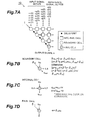
- Fig.7A shows an example of the configuration of a basic systolic array of the prior art, which is here explained.
- the systolic array device 10 shown in Fig.7A has a configuration for the case of three taps, and is configured to comprise boundary cells, indicated by empty circles; internal cells, indicated by squares; final cells, indicated by double circles; and delay units, indicated by filled circles.
- boundary cells indicated by empty circles
- internal cells indicated by squares
- final cells indicated by double circles
- delay units indicated by filled circles.
- the symbol used for final cells is an "x" within a circle; here, however, a double-circle symbol is used.
- Boundary cells empty circles and internal cells (squares) perform transformations based on a Givens rotation; boundary cells (empty circles) calculate an appropriate rotation parameter, and this calculated value is passed to an internal cell (square); the internal cell (square) uses the calculated value to rotate the elements of the received data vector.
- the final cells double circles derive the a posteriori estimated error.
- All the delay units (filled circles) delay the time for input to the next-stage cell of the signal ⁇ out output from a boundary cell (empty circles) by one operation processing time period.
- * indicates the complex conjugate.
- the specifics of the operations performed in all the internal cells (squares) are described in the above-cited reference .
- Fig.7A shows, for simplicity, signals from time 1 to time 5.
- the input signal series for the first tap is u 1 (1), u 1 (2), u 1 (3), u 1 (4), u 1 (5);
- the input signal series for the second tap is u 2 (1), u 2 (2), u 2 (3), u 2 (4), u 2 (5);
- the input signal series for the third tap is u 3 (1), u 3 (2), u 3 (3), u 3 (4), u 3 (5).
- the a posteriori estimated error signal for these input signal series u 1 (1) to u 1 (5), u 2 (1) to u 2 (5), u 3 (1) to u 3 (5) and for the reference signal series d(1), d(2), d(3), d(4), d(5) is output from the final cell (double circles) as the output signal e.
- the values of tap coefficients can also be obtained as an output signal e.
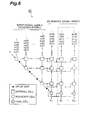
- Fig.8 shows the case in which two types of reference signal series are handled with three taps.
- the input signal series for the first tap is u 1 (1), u 1 (2), u 1 (3), u 1 (4), u 1 (5)
- the input signal series for the second tap is u 2 (1), u 2 (2), u 2 (3), u 2 (4), u 2 (5)
- the input signal series for the third tap is u 3 (1), u 3 (2), u 3 (3), u 3 (4), u 3 (5).
- the present invention was devised in light of the above, and has as an object the provision of a systolic arrav device which, in cases where the same input signal series is handled with a plurality of reference signal series when performing RLS algorithm processing based on QR decomposition, is able to simultaneously handle the plurality of reference signal series.
- a systolic array device of this invention in order to perform processing of a sequential least-squares algorithm based on QR decomposition, has a plurality of boundary cells which calculate appropriate rotation parameters for transformation based on Givens rotation; a plurality of internal cells which use values calculated by boundary cells to cause rotation of the elements in a received data vector; and a final cell which derives the posteriori estimated error from the calculated values of the above boundary cells and the above internal cells; and is characterized in comprising a plurality of additional internal cells, connected to each of the above internal cells arranged in the end cell column to which signal series are input such that signals output from the above internal cells are passed to the plurality of additional internal cells, and an additional final cell, connected to the above final cell so as to receive calculated values from said final cell that contains values calculated from boundary cell and so as to receive calculated values from said additional internal cells.
- a cell column having a plurality of additional internal cells and an additional final cell is added to the end cell column, so that by simultaneously inputting, to both the above end cell column and to the added cell column, different reference signal series, a posteriori estimated errors for the input signal series and each of the reference signal series can simultaneously be derived.
- a systolic array device of this invention comprising additional final cells and a plurality of stages of the additional internal cells, wherein a plurality of stages of said additional internal cells are connected so as to receive, in succession, signals output from said internal cells and the additional final cells being connected for each connected additional internal cell stage; and calculated values from the boundary cells and calculated values from additional internal cells connected to the additional final cell are received by each connected additional final cell.
- a plurality of stages of cell columns are added to the cell column added to the end cell column, so that a posteriori estimated errors for input-signal series and each of the types of reference signal series according to the number of stages can be derived simultaneously.
- a systolic array device of this invention is characterized in that a plurality of stages of additional internal cells are connected so as to directly receive signals output from the above internal cells; additional final cells are connected to each of these stages of connected additional internal cells; and, calculated values from boundary cells and calculated values from additional internal cells connected to the additional final cells in question are passed to each of the connected additional final cells.
- a plurality of stages of cell columns are added to the cell column added to the end cell column, so that a posteriori estimated errors for input-signal series and each of the types of reference signal series according to the number of stages can be derived simultaneously.
- the calculated values of internal cells are passed directly to the respective additional internal cells, so that reference signals can be input simultaneously to the respective additional internal cells.
- a synchronization capture device in the communications of this invention uses the above systolic array device, and is characterized in that received-signal series are input to the boundary cell and internal cells in this systolic array device to which input signal series are input, and a plurality of known signal series, generated in advance by changing the timing of a known signal series by a fixed amount of time, is input to the end internal cells and to the additional internal cells.
- a posteriori estimated errors are obtained simultaneously for the received signal series and a plurality of known signal series, and thereafter, by applying a well-known function which takes as the synchronization point the timing of the known signal series resulting in the smallest error power, synchronization capture can be performed in a short length of time.
- a synchronization capture device of this invention in communications uses the above systolic array device, and is characterized in that received signal series are input to the internal cells and boundary cells in the systolic array device to which input signal series are input, and a plurality of known signal series in advance is input with the same timing to the end internal cells and additional internal cells.
- a posteriori estimated errors are obtained simultaneously for the received signal series and a plurality of known signal series, and theroafter, by applying a well-known function which takes as the synchronization point the timing of the known signal series resulting in the smallest error power, synchronization capture can be performed in a short length of time.
- the known signal series are input simultaneously to the respective additional internal cells, so that no delay occurs in the timing for output of computation results from the respective final cells, and processing speeds can be increased, so that this configuration is particularly advantageous when there are numerous additional cell columns.
- an adaptive array antenna device of this invention employs the above systolic array device, and is characterized in that received-signal series are input to the boundary cell and internal cells in the systolic array device to which input-signal series are input, and a known signal series with timing coordinated with an advanced wave, and a known signal series with timing coordinated with a delayed wave with various delay times, are input to the end internal cells and the additional internal cells.
- the tap coefficient which takes into consideration the advanced wave and the tap coefficient which takes into consideration the delayed wave can be derived simultaneously, so that in an adaptive array antenna control algorithm which combines and uses the tap coefficient considered for an advanced wave and the tap coefficient considered for a delayed wave, processing can be performed in a short length of time.
- Fig. 1 is a block diagram showing the configuration of a systolic array device of an aspect of the invention.
- a characteristic of the systolic array device 20 of the invention shown in Fig. 1 lies in a configuration whereby m types of reference signal series are simultaneously processed using k taps. That is, in this configuration the plurality of internal cells (squares) and final cells (double circles) surrounded by the dotted-line frame 21 have been added.
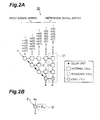
- Fig.2A shows a configuration in which two types of reference signal series are simultaneously processed using three taps; this is explained below.
- the systolic array device 30 has second reference signal input cell column consisting of internal cells (square) to receive the second reference signal series d'(1) to d'(5) and a final cell (double circle), surrounded by the dotted line frame 31.
- the second reference signal input cell column is arranged to the right of the first reference input cell column which and receive the first reference signal series d(1) to d(5) from the conventional systolic array device 10 shown in Fig.7A.
- the arrangement of second signal input cell column is similar to that of the first reference input cell column.
- each of the internal cells (squares) in the first reference input cell column is connected so as to pass the signals s, z shown in Fig. 7C to the right-adjacent internal cell in the second reference input cell column.
- Results confirmed by computer programming for the operation of a systolic array device 30 configured in this way are shown in Fig. 3. That is, the number of taps is three, and output signals e, e' are derived for two types of reference signal series.
- Fig.3A shows the input signal series u 1 , u 2 , u 3 and the reference signal series d, d' shown in Fig.3A
- Fig.3B shows the results of derivation separately of the output signals e, e' using the systolic array device 10 of the prior art
- Fig.3C shows the results of simultaneous derivation of the output signals e, e' using the systolic array device 30 of this invention.
- the two results have the same value.
- the output signals e(1), e(2), e(3) and e'(1), e'(2), e'(3) of the first taps are not derived.
- the figure only shows output signals e(4), e(5) and e'(4), e'(5). From this, it is confirmed that the systolic array device 10 of this invention can handle a plurality of reference signal series simultaneously.
- a systolic array device when performing processing of a sequential least-squares algorithm based on QR decomposition, is configured in which, to a configuration comprising a plurality of boundary cells (empty circles) which calculate appropriate rotation parameters for transformations based on Givens rotation, a plurality of internal cells (squares) which rotate the elements of received data vectors using the values calculated by the boundary cells (empty circles), and a final cell (double circles) which derives the a posterior estimated error from the values calculated by the bounday cells (empty circles) and internal cells (squares), additional internal cells (squares) are connected to each of the internal cells (squares) arranged in the end cell column to which signal series are input, so as to receive the signals output from the internal cells (squares), and an additional final cell (double circles) is connected to the final cell (double circles) , so as to receive the calculated values from the boundary cell (empty circle) input to this cell (double circles) and
- a cell column having a plurality of additional internal cells (squares) and an additional final cell (double circles), is added to the end cell column; hence by inputting different reference signal series simultaneously to both the end cell column and to the added cell column, the a posteriori estimated error signal for the input signal series and each of the input reference signal series can be derived simultaneously.
- a plurality of stages of additional internal cells are connected such that signals output from the internal cells (squares) are received in successionion; an additional final cell (double circles) is connected to each stage of additional internal cells (squares) ; and each of the connected additional final cells (double circles) receives a calculated value from a boundary cell (empty circle) and a calculated value from the additional internal cell (square) to which the additional final cell (double circles) is connected.
- the systolic array device of this aspect can be utilized when using a systolic array to handle a plurality of reference signal series for the same input signal, and as explained below in a specific example, can be employed for synchronization capture in communications and for control of an adaptive array antenna in mobile communications.
- utilization is possible when handling a plurality of reference signal series for the same input signal series using a systolic array which performs RLS algorithm processing based on QR decomposition, and is not limited to the field of communications.
- a signal series already known on the receiving side is transmitted by the transmitting side; on the receiving side, the timing of the known signal series is changed by one symbol each to generate a plurality of reference signal series; the posteriori estimated error for the plurality of reference signal series and the received signal series is calculated; and the timing of the reference signal series resulting in the smallest error power is taken to be the synchronization point.
- the systolic array device of this aspect can calculate a posteriori estimated error signals simultaneously by taking received signal as the input-signel series and by taking a plurality of known signal series with timing different by one symbol each as a plurality of reference signal series.
- the systolic array device of this aspect can derive the corresponding a posteriori estimated error signals e 1 , e 2 , e 3 , e 1 , e 5 , e 6 , ... simultaneously.
- the present invention can be used for synchronization capture in communications.
- a tap coefficient which takes into consideration the advanced wave, and a tap coefficient which takes into consideration the delayed wave are synthesized as the tap coefficient of each element in an adaptive array antenna to make effective use of the received power.
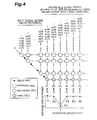
- Derivation of the tap coefficient which takes into consideration the advanced wave and the tap coefficient which takes into consideration the delayed wave can be performed by simultaneous calculations using the systolic array device of this aspect. This configuration, shown in Fig. 5, is explained below.
- Fig. 6 shows the configuration of the systolic array device 40 of the second aspect.
- the systolic array device 40 of the second aspect has essentially the same configuration as the systolic array device 20 of the first aspect, but differs in that each of the additional internal cells is connected in parallel with the internal cells arranged in the end cell column, configured such that calculation results are received directly from internal cells in the end column.
- a cell column having a plurality of additional internal cells (squares) and an additional final cell (double circles) is added to the end cell column, so that by simultaneously inputting different reference signal series into both the end cell column and into the added cell column, a posteriori estimated error signals for the input signal series and each of the input reference signal series can be simultaneously derived.
- a plurality of stages are connected such that signals output from internal cells (squares) are directly received by additional internal cells (squares), so that there is no need to shift the timing of each of the reference signal series input to the respective additional internal cells (squares). Also, no delay occurs in the timing with which computation results are output from each of the final cells, and consequently the processing speed can be further improved, so that this configuration is particularly advantageous when there are numerous additional cell columns.
- the systolic array device 40 of this aspect is not configured such that a final cell (double circles) receives the calculation result of an adjacent final cell (double circles); hence the final cells (double circles) need not have another output, and the final cells of conventional systolic array devices can be used.
- the systolic array device 40 of this aspect can be used in cases where a systolic array is employed to handle a plurality of reference signal series with the same input signal, so that similarly to the systolic array device 20 of the first aspect, use in synchronization capture for communication, and in control of adaptive array antennas for mobile communication, is possible.
- a cell column having a plurality of additional internal cells and an additional final cell is added to the end cell column of a systolic array device which performs processing of an RLS algorithm based on QR decomposition, so that by the simultaneous input of different reference signal series to both the above end cell column and to the added cell column, the posteriori estimated errors for the input signal series and each of the input reference signal series can be derived simultaneously. That is, when handling a plurality of reference signal series with the same input signal series in processing of an RLS algorithm based on QR decomposition, the plurality of reference signal series can be handled simultaneously.
Landscapes
- Engineering & Computer Science (AREA)
- Computer Hardware Design (AREA)
- Theoretical Computer Science (AREA)
- Computing Systems (AREA)
- Physics & Mathematics (AREA)
- General Engineering & Computer Science (AREA)
- General Physics & Mathematics (AREA)
- Radio Transmission System (AREA)
- Mobile Radio Communication Systems (AREA)
- Measurement And Recording Of Electrical Phenomena And Electrical Characteristics Of The Living Body (AREA)
Abstract
Description
Claims (6)
- A systolic array device, having a plurality of boundary cells which calculate appropriate rotation parameters for transformations based on Givens rotation, a plurality of internal cells which cause rotation of the elements of a received data vector using the calculated values of the boundary cells, and a final cell which derives the posteriori estimated error from the calculated values of said boundary cells and said internal cells, in order to perform processing of a sequential least-squares algorithm based on QR decomposition; comprising
a plurality of additional internal cells, connected to each of said internal cells arranged in the end cell column to which signal series are input, so as to receive signals output from said internal cells; and,
an additional final cell, connected to said final cell so as to receive calculated values from said final cell that contains values calculated from boundary cell and so as to receive calculated values from said additional internal cells. - The systolic array device according to claim 1, comprising additional final cells and a plurality of stages of said additional internal cells, wherein a plurality of stages of said additional internal cells are connected so as to receive, in succession, signals output from said internal cells and said additional final cells being connected for each connected additional internal cell stage; and calculated values from said boundary cells and calculated values from additional internal cells connected to the additional final cell are received by each connected additional final cell.
- The systolic array device according to claim 1, comprising additional final cells and a plurality of stages of said additional internal cells, wherein a plurality of stages of said additional internal cells are connected so as to receive, directory, signals output from said internal cells and said additional final cells being connected for each connected additional internal cell stage; and calculated values from said boundary cells and calculated values from additional internal cells connected to the additional final cell are received by each connected additional final cell.
- A synchronization capture device, using a systolic array device according to claim 1 or claim 2, wherein received-signal series are input to the boundary cells and internal cells in the systolic array device to which input-signal series are input, and a plurality of known signal series, generated in advance from a known signal series with timing changed by a fixed amount of time each, are input to the end internal cells and the additional internal cells.
- A synchronization capture device, using the systolic array device according to claim 1 or claim 3, wherein received-signal series are input to the boundary cells and internal cells in the systolic array device to which input-signal series are input, and a plurality of signal series known in advance are input with the same timing to the end internal cells and additional internal cells.
- An adaptive array antenna device, using a systolic array device according to any of claims 1 to 3, wherein received-signal series are input to the boundary cells and internal cells in the systolic array device to which input-signal series are input, and a known signal series with timing coordinated with an advanced wave and a known signal series with timing coordinated with delayed waves with various delay times are input to the end internal cells and the additional internal cells.
Applications Claiming Priority (2)
| Application Number | Priority Date | Filing Date | Title |
|---|---|---|---|
| JP2001220035 | 2001-07-19 | ||
| JP2001220035 | 2001-07-19 |
Publications (2)
| Publication Number | Publication Date |
|---|---|
| EP1278128A2 true EP1278128A2 (en) | 2003-01-22 |
| EP1278128A3 EP1278128A3 (en) | 2004-09-08 |
Family
ID=19053923
Family Applications (1)
| Application Number | Title | Priority Date | Filing Date |
|---|---|---|---|
| EP02015672A Ceased EP1278128A3 (en) | 2001-07-19 | 2002-07-17 | Systolic array device |
Country Status (5)
| Country | Link |
|---|---|
| US (1) | US20030018675A1 (en) |
| EP (1) | EP1278128A3 (en) |
| KR (1) | KR100459524B1 (en) |
| CN (1) | CN100412856C (en) |
| SG (1) | SG107107A1 (en) |
Families Citing this family (17)
| Publication number | Priority date | Publication date | Assignee | Title |
|---|---|---|---|---|
| EP1772809A3 (en) | 2005-10-07 | 2009-12-02 | Altera Corporation | Method and apparatus for matrix decomposition in programmable logic devices |
| US8020006B2 (en) * | 2006-02-10 | 2011-09-13 | Cisco Technology, Inc. | Pipeline for high-throughput encrypt functions |
| US8473540B1 (en) | 2009-09-01 | 2013-06-25 | Xilinx, Inc. | Decoder and process therefor |
| US8417758B1 (en) | 2009-09-01 | 2013-04-09 | Xilinx, Inc. | Left and right matrix multiplication using a systolic array |
| US8510364B1 (en) | 2009-09-01 | 2013-08-13 | Xilinx, Inc. | Systolic array for matrix triangularization and back-substitution |
| US8473539B1 (en) | 2009-09-01 | 2013-06-25 | Xilinx, Inc. | Modified givens rotation for matrices with complex numbers |
| US8620984B2 (en) | 2009-11-23 | 2013-12-31 | Xilinx, Inc. | Minimum mean square error processing |
| US8416841B1 (en) | 2009-11-23 | 2013-04-09 | Xilinx, Inc. | Multiple-input multiple-output (MIMO) decoding with subcarrier grouping |
| US8406334B1 (en) * | 2010-06-11 | 2013-03-26 | Xilinx, Inc. | Overflow resistant, fixed precision, bit optimized systolic array for QR decomposition and MIMO decoding |
| US8443031B1 (en) | 2010-07-19 | 2013-05-14 | Xilinx, Inc. | Systolic array for cholesky decomposition |
| US8824603B1 (en) * | 2013-03-01 | 2014-09-02 | Futurewei Technologies, Inc. | Bi-directional ring-bus architecture for CORDIC-based matrix inversion |
| CN104462021B (en) * | 2014-11-11 | 2017-05-17 | 江苏中兴微通信息科技有限公司 | Base vector matrix compression device based on high-speed systolic array and Givens transformation |
| US20160226468A1 (en) * | 2015-01-30 | 2016-08-04 | Huawei Technologies Co., Ltd. | Method and apparatus for parallelized qrd-based operations over a multiple execution unit processing system |
| KR102479480B1 (en) * | 2021-03-16 | 2022-12-20 | 국방과학연구소 | Systolic array fast fourier transform apparatus and method based on shared memory |
| US11507452B1 (en) * | 2021-07-16 | 2022-11-22 | Google Llc | Error checking for systolic array computation |
| US12554675B2 (en) * | 2021-11-22 | 2026-02-17 | Google Llc | Synthesizing zero-loss low-power approximate DNN accelerators with large-scale search |
| KR20250151062A (en) | 2024-04-13 | 2025-10-21 | 양세인 | discolored window |
Family Cites Families (10)
| Publication number | Priority date | Publication date | Assignee | Title |
|---|---|---|---|---|
| DE3482532D1 (en) * | 1983-07-06 | 1990-07-19 | Secr Defence Brit | PROCESSOR WITH FORCED ADJUSTMENT. |
| US4823299A (en) * | 1987-04-01 | 1989-04-18 | The United States Of America As Represented By The Administrator Of The National Aeronautics And Space Administration | Systolic VLSI array for implementing the Kalman filter algorithm |
| GB2219106B (en) * | 1988-05-26 | 1992-04-15 | Secr Defence | Processor for constrained least squares computations |
| GB8903091D0 (en) * | 1989-02-10 | 1989-03-30 | Secr Defence | Heuristic processor |
| GB9018048D0 (en) * | 1990-08-16 | 1990-10-03 | Secr Defence | Digital processor for simulating operation of a parallel processing array |
| GB9106082D0 (en) * | 1991-03-22 | 1991-05-08 | Secr Defence | Dynamical system analyser |
| US5909460A (en) * | 1995-12-07 | 1999-06-01 | Ericsson, Inc. | Efficient apparatus for simultaneous modulation and digital beamforming for an antenna array |
| CN1179492C (en) * | 1999-01-18 | 2004-12-08 | 日本电气株式会社 | CDMA Multiuser Receiver Characterized by Combination of Array Antenna and Multiuser Canceller |
| KR100382148B1 (en) * | 2000-10-25 | 2003-05-01 | 한국전자통신연구원 | Systolic Array Structure-based Covariance Inversion Method Applied to Adaptive Array Basestation |
| JP2002175283A (en) * | 2000-12-05 | 2002-06-21 | Matsushita Electric Ind Co Ltd | Systolic array type computing unit |
-
2002
- 2002-07-17 EP EP02015672A patent/EP1278128A3/en not_active Ceased
- 2002-07-18 SG SG200204378A patent/SG107107A1/en unknown
- 2002-07-19 US US10/198,570 patent/US20030018675A1/en not_active Abandoned
- 2002-07-19 CN CNB021458960A patent/CN100412856C/en not_active Expired - Fee Related
- 2002-07-19 KR KR10-2002-0042516A patent/KR100459524B1/en not_active Expired - Fee Related
Also Published As
| Publication number | Publication date |
|---|---|
| KR100459524B1 (en) | 2004-12-03 |
| CN100412856C (en) | 2008-08-20 |
| EP1278128A3 (en) | 2004-09-08 |
| KR20030009216A (en) | 2003-01-29 |
| SG107107A1 (en) | 2004-11-29 |
| US20030018675A1 (en) | 2003-01-23 |
| CN1403955A (en) | 2003-03-19 |
Similar Documents
| Publication | Publication Date | Title |
|---|---|---|
| US20030018675A1 (en) | Systolic array device | |
| CN111817768B (en) | Channel estimation method for intelligent reflecting surface wireless communication | |
| US7016437B2 (en) | Signal extraction method and apparatus in wireless communication system | |
| US4468786A (en) | Nonlinear equalizer for correcting intersymbol interference in a digital data transmission system | |
| EP1158694A2 (en) | Spatial and temporal equalizer and equalization method | |
| EP0684706A1 (en) | Replica producing adaptive demodulating method and demodulator using the same | |
| JPH0125250B2 (en) | ||
| EP0894367A1 (en) | Method and apparatus for interference rejection with different beams, polarizations, and phase references | |
| JPH06197032A (en) | Adaptive equalizer | |
| EP1032962B1 (en) | Discrimination procedure of a wanted signal from a plurality of cochannel interferents received from array antennas of base stations for cellular telecommunication and relative receiver | |
| CN101436890B (en) | Method and equipment for estimating antenna array error parameter | |
| UA80725C2 (en) | Antenna array and a method for generating digital signals for forming the directional pattern of the antenna array | |
| US5889825A (en) | Method of parameterizing a receiving device, and also a corresponding receiving device and radio station | |
| CN107743045B (en) | Array Antenna Beamforming Receiver and Its Weight Coefficient Optimization Method | |
| JP4365125B2 (en) | Adaptive equalization method | |
| JP3924507B2 (en) | Systolic array device | |
| CN115882908B (en) | Feedback method for intelligent super-surface time correlation cascade channel | |
| JP3061108B2 (en) | Receiving device and receiving method | |
| KR100513598B1 (en) | Normalizing apparatus for adaptive beamforming in smart antenna receiving system | |
| JP3866049B2 (en) | Time-space equalization apparatus and equalization method | |
| CN101616107B (en) | Adaptive equalizer for MIMO system and coefficient generating circuit and method thereof | |
| CN114826347B (en) | Beamforming method, device and storage medium for wireless communication system | |
| WO2025119488A1 (en) | An adaptive electronic filter | |
| US6449268B1 (en) | Digital radio communication system, PDMA radio base station reception system and weight vector calculation method | |
| CN102959881B (en) | Signal correction method and receiver |
Legal Events
| Date | Code | Title | Description |
|---|---|---|---|
| PUAI | Public reference made under article 153(3) epc to a published international application that has entered the european phase |
Free format text: ORIGINAL CODE: 0009012 |
|
| AK | Designated contracting states |
Kind code of ref document: A2 Designated state(s): AT BE BG CH CY CZ DE DK EE ES FI FR GB GR IE IT LI LU MC NL PT SE SK TR |
|
| AX | Request for extension of the european patent |
Free format text: AL;LT;LV;MK;RO;SI |
|
| RIN1 | Information on inventor provided before grant (corrected) |
Inventor name: TOMISATO, SHIGERU,NTT DOCOMO, INC.INTEL.PROP Inventor name: NTT DOCOMO, INC.INT.PTY.DEP.,MATSUMOTO TDADASHI Inventor name: ASAI, TAKAHIRO,NTT DOCOMO, INC. INTEL.PROP.DEPT. |
|
| PUAL | Search report despatched |
Free format text: ORIGINAL CODE: 0009013 |
|
| RIC1 | Information provided on ipc code assigned before grant |
Ipc: 7H 03H 21/00 B Ipc: 7G 06F 15/80 A |
|
| AK | Designated contracting states |
Kind code of ref document: A3 Designated state(s): AT BE BG CH CY CZ DE DK EE ES FI FR GB GR IE IT LI LU MC NL PT SE SK TR |
|
| AX | Request for extension of the european patent |
Extension state: AL LT LV MK RO SI |
|
| 17P | Request for examination filed |
Effective date: 20040928 |
|
| AKX | Designation fees paid |
Designated state(s): DE GB IT |
|
| 17Q | First examination report despatched |
Effective date: 20070427 |
|
| STAA | Information on the status of an ep patent application or granted ep patent |
Free format text: STATUS: THE APPLICATION HAS BEEN REFUSED |
|
| 18R | Application refused |
Effective date: 20101012 |