EP1277822A1 - Vibration damper composition - Google Patents
Vibration damper composition Download PDFInfo
- Publication number
- EP1277822A1 EP1277822A1 EP01917840A EP01917840A EP1277822A1 EP 1277822 A1 EP1277822 A1 EP 1277822A1 EP 01917840 A EP01917840 A EP 01917840A EP 01917840 A EP01917840 A EP 01917840A EP 1277822 A1 EP1277822 A1 EP 1277822A1
- Authority
- EP
- European Patent Office
- Prior art keywords
- polymer block
- copolymer
- material composition
- damper material
- composition according
- Prior art date
- Legal status (The legal status is an assumption and is not a legal conclusion. Google has not performed a legal analysis and makes no representation as to the accuracy of the status listed.)
- Withdrawn
Links
Images


Classifications
-
- C—CHEMISTRY; METALLURGY
- C08—ORGANIC MACROMOLECULAR COMPOUNDS; THEIR PREPARATION OR CHEMICAL WORKING-UP; COMPOSITIONS BASED THEREON
- C08L—COMPOSITIONS OF MACROMOLECULAR COMPOUNDS
- C08L53/00—Compositions of block copolymers containing at least one sequence of a polymer obtained by reactions only involving carbon-to-carbon unsaturated bonds; Compositions of derivatives of such polymers
-
- C—CHEMISTRY; METALLURGY
- C08—ORGANIC MACROMOLECULAR COMPOUNDS; THEIR PREPARATION OR CHEMICAL WORKING-UP; COMPOSITIONS BASED THEREON
- C08L—COMPOSITIONS OF MACROMOLECULAR COMPOUNDS
- C08L23/00—Compositions of homopolymers or copolymers of unsaturated aliphatic hydrocarbons having only one carbon-to-carbon double bond; Compositions of derivatives of such polymers
- C08L23/02—Compositions of homopolymers or copolymers of unsaturated aliphatic hydrocarbons having only one carbon-to-carbon double bond; Compositions of derivatives of such polymers not modified by chemical after-treatment
- C08L23/04—Homopolymers or copolymers of ethene
-
- C—CHEMISTRY; METALLURGY
- C08—ORGANIC MACROMOLECULAR COMPOUNDS; THEIR PREPARATION OR CHEMICAL WORKING-UP; COMPOSITIONS BASED THEREON
- C08L—COMPOSITIONS OF MACROMOLECULAR COMPOUNDS
- C08L53/00—Compositions of block copolymers containing at least one sequence of a polymer obtained by reactions only involving carbon-to-carbon unsaturated bonds; Compositions of derivatives of such polymers
- C08L53/02—Compositions of block copolymers containing at least one sequence of a polymer obtained by reactions only involving carbon-to-carbon unsaturated bonds; Compositions of derivatives of such polymers of vinyl-aromatic monomers and conjugated dienes
-
- Y—GENERAL TAGGING OF NEW TECHNOLOGICAL DEVELOPMENTS; GENERAL TAGGING OF CROSS-SECTIONAL TECHNOLOGIES SPANNING OVER SEVERAL SECTIONS OF THE IPC; TECHNICAL SUBJECTS COVERED BY FORMER USPC CROSS-REFERENCE ART COLLECTIONS [XRACs] AND DIGESTS
- Y10—TECHNICAL SUBJECTS COVERED BY FORMER USPC
- Y10T—TECHNICAL SUBJECTS COVERED BY FORMER US CLASSIFICATION
- Y10T428/00—Stock material or miscellaneous articles
- Y10T428/31504—Composite [nonstructural laminate]
- Y10T428/31678—Of metal
- Y10T428/31692—Next to addition polymer from unsaturated monomers
Definitions
- the present invention relates to a damper material composition for use as a damper (viscoelastic damper) which absorbs the impact displacement and vibrations of framework structural members in the field of architecture and to a damper and a vibration-damping double-sided adhesive tape, in which the composition is employed.
- a damper viscoelastic damper
- damping rubbers exhibiting high damping capacities at and around room temperature
- oil-modified norbornene rubbers and high-vinyl styrene-isoprene block copolymers and their hydrogenated versions are commercially available.
- These damping rubbers generally have glass transition points (Tg) at and around room temperature.
- Tg glass transition points
- Such materials have high damping capacities at and around room temperature but show large changes in elastic modulus around Tg so that the temperature dependence of rigidity at and around room temperature is very large, making them hardly applicable to dampers.
- damping materials may be obtained from styrene-isobutylene block copolymers but all that is disclosed there is that only general-purpose damping materials may be obtained and neither disclosure includes teachings on applications demanding special characteristics such as those required of viscoelastic dampers for use in the field of architecture.
- the glass transition temperature is invariably below -15 °C so that the temperature dependence of rigidity is small at and around room temperature.
- the damping capacities of these materials at and around room temperature are too low for them to use as damping materials.
- the damper material composition for vibration dampers materials must have a rigidity of the order retaining its shape and a deformability capable of withstanding large seismic vibrations due to an earthquake.
- the technology of fabricating vibration dampers from such damping materials includes the method comprising laminating a damper sheet with steel plates using an adhesive and the hot-melt method comprising melt-molding the damping material.
- the laminating method using an adhesive is suitable for the processing of damping materials in the sheet form but does not easily lend itself to the fabrication of other shapes. Therefore, the damper material composition for vibration dampers preferably has self-adhesive properties.
- the hot-melt method comprises merely pouring a molten viscoelastic material into molds so that the material can be easily processed into a variety of shaped products, with the additional advantage that the processing cost is low. From these points of view, the damping materials for vibration dampers preferably have hot-melt properties.
- the present invention developed in the above state of the art, has for its object to provide not only a damping material which, despite a high damping capacity at and around room temperature, has a small temperature dependence of rigidity at and around room temperature, as well as self-adhesive properties and good deformability, but also a damper and a double-sided self-adhesive tape having a vibration damping function, both of which are comprised of said damping material.
- the first aspect of the present invention is concerned with a damper material composition wherein the ratio of the storage modulus (G') value at 0 °C to the corresponding value at 40 °C as found by the measurement of dynamic viscoelasticity in the shear mode, namely (G' 0°C /G' 40°C ), is not greater than 15 and the loss tangent (tan ⁇ ) value as found by said measurement is not smaller than 0.4 at 0 °C to 40 °C.
- the first aspect of the present invention is specifically concerned with a damper material composition which comprises a block copolymer (A) comprising a polymer block (a) and a polymer block (b) and terminating in said polymer block (b), said polymer block (a) being comprised of an aromatic vinyl compound as a constituent monomer, and said polymer block (b) being comprised of isobutylene as a constituent monomer.
- A block copolymer
- A comprising a polymer block (a) and a polymer block (b) and terminating in said polymer block (b)
- said polymer block (a) being comprised of an aromatic vinyl compound as a constituent monomer
- said polymer block (b) being comprised of isobutylene as a constituent monomer.
- the second aspect of the present invention is concerned with a damper material composition
- a damper material composition comprising a diblock copolymer (A') comprising a polymer block (a') and a polymer block (b), said polymer block (a') being comprised of an aromatic vinyl compound as a constituent monomer and having a number average molecular weight of not more than 10,000, and said polymer block (b) being comprised of isobutylene as a constituent monomer.
- the third aspect of the present invention is concerned with a vibration damper having structure of a combination of said damper material composition with steel sheet or pipe.
- the fourth aspect of the present invention is concerned with a damping double-sided self-adhesive tape comprising said damper material composition as molded in the form of a tape.
- the damper material composition according to the first aspect of the present invention is preferably a composition such that the ratio of the storage modulus (G') value at 0 °C to the corresponding value at 40 °C as found by a dynamic viscoelasticity measurement in the shear mode, namely (G' 0°C /G' 40°C ), is not more than 15 and that the loss tangent (tan ⁇ ) value found by said measurement is not less than 0.4 at 0 °C to 40 °C.
- the dynamic viscoelasticity in the shear mode can be measured in accordance with JIS K-6394 (Testing methods for dynamic properties of vulcanized rubber and thermoplastic rubber) .
- the frequency to be used should be 0.1 to 5 Hz. This range corresponds to the frequency of vibrations of buildings in an earthquake or a typhoon.
- tan ⁇ represents the damping capacity of a damping material, and the larger the value is, the greater is the damping capacity.
- the measurement of dynamic viscoelasticity in the shear mode is performed using a specimen with an S/D value (unit: mm) [where S stands for shear area (unit: mm 2 ) and D stands for thickness (unit: mm)] of not less than 20.
- S/D value unit: mm
- D thickness
- the ratio of the G' value at 0 °C (G' 0°C ) to the corresponding value at 40 °C (G' 40°C ), namely (G' 0°C /G' 40°C ), is preferably not more than 15, more preferably not more than 12, and still more preferably not more than 10.
- the tan ⁇ value at 0 °C to 40 °C is preferably not less than 0.4, more preferably not less than 0.5, still more preferably not less than 0.7.
- the damper material composition according to the first aspect of the invention preferably comprises a block copolymer (A) comprising a polymer block (a) comprised of an aromatic vinyl compound as a constituent monomer and a polymer block (b) comprised of isobutylene as a constituent monomer and terminating in said polymer block (a).
- the polymer block (A) is preferably a diblock copolymer of the polymer block (a) - polymer block (b) structure because of a balance between damping capacity and temperature dependence of rigidity at and around room temperature.
- the inventors of the present invention discovered that a polymer block (a)-terminated block copolymer (A) shows a peculiar glass transition behavior and arrived at the present invention.
- a block copolymer not terminating in a polymer block (a), for example a triblock copolymer of the (b)-(a)-(b) structure has a glass transition point corresponding to the polymer block (a) and a glass transition point corresponding to the polymer block (b) .
- This kind of behavior is observed generally in block copolymers each comprising a combination of polymer blocks having a tendency toward phase separation and is a phenomenon well known to those skilled in the art.
- a block copolymer (A) terminating in the polymer block (a) has a third glass transition point intermediate between the glass transition point corresponding to the polymer block (a) and the glass transition point corresponding to the polymer block (b). Therefore, the block copolymer (A) terminating in the polymer block (a) shows a peak tan ⁇ value corresponding to said third glass transition point in the rubber region above the glass transition point of the polymer block (a) .
- the damper material composition of the invention shows a high damping capacity in this region where the temperature dependence of rigidity is small.
- the block copolymer (A) which can be used in the first aspect of the invention is not particularly restricted as far as it is ablockcopolymercomprisingpolymerblock (a) and polymer block (b) and terminating in the polymer block (b) and can be any of block, diblock, triblock and multi-block copolymers having a linear, branched, stellar or other structure.
- the block copolymer (A) satisfying the desired viscoelastic characteristics, physical properties such as maximum strain coefficient and shear strength, and processability can be selected.
- the damping capacity in the temperature region of 20 to 40 °C can be augmented without increasing the temperature dependence of rigidity at and around room temperature.
- the polymer block (a) is a polymer block comprised of an aromatic vinyl compound as a constituent monomer
- the aromatic vinyl compound is not particularly restricted as far as it has an aromatic ring and a carbon-carbon double bond conducive to cationic polymerization.
- styrene, o-, m- or p-methylstyrene ⁇ -methylstyrene, ⁇ -methylstyrene, 2,6-dimethylstyrene, 2,4-dimethylstyrene, ⁇ -methyl-o-methylstyrene, ⁇ -methyl-m-methylstyrene, ⁇ -methyl-p-methylstyrene, ⁇ -methyl-o-methylstyrene, ⁇ -methyl-m-methylstyrene, ⁇ -methyl-p-methylstyrene, 2,4,6-trimethylstyrene, ⁇ -methyl-2,6-dimethylstyrene, ⁇
- the preferred, among them, is at least one selected from the group consisting of styrene, p-methylstyrene, ⁇ -methylstyrene, p-chlorostyrene, p-t-butylstyrene, p-methoxystyrene, p-chloromethylstyrene, p-bromomethylstyrene, silyl-substituted styrene derivatives and indene.
- the more preferred is at least one selected from the group consisting of styrene, ⁇ -methylstyrene, p-methylstyrene and indene. From cost points of view, styrene, ⁇ -methylstyrene or a mixture thereof is particularly preferred.
- the polymer block (a) may additionally contain a monomer or monomers other than said aromatic vinyl compound.
- the aromatic vinyl compound preferably accounts for not less than 60 weight %, more preferably not less than 80 weight %, of the total weight of the polymer block (a).
- the monomer or monomers other than the aromatic vinyl compound in the polymer block (a) is not particularly restricted inasmuch as they are monomers capable of undergoing cationic polymerization with the aromatic vinyl compound, thus including such monomers as isobutylene, aliphatic olefins, dienes, vinyl ethers, ⁇ -pinene and so on. These may be used singly or in a combination of two or more species.
- the polymer block (a) preferably has a number average molecular weight of not more than 10,000 as will be described later herein.
- the polymer block (b) as a component of the block copolymer (A) according to the first aspect of the invention is a polymer block comprised of isobutylene as a constituent monomer.
- the polymer block (b) is comprised of isobutylene, it may optionally contain a monomer or monomers other than isobutylene. When it additionally contains such a monomer or monomers other than isobutylene, the proportion of isobutylene in the polymer block (b) is preferably not less than 60 weight %, more preferably not less than 80 weight %.
- the monomer other than isobutylene in the polymer block (b), that can be used, is not particularly restricted as far as it is capable of undergoing cationic polymerization with isobutylene, thus including said aromatic vinyl compounds, aliphatic olefins, dienes, vinyl ethers and ⁇ -pinene, among other monomers. These may be used singly or in a combination of two or more species.
- the aliphatic olefin includes ethylene, propylene, 1-butene, 2-methyl-1-butene, 3-methyl-1-butene, pentene, hexene, cyclohexene, 4-methyl-1-pentene, vinylcyclohexane, octene and norbornene.
- the diene includes butadiene, isoprene, hexadiene, cyclopentadiene, cyclohexadiene, dicyclopentadiene, divinylbenzene and ethylidenenorbornene. These may be used singly or in a combination of two or more species.
- the vinyl ether includes methyl vinyl ether, ethyl vinyl ether, (n-, iso)propyl vinyl ether, (n-, sec, tert-, iso-)butyl vinyl ether, methyl propenyl ether and ethyl propenyl ether. These may be used singly or in a combination of two or more species.
- the relative proportions of the polymer block (a) comprised of an aromatic vinyl compound as a constituent monomer and the polymer block (b) comprised of isobutylene as a constituent monomer are not particularly restricted but, in terms of the balance between physical state and processability, the polymer block (a) /polymer block (b) ratio is preferably 2/98 to 60/40 by weight, more preferably 5/95 to 40/60 by weight.
- the number average molecular weight of the block copolymer (A) is not particularly restricted, either, but in terms of the balance between physical state and processability, it is preferably within the range of 3,000 to 1,000,000, more preferably 5,000 to 500,000. When the number average molecular weight of the block copolymer (A) is below the above-defined range, the intrinsic physical properties of the composition are not fully expressed. On the other hand, exceeding the above range results in poor processability.
- block copolymer (A) in terms of the physical state and processability of the composition, is at least one selected from the group consisting of a diblock copolymer of the polymer block (a) - polymer block (b) structure, a triblock copolymer of the polymer block (b) - polymer block (a) - polymer block (b) structure, and a stellate copolymer comprising a core of said polymer block (a) and arms of said polymer block (b).
- a diblock copolymer of the polymer block (a) - polymer block (b) structure is particularly preferred.
- copolymers having various functional groups terminally or intermediately of the molecular chain can also be employed as the block copolymer (A).
- functional groups there may be mentioned epoxy, hydroxyl, amino, alkylamino, alkoxy and other ether groups, carboxyl, alkoxycarbonyl, acyloxy and other ester groups, carbamoyl, alkylcarbamoyl, acylamino and other amido groups, maleic anhydride and other acid anhydride groups, silyl, allyl, vinyl and other groups.
- the block copolymer (A) may have only one of these functional groups or two or more of them.
- the functional groups which are preferred in terms of the balance of physical properties, for instance, are epoxy, amino, ether, ester, amido, silyl, allyl and vinyl groups.
- the method of producing the block copolymer (A) is not particularly restricted but includes various known polymerization techniques. However, in order that a block copolymer of controlled structure may be produced, it is preferred to copolymerize a monomer component comprising isobutylene as a predominant monomer and a monomer component comprising an aromatic vinyl compound as a predominant monomer in the presence of a compound represented by the following general formula (I). (CR 1 R 2 X) n R 3 wherein X represents a substituent group selected from the group consisting of a halogen atom, an alkoxy group containing 1 to 6 carbon atoms and an acyloxy group containing 1 to 6 carbon atoms.
- R 1 and R 2 each represents a hydrogen atom or a univalent hydrocarbon group containing 1 to 6 carbon atoms.
- R 1 and R 2 may be the same or different.
- R 1 and R 2 when plural, may respectively be the same group or different groups.
- R 3 represents an n-valent aromatic hydrocarbon group or an n-valent aliphatic hydrocarbon group.
- n represents a natural number of 1 to 6.
- the halogen atom mentioned above includes chlorine, fluorine, bromine and iodine.
- the alkoxy group containing 1 to 6 carbon atoms is not particularly restricted but may for example be methoxy, ethoxy or n- or isopropoxy.
- the acyloxy group containing 1 to 6 carbon atoms is not particularly restricted but may for example be acetyloxy or propionyloxy.
- the hydrocarbon group containing 1 to 6 carbon atoms is not particularly restricted but may for example be methyl, ethyl, or n- or isopropyl.
- the compound represented by the above general formula (I) acts as an initiator, being suspected to form a carbocation in the presence of a Lewis acid or the like to provide an initiation site for cationic polymerization.
- a Lewis acid or the like to provide an initiation site for cationic polymerization.
- (1-chloro-1-methylethyl)benzene is also known as ⁇ -chloroisopropylbenzene, 2-chloro-2-propylbenzene or cumyl chloride; bis(1-chloro-1-methylethyl)benzene is also known as bis( ⁇ -chloroisopropyl)benzene, bis(2-chloro-2-propyl)benzene or dicumyl chloride; and tris(1-chloro-1-methylethyl)benzene is also known as tris( ⁇ -chloroisopropyl)benzene, tris(2-chloro-2-propyl)benzene or tricumyl chloride.
- the above polymerization reaction can be conducted in the presence of a Lewis catalyst.
- the Lewis catalyst need only be a compound that can be used for cationic polymerization, thus including metal halides, such as TiCl 4 , TiBr 4 , BCl 3 , BF 3 , BF 3 ⁇ OEt 2 , SnCl 4 , SbCl 5 , SbF 5 , WCl 6 , TaCl 5 , VCl 5 , FeCl 3 , ZnBr 2 , AlCl 3 , AlBr 3 , etc., and organometal halides such as Et 2 AlCl, EtAlCl 2 , etc., to mention but a few preferred examples.
- TiCl 4 , BCl 3 and SnCl 4 are preferred.
- the amount of use of the Lewis catalyst is not particularly restricted but can be selected in consideration of the polymerizing properties and concentration of the monomers used, among other variables.
- an electron donor component may be caused to be present concomitantly as necessary.
- the electron donor component is considered to be effective in stabilizing the polymer growth-associated carbocation in cationic polymerization, and by adding such an electron donor, there can be obtained a polymer having a controlled narrow molecular weight distribution.
- the electron donor component is not particularly restricted but includes pyridines, amines, amides, sulfoxides, esters, and metal compounds having an oxygen atom bound to the metal atom, among others.
- the above polymerization reaction may be carried out in an organic solvent.
- the organic solvent is not particularly restricted as far as it does not substantially inhibit the cationic polymerization.
- halogenated hydrocarbons such as methyl chloride, dichloromethane, chloroform, ethyl chloride, dichloroethane, n-propyl chloride, n-butyl chloride and chlorobenzene; benzene, toluene, xylene, and alkylbenzenes such as ethylbenzene, propylbenzene and butylbenzene; straight-chain aliphatic hydrocarbons such as ethane, propane, butane, pentane, hexane, heptane, octane, nonane and decane; branched-chain aliphatic hydrocarbons such as 2-methylpropane, 2-methylbutane, 2,3,3-trimethylpentane and 2,2,5
- solvents can be used singly or in a combination of two or more species taking into consideration the polymerization characteristics of the constituent monomers of the block copolymer (A) and the solubility of the product polymer, among other factors.
- the amount of use of said solvent is selected so as to give a polymer concentration of 1 to 50 wt. %, preferably 3 to 35 wt. %, in consideration of the viscosity of the resulting polymer solution and the ease of heat removal.
- the respective components are admixed under cooling, for example at a temperature not below -100 °C but below 0 °C.
- the preferred temperature range is -80 °C to -30 °C.
- the above polymerization reaction can be conducted batchwise (batch or semi-batch method) or on a continuous mode in which each component necessary for polymerization is continuously fed to a reactor.
- the method of producing a stellate polymer having said polymer block (a) as the core and said polymer block (b) as the arm component is not particularly restricted but includes the method which comprises copolymerizing a monomer component predominantly composed of an aromatic vinyl compound with a monomer component predominantly composed of isobutylene in the presence of a compound having 3 or more cationic polymerization initiation sites and the method which comprises copolymerizing a monomer component predominantly composed of isobutylene with a monomer component predominantly composed of an aromatic vinyl compound to prepare a diblock copolymer and, then, coupling (jointing) saiddiblock copolymer with apolyfunctional compound as a coupling (jointing) agent.
- a compound having 3 or more reaction sites (functional groups) for coupling can be used. Also usable is a compound having 2 reaction sites per mole and capable of polymerizing or reacting to form a polymer have 3 or more reaction sites (functional groups).
- the polyfunctional compound mentioned above includes divinyl aromatic compounds such as 1,3-divinylbenzene, 1,4-divinylbenzene, 1,2-diisopropenylbenzene, 1,3-diisopropenylbenzene, 1,4-diisopropenylbenzene, 1,3-divinylnaphthalene, 1,8-divinylnaphthalene, 2,4-divinylbiphenyl, 1,2-divinyl-3,4-dimethylbenzene, 1,3-divinyl-4,5,8-tributylnaphthalene, 2,2'-divinyl-4-ethyl-4'-propylbiphenyl, etc.; trivinyl aromatic compounds such as 1,2,4-trivinylbenzene, 1,3,5-trivinylnaphthalene, 3,5,4'-trivinylbiphenyl, 1,5,6-trivinyl-3,7-diethylna
- divinyl aromatic compounds can be used with advantage, and it is particularly preferable to use at least one species selected from the group consisting of 1,3-divinylbenzene, 1,4-divinylbenzene, 1,3-diisopropenylbenzene and 1,4-diisopropenylbenzene.
- These compounds are generally available commercially as mixtures with, for example, ethylvinylbenzene and the like and as far as such mixtures are predominantly composed of said divinyl aromatic compound or compounds, they can be used as they are or, if desired, may be purified to higher purity and put to use.
- the block copolymer (A) content of the damper material composition according to the first aspect of the present invention should vary with the other components used in combination and cannot be specified in general terms but is preferably not less than 20 weight %, more preferably not less than 30 weight %. Below this formulating amount, the balance between damping capacity and temperature dependence of rigidity at and around room temperature tends to be adversely affected.
- the damper material composition according to the first aspect of the present invention may contain any other optional components in addition to said block copolymer (A) comprising a polymer block (a) comprised of an aromatic vinyl compound as a constituent monomer and a polymer block (b) comprised of isobutylene as a constituent monomer and terminating in said polymer block (b).
- thermoplastic polymers such as a thermoplastic resin (C) and a thermoplastic elastomer (D), a tackifying resin, a plasticizer and a filler, among others.
- thermoplastic resin (C) is added for the purpose of improving the rigidity and deformability of the damper material composition.
- the thermoplastic resin (C) includes ethylene-propylene copolymer, ethylene-butene copolymer, ethylene-hexene copolymer, ethylene-octene copolymer, ethylene-vinyl acetate copolymer, ethylene-ethyl acrylate copolymer, high-density polyethylene, low-density polyethylene, linear low-density polyethylene, polypropylene, natural rubber, diene polymer rubber, olefinpolymer rubber, acrylic rubber and urethane rubber, among others.
- the diene polymer rubber includes isoprene rubber, butadiene rubber, 1,2-polybutadiene, styrene-butadiene rubber, chloroprene rubber, nitrile rubber and so on.
- the olefin polymer rubber includes isobutylene-isoprene copolymer (commonly known as butyl rubber), halogenated butyl rubber, ethylene-propylene-diene rubber and so on.
- ethylenic copolymers such as ethylene-propylene copolymer, ethylene-butene copolymer, ethylene-hexene copolymer, ethylene-octene copolymer, ethylene-vinyl acetate copolymer, ethylene-ethyl acrylate copolymer, high-density polyethylene, low-density polyethylene, linear low-density polyethylene, etc. and isobutylene-isoprene copolymer (butyl rubber).
- the amount of its use is not particularly restricted but may usually be 1 to 1000 weight parts relative to 100 weight parts of the block copolymer (A). From composition performance points of view, the range of 1 to 100 weight parts is preferred.
- thermoplastic elastomer (D) (in the context of the invention, the thermoplastic elastomer does not include the block copolymer (A)) is used for improving the cohesive force of the damper material composition and improving the rigidity and deformability.
- the thermoplastic elastomer (D) includes styrenic thermoplastic elastomers, olefinic thermoplastic elastomers, vinyl chloride thermoplastic elastomers, urethane thermoplastic elastomers, polyester thermoplastic elastomers and polyamide thermoplastic elastomers, among others. Preferred, among these, from the standpoint of compatibility with the block copolymer (A) are styrenic thermoplastic elastomers.
- styrenic thermoplastic elastomers in terms of industrial availability is a triblock copolymer comprising (a polymer block comprised of an aromatic vinyl compound as a constituent monomer) - (a polymer block comprised of a conjugated diene as a constituent monomer and optionally hydrogenated)- (apolymerblockcomprised of an aromatic vinyl compound as a constituent monomer) and a triblock copolymer comprising (a polymer block comprised of an aromatic vinyl compound as a constituent monomer) - (a polymer block comprised of isobutylene as a constituent monomer) - (a polymer block comprised of an aromatic vinyl compound as a constituent monomer).
- the polymer block comprised of a conjugated diene as a constituent monomer and optionally hydrogenated includes conjugated diene polymer blocks (e.g. polybutadiene block, polyisoprene block, etc.), partially hydrogenated conjugated diene polymer blocks, and completely hydrogenated conjugated diene polymer blocks (e.g. ethylene-butylene copolymer block, ethylene-propylene copolymer block, etc.), among others.
- conjugated diene polymer blocks e.g. polybutadiene block, polyisoprene block, etc.
- partially hydrogenated conjugated diene polymer blocks e.g. ethylene-butylene copolymer block, ethylene-propylene copolymer block, etc.
- completely hydrogenated conjugated diene polymer blocks e.g. ethylene-butylene copolymer block, ethylene-propylene copolymer block, etc.
- aromatic vinyl compound mentioned above it is preferable to use at least one monomer selected from the group consisting of styrene, ⁇ -methylstyrene, p-methylstyrene and indene, and from the standpoint of cost, styrene, ⁇ -methylstyrene or a mixture thereof is particularly preferred.
- the conjugated diene mentioned above includes butadiene and isoprene, among others. These may be used singly or in a combination of two species.
- the amount of its use is not particularly restricted but may generally be 1 to 1000 weight parts relative to 100 weight parts of the block copolymer (A), with the range of 1 to 100 weight parts being preferred from the standpoint of performance of the composition.
- the tackifying resin is a low-molecular-weight resin having a number average molecular weight of 300 to 3,000 and a softening point of 60 to 150 °C as measured by the ring-and-ball method defined in JIS K-2207, thus including rosins, rosin derivatives, polyterpene resins, aromatic-modified terpene resins and hydrogenation products thereof, terpene-phenol resins, chroman-indene resins, aliphatic petroleum resins, alicyclic petroleum resins and hydrogenation products thereof, aromatic petroleum resin and hydrogenation products thereof, aroma-to-aliphatic copolymer petroleum resins, dicyclopentadiene petroleum resins and hydrogenation products thereof, styrene and substituted styrene, among other low-molecular-weight polymers.
- the tackifying resin mentioned above is effective in shifting the Tg of the polymer block (b) comprised of isobutylene as a constituent monomer toward the higher end of the temperature scale. To attain this shift, it is recommendable to formulate a tackifying resin which is compatible with the polymer block comprised of isobutylene as a constituent monomer and constituting the block copolymer (A) .
- tackifying resins of this kind there can be used alicyclic petroleum resins and hydrogenation products thereof, aliphatic petroleum resins, hydrogenated aromatic petroleum resins and polyterpene resins, to mention but a few preferred examples.
- tackifying resins within the same category one having a higher softening point is more effective in shifting the Tg of the polymer block (b) comprised of isobutylene as a constituent monomer and constituting the block copolymer (A) toward the higher end of the temperature scale. Therefore, when it is desirable to reduce the formulating amount of the tackifying resin, a resin with a higher softening point can be selected, while a resin with a lower softening point can be judiciously chosen when the formulating amount of the tackifying resin is to be increased.
- the formulating amount of the tackifying resin, when used, is not particularly restricted but is generally 1 to 1000 weight parts and, from the standpoint of performance of the composition, is preferably 1 to 100 weight parts, relative to 100 weight parts of the block polymer (A).
- the plasticizer may be any of petroleum process oils such as paraffin process oil, naphthene process oil, aromatic process oil, etc., dibasic acid dialkyl esters such as diethyl phthalate, dioctyl phthalate, dibutyl adipate, etc., and low-molecular-weight liquid polymers such as liquid polybutene, liquid polyisoprene and so on.
- petroleum process oils such as paraffin process oil, naphthene process oil, aromatic process oil, etc.
- dibasic acid dialkyl esters such as diethyl phthalate, dioctyl phthalate, dibutyl adipate, etc.
- low-molecular-weight liquid polymers such as liquid polybutene, liquid polyisoprene and so on.
- Such a plasticizer as above is effective in shifting the Tg of the polymer block comprised of isobutylene as a constituent monomer toward the lower end of the temperature scale, and for such purposes, it is preferable to formulate a plasticizer compatible with the polymer block (b) comprised of isobutylene as a constituent monomer and constituting the block copolymer (A).
- a plasticizer compatible with the polymer block (b) comprised of isobutylene as a constituent monomer and constituting the block copolymer (A).
- paraffin process oil or liquid polybutene for instance, can be used with advantage.
- the formulating amount of the plasticizer, when used, is not particularly restricted but is generally 1 to 1000 weight parts and, from the standpoint of performance of the composition, is preferably 1 to 100 weight parts, based on 100 weight parts of the block copolymer (A).
- powdered fillers such as, for example, mica, carbon black, silica, calcium carbonate, talc, graphite, stainless steel and aluminum powders; and fibrous fillers such as glass fiber and metal fiber.
- mica is particularly preferred because it contributes to improvement in damping capacity.
- a metal powder such as stainless steel powder and aluminum powder, a metal fiber, or an electrically conductive powder, such as carbon black and graphite, is formulated, spot welding is made feasible.
- stabilizers such as triphenyl phosphite, hindered phenol, dibutyltin maleate, etc.
- lubricants such as polyethylene wax, polypropylene wax, montanic acid wax, etc.
- flame retardants such as triphenyl phosphate, tricresyl phosphate, decabromobiphenyl, decabromobiphenyl ether, antimony trioxide, etc.
- pigments such as titanium oxide, zinc sulfide, zinc oxide and so on.
- the preferred damper material composition according to the first aspect of the present invention is a composition comprising the block copolymer (A) as well as at least one of the thermoplastic resin (C) and thermoplastic elastomer (D) and in a weight ratio of 100/0 to 30/70 based on 100 weight parts of the mixture, and containing 5 to 200 weight parts of the tackifying resin and/or plasticizer.
- the more preferred is a composition comprising the block copolymer (A) as well as at least one of the thermoplastic resin (C) and thermoplastic elastomer (D) in a weight ratio of 95/5 to 40/60 based on 100 weight parts of the mixture, and containing 10 to 150 weight parts of the tackifying resin and/or plasticizer.
- composition comprising the block copolymer (A) as well as at least one of the thermoplastic resin (C) and thermoplastic elastomer (D) in a weight ratio of 90/10 to 50/50 based on 100 weight parts of the mixture, and containing 5 to 100 weight parts of the tackifying resin and/or plasticizer.
- the cohesive force of the damper material composition is so small that the composition tends to be deficient in deformability.
- the addition amount is too high, the cohesive force of the damper material composition will become so large as to cause a relative decrease in the adhesion to steel, thus leading to insufficient adhesion.
- the tackifying resin and plasticizer are formulated for the purpose of adjusting the glass transition temperature and controlling the temperature dependence of rigidity and damping capacity of the damper material composition.
- the rigidity is decreased with an increasing addition amount. Therefore, if the addition amount is too high, a rigidity sufficient to retain the shape may not be maintained.
- the second aspect of the present invention is directed to a damper material composition
- a damper material composition comprising a diblock copolymer (A') comprising a polymer block (a') and a polymer block (b), said polymer block (a') being comprised of an aromatic vinyl compound as a constituent monomer and having a number average molecular weight of not more than 10,000 and said polymer block (b) being comprised of isobutylene as a constituent monomer.
- the polymer block (a') is a polymer block comprised of an aromatic vinyl compound as a constituent monomer and having a number average molecular weight of not more than 10,000.
- a damping material having hot-melt processability shown a low melt viscosity under heating at a high temperature
- the number average molecular weight is higher than 10,000, the polymer block does not melt even when heated to a high temperature so that the composition does not lend itself well to hot-melt processing, although the damper may have a good balance between damping capacity and temperature dependence of rigidity at and around room temperature.
- the tackifier and/or plasticizer may be formulated in an increased amount to thereby lower the melt viscosity at high temperature but such a practice is not recommendable because the balance between damping capacity and temperature dependence of rigidity at and around room temperature would then be adversely affected.
- the number average molecular weight of the polymer block (a') is preferably not more than 9,000, more preferably not more than 8,000. Also, it is preferably not less than 1,000, more preferably not less than 2,000. When the number average molecular weight of the polymer block (a') is too low, the balance between damping capacity and temperature dependence of rigidity at and around room temperature tends to be adversely affected.
- the procedure for calculation of the number average molecular weight of the polymer block (a') is dependent on the method for production (polymerization) of the diblock copolymer (A').
- the copolymer is synthesized by polymerizing a monomer component containing an aromatic vinyl compound in the first place and, then, further polymerizing a monomer component containing isobutylene, the number average molecular weight of the polymer available on polymerization of said monomer component containing an aromatic vinyl compound is used.
- the number average molecular weight of polymer block (a') is the value calculated by means of the formula: (number average molecular weight of the end-product copolymer) - (the number average molecular weight of the polymer available on polymerization of the isobutylene-containing monomer component).
- the computation formula (number average molecular weight of the end-product copolymer) ⁇ (styrene content (weight %) of diblock copolymer (A')) / 100 may be employed.
- number average molecular weight is the value measured by gel permeation chromatography and expressed in polystyrene equivalent.
- the constituent monomer component of the polymer block (a') may be the same as that mentioned for polymer block (a) in the block copolymer (A).
- the polymer block (b) of the diblock copolymer (A') according to the second aspect of the invention may be the same as the polymer block (b) described hereinbefore. Its number average molecular weight is not particularly restricted but preferably such that the number average molecular weight of the whole diblock copolymer (A') will assume a suitable value.
- the ratio of the polymer block (a') comprised of an aromatic vinyl compound as a constituent monomer to the polymer block (b) comprised of isobutylene as a constituent monomer in the diblock copolymer (A') is not particularly restricted but, in terms of the balance between physical state and processability, the weight ratio of polymer block (a')/polymer block (b) is preferably 5/95 to 40/60, more preferably 10/90 to 40/60.
- the number average molecular weight of the diblock copolymer (A') is not particularly restricted but, from the standpoint of physical properties and processability, is preferably 3,000 to 200,000, more preferably 5,000 to 50,000. When the number average molecular weight is less than the above range, the composition cannot fully express its physical characteristics. On the other hand, when it exceeds the above range, processability is poor.
- diblock copolymers having various functional groups internally or terminally of the molecular chain can be used as said diblock copolymer (A') .
- the functional groups may be the same as those mentioned hereinbefore.
- the method of producing the diblock copolymer (A') may be the same as the technology described hereinbefore for the production of the diblock copolymer (A).
- the diblock copolymer (A') content of the damper material composition according to the second aspect of the invention should vary with different components used concomitantly and cannot be stated in general terms but is preferably not less than 20 weight %, more preferably not less than 30 weight %. Below the above range, the balance between damping capacity and temperature dependence of rigidity at and around room temperature tends to be adversely affected.
- the damper material composition of this invention need only be a composition which comprises a diblock copolymer (A') comprising said polymer block (a') comprised of an aromatic vinyl compound as a constituent monomer and having a number average molecular weight of not more than 10,000 and said polymer block (b) comprised of isobutylene as a constituent monomer and may contain any other optional component other than the diblock copolymer (A').
- Such optional components include thermoplastic polymers such as thermoplastic elastomers and thermoplastic resins, tackifying resins, plasticizers, fillers and stabilizers which have already beenmentioned and the formulating amounts thereof may also be the same as those mentioned hereinbefore.
- Addition of a thermoplastic elastomer in particular, is effective in enhancing the cohesive force and increasing the breaking strain of the diblock copolymer (A').
- Addition of a thermoplastic resin is effective in increasing the rigidity of the diblock copolymer (A').
- Addition of a tackifying resin and/or a plasticizer is effective in improving the damping capacity and hot-melt processability of the diblock copolymer (A'). Further, the damping capacity and rigidity can be modulated by adding said filler and the thermal stability during processing and long-term durability can be improved by adding said stabilizer.
- the damper material composition is required to have a high damping capacity and a small temperature dependence of rigidity at and around room temperature. Therefore, the damper material composition according to the second aspect of the invention is preferably such that the ratio of the storage modulus (G') value at 10 °C to the corresponding value at 30 °C as found by a dynamic viscoelasticity measurement in the shear mode, namely (G' 10°C /G' 30°C ), is not more than 5 and the loss tangent (tan ⁇ ) value found by said measurement is not less than 0.4 at 10 °C to 30 °C.
- G' storage modulus
- the ratio (G' 10°C /G' 30°C ) of the G' value at 10 °C (G' 10°C ) to the G' value at 30 °C (G' 30°C ) is preferably not more than 5, more preferably not more than 4, still more preferably not more than 2.
- the tan ⁇ value at 10 °C to 30 °C is preferably not less than 0.4, more preferably not less than 0.5, still more preferably not less than 0.7.
- the method of producing the damper material composition of the invention is not particularly restricted but includes a method comprising mixing the components mechanically by means of a mixing roll, a Banbury mixer, a kneader, a melting furnace equipped with a stirrer, or a single-screw or twin-screw extruding machine. This mixing procedure may optionally be carried out under heating.
- An alternative method comprises pouring the components in a suitable solvent, stirring the mixture to give a homogeneous solution of the composition and distilling off the solvent.
- the damper material composition can be molded and crosslinked by means of a press, for instance.
- the damper material composition of the invention can be used in combination with steel sheets or pipes to provide architectural dampers.
- the kind of steel sheet or pipe which can be used for such dampers is not restricted but includes general-purpose structural steel sheets, cold rolled steel sheets, carbon steel sheets, stainless steel sheets and low-alloyed steel sheets, among others.
- the structure of a vibration damper may for example be a laminate structure comprising at least one layer of the damper material composition of the invention and the same number plus one steel sheets as alternately laminated or a laminate structure comprising at least one layer of the damper material composition of the invention and the same number plus one steel pipes as similarly laminated in a concentric manner.
- the damper material composition and steel sheet or pipe may be bonded together with an adhesive or without the aid of an adhesive.
- Thickness of the damping material of the vibration damper can be selected according to the shearing force and deformation volume required for the damper. Said thickness is generally within the range of 3 mm to 20 mm. When the thickness is smaller than 3 mm, the damper cannot deal with a large deformation due to an earthquake and the like to cause the failure thereof. When the thickness is larger than 20 mm, the rigidity and shearing force of the damper tend to be too small.
- the damping material can be molded by standard extruders, press-molders, hot-roller and the like. Molded products in the form of a sheet or tape may be adhered with steel sheets or pipes.
- the screw temperature may be 80 to 200 °C and the die temperature may be 50 to 150 °C.
- the vibration molders may have a conventional shape, for example, those in the shape of diagonal brace, those in the shape of puncheon and those in the shape of wall.
- damper material composition has good hot-melt processability
- a technique which comprises interposing the damper material composition between steel sheets orpipes and heating the whole in an electric furnace, for instance, to cause the composition to melt and flow.
- An alternative technique comprises pouring the damper material composition, previously molten, into the clearance between steel sheets or pipes to fill up the clearance and bond them together. The melting may be effected generally within the temperature range of 150 to 300 °C.
- the damper material composition of the invention has adhesive properties, it can be molded into a tape for use as a double-sided self-adhesive tape having a damping function.
- a double-sided self-adhesive tape having a vibration damping function is set between steel sheets, between wood members, or between a wood member and a gypsum board, for instance, both sides of the tape stick to the respective adherends and, in this mode of use, the damper material composition may undergo shear deformation in response to the vibrations caused by a wind or an earthquake, thus insuring a vibration damping effect in an expedient manner.
- the size of the self-adhesive tape may usually be 2 cm to 10 cm in width and 0.3 mm to 3.0 mm in thickness. Formation of the tape can be carried out with a standard extruder using a screw temperature of 80 to 200 °C and a die temperature of 50 to 150 °C.
- a 2 L reactor equipped with a stirrer was charged with 589 mL of methylcyclohexane (dried with molecular sieves in advance), 613 mL of n-butyl chloride (dried with molecular sieves in advance) and 0.550 g of cumyl chloride. After the reactor was cooled to -70 °C, 0.35 mL of ⁇ -picoline (2-methylpyridine) and 179 mL of isobutylene were added. Then, 9.4 mL of titanium tetrachloride was added and the polymerization was thus started. The reaction was carried out at -70 °C with constant stirring for 2.0 hours.
- the diblock copolymer thus obtained had a number average molecular weight (Mn) of 48,000 and a molecular weight distribution (Mw/Mn) of 1.12.
- Mn number average molecular weight
- Mw/Mn molecular weight distribution
- the number average molecular weight and molecular weight distribution values were determined using Wasters 510 GPC system (solvent: chloroform, flow rate 1 mL/min).
- the molecular weight was expressed in polystyrene equivalent (the same applies hereinafter).
- a 2 L reactor equipped with a stirrer was charged with 570 mL of methylcyclohexane (dried with molecular sieves in advance), 590 mL of n-butyl chloride (dried withmolecular sieves in advance) and 0.400 g of dicumyl chloride. After the reactor was cooled to -70 °C, 0.34 mL of ⁇ -picoline (2-methylpyridine) and 174 mL of isobutylene were added. Then, 10.3 mL of titanium tetrachloride was added and the polymerization was thus started. The reaction was carried out at -70 °C with constant stirring for 2.0 hours.
- the triblock copolymer thus obtained had a number average molecular weight of 98,000 and a molecular weight distribution value of 1.15.
- the block copolymer (A) (SIB-1 prepared in Production Example 1), a thermoplastic elastomer, a thermoplastic resin, a tackifying resin, and a plasticizer were kneaded together according to the formulas indicated in Table 1 using a Labo-Plastomill (manufactured by Toyo Precision Machinery) set at 170 °C for 15 minutes to manufacture rubber compositions.
- the rubber compositions were respectively press-molded at 170 °C to prepare sheets. The moldability was excellent. From each sheet, specimens measuring 5 mm ⁇ 6 mm ⁇ 1.7 mm were cut out.
- the dynamic viscoelasticity of each composition was measured at a frequency of 0.5 Hz and a shear strain of 0.05% in accordance with JIS K-6394.
- the dynamic viscoelasticity meter DVA-200 manufactured by IT Metric Control was used.
- the specimen thus prepared was pulled in the shear direction at a speed of 300 mm/min using Autograph AG-10TB (Shimadzu Corporation) .
- the adhesion was evaluated according to whether the damper material composition sheet and steel sheet are peeled apart across the interface or the damper material composition sheet was destroyed. In the event of interfacial separation, the product cannot be used as an architectural damper because it will be subjected to a large force in an earthquake.
- thermoplastic elastomer thermoplastic resin
- tackifying resin plasticizer and filler mentioned in Table 1 are as follows.
- compositions according to Examples 1 to 8 not only had tan ⁇ values as high as not less than 0.4 within the range of 0 °C to 40 °C but also (G' 0°C /G' 40°C ) ratios as small as not more than 15 so that they had a good balance between damping capacity and temperature dependence of rigidity at and around room temperature and can, therefore, be used with advantage as damping materials for architectural viscoelastic dampers.
- Such effects are attributable to the marked improvements in tan ⁇ at temperatures not below 20 °C, particularly at 30 °C to 40 °C.
- Example 4 and 5 where SEPS was used in lieu of the SIBS-1 used in Examples 2 and 3, the balance between tan ⁇ and G' was superior as compared with Examples 2 and 3. In particular, improvements in the (G' 0°C /G' 40°C ) ratio were remarkable.
- EOC was used in lieu of the SIBS-1 in Examples 2 and 3, and EVA was used in Example 8. In these formulations, too, improvements were obtained in tan ⁇ at temperatures not below 20 °C, particularly at 30 °C and 40 °C. Further, in Example 8 where EVA was used, a tendency toward improved adhesion between the damper material composition and the steel sheet was observed.
- damper material compositions according to Examples 1 to 8 invariably had self-adhesive properties and could be melt-bonded to steel sheets without the aid of an adhesive. Moreover, the resulting bond at an interface between the steel sheet and damper material composition was very satisfactory and the type of failure was invariably the failure of the damping material. Furthermore, the compositions according to Examples 2 to 8 wherein the thermoplastic resin and thermoplastic elastomer were added to the damper material composition of Example 1 showed a tendency toward improved deformability.
- Comparative Example 1 in which only the isobutylene-based block copolymer described specifically in WO 93/14135 and Japanese Kokai Publication Hei-7-137194 was used as the damping material
- Comparative Example 4 in which the kind and formulating amount of tackifying resin were optimized to improve tan ⁇ values at and around room temperature, the tan ⁇ values at temperatures not below 20 °C were improved but the temperature dependence of rigidity was increased. Thus, according to the prior art technology, it is impossible to strike a balance between damping capacity and temperature dependence of rigidity at and around room temperature.
- the conventional compositions have no self-adhesive properties and, even when bonded to a steel sheet with the aid of an adhesive, the laminate shows an interfacial failure and cannot be used as an architectural vibration damper.
- an architectural damper undergoes a shear deformation in an earthquake, a force commensurate with the amount of deformation is generated but if an interfacial failure takes place when the deformation has become large, the stress from the damper is abruptly relieved so that a large load is imposed on the building.
- thermoplastic elastomers known to be useful for ordinary damper materials do not provide for the characteristics required of damping materials for architectural viscoelastic dampers.
- a small-sized viscoelastic damper was fabricated by bonding together two of said damping sheets and three of said steel sheets in the alternating manner illustrated in Fig. 1. To promote curing of the adhesive, the damper was heated in an oven at 100 °C for 10 minutes and, then, left sitting at room temperature for 24 hours.
- the viscoelastic damper thus completed was set with a jig on a vibrating machine and a dynamic vibration test was carried out.
- MTS's 831 Elastomer Test System was used as the tester and an incubator was used for temperature control.
- the test conditions were: frequency 0.5 Hz, strains 50%, 100% and 200%, temperatures 0 °C, 10 °C, 20 °C, 30 °C and 40 °C.
- the equivalent rigidity (Keq) and equivalent damping factor (heq) values calculated from the resulting hysteresis curves are shown in Table 2 and the hysteresis loops at 20 °C are shown in Fig. 2.
- Equivalent rigidity which is an indicator of rigidity of the damping material, is the gradient of a straight line drawn from the origin to the (load, effective design displacement) shown in Fig. 2. Strain 50% 100% 200% Keq (0 °C) MPa 0.079 0.058 0.039 Keq (10 °C) MPa 0.043 0.034 0.026 Keq (20 °C) MPa 0.046 0.036 0.027 Keq (30 °C) MPa 0.037 0.030 0.023 Keq (40 °C) MPa 0.026 0.021 0.017 Keq (10°C)/Keq (30°C) - 1.2 1.2 1.1 Keq (0 °C)/Keq (40 °C) - 3.1 2.7 2.3 heq (0 °C) - 0.38 0.48 0.57 heq (10 °C) - 0.41 0.47 0.51 heq (20 °C) - 0.40 0.46 0.51 heq (30 °C) - 0.40 0.45
- the viscoelastic damper fabricated from the composition of the invention is low in the temperature dependence of rigidity and shows high damping capacities at and around room temperature. It can also be seen in Fig. 2 that the viscoelastic damper fabricated from the composition of the invention is an excellent architectural viscoelastic damper giving a hysteresis loop undergoing a concentric expansion according to a varying strain and, therefore, having a small strain dependence (high linearity).
- a 2 L reactor equipped with a stirrer was charged with 589 mL of methylcyclohexane (dried with molecular sieves in advance), 613 mL of n-butyl chloride (dried with molecular sieves in advance) and 0.550 g of cumyl chloride. After the reactor was cooled to -70 °C, 0.35 mL of ⁇ -picoline (2-methylpyridine) was added, further followed by addition of isobutylene in the amount indicated in Table 3. Then, 9.4 mL of titanium tetrachloride was added and the polymerization was thus started. The reaction was carried out at -70 °C with constant stirring for 2.0 hours.
- Diblock copolymer SIB-2 SIB-3 SIB-4 Isobutylene (g) 60.7 120.9 99.6 Styrene (g) 11.1 21.9 42.6 Mn after 19100 35200 29900 polymerization of isobutylene (Mw/Mn) (1.05) (1.07) (1.07) Mn after 22700 42500 43100 polymerization of styrene (Mw/Mn) (1.11) (1.17) (1.18) Mn of polystyrene block 3600 7300 13200 Styrene content (wt %) of copolymer 15 16 31
- a 2 L reactor equipped with a stirrer was charged with 570 mL of methylcyclohexane (dried with molecular sieves in advance), 590 mL of n-butyl chloride (dried with molecular sieves in advance) and 0.400 g of dicumyl chloride. After the reactor was cooled to -70 °C, 0.34 mL of ⁇ -picoline (2-methylpyridine) and 174 mL of isobutylene were added. Then, 10.3 mL of titanium tetrachloride was added and the polymerization was thus started. The reaction was carried out at -70 °C with constant stirring for 2.0 hours.
- the molecular weight of the polystyrene block was 14,500
- the styrene content was 30 weight %.
- the storage modulus G' and loss tangent ⁇ were measured with the dynamic viscoelasticity meter DVA-200 (IT Metric Control) .
- the measuring frequency was 0.5 Hz.
- thermoplastic elastomer thermoplastic resin
- tackifying resin plasticizer
- Examples 10 to 19 were invariably satisfactory in the balance between damping capacity and temperature-dependence of rigidity at and around room temperature. Particularly in comparison with Examples 16 and 17, Examples 10 to 13 showed selective improvements in hot-melt properties substantially without being affected in dynamic characteristics, i.e. the balance between tan ⁇ and temperature-dependence of G'. Moreover, in Examples 14 and 15 wherein EOC or HDPE was formulated, hot-melt properties were selectively improved substantially without compromise in dynamic characteristics, namely the balance between tan ⁇ and the temperature dependence of G'.
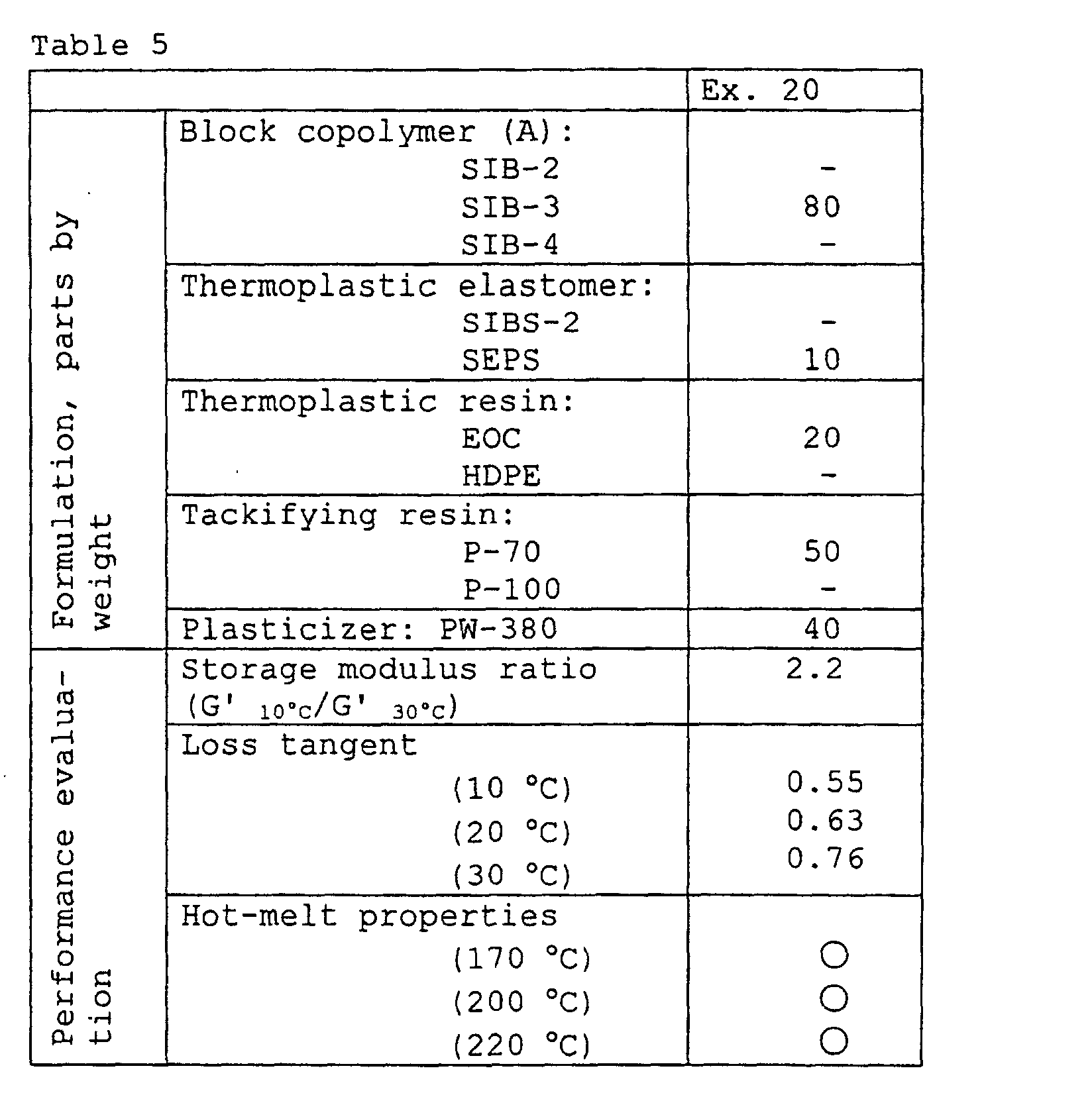
- Damper material compositions were produced according to the formulas indicated in Table 5 in otherwise the same manner as in Examples 10 to 19. From each composition thus obtained, a 12 g aliquot was weighed out and sandwiched between 50 mm ⁇ 100 mm ⁇ 7 mm general-purpose structural rolled steel [SS400 (JISG-3101)] sheets sandblasted for surface treatment in advance. The assembly was heated in an oven at 190°C to cause the composition to flow, whereby a small-sized viscoelastic damper of the shape illustrated in Fig. 1 was obtained. The composition became sufficiently flowable at 190 °C and was found to show sufficient adhesion to steel sheets without leaving air cells, thus having satisfactory hot-melt processability.
- the viscoelastic damper obtained was set with a jig on a vibrating machine and a dynamic vibration test was carried out.
- MTS's 831 Elastomer Test System was used as the testing instrument and an incubator was used for temperature control.
- the measuring conditions were: frequency 0.5 Hz, strain 50%, 100% or 200%; temperature 0 °C, 10 °C, 20 °C, 30 °C or 40 °C.
- the equivalent rigidity (Keq) and equivalent damping factor (heq) values calculated from the hysteresis loops are shown in Table 6.
- the hysteresis loops at 20 °C are shown in Fig. 3.
- the viscoelastic damper fabricated using the damper material composition of this invention is low in the temperature dependence of rigidity and shows a high damping capacity at and around room temperature. It can also seen in Fig. 3 that the viscoelastic damper fabricated using the damper material composition of this invention shows a concentric expansion of its hysteresis loop according to an increasing strain, thus being an excellent architectural viscoelastic damper with a small strain dependence (high linearity). Moreover, no delamination from steel sheets was observed even under a large strain of 200%, indicating that the composition shows sufficient adhesion.
- Example 20 Using the damper material composition produced in Example 20, a double-sided self-adhesive tape was fabricated by means of a single-screw extruder. The screw temperature was set at 90 °C and the die temperature was set at 110 °C. The thickness and width of the tape were controlled at 1 mm and 50 mm, respectively.
- the adhesion of the product tape was evaluated by a shear test.
- the tape was cut to 25 mm ⁇ 25 mm and secured to one edge of a sandblasted 25 mm ⁇ 100 mm ⁇ 5 mm general-purpose structural steel sheet [SS400 (JIS G-3101)].
- SS400 JIS G-31011
- another steel sheet was secured to the tape to prepare a specimen for the shear test.
- Autograph AG-10TB Shiadzu Corporation
- the specimen was pulled in the shear direction at a speed of 300 mm/min and the maximum strain causing detachment or destruction of the tape was measured. As a result, the maximum strain was found to be 2280%.
- the destruction was a cohesive failure and no interfacial failure took place.
- the above findings indicate that the damper material composition according to the present invention enables the provision of a double-sided self-adhesive tape having sufficient adhesion and capable of functioning as a double-sided self-adhesive tape having vibration-dam
- the damper material composition of the present invention not only features an improvement in the attenuation of damping capacity at 20 to 40 °C and a consequent good balance between damping capacity and temperature dependence of rigidity at and around room temperature, which are conflicting characteristic parameters, but also self-adhesive properties and good deformability, thus enabling the provision of excellent architectural viscoelastic dampers.
- the damper material composition of the invention has excellent hot-melt processability in addition to the good balance between damping capacity and temperature dependence of rigidity at and around room temperature, thus enabling the provision of an architectural damper and a vibration-damping double-sided self-adhesive tape, both of which have excellent hot-melt processability.
Landscapes
- Chemical & Material Sciences (AREA)
- Health & Medical Sciences (AREA)
- Chemical Kinetics & Catalysis (AREA)
- Medicinal Chemistry (AREA)
- Polymers & Plastics (AREA)
- Organic Chemistry (AREA)
- Compositions Of Macromolecular Compounds (AREA)
- Vibration Prevention Devices (AREA)
- Graft Or Block Polymers (AREA)
Abstract
wherein the ratio of the storage modulus (G') value at 0°C to the corresponding value at 40 °C as found by the measurement of dynamic viscoelasticity in the shear mode, namely (G' 0°C/G' 40°C), is not greater than 15
and the loss tangent (tan δ) value as found by said measurement is not smaller than 0.4 at 0 °C to 40 °C.
Description
wherein the ratio of the storage modulus (G') value at 0 °C to the corresponding value at 40 °C as found by the measurement of dynamic viscoelasticity in the shear mode, namely (G' 0°C/G' 40°C), is not greater than 15
and the loss tangent (tan δ) value as found by said measurement is not smaller than 0.4 at 0 °C to 40 °C.
which comprises a block copolymer (A) comprising a polymer block (a) and a polymer block (b) and terminating in said polymer block (b),
said polymer block (a) being comprised of an aromatic vinyl compound as a constituent monomer,
and said polymer block (b) being comprised of isobutylene as a constituent monomer.
said polymer block (a') being comprised of an aromatic vinyl compound as a constituent monomer and having a number average molecular weight of not more than 10,000,
and said polymer block (b) being comprised of isobutylene as a constituent monomer.
- (1-Chloro-1-methylethyl)benzene: C6H5C(CH3)2Cl,
- 2-Methoxy-2-phenylpropane: C6H5C(CH3)2OCH3,
- 2-Chloro-2,4,4-trimethylpropane: (CH3)3CCH2C(CH3)2Cl,
- 1,4-Bis(1-chloro-1-methylethyl)benzene: 1,4-Cl(CH3)2CC6H4C(CH3)2Cl,
- 1,3-Bis(1-chloro-1-methylethyl)benzene: 1,3-Cl(CH3)2CC6H4C(CH3)2Cl,
- 1,3,5-Tris(1-chloro-1-methylethyl)benzene: 1,3,5-(ClC(CH3)2)3C6H3,
- 1,3-Bis(1-chloro-1-methylethyl)-5-(tert-butyl)benzene: 1,3-(C(CH3)2Cl)2-5-(C(CH3)3)C6H3.
said polymer block (a') being comprised of an aromatic vinyl compound as a constituent monomer and having a number average molecular weight of not more than 10,000
and said polymer block (b) being comprised of isobutylene as a constituent monomer.

- Thermoplastic elastomer: SEPS (styrene-ethylene/propylene-styrene triblock copolymer [SEPTON 2007, product of Kuraray Co.]
- Thermoplastic elastomer: VS1 (high-vinyl styrene-isoprene block copolymer, HYBLAR VS-1, styrene content 20% [product of Kuraray Co.]
- Thermoplastic elastomer: HVS3 (hydrogenated high-vinyl styrene-isoprene block copolymer, HYBLAR HVS-3, styrene content 20% [product of Kuraray Co.]
- Thermoplastic elastomer: SEBS (hydrogenated styrene-butadiene block copolymer, CRAYTON G-1650, styrene content 29% [product of Shell Japan Co.]
- Thermoplastic resin: EOC (ethylene-octene copolymer (ENGAGE 8150, product of Dow)
- Thermoplastic resin: EVA (ethylene-vinyl acetate copolymer (EV260, product of Mitsui-DuPont)
- Tackifying resin: P-100 (hydrogenated C9 alicyclic petroleum
resin, ARCON P-100,
softening point 100 °C, molecular weight 610 (product of Arakawa Chemical Industry) - Tackifying resin: P-140 (hydrogenated C9 alicyclic petroleum resin, ARCON P-140, softening point 140 °C, molecular weight 860 (product of Arakawa Chemical Industry)
- Plasticizer: PW-380 (paraffinic oil, Diana Process Oil PW-380, viscosity 380 cSt (40 °C), density 0.8769 g/cm3, pour point -15 °C (product of Idemitsu Kosan)
- Plasticizer: 300H (polybutene oil, Idemitsu Polybutene 300H,
viscosity 32,000 cSt (40 °C), density 0.900 g/cm3, pour
point 0 °C (product of Idemitsu Petrochemical) - Filler: SC-60 (flaky graphite SC-60 (product of Nakagoshi Graphite)
| | ||||
| 50% | 100% | 200% | ||
| Keq (0 °C) | MPa | 0.079 | 0.058 | 0.039 |
| Keq (10 °C) | MPa | 0.043 | 0.034 | 0.026 |
| Keq (20 °C) | MPa | 0.046 | 0.036 | 0.027 |
| Keq (30 °C) | MPa | 0.037 | 0.030 | 0.023 |
| Keq (40 °C) | MPa | 0.026 | 0.021 | 0.017 |
| Keq (10°C)/Keq (30°C) | - | 1.2 | 1.2 | 1.1 |
| Keq (0 °C)/Keq (40 °C) | - | 3.1 | 2.7 | 2.3 |
| heq (0 °C) | - | 0.38 | 0.48 | 0.57 |
| heq (10 °C) | - | 0.41 | 0.47 | 0.51 |
| heq (20 °C) | - | 0.40 | 0.46 | 0.51 |
| heq (30 °C) | - | 0.40 | 0.45 | 0.48 |
| heq (40 °C) | - | 0.36 | 0.40 | 0.43 |
| Production Ex. 3 | Production Ex. 4 | Production Ex. 5 | |
| Diblock copolymer | SIB-2 | SIB-3 | SIB-4 |
| Isobutylene (g) | 60.7 | 120.9 | 99.6 |
| Styrene (g) | 11.1 | 21.9 | 42.6 |
| Mn after | 19100 | 35200 | 29900 |
| polymerization of isobutylene (Mw/Mn) | (1.05) | (1.07) | (1.07) |
| Mn after | 22700 | 42500 | 43100 |
| polymerization of styrene (Mw/Mn) | (1.11) | (1.17) | (1.18) |
| Mn of polystyrene block | 3600 | 7300 | 13200 |
| Styrene content (wt %) of copolymer | 15 | 16 | 31 |
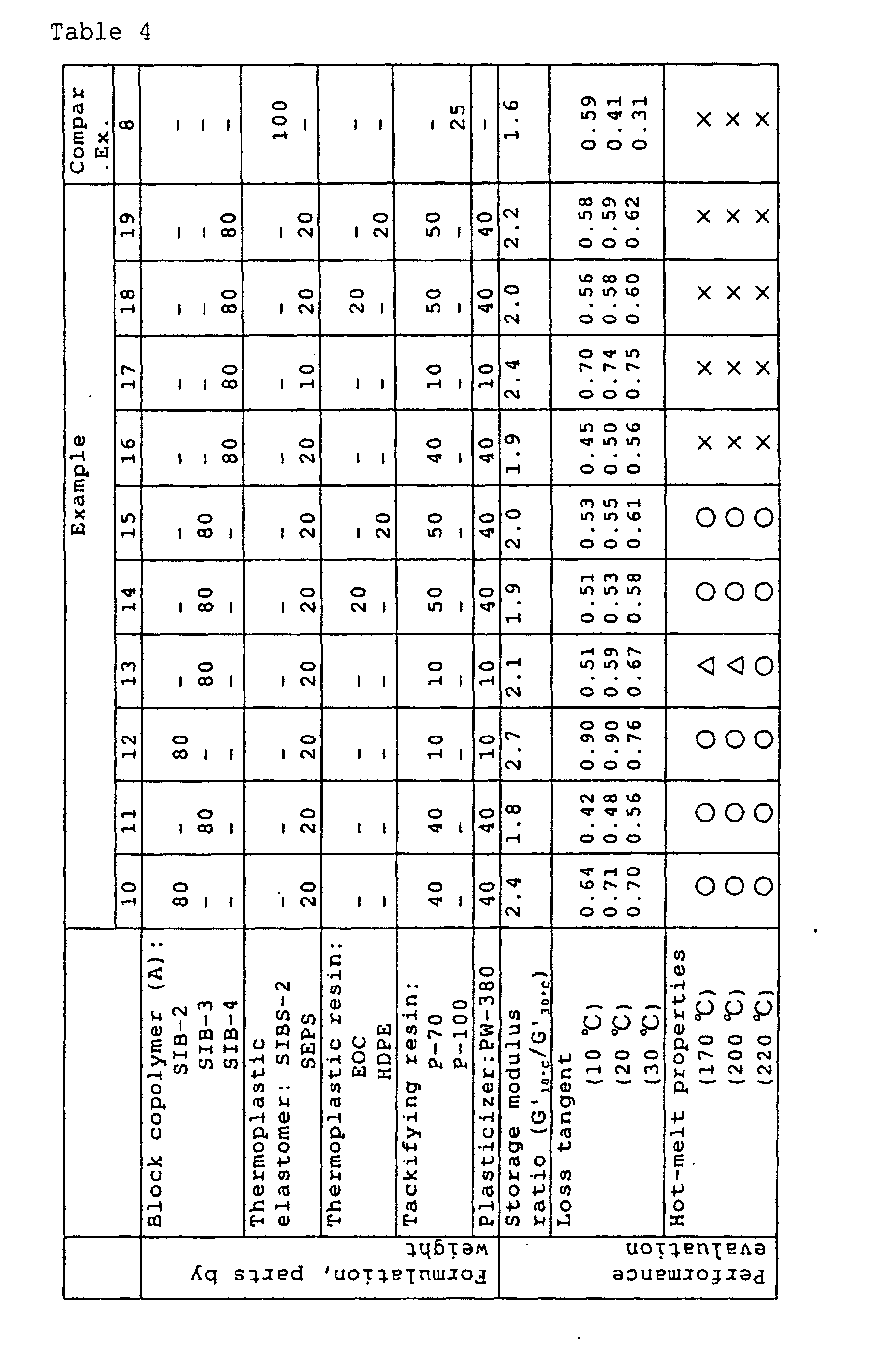
- Thermoplastic elastomer: SEPS (styrene-ethylene/propylene-styrene triblock copolymer (SEPTON 2007, product of Kuraray)
- Thermoplastic resin: EOC (ethylene-octene copolymer (ENGAGE 8150, product of Dow)
- Thermoplastic resin: HDPE (high-density polyethylene, HIZEX 2200J, product of Mitsui Chemical)
- Tackifying resin: P-70 (ARCON P-70, product of Arakawa Chemical)
- Tackifying resin: P-100 (ARCON P-100, product of Arakawa Chemical)
- Plasticizer: PW-380 (paraffinic process oil PW-380, product of Idemitsu Kosan)
| | ||||
| 50% | 100% | 200% | ||
| Keq (0 °C) | MPa | 0.161 | 0.121 | 0.075 |
| Keq (10 °C) | MPa | 0.121 | 0.085 | 0.053 |
| Keq (20 °C) | MPa | 0.081 | 0.057 | 0.037 |
| Keq (30 °C) | MPa | 0.062 | 0.045 | 0.032 |
| Keq (40 °C) | Mpa | 0.041 | 0.032 | 0.026 |
| Keq (10°C)/Keq (30 °C) | - | 2.0 | 1.9 | 1.7 |
| Keq (0 °C)/Keq (40 °C) | - | 3.9 | 3.8 | 2.9 |
| heq (0 °C) | - | 0.35 | 0.45 | 0.61 |
| heq (10 °C) | - | 0.36 | 0.47 | 0.63 |
| heq (20 °C) | - | 0.41 | 0.53 | 0.64 |
| heq (30 °C) | - | 0.46 | 0.56 | 0.61 |
| heq (40 °C) | - | 0.48 | 0.55 | 0.56 |
Claims (17)
- A damper material composition
wherein the ratio of the storage modulus (G') value at 0°C to the corresponding value at 40°C as found by the measurement of dynamic viscoelasticity in the shear mode, namely (G' 0°C/G' 40°C), is not greater than 15
and the loss tangent (tan δ) value as found by said measurement is not smaller than 0.4 at 0 °C to 40 °C. - The damper material composition according to Claim 1
which comprises a block copolymer (A) comprising a polymer block (a) and a polymer block (b) and terminating in said polymer block (b)
said polymer block (a) being comprised of an aromatic vinyl compound as a constituent monomer
and said polymer block (b) being comprised of isobutylene as a constituent monomer. - The damper material composition according to Claim 2
wherein the block copolymer (A) is a diblock copolymer having a polymer block (a) - polymer block (b) structure. - The damper material composition according to Claim 3
wherein the polymer block (a) has a number average molecular weight of not more than 10,000. - The damper material composition according to any of Claims 2 to 4
containing at least one kind of a tackifying resin and a plasticizer. - The damper material composition according to any of Claims 2 to 5
containing at least one kind of thermoplastic resin (C) . - The damper material composition according to Claim 6
wherein the thermoplastic resin (C) is at least one selected from the group consisting of ethylene-propylene copolymer, ethylene-butene copolymer, ethylene-hexene copolymer, ethylene-octene copolymer, ethylene-vinyl acetate copolymer, ethylene-ethyl acrylate copolymer, high-density polyethylene, low-density polyethylene, linear low-density polyethylene and isobutylene-isoprene copolymer (butyl rubber). - The damper material composition according to any of Claims 2 to 7
containing at least one kind of thermoplastic elastomer (D). - The damper material composition according to Claim 8
wherein the thermoplastic elastomer (D) is at least one selected from the group consisting of a triblock copolymer having the structure of (a polymer block comprised of an aromatic vinyl compound as a constituent monomer) - (a polymer block comprising a conjugated diene as a constituent monomer and optionally hydrogenated) - (a polymer block comprised of an aromatic vinyl compound as a constituent monomer) and a triblock copolymer having the structure of (a polymer block comprised of an aromatic vinyl compound as a constituent monomer) - (a polymer block comprised of isobutylene as a constituent monomer) - (a polymer block comprised of an aromatic vinyl compound as a constituent monomer). - A damper material composition comprising a diblock copolymer (A') comprising a polymer block (a') and a polymer block (b),
said polymer block (a') being comprised of an aromatic vinyl compound as a constituent monomer and having a number average molecular weight of not more than 10,000
and said polymer block (b) being comprised of isobutylene as a constituent monomer. - The damper material composition according to Claim 10
containing at least one kind of thermoplastic elastomer (D). - The damper material composition according to Claim 11
wherein the thermoplastic elastomer (D) is a triblock copolymer having the structure of (a polymer block comprised of an aromatic vinyl compound as a constituent monomer) - (a polymer block comprised of a conjugated diene as a constituent monomer and optionally hydrogenated) (apolymerblockcomprised of an aromatic vinyl compound as a constituent monomer). - The damper material composition according to any of Claims 10 to 12
containing at least one selected from the group consisting of ethylene-propylene copolymer, ethylene-butene copolymer, ethylene-hexene copolymer, ethylene-octene copolymer, ethylene-vinyl acetate copolymer, ethylene-ethyl acrylate copolymer, high-density polyethylene, low-density polyethylene, linear low-density polyethylene and isobutylene-isoprene copolymer (butyl rubber). - The damper material composition according to any of Claims 10 to 13
containing at least one kind of a tackifying resin and a plasticizer. - The damper material composition according to any of Claims 10 to 14
wherein the ratio of the storage modulus (G') value at 10°C to the corresponding value at 30°C as found by the measurement of dynamic viscoelasticity in the shear mode, namely (G' 10°C/G' 30°C), is not greater than 5
and the loss tangent (tan δ) value as found by said measurement is not smaller than 0.4 at 10 °C to 30 °C. - The vibration damper having the structure of a combination of the damper material composition according to any of Claims 1 to 15 with steel sheet or steel pipe.
- A damping double-sided self-adhesive tape comprising the damper material composition according to any of Claims 1 to 15 as molded in the form of a tape.
Applications Claiming Priority (5)
| Application Number | Priority Date | Filing Date | Title |
|---|---|---|---|
| JP2000103962 | 2000-04-05 | ||
| JP2000103962 | 2000-04-05 | ||
| JP2001027319 | 2001-02-02 | ||
| JP2001027319 | 2001-02-02 | ||
| PCT/JP2001/002972 WO2001074964A1 (en) | 2000-04-05 | 2001-04-05 | Vibration damper composition |
Publications (2)
| Publication Number | Publication Date |
|---|---|
| EP1277822A1 true EP1277822A1 (en) | 2003-01-22 |
| EP1277822A4 EP1277822A4 (en) | 2004-07-28 |
Family
ID=26589534
Family Applications (1)
| Application Number | Title | Priority Date | Filing Date |
|---|---|---|---|
| EP01917840A Withdrawn EP1277822A4 (en) | 2000-04-05 | 2001-04-05 | Vibration damper composition |
Country Status (6)
| Country | Link |
|---|---|
| US (1) | US7241837B2 (en) |
| EP (1) | EP1277822A4 (en) |
| CN (1) | CN1247732C (en) |
| MY (1) | MY128694A (en) |
| TW (1) | TWI221851B (en) |
| WO (1) | WO2001074964A1 (en) |
Cited By (9)
| Publication number | Priority date | Publication date | Assignee | Title |
|---|---|---|---|---|
| EP1431343A4 (en) * | 2001-09-25 | 2006-05-10 | Bridgestone Corp | Resin composition and member comprising said resin composition |
| WO2006067943A1 (en) | 2004-12-02 | 2006-06-29 | Kaneka Corporation | Resin composition for tubes and tube |
| EP2202270A4 (en) * | 2007-10-19 | 2010-10-06 | Toda Kogyo Corp | Resin composition for pavement, asphalt composition for pavement, and method for producing the same |
| CN104612276A (en) * | 2014-12-12 | 2015-05-13 | 北京工业大学 | Embedded plate type large-stroke lead damper |
| CN104612275A (en) * | 2014-12-12 | 2015-05-13 | 北京工业大学 | Embedded type large-stroke lead damper |
| US20150183969A1 (en) * | 2012-05-07 | 2015-07-02 | Dow Corning Toray Co.,Ltd. | Additive For Rubber, And Rubber Composition Obtained By Blending Same |
| WO2020174393A1 (en) * | 2019-02-25 | 2020-09-03 | 3M Innovative Properties Company | Damping material and damping sheet made therefrom |
| US20200283617A1 (en) * | 2017-11-22 | 2020-09-10 | Kuraray Co., Ltd. | Block copolymer or hydrogenated product of same |
| US20210087386A1 (en) * | 2018-02-22 | 2021-03-25 | Kitagawa Industries Co., Ltd. | Flame-Retardant High-Damping Material |
Families Citing this family (44)
| Publication number | Priority date | Publication date | Assignee | Title |
|---|---|---|---|---|
| EP1333043B1 (en) * | 2000-11-10 | 2017-10-11 | Denka Company Limited | Block copolymer, composition thereof, and film made thereof |
| JP3885619B2 (en) * | 2002-03-12 | 2007-02-21 | 東海ゴム工業株式会社 | High damping elastomer composition and elastomer product using the same |
| US7459494B2 (en) * | 2002-07-31 | 2008-12-02 | The Procter & Gamble Company | Phase change solvents for thermoplastic elastomers |
| JP4192007B2 (en) * | 2003-02-07 | 2008-12-03 | 三菱化学株式会社 | Thermoplastic elastomer composition having a high coefficient of friction and anti-slip member comprising the same |
| JP2006045344A (en) * | 2004-08-04 | 2006-02-16 | Kaneka Corp | Vibration-damping material composition |
| US20060169341A1 (en) * | 2005-02-01 | 2006-08-03 | Material Sciences Corporation | Internally damped laminated tube |
| JPWO2006095854A1 (en) * | 2005-03-11 | 2008-08-21 | 株式会社カネカ | Anti-vibration material composition |
| JP2006282784A (en) * | 2005-03-31 | 2006-10-19 | Nippon Zeon Co Ltd | Damped molded body |
| ES2449515T3 (en) | 2005-10-06 | 2014-03-20 | Henkel Ag & Co. Kgaa | Vibration transfer reduction |
| US7368649B2 (en) * | 2006-01-17 | 2008-05-06 | Richard Mintz | Method and device for adjusting cymbal sound |
| FI118482B (en) * | 2006-06-12 | 2007-11-30 | Metso Paper Inc | Arrangement for damping vibration in a drum |
| JP5142406B2 (en) * | 2007-02-20 | 2013-02-13 | 旭化成ケミカルズ株式会社 | Shock absorber composition |
| US7929245B2 (en) * | 2007-03-13 | 2011-04-19 | IntriPlex Technologies | Damper for use in disk drive data storage applications |
| US8273825B2 (en) * | 2007-03-20 | 2012-09-25 | Sabic Innovative Plastics Ip B.V. | Polycarbonate/polyolefin based resin compositions and their production processes and uses |
| JP2007231293A (en) * | 2007-05-15 | 2007-09-13 | Tokai Rubber Ind Ltd | Damping and seismic isolation elastomer products for construction |
| JP5571332B2 (en) * | 2009-07-10 | 2014-08-13 | スリーエム イノベイティブ プロパティズ カンパニー | Primer composition for viscoelastic damper and viscoelastic damper |
| CN101924339B (en) * | 2009-11-24 | 2013-02-27 | 东南大学 | Anti-galling viscoelastic damping shock absorber |
| JP5586281B2 (en) * | 2010-03-16 | 2014-09-10 | 東海ゴム工業株式会社 | Damping damper |
| CN101974951B (en) * | 2010-11-24 | 2011-11-16 | 南京工业大学 | Wall type soft steel bending energy dissipation damper |
| EP2694609B1 (en) * | 2011-04-08 | 2015-08-19 | Bostik, Inc. | Polyolefin based hot melt adhesive containing a solid plasticizer |
| CN103703267A (en) * | 2011-06-03 | 2014-04-02 | 弗洛里安.费利克斯 | device for damping shock |
| JP5789434B2 (en) * | 2011-07-04 | 2015-10-07 | 住友ゴム工業株式会社 | High damping composition |
| CN103717939B (en) * | 2011-07-28 | 2015-09-23 | 株式会社普利司通 | Composition for plug in base-isolated structure, plug for base-isolated structure, base-isolated structure, method for producing plug composition for base-isolated structure, and method for manufacturing plug for base-isolated structure |
| WO2013069544A1 (en) * | 2011-11-09 | 2013-05-16 | Jsr株式会社 | Self-organization composition for pattern formation and pattern formation method |
| JP2014001323A (en) * | 2012-06-19 | 2014-01-09 | Sumitomo Rubber Ind Ltd | High damping composition and earthquake-proof damper |
| CN102702627A (en) * | 2012-07-10 | 2012-10-03 | 广州市延昌新型塑胶制品有限公司 | Antivibration film on non-vulcanized high-strength compressor liquid storage tank and production process of antivibration film |
| JP2014074105A (en) * | 2012-10-03 | 2014-04-24 | Sumitomo Rubber Ind Ltd | High damping composition and vibration control damper |
| JP6230979B2 (en) * | 2014-10-01 | 2017-11-15 | 中日本高速技術マーケティング株式会社 | Rubber bearing |
| CN107207866A (en) | 2015-02-11 | 2017-09-26 | 普立万公司 | Dampened thermoplastic's elastomer |
| WO2016130639A1 (en) | 2015-02-11 | 2016-08-18 | Polyone Corporation | Super-vibration damping thermoplastic elastomer blends |
| US10329417B2 (en) | 2015-02-11 | 2019-06-25 | Polyone Corporation | Sound damping thermoplastic elastomer articles |
| US10457805B2 (en) | 2015-02-11 | 2019-10-29 | Polyone Corporation | Damping thermoplastic elastomers |
| WO2016130630A1 (en) * | 2015-02-11 | 2016-08-18 | Polyone Corporation | Damping thermoplastic elastomer articles with low compression set |
| CN105133745A (en) * | 2015-09-28 | 2015-12-09 | 武汉斯坦迪减振技术有限公司 | Vibration damper |
| US10814593B2 (en) | 2016-07-25 | 2020-10-27 | Avient Corporation | Super-vibration damping thermoplastic elastomer blends and articles made therewith |
| PL3516261T3 (en) | 2016-09-20 | 2023-03-27 | Avery Dennison Corporation | Multilayer tape |
| KR102364530B1 (en) * | 2016-09-27 | 2022-02-17 | 주식회사 쿠라레 | Interlayer film for resin composition, pellets, bales, vibration dampers, sound insulation materials and laminated glass |
| WO2018131619A1 (en) * | 2017-01-11 | 2018-07-19 | 積水化学工業株式会社 | Shock-absorbing sheet |
| US11059264B2 (en) | 2018-03-19 | 2021-07-13 | Avery Dennison Corporation | Multilayer constrained-layer damping |
| CN112423977B (en) | 2018-05-17 | 2023-09-19 | 艾利丹尼森公司 | Partially covered with multi-layer damping laminate |
| JP6869274B2 (en) * | 2019-01-11 | 2021-05-12 | Jx金属株式会社 | Conductive coating material |
| CN110374219A (en) * | 2019-04-26 | 2019-10-25 | 长春工程学院 | A kind of New type corrugated damper and the construction wall containing the ripple damper |
| CN111532306A (en) * | 2020-04-20 | 2020-08-14 | 株洲时代瑞唯减振装备有限公司 | Rigidity adjusting method of plate type composite joint |
| KR102693405B1 (en) * | 2022-09-21 | 2024-08-08 | 김병식 | Adhesive Resin Composition Containing Ethylene Vinyl Acetate Resin And Styrene Block Copolymer Resin And The Vibration Damping Steel Sheet Manufactured Using The Same |
Family Cites Families (19)
| Publication number | Priority date | Publication date | Assignee | Title |
|---|---|---|---|---|
| US4760478A (en) * | 1983-03-30 | 1988-07-26 | International Business Machines | Visco-elastically damped magnetic head suspension assembly |
| JPH0757865B2 (en) | 1990-10-05 | 1995-06-21 | 日本ゼオン株式会社 | Adhesive composition |
| JP3199739B2 (en) | 1992-01-21 | 2001-08-20 | 日本ゼオン株式会社 | Damping composition |
| JPH05295054A (en) | 1992-04-18 | 1993-11-09 | Japan Synthetic Rubber Co Ltd | Anti-vibration composition |
| JPH07138811A (en) | 1993-11-16 | 1995-05-30 | Kuraray Co Ltd | Fiber made of block copolymer |
| JP3107491B2 (en) | 1993-11-16 | 2000-11-06 | 株式会社クラレ | Polymer composition and adhesive |
| JPH07137194A (en) | 1993-11-22 | 1995-05-30 | Kuraray Co Ltd | Damping metal composite |
| JP3329599B2 (en) | 1994-11-14 | 2002-09-30 | 株式会社ブリヂストン | Anti-vibration rubber composition |
| US5721331A (en) * | 1995-03-08 | 1998-02-24 | Kuraray Co., Ltd. | Isobutylene-based polymer and process of producing the same |
| WO1996035458A2 (en) * | 1995-04-25 | 1996-11-14 | Minnesota Mining And Manufacturing Company | Tackified polydiorganosiloxane polyurea segmented copolymers and a process for making same |
| CA2181604C (en) | 1995-07-20 | 2008-02-05 | Kenji Shachi | Closure and sealing element |
| SE9503884L (en) * | 1995-11-03 | 1997-05-04 | Ericsson Telefon Ab L M | Procedure for mounting speakers and speaker assembly |
| WO1998014518A1 (en) | 1996-10-04 | 1998-04-09 | Kuraray Co., Ltd. | Thermoplastic polymer composition |
| US6410109B1 (en) | 1997-01-10 | 2002-06-25 | Kuraray Co., Ltd. | Resin composition and usage thereof |
| JPH10330451A (en) | 1997-05-30 | 1998-12-15 | Toyo Tire & Rubber Co Ltd | High-damping polyurethane compound |
| US6576699B2 (en) * | 1997-09-03 | 2003-06-10 | Toyoda Gosei Co., Ltd. | Damping resin composition and molded article using the same |
| JP3618527B2 (en) | 1997-09-25 | 2005-02-09 | 株式会社クラレ | Block copolymer, method for producing the same, and resin composition |
| DE69921265T2 (en) * | 1998-04-28 | 2005-12-01 | Kaneka Corp. | BLOCK COPOLYMER |
| JP3878327B2 (en) | 1998-05-20 | 2007-02-07 | 株式会社カネカ | Aromatic vinyl-isobutylene block copolymer composition |
-
2001
- 2001-04-04 TW TW90108046A patent/TWI221851B/en not_active IP Right Cessation
- 2001-04-04 MY MYPI20011603A patent/MY128694A/en unknown
- 2001-04-05 US US10/240,903 patent/US7241837B2/en not_active Expired - Fee Related
- 2001-04-05 EP EP01917840A patent/EP1277822A4/en not_active Withdrawn
- 2001-04-05 CN CNB018077692A patent/CN1247732C/en not_active Expired - Fee Related
- 2001-04-05 WO PCT/JP2001/002972 patent/WO2001074964A1/en not_active Ceased
Cited By (18)
| Publication number | Priority date | Publication date | Assignee | Title |
|---|---|---|---|---|
| EP1431343A4 (en) * | 2001-09-25 | 2006-05-10 | Bridgestone Corp | Resin composition and member comprising said resin composition |
| US7163980B2 (en) | 2001-09-25 | 2007-01-16 | Bridgestone Corporation | Resin composition and member comprising said resin composition |
| WO2006067943A1 (en) | 2004-12-02 | 2006-06-29 | Kaneka Corporation | Resin composition for tubes and tube |
| EP1832792A4 (en) * | 2004-12-02 | 2010-01-13 | Kaneka Corp | Resin composition for tubes and tube |
| US8057875B2 (en) | 2004-12-02 | 2011-11-15 | Kaneka Corporation | Resin composition for tubes and tube |
| EP2202270A4 (en) * | 2007-10-19 | 2010-10-06 | Toda Kogyo Corp | Resin composition for pavement, asphalt composition for pavement, and method for producing the same |
| US20150183969A1 (en) * | 2012-05-07 | 2015-07-02 | Dow Corning Toray Co.,Ltd. | Additive For Rubber, And Rubber Composition Obtained By Blending Same |
| EP2848648A4 (en) * | 2012-05-07 | 2016-01-20 | Dow Corning Toray Co Ltd | RUBBER ADDITIVE AND RUBBER COMPOSITION OBTAINED BY ITS MIXTURE |
| US9879130B2 (en) | 2012-05-07 | 2018-01-30 | Dow Corning Toray Co. Ltd. | Additive for rubber, and rubber composition obtained by blending same |
| CN104612275A (en) * | 2014-12-12 | 2015-05-13 | 北京工业大学 | Embedded type large-stroke lead damper |
| CN104612276A (en) * | 2014-12-12 | 2015-05-13 | 北京工业大学 | Embedded plate type large-stroke lead damper |
| CN104612275B (en) * | 2014-12-12 | 2017-02-01 | 北京工业大学 | Embedded type large-stroke lead damper |
| US20200283617A1 (en) * | 2017-11-22 | 2020-09-10 | Kuraray Co., Ltd. | Block copolymer or hydrogenated product of same |
| EP3715395A4 (en) * | 2017-11-22 | 2021-08-18 | Kuraray Co., Ltd. | SEQUENCED COPOLYMER, AND HYDROGENATED PRODUCT OF THE SAME |
| US11655362B2 (en) | 2017-11-22 | 2023-05-23 | Kuraray Co., Ltd. | Block copolymer or hydrogenated product of same |
| US20210087386A1 (en) * | 2018-02-22 | 2021-03-25 | Kitagawa Industries Co., Ltd. | Flame-Retardant High-Damping Material |
| US11845860B2 (en) * | 2018-02-22 | 2023-12-19 | Kitagawa Industries Co., Ltd. | Flame-retardant high-damping material |
| WO2020174393A1 (en) * | 2019-02-25 | 2020-09-03 | 3M Innovative Properties Company | Damping material and damping sheet made therefrom |
Also Published As
| Publication number | Publication date |
|---|---|
| MY128694A (en) | 2007-02-28 |
| EP1277822A4 (en) | 2004-07-28 |
| US7241837B2 (en) | 2007-07-10 |
| US20030158336A1 (en) | 2003-08-21 |
| CN1247732C (en) | 2006-03-29 |
| WO2001074964A1 (en) | 2001-10-11 |
| TWI221851B (en) | 2004-10-11 |
| CN1422317A (en) | 2003-06-04 |
Similar Documents
| Publication | Publication Date | Title |
|---|---|---|
| US7241837B2 (en) | Vibration damper composition | |
| KR100503985B1 (en) | Block copolymer composition | |
| KR102718552B1 (en) | Hydrogenated block copolymers, resin compositions, and their various uses | |
| EP3666807B1 (en) | Block copolymers and uses thereof | |
| JPWO2005033035A1 (en) | Multi-layer glass encapsulant comprising a resin composition having excellent gas barrier properties and hot-melt adhesiveness | |
| WO2015087954A1 (en) | Sealant | |
| KR20200022518A (en) | Hydrogenated Additives of Block Copolymers, Resin Compositions, and Their Various Applications | |
| JPWO2001085818A1 (en) | Block copolymer and composition containing said copolymer | |
| JP2010248328A (en) | Thermoplastic elastomer composition and hot melt sealant comprising the same | |
| JP2001288329A (en) | A viscoelastic composition and a viscoelastic damper comprising the same. | |
| JP2010106200A (en) | Resin composition and sheet-like molded article made therefrom | |
| JPH02135256A (en) | Composition having excellent vibration-damping performance | |
| JP2016141132A (en) | Laminate, and application thereof | |
| JP2006258156A (en) | Viscoelastic damper | |
| EP4269451A1 (en) | Hydrogenated product of block copolymer, resin composition, and method for producing hydrogenated product of block copolymer | |
| JP2000038460A (en) | Sheet material | |
| JP2003128870A (en) | Thermoplastic elastomer composition | |
| WO2020235661A1 (en) | Tackifying composition | |
| JP2003049043A (en) | Anti-vibration material for light electrical equipment | |
| JP2612588B2 (en) | Thermoplastic elastomer for asphalt modification | |
| JPWO2001074964A1 (en) | Vibration-damping composition | |
| JP7461266B2 (en) | Vibration-damping material, manufacturing method for vibration-damping material, laminate, and method for improving vibration-damping properties | |
| JP6228441B2 (en) | Asphalt composition and use thereof | |
| JP2006045344A (en) | Vibration-damping material composition | |
| JP2006176708A (en) | Resin composition |
Legal Events
| Date | Code | Title | Description |
|---|---|---|---|
| PUAI | Public reference made under article 153(3) epc to a published international application that has entered the european phase |
Free format text: ORIGINAL CODE: 0009012 |
|
| 17P | Request for examination filed |
Effective date: 20021030 |
|
| AK | Designated contracting states |
Kind code of ref document: A1 Designated state(s): AT BE CH CY DE DK ES FI FR GB GR IE IT LI LU MC NL PT SE TR |
|
| RIC1 | Information provided on ipc code assigned before grant |
Ipc: 7C 09J 7/02 B Ipc: 7A 61L 15/58 B Ipc: 7C 08L 101/00 B Ipc: 7C 08L 53/02 B Ipc: 7F 16F 15/02 B Ipc: 7C 09K 3/00 A |
|
| RBV | Designated contracting states (corrected) |
Designated state(s): AT BE CH CY DE DK FR GB IT LI NL |
|
| A4 | Supplementary search report drawn up and despatched |
Effective date: 20040615 |
|
| 17Q | First examination report despatched |
Effective date: 20071121 |
|
| STAA | Information on the status of an ep patent application or granted ep patent |
Free format text: STATUS: THE APPLICATION IS DEEMED TO BE WITHDRAWN |
|
| 18D | Application deemed to be withdrawn |
Effective date: 20091103 |