EP1277795A2 - Pneumatic tire - Google Patents
Pneumatic tire Download PDFInfo
- Publication number
- EP1277795A2 EP1277795A2 EP02022629A EP02022629A EP1277795A2 EP 1277795 A2 EP1277795 A2 EP 1277795A2 EP 02022629 A EP02022629 A EP 02022629A EP 02022629 A EP02022629 A EP 02022629A EP 1277795 A2 EP1277795 A2 EP 1277795A2
- Authority
- EP
- European Patent Office
- Prior art keywords
- weight
- parts
- rubber component
- resin
- group
- Prior art date
- Legal status (The legal status is an assumption and is not a legal conclusion. Google has not performed a legal analysis and makes no representation as to the accuracy of the status listed.)
- Granted
Links
- 0 CC(N)SCP(*)(*)=S Chemical compound CC(N)SCP(*)(*)=S 0.000 description 2
Classifications
-
- C—CHEMISTRY; METALLURGY
- C08—ORGANIC MACROMOLECULAR COMPOUNDS; THEIR PREPARATION OR CHEMICAL WORKING-UP; COMPOSITIONS BASED THEREON
- C08K—Use of inorganic or non-macromolecular organic substances as compounding ingredients
- C08K5/00—Use of organic ingredients
- C08K5/36—Sulfur-, selenium-, or tellurium-containing compounds
- C08K5/45—Heterocyclic compounds having sulfur in the ring
- C08K5/46—Heterocyclic compounds having sulfur in the ring with oxygen or nitrogen in the ring
- C08K5/47—Thiazoles
-
- B—PERFORMING OPERATIONS; TRANSPORTING
- B60—VEHICLES IN GENERAL
- B60C—VEHICLE TYRES; TYRE INFLATION; TYRE CHANGING; CONNECTING VALVES TO INFLATABLE ELASTIC BODIES IN GENERAL; DEVICES OR ARRANGEMENTS RELATED TO TYRES
- B60C1/00—Tyres characterised by the chemical composition or the physical arrangement or mixture of the composition
- B60C1/0016—Compositions of the tread
-
- C—CHEMISTRY; METALLURGY
- C08—ORGANIC MACROMOLECULAR COMPOUNDS; THEIR PREPARATION OR CHEMICAL WORKING-UP; COMPOSITIONS BASED THEREON
- C08K—Use of inorganic or non-macromolecular organic substances as compounding ingredients
- C08K5/00—Use of organic ingredients
- C08K5/49—Phosphorus-containing compounds
- C08K5/5398—Phosphorus bound to sulfur
-
- Y—GENERAL TAGGING OF NEW TECHNOLOGICAL DEVELOPMENTS; GENERAL TAGGING OF CROSS-SECTIONAL TECHNOLOGIES SPANNING OVER SEVERAL SECTIONS OF THE IPC; TECHNICAL SUBJECTS COVERED BY FORMER USPC CROSS-REFERENCE ART COLLECTIONS [XRACs] AND DIGESTS
- Y10—TECHNICAL SUBJECTS COVERED BY FORMER USPC
- Y10T—TECHNICAL SUBJECTS COVERED BY FORMER US CLASSIFICATION
- Y10T152/00—Resilient tires and wheels
- Y10T152/10—Tires, resilient
- Y10T152/10495—Pneumatic tire or inner tube
Definitions
- the present invention relates to a pneumatic tire, and more particularly, to a pneumatic tire which exhibits excellent stability and controllability on wet roads (hereinafter referred to as controllability) or a combination of excellent controllability on wet roads and excellent comfort of ride even when a vehicle is vibrating (hereinafter referred to as ride comfort) throughout the life of the pneumatic tire including the initial, intermediate, and final periods of tire use.
- controllability excellent stability and controllability on wet roads
- ride comfort a combination of excellent controllability on wet roads and excellent comfort of ride even when a vehicle is vibrating
- tires have been increasingly required to have more excellent controllability or a combination of more excellent controllability and ride comfort than hitherto throughout the life of the pneumatic tire.
- highly excellent controllability or a combination of highly excellent controllability and ride comfort is strongly required as the tire structure changes from a bias structure to a radial structure and the aspect ratio of radial tires changes from 82 to 72 and further to 65.
- a rubber composition comprising a specific vulcanization accelerator and a specific antioxidant shows improved resistance to hardening under heating and provides a tire showing improved appearance in the final period of tire use.
- performances of the tire during driving are not examined at all.
- scorching in mixing to prepare a rubber composition can be improved by the use of a rubber composition comprising a specific vulcanization accelerator.
- performances of a tire are not described or suggested at all.
- the present invention has been made under the above circumstances, and the object of the present invention is to provide a pneumatic tire exhibiting excellent controllability or a combination of excellent controllability and excellent ride comfort throughout the life of the pneumatic tire including the initial, intermediate, and final periods of tire use.
- the present invention also provides
- the present invention also provides
- the present invention also provides (16) a pneumatic tire comprising a tread portion formed by using a rubber composition which comprises:
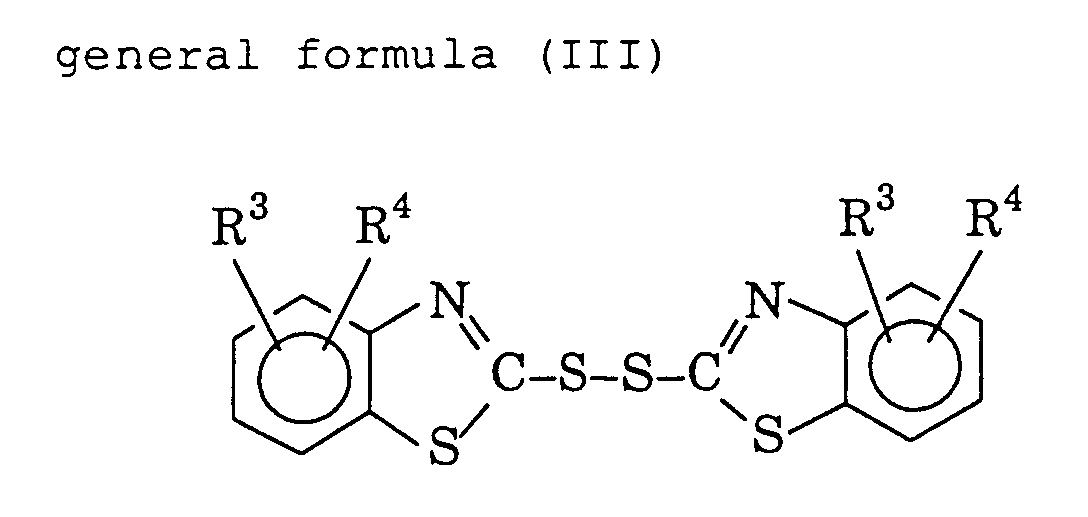
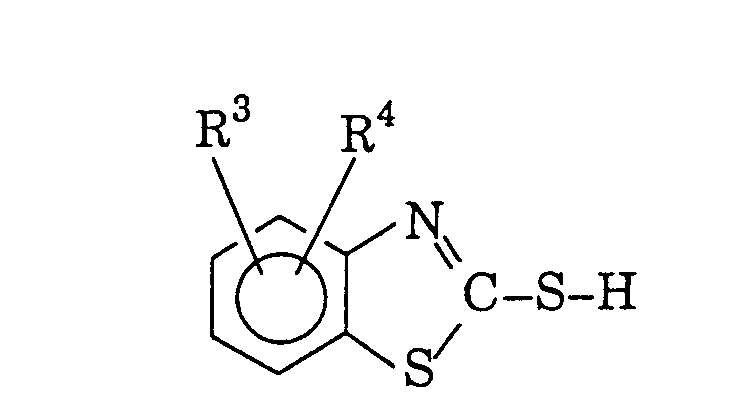
- R 3 and R 4 each independently represents a hydrogen atom, methyl group, ethyl group, or phenyl group, excluding the case in which R 3 and R 4 both represent hydrogen atoms.
- the benzothiazole compound type vulcanization accelerator represented by general formula (III) which is described in (16) is at least one compound selected from the group consisting of bis(4-methylbenzothiazolyl-2) disulfide, bis(5-methylbenzothiazolyl-2) disulfide, mercapto-4-methylbenzothiazole, and mercapto-5-methylbenzothiazole.
- the alkoxy group is bonded to the 4-position or the 6-position, more preferably to the 4-position, of the aromatic single ring.
- the alkoxy group is a group selected from the group consisting of methoxy group, ethoxy group, and butoxy group, and more preferably ethoxy group.
- the resin softener described in any of (14) and (16) has a softening point of 70 to 130°C.
- the coumarone resin used as the resin softener is a coumarone-indene resin having a softening point of 70 to 130°C.
- the phenol-terpene resin used as the resin softener is a phenol-acetylene resin or a phenol-formaldehyde resin.
- the petroleum hydrocarbon resin used as the resin softener is an aliphatic cyclic hydrocarbon resin or an aromatic hydrocarbon resin.
- the rubber component comprises SBR in an amount such that the styrene units of the SBR account for 20% by weight or more of 100% by weight of the rubber component.
- the present invention in which aluminum hydroxide is not used as a component of the rubber composition, is characterized in that a specific resin softener and a specific vulcanization accelerator are used in combination as described above in (1) to (13).
- a tread rubber in a tire shows gradual hardening in the final period of tire use although hardening is suppressed until the intermediate period.
- the resin softener specified in the present invention i.e., in accordance with the present invention
- hardening of the rubber caused by migration of the resin softener into other members of the tire can be suppressed in the final period of tire use. Therefore, in accordance with the present invention, decrease in controllability and ride comfort can be suppressed particularly in the final period of tire use.
- aromatic oils are generally used as the softener.
- These softeners migrate into other members of a tire, such as a tire case, containing less amount of oil, and this migration causes hardening of a tread rubber which, in turn, causes inferior controllability and ride comfort of the tire. It has been found that hardening of the rubber can remarkably be suppressed because the specific softener in accordance with the present invention shows less tendency to migrate into other members.
- the pneumatic tire of the present invention having excellent controllability and excellent ride comfort has been obtained by using the specific softener in combination with the specific vulcanization accelerator.
- the present invention in another embodiment of the present invention in which aluminum hydroxide is used as a component of the rubber composition, the present invention is characterized in that three components which are aluminum hydroxide, a specific resin softener, and a specific vulcanization accelerator are used in combination as described above in (14) to (26).
- controllability of a tire is remarkably improved in the intermediate and final periods of tire use in which rubber is generally heat aged and hardened in comparison with corresponding controllability of a tire obtained by the single use of aluminum hydroxide, the above specific softener, or the above vulcanization accelerator.
- excellent controllability could be obtained by the synergistic effect of the combined use of the three components which are aluminum hydroxide, the specific resin softener, and the specific vulcanization accelerator.
- the pneumatic tire of the present invention has been obtained on the basis of this new knowledge.
- the rubber composition used for the tire tread portion in the present invention i.e. the rubber composition comprising various types of compounding ingredients related to the present invention, may be applied to rubber of the tread portion composed of a single layer.
- the above rubber composition for the tire tread portion may be applied to both cap rubber and base rubber or to the base rubber alone. It is preferable that the rubber composition is applied to the base rubber.
- the rubber composition for the tread portion comprise 50 parts by weight or more, preferably 70 parts by weight or more, of SBR (styrenebutadiene rubber) in 100 parts by weight of a rubber component.
- SBR styrenebutadiene rubber
- the rubber component comprises SBR in an amount such that the styrene units of the SBR account for 20% by weight or more of 100% by weight of the rubber component. This means that, for example, when 50 parts by weight of SBR is mixed with 50 parts by weight of natural rubber as another rubber component, the content of the styrene unit of SBR is preferably 40% by weight or more.
- an SBR containing 30% by weight or more of styrene is comprised in the rubber component.
- the obtained rubber component comprises less than 20% by weight of the styrene unit in 100% by weight of the total rubber component, and this rubber component can be used in the present invention.
- SBR used in the present invention is not particularly limited as long as the above conditions are satisfied. Commercial SBR obtained by the emulsion polymerization or the solution polymerization can be used.
- the rubber component in the present invention for example, other types of SBR, natural rubber, and synthetic rubbers, such as isoprene rubber, butadiene rubber, butyl rubber including halogenated butyl rubber, and ethylenepropylene rubber, can be used in addition to SBR of the present invention.
- aluminum hydroxide [Al(OH) 3 ] is used in an amount of 5 to 40 parts by weight, preferably 10 to 30 parts by weight, per 100 parts by weight of the rubber component.
- the average particle diameter of aluminum hydroxide is preferably 0.01 to 10 ⁇ m, more preferably 0.01 to 2 ⁇ m.
- workability in mixing is inferior.
- the average particle diameter exceeds 10 ⁇ m, fracture properties, particularly abrasion resistance, of the tread rubber deteriorate. Therefore, such amounts are not preferable.
- the rubber composition comprises a softener in a total amount of 20 parts by weight or more per 100 parts by weight of the rubber component.
- the softener in this amount comprises 5 to 55 parts by weight, preferably 10 to 55 parts by weight in view of the effect, of at least one resin softener having a softening point of 35 to 150°C, preferably 70 to 130°C in view of the effect, and selected from the group consisting of coumarone resins, phenol-terpene resins, and petroleum hydrocarbon resins.
- the amount of the resin softener is less than 5 parts by weight, a sufficient effect cannot be obtained.
- the amount exceeds 55 parts by weight workability and abrasion resistance decrease. Therefore, such amounts are not preferable.
- softening point of the resin softener When the softening point of the resin softener is lower than 35°C, migration of the resin softener to other members of the tire increases. When the softening point exceeds 150°C, workability in mixing and dispersion deteriorate. Therefore, such softening points are not preferable.
- Examples of the coumarone resin include coumarone-indene resins and mixtures of coumarone resins, naphthenic oils, phenol resins, and rosins. Among these resins, coumarone-indene resins are preferable in view of the effect.
- phenol-terpene resin examples include phenol-acetylene resins, phenol-formaldehyde resins, terpenephenol resins, polyterpene resins, and xylene-formaldehyde resins.
- phenol-acetylene resins and phenol-formaldehyde resin are preferable in view of the effect.
- the petroleum hydrocarbon resin examples include synthetic polyterpene resins; aromatic hydrocarbon resins, such as NISSEKI NEOPOLYMER 80 (a trade name, manufactured by NIPPON OIL Co., Ltd.); aliphatic hydrocarbon resins, such as TACKIROL 1000 (a trade name, manufactured by SUMITOMO CHEMICAL Co., Ltd.); aliphatic cyclic hydrocarbon resins, such as dicyclopentadiene resins; aliphatic aromatic petroleum resins, such as HI-REZ G100X (a trade name, manufactured by MITSUI PETROCHEMICAL INDUSTRIES, Ltd.); hydrogenated hydrocarbon resins, such as ESCOREZ 5300 (a trade name, manufactured by EXXON CHEMICAL Co., Ltd.); hydrocarbon tackified resins, such as PICCOTAC RESINS A (a trade name, manufactured by HERCULES JAPAN Co., Ltd.); aliphatic alicyclic petroleum resins, such as ESCOREZ 1401 (a trade
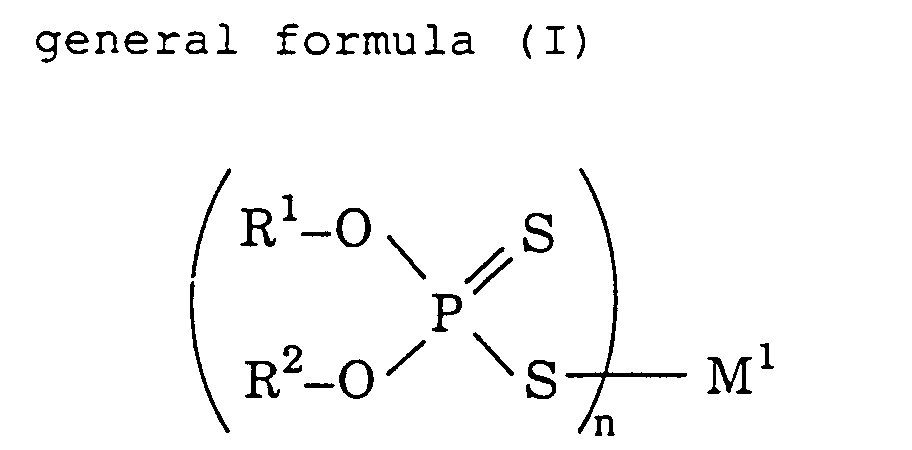
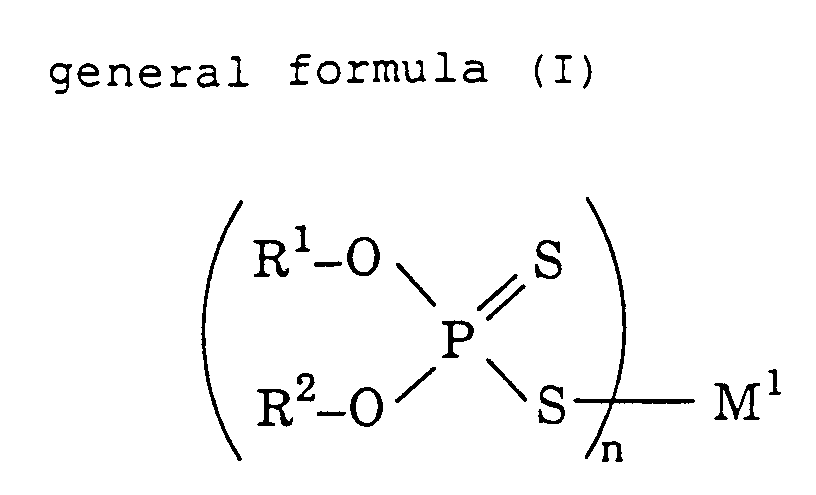
- the dithiophosphoric acid compound type vulcanization accelerator which is used in one embodiment of the present invention is at least one compound selected from the group consisting of metal dithiophosphates represented by general formula (I) described above, O,O'-dialkyldithiophosphoric acid disulfides, and O,O'-dialkyldithiophosphoric acid tetrasulfides.
- R 1 and R 2 each independently represents an alkyl group having 1 to 8 carbon atoms or an aryl group having 6 to 10 carbon atoms.
- the alkyl group may be a linear, branched, or cyclic group.
- M 1 represents a Zn atom, an Sb atom, an Fe atom, or a Cu atom, and n represents a valency of M 1 .
- R 1 and R 2 each preferably represents an alkyl group having 3 or 4 carbon atoms.
- metal dithiophosphate When the alkyl group in a metal dithiophosphate has 5 or more carbon atoms, the effect expected from the increased number of the carbon atom is not always exhibited, and a number of the carbon atom of 5 or more is not always effective in view of the economy, either.
- a Zn atom or an Sb atom is preferable.
- metal dithiophosphates represented by general formula (II) are preferable.
- metal dithiophosphate examples include zinc O,O'-dipropyldithiophosphate, zinc O,O'-diisopropyldithiophosphate, zinc O,O'-di-n-buyldithiophosphate, zinc O,O'-di-sec-butyldithiophosphate, zinc O,O'-di-t-butyldithiophosphate, zinc O,O'-diphenyldithiophosphate, zinc O,O'-dicyclohexyldithiophosphate, antimony O,O'-dipropyldithiophosphate, antimony O,O'-diisopropyldithiophosphate, antimony O,O'-di-n-butyldithiophosphate, antimony O,O'-di-sec-butyldithiophosphate, antimony O,O'-di-t-butyldithiophosphate, antimony
- zinc O,O'-diisopropyldithiophosphate, zinc O,O'-di-n-butyldithiophosphate, antimony O,O'-diisopropyldithiophosphate, and antimony O,O'-di-n-butyl-dithiophosphate are preferable.
- These vulcanization accelerators may be used singly or as a mixture of two or more types.
- O,O'-dialkyldithophosphoric acid disulfide and O,O'-dialkyldithiophosphoric acid tetrasulfide examples include O,O'-dibutyldithiophosphoric acid disulfide, O,O'-diisopropyldithiophosphoric acid disulfide, O,O'-dipropyldithiophosphoric acid disulfide, O,O'-diethyldithiophosphoric acid disulfide, O,O'-dimethyldithiophosphoric acid disulfide, O,O'-bis(2-ethylhexyl)dithiophosphoric acid disulfide, O,O'-bis(4-methylpentyl)dithiophosphoric acid disulfide, O,O'-dioctadecyldithiophosphoric acid disulfide, O,O'-dibutyldithiophosphoric
- O,O'-dibutyldithiophosphoric acid tetrasulfide O,O'-diisopropyldithiophosphoric acid tetrasulfide, and O,O'-bis(2-ethylhexyl)dithiophosphoric acid tetrasulfide are preferable in view of the effect.
- the rubber composition comprise the above dithiophosphoric acid compound type vulcanization accelerator in an amount of 0.2 to 10.0 parts by weight, preferably 0.5 to 5.0 parts by weight, per 100 parts by weight of the rubber component.
- the amount is less than 0.2 parts by weight, the effect of improving controllability and ride comfort of the tire in the intermediate to final periods of tire use is small.
- the vulcanization accelerator is used in an amount exceeding 10.0 parts by weight, no further increase in the effect expected from the increased amount is obtained, and an amount exceeding the range is not effective in view of economy, either.
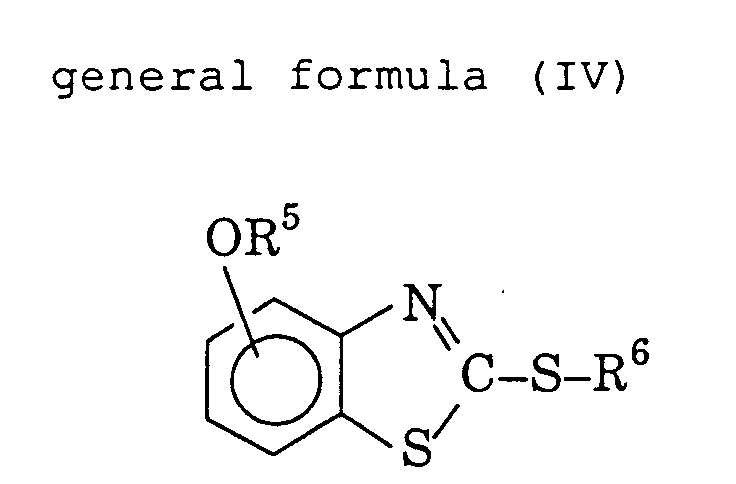
- the benzothiazole compound type vulcanization accelerator which is used in another embodiment of the present invention is at least one compound selected from the group consisting of compounds represented by general formula (III), (IV), (V), or (VI) shown above.
- R 3 and R 4 each independently represents a hydrogen atom, an alkyl group having 1 to 8 carbon atoms, or an aryl group having 6 to 10 carbon atoms; preferably a hydrogen atom, an alkyl group having 1 to 6 carbon atoms, or an aryl group having 6 to 10 carbon atoms; more preferably a hydrogen group, methyl group, ethyl group, or phenyl group; excluding the case in which R 3 and R 4 both represent hydrogen atoms.
- Examples of the above vulcanization accelerator include 2-mercapto-4-methylbenzothiazole, 2-mercapto-4-ethylbenzothiazole, 2-mercapto-5-methylbenzothiazole, 2-mercapto-5-ethylbenzothiazole, 2-mercapto-6-methylbenzothiazole, 2-mercapto-6-ethylbenzothiazole, 2-mercapto-4,5-dimethylbenzothiazole, 2-mercapto-4,5-diethylbenzothiazole, 2-mercapto-4-phenylbenzothiazole, 2-mercapto-5-phenylbenzothiazole, 2-mercapto-6-phenylbenzothiazole, bis(4-methylbenzothiazolyl-2) disulfide, bis(4-ethylbenzothiazolyl-2) disulfide, bis(5-methylbenzothiazolyl-2) disulfide, bis(5-ethylbenzothiazolyl-2) disulfide, bis
- bis(4-methylbenzothiazolyl-2) disulfide bis(5-methylbenzothiazolyl-2) disulfide, mercapto-4-methylbenzothiazole, and mercapto-5-methylbenzothiazole are preferable.
- These vulcanization accelerators may be used singly or as a mixture of two or more types.
- the process for producing these vulcanization accelerators is not particularly limited, and the vulcanization accelerators can easily be produced, for example, in accordance with the process described in Japanese Patent Application Laid-Open No. 49-93361.
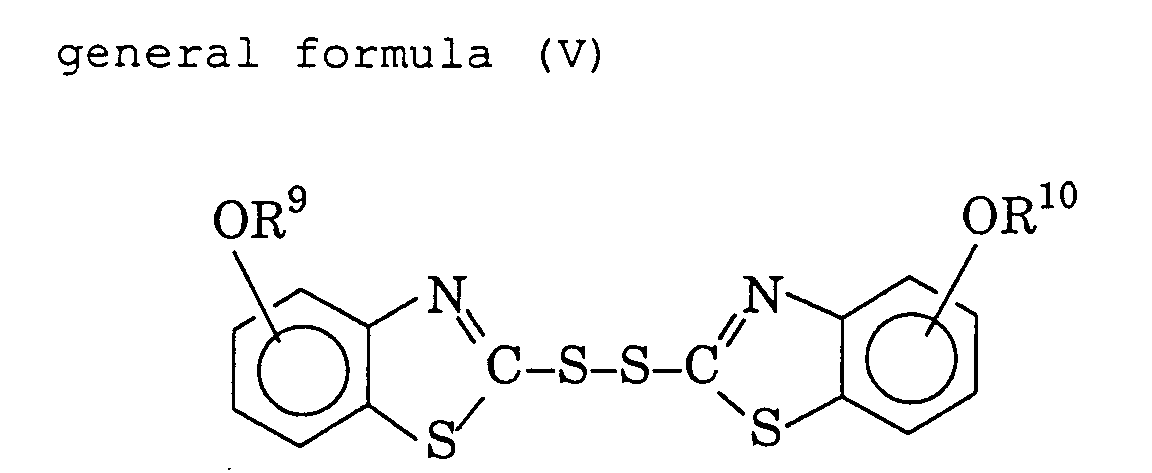
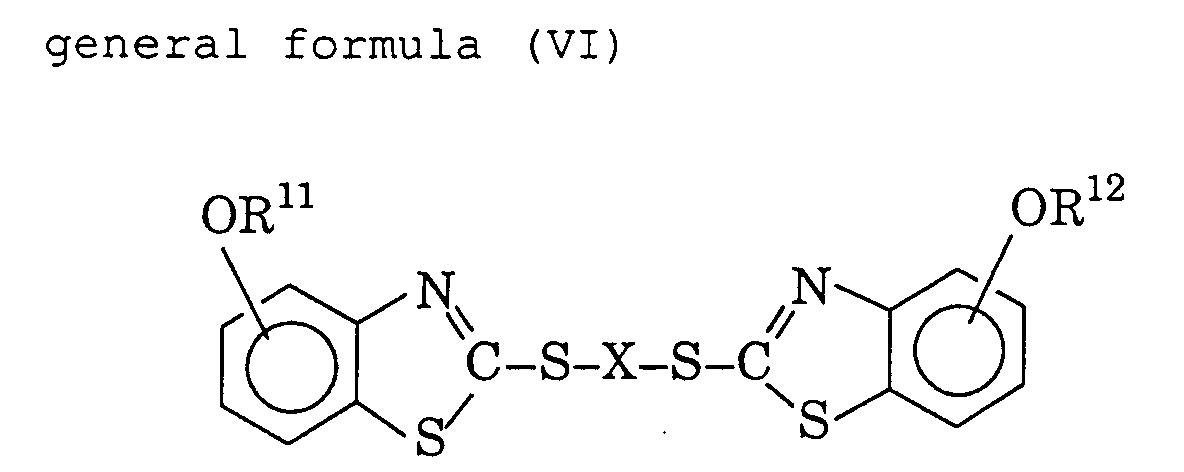
- the benzothiazole compound type vulcanization accelerators represented by general formula (IV), (V), or (VI), which are used in the present invention, are 2-mercaptobenzothiazole compounds having alkoxy groups. These compounds may be used singly or as a mixture of two or more types.
- R 5 represents an alkyl group having 1 to 8 carbon atoms, an alkenyl group, or cycloalkyl group
- R 6 represents a hydrogen atom or an amino group represented by -N(R 7 ) 8
- R 7 and R 8 each independently represents a hydrogen atom, an alkyl group having 2 to 4 carbon atoms, or cyclohexyl group, excluding the case in which R 7 and R 8 both represent hydrogen atoms.
- R 9 and R 10 each independently represents an alkyl group having 1 to 8 carbon atoms, an alkenyl group, or cyclohexyl group
- X represents a Zn atom, a Cu atom, or an amino group represented by >N-R 13
- R 13 represents an alkyl group having 2 to 4 carbon atoms or cyclohexyl group.
- R 11 and R 12 each represents the same group as that represented by R 9 .
- the alkoxy groups i.e., -OR 5 , -OR 9 , -OR 10 , -OR 11 , and -OR 12 , each independently is methoxy group, ethoxy group, or butoxy group, and more preferably ethoxy group.
- Examples of the benzothiazole compound type vulcanization accelerator represented by general formula (IV) include 4-methoxy-2-mercaptobenzothiazole, 5-methoxy-2-mercaptobenzothiazole, 6-methoxy-2-mercaptobenzothiazole, 7-methoxy-2-mercaptobenzothiazole, 4-ethoxy-2-mercaptobenzothiazole, 5-ethoxy-2-mercaptobenzothiazole, 6-ethoxy-2-mercaptobenzothiazole, 7-ethoxy-2-mercaptobenzothiazole, 4-butoxy-2-mercaptobenzothiazole, 5-butoxy-2-mercaptobenzothiazole, 6-butoxy-2-mercaptobenzothiazole, 7-butoxy-2-mercaptobenzothiazole, N-tert-butyl-4-methoxy-2-benzothiazolylsulfenamide, N-tert-butyl-5-methoxy-2-benzothiazolylsulfen
- Examples of the benzothiazole compound type vulcanization accelerator represented by general formula (V) include di-4-methoxy-2-benzothiazyl disulfide, di-5-methoxy-2-benzothiazyl disulfide, di-6-methoxy-2-benzothiazyl disulfide, di-7-methoxy-2-benzothiazyl disulfide, di-4-ethoxy-2-benzothiazyl disulfide, di-5-ethoxy-2-benzothiazyl disulfide, di-6-ethoxy-2-benzothiazyl disulfide, di-7-ethoxy-2-benzothiazyl disulfide, di-4-butoxy-2-benzothiazyl disulfide, di-5-butoxy-2-benzothiazyl disulfide, di-6-butoxy-2-benzothiazyl disulfide, and di-7-butoxy-2-benzothiazyl disulfide,
- Examples of the benzothiazole compound type vulcanization accelerator represented by general formula (VI) include zinc salt of 4-methoxy-2-mercaptobenzothiazole, zinc salt of 5-methoxy-2-mercaptobenzothiazole, zinc salt of 6-methoxy-2-mercaptobenzothiazole, zinc salt of 7-methoxy-2-mercaptobenzothiazole, zinc salt of 4-ethoxy-2-mercaptobenzothiazole, zinc salt of 5-ethoxy-2-mercaptobenzothiazole, zinc salt of 6-ethoxy-2-mercaptobenzothiazole, zinc salt of 7-ethoxy-2-mercaptobenzothiazole, zinc salt of 4-butoxy-2-mercaptobenzothiazole, zinc salt of 5-butoxy-2-mercaptobenzothiazole, zinc salt of 6-butoxy-2-mercaptobenzothiazole, zinc salt of 7-butoxy-2-mercaptobenzothiazole, copper salt of 4-methoxy-2-mercaptobenzothiazo
- benzothiazole compound type vulcanization accelerators compounds having an alkoxy group bonded to the 4-position or the 6-position of the aromatic single ring in general formula (IV), (V), or (VI) are preferable, and compounds having an alkoxy group bonded to the 4-position are more preferable.
- Benzothiazole compounds having an alkoxy group at the 4-position or the 6- position of the aromatic single ring are preferable because they are easily available and easily synthesized.
- Benzothiazolylsulfenamide, benzothiazyl disulfide, and benzothiazolylsulfenimide having an alkoxy group at the 4-position or the 6-position of the aromatic single ring are preferable in view of the scorching property.
- Compounds having an alkoxy group at the 4-position of the aromatic single ring are more preferable because hardening during heat aging of the rubber composition can be suppressed.
- the process for producing these vulcanization accelerator is not particularly limited, and the vulcanization accelerators can easily be produced, for example, in accordance with the process described in Japanese Patent Application Laid-Open No. 49-93361.
- the benzothiazole compound type vulcanization accelerator which is used in the present invention is used in an amount of 0.2 to 10 parts by weight, preferably 0.5 to 5.0 parts by weight, per 100 parts by weight of the rubber component.
- amount is less than 0.2 parts by weight, a sufficient effect is not obtained.
- amount exceeds 10 parts by weight, the effect expected from the increased amount is not obtained, and workability such as the scorching property becomes inferior.
- vulcanization accelerators used in the present invention may suitably be used in combination with other conventional vulcanization accelerators, such as thiazole vulcanization accelerators like 2-mercaptobenzothiazyl disulfide, N-t-butylbenzothiazolylsulfenamide, and N-cyclohexylbenzothiazolylsulfenamide, and thiuram vulcanization accelerators like tetra(2-ethylhexyl)thiuram disulfide and tetramethylthiuram disulfide.
- thiazole vulcanization accelerators like 2-mercaptobenzothiazyl disulfide, N-t-butylbenzothiazolylsulfenamide, and N-cyclohexylbenzothiazolylsulfenamide
- thiuram vulcanization accelerators like tetra(2-ethylhexyl)thiuram disulfide and tetramethylthiura
- the rubber composition used for the pneumatic tire of the present invention may suitably comprise other ingredients which are generally used in rubber compositions for pneumatic tires in combination with the above essential components within the range that the effect of the present invention is not adversely affected.
- ingredients include carbon black, silica, zinc oxide, stearic acid, antioxidants, wax, silane coupling agents, and vulcanizing agents.
- sulfur can be used as the vulcanizing agent.
- the amount of sulfur is 0.1 to 5 parts by weight, preferably 1 to 2 parts by weight, per 100 parts by weight of the rubber component.
- the amount is less than 0.1 part by weight, fracture strengths and abrasion resistance of the vulcanized rubber decrease.
- the amount exceeds 5 parts by weight the rubber elasticity tends to be affected adversely.
- the rubber composition used for the pneumatic tire of the present invention can be obtained by mixing the components using a mixer, such as rolls, an internal mixer, and a Banbury mixer, and used for tire treads and the like after being formed and vulcanized.
- a mixer such as rolls, an internal mixer, and a Banbury mixer
- the results of evaluation of controllability and ride comfort are both shown in two ways.
- the result obtained with the new tire in Comparative Example 1 is used as the control for the results obtained with all new tires, tires in the intermediate period, and tires in the final periods of tire use in all Examples and other Comparative Examples.
- the results obtained with the new tire, the tire in the intermediate period, and the tire in the final period of tire use in Comparative Example 1 are used as the controls for the results obtained with new tires, tires in the intermediate period, and tires in the final period, respectively, in all Examples and other Comparative Examples.
- the results of the evaluation are shown by the difference (signs) from controls in terms of plus (+) or minus (-). The higher the number of pluses (+), the better the property.
- Plus-or-minus zero means that the test driver could not distinguish a difference in properties between the test tire and the control.
- Plus one (+1) means that the property is better than that of the control to the degree that the test driver could detect a significant difference.
- Plus two (+2) means that the property is better than that of the control to the degree that the test driver could detect a clear difference.
- Plus three (+3) means that the property is better than that of the control to the degree that the test driver could detect a very clear difference.
- Plus four (+4) means that the property is better than that of the control to the degree that an ordinary driver can detect a significant difference.
- Plus five (+5) means that the property is better than that of the control to the degree that an ordinary driver can detect a clear difference.
- Plus six (+6) means that the property is better than that of the control to the degree that an ordinary driver can detect a very clear difference. The higher the number of minuses (-), the inferior the property. Minus one (-1), minus two (-2), minus three (-3), minus four (-4), minus five (-5), and minus six (-6) each means that the property is inferior to that of the control to the same degree as that described for the corresponding number of plus.
- the pneumatic tires of the present invention could maintain controllability and ride comfort in the intermediate to final periods of tire use at levels as high as those in the initial period of tire use.
- the pneumatic tires of the present invention could maintain controllability in the intermediate to final periods of tire use at levels as high as those in the initial period of tire use.
Landscapes
- Chemical & Material Sciences (AREA)
- Health & Medical Sciences (AREA)
- Chemical Kinetics & Catalysis (AREA)
- Medicinal Chemistry (AREA)
- Polymers & Plastics (AREA)
- Organic Chemistry (AREA)
- Engineering & Computer Science (AREA)
- Mechanical Engineering (AREA)
- Compositions Of Macromolecular Compounds (AREA)
- Tires In General (AREA)
Abstract
Description







| Comparative Example | 1 | 2 | 3 | 4 | 5 | 6 |
| Formulation (parts by weight) | ||||||
| material rubber | ||||||
| SBR1) | 60 | 60 | 60 | 60 | 60 | 60 |
| SBR2) | 55 | 55 | 55 | 55 | 55 | 55 |
| aromatic oil | 20 | - | 20 | 20 | - | - |
| carbon black3) | 65 | 65 | 65 | 65 | 65 | 65 |
| wax | 2.0 | 2.0 | 2.0 | 2.0 | 2.0 | 2.0 |
| antioxidant TMDQ4) | 0.5 | 0.5 | 0.5 | 0.5 | 0.5 | 0.5 |
| antioxidant IPPD5) | 1.0 | 1.0 | 1.0 | 1.0 | 1.0 | 1.0 |
| stearic acid | 1.0 | 1.0 | 1.0 | 1.0 | 1.0 | 1.0 |
| dicyclopentadiene resin6) | - | - | - | - | 20 | - |
| coumarone-indene resin7) | - | - | - | - | - | 20 |
| zinc oxide | 3.0 | 3.0 | 3.0 | 3.0 | 3.0 | 3.0 |
| accelerator MBTS8) | 0.5 | 0.5 | - | - | 0.5 | - |
| accelerator DPG9) | 0.5 | 0.5 | 0.5 | 0.5 | 0.5 | 0.5 |
| accelerator MMBTS10) | - | - | 1.0 | - | - | - |
| accelerator TBBS11) | 0.5 | 0.5 | 0.5 | 0.5 | 0.5 | 0.5 |
| accelerator DIPDPZn12) | - | - | - | 0.7 | - | 0.7 |
| sulfur | 1.8 | 1.8 | 1.8 | 1.8 | 1.8 | 1.8 |
| total amount of softener | 35 | 15 | 35 | 35 | 35 | 35 |
| total content of styrene13) | 28.1 | 28.1 | 28.1 | 28.1 | 28.1 | 28.1 |
| Properties of tire | ||||||
| controllability on wet roads | ||||||
| initial | control | -3 | ±0 | ±0 | +1 | +1 |
| intermediate period | -3 | -6 | -2 | -2 | -2 | -2 |
| final period | -4 | -6 | -3 | -3 | -2 | -2 |
| initial | control | -3 | ±0 | ±0 | +1 | +1 |
| intermediate period | control | -3 | +1 | +1 | +1 | +1 |
| final period | control | -2 | +1 | +1 | +2 | +2 |
| ride comfort | ||||||
| initial | control | -3 | ±0 | ±0 | -1 | -1 |
| intermediate period | -2 | -5 | -1 | -1 | -3 | -3 |
| final period | -3 | -5 | -2 | -2 | -3 | -3 |
| initial | control | -3 | ±0 | ±0 | -1 | -1 |
| intermediate period | control | -3 | +1 | +1 | -1 | -1 |
| final period | control | -2 | +1 | +1 | ±0 | ±0 |
| Example | 1 | 2 | 3 |
| Formulation (parts by weight) | |||
| material rubber | |||
| SBR | 60 | 60 | 60 |
| SBR | 55 | 55 | 55 |
| aromatic oil | - | - | 10 |
| carbon black | 65 | 65 | 65 |
| wax | 2.0 | 2.0 | 2.0 |
| antioxidant TMDQ | 0.5 | 0.5 | 0.5 |
| antioxidant IPPD | 1.0 | 1.0 | 1.0 |
| stearic acid | 1.0 | 1.0 | 1.0 |
| dicyclopentadiene resin | 20 | - | - |
| aromatic hydrocarbon resin | - | 20 | 10 |
| zinc oxide | 3.0 | 3.0 | 3.0 |
| accelerator MBTS | - | - | - |
| accelerator DPG | 0.5 | 0.5 | 0.5 |
| accelerator MMBTS | - | - | - |
| accelerator TBBS | 0.5 | 0.5 | 0.5 |
| accelerator DIPDPZn | 0.7 | 0.7 | 0.7 |
| sulfur | 1.8 | 1.8 | 1.8 |
| total amount of softener | 35 | 35 | 35 |
| total content of styrene | 28.1 | 28.1 | 28.1 |
| Properties of tire | |||
| controllability on wet roads | |||
| initial | +1 | +1 | ±0 |
| intermediate period | -1 | -1 | -2 |
| final period | -1 | -1 | -2 |
| initial | +1 | +1 | ±0 |
| intermediate period | +2 | +2 | +1 |
| final period | +3 | +3 | +2 |
| ride comfort | |||
| initial | -1 | -1 | ±0 |
| intermediate period | -2 | -2 | -1 |
| final period | -2 | -2 | -2 |
| initial | -1 | -1 | ±0 |
| intermediate period | ±0 | ±0 | +1 |
| final period | +1 | +1 | +1 |
| Example | 4 | 5 | 6 | ||||
| Comparative Example | 7 | 8 | 9 | 10 | |||
| Formulation (parts by weight) | |||||||
| material rubber | |||||||
| SBR | 60 | 60 | 60 | 60 | 60 | 60 | 60 |
| SBR | 55 | 55 | 55 | 55 | 55 | 55 | 55 |
| aromatic oil | 20 | 20 | 20 | 20 | - | - | - |
| carbon black | 65 | 65 | 65 | 65 | 65 | 65 | 65 |
| wax | 2.0 | 2.0 | 2.0 | 2.0 | 2.0 | 2.0 | 2.0 |
| antioxidant TMDQ | 0.5 | 0.5 | 0.5 | 0.5 | 0.5 | 0.5 | 0.5 |
| antioxidant IPPD | 1.0 | 1.0 | 1.0 | 1.0 | 1.0 | 1.0 | 1.0 |
| stearic acid | 1.0 | 1.0 | 1.0 | 1.0 | 1.0 | 1.0 | 1.0 |
| dicyclopentadiene resin | - | - | - | - | 20 | 20 | 20 |
| aluminum hydroxide | - | - | - | 25 | - | 25 | 25 |
| zinc oxide | 3.0 | 3.0 | 3.0 | 3.0 | 3.0 | 3.0 | 3.0 |
| accelerator MBTS | 0.5 | - | - | 0.5 | - | - | - |
| accelerator DPG | 0.5 | 0.5 | 0.5 | 0.5 | 0.5 | 0.5 | 0.5 |
| accelerator MMBTS | - | 1.0 | - | - | - | - | 1.0 |
| accelerator TBBS | 0.5 | 0.5 | 0.5 | 0.5 | 0.5 | 0.5 | 0.5 |
| accelerator DIPDPZn | - | - | 0.7 | - | 0.7 | 0.7 | - |
| sulfur | 1.8 | 1.8 | 1.8 | 1.8 | 1.8 | 1.8 | 1.8 |
| total amount of softener | 35 | 35 | 35 | 35 | 35 | 35 | 35 |
| total content of styrene | 28.1 | 28.1 | 28.1 | 28.1 | 28.1 | 28.1 | 28.1 |
| Properties of tire | |||||||
| controllability on wet roads | |||||||
| initial | control | ±0 | ±0 | +1 | +1 | +2 | +2 |
| intermediate period | -3 | -2 | -2 | -2 | -1 | +1 | +1 |
| final period | -4 | -3 | -3 | -3 | -1 | +1 | +1 |
| initial | control | ±0 | ±0 | +1 | +1 | +2 | +2 |
| intermediate period | control | +1 | +1 | +1 | +2 | +4 | +4 |
| final period | control | +1 | +1 | +1 | +3 | +5 | +5 |
Claims (9)
- A pneumatic tire comprising a tread portion formed by using a rubber composition which comprises:wherein R1 and R2 each independently represents an alkyl group having 1 to 8 carbon atoms or an aryl group having 6 to 10 carbon atoms, the alkyl group being a linear, branched, or cyclic group; M1 represents a Zn atom, an Sb atom, an Fe atom, or a Cu atom; and n represents a valency of the metal represented by M1.a rubber component comprising 50 parts by weight or more of SBR in 100 parts by weight of the rubber component;per 100 parts by weight of the rubber component, 20 parts by weight or more of a softener which comprises 5 to 55 parts by weight of at least one resin softener having a softening point of 35 to 150°C and selected from the group consisting of coumarone resins, phenol-terpene resins, and petroleum hydrocarbon resins; andper 100 parts by weight of the rubber component, 0.2 to 10.0 parts by weight of at least one dithiophosphoric acid compound type vulcanization accelerator selected from the group consisting of O,O'-dialkyldithiophosphoric acid disulfides, O,O'-dialkyldithiophosphoric acid tetrasulfides, and metal dithiophosphates represented by following general formula (I):
- A pneumatic tire comprising a tread portion formed by using a rubber composition which comprises:wherein R1 and R2 each independently represents an alkyl group having 1 to 8 carbon atoms or an aryl group having 6 to 10 carbon atoms, the alkyl group being a linear, branched, or cyclic group; M1 represents a Zn atom, an Sb atom, an Fe atom, or a Cu atom; and n represents a valency of the metal represented by M1.a rubber component comprising 50 parts by weight or more of SBR in 100 parts by weight of the rubber component;5 to 40 parts by weight of aluminum hydroxide per 100 parts by weight of the rubber component;per 100 parts by weight of the rubber component, 20 parts by weight or more of a softener which comprises 5 to 55 parts by weight of at least one resin softener having a softening point of 35 to 150°C and selected from the group consisting of coumarone resins, phenol-terpene resins, and petroleum hydrocarbon resins; andper 100 parts by weight of the rubber component, 0.2 to 10.0 parts by weight of at least one dithiophosphoric acid compound type vulcanization accelerator selected from the group consisting of O,O'-dialkyldithiophosphoric acid disulfides, O,O'-dialkyldithiophosphoric acid tetrasulfides, and metal dithiophosphates represented by following general formula (I):
- A pneumatic tire according to any of Claims 1 and 2, wherein the metal dithiophosphate represented by general formula (I) is a dithiophosphoric acid compound type vulcanization accelerator represented by following general formula (II):or
 wherein M2 represents a Zn atom or an Sb atom; and n represents a valency of the metal represented by M2.
- A pneumatic tire according to any of Claims 1 to 3, wherein the resin softener has a softening point of 70 to 130°C.
- A pneumatic tire according to any of Claims 1 to 4, wherein the coumarone resin used as the resin softener is a coumarone-indene resin having a softening point of 70 to 130°C.
- A pneumatic tire according to any of Claims 1 to 5, wherein the phenol-terpene resin used as the resin softener is a phenol-acetylene resin or a phenol-formaldehyde resin.
- A pneumatic tire according to any of Claims 1 to 6, wherein the petroleum hydrocarbon resin used as the resin softener is an aliphatic cyclic hydrocarbon resin or an aromatic hydrocarbon resin.
- A pneumatic tire according to any of Claims 1 to 7, wherein the rubber component comprises SBR in an amount such that the styrene units of the SBR account for 20% by weight or more of 100% by weight of the rubber component.
- A pneumatic tire according to any of Claims 1 to 8, wherein an SBR containing 30% by weight or more of styrene is comprised in the rubber component.
Applications Claiming Priority (5)
| Application Number | Priority Date | Filing Date | Title |
|---|---|---|---|
| JP18688897A JP3789606B2 (en) | 1997-07-11 | 1997-07-11 | Pneumatic tire |
| JP18688897 | 1997-07-11 | ||
| JP7558498 | 1998-03-24 | ||
| JP07558498A JP4567819B2 (en) | 1998-03-24 | 1998-03-24 | Pneumatic tire |
| EP98304958A EP0890605B1 (en) | 1997-07-11 | 1998-06-24 | Pneumatic tire |
Related Parent Applications (1)
| Application Number | Title | Priority Date | Filing Date |
|---|---|---|---|
| EP98304958A Division EP0890605B1 (en) | 1997-07-11 | 1998-06-24 | Pneumatic tire |
Publications (3)
| Publication Number | Publication Date |
|---|---|
| EP1277795A2 true EP1277795A2 (en) | 2003-01-22 |
| EP1277795A3 EP1277795A3 (en) | 2004-06-23 |
| EP1277795B1 EP1277795B1 (en) | 2007-04-04 |
Family
ID=26416728
Family Applications (2)
| Application Number | Title | Priority Date | Filing Date |
|---|---|---|---|
| EP98304958A Expired - Lifetime EP0890605B1 (en) | 1997-07-11 | 1998-06-24 | Pneumatic tire |
| EP02022629A Expired - Lifetime EP1277795B1 (en) | 1997-07-11 | 1998-06-24 | Pneumatic tire |
Family Applications Before (1)
| Application Number | Title | Priority Date | Filing Date |
|---|---|---|---|
| EP98304958A Expired - Lifetime EP0890605B1 (en) | 1997-07-11 | 1998-06-24 | Pneumatic tire |
Country Status (4)
| Country | Link |
|---|---|
| US (1) | US6186204B1 (en) |
| EP (2) | EP0890605B1 (en) |
| DE (2) | DE69813682T2 (en) |
| ES (2) | ES2192743T3 (en) |
Cited By (5)
| Publication number | Priority date | Publication date | Assignee | Title |
|---|---|---|---|---|
| KR100445830B1 (en) * | 2001-11-23 | 2004-08-30 | 한국타이어 주식회사 | Rubber composition for tire tread |
| EP1526002A1 (en) * | 2003-10-23 | 2005-04-27 | Continental Aktiengesellschaft | Pneumatic vehicle tyre |
| EP1767569A1 (en) * | 2005-09-21 | 2007-03-28 | Continental Aktiengesellschaft | Rubber mixture and tires |
| WO2007033889A1 (en) * | 2005-09-21 | 2007-03-29 | Continental Aktiengesellschaft | Rubber mixture and tires |
| US7960463B2 (en) | 2007-12-31 | 2011-06-14 | Bridgestone Corporation | Tire treads including aluminum hydroxycarbonate |
Families Citing this family (26)
| Publication number | Priority date | Publication date | Assignee | Title |
|---|---|---|---|---|
| US6489389B1 (en) * | 1994-08-19 | 2002-12-03 | Bridgestone Corporation | Rubber composition for tire treads |
| DE19906986C1 (en) * | 1999-02-19 | 2000-07-13 | Rhein Chemie Rheinau Gmbh | Dithiophosphoric acid polysulfide mixtures, useful as sulfur source in the vulcanization of rubber, are prepared by heating the corresponding disulfide with sulfur in the presence of a solvent |
| EP1112961B1 (en) * | 1999-12-27 | 2004-09-15 | Sumitomo Chemical Company, Limited | Aluminium hydroxide and tyre tread rubber composition and pneumatic tyre employing the aluminium hydroxide |
| JP2002332381A (en) * | 2001-05-10 | 2002-11-22 | Sumitomo Chem Co Ltd | Rubber composition and tire using the same |
| US20060167160A1 (en) * | 2002-06-19 | 2006-07-27 | Bridgestone Corporation | Rubber composition for tire and tire made therefrom |
| US20040182486A1 (en) * | 2003-01-30 | 2004-09-23 | Carlo Bernard | Agricultural or industrial tire with reinforced rubber composition |
| DE102004026317A1 (en) * | 2004-05-26 | 2005-12-15 | Rhein-Chemie Rheinau Gmbh | Process for the preparation of rubber compounds |
| JP5536419B2 (en) * | 2009-11-06 | 2014-07-02 | 住友ゴム工業株式会社 | Rubber composition for cap tread and studless tire |
| WO2012054458A1 (en) | 2010-10-18 | 2012-04-26 | Bridgestone Corporation | Tread rubber compounds having improved abrasion resistance using functionalized liquid polybutadiene |
| CN103237842B (en) * | 2010-12-03 | 2014-08-13 | 横滨橡胶株式会社 | Rubber composition for tire tread |
| KR101662926B1 (en) * | 2012-05-25 | 2016-10-05 | 엑손모빌 케미칼 패턴츠 인코포레이티드 | Dicyclopentadiene based resin compositions and articles manufactured therefrom |
| DE102012107608A1 (en) | 2012-08-20 | 2014-02-20 | Continental Reifen Deutschland Gmbh | rubber compound |
| JP5767753B2 (en) * | 2013-04-30 | 2015-08-19 | 住友ゴム工業株式会社 | Rubber composition for tire and pneumatic tire |
| JP2016056235A (en) * | 2014-09-05 | 2016-04-21 | 住友ゴム工業株式会社 | Pneumatic tire |
| JP2016056234A (en) * | 2014-09-05 | 2016-04-21 | 住友ゴム工業株式会社 | Pneumatic tire |
| US20170327670A1 (en) * | 2014-12-24 | 2017-11-16 | Sumitomo Rubber Industries, Ltd. | Pneumatic tire |
| WO2016104144A1 (en) * | 2014-12-24 | 2016-06-30 | 住友ゴム工業株式会社 | Pneumatic tire |
| US20170232795A1 (en) * | 2016-02-15 | 2017-08-17 | The Goodyear Tire & Rubber Company | Tire with tread for low temperature performance and wet traction |
| KR102208967B1 (en) | 2016-09-30 | 2021-01-28 | 코오롱인더스트리 주식회사 | Composition for tire tread comprising resin alternative to process oil |
| JP6888948B2 (en) * | 2016-12-08 | 2021-06-18 | Toyo Tire株式会社 | Rubber composition for tire tread and pneumatic tire |
| DE102017223545A1 (en) * | 2017-12-21 | 2019-06-27 | Contitech Luftfedersysteme Gmbh | Articles, in particular an air spring bellows, a metal-rubber element or a vibration damper |
| US10947368B2 (en) | 2019-03-04 | 2021-03-16 | The Goodyear Tire & Rubber Company | Pneumatic tire |
| US11440350B2 (en) | 2020-05-13 | 2022-09-13 | The Goodyear Tire & Rubber Company | Pneumatic tire |
| JP7095772B1 (en) * | 2021-04-20 | 2022-07-05 | 横浜ゴム株式会社 | Rubber composition for tires |
| US20230101160A1 (en) * | 2021-09-30 | 2023-03-30 | The Goodyear Tire & Rubber Company | Rubber composition and tire |
| JP2023051879A (en) * | 2021-09-30 | 2023-04-11 | ザ・グッドイヤー・タイヤ・アンド・ラバー・カンパニー | Rubber composition and tire |
Family Cites Families (11)
| Publication number | Priority date | Publication date | Assignee | Title |
|---|---|---|---|---|
| NL261521A (en) * | 1960-02-23 | |||
| US3554857A (en) * | 1968-03-29 | 1971-01-12 | Uniroyal Inc | Method of minimizing degradation of polyester/rubber vulcanizates,and product thereof |
| US3658828A (en) * | 1969-11-19 | 1972-04-25 | Monsanto Co | Unsymmetrical dialkyl thiazole sulfenamides |
| US3927144A (en) * | 1970-02-20 | 1975-12-16 | Bridgestone Tire Co Ltd | Elastomer composition |
| US3852251A (en) * | 1972-04-18 | 1974-12-03 | Goodyear Tire & Rubber | Two-component accelerator system for vulcanizable rubbers |
| FR2205900A5 (en) | 1972-11-08 | 1974-05-31 | Rhone Poulenc Sa | |
| JPS56139542A (en) | 1980-02-14 | 1981-10-31 | Kawaguchi Kagaku Kogyo Kk | Novel vulcanization accelerator for rubber |
| JPS5887138A (en) * | 1981-11-20 | 1983-05-24 | Bridgestone Corp | Rubber composition for tire |
| EP0697432B1 (en) * | 1994-08-19 | 2003-10-15 | Bridgestone Corporation | Rubber composition for tire treads |
| FR2749313A1 (en) | 1996-05-28 | 1997-12-05 | Michelin & Cie | DIENE RUBBER COMPOSITION BASED ON ALUMINA AS A REINFORCING FILLER AND ITS USE FOR THE MANUFACTURE OF TIRE COVERS |
| DE69701838T2 (en) * | 1996-07-11 | 2000-10-12 | Bridgestone Corp., Tokio/Tokyo | tire |
-
1998
- 1998-06-24 EP EP98304958A patent/EP0890605B1/en not_active Expired - Lifetime
- 1998-06-24 DE DE69813682T patent/DE69813682T2/en not_active Expired - Lifetime
- 1998-06-24 DE DE69837498T patent/DE69837498T2/en not_active Expired - Fee Related
- 1998-06-24 ES ES98304958T patent/ES2192743T3/en not_active Expired - Lifetime
- 1998-06-24 EP EP02022629A patent/EP1277795B1/en not_active Expired - Lifetime
- 1998-06-24 ES ES02022629T patent/ES2283494T3/en not_active Expired - Lifetime
- 1998-06-30 US US09/107,431 patent/US6186204B1/en not_active Expired - Lifetime
Cited By (5)
| Publication number | Priority date | Publication date | Assignee | Title |
|---|---|---|---|---|
| KR100445830B1 (en) * | 2001-11-23 | 2004-08-30 | 한국타이어 주식회사 | Rubber composition for tire tread |
| EP1526002A1 (en) * | 2003-10-23 | 2005-04-27 | Continental Aktiengesellschaft | Pneumatic vehicle tyre |
| EP1767569A1 (en) * | 2005-09-21 | 2007-03-28 | Continental Aktiengesellschaft | Rubber mixture and tires |
| WO2007033889A1 (en) * | 2005-09-21 | 2007-03-29 | Continental Aktiengesellschaft | Rubber mixture and tires |
| US7960463B2 (en) | 2007-12-31 | 2011-06-14 | Bridgestone Corporation | Tire treads including aluminum hydroxycarbonate |
Also Published As
| Publication number | Publication date |
|---|---|
| EP0890605A2 (en) | 1999-01-13 |
| EP0890605B1 (en) | 2003-04-23 |
| EP1277795B1 (en) | 2007-04-04 |
| ES2283494T3 (en) | 2007-11-01 |
| ES2192743T3 (en) | 2003-10-16 |
| US6186204B1 (en) | 2001-02-13 |
| EP0890605A3 (en) | 1999-06-09 |
| DE69813682T2 (en) | 2003-10-16 |
| DE69837498D1 (en) | 2007-05-16 |
| EP1277795A3 (en) | 2004-06-23 |
| DE69813682D1 (en) | 2003-05-28 |
| DE69837498T2 (en) | 2007-12-06 |
Similar Documents
| Publication | Publication Date | Title |
|---|---|---|
| EP0890605B1 (en) | Pneumatic tire | |
| EP0945482B1 (en) | Rubber composition for tire tread and pneumatic tire using same | |
| EP0731132B1 (en) | Silica reinforced rubber composition and tire with tread thereof | |
| EP0732362B1 (en) | Silica reinforced rubber composition and use in tyres | |
| EP0632093B1 (en) | Silica reinforced rubber composition | |
| EP0632094B1 (en) | Tire with silica reinforced tread | |
| US5534574A (en) | Silica reinforced rubber preparation and tire with tread thereof | |
| US6359045B1 (en) | Vulcanizable rubber compounds containing styrene-butadiene and butadiene rubbers | |
| CA2157845C (en) | Silica reinforced rubber preparation and tire with tread thereof | |
| EP1035164A1 (en) | Rubber composition with liquid high tg polymer and tire with tread thereof | |
| EP2512824A1 (en) | High silica content for heavy vehicle tires | |
| CA2409952A1 (en) | Rubber compositions and method for increasing the mooney scorch value | |
| JP2000119400A (en) | Production of reinforced rubber and its use in tire | |
| US6334476B1 (en) | Pneumatic tire | |
| JP3789606B2 (en) | Pneumatic tire | |
| JP4295385B2 (en) | Pneumatic tire | |
| JP4567819B2 (en) | Pneumatic tire | |
| JP4227240B2 (en) | Pneumatic tire | |
| EP0948029A2 (en) | High pressure discharge lamp | |
| US6197890B1 (en) | Rubber composition containing SBR rubber, softener and a bis benzothiazolyl disulfide vulcanization accelerator | |
| US7530378B2 (en) | Speckled tire treads | |
| JPH1129658A (en) | Pneumatic tire | |
| MXPA98007608A (en) | Compositions of elastomer and rims with their rodamie bands |
Legal Events
| Date | Code | Title | Description |
|---|---|---|---|
| PUAI | Public reference made under article 153(3) epc to a published international application that has entered the european phase |
Free format text: ORIGINAL CODE: 0009012 |
|
| 17P | Request for examination filed |
Effective date: 20021016 |
|
| AC | Divisional application: reference to earlier application |
Ref document number: 890605 Country of ref document: EP |
|
| AK | Designated contracting states |
Kind code of ref document: A2 Designated state(s): DE ES FR GB IT |
|
| PUAL | Search report despatched |
Free format text: ORIGINAL CODE: 0009013 |
|
| AK | Designated contracting states |
Kind code of ref document: A3 Designated state(s): DE ES FR GB IT |
|
| RIC1 | Information provided on ipc code assigned before grant |
Ipc: 7C 08K 5/47 B Ipc: 7C 08K 5/5398 A Ipc: 7B 60C 1/00 B |
|
| AKX | Designation fees paid |
Designated state(s): DE ES FR GB IT |
|
| GRAP | Despatch of communication of intention to grant a patent |
Free format text: ORIGINAL CODE: EPIDOSNIGR1 |
|
| GRAS | Grant fee paid |
Free format text: ORIGINAL CODE: EPIDOSNIGR3 |
|
| GRAA | (expected) grant |
Free format text: ORIGINAL CODE: 0009210 |
|
| AC | Divisional application: reference to earlier application |
Ref document number: 0890605 Country of ref document: EP Kind code of ref document: P |
|
| AK | Designated contracting states |
Kind code of ref document: B1 Designated state(s): DE ES FR GB IT |
|
| REG | Reference to a national code |
Ref country code: GB Ref legal event code: FG4D |
|
| REF | Corresponds to: |
Ref document number: 69837498 Country of ref document: DE Date of ref document: 20070516 Kind code of ref document: P |
|
| RIN2 | Information on inventor provided after grant (corrected) |
Inventor name: KIMURA, SHIGEO Inventor name: SASAKA, NAOHIRO Inventor name: YAGAWA, KAZUO |
|
| ET | Fr: translation filed | ||
| REG | Reference to a national code |
Ref country code: ES Ref legal event code: FG2A Ref document number: 2283494 Country of ref document: ES Kind code of ref document: T3 |
|
| PLBE | No opposition filed within time limit |
Free format text: ORIGINAL CODE: 0009261 |
|
| STAA | Information on the status of an ep patent application or granted ep patent |
Free format text: STATUS: NO OPPOSITION FILED WITHIN TIME LIMIT |
|
| 26N | No opposition filed |
Effective date: 20080107 |
|
| PGFP | Annual fee paid to national office [announced via postgrant information from national office to epo] |
Ref country code: IT Payment date: 20080626 Year of fee payment: 11 |
|
| PGFP | Annual fee paid to national office [announced via postgrant information from national office to epo] |
Ref country code: ES Payment date: 20080708 Year of fee payment: 11 Ref country code: DE Payment date: 20080703 Year of fee payment: 11 |
|
| PGFP | Annual fee paid to national office [announced via postgrant information from national office to epo] |
Ref country code: FR Payment date: 20080617 Year of fee payment: 11 |
|
| PGFP | Annual fee paid to national office [announced via postgrant information from national office to epo] |
Ref country code: GB Payment date: 20080625 Year of fee payment: 11 |
|
| GBPC | Gb: european patent ceased through non-payment of renewal fee |
Effective date: 20090624 |
|
| REG | Reference to a national code |
Ref country code: FR Ref legal event code: ST Effective date: 20100226 |
|
| PG25 | Lapsed in a contracting state [announced via postgrant information from national office to epo] |
Ref country code: FR Free format text: LAPSE BECAUSE OF NON-PAYMENT OF DUE FEES Effective date: 20090630 |
|
| PG25 | Lapsed in a contracting state [announced via postgrant information from national office to epo] |
Ref country code: GB Free format text: LAPSE BECAUSE OF NON-PAYMENT OF DUE FEES Effective date: 20090624 |
|
| PG25 | Lapsed in a contracting state [announced via postgrant information from national office to epo] |
Ref country code: DE Free format text: LAPSE BECAUSE OF NON-PAYMENT OF DUE FEES Effective date: 20100101 |
|
| REG | Reference to a national code |
Ref country code: ES Ref legal event code: FD2A Effective date: 20090625 |
|
| PG25 | Lapsed in a contracting state [announced via postgrant information from national office to epo] |
Ref country code: ES Free format text: LAPSE BECAUSE OF NON-PAYMENT OF DUE FEES Effective date: 20090625 |
|
| PG25 | Lapsed in a contracting state [announced via postgrant information from national office to epo] |
Ref country code: IT Free format text: LAPSE BECAUSE OF NON-PAYMENT OF DUE FEES Effective date: 20090624 |