EP1277754A1 - Imidazopyridine derivatives - Google Patents
Imidazopyridine derivatives Download PDFInfo
- Publication number
- EP1277754A1 EP1277754A1 EP01925980A EP01925980A EP1277754A1 EP 1277754 A1 EP1277754 A1 EP 1277754A1 EP 01925980 A EP01925980 A EP 01925980A EP 01925980 A EP01925980 A EP 01925980A EP 1277754 A1 EP1277754 A1 EP 1277754A1
- Authority
- EP
- European Patent Office
- Prior art keywords
- lower alkyl
- group
- aryl
- substituted
- nitrogen
- Prior art date
- Legal status (The legal status is an assumption and is not a legal conclusion. Google has not performed a legal analysis and makes no representation as to the accuracy of the status listed.)
- Granted
Links
Classifications
-
- C—CHEMISTRY; METALLURGY
- C07—ORGANIC CHEMISTRY
- C07D—HETEROCYCLIC COMPOUNDS
- C07D471/00—Heterocyclic compounds containing nitrogen atoms as the only ring hetero atoms in the condensed system, at least one ring being a six-membered ring with one nitrogen atom, not provided for by groups C07D451/00 - C07D463/00
- C07D471/02—Heterocyclic compounds containing nitrogen atoms as the only ring hetero atoms in the condensed system, at least one ring being a six-membered ring with one nitrogen atom, not provided for by groups C07D451/00 - C07D463/00 in which the condensed system contains two hetero rings
- C07D471/04—Ortho-condensed systems
-
- A—HUMAN NECESSITIES
- A61—MEDICAL OR VETERINARY SCIENCE; HYGIENE
- A61P—SPECIFIC THERAPEUTIC ACTIVITY OF CHEMICAL COMPOUNDS OR MEDICINAL PREPARATIONS
- A61P1/00—Drugs for disorders of the alimentary tract or the digestive system
- A61P1/18—Drugs for disorders of the alimentary tract or the digestive system for pancreatic disorders, e.g. pancreatic enzymes
-
- A—HUMAN NECESSITIES
- A61—MEDICAL OR VETERINARY SCIENCE; HYGIENE
- A61P—SPECIFIC THERAPEUTIC ACTIVITY OF CHEMICAL COMPOUNDS OR MEDICINAL PREPARATIONS
- A61P13/00—Drugs for disorders of the urinary system
- A61P13/08—Drugs for disorders of the urinary system of the prostate
-
- A—HUMAN NECESSITIES
- A61—MEDICAL OR VETERINARY SCIENCE; HYGIENE
- A61P—SPECIFIC THERAPEUTIC ACTIVITY OF CHEMICAL COMPOUNDS OR MEDICINAL PREPARATIONS
- A61P13/00—Drugs for disorders of the urinary system
- A61P13/12—Drugs for disorders of the urinary system of the kidneys
-
- A—HUMAN NECESSITIES
- A61—MEDICAL OR VETERINARY SCIENCE; HYGIENE
- A61P—SPECIFIC THERAPEUTIC ACTIVITY OF CHEMICAL COMPOUNDS OR MEDICINAL PREPARATIONS
- A61P17/00—Drugs for dermatological disorders
- A61P17/06—Antipsoriatics
-
- A—HUMAN NECESSITIES
- A61—MEDICAL OR VETERINARY SCIENCE; HYGIENE
- A61P—SPECIFIC THERAPEUTIC ACTIVITY OF CHEMICAL COMPOUNDS OR MEDICINAL PREPARATIONS
- A61P19/00—Drugs for skeletal disorders
-
- A—HUMAN NECESSITIES
- A61—MEDICAL OR VETERINARY SCIENCE; HYGIENE
- A61P—SPECIFIC THERAPEUTIC ACTIVITY OF CHEMICAL COMPOUNDS OR MEDICINAL PREPARATIONS
- A61P27/00—Drugs for disorders of the senses
- A61P27/02—Ophthalmic agents
-
- A—HUMAN NECESSITIES
- A61—MEDICAL OR VETERINARY SCIENCE; HYGIENE
- A61P—SPECIFIC THERAPEUTIC ACTIVITY OF CHEMICAL COMPOUNDS OR MEDICINAL PREPARATIONS
- A61P29/00—Non-central analgesic, antipyretic or antiinflammatory agents, e.g. antirheumatic agents; Non-steroidal antiinflammatory drugs [NSAID]
-
- A—HUMAN NECESSITIES
- A61—MEDICAL OR VETERINARY SCIENCE; HYGIENE
- A61P—SPECIFIC THERAPEUTIC ACTIVITY OF CHEMICAL COMPOUNDS OR MEDICINAL PREPARATIONS
- A61P3/00—Drugs for disorders of the metabolism
- A61P3/08—Drugs for disorders of the metabolism for glucose homeostasis
- A61P3/10—Drugs for disorders of the metabolism for glucose homeostasis for hyperglycaemia, e.g. antidiabetics
-
- A—HUMAN NECESSITIES
- A61—MEDICAL OR VETERINARY SCIENCE; HYGIENE
- A61P—SPECIFIC THERAPEUTIC ACTIVITY OF CHEMICAL COMPOUNDS OR MEDICINAL PREPARATIONS
- A61P35/00—Antineoplastic agents
-
- A—HUMAN NECESSITIES
- A61—MEDICAL OR VETERINARY SCIENCE; HYGIENE
- A61P—SPECIFIC THERAPEUTIC ACTIVITY OF CHEMICAL COMPOUNDS OR MEDICINAL PREPARATIONS
- A61P35/00—Antineoplastic agents
- A61P35/02—Antineoplastic agents specific for leukemia
-
- A—HUMAN NECESSITIES
- A61—MEDICAL OR VETERINARY SCIENCE; HYGIENE
- A61P—SPECIFIC THERAPEUTIC ACTIVITY OF CHEMICAL COMPOUNDS OR MEDICINAL PREPARATIONS
- A61P37/00—Drugs for immunological or allergic disorders
- A61P37/02—Immunomodulators
-
- A—HUMAN NECESSITIES
- A61—MEDICAL OR VETERINARY SCIENCE; HYGIENE
- A61P—SPECIFIC THERAPEUTIC ACTIVITY OF CHEMICAL COMPOUNDS OR MEDICINAL PREPARATIONS
- A61P43/00—Drugs for specific purposes, not provided for in groups A61P1/00-A61P41/00
-
- A—HUMAN NECESSITIES
- A61—MEDICAL OR VETERINARY SCIENCE; HYGIENE
- A61P—SPECIFIC THERAPEUTIC ACTIVITY OF CHEMICAL COMPOUNDS OR MEDICINAL PREPARATIONS
- A61P9/00—Drugs for disorders of the cardiovascular system
- A61P9/08—Vasodilators for multiple indications
-
- A—HUMAN NECESSITIES
- A61—MEDICAL OR VETERINARY SCIENCE; HYGIENE
- A61P—SPECIFIC THERAPEUTIC ACTIVITY OF CHEMICAL COMPOUNDS OR MEDICINAL PREPARATIONS
- A61P9/00—Drugs for disorders of the cardiovascular system
- A61P9/10—Drugs for disorders of the cardiovascular system for treating ischaemic or atherosclerotic diseases, e.g. antianginal drugs, coronary vasodilators, drugs for myocardial infarction, retinopathy, cerebrovascula insufficiency, renal arteriosclerosis
-
- C—CHEMISTRY; METALLURGY
- C07—ORGANIC CHEMISTRY
- C07D—HETEROCYCLIC COMPOUNDS
- C07D487/00—Heterocyclic compounds containing nitrogen atoms as the only ring hetero atoms in the condensed system, not provided for by groups C07D451/00 - C07D477/00
- C07D487/02—Heterocyclic compounds containing nitrogen atoms as the only ring hetero atoms in the condensed system, not provided for by groups C07D451/00 - C07D477/00 in which the condensed system contains two hetero rings
- C07D487/04—Ortho-condensed systems
Definitions
- the present invention relates to imidazopyridine derivatives which are useful as medicaments, more particularly as phosphatidylinositol-3-kinase (PI3K) inhibitors and antitumor agents.
- PI3K phosphatidylinositol-3-kinase
- Phosphatidylinositol (hereinafter abbreviated as "PI") is one of a number of phospholipids found in cell membranes. In recent years it has become clear that PI plays an important role in intracellular signal transduction. It is well recognized in the art that especially PI (4,5) bisphosphate (PI(4,5)P2) is degraded into diacylglycerol and inositol (1,4,5) triphosphate by phospholipase C to induce activation of protein kinase C and intracellular calcium mobilization, respectively [M. J. Berridge et al., Nature, 312, 315 (1984); Y Nishizuka, Science, 225, 1365 (1984)].
- PI3K PI3 kinase
- PI3K was originally considered to be a single enzyme at the time when PI3K was discovered. Recently it was clarified that a plurality of subtypes are present in the PI3K. Three major classes of PI3Ks have now been identified on the basis of their in vitro substrate specificity [B. Vanhaesebroeck, Trend in Biol. Sci., 22, 267(1997)].
- Class I PI3Ks are further divided into two groups, class Ia and class Ib, in terms of their activation mechanism.
- Class Ia PI3Ks which include PI3K p110 ⁇ , p110 ⁇ and p110 ⁇ subtypes, are activated in the tyrosine kinase system.
- Class Ib PI3K includes a p110 ⁇ subtype activated by a G protein-coupled receptor.
- PI and PI(4)P are known as substrates for class II PI3Ks but PI(4,5)P2 is not a substrate for the enzymes of this class.
- Class II PI3Ks include PI3K C2 ⁇ , C2 ⁇ and C2 ⁇ subtypes, which are characterized by containing C2 domains at the C terminus, implying that their activity will be regulated by calcium ions.
- the substrate for class III PI3Ks is PI only. A mechanism for activation of the class III PI3Ks is not clarified yet. Since each subtype has its own mechanism for regulating activity, it is considered that the respective subtypes will be activated depending on their respective stimuli specific to each of them.
- the class Ia subtype has been most extensively investigated to date.
- the three subtypes of class Ia are hetero dimers of a catalytic 110 kDa subunit and regulatory subunits of 85 kDa and 55 kDa.
- the regulatory subunits contain SH2 domains and bind to tyrosine residues phosphorylated by growth factor receptors with a tyrosine kinase activity or oncogene products thereby inducing the PI3K activity of the p110 catalytic subunit.
- the class Ia subtypes are considered to be associated with cell proliferation and carcinogenesis.
- class Ia PI3K subtypes bind to activated ras oncogene to express their enzyme activity. It has been confirmed that the activated ras oncogene is found to be present in many cancers, suggesting a role of class Ia PI3Ks in carcinogenesis.
- the PI3K inhibitors are expected to be a new type of medicaments useful for cell proliferation disorders, in particular antitumor agents.
- wortmannin H. Yano et al., J. Biol. Chem., 263, 16178 (1993)
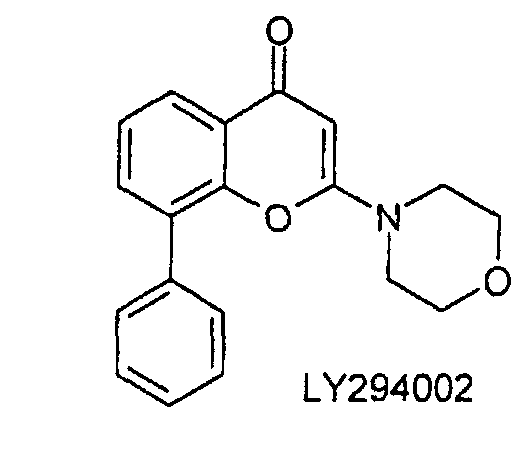
- Y294002 J. Vlahos et al., J. Biol. Chem., 269, 5241(1994)
- creation of PI3K inhibitors are hereby desired having a more potent and excellent cancer cell growth inhibiting activity.
- Japanese patent KOKAI (Laid-Open) No. H09-176165 discloses imidazopyridine derivatives having an ACAT inhibitory activity.
- WO93/25553 discloses imidazopyridine derivatives having an activity to treat atherosclerosis or hypercholesterolemia.
- USP 4,713,381 discloses imidazopyridine derivatives as reaction intermediates. However, all of these have a different structure from those of the compounds of the present invention. Further, these references do not disclose or imply a PI3K inhibiting and antitumor activity.
- Hungarian patent publication No. HU 43066A2 and Eur. J. Med. Chem. (1989), 24(1), 97-9 discloses imidazopyridine derivatives substituted by a substitited-amino-substituted-1,3,5-triazinyl group having a cardiotonic activity.
- Arch. Pharm. (Weinheim, Ger.) (1992), 325(9), 623-4 discloses imidazopyridine derivatives substituted by a substitited-amino-substituted-1,3,4-oxadiazolyl which are useful as anticonvulsants.
- the Maybridge catalogue (order No. SPB-04848) discloses imidazopyridine derivatives substituted by an alkylthio-substituted-pyrimidinyl group.
- the present inventors have performed extensive investigations on compounds with a PI3K inhibiting activity. As a result, it has been discovered that novel imidazopyridine derivatives have an excellent PI3K inhibiting activity and cancer cell growth inhibiting activity. Based on the discovery, it has been found that the imidazopyridine derivatives could be excellent PI3K inhibitors and cancinostatic agents. The present invention has thus been achieved.
- the present invention relates to novel imidazopyridine derivatives or salts thereof which are useful as PI3K inhibitors and antitumor agents.
- the imidazopyridine derivatives are represented by the following general formula (I): wherein
- the present invention further relates to novel pharmaceutical compositions, particularly to PI3K inhibitors and antitumor agents, comprising an imidazopyridine derivative of formula (I) above or a salt thereof and a pharmaceutically acceptable carrier.
- a further aspect of the present invention relates to treatment methods of disorders (especially cancers) influenced by PI3K, wherein an effective amount of a novel imidazopyridine derivative of formula (I) above or a salt thereof is administered to humans or animals.
- lower throughout the specification is used to mean a straight or branched hydrocarbon chain having 1 to 10, preferably 1 to 6, and more preferably 1 to 3 carbon atoms.
- Preferred examples of the "lower alkyl” are an alkyl having 1 to 6 carbon atoms, more preferably methyl and ethyl group.
- Preferred examples of the "lower alkenyl” include vinyl, allyl, 1-propenyl, isopropenyl, 1-butenyl, 2-butenyl and 3-butenyl group.
- Preferred examples of the "lower alkynyl” include ethynyl, 1-propynyl, 2-propynyl, 1-butynyl, 2-butynyl, 3-butyryl and 1-methyl-2-propynyl group.
- cycloalkyl and “cycloalkenyl” are preferably a cycloalkyl and a cycloalkenyl group, each having 3 to 8 carbon atoms, more preferably cyclopropyl, cyclopentyl, cyclohexyl and cyclopentenyl group.
- Preferred examples of the "lower alkylene” include methylene, ethylene, trimethylene and 2,2-dimethyltrimethylene group.
- the "lower alkenylene” is preferably vinylene group.
- the "lower alkynylene” is preferably ethynylene group.
- aryl is used throughout the specification to mean an aromatic cyclic hydrocarbon group.
- An aryl having 6 to 14 carbon atoms is preferable. It may be partially saturated. Preferred examples of such aryl are phenyl and naphthyl group.
- Y 1 and Y 3 are bonded via 2 or 3 atoms and combined with the adjacent Y 2 to form a B ring, a preferred aryl ring of the B ring is a benzene and naphthalene ring.
- heteroaryl throughout the specification includes a 5- or 6-membered monocyclic heteroaryl group having 1 to 4 hetero atoms selected from the group consisting of N, S and 0 as well as a bicyclic heteroaryl group in which such a monocyclic heteroaryl is fused to a benzene ring.
- the heteroaryl may be partially saturated.
- a 5- to 6-membered monocyclic heteroaryl group having 1 to 4 hetero atoms selected from the group consisting of N, S, and O is preferably exemplified by groups of furyl, thienyl, pyrolyl, imidazolyl, pyrazolyl, thiazolyl, isothiazolyl, oxazolyl, isoxazolyl, triazolyl, tetrazolyl, thiadiazolyl, pyridyl, pyrimidinyl, pyridazinyl, and pyrazinyl group.
- bicyclic heteroaryl group examples are preferably benzofuranyl, benzothienyl, benzothiadiazolyl, benzothiazolyl, benzimidazolyl, indolyl, isoindolyl, indazolyl, quinolyl, isoquinolyl, cinnolinyl, quinazolinyl, quinoxalinyl and benzodioxolyl group.
- Specific examples of the partially saturated heteroaryl are 1,2,3,4-tetrahydroquinolyl group, etc.
- Particularly preferred as a heteroaryl in R 2 are thienyl, pyrazolyl, thiazolyl, isoxazolyl, pyridyl, benzothiadiazolyl and quinolyl group.
- a "5- to 6-membered monocyclic heteroaryl ring having 1 to 4 hetero atoms selected from the group consisting of N, S, and O" in a B ring formed by bonding Y 1 with Y 3 via 2 or 3 atoms and combining Y 1 and Y 3 with the adjacent Y 2 is a heteroaryl ring forming the aforementioned "5- to 6-membered monocyclic heteroaryl having 1 to 4 hetero atoms selected from the group consisting of N, S, and O".
- Preferable examples are a furan, thiophene, pyrrole, imidazole, pyrazole, thiazole, isothiazole, oxazole, isoxazole, triazole, tetrazole, thiadiazole, pyridine, pyrimidine, pyridazine and pyrazine ring. More preferable examples are a 5-membered monocyclic heteroaryl ring. Among them, more preferable examples are a pyrrole, imidazole, pyrazole, thiazole, oxazole and triazole ring, and particularly preferable examples are a pyrazole and thiazole ring.
- halogen examples include F, Cl, Br and I atom.
- halogenated lower alkyl examples include the aforementioned lower alkyl groups which are further substituted by one or more halogen atoms described above, preferably -CF 3 .
- nitrogen-containing saturated heterocyclic group throughout the specification is a 5- to 7-membered saturated heterocyclic group containing one or two nitrogen atoms on the ring, which may further contain one 0 or S atom and may form a bridge structure.
- Preferred examples of such heterocyclic group are 1-pyrrolidinyl, 1-piperazinyl, piperidino and morpholino.
- the "5- to 7-membered nitrogen-containing heterocyclic ring fused with a benzene ring(s) of the aryl group” which is formed by combining R 7 "with the substituent at the ortho-position to form a C 2-3 lower alkylene chain, and with the aryl of R 2 " "when X is NR 7 and R 2 is an aryl having a substituent at the ortho-position” includes the above defined "nitrogen-containing saturated heterocyclic group" fused with an aryl ring(s), preferably 1-pyrrolidinyl and piperidino fused with a benzene ring.
- the "nitrogen-containing saturated heterocyclic group" in the B ring formed by bonding Y 1 with Y 3 via 2 or 3 atoms and combining Y 1 and Y 3 with the adjacent Y 2 is preferably a pyrrolidine, imidazolidine or pyrazolidine ring and more preferably is a pyrrolidine ring.
- subsituents in the "lower alkyl which may have one or more subsituents”, “lower alkenyl which may have one or more subsituents” and “lower alkynyl which may have one or more subsituents” are 1 ⁇ 5 subsituents selected from Group D below.
- Group D -a halogen, -NO 2 , -CN, -OH, -O-a lower alkyl, -O-a halogenated lower alkyl, -SH, -S-a lower alkyl, -SO 2 -a lower alkyl, -SO-a lower alkyl, -COOH, -COO-a lower alkyl, -CO-a lower alkyl, -CONH 2 , -NH 2 ,- NH-a lower alkyl, -N(a lower alkyl) 2 ,-(a nitrogen-containing saturated heterocyclic group which may be substituted by a lower alkyl group), -an aryl, -a heteroaryl, -a cycloalkyl and -a cycloalkenyl.
- -a halogen -NO 2 , -CN, -OH, -O-a lower alkyl, -O-a halogenated lower alkyl, -SH
- R 2 The substituent(s) for "-a cycloalkyl which may have one or more subsituents", "-a cycloalkenyl which may have one or more subsituents", “-an aryl which may have one or more subsituents", and "-a heteroaryl which may have one or more subsituents” shown by R 2 are preferably -a lower alkyl which may have 1 ⁇ 5 substituents which are selected from Group D, -a lower alkenyl which may have 1 ⁇ 5 substituents which are selected from Group D, -a lower alkynyl which may have 1 ⁇ 5 substituents which are selected from Group D, -a cycloalkyl which may have 1 ⁇ 5 substituents which are selected from Group E, -a cycloalkenyl which may have 1 ⁇ 5 substituents which are selected from Group E, -a halogen, -NO 2 , -CN, -a halogenated lower al
- R 1 groups may be the same or different.
- each R 4 group may be the same or different from each other.
- R 3 , R 4a , R 4b , R 4c , R 4d , R 4e , and R 4f are preferably -H, -OH, or a lower alkyl.
- -a lower alkyl O, -COOH, -COO-a lower alkyl, -CO-a lower alkyl or -SO 3 H is preferred.
- R 5 and R 7 -H or a lower alkyl is preferred.
- R 6 -H, -a lower alkyl or alkenyl group is preferred, wherein the lower alkyl or alkenyl group may be substituted by a substituent(s) selected from -O-a lower alkyl, -S-a lower alkyl, -SO 2 -a lower alkyl, -SO-a lower alkyl, -COOH, -COO-a lower alkyl, -CO-a lower alkyl, -CONH 2 , -NH 2 , -NH-a lower alkyl, -N(a lower alkyl) 2 , -(a nitrogen-containing saturated heterocyclic group which may be substituted by a lower alkyl group) and -an aryl.
- a substituent(s) selected from -O-a lower alkyl, -S-a lower alkyl, -SO 2 -a lower alkyl, -SO-a lower alkyl, -COOH, -COO-a lower alky
- Preferred imidazopyridine derivatives of the present invention are compounds of formula (I) as below.
- the compounds of the present invention may be geometric isomers or tautomers depending upon the kind of substituents.
- the present invention also covers these isomers in separated forms and the mixtures thereof.
- some of the compounds may contain an asymmetric carbon in the molecule; in such a case isomers could be present.
- the present invention also embraces the mixtures of these optical isomers and the isolated forms of the isomers.
- Some of the compounds of the invention may form salts. There is no particular limitation so long as the formed salts are pharmacologically acceptable.
- Specific examples of acid addition salts are salts with inorganic acids such as hydrochloric acid, hydrobromic acid, hydroiodic acid, sulfuric acid, nitric acid, phosphoric acid, etc., organic acids such as formic acid, acetic acid, propionic acid, oxalic acid, malonic acid, succinic acid, fumaric acid, maleic acid, lactic acid, malic acid, tartaric acid, citric acid, methanesulfonic acid, ethanesulfonic acid, aspartic acid, glutamic acid, etc.
- inorganic acids such as hydrochloric acid, hydrobromic acid, hydroiodic acid, sulfuric acid, nitric acid, phosphoric acid, etc.
- organic acids such as formic acid, acetic acid, propionic acid, oxalic acid, malonic acid, succinic acid
- basic salts include salts with inorganic bases containing metals such as sodium, potassium, magnesium, calcium, aluminum, etc., or salts with organic bases such as methylamine, ethylamine, ethanolamine, lysine, omithine, etc.
- the present invention further embraces various hydrates and solvates to the compounds (I) or salts thereof of the invention as well as polymorphism thereof.
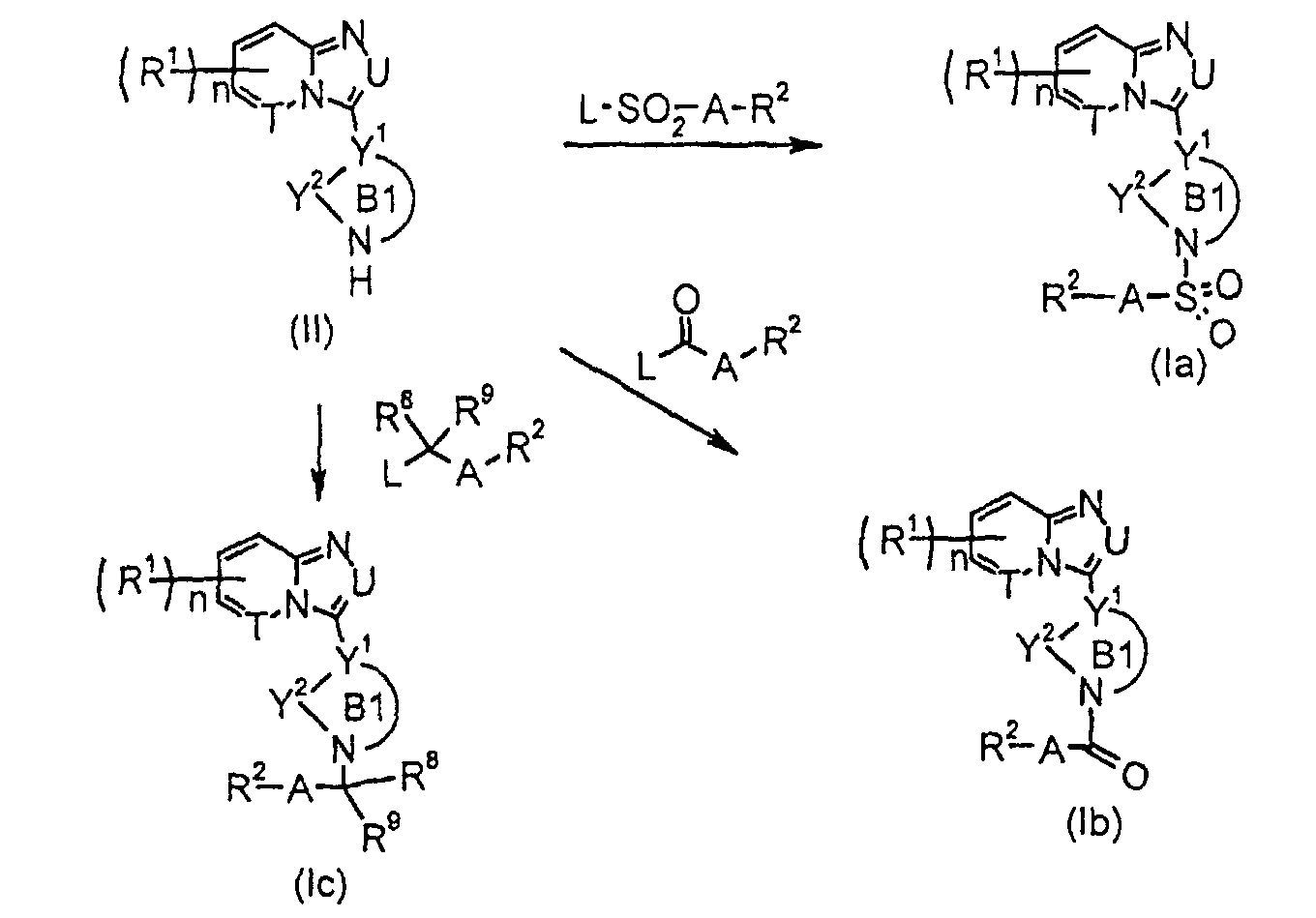
- the B1 ring represents a 5- or 6-membered monocyclic heteroaryl ring having 1 to 4 hetero atoms selected from the group consisting of N, S, and O, or a nitrogen-containing saturated heterocyclic ring, said B ring may be substituted by one to two R 4 s and Y 3 is an N atom; and L represents a leaving group.
- the compounds (Ia), (Ib), and (Ic) of the present invention may be synthesized by subjecting heterocycle derivatives shown by general formula (II) to various modification reactions such as sulfonylation, amidation, and alkylation according to a conventional manner.
- a leaving group shown by L is a halogen (fluorine, chlorine, bromine, iodine, etc.) or a sulfonyloxy group (e.g., methanesulfonyloxy, trifluoromethanesulfonyloxy, toluenesulfonyloxy, benzenesulfonyloxy, etc.), and preferably chlorine, bromine, iodine, and trifluoromethanesulfonyloxy.
- halogen fluorine, chlorine, bromine, iodine, etc.
- a sulfonyloxy group e.g., methanesulfonyloxy, trifluoromethanesulfonyloxy, toluenesulfonyloxy, benzenesulfonyloxy, etc.
- a sulfonyloxy group e.g., methanesulfonyloxy
- Sulfonylation reaction may be performed by reacting heterocycle derivatives (II) with reactive derivatives of sulfonic acid according to a conventional manner.
- the reactive derivatives of sulfonic acid include sulfonyl chloride as a most ordinary example, as well as sulfonyl bromides, acid anhydrides (sulfonic anhydride prepared from two molecules of sulfonic acid), acid azides, and the like.
- Such reactive derivatives of sulfonic acid may be readily obtained from the corresponding sulfonic acid in a conventional manner.
- An example in which sulfonyl chloride is prepared includes a method described in J. Chem. Soc. Pak., 8(1), 11-17(1986), and Bull. Chem.
- the sulfonylation is performed preferably in the presence of a base (an inorganic base such as sodium hydroxide or sodium hydride, or an organic base such as pyridine, triethylamine (TEA) or diisopropylethylamine).
- a base an inorganic base such as sodium hydroxide or sodium hydride, or an organic base such as pyridine, triethylamine (TEA) or diisopropylethylamine.
- a base an inorganic base such as sodium hydroxide or sodium hydride, or an organic base such as pyridine, triethylamine (TEA) or diisopropylethylamine.
- a base such as sodium hydride, TEA, pyridine or 2,6-lutidine.
- the reaction temperature may be appropriately chosen depending on the kind of reactive derivatives used.
- a solvent that may be used there are basic solvents such as pyridine; an aromatic hydrocarbon solvent such as benzene or toluene; an ether solvent such as tetrahydrofuran (THF) or 1,4-dioxane; a halogenated hydrocarbon solvent such as dichloromethane or chloroform; an amide solvent such as N, N-dimethylformamide (DMF) or N,N-dimethylacetamide; a carbonyl-based solvent such as acetone or methyl ethyl ketone. These solvents may be used alone or as an admixture of two or more. The solvent should be appropriately chosen depending on the kind of starting compounds.
- the amidation reaction may be performed in a conventional manner, preferably by converting carboxylic acid into reactive derivatives such as acid halides (acid chlorides, etc.) or acid anhydrides, and then reacting the reactive derivatives with the heterocycle derivatives (II).
- reactive derivatives such as acid halides (acid chlorides, etc.) or acid anhydrides
- the aforementioned base is preferably added.
- amidation of the heterocycle derivatives (II) with carboxylic acids may be carried out in the presence of condensation agent (1-ethyl-3-(3-dimethylaminopropyl) carbodiimide (EDCI), 1,1 '-carbonylbis-1H-imidazole (CDI), etc.).
- an additive such as 1-hydroxybenzotriazole (HOBt) or the like may be added.
- the reaction temperature may be appropriately chosen depending on the kind of starting compounds.
- an inert solvent to the reaction may be used, e.g. the solvent used in the above sulfonylation. These solvents may be used alone or as an admixture of two or more.
- the solvent should be chosen depending on the kind of starting compounds.
- Alkylation may be performed in a conventional method, and preferably in the presence of the aforementioned base such as potassium carbonate, sodium hydroxide, sodium hydride, or the like.
- An alkylating agent such as alkyl halide or sulfonate (an ester of p-toluenesulfonic acid, an ester of trifluoromethanesulfonic acid, etc.) may be employed.
- the reaction may be conducted under cooling or heating or at room temperature.
- an inert solvent to the reaction may be used, e.g. the solvent used in the above sulfonylation. These solvents may be used alone or as an admixture of two or more. The solvent should be chosen depending on the kind of starting compounds.
- alkylation gives a monoalkylated compound
- the compound can be converted to a dialkyl compound using a conventional alkylation reaction again.
- reductive alkylation can be performed by using reducing agents such as sodium borohydride, sodium triacetoxyborohydride or sodium cyanoborohydride, dehydrator to give the corresponding imine and then reducing the imine by sodium borohydride.
- the reductive alkylation also can be performed by using a Dean-Stark.
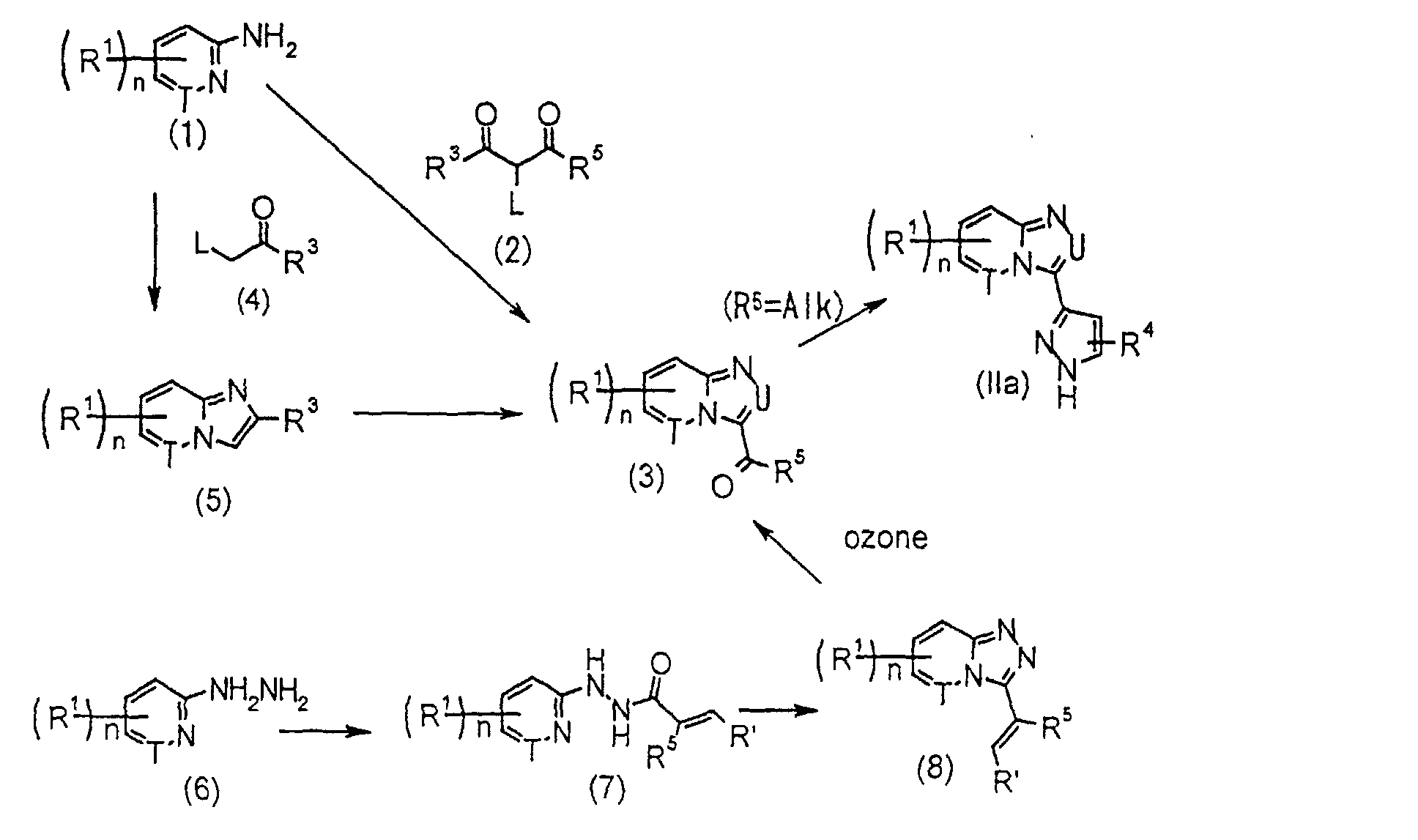
- the starting compounds (II), which are heterocycle derivatives, may be prepared in a conventional manner in accordance with the type of each heterocycle. Representative synthesis methods are illustrated below: (Alk represents an alkyl group, and R' represents an allyl or aryl group.)
- the pyrazole derivatives (IIa) are synthesized by reacting acyl compounds (3) with N,N-dimethylformamide dimethylacetal, etc., to give dimethylamino-enone compounds and further adding hydrazine to the enone compounds for cyclization.
- the reaction may be conducted either in the absence of any solvent or in the presence of an organic solvent inert to the reaction.
- the reaction may be performed under cooling or heating or at room temperature.
- Acyl compounds (3) in which U represents CR 3 can be obtained by a reaction of amino compounds (1) with diketone compounds (2). It can be also obtained by a method in which a halogenated ketone alkylates N-pyridylamidine as described in Synthesis, 263-265 (1984).
- acyl compounds (3) can be obtained by an acylation reaction of Friedel-Crafts types to imidazopyridine derivatives (5).
- the acylation reaction may be performed in a conventional manner.
- a method according to J. Med. Chem., 13, 1048 (1970) may be employed.
- the compound (5) may be easily synthesized using aminopyridine derivatives (1) and ⁇ -halogenated carbonyl compounds (4) in a conventional manner.
- Acyl compounds (3) in which U represents N can be obtained by oxidative cleavage of a double bond of olefin compounds (8), e.g., via ozonolysis.
- ketone equivalents such as hemiketals may be separated. In these cases, such compounds can be changed to desired acyl compounds using appropriate reaction conditions.
- Olefin compounds (8) can be synthesized by heating hydrazides (7) in acetic acid as an example. Hydrazides (7) can be synthesized by acylation of hydrazines (6) in a conventional method.
- the starting compounds (IIb) can be synthesized by heating hydrazide compounds (9) in acetic acid as an example to cyclize them.
- Hydrazide compounds (9) can be synthesized by acylation of hydrazines (6) in a conventional method.
- the stalling compounds (IIc-1) can be synthesized by reacting enone compounds (11) with tosylmethylisocyanide (TosMIC) in a conventional method and compounds (11) can be synthesized by subjecting compounds (10) to the Homer-Emmons-Wadsworth reaction in a conventional method.
- the synthesis method of said compounds (3) can serve basically as a reference. Differences lie in that when U represents C-R 3 , hormylation by the Vilsmeier reaction is employed instead of the acylation of compounds (5) and in that when diketone reacts with compounds (1) to create an imidazopyridine ring, halogenated malonoaldehyde is employed as a reaction agent.
- Examples of the Vilsmeier reaction includes a method described in the aforementioned J. Med. Chem., 13, 1048(1970).
- U represents N
- compounds with R 5 representing H can be utilized in the synthesis of compounds (3) as the starting compounds to give compounds (10).
- the starting compounds (IIc-2) can be synthesized by subjecting ester compounds (IIc-1) to hydrolysis and decarboxylation with heating.
- R 61 represents a group as defined for R 6 , other than H.
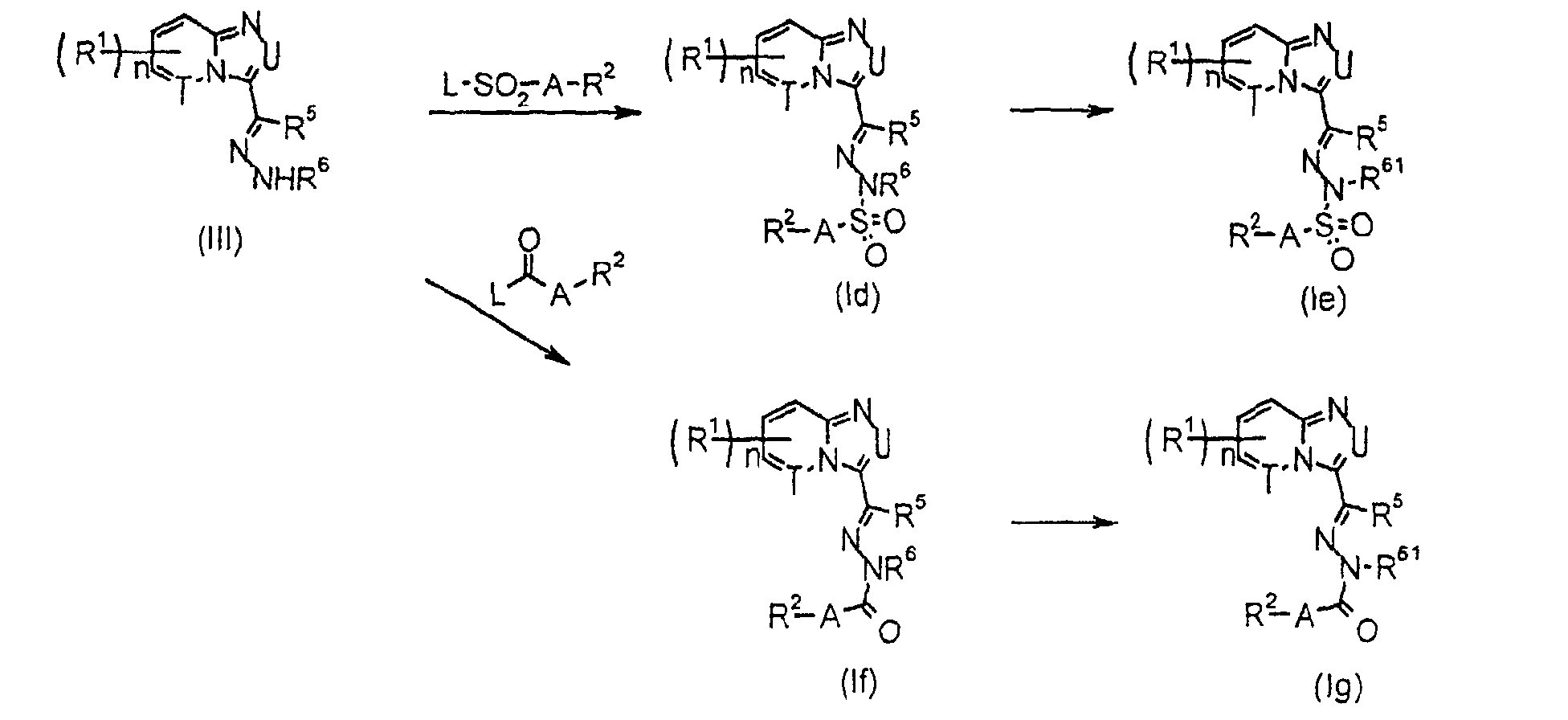
- hydrazone derivatives shown by the formula (III) is subjected to various modification reactions such as sulfonylation or amidation according to a conventional manner to obtain compounds (Id) and (If) of the present invention.
- R 6 represents H
- the compounds (Id) and (If) of the present invention can be led to invented compounds (Ie) and (Ig) by known methods of a functional group transformation, such as alkylation, as desired.
- the starting compounds (III), which are hydrazone derivatives, may be synthesized in a conventional manner by reacting acyl compounds (3) or (10) with hydrazine compounds shown by NH 2 NHR 6 or its hydrate, preferably in an alcohol solvent such as methanol or ethanol under cooling or heating or at room temperature.
- the cyclization reaction may be conducted in a conventional manner.
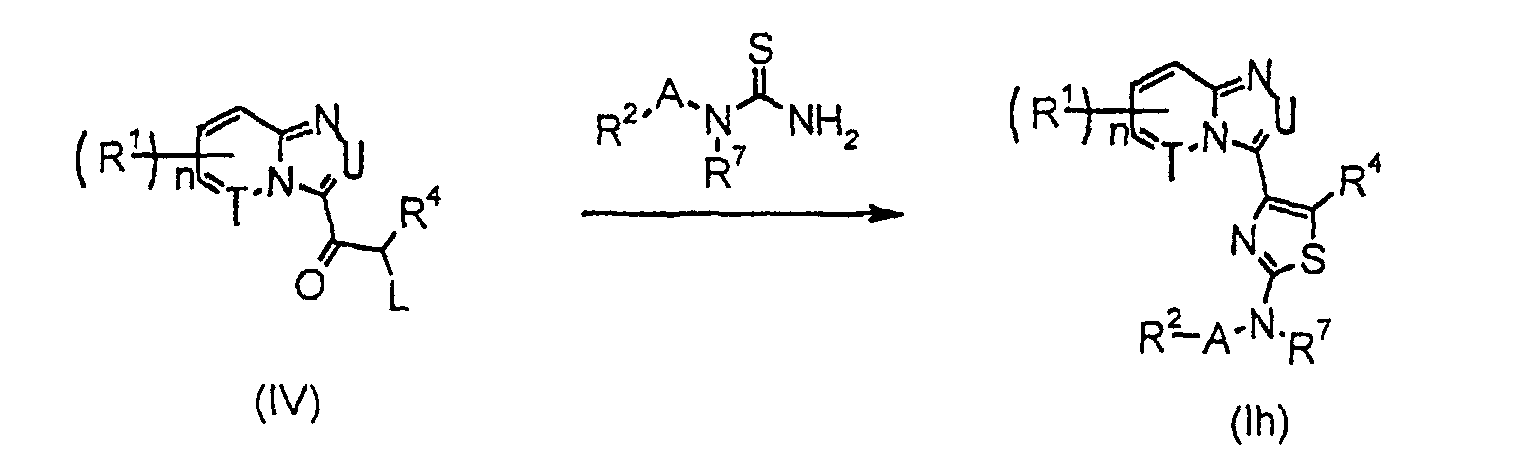
- thiourea compounds or the like are reacted with ⁇ -halogenated ketone (IV) or the like in solvents or without any solvent under cooling or heating or at room temperature.
- solvents are alcohol solvents such as methanol, ethanol and isopropanol, the above carbonyl-based solvents, ether solvents, halogenated hydrocarbon solvents, amide solvents, etc.
- the solvent should be appropriately chosen depending on the kind of starting compounds, and these solvents may be used alone or as an admixture of two or more.
- the reaction sometimes proceeds smoothly by adding a base (potassium carbonate, sodium carbonate, TEA, etc.).
- the starting compounds (IV), which are ⁇ -halogenated ketone derivatives, may be synthesized by halogenation of acyl compounds (3a) in a conventional manner.
- Halogenation reagents are, for example, chlorine, bromine, iodine, copper bromide (II), potassium iodate, benzyltrimethylammonium tribromide, phenyltrimethylammonium tribromide, tetrabutylammonium tribromide, sulfuryl chloride, trimethylsilyl chloride, trimethylsilyl bromide, and 5,5-dibromobarbituric acid.
- a solvent inert to the reaction may be used, for example, acidic solvents such as acetic acid and hydrobromic acid/acetic acid, the aforementioned alcohol solvents and ether solvents.
- the reaction temperature may be under cooling or heating or at room temperature.
- the desired starting compound may also be synthesized by appropriately known methods to convert substituents, wherein proper methods may depend on the kind of substituents.
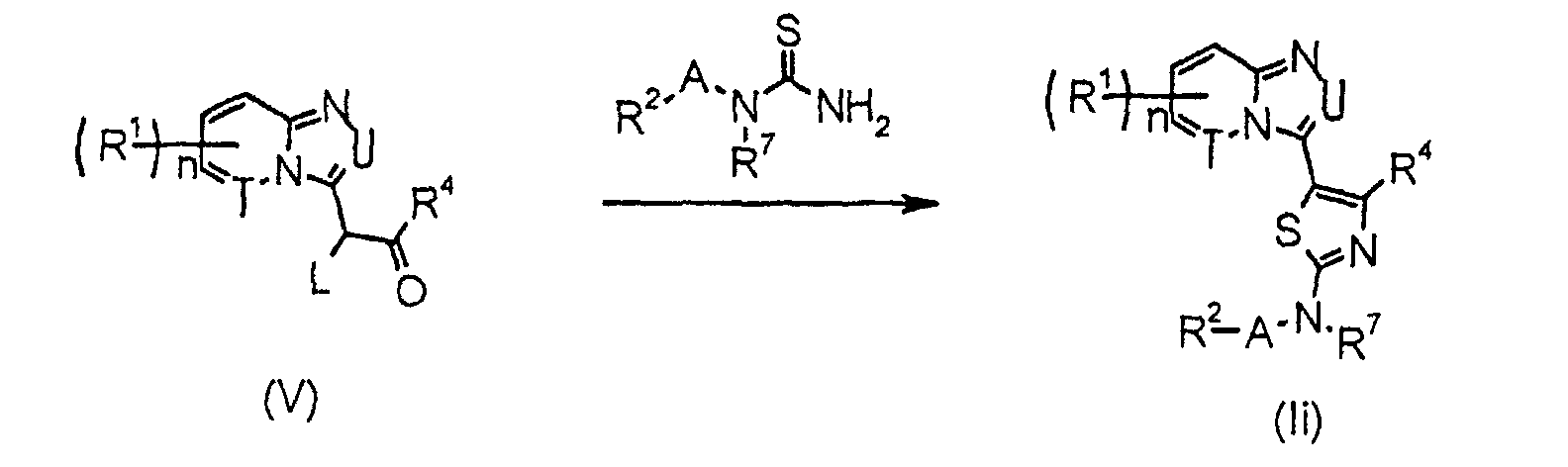
- the cyclization reaction may be performed in the same manner as in Synthesis Method III.
- the starting compound (V) may be synthesized in the same manner as the starting compound (IV).
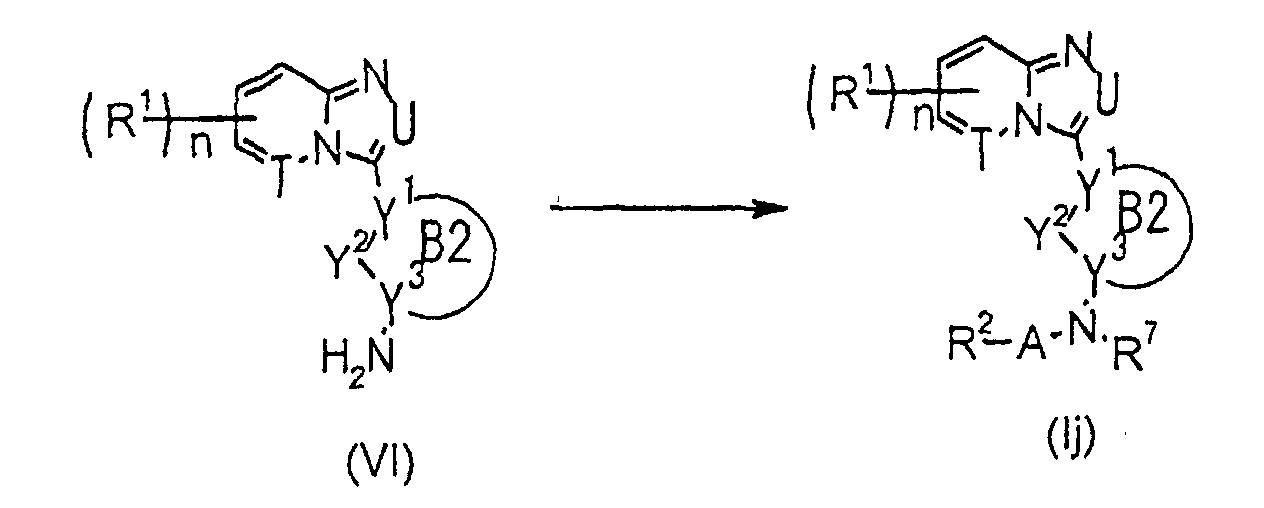
- the B2 ring represents a 5- or 6-membered monocyclic heteroaryl ring having 1 to 4 hetero atoms selected from the group consisting of N, S, and O, a nitrogen-containing saturated heterocyclic ring, a nitrogen-containing saturated heterocyclic group or an aryl ring, whereas said B2-ring may be substituted by one to two R 4 s and Y 3 is a C atom.
- This method is for obtaining a compound (Ij) of the present invention by subjecting amino compounds shown by the formula (VI) to an alkylation or arylation reaction.
- the alkylation reaction may be performed in a conventional manner, for example, the same manner as that in Synthesis Method I. Further, known convening methods such as N-alkylation or the like may be appropriately performed.
- Examples of the arylation reaction include coupling reactions described in Acc. Chem. Res., 31, 805, (1998) and ibid. 31, 852 (1998) and ipso-substitution described in J. Org. Chem., 63(18), 6338(1998).
- the starting amino compounds (VI) can be synthesized according to a conventional method.
- the B2-ring when the B2-ring is an imidazole, they can be synthesized using the aforementioned ⁇ -halogenated ketone (IV) as a starting material in a conventional method, for example, a method described in J. Org. Chem. 59(24) 7299-7305 (1994).
- the B2-ring when the B2-ring is a thiazole ring, they can be produced by reacting unsubstituted thiourea as a reaction agent according to the method described in the aforementioned Synthesis Method IV.
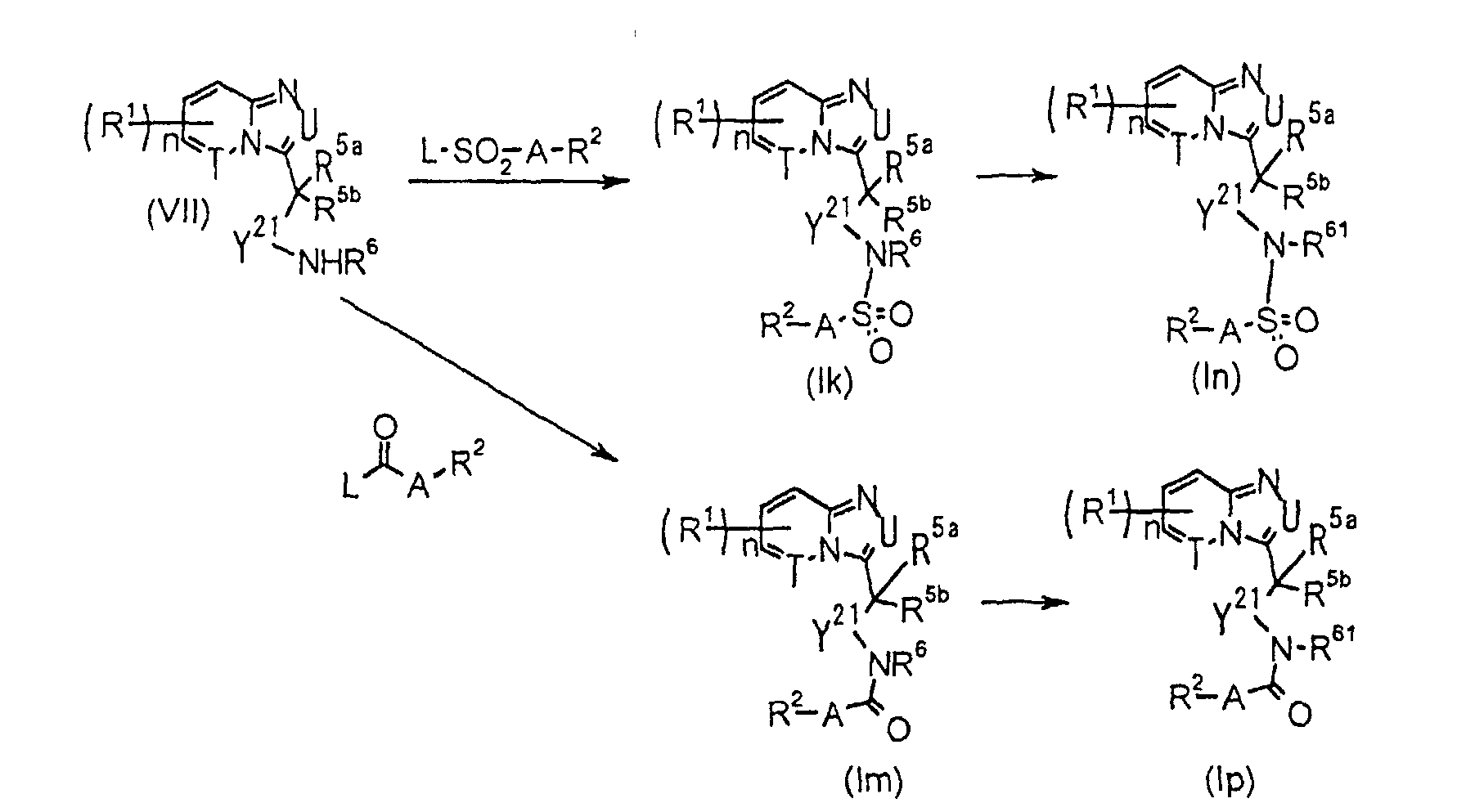
- Y 21 represents NH or CR 4a R 4b .
- This method is for synthesizing compounds (Ik) and (Im) of the present invention by subjecting amine derivatives shown by the formula (VII) to various modification reactions of sulfonylation and amidation according to conventional methods. Further, the compounds (Ik) and (Im) of the present invention can be led to compounds (In) and (Ip) of the present invention, respectively, by known methods of a substituent conversion, such as alkylation or the like. Sulfonylation, amidation, and alkylation can be conducted, for example, in the same manner as in Synthesis Method I.
- the starting compounds (VII) can be readily sythensized using the methods shown by the synthetic routes below as an example.
- the starting material (VIIa) can be readily synthesized, as an example, by subjecting the nitrile compounds (15) to reducing reactions described in Jikken Kagaku Kouza (Encyclopedia for Experimental Chemistry) edited by Nihon Kagaku Kai (Japanese Association of Chemistry) and published by Maruzen Co., Ltd.
- the nitrile compounds (15) can be produced by subjecting the aforementioned acyl compounds (3) to a conventional method such as one described in J. Med. Chem. 12, 122 (1969).
- the compounds (VIIb) can be synthesized by reacting the ester compounds (16) with hydrazines at room temperature or under heating.
- the compounds (VIIc) can be synthesized by reducing ⁇ -halogenated ketone derivatives (IV) with an agent such as sodium borohydride to give epoxide or halohydrin compounds, followed by the treatment with amino compounds.
- the B ring represents a 5- or 6-membered monocyclic heteroaryl ring having 1 to 4 hetero atoms selected from the group consisting of N, S, and O, a nitrogen-containing saturated heterocyclic ring, an aryl ring, whereas the B ring may be substituted by one to two R 4 s.
- This method is for converting thiol compounds (VIII) to the compounds of the present invention (Iq) and conducting an oxidation reaction as necessary to synthesize sulfoxide derivatives and sulfone derivatives shown by the formula (Ir) and (Is).
- Examples of methods to synthesize sulfide compounds (Iq) from the starting materials, thiol compounds (VIII), include a method in which reacting them with halogenated alkyl or halogenated aralkyl in the presence of a base according to a conventional method when the group, -A-R 2 , is an alkyl or aralkyl.
- sulfide compounds (Iq) can be obtained by a coupling reaction with an halogenated aryl.
- a coupling reaction for example, a method according to J. Org. Chem. 1993, 58(12), 3229-3230, and Synth Commun. 1982, 12(13), 1071 may be used when the halogen is fluorine, a method according to Synthesis 11, 892 (1981) may be used when the halogen is bromine, and a method according to Chem. Lett. 11, 1363 (1980) may be used when the halogen is iodine.
- thiolate salts (VIII) are reacted with diazonium salts
- an ipso-substitution reaction can be so employed in which an aryl group having appropriate leaving groups is subjected to thiolate salts at room temperature or under heating.
- reaction conditions methods can be referenced which are described, for example, in Japanese patent KOKAI (Laid-Open) No. 2000-53635 and Tetrahedron Lett., 26, 6365 (1985).
- the oxidation reaction to convert (Iq) to (Ir) and (Is) may be performed according to a conventional method, and an oxidizing agent such as m-chloroperoxybenzoic acid, hydrogen peroxide, peracetic acid, potassium permanganate, oxone and sodium periodate may be used.
- an oxidizing agent such as m-chloroperoxybenzoic acid, hydrogen peroxide, peracetic acid, potassium permanganate, oxone and sodium periodate may be used.
- the reaction conditions for example, described in J. Heterocyclic Chem., 28, 577 (1991) and Tetrahedron Lett., 35, 4955 (1994) may be referenced.
- a functional group other than the aimed sulfide is oxidized and, for example, converted to an oxidant such as N-oxide upon the oxidation reaction, it can be deoxidized with an appropriate reducing agent according to a conventional manner.
- the starting compounds (VIII) may be synthesized according to conventional methods.
- the methods for thiazol described in Bioorganic & Medicinal Chemistry, 5, 601 (1997) and J. Org. Chem., 13, 722 (1948) those for imidazole described in J. Am. Chem. Soc., 71, 4000 (1949), J. Indian Chem. Soc., 52(12), 1117 (1981) and Chem. Pharm. Bull., 32(7), 2536 (1984), those for oxazole described in Fr1450443 (1965), JCS Perkin Trans. 1,3, 435 (1984), Chem. Pharm. Bull., 40, 245 (1992) and Bull. Soc. Chim.
- Hal represents a halogen
- This method is for converting halogenated aryl compounds shown by the formula (IX) and (X) by a coupling reaction according to a conventional manner to the compounds (It) of the present invention.
- the coupling reaction can be conducted according to a conventional method.
- the coupling reaction is preferably performed in the presence of a catalyst such as palladium, nickel or copper after (IX) or (X) is converted to a reactive derivative such as an aryl metal reagent, an arylboronic acid derivative or an aryl tin compound in a conventional manner.
- a catalyst such as palladium, nickel or copper
- An example of these coupling reactions is a method described in Jikken Kagaku Kouza as described hereinbefore.
- the starting compounds (IX) may be synthesized by constructing a B ring by methods described in, for example, "Comprehensive Heterocyclic Chemistry", “The Chemistry of Heterocyclic Compounds” or “Advanced in Heterocyclic Chemistry” as described hereinbefore, and then by employing, as necessary, the alkylation reaction, coupling reaction, oxidizing reaction, deoxygenation reaction which are described in Synthesis Method VII.
- the desired compound of the present invention may also be synthesized by functional group transformation methods well known to those skilled in the art, which may depend on the kind of the substituent.
- the order of the reactions, or the like, may be appropriately changed in accordance with the aimed compound and the kind of reaction to be employed.
- Each of the reaction products obtained by the aforementioned synthesis methods is isolated and purified as a free base or a salt thereof.
- the salt can be produced by a usual salt forming method.
- the isolation and purification are carried out by employing usually used chemical techniques such as extraction, concentration, evaporation, crystallization, filtration, recrystallization, various types of chromatography and the like.
- isomers can be isolated by the usual procedures making use of physicochemical differences among isomers.
- racemic compounds can be separated by means of a conventional optical resolution method (e.g., by forming diastereomer salts with a conventional optically active acid such as tartaric acid, etc. and then optically resolving the salts) to give optically pure isomers.
- a mixture of diastereomers can be separated by conventional means, e.g., fractional crystallization or chromatography.
- an optical isomer can also be synthesized from an appropriate optically active starting compound.
- the compounds of the present invention exhibit a kinase inhibitory activity, especially PI3K inhibitory activity and therefore, can be utilized in order to inhibit abnormal cell growths in which PI3K plays a role.
- the compounds are effective in the treatment of disorders with which abnormal cell growth actions of PI3K are associated, such as restenosis, atherosclerosis, bone disorders, arthritis, diabetic retinopathy, psoriasis, benign prostatic hypertrophy, atherosclerosis, inflammation, angiogenesis, immunological disorders, pancreatitis, kidney disease, cancer, etc.
- the compounds of the present invention possess excellent cancer cell growth inhibiting effects and are effective in treating cancers, preferably all types of solid cancers and malignant lymphomas, and especially, leukemia, skin cancer, bladder cancer, breast cancer, uterus cancer, ovary cancer, prostate cancer, lung cancer, colon cancer, pancreas cancer, renal cancer, gastric cancer, brain tumor, etc.
- Bovine p110 ⁇ was prepared in the baculovirus expression system.
- Bovine p110 ⁇ was prepared according to a modification from the method by I. Hiles et al., Cell, 70, 419 (1992).
- DMSO dimethylsulfoxide
- the compound (0.5 ⁇ l) to be assayed and enzyme were mixed in 25 ⁇ l of buffer solution (40 mM Tris-HCl (pH 7.4), 200 mM NaCl, 2 mM dithiothreitol, 5 mM MgCl 2 ).
- the IC 50 inhibition activity was defined by a 50% inhibition concentration of each compound assayed, which was converted from the radioactivity determined as 100% when DMSO alone was added and as 0% when no enzyme was added.
- the compounds of the present invention showed excellent inhibitory activities.
- Compound 6 of the present invention inhibits PI3K more than 10 times as strong as known PI3K inhibitor LY294002.
- HCT116 cells from a colon cancer cell line were cultured in McCoy's 5A medium (GIBCO) supplemented with 10% fetal bovine serum. HCT116 cells were inoculated on a 96 well plate (5000 cells/well) followed by overnight incubation. The test compound diluted with the medium was added to the medium in a final concentration of 0.1 to 30 ⁇ M (final DMSO concentration, 1%). After incubation for over 72 hours, Alamar Blue reagent was added to the medium. Two hours after the addition, a ratio of fluorescent intensity at an excitation wavelength of 530 nm to that at an emission wavelength of 590 nm was measured to determine the IC 50 .
- Compounds 5, 6, 8, and 9 of the present invention exerted a good cancer cell growth inhibition activity.
- A375 cells from a melanoma cell line were cultured in DMEM medium (GIBCO) supplemented with 10% fetal bovine serum.
- A375 cells at 10,000 cells/100 ⁇ l were added to a 96 well plate which contained 1 ⁇ l/well of the test compounds (final concentration of 0.001 ⁇ 30 ⁇ M).
- Alamar Blue reagent was added to the medium (10 ⁇ l/well).
- a ratio of fluorescent intensity at an excitation wavelength of 530 nm to that at an emission wavelength of 590 nm was measured to determine the IC 50 of the test compounds in the same manner as in the above examples.
- the compounds of the present invention exhibited excellent cancer cell growth inhibiting activities against Hela cells from a cervix cancer cell line, A549, H460 cells from a lung cancer cell line, COLO205, WiDr, Lovo cells from a colon cancer cell line, PC3, LNCap cells from a prostate cancer cell line, SKOV-3, OVCAR-3, CH1 cells from an ovary cancer cell line, U87 MG cells from a glioma cell line and BxPC-3 cells from a pancreas cancer cell line.
- a single-cell suspension of HelaS3 (5 x 10 6 cells), a human cervix cancer cell line, was inoculated into the flank of female Balb/c nude mice by subcutaneously injection.
- test compounds were intraperitoneally administered once a day for two weeks.
- 20% Hydroxypropyl- ⁇ -cyclodextrin/saline was intraperitoneally administered with the same schedule as a control group.
- the diameter of the tumors was measured with a vernier caliper at certain tune intervals until one day after the final doze administration.
- the tumor volume was calculated by the following formula: 1/2 x (a shorter diameter) 2 x (a longer diameter).
- test compounds exhibited superior anti-tumor activities as compared with the control group.
- the pharmaceutical composition of the present invention can be prepared in a conventional manner by mixing one or more compounds of the invention shown by general formula (I) with a carrier for medical use, a filler and other additives usually used in pharmaceutical preparations.
- the pharmaceutical composition of the invention may be administered either orally in the form of tablets, pills, capsules, granules, powders, liquid, etc., or parenterally such as by intravenous or intramuscular injection, in the form of suppositories, or through pernasal, permucosal or subcutaneous route.
- a solid composition in the form of, e.g., tablets, powders or granules is available.
- one or more active or effective ingredients are blended with at least one inert diluent such as lactose, mannitol, glucose, hydroxypropyl cellulose, microcrystalline cellulose, starch, polyvinyl pyrrolidone or magnesium aluminate metasilicate.
- the composition may further contain additives other than the inert diluent by the usual procedures.
- additives examples include a lubricant such as magnesium stearate, a disintegrating agent such as calcium cellulose glycolate, a solubilization assisting agent such as glutamic acid or aspartic acid. Tablets or pills may be coated, if necessary, with films of sugar or a gastric or enteric substance such as sucrose, gelatin, hydroxypropyl cellulose, hydroxypropylmethyl cellulose phthalate, etc.
- a liquid composition for oral administration includes pharmaceutically acceptable emulsions, solutions, suspensions, syrups, elixirs, etc. and contains an inert diluent conventionally employed, e.g., purified water or ethanol.
- the liquid composition may further contain an auxiliary agent such as a moistening agent or a suspending agent, a sweetener, a flavor and/or a preservative.
- a composition for parenteral administration contains a sterile aqueous or non-aqueous solution, a suspension and an emulsion.
- aqueous solution and suspension include distilled water for injection use and physiological saline.
- non-aqueous solution and suspension are propylene glycol, polyethylene glycol, vegetable oil such as olive oil, an alcohol such as ethanol, polysorbate 80, and the like.
- These compositions may further contain a preservative, a moistening agent, an emulsifier, a dispersing agent, a stabilizer and a solubilization assisting agent.
- compositions are sterilized, e.g., by filtering them through a bacteria retention filter, incorporating a bactericide or through irradiation.
- they may be prepared into a sterile solid composition, which is dissolved in sterile water or a sterile solvent for injection prior to use.
- suitable daily does is usually about 0.0001 to 50 mg/kg body weight, preferably about 0.001 to 10 mg/kg, more preferably about 0.01 to 1 mg/kg, and the daily does is administered once a day or divided into 2 to 4 doses per day.
- suitable daily dose is usually about 0.0001 to 1 mg/kg body weight, preferably about 0.0001 to 0.1 mg/kg.
- the daily dose is administered once a day or divided into a plurality of doses per day. The dose may be appropriately determined for each case, depending on conditions, age, sex, etc.
- the compounds of the present invention can be utilized alone, or in conjunction with other treatments (e.g., radiotherapy and surgery). Moreover, they can be utilized in conjunction with other antitumor agents, such as alkylation agents (cisplatin, carboplatin, etc.), antimetabolites (methotrexate, 5-FU, etc.), antitumor antibiotics (adriamymycin, bleomycin, etc.), antitumor vegetable alkaloids (taxol, etoposide, etc.), antitumor hormones (dexamethasone, tamoxifen, etc.), antitumor immunological agents (interferon ⁇ , ⁇ , ⁇ , etc.), and so forth.
- alkylation agents cisplatin, carboplatin, etc.
- antimetabolites metalhotrexate, 5-FU, etc.
- antitumor antibiotics as antibiotics (adriamymycin, bleomycin, etc.), antitumor vegetable alkaloids (taxol,
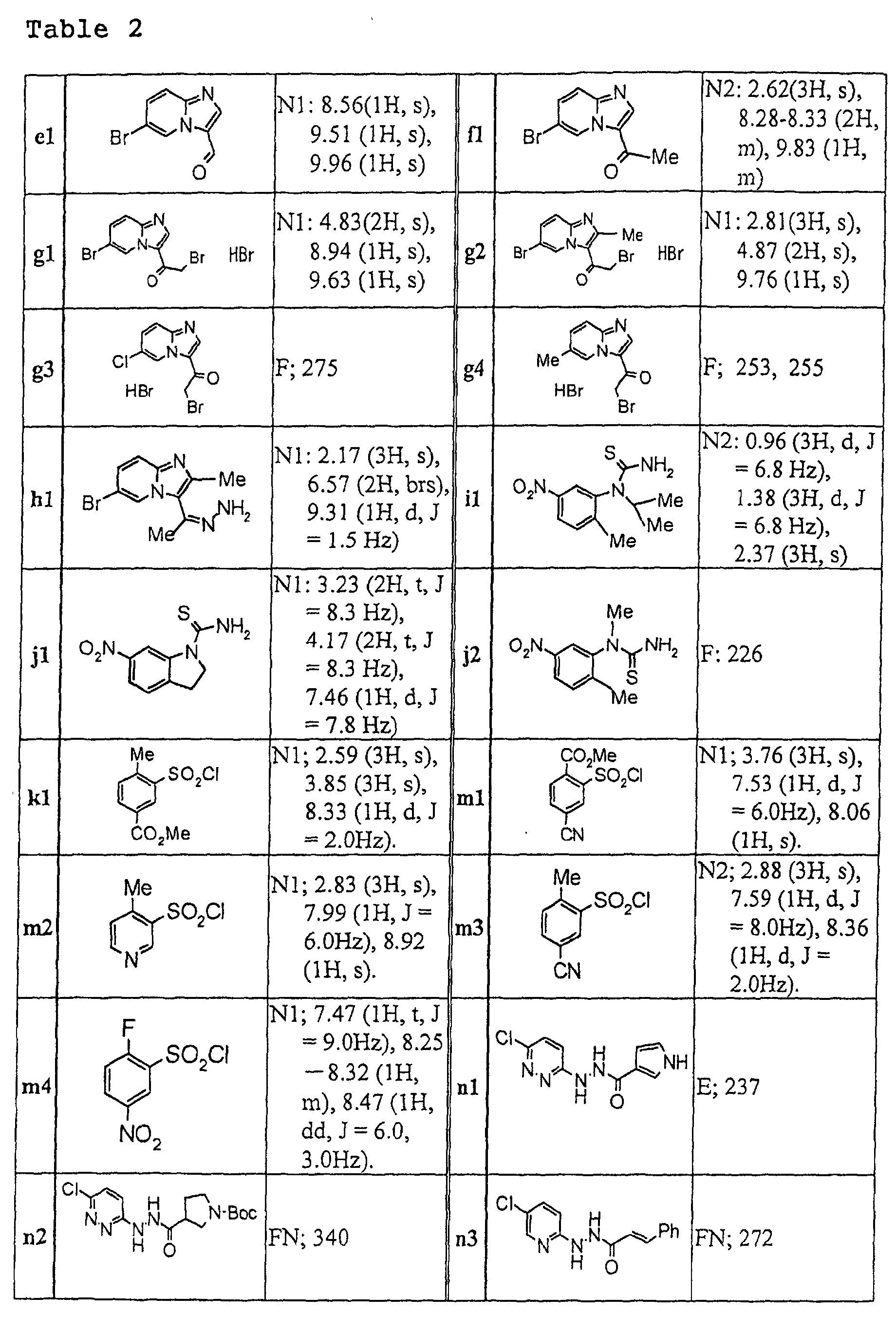
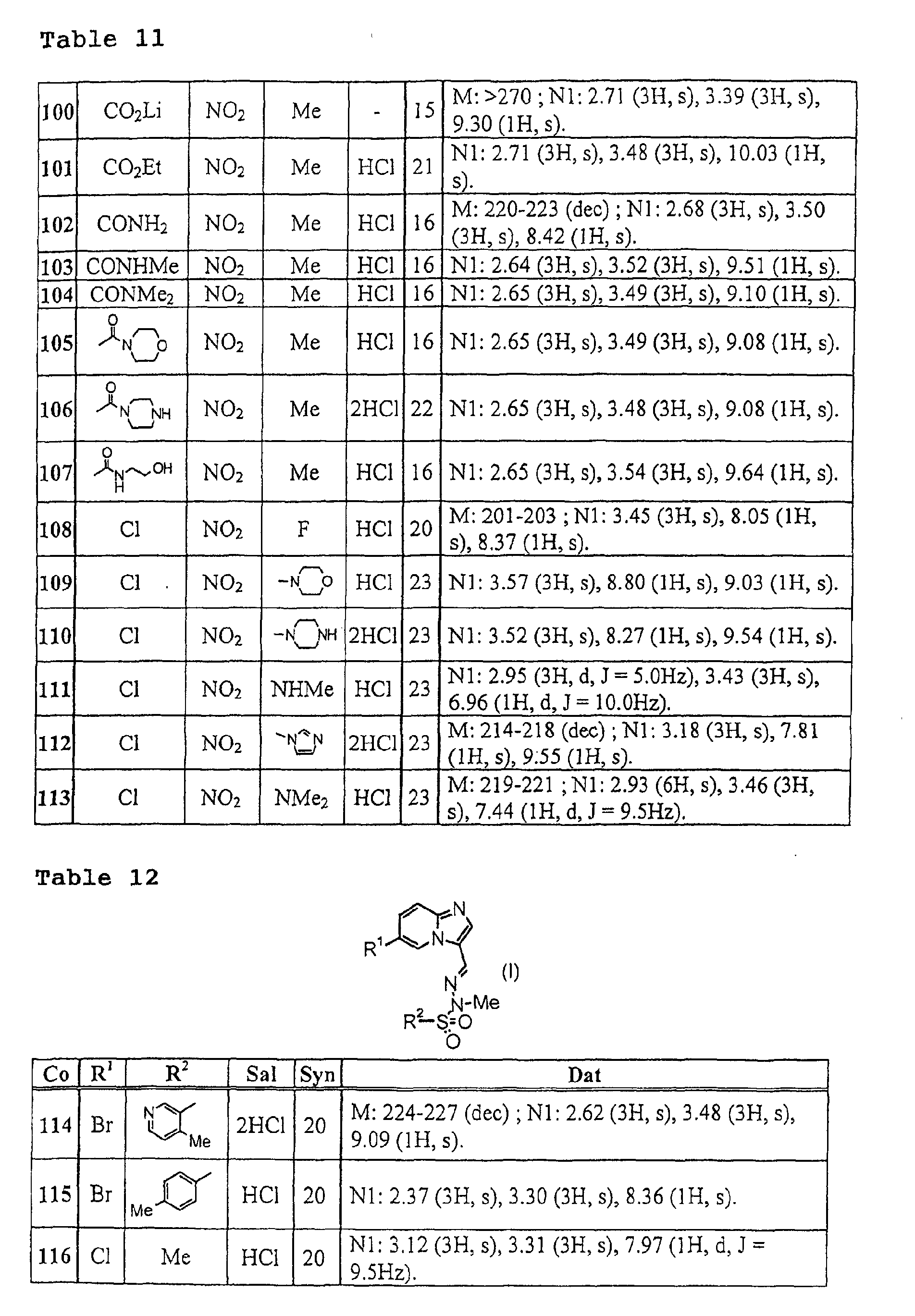
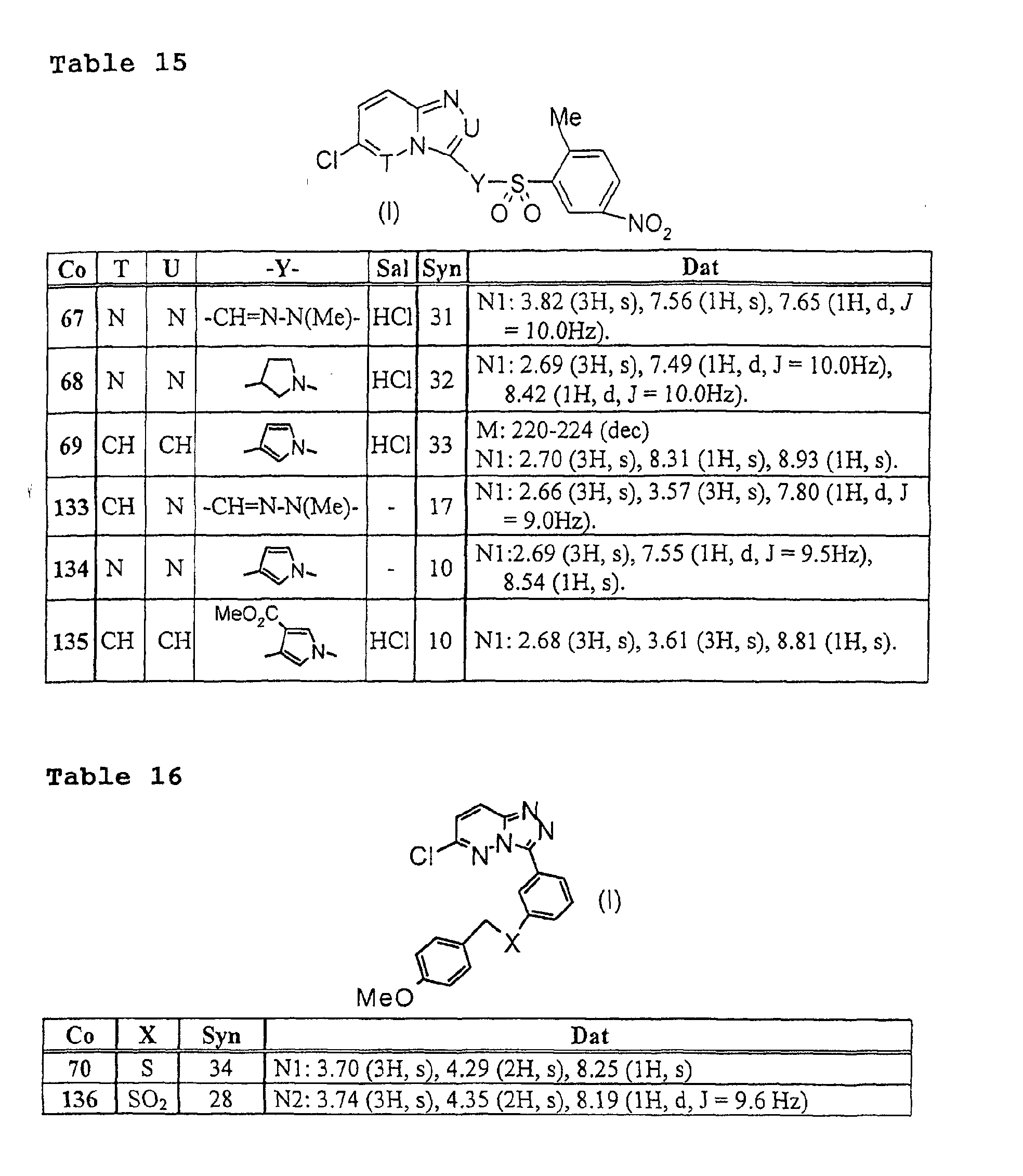
- Tables 1 ⁇ 3 show starting compounds which were used in EXAMPLES, and Tables 4 ⁇ 19 show structural formulas as well as physicochemical properties of the compounds of the present invention. Moreover, the compounds of the present invention with structural formulas shown in Tables 17 - 19 can be easily produced in the same manner as in the EXAMPLES mentioned hereinafteror in accordance with the Synthesis Methods mentioned hereinabove, or by applying thereto some modifications which are obvious to those skilled in the art.
- Rco starting compounds number
- Co compounds number of the present invention
- Str structural formula
- Sal salt
- Syn synthesis method (a following number represents a number of an EXAMPLE described hereinbelow, indicating that the compound was synthesized using the method described in the EXAMPLE or a similar method.)
- Dat physicochemical properties (wherein; F: FAB-MS (M+H) + ; FN: FAB-MS (M-H) - ; E: EI-MS; M: melting point [°C]; N1: characteristic peaks ⁇ ppm of NMR (DMSO-d6, TMS internal standard); N2: characteristic peaks ⁇ ppm of NMR (CDCl3, TMS internal standard);
- HPLC retention time [min] of compound in HPLC assay ⁇ HPLC conditions; column:Wakosil-II 5C18AR, 4.6 x 30 min, detection wavelength: 254 nm, column temperature: 35°C, flow rate: 1.0 ml/min,
- a number preceding a substituent represents a substitution position.
- “4-OMe” means that a methoxy group is substituted at 4-position.
- Compound b1 Compound a1, phenylboronic acid, sodium carbonate, and tetrakis(triphenylphosphine) palladium in a mixture of water and dimethoxyethane were refluxed for 5 hours. After the solution was allowed to cool, water and brine were added and extracted with chloroform. The combined organic layer was concentrated under reduced pressure. The residue was purified with silica gel column chromatography to give Compound b1.
- Compound h1 A mixture of Compound a1, ethanol and hydrazine monohydrate was heated under reflux for 2 days. The reaction mixture was concentrated under reduced pressure, diluted with chloroform and washed with water. The organic layer was dried over anhydrous magnesium sulfate and concentrated under reduced pressure. The obtained residue was purified with silica gel column chromatography to give Compound h1.
- Compound p1 A solution of Compound n1 in acetic acid was stirred at 100°C for 4 hours. The reaction mixture was concentrated under reduced pressure and washed with water to give Compound p1.
- Compound q1 A solution of Compound n3 in acetic acid was refluxed for 2 days. The reaction mixture was concentrated under reduced pressure, the residue was dissolved in ethanol. 4M Hydrogen chloride/ethyl acetate was added to the solution and the obtained precipitates were collected. The obtained solid was dissolved in methanol and ozone gas was introduced to the solution at -78°C for 1 hour. Then, dimethyl sulfide was added and the reaction mixture was stirred at room temperature for 10 hours. The reaction mixture was concentrated and purified with silica gel column chromatography to give Compound q1.
- Compound r1 A solution of Compound n5 in acetic acid was heated at 100°C for 18 hours. After the reaction mixture was concentrated under reduced pressure and diluted with ethyl acetate, water and ethyl acetate were added. The separated organic layer was dried over anhydrous sodium sulfate and concentrated under reduced pressure. The residue was recrystallized from ethanol and then dissolved in methanol. After ozone gas was introduced to the reaction solution at -78°C for 1 hour, dimethyl sulfide was added, followed by stirring at room temperature for 1 hour. The resulting precipitate was collected to give Compound r1.
- Compound t1 A solution of Compound s1 in DMSO-diethyl ether and tosylmehylisocyanide was slowly added to a suspension of 60% sodium hydride in diethyl ether at room temperature. After the reaction solution was stirred for 1 hour, it was concentrated under reduced pressure and the residue was washed with water and ether to give Compound t1.
- EXAMPLE 4 A mixture of (2-methyl-5-nitrophenyl)thiourea (350mg), Compound g2 (430mg) and ethanol (10ml) was refluxed for 2 hours. After the mixture was allowed to cool, ethanol (5ml) was added and insoluble materials were collected. The obtained solids were recrystallized from methanol to give Compound 33 (181mg). In a similar manner, Compounds 39, 40 and 45 were obtained.
- EXAMPLE 5 A mixture of Compound f1 (2.01g), hydrazine monohydrate (5.0g) and ethanol (20ml) was refluxed for 15 hours. The reaction mixture was concentrated. After dilution with ethyl acetate, the mixture was washed with brine. The organic layer was dried over anhydrous magnesium sulfate and concentrated under reduced pressure to give solids of 1-(6-bromoimidazo[1,2-a]pyridin-3-yl)ethylidenehydrazine. Pyridine (20ml) and 5-nitro-2-methylbenzenesulfonylchloride (2.4g) were added to the obtained solids at room temperature. The mixture was stirred for 1 hour, and concentrated under reduced pressure.
- EXAMPLE 6 A mixture of Compound i1 (390mg), Compound g1 (590mg), ethanol (5ml) and methanol (3ml) was refluxed for 24 hours. The reaction mixture was concentrated. Ethanol was added to the obtained foamy residue and resulting insoluble materials were filtered off and the filtrate was concentrated. The residue was crystallized from ethanol and ethyl acetate and then recrystallized from ethanol and ether. In order to remove impurities with high crystallinity, the obtained solids were dissolved in methanol (50ml) and sodium borohydride (100mg) was added to the solution at room temperature. The reaction mixture was stirred for 15 minutes and concentrated under reduced pressure.
- EXAMPLE 7 Compound 32 (500mg) and methyl iodide (198mg) were added subsequently to a suspension of 60% sodium hydride (50mg) in DMF (10ml). After stirring at room temperature for 10 minutes, the reaction mixture was diluted with ethyl acetate and washed with water and brine. The organic layer was dried over anhydrous magnesium sulfate and concentrated under reduced pressure. The residue was purified with silica gel column chromatography (eluent: chloroform). The obtained solids were washed with hot methanol to give Compound 36 (230mg). In a similar manner, Compounds 42 ⁇ 44 were obtained.
- EXAMPLE 9 3-Nitrophenyl acetate (375mg), 1-hydroxybenzotriazole (280mg) and EDCI hydrochloride (397mg) were added to a solution of Compound c1 (698mg) in DMF (20ml) and the mixture was stirred at room temperature for 16 hours. Water was added to this reaction mixture and solid was collected and washed with water and diethyl ether. The obtained solid was recrystallized from chloroform to give Compound 38 as a 0.2 hydrate (93mg).
- EXAMPLE 12 A suspension of Raney nickel in ethanol (20ml) and concentrated aqueous ammonia (5ml) were added to a solution of Compound w1 (450mg) in methanol (20ml) and THF (20ml) and the mixture was stirred in hydrogen atmosphere at 1 atm for 9 hours. After unsoluble materials were filtered, the filtrate was concentrated. The obtained residue was dissolved in pyridine (20ml), 2-methyl-5-nitrobenzenesulfonyl chloride (400mg) was added to it, and the reaction mixture was stirred at room temperature overnight and concentrated. Chloroform and saturated aqueous sodium hydrogencarbonate were added and the separated organic layer was dried over anhydrous sodium sulfate and concentrated.
- EXAMPLE 15 Methanol (30ml) and 10M aqueous sodium hydroxide (4.0ml) were added to Compound 50 (1.1g), and the mixture was stirred for 18 hours. The precipitated solid was collected and washed with ethanol to give Compound 51 (260mg).
- EXAMPLE 16 Methanol (10ml) and 4M hydrogen chloride/ethyl acetate (5.0ml) were added to Compound 51 (700mg), and the obtained precipitates were filtered. THF (5.0ml) and CDI (330mg) were added to this. The reaction mixture was stirred at 70°C for 1 hour, and then concentrated aqueous ammonia (1.0ml) was added at room temperature. The resulting mixture was concentrated, washed with water, and dissolved in methanol (10ml). 4M Hydrogen chloride/ethyl acetate (1.0ml) was added to the solution and the resulting solution was concentrated under reduced pressure. The obtained residue was washed with ethanol to give Compound 52 (190mg).
- EXAMPLE 17 Potassium carbonate (410mg) and methyl iodide (230mg) were added to a solution of Compound 85 (670mg) in DMF (3.0ml) and the mixture was stirred for 2 hours. The resulting mixture was poured into water, and the obtained precipitates were collected and dissolved in methanol (10ml). 4M Hydrogen chloride/ethyl acetate (1.0ml) was added to it, and the reaction solution was concentrated under reduced pressure. The obtained residue was washed with ethanol to give Compound 53 (64mg).
- EXAMPLE 18 Phosphorus oxychloride (5.0ml) was added to a free form of Compound 52 (300mg) and the mixture was stirred at 60°C for 2 hours. After the reaction mixture was concentrated, 4M hydrogen chloride/ethyl acetate (1.0ml) was added and the solution was concentrated under reduced pressure. The obtained residue was recrystallized from ethanol to give Compound 54 (118mg).
- EXAMPLE 19 Trimethylsiloxy potassium (130mg) was added to a solution of Compound 83 (300mg) in THF (10ml) and the mixture was stirred for 12 hours. 4M Hydrogen chloride/ethyl acetate (1.0ml) was added to the reaction solution and the reaction solution was concentrated under reduced pressure. The obtained residue was washed with methanol and water to give Compound 55 (250mg).
- EXAMPLE 20 Methylhydrazine (80mg) was added to a solution of 6-chloroimidazo[1,2-a]pyridine-3-carboaldehyde (400mg) in ethanol (5.0ml) and the mixture heated at 60°C for 2 hours. The reaction solution was concentrated under reduced pressure, the obtained residue was dissolved in pyridine (5.0ml), 2-methyl-5-sulfamoylbenzenesulfonyl chloride (590mg) was added and the reaction solution was stirred for 2 hours. The reaction solution was concentrated under reduced pressure. 4M Hydrogen chloride/ethyl acetate (1.0ml) was added to the obtained residue. Then, the reaction solution was concentrated under reduced pressure, and washed with ethanol to give Compound 56 (740mg).
- EXAMPLE 21 2-Bromomalonoaldehyd (1.4g) was added to a solution of 2-amino-5-fluoropyridine (500mg) in ethanol (5.0ml) and the mixture was refluxed for 2 hours. The reaction mixture was concentrated under reduced pressure, and the obtained residue was washed with ethyl acetate. Then, ethanol (10ml) and methylhydrazine (140mg) were added, and the resulting mixture was heated at 60°C for 2 hours and concentrated under reduced pressure. The obtained residue was dissolved in pyridine (5.0ml). 2-Methyl-5-nitrobenzenesulfonyl chloride (800mg) was added to the solution.
- EXAMPLE 22 Methanol (10ml) and 4M hydrogen chloride/ethyl acetate (1.0ml) were added to Compound 100 (220mg) and the obtained precipitates were collected. THF (5.0ml) and CDI (330mg) were added to this and the mixture was stirred for 3 hours. Then, t-butyl 2-aminoethylcarbamate (160mg) was added at room temperature. After the reaction mixture was concentrated, it was dissolved in methanol (2.0ml). 4M Hydrogen chloride/ethyl acetate (2.0ml) was added to it and stirred for 0.5 hour. The precipitates were collected and washed with methanol and ether to give Compound 58 (230mg).
- EXAMPLE 23 Concentrated aqueous ammonia (1.0ml) was added to a solution of a free form of Compound 108 (150mg) in THF (5.0ml), and the mixture was stirred at 60°C for 7 hours. Then, the reaction mixture was concentrated under reduced pressure. The obtained residue was washed with water and dissolved in methanol (2.0ml). 4M Hydrogen chloride/ethyl acetate (1.0ml) was added to it and the solution was concentrated under reduced pressure. The obtained residue was washed with methanol to give Compound 59 (69mg).
- EXAMPLE 24 2,2,2-Trifluoroethanol (50mg) and 60% sodium hydride (20mg) were added to a solution of Compound 108 (130mg) in THF (5.0ml) and the mixture was stirred for 2 hours. Then, the reaction mixture was concentrated under reduced pressure. After the obtained residue was washed with water, it was dissolved in methanol (2.0ml) and 4M hydrogen chloride/ethyl acetate (1.0ml) was added to it. The solution was concentrated under reduced pressure and the obtained residue was washed with methanol to give Compound 60 (61mg).
- EXAMPLE 25 Compound x1 (808mg) and 2-fluoro-5-nitrotoluene (430mg) were added to a suspension of 60% sodium hydride (110mg) in DMF (20ml). After stirring at 70°C for 6 hours, 2-fluoro-5-nitrotoluene (400mg) was added and the mixture was stirred at 90°C for 18 hours. The reaction mixture was concentrated and saturated aqueous sodium hydrogencarbonate and ethyl acetate were added to the residue. The organic layer was separated, washed with saturated aqueous sodium hydrogencarbonate and brine, dried over anhydrous sodium sulfate and concentrated. The residue was purified with silica gel column chromatography (eluent: chloroform).
- the reaction mixture was refluxed for 1 hour. After being allowed to cool, the reaction was quenched with methanol and water under ice bath cooling. The reaction solution was concentrated. Methanol (50ml) and 1M hydrochloric acid (20ml) were added to the obtained residue and the mixture was heated at 80°C. After being allowed to cool, the solvent was evaporated and the residue was dissolved in methanol and chloroform. 4M Hydrogen chloride/ethyl acetate (75 ⁇ l) was added to it, and the solution was concentrated. The obtained residue was recrystallized from ethanol to give Compound 62 (100mg).
- EXAMPLE 27 An aqueous solution (5ml) of sodium nitrile (930mg) was added in dropwise to a suspension of 2-methyl-5-nitroaniline (2g) in 6M hydrochloric acid at below 0°C. After stirring at the same temperature for 30 minutes, an aqueous solution (10ml) of sodium tetrafluoroborate (2g) was added to it. After stirring with ice bath cooling for 30 minutes, the obtained diazonium salts were collected. Compound x1 (1.5g) and the collected diazonium salts were added to a suspension (30ml) of 60% sodium hydride (192mg) in DMSO, followed by stirring for 15 minutes.
- EXAMPLE 30 Potassium carbonate (450mg) and 2-methoxy-5-nitrobenzyl bromide (480mg) were added to a solution of Compound y2 (400mg) in DMF (10ml) and the mixture was stirred at room temperature for 5.5 hours. The reaction solution was diluted with chloroform, washed with water and dried over anhydrous magnesium sulfate. The obtained organic layer was concentrated and crystallized from diethyl ether-hexane to give Compound 66 (558mg).
- EXAMPLE 32 Compound p2 (250mg) was added to trifluoroacetic acid (1.5ml) and the mixture was stirred for 2 hours, followed by concentration under reduced pressure and azeotrope with ethanol. THF (3.0ml) and 60% sodium hydride (80mg) were added to this and the reaction mixture was stirred for 15 minutes. Then, 2-methyl-5-nitrobenzenesulfonyl chloride (240mg) was added and the reaction solution was stirred for 4 hours, concentrated under reduced pressure, washed with water, and dissolved in methanol (2.0ml). 4M Hydrogen chloride/ethyl acetate (1.0ml) was added and the solution was concentrated under reduced pressure. The residue was washed with methanol to give Compound 68 (140mg).
- EXAMPLE 33 Potassium hydroxide (1.6g) was added to a solution of Compound t1 (800mg) in water-methanol (5.0 - 5.0ml) and the mixture was stirred at 90°C for 3 hours. 1M hydrochloric acid was added to neutralize the reaction solution. Then, the reaction solution was concentrated under reduced pressure. Ethanol was added to the obtained residue, followed by filtration and concentration of filtrate under reduced pressure, wherein this sequence of operations were repeated 3 times. The obtained residue was dissolved in ethanol amine (5.0ml), stirred at 200°C for 1 hour and then poured into water. The resulting precipitates were collected.
Landscapes
- Health & Medical Sciences (AREA)
- Chemical & Material Sciences (AREA)
- Organic Chemistry (AREA)
- Nuclear Medicine, Radiotherapy & Molecular Imaging (AREA)
- Pharmacology & Pharmacy (AREA)
- Chemical Kinetics & Catalysis (AREA)
- General Chemical & Material Sciences (AREA)
- Medicinal Chemistry (AREA)
- Veterinary Medicine (AREA)
- Public Health (AREA)
- General Health & Medical Sciences (AREA)
- Life Sciences & Earth Sciences (AREA)
- Animal Behavior & Ethology (AREA)
- Bioinformatics & Cheminformatics (AREA)
- Engineering & Computer Science (AREA)
- Urology & Nephrology (AREA)
- Diabetes (AREA)
- Cardiology (AREA)
- Hematology (AREA)
- Heart & Thoracic Surgery (AREA)
- Immunology (AREA)
- Rheumatology (AREA)
- Endocrinology (AREA)
- Emergency Medicine (AREA)
- Obesity (AREA)
- Pain & Pain Management (AREA)
- Vascular Medicine (AREA)
- Ophthalmology & Optometry (AREA)
- Oncology (AREA)
- Dermatology (AREA)
- Physical Education & Sports Medicine (AREA)
- Pharmaceuticals Containing Other Organic And Inorganic Compounds (AREA)
- Nitrogen Condensed Heterocyclic Rings (AREA)
- Solid-Sorbent Or Filter-Aiding Compositions (AREA)
Abstract
Description
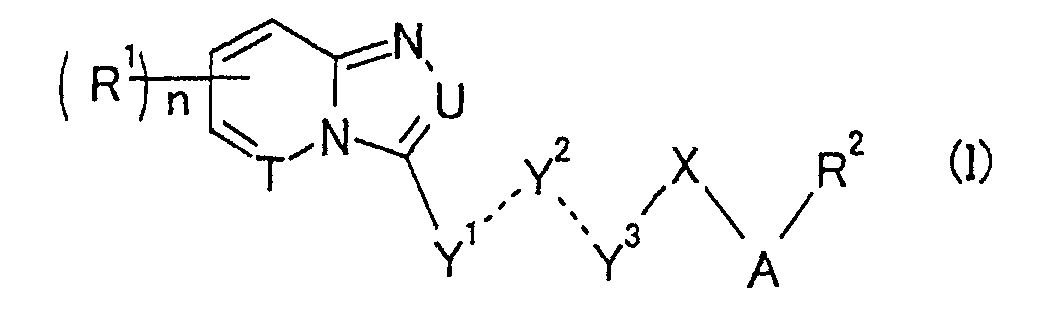
in Y1•••Y2•••Y3,
- (1) X represents a group other than NR7 when Y1•••Y2•••Y3 is bonded with X via N atom or Y1 and Y3 are bonded with each other via 2 or 3 atoms and combined with the adjacent Y2 to form a 1,3,5-triazine or 1,3,4-oxadiazole ring; and
- (2) X represents SO, SO2, CO or a methylene group when Y1 and Y3 are bonded with each other via 2 or 3 atoms and combined with the adjacent Y2 to form a pyrimidine ring.












Claims (13)
- An imidazopyridine derivative represented by formula (I) or salts thereof:wherein
 with the proviso thatR1 represents -H, -a lower alkyl, -a lower alkenyl, -a lower alkynyl, -a cycloalkyl, -a cycloalkenyl, -a halogen, -NO2, -CN, -a halogenated lower alkyl, -ORa, -SRa,-SO2Ra, -SORa, -CO2Ra, -CO-Ra, -an aryl, -a lower alkylene-an aryl, -O-a lower alkylene-an aryl, -CONRaRb, -CO-(a nitrogen-containing saturated heterocyclic group which may be substituted by a lower alkyl group), - SO2NRaRb, -SO2-(a nitrogen-containing saturated heterocyclic group which may be substituted by a lower alkyl group), -SO3H, -(a nitrogen-containing saturated heterocyclic group which may be substituted by a lower alkyl group),-NRaRb, -CONRa-a lower alkylene-ORb, -CONRa-a lower alkylene-NRbRc, -CONRa-a lower alkylene-(a nitrogen-containing saturated heterocyclic group which may be substituted by a lower alkyl group), -O-a lower alkylene-ORa, -O-a lower alkylene-O-a lower alkylene-ORa, - O-a lower alkylene-NRaRb, -O-a lower alkylene-(a nitrogen-containing saturated heterocyclic group which may be substituted by a lower alkyl group), -O-a lower alkylene-O-a lower alkylene-NRaRb, -O-a lower alkylene-O-a lower alkylene-(a nitrogen-containing saturated heterocyclic group which may be substituted by a lower alkyl group), -O-a lower alkylene-NRc-a lower alkylene-NRaRb, -O-a lower alkylene-NRc-a lower alkylene-(a nitrogen-containing saturated heterocyclic group which may be substituted by a lower alkyl group),-OCO-NRaRb, -OCO-(a nitrogen-containing saturated heterocyclic group which may be substituted by a lower alkyl group), -NRa-SO2Rb, -NRc-a lower alkylene-NRaRb, -NRc-a lower alkylene-(a nitrogen-containing saturated heterocyclic group which may be substituted by a lower alkyl group), -N(a lower alkylene-NRaRb)2, -N(a lower alkylene-(a nitrogen-containing saturated heterocyclic group which may be substituted by a lower alkyl group))2, -CONRa-ORb, -NRa-CORb, -NRa-CO-NRbRc, -NRa-CO-(a nitrogen-containing saturated heterocyclic group which may be substituted by a lower alkyl group), or -OCORa;Ra, Rb and Rc which may be the same or different, represent -H, -a lower alkyl or -an aryl;T represents N or CR1a;U represents N or CR3;n represents an integer, 1, 2 or 3;
in Y1•••Y2•••Y3,i) •••represents a single bond on one side and a single or double bond on the other side, Y1 represents CR5 or CR5aR5b, Y2 represents N, NH, CR4a or CR4bR4c, and Y3 represents NR6, CR4d or CR4eR4f, whereas Y3 represents NR6 when Y2 represents CR4a or CR4bR4c,or, ii) Y1 and Y3 may be bonded with each other via 2 or 3 atoms and combined with the adjacent Y2 to form a B ring, wherein the B ring represents a 5- or 6-membered monocyclic heteroaryl ring having 1 to 4 hetero atoms selected from the group consisting of N, S, and O, a nitrogen-containing saturated heterocyclic ring or an aryl ring, whereas said B ring may be substituted by one to two R4s;X represents S, SO or SO2, whereas X may also represent CO, NR7 or a methylene group when Y1 and Y3 are bonded with each other via 2 or 3 atoms and combined with the adjacent Y2 to form the B ring;"A" represents a linkage, a lower alkylene, a lower alkenylene or a lower alkynylene;R2 represents -a lower alkyl which may have one or more subsituents, -a lower alkenyl which may have one or more subsituents, -a lower alkynyl which may have one or more subsituents, -a cycloalkyl which may have one or more subsituents, -a cycloalkenyl which may have one or more subsituents, -N=O, -an aryl which may have one or more subsituents, or -a heteroaryl which may have one or more subsituents;R1a, R3, R4a, R4b, R4c, R4d, R4e, R4f, R5a and R5b, which may be the same or different, represent a group defined by R1, whereas R4b and R4c, R4e and R4f, or R5a and R5b may be combined with each other to form an oxo group (=O);R4 represents a group defined by R1, or an oxo group (=O);R5, R6 and R7, which may be the same or different, represent -H, -a lower alkyl which may have one or more subsituents, -a lower alkenyl which may have one or more subsituents,-a lower alkynyl which may have one or more subsituents, with proviso that when X is NR7 and R2 is an aryl having a substituent at the ortho-position, R7 may be combined with the substituent at the ortho-position to form a C2-3 lower alkylene chain, and with the aryl of R2 to form a 5- to 7-membered nitrogen-containing heterocyclic ring fused with a benzene ring(s) of the aryl group;(1) X represents a group other than NR7 when Y1•••Y2•••Y3 is bonded with X via N atom or Y1 and Y3 are bonded with each other via 2 or 3 atoms and combined with the adjacent Y2 to form a 1,3,5-triazine or 1,3,4-oxadiazole ring; and(2) X represents SO, SO2, CO or a methylene group when Y1 and Y3 are bonded with each other via 2 or 3 atoms and combined with the adjacent Y2 to form a primidine ring. - The imidazopyridine derivative or a salt thereof according to claim 1, wherein R1 represents -H, -a lower alkyl, -a lower alkenyl, -a lower alkynyl, -a cycloalkyl, -acycloalkenyl, - a halogen, -NO2, -CN, -a halogenated lower alkyl, -OH, -O-a lower alkyl, -O-an aryl, -SH, -S-a lower alkyl, -SO2-a lower alkyl, -SO-a lower alkyl, -COOH, -COO-a lower alkyl, -CO-a lower alkyl, -an aryl, -CO-an aryl, -a lower alkylene-an aryl, -O-a lower alkylene-an aryl, -CONH2,-SO2NH2, -SO3H, -a nitrogen-containing saturated heterocyclic group, -NH2, -NH-a lower alkyl or -N(a lower alkyl)2; T represents CR1a; U represents CR3; in Y1•••Y2•••Y3, i) ••• represents a single bond on one side and a single or double bond on the other side, Y1 represents CR5 or CHR5a, Y2 represents N, CR4a or CHR4b, and Y3 represents NR7, CR4d or CHR4e, or, ii) Y1 and Y3 may be bonded with each other via 2 or 3 atoms and combined with the adjacent Y2 to form a B ring, wherein the B ring represents a 5- or 6-membered monocyclic heteroaryl ring having 1 to 4 hetero atoms selected from the group consisting of N, S, and O, or an aryl, whereas said B ring may be substituted by one to two R4s; R2 represents-H, -a halogenated loweralkyl, -N=O, -an aryl which may have one or more subsituents, or -a heteroaryl which may have one or more subsituents; R1a, R3, R4, R4a, R4b, R4d and R4e, which may be the same or different, represent a group defined by R1; and R5, R5a, R6 and R7, which may be the same or different, represents -H, -a lower alkyl, with proviso that when X is NR7 and R2 is an aryl having a substituent at the ortho-position, R7 may be combined with the substituent at the ortho-position to form a C2-3 lower alkylene chain, and with the aryl of R2 to form a 5- to 7-membered nitrogen-containing heterocyclic ring fused with a benzene ring(s) of the aryl group.
- The imidazopyridine derivative or a salt thereof according to claim 1, wherein n represents 1; and R1 represents -a lower alkyl, a halogen, -CN, -NO2, -a halogenated lower alkyl, -ORa, -O-a lower alkylene-an aryl, -COORa, -CONRa-a lower alkylene-ORb, -CONRaRb, -CO-(a nitrogen-containing saturated heterocyclic group which may be substituted by a lower alkyl group), -CONRa-a lower alkylene-NRbRc, -CONRa-a lower alkylene-(a nitrogen-containing saturated heterocyclic group which may be substituted by a lower alkyl group), or-an aryl.
- The imidazopyridine derivative or a salt thereof according to claim 1, wherein A represents a linkage and R2 represents -an aryl which may have one or more substituents or -a heteroaryl which may have one or more substituents.
- The imidazopyridine derivative or a salt thereof according to claim 4, wherein R2 represents a phenyl which may have one or more substituents selected from the group consisting of -(a lower alkyl which may be substituted by -OH), -a lower alkenyl, -a halogen,-NO2, -CN, -a halogenated lower alkyl, -O-a halogenated lower alkyl, -OH, -O-a lower alkyl,-CO-a lower alkyl, -SO2-a lower alkyl, -COOH, -COO-a lower alkyl, -CONH2, -SO2NH2, -CO-an aryl, -SO2-an aryl, -NH2, -NH-a lower alkyl, -N(a lower alkyl)2, -(a nitrogen-containing saturated heterocyclic group which may be substituted by a lower alkyl group), -NHCO-a lower alkyl, -an aryl which may be substituted by 1 to 5 substituents selected from Group E, and -a heteroaryl which may be substituted by 1 to 5 substituents selected from Group E, whereas Group E consists of -a lower alkyl, -a lower alkenyl, -a lower alkynyl, -a halogen,-NO2, -CN, -OH, -O-a lower alkyl, -O-a halogenated lower alkyl, -SH, -S-a lower alkyl, -SO2-a lower alkyl, -SO-a lower alkyl, -COOH, -COO-a lower alkyl, -CO-a lower alkyl, -CONH2,-NH2, -NH-a lower alkyl, -N(a lower alkyl)2, -(a nitrogen-containing saturated heterocyclic group which may be substituted by a lower alkyl group), -an aryl, -a heteroaryl, -a cycloalkyl and -a cycloalkenyl.
- The imidazopyridine derivative or a salt thereof according to claim I, wherein X represents SO2.
- The imidazopyridine derivative or a salt thereof according to claim 1, wherein i) Y1•• Y2•••Y3 represents CR5 =N-NR6, CR5aR5b-NH-NR6, CR5aR5b-CR4bR4c-NR6 or ii) Y1 and Y3 of Y1•••Y2•••Y3 are bonded with each other via 2 or 3 atoms and combined with the adjacent Y2 to form a 5- or 6-membered monocyclic heteroaryl ring, wherein said 5- or 6-membered monocyclic heteroaryl ring may be substituted by one to two R4s.
- The imidazopyridine derivative or a salt thereof according to claim 7, wherein Y1••• Y2•••Y3 represents CR5 =N-NR6; R5 represents -H or a lower alkyl; and R6 represents -H, -a lower alkyl or -a lower alkenyl, wherein -a lower alkyl or -a lower alkenyl may be substituted by one or more substituents selected from a group consisting of -O-a lower alkyl, -S-a lower alkyl, -SO2-a lower alkyl, -SO-a lower alkyl, -COOH, -COO-a lower alkyl, -CO-a lower alkyl, -CONH2, -NH2, -NH-a lower alkyl, -N(a lower alkyl)2, -(a nitrogen-containing saturated heterocyclic group which may be substituted by a lower alkyl group) and -an aryl.
- The imidazopyridine derivative or a salt thereof according to claim 7, wherein Y1 and Y3 of Y1•••Y2•••Y3 are bonded with each other via 2 or 3 atoms and combined with the adjacent Y2 to form a 5-membered monocyclic heteroaryl ring which may be substituted by one to two R4s selected from the group consisting of -a lower alkyl, -COOH, -COO-a lower alkyl, -CO-a lower alkyl and -SO3H.
- The imidazopyridine derivative or a salt thereof according to claim 1, which is selected from the group consisting of 3-(6-bromo-2-methylimidazo[1,2-a]pyridin-3-yl)-1H-pyrazol-1-yl 2-methyl-5-nitrophenyl sulfone; 3-(6-bromoimidazo[1,2-a]pyridin-3-yl)-1H-pyrazol-1-yl 2-methyl-5-nitrophenyl sulfone; 2'-[(6-bromoimidazo[1,2-a]pyridin-3-yl)methylidene]-1',2-dimethyl-5-nitrobenzenesulfonohydrazide; 2'-[(6-bromoimidazo[1,2-a]pyridin-3-yl)methylidene]-2-ethyl-1'-methyl-5-nitrobenzenesulfonohydrazide; 3-({2-[(6-bromoimidazo[1,2-a]pyridin-3-yl)methylidene]-1-methylhydrazino}sulfonyl)-4-methylbenzonitrile; 2'-[(6-fluoroimidazo[1,2-a]pyridin-3-yl)methylidene]-1',2-dimethyl-5-nitrobenzenesulfonohydrazide; 2-amino-2'-[(6-chloroimidazo[1,2-a]pyridin-3-yl)methylidene]-1'-methyl-5-nitrobenzenesulfonohydrazide; 2'-[(6-chloroimidazo[1,2-a]pyridin-3-yl)methylidene]-1'-methyl-5-nitro-2-(2,2,2-trifluoroethoxy)benzenesulfonohydrazide; 6-chloro-3-[2-(2-methyl-5-nitrobenzenesulfonyl)thiazol-4-yl]imidazo[1,2-a]pyridine; 6-bromo-3-{[(2-methyl-5-nitrobenzenesulfonyl)(2-morpholinoethyl)hydrazono]methyl}imidazo[1,2-a]pyridine; 6-chloro-3-{[(methyl)(2-methyl-5-nitrobenzenesulfonyl)hydrazono]methyl}imidazo[1,2-a]pyridine; 3-{[(methyl)(2-methyl-5-nitrobenzenesulfonyl)hydrazono]methyl}imidazo[1,2-a]pyridine-6-carbonitrile; 5-cyano-2'-[(6-fluoroimidazo[1,2-a]pyridin-3-yl)methylidene]-1',2-dimethylbenzenesulfonohydrazide; 5-cyano-2'-[(6-cyanoimidazo[1,2-a]pyridin-3-yl)methylidene]-1',2-dimethylbenzenesulfonohydrazide; 1'2-dimethyl-2'-[(6-methylimidazo[1,2-a]pyridin-3-yl)methylidene]-5-nitrobenzenesulfonohydrazide; 2'-[(6-chloroimidazo[1,2-a]pyridin-3-yl)methylidene]-2-(1H-imidazol-1-yl)-1'-methyl-5-nitrobenzenesulfonohydrazide; 2'-[(6-chloroimidazo[1,2-a]pyridin-3-yl)methylidene]-2-dimethylamino-1'-methyl-5-nitrobenzenesulfonohydrazide; and salts thereof.
- A pharmaceutical composition comprising the imidazopyridine derivative or a salt thereof according to any one of claims 1 to 10 and a pharmaceutically acceptable carrier.
- The pharmaceutical composition according to claim 11, wherein the pharmaceutical composition is a phosphatidylinositol 3-kinase inhibitor.
- The pharmaceutical composition according to claim 11, wherein the pharmaceutical composition is an antitumor agent
Applications Claiming Priority (3)
| Application Number | Priority Date | Filing Date | Title |
|---|---|---|---|
| JP2000128295 | 2000-04-27 | ||
| JP2000128295 | 2000-04-27 | ||
| PCT/JP2001/003649 WO2001083481A1 (en) | 2000-04-27 | 2001-04-26 | Imidazopyridine derivatives |
Publications (4)
| Publication Number | Publication Date |
|---|---|
| EP1277754A1 true EP1277754A1 (en) | 2003-01-22 |
| EP1277754A4 EP1277754A4 (en) | 2003-06-04 |
| EP1277754B1 EP1277754B1 (en) | 2005-07-27 |
| EP1277754B8 EP1277754B8 (en) | 2005-09-28 |
Family
ID=18637756
Family Applications (1)
| Application Number | Title | Priority Date | Filing Date |
|---|---|---|---|
| EP01925980A Expired - Lifetime EP1277754B8 (en) | 2000-04-27 | 2001-04-26 | Imidazopyridine derivatives |
Country Status (11)
| Country | Link |
|---|---|
| EP (1) | EP1277754B8 (en) |
| JP (1) | JP3729343B2 (en) |
| KR (1) | KR100830859B1 (en) |
| CN (2) | CN1308327C (en) |
| AT (1) | ATE300540T1 (en) |
| AU (1) | AU2001252609A1 (en) |
| CA (1) | CA2407573C (en) |
| DE (1) | DE60112272T2 (en) |
| DK (1) | DK1277754T3 (en) |
| ES (1) | ES2244613T3 (en) |
| WO (1) | WO2001083481A1 (en) |
Cited By (48)
| Publication number | Priority date | Publication date | Assignee | Title |
|---|---|---|---|---|
| WO2004017950A3 (en) * | 2002-08-22 | 2004-05-13 | Piramed Ltd | Phosphadidylinositol 3,5-biphosphate inhibitors as anti-viral agents |
| WO2005023800A1 (en) * | 2003-09-04 | 2005-03-17 | Warner-Lambert Company Llc | Halo substituted benzo`b! thiophenes with pi3k inhibitory activity as therapeutic agents |
| WO2006018735A3 (en) * | 2004-08-18 | 2006-06-22 | Pharmacia & Upjohn Co Llc | Triazolopyridine compounds |
| US7173033B2 (en) | 2002-03-01 | 2007-02-06 | Astellas Pharma Inc. | Nitrogen-containing heterocyclic compound |
| WO2008052733A1 (en) * | 2006-10-30 | 2008-05-08 | Novartis Ag | Imidazopyridazines as pi3k lipid kinase inhibitors |
| EP1804803A4 (en) * | 2004-10-28 | 2008-07-30 | Irm Llc | COMPOUNDS AND COMPOSITIONS AS MODULATORS OF THE HEDGEHOG SIGNALING PATH |
| EP1972631A1 (en) * | 2007-03-23 | 2008-09-24 | Novartis AG | Imidazopyridazines as PI3K lipid kinase inhibitors |
| WO2008130951A1 (en) * | 2007-04-17 | 2008-10-30 | Bristol-Myers Squibb Company | Fused heterocyclic 11-beta-hydroxysteroid dehydrogenase type i inhibitors |
| WO2008138834A1 (en) * | 2007-05-09 | 2008-11-20 | Novartis Ag | Substituted imidazopyridazines as pi3k lipid kinase inhibitors |
| WO2009021990A1 (en) * | 2007-08-14 | 2009-02-19 | Bayer Schering Pharma Aktiengesellschaft | Fused imidazoles for cancer treatment |
| EP2062893A1 (en) * | 2007-10-18 | 2009-05-27 | Bayer Schering Pharma AG | Fused imidazoles for cancer treatment |
| WO2010007099A1 (en) * | 2008-07-15 | 2010-01-21 | Cellzome Limited | 2-aminoimidazo[1,2-b]pyridazine derivatives as pi3k inhibitors |
| WO2010022081A1 (en) * | 2008-08-19 | 2010-02-25 | Array Biopharma Inc. | Triazolopyridine compounds as pim kinase inhibitors |
| WO2011055320A1 (en) * | 2009-11-06 | 2011-05-12 | Piramal Life Sciences Limited | Imidazopyridine derivatives |
| US8030327B2 (en) | 2004-11-08 | 2011-10-04 | Mds K.K. | Fused imidazole derivative |
| US8088771B2 (en) | 2008-07-28 | 2012-01-03 | Gilead Sciences, Inc. | Cycloalkylidene and heterocycloalkylidene inhibitor compounds |
| US8124764B2 (en) | 2008-07-14 | 2012-02-28 | Gilead Sciences, Inc. | Fused heterocyclyc inhibitor compounds |
| US8134000B2 (en) | 2008-07-14 | 2012-03-13 | Gilead Sciences, Inc. | Imidazolyl pyrimidine inhibitor compounds |
| WO2012068204A1 (en) * | 2010-11-18 | 2012-05-24 | Janssen Pharmaceutica Nv | Fused heteroaryl inhibitors of pro-matrix metalloproteinase activation |
| US8258316B2 (en) | 2009-06-08 | 2012-09-04 | Gilead Sciences, Inc. | Alkanoylamino benzamide aniline HDAC inhibitor compounds |
| US8283357B2 (en) | 2009-06-08 | 2012-10-09 | Gilead Sciences, Inc. | Cycloalkylcarbamate benzamide aniline HDAC inhibitor compounds |
| WO2012156379A1 (en) * | 2011-05-13 | 2012-11-22 | Universität Zürich | PIK3/P110α INHIBITORS FOR PREVENTION OF RESTENOSIS BY APPLICATION AS AN IMPLANT COATING |
| US8344018B2 (en) | 2008-07-14 | 2013-01-01 | Gilead Sciences, Inc. | Oxindolyl inhibitor compounds |
| US8481542B2 (en) | 2008-07-18 | 2013-07-09 | Novartis Ag | Pyridazinyl derivatives as smo inhibitors |
| US8536168B2 (en) | 2007-03-15 | 2013-09-17 | Novartis Ag | Benzyl and pyridinyl derivatives as modulators of the hedgehog signaling pathway |
| US8575145B2 (en) | 2008-08-19 | 2013-11-05 | Array Biopharma Inc. | Triazolopyridine compounds as PIM kinase inhibitors |
| US8685967B2 (en) | 2009-04-07 | 2014-04-01 | Merck Sharp & Dohme Corp. | Substituted triazolopyridines and analogs thereof |
| WO2014068104A1 (en) | 2012-11-05 | 2014-05-08 | Bayer Pharma Aktiengesellschaft | Hydroxy-substituted imidazo[1,2-a]pyridinecarboxamides and their use as soluble guanylate cyclase stimulants |
| WO2014068095A1 (en) | 2012-11-05 | 2014-05-08 | Bayer Pharma Aktiengesellschaft | Carboxy-substituted imidazo[1,2-a]pyridinecarboxamides and their use as soluble guanylate cyclase stimulants |
| WO2014068099A1 (en) | 2012-11-05 | 2014-05-08 | Bayer Pharma Aktiengesellschaft | Amino-substituted imidazo[1,2-a]pyridinecarboxamides and their use |
| US8889704B2 (en) | 2011-02-25 | 2014-11-18 | Array Biopharma Inc. | Triazolopyridine compounds as PIM kinase inhibitors |
| US8895550B2 (en) | 2008-08-19 | 2014-11-25 | Array Biopharma Inc. | Triazolopyridine compounds as PIM kinase inhibitors |
| US8987251B2 (en) | 2008-08-19 | 2015-03-24 | Array Biopharma Inc. | Triazolopyridine compounds as PIM kinase inhibitors |
| US9000186B2 (en) | 2011-02-01 | 2015-04-07 | Kyowa Hakko Kirin Co., Ltd. | Ring-fused heterocyclic derivative |
| US9126998B2 (en) | 2012-11-05 | 2015-09-08 | Bayer Pharma AG | Amino-substituted imidazo[1,2-a]pyridinecarboxamides and their use |
| US9145419B2 (en) | 2010-04-28 | 2015-09-29 | Bristol-Myers Squibb Company | Imidazopyridazinyl compounds |
| WO2015165930A1 (en) | 2014-05-02 | 2015-11-05 | Bayer Pharma Aktiengesellschaft | Enantiomers of the n-(2-amino-5-fluoro-2-methylpentyl)-8-[(2,6-difluorobenzyl)oxy]-2-methylimidazo[1,2-a]pyridine-3-carboxamide, as well as of the di- and trifluoro derivatives for the treatment of cardiovascular diseases |
| US9206185B2 (en) | 2011-04-07 | 2015-12-08 | Bayer Intellectual Property Gmbh | Imidazopyridazines as Akt kinase inhibitors |
| EP2927231A4 (en) * | 2012-11-30 | 2016-04-20 | Astellas Pharma Inc | IMIDAZOPYRIDINE COMPOUNDS |
| WO2016087343A1 (en) | 2014-12-02 | 2016-06-09 | Bayer Pharma Aktiengesellschaft | Heteroaryl-substituted imidazo[1,2-a]pyridines and their use |
| US9540366B2 (en) | 2012-07-31 | 2017-01-10 | Kyowa Hakko Kirin Co., Ltd. | Ring-fused heterocyclic compound |
| US9688699B2 (en) | 2014-02-19 | 2017-06-27 | Bayer Pharma Aktiengesellschaft | 3-(pyrimidine-2-yl)imidazo[1,2-a]pyridines |
| US9771360B2 (en) | 2014-03-21 | 2017-09-26 | Bayer Pharma Aktiengesellschaft | Cyano-substituted imidazo[1,2-A]pyridinecarboxamides and their use |
| US9776997B2 (en) | 2013-06-04 | 2017-10-03 | Bayer Pharma Aktiengesellschaft | 3-aryl-substituted imidazo[1,2-A]pyridines and their use |
| WO2018184976A1 (en) | 2017-04-05 | 2018-10-11 | Bayer Pharma Aktiengesellschaft | Substituted imidazo[1,2-a]pyridinecarboxamides and use of same |
| WO2019081353A1 (en) | 2017-10-24 | 2019-05-02 | Bayer Aktiengesellschaft | SUBSTITUTED IMIDAZOPYRIDINAMIDES AND THEIR USE |
| WO2020216669A1 (en) | 2019-04-23 | 2020-10-29 | Bayer Aktiengesellschaft | Phenyl-substituted imidazopyridine amides and use thereof |
| US10947225B2 (en) | 2016-05-11 | 2021-03-16 | Emory University | Phosphotidylinositol 3-kinase inhibitors |
Families Citing this family (77)
| Publication number | Priority date | Publication date | Assignee | Title |
|---|---|---|---|---|
| SE0100567D0 (en) * | 2001-02-20 | 2001-02-20 | Astrazeneca Ab | Compounds |
| WO2003027321A2 (en) * | 2001-09-24 | 2003-04-03 | University Of Aarhus | Methods for diagnosis and treatment of diseases associated with altered expression of neurogranin |
| ES2275933T3 (en) * | 2001-11-30 | 2007-06-16 | Qlt, Inc. | TREATMENT OF NEOVASCULAR OPHTHALMOLOGICAL DISEASES. |
| PT1709019E (en) * | 2004-01-12 | 2007-08-27 | Serono Lab | Thiazole derivatives and use thereof |
| GB0420722D0 (en) | 2004-09-17 | 2004-10-20 | Addex Pharmaceuticals Sa | Novel allosteric modulators |
| US7723336B2 (en) | 2005-09-22 | 2010-05-25 | Bristol-Myers Squibb Company | Fused heterocyclic compounds useful as kinase modulators |
| TWI417095B (en) | 2006-03-15 | 2013-12-01 | Janssen Pharmaceuticals Inc | 1,4-disubstituted 3-cyano-pyridone derivatives and their use as positive allosteric modulators of mglur2-receptors |
| WO2008036272A1 (en) * | 2006-09-18 | 2008-03-27 | Vertex Pharmaceuticals Incorporated | HETEROCYCLIC INHIBITORS OF c-MET AND USES THEREOF |
| CA2670636A1 (en) | 2006-11-27 | 2008-06-05 | H. Lundbeck A/S | Heteroaryl amide derivatives |
| AR064106A1 (en) * | 2006-12-05 | 2009-03-11 | Bayer Schering Pharma Ag | DERIVATIVES OF 2,3-DIHYDROIMIDAZO [1,2-C] SUBSTITUTED QUINAZOLINE USEFUL FOR THE TREATMENT OF HYPER-PROLIFERATIVE DISEASES ASSOCIATED WITH ANGIOGENESIS |
| CN101502484B (en) * | 2006-12-26 | 2011-04-20 | 济南康泉医药科技有限公司 | Glucocorticosteroid and chemotherapy medicament carried by anticancer sustained-release agent |
| TW200845978A (en) | 2007-03-07 | 2008-12-01 | Janssen Pharmaceutica Nv | 3-cyano-4-(4-tetrahydropyran-phenyl)-pyridin-2-one derivatives |
| TW200900065A (en) | 2007-03-07 | 2009-01-01 | Janssen Pharmaceutica Nv | 3-cyano-4-(4-pyridinyloxy-phenyl)-pyridin-2-one derivatives |
| NZ580327A (en) | 2007-04-03 | 2012-02-24 | Array Biopharma Inc | IMIDAZO[1,2-a]PYRIDINE COMPOUNDS AS RECEPTOR TYROSINE KINASE INHIBITORS |
| AU2008236649B2 (en) | 2007-04-10 | 2013-05-02 | H. Lundbeck A/S | Heteroaryl amide analogues as P2X7 antagonists |
| EP2148877A2 (en) * | 2007-05-18 | 2010-02-03 | Bayer Schering Pharma AG | Inhibitors of hypoxia inducible factor (hif) useful for treating hyper-proliferative disorders and diseases associated with angiogenesis |
| KR20100065191A (en) | 2007-09-14 | 2010-06-15 | 오르토-맥닐-얀센 파마슈티칼스 인코포레이티드 | 1,3-disubstituted 4-(aryl-x-phenyl)-1h-pyridin-2-ones |
| CA2696948C (en) | 2007-09-14 | 2013-04-30 | Jose Maria Cid-Nunez | 1',3'-disubstituted-4-phenyl-3,4,5,6-tetrahydro-2h,1'h-[1,4']bipyridinyl-2'-ones |
| EP2060565A1 (en) | 2007-11-16 | 2009-05-20 | 4Sc Ag | Novel bifunctional compounds which inhibit protein kinases and histone deacetylases |
| EP2222674B8 (en) * | 2007-11-27 | 2016-01-06 | Cellzome Limited | Amino triazoles as pi3k inhibitors |
| EP2240488B1 (en) | 2008-02-06 | 2016-11-02 | Bristol-Myers Squibb Company | Substituted imidazopyridazines useful as kinase inhibitors |
| PE20091468A1 (en) | 2008-02-28 | 2009-10-22 | Novartis Ag | DERIVATIVES OF 3-METHYL-IMIDAZINE- [1,2-b] -PYRIDAZINE |
| WO2009126624A1 (en) | 2008-04-11 | 2009-10-15 | Bristol-Myers Squibb Company | Triazolo compounds useful as dgat1 inhibitors |
| US8394823B2 (en) | 2008-04-11 | 2013-03-12 | Bristol-Myers Squibb Company | Triazolopyridine compounds useful as DGAT1 inhibitors |
| CA2735764C (en) | 2008-09-02 | 2016-06-14 | Ortho-Mcneil-Janssen Pharmaceuticals, Inc. | 3-azabicyclo[3.1.0]hexyl derivatives as modulators of metabotropic glutamate receptors |
| TWI491610B (en) | 2008-10-09 | 2015-07-11 | 必治妥美雅史谷比公司 | Imidazopyridazinecarbonitriles useful as kinase inhibitors |
| BRPI0921333A2 (en) | 2008-11-28 | 2015-12-29 | Addex Pharmaceuticals Sa | indole and benzoxazine derivatives as metabotropic glutamate receptor modulators |
| WO2010074586A1 (en) * | 2008-12-23 | 2010-07-01 | Pathway Therapeutics Limited | Pyrazolo[1,5-a]pyridine and imidazo[1,2-a]pyridine derivatives and their use in cancer therapy |
| EA020671B1 (en) | 2009-05-12 | 2014-12-30 | Янссен Фармасьютикалз, Инк. | 1,2,4-TRIAZOLO[4,3-a]PYRIDINE DERIVATIVES AND THEIR USE AS POSITIVE ALLOSTERIC MODULATORS OF mGluR2 RECEPTORS |
| MY153913A (en) | 2009-05-12 | 2015-04-15 | Janssen Pharmaceuticals Inc | 7-aryl-1,2,4-triazolo[4,3-a]pyridine derivatives and their use as positive allosteric modulators of mglur2 receptors |
| NZ596078A (en) | 2009-05-12 | 2013-06-28 | Janssen Pharmaceuticals Inc | 1,2,4-TRIAZOLO [4,3-a] PYRIDINE DERIVATIVES AND THEIR USE FOR THE TREATMENT OR PREVENTION OF NEUROLOGICAL AND PSYCHIATRIC DISORDERS |
| US8389526B2 (en) | 2009-08-07 | 2013-03-05 | Novartis Ag | 3-heteroarylmethyl-imidazo[1,2-b]pyridazin-6-yl derivatives |
| EA201200260A1 (en) | 2009-08-12 | 2012-09-28 | Новартис Аг | HETEROCYCLIC HYDRAZONES AND THEIR APPLICATION FOR THE TREATMENT OF CANCER AND INFLAMMATION |
| MX2012002179A (en) | 2009-08-20 | 2012-03-16 | Novartis Ag | Heterocyclic oxime compounds. |
| CN110483499A (en) | 2009-11-05 | 2019-11-22 | 圣母大学 | Imidazo[1,2-a]pyridine compounds and methods for their synthesis and use |
| MX2012007367A (en) * | 2009-12-30 | 2013-04-03 | Arqule Inc | Substituted imidazopyridinyl-aminopyridine compounds. |
| TWI541243B (en) | 2010-09-10 | 2016-07-11 | 拜耳知識產權公司 | Substituted imidazopyridazines |
| CN103298810B (en) | 2010-11-08 | 2016-03-16 | 杨森制药公司 | The purposes of 1,2,4-triazolo [4,3-a] pyridine derivate and the positive allosteric modulators as MGLUR2 acceptor thereof |
| EP2643320B1 (en) | 2010-11-08 | 2015-03-04 | Janssen Pharmaceuticals, Inc. | 1,2,4-TRIAZOLO[4,3-a]PYRIDINE DERIVATIVES AND THEIR USE AS POSITIVE ALLOSTERIC MODULATORS OF MGLUR2 RECEPTORS |
| CA2815002C (en) | 2010-11-08 | 2019-10-22 | Janssen Pharmaceuticals, Inc. | 1,2,4-triazolo[4,3-a]pyridine derivatives and their use as positive allosteric modulators of mglur2 receptors |
| CN106986862A (en) | 2010-12-22 | 2017-07-28 | Abbvie 公司 | Hepatitis c inhibitor and application thereof |
| CN102030752A (en) * | 2011-01-06 | 2011-04-27 | 贵阳中医学院 | Method for preparing compound 2-(imidazo [1, 2-a] pyridine-3-yl) acetonitrile |
| KR101274986B1 (en) * | 2011-07-27 | 2013-06-17 | 한국과학기술원 | Imidazopyridine derivatives, PI3K and/or mTOR inhibiting composition and composition used in diseases linked to PI3K and/or mTOR comprising the same |
| AP2015008663A0 (en) | 2013-02-19 | 2015-08-31 | Pfizer | Azabenzimidazole compounds as inhibitors of PDE4 isozymes for the treatment of cns and other disorders |
| JO3368B1 (en) | 2013-06-04 | 2019-03-13 | Janssen Pharmaceutica Nv | 6, 7- dihydropyrazolu [5,1-a] pyrazine-4 (5 hands) -on compounds and their use as negative excretory regulators of Miglore 2 receptors. |
| JO3367B1 (en) | 2013-09-06 | 2019-03-13 | Janssen Pharmaceutica Nv | 1,2,4-TRIAZOLO[4,3-a]PYRIDINE COMPOUNDS AND THEIR USE AS POSITIVE ALLOSTERIC MODULATORS OF MGLUR2 RECEPTORS |
| KR102414246B1 (en) | 2014-01-21 | 2022-06-27 | 얀센 파마슈티카 엔.브이. | Combinations comprising positive allosteric modulators or orthosteric agonists of metabotropic glutamatergic receptor subtype 2 and their use |
| LT3431106T (en) | 2014-01-21 | 2021-02-10 | Janssen Pharmaceutica Nv | Combinations comprising positive allosteric modulators of metabotropic glutamatergic receptor subtype 2 and their use |
| EP3392244A1 (en) | 2014-02-13 | 2018-10-24 | Incyte Corporation | Cyclopropylamines as lsd1 inhibitors |
| KR102421235B1 (en) | 2014-02-13 | 2022-07-15 | 인사이트 코포레이션 | Cyclopropylamines as lsd1 inhibitors |
| NZ723203A (en) | 2014-02-13 | 2020-08-28 | Incyte Corp | Cyclopropylamines as lsd1 inhibitors |
| US9527835B2 (en) | 2014-02-13 | 2016-12-27 | Incyte Corporation | Cyclopropylamines as LSD1 inhibitors |
| WO2015148464A1 (en) * | 2014-03-24 | 2015-10-01 | Arqule Inc. | Process of preparing 3-(3-(4-(1-aminocyclobutyl)phenyl)-5-phenyl-3h-imidazo[4,5-b]pyridin-2-yl)pyridin-2-amine |
| SG11201608722QA (en) * | 2014-04-22 | 2016-11-29 | Arqule Inc | Salts and polymorphs of a substituted imidazopyridinyl-aminopyridine compound |
| WO2016007731A1 (en) | 2014-07-10 | 2016-01-14 | Incyte Corporation | Imidazopyridines and imidazopyrazines as lsd1 inhibitors |
| US9758523B2 (en) | 2014-07-10 | 2017-09-12 | Incyte Corporation | Triazolopyridines and triazolopyrazines as LSD1 inhibitors |
| US9695180B2 (en) | 2014-07-10 | 2017-07-04 | Incyte Corporation | Substituted imidazo[1,2-a]pyrazines as LSD1 inhibitors |
| WO2016007722A1 (en) | 2014-07-10 | 2016-01-14 | Incyte Corporation | Triazolopyridines and triazolopyrazines as lsd1 inhibitors |
| EP3172210B1 (en) | 2014-07-24 | 2020-01-15 | Pfizer Inc | Pyrazolopyrimidine compounds |
| SG11201700243YA (en) | 2014-08-06 | 2017-02-27 | Pfizer | Imidazopyridazine compounds |
| UA122688C2 (en) | 2015-04-03 | 2020-12-28 | Інсайт Корпорейшн | HETEROCYCLIC COMPOUNDS AS LSD1 INHIBITORS |
| JP7427363B2 (en) | 2015-08-12 | 2024-02-05 | インサイト・ホールディングス・コーポレイション | LSD1 inhibitor salt |
| US10919888B2 (en) | 2015-09-17 | 2021-02-16 | University Of Notre Dame Du Lac | Benzyl amine-containing heterocyclic compounds and compositions useful against mycobacterial infection |
| GB201602527D0 (en) * | 2016-02-12 | 2016-03-30 | Glaxosmithkline Ip Dev Ltd | Chemical compounds |
| WO2017181973A1 (en) * | 2016-04-20 | 2017-10-26 | 苏州苏领生物医药有限公司 | 5-member heterocycle and manufacturing method, pharmaceutical composition, and application thereof |
| CN107304202A (en) * | 2016-04-20 | 2017-10-31 | 苏州苏领生物医药有限公司 | Five-membered heterocycles and preparation method thereof, pharmaceutical composition and purposes |
| US10166221B2 (en) | 2016-04-22 | 2019-01-01 | Incyte Corporation | Formulations of an LSD1 inhibitor |
| AR108325A1 (en) | 2016-04-27 | 2018-08-08 | Samumed Llc | ISOQUINOLIN-3-IL CARBOXAMIDS AND PREPARATION AND USE OF THE SAME |
| US11352328B2 (en) | 2016-07-12 | 2022-06-07 | Arisan Therapeutics Inc. | Heterocyclic compounds for the treatment of arenavirus |
| MX2021000293A (en) | 2018-07-09 | 2021-07-15 | Boehringer Ingelheim Animal Health Usa Inc | Anthelminthic heterocyclic compounds. |
| WO2020047198A1 (en) | 2018-08-31 | 2020-03-05 | Incyte Corporation | Salts of an lsd1 inhibitor and processes for preparing the same |
| US12419865B2 (en) | 2018-12-06 | 2025-09-23 | Arisan Therapeutics Inc. | Compounds for the treatment of arenavirus infection |
| JP7637630B2 (en) | 2019-03-19 | 2025-02-28 | ベーリンガー インゲルハイム フェトメディカ ゲーエムベーハー | Anthelmintic azabenzothiophene and azabenzofuran compounds |
| CN115768744B (en) | 2020-04-27 | 2024-06-28 | 奧土择破利悟 | Compounds as UBR box domain ligands |
| PH12022553222A1 (en) | 2020-05-29 | 2024-02-12 | Boehringer Ingelheim Animal Health Usa Inc | Anthelmintic heterocyclic compounds |
| CN113135913B (en) * | 2021-04-28 | 2022-05-24 | 沈阳药科大学 | 3-substituent-6-pyridine substituent-six-membered and five-membered heterocyclic derivative and preparation method and application thereof |
| AR127495A1 (en) | 2021-11-01 | 2024-01-31 | Boehringer Ingelheim Vetmedica Gmbh | PYRROLOPYRIDAZINE COMPOUNDS AS ANTIHELMINTICS |
Family Cites Families (8)
| Publication number | Priority date | Publication date | Assignee | Title |
|---|---|---|---|---|
| US4735956A (en) | 1985-09-13 | 1988-04-05 | Merck & Co., Inc. | Certain 1,4-dihydro-2,6-di-lower hydrocarbyl-4-heterocyclic-3,5-pyridine dicarboxylates which are useful as calcium channel blockers |
| JP2782823B2 (en) * | 1989-08-21 | 1998-08-06 | 吉富製薬株式会社 | Nicotinamide compounds |
| IL96432A0 (en) * | 1989-11-30 | 1991-08-16 | Schering Ag | Pesticidal compositions containing pyridine derivatives and novel pyridine derivatives |
| AU5348396A (en) * | 1995-05-01 | 1996-11-21 | Fujisawa Pharmaceutical Co., Ltd. | Imidazo 1,2-a pyridine and imidazo 1,2-a pyridezine derivati ves and their use as bone resorption inhibitors |
| GB9927687D0 (en) * | 1999-11-23 | 2000-01-19 | Merck Sharp & Dohme | Therapeutic agents |
| ATE414079T1 (en) * | 2000-03-01 | 2008-11-15 | Janssen Pharmaceutica Nv | 2,4-DISUBSTITUTED THIAZOLYL DERIVATIVES |
| DE10038019A1 (en) * | 2000-08-04 | 2002-02-14 | Bayer Ag | Substituted triazolopyride (az) ine |
| AU2001295992A1 (en) * | 2000-10-24 | 2002-05-06 | Sankyo Company Limited | Imidazopyridine derivatives |
-
2001
- 2001-04-26 AU AU2001252609A patent/AU2001252609A1/en not_active Abandoned
- 2001-04-26 DE DE60112272T patent/DE60112272T2/en not_active Expired - Lifetime
- 2001-04-26 EP EP01925980A patent/EP1277754B8/en not_active Expired - Lifetime
- 2001-04-26 ES ES01925980T patent/ES2244613T3/en not_active Expired - Lifetime
- 2001-04-26 AT AT01925980T patent/ATE300540T1/en not_active IP Right Cessation
- 2001-04-26 JP JP2001580909A patent/JP3729343B2/en not_active Expired - Lifetime
- 2001-04-26 CN CNB2004100474536A patent/CN1308327C/en not_active Expired - Lifetime
- 2001-04-26 CN CNB018086551A patent/CN1173975C/en not_active Expired - Lifetime
- 2001-04-26 CA CA2407573A patent/CA2407573C/en not_active Expired - Lifetime
- 2001-04-26 KR KR1020027014389A patent/KR100830859B1/en not_active Expired - Lifetime
- 2001-04-26 WO PCT/JP2001/003649 patent/WO2001083481A1/en not_active Ceased
- 2001-04-26 DK DK01925980T patent/DK1277754T3/en active
Cited By (61)
| Publication number | Priority date | Publication date | Assignee | Title |
|---|---|---|---|---|
| US7173033B2 (en) | 2002-03-01 | 2007-02-06 | Astellas Pharma Inc. | Nitrogen-containing heterocyclic compound |
| WO2004017950A3 (en) * | 2002-08-22 | 2004-05-13 | Piramed Ltd | Phosphadidylinositol 3,5-biphosphate inhibitors as anti-viral agents |
| WO2005023800A1 (en) * | 2003-09-04 | 2005-03-17 | Warner-Lambert Company Llc | Halo substituted benzo`b! thiophenes with pi3k inhibitory activity as therapeutic agents |
| WO2006018735A3 (en) * | 2004-08-18 | 2006-06-22 | Pharmacia & Upjohn Co Llc | Triazolopyridine compounds |
| EP1804803A4 (en) * | 2004-10-28 | 2008-07-30 | Irm Llc | COMPOUNDS AND COMPOSITIONS AS MODULATORS OF THE HEDGEHOG SIGNALING PATH |
| US8030327B2 (en) | 2004-11-08 | 2011-10-04 | Mds K.K. | Fused imidazole derivative |
| WO2008052733A1 (en) * | 2006-10-30 | 2008-05-08 | Novartis Ag | Imidazopyridazines as pi3k lipid kinase inhibitors |
| US8536168B2 (en) | 2007-03-15 | 2013-09-17 | Novartis Ag | Benzyl and pyridinyl derivatives as modulators of the hedgehog signaling pathway |
| EP1972631A1 (en) * | 2007-03-23 | 2008-09-24 | Novartis AG | Imidazopyridazines as PI3K lipid kinase inhibitors |
| US8546394B2 (en) | 2007-04-17 | 2013-10-01 | Bristol-Myers Squibb Company | Substituted [1,2,4]triazolo[4,3-A]pyrazine 11-beta-hydroxysteroid dehydrogenase inhibitors |
| WO2008130951A1 (en) * | 2007-04-17 | 2008-10-30 | Bristol-Myers Squibb Company | Fused heterocyclic 11-beta-hydroxysteroid dehydrogenase type i inhibitors |
| EP2474549A1 (en) * | 2007-04-17 | 2012-07-11 | Bristol-Myers Squibb Company | Fused heterocyclic 11-beta-hydroxysteroid dehydrogenase type I inhibitors |
| WO2008138834A1 (en) * | 2007-05-09 | 2008-11-20 | Novartis Ag | Substituted imidazopyridazines as pi3k lipid kinase inhibitors |
| WO2009021990A1 (en) * | 2007-08-14 | 2009-02-19 | Bayer Schering Pharma Aktiengesellschaft | Fused imidazoles for cancer treatment |
| JP2010535847A (en) * | 2007-08-14 | 2010-11-25 | バイエル・シエーリング・ファーマ アクチエンゲゼルシャフト | Fused imidazole for cancer treatment |
| US8592591B2 (en) | 2007-08-14 | 2013-11-26 | Bayer Intellectual Property Gmbh | Fused bicyclic imidazoles |
| EP2062893A1 (en) * | 2007-10-18 | 2009-05-27 | Bayer Schering Pharma AG | Fused imidazoles for cancer treatment |
| US8134000B2 (en) | 2008-07-14 | 2012-03-13 | Gilead Sciences, Inc. | Imidazolyl pyrimidine inhibitor compounds |
| US8344018B2 (en) | 2008-07-14 | 2013-01-01 | Gilead Sciences, Inc. | Oxindolyl inhibitor compounds |
| US8124764B2 (en) | 2008-07-14 | 2012-02-28 | Gilead Sciences, Inc. | Fused heterocyclyc inhibitor compounds |
| WO2010007099A1 (en) * | 2008-07-15 | 2010-01-21 | Cellzome Limited | 2-aminoimidazo[1,2-b]pyridazine derivatives as pi3k inhibitors |
| US9409871B2 (en) | 2008-07-18 | 2016-08-09 | Novartis Ag | Pyridazinyl derivatives as SMO inhibitors |
| US8481542B2 (en) | 2008-07-18 | 2013-07-09 | Novartis Ag | Pyridazinyl derivatives as smo inhibitors |
| US8088771B2 (en) | 2008-07-28 | 2012-01-03 | Gilead Sciences, Inc. | Cycloalkylidene and heterocycloalkylidene inhibitor compounds |
| US8575145B2 (en) | 2008-08-19 | 2013-11-05 | Array Biopharma Inc. | Triazolopyridine compounds as PIM kinase inhibitors |
| US8987251B2 (en) | 2008-08-19 | 2015-03-24 | Array Biopharma Inc. | Triazolopyridine compounds as PIM kinase inhibitors |
| US8895550B2 (en) | 2008-08-19 | 2014-11-25 | Array Biopharma Inc. | Triazolopyridine compounds as PIM kinase inhibitors |
| WO2010022081A1 (en) * | 2008-08-19 | 2010-02-25 | Array Biopharma Inc. | Triazolopyridine compounds as pim kinase inhibitors |
| US8557809B2 (en) | 2008-08-19 | 2013-10-15 | Array Biopharma Inc. | Triazolopyridine compounds as PIM kinase inhibitors |
| US8685967B2 (en) | 2009-04-07 | 2014-04-01 | Merck Sharp & Dohme Corp. | Substituted triazolopyridines and analogs thereof |
| US8258316B2 (en) | 2009-06-08 | 2012-09-04 | Gilead Sciences, Inc. | Alkanoylamino benzamide aniline HDAC inhibitor compounds |
| US8283357B2 (en) | 2009-06-08 | 2012-10-09 | Gilead Sciences, Inc. | Cycloalkylcarbamate benzamide aniline HDAC inhibitor compounds |
| WO2011055320A1 (en) * | 2009-11-06 | 2011-05-12 | Piramal Life Sciences Limited | Imidazopyridine derivatives |
| US9145419B2 (en) | 2010-04-28 | 2015-09-29 | Bristol-Myers Squibb Company | Imidazopyridazinyl compounds |
| WO2012068204A1 (en) * | 2010-11-18 | 2012-05-24 | Janssen Pharmaceutica Nv | Fused heteroaryl inhibitors of pro-matrix metalloproteinase activation |
| US9000186B2 (en) | 2011-02-01 | 2015-04-07 | Kyowa Hakko Kirin Co., Ltd. | Ring-fused heterocyclic derivative |
| US8889704B2 (en) | 2011-02-25 | 2014-11-18 | Array Biopharma Inc. | Triazolopyridine compounds as PIM kinase inhibitors |
| US9206185B2 (en) | 2011-04-07 | 2015-12-08 | Bayer Intellectual Property Gmbh | Imidazopyridazines as Akt kinase inhibitors |
| WO2012156379A1 (en) * | 2011-05-13 | 2012-11-22 | Universität Zürich | PIK3/P110α INHIBITORS FOR PREVENTION OF RESTENOSIS BY APPLICATION AS AN IMPLANT COATING |
| US9540366B2 (en) | 2012-07-31 | 2017-01-10 | Kyowa Hakko Kirin Co., Ltd. | Ring-fused heterocyclic compound |
| WO2014068099A1 (en) | 2012-11-05 | 2014-05-08 | Bayer Pharma Aktiengesellschaft | Amino-substituted imidazo[1,2-a]pyridinecarboxamides and their use |
| US9126998B2 (en) | 2012-11-05 | 2015-09-08 | Bayer Pharma AG | Amino-substituted imidazo[1,2-a]pyridinecarboxamides and their use |
| US8796305B2 (en) | 2012-11-05 | 2014-08-05 | Bayer Pharma Aktiengesellschaft | Carboxy-substituted imidazo[1,2-a]pyridinecarboxamides and their use |
| US10662185B2 (en) | 2012-11-05 | 2020-05-26 | Bayer Pharma Aktiengesellschaft | Amino-substituted imidazo[1,2-A] pyridinecarboxamides and their use |
| US8778964B2 (en) | 2012-11-05 | 2014-07-15 | Bayer Pharma Aktiengesellschaft | Hydroxy-substituted imidazo[1,2-a]-pyridinecarboxamides and their use |
| US10052312B2 (en) | 2012-11-05 | 2018-08-21 | Bayer Pharma Aktiengesellschaft | Amino-substituted imidazo[1,2-a]pyridinecarboxamides and their use |
| WO2014068095A1 (en) | 2012-11-05 | 2014-05-08 | Bayer Pharma Aktiengesellschaft | Carboxy-substituted imidazo[1,2-a]pyridinecarboxamides and their use as soluble guanylate cyclase stimulants |
| WO2014068104A1 (en) | 2012-11-05 | 2014-05-08 | Bayer Pharma Aktiengesellschaft | Hydroxy-substituted imidazo[1,2-a]pyridinecarboxamides and their use as soluble guanylate cyclase stimulants |
| US9624214B2 (en) | 2012-11-05 | 2017-04-18 | Bayer Pharma Aktiengesellschaft | Amino-substituted imidazo[1,2-a]pyridinecarboxamides and their use |
| US8946215B2 (en) | 2012-11-05 | 2015-02-03 | Bayer Pharma Aktiengesellschaft | Hydroxy-substituted imidazo[1,2-a]pyridinecarboxamides and their use |
| EP2927231A4 (en) * | 2012-11-30 | 2016-04-20 | Astellas Pharma Inc | IMIDAZOPYRIDINE COMPOUNDS |
| US9776997B2 (en) | 2013-06-04 | 2017-10-03 | Bayer Pharma Aktiengesellschaft | 3-aryl-substituted imidazo[1,2-A]pyridines and their use |
| US9688699B2 (en) | 2014-02-19 | 2017-06-27 | Bayer Pharma Aktiengesellschaft | 3-(pyrimidine-2-yl)imidazo[1,2-a]pyridines |
| US9771360B2 (en) | 2014-03-21 | 2017-09-26 | Bayer Pharma Aktiengesellschaft | Cyano-substituted imidazo[1,2-A]pyridinecarboxamides and their use |
| WO2015165930A1 (en) | 2014-05-02 | 2015-11-05 | Bayer Pharma Aktiengesellschaft | Enantiomers of the n-(2-amino-5-fluoro-2-methylpentyl)-8-[(2,6-difluorobenzyl)oxy]-2-methylimidazo[1,2-a]pyridine-3-carboxamide, as well as of the di- and trifluoro derivatives for the treatment of cardiovascular diseases |
| WO2016087343A1 (en) | 2014-12-02 | 2016-06-09 | Bayer Pharma Aktiengesellschaft | Heteroaryl-substituted imidazo[1,2-a]pyridines and their use |
| US10292970B2 (en) | 2014-12-02 | 2019-05-21 | Bayer Pharma Aktiengesellschaft | Heteroaryl-substituted imidazo[1,2-A]pyridines and their use |
| US10947225B2 (en) | 2016-05-11 | 2021-03-16 | Emory University | Phosphotidylinositol 3-kinase inhibitors |
| WO2018184976A1 (en) | 2017-04-05 | 2018-10-11 | Bayer Pharma Aktiengesellschaft | Substituted imidazo[1,2-a]pyridinecarboxamides and use of same |
| WO2019081353A1 (en) | 2017-10-24 | 2019-05-02 | Bayer Aktiengesellschaft | SUBSTITUTED IMIDAZOPYRIDINAMIDES AND THEIR USE |
| WO2020216669A1 (en) | 2019-04-23 | 2020-10-29 | Bayer Aktiengesellschaft | Phenyl-substituted imidazopyridine amides and use thereof |
Also Published As
| Publication number | Publication date |
|---|---|
| AU2001252609A1 (en) | 2001-11-12 |
| CN1426413A (en) | 2003-06-25 |
| EP1277754B8 (en) | 2005-09-28 |
| ATE300540T1 (en) | 2005-08-15 |
| CA2407573A1 (en) | 2001-11-08 |
| KR100830859B1 (en) | 2008-05-21 |
| CN1308327C (en) | 2007-04-04 |
| CN1600783A (en) | 2005-03-30 |
| ES2244613T3 (en) | 2005-12-16 |
| CN1173975C (en) | 2004-11-03 |
| DK1277754T3 (en) | 2005-11-14 |
| DE60112272T2 (en) | 2006-05-24 |
| EP1277754B1 (en) | 2005-07-27 |
| EP1277754A4 (en) | 2003-06-04 |
| CA2407573C (en) | 2011-09-13 |
| DE60112272D1 (en) | 2005-09-01 |
| KR20030014206A (en) | 2003-02-15 |
| JP3729343B2 (en) | 2005-12-21 |
| WO2001083481A1 (en) | 2001-11-08 |
Similar Documents
| Publication | Publication Date | Title |
|---|---|---|
| EP1277754B1 (en) | Imidazopyridine derivatives | |
| US6403588B1 (en) | Imidazopyridine derivatives | |
| JP7337883B2 (en) | Small molecule inhibitors of lactate dehydrogenase and methods of use thereof | |
| JPWO2001083481A1 (en) | Imidazopyridine derivatives | |
| CA2407593C (en) | Fused heteroaryl derivatives | |
| US6770641B2 (en) | Fused heteroaryl derivatives | |
| CN102137668B (en) | Pyrazolopyridine Derivatives as NADPH Oxidase Inhibitors | |
| KR20140014147A (en) | Derivatives of azaindazole or diazaindazole type as medicament | |
| JPWO2005095419A1 (en) | Thiazolopyrimidine derivatives | |
| AU2017217238A1 (en) | Haloallylamine indole and azaindole derivative inhibitors of lysyl oxidases and uses thereof | |
| JPWO2001083456A1 (en) | Fused Heteroaryl Derivatives | |
| WO2019101086A1 (en) | Halo-allylamine ssao/vap-1 inhibitor and use thereof | |
| TW200413379A (en) | Fused azole-pyrimidine derivatives | |
| JP2009502780A (en) | Pyridinequinoline substituted pyrrolo [1,2-B] pyrazole monohydrate as a TGF-beta inhibitor | |
| CN102762563A (en) | Pyrazolo piperidine derivatives as nadph oxidase inhibitors | |
| JP2002308882A (en) | Thienopyrimidine derivative | |
| AU2013358591A1 (en) | Pyrimido [4,5-b]quinoline-4,5 (3H,10H)-diones as nonsense mutation suppressors | |
| JP2004521903A (en) | Thiazole compounds as TGF-β inhibitors | |
| JP3810017B2 (en) | Fused heteroaryl derivatives | |
| WO2021107125A1 (en) | Compound having lysophosphatidic acid receptor agonistic activity and pharmaceutical use of said compound | |
| KR20050044852A (en) | Benzotriazepines as gastrin and cholecystokinin receptor ligands | |
| JP2001525398A (en) | Selective β3 adrenergic agonist | |
| EP4313294B1 (en) | 3-substituted 1h-pyrrolo[2,3-b]pyridine as grk5 modulators | |
| OA16493A (en) | Derivatives of azaindazole or diazaindazole type as medicament. |
Legal Events
| Date | Code | Title | Description |
|---|---|---|---|
| PUAI | Public reference made under article 153(3) epc to a published international application that has entered the european phase |
Free format text: ORIGINAL CODE: 0009012 |
|
| 17P | Request for examination filed |
Effective date: 20021021 |
|
| AK | Designated contracting states |
Kind code of ref document: A1 Designated state(s): AT BE CH CY DE DK ES FI FR GB GR IE IT LI LU MC NL PT SE TR |
|
| AX | Request for extension of the european patent |
Free format text: AL;LT;LV;MK;RO;SI |
|
| A4 | Supplementary search report drawn up and despatched |
Effective date: 20030425 |
|
| 17Q | First examination report despatched |
Effective date: 20030716 |
|
| GRAP | Despatch of communication of intention to grant a patent |
Free format text: ORIGINAL CODE: EPIDOSNIGR1 |
|
| GRAS | Grant fee paid |
Free format text: ORIGINAL CODE: EPIDOSNIGR3 |
|
| GRAA | (expected) grant |
Free format text: ORIGINAL CODE: 0009210 |
|
| AK | Designated contracting states |
Kind code of ref document: B1 Designated state(s): AT BE CH CY DE DK ES FI FR GB GR IE IT LI LU MC NL PT SE TR |
|
| PG25 | Lapsed in a contracting state [announced via postgrant information from national office to epo] |
Ref country code: BE Free format text: LAPSE BECAUSE OF FAILURE TO SUBMIT A TRANSLATION OF THE DESCRIPTION OR TO PAY THE FEE WITHIN THE PRESCRIBED TIME-LIMIT Effective date: 20050727 Ref country code: AT Free format text: LAPSE BECAUSE OF FAILURE TO SUBMIT A TRANSLATION OF THE DESCRIPTION OR TO PAY THE FEE WITHIN THE PRESCRIBED TIME-LIMIT Effective date: 20050727 Ref country code: FI Free format text: LAPSE BECAUSE OF FAILURE TO SUBMIT A TRANSLATION OF THE DESCRIPTION OR TO PAY THE FEE WITHIN THE PRESCRIBED TIME-LIMIT Effective date: 20050727 Ref country code: TR Free format text: LAPSE BECAUSE OF FAILURE TO SUBMIT A TRANSLATION OF THE DESCRIPTION OR TO PAY THE FEE WITHIN THE PRESCRIBED TIME-LIMIT Effective date: 20050727 |
|
| REG | Reference to a national code |
Ref country code: GB Ref legal event code: FG4D |
|
| REG | Reference to a national code |
Ref country code: CH Ref legal event code: EP |
|
| REG | Reference to a national code |
Ref country code: IE Ref legal event code: FG4D |
|
| RAP2 | Party data changed (patent owner data changed or rights of a patent transferred) |
Owner name: LUDWIG INSTITUTE FOR CANCER RESEARCH Owner name: ASTELLAS PHARMA INC. Owner name: IMPERIAL CANCER RESEARCH TECHNOLOGY LIMITED |
|
| REF | Corresponds to: |
Ref document number: 60112272 Country of ref document: DE Date of ref document: 20050901 Kind code of ref document: P |
|
| REG | Reference to a national code |
Ref country code: SE Ref legal event code: TRGR |
|
| PG25 | Lapsed in a contracting state [announced via postgrant information from national office to epo] |
Ref country code: GR Free format text: LAPSE BECAUSE OF FAILURE TO SUBMIT A TRANSLATION OF THE DESCRIPTION OR TO PAY THE FEE WITHIN THE PRESCRIBED TIME-LIMIT Effective date: 20051027 |
|
| NLT2 | Nl: modifications (of names), taken from the european patent patent bulletin |
Owner name: ASTELLAS PHARMA INC. EN LUDWIG INSTITUTE FOR CANCE Effective date: 20050831 |
|
| REG | Reference to a national code |
Ref country code: DK Ref legal event code: T3 |
|
| REG | Reference to a national code |
Ref country code: CH Ref legal event code: NV Representative=s name: BOVARD AG PATENTANWAELTE |
|
| REG | Reference to a national code |
Ref country code: ES Ref legal event code: FG2A Ref document number: 2244613 Country of ref document: ES Kind code of ref document: T3 |
|
| PG25 | Lapsed in a contracting state [announced via postgrant information from national office to epo] |
Ref country code: PT Free format text: LAPSE BECAUSE OF FAILURE TO SUBMIT A TRANSLATION OF THE DESCRIPTION OR TO PAY THE FEE WITHIN THE PRESCRIBED TIME-LIMIT Effective date: 20051227 |
|
| PG25 | Lapsed in a contracting state [announced via postgrant information from national office to epo] |
Ref country code: MC Free format text: LAPSE BECAUSE OF NON-PAYMENT OF DUE FEES Effective date: 20060430 |
|
| ET | Fr: translation filed | ||
| PLBE | No opposition filed within time limit |
Free format text: ORIGINAL CODE: 0009261 |
|
| STAA | Information on the status of an ep patent application or granted ep patent |
Free format text: STATUS: NO OPPOSITION FILED WITHIN TIME LIMIT |
|
| 26N | No opposition filed |
Effective date: 20060428 |
|
| BECN | Be: change of holder's name |
Owner name: *IMPERIAL CANCER RESEARCH TECHNOLOGY LTD Effective date: 20050727 Owner name: *ASTELLAS PHARMA INC. Effective date: 20050727 Owner name: *LUDWIG INSTITUTE FOR CANCER RESEARCH Effective date: 20050727 |
|
| PG25 | Lapsed in a contracting state [announced via postgrant information from national office to epo] |
Ref country code: LU Free format text: LAPSE BECAUSE OF NON-PAYMENT OF DUE FEES Effective date: 20060426 |
|
| PG25 | Lapsed in a contracting state [announced via postgrant information from national office to epo] |
Ref country code: CY Free format text: LAPSE BECAUSE OF FAILURE TO SUBMIT A TRANSLATION OF THE DESCRIPTION OR TO PAY THE FEE WITHIN THE PRESCRIBED TIME-LIMIT Effective date: 20050727 |
|
| REG | Reference to a national code |
Ref country code: CH Ref legal event code: PFA Owner name: IMPERIAL CANCER RESEARCH TECHNOLOGY LIMITED Free format text: IMPERIAL CANCER RESEARCH TECHNOLOGY LIMITED#SARDINIA HOUSE, SARDINIA STREET#LONDON WC2A 3NL (GB) $ LUDWIG INSTITUTE FOR CANCER RESEARCH#605 THIRD AVENUE#NEW YORK, NEW YORK 10158 (US) $ ASTELLAS PHARMA INC.#3-11, NIHONBASHI-HONCHO 2-CHOME, CHUO-KU#TOKYO 103-8411 (JP) -TRANSFER TO- IMPERIAL CANCER RESEARCH TECHNOLOGY LIMITED#SARDINIA HOUSE, SARDINIA STREET#LONDON WC2A 3NL (GB) $ LUDWIG INSTITUTE FOR CANCER RESEARCH#605 THIRD AVENUE#NEW YORK, NEW YORK 10158 (US) $ ASTELLAS PHARMA INC.#3-11, NIHONBASHI-HONCHO 2-CHOME, CHUO-KU#TOKYO 103-8411 (JP) |
|
| REG | Reference to a national code |
Ref country code: FR Ref legal event code: PLFP Year of fee payment: 16 |
|
| REG | Reference to a national code |
Ref country code: FR Ref legal event code: PLFP Year of fee payment: 17 |
|
| REG | Reference to a national code |
Ref country code: FR Ref legal event code: PLFP Year of fee payment: 18 |
|
| PGFP | Annual fee paid to national office [announced via postgrant information from national office to epo] |
Ref country code: NL Payment date: 20200312 Year of fee payment: 20 |
|
| PGFP | Annual fee paid to national office [announced via postgrant information from national office to epo] |
Ref country code: FR Payment date: 20200312 Year of fee payment: 20 |
|
| PGFP | Annual fee paid to national office [announced via postgrant information from national office to epo] |
Ref country code: IE Payment date: 20200409 Year of fee payment: 20 Ref country code: ES Payment date: 20200504 Year of fee payment: 20 Ref country code: CH Payment date: 20200420 Year of fee payment: 20 Ref country code: DE Payment date: 20200415 Year of fee payment: 20 Ref country code: DK Payment date: 20200414 Year of fee payment: 20 |
|
| PGFP | Annual fee paid to national office [announced via postgrant information from national office to epo] |
Ref country code: SE Payment date: 20200415 Year of fee payment: 20 Ref country code: GB Payment date: 20200416 Year of fee payment: 20 Ref country code: IT Payment date: 20200312 Year of fee payment: 20 |
|
| REG | Reference to a national code |
Ref country code: DE Ref legal event code: R071 Ref document number: 60112272 Country of ref document: DE |
|
| REG | Reference to a national code |
Ref country code: NL Ref legal event code: MK Effective date: 20210425 |
|
| REG | Reference to a national code |
Ref country code: DK Ref legal event code: EUP Expiry date: 20210426 |
|
| REG | Reference to a national code |
Ref country code: CH Ref legal event code: PL |
|
| REG | Reference to a national code |
Ref country code: GB Ref legal event code: PE20 Expiry date: 20210425 |
|
| REG | Reference to a national code |
Ref country code: IE Ref legal event code: MK9A |
|
| REG | Reference to a national code |
Ref country code: SE Ref legal event code: EUG |
|
| PG25 | Lapsed in a contracting state [announced via postgrant information from national office to epo] |
Ref country code: IE Free format text: LAPSE BECAUSE OF EXPIRATION OF PROTECTION Effective date: 20210426 Ref country code: GB Free format text: LAPSE BECAUSE OF EXPIRATION OF PROTECTION Effective date: 20210425 |
|
| REG | Reference to a national code |
Ref country code: ES Ref legal event code: FD2A Effective date: 20211230 |
|
| PG25 | Lapsed in a contracting state [announced via postgrant information from national office to epo] |
Ref country code: ES Free format text: LAPSE BECAUSE OF EXPIRATION OF PROTECTION Effective date: 20210427 |