EP1277710A1 - Process for preparing a flowable slurry - Google Patents
Process for preparing a flowable slurry Download PDFInfo
- Publication number
- EP1277710A1 EP1277710A1 EP01306276A EP01306276A EP1277710A1 EP 1277710 A1 EP1277710 A1 EP 1277710A1 EP 01306276 A EP01306276 A EP 01306276A EP 01306276 A EP01306276 A EP 01306276A EP 1277710 A1 EP1277710 A1 EP 1277710A1
- Authority
- EP
- European Patent Office
- Prior art keywords
- flowable
- slurry
- mixtures
- group
- water
- Prior art date
- Legal status (The legal status is an assumption and is not a legal conclusion. Google has not performed a legal analysis and makes no representation as to the accuracy of the status listed.)
- Withdrawn
Links
- 230000009969 flowable effect Effects 0.000 title claims abstract description 60
- 238000004519 manufacturing process Methods 0.000 title claims abstract description 38
- 239000002002 slurry Substances 0.000 title claims abstract description 37
- 239000000463 material Substances 0.000 claims abstract description 38
- 239000000203 mixture Substances 0.000 claims abstract description 34
- XLYOFNOQVPJJNP-UHFFFAOYSA-N water Substances O XLYOFNOQVPJJNP-UHFFFAOYSA-N 0.000 claims abstract description 32
- 239000004614 Process Aid Substances 0.000 claims abstract description 30
- 239000004568 cement Substances 0.000 claims abstract description 27
- 239000006227 byproduct Substances 0.000 claims abstract description 24
- 229930006000 Sucrose Natural products 0.000 claims abstract description 17
- CZMRCDWAGMRECN-UGDNZRGBSA-N Sucrose Chemical compound O[C@H]1[C@H](O)[C@@H](CO)O[C@@]1(CO)O[C@@H]1[C@H](O)[C@@H](O)[C@H](O)[C@@H](CO)O1 CZMRCDWAGMRECN-UGDNZRGBSA-N 0.000 claims abstract description 17
- SLLGVCUQYRMELA-UHFFFAOYSA-N chlorosilicon Chemical compound Cl[Si] SLLGVCUQYRMELA-UHFFFAOYSA-N 0.000 claims abstract description 17
- 239000005720 sucrose Substances 0.000 claims abstract description 17
- 239000000428 dust Substances 0.000 claims abstract description 15
- 239000000499 gel Substances 0.000 claims abstract description 12
- 229920005610 lignin Polymers 0.000 claims abstract description 12
- 239000005715 Fructose Substances 0.000 claims abstract description 11
- 229930091371 Fructose Natural products 0.000 claims abstract description 11
- RFSUNEUAIZKAJO-ARQDHWQXSA-N Fructose Chemical compound OC[C@H]1O[C@](O)(CO)[C@@H](O)[C@@H]1O RFSUNEUAIZKAJO-ARQDHWQXSA-N 0.000 claims abstract description 11
- HDTRYLNUVZCQOY-UHFFFAOYSA-N α-D-glucopyranosyl-α-D-glucopyranoside Natural products OC1C(O)C(O)C(CO)OC1OC1C(O)C(O)C(O)C(CO)O1 HDTRYLNUVZCQOY-UHFFFAOYSA-N 0.000 claims abstract description 10
- GUBGYTABKSRVRQ-XLOQQCSPSA-N Alpha-Lactose Chemical compound O[C@@H]1[C@@H](O)[C@@H](O)[C@@H](CO)O[C@H]1O[C@@H]1[C@@H](CO)O[C@H](O)[C@H](O)[C@H]1O GUBGYTABKSRVRQ-XLOQQCSPSA-N 0.000 claims abstract description 10
- HDTRYLNUVZCQOY-LIZSDCNHSA-N alpha,alpha-trehalose Chemical compound O[C@@H]1[C@@H](O)[C@H](O)[C@@H](CO)O[C@@H]1O[C@@H]1[C@H](O)[C@@H](O)[C@H](O)[C@@H](CO)O1 HDTRYLNUVZCQOY-LIZSDCNHSA-N 0.000 claims abstract description 10
- HOVAGTYPODGVJG-UHFFFAOYSA-N methyl beta-galactoside Natural products COC1OC(CO)C(O)C(O)C1O HOVAGTYPODGVJG-UHFFFAOYSA-N 0.000 claims abstract description 10
- 238000002156 mixing Methods 0.000 claims abstract description 10
- MUPFEKGTMRGPLJ-ZQSKZDJDSA-N raffinose Chemical compound O[C@H]1[C@H](O)[C@@H](CO)O[C@@]1(CO)O[C@@H]1[C@H](O)[C@@H](O)[C@H](O)[C@@H](CO[C@@H]2[C@@H]([C@@H](O)[C@@H](O)[C@@H](CO)O2)O)O1 MUPFEKGTMRGPLJ-ZQSKZDJDSA-N 0.000 claims abstract description 10
- GUBGYTABKSRVRQ-QKKXKWKRSA-N Lactose Natural products OC[C@H]1O[C@@H](O[C@H]2[C@H](O)[C@@H](O)C(O)O[C@@H]2CO)[C@H](O)[C@@H](O)[C@H]1O GUBGYTABKSRVRQ-QKKXKWKRSA-N 0.000 claims abstract description 9
- MUPFEKGTMRGPLJ-RMMQSMQOSA-N Raffinose Natural products O(C[C@H]1[C@@H](O)[C@H](O)[C@@H](O)[C@@H](O[C@@]2(CO)[C@H](O)[C@@H](O)[C@@H](CO)O2)O1)[C@@H]1[C@H](O)[C@@H](O)[C@@H](O)[C@@H](CO)O1 MUPFEKGTMRGPLJ-RMMQSMQOSA-N 0.000 claims abstract description 9
- HDTRYLNUVZCQOY-WSWWMNSNSA-N Trehalose Natural products O[C@@H]1[C@@H](O)[C@@H](O)[C@@H](CO)O[C@@H]1O[C@@H]1[C@H](O)[C@@H](O)[C@@H](O)[C@@H](CO)O1 HDTRYLNUVZCQOY-WSWWMNSNSA-N 0.000 claims abstract description 9
- MUPFEKGTMRGPLJ-UHFFFAOYSA-N UNPD196149 Natural products OC1C(O)C(CO)OC1(CO)OC1C(O)C(O)C(O)C(COC2C(C(O)C(O)C(CO)O2)O)O1 MUPFEKGTMRGPLJ-UHFFFAOYSA-N 0.000 claims abstract description 9
- 239000008101 lactose Substances 0.000 claims abstract description 9
- HOVAGTYPODGVJG-WLDMJGECSA-N methyl D-glucoside Chemical compound COC1O[C@H](CO)[C@@H](O)[C@H](O)[C@H]1O HOVAGTYPODGVJG-WLDMJGECSA-N 0.000 claims abstract description 9
- 239000010909 process residue Substances 0.000 claims abstract description 9
- 235000019830 sodium polyphosphate Nutrition 0.000 claims abstract description 9
- 238000000034 method Methods 0.000 claims description 27
- 239000004927 clay Substances 0.000 claims description 24
- 239000011398 Portland cement Substances 0.000 claims description 9
- 230000015572 biosynthetic process Effects 0.000 claims description 6
- 230000000694 effects Effects 0.000 claims description 4
- 238000000227 grinding Methods 0.000 claims description 4
- VYPSYNLAJGMNEJ-UHFFFAOYSA-N Silicium dioxide Chemical compound O=[Si]=O VYPSYNLAJGMNEJ-UHFFFAOYSA-N 0.000 description 14
- NLYAJNPCOHFWQQ-UHFFFAOYSA-N kaolin Chemical compound O.O.O=[Al]O[Si](=O)O[Si](=O)O[Al]=O NLYAJNPCOHFWQQ-UHFFFAOYSA-N 0.000 description 9
- 229960002737 fructose Drugs 0.000 description 7
- 239000000725 suspension Substances 0.000 description 7
- 238000006243 chemical reaction Methods 0.000 description 6
- GUJOJGAPFQRJSV-UHFFFAOYSA-N dialuminum;dioxosilane;oxygen(2-);hydrate Chemical compound O.[O-2].[O-2].[O-2].[Al+3].[Al+3].O=[Si]=O.O=[Si]=O.O=[Si]=O.O=[Si]=O GUJOJGAPFQRJSV-UHFFFAOYSA-N 0.000 description 6
- 239000000377 silicon dioxide Substances 0.000 description 6
- XUIMIQQOPSSXEZ-UHFFFAOYSA-N Silicon Chemical compound [Si] XUIMIQQOPSSXEZ-UHFFFAOYSA-N 0.000 description 5
- -1 limestone Chemical compound 0.000 description 5
- 239000002994 raw material Substances 0.000 description 5
- OYPRJOBELJOOCE-UHFFFAOYSA-N Calcium Chemical compound [Ca] OYPRJOBELJOOCE-UHFFFAOYSA-N 0.000 description 4
- GWEVSGVZZGPLCZ-UHFFFAOYSA-N Titan oxide Chemical compound O=[Ti]=O GWEVSGVZZGPLCZ-UHFFFAOYSA-N 0.000 description 4
- 229910052791 calcium Inorganic materials 0.000 description 4
- 239000011575 calcium Substances 0.000 description 4
- NEHMKBQYUWJMIP-UHFFFAOYSA-N chloromethane Chemical compound ClC NEHMKBQYUWJMIP-UHFFFAOYSA-N 0.000 description 4
- 230000007062 hydrolysis Effects 0.000 description 4
- 238000006460 hydrolysis reaction Methods 0.000 description 4
- DLYUQMMRRRQYAE-UHFFFAOYSA-N tetraphosphorus decaoxide Chemical compound O1P(O2)(=O)OP3(=O)OP1(=O)OP2(=O)O3 DLYUQMMRRRQYAE-UHFFFAOYSA-N 0.000 description 4
- 239000005046 Chlorosilane Substances 0.000 description 3
- KKCBUQHMOMHUOY-UHFFFAOYSA-N Na2O Inorganic materials [O-2].[Na+].[Na+] KKCBUQHMOMHUOY-UHFFFAOYSA-N 0.000 description 3
- PNEYBMLMFCGWSK-UHFFFAOYSA-N aluminium oxide Inorganic materials [O-2].[O-2].[O-2].[Al+3].[Al+3] PNEYBMLMFCGWSK-UHFFFAOYSA-N 0.000 description 3
- KOPOQZFJUQMUML-UHFFFAOYSA-N chlorosilane Chemical class Cl[SiH3] KOPOQZFJUQMUML-UHFFFAOYSA-N 0.000 description 3
- 229910052681 coesite Inorganic materials 0.000 description 3
- 229910052593 corundum Inorganic materials 0.000 description 3
- 229910052906 cristobalite Inorganic materials 0.000 description 3
- 239000011521 glass Substances 0.000 description 3
- JEIPFZHSYJVQDO-UHFFFAOYSA-N iron(III) oxide Inorganic materials O=[Fe]O[Fe]=O JEIPFZHSYJVQDO-UHFFFAOYSA-N 0.000 description 3
- 239000000047 product Substances 0.000 description 3
- 229910052682 stishovite Inorganic materials 0.000 description 3
- 229910052905 tridymite Inorganic materials 0.000 description 3
- 239000002699 waste material Substances 0.000 description 3
- 229910001845 yogo sapphire Inorganic materials 0.000 description 3
- UXVMQQNJUSDDNG-UHFFFAOYSA-L Calcium chloride Chemical compound [Cl-].[Cl-].[Ca+2] UXVMQQNJUSDDNG-UHFFFAOYSA-L 0.000 description 2
- VEXZGXHMUGYJMC-UHFFFAOYSA-N Hydrochloric acid Chemical compound Cl VEXZGXHMUGYJMC-UHFFFAOYSA-N 0.000 description 2
- 239000004809 Teflon Substances 0.000 description 2
- 229920006362 Teflon® Polymers 0.000 description 2
- 239000001110 calcium chloride Substances 0.000 description 2
- 229910001628 calcium chloride Inorganic materials 0.000 description 2
- IXCSERBJSXMMFS-UHFFFAOYSA-N hydrogen chloride Substances Cl.Cl IXCSERBJSXMMFS-UHFFFAOYSA-N 0.000 description 2
- 229910000041 hydrogen chloride Inorganic materials 0.000 description 2
- 239000004615 ingredient Substances 0.000 description 2
- AMWRITDGCCNYAT-UHFFFAOYSA-L manganese oxide Inorganic materials [Mn].O[Mn]=O.O[Mn]=O AMWRITDGCCNYAT-UHFFFAOYSA-L 0.000 description 2
- 238000005259 measurement Methods 0.000 description 2
- 229910052751 metal Inorganic materials 0.000 description 2
- 239000002184 metal Substances 0.000 description 2
- 229940050176 methyl chloride Drugs 0.000 description 2
- 238000004064 recycling Methods 0.000 description 2
- 150000003839 salts Chemical class 0.000 description 2
- 239000007787 solid Substances 0.000 description 2
- 239000000126 substance Substances 0.000 description 2
- LKDRXBCSQODPBY-VRPWFDPXSA-N D-fructopyranose Chemical compound OCC1(O)OC[C@@H](O)[C@@H](O)[C@@H]1O LKDRXBCSQODPBY-VRPWFDPXSA-N 0.000 description 1
- 235000019738 Limestone Nutrition 0.000 description 1
- 241000237502 Ostreidae Species 0.000 description 1
- BLRPTPMANUNPDV-UHFFFAOYSA-N Silane Chemical compound [SiH4] BLRPTPMANUNPDV-UHFFFAOYSA-N 0.000 description 1
- 230000002378 acidificating effect Effects 0.000 description 1
- 239000000654 additive Substances 0.000 description 1
- 239000012736 aqueous medium Substances 0.000 description 1
- 239000007864 aqueous solution Substances 0.000 description 1
- QVQLCTNNEUAWMS-UHFFFAOYSA-N barium oxide Inorganic materials [Ba]=O QVQLCTNNEUAWMS-UHFFFAOYSA-N 0.000 description 1
- 238000001354 calcination Methods 0.000 description 1
- ODINCKMPIJJUCX-UHFFFAOYSA-N calcium oxide Inorganic materials [Ca]=O ODINCKMPIJJUCX-UHFFFAOYSA-N 0.000 description 1
- 229910052918 calcium silicate Inorganic materials 0.000 description 1
- 235000012241 calcium silicate Nutrition 0.000 description 1
- JHLNERQLKQQLRZ-UHFFFAOYSA-N calcium silicate Chemical compound [Ca+2].[Ca+2].[O-][Si]([O-])([O-])[O-] JHLNERQLKQQLRZ-UHFFFAOYSA-N 0.000 description 1
- YGZSVWMBUCGDCV-UHFFFAOYSA-N chloro(methyl)silane Chemical class C[SiH2]Cl YGZSVWMBUCGDCV-UHFFFAOYSA-N 0.000 description 1
- 238000005520 cutting process Methods 0.000 description 1
- BCAARMUWIRURQS-UHFFFAOYSA-N dicalcium;oxocalcium;silicate Chemical compound [Ca+2].[Ca+2].[Ca]=O.[O-][Si]([O-])([O-])[O-] BCAARMUWIRURQS-UHFFFAOYSA-N 0.000 description 1
- KPUWHANPEXNPJT-UHFFFAOYSA-N disiloxane Chemical class [SiH3]O[SiH3] KPUWHANPEXNPJT-UHFFFAOYSA-N 0.000 description 1
- 238000011143 downstream manufacturing Methods 0.000 description 1
- 239000000446 fuel Substances 0.000 description 1
- 150000004820 halides Chemical class 0.000 description 1
- 239000011396 hydraulic cement Substances 0.000 description 1
- 239000006028 limestone Substances 0.000 description 1
- CPLXHLVBOLITMK-UHFFFAOYSA-N magnesium oxide Inorganic materials [Mg]=O CPLXHLVBOLITMK-UHFFFAOYSA-N 0.000 description 1
- 229910000000 metal hydroxide Inorganic materials 0.000 description 1
- 150000004692 metal hydroxides Chemical class 0.000 description 1
- 229910044991 metal oxide Inorganic materials 0.000 description 1
- 150000004706 metal oxides Chemical class 0.000 description 1
- HOVAGTYPODGVJG-ZFYZTMLRSA-N methyl alpha-D-glucopyranoside Chemical compound CO[C@H]1O[C@H](CO)[C@@H](O)[C@H](O)[C@H]1O HOVAGTYPODGVJG-ZFYZTMLRSA-N 0.000 description 1
- 230000003278 mimic effect Effects 0.000 description 1
- 238000006386 neutralization reaction Methods 0.000 description 1
- 239000003921 oil Substances 0.000 description 1
- 235000020636 oyster Nutrition 0.000 description 1
- NOTVAPJNGZMVSD-UHFFFAOYSA-N potassium monoxide Inorganic materials [K]O[K] NOTVAPJNGZMVSD-UHFFFAOYSA-N 0.000 description 1
- 238000001556 precipitation Methods 0.000 description 1
- 239000002243 precursor Substances 0.000 description 1
- 238000002360 preparation method Methods 0.000 description 1
- 230000000135 prohibitive effect Effects 0.000 description 1
- 238000000746 purification Methods 0.000 description 1
- 239000010453 quartz Substances 0.000 description 1
- 239000004576 sand Substances 0.000 description 1
- 229910000077 silane Inorganic materials 0.000 description 1
- 150000004756 silanes Chemical class 0.000 description 1
- 229910052710 silicon Inorganic materials 0.000 description 1
- 239000010703 silicon Substances 0.000 description 1
- IATRAKWUXMZMIY-UHFFFAOYSA-N strontium oxide Inorganic materials [O-2].[Sr+2] IATRAKWUXMZMIY-UHFFFAOYSA-N 0.000 description 1
- AKEJUJNQAAGONA-UHFFFAOYSA-N sulfur trioxide Inorganic materials O=S(=O)=O AKEJUJNQAAGONA-UHFFFAOYSA-N 0.000 description 1
- 229910021534 tricalcium silicate Inorganic materials 0.000 description 1
- 235000019976 tricalcium silicate Nutrition 0.000 description 1
- 239000002351 wastewater Substances 0.000 description 1
- 229930195727 α-lactose Natural products 0.000 description 1
Classifications
-
- C—CHEMISTRY; METALLURGY
- C04—CEMENTS; CONCRETE; ARTIFICIAL STONE; CERAMICS; REFRACTORIES
- C04B—LIME, MAGNESIA; SLAG; CEMENTS; COMPOSITIONS THEREOF, e.g. MORTARS, CONCRETE OR LIKE BUILDING MATERIALS; ARTIFICIAL STONE; CERAMICS; REFRACTORIES; TREATMENT OF NATURAL STONE
- C04B7/00—Hydraulic cements
- C04B7/24—Cements from oil shales, residues or waste other than slag
-
- C—CHEMISTRY; METALLURGY
- C04—CEMENTS; CONCRETE; ARTIFICIAL STONE; CERAMICS; REFRACTORIES
- C04B—LIME, MAGNESIA; SLAG; CEMENTS; COMPOSITIONS THEREOF, e.g. MORTARS, CONCRETE OR LIKE BUILDING MATERIALS; ARTIFICIAL STONE; CERAMICS; REFRACTORIES; TREATMENT OF NATURAL STONE
- C04B7/00—Hydraulic cements
- C04B7/36—Manufacture of hydraulic cements in general
- C04B7/38—Preparing or treating the raw materials individually or as batches, e.g. mixing with fuel
- C04B7/42—Active ingredients added before, or during, the burning process
- C04B7/428—Organic materials
-
- Y—GENERAL TAGGING OF NEW TECHNOLOGICAL DEVELOPMENTS; GENERAL TAGGING OF CROSS-SECTIONAL TECHNOLOGIES SPANNING OVER SEVERAL SECTIONS OF THE IPC; TECHNICAL SUBJECTS COVERED BY FORMER USPC CROSS-REFERENCE ART COLLECTIONS [XRACs] AND DIGESTS
- Y02—TECHNOLOGIES OR APPLICATIONS FOR MITIGATION OR ADAPTATION AGAINST CLIMATE CHANGE
- Y02P—CLIMATE CHANGE MITIGATION TECHNOLOGIES IN THE PRODUCTION OR PROCESSING OF GOODS
- Y02P40/00—Technologies relating to the processing of minerals
- Y02P40/10—Production of cement, e.g. improving or optimising the production methods; Cement grinding
Definitions
- the present invention is a process for preparing a flowable slurry comprising mixing an alkaline material selected from the group consisting of chlorosilicon manufacturing byproducts, direct process residue gels, cement kiln dust and mixtures thereof, optionally clay, about 25 to 70 wt. % water and a process aid selected from the group consisting of sucrose, raffinose, lignin, methylglucopyranoside, lactose, fructose, sodium polyphosphate, trehalose and mixtures thereof to form the flowable slurry.
- the process is especially useful as an economical and an environmentally sound method for recycling alkaline raw materials for cement manufacture.
- portland cement is a hydraulic cement characterized by the ability to set and harden in water.
- portland cement is manufactured by mixing suitable raw materials with water, burning at suitable temperatures to effect clinker formation, and grinding the resulting clinkers to the fineness required for hardening by reaction with water. The burning operation generates a fine alkaline particulate byproduct called cement kiln dust that is difficult to recycle.
- Cement kiln dust typically comprises about 1-3 wt. % or more of the above product from the cement production operation.
- the portland cement resulting from the above process consists mainly of tricalcium silicate and dicalcium silicate. These two materials are primarily derived from two raw materials: one rich in calcium such as limestone, chalk, marl, oyster or clam shells; and the other rich in silica such as clay, shale, sand or quartz.
- Bunce, et. al in US Patent No. 5,374,310 teach the use of a silicon containing product resulting from the hydrolysis of chlorosilicon by-product as materials for cement production.
- a thick, non-flowable paste forms which prevents further downstream processing, especially when small amounts of water are used.
- the present invention is a process for preparing a flowable slurry comprising mixing:
- the present invention also relates to a flowable slurry comprising:
- the present invention is a process for preparing a flowable slurry comprising an alkaline material, a process aid, optionally clay and water.
- the process aid inhibits the formation of thick pastes that result when the alkaline material and, optionally, clay are mixed with water.
- the alkaline materials useful herein comprise chlorosilicon manufacturing byproducts, direct process residue gels, cement kiln dust, and mixtures thereof.
- chlorosilicon manufacturing by-products result from manufacturing operations in which chlorosilicons are produced.
- Typical of chlorosilicon manufacturing operations are the reaction of silicon metal with methyl chloride to form methyl chlorosilanes and the reaction of silicon metal with hydrogen chloride to produce chlorosilanes.
- these operations produce a number of undesirable by-products and waste streams that require disposal.
- a specific example of a by-product useful in the process of the present invention comprises that generated by the metal hydroxide precipitation during the purification of wastewater from chlorosilicon manufacturing.
- the by-products resulting from these processes may comprise metal oxides, such as CaO, SiO 2 , Al 2 O 3 , Fe 2 O 3 , MgO, K 2 O, Na 2 O, SO 3 , TiO 2 , P 2 O 5 , SrO, BaO, and Mn 3 O 4 .
- metal oxides such as CaO, SiO 2 , Al 2 O 3 , Fe 2 O 3 , MgO, K 2 O, Na 2 O, SO 3 , TiO 2 , P 2 O 5 , SrO, BaO, and Mn 3 O 4 .
- typical chemical compositions of the by-product from the example of the previous paragraph may comprise 0 to 30 wt. % CaO, 0 to 35 wt. % SiO 2 , 0 to 5 wt. % Al 2 O 3 , 0 to 4 wt. % Fe 2 O 3 , 0 to 8 wt. % MgO, 0 to 1 wt.
- Another alkaline material useful in the present invention is direct process residue gel. Examples of this material are described in US Patent Nos. 4,408,030 and 5,374,310 which are incorporated herein by reference. These references describe the formation of gels from the by-products of the reaction of silicon metal with methyl chloride to produce chlorosilanes (the 'direct process').
- the gels are formed by the hydrolysis of a variety of these chlorosilion by-products including, for example, silanes, disilanes, disiloxanes, silane oligomers, siloxane oligomers, silphenylenes and silalkylenes. This hydrolysis occurs in an aqueous medium as described in the above patents which may comprise additives such as HCl and/or CaCl 2 .
- a typical composition of this gel comprises water, CaCl 2 , and the hydrolyzed products of the hydrolysis.
- alkaline materials in the present invention are other calcium rich materials, such as, cement kiln dust which, as described above, is a by-product generated during Portland cement manufacturing operations.
- Portland cements are manufactured by mixing suitable raw materials with water, burning at suitable temperatures to effect clinker formation, and grinding the resulting clinkers to the fineness required for hardening by reaction with water. The burning operation generates the fine alkaline particulate, cement kiln dust.
- typical chemical compositions for cement kiln dust are in the range of about 15 to 55 wt. % CaO, 10 to 35 wt. % SiO 2 , 2 to 10 wt. % Al 2 O 3 , 1 to 6 wt.
- the alkaline materials are typically added to the slurry of the present invention in amounts up to about 40 wt. % based on the total weight of the slurry when clay is present, and up to about 65% when clay is not part of the slurry. Often, the alkaline materials are used in amounts up to about 30 wt. % or, alternatively, about 1 to 30 wt. %, based on the total weight of the slurry when clay is included, and up to about 60 wt. % or, alternatively, 0.1 to 60 wt. %, when clay is not part of the slurry. Obviously, smaller amounts are also within the scope of the invention.
- the process aids used in the present invention are selected from the group consisting of sucrose, raffinose, lignin, methylglucopyranoside, lactose, fructose, sodium polyphosphate, trehalose and mixtures thereof.
- This materials are all known in the art and readily commercially available.
- the process is selected from the group consisting of sucrose, lignin, fructose and mixtures thereof. It should be noted that the use of precursors for these process aids as well as compositions containing these process aids are within the scope of this invention.
- the amount of process aid used in the present invention depends on the other components used (i.e., the alkaline material used, the clay, and the water) as well as the quantities thereof. Generally, however, the process aid is used in an amount of from about 0.02 to about 10 wt. %, alternatively about 0.02 to about 5 wt. %, based on the weight of the slurry. Alternatively, the amount of process aid is within the range of about 0.05 to 1 wt. %.
- the slurry of the present invention can also contain a clay.
- Clay is often included because clay slurries are a feedstock for cement manufacture and incorporating the alkaline material in clay slurry is a convenient method for introducing the alkaline material into the cement production process. While the type of clay utilized herein is not critical to the invention, typical examples include montmorillonite clay which comprises magnesium aluminum silicates suspended in water, often in suspensions of about 25 - 65% montmorillonite clay in water. Such clay suspensions are commercially available. Other clays, however, are also useful herein.
- the clay is usually added to the slurry of the present invention in amounts of about 1-65 wt. % clay solids, often above about 40 wt. %, alternatively above about 45wt. %, based on the total weight of the clay solids in the slurry.
- Water is also a component of the slurry. Typically it is included in the slurry in amount of from about 25 to about 70 wt. %, alternatively from about 30 to about 55 wt. % based on the weight of the slurry. Values above 70% can be used, but the volume of water that needs to be removed in the calcining process becomes so large that it is economically prohibitive to boil it away due to fuel costs.
- alkaline materials may make up all or only a portion of the calcium and silica requirements of Portland cement.
- other alkaline, calcium and/or silica-containing materials can be added to the invention.
- the order and method of mixing the components is not critical to the invention, For example, all of the components of the slurry can be mixed at the same time.
- the process aid can be mixed with a mixture of the water, alkaline material and optional clay, even after a thick paste has formed.
- the alkaline material and optional clay can be mixed with aqueous solutions of the process aid.
- These materials can be mixed by conventional mixing techniques and conventional mixing equipment such as, but not limited to, rod mills, pan mills pug mills, other single or multi-shaft mixers.
- the process aids of the invention When the process aids of the invention are incorporated in slurries of the materials described herein, the slurries remain flowable and, thus, processable in cement manufacturing operations. Thus, not only are there significant savings in raw material costs in cement manufacturing, but this process eliminates costs associated with disposing cement kiln dust and it provides a means for recycling wastes associated with chlorosilane manufacturing operations.
- the present invention also relates to a process for the manufacture of portland cement comprising burning the above slurry to effect clinker formation; and grinding the resulting clinkers to the fineness required for hardening when reacted with water.
- Example 1 50 grams of a 35 wt. % suspension of montmorillonite clay in water was placed in a glass jar and the sample spiked with 2.5 grams of CaO. The jar contents were hand shaken for about 1 to 2 minutes until the clay slurry thickened into a non-flowable paste. Sucrose (0.06 wt. % of the above mixture) was added to the jar and the contents were stirred and the non-flowable paste thinned into a flowable paste.
- Example 2 Runs were conducted using the procedure of Example 1, with the exception that the process aid and process aid amount were varied. The process aid, process aid amount added to the clay slurry, and the clay slurry flow characteristics after the process aid addition are reported in Table 1.
- Example 3 50 grams of a 35 wt. % suspension of montmorillonite clay in water was placed in a glass jar and the sample spiked with an additional 10 wt. % chlorosilicon manufacturing byproducts. The jar contents were hand shaken for about 1 to 2 minutes until the clay slurry thickened into a non-flowable paste. Sucrose (0.25 wt. % of mixture) was added to the jar and the contents were stirred. The non-flowable paste reverted back into a flowable watery clay slurry as defined in Table 1.
- Example 4 50 grams of a 35 wt. % suspension of montmorillonite clay in water was placed in a glass jar and the sample was mixed with chlorosilicon manufacturing byproducts (10 wt. %) spiked with sucrose (0.25 wt. % of final mixture). The jar contents were hand shaken for about 1 to 2 minutes and the clay slurry remained flowable and watery as defined in Table 1.
- Example 5 Chlorosilicon manufacturing byproducts (10 wt. %) was added to a jar containing a 35 wt. % suspension of montmorillonite clay in water which was spiked with 0.25 wt. % sucrose. The jar contents were hand shaken for about 1 to 2 minutes and the clay slurry remained flowable and watery as defined in Table 1.
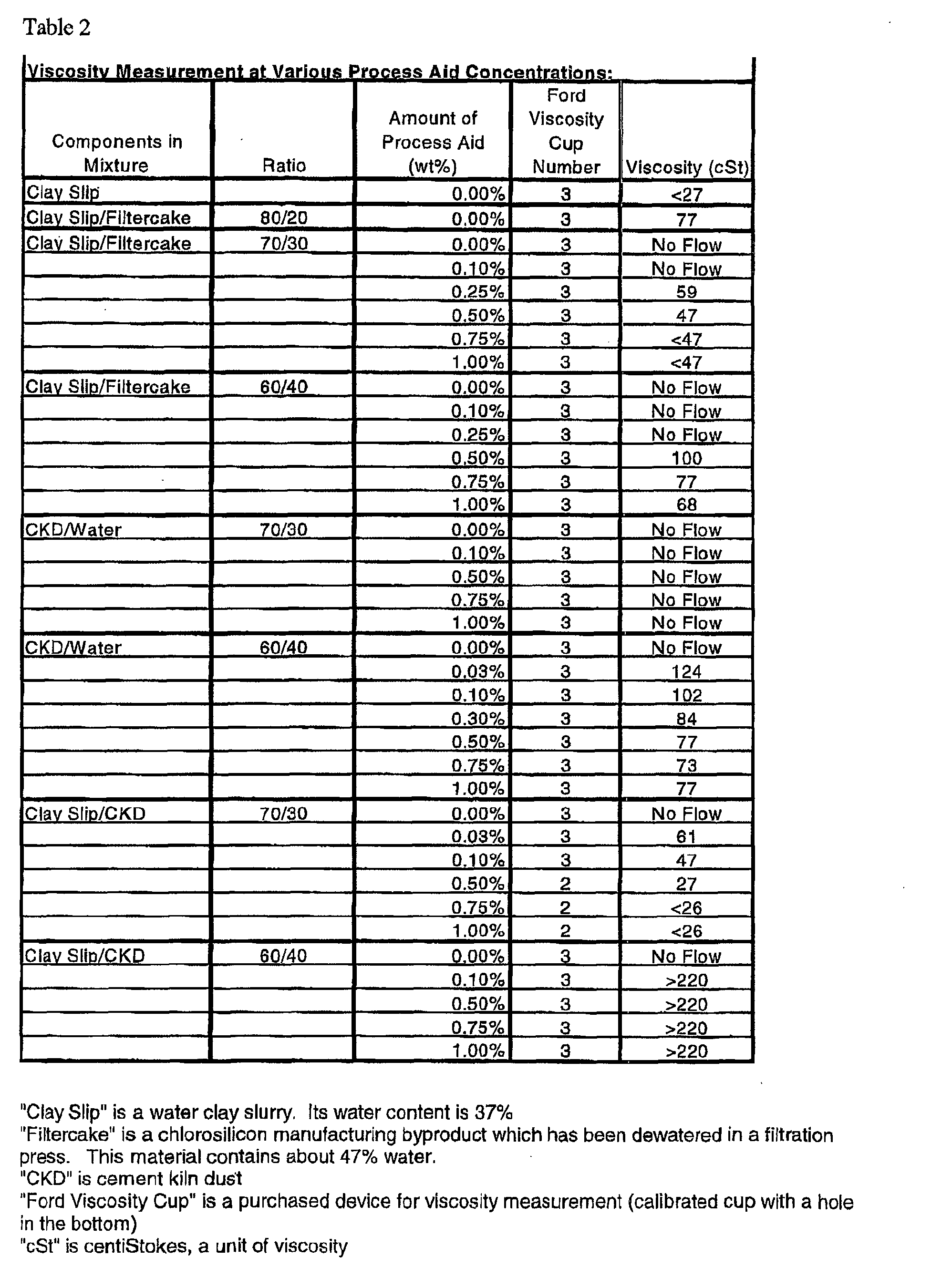
- Example 6 Various mixtures of alkaline materials were prepared in a slurry form with water and other materials as listed in Table 2.
- a 63 wt. % suspension of clay in 37 wt. % water was prepared to mimic a cement kiln feedstock. This material is named "clay slip” in Table 2 (and by the cement industry).
- the ingredients were mixed in the proportions shown in Table 2, along with an amount of sucrose process aid expressed as a weight percentage of the mixture.
- the ingredients were mixed together and poured into the Ford Viscosity Cup with the orifice outlet blocked. The outlet was opened and the material drained out of the cup into a container below. The time required for the contents of the cup to drain was recorded.
- a table accompanying the Ford Viscosity Cup is used to correlate the drain times of each cup with the viscosity of the mixture in centistokes (cSt).
- the Ford Cup (Catalog VG-7200 series, available from BYK Gardner) is a cylindrical container with a cone-shaped bottom with a volume of approximately 100 ml. An orifice is located in the center at the bottom of the cylinder.
- the process aid is able to reduce the mixture viscosity from not flowable or high viscosity to lower viscosity.
Landscapes
- Chemical & Material Sciences (AREA)
- Engineering & Computer Science (AREA)
- Ceramic Engineering (AREA)
- Materials Engineering (AREA)
- Structural Engineering (AREA)
- Organic Chemistry (AREA)
- Curing Cements, Concrete, And Artificial Stone (AREA)
Abstract
A process for preparing a flowable slurry comprising mixing 25-70 wt. % water; an
alkaline material selected from the group consisting of chlorosilicon manufacturing
byproducts, direct process residue gels, cement kiln dust, and mixtures thereof; and a
process aid selected from the group consisting of sucrose, raffinose, lignin,
methylglucopyranoside, lactose, fructose, sodium polyphosphate, trehalose and mixtures
thereof to form a flowable slurry. This slurry is especially useful in the manufacture of
cement.
Description
- The present invention is a process for preparing a flowable slurry comprising mixing an alkaline material selected from the group consisting of chlorosilicon manufacturing byproducts, direct process residue gels, cement kiln dust and mixtures thereof, optionally clay, about 25 to 70 wt. % water and a process aid selected from the group consisting of sucrose, raffinose, lignin, methylglucopyranoside, lactose, fructose, sodium polyphosphate, trehalose and mixtures thereof to form the flowable slurry. The process is especially useful as an economical and an environmentally sound method for recycling alkaline raw materials for cement manufacture.
- The preparation of portland cement is well known in the art. Portland cement is a hydraulic cement characterized by the ability to set and harden in water. Generally, portland cement is manufactured by mixing suitable raw materials with water, burning at suitable temperatures to effect clinker formation, and grinding the resulting clinkers to the fineness required for hardening by reaction with water. The burning operation generates a fine alkaline particulate byproduct called cement kiln dust that is difficult to recycle. Cement kiln dust typically comprises about 1-3 wt. % or more of the above product from the cement production operation.
- The portland cement resulting from the above process consists mainly of tricalcium silicate and dicalcium silicate. These two materials are primarily derived from two raw materials: one rich in calcium such as limestone, chalk, marl, oyster or clam shells; and the other rich in silica such as clay, shale, sand or quartz.
- Bunce, et. al in US Patent No. 5,374,310 teach the use of a silicon containing product resulting from the hydrolysis of chlorosilicon by-product as materials for cement production. However, when such materials are added to a clay slurry for use in cement manufacture, a thick, non-flowable paste forms which prevents further downstream processing, especially when small amounts of water are used.
- It would also be useful to use other alkaline materials such as other chlorosilicon manufacturing byproducts and cement kiln dust in the manufacture of cement. Unfortunately, these materials, too, suffer from the disadvantage that they form thick pastes that are difficult to manage unless large amounts of water are used.
- The present inventors have now discovered that flowable slurries of such alkaline materials can be maintained by mixing them with certain process aids selected from the group consisting of sucrose, raffinose, lignin, methylglucopyranoside, lactose, fructose, sodium polyphosphate, trehalose and mixtures thereof.
- The present invention is a process for preparing a flowable slurry comprising mixing:
- 25-70 wt. % water;
- an alkaline material selected from the group consisting of chlorosilicon manufacturing byproducts, direct process residue gels, cement kiln dust and mixtures thereof;
- optionally, clay; and
- a process aid selected from the group consisting of sucrose, raffinose, lignin, methylglucopyranoside, lactose, fructose, sodium polyphosphate, trehalose and mixtures thereof to form a flowable slurry.
-
- The present invention also relates to a flowable slurry comprising:
- 25-70 wt. % water;
- an alkaline material selected from the group consisting of chlorosilicon manufacturing byproducts, direct process residue gels, cement kiln dust, and mixtures thereof; and
- a process aid selected from the group consisting of sucrose, raffinose, lignin, methylglucopyranoside, lactose, fructose, sodium polyphosphate, trehalose and mixtures thereof to form a flowable slurry.
-
- The present invention is a process for preparing a flowable slurry comprising an alkaline material, a process aid, optionally clay and water. The process aid inhibits the formation of thick pastes that result when the alkaline material and, optionally, clay are mixed with water.
- The alkaline materials useful herein comprise chlorosilicon manufacturing byproducts, direct process residue gels, cement kiln dust, and mixtures thereof.
- The "chlorosilicon manufacturing by-products" result from manufacturing operations in which chlorosilicons are produced. Typical of chlorosilicon manufacturing operations are the reaction of silicon metal with methyl chloride to form methyl chlorosilanes and the reaction of silicon metal with hydrogen chloride to produce chlorosilanes. Unfortunately, these operations produce a number of undesirable by-products and waste streams that require disposal.
- These by-products and waste streams are often acidic and, thus, are often neutralized prior to use. An example of one such neutralization method is described in US Patent No. 5,000,934, in which a spent bed resulting from the reaction of halides with silicon metal is neutralized with a strong base and elevated temperature. This reference is incorporated herein by reference. The metal salts that are generated by processes such as this or other by-product disposal processes, as well as any other incidental metal salts generated by chlorosilicon production processes which will be known to those with ordinary skill are generally captured to avoid discharge to the environment and can be used in the process of the present invention.
- A specific example of a by-product useful in the process of the present invention comprises that generated by the metal hydroxide precipitation during the purification of wastewater from chlorosilicon manufacturing.
- The by-products resulting from these processes may comprise metal oxides, such as CaO, SiO2, Al2O3, Fe2O3, MgO, K2O, Na2O, SO3, TiO2, P2O5, SrO, BaO, and Mn3O4. While the actual composition is not critical to the invention, typical chemical compositions of the by-product from the example of the previous paragraph may comprise 0 to 30 wt. % CaO, 0 to 35 wt. % SiO2, 0 to 5 wt. % Al2O3, 0 to 4 wt. % Fe2O3, 0 to 8 wt. % MgO, 0 to 1 wt. % K2O, 0 to 0.5 wt. % Na2O, 0 to 1 wt. % SO3, 0 to 1 wt. % TiO2, 0 to 0.1 wt. % P2O5, 0 to 0.1 wt. % SrO, 0 to 0.1 wt. % BaO, 0 to 0.5 wt. % Mn3O4 and 0 to 30 wt. % water.
- Another alkaline material useful in the present invention is direct process residue gel. Examples of this material are described in US Patent Nos. 4,408,030 and 5,374,310 which are incorporated herein by reference. These references describe the formation of gels from the by-products of the reaction of silicon metal with methyl chloride to produce chlorosilanes (the 'direct process'). The gels are formed by the hydrolysis of a variety of these chlorosilion by-products including, for example, silanes, disilanes, disiloxanes, silane oligomers, siloxane oligomers, silphenylenes and silalkylenes. This hydrolysis occurs in an aqueous medium as described in the above patents which may comprise additives such as HCl and/or CaCl2.
- A typical composition of this gel comprises water, CaCl2, and the hydrolyzed products of the hydrolysis.
- Also useful as alkaline materials in the present invention are other calcium rich materials, such as, cement kiln dust which, as described above, is a by-product generated during Portland cement manufacturing operations. Generally, Portland cements are manufactured by mixing suitable raw materials with water, burning at suitable temperatures to effect clinker formation, and grinding the resulting clinkers to the fineness required for hardening by reaction with water. The burning operation generates the fine alkaline particulate, cement kiln dust. While the actual composition is not critical to the invention, typical chemical compositions for cement kiln dust are in the range of about 15 to 55 wt. % CaO, 10 to 35 wt. % SiO2, 2 to 10 wt. % Al2O3, 1 to 6 wt. % Fe2O3, 1 to 11 wt. % MgO, 0.2 to 2 wt. % K2O, 0.05 to 1.0 wt. % Na2O, and 0.1 to 2 wt. % SO3.
- The alkaline materials are typically added to the slurry of the present invention in amounts up to about 40 wt. % based on the total weight of the slurry when clay is present, and up to about 65% when clay is not part of the slurry. Often, the alkaline materials are used in amounts up to about 30 wt. % or, alternatively, about 1 to 30 wt. %, based on the total weight of the slurry when clay is included, and up to about 60 wt. % or, alternatively, 0.1 to 60 wt. %, when clay is not part of the slurry. Obviously, smaller amounts are also within the scope of the invention.
- The process aids used in the present invention are selected from the group consisting of sucrose, raffinose, lignin, methylglucopyranoside, lactose, fructose, sodium polyphosphate, trehalose and mixtures thereof. This materials are all known in the art and readily commercially available. Preferably, the process is selected from the group consisting of sucrose, lignin, fructose and mixtures thereof. It should be noted that the use of precursors for these process aids as well as compositions containing these process aids are within the scope of this invention.
- The amount of process aid used in the present invention depends on the other components used (i.e., the alkaline material used, the clay, and the water) as well as the quantities thereof. Generally, however, the process aid is used in an amount of from about 0.02 to about 10 wt. %, alternatively about 0.02 to about 5 wt. %, based on the weight of the slurry. Alternatively, the amount of process aid is within the range of about 0.05 to 1 wt. %.
- The slurry of the present invention can also contain a clay. Clay is often included because clay slurries are a feedstock for cement manufacture and incorporating the alkaline material in clay slurry is a convenient method for introducing the alkaline material into the cement production process. While the type of clay utilized herein is not critical to the invention, typical examples include montmorillonite clay which comprises magnesium aluminum silicates suspended in water, often in suspensions of about 25 - 65% montmorillonite clay in water. Such clay suspensions are commercially available. Other clays, however, are also useful herein.
- If used, the clay is usually added to the slurry of the present invention in amounts of about 1-65 wt. % clay solids, often above about 40 wt. %, alternatively above about 45wt. %, based on the total weight of the clay solids in the slurry.
- Water is also a component of the slurry. Typically it is included in the slurry in amount of from about 25 to about 70 wt. %, alternatively from about 30 to about 55 wt. % based on the weight of the slurry. Values above 70% can be used, but the volume of water that needs to be removed in the calcining process becomes so large that it is economically prohibitive to boil it away due to fuel costs.
- It should be noted that the above alkaline materials may make up all or only a portion of the calcium and silica requirements of Portland cement. As such, other alkaline, calcium and/or silica-containing materials can be added to the invention.
- The order and method of mixing the components is not critical to the invention, For example, all of the components of the slurry can be mixed at the same time. Alternatively, the process aid can be mixed with a mixture of the water, alkaline material and optional clay, even after a thick paste has formed. Similarly, the alkaline material and optional clay can be mixed with aqueous solutions of the process aid.
- These materials can be mixed by conventional mixing techniques and conventional mixing equipment such as, but not limited to, rod mills, pan mills pug mills, other single or multi-shaft mixers.
- When the process aids of the invention are incorporated in slurries of the materials described herein, the slurries remain flowable and, thus, processable in cement manufacturing operations. Thus, not only are there significant savings in raw material costs in cement manufacturing, but this process eliminates costs associated with disposing cement kiln dust and it provides a means for recycling wastes associated with chlorosilane manufacturing operations.
- The present invention also relates to a process for the manufacture of portland cement comprising burning the above slurry to effect clinker formation; and
grinding the resulting clinkers to the fineness required for hardening when reacted with water. - The following examples are provided to illustrate the present invention. These examples are not intended to limit the scope of the claims herein.
- Example 1. 50 grams of a 35 wt. % suspension of montmorillonite clay in water was placed in a glass jar and the sample spiked with 2.5 grams of CaO. The jar contents were hand shaken for about 1 to 2 minutes until the clay slurry thickened into a non-flowable paste. Sucrose (0.06 wt. % of the above mixture) was added to the jar and the contents were stirred and the non-flowable paste thinned into a flowable paste.
- Example 2. Runs were conducted using the procedure of Example 1, with the exception that the process aid and process aid amount were varied. The process aid, process aid amount added to the clay slurry, and the clay slurry flow characteristics after the process aid addition are reported in Table 1.
- The following method was used to provide flowability measurements of Table 1:
- A ring stand with a clamp is used to secure a 10" x 11" cutting board covered with teflon paper at a thirty degree angle. Tape is used to mark a distance of 15 cm. from the bottom of the board. A collection dish is positioned at the bottom of the board. The ambient temperature is recorded. For consistency, the room temperature should be between 68° and 72°F.
- The sample is mixed well and weighed. The sample is quickly poured onto the teflon
surface at the 15 cm. tape line and a stopwatch is simultaneously started. The collection
dish is removed after one minute and the amount of sample recovered weighed. The
percent of the sample recovered is then calculated.
PROCESS
AIDFLOW CHARACTERISTICS wt. % 1.0 0.5 0.25 0.13 0.06 0.03 Sucrose flowable,
wateryflowable,
wateryflowable,
wateryflowable,
less waterythicker
paste,
flowablenon-
flowable
pasteD(+)-
Raffinoseflowable,
wateryflowable,
wateryflowable,
wateryflowable,
less
waterythick
paste, still
flowsthick
paste,
minimal
flowLignin flowable,
wateryflowable,
wateryflowable,
waterythick paste
still flowsthick paste
still flowsthick paste
still flows(NaPO3)n thick paste
still flowsflowable,
wateryflowable,
waterythick paste
minimal
flownon-
flowable
pastenon-
flowable
pasteMethyl-α-D-glucopyra noside flowable,
wateryflowable,
waterythick
paste,
minimal
flownon-
flowable
pasteD(+)
Trehaloseflowable,
wateryflowable,
waterythick paste
minimal
flownon-
flowable
pasteα-Lactose flowable,
wateryflowable,
waterythick paste
still flowsthick paste
minimal flownon-
flowable
pasteD(-)
Fructosevery thin
flowable,
wateryvery thin
flowable,
wateryflowable,
waterythick paste
still flowsthick paste
minimal
flownon-flowable paste Table Key
"Flowable, watery" (very thin) = flows out of jig before measurement can begin
"Flowable, watery" = moves 4 inches in 10 seconds or less
"Flowable, less watery" = moves 3.0 to 3.9 inches in 10 seconds
"Thick paste, still flows" = moves 1.0 to 2.9 inches in 10 seconds
"Thick paste, minimal flow" = moves 0.1 to 0.9 inches in 10 seconds
"Non-flowable paste" = No flow in 10 seconds -
- Example 3. 50 grams of a 35 wt. % suspension of montmorillonite clay in water was placed in a glass jar and the sample spiked with an additional 10 wt. % chlorosilicon manufacturing byproducts. The jar contents were hand shaken for about 1 to 2 minutes until the clay slurry thickened into a non-flowable paste. Sucrose (0.25 wt. % of mixture) was added to the jar and the contents were stirred. The non-flowable paste reverted back into a flowable watery clay slurry as defined in Table 1.
- Example 4. 50 grams of a 35 wt. % suspension of montmorillonite clay in water was placed in a glass jar and the sample was mixed with chlorosilicon manufacturing byproducts (10 wt. %) spiked with sucrose (0.25 wt. % of final mixture). The jar contents were hand shaken for about 1 to 2 minutes and the clay slurry remained flowable and watery as defined in Table 1.
- Example 5. Chlorosilicon manufacturing byproducts (10 wt. %) was added to a jar containing a 35 wt. % suspension of montmorillonite clay in water which was spiked with 0.25 wt. % sucrose. The jar contents were hand shaken for about 1 to 2 minutes and the clay slurry remained flowable and watery as defined in Table 1.
- Example 6. Various mixtures of alkaline materials were prepared in a slurry form with water and other materials as listed in Table 2. A 63 wt. % suspension of clay in 37 wt. % water was prepared to mimic a cement kiln feedstock. This material is named "clay slip" in Table 2 (and by the cement industry). The ingredients were mixed in the proportions shown in Table 2, along with an amount of sucrose process aid expressed as a weight percentage of the mixture. The ingredients were mixed together and poured into the Ford Viscosity Cup with the orifice outlet blocked. The outlet was opened and the material drained out of the cup into a container below. The time required for the contents of the cup to drain was recorded. A table accompanying the Ford Viscosity Cup is used to correlate the drain times of each cup with the viscosity of the mixture in centistokes (cSt). The Ford Cup (Catalog VG-7200 series, available from BYK Gardner) is a cylindrical container with a cone-shaped bottom with a volume of approximately 100 ml. An orifice is located in the center at the bottom of the cylinder. There are three different Ford Viscosity Cups based upon the size of the orifice on the bottom and each cup is calibrated to NIST-traceable oils. (Two different cups, #2 and #3, were used for Example 6.) In each mixture where the alkaline material content is sufficiently low, the process aid is able to reduce the mixture viscosity from not flowable or high viscosity to lower viscosity.
Claims (10)
- A process for preparing a flowable slurry comprising mixing:to form a flowable slurry.25-70 wt. % water;an alkaline material selected from the group consisting of chlorosilicon manufacturing byproducts, direct process residue gels, cement kiln dust, and mixtures thereof; anda process aid selected from the group consisting of sucrose, raffinose, lignin, methylglucopyranoside, lactose, fructose, sodium polyphosphate, trehalose and mixtures thereof
- The process according to claim 1, wherein the process aid is selected from the group consisting of sucrose, lignin, fructose and mixtures thereof.
- The process according to either of the previous claims, wherein clay is also mixed into the slurry.
- The process according to any of the previous claims, wherein the amount of process aid is in the range of 0.02 to 10 wt. %.
- The process according to any of the previous claims, wherein the amount of process aid is in the range of 0.05 to 1 wt. %.
- The process according to any of the previous claims wherein the amount of alkaline material is in the range of up to 65 wt %.
- A process according to claim 3, wherein the amount clay is in the range of 1 to 65 wt%.
- A flowable slurry comprising:to form a flowable slurry.25-70 wt. % water;an alkaline material selected from the group consisting of chlorosilicon manufacturing byproducts, direct process residue gels, cement kiln dust, and mixtures thereof; anda process aid selected from the group consisting of sucrose, raffinose, lignin, methylglucopyranoside, lactose, fructose, sodium polyphosphate, trehalose and mixtures thereof
- In a process for manufacturing a flowable slurry comprising water and an alkaline material selected from the group consisting of chlorosilicon manufacturing byproducts, direct process residue gels, cement kiln dust, and mixtures thereof, the improvement comprising the addition of a process aid selected from the group consisting of sucrose, raffinose, lignin, methylglucopyranoside, lactose, fructose, sodium polyphosphate, trehalose and mixtures thereof.
- A process for the manufacture of portland cement comprising:burning the slurry of claim 8 to effect clinker formation; andgrinding the resulting clinkers to the fineness required for hardening when reacted with water.
Priority Applications (1)
| Application Number | Priority Date | Filing Date | Title |
|---|---|---|---|
| EP01306276A EP1277710A1 (en) | 2001-07-20 | 2001-07-20 | Process for preparing a flowable slurry |
Applications Claiming Priority (1)
| Application Number | Priority Date | Filing Date | Title |
|---|---|---|---|
| EP01306276A EP1277710A1 (en) | 2001-07-20 | 2001-07-20 | Process for preparing a flowable slurry |
Publications (1)
| Publication Number | Publication Date |
|---|---|
| EP1277710A1 true EP1277710A1 (en) | 2003-01-22 |
Family
ID=8182132
Family Applications (1)
| Application Number | Title | Priority Date | Filing Date |
|---|---|---|---|
| EP01306276A Withdrawn EP1277710A1 (en) | 2001-07-20 | 2001-07-20 | Process for preparing a flowable slurry |
Country Status (1)
| Country | Link |
|---|---|
| EP (1) | EP1277710A1 (en) |
Citations (7)
| Publication number | Priority date | Publication date | Assignee | Title |
|---|---|---|---|---|
| US2687290A (en) * | 1950-01-04 | 1954-08-24 | Permanente Cement Company | Treatment of recovered cement kiln dust |
| US2900266A (en) * | 1957-02-18 | 1959-08-18 | Monsanto Chemicals | Method of increasing fluidity of aqueous industrial mineral slurries |
| US3346487A (en) * | 1965-06-11 | 1967-10-10 | Monsanto Co | Deflocculation of solid materials in aqueous medium |
| US4115139A (en) * | 1978-01-16 | 1978-09-19 | Chemed Corporation | Production of raw mix cement slurries having reduced water content |
| US5000934A (en) | 1989-11-13 | 1991-03-19 | Dow Corning Corporation | Method for quenching silicon spent bed |
| US5374310A (en) | 1992-09-29 | 1994-12-20 | Dow Corning Corporation | Hydrolyzed chlorosilicon by-product addition to cement |
| JP2000143315A (en) * | 1998-11-10 | 2000-05-23 | Kao Corp | Additives for hydraulic compositions |
-
2001
- 2001-07-20 EP EP01306276A patent/EP1277710A1/en not_active Withdrawn
Patent Citations (7)
| Publication number | Priority date | Publication date | Assignee | Title |
|---|---|---|---|---|
| US2687290A (en) * | 1950-01-04 | 1954-08-24 | Permanente Cement Company | Treatment of recovered cement kiln dust |
| US2900266A (en) * | 1957-02-18 | 1959-08-18 | Monsanto Chemicals | Method of increasing fluidity of aqueous industrial mineral slurries |
| US3346487A (en) * | 1965-06-11 | 1967-10-10 | Monsanto Co | Deflocculation of solid materials in aqueous medium |
| US4115139A (en) * | 1978-01-16 | 1978-09-19 | Chemed Corporation | Production of raw mix cement slurries having reduced water content |
| US5000934A (en) | 1989-11-13 | 1991-03-19 | Dow Corning Corporation | Method for quenching silicon spent bed |
| US5374310A (en) | 1992-09-29 | 1994-12-20 | Dow Corning Corporation | Hydrolyzed chlorosilicon by-product addition to cement |
| JP2000143315A (en) * | 1998-11-10 | 2000-05-23 | Kao Corp | Additives for hydraulic compositions |
Non-Patent Citations (1)
| Title |
|---|
| DATABASE WPI Section Ch Week 200037, Derwent World Patents Index; Class A14, AN 2000-426039, XP002186198 * |
Similar Documents
| Publication | Publication Date | Title |
|---|---|---|
| US6478870B2 (en) | Process aid for preparing a flowable slurry | |
| EP0364640B1 (en) | Hard setting refractory composition | |
| AU2025287355A1 (en) | Geopolymers produced from mineral processing by-products | |
| CA2170626A1 (en) | Use of alumina clay with cement fly ash mixtures | |
| CA1218387A (en) | Cementitious composite material | |
| EP2209750A1 (en) | Cementitious formulations and products | |
| KR20080077002A (en) | Multifunctional composition and method for preparing the composition for the coagulation composite | |
| EP4155278A1 (en) | Improving reactivity of carbonated recycled concrete fines | |
| EP0006593B1 (en) | Process for producing tobermorite and ettringite | |
| US7101821B2 (en) | Silicon composition | |
| EP0594313A1 (en) | Hydrolyzed chlorosilicon by-product addition to cement | |
| JP4842211B2 (en) | Sintered product for cement additive, cement additive and cement composition | |
| JP3750269B2 (en) | Solidification method of industrial waste and solidified body of industrial waste | |
| CN107663044B (en) | Geopolymer type soft soil cementing agent and preparation method thereof | |
| US20090064899A9 (en) | Microsilica materials with improved pozzolanic activity | |
| JPH039060B2 (en) | ||
| KR100241223B1 (en) | A process for preparing bricks using sludges of waste water originating from electronic elements manufacturing plants | |
| JP2003055009A (en) | Flowable slurry, process for preparing the same, and process for manufacture of portland cement | |
| JP7062225B2 (en) | Strength-enhancing agent, its manufacturing method, and Portland cement strength-enhancing method | |
| JP2000001347A (en) | Room temperature solidified inorganic material formulation | |
| US20040040472A1 (en) | Method of recycling cement kiln dust | |
| JP3838793B2 (en) | Room temperature solidified inorganic material formulation | |
| SU947123A1 (en) | Raw meal for producing silica brick | |
| CN1398811A (en) | Prepn of processing assistant for flowable slurry | |
| JP2025152334A (en) | Cementless quick-setting materials, spraying materials, spraying methods |
Legal Events
| Date | Code | Title | Description |
|---|---|---|---|
| PUAI | Public reference made under article 153(3) epc to a published international application that has entered the european phase |
Free format text: ORIGINAL CODE: 0009012 |
|
| AK | Designated contracting states |
Kind code of ref document: A1 Designated state(s): AT BE CH CY DE DK ES FI FR GB GR IE IT LI LU MC NL PT SE TR |
|
| AX | Request for extension of the european patent |
Free format text: AL;LT;LV;MK;RO;SI |
|
| 17P | Request for examination filed |
Effective date: 20030514 |
|
| AKX | Designation fees paid |
Designated state(s): AT BE CH CY DE DK ES FI FR GB GR IE IT LI LU MC NL PT SE TR |
|
| STAA | Information on the status of an ep patent application or granted ep patent |
Free format text: STATUS: THE APPLICATION HAS BEEN WITHDRAWN |
|
| 18W | Application withdrawn |
Effective date: 20050112 |