EP1277402A1 - Additive for bordeaux mixture and bordeaux mixture - Google Patents
Additive for bordeaux mixture and bordeaux mixture Download PDFInfo
- Publication number
- EP1277402A1 EP1277402A1 EP01926064A EP01926064A EP1277402A1 EP 1277402 A1 EP1277402 A1 EP 1277402A1 EP 01926064 A EP01926064 A EP 01926064A EP 01926064 A EP01926064 A EP 01926064A EP 1277402 A1 EP1277402 A1 EP 1277402A1
- Authority
- EP
- European Patent Office
- Prior art keywords
- bordeaux mixture
- bordeaux
- additive
- group
- mixture
- Prior art date
- Legal status (The legal status is an assumption and is not a legal conclusion. Google has not performed a legal analysis and makes no representation as to the accuracy of the status listed.)
- Granted
Links
Classifications
-
- C—CHEMISTRY; METALLURGY
- C08—ORGANIC MACROMOLECULAR COMPOUNDS; THEIR PREPARATION OR CHEMICAL WORKING-UP; COMPOSITIONS BASED THEREON
- C08F—MACROMOLECULAR COMPOUNDS OBTAINED BY REACTIONS ONLY INVOLVING CARBON-TO-CARBON UNSATURATED BONDS
- C08F220/00—Copolymers of compounds having one or more unsaturated aliphatic radicals, each having only one carbon-to-carbon double bond, and only one being terminated by only one carboxyl radical or a salt, anhydride ester, amide, imide or nitrile thereof
- C08F220/02—Monocarboxylic acids having less than ten carbon atoms; Derivatives thereof
- C08F220/04—Acids; Metal salts or ammonium salts thereof
-
- A—HUMAN NECESSITIES
- A01—AGRICULTURE; FORESTRY; ANIMAL HUSBANDRY; HUNTING; TRAPPING; FISHING
- A01N—PRESERVATION OF BODIES OF HUMANS OR ANIMALS OR PLANTS OR PARTS THEREOF; BIOCIDES, e.g. AS DISINFECTANTS, AS PESTICIDES OR AS HERBICIDES; PEST REPELLANTS OR ATTRACTANTS; PLANT GROWTH REGULATORS
- A01N59/00—Biocides, pest repellants or attractants, or plant growth regulators containing elements or inorganic compounds
- A01N59/16—Heavy metals; Compounds thereof
- A01N59/20—Copper
-
- A—HUMAN NECESSITIES
- A01—AGRICULTURE; FORESTRY; ANIMAL HUSBANDRY; HUNTING; TRAPPING; FISHING
- A01N—PRESERVATION OF BODIES OF HUMANS OR ANIMALS OR PLANTS OR PARTS THEREOF; BIOCIDES, e.g. AS DISINFECTANTS, AS PESTICIDES OR AS HERBICIDES; PEST REPELLANTS OR ATTRACTANTS; PLANT GROWTH REGULATORS
- A01N25/00—Biocides, pest repellants or attractants, or plant growth regulators, characterised by their forms, or by their non-active ingredients or by their methods of application, e.g. seed treatment or sequential application; Substances for reducing the noxious effect of the active ingredients to organisms other than pests
- A01N25/08—Biocides, pest repellants or attractants, or plant growth regulators, characterised by their forms, or by their non-active ingredients or by their methods of application, e.g. seed treatment or sequential application; Substances for reducing the noxious effect of the active ingredients to organisms other than pests containing solids as carriers or diluents
- A01N25/10—Macromolecular compounds
-
- C—CHEMISTRY; METALLURGY
- C08—ORGANIC MACROMOLECULAR COMPOUNDS; THEIR PREPARATION OR CHEMICAL WORKING-UP; COMPOSITIONS BASED THEREON
- C08F—MACROMOLECULAR COMPOUNDS OBTAINED BY REACTIONS ONLY INVOLVING CARBON-TO-CARBON UNSATURATED BONDS
- C08F220/00—Copolymers of compounds having one or more unsaturated aliphatic radicals, each having only one carbon-to-carbon double bond, and only one being terminated by only one carboxyl radical or a salt, anhydride ester, amide, imide or nitrile thereof
- C08F220/02—Monocarboxylic acids having less than ten carbon atoms; Derivatives thereof
- C08F220/10—Esters
- C08F220/26—Esters containing oxygen in addition to the carboxy oxygen
- C08F220/28—Esters containing oxygen in addition to the carboxy oxygen containing no aromatic rings in the alcohol moiety
- C08F220/285—Esters containing oxygen in addition to the carboxy oxygen containing no aromatic rings in the alcohol moiety and containing a polyether chain in the alcohol moiety
-
- C—CHEMISTRY; METALLURGY
- C08—ORGANIC MACROMOLECULAR COMPOUNDS; THEIR PREPARATION OR CHEMICAL WORKING-UP; COMPOSITIONS BASED THEREON
- C08F—MACROMOLECULAR COMPOUNDS OBTAINED BY REACTIONS ONLY INVOLVING CARBON-TO-CARBON UNSATURATED BONDS
- C08F283/00—Macromolecular compounds obtained by polymerising monomers on to polymers provided for in subclass C08G
- C08F283/06—Macromolecular compounds obtained by polymerising monomers on to polymers provided for in subclass C08G on to polyethers, polyoxymethylenes or polyacetals
-
- C—CHEMISTRY; METALLURGY
- C08—ORGANIC MACROMOLECULAR COMPOUNDS; THEIR PREPARATION OR CHEMICAL WORKING-UP; COMPOSITIONS BASED THEREON
- C08F—MACROMOLECULAR COMPOUNDS OBTAINED BY REACTIONS ONLY INVOLVING CARBON-TO-CARBON UNSATURATED BONDS
- C08F290/00—Macromolecular compounds obtained by polymerising monomers on to polymers modified by introduction of aliphatic unsaturated end or side groups
- C08F290/02—Macromolecular compounds obtained by polymerising monomers on to polymers modified by introduction of aliphatic unsaturated end or side groups on to polymers modified by introduction of unsaturated end groups
- C08F290/06—Polymers provided for in subclass C08G
-
- C—CHEMISTRY; METALLURGY
- C08—ORGANIC MACROMOLECULAR COMPOUNDS; THEIR PREPARATION OR CHEMICAL WORKING-UP; COMPOSITIONS BASED THEREON
- C08F—MACROMOLECULAR COMPOUNDS OBTAINED BY REACTIONS ONLY INVOLVING CARBON-TO-CARBON UNSATURATED BONDS
- C08F290/00—Macromolecular compounds obtained by polymerising monomers on to polymers modified by introduction of aliphatic unsaturated end or side groups
- C08F290/02—Macromolecular compounds obtained by polymerising monomers on to polymers modified by introduction of aliphatic unsaturated end or side groups on to polymers modified by introduction of unsaturated end groups
- C08F290/06—Polymers provided for in subclass C08G
- C08F290/061—Polyesters; Polycarbonates
-
- C—CHEMISTRY; METALLURGY
- C08—ORGANIC MACROMOLECULAR COMPOUNDS; THEIR PREPARATION OR CHEMICAL WORKING-UP; COMPOSITIONS BASED THEREON
- C08F—MACROMOLECULAR COMPOUNDS OBTAINED BY REACTIONS ONLY INVOLVING CARBON-TO-CARBON UNSATURATED BONDS
- C08F290/00—Macromolecular compounds obtained by polymerising monomers on to polymers modified by introduction of aliphatic unsaturated end or side groups
- C08F290/02—Macromolecular compounds obtained by polymerising monomers on to polymers modified by introduction of aliphatic unsaturated end or side groups on to polymers modified by introduction of unsaturated end groups
- C08F290/06—Polymers provided for in subclass C08G
- C08F290/062—Polyethers
-
- C—CHEMISTRY; METALLURGY
- C08—ORGANIC MACROMOLECULAR COMPOUNDS; THEIR PREPARATION OR CHEMICAL WORKING-UP; COMPOSITIONS BASED THEREON
- C08L—COMPOSITIONS OF MACROMOLECULAR COMPOUNDS
- C08L71/00—Compositions of polyethers obtained by reactions forming an ether link in the main chain; Compositions of derivatives of such polymers
- C08L71/02—Polyalkylene oxides
-
- C—CHEMISTRY; METALLURGY
- C08—ORGANIC MACROMOLECULAR COMPOUNDS; THEIR PREPARATION OR CHEMICAL WORKING-UP; COMPOSITIONS BASED THEREON
- C08L—COMPOSITIONS OF MACROMOLECULAR COMPOUNDS
- C08L2205/00—Polymer mixtures characterised by other features
- C08L2205/05—Polymer mixtures characterised by other features containing polymer components which can react with one another
-
- C—CHEMISTRY; METALLURGY
- C08—ORGANIC MACROMOLECULAR COMPOUNDS; THEIR PREPARATION OR CHEMICAL WORKING-UP; COMPOSITIONS BASED THEREON
- C08L—COMPOSITIONS OF MACROMOLECULAR COMPOUNDS
- C08L33/00—Compositions of homopolymers or copolymers of compounds having one or more unsaturated aliphatic radicals, each having only one carbon-to-carbon double bond, and only one being terminated by only one carboxyl radical, or of salts, anhydrides, esters, amides, imides or nitriles thereof; Compositions of derivatives of such polymers
- C08L33/04—Homopolymers or copolymers of esters
- C08L33/14—Homopolymers or copolymers of esters of esters containing halogen, nitrogen, sulfur, or oxygen atoms in addition to the carboxy oxygen
Definitions
- the present invention relates to an additive to a Bordeaux mixture and a Bordeaux mixture added therewith. More specifically, the invention pertains to an additive to a Bordeaux mixture which enables stable storage for a long period of time before spraying without causing poor dispersion both at a concentrated concentration and at a using concentration; enables confirmation, just after spraying, of the amount applied onto leaves or fruits from their appearance; and even after drying, prevents easy peeling and run-off of the sprayed mixture owing to physical influences from the outside world such as external pressure or rain water; and the Bordeaux mixture added with the additive.
- a Bordeaux mixture composition has, as an effective component, basic copper sulfate calcium which is generally represented by CuSo 4 ⁇ xCu(OH) 2 ⁇ yCa(OH) 2 ⁇ zH 2 O. Since basic copper sulfate calcium has a large specific gravity (slaked lime: 2.24, copper sulfate: 2.28), a difference in specific gravity causes separation and sedimentation of it. The conventional Bordeaux mixture must therefore be sprayed as soon as possible after preparation.
- a Bordeaux mixture was so far prepared at each farmer's home. For preparation, it took much labor, and in addition, it was difficult to prepare a Bordeaux mixture of uniform quality, influenced by the difference in the experience of farm workers engaged in the preparation or quality of copper sulfate or lime employed as raw materials. As a result, its effect was not uniform and even more, a chemical injury due to the improper concentration of copper ions or lime occurred, though depending on the kind of the crops to be applied. Instead of such a Bordeaux mixture, a Bordeaux mixture having uniform quality and facilitating preparation of a spray solution has been developed.
- a conventional process for preparing a basic Bordeaux mixture is as follows: Copper sulfate is pulverized and dissolved in 80 to 90% of water based on the whole amount. After addition of a small amount of water to quicklime, remaining 10 to 20% of water is added thereto. The copper sulfate solution is then added in portions while stirring the cream of lime. Additives such as spreading agent are then added to the resulting mixture.
- a protective colloid such as lignin sulfonic acid, polyvinyl alcohol, carboxymethyl cellulose, gum arabic or alginate in advance to slaked lime powder or copper sulfate.
- Japanese Patent Laid-Open No. 63601/1986 described is, upon preparation of micro-granule biocidal active dispersion, addition of at least one selected from unsaturated carboxylic acid polymer dispersions, styrenesulfonate polymers and formalin condensates, and salts thereof.
- Proposed in Japanese Patent Laid-Open No. 226905/1987 is a process for preparing an aqueous solution of a polycarboxylic acid copper amine salt.
- Japanese Patent Laid-Open Nos. 155403/1985 and 97202/1986 proposed is wet grinding of pesticide grains in a suspension, thereby attaining stability.
- Japanese Patent Laid-Open No. 155403/1995 proposed is the preparation of a stable dispersion of micro granules which are solid at normal temperature and have solubility, in an aqueous dispersant, of 50 ppm or less by adjusting the product of true specific gravity and average grain size to 0.8 ⁇ m or less.
- Japanese Patent Laid-Open No. 97202/1986 proposes use of a polyoxyalkylene type nonionic surfactant, polyoxyalkylene ether phosphate or alkylaryl polyoxyalkylene ether phosphate as a dispersant.
- the resulting Bordeaux mixture undergoes a gradual deterioration in dispersion stability from just after preparation. For example, sedimentation occurs on the bottom of a container having therein a dispersion of a Bordeaux mixture prepared in advance on the day before application, which disturbs spraying work. Such a problem has frequently occurred. Even if the precipitated Bordeaux mixture is stirred to provide for the spraying work, it cannot be re-dispersed owing to caking, or even if it can be re-dispersed, the nozzle of a fungicide sprayer is clogged therewith. Another problem is that such a Bordeaux mixture cannot be sprayed uniformly on the surface of leaves, fruits or the like object. Most of the efforts so far been made focused on improvement in the dispersion stability of a Bordeaux mixture.
- An object of the present invention is therefore to provide an additive for a Bordeaux mixture, which additive enables the Bordeaux mixture, to which it has been added, to simultaneously satisfy the following three requirements: excellent dispersion stability both upon preparation and after long-term storage, excellent spreading stability just after spraying and after drying, and excellent visible confirmation of an applied amount just after spraying; and a Bordeaux mixture containing the additive.
- Polymer (A) has, as essential monomers, monomer (a) and monomer (b) and is available by copolymerization thereof.
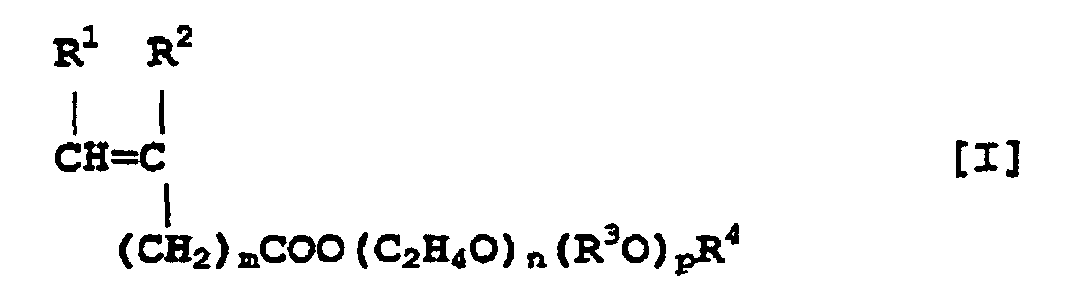
- R 1 and R 2 may be the same or different and each represents a hydrogen atom or a methyl group
- m stands for 0 to 2, preferably 0, of which preferred is a (meth)acrylic acid alkoxypolyalkylene glycol adduct, that is, a monomer having a hydrogen atom as R 1 , a hydrogen atom or a methyl group as R 2 and 0 as m
- acrylic acid or "methacrylic acid” will hereinafter be called "(moth)acrylic acid”).
- R 3 O is a C 3-18 oxyalkylene group and specific examples of it include propylene oxide, 1,2-butylene oxide, 2,3-butylene oxide, 1-butene oxide, 2-butene oxide, ⁇ -olefin oxide, trimethylethylene oxide, tetramethylethylene oxide, butadiene monoxide, ⁇ -methylstyrene oxide, 1,1-diphenylethylene oxide, cyclohexene oxide, dihydronaphthaline oxide and oxycetane, and alkylsubstituted derivatives thereof, and oxyalkylene groups derived from tetrahydrofuran. These C 3-18 oxyalkylene groups may be used either singly or in combination.
- the preferable number of carbon atoms is 3 to 4. When the number of carbon atoms exceeds 18, hydrophilicity becomes too high and decreases the effect of an oxyethylene bonding which has been formed simultaneously, thereby disturbing the dispersion stability of Bordeaux granules.
- Oxyethylene groups and C 3-18 oxyalkylene groups may be bonded either in the block form or random form, of which the former one is preferred. In the case of bonding in the block form, their boding order is not determined and either an oxyethylene group or a C 3-18 oxyalkylene group may be bonded to an ester bond.
- n means an average number of moles of they oxyethylene group added and it stands for 1 to 200, preferably 1 to 100.
- the letter p means an average number of moles of the C 3-18 oxyalkylene group added and it stands for 0 to 200, preferably 1 to 80.
- n+p is equal to 1 to 250, preferably 1 to 180.
- the sum exceeding 250 is not preferred, because the polyoxyethylene compound represented by the formula [I] has an increased viscosity, which makes the preparation difficult.
- R 4 represents a C 1-40 hydrocarbon group. Specific examples include saturated hydrocarbon groups such as methyl, ethyl, allyl, propyl, isopropyl, butyl, isobutyl, secondary butyl, tertiary butyl, pentyl, isopentyl, neopentyl, hexyl, heptyl, octyl, nonyl, decyl, undecyl, dodecyl, isotridecyl, tetradecyl, hexadecyl, isocetyl, octadecyl, isostearyl, oleyl, octyldodecyl, docosyl, decyltetradecyl, benzyl, cresyl, butylphenyl, dibutylphenyl, octylphenyl, nonylphenyl, dodecylphen
- the monomer (a) represented by the formula [I] has an HLB of 3.0 to 7.0, preferably 3.5 to 7.0.
- the HLB of the polymer (A) is preferably 6.0 to 8.0, more preferably 6.5 to 8.0.
- Adjustment of the HLB within the above-described range makes it possible to balance, at the maximum, the dispersing effect of Bordeaux grains in water and spreading effect.
- HLB was calculated based on the Devies's equation (Proc., 2nd Interc. Congress of Surface Activity, 1426(1957)).
- the below-described parameter is used as the HLB number.
- HLB ion dissociation as [-COO] + [X] - occurs, HLB reaches 20 readily, but it does not reflect the actual dispersion property or fixing property.
- the monomer (a) of the formula [I] usable in the present invention can be prepared as an ester compound by dehydration esterification between (meth)acrylic acid or crotonic acid and, or ester exchange between an alkyl (meth)acrylate or alkyl crotonate, and an alkoxypolyalkylene glycol available by bonding a C 1-40 hydrocarbon having, as active hydrogen, an -OH functional group to ethylene oxide and a C 3-18 alkylene oxide derivative through ring-opening addition polymerization.
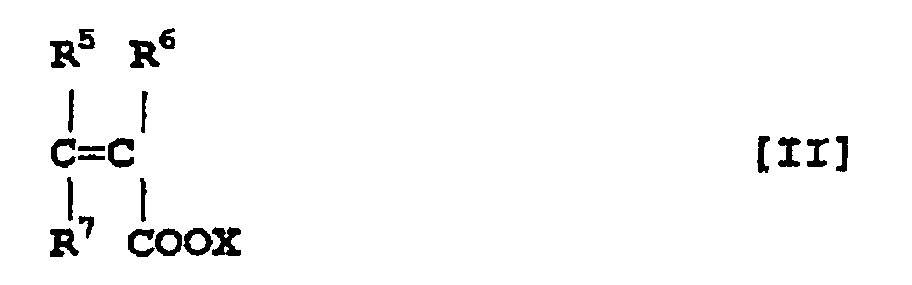
- R 5 , R 6 and R 7 may be the same or different and each represents a hydrogen atom, a methyl group or a (CH 2 ) q COOX group.
- R 5 , R 6 and R 7 are preferred when each of them represents a hydrogen atom.
- X represents a hydrogen atom, a monovalent metal, a divalent metal, an ammonium group or an organoammonium group.
- the monovalent metal include lithium, sodium, potassium and cesium, while those of the divalent metal include beryllium, magnesium, calcium, strontium and barium, of which calcium is most preferred.
- the ammonium salt or organoammonium salt usable are, as well as salts neutralized with ammonia, salts neutralized with an alkylamide which is a C 1-30 amine, N-methylolamide or N,N-dimethylamide.
- a sodium salt which is a monovalent metal salt is preferred.
- the letter q stands for 0 to 2. When there exist two or more COOX groups, they may form the corresponding anhydride.
- the monomer (b) examples include acrylic acid, methacrylic acid and crotonic acid, and metal salts, ammonium salts and amine salts thereof.
- the unsaturated dicarboxylic acid monomer examples include maleic acid, itaconic acid, citraconic acid and fumaric acid, and metal salts, ammonium salts and organoammonium salts thereof.
- Their anhydrides include maleic anhydride, itaconic anhydride and citraconic anhydride.
- unsaturated monocarboxylic acid monomers are preferred, with (meth)acrylic acid and salts thereof being more preferred and acrylic acid and salts thereof being most preferred. These monomers may be used either singly or in combination.
- Polymer (A) is available by polymerizing the above-described monomer components in the presence of a polymerization initiator.
- a monomer containing a salt it is possible to use a monomer containing a salt; or after copolymerization, use a metal hydroxide, metal anhydride, carbonate or bicarbonate, use ammonia gas or aqueous ammonia, or carry out amidation reaction by the addition of an alkylamine or the like.
- Polymerization may be polymerization in a solvent or bulk polymerization.
- the molar ratio of the monomer (a) to the monomer (b) upon copolymerization for obtaining the Polymer (A) is 1:1 to 1:9.5, more preferably 1:2 to 1:9.5.
- the polymer has a weight-average molecular weight of 5,000 to 80,000, more preferably 6,000 to 28,000.
- the polymerization in a solvent may be conducted in a batch-wise or continuous manner.
- the solvent usable here is water or an organic solvent.
- the organic solvent include lower alcohols such as methanol; ethanol and propanol, aromatic and alicyclic hydrocarbons such as benzene, toluene, xylene, cyclohexane and n-hexane, ester compounds such as ethyl acetate and ketone compounds such as acetone and methyl ethyl ketone.
- a polymerization initiator such as ammonium persulfate, alkali metal persulfate, hydrogen peroxide, or hydroperoxide such as tertiary-butyl hydroxyperoxide is usable.
- a polymerization accelerator such as sodium bisulfite or Mohr's salt can be used in combination.
- usable polymerization initiators are diacyl peroxides such as lauroyl peroxide, benzoyl peroxide, hexanonyl peroxide and stearoyl peroxide; peroxydicarbonates such as diisopropylperoxydicarbonate, di-2-ethylhexylperoxydicarbonate, di-n-propylperoxydicarbonate, di-2-ethoxyethylperoxydicarbonate, di-3-methoxybutylperoxydicarbonate, and bis(4-t-butylcyclohexyl)peroxydicarbonate; peroxy esters such as 1,1,3,3-tetramethylbutylperoxy-2-ethyl hexanoate, t-hexylperoxy-2-ethyl hexanoate, t-butylperoxy-2-ethyl hexanoate, and t
- a polymerization accelerator such as amine compound can be used in combination.
- a polymerization temperature can be determined as desired, depending on the kind of the solvent or polymerization initiator employed, it is usually 0 to 130°C, preferably 25 to 115°C.
- Bulk polymerization can be performed within a temperature range of 50 to 200°C by using a polymerization initiator selected as needed from diacyl peroxides, peroxydicarbonates, peroxy esters and aromatic azo compounds.
- a chain transfer agent can be used in combination.
- the chain transfer agent usable here is usually a thiol compound selected from mercaptoethanol, thioglycerol, thioglycolic acid, 2-mercaptopropionic and 3-mercaptopropionic acid. These chain transfer agents may be used either singly or in combination.
- a Bordeaux mixture can be prepared in the below-described manner. Copper sulfate is pulverized and dissolved in water to give its concentration of 20 to 40 wt.%, whereby an aqueous solution of copper sulfate is prepared. Then, cream of lime having a concentration of 20 to 40 wt.% is prepared by dispersing and dissolving quicklime (calcium oxide) in water under stirring. To this cream of lime, the polymer (A) which is an additive for Bordeaux mixture is added in an amount of 0.1 to 6 wt.%, preferably 1 to 4 wt.%, in terms of solid content, based on the total amount of copper sulfate and quicklime under stirring to dissolve and disperse the latter in the former. When the amount of the polymer (A) is less than 0.1 wt.%, the resulting additive cannot exhibit satisfactory dispersion property and spreading property. The amount exceeding 6 wt.%, on the other hand, does not bring about further improvement.
- the aqueous solution of copper sulfate is added in portions while stirring, whereby a crude solution of a Bordeaux mixture can be prepared.
- This crude solution can be used as a Bordeaux solution in practice by wet grinding it by a wet grinder and then, diluting the ground product with water into a proper concentration.
- the Bordeaux mixture can be usually prepared within a temperature range of 0 to 80°C, preferably 5 to 40°C.
- the sedimentation velocity of sedimentation layer after a predetermined time must be similar to that just after preparation. In other words, it is necessary that the Bordeaux mixture just after preparation and that after storage for a long period time have a similarly stable dispersion state.
- the sedimentation velocity of sedimentation layer of the Bordeaux mixture is preferably 0.6 ⁇ [PS oh ]/[PS 24h ] ⁇ 1.5 (wherein [PS oh ] : sedimentation velocity of sedimentation layer just after preparation, [PS 24h ] : sedimentation velocity of sedimentation layer after 24 hours), more preferably 0.8 ⁇ [PS oh ]/[PS 24h ] ⁇ 1.3.
- the Bordeaux mixture can be stored and re-dispersed easily as the uniform Bordeaux mixture even after storage for 3 years or more.
- the basic copper sulfate calcium serving as an effective component of the Bordeaux mixture is preferably adjusted to have a grain size, as Bordeaux granules, of 2 to 4 ⁇ m.
- a grain size as Bordeaux granules
- dispersion stability lowers.
- the grain size below 2 ⁇ m does not impair dispersion stability, it weakens reflection or scattering of a visible ray and traces remaining on the surface and implying the application thereto of the Bordeaux mixture become thin. As a result, it becomes difficult to confirm the sprayed amount by appearance.
- the active component of the Bordeaux mixture is mainly copper ion.
- % and “part” or “parts” mean “wt.%” and “part by weight” or “parts by weight”, respectively, unless otherwise particularly indicated.
- the weight average molecular weight of each of the polymer and polyalkylene glycol constituting an essential component to be provided for polymerization was determined by gel permeation chromatography (GPC) in terms of polyethylene glycol.
- polymerization products and salts thereof as shown in Table 1 were obtained as polymers A.
- the ammonia salt and potassium salt were however obtained by pH adjustment with aqueous ammonia and a 5% aqueous solution of potassium hydroxide, respectively.
- Each of the polymers was adjusted to have a solid concentration of 40%.
- a copper sulfate solution was prepared by dissolving 150 parts of copper sulfate (CuSO 4 ⁇ 5H 2 O) in 340 parts by water, while a mother liquid of cream of lime was prepared by dissolving and dispersing 150 parts of quicklime (calcium oxide) in 350 parts of water under stirring. After addition of 13.5 parts (solid concentration: 40%) of the polymer (A) obtained in Preparation Example 1 to the mother liquid of cream of lime, the copper sulfate solution was added dropwise, whereby a crude Bordeaux solution having a Bordeaux mixture content of about 30% was prepared.
- the resulting crude Bordeaux solution was ground at 30 rpm for 1 hour by a wet grinder magnetic ball mill (product of Asada Tekko K.K., capacity: 3 L, filled with 30 magnetic balls having a diameter of 25 mm), whereby a Bordeaux mixture was prepared.
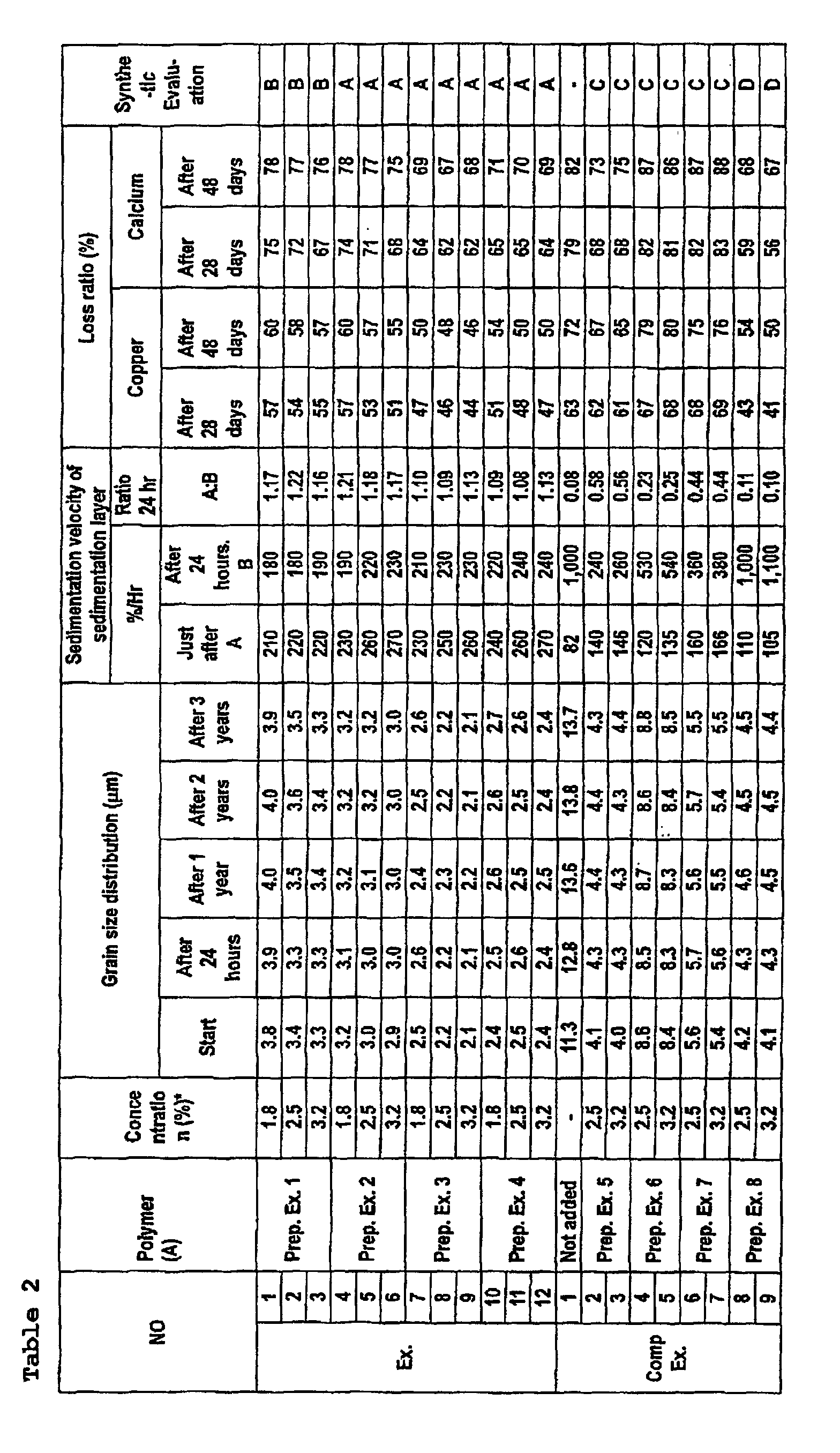
- the resulting Bordeaux mixture was diluted 25-fold and then provided as a Bordeaux mixture for test use. The results are shown in Table 2.
- Example 2 Bordeaux mixtures were prepared by adding each of the polymers (A) obtained in Preparation Examples 1 to 8. The concentration of the polymer was adjusted as shown in Table 2 in view of the total amount of copper sulfate and quicklime. The results are shown in Table 2.
- a copper sulfate solution was prepared by dissolving 150 parts of copper sulfate (CuSO 4 ⁇ 5H 2 O) in 350 parts by water, while a mother liquid of cream of lime was prepared by dissolving and dispersing 150 parts of quicklime (calcium oxide) in 350 parts of water under stirring.
- the copper sulfate solution was added dropwise to the mother liquid of cream of lime, whereby a crude Bordeaux solution having a Bordeaux mixture concentration of about 30% was prepared.
- the resulting crude Bordeaux solution was ground at 30 rpm for 1 hour by a wet grinder magnetic ball mill (product of Asada Tekko K.K., capacity: 3 L, filled with 30 magnetic balls having a diameter of 25 mm), whereby a Bordeaux mixture was prepared.
- the resulting Bordeaux mixture was diluted 25-fold and then provided as a Bordeaux mixture for test use. The results are shown in Table 2.
- the grain size of the Bordeaux mixture was measured by a measuring device just after preparation of the Bordeaux mixture for test use, after 24 hours, after one year and after 3 years. With regards to the samples other than that just after preparation, measurement was conducted by storing each mixture in a storing chamber having a temperature of 0 to 35°C, not permitting freezing in winter, and being free from direct sunlight, periodically checking by sample, and stirring the sample in a stirrer for about 5 minutes just before measurement.
- Microtrac® product of NIKKISO Co., Ltd.
- the concentration of sedimentation layer was measured in the following manner.
- the Bordeaux mixture for test use just after preparation was measured as was, while that after an elapsed time of 24 hours was provided for the measurement after stirring for about 5 minutes in a stirrer just before measurement, quickly transferring the mixture to a 100-mL measuring cylinder with ground-in stopper to fill up to the scale of 100 ml, sealing the cylinder with the stopper, agitating the mixture vigorously ten times and then allowing it to stand.
- a sedimentation ratio (%) the scale of the height of the sedimentation layer in the measuring flask was visually read at intervals of 5 minutes from just after preparation until 30 minutes after preparation and then, at intervals of 10 minutes until 60 minutes.
- the sedimentation velocity was calculated as a sedimentation ratio of sedimentation layer per hour. This sedimentation velocity of sedimentation layer was calculated by dividing a changing ratio (determined from the differentiation curve of the sedimentation ratio of sedimentation layer - time) of the sedimentation ratio (%) per unit time (min) from just after preparation until it shows the maximum value by this elapsed time. The three significant digit of the quotient was rounded to two significant digit.
- the relationship between the time and sedimentation ratio of the Bordeaux mixture prepared in Example 5 as shown in Table 2 is as follows: Time (minute) Sedimentation ratio (%) 0 0 5 20 10 43 15 64 20 74 25 79 30 81 40 84 50 85 60 86
- the changing ratio of the sedimentation ratio of sedimentation layer became smaller after an elapsed time of 10 minutes so that the gradient until 10 minutes was extrapolated as a curve of primary degree, whereby the sedimentation velocity just after preparation was determined as 260%/h.
- the loss ratio was determined by spraying the Bordeaux mixture to oranges covered with a plastic greenhouse only to protect them from rain and measuring the concentrations of copper and calcium before and after time elapse, especially the concentration of copper ion.
- the test was conducted in Hojo city/Ehime Prefecture for 48 days from March 16, 1997.
- the Bordeaux mixture was sprayed by a manual sprayer to give 500 L per 10 are. Just before and just after spraying, no water was sprayed to the trees. On and after Day 7 after spraying, water was sprayed by a sprinkler at about 30 mm/week on the assumption of the natural rainfall. The amount of rain fall estimated was 180 mm.
- Extraction of calcium ion and copper ion was effected in the following manner: 100 leaves taken at random from each test plot were charged in a beaker, to which deionized water was added in an amount to dip them sufficiently therein. After stirring, they are allowed to stand all day and night. These leaves are transferred, one by one, to another beaker by tweezers. At this time, by using the other tweezers, deionized water was sprayed to the surface of each of the leaves until it was visually confirmed that nothing adhered to the surface. The deionized water used for washing is secured.
- the Bordeaux mixtures added with the additive of the present invention are each stable in the grain size of the Bordeaux grains ranging from 2 to 4 ⁇ m. It is not only excellent in stability after passage of time but also superior in a loss ratio of a copper ion as an active component to that of Comparative Example. Thus, these Bordeaux mixtures are well balanced in these properties.
- Comparative Example 1 A ratio of the sedimentation velocity of sedimentation layer just after preparation to that after 24 hours is 0,08, which is markedly lower than 0.6, the lower limit. From Table 2, it has been found that the grain size exceeds 10 ⁇ m, suggesting inferior stability of Bordeaux granules. The loss ratio of copper ion after 48 days is 72%, exceeding 70%. Comparative Examples 2 to 7: The HLB of the monomer (a) contained in the polymer (A) constituting the Bordeaux mixtures of these Examples is 7.5 to 10.7. It is excessively large, exceeding the upper limit 7.0.
- the HLB of the polymer (A) itself is 8.1 to 8.8, also exceeding the upper limit, 8.0.
- a ratio of the sedimentation velocity of sedimentation layer just after preparation to that after 24 hours is therefore 0.23 to 0.58, below the lower limit of 0.6.
- the loss ratio of copper ion after 48 days is 65 to 80%, exceeding the upper limit 60%.
- Comparative Examples 8 to 9 The HLB of the monomer (a) contained in the polymer constituting the Bordeaux mixture of each of these Example is -2.9, below the lower limit of 3.0.
- the HLB of the polymer (A) itself is 4.2, also below the lower limit of 6.0.
- a ratio of the sedimentation velocity of sedimentation layer just after preparation to that after 24 hours is therefore 0.10 to 0.11, below the lower limit of 0.6
- the additive for the Bordeaux mixture composition according to the present invention is adjusted to have an HLB of 6.0 to 8.0 by incorporating, as an essential component, a monomer (a) having an HLB of 3.0 to 7.0 in the polymer (A).
- Addition of this additive to a Bordeaux mixture makes it possible to maintain a difference between a sedimentation velocity of sedimentation layer just after preparation and that after 24 hours at 0.6 to 1.5, leading to an improvement in the storage stability of the Bordeaux mixture.
- the Bordeaux mixture can therefore be kept under good conditions even for 3 years or more.
- excellent dispersion stability enables spraying and spreading, at a uniform copper ion concentration, of the Bordeaux mixture to a substance to be sprayed. Even to the agricultural crops which are sensitive to the calcium or copper ion concentration, it can be sprayed at a concentration not causing much side effects.
- expansion of its application fields can be expected from its excellent visibility after spraying.
Landscapes
- Chemical & Material Sciences (AREA)
- Health & Medical Sciences (AREA)
- Chemical Kinetics & Catalysis (AREA)
- Medicinal Chemistry (AREA)
- Polymers & Plastics (AREA)
- Organic Chemistry (AREA)
- Life Sciences & Earth Sciences (AREA)
- General Health & Medical Sciences (AREA)
- Dentistry (AREA)
- Pest Control & Pesticides (AREA)
- Plant Pathology (AREA)
- Engineering & Computer Science (AREA)
- Agronomy & Crop Science (AREA)
- Wood Science & Technology (AREA)
- Zoology (AREA)
- Environmental Sciences (AREA)
- Inorganic Chemistry (AREA)
- Toxicology (AREA)
- Agricultural Chemicals And Associated Chemicals (AREA)
Abstract
Description
- Lipophilic groups:
- CH3, CH2, CH: each, -0.475
(CH(CH3))CH2O) : -0.15 - Hydrophilio groups:
- (CH2CH2O): + 3.3,
COO: +2.4,
COOH: +2.1,
OH: +1.9.

| Time (minute) | Sedimentation ratio (%) |
| 0 | 0 |
| 5 | 20 |
| 10 | 43 |
| 15 | 64 |
| 20 | 74 |
| 25 | 79 |
| 30 | 81 |
| 40 | 84 |
| 50 | 85 |
| 60 | 86 |
| Time (minute) | Sedimentation ratio (%) |
| 0 | 0 |
| 5 | 84 |
| 10 | 89 |
| 15 | 90 |
| 20 | 91 |
| 25 | 91 |
| 30 | 91 |
| 40 | 91 |
| 50 | 91 |
| 60 | 91 |

Claims (6)
- An additive for a Bordeaux mixture, which comprises a polymer (A) having a molecular weight of 5,000 to 80,000 obtained by copolymerizing, at a molar ratio of 1:1 to 1:9.5,
a monomer (a) having a HLB value of 3.0 to 7.0 and represented by the following formula [I]:wherein R1 and R2 each represents a hydrogen atom or a methyl group; m stands for 0 to 2; R3O represents an oxyalkylene group having 3 to 18 carbon atoms or a mixture of at least two oxyalkylene groups each having 3 to 18 carbon atoms; with the proviso that in case of the mixture, they may be added in a block form, in a random form, or a combination thereof; n and p stand for an average number of moles of the oxyethylene group added and an average number of moles of the oxyalkylene group added, respectively; n stands for 1 to 200; p stands for 0 to 200, a sum of n and p is 1 to 250; and R4 represents a hydrocarbon group having 1 to 40 carbon atoms,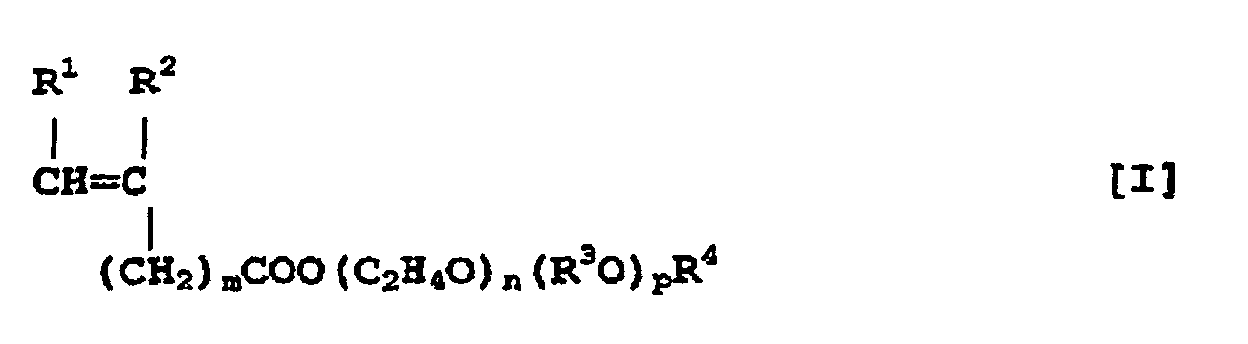
and a monomer (b) represented by the following formula [II]:wherein R5, R6 and R7 each represents a hydrogen atom, a methyl group or a (CH2)qCOOX group; X represents a hydrogen atom, a monovalent metal, a divalent metal, an ammonium group or an organoammonium group; q stands for 0 to 2, and when there exist two COOX groups, they may form an anhydride.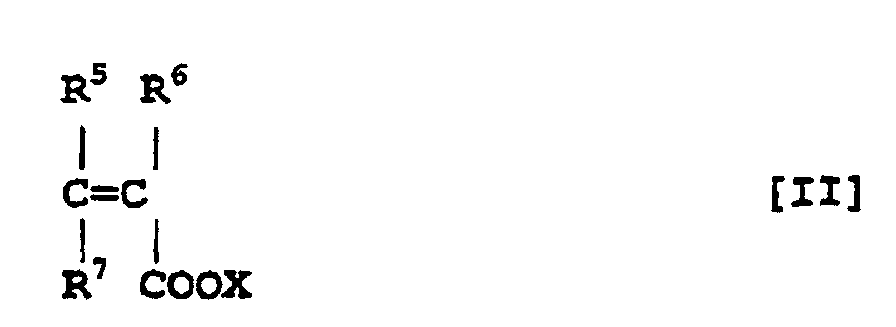
- The additive for a Bordeaux mixture according to claim 1, wherein a HLB value of the polymer (A) is 6.0 to 8.0.
- A Bordeaux mixture comprising the additive according to claim 1 or 2.
- The Bordeaux mixture according to claim 3, wherein a ratio of a sedimentation velocity of a sedimentation layer that is just after a preparation of the Bordeaux mixture to a sedimentation layer that is 24 hours after the preparation is 0.6 to 1.5.
- The Bordeaux mixture according to claim 3, wherein a loss ratio of copper ions from a sprayed product 48 days after a spraying of the Bordeaux mixture does not exceed 70%.
- The Bordeaux mixture according to claim 4, wherein a loss ratio of copper ions from a sprayed product 48 days after a spraying of the Bordeaux mixture does not exceed 70%.
Applications Claiming Priority (3)
| Application Number | Priority Date | Filing Date | Title |
|---|---|---|---|
| JP2000129369 | 2000-04-28 | ||
| JP2000129369 | 2000-04-28 | ||
| PCT/JP2001/003739 WO2001082695A1 (en) | 2000-04-28 | 2001-04-27 | Additive for bordeaux mixture and bordeaux mixture |
Publications (3)
| Publication Number | Publication Date |
|---|---|
| EP1277402A1 true EP1277402A1 (en) | 2003-01-22 |
| EP1277402A4 EP1277402A4 (en) | 2006-07-19 |
| EP1277402B1 EP1277402B1 (en) | 2008-04-02 |
Family
ID=18638658
Family Applications (1)
| Application Number | Title | Priority Date | Filing Date |
|---|---|---|---|
| EP01926064A Expired - Lifetime EP1277402B1 (en) | 2000-04-28 | 2001-04-27 | Additive for bordeaux mixture and bordeaux mixture |
Country Status (7)
| Country | Link |
|---|---|
| EP (1) | EP1277402B1 (en) |
| KR (1) | KR100561330B1 (en) |
| CN (1) | CN1264402C (en) |
| DE (1) | DE60133456T2 (en) |
| ES (1) | ES2302730T3 (en) |
| PT (1) | PT1277402E (en) |
| WO (1) | WO2001082695A1 (en) |
Families Citing this family (1)
| Publication number | Priority date | Publication date | Assignee | Title |
|---|---|---|---|---|
| KR101077303B1 (en) * | 2009-05-06 | 2011-10-26 | 삼성전기주식회사 | Composition for forming substrate, and prepreg and substrate using the same |
Family Cites Families (6)
| Publication number | Priority date | Publication date | Assignee | Title |
|---|---|---|---|---|
| JPS5352622A (en) * | 1976-10-22 | 1978-05-13 | Meiji Seika Kaisha Ltd | Composition for preparation of bordeaux mixture |
| US4663364A (en) * | 1984-09-05 | 1987-05-05 | Kao Corporation | Biocidal fine powder, its manufacturing method and a suspension for agricultural use containing the above powder |
| JPH02279611A (en) * | 1989-04-20 | 1990-11-15 | Nippon Oil & Fats Co Ltd | Preparation of bordeaux mixture |
| JPH02279610A (en) * | 1989-04-20 | 1990-11-15 | Nippon Oil & Fats Co Ltd | Dispersing agent for bordeaux mixture |
| FR2668031B1 (en) * | 1990-10-19 | 1997-01-31 | Nippon Oils & Fats Co Ltd | BORDELAIS BOUILLIES AND THEIR PREPARATION PROCESS. |
| JPH04198102A (en) * | 1990-11-28 | 1992-07-17 | Nippon Oil & Fats Co Ltd | Dispersant for bordeaux mixture |
-
2001
- 2001-04-27 ES ES01926064T patent/ES2302730T3/en not_active Expired - Lifetime
- 2001-04-27 CN CNB018086837A patent/CN1264402C/en not_active Expired - Lifetime
- 2001-04-27 KR KR1020027014325A patent/KR100561330B1/en not_active Expired - Lifetime
- 2001-04-27 WO PCT/JP2001/003739 patent/WO2001082695A1/en not_active Ceased
- 2001-04-27 DE DE60133456T patent/DE60133456T2/en not_active Expired - Lifetime
- 2001-04-27 EP EP01926064A patent/EP1277402B1/en not_active Expired - Lifetime
- 2001-04-27 PT PT01926064T patent/PT1277402E/en unknown
Also Published As
| Publication number | Publication date |
|---|---|
| PT1277402E (en) | 2008-05-28 |
| WO2001082695A1 (en) | 2001-11-08 |
| DE60133456D1 (en) | 2008-05-15 |
| CN1426274A (en) | 2003-06-25 |
| KR100561330B1 (en) | 2006-03-16 |
| EP1277402B1 (en) | 2008-04-02 |
| ES2302730T3 (en) | 2008-08-01 |
| EP1277402A4 (en) | 2006-07-19 |
| DE60133456T2 (en) | 2009-05-07 |
| KR20030010609A (en) | 2003-02-05 |
| CN1264402C (en) | 2006-07-19 |
Similar Documents
| Publication | Publication Date | Title |
|---|---|---|
| CA1307437C (en) | Detergents containing water-soluble copolymers containing as copolymerized units monomers having two or more ethylenically unsaturated double bonds | |
| ES2301055T3 (en) | METHOD FOR THE PRODUCTION OF POLY MONOMETACRYLATES C2-C4 ALQUILENGLICOL. | |
| EP2964609B1 (en) | Anionic surfactant compositions and use thereof | |
| JP2012041341A (en) | Dispersant and method of producing the same | |
| CN105263322B (en) | Agrochemical composition water soluble polymer | |
| CN114631526B (en) | A kind of auxiliary agent for improving the rain erosion resistance of mancozeb wettable powder and preparation method thereof | |
| CA1333737C (en) | Water-soluble copolymers and their preparation | |
| EP1277402B1 (en) | Additive for bordeaux mixture and bordeaux mixture | |
| US4952655A (en) | Water-soluble copolymers, their preparation and their use | |
| WO2012105239A1 (en) | Hydraulic material dispersing agent and hydraulic material composition | |
| US9187372B2 (en) | Dispersing agent for solid suspensions | |
| US4914172A (en) | Water-soluble copolymers and their preparation | |
| US10030088B2 (en) | Reactive monomers as comonomers for the production of polymers | |
| JP4841056B2 (en) | Bordeaux liquid additive and Bordeaux liquid | |
| EP0290807A2 (en) | Hydrosoluble copolymers, process for their preparation and their use | |
| US4897458A (en) | Water-soluble copolymers and their preparation | |
| US9109054B2 (en) | Process for emulsion polymerization | |
| EP2440041A1 (en) | Suspension composition and method of preparing the same | |
| JP2022094395A (en) | Agricultural chemical additives and pesticide compositions using them | |
| JP2015085220A (en) | Granulation aid | |
| JPS6268857A (en) | Dispersant for inorganic pigment | |
| JPS63210108A (en) | Manufacturing method of super absorbent polymer |
Legal Events
| Date | Code | Title | Description |
|---|---|---|---|
| PUAI | Public reference made under article 153(3) epc to a published international application that has entered the european phase |
Free format text: ORIGINAL CODE: 0009012 |
|
| 17P | Request for examination filed |
Effective date: 20021028 |
|
| AK | Designated contracting states |
Kind code of ref document: A1 Designated state(s): AT BE CH CY DE DK ES FI FR GB GR IE IT LI LU MC NL PT SE TR |
|
| RBV | Designated contracting states (corrected) |
Designated state(s): AT BE CH CY DE ES FR IT LI PT |
|
| A4 | Supplementary search report drawn up and despatched |
Effective date: 20060621 |
|
| GRAP | Despatch of communication of intention to grant a patent |
Free format text: ORIGINAL CODE: EPIDOSNIGR1 |
|
| RBV | Designated contracting states (corrected) |
Designated state(s): DE ES FR IT PT |
|
| GRAS | Grant fee paid |
Free format text: ORIGINAL CODE: EPIDOSNIGR3 |
|
| GRAA | (expected) grant |
Free format text: ORIGINAL CODE: 0009210 |
|
| RAP1 | Party data changed (applicant data changed or rights of an application transferred) |
Owner name: INOUE SEKKAI KOGYO KABUSHIKI KAISHA Owner name: NOF CORPORATION |
|
| AK | Designated contracting states |
Kind code of ref document: B1 Designated state(s): DE ES FR IT PT |
|
| REF | Corresponds to: |
Ref document number: 60133456 Country of ref document: DE Date of ref document: 20080515 Kind code of ref document: P |
|
| REG | Reference to a national code |
Ref country code: PT Ref legal event code: SC4A Free format text: AVAILABILITY OF NATIONAL TRANSLATION Effective date: 20080516 |
|
| REG | Reference to a national code |
Ref country code: ES Ref legal event code: FG2A Ref document number: 2302730 Country of ref document: ES Kind code of ref document: T3 |
|
| ET | Fr: translation filed | ||
| PLBE | No opposition filed within time limit |
Free format text: ORIGINAL CODE: 0009261 |
|
| STAA | Information on the status of an ep patent application or granted ep patent |
Free format text: STATUS: NO OPPOSITION FILED WITHIN TIME LIMIT |
|
| 26N | No opposition filed |
Effective date: 20090106 |
|
| REG | Reference to a national code |
Ref country code: FR Ref legal event code: PLFP Year of fee payment: 16 |
|
| REG | Reference to a national code |
Ref country code: FR Ref legal event code: PLFP Year of fee payment: 17 |
|
| REG | Reference to a national code |
Ref country code: FR Ref legal event code: PLFP Year of fee payment: 18 |
|
| PGFP | Annual fee paid to national office [announced via postgrant information from national office to epo] |
Ref country code: PT Payment date: 20200227 Year of fee payment: 20 |
|
| PGFP | Annual fee paid to national office [announced via postgrant information from national office to epo] |
Ref country code: FR Payment date: 20200420 Year of fee payment: 20 Ref country code: DE Payment date: 20200420 Year of fee payment: 20 Ref country code: ES Payment date: 20200504 Year of fee payment: 20 |
|
| PGFP | Annual fee paid to national office [announced via postgrant information from national office to epo] |
Ref country code: IT Payment date: 20200428 Year of fee payment: 20 |
|
| REG | Reference to a national code |
Ref country code: DE Ref legal event code: R071 Ref document number: 60133456 Country of ref document: DE |
|
| PG25 | Lapsed in a contracting state [announced via postgrant information from national office to epo] |
Ref country code: PT Free format text: LAPSE BECAUSE OF EXPIRATION OF PROTECTION Effective date: 20210505 |
|
| REG | Reference to a national code |
Ref country code: ES Ref legal event code: FD2A Effective date: 20210803 |
|
| PG25 | Lapsed in a contracting state [announced via postgrant information from national office to epo] |
Ref country code: ES Free format text: LAPSE BECAUSE OF EXPIRATION OF PROTECTION Effective date: 20210428 |