EP1275831A1 - Direct fuel injection-type spark-ignition internal combustion engine - Google Patents
Direct fuel injection-type spark-ignition internal combustion engine Download PDFInfo
- Publication number
- EP1275831A1 EP1275831A1 EP02023202A EP02023202A EP1275831A1 EP 1275831 A1 EP1275831 A1 EP 1275831A1 EP 02023202 A EP02023202 A EP 02023202A EP 02023202 A EP02023202 A EP 02023202A EP 1275831 A1 EP1275831 A1 EP 1275831A1
- Authority
- EP
- European Patent Office
- Prior art keywords
- fuel
- spark plug
- side wall
- fuel injection
- cavity
- Prior art date
- Legal status (The legal status is an assumption and is not a legal conclusion. Google has not performed a legal analysis and makes no representation as to the accuracy of the status listed.)
- Granted
Links
Images

Classifications
-
- F—MECHANICAL ENGINEERING; LIGHTING; HEATING; WEAPONS; BLASTING
- F02—COMBUSTION ENGINES; HOT-GAS OR COMBUSTION-PRODUCT ENGINE PLANTS
- F02B—INTERNAL-COMBUSTION PISTON ENGINES; COMBUSTION ENGINES IN GENERAL
- F02B17/00—Engines characterised by means for effecting stratification of charge in cylinders
- F02B17/005—Engines characterised by means for effecting stratification of charge in cylinders having direct injection in the combustion chamber
-
- F—MECHANICAL ENGINEERING; LIGHTING; HEATING; WEAPONS; BLASTING
- F02—COMBUSTION ENGINES; HOT-GAS OR COMBUSTION-PRODUCT ENGINE PLANTS
- F02B—INTERNAL-COMBUSTION PISTON ENGINES; COMBUSTION ENGINES IN GENERAL
- F02B23/00—Other engines characterised by special shape or construction of combustion chambers to improve operation
- F02B23/08—Other engines characterised by special shape or construction of combustion chambers to improve operation with positive ignition
- F02B23/10—Other engines characterised by special shape or construction of combustion chambers to improve operation with positive ignition with separate admission of air and fuel into cylinder
- F02B23/104—Other engines characterised by special shape or construction of combustion chambers to improve operation with positive ignition with separate admission of air and fuel into cylinder the injector being placed on a side position of the cylinder
-
- F—MECHANICAL ENGINEERING; LIGHTING; HEATING; WEAPONS; BLASTING
- F02—COMBUSTION ENGINES; HOT-GAS OR COMBUSTION-PRODUCT ENGINE PLANTS
- F02B—INTERNAL-COMBUSTION PISTON ENGINES; COMBUSTION ENGINES IN GENERAL
- F02B75/00—Other engines
- F02B75/12—Other methods of operation
- F02B2075/125—Direct injection in the combustion chamber for spark ignition engines, i.e. not in pre-combustion chamber
-
- F—MECHANICAL ENGINEERING; LIGHTING; HEATING; WEAPONS; BLASTING
- F02—COMBUSTION ENGINES; HOT-GAS OR COMBUSTION-PRODUCT ENGINE PLANTS
- F02F—CYLINDERS, PISTONS OR CASINGS, FOR COMBUSTION ENGINES; ARRANGEMENTS OF SEALINGS IN COMBUSTION ENGINES
- F02F1/00—Cylinders; Cylinder heads
- F02F1/24—Cylinder heads
- F02F2001/244—Arrangement of valve stems in cylinder heads
- F02F2001/245—Arrangement of valve stems in cylinder heads the valve stems being orientated at an angle with the cylinder axis
-
- F—MECHANICAL ENGINEERING; LIGHTING; HEATING; WEAPONS; BLASTING
- F02—COMBUSTION ENGINES; HOT-GAS OR COMBUSTION-PRODUCT ENGINE PLANTS
- F02F—CYLINDERS, PISTONS OR CASINGS, FOR COMBUSTION ENGINES; ARRANGEMENTS OF SEALINGS IN COMBUSTION ENGINES
- F02F3/00—Pistons
- F02F3/26—Pistons having combustion chamber in piston head
-
- Y—GENERAL TAGGING OF NEW TECHNOLOGICAL DEVELOPMENTS; GENERAL TAGGING OF CROSS-SECTIONAL TECHNOLOGIES SPANNING OVER SEVERAL SECTIONS OF THE IPC; TECHNICAL SUBJECTS COVERED BY FORMER USPC CROSS-REFERENCE ART COLLECTIONS [XRACs] AND DIGESTS
- Y02—TECHNOLOGIES OR APPLICATIONS FOR MITIGATION OR ADAPTATION AGAINST CLIMATE CHANGE
- Y02T—CLIMATE CHANGE MITIGATION TECHNOLOGIES RELATED TO TRANSPORTATION
- Y02T10/00—Road transport of goods or passengers
- Y02T10/10—Internal combustion engine [ICE] based vehicles
- Y02T10/12—Improving ICE efficiencies
Definitions
- the present invention relates to a direct fuel injection-type spark-ignition internal combustion engine.
- a stratified charge combustion produced by directly injecting fuel into a cylinder to form a mixture (hereinafter referred to as combustible mixture) that can be favorably ignited only in the vicinity of a spark plug, at the ignition timing, to burn a lean mixture in the cylinder as a whole.
- the fuel injection valve injects fuel in the latter half of the compression stroke. It is intended that the thus injected fuel proceeds into a concave combustion chamber formed in the top surface of the piston, is vaporized by robbing heat from the wall surfaces of the combustion chamber, is deflected by the shape of the combustion chamber toward the spark plug, and forms a combustible mixture near the spark plug.
- the spark plug is arranged nearly at the center in the upper part of the cylinder
- the fuel injection valve is arranged in the periphery in the upper part of the cylinder
- the combustion chamber extends from nearly the central portion of the top surface of the piston toward the periphery of the top surface of the piston on the side of the fuel injection valve, and includes the bottom wall, the spark plug side wall, and the fuel injection valve side wall.
- Fuel injected into the combustion chamber collides with the bottom wall of the combustion chamber, thereafter proceeds toward the spark plug side wall along the bottom wall, and thereafter is deflected toward the spark plug by the spark plug side wall.
- the distance for moving fuel along the wall surface of the combustion chamber must be lengthened so that the injected fuel stays in contact with the wall surface of the combustion chamber for an extended period.
- an amount of the combustible mixture formed near the spark plug via the spark plug side wall of the combustion chamber is decreased, and the engine output is not produced as intended.
- the mixture formed by fuel proceeding toward the fuel injection valve side wall of the combustion chamber cannot be favorably burned, and unburned fuel may be emitted in increased amounts.
- a direct fuel injection-type spark-ignition internal combustion engine comprising a spark plug, a fuel injection valve and a cavity formed in the top surface of the piston, said cavity having a bottom wall, a spark plug side wall and a fuel injection valve side wall, the fuel injection valve injecting fuel toward the bottom wall of the cavity in stratified charge combustion, the fuel mainly proceeding toward the spark plug side wall of the cavity along the bottom wall, being deflected by the spark plug side wall and being led to the vicinity of the spark plug, wherein the spark plug side wall of the cavity is provided with a deflecting portion inclined toward the inside of the cavity, a first part of the deflecting portion provided on both sides of the spark plug side wall functions to lead the fuel to the vicinity of the spark plug, and a second part of the deflecting portion provided on the central portion of the spark plug side wall functions to lead the fuel to a region neighboring the side of the fuel injection valve from the vicinity of the spark plug.
- another direct fuel injection-type spark-ignition internal combustion engine comprising a spark plug, a fuel injection valve and a cavity formed in the top surface of the piston, the cavity having a bottom wall, a spark plug side wall and a fuel injection valve side wall, the fuel injection valve injecting fuel toward the bottom wall of the cavity in the stratified charge combustion, the fuel mainly proceeding toward the spark plug side wall of the cavity along the bottom wall, being deflected by the spark plug side wall and being to the vicinity of the spark plug, wherein, at least at a position where the fuel comes into collision, the bottom wall of the cavity is so inclined as to be deeper on the side of the fuel injection valve side wall than on the side of the spark plug side wall, and an extended plane of the central portion of the fuel injection valve side wall intersects the upper wall of the cylinder at an obtuse angle on the side of the spark plug.
- Fig. 1 is a vertical sectional view schematically illustrating a main part of a direct fuel injection-type spark-ignition internal combustion engine according to a first embodiment of the present invention
- Fig. 2 is a plan view of a piston shown in Fig. 1.
- reference numeral 1 denotes an intake port and 2 denotes an exhaust port.
- the intake port 1 is communicated with the cylinder via an intake valve 3
- the exhaust port 2 is communicated with the cylinder via an exhaust valve 4.
- Reference numeral 5 denotes a piston having a cavity 8 formed in the top surface thereof
- 6 denotes a spark plug arranged in nearly the central upper part of the cylinder.
- a fuel injection valve 7 is arranged in the upper periphery of the cylinder in the intake port side and injects fuel in a flat fan shape having a relatively small thickness.
- the cavity 8 formed in the top surface of the piston extends from nearly the central portion in the top surface of the piston toward the periphery in the top surface of the piston on the fuel injection valve side, and includes the bottom wall 8a, the spark plug side wall 8b and the fuel injection valve side wall 8c.
- the spark plug 6 is positioned on the center line of the contained angle of the fan of the fan-shaped fuel injected from the fuel injection valve 7, and faces the inside of the spark plug side wall 8b of the cavity 8.
- the fuel injection valve 7 injects a required amount of fuel in the intake stroke thereby to form a uniform charge mixture in the cylinder at the ignition timing.
- a required amount of fuel is injected into the cavity 8 in the latter half of the compression stroke.
- Fuel injected into the cavity 8 collides with the bottom wall 8a of the cavity 8 so as to proceed toward the spark plug side wall 8b along the bottom wall 8a.
- Fuel proceeding on the bottom wall 8a radially spreads within the contained angle of the fan of fuel, and is gradually vaporized by favorably absorbing heat from a large area of the wall surface of the cavity.
- the spark plug side wall 8b of the cavity 8 has an arcuate shape in a plan view. Further, the distance from the center of the contained angle of the fan of fuel proceeding on the bottom wall 8a of the cavity to the spark plug side wall, is longer than the radius of the arcuate shape. Therefore, each part of fuel in the width direction arriving at the spark plug side wall 8b does not lose much speed, and proceeds along the spark plug side wall 8b.
- a velocity vector along the bottom wall 8a is converted into an upward velocity vector
- a velocity vector along the bottom wall 8a is converted into a resultant of an upward velocity vector and a velocity vector in the direction of the center line of the contained angle of the fan of fuel.
- the spark plug side wall 8b is provided with a deflecting portion 8d. Therefore, each part of the fuel proceeding along the spark plug side wall 8b is finally deflected toward the inside of the cavity 8.
- the injected fuel is all completely vaporized at the ignition timing. If fuel partly exists in the form of a liquid, it does not favorably burn and is discharged as unburned fuel.
- the distance for moving fuel along the wall surface of the cavity is lengthened and the injected fuel is permitted to stay contacted with the wall surface of the cavity for an extended period in order to favorably vaporize the fuel by utilizing the heat of the wall surface of the cavity.
- the fuel injection valve 7 injects fuel at a relatively large acute angle with respect to the horizontal plane, whereby the position where fuel collides the bottom wall 8a is moved away from the spark plug side wall 8b of the cavity 8, making it possible to lengthen the distance for moving fuel along the bottom wall 8a of the cavity 8.
- the fuel 10 when the fuel 10 is injected at a relatively large acute angle with respect to the horizontal plane, as shown in Figs. 1 and 2, the fuel that has come into collision with the bottom wall 8a may be diverted into a fuel 10a proceeding toward the spark plug side wall 8b along the bottom wall 8a and a fuel 10b proceeding toward the fuel injection valve side wall 8c along the bottom wall 8a.
- the fuel 10b that flows after being thus diverted forms a mixture 10b' on the side of the fuel injection valve 7 in an upper part of the cylinder as shown in Fig. 1.
- the amount of fuel 10a which proceeds toward the spark plug side wall 8b is the largest and the amount of fuel 10b which proceeds toward the fuel injection valve side wall 8c is the smallest.
- the fuel injection valve side wall 8c is the smallest.
- only a minimum required amount of fuel is injected in the present engine operating condition. Therefore, if a part of the injected fuel does not exist as a mixture near the spark plug 6, the engine output is not produced as intended.
- the mixture 10b' on the side of the fuel injection valve 7 in the upper part of the cylinder is separated from the combustible mixture 10a' near the spark plug, flame does not propagate well thereto and it can be emitted as unburned fuel.
- a first part 8d of the deflecting portion formed on both sides of the spark plug side wall 8b of the cavity 8 functions to lead the fuel proceeding along the spark plug side wall 8b to the vicinity of the spark plug 6
- a second part 8d' of the deflecting portion formed at the central portion of the spark plug side wall 8b functions to lead the fuel proceeding along the spark plug side wall 8b to the region neighboring the side of the fuel injection valve 7 from the vicinity of the spark plug.
- an angle of inclination of the second part 8d' of the deflecting portion at the central portion of the spark plug side wall 8b with respect to the bottom wall 8a is smaller than that of the first part 8d of the deflecting portion on both sides of the spark plug side wall 8b.
- the angle of inclination is an angle between a tangent line at the end thereof and the bottom wall 8a.
- the position of the second part 8d' of the deflecting portion at the central portion of the spark plug side wall 8b is lower than that of the first part 8d of the deflecting portion on both sides of the spark plug side wall 8b.
- both side parts of fuel 10a in the direction of width proceeding toward the spark plug side wall 8b along the bottom wall 8a are deflected by the first part 8d of the deflecting portion on both sides of the spark plug side wall 8b of the cavity 8 to form a combustible mixture 10a' near the spark plug 6
- the fuel proceeding toward the fuel injection valve side wall 8c forms a mixture 10b' in the upper part of the cylinder on the side of the fuel injection valve 7
- the central part of fuel 10a in the direction of width proceeding toward the spark plug side wall 8b along the bottom wall 8a is deflected by the second part 8d' of the deflecting portion at the central portion of the spark plug side wall 8b of the cavity 8 to form a mixture 10a" between the combustible mixture 10a' near the spark plug and the mixture 10b' in the upper part of the cylinder on the side of the fuel injection valve 7.
- the mixture 10b' in the upper part of the cylinder on the side of the fuel injection valve 7 and the combustible mixture 10a' near the spark plug merge together to form a mass of combustible mixture.
- all of the fuel injected into the cavity 8 can be reliably burned, making it possible to realize a favorable stratified charge combustion to produce the engine output as intended.
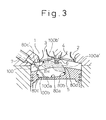
- Fig. 3 is a vertical sectional view schematically illustrating the direct fuel injection-type spark-ignition internal combustion engine according to a second embodiment of the present invention. Only the differences between the first embodiment and the present embodiment are explained below.
- a nearly uniform deflecting portion 80d is formed on the spark plug side wall 80b of the cavity 80, so that fuel 100a proceeding toward the spark plug side wall 80b is all led to the vicinity of the spark plug 6.
- the bottom wall 80a of the cavity 80 is so inclined as to be deeper on the side of the fuel injection valve side wall 80c than on the side of the spark plug side wall 80b. Further, the central extended plane 80c' of the fuel injection valve side wall 80c intersects the upper wall of the cylinder at an obtuse angle (TH) on the side of the spark plug 6.
- the fuel 100b vaporizes upon absorbing heat from the bottom wall 80a of the cavity 80 and from the fuel injection valve side wall 80c, and the thus formed mixture further rises along the extended plane of the central portion of the fuel injection valve side wall 80c.
- the inertial force of the mixture is dependent upon the inertial force of fuel toward the fuel injection valve side wall 80c, and thus it is relatively great.
- the mixture collides with the upper wall of the cylinder at the obtuse angle (TH) and easily moves toward the spark plug 6 along the upper wall of the cylinder due to the relatively large inertial force. Therefore, the mixture merges with the combustible mixture formed near the spark plug 6.
- TH obtuse angle
- an amount of fuel 100b which proceeds toward the fuel injection valve side wall 80c of the cavity 80 increases.
- the mixture formed by this fuel 100b can be reliably merged with the combustible mixture formed near the spark plug 6 due to the relatively large inertial force, without causing any problem.
- an amount of fuel 100a which proceeds toward the spark plug side wall 80b of the cavity 80 decreases and, hence, an inertial force thereof for proceeding toward the spark plug side wall 80b decreases. Accordingly, this fuel 100a proceeds at a decreased speed along the bottom wall 80a of the cavity 80 and along the spark plug side wall 80b and, hence, stays in contact with the wall surfaces of the cavity 80 for a correspondingly extended period. Thus, this fuel 100a is easily vaporized. This makes it possible to inject an increased amount of fuel in the latter half of the compression stroke, and to expand the region of stratified charge combustion to realize a low fuel consumption toward the high engine load side. In this case, an amount of fuel 100b which proceeds toward the fuel injection valve side wall 80c of the cavity 80 increases. However, the amount is small in terms of an absolute value. Hence, the fuel 100b can be reliably vaporized by the bottom wall 80a of the cavity 80 and by the fuel injection valve side wall 80c, without causing any problem in the stratified charge combustion.
- the amount of fuel injected is larger than that in the stratified charge combustion since the engine load is high.
- the fuel injection In order to inject this large amount of fuel during the intake stroke, the fuel injection must be started from the initial stage of the intake stroke.
- the injected fuel In the uniform charge combustion, the injected fuel is diverted in the collision with the bottom wall of the cavity so as to be widely dispersed in the cylinder to form a favorable uniform mixture at the ignition timing.
- the fuel injection valve 7 injects fuel in a fan shape having a relatively small thickness, however, this is not to limit the invention.
- the above-mentioned effects can be obtained even when fuel is injected in a conical shape or in a cylindrical shape and fuel is diverted due to the collision with the bottom wall of the cavity.
- the cavity in the top surface of the piston has a shape in which the bottom wall, with which fuel comes into collision, the spark plug side wall for leading fuel proceeding on the bottom wall to the vicinity of the spark plug, and the fuel injection valve side wall can be distinguished.
- This is not to limit the invention.
- a portion where fuel comes into collision can be intended as the bottom wall of the cavity
- a portion for leading fuel proceeding on the bottom wall toward the vicinity of the spark plug can be intended as the spark plug side wall of the cavity
- a portion facing the spark plug side wall can be intended as the fuel injection valve side wall of the cavity.
Landscapes
- Engineering & Computer Science (AREA)
- Chemical & Material Sciences (AREA)
- Combustion & Propulsion (AREA)
- Mechanical Engineering (AREA)
- General Engineering & Computer Science (AREA)
- Combustion Methods Of Internal-Combustion Engines (AREA)
- Ignition Installations For Internal Combustion Engines (AREA)
Abstract
Description
Claims (2)
- A direct fuel injection-type spark-ignition internal combustion engine comprising a spark plug, a fuel injection valve and a cavity formed on the top surface of the piston, said cavity having a bottom wall, a spark plug side wall and a fuel injection valve side wall, said fuel injection valve injecting fuel toward said bottom wall of said cavity in stratified charge combustion, said fuel mainly proceeding toward said spark plug side wall of said cavity along said bottom wall, being deflected by said spark plug side wall and being led to the vicinity of said spark plug, wherein at least at a position where the fuel comes into collision, said bottom wall of said cavity is so inclined as to be deeper on the side of said fuel injection valve side wall than on the side of said spark plug side wall, and an extended plane of the central portion of said fuel injection valve side wall intersects the upper wall of the cylinder at an obtuse angle on the side of said spark plug.
- A direct fuel injection-type spark-ignition internal combustion engine according to claim 1, wherein said fuel is injected at a relatively large acute angle with respect to the horizontal plane and after the collision with said bottom wall, a part of said fuel proceeds towards said fuel injection valve side wall along said bottom wall.
Applications Claiming Priority (3)
| Application Number | Priority Date | Filing Date | Title |
|---|---|---|---|
| JP8927899 | 1999-03-30 | ||
| JP08927899A JP3405261B2 (en) | 1999-03-30 | 1999-03-30 | In-cylinder injection spark ignition internal combustion engine |
| EP00106749A EP1041257A3 (en) | 1999-03-30 | 2000-03-29 | Direct fuel injection-type spark-ignition internal combustion engine |
Related Parent Applications (1)
| Application Number | Title | Priority Date | Filing Date |
|---|---|---|---|
| EP00106749.5 Division | 2000-03-29 |
Publications (2)
| Publication Number | Publication Date |
|---|---|
| EP1275831A1 true EP1275831A1 (en) | 2003-01-15 |
| EP1275831B1 EP1275831B1 (en) | 2004-09-22 |
Family
ID=13966268
Family Applications (2)
| Application Number | Title | Priority Date | Filing Date |
|---|---|---|---|
| EP00106749A Withdrawn EP1041257A3 (en) | 1999-03-30 | 2000-03-29 | Direct fuel injection-type spark-ignition internal combustion engine |
| EP02023202A Expired - Lifetime EP1275831B1 (en) | 1999-03-30 | 2000-03-29 | Direct fuel injection-type spark-ignition internal combustion engine |
Family Applications Before (1)
| Application Number | Title | Priority Date | Filing Date |
|---|---|---|---|
| EP00106749A Withdrawn EP1041257A3 (en) | 1999-03-30 | 2000-03-29 | Direct fuel injection-type spark-ignition internal combustion engine |
Country Status (4)
| Country | Link |
|---|---|
| US (1) | US6289870B1 (en) |
| EP (2) | EP1041257A3 (en) |
| JP (1) | JP3405261B2 (en) |
| DE (1) | DE60014181T2 (en) |
Cited By (3)
| Publication number | Priority date | Publication date | Assignee | Title |
|---|---|---|---|---|
| WO2005121523A1 (en) * | 2004-06-11 | 2005-12-22 | Toyota Jidosha Kabushiki Kaisha | In-cylinder injection, spark ignited internal combustion engine |
| CN105736123A (en) * | 2014-12-24 | 2016-07-06 | 三菱自动车工业株式会社 | Piston for inner-cylinder injection engine |
| US9757362B2 (en) | 2003-08-29 | 2017-09-12 | Veloxis Pharmaceuticals A/S | Modified release compositions comprising tacrolimus |
Families Citing this family (4)
| Publication number | Priority date | Publication date | Assignee | Title |
|---|---|---|---|---|
| JP2003065056A (en) * | 2001-08-24 | 2003-03-05 | Toyota Motor Corp | In-cylinder injection spark ignition internal combustion engine |
| US6588396B1 (en) * | 2002-02-01 | 2003-07-08 | General Motors Corporation | Spark ignition direct injection engine with oval fuel spray into oblong piston bowl |
| CN101208502A (en) * | 2005-06-27 | 2008-06-25 | 奥托诺瓦公司 | gas turbine |
| US7318406B2 (en) * | 2006-04-10 | 2008-01-15 | Ford Global Technologies Llc | Bowl-in-piston of a cylinder in a direct injection engine |
Citations (4)
| Publication number | Priority date | Publication date | Assignee | Title |
|---|---|---|---|---|
| DE1576005A1 (en) * | 1967-08-09 | 1970-04-09 | Daimler Benz Ag | Air-compressing injection internal combustion engine with external ignition |
| JPH09158736A (en) * | 1995-12-06 | 1997-06-17 | Toyota Central Res & Dev Lab Inc | Spark ignition combustion method and spark ignition internal combustion engine |
| JPH10212986A (en) * | 1997-01-30 | 1998-08-11 | Mazda Motor Corp | In-cylinder injection engine |
| JPH10339140A (en) * | 1997-06-04 | 1998-12-22 | Nissan Motor Co Ltd | In-cylinder direct injection internal combustion engine |
Family Cites Families (6)
| Publication number | Priority date | Publication date | Assignee | Title |
|---|---|---|---|---|
| US5259348A (en) | 1991-06-20 | 1993-11-09 | Toyota Jidosha Kabushiki Kaisha | Direct injection type engine |
| JP3163906B2 (en) * | 1994-07-27 | 2001-05-08 | トヨタ自動車株式会社 | In-cylinder injection spark ignition engine |
| US5775288A (en) | 1995-08-17 | 1998-07-07 | Yamaha Hatsudoki Kabushiki Kaisha | Combustion chamber |
| US5720253A (en) | 1995-09-11 | 1998-02-24 | Nissan Motor Co., Ltd. | Direct-injection type spark-ignition internal combustion engine |
| US6035823A (en) * | 1998-06-15 | 2000-03-14 | Toyota Jidosha Kabushiki Kaisha | Spark-ignition type engine |
| JP3401206B2 (en) | 1999-03-16 | 2003-04-28 | トヨタ自動車株式会社 | In-cylinder injection spark ignition internal combustion engine |
-
1999
- 1999-03-30 JP JP08927899A patent/JP3405261B2/en not_active Expired - Fee Related
-
2000
- 2000-03-27 US US09/535,963 patent/US6289870B1/en not_active Expired - Fee Related
- 2000-03-29 DE DE60014181T patent/DE60014181T2/en not_active Expired - Lifetime
- 2000-03-29 EP EP00106749A patent/EP1041257A3/en not_active Withdrawn
- 2000-03-29 EP EP02023202A patent/EP1275831B1/en not_active Expired - Lifetime
Patent Citations (4)
| Publication number | Priority date | Publication date | Assignee | Title |
|---|---|---|---|---|
| DE1576005A1 (en) * | 1967-08-09 | 1970-04-09 | Daimler Benz Ag | Air-compressing injection internal combustion engine with external ignition |
| JPH09158736A (en) * | 1995-12-06 | 1997-06-17 | Toyota Central Res & Dev Lab Inc | Spark ignition combustion method and spark ignition internal combustion engine |
| JPH10212986A (en) * | 1997-01-30 | 1998-08-11 | Mazda Motor Corp | In-cylinder injection engine |
| JPH10339140A (en) * | 1997-06-04 | 1998-12-22 | Nissan Motor Co Ltd | In-cylinder direct injection internal combustion engine |
Non-Patent Citations (3)
| Title |
|---|
| PATENT ABSTRACTS OF JAPAN vol. 1997, no. 10 31 October 1997 (1997-10-31) * |
| PATENT ABSTRACTS OF JAPAN vol. 1998, no. 13 30 November 1998 (1998-11-30) * |
| PATENT ABSTRACTS OF JAPAN vol. 1999, no. 03 31 March 1999 (1999-03-31) * |
Cited By (5)
| Publication number | Priority date | Publication date | Assignee | Title |
|---|---|---|---|---|
| US9757362B2 (en) | 2003-08-29 | 2017-09-12 | Veloxis Pharmaceuticals A/S | Modified release compositions comprising tacrolimus |
| US11077096B2 (en) | 2003-08-29 | 2021-08-03 | Veloxis Pharmaceuticals Inc. | Modified release compositions comprising tacrolimus |
| WO2005121523A1 (en) * | 2004-06-11 | 2005-12-22 | Toyota Jidosha Kabushiki Kaisha | In-cylinder injection, spark ignited internal combustion engine |
| US7055490B2 (en) | 2004-06-11 | 2006-06-06 | Toyota Jidosha Kabushiki Kaisha | In-cylinder injection, spark ignited internal combustion engine |
| CN105736123A (en) * | 2014-12-24 | 2016-07-06 | 三菱自动车工业株式会社 | Piston for inner-cylinder injection engine |
Also Published As
| Publication number | Publication date |
|---|---|
| US6289870B1 (en) | 2001-09-18 |
| EP1275831B1 (en) | 2004-09-22 |
| JP3405261B2 (en) | 2003-05-12 |
| EP1041257A3 (en) | 2001-08-29 |
| JP2000282873A (en) | 2000-10-10 |
| EP1041257A2 (en) | 2000-10-04 |
| DE60014181T2 (en) | 2006-02-23 |
| DE60014181D1 (en) | 2004-10-28 |
Similar Documents
| Publication | Publication Date | Title |
|---|---|---|
| EP0971108B1 (en) | Direct cylinder injection-type spark ignition internal combustion engine | |
| US6615789B2 (en) | Piston for internal combustion engines | |
| EP1026377B1 (en) | Direct-fuel-injection-type spark-ignition internal combustion engine | |
| EP0990779B1 (en) | Direct injection gasoline engines | |
| US6269789B1 (en) | Direct fuel injection-type spark-ignition internal combustion engine | |
| EP1043484B1 (en) | Direct fuel injection-type spark-ignition internal combustion engine | |
| US6263855B1 (en) | Direct fuel injection-type spark-ignition internal combustion engine | |
| EP1275831B1 (en) | Direct fuel injection-type spark-ignition internal combustion engine | |
| US6186113B1 (en) | Direct cylinder injection-type spark ignition internal combustion engine | |
| JP3633392B2 (en) | In-cylinder injection spark ignition internal combustion engine | |
| EP1036922B1 (en) | Direct fuel injection-type spark-ignition internal combustion engine | |
| JP3777660B2 (en) | In-cylinder direct injection spark ignition internal combustion engine | |
| JP3620514B2 (en) | In-cylinder injection spark ignition internal combustion engine | |
| JP3820688B2 (en) | In-cylinder direct injection spark ignition engine | |
| JP3690364B2 (en) | In-cylinder injection spark ignition internal combustion engine | |
| KR100303979B1 (en) | 3-valve gasoline engine | |
| JP3838346B2 (en) | In-cylinder injection spark ignition internal combustion engine | |
| JP3573138B2 (en) | In-cylinder injection spark ignition internal combustion engine | |
| JP2025151873A (en) | Engine combustion chamber structure |
Legal Events
| Date | Code | Title | Description |
|---|---|---|---|
| PUAI | Public reference made under article 153(3) epc to a published international application that has entered the european phase |
Free format text: ORIGINAL CODE: 0009012 |
|
| AC | Divisional application: reference to earlier application |
Ref document number: 1041257 Country of ref document: EP |
|
| AK | Designated contracting states |
Kind code of ref document: A1 Designated state(s): DE FR GB |
|
| 17P | Request for examination filed |
Effective date: 20030227 |
|
| 17Q | First examination report despatched |
Effective date: 20030605 |
|
| AKX | Designation fees paid |
Designated state(s): DE FR GB |
|
| GRAP | Despatch of communication of intention to grant a patent |
Free format text: ORIGINAL CODE: EPIDOSNIGR1 |
|
| GRAS | Grant fee paid |
Free format text: ORIGINAL CODE: EPIDOSNIGR3 |
|
| GRAA | (expected) grant |
Free format text: ORIGINAL CODE: 0009210 |
|
| AC | Divisional application: reference to earlier application |
Ref document number: 1041257 Country of ref document: EP Kind code of ref document: P |
|
| AK | Designated contracting states |
Kind code of ref document: B1 Designated state(s): DE FR GB |
|
| REG | Reference to a national code |
Ref country code: GB Ref legal event code: FG4D |
|
| REF | Corresponds to: |
Ref document number: 60014181 Country of ref document: DE Date of ref document: 20041028 Kind code of ref document: P |
|
| ET | Fr: translation filed | ||
| PLBE | No opposition filed within time limit |
Free format text: ORIGINAL CODE: 0009261 |
|
| STAA | Information on the status of an ep patent application or granted ep patent |
Free format text: STATUS: NO OPPOSITION FILED WITHIN TIME LIMIT |
|
| 26N | No opposition filed |
Effective date: 20050623 |
|
| REG | Reference to a national code |
Ref country code: GB Ref legal event code: 746 Effective date: 20081024 |
|
| PGFP | Annual fee paid to national office [announced via postgrant information from national office to epo] |
Ref country code: FR Payment date: 20110317 Year of fee payment: 12 |
|
| PGFP | Annual fee paid to national office [announced via postgrant information from national office to epo] |
Ref country code: DE Payment date: 20110323 Year of fee payment: 12 Ref country code: GB Payment date: 20110323 Year of fee payment: 12 |
|
| GBPC | Gb: european patent ceased through non-payment of renewal fee |
Effective date: 20120329 |
|
| REG | Reference to a national code |
Ref country code: FR Ref legal event code: ST Effective date: 20121130 |
|
| REG | Reference to a national code |
Ref country code: DE Ref legal event code: R119 Ref document number: 60014181 Country of ref document: DE Effective date: 20121002 |
|
| PG25 | Lapsed in a contracting state [announced via postgrant information from national office to epo] |
Ref country code: FR Free format text: LAPSE BECAUSE OF NON-PAYMENT OF DUE FEES Effective date: 20120402 Ref country code: GB Free format text: LAPSE BECAUSE OF NON-PAYMENT OF DUE FEES Effective date: 20120329 |
|
| PG25 | Lapsed in a contracting state [announced via postgrant information from national office to epo] |
Ref country code: DE Free format text: LAPSE BECAUSE OF NON-PAYMENT OF DUE FEES Effective date: 20121002 |